Validating Force Field Parameters with Normal Mode Analysis: A Comprehensive Guide for Computational Researchers
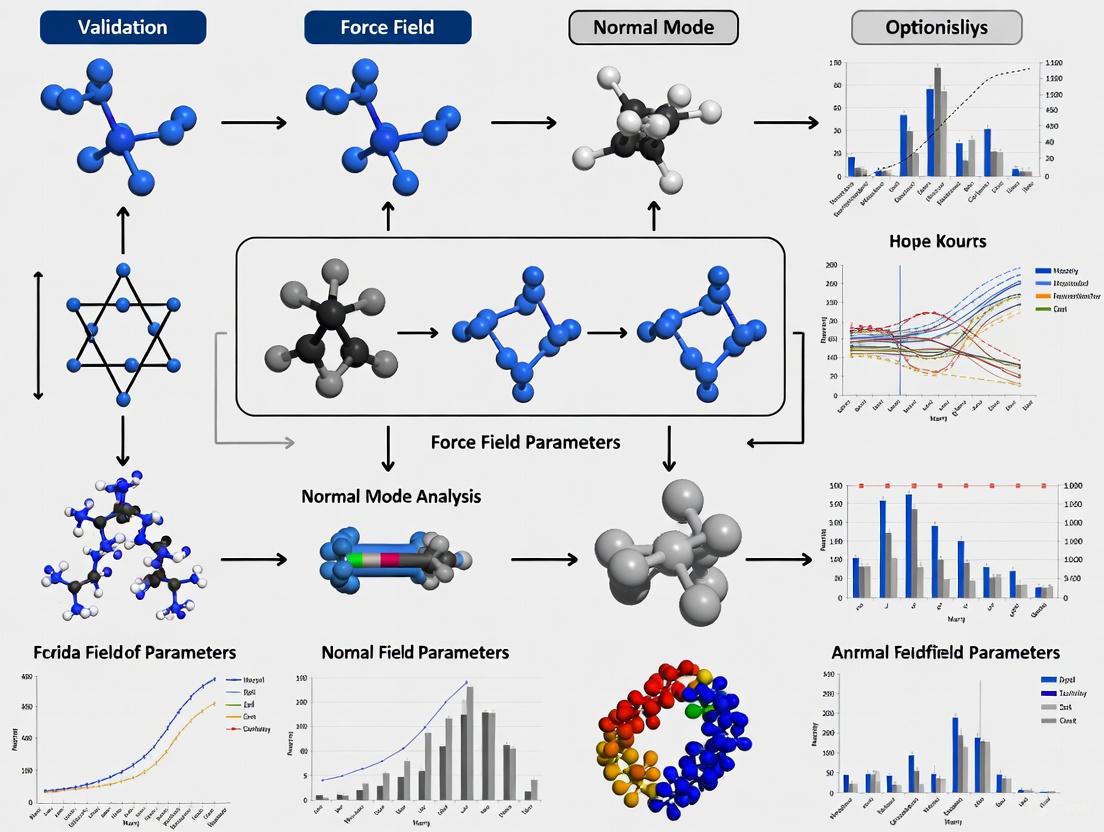
This article provides a comprehensive guide for researchers and drug development professionals on the critical role of Normal Mode Analysis (NMA) in validating molecular mechanics force field parameters.
Validating Force Field Parameters with Normal Mode Analysis: A Comprehensive Guide for Computational Researchers
Abstract
This article provides a comprehensive guide for researchers and drug development professionals on the critical role of Normal Mode Analysis (NMA) in validating molecular mechanics force field parameters. It covers the foundational principles connecting force field accuracy to vibrational spectra, outlines practical methodologies for performing NMA within popular simulation packages like GROMACS and CHARMM, and addresses common troubleshooting scenarios. By exploring both traditional and emerging machine-learning force fields, the article establishes NMA as a gold standard for parameter validation, ensuring the reliability of molecular dynamics simulations in biomedical research and drug discovery.
The Essential Link: Understanding How Normal Mode Analysis Validates Force Field Fundamentals
Normal Mode Analysis (NMA) is a computational technique that describes the collective, harmonic vibrations of a molecular system around a local energy minimum. It provides the vibrational frequencies and corresponding atomic displacements (normal modes) that characterize the intrinsic flexibility of a molecule. In the context of molecular dynamics (MD) simulations, NMA serves as a critical validation tool for assessing the quality of a force field—the mathematical function that defines the potential energy of a system and its dependence on the nuclear coordinates. A force field's parameters, particularly those governing bonded interactions (bonds, angles, dihedrals), directly determine the vibrational properties of a molecule. By comparing the normal modes and vibrational frequencies obtained from MD simulations using a specific force field against high-quality quantum mechanical (QM) calculations or experimental spectroscopic data, researchers can rigorously evaluate the force field's accuracy and the balance amongst its various bonded parameters [1]. This validation is vital because an imbalanced force field, even if it reproduces a molecule's equilibrium geometry, may fail to accurately model its dynamics, conformational landscape, and functional properties, ultimately undermining the reliability of the simulation [1].
Comparative Analysis of Force Field Validation via NMA
The table below summarizes how different types of force fields are validated using Normal Mode Analysis, highlighting their characteristic approaches and performance.
Table 1: Force Field Comparison Based on NMA Validation
| Force Field Type / Name | Parameter Assignment Method | Key Features for Validation | Reported NMA/Validation Performance |
|---|---|---|---|
| Classical MM (e.g., CHARMM, AMBER) | Look-up tables based on atom types [2] [3]. | Fixed functional forms; Parameters are transferable by atom type [4] [1]. | NMA validates parameter balance; Reproduces QM vibrational spectra for standard biomolecules [1]. |
| Machine-Learned MM (Grappa) | Graph neural network (GNN) predicts parameters from molecular graph [3]. | No hand-crafted features; High data efficiency; Same computational cost as classical MM [3]. | Accurately reproduces QM energies and forces for peptides and RNA; Shows good transferability [3]. |
| Machine-Learned MM (ByteFF) | Graph neural network (GNN) trained on a large, diverse QM dataset [4]. | Data-driven approach; Covers expansive drug-like chemical space [4]. | State-of-the-art accuracy in predicting relaxed geometries and conformational energies/forces [4]. |
| Machine-Learned MM (Espaloma) | Graph neural networks (GNNs) using expert-crafted chemical features [4] [3]. | End-to-end parameter prediction; Improves upon traditional MM accuracy [4]. | Outperformed by Grappa in terms of accuracy on small molecules, peptides, and RNA [3]. |
| Full Machine Learning Potentials (e.g., sGDML, EMFF) | Directly maps atomic structure to energies and forces [5] [6]. | No fixed functional form; Can achieve quantum-level accuracy [5] [6]. | High accuracy in reproducing global potential energy surfaces [6]; Can predict mechanical and chemical properties [5]. |
Experimental Protocols for NMA in Force Field Validation
A typical workflow for using NMA to validate force field parameters involves a direct comparison between properties derived from molecular mechanics (MM) and those from a quantum mechanical (QM) reference.
Protocol 1: Comparative Frequency and Mode Analysis
This protocol is a standard for validating the fundamental vibrational characteristics of a force field [1].
- Geometry Optimization: The molecular structure is first optimized to an energy minimum using both the target MM force field and the chosen QM method (e.g., DFT at the B3LYP-D3(BJ)/DZVP level) [4].
- Hessian Matrix Calculation: The second derivative (Hessian) matrix of the energy with respect to the nuclear coordinates is computed at the optimized geometry for both the MM and QM methods.
- Normal Mode Calculation: The Hessian matrix is diagonalized to obtain the normal mode frequencies and their corresponding atomic displacement vectors.
- Comparison and Validation: The vibrational frequencies from MM and QM are directly compared. A more detailed analysis involves comparing the Potential Energy Distribution (PED), which reveals how much each internal coordinate (bond stretch, angle bend, etc.) contributes to a given normal mode. This is vital for validating the balance among various bonded force constants in the force field [1].
Protocol 2: Differentiable Validation with Experimental Data
A more advanced protocol involves integrating experimental data directly into the training/validation loop, correcting for known inaccuracies in the QM reference data.
- Data Fusion: A machine learning potential is trained not only on QM data (energies, forces, virial stress) but also on experimental observables, such as temperature-dependent elastic constants and lattice parameters [7].
- Forward Simulation: The trained model is used to run MD simulations and compute experimental observables, such as vibrational spectra or mechanical properties.
- Gradient-Based Optimization: Methods like Differentiable Trajectory Reweighting (DiffTRe) are used to compute gradients of the simulation observables with respect to the model parameters, allowing for direct optimization of the force field to match experimental data [7].
- Validation on Out-of-Target Properties: The final model, now consistent with both QM and experiment, is validated against other properties not used in training (e.g., phonon spectra of different phases) to ensure generalizability [7].
Diagram 1: NMA Force Field Validation Workflow.
The Scientist's Toolkit: Essential Reagents and Software
The following table lists key software tools and computational "reagents" essential for conducting NMA and developing or validating force fields.
Table 2: Key Research Reagent Solutions for NMA and Force Field Development
| Tool / Resource Name | Type | Primary Function in NMA/FF Validation |
|---|---|---|
| FFParam-v2.0 [1] | Software Package | A comprehensive tool for CHARMM force field parameter optimization and validation; supports extraction of vibrational modes and Hessian matrices from QM output and their comparison with MM results. |
| Gaussian/Psi4 [1] | Quantum Chemistry Engine | Used to generate high-fidelity reference data, including optimized geometries, Hessian matrices, and vibrational frequencies for target molecules. |
| Grappa [3] | Machine-Learned Force Field | A graph-based neural network that predicts molecular mechanics parameters, providing state-of-the-art accuracy for simulating molecules and proteins. |
| ByteFF [4] | Machine-Learned Force Field | An Amber-compatible, data-driven force field for drug-like molecules, trained on a massive QM dataset for expansive chemical space coverage. |
| FHI-aims [8] | Quantum Chemistry Code | An ab initio code used for reference calculations; integrated with active learning frameworks like aims-PAX for generating training data for machine learning force fields. |
| sGDML [6] | Machine Learning Potential | Constructs accurate and data-efficient molecular force fields that can reconstruct global potential energy surfaces, useful for advanced MD and NMA. |
| CHARMM/OpenMM [1] [3] | Molecular Dynamics Engine | Simulation software used to perform energy calculations, geometry optimizations, and molecular dynamics with the force field under validation. |
| aims-PAX [8] | Active Learning Framework | An automated, open-source software package for performing active learning to build stable and accurate machine learning force fields for diverse systems. |
Normal Mode Analysis remains an indispensable component of the force field validation toolkit. It moves beyond static geometric properties to provide a dynamic benchmark for assessing the physical realism of a force field's parameter set. The emergence of sophisticated, data-driven machine-learned force fields like Grappa and ByteFF promises enhanced accuracy across broader regions of chemical space. However, rigorous validation through techniques like NMA and potential energy distribution analysis is, more than ever, critical to ensure these next-generation models faithfully capture the underlying physics of molecular systems, thereby boosting confidence in simulations for drug discovery and materials science [1] [3].
In the realm of molecular dynamics (MD) simulations, force fields serve as the fundamental architectural blueprint that defines the potential energy of a system of atoms or molecules. A force field is a computational model composed of a functional form and parameter sets used to calculate the potential energy of a system at the atomistic level, describing the forces between atoms within molecules or between molecules [9]. The accuracy of these simulations, which are pivotal for applications ranging from drug discovery to materials science, hinges entirely on the quality and precision of the underlying force field. The core energy terms—bonds, angles, and dihedrals—form the essential framework that describes molecular geometry and flexibility, while non-bonded terms capture intermolecular interactions.
Force fields are broadly categorized by their resolution and complexity. All-atom force fields provide parameters for every atom in a system, including hydrogen, while united-atom potentials treat hydrogen and carbon atoms in methyl groups and methylene bridges as single interaction centers for computational efficiency [9]. Coarse-grained potentials offer even cruder representations for simulating large macromolecular complexes over longer timescales [9]. Additionally, force fields are often classified into generations: Class I utilizes simple harmonic potentials for bonds and angles; Class II incorporates anharmonic cubic/quartic terms and cross-terms coupling adjacent internal coordinates; and Class III explicitly includes advanced effects like polarization and stereoelectronic influences [10].
This guide provides a comprehensive comparison of how modern biomolecular force fields handle the core parameters governing bonds, angles, and dihedrals, with a specific focus on their validation through normal mode analysis—a critical technique for ensuring parameter transferability and physical reliability.
Theoretical Foundation of Core Energy Terms
The total potential energy in a molecular mechanics force field is typically expressed as the sum of bonded and non-bonded interactions: ( E{\text{total}} = E{\text{bonded}} + E{\text{nonbonded}} ) [9] [10] [11]. The bonded component, ( E{\text{bonded}} ), is further decomposed into energy contributions from bonds, angles, and dihedrals: ( E{\text{bonded}} = E{\text{bond}} + E{\text{angle}} + E{\text{dihedral}} ) [9]. The following sections detail the mathematical formulation and physical significance of each term.
Table 1: Core Bonded Energy Functions in Molecular Force Fields
| Energy Term | Mathematical Formulation | Key Parameters | Physical Interpretation |
|---|---|---|---|
| Bond Stretching | ( E{\text{bond}} = \frac{1}{2} kb (r - r_0)^2 ) [9] [10] [12] | ( kb ): Force constant( r0 ): Equilibrium distance | Oscillation about an equilibrium bond length; penalizes deviation from ideal bond distance. |
| Angle Bending | ( E{\text{angle}} = \frac{1}{2} k\theta (\theta - \theta_0)^2 ) [9] [10] [12] | ( k\theta ): Force constant( \theta0 ): Equilibrium angle | Oscillation about an equilibrium bond angle; maintains molecular geometry. |
| Proper Dihedral | ( E{\text{dihedral}} = k\phi [1 + \cos(n\phi - \delta)] ) [10] [12] | ( k_\phi ): Force constant( n ): Periodicity( \delta ): Phase angle | Governs rotation around central bond; defines rotational energy barriers and conformations. |
| Improper Dihedral | ( E{\text{improper}} = \frac{1}{2} k\psi (\psi - \psi_0)^2 ) [10] [12] | ( k\psi ): Force constant( \psi0 ): Equilibrium angle | Enforces planarity in aromatic rings and conjugated systems; out-of-plane bending. |
The functional forms in Table 1 represent the most common implementations in Class I force fields like AMBER, CHARMM, and OPLS [10]. The bond and angle terms are typically modeled by simple harmonic (quadratic) potentials, which provide reasonable accuracy for simulations at moderate temperatures but do not allow for bond breaking [9]. A more realistic but computationally expensive alternative for bond stretching is the Morse potential [9]. Class II force fields (e.g., MMFF94, CFF) enhance these basic terms by adding anharmonic cubic and/or quartic terms, and crucially, by including cross-terms that describe the coupling between adjacent internal coordinates such as bonds and angles [10].
The following diagram illustrates the logical relationship between a molecule's structure, the core energy terms that describe its flexibility, and the subsequent validation process:
Diagram 1: From molecular structure to a validated force field. Core bonded energy terms are parameterized using QM data and validated against experimental data, with normal mode analysis serving as a key validation step.
Comparative Analysis of Modern Force Fields
Force Field Families and Their Characteristic Approaches
Different force field families have emerged from various research communities, each with distinct optimization philosophies and target applications. The following table systematically compares several prominent force fields, highlighting their treatment of core parameters and key innovations.
Table 2: Comparison of Force Field Families and Their Parameterization Strategies
| Force Field | Class | Bond/Angle Treatment | Dihedral Parameterization | Key Innovations & Applications |
|---|---|---|---|---|
| CHARMM [12] [1] | I (Additive)III (Drude) | Harmonic with Urey-Bradley terms for select angles [12]. | Extensive dihedral terms; CMAP correction for proteins [12]. | Polarizable Drude model; rigorous LJ optimization with noble gas scans; strong focus on biomolecules [1]. |
| AMBER/GAFF [13] [4] | I | Standard harmonic potentials [13]. | Modular dihedral parameterization; RESP charges for electrostatics [13] [4]. | Designed for biomolecular simulations; compatible with proteins, nucleic acids; extensible to new molecules (GAFF). |
| BLipidFF [13] | I (Specialized) | Harmonic potentials derived via QM for bacterial lipids [13]. | Torsions optimized via QM potential energy scans [13]. | Specialized for mycobacterial membrane lipids (e.g., PDIM, TDM); captures unique membrane rigidity and diffusion. |
| OPLS [4] | I | Harmonic potentials [4]. | Extremely large number of pre-defined torsion types (e.g., 146,669 in OPLS3e) [4]. | Focus on accurate liquid properties and conformational energies for drug-like molecules. |
| ByteFF [4] | I (Data-Driven) | GNN-predicted parameters trained on 2.4M QM geometries [4]. | GNN-predicted parameters trained on 3.2M torsion profiles [4]. | Machine learning approach for expansive chemical space coverage; Amber-compatible functional form. |
| OpenFF [4] | I | SMIRKS-based direct chemical environment perception [4]. | SMIRKS-based torsion parameters [4]. | Defines parameters via SMIRKS patterns for improved transferability and chemical accuracy. |
Performance Benchmarking: Accuracy Across Chemical Spaces
The true test of a force field lies in its ability to reproduce experimental observables and high-level quantum mechanical data. Recent studies provide quantitative performance comparisons.
BLipidFF for Membrane Lipids: When simulating α-mycolic acid bilayers, BLipidFF demonstrated superior performance over general force fields (GAFF, CGenFF, OPLS) by correctly capturing the high tail rigidity and lateral diffusion rates characteristic of mycobacterial outer membranes. The lateral diffusion coefficient predicted by BLipidFF showed excellent agreement with Fluorescence Recovery After Photobleaching (FRAP) experiments, a key biophysical validation [13].
ByteFF for Drug-like Molecules: In benchmarks against established force fields, ByteFF showed state-of-the-art performance in predicting relaxed molecular geometries, torsional energy profiles, and conformational energies and forces [4]. This demonstrates the potential of data-driven, machine-learning approaches to surpass the accuracy of traditional parametrization methods across expansive chemical spaces.
Class II vs. Class I for Polymers: A review on all-atom force fields for polymer systems indicated that Class II force fields are generally more convenient for predicting the thermomechanical properties of amorphous polymer systems compared to Class I force fields [2]. This advantage is attributed to their more sophisticated treatment of anharmonicity and coupling between internal coordinates.
Experimental Protocols for Parameterization and Validation
Quantum Mechanical Parameterization Workflow
The development of accurate force field parameters relies heavily on high-quality quantum mechanical (QM) data. The following diagram outlines a comprehensive QM-to-MM parameterization workflow, integrating protocols from multiple modern force field development efforts:
Diagram 2: Comprehensive QM-to-MM force field parameterization workflow. The process begins with target molecule selection and proceeds through systematic QM calculations to derive and validate all core parameters.
Key steps in this workflow include:
Target Data Generation: High-level QM calculations (e.g., at the B3LYP-D3(BJ)/DZVP level) are performed to generate target data, including optimized molecular geometries with analytical Hessian matrices, and torsional energy profiles [4]. For example, the ByteFF development utilized 2.4 million optimized molecular fragment geometries and 3.2 million torsion profiles [4].
Electrostatic Parameterization: Partial atomic charges are typically derived using the Restrained Electrostatic Potential (RESP) method [13] [4]. This involves fitting atomic charges to reproduce the QM-derived electrostatic potential around the molecule. For large, complex molecules like the mycobacterial lipid PDIM, a "divide-and-conquer" strategy is employed where the molecule is divided into manageable segments, charges are computed for each segment, and then integrated to yield charges for the complete molecule [13].
Bond and Angle Parameterization: Equilibrium values (r₀, θ₀) and force constants (kb, kθ) are optimized to reproduce QM-calculated vibrational frequencies and the Hessian matrix [1]. This ensures that the force field accurately captures the molecular vibrational spectrum and structural preferences.
Dihedral Parameter Optimization: Torsion parameters (k_φ, n, δ) are optimized to minimize the difference between QM and MM potential energy scans (PES) of rotation around dihedral angles [13] [4]. This is crucial for correctly representing conformational energy landscapes and barriers to rotation.
Validation Through Normal Mode Analysis
Normal mode analysis (NMA) provides a powerful validation method by comparing the vibrational characteristics between QM and MM representations. FFParam-v2.0 includes specialized functionality for this purpose:
Methodology: NMA involves diagonalizing the Hessian matrix (matrix of second derivatives of energy with respect to atomic coordinates) to obtain vibrational frequencies (eigenvalues) and the corresponding atomic displacement patterns (eigenvectors) for each normal mode [1].
Validation Protocol: The normal modes and their associated potential energy distribution (PED) are calculated from both QM and MM methods and compared [1]. The PED analysis decomposes each normal mode vibration into contributions from specific internal coordinates (bonds, angles, dihedrals), providing crucial insights into the balance among various bonded parameters.
Significance: Agreement between QM and MM normal modes indicates that the force field correctly captures the curvature of the potential energy surface around the energy minimum. Discrepancies can identify specific parameters that require refinement, such as overestimated angle force constants or underestimated torsional barriers [1]. This validation is particularly vital for ensuring the transferability of parameters to molecular environments beyond those used in the initial parameterization.
The force field development ecosystem comprises specialized software tools, databases, and computational resources that enable the parameterization and validation processes described throughout this guide.
Table 3: Essential Research Reagents and Computational Tools for Force Field Development
| Tool/Resource | Type | Primary Function | Key Features |
|---|---|---|---|
| FFParam-v2.0 [1] | Parameter Optimization Tool | Optimizes CHARMM additive and Drude polarizable FF parameters. | GUI and CLI interfaces; MCSA and least-square fitting; LJ optimization via noble gas scans; normal mode comparison. |
| ByteFF [4] | Data-Driven Force Field | Predicts MM parameters for drug-like molecules across expansive chemical space. | GNN model trained on 2.4M QM geometries; state-of-the-art torsion and geometry prediction; Amber-compatible. |
| Gaussian/Psi4 [1] | Quantum Chemistry Software | Generates QM target data for parameterization. | Geometry optimization; frequency calculation; electrostatic potential mapping; torsion scans. |
| CHARMM/OpenMM [1] | Molecular Dynamics Engines | Performs MM calculations and validation simulations. | Energy calculations; molecular dynamics simulations; normal mode analysis. |
| CGenFF Program [1] | Parameter Assignment Tool | Provides initial atom types and parameters for CHARMM. | Automated atom type assignment and parameter guessing for novel molecules. |
| BLipidFF [13] | Specialized Force Field | Simulates mycobacterial membrane lipids. | QM-derived parameters for complex lipids (PDIM, TDM, SL-1); validated against biophysical experiments. |
The continuing evolution of force field parameterization represents a convergence of rigorous physical modeling, expansive quantum chemical data, and innovative machine learning methodologies. Traditional approaches, exemplified by CHARMM's systematic optimization protocols and BLipidFF's targeted quantum mechanics derivations, provide physically grounded parameters with well-understood limitations. Meanwhile, emerging data-driven paradigms like ByteFF demonstrate the transformative potential of graph neural networks to predict accurate parameters across vast chemical spaces, addressing a critical bottleneck in computational drug discovery.
The validation of core parameters through normal mode analysis remains an indispensable step in ensuring force field reliability, particularly as applications expand into increasingly complex molecular systems. As force fields evolve toward explicitly polarizable formulations (Class III) and incorporate more sophisticated physical models, the fundamental bonded terms compared in this guide will continue to form the essential scaffold upon which these advanced capabilities are built. The ongoing integration of high-throughput quantum calculations, machine learning, and robust validation protocols promises to deliver the next generation of force fields with unprecedented accuracy and transferability, ultimately enhancing the predictive power of molecular simulations across chemistry, biology, and materials science.
The potential energy surface (PES) represents a foundational concept in computational chemistry, mapping the energy of a molecular system as a function of its nuclear coordinates. For a polyatomic molecule with N atoms, this surface exists in 3N dimensions, creating a complex landscape of hills, valleys, and passes that dictate molecular stability and reactivity. The connection between this multidimensional energy landscape and experimental observables, particularly vibrational spectra, provides a critical pathway for validating theoretical models. Within the context of force field development, normal mode analysis serves as an essential validation tool, ensuring that the mathematical representation of molecular interactions accurately reproduces quantum mechanical behavior. This guide examines the theoretical framework connecting PES features to vibrational frequencies and objectively compares computational methodologies employed by researchers to bridge this gap.
The harmonic approximation, which models molecular vibrations as simple harmonic oscillators, enables this connection by truncating the Taylor series expansion of the PES at the quadratic term. At a local minimum on the PES, the gradient terms vanish, and the Hessian matrix containing the second derivatives of the energy with respect to nuclear coordinates becomes the principal descriptor of vibrational behavior. Diagonalization of the mass-weighted Hessian yields both the vibrational frequencies as eigenvalues and the normal modes as eigenvectors, creating a direct mathematical link between the PES curvature and spectroscopic observables.
Theoretical Framework: From Potential Energy Surfaces to Vibrational Spectra
Mathematical Foundation of Molecular Vibrations
The theoretical connection between PES and vibrational frequencies begins with a Taylor expansion of the electronic energy around a reference geometry, typically a local minimum. For a polyatomic molecule, the potential energy V can be approximated as:
[V (gk) = V(0) + \sumk \left(\dfrac{\partial V}{\partial qk}\right) qk + \dfrac{1}{2} \sum{j,k} qj H{j,k} qk \, + \, ... ]
where V(0) represents the energy at the current geometry, ∂V/∂qₖ = gₖ is the gradient along coordinate qₖ, and Hⱼₖ = ∂²V/∂qⱼ∂qₖ is the Hessian matrix [14]. At a minimum on the PES, all gradient terms gₖ approach zero, simplifying the expression to the harmonic potential:
[V(qk) = V(0) + \dfrac{1}{2} \sum{j,k} qj H{j,k} q_k ]
The classical equations of motion derived from this potential energy function lead to a generalized eigenvalue problem:
[\omega^2 xj = \sumk H'{j,k} xk ]
where ω² represents the squared vibrational frequencies, xⱼ are mass-weighted coordinates, and H'ⱼₖ is the mass-weighted Hessian matrix with elements H'ⱼₖ = Hⱼₖ/√(mⱼmₖ) [14]. The solutions to this eigenvalue problem provide the normal mode frequencies and their corresponding atomic displacement patterns.
Computational Workflow for Normal Mode Analysis
The transformation from a potential energy surface to vibrational frequencies follows a systematic computational pathway implemented across quantum chemistry packages. Table 1 outlines the key steps in this procedure, with specific implementation details from Gaussian software noted where applicable.
Table 1: Computational Workflow for Normal Mode Analysis
| Step | Procedure | Implementation in Gaussian |
|---|---|---|
| Hessian Calculation | Compute second derivatives of energy with respect to Cartesian coordinates | Analytical (limited XC functionals) or numerical differentiation of gradients |
| Mass-Weighting | Transform Hessian to mass-weighted coordinates: H'ⱼₖ = Hⱼₖ/√(mⱼmₖ) | Automatic transformation using atomic masses |
| Translation-Rotation Removal | Project out 5 (linear) or 6 (non-linear) zero-frequency modes | Uses Sayvetz conditions to generate orthogonal vectors |
| Diagonalization | Solve eigenvalue problem for internal coordinates | Outputs frequencies (cm⁻¹) and normal mode vectors |
| Intensity Calculation | Compute IR intensities from dipole derivatives | Numerical differentiation of dipole moments along normal modes |
The process begins with the calculation of the Hessian matrix, which contains the second partial derivatives of the potential energy with respect to the 3N Cartesian coordinates of the N atoms [15]. Most computational engines construct this matrix through numerical differentiation of analytical gradients, requiring 6N single-point calculations—a potentially expensive process for large systems [16]. The resulting Hessian is then converted to mass-weighted coordinates before diagonalization.
Critical to obtaining physical vibrations is the separation of internal vibrational motions from overall molecular translation and rotation. Gaussian accomplishes this by first determining the principal axes of inertia, then generating vectors corresponding to translational and rotational motions, and finally performing Schmidt orthogonalization to create (3N-6) or (3N-5) remaining vectors orthogonal to these external motions [15]. The transformed Hessian in these internal coordinates is then diagonalized to yield eigenvalues that are converted to frequencies in cm⁻¹ through appropriate unit conversions.
The following diagram illustrates the complete workflow from molecular structure to vibrational spectrum:
Methodological Comparison: Computational Approaches for Large Systems
Partial Hessian Methodologies
For extended molecular systems such as proteins, supramolecular assemblies, or molecules in condensed phases, calculating the full Hessian matrix becomes computationally prohibitive. Several partial Hessian methods have been developed to address this challenge, each with distinct advantages and limitations. Table 2 provides a comparative analysis of three prominent approaches.
Table 2: Comparison of Partial Hessian Methods for Vibrational Analysis
| Method | Key Principle | Computational Efficiency | Accuracy Limitations | Ideal Application |
|---|---|---|---|---|
| Partial Hessian Vibrational Analysis (PHVA) | Freezes atoms assigned infinite mass; reduces active space | High for localized modes | Neglects coupling to frozen region; unphysical for collective motions | Localized functional group vibrations [17] |
| Mobile Block Hessian (MBH) | Treats blocks as rigid bodies with only rotational/translational degrees of freedom | Moderate reduction | Limited internal flexibility within blocks | Partially optimized structures; large flexible systems [16] [17] |
| Vibrational Subsystem Analysis (VSA) | Partitions into subsystem and environment; environment follows adiabatically | High for low-frequency modes | Approximates environment response | Low-frequency collective motions [17] |
The Partial Hessian Vibrational Analysis (PHVA) method, one of the earliest approaches, simplifies the computational problem by assigning infinite mass to atoms in the fixed region of the molecule, effectively removing them from vibrational analysis [17]. While computationally efficient for studying localized modes like amide I bands in proteins, this method suffers from the significant limitation of neglecting coupling between the active and frozen regions, potentially producing unphysical results for collective motions.
The Mobile Block Hessian (MBH) method represents a more sophisticated approach that partitions the system into rigid blocks of atoms while maintaining their finite mass [16]. This method is particularly valuable for analyzing partially optimized structures where internal degrees of freedom within blocks were constrained during geometry optimization. Unlike PHVA, MBH preserves physical coupling between blocks and can accurately reproduce both localized and global modes, serving as both a computational tool and spectrum analysis method [17].
The Vibrational Subsystem Analysis (VSA) takes an alternative approach by partitioning the system into a subsystem and environment, where the environment adiabatically follows subsystem motions [17]. This method excels at capturing low-frequency collective modes but may lack accuracy for highly localized vibrations. Each of these methods enables normal mode analysis for systems where full quantum mechanical treatment would be computationally intractable.
Experimental Validation Protocols
Validating computational methodologies requires rigorous comparison with experimental data. The development of FFParam-v2.0, a comprehensive tool for CHARMM force field parameterization, exemplifies this validation process. This software incorporates direct comparison of normal modes and potential energy distribution of internal coordinates between quantum mechanical and molecular mechanics calculations, providing critical validation of the balance among various bonded parameters contributing to complex normal modes [1].
In the parameterization of mycobacterial membrane lipids, researchers employed a modular strategy combining quantum mechanical calculations with molecular dynamics validation [13]. The protocol involved:
Atom Type Definition: Categorizing atoms based on location and properties using dual-character definition (elemental category + chemical environment)
Charge Parameter Calculation: Employing a divide-and-conquer strategy with two-step QM protocol (geometry optimization at B3LYP/def2SVP level followed by RESP charge fitting at B3LYP/def2TZVP level) using 25 conformations
Torsion Parameter Optimization: Minimizing differences between QM and classical potential energies for all torsion parameters consisting of heavy atoms
This systematic approach enabled the development of BLipidFF, a specialized force field that successfully captured the high rigidity and diffusion rates of mycobacterial outer membrane lipids, demonstrating excellent agreement with fluorescence spectroscopy measurements [13].
Essential Research Tools and Reagents
The computational study of molecular vibrations requires specialized software tools and theoretical components. Table 3 catalogues the essential "research reagents" in this field, with specific examples from the literature.
Table 3: Essential Research Reagents for Vibrational Analysis and Force Field Validation
| Tool/Component | Function | Representative Examples |
|---|---|---|
| Quantum Chemistry Software | Calculate Hessian matrix, energies, properties | Gaussian [15] [13], Psi4 [1], MOLPRO [18], ORCA |
| Force Field Parameterization Tools | Optimize and validate molecular mechanics parameters | FFParam [1], ffTK [1] |
| Molecular Dynamics Engines | Simulate molecular behavior using force fields | CHARMM [1], OpenMM [1], NAMD |
| Normal Mode Analysis Methods | Compute vibrational frequencies and modes | Full Hessian, PHVA, MBH [17], VSA [17] |
| Visualization & Analysis | Interpret vibrational modes and spectra | AMSspectra [16], VMD [1], Multiwfn [13] |
The workflow connecting these components illustrates the integrated nature of computational vibrational analysis:
Quantum chemistry packages like Gaussian provide the foundational quantum mechanical target data, including Hessian matrices and vibrational frequencies [15]. Specialized parameterization tools like FFParam-v2.0 then utilize this data to optimize force field parameters through algorithms such as Monte Carlo Simulated Annealing and least square fitting [1]. The resulting parameters are validated through normal mode analysis comparisons and molecular dynamics simulations, with final validation against experimental spectroscopic data.
The theoretical framework connecting potential energy surfaces to vibrational frequencies represents a cornerstone of computational chemistry, enabling researchers to bridge quantum mechanical principles with experimental observables. The harmonic approximation, while simplified, provides a mathematically robust pathway from the second derivatives of the PES to vibrational spectra through diagonalization of the mass-weighted Hessian matrix. For force field validation, normal mode analysis serves as an essential tool for ensuring that classical potential functions accurately reproduce quantum mechanical behavior.
Comparative analysis of computational methodologies reveals that standard normal mode analysis remains the gold standard for small to medium-sized systems, while partial Hessian methods (PHVA, MBH, and VSA) offer viable alternatives for extended molecular systems. Each method presents distinct advantages: PHVA excels for localized modes, MBH handles partially optimized structures effectively, and VSA captures low-frequency collective motions efficiently. The ongoing development of specialized force fields for complex systems, such as mycobacterial membranes, demonstrates the critical importance of accurate vibrational analysis in parameter validation protocols. As computational power increases and methodologies refine, the connection between PES features and vibrational frequencies will continue to provide essential insights for researchers across chemistry, materials science, and drug development.
Normal Mode Analysis (NMA) is a fundamental technique in computational chemistry and structural biology used to describe the flexible states accessible to a molecule about its equilibrium position [19]. For researchers engaged in validating force field parameters, interpreting NMA outputs is not merely a procedural step but a critical process for bridging computational models with physical reality. The vibrational modes, frequencies, and potential energy distribution (PED) resulting from an NMA provide a quantitative window into the dynamic behavior of proteins, nucleic acids, and other biological macromolecules under the governing rules of the chosen force field. When properly interpreted, these outputs serve as rigorous benchmarks for assessing the quality and physical accuracy of force field parameter sets, enabling researchers to identify parameterization shortcomings and refine them to better reproduce experimental observables and quantum mechanical references.
The interpretation process transforms raw computational outputs into chemically meaningful insights about molecular flexibility, functional dynamics, and energy landscapes. This guide provides a comprehensive framework for interpreting NMA outputs within the specific context of force field validation, offering detailed methodologies for analyzing vibrational modes, frequencies, and PED contributions to facilitate accurate comparison across different parameter sets and molecular systems.
Theoretical Foundation of NMA
Mathematical Framework
Normal Mode Analysis is rooted in the harmonic approximation of the potential energy surface around a local minimum. The mathematical foundation begins with a Taylor series expansion of the potential energy ( V ) with respect to the ( 3N ) Cartesian coordinates of the system's ( N ) atoms [20]:
[ V(gk) = V(0) + \sumk \left(\dfrac{\partial V}{\partial qk}\right) qk + \dfrac{1}{2} \sum{j,k} qj H{j,k} qk + \, ... ]
At a minimum energy structure, the gradient terms ( \frac{\partial V}{\partial q_k} ) vanish, and the potential can be approximated by the quadratic term:
[ V(qk) = V(0) + \dfrac{1}{2} \sum{j,k} qj H{j,k} q_k ]
where ( H{j,k} = \frac{\partial^2 V}{\partial qj \partial q_k} ) constitutes the Hessian matrix, containing the second derivatives of the potential with respect to atomic displacements [20]. The classical equations of motion for this system lead to an eigenvalue equation [19]:
[ V A = \lambda A ]
where ( Ak ) represents the eigenvectors (normal mode vectors) describing the direction and relative displacement of each atom in the mode, and ( \lambdak ) contains the eigenvalues corresponding to the squares of the vibrational frequencies ( \omega_k ) [19].
The Concept of Mass-Weighting
To separate internal molecular vibrations from overall translation and rotation, the Hessian matrix is transformed into mass-weighted coordinates [20]:
[ xj = qj \sqrt{m_j} ]
The mass-weighted Hessian matrix elements become:
[ H'{j,k} = \dfrac{H{j,k}}{\sqrt{mj mk}} ]
This transformation yields an eigenvalue equation whose solutions correspond to pure vibrational motions. The first six eigenvalues of the mass-weighted Hessian should be zero (or nearly zero numerically), representing the three translational and three rotational degrees of freedom of the entire molecule.
Computational Protocols for NMA
System Preparation and Energy Minimization
Critical Preprocessing Steps:
- Structure Preparation: Begin with an initial structure, typically from experimental sources (Protein Data Bank) or previous simulations. Ensure proper protonation states, correct rotamers for histidines, and appropriate placement of missing atoms or residues.
- Solvation and Environment: Embed the molecular system in a suitable environment—implicit solvent, explicit water box, or membrane bilayer—consistent with the target force field requirements.
- Energy Minimization: Conduct thorough energy minimization until the root mean square (RMS) of the gradient reaches machine precision (typically 10⁻⁶ kcal/mol/Å or lower) to ensure the structure resides at a true local minimum on the potential energy surface [19]. Inadequate minimization can result in imaginary frequencies in subsequent NMA.
- Hessian Matrix Calculation: Compute the second derivative matrix (Hessian) either analytically or numerically using the chosen force field. For large systems, approximation methods may be employed to reduce computational cost.
Workflow for NMA Execution and Interpretation
The following diagram illustrates the complete workflow from structure preparation to the interpretation of NMA results:
Interpreting Vibrational Modes and Frequencies
Characteristics of Normal Modes
Each normal mode represents a collective, synchronous motion of atoms where all atoms move with the same frequency and phase. The orthogonality of normal modes means they can be excited independently, and any general molecular motion can be described as a superposition of these modes [19].
Key classifications of normal modes include:
- Low-Frequency Modes (≤50 cm⁻¹): These modes correspond to large-scale, collective motions often involving domain movements, helix bending, or global structural changes. They typically have the largest amplitudes and are frequently associated with biological function [19].
- Intermediate-Frequency Modes (50-200 cm⁻¹): These often represent secondary structure deformations, loop motions, or side-chain rearrangements.
- High-Frequency Modes (≥200 cm⁻¹): These involve localized motions, particularly bond stretching and angle bending, with minimal collective character. The highest frequency modes typically involve hydrogen motions.
Frequency Analysis and Force Field Validation
The vibrational frequencies ( \omega_k ) obtained from NMA provide direct benchmarks for force field validation. The following table outlines key comparisons between computed and experimental frequencies:
Table 1: Frequency Range Characteristics and Validation Approaches
| Frequency Range | Spatial Character | Dominant Motions | Experimental Validation Methods | Common Force Field Deviations |
|---|---|---|---|---|
| 0-50 cm⁻¹ | Collective, global | Domain motions, bending, torsion | Inelastic neutron scattering, low-frequency Raman spectroscopy | Overly rigid domain interfaces, incorrect barrier heights |
| 50-200 cm⁻¹ | Semi-collective, localized | Loop deformation, side-chain rearrangements, helix twisting | Terahertz spectroscopy, Raman low-frequency | Imbalanced torsion potentials, inadequate solvation parameters |
| 200-500 cm⁻¹ | Localized, specific | Side-chain rotations, backbone rearrangements | Far-infrared spectroscopy | Inaccurate partial charges, van der Waals parameters |
| >500 cm⁻¹ | Highly localized | Bond stretching, angle bending | Infrared spectroscopy, Raman spectroscopy | Incorrect bond and angle force constants, anharmonicity |
Frequency Interpretation Guidelines:
- Check for Imaginary Frequencies: The presence of imaginary frequencies (negative eigenvalues, often reported as negative cm⁻¹ values) indicates that the structure is not at a true minimum on the potential energy surface. This typically necessitates further energy minimization or investigation of structural issues.
- Compare Absolute Frequencies: For well-validated force fields, computed frequencies should match experimental values within 5-15% depending on the frequency range. Larger deviations suggest potential force field parameter issues.
- Analyze Frequency Distribution: The overall distribution of frequencies across the spectrum should match experimental observations, with particular attention to the low-frequency region which governs large-scale conformational changes.
Analyzing Potential Energy Distribution (PED)
Fundamentals of PED Analysis
Potential Energy Distribution analysis decomposes the total potential energy of each vibrational mode into contributions from specific internal coordinates (stretches, bends, torsions) or chemical subgroups. This decomposition reveals which structural elements or force field terms dominate each mode's dynamics.
The PED contribution of internal coordinate ( Ri ) to normal mode ( Qk ) is calculated as:
[ \text{PED}{i,k} = \frac{F{ii} (L{ik})^2}{\lambdak} \times 100\% ]
where ( F{ii} ) is the force constant for internal coordinate ( Ri ), ( L{ik} ) is the transformation matrix element between internal and normal coordinates, and ( \lambdak ) is the eigenvalue of mode ( k ).
PED Interpretation Methodology
Step-by-Step PED Analysis Protocol:
- Internal Coordinate Definition: Define a complete set of internal coordinates (bond stretches, angle bends, proper torsions, improper torsions) covering all relevant degrees of freedom in the molecular system.
- Transformation Matrix Calculation: Compute the transformation matrix between Cartesian coordinates used in the NMA and the internal coordinate basis.
- Energy Contribution Calculation: For each normal mode, calculate the percentage contribution of each internal coordinate to the total potential energy of that mode.
- Dominant Contribution Identification: Identify internal coordinates contributing more than a threshold value (typically 10-15%) to a given normal mode.
- Pattern Recognition: Group modes with similar PED characteristics to establish correlations between specific vibrational motions and their energetic drivers.
Table 2: Example PED Analysis of a Protein Helix (Hypothetical Data)
| Mode Frequency (cm⁻¹) | Dominant Internal Coordinates (Contributions >15%) | Motion Description | Force Field Validation Insight |
|---|---|---|---|
| 18.5 | Backbone torsion ψ (35%), Backbone torsion φ (28%) | Helix bending | Validate torsion potential parameters V₁, V₂, V₃ |
| 48.3 | Backbone torsion ψ (42%), Helix hydrogen bonds (22%) | Helix twisting | Check torsion balance and electrostatic parameters |
| 76.9 | Cα-Cβ bonds (38%), Side-chain torsion χ₁ (31%) | Side-chain collective motion | Validate bond stretching and side-chain torsion parameters |
| 132.5 | Backbone angle C-N-Cα (45%), Backbone angle N-Cα-C (28%) | Backbone angle deformation | Assess angle bending force constants |
| 285.7 | C=O stretch (62%), N-H stretch (25%) | Amide group vibration | Validate bond stretching parameters and anharmonicity |
Experimental Validation of NMA Predictions
Correlation with Experimental Techniques
Validating NMA predictions against experimental data provides critical assessment of force field performance. Several biophysical techniques offer direct or indirect measurements of molecular vibrations:
Table 3: Experimental Techniques for NMA Validation
| Experimental Method | Frequency Range | Observable | NMA Correlation Approach | Information Content |
|---|---|---|---|---|
| Raman Spectroscopy | 5-3500 cm⁻¹ | Inelastic light scattering | Compare calculated and experimental frequency positions and intensities | Bond polarizability, local environment sensitivity |
| Infrared Spectroscopy | 100-3500 cm⁻¹ | Molecular absorption | Project normal modes onto dipole derivatives for intensity prediction | Bond dipole moments, hydrogen bonding |
| Inelastic Neutron Scattering | 10-500 cm⁻¹ | Atomic displacement cross-section | Compare calculated and experimental generalized density of states | Hydrogen motions, global dynamics |
| Terahertz Spectroscopy | 1-100 cm⁻¹ | Low-energy photon absorption | Direct comparison of low-frequency mode positions | Collective motions, solvent-coupled dynamics |
| Temperature Factors (B-factors) | N/A | Mean square atomic displacements | Compare calculated ( B{calc} = \frac{8\pi^2}{3} \sumk \frac{Ak^2}{\omegak^2} ) with experimental B-factors | Amplitude of atomic fluctuations |
Quantitative Validation Metrics
When comparing NMA results with experimental data, employ these quantitative metrics:
- Frequency Correlation Coefficient (R²): Calculate the coefficient of determination between computed and experimental frequencies for assigned modes.
- Root Mean Square Deviation (RMSD): Compute frequency RMSD: ( \text{RMSD} = \sqrt{\frac{1}{N} \sum{i=1}^N (\omega{i,calc} - \omega_{i,exp})^2 } )
- Relative Frequency Error: Determine mean absolute percentage error: ( \text{MAPE} = \frac{100\%}{N} \sum{i=1}^N \left| \frac{\omega{i,calc} - \omega{i,exp}}{\omega{i,exp}} \right| )
- B-factor Correlation: Calculate correlation between experimental and calculated B-factors across all atoms.
Advanced Applications in Force Field Validation
Case Study: Protein Force Field Comparison
The following diagram illustrates a systematic approach for using NMA to compare and validate different protein force fields:
Troubleshooting Force Field Performance
When NMA reveals discrepancies with experimental data, these systematic investigations can identify parameterization issues:
Low-Frequency Mode Problems:
- Overly rigid domains: Suggest excessively strong non-bonded or torsion potentials
- Incorrect collective motions: May indicate imbalance between bonded and non-bonded terms
- Solution: Adjust torsion barriers, scale non-bonded interactions
Intermediate-Frequency Deviations:
- Incorrect loop flexibility: Often related to backbone torsion parameters
- Side-chain mobility issues: May require χ-angle parameter refinement
- Solution: Refine specific torsion profiles using quantum mechanical data
High-Frequency Inaccuracies:
- Bond stretching errors: Direct indication of incorrect bond force constants
- Angle bending deviations: Suggest need for angle parameter optimization
- Solution: Recalibrate against spectroscopic data or quantum mechanical calculations
Research Reagent Solutions
Table 4: Essential Computational Tools for NMA and Force Field Validation
| Tool Name | Type/Classification | Primary Function | Application in NMA |
|---|---|---|---|
| GROMACS | Molecular Dynamics Suite | Biomolecular simulation | Perform energy minimization, Hessian calculation, and NMA |
| NAMD | Molecular Dynamics Program | Scalable biomolecular simulation | NMA of large systems using distributed computing |
| AMBER | Molecular Dynamics Suite | Biomolecular simulation with force fields | NMA with specific AMBER force field parameterization |
| CHARMM | Molecular Dynamics Program | Biomolecular simulation | NMA implementation with CHARMM force fields |
| OpenMM | Molecular Dynamics Library | GPU-accelerated simulation | High-performance NMA calculations |
| NOLB | Normal Mode Analysis Tool | Nonlinear normal mode calculations | Large-amplitude motions beyond harmonic approximation [21] |
| ElNemo | Web NMA Server | Elastic network model NMA | Rapid NMA using coarse-grained representation |
| MMTK | Molecular Modeling Toolkit | Molecular simulation environment | Scientific Python environment for NMA implementation |
| VMD | Molecular Visualization | Trajectory and mode analysis | Visualization of normal modes and vibrational amplitudes |
| MDAnalysis | Python Analysis Library | Trajectory analysis | Programmatic analysis of NMA results and mode decomposition |
The interpretation of NMA outputs—vibrational modes, frequencies, and potential energy distributions—provides a rigorous methodology for force field validation. By systematically comparing computational results with experimental data across multiple frequency ranges and analyzing the distribution of potential energy across internal coordinates, researchers can identify specific force field deficiencies and guide parameter refinement. The protocols and analyses presented in this guide establish a comprehensive framework for employing NMA as a critical validation tool in force field development, ultimately enhancing the accuracy of molecular simulations across structural biology and drug discovery applications.
Normal Mode Analysis (NMA) serves as a critical benchmark for evaluating the accuracy of molecular mechanical (MM) force fields against quantum mechanical (QM) reference data. This guide objectively compares the performance of QM and MM Hessian matrices in predicting vibrational properties, detailing methodologies such as the Partial Hessian Vibrational Analysis (PHVA) for manageable computational cost. We provide structured comparative data, experimental protocols for validation, and essential toolkits for researchers. The analysis underscores the role of NMA in force field parameterization and validation, offering actionable insights for scientists and drug development professionals engaged in molecular simulations.
The validation of empirical force field parameters is a fundamental challenge in molecular simulations. Force fields from families like CHARMM, AMBER, OPLS, and GROMOS use similar analytical functions but employ different parametrization strategies, making direct comparisons of their quality complex and often inconclusive [22]. Normal Mode Analysis (NMA) provides a powerful framework for this validation by enabling direct, quantitative comparison of the potential energy surface curvature derived from QM and MM calculations [23] [17].
NMA is a technique that describes the flexible states accessible to a protein or other molecule about an equilibrium position [23]. It is based on the physics of small oscillations, where the potential energy surface near a minimum is approximated by a quadratic form characterized by the Hessian matrix, a square matrix of second-order partial derivatives of the potential energy with respect to the atomic coordinates [24] [17]. Diagonalization of this mass-weighted Hessian yields normal modes, which describe collective atomic vibrations, and their corresponding frequencies [17]. The lowest-frequency modes often describe large-scale, collective motions with functional significance, while higher-frequency modes describe more localized vibrations [23].
The core premise of using NMA as a benchmark is that a well-parametrized MM force field should reproduce the vibrational characteristics—frequencies and atomic displacement patterns—of a more accurate, but computationally expensive, QM calculation. This is particularly vital in drug development, where understanding functional protein motions can inform discovery efforts [23]. However, the computational cost of calculating the full Hessian matrix for large systems using QM methods is often prohibitive [25]. This has led to the development of simplified models like the Elastic Network Model (ENM) [23] and approximations like the Partial Hessian Vibrational Analysis (PHVA) [25] [17] to make QM/MM-based vibrational analysis tractable. This guide details these methods and provides a structured comparison of QM and MM performance in reproducing vibrational properties.
Theoretical Foundations of NMA and the Hessian Matrix
The Mathematics of Normal Mode Analysis
Normal Mode Analysis is rooted in the harmonic approximation, which expands the potential energy surface, ( V ), near a stable equilibrium configuration, ( \mathbf{r0} ), in a Taylor series. For small displacements ( \mathbf{\eta} = \mathbf{r} - \mathbf{r0} ), the potential energy can be expressed as: [ V(\mathbf{q}) \approx \frac{1}{2} \mathbf{\eta}^T \mathbf{H} \mathbf{\eta} ] where ( \mathbf{H} ) is the Hessian matrix, with elements ( H{ij} = \frac{\partial^2 V}{\partial qi \partial qj} ), representing the force constants between coordinates ( i ) and ( j ) [23] [17]. The kinetic energy is given by ( T = \frac{1}{2} \mathbf{\dot{\eta}}^T \mathbf{M} \mathbf{\dot{\eta}} ), where ( \mathbf{M} ) is a diagonal matrix of atomic masses. The equations of motion lead to a generalized eigenvalue equation: [ \mathbf{H} \mathbf{v}k = \omegak^2 \mathbf{M} \mathbf{v}k ] where ( \omegak ) and ( \mathbf{v}k ) are the frequency and mass-weighted eigenvector (normal mode) of the ( k )-th mode, respectively [23] [17]. The first six modes typically have zero frequency, representing global translations and rotations [23].
The Hessian Matrix in QM and MM Contexts
The definition of the Hessian matrix is consistent across QM and MM; however, the method of its computation differs fundamentally:
- Quantum Mechanical (QM) Hessian: The QM Hessian is computed from an ab initio or density functional theory (DFT) potential energy surface. It involves calculating the second derivatives of the electronic energy with respect to nuclear coordinates, which is computationally demanding but generally provides a more accurate description of the potential energy landscape [26].
- Molecular Mechanical (MM) Hessian: The MM Hessian is derived from an empirical force field. The potential energy ( V ) is a sum of analytical bonded (bond, angle, dihedral) and non-bonded (electrostatic, van der Waals) terms. The Hessian is built from the second derivatives of these analytical functions, which is computationally inexpensive compared to QM [22].
The ability of an MM force field to reproduce the QM Hessian's eigenvalue structure (frequencies) and eigenvectors (displacement directions) is a direct test of its accuracy [26] [22].
Figure 1: A high-level workflow for using Normal Mode Analysis (NMA) to benchmark Molecular Mechanical (MM) force fields against a Quantum Mechanical (QM) reference. The two paths converge in a comparative analysis that validates the force field's accuracy.
Methodologies for Comparative NMA
Full Hessian versus Partial Hessian Approximations
Calculating the full Hessian with QM for large systems is often computationally intractable. Several approximation strategies reduce this cost:
- Partial Hessian Vibrational Analysis (PHVA): In this widespread QM/MM approach, only the QM–QM block of the Hessian is calculated, while the MM–MM and QM–MM blocks are disregarded [25] [17]. This treats the QM atoms as mobile and the MM environment as frozen. A consequence is the appearance of spurious pseudotranslational and pseudorotational modes—low-frequency modes where the entire QM subsystem vibrates or rotates relative to the frozen MM cage [25]. These modes are unphysical and must be identified and removed during analysis.
- Mobile Block Hessian (MBH): This advanced method partitions the system into blocks of atoms (e.g., the QM subsystem and individual MM residues). These blocks can move as rigid bodies during vibrational analysis, possessing translational and rotational degrees of freedom. The MBH accounts for the finite mass of the environment atoms, providing a better description of low-frequency collective motions compared to PHVA [17].
- Vibrational Subsystem Analysis (VSA): The VSA partitions the system into a subsystem and an environment. It calculates only modes initiated by subsystem motions, assuming the environment follows adiabatically. This method is particularly useful for reproducing the low-frequency spectrum [17].
Experimental Protocol for QM/MM-PHVA Benchmarking
The following protocol, adapted from current literature, assesses the accuracy of the PHVA in a QM/MM setting [25]:
- System Preparation: Select a model system (e.g., a solute in explicit solvent). Generate structures, typically a sphere with a defined radius (e.g., 8 Å) around the solute.
- Geometry Optimization: Optimize the geometry of the entire system using a high-level QM method (e.g., HF or DFT with a basis set like pcseg-1). For QM/MM, optimize the QM subsystem with the MM environment frozen.
- Hessian and Property Calculation:
- Full QM Reference: Calculate the full Hessian matrix, dipole gradients (for IR intensity), and polarizability gradients (for Raman intensity) at the QM level.
- Partial QM Hessian: Extract the QM–QM block from the full QM Hessian to simulate an "ideal" PHVA.
- QM/MM-PHVA Calculation: Compute the partial Hessian, dipole gradients, and polarizability gradients using the QM/MM method (e.g., with a polarizable embedding model).
- Error Analysis: Perform two separate comparisons:
- Effect of PHVA: Compare normal modes, frequencies, and intensities from the ideal partial Hessian (step 3b) against the full QM reference (step 3a). This isolates the error from neglecting the environment's mobility.
- Effect of QM/MM Embedding: Compare the results from the QM/MM-PHVA (step 3c) against the ideal partial Hessian (step 3b). This quantifies the error introduced by the approximate QM/MM embedding itself.
Figure 2: Detailed workflow for a benchmarking study assessing the Partial Hessian Vibrational Analysis (PHVA) within a QM/MM framework. The protocol isolates two major sources of error: the partial Hessian approximation and the QM/MM embedding.
Comparative Performance Data
Accuracy of Partial Hessian Methods
A comparative study of partial Hessian methods investigated their performance in reproducing localized high-frequency modes and collective low-frequency motions [17]. The findings are summarized below:
Table 1: Performance Guidelines for Partial Hessian Methods [17]
| Method | Best For | Advantages | Limitations |
|---|---|---|---|
| Partial Hessian Vibrational Analysis (PHVA) | Reproducing localized modes (e.g., amine-stretch). | Simple, low computational cost, suitable for fingerprinting functional groups. | Fails to describe collective motions; introduces spurious pseudo-translational/rotational modes. |
| Mobile Block Hessian (MBH) | Reproducing both localized and global modes; spectral analysis. | Accounts for environment mass; good for low- and high-frequency modes. | Performance depends on block definition; more complex than PHVA. |
| Vibrational Subsystem Analysis (VSA) | Reproducing the low-frequency spectrum. | Reduces dimensionality effectively; good for large-scale collective motions. | Less useful for localized, high-frequency modes. |
Quantitative Comparison of PHVA Errors
A 2024 study on solute-solvent systems provides quantitative data on the errors introduced by the QM/MM-PHVA approach [25]. The research analyzed systems like formaldehyde in water, pyridine in methanol, and uracil in methanol, comparing harmonic frequencies and IR/Raman intensities from full QM calculations to those from PHVA.
Table 2: Representative Errors from Partial Hessian Vibrational Analysis (PHVA) in Solute-Solvent Systems [25]
| System | Type of Mode | Frequency Error (cm⁻¹) | IR Intensity Error (%) | Key Findings |
|---|---|---|---|---|
| Formaldehyde in Water | Localized C=O Stretch | ~5-15 | ~10-20 | Errors are generally small for localized internal modes of the solute. |
| General Solute-Solvent Systems | Pseudotranslational/Rotational | Significant | Not Applicable | These modes are unphysical and must be identified and removed from the analysis. |
| Systems with explicit H-bonds | Modes involving H-bonds | Larger errors observed | Larger errors observed | Accuracy improves when key solvent molecules (e.g., H-bonded waters) are included in the QM subsystem. |
The study concluded that for the local modes of a rigid solute, the errors introduced by the PHVA are often acceptably small. However, it strongly recommended identifying and filtering out the pseudotranslational and pseudorotational modes that arise from the frozen MM environment, as projecting out global translations and rotations as done for isolated molecules can adversely affect other normal modes within the PHVA framework [25].
The Scientist's Toolkit: Research Reagents & Solutions
This section details key computational tools and methodologies essential for conducting NMA benchmarking studies.
Table 3: Essential Computational Tools for NMA Benchmarking
| Tool / Resource | Type | Function in NMA Benchmarking |
|---|---|---|
| Quantum Chemistry Packages (e.g., Q-Chem, Dalton) | Software | Compute reference QM Hessian matrices, gradient vectors, and vibrational property derivatives (dipole, polarizability) [25] [26]. |
| Molecular Dynamics Engines (e.g., GROMACS, AMBER, CHARMM) | Software | Perform geometry optimizations and frequency calculations using MM force fields; enable validation of force fields against a wider range of experimental data [22]. |
| Polarizable Embedding (PE) Models | Methodological Framework | Provide a more sophisticated QM/MM treatment by including polarizability in the MM environment, improving the accuracy of computed properties like Hessians [25]. |
| Model Systems (e.g., Solute-Solvent Clusters) | Computational Reagent | Curated sets of small, rigid molecules in explicit solvent serve as standardized test systems for method development and validation [25] [22]. |
| Elastic Network Models (ENM) | Algorithm | Provide a coarse-grained and computationally cheap alternative for low-frequency NMA of very large systems like proteins, useful for initial screening [23] [17]. |
Normal Mode Analysis provides a rigorous, mathematically grounded benchmark for assessing the quality of Molecular Mechanical force fields against Quantum Mechanical standards. While full QM NMA remains the gold standard, approximations like the Partial Hessian Vibrational Analysis make comparative studies feasible for biologically relevant systems. The data and protocols presented herein demonstrate that PHVA can yield accurate results for local vibrational modes of a solute, provided careful steps are taken to manage the inherent errors from a frozen environment.
The choice of methodology—PHVA for localized modes, MBH for a balanced view, or VSA for low-frequency motions—should be guided by the specific research question. As force field development continues to advance, the framework of NMA benchmarking, supported by curated test sets and robust statistical analysis, will remain indispensable for validating the potential energy surfaces that underpin reliable molecular simulation in drug discovery and structural biology.
A Practical Methodology: Implementing Normal Mode Analysis for Parameter Validation
Molecular simulations have become a cornerstone of modern scientific research, providing atomic-level insights into the behavior of biological systems and materials. The predictive accuracy of these simulations is fundamentally dependent on the force field (FF)—the mathematical model that approximates the atomic-level forces acting on the simulated molecular system [27]. Force fields are primarily classified into all-atom and coarse-grained representations, with functional forms that typically include terms for bond stretching, angle bending, torsion rotations, and non-bonded van der Waals and electrostatic interactions [28].
The validation of force field parameters remains a significant challenge in computational chemistry and biology. Normal Mode Analysis (NMA) has emerged as a powerful validation technique that characterizes the flexible configurations a molecule can assume around its stable state by solving the eigenvalues and eigenvectors of the Hessian matrix [29]. This review examines the integrated workflow from parameter assignment to NMA validation, providing researchers with a comprehensive comparison of methodologies and their applications in force field development and assessment.
Force Field Parameterization Strategies
Traditional Parameterization Approaches
Traditional force field development employs rigorous parameterization strategies to ensure accurate representation of molecular systems. The process typically begins with atom type definition, where atoms are categorized based on their elemental properties and chemical environments [13]. For specialized applications, such as mycobacterial membranes, researchers have developed tailored atom typing systems with dual-character definitions: lowercase letters denoting elemental category and uppercase letters specifying chemical environment [13].
Charge parameter calculation represents a critical step in force field development. The Restrained Electrostatic Potential (RESP) fitting method at the B3LYP/def2TZVP level has been widely adopted for deriving partial atomic charges [13]. For complex molecules, a "divide-and-conquer" strategy is often employed, where large molecules are divided into segments, charges are calculated for each segment using quantum mechanical methods, and then integrated into the complete molecular system [13].
Torsion parameter optimization is equally crucial for accurately capturing molecular flexibility. Parameters are optimized to minimize the difference between quantum mechanical and classical potential energies [13]. This process typically involves further molecular subdivision to manage computational expense while maintaining accuracy.
Emerging Machine Learning Approaches
Machine learning (ML) has revolutionized force field development through bottom-up and top-down learning strategies [7]. Bottom-up learning trains ML potentials on data from ab initio calculations, providing energy, forces, and virial stress labels for different atomic configurations [7]. While this approach benefits from straightforward training, it often inherits inaccuracies from the underlying density functional theory (DFT) calculations.
Top-down learning instead trains ML potentials directly on experimental data, potentially offering higher accuracy but facing challenges related to data scarcity and the need for extensive forward simulations [7]. A promising fused data learning strategy combines both DFT calculations and experimental measurements, concurrently satisfying all target objectives to produce molecular models with superior accuracy compared to single-source approaches [7].
Table 1: Comparison of Force Field Parameterization Strategies
| Parameterization Strategy | Data Sources | Advantages | Limitations |
|---|---|---|---|
| Traditional Quantum Mechanics | Ab initio calculations, Experimental references | High transparency, Strong theoretical foundation | Computationally expensive for complex systems |
| Bottom-Up ML Learning | DFT calculations, CCSD(T) references | Quantum-level accuracy, Broad coverage | Inherits DFT inaccuracies, Data generation challenges |
| Top-Down ML Learning | Experimental measurements | Direct experimental agreement | Data scarcity, Complex training process |
| Fused Data Learning | Combined DFT and experimental data | Corrects DFT inaccuracies, Higher overall accuracy | Implementation complexity |
Comparative Analysis of Force Field Performance
Performance in Conformational Analysis
Force field performance varies significantly across different molecular systems and applications. For conformational analysis of organic molecules, the MM2, MM3, and MMFF94 force fields consistently demonstrate strong performance in predicting relative energies and geometries of conformers [28]. The polarizable AMOEBA force field also shows excellent performance, though it requires more computational resources [28].
In specialized applications, such as mycobacterial membranes, general force fields often fail to capture critical membrane properties. The recently developed BLipidFF (Bacteria Lipid Force Fields) specifically addresses this limitation, accurately capturing the rigidity and diffusion rates of α-mycolic acid bilayers that are poorly described by general force fields [13]. Validation against fluorescence spectroscopy measurements and fluorescence recovery after photobleaching (FRAP) experiments confirmed BLipidFF's superior performance for its target systems [13].
Performance in Molecular Dynamics Simulations
For biomolecular simulations, the CHARMM36m and AMBER Lipid21 force fields have demonstrated strong performance in simulating various lipid bilayer properties [13]. The Slipids force field, tailored specifically for lipid systems, employs RESP charges and high-level quantum mechanics for torsions, enabling stable tensionless simulations and accurate reproduction of lipid structures [13].
The GROMOS-96 force field, while popular for united-atom setups, has documented limitations when used with modern integrators. Physical properties such as density may deviate from intended values when simulated with single-range cutoffs rather than the original twin-range cutoff scheme [30].
Table 2: Force Field Performance Across Molecular Systems
| Force Field | Recommended Application | Strengths | Validation Methods |
|---|---|---|---|
| MM2/MM3/MMFF94 | Organic small molecules | Strong conformational energetics | Comparison to QM calculations |
| AMOEBA | Diverse organic molecules | Polarization capability, Accuracy | Experimental and QM references |
| BLipidFF | Bacterial membranes | Specialized lipid parameters | FRAP, Fluorescence spectroscopy |
| CHARMM36m | Biological membranes | Extensive validation | Multiple bilayer properties |
| GROMOS-96 | United-atom setups | Computational efficiency | Physical properties (with caveats) |
| ML Potentials (Fused) | Material science | DFT+experimental accuracy | Mechanical properties, Phase diagrams |
Normal Mode Analysis Validation Workflow
Fundamentals of Normal Mode Analysis
Normal Mode Analysis provides an efficient approach for characterizing protein flexibility and dynamics around a stable equilibrium state. The mathematical foundation of NMA begins with the behavior of an oscillating system in equilibrium, where a corrective force acts to restore the system to its minimal energy state when disturbed [29]. The potential energy is described by the equation:
$$V({\Delta q})=\frac{1}{2}{\sum}{i,j}\frac{{\partial}^{2}V}{{\partial q}{i}{\partial q}{j}}{\Delta q}{i}{\Delta q}_{j}$$
where Vij represents the Hessian matrix containing second-order derivatives of the system potential [29]. By substituting an oscillatory equation into the equation of motion, a standard eigenvalue equation is derived:
$${VA}}={{{\lambda}}}{A}_{{\prime}}$$
where matrix A contains eigenvectors Ak from the Hessian matrix V, and λ is a diagonal matrix with eigenvalues λk [29]. The eigenvectors indicate relative movement direction and magnitude for each particle, while eigenvalues represent squared vibration frequencies.
Large-Scale Validation with ProFlex
Recent advances have enabled large-scale validation of force fields against experimental data using NMA. The ProFlex framework represents a significant innovation, empirically defining a protein flexibility alphabet through NMA of over 500,000 AlphaFold-predicted structures [29]. This approach converts complex flexibility profiles into discrete characters, enabling comprehensive analysis of massive structural datasets.
ProFlex employs three distinct binning methods for alphabet determination: equal binning, global binning, and sequence-based binning [29]. Statistical analysis revealed that global binning performed optimally, producing alphabets highly representative of most sequences while maintaining comparability across different protein structures [29]. This approach effectively captures conserved flexibility patterns, with strong conservation of local minima and maxima observed across diverse protein families.
Integrated Parameter-to-Validation Pipeline
The complete workflow from parameter assignment to NMA validation incorporates multiple interconnected stages, as illustrated below:
Diagram Title: Force Field Parameterization and Validation Workflow
Experimental Protocols for Validation
Force Field Validation Against Experimental Data
Systematic validation of force fields against experimental data requires carefully designed protocols. A comprehensive study evaluating eight protein force fields compared simulation results with experimental NMR data, examining abilities to describe folded protein structure and fluctuations [27]. Additionally, potential biases toward different secondary structure types were quantified by comparing experimental and simulation data for small peptides preferentially populating helical or sheet-like structures [27]. The study further tested force field abilities to fold two small proteins—one α-helical, the other with β-sheet structure [27].
For bacterial membrane force fields, validation protocols have included comparing predicted lateral diffusion coefficients of α-mycolic acid with values measured via Fluorescence Recovery After Photobleaching (FRAP) experiments [13]. Similarly, fluorescence spectroscopy measurements have been employed to validate force field predictions of tail rigidity in outer membrane lipids [13].
NMA-Based Validation Protocols
Normal Mode Analysis validation protocols typically begin with structure preparation, followed by NMA computation using packages like NRGTEN or the c-alpha forcefield from the Bio-3D package [29] [31]. The resulting root mean square fluctuation (RMSF) profiles are then processed through discretization methods such as ProFlex, which converts continuous flexibility metrics into discrete alphabets for large-scale analysis [29].
Protocols must account for force field-specific considerations, as different simulation conditions can impact NMA results. Evaluation of alternative forcefields—ANM and SDENM—revealed subtle but potentially significant differences in percentile definitions that could affect the resulting flexibility alphabet [29]. This underscores the importance of consistent simulation conditions when comparing force field performance.
Research Toolkit for Parameterization and Validation
Table 3: Essential Research Tools for Force Field Development and NMA Validation
| Tool/Resource | Function | Application Context |
|---|---|---|
| Gaussian09 | Quantum mechanical calculations | Charge parameterization, Torsion optimization |
| Multiwfn 3.8dev | RESP charge fitting | Partial charge derivation |
| GROMACS | Molecular dynamics simulations | Force field validation, Property calculation |
| NRGSuite-Qt | Normal mode analysis | NMA validation, Binding site analysis |
| ProFlex Toolkit | Flexibility alphabet generation | Large-scale NMA validation |
| VOTCA | Coarse-graining applications | Systematic coarse-grained force field development |
| AMBER/CHARMM | Force field parameters | Biomolecular simulation parameters |
| BLipidFF | Specialized bacterial membranes | Mycobacterial membrane simulations |
The workflow from parameter assignment to NMA validation represents a critical pathway for developing accurate and reliable force fields. Traditional parameterization methods based on quantum calculations continue to provide strong foundations, while machine learning approaches offer promising avenues for overcoming accuracy-efficiency trade-offs. The emerging strategy of fused data learning, which combines both simulation and experimental data sources, demonstrates particular potential for developing next-generation force fields that simultaneously satisfy multiple target objectives.
Normal Mode Analysis has evolved from a specialized analytical technique to a powerful validation framework capable of processing massive structural datasets through innovations like ProFlex. As structural databases continue to expand through AI-based prediction tools, these approaches will become increasingly essential for comprehensive force field validation. The integration of robust parameterization strategies with systematic NMA validation creates a virtuous cycle of force field improvement, ultimately enhancing the predictive power of molecular simulations across diverse scientific disciplines from drug development to materials science.
Setting Up NMA Calculations in GROMACS and CHARMM
For researchers validating force field parameters through Normal Mode Analysis (NMA), the choice of molecular dynamics (MD) software is critical. This guide provides an objective comparison between two prominent tools—GROMACS and CHARMM—focusing on their capabilities for setting up and performing NMA, a key technique for studying biomolecular flexibility and dynamics.
GROMACS and CHARMM are both powerful MD simulation packages but differ significantly in their design philosophy and implementation, which directly impacts NMA setup workflows.
GROMACS is optimized for high-performance computing on modern hardware, featuring advanced GPU acceleration that enables extremely fast energy minimization—a critical prerequisite for NMA. Its topology and parameter system combines all force field information into a single entity, streamlining the setup process [32]. The pdb2gmx tool provides automated topology generation for standard biomolecules, offering researchers a quick start for NMA studies of proteins and nucleic acids [33].
CHARMM employs a paradigm where topological information remains separate from force field parameters until runtime [32]. This design offers greater flexibility for complex systems but requires more meticulous setup. CHARMM provides extensive tools for building non-standard molecular systems, including complex ligands, cofactors, and membrane environments, which is valuable for NMA studies of specialized biomolecular complexes [34].
Table 1: Core Architectural Differences Relevant to NMA Setup
| Feature | GROMACS | CHARMM |
|---|---|---|
| Parameter Management | Combined topology/parameter files [32] | Separate topology and parameter files [32] |
| Performance Focus | High-throughput computation, GPU acceleration | Comprehensive molecular analysis |
| System Building | pdb2gmx for standard biomolecules [33] |
Advanced building tools for complex molecules [34] |
| Force Field Support | Native support for multiple force fields [33] | Primarily CHARMM force fields with extensive validation |
Force Field Compatibility and Parameter Conversion
Accurate force field parameters are fundamental for valid NMA results. Both packages support major biomolecular force fields, though with different implementation approaches.
Native Force Field Support: GROMACS includes native support for CHARMM, AMBER, OPLS-AA, and GROMOS force fields [33] [35]. The CHARMM36 force field in particular has been thoroughly tested and validated within GROMACS, ensuring compatibility for NMA studies [33]. CHARMM primarily utilizes its own force fields, which are extensively parameterized and validated across diverse molecular systems [36].
Parameter Conversion: For researchers needing to transfer parameters between packages, tools like TopoTools (integrated within VMD) enable automated conversion of CHARMM-formatted topologies to GROMACS format [32] [33]. This conversion has been rigorously validated through energy comparison benchmarks, showing nearly identical potential energies for identical starting configurations—a critical requirement for comparable NMA results [32].
Specialized Parameter Development: Both packages support custom parameter development for non-standard molecules. The Force Field Toolkit (ffTK) plugin in VMD facilitates CHARMM-compatible parameter development from quantum mechanical calculations [34], while GROMACS allows custom parameters through modified topology files [37]. This capability is essential for NMA studies involving ligands, cofactors, or other molecules not covered by standard force fields.
Experimental Validation and Benchmarking Data
Validation of force field parameters through energy calculations and structural properties provides critical insights for NMA reliability.
Energy Term Validation: Comprehensive testing has demonstrated that after proper parameter conversion, potential energy terms between CHARMM and GROMACS show nearly identical values for identical molecular configurations [32]. This energy equivalence is fundamental for obtaining comparable normal modes, as NMA depends on the second derivatives of the potential energy function.
Table 2: Energy Comparison Between CHARMM and GROMACS
| Energy Component | Average Difference | Validation Methodology |
|---|---|---|
| Bond Stretching | Minimal differences | Monomeric sugars, nucleic acids, amino acids, lipids in vacuo [32] |
| Angle Bending | Minimal differences | Infinite cutoff simulations at 0K [32] |
| Dihedral Angles | Minimal differences | 8,000 tripeptide simulations [32] |
| CMAP Correction | Equivalent in CHARMM & GROMACS | Tripeptide tests after NAMD 2.11 update [32] |
| Non-bonded Interactions | Slightly larger differences due to precision | Mixed-precision vs. double-precision arithmetic [32] |
System Setup Protocols: For reliable NMA comparisons between packages, consistent system setup is essential. The following workflow illustrates the optimal approach for setting up NMA calculations, leveraging the strengths of both packages:
Performance Considerations for NMA
NMA requires extensive computation of Hessian matrices and diagonalization, making performance a practical concern for researchers.
Computational Efficiency: GROMACS typically demonstrates superior performance for the energy minimization phase and Hessian matrix calculation due to its optimized algorithms and GPU acceleration. This efficiency becomes particularly valuable for large systems or when performing multiple NMA runs during parameter validation.
System Size Considerations: For small to medium biomolecules (up to ~20,000 atoms), both packages perform adequately for NMA. For larger systems, GROMACS generally provides faster computation times, enabling more rapid iteration during force field validation studies [32].
Recommended Settings for CHARMM Force Fields: When using CHARMM force fields in GROMACS for NMA, specific settings ensure compatibility and accuracy:
constraints = h-bondscutoff-scheme = Verletvdw-modifier = force-switchrvdw-switch = 1.0coulombtype = PME[35]
These settings maintain consistency with CHARMM's functional forms, particularly for the non-bonded interactions that influence normal mode calculations.
Research Toolkit for Force Field Validation
Successful NMA-based parameter validation requires specific tools and resources. The following table outlines essential components of the researcher's toolkit:
Table 3: Essential Research Tools for NMA and Force Field Validation
| Tool Category | Representative Examples | Function in NMA Studies |
|---|---|---|
| Parameter Conversion | TopoTools (VMD plugin) [32], ParmEd [32] | Convert topology/parameter files between formats |
| Parameter Development | Force Field Toolkit (ffTK) [34], QUBEKit [38] | Derive novel parameters from QM calculations |
| System Building | CHARMM-GUI [32], CarbBuilder [32] | Construct complex molecular assemblies |
| Quantum Mechanics | Gaussian, Multiwfn (for RESP charges) [13] | Target data for parameter optimization |
| Analysis & Visualization | VMD [32], MDAnalysis | Analyze NMA results and visualize normal modes |
Best Practices for Cross-Platform Validation
Researchers validating force field parameters through NMA should adopt these evidence-based practices:
Always verify energy equivalence between platforms after parameter conversion by comparing potential energy terms for minimized structures before proceeding with NMA [32].
Use consistent non-bonded treatment—employ infinite cutoffs or identical cutoff schemes during validation to eliminate methodological differences [32].
Leverage specialized building tools in CHARMM for complex molecules like membrane systems [13] or corrinoid cofactors [34], then convert to GROMACS for production NMA.
Validate with multiple system types including proteins, nucleic acids, and membranes to ensure force field transferability across molecular environments [32].
Compare essential NMA outputs including low-frequency mode shapes, vibrational densities of states, and residue fluctuation correlations rather than focusing solely on frequencies.
The complementary strengths of GROMACS and CHARMM enable robust force field validation through NMA. By leveraging CHARMM's sophisticated parameterization capabilities and GROMACS's computational efficiency, researchers can implement rigorous validation workflows that enhance the reliability of their molecular simulations.
Protocol for Comparing QM and MM Normal Modes and Hessian Matrices
Normal Mode Analysis (NMA) is a fundamental computational technique for validating molecular mechanics (MM) force fields against quantum mechanical (QM) reference data. By comparing the vibrational characteristics derived from both methods, researchers can assess the quality and physical validity of force field parameters, ensuring they accurately reproduce the potential energy surface around energy minima. This protocol is particularly valuable in drug development for validating small molecule parameters before conducting molecular dynamics simulations of protein-ligand complexes [39]. The core mathematical framework involves diagonalization of the mass-weighted Hessian matrix to obtain vibrational frequencies (eigenvalues) and modes (eigenvectors), with the QM Hessian serving as the reference for evaluating its MM counterpart [40].
The Hessian matrix, containing second derivatives of the potential energy with respect to atomic coordinates, forms the foundation of normal mode analysis. In practical implementation, the MM Hessian is calculated numerically from forces using finite differences, while the QM Hessian is typically computed analytically during quantum chemistry calculations [40]. Comparing these matrices and their derived properties provides critical insights into force field performance, highlighting potential deficiencies in bonded parameter balance and overall energy surface representation.
Experimental Methodology
Prerequisite Calculations and System Preparation
Quantum Mechanical Calculations: The protocol begins with a high-quality QM calculation on the target molecule. First, the molecular geometry must be thoroughly optimized to a minimum energy structure with tight convergence criteria (typically 0.001 kJ mol⁻¹ or better) [40]. Following optimization, the Hessian matrix is computed analytically at the same level of theory. Common methods include B3LYP-D3(BJ)/DZVP, which provides a reasonable balance between accuracy and computational cost for drug-like molecules [4]. The QM calculation outputs both the optimized structure and the Hessian matrix, which serve as reference data for subsequent comparisons.
Molecular Mechanics Calculations: For the MM calculations, researchers require initial force field parameters, which can be obtained from generalized force fields like CGenFF for CHARMM or GAFF for AMBER through automated assignment tools [39]. The same minimized geometry from QM calculations should be used as the starting point for MM analysis to ensure valid comparisons. The MM Hessian is then computed numerically by evaluating finite differences of analytical forces: ( H{ij} = - \frac{fi(\mathbf{x}+h\mathbf{e}j) - fi(\mathbf{x}-h\mathbf{e}j)}{2h} ), where ( fi ) represents the force on coordinate ( i ), ( \mathbf{e}_j ) is the unit vector in direction ( j ), and ( h ) is the displacement step size [40]. All calculations should be performed in double precision to ensure numerical accuracy.
Computational Workflow for Normal Mode Comparison
The following diagram illustrates the complete workflow for comparing QM and MM normal modes and Hessian matrices:
This workflow emphasizes the iterative nature of force field development, where parameter validation often leads to refinement and recalculation. Tools like FFParam-v2 facilitate this process by providing integrated environments for extracting vibrational modes from both QM and MM calculations and comparing them systematically [1]. The comparison phase involves both quantitative frequency analysis and qualitative mode shape evaluation, with potential energy distribution analysis helping to identify specific parameter deficiencies.
Comparative Analysis of QM and MM Results
Quantitative Comparison Metrics
Several quantitative metrics enable rigorous comparison between QM and MM normal modes. Frequency correlation analysis plots MM frequencies against their QM counterparts, with ideal force fields showing tight linear correlation along the diagonal. Frequency shift statistics (( \omega{i}^{MM} - \omega{i}^{QM} )) provide systematic bias information, while relative error percentages (( |\omega{i}^{MM} - \omega{i}^{QM}|/\omega_{i}^{QM} \times 100\% )) highlight modes with largest discrepancies. The overlap integral between corresponding QM and MM eigenvectors measures mode shape similarity, computed as the dot product of mass-weighted eigenvectors [1].
For the six lowest-frequency normal modes critical for conformational sampling, researchers typically expect higher agreement than for high-frequency bond-stretching modes. The table below summarizes key comparison metrics used in force field validation:
Table 1: Key Metrics for QM/MM Normal Mode Comparison
| Metric | Calculation | Interpretation | Optimal Value |
|---|---|---|---|
| Frequency Correlation Coefficient | Pearson correlation between QM and MM frequencies | Overall force field accuracy | >0.95 |
| Mean Absolute Frequency Error | (\frac{1}{N}\sum{i=1}^{N} | \omega{i}^{MM} - \omega_{i}^{QM} |) | Average deviation | <10 cm⁻¹ |
| Root Mean Square Error | (\sqrt{\frac{1}{N}\sum{i=1}^{N} (\omega{i}^{MM} - \omega_{i}^{QM})^2}) | Overall deviation magnitude | <15 cm⁻¹ |
| Mode Overlap Integral | (\langle \mathbf{q}{i}^{QM} | \mathbf{q}{i}^{MM} \rangle) | Eigenvector similarity | >0.8 |
| Potential Energy Distribution Match | Percentage contribution of internal coordinates to each mode | Bonded parameter balance | QM/MM difference <15% |
Case Study: Enzalutamide Parameter Validation
A recent study on the prostate cancer drug enzalutamide demonstrates the practical application of this protocol. After obtaining initial parameters from CGenFF, researchers optimized bond, angle, and dihedral parameters using the Force Field Tool Kit (FFTK), then validated results through normal mode comparison [39]. The optimized parameters showed significantly improved agreement with QM reference data in reproducing experimental infrared spectra, confirming the protocol's effectiveness.
The study calculated normal modes from both QM and MM approaches and compared the resulting vibrational frequencies and intensities. Theoretical IR spectra alignment provided validation of the overall parameter set, with the optimized force field successfully reproducing the characteristic spectral features observed in QM calculations [39]. This comprehensive validation approach, combining normal mode analysis with thermodynamic property calculation (water-octanol partition coefficients), represents current best practices in force field parameterization for drug-like molecules.
Essential Research Toolkit
Software Solutions
Table 2: Essential Software Tools for QM/MM Normal Mode Comparison
| Tool Name | Primary Function | Capabilities | Compatibility |
|---|---|---|---|
| FFParam-v2.0 | Force field parameter optimization | Extracts vibrational modes from QM/MM; Performs normal mode comparisons; Optimizes parameters using Hessian data | CHARMM, Drude FF [1] |
| GROMACS | Molecular dynamics and analysis | Performs numerical Hessian calculation; Diagonalizes mass-weighted Hessian; Computes normal modes/frequencies | AMBER, CHARMM, OPLS [40] |
| Force Field Tool Kit (ffTK) | Force field parameterization | Optimizes bonded parameters; Validates via normal modes; Calculates potential energy distributions | CHARMM, AMBER [39] |
| QMMM 2023 | QM/MM calculations | Performs geometry optimizations; Calculates Hessian matrices; Supports multiple QM/MM embedding schemes | GAMESS-US, Gaussian, ORCA [41] |
| ByteFF | Data-driven force field | Predicts MM parameters using GNN; Trained on QM Hessian data; Provides expansive chemical coverage | Amber-compatible [4] |
Reference Data and Force Fields
Modern force field development increasingly relies on large-scale, high-quality quantum mechanical datasets for parameterization. The ByteFF approach exemplifies this trend, utilizing 2.4 million optimized molecular fragment geometries with analytical Hessian matrices at the B3LYP-D3(BJ)/DZVP level to train graph neural networks for parameter prediction [4]. Such datasets provide comprehensive coverage of drug-like chemical space, enabling more robust parameterization than traditional look-up table approaches.
Established force fields like CHARMM, AMBER, GAFF, and OPLS provide foundation parameter sets, with specialized tools available for each ecosystem. CGenFF offers initial parameter assignment for CHARMM, with subsequent optimization guided by normal mode comparison results [39]. The emerging machine learning-assisted approaches represent a paradigm shift, with systems like Espaloma and ByteFF using graph neural networks to predict parameters directly from molecular structure, trained on QM data including Hessian matrices [4].
Advanced Applications and Emerging Methodologies
Potential Energy Distribution Analysis
Beyond frequency comparison, potential energy distribution (PED) analysis provides deeper insights into force field deficiencies. This method decomposes each normal mode into contributions from specific internal coordinates (bonds, angles, dihedrals), revealing whether imbalances in force constants cause observed frequency discrepancies [1]. For example, if a particular bending mode shows different energy distributions in QM versus MM, the associated angle force constants require adjustment. FFParam-v2.0 specifically implements this analysis capability, enabling targeted parameter refinement rather than trial-and-error approaches.
Multiscale QM/MM Approaches
Combined QM/MM methods further extend normal mode analysis capabilities for complex systems. The QMMM 2023 program implements various embedding schemes including mechanical embedding (ME), electronic embedding (EE), polarizable embedding (PE), and flexible embedding (FE), allowing sophisticated treatment of environment effects on molecular vibrations [41]. These approaches are particularly valuable for studying chromophores in photonic environments or enzymatic reaction centers, where purely MM treatments may insufficiently capture electronic polarization effects [42].
Recent methodological advances incorporate QM/MM molecular dynamics with few-mode quantization to model light-matter interactions in nanophotonic structures. While not directly related to traditional force field validation, these approaches demonstrate how Hessian-based vibrational analysis continues evolving to address new scientific challenges at the interface of molecular modeling and quantum optics [42]. The fundamental principle remains consistent: comparing vibrational characteristics across computational methods provides critical validation of the underlying potential energy surface representation.
Molecular dynamics (MD) simulations provide atomic-level insights into biological membranes, but their predictive accuracy fundamentally depends on the empirical potential energy functions, or force fields (FFs), used to describe interatomic interactions [13]. The unique cell envelope of Mycobacterium tuberculosis (Mtb), rich in complex lipids like phthiocerol dimycocerosate (PDIM) and mycolic acids, is critical for its pathogenicity and antibiotic tolerance [13]. However, the structural complexity of these lipids—characterized by glycosylation, multi-chain structures, and headgroups incorporating diverse elements—presents substantial challenges for both experimental characterization and computational simulation.
General lipid force fields such as AMBER Lipid21, CHARMM36, and Slipids were not developed specifically for the unique lipid compositions of bacterial cell envelopes [13]. This limitation hinders accurate simulation of mycobacterial membranes. To address this gap, researchers developed BLipidFF (Bacteria Lipid Force Fields), a specialized all-atom force field parameterized for key bacterial lipids [13]. This case study examines the validation of BLipidFF against biophysical experimental data, demonstrating its superior performance for mycobacterial membrane systems compared to general-purpose force fields.
BLipidFF Development: A Framework for Bacterial Lipid Parameterization
Modular Parameterization Strategy
The development of BLipidFF employed a systematic parameterization strategy to address the chemical complexity of mycobacterial outer membrane lipids. The protocol involved several key stages [13]:
Atom Type Definition: Atomic nomenclature followed a dual-character definition where lowercase letters denote elemental category (c: carbon, o: oxygen, etc.) and uppercase letters specify chemical environment (T: lipid tail, A: headgroup, etc.). This created 18 chemically distinct atom categories to capture unique chemical features.
Quantum Mechanical Charge Calculation: Partial charge parameters were derived using a divide-and-conquer strategy where large lipids were divided into segments. Charge derivation employed a two-step QM protocol: geometry optimization at the B3LYP/def2SVP level followed by charge derivation via the Restrained Electrostatic Potential (RESP) fitting method at the B3LYP/def2TZVP level.
Torsion Parameter Optimization: Torsion parameters were optimized to minimize the difference between quantum mechanical and classical potential energies. All torsion parameters consisting of heavy atoms underwent specific parameterization, while other parameters were adopted from GAFF.
Representative Lipid Systems
BLipidFF development focused on four representative Mtb outer membrane lipids that play critical roles in virulence and host-pathogen interactions [13]:
- Phthiocerol dimycocerosate (PDIM): A complex wax-ester with multi-chain structure
- α-mycolic acid (α-MA): Exceptionally long-chain (C60-C90) fatty acids with α-alkyl, β-hydroxy configuration
- Trehalose dimycolate (TDM): Glycolipid with mycolic acid chains attached to a trehalose headgroup
- Sulfoglycolipid-1 (SL-1): Sulfated glycolipid implicated in host immune modulation
Figure 1: BLipidFF force field development and validation workflow.
Experimental Validation: Methodologies and Comparative Analysis
Validation Framework and Metrics
Validating force fields requires comparison against experimental observables to ensure physical accuracy. For BLipidFF, researchers employed a comprehensive validation framework comparing simulation results with biophysical experimental data [13]. Key validation metrics included:
- Membrane rigidity and order parameters: Assessing the packing and fluidity of lipid bilayers
- Lateral diffusion coefficients: Measuring lipid mobility within membranes
- Structural properties: Including area per lipid and membrane thickness
The validation emphasized consistency with Fluorescence Recovery After Photobleaching (FRAP) experiments and fluorescence spectroscopy measurements, which provide direct experimental measurements of diffusion rates and membrane organization [13].
Comparative Performance Analysis
BLipidFF was systematically compared against general force fields including GAFF, CGenFF, and OPLS across multiple physical properties. The comparative analysis revealed significant improvements in capturing mycobacterial membrane characteristics [13].
Table 1: Comparison of force field performance for mycobacterial lipid simulations
| Property | BLipidFF | General FFs (GAFF/CGenFF/OPLS) | Experimental Reference |
|---|---|---|---|
| Lateral Diffusion Coefficient | Excellent agreement with FRAP | Significant deviation | FRAP measurements |
| Tail Rigidity | Accurately captures high rigidity | Underestimates order parameters | Fluorescence spectroscopy |
| Membrane Organization | Realistic domain formation | Less biologically realistic | Biophysical studies |
| Chain Order Parameters | Distinguishes different tail groups | Limited differentiation | NMR data |
Notably, BLipidFF uniquely captured the high degree of tail rigidity characteristic of outer membrane lipids, which was supported by fluorescence spectroscopy measurements [13]. The force field also successfully accounted for differences in order parameters arising from different tail chain groups, a subtlety poorly captured by general force fields.
Table 2: Key research reagents and computational tools for lipid force field development and validation
| Resource Category | Specific Tools/Methods | Function in FF Development/Validation |
|---|---|---|
| Quantum Chemistry Software | Gaussian09, Multiwfn 3.8dev | RESP charge fitting and torsion parameter optimization [13] |
| MD Simulation Packages | AMBER, CHARMM, GROMOS | Running molecular dynamics simulations with different force fields [13] |
| Experimental Techniques | FRAP, Fluorescence Spectroscopy | Providing experimental data for validation of diffusion coefficients and membrane order [13] |
| Parameter Fitting Tools | ForceBalance | Automated parameter optimization against experimental data [43] |
| Bespoke FF Tools | QUBEKit | Deriving force field parameters directly from QM calculations [43] |
Implications for Drug Discovery and Membrane Biology
The development and validation of BLipidFF represents significant progress for studying bacterial pathogenicity and host-pathogen interactions. The accurate atomic-level description of mycobacterial membranes enables [13]:
- Improved understanding of antibiotic penetration: The complex Mtb cell envelope is a major determinant of antibiotic resistance
- Insight into host immune modulation: Mtb membrane lipids play crucial roles in manipulating host immune responses
- Framework for studying other bacterial membranes: The parameterization strategy can be extended to other bacterial membrane components
The specialized force field allows researchers to investigate molecular mechanisms underlying key aspects of mycobacterial survival, including antibiotic resistance development and immune evasion strategies [13].
Figure 2: Research applications enabled by validated specialized force fields.
BLipidFF demonstrates the necessity of specialized parameterization for accurately simulating complex biological systems like mycobacterial membranes. Through rigorous validation against biophysical data, BLipidFF captures essential membrane properties that are poorly described by general force fields, particularly membrane rigidity and lipid diffusion rates.
The success of BLipidFF highlights the importance of experimental validation in force field development, ensuring that computational models generate biologically relevant insights. As molecular dynamics simulations continue to play an expanding role in drug discovery and membrane biophysics, specialized force fields like BLipidFF will be crucial for investigating the relationship between membrane composition and biological function in pathogenic bacteria.
This case study establishes a standardized framework for parameterizing bacterial membrane components, providing researchers with validated tools to explore fundamental questions in bacterial pathogenesis and develop novel therapeutic strategies targeting unique bacterial membrane structures.
This guide provides an objective comparison of modern force field parameterization tools, with a focused case study on FFParam-v2.0. Force fields (FFs) are the foundation of molecular dynamics (MD) simulations, and their accuracy directly impacts the predictive value of computational studies in drug design and materials science. Parameter optimization—the process of deriving the numerical constants for a force field's mathematical functions—is a critical but historically challenging step. We frame this discussion within the broader thesis that rigorous validation, particularly through normal mode analysis, is essential for developing transferable and physically meaningful parameters. This article compares the performance, capabilities, and experimental protocols of FFParam-v2.0 against other contemporary parameterization and validation tools.
The accuracy of Molecular Dynamics (MD) simulations is fundamentally constrained by the quality of the underlying force field. A force field is a mathematical model describing the potential energy of a molecular system as a sum of bonded and non-bonded terms [4]. The parameters for these terms—such as equilibrium bond lengths, force constants, and atomic charges—must be carefully optimized to reproduce reference data, often derived from quantum mechanical (QM) calculations or experimental measurements.
Traditional parameterization has been a specialist task, requiring deep expertise and numerous manual steps. The challenge is twofold: achieving high accuracy for specific molecules of interest while ensuring that parameters remain transferable across diverse chemical spaces. This has spurred the development of automated and semi-automated parameterization tools. Unlike machine learning force fields (MLFFs) that use complex neural networks, conventional molecular mechanics force fields (MMFFs) prioritize computational efficiency and interpretability, making them the current standard for large-scale biological simulations [4]. The core challenge these tools address is optimizing parameters within the fixed functional forms of MMFFs to best approximate the quantum mechanical potential energy surface.
This section introduces key parameterization tools available to researchers, highlighting their distinct design philosophies and core capabilities.
Table 1: Comparison of Force Field Parameterization Tools
| Tool Name | Primary Force Field Compatibility | Key Capabilities | Optimization Approach | Unique Features |
|---|---|---|---|---|
| FFParam-v2.0 [1] | CHARMM (Additive & Drude Polarizable) | Electrostatic, bonded, and Lennard-Jones parameter optimization; Normal mode analysis; Condensed-phase property validation. | MCSA; Least-square fitting; QM target data. | Integrated workflows for noble gas (He, Ne) PES; Direct validation against experimental observables (e.g., density, ΔHvap). |
| BLipidFF [13] | Custom (for bacterial lipids) | Specialized parameterization for complex lipids (e.g., from M. tuberculosis). | Modular "divide-and-conquer" QM; RESP charge fitting. | Addresses unique chemical motifs in bacterial membranes; Validated against biophysical experiments like FRAP. |
| ByteFF [4] | AMBER-compatible | Data-driven prediction of all bonded and non-bonded parameters for drug-like molecules. | Graph Neural Network (GNN) trained on a massive QM dataset. | End-to-end parameter prediction for expansive chemical space; High emphasis on torsional profile accuracy. |
| SA+PSO+CAM Framework [44] | ReaxFF (Reactive) | Optimization of reactive force field parameters for chemical reactions. | Hybrid Simulated Annealing (SA) and Particle Swarm Optimization (PSO). | Concentrated Attention Mechanism (CAM) prioritizes key data; Aims to avoid local optima in complex parameter landscapes. |
| FFLOW/SMAOpt [45] | Multi-scale (general) | Optimization of LJ parameters targeting both molecular and bulk properties. | Surrogate Model-Assisted Optimization (SMAOpt). | Uses ML surrogate models to replace costly MD simulations, drastically speeding up optimization. |
In-Depth Focus: FFParam-v2.0 Workflow
FFParam-v2.0 is a comprehensive Python package designed to facilitate the development of production-quality CHARMM force field parameters. Its workflow integrates several key stages, from initial setup to final validation, with a strong emphasis on using condensed-phase data.
The following diagram illustrates the core optimization and validation workflow in FFParam-v2.0, highlighting its integrated approach.
Diagram Title: FFParam-v2.0 Parameter Optimization and Validation Workflow
Experimental Protocols and Validation Data
A critical differentiator among tools is the type of target data they use for optimization and validation. The most robust protocols leverage a multi-faceted approach.
Key Experimental and QM Protocols
The methodologies below are central to the parameterization process in tools like FFParam-v2.0 and BLipidFF.
Quantum Mechanical Potential Energy Scans (PES) with Noble Gases: FFParam-v2.0 employs PES between atoms in the target molecule and noble gases like Helium (He) and Neon (Ne). Since noble gases carry no charge, the interaction energy profile is dominated by van der Waals forces, providing a direct target for optimizing Lennard-Jones parameters without interference from electrostatic interactions [1]. This helps deconvolute the parameter correlation problem.
Condensed-Phase Property Calculations: A gold-standard validation method involves running MD simulations with the preliminary parameters and comparing the results to experimental observables. FFParam-v2.0 can calculate properties such as:
- Heat of vaporization (ΔHvap): Primarily governed by LJ interactions in neutral organic molecules [1].
- Free energy of solvation (ΔGsolv): Tests the balance of solute-solute and solute-solvent interactions.
- Bulk density (ρ) and isothermal compressibility: Provides a stringent test for the overall performance of the force field in a condensed environment [1].
Normal Mode Analysis (NMA): This is a cornerstone of the validation thesis. FFParam-v2.0 supports the comparison of normal modes and the potential energy distribution (PED) of internal coordinates obtained from both QM and MM calculations [1] [46]. This comparison is vital for validating the balance among various bonded parameters that contribute to complex molecular vibrations. A well-parameterized force field will reproduce not just the vibrational frequencies but also the character of each normal mode.
Modular RESP Charge Fitting (as in BLipidFF): For large, complex molecules, a "divide-and-conquer" strategy is employed. The molecule is divided into manageable segments at chemically rational points. Each segment's geometry is optimized at the B3LYP/def2SVP level, and its partial atomic charges are derived using the Restrained Electrostatic Potential (RESP) fitting method at the B3LYP/def2TZVP level [13]. The charges are then assembled into the complete molecule, ensuring accurate electrostatics with feasible computational cost.
The Scientist's Toolkit: Essential Research Reagents
This table details key software and methodological "reagents" essential for force field parameterization.
Table 2: Key Research Reagents for Force Field Parameterization
| Item Name | Type | Primary Function in Parameterization |
|---|---|---|
| Quantum Mechanics (QM) Package (e.g., Gaussian, Psi4) [1] [13] | Software | Generates high-level reference data (e.g., optimized geometries, Hessian matrices, torsion scans, interaction energies) used as optimization targets. |
| Restrained Electrostatic Potential (RESP) [13] [4] | Methodology | Derives partial atomic charges by fitting to the QM-calculated electrostatic potential around a molecule, ensuring accurate electrostatics. |
| Noble Gases (He, Ne) [1] | Computational Probe | Used in PES to isolate and optimize van der Waals (Lennard-Jones) parameters due to their lack of permanent charge. |
| Monte Carlo Simulated Annealing (MCSA) [1] [44] | Algorithm | A global optimization algorithm used to find parameter sets that minimize the difference between MM and QM target data, helping to avoid local minima. |
| Graph Neural Network (GNN) [4] | Machine Learning Model | In data-driven tools like ByteFF, a GNN simultaneously predicts all bonded and non-bonded parameters for a molecule based on its graph structure. |
| Molecular Dynamics (MD) Engine (e.g., CHARMM, OpenMM, GROMACS) [1] | Software | Performs condensed-phase simulations to validate optimized parameters against experimental bulk properties like density and enthalpy of vaporization. |
Performance Comparison and Objective Data
Different tools excel in different areas. The following tables summarize quantitative and qualitative performance metrics based on published studies.
Table 3: Performance Comparison Based on Key Validation Metrics
| Tool / Force Field | Torsional Energy Profile Accuracy | Condensed-Phase Property Accuracy | Normal Mode / Vibration Validation | Reported Application / Validation |
|---|---|---|---|---|
| FFParam-v2.0 (CHARMM/Drude) | High (via PES fitting) [1] | High (direct target for LJ optimization) [1] | Yes, integrated (NMA & PED) [1] [46] | Drug-like molecules, molecular ions, glycopeptides [1] |
| BLipidFF | Implicit (via GAFF torsions) [13] | Good (validated against bilayer rigidity & FRAP) [13] | Not explicitly mentioned | Mycobacterial outer membrane lipids (PDIM, TDM, SL-1) [13] |
| ByteFF | State-of-the-art (primary training focus) [4] | Not the primary focus in benchmarks | Good (via Hessian & geometry fitting) [4] | Broad coverage of drug-like chemical space [4] |
| GAFF / OPLS3e | Good to High (large torsion lists) [4] | Variable (depends on specific molecule) | Limited | General small molecules |
The choice of optimization algorithm significantly impacts the efficiency and success of parameterization. The following diagram compares the logical structure of a traditional method versus the hybrid approach used in a modern ReaxFF study.
Diagram Title: Traditional vs. Hybrid Optimization Algorithm Logic
Table 4: Optimization Algorithm Efficiency Comparison (Based on ReaxFF Study [44])
| Algorithm | Optimization Speed | Tendency for Local Minima | Key Characteristic |
|---|---|---|---|
| Simulated Annealing (SA) | Slower convergence [44] | Moderate (random walk can escape) [44] | Simple, does not require good initial guess. |
| Particle Swarm Optimization (PSO) | Faster initial convergence [44] | High (can get stuck) [44] | Efficient, guided by historical best solutions. |
| Genetic Algorithm (GA) | Moderate | High (premature convergence) [44] | Complex selection/crossover operators. |
| Hybrid (SA+PSO+CAM) | Fastest and most accurate in test case [44] | Lowest (combines exploration & exploitation) [44] | Leverages strengths of SA and PSO; prioritizes key data. |
The landscape of force field parameterization is evolving, with tools diverging into specialized and generalist approaches. FFParam-v2.0 stands out for its comprehensive and rigorous validation workflow, particularly its integrated use of normal mode analysis and condensed-phase property calculation. This makes it an excellent choice for researchers requiring high-fidelity parameters for the CHARMM force field ecosystem, especially when polarizability (via the Drude model) is important.
BLipidFF demonstrates the necessity of specialized tools for specific chemical domains, successfully capturing the unique properties of mycobacterial lipids that are poorly described by general force fields [13]. In contrast, ByteFF represents the data-driven frontier, using GNNs to achieve broad coverage of drug-like chemical space with exceptional speed once trained [4].
For the practicing computational chemist or drug developer, the choice of tool depends on the specific need:
- For CHARMM/Drude force fields with a need for rigorous, multi-scale validation, FFParam-v2.0 is the most comprehensive solution.
- For high-throughput parameterization of drug-like molecules compatible with AMBER, ByteFF offers a powerful, state-of-the-art approach.
- For specialized systems like bacterial membranes, a dedicated tool like BLipidFF is invaluable.
In conclusion, the broader thesis on validating force field parameters is strongly supported by the capabilities of modern tools. Normal mode analysis is not merely a final check but an integral part of ensuring the balanced and physically correct behavior of optimized parameters. As the field progresses, the integration of machine learning, multi-scale optimization, and robust validation protocols will continue to enhance the accuracy and transferability of molecular mechanics force fields.
Troubleshooting and Refinement: Correcting Common Deficiencies in Force Field Parameters
In computational chemistry, the accuracy of molecular dynamics (MD) simulations and normal mode analysis (NMA) is fundamentally dependent on the quality of the force fields employed. Force fields are mathematical models that approximate the atomic-level forces acting on molecular systems, and their parameters are typically derived from quantum mechanics calculations and experimental data on small molecules [47]. Despite continuous refinement, significant discrepancies often arise between calculated and experimental spectroscopic data, serving as critical "red flags" that indicate potential inaccuracies in the force field parameterization or methodological approach.
The validation of force fields against experimental spectra is not merely an academic exercise but a practical necessity for reliable drug development and materials science research. Infrared spectroscopy provides a powerful experimental benchmark because it probes molecular vibrations and conformational dynamics that are highly sensitive to the underlying potential energy surface [48]. When computational spectra deviate systematically from experimental measurements, these discrepancies highlight specific limitations in how the force field represents molecular interactions, polarization effects, or anharmonic behaviors [48].
This guide objectively compares the performance of different computational approaches for reproducing experimental spectra, with a specific focus on the role of normal mode analysis in validating force field parameters. By examining specific case studies and methodological frameworks, we provide researchers with practical tools for identifying when force fields require refinement and how to select the most appropriate computational tools for their specific systems.
Theoretical Foundation: Normal Mode Analysis and Force Field Principles
Normal Mode Analysis Fundamentals
Normal Mode Analysis is a powerful technique for describing the flexible states accessible to proteins and other biomolecules about their equilibrium positions. The theoretical foundation of NMA rests on the physics of small oscillations, where a system at equilibrium (e.g., a protein in an energy minimum conformation) experiences a restoring force when slightly perturbed [23]. The mathematical framework involves solving an eigenvalue equation derived from the system's potential energy function:
[ VA = \lambda A ]
where V represents the Hessian matrix containing second derivatives of the potential with respect to atomic coordinates, A contains the eigenvectors (normal mode vectors), and λ contains the eigenvalues (squares of vibrational frequencies) [23]. These normal modes provide analytical solutions to the equations of motion, with each eigenvector describing the direction and relative displacement of each particle in the system. The lowest-frequency modes typically correspond to collective, large-scale motions with functional significance, while higher-frequency modes describe more localized vibrations [23].
For proteins, NMA has been successfully applied to systems ranging from small enzymes to large complexes like the ribosome and viral capsids [23]. The technique is particularly valuable because it reveals functional motions accessible to biomolecules without the extensive computational sampling required by molecular dynamics simulations. However, its accuracy is inherently limited by the quality of the force field parameters used to construct the potential energy surface.
Force Field Parameterization Strategies
Force field development involves determining parameters for bond stretching, angle bending, torsional rotations, and nonbonded interactions that collectively define the potential energy surface. The parameterization strategies for biomolecular force fields have evolved significantly, with most modern approaches incorporating quantum mechanical calculations and experimental validation [49]. Recent efforts have emphasized systematic refinement through tools like ForceBalance and the Open Force Field Initiative, which optimize parameters to match both quantum mechanical and experimental data [48].
A critical challenge in force field development is the transferability problem – parameters derived from small molecule data may not accurately capture interactions in complex polymeric or biomolecular systems [2]. This limitation becomes particularly apparent when comparing calculated and experimental spectra, where systematic deviations often reveal specific shortcomings in how the force field represents certain chemical environments or interaction types.
Table 1: Common Force Fields and Their Characteristics
| Force Field | Class | Parameterization Basis | Specialized Applications |
|---|---|---|---|
| AMBER ff99SB-ILDN | Class I | Quantum mechanics on small molecules, NMR data on proteins [47] | Proteins, nucleic acids |
| CHARMM36 | Class I | Quantum mechanics, experimental crystal and solution data [13] | Lipids, membranes, proteins |
| OPLS-AA | Class I | Liquid-state properties, quantum mechanics [47] | Organic molecules, polymers |
| BLipidFF | Specialized | Quantum mechanics-based parameterization for bacterial lipids [13] | Mycobacterial membranes |
| Polarizable FFs | Advanced | Drude oscillator model with virtual particles [48] | Ionic liquids, spectroscopic properties |
Methodological Framework: Protocols for Spectral Validation
Computational Approaches for Spectral Calculation
The accurate calculation of vibrational spectra from molecular simulations requires careful consideration of methodological choices and their inherent limitations. Two primary approaches dominate the field: (1) normal mode analysis, which provides the harmonic approximation of vibrations, and (2) molecular dynamics simulations, which capture anharmonic effects through time-dependent fluctuations.
For infrared spectroscopy, the absorption coefficient α(ω) can be computed from the autocorrelation function of the time derivative of molecular dipole moments [48]:
[ \alpha(\omega) = \frac{4\pi^2}{3V\hbar cn(\omega)} (1 - e^{-\beta\hbar\omega}) \omega^2 \int_{-\infty}^{\infty} dt e^{-i\omega t} \langle \dot{\mathbf{M}}(0) \cdot \dot{\mathbf{M}}(t) \rangle ]
where M(t) represents the collective dipole moment of the system, V is the volume, c is the speed of light, n(ω) is the refractive index, and β = 1/kT [48]. This approach captures both single-particle motions and collective modes that contribute to the experimental IR spectrum.
The following workflow outlines the standard protocol for validating force fields against experimental spectra:
Figure 1: Force Field Validation Workflow for Spectral Accuracy
Experimental Benchmarking Protocols
Robust validation of force fields requires comparison against high-quality experimental data across multiple systems. The protocol should include:
System Selection: Choose molecular systems with well-characterized experimental spectra and diverse chemical functionalities relevant to the force field's intended application [47] [48].
Spectral Acquisition: Obtain experimental spectra under standardized conditions (temperature, solvent, concentration) to minimize external variables [48].
Quantum Mechanical Reference: Perform high-level QM calculations (e.g., at the B3LYP/def2TZVP level) on molecular fragments to establish reference vibrational frequencies [13] [48].
Systematic Comparison: Analyze both frequency positions and relative intensities of absorption peaks, as each provides different information about force field accuracy [48].
For specialized applications such as mycobacterial membranes, domain-specific parameterization may be necessary. The BLipidFF approach demonstrates how dedicated force fields can be developed using a modular strategy with quantum mechanical calculations on lipid segments, followed by validation against biophysical experiments [13] [50].
Comparative Analysis: Force Field Performance Across Systems
Proteins and Peptides
Systematic validation of protein force fields against experimental NMR data has revealed significant differences in their ability to reproduce the structure and dynamics of folded proteins [47]. In comparative studies, researchers performed 10-µs molecular dynamics simulations of ubiquitin and GB3 proteins in eight different force fields, then compared the results to experimental NMR data [47].
Table 2: Force Field Performance for Proteins and Peptides
| Force Field | Stability of Native State | Backbone Dynamics | Secondary Structure Bias |
|---|---|---|---|
| Amber ff99SB-ILDN | Stable in 10-µs simulation [47] | Good agreement with NMR | Balanced helix/coil [47] |
| Amber ff99SB*-ILDN | Stable in 10-µs simulation [47] | Improved backbone fluctuations | Better helical propensity [47] |
| CHARMM22* | Stable in 10-µs simulation [47] | Accurate side chain dynamics | Moderate helical bias [47] |
| CHARMM22 | Unfolding of GB3 observed [47] | Excessive flexibility | Significant bias [47] |
| OPLS-AA | Stable in 10-µs simulation [47] | Reasonable agreement | Slight bias depending on system [47] |
The table above shows that while most modern force fields maintain protein stability, their accuracy in reproducing dynamics varies significantly. The choice of force field should therefore be guided by the specific system and properties of interest, with ff99SB-ILDN and CHARMM22* generally providing robust performance for folded proteins [47].
Membrane Systems and Specialized Lipids
For membrane systems, particularly those with unique lipid compositions like mycobacterial membranes, general force fields often struggle to reproduce experimental observations. The recently developed BLipidFF force field demonstrates how specialized parameterization can improve agreement with experimental data [13].
Key improvements observed with BLipidFF include:
- More accurate lateral diffusion coefficients for α-mycolic acid bilayers that match fluorescence recovery after photobleaching (FRAP) measurements [13]
- Better representation of tail rigidity in outer membrane lipids, consistent with fluorescence spectroscopy [13]
- Improved order parameters for different tail chain groups [13]
These advances highlight the importance of domain-specific parameterization for systems with unique chemical features not adequately represented in general-purpose force fields.
Ionic Liquids and Small Molecules
For ionic liquids, polarizable force fields have shown promise in reproducing experimental IR spectra, though careful treatment of the transition from gas to liquid phase is essential [48]. The FFGenOpt parametrization tool employs a genetic algorithm to optimize force field parameters to accurately reproduce quantum mechanical normal modes, addressing specific limitations in vibrational frequency matching [48].
The key challenges in this domain include:
- Collective motions in the liquid phase that alter electrostatic environments and introduce friction [48]
- Intermolecular interactions that significantly change spectral features compared to gas-phase calculations [48]
- Nuclear quantum effects that are particularly important for hydrogen-bonding vibrations but challenging to capture in classical simulations [48]
Red Flag Identification: Systematic Discrepancies and Their Interpretation
Common Discrepancy Patterns
When comparing calculated and experimental spectra, specific patterns of discrepancy serve as red flags indicating potential force field limitations:
Systematic Frequency Shifts: Consistent overestimation or underestimation of vibrational frequencies across multiple peaks often indicates issues with bond force constants or electrostatic parameters [48]. For example, over-stiff bond parameters will blue-shift the entire spectrum, while inadequate treatment of polarization may red-shift specific bands.
Incorrect Relative Intensities: Discrepancies in peak intensities without frequency shifts suggest problems with charge distribution or polarizability parameters [48]. This is particularly common in ionic systems where collective dipole fluctuations contribute significantly to spectral intensities.
Missing Spectral Features: The absence of specific peaks in calculated spectra may indicate that the force field cannot capture certain conformational states or collective motions present in the experimental system [48].
Overly Sharp or Broad Peaks: In MD-generated spectra, anomalous peak widths suggest issues with energy landscape roughness or insufficient conformational sampling [48].
Domain-Specific Red Flags
Different biomolecular systems present unique challenges for force field accuracy:
For proteins and peptides, a significant red flag is incorrect balance between secondary structure propensities, where some force fields show unreasonable preference for helical or extended conformations [47]. This can manifest as overprediction of helical content in naturally disordered regions or incorrect stability of β-sheet structures.
For membrane systems, general force fields often fail to capture the high rigidity and slow diffusion of specialized lipids like those found in mycobacterial membranes [13]. Discrepancies in order parameters or diffusion coefficients compared to experimental measurements indicate inadequate parameterization of lipid tail interactions.
For polymers and ionic liquids, inaccurate reproduction of the far-IR region (below 400 cm⁻¹) suggests problems with modeling collective intermolecular dynamics and hydrogen-bonding networks [48] [2].
Research Reagent Solutions: Computational Tools for Force Field Refinement
Table 3: Essential Tools for Force Field Validation and Refinement
| Tool Name | Type | Primary Function | Application Context |
|---|---|---|---|
| FFGenOpt [48] | Parameter optimization | Python program using genetic algorithm to optimize force field parameters against QM normal modes | IR spectrum refinement for ionic liquids |
| ForceBalance [48] | Parameter optimization | Systematic and reproducible force field optimization to match experimental/QM data | General biomolecular force field refinement |
| BLipidFF [13] | Specialized force field | Quantum mechanics-based parameters for bacterial membrane lipids | Mycobacterial membrane simulations |
| AMBER Lipid21 [13] | Lipid force field | Modular force field compatible with AMBER protein parameters | Complex biomolecular assemblies |
| CHARMM36m [13] | Biomolecular force field | Optimized for proteins, nucleic acids, and lipids | Membrane protein simulations |
| Gaussian09 [13] | Quantum chemistry | High-level QM calculations for parameter derivation | Reference data generation |
| Multiwfn [13] | Wavefunction analysis | RESP charge fitting and electronic structure analysis | Force field parameterization |
The identification of discrepancies between calculated and experimental spectra remains an essential process in force field development and validation. These "red flags" provide critical insights into specific limitations of current parameter sets and guide future refinements. As force field technology evolves, several key principles emerge:
First, specialized parameterization for specific chemical domains (e.g., bacterial lipids, ionic liquids) often yields significant improvements over general-purpose force fields [13] [48]. Second, systematic validation against multiple types of experimental data, including spectra, dynamics, and thermodynamic properties, provides a more comprehensive assessment of force field quality [47] [49]. Finally, open tools and standardized benchmarks are essential for meaningful comparisons between different force fields and methodological approaches [49].
For researchers in drug development and materials science, careful attention to spectral discrepancies provides not only warnings about potential force field limitations but also opportunities for targeted improvements that enhance the predictive power of computational models.
In molecular dynamics (MD) simulations, the accuracy of a force field is paramount for producing physically meaningful and predictive results. Force field parameters are typically derived from quantum mechanical (QM) calculations and experimental data, but their validation remains a significant challenge. Within this process, normal mode analysis (NMA) has emerged as a powerful technique for validating the internal dynamics of molecular systems. A key component of this validation is the Potential Energy Distribution (PED) analysis, which provides a quantitative measure of how the potential energy is distributed among various internal coordinates (e.g., bonds, angles, dihedrals) during each vibrational mode [1] [23].
Balancing bonded parameters—which govern the energies of bond stretching, angle bending, and dihedral torsions—is essential for creating a robust and transferable force field. Imbalances in these parameters can lead to inaccurate vibrational spectra, unphysical conformational dynamics, and ultimately, unreliable simulation outcomes. PED analysis directly addresses this by enabling researchers to dissect the complex, collective motions of a molecule (its normal modes) into contributions from individual bonded terms. This guide compares the performance and methodologies of different software tools that utilize PED analysis for parameter optimization, providing a clear framework for researchers engaged in force field development and validation, particularly in the field of drug development where accurate ligand and protein dynamics are critical.
Comparative Analysis of Software Tools for Parameter Optimization
Several software packages incorporate PED analysis and related techniques for force field validation and optimization. The following table provides a high-level comparison of their core capabilities.
Table 1: Comparison of Software Tools for Force Field Parameter Optimization and Validation
| Software Tool | Supported Force Fields | PED/NMA Analysis | Key Optimization Features | Primary Use Case |
|---|---|---|---|---|
| FFParam-v2.0 [1] | CHARMM additive & polarizable Drude | Yes, via comparison of QM and MM normal modes and PED | MCSA and least-square fitting for bonded terms; LJ parameter optimization | Comprehensive parameter optimization and validation for biomolecules |
| ffTK [1] | CHARMM, AMBER | Not explicitly mentioned | Automated parameter optimization protocols | Improving additive force field parameters for small molecules |
| POSMat [51] | COMB, Buckingham, and other formalisms | Not explicitly mentioned | Iterative optimization targeting material properties | Development of empirical interatomic potentials for materials science |
| BLipidFF [13] | Specialized for bacterial lipids | Not explicitly mentioned | Modular parameterization with QM calculations and RESP charges | Developing accurate force fields for complex bacterial membrane lipids |
| UniFFBench (Framework) [52] | Various UMLFFs | No (benchmarks against exp. data) | Benchmarking framework for ML force fields | Evaluating ML force fields against experimental measurements |
As illustrated in Table 1, FFParam-v2.0 stands out for its explicit capability to compare normal modes and their associated Potential Energy Distributions (PED) derived from both quantum mechanical (QM) and molecular mechanical (MM) calculations [1]. This functionality is vital for validating the balance among various bonded parameters that collectively define a molecule's low-frequency, collective motions. In contrast, while other tools like ffTK automate established parameter optimization protocols, their documentation does not highlight PED analysis as a core feature [1].
Experimental Protocols for PED-Assisted Parameter Validation
The following workflow details the standard methodology for employing PED analysis in the validation and balancing of bonded force field parameters, drawing from established practices in tools like FFParam.
Workflow Diagram: PED-Assisted Parameter Validation
The following diagram outlines the core workflow for using Potential Energy Distribution (PED) analysis to validate and refine bonded force field parameters.
Detailed Methodological Breakdown
The workflow depicted above consists of the following key experimental steps:
Generate Target Data via QM Calculations: The process begins with a high-level quantum mechanical (QM) calculation on the molecule of interest. This typically involves:
- Geometry Optimization: The molecular structure is optimized to its minimum energy conformation [23].
- Hessian Matrix Calculation: The second derivatives of the energy with respect to the nuclear coordinates are computed. This matrix is the foundation for subsequent normal mode analysis [23].
- Vibrational Frequency Analysis: The Hessian is mass-weighted and diagonalized to obtain the QM vibrational frequencies (eigenvalues) and normal mode vectors (eigenvectors) [1] [23].
Perform MM Normal Mode Analysis: Using the same optimized geometry, a normal mode analysis is performed with the current set of molecular mechanics (MM) force field parameters. This calculation yields the MM-predicted vibrational frequencies and normal mode vectors [1].
Conduct Potential Energy Distribution (PED) Analysis: This is the critical step for diagnosing parameter imbalance. The contribution of each internal coordinate (e.g., stretch of bond i, bend of angle j, torsion of dihedral k) to the total potential energy of each normal mode is calculated [1]. This creates a PED profile for both the QM and MM results.
Compare and Diagnose: The PED profiles and vibrational frequencies from QM and MM are systematically compared. A well-balanced force field will show strong agreement in both the frequencies and, crucially, the PED profile for corresponding normal modes. Significant discrepancies indicate which bonded parameters (e.g., a force constant for a specific angle type) are likely misparameterized [1].
Iterative Parameter Adjustment: Based on the PED comparison, specific bonded parameters are adjusted. For example, if a particular low-frequency mode shows excessive contribution from an angle bend in the MM model compared to the QM target, the force constant for that angle term may be refined. The MM NMA and PED comparison are then repeated until satisfactory agreement is achieved [1].
Final Validation with Condensed Phase Data: After balancing bonded parameters against QM target data, the final force field should be validated by simulating condensed phase properties (e.g., density, heat of vaporization, free energy of solvation) and comparing them with experimental data, a process supported by advanced tools like FFParam-v2.0 [1].
The Scientist's Toolkit: Essential Research Reagents and Software
Table 2: Essential Tools for PED Analysis and Force Field Optimization
| Tool / Reagent | Function / Description | Example Use in Workflow |
|---|---|---|
| Quantum Chemistry Software (e.g., Gaussian, Psi4) [1] | Provides target data by calculating accurate molecular structures, energies, and vibrational frequencies. | Generating the target QM geometry, Hessian matrix, and normal modes. |
| Parameter Optimization Platform (e.g., FFParam-v2.0) [1] | A dedicated tool for comparing QM/MM data, visualizing PED, and optimizing force field parameters. | Performing MM normal mode analysis, comparing PED, and refining bonded parameters. |
| Molecular Dynamics Engine (e.g., CHARMM, OpenMM, LAMMPS) [1] [51] | Software that performs the actual MD simulations using the force field. | Used after parameterization for final validation in condensed phase simulations. |
| Visualization Software (e.g., VMD) | Allows for the visualization of normal modes and molecular structures. | Visually inspecting and animating normal modes to understand the nature of discrepant vibrations. |
| Model Compound | A small molecule representative of the chemical functional groups being parameterized. | Serves as the test case for the initial parameter optimization and PED analysis. |
Performance and Application Data
The effectiveness of using normal mode analysis and PED for force field validation is demonstrated by its successful application in challenging biophysical contexts.
Table 3: Documented Applications of NMA in Force Field and Structural Validation
| System Studied | Methodology | Key Outcome | Reference |
|---|---|---|---|
| CRISPR-Cas9 | NMA of Cas9 protein complexed with gRNA and target DNA. | Accurately predicted the activity and specificity profiles of wild-type and high-fidelity variants, matching empirical data. | [53] |
| Mycobacterial Membranes | Development of the BLipidFF force field using QM-based parameterization. | Captured membrane rigidity and diffusion rates consistent with biophysical experiments, outperforming general force fields. | [13] |
| Universal ML Force Fields (UMLFFs) | Benchmarking against experimental mineral properties (UniFFBench). | Revealed a "reality gap"; models good on computational benchmarks often failed against experimental complexity. | [52] |
| General Protein Structures | NMA using elastic network models. | Validated as a rapid and effective tool for studying flexible states and large-scale conformational changes in proteins. | [23] |
Balancing bonded parameters using potential energy distribution analysis represents a sophisticated and rigorous strategy for force field validation. As the comparative data shows, tools like FFParam-v2.0, with their explicit support for PED analysis, provide a critical advantage in achieving a physically correct balance between different energy terms. This process ensures that force fields can reproduce not only static structural properties but also the essential dynamics of molecular systems. For researchers in drug development, employing these strategies and tools is key to generating reliable simulations that can accurately predict ligand binding, protein flexibility, and other phenomena critical to rational drug design.
Molecular simulations have become indispensable tools in biomedical research and drug development, providing atomic-level insights into processes that are often difficult to observe experimentally. The accuracy of these simulations, from classical molecular dynamics to binding free energy calculations, fundamentally depends on the quality of the potential energy functions, or force fields, used to describe interatomic interactions [13] [54]. Force fields are mathematical representations of the potential energy of a system of particles, typically consisting of parameters for bond lengths, angles, dihedrals, and nonbonded interactions. Their development involves a delicate balance between physical accuracy, computational efficiency, and transferability across diverse molecular systems.
The validation of force field parameters remains a central challenge in computational chemistry and biology. While force fields are often parameterized using quantum mechanical calculations and small molecule experimental data, their performance must be rigorously tested in realistic biomolecular simulations. Normal mode analysis (NMA) has emerged as a powerful validation technique that probes the vibrational characteristics of molecular systems around their equilibrium positions [23]. By comparing NMA-predicted fluctuations with experimental observations or more computationally intensive methods, researchers can assess whether a force field captures the essential physics of molecular flexibility and conformational dynamics.
This guide provides a comprehensive comparison of force field performance across three critical biomolecular domains: proteins, lipids, and drug-like small molecules. We synthesize experimental data and methodological protocols to help researchers select appropriate force fields for their specific systems and implement robust validation practices using normal mode analysis.
Force Field Performance Comparison Across Biomolecular Systems
Protein Systems
Proteins represent the most extensively studied class of biomolecules in force field development. The table below summarizes the performance characteristics of major force fields for protein systems, with validation insights from normal mode analysis.
Table 1: Performance Comparison of Protein Force Fields
| Force Field | Strengths | Limitations | NMA Validation Insights |
|---|---|---|---|
| AMBER ff03 | Excellent performance in MM/GBSA binding free energy calculations [55] | Less validated for membrane proteins | Compatible with AMBER lipid force fields (Lipid14/Lipid21) for membrane protein simulations [13] |
| CHARMM36m | High accuracy for lipid bilayer properties; widely adopted [13] | Higher computational cost than coarse-grained alternatives | Parameters for lipidated amino acids available [56] |
| GROMOS-CKP | Enhanced computational efficiency (united atom) | Lower resolution due to CH~x~ groups as single sites [13] | Improved description of POPC order parameters [13] |
Normal mode analysis has been particularly valuable for validating protein force fields. Studies have demonstrated that classical normal-mode analysis (CNMA) can successfully match both the magnitude and direction of residue fluctuations observed in more detailed, anharmonic methods like quasiharmonic analysis of molecular dynamics trajectories [57]. This correspondence is especially strong for large-scale motions and mobile structural motifs in globular proteins, though performance may vary for elongated or loosely packed structures.
Lipid Membrane Systems
Lipid membranes present unique challenges for force field development due to their complex phase behavior and the structural diversity of lipid species. Specialized force fields have been developed to capture the biophysical properties of membrane systems accurately.
Table 2: Performance Comparison of Lipid Membrane Force Fields
| Force Field | Parameterization Approach | Key Applications | Validation Status |
|---|---|---|---|
| BLipidFF | Quantum mechanics-based parameterization for bacterial lipids [13] | Mycobacterial membranes (PDIM, α-MA, TDM, SL-1) [13] | Captures tail rigidity; matches FRAP diffusion measurements [13] |
| CHARMM36 | Optimized for phospholipid bilayers [13] [54] | Eukaryotic plasma membrane simulations [58] | Extensively validated against NMR and x-ray scattering data [54] |
| Slipids | RESP charges; high-level QM for torsions [13] | Stable tensionless simulations [13] | Accurately reproduces lipid structures [13] |
| Martini 3 | Coarse-grained (4:1 mapping) [59] | Large-scale membrane remodeling [58] | Improved interaction balance [58] |
For lipid systems, normal mode analysis provides insights into membrane mechanical properties and domain formation. The elastic network model (ENM), a highly simplified form of NMA, has shown mixed performance for non-globular structures like membranes, highlighting the importance of applying heterogeneous potential functions for systems that are not closely packed [57].
Drug-like Molecules
Force field selection for drug-like molecules is complicated by the enormous chemical space occupied by potential therapeutics. The table below compares general force fields commonly applied to small molecules.
Table 3: Performance Comparison of Force Fields for Drug-like Molecules
| Force Field | Parameterization | Compatibility | Binding Affinity Prediction |
|---|---|---|---|
| GAFF/GAFF2 | Automated for organic molecules [13] | AMBER protein force fields [60] | Widely used in MM/PBSA and MM/GBSA [60] [55] |
| CGenFF | CHARMM-compatible [13] [56] | CHARMM protein force fields [56] | Suitable for protein-ligand simulations [56] |
| OPLS | Optimized for liquids [13] | Multiple protein force fields | Good balance of speed and accuracy [13] |
Validation of force fields for drug-like molecules often involves calculating binding free energies using methods like MM/PBSA and MM/GBSA, which combine molecular mechanics calculations with continuum solvation models [60] [55]. These methods are sensitive to force field selection, with studies showing that the AMBER ff03 force field combined with GAFF for ligands provides excellent performance in ranking binding affinities [55].
Experimental Protocols for Force Field Validation
Normal Mode Analysis Workflow
The following diagram illustrates the general workflow for conducting normal mode analysis to validate force field parameters:
Protocol Details:
Energy Minimization: The starting structure must be energy-minimized until machine precision is reached (typically below 0.001 kJ/mol-nm) to ensure the system is in a true minimum with respect to the chosen force field [23]. This step is more computationally demanding than typical minimizations for other applications.
Hessian Matrix Construction: Construct the mass-weighted second derivative matrix of the potential energy with respect to atomic coordinates. This matrix contains information about how positional changes of one atom affect others in the system [23].
Matrix Diagonalization: Solve the eigenvalue equation VA = λA, where V is the Hessian matrix, A contains the eigenvectors (normal modes), and λ contains the eigenvalues (squares of vibrational frequencies) [23]. The first six modes with zero frequency represent translations and rotations of the entire molecule.
Mode Analysis: Analyze the eigenvectors and eigenvalues. Low-frequency modes typically correspond to collective, large-scale motions, while high-frequency modes represent localized atomic vibrations [23].
Validation: Compare the magnitude and direction of fluctuations predicted by NMA with experimental data (e.g., B-factors from crystallography) or with results from more detailed methods like molecular dynamics simulations [57].
Binding Free Energy Calculation Protocol
For validating force fields against experimental binding affinities, MM/GBSA and MM/PBSA methods are commonly employed:
System Preparation:
- Obtain protein-ligand complex structures from crystallography or docking
- Assign protonation states appropriate for physiological pH
- Parameterize ligands using appropriate small molecule force fields (e.g., GAFF) [60]
Molecular Dynamics Simulation:
- Solvate system in explicit water molecules using a rectangular box extending 9Å from solute atoms
- Neutralize with counterions (Na+/Cl-)
- Employ particle mesh Ewald (PME) for long-range electrostatics
- Run simulations in NPT ensemble at 300K and 1 atm pressure [60]
Free Energy Calculation:
- Extract snapshots from MD trajectories (typically 400-4800 ps)
- Calculate binding free energy using the formula: ΔG~bind~ = ΔE~MM~ + ΔG~sol~ - TΔS where ΔE~MM~ includes internal, electrostatic, and van der Waals energy components [60]
- Estimate entropic contributions using normal mode analysis or interaction entropy approaches [55]
Specialized Protocol for Membrane System Validation
For lipid membrane systems, follow this modified validation protocol:
Membrane Building:
- Create bilayers with appropriate lipid composition using tools like CHARMM-GUI
- Incorporate specialized lipids using dedicated parameters (e.g., BLipidFF for bacterial lipids) [13]
Property Calculation:
- Calculate lateral diffusion coefficients for comparison with FRAP experiments [13]
- Determine order parameters for comparison with NMR data
- Assess membrane mechanical properties (bending modulus, area compressibility)
NMA Validation:
- Perform normal mode analysis on membrane-embedded proteins
- Compare fluctuations with experimental B-factors
- Assess collective motions relevant to membrane function [58]
Research Reagent Solutions: Essential Tools for Force Field Validation
Table 4: Essential Research Reagents and Computational Tools for Force Field Validation
| Category | Specific Tools | Primary Function | Application Notes |
|---|---|---|---|
| Simulation Software | CHARMM [57], AMBER [60], GROMACS | Molecular dynamics engine | CHARMM provides comprehensive NMA capabilities [57] |
| Parameterization Tools | CGenFF [56], GAFF [13], antechamber [60] | Small molecule parameter generation | CGenFF uses analogy-based approach; GAFF provides general organic parameters [13] |
| Quantum Chemistry Software | Gaussian [13] [56], NWCHEM [56] | QM calculations for parameterization | Essential for deriving partial charges and torsion parameters [13] |
| System Building | CHARMM-GUI [56], Solvate [57] | Simulation system preparation | CHARMM-GUI simplifies membrane protein setup [56] |
| Analysis Tools | ProLint [58], Multiwfn [13], VMD | Simulation analysis and visualization | ProLint specializes in lipid-protein interaction analysis [58] |
| Force Field Distributions | BLipidFF [13], Lipid21 [13], Martini [58] | Specialized parameters | BLipidFF targets bacterial membranes; Martini enables coarse-grained simulations [13] [58] |
Integrated Validation Framework: Connecting NMA to Force Field Performance
The following diagram illustrates how normal mode analysis integrates into a comprehensive force field validation pipeline:
This framework highlights the iterative nature of force field development, where normal mode analysis serves as a crucial bridge between simulation results and experimental observations. By comparing NMA-predicted fluctuations with experimental B-factors from crystallography or fluctuations derived from molecular dynamics trajectories, researchers can identify systematic deficiencies in force field parameters and guide refinements.
Key insights from this integrative approach include:
System-specific performance: Force fields that perform well for globular proteins may show deficiencies for membrane systems or extended nucleic acids [57]. The elastic network model, for instance, produces mixed results for systems that lack close-packed structures [57].
Entropy considerations: Normal mode analysis provides a computationally efficient approach to estimating conformational entropy in binding free energy calculations, though performance depends on dielectric treatment and sampling [55].
Multi-scale validation: Combining NMA with other validation techniques (e.g., comparison with spectroscopic data, binding affinities, or membrane properties) provides a more comprehensive assessment of force field performance [13] [54].
Force field selection and validation remain critical components of reliable biomolecular simulations. Through systematic comparison and normal mode analysis validation, researchers can make informed decisions about force field selection for specific systems. The continued development of specialized force fields for proteins, lipids, and drug-like molecules—coupled with rigorous validation protocols—will enhance the predictive power of computational approaches in drug discovery and structural biology.
The experimental protocols and comparison data presented in this guide provide a foundation for researchers to implement robust force field validation practices in their own work, ultimately contributing to more accurate simulations of biological processes and drug-target interactions.
Machine-learned force fields (MLFFs) have emerged as a transformative tool in computational materials science and drug development, promising to bridge the gap between the quantum-level accuracy of ab initio methods and the computational efficiency of classical molecular dynamics (MD) simulations [7]. The core premise of MLFFs is their ability to learn the potential energy surface of a system from reference data, typically derived from quantum mechanical calculations like Density Functional Theory (DFT) [7]. However, the reliability of any MLFF is fundamentally constrained by the quality of its training data and the robustness of its error estimation protocols. This guide objectively compares prevailing methodologies, evaluates their performance against experimental benchmarks, and situates best practices within the critical context of validation, particularly using Normal Mode Analysis (NMA).
Comparative Analysis of MLFF Methodologies and Performance
Different strategies for developing MLFFs present distinct trade-offs between accuracy, computational cost, and reliance on theoretical or experimental data. The following table summarizes the core approaches.
Table 1: Comparison of Primary MLFF Training Methodologies
| Training Methodology | Data Source | Key Advantages | Inherent Limitations | Typical Application Context |
|---|---|---|---|---|
| Bottom-Up (DFT-Centric) [7] | DFT calculations (energies, forces, virial stress) | Direct quantum mechanical accuracy; High data fidelity for atomic configurations. | Inherits inaccuracies of the DFT functional; Computationally expensive data generation. | Studying systems where high-level ab initio data is accessible and sufficient. |
| Top-Down (Experimental) [7] | Experimental observables (elastic constants, lattice parameters) | Ensures agreement with real-world measured properties. | Can be under-constrained; Risk of unphysical potentials without careful regularization. | Refining force fields to match specific experimental properties at target conditions. |
| Fused Data Learning [7] | Hybrid: DFT data + Experimental properties | Corrects DFT inaccuracies; Achieves higher overall accuracy and transferability. | Increased complexity in training workflow and loss function design. | Developing high-fidelity potentials for predictive materials design. |
Recent systematic evaluations reveal a substantial reality gap between performance on computational benchmarks and against experimental measurements. In a comprehensive assessment of universal MLFFs (UMLFFs) against ~1,500 experimental mineral structures, even the best-performing models exhibited higher density prediction error than the threshold required for practical applications [61]. This underscores that impressive performance on theoretical benchmarks does not guarantee reliability when confronted with experimental complexity.
The fused data learning strategy demonstrates a promising path forward. For instance, in developing a titanium MLFF, a model trained only on DFT data failed to quantitatively reproduce experimental temperature-dependent lattice parameters and elastic constants [7]. However, a model trained concurrently on both DFT data and experimental mechanical properties successfully satisfied all target objectives, correcting the inaccuracies of the DFT functional without significantly compromising other properties [7].
Table 2: Performance Comparison for Titanium MLFF (Illustrative Data based on Ref [6])
| Model Type | DFT Test Error (Energy, meV/atom) | Agreement with Exp. Elastic Constants | Agreement with Exp. Lattice Parameters |
|---|---|---|---|
| DFT Pre-trained Model | < 43 (Chemical Accuracy) | Low / Inconsistent | Low / Inconsistent |
| Fused DFT & EXP Model | Slightly increased vs. DFT-only | High across temperature range | High across temperature range |
Best Practices for Data Quality and Error Estimation
Ensuring High-Quality Training Data
The axiom "garbage in, garbage out" is particularly pertinent for MLFFs. High-quality training data is non-negotiable.
- Comprehensive Configuration Sampling: The training dataset must encompass a diverse and representative set of atomic configurations relevant to the properties of interest. This includes not just equilibrium structures, but also strained, defected, and randomly perturbed structures, as well as configurations sampled from high-temperature MD simulations to capture anharmonic effects [7]. Active learning, where the dataset is expanded on-the-fly during MD simulations based on uncertainty quantification, is a powerful technique for ensuring robust sampling [62].
- Consistent and Converged Electronic Calculations: All ab initio reference data must be consistent and well-converged. Inconsistent convergence or the use of different DFT functionals for different configurations can introduce noise and artifacts into the potential energy surface, severely hampering the MLFF's transferability [62]. The underlying data must represent a single, consistent potential energy landscape.
Robust Error Estimation and Uncertainty Quantification
Error estimation is not merely a final validation step but should be integrated throughout the MLFF development lifecycle.
- On-the-Fly Bayesian Error Estimation: In active learning workflows, a Bayesian error metric can be used to decide whether to perform an ab initio calculation at a given MD step. If the MLFF's predicted uncertainty for a new configuration is above a predefined threshold, an ab initio calculation is triggered, and the result is added to the training dataset. This ensures data is collected efficiently in regions of configuration space where the model is uncertain [62].
- Multi-Faceted Validation: A thorough validation protocol must go beyond the training and test errors on the quantum mechanical dataset. It is essential to validate the MLFF's performance by comparing its predictions of macroscopic properties with known experimental data or higher-level theory results [61] [7]. This includes properties like phase stability, radial distribution functions in liquids, and phonon dispersion spectra.
Experimental Protocols for MLFF Validation
Fused Data Learning Workflow
This protocol outlines the methodology for concurrently training an MLFF on both DFT and experimental data, as demonstrated for titanium [7].
Diagram 1: Fused data training workflow.
Procedure:
- Initialization: Begin with a model pre-trained on a diverse DFT database (e.g., 5704 configurations for Ti, including equilibrated, strained, and high-temperature structures) [7].
- DFT Trainer Epoch: For one epoch, optimize model parameters (θ) to minimize the loss between the MLFF's predicted energies, forces, virial stress and the target DFT values for configurations in the database.
- EXP Trainer Epoch: For one epoch, optimize parameters (θ) such that properties computed from ML-driven MD simulations match target experimental values. Gradients are computed using methods like Differentiable Trajectory Reweighting (DiffTRe) [7].
- Iteration: Alternate between the DFT and EXP trainers until convergence is achieved, as determined by early stopping on a validation set.
Validation via Normal Mode Analysis (NMA)
Normal Mode Analysis provides a powerful, computationally efficient method for validating the dynamical properties of an MLFF, particularly its accuracy in capturing low-frequency, collective motions that are often critical to function [23].
Theoretical Basis: NMA describes the flexible states of a molecule around an equilibrium position. It involves solving the eigenvalue equation derived from the system's Hessian matrix (the matrix of second derivatives of the potential energy with respect to atomic coordinates) [23]:
VA = λA
Here, V is the Hessian matrix, A contains the eigenvectors (normal modes), and λ contains the eigenvalues (squares of the vibrational frequencies) [23]. The lowest-frequency modes (excluding the first six translational and rotational modes) represent the most collective and functionally relevant motions.
Protocol for NMA Validation:
- Energy Minimization: The structure must be energy-minimized using the MLFF until it reaches a true potential energy minimum, where the generalized forces are zero [23].
- Hessian Calculation: Compute the Hessian matrix numerically by evaluating finite differences of the analytical forces provided by the MLFF.
- Diagonalization: Diagonalize the mass-weighted Hessian to obtain the eigenvalues (frequencies) and eigenvectors (mode shapes).
- Comparison: Compare the calculated vibrational frequencies and mode shapes against those derived from the reference ab initio method or, where available, experimental spectroscopic data. Significant deviations in low-frequency modes can indicate problems with the MLFF's description of long-range interactions or collective dynamics.
The Scientist's Toolkit: Essential Research Reagents
Table 3: Key Software and Computational Tools for MLFF Development
| Tool / Solution | Function | Relevance to MLFF Development |
|---|---|---|
| VASP MLFF Module [62] | Integrated on-the-fly training and application of MLFFs within an ab-initio MD framework. | Enables active learning, provides Bayesian error estimation, and streamlines the workflow from training to production MD. |
| Pyiron IDE [63] | An integrated development environment for atomistic simulations. | Manages complex workflows combining structure generation, DFT calculation (e.g., VASP), potential fitting, and validation (e.g., via LAMMPS). |
| DiffTRe Method [7] | A differentiable trajectory reweighting technique. | Allows for efficient gradient-based optimization of MLFF parameters against experimental observables without backpropagating through the entire MD trajectory. |
| Elastic Network Models (ENM) [23] | A simplified NMA technique using a coarse-grained harmonic potential. | Serves as a rapid sanity check for low-frequency mode shapes and can be used to generate initial conformational ensembles for more detailed studies. |
| MACE & Atomic Cluster Expansion [63] | Advanced, highly accurate MLFF architectures. | State-of-the-art model architectures that provide a strong foundation for capturing complex atomic interactions with high data efficiency. |
The development of reliable machine-learned force fields hinges on a rigorous, multi-pronged approach that prioritizes data quality and comprehensive error estimation. As evidenced by systematic benchmarks, models trained solely on DFT data, while accurate on their own terms, often fail to achieve quantitative agreement with key experimental properties [61] [7]. The fused data learning paradigm, which leverages both ab initio calculations and experimental measurements, emerges as a superior strategy for constructing robust and predictive potentials. Finally, validation must extend beyond energy and force errors to include macroscopic observables and dynamical properties, with Normal Mode Analysis serving as a critical and computationally efficient technique for ensuring the force field accurately captures the essential physics of molecular motion.
Molecular dynamics (MD) simulations have become an indispensable tool in academic and industrial research, from studying protein folding to computer-aided drug design [22] [64]. The accuracy of these simulations depends critically on the underlying force field—the mathematical model that describes interatomic interactions [22] [47]. While the functional forms of common force fields like CHARMM, AMBER, OPLS, and GROMOS are similar, their parameterization strategies vary significantly, leading to differences in performance [22] [65].
Among the most challenging parameters to optimize are the Lennard-Jones (LJ) parameters, which describe van der Waals interactions through a 12-6 potential [64] [66]. The LJ potential governs key aspects of molecular behavior, including density, viscosity, solvation free energies, and molecular packing [65] [66]. Historically, LJ parameters were refined through manual adjustment, but this approach faces the curse of dimensionality as chemical space expands [67] [68]. Modern approaches now leverage condensed phase thermodynamic properties—such as enthalpy of vaporization (ΔHvap), molecular volume (Vm), density, and shear viscosity—as critical training data for parameter optimization [64] [65] [67].
This guide compares contemporary methodologies for refining LJ parameters using condensed phase data, evaluating their computational demands, applicability, and performance across diverse chemical systems.
Fundamental Concepts: LJ Parameterization and Condensed Phase Validation
The Lennard-Jones Potential and Its Physical Interpretation
The LJ potential describes van der Waals interactions through the equation:
[ U{LJ} = \sum{non-bonded\ pairs} \left{ \epsilon{ij} \left[ \left( \frac{R{min,ij}}{r{ij}} \right)^{12} - 2 \left( \frac{R{min,ij}}{r_{ij}} \right)^{6} \right] \right} ]
where ( \epsilon{ij} ) represents the well depth, ( R{min,ij} ) is the distance at the energy minimum, and ( r{ij} ) is the interatomic distance [64]. The ( r^{-12} ) term models short-range repulsion due to Pauli exclusion, while the ( r^{-6} ) term describes attractive London dispersion forces [64]. Parameters for individual atom types (( \epsiloni ) and ( R_{min,i} )) are combined using rules such as Lorentz-Berthelot to generate pair-specific parameters [64].
Key Condensed Phase Properties for Validation
The following condensed phase properties serve as essential training data and validation metrics for LJ parameter refinement:
- Density (ρ): A fundamental thermodynamic property that reflects molecular packing efficiency [65] [67].
- Enthalpy of vaporization (ΔHvap): The energy required to transfer a molecule from liquid to gas phase, indicative of overall cohesive energy [67].
- Molecular volume (Vm): Provides insights into molecular size and packing [64].
- Shear viscosity: A transport property sensitive to intermolecular friction [65].
- Dielectric constant (ε): Measures a substance's polarity and response to electric fields [67].
- Hydration free energy (ΔGhyd): The free energy change when a solute transfers from gas phase to aqueous solution, crucial for biomolecular simulations [64].
- Interfacial tension: Particularly important for membrane simulations [65].
Methodological Comparison: Approaches to LJ Parameter Refinement
Table 1: Comparison of LJ Parameter Refinement Methodologies
| Method | Core Principle | Representative Tools | Computational Cost | Key Advantages | Key Limitations |
|---|---|---|---|---|---|
| Manual Adjustment | Expert intuition guided by limited simulation data | Traditional force field development [68] | Low to moderate (per cycle) | Leverages human expertise [68] | Poor parameter scaling; time-intensive [68] |
| Ensemble Reweighting | Reweights simulation trajectories to match experimental data without re-simulation | ForceBalance [68] [69] | High (requires extensive sampling) | Applicable to various equilibrium properties [68] | Not applicable to time-dependent properties [68] |
| Deep Learning (DL)-Based Parametrization | DL models predict properties from parameters; inverse design finds optimal parameters | Custom DL frameworks [64] | Very high (training); moderate (deployment) | Samples wide parameter ranges; handles parameter correlation [64] | Requires extensive training data; complex implementation [64] |
| Differentiable Molecular Simulation (DMS) | Automatic differentiation through entire MD trajectory | OpenMM [68] | Very high (memory-intensive) | Accurate gradients for any parameter [68] | Linear memory scaling with steps; gradient explosion risk [68] |
| Reversible Simulation | Explicit gradient calculation by running simulation backward in time | Custom implementations [68] [69] | High (similar to forward simulation) | Memory-efficient; applicable to dynamic properties [69] | Requires custom implementation; can diverge [68] |
Traditional and Ensemble-Based Approaches
Manual adjustment represents the classical approach to force field development, where parameters are iteratively tuned based on chemical intuition and comparison with limited experimental or quantum chemical data [68]. While this approach benefits from researcher expertise, it scales poorly with parameter number and risks introducing researcher bias [68].
Ensemble reweighting methods, exemplified by ForceBalance, significantly advanced the field by enabling systematic parameter optimization against experimental data [68] [69]. These approaches reweight existing simulation trajectories to match target experimental values without requiring new simulations for each parameter adjustment [68]. However, they cannot handle time-dependent properties like diffusion coefficients or relaxation rates [68].
Advanced Sampling and Machine Learning Approaches
Deep Learning (DL)-based parametrization represents a paradigm shift in LJ parameter optimization. This framework combines Latin Hypercube Design for initial parameter sampling with deep neural networks to map parameters to condensed phase properties [64]. The trained model can then be used to efficiently search the parameter space for combinations that best reproduce experimental data. This approach is particularly effective for addressing the correlated nature of LJ parameters, where multiple parameter combinations can yield similar results—a fundamental challenge in force field development [64].
Differentiable Molecular Simulation (DMS) implements automatic differentiation throughout the entire MD trajectory, enabling exact calculation of how simulation observables depend on force field parameters [68]. While powerful, traditional DMS suffers from prohibitive memory requirements that scale linearly with simulation length [68].
Reversible Simulation enhances DMS by explicitly calculating gradients through a reverse-time simulation with effectively constant memory cost [68] [69]. By running simulations backward in time, this method achieves memory efficiency while maintaining accuracy comparable to standard DMS [69]. This approach is particularly valuable for optimizing parameters to match time-dependent observables like diffusion coefficients and relaxation rates, which are beyond the reach of ensemble reweighting methods [68].
Diagram 1: Deep learning-based parameter optimization workflow combining sampling, simulation, and machine learning for efficient parameter discovery [64].
Performance Evaluation: Comparative Studies of Refined Parameters
Force Field Performance Across Chemical Systems
Table 2: Performance Comparison of Force Fields with Differently Refined LJ Parameters
| System Category | Evaluation Metrics | Best Performing Force Fields | Key Findings | Reference |
|---|---|---|---|---|
| Diisopropyl Ether (Liquid Membranes) | Density, shear viscosity, interfacial tension, partition coefficients | CHARMM36, COMPASS | GAFF and OPLS-AA overestimated DIPE density by 3-5% and viscosity by 60-130% | [65] |
| Small Organic Molecules | Density, ΔHvap, dielectric constant | H2CON (minimal typing) | Models with only 2 H types and 1 type each for C, O, N performed nearly as well as complex typing schemes | [67] |
| Proteins (Folded State) | Backbone RMSD, J-couplings, NOEs, native H-bonds | ff99SB-ILDN, CHARMM22* | Recent force fields showed improvement but improvements in one metric often offset by losses in another | [22] [47] |
| Hydration Free Energies | Transfer free energies between solvents | Double Exponential (DE) Potential | DE potential showed improvements over LJ-based force fields in transfer free energies | [66] |
The Typology Question: How Many LJ Types Are Necessary?
A fundamental question in LJ parameterization concerns the optimal number of distinct atom types. Surprisingly, minimalist typing schemes can achieve accuracy comparable to complex ones. Research demonstrates that a model with just two hydrogen types (polar and apolar) and one type each for carbon, oxygen, and nitrogen (H2CON model) performs nearly as well as the SMIRNOFF99Frosst-1.0.7 force field with 15 LJ types for the same compounds [67]. For density, heats of vaporization, and dielectric constants, the H2CON model showed errors of 5.70%, 12.30%, and 50.1% respectively, compared to 3.84%, 12.72%, and 52.5% for the more complex SMIRNOFF model [67]. This suggests that current force fields may contain more types than necessary, potentially leading to overfitting without significant accuracy gains.
Case Study: Ether-Based Liquid Membranes
A comprehensive comparison of GAFF, OPLS-AA/CM1A, CHARMM36, and COMPASS for simulating diisopropyl ether (DIPE) revealed significant performance variations [65]. CHARMM36 and COMPASS yielded quite accurate density and viscosity values, while GAFF and OPLS-AA/CM1A overestimated DIPE density by 3-5% and viscosity by 60-130% [65]. This study highlights how force field performance is highly system-dependent and underscores the importance of validating LJ parameters for specific application domains.
Integration with Normal Mode Analysis for Structural Validation
Normal Mode Analysis (NMA) provides an efficient method for studying macromolecular flexibility about an equilibrium structure and serves as a valuable complement to condensed phase data in force field validation [23]. By describing the accessible flexible states of proteins, NMA can help identify force field biases in conformational sampling.
The integration of NMA with condensed phase validation creates a comprehensive framework for force field assessment:
- Condensed phase data ensures thermodynamic and bulk property accuracy
- NMA validates the representation of energy landscapes near native states
This combined approach is particularly valuable given the finding that improvements in agreement with one metric (e.g., RMSD) are often offset by loss of agreement in another [22]. A multi-faceted validation strategy that includes both condensed phase properties and structural flexibility metrics provides the most robust assessment of force field quality.
Emerging Directions: Alternative Functional Forms and Machine Learning
Beyond Lennard-Jones: The Double Exponential Potential
While the LJ potential remains dominant, alternative functional forms are emerging. The double exponential (DE) potential offers a more physically motivated representation of repulsive interactions through exponential decay:
[ U{DE} = \sum{non-bonded\ pairs} \left{ \frac{\epsilon{ij}}{(1 - \frac{6}{\alpha})} \left[ \frac{6}{\alpha} e^{\alpha (1 - \frac{r{ij}}{r{m,ij}})} - \left( \frac{r{m,ij}}{r{ij}} \right)^6 \left(1 - \frac{6}{\alpha} (1 - \left( \frac{r{ij}}{r_{m,ij}} \right)^\beta) \right) \right] \right} ]
where α and β control the steepness of repulsion and attraction, respectively [66]. This functional form provides greater flexibility and includes a natural soft core that remains finite at r = 0, potentially improving convergence in free energy calculations [66]. Trained using automated ForceBalance optimization against over 1000 experimental condensed phase properties, DE-based force fields have demonstrated improvements in transfer free energies compared to state-of-the-art LJ-based force fields [66].
Machine Learning Potentials and Differentiable Simulation
The field is rapidly evolving toward machine learning interatomic potentials (MLIPs) that bypass traditional functional forms entirely [68] [69]. While typically trained on quantum mechanical data, these potentials can now incorporate experimental data using reversible simulation approaches [69]. This fusion of machine learning with physics-based simulation represents the cutting edge of force field development.
Diagram 2: Reversible simulation workflow for training force fields with experimental data, enabling memory-efficient gradient calculation [68] [69].
Table 3: Essential Research Reagent Solutions for Force Field Development
| Tool/Resource | Type | Primary Function | Application Context |
|---|---|---|---|
| ForceBalance | Software | Systematic force field optimization using ensemble reweighting | Parameter refinement against thermodynamic data [66] [69] |
| Open Force Field (OpenFF) | Software Infrastructure | Automated force field parameterization with direct chemical perception | Training transferable small molecule force fields [66] |
| Smirnoff-plugins | Software Framework | Support for custom force field functional forms | Implementing novel potentials (e.g., double exponential) [66] |
| OpenMM | MD Software | High-performance simulation with GPU acceleration | Differentiable molecular simulation [68] |
| CHARMM | MD Software | Comprehensive biomolecular simulation | Traditional force field development and testing [64] [65] |
| Orthogonal-maximin Latin Hypercube Design | Sampling Algorithm | Efficient parameter space sampling | Initial design for DL-based parametrization [64] |
| Deep Learning Models | ML Framework | Property prediction and inverse parameter design | Mapping LJ parameters to condensed phase properties [64] |
The refinement of Lennard-Jones parameters using condensed phase data has evolved from manual adjustment to automated, data-driven approaches. Methodologies like deep learning parametrization and reversible simulation now enable systematic optimization against diverse experimental datasets. Key findings indicate that simplified typing schemes can achieve accuracy comparable to complex ones, and that force field performance remains highly system-dependent. Emerging trends point toward alternative functional forms like the double exponential potential and machine learning potentials trained with experimental data. For researchers, the selection of refinement methodology should be guided by the target application, available computational resources, and the specific properties requiring accurate reproduction. As the field advances, the integration of condensed phase validation with structural analysis techniques like normal mode analysis will continue to provide comprehensive assessment of force field quality and reliability.
Beyond the Basics: Comparative Validation Across Force Field Generations
Molecular dynamics (MD) simulations serve as a cornerstone of modern computational chemistry and drug discovery, providing atomic-level insights into the behavior of biological systems. The accuracy of these simulations is fundamentally dependent on the force field—the mathematical model that describes the potential energy of a system as a function of its atomic coordinates. Traditional force fields like CHARMM, AMBER, GAFF, and OPLS have emerged as the workhorses for simulating biomolecular systems over several decades. These force fields employ fixed analytical forms to balance computational efficiency with physical accuracy, decomposing molecular potential energy into bonded and non-bonded interactions. Within the specific research context of validating force field parameters using normal mode analysis, it becomes crucial to understand how these force fields perform in reproducing vibrational characteristics and conformational energies derived from quantum mechanical calculations.
This guide provides an objective comparison of these traditional force fields, focusing on their performance in predicting key physicochemical properties relevant to drug discovery. We present quantitative benchmarking data from recent studies, detailed experimental methodologies, and analytical frameworks to assist researchers in selecting appropriate force fields for their specific applications.
Force Field Philosophies and Parameterization Approaches
The CHARMM, AMBER, GAFF, and OPLS force fields share similar functional forms but differ significantly in their parameterization philosophies, charge assignment strategies, and target training data, leading to distinct performance characteristics.
CHARMM (Chemistry at HARvard Macromolecular Mechanics) employs a philosophy focused on reproducing quantum mechanical energies and wavefunctions, particularly at the HF/6-31G(d) level. The CHARMM General Force Field (CGenFF) extends this approach to drug-like molecules, with charges designed to represent Coulombic interactions with a proximal TIP3 water molecule evaluated in the gas phase using HF/6-31G(d) calculations. This approach aims to explicitly capture polarization effects of the condensed phase [70].
AMBER (Assisted Model Building with Energy Refinement) force fields, including the Generalized AMBER Force Field (GAFF) for small molecules, utilize the RESP (Restrained Electrostatic Potential) charge model that fits atomic partial charges to reproduce the quantum mechanical electrostatic potential surface. GAFF specifically employs the AM1-BCC charge model to accurately represent the electrostatic surface potential (ESP) around a molecule, leveraging the overestimated gas-phase dipole moment to fortuitously account for condensed-phase polarization effects [70].
OPLS (Optimized Potentials for Liquid Simulations) force fields prioritize accurate reproduction of thermodynamic properties and liquid-state behaviors. The parameterization focuses heavily on fitting to experimental data such as densities, heats of vaporization, and free energies of hydration [71]. Recent versions like OPLS3e and OPLS4 have dramatically expanded torsion parameter coverage and incorporated tools for refining torsion terms for molecules beyond predetermined lists [4].
A critical distinction in their approaches lies in charge assignment: CGenFF aims to represent interactions with water molecules using HF/6-31G(d) calculations, while GAFF's AM1-BCC method targets reproduction of the gas-phase electrostatic potential surface [70]. These philosophical differences manifest in their performance across various benchmarking scenarios, as detailed in subsequent sections.
Performance Benchmarking: Quantitative Comparison
Hydration Free Energy Predictions
Hydration free energy (HFE) represents a crucial property in drug design as it influences membrane permeability and binding affinity. A comprehensive study evaluated CHARMM/CGenFF and AMBER/GAFF performance on over 600 molecules from the FreeSolv dataset, revealing systematic trends linked to specific functional groups [70].
Table 1: Hydration Free Energy Errors by Functional Group
| Force Field | Nitro-Group | Amine-Group | Carboxyl-Group |
|---|---|---|---|
| CHARMM/CGenFF | Over-solubilized | Under-solubilized (More pronounced) | Less over-solubilized |
| AMBER/GAFF | Under-solubilized | Under-solubilized (Less pronounced) | More over-solubilized |
The study implemented an alchemical free energy protocol within CHARMM/OpenMM and CHARMM/BLaDE interfaces, using the thermodynamic cycle approach with a hybrid Hamiltonian (H(λ) = λH₀ + (1-λ)H₁) to annihilate solute molecules in aqueous and vacuum phases. Free energy calculations employed methods such as Multistate BAR (MBAR) through the pyMBAR or FastMBAR packages [70].
Biomolecular System Performance
Beyond small molecules, force field performance varies significantly in complex biomolecular systems. A benchmarking study of polyamide-based reverse-osmosis membranes evaluated eleven forcefield-water combinations, including CGenFF, GAFF, and OPLS, for their ability to predict experimental properties [72].
Table 2: Membrane System Performance Benchmarking
| Force Field | Dry State Density | Young's Modulus | Pure Water Permeability | Hydrated State Porosity |
|---|---|---|---|---|
| CVFF | Accurate predictions | Accurate predictions | N/A | Less accurate |
| SwissParam | Accurate predictions | Accurate predictions | N/A | Less accurate |
| CGenFF | Accurate predictions | Accurate predictions | N/A | Less accurate |
| GAFF | Less accurate | Less accurate | Validated at experimental pressures | Accurate pore size prediction |
| PCFF | Less accurate | Less accurate | N/A | Accurate pore size prediction |
The membrane simulations employed equilibrium MD for dry and hydrated states, followed by non-equilibrium MD for reverse osmosis simulations. The best-performing forcefields predicted experimental pure water permeability within a 95% confidence interval, demonstrating the importance of force field selection for specific material properties [72].
Limitations and Systematic Errors
Both CGenFF and GAFF demonstrate generally comparable accuracy in predicting absolute hydration free energies across diverse molecular sets, but analysis of individual molecule errors reveals significant limitations. The functional group-associated errors highlighted in Table 1 indicate specific parameterization challenges that can systematically affect binding affinity predictions in drug design applications [70].
Machine learning approaches, particularly the SHapely Additive exPlanations (SHAP) framework, have been employed to attribute error trends to specific functional groups, providing insights for future force field refinement. This analysis reveals that molecules with nitro-groups show opposing deviations in CGenFF (over-solubilized) versus GAFF (under-solubilized), while amine-groups are under-solubilized more significantly in CGenFF than in GAFF [70].
Methodologies for Force Field Validation
Normal Mode Analysis and Force Field Validation
Normal mode analysis provides a powerful approach for validating force field parameters by comparing vibrational characteristics and conformational energies with quantum mechanical reference data. The modes utility in AMBER enables various analyses on eigenmodes from quasiharmonic or principal component analyses, facilitating direct comparison with theoretical expectations [73].
Key analytical capabilities include:
- RMS fluctuations: Calculation of root-mean-square fluctuations for each atom across specified normal modes
- Displacement analysis: Determination of Cartesian coordinate displacements in X, Y, and Z directions
- Dipole-dipole correlation functions: Analysis of correlation functions for specific atom pairs
- Pseudo-trajectory generation: Creation of trajectories along given modes from average structures for visualization
- Root-mean-square inner product (RMSIP): Quantitative comparison between different mode sets
A typical workflow involves generating a covariance matrix, diagonalizing it to obtain eigenvectors, and then analyzing the resulting modes for fluctuations, displacements, or correlations. For example, the commands matrix mwcovar name mwcvmat, diagmatrix mwcvmat name evecs vecs 5, and modes fluct out rmsfluct.dat name evecs beg 1 end 3 calculate RMS fluctuations of the first three eigenmodes [73].
Alchemical Free Energy Calculations
The hydration free energy benchmarking study employed a sophisticated alchemical transformation protocol implemented through CHARMM's interface with GPU-accelerated kernels (OpenMM and BLaDE) [70]. The methodology included:
System Setup: Solute molecules centered in a cubic TIP3P water box with 14Å minimum distance to box edges, periodic boundary conditions, and non-bonded interactions truncated at 12Å.
Thermodynamic Cycle: Using the relationship ΔGhydr = ΔGvac - ΔGsolvent, where ΔGvac and ΔGsolvent represent free energies of turning off interactions in vacuum and aqueous medium, respectively.
Alchemical Transformation: Implementing a hybrid Hamiltonian (H(λ) = λH₀ + (1-λ)H₁) with three blocks: water molecules (BLOCK 1), a dummy particle (BLOCK 2), and the solute (BLOCK 3). The dummy particle served as a placeholder for the annihilated solute, with λ coupled only to electrostatic and Lennard-Jones interaction terms.
Free Energy Calculation: Using the BAR, WHAM, or MBAR methods through integration with pyMBAR or FastMBAR packages, with the entire workflow available as Jupyter Notebooks on GitHub [70].
Enhanced Sampling for Membrane Proteins
Validating force fields for membrane proteins presents additional challenges due to the heterogeneous membrane environment. Recent work has extended the Molecular Mechanics Poisson-Boltzmann Surface Area (MMPBSA) method for membrane protein-ligand systems by implementing automated membrane parameter calculation and multitrajectory approaches [74].
Key advancements include:
- Automated membrane placement: Eliminating manual parsing of PDB files and trajectory analysis
- Multitrajectory approach: Using distinct protein conformations (pre- and post-ligand binding) as receptors and complexes
- Ensemble simulations: Improving sampling depth and accuracy for systems with large ligand-induced conformational changes
- Entropy corrections: Incorporating corrections to enhance binding free energy calculation accuracy
This methodology was validated using the human purinergic platelet receptor P2Y12R, demonstrating significant improvements in performance for membrane protein systems exhibiting large conformational changes upon ligand binding [74].
Research Reagent Solutions
Table 3: Essential Tools for Force Field Validation
| Tool/Resource | Function | Applicable Force Fields |
|---|---|---|
| CHARMM-GUI Multicomponent Assembler | Prepares complex simulation systems with multiple components under PBC | CHARMM/CGenFF, INTERFACE FF |
| AMBER modes utility | Performs normal mode analysis on eigenmodes from quasiharmonic analysis | AMBER/GAFF |
| OpenMM | GPU-accelerated MD engine for enhanced sampling and free energy calculations | All major force fields |
| FastMBAR/pyMBAR | Efficient free energy calculation using multistate Bennett acceptance ratio | All major force fields |
| SHAP framework | Machine learning approach for attributing errors to specific chemical features | Force field development |
| CHARMM-GUI Membrane Builder | Prepares membrane protein systems for simulation | CHARMM, CGenFF |
Workflow Visualization
Workflow for Force Field Validation
HFE Calculation Protocol
The benchmarking data presented reveals that traditional force fields exhibit distinct strengths and limitations across different chemical spaces and system types. CHARMM/CGenFF and AMBER/GAFF demonstrate generally comparable accuracy for hydration free energy predictions but show systematic, functional group-dependent errors. For complex biomolecular systems like polyamide membranes, multiple force fields can accurately predict specific properties, but none excel across all metrics.
The integration of machine learning approaches, exemplified by the SHAP framework for error analysis and emerging data-driven parameterization methods like ByteFF and Espaloma, points toward a future where force fields can provide both expansive chemical space coverage and improved accuracy. These approaches leverage graph neural networks trained on large-scale quantum mechanical datasets to predict parameters simultaneously across broad chemical spaces [4].
For researchers engaged in normal mode analysis and force field validation, the methodologies and tools outlined provide a robust framework for evaluating and selecting appropriate force fields for specific applications. As force field development continues to evolve, the integration of physical principles with data-driven approaches promises to address current limitations while maintaining the computational efficiency required for drug discovery applications.
Validating Newly Developed Specialized Force Fields (e.g., BLipidFF for Mycobacterial Membranes)
Molecular dynamics (MD) simulations provide atomic-level insights into biological systems, but their predictive accuracy is fundamentally limited by the force fields that govern interatomic interactions. This is particularly critical for pathogens like Mycobacterium tuberculosis (Mtb), the leading cause of death worldwide from a single infectious agent [13]. The unique and complex lipid-rich cell envelope of Mtb is a major determinant of its pathogenicity, host interactions, and antibiotic tolerance [13]. General-purpose force fields are often inadequate for accurately simulating these specialized membrane components, necessitating the development and rigorous validation of dedicated parameters. This guide compares the performance of newly developed specialized force fields, focusing on BLipidFF for mycobacterial membranes, against established alternatives, providing a framework for researchers to objectively assess their utility in drug discovery and basic science.
Force Field Development and Comparison Methodology
The development of a specialized force field involves a meticulous parameterization process to ensure it accurately captures the physics of the target system. The table below summarizes the key force fields discussed in this guide.
Table 1: Key Force Fields for Lipid and Small Molecule Simulations
| Force Field Name | Type / Specialty | Key Features / Parameterization Basis | Compatible Molecules/Systems |
|---|---|---|---|
| BLipidFF [13] | Specialized, All-Atom | Quantum mechanics (QM)-based parameterization; RESP charges; modular strategy for large lipids. | Mycobacterial outer membrane lipids (e.g., PDIM, α-MA, TDM, SL-1). |
| QUBE [38] | Bespoke, All-Atom | Nonbonded parameters derived directly from system-specific electron density; compatible QUBE protein force field. | Small organic molecules, proteins, protein-ligand complexes. |
| OPLS3e [75] | General, All-Atom | Extensive parameter training set; performs well in reproducing QM geometries and energetics. | Diverse small molecules, drug-like compounds. |
| OpenFF Parsley [75] | General, All-Atom | SMIRKS-based; open-source; version 1.2 approaches OPLS3e accuracy for small molecules. | Drug-like small molecules. |
| GAFF/GAFF2 [75] | General, All-Atom | General Amber Force Field; widely used for small molecules. | Drug-like small molecules. |
| MMFF94/MMFF94S [75] | General, All-Atom | Merck Molecular Force Field. | Drug-like small molecules. |
Key Experimental and Validation Protocols
The validation of a force field is as crucial as its development. Below are detailed protocols for the key experiments and simulations used to assess force field performance.
Table 2: Key Experimental and Computational Protocols for Validation
| Protocol Name | Core Purpose | Detailed Workflow Summary | Key Measured Outputs |
|---|---|---|---|
| MD Simulation of Lipid Bilayers [13] [76] | To study membrane biophysical properties and conformational dynamics. | 1. Build a lipid bilayer model in a simulation box.2. Solvate the system with water molecules.3. Add ions to neutralize the system.4. Energy minimization and equilibration.5. Run production MD simulation (μs-timescale). | Membrane thickness, density, lipid diffusion rates, lipid conformational states (e.g., W, U, Z), order parameters. |
| Fluorescence Recovery After Photobleaching (FRAP) [13] | To experimentally measure lateral diffusion in membranes. | 1. Label membranes with a fluorescent tag.2. Use a laser to bleach a small area.3. Monitor the recovery of fluorescence in the bleached area over time. | Lateral diffusion coefficient. |
| Quantum Mechanical (QM) Conformer Energy/Geometry Calculation [75] | To generate reference data for force field validation. | 1. Generate multiple molecular conformers.2. Perform QM geometry optimization (e.g., at B3LYP-D3BJ/DZVP level).3. Calculate single-point energies for optimized structures. | Optimized conformer geometries, relative conformer energies. |
| Force Field Geometry Optimization & Energy Comparison [75] | To benchmark force field accuracy against QM data. | 1. Use QM-optimized structures as input for force field energy minimization.2. Calculate relative energies of conformers using the force field. | Root-mean-square deviation (RMSD) of atomic positions from QM references, error in relative conformer energies. |
Diagram 1: Workflow for Developing and Validating a Specialized Force Field. The process involves parameterizing charges and torsions, running simulations, and crucially, validating results against experimental and quantum mechanical data.
Performance Benchmark: BLipidFF vs. General Force Fields
The true test of a specialized force field is its performance against established general alternatives and its agreement with experimental observations.
Quantitative Performance Metrics
Table 3: Performance Comparison of BLipidFF vs. General Force Fields for Mycobacterial Lipids
| Validation Metric | BLipidFF Performance | Performance of General Force Fields (e.g., GAFF, CGenFF, OPLS) | Experimental Reference Value |
|---|---|---|---|
| α-MA Bilayer Rigidity | Correctly captures high tail rigidity and order parameters [13]. | Poorly describes membrane rigidity and ordering [13]. | Supported by fluorescence spectroscopy measurements [13]. |
| Lateral Diffusion Coefficient in α-MA Bilayers | Excellent agreement with FRAP experiments [13]. | Not reported; general force fields typically fail to reproduce key membrane properties [13]. | Measured via Fluorescence Recovery After Photobleaching (FRAP) [13]. |
| Membrane Thickness & Density | N/A for this specific study, but all-atom MD captures these properties [76]. | N/A for this specific study. | ~7-8 nm thickness, high packing density [76]. |
| Conformer Energy/Geometry Accuracy (Small Molecules) | Not directly applicable, as BLipidFF is for lipids. | OPLS3e and OpenFF 1.2 show best performance in reproducing QM geometries and energetics [75]. | Reference data from QM calculations [75]. |
Capturing Key Biophysical Properties of Mycobacterial Membranes
BLipidFF was specifically designed to address the shortcomings of general force fields in simulating the unique lipids of the Mtb outer membrane. Its development involved a rigorous, QM-based parameterization of key lipids like phthiocerol dimycocerosate (PDIM), α-mycolic acid (α-MA), trehalose dimycolate (TDM), and sulfoglycolipid-1 (SL-1) [13]. A critical differentiator of BLipidFF is its ability to accurately reproduce the high rigidity and slow diffusion characteristic of the α-mycolic acid bilayers that form the protective mycobacterial outer membrane. MD simulations using BLipidFF yielded lateral diffusion coefficients that showed excellent agreement with values measured via Fluorescence Recovery After Photobleaching (FRAP) experiments, a validation that general force fields failed to achieve [13].
Furthermore, all-atom MD simulations of mycolic acid bilayers—which would benefit from specialized parameters—reveal that membrane properties are highly dependent on the conformational states of the lipids (classified as W, U, or Z shapes) [76]. For instance, a membrane where α-mycolic acids adopt the "eU" conformation is both thicker and denser, forming a much stronger barrier against external threats like antibiotics [76]. The presence of other mycolic acids like keto- and methoxy-mycolic acids can further stabilize these conformations, highlighting the need for force fields that can accurately model complex, multi-component membranes [76].
Table 4: Key Research Reagents and Software for Force Field Development and Validation
| Item / Resource | Function / Purpose | Relevance to Force Field Work |
|---|---|---|
| Gaussian 09 [13] | Quantum chemistry software package. | Used for geometry optimization and electrostatic potential calculation to derive RESP charges. |
| Multiwfn [13] | A multifunctional wavefunction analyzer. | Performs RESP charge fitting from quantum mechanical calculations. |
| QUBEKit [38] | Software toolkit for deriving force field parameters. | Facilitates the creation of bespoke (QUBE) force fields for small molecules and proteins from QM data. |
| GROMACS / AMBER / NAMD | High-performance MD simulation packages. | Used to run the molecular dynamics simulations that test and validate force fields. |
| QCArchive Database [75] | A database for quantum chemistry results. | Provides reference QM geometries and energies for benchmarking force field accuracy. |
| Mycolic Acid (α, Keto, Methoxy) [76] | Key lipid components of the mycobacterial outer membrane. | The primary molecules of interest for simulating and understanding Mtb membrane properties and antibiotic permeability. |
The validation of specialized force fields like BLipidFF demonstrates a clear advantage over general-purpose alternatives for simulating complex biological systems such as the mycobacterial membrane. The key differentiator lies in their targeted parameterization, often derived from rigorous quantum mechanical calculations, and their successful validation against critical experimental data like FRAP measurements and membrane rigidity studies. For researchers studying bacterial pathogenicity and host-pathogen interactions, the use of such specialized tools is no longer a luxury but a necessity to gain accurate, atomic-level insights that can drive rational drug design. The continued development and benchmarking of these force fields, supported by resources like QCArchive and software like QUBEKit, will undoubtedly enhance the reliability of molecular simulations and their impact on public health.
Assessing the Performance of Machine-Learned Force Fields (ByteFF, NeuralIL)
Molecular dynamics (MD) simulations are indispensable tools in computational chemistry and drug discovery, providing atomic-level insights into the behavior of molecules and complex biological systems [4]. The accuracy of these simulations is fundamentally governed by the force field (FF)—a mathematical model that describes the potential energy surface of a molecular system [4]. Traditional molecular mechanics force fields (MMFFs), such as AMBER, GAFF, and OPLS, utilize fixed analytical forms, offering high computational efficiency but often suffering from inaccuracies due to the limited functional forms and approximations involved [4] [77].
The recent expansion of synthetically accessible chemical space, particularly for drug-like molecules, has pushed traditional parameterization approaches, which often rely on look-up tables, to their limits [4] [77]. In response, machine-learned force fields (MLFFs) have emerged as a powerful paradigm, leveraging modern neural networks to map atomistic features and coordinates directly to energies and forces, thereby achieving high accuracy without being constrained by fixed functional forms [4] [78].
This guide objectively compares two advanced MLFFs—ByteFF for general drug-like molecules and NeuralIL for ionic liquids—by synthesizing their declared performance metrics, underlying methodologies, and experimental validation. Furthermore, it frames this comparison within the critical context of validating force field parameters with Normal Mode Analysis (NMA), a technique that uses the Hessian matrix to probe vibrational properties and ensure the physical reasonableness of a force field [23].
ByteFF: A General-Purpose Force Field for Drug-Like Molecules
ByteFF is an Amber-compatible, molecular mechanics force field (MMFF) designed for expansive chemical space coverage of drug-like molecules [4] [79]. Its development was motivated by the challenges traditional FFs face in covering the rapidly growing space of synthetically accessible chemicals. Unlike MLFFs that directly learn the potential energy surface, ByteFF employs a graph neural network (GNN) to predict all bonded and non-bonded parameters for a given molecule within a conventional MM framework [4] [77]. This hybrid approach aims to combine the computational efficiency and interpretability of classical MMFFs with the accuracy and transferability of data-driven methods.
NeuralIL: A Specialized Force Field for Ionic Liquids
NeuralIL is a neural network force field (NNFF) developed specifically for ionic liquids (ILs) [78]. ILs are challenging systems for MD simulations due to the complex interplay of electrostatic, steric, and dispersion interactions among ions. NeuralIL is built as a multilayer perceptron that uses spherical Bessel descriptors to represent atomic environments. A key feature of its implementation is that the entire data pipeline is fully automatically differentiable, allowing the model to be trained efficiently on ab initio forces and to predict arbitrary derivatives of the potential energy conservatively [78].
Table 1: Core Architectural Differences Between ByteFF and NeuralIL
| Feature | ByteFF | NeuralIL |
|---|---|---|
| FF Type | Machine-learning-parameterized MMFF [4] | Neural Network FF (NNFF) [78] |
| Target System | Drug-like molecules [4] | Ionic Liquids (e.g., Ethylammonium Nitrate) [78] |
| Architecture Core | Symmetry-preserving Graph Neural Network (GNN) [4] | Multilayer Perceptron with Spherical Bessel Descriptors [78] |
| Energy Prediction | Sum of classical MM terms (bonds, angles, torsions, non-bonded) [77] | Sum of atomic energies [78] |
| Differentiability | Not explicitly stated | Fully automatically differentiable; can be trained on forces [78] |
Experimental Protocols and Performance Benchmarks
Training and Benchmarking Methodologies
The performance of any MLFF is intrinsically linked to the quality and scale of its training data and the rigor of its validation.
ByteFF's Training Protocol: ByteFF was trained on a massive, custom-generated quantum mechanics (QM) dataset [4]. This dataset was constructed by fragmenting molecules from drug-like compound libraries (ChEMBL, ZINC20) to preserve local chemical environments. The final dataset included 2.4 million optimized molecular fragment geometries with analytical Hessian matrices and 3.2 million torsion profiles, all computed at the B3LYP-D3(BJ)/DZVP level of theory [4]. The model was trained using a novel differentiable partial Hessian loss, which directly links force field parameters to vibrational data, and an iterative optimization procedure [4].
NeuralIL's Training Protocol: NeuralIL was trained on a dataset of 741 configurations of ethylammonium nitrate (EAN) sampled from a classical MD trajectory [78]. These configurations were subsequently treated with Density Functional Theory (DFT) calculations using the GPAW package. A key differentiator is its efficient use of data; by being fully differentiable and trainable on forces, it maximizes the information extracted from each configuration (yielding 3N force components in addition to the total energy) [78].
Normal Mode Analysis (NMA) as a Validation Tool: NMA is a technique used to study the flexible states of a molecule around its energy minimum [23]. It involves calculating the Hessian matrix (the matrix of second derivatives of the potential energy with respect to atomic coordinates) and diagonalizing it to obtain eigenvalues (vibrational frequencies) and eigenvectors (vibrational modes) [23]. For FF validation, comparing NMA results from the FF against reference QM calculations is a stringent test. Accurate reproduction of low-frequency modes is crucial as they are associated with large-scale, functionally relevant conformational changes. ByteFF's use of Hessian matrices in its training loss function is a direct implementation of this principle [4].
Comparative Performance Data
The following tables summarize the declared performance metrics for ByteFF and NeuralIL as reported in their respective studies.
Table 2: Accuracy Performance on Key Metrics
| Force Field | Energy Accuracy | Force Accuracy | Geometry Accuracy | Torsional Profile Accuracy |
|---|---|---|---|---|
| ByteFF | State-of-the-art on conformational energies [4] | State-of-the-art on conformational forces [4] | State-of-the-art on relaxed geometries [4] | State-of-the-art performance [4] [79] |
| NeuralIL | Better than 2 meV/atom (<0.05 kcal/mol) for EAN [78] | ~70 meV/Å for EAN [78] | Not explicitly reported | Not explicitly reported |
Table 3: Computational Efficiency and Coverage
| Force Field | Computational Speed vs. QM | Chemical Space Coverage | Key Benchmark Datasets |
|---|---|---|---|
| ByteFF | MM-level efficiency [4] | Expansive; designed for drug-like molecules [4] | Various benchmark sets for geometries, torsions, and conformations [4] |
| NeuralIL | "Orders-of-magnitude" savings vs. DFT [78] | Specialized for Ionic Liquids; transferability assessed via ensemble learning [78] | Internal test set for EAN [78] |
A Framework for Validation: The Role of Normal Mode Analysis
Normal Mode Analysis provides a rigorous pathway to assess the quality of a force field's parameterization, particularly its Hessian matrix, which is foundational for vibrational spectroscopy and understanding biomolecular dynamics.
The workflow above outlines the standard protocol for using NMA in force field validation. The process begins with a molecular structure, which undergoes high-level QM geometry optimization to find its true energy minimum [23]. The Hessian matrix is then computed at this minimum, and diagonalization yields the reference vibrational frequencies and mode shapes [23]. In parallel, the same initial structure is parameterized with the MLFF (e.g., ByteFF or NeuralIL), and an MM geometry optimization is performed. The MM Hessian is computed and analyzed, and the resulting vibrational properties are directly compared against the QM reference [4] [23]. A close agreement validates the force field's ability to capture the local potential energy surface curvature, while discrepancies indicate a need for parameter refinement.
The Scientist's Toolkit: Essential Research Reagents and Solutions
This section details key computational tools and data required for developing and validating machine-learned force fields.
Table 4: Essential Resources for MLFF Development and NMA Validation
| Tool/Resource | Function in MLFF Research | Examples from Featured Studies |
|---|---|---|
| Quantum Chemistry Software | Generates reference data (energies, forces, Hessians) for training and validation. | B3LYP-D3(BJ)/DZVP calculations for ByteFF [4]; DFT/GPAW for NeuralIL [78] |
| Chemical Databases | Provides diverse molecular structures for dataset construction and chemical space coverage. | ChEMBL, ZINC20 used for ByteFF [4] |
| Molecular Dynamics Engines | Runs simulations using the new force fields to test predictive performance for dynamical properties. | GROMACS (used in NeuralIL classical sampling) [78] |
| Normal Mode Analysis Tools | Calculates vibrational frequencies and modes from a Hessian matrix for force field validation. | Core component of ByteFF's training loss [4]; Standard tool in packages like AMBER, GROMACS [23] |
| Differentiable Programming Frameworks | Enables gradient-based optimization through the entire model, crucial for efficient training on forces. | Key implementation feature of NeuralIL [78] |
The development of ByteFF and NeuralIL exemplifies the powerful shift towards data-driven, machine-learned force fields. ByteFF demonstrates that GNNs can be used to create highly accurate, general-purpose MMFFs with broad coverage of drug-like chemical space, while maintaining the efficiency of the molecular mechanics formalism [4]. NeuralIL showcases how specialized, fully differentiable NNFFs can achieve quantum-chemical accuracy for challenging systems like ionic liquids with remarkable data efficiency [78].
Robust validation is paramount. The integration of Normal Mode Analysis into both training (as seen with ByteFF's Hessian loss) and independent benchmarking provides a critical, physics-based assessment of a force field's quality. It moves beyond simple energy comparisons to probe the curvature of the potential energy surface, which is essential for predicting vibrational spectra and conformational dynamics.
For researchers, the choice between a generalized FF like ByteFF and a specialized one like NeuralIL depends entirely on the system of interest. Furthermore, the commitment to open science, as evidenced by the public release of code and data for these tools, will be a significant accelerant for the broader adoption and continuous improvement of machine-learned force fields in computational chemistry and drug discovery.
Validating force field parameters is a critical step in molecular dynamics (MD) simulations, ensuring that computational models accurately reproduce the behavior of biological systems. Normal mode analysis (NMA) serves as a fundamental tool for this validation, providing insights into molecular vibrations and conformational dynamics. However, relying solely on NMA presents limitations, as it typically operates in harmonic approximations near energy minima. Integrating NMA with complementary validation metrics for thermodynamic and dynamic properties creates a more robust, multi-faceted validation framework. This approach allows researchers to assess force field performance across a broader range of physical properties and conditions, ultimately enhancing the reliability of simulations for drug discovery and development. This guide systematically compares validation methodologies, providing experimental protocols and quantitative comparisons to assist researchers in selecting appropriate validation strategies for their specific research applications in computational chemistry and structural biology.
Theoretical Framework: NMA and Complementary Validation Approaches
Normal Mode Analysis Fundamentals
Normal mode analysis computes the harmonic vibrations of a molecular system around a local energy minimum. The technique diagonalizes the Hessian matrix (second derivatives of potential energy with respect to atomic coordinates) to obtain eigenvectors (vibrational modes) and eigenvalues (vibrational frequencies). These calculations provide valuable insights into molecular flexibility, conformational dynamics, and entropy contributions. When used for force field validation, researchers compare calculated vibrational frequencies to experimental spectroscopic data, such as infrared and Raman spectroscopy, ensuring the force field reproduces experimental vibrational profiles. Additionally, NMA-derived conformational fluctuations can be compared to crystallographic B-factors, validating the force field's ability to capture structural flexibility.
Beyond Harmonic Approximations: Essential Complementary Metrics
While NMA provides valuable validation within harmonic approximations, a comprehensive force field validation requires integration with thermodynamic and dynamic properties that capture anharmonic effects and system behavior far from energy minima:
Thermodynamic Properties: Validation against thermodynamic properties ensures force fields reproduce correct energy distributions and equilibrium properties. Key metrics include:
- Free Energy Calculations: Potential of mean force (PMF) profiles along reaction coordinates, binding free energies for molecular complexes, and solvation free energies for small molecules.
- Enthalpy/Entropy Contributions: Comparison to calorimetric data (e.g., heat capacity curves) and thermodynamic integration calculations.
- Phase Behavior: For materials applications, validation against phase transition temperatures and pressures.
Dynamic Properties: These metrics validate the time-dependent behavior of molecular systems:
- Diffusion Coefficients: For liquids and biomolecular systems, comparing calculated and experimental diffusion constants.
- Relaxation Timescales: NMR relaxation parameters and conformational transition rates.
- Transport Properties: Viscosity, thermal conductivity, and ionic conductivity where applicable.
Table 1: Core Validation Metrics for Force Field Assessment
| Validation Category | Specific Metrics | Experimental Comparison | Force Field Sensitivity |
|---|---|---|---|
| NMA-Derived | Vibrational frequencies, Density of states | IR/Raman spectroscopy, Inelastic neutron scattering | Bond stretching, Angle bending, Electrostatics |
| Thermodynamic | Free energy profiles, Heat capacity, Density | Calorimetry, PMF measurements, PVT data | Van der Waals, Solvation parameters, Bonded terms |
| Dynamic | Diffusion coefficients, Relaxation times, Viscosity | NMR, Quasielastic neutron scattering, Rheometry | Friction coefficients, Rotational barriers, Non-bonded |
Experimental Protocols and Methodologies
Normal Mode Analysis Implementation Protocol
For reliable NMA validation, consistent implementation protocols must be followed:
System Preparation:
- Start with an energy-minimized structure using the same force field being validated
- Ensure minimization converges to a true local minimum (gradient < 0.1 kJ/mol/Å)
- Solvate molecules appropriately for the target comparison (implicit vs. explicit solvation)
Hessian Matrix Calculation:
- Compute the mass-weighted Hessian matrix numerically or analytically
- For large systems, use coarse-grained approaches or subspace iteration methods
- Employ dielectric continuum models for solvent effects when appropriate
Frequency Calculation and Validation:
- Diagonalize the Hessian matrix to obtain eigenvalues and eigenvectors
- Convert eigenvalues to vibrational frequencies: ( \omegai = \frac{1}{2\pi}\sqrt{\lambdai} )
- Scale frequencies according to established correction factors for computational method
- Compare to experimental spectroscopic data using correlation plots and frequency difference metrics
Entropy Calculations:
- Compute vibrational entropy: ( S{vib} = R\sum{i=1}^{3N-6}\left[\frac{\hbar\omegai/kT}{e^{\hbar\omegai/kT}-1} - \ln\left(1-e^{-\hbar\omega_i/kT}\right)\right] )
- Compare to experimental entropy measurements where available
Thermodynamic Property Validation Protocols
Validating thermodynamic properties requires specialized simulation approaches:
Free Energy Calculation Protocol:
- System Setup: Build simulation system with solute appropriately solvated in water or other solvent
- Equilibration: Run extensive NPT equilibration to establish correct density (≥100 ns for biomolecules)
- Enhanced Sampling: Implement free energy calculation method:
- Thermodynamic Integration: Slowly mutate between states with coupling parameter λ (0→1)
- Free Energy Perturbation: Calculate free energy differences between successive windows
- Umbrella Sampling: Apply biasing potentials along reaction coordinate with WHAM analysis
- Convergence Testing: Ensure statistical errors are minimal through block averaging and repeat simulations
Heat Capacity Calculation:
- Run simulations at multiple temperatures (minimum 5-point temperature series)
- Calculate enthalpy fluctuations: ( C_p = \frac{\langle H^2\rangle - \langle H\rangle^2}{kT^2} )
- Compare to experimental differential scanning calorimetry data
Dynamic Property Measurement Protocols
Validating dynamic properties requires extended simulation timescales:
Diffusion Coefficient Protocol:
- Run production MD simulation in NVT ensemble (100+ ns for accurate statistics)
- Calculate mean squared displacement (MSD) of molecules: ( MSD(t) = \langle |r(t+t0) - r(t0)|^2 \rangle )
- Extract diffusion coefficient from Einstein relation: ( D = \frac{1}{6}\lim_{t\to\infty}\frac{d}{dt}MSD(t) )
- Compare to experimental pulsed-field gradient NMR or tracer diffusion data
Viscosity Calculation Protocol:
- Run equilibrium MD simulation in NVT ensemble
- Calculate stress autocorrelation function: ( \eta = \frac{V}{kT}\int0^\infty \langle P{\alpha\beta}(t)P_{\alpha\beta}(0)\rangle dt )
- Alternatively, use non-equilibrium methods with applied shear flow
- Compare to experimental viscometer data
Comparative Analysis of Validation Approaches
Quantitative Performance Comparison
Different force fields exhibit varying performance across validation metrics. The table below summarizes typical performance ranges for common biomolecular force fields:
Table 2: Force Field Performance Across Validation Metrics
| Force Field | NMA Frequency RMSD (cm⁻¹) | Free Energy MAE (kJ/mol) | Diffusion Coefficient Error % | Strength/Weakness |
|---|---|---|---|---|
| CHARMM36 | 25-40 | 2-4 | 8-15 | Excellent proteins, nucleic acids; Moderate small molecules |
| AMBER ff19SB | 20-35 | 3-5 | 10-18 | Excellent backbone; Side chain rotamer challenges |
| OPLS-AA/M | 30-50 | 1-3 | 5-12 | Excellent liquids; Moderate biomolecules |
| GAFF | 40-70 | 4-7 | 15-25 | General organic molecules; Polarization limitations |
| CHARMM36m | 22-38 | 2-4 | 8-16 | Excellent IDPs; Complex parameterization |
Case Study: Protein Force Field Validation
A comprehensive validation of protein force fields illustrates the importance of multi-metric approaches:
System: Lysozyme in aqueous solution Simulation Details: 1μs MD simulations using multiple force fields, compared to experimental data
Results Integration:
- NMA validation revealed that all force fields reproduced general frequency patterns, but differed in low-frequency mode distributions (<100 cm⁻¹)
- Thermodynamic validation showed varying performance in hydration free energy calculations (errors ranged 5-15%)
- Dynamic property validation demonstrated systematic overestimation of water diffusion (10-25% error) across force fields
- No single force field outperformed others across all metrics, highlighting context-dependent selection
Synergistic Information from Combined Metrics
Integrating NMA with thermodynamic and dynamic validation provides complementary insights:
- Consistent NMA/Dynamic Performance: Force fields accurately reproducing low-frequency NMA modes typically better capture large-amplitude conformational transitions
- Thermodynamic-Dynamic Correlations: Improved free energy profiles correlate with better prediction of transition state kinetics
- Force Field Refinement: Discrepancies between NMA and thermodynamic validation often indicate specific parameter issues:
- Good NMA but poor thermodynamics → Non-bonded parameter problems
- Good thermodynamics but poor NMA → Bonded parameter problems
- Good NMA/thermodynamics but poor dynamics → Friction/viscosity parameter issues
Research Reagent Solutions
Table 3: Essential Research Reagents and Computational Tools
| Reagent/Tool | Function | Application Context |
|---|---|---|
| GROMACS | Molecular dynamics simulation package | High-performance MD for thermodynamic/dynamic property calculation |
| AMBER | Biomolecular simulation suite | Specialized force field implementation and free energy calculations |
| CHARMM | Molecular dynamics program | Force field development and validation with comprehensive analysis tools |
| Normal Mode Wizard (VMD) | NMA visualization and analysis | Interactive NMA visualization and frequency analysis |
| MDAnalysis | Python analysis toolkit | Programmatic analysis of simulation trajectories and validation metrics |
| HELANAL | Helix analysis program | Quantitative validation of helical properties from MD simulations |
| CP2K | Ab initio molecular dynamics | Reference quantum calculations for force field parameterization |
| Packmol | Initial configuration builder | System preparation for complex multi-component simulations |
| ParmEd | Parameter editor | Force field parameter manipulation and conversion between formats |
| WHAM | Weighted histogram analysis | Free energy surface reconstruction from umbrella sampling simulations |
Integrated Validation Workflow
The following workflow diagram illustrates the comprehensive integration of NMA with thermodynamic and dynamic validation metrics:
Integrated Force Field Validation Workflow
Advanced Integration Strategies
Machine Learning-Enhanced Validation
Recent advances in machine learning (ML) offer opportunities to enhance traditional validation approaches [80]. ML models can:
- Identify patterns across multiple validation metrics that might be missed by individual analyses
- Predict force field performance for specific applications without exhaustive testing
- Optimize force field parameters by learning from validation discrepancies
- Generate surrogate models for rapid preliminary validation screening
The integration of ML with physical validation metrics represents a promising direction for more efficient and comprehensive force field assessment.
Multi-Scale Validation Framework
For complex systems, a multi-scale validation approach ensures consistency across resolution levels:
- Quantum-to-Classical Mapping: Validate classical force fields against quantum mechanical references for key fragments
- All-Atom to Coarse-Grained: Ensure consistency in thermodynamic and dynamic properties across resolution scales
- Microscopic to Macroscopic: Connect molecular-level properties to bulk experimental measurements
This hierarchical approach is particularly valuable for force fields intended for multi-scale simulations, where consistent performance across resolutions is essential.
Integrating normal mode analysis with thermodynamic and dynamic property validation creates a robust framework for force field assessment. This comparative analysis demonstrates that no single metric sufficiently captures force field performance across all application domains. Rather, a carefully selected portfolio of validation metrics, tailored to specific research goals, provides the most reliable assessment. The experimental protocols and comparative data presented in this guide offer researchers a practical foundation for implementing comprehensive validation strategies. As force field development continues to advance, with emerging approaches incorporating machine learning and polarizable models [80], these integrated validation methodologies will become increasingly essential for ensuring simulation reliability in drug discovery and materials design.
In computational drug discovery, Molecular Dynamics (MD) simulations provide unparalleled insights into dynamical behaviors and physical properties at an atomic level. The accuracy of these simulations fundamentally hinges on the empirical force field—a mathematical model describing the potential energy surface of a molecular system [4]. Force fields are traditionally classified into conventional molecular mechanics force fields (MMFFs) and emerging machine learning force fields (MLFFs). While MLFFs show promise for capturing complex interactions, conventional MMFFs remain the most reliable and commonly used tool for MD simulations of biological systems due to their superior computational efficiency [4].
The validation hierarchy for force fields establishes a multi-tiered framework to ensure predictive accuracy across different biological and material systems. This guide objectively compares modern force field performance through a structured evaluation, beginning with local atomic vibrations (normal mode analysis), progressing through conformational energetics, and culminating in macroscopic bulk properties.
Theoretical Framework: Validation Hierarchy and Key Concepts
The Validation Pyramid
A robust validation strategy employs a hierarchical approach, mirroring the progression from simplified to complex systems:
- Level 1: Normal Mode Analysis (NMA) - Validates the harmonic approximation of the potential energy surface near equilibrium, ensuring accurate vibrational spectra and low-frequency collective motions [81] [19].
- Level 2: Conformational Properties - Assesses the force field's ability to reproduce torsional energy profiles and conformational distributions, critical for ligand binding affinity predictions [4].
- Level 3: Bulk Material Properties - Evaluates performance in predicting macroscopic observables like bulk modulus and thermal expansion, confirming transferability to condensed-phase systems [82].
Foundational Force Field Concepts
The potential energy function in typical MMFFs decomposes into bonded and non-bonded terms [4]:
Where bonded interactions include bonds, angles, and torsions, while non-bonded interactions encompass van der Waals and electrostatic components. Parameterization involves determining numerical values for equilibrium geometries, force constants, and partial charges through iterative refinement against quantum mechanical calculations and experimental data [83].
Normal Mode Analysis provides the theoretical foundation for Level 1 validation. NMA describes flexible states accessible to a protein about an equilibrium position by solving the eigenvalue equation [19]:
where V is the Hessian matrix of second derivatives, A contains the normal mode eigenvectors, and λ contains the eigenvalue squares of vibrational frequencies [19]. This analysis reveals functionally significant collective motions with minimal computational expense compared to full molecular dynamics.
Experimental Protocols and Benchmarking Methodologies
Level 1: Normal Mode Analysis Protocols
Standard NMA Workflow:
- Energy Minimization: The starting structure must be minimized until machine precision is reached to ensure the system resides in a true local minimum [19].
- Hessian Matrix Calculation: Compute the matrix of second derivatives of the potential energy with respect to atomic coordinates.
- Diagonalization: Solve the eigenvalue problem to obtain normal modes and frequencies.
- Comparison with Reference Data: Validate against experimental vibrational spectra or principal components from MD simulations [81].
Advanced Implementation: The Elastic Network Model (ENM) significantly reduces computational cost by simplifying the potential energy function. ENM represents proteins as coarse-grained nodes connected by springs, enabling NMA of large systems like virus capsids and ribosomal complexes [19].
Level 2: Conformational Property Assessment
Torsional Parameter Validation:
- Quantum Mechanical Reference Calculations: Generate torsion energy profiles by constrained optimizations at the B3LYP-D3(BJ)/DZVP level of theory [4].
- Potential Energy Surface Scanning: Compare MM and QM energies across dihedral angle rotations.
- Conformational Distribution Analysis: Run MD simulations of small molecules in solution and compare conformational populations with experimental NMR data [83].
The ByteFF team employed innovative fragmentation methods, generating 3.2 million torsion profiles from drug-like molecular fragments to ensure comprehensive chemical space coverage [4].
Level 3: Bulk Property Evaluation
Bulk Modulus Calculation:
- Isotropic Lattice Scaling: Systematically scale lattice parameters while minimizing atomic positions [82].
- Energy-Volume Curve Fitting: Fit data to the Murnaghan equation of state [82]:
where B₀ is the bulk modulus, B'₀ is its pressure derivative, and V₀ is the equilibrium volume.
Thermal Expansion Analysis:
- NPT Simulations: Conduct constant pressure-temperature simulations across a temperature range.
- Lattice Parameter Tracking: Measure dimensional changes with temperature.
- Linear Expansion Coefficient Calculation: Determine α = (1/L)(dL/dT) from the slope of the lattice parameter versus temperature curve [82].
Comparative Performance Analysis of Modern Force Fields
Level 1 Validation: Normal Mode and Vibrational Analysis
Table 1: Normal Mode Analysis Performance Comparison
| Force Field | Collective Motion Accuracy | Local Vibration Transferability | Computational Efficiency |
|---|---|---|---|
| CHARMM36m | High (validated for protein allostery) | Moderate (requires specific parametrization) | High (optimized for biomolecules) |
| AMBER Lipid21 | Moderate (good for membrane systems) | High for lipids, moderate for proteins | High |
| BLipidFF | High (specific to bacterial membranes) | High for mycobacterial lipids | Moderate |
| ByteFF | Not extensively validated | High for drug-like molecules | High |
| UFF4MOF | Limited protein application | High for metal-organic frameworks | High |
Level 2 Validation: Conformational Energy Accuracy
Table 2: Conformational Property Benchmarking (Mean Absolute Errors)
| Force Field | Torsional Profiles (kcal/mol) | Bond Lengths (Å) | Angle Bending (degrees) | Chemical Space Coverage |
|---|---|---|---|---|
| OPLS4 | 0.3-0.5 | 0.01-0.02 | 1.5-2.5 | Extensive (146,669 torsion types) |
| GAFF2 | 0.4-0.6 | 0.01-0.03 | 2.0-3.0 | Broad (drug-like molecules) |
| OpenFF | 0.3-0.5 | 0.01-0.02 | 1.5-2.5 | SMIRKS-based patterns |
| ByteFF | 0.2-0.4 | 0.01-0.02 | 1.0-2.0 | Exceptional (2.4M fragments) |
| BLipidFF | Specific to complex lipids | Specific to complex lipids | Specific to complex lipids | Specialized (mycobacterial membranes) |
ByteFF demonstrates state-of-the-art performance in conformational energy prediction, achieving 20-30% improvement in torsional profile accuracy compared to established force fields, attributable to its training on 2.4 million optimized molecular fragment geometries [4].
Level 3 Validation: Bulk Material Properties
Table 3: Bulk Property Prediction for Metal-Organic Frameworks (Deviations from Experiment)
| Force Field | Bulk Modulus (%) | Thermal Expansion (%) | Structural Transfers | Material Classes |
|---|---|---|---|---|
| UFF | 5-15% | 10-20% | Excellent | Broad (all elements) |
| DREIDING | 10-20% | 15-25% | Good | Organic/MOFs |
| UFF4MOF | 3-8% | 5-15% | Excellent | MOF-optimized |
| BTW-FF | 5-10% | 8-15% | Moderate | MOFs/hydrocarbons |
| DWES | 5-10% | N/A | Limited | IRMOF series |
UFF4MOF provides the most consistent bulk property predictions across diverse MOF architectures, with bulk modulus deviations under 5 GPa for well-studied systems like IRMOF-1 [82].
Force Field Specific Performance Profiles
Specialized Biological Force Fields
BLipidFF represents a specialized approach for mycobacterial membranes, demonstrating the importance of system-specific parameterization. Its development for phthiocerol dimycocerosate (PDIM), α-mycolic acid (α-MA), trehalose dimycolate (TDM), and sulfoglycolipid-1 (SL-1) involved quantum mechanics-based parameterization with modular segmentation of complex lipids [13]. Validation against Fluorescence Recovery After Photobleaching (FRAP) experiments showed excellent agreement for lateral diffusion coefficients, uniquely capturing the high tail rigidity characteristic of outer membrane lipids [13].
ByteFF employs a modern data-driven approach using graph neural networks trained on 2.4 million optimized molecular fragment geometries with analytical Hessian matrices. This extensive training dataset enables exceptional accuracy across expansive chemical space, particularly for drug-like molecules [4].
General-Purpose and Materials Force Fields
CHARMM36m remains a gold standard for biomolecular simulations, with extensive validation across all three hierarchy levels. Its compatibility with the new Bayesian parameterization framework enhances partial charge determination for biologically relevant motifs [84].
UFF4MOF extends the traditional Universal Force Field for metal-organic frameworks, demonstrating that carefully parameterized general force fields can achieve accuracy comparable to specialized parametrizations for bulk property prediction [82].
Visualization of Relationships and Workflows
Force Field Validation Hierarchy
Figure 1: The Three-Level Validation Hierarchy for Force Field Development
Bayesian Force Field Parameterization Workflow
Figure 2: Bayesian Parameterization Workflow with Uncertainty Quantification
Table 4: Key Computational Tools for Force Field Development and Validation
| Tool/Resource | Primary Function | Application in Validation | Compatibility |
|---|---|---|---|
| AMBER | MD simulation & analysis | MMPBSA for binding affinities, membrane protein simulations [74] | AMBER force fields |
| LAMMPS | Large-scale MD simulator | Bulk property calculation for materials [82] | Multiple FFs (UFF, DREIDING) |
| Gaussian | Quantum chemistry package | Reference geometry optimization & Hessian calculation [13] | Parameter derivation |
| Multiwfn | Wavefunction analysis | RESP charge fitting [13] | QM software |
| geomeTRIC | Geometry optimizer | QM structure optimization [4] | Python-based |
| CHARMM-GUI | Membrane system builder | Membrane bilayer setup [74] | CHARMM force fields |
| ProMode | Normal mode database | Comparison of protein motions [19] | PDB structures |
The validation hierarchy from normal modes to bulk properties establishes a rigorous framework for assessing force field accuracy and transferability. Based on comparative analysis:
- For drug discovery applications, ByteFF provides exceptional accuracy across expansive chemical space, with 20-30% improvement in torsional energy predictions [4].
- For membrane protein systems, BLipidFF offers specialized parameters that correctly capture the unique biophysical properties of bacterial membranes, demonstrating the necessity of target-specific parameterization [13].
- For materials science applications, UFF4MOF delivers consistent bulk property predictions, proving that thoughtfully extended general force fields can achieve specialized accuracy [82].
Emerging methodologies like Bayesian parameterization address critical limitations in traditional force field development by providing uncertainty quantification and naturally incorporating condensed-phase effects from ab initio molecular dynamics [84]. This approach represents the future of force field development, moving beyond single optimal parameter sets to probabilistic descriptions that enhance confidence in computational predictions across the validation hierarchy.
Conclusion
Normal Mode Analysis stands as an indispensable, rigorous tool for validating the internal balance and physical correctness of force field parameters. By providing a direct link between quantum mechanical potential energy surfaces and classical simulations, NMA ensures that force fields accurately capture the essential vibrational characteristics of molecular systems. The methodology is crucial for both traditional molecular mechanics and emerging machine-learning force fields, enabling researchers to build confidence in their simulation results. As force fields expand into new chemical spaces—from complex bacterial membranes to novel ionic liquids—the integration of NMA into standardized parameterization workflows will be paramount. This rigorous validation is foundational for achieving reliable outcomes in computational drug discovery, materials science, and biomedical research, ultimately accelerating the translation of simulation-based insights into real-world applications.
References
- 1. FFParam-v2.0: A Comprehensive Tool for CHARMM ... [https://pmc.ncbi.nlm.nih.gov/articles/PMC11260432/]
- 2. A review on all-atom force fields capabilities to predict ... [https://www.sciencedirect.com/science/article/pii/S0927025625002046]
- 3. Grappa – a machine learned molecular mechanics force field [https://pubs.rsc.org/en/content/articlehtml/2025/sc/d4sc05465b]
- 4. Data-driven parametrization of molecular mechanics force ... [https://pubs.rsc.org/en/content/articlehtml/2025/sc/d4sc06640e]
- 5. EMFF-2025: a general neural network potential for ... [https://www.nature.com/articles/s41524-025-01809-w]
- 6. sGDML: Constructing accurate and data efficient molecular ... [https://www.sciencedirect.com/science/article/pii/S0010465519300591]
- 7. Accurate machine learning force fields via experimental ... [https://www.nature.com/articles/s41524-024-01251-4]
- 8. aims-PAX: Parallel Active eXploration Enables Expedited ... [https://arxiv.org/html/2508.12888v2]
- 9. Force field (chemistry) [https://en.wikipedia.org/wiki/Force_field_(chemistry)]
- 10. Force Fields and Interactions - GitHub Pages [https://computecanada.github.io/molmodsim-md-theory-lesson-novice/01-Force_Fields_and_Interactions/index.html]
- 11. Force Field Methods [https://www.cup.uni-muenchen.de/ch/compchem/tink/mm1.html]
- 12. Lesson 3: Parameter Files [https://charmm-gui.org/?doc=lecture&module=molecules_and_topology&lesson=3]
- 13. Development of force field parameters for the atomic ... [https://www.nature.com/articles/s42004-025-01722-9]
- 14. 3.2: Normal Modes of Vibration - Chemistry LibreTexts [https://chem.libretexts.org/Bookshelves/Physical_and_Theoretical_Chemistry_Textbook_Maps/Advanced_Theoretical_Chemistry_(Simons)/03:_Characteristics_of_Energy_Surfaces/3.02:_Normal_Modes_of_Vibration]
- 15. Vibrational Analysis in Gaussian [https://gaussian.com/vib/]
- 16. Vibrational Spectroscopy — AMS 2025.1 documentation [https://www.scm.com/doc/AMS/Vibrational_Spectroscopy.html]
- 17. Comparative Study of Various Normal Mode Analysis Techniques Based on Partial Hessians - PMC [https://pmc.ncbi.nlm.nih.gov/articles/PMC4245204/]
- 18. Theoretical study on the potential energy surface and ... [https://www.sciencedirect.com/science/article/abs/pii/S1001841708000521]
- 19. Normal Mode Analysis as a Routine Part of a Structural ... [https://www.mdpi.com/1420-3049/24/18/3293]
- 20. 3.2: Normal Modes of Vibration [https://chem.libretexts.org/Bookshelves/Physical_and_Theoretical_Chemistry_Textbook_Maps/Advanced_Theoretical_Chemistry_(Simons)/03%3A_Characteristics_of_Energy_Surfaces/3.02%3A_Normal_Modes_of_Vibration]
- 21. Deciphering conformational dynamics in AFM data using ... [https://www.nature.com/articles/s42003-025-08365-5]
- 22. On the Validation of Protein Force Fields Based on Structural ... [https://pmc.ncbi.nlm.nih.gov/articles/PMC11103706/]
- 23. Normal Mode Analysis as a Routine Part of a Structural ... [https://pmc.ncbi.nlm.nih.gov/articles/PMC6767145/]
- 24. Hessian matrix [https://en.wikipedia.org/wiki/Hessian_matrix]
- 25. Assessing the Partial Hessian Approximation in QM/MM ... [https://pmc.ncbi.nlm.nih.gov/articles/PMC11562069/]
- 26. Q-Chem 4.3 User's Manual : Theoretical Background [https://manual.q-chem.com/4.3/sect0076.html]
- 27. Systematic validation of protein force fields against ... [https://pubmed.ncbi.nlm.nih.gov/22384157/]
- 28. Comparisons of different force fields in conformational ... [https://www.sciencedirect.com/science/article/abs/pii/S0040402020311236]
- 29. ProFlex as a linguistic bridge for decoding protein ... [https://www.nature.com/articles/s41467-025-64103-9]
- 30. Force field - GROMACS 2025.1 documentation [https://manual.gromacs.org/documentation/2025.1/reference-manual/functions/force-field.html]
- 31. NRGSuite-Qt: a PyMOL plugin for high-throughput virtual ... [https://pubmed.ncbi.nlm.nih.gov/40538444/]
- 32. Automated Topology Conversion from CHARMM to ... [https://pmc.ncbi.nlm.nih.gov/articles/PMC5543333/]
- 33. Force field - GROMACS 2025.3 documentation [https://manual.gromacs.org/documentation/2025.3/reference-manual/functions/force-field.html]
- 34. Development of CHARMM-compatible force-field parameters ... [https://pmc.ncbi.nlm.nih.gov/articles/PMC5980237/]
- 35. Force fields in GROMACS [https://manual.gromacs.org/current/user-guide/force-fields.html]
- 36. Consistent Force Field (CFF) [https://www.charmm-gui.org/charmmdoc/cff.html]
- 37. Force field organization - GROMACS 2025.4 documentation [https://manual.gromacs.org/current/reference-manual/topologies/force-field-organization.html]
- 38. Development and Validation of the Quantum Mechanical ... [https://pmc.ncbi.nlm.nih.gov/articles/PMC6740169/]
- 39. Optimization of CHARMM force field parameters of a ... [https://www.sciencedirect.com/science/article/abs/pii/S1093326319305832]
- 40. Normal-Mode Analysis [https://manual.gromacs.org/current/reference-manual/algorithms/normal-mode-analysis.html]
- 41. QMMM 2023: A program for combined quantum mechanical ... [https://pmc.ncbi.nlm.nih.gov/articles/PMC12121964/]
- 42. Incorporating QM/MM molecular dynamics into the few- ... [https://arxiv.org/html/2511.03303v1]
- 43. Exploration and validation of force field design protocols ... [https://pubs.rsc.org/en/content/articlehtml/2022/cp/d2cp02864f]
- 44. An improved reactive force field parameter optimization ... [https://www.sciencedirect.com/science/article/abs/pii/S0927025625001193]
- 45. Speed up Multi‐Scale Force‐Field Parameter Optimization ... [https://pmc.ncbi.nlm.nih.gov/articles/PMC12530876/]
- 46. FFParam-v2.0: A Comprehensive Tool for CHARMM Additive ... [https://pubmed.ncbi.nlm.nih.gov/38690986/]
- 47. Systematic Validation of Protein Force Fields against ... [https://journals.plos.org/plosone/article?id=10.1371/journal.pone.0032131]
- 48. Force field refinement for reproducing experimental ... [https://pubs.rsc.org/en/content/articlehtml/2023/cp/d3cp00932g]
- 49. Systematic design of biomolecular force fields [https://www.sciencedirect.com/science/article/pii/S0959440X2030141X]
- 50. Development of force field parameters for the atomic ... [https://pubmed.ncbi.nlm.nih.gov/41214160/]
- 51. Potential Optimization Software for Materials (POSMat) [https://www.sciencedirect.com/science/article/abs/pii/S0010465516300042]
- 52. Evaluating Universal Machine Learning Force Fields ... [https://arxiv.org/html/2508.05762v1]
- 53. Computational normal mode analysis accurately replicates ... [https://www.sciencedirect.com/science/article/pii/S2001037022001441]
- 54. Force Field Development for Lipid Membrane Simulations [https://www.sciencedirect.com/science/article/pii/S0005273615004393]
- 55. Assessing the performance of MM/PBSA and MM/GBSA ... [https://pubs.rsc.org/en/content/articlelanding/2018/cp/c7cp07623a]
- 56. Molecular Dynamics Simulation of Lipid-Modified Signaling ... [https://pmc.ncbi.nlm.nih.gov/articles/PMC8961723/]
- 57. Comparison of Mode Analyses at Different Resolutions ... [https://pmc.ncbi.nlm.nih.gov/articles/PMC1366792/]
- 58. Insights into lipid-protein interactions from computer ... [https://pmc.ncbi.nlm.nih.gov/articles/PMC8724345/]
- 59. Challenges and opportunities in computational studies for ... [https://www.nature.com/articles/s44386-025-00024-3]
- 60. Assessing the performance of the MM/PBSA and ... [https://pmc.ncbi.nlm.nih.gov/articles/PMC3029230/]
- 61. Evaluating Universal Machine Learning Force Fields ... [https://arxiv.org/abs/2508.05762]
- 62. Machine learning force field calculations: Basics [https://www.vasp.at/wiki/index.php/Machine_learning_force_field_calculations:_Basics]
- 63. Machine Learning Force Fields • IMSI [https://www.imsi.institute/activities/data-driven-materials-informatics/machine-learning-force-fields/]
- 64. Harnessing Deep Learning for Optimization of Lennard-Jones ... [https://pmc.ncbi.nlm.nih.gov/articles/PMC9097857/]
- 65. Force field comparison for molecular dynamics simulations ... [https://www.sciencedirect.com/science/article/abs/pii/S0167732224024061]
- 66. A transferable double exponential potential for condensed ... [https://pubs.rsc.org/en/content/articlehtml/2023/dd/d3dd00070b]
- 67. Data-driven analysis of the number of Lennard–Jones ... [https://www.nature.com/articles/s42004-020-00395-w]
- 68. Reversible molecular simulation for training classical and ... [https://arxiv.org/html/2412.04374v3]
- 69. Reversible molecular simulation for training classical and ... [https://pmc.ncbi.nlm.nih.gov/articles/PMC12146726/]
- 70. Exploring the limits of the generalized CHARMM and ... [https://pmc.ncbi.nlm.nih.gov/articles/PMC11275216/]
- 71. Supplemental: Overview of the Common Force Fields [https://computecanada.github.io/molmodsim-md-theory-lesson-novice/S01-Force_Fields_Overview/index.html]
- 72. Benchmarking forcefields for molecular dynamics ... [https://www.sciencedirect.com/science/article/abs/pii/S0376738824010871]
- 73. modes [https://amberhub.chpc.utah.edu/modes/]
- 74. Article Extending MMPBSA for membrane proteins [https://www.sciencedirect.com/science/article/pii/S0006349525003182]
- 75. Benchmark assessment of molecular geometries and ... [https://pmc.ncbi.nlm.nih.gov/articles/PMC7863993/]
- 76. Conformational Dynamics and Stability of Bilayers Formed ... [https://www.mdpi.com/1420-3049/28/3/1347]
- 77. Data-Driven Parametrization of Molecular Mechanics Force ... [https://arxiv.org/html/2408.12817v2]
- 78. A Differentiable Neural-Network Force Field for Ionic Liquids [https://pmc.ncbi.nlm.nih.gov/articles/PMC8757435/]
- 79. Data-driven parametrization of molecular mechanics force ... [https://pubs.rsc.org/en/content/articlelanding/2025/sc/d4sc06640e]
- 80. AI-Driven Inverse Design of Materials: Past, Present, and ... [https://cpl.iphy.ac.cn/article/doi/10.1088/0256-307X/42/2/027403]
- 81. Normal mode analysis and beyond - PMC [https://pmc.ncbi.nlm.nih.gov/articles/PMC6976091/]
- 82. Force-Field Prediction of Materials Properties in Metal- ... [https://pmc.ncbi.nlm.nih.gov/articles/PMC5253710/]
- 83. 9.3 Parameterization and validation of force fields [https://fiveable.me/computational-chemistry/unit-9/parameterization-validation-force-fields/study-guide/LvMzZqIJvjD63P0q]
- 84. Bayesian learning for accurate and robust biomolecular ... [https://arxiv.org/html/2511.05398v1]