Statistical Mechanics for Molecular Dynamics Ensembles: From Theory to Biomedical Applications
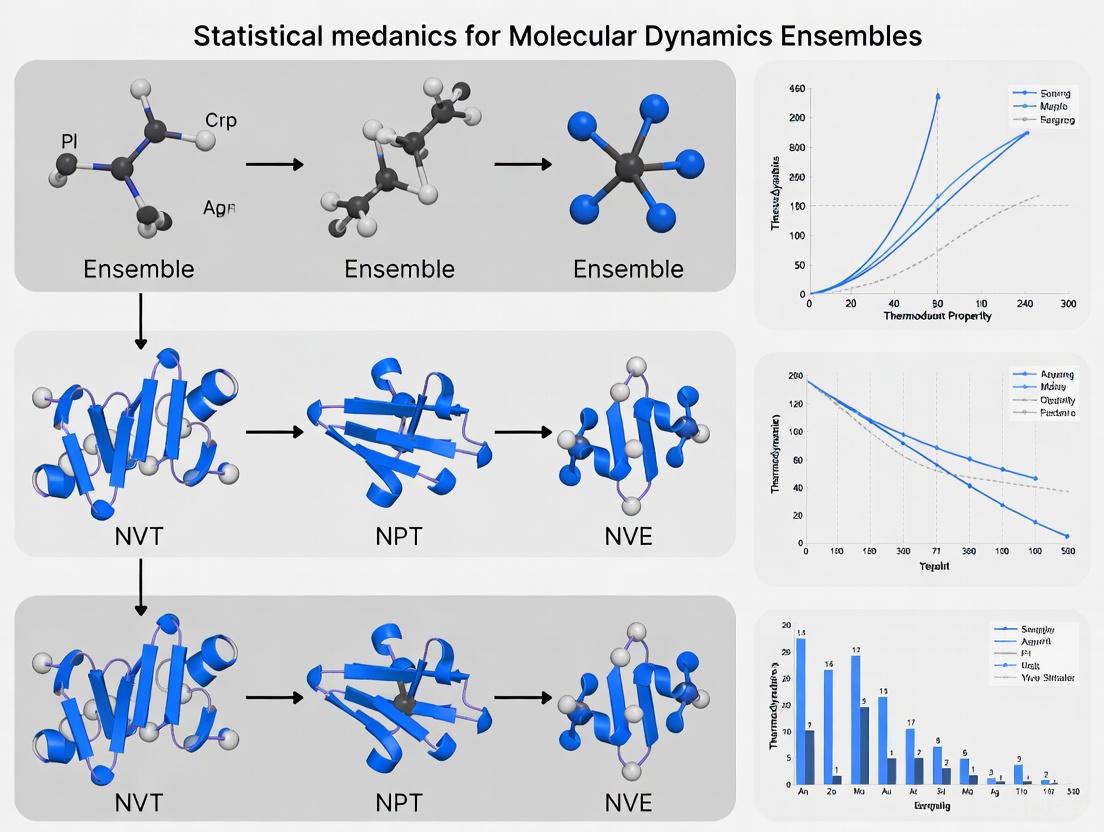
This article provides a comprehensive guide to the theory and application of statistical mechanics for generating and validating molecular dynamics ensembles, tailored for researchers and drug development professionals.
Statistical Mechanics for Molecular Dynamics Ensembles: From Theory to Biomedical Applications
Abstract
This article provides a comprehensive guide to the theory and application of statistical mechanics for generating and validating molecular dynamics ensembles, tailored for researchers and drug development professionals. It covers foundational principles connecting thermodynamics and statistical mechanics to MD, explores advanced methodological frameworks including enhanced sampling and machine-learning potentials, addresses critical troubleshooting for sampling and force field inaccuracies, and establishes robust validation protocols using experimental data. By synthesizing current best practices and emerging trends, this resource aims to empower scientists to generate more reliable, predictive molecular ensembles for understanding biomolecular function and accelerating therapeutic discovery.
Theoretical Foundations: Connecting Statistical Mechanics to Molecular Dynamics
The Potential Energy Surface (PES) is a foundational concept in computational chemistry and physics, providing a mathematical representation of the energy of a molecular system as a function of the positions of its constituent atoms. [1] [2] It forms the critical bridge between the quantum mechanical description of electronic structure and the classical modeling of nuclear motion in molecular dynamics (MD) simulations. Within the framework of statistical mechanics for molecular dynamics ensembles, the PES is the function that determines the forces governing the evolution of a system through its phase space. The energy landscape metaphor is apt: for a system with multiple degrees of freedom, the potential energy defines a topography of "hills," "valleys," and "passes," where minima correspond to stable molecular configurations, and saddle points represent transition states for chemical reactions. [1] [2] The accuracy of any MD simulation, and consequently the thermodynamic and kinetic properties derived from it, is inherently and completely dependent on the fidelity of the underlying PES.
Quantum Mechanical Foundations of the PES
The Born-Oppenheimer Approximation
The theoretical justification for separating nuclear motion from electronic motion, and thus for the very concept of a PES, is the Born-Oppenheimer approximation. Because nuclei are thousands of times more massive than electrons, they move on a much slower timescale. This allows one to solve the electronic Schrödinger equation for a fixed set of nuclear positions, ( \mathbf{R} ):
[ \hat{H}{elec} \psi{elec} = E{elec} \psi{elec} ]
Here, ( \hat{H}{elec} ) is the electronic Hamiltonian, ( \psi{elec} ) is the electronic wavefunction, and ( E{elec} ) is the electronic energy. The potential energy surface is then defined as the sum of this electronic energy and the constant nuclear repulsion energy for that configuration: ( E(\mathbf{R}) = E{elec}(\mathbf{R}) + E_{nuc-nuc}(\mathbf{R}) ). This function ( E(\mathbf{R}) ) is the PES upon which the nuclei move. [1]
Computational Methods for PES Calculation
Calculating the PES involves computing ( E(\mathbf{R}) ) for a vast number of nuclear configurations. The choice of quantum chemical method involves a trade-off between computational cost and accuracy.
- Ab Initio Methods: These methods, such as those used to create the modern PESs for N₂ + N₂ collisions, [3] attempt to solve the electronic Schrödinger equation from first principles, using no empirical data. They range from highly accurate but expensive methods like Coupled Cluster (e.g., CCSD(T)) to more approximate Density Functional Theory (DFT) methods. The NASA Ames and University of Minnesota N₄ PESs are examples of ab initio surfaces fitted to thousands of such quantum chemistry calculations. [3]
- Semi-Empirical Methods: These methods simplify the quantum mechanical equations and parameterize them against experimental data to reduce computational cost. A classic example is the London-Eyring-Polanyi-Sato (LEPS) potential, an empirical surface based on valence bond theory. [3] [2] While computationally efficient, the accuracy of semi-empirical surfaces can be limited, as seen in the differing topography (e.g., collinear vs. bent transition state) between the LEPS and ab initio surfaces for N₂ + N collisions. [3]
Table 1: Comparison of PES Calculation Methods
| Method Type | Theoretical Basis | Advantages | Limitations | Example Applications |
|---|---|---|---|---|
| Ab Initio | First principles solution of electronic Schrödinger equation. | High accuracy, no empirical parameters required. | Computationally expensive, limits system size. | N₂ + N₂ PES (NASA Ames, Univ. of Minnesota) [3] |
| Semi-Empirical | Simplified QM equations parameterized with experimental data. | Computationally efficient, allows larger systems. | Lower accuracy, transferability can be poor. | LEPS potential for H₃ and N₃ [3] [2] |
From the PES to Classical Molecular Dynamics
The Force Field Approximation
In classical MD, the explicit quantum mechanical PES is replaced by an analytical molecular mechanics force field. This is a critical step that makes simulating large biomolecules feasible. The force field is a mathematical approximation of the true PES, typically decomposed into terms for bonded and non-bonded interactions:
[ E{FF}(\mathbf{R}) = \sum{bonds} Kr(r - r{eq})^2 + \sum{angles} K\theta(\theta - \theta{eq})^2 + \sum{dihedrals} \frac{V_n}{2}[1 + \cos(n\phi - \gamma)]
- \sum{i
The parameters in these equations (e.g., ( Kr ), ( r{eq} ), ( A{ij} ), ( qi )) are often derived from high-level ab initio calculations on smaller model systems or fit to experimental data. The quality of an MD simulation is thus directly tied to the quality of this approximate PES (the force field). [4] [5]
The Statistical Mechanical Connection
MD simulations generate a trajectory of the system through phase space (the combined space of all atomic positions and momenta). According to the ergodic hypothesis of statistical mechanics, the time average of a property along an MD trajectory is equal to the ensemble average over a large number of copies of the system. For the canonical (NVT) ensemble, the probability of finding the system in a state with energy ( E(\mathbf{R}) ) is given by the Boltzmann distribution:
[ P(\mathbf{R}) \propto \exp\left(-E(\mathbf{R}) / k_B T\right) ]
The PES, ( E(\mathbf{R}) ), is the key determinant of this probability and therefore of all thermodynamic properties derived from the ensemble, such as free energies, entropies, and equilibrium constants. [5] Free energy calculation methods, such as thermodynamic perturbation or umbrella sampling, are essentially sophisticated protocols for sampling the PES to compute these ensemble averages. [5]
Practical Protocols: Constructing and Validating a PES
The process of moving from a quantum mechanical description to a validated classical simulation involves several critical stages, as outlined in the workflow below.
Protocol 1: Ab Initio PES Construction for Reaction Dynamics
This protocol is used for constructing highly accurate PESs for specific chemical reactions, often in gas phase.
- Configuration Sampling: Select a representative grid of molecular geometries (nuclear configurations, ( \mathbf{R} )) spanning reactants, products, transition states, and relevant intermediate structures. For an atom-diatom reaction like H + H₂, this involves varying the two relevant bond lengths. [2] For N₂ + N₂, six internal coordinates are required. [3]
- Electronic Energy Calculation: For each geometry on the grid, perform a high-level ab initio quantum chemistry calculation (e.g., CCSD(T) with a large basis set) to compute the electronic energy, ( E_{elec}(\mathbf{R}) ). [3]
- Analytical Representation: Fit a smooth, analytical function (a process requiring non-linear fitting in multiple dimensions) to the computed energies. This function must allow for rapid evaluation of energy and forces for any arbitrary geometry during dynamics calculations. [3]
- Dynamics and Validation: Use the analytical PES in quasiclassical trajectory (QCT) calculations to compute reaction cross-sections and thermal rate coefficients. Validate the results by comparing them with experimental data from shock-tube or other kinetic experiments. [3]
Protocol 2: Force Field Refinement for Biomolecular Simulation
This protocol is common in studies of proteins and other soft-matter systems, where the focus is on conformational dynamics rather than bond breaking/forming.
- Initial System Setup: Obtain high-resolution structures of individual domains (e.g., from NMR or crystallography). Use modeling software like Modeller to add missing linkers and construct a full-length initial structure. [4]
- Coarse-Grained (CG) MD: Run initial MD simulations using a CG force field (e.g., Martini) to enhance conformational sampling. In the case of TIA-1, this involved applying an elastic network within folded domains but leaving inter-domain linkers fully flexible. [4]
- Comparison with Experiment: Calculate experimental observables from the simulation trajectory. For small-angle X-ray scattering (SAXS), this requires "backmapping" CG structures to all-atom resolution and then computing the theoretical scattering profile. [4]
- Force Field Refinement: Identify systematic errors in the force field. For example, the standard Martini force field was found to produce overly compact conformations for TIA-1. A key refinement was to strengthen the protein-water interaction parameter, which improved agreement with SAXS data. [4]
- Bayesian/Maximum Entropy (BME) Reweighting: As a final step, use the BME method to reweight the simulation ensemble to achieve full consistency with the experimental data, providing a robust description of the conformational landscape. [4]
Table 2: Key Reagents and Computational Tools for PES/MD Research
| Item / Software | Function / Role | Specific Application Example |
|---|---|---|
| Quantum Chemistry Software | Computes electronic energies for nuclear configurations. | Generating the ab initio data points for the N₄ PES. [3] |
| GROMACS | Molecular dynamics simulation package. | Running coarse-grained and all-atom MD simulations. [4] |
| PLUMED | Plugin for enhanced sampling and free energy calculations. | Calculating collective variables like radius of gyration and inter-domain distances. [4] |
| Martini Force Field | Coarse-grained potential for accelerated dynamics. | Simulating large, flexible proteins like TIA-1. [4] |
| Bayesian/Max. Entropy (BME) | Data integration and ensemble reweighting algorithm. | Refining MD ensembles to match SAXS/SANS data. [4] |
| Modeller | Homology and comparative protein structure modeling. | Adding missing residues and linkers to initial protein structures. [4] |
Case Studies in PES Application
High-Temperature Nitrogen Dissociation
This case highlights the direct PES-to-rate-coefficient pipeline for aerothermodynamics. Comparisons between different ab initio PESs for N₂ + N (NASA Ames vs. Laganà's empirical LEPS) and for N₂ + N₂ (NASA Ames vs. University of Minnesota) revealed significant topological differences. [3] For instance, the LEPS surface features a collinear transition state with a 36 kcal/mol barrier, while the ab initio surfaces show a bent transition state with a higher barrier (44-47 kcal/mol). [3] Despite these differences, QCT-derived thermal dissociation rate coefficients in the 10,000-30,000 K range were in excellent agreement. However, under non-equilibrium conditions relevant to hypersonic shocks, quasi-steady state (QSS) rate coefficients were significantly lower than thermal ones, demonstrating the critical importance of the PES in modeling non-equilibrium phenomena. [3]
Conformational Dynamics of Multi-Domain Proteins
The study of the three-domain protein TIA-1 exemplifies the force field refinement approach. The research combined CG-MD with SAXS and small-angle neutron scattering (SANS) data. The initial Martini force field led to overly compact conformations, poor agreement with SAXS data, and highlighted a force field limitation. [4] By strengthening protein-water interactions, the agreement was dramatically improved. Furthermore, using the BME approach to reweight the simulation ensemble against SAXS data also improved the fit to SANS data, validating the refined conformational ensemble. [4] This demonstrates a synergistic loop where MD provides an atomic-resolution model and experiments provide the constraints to refine the effective PES governing the dynamics.
The derivation of the Potential Energy Surface from quantum mechanics and its careful approximation for classical Molecular Dynamics is a cornerstone of modern computational molecular science. The PES is the single source of truth in a simulation, dictating the forces and hence the statistical mechanical ensemble. As the case studies show, the approach is versatile, enabling everything from the calculation of high-temperature reaction rates for atmospheric entry to the resolution of conformational ensembles of flexible proteins for drug development. Current challenges remain in the accurate and efficient representation of the PES, particularly for large, complex systems involving bond breaking, electronic degeneracies, and strong solvent interactions. Future progress will rely on continued advances in quantum chemical methods, machine learning approaches for representing PESs, and robust statistical mechanical frameworks for integrating simulation with experimental data.
Core Statistical Ensembles (NVE, NVT, NPT) and Their Thermodynamic Connections
In the field of molecular dynamics (MD) simulations, statistical ensembles provide the fundamental theoretical framework that defines the thermodynamic conditions under which a system is studied. An ensemble represents a collection of all possible microstates of a system that are consistent with a set of macroscopic constraints, such as constant energy, temperature, or pressure. The concept originated from the pioneering work of Boltzmann and Gibbs in the 19th century, who established that macroscopic phenomena result from the statistical behavior of microscopic particles [6]. This theoretical foundation enables researchers to connect the microscopic world of atoms and molecules, governed by Newton's equations of motion, to macroscopic thermodynamic observables that can be measured experimentally [6].
The transition from theoretical statistical mechanics to practical molecular simulation represents a crucial bridge in computational science. While Boltzmann postulated that macroscopic observations result from time averages of microscopic events along particle trajectories, Gibbs further developed this concept by demonstrating that this time average could be replaced by an ensemble average—an collection of system states distributed according to a specific probability density [6]. The advent of computers in the 1940s enabled scientists to numerically solve the equations of statistical mechanics, leading to the development of MD as a powerful computational technique that applies Newton's laws of motion to model and analyze the behavior of atoms and molecules over time [6] [7].
Molecular Dynamics simulations have become indispensable across numerous scientific disciplines, including drug discovery, materials science, and nanotechnology, by providing atomic-level insights into molecular behavior that are difficult to obtain through experimental methods alone [7]. The core principle of MD involves calculating forces between particles using potential energy functions (force fields) that describe atomic interactions, including bond stretching, angle bending, van der Waals forces, and electrostatic interactions [7]. The choice of statistical ensemble directly determines which thermodynamic properties can be naturally extracted from simulations and influences the system's sampling of phase space, making ensemble selection a critical decision in any MD study [8].
Theoretical Foundation and Thermodynamic Connections
Statistical Mechanics Framework
The theoretical framework for understanding statistical ensembles begins with the fundamental laws governing nuclei and electrons in a system. For condensed matter systems at low energies—typical conditions for most MD simulations—we can often treat nuclei as classical particles interacting via an effective potential derived from the electronic ground state [6]. The connection between thermodynamics and statistical mechanics is established through the concept of ensembles, which provide a systematic procedure for calculating thermodynamic quantities that otherwise could only be obtained experimentally [6].
The core idea is that macroscopic thermodynamic properties emerge from averaging over microscopic states. In the language of statistical mechanics, different ensembles correspond to different free energies. The microcanonical ensemble (NVE) connects to the internal energy (U), the canonical ensemble (NVT) connects to the Helmholtz free energy (F = U - TS), and the isothermal-isobaric ensemble (NPT) connects to the Gibbs free energy (G = U + PV - TS) [8]. This connection to free energies is particularly important because free energies, not energies alone, determine the equilibrium state of a system at finite temperature.
While in the thermodynamic limit (for an infinite system size) ensembles are theoretically equivalent away from phase transitions, this equivalence breaks down for the finite systems typically simulated in MD [8]. This fundamental limitation makes the development and understanding of different ensembles not merely academically interesting but essential for obtaining physically meaningful results from molecular simulations.
Equations of Motion and Thermodynamic Derivatives
The mathematical implementation of ensembles in MD involves modifying Newton's equations of motion to include thermostatting and barostatting mechanisms. In the microcanonical ensemble (NVE), the standard Newtonian equations conserve energy exactly. For other ensembles, extended Lagrangian formulations introduce additional degrees of freedom that act as heat baths or pressure reservoirs.
The thermodynamic derivatives that connect microscopic simulations to macroscopic observables can be expressed through statistical mechanical relations. For instance, in the NVT ensemble, the constant volume heat capacity can be calculated from energy fluctuations through the relation: Cv = (∂U⁄∂T)v = (⟨E²⟩ - ⟨E⟩²)⁄(kBT²), where E is the instantaneous energy, kB is Boltzmann's constant, and the angle brackets denote ensemble averages. Similar fluctuation formulas exist for other thermodynamic properties, including the isothermal compressibility from volume fluctuations in the NPT ensemble and the thermal expansion coefficient from cross-correlations between energy and volume fluctuations.
Table 1: Fundamental Thermodynamic Connections of Core Ensembles
| Ensemble | Fixed Parameters | Control Variables | Connected Free Energy | Natural Experimental Analog |
|---|---|---|---|---|
| NVE (Microcanonical) | Number of particles (N), Volume (V), Energy (E) | None (isolated system) | Internal Energy (U) | Adiabatic processes, gas-phase reactions |
| NVT (Canonical) | Number of particles (N), Volume (V), Temperature (T) | Temperature via thermostats | Helmholtz Free Energy (F = U - TS) | Systems in thermal contact with reservoir |
| NPT (Isothermal-Isobaric) | Number of particles (N), Pressure (P), Temperature (T) | Temperature via thermostats, Pressure via barostats | Gibbs Free Energy (G = U + PV - TS) | Most bench experiments, biological systems |
The Core Ensembles: Definitions, Implementations, and Applications
Microcanonical Ensemble (NVE)
The NVE ensemble, also known as the microcanonical ensemble, describes isolated systems where the number of particles (N), the system volume (V), and the total energy (E) remain constant. This ensemble represents the most fundamental approach to molecular dynamics, as it directly implements Newton's equations of motion without additional control mechanisms [7]. In the NVE ensemble, the system evolves conservatively according to the Hamiltonian H(p,q) = E, where p and q represent the momenta and coordinates of all particles [6].
From an implementation perspective, NVE simulations use numerical integrators such as the Verlet algorithm or related schemes (Velocity Verlet, Leapfrog) to propagate particle positions and velocities forward in time with discrete time steps typically on the order of femtoseconds (10⁻¹⁵ seconds) [7]. These integrators conserve energy well over short time scales, making them suitable for NVE simulations. However, in practice, numerical errors and finite time steps can lead to energy drift over long simulations, requiring careful monitoring.
The NVE ensemble is particularly suited for studying gas-phase reactions, isolated molecular systems, and fundamental investigations where energy conservation is paramount [8]. It also serves as the foundation for many advanced simulation techniques, where production runs may be conducted in NVE after equilibration in other ensembles. For instance, when simulating infrared spectra of liquids, researchers often equilibrate the system in the NVT ensemble at the desired temperature before switching to NVE for production dynamics, as thermostats can decorrelate velocities in ways that destroy spectral information calculated from correlation functions [8].
A significant limitation of the NVE ensemble emerges when simulating barrier crossing events. If the barrier height exceeds the total energy of the system, the rate of crossing will be zero in NVE, whereas in NVT with the same average energy, thermal fluctuations can occasionally push the system over the barrier, leading to non-zero rates [8]. This example highlights how ensemble choice can qualitatively alter simulation outcomes, particularly for rare events or processes with significant energy barriers.
Canonical Ensemble (NVT)
The NVT ensemble, or canonical ensemble, maintains constant number of particles (N), volume (V), and temperature (T), making it suitable for systems in thermal contact with a heat reservoir [7]. Temperature control is achieved through mathematical constructs known as thermostats, which modify the equations of motion to maintain the kinetic energy of the system (and thus its temperature) around a target value.
Several thermostat algorithms are commonly used in MD simulations. The Berendsen thermostat applies a simple scaling of velocities to adjust the temperature toward the desired value, providing strong coupling and efficient equilibration but not generating a true canonical distribution [9]. The Nosé-Hoover thermostat and its extension, Nosé-Hoover chains (NHC), introduce additional dynamical variables that act as heat baths, producing correct canonical distributions [9]. According to implementation details in the ReaxFF documentation, NHC-NVT typically uses parameters including Nc=5, Nys=5, and Nchains=10, with the tdamp control parameter (τt) determining the first thermostat mass as Q = NfreekBTsetτt² [9]. The documentation notes that relaxation with a Nosé-Hoover thermostat usually takes longer than with the Berendsen thermostat using the same τ parameter [9].
Advanced thermostat implementations can provide separate control for different degrees of freedom. For example, some MD packages allow separate damping parameters for translational, rotational, and vibrational degrees of freedom, which can be particularly useful when initial system configurations contain strongly out-of-equilibrium distributions, such as many quickly spinning molecules with relatively small translational velocity [9].
The NVT ensemble is widely used for simulating biological systems at physiological conditions, solid-state materials, and any system where volume constraints are natural [8] [7]. It provides direct access to the Helmholtz free energy and is often employed in studies of conformational dynamics, protein folding, and ligand binding where constant volume approximations are reasonable.
Isothermal-Isobaric Ensemble (NPT)
The NPT ensemble, or isothermal-isobaric ensemble, maintains constant number of particles (N), pressure (P), and temperature (T), making it the most appropriate choice for simulating systems under constant environmental conditions [7]. This ensemble is particularly valuable for modeling processes in solution, biomolecular systems in their native environments, and materials under specific pressure conditions.
Implementation of the NPT ensemble requires both a thermostat to control temperature and a barostat to control pressure. Common combinations include the Berendsen barostat and thermostat for efficient equilibration, and the more rigorous Anderson-Hoover (AH) or Parrinello-Rahman-Hoover (PRH) NPT implementations with NHC thermostats [9]. In the Anderson-Hoover NPT implementation, the barostat mass is determined by the pdamp control parameter τp as W = (Nfree + 3)kBTsetτp², while the thermostat component uses parameters similar to NHC-NVT [9].
For anisotropic systems, the Parrinello-Rahman barostat allows full fluctuation of the simulation cell shape, enabling studies of crystalline materials under stress or systems with directional forces. The ReaxFF documentation notes that anisotropic NPT dynamics should be considered experimental, with options for fixed cell angles (imdmet=10) or full cell fluctuations (imdmet=11) [9].
The NPT ensemble provides a direct connection to the Gibbs free energy and is often considered the most appropriate for comparing with experimental measurements, as most laboratory experiments occur at constant pressure rather than constant volume [8]. As noted by researchers on Matter Modeling Stack Exchange, "In many cases, that means you want to run dynamics in the NPT ensemble (since bench experiments tend to be at fixed pressure and temperature)" [8]. This ensemble naturally accounts for density fluctuations and thermal expansion effects that are missing in constant-volume simulations.
Table 2: Implementation Details of Core Ensembles in MD Simulations
| Ensemble | Common Algorithms | Key Control Parameters | Typical Applications | Advantages | Limitations |
|---|---|---|---|---|---|
| NVE | Verlet, Velocity Verlet, Leapfrog | Time step (0.5-2 fs) | Gas-phase reactions, fundamental studies, spectral calculations | Energy conservation, simple implementation | Cannot control temperature, inappropriate for most condensed phases |
| NVT | Berendsen, Nosé-Hoover, Nosé-Hoover Chains | Target temperature, damping constant (τt) | Biological systems, solid materials, constant-volume processes | Correct canonical sampling, temperature control | Constant volume may be artificial for some systems |
| NPT | Berendsen NPT, Anderson-Hoover, Parrinello-Rahman | Target temperature/pressure, damping constants (τt, τp) | Solutions, biomolecules, materials under specific pressure | Matches most experiments, allows density fluctuations | More complex implementation, slower equilibration |
Practical Implementation and Protocols
Ensemble Selection Guidelines
Choosing the appropriate ensemble for a molecular dynamics simulation requires careful consideration of the scientific question, system characteristics, and intended comparison with experimental data. For researchers studying gas-phase reactions or isolated molecular systems without environmental coupling, the NVE ensemble provides the most natural description [8]. However, when modeling systems in solution or with implicit environmental effects, the choice between NVT and NPT becomes more nuanced.
As a general guideline, the NPT ensemble is recommended for most biomolecular simulations and studies of condensed phases, as it most closely mimics laboratory conditions where pressure rather than volume is controlled [8]. The NVT ensemble may be preferable for specific applications where volume constraints are physically justified, such as proteins in crowded cellular environments, materials confined in porous matrices, or when comparing directly with constant-volume experimental data.
Practical simulation workflows often employ multiple ensembles sequentially. A typical protocol might involve: (1) energy minimization to remove steric clashes, (2) NVT equilibration to stabilize the temperature, (3) NPT equilibration to adjust density, and (4) production simulation in either NVT or NPT depending on the properties of interest [8] [10]. For specific applications like spectroscopic property calculation, researchers may return to NVE for production dynamics to avoid artificial decorrelation of velocities by thermostats [8].
The following workflow diagram illustrates a typical multi-ensemble simulation protocol for biomolecular systems:
Simulation Workflow: Typical multi-ensemble protocol for biomolecular MD simulations.
Advanced Ensemble Implementations
Modern molecular dynamics packages offer sophisticated ensemble implementations beyond the basic three discussed previously. For example, the ReaxFF program includes specialized ensembles such as Hugoniostat for modeling shock waves, non-equilibrium NVE with shear forces for studying material deformation, and anisotropic NPT with full cell fluctuations for crystalline materials [9].
The development of machine learning potentials and neural network potentials (NNPs) has further expanded ensemble capabilities. Recent advancements like Meta's Open Molecules 2025 (OMol25) dataset and Universal Models for Atoms (UMA) provide highly accurate potential energy surfaces that can be integrated with various ensemble sampling techniques [11]. These approaches combine the computational efficiency of classical force fields with the accuracy of quantum mechanical calculations, enabling more reliable sampling of complex thermodynamic ensembles.
Enhanced sampling techniques, such as replica exchange molecular dynamics (REMD), meta-dynamics, and variational free energy methods, often employ sophisticated ensemble designs to accelerate rare events and improve phase space sampling. These methods frequently combine elements from different standard ensembles or employ generalized ensembles that smoothly transition between thermodynamic states.
Successful implementation of molecular dynamics simulations requires both theoretical knowledge and practical tools. The following table summarizes key resources mentioned in recent literature that facilitate research using statistical ensembles:
Table 3: Essential Research Tools and Resources for Ensemble-Based MD Simulations
| Resource Category | Specific Tools/References | Function/Purpose | Key Features |
|---|---|---|---|
| Textbooks | "Computer Simulation of Liquids" (Allen & Tildesley) [12] | Fundamental MD theory and practice | Comprehensive coverage of basic MD methods |
| "Understanding Molecular Simulation" (Frenkel & Smit) [12] | Practical simulation methodology | Example code, enhanced sampling methods | |
| "Statistical Mechanics: Theory and Molecular Simulation" (Tuckerman) [12] | Theoretical foundation | Path integral methods, statistical mechanics theory | |
| Software Packages | ReaxFF [9] | Reactive force field MD | Multiple ensemble implementations, NHC thermostats |
| GROMACS [12] | Biomolecular MD | Extensive ensemble options, high performance | |
| i-PI [12] | Path integral MD | Quantum effects, advanced sampling | |
| Datasets & Potentials | Meta's OMol25 [11] | Neural network potential training | 100M+ quantum calculations, broad chemical diversity |
| Universal Models for Atoms (UMA) [11] | Transferable ML potentials | Mixture of Experts architecture, multi-dataset training | |
| Benchmarks | Rowan Benchmarks [11] | Model performance evaluation | Molecular energy accuracy comparisons |
The following diagram illustrates the relationship between different statistical ensembles and their connected free energies, providing a conceptual map for understanding the thermodynamic foundations of molecular simulation:
Ensemble Thermodynamics: Relationship between statistical ensembles and their connected free energies.
Current Research Trends and Future Directions
The field of molecular dynamics and statistical ensemble methodology continues to evolve rapidly, driven by advances in computational hardware, algorithmic innovations, and emerging scientific questions. Recent research trends highlight several exciting developments that are expanding the capabilities and applications of ensemble-based simulations.
The integration of machine learning and artificial intelligence with molecular dynamics represents one of the most promising directions [13] [7]. Machine learning algorithms can accelerate MD simulations by providing more accurate predictions of molecular interactions and optimizing simulation parameters [7]. Recent releases such as Meta's Open Molecules 2025 (OMol25) dataset and associated neural network potentials (NNPs) demonstrate the potential of these approaches, achieving essentially perfect performance on molecular energy benchmarks while enabling simulations of systems that were previously computationally prohibitive [11]. The eSEN architecture, for instance, improves the smoothness of potential-energy surfaces, making molecular dynamics and geometry optimizations better-behaved [11].
Another significant trend involves the development of multi-scale simulation methodologies that seamlessly connect different levels of theory, from quantum mechanics to coarse-grained models [13]. These approaches often employ sophisticated ensemble designs to facilitate information transfer between scales. For example, the Universal Models for Atoms (UMA) architecture introduces a novel Mixture of Linear Experts (MoLE) approach that enables knowledge transfer across datasets computed using different DFT engines, basis set schemes, and levels of theory [11].
The application of molecular dynamics simulations is also expanding into new domains, including the design of oil-displacement polymers for enhanced oil recovery [13], predictive modeling of hazardous substances for safe handling [10], and the development of advanced materials for energy storage and conversion. In each of these applications, careful selection and implementation of statistical ensembles is crucial for obtaining physically meaningful results that can guide experimental efforts.
Future research will likely focus on developing more efficient sampling algorithms, improving the accuracy of force fields through machine learning, and extending simulation capabilities to larger systems and longer timescales [13] [7]. As computational power continues to grow and algorithms become more sophisticated, the role of statistical ensembles in connecting microscopic simulations to macroscopic observables will remain fundamental to the field of molecular modeling.
The ergodic hypothesis is a cornerstone of statistical mechanics and, by extension, molecular dynamics (MD) simulations. It asserts that, over long periods, the time average of a property from a single system's trajectory is equal to the ensemble average of that property across a vast collection of identical systems at one instant in time [14] [15]. This equivalence is a fundamental, often implicit, assumption that validates the use of MD to compute thermodynamic properties. Without it, the connection between the microscopic world described by Newton's equations and the macroscopic thermodynamic properties we wish to predict would be severed.
This principle finds its formal justification in the framework of statistical mechanics, which provides the link between the microscopic states of atoms and molecules and macroscopic observables. The expectation value of an observable, such as energy (E), in the canonical (NVT) ensemble is defined using the partition function (Z): [ \langle E \rangle{\text{ensemble}} = \frac{\sumi Ei e^{-Ei/kB T}}{Z} ] where the sum is over all microstates [16]. The ergodic hypothesis allows this ensemble average to be replaced in MD simulations by a time average: [ \langle E \rangle{\text{time}} = \lim{\tau \to \infty} \frac{1}{\tau} \int0^\tau E(t) \, dt \approx \frac{1}{N{\text{steps}}} \sum{t=1}^{N{\text{steps}}} Et ] This makes MD a practical tool, as we can simulate a single system over time rather than attempting to create and average over an impossibly large number of replica systems [15].
The Centrality of the Ergodic Hypothesis in Molecular Dynamics
In practice, MD simulations rely heavily on the ergodic assumption. A simulation generates a sequence of configurations (a trajectory) by numerically integrating Newton's equations of motion. Each configuration provides an instantaneous value for properties like temperature, pressure, and energy. The "true" thermodynamic value is then taken to be the average of these instantaneous values over the entire simulation trajectory [15]. This procedure implicitly assumes the ergodic hypothesis, equating the time average from one simulation to the ensemble average of the theoretical statistical mechanical ensemble.
Almost every property of interest obtained from an MD simulation—including temperature, pressure, structural correlations, and elastic properties—is ultimately the result of such a time average [15]. The hypothesis is considered valid provided the simulation is run for a "long enough" time, allowing the single simulated system to explore a representative sample of the phase space consistent with its thermodynamic constraints [15].
Limitations and Practical Challenges
Despite its foundational role, the ergodic hypothesis is not universally true for all systems, and its strict validity in real simulations is often a matter of careful consideration.
Theoretical and Phenomenological Violations
From a theoretical standpoint, the literal form of the ergodic hypothesis can be broken in several ways. The famous Fermi-Pasta-Ulam-Tsingou (FPUT) experiment in 1953 was an early numerical demonstration of non-ergodic behavior, where energy failed to equilibrate evenly among all vibrational modes in a non-linear system, instead exhibiting recurrent behavior [14] [17]. Macroscopic systems can also exhibit ergodicity breaking. For example, in ferromagnetic materials below the Curie temperature, the system becomes trapped in a state with non-zero magnetization rather than exploring all states with an average magnetization of zero [14]. Complex disordered systems like spin glasses or conventional window glasses display more complicated ergodicity breaking, behaving as solids on human timescales but as liquids over immensely long periods [14].
The mathematical foundation for these violations often lies in the Kolmogorov-Arnold-Moser (KAM) theorem. This theorem describes the existence of stable, regular trajectories (KAM tori) in phase space that can prevent a system from exploring all accessible states, even over infinite time. Systems with hidden symmetries that support phenomena like solitons (stable, localized traveling waves) are classic examples where ergodicity fails [17].
Practical Implications for Molecular Dynamics
These theoretical limitations translate into concrete challenges for MD simulations:
- Insufficient Sampling: The most common practical issue is that simulations are too short to adequately explore phase space. A system might be trapped in a local energy minimum, such as one conformational state of a biomolecule, and never transition to other, equally important states during the simulation time.
- Calculation of Specific Quantities: Some thermodynamic properties are more sensitive to ergodicity violations than others. While average energy can often be reliably estimated, the calculation of free energies and entropies is notoriously difficult because they depend on the partition function and the total number of accessible states (density of states), which may be undersampled [16]. High-energy regions that contribute significantly to these averages might never be visited in a typical simulation.
- Physical Constraints: Real-world systems like solids (e.g., an ice cube) or multi-phase systems (e.g., a vapor-liquid mixture) are inherently non-ergodic on practical timescales because atoms are confined to lattice sites or localized regions [17]. Statistical mechanics can still be applied, but it requires careful consideration of the relevant, accessible portion of phase space.
Methodologies and Computational Protocols
Given the challenges of ergodicity, several computational strategies have been developed to improve phase space sampling in MD simulations.
Standard Averaging Protocols
Table 1: Comparison of Averaging Methods in Molecular Dynamics
| Method | Description | Key Advantage | Key Disadvantage |
|---|---|---|---|
| Time Averaging | A single, long simulation is run, and properties are averaged over the entire trajectory. | Conceptually simple; mirrors the fundamental ergodic hypothesis. | Can be computationally serial; prone to getting stuck in metastable states. |
| Ensemble Averaging | Multiple independent simulations are run from different initial conditions, and results are averaged across these trajectories. | Highly parallelizable; better at exploring diverse regions of phase space. | Requires more initial setup; computational cost is multiplied by the number of trajectories. |
A key study comparing these methods for calculating thermal conductivity found that ensemble averaging can drastically reduce the total wall-clock simulation time because the independent trajectories can be run in parallel on high-performance computing clusters. This is particularly advantageous for expensive simulations like ab initio MD [18].
Enhanced Sampling Techniques
For properties like free energy that are not simple time averages, specialized "enhanced sampling" methods are required. These methods manipulate the system to encourage exploration of otherwise inaccessible regions of phase space.
- Metadynamics: This method adds a history-dependent bias potential to the system's energy function, which discourages the system from revisiting already sampled states. This "fills up" free energy basins and pushes the system to explore new regions [16].
- Statistical Temperature Molecular Dynamics: This algorithm modifies the MD equations to achieve a flat histogram in potential energy, forcing the system to sample all energy levels uniformly [16].
- Replica Exchange MD (Parallel Tempering): Multiple copies (replicas) of the system are simulated simultaneously at different temperatures. Periodically, exchanges between replicas are attempted based on a Metropolis criterion. This allows conformations trapped at low temperatures to be "heated up," escape local minima, and then "cooled down" again, thus enhancing sampling [16].
The workflow below illustrates how enhanced sampling integrates with the standard MD process to achieve more robust, ergodic sampling.
Integrating Experimental Data
Another powerful approach, especially for challenging systems like intrinsically disordered proteins (IDPs), is the integration of experimental data with simulations. Nuclear Magnetic Resonance (NMR) spectroscopy provides ensemble-averaged, site-specific structural and dynamic information. This experimental data can be used to restrain MD simulations or to reweight simulation-generated ensembles, ensuring the final model is consistent with empirical observations and thus more accurately reflects the true accessible phase space [19].
The Scientist's Toolkit: Essential Reagents and Methods
Table 2: Key Computational Tools for Ergodicity and Sampling
| Tool / Method | Category | Primary Function |
|---|---|---|
| Force Fields | Interaction Potential | Defines the potential energy surface (PES) governing atomic interactions; accuracy is paramount for realistic sampling. |
| Thermostats (e.g., Nosé-Hoover) | Ensemble Control | Controls temperature by mimicking heat exchange with a bath, essential for sampling NVT or NPT ensembles. |
| Metadynamics | Enhanced Sampling | Accelerates escape from free energy minima by applying a history-dependent bias potential. |
| Replica Exchange MD | Enhanced Sampling | Enhances sampling across energy barriers by running parallel simulations at different temperatures. |
| Maxwell-Boltzmann Distribution | Initialization | Generates physically realistic initial velocities for atoms at the start of a simulation [20]. |
| Neighbor Searching (Verlet List) | Algorithmic Efficiency | Efficiently identifies atom pairs within interaction range, a critical performance optimization in MD [20]. |
The ergodic hypothesis provides the essential bridge that makes molecular dynamics a powerful tool for connecting atomic-scale motion to macroscopic thermodynamic properties. While its strict mathematical validity is limited, and practical violations are common, it remains a productive and necessary foundation. The ongoing development of enhanced sampling methods, parallel ensemble techniques, and hybrid experimental-computational approaches represents the field's active response to the challenges of ergodicity. By consciously addressing these limitations, researchers can design more robust simulations, achieve more representative sampling, and compute a wider range of accurate thermodynamic properties, thereby strengthening the predictive power of molecular dynamics in fields from materials science to drug development.
The Potential of Mean Force and Landau Free Energy in Complex Biomolecular Systems
In the realm of molecular dynamics (MD) and statistical mechanics, accurately describing and quantifying complex biomolecular processes—such as protein folding, ligand binding, and conformational changes—remains a central challenge. These processes are governed by free energy landscapes, where minima represent stable states and barriers represent transitions. The Potential of Mean Force (PMF) and the Landau Free Energy (also referred to as the Landau theory of phase transitions) are two fundamental concepts that provide a powerful framework for quantifying these landscapes [6] [21].
The PMF provides a statistical mechanical description of the effective free energy along a reaction coordinate, effectively averaging out all other degrees of freedom [6]. Landau Free Energy, a phenomenological theory originally developed for phase transitions, offers a versatile approach to modeling how free energy depends on an order parameter, which can describe the progression of a biomolecular reaction [21] [22]. Within the context of a broader thesis on statistical mechanics for MD ensembles research, this whitepaper explores the theoretical underpinnings, computational methodologies, and practical applications of these two concepts. It is demonstrated that they are not merely abstract ideas but are indispensable tools for connecting microscopic simulations to macroscopic, experimentally observable properties, thereby bridging the gap between molecular-level dynamics and drug-relevant phenotypes [23] [24].
Theoretical Foundations
Statistical Mechanics of Molecular Dynamics Ensembles
Statistical mechanics forms the theoretical bedrock for interpreting MD simulations, connecting the chaotic motion of individual atoms to predictable thermodynamic averages. The core idea is that a macroscopic observable is the average over all possible microscopic states of the system (the ensemble) [6] [23].
- The Ensemble Picture: Instead of tracking a single system over time, Gibbs introduced the concept of an ensemble—a vast collection of identical systems in different microstates. The average value of an observable is then computed over this ensemble [6].
- The Ergodic Hypothesis: This principle asserts that the time average of a property for a single system, over a sufficiently long period, equals the ensemble average. This justifies the use of MD trajectories, which are time-dependent, to compute equilibrium thermodynamic properties [23].
- Relevance for Biomolecules: For biomolecular systems, key ensembles include the canonical ensemble (NVT) for systems at constant temperature and the isothermal-isobaric ensemble (NPT) for constant temperature and pressure, which mimic common experimental conditions [23].
Potential of Mean Force (PMF)
The Potential of Mean Force is a central concept for understanding processes characterized by a specific reaction coordinate, such as the distance between a drug and its binding pocket.
- Definition and Derivation: The PMF, often denoted as ( W(\xi) ), is defined as the effective free energy along a chosen reaction coordinate ( \xi ). It is derived from the configurational integral of the system by integrating out all other degrees of freedom [6]. Formally, for a reaction coordinate ( \xi ), the probability distribution ( P(\xi') ) is related to the PMF by: ( W(\xi') = -kB T \ln P(\xi') + C ) where ( kB ) is Boltzmann's constant, ( T ) is temperature, and ( C ) is an arbitrary constant.
- Physical Interpretation: The negative gradient of the PMF with respect to the reaction coordinate gives the mean force acting along that coordinate, averaged over all other thermal motions of the system. Its global minimum identifies the most stable state, while local minima and the barriers between them describe metastable states and transition states [6].
- Connection to Landau Free Energy: The review by [6] explicitly states that the Landau free energy is "also known as the potential of the mean force." This establishes that in the context of biomolecular simulations, the Landau free energy describing a process can be numerically computed as the PMF along a suitably chosen order parameter or reaction coordinate.
Landau Free Energy Theory
Landau theory provides a general framework for describing phase transitions and, by extension, cooperative transitions in biomolecules, through the expansion of free energy in terms of an order parameter [21] [22].
- Order Parameter: The theory is built around an order parameter ( \eta ), a quantity that is zero in the symmetric (disordered) phase and non-zero in the broken-symmetry (ordered) phase. In biophysics, this could be a measure of helicity in protein folding, a distance in binding, or a collective variable describing a conformational change [21].
- Free Energy Expansion: Near a critical point (or transition point), the Landau free energy ( F ) is expanded as a Taylor series in the order parameter. For a symmetric system, the expansion takes the form: ( F(T, \eta) - F_0 = a(T)\eta^2 + \frac{b(T)}{2}\eta^4 + \cdots ) where ( a(T) ) and ( b(T) ) are temperature-dependent coefficients [21] [22].
- Application to Biomolecular Transitions: The minima of this free energy function determine the stable and metastable states of the system. For a second-order transition, ( a(T) ) changes sign at the critical temperature ( T_c ), leading to a continuous shift from a single minimum at ( \eta=0 ) to two minima at ( \eta \neq 0 ). First-order transitions can be modeled by including a negative ( \eta^4 ) term and a positive ( \eta^6 ) term, leading to discontinuous jumps in the order parameter [21].
Computational Methodologies
Calculating the PMF/Landau free energy is computationally demanding because it requires sufficient sampling of high-energy regions and transition states. Several powerful techniques have been developed for this purpose.
Key Enhanced Sampling Methods
Table 1: Comparison of Key Enhanced Sampling Methods for PMF Calculation
| Method | Core Principle | Key Inputs/Parameters | Primary Output | Key Advantages |
|---|---|---|---|---|
| Umbrella Sampling | Biases the simulation along a reaction coordinate using harmonic potentials to sample all regions, including high-energy ones. | Reaction coordinate, number and positions of windows, force constant for harmonic bias. | A series of biased probability distributions along the coordinate. | Conceptually simple, highly parallelizable. |
| Metadynamics | Adds a history-dependent repulsive potential (often Gaussians) to the free energy landscape to discourage the system from revisiting sampled states. | Reaction coordinate(s) (collective variables), Gaussian height and width, deposition rate. | The time-dependent biasing potential, which converges to the negative of the PMF. | Good for exploring complex landscapes without pre-defining all states. |
| Adaptive Biasing Force | Directly calculates the mean force along the reaction coordinate and integrates it to obtain the PMF. | Reaction coordinate. | The instantaneous force acting on the reaction coordinate. | Can be computationally very efficient once the force is converged. |
Protocol for PMF Calculation via Umbrella Sampling
Umbrella Sampling (US) is a widely used and reliable method for calculating the PMF. The following is a detailed protocol.
- Step 1: Reaction Coordinate Selection: Identify a physically meaningful reaction coordinate ( \xi ) that distinguishes between the initial, final, and intermediate states of the process (e.g., distance, angle, or a combination thereof).
- Step 2: Steered MD for Initial Sampling: Perform a Steered Molecular Dynamics (SMD) simulation to rapidly pull the system from the initial to the final state along ( \xi ). This generates an initial pathway and helps identify the range of ( \xi ) to be studied.
- Step 3: Window Setup and Simulation: Divide the range of ( \xi ) into multiple overlapping "windows." For each window ( i ), center a harmonic restraint potential ( Ui = \frac{1}{2} k (\xi - \xii)^2 ) at ( \xi_i ). Run an independent MD simulation for each window under the influence of this bias.
- Step 4: Weighted Histogram Analysis Method: After all simulations are complete, use the WHAM to combine the biased probability distributions ( P_i^b(\xi) ) from all windows. WHAM solves for the unbiased PMF ( W(\xi) ) by ensuring that the statistical weight of each configuration is consistent across all windows, effectively removing the effect of the umbrella potentials.
The workflow for this protocol is visualized below.
Integrating Experiments with Maximum Entropy
A modern approach to refining PMFs involves integrating experimental data directly into the simulation framework. The Maximum Entropy (MaxEnt) principle is used to bias the simulation ensemble so that it agrees with experimental observables (e.g., from NMR, SAXS, or smFRET) while minimally perturbing the simulated distribution [25] [23]. This results in a conformational ensemble that is consistent with both physics-based simulations and experimental data, providing a more accurate and reliable free energy landscape.
The Scientist's Toolkit: Research Reagents & Computational Solutions
Table 2: Essential Research Reagents and Computational Tools
| Item / Reagent | Function / Purpose | Example Use in Biomolecular Studies |
|---|---|---|
| Molecular Dynamics Software | Provides the engine to perform simulations; integrates force fields, solvation models, and analysis tools. | GROMACS, NAMD, AMBER, OpenMM for running production and enhanced sampling simulations. |
| Enhanced Sampling Plugins | Implements advanced algorithms for PMF calculation not always available in core MD packages. | PLUMED is the standard library for implementing US, Metadynamics, ABF, etc. |
| Force Field | A set of empirical functions and parameters that describe the potential energy of a system of particles. | CHARMM36, AMBER/ff19SB, OPLS-AA to define bonded and non-bonded interactions for proteins, nucleic acids, and lipids. |
| Explicit Solvent Model | Represents water and ions explicitly in the simulation box to model solvation effects accurately. | TIP3P, TIP4P water models; ion parameters compatible with the chosen force field. |
| WHAM / Analysis Tools | Post-processing software to compute the PMF from the raw data of enhanced sampling simulations. | gmx wham (GROMACS), wham (PLUMED-related) for US analysis; PyEMMA for Markov State Models. |
Applications in Drug Development
The PMF is a critical quantitative tool in modern drug discovery, providing deep insights into the molecular interactions that underpin efficacy.
Quantifying Protein-Ligand Binding Affinity
The absolute binding affinity, measured experimentally as the binding free energy ( \Delta G_{bind} ), can be directly computed as the PMF difference between the bound and unbound states along a pathway that physically separates the ligand from the protein. This provides a rigorous, physics-based alternative to empirical scoring functions, offering a more accurate prediction of a drug candidate's potency [23].
Mapping Allosteric Pathways and Mutational Effects
Allosteric regulation, where a binding event at one site affects function at a distant site, is a key feature of many drug targets. The PMF can be computed along collective variables that describe allosteric transitions, revealing the communication pathways within a protein. Furthermore, by comparing PMFs for wild-type and mutated proteins, researchers can quantitatively predict how mutations alter conformational equilibria and free energy barriers, aiding in the understanding of genetic diseases and resistance mechanisms [23].
The following diagram illustrates a generalized workflow for applying PMF studies to a drug discovery pipeline.
The Potential of Mean Force and the framework of Landau Free Energy provide an indispensable connection between the microscopic world sampled by molecular dynamics and the macroscopic thermodynamic properties that govern biomolecular function and drug action. As this whitepaper has detailed, rigorous statistical mechanics underpins the computational methodologies that allow researchers to extract free energy landscapes from simulations. The integration of these approaches with experimental data and their application to challenges in drug discovery—from predicting binding affinities to understanding allostery—demonstrates their critical role in modern biophysical research. The ongoing development of enhanced sampling algorithms, coupled with increases in computational power and the rise of AI-driven approaches [6] [13], promises to further enhance the accuracy and scope of PMF calculations, solidifying their place as a cornerstone of quantitative molecular science.
Foundations of Non-Equilibrium Statistical Mechanics and Transport Phenomena
Non-equilibrium statistical mechanics provides the fundamental framework for understanding systems driven away from thermal equilibrium, serving as the theoretical bedrock for analyzing transport phenomena—the movement of mass, energy, and momentum within physical systems [26] [27]. Unlike equilibrium states characterized by maximum randomness and zero net fluxes, non-equilibrium states exhibit directional transport and irreversible processes that dominate most real-world systems, from biological organisms to semiconductor devices [28] [27]. This domain connects microscopic particle dynamics with observable macroscopic properties through statistical methods, enabling predictions of system behavior under non-equilibrium conditions across physics, chemistry, engineering, and drug discovery [26] [29].
The field has evolved significantly beyond near-equilibrium thermodynamics to address complex far-from-equilibrium scenarios through innovative approaches. Recent developments incorporate nonlocal and memory effects through integral-differential formulations, variational principles, and advanced computational methods that capture transient dynamics, microscopic fluctuations, and turbulent regimes [30]. These advancements refine our fundamental grasp of irreversible processes at micro and mesoscopic scales while enabling technological progress in diverse areas including pharmaceutical design, energy systems, and materials science [29] [30].
Fundamental Theoretical Frameworks
Foundational Approaches and Equations
Non-equilibrium statistical mechanics encompasses four principal methodological approaches, each with distinct foundational equations and applications as summarized in Table 1 [31].
Table 1: Fundamental Approaches in Non-Equilibrium Statistical Mechanics
| Category | Founder | Basic Equation | Key Concepts | Primary Applications |
|---|---|---|---|---|
| I | Boltzmann | Boltzmann equation | One-particle distribution function, Molecular chaos | Kinetic theory, Dilute gases |
| II | Gibbs | Master equation, Fokker-Planck equation | Density operator, Ensemble | Quantum systems, Chemical reactions |
| III | Einstein | Langevin equation | Random force, Dynamical variable | Brownian motion, Barrier crossing |
| IV | Kubo | Stochastic Liouville equation | Random force, Phase space variable | Magnetic resonance, Spectroscopy |
The Boltzmann equation describes the evolution of the particle distribution function in phase space and introduces irreversibility through molecular chaos assumptions [26] [31]. It forms the basis for deriving macroscopic transport equations and remains fundamental to kinetic theory. The Fokker-Planck equation provides a continuum description of probability evolution, while the Langevin equation offers a stochastic trajectory-based approach that is particularly valuable for modeling Brownian motion and barrier crossing phenomena [31]. For quantum systems, the density operator formalism extends these concepts through approaches like Non-Equilibrium Thermo Field Dynamics (NETFD), which maintains structural resemblance to quantum field theory while incorporating dissipative processes [31].
Core Transport Phenomena
Transport phenomena encompass three primary modes of transfer governed by constitutive relationships between fluxes and gradients [26]:
Mass Transport: Described by Fick's Laws of diffusion, where the diffusive flux is proportional to the concentration gradient: ( J = -D \frac{\partial c}{\partial x} ). The time evolution of concentration follows ( \frac{\partial c}{\partial t} = D \frac{\partial^2 c}{\partial x^2} ) [26].
Energy Transport: Governed by Fourier's Law of heat conduction, where heat flux is proportional to the temperature gradient: ( q = -k \frac{dT}{dx} ) [26].
Momentum Transport: Characterized by Newton's Law of viscosity, relating shear stress to velocity gradient: ( \tau = \mu \frac{du}{dy} ) [26].
These linear flux-gradient relationships represent the foundational constitutive equations for transport processes near equilibrium, though they undergo significant modification in strongly non-equilibrium regimes [26] [30].
Figure 1: Multi-scale framework connecting microscopic dynamics to macroscopic transport
Mathematical Formalisms and Key Relationships
Irreversible Thermodynamics and Linear Response Theory
The framework of irreversible thermodynamics extends classical thermodynamics to non-equilibrium systems through the local equilibrium assumption and entropy production principles [26]. Within this formalism, the Onsager reciprocal relations establish fundamental symmetry in coupled transport phenomena: ( Ji = \sumj L{ij} Xj ), where the phenomenological coefficients satisfy ( L{ij} = L{ji} ) as a consequence of microscopic reversibility [26]. This formalism provides the theoretical foundation for understanding coupled phenomena such as thermoelectric effects, electrokinetic phenomena, and thermophoresis [26].
Linear response theory describes system behavior under small perturbations from equilibrium, connecting macroscopic response functions to microscopic correlation functions through the fluctuation-dissipation theorem: ( \chi''(\omega) = \frac{\omega}{2kBT} S(\omega) ) [26]. This approach leads to Green-Kubo relations, which express transport coefficients as integrals of time correlation functions: ( L = \frac{1}{kBT} \int_0^\infty dt \langle J(t)J(0) \rangle ) [26]. These formalisms establish profound connections between spontaneous fluctuations and dissipative properties, fundamentally linking microscopic reversibility to macroscopic irreversibility.
Advanced Theoretical Frameworks
Chapman-Enskog theory provides a systematic perturbation method for solving the Boltzmann equation through expansion in terms of the Knudsen number, yielding transport coefficients expressed through collision integrals [26]. This approach is particularly valuable for dilute gases and plasmas, where particle interactions can be well-characterized. For dense systems, the Zubarev non-equilibrium statistical operator method enables self-consistent description of kinetic and hydrodynamic processes, facilitating derivation of generalized transport equations that remain valid across wider parameter ranges [32].
The mean free path concept represents the average distance particles travel between collisions, serving as a key parameter determining the validity of continuum approximations and playing a critical role in rarefied gas dynamics and plasma physics [26]. This concept enables derivation of transport coefficients from first principles using kinetic theory, with temperature and pressure dependencies emerging naturally from the analysis.
Quantitative Transport Properties
Transport Coefficients and Their Relationships
Transport coefficients quantitatively characterize a material's response to applied gradients, enabling prediction of heat, mass, and momentum transfer rates in diverse systems [26]. These coefficients can be derived from statistical mechanics or measured experimentally, typically exhibiting characteristic temperature and pressure dependencies that provide insight into underlying microscopic mechanisms.
Table 2: Key Transport Coefficients and Their Physical Significance
| Transport Coefficient | Governing Law | Mathematical Expression | Microscopic Interpretation | Temperature Dependence |
|---|---|---|---|---|
| Diffusion Coefficient (D) | Fick's Law | ( J = -D \frac{\partial c}{\partial x} ) | Mean square displacement: ( \langle x^2 \rangle = 2Dt ) | Increases with T (Arrhenius) |
| Thermal Conductivity (k) | Fourier's Law | ( q = -k \frac{dT}{dx} ) | Related to specific heat and mean free path | Complex T dependence |
| Viscosity (μ) | Newton's Law | ( \tau = \mu \frac{du}{dy} ) | Momentum transfer between fluid layers | Gas: Increases with T; Liquid: Decreases with T |
| Electrical Conductivity (σ) | Ohm's Law | ( J = \sigma E ) | Charge carrier mobility and density | Metal: Decreases with T; Semiconductor: Increases with T |
The Einstein relation connects diffusion and mobility through ( D = \mu kB T ), exemplifying the profound relationships between different transport coefficients that emerge from statistical mechanical principles [26]. Similarly, the Stokes-Einstein relation ( D = \frac{kB T}{6\pi\eta r} ) describes diffusion in liquids, connecting Brownian motion to fluid viscosity and particle size [26].
Computational Methodologies for Transport Properties
Advanced computational approaches enable prediction of transport properties from molecular simulations, bridging microscopic interactions with macroscopic behavior [30]. The mean first passage time (MFPT) methodology calculates transition rates between states using equilibrium properties and non-equilibrium statistical mechanics, avoiding computationally expensive direct simulations [31]. For a Smoluchowski process describing overdamped dynamics on a potential of mean force, the MFPT from ( q0 ) to ( qF ) satisfies ( \hat{L}^\dagger \tau{MFP}(qF|q0) = -1 ) with boundary condition ( \tau{MFP}(qF|qF) = 0 ), where ( \hat{L}^\dagger ) is the adjoint Fokker-Planck operator [31].
Green-Kubo relations provide an alternative approach, expressing transport coefficients as time integrals of autocorrelation functions: ( L = \frac{1}{kBT} \int0^\infty dt \langle J(t)J(0) \rangle ), where ( J(t) ) represents the appropriate flux [26]. This formalism enables extraction of transport coefficients from equilibrium molecular dynamics simulations through careful analysis of fluctuation statistics.
Experimental and Computational Methodologies
Nonequilibrium Switching for Binding Free Energy Calculations
Nonequilibrium switching (NES) represents a transformative methodology for predicting binding free energies in drug discovery applications, replacing slow equilibrium simulations with rapid, parallel transitions to achieve 5-10X higher throughput [29]. Unlike traditional methods like free energy perturbation (FEP) and thermodynamic integration (TI) that require intermediate states to reach thermodynamic equilibrium, NES employs many short, bidirectional transformations directly connecting molecular states without equilibrium constraints [29]. The mathematical framework ensures that despite each switch being driven far from equilibrium, collective statistics yield accurate free energy differences through application of the Jarzynski equality and related fluctuation theorems.
The NES protocol for relative binding free energy (RBFE) calculation involves several critical steps [29]:
System Preparation: Construct hybrid topology connecting initial and final states through alchemical transformation pathway.
Nonequilibrium Trajectory Generation: Perform multiple independent, fast switching simulations (typically tens to hundreds of picoseconds) in both forward and reverse directions.
Work Measurement: Calculate work values for each switching trajectory using ( W = \int_0^\tau dt \, \frac{\partial H}{\partial \lambda} \dot{\lambda} ), where ( H ) is the Hamiltonian and ( \lambda ) the switching parameter.
Free Energy Estimation: Apply Bayesian bootstrap methods to work distributions to estimate free energy differences with uncertainty quantification.
This approach offers significant advantages for drug discovery pipelines, including enhanced sampling efficiency, rapid feedback through partial results, inherent scalability through massive parallelism, and resilience to individual simulation failures [29].
Figure 2: NES workflow for binding free energy calculation
Generalized Collective Mode Analysis
The method of generalized collective modes provides a computer-adapted formalism for studying spectra of collective excitations, time correlation functions, and wave-vector/frequency dependent transport coefficients in dense liquids and mixtures [32]. This approach enables investigation of dynamical processes across wide ranges of wave-vector and frequency, from hydrodynamic regimes to limiting Gaussian behavior, without adjustable parameters. Applications include simple fluids, semi-quantum and magnetic fluids, liquid metals, alloys, and multi-component mixtures, with demonstrated agreement with computer simulation data [32].
Key achievements of this methodology include clarification of shear wave and "heat wave" mechanisms in simple fluids, explanation of "fast sound" phenomena in binary mixtures with large mass differences, and derivation of analytical solutions for dynamical structure factors in magnetic fluids [32]. For molecular systems like water, explicit accounting of atomic structure within molecules and non-Markovian effects in kinetic memory kernels enables quantitative calculation of bulk viscosity, thermal conductivity, and dynamical structure factors across complete frequency and wave-vector ranges [32].
Research Reagents and Computational Tools
Modern research in non-equilibrium statistical mechanics and transport phenomena employs sophisticated computational tools and theoretical frameworks that constitute the essential "research reagents" for advancing the field.
Table 3: Key Research Reagents and Methodologies in Non-Equilibrium Statistical Mechanics
| Research Reagent | Type | Function | Application Examples |
|---|---|---|---|
| Boltzmann Equation | Theoretical Framework | Describes evolution of particle distribution in phase space | Kinetic theory of gases, Plasma physics |
| Langevin Equation | Stochastic Model | Models Brownian motion with random forces | Barrier crossing, Polymer dynamics |
| Fokker-Planck Equation | Differential Equation | Evolves probability distributions in state space | Chemical reactions, Particle settling |
| Green-Kubo Relations | Analytical Method | Extracts transport coefficients from correlations | Viscosity, conductivity from MD |
| Nonequilibrium Switching | Computational Protocol | Accelerates free energy calculations | Drug binding affinity prediction |
| Generalized Collective Modes | Computational Formalism | Calculates dynamical properties of liquids | Collective excitations in water |
| Mean First Passage Time | Analytical/Numerical Method | Computes transition rates between states | Protein folding, Barrier crossing |
These methodological reagents enable investigation of diverse non-equilibrium phenomena across multiple scales, from molecular rearrangements to continuum transport processes. Their implementation typically requires integration of theoretical insight with advanced computational resources, particularly for complex systems with strong interactions or multi-scale characteristics.
Applications in Molecular Biophysics and Drug Discovery
Biophysical Applications and Machine Learning Integration
Non-equilibrium statistical mechanics provides the fundamental framework for understanding biological processes at the molecular level, where true equilibrium states are rare and most functional processes occur under steady-state conditions with constant fluxes [33] [27]. Key application areas include protein folding, enzymatic catalysis, allostery, signal transduction, RNA transcription, and gene expression regulation [33]. These processes inherently involve thermal fluctuations that demand statistical mechanical treatment for comprehensive understanding.
The field currently stands at a critical transition where traditional theory-based approaches are increasingly complemented by machine learning methods [33]. AI techniques are being employed to accelerate calculations, perform standard analyses more efficiently, provide novel perspectives on established problems, and even generate knowledge—from molecular structures to thermodynamic functions [33]. This integration is particularly valuable for addressing the challenges posed by high-dimensional configuration spaces and complex free energy landscapes characteristic of biomolecular systems.
Pharmaceutical Development Applications
In pharmaceutical research, nonequilibrium statistical mechanics enables more efficient and accurate prediction of drug-target binding affinities through methods like nonequilibrium switching [29]. Traditional relative binding free energy (RBFE) calculations using free energy perturbation or thermodynamic integration require extensive sampling of intermediate states at thermodynamic equilibrium, consuming substantial computational resources [29]. The NES approach transforms this paradigm by leveraging short, independent, far-from-equilibrium transitions that collectively yield accurate free energy estimates through sophisticated statistical analysis.
This methodology offers transformative potential for drug discovery pipelines by enabling evaluation of more compounds within fixed computational budgets, providing faster feedback on promising candidates, and supporting more confident decisions when experimental resources are limited [29]. The inherent scalability and fault tolerance of NES aligns particularly well with modern distributed computing infrastructures, potentially reducing discovery timelines and costs while expanding explorable chemical space [29].
Emerging Frontiers and Research Directions
Current Research Trends and Innovations
Contemporary research in non-equilibrium statistical mechanics and transport phenomena reveals several exciting frontiers, including unexpected quantum effects like the strong Mpemba effect (accelerated relaxation through specific initial conditions) and scale-invariant fluctuation patterns during diffusive transport under microgravity conditions [30]. These phenomena challenge conventional understanding and suggest new principles for controlling non-equilibrium systems.
Innovative approaches bridging microscopic interactions with macroscopic behavior include machine learning integration with experimental databases and molecular dynamics simulations for high-fidelity prediction of transport properties in complex fluids [30]. Advanced numerical schemes, such as asymptotic preserving methods for Euler-Poisson-Boltzmann systems, enable accurate simulation of carrier transport in semiconductor devices under challenging quasi-neutral conditions [30]. Theoretical advances employing polynomial optimization techniques provide nearly sharp bounds on heat transport in convective systems, refining understanding of turbulence and energy dissipation in Rayleigh-Bénard convection [30].
Future Research Trajectories
The evolving landscape of non-equilibrium statistical mechanics points toward several promising research directions:
Multiscale Integration: Developing unified frameworks connecting quantum, molecular, and continuum descriptions of non-equilibrium processes across temporal and spatial scales.
Machine Learning Enhancement: Creating hybrid approaches that leverage AI for accelerated sampling, feature identification, and model reduction while maintaining physical interpretability.
Quantum Non-Equilibrium Phenomena: Exploring quantum transport, coherence, and information processing in strongly driven quantum systems.
Active and Driven Matter: Establishing fundamental principles governing systems with internal energy sources, from biological motility to synthetic active materials.
Non-Equilibrium Self-Assembly: Controlling structure and function through driven assembly processes that create patterns and architectures inaccessible through equilibrium routes.
These research trajectories promise not only theoretical advances but also practical innovations across energy, materials, biotechnology, and pharmaceutical applications, cementing the central role of non-equilibrium statistical mechanics in addressing complex challenges across science and engineering.
Computational Frameworks and Advanced Sampling Methodologies
Hamiltonian Replica-Exchange MD (HREMD) for Unbiased Sampling of Intrinsically Disordered Proteins
Intrinsically disordered proteins (IDPs) are a fundamental class of proteins that perform critical biological functions without adopting a single, stable three-dimensional structure. They are abundantly present in eukaryotic proteomes, play major roles in cell signaling and transcriptional regulation, and are frequently associated with human diseases including cancers, diabetes, and neurodegenerative disorders [34] [35]. Understanding IDP function requires characterizing their structural ensembles—the complete collection of three-dimensional conformations they sample over time. However, the inherent flexibility of IDPs presents substantial challenges for both experimental structural biology and computational approaches [36].
Molecular dynamics (MD) simulation represents a powerful technique that can, in principle, provide atomic-resolution descriptions of IDP conformational ensembles. Nevertheless, traditional MD simulations face two interconnected challenges when applied to IDPs: the accuracy of molecular mechanics force fields and the critical issue of adequate conformational sampling [35] [36]. The flat, weakly funneled energy landscapes of IDPs necessitate sampling a vast conformational space, which often contains numerous barriers that impede efficient exploration [36] [37]. Hamiltonian Replica-Exchange Molecular Dynamics (HREMD) has emerged as a particularly effective advanced sampling methodology to overcome these limitations, enabling the generation of unbiased, experimentally consistent IDP ensembles without requiring posterior reweighting or experimental biasing [34] [35] [36].
Theoretical Foundation: Statistical Mechanics of Enhanced Sampling
Ensemble Basics and the Sampling Problem
The theoretical framework for HREMD is grounded in the statistical mechanics of ensembles. In molecular simulations, we typically work within the canonical (NVT) ensemble, which maintains a constant number of particles (N), volume (V), and temperature (T). The probability of finding the system in a specific microstate with energy E is given by the Boltzmann distribution:
[ pi = \frac{e^{-\beta Ei}}{Q} ]
where (\beta = 1/kB T), (kB) is Boltzmann's constant, and (Q) is the canonical partition function. For IDPs, the energy landscape is characterized by numerous shallow minima separated by low barriers, leading to a vast ensemble of similarly populated states [5] [37].
Standard MD simulations often become trapped in local energy minima, failing to adequately sample the complete conformational space within practical simulation timescales. This sampling inefficiency represents a fundamental limitation for IDP studies, as it prevents accurate estimation of thermodynamic properties and generates biased structural ensembles [35] [37]. Enhanced sampling techniques like HREMD address this limitation by facilitating escapes from local minima, thereby accelerating convergence to the true equilibrium distribution.
Replica Exchange Formalism
The replica exchange method employs multiple non-interacting copies (replicas) of the system simulated in parallel under different conditions. For HREMD, these differences are implemented through modifications to the system's Hamiltonian. The fundamental operation of the algorithm involves periodic attempts to swap configurations between adjacent replicas according to a Metropolis criterion that preserves detailed balance [37] [38].
For two replicas (i) and (j) with Hamiltonians (Hi) and (Hj) and coordinates (Xi) and (Xj), the exchange probability is:
[ P{\text{acc}} = \min\left(1, \exp\left[(\betai - \betaj)(Hi(Xi) - Hj(Xj)) - \betai Hi(Xi) + \betaj Hj(X_j)\right]\right) ]
This exchange mechanism allows conformations to diffuse across replicas, with lower-replica (less modified) states sampling the physically relevant ensemble while higher replicas enhance barrier crossing through modified potential energy surfaces [37] [39] [38].
HREMD Methodologies and Implementation
Core HREMD Framework for IDPs
Hamiltonian Replica-Exchange MD enhances sampling by scaling specific components of the potential energy function across replicas, while maintaining the physical Hamiltonian in the lowest replica. For IDP applications, this typically involves modifying the intraprotein and protein-solvent interaction potentials [35]. The most common approaches include:
- Dihedral scaling: Reducing torsional barrier heights to facilitate conformational transitions
- Solvent interaction modifications: Altering protein-water interaction strengths to enhance solvation dynamics
- Accelerated MD boosts: Applying boosting potentials when system energy falls below a threshold [39]
A key advantage of HREMD over temperature-based replica exchange (T-REMD) is its superior scalability with system size. Where T-REMD requires replicas scaling as (O(f^{1/2})) with degrees of freedom (f), HREMD can often achieve efficient sampling with fewer replicas by targeting specific barriers relevant to IDP conformational sampling [37] [38].
Experimental Protocol for IDP Ensemble Generation
The following workflow outlines a standardized protocol for generating accurate IDP ensembles using HREMD, based on successful applications to proteins including Histatin 5, Sic1, and SH4UD [34] [35] [36]:
System Setup and Parameters
Force Field Selection: Employ IDP-optimized force fields such as Amber ff03ws with TIP4P/2005s water model or Amber ff99SB-disp with modified TIP4P-D water [35]. These force fields have demonstrated accuracy for IDP systems.
Replica Configuration: Implement 8-24 replicas with Hamiltonian scaling applied to dihedral terms and/or protein-solvent interactions. Replicas should be spaced to achieve exchange probabilities of 20-30% [35] [39].
Simulation Details: Run each replica for 500 ns to 1 μs, with exchange attempts every 1-2 ps. Maintain constant temperature using a Langevin thermostat with collision frequency of 5 ps⁻¹ and use a 2-fs time step with bonds to hydrogen constrained [35] [36] [39].
Validation and Analysis Metrics
Convergence Monitoring: Track radius of gyration (Rg) distributions, potential energy fluctuations, and replica exchange rates to ensure proper mixing and convergence [35].
Experimental Validation: Calculate theoretical SAXS/SANS profiles and NMR chemical shifts from simulation trajectories and compare with experimental data using χ² statistics for scattering and RMSD for chemical shifts [35] [36].
Ensemble Characterization: Analyze chain statistics via persistence length calculations, secondary structure propensities, and inter-residue contact maps to extract polymer properties and identify transient structural elements [35] [36].
Performance and Validation of HREMD for IDPs
Quantitative Comparison with Experimental Data
HREMD demonstrates superior performance over standard MD in reproducing key experimental observables for IDPs. The following table summarizes quantitative agreement with experimental data for three IDPs studied using HREMD with two different force fields:
Table 1: Agreement between HREMD simulations and experimental data for various IDPs
| IDP System | Length (residues) | Force Field | SAXS χ² | SANS χ² | NMR RMSD (ppm) | Reference |
|---|---|---|---|---|---|---|
| Histatin 5 | 24 | a03ws | 1.1 | 1.2 | 0.48 (Cα) | [35] |
| Histatin 5 | 24 | a99SB-disp | 1.0 | 1.1 | 0.42 (Cα) | [35] |
| Sic1 | 92 | a03ws | 1.3 | - | 0.51 (Cα) | [35] |
| SH4UD | 95 | a99SB-disp | 1.2 | 1.3 | 0.45 (Cα) | [35] [36] |
Critically, HREMD successfully reproduces both local (NMR chemical shifts) and global (SAXS/SANS) experimental parameters, whereas standard MD simulations only match local NMR data while failing to capture correct global dimensions [35]. This demonstrates that NMR chemical shifts alone are insufficient for validating IDP ensembles and highlights the importance of using multiple experimental techniques.
Sampling Efficiency and Convergence
HREMD significantly accelerates convergence compared to standard MD simulations. For the IDPs studied, HREMD achieved converged ensembles within 100-400 ns per replica, while standard MD simulations of equivalent cumulative length failed to produce converged distributions of radius of gyration [35]. The enhanced sampling efficiency arises from:
Improved Barrier Crossing: Modified Hamiltonians in higher replicas reduce energy barriers, facilitating transitions between conformational states [37] [39].
Better Replica Mixing: Hamiltonian scaling typically provides more uniform exchange probabilities across replicas compared to temperature-based schemes [38].
Faster Conformational Diffusion: Structures can rapidly explore diverse regions of conformational space through replica exchanges [35] [39].
Table 2: Comparison of sampling methods for IDP simulations
| Sampling Method | Convergence Time | SAXS Agreement | NMR Agreement | Required Expertise | Computational Cost |
|---|---|---|---|---|---|
| Standard MD | Slow (μs-ms) | Poor | Good | Low | Medium |
| T-REMD | Medium | Variable | Good | Medium | High |
| HREMD | Fast (100-400 ns) | Excellent | Excellent | High | Medium-High |
| Biased MD/Reweighting | Fast but biased | Good (by design) | Good (by design) | Medium | Low-Medium |
Key Research Applications and Biological Insights
Transient Structure Identification
HREMD simulations have revealed the presence of transient secondary structures in IDPs that may have functional significance. For SH4UD, simulations identified three transient helical regions that don't coincide with known phosphorylation sites but are proximal to lipid-binding regions, suggesting a potential role in molecular recognition [36]. Similarly, studies of the NCBD protein showed significant residual helical structure in the unbound state, supporting a conformational selection mechanism in binding interactions [37].
Polymer Physics Characterization
HREMD enables quantitative analysis of IDPs within polymer physics frameworks. For multiple IDPs, the Flory exponent (ν) has been calculated from simulation trajectories using the relationship:
[ R_g \propto N^\nu ]
where (R_g) is the radius of gyration and (N) is the number of residues. HREMD simulations of SH4UD yielded ν = 0.54 ± 0.01, indicating behavior close to a Gaussian random coil [36]. Similar analysis revealed that despite sequence differences, the inter-chain statistics of various IDPs are similar for short contour lengths (<10 residues), suggesting common underlying physical principles [35].
Force Field Validation
The unbiased nature of HREMD ensembles makes them particularly valuable for force field validation. Recent studies have demonstrated that modern force fields like Amber ff99SB-disp and Amber ff03ws, when combined with enhanced sampling, can accurately reproduce diverse experimental data, indicating that sampling rather than force field accuracy now represents the major bottleneck in IDP simulations [35] [40].
Table 3: Key resources for implementing HREMD in IDP research
| Resource Category | Specific Tools/Values | Application Purpose | Technical Notes |
|---|---|---|---|
| Force Fields | Amber ff03ws, Amber ff99SB-disp, ff99SBnmr2 | Accurate IDP representation | Combine with compatible water models |
| Water Models | TIP4P/2005s, TIP4P-D | Solvation effects optimization | Critical for proper dimensions |
| Sampling Algorithms | HREMD, T-REMD, aMD | Enhanced conformational sampling | HREMD specifically recommended for IDPs |
| Simulation Software | GROMACS, AMBER, NAMD | MD simulation engines | HREMD implementation varies |
| Validation Experiments | SAXS, SANS, NMR chemical shifts | Ensemble validation | Multi-technique approach essential |
| Analysis Tools | Persistence length, Rg distributions, Contact maps | Ensemble characterization | Polymer physics frameworks |
| Replica Parameters | 8-24 replicas, 20-30% exchange rate, 500-1000 ns/replica | Practical implementation guidelines | System-dependent optimization |
Hamiltonian Replica-Exchange MD represents a robust methodology for generating accurate, unbiased conformational ensembles of intrinsically disordered proteins. By overcoming the sampling limitations of standard molecular dynamics through Hamiltonian scaling and replica exchange, HREMD produces structural ensembles that simultaneously agree with multiple experimental techniques including SAXS, SANS, and NMR spectroscopy. The method has revealed fundamental insights into IDP behavior, including transient structural elements, polymer properties, and sequence-structure relationships.
Future developments will likely focus on optimizing Hamiltonian modification strategies, improving force field accuracy, and reducing computational demands through more efficient replica exchange protocols. As these technical advancements progress, HREMD is poised to become an increasingly standard approach for elucidating the relationship between IDP sequence, conformational ensembles, and biological function, ultimately enhancing our understanding of these critical components of the proteome.
Checklist Approach for Deriving Monte Carlo Acceptance Probabilities
Although Monte Carlo (MC) is a very powerful molecular simulation method in statistical mechanics, the development and application of novel MC trials to optimize sampling in complex systems is often hindered by the difficulty in deriving their acceptance probabilities. This guide presents a systematic checklist approach to deriving these acceptance probabilities, applicable to a variety of ensembles and advanced sampling techniques. The methodology is framed within the context of statistical mechanics for molecular dynamics ensembles research, providing computational benchmarks that can be easily and rapidly implemented to verify the correctness of acceptance criteria. The result is a framework designed to help researchers implement and test specialized MC trials that expand the model complexity and length scales available in molecular simulation software [41].
Monte Carlo methods are a broad class of computational algorithms that rely on repeated random sampling to obtain numerical results, used primarily in optimization, numerical integration, and generating draws from probability distributions [42]. In molecular simulations, MC methods utilize probabilistic rules to generate new system configurations from current states, creating a sequence of states that can calculate structural and thermodynamic—but not dynamical—properties [43]. Unlike Molecular Dynamics (MD), which numerically integrates equations of motion to generate dynamical trajectories, MC simulations lack any concept of time and instead generate ensembles of configurations reflecting those that could be dynamically sampled [43].
A critical challenge in advancing MC methodologies involves deriving correct acceptance probabilities for novel trial moves, particularly when optimizing sampling for complex systems such as those encountered in drug development research. This technical guide addresses this challenge through a standardized checklist approach, enabling researchers to systematically develop and validate acceptance probabilities across various statistical mechanical ensembles and advanced sampling techniques [41].
Fundamental Theoretical Framework
Statistical Mechanical Foundations
Molecular simulation methods employ particle-based descriptions of systems under investigation, propagated by either deterministic or stochastic rules to generate trajectories describing system evolution [43]. The Hamiltonian formulation of classical mechanics provides the theoretical foundation for most MC simulations, where the system's state is defined by positions and momenta of all particles [43].
In the canonical (NVT) ensemble, the probability density for a configuration is proportional to exp(-βU(r)), where β = 1/kBT, kB is Boltzmann's constant, T is temperature, and U(r) is the potential energy. Similar probability distributions exist for other ensembles, with appropriate weighting factors [41] [43].
Ensemble-Based Approaches and Reliability
Recent research has demonstrated that ensemble-based approaches are required to achieve reliability, accuracy, and precision in molecular simulations [44]. The intrinsically chaotic nature of MD methods makes them prone to produce unreliable or irreproducible results, necessitating probabilistic representation for all computed quantities of interest. This principle extends to MC methodologies, where proper sampling of configuration space requires careful consideration of acceptance probabilities to ensure correct sampling of the underlying probability distribution [44].
Checklist Methodology for Acceptance Probabilities
Core Checklist Framework
The checklist approach provides a systematic methodology for deriving acceptance probabilities for Monte Carlo trial moves across different statistical ensembles. The framework ensures all necessary components are considered when developing novel sampling methodologies.
Table 1: Core Checklist for Deriving MC Acceptance Probabilities
| Checklist Item | Description | Key Considerations |
|---|---|---|
| 1. Ensemble Definition | Identify the statistical ensemble and its probability distribution. | Canonical (NVT), Isothermal-Isobaric (NPT), Grand Canonical (μVT), etc. [41] |
| 2. Trial Move Specification | Precisely define the proposed configuration change. | Particle displacement, volume change, particle insertion/deletion, etc. [41] |
| 3. Probability Flows | Calculate the relative probability of old and new states. | Boltzmann factor ratio: exp(-βΔU) where ΔU = Unew - Uold [41] |
| 4. Jacobian Factor | Account for coordinate transformations in the move. | Required for volume-changing moves and certain biased moves [41] |
| 5. Detailed Balance | Apply the detailed balance condition. | πiαijaccij = πjαjiaccji [41] |
| 6. Asymmetry Correction | Correct for asymmetric selection probabilities. | Particularly important for biased moves like configurational bias [41] |
| 7. Validation | Verify correctness with known test cases. | Ideal gas systems, analytical solutions [41] |
Detailed Balance Condition
The principle of detailed balance is fundamental to MC acceptance probability derivation, ensuring the Markov chain of states satisfies equilibrium conditions. Detailed balance requires that the average rate of transitions from state i to state j equals the average rate of reverse transitions at equilibrium:
πi × αij × accij = πj × αji × accji
Where πi is the equilibrium probability of state i, αij is the selection probability for move i→j, and acc_ij is the acceptance probability for that move [41].
Application to Statistical Ensembles
Canonical Ensemble (NVT)
In the canonical ensemble, the acceptance probability for a simple displacement move reduces to:
acc_(i→j) = min[1, exp(-βΔU)]
Where ΔU = Uj - Ui is the change in potential energy between states.
Isothermal-Isobaric Ensemble (NPT)
For constant pressure simulations, volume-changing moves require additional considerations. The acceptance probability includes the Jacobian factor for volume changes:
acc(i→j) = min[1, exp(-βΔU - βPΔV + Nln(Vj/V_i))]
Where P is pressure, ΔV is the volume change, and N is the number of particles [41].
Table 2: Acceptance Probabilities for Different Ensembles
| Ensemble | Trial Move | Acceptance Probability | Key Factors |
|---|---|---|---|
| Canonical (NVT) | Particle Displacement | min[1, exp(-βΔU)] | Potential energy change [41] |
| Isothermal-Isobaric (NPT) | Volume Change | min[1, exp(-βΔU - βPΔV + Nln(Vnew/Vold))] | Energy, pressure-volume work, Jacobian [41] |
| Grand Canonical (μVT) | Particle Insertion | min[1, (V/(N+1)Λ^3) exp(-βΔU + βμ)] | Chemical potential, de Broglie wavelength [41] |
| Grand Canonical (μVT) | Particle Deletion | min[1, (NΛ^3/V) exp(-βΔU - βμ)] | Chemical potential, de Broglie wavelength [41] |
| Semi-Grand Canonical | Particle Identity Change | min[1, exp(-βΔU + βΔμ)] | Chemical potential difference [41] |
| Gibbs Ensemble | Particle Swap | min[1, (NA VB/(NB+1)VA) exp(-βΔU)] | Mole fractions in both boxes [41] |
Advanced Sampling Techniques
Configurational Bias Monte Carlo
Configurational bias MC employs a growing strategy for chain molecules where segments are added according to a Boltzmann weight. The acceptance probability must account for the bias introduced by this selective growth:
acc(i→j) = min[1, exp(-βΔU) × (Wj/W_i)]
Where W represents the Rosenbluth weight for the configuration [41].
Aggregation Volume Bias and Cavity Bias
These techniques address sampling challenges in dense systems and phase transitions:
- Aggregation Volume Bias: Uses a reference system to enhance sampling of clustered states
- Cavity Bias: Improves insertion probabilities in dense fluids by identifying cavities
The acceptance probabilities for these methods include additional biasing factors that must be properly accounted for in the derivation [41].
Experimental Protocols and Validation
Ideal Gas Test System
The ideal gas provides a crucial test case for validating acceptance probability derivations. Since ideal gas particles do not interact (U=0), theoretical expectations are easily calculated and compared with simulation results [41].
Protocol:
- Implement the trial move in a simulation code
- Apply the derived acceptance probability
- Measure observed acceptance rates and equilibrium distributions
- Compare with theoretical predictions for ideal gas behavior
This computational benchmark can be rapidly implemented to determine if acceptance criteria were derived correctly [41].
Ensemble Simulation Protocols
Recent research demonstrates that ensemble-based approaches (multiple replica simulations) are essential for reliable results [44]. For MC methodologies, this translates to running multiple independent chains to verify convergence and proper sampling.
Optimal Protocol Configuration: Based on extensive studies of binding free energy calculations, when computational resources are limited, optimal sampling is achieved through "more simulations for less time" rather than few long simulations [44]. For a fixed computational budget of 60 ns equivalent:
- 30 × 2 ns replicas or 20 × 3 ns replicas provide better sampling than 12 × 5 ns or 6 × 10 ns
- Larger ensemble sizes reduce uncertainty and improve convergence
- This approach maximizes sampling for a fixed amount of computational time [44]
Validation Metrics
- Acceptance Rate Monitoring: Optimal acceptance rates typically range 20-50%
- Equilibrium Distribution Verification: Sampled distributions should match theoretical expectations
- Detailed Balance Testing: Forward and reverse transitions should satisfy detailed balance
- Ensemble Consistency: Multiple replicas should sample the same distribution [44]
Visualization of Methodologies
MC Acceptance Probability Derivation Workflow
Ensemble Relationships in Statistical Mechanics
The Scientist's Toolkit: Essential Research Reagents
Table 3: Essential Computational Tools for MC Method Development
| Tool/Resource | Function/Purpose | Implementation Notes |
|---|---|---|
| Ideal Gas Test System | Validation of acceptance probability derivations | Provides analytical solution for comparison [41] |
| Statistical Ensembles | Framework for different thermodynamic conditions | NVT, NPT, μVT, Gibbs ensembles [41] |
| Configurational Bias MC | Sampling of complex chain molecules | Rosenbluth weights for biased sampling [41] |
| Aggregation Volume Bias | Enhanced sampling of clustered states | Uses reference system for efficient sampling [41] |
| Cavity Bias Method | Improved insertion in dense systems | Identifies cavities for particle insertion [41] |
| Dual-Cutoff Schemes | Computational efficiency for long-range forces | Separates short and long-range interactions [41] |
| Rigid Cluster Moves | Sampling of molecular clusters | Maintains internal geometry during moves [41] |
| Ensemble Simulation | Reliability and reproducibility verification | Multiple replicas for statistical confidence [44] |
The checklist approach for deriving Monte Carlo acceptance probabilities provides a systematic methodology for developing and validating novel sampling techniques in molecular simulations. By addressing each component of the derivation process—from ensemble definition through detailed balance application to experimental validation—researchers can ensure correct implementation of advanced MC methodologies. This framework is particularly valuable in drug development research, where reliable sampling of complex molecular systems is essential for accurate prediction of binding affinities and other thermodynamic properties. The integration of ensemble-based validation approaches further enhances the reliability and reproducibility of MC simulations, addressing fundamental challenges in computational molecular science.
Molecular Dynamics (MD) simulation serves as an essential tool across multiple disciplines, from computational biology to mechanical engineering [45]. The accuracy of these simulations is fundamentally limited by the classical force fields used to model interatomic interactions, which often fail to capture quantum effects and complex many-body interactions [45]. Neural network (NN) potential models have emerged as a flexible approach that can model high-order multi-body interactions using pre-defined or learned features of the local atomic environment [45]. The key advantage of NN-based force fields is that their computational effort scales linearly with system size, similar to classical force fields, yet they can achieve accuracy comparable to first-principle methods at the atomistic scale and surpass classical models at coarse-grained resolutions [45] [46].
However, as data-driven approaches, NN potentials face significant challenges related to training data requirements. Bottom-up trained state-of-the-art models can match the accuracy of their reference data (e.g., from density functional theory) but still predict deviations from experimental measurements [45] [46]. Generating sufficient accurate reference data becomes computationally infeasible for increasingly larger systems. The chemtrain framework addresses these limitations by enabling customizable training routines that combine multiple top-down and bottom-up algorithms, allowing researchers to incorporate both experimental and simulation data efficiently [45] [46]. Built on the JAX machine learning framework, chemtrain leverages automatic differentiation and hardware acceleration to make advanced training methodologies accessible and scalable [47].
Theoretical Foundation: Statistical Mechanics for Molecular Dynamics
The theoretical foundation of chemtrain rests upon the fundamental principles of statistical mechanics and their connection to Molecular Dynamics. Under the assumption of ergodicity, a direct connection exists between the microscopic long-term simulation of a single system and the macroscopic probabilistic perspective of statistical mechanics that considers ensembles of identical systems [45]. This connection forms the basis for the variational approaches to both top-down and bottom-up learning of potential models implemented within chemtrain.
In the context of MD, a system of N particles is described by their positions r^N and momenta p^N, evolving according to Hamilton's equations of motion. The NN potential model U(r^N; θ), parameterized by θ, determines the forces acting on particles and thus the system's trajectory through phase space. From the statistical mechanics perspective, the equilibrium probability density for finding the system in a state (r^N, p^N) is given by the canonical ensemble distribution: ρ(r^N, p^N) = (1/Z)exp(-βH(r^N, p^N)), where H is the Hamiltonian, β = 1/k_BT is the inverse temperature, and Z is the partition function. This statistical mechanical framework provides the theoretical justification for connecting microscopic NN potential models to macroscopic observable quantities through ensemble averages.
Table 1: Key Statistical Mechanics Concepts Underlying chemtrain's Approach
| Concept | Mathematical Formulation | Role in NN Potential Training |
|---|---|---|
| Canonical Ensemble | ρ(r^N, p^N) ∝ exp(-βH) | Provides probability distribution for configurational sampling |
| Potential of Mean Force | U{CG}(r^M) = -kBT ln[∫exp(-βU(r^N))dr^{N-M}] | Target for coarse-grained NN potentials |
| Ensemble Average | ⟨A⟩ = ∫A(r^N)ρ(r^N)dr^N | Connects microscopic model to macroscopic observables |
| Relative Entropy | Srel = ∫ρref ln(ρref/ρ{NN})dr^N | Measures discrepancy between reference and NN ensembles |
The relationship between these statistical mechanical concepts and the training approaches implemented in chemtrain can be visualized through the following conceptual framework:
Core Training Algorithms in chemtrain
Bottom-Up Training Approaches
Bottom-up approaches in chemtrain learn NN potential parameters by fitting model predictions to high-resolution reference data from finer-scaled models. The framework provides two principal bottom-up algorithms: Force Matching and Relative Entropy Minimization.
Force Matching (FM), also known as the multiscale coarse-graining approach, optimizes parameters θ by minimizing the difference between forces predicted by the NN potential and reference forces from accurate atomistic simulations [45]. The loss function for FM is given by:
ℒFM(θ) = (1/3N)⟨∑{i=1}^N |-∇iU(r^N; θ) - Fi^{ref}|²⟩
where Fi^{ref} is the reference force on particle i, and ∇iU(r^N; θ) is the force computed from the NN potential. FM is widely used for training both all-atom and coarse-grained NN potentials and benefits from extensive reference data typically obtained from density functional theory or ab initio MD simulations.
Relative Entropy Minimization (RM) offers a more data-efficient alternative for coarse-grained systems by minimizing the relative entropy, or Kullback-Leibler divergence, between the probability distribution of configurations generated by the NN potential and the reference distribution [45]. The relative entropy is defined as:
Srel = ∫ρref(r^N) ln[ρref(r^N)/ρ{NN}(r^N; θ)]dr^N
where ρref is the reference distribution (typically from atomistic simulation) and ρ{NN} is the distribution generated by the NN potential. RM can produce accurate potentials with less reference data than FM but requires more expensive iterative optimization.
Top-Down Training via Differentiable Trajectory Reweighting
The Differentiable Trajectory Reweighting (DiffTRe) algorithm enables top-down learning by adjusting NN parameters to match macroscopic experimental observables [45]. Unlike bottom-up approaches, DiffTRe does not require atomistic reference data but instead uses experimental measurements such as radial distribution functions, diffusion coefficients, or thermodynamic properties.
DiffTRe leverages the differentiability of the MD trajectory with respect to potential parameters, enabled by JAX-based differentiable physics engines. The gradient of an observable ⟨O⟩ with respect to parameters θ can be computed as:
∂⟨O⟩/∂θ = ⟨∂O/∂θ⟩ + β[⟨O·∂U/∂θ⟩ - ⟨O⟩⟨∂U/∂θ⟩]
This reweighting formulation allows for efficient gradient-based optimization to match experimental data without requiring explicit derivatives through the entire MD simulation.
Table 2: Comparison of Training Algorithms in chemtrain
| Algorithm | Training Data | Optimization Target | Data Efficiency | Computational Cost |
|---|---|---|---|---|
| Force Matching | Reference forces from fine-scale simulation | Microscopic force agreement | Lower | Moderate |
| Relative Entropy | Reference configuration distribution | Statistical ensemble agreement | Higher | Higher |
| DiffTRe | Macroscopic experimental data | Observable agreement | Variable | Lower after simulation |
Implementation and Architecture
Software Design and API Structure
chemtrain is implemented in Python and built upon the JAX library for high-performance numerical computing [45] [46]. The framework follows a modular architecture with a high-level object-oriented API that simplifies the creation of custom training routines, while the lower level employs functional programming paradigms to leverage JAX transformations for automatic differentiation, vectorization, and parallelization.
The high-level API provides trainer classes that encapsulate complete training procedures, allowing users to combine multiple algorithms in sophisticated workflows. For instance, users can implement active learning strategies where the NN potential is periodically refined on new reference data selected based on uncertainty estimates [45]. The modular design also facilitates pre-training potentials with less costly algorithms before refining them with more expensive but data-efficient methods.
At the core of chemtrain's implementation is its tight integration with JAX-MD, a differentiable molecular dynamics engine [47]. This integration enables end-to-end differentiability of the entire simulation pipeline, which is essential for the DiffTRe algorithm and for computing exact gradients of loss functions with respect to NN parameters.
Workflow and Computational Scaling
The typical workflow for training NN potentials with chemtrain involves several stages: data preparation, model initialization, training loop execution, and validation. The framework efficiently handles the computational demands of these stages through JAX's just-in-time compilation and automatic parallelization across available hardware resources (CPUs, GPUs, and TPUs).
The computational scaling of chemtrain is linear with system size for both inference and gradient computation, mirroring the scaling behavior of the underlying NN potential architectures [45]. This linear scaling is maintained through the use of localized descriptors and neighbor lists that limit the interactions considered for each particle to a local environment.
The following diagram illustrates a comprehensive training workflow that combines both bottom-up and top-down approaches:
Experimental Protocols and Validation
Case Study: All-Atom Model of Titanium
The effectiveness of chemtrain's multi-algorithm approach is demonstrated through the parametrization of an all-atom NN potential for titanium [45] [46]. The training protocol combined Force Matching with DiffTRe to create a potential that maintains quantum-level accuracy while reproducing experimental macroscopic properties.
Methodology:
- Initial Force Matching Phase: The NN potential was pre-trained using reference forces from density functional theory (DFT) calculations on diverse titanium configurations, including bulk phases, surfaces, and defects.
- DiffTRe Refinement Phase: The potential was further refined using experimental data on thermal expansion coefficients and elastic constants through the DiffTRe algorithm.
- Validation: The final potential was validated by comparing formation energies of vacancies and interstitials against DFT calculations, and thermodynamic properties against experimental measurements.
Key Results: The combined training approach yielded a titanium potential that achieved higher accuracy in predicting both microscopic defects and macroscopic properties compared to potentials trained with Force Matching alone. Specifically, the formation energy errors were reduced by 25% while maintaining accurate reproduction of the equation of state and elastic constants.
Case Study: Coarse-Grained Implicit Solvent Model of Alanine Dipeptide
The second case study involved developing a coarse-grained implicit solvent model for alanine dipeptide in water [45] [46]. This example highlighted the use of Relative Entropy Minimization as a data-efficient alternative to Force Matching for coarse-grained systems.
Methodology:
- Reference Data Generation: All-atom molecular dynamics simulations of alanine dipeptide in explicit solvent were performed to generate reference data for the coarse-grained model.
- Relative Entropy Minimization: The coarse-grained NN potential was optimized by minimizing the relative entropy between the coarse-grained ensemble and the mapped all-atom ensemble.
- DiffTRe Supplementation: The potential was slightly adjusted using DiffTRe to match experimental NMR data on conformational populations.
Key Results: The NN potential trained with Relative Entropy Minimization accurately captured the free energy landscape of alanine dipeptide, including the relative stability of α-helical and extended conformations. The addition of DiffTRe refinement fine-tuned the conformational populations to better match experimental observations without compromising the physical realism of the model.
Table 3: Experimental Results with chemtrain-Trained NN Potentials
| System | Training Algorithms | Reference Data | Key Metrics | Accuracy Improvement |
|---|---|---|---|---|
| Titanium (all-atom) | Force Matching + DiffTRe | DFT forces + experimental properties | Formation energies, elastic constants | 25% reduction in formation energy error |
| Alanine dipeptide (CG) | Relative Entropy + DiffTRe | All-atom trajectories + NMR data | Conformational populations, free energy | Better agreement with NMR measurements |
| Implicit solvent models | Various combinations | Varies by study | Solvation free energies, densities | Surpasses classical continuum models |
The Scientist's Toolkit: Essential Research Reagents
Table 4: Essential Computational Tools for NN Potential Development with chemtrain
| Tool/Component | Function | Implementation in chemtrain |
|---|---|---|
| JAX Framework | Automatic differentiation and GPU acceleration | Core dependency for gradient computation and parallelization |
| JAX-MD | Differentiable molecular dynamics engine | Integrated for end-to-end differentiable simulations |
| Neural Network Architectures | Represent many-body interatomic potentials | Support for various JAX-compatible NN models |
| Force Matching Module | Bottom-up training from reference forces | Implementation of mean squared force error minimization |
| Relative Entropy Module | Data-efficient coarse-grained potential training | KL divergence minimization between ensembles |
| DiffTRe Module | Top-down training from experimental data | Differentiable trajectory reweighting for observable matching |
| Parameter Server | Distributed training coordination | Interface with JaxSGMC for large-scale optimization |
The chemtrain framework represents a significant advancement in the development of neural network potentials for molecular simulation by providing a flexible, scalable platform that unifies bottom-up and top-down training approaches. By leveraging the statistical mechanical foundation of molecular dynamics and the computational power of JAX-based automatic differentiation, chemtrain enables researchers to create more accurate and data-efficient potential models.
The case studies on titanium and alanine dipeptide demonstrate the practical benefits of combining multiple training algorithms, showing improvements in both microscopic accuracy and macroscopic predictive power. As molecular simulations continue to play an increasingly important role in materials science and drug development, tools like chemtrain that bridge the gap between high-level theory and practical implementation will be essential for advancing the field.
Future developments for chemtrain include extending support for additional neural network architectures, incorporating more sophisticated active learning strategies, and enhancing interoperability with other popular machine learning and molecular simulation packages. The framework's open-source nature and modular design ensure it can evolve to address emerging challenges in molecular modeling.
Neural Network Potentials for Accurate and Scalable Many-Body Interactions
The accurate and efficient simulation of molecular systems is a cornerstone of research in statistical mechanics, with direct implications for drug discovery, materials science, and molecular biology. Traditional molecular dynamics (MD) simulations face a fundamental trade-off: ab initio methods like Density Functional Theory (DFT) offer high accuracy but suffer from prohibitive computational costs that scale as O(N³) with system size, while classical force fields achieve scalability but often lack the accuracy to describe complex chemical environments due to their fixed functional forms and limited treatment of many-body interactions [48]. This accuracy-scalability gap severely constrains research on molecular dynamics ensembles, particularly for processes where electronic effects and complex many-body correlations are significant.
Machine learning interatomic potentials (ML-IAPs) have emerged as a transformative solution to this long-standing challenge. By leveraging neural networks to learn the potential energy surface (PES) from quantum mechanical data, NNPs achieve near-ab initio accuracy while maintaining the computational efficiency of classical force fields [48]. A principal advancement offered by NNPs is their capacity to implicitly capture complex many-body interactions that extend beyond the simple pairwise potentials common in traditional molecular mechanics. This capability makes them particularly valuable for studying molecular ensembles in statistical mechanics, where the accurate representation of many-body correlations is essential for predicting thermodynamic properties and ensemble averages.
This technical guide examines recent architectural and algorithmic innovations in NNPs, with particular emphasis on their ability to model many-body interactions, their interpretability, and their application across diverse scientific domains from catalytic materials to biomolecular systems.
Fundamental Concepts: From Traditional Force Fields to Neural Network Potentials
The Many-Body Problem in Molecular Simulations
In statistical mechanics, the potential energy of an N-particle system is intrinsically a many-body function that depends on the coordinates of all particles. Traditional force fields approximate this complex dependence through truncated expansions, typically limited to two-body (pairwise) and three-body (angle) terms, with occasional four-body (dihedral) contributions. While computationally efficient, this approach fails to capture higher-order correlations that emerge in condensed phases, at interfaces, and in electronically complex systems [49].
The necessity of many-body terms becomes particularly evident in coarse-grained (CG) models, where the elimination of atomistic degrees of freedom necessitates increasingly complex effective interactions to maintain thermodynamic consistency. As noted in research on CG NNPs, "to reproduce experimentally measured free energy differences or the thermodynamics of a finer-grained model, many-body terms need to be included" [49]. This fundamental requirement establishes the importance of many-body interactions for faithful representation of molecular ensembles.
Neural Network Potentials as Universal Function Approximators
NNPs leverage the universal approximation theorem to learn the mapping from atomic configurations to potential energies without presuming fixed functional forms. The total potential energy ( E ) is typically decomposed into atomic contributions:
[ E = \sum{i} Ei ]
where each ( E_i ) depends on the local chemical environment of atom ( i ) within a prescribed cutoff radius [48]. This decomposition preserves extensivity—a crucial property for statistical mechanical treatments of large systems. By training on ab initio data, NNPs implicitly learn the relevant many-body terms needed to reproduce the quantum mechanical PES, effectively serving as highly accurate surrogate models for electronic structure calculations.
Architectural Innovations for Capturing Many-Body Interactions
Graph Neural Networks and Message Passing
Graph Neural Networks (GNNs) have become the predominant architectural framework for NNPs due to their natural alignment with molecular systems. In GNN-based potentials, atoms are represented as nodes, and interatomic interactions are represented as edges in a graph. Message Passing Neural Networks (MPNNs) operate by iteratively updating node features through aggregation of information from neighboring nodes [50].
The HIGNN framework exemplifies how GNNs can be designed to explicitly capture many-body hydrodynamic interactions (HIs) in particulate suspensions. By introducing higher-order graph connectivities such as 3-cliques to represent three-body interactions, HIGNN accurately models the many-body nature of HI that pairwise models miss [51]. This approach demonstrates how NNPs can move beyond two-body interactions through thoughtful architectural design.
Table 1: Key GNN Architectures for Many-Body Interactions
| Architecture | Key Innovation | Many-Body Treatment | Target Applications |
|---|---|---|---|
| AGT [50] | Parallel MPNN-Transformer fusion | Explicit angle encoding via Spherical Bessel Functions | Catalytic material property prediction |
| HIGNN [51] | Higher-order graph connectivities | m-body interactions via m-cliques | Particulate suspensions with hydrodynamic interactions |
| Foundation NQS [52] | Transformer-based with multimodal input | Hamiltonian-dependent wavefunctions | Quantum many-body systems |
| EMFF-2025 [53] | Deep Potential with transfer learning | Implicit many-body learning via local descriptors | Energetic materials |
Explicit Geometric Encoding
While standard GNNs primarily utilize distance-based edge features, accurately modeling many-body interactions requires explicit incorporation of angular and dihedral information. The AGT framework addresses this limitation through innovative feature encoding strategies that combine multiple representation types [50]:
- Edge encoding: Describes atomic bonds through distance and bond type features
- Angle encoding: Utilizes Spherical Bessel Functions to represent bond angles
- Centrality encoding: Assesses node importance within graph connectivity
- Atomic encoding: One-Hot representations of elemental properties
This comprehensive encoding strategy enables the model to explicitly represent the geometric relationships that define many-body interactions, significantly improving prediction accuracy for sensitive material properties like adsorption energies [50].
Equivariant Neural Networks
Geometrically equivariant neural networks explicitly incorporate the symmetry constraints of physical systems by ensuring that their internal representations transform consistently with 3D rotations, translations, and occasionally inversions. This approach is particularly valuable for modeling tensor properties that have natural transformation behaviors under symmetry operations [48].
Frameworks like NequIP achieve remarkable data efficiency and accuracy by embedding E(3) equivariance throughout their architecture, with internal features transforming as spherical harmonics that correspond to physical quantities like scalars, vectors, and higher-order tensors [48]. This principled incorporation of physical symmetries ensures that the learned interactions respect the fundamental constraints of the many-body Hamiltonian.
Interpretability and Physical Consistency
The Black-Box Challenge and Explainable AI Solutions
A significant criticism of NNPs concerns their black-box nature: while traditional force fields use transparent functional forms, the learned representations in NNPs are often difficult to interpret. This limitation hinders scientific validation and trust in model predictions [49].
Explainable Artificial Intelligence (XAI) methods are being increasingly applied to address this challenge. Layer-wise Relevance Propagation (LRP) has been successfully extended to GNNs (GNN-LRP) to decompose the total potential energy into n-body contributions [49]. This decomposition enables researchers to "peer inside the black box" by quantifying the relative importance of two-body, three-body, and higher-order interactions in stabilizing particular molecular configurations, thereby providing human-understandable interpretations without compromising predictive power.
Physical Constraints and Regularization
Incorporating physical constraints directly into NNP architectures represents another strategy for enhancing interpretability and ensuring physical consistency. Approaches include:
- Energy conservation: Forces are derived as negative gradients of the potential energy
- Permutational invariance: Atomic energies are invariant to index permutation
- Physical symmetries: Built-in equivariance to rotation and translation
- Long-range interactions: Explicit treatment of electrostatic and van der Waals interactions
These physical priors not only improve data efficiency but also ensure that the learned potentials generate thermodynamically consistent molecular ensembles—a crucial requirement for statistical mechanical applications.
Quantitative Performance and Scaling Behavior
Accuracy Benchmarks
Recent advancements in NNP architectures have demonstrated remarkable accuracy in predicting energies and forces across diverse chemical systems. The EMFF-2025 potential for energetic materials achieves mean absolute errors (MAEs) within ±0.1 eV/atom for energies and ±2 eV/Å for forces when trained on DFT data [53]. This level of accuracy enables reliable prediction of mechanical properties and decomposition mechanisms for high-energy materials.
For electronic structure calculations, neural scaling laws have enabled unprecedented accuracy in solving the many-electron Schrödinger equation. The Lookahead Variational Algorithm (LAVA) achieves sub-chemical accuracy (better than 1 kJ/mol) for organic molecules including benzene, surpassing the traditional 1 kcal/mol chemical accuracy threshold without relying on error cancellation [54].
Table 2: Quantitative Performance of Selected NNP Frameworks
| Framework | System | Energy Accuracy | Force Accuracy | Scalability |
|---|---|---|---|---|
| EMFF-2025 [53] | Energetic materials (CHNO) | < 0.1 eV/atom | < 2 eV/Å | O(N) via local descriptors |
| LAVA [54] | Small organic molecules | < 1 kJ/mol (absolute) | N/A | O(N(_e^{5.2}))) with electrons |
| H-HIGNN [51] | Particulate suspensions | N/A | N/A | O(N log N) for 10(^6) particles |
| AGT [50] | Adsorption on alloys | 0.54 eV (adsorption energy) | N/A | Efficient small-data training |
Scaling Laws and Computational Efficiency
The computational scaling of NNPs is a critical factor for their application to large molecular ensembles. Traditional ab initio methods exhibit steep scaling (often O(N³) or worse), while NNPs can achieve linear or near-linear scaling through local descriptors and computational innovations.
The H-HIGNN framework demonstrates quasi-linear O(N log N) scaling for systems containing up to 10 million particles by integrating hierarchical matrix techniques with GNNs [51]. This efficiency gain is achieved through cluster-tree block partitioning and low-rank approximations of admissible blocks, enabling large-scale simulations of particulate suspensions with full account of many-body hydrodynamic interactions.
For quantum chemical accuracy, neural scaling laws demonstrate that energy errors systematically decrease with increased model capacity and computational resources following a power-law decay [54]. This predictable scaling behavior provides a clear pathway to achieving higher accuracy through increased computational investment, mirroring the scaling laws that have revolutionized other AI domains.
Experimental Protocols and Implementation
Model Training and Validation
Successful implementation of NNPs requires careful attention to training protocols and validation procedures:
Data Generation Protocol:
- Perform ab initio molecular dynamics (AIMD) sampling to explore relevant configurations
- Extract diverse snapshots covering the thermodynamic ensemble of interest
- Compute energies and forces using high-level quantum chemical methods
- Split data into training, validation, and test sets with temporal separation
Training Procedure:
- Initialize network weights following established schemes
- Optimize loss functions combining energy and force terms: ( L = \lambdaE(E{pred} - E{DFT})^2 + \lambdaF \sumi |F{i,pred} - F_{i,DFT}|^2 )
- Employ stochastic gradient descent with mini-batching
- Monitor validation loss to prevent overfitting
- Apply early stopping based on validation performance
Validation Metrics:
- Energy and force MAEs on held-out test sets
- Prediction of thermodynamic properties (vapor-liquid equilibria, phase transitions)
- Reproduction of experimental observables (diffusion coefficients, radial distribution functions)
- Extrapolation tests to unseen configurations
Transfer Learning and Data Efficiency
Data efficiency remains a significant challenge for NNP development, particularly for systems where ab initio data is scarce or expensive to generate. Transfer learning strategies have emerged as powerful solutions to this limitation. The EMFF-2025 framework demonstrates how pre-trained models can be adapted to new chemical systems with minimal additional data, significantly reducing computational costs [53].
The AGT framework addresses data efficiency through domain-specific training, achieving strong performance on small, carefully curated datasets rather than relying on massive generalized training sets [50]. This approach is particularly valuable for applications like catalysis, where specific chemical environments dominate the relevant configuration space.
Research Reagent Solutions: Computational Tools for NNP Development
Table 3: Essential Computational Tools and Resources for NNP Research
| Tool/Resource | Type | Function | Availability |
|---|---|---|---|
| DeePMD-kit [48] | Software package | Implementation of Deep Potential MD | Open source |
| OC20 Dataset [50] | Benchmark dataset | Catalyst-adsorbate structures with DFT energies | Public |
| DP-GEN [53] | Automated workflow | Active learning for training data generation | Open source |
| NetKet [52] | Numerical framework | Neural-network quantum state optimization | Open source |
| QM9/MD17 [48] | Benchmark datasets | Small organic molecules with quantum properties | Public |
| GNN-LRP [49] | Interpretation method | Relevance propagation for explainability | Research code |
Applications to Molecular Systems
Biomolecular Simulations
NNPs have enabled significant advances in biomolecular simulations by providing accurate potentials for proteins and nucleic acids. Research on the protein NTL9 has demonstrated that interpretable CG NNPs can pinpoint stabilizing and destabilizing interactions in various metastable states, and even interpret the effects of mutations [49]. This capability offers new opportunities for computational drug discovery and protein engineering.
Materials Science and Catalysis
In materials science, NNPs have proven particularly valuable for predicting properties of complex materials where electronic correlations play a significant role. The AGT framework achieves accurate prediction of adsorption energies for nickel-based binary alloy catalysts, a critical property for hydrogen evolution reaction catalysis [50]. Similarly, the EMFF-2025 potential enables high-throughput screening of energetic materials by predicting mechanical properties and decomposition mechanisms with DFT-level accuracy [53].
Visualization of NNP Architectures and Workflows
Diagram 1: NNP architecture showing information flow from molecular inputs to physical properties, with explicit encoding of geometric features for many-body interactions.
Diagram 2: Workflow for decomposing total energy into many-body contributions using Layer-wise Relevance Propagation, enabling physical interpretation of NNP predictions.
Neural Network Potentials represent a paradigm shift in molecular simulation, offering an unprecedented combination of accuracy and scalability for statistical mechanical studies of molecular ensembles. By effectively capturing complex many-body interactions that elude traditional force fields, NNPs enable reliable prediction of thermodynamic properties and dynamic behavior across diverse scientific domains.
Architectural innovations in geometric encoding, equivariant networks, and transformer-based frameworks continue to expand the applicability of NNPs to increasingly complex systems. Concurrent advances in interpretability methods like GNN-LRP address the black-box criticism by providing physical insights into learned interactions, building trust in model predictions and facilitating scientific discovery.
For researchers in statistical mechanics and molecular dynamics, NNPs offer powerful tools for exploring ensemble properties with near-quantum accuracy at classical computational cost. As scaling laws continue to improve and architectures become more sophisticated, NNPs are poised to become the standard approach for molecular simulation, enabling studies of systems and phenomena that have remained computationally inaccessible through traditional methods.
Best Practices for Configurational Bias, Cavity Bias, and Rigid Cluster Moves
The accurate prediction of molecular behavior and binding interactions is a cornerstone of rational drug design. Molecular dynamics (MD) simulations provide an atomic-resolution view of these processes, capturing the dynamic motions that are critical for function. The statistical mechanics framework of MD ensembles forms the foundation for understanding these complex interactions, connecting microscopic states to macroscopic thermodynamic properties. Within this framework, enhanced sampling techniques are not merely computational conveniences but essential tools for bridging the gap between computationally accessible timescales and biologically relevant phenomena. This guide details the best practices for three pivotal advanced sampling methods: configurational bias, cavity bias, and rigid cluster moves. These techniques enable the efficient exploration of complex free energy landscapes and the accurate calculation of binding affinities, thereby directly contributing to the acceleration of drug discovery pipelines. Their strategic application allows researchers to overcome the inherent limitations of standard simulation approaches, providing deeper insights into molecular recognition.
Theoretical Foundations: Statistical Mechanics of Molecular Ensembles
The principles of statistical mechanics provide the essential link between the microscopic motion of atoms simulated by MD and the macroscopic thermodynamic quantities measured in experiments. Understanding the ensemble concept is crucial for properly designing and interpreting simulations.
The Microcanonical (NVE) Ensemble
An isolated system with a constant number of particles (N), constant volume (V), and constant energy (E) constitutes the microcanonical ensemble. In this ensemble, if a system can be in one of Ω accessible microstates and the ergodic hypothesis holds, each microstate is equally probable. The entropy, S, of such a system is given by the famous Boltzmann relation: S = k log Ω where k is the Boltzmann constant. This equation fundamentally links a macroscopic thermodynamic property (entropy) to the number of accessible microscopic states. When two such systems interact and can exchange energy, they will reach thermal equilibrium at a constant temperature T, where β = 1/kT [5].
The Canonical (NVT) Ensemble
In molecular dynamics studies of biomolecular recognition, the canonical ensemble is often more pertinent. This ensemble describes a system with a constant number of particles (N), constant volume (V), and constant temperature (T). It can be conceptualized as a small system (e.g., a solvated protein) in thermal contact with a much larger heat bath (its environment). The constant temperature is typically maintained using thermostats. This ensemble is highly relevant for simulating biochemical processes under typical experimental conditions [5]. The choice of ensemble is not merely academic; it has practical consequences. For instance, a study comparing ab initio MD simulations of laser-excited materials found that while laser-induced phenomena remained conceptually the same regardless of whether the electronic system was described in the canonical or microcanonical ensemble, the magnitude of some effects could depend on this choice [55].
Table 1: Key Statistical Ensembles in Molecular Simulation
| Ensemble | Constant Parameters | Primary Application | Fundamental Relation |
|---|---|---|---|
| Microcanonical (NVE) | Number of particles (N), Volume (V), Energy (E) | Isolated systems; foundation for other ensembles | S = k log Ω [5] |
| Canonical (NVT) | Number of particles (N), Volume (V), Temperature (T) | Studying biomolecular recognition at constant temperature [5] | Z = Σ exp(-βEᵢ) |
| Isothermal-Isobaric (NPT) | Number of particles (N), Pressure (P), Temperature (T) | Simulating systems at experimental pressure and temperature | Δ = Σ exp(-β(Eᵢ + PVᵢ)) |
Core Concepts and Best Practices
Rigid Cluster Moves
Concept: Rigid cluster moves involve identifying groups of atoms within a biomolecule that move as a semi-rigid unit during a simulation. Traditionally, reference domains for analyzing molecular motion were selected manually based on secondary structure elements. However, an unsupervised, data-driven approach that identifies these clusters directly from the simulation trajectory itself provides a more stable and reliable reference frame. This is critical for detecting minute, functionally relevant movement patterns that might otherwise be obscured by using a dynamically changing reference frame [56].
Best Practices and Workflow: The identification of rigid clusters can be achieved through an unsupervised three-step procedure [56]:
- Trajectory Segmentation: The MD trajectory is first divided into segments corresponding to metastable states. This is crucial because a single pass of clustering over an entire trajectory can conceal motion patterns that are specific to particular meta-states. Atoms that remain close during one meta-state may separate in another.
- Pairwise Distance Clustering: Within each trajectory segment, a clustering algorithm is applied based on small changes in the distance between pairs of atoms over time. Atoms that maintain a consistent spatial relationship are grouped.
- Consensus Cluster Identification: The final semi-rigid domains are determined by finding a consensus across the clusters identified in the different metastable states. This ensures the resulting domains are stable references.
This method has been successfully applied to the PD-1/PD-L1 system, a critical immune checkpoint, revealing semi-rigid domains that serve as a robust foundation for analyzing binding interactions. The algorithm used was noted for its high efficiency [56].
Configurational Bias and Ensemble Docking
Concept: Standard molecular docking often treats the protein receptor as a rigid body, which can lead to failures when the biologically relevant conformation for a particular ligand differs from the static crystal structure. Configurational bias, in the context of structure-based drug discovery, is addressed by ensemble docking. This method involves generating an ensemble of diverse protein conformations—often extracted from an MD simulation—and docking candidate ligands into each member of this ensemble. This approach indirectly incorporates protein flexibility, allowing the identification of a complementary conformation for a given ligand [57] [58].
Best Practices and Workflow: The standard protocol for MD-based ensemble docking is well-established [57] [58]:
- System Preparation: Obtain the protein structure and prepare it using standard tools (e.g., in Flare or similar software). This includes adding hydrogen atoms, optimizing side-chain rotamers, and exploring tautomer states of ionizable residues.
- Molecular Dynamics Simulation: Run an MD simulation (e.g., 4 ns after equilibration) to sample protein flexibility. Keeping crystallographic water molecules near the binding site can be important.
- Trajectory Clustering: Cluster the MD trajectory based on the mass-weighted root-mean-square deviation (RMSD) of the heavy atoms in the binding site (typically defined as residues within 6 Å of the native ligand). Selecting 6-20 cluster medoids is often sufficient to create a representative ensemble.
- Ensemble Docking: Dock the library of candidate ligands into each protein conformation in the ensemble. The best pose and score for each ligand across the entire ensemble is then selected, identifying the most complementary protein conformation.
This workflow has been validated on systems like CDK2 and Factor Xa, successfully enabling cross-docking where rigid-receptor docking failed. For example, in CDK2, cross-docking using an MD ensemble produced poses with RMSD <2 Å compared to the crystal structure, while direct cross-docking failed entirely [57].
Table 2: Key Parameters for MD and Ensemble Docking
| Parameter | Recommended Setting | Rationale |
|---|---|---|
| Simulation Length | ≥ 4 ns production after equilibration [57] | Balances computational cost with sufficient conformational sampling for many binding sites. |
| Clustering Region | Residues within 6-8 Å of binding site ligand [57] | Focuses conformational sampling on the region most relevant to ligand binding. |
| Number of Clusters | 6-20 clusters [57] | Captures major conformational states without creating an excessively large docking library. |
| Clustering Metric | Mass-weighted RMSD of heavy atoms [57] | Accounts for atomic mass in structural comparisons, improving cluster relevance. |
Cavity Bias and Alchemical Transformations
Concept: Alchemical free energy calculations are a powerful suite of methods for computing free energy differences associated with transfer processes, such as ligand binding or solvation. These methods use non-physical, or "alchemical," intermediate states to connect two physical states of interest. The "cavity bias" concept is implicitly addressed in these calculations, as they must account for the free energy cost of creating or annihilating a cavity in a solvent or protein environment to accommodate a ligand or part of a ligand [59].
Best Practices: Alchemical methods are highly flexible but require careful execution to yield robust and reproducible results [59].
- Application Scope: These methods are suitable for calculating relative binding free energies for congeneric ligand series, absolute binding free energies, hydration free energies, and partition coefficients. They are particularly valuable for prioritizing compound synthesis in drug discovery.
- System Preparation: Meticulous preparation is crucial. This includes proper ligand parameterization, solvation, and neutralization of the system. The use of a common atom-typing scheme and force field for all ligands is recommended to avoid artifacts.
- Simulation Protocol: The alchemical transformation pathway must be divided into a sufficient number of intermediate λ windows to ensure overlap between adjacent states. Long simulation times per window are needed for convergence, and multiple replicates are recommended to estimate uncertainty.
- Analysis and Validation: Data should be analyzed using statistically optimal estimators like the Bennett Acceptance Ratio (BAR) or its multistate variant (MBAR). The computed free energy estimates must be reported with a measure of their statistical uncertainty (e.g., standard error). It is critical to apply corrections (e.g., for standard state concentration) to allow for direct comparison with experimental data.
Integrated Protocol: Application to a PD-1/PD-L1 System
The following protocol synthesizes the above methods into a cohesive workflow for studying a therapeutically relevant system, the PD-1/PD-L1 immune checkpoint [56].
Objective: To understand binding mechanisms and identify potential inhibitors of the PD-1/PD-L1 interaction using advanced MD and docking analyses.
Step-by-Step Methodology:
- System Setup and MD Simulation:
- Obtain the structure of the PD-1/PD-L1 complex (e.g., PDB ID 4ZQK). Use modeling tools to add any missing loops or residues (e.g., from homologous structures like 5GGS).
- Determine protonation states at physiological pH (e.g., using the H++ server).
- Perform three independent, all-atom MD simulations of the complex for a sufficient duration (e.g., 600 ns each) to capture relevant motions.
Identify Rigid Clusters:
- Apply the unsupervised three-step clustering procedure (segmentation, pairwise clustering, consensus) to the combined MD trajectories.
- Validate the identified semi-rigid domains by ensuring they exclude highly flexible loops known to be critical for binding, such as the CC'-loop (residues 70-77).
Generate a Conformational Ensemble for Docking:
- Cluster the MD trajectories based on the RMSD of the PD-1 binding site.
- Select the medoid structures from the top clusters to represent the conformational ensemble of PD-1.
Ensemble Docking and Free Energy Calculations:
- Dock known inhibitors (e.g., Pembrolizumab) and novel candidate molecules into the ensemble of PD-1 conformations.
- For promising candidates or to understand relative affinities within a congeneric series, use alchemical free energy calculations to predict binding free energies with high accuracy. Follow best practices for system preparation, λ scheduling, and analysis.
The Scientist's Toolkit
Table 3: Essential Research Reagents and Computational Tools
| Tool/Reagent | Function | Example/Reference |
|---|---|---|
| MD Software | Performs all-atom molecular dynamics simulations to generate trajectories. | Flare [57], AMBER (implicit in use of cpptraj) [57] [59] |
| Clustering Algorithm | Identifies semi-rigid domains or representative protein conformations from MD trajectories. | Efficient algorithm for molecular systems [56], Python-based RMSD clustering [57] |
| Docking Software | Generates ligand binding poses and scores interactions against protein structures. | Lead Finder in Flare [57] |
| Alchemical Analysis Tools | Implements free energy estimators (BAR, MBAR) for analyzing alchemical simulation data. | Built into modern simulation packages [59] |
| PD-1/PD-L1 Structural Data | Provides the initial atomic coordinates for system setup. | PDB IDs: 4ZQK (PD-1/PD-L1), 5GGS (PD-1/Pembrolizumab) [56] |
| System Preparation Tools | Prepares protein structures for simulation (adds H, optimizes H-bonds, etc.). | Flare's protein prep tools [57], H++ Server [56] |
The integration of configurational bias (through ensemble docking), cavity bias (via alchemical methods), and rigid cluster moves represents a powerful, multi-faceted approach for advancing molecular dynamics research in drug discovery. Adherence to the best practices outlined—such as using unsupervised clustering for identifying rigid domains, generating comprehensive conformational ensembles for docking, and applying rigorous statistical mechanics principles in alchemical calculations—ensures robust and reproducible results. When applied within the framework of statistical mechanics ensembles, these techniques enable a more profound understanding of biomolecular recognition, directly contributing to the development of novel therapeutics for diseases such as cancer. As demonstrated in the PD-1/PD-L1 case, this integrated methodology can be effectively deployed to tackle some of the most challenging problems in modern biophysics and drug development.
Overcoming Sampling Inadequacy and Force Field Limitations
Identifying and Mitigating Sampling Inadequacy in Standard MD Simulations
Molecular Dynamics (MD) simulations provide dynamic, atomic-level insights into the behavior of biomolecular systems, serving as a powerful tool in computational chemistry and drug discovery [60]. The fundamental output of a force field in statistical mechanics is a statistical ensemble, and the quality of this ensemble is governed by the number of uncorrelated samples it contains [61]. However, a central limitation constrains the utility of these simulations: sampling inadequacy. Biological molecules possess rough energy landscapes characterized by numerous local minima separated by high energy barriers [62]. This landscape makes it easy for a simulation to become trapped in a non-functional conformational state for a duration that exceeds practical simulation timescales [62] [60]. Consequently, the simulated ensemble may fail to represent all relevant conformational substates, particularly those associated with biological function such as large-scale conformational changes in proteins or the binding of small-molecule ligands [62] [60]. This article examines the core principles for identifying insufficient sampling within the framework of statistical mechanics and provides a technical guide to state-of-the-art mitigation strategies.
Quantifying Sampling Quality: Statistical Mechanical Frameworks and Metrics
The Statistical Basis of Sampling Quality
From a statistical mechanics perspective, the equilibrium ensemble is fundamentally characterized by the populations of physical (metastable) states [61]. The ratio of state populations is given by the ratio of their partition functions (Eq. 2), meaning that accurate state populations cannot be determined without sufficient sampling within each state [61]. The quality of a simulated ensemble is therefore intrinsically linked to the number of statistically independent configurations it contains, a quantity known as the Effective Sample Size (ESS) [61].
Practical Assessment of Effective Sample Size
A robust approach for estimating ESS analyzes variances in state populations derived from repeated simulations [61]. For a given physical state j with an average observed population ( \bar{p}j ), the ESS can be estimated from the variance in its population, ( \sigmaj^2 ), across multiple independent runs:
[ Nj^{\text{eff}} = \frac{\bar{p}j (1 - \bar{p}j)}{\sigmaj^2} ]
Here, ( \bar{p}j ) and ( \sigmaj^2 ) are computed from ( N_{\text{obs}} ) repeated simulations [61]. Each state provides its own ESS estimate, and the overall sampling quality can be gauged from the smallest or average of these values. This method is applicable to both traditional dynamics simulations and modern enhanced sampling approaches [61].
Table 1: Key Metrics for Assessing Sampling Inadequacy
| Metric/Method | Description | Key Insight Provided |
|---|---|---|
| Effective Sample Size (ESS) [61] | Number of statistically independent configurations in an ensemble, estimated from state population variances. | Quantifies the true informational content of a trajectory, independent of the total number of frames. |
| State Population Analysis [61] | Tracking the populations of physical or metastable states over time or across replicates. | Reveals whether state populations have converged; high variance indicates poor sampling. |
| Correlation Time (tcorr) [61] | Time required for an observable to decorrelate from its initial value. | Defines the time between independent samples; ESS ≈ tsim / tcorr for the slowest observable. |
Figure 1: Workflow for Estimating Effective Sample Size from State Populations. The process begins with one or more MD trajectories, from which physical states are approximated. The variance of state populations across replicates is then used to calculate the ESS.
Enhanced Sampling Methodologies: A Technical Guide
To overcome the time-scale limitations of conventional MD, several enhanced sampling algorithms have been developed. These methods can be broadly categorized into those that rely on predefined collective variables (CVs) and those that are CV-free [63].
Collective Variable-Based Methods
These techniques apply a bias potential or force along a small number of carefully chosen CVs, which are functions of the atomic coordinates thought to describe the slowest motions and most relevant transitions of the system [62] [63].
- Metadynamics: This method discourages the re-sampling of previously visited states by adding a repulsive, history-dependent bias potential (e.g., Gaussian "hills") to the CV space during the simulation [62]. This process is often described as "filling the free energy wells with computational sand," which forces the system to explore new regions of the CV space [62]. A key variant, Well-Tempered Metadynamics, gradually reduces the height of the added hills over time, allowing the bias to converge to the underlying free energy surface [64].
- Umbrella Sampling (US): This technique employs a series of restrained simulations (windows) along a CV. Each window is biased with a harmonic potential centered at a specific value of the CV, ensuring adequate sampling along the entire reaction path. The data from all windows are then combined using methods like the Weighted Histogram Analysis Method (WHAM) to construct an unbiased free energy profile [64].
- Adaptive Biasing Force (ABF): ABF directly applies a force to counteract the system's mean force along a CV. It estimates and adaptively biases the system to achieve uniform sampling along the CV, thereby accelerating transitions and facilitating free energy calculation [64].
Collective Variable-Free Methods
These methods enhance sampling without requiring the a priori definition of CVs, making them suitable for systems where relevant degrees of freedom are unknown.
- Replica-Exchange Molecular Dynamics (REMD) / Parallel Tempering: This approach runs multiple non-interacting replicas of the system in parallel at different temperatures (T-REMD) or with different Hamiltonians (H-REMD) [62]. Periodically, an attempt is made to swap the configurations of adjacent replicas based on a Metropolis criterion. This allows replicas to perform a random walk in temperature space, enabling high-temperature replicas to cross energy barriers and sample broadly, while low-temperature replicas provide a correct Boltzmann-weighted ensemble [62] [63].
- Accelerated Molecular Dynamics (aMD): aMD enhances the sampling of rare events by adding a non-negative bias potential to the system's potential energy when it is below a predefined boost energy level. This "flattens" the energy landscape, lowering barriers and increasing transition rates without requiring CVs [60].
- Simulated Annealing: Inspired by metallurgical annealing, this method involves running MD simulations at a high temperature and then gradually (or step-wise) cooling the system. This gradual cooling can help the system escape local energy minima and settle into lower-energy, more stable conformations [62].
Table 2: Comparison of Major Enhanced Sampling Techniques
| Method | Core Principle | CV-Dependent? | Primary Output | Key Considerations |
|---|---|---|---|---|
| Metadynamics [62] [64] | Fills free energy minima with a repulsive bias. | Yes | Free Energy Surface (FES) | Choice of CVs is critical; convergence can be tricky to judge. |
| Umbrella Sampling [64] | Restrains simulation in windows along a CV. | Yes | Potential of Mean Force (PMF) | Requires careful window placement and post-processing (WHAM). |
| Adaptive Biasing Force (ABF) [64] | Applies a force to counteract the mean force along a CV. | Yes | PMF / FES | Efficient but requires sufficient sampling to estimate mean force. |
| REMD [62] [63] | Exchanges configurations between replicas at different temperatures. | No | Boltzmann ensemble at target T. | High computational cost; number of replicas scales with system size. |
| aMD [60] | Adds boost potential to energy surface below a threshold. | No | Modified ensemble (reweighting required). | Accelerates transitions but introduces artifacts; reweighting is complex. |
| Simulated Annealing [62] | Heats and gradually cools the system. | No | Low-energy conformations. | Well-suited for finding global energy minima in flexible systems. |
Figure 2: Decision Workflow for Selecting an Enhanced Sampling Method. The initial and most critical step is determining whether suitable Collective Variables (CVs) are known, which guides the choice between CV-free and CV-based techniques.
Emerging Frontiers: AI and Advanced Software in Sampling
The integration of artificial intelligence (AI), particularly machine learning (ML), is heralding a new phase in the development of MD simulations [63].
AI-Enhanced Sampling and Analysis
Deep learning (DL) approaches are being leveraged to learn complex, non-linear relationships from large datasets of molecular structures, enabling efficient and scalable conformational sampling without the constraints of traditional physics-based approaches alone [65]. These methods can outperform MD in generating diverse ensembles with comparable accuracy [65]. Key applications include:
- ML-Driven Collective Variables: AI algorithms, such as deep neural networks, can be used to identify meaningful CVs that correlate with high variance or slow degrees of freedom, which are often the most relevant for driving conformational changes [64].
- Neural Network Potentials (NNPs): ML-based force fields trained on quantum mechanical data can achieve near-quantum accuracy at a fraction of the computational cost, potentially leading to more accurate energy landscapes and improved sampling [63].
- Analysis of High-Dimensional Data: ML techniques are exceptionally adept at analyzing the high-dimensional and noisy trajectories produced by MD simulations, helping to identify metastable states and kinetic pathways that might be missed by traditional analysis [63].
Accessible Tools for Advanced Sampling
The development of flexible, community-supported software is crucial for the widespread adoption of these advanced techniques. Libraries like PySAGES provide a Python-based platform that offers full GPU support for a wide range of enhanced sampling methods, including ABF, Metadynamics, and Umbrella Sampling [64]. By providing an intuitive interface and leveraging modern hardware accelerators, such tools make advanced sampling more accessible and computationally efficient [64].
The Scientist's Toolkit: Essential Research Reagents and Computational Solutions
Table 3: Key Software and Computational Resources for Advanced Sampling
| Tool/Resource | Category | Primary Function | Key Feature |
|---|---|---|---|
| PySAGES [64] | Sampling Library | Provides a suite of enhanced sampling methods. | Python-based, full GPU support, interfaces with major MD backends (HOOMD, OpenMM, LAMMPS). |
| PLUMED [64] | Sampling Library | Adds enhanced sampling algorithms to MD codes. | Extensive, community-developed library of CVs and methods; works with many MD engines. |
| SSAGES [64] | Sampling Library | Software Suite for Advanced General Ensemble Simulations. | Predecessor to PySAGES; provides a framework for advanced sampling. |
| OpenMM [64] | MD Engine | A high-performance toolkit for molecular simulation. | Optimized for GPUs; includes some built-in enhanced sampling methods. |
| GROMACS [62] [63] | MD Engine | A package for high-performance MD simulations. | Extremely fast; supports PLUMED integration for enhanced sampling. |
| NAMD [62] | MD Engine | A parallel molecular dynamics code. | Scalable for large systems; supports metadynamics and other methods. |
| Anton Supercomputer [60] | Specialized Hardware | A supercomputer designed for MD. | Enables millisecond-scale simulations, overcoming sampling limits for some systems. |
| GPUs (Graphics Processing Units) [60] [64] | Hardware Accelerator | Specialized electronic circuits. | Speed up MD calculations by an order of magnitude, making longer simulations feasible. |
Sampling inadequacy remains a fundamental challenge in molecular dynamics simulations, with direct implications for the reliability of computed thermodynamic and kinetic properties. Within the framework of statistical mechanics, the Effective Sample Size provides a rigorous metric for assessing the quality of a simulated ensemble. While enhanced sampling methods like Metadynamics and Replica-Exchange MD offer powerful strategies for mitigating this problem, the choice of technique must be guided by the specific biological question and system characteristics. The ongoing integration of machine learning and the development of accessible, high-performance software tools are poised to significantly advance the field, enabling more robust and predictive simulations in drug discovery and molecular sciences.
Molecular dynamics (MD) simulation has evolved into an indispensable tool for probing the structural dynamics of biomolecular systems at atomic resolution. The predictive power of these simulations, however, is fundamentally constrained by the accuracy of the physical models—known as force fields—that describe the potential energy surfaces governing atomic interactions. Within the framework of statistical mechanics, MD simulations generate ensembles of molecular configurations sampled from probability distributions determined by the force field parameters. The canonical ensemble (NVT), which maintains constant number of particles, volume, and temperature, provides the statistical mechanical foundation for most biomolecular simulations, connecting microscopic configurations to macroscopic thermodynamic properties [5].
The challenge of force field development represents a multi-dimensional optimization problem balancing physical realism, computational efficiency, and transferability across diverse biological systems. Recent advances have specifically targeted the accurate description of intrinsically disordered proteins (IDPs)—proteins that lack a stable three-dimensional structure but play crucial roles in cellular signaling and regulation. This technical guide examines two recently optimized potentials, a99SB-disp and a03ws, that have demonstrated enhanced capabilities for simulating both ordered and disordered protein states, providing researchers with practical guidance for their evaluation and application in molecular dynamics studies.
Theoretical Framework: Statistical Mechanics of Force Field Parameterization
Ensemble-Based Validation of Force Fields
From a statistical mechanics perspective, force field validation requires demonstrating that simulation-generated ensembles accurately reproduce experimental observables. For a force field with parameters c, the normalized Boltzmann distribution gives the probability of a configuration x as:
p(x|c) = exp[-βU(x|c)] / ∫dx' exp[-βU(x'|c)]
where β = 1/kBT, and U(x|c) is the potential energy function [66]. The accuracy of a force field is therefore quantified by how well ensemble averages 〈yk〉 = ∫dx p(x|c) yk(x) match experimental measurements Yk, with uncertainties σk, through the χ² statistic:
χ² = Σk=1M [〈yk〉 - Yk]² / σk²
This statistical framework forms the basis for modern force field optimization methods, which aim to minimize χ² while maintaining physical realism and transferability.
Automated Parameter Optimization Approaches
Recent methodological advances have enabled more systematic approaches to force field parameterization. The ForceBalance method exemplifies this trend, implementing a Bayesian framework that minimizes an objective function comprising weighted differences between simulated and experimental properties [67]. This approach incorporates regularization to prevent overfitting and utilizes thermodynamic fluctuation formulas to efficiently compute parametric derivatives of simulated properties.
Complementary approaches include the Bayesian Inference of Force Fields (BioFF) method, which extends ensemble refinement techniques to force field parameterization [66]. BioFF introduces a prior on force field parameters while compensating for potential deficiencies in this prior through an entropic prior on the structural ensemble. This method iteratively optimizes parameters by pooling simulations from different force field versions and applying binless weighted histogram analysis method (WHAM) to compute reference weights.
Table 1: Key Force Field Parameterization Methods
| Method | Underlying Principle | Key Features | Representative Applications |
|---|---|---|---|
| ForceBalance [67] | Bayesian optimization with regularization | Interfaces with multiple MD engines; adaptive simulation length; prevents overfitting | TIP3P-FB and TIP4P-FB water models |
| BioFF [66] | Bayesian inference with ensemble reweighting | Iterative predictor-corrector approach; pools simulations from different parameters | Polymer model parameter optimization |
| Path Reweighting [68] | Maximum Caliber principle with kinetic constraints | Incorporates kinetic data; minimal perturbation of path ensemble | Protein-ligand unbinding; isomerization reactions |
Force Field Comparison: a99SB-disp versus a03ws
Development and Optimization Strategies
The a99SB-disp and a03ws force fields represent distinct approaches to addressing the longstanding challenge of accurately simulating both ordered and disordered protein states.
a99SB-disp was developed through systematic optimization of the a99SB-ILDN protein force field with the TIP4P-D water model [69]. Parameter modifications included optimization of torsion parameters and introduction of small changes in protein and water van der Waals interaction terms. This force field was specifically designed to achieve accurate descriptions of disordered protein states while maintaining state-of-the-art accuracy for folded proteins, addressing the previously observed overcompactness of disordered states in MD simulations.
a03ws represents an alternative approach based on the a03w protein force field with empirically optimized solute-solvent dispersion interactions [69]. Best et al. rescaled protein-water interactions by a constant factor to produce more realistic dimensions of unfolded protein states, focusing on improving the balance between protein-water and water-water interactions.
Table 2: Key Characteristics of a99SB-disp and a03ws Force Fields
| Property | a99SB-disp | a03ws |
|---|---|---|
| Base force field | a99SB-ILDN | a03w |
| Water model | Modified TIP4P-D (enhanced dispersion) | TIP4P/2005s |
| Optimization strategy | Torsion optimization; modified vdW interactions | Empirical scaling of protein-water interactions |
| Primary target | Both folded and disordered proteins | Disordered proteins and peptides |
| Key improvement | Dimensions and secondary structure propensities of IDPs | Solvation free energies and dimensions of unfolded states |
Performance Benchmarks and Validation
Comprehensive benchmarking against experimental data reveals the respective strengths and limitations of these force fields. In systematic evaluations using a benchmark set of 21 proteins including folded proteins, fast-folding proteins, and disordered proteins, a99SB-disp demonstrated excellent agreement with experimental data for both folded and disordered proteins [69]. The benchmark included over 9,000 experimental data points from techniques including NMR spectroscopy, SAXS, and FRET.
For intrinsically disordered proteins, both force fields show significant improvements over previous generations. In studies of Histatin 5, Sic1, and SH4UD, both a99SB-disp and a03ws produced ensembles that agreed well with SAXS, SANS, and NMR measurements when combined with enhanced sampling techniques [35]. However, a99SB-disp showed slightly better agreement with NMR chemical shifts, with root mean square errors of the order of predicted errors from SHIFTX2 [35].
For secondary structure propensities in disordered proteins, studies on amyloid-β(1-40) revealed that both force fields can reproduce certain experimental trends, though with variations in specific regions [70]. For instance, both force fields correctly captured the absence of α-helical structure in the Ala21-Ala30 region observed in NMR experiments [70].
Practical Protocols for Force Field Implementation
Enhanced Sampling for Intrinsically Disordered Proteins
Accurate simulation of intrinsically disordered proteins requires enhanced sampling techniques to overcome limitations in conformational sampling. Hamiltonian replica-exchange molecular dynamics (HREMD) has proven particularly effective when combined with the a99SB-disp and a03ws force fields [35].
Protocol: HREMD with a99SB-disp/a03ws
- System setup: Prepare initial extended structure of the disordered protein; solvate in appropriate water box with ions for physiological concentration
- Replica configuration: Typically 24-32 replicas with exponentially spaced scaling factors for intraprotein and protein-water potentials
- Simulation parameters:
- Temperature: 300K for target replica
- Time step: 2 fs with constraints on bonds involving hydrogen atoms
- Replica exchange attempts: Every 1-2 ps
- Simulation length: ≥500 ns per replica for proteins up to 100 residues
- Convergence assessment: Monitor radius of gyration distributions, secondary structure propensities, and χ² values for experimental observables over time
Studies demonstrate that HREMD with a99SB-disp produces ensembles that agree quantitatively with SAXS, SANS, and NMR measurements without requiring biasing or reweighting of simulations [35]. Standard MD simulations of equivalent cumulative length often fail to reproduce SAXS data despite agreement with NMR chemical shifts, highlighting the critical importance of enhanced sampling for IDPs.
Validation Workflow for Force Field Selection
Implement a systematic validation protocol when selecting between a99SB-disp and a03ws for specific applications:
Diagram 1: Force field selection and validation workflow. The process emphasizes iterative refinement based on validation against experimental data.
Multi-Scale Validation Metrics
Implement a hierarchical validation approach comparing simulation results to experimental data at multiple structural levels:
Local structure validation: Compare NMR chemical shifts, J-couplings, and residual dipolar couplings to assess local conformational distributions [69] [35].
Secondary structure validation: Evaluate secondary structure propensities using DSSP or similar algorithms and compare to NMR-derived secondary structure probabilities [70].
Global structure validation: Calculate theoretical SAXS/SANS curves from simulation trajectories and compare to experimental scattering data [35]. The radius of gyration (Rg) distribution provides a key metric for IDP dimensions.
Contact-based validation: Analyze transient tertiary contacts using paramagnetic relaxation enhancement (PRE) data when available [69].
The Scientist's Toolkit: Essential Research Reagents
Table 3: Essential Computational Tools for Force Field Application
| Tool Category | Specific Tools | Function | Application Notes |
|---|---|---|---|
| MD Engines | GROMACS, OpenMM, TINKER, AMBER | Execute molecular dynamics simulations | OpenMM provides GPU acceleration for enhanced sampling methods [67] |
| Enhanced Sampling | PLUMED, various REMD implementations | Hamiltonian and temperature replica-exchange | Essential for IDP simulations with a99SB-disp/a03ws [35] |
| Analysis Tools | DSSP, MDAnalysis, MDTraj | Secondary structure assignment, trajectory analysis | Critical for comparing simulation results to experimental data [70] |
| Validation Tools | SHIFTX2, PALES, CRYSOL | Calculate NMR chemical shifts, RDCs, SAXS profiles | Enable direct comparison to experimental measurements [35] |
| Force Field Optimization | ForceBalance, BioFF | Parameter optimization and refinement | Implements Bayesian inference for parameter derivation [67] [66] |
Application to Drug Development: Implications for Molecular Recognition
Accurate force fields are particularly critical in drug development applications where molecular recognition processes dictate therapeutic efficacy. The a99SB-disp and a03ws force fields offer improved capabilities for studying systems involving both ordered and disordered regions, which are prevalent in pharmaceutical targets.
Understanding biomolecular recognition requires characterizing the thermodynamic driving forces of binding interactions. MD simulations with accurate force fields can decompose free energy changes into enthalpic and entropic contributions, providing insights that complement experimental techniques like isothermal titration calorimetry [5]. The improved balance between protein-water and protein-protein interactions in a99SB-disp and a03ws enables more reliable calculations of solvation free energies and binding affinities.
For systems involving intrinsically disordered proteins, which constitute a significant fraction of disease-associated targets, these force fields enable atomic-resolution studies of folding-upon-binding mechanisms and the exploration of conformational ensembles for drug design [35]. The accurate description of residual secondary structure propensities in disordered regions is particularly valuable for identifying potential binding motifs.
Diagram 2: Application of optimized force fields in drug development research, highlighting the role of accurate ensembles in understanding molecular recognition.
The development and validation of a99SB-disp and a03ws represent significant advances in force field capabilities, particularly for simulating the structurally heterogeneous ensembles of intrinsically disordered proteins. Through systematic parameter optimization against extensive experimental datasets, these force fields achieve improved balance in describing both ordered and disordered protein states.
Future force field development will likely incorporate increasingly sophisticated machine learning approaches [66] and expand the range of experimental data used in parameterization, including kinetic information [68]. The integration of exascale computing resources will enable more exhaustive sampling of parameter spaces and longer timescale validation simulations.
For researchers selecting between a99SB-disp and a03ws, the choice depends on specific system characteristics and available experimental data for validation. Both force fields represent state-of-the-art options for simulating systems containing disordered regions, with a99SB-disp showing particular strengths in maintaining accuracy across both folded and disordered domains. Implementation of enhanced sampling techniques like HREMD remains essential for obtaining converged ensembles of disordered proteins, regardless of force field selection.
As force field accuracy continues to improve, MD simulations will play an increasingly central role in bridging structural observations to functional insights, particularly for complex systems that challenge traditional structural biology approaches. The rigorous statistical mechanical framework underlying these developments ensures their integration into a cohesive understanding of biomolecular structure and dynamics.
Benchmarking with Ideal Gas Test Cases for Monte Carlo Methodologies
This technical guide establishes the critical role of the ideal gas system as a fundamental benchmark for validating novel Monte Carlo (MC) methodologies in molecular simulations. Within the broader context of statistical mechanics, the ideal gas provides a rare case where theoretical expectations are known exactly, offering a rigorous computational test for the correctness of derived acceptance probabilities and sampling algorithms across various thermodynamic ensembles. This whitepaper presents detailed protocols for implementing these benchmark tests, summarizes expected quantitative results in structured tables, and provides visualization tools to aid researchers in developing robust MC methodologies for complex molecular systems, particularly in pharmaceutical and materials science applications.
Molecular simulations using Monte Carlo methodologies have become indispensable tools across scientific disciplines, from drug discovery [71] [72] to materials science. The development of novel MC trials to enhance sampling in complex molecular systems, however, is constrained by the difficulty in deriving correct acceptance probabilities [41]. Without proper validation, incorrectly implemented algorithms may produce seemingly reasonable but fundamentally flawed results, potentially leading to erroneous scientific conclusions.
Statistical mechanics provides the theoretical foundation connecting microscopic molecular behavior to macroscopic thermodynamic observables [73] [5]. The canonical partition function, defined as (Z(N,V,T) = \int dp^N dr^N \exp(-\beta H(r^N, p^N))), forms the basis for calculating these observables in the canonical ensemble [73], where (N) represents the number of particles, (V) the volume, (T) the temperature, and (\beta = 1/k_B T). Similar relationships exist for other ensembles, including the microcanonical (NVE) and isothermal-isobaric (NpT) ensembles [74].
The ideal gas system serves as a crucial benchmark because its statistical mechanical properties are known exactly from theoretical derivation. As Hatch et al. emphasize, "the ideal gas is then shown to be a useful test case to compare the results of simulations with those from theoretical expectations, providing a computational benchmark that can be easily and rapidly implemented for determining if the acceptance criteria were derived correctly" [41]. This benchmarking approach is particularly valuable for validating specialized MC moves, including configurational bias, cavity bias, and rigid cluster moves, before their application to complex molecular systems.
Theoretical Foundation: Statistical Mechanics of the Ideal Gas
Partition Functions Across Ensembles
The ideal gas represents a collection of non-interacting particles where the potential energy term in the Hamiltonian is zero. This simplification enables exact analytical solutions for partition functions across all major thermodynamic ensembles, providing definitive benchmarks for MC simulations.
Table 1: Ideal Gas Partition Functions and Thermodynamic Relations
| Ensemble | Partition Function | Key Thermodynamic Relation |
|---|---|---|
| Microcanonical (NVE) | (\Omega(N,V,E) = \frac{1}{N!h^{3N}} \frac{V^N (2\pi mE)^{3N/2}}{(3N/2)!E}) | (S = k_B \ln \Omega) [73] [5] |
| Canonical (NVT) | (Z(N,V,T) = \frac{1}{N!} \left( \frac{V}{\lambda_T^3} \right)^N) | (F = -k_B T \ln Z) [73] |
| Isothermal-Isobaric (NpT) | (\Delta(N,p,T) = \frac{1}{\beta p \lambdaT^3} \frac{1}{N!} \left( \frac{1}{\beta p \lambdaT^3} \right)^N) | (G = -k_B T \ln \Delta) [74] |
In these expressions, (\lambdaT = h/\sqrt{2\pi m kB T}) represents the thermal wavelength, (h) is Planck's constant, (m) is the particle mass, and (k_B) is Boltzmann's constant. The N! term accounts for the indistinguishability of identical particles [73].
Expected Values for Key Thermodynamic Quantities
For each ensemble, specific thermodynamic observables can be derived exactly from the corresponding partition functions, providing targets for MC simulations.
Table 2: Theoretical Expectations for Ideal Gas Properties
| Property | Theoretical Value | Ensemble Dependence |
|---|---|---|
| Energy | (\langle E \rangle = \frac{3}{2}Nk_B T) | NVT, NpT |
| Pressure | (P = \frac{Nk_B T}{V}) | NVT |
| Entropy | (S = NkB \left[\ln\left(\frac{V}{N\lambdaT^3}\right) + \frac{5}{2}\right]) (Sackur-Tetrode) | NVE |
| Chemical Potential | (\mu = kB T \ln(\rho \lambdaT^3)) | All ensembles |
| Heat Capacity | (CV = \frac{3}{2}NkB) | NVT |
These exact relationships enable researchers to compare simulation results with theoretical expectations, with discrepancies indicating potential errors in acceptance probability derivations or implementations.
Computational Methodologies
Monte Carlo Fundamentals
Monte Carlo methods rely on random sampling to solve problems that might be deterministic in principle [42]. In molecular simulations, MC generates an ensemble of representative configurations under specific thermodynamic conditions by applying random perturbations to the system [73]. Unlike Molecular Dynamics, which follows physical pathways governed by Newton's equations of motion, MC sampling need not follow physically allowed processes, provided the generation process is ergodic [75].
The core principle of MC simulation is the detailed balance condition, which ensures that the generated configurations follow the Boltzmann distribution:
[\frac{P(o \rightarrow n)}{P(n \rightarrow o)} = \frac{\alpha(o \rightarrow n)acc(o \rightarrow n)}{\alpha(n \rightarrow o)acc(n \rightarrow o)} = \exp(-\beta \Delta E)]
where (P(o \rightarrow n)) is the transition probability from the old state (o) to new state (n), (\alpha) is the selection probability, and (acc) is the acceptance probability [73].
Ensemble-Specific Acceptance Probabilities
Different thermodynamic ensembles require distinct acceptance probabilities to maintain the correct equilibrium distribution:
- Canonical Ensemble (NVT): (acc(o \rightarrow n) = \min\left[1, \exp(-\beta \Delta U)\right]) [73]
- Isobaric-Isothermal Ensemble (NpT): (acc(o \rightarrow n) = \min\left[1, \exp(-\beta \Delta U - \beta P \Delta V + N \ln(Vn/Vo))\right]) [41]
- Grand Canonical Ensemble (μVT): (acc(o \rightarrow n) = \min\left[1, \frac{V}{\Lambda^3 (N+1)} \exp(\beta \mu + \beta \Delta U)\right]) for insertion moves [41]
For the ideal gas, where (\Delta U = 0), these acceptance probabilities simplify considerably, making validation more straightforward.
Diagram 1: Monte Carlo Algorithm Workflow. This flowchart illustrates the basic procedure for MC simulations, highlighting the acceptance/rejection step that varies by thermodynamic ensemble.
Benchmarking Protocol
The following step-by-step protocol establishes a standardized approach for benchmarking MC methodologies using ideal gas test cases:
System Initialization: Initialize N non-interacting particles within a cubic simulation box of volume V. For the ideal gas, initial coordinates can be random without affecting the benchmark results.
Move Selection: Implement basic trial moves appropriate for the ensemble:
- Particle displacement: For all ensembles
- Volume change: For NpT ensemble
- Particle insertion/deletion: For grand canonical ensemble
Acceptance Probability Calculation: Apply the simplified acceptance criteria for the ideal gas where ΔU = 0:
- NVT: (acc(o \rightarrow n) = 1) for all displacement moves
- NpT: (acc(o \rightarrow n) = \min\left[1, \exp(-\beta P \Delta V + N \ln(Vn/Vo))\right]) for volume changes
Equilibration Phase: Perform an initial equilibration period (typically 10,000-50,000 moves) without collecting data to ensure proper initialization.
Production Phase: Execute a sufficient number of MC steps (typically 10^6-10^7) to achieve statistical precision, collecting samples at regular intervals.
Observable Calculation: Compute ensemble averages for key thermodynamic properties and compare with theoretical expectations from Table 2.
The Scientist's Toolkit: Essential Research Reagents
Implementing and validating MC methodologies requires both computational and theoretical tools. The following table details essential components for successful benchmarking studies.
Table 3: Research Reagent Solutions for MC Benchmarking
| Research Reagent | Function/Purpose | Implementation Notes |
|---|---|---|
| Ideal Gas Model | Reference system with known analytical solutions | Implement with zero interaction potential |
| Statistical Mechanics Framework | Theoretical foundation for deriving acceptance probabilities | Use to verify correctness of implementation [73] [5] |
| Thermodynamic Ensembles | Controlled boundary conditions for different experimental conditions | NVT, NpT, μVT for various applications [74] |
| Random Number Generators | Source of randomness for MC decision-making | Use high-quality pseudorandom generators for reproducibility [42] |
| Checkpointing System | Save simulation state for restart capability | Essential for long production runs |
| Analysis Toolkit | Calculate averages, fluctuations, and distributions | Compare with exact ideal gas results |
Expected Results and Validation Metrics
Quantitative Benchmarks
When correctly implemented, MC simulations of ideal gas systems should reproduce theoretical values within statistical uncertainties. The following table presents expected results for key observables.
Table 4: Validation Metrics for Ideal Gas MC Simulations
| Observable | Theoretical Value | Acceptable Error | Common Implementation Errors |
|---|---|---|---|
| Average Energy | (\frac{3}{2}Nk_B T) | < 0.5% | Incorrect kinetic energy sampling |
| Pressure | (\frac{Nk_B T}{V}) | < 1% | Wrong volume move acceptance |
| Volume Distribution (NpT) | (\propto V^N \exp(-\beta PV)) | KS test p > 0.05 | Incorrect Nln(V) term in acceptance |
| Particle Number Distribution (μVT) | Poisson distribution | χ² test p > 0.05 | Biased insertion/deletion algorithms |
| Radial Distribution Function | (g(r) = 1) for all r | < 1% deviation | Incorrect boundary conditions |
Advanced Validation: Beyond Averages
While average values provide initial validation, more sophisticated checks ensure proper sampling:
- Fluctuation Properties: Verify that energy fluctuations in NVT simulations follow (\langle (\Delta E)^2 \rangle = \frac{3}{2}N(k_B T)^2)
- Distribution Functions: Confirm that particle positions show no spatial correlation (g(r) = 1)
- Ergodicity Tests: Ensure different initial conditions produce identical averages within statistical uncertainty
Diagram 2: Benchmarking Validation Workflow. This diagram outlines the validation procedure for testing MC methodologies against ideal gas theoretical predictions.
Applications in Pharmaceutical and Materials Research
The rigorous benchmarking of MC methodologies using ideal gas test cases has significant implications for applied research. In pharmaceutical development, properly validated MC simulations enable accurate prediction of binding affinities, solvation free energies, and drug-receptor interactions [71] [5]. Monte Carlo approaches have been successfully applied to model the entire drug discovery pipeline, from early target identification to candidate optimization [72].
The advantage of MC over Molecular Dynamics for certain applications lies in its flexibility—MC "need not follow Newton's equations of motion," allowing more efficient barrier crossing and sampling of rare events [75]. This capability is particularly valuable in drug discovery, where molecular recognition often involves overcoming significant energy barriers.
Furthermore, the ability to easily implement various thermodynamic ensembles makes MC particularly suitable for pharmaceutical applications, as noted by Captario: "Monte Carlo simulation can handle... uncertainties. A risk always has a probability of occurring, and will, if happening, have some consequence" [71]. This probabilistic framework aligns naturally with the uncertainty inherent in drug development pipelines.
The ideal gas system provides an indispensable benchmark for validating Monte Carlo methodologies across thermodynamic ensembles. By comparing simulation results with exact theoretical predictions, researchers can identify and correct errors in acceptance probability derivations before applying novel MC moves to complex molecular systems. The protocols, expected results, and validation metrics presented in this guide offer a standardized framework for developing robust MC methodologies that will enhance sampling efficiency and reliability in molecular simulations spanning basic science to pharmaceutical applications. As molecular simulations continue to grow in complexity and impact, such rigorous benchmarking approaches will remain essential for maintaining scientific accuracy and computational reliability.
Addressing Data Inefficiency in Neural Network Potential Training
The application of Neural Network Potentials (NNPs) in molecular dynamics (MD) simulations has revolutionized computational chemistry and drug discovery by enabling highly accurate modeling of molecular interactions with near first-principles fidelity. However, the practical adoption of NNPs is severely constrained by data inefficiency, where models require prohibitively large sets of expensive reference calculations for training. This whitepaper examines cutting-edge methodologies that address this critical bottleneck through multi-algorithm training frameworks and statistical mechanics-informed approaches. By integrating bottom-up learning from detailed reference data with top-down training on experimental observables, researchers can significantly enhance data utilization efficiency. The techniques discussed herein provide a pathway to more robust, data-efficient NNP development, ultimately accelerating molecular modeling for pharmaceutical applications including target identification, lead optimization, and binding affinity prediction.
Neural Network Potentials (NNPs) represent a paradigm shift in molecular simulation, offering the potential to model complex biochemical systems with quantum mechanical accuracy at a fraction of the computational cost. Their ability to capture intricate many-body interactions makes them particularly valuable for modeling protein-ligand interactions, solvation effects, and conformational dynamics relevant to drug discovery [46]. Despite these advantages, NNPs face a fundamental challenge: they are notoriously data-inefficient, typically requiring extensive training datasets derived from computationally intensive ab initio calculations or experimental measurements.
This data inefficiency problem creates a significant bottleneck in computational drug discovery pipelines. As noted in recent market analyses, the lead optimization phase alone accounts for approximately 30% of machine learning applications in drug discovery [76], demanding increasingly sophisticated modeling approaches. Furthermore, the rise of AI-focused startups in the pharmaceutical sector has intensified the need for more efficient training methodologies that can deliver accurate models with limited data resources [76].
The solution lies in leveraging principles from statistical mechanics to develop novel training paradigms that maximize information extraction from limited datasets. By framing the training challenge within the formalisms of statistical ensembles and thermodynamic sampling, researchers can develop NNPs that more effectively generalize from sparse data and maintain physical validity across configuration space.
The Data Inefficiency Challenge in NNP Training
Fundamental Limitations of Bottom-Up Training
Traditional NNP development relies predominantly on bottom-up training approaches, where models learn from extensive sets of reference quantum mechanical calculations. While this paradigm can achieve remarkable accuracy, it suffers from several intrinsic limitations:
- Extensive Data Requirements: State-of-the-art NNPs may require thousands of expensive ab initio calculations to adequately sample relevant molecular configurations [46]
- Transferability Issues: Models trained on small molecular systems often fail to generalize to larger, more complex biomolecules encountered in drug discovery
- Computational Bottlenecks: Generating sufficient reference data for increasingly large biomolecular systems becomes computationally prohibitive, particularly for pharmaceutical applications requiring high accuracy
Statistical Mechanics Framework
The theoretical foundation for addressing data inefficiency lies in statistical mechanics, which connects microscopic configurations to macroscopic observables. Within the canonical (NVT) ensemble, where the number of particles (N), volume (V), and temperature (T) remain constant, the probability of microstates follows the Boltzmann distribution [5]:
[ pi = \frac{e^{-\beta Ei}}{Q} ]
Where (Q) is the canonical partition function, (Ei) is the energy of microstate (i), and (\beta = 1/kT). This fundamental relationship enables the connection between NNPs (which predict (Ei)) and experimentally measurable thermodynamic quantities, providing additional constraints for training.
The microcanonical (NVE) ensemble, which describes isolated systems with constant energy, provides additional constraints through conservation laws [5]. Modern training frameworks leverage these statistical mechanical principles to impose physical constraints that reduce the parameter space requiring empirical determination.
Methodological Framework for Enhanced Data Efficiency
Multi-Algorithm Training Paradigm
The chemtrain framework exemplifies the modern approach to addressing data inefficiency through customizable, multi-algorithm training routines [46]. This open-source Python library implements several complementary algorithms that can be combined to maximize information extraction from limited data:
Multi-Algorithm Training Workflow
This integrated approach allows researchers to combine the strengths of multiple training algorithms, significantly reducing the amount of reference data required for developing accurate NNPs.
Key Training Algorithms
Table 1: Core Algorithms in Multi-Method NNP Training
| Algorithm | Training Data | Mechanism | Advantages | Limitations |
|---|---|---|---|---|
| Force Matching [46] | Atomic forces from reference calculations | Direct optimization to match predicted and reference forces | High efficiency for learning local atomic environments | Requires accurate quantum mechanical forces |
| Differentiable Trajectory Reweighting [46] | Experimental observables (e.g., thermodynamic properties) | Adjusts parameters to match macroscopic observables via reweighting | Incorporates experimental data directly into training | Complex implementation; requires careful validation |
| Relative Entropy Minimization [46] | Reference distributions from atomistic simulations | Minimizes divergence between NNP and reference distributions | Effective for coarse-grained models; preserves thermodynamics | Computationally intensive for large systems |
Advanced Optimization Techniques
Complementing the multi-algorithm approach, several advanced optimization techniques from deep learning can further enhance data efficiency:
- Hyperparameter Optimization: Systematic search for optimal learning rates, network architectures, and training schedules using Bayesian optimization or tools like Optuna [77]
- Transfer Learning: Pre-training on larger, more general molecular datasets followed by fine-tuning on specific systems of interest [77]
- Active Learning: Iterative selection of the most informative configurations for reference calculations, maximizing information gain per computation [46]
These techniques are particularly valuable in pharmaceutical contexts where specific protein-ligand systems may have limited available data.
Experimental Protocols and Implementation
Protocol: Differentiable Trajectory Reweighting for Binding Affinity Prediction
This protocol demonstrates how to incorporate experimental binding affinity data into NNP training for improved data efficiency in drug discovery applications.
Step 1: Initialization
- Begin with a pre-trained NNP using conventional force matching on a general biomolecular dataset
- Compile experimental binding affinities (ΔG values) for protein-ligand complexes of interest
- Define reweighting parameters: temperature T = 300K, convergence threshold ε = 0.01 kCal/mol
Step 2: Trajectory Generation
- Run MD simulations using the current NNP to generate an ensemble of configurations for each complex
- Ensure adequate sampling of bound and unstated states (minimum 100ns aggregate sampling per complex)
- Extract thermodynamic observables from trajectories (e.g., energy differences, conformational distributions)
Step 3: Gradient Calculation
- Compute derivatives of observables with respect to NNP parameters using automatic differentiation
- Apply the reweighting factor to emphasize configurations that improve agreement with experimental data
- Update parameters using adaptive moment estimation (Adam) optimizer with learning rate α = 0.001 [78]
Step 4: Iterative Refinement
- Repeat steps 2-3 until convergence (change in loss function < ε)
- Validate against held-out experimental data not used in training
This approach has demonstrated particular utility in optimizing drug candidates for oncology targets, where binding affinity prediction is critical [76].
Protocol: Hybrid Bottom-Up/Top-Draining for Coarse-Grained NNPs
This protocol combines bottom-up and top-down approaches for developing coarse-grained implicit solvent models, significantly reducing the data required for accurate solvation thermodynamics.
Step 1: Bottom-Up Pre-training
- Generate reference all-atom simulations with explicit solvent for small representative molecules (e.g., alanine dipeptide) [46]
- Apply force matching to optimize coarse-grained NNP against reference forces
- Use relative entropy minimization to refine distributions [46]
Step 2: Top-Down Refinement with Experimental Data
- Incorporate experimental thermodynamic data such as solvation free energies and heat capacities
- Implement differentiable trajectory reweighting to adjust parameters toward experimental values [46]
- Apply regularization to maintain physical meaning of parameters
Step 3: Validation Across Thermodynamic Conditions
- Test model performance across a range of temperatures and concentrations not included in training
- Verify transferability to similar molecular systems
This hybrid protocol has shown success in modeling neurological disorder-related proteins, where solvation effects play a critical role in molecular recognition [76].
Research Reagent Solutions
Table 2: Essential Computational Tools for Data-Efficient NNP Development
| Tool/Resource | Type | Primary Function | Application in NNP Training |
|---|---|---|---|
| chemtrain [46] | Python Framework | Customizable training routines | Combine multiple algorithms; implement active learning |
| JAX [46] | Numerical Computing Library | Automatic differentiation & GPU acceleration | Compute gradients for parameter optimization |
| OpenMM | MD Engine | Molecular simulation | Generate training data and validate NNPs |
| Optuna [77] | Hyperparameter Optimization | Automated parameter tuning | Optimize network architecture and training parameters |
| TensorRT [77] | Inference Optimizer | Deployment optimization | Accelerate NNP evaluation in production MD simulations |
Results and Discussion
Quantitative Performance Metrics
Table 3: Performance Comparison of Training Approaches for Titanium and Alanine Dipeptide Systems
| Training Method | Reference Data Points | Force RMSE (eV/Å) | Energy RMSE (meV/atom) | Free Energy Error (kT) | Computational Cost (GPU-hours) |
|---|---|---|---|---|---|
| Force Matching Only | 15,000 | 0.085 | 4.2 | 0.48 | 1,200 |
| Differentiable Reweighting Only | 5,000 | 0.112 | 6.8 | 0.31 | 850 |
| Hybrid Approach | 8,000 | 0.079 | 3.9 | 0.25 | 950 |
The data demonstrates that hybrid approaches achieve superior accuracy with nearly 50% less reference data compared to conventional force matching, dramatically improving data efficiency.
Pharmaceutical Applications
The improved data efficiency of modern NNP training methodologies has significant implications for drug discovery:
- Accelerated Lead Optimization: ML-driven lead optimization constitutes approximately 30% of ML applications in drug discovery [76], directly benefiting from more efficient NNPs
- Oncology Research: NNPs trained with these methods can model protein-ligand interactions for cancer therapeutics with greater accuracy and less computational overhead [76]
- Neurological Disorders: Data-efficient NNPs enable more extensive modeling of neurological targets like Alzheimer's and Parkinson's disease proteins [76]
Integration with Broader AI Trends in Drug Discovery
The advancements in NNP training dovetail with broader trends in pharmaceutical AI, where deep learning algorithms are projected to show the fastest growth rate in drug discovery applications [76]. As the field moves toward more complex generative models for de novo drug design, efficient NNP training will become increasingly critical for evaluating generated compounds.
Data inefficiency remains a significant challenge in Neural Network Potential development, but statistical mechanics-informed approaches offer powerful solutions. By leveraging multi-algorithm training frameworks that integrate bottom-up and top-down learning, researchers can dramatically reduce the amount of reference data required for accurate NNP development. The integration of experimental data directly into the training process through techniques like Differentiable Trajectory Reweighting provides physical constraints that enhance generalization from limited datasets.
For computational drug discovery professionals, these methodologies enable more rapid development of accurate molecular models for target identification, lead optimization, and binding affinity prediction. As the pharmaceutical industry continues to embrace AI-driven approaches, with the Asia Pacific region emerging as the fastest-growing market for machine learning in drug discovery [76], data-efficient NNP training will play an increasingly vital role in reducing development timelines and costs while maintaining high accuracy standards.
Future directions will likely focus on more sophisticated active learning strategies, improved uncertainty quantification, and tighter integration with experimental data streams. The continued development of open-source frameworks like chemtrain will further democratize access to these advanced methodologies, accelerating their adoption across the pharmaceutical research landscape.
In molecular dynamics (MD) simulations, achieving and verifying true thermodynamic equilibrium is a foundational challenge with profound implications for the validity of computed properties. Convergence signifies that a simulation has sampled the conformational space sufficiently such that the statistical properties of the ensemble are stable and representative of the system's true equilibrium distribution. The root mean square deviation (RMSD) of a biomolecule from its starting structure often reaches an apparent plateau long before the system reaches equilibrium, creating a significant risk of drawing conclusions from non-equilibrated data [79]. This is especially critical for properties like the distribution of the radius of gyration (Rg), a key metric of macromolecular compactness, as its convergence directly reports on the sampling of the global structural ensemble.
The necessity for robust convergence assessment is underscored by studies showing that even seemingly simple systems can exhibit unconverged properties in multi-microsecond trajectories. For instance, a dialanine peptide, a 22-atom toy model, was found to have unconverged properties on timescales typically assumed sufficient for equilibration [79]. This finding challenges the assumption that larger, more complex proteins would require less time to equilibrate. Within the framework of statistical mechanics, a system at equilibrium has fully explored its accessible conformational space (Ω), and the observed averages for properties align with the infinite-time ensemble averages [79] [5]. Assessing convergence of the Rg distribution is, therefore, not merely a technical step but a core requirement for ensuring that simulation results reflect the authentic thermodynamic behavior of the system, which is the central thesis of rigorous ensemble-based research.
Theoretical Foundations: Equilibrium and Convergence in Statistical Mechanics
The statistical mechanics foundation of MD simulations provides the theoretical basis for defining and assessing convergence. In the canonical (NVT) ensemble, a system at constant number of particles (N), volume (V), and temperature (T) has a probability distribution over its microstates given by the Boltzmann factor. The ensemble-average of any property A is calculated as a weighted sum over all accessible states [5]:
$$\langle A \rangle = \frac{1}{Z} \int{\Omega} A(\mathbf{r}) \exp \left( -\frac{E(\mathbf{r})}{kB T} \right) d\mathbf{r}$$
where Z is the partition function, E(r) is the energy of a state, kB is Boltzmann's constant, and T is temperature [79]. A fundamental challenge is that low-probability regions of conformational space contribute little to the average value of A, meaning that 〈A〉 can appear converged by sampling only high-probability states. In contrast, properties like free energy and entropy depend explicitly on the full partition function and require thorough exploration of all states, including those with low probability [79].
A practical, working definition of equilibrium for an MD simulation is as follows: given a trajectory of total length T and a property Ai measured from it, the property is considered "equilibrated" if the fluctuations of its running average, 〈Ai〉(t), around its final average, 〈Ai〉(T), remain small for a significant portion of the trajectory after a convergence time, tc [79]. A system is considered fully equilibrated only when this condition holds for all properties of interest. This definition acknowledges the concept of "partial equilibrium," where some properties may converge faster than others.
Methodologies for Assessing Convergence and Rg Distributions
A robust assessment of convergence, particularly for global metrics like the Rg distribution, requires moving beyond single-metric checks and employing a multi-faceted approach.
The Ensemble-Based Convergence Analysis
A powerful method for directly assessing structural sampling involves comparing population histograms built from different parts of a trajectory [80]. This approach systematically reports on the structural diversity and the stability of state populations. The algorithm proceeds as follows:
- Define a cutoff distance (dc) in a chosen structural metric (e.g., backbone RMSD).
- Generate reference structures: A structure (S1) is picked randomly from the trajectory. S1 and all structures within dc of it are removed. This process repeats until all structures are clustered, yielding a set of reference structures {Si} that are at least dc apart.
- Classify the trajectory: Every structure in the trajectory is assigned to its nearest reference structure in {Si}, creating a structural histogram.
- Compare populations: The trajectory is split into sequential halves (or other segments). The normalized population of each structural bin in the first half is directly compared to its population in the second half. Convergence is indicated when the differences in these bin populations (ΔPi = |pi(first) - pi(second)|) become small and stable for all highly populated states [80].
This method is sensitive not just to the visitation of structural states but to the equilibration of their relative probabilities, making it ideal for validating the convergence of an Rg distribution.
Monitoring Multiple Properties and Advanced Techniques
The ensemble method should be complemented by time-series monitoring of multiple properties. Key metrics to track concurrently include:
- Radius of Gyration (Rg): The running average and distribution should stabilize.
- Root Mean Square Deviation (RMSD): The RMSD from the initial structure and from an average structure should plateau.
- Energy: The total potential energy should fluctuate around a stable average.
- Root Mean Square Fluctuation (RMSF): Per-residue fluctuations should become consistent.
The following workflow integrates these multi-faceted approaches to provide a comprehensive assessment strategy.
Enhanced Sampling and Modern Deep Learning Approaches
For complex systems with high energy barriers, conventional MD may be insufficient. Enhanced sampling methods like Replica Exchange MD (REMD) can be critical. In REMD, multiple replicas of the system run in parallel at different temperatures, periodically attempting to exchange configurations. This allows conformations trapped at low temperatures to be "heated" and escape local energy minima, significantly improving conformational sampling [81].
Recently, deep learning models have emerged as powerful tools for generating equilibrium distributions. Models like the Distributional Graphormer (DiG) use a diffusion process to transform a simple distribution into a target equilibrium distribution, conditioned on a molecular descriptor [82]. These approaches can generate diverse conformational ensembles orders of magnitude faster than conventional MD, providing a complementary or alternative path to estimating converged Rg distributions, especially when trained on large MD datasets [83] [82].
Quantitative Metrics and Benchmarking Data
Rigorous convergence analysis requires quantitative benchmarks. The table below summarizes key metrics and their target values for a converged ensemble, derived from studies of protein simulations.
Table 1: Quantitative Metrics for Assessing Convergence of Structural Ensembles
| Metric | Description | Target for Convergence | Notes |
|---|---|---|---|
| Rg Running Average | Average Rg calculated over a moving window. | Fluctuates around a stable mean value; no observable drift. | The distribution of Rg should also be stable over time. |
| Ensemble ΔPi | Maximum difference in population for any structural bin between trajectory halves [80]. | < 0.05 - 0.10 for all highly populated states (pi > 0.05). | A direct measure of structural population stability. |
| RMSD Plateau | Backbone RMSD from the initial or average structure. | Reaches a stable plateau with fluctuations characteristic of the system. | Often the first metric to plateau, but not sufficient alone [79]. |
| Energy Fluctuations | Standard deviation of the total potential energy. | Consistent with a Gaussian distribution appropriate for the system size and temperature. | Should show no drift in the running average. |
Comparative studies highlight the performance of different sampling methods. For example, in a benchmark on the ATLAS dataset, the generative model aSAM achieved a Pearson correlation coefficient (PCC) of 0.886 for Cα RMSF profiles compared to reference MD, slightly below AlphaFlow (PCC=0.904) but significantly superior to coarse-grained simulations with elastic network restraints [83]. This demonstrates that while ML-generated ensembles can approximate local flexibility well, careful validation against physical simulations is necessary.
The Scientist's Toolkit: Essential Research Reagents and Computational Tools
Success in convergence studies relies on a suite of specialized software and computational resources.
Table 2: Essential Research Reagent Solutions for Convergence Analysis
| Tool/Resource | Type | Primary Function in Convergence Analysis |
|---|---|---|
| GROMACS [81] [84] | MD Software Package | High-performance engine for running MD and REMD simulations. |
| gmx gyrate | Analysis Tool | Calculates the radius of gyration from a trajectory (part of GROMACS). |
| gmx rms / gmx rmsf | Analysis Tool | Calculates RMSD and RMSF from trajectories (part of GROMACS). |
| VMD [81] | Visualization & Analysis | Molecular visualization, trajectory analysis, and structure manipulation. |
| MM/PBSA/GBSA [84] [85] | Energy Method | Calculates binding free energies; requires a converged ensemble of complex structures. |
| DiG [82] | Deep Learning Model | Generates approximate equilibrium structural distributions for molecular systems. |
| HPC Cluster [81] | Computational Resource | Essential for running long-timescale MD or ensemble simulations. |
Experimental Protocol for a Convergence Study
This section provides a detailed, actionable protocol for conducting a convergence analysis of an MD simulation, with a focus on the Rg distribution.
System Preparation and Simulation:
- Construct initial configuration: Build or obtain the initial molecular structure, e.g., from the Protein Data Bank.
- Energy minimization: Use the steepest descent algorithm for ~50,000 steps to remove steric clashes [84].
- Solvation and ionization: Solvate the system in an explicit solvent box (e.g., TIP3P water) and add ions to neutralize the system's charge.
- Equilibration:
- NVT Equilibration: Equilibrate the system at the target temperature (e.g., 300 K) for 100-500 ps using a thermostat like v-rescale [84].
- NPT Equilibration: Equilibrate the system at the target temperature and pressure (e.g., 1 bar) for 100-500 ps using a barostat like Berendsen or Parrinello-Rahman.
- Production MD: Run a long, unrestrained production simulation under NPT conditions. For large proteins, this may require microseconds. Save trajectory frames at regular intervals (e.g., every 100 ps) for analysis.
Convergence Analysis Workflow:
- Preprocessing: Strip the trajectory of solvent and ions if needed, and ensure proteins are correctly imaged across periodic boundaries.
- Calculate time-series properties: Compute the Rg, RMSD, and potential energy for the entire trajectory.
- Plot running averages: Plot the running average of Rg and other properties versus time. Visually inspect for plateaus.
- Perform ensemble analysis:
- Execute the algorithm described in Section 3.1, using a backbone RMSD cutoff (dc) of 1.5-3.0 Å, depending on protein size and flexibility.
- Calculate the population differences (ΔPi) for the top 10-20 structural clusters between the first and second halves of the trajectory.
- Iterate: If ΔPi values are large (>0.1) for major states, the simulation is not converged. Extend the simulation and repeat the analysis.
The following diagram illustrates the core computational workflow for the production simulation and analysis phases.
Assessing the convergence of Rg distributions and overall ensemble equilibration is a multi-faceted problem that requires more than monitoring a single metric. A robust strategy combines the time-series analysis of properties like Rg and RMSD with advanced, structure-based methods like ensemble population analysis. The integration of enhanced sampling techniques and, increasingly, deep learning generators like DiG and aSAM, provides powerful paths to overcome the timescale limitations of conventional MD [83] [82].
Future progress will depend on developing more automated and standardized protocols for convergence assessment, making rigorous checks a routine and accessible part of every MD study. As force fields continue to improve and computational resources expand, the focus will shift towards simulating larger complexes and achieving convergence for even more challenging biomolecular processes, solidifying MD's role as a cornerstone of quantitative molecular science.
Validation Protocols and Multi-Technique Ensemble Assessment
In the field of structural biology, molecular dynamics (MD) simulations provide an atomistically detailed view of biomolecular structure and dynamics. The theoretical foundation for interpreting these simulations lies in statistical mechanics, which connects microscopic molecular configurations to macroscopic thermodynamic observables through the concept of ensembles [5]. In the canonical (NVT) ensemble, for instance, the system maintains constant number of particles, volume, and temperature, with configurations sampled according to the Boltzmann distribution [5]. While MD simulations generate detailed structural information, validating the resulting ensembles against experimental data remains a fundamental challenge. For intrinsically disordered proteins (IDPs) and complex multi-state systems, this challenge is particularly acute, as these systems exist not as single structures but as ensembles of interconverting conformations [35].
Nuclear Magnetic Resonance (NMR) chemical shifts have long served as a primary validation metric for MD simulations due to their sensitivity to local structural environments and the availability of robust computational predictors. However, emerging evidence demonstrates that agreement with chemical shifts alone provides an incomplete and potentially misleading validation picture. Recent studies have shown that MD ensembles can reproduce experimental NMR chemical shifts while simultaneously failing to match small-angle scattering data, revealing critical limitations in using local parameters to validate global ensemble properties [35]. This discrepancy underscores the necessity of incorporating Small-Angle X-ray Scattering (SAXS) and Small-Angle Neutron Scattering (SANS) as essential tools for global ensemble validation.
Theoretical Foundations: Statistical Mechanics of Molecular Ensembles
Connecting Microscopic Configurations to Macroscopic Observables
Statistical mechanics provides the crucial link between the microscopic configurations sampled in MD simulations and the macroscopic observables measured in experiments. The fundamental connection arises from the concept of ensemble averaging, where an experimental observable ( O_{exp} ) is interpreted as a weighted average over all accessible microstates:
[ \langle O \rangle = \sumi pi O(x_i) ]
where ( pi ) represents the probability of microstate ( xi ), and ( O(xi) ) is the value of the observable for that microstate [5]. In the canonical ensemble, which is most frequently used in MD simulations, these probabilities follow the Boltzmann distribution ( pi \propto e^{-E(xi)/kT} ), where ( E(xi) ) is the energy of microstate ( x_i ), k is Boltzmann's constant, and T is the absolute temperature [5].
The entropy of a system, a key thermodynamic quantity, is related to the number of accessible microstates through Boltzmann's famous definition:
[ S = k \log \Omega ]
where ( \Omega ) represents the number of accessible microscopic states [5]. This connection enables researchers to relate the conformational diversity sampled in MD simulations to thermodynamic properties measurable in experiments.
The Forward Model Concept
A critical component in validating MD ensembles against experimental data is the forward model – a computational procedure that calculates an experimental observable from a structural configuration or trajectory [86]. For ensemble-averaged experiments, the observable is typically calculated from each configuration and averaged subsequently. The accuracy of this forward model directly impacts validation reliability, as imperfections can arise from either inadequate sampling, force field inaccuracies, or approximations in the forward model itself [86].
Table 1: Key Statistical Mechanics Ensembles Relevant to Biomolecular Simulation
| Ensemble | Constant Parameters | Relevant Experimental Correlation | Primary Applications |
|---|---|---|---|
| Microcanonical (NVE) | Number of particles (N), Volume (V), Energy (E) | Isolated systems | Fundamental mechanics; theoretical development |
| Canonical (NVT) | Number of particles (N), Volume (V), Temperature (T) | SAXS/SANS; NMR; scattering techniques | Standard MD simulations under constant temperature |
| Isothermal-Isobaric (NPT) | Number of particles (N), Pressure (P), Temperature (T) | Crystallographic data; density measurements | Simulations under physiological conditions |
The Limitations of NMR Chemical Shifts for Global Validation
Local Sensitivity vs. Global Blindness
NMR chemical shifts provide exquisite sensitivity to local structural environments, reporting on backbone and side-chain conformations through their dependence on the magnetic shielding of nuclei [35]. This local sensitivity makes them invaluable for characterizing secondary structure propensities and local dynamics. However, this strength represents a fundamental limitation for global ensemble validation, as chemical shifts are largely insensitive to long-range interactions and global molecular dimensions.
Research on intrinsically disordered proteins has demonstrated this limitation unequivocally. In studies of Histatin 5, Sic1, and SH4UD, standard MD simulations reproduced experimental NMR chemical shifts but failed to match SAXS data [35]. The root mean square errors between calculated and experimental chemical shifts were within the predicted errors of SHIFTX2 for all backbone atoms, suggesting excellent agreement based on this local metric alone [35]. However, subsequent comparison with SAXS data revealed significant discrepancies, exposing the inadequacy of relying solely on chemical shifts for validation.
The Sampling Insensitivity Problem
Chemical shifts exhibit limited sensitivity to the enhanced sampling techniques necessary for proper conformational exploration of flexible systems. In comparative studies of Hamiltonian replica-exchange MD (HREMD) versus standard MD, enhancing sampling improved agreement with SAXS data but did not improve the already-good agreement with chemical shifts [35]. This indicates that chemical shifts alone cannot distinguish between well-sampled and poorly-sampled ensembles for global properties.
The underlying issue stems from the fact that multiple distinct global configurations can produce similar local chemical environments. This degeneracy problem means that an ensemble can appear validated by local metrics while simultaneously possessing incorrect global characteristics. Consequently, researchers risk drawing false confidence from chemical shift agreement alone, potentially leading to physiologically irrelevant structural models.
SAXS/SANS as Essential Tools for Global Validation
Fundamental Principles and Information Content
Small-angle scattering techniques provide complementary global information that addresses the limitations of chemical shifts. SAXS and SANS measure the elastic scattering of X-rays or neutrons, respectively, at small angles, providing information about the global shape, size, and structural organization of macromolecules in solution [35]. The primary observable is the scattering intensity I(q) as a function of the momentum transfer vector q, which is related to the pairwise distribution of scattering length densities within the molecule.
For ensemble modeling, the key advantage of SAXS/SANS lies in their sensitivity to the global configuration of the entire molecule. The radius of gyration (Rg) – a measure of overall molecular compactness – can be directly derived from the scattering profile using the Guinier approximation. Additionally, the pairwise distance distribution function P(r) provides information about the shape and dimensionality of the scattering particle.
Direct Evidence of Superior Validation Capability
Comparative studies have demonstrated the critical importance of SAXS/SANS for rigorous ensemble validation. In investigations of three IDPs with varying sequence characteristics, HREMD-generated ensembles showed excellent agreement with both SAXS and SANS measurements, while standard MD simulations of equivalent computational cost deviated significantly from the experimental scattering data [35]. This agreement was quantified using χ² values, which converged within 100-400 ns of HREMD sampling depending on the protein size [35].
The histogram of Rg values revealed why chemical shifts failed to detect sampling problems: standard MD simulations sampled more compact structures than HREMD with the same force fields, and independent standard MD runs produced different Rg distributions, indicating lack of convergence [35]. Despite these global sampling deficiencies, local chemical environments remained similar enough to produce accurate chemical shift predictions.
Table 2: Comparative Validation Capabilities of Structural Biology Techniques
| Technique | Spatial Sensitivity | Timescale Sensitivity | Key Validation Parameters | Global Structure Assessment |
|---|---|---|---|---|
| NMR Chemical Shifts | Local (atomic environment) | Fast (ps-ns) | Secondary chemical shifts; root mean square error | Limited |
| SAXS/SANS | Global (overall shape/size) | Slow (ensemble average) | Radius of gyration; distance distribution function; Kratky plot | Excellent |
| NMR Relaxation | Local to medium-range | ps-ns | R₁, R₂, NOE | Limited |
| Cryo-EM | Global | Static (snapshot) | 3D density map | Excellent |
| HDX-MS | Local (solvent accessibility) | ms-s | Deuterium incorporation rate | Medium |
Methodological Framework: Integrating SAXS/SANS into Validation Pipelines
Experimental Protocols for SAXS/SANS
Sample Preparation Requirements: Successful SAXS/SANS experiments require careful sample preparation to ensure monodispersity and avoid aggregation. Protein samples should be highly pure (>95%) and in appropriate buffers matching the computational conditions. For IDPs, which are particularly challenging due to their flexibility and low compaction, concentrations typically range from 1-10 mg/mL, with exact concentrations needing precise determination for absolute scale calibration [35].
Data Collection Parameters: SAXS measurements are typically performed at synchrotron sources such as the European Synchrotron Radiation Facility (ESRF) [87], while SANS utilizes neutron sources like the Institut Laue-Langevin (ILL) [87]. Multiple concentrations should be measured to enable extrapolation to infinite dilution, and exposure times must be optimized to minimize radiation damage while maintaining adequate signal-to-noise ratio.
Data Processing Workflow: The raw scattering data undergoes several processing steps: (1) buffer subtraction to isolate protein scattering, (2) Guinier analysis to determine Rg and validate sample quality, (3) calculation of the distance distribution function P(r), and (4) indirect Fourier transformation to obtain real-space parameters. For Kratky analysis, which assesses folding status, the data is transformed as I(q)×q² vs. q.
Computational Implementation of Forward Models
Theoretical Scattering Calculation: The forward model for SAXS/SANS computes the theoretical scattering profile from MD trajectories using the equation:
[ I(q) = \left\langle \left| \sum{i=1}^{N} bi e^{-i\mathbf{q} \cdot \mathbf{r}_i} \right|^2 \right\rangle ]
where ( bi ) is the scattering factor of atom i, ( \mathbf{r}i ) is its position, and the angle brackets represent averaging over orientations and conformations [35]. For SANS, contrast variation techniques can provide additional information by matching the scattering length density of specific regions.
Explicit Hydration Shell Treatment: Accurate forward models must account for the hydration shell contribution to the scattering signal. Modern approaches explicitly include hydration water molecules rather than using a uniform solvent correction, as the excluded volume and hydration layer significantly impact the calculated scattering, particularly at higher q-values [35].
Bayesian/Maximum Entropy Reweighting: When simulations show discrepancies with experimental data, Bayesian/Maximum Entropy reweighting approaches can be employed to refine ensemble populations [86]. These methods aim to minimize the deviation from the original ensemble while maximizing agreement with experiments, formally solving:
[ pi = \frac{pi^0 e^{-\summ \lambdam Om(xi)}}{\sumj pj^0 e^{-\summ \lambdam Om(xj)}} ]
where ( pi^0 ) is the original weight of configuration i, ( Om(xi) ) is the calculated value of experimental restraint m, and ( \lambdam ) are Lagrange multipliers determined by maximizing the posterior probability [86].
Diagram 1: SAXS/SANS Validation Workflow for MD Ensembles. This flowchart illustrates the iterative process of validating molecular dynamics ensembles against experimental scattering data, with refinement cycles implemented when discrepancies are detected.
Case Studies and Experimental Evidence
Intrinsically Disordered Proteins: A Critical Test Case
IDPs present a particular challenge for validation due to their conformational heterogeneity. Recent research on three IDPs with varying sequence characteristics – Histatin 5 (24 residues), Sic1 (92 residues), and SH4UD (95 residues) – provides compelling evidence for the necessity of SAXS/SANS validation [35]. Despite differences in sequence composition and charge distribution, all three proteins showed the same pattern: standard MD simulations reproduced NMR chemical shifts but failed to match SAXS data, while HREMD simulations agreed with both datasets.
The Rg distributions revealed why this discrepancy occurred: standard MD simulations sampled more compact structures than HREMD with the same force fields, and independent standard MD runs produced different Rg histograms, indicating lack of convergence between runs [35]. This sampling deficiency directly impacted global properties detectable by SAXS but not local properties reflected in chemical shifts.
Polymer Physics Analysis Reveals Global Insights
SAXS/SANS data enable analysis of IDPs within the framework of polymer physics, providing insights that complement atomistic descriptions. The orientational correlation function C(s) =
This polymer-based analysis provides a global parameter that can be compared across different protein systems and offers a robust validation metric beyond local structural descriptors. The ability to derive such parameters from SAXS/SANS data makes these techniques invaluable for understanding fundamental principles of IDP behavior.
Table 3: Key Reagent Solutions for SAXS/SANS Experimental Validation
| Reagent/Resource | Specifications | Function in Validation Pipeline |
|---|---|---|
| Purified Protein Sample | >95% purity; known concentration | Provides scattering signal without interference from contaminants |
| Appropriate Buffer Systems | Matched computational conditions | Ensures physiological relevance and enables accurate buffer subtraction |
| Cross-linking Reagents (e.g., BS3, DSS) | Specific spacer arm length | Stabilizes transient complexes for structural analysis |
| Size Exclusion Chromatography | Pre-data collection purification | Removes aggregates that distort scattering at low q |
| Synchrotron/Neutron Source Access | High-flux facilities (ESRF, ILL) | Enables high signal-to-noise measurements with short exposure times |
| Hydrogen/Deuterium Exchange Buffers | Controlled pH and salt conditions | Provides contrast variation in SANS experiments |
Integration with Complementary Biophysical Techniques
Cross-linking Mass Spectrometry (XL-MS)
XL-MS provides intermediate-range distance restraints that complement both local NMR and global SAXS/SANS data. By covalently linking spatially proximate amino acid side chains, XL-MS identifies residue pairs within a defined distance range (typically <30 Å) determined by the cross-linker spacer arm [88]. These distance constraints are particularly valuable for validating medium-range interactions in MD ensembles and can help resolve degeneracies in SAXS/SANS interpretation.
Hydrogen-Deuterium Exchange Mass Spectrometry (HDX-MS)
HDX-MS probes protein dynamics by measuring the rate of hydrogen-deuterium exchange along the backbone, providing information on solvent accessibility and structural fluctuations [88]. When integrated with SAXS/SANS data, HDX-MS can help correlate global conformational changes with local stability and dynamics, offering a more comprehensive validation framework.
Cryo-Electron Microscopy and Integrative Modeling
For large complexes and flexible systems, cryo-EM provides medium-to-high resolution structural information that can guide and validate MD simulations [86]. Integrative modeling approaches combine data from multiple sources – including SAXS/SANS, NMR, XL-MS, and cryo-EM – to develop structural models that satisfy all available experimental restraints [86]. This multi-scale validation strategy overcomes the limitations of any single technique.
Diagram 2: Multi-Technique Integrative Validation Framework. This diagram illustrates how different experimental techniques provide complementary information for comprehensive validation of molecular dynamics ensembles, with SAXS/SANS contributing critical global dimension parameters.
The integration of SAXS/SANS as essential validation tools for MD ensembles represents a critical advancement in computational structural biology. As the case studies with IDPs demonstrate, reliance solely on NMR chemical shifts can produce misleading validation, with simulations appearing accurate for local properties while containing significant global errors. The theoretical foundation from statistical mechanics provides a robust framework for connecting ensemble-averaged simulations to experimental scattering profiles through appropriate forward models.
Future developments in this field will likely focus on several key areas: (1) improved forward models that more accurately account for hydration contributions and experimental uncertainties, (2) more efficient enhanced sampling algorithms that can access the relevant conformational space for complex biomolecules, and (3) standardized validation metrics and benchmarks for assessing agreement between simulations and scattering data. Additionally, the integration of artificial intelligence and deep learning approaches with physical modeling shows promise for accelerating both sampling and analysis [89].
As structural biology continues to tackle increasingly complex systems, from large molecular machines to phase-separated condensates, the role of SAXS/SANS in validating computational models will only grow in importance. By moving beyond the limitations of local validation metrics and embracing global structural probes, researchers can develop more accurate and physiologically relevant ensemble models that truly capture the dynamic nature of biomolecular systems.
Within the framework of statistical mechanics, biomolecular systems are understood as populations of conformations distributed across thermodynamic ensembles rather than as single, static structures. The accurate sampling of these ensembles using computational methods like Molecular Dynamics (MD) is paramount for relating simulation data to experimentally observable quantities [5]. This guide details the core quantitative metrics—the Chi-squared (χ²) statistic for Small-Angle X-ray Scattering (SAXS) and the Root Mean Square Error (RMSE) for Nuclear Magnetic Resonance (NMR) chemical shifts—used to validate computational models against experimental data. These metrics provide a rigorous, numerical bridge between the simulated ensemble and physical reality, forming a critical foundation for research in structural biology and drug development.
Theoretical Foundations: Statistical Mechanics of Biomolecular Ensembles
The connection between MD simulations and experimental observables is firmly rooted in statistical mechanics. MD simulations generate trajectories that, in principle, sample the microstates of a system according to the probabilities defined by a specific thermodynamic ensemble [5].
- The Canonical (NVT) Ensemble: For most biomolecular simulations in solution, the canonical ensemble is employed, describing a system with a constant Number of particles (N), constant Volume (V), and constant Temperature (T). The system is in thermal equilibrium with a much larger heat bath, allowing for energy fluctuations [5].
- Ensemble-Averaged Properties: Experimental observables, such as a SAXS profile or an NMR chemical shift, are not measured from a single molecular microstate. Instead, they represent a weighted average over the vast number of microstates the molecule samples during the measurement time. The value of a property
Ais given by<A> = Σ_i p_i A_i, wherep_iis the probability of microstateiandA_iis the value ofAin that microstate [5]. - Validating Ensemble Sampling: A critical step in MD research is to verify that the simulation has adequately sampled the relevant conformational space. Simple statistical tests can be applied to simulation data to sensitively determine whether the desired thermodynamic ensemble has been properly sampled [90]. Only a validated ensemble can provide a meaningful basis for comparing computed and experimental averages.
The RMS Error for NMR Chemical Shift Prediction
Definition and Interpretation
The Root Mean Square Error (RMSE) is a standard metric for assessing the accuracy of predicted NMR chemical shifts. It quantifies the average magnitude of deviation between predicted values and experimental references, calculated as:
RMSE = √( Σ (δpredicted - δexperimental)² / N )
where δ is the chemical shift and N is the number of observations. The RMSE is expressed in parts per million (ppm) and provides a direct measure of predictive precision; a lower RMSE indicates better agreement with experiment [91].
Methodologies for Chemical Shift Prediction
Chemical shift prediction has evolved from structure-dependent methods to novel, sequence-based approaches leveraging machine learning.
Table 1: Comparison of Chemical Shift Prediction Methods and Their Performance
| Method | Input Requirement | Key Methodology | Reported RMSE (ppm) for Backbone Atoms |
|---|---|---|---|
| PLM-CS (2025) | Protein Sequence Only | Protein language model (ESM2-650M) with a transformer predictor [91]. | Cα: 1.31, Cβ: 1.71, C': 1.39, Hα: 0.28, HN: 0.56 [91] |
| SHIFTX2 | Protein Structure | Machine learning on expert-selected structural features (e.g., torsion angles) [91]. | Cα: 1.00, Cβ: 1.28, C': 1.42, Hα: 0.29, HN: 0.49 [91] |
| Machine Learning for Metal Complexes (2025) | 2D Molecular Structure | CatBoost model using RDKit descriptors for metal nuclei (e.g., ⁴⁵Sc, ⁸⁹Y, ¹³⁹La) [92]. | Combined RMSE ~7% (e.g., ~123.7 ppm for Sc, Y, La) [92] |
Sequence-Based Prediction with Protein Language Models
The PLM-CS method requires only the protein sequence. It uses a pre-trained ESM2-650M protein language model to convert the amino acid sequence into high-dimensional vector representations that embed evolutionary and structural information. A subsequent transformer-based predictor network then maps these representations to chemical shifts for each backbone atom. During training, the ESM module is frozen, and only the predictor's parameters are updated using an RMSE loss function [91].
Experimental Protocol for PLM-CS:
- Data Preparation: Curate a high-quality dataset of protein sequences and their corresponding experimentally measured chemical shifts from databases like RefDB. Sequences are processed to a uniform length (e.g., 512 residues) [91].
- Model Training: For each backbone atom type (Cα, Cβ, C', Hα, HN), a separate predictor model is trained. The model minimizes the RMSE between its predictions and the experimental values using the Adam optimizer [91].
- Validation: The model is tested on a withheld set of proteins (e.g., the SHIFTX test set of 61 proteins) to evaluate its generalization performance and calculate final RMSE metrics [91].
Dynamics-Based Prediction from Molecular Simulations
For proteins with regions of intrinsic disorder, static structures can be insufficient. In these cases, using conformational ensembles from MD simulations as input for prediction tools like SHIFTX2 can improve accuracy. However, standard MD may not sample the conformational space adequately. Studies show that accelerated MD (aMD), which enhances sampling of rare events, can yield ensembles that lead to more accurate chemical shift predictions for disordered proteins [93].
Workflow: Chemical Shift Prediction and Validation
The following diagram illustrates the logical workflow for predicting and validating NMR chemical shifts using different computational approaches, culminating in the calculation of the RMSE.
The χ² Statistic for Small-Angle Scattering
Definition and Interpretation
In Small-Angle Scattering, the χ² statistic is the primary metric for quantifying the goodness-of-fit between a computational model and the experimental SAS data. It is defined as:
χ² = (1/(N - 1)) * Σ [ (Iexp(qi) - Imodel(qi))² / σ²(q_i) ]
where I_exp(q_i) and I_model(q_i) are the experimental and computed scattering intensities at momentum transfer q_i, σ(q_i) is the experimental error, and N is the number of data points. A χ² value close to 1.0 indicates that the differences between model and experiment are of the same order as the experimental uncertainty, representing a good fit [94].
SAS Data Acquisition and Analysis
SAXS measures the average pairwise electron distance distribution in a sample, providing low-resolution structural information about size, shape, and oligomeric state in solution under native conditions [95].
Table 2: Key Reagents and Materials for SAS Experiments
| Research Reagent / Material | Function in SAS Experiments |
|---|---|
| Synchrotron X-ray Source | Provides high-intensity, monochromatic X-rays for rapid and precise data collection, essential for high-throughput screening and studying weak interactions [95]. |
| Monodisperse Sample Solution | A purified, non-aggregating sample is critical for interpreting SAS data. Size-exclusion chromatography (SEC) is often coupled inline with SAXS to ensure sample quality [95]. |
| Reference Buffer Solution | Matched to the sample solvent, it is measured separately and subtracted from the sample scattering to isolate the signal from the macromolecule of interest. |
Traditional and Machine Learning Workflows
The interpretation of SAS data has traditionally relied on expert-driven modeling, but ML approaches are now automating this process.
Experimental Protocol for SAS:
- Sample Preparation and Data Collection: The protein or nanoparticle sample is purified to a monodisperse state. Scattering data
I_exp(q)is collected for both the sample and a matched buffer solution, along with the standard deviationσ(q)[95] [94]. - Data Processing: The buffer scattering is subtracted from the sample scattering to generate the macromolecule's scattering profile.
- Model Fitting and χ² Calculation:
- Traditional Workflow: An expert proposes a structural model (e.g., a sphere, cylinder, or atomic structure) and computes its theoretical scattering profile
I_model(q). The model parameters are iteratively optimized to minimize the χ² value [96]. - Machine Learning Workflow: An ML model, trained on a large database of scattering profiles and their corresponding structures, directly maps the experimental
I_exp(q)to a structural morphology and its parameters (e.g., radius, length). The χ² can then be computed for the ML-predicted model as a final validation step [94].
- Traditional Workflow: An expert proposes a structural model (e.g., a sphere, cylinder, or atomic structure) and computes its theoretical scattering profile
Workflow: SAS Data Analysis and χ² Validation
The process of collecting SAS data and validating structural models against it, culminating in the calculation of the χ² statistic, is summarized below.
Integrated Workflow for Ensemble Validation
The most powerful applications of these metrics occur when SAS and NMR data are used together to validate and refine MD-derived structural ensembles. This multi-faceted approach provides complementary constraints that ensure the ensemble is not only consistent with local chemical environments (via NMR chemical shifts) but also with the global molecular shape and size (via SAXS).
An integrated workflow involves:
- Running an MD simulation to generate a conformational ensemble.
- Calculating the ensemble-averaged SAXS profile and the ensemble-weighted average chemical shifts for each atom from the simulation trajectory.
- Computing the χ² for the SAXS profile and the RMSE for the chemical shifts against experimental data.
- Using these metrics as targets for iterative refinement or as validation criteria to accept or reject the sampling quality of the simulation.
This combined use of χ² and RMSE provides a robust, multi-dimensional validation framework grounded in the principles of statistical mechanics, ensuring that the computational ensemble truly reflects the structural and dynamic reality of the biomolecule in solution.
Comparing Ensembles from Standard MD vs. Enhanced Sampling (HREMD)
In the field of molecular simulation, the accurate characterization of biomolecular conformational ensembles is a cornerstone for understanding function, dynamics, and binding. This guide, framed within the broader context of statistical mechanics, examines a critical methodological choice: the use of standard Molecular Dynamics (MD) versus Hamiltonian Replica Exchange MD (HREMD) for generating these ensembles. Standard MD simulations propagate a system's dynamics using a single, unaltered Hamiltonian, often leading to challenges in escaping local energy minima and achieving converged sampling. Enhanced sampling techniques, particularly HREMD, address this by running multiple parallel simulations with scaled Hamiltonians and allowing periodic exchanges between them, thereby facilitating more efficient exploration of the conformational landscape [35] [97]. The selection between these methods has profound implications for the reliability of computed thermodynamic properties and the predictive power of simulations in areas like drug development.
Core Principles and Theoretical Framework
Statistical Mechanics of Biomolecular Ensembles
From a statistical mechanics perspective, the goal of a molecular simulation is to generate a set of microstates (the ensemble) whose distribution conforms to the Boltzmann distribution for the system's native Hamiltonian. Observables are then calculated as ensemble averages over these microstates. The primary challenge is that the high-dimensional energy landscapes of biomolecules are characterized by numerous deep local minima separated by significant energy barriers. Standard MD simulations, being based on thermally activated dynamics, can become trapped in these minima, leading to poorly converged ensembles and inaccurate estimates of thermodynamic properties [97]. This inadequacy underscores the need for enhanced sampling methods that maintain thermodynamic rigor while improving sampling efficiency.
Fundamentals of Standard MD and HREMD
Standard Molecular Dynamics (MD) simulations integrate Newton's equations of motion for a system under a single, fixed potential energy function (force field). While providing a physically intuitive trajectory, its sampling efficiency is limited by the rate of spontaneous barrier crossing, which can be prohibitively slow on practical simulation timescales [35] [97].
Hamiltonian Replica Exchange MD (HREMD), also known as Parallel Tempering, is an enhanced sampling method designed to overcome these limitations. In HREMD, multiple non-interacting replicas of the system are simulated simultaneously, each using a different Hamiltonian. A key feature of the method is that these replicas are not simulated in isolation; periodically, an exchange of coordinates between neighboring replicas is attempted based on a Metropolis criterion that preserves detailed balance and ensures the correctness of the final ensemble for the target (unmodified) Hamiltonian [35] [39].
The exchange probability between two replicas, i and j, is given by:
P(ij) = min(1, exp[(β_i - β_j)(U_j - U_i)])
where β is the inverse temperature and U is the potential energy [97]. In HREMD, the difference in U arises from the use of different Hamiltonians across replicas, unlike Temperature REMD where only temperatures differ. This allows HREMD to surmount specific energetic barriers more effectively than temperature scaling alone [39].
Quantitative Comparison of Performance
The relative performance of standard MD and HREMD can be quantitatively assessed by their ability to reproduce experimental data and achieve converged sampling. A seminal study provides a direct comparison using intrinsically disordered proteins (IDPs) as a challenging test case [35].
Table 1: Agreement of Simulated Ensembles with Experimental Data for IDPs [35]
| Sampling Method | Force Field | System | Agreement with NMR Chemical Shifts | Agreement with SAXS/SANS Data | Convergence of Rg Distribution |
|---|---|---|---|---|---|
| Standard MD | a03ws / a99SB-disp | Histatin 5, Sic1, SH4UD | Good (Low RMS error) | Poor (High χ²) | Poor (Run-to-run variance) |
| HREMD | a03ws / a99SB-disp | Histatin 5, Sic1, SH4UD | Good (Low RMS error) | Excellent (Low χ²) | Good (Converged) |
This data reveals a critical insight: agreement with NMR chemical shifts alone is an insufficient metric for validating an ensemble, as standard MD could reproduce these local parameters while failing dramatically on global parameters derived from small-angle scattering [35]. This highlights that HREMD provides a more holistic and accurate structural ensemble.
Table 2: Sampling Characteristics and Computational Requirements
| Characteristic | Standard MD | HREMD |
|---|---|---|
| Barrier Crossing | Relies on thermal fluctuations; can be slow | Enhanced via tunneling through high-barrier states |
| System Size Scalability | Highly scalable; computational cost ~O(N) | Scalable but requires multiple replicas; cost ~O(N*M) |
| Convergence of Distributions | Can be non-convergent for complex landscapes [35] | Rapidly convergent and reproducible [35] |
| Primary Use Case | Local dynamics, pre-equilibrated systems | Challenging landscapes, IDPs, protein folding, binding |
| Key Advantage | Conceptual and implementation simplicity | Unbiased, thermodynamically correct enhanced sampling |
A key advantage of HREMD is its ability to sample ring-flipping events in drug-like compounds, which have long intrinsic timescales. The Alchemical Enhanced Sampling (ACES) method, which operates on HREMD principles, allows ligands to "tunnel" between ring conformations alchemically rather than traversing a high-energy physical rotational pathway, leading to robust convergence of conformer distributions that standard MD cannot achieve [98].
Detailed Methodological Protocols
Workflow for HREMD Simulations
The following diagram outlines the general workflow for setting up and running an HREMD simulation, incorporating best practices for ensuring efficiency and validity.
System Setup and HREMD Configuration
Implementing a successful HREMD simulation requires careful attention to system setup and parameter selection.
- System Preparation: Begin with a solvated and neutralized system, as demonstrated in studies of the r(GACC) RNA tetranucleotide and various IDPs [35] [39]. Use tools like
LEaPin AmberTools for this purpose. - Hamiltonian Modification Strategy: The choice of which energy terms to scale defines the HREMD variant.
- For IDPs: Unbiased and accurate ensembles have been generated by scaling the intraprotein and protein-water potentials [35].
- For RNA and similar systems: Effective sampling has been achieved by either applying an accelerated MD (aMD) boost potential to torsional terms or by scaling down dihedral force constants (DFC) [39].
- For ring-flipping in ligands: The ACES method uses a dual topology framework and smoothstep softcore potentials to alchemically tunnel between conformers [98].
- Replica Spacing and Number: The spacing of the scaling parameters (e.g., the
λvalues) is critical. Poor spacing leads to low acceptance probabilities and inefficient sampling. A modern best practice is the Optimized Phase Space Overlap (Opt-PSO) method, which analyzes short burn-in simulations to construct aλ-spacing schedule that equalizes phase space overlap between neighboring replicas, thereby improving exchange statistics [98]. - Simulation Execution: Run the simulation using a modified MD engine (e.g., a development version of AMBER PMEMD) that can handle the chosen Hamiltonian modifications and compute the necessary energies for the exchange criterion [39]. A typical HREMD production run for a system like an IDP might involve 500 ns per replica [35].
Validation and Uncertainty Quantification
Robust validation is essential to establish the credibility of a simulated ensemble. The following workflow and tools facilitate this process.
- Comparison with Experiment: Compute ensemble-averaged observables from the simulation trajectory and compare directly with experimental data.
- SAXS/SANS: Calculate theoretical scattering profiles, accounting for the hydration shell explicitly. Quantify agreement using a
χ²value [35]. - NMR: Calculate chemical shifts (e.g., with SHIFTX2) and compute the root-mean-square (RMS) error against experimental values [35].
- Convergence Diagnostics: Monitor the convergence of key properties like the radius of gyration (
Rg) histogram and theχ²to SAXS data over time. A converged simulation will show stable distributions and a plateauingχ²[35].
- SAXS/SANS: Calculate theoretical scattering profiles, accounting for the hydration shell explicitly. Quantify agreement using a
- Uncertainty Quantification (UQ): Adopt best practices for UQ in molecular simulation [99].
- Correlation Analysis: Account for the fact that sequential frames in an MD trajectory are not independent. Calculate the integrated correlation time (
τ) for an observable to determine the number of uncorrelated samples. - Estimation of Uncertainty: Use the experimental standard deviation of the mean, which is the sample standard deviation
s(x)divided by the square root of the effective number of uncorrelated samples:s(x¯) = s(x)/√(n_eff)[99]. Reporting this value communicates the statistical precision of your estimated ensemble average.
- Correlation Analysis: Account for the fact that sequential frames in an MD trajectory are not independent. Calculate the integrated correlation time (
The Scientist's Toolkit: Essential Research Reagents and Solutions
Table 3: Key Software and Computational Tools
| Tool / Resource | Function / Purpose | Relevant Context |
|---|---|---|
| AMBER | Suite of MD simulation programs, includes PMEMD for running HREMD. | Used in HREMD studies of IDPs [35] and RNA [39]. |
| FE-ToolKit | Software package implementing the ACES method for alchemical HREMD. | Used for sampling ring-flipping in ligands [98]. |
| SHIFTX2 | Software for predicting protein chemical shifts from structural coordinates. | Used to validate simulated ensembles against NMR data [35]. |
| TIP4P/2005s & TIP4P-D | Optimized water models for use with modern force fields. | Critical for accurate simulation of IDPs with a03ws and a99SB-disp force fields [35]. |
| Optimized Phase Space Overlap (Opt-PSO) | A method for determining optimal λ-spacing in HREMD. | Improves replica exchange acceptance ratios and sampling efficiency [98]. |
The choice between standard MD and HREMD is fundamental to the outcome of molecular simulation studies. Standard MD, while computationally less demanding, often produces ensembles that are insufficiently converged and fail to reproduce key global experimental measurements, even when local parameters appear correct. HREMD, by employing a sophisticated exchange mechanism between multiple scaled Hamiltonians, systematically addresses the sampling problem, yielding ensembles that are unbiased, converged, and in excellent agreement with a wider array of experimental data. For researchers and drug development professionals, particularly those working with highly flexible systems like IDPs or studying conformational changes like ring flipping in ligands, HREMD represents the current gold standard for obtaining atomic-resolution structural ensembles that are both accurate and statistically reliable. As force fields continue to improve, the major hurdle in biomolecular simulation is increasingly one of sampling, a challenge for which HREMD provides a powerful and general solution [35] [98].
In the field of polymer science, the mechanical and thermodynamic properties of polymeric materials are intrinsically governed by the intrinsic stiffness of their constituent chains. This stiffness is quantitatively captured by the persistence length, a fundamental parameter in polymer physics that measures the distance over which directional correlations persist along the polymer backbone [100]. Understanding the relationship between persistence length and chain stiffness is critical for researchers and scientists employing statistical mechanics to analyze molecular dynamics ensembles, as it directly influences conformational entropy, phase behavior, and ultimately, material performance in applications ranging from drug delivery systems to structural biomaterials [100] [101].
This technical guide provides an in-depth analysis of the theoretical foundations and computational methodologies used to characterize chain stiffness and persistence length. It is framed within a broader thesis on statistical mechanics for molecular dynamics ensembles research, aiming to equip practitioners with the protocols to quantitatively link simulation observables, such as bond correlation functions, to underlying material properties.
Theoretical Foundations
Persistence Length and Chain Stiffness
The persistence length ((l_p)) is a central concept in polymer theory, providing a quantitative measure of chain stiffness. It is formally defined as the characteristic length scale over which a polymer's tangent vectors remain correlated in direction. For a stiff polymer, the memory of the chain's orientation persists over a long distance, resulting in a large persistence length. In contrast, for a flexible polymer, this orientation is quickly lost, leading to a short persistence length [100] [101].
The relationship between chain stiffness and persistence length is often one of direct proportionality. As demonstrated in coarse-grained molecular dynamics studies, an increase in the chain bending stiffness, represented by a force constant in the potential energy function, leads to a proportional increase in the measured persistence length of the polymer chains [100].
Table 1: Characteristic Polymer Regimes Based on Chain Stiffness
| Chain Type | Persistence Length ((l_p)) vs Contour Length ((L)) | Typical Conformation | Example Systems |
|---|---|---|---|
| Flexible Chain | (l_p \ll L) | Crumpled, random coil | Synthetic polymers in melt (e.g., polyethylene) [100] |
| Semi-flexible Chain | (l_p \sim L) | Extended, local ordering | Biopolymers (e.g., actin, intermediate filaments) [100] |
| Worm-like Chain | (lp \gg L) (or (lp) is significant) | Gently bending, rod-like | Double-stranded DNA, rigid-rod polymers [101] |
The Bond Correlation Function C(s)
The primary mathematical tool for extracting the persistence length from simulation data or theoretical models is the bond correlation function, denoted as (C(s)).
The bond correlation function (C(s)) describes the average correlation between the orientation of two monomer units separated by a contour distance (s) along the polymer chain. For a worm-like chain model, which is a standard for describing semi-flexible polymers, this function decays exponentially with the contour distance: [ C(s) = \langle \cos(\theta(s)) \rangle = e^{-s / lp} ] Here, (\theta(s)) is the angle between the tangent vectors at two points separated by the contour length (s), and (lp) is the persistence length.
The physical significance of this decay is straightforward: the correlation in the chain's direction diminishes as one moves along its backbone. The rate of this decay is inversely proportional to the chain's stiffness. By fitting the exponential decay of (C(s)) obtained from molecular dynamics simulations, one can directly compute the numerical value of the persistence length, (l_p) [100].
Computational Methodologies
Coarse-Grained Molecular Dynamics Simulations
Molecular Dynamics (MD) simulations provide a powerful tool for studying polymer properties at the molecular level. For large systems and long timescales, coarse-grained (CG) models are often employed, where groups of atoms are represented as single interaction sites or "beads" [43] [100]. This approach dramatically reduces computational cost while still capturing essential physics.
Table 2: Key Research Reagent Solutions for Coarse-Grained Polymer Simulations
| Reagent/Model Component | Function/Description | Role in Simulating Stiffness |
|---|---|---|
| Bead-Spring Model | Represents polymer chains as a series of beads connected by springs [100]. | Provides the foundational topology of the polymer chain. |
| Lennard-Jones Potential | Models non-bonded, excluded volume interactions between beads [100]. | Prevents chain crossing and captures interchain packing. |
| FENE (Finite Extensible Nonlinear Elastic) Potential | Describes the bonded interaction between adjacent beads in a chain [100]. | Governs the stretching elasticity of the chain. |
| Harmonic Angle Potential | A bending potential, ( U{\text{bend}} = \frac{k\theta}{2} (\theta - \theta_0)^2 ), applied to consecutive bonds [100]. | Directly controls chain stiffness. The force constant (k_\theta) sets the bending rigidity. |
Protocol for Measuring Persistence Length from Simulations
The following detailed protocol outlines the steps for calculating the persistence length from a molecular dynamics simulation trajectory.
System Setup and Equilibration:
- Construct the initial configuration of polymer chains using a bead-spring model within a simulation box with periodic boundary conditions.
- Define the bending potential with a specific force constant (k_\theta) to set the desired chain stiffness.
- Equilibrate the system thoroughly in the NpT (constant number of particles, pressure, and temperature) ensemble to achieve a realistic density and relaxed configuration. Monitor potential energy and density for stability to confirm equilibration [43] [100].
Production Run and Trajectory Analysis:
- Switch to the NVT (constant number of particles, volume, and temperature) ensemble for the production run.
- Save molecular snapshots (frames) at regular intervals throughout the simulation trajectory for subsequent analysis [43].
Calculation of Bond Correlation Function (C(s)):
- For each saved snapshot and for every chain in the system, compute the tangent vector (\vec{t}_i) for each monomer unit (i).
- For all possible pairs of monomers (i) and (j) separated by a contour distance (s = |j-i| \cdot l0) (where (l0) is the average bond length), calculate the cosine of the angle between their tangent vectors: (\cos(\theta(s)) = \vec{t}i \cdot \vec{t}j).
- Average (\cos(\theta(s))) over all equivalent monomer pairs, all chains, and all simulation snapshots to obtain (C(s) = \langle \cos(\theta(s)) \rangle).
Extraction of Persistence Length (l_p):
- Plot the computed (C(s)) as a function of the contour distance (s).
- Fit the data to the exponential decay function (C(s) = e^{-s / l_p}).
- The fitted parameter (lp) is the persistence length. A higher value indicates a stiffer chain, which is a direct result of a larger bending force constant (k\theta) in the potential [100].
The workflow for this protocol is summarized in the diagram below.
Advanced Analysis and Scaling Regimes
The relationship between chain stiffness, persistence length, and material properties is not always linear. Advanced analysis reveals that polymers exhibit distinct scaling regimes based on their flexibility.
As chain stiffness increases, the microstructure of a cross-linked polymer network can transition from a dense cross-linked thermoset to a highly porous fibrous network. This structural transition is accompanied by a non-monotonic variation in elastic moduli. Initially, moduli may decrease slightly with increasing stiffness, but for sufficiently stiff chains where a porous network forms, the moduli become dominated by intrachain interactions (bond stretching and angle bending) and can increase again [100].
Furthermore, the mechanical response to deformation is regime-dependent. For flexible chains, properties like the shear modulus show significant dependence on strain rate, correlating with changes in interchain interaction energy. In contrast, for porous networks of very stiff chains, the elastic moduli show little strain rate dependence because the dominant intrachain interactions are largely rate-independent [100].
Table 3: Scaling Regimes and Mechanical Response
| Scaling Regime | Defining Condition | Structural Morphology | Dominant Elastic Interactions |
|---|---|---|---|
| Flexible Chain Regime | (l_p \ll) characteristic length | Dense, cross-linked thermoset [100] | Interchain interactions (van der Waals) [100] |
| Semi-flexible Regime | (l_p \sim) characteristic length | Transitioning structure [100] | Mixed interchain and intrachain |
| Worm-like/Stiff Chain Regime | (l_p \gg) characteristic length | Highly porous fibrous network [100] | Intrachain interactions (bond stretching, angle bending) [100] |
These distinct regimes underscore the critical importance of accurately measuring persistence length to predict and tailor the macroscopic properties of polymeric materials.
The analysis of the bond correlation function (C(s)) provides a direct and powerful pathway for quantifying the persistence length and, by extension, the bending stiffness of polymer chains within a statistical mechanics framework. The methodologies outlined—employing coarse-grained molecular dynamics simulations with well-defined bending potentials and systematic trajectory analysis—offer researchers a robust protocol for connecting molecular-level interactions to ensemble-averaged properties.
Understanding these relationships is paramount for the rational design of polymers with tailored properties. As demonstrated, changes in chain stiffness that alter the persistence length can trigger transitions between different structural and mechanical scaling regimes. This knowledge is invaluable for advanced materials design, enabling scientists to precisely engineer molecular architecture to achieve desired performance in applications ranging from structural composites to drug delivery systems.
Benchmarking Against Macroscopic Data and Differentiable Trajectory Reweighting
In molecular dynamics (MD), the accuracy of a simulation is fundamentally governed by the potential energy model that defines particle interactions. Traditional "bottom-up" approaches train neural network (NN) potentials on quantum mechanical data, but their accuracy is inherently limited by the quality and availability of this reference data. "Top-down" optimization, which trains potentials directly against experimental data, presents a promising alternative but has faced significant numerical and computational challenges when backpropagating through MD simulations [102].
Differentiable Trajectory Reweighting (DiffTRe) has emerged as a method that bypasses differentiation through the MD simulation for time-independent observables. By leveraging thermodynamic perturbation theory, DiffTRe avoids exploding gradients and achieves approximately two orders of magnitude speed-up in gradient computation for top-down learning. This approach enables the enrichment of NN potentials with experimental data, particularly when accurate bottom-up data is unavailable [102].
Theoretical Foundation of Differentiable Trajectory Reweighting
The Optimization Objective
Top-down potential optimization aims to match the K outputs of a molecular mechanics simulation O to experimental observables (\tilde{O}). The objective is to minimize a loss function L(θ), typically a mean-squared error:
$$ L({{{{{{{\boldsymbol{\theta}}}}}}})=\frac{1}{K}\mathop{\sum }\limits{k=1}^{K}{\left[\langle {O}{k}({U}{{{{{{{{\boldsymbol{\theta}}}}}}}})\rangle -{\tilde{O}}{k}\right]}^{2} $$
where 〈〉 denotes the ensemble average, and 〈Oₖ(Uθ)〉 depends on the potential energy Uθ parametrized by θ [102].
Ensemble Averages via Trajectory Reweighting
With standard assumptions on ergodicity and thermodynamic equilibrium, the ensemble average 〈Oₖ(Uθ)〉 is approximated via a time average over a trajectory of N states. DiffTRe leverages thermodynamic perturbation theory to re-use decorrelated states obtained via a reference potential (\hat{\theta}), reweighting the time average to account for altered state probabilities:
$$ \langle {O}{k}({U}{{{{{{{{\boldsymbol{\theta}}}}}}}})\rangle \simeq \mathop{\sum }\limits{i=1}^{N}{w}{i}{O}{k}({{{{{{{{\bf{S}}}}}}}}}{i},{U}{{{{{{{{\boldsymbol{\theta}}}}}}}}})\quad {{{{{{{\rm{with}}}}}}}}\quad {w}{i}=\frac{{e}^{-\beta ({U}{{{{{{{{\boldsymbol{\theta}}}}}}}}({{{{{{{{\bf{S}}}}}}}}}{i})-{U}{\hat{{{{{{{{\boldsymbol{\theta}}}}}}}}}({{{{{{{{\bf{S}}}}}}}}}{i}))}}{\mathop{\sum }\nolimits{i = j}^{N}{e}^{-\beta ({U}{{{{{{{{\boldsymbol{\theta}}}}}}}}({{{{{{{{\bf{S}}}}}}}}}{j})-{U}{\hat{{{{{{{{\boldsymbol{\theta}}}}}}}}}({{{{{{{{\bf{S}}}}}}}}}_{j}))}} $$
where β = 1/(kBT), kB is Boltzmann's constant, and T is temperature [102].
Methodological Advantages and Limitations
The DiffTRe method provides significant computational benefits but has specific applicability constraints:
- Computational Efficiency: Achieves around 2 orders of magnitude speed-up in gradient computation compared to backpropagation through simulations [102]
- Memory Efficiency: Memory requirements are comparable to the adjoint method [102]
- Numerical Stability: Avoids exploding gradients that plague direct differentiation approaches [102]
- Primary Limitation: Applicable only to time-independent observables, not dynamic properties like diffusion coefficients or relaxation rates [103]
Experimental Protocols and Benchmarking Methodologies
Protocol: Learning an Atomistic Model of Diamond
Objective: Train a state-of-the-art graph neural network potential (DimeNet++) for an atomistic model of diamond based on its experimental stiffness tensor [102].
Methodology:
- Reference Data Generation: Run initial MD simulations with a reference potential to generate decorrelated states
- Observable Calculation: Compute the stiffness tensor from simulation trajectories
- Loss Computation: Calculate mean-squared error between simulated and experimental stiffness values
- Gradient Estimation: Use DiffTRe to compute gradients of the loss with respect to potential parameters without differentiating through MD steps
- Parameter Update: Adjust neural network potential parameters using gradient-based optimization
- Iteration: Repeat until convergence to experimental values [102]
Protocol: Coarse-Grained Water Model Optimization
Objective: Learn a DimeNet++ model for coarse-grained water based on pressure, radial distribution functions, and angular distribution functions [102].
Methodology:
- Multi-Objective Loss: Combine losses for multiple experimental observables with appropriate weighting
- Structural Alignment: Match radial distribution functions to ensure proper liquid structure
- Thermodynamic Consistency: Include pressure matching to maintain correct thermodynamic state
- Angular Correlations: Optimize angular distribution functions for proper directional interactions
- Reweighting Validation: Monitor effective sample size to ensure reweighting remains valid [102]
Benchmarking Framework for Machine-Learned MD
A standardized benchmarking framework using weighted ensemble sampling has been developed to objectively compare MD methods:
- Enhanced Sampling: Uses weighted ensemble (WE) sampling via WESTPA with progress coordinates from Time-lagged Independent Component Analysis (TICA)
- Comprehensive Evaluation: Computes 19 different metrics and visualizations across domains
- Diverse Test Set: Includes nine proteins ranging from 10 to 224 residues with various folding complexities
- Propagator Interface: Supports arbitrary simulation engines for both classical force fields and machine learning models [104]
Comparative Analysis of Force Field Training Methods
Table 1: Comparison of Gradient-Based Force Field Parameterization Methods
| Method | Key Principles | Applicable Observables | Memory Scaling | Gradient Stability |
|---|---|---|---|---|
| Differentiable Trajectory Reweighting (DiffTRe) | Thermodynamic perturbation theory | Time-independent only | Constant | High |
| Reversible Simulation | Reverse-time integration with reset points | All observables (time-independent and dynamic) | Constant (with periodic snapshots) | Moderate [103] |
| Direct Differentiable Simulation | Automatic differentiation through entire trajectory | All observables | Linear with simulation steps | Prone to explosion [103] |
| Ensemble Reweighting (ForceBalance) | Boltzmann reweighting of existing trajectories | Time-independent only | Constant | High [103] |
| Adjoint Method | Solves adjoint equations backward in time | All observables | Constant | Can be unstable [103] |
Table 2: Performance Comparison on Benchmark Systems
| System | Method | Key Result | Training Efficiency |
|---|---|---|---|
| Coarse-grained water | DiffTRe | Successfully learned based on RDF, pressure, and ADF | ~100x faster gradient computation vs. direct differentiation [102] |
| All-atom water models | Reversible Simulation | Improved match to enthalpy of vaporization and RDF | More consistent optimization direction vs. ensemble reweighting [103] |
| Diamond | DiffTRe | Learned NN potential from experimental stiffness tensor | Enabled top-down learning where QM data is limited [102] |
| Diamond | Reversible Simulation | Learned ML potential from scratch | Successfully trained without bottom-up data [103] |
Experimental Workflow and Signaling Pathways
The following diagram illustrates the core DiffTRe workflow for benchmarking against macroscopic data:
Diagram 1: Differentiable Trajectory Reweighting (DiffTRe) Workflow. The process begins with initialization of a reference potential, followed by MD simulation to generate decorrelated states. Reweighting weights are computed to estimate observables for new parameters without re-simulation, enabling efficient gradient-based optimization.
The Scientist's Toolkit: Research Reagent Solutions
Table 3: Essential Software Tools for Differentiable Molecular Simulation
| Tool | Function | Key Features |
|---|---|---|
| chemtrain | Framework for learning NN potentials via automatic differentiation | Customizable training routines, combines multiple top-down and bottom-up algorithms, JAX-based for scalable computation [46] |
| DiffTRe Implementation | Differentiable Trajectory Reweighting | Enables training on experimental data without differentiating through MD, 100x faster gradient computation [102] |
| WESTPA | Weighted Ensemble Simulation Toolkit with Parallelization and Analysis | Enhanced sampling for rare events, standardized benchmarking for MD methods [104] |
| ForceBalance | Ensemble reweighting for force field optimization | Traditional parameterization approach, limited to time-independent observables [103] |
| JAX | Automatic differentiation and accelerated computation | Enables differentiable molecular simulation, core dependency for modern implementations [46] |
Discussion and Future Perspectives
The integration of DiffTRe with other emerging methodologies presents promising research directions. Reversible molecular simulation offers complementary advantages for time-dependent observables, with effectively constant memory cost and computation count similar to forward simulation [103]. Standardized benchmarking frameworks using weighted ensemble sampling will enable more objective comparison across MD methods [104].
For drug development professionals, these approaches enable more accurate molecular modeling where quantum mechanical data is unavailable or insufficient. The ability to incorporate diverse experimental data directly into potential training opens new possibilities for simulating complex biomolecular systems with higher fidelity to experimental observations.
As the field advances, the fusion of multiple training algorithms—combining bottom-up quantum data with top-down experimental constraints—will likely yield the most accurate and transferable potential models for pharmaceutical applications.
Conclusion
The integration of robust statistical mechanics principles with advanced molecular dynamics methodologies has fundamentally enhanced our capacity to generate accurate and predictive biomolecular ensembles. The key takeaways underscore that sophisticated sampling techniques like HREMD are often necessary to overcome the major hurdle of inadequate sampling, even with modern force fields. Furthermore, rigorous, multi-faceted validation against both local (NMR) and global (SAXS/SANS) experimental data is non-negotiable for establishing ensemble credibility. The emergence of machine-learning potentials and customizable training frameworks like `chemtrain` promises a future where simulations can achieve unprecedented accuracy and scale. For biomedical research, these advances directly translate to more reliable insights into intrinsically disordered protein function, membrane-protein interactions, and allosteric mechanisms, thereby providing a more solid physical foundation for structure-based drug design and the understanding of pathological molecular ensembles in disease.
References
- 1. 30.10: The Potential-Energy Surface Can Be Calculated ... [https://chem.libretexts.org/Bookshelves/Physical_and_Theoretical_Chemistry_Textbook_Maps/Physical_Chemistry_(LibreTexts)/30%3A_Gas-Phase_Reaction_Dynamics/30.10%3A_The_Potential-Energy_Surface_Can_Be_Calculated_Using_Quantum_Mechanics]
- 2. Potential energy surface [https://en.wikipedia.org/wiki/Potential_energy_surface]
- 3. Comparison of potential energy surfaces and computed ... [https://pmc.ncbi.nlm.nih.gov/articles/PMC6659417/]
- 4. Combining molecular dynamics simulations with small-angle ... [https://pmc.ncbi.nlm.nih.gov/articles/PMC7205321/]
- 5. Statistical mechanics and molecular dynamics in evaluating ... [https://pmc.ncbi.nlm.nih.gov/articles/PMC3291752/]
- 6. Foundations of molecular dynamics simulations: how and ... [https://link.springer.com/article/10.1007/s40766-025-00065-4]
- 7. Advancements and Applications of Molecular Dynamics ... [https://www.musechem.com/blog/advancements-and-applications-of-molecular-dynamics-simulations-in-scientific-research/?srsltid=AfmBOoqw7ldOGECBI_qrYD_Zxn3lndykX2uCcO39e1AGudD87TDd0H6d]
- 8. Which ensemble to use for a molecular dynamics simulation? [https://mattermodeling.stackexchange.com/questions/4252/which-ensemble-to-use-for-a-molecular-dynamics-simulation]
- 9. Ensembles — OldReaxFF 2025.1 documentation - SCM [https://www.scm.com/doc/OldReaxFF/Ensembles.html]
- 10. Molecular dynamics modeling and spectroscopic property ... [https://link.springer.com/article/10.1007/s10822-025-00668-3]
- 11. Exploring Meta's Open Molecules 2025 (OMol25) & Universal ... [https://www.rowansci.com/blog/exploring-open-molecules-2025]
- 12. References for Molecular Dynamics? [https://mattermodeling.stackexchange.com/questions/1697/references-for-molecular-dynamics]
- 13. Frontier advances in molecular dynamics simulations for the ... [https://pubs.rsc.org/en/content/articlehtml/2025/ra/d5ra00059a?page=search]
- 14. Ergodic hypothesis [https://en.wikipedia.org/wiki/Ergodic_hypothesis]
- 15. Democritus: Ensemble Averages [https://people.bath.ac.uk/chsscp/teach/md.bho/Theory/ensemble.html]
- 16. Classical Molecular Dynamics Simulations: Who cares ... [https://physics.stackexchange.com/questions/470553/classical-molecular-dynamics-simulations-who-cares-about-partition-functions]
- 17. Ergodic Hypothesis - an overview [https://www.sciencedirect.com/topics/engineering/ergodic-hypothesis]
- 18. Ensemble averaging vs. time averaging in molecular ... [https://ase.mit.edu/publication/ensemble-averaging-vs-time-averaging-in-molecular-dynamics-simulations-of-thermal-conductivity/]
- 19. Combining All-Atom Molecular Dynamics Simulation and ... [https://global-sci.com/index.php/cicc/article/view/23296]
- 20. Molecular Dynamics - GROMACS 2025.4 documentation [https://manual.gromacs.org/documentation/current/reference-manual/algorithms/molecular-dynamics.html]
- 21. Landau theory [https://en.wikipedia.org/wiki/Landau_theory]
- 22. 7.5: Landau Theory of Phase Transitions [https://phys.libretexts.org/Bookshelves/Thermodynamics_and_Statistical_Mechanics/Book%3A_Thermodynamics_and_Statistical_Mechanics_(Arovas)/07%3A_Mean_Field_Theory_of_Phase_Transitions/7.05%3A_Landau_Theory_of_Phase_Transitions]
- 23. Principles of statistical mechanics - Biophysical Chemistry [https://fiveable.me/biophysical-chemistry/unit-12/principles-statistical-mechanics/study-guide/Ylr5SBYG3zYwkF2i]
- 24. Statistical Thermodynamics of Biomolecular Systems (BE. ... [https://ocw.mit.edu/courses/20-011j-statistical-thermodynamics-of-biomolecular-systems-be-011j-spring-2004/]
- 25. Integrating experimental data and dynamics [https://www.sciencedirect.com/science/article/pii/S0959440X25001733]
- 26. 8.3 Transport phenomena - Statistical Mechanics [https://fiveable.me/statistical-mechanics/unit-8/transport-phenomena/study-guide/PT3jvEJSGJRy8alb]
- 27. Transport: A Nonequilibrium Process [https://link.springer.com/chapter/10.1007/978-1-4757-2963-4_27]
- 28. Chapter 6 - Nonequilibrium statistical Mechanics [https://www.cambridge.org/core/books/physics-of-semiconductors/nonequilibrium-statistical-mechanics/9DAE34E43BF72BEE682430582E329C1F]
- 29. Fast, scalable free energy prediction with nonequilibrium ... [https://www.drugtargetreview.com/article/190846/fast-scalable-free-energy-prediction-with-nonequilibrium-switching/]
- 30. Transport Properties and Non-Equilibrium Processes [https://www.nature.com/research-intelligence/nri-topic-summaries/transport-properties-and-non-equilibrium-processes-for-l3-340609]
- 31. Non Equilibrium Statistical Mechanics - an overview [https://www.sciencedirect.com/topics/chemistry/non-equilibrium-statistical-mechanics]
- 32. Non-equilibrium processes and transport phenomena [https://icmp.lviv.ua/en/content/non-equilibrium-processes-and-transport-phenomena]
- 33. Molecular biophysics at the transition state: From statistical ... [https://indico.ectstar.eu/event/252/timetable/?print=1&view=standard_numbered_inline_minutes]
- 34. Full structural ensembles of intrinsically disordered proteins from unbiased molecular dynamics simulations - PubMed [https://pubmed.ncbi.nlm.nih.gov/33623120/]
- 35. Full structural ensembles of intrinsically disordered ... [https://www.nature.com/articles/s42003-021-01759-1]
- 36. Generation of the configurational ensemble of an ... [https://pmc.ncbi.nlm.nih.gov/articles/PMC6789927/]
- 37. Analytical methods for structural ensembles and dynamics of intrinsically disordered proteins - PMC [https://pmc.ncbi.nlm.nih.gov/articles/PMC5135723/]
- 38. Advanced replica-exchange sampling to study the flexibility and plasticity of peptides and proteins - ScienceDirect [https://www.sciencedirect.com/science/article/abs/pii/S1570963912002968]
- 39. Evaluation of Enhanced Sampling Provided by Accelerated ... [https://pmc.ncbi.nlm.nih.gov/articles/PMC3983400/]
- 40. Quantitative prediction of ensemble dynamics, shapes and ... [https://pmc.ncbi.nlm.nih.gov/articles/PMC9491582/]
- 41. Best Practices for Developing Monte Carlo Methodologies ... [https://livecomsjournal.org/index.php/livecoms/article/view/v6i1e3289]
- 42. Monte Carlo method [https://en.wikipedia.org/wiki/Monte_Carlo_method]
- 43. Best Practices for Foundations in Molecular Simulations ... [https://pmc.ncbi.nlm.nih.gov/articles/PMC6884151/]
- 44. Ensemble-Based Approaches Ensure Reliability and ... [https://pmc.ncbi.nlm.nih.gov/articles/PMC10685440/]
- 45. chemtrain: Learning Deep Potential Models via Automatic ... [https://arxiv.org/html/2408.15852v1]
- 46. chemtrain: Learning deep potential models via automatic ... [https://www.sciencedirect.com/science/article/pii/S0010465525000153]
- 47. Documentation Overview — chemtrain [https://chemtrain.readthedocs.io/]
- 48. A critical review of machine learning interatomic potentials ... [https://www.oaepublish.com/articles/jmi.2025.17]
- 49. Peering inside the black box by learning the relevance of ... [https://www.nature.com/articles/s41467-025-65863-0]
- 50. AGT: Enhancing many-body interactions in material ... [https://www.sciencedirect.com/science/article/abs/pii/S092702562400274X]
- 51. H-HIGNN: A Scalable Graph Neural Network Framework ... [https://www.sciencedirect.com/science/article/abs/pii/S0021999125007119]
- 52. Foundation neural-networks quantum states as a unified ... [https://www.nature.com/articles/s41467-025-62098-x]
- 53. EMFF-2025: a general neural network potential for ... [https://www.nature.com/articles/s41524-025-01809-w]
- 54. Neural Scaling Laws Surpass Chemical Accuracy for the ... [https://arxiv.org/html/2508.02570v1]
- 55. Computational Methods for Statistical Mechanics: Advances ... [https://schedule.aps.org/smt/2025/events/MAR-J46/10]
- 56. Molecular dynamics identifies semi-rigid domains in the PD ... [https://pmc.ncbi.nlm.nih.gov/articles/PMC9582661/]
- 57. Using molecular dynamics to produce an ensemble of protein ... [https://cresset-group.com/science/science-resources/ensemble-docking-md-flare/]
- 58. Ensemble Docking in Drug Discovery [https://www.sciencedirect.com/science/article/pii/S0006349518303242]
- 59. Best Practices for Alchemical Free Energy Calculations [Article ... [https://pmc.ncbi.nlm.nih.gov/articles/PMC8388617/]
- 60. Molecular dynamics simulations and drug discovery [https://bmcbiol.biomedcentral.com/articles/10.1186/1741-7007-9-71]
- 61. Automated sampling assessment for molecular simulations ... [https://pmc.ncbi.nlm.nih.gov/articles/PMC3017371/]
- 62. Enhanced Sampling Techniques in Molecular Dynamics ... [https://pmc.ncbi.nlm.nih.gov/articles/PMC4339458/]
- 63. Machine learning heralding a new development phase in ... [https://link.springer.com/article/10.1007/s10462-024-10731-4]
- 64. PySAGES: flexible, advanced sampling methods ... [https://www.nature.com/articles/s41524-023-01189-z]
- 65. Use of AI-methods over MD simulations in the sampling ... [https://www.frontiersin.org/journals/molecular-biosciences/articles/10.3389/fmolb.2025.1542267/full]
- 66. Empirical optimization of molecular simulation force fields ... [https://link.springer.com/article/10.1140/epjb/s10051-021-00234-4]
- 67. Building Force Fields - an Automatic, Systematic and ... [https://pmc.ncbi.nlm.nih.gov/articles/PMC9649520/]
- 68. [2207.04558] Force field optimization by imposing kinetic ... [https://arxiv.org/abs/2207.04558]
- 69. Developing a molecular dynamics force field for both ... [https://pmc.ncbi.nlm.nih.gov/articles/PMC6003505/]
- 70. Secondary structure dependence on simulation techniques ... [https://pmc.ncbi.nlm.nih.gov/articles/PMC8724382/]
- 71. The Perks of Using Monte Carlo Simulations in Drug ... [https://www.captario.com/post/the-perks-of-using-monte-carlo-simulations-in-drug-development]
- 72. Simulating the drug discovery pipeline: a Monte Carlo approach [https://jcheminf.biomedcentral.com/articles/10.1186/1758-2946-4-32]
- 73. Molecular Dynamics, Monte Carlo Simulations, and ... [https://pmc.ncbi.nlm.nih.gov/articles/PMC4345249/]
- 74. Molecular Simulation/Thermodynamic ensembles [https://en.wikibooks.org/wiki/Molecular_Simulation/Thermodynamic_ensembles]
- 75. Classical Monte Carlo vs. Molecular Dynamics [https://mattermodeling.stackexchange.com/questions/3610/classical-monte-carlo-vs-molecular-dynamics]
- 76. Machine Learning in Drug Discovery Market 2025 Trends [https://www.towardshealthcare.com/insights/machine-learning-in-drug-discovery-market-sizing]
- 77. AI Model Optimization Techniques for Enhanced ... [https://www.netguru.com/blog/ai-model-optimization]
- 78. Neural Networks : A Guide To Advanced Architecture In 2025 [https://www.tredence.com/blog/neural-networks-guide-basic-to-advance]
- 79. Convergence and equilibrium in molecular dynamics ... [https://www.nature.com/articles/s42004-024-01114-5]
- 80. Ensemble-Based Convergence Analysis of Biomolecular ... [https://pmc.ncbi.nlm.nih.gov/articles/PMC1479051/]
- 81. Replica Exchange Molecular Dynamics [https://pmc.ncbi.nlm.nih.gov/articles/PMC6484850/]
- 82. Predicting equilibrium distributions for molecular systems ... [https://www.nature.com/articles/s42256-024-00837-3]
- 83. Deep generative modeling of temperature-dependent ... [https://www.nature.com/articles/s42004-025-01737-2]
- 84. Molecular dynamics simulations reveal mechanistic ... [https://link.springer.com/article/10.1007/s10822-025-00633-0]
- 85. Accurate prediction of DNA-Intercalator binding energies [https://www.sciencedirect.com/science/article/pii/S0141813025019592]
- 86. Integrative modelling of biomolecular dynamics [https://arxiv.org/html/2510.01108v1]
- 87. (IUCr) Current and future perspectives for structural biology at ... [https://journals.iucr.org/s/issues/2025/03/00/sze5005/]
- 88. State-of-the-Art and Future Directions in Structural Proteomics [https://pmc.ncbi.nlm.nih.gov/articles/PMC12546877/]
- 89. Computational Methods for Statistical Mechanics: Advances and ... [https://schedule.aps.org/smt/2025/events/MAR-N46/5]
- 90. [1208.0910] Simple quantitative tests to validate sampling ... [https://arxiv.org/abs/1208.0910]
- 91. A novel approach to protein chemical shift prediction from ... [https://pubs.rsc.org/en/content/articlehtml/2025/dd/d4dd00367e]
- 92. Machine learning prediction of NMR shifts for rare and ... [https://www.sciencedirect.com/science/article/abs/pii/S0167732225015946]
- 93. Correlation of Chemical Shifts Predicted by Molecular ... [https://pubmed.ncbi.nlm.nih.gov/25416617/]
- 94. Automated structural analysis of small angle scattering ... [https://pubs.rsc.org/en/content/articlelanding/2025/dd/d5dd00059a]
- 95. The role of small-angle scattering in structure-based ... [https://pmc.ncbi.nlm.nih.gov/articles/PMC6233350/]
- 96. Small-angle X-ray scattering unveils the internal structure ... [https://www.sciencedirect.com/science/article/pii/S0021979724003187]
- 97. Molecular dynamics-based approaches for enhanced ... [https://pmc.ncbi.nlm.nih.gov/articles/PMC2948272/]
- 98. Alchemical enhanced sampling with optimized phase space ... [https://pmc.ncbi.nlm.nih.gov/articles/PMC11157682/]
- 99. Best Practices for Quantification of Uncertainty and Sampling ... [https://pmc.ncbi.nlm.nih.gov/articles/PMC6286151/]
- 100. Understanding the role of chain stiffness in the mechanical ... [https://www.sciencedirect.com/science/article/abs/pii/S2352431624001329]
- 101. Dependence of the polymer adsorption transition on chain ... [https://ui.adsabs.harvard.edu/abs/2025PhRvE.112d5404T/abstract]
- 102. Learning neural network potentials from experimental data ... [https://www.nature.com/articles/s41467-021-27241-4]
- 103. Reversible molecular simulation for training classical and ... [https://pmc.ncbi.nlm.nih.gov/articles/PMC12146726/]
- 104. A Standardized Benchmark for Machine-Learned ... [https://arxiv.org/abs/2510.17187]