Solving Energy Conservation Problems in Molecular Dynamics: A Practical Guide for Biomedical Researchers
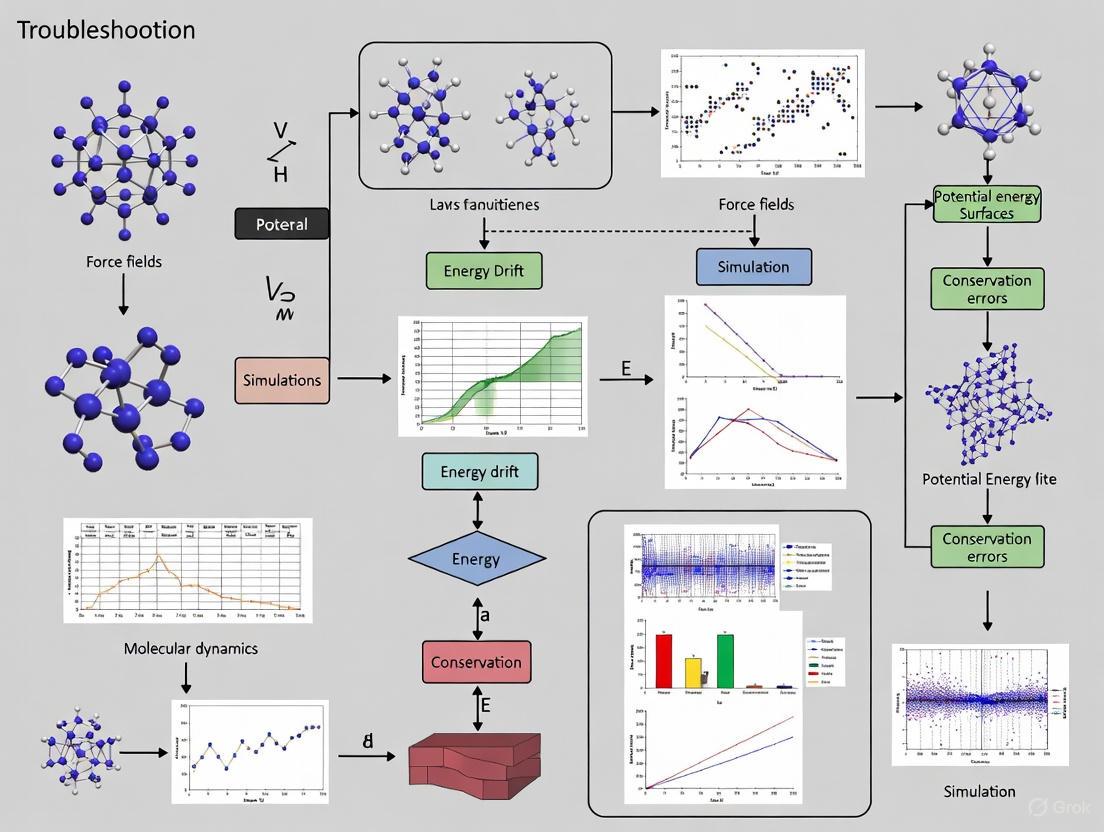
This article provides a comprehensive framework for diagnosing and resolving energy conservation issues in Molecular Dynamics (MD) simulations, a critical challenge for obtaining reliable results in computational drug discovery and...
Solving Energy Conservation Problems in Molecular Dynamics: A Practical Guide for Biomedical Researchers
Abstract
This article provides a comprehensive framework for diagnosing and resolving energy conservation issues in Molecular Dynamics (MD) simulations, a critical challenge for obtaining reliable results in computational drug discovery and biomolecular research. We cover foundational principles distinguishing simulation-energy from true-energy conservation, explore methodological advancements including machine learning potentials and structure-preserving integrators, detail systematic troubleshooting protocols for parameter selection and system setup, and introduce robust validation techniques using theoretical-best estimates and experimental data refinement. Targeted at researchers and drug development professionals, this guide synthesizes current best practices and emerging trends to enhance the robustness and predictive power of MD simulations in biomedical applications.
Understanding Energy Conservation: From Physical Principles to Simulation Realities
Defining True-Energy Conservation vs. Simulation-Energy Conservation
Frequently Asked Questions (FAQs)
Q1: What is the core difference between "Simulation-Energy" and "True-Energy" conservation?
A1: The key distinction lies in what is being conserved [1]:
- Simulation-Energy Conservation: Refers to the conservation of the total energy within the closed numerical system of the simulation itself. It is a measure of the numerical stability of the integrator and the time-reversibility of the calculated forces.
- True-Energy Conservation: Refers to how well the simulated dynamics conserves the energy that would be present in the real, physical system being modeled. It is a measure of the physical accuracy of the potential energy surface (PES) or the force calculator used in the simulation. A simulation can be perfectly simulation-energy conserving even if it models physically unrealistic or dissociative behavior.
Q2: My simulation uses a Machine Learning Interatomic Potential (MLIP). Why does my total energy drift even if the potential claims low force errors?
A2: This is a common issue. MLIPs are often trained to minimize the root-mean-square error (RMSE) of forces on a static testing dataset. However, they can fail to accurately reproduce the true physical potential energy surface in regions encountered during a dynamic simulation, such as during rare events (e.g., defect migration) or in non-equilibrium structures [2]. Low average errors on standard test sets do not guarantee accurate dynamics. The drift indicates a discrepancy between the MLIP's learned PES and the true physical PES, leading to poor true-energy conservation [1].
Q3: What is an "acceptable" level of energy fluctuation in an NVE (microcanonical) simulation?
A3: For a production-quality NVE simulation, the total energy should not have a systematic drift. The magnitude of random fluctuations around a stable mean is what matters. A widely used heuristic is that the magnitude of these fluctuations should be small compared to the relevant thermal energy scale [3]. A more practical rule of thumb is that the fluctuations should be roughly three orders of magnitude smaller than the total energy of the system [3].
Q4: What common simulation setup errors can cause significant energy non-conservation?
A4: Several technical parameters can severely impact energy conservation [4]:
- Time step (
TimeStep) too large: A large integration step size leads to inaccuracies in solving Newton's equations, causing a drift in total energy. - Insufficient pair-list buffer (
rlist): The pair list (neighbor list) is updated periodically. If the buffer distance between the pair-list cut-off and the force cut-off is too small, particles can move from outside the interaction range to inside between updates, missing force calculations and causing energy drift [4]. - Incorrect treatment of constrained bonds: The accuracy of algorithms like SHAKE or LINCS must be sufficient. In single precision, constraints can cause a small but non-negligible energy drift [4].
Troubleshooting Guide: Diagnosing Energy Non-Conservation
Follow this workflow to systematically identify the source of energy conservation issues in your molecular dynamics simulations.
Table 1: Quantitative Benchmarks for Energy Fluctuations
Use this table to evaluate the energy behavior in your NVE simulation.
| Metric | Description | Target / Acceptable Heuristic |
|---|---|---|
| Systematic Drift | A continuous, monotonic increase or decrease in total energy over time. | Zero. Any significant systematic drift indicates a problem that must be corrected [1]. |
| Fluctuation Magnitude | The standard deviation or peak-to-peak variation of the total energy around its mean. | Fluctuations should be ~3 orders of magnitude smaller than the total system energy [3]. |
| Relative Thermal Scale | The magnitude of fluctuations relative to the thermal energy per particle. | Fluctuations should be smaller than ( k_B T ) per particle for the property of interest [3]. |
Table 2: Common Technical Errors and Solutions
| Error Source | Symptom | Diagnostic Step | Solution |
|---|---|---|---|
| Large Time Step | Energy drift that increases with larger TimeStep. |
Run short tests with progressively smaller time steps (e.g., 0.5 fs, 1 fs, 2 fs). | Reduce the TimeStep until energy is stable. |
| Pair-List Buffer | Small, steady energy drift. | Check the log file for warnings. Monitor the neighbor search efficiency. | Increase the Verlet buffer size (rlist - rcutoff) or decrease the update frequency (nstlist). Use automated buffer tuning if available [4]. |
| Stochastic Thermostat | Energy does not conform to the microcanonical ensemble. | Ensure you are running in the NVE ensemble. | For NVE testing, use a thermostat only for equilibration, then switch to NVE for production. |
Advanced Topic: Energy Conservation with Machine Learning Potentials
Machine Learning Interatomic Potentials (MLIPs) present unique challenges for energy conservation. They can achieve low average force errors on test sets but still produce poor dynamics.
The Core Problem
MLIPs are trained on data, and if the training set lacks sufficient coverage of rare events (REs) or defective configurations, the potential will be inaccurate in those regions. This leads to a failure in true-energy conservation, even if the simulation itself is numerically stable [2]. For example, an MLIP might show excellent energy conservation while simulating a solid at equilibrium but fail dramatically when a vacancy migrates or an interstitial forms, because those configurations were not well-represented in the training data [2].
Protocol: Evaluating and Improving MLIPs for True-Energy Conservation
- Create Specialized Test Sets: Move beyond standard test sets. Construct a "Rare Event Testing Set" (( \mathcal{D}_{RE-Testing} )) comprising snapshots from ab initio MD (AIMD) trajectories that capture key atomic migrations, such as vacancy or interstitial diffusion [2].
- Compute Diagnostic Metrics: On the ( \mathcal{D}_{RE-Testing} ) set, calculate:
- The force error specifically on the migrating atoms.
- The energy RMSE for these non-equilibrium configurations.
- Use Metrics for Model Selection: When developing multiple MLIP models, use the metrics from Step 2 to select the final model, rather than relying solely on low average force errors over a broad dataset [2].
- Iterative Training: Use the configurations where the MLIP shows high errors to augment the training dataset, then retrain the model. This iterative process improves the MLIP's accuracy in critical, dynamically relevant regions of the PES.
Table 3: Research Reagent Solutions for MLIP Development
| Item / Tool | Function in MLIP Troubleshooting |
|---|---|
| Rare Event (RE) Test Set (( \mathcal{D}_{RE-Testing} )) | A curated set of atomic configurations used to evaluate the MLIP's accuracy for diffusion, defect migration, and other key dynamic processes [2]. |
| Force Performance Score | A quantitative metric developed to gauge an MLIP's ability to correctly predict forces on atoms undergoing rare events, providing a better indicator of dynamic accuracy than total force RMSE [2]. |
| Ab Initio Molecular Dynamics (AIMD) | Used as the source of ground-truth data and to generate the RE test sets for validating MLIP-driven MD simulations [2]. |
| BoostMut | A computational tool that automates the analysis of dynamic structural features from MD simulations, which can help in formalizing the assessment of stability and identifying simulation anomalies [5]. |
The Critical Role of Energy Conservation in Robust Biomolecular Sampling
Frequently Asked Questions
What does "energy conservation" mean in the context of molecular dynamics (MD) simulations? In MD, energy conservation means that the total energy of a simulated system (the sum of potential and kinetic energy) should remain constant over time when no external forces are applied. It is a fundamental check for the correctness and numerical stability of a simulation [6].
Why should I care if my simulation doesn't conserve energy perfectly? Significant energy drift (a consistent change in total energy) indicates that your simulation is not sampling from a physically realistic ensemble. This can lead to artifactual results and unreliable predictions, for instance, in protein-ligand binding free energies or protein folding studies [6].
My simulation shows energy drift. Where should I start troubleshooting? Energy drift is often a symptom of underlying problems. A systematic approach is crucial. Begin by investigating the most common culprits: the treatment of long-range electrostatics, the integration timestep, and the constraint algorithms used for bonds involving hydrogen [6].
Can my choice of thermostat cause energy conservation issues? Yes. Some thermostats are designed to correctly sample the desired thermodynamic ensemble (e.g., NVT), while others only approximate it. Using a thermostat that is inappropriate for your system size or type can introduce artifacts. For example, the Berendsen thermostat is known to suppress energy fluctuations and does not generate a correct ensemble, which can mask or contribute to energy conservation problems [6].
I see "crazy bonds" and molecules diffusing out of the box in my visualization. Is this an energy conservation error?
Not necessarily. These are typically artifacts of periodic boundary conditions (PBC) and how trajectories are visualized. Molecules crossing a box boundary will reappear on the opposite side, which can make them look broken. This is normal behavior during the simulation but should be corrected during trajectory analysis for proper visualization. GROMACS provides tools like gmx trjconv to fix these visual issues [6].
Troubleshooting Guides
Guide 1: Diagnosing and Fixing Energy Drift
Problem: The total energy of your system shows a consistent upward or downward drift over time.
Diagnostic Protocol:
- Isolate the Component: Plot the kinetic energy, potential energy, and total energy separately. This helps identify if the drift originates from a specific part of the energy calculation.
- Check the Thermostat: Ensure you are using a thermostat that produces a correct thermodynamic ensemble (e.g., Nosé-Hoover) for production simulations, especially for biomolecular systems [6].
- Verify Settings: Systematically review the parameters in the table below.
Table: Key Parameters to Check for Energy Drift
| Parameter | Common Issue | Suggested Fix |
|---|---|---|
| Electrostatic Cut-off | Too short a cut-off can create artifacts. | Use a longer cut-off (e.g., 1.2 nm) or a more accurate method like Particle Mesh Ewald (PME). |
| Integration Timestep | A too-large timestep leads to inaccuracies. | Reduce the timestep (e.g., to 1-2 fs), especially when bonds with hydrogen are constrained [6]. |
| Constraint Algorithm | Inaccurate algorithms can cause energy drift. | Use a robust algorithm like P-LINCS [6]. |
| Pair List Update | Infrequent updates can cause atoms to "overlap". | Decrease the nstlist parameter or use the Verlet buffer scheme. |
| Center of Mass Motion | If removed in multiple groups, energy is not conserved. | Remove center of mass motion for the entire system only once per step [6]. |
Guide 2: Addressing Poor Sampling and Non-Physical Results
Problem: The simulation fails to replicate known experimental data or gets stuck in a single conformational state.
Diagnostic Protocol:
- Validate the Energy Function: Confirm that your force field can reproduce relevant small-molecule thermodynamics and recapitulate known macromolecular structures. An imbalance in force field parameters is a common root cause [7].
- Check for Restricted Motion: Analyze root-mean-square deviation (RMSD) and radius of gyration (Rg) over time. If these values plateau at a low level, the system may be trapped.
- Implement Enhanced Sampling: If the energy barrier between states is too high to cross in a standard simulation time, use enhanced sampling techniques.
Table: Enhanced Sampling Methods for Biomolecular Systems [8]
| Method | Principle | Typical Application |
|---|---|---|
| Metadynamics | Adds a history-dependent bias potential to collective variables (CVs) to discourage visited states. | Protein folding, ligand unbinding. |
| Replica Exchange MD (REMD) | Runs multiple replicas at different temperatures and swaps them, aiding escape from local minima. | Peptide conformational sampling, protein folding. |
| Parallel Tempering | Similar to REMD but focused on temperature as the swapping parameter. | Sampling complex energy landscapes. |
| Conformational Flooding | Applies a bias potential to accelerate slow transitions. | Enzyme functional motions. |
Experimental Protocols
Protocol 1: Validating a Biomolecular Energy Function
This protocol is based on the methodology used to develop the next-generation Rosetta energy function, which integrates both small-molecule and macromolecular data for robust parameterization [7].
Objective: To optimize and validate an energy function against diverse experimental data to ensure transferability and physical accuracy.
Methodology:
Define a Composite Target Function: The agreement of an energy function ( E(\Theta) ) with parameters ( \Theta ) is evaluated using a weighted target function [7]: ( F{\text{total}}[E(\Theta)] = w{\text{thermodynamic}} F{\text{thermodynamic}}[E(\Theta)] + w{\text{structural}} F_{\text{structural}}[E(\Theta)] )
Incorporate Diverse Training Data:
- Thermodynamic Data: Use experimental liquid properties of small molecules and vapor-to-water transfer free energies of protein side-chain analogs [7].
- Structural Data: Use high-resolution macromolecular structural data and large sets of alternative conformations (decoys) for known protein structures and complexes [7].
Perform Integrated Optimization: Use a protocol like
dualOptEto simultaneously optimize a large number of energy parameters (on the order of 100) against the composite target function. This ensures the final model balances physical chemistry with structural biology [7].Independent Validation: Test the optimized energy function on computationally intensive tasks not included in the training set, such as [7]:
- Monomeric protein structure prediction.
- Protein-protein and protein-ligand docking.
- Protein sequence design.
- Prediction of free energy changes upon mutation (( \Delta \Delta G )).
Protocol 2: A Workflow for System Setup and Equilibration
This workflow provides a generalized checklist to minimize energy-related issues from the start of a simulation.
Steps:
System Preparation:
- Place your solute (e.g., protein) in a simulation box of appropriate shape and size.
- Solvate with water models consistent with your force field.
- Add ions to neutralize the system and achieve desired ionic concentration.
Energy Minimization:
- Use a steepest descent or conjugate gradient algorithm to remove bad steric clashes and high initial forces.
- This step is crucial for relaxing the system before applying temperature.
Solvent Equilibration:
- Run a short simulation (e.g., 50-100 ps) with heavy atoms of the solute harmonically restrained.
- Use a thermostat to bring the system to the target temperature (e.g., 300 K). This allows the solvent and ions to relax around the solute.
Full System Equilibration:
- Gradually release the restraints on the solute (e.g., first release side-chains, then the backbone).
- If running an NPT simulation, introduce a barostat to adjust the density to the target pressure.
Production MD:
- Run the simulation with all restraints removed for the desired timescale.
- Ensure that properties like density, temperature, and potential energy have stabilized before considering the production phase begun.
The Scientist's Toolkit
Table: Essential Research Reagents and Software Solutions
| Item / Software | Function / Description | Relevance to Energy Conservation |
|---|---|---|
| GROMACS | A versatile package for performing MD simulations. | Its documentation provides detailed explanations on thermostats, pressure coupling, and energy conservation issues [6]. |
| PLUMED | A plugin for enhanced sampling algorithms and free-energy calculations. | Enables the use of metadynamics and other methods to overcome sampling barriers linked to energy landscape features [8]. |
| Rosetta | A comprehensive software suite for macromolecular modeling. | Its energy functions can be optimized against both structural and thermodynamic data for more physically accurate modeling [7]. |
| ReaxFF | A reactive force field for MD simulations. | Models bond formation and breakage, requiring dynamic charge equilibration; surrogate ML models can accelerate charge prediction while enforcing physical constraints [9]. |
| LeanLJ | A formally verified framework for computing molecular interaction energies. | Uses theorem provers to eliminate semantic errors in energy calculations, providing mathematical guarantees of correctness for potentials like Lennard-Jones [10]. |
| LAMMPS | A classical molecular dynamics simulator. | Like GROMACS, it is a widely used engine where the principles of energy conservation and proper parameter settings apply. |
| MOSDEF | The Molecular Simulation Design Framework. | Aids in creating reproducible, well-documented simulation workflows, reducing human error in setup [10]. |
Hamiltonian Mechanics and the Foundation of Conservative Systems
Frequently Asked Questions
What does it mean for a system to be Hamiltonian? A system is Hamiltonian if its dynamics can be described by Hamilton's equations. For a system with coordinates (\boldsymbol{q}) and momenta (\boldsymbol{p}), these equations are: [ \frac{d\boldsymbol{q}}{dt} = \frac{\partial \mathcal{H}}{\partial \boldsymbol{p}}, \quad \frac{d\boldsymbol{p}}{dt} = -\frac{\partial \mathcal{H}}{\partial \boldsymbol{q}} ] where (\mathcal{H}(\boldsymbol{p}, \boldsymbol{q}, t)) is the Hamiltonian function, which often corresponds to the total energy of the system [11]. The preservation of this Hamiltonian is a key feature of conservative systems.
Why is my NVE simulation showing a significant energy drift? Energy drift in NVE (constant number of particles, volume, and energy) simulations is a common problem. The causes can be grouped into three main categories [12] [13] [14]:
- Numerical Discretization Error: The use of a finite time step in integrators like Velocity Verlet introduces an error. The numerical solution follows a "shadow Hamiltonian" that is close to, but not exactly, the true system Hamiltonian. This is a fundamental source of error, even with a perfectly coded integrator [14].
- Incorrect Force Calculation: A bug in the force routine, such as an incorrect derivative of the potential, will directly violate the conservation laws dictated by Hamilton's equations [13].
- Inadequate Handling of Boundaries: Failing to correctly implement periodic boundary conditions using the minimum image convention can cause particles to interact incorrectly when they cross the simulation box boundaries, leading to energy jumps [13].
My simulation conserves energy with a small system but fails with a larger one. Why? The stability of a numerical integrator can be system-size dependent. For a given time step, the accumulation of numerical errors might become more significant as the number of particles and degrees of freedom increases. Furthermore, larger systems have a higher chance of containing a few "stiff" interactions (e.g., bonds or atoms that are very close) that require a smaller time step for stable integration [13].
What is the difference between "simulation-energy" and "true-energy" conservation? This is a crucial distinction, especially when using machine-learned potentials:
- Simulation-energy conservation means that the value of the Hamiltonian defined by the model potential used in the simulation is constant.
- True-energy conservation means that the energy of the real, physical system is constant. A simulation can be perfect in the first sense but still be physically unrealistic and un-conservative in the second sense if the underlying model potential is inaccurate [1].
Troubleshooting Guides
Guide 1: Diagnosing and Fixing Energy Drift in NVE Simulations
Follow this logical workflow to systematically identify and resolve the cause of energy drift in your simulations.
Recommended Action for Each Step
Step 1: Reduce Time Step
- Protocol: Run a short simulation (e.g., 10-20 ps) and monitor the total energy. Halve the time step and repeat. If the drift reduces significantly, your original time step was too large.
- Reference Values: For a simple Lennard-Jones system in reduced units, a time step of 0.001-0.005 is common. For all-atom water models (like TIP4P), a time step of around 2 fs is standard, but stable integration up to 7 fs has been demonstrated with careful parameterization [13] [14].
Step 2: Check Force Implementation
- Protocol: This is a code/debugging issue. A classic error is a mismatch between the potential and the force. For a Lennard-Jones potential ( V(r) = 4\epsilon [ (\sigma/r)^{12} - (\sigma/r)^{6} ] ), the correct force is ( F(r) = (24\epsilon / r) * [ 2(\sigma/r)^{12} - (\sigma/r)^{6} ] ). An incorrect implementation (e.g., missing the division by (r)) will cause immediate and severe energy drift [13]. Test your force routine on a simple two-particle system.
Step 3: Verify Boundary Conditions
- Protocol: Ensure your code correctly implements the minimum image convention for periodic boundary conditions. When calculating the distance vector
dxbetween two particles, it should be corrected as follows [13]: Without this, particles interacting across the box boundary will experience a discontinuous force, causing energy jumps.
- Protocol: Ensure your code correctly implements the minimum image convention for periodic boundary conditions. When calculating the distance vector
Step 4: Inspect Thermostat Coupling
- Protocol: If you are running an NVE simulation, ensure that no thermostat (e.g., Nosé-Hoover, Langevin) is active. A poorly configured or overly strong thermostat in a preceding equilibration phase can push the system into a state that is not a valid microstate for the NVE ensemble, leading to an initial energy drift as the system relaxes [14].
Step 5: Check System Preparation
- Protocol: A proper NVE simulation requires that the system is well-equilibrated beforehand. Ensure that a suitable equilibration protocol in the NVT (constant temperature) or NPT (constant pressure) ensemble has been performed until the potential energy, temperature, and density (if NPT) have stabilized [15].
Guide 2: Choosing a Time Step for Stable Integration
This guide helps you select an appropriate integration time step to balance computational efficiency and energy conservation.
Table 1: Time Step Guidelines for Different Systems
| System Type | Potential / Model | Suggested Maximum Time Step | Key Considerations & Rationale |
|---|---|---|---|
| Simple Atomic Liquid | Lennard-Jones (reduced units) | 0.001 - 0.005 [13] | The stability limit is governed by the fastest atomic vibrations from the steep repulsive part ((r^{-12})) of the potential. |
| All-Atom Water | TIP4P (rigid) | ~7 fs [14] | With the use of symplectic integrators and constraint algorithms for bonds, step sizes can be pushed significantly beyond the 2 fs limit often used for flexible models. |
| Machine Learning Potentials | Various ML-derived potentials | System-dependent, requires validation | ML potentials can have unphysical sharp features or be non-conservative. Energy conservation must be explicitly checked, as high force accuracy does not guarantee stable dynamics [1]. |
Experimental Protocol: Time Step Stability Test
- Start from a well-equilibrated system.
- Run a short NVE simulation (e.g., 50-100 ps) using a candidate time step.
- Monitor the total energy and calculate the drift (e.g., kJ/mol/ps per atom).
- Repeat with a time step 20-50% smaller. If the drift decreases significantly, the larger time step is too aggressive.
- A good target for the energy drift is on the order of (10^{-4}) to (10^{-5}) (k_B T)/ns per atom or better [12].
The Scientist's Toolkit
Table 2: Essential "Reagents" for Molecular Dynamics Experiments
| Item | Function in the Simulation | Technical Specification & Purpose |
|---|---|---|
| Numerical Integrator | Propagates the equations of motion. | Velocity Verlet is a common choice: it is symplectic, time-reversible, and second-order accurate. These properties are crucial for long-term energy conservation [13] [14]. |
| Potential Energy Function | Defines the interatomic forces. | E.g., Lennard-Jones for simple fluids, TIP4P for water [13] [14]. The function must be smooth, and its derivative (force) must be consistent with the potential to obey Hamilton's equations [11] [13]. |
| Thermostat | Controls temperature during equilibration. | Nosé-Hoover (deterministic) or Langevin (stochastic). Used to prepare the system for NVE production runs. Strong coupling can artifactually affect dynamics [14]. |
| Symplectic Map / Generating Function | For structure-preserving long-time-step integration. | A scalar generating function (S^3(\bar{\boldsymbol{p}}, \bar{\boldsymbol{q}})) can be used to define a symplectic and time-reversible map ((\boldsymbol{p}, \boldsymbol{q}) \rightarrow (\boldsymbol{p}', \boldsymbol{q}')) equivalent to a large time step, avoiding energy drift artifacts of non-structure-preserving methods [16]. |
Advanced Methodologies
Structure-Preserving Integration for Large Time Steps
A promising approach to overcome the time-step limitation is to use machine learning to learn a structure-preserving map for the long-time-step evolution of the system.
Protocol: Learning the Action for Long-Time-Step Simulations [16]
- Concept: Instead of learning the trajectory directly, learn a generating function (S^3(\bar{\boldsymbol{p}}, \bar{\boldsymbol{q}})), which defines a symplectic and time-reversible map. This ensures the learned dynamics has a Hamiltonian structure.
- Parametrization: Use a neural network to represent the generating function (S^3), where its inputs are the average momenta and positions, (\bar{\boldsymbol{p}}=(\boldsymbol{p}+\boldsymbol{p}')/2) and (\bar{\boldsymbol{q}}=(\boldsymbol{q}+\boldsymbol{q}')/2).
- Training: The network is trained on short, high-time-step-resolution trajectories, learning to predict the system's evolution over a large time step (h).
- Result: The trained model produces a map that is equivalent to learning the mechanical action of the system. This method eliminates pathological energy drift and violations of equipartition seen in non-structure-preserving ML predictors, enabling accurate simulations with time steps orders of magnitude larger than conventional methods.
Understanding and Correcting Discretization Errors
Even with a perfect, symplectic integrator, a finite time step (h) introduces a discretization error. Backward error analysis provides a framework to understand and correct this.
Theoretical Foundation [14] The numerical solution from a symplectic integrator of order (r) is the exact solution of a modified Hamiltonian (\tilde{\mathcal{H}}): [ \tilde{\mathcal{H}}(\boldsymbol{z}; h) = \mathcal{H}(\boldsymbol{z}) + h^r \mathcal{H}^{[r]}(\boldsymbol{z}) + h^{r+1} \mathcal{H}^{[r+1]}(\boldsymbol{z}) + \cdots ] where (\mathcal{H}) is the original Hamiltonian. When we measure an observable (A) in our simulation, we are actually sampling from this shadow system, leading to a measured average (\langle A \rangleh) that differs from the true average (\langle A \rangle0).
Practical Correction Protocol: Extrapolation [14]
- Run multiple simulations of the same system using the same integrator but with different time steps (e.g., (h, h/2, h/4)).
- Measure the observable (A) for each simulation, obtaining (\langle A \rangleh, \langle A \rangle{h/2}, \langle A \rangle_{h/4}).
- Perform a Richardson extrapolation to (h \rightarrow 0) to estimate the true value (\langle A \rangle_0). This can correct for the leading-order discretization error in the measured averages.
Troubleshooting Guides
How do I diagnose the root cause of energy drift in my NVT simulation?
Energy drift in NVT simulations often stems from incorrect simulation parameters or force field inconsistencies. A systematic approach is required to identify the specific cause.
Diagnostic Steps:
- Run an NVE Test: First, isolate the thermostat's influence. Run a short simulation in the NVE (microcanonical) ensemble using your equilibrated configuration. Monitor the total energy (
etotal) over time. A well-behaved integrator with a correct time step will show minimal energy drift in NVE [17]. - Verify Time Step: The time step must be small enough to resolve the highest frequency vibrations in your system, particularly those of light atoms like hydrogen. A time step that is too large violates the numerical integration's assumption that forces are constant between steps, causing energy to diverge. For most systems, 1 femtosecond (fs) is a safe starting point [17].
- Check Thermostat Coupling: A very tight coupling to the heat bath (set via a small
Thermostat timescalein Nose-Hoover or a highFrictionparameter in Langevin) can artificially interfere with the system's natural dynamics and introduce artifacts [17]. - Audit Force Field Mixing: Incorrectly defined non-bonded interactions between different materials, especially in hybrid interfaces (e.g., solid-liquid), are a common source of error. Ensure that the cross-interaction parameters (e.g., between a Buckingham potential and an OPLSAA force field) are physically reasonable and correctly specified in your input script [18].
Solutions:
- If the NVE test shows drift, reduce the time step.
- If the NVE test is stable but NVT is not, loosen the thermostat coupling. For the Nose-Hoover thermostat, increase the
Thermostat timescaleparameter. For the Langevin thermostat, decrease theFrictionparameter [17]. - Systematically review all
pair_styleandpair_coeffcommands for consistency, paying special attention to hybrid or overlay styles and cross-interactions [18].
Why does my simulation show large energy noise and unstable temperature?
Large, high-frequency noise in energy and temperature signals is typically related to the choice of thermostat and its parameters, which can oversuppress or disrupt the system's dynamics.
Diagnostic Steps:
- Identify the Thermostat: Confirm which thermostat you are using. The Berendsen and Langevin thermostats are known to produce stronger interference with atomic dynamics compared to the Nose-Hoover thermostat [17].
- Check Friction and Coupling Constants: For the Langevin thermostat, a high
Frictionvalue means each particle is strongly coupled to a viscous, stochastic background. This can cause large, noisy fluctuations in energy as the system is constantly subjected to random collision forces [17].
Solutions:
- For production runs where accurate dynamics are important, switch to the Nose-Hoover thermostat, which generally provides more stable and reliable temperature control [17].
- If you must use the Langevin thermostat, reduce the
Frictionparameter to weaken the coupling to the heat bath. Note that the Langevin thermostat is often better suited for equilibration or structure generation rather than for measuring dynamical properties [17].
How can I prevent catastrophic failure (irreversible energy blow-up) at the start of a simulation?
Catastrophic failure early in a simulation is usually a sign of a fundamentally unstable configuration or incorrect setup.
Diagnostic Steps:
- Inspect Initial Structure: Check for unphysically close contacts between atoms, which generate enormous repulsive forces. This can occur if an energy-minimized structure was not properly generated before starting the dynamics.
- Review Minimization and Equilibration: Ensure the system underwent a thorough energy minimization and a gradual, multi-step equilibration process (e.g., NPT followed by NVT) to relax any high-energy configurations before applying a non-equilibrium protocol [18].
- Validate Potentials and Parameters: A single incorrect parameter in a potential function (e.g., in a Buckingham or bond coefficient) can make the entire system unstable [18].
Solutions:
- Always run a sequence of energy minimization and equilibration simulations before starting production runs.
- Double-check all force field parameters, masses, and charges in your input script.
- Start the simulation with a very small time step (e.g., 0.1 fs) for the first few steps and monitor the total energy and maximum force. If stable, you can gradually increase the time step to the target value.
Frequently Asked Questions (FAQs)
My NEMD simulation shows different heat fluxes at the source and sink. Is this an energy conservation error?
Not necessarily. A difference in the instantaneous heat flux between the heat source and sink regions is expected and can be due to the finite time required for heat to travel and dissipate across the system. However, a large, systematic difference in the accumulated heat, as seen in the slope of the energy added/removed over time, does indicate a non-conservation problem. This can be caused by the energy drift issues detailed in the troubleshooting guide above, often related to the thermostatting method and force field setup in the interface regions [18].
How can I easily verify that my molecular dynamics simulator is working correctly?
A standard verification test involves checking the conservation of energy in an NVE simulation of a simple, closed system.
- Set up a small, well-defined system like a Lennard-Jones crystal or fluid.
- Run a simulation in the NVE ensemble for a significant number of steps.
- Plot the total energy over time. For a correct and stable integrator (like Velocity Verlet), the total energy should oscillate around a stable mean value with no systematic drift.
- Perform a convergence test: run the same simulation with progressively smaller time steps. The error in the average total energy should decrease with the square of the time step, confirming the theoretical order of the integrator [19].
What is the best thermostat to use if I need accurate dynamical properties?
For measuring dynamical properties like diffusion constants or vibration spectra, the Nose-Hoover thermostat is generally recommended. It produces a correct canonical ensemble and interferes less with the natural dynamics of the particles compared to stochastic thermostats like Langevin. For the most accurate dynamics, running production simulations in the NVE ensemble after equilibration in NVT is the best option, as it completely avoids thermostat-induced artifacts [17].
Experimental Protocols & Data
Protocol: Verifying Energy Conservation in NVE Ensemble
This protocol provides a methodology to test the stability of your simulation setup independently of a thermostat [17] [19].
1. System Preparation:
- Create or obtain a well-defined, energy-minimized system (e.g., a simple liquid or crystal).
- Equilibrate the system in the NVT ensemble at the desired temperature until the temperature and pressure are stable.
2. NVE Production Run:
- Use the final configuration from the NVT equilibration as the input for an NVE simulation.
- Set the
timestepto an appropriate value (e.g., 1 fs). - Use an integrator like
velocity Verlet. - Set the
thermooutput frequency to record the total energy every 100-1000 steps.
3. Data Analysis:
- Plot the total energy (
etotal) as a function of simulation time. - Calculate the drift as the slope of a linear fit to the total energy time series. A robust simulator will exhibit a near-zero slope.
Quantitative Data on Thermostat Performance
The table below summarizes key characteristics of common thermostats that influence energy conservation and dynamic properties [17].
| Thermostat | Ensembles Correctly Sampled? | Interference with Natural Dynamics | Recommended Use Case |
|---|---|---|---|
| Nose-Hoover | Yes (Canonical) | Low | Production runs, calculating dynamical properties |
| Langevin | Yes (Canonical) | High (individual particle coupling) | Equilibration, structure generation, suppressing dynamics |
| Berendsen | No (approximately Canonical) | Moderate | Fast equilibration only (not for production) |
| Bussi-Donadio-Parrinello | Yes (Canonical) | Moderate | Stochastic alternative to Berendsen for correct sampling |
The Scientist's Toolkit
Key Research Reagent Solutions
This table lists essential "reagents" or components for setting up and troubleshooting molecular dynamics simulations.
| Item | Function / Explanation |
|---|---|
| Nose-Hoover Thermostat | A reliable algorithm for temperature control that correctly samples the canonical ensemble with minimal interference to system dynamics [17]. |
| Velocity Verlet Integrator | A widely used numerical algorithm for integrating Newton's equations of motion. It is time-reversible and symplectic, leading to good long-term energy conservation [17]. |
| PPPM (Particle-Particle Particle-Mesh) | An algorithm (kspace_style pppm) for efficiently and accurately calculating long-range electrostatic interactions, which is critical for energy stability in charged systems [18]. |
| Lennard-Jones Potential | A simple model potential for van der Waals interactions, often used for initial verification and testing of a new MD code or setup [19]. |
| Hybrid Pair Styles | A method (pair_style hybrid/overlay) to combine different interaction potentials (e.g., Buckingham + LJ) within one simulation, essential for modeling complex interfaces [18]. |
Workflow and Logic Diagrams
Energy Non-Conservation Diagnostics
NVE Verification Protocol
Frequently Asked Questions (FAQs) on Energy Conservation
Q1: My molecular dynamics (MD) simulation does not conserve total energy. Is this always a problem with my physical model? No, not necessarily. It is crucial to distinguish between simulation-energy and true-energy conservation. A simulation can perfectly conserve its own numerical energy (simulation-energy) but still be a poor representation of the real, physical energy conservation (true-energy) of the system you are trying to model. Energy drift in ab initio MD or non-conservation in machine learning (ML) force fields often points to inaccuracies in the underlying potential energy surface (PES), which is a physical artifact. However, even with an accurate PES, an overly large numerical artifact, such as an improper time step, can also cause energy drift [1].
Q2: What is the most common numerical mistake that leads to energy non-conservation? Using an excessively large time step is a prevalent source of numerical error. For simulations involving water, a standard 2-femtosecond (fs) time step, often used with rigid water models, has been shown to introduce significant inaccuracies. These include violations of the equipartition theorem, leading to errors in system dynamics, density, and volume. These errors can be as large as the typical volume change in protein folding, critically affecting thermodynamic and dynamic properties [20].
Q3: How can Machine Learning Potentials (MLIPs) cause energy non-conservation? MLIPs that are not based on a conservative potential energy surface may only provide forces. While these forces might be reasonable for single-point calculations, they do not necessarily correspond to a consistent energy landscape. When integrated over time, this results in a failure to conserve energy, a physical artifact stemming from an incorrect PES. Furthermore, MLIPs can exhibit pathological behavior and a loss of equipartition even when trained to high accuracy, because their predicted trajectories often lack the symplectic (structure-preserving) property of true Hamiltonian dynamics [16] [1] [2].
Q4: My simulation conserves energy but produces incorrect dynamics (e.g., diffusion or spectroscopy). Why? Energy conservation is a necessary but not sufficient condition for a correct simulation. The issue likely lies in the physical artifacts of your model. For example:
- An MLIP might have low average force errors on its test set but still fail to accurately reproduce rare events, defect migration barriers, or atomic vibrational frequencies. This indicates an incorrect PES in specific, crucial configurations [2].
- Similarly, a classical force field may be energy-conserving but based on an imperfect functional form that fails to capture the true physics of bond breaking/formation or complex interactions [21] [22].
Troubleshooting Guide: A Step-by-Step Diagnostic Protocol
Follow this systematic guide to isolate the root cause of energy non-conservation and related artifacts in your MD simulations.
Step 1: Isolate the Integrator and Time Step
Objective: Rule out numerical artifacts from the time integration scheme. Methodology:
- Reduce the Time Step: Run a short simulation, drastically reducing your time step (e.g., to 0.5 fs for systems containing light atoms or flexible bonds) [20].
- Compare Results: Monitor the total energy conservation and key physical properties (e.g., temperature, density).
- Analysis: If the energy conservation and physical properties improve significantly with a smaller time step, the original issue was a numerical artifact related to an overly large time step. If the problem persists, the issue is likely a physical artifact.
Table 1: Quantitative Impact of Time Step on Simulation Accuracy (Liquid Water Example)
| Time Step (fs) | Energy Conservation | Density Error | Equipartition Violation | Primary Artifact Type |
|---|---|---|---|---|
| 0.5 | Excellent | Minimal | No | Baseline |
| 2.0 | Poor | Significant | Yes | Numerical |
| ≥ 3.5 | Unstable | Large | Severe | Numerical |
Data adapted from ORNL study on water simulations [20].
Step 2: Interrogate the Physical Model (Force Field/MLIP)
Objective: Determine if inaccuracies in the Potential Energy Surface (PES) are the root cause. Methodology:
- Validate against Ab Initio Data: If using an MLIP, check its performance on a diverse testing set that includes non-equilibrium structures, defects, and transition states (rare events). Low average errors on standard test sets do not guarantee accuracy for dynamics [2].
- Check for Physical Consistency: Monitor properties like equipartition (the average kinetic energy should be equal per degree of freedom). A lack of equipartition strongly indicates a physical artifact in the model, such as an MLIP that does not learn a conservative Hamiltonian [20] [16].
- Use Reactive Force Fields with Caution: If simulating chemical reactions, ensure your reactive force field (ReaxFF) has been specifically parameterized and validated for your system. Using an unvalidated parameter set will introduce physical artifacts [21].
Step 3: Analyze System-Specific Properties
Objective: Identify artifacts by comparing simulated properties against known experimental or high-level theoretical data. Methodology:
- Compare Dynamical Properties: Calculate transport properties (e.g., diffusion coefficients) and vibrational spectra (e.g., IR) from your simulation. Significant deviations from experimental data point to physical artifacts in the PES [22].
- Check for Proper Equilibration: Ensure your system has reached equilibrium by monitoring energy, temperature, and pressure. An insufficient equilibration time is a numerical artifact that can lead to spurious results in the production run [15].
- Monitor Phase Space Behavior: In NVE simulations, plot the total energy as a function of time. A steady drift indicates a numerical artifact (e.g., from a large time step or poor integrator), while random fluctuations around a mean are normal. A sudden, large jump in energy may indicate a physical artifact (e.g., unphysical bond breaking due to a bad PES) [15] [1].
Diagram 1: Diagnostic workflow for identifying the root cause of energy non-conservation and related artifacts in MD simulations.
The Scientist's Toolkit: Essential Research Reagents & Solutions
Table 2: Key Computational Tools for Diagnosing MD Artifacts
| Tool / Reagent | Function / Purpose | Considerations for Use |
|---|---|---|
| Short Time Step (0.5 fs) | Diagnostic tool to isolate numerical instability from integrator. | Increases computational cost but is essential for ruling out time-step-related errors, especially with flexible bonds [20]. |
| Symplectic Integrator (e.g., Velocity Verlet) | Numerically integrates equations of motion while preserving geometric structure of Hamiltonian flow. | Prevents energy drift in microcanonical (NVE) simulations for closed systems; ensures long-time stability [16] [23]. |
| Reactive Force Field (ReaxFF) | Models bond breaking and formation in classical MD. | Requires careful parameterization for the specific system; unvalidated parameters are a major source of physical artifacts [21]. |
| Machine Learning Interatomic Potential (MLIP) | Approximates ab initio PES with low computational cost. | Must be tested on rare events and defect properties, not just average force errors, to ensure dynamical accuracy and avoid physical artifacts [2]. |
| Differentiable MD Code (e.g., JAX-MD, TorchMD) | Allows refinement of PES by directly learning from experimental dynamical data (e.g., spectra). | Emerging tool to correct physical artifacts in a PES by using a top-down fitting approach [22]. |
Advanced Methods for Energy-Stable MD Simulations
Selecting and Tuning Symplectic and Time-Reversible Integrators
Frequently Asked Questions (FAQs)
What are the fundamental properties I should look for in a molecular dynamics integrator?
For long-time numerical integration, it is essential that the integrator nearly conserves energy and nearly preserves phase space volume. These properties are often summarized as "what makes molecular dynamics work" [24]. The most reliable integrators possess geometric properties, such as:
- Symplecticity: A mathematical property that implies phase space volume preservation and ensures excellent long-term energy conservation for sufficiently small time steps [24].
- Time-Reversibility (Symmetry): The numerical method should be symmetric, meaning it reproduces the same trajectory forwards and backwards in time. This is directly linked to energy conservation [24] [25].
- Volume Preservation: The integrator should conserve volume in the phase space of the system, a property automatically fulfilled by symplectic integrators [26] [24].
Why is the Störmer-Verlet method so popular, and when should I consider a different integrator?
The Störmer-Verlet method (also known as velocity-Verlet or leapfrog) is a method of choice because it is explicit for separable Hamiltonians, easy to implement, and possesses all essential geometric properties: it is symmetric, time-reversible, symplectic, and volume-preserving [24]. Its main disadvantage is its low order (2nd-order), which results in a lack of accuracy compared to other methods [24]. You should consider a different integrator when higher accuracy is required without reducing the time step, which can be the case in ab initio molecular dynamics or when simulating systems where numerical phase errors are critical [27].
I've heard about "effective order." What does this mean?
An integrator is of effective order four if it is conjugate to a method of order four. This means there exists a change of coordinates (a transformation of your system's variables) such that the transformed method approximates the exact flow to order four. In practice, with a constant step size, this change of coordinates only needs to be applied at the beginning and end of the integration. This allows you to use an integrator that is simpler or cheaper to compute but behaves like a higher-order one after the transformation [24].
My simulations show a steady drift in energy. What is the most likely cause?
A steady drift in the conserved quantity (like total energy in an NVE simulation) often indicates that the numerical integrator is not behaving time-reversibly, breaking the symplecticity of the method [25]. This can be caused by:
- Using a non-symplectic integrator [24].
- Using a time step that is too large, pushing the integrator outside its stable region [25].
- In ab initio dynamics, using extrapolation schemes for the wavefunction or density that are not time-reversible [25].
How can I check if my time step is appropriate?
You can perform a constant energy (NVE) simulation and monitor the total energy over time. A well-conserved energy will fluctuate randomly around a stable mean value. A clear linear drift indicates an inappropriate time step or a problem with the integrator [25]. A reasonable rule of thumb is that the long-term drift in the conserved quantity should be less than 10 meV/atom/ps for qualitative results, and 1 meV/atom/ps for "publishable" results [25].
Troubleshooting Guides
Problem: Poor Long-Term Energy Conservation
Symptoms:
- Linear drift in total energy during an NVE simulation.
- Energy "blow-up" and simulation failure.
Diagnostic Steps:
- Verify Integrator Properties: Confirm you are using a symplectic and time-reversible integrator like Störmer-Verlet. Non-symplectic methods, even symmetric and volume-preserving ones, can exhibit energy drift or random-walk behavior in chaotic systems [24].
- Check Time Step Size: Ensure your time step is appropriate based on the Nyquist criterion. The time step should be less than half the period of the fastest vibration in your system. A common guideline is to choose a time step between 0.0333 and 0.01 of the smallest vibrational period [25].
- Run an NVE Test: Perform a short simulation in the NVE ensemble and monitor the energy. Acceptable fluctuations are around 1 part in 5000 of the total system energy per twenty time steps [25].
Solutions:
- Reduce Time Step: Sequentially reduce your time step and observe the energy drift in an NVE simulation until it is acceptable [25].
- Switch Integrator: If you are using a non-symplectic integrator, switch to a symplectic one like Störmer-Verlet. Research indicates that for long-term stability, using a symplectic integrator is superior to strictly volume-preserving but non-symplectic ones [26] [24].
- Use Constraints or Mass Repartitioning: For systems with very fast vibrations (e.g., bonds involving hydrogen atoms), use constraints (like SHAKE or LINCS) to remove those degrees of freedom, allowing for a larger time step. Alternatively, hydrogen mass repartitioning (HMR) can be used to slow down the highest frequencies [25].
The following workflow can help you diagnose and resolve energy conservation issues:
Problem: Choosing Between Different Orders of Integrators
Symptoms:
- High discretization error despite a seemingly small time step.
- Need for high accuracy in trajectories, e.g., for calculating dynamical properties.
Diagnostic Steps:
- Assess Accuracy Needs: Determine if your scientific question requires high short-term accuracy of individual trajectories or good long-term statistical and energy conservation properties. Higher-order methods are often more accurate over short times, but not necessarily over long times [27].
- Evaluate Computational Cost: Higher-order methods (4th-order and above) often require multiple force evaluations per time step. Compare the cost of a higher-order method with a smaller time step versus a lower-order method (like Störmer-Verlet) with a larger time step for the same computational cost.
Solutions:
- Use a Second-Order Symplectic Method: For most conventional MD simulations, the Störmer-Verlet method provides the best balance of stability, simplicity, and computational cost. Its geometric properties ensure good long-term behavior [27] [24].
- Consider an Effective-Order-Four Integrator: If higher accuracy is needed, consider an integrator like the Takahashi-Imada method or its simplified version. These are modifications of Störmer-Verlet that are as easy to implement but have improved accuracy and are conjugate to a fourth-order method [24].
- Generally Avoid Very High-Order Methods: For large-scale molecular dynamics, the overall sense in the community is that the cost-benefit ratio of very high-order integrators (e.g., 6th-order) isn't worth it. The main inaccuracy often comes from statistical error rather than integration error [27] [24].
Comparison of Common Geometric Integrators
The following table summarizes key properties of integrators discussed in the context of molecular dynamics.
| Integrator Name | Formal Order | Effective Order | Symplectic? | Time-Reversible? | Key Advantages | Key Disadvantages |
|---|---|---|---|---|---|---|
| Störmer-Verlet [24] | 2nd | 2nd | Yes | Yes | Simple; All geometric properties; Low cost per step. | Low formal accuracy. |
| Takahashi-Imada [24] | 2nd | 4th | Yes | Yes | Higher effective accuracy. | Requires Hessian (force Jacobian) evaluation. |
| Simplified Takahashi-Imada [24] | 2nd | 4th | No (for DoF>1) | Yes | Higher effective accuracy; No Hessian needed. | Not symplectic; Can cause energy drift. |
| Higher-Order (e.g., 4th) Symplectic [27] | 4th | 4th | Yes | Yes | High short-term trajectory accuracy. | Multiple force evaluations per step; Higher computational cost. |
Guidelines for Time Step Selection
This table provides practical guidelines for choosing a time step based on system characteristics and simulation goals.
| System Type | Fastest Vibration | Recommended Time Step | Key Metric & Threshold |
|---|---|---|---|
| General (with H atoms) [25] | C-H stretch (~90 THz) | 1 - 2 fs | Nyquist theorem: timestep < (1/2) × period of fastest vibration. |
| With H-bond constraints [25] | Remaining vibrations | 2 - 4 fs | Allows larger timestep by removing high-frequency C-H bond vibrations. |
| Qualitative Testing [25] | System-dependent | Test and monitor | Energy drift < 10 meV/atom/ps. |
| Publication-Quality [25] | System-dependent | Test and monitor | Energy drift < 1 meV/atom/ps. |
The Scientist's Toolkit: Research Reagent Solutions
This table lists key "reagents" or essential components for setting up and diagnosing molecular dynamics integrations.
| Item | Function in Integration | Brief Explanation |
|---|---|---|
| Störmer-Verlet Integrator | Core propagation algorithm | The workhorse integrator; provides robust, long-term stability due to its symplectic and time-reversible nature [24]. |
| NVE Ensemble | Diagnostic environment | The ideal test setting to verify energy conservation without interference from thermostats or barostats [25]. |
| Constraint Algorithm (e.g., SHAKE) | "Speed-up" reagent | Allows for larger time steps by mathematically freezing the fastest vibrational degrees of freedom (e.g., bonds to hydrogen) [25]. |
| Hydrogen Mass Repartitioning (HMR) | "Speed-up" reagent | An alternative to constraints; increases the mass of H atoms and decreases the mass of the attached heavy atom, slowing the fastest vibrations and permitting a larger time step [25]. |
| Simplified Takahashi-Imada Integrator | "Accuracy" reagent | A drop-in replacement for Störmer-Verlet that provides higher effective order (4th) without requiring expensive Hessian calculations, though it is not symplectic [24]. |
Molecular dynamics (MD) simulations are a cornerstone of computational chemistry and materials science, providing insights into atomic-scale processes that are critical for drug discovery and energy materials research [28] [15]. At the heart of any MD simulation lies the fundamental requirement of energy conservation, which ensures the physical realism and thermodynamic accuracy of the simulated system [4]. Traditional simulations using classical force fields or density functional theory (DFT) have well-established protocols for maintaining this conservation, but they come with significant trade-offs: classical force fields often lack quantum accuracy, while DFT provides high fidelity at prohibitive computational costs [29] [30].
The emergence of machine learning potentials (MLPs), particularly those built on groundbreaking datasets and architectures like Meta's OMol25, eSEN, and UMA, promises to bridge this gap by offering DFT-level accuracy at dramatically reduced computational expense [29] [31] [32]. However, these powerful new tools introduce novel challenges for energy conservation and stability that researchers must navigate. This technical support center provides targeted troubleshooting guidance and FAQs to help scientists, especially those in drug development and energy materials research, effectively leverage these advanced MLPs while maintaining the rigorous conservation standards required for publishable, reliable science.
Troubleshooting Guides
Diagnosing and Addressing Energy Drift in OMol25-Based Simulations
Reported Issue: Users observe significant energy drift during molecular dynamics simulations using ML potentials, indicating non-conservation of energy that compromises simulation validity.
Diagnosis Steps:
- Quantify Energy Drift: Calculate the energy drift per particle per picosecond. For canonical (NVT) ensembles, the average energy error can be determined from atomic displacements and the potential's shape at the cut-off [4]. A drift exceeding 0.005 kJ/mol/ps per particle typically indicates problematic non-conservative behavior, though in practice, well-behaved systems often show drift an order of magnitude smaller [4].
- Verify Pair-List Buffering: In GROMACS and similar MD packages, check that the Verlet buffer size is appropriately configured. An undersized buffer allows particles to move from outside the pair-list cut-off to inside the interaction cut-off during the list's lifetime, causing force calculation errors and energy drift [4].
- Check Integration Time Step: MLPs can enable longer time steps, but excessively long steps violate the numerical stability of traditional integrators. Monitor whether your time step approaches or exceeds the stability limit of your integrator.
Solutions:
- Enable Automatic Buffer Tuning: When using temperature coupling, allow the MD engine to automatically determine the pair-list buffer size based on a specified tolerance for energy drift (e.g., the GROMACS default of 0.005 kJ/mol/ps per particle) [4].
- Implement Dynamic List Pruning: Use algorithms that frequently prune out particle pairs that remain outside the cut-off range for most of the pair list's lifetime. This procedure can be applied every 4-10 integration steps with minimal overhead and significantly reduces the number of erroneous force calculations [4].
- Adopt Conservative-Force Models: For eSEN architectures, specifically use the eSEN-sm-conserving model rather than direct-force variants. Conservative models are explicitly trained to preserve energy and are more stable for MD tasks [29] [31].
Managing Non-Physical Artifacts in Long-Time-Step MLP Simulations
Reported Issue: Simulations using machine-learning-predicted trajectories with extended time steps exhibit pathological behaviors including lack of energy conservation, loss of equipartition between different degrees of freedom, and general instability.
Diagnosis Steps:
- Monitor Energy Distribution: Check for equipartition violations where different system components (e.g., light vs. heavy atoms, different molecular fragments) show systematically different kinetic energies despite being at the same temperature.
- Verify Thermostat Coupling: Determine whether reported "stable" simulations achieve stability only through aggressive thermostatting that masks underlying energy conservation problems.
- Test Time-Reversibility: Run a short simulation segment, reverse the velocities, and run backward. Significant deviation from the initial configuration indicates non-Hamiltonian behavior.
Solutions:
- Implement Structure-Preserving ML Integrators: Replace conventional ML trajectory predictors with architectures that learn symplectic and time-reversible maps equivalent to learning the mechanical action of the system. These preserve the geometric structure of the underlying Hamiltonian flow [16].
- Use Generating Function Parametrization: Employ the S³ parametrization approach, which defines symplectic maps through a generating function and ensures time-reversibility through an implicit midpoint rule implementation [16].
- Apply Iterative Correction: Use action-derived ML integrators as corrections to computationally cheaper direct predictors, applying them iteratively to maintain physical fidelity while achieving speedup [16].
Addressing Accuracy-Stability Trade-offs in UMA and eSEN Models
Reported Issue: Users struggle with the competing demands of model accuracy (approaching DFT levels) and numerical stability during extended molecular dynamics simulations.
Diagnosis Steps:
- Benchmark Against DFT: Test your MLP on known systems with available high-quality DFT reference data, particularly focusing on energy ranking of conformers (e.g., Wiggle150 benchmark) and reaction barriers (e.g., GMTKN55) [29] [31].
- Identify Model Limitations: Determine whether accuracy-stability issues stem from fundamental model limitations. Current OMol25-trained models have known constraints including no explicit charge or spin modeling, truncated long-range interactions (~6-12 Å cutoff), and lack of built-in solvent models [29].
- Evaluate Architecture Selection: Assess whether you're using the appropriate model architecture for your specific application. The trade-offs between different OMol25-trained models significantly impact both accuracy and stability.
Table: Performance Comparison of OMol25-Trained Models
| Model | Architecture | Key Features | Reported Accuracy (MAE) | Stability Characteristics |
|---|---|---|---|---|
| eSEN-sm-conserving | Equivariant Spherical-harmonic Embedding Network | Two-phase training: direct-force + conservative-force fine-tuning [31] | <1 kcal/mol for total and conformer energies [29] | Publicly available; stable for MD tasks [29] |
| eSEN-md/lg direct | Equivariant Spherical-harmonic Embedding Network | Transformer design with rotational equivariance [29] | Superior to smaller variants [31] | Faster inference but potential stability issues [31] |
| UMA Models | Universal Models for Atoms | Mixture of Linear Experts (MoLE); multi-dataset training [29] [31] | Matches r2SCAN-3c DFT benchmarks [29] | Multi-domain generalization with low inference cost [29] |
Solutions:
- Apply Two-Phase Training for Custom Models: When fine-tuning models, adopt the successful eSEN approach: first train a direct-force model, then remove its direct-force prediction head and fine-tune using conservative force prediction. This reduces training time by 40% while achieving lower validation loss [31].
- Use Hybrid Physics-ML Models: For systems pushing beyond OMol25's current limitations (e.g., open-shell systems, explicit solvent requirements), implement hybrid approaches that combine ML potentials with physical potentials for problematic system components [29].
- Select Appropriately-Sized Models: Balance accuracy needs with computational constraints. While larger models (eSEN-md/lg) generally outperform smaller variants, they slow inference speed—a critical consideration for production MD workflows [31].
Frequently Asked Questions (FAQs)
Q1: Which specific pre-trained model from the OMol25 ecosystem would you recommend for stable, production-level molecular dynamics of drug-like molecules?
A: For production MD of drug-like molecules, the eSEN-sm-conserving model is currently the recommended starting point. It is publicly available, specifically designed for molecular dynamics stability, and provides excellent accuracy (<1 kcal/mol error) for organic molecules and conformer energy ranking [29] [31]. The "conserving" designation indicates it was fine-tuned for conservative force prediction, making it more appropriate for dynamics than direct-force variants. Internal benchmarks from early users report "much better energies than the DFT level of theory I can afford" while allowing "computations on huge systems that I previously never even attempted to compute" [31].
Q2: Our research involves reactive metal complexes with variable spin states. What are the specific limitations of OMol25-trained models for these systems, and how can we work around them?
A: OMol25-trained models have two significant limitations for your application: (1) No explicit spin modeling - performance drops on open-shell systems, and (2) No explicit charge modeling - although the dataset includes charged species, the models don't explicitly handle electronic structure [29]. For working around these limitations:
- Benchmark extensively on known spin-state energetics from high-level theory before trusting new systems.
- Implement hybrid approaches where you use ML potentials for the majority of the system but apply higher-level theory (DFT) to the metal center and immediate coordination sphere.
- Consult the benchmarking results provided in the OMol25 paper, which includes tests on spin-state ordering in metal complexes to establish baseline expected performance [29].
Q3: We're achieving excellent energy conservation with eSEN models but need to handle larger systems (>50,000 atoms) for membrane protein simulations. What strategies would you recommend for scaling while maintaining accuracy?
A: For large biomolecular systems, consider these scaling strategies:
- Use the UMA architecture which is specifically designed for multi-domain generalization with low inference cost, acting as a "GPT-equivalent for atomistic modeling" [29].
- Implement neural network potential-specific cutoffs - UMA and eSEN models typically truncate long-range interactions at ~6-12 Å, so ensure your system decomposition respects these limits [29].
- Employ multi-resolution approaches where critical regions (active sites, binding pockets) use the ML potential while less critical regions use faster classical force fields [28].
- Leverage the biomolecular diversity in OMol25 - the dataset includes protein-ligand, protein-nucleic acid, and protein-protein interfaces with extensive sampling of protonation states and tautomers, making the models particularly suited for these applications [29] [31].
Q4: How does the accuracy of OMol25-trained models genuinely compare to traditional DFT for practical drug discovery applications like ligand strain energy or tautomer ranking?
A: Comprehensive benchmarking demonstrates that OMol25-trained models achieve exceptional accuracy for drug discovery applications:
- Ligand strain energy: MAE <1 kcal/mol for total and conformer energies on the Wiggle150 conformer energy ranking benchmark [29] [31].
- Tautomer and protonation states: The dataset includes extensive sampling of different protonation states and tautomers generated using Schrödinger tools, enabling accurate modeling of these critical phenomena [31].
- Overall performance: Models match r2SCAN-3c DFT benchmarks across multiple tests including organic molecule stability/reactivity (GMTKN55) and transition state barriers [29]. Independent validation from scientists reports this represents "an AlphaFold moment" for the field, with models providing "much better energies than the DFT level of theory I can afford" for practical applications [31].
Essential Research Reagents & Computational Tools
Table: Key Resources for MLP Experiments
| Resource Name | Type | Primary Function | Access Information |
|---|---|---|---|
| OMol25 Dataset | Dataset | 100M+ DFT calculations at ωB97M-V/def2-TZVPD level for training/fine-tuning MLPs [29] [32] | Publicly released dataset |
| eSEN-sm-conserving | Neural Network Potential | Pre-trained conservative-force model stable for MD tasks [29] | Available on HuggingFace [31] |
| UMA Models | Neural Network Potential | Universal models with Mixture of Linear Experts architecture for multi-domain applications [29] | Select models publicly available |
| ωB97M-V/def2-TZVPD | DFT Method | High-accuracy reference theory level used for OMol25 dataset [29] [31] | Standard in quantum chemistry packages |
| Wiggle150 & GMTKN55 | Benchmark Suite | Validate MLP performance on conformer energy ranking and organic reactivity [29] [31] | Publicly available benchmarks |
Workflow & System Architecture Diagrams
This technical support center provides troubleshooting guides and FAQs for researchers implementing structure-preserving machine learning maps in molecular dynamics simulations, with a specific focus on maintaining energy conservation.
Frequently Asked Questions
Q1: Why does my simulation exhibit significant energy drift when using a learned map with large time steps?
Energy drift in structure-preserving maps typically stems from one of three issues: inadequate training data coverage, insufficient model capacity to capture the symplectic structure, or numerical errors in the gradient computation. First, verify your training data spans the relevant phase space regions your simulation will explore. Second, ensure your network architecture explicitly enforces symplectic constraints through canonical transformations rather than relying on generic architectures. Third, monitor gradient norms during training - vanishing gradients often indicate architectural limitations for learning Hamiltonian dynamics.
Q2: How can I diagnose whether energy non-conservation originates from the ML map or the integration method?
Implement a validation protocol using known analytical Hamiltonians ( [33]). First, test your ML map on a simple harmonic oscillator with a small time step where numerical errors are minimal. If energy conservation fails here, the issue lies with the map architecture or training. Next, apply the map to a double-well potential and compare energy conservation across different initial conditions. Finally, implement the same tests with a conventional symplectic integrator (like Velocity Verlet) as a baseline - significant deviations indicate map deficiencies rather than fundamental integration issues.
Q3: What are the best practices for generating training data that leads to structure-preserving maps?
Training data quality critically impacts map performance. Generate data using short, high-precision simulations (time steps of 0.5-1 fs) from diverse initial conditions covering thermodynamically relevant states [33]. Apply multiple time-stepping methods where fast motions are integrated with short time steps and slow motions with longer steps. Ensure your dataset represents the Boltzmann distribution through proper sampling techniques (Langevin dynamics, Nosé-Hoover thermostats). Data should include position-momentum pairs with corresponding forces and energies for supervised learning.
Troubleshooting Guides
Energy Drift During Simulation
Symptoms: Gradual increase or decrease in total system energy exceeding 1% over 1000 steps, non-physical temperature trends, systematic momentum drift.
Diagnosis Protocol:
- Isolate the issue: Run simulation with identical initial conditions using Velocity Verlet integrator
- Analyze time step dependence: Test ML map with progressively smaller time steps
- Check training fidelity: Compute force error metrics on test trajectories
- Verify symplecticity: Calculate deviation from Jacobian condition for your map
Solutions:
- For small time steps (<2 fs): Retrain with enhanced sampling near high-curvature regions of potential energy surface
- For medium time steps (2-10 fs): Implement symplectic correction term during inference
- For large time steps (>10 fs): Augment architecture with explicit symplectic constraints via generating functions
Force Matching Failures
Symptoms: Poor generalization to unseen configurations, unphysical forces at decision boundaries, high test error despite low training loss.
Resolution Steps:
- Data augmentation: Incorporate active learning by querying regions with high predictive uncertainty
- Architecture modification: Switch to symplectic neural networks that preserve phase space volume
- Regularization: Add physical constraints (rotational invariance, energy conservation) to loss function
- Representation improvement: Implement equivariant features or learn relevant collective variables
Quantitative Data for Method Selection
Comparison of Integration Algorithms
| Algorithm | Time Step (fs) | Energy Error/Atom (kJ/mol) | Computational Cost (ms/step) | Stability Limit (fs) | Symplectic |
|---|---|---|---|---|---|
| Velocity Verlet [33] | 1.0 | 0.001-0.005 | 0.1-0.5 | 2-3 | Yes |
| Verlet [33] | 1.0 | 0.001-0.008 | 0.08-0.4 | 2-3 | Yes |
| Leap-frog [33] | 1.0 | 0.002-0.01 | 0.1-0.5 | 2-3 | Yes |
| Beeman's [33] | 1.0 | 0.0005-0.003 | 0.3-0.8 | 3-4 | No |
| ML Map (Small) | 5.0 | 0.01-0.05 | 0.5-2.0 | 10-15 | Approximately |
| ML Map (Medium) | 20.0 | 0.05-0.2 | 0.8-3.0 | 30-50 | Approximately |
| ML Map (Large) | 100.0 | 0.1-0.5 | 1.0-4.0 | 100-200 | Approximately |
Force Field Components and Computational Cost
| Energy Component | Functional Form | Parameters Required | Relative Cost | ML Approximation Error |
|---|---|---|---|---|
| Bond Stretching [33] | Harmonic: $E = kb(r - r0)^2$ | $kb$, $r0$ | 1.0 | 0.1-0.5% |
| Angle Bending [33] | Harmonic: $E = kθ(θ - θ0)^2$ | $kθ$, $θ0$ | 1.2 | 0.2-0.8% |
| Dihedral Torsion [33] | Periodic: $E = k_φ[1 + cos(nφ - δ)]$ | $k_φ$, $n$, $δ$ | 1.5 | 0.5-1.5% |
| van der Waals [33] | Lennard-Jones: $E = 4ε[(σ/r)^{12} - (σ/r)^6]$ | $ε$, $σ$ | 3.0 | 1.0-3.0% |
| Electrostatic [33] | Coulomb: $E = qiqj/4πε_0r$ | $qi$, $qj$ | 5.0 | 2.0-5.0% |
Experimental Protocols
Training Data Generation Protocol
Objective: Produce diverse, physically representative trajectory data for training structure-preserving maps.
Materials:
- Molecular system (protein, nucleic acid, polymer)
- Classical force field (AMBER, CHARMM, OPLS) [33]
- MD software (NAMD, GROMACS, AMBER) [34] [35]
- High-performance computing resources
Procedure:
- Energy minimization: Use steepest descent for 5,000 steps followed by conjugate gradient for 2,000 steps
- System equilibration:
- NVT ensemble: 100ps with Langevin dynamics at target temperature
- NPT ensemble: 200ps with Nosé-Hoover Langevin piston at target pressure
- Production run: 10-100ns with 1-2fs time step, saving frames every 0.1-1ps
- Initial condition diversification: Sample from:
- Boltzmann distribution at different temperatures (200K, 250K, 300K, 350K)
- Enhanced sampling (metadynamics, replica exchange)
- Targeted simulations of relevant conformational transitions
Validation Metrics:
- Potential energy distribution compared to theoretical Boltzmann
- Radial distribution functions matching reference
- Dihedral angle distributions covering relevant states
ML Map Validation Protocol
Objective: Quantitatively assess energy conservation and sampling accuracy of learned maps.
Procedure:
- Short-term stability test: Run 10,000 steps with different initial conditions, monitor energy drift
- Long-term stability test: Run 1,000,000 steps, compute:
- Relative energy drift: $(E{final} - E{initial}) / E_{initial}$
- Temperature deviation from target
- Distribution test: Compare configuration distribution with reference MD
- Radial distribution functions
- Dihedral angle distributions
- Potential energy distribution
- Dynamic property test: Compare time-correlation functions with reference
Acceptance Criteria:
- Energy drift < 1% over 1,000,000 steps
- Temperature maintained within 2% of target
- Kolmogorov-Smirnov test for distributions: p-value > 0.01
- Correlation function decay rates within 15% of reference
The Scientist's Toolkit
Essential Research Reagents and Software
| Item | Function | Implementation Notes |
|---|---|---|
| NAMD [34] | Production MD simulations for training data | Use Charm++ for parallelization; Requires Tcl for scripting |
| GROMACS [35] | Alternative MD engine with GPU acceleration | Optimized for biomolecular systems; Check compiler compatibility |
| AMBER Force Field [33] | Reference potential for small molecules | Compatible with GAFF; Parameters for organic molecules |
| CHARMM Force Field [33] | All-atom force field for proteins | Superior for phospholipids membranes |
| TensorFlow/PyTorch | ML map implementation | Use custom layers for symplectic constraints |
| JAX | Automatic differentiation for gradients | Enables efficient Hamiltonian neural networks |
| ASE | Atomic simulation environment | Utilities for molecular analysis and visualization |
| MDAnalysis | Trajectory analysis | Essential for validation metrics computation |
Workflow Visualization
Structure-Preserving ML Map Implementation
Energy Conservation Diagnostics
Troubleshooting Guides
My simulation shows significant energy drift. What is wrong?
Energy drift in molecular dynamics (MD) simulations often indicates that the methods controlling temperature and energy are not functioning correctly.
| Possible Cause | Diagnostic Checks | Recommended Solution |
|---|---|---|
| Poorly configured thermostat | Check the time series of the instantaneous temperature for large oscillations or drift. | Reduce the thermostat coupling time constant. Switch to a more robust thermostat (e.g., Nosé-Hoover chain). |
| Incorrect barostat application | Monitor the density and pressure for unstable fluctuations. | Ensure the barostat is only applied after initial equilibration. Adjust the barostat coupling constant. |
| Underlying force field inaccuracies | Evaluate the quality of forces and energies for a single point calculation on a snapshot. | Use the new "true-energy" non-conservation metrics to diagnose force errors [1]. Validate or retrain the machine learning potential. |
My simulation becomes unstable and crashes. How can I fix it?
Simulation crashes are frequently caused by unphysical forces or incorrect control parameter settings.
| Possible Cause | Diagnostic Checks | Recommended Solution |
|---|---|---|
| Unphysically dissociative forces | Inspect the trajectory just before the crash for bond stretching or atomic clashes. | If using a machine learning potential, check its performance on out-of-domain geometries. Implement a failsafe to reject unphysical steps [1]. |
| Overly aggressive barostat/thermostat | Check if the crash coincides with extreme fluctuations in box volume or temperature. | Increase the coupling time constants for the thermostat and barostat to make the coupling to the heat bath weaker and more gradual. |
| Loose geometric tolerances | Verify the accuracy of constrained bond algorithms. | Tighten the tolerance for SHAKE/LINCS algorithms. Consider using a smaller integration timestep. |
How do I know if my temperature and pressure control is producing physical results?
Proper equilibration is key to generating physically meaningful ensemble averages.
| Possible Cause | Diagnostic Checks | Recommended Solution |
|---|---|---|
| Insufficient system equilibration | Plot the potential, kinetic, and total energy as a function of simulation time. | Extend the equilibration period until all energies and the temperature are stable around a mean value. |
| Inaccurate ensemble averages | Check if the radial distribution function or other structural properties look reasonable. | Run multiple independent simulations to check for consistency. Calculate the diffusion coefficient to check for dynamics. |
| "True-energy" non-conservation | Use the metrics proposed by Zhang et al. to estimate true-energy non-conservation [1]. | Focus on minimizing true-energy non-conservation rather than just simulation-energy conservation, especially with ML-based methods [1]. |
Frequently Asked Questions (FAQs)
What is the difference between "true-energy" conservation and "simulation-energy" conservation?
"Simulation-energy" conservation refers to the conservation of the total energy within a microcanonical (NVE) MD simulation, which is a property of the numerical integrator. "True-energy" conservation is a broader concept that evaluates how well the simulated dynamics correspond to a real, physical system where total energy is conserved. A simulation can be perfectly energy-conserving in the numerical sense but still model unphysical behavior if the underlying forces are incorrect, leading to "true-energy" non-conservation [1].
When should I use a thermostat and a barostat together?
You should use a thermostat and a barostat together when you want to simulate your system in the isothermal-isobaric (NPT) ensemble. This ensemble maintains a constant number of atoms (N), constant pressure (P), and constant temperature (T), which is the most common ensemble for simulating biomolecular systems in solution to mimic experimental conditions.
My machine learning potential provides excellent energies and forces, but my dynamics are poor. Why?
Machine learning (ML) potentials can sometimes provide accurate energies and forces for single-point calculations but fail to produce stable, physical dynamics over time. This can occur if the ML model generates unphysically dissociative trajectories or if the model was not trained on data relevant for dynamical properties. It is recommended to use metrics that estimate the degree of true-energy non-conservation to evaluate the quality of the MD simulation itself, rather than just the quality of the ML potential's static predictions [1].
How long should I equilibrate my system before production?
There is no universal time for equilibration. You should monitor key properties like temperature, pressure, density, and potential energy. Equilibration is complete when these properties have stabilized and are fluctuating around a steady average. For a typical solvated protein system, equilibration often takes hundreds of picoseconds to a few nanoseconds.
The Scientist's Toolkit
Research Reagent Solutions
| Item | Function |
|---|---|
| Nosé-Hoover Thermostat | A deterministic algorithm that extends the phase space to generate a canonical (NVT) ensemble, providing robust temperature control. |
| Berendsen Barostat | A proportional feedback algorithm that scales coordinates to control pressure. It is robust and good for initial equilibration but does not produce a rigorous ensemble. |
| Parrinello-Rahman Barostat | A more advanced, deterministic barostat that allows for flexible box shapes and generates a correct isothermal-isobaric (NPT) ensemble. |
| Stochastic Thermostats (e.g., Bussi-Donadio-Parrinello) | Velocity rescaling algorithms that produce a correct canonical ensemble and are often faster than deterministic thermostats at reaching equilibrium. |
| True-energy Non-conservation Metric | A set of criteria, as proposed by Zhang et al., to evaluate the quality of an MD simulation by estimating how much it deviates from true physical energy conservation, which is vital for accurate infrared spectra and other properties [1]. |
Experimental Protocols
Protocol 1: System Equilibration for NPT Ensemble
This protocol details the steps for equilibrating a solvated molecular system to a target temperature and pressure.
Protocol 2: Diagnosing Energy Conservation Issues
This workflow helps identify the root cause of energy drift or non-physical dynamics in a simulation.
Protocol 3: Workflow for Validating Simulation Quality
This protocol outlines a comprehensive check for ensuring the physical integrity of a production simulation.
FAQs and Troubleshooting Guides
What are the fundamental differences between Class I, II, and III force fields?
The primary difference lies in their complexity and the physical effects they are designed to capture.
- Class I Force Fields use a simple harmonic approximation for bond stretching and angle bending and omit correlations between them. They are computationally efficient and widely used for biomolecular simulations like proteins and nucleic acids. Examples include AMBER, CHARMM, GROMOS, and OPLS [36] [37].
- Class II Force Fields add anharmonic cubic and/or quartic terms to the potential energy for bonds and angles. They also contain cross-terms that describe the coupling between adjacent bonds, angles, and dihedrals, leading to improved accuracy for vibrational spectra. An example is the PCFF [36] [37].
- Class III Force Fields explicitly incorporate more complex electronic effects, most notably electronic polarization. This allows the charge distribution of atoms to respond to their local chemical environment, which is critical for accurately simulating interfaces, ions, and spectroscopy. Examples include AMOEBA, DRUDE, and polarizable models based on the Drude oscillator or inducible point dipoles [36] [37].
Table 1: Comparison of Force Field Classes
| Feature | Class I | Class II | Class III |
|---|---|---|---|
| Bond/Angle Potentials | Simple harmonic [36] | Anharmonic; cross-terms [36] [37] | Often more complex, may include cross-terms [37] |
| Electronic Polarization | No (fixed atomic charges) [36] | No (fixed atomic charges) [36] | Yes (fluctuating charges, Drude oscillators, or inducible dipoles) [36] [37] |
| Computational Cost | Lowest [37] | Moderate [37] | Highest [37] |
| Example Applications | Biomolecular simulations (proteins, DNA) [36] | More accurate vibrational properties, polymers [36] | Systems where polarization is critical (e.g., ions, interfaces) [36] |
| Common Examples | AMBER, CHARMM, OPLS, GROMOS [36] | MMFF94, UFF, PCFF [36] [37] | AMOEBA, CHARMM-Drude, OPLS5 [36] [37] |
How does force field selection directly impact energy conservation in my simulation?
Force field selection is a primary determinant of your simulation's energy landscape and its numerical stability.
- Accuracy of the Energy Landscape: An inappropriate force field will generate an incorrect potential energy surface. For instance, using a non-polarizable (Class I/II) force field for a system with strong polarization effects will miscalculate electrostatic interactions, leading to inaccurate energies, forces, and dynamics [36] [38].
- Numerical Stability from Functional Forms: The mathematical forms used in the force field can introduce instabilities. The Buckingham potential, while sometimes more realistic than Lennard-Jones, has a risk of "Buckingham catastrophe" at very short atomic distances where the potential energy can plunge to negative infinity, crashing the simulation [36]. Similarly, overly stiff bond parameters can require excessively small integration time steps, increasing computational cost and potential numerical error accumulation.
- Parameter Incompatibility and Energy Drift: Mixing parameters from different force fields or using incorrect combining rules for non-bonded interactions (e.g., Lorentz-Berthelot vs. geometric mean) creates internal inconsistencies in the Hamiltonian. This is a common source of non-physical energy drift over time, as the system explores states that are not governed by a self-consistent energy function [36] [38].
My simulation shows significant energy drift. What are the first parameters to check?
Energy drift often indicates a flaw in the system setup or force field parameters. Follow this troubleshooting guide to identify the cause.
Step 1: Verify System Neutrality and Electrostatics Check the total charge of your system using analysis tools. A non-neutral system in a Particle-Mesh Ewald (PME) electrostatic setup can cause long-range interactions to be incorrectly calculated, leading to major energy instabilities. Add counter-ions to neutralize the system [39].
Step 2: Inspect Non-Bonded Interaction Parameters Confirm that the combining rules for Lennard-Jones interactions in your force field are correctly specified in the molecular dynamics engine (e.g.,
comb-rulein GROMACS). Using rule 2 (Lorentz-Berthelot) for a force field parameterized with rule 1 (geometric) will result in erroneous van der Waals forces and energies [36].Step 3: Examine Bonded Terms and Constraints For systems with constraints (e.g., rigid water models like TIP4P or bonds constrained by SHAKE/LINCS), ensure the constraint algorithms are applied consistently and correctly. Inaccurate constraint application can inject energy into the system. Also, check for missing or incorrect parameters in dihedral angles, which can allow molecules to adopt unrealistically high-energy conformations [36] [37].
Step 4: Check for Initial Overlaps and Minimization A poor initial structure with atomic overlaps creates extremely high repulsive forces at the start of the simulation. If energy minimization fails to properly resolve these, the subsequent dynamics will be unstable. Always monitor your energy minimization to ensure it has converged to a stable local minimum before beginning equilibration [39].
How do I troubleshoot "Parameter Not Found" and "Combining Rule" errors?
These are common setup errors that prevent the simulation from even starting.
Error: 'Residue not found in residue topology database'
- Cause: The force field you selected does not have a definition (a residue template) for the molecule you are simulating [40].
- Solution:
- Check the residue or molecule name in your coordinate file matches the naming convention in the force field's database.
- If the molecule is non-standard, you will need to create a topology for it yourself. You cannot use
pdb2gmxfor arbitrary molecules without this entry [40]. - Consider using a different, more specialized force field that includes parameters for your molecule, or search the literature for published parameters compatible with your chosen force field [40].
Error: 'Found a second defaults directive' or 'Invalid order for directive'
- Cause: The
[defaults]directive appears more than once in your topology, or other directives (like[atomtypes]) appear in the wrong order. This often happens when incorrectly mixing topology files from different sources [40]. - Solution: The
[defaults]section must appear only once, typically from the main force field file (forcefield.itp). Comment out or remove any duplicate[defaults]directives in other included files. Ensure all[*types]directives are placed before any[moleculetype]directives in your topology [40].
- Cause: The
Error: Incorrect non-bonded interaction energies
- Cause: Using the wrong combining rule for the Lennard-Jones parameters of your force field [36].
- Solution: In your molecular dynamics engine, explicitly set the combining rule to match the force field's requirement. For example, in GROMACS, this is set in the
forcefield.itpfile [36]:- Rule 1: Geometric mean for both C12 and C6 (used by GROMOS).
- Rule 2: Lorentz-Berthelot (arithmetic mean for σ, geometric mean for ε; used by CHARMM and AMBER).
- Rule 3: Geometric mean for both σ and ε (used by OPLS).
What advanced force field developments should I consider for more accurate energy dynamics?
Beyond traditional Class I/II/III force fields, new developments offer pathways to higher accuracy for specific challenges.
- Reactive Force Fields (ReaxFF): These allow for bond breaking and formation during the simulation. They are essential for studying chemical reactions, combustion, or material degradation, where the static bonding description of traditional force fields fails [37].
- Machine Learning Force Fields (ML-FFs): These are trained on data from high-level quantum mechanical (QM) calculations. They promise to achieve near-QM accuracy at a fraction of the computational cost of QM, bridging the gap between accuracy and efficiency. They are increasingly applied to both organic and inorganic systems [37].
Table 2: Key Research Reagent Solutions for Molecular Dynamics
| Reagent / Tool | Function in Simulation |
|---|---|
| Class I Force Fields (AMBER, CHARMM) | Provides empirical potential energy functions for simulating large biomolecular systems efficiently [36] [37]. |
| Class III/Polarizable Force Fields (AMOEBA, DRUDE) | Models electronic polarization for accurate electrostatic interactions in heterogeneous systems or with ions [36] [37]. |
| Water Models (SPC/E, TIP3P, TIP4P) | Defines the structure, dynamics, and thermodynamic properties of solvent water molecules [37]. |
| Quantum Mechanics (QM) Software | Generates reference data for parameterizing new molecules or for training Machine Learning Force Fields [37]. |
| Reactive Force Fields (ReaxFF) | Enables simulation of chemical reactions by allowing bonds to break and form based on bond order calculations [37]. |
Treatment of Long-Range Electrostatics and its Conservation Implications
Frequently Asked Questions (FAQs)
FAQ 1: Why is the proper treatment of long-range electrostatics critical for energy conservation in MD simulations?
Long-range electrostatic interactions do not vanish beyond a typical cutoff distance; they decay slowly as a function of 1/r. Ignoring or improperly truncating these interactions introduces significant forces, leading to inaccurate dynamics and poor energy conservation [41]. Correctly handling these forces is essential for simulating charged systems, polar solvents like water, and processes like ion permeation, where long-range forces are dominant [42] [41]. Advanced methods like PME provide a physically consistent framework for including these interactions, which is necessary for achieving reliable, energy-conserved simulations [43].
FAQ 2: How does the Particle Mesh Ewald (PME) method improve upon standard Ewald summation?
The standard Ewald summation method splits electrostatic interactions into short-range (real-space) and long-range (reciprocal-space) components. While accurate, its reciprocal sum scales poorly with system size (approximately as N²), making it computationally prohibitive for large systems [43] [41]. The PME method enhances this by using Fast Fourier Transforms (FFTs) on an interpolation grid to calculate the reciprocal sum, reducing the computational complexity to O(N log N) [43] [41]. This allows for efficient and accurate inclusion of all long-range electrostatic interactions within periodic boundary conditions, making it the standard for most biomolecular simulations.
FAQ 3: What are common symptoms of poor long-range electrostatics treatment in a simulation?
Several artifacts can indicate issues with electrostatic treatment:
- Poor Energy Conservation: Drifting or unstable total energy is a primary indicator of incorrect force calculations [41].
- Unphysical Structural Properties: Incorrect radial distribution functions, especially for ions and water, or failure to reproduce known solvation structures [42] [44].
- Dielectric Failures: Inability of the simulation to correctly screen charges or reproduce the experimental dielectric constant of the solvent [42].
- Interface Artifacts: Unrealistic behavior at interfaces, such as a water-vapor interface, because long-range forces do not cancel out as they do in a bulk medium [42].
FAQ 4: My simulation of a charged protein shows abnormal drift. Could this be related to electrostatics?
Yes. Simulations of systems with a net charge are particularly sensitive to the treatment of electrostatics. A key requirement when using periodic boundary conditions with Ewald-based methods like PME is that the system must be charge-neutral [45]. A non-neutral system can lead to unphysical infinite energy contributions. To resolve this, a "charge-leveling" technique should be used, which couples the protonation or deprotonation of the solute with the simultaneous ionization or neutralization of a co-ion in the solution (e.g., adding Cl- ions to neutralize a positively charged protein) [45]. This ensures the overall system net charge remains zero.
Troubleshooting Guides
Issue 1: Poor Energy Conservation with PME
Problem: The total energy of the system is not conserved, showing a noticeable drift over time when using the Particle Mesh Ewald (PME) method.
| Troubleshooting Step | Action & Rationale |
|---|---|
| Check Parameter Interdependence | Ensure rcoulomb, fourierspacing, and pme-order are consistent. A too-coarse grid (large fourierspacing) or low interpolation order can cause force errors [43]. |
| Verify Cutoff Scheme | Use a potential-shift modifier for Coulomb interactions (coulomb-modifier=Potential-shift) in the Verlet cutoff scheme. This ensures the potential is zero at the cutoff, making it the exact integral of the force and improving energy conservation [46]. |
| Inspect System Charge | Confirm your system is overall charge-neutral. A non-neutral system violates the assumptions of PME and causes severe energy drift [45]. |
| Adjust Ewald Tolerance | Use ewald-rtol to control accuracy. A lower tolerance (e.g., 1e-6) increases accuracy but also computational cost. Find a balance suitable for your system [43]. |
Issue 2: Unphysical Ion Pairing or Solvent Structure
Problem: Ions cluster excessively, or the radial distribution functions of the solvent (e.g., water O-O pairs) do not match reference data.
| Troubleshooting Step | Action & Rationale |
|---|---|
| Validate Real-Space Cutoff | Use a sufficiently large real-space cutoff (rcoulomb). A common value is 0.9-1.2 nm. A short cutoff truncates interactions too abruptly [46] [44]. |
| Profile PME Grid Size | Check the actual grid dimensions used. The fourierspacing parameter should be small enough (e.g., 0.12 nm or less) to ensure the grid is fine enough to represent charge variations accurately [43]. |
| Review Force Field Compatibility | Ensure your electrostatic treatment matches the force field's parametrization. Some force fields are parameterized with specific cutoffs or with long-range dispersion corrections [46] [44]. |
Electrostatics Methods Comparison
The table below summarizes key methods for handling long-range electrostatics.
| Method | Computational Complexity | Key Principle | Best Use Cases | Energy Conservation Implications |
|---|---|---|---|---|
| Direct Coulomb Sum (DCS) [41] | O(N²) | Directly sums all pairwise interactions without approximation. | Small, non-periodic systems; reference calculations. | Excellent in vacuum, but incompatible with PBC, leading to severe artifacts. |
| Reaction Field (RF) [45] [41] | O(N) | Approximates the environment beyond a cutoff as a dielectric continuum. | Non-polarizable force fields; simple condensed-phase systems. | Good with a well-chosen dielectric constant, but can introduce artifacts at the cutoff boundary. |
| Particle Mesh Ewald (PME) [43] [41] | O(N log N) | Splits interactions into short-range (particle-based) and long-range (grid-based) parts. | The standard for most periodic, biomolecular simulations in explicit solvent. | Excellent when parameters (grid, cutoff, tolerance) are optimized [43]. |
| Fast Multipole Method (FMM) [41] | O(N) | Hierarchically groups particles to compute far-field interactions efficiently. | Very large non-periodic systems; some specialized MD codes. | Excellent, but highly dependent on implementation and tuning of multipole acceptance criteria. |
| Generalized Reaction Field (GRF) [45] | O(N) | A pairwise method using a cutoff with a reaction field correction. | An alternative to Ewald methods; can yield comparable results for various systems [45]. | Can provide good energy conservation and has been shown to give accurate results for highly charged proteins and RNA [45]. |
Experimental Protocols
Detailed Methodology: Setting up a PME Simulation in GROMACS
This protocol outlines the key steps and parameters for configuring a simulation with accurate long-range electrostatics using the PME method [43] [46].
Workflow Overview
The following diagram illustrates the key stages and decision points in setting up a PME simulation.
1. System Preparation
- Solvation and Ions: Place your solute (e.g., protein) in a periodic box of solvent (e.g., TIP3P water). Use the
gmx geniontool to replace solvent molecules with ions to neutralize the system's net charge. This step is critical for PME. [45] [43]
2. Parameter File Configuration (.mdp) The following parameters in the GROMACS molecular dynamics parameter (mdp) file are essential for PME [43] [46]:
coulombtype = PME: Specifies the use of the PME method.rcoulomb = 0.9: The real-space cutoff distance (in nm). Common values are 0.9-1.0 nm.rvdw = 0.9: The cutoff for van der Waals interactions (in nm). Often set equal torcoulomb.fourierspacing = 0.12: The maximum spacing (in nm) for the FFT grid. A value of 0.12 is a good starting point for high accuracy.pme-order = 4: The order of interpolation (spline). A value of 4 (cubic) is standard.ewald-rtol = 1e-5: The relative tolerance for direct/reciprocal force splitting.
3. Energy Conservation Check
- After a short equilibration run, analyze the total energy (
gmx energy). A well-conserved system will show minimal drift in the NVE ensemble. Significant drift indicates a problem, often related to the parameters above or system neutrality.
The Scientist's Toolkit: Research Reagent Solutions
This table lists essential software tools and computational "reagents" for implementing long-range electrostatics in MD simulations.
| Tool / Component | Function & Role in Electrostatics |
|---|---|
| GROMACS [43] [44] | A widely used MD package with highly optimized implementations of PME and P3M, supporting GPU acceleration for efficient calculation of long-range forces. |
| AMBER [47] | A suite of biomolecular simulation programs that uses the Particle Mesh Ewald (PME) method as a standard for its explicit solvent simulations. |
| OpenMM [48] [49] | An open-source library for MD simulation that provides a flexible API, including a NonbondedForce class which can be configured to use PME, Ewald, or Reaction Field methods. |
| CHARMM [45] | A comprehensive program for macromolecular simulation that includes various electrostatic methods, such as the Generalized Reaction Field (GRF), used in constant pH MD (CpHMD). |
| Particle Mesh Ewald (PME) [43] [41] | The algorithmic "reagent" itself. It is the practical method used within most software to compute the reciprocal space part of the Ewald sum efficiently via Fast Fourier Transforms. |
| Charge-Leveling Co-Ions [45] | In constant-pH MD or simulations of charged molecules, these ions (e.g., Cl⁻, Na⁺) are added to maintain total system charge neutrality, a prerequisite for stable PME simulations. |
A Systematic Troubleshooting Protocol for Energy Drift and Instability
Frequently Asked Questions (FAQs)
1. My molecular dynamics simulation is not energy-conserving. What are the first parameters I should check? Begin by validating your simulation's time step and integrator algorithms. A time step that is too large is a primary cause of energy drift, as it can cause atoms to overlook repulsive forces, leading to unphysical overlaps and energy errors [50]. Furthermore, distinguish between simulation-energy conservation (the stability of the total energy within your simulation's numerical framework) and true-energy conservation (adherence to the physical laws of energy conservation). Even simulations that appear to be energy-conserving internally may be based on models that do not conserve true energy, especially when using machine learning potentials or methods that provide only forces [1].
2. How can I determine if my force field parameters are appropriate for my specific molecular system? The appropriateness of a force field depends entirely on the system under investigation. For simulations involving membranes, membrane proteins, intrinsically disordered proteins, glycans, or nucleic acids, you must justify that your chosen model has the required accuracy [51]. Key considerations include:
- Model Resolution: Decide between all-atom versus coarse-grained models [51].
- Electrostatics: Evaluate whether a fixed-charge force field is sufficient or if a polarizable model is needed [51] [52].
- Solvent Representation: Choose between implicit and explicit solvent [51]. Always provide a justification in your text for why the chosen force field, water model, and other parameters are accurate enough to answer your specific research question [51].
3. What is the minimum number of replicate simulations required to establish result reliability? To ensure reliability and perform meaningful statistical analysis, you should run at least three independent simulations per simulation condition [51]. These replicates should start from different initial configurations to provide evidence that your results are independent of the starting setup [51].
4. My simulation trajectory appears stable, but how can I rigorously assess its convergence? A stable-looking trajectory is not sufficient proof of convergence. A proper assessment requires:
- Time-course analysis: Show that the property being measured has equilibrated [51].
- Clear reporting: Describe how the simulation was split into equilibration and production phases, and specify the amount of production data analyzed [51].
- Multiple replicates: As noted above, use multiple independent simulations to detect a lack of convergence [51]. Be aware that for systems with rugged energy landscapes, convergence analysis of unbiased trajectories may not detect slow transitions between metastable states, which may require enhanced sampling methods [51].
Troubleshooting Guides
Guide 1: Diagnosing Energy Conservation Issues
Follow this logical workflow to systematically identify the root cause of energy non-conservation in your simulations.
Associated Quantitative Checks
| Diagnostic Check | Problematic Value | Recommended Correction |
|---|---|---|
| Time Step Size | > 2 fs for all-atom models [50] | Reduce to 1-2 fs [50] |
| LJ Combining Rule | Inconsistent with force field (e.g., using rule 1 for AMBER) [52] | Use rule 2 for AMBER/CHARMM, rule 1 for GROMOS, rule 3 for OPLS [52] |
| Nonbonded Cutoff | Too short for system electrostatic properties | Use particle-mesh Ewald (PME) for long-range electrostatics [53] |
Guide 2: Validating Force Field Parameters
Use this protocol to select and validate your force field, ensuring it is suitable for your research objectives.
Detailed Validation Methodology
Force Field Classification: Understand the hierarchy of force fields.
- Class I: Uses harmonic bonds and angles, omits cross-terms. Examples include AMBER, CHARMM, GROMOS. Suitable for most standard biomolecular simulations [52].
- Class II: Adds anharmonic and cross-terms for better accuracy on distorted geometries. Example: MMFF94 [52].
- Class III (Polarizable): Explicitly includes effects like electronic polarization. Examples: AMOEBA, Drude. Necessary when polarization effects are critical [52].
Parameter Verification: Scrutinize the specific parameters.
- Nonbonded Interactions: Confirm the form of the potential (e.g., Lennard-Jones vs. Buckingham) and the combining rules for different atom types, as these are common sources of error [52].
- Bonded Terms: Ensure the parameters for bonds, angles, and dihedrals are appropriate for your molecule, especially if it contains non-standard residues [52].
Connection to Experiments: A force field is only as good as its ability to reproduce real-world data. Perform calculations of experimental observables to validate your simulation. These can include:
Experimental Protocols
Protocol 1: System Setup and Equilibration for Reliable Simulations
This protocol provides a detailed methodology for setting up a robust molecular dynamics simulation, as derived from established best practices [53].
Research Reagent Solutions
| Item | Function in Protocol |
|---|---|
| AMBER ff99SB-ILDN | A Class I force field; provides empirical energy functions and parameters to calculate potential energy and forces for proteins and nucleic acids [53]. |
| CHARMM36 | A Class I force field; an alternative empirical potential energy function, particularly common for lipid and membrane systems [53]. |
| TIP4P-EW | A rigid, four-site water model; solvates the protein and provides a more accurate representation of electrostatic interactions and diffusion properties [53]. |
| GROMACS | Molecular dynamics simulation software; performs the integration of equations of motion, system maintenance, and trajectory output [53] [54]. |
| NAMD | Parallel molecular dynamics software; designed for high-performance simulation of large biomolecular systems [53]. |
Step-by-Step Procedure:
Initial Structure Preparation:
Solvation and Ionization:
- Solvate the protein in an explicit water model (e.g., TIP4P-EW) within a periodic box (e.g., truncated octahedron) that extends at least 10 Å beyond any protein atom [53].
- Add ions to neutralize the system's net charge and to achieve a physiologically relevant salt concentration (e.g., 150 mM NaCl) [51].
Energy Minimization:
- Perform multi-stage minimization to remove bad steric contacts.
- Stage 1: Minimize solvent and ions with heavy protein atoms restrained (e.g., 100 kcal mol⁻¹ Å⁻²) for 500-1000 steps of steepest descent [53].
- Stage 2: Minimize the entire system without restraints using conjugate gradient algorithm until the maximum force is below a reasonable threshold (e.g., 1000 kJ mol⁻¹ nm⁻¹) [53].
System Equilibration:
- Equilibrate the system in the NVT ensemble (constant Number of particles, Volume, and Temperature) for 100-500 ps, using a weak coupling thermostat (e.g., Berendsen) to reach the target temperature (e.g., 298 K) [53].
- Further equilibrate in the NPT ensemble (constant Number of particles, Pressure, and Temperature) for 100-500 ps, using a barostat (e.g., Parrinello-Rahman) to reach the target pressure (e.g., 1 bar). This stabilizes the density of the system [53].
Production Simulation:
- Launch the production run using an integrator like leap-frog and a thermostat like Nosé-Hoover. Use a 2-fs time step, typically enabled by constraining all bonds involving hydrogen atoms [53] [50].
- Run at least three independent replicates starting from different initial velocities to ensure reliability and allow for statistical analysis [51].
Protocol 2: Quantifying Convergence and Reproducibility
This protocol outlines the steps to quantitatively assess whether your simulation has sampled enough to produce reliable results.
Step-by-Step Procedure:
Define Equilibration and Production:
- Visually inspect the time series of properties like potential energy, root-mean-square deviation (RMSD), and radius of gyration (Rg). Identify the point where these properties stabilize around a steady average.
- Formally declare this point as the end of the equilibration period. Discard all data from the equilibration phase before analysis [51].
Perform Block Averaging Analysis:
- For a key observable (e.g., a distance or an angle), calculate the average and standard deviation using the entire production trajectory.
- Then, divide the trajectory into successively larger blocks (e.g., 2 blocks, 4 blocks, 8 blocks...). Calculate the average of the observable for each block, and then the standard error of these block averages.
- The simulation can be considered converged for that observable when the standard error becomes independent of block size.
Calculate Inter-Replicate Statistics:
- For the same key observable, calculate the mean and standard deviation for each of the three (or more) independent replicate simulations.
- Perform a simple statistical test (e.g., one-way ANOVA) to confirm that the means from different replicates are not significantly different from each other. This provides evidence that the results are independent of the initial configuration [51].
Document for Reproducibility:
- Create a system setup table that includes: simulation box dimensions, total number of atoms, number of water molecules, salt concentration, and lipid composition (if applicable) [51].
- Provide the simulation input files, initial coordinates, and a coordinate file of the final output, either as supplementary files or in a public repository [51].
- Describe the software and versions used for both simulation and analysis [51].
Frequently Asked Questions (FAQs)
What is the most common cause of unphysical bond dissociation or system instability during a simulation? An excessively large time step is a frequent culprit. A time step that is too big fails to capture the fastest vibrations in the system (like C-H bonds), injecting energy and causing instability. For all-atom systems, a time step of 1-4 fs is typical. Using the SHAKE algorithm to constrain bond vibrations involving hydrogen allows for a larger time step, up to the 4 fs range [55].
My simulation is "energy-conserving" according to the log file, but the observed properties are wrong. Why? A simulation can be "simulation-energy conserving" (constant total energy according to the approximate potential used) but not "true-energy conserving." If the underlying potential energy surface is inaccurate, the trajectory can still be unphysical, leading to incorrect properties like inflated vibrational frequencies, even with perfect energy conservation from the simulation's perspective [1] [56].
How do I choose a cutoff for residue-residue contact analysis? A common and effective trade-off for analyzing biomolecular interactions is to use a cutoff of 4.5 Å between the closest heavy atoms of two residues [57]. This value captures various short-range interaction types without being overly sensitive to small fluctuations.
My simulation fails to equilibrate. What parameters should I check? First, ensure you start from a properly minimized and optimized geometry [55]. Then, verify your thermostat parameters; an excessively high coupling constant can prevent the system from reaching the target temperature. Allowing for a longer equilibration phase before starting production runs is also critical.
Troubleshooting Guides
Guide 1: Resolving Instability and Energy Drift
Problem: Your simulation crashes, or the total energy shows a consistent upward or downward drift in the NVE ensemble, indicating a lack of energy conservation.
Diagnosis and Solutions:
Check the Time Step:
- Issue: A time step too large for the highest frequency vibrations.
- Solution: Reduce the time step. Start with 1 fs for stability testing and increase cautiously. Use the
stepparameter [55].
Apply Constraint Algorithms:
- Issue: High-frequency bond vibrations limit the usable time step.
- Solution: Enable the SHAKE algorithm (or similar, like LINCS) to constrain these bonds. This allows a larger time step (e.g., 2-4 fs). In an input file, this is often controlled by a
shakeparameter (e.g.,shake=1for X-H bonds only,shake=2for all bonds) [55].
Verify the Initial Structure:
- Issue: The simulation starts from a high-energy, non-equilibrated structure.
- Solution: Always begin a production MD run from a pre-optimized geometry. Most software allows this via a flag like
--omdto perform an optimization before the dynamics [55].
Assess the "True-Energy" Conservation:
- Issue: The simulation is stable but produces unphysical results.
- Solution: For a subset of your trajectory, perform single-point energy calculations with a higher-accuracy method. A drift in this "Theoretical-Best Estimate" (TBE) total energy indicates the simulation is not truly energy-conserving, pointing to a poor-quality potential [1] [56].
Guide 2: Selecting Parameters for Contact Analysis
Problem: Your residue-residue contact analysis yields noisy or biologically implausible results.
Diagnosis and Solutions:
Optimize the Distance Cutoff:
- Issue: A single cutoff may not suit all analyses.
- Solution: The cutoff choice depends on the interaction type and analysis goal.
Protocol: Use the following table as a starting point for contact frequency analysis [57]:
Interaction Type Recommended Cutoff (Å) Distance Scheme General Residue Contacts 4.5 Closest heavy atoms Coarse-Grained Analysis 6.0 - 8.0 Closest Cα atoms Specific Sidechain Pairs User-Defined Sidechain heavy atoms
Ensure Sufficient Sampling:
- Issue: Contact frequencies are calculated from too few simulation frames.
- Solution: Calculate contact frequencies over multiple, independent trajectories to ensure robustness and check for outliers. The formula for contact frequency in a trajectory is: ( CF{AB}^i = \frac{1}{N{frames}^i} \sum{t} C{AB}^i(t) ), where ( C_{AB} ) is 1 if the distance is less than the cutoff δ, else 0 [57].
Parameter Tables for Simulation Setup
Table 1: Core Molecular Dynamics Parameters
| Parameter | Typical Value Range | Description | Troubleshooting Tip |
|---|---|---|---|
| Time Step | 1 - 4 fs | Interval for numerical integration. | Instability? Reduce time step or enable SHAKE. |
| Temperature | 298 - 310 K (biological) | Thermostat target temperature. | Use a weak coupling constant for NVT ensemble [55]. |
| SHAKE | 0 (off), 1 (X-H), 2 (all) | Constrains bond vibrations. | Enable (shake=1) to use a 2-4 fs time step [55]. |
| Simulation Time | 10 ps - 1 μs+ | Total duration of the production run. | Longer times may be needed for slow processes. |
Table 2: Key "Research Reagent Solutions" (Software & Tools)
| Item | Function | Reference |
|---|---|---|
| mdciao (Python API) | Analyzes/vizualizes MD data via contact frequencies; generates production-ready figures. | [57] |
| VMD / PyMOL / Chimera | Visual inspection and 3D analysis of trajectories and structures. | [58] [57] |
| MDtraj / MDanalysis | Python modules for programmatic analysis of MD trajectories. | [57] |
| xtb | Software package for performing semi-empirical quantum mechanical MD. | [55] |
| MLatom | Platform for running MD with machine learning potentials and QM methods. | [56] |
Experimental Protocols
Protocol 1: Performing a Basic Energy Conservation Check
This protocol outlines steps to run a simulation and evaluate its energy stability.
- System Preparation: Obtain an initial structure file (e.g.,
coord). - Parameter Configuration: Create an input file (e.g.,
md.inp) specifying key parameters [55]. - Simulation Execution: Run the simulation from an optimized structure. Example command for
xtb:xtb coord --input md.inp --omd[55]. - Energy Log Analysis: Plot the total energy from the output/log file against time. A flat line indicates simulation-energy conservation.
- True-Energy Validation (Optional): Select a subset of geometries from the output trajectory (
xtb.trj). Calculate single-point energies with a higher-level method. Plot these TBE total energies over time to assess true-energy conservation [1] [56].
Protocol 2: Conducting Residue-Residue Contact Analysis with mdciao
This protocol describes a one-shot analysis to compute contact frequencies from a trajectory [57].
- Input: Prepare your molecular dynamics trajectory file(s) and a corresponding topology file.
- Run Contact Analysis: Use
mdciaowith default or custom settings. The core computation calculates the distance ( d_{AB}(t) ) for every residue pair (A,B) in every framet. - Compute Frequencies: For each trajectory
i, the contact frequency for a pair is calculated as ( CF{AB}^i = \frac{1}{N{frames}^i} \sum{t} C{AB}^i(t) ), where the contact function ( C{AB} ) equals 1 if ( d{AB} < δ ) (the cutoff, default 4.5 Å), else 0 [57]. - Generate Output:
mdciaoautomatically produces annotated figures and tables of the contact frequencies for analysis.
Workflow and Relationship Diagrams
Simulation Energy Conservation Check
Residue Contact Analysis Workflow
Addressing Instabilities in Neural Network Potentials (Direct vs. Conservative Forces)
Frequently Asked Questions (FAQs)
1. What is the fundamental difference between conservative and non-conservative neural network potentials?
Conservative models learn the potential energy of the system and calculate interatomic forces as the negative derivatives of this energy with respect to atomic positions (F = -∇V). This approach inherently ensures energy conservation. Non-conservative models, in contrast, directly predict the interatomic forces, which breaks the energy conservation constraint but can offer computational advantages. [59]
2. What are the primary risks of using non-conservative force models in production simulations?
Using non-conservative models can lead to several fundamental issues, including:
- Ill-defined convergence in geometry optimization tasks. [59]
- Instability during molecular dynamics (MD) simulations, making long-time-scale simulations unreliable. [59]
- Pathological behavior and an undefined potential energy landscape, which complicates the interpretation of simulation results. [59]
3. Can the lack of physical constraints, like energy conservation, be learned from data?
While some physical symmetries, such as rotational invariance, can be successfully learned from sufficient data, research indicates that energy conservation is much harder to learn, control, and correct through data alone. The pathological behaviors associated with non-conservative forces are difficult to eliminate. [59]
4. Are there any safer NNP architectures that can help mitigate privacy risks when sharing models?
Yes, studies on membership inference attacks have shown that models trained on graph representations of molecules combined with message-passing neural networks consistently demonstrate the least information leakage. This architecture can reduce the risk of exposing confidential training data while maintaining model performance. [60]
5. What is a recommended approach to gain speed without sacrificing simulation stability?
A suggested strategy is to use a hybrid method. This involves using a conservative model as the ground truth but supplementing it with direct force predictions to accelerate the force computations. This reduces the computational cost of backpropagation while avoiding most of the pathological behaviors linked to fully non-conservative forces. [59]
Troubleshooting Guides
Issue 1: Energy Drift in NVE Molecular Dynamics Simulations
Problem Description: The total energy (kinetic + potential) is not conserved during an NVE (microcanonical) simulation, indicating a violation of the physical dynamics. [4] [17]
Diagnostic Checklist:
- Check Force Model Conservation: Verify if a non-conservative (direct-force) model is being used. This is a primary cause of inherent energy drift. [59]
- Validate Time Step: Ensure the integration time step is small enough to resolve the highest vibrational frequencies in the system (e.g., bonds involving hydrogen atoms). A time step that is too large introduces numerical integration errors. A safe starting point is often 1 fs. [17]
- Inspect Pair List Buffering: In Verlet-type cut-off schemes, an energy drift can occur if particles move from outside the pair-list cut-off to inside the interaction cut-off between list updates. Ensure the pair-list buffer is sufficiently large or is determined automatically by the MD engine (e.g., GROMACS) based on a tolerated energy drift. [4]
Resolution Protocol:
- Switch to a Conservative Model: If a non-conservative model is the source, the most robust solution is to switch to a conservative NNP that computes forces as energy derivatives. [59]
- Reduce the Time Step: Decrease the integration time step by 50% and monitor if the energy drift reduces. This helps isolate a time-step-related issue. [17]
- Adjust Neighbor Search Parameters: Increase the Verlet buffer size (
rlistin GROMACS) or reduce the frequency of pair-list updates (nstlist). Modern MD software can often automate this to maintain a user-specified energy drift tolerance. [4]
Issue 2: Unstable or Unphysical Trajectories in NVT Simulations
Problem Description: The simulation crashes, or the system temperature exhibits large, unphysical oscillations when using a thermostat.
Diagnostic Checklist:
- Identify Force Model Pathologies: Non-conservative forces can cause intrinsic instabilities in MD integrators, which may be mistaken for thermostat issues. [59]
- Review Thermostat Coupling Strength: An excessively tight coupling to the heat bath (e.g., very small
tau_tor highfrictionin a Langevin thermostat) can interfere with the natural dynamics and sometimes mask or exacerbate underlying force errors. [17] - Check Initial Conditions: Ensure the initial configuration is reasonable and that velocities are correctly initialized from a Maxwell-Boltzmann distribution. [4] [17]
Resolution Protocol:
- Test with a Conservative Potential: Run the same simulation with a known stable, conservative force field or NNP to determine if the instability is specific to the non-conservative model.
- Optimize Thermostat Parameters:
- Change Thermostat Type: For production runs where correct sampling is crucial, use a thermostat that properly reproduces the canonical ensemble, such as Nose-Hoover or the stochastic Bussi-Donadio-Parrinello thermostat, rather than the Berendsen thermostat. [17]
Issue 3: Failed or Oscillatory Geometry Optimizations
Problem Description: Energy minimization or geometry relaxation fails to converge or oscillates without reaching a minimum.
Diagnostic Checklist:
- Confirm Force Conservation: This is the most likely cause. Non-conservative forces lead to an ill-defined potential energy surface, making convergence of minimization algorithms difficult or impossible. [59]
- Verify Force Accuracy: Ensure the forces predicted by the NNP are accurate and noise-free compared to the reference quantum mechanical data.
Resolution Protocol:
- Use a Conservative NNP: Geometry optimization algorithms fundamentally require a well-defined energy to minimize. The only reliable fix is to use a model that provides a conservative force field. [59]
- Validate with a Reference Method: Perform a single-point energy and force calculation using a high-accuracy quantum mechanics method on the optimized geometry to check for inconsistencies with the NNP predictions.
Data and Model Comparison Tables
Table 1: Quantitative Comparison of Conservative vs. Non-Conservative NNPs
| Feature | Conservative NNP | Non-Conservative NNP |
|---|---|---|
| Force Calculation | Forces are derived from the predicted energy (F = -∇V). [59] |
Forces are predicted directly. [59] |
| Energy Conservation | Inherently enforced, leading to stable NVE MD. [59] | Not guaranteed, often leads to energy drift. [59] |
| Geometry Optimization | Well-defined convergence on a potential energy surface. [59] | Ill-defined convergence, often pathological. [59] |
| Computational Cost | Requires backpropagation for forces, can be higher. [59] | Direct prediction can be more computationally efficient. [59] |
| Data Requirements | Must be trained on both energies and forces. | Can be trained on force data alone. |
| Recommended Use | Production simulations, geometry optimization, reliable dynamics. [59] | Use with caution, if at all; best combined with a conservative model for acceleration. [59] |
Table 2: Thermostat Performance and Selection Guide
| Thermostat Type | Ensembles Samed Correctly? | Impact on Dynamics | Recommended Use |
|---|---|---|---|
| Nose-Hoover | Yes (NVT) | Low with proper coupling | Production runs, dynamical properties. [17] |
| Berendsen | No (NVT) | Suppresses fluctuations quickly | Equilibration only, not for production. [17] |
| Bussi-Donadio-Parrinello | Yes (NVT) | Stochastic, good control | Production runs, a robust stochastic alternative. [17] |
| Langevin | Yes (NVT) | High, suppresses natural dynamics | Sampling and structure generation, not for dynamics. [17] |
Experimental Protocols
Protocol 1: Benchmarking NNP Stability in NVE Molecular Dynamics
Objective: To empirically assess the energy conservation properties of a neural network potential.
Materials:
- A well-equilibrated initial configuration of a test system (e.g., a small protein or a box of water).
- The NNP to be evaluated, installed in a compatible MD engine (e.g., GROMACS, QuantumATK, AMS).
- A reference conservative force field or high-level QM method for comparison.
Methodology:
- System Setup: Prepare the system using the NNP as the sole source of forces.
- Initialization: Assign velocities from a Maxwell-Boltzmann distribution at a relevant temperature (e.g., 300 K). [4]
- Simulation Parameters:
- Execution: Run the simulation and log the total energy, potential energy, and kinetic energy at every time step.
- Analysis: Plot the total energy over time. A stable, conservative potential will show a flat line with minor oscillations. A non-conservative potential will show a clear drift. Compare the magnitude of drift against the reference method.
Protocol 2: Evaluating Privacy Risks via Membership Inference Attacks
Objective: To quantify the risk of exposing confidential training data when a trained NNP is made publicly available.
Materials:
- The trained NNP model for molecular property prediction.
- The original training dataset (confidential) and a hold-out set of similar molecules not in the training data.
- A privacy assessment framework, such as the one available from
https://github.com/FabianKruger/molprivacy. [60]
Methodology:
- Data Preparation: Split the training and non-training molecules into appropriate sets for attack.
- Attack Configuration: Configure black-box membership inference attacks (e.g., Likelihood Ratio Attack - LiRA, Robust Membership Inference Attack - RMIA) that use the output logits of the trained model. [60]
- Execution: Run the attacks to determine for each molecule whether it was part of the training data.
- Analysis: Calculate the True Positive Rate (TPR) at a very low False Positive Rate (FPR), such as 0 or 0.001. A significantly high TPR indicates that confidential chemical structures from the training set can be identified, representing a data breach. [60]
- Mitigation Validation: Repeat the attack on models trained with different molecular representations (e.g., graphs vs. fingerprints) to validate that graph-based message-passing neural networks offer greater privacy. [60]
Workflow and System Diagrams
The Scientist's Toolkit: Research Reagent Solutions
Table 3: Essential Software and Datasets for NNP Development
| Item Name | Type | Function / Application |
|---|---|---|
| ANI-1 | Dataset | A large dataset (17.2M conformations) for training general-purpose NNPs on molecules with H, C, N, O. [61] |
| Open Catalyst (OC20/OC22) | Dataset | Billions of DFT relaxations for training NNPs on systems relevant to surface catalysis and materials. [61] |
| Materials Project (MPtrj) | Dataset | A repository of periodic DFT calculations on materials, useful for training solid-state NNPs. [61] |
| GROMACS | MD Software | A high-performance molecular dynamics package that can be integrated with NNPs for running simulations. [62] [4] |
| QuantumATK | MD/QM Platform | A simulation platform that supports MD simulations with various calculators, including classical and machine-learned potentials. [17] |
| MolPrivacy Framework | Analysis Tool | A framework for assessing the privacy risks (via membership inference attacks) of sharing trained classification models in drug discovery. [60] |
Resolving Issues Related to Bonded and Non-Bonded Interaction Terms
Frequently Asked Questions
Q1: My molecular dynamics (MD) simulation shows significant energy drift, even though the calculated total energy appears constant. What could be wrong? The apparent conservation of the approximate total energy (simulation-energy conservation) does not guarantee that your trajectory is physically correct. The paradox is that even with a flat total energy line, the simulation can be unphysical because the true, exact energy may not be conserved. This occurs when the approximate potential energy function used to propagate the simulation is inaccurate. Deviations can lead to unphysical phenomena, such as atoms vibrating at too-high frequencies or even bond dissociation. To diagnose this, perform single-point energy calculations on a subset of your trajectory frames using a higher-accuracy method to estimate the theoretical-best estimate (TBE) total energy. A non-conserving TBE energy indicates issues with the force field's accuracy. [56]
Q2: What are the consequences of using an incorrect Lennard-Jones combination rule in my force field? Using a combination rule that does not match your force field's parameterization will lead to inaccurate non-bonded interactions, potentially causing unrealistic packing of atoms, incorrect densities, or improper protein-ligand binding. For example, using the geometric mean (GROMOS, OPLS) where Lorentz-Berthelot (AMBER, CHARMM) is required will miscalculate the well depth (ε) and van der Waals radius (σ) between different atom types, destabilizing the simulation. [63] [36]
Q3: How do cut-off schemes for non-bonded interactions affect energy conservation? Applying a simple cut-off to long-range interactions like the Coulomb potential creates an abrupt change in force at the cut-off distance, making the forces non-conservative and harming energy conservation. To resolve this, use shifted potentials or switching functions that make the potential smoothly go to zero at the cut-off. For Coulomb interactions, using a reaction field or Particle Mesh Ewald (PME) is recommended to handle long-range electrostatics properly and maintain energy conservation. [63]
Q4: My simulation becomes unstable, with atoms flying apart. Is this linked to bonded or non-bonded terms? This can be linked to both. First, check bonded terms; an excessively large bond force constant can require an impractically small integration time step. For non-bonded terms, a Buckingham potential can experience a "Buckingham catastrophe" at very short distances where the exponential repulsion becomes insufficient, leading to an unphysical collapse. Using the more stable Lennard-Jones potential or carefully validating Buckingham parameters can prevent this. [36]
Troubleshooting Guide
The following table outlines common problems related to interaction terms and their solutions.
| Symptom | Potential Root Cause | Diagnostic Steps | Solution |
|---|---|---|---|
| Energy drift in NVE ensemble [56] | Incorrect treatment of long-range electrostatics; Force field inaccuracy | Verify use of PME or Reaction Field for Coulomb interactions; Calculate TBE total energy | Switch to a more accurate long-range electrostatics method; Use a higher-accuracy force field |
| Unphysical vaporization or overly high pressure [36] | Overestimated repulsion in Lennard-Jones potential | Check simulated system density against experimental data; Analyze pressure | Adjust LJ parameters (C12/C6 or σ/ε); Consider using a different combining rule |
| "Buckingham catastrophe": instability at short distances [36] | Exponential repulsion term fails at very short interatomic distances | Identify configurations where distances become abnormally small | Switch to Lennard-Jones potential; Re-parameterize Buckingham A and B constants |
| Incorrect structural properties (e.g., solvation shell) [63] [36] | Wrong LJ combination rule for the force field | Confirm the comb-rule setting in the force field file (e.g., [defaults] in GROMACS) |
Use rule 2 for AMBER/CHARMM (Lorentz-Berthelot) or rule 1/3 for GROMOS/OPLS (geometric) |
| Too-high frequency vibrations in IR spectrum [56] | Inaccurate potential energy surface from force field | Calculate TBE total energy for trajectory points; Compare vibrational modes to experimental data | Use a force field with explicit polarization (e.g., AMOEBA, DRUDE) or a machine learning potential |
Diagnostic Workflow for Energy Conservation Issues
The diagram below outlines a logical pathway for diagnosing energy-related problems stemming from interaction terms.
Research Reagent Solutions
The table below lists key computational tools and their functions for troubleshooting interaction terms.
| Reagent / Tool | Function in Troubleshooting |
|---|---|
| High-Accuracy QM Method (e.g., CCSD(T)) [56] | Provides theoretical-best estimate (TBE) energies for trajectory frames to validate the force field's accuracy. |
| PME (Particle Mesh Ewald) [63] | Handles long-range electrostatic interactions correctly in periodic systems, preventing energy drift from cut-off artifacts. |
| Theoretical-Best Estimate (TBE) Energy [56] | A diagnostic metric calculated by evaluating single-point energies with a more accurate method to assess true-energy conservation. |
| Lennard-Jones Potential [63] [36] | A stable non-bonded potential function for van der Waals interactions, avoiding the short-range instability of the Buckingham potential. |
| Lorentz-Berthelot Combining Rules [63] [36] | Standard rules (arithmetic mean for σ, geometric mean for ε) for combining LJ parameters between different atom types in force fields like AMBER and CHARMM. |
Managing System Size and Solvent Boundary Effects
Frequently Asked Questions (FAQs)
Why are the pressure fluctuations in my simulation so large? Pressure is a macroscopic property, and its instantaneous value in a molecular dynamics simulation is not well-defined. Significant fluctuations are entirely normal. The magnitude of these fluctuations is inversely related to your system size; they scale with the square root of the number of particles. For example, a system of 216 water molecules typically has fluctuations of 500-600 bar. If you simulate a system 100 times larger (21,600 water molecules), the fluctuations will be reduced to about 50-60 bar [6].
Why do my molecules appear to be broken or leaving the simulation box when I visualize the trajectory?
This is typically not an error but an expected consequence of Periodic Boundary Conditions (PBC). PBC are used to mimic an infinite system, meaning an atom that moves "out" of one side of the box simultaneously moves "in" from the opposite side. This can cause large molecules to appear broken or to protrude from the box when visualized. This is a visual artifact that can be corrected after the simulation by processing the trajectory file with tools like gmx trjconv to make molecules whole for analysis or visualization [6].
I am getting a fatal error that the distance between pull groups is too large. What does this mean? This error occurs in steered molecular dynamics (SMD) or pull-code simulations when the distance between the centers of mass of two groups you are pulling exceeds a safe threshold relative to the box size (e.g., more than ~0.49 times the box size). This often happens because the groups are being pulled too far apart, risking an invalid calculation where the algorithm cannot correctly compute the minimum image distance across periodic boundaries [64].
Could my thermostat settings be causing incorrect energy distributions?
Yes. A common mistake is using too many separate thermostat coupling groups. Thermostats are designed to work correctly with a sufficient number of degrees of freedom. Applying separate thermostats to small groups, like a small molecule, protein, and water, can introduce artifacts and errors. For a typical protein simulation, using tc-grps = Protein Non-Protein is generally recommended. You should not couple ions in a separate group from their aqueous solvent [6].
Troubleshooting Guides
Issue 1: Large Pressure Fluctuations
- Problem: Instantaneous pressure values are oscillating wildly (hundreds of bar).
- Background: Pressure is a statistical property, and its instantaneous value is meaningless. Fluctuations are inherent to the microscopic scale [6].
- Solution:
- Verify System Size: Ensure your system has a sufficient number of particles. Smaller systems have inherently larger fluctuations.
- Focus on Averages: The reported pressure of a simulation is the time-averaged value. Ensure you are running the simulation long enough for this average to converge.
- Check Pressure Coupling: If using pressure coupling, the value of the coupling constant (
tau_p) can affect the oscillation speed. The fluctuations themselves, however, are primarily a function of system size [6].
Issue 2: Artifacts from Periodic Boundary Conditions (PBC) in Visualization and Analysis
- Problem: Molecules look fragmented, have "crazy bonds," or seem to diffuse out of the box, leading to flawed analysis like incorrect RMSD calculations.
- Background: Visualization software often shows the "raw" coordinates without accounting for PBC. Molecules are not automatically made "whole" during the simulation [6].
- Solution: Use
gmx trjconvto post-process your trajectory. The suggested workflow is [6]:- Make molecules whole (
-pbc whole). - Cluster molecules if desired (
-pbc cluster). - Remove jumps caused by PBC (
-pbc nojump). Note: This requires using the first frame as a reference (-s), and the reference structure must already be whole/clustered. - Center the system in the box (
-center). - (Optional) Output the trajectory in a specific unit cell representation (
-uror-pbc mol).
- Make molecules whole (
Issue 3: Pull Code Fatal Error Due to Excessive Distance
- Problem: Simulation fails with an error similar to: "Distance between pull groups ... is larger than 0.49 times the box size" [64].
- Background: The pull code measures the minimum distance between two groups considering PBC. If the groups are too far apart, this calculation can fail.
- Solution:
- Check Box Size: Ensure your simulation box is large enough to accommodate the pulling distance without the groups spanning more than half the box length.
- Review Pull Parameters: Check your pull rate (
pull_coord1_rate). A slower rate may prevent the groups from separating too quickly. - Use PBC-aware Pulling: For large pull groups, try using the
pull-pbc-ref-prev-step-comoption, which can help handle PBC for the center of mass calculation [64]. - Re-examine Setup: Consider if the initial configuration places the groups too far apart or if the intended pull distance is simply too long for the box size.
Issue 4: Energy Conservation Problems from Solvent Boundary and System Setup
- Problem: The total energy of your system is not conserved in an NVE (microcanonical) ensemble simulation.
- Background: Several factors related to system setup and numerical algorithms can break energy conservation [6].
- Solution:
- Electrostatic and Van der Waals Treatments: Inaccurate treatment of long-range electrostatics (e.g., cutoff schemes) or VdW interactions can cause energy drift. Use mesh-based methods like PME for long-range electrostatics [6].
- Constraint Algorithms: The choice of constraint algorithm (e.g., LINCS) and its settings can impact energy conservation, especially with hydrogen bonds [6].
- Integration Timestep: A timestep that is too large can make the integration unstable. Reduce the timestep (
dt), particularly when using constraint algorithms. - Center of Mass Motion Removal: If the center of mass motion is removed from more than one group in the system, energy conservation will be violated. It should typically be removed for the entire
Systemonly [6].
Quantitative Data on System Size and Pressure
The table below summarizes how pressure fluctuations depend on the number of water molecules in a system, illustrating the importance of system size [6].
Table 1: Scaling of Pressure Fluctuations with System Size in Water Simulations
| Number of Water Molecules | Approximate System Size Factor | Expected Pressure Fluctuation (bar) |
|---|---|---|
| 216 | 1x | 500 - 600 |
| 2,160 | 10x | ~160 - 190 |
| 21,600 | 100x | 50 - 60 |
Experimental Protocols for Troubleshooting
Workflow: Correcting Periodic Boundary Condition Artifacts for Analysis
This protocol details the steps to process a trajectory for proper visualization or analysis using gmx trjconv [6].
Procedure:
- Make Molecules Whole: Use the command
gmx trjconv -f trajectory.xtc -s topol.tpr -pbc whole -o whole.xtc. This ensures each molecule is displayed as a single, continuous entity. - Cluster Molecules (Optional): If you want all parts of your system to be close together, use
gmx trjconv -f whole.xtc -s topol.tpr -pbc cluster -o cluster.xtc. - Remove Jumps: To ensure a molecule does not appear to jump across the box, use
gmx trjconv -f cluster.xtc -s topol.tpr -pbc nojump -o nojump.xtc. This step requires a reference file (-s). - Center the System: Center your molecule of interest (e.g., a protein) in the box for a cleaner visualization.
gmx trjconv -f nojump.xtc -s topol.tpr -center -o centered.xtc. You will be prompted to select a group for centering and for output. - Output in a Simple Box (Optional): For rectangular visualization, you can fit the system into a specific box type:
gmx trjconv -f centered.xtc -s topol.tpr -ur rectangular -o final.xtc.
Protocol: Diagnosing Energy Conservation Issues This protocol provides a checklist to identify the source of energy drift in NVE simulations [6].
Procedure:
- Inspect the MDP Parameters: Review your simulation parameter (
.mdp) file.- Long-range electrostatics: Ensure you are using a mesh-based method like
coulombtype = PME, not a simple cutoff. - Timestep (
dt): Reduce the integration timestep. For all-atom simulations with constraints, 2 fs is standard. Test with a 1 fs timestep. - Constraints: Verify the
constraintsandconstraint_algorithmsettings are appropriate for your system. - Center of Mass Motion: Confirm that
comm_modeis not set to remove the center of mass motion for multiple groups (comm_grpsshould likely beSystem).
- Long-range electrostatics: Ensure you are using a mesh-based method like
- Run a Short Test: Perform a short NVE simulation on a well-equilibrated system and monitor the drift in total energy.
- Systematically Adjust Parameters: Change one parameter at a time (e.g., reduce the timestep) to isolate the variable causing the energy drift.
The Scientist's Toolkit: Research Reagent Solutions
Table 2: Essential Software and Parameters for MD Simulations
| Item Name | Function / Explanation |
|---|---|
| GROMACS Suite | A comprehensive software package for performing MD simulations and analysis. It includes tools like gmx trjconv for trajectory correction and gmx grompp for preprocessing [6] [40]. |
| Particle Mesh Ewald (PME) | The recommended algorithm for calculating long-range electrostatic interactions in periodic systems. It is essential for accuracy and energy conservation and is set with coulombtype = PME in the .mdp file [6]. |
| Leap-frog Integrator | The default integration algorithm in GROMACS for solving the equations of motion. The choice of integrator can affect energy conservation [6]. |
| LINCS | A constraint algorithm used to freeze the fastest vibrations (e.g., bonds involving hydrogen atoms), allowing for a longer integration timestep [6]. |
| Nosé-Hoover Thermostat | A thermostat that generally provides a correct canonical ensemble. It should not be used for very small groups with few degrees of freedom [6]. |
| Parrinello-Rahman Barostat | A pressure coupling algorithm that allows the box dimensions to fluctuate to maintain constant pressure [6]. |
| Verlet Cut-off Scheme | The recommended method for managing the neighbor search list for non-bonded interactions, improving performance and accuracy [6]. |
Practical Workflow for Incremental System Complexity and Stability Testing
Frequently Asked Questions (FAQs)
Q1: What are the most common causes of energy drift in Molecular Dynamics simulations, and what are the first steps to diagnose them? Energy drift, a sign of poor energy conservation, is often caused by an incorrectly chosen integration time step, an unstable integrator for the specific system, or inaccuracies in the force calculation due to a poorly parameterized potential. The first diagnostic step is to plot the total energy of the system over time in the NVE (constant particle number, volume, and energy) ensemble. A well-conserved energy will fluctuate around a stable mean. Subsequently, systematically test smaller time steps and verify the suitability of your potential function for the material and phenomena you are studying [65] [66].
Q2: How does the Adaptive Integration Approach (AIA) improve energy conservation compared to the standard Verlet algorithm? The standard Verlet (or Velocity Verlet) algorithm is a robust, single-stage integrator. However, the Adaptive Integration Approach (AIA) is a advanced strategy that automatically selects the optimal two-stage splitting integrator from a family of options, tailored to your specific system and chosen time step. For a given problem and step size, AIA identifies the integrator that provides the best energy conservation for harmonic forces. This can lead to a significant increase in sampling efficiency—up to 5 times better in some cases—while maintaining stability, especially when using time steps near the stability limit where AIA defaults to a Verlet-equivalent scheme [65].
Q3: When building a system incrementally, what is the best practice for testing stability at each stage?
After adding a new component or making a significant change to your system, do not immediately proceed with long production runs. First, run a short simulation in the NVE ensemble to monitor energy conservation. Then, run in your target thermodynamic ensemble (e.g., NVT, NPT) and check that key properties, such as temperature, pressure, density, and potential energy, have stabilized. Tools like MDTraj can be used to analyze the trajectory and compute stability metrics like root-mean-square deviation (RMSD) to ensure the system is not undergoing large, unphysical structural changes [67] [66].
Q4: What are the key differences between all-atom (AA) and coarse-grained (CG) models when assessing system stability? The choice between AA and CG models involves a trade-off between computational cost and resolution. All-atom models provide high resolution and are sensitive to atomic-scale interactions, such as specific hydrogen bonding or steric clashes, that can affect stability. However, they are computationally expensive. Coarse-grained models, like the Martini force field, group several atoms into a single "bead," allowing simulation of larger systems and longer timescales. This is crucial for studying slow processes like large-scale lipid membrane remodeling in lipid nanoparticles (LNPs). The key is that stability must be assessed within the context of the model's resolution; a stable CG system might reveal instabilities when back-mapped to an AA model [68].
Q5: How can machine learning interatomic potentials (MLIPs) impact the stability and efficiency of my simulations?
MLIPs offer near-quantum mechanical accuracy at a fraction of the computational cost of direct quantum calculations, which can greatly improve the reliability of forces and thus simulation stability. However, they must be properly trained. Newer approaches like FlashMD aim to go a step further by predicting atomic trajectories over much longer time steps (long strides), bypassing the force calculation and numerical integration bottleneck entirely. This can dramatically extend accessible simulation timescales, but requires careful validation to ensure the model reproduces correct physical behavior and energy conservation [69].
Troubleshooting Guides
Guide 1: Resolving Energy Drift in NVE Simulations
Energy drift in NVE simulations indicates that the total energy is not being conserved, which can invalidate simulation results.
Step-by-Step Diagnosis:
- Isolate the System: Begin troubleshooting in the simplest possible NVE system (e.g., a well-understood solvent like water) to rule out issues with complex molecules.
- Plot Total Energy: Graph the total energy (potential + kinetic) over time. A well-conserved energy will show stable fluctuations.
- Upward/Downward Trend: Suggests a fundamental issue with the integrator or time step.
- Reduce the Time Step: Halve your integration time step and rerun the simulation. If the drift reduces significantly, your original time step was too large. A common starting point is 1-2 femtoseconds for all-atom models [69].
- Check the Integrator: Ensure you are using a symplectic integrator like Velocity Verlet, which is designed for long-term energy conservation. Consider advanced methods like the Adaptive Integration Approach (AIA) for optimal performance [65].
- Verify Force Field Parameters: Incorrectly defined bonds, angles, or dihedrals can lead to "hot" bonds and energy injection. Validate your molecular topology.
- Inspect for High-Energy Local Interactions: Look for atomic overlaps, extreme bond stretching, or other steric clashes that create unrealistically high potential energy.
Guide 2: Managing Stability When Introducing New Components
Introducing a new molecule, ion, or surface into a stable simulation can disrupt equilibrium.
Stability Workflow: This workflow outlines a systematic, incremental approach for introducing new components to a simulation system to maintain stability.
Protocol Details:
- Energy Minimization: This first critical step uses algorithms like steepest descent or conjugate gradient to relieve any atomic clashes introduced during the system build, removing unrealistically high forces.
- NVT Equilibrium: This phase uses a thermostat (e.g., Nosé-Hoover, v-rescale) to stabilize the system's temperature. It allows the kinetic energy to distribute properly.
- NPT Equilibrium: This phase uses a barostat (e.g., Parrinello-Rahman) in addition to the thermostat to adjust the system density to the target pressure, ensuring the correct packing and volume.
- NVE Energy Test: A short run without thermostats or barostats is the definitive test for the stability of the numerical integration. A stable system will show minimal energy drift [65] [66].
Guide 3: Selecting an Appropriate Time Step and Integrator
The choice of integrator and time step is crucial for balancing stability, accuracy, and computational cost.
Decision Logic: This diagram helps select a numerical integrator and time step based on your system's characteristics and simulation goals.
Integrator Comparison Table
| Integrator | Typical Time Step | Key Features | Best For |
|---|---|---|---|
| Velocity Verlet [65] [69] | 1-2 fs (AA) | Simple, symplectic, robust. | Standard, general-purpose simulations. |
| Velocity Verlet with Constraints (e.g., LINCS, SHAKE) | 2-4 fs (AA) | Constrains bonds involving hydrogen, allowing larger time steps. | Most biomolecular systems in solvents like water. |
| Multi-stage / AIA [65] | 1-4 fs (AA) | Automatically selects an optimal scheme for superior energy conservation. | Systems where maximum integrator accuracy and stability are required. |
| ML Long-Stride (FlashMD) [69] | 10-100 fs | Predicts evolution over long strides, bypassing force calculation. | Exploring very long-timescale processes (microseconds+). |
The Scientist's Toolkit: Essential Research Reagents & Software
This table details key software and computational tools essential for conducting and analyzing stable molecular dynamics simulations.
| Tool Name | Function | Application Context |
|---|---|---|
| GROMACS [65] [66] | A high-performance MD software package, highly optimized for biomolecular systems. | Excellent for simulating proteins, lipids, and polymers. Supports advanced integrators like AIA. |
| LAMMPS [66] | A flexible, massively parallel MD simulator. | Ideal for large-scale systems of metals, alloys, and materials. Widely used in ultrasonic welding studies [66]. |
| MDTraj [67] | A modern, fast, open-source Python library for analyzing MD trajectories. | Used for calculating RMSD, secondary structure, and other order parameters; integrates with the Python data science ecosystem. |
| Martini Coarse-Grained FF [68] | A popular coarse-grained force field where ~4 heavy atoms are grouped into one bead. | Simulating large systems over long timescales, e.g., lipid nanoparticle (LNP) self-assembly and membrane dynamics [68]. |
| EAM Potential [66] | (Embedded Atom Method) An empirical potential energy function for metals. | Accurately describes metallic bonding and properties for simulations of alloys and metal interfaces. |
| Tersoff Potential [66] | An empirical potential for covalent materials. | Simulating systems like silicon, carbon, and other semiconductors where bond directionality is critical. |
| Constant pH MD (CpHMD) [68] | A specialized MD method that allows protonation states to change dynamically. | Crucial for simulating systems with ionizable lipids in LNPs or proteins where pH affects structure and function [68]. |
Beyond the Energy Plot: Robust Validation and Benchmarking
Troubleshooting Guide: Addressing Energy Conservation Issues in MD Simulations
Q1: My simulation is "simulation-energy conserving," but my trajectory shows unphysical behavior like bond dissociation. What is wrong?
Answer: This is a classic symptom of the difference between "simulation-energy conservation" and "true-energy conservation" [56]. Your simulation conserves the total energy calculated from the approximate potential (e.g., a machine learning potential or a classical force field) used to propagate the dynamics. However, this approximate potential may be inaccurate. In regions where it underestimates the true potential energy, the simulation generates artificially high velocities and kinetic energy in the next time step. Over time, this error accumulates, leading to unphysical phenomena like abnormally high vibrational frequencies or bond dissociation, even though the simulation's total energy appears perfectly flat [56]. The solution is to evaluate the trajectory's quality using a Theoretical-Best Estimate (TBE) analysis.
Q2: What is TBE Analysis, and how does it diagnose these hidden errors?
Answer: Theoretical-Best Estimate (TBE) analysis is a method to quantify how much a molecular dynamics trajectory deviates from true-energy conservation, even when simulation-energy is conserved [56].
- Core Concept: The "true" potential energy surface is unknown. The TBE provides a practical, higher-accuracy estimate against which the simulation's energy can be benchmarked.
- Methodology: After running the MD simulation with your standard method (the "propagation method"), you perform single-point energy calculations on a subset of the generated geometries using a more accurate, computationally expensive quantum mechanical method (the "TBE method") [56].
- Diagnosis: The TBE total energy is calculated as:
TBE Total Energy = Single-Point Potential Energy (TBE Method) + Kinetic Energy (from Trajectory). In a system with true-energy conservation, this TBE total energy should be constant. A systematic drift or large fluctuations in the TBE total energy reveal the error introduced by the propagation method [56]. For example, if the approximate potential systematically underestimates the true energy, the TBE total energy will show an unphysical increase, indicating the system is gaining energy from the "vacuum" [56].
Q3: My TBE analysis shows a significant energy drift. How can I fix my simulation?
Answer: A significant drift in the TBE total energy indicates that the method used for MD propagation is not sufficiently accurate for your system. Here are steps to resolve this:
- Refine the Propagation Method: The most direct solution is to improve the quality of the potential energy surface used for the simulation. This could involve:
- Switching to a more accurate, pre-trained machine learning potential.
- Re-training your ML potential on a more diverse dataset that covers the geometries sampled in your problematic MD run.
- For classical force fields, ensuring the parameters are appropriate for your specific molecular system and conditions.
- Reduce the Time Step: An excessively large time step can introduce numerical errors and instability, exacerbating energy drift. For systems with light atoms (like hydrogen) or strong bonds, a smaller time step (e.g., 0.5 - 2.0 fs) is often necessary [70]. Test if reducing the time step improves the stability of the TBE total energy.
- Verify Implementation of Periodic Boundary Conditions: Incorrect handling of periodic boundaries in the force calculation can cause energy drift. Ensure your code correctly implements the minimum image convention, so particles interact with the closest image of their neighbors, not with images across the simulation box [13].
Frequently Asked Questions (FAQs)
Q1: I cannot afford to run my entire MD at the TBE method level. Is TBE analysis still useful?
Answer: Absolutely. The power of TBE analysis is that it requires only a manageable number of single-point calculations at the more accurate level on geometries already generated by the cheaper propagation method. This makes it a highly efficient diagnostic tool. You can run a long, stable MD with a fast but approximate potential and then use TBE analysis on a few hundred sampled frames to robustly check the quality of the entire trajectory and choose the best propagation method for future studies [56].
Q2: What are some universal error measures derived from TBE analysis?
Answer: The deviation from true-energy conservation can be quantified using simple error measures calculated from the TBE total energy over a set of ( N ) sample points from the trajectory [56]. Two key metrics are:
- Mean Absolute Deviation (MAD): Provides the average magnitude of the error.
- Root-Mean-Square Deviation (RMSD): Places a greater weight on larger errors.
These universal measures allow for the robust evaluation and comparison of different MD algorithms and potentials [56].
Q3: Can TBE analysis be applied to novel AI models that predict trajectories directly?
Answer: Yes. A significant advantage of TBE analysis is that it is model-agnostic. It operates on the final trajectory and does not depend on how the trajectory was generated—whether through traditional force-based integration or novel AI models that predict positions and velocities directly without calculating forces and potential energies. The analysis simply requires geometries from the trajectory to compute single-point TBE energies, making it universally applicable [56].
Workflow and Diagnostics
TBE Analysis Workflow
The following diagram illustrates the complete process for conducting a TBE analysis to diagnose an MD simulation.
Diagnostic Decision Guide
Use this flowchart to investigate and resolve common energy-related issues in your MD simulations.
Essential Materials and Error Metrics
Key Research Reagent Solutions
| Item | Function in TBE Analysis |
|---|---|
| Propagation Method | The computational method (e.g., ML potential, DFT, force field) used to run the MD simulation and generate the trajectory. Its accuracy is being evaluated. |
| TBE Method | The higher-accuracy computational method (e.g., higher-level DFT, coupled-cluster) used for single-point energy calculations on sampled geometries. It serves as the benchmark. |
| Reference Geometry Set | A subset of geometries (frames) extracted from the generated MD trajectory for TBE single-point calculations. |
| Energy & Force Calculator | The software interface (e.g., in ASE, MLatom) that connects the geometry data to the quantum chemistry code performing the energy calculations. |
Quantitative Error Measures for TBE Analysis
The following table summarizes the universal error measures suggested for quantifying deviation from true-energy conservation [56]. Let ( E{\text{TBE}}(i) ) be the TBE total energy at sample point ( i ), and ( \bar{E}{\text{TBE}} ) be its average over ( N ) samples.
| Metric | Formula | Interpretation |
|---|---|---|
| Mean Absolute Deviation (MAD) | ( \frac{1}{N} \sum{i=1}^{N} | E{\text{TBE}}(i) - \bar{E}_{\text{TBE}} | ) | Average magnitude of energy error. Less sensitive to outliers. |
| Root-Mean-Square Deviation (RMSD) | ( \sqrt{ \frac{1}{N} \sum{i=1}^{N} \left( E{\text{TBE}}(i) - \bar{E}_{\text{TBE}} \right)^2 } ) | Measure of the standard deviation of the error. Punishes large errors more heavily. |
Frequently Asked Questions (FAQs)
General Concepts
What is the core idea behind refining potentials with experimental dynamical data? The core idea is to overcome the accuracy limitations of ab initio methods used to train Machine Learning Potentials (MLPs) by using experimental dynamical data to adjust or "refine" the Potential Energy Surface (PES). This is an inverse approach: instead of using a PES to predict properties, experimental properties are used to infer a more accurate PES. This is often done by using automatic differentiation to efficiently compute the gradients of a loss function (which measures the difference between simulation and experiment) with respect to the potential parameters [71].
Why is using dynamical data for refinement considered more challenging than using thermodynamic data? Dynamical property calculation involves time correlation functions and the propagation of trajectories. Differentiating through these long molecular dynamics trajectories was historically problematic due to two main issues:
- Memory Overflow: The memory required for backpropagation scales linearly with the number of MD steps [71].
- Exploding Gradients: The chaotic nature of MD trajectories can lead to unstable gradients during differentiation [71]. In contrast, thermodynamic properties depend only on the stationary distribution of states, allowing the use of reweighting schemes that circumvent these problems [71].
What is "true-energy non-conservation" and how does it relate to this field? In the context of molecular dynamics, a distinction should be made between "simulation-energy" conservation and "true-energy" conservation. A simulation can perfectly conserve its own total energy (simulation-energy) but still produce dynamics that poorly match physical reality. The goal is to minimize "true-energy non-conservation," meaning the dynamics should align with what would be expected from a physically correct potential, even if the ML model isn't a traditional energy function. Evaluating true-energy non-conservation provides a more intuitive standard for assessing MD simulation quality than simply monitoring the conservation of the simulation's internal energy [1].
Technical Implementation
What types of experimental data can be used for refinement? The following table summarizes key types of dynamical data that can be used:
| Data Type | Specific Examples | Relation to Simulation |
|---|---|---|
| Transport Properties | Diffusion coefficient, electrical conductivity, thermal conductivity [71] | Calculated from time correlation functions using Green-Kubo formulas [71]. |
| Vibrational Spectroscopy | Infrared (IR) spectra, Raman spectra [71] | Obtained via Fourier transform of the appropriate time correlation function (e.g., dipole moment autocorrelation for IR) [71]. |
What software infrastructures exist for differentiable molecular simulation? Several specialized libraries have been developed to enable this research, including JAX-MD, TorchMD, SPONGE, and DMFF [71].
How can the memory issue in trajectory differentiation be solved? The adjoint method, inspired by work on Neural Ordinary Differential Equations (NeuralODEs), can reduce the memory cost of backpropagation through an MD trajectory from scaling linearly with the number of steps to a constant cost [71].
How is the problem of exploding gradients managed? Research indicates that the gradient explosion problem can be circumvented by truncating the long tail of the time correlation functions used to compute dynamical properties. Although a single MD trajectory is chaotic, the ensemble-averaged properties are stable, making their differentiation more well-behaved than previously thought [71].
Troubleshooting Guides
Problem: Instability in Gradients During Potential Refinement
Symptoms:
- Gradients during optimization become extremely large (NaN or infinity).
- The refinement process fails to converge or converges to an unphysical potential.
Possible Causes and Solutions:
| Cause | Solution |
|---|---|
| Chaotic dynamics in individual trajectories causing gradient explosion [71]. | Apply gradient truncation methods. Specifically, truncate the long tail of the time correlation function (TCF) before differentiation [71]. |
| Insufficient ensemble averaging. A single or few trajectories are not representative [71]. | Increase the number of independent trajectories (initial states) used to compute the ensemble-averaged dynamical property [71]. |
| Incorrectly implemented force or potential gradients. | Verify the consistency between the energy function and its derivative. A mismatch, such as an error in the force calculation derived from the potential, will cause energy drift and unstable refinement [13]. |
Problem: Poor Refinement Performance or Unphysical Results
Symptoms:
- The refined potential does not improve agreement with experimental data.
- The refined potential leads to unphysical molecular behavior (e.g., dissociation, unrealistic geometries).
Possible Causes and Solutions:
| Cause | Solution |
|---|---|
| Underlying ab initio method (e.g., DFT functional) is too inaccurate as a starting point [71]. | Employ a pre-train and fine-tune strategy: pre-train the MLP on a cheap ab initio method, then refine with a small amount of high-quality experimental data [71]. |
| The experimental data used is insufficient to constrain the potential. | Combine multiple types of data in the loss function. Using both thermodynamic data (e.g., RDF, density) and dynamical data (e.g., spectroscopy) can jointly boost the accuracy and robustness of the refined potential [71]. |
| Inadequate sampling of the system's conformational space [72]. | Ensure simulations are long enough and use multiple replicates to capture slow relaxation processes and avoid getting trapped in local minima [72]. |
Experimental Protocols
Protocol: Refining a Water Potential Using IR Spectroscopy and Diffusion Data
This protocol outlines the key steps for refining a DFT-based Machine Learning Potential for a bulk system like water, using both spectroscopic and transport data [71].
1. Initial Setup and Data Preparation
- Select a Base MLP: Choose a machine learning potential (e.g., BPNN, DeepMD, NequIP) pre-trained on a density functional theory (DFT) calculation [71].
- Gather Experimental Data: Obtain reference experimental data for the following properties of liquid water:
- Define the Loss Function: Construct a loss function, ( L ), that measures the discrepancy between simulation and experiment. A simple example is the sum of squared deviations: ( L = \omega1 \sum (I{\text{sim}}(\omega) - I{\text{exp}}(\omega))^2 + \omega2 (D{\text{sim}} - D{\text{exp}})^2 ) where ( \omega1 ) and ( \omega2 ) are weights to balance the contributions of the spectral data (( I )) and the diffusion coefficient (( D )).
2. Differentiable Simulation and Gradient Calculation
- Generate Initial Conditions: Perform an equilibrated simulation (NVT or NPT) and draw an ensemble of uncorrelated initial states (( S1, S2, ..., S_N )) [71].
- Propagate Trajectories: For each initial state, run an NVE molecular dynamics simulation to generate a full trajectory ( \mathbf{z}n(t) = (\mathbf{p}n(t), \mathbf{q}_n(t)) ) [71].
- Compute Observables:
- IR Spectrum: Calculate the dipole moment ( \mu(t) ) along each trajectory. The IR intensity ( I(\omega) ) is proportional to the Fourier transform of the dipole moment time correlation function, ( \langle \mu(0) \cdot \mu(t) \rangle ) [71].
- Diffusion Coefficient: Calculate the velocity of molecules. The diffusion coefficient ( D ) is proportional to the integral of the velocity autocorrelation function, ( \langle \mathbf{v}(0) \cdot \mathbf{v}(t) \rangle ) [71].
- Calculate Loss and Gradients: Compute the total loss ( L ). Using automatic differentiation, compute the gradient of this loss with respect to the potential parameters ( \theta ), i.e., ( \frac{\partial L}{\partial \theta} ) [71]. To manage computational cost, use the adjoint method for NVE integration [71].
3. Potential Optimization
- Update Parameters: Use an optimizer (e.g., stochastic gradient descent, Adam) to update the potential parameters: ( \theta{\text{new}} = \theta{\text{old}} - \alpha \frac{\partial L}{\partial \theta} ), where ( \alpha ) is the learning rate.
- Iterate: Repeat steps 2 and 3 until the loss function converges and the simulated properties agree satisfactorily with the experimental targets.
The workflow for this protocol is summarized in the following diagram:
Protocol: Differentiable Coarse-Grained Protein Simulation
This protocol describes a simpler approach for learning a coarse-grained potential from structural data, demonstrating the flexibility of differentiable simulation [73].
1. System and Potential Definition
- Coarse-Grained Model: Represent the protein with 4 particles per residue (N, Cα, C, and sidechain centroid) [73].
- Potential Form: Use a classical force field form consisting of:
- Pairwise distance potentials (for covalent and non-covalent interactions).
- Bond angle potentials.
- Torsion angle potentials (parameterized by predicted secondary structure) [73].
2. Simulation and Training Loop
- Initialization: Start the simulation from the protein's native crystal structure.
- Dynamics: Run NVE molecular dynamics using the velocity Verlet integrator for a fixed number of steps (e.g., 2,000 steps) [73].
- Loss Function Definition: Define a loss function based on the root-mean-square deviation (RMSD) between the simulation's final conformation and the native structure. For example: ( L = \log(1 + \text{RMSD}) ) [73].
- Gradient Calculation and Optimization: Use automatic differentiation to compute the gradient of the loss with respect to all force field parameters. Update the parameters using a gradient-based optimizer to minimize the loss [73].
The Scientist's Toolkit: Key Research Reagents and Solutions
The following table lists essential components and their functions for setting up differentiable MD experiments.
| Item | Function in Differentiable MD |
|---|---|
| Machine Learning Potential (MLP) | A flexible model (e.g., BPNN, DeepMD) that represents the PES. Its parameters are the targets for refinement [71]. |
| Automatic Differentiation (AD) Engine | The core software technology (e.g., in JAX, PyTorch) that automatically computes gradients of the loss function with respect to potential parameters [71] [73]. |
| Differentiable Simulation Infrastructure | Specialized MD software (e.g., JAX-MD, TorchMD) built on AD frameworks, allowing the entire simulation to be treated as a differentiable program [71]. |
| Experimental Dynamical Data | Reference data (e.g., transport coefficients, vibrational spectra) used as optimization targets to refine the potential towards higher, experimentally-grounded accuracy [71]. |
| Adjoint Sensitivity Method | A numerical technique that drastically reduces memory requirements when differentiating through long simulation trajectories [71]. |
| Time Correlation Function (TCF) | The central mathematical object connecting MD trajectories to experimental dynamical properties; its differentiation is key to the refinement process [71]. |
Benchmarking Against Standard Systems and Known Thermodynamic Properties
Frequently Asked Questions (FAQs)
Q1: Why is energy conservation a critical metric for validating my molecular dynamics (MD) simulation? Energy conservation is a fundamental principle of classical mechanics in isolated systems. In MD, the total energy (sum of potential and kinetic energy) should remain constant in a microcanisothermal (NVE) ensemble. Significant energy drift (a continuous change in total energy over time) indicates that the simulation is not physically realistic, often due to an overly large integration time step, inadequate force field parameters, or poor convergence. This drift can corrupt all subsequent thermodynamic properties derived from the simulation, making benchmarking unreliable [16].
Q2: What are the most common standard systems used for benchmarking thermodynamic properties? Elemental metals with simple crystal structures, such as Aluminum (FCC) and Molybdenum (BCC), are widely used as standard systems. Their thermodynamic properties, including heat capacity, thermal expansion, and bulk moduli, are well-established experimentally and theoretically. For free-energy specific benchmarking, the melting points of these metals and the properties of simple liquids like water are excellent benchmarks to validate an MD workflow's ability to handle both solid and liquid phases [74] [75].
Q3: My simulation exhibits significant energy drift. What are the first parameters I should check? Your first step should be to investigate the following, in this order:
- Time Step (
TimeStep): Reduce the integration time step. A good rule of thumb is that it should be about an order of magnitude smaller than the period of the fastest vibration in your system [23]. - Thermostat (
Thermostat): If you are using a thermostat (e.g., Nose-Hoover or Berendsen) in an NVT or NPT ensemble, ensure it is correctly parameterized. An excessively small relaxation time (Tau) can cause artificial energy oscillations or drain energy from the system [23]. - Constraints (
Shake): Check the convergence of algorithms used to constrain bond lengths involving hydrogen atoms. Increase theIterationsor tighten theConvergeR2andConvergeRVtolerances if necessary [23].
Q4: How can I use free energy to benchmark my simulation against known thermodynamic data? The Helmholtz free energy, ( F(V, T) ), is a fundamental property from which all other thermodynamic properties can be derived. You can reconstruct a free-energy surface from your MD simulations using methods like Gaussian Process Regression (GPR) by sampling at multiple volumes (( V )) and temperatures (( T )). Once you have ( F(V, T) ), you can calculate derivatives to obtain properties like heat capacity (( C_V )), thermal expansion coefficient (( \alpha )), and bulk modulus (( K )), and directly compare these to experimental or high-accuracy theoretical data for your benchmark system [74].
Q5: What is the role of machine learning in improving the benchmarking of MD simulations? Machine learning (ML) aids benchmarking in two key ways:
- Advanced Analysis: ML models can reconstruct free-energy surfaces from MD data more efficiently and propagate statistical uncertainties, providing confidence intervals on predicted thermodynamic properties [74].
- Developing Accurate Potentials: Machine-learning interatomic potentials (MLIPs) are trained on quantum-mechanical data and can achieve near ab initio accuracy for complex systems, providing a high-fidelity benchmark against which simpler, classical force fields can be compared [75].
Troubleshooting Guides
Diagnosing and Resolving Energy Drift
Energy drift is a common symptom of an unstable simulation. Follow this logical pathway to diagnose and resolve the issue.
Protocol:
- Reduce Time Step: Begin by halving your
TimeStepparameter. For all-atom models, a value of 1-2 fs is standard. If the drift disappears, you have identified the cause. Gradually increase the time step to find the largest stable value [23]. - Adjust Thermostat Coupling: If using a thermostat like Berendsen or Nose-Hoover (NHC), the
Tauparameter should be chosen carefully. It should be long enough to not interfere with natural system fluctuations but short enough to effectively control the temperature. A value between 100-1000 time steps is often a safe starting point [23]. - Tighten Constraint Settings: For bonds involving hydrogen, the SHAKE or RATTLE algorithms are used. If these algorithms do not converge within a default number of iterations, bonds will not be properly constrained, leading to instability. Increase the
Iterationsparameter and tighten the convergence tolerances (ConvergeR2,ConvergeRV) [23]. - Validate the Force Field: Consult the literature for your specific force field (e.g., OPLS-AA, COMPASS) and system. Some force fields may have known limitations or require specific parameter sets for certain ions or molecules to perform correctly [76] [77].
- Consider Advanced Integrators: For very large time steps, standard integrators like velocity Verlet fail. Emerging ML-based, structure-preserving (symplectic) integrators can be explored. These learn a symplectic map equivalent to the mechanical action, which can conserve energy even with longer time steps [16].
Workflow for Free-Energy Based Benchmarking
This guide outlines a robust protocol for using free-energy calculations to benchmark your MD simulation setup against known thermodynamic properties of a standard system like elemental Aluminum.
Protocol:
- System Setup: Choose a well-characterized benchmark system (e.g., an FCC metal like Al). Create a simulation cell with periodic boundary conditions and equip it with a suitable potential (e.g., an EAM potential for metals) [74].
- Sampling: Perform a series of NVT or NPT MD simulations across a grid of volumes and temperatures that covers the relevant thermodynamic range. For each (V,T) point, ensure the simulation is long enough for properties to converge and record the average potential energy and pressure [74].
- Free-Energy Reconstruction: Use a statistical method like Gaussian Process Regression (GPR) to reconstruct the continuous Helmholtz free-energy surface, ( F(V, T) ), from the discrete (V,T) data points. A key advantage of GPR is its ability to quantify the uncertainty of the reconstruction [74].
- Quantum Correction: For accurate low-temperature properties, incorporate a zero-point energy (ZPE) correction derived from harmonic or quasi-harmonic phonon calculations, as classical MD neglects quantum nuclear effects [74].
- Property Calculation: Compute thermodynamic properties as analytical derivatives of the fitted ( F(V, T) ) surface.
- Constant-volume heat capacity: ( CV = -T \left( \frac{\partial^2 F}{\partial T^2} \right)V )
- Linear thermal expansion coefficient: ( \alpha = \frac{1}{3V} \left( \frac{\partial^2 F}{\partial T \partial V} \right) ) (requires conversion from volumetric to linear expansion)
- Isothermal bulk modulus: ( KT = V \left( \frac{\partial^2 F}{\partial V^2} \right)T ) [74]
- Validation: Compare the calculated properties (e.g., ( CV ), ( \alpha ), ( KT )) against established experimental data or high-accuracy ab initio results. The agreement (or lack thereof) provides a direct benchmark of your simulation methodology and force field [74].
Quantitative Data for Key Benchmark Systems
The following tables summarize reference thermodynamic properties for common benchmark systems, which can be used as targets for validating your MD simulations.
Table 1: Thermodynamic Properties of Elemental Metals at 300 K
Standard systems for solid-state benchmarking. Values are approximate and can vary with specific potential and simulation conditions.
| System (Structure) | Property | Symbol (Units) | Reference Value | Common Force Field Types |
|---|---|---|---|---|
| Aluminum (FCC) | Linear Thermal Expansion | α (10⁻⁵ K⁻¹) | ~2.3 | EAM, MEAM, MTP [74] |
| Constant-Pressure Heat Capacity | C_P (J/mol·K) | ~24.2 | EAM, MEAM, MTP [74] | |
| Isothermal Bulk Modulus | K_T (GPa) | ~72 | EAM, MEAM, MTP [74] | |
| Copper (FCC) | Linear Thermal Expansion | α (10⁻⁵ K⁻¹) | ~1.6 | EAM, MEAM, MTP [74] [75] |
| Constant-Pressure Heat Capacity | C_P (J/mol·K) | ~24.5 | EAM, MEAM, MTP [74] [75] | |
| Isothermal Bulk Modulus | K_T (GPa) | ~130 | EAM, MEAM, MTP [74] [75] |
Table 2: Properties for Liquid-State Benchmarking
Standard systems for validating simulations of liquids and phase changes.
| System | Property | Symbol (Units) | Reference Value | Notes / Method |
|---|---|---|---|---|
| Water (H₂O) | Density | ρ (g/cm³) | ~0.997 | OPLS-AA error < 2% at 298K [76] [77] |
| Heat of Vaporization | ΔH_vap (kcal/mol) | ~10.5 | R² > 0.97 vs. experiment with OPLS4 [77] | |
| Radial Distribution Function | g(r) | N/A | Compare first peak positions (O-O, O-H) with exp. [75] | |
| Biphenyl (C₁₂H₁₀) | Boiling Point | T_b (K) | ~525 | Estimated via MD inflection-point method [76] |
The Scientist's Toolkit: Key Research Reagents & Solutions
This table details essential "reagents" — in this context, computational tools, methods, and data — required for effective benchmarking.
Table 3: Essential Tools for MD Benchmarking
| Item | Function / Description | Relevance to Benchmarking |
|---|---|---|
| Standard System Database | A curated list of systems (e.g., FCC/BCC metals, water) with well-known properties. | Provides the ground truth against which simulation results are compared. |
| Gaussian Process Regression (GPR) | A machine learning method to reconstruct a continuous free-energy surface, ( F(V,T) ), from discrete MD data. | Enables calculation of various thermodynamic properties via derivatives and provides uncertainty quantification [74]. |
| Structure-Preserving (Symplectic) Integrator | An integration algorithm (e.g., based on learned mechanical action) that conserves the geometric structure of Hamiltonian flow. | Mitigates energy drift with large time steps, ensuring long-term stability and physical fidelity [16]. |
| Machine-Learning Interatomic Potential (MLIP) | A potential trained on quantum-mechanical data that offers near-ab initio accuracy. | Serves as a high-fidelity reference for benchmarking classical force fields on complex properties [74] [75]. |
| Uncertainty Quantification (UQ) | A framework (e.g., built into GPR) to propagate statistical errors from MD sampling to final properties. | Allows results to be reported as confidence intervals (e.g., 525.3 K ± 0.5 K), defining the limits of trust in the prediction [74] [76]. |
Frequently Asked Questions
Q1: What is the fundamental difference between eSEN Direct and Conserving models?
The core difference lies in how atomic forces are predicted during training. Direct models are trained to predict forces directly from atomic coordinates in a single step. In contrast, Conserving models are trained to ensure that the predicted forces are the negative gradient of a single, underlying potential energy surface, thus conserving total energy, which is a fundamental requirement for stable molecular dynamics simulations. [31]
Q2: Why would I choose a UMA model over a standard eSEN model?
Choose a Universal Model for Atoms (UMA) when you need to simulate systems across diverse chemical domains or require knowledge transfer between different types of atomic systems. UMA's key innovation is its Mixture of Linear Experts (MoLE) architecture, which allows one model to be trained effectively on multiple, dissimilar datasets (like OMol25, OC20, ODAC25) without a significant increase in inference time. This leads to better performance than single-task models due to cross-domain knowledge transfer. [31]
Q3: My simulations show energy drift. Could the force field be the cause?
Yes. This is a classic symptom of non-conservative forces. If you are using a direct-force prediction model, the predicted forces may not be the true gradient of a potential energy function. This violates energy conservation and can cause energy to increase over time. Switching to a conserving model is the primary recommended solution, as it guarantees energy conservation by construction. [31] [78]
Q4: Are there trade-offs when using the more accurate Conserving models?
Yes. The increased physical accuracy of conserving models comes with a computational cost. They typically have slower model inference times compared to their direct-force counterparts. Furthermore, their training process is more complex, often requiring a two-phase scheme to reduce training time and wall-clock cost. [31]
Troubleshooting Guides
Problem: Unphysical energy increase during molecular dynamics simulations
Description: The total energy of the simulated system increases steadily over time, making the simulation unstable and the results non-physical.
Diagnosis: This is most likely caused by using a machine learning potential that does not explicitly conserve energy, such as an eSEN direct-force model. The learned force field may not be a true conservative vector field. [78]
Solution:
- Immediate Action: Switch from a direct-force model to a conserving model (e.g., eSEN-small-cons).
- Validation: Perform a short simulation in a closed system (NVE ensemble) and monitor the total energy. A properly conserving force field will show stable total energy with small fluctuations around a mean value.
- Alternative Approach: If you must use a direct model, ensure it has been trained with a very large dataset (like OMol25) and rigorously validate its energy conservation on a test system before production runs. [31]
Problem: Poor model performance on a specific chemical system (e.g., metal complexes)
Description: The model shows high error when predicting energies or forces for molecular systems that are underrepresented in its general training data.
Diagnosis: The model lacks sufficient examples of the specific elements, coordination environments, or spin states in your system. This is an out-of-distribution problem.
Solution:
- Model Selection: Choose a model trained on a dataset with extensive coverage of your system's domain. The OMol25 dataset, for instance, includes biomolecules, electrolytes, and a vast array of metal complexes, making UMA or eSEN models trained on it a robust choice. [31] [79]
- Leverage UMA: The UMA architecture is specifically designed for this scenario. Its ability to integrate data from multiple domains (molecules, materials, crystals) makes it more robust for diverse and hybrid systems. [31]
- Fine-Tuning: If performance remains poor, consider fine-tuning a pre-trained model (like UMA) on a smaller, high-quality dataset specific to your system of interest.
Performance Comparison of ML Potentials
The table below summarizes key quantitative differences to guide model selection. Data is based on models trained on the OMol25 dataset. [31]
| Model Type | Example | Energy MAE (meV/atom) | Force MAE (meV/Å) | Energy Conservation | Inference Speed | Key Differentiator |
|---|---|---|---|---|---|---|
| Direct Force | eSEN-md (direct) | ~1-2 | Comparable to energy MAE | Not Guaranteed | Faster | Simpler, single-step training |
| Conserving Force | eSEN-small-cons | Lower than direct | Lower than direct | Guaranteed | Slower | Required for stable, long MD |
| Universal Model | UMA (on OMol25) | Essentially perfect on benchmarks | Essentially perfect on benchmarks | Guaranteed | Varies | Cross-domain knowledge transfer via MoLE |
Experimental Validation Protocol
Follow this detailed methodology to validate the energy conservation properties of an ML potential before starting production simulations.
Objective: To verify that a machine learning force field produces conservative forces and does not exhibit energy drift in a closed system.
Workflow:
Procedure:
- System Preparation: Select a small, well-understood molecular system (e.g., a protein ligand in vacuum, a small organic molecule like toluene).
- Simulation Setup: Run a molecular dynamics simulation in the NVE (microcanonical) ensemble for a significant number of steps (e.g., 100,000+). Do not apply a thermostat or barostat, as these exchange energy with the environment.
- Data Collection: Record the total energy of the system at every time step throughout the simulation.
- Data Analysis:
- Calculate the mean total energy and its standard deviation. The energy should fluctuate randomly around a stable mean value.
- Perform a linear regression on the total energy over time. The slope of the fitted line should be statistically indistinguishable from zero. A significant positive or negative slope indicates energy drift and a non-conservative force field. [78]
The Scientist's Toolkit: Research Reagent Solutions
| Essential Material / Resource | Function in Research |
|---|---|
| OMol25 Dataset | A massive, high-accuracy DFT dataset for training and benchmarking ML potentials. Provides uniform ωB97M-V/def2-TZVPD calculations across diverse molecular systems. [31] [79] |
| ODAC25 Dataset | Provides DFT calculations for gas adsorption in Metal-Organic Frameworks (MOFs), essential for developing and testing potentials in sorbent discovery and materials science. [80] |
| eSEN Model Architecture | An equivariant transformer-style architecture that produces smooth potential energy surfaces, well-suited for molecular dynamics and geometry optimizations. [31] |
| UMA (MoLE Architecture) | A universal model architecture that uses a Mixture of Linear Experts to integrate knowledge from multiple datasets (molecules, crystals, adsorbates), improving transferability. [31] |
| Conservative Force Training | A two-phase training scheme that ensures the model learns a conservative force field, which is critical for stable, long-timescale MD simulations. [31] |
Validating with Spectroscopic and Transport Property Predictions
This technical support guide addresses a critical challenge in molecular dynamics (MD) simulations: ensuring that your simulations accurately reproduce experimentally measurable spectroscopic and transport properties. Even when energy conservation appears satisfactory, discrepancies in these properties often reveal underlying issues with force fields, sampling, or quantum treatment. Proper validation against these observables is essential for reliable research outcomes in drug development and materials science.
Research Reagent Solutions: Tools for Effective Validation
The table below outlines essential computational tools and datasets for validating your MD simulations.
Table 1: Key Research Reagent Solutions for MD Validation
| Solution Name | Type/Function | Key Application in Validation |
|---|---|---|
| Bouhadja et al. Force Field [81] | Classical empirical potential (Born-Mayer-Huggins) | Benchmarking for transport properties (diffusion, conductivity) in oxide melts [81] |
| NEP-MB-pol [82] | Machine-learned potential (Neuroevolution Potential) | Unified prediction of structural, thermodynamic, and transport properties in water, capturing quantum effects [82] |
| OPLS All-Atom with eQeQ [83] | Refined classical force field | Predicting thermodynamic, transport, and vibrational spectroscopic properties of organic molecules [83] |
| OMol25 Dataset [31] | Large-scale quantum chemical dataset | Training and benchmarking ML potentials for high-accuracy energy and force predictions across diverse chemistry [31] |
| eSEN Model [84] [31] | Machine-learned interatomic potential | Ensuring energy conservation in MD and accurate prediction of properties like thermal conductivity [84] |
Troubleshooting FAQs and Guides
FAQ 1: Why does my simulation conserve energy but produce incorrect transport properties like diffusion or viscosity?
A: This common issue often stems from inaccuracies in the interatomic potential, even when the total energy is conserved.
- Potential Cause 1: Non-Conservative Force Predictions. Some machine-learned potentials (MLIPs) predict forces directly instead of deriving them from the energy gradient. These non-conservative forces, while potentially accurate on static test sets, can fail to reproduce correct dynamics over long simulation times [84].
- Diagnosis and Solution:
- Verify if your MLIP uses conservative forces. Models that derive forces as the negative gradient of a potential energy surface (PES) are inherently conservative [84].
- Check the model's documentation. For instance, the eSEN architecture offers both "direct" and "conserving" variants; the conserving variant is specifically designed for more reliable dynamics [31].
- Benchmark your force field against a simpler system where high-quality experimental or ab initio molecular dynamics (AIMD) data exists [81].
FAQ 2: How can I validate my simulation against experimental spectroscopic data?
A: You can compute infrared (IR) spectra directly from your MD trajectory, providing a powerful validation point.
- Experimental Protocol:
- Simulation: Run a sufficiently long MD simulation in the NVT or NVE ensemble to ensure good sampling of molecular vibrations.
- Data Collection: Save the total dipole moment of the system at every time step throughout the simulation [83].
- Analysis: The infrared spectrum is obtained from the Fourier transform of the dipole moment autocorrelation function [83]. This method captures the signature vibrational modes of functional groups, allowing for direct comparison with experimental fingerprint regions [83].
- Troubleshooting: If peak positions are incorrect, the force field likely has inaccuracies in describing bond stiffness or atomic charges. Consider refining partial charges or using a force field specifically parameterized for spectroscopic accuracy [83].
FAQ 3: My machine-learned potential (MLP) has low force errors, but thermal conductivity is still wrong. Why?
A: Low average force errors on a static test set do not guarantee accuracy for all properties, especially those sensitive to high-order derivatives of the potential energy surface (PES), like thermal conductivity (κ) [85] [2].
- Potential Cause: The MLP may have small errors that systematically affect the anharmonic interactions governing phonon scattering, which dictates thermal transport [85].
- Diagnosis and Solution:
- Noise Injection and Correction: Implement a second-order extrapolation scheme using controlled force noises via a Langevin thermostat to correct for the underestimation of κ [85].
- Validate with Lattice Dynamics: Compare the thermal conductivity obtained from MD simulations with results from lattice dynamics (LD) calculations. LD can be less sensitive to certain force errors and may align better with experiments, helping to isolate the problem [85].
- Check Training Data: Ensure the training dataset for the MLP includes non-equilibrium structures and relevant defect configurations that probe the parts of the PES critical for heat transport [2].
Table 2: Troubleshooting Transport Property Predictions
| Symptom | Potential Root Cause | Recommended Validation Action |
|---|---|---|
| Self-diffusion coefficient is too low/high | Inaccurate force field transferability; poor sampling of rare diffusion events [81] [2] | Compare activation energy for diffusion with experiment or AIMD; check mean-squared displacement for linear regime [81]. |
| Viscosity is inaccurate | Force field fails to capture dominant intermolecular interactions (e.g., electrostatic, H-bonding) [82] [83] | Validate against shear viscosity experiments; recompute with the Green-Kubo method and ensure long correlation times. |
| Thermal conductivity is underestimated | Force errors in MLP affecting anharmonicity [85] | Apply a force-noise correction scheme [85]; validate phonon spectrum. |
| Electrical conductivity trends are wrong | Force field inaccurately describes ionic hopping barriers or cross-correlations [81] | Use the Einstein relation for conductivity, which accounts for cross-correlations between different ion motions [81]. |
Experimental Protocols for Robust Validation
Protocol 1: Systematic Force Field Benchmarking for Transport Properties
This methodology, derived from a study on oxide melts, provides a template for evaluating any force field's predictive power for dynamic properties [81].
- System Preparation: Create simulation cells for multiple compositions and temperatures relevant to your research.
- Simulation Run: Perform NVT or NVE MD simulations for a duration sufficient to observe the relevant transport phenomena (e.g., ion diffusion).
- Data Extraction:
- Self-diffusion Coefficients: Calculate from the slope of the mean-squared displacement (MSD) over time.
- Electrical Conductivity: Compute using the Einstein formulation, which incorporates the cross-correlations between the motions of different ionic species, as this is critical for accurate prediction [81].
- Validation: Compare the MD-predicted values with available experimental data or high-quality AIMD results. Evaluate both the absolute values and trends (e.g., activation energies) [81].
Protocol 2: Unified Framework for Aqueous Systems with Quantum Corrections
For simulating water and aqueous solutions, a unified machine-learning framework that includes nuclear quantum effects (NQEs) is necessary for quantitatively predicting multiple properties simultaneously [82].
- Potential Selection: Employ a highly accurate neuroevolution potential (e.g., NEP-MB-pol) trained on many-body polarization reference data [82].
- Quantum Treatment: Combine the potential with path-integral molecular dynamics (PIMD) or apply quantum-correction techniques to account for NQEs [82].
- Property Prediction: Use this setup to simultaneously predict key properties including:
- Structure (Radial distribution functions)
- Thermodynamics (Density, heat capacity)
- Transport (Self-diffusion coefficient, viscosity, thermal conductivity) [82].
- Validation: Compare all predicted properties against experimental measurements across a broad temperature range [82].
Workflow Visualization
The following diagram illustrates the logical workflow for validating molecular dynamics simulations, integrating the tools and protocols described in this guide.
Molecular dynamics (MD) simulations have become indispensable for predicting chemical susceptibility and understanding molecular initiating events across species. However, researchers frequently encounter challenges in achieving and maintaining energy conservation during simulations, particularly when working with buried binding pockets or complex protein-ligand systems. The transthyretin-perfluorooctanoic acid (TTR-PFOA) complex serves as an excellent case study for troubleshooting these issues, as it represents a system where accurate binding free energy calculations are crucial for predicting thyroid hormone disruption potential across vertebrate species. Energy conservation problems often manifest as unstable total energy trajectories, abnormal temperature drift, or unrealistic protein-ligand interaction energies, potentially compromising the validity of cross-species extrapolation conclusions. This technical support guide addresses these specific challenges through targeted troubleshooting methodologies.
Frequently Asked Questions (FAQs) & Troubleshooting Guides
FAQ 1: Why does my binding free energy calculation show negligible difference between solvated and vacuum states for buried binding pockets?
Problem Description:
Researchers report minimal energy differences when decoupling ligands from deeply buried protein binding sites between solvated and vacuum environments, particularly when using alchemical free energy methods with couple-intramol = yes in GROMACS.
Root Cause: Buried binding pockets with limited water accessibility create similar microenvironments in solvated and vacuum states. When the ligand binding site is deeply buried within the protein interior (e.g., PDB: 6B6G), the immediate environment around the ligand remains largely unchanged between solvated and vacuum simulations due to minimal water penetration [86].
Solution: For buried binding sites, omit the vacuum complex simulation (System B) and calculate binding free energy using only:
- System A: Complex in solution
- System C: Ligand in solution
The relevant process becomes: Protein-Ligand in Solvent → Ligand in Solvent, which provides meaningful binding free energy data without unnecessary computational expense [86].
Verification Method:
- Count water molecules within 5Å of the ligand in the solvated complex
- If fewer than 10 water molecules are accessible to the ligand, the buried pocket assumption is valid
- Monitor energy variance across triplicate simulations to ensure statistical significance
FAQ 2: How can I validate the conservation of protein-ligand interactions across species when my simulations show energy instability?
Problem Description: Unstable energy profiles during MD simulations of protein-ligand complexes across different species hinder reliable conservation analysis for cross-species extrapolation.
Root Cause: Inadequate system equilibration, incorrect force field parameters for novel contaminants (like PFAS), or insufficient sampling of conformational space can cause energy drift and unreliable binding affinity comparisons.
Solution: Implement the integrated bioinformatics workflow combining sequence analysis, molecular docking, and MD simulations:
- Perform SeqAPASS analysis to evaluate protein sequence conservation across species [87] [88]
- Conduct molecular docking with predicted structures from susceptible species
- Run extended MD simulations (100+ ns) with explicit solvent and physiological ion concentrations
- Calculate quantitative metrics: binding affinities, root-mean-square deviation (RMSD), and residue-specific interaction energies
Experimental Protocol from TTR-PFOA Case Study:
- Protein Preparation: Use crystal structure of human transthyretin (PDB ID: 1ICT) [89]
- Ligand Preparation: Obtain PFOA structure from PubChem and minimize using MMFF94 force field [89]
- System Setup: Solvate in cubic water box with 150mM NaCl [90]
- Simulation Parameters: AMBER ff14SB force field, SPC/E water model, 300K, 1 atm [90]
- Analysis: Focus on Lysine-15 interactions and tetramer stability [87]
FAQ 3: What are the best practices for achieving energy conservation when simulating protein-PFAS complexes?
Problem Description: PFAS compounds like PFOA present unique simulation challenges due to their fluorinated carbon chains, which can cause force field inaccuracies and energy conservation issues.
Root Cause: Standard force fields may not adequately capture the unique physicochemical properties of PFAS, particularly the polarization effects and hydrophobic/oleophobic characteristics of fluorinated chains.
Solution:
- Use QM/MM-derived charges: Replace standard force field charges with electrostatic potential (ESP) charges from QM/MM calculations [91]
- Implement the Relaxed Complex Scheme: Combine MD simulation of protein flexibility with molecular docking for improved efficiency [92]
- Apply enhanced sampling: Utilize PaCS-MD with Markov State Model analysis for improved binding free energy calculations [90]
Verification Checklist:
- Monitor total energy drift: should be < 0.1% over production simulation
- Check temperature stability: fluctuations should be < 2-3K
- Validate pressure coupling: should oscillate around target value
- Confirm ligand stability in binding pocket: RMSD < 2Å
Quantitative Data Analysis
Table 1: Binding Free Energy Calculation Methods Comparison
| Method | Pearson's Correlation (R) | Mean Absolute Error (kcal mol⁻¹) | Computational Cost | Best Use Case |
|---|---|---|---|---|
| QM/MM with Multi-Conformer Free Energy Processing [91] | 0.81 | 0.60 | Medium | High-accuracy binding affinity prediction |
| dPaCS-MD/MSM [90] | N/A (Matches experimental) | ~1.0 | High | Binding pathway analysis |
| Classical Mining Minima (MM-VM2) [91] | 0.74 | N/A | Low | Initial screening |
| Molecular Docking Only [92] | 0.5-0.7 | >1.5 | Very Low | High-throughput screening |
Table 2: TTR-PFAS Interaction Energies by Chain Length
| PFAS Category | Example Compounds | Average Binding Energy (kcal/mol) | Key Interacting Residues |
|---|---|---|---|
| Long-chain (≥6 carbons) | PFOA, PFOS | -7.2 to -9.7 [89] [93] | Lys-15, Leu-17, Ala-108 |
| Short-chain (<6 carbons) | PFBA, PFBS | -5.1 to -6.8 [89] | Lys-15, Leu-110 |
| Ultrashort-chain (≤3 carbons) | TFA, PFPrA | -4.3 to -5.2 [89] | Variable, weaker interactions |
Experimental Workflow Visualization
Computational Workflow for Conservation Analysis
Research Reagent Solutions
Table 3: Essential Computational Tools for Protein-Ligand Conservation Studies
| Tool Name | Function | Application in TTR-PFOA Study |
|---|---|---|
| SeqAPASS [87] [88] | Protein sequence conservation analysis | Identified 750-976 susceptible species based on TTR conservation |
| GROMACS [90] [86] | Molecular dynamics simulation | Running production MD simulations and free energy calculations |
| AutoDock/Vina [89] | Molecular docking | Initial pose generation and binding affinity estimation |
| AMBER [90] | Force field parameters and simulation | Providing ff14SB force field for protein and GAFF for ligands |
| VeraChem VM2 [91] | Mining minima binding free energy | Multi-conformer binding free energy estimation |
| STRING Database [93] | Protein-protein interaction networks | Identifying hub targets in toxicity pathways |
| Cytoscape [93] | Network visualization and analysis | Topological parameter calculation for core target identification |
Signaling Pathway Analysis
PFAS Thyroid Toxicity Signaling Pathways
Conclusion
Achieving reliable energy conservation in MD simulations requires a multifaceted approach that combines robust theoretical foundations, careful selection of modern methods like structure-preserving integrators and conservative ML potentials, systematic troubleshooting of parameters, and rigorous validation beyond simple energy plots. The emergence of techniques like TBE analysis and differentiable MD, which refines potentials against experimental spectroscopic data, marks a significant step toward more trustworthy simulations. For biomedical researchers, these advances are crucial for enhancing the predictive power of virtual drug screening, understanding protein-ligand interactions like TTR-PFOA, and ultimately accelerating the development of novel therapeutics. Future progress will depend on the continued integration of physical constraints into machine learning frameworks and the development of universally accepted benchmarking protocols for energy stability across diverse biological systems.
References
- 1. Energy-conserving molecular dynamics is not ... [https://pubs.rsc.org/en/content/articlelanding/2023/cp/d3cp03515h]
- 2. Discrepancies and error evaluation metrics for machine ... [https://www.nature.com/articles/s41524-023-01123-3]
- 3. energy fluctuations in NVE ensemble in molecular dynamics [https://mattermodeling.stackexchange.com/questions/13385/energy-fluctuations-in-nve-ensemble-in-molecular-dynamics]
- 4. Molecular Dynamics - GROMACS 2025.4 documentation [https://manual.gromacs.org/documentation/current/reference-manual/algorithms/molecular-dynamics.html]
- 5. Enriching stabilizing mutations through automated analysis ... [https://pubmed.ncbi.nlm.nih.gov/41074875/]
- 6. Terminology - GROMACS 2025.2 documentation [https://manual.gromacs.org/documentation/2025.2/user-guide/terminology.html]
- 7. Simultaneous optimization of biomolecular energy function on ... [https://pmc.ncbi.nlm.nih.gov/articles/PMC5515585/]
- 8. Enhanced sampling techniques in biomolecular simulations [https://www.sciencedirect.com/science/article/abs/pii/S0734975014001864]
- 9. Accelerating charge estimation in molecular dynamics ... [https://www.nature.com/articles/s41524-024-01495-0]
- 10. Benchmarking Energy Calculations Using Formal Proofs [https://arxiv.org/html/2505.09095v2]
- 11. Hamiltonian mechanics [https://en.wikipedia.org/wiki/Hamiltonian_mechanics]
- 12. Energy drift in NVE - User discussions - GROMACS forums [https://gromacs.bioexcel.eu/t/energy-drift-in-nve/4423]
- 13. Difficulty with possibly the simplest MD simulation [https://scicomp.stackexchange.com/questions/5353/difficulty-with-possibly-the-simplest-md-simulation]
- 14. Discretization errors in molecular dynamics simulations ... [https://www.sciencedirect.com/science/article/abs/pii/S0021999110004985]
- 15. A compact guide to performing Molecular Dynamics ... [https://www.sciencedirect.com/science/article/pii/S0167273825001869]
- 16. Learning the action for long-time-step simulations of ... [https://arxiv.org/html/2508.01068v1]
- 17. Molecular Dynamics - QuantumATK [https://docs.quantumatk.com/manual/technicalnotes/molecular_dynamics/molecular_dynamics.html]
- 18. Non-Conservation of Energy in NEMD simulations by ... [https://matsci.org/t/non-conservation-of-energy-in-nemd-simulations-by-langevin-thermostat/57830]
- 19. How can I easily verify my molecular dynamics simulation? [https://scicomp.stackexchange.com/questions/8178/how-can-i-easily-verify-my-molecular-dynamics-simulation]
- 20. Researchers confirm method used in water simulations can ... [https://www.ornl.gov/news/researchers-confirm-method-used-water-simulations-can-cause-errors]
- 21. Reactive force field development and molecular dynamics ... [https://www.sciencedirect.com/science/article/abs/pii/S0927025625005440]
- 22. Refining potential energy surface through dynamical ... [https://www.nature.com/articles/s41467-025-56061-z]
- 23. Molecular dynamics — AMS 2025.1 documentation - SCM [https://www.scm.com/doc/AMS/Tasks/Molecular_Dynamics.html]
- 24. ON ENERGY CONSERVATION OF THE SIMPLIFIED ... [https://pmc.ncbi.nlm.nih.gov/articles/PMC2881582/]
- 25. How should one choose the time step in a molecular ... [https://mattermodeling.stackexchange.com/questions/498/how-should-one-choose-the-time-step-in-a-molecular-dynamics-integration]
- 26. Energy Conserving, Liouville, and Symplectic Integrators [https://www.sciencedirect.com/science/article/abs/pii/S0021999185711722]
- 27. Use of higher-order integrators in molecular dynamics? [https://mattermodeling.stackexchange.com/questions/7082/use-of-higher-order-integrators-in-molecular-dynamics]
- 28. Molecular Simulations of Energy Materials - PMC [https://pmc.ncbi.nlm.nih.gov/articles/PMC12608438/]
- 29. Meta's OMol25 and UMA Models: Redefining the Future of ... [https://www.medvolt.ai/blog/meta-omol25-uma-models-molecular-simulation]
- 30. Machine learning interatomic potential: Bridge the gap ... [https://www.sciencedirect.com/science/article/pii/S2589004224008952]
- 31. Exploring Meta's Open Molecules 2025 (OMol25) & Universal ... [https://www.rowansci.com/blog/exploring-open-molecules-2025]
- 32. [2505.08762] The Open Molecules 2025 (OMol25) Dataset, ... [https://arxiv.org/abs/2505.08762]
- 33. 分子动力学模拟(MD) - AuToFF 用户手册 [https://autoff.readthedocs.io/en/latest/MD.html]
- 34. 分子动力学仿真软件:NAMD_(11).常见问题与解决方案原创 [https://blog.csdn.net/weixin_42749425/article/details/149134396]
- 35. GROMACS分子模拟入门常见问题解答 [https://www.fangzhenxiu.com/course/10721438/]
- 36. Force Fields and Interactions - GitHub Pages [https://computecanada.github.io/molmodsim-md-theory-lesson-novice/01-Force_Fields_and_Interactions/index.html]
- 37. Development of force fields used in molecular dynamics ... [https://www.jsol-cae.com/en/tech-blog/20230518.html]
- 38. Force field (chemistry) [https://en.wikipedia.org/wiki/Force_field_(chemistry)]
- 39. 12 GROMACS Errors: From Setup to Execution [https://parssilico.com/blogs/99-12-gromacs-errors-from-setup-to-execution]
- 40. Common errors when using GROMACS [https://manual.gromacs.org/2024.4/user-guide/run-time-errors.html]
- 41. Review of Electrostatic Force Calculation Methods and ... [https://pmc.ncbi.nlm.nih.gov/articles/PMC9494432/]
- 42. Self-consistent determination of long-range electrostatics in ... [https://www.nature.com/articles/s41467-022-29243-2]
- 43. Long Range Electrostatics [https://manual.gromacs.org/current/reference-manual/functions/long-range-electrostatics.html]
- 44. GROMOS-RONS: A Force Field for Simulations of Reactive ... [https://pmc.ncbi.nlm.nih.gov/articles/PMC12169666/]
- 45. Charge-leveling and proper treatment of long-range ... [https://pmc.ncbi.nlm.nih.gov/articles/PMC3511335/]
- 46. Mdp parameters for non-bonded interaction using the AMBER ... [https://gromacs.bioexcel.eu/t/mdp-parameters-for-non-bonded-interaction-using-the-amber-force-field/6458]
- 47. The Amber Biomolecular Simulation Programs - PMC [https://pmc.ncbi.nlm.nih.gov/articles/PMC1989667/]
- 48. NonbondedForce — OpenMM 7.1.0.dev-9567ddb ... [https://docs.openmm.org/7.1.0/api-python/generated/simtk.openmm.openmm.NonbondedForce.html]
- 49. Calculating electrostatic potential/field · Issue #4496 [https://github.com/openmm/openmm/issues/4496]
- 50. Molecular Dynamics Simulation of the p53 N-terminal peptide [https://www.bonvinlab.org/education/molmod_online/simulation/]
- 51. Reliability and reproducibility checklist for molecular dynamics ... [https://pmc.ncbi.nlm.nih.gov/articles/PMC10014944/]
- 52. Practical considerations for Molecular Dynamics - GitHub Pages [https://computecanada.github.io/molmodsim-md-theory-lesson-novice/aio/index.html]
- 53. Validating Molecular Dynamics Simulations Against ... [https://pmc.ncbi.nlm.nih.gov/articles/PMC6420231/]
- 54. A beginner's guide to molecular dynamics simulations and ... [https://www.sciencedirect.com/science/article/abs/pii/S0076687920301488]
- 55. Molecular Dynamics Simulations — xtb doc 2023 documentation [https://xtb-docs.readthedocs.io/en/latest/md.html]
- 56. Energy-conserving molecular dynamics is not ... - Dral's Group [http://dr-dral.com/energy-cons/]
- 57. mdciao: Accessible Analysis and Visualization of Molecular ... [https://journals.plos.org/ploscompbiol/article?id=10.1371/journal.pcbi.1012837]
- 58. From complex data to clear insights: visualizing molecular ... [https://pmc.ncbi.nlm.nih.gov/articles/PMC11043564/]
- 59. assessing non-conservative force models for atomistic ... [https://arxiv.org/html/2412.11569v1]
- 60. Publishing neural networks in drug discovery might ... [https://jcheminf.biomedcentral.com/articles/10.1186/s13321-025-00982-w]
- 61. An Introduction to Neural Network Potentials - Rowan Scientific [https://rowansci.com/publications/introduction-to-nnps]
- 62. User guide - GROMACS 2025.4 documentation [https://manual.gromacs.org/2025.4/user-guide/index.html]
- 63. Non-bonded interactions - GROMACS 2025.4 documentation [https://manual.gromacs.org/documentation/current/reference-manual/functions/nonbonded-interactions.html]
- 64. Fatal Error in Steered MD simulation - GROMACS forums [https://gromacs.bioexcel.eu/t/fatal-error-in-steered-md-simulation/4528]
- 65. Adaptive multi-stage integrators for optimal energy ... [https://www.sciencedirect.com/science/article/abs/pii/S0021999116304569]
- 66. Research Status of Molecular Dynamics Simulation ... [https://pmc.ncbi.nlm.nih.gov/articles/PMC12565893/]
- 67. MDTraj: A Modern Open Library for the Analysis of ... [https://www.sciencedirect.com/science/article/pii/S0006349515008267]
- 68. Challenges and opportunities in computational studies for ... [https://www.nature.com/articles/s44386-025-00024-3]
- 69. long-stride, universal prediction of molecular dynamics [https://arxiv.org/html/2505.19350v2]
- 70. Molecular dynamics — ASE documentation [https://wiki.fysik.dtu.dk/ase/ase/md.html]
- 71. energy surface through Refining properties via... potential dynamical [https://www.nature.com/articles/s41467-025-56061-z?error=cookies_not_supported&code=ca2ebfc2-a3cf-4e76-acf2-17f8b176f651]
- 72. the Challenge of Systematic and Statistical Error in ... [https://pmc.ncbi.nlm.nih.gov/articles/PMC4008789/]
- 73. Differentiable molecular simulation can learn all the ... [https://pmc.ncbi.nlm.nih.gov/articles/PMC8412298/]
- 74. Automated Prediction of Thermodynamic Properties via ... [https://arxiv.org/html/2511.14655v1]
- 75. High-speed and low-power molecular dynamics ... [https://www.nature.com/articles/s41524-024-01422-3]
- 76. A hybrid molecular dynamics–machine learning framework ... [https://www.sciencedirect.com/science/article/pii/S2214157X2500944X]
- 77. Leveraging high-throughput molecular simulations and ... [https://www.nature.com/articles/s41524-025-01552-2]
- 78. Machine learning of accurate energy-conserving molecular ... [https://pmc.ncbi.nlm.nih.gov/articles/PMC5419702/]
- 79. OMol25: High-Precision Molecular DFT Dataset [https://www.emergentmind.com/topics/omol25-dataset]
- 80. The Open DAC 2025 Dataset for Sorbent Discovery in ... [https://arxiv.org/html/2508.03162v2]
- 81. Molecular dynamics studies of the structural and transport ... [https://www.sciencedirect.com/science/article/abs/pii/S0927025625004938]
- 82. NEP-MB-pol: a unified machine-learned framework for fast ... [https://www.nature.com/articles/s41524-025-01777-1]
- 83. Molecular dynamics modeling and spectroscopic property ... [https://link.springer.com/article/10.1007/s10822-025-00668-3]
- 84. Learning Smooth and Expressive Interatomic Potentials for ... [https://arxiv.org/html/2502.12147v1]
- 85. Insight into the effect of force error on the thermal ... [https://www.sciencedirect.com/science/article/abs/pii/S2542529324003146]
- 86. Ligand binding free energy in a burried pocket [https://gromacs.bioexcel.eu/t/ligand-binding-free-energy-in-a-burried-pocket/9888]
- 87. Using molecular dynamics simulation to enhance ... [https://academic.oup.com/etc/article/44/9/2687/8171337]
- 88. Using molecular dynamics simulation to enhance ... [https://pubmed.ncbi.nlm.nih.gov/40580547/]
- 89. In silico analysis decodes transthyretin (TTR) binding and ... [https://pmc.ncbi.nlm.nih.gov/articles/PMC9968702/]
- 90. Binding free energy of protein/ligand complexes calculated ... [https://pmc.ncbi.nlm.nih.gov/articles/PMC8694779/]
- 91. Accurate protein-ligand binding free energy estimation ... [https://www.nature.com/articles/s42004-024-01328-7]
- 92. High-throughput screening of protein interactions with per [https://www.sciencedirect.com/science/article/abs/pii/S0304389425001475]
- 93. Integrated computational analysis of molecular ... [https://www.nature.com/articles/s41598-025-92678-2]