Self-Diffusion vs. Mutual Diffusion: A Comprehensive Guide for Pharmaceutical and Materials Research
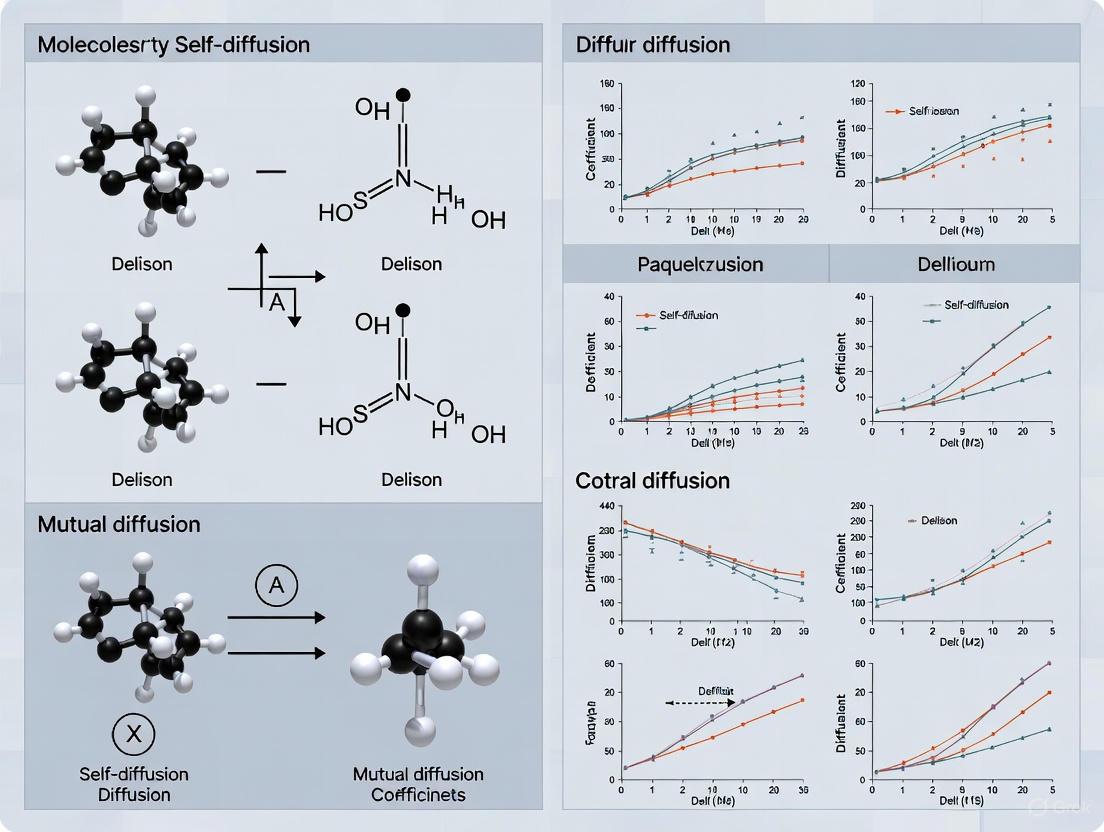
This article provides a detailed exploration of self-diffusion and mutual diffusion coefficients, two fundamental parameters governing molecular transport.
Self-Diffusion vs. Mutual Diffusion: A Comprehensive Guide for Pharmaceutical and Materials Research
Abstract
This article provides a detailed exploration of self-diffusion and mutual diffusion coefficients, two fundamental parameters governing molecular transport. Tailored for researchers, scientists, and drug development professionals, it clarifies the conceptual distinctions, measurement methodologies, and practical applications of these coefficients. The scope ranges from foundational theory and experimental techniques to troubleshooting common challenges, validating data, and leveraging computational predictions. Special emphasis is placed on implications for pharmaceutical development, including drug diffusion through biological barriers and the optimization of analytical chromatography.
Core Concepts: Demystifying Self-Diffusion and Mutual Diffusion
Diffusion, the process of mass transport driven by the random thermal motion of molecules, is a fundamental phenomenon with profound implications across scientific and industrial domains. In chemical engineering, it dictates the efficiency of reactors and separation processes [1]; in pharmacology, it determines the rate at which a drug penetrates biological barriers to reach its target [2]; and in materials science, it controls processes like alloy hardening and phase transformations [3]. The quantitative analysis of diffusion is universally described by Fick's laws, which relate the diffusive flux to the concentration gradient via the diffusion coefficient (D), a parameter that is highly sensitive to the specific physical context. Within the broader thesis of self-diffusion coefficient versus mutual diffusion coefficient research, it is crucial to delineate these core concepts clearly. This guide provides an in-depth examination of three principal diffusion types—self-diffusion, mutual diffusion, and tracer diffusion—framed for researchers and drug development professionals. It will detail their conceptual foundations, present modern experimental methodologies for their measurement, and summarize quantitative data in an accessible format, thereby establishing a rigorous technical reference for the field.
Core Concepts and Definitions
Self-Diffusion
Self-diffusion refers to the translational motion of atoms or molecules of a single species in the absence of any net chemical potential gradient. It is the spontaneous, random motion of particles in a pure substance or a component in a uniform mixture. Since there is no macroscopic concentration gradient, self-diffusion does not result in net mass transport. The coefficient quantifying this motion is the self-diffusion coefficient (D*). It is a measure of the intrinsic mobility of particles due to their thermal energy and is often probed by techniques that can track the motion of labeled but otherwise identical particles, such as Nuclear Magnetic Resonance (NMR) [4]. For example, the self-diffusion of water molecules in pure water is a key parameter in understanding fluid dynamics at the molecular level.
Mutual Diffusion
Mutual diffusion (also known as chemical or inter-diffusion) describes the mass transfer process that occurs in a mixture driven by a macroscopic concentration gradient of one or more components. The coefficient quantifying this process is the mutual diffusion coefficient (D₁₂). It is this coefficient that appears in Fick's first law for a binary system: J₁ = -D₁₂ * (∂C₁/∂x) where J₁ is the flux of component 1, and ∂C₁/∂x is its concentration gradient [4]. This is the most commonly referenced diffusion coefficient in engineering applications, such as modeling the diffusion of a drug molecule through a static fluid or the interdiffusion of two gases or liquids [1] [2]. In a binary solution, the mutual diffusion coefficient D₁₂ is equal to D₂₁.
Tracer Diffusion
Tracer diffusion involves monitoring the diffusion of a tiny amount of a labeled component (the "tracer") within a chemically identical or different host medium under conditions of no net concentration gradient. The coefficient measured is the tracer diffusion coefficient (Dₜ). A classic example is the diffusion of a radioactive isotope of zirconium within a matrix of natural zirconium [3]. When the tracer and host are chemically identical, the tracer diffusion coefficient is, in principle, equal to the self-diffusion coefficient. However, if there is a slight mass difference between the tracer and host atoms, a kinetic isotope effect may cause a minor discrepancy. Tracer diffusion is a powerful tool for studying diffusion mechanisms in solids and complex fluids [5].
Conceptual Relationships
The relationships between these diffusion coefficients are foundational. In a thermodynamically ideal binary mixture, the mutual diffusion coefficient D₁₂ is equal to the tracer diffusion coefficients of the individual components at infinite dilution. In non-ideal systems, thermodynamic factors must be considered. For a single component, the self-diffusion coefficient and the tracer diffusion coefficient are equivalent. The following diagram illustrates the logical relationships and primary measurement contexts for these three diffusion types.
Quantitative Data and Trends
Diffusion coefficients vary over orders of magnitude depending on the state of matter, temperature, and the specific system. The following tables consolidate representative data and key relationships.
Table 1: Representative Diffusion Coefficients in Various Systems
| System | State | Temp. (°C) | Diffusion Coefficient (m²/s) | Type | Citation |
|---|---|---|---|---|---|
| Water | Liquid | 25 | ~2.30 × 10⁻⁹ | Self-Diffusion | [3] |
| Glucose in Water | Liquid | 25 | ~6.70 × 10⁻¹⁰ | Mutual (Infinite Dilution) | [1] |
| Sorbitol in Water | Liquid | 25 | ~5.80 × 10⁻¹⁰ | Mutual (Infinite Dilution) | [1] |
| Theophylline in Mucus | Gel-like | 37 | 6.56 × 10⁻¹⁰ | Tracer/Mutual | [2] |
| Albuterol in Mucus | Gel-like | 37 | 4.66 × 10⁻¹⁰ | Tracer/Mutual | [2] |
| Ethylene Glycol in Water | Liquid | 25 | ~1.11 × 10⁻⁹ | Mutual (Infinite Dilution) | [6] |
| α-Zr (self-diffusion) | Solid | ~856 | 1.00 × 10⁻¹⁷ | Self-Diffusion | [3] |
Table 2: Factors Influencing Diffusion Coefficients and Common Correlations
| Factor | Effect on D | Correlation / Note |
|---|---|---|
| Temperature | Increases D | Arrhenius Law: D = D₀ exp(-ED / RT), where ED is diffusion activation energy [6]. |
| Viscosity (η) | Decreases D | Stokes-Einstein (Spherical particles): D = kT / (6πηr) [1] [7]. |
| Molecular Size/Weight | Decreases D | Inverse relationship; for non-spherical molecules, the hydrodynamic radius is used. |
| Surfactants | Can increase D | Reduces effective activation energy E_D in liquid systems, enhancing rate at constant T [6]. |
| Concentration | Variable | Mutual diffusion coefficient D can be a strong function of concentration C, requiring D(C) measurement [4]. |
Experimental Methodologies and Protocols
A diverse array of experimental techniques exists to measure the different types of diffusion coefficients. The choice of method depends on the system's state (liquid, solid, gas), the available equipment, and the required accuracy.
Taylor Dispersion Method
This method is widely used for measuring mutual diffusion coefficients in liquid solutions due to its experimental simplicity and reliability [1] [8].
Detailed Experimental Protocol:
- Apparatus Setup: A long (e.g., 20 m), narrow-bore (e.g., 0.4 mm internal diameter) capillary tube, typically made of Teflon, is coiled and immersed in a thermostated bath for temperature stability. The system includes a precision pump, an injection valve, and a differential refractive index detector at the outlet.
- Procedure: A solvent stream is pumped at a precise, low flow rate to ensure laminar (parabolic) flow. A small, sharp pulse (e.g., 0.5 mL) of solution with a slightly different concentration is injected into this stream.
- Data Collection: As the pulse flows through the capillary, it disperses axially due to the velocity profile and radially due to diffusion. The detector records the concentration profile (a Gaussian-shaped peak) at the outlet over time.
- Data Analysis: The mutual diffusion coefficient D is determined by fitting the temporal concentration profile to the solution of the dispersion equation. The variance of the peak is inversely proportional to D [1] [8]. The workflow is as follows:
Optical Interferometry (Digital Holographic Interferometry)
This non-contact, high-precision method directly measures the concentration distribution in a diffusion cell to determine mutual diffusion coefficients [4].
Detailed Experimental Protocol:
- Apparatus Setup: A diffusion cell is placed in the path of a coherent laser beam. The system is based on an interferometer (e.g., Mach-Zehnder).
- Procedure: The cell is carefully filled, typically with a denser solution below a lighter solvent to initiate a one-dimensional diffusion process while minimizing convection.
- Data Collection: As diffusion proceeds, the changing concentration profile alters the refractive index, which shifts the interference fringes. A camera records these interferograms over time.
- Data Analysis: The fringe patterns are processed to reconstruct the time-dependent concentration field, C(x, t). Advanced data processing methods, such as those based on the Finite Volume Method (FVM), fit this data to Fick's second law to extract the mutual diffusion coefficient, D, even when it is concentration-dependent, D(C) [4].
Tracer Diffusion Techniques
Tracer methods are indispensable for measuring self-diffusion and tracer diffusion coefficients, especially in solids and complex media.
Detailed Experimental Protocol (Using Radioactive Tracers):
- Tracer Deposition: A thin layer of a radioactive isotope of the material under study (e.g., ⁶⁵Zn for zinc) is deposited on a carefully prepared surface of the sample.
- Annealing Diffusion: The sample is sealed in an ampoule and annealed at a specific temperature for a known time, allowing the tracer atoms to diffuse into the bulk.
- Sectioning and Counting: After annealing, thin layers of the material are sequentially removed (e.g., by precision grinding or ion-beam sputtering). The radioactivity of each removed section is measured.
- Data Analysis: The tracer penetration profile is constructed from the activity vs. depth data. This profile is fitted to the solution of Fick's second law for thin-film geometry, yielding the tracer diffusion coefficient Dₜ [5].
Detailed Experimental Protocol (Using ATR-FTIR Spectroscopy): This method is powerful for studying drug diffusion through biological barriers like artificial mucus [2].
- Apparatus Setup: An artificial mucus layer is placed on an Attenuated Total Reflectance (ATR) crystal in an FTIR spectrometer.
- Procedure: A drug solution is placed in contact with the upper surface of the mucus layer. The lower surface is in contact with the ATR crystal.
- Data Collection: Time-resolved FTIR spectra are collected. The intensity of absorption peaks unique to the drug molecule is monitored, which correlates with its concentration at the crystal interface via Beer-Lambert law.
- Data Analysis: The concentration-time data at the interface is analyzed using a model based on Fick's second law (e.g., Crank's solution for a semi-infinite medium) to determine the effective diffusion coefficient of the drug through the mucus [2].
The Scientist's Toolkit: Essential Research Reagents and Materials
Table 3: Key Reagents and Materials for Diffusion Experiments
| Reagent/Material | Function in Diffusion Research | Example Application |
|---|---|---|
| D(+)-Glucose | Model solute for studying diffusion in aqueous biological and chemical systems. | Measuring mutual diffusion coefficients in water for reactor design [1]. |
| D-Sorbitol | Model solute and product in hydrogenation reactions. | Studying diffusion in ternary systems (glucose-sorbitol-water) [1]. |
| Artificial Mucus | Synthetic simulant of the pulmonary mucus barrier. | Measuring tracer diffusion coefficients of asthma drugs (e.g., Theophylline, Albuterol) [2]. |
| Radioactive Tracers (e.g., ⁶⁵Zn, ⁶³Ni) | Isotopically labeled atoms to track self-diffusion and tracer diffusion. | Measuring tracer diffusion coefficients in metallic alloys [3] [5]. |
| Sodium Dodecyl Benzene Sulfonate (Surfactant) | Modifies interfacial properties and liquid structure. | Studying the effect of reduced activation energy on enhancing mutual diffusion rates in alcohol-water systems [6]. |
| Potassium Chloride (KCl) | Standard reference solute with well-documented diffusion data. | Validation and calibration of new experimental setups for measuring mutual diffusion coefficients [6] [4]. |
| Fluorescent Microspheres | Monodisperse colloidal tracers for optical methods. | Validating novel diffusion measurement setups via comparison with Stokes-Einstein predictions [7]. |
| LiTFSI (Lithium Bis(trifluoromethanesulfonyl)imide) | Salt solute for non-aqueous and advanced electrolyte systems. | Measuring concentration-dependent mutual diffusion coefficients in aqueous solutions [4]. |
Within the broader research context comparing self-diffusion and mutual diffusion coefficients, this guide has delineated their fundamental definitions, relationships, and measurement paradigms. Self-diffusion coefficients probe intrinsic mobility, while mutual diffusion coefficients describe macroscopic mass transfer, with tracer diffusion serving as a vital experimental bridge. The quantitative data and detailed protocols underscore that the accurate determination of these parameters is not a one-size-fits-all endeavor but requires careful selection of a methodology—be it Taylor dispersion, interferometry, or tracer techniques—tailored to the system's physical state and the research question at hand. For drug development professionals, this is particularly critical, as the efficacy of inhalation therapeutics hinges on their tracer diffusion coefficient through mucus [2]. Likewise, materials scientists rely on precise tracer data to model microstructural evolution [3] [5]. As research advances, the development of novel methods, such as non-equilibrium molecular dynamics simulations [9] and advanced finite volume analysis of interferometry data [4], promises to further refine our understanding and control of these foundational transport phenomena.
In both biological and industrial contexts, the transport of molecules through various media is a process governed by fundamental physical driving forces. For researchers and drug development professionals, a precise understanding of diffusion—the migration process caused by particle movement that results in directional mass transfer—is critical for optimizing processes ranging from drug release kinetics to membrane-based separations [6]. The diffusion coefficient (D) serves as the key quantitative descriptor of this speed, yet its accurate determination and prediction remain challenging in complex systems [10].
This whitepaper examines diffusion through the dual lenses of entropy and thermodynamics, focusing specifically on the distinction between self-diffusion and mutual diffusion coefficients. Self-diffusion characterizes the movement of a particle due solely to thermal motion, while mutual diffusion describes the net transport resulting from a chemical potential gradient [6]. Within the framework of a broader thesis on diffusion coefficient research, we explore how entropy, as a statistical driver toward disorder, and thermodynamic forces, as responses to energy gradients, collectively govern molecular transport phenomena. The interplay between these forces becomes particularly critical in pharmaceutical applications where controlling diffusion rates directly impacts drug efficacy, release profiles, and delivery system design.
Theoretical Foundations: Entropy and Diffusion
The Role of Entropy as a Driving Force
Entropy, a scientific concept most commonly associated with states of disorder, randomness, or uncertainty, serves as a fundamental driver in diffusion processes [11]. In statistical mechanics, entropy is interpreted as a measure of the number of possible microscopic arrangements (microstates) available to a system. The second law of thermodynamics dictates that isolated systems evolve spontaneously toward states of higher entropy, representing increased molecular disorder [11].
This progression toward disorder manifests physically as the diffusive spreading of molecules. When concentration gradients exist, the number of microstates (and thus entropy) increases as molecules redistribute from ordered, concentrated states to disordered, evenly distributed states. As one physicist explains, "Entropy transfer is associated with non-work energy transfer (aka heat transfer). The driving force for heat transfer is a temperature difference. On a more fundamental level, entropy generation within a system is associated with dissipation of useable energy as a result of finite driving forces for heat transfer (temperature gradients), momentum transfer (velocity gradients), mass transfer (concentration gradients), and chemical reactions (chemical potential differences)" [12].
Thermodynamic Formalism of Diffusion
The thermodynamic treatment of diffusion formalizes this relationship through the definition of chemical potential. The mutual diffusion coefficient, which characterizes net transport due to chemical potential gradients, can be expressed as the product of a mobility coefficient and a thermodynamic factor that accounts for non-ideal interactions [10]:
D = D₁ · Θ
Where:
- D represents the mutual diffusion coefficient
- D₁ is the self-diffusion coefficient (mobility term)
- Θ is the thermodynamic factor accounting for deviations from ideal behavior
For binary polymer-solvent systems, the thermodynamic factor can be expressed as: Θ = (1 - Φ₁) · (1 - 2χ₁ₚΦ₁) where Φ₁ is the solvent volume fraction and χ₁ₚ is the Flory-Huggins interaction parameter [10].
This framework distinguishes between two key diffusion coefficients central to current research:
- Self-diffusion coefficient: Describes molecular motion due to thermal energy alone, measured in the absence of chemical potential gradients.
- Mutual diffusion coefficient: Characterizes the collective diffusion process driven by chemical potential gradients, relevant to mass transfer applications.
Table 1: Key Diffusion Coefficients in Research
| Diffusion Type | Driving Force | Research Significance | Typical Measurement Techniques |
|---|---|---|---|
| Self-diffusion | Thermal motion (entropy) | Molecular mobility in homogeneous systems | Pulsed-field gradient NMR, Fluorescence recovery after photobleaching (FRAP) |
| Mutual diffusion | Chemical potential gradient | Mass transfer in concentration gradients | Optical interferometry, Taylor dispersion, Membrane cell methods |
Experimental Determination of Diffusion Coefficients
Gravitational Technique for Polymer Systems
For polymer-solvent systems, determining diffusion coefficients often involves bringing the polymer into contact with specific solvents and monitoring mass changes over time. The gravitational technique, which tracks mass variation as solvent penetrates the polymer matrix, allows researchers to identify diffusion mechanisms and select appropriate mathematical models [10]. Structural changes in the polymer during experimentation can lead to diffusion anomalies, requiring careful data interpretation.
Experimental data processed through this technique has revealed how diffusion mechanisms are influenced by structural variations caused by concentration and temperature changes. For instance, in the cellulose triacetate (CTA)-dichloromethane (DCM) system, the diffusion coefficient at 303 K ranges between 4.5 and 8·10⁻¹¹ m²/s across various concentrations, while for the polyvinyl alcohol (PVA)-water system, D = 4.1·10⁻¹² m²/s at 303 K, increasing to D = 6.5·10⁻¹² m²/s at 333 K [10].
Equal-Refractive-Index Thin-Layer Method
Recent advances in diffusion measurement employ the equal-refractive-index thin-layer method based on liquid-core cylindrical lenses (SLCL-Doublet). This approach visualizes the diffusion process with a simple experimental setup, short measurement time, and high accuracy [6]. The methodology involves:
Experimental Setup: An attenuated laser beam passes through a collimation and expansion system, then perpendicularly irradiates an SLCL-Doublet filled with diffusion liquids. The intensity distribution of the laser beam exiting the liquid-core cylindrical lens is captured by a CCD camera, recording the dynamic change of the diffusion zone [6].
Data Processing: The diffusion coefficient is determined from the relationship between the diffusion zone width and time using the equation: D = k²/4a², where k is the slope of the line fitted to the experimental data of the diffusion zone width versus the square root of time [6].
Uncertainty Analysis: The standard deviation of the thin-layer position used for fitting is calculated according to the uncertainty formula of the least-squares method, accounting for both fitting uncertainties and systematic errors from environmental vibrations and temperature fluctuations [6].
Surfactant-Enhanced Diffusion
Recent investigations have explored methods to enhance diffusion rates without temperature increases, particularly valuable for diffusion-sensitive molecules in pharmaceutical applications. The addition of trace amounts of surfactant (e.g., sodium dodecyl benzene sulfonate) to alcohol-water diffusion systems has been shown to effectively reduce diffusion activation energy (E_D) and increase liquid diffusion coefficients at room temperature [6].
This approach measures infinite dilution diffusion values of alcohols (ethylene glycol, glycerol, triethylene glycol) diffusing in water with and without surfactant across multiple temperatures. Results demonstrate that appropriate surfactants reduce diffusion activation energy E_D, thereby accelerating the diffusion process—a finding with significant implications for drug delivery systems where temperature sensitivity is a concern [6].
Table 2: Surfactant Impact on Diffusion Parameters
| System | Temperature (K) | Diffusion Coefficient without Surfactant (m²/s) | Diffusion Coefficient with Surfactant (m²/s) | Activation Energy Change |
|---|---|---|---|---|
| Ethylene Glycol-Water | 298 | 1.15 × 10⁻⁹ | 1.38 × 10⁻⁹ | Reduction observed |
| Glycerol-Water | 298 | 0.87 × 10⁻⁹ | 1.12 × 10⁻⁹ | Reduction observed |
| Triethylene Glycol-Water | 298 | 0.52 × 10⁻⁹ | 0.71 × 10⁻⁹ | Reduction observed |
Mathematical Modeling Approaches
Free Volume Theory
The free volume concept, introduced by Cohen and Turnbull in 1959, forms the theoretical basis for many diffusion models in polymer systems [10]. This approach posits that diffusive displacement occurs due to voids generated by the redistribution of free volume, with the diffusion constant expressed as:
D = A · exp[-γv*/v_f]
where v* represents the critical hole free volume required for a molecular jump, and v_f is the average free volume per molecule [10].
The Fujita model, derived from this concept, describes the relationship between diffusion coefficient and free volume as:
D = A · R · T · exp(-B/f_v)
where f_v represents the fractional free volume [10]. While effective for polymer-organic solvent systems, this model provides less reliable results for polymer-water systems due to significant molecular interactions.
Advanced Predictive Frameworks
Vrentas-Duda Model
For concentrated polymer solutions, Vrentas and Duda developed a more comprehensive free volume theory that divides polymer volume into three elements: occupied volume (van der Waals volume), interstitial free volume (from vibrational energy), and hole free volume (from volume relaxation and plasticization) [10]. The self-diffusion coefficient in this model is expressed as:
D₁ = D₀ · exp(-(ω₁V̂₁* + ξ₁ₚωₚV̂ₚ*) / (V̂_FH/γ))
where:
- D₀ is a pre-exponential factor
- ωᵢ is the mass fraction of component i
- V̂ᵢ* is the specific critical hole free volume of component i
- ξ₁ₚ is the ratio of critical molar volumes of solvent and polymer
- V̂_FH is the average hole free volume per gram of mixture [10]
Entropy Scaling Framework
Recent advances in predictive modeling include entropy scaling for diffusion coefficients in fluid mixtures. This framework enables predictions of both self-diffusion and mutual diffusion coefficients across wide temperature and pressure ranges, including gaseous, liquid, supercritical, and metastable states—even for strongly non-ideal mixtures [13].
The entropy scaling approach leverages information from the self-diffusion coefficients of pure components and infinite-dilution diffusion coefficients, utilizing the mixture entropy derived from molecular-based equations of state. This thermodynamically consistent method represents a significant advancement for predicting diffusion behavior in complex pharmaceutical systems where experimental data is limited [13].
The Scientist's Toolkit: Research Reagents and Materials
Table 3: Essential Research Materials for Diffusion Studies
| Material/Reagent | Function/Application | Example Systems | Technical Considerations |
|---|---|---|---|
| Polyvinyl Alcohol (PVA) | Polymer matrix for studying water diffusion | PVA-Water systems for hydrogel drug delivery research | Diffusion coefficient: 4.1·10⁻¹² m²/s at 303 K [10] |
| Cellulose Acetate (CA) | Membrane material for organic solvent diffusion studies | CA-Tetrahydrofuran (THF) systems | D = 2.5∙10⁻¹² m²/s at 303 K [10] |
| Sodium Dodecyl Benzene Sulfonate | Anionic surfactant for enhancing diffusion rates | Alcohol-water systems at room temperature | Reduces diffusion activation energy [6] |
| Ethylene Glycol | Model compound for diffusion studies | EG-water systems with/without surfactants | Baseline D: 1.15 × 10⁻⁹ m²/s at 298 K [6] |
| Liquid-Core Cylindrical Lenses (SLCL-Doublet) | Optical component for equal-refractive-index method | Visualization of diffusion zone dynamics | Corrects aberration for accurate measurement [6] |
| KCl Solutions | Density modifier for experimental configuration | Aqueous diffusion systems | Creates stable stratification in diffusion cells [6] |
The investigation of physical driving forces behind diffusion reveals entropy and thermodynamics as complementary rather than competing explanations. Entropy provides the statistical impetus toward disorder that underlies all diffusion phenomena, while thermodynamic formalism quantifies how chemical potential gradients direct this disordered motion into net transport. The distinction between self-diffusion coefficients (governed primarily by entropic driving forces) and mutual diffusion coefficients (driven by combined entropic and energetic factors) represents a fundamental consideration for research in drug development where both molecular mobility and net mass transfer are critical.
Emerging techniques, including surfactant-enhanced diffusion at constant temperature and advanced predictive frameworks like entropy scaling, offer powerful new approaches for controlling and modeling diffusion processes. These advancements hold particular promise for pharmaceutical applications where precise manipulation of diffusion rates can optimize drug release profiles, enhance delivery efficiency, and improve therapeutic outcomes. As research continues to bridge theoretical understanding with practical application, the interplay between entropy and thermodynamics will remain central to advancing diffusion science in biological and synthetic systems.
In the study of diffusion within binary mixtures, a fundamental distinction exists between self-diffusion and mutual diffusion. Self-diffusion coefficient ((D_{self})) describes the random Brownian motion of a single tagged particle in a homogeneous medium, while mutual diffusion coefficient ((\tilde{D})), also called chemical or interdiffusion coefficient, describes the macroscopic flux of components driven by a concentration gradient in a mixture [14]. Understanding the relationship between these two distinct phenomena is critical for predicting mass transport in materials design, chemical processes, and pharmaceutical development.
The Darken Equation, introduced by Lawrence Stamper Darken in 1948, provides a foundational theoretical framework that bridges these concepts [15]. This equation successfully relates the easily measurable mutual diffusion coefficient to the intrinsic self-diffusion coefficients of the individual components, while accounting for the non-ideality of the mixture through a thermodynamic factor. For decades, Darken's model has remained indispensable in metallurgy, materials science, and increasingly in chemical engineering and pharmaceutical research for predicting diffusion behavior in binary systems.
This technical guide examines the Darken Equation's theoretical derivation, experimental validation, practical application methodologies, and its modern extensions in contemporary research settings, particularly highlighting its relevance for researchers and drug development professionals working with complex multicomponent systems.
Theoretical Foundation
The Two Darken Equations
Darken's analysis produced two seminal equations that together describe diffusion in binary systems where components have different diffusion coefficients.
Darken's First Equation describes the velocity of the lattice frame ((\nu)) in a diffusion couple relative to a fixed laboratory frame, often visualized through the motion of inert markers in the famous Kirkendall experiment [15]:
[ \nu = (D1 - D2)\frac{\partial N1}{\partial x} = (D2 - D1)\frac{\partial N2}{\partial x} ]
Where:
- (\nu) = marker velocity (m/s)
- (D1, D2) = intrinsic diffusion coefficients of components 1 and 2 (m²/s)
- (N1, N2) = mole fractions of components 1 and 2
- (x) = spatial coordinate (m)
Darken's Second Equation provides the relationship between the mutual diffusion coefficient and the self-diffusion coefficients [15]:
[ \tilde{D} = (N1D2 + N2D1)\left(1 + N1\frac{\partial \ln a1}{\partial \ln N_1}\right) ]
Where:
- (\tilde{D}) = mutual diffusion coefficient (m²/s)
- (D1, D2) = self-diffusion coefficients of components 1 and 2 (m²/s)
- (a_1) = activity of component 1
- The term (\left(1 + N1\frac{\partial \ln a1}{\partial \ln N_1}\right)) is known as the thermodynamic factor ((\Gamma))
Table 1: Key Variables in Darken's Equations
| Symbol | Term | Definition | Units |
|---|---|---|---|
| (\tilde{D}) | Mutual diffusion coefficient | Measures collective mixing driven by concentration gradients | m²/s |
| (D_i) | Self-diffusion coefficient | Measures mobility of individual species i in the mixture | m²/s |
| (N_i) | Mole fraction | Concentration of species i in the mixture | Dimensionless |
| (\nu) | Marker velocity | Velocity of lattice frame in diffusion couple | m/s |
| (\Gamma) | Thermodynamic factor | (\left(1 + N1\frac{\partial \ln a1}{\partial \ln N_1}\right)), accounts for non-ideality | Dimensionless |
Derivation Framework
The derivation of Darken's equations begins with Fick's first law applied to a binary system, considering fluxes in both laboratory-fixed and marker-fixed reference frames [15] [16]. For a binary system with components A and B, the fluxes in the lattice-fixed frame are given by:
[ JA = -DA\frac{\partial CA}{\partial x}, \quad JB = -DB\frac{\partial CB}{\partial x} ]
Assuming constant total concentration (C = CA + CB), the concentration gradients are equal and opposite: (\frac{\partial CA}{\partial x} = -\frac{\partial CB}{\partial x}). The net flux of atoms relative to the lattice frame creates a net vacancy flux that must be compensated by lattice motion, yielding the marker velocity (\nu) [16]:
[ \nu = \frac{1}{C0}(DA - DB)\frac{\partial CA}{\partial x} ]
where (C_0) is the total number of atoms per unit volume. When this lattice drift is accounted for in the laboratory-fixed frame, the net flux for component A becomes:
[ JA' = -DA\frac{\partial CA}{\partial x} + \nu CA ]
Substituting the expression for (\nu) and converting to mole fractions yields:
[ JA' = -(NA DB + NB DA)\frac{\partial CA}{\partial x} ]
Thus, the mutual diffusion coefficient is identified as:
[ \tilde{D} = NA DB + NB DA ]
For non-ideal systems, this relationship is modified by the thermodynamic factor to account for the deviation from ideal mixing behavior, giving the complete Darken's second equation [15].
Diagram 1: Logical relationship between diffusion phenomena and the Darken Equation framework, showing how self-diffusion, mixture composition, and non-ideal thermodynamics combine to predict mutual diffusion.
Experimental Validation & Historical Context
The Kirkendall Experiment
Darken's first equation was directly validated by the seminal Kirkendall experiment, which demonstrated that different components in a binary system can diffuse at different rates [15]. In this experiment, inert molybdenum wires were placed at the interface between copper and brass components, and their motion was monitored during annealing. The observation that these markers moved toward the brass region provided definitive evidence that zinc diffuses out of brass faster than copper diffuses in, creating a net vacancy flux that drives lattice motion [15].
Experimental Protocol:
- Diffusion Couple Preparation: A copper/brass interface is established with inert molybdenum wire markers positioned at the planar interface
- Annealing Process: The couple is heated to appropriate temperature (typically 700-1000°C) for controlled time duration to allow substantial interdiffusion
- Marker Tracking: The displacement of markers from the original interface is measured post-annealing
- Concentration Profiling: Composition across the diffusion zone is determined via techniques such as electron microprobe analysis
- Velocity Calculation: Marker velocity ((\nu)) is calculated from displacement and annealing time
- Diffusivity Determination: Intrinsic diffusion coefficients are extracted using Darken's first equation
This experiment confirmed that the diffusion mechanism in metallic systems occurs primarily through vacancy exchange rather than direct atom interchange, fundamentally changing the understanding of solid-state diffusion.
Johnson's Experiment and Thermodynamic Factors
Darken's second equation was validated through W. A. Johnson's experiments on gold-silver systems using radioactive tracers [15]. These experiments measured self-diffusion coefficients of gold and silver in their binary alloys, revealing that the mutual diffusion coefficient could not be explained by simple averaging of the component self-diffusivities.
Key Findings:
- The mutual diffusion coefficient showed significant deviation from ideal mixing behavior
- The thermodynamic factor played a crucial role in explaining these deviations
- Radioactive isotopes demonstrated similar mobility to non-radioactive elements, validating the tracer methodology
Practical Implementation & Methodologies
Applying Darken's Equation: A Step-by-Step Protocol
For researchers applying Darken's equation to determine mutual diffusion coefficients, the following methodology provides a reliable approach:
Determine Self-Diffusion Coefficients:
- Obtain (D1) and (D2) for the mixture components at the relevant composition and temperature
- Use techniques: Pulsed-field gradient NMR, radioactive tracer methods, or quasi-elastic neutron scattering [17] [14]
- For predictive work, molecular dynamics simulations with appropriate finite-size corrections can be employed [14]
Characterize Thermodynamic Behavior:
- Determine activity coefficients ((γ_i)) as a function of composition
- Use techniques: Vapor-liquid equilibrium measurements, Gibbs-Duhem integration, or molecular simulations
- Calculate the thermodynamic factor: (\Gamma = 1 + N1\frac{\partial \ln γ1}{\partial \ln N_1})
Compute Mutual Diffusion Coefficient:
- Apply Darken's equation: (\tilde{D} = (N1D2 + N2D1) \cdot \Gamma)
- Validate against experimental mutual diffusion data when available (e.g., Taylor dispersion, optical interferometry)
Account for System Non-Ideality:
- For highly non-ideal systems near phase boundaries, apply additional corrections for thermodynamic factor accuracy
- Consider finite-size effects in simulation-derived data [14]
Table 2: Comparison of Diffusion Coefficient Types and Measurement Techniques
| Diffusion Type | Definition | Measurement Techniques | Key Applications |
|---|---|---|---|
| Self-Diffusion | Motion of tagged particle in homogeneous medium | NMR, radioactive tracers, quasi-elastic neutron scattering, MD simulations | Understanding molecular mobility, segmental dynamics in polymers |
| Mutual Diffusion | Macroscopic mixing driven by concentration gradient | Taylor dispersion, optical interferometry, Boltzmann-Matano analysis | Process design, membrane transport, drug release kinetics |
| Intrinsic Diffusion | Diffusion of component in a lattice-fixed frame | Kirkendall marker experiments, diffusion couple analysis | Metallurgical applications, alloy design |
The Scientist's Toolkit: Essential Research Reagents & Materials
Table 3: Key Research Materials for Diffusion Studies Using Darken's Equation
| Material/Reagent | Function | Application Context |
|---|---|---|
| Inert Markers (Mo, W, ThO₂ particles) | Reference points for lattice frame motion | Kirkendall experiments to measure intrinsic diffusivities and marker velocity |
| Radioactive Tracers (³H, ¹⁴C, ²²Na, ⁶⁵Zn isotopes) | Label molecules to track self-diffusion without chemical potential gradients | Measuring self-diffusion coefficients in binary mixtures |
| Binary Diffusion Couples (Cu/Zn, Au/Ag, Fe/Ni) | Model systems for interdiffusion studies | Experimental validation of Darken equations in metallic alloys |
| Lennard-Jones Potential Models | Simplified interaction potential for molecular simulation | Fundamental studies of diffusion in model fluids, validation of predictive models [18] [14] |
| Thermodynamic Database (Activity coefficients, phase diagrams) | Source of thermodynamic factors for non-ideal systems | Calculating Γ for Darken equation application to real systems |
Modern Research & Extensions
Addressing the Self-Diffusion Prediction Challenge
A significant limitation in applying Darken's equation has been the scarcity of composition-dependent self-diffusion coefficient data. Recent work by Wolff et al. (2018) has addressed this through a predictive model for composition-dependent self-diffusion coefficients in nonideal binary liquid mixtures [17]. Their model correlates nonideal diffusion effects with the thermodynamic factor and extends the McCarty and Mason correlation for ideal binary gas mixtures to liquid systems.
The model requires only:
- Self-diffusion coefficients at infinite dilution
- Self-diffusion coefficients of the pure substances
- The thermodynamic factor
Validation across 9 systems showed a 2× improvement in accuracy compared to previous correlations, significantly expanding the practical applicability of Darken-based models [17].
Finite-Size Effects in Molecular Simulations
Molecular dynamics simulations have become powerful tools for computing diffusion coefficients, but they suffer from finite-size effects where computed diffusivities increase with system size. Moultos et al. (2018) proposed a correction for Maxwell-Stefan diffusion coefficients based on the thermodynamic factor [14]:
[ Đ{MS}^∞ = Đ{MS} + \frac{k_B T Γ}{6 π η L} ]
Where:
- (Đ_{MS}^∞) = Maxwell-Stefan diffusivity at thermodynamic limit
- (Đ_{MS}) = finite-size Maxwell-Stefan diffusivity from simulation
- (η) = shear viscosity of the system
- (L) = simulation box length
- (Γ) = thermodynamic factor
This correction is particularly important for mixtures near demixing, where finite-size effects can be substantial [14].
Critical Perspectives and Mathematical Scrutiny
While widely applied, Darken's equation has faced mathematical scrutiny. Okino (2013) argued that the derivation contains mathematical inconsistencies, particularly in treating partial differential equations as ordinary differential equations [19]. This critique highlights that the intrinsic diffusion concept might be mathematically problematic, though the practical utility of Darken's equation for predicting concentration profiles remains acknowledged in the field.
Applications in Pharmaceutical & Materials Development
The Darken equation framework finds important applications in pharmaceutical and advanced materials development:
Polymer-Solvent Systems
In pharmaceutical formulation, understanding drug release from polymer matrices requires knowledge of mutual diffusion coefficients. The Hartley-Crank extension of Darken's equation applies to polymer solutions:
[ \tilde{D} = (N1D2 + N2D1) \cdot \left(1 + N1\frac{\partial \ln a1}{\partial \ln N_1}\right) ]
Where component 1 is typically the solvent and component 2 the polymer. For concentrated solutions, the polymer self-diffusion coefficient becomes negligible, simplifying the expression [20].
Microemulsion Systems
In drug delivery systems based on microemulsions, mutual diffusion coefficients provide critical information about droplet interactions and stability. The pseudo-binary approximation with constant water-to-surfactant ratios allows application of Darken-based models to these complex systems [20].
The Darken Equation remains a cornerstone of diffusion theory, providing an essential bridge between self-diffusion and mutual diffusion in binary systems. Its strength lies in physically connecting microscopic molecular mobility with macroscopic mixing phenomena while accounting for thermodynamic non-ideality through the thermodynamic factor. While mathematical scrutiny continues to refine fundamental understanding, the practical utility of Darken's framework is undeniable across metallurgy, chemical engineering, and pharmaceutical development.
Modern extensions addressing composition-dependent self-diffusion prediction and finite-size effects in molecular simulations continue to enhance the applicability of Darken-based models. For drug development professionals and researchers working with complex multicomponent systems, the Darken Equation provides a foundational approach for predicting diffusion behavior essential to process optimization, formulation design, and material performance assessment.
Within the fields of chemical engineering, materials science, and pharmaceutical development, the accurate prediction of molecular transport is critical for designing processes ranging from catalytic reactors to drug delivery systems. This transport is fundamentally governed by diffusion, the process by which molecules move from regions of high concentration to low concentration. Two principal coefficients are used to quantify this phenomenon: the self-diffusion coefficient and the mutual diffusion coefficient [21]. Despite being interrelated, they describe distinct physical scenarios. The self-diffusion coefficient (e.g., ( D{i,self} )) characterizes the intrinsic mobility of a single molecule within a uniform chemical environment, tracing its random Brownian motion at thermodynamic equilibrium. In contrast, the mutual diffusion coefficient (e.g., ( D{ij} ) or ( \mathcal{D}_{AB} )) describes the macroscopic, net mass transfer that occurs down a concentration gradient in a mixture, driving the system toward composition homogeneity [21] [22].
Understanding the nuanced differences in how these coefficients depend on concentration and system composition is not merely an academic exercise; it is a practical necessity. For instance, in drug development, the self-diffusion coefficient of an active pharmaceutical ingredient (API) can predict its mobility within a homogeneous carrier medium, while the mutual diffusion coefficient governs its release rate from a concentrated formulation into the body [23] [24]. This whitepaper provides an in-depth technical guide, framed within ongoing research, to elucidate the key differences between these two coefficients, with a specific focus on their concentration dependence and behavior in different system compositions.
Fundamental Definitions and Theoretical Frameworks
Self-Diffusion Coefficient
The self-diffusion coefficient (( D{self} )) quantifies the mean-square displacement of a particle (atom or molecule) due solely to thermal motion in a system with no net concentration gradient [21]. It is an equilibrium property. In a pure substance, it is the mobility of molecules in their own substance. In a mixture, the self-diffusion coefficient of component ( i ) (( D{i,self} )) measures its mobility within the mixture environment.
This coefficient is fundamentally rooted in statistical mechanics. It can be calculated using the Einstein relation, which connects it to the mean-square displacement (MSD) of a molecule over time [23] [24]: [ D{i,self} = \lim{t \to \infty} \frac{1}{6t} \langle | \mathbf{r}i(t) - \mathbf{r}i(0) |^2 \rangle ] where ( \mathbf{r}i(t) ) is the position of molecule ( i ) at time ( t ), and the angle brackets denote an ensemble average. Alternatively, the Green-Kubo formula relates ( D{self} ) to the integral of the velocity autocorrelation function [24]: [ D{i,self} = \frac{1}{3} \int0^\infty \langle \mathbf{v}i(0) \cdot \mathbf{v}i(t) \rangle dt ] where ( \mathbf{v}_i(t) ) is the velocity of molecule ( i ) at time ( t ).
Mutual Diffusion Coefficient
The mutual diffusion coefficient (( D{ij} ) or ( \mathcal{D}{AB} )), also known as the interdiffusion or chemical diffusion coefficient, is a non-equilibrium property defined by Fick's first law [25]. For a binary mixture A-B, it relates the diffusive flux ( JA ) of component A to its concentration gradient: [ JA = - \mathcal{D}{AB} \nabla cA ] Here, ( \mathcal{D}{AB} ) is the mutual diffusion coefficient, and ( cA ) is the molar concentration of A. This coefficient quantifies the collective, cooperative motion of components as they interdiffuse to eliminate a concentration gradient.
A critical advancement in understanding mutual diffusion is its relationship with thermodynamics. For a binary system, the mutual diffusion coefficient is related to the self-diffusion coefficients and the thermodynamic factor (( \Gamma )) [22]: [ \mathcal{D}{AB} = (xA D{B,self} + xB D{A,self}) \, \Gamma ] where ( xA ) and ( xB ) are mole fractions, and ( D{A,self} ), ( D{B,self} ) are the self-diffusion coefficients. The thermodynamic factor ( \Gamma ) is defined as: [ \Gamma = 1 + \frac{\partial \ln \gammaA}{\partial \ln xA} ] where ( \gammaA ) is the activity coefficient of component A. This factor accounts for non-ideal mixing effects. In an ideal mixture, ( \Gamma = 1 ), and the relationship simplifies. This framework illustrates that mutual diffusion is influenced by both the intrinsic mobilities of the individual components (via the self-diffusion coefficients) and the thermodynamic driving force stemming from chemical potential gradients (via ( \Gamma )) [21] [22].
The relationship between self-diffusion and mutual diffusion in a binary system can be visualized as follows, incorporating the key influences of mobility and thermodynamics:
Concentration Dependence
The response of diffusion coefficients to changes in concentration is a key differentiator and is critical for modeling real-world systems.
Concentration Dependence of Self-Diffusion Coefficients
In general, the self-diffusion coefficient of a component in a mixture decreases as its own concentration decreases. This is because a molecule in a dilute solution encounters a different microenvironment—dominated by solvent molecules—which can offer different frictional resistance compared to its native environment. The concentration dependence can be complex and is often system-specific. A recent thermodynamic method proposes a relationship for binary mixtures, introducing the concept of a "system self-diffusion coefficient" (( D{sys} )), which is a mole-fraction-weighted average of the component self-diffusion coefficients [23]: [ D{sys} = \frac{xA D{A,self} + xB D{B,self}}{xA + xB} = xA D{A,self} + xB D{B,self} ] This framework allows for analyzing the deviation of ( D{sys} ) from a simple linear combination (additivity) and can be used to relate the concentration dependences of ( D{A,self} ) and ( D_{B,self} ) [23]. In associated liquids (e.g., those with hydrogen bonding like methanol-water mixtures), the concentration dependence can be highly non-linear due to changes in molecular association, which affect the effective hydrodynamic radius and thus the mobility [23].
Concentration Dependence of Mutual Diffusion Coefficients
The mutual diffusion coefficient's dependence on concentration is more complex because it incorporates both kinetic (mobility) and thermodynamic factors [21]. Its behavior varies significantly with the nature of the mixture:
- Ideal or Regular Solutions: The concentration dependence is often modest. The Darken equation, ( \mathcal{D}{AB} = (xB D{A,self} + xA D{B,self}) \Gamma ), is commonly applied. Here, the weighted average of the self-diffusion coefficients and the thermodynamic factor ( \Gamma ) determine the value of ( \mathcal{D}{AB} ) [22].
- Non-Ideal and Associated Systems: The mutual diffusion coefficient can exhibit strong, non-monotonic concentration dependence. The thermodynamic factor ( \Gamma ) can deviate significantly from unity. For example, in systems exhibiting phase separation, ( \Gamma ) can approach zero, leading to a dramatic decrease in ( \mathcal{D}_{AB} ), a phenomenon known as critical slowing down [22].
- Polymer Solutions: A classic example of opposing trends. The self-diffusion coefficient of polymer chains (( Ds )) decreases with increasing concentration (( c )) due to entanglement. In contrast, the mutual diffusion coefficient (( Dm )) often increases with ( c ) in the semi-dilute regime because it is driven by the osmotic pressure gradient, which becomes steeper with concentration [21].
Table 1: Summary of Concentration Dependence in Different System Types
| System Type | Self-Diffusion Coefficient (( D_{self} )) | Mutual Diffusion Coefficient (( \mathcal{D}_{AB} )) | Primary Influencing Factors |
|---|---|---|---|
| Ideal Mixture | Generally decreases for a component as its concentration decreases. | Moderate concentration dependence. | Molecular size, shape, and solvent viscosity. |
| Non-Ideal Mixture | Non-linear dependence due to specific intermolecular interactions. | Can be strongly concentration-dependent. | Thermodynamic factor (Γ), activity coefficients. |
| Associated Liquids | Can show minima/maxima due to changing molecular aggregates. | Often complex, non-monotonic behavior. | Degree of molecular self- and hetero-association. |
| Polymer Solutions | Decreases sharply with increasing concentration. | Increases with concentration in the semi-dilute regime. | Entanglements (for Ds), osmotic compressibility (for Dm). |
Dependence on System Composition
The composition of a system, particularly in multicomponent mixtures, adds another layer of complexity.
Binary vs. Multicomponent Systems
In binary systems, the relationship between self- and mutual diffusion, while not simple, is more direct, as captured by frameworks like the Darken equation [22].
In multicomponent systems (three or more components), the diffusion process becomes significantly more complex. The flux of one component can depend on the concentration gradients of all other components. The diffusion coefficient is no longer a scalar but a matrix of coefficients (( \mathcal{D}{ij} )) [26]. The interdiffusion coefficient in a multicomponent system can be estimated using an expression derived from the Maxwell-Stefan equations [25]: [ \mathcal{D}'A = \frac{1 - yA}{\frac{yB}{\mathcal{D}{AB}} + \frac{yC}{\mathcal{D}{AC}} + \cdots} ] where ( \mathcal{D}'A ) is the diffusion coefficient of component A in the mixture, ( yi ) are the mole fractions, and ( \mathcal{D}{AB}, \mathcal{D}_{AC} ) are the binary diffusion coefficients. This highlights that the diffusivity of a component is influenced by its interactions with every other component in the mixture.
The Role of Entropy Scaling
A recent and powerful approach for predicting transport properties across wide ranges of state conditions is entropy scaling. This method posits that suitably scaled transport properties, including self-diffusion coefficients, are a monovariate function of the residual entropy [22]. This framework has been successfully extended to mixtures.
For mixture self-diffusion coefficients, entropy scaling treats the infinite-dilution diffusion coefficient ( Di^\infty ) (a pseudo-pure property) as a basis. The concentration dependence of the self-diffusion coefficient ( Di ) of a component in a mixture can then be predicted using combination rules that are functions of the pure component and infinite-dilution values, all within an entropy-scaling framework [22]. This allows for thermodynamically consistent predictions of both self- and mutual diffusion coefficients from gaseous to liquid states, including for strongly non-ideal mixtures, based on limited initial data.
Experimental and Computational Methodologies
Accurate determination of both types of diffusion coefficients relies on specialized techniques.
Measuring Self-Diffusion Coefficients
The primary experimental method for measuring self-diffusion coefficients is Pulsed Field Gradient Nuclear Magnetic Resonance (PFG-NMR), also known as Pulsed Gradient Spin-Echo (PGSE) NMR [23] [24].
- Principle: The method uses magnetic field gradients to label the spatial position of nuclear spins. After a known time interval, the signal is decoded. The attenuation of the NMR signal due to diffusion is measured.
- Protocol (PGSE-NMR): The self-diffusion coefficient ( D ) is obtained using the Stejskal-Tanner equation [24]:
[
\frac{S}{S0} = \exp\left( -\gamma^2 g^2 \delta^2 D \left( \Delta - \frac{\delta}{3} \right) \right)
]
where:
- ( S ) and ( S0 ) are the signal intensities with and without the gradient pulse, respectively.
- ( \gamma ) is the gyromagnetic ratio of the nucleus being observed.
- ( g ) is the strength of the pulsed gradient.
- ( \delta ) is the duration of the gradient pulse.
- ( \Delta ) is the time interval between the two gradient pulses.
- Applications: This method is versatile and can be applied to a wide range of liquids, including pure components and complex mixtures, as demonstrated in studies of benzene-methanol-ethanol systems [23].
Measuring Mutual Diffusion Coefficients
Several techniques exist, with a novel optical method being the Shift of Equivalent Refractive Index Slice (SERIS) [27].
- Principle: This method uses a Double Liquid-Core Cylindrical Lens (DLCL). One core acts as a diffusion cell and an imaging lens. The dynamic diffusion process creates a refractive index (RI) gradient, which causes a shift in the image of a specific "slice" of liquid on a CMOS sensor.
- Protocol (SERIS):
- The DLCL's front liquid core is filled with two contacting liquids of different concentrations (e.g., heavy water and normal water).
- Monochromatic collimated light passes through the DLCL. The RI gradient formed during diffusion projects a dynamic image onto a CMOS chip.
- The position ( Zi ) of a sharp image point (corresponding to a specific RI, ( nc )) is tracked over time.
- The mutual diffusion coefficient ( D ) is calculated from the slope ( k1 ) of a linear fit of ( Zi ) versus ( \sqrt{t} ), using the equation derived from Fick's second law [27]: [ D = \frac{k1^2}{4 \cdot [\text{erfinv}(\Omega)]^2} ] where ( \Omega ) is a constant determined by the initial concentrations and the selected ( nc ).
Computational Determination
Molecular Dynamics (MD) Simulation is a powerful computational tool for calculating both self- and mutual diffusion coefficients from first principles.
- For Self-Diffusion: The Mean Squared Displacement (MSD) method is most common. After running an MD simulation to generate particle trajectories, ( D{self} ) is calculated from the slope of the MSD versus time plot [24] [28]: [ D{self} = \frac{1}{6N} \lim{t \to \infty} \frac{d}{dt} \sum{i=1}^N \langle | \mathbf{r}i(t) - \mathbf{r}i(0) |^2 \rangle ] where ( N ) is the number of molecules. Modern force fields like OPLS4 have demonstrated excellent agreement with experimental self-diffusion data for diverse liquids [24].
- For Mutual Diffusion: Calculation is more complex and often involves non-equilibrium MD (NEMD) or equilibrium methods that relate concentration fluctuations to the mutual diffusion coefficient. Recent advances involve Machine Learning (ML) and Symbolic Regression (SR). SR can derive simple, physically consistent analytical expressions for the self-diffusion coefficient based on macroscopic variables like density (( \rho )), temperature (( T )), and confinement width (( H )) [28]. For example, a derived symbolic expression for a reduced self-diffusion coefficient ( D^* ) in bulk fluids takes the form: [ D^_{SR} = \alpha_1 T^{\alpha2} \rho^{*\alpha3} - \alpha4 ] where ( \alphai ) are fluid-specific parameters. This bypasses the need for computationally expensive trajectory analysis [28].
The following workflow summarizes the decision process for selecting the appropriate measurement or simulation technique based on research goals:
The Scientist's Toolkit: Key Research Reagents and Materials
Table 2: Essential Materials and Computational Tools for Diffusion Research
| Item / Reagent | Function / Application | Example from Research |
|---|---|---|
| Deuterated Solvents (e.g., D₂O) | Used in PFG-NMR to provide a lock signal; also as a tracer for mutual diffusion studies due to distinct RI and NMR properties. | Measuring mutual diffusion of heavy water in normal water via SERIS [27]. |
| Associated Liquids (Methanol, Ethanol) | Model systems for studying the effect of hydrogen bonding (self- and hetero-association) on concentration dependence. | Studying self-diffusion in benzene-methanol and ethanol-methanol systems [23]. |
| PGSE-NMR Spectrometer | The primary instrument for measuring self-diffusion coefficients in liquid phases. | Determining 547 self-diffusion coefficients for diverse pure liquids [24]. |
| Double Liquid-Core Cylindrical Lens (DLCL) | Key component in the SERIS method, acting as both diffusion cell and imaging element for visualizing mutual diffusion. | Visualizing and measuring mutual diffusion coefficient of D₂O in H₂O [27]. |
| Molecular Dynamics Software (e.g., Desmond) | Performs all-atom MD simulations to calculate diffusion coefficients from generated particle trajectories. | Calculating self-diffusion coefficients using OPLS4 force field [24]. |
| OPLS4 Force Field | A potential function for MD simulations providing parameters for interatomic interactions; critical for accurate prediction of dynamic properties. | Achieving high accuracy in predicting self-diffusion coefficients for chemically diverse liquids [24]. |
The distinction between the self-diffusion coefficient and the mutual diffusion coefficient is fundamental. The self-diffusion coefficient is a measure of intrinsic molecular mobility at equilibrium, while the mutual diffusion coefficient is a measure of collective, net mass transport driven by a chemical potential gradient. Their dependence on concentration and system composition diverges significantly. The self-diffusion coefficient is primarily governed by the local frictional environment and specific molecular interactions. In contrast, the mutual diffusion coefficient is a product of both mobility (often related to weighted averages of self-diffusion coefficients) and thermodynamics (the thermodynamic factor Γ), making its behavior in non-ideal and multicomponent systems particularly complex.
Cut-edge research is providing powerful new frameworks to unify the understanding of these properties. Entropy scaling offers a path to predict both coefficients over wide state ranges based on fundamental thermodynamic properties. Simultaneously, advances in experimental techniques like SERIS and computational methods like machine learning-enhanced MD are enabling more accurate and high-throughput determination of these critical parameters. For researchers in drug development and materials science, a deep understanding of these differences is no longer just theoretical—it is an essential tool for rationally designing and optimizing formulations and processes where precise control over molecular transport is paramount.
The Role of Thermodynamic Factors and Activity Coefficients in Mutual Diffusion
In the broader context of diffusion research, a fundamental distinction exists between the self-diffusion coefficient, which quantifies the intrinsic mobility of a molecule in a uniform environment, and the mutual diffusion coefficient, which describes the macroscopic flux of a species down a concentration gradient in a mixture. While self-diffusion is primarily a measure of mobility, mutual diffusion is governed by both the kinetic mobility of the molecules and the thermodynamic forces driving the system toward equilibrium. This in-depth guide explores the critical role of thermodynamic factors and activity coefficients in determining mutual diffusion, a relationship that is paramount for accurately predicting mass transfer in non-ideal systems encountered in fields from chemical engineering to pharmaceutical sciences. The central challenge lies in the fact that the mutual diffusion coefficient is not only a function of molecular friction but is also modulated by the thermodynamics of the mixture, which can either accelerate or retard the diffusion process relative to the self-diffusion of its components.
Theoretical Foundation: From Fick's Law to the Thermodynamic Factor
The Fundamental Relationship
The canonical description of diffusion is provided by Fick's first law, which states that the flux of a species is proportional to its concentration gradient. However, for non-ideal mixtures, the true driving force for diffusion is the chemical potential gradient. This leads to a more fundamental expression for the flux, which, when reconciled with Fick's law, reveals that the Fickian or mutual diffusion coefficient comprises two distinct parts [21] [29]:
D~Fick~ = D~MS~ × Γ
Here, D~MS~ is the Maxwell-Stefan (MS) diffusion coefficient, which represents an inverse friction coefficient characterizing the molecular mobility. The factor Γ is the thermodynamic factor, which corrects for the non-ideality of the mixture. For a binary system, the thermodynamic factor is defined as [29]:
Γ = 1 + (∂ ln γ / ∂ ln x)
where γ is the activity coefficient of the diffusing species and x is its mole fraction. In an ideal mixture, Γ = 1, and the mutual diffusion is governed solely by mobility. In non-ideal systems, Γ can be greater or less than 1, significantly altering the mutual diffusion coefficient. For strongly non-ideal systems, such as those exhibiting phase separation, Γ can even become negative, leading to the seemingly paradoxical phenomenon of "uphill diffusion" where a species diffuses against its concentration gradient (though still down its chemical potential gradient).
Relating Mutual and Self-Diffusion Coefficients
The connection between mutual diffusion and the self-diffusion coefficients of the individual components is often described by models such as the Darken equation. In its simplest form, the Darken equation relates the mutual diffusion coefficient to the self-diffusion coefficients and the thermodynamic factor [30]:
D~m~ = (x₂D~s1~ + x₁D~s2~) Γ
Here, D~m~ is the mutual diffusion coefficient, D~s1~ and D~s2~ are the self-diffusion coefficients of components 1 and 2, respectively, and x₁ and x₂ are their mole fractions. This equation highlights that mutual diffusion is an average of the component mobilities, scaled by the thermodynamic factor. Recent research has shown that the accuracy of this family of models can be improved by introducing a scaling power on the thermodynamic factor, i.e., Γ^α^, where α is an optimized parameter [30].
Table 1: Key Diffusion Coefficients and Their Characteristics
| Diffusion Coefficient Type | Symbol | Driving Force | Represents | Measurement Context |
|---|---|---|---|---|
| Mutual (Fickian) | D~m~, D~Fick~ | Concentration Gradient | Macroscopic interdiffusion of components | Non-equilibrium (concentration gradient) |
| Self-Diffusion | D~s~ | Thermal Energy (Brownian motion) | Mobility of a single species in a uniform environment | Equilibrium (no chemical potential gradient) |
| Tracer | D~*~ | Thermal Energy | Mobility of a labeled tracer in a chemically identical environment | Equilibrium |
| Maxwell-Stefan | D~MS~ | Chemical Potential Gradient | Inverse friction coefficient between species | Relates to molecular mobility |
Experimental Methodologies for Measurement and Analysis
The Shift of Equivalent Refractive Index Slice (SERIS) Method
The SERIS method is a modern optical technique for visualizing and quantifying mutual diffusion in liquid systems. The core of the setup is a Double Liquid-Core Cylindrical Lens (DLCL), where the front liquid core acts as both the diffusion cell and an imaging lens [27].
Experimental Protocol:
- Apparatus Setup: A DLCL is aligned in a path of monochromatic collimated light (e.g., λ = 589.0 nm). A high-resolution CMOS camera is positioned at the focal plane of the DLCL.
- Calibration: The relationship between the concentration (C) and refractive index (n) for the binary system (e.g., heavy water and normal water) is established at the experimental temperature using an Abbe refractometer. A linear relationship, C = a·n + b, is typically found [27].
- Loading Solutions: The front liquid core of the DLCL is carefully filled with the two solutions of interest (e.g., normal water and heavy water), creating a sharp initial interface at Z=0.
- Data Acquisition: Diffusion commences upon contact. The CMOS camera captures dynamic images of the "beam waist" formed due to the refractive index gradient. The position Z~c~ of a specific, sharply imaged liquid slice (with a constant refractive index n~c~) is tracked over time.
- Data Analysis: The position Z~c~ is plotted against the square root of time (t^1/2^). According to Fick's second law, this relationship is linear. The mutual diffusion coefficient D is calculated from the slope k~1~ of this line using the formula D = k₁² / (4 [erfinv(Ω)]²), where erfinv is the inverse error function and Ω is a constant derived from the initial concentrations and the selected n~c~ [27].
This method allows for direct visualization of the diffusion process and can achieve high resolution, with a minimum resolvable refractive index change (δn) as small as 6.15 × 10⁻⁵ [27].
Diaphragm Cell and Interferometry
Traditional methods for measuring mutual diffusion coefficients include the diaphragm cell and interferometry.
- Diaphragm Cell: This method involves two chambers separated by a porous diaphragm. The change in concentration in each chamber over time is monitored, and the diffusion coefficient is calculated from the rate of equilibration. A significant disadvantage is that the cell constant requires calibration [27].
- Interferometry: This optical method leverages the fact that concentration changes alter the refractive index, which causes a shift in the interference fringes. While highly accurate, it requires an extremely stable experimental environment to prevent vibrational noise [27].
Computational and Predictive Modeling Approaches
Molecular Dynamics (MD) Simulations
MD simulations provide a powerful bottom-up approach for calculating diffusion coefficients by tracking the motion of individual atoms over time. Two primary methods are used within MD [31] [32]:
1. Mean Squared Displacement (MSD) Method (Einstein Relation): This is the most straightforward and recommended method. The self-diffusion coefficient is calculated from the slope of the MSD versus time plot: MSD(t) = ⟨[r(0) - r(t)]²⟩ = 2nD~s~t where n is the dimensionality (typically 3 for 3D diffusion). The diffusion coefficient is extracted as D~s~ = slope(MSD) / 2n [31] [32].
2. Velocity Autocorrelation Function (VACF) Method (Green-Kubo Relation): This method calculates the self-diffusion coefficient by integrating the VACF: D~s~ = (1/3) ∫₀^∞^ ⟨v(0) · v(t)⟩ dt While theoretically equivalent to the MSD method, it can be more sensitive to statistical noise and requires a high sampling frequency of velocities [31].
To compute the mutual diffusion coefficient, the self-diffusion coefficients obtained from MD must be combined with the thermodynamic factor, which can be calculated separately using methods like the Permuted Widom Test Particle Insertion (PWTPI) or its more advanced variant, the Continuous Fractional Component Monte Carlo (CFCMC) method, which is efficient even for dense liquids [29].
Experimental Protocol for MD Simulation of Diffusion [31]:
- System Preparation: Obtain or build the initial molecular structure (e.g., from a CIF file for crystals). Equilibrate the system using energy minimization and a preliminary MD run in the NPT ensemble to relax the density.
- Production MD Run: Perform a longer MD simulation in the NVT ensemble at the desired temperature. Use a thermostat (e.g., Berendsen) to maintain temperature. The simulation must be long enough for the MSD to enter a linear regime (typically nanoseconds).
- Trajectory Analysis: Save atomic coordinates and velocities at regular intervals. Use these trajectories to calculate the MSD or VACF for the atoms of interest.
- Calculation of D: For MSD analysis, perform a linear fit to the MSD vs. time curve after the initial ballistic regime. The diffusion coefficient is one-sixth of the slope in 3D.
Predictive Free Volume Theory and QSPR Models
For engineering applications, predictive models are essential. The Vrentas-Duda free volume theory is a widely used framework for predicting diffusion coefficients in polymer-solvent and polymer-drug systems [33]. This model describes the dependence of diffusion on temperature, concentration, and the free volume available in the mixture.
Furthermore, Quantitative Structure-Property Relationship (QSPR) models can be developed using multiple linear regression or artificial neural networks. These models relate molecular descriptors (e.g., molecular weight, van der Waals volume, topological indices) to the parameters of the free volume theory, enabling the prediction of diffusion coefficients based solely on molecular structure [33]. This is particularly valuable in drug delivery for in-silico screening of polymer carriers for controlled release devices.
Table 2: Comparison of Mutual Diffusion Coefficient Prediction Models for Non-Ideal Mixtures [30]
| Model Type | Key Principle | Typical Inputs Required | Reported Accuracy (AARD*) | Best For |
|---|---|---|---|---|
| Darken-based (with scaling) | Averages self-diffusion coefficients, scaled by (Γ)^α^ | D~s1~, D~s2~, Γ, α | 1 - 20% | General non-ideal mixtures |
| Viscosity-based (Vis-SF) | Relates diffusivity to mixture viscosity and Γ | η~mixture~, Γ | ~14% | Systems with known viscosity |
| Vignes-based (V-Gex) | Uses excess Gibbs free energy | G^ex^ data | ~25% | Less reliable than Darken |
| Dimerization Model | Accounts for molecular association | Association constants | Inaccurate (except aqueous) | Mixtures containing water |
*Absolute Average Relative Deviation
Applications in Controlled Drug Delivery
The principles of mutual diffusion are critically applied in the design of controlled-release drug delivery devices. In these systems, a drug is encapsulated within a polymer matrix, and its release rate is often controlled by diffusion through the polymer. The key property governing this release is the mutual diffusion coefficient of the drug in the polymer [33].
The drug release profile from a monolithic device can be modeled by solving Fick's second law of diffusion. The mutual diffusion coefficient used in this equation is a strong function of the drug-polymer interactions, which are captured by the activity coefficient and the thermodynamic factor. A predictive model for the diffusion coefficient allows for reverse engineering: selecting or designing a polymer that will provide a desired drug release profile, thereby significantly reducing the time and cost of development [33]. For example, such models have been applied to systems like paclitaxel in polycaprolactone and hydrocortisone in polyvinylacetate.
The Scientist's Toolkit: Essential Reagents and Materials
Table 3: Key Research Reagent Solutions and Materials
| Item | Function in Diffusion Research |
|---|---|
| Double Liquid-Core Cylindrical Lens (DLCL) | Serves as both a diffusion cell and an imaging element in the SERIS method, enabling visualization and measurement of refractive index gradients [27]. |
| Molecular Dynamics Software (e.g., AMS, GROMACS) | Simulates the motion of atoms and molecules over time, used to calculate self-diffusion coefficients from MSD or VACF [31] [32]. |
| Force Fields (e.g., GAFF, ReaxFF) | Define the potential energy functions and parameters for atoms in MD simulations, determining the accuracy of predicted mobilities and thermodynamic properties [31] [32]. |
| Activity Coefficient Model (e.g., NRTL) | Used to model vapour-liquid equilibrium data and calculate the crucial thermodynamic factor (Γ) for predicting mutual diffusion in non-ideal mixtures [30]. |
| Abbe Refractometer | Measures the refractive index of liquids with high precision, essential for calibrating concentration-refractive index relationships in optical methods like SERIS [27]. |
Visualizing Relationships and Workflows
Conceptual Relationship Between Diffusion Coefficients
The following diagram illustrates the core conceptual relationship between self-diffusion and mutual diffusion, mediated by thermodynamics.
Workflow for Predicting Mutual Diffusion
This workflow charts the integrated path for predicting the mutual diffusion coefficient, combining computational simulations and thermodynamic modeling.
Measurement and Impact: Techniques and Real-World Applications
The measurement of self-diffusion coefficients is crucial for understanding molecular transport in diverse systems, from biological tissues to porous materials and industrial solvents. Within the broader context of diffusion coefficient research, a critical distinction exists between the self-diffusion coefficient, which describes the random, thermally-driven motion of a single particle in a uniform environment, and the mutual diffusion coefficient, which characterizes the collective flow of particles down a concentration gradient. This technical guide focuses on two powerful techniques for investigating self-diffusion: Pulsed Field Gradient Nuclear Magnetic Resonance (PFG-NMR) and Molecular Dynamics (MD) Simulation. PFG-NMR provides an experimental window into molecular displacement, while MD simulation offers a computational approach based on first principles, enabling atomic-level insight into diffusion processes. The complementary nature of these methods is increasingly leveraged in modern research, as highlighted by combined PFG-NMR and MD studies on complex systems like covalent organic frameworks [34].
Pulsed Field Gradient Nuclear Magnetic Resonance (PFG-NMR)
Theoretical Foundation and Basic Principles
PFG-NMR measures self-diffusion by using magnetic field gradients to label the spatial positions of nuclear spins and detecting the attenuation of the NMR signal due to their translational displacement over a known time interval. The technique is rooted in the dependence of the Larmor frequency (ωL) on the amplitude of the applied magnetic field [35]. When a magnetic field gradient is applied, the precessional frequency of nuclear spins becomes spatially encoded, allowing their positions to be tracked over time.
The fundamental pulse sequences used are the spin echo (SE) and the stimulated echo (STE) sequences, each incorporating at least a pair of identical gradient pulses (see Section 2.3 for workflows) [35]. The first gradient pulse (duration δ, amplitude g) encodes spin positions by imparting a position-dependent phase. After a diffusion time (Δ), the second gradient pulse decodes the phase. Molecules that have moved during Δ do not experience perfect phase refocusing, leading to signal attenuation. For a population of molecules undergoing normal (Fickian) diffusion, the signal attenuation ψ is described by the Stejskal-Tanner equation [35]:
where S and S0 are the signal intensities with and without the gradient pulses, γ is the gyromagnetic ratio of the nucleus, and D is the self-diffusion coefficient. By measuring the signal attenuation as a function of gradient strength (g) or duration (δ), the diffusion coefficient D can be extracted.
Critical Experimental Parameters and Protocol
A robust PFG-NMR experiment requires careful optimization of several parameters to ensure accurate measurement of the self-diffusion coefficient. The table below summarizes the core parameters and their influence.
Table 1: Key Experimental Parameters in PFG-NMR Diffusion Measurements
| Parameter | Symbol | Typical Range/Values | Influence on Measurement |
|---|---|---|---|
| Gradient Pulse Duration | δ | 1-10 ms | Longer δ increases sensitivity to diffusion but may be limited by hardware and spin relaxation. |
| Diffusion Time | Δ | 10 ms - 1 s | Determines the time scale of observed motion. Must be shorter than T1 relaxation. |
| Gradient Amplitude | g | 0 - 80 G/cm (max) [36] | Stronger gradients increase dynamic range for measuring smaller D values. |
| Gradient Shape | - | Rectangular, half-sine [35] | Affects the Stejskal-Tanner equation; sine shapes reduce eddy currents. |
| Nucleus | - | ¹H, ¹⁹F, ³¹P [35] | ¹H offers highest sensitivity; other nuclei can provide species-specificity. |
| Relaxation Time | T₁, T₂ | System-dependent | Δ must be << T₁; signal loss during sequence is governed by T₂. |
The experimental protocol involves the following key steps:
- Sample Preparation: The sample must be prepared and loaded appropriately. For studies on porous materials, solvent vapor treatment can be used to preferentially fill pores and minimize interparticle liquid signals [34].
- Parameter Selection: Based on the expected diffusion coefficient and the sample's relaxation times, initial values for Δ and δ are chosen.
- Gradient Calibration: The gradient amplitude (g) must be precisely calibrated, often using a standard sample with a known diffusion coefficient (e.g., water).
- Data Acquisition: The PFG-NMR experiment (typically STE or SE sequence) is run while systematically varying the gradient strength (g) over a series of transients, keeping all other parameters constant.
- Data Analysis: The signal attenuation (S/S₀) is plotted against the scaling factor (γgδ)²(Δ - δ/3). The self-diffusion coefficient (D) is obtained from the slope of the linear fit to this data.
PFG-NMR Workflow and Signal Evolution
The following diagram illustrates the logical sequence of a standard stimulated echo (STE) PFG-NMR experiment and the corresponding state of the spin system.
Molecular Dynamics Simulation
Theoretical Foundation and Calculation Methods
Molecular Dynamics simulation calculates self-diffusion coefficients by numerically solving Newton's equations of motion for a system of interacting particles. From the resulting trajectories, dynamic properties like self-diffusion can be derived. The two primary methods for calculating the self-diffusion coefficient (D) from MD simulations are the Einstein relation and the Green-Kubo relation.
The most widely used approach is the Einstein relation, which connects the self-diffusion coefficient to the slope of the mean squared displacement (MSD) versus time [37] [38]:
where d is the dimensionality of the system, r_i(t) is the position of particle i at time t, and the angle brackets denote an ensemble average over all particles and time origins. The MSD plot typically shows an initial ballistic regime (MSD ∝ t²) where particle motion is dominated by its initial velocity, followed by a Fickian diffusion regime (MSD ∝ t) where random collisions dictate motion. The diffusion coefficient is calculated from the linear portion of the MSD in the Fickian regime [37].
Critical Simulation Parameters and Protocol
The accuracy of self-diffusion coefficients from MD simulations is highly sensitive to simulation setup and analysis parameters. Key considerations and a typical protocol are summarized below.
Table 2: Key Parameters and Considerations for MD Simulations of Diffusion
| Parameter / Consideration | Impact on Calculated Diffusion Coefficient |
|---|---|
| Force Field Selection | Determines the accuracy of interatomic interactions; improper parameterization is a major source of error [38]. |
| System Size (N) | Finite-size effects can artificially reduce D; correction schemes or extrapolation to the thermodynamic limit are often needed [37]. |
| Simulation Time | Must be long enough to achieve statistical convergence in the MSD and ensure particles experience sufficient random collisions. |
| Ballistic vs. Fickian Regime | Including the initial ballistic regime in the linear fit of the MSD introduces significant error; it must be excluded [37]. |
| Trajectory Analysis | The whole trajectory is often divided into segments to estimate the uncertainty of D via ensemble averaging [37]. |
A standard protocol for calculating self-diffusion coefficients via MD involves:
- System Construction: Defining the initial coordinates of molecules and the simulation box size, applying Periodic Boundary Conditions (PBCs).
- Force Field Assignment: Selecting and assigning a validated force field (e.g., SPC/E for water [39]) to describe interatomic potentials.
- Equilibration: Running simulations in the NVT (constant Number, Volume, Temperature) and NPT (constant Number, Pressure, Temperature) ensembles to equilibrate the system density and temperature.
- Production Run: Performing a long MD simulation in the NVE or NPT ensemble to generate a trajectory for analysis.
- Trajectory Analysis: Calculating the MSD for the species of interest and fitting the linear region (excluding the ballistic stage) to the Einstein relation to obtain D. Tools like the
MD2DPython module can automate this analysis and apply finite-size corrections [37].
Advanced MD Analysis and Machine Learning
Recent advances have integrated machine learning (ML) with MD to improve the calculation and prediction of diffusion coefficients. For instance:
- Machine Learning Clustering: A novel ML clustering method has been developed to effectively identify and process anomalous MSD-t data, providing more robust algorithmic extraction of diffusion coefficients from complex trajectories, such as those of fluids confined in carbon nanotubes [39].
- Symbolic Regression (SR): SR is a supervised ML technique that discovers simple, interpretable mathematical expressions to fit a dataset. It has been used to derive highly accurate, physics-informed equations for predicting the self-diffusion coefficient based solely on macroscopic variables like reduced temperature (T*), density (ρ*), and pore size (H*), effectively bypassing the need for traditional MSD analysis [28].
MD Simulation and Analysis Workflow
The end-to-end process for calculating self-diffusion coefficients via molecular dynamics simulation is visualized below.
The Scientist's Toolkit: Essential Research Reagents and Materials
This section details key computational and experimental resources used in advanced self-diffusion studies.
Table 3: Essential Reagents and Computational Tools for Self-Diffusion Research
| Category | Item / Software / Model | Primary Function and Application |
|---|---|---|
| Computational Force Fields | SPC/E Water Model [39] | A classical model for simulating water molecules, used in studies of supercritical water mixtures. |
| Saito Model [39] | A potential function used to describe the interactions within carbon nanotubes (CNTs) in MD simulations. | |
| Software & Code | MD2D Python Module [37] | A specialized Python tool for accurate determination of D from MD via Einstein relation, handling ballistic regime exclusion and finite-size corrections. |
| VMD [39] | Visual Molecular Dynamics; a tool for visualizing and analyzing MD trajectories. | |
| Experimental Materials | Carbon Nanotubes (CNTs) [39] | Used as nanoscale confinements to study the effect of restricted geometry on fluid self-diffusion. |
| Covalent Organic Frameworks (COFs) [34] | Porous crystalline materials used as scaffolds to study anisotropic and confined diffusion of guest molecules (e.g., acetonitrile, chloroform). | |
| NMR Probe Molecules | Acetonitrile-d₃ (CD₃CN) [34] | A common solvent used in PFG-NMR studies of porous materials; its ¹H signal has suitable relaxation times for diffusion measurements. |
PFG-NMR and Molecular Dynamics simulation represent two pillars of self-diffusion coefficient research. PFG-NMR is a powerful and non-invasive experimental technique that probes diffusion over micrometer-length scales, making it ideal for complex, real-world samples like porous materials and biological systems. MD simulation provides a complementary, bottom-up approach that reveals atomic-level details and allows for the study of systems under extreme conditions or in idealized confinements where experiments are challenging. The convergence of these methods is a hallmark of modern science, as demonstrated by their combined use in validating molecular transport models in novel materials [34]. Furthermore, the integration of machine learning—from clustering MSD data [39] to deriving predictive models via symbolic regression [28]—is pushing the boundaries of accuracy and efficiency, making the study of self-diffusion more powerful and predictive than ever before.
The measurement of diffusion coefficients is fundamental to understanding mass transport in a wide range of scientific and industrial contexts, from pharmaceutical development to polymer science. Within this domain, a critical distinction exists between self-diffusion and mutual diffusion coefficients. Self-diffusion refers to the random motion of a single molecule within a uniform chemical environment, while mutual diffusion describes the macroscopic flow of one component relative to another in a mixture due to a concentration gradient [40]. These two coefficients can differ significantly; interparticle interactions inhibit self-diffusion but can enhance mutual diffusion in the case of repulsive forces [40]. Accurate experimental determination of mutual diffusion coefficients is therefore essential for modeling and optimizing processes such as controlled drug release and membrane transport.
This whitepaper provides an in-depth technical guide to two powerful experimental methods for measuring mutual diffusion coefficients: Taylor-Aris Dispersion and Attenuated Total Reflectance Fourier Transform Infrared (ATR-FTIR) Spectroscopy. The core principles, detailed methodologies, and practical applications of each technique are examined within the context of ongoing research distinguishing self-diffusion from mutual diffusion phenomena.
Theoretical Foundation: Self-Diffusion vs. Mutual Diffusion
The differential behavior between self-diffusion and mutual diffusion arises from intermolecular interactions. In a binary system, the mutual diffusion coefficient ((D{12})) is related to the self-diffusion coefficients ((D1^), (D_2^)) and the thermodynamic properties of the mixture. As analyzed in membrane systems, interprotein interactions can produce markedly different density-dependent changes in the coefficients describing these two processes [40].
- Self-Diffusion: This coefficient quantifies the Brownian motion of a tracer molecule in a homogeneous medium. It is invariably inhibited by interparticle interactions, whether repulsive or attractive, as these interactions impede the random motion of individual particles.
- Mutual Diffusion: This coefficient describes the collective, directed flow of components down a concentration gradient in a mixture. Repulsive interactions between particles can enhance mutual diffusion, while attractive interactions inhibit it [40].
This fundamental disparity means that the technique chosen for diffusion measurement must align with the specific parameter relevant to the application. Taylor-Aris Dispersion and ATR-FTIR Spectroscopy are both designed to measure the mutual diffusion coefficient.
Taylor-Aris Dispersion Method
Core Principles and History
The Taylor-Aris Dispersion method is an absolute technique for determining molecular diffusion coefficients ((D_m)) under chromatographically relevant conditions [41]. It is based on the dispersion of a solute band as it flows through a long, narrow capillary tube.
The methodology was pioneered by Taylor and later refined by Aris. The technique involves injecting a small plug of sample into a solvent flowing under steady laminar conditions through an open tube. The parabolic flow profile of the fluid causes solute molecules at the center of the tube to travel faster than those near the walls. This velocity gradient, combined with radial diffusion, leads to the longitudinal dispersion of the solute band. Taylor's analysis showed that this dispersion could be quantitatively related to the molecular diffusion coefficient of the solute [42].
The governing equation for the concentration profile measured at the detector ((\overline{c}_L(t))) is a Gaussian function:
where (n) is the injected amount, (R0) is the tube radius, (L0) is the tube length, (\overline{u}_0) is the average fluid velocity, and (K) is the dispersion coefficient [42]. Taylor found that for fast radial diffusion, the dispersion coefficient is given by:
where (D_{12}) is the mutual diffusion coefficient [42]. Aris's more rigorous moment analysis provided an exact solution that confirmed Taylor's approximation and established the conditions for its validity [42].
Detailed Experimental Protocol
Apparatus Setup:
- Capillary Tube: Use a long (typically 10-20 m), coiled tube with a precise internal diameter (e.g., 500 µm) made of chemically inert material like PEEK [41].
- Pumping System: A high-pressure pump capable of delivering a constant, pulse-free flow.
- Injector: A chromatographic injection valve with a sample loop of known volume (typically nanoliters to microliters) [42].
- Thermostat: A temperature-controlled enclosure for the capillary tube to maintain a constant temperature within ±0.1 °C.
- Detector: A concentration-sensitive detector (e.g., UV-Vis, refractive index) placed at the capillary outlet.
- Data Acquisition System: A computer for recording the detector signal as a function of time.
Step-by-Step Procedure:
- System Preparation: Flush and fill the capillary tube with the pure solvent (mobile phase). Ensure the system is free of air bubbles and leaks.
- Thermal Equilibration: Allow the capillary and mobile phase to reach thermal equilibrium at the desired experimental temperature.
- Flow Rate Calibration: Set the pump to a precise, known volumetric flow rate, (\dot{V}). The superficial velocity is calculated as (\overline{u}0 = \dot{V}/(\pi R0^2)) [42].
- Sample Injection: Load the sample loop with the solution of interest and use the injection valve to introduce a sharp, discrete plug into the flowing mobile phase.
- Data Collection: Record the detector signal (chromatogram or "taylorgram") over time as the dispersed solute band elutes from the capillary. The total run time should be sufficient for the peak to be fully captured.
- Data Analysis: Fit the resulting peak to a Gaussian model to determine its variance ((\sigmat^2)). The dispersion coefficient (K) is related to the temporal variance by (K = \frac{\overline{u}0^2 \sigmat^2}{2 tR}), where (tR) is the mean retention time. The mutual diffusion coefficient is then calculated as (D{12} = \frac{{\overline{u}0^2 R0^2}}{{48K}}) [41] [42].
- Validation: Repeat measurements at different flow rates to ensure results are independent of flow conditions, confirming the validity of the Taylor-Aris regime.
Figure 1: Workflow of a Taylor-Aris Dispersion Experiment.
Key Applications and Data
Taylor-Aris Dispersion is versatile and can be applied to a wide range of solutes, from small molecules to large biomolecules and nanoparticles [41]. The table below summarizes representative diffusion coefficients measured using this technique.
Table 1: Experimentally Determined Diffusion Coefficients via Taylor-Aris Dispersion
| Analyte | Molecular Weight / System | Diffusion Coefficient, D (×10⁻⁹ m²/s) | Experimental Conditions | Citation |
|---|---|---|---|---|
| Ovalbumin | 45 kDa Protein | 7.59 | Capillary Zone Electrophoresis Instrumentation | [43] |
| Hemoglobin | ~64.5 kDa Protein | 6.76 | Capillary Zone Electrophoresis Instrumentation | [43] |
| Thiourea | 76.1 Da | 14.1 (in water) | Validation against literature data | [41] |
| Bovine Serum Albumin (BSA) | ~66 kDa Protein | ~0.6-0.7 (est.) | PEEK tube, ID = 500 µm, ~20 m length | [41] |
| β-CD / Folic Acid | Host-Guest Complex | Binding parameters determined | Taylor Dispersion Analysis (TDA) | [44] |
ATR-FTIR Spectroscopy Method
Core Principles and Theory
ATR-FTIR Spectroscopy is a non-destructive, in-situ technique for measuring mutual diffusion coefficients, particularly in polymer and membrane systems. It is based on following concentration changes as a function of time and position at an interface.
The method utilizes the phenomenon of attenuated total reflection. An infrared beam is directed through a crystal with a high refractive index (e.g., ZnSe) at an angle greater than the critical angle, causing it to undergo total internal reflection. At each point of reflection, an evanescent wave penetrates a short distance (typically 0.5-5 µm) into the sample in contact with the crystal. This evanescent wave is absorbed by the sample at characteristic IR frequencies.
The intensity of the absorbed light is described by the Beer-Lambert law:
where (A) is the absorbance, (\epsilon) is the molar absorptivity, (c) is the concentration, and (d_e) is the effective penetration depth of the evanescent wave. By monitoring the change in absorbance of a characteristic infrared band over time, the concentration profile of a diffusing species can be determined as it enters or leaves the evanescent field [45] [46].
For a Fickian diffusion process across an interface, the mutual diffusion coefficient ((D{12})) is obtained by fitting the time-dependent absorbance data to the solution of Fick's second law. For one-dimensional diffusion, the concentration profile is often described by an error function, and (D{12}) is the fitting parameter that aligns the theoretical curve with the experimental data [45].
Detailed Experimental Protocol
Apparatus Setup:
- FTIR Spectrometer: Equipped with a stable IR source and a sensitive detector (e.g., Mercury-Cadmium-Telluride (MCT) detector).
- ATR Accessory: A single or multiple reflection ATR crystal (e.g., ZnSe, Ge) mounted in a flow-through or diffusion cell.
- Temperature Control: A precise temperature controller for the ATR cell (± 0.1 °C).
- Software: For continuous spectral collection and data analysis.
Step-by-Step Procedure:
- Baseline Collection: Collect a background spectrum of the empty crystal or a pure polymer film.
- Interface Establishment: For mutual diffusion studies, bring two layers into intimate contact on the ATR crystal. For example, a polymer film can be coated onto the crystal, and a second polymer or solvent can be placed on top [45] [46].
- Kinetic Data Acquisition: Initiate the experiment and collect infrared spectra at regular, short time intervals. The number of averaged scans per spectrum is a trade-off between signal-to-noise ratio and temporal resolution.
- Spectral Analysis: Identify characteristic infrared absorption bands for each diffusing component. The bands at 1717 cm⁻¹ and 1669 cm⁻¹ were used to track vinyl ester monomer and poly(vinyl pyrrolidone) (PVP), respectively [45].
- Data Fitting: For each time slice, plot the integrated absorbance of the characteristic band. Fit this temporal absorbance profile to the appropriate solution of Fick's second law for the given geometry to extract the mutual diffusion coefficient, (D_{12}) [45].
- Model Validation: Assess the quality of the fit. Deviations may indicate non-Fickian (e.g., Case II) diffusion, often associated with polymer relaxation processes, especially near the glass transition temperature [45].
Figure 2: Workflow of an ATR-FTIR Diffusion Experiment.
Key Applications and Data
ATR-FTIR is particularly valuable for studying diffusion in complex, viscous systems like polymers, gels, and electrolytes, where other techniques may fail. It can measure diffusion coefficients over an exceptionally wide range, from 10⁻⁵ to 10⁻¹⁶ cm²/s [45].
Table 2: Experimentally Determined Diffusion Coefficients via ATR-FTIR Spectroscopy
| System | Diffusing Species / Matrix | Diffusion Coefficient, D (×10⁻¹⁰ cm²/s) | Temperature | Citation |
|---|---|---|---|---|
| PVP / Vinyl Ester | Vinyl Ester Monomer / PVP | ~200 | 100 °C | [45] |
| Diblock Copolymer Electrolyte | LiTFSI Salt / PS-PEO | Weakly dependent on salt concentration | Not Specified | [46] |
| PS / PVME | Polystyrene / Poly(vinyl methyl ether) | Varies with temperature and composition | Near Tg of PS | [45] |
The Scientist's Toolkit: Essential Research Reagents and Materials
Successful implementation of these diffusion measurement techniques requires specific materials and reagents. The following table details key items and their functions.
Table 3: Essential Research Reagents and Materials for Diffusion Experiments
| Item | Function / Relevance | Typical Examples / Specifications |
|---|---|---|
| Open Tubular Capillary | The core component where Taylor dispersion occurs. | PEEK tubing; Internal Diameter: 500 µm; Length: 10-20 m [41]. |
| Chromatographic Pump | Generates pulse-free, laminar flow of the mobile phase. | High-pressure HPLC pump capable of constant flow. |
| Micro-Injection Valve | Introduces a sharp, well-defined sample plug into the capillary. | Injection valve with a sample loop of nanoliter to microliter volume [42]. |
| ATR Crystal | Serves as the internal reflection element and sample platform. | Zinc Selenide (ZnSe), Germanium (Ge); specific geometry (e.g., horizontal, multi-bounce). |
| Characteristic IR Probes | Molecules or functional groups with distinct IR bands for tracking diffusion. | PVP (C=O band at 1669 cm⁻¹), Vinyl Ester (C=O band at 1717 cm⁻¹) [45]. |
| Thermostat / Oven | Maintains a constant, uniform temperature for the experiment. | Precision of ±0.1 °C is often required for accurate results [41] [45]. |
| Standard Reference Compounds | Used for method validation and calibration. | Proteins (e.g., BSA, Ovalbumin), small molecules (e.g., Thiourea) [41] [43]. |
Technique Comparison and Selection
Taylor-Aris Dispersion and ATR-FTIR Spectroscopy offer complementary strengths, making them suitable for different experimental scenarios.
Taylor-Aris Dispersion is an absolute method that excels in studying diffusion in liquids and solutions. Its main advantages are its simplicity, the absence of a need for calibration, and its applicability to a wide range of solute sizes. A key limitation is the requirement for a flowing fluid phase, making it unsuitable for solid or highly viscous systems [41] [42]. Furthermore, measurements can be time-consuming, especially for large molecules with low diffusion coefficients [41].
ATR-FTIR Spectroscopy is a relative method that is exceptionally powerful for studying diffusion in polymers, at interfaces, and in complex, non-fluid systems. Its principal advantages are the ability to monitor diffusion in situ and in real-time, the high spatial resolution of the evanescent wave, and the capability to simultaneously track multiple components via their unique IR fingerprints [45] [46]. Its limitations include the need for a characteristic IR band for the diffusing species and the challenge of modeling more complex, non-Fickian diffusion behaviors often encountered in polymer systems [45].
Both Taylor-Aris Dispersion and ATR-FTIR Spectroscopy provide robust, experimentally accessible pathways for determining the mutual diffusion coefficient, a parameter distinct from and often more application-relevant than the self-diffusion coefficient. The choice between them is dictated by the physical state of the system (liquid vs. solid/polymer), the need for temporal/spatial resolution, and the chemical specificity required. Mastery of these techniques empowers researchers and drug development professionals to accurately characterize mass transport, thereby enabling the rational design and optimization of materials and processes in fields ranging from pharmaceuticals to energy storage.
The efficacy of a drug is fundamentally governed by its ability to reach its target site at a sufficient concentration and for an adequate duration. For numerous administration routes—including oral, respiratory, nasal, vaginal, and ocular—the drug must first navigate through complex biological hydrogels such as mucus and various tissues. Spatial drug distribution within these barriers is a critical determinant of therapeutic success [47]. The quantitative modeling of this transport is essential for rational drug and delivery system design, enabling the prediction of release profiles, penetration rates, and ultimately, in silico optimization of formulations before costly experimental work begins [33] [47].
This process must be framed within the crucial distinction between two key transport properties: the self-diffusion coefficient and the mutual diffusion coefficient. The self-diffusion coefficient (or intradiffusion coefficient, D*) describes the random Brownian motion of a single molecule in a homogeneous medium, typically measured using techniques like NMR or radioactive tracers in the absence of a concentration gradient. In contrast, the mutual diffusion coefficient (D) describes the macroscopically observable flux of a solute down its concentration gradient in a system that may contain multiple, interacting components. This mutual diffusion process is characterized by coupled fluxes, where a gradient in one solute (e.g., a drug) can drive the transport of another (e.g., a carrier molecule) [48]. For drug delivery, where mass transport is driven by concentration gradients across barriers, the mutual diffusion coefficient is the most relevant parameter, though its accurate prediction is complex due to strong molecular associations in these multicomponent systems [48].
Theoretical Foundations of Diffusion Modeling
Core Mathematical Frameworks
The foundational model for diffusion is based on Fick's laws. Fick's first law states that the diffusive flux, J, is proportional to the negative concentration gradient. For a binary system, this is expressed as ( J = -D \nabla C ), where D is the diffusion coefficient. Fick's second law, or the diffusion equation, describes how concentration changes over time: ( \frac{\partial C}{\partial t} = \nabla \cdot (D \nabla C) ) [48]. In controlled release systems, solving Fick's second law for the appropriate geometry of the delivery device allows for the prediction of the drug release profile [33].
For diffusion in complex, viscoelastic media like mucus, the simple Fickian model often breaks down. The Mean-Squared Displacement (MSD) of a particle, (\langle MSD \rangle), is a key metric analyzed through passive microrheology. In purely viscous fluids, MSD increases linearly with time ((\langle MSD \rangle \propto \Delta t)), characteristic of normal diffusion. In mucus and other polymeric fluids, diffusion is often anomalous or subdiffusive, where (\langle MSD \rangle \propto \Delta t^\alpha) with (\alpha < 1) [49]. The parameter (\alpha), known as the anomalous exponent, quantifies the deviation from normal diffusion. A meta-analysis of particle diffusion in mucus identified the anomalous exponent as the single strongest predictor of the effective diffusion coefficient, explaining 89% of its variance across seven orders of magnitude [49]. The effective diffusion coefficient ((D{eff})) is then calculated from the MSD at a specific time window ((\Delta t{eff})), typically 1 second, using the relation ( D{eff} = \frac{\langle MSD \rangle}{2k \Delta t{eff}} ), where (k) is the dimensionality of the diffusion [49].
Physical and Structural Considerations in Mucus
Mucus is a complex hydrogel comprising 90-95% water, with the remaining mass consisting largely of glycoprotein fibers called mucins, lipids, DNA, enzymes, and cellular debris [50] [51]. Its three-dimensional structure is sustained by a network of randomly interwoven, flexible mucin fibers, creating a mesh with an average pore size reported to be between 10 nm and 500 nm [50] [51]. This mesh structure, along with adhesive interactions between the diffusing particle and mucins, acts as the primary barrier to diffusion.
Mathematical models of mucus diffusion often represent the gel as an array of overlapping fibers that reduce the available space for free diffusion and create steric hindrance. These models factor in the relationship between the solute radius (r_s) and the pore diameter (a). Furthermore, the viscoelasticity of the fluid medium within the mucin scaffold creates a hydrodynamic drag force on the diffusing species [50]. The weak, non-covalent interactions between mucin fibers also mean that the structure is not rigid; factors like pH, ionic strength, and mechanical force can alter fiber orientation and spacing, thereby dynamically changing the mesh pore size and the diffusion barrier [50] [49]. For instance, low pH can increase the distribution of negative charges on mucins, altering both the gel's structure and its interactive properties with solutes [49].
Physical and Structural Considerations in Tissues
Modeling drug diffusion in tissues, such as the brain, requires accounting for a more complex set of physiological structures and processes. Key barriers include the Blood-Brain Barrier (BBB), a tightly sealed layer of endothelial cells that severely limits paracellular transport, and the Brain-Cerebrospinal Fluid Barrier (BCSFB) [47]. Once a drug crosses these barriers, its distribution within the brain parenchyma is governed by diffusion through the brain extracellular fluid (ECF), which occupies about 20% of the tissue volume, as well as by bulk flow of the ECF and CSF, exchange between extracellular and intracellular compartments, and binding (both specific and non-specific) to tissue components [47]. The brain's dense, heterogeneous cellular structure means that the tortuosity of the extracellular space is high, significantly reducing the effective diffusion coefficient of drugs compared to their values in water.
Table 1: Key Properties of Biological Diffusion Barriers
| Property | Mucus | Brain Tissue |
|---|---|---|
| Main Structural Components | Mucin glycoproteins, water, lipids, DNA [50] [51] | Cells, extracellular fluid (ECF), cerebrospinal fluid (CSF) [47] |
| Structural Geometry | Mesh-like network of flexible fibers; pore size ~10-500 nm [51] | Dense cellular packing; ECF space ~20% of volume; high tortuosity [47] |
| Primary Transport Barriers | Steric hindrance from mesh; adhesive interactions with mucins; viscosity [50] | Blood-Brain Barrier (BBB); cellular membranes; tissue tortuosity [47] |
| Dominant Transport Mode | Passive diffusion (often anomalous) [50] [49] | Passive diffusion, carrier-mediated transport, bulk flow (ECF/CSF) [47] |
| Key Influencing Factors | Particle size & charge; pH; ionic strength; mucin concentration [49] [51] | BBB permeability, ECF/CSF flow rates, binding to tissue, metabolism [47] |
Experimental Methodologies for Measuring Diffusion
Techniques for Isolated Mucus and In Vitro Models
The diffusion of drugs and particles through mucus can be studied using isolated native mucus or in vitro cell cultures. Key techniques provide data on different spatial and temporal scales.
Multiple Particle Tracking (MPT) is a powerful, non-invasive technique used to characterize the microscopic heterogeneity of mucus. In MPT, the movement of fluorescently labeled particles (e.g., drug carriers or viruses) is recorded using fluorescence video microscopy. An image analysis algorithm (e.g., in MATLAB or ImageJ) is then used to reconstruct individual particle trajectories [51]. From these trajectories, the time-averaged mean-squared displacement ((\langle MSD \rangle)) for each particle is calculated. The ensemble average of these MSDs is then used to compute the effective diffusivity ((D_{eff})) and the anomalous exponent ((\alpha)) [51]. MPT's major advantage is its ability to probe the local micro-environment and reveal spatial heterogeneity in transport rates within the mucus gel, as opposed to providing only a bulk average value [51]. For example, MPT has been used to show that treating cystic fibrosis sputum with the mucolytic agent N-acetyl cysteine (NAC) decreases its viscoelasticity and increases the diffusion rate of 200 nm PEGylated particles by tenfold [51].
Fluorescence Recovery After Photobleaching (FRAP) is another common technique used to quantify diffusion, particularly for molecular species and small colloids. In a FRAP experiment, a high-intensity laser beam is used to photobleach a small region of the sample containing a fluorescent probe. The subsequent recovery of fluorescence in the bleached area, due to the diffusion of unbleached probes from the surrounding regions, is monitored over time [51]. The rate of this recovery is directly related to the diffusion coefficient (D) of the fluorescent species. FRAP is well-suited for studying the diffusion of molecules like antibodies or proteins. A FRAP study demonstrated that antibody diffusion (IgG, IgA, IgM) was slowed 3- to 5-fold in mucus compared to water, due to low-affinity interactions with the mucus gel [51].
Bulk Diffusion Studies and Penetration Assays are conducted on longer time and length scales. These often involve placing a source of the drug or particle on one side of a mucus layer and measuring its appearance on the other side over time, using techniques like UV-Vis spectroscopy or fluorescence detection [51].
Diagram 1: Multiple Particle Tracking (MPT) Workflow
Techniques for Tissue Distribution and Advanced Methods
Studying drug distribution in intact tissues, both ex vivo and in vivo, presents additional challenges but provides critical physiological context.
Diffusion Magnetic Resonance Imaging (dMRI) is a non-invasive in vivo technique that probes tissue microstructure by measuring the diffusion of water molecules. The core idea is that in structured tissues like white matter, water diffusion is anisotropic—it is faster along the direction of fiber bundles and slower in perpendicular directions [52] [53]. The most common model, Diffusion Tensor Imaging (DTI), fits a 3x3 covariance matrix (the diffusion tensor) to the water diffusion data acquired in multiple directions, providing metrics like fractional anisotropy and the principal diffusion direction [52] [53]. While primarily used for clinical neuroimaging and tractography, the principles of dMRI can be applied to study the distribution and mobility of drugs, particularly if the drug molecule itself can be tagged or its presence inferred from its effect on the local aqueous environment.
The Taylor Dispersion Technique is a highly accurate method for measuring mutual diffusion coefficients in solutions. In this method, a small pulse of a solution is injected into a laminar carrier stream of solvent or a different concentration of the same solution. As the pulse flows down a long capillary tube, it spreads out due to the combined action of diffusion and the parabolic flow profile. The concentration profile of the eluted pulse is measured (often by UV absorption or refractometry) and analyzed to extract the mutual diffusion coefficient (D) with high precision (uncertainty < 0.5-2%) [48]. This technique is particularly valuable for characterizing the coupled diffusion in multicomponent drug-carrier systems, such as those involving cyclodextrins or surfactant micelles [48].
Table 2: Key Experimental Techniques for Diffusion Measurement
| Technique | Spatial Scale | Measured Parameter(s) | Key Applications |
|---|---|---|---|
| Multiple Particle Tracking (MPT) | Nanoscale to microscale [51] | Anomalous exponent (α), Effective diffusivity (D_eff), Microviscosity [49] [51] | Drug carrier diffusion in mucus; microrheology; heterogeneity mapping [51] |
| Fluorescence Recovery After Photobleaching (FRAP) | Microscale [51] | Diffusion coefficient (D) of molecular species [51] | Protein & antibody diffusion; small colloid & virus mobility [51] |
| Taylor Dispersion | Macroscale (bulk solution) [48] | Mutual diffusion coefficient (D), Cross-diffusion coefficients [48] | Drug-carrier interactions (e.g., with cyclodextrins); binary & ternary solution dynamics [48] |
| Diffusion MRI (dMRI/DTI) | Millimetre (voxel) to whole organ [52] [53] | Water diffusion tensor, Anisotropy, Fiber orientation [52] [53] | In vivo tissue structure analysis; potential for tracking drug distribution effects [52] |
The Scientist's Toolkit: Research Reagent Solutions
Table 3: Essential Research Reagents and Materials for Diffusion Studies
| Reagent / Material | Function in Diffusion Experiments |
|---|---|
| Mucins (Purified or Native Mucus) | The primary structural component of the mucus barrier, used to create in vitro mucus models for diffusion studies [50] [51]. |
| Cyclodextrins (e.g., α-, β-, γ-CD) | Molecular carriers used to enhance the solubility and facilitate the transport of poorly soluble drugs; their interaction with drugs affects mutual diffusion [48]. |
| Polymeric Particles (e.g., PS, PEGylated PS) | Model drug carriers with tunable size and surface chemistry (e.g., COOH, amine) used to study the effect of physicochemical properties on diffusion in mucus [49] [51]. |
| Fluorescent Dyes / Probes | Used to label drugs, proteins, or particles to enable tracking and detection in techniques like MPT and FRAP [51]. |
| Mucolytic Agents (e.g., NAC, DNase) | Used to selectively degrade components of the mucus gel (e.g., disulfide bonds, DNA) to study their specific contribution to the diffusion barrier [51]. |
Computational and Numerical Modeling Approaches
Predictive Diffusion Models for Controlled Release
Quantitative Structure-Property Relationship (QSPR) models represent a powerful in silico approach for predicting diffusion coefficients of drugs in polymers used in controlled release devices. These models use descriptors derived from the molecular structure of the drug and polymer—such as topological connectivity indices, van der Waals volume, and molecular weight—to predict parameters in physical models like the Vrentas-Duda free volume theory of diffusion [33]. These parameters can then be used to compute the mutual diffusion coefficient, which is the critical property controlling drug release from a polymeric matrix [33]. The viability of this approach has been established by successfully predicting diffusion coefficients for several polymer-solvent and polymer-drug systems, such as paclitaxel in polycaprolactone [33]. This predictive capability enables a reverse engineering framework, where polymers can be selectively designed in silico to achieve a desired drug release profile, significantly reducing the time and cost of experimental testing [33].
Numerical Phantoms and Simulation
Numerical simulations are indispensable for understanding the physical principles behind advanced imaging techniques and for validating analysis methods. Tools like the Fiber Architecture Constructor (FAConstructor) have been developed to enable the fast and efficient generation of synthetic nerve fiber models [54]. These geometric models serve as a known ground truth (or "phantoms") that can be used as input for simulation approaches like finite-difference time-domain (FDTD) simulations or matrix calculus simulations (simPLI) for 3D Polarized Light Imaging (3D-PLI), a technique used to map nerve fiber orientations [54]. While applied here to neuroscience, the paradigm of generating complex, bio-mimicking numerical phantoms for simulation is directly applicable to drug development. For instance, one could create a detailed phantom of the mucus mesh or brain extracellular space to simulate the diffusion paths of drug molecules and better interpret experimental data from techniques like dMRI or MPT.
Diagram 2: Computational Modeling Approaches for Diffusion
The ability to accurately model and predict the diffusion of drugs through biological barriers like mucus and tissues is a cornerstone of modern rational drug design. The distinction between the self-diffusion and mutual diffusion coefficients is critical, as the latter governs the mass transport relevant to drug delivery in complex, multicomponent systems where coupled fluxes and intermolecular interactions are the norm, not the exception [48]. A comprehensive approach combines robust theoretical frameworks—accounting for steric hindrance, anomalous diffusion, and adhesive interactions—with sophisticated experimental techniques like MPT, FRAP, and Taylor dispersion that provide high-quality data across different spatial and temporal scales [49] [51] [48]. The integration of this experimental data with predictive QSPR models and detailed numerical simulations creates a powerful toolkit. This integrated approach moves the field from a descriptive to a predictive paradigm, enabling the in silico design and optimization of drug delivery systems for enhanced therapeutic efficacy, thereby de-risking development and accelerating the translation of new treatments to patients [33] [47].
In the field of analytical chemistry, chromatographic separation stands as a pivotal technique for resolving complex mixtures, playing an indispensable role in drug development, quality control, and research. The efficacy of any chromatographic method hinges on its ability to produce sharp, well-resolved peaks. Band broadening, the phenomenon where analyte peaks widen as they traverse the chromatographic system, is the fundamental adversary of resolution and sensitivity. For scientists and researchers, understanding and controlling band broadening is not merely an academic exercise but a practical necessity for developing robust and reliable methods.
The Van Deemter equation provides the definitive theoretical framework for this understanding. Developed in 1956, it mathematically models the contributions of various kinetic processes to band broadening, offering a predictive tool for optimizing chromatographic performance [55]. When framed within advanced research on transport properties, the equation's deep connection to molecular diffusion becomes paramount. The distinction between self-diffusion coefficients (which describe the random motion of a molecule in a pure substance) and mutual diffusion coefficients (which describe the interdiffusion of two different substances) is particularly critical [18]. These parameters are not constants; they are influenced by temperature, pressure, and molecular interactions within the system. Consequently, ongoing research into accurately correlating and predicting these coefficients, especially for complex fluids like polymer solutions used in pharmaceutical formulations, directly enhances our ability to model and minimize band broadening, leading to more efficient separations [18]. This whitepaper delves into the Van Deemter equation, exploring its components and its intrinsic relationship with diffusion phenomena to provide a comprehensive guide for optimizing chromatographic performance.
The Van Deemter Equation: A Detailed Deconstruction
The Van Deemter equation expresses the relationship between the linear velocity of the mobile phase (u) and the column efficiency, measured as the Height Equivalent to a Theoretical Plate (HETP or H). A lower HETP value indicates a more efficient column, as it means less band broadening per theoretical plate. The classic equation is given as [55]:
H = A + B/u + C·u
Where:
- H is the Height Equivalent to a Theoretical Plate (HETP), a measure of column efficiency.
- u is the linear velocity of the mobile phase.
- A is the eddy diffusion term.
- B is the longitudinal diffusion coefficient.
- C is the mass transfer coefficient.
Each term represents a distinct physical process contributing to the overall band broadening. The following sections break down these components, with a specific focus on their relationship to diffusion coefficients.
The A-Term: Eddy Diffusion or Multi-Path Effect
The A-term, or eddy diffusion, arises from the multiple flow paths available to analyte molecules as they travel through a packed column. In a perfectly packed bed, particles are uniform in size and shape, but in practice, the arrangement creates a distribution of flow path lengths. Some molecules take a more direct route, while others are forced through longer, more tortuous paths. This variation in travel time leads to peak broadening [55].
- Relationship to Diffusion: While the A-term is primarily a hydrodynamic effect related to the column's physical structure, its impact is independent of mobile phase velocity. It is considered a constant for a given column packing.
- Minimization Strategy: The effect of the A-term can be minimized by using columns packed with small, uniform spherical particles. This creates a more consistent bed structure, reducing the variation in flow paths [55].
The B-Term: Longitudinal Diffusion
The B/u term represents band broadening due to longitudinal diffusion. As the analyte band is carried through the column, molecules naturally diffuse from a region of higher concentration (the center of the band) to regions of lower concentration (the leading and trailing edges) along the longitudinal axis of the column. This process is governed by Fick's laws of diffusion [55].
- Relationship to Diffusion: The B-term is directly proportional to the diffusion coefficient of the analyte in the mobile phase (Dm). In gas chromatography, this is the diffusion coefficient in the carrier gas; in liquid chromatography, it is the diffusion coefficient in the liquid eluent. The equation is often expressed as B = 2γDm, where γ is a tortuosity factor that accounts for the obstruction posed by the packing material [55] [18].
- Context of Diffusion Research: The accurate determination of the diffusion coefficient (D_m) is a active area of research. For liquid systems, equations beyond the simple Stokes-Einstein relation are often required, especially for dense fluids and complex mixtures like polymer solutions, where self- and mutual diffusion coefficients can differ significantly and exhibit strong concentration dependence [18].
- Minimization Strategy: Longitudinal diffusion is most significant at low mobile phase velocities where analytes spend more time in the column. Its influence is reduced by operating at higher flow rates, which reduces the time available for diffusion to occur [55].
The C-Term: Resistance to Mass Transfer
The C·u term accounts for the resistance to mass transfer, both in the mobile and stationary phases. For a molecule to be retained, it must move from the mobile phase into the stationary phase and back again. If this equilibration process is not instantaneous, molecules that spend more time in the stationary phase will lag, while those that spend less time will move ahead, resulting in peak broadening [55].
- Relationship to Diffusion: The C-term is inversely related to the diffusion coefficient of the analyte in the mobile (Dm) and stationary (Ds) phases. Slow diffusion (low Dm or Ds) means molecules take longer to traverse the distance to and from the stationary phase, increasing the resistance to mass transfer and broadening the peak. The term is often expressed as C ∝ (dp² / Dm) for the mobile phase mass transfer, where d_p is the particle diameter [55] [18].
- Context of Diffusion Research: In polymeric stationary phases or for large analyte molecules like biomolecules, diffusion within the stationary phase (D_s) can be the rate-limiting step. Research into mutual diffusion in polymer-solvent systems, as described by models like the Vrentas and Duda free-volume theory, is crucial for accurately predicting and optimizing this term in advanced chromatographic applications [18].
- Minimization Strategy: Mass transfer is improved by using smaller particles (reducing the distance for diffusion), thinner stationary phase films, and higher temperatures (which increase diffusion coefficients). However, this comes at the cost of increased operating pressure [55].
The following diagram illustrates the core concepts of the Van Deemter equation and the band broadening phenomena it describes.
Quantitative Data and Experimental Factors
The interplay of the A, B, and C terms with operational parameters can be quantitatively summarized. The following table synthesizes key relationships and their practical implications for method development.
Table 1: Quantitative Summary of Van Deemter Equation Terms and Optimization Strategies
| Term | Direct Relationship | Key Influencing Parameters | Optimal Condition / Minimization Strategy | Impact of Increased Temperature |
|---|---|---|---|---|
| A (Eddy Diffusion) | Independent of flow velocity | Particle size distribution, column packing uniformity | Use smaller, spherical particles for a more uniform packed bed [55] | Negligible direct effect |
| B (Longitudinal Diffusion) | Inversely proportional to flow velocity (B/u) | Diffusion coefficient in mobile phase (Dm) | Use higher flow rates; more critical in GC than HPLC [55] | Increases Dm, slightly increases term effect |
| C (Mass Transfer) | Proportional to flow velocity (C·u) | Particle diameter (dp), stationary phase thickness (df), diffusion coefficient in mobile (Dm) and stationary (Ds) phases | Use smaller particles, thinner films, higher temperatures to increase Dm and Ds [55] | Increases Dm and Ds, significantly reduces term effect |
Beyond the core parameters in the Van Deemter equation, several other experimental factors critically influence band broadening and separation efficiency.
- Temperature: Temperature has a profound effect, primarily through its influence on diffusion coefficients. Higher temperatures reduce mobile phase viscosity, thereby increasing diffusion coefficients (Dm and Ds). This improves mass transfer (reducing the C-term) but can slightly increase longitudinal diffusion (B-term). The net effect is often a significant improvement in efficiency and a flattening of the Van Deemter curve, allowing for faster separations with less loss of efficiency [55].
- Mobile Phase Composition: The composition of the mobile phase affects its viscosity and density, which in turn influence diffusion rates and mass transfer. In techniques like supercritical fluid chromatography (SFC), the density of the mobile phase (e.g., CO2/methanol mixtures) is a critical parameter that impacts retention and efficiency [55].
- Column Packing and Dimensions: The quality of the column packing is paramount for minimizing the A-term. Poor packing creates flow inhomogeneities, increasing eddy diffusion. Furthermore, smaller diameter columns packed with smaller particles generally provide higher efficiency by reducing the contributions of both the A- and C-terms [55].
Advanced Applications and Research Context
The classical Van Deemter equation provides a robust foundation, but its application must be adapted for modern and complex chromatographic systems.
Variations of the Van Deemter Equation
Variations of the original equation account for specific conditions and column designs. In Hydrophilic Interaction Liquid Chromatography (HILIC) and Reversed-Phase Liquid Chromatography (RPLC), adjustments are needed to more accurately represent mass transfer mechanisms and incorporate correct diffusion coefficients for both the mobile and stationary phases [55]. Under high-pressure conditions, longitudinal temperature and pressure gradients alter diffusion coefficients along the column length, requiring the replacement of the simple linear C-term with more complex forms in a modified Van Deemter equation [55]. In Gas Chromatography (GC), the pressure drop along the column affects the B-term, and models like the Giddings model account for this, preventing overestimation of diffusional band broadening [55].
Connection to Diffusion Coefficient Research
The parameters within the Van Deemter equation are not merely fitting constants; they are grounded in the physical chemistry of transport phenomena. The B and C terms are explicitly tied to diffusion coefficients. Ongoing research aims to develop more accurate and predictive equations for these coefficients, particularly for challenging systems. For instance, equations initially developed for Lennard-Jones chain fluids have been successfully extended to correlate self-diffusion coefficients for pure liquids and, crucially, to predict mutual diffusion coefficients for binary liquid mixtures and polymer-solvent systems [18]. This is directly relevant to pharmaceutical analysis, where drug molecules often diffuse through polymeric matrices in drug delivery systems or during chromatographic separation on polymeric stationary phases. The ability to predict mutual diffusion coefficients as a function of temperature, concentration, and molecular weight is vital for accurately modeling and optimizing chromatographic processes in drug development [18].
Visualization in Comparative Analysis
In advanced applications like comprehensive two-dimensional gas chromatography (GC×GC), band broadening and retention time shifts present challenges for comparing complex samples. Sophisticated data processing techniques are employed, including registration (alignment) of datasets using affine transformations to correct for retention time variations and normalization using quantitative standards to correct for sample amount variations [56]. These processes ensure that visual comparisons and difference analyses accurately reflect real chemical differences rather than chromatographic artifacts. Effective visualization of this data often utilizes color to simultaneously represent different values and differences, though this must be done with careful attention to accessibility and color contrast to ensure clarity for all users, including those with color vision deficiencies [56] [57].
Experimental Protocols for Van Deemter Curve Generation
Generating a Van Deter plot is a fundamental experiment for characterizing and optimizing a chromatographic system. The following workflow provides a detailed protocol.
Detailed Methodology
- System Selection and Conditioning: Choose a representative analyte and a chromatographic column relevant to your research. The mobile phase composition should be held constant. Condition the system until a stable baseline is achieved.
- Standard Solution Preparation: Prepare a standard solution of the analyte at a concentration that provides a strong detector signal without overloading the column.
- Data Acquisition:
- Set the chromatographic system to the lowest flow rate (e.g., 0.1 mL/min for a typical HPLC system).
- Inject the standard solution and record the chromatogram. Ensure the data system records the retention time of an unretained marker (t0) and the retention time and peak width of the analyte peak.
- Repeat the injection at incrementally increased flow rates (e.g., 0.2, 0.5, 0.8, 1.0, 1.2 mL/min) while keeping all other parameters constant. Ensure system stability at each new flow rate before injection.
- Data Processing and Calculation:
- For each chromatogram at each flow rate, calculate the plate number (N) for the analyte peak. The formula is N = 16(tR/W)2, where tR is the retention time and W is the peak width at baseline.
- Calculate the HETP: H = L / N, where L is the length of the column.
- Calculate the linear velocity (u) of the mobile phase: u = L / t0.
- Plotting and Interpretation: Plot the calculated H values (y-axis) against the corresponding linear velocity u (x-axis). The resulting curve is the Van Deemter plot. The optimal linear velocity (u_opt) is the point where the curve reaches its minimum, indicating the lowest HETP and highest column efficiency.
The Scientist's Toolkit: Essential Research Reagents and Materials
Table 2: Key Materials for Chromatographic Method Development and Optimization
| Item | Function / Role in Band Broadening Studies |
|---|---|
| Chromatography Column | The core separation device; its particle size, packing uniformity, and stationary phase chemistry directly control the A and C terms [55]. |
| Mobile Phase Solvents & Modifiers | The carrier for analytes; composition affects viscosity, density, and diffusion coefficients (Dm), influencing the B and C terms [55]. |
| Analytical Standards (Pure Compounds) | Used for system calibration, peak identification (via retention time), and for generating Van Deemter curves [58]. |
| Unretained Marker | A compound that does not interact with the stationary phase. Used to accurately measure the dead time (t0) and calculate linear velocity (u) [58]. |
| Chromatography Data System (CDS) | Software for instrument control, data acquisition, and peak integration. Critical for precise measurement of retention times and peak widths needed for HETP calculations [59]. |
The Van Deemter equation remains an indispensable tool for the chromatographer, providing a fundamental and practical model for understanding band broadening. Its power lies in deconvoluting the complex phenomenon of peak widening into three distinct, addressable components: eddy diffusion (A), longitudinal diffusion (B), and resistance to mass transfer (C). For the modern researcher, particularly in drug development, framing this equation within the context of diffusion coefficient research adds a deeper layer of predictive power. A thorough understanding of the relationship between the equation's parameters—especially the B and C terms—and the self- and mutual diffusion coefficients of analytes in complex matrices allows for the rational design of chromatographic methods. By systematically optimizing factors such as mobile phase velocity, particle size, and temperature, as guided by the Van Deemter curve, scientists can achieve the high-resolution separations necessary for accurate qualitative and quantitative analysis, ultimately driving innovation and ensuring quality in scientific and pharmaceutical endeavors.
The study of diffusion coefficients is pivotal for understanding and optimizing industrial processes involving mass transport. Within this domain, a critical distinction exists between the self-diffusion coefficient, which measures the mobility of a single molecule within a homogeneous medium, and the mutual diffusion coefficient, which describes the macroscopic flow of one substance into another. Research has demonstrated that inter-particle interactions can produce markedly different density-dependent changes in these coefficients [40]. This technical guide explores how the fundamental principles of self-diffusion versus mutual diffusion underpin three key industrial processes: drying, solvent spinning, and barrier packaging. A precise understanding of these diffusion mechanisms enables researchers and product development professionals to better design materials and control process parameters for enhanced efficiency and performance.
Theoretical Framework: Self-Diffusion vs. Mutual Diffusion
Fundamental Definitions and Differences
In fluid systems, the self-diffusion coefficient ((D{self})) and mutual diffusion coefficient ((D{mutual})) describe fundamentally different physical phenomena, though they are dimensionally equivalent.
- Self-Diffusion Coefficient ((D_{self})): This parameter quantifies the translational mobility of a labeled molecule or particle within a uniform chemical environment. It is typically measured using techniques that track the motion of individual molecules, such as fluorescence recovery after photobleaching (FRAP) or pulsed-field gradient NMR, and reflects Brownian motion in the absence of a chemical potential gradient.
- Mutual Diffusion Coefficient ((D_{mutual})): This parameter describes the collective interdiffusion of two distinct chemical species down a concentration gradient. It is the coefficient that appears in Fick's first law and governs macroscopic mass transfer processes. Techniques like post-electrophoresis relaxation often measure this coefficient.
Impact of Intermolecular Interactions
Theoretical analyses for two-dimensional membrane systems reveal that inter-protein interactions can produce markedly different density-dependent changes in these two diffusion coefficients [40]. The qualitative differences are illustrated using a theoretical formalism valid for dilute solutions with three analytical potentials:
- Hard-Core and Soft Repulsions: These interactions inhibit self-diffusion but enhance mutual diffusion.
- Soft Repulsions with Weak Attractions: These interactions inhibit both self-diffusion and mutual diffusion.
Table 1: Comparative Effects of Molecular Interactions on Diffusion Coefficients
| Interaction Type | Effect on Self-Diffusion ((D_{self})) | Effect on Mutual Diffusion ((D_{mutual})) |
|---|---|---|
| Hard-Core Repulsion | Inhibited | Enhanced |
| Soft Repulsion | Inhibited | Enhanced |
| Soft Repulsion + Weak Attraction | Inhibited | Inhibited |
This disparity can underlie the differences in protein diffusion coefficients extracted from various experimental methods, such as FRAP (which often reflects self-diffusion) and post-electrophoresis relaxation (which measures mutual diffusion) [40]. Understanding this distinction is essential for correctly interpreting experimental data and predicting material behavior in industrial applications.
Barrier Packaging
Barrier packaging relies on controlling the mutual diffusion of gases (like oxygen and water vapor) and aromas to protect contents and extend shelf life. The development of new barrier materials focuses on creating functional layers that minimize this diffusivity.
Advanced Barrier Materials and Performance
Innovation in barrier papers aims to achieve performance comparable to plastic films while improving sustainability. For instance, thinbarrier 302 is a high-performance barrier paper that provides a combined oxygen, water vapor, and grease barrier. With a weight of just over 60 g/m², it is one of the lightest barrier papers on the market, facilitating disposal in waste paper streams and achieving a favorable CEPI recycling score [60].
Its key functional performance metrics, which are governed by the mutual diffusion of substances through the material, include:
- Water Vapor Barrier: Less than 10 g per square meter per day, preventing moisture penetration (which protects dry snacks) and moisture loss (which preserves texture and freshness).
- Oxygen Barrier: Lower than commercially available plastic mono-films, preventing oxygen from penetrating the packaging to preserve natural flavors and product quality.
- Material Composition: It is naturally free from optical brighteners (OBAs) and intentionally added per- and polyfluoroalkyl substances (PFAS) [60].
Experimental Methods for Determining Diffusion in Barriers
Determining the efficacy of a barrier material involves quantifying the mutual diffusion coefficient of the permeating species (e.g., O₂, H₂O) through the material.
- Method Principle: The material forms a sealed barrier between two chambers. One chamber contains the permeant at a higher concentration. The rate at which the permeant moves through the material into the other chamber is measured, allowing for the calculation of the mutual diffusion coefficient based on Fick's laws.
- Key Measurements: Standard tests measure the Water Vapor Transmission Rate (WVTR) and Oxygen Transmission Rate (OTR) under controlled temperature and humidity conditions. These rates are directly related to the mutual diffusion coefficient of the permeant in the polymer or paper matrix.
Drying Processes
Drying operations fundamentally involve the mutual diffusion of a liquid (e.g., water, solvent) from within a solid or semi-solid matrix to a surrounding gas phase. The rate-limiting step is often internal diffusion.
Diffusion in Porous and Hydrogel Systems
In the context of biomedical applications like drug delivery and tissue engineering, the diffusion of particles through hydrogels is a critical design parameter. Knowledge of solute penetration and diffusivity is key to designing functions such as controlled release in drug delivery systems [61].
A simple method to determine diffusion coefficients in soft hydrogels uses fluorescence intensity measurements from a microplate reader. The concentration of diffusing particles is measured at different penetration distances in the gel. The experimental data is then fitted to a one-dimensional diffusion model to obtain the diffusion coefficients [61]. This method can be adapted to hydrogels of different stiffnesses and for solutes of various sizes and chemical natures, providing a versatile tool for characterizing diffusion in drying-relevant systems.
Table 2: Key Research Reagents for Hydrogel Diffusion Studies
| Research Reagent | Function/Explanation |
|---|---|
| Agarose | A polysaccharide used to form soft, tunable hydrogels that model porous media. |
| Fluorescein | A small fluorescent molecule used to track diffusion dynamics. |
| mNeonGreen | A fluorescent protein used as a larger, biologically relevant diffusing particle. |
| Fluorophore-labeled BSA | Labeled Bovine Serum Albumin models the diffusion of large therapeutic proteins. |
Solvent Spinning
Solvent spinning, a process for producing synthetic fibers, involves the diffusion of solvents and coagulants into and out of a polymer solution or melt. The mutual diffusion rates between the polymer solvent and the non-solvent (coagulant) in the spinning bath directly control the kinetics of fiber solidification and the final morphology.
The Role of Diffusion in Fiber Formation
In wet-spinning, a polymer solution is extruded through a spinneret into a liquid coagulation bath. The mutual inter-diffusion of the solvent (from the polymer jet) and the non-solvent (from the bath) leads to phase separation and solidification of the polymer into a fiber. The relative rates of solvent outflow and non-solvent inflow, governed by their respective mutual diffusion coefficients in the polymer matrix, are critical in determining the fiber's cross-sectional shape, porosity, density, and mechanical properties.
Experimental Protocols & Data Analysis
This section provides detailed methodologies for key experiments cited in this guide, focusing on the measurement of diffusion coefficients.
Protocol: Determining Diffusion Coefficients in Soft Hydrogels
This protocol is adapted from the method described by Adeoye et al. for drug delivery and biomedical applications [61].
- Hydrogel Preparation: Prepare soft agarose hydrogels at low percentages (e.g., 0.05-0.2%) in an appropriate buffer. Cast the gel in a suitable container to form a slab with a defined thickness.
- Solute Application: Introduce the fluorescent solute (e.g., fluorescein, mNeonGreen, or labeled BSA) as a concentrated band or on one surface of the hydrogel slab.
- Incubation and Sectioning: Allow the solute to diffuse for a set time under controlled temperature. Subsequently, section the hydrogel at precise distances from the source.
- Fluorescence Measurement: Dissolve or extract the solute from each section and measure the fluorescence intensity using a microplate reader.
- Data Analysis: Fit the experimental concentration vs. penetration distance data to a one-dimensional diffusion model (Fick's second law) to calculate the mutual diffusion coefficient ((D_{mutual})).
Mass Spectrometry for Complex Material Analysis
While not a direct measure of diffusion, advanced mass spectrometry techniques are used to characterize complex materials like polymers and glycoproteins, whose properties influence diffusion. A comparison of two widely used MS approaches highlights their complementary nature [62].
- Online HPLC/ESI-FTICR MS: This platform is efficient for analyzing complex mixtures in a single experiment. It allows for glycan-specific ions to be identified and used to trigger subsequent MSn scans during chromatographic separation, providing extensive structural information. However, it can be complicated by multiply charged ions and salt adducts [62].
- Offline HPLC/MALDI-TOF/TOF MS: This platform has a higher dynamic range and greater tolerance to salts. However, it typically provides less informational content in MS/MS experiments and can suffer from matrix-dependent ionization and fragmentation processes [62].
Similar comparative studies on poly(dimethylsiloxanes) found that GPC-ESI-TOF MS effectively reports low-mass oligomers but underestimates high-mass ones, while GPC-MALDI-TOF MS does the opposite [63]. The choice of technique depends on the specific analytical goals.
Visualization of Diffusion Pathways and Experimental Workflows
The following diagrams, generated using Graphviz DOT language, illustrate the core logical relationships and experimental workflows described in this guide.
Conceptual Relationship Between Diffusion Types and Industrial Processes
Diagram Title: Diffusion Types and Industrial Process Relationships
Workflow for Measuring Diffusion in Hydrogels
Diagram Title: Hydrogel Diffusion Measurement Workflow
The distinction between self-diffusion and mutual diffusion coefficients is not merely a theoretical concept but a fundamental consideration with profound implications for industrial process design and optimization. As demonstrated, repulsive inter-particle interactions can inhibit self-diffusion while enhancing mutual diffusion—a critical insight for formulating coatings, designing drug delivery hydrogels, and engineering polymer fibers [40]. Modern experimental methods, from fluorescence-based assays in hydrogels to advanced mass spectrometry for material characterization, provide powerful tools to quantify these parameters [62] [61]. The continued development of sustainable barrier materials like high-performance papers further underscores the industrial relevance of controlling mutual diffusion [60]. A deep and nuanced understanding of diffusion mechanics empowers scientists and engineers to push the boundaries of innovation across diverse industries, from pharmaceuticals and food packaging to advanced materials manufacturing.
Overcoming Challenges: Factors Affecting Diffusion and Optimization Strategies
Navigating Concentration Dependence in Concentrated Solutions and Polymer Systems
Understanding mass transport in concentrated solutions and polymer systems is fundamental for advancements in drug development, material science, and chemical engineering. Central to this understanding is the critical distinction between two key diffusion coefficients: the self-diffusion coefficient and the mutual diffusion coefficient. The self-diffusion coefficient (Ds) characterizes the random, Brownian motion of a single molecule within a uniform chemical environment, tracing its mean-squared displacement over time in the absence of a chemical potential gradient [21] [22]. In contrast, the mutual diffusion coefficient (Dm) describes the macroscopic, collective flux of a component down its concentration gradient during a mixing process, as formalized by Fick's laws [21]. This in-depth technical guide explores the complex concentration dependence of these coefficients, a phenomenon of paramount importance for researchers and scientists designing controlled-release pharmaceuticals, separation membranes, and polymer processing operations.
Theoretical Foundations: From Definitions to Thermodynamics
The Fundamental Relationship Between Ds and Dm
The self-diffusion and mutual diffusion coefficients are intrinsically linked yet distinct. For a binary mixture, the mutual diffusion coefficient is related to the self-diffusion coefficients through a thermodynamic factor [10] [22]:
D = D₁ · Θ
Here, D is the mutual diffusion coefficient, D₁ is the solvent self-diffusion coefficient, and Θ is the thermodynamic factor, which for a polymer-solvent system is often expressed as Θ = (1 – Φ₁) (1 – 2χ₁ₚΦ₁), where Φ₁ is the solvent volume fraction and χ₁ₚ is the Flory-Huggins interaction parameter [10]. This relationship highlights that mutual diffusion is driven not only by molecular mobility (captured by Ds) but also by thermodynamic forces that arise from concentration gradients.
The Gibbs-Duhem Constraint and System Behavior
The concentration dependences of partial molar properties in a binary system are not independent; they are constrained by the Gibbs-Duhem equation [23]: [ \frac{\partial P{A, part}}{\partial xB} \frac{\partial P{B, part}}{\partial xB} = -\frac{xB}{xA} ] This fundamental thermodynamic relationship imposes strict restrictions on the mathematical models used to approximate experimental data for diffusion and other transport properties, ensuring internal consistency in multi-component systems [23].
Table 1: Key Characteristics of Diffusion Coefficients
| Feature | Self-Diffusion Coefficient (Ds) | Mutual Diffusion Coefficient (Dm) |
|---|---|---|
| Definition | Measures mobility of a tracer molecule in a uniform chemical environment | Measures collective mass transport down a concentration gradient |
| Driving Force | Thermal energy (Entropic) | Chemical potential gradient (Entropic & Enthalpic) |
| Experimental Techniques | Pulsed Gradient Spin-Echo NMR (PGSE NMR) [23] | Interferometry, Taylor Dispersion, Diaphragm Cell [27] |
| Typical Concentration Dependence in Polymers | Generally decreases with increasing polymer concentration [21] | Can increase or decrease, influenced by the thermodynamic factor [21] |
Predictive Models for Concentration Dependence
Free Volume Theory (FVT)
Free Volume Theory (FVT) is a powerful semi-theoretical framework for predicting self-diffusion coefficients, particularly in amorphous polymers and highly viscous regimes near the glass transition temperature (Tg) [64]. The core postulate is that diffusive displacement occurs when a molecule jumps into a void of sufficient size, created by the random redistribution of free volume within the material [64] [10]. A modified Vrentas-Duda model expresses the solvent self-diffusion coefficient as [64] [10]: [ D1 = D0 \cdot \exp \left( - \frac{ \omega1 \hat{V}1^* + \xi{1p} \omegap \hat{V}p^* } { \hat{V}{FH} / \gamma } \right) ] where ( \hat{V}{FH} ) is the average hole free volume per gram of mixture, ( \hat{V}i^* ) is the specific critical hole free volume of component i required for a jump, γ is an overlap factor, and ξ is the ratio of the critical molar volume of the solvent to that of the polymer [10]. The model's utility lies in its ability to predict diffusivity across the entire compositional range using pure-component properties, though it requires knowledge of parameters like the WLF constants and the thermal expansion coefficient [64].
Entropy Scaling and Other Semi-Empirical Approaches
Entropy Scaling is an emerging, powerful technique that models transport properties as a monovariate function of the residual entropy [22]. For mixtures, this framework allows for the prediction of both self-diffusion and mutual diffusion coefficients over a wide range of temperatures and pressures, including gaseous, liquid, and supercritical states, based on information from the pure components and infinite-dilution coefficients [22].
Other notable semi-empirical models include:
- The Stokes-Einstein Relation: ( D{A,self} / D{B,self} = \sigmaB / \sigmaA ), which relates the self-diffusion coefficients of two components to their effective hydrodynamic radii [23]. Its validity can be limited in concentrated systems with molecular association.
- The Vignes Equation: An empirical model for predicting the concentration dependence of mutual diffusion coefficients, though it can fail for strongly non-ideal mixtures [22].
Table 2: Summary of Predictive Models for Diffusion Coefficients
| Model | Key Inputs | Applicability | Advantages & Limitations |
|---|---|---|---|
| Free Volume Theory (Vrentas-Duda) | Pure-component properties (Tg, density, WLF parameters), polymer-solvent interaction parameter (χ) | Concentrated polymer solutions; temperatures below ~1.2 Tg [64] | Advantage: Strong physical basis, predictive across compositions. Limitation: Requires extensive input data [10]. |
| Entropy Scaling | Residual entropy (from an Equation of State), pure component and infinite-dilution Ds | Entire fluid region (gas, liquid, supercritical), including metastable states [22] | Advantage: Thermodynamically consistent, wide-ranging. Limitation: Relies on accurate entropy calculation [22]. |
| Stokes-Einstein (for mixtures) | Effective hydrodynamic radii of components | Binary mixtures; best for simple, dilute liquids [23] | Advantage: Simple form. Limitation: Radii (σ) are often concentration-dependent [23]. |
Experimental Protocols and Data Analysis
PGSE NMR for Self-Diffusion Coefficients
The Pulsed Gradient Spin-Echo Nuclear Magnetic Resonance (PGSE NMR) method is a cornerstone technique for measuring self-diffusion coefficients in binary mixtures [23].
Detailed Protocol:
- Sample Preparation: Binary systems (e.g., benzene-methanol, ethanol-methanol) are prepared gravimetrically in standard 5 mm NMR tubes. The composition is determined with high precision (e.g., ±0.0001 g) [23].
- Instrumentation and Calibration: Measurements are performed on a high-resolution NMR spectrometer equipped with a diffusion probe. The magnetic field gradient is carefully calibrated using a reference material with a known, precise diffusion coefficient, such as heavy water (D₂O) at a controlled temperature [23].
- Pulse Sequence Execution: The stimulated echo pulse sequence is typically employed. A series of experiments is run where the intensity of the gradient pulse (g) is systematically varied while keeping the diffusion time (Δ) and the duration of the gradient pulse (δ) constant.
- Data Analysis: The decay of the NMR signal echo amplitude (I) is described by the Stejskal-Tanner equation: [ I = I_0 \exp[-D \gamma^2 g^2 \delta^2 (\Delta - \delta/3)] ] where I₀ is the signal intensity without gradients, D is the self-diffusion coefficient, and γ is the gyromagnetic ratio of the nucleus being observed. A non-linear least squares fitting of I vs. g² is used to extract the diffusion coefficient D for each component in the mixture [23].
The SERIS Method for Mutual Diffusion Coefficients
The Shift of Equivalent Refractive Index Slice (SERIS) method is a novel optical technique for measuring mutual diffusion coefficients, exemplified by studies of D₂O in H₂O [27].
Detailed Protocol:
- System Setup: A Double Liquid-Core Cylindrical Lens (DLCL) is the central component. The front liquid core acts as both the diffusion cell and an imaging lens, while the rear liquid core functions as an aplanatic lens to minimize spherical aberration [27].
- Calibration: The precise linear relationship between the concentration and refractive index (n) of the solutions must be established beforehand at the experimental temperature (e.g., C = -216.7846n + 288.8353 for H₂O/D₂O at 30°C) [27].
- Diffusion Experiment: The front liquid core is carefully filled with the two contacting solutions (e.g., normal water on top of heavy water). The time of contact is defined as t=0. Monochromatic collimated light (e.g., λ = 589.0 nm) is passed through the DLCL [27].
- Image Capture and Analysis: A CMOS camera positioned at the focal plane captures dynamic images of the "beam waist" formed due to the refractive index gradient. The position (Zc) of a specific, sharply imaged liquid slice with a fixed refractive index (nc) is tracked over time. The mutual diffusion coefficient D is obtained from the slope (k₁) of a linear fit of Zc versus the square root of time (t¹/²): [ D = \frac{k_1^2}{4 [\text{erfinv}(\Omega)]^2} ] where erfinv(Ω) is the inverse error function of a constant related to the selected slice [27].
The Scientist's Toolkit: Essential Research Reagents and Materials
Table 3: Key Reagents and Materials for Diffusion Experiments
| Item | Specification / Example | Function in Research |
|---|---|---|
| Deuterated Solvents | D₂O, Deuterated Chloroform (CDCl₃) | Used in PGSE NMR to avoid a strong proton signal from the solvent, allowing for accurate measurement of solute self-diffusion [27]. |
| High-Purity Polymers | Polyvinylpyrrolidone (PVP K17), Polystyrene (PS) | Model polymer systems for studying diffusion in amorphous solid dispersions; purity and molecular weight are critical for reproducibility [64]. |
| Reference Materials | Heavy Water (D₂O) with known D value | Essential for calibrating the magnetic field gradient in PGSE NMR experiments [23] [27]. |
| Model Active Ingredients | Imidacloprid, Indomethacin | Small molecule diffusants used in free volume theory studies to predict mobility in polymer matrices for drug delivery applications [64]. |
| DLCL (Optical Cell) | Double Liquid-Core Cylindrical Lens | Specialized imaging cell that enables direct visualization and measurement of mutual diffusion processes via the SERIS method [27]. |
Visualization of Concepts and Workflows
Relating Diffusion Coefficients in a Binary Mixture
Diagram 1: Relationship between diffusion coefficients in a binary mixture, showing how self-diffusion coefficients and the thermodynamic factor combine to determine the mutual diffusion coefficient.
Free Volume Theory Diffusion Mechanism
Diagram 2: The free volume theory mechanism, illustrating the jump diffusion process of a small molecule in a polymer matrix.
SERIS Method Workflow
Diagram 3: The SERIS method workflow for measuring mutual diffusion coefficients, showing the key steps from experiment setup to data analysis.
Navigating the concentration dependence of diffusion coefficients in concentrated solutions and polymer systems requires a multifaceted approach, integrating robust theoretical models like Free Volume Theory and Entropy Scaling with precise experimental techniques such as PGSE NMR and SERIS. The distinction between self-diffusion and mutual diffusion remains paramount, with the thermodynamic factor providing a critical link between molecular mobility and macroscopic flow. For researchers in drug development, these principles are indispensable for predicting API release rates, stabilizing amorphous solid dispersions, and designing novel drug delivery platforms. As experimental methods advance and computational models incorporate more fundamental physical insights, the predictive power over diffusion in these complex systems will continue to grow, enabling more efficient and targeted material and pharmaceutical design.
The diffusion coefficient is a critical transport property that quantifies the mobility of molecules within a medium. In scientific research, a fundamental distinction is made between two types of diffusion coefficients: the self-diffusion coefficient (or tracer diffusion coefficient), which describes the Brownian motion of individual molecules in a uniform environment, and the mutual diffusion coefficient (or transport diffusion coefficient), which describes the macroscopic flux of molecules driven by a concentration gradient in a mixture [22]. Understanding how molecular properties—size, weight, charge, and lipophilicity—govern these diffusion processes is essential across diverse fields, from drug delivery and pharmaceutical sciences to chemical engineering and materials design. This whitepaper synthesizes current research to provide an in-depth technical guide on this relationship, framed within the context of advanced diffusion coefficient research.
Fundamental Concepts: Self-Diffusion vs. Mutual Diffusion
The self-diffusion coefficient ((Di)) of a component (i) characterizes the random thermal motion of its molecules, typically measured in a system at equilibrium with no net concentration gradient. In contrast, the mutual diffusion coefficient ((D{ij}) or (\−D_{ij})) describes the inter-diffusion of two or more components down their concentration gradient, a non-equilibrium process critical for mass transfer in separations and chemical reactions [22].
For binary mixtures, the Maxwell-Stefan and Fickian frameworks for mutual diffusion are thermodynamically consistent and related by: [ D{ij} = \−D{ij} \Gamma{ij} ] where (\Gamma{ij}) is the thermodynamic factor, defined by the second derivative of the Gibbs energy with respect to composition [22]. The two diffusion coefficients converge under idealized conditions; in the infinite-dilution limit, the self-diffusion coefficient of a tracer molecule equals the mutual diffusion coefficient [22]: [ xi \to 0: \−D{ij} = D{ij} = Di = D_i^\infty ] This relationship provides a crucial bridge for predicting mixture transport properties from pure-component data.
Quantitative Impact of Molecular Properties on Diffusion
Lipophilicity
Lipophilicity, often quantified by the octanol/water distribution ratio (log K), can significantly hinder diffusion through complex biological media like mucus, even for small molecules.
Table 1: Impact of Lipophilicity on Drug Diffusion in Native Pig Intestinal Mucus (PIM) [65]
| Model Drug | Lipophilicity (log K) | Diffusion Coefficient in PIM (relative to buffer) | Key Finding |
|---|---|---|---|
| Testosterone | High | Decreased by 58% | Largest decrease observed |
| Propranolol | Moderate | Moderate decrease | Negative correlation with log K |
| Metoprolol | Low | Minor decrease | |
| Glucose | Very Low (Hydrophilic) | Minor decrease | Charge had only minor effects |
| Mannitol | Very Low (Hydrophilic) | Minor decrease | Charge had only minor effects |
A study on gastrointestinal mucus revealed a pronounced negative correlation between lipophilicity and the diffusion coefficient in native pig intestinal mucus (PIM), which contains lipids and proteins alongside mucins. No such relationship was found in a simple phosphate buffer or a purified mucin solution (PPGM), highlighting that the complex, native composition of the diffusion medium is critical for this effect [65].
Molecular Size and Weight
The influence of molecular size is scale-dependent. For small molecules, size often has a secondary effect compared to lipophilicity in certain environments. However, for larger molecules, such as peptides, size becomes the dominant factor restricting diffusion.
Table 2: Impact of Molecular Size on Diffusion Coefficients [65] [66]
| Molecule Type | Example Molecules | Relative Size/Weight | Key Diffusion Finding |
|---|---|---|---|
| Small Molecules | Glucose, Testosterone | Low MW (<500 Da) | Lipophilicity is the primary influencing factor in native mucus [65] |
| Peptide Drugs | Cyclosporin, D-arginine vasopressin | High MW (~1 kDa) | Markedly reduced diffusion in native mucus; size is dominant factor [65] |
| Polymers | Dicyclopentadiene (DCPD) resin | Very High MW | Apparent diffusion coefficients in porous catalysts are very low (e.g., 3.83 × 10⁻¹⁵ m²/s) [66] |
For polymers diffusing in porous materials, the pore size of the solid structure imposes a severe constraint. Research on hydrogenation catalysts showed that the diffusion coefficient of DCPD resin molecules increased with larger catalyst pore sizes, directly linking molecular mobility to the confining geometry [66].
Molecular Charge
The effect of charge on diffusion is often secondary to lipophilicity and size in complex media. The study of gastrointestinal mucus concluded that charge had only minor effects on the diffusion coefficients of the model drugs compared to the significant impact of lipophilicity [65]. The influence of charge is likely more pronounced in simpler aqueous environments or when interacting with specific charged barriers.
Experimental and Computational Methodologies
Key Experimental Protocols
In Vitro Drug Diffusion in Mucus
- Objective: To determine the self-diffusion coefficients of drugs in native and purified gastrointestinal mucus and assess the impact of their physicochemical properties [65].
- Methodology:
- Diffusion Media Preparation: Native pig intestinal mucus (PIM) is used without purification. Purified pig gastric mucin (PPGM) is prepared to contain only high molecular weight mucin molecules. Phosphate buffer (PB) serves as a control.
- Model Drug Selection: A set of radiolabeled model drugs with wide-ranging lipophilicity and charge (e.g., glucosamine, mannitol, propranolol, hydrocortisone, testosterone) is selected.
- Coefficient Determination: An in vitro method (e.g., using diffusion cells) is employed to determine the self-diffusion coefficients of the drugs in the different media.
- Data Analysis: Diffusion coefficients in PIM and PPGM are compared to those in PB. The relationship between the diffusion coefficient and log K is analyzed via regression.
Taylor Dispersion for Binary and Ternary Systems
- Objective: To measure mutual diffusion coefficients in liquid systems, such as glucose-water and sorbitol-water mixtures, for process optimization [67].
- Methodology:
- Apparatus Setup: A long, thin Teflon tube (e.g., 20 m length, ~0.4 mm inner diameter) is coiled and immersed in a thermostat for temperature control.
- Solution Flow: A solvent or solution of defined composition is pumped through the tube under laminar flow conditions.
- Pulse Injection: A small pulse (e.g., 0.5 cm³) of a solution with slightly different concentration is injected into the flow.
- Detection & Analysis: The concentration profile of the dispersed pulse is measured at the outlet using a differential refractive index detector. The mutual diffusion coefficient is calculated from the variance of the resulting Gaussian concentration profile.
Advanced Computational Frameworks
Entropy Scaling for Diffusion Coefficients
Entropy scaling is a powerful predictive technique that correlates reduced transport properties with the residual entropy of the system. A recent framework extends this to mixtures, enabling prediction of self-diffusion and mutual diffusion coefficients over wide ranges of temperature, pressure, and composition, including gaseous, liquid, and supercritical states [22]. The model is based on:
- Treating infinite-dilution diffusion coefficients ((D_i^\infty)) as pseudo-pure component properties that also follow entropy scaling.
- Using molecular-based equations of state to obtain the entropy.
- Predicting the concentration dependence using combination rules, requiring only pure-component and infinite-dilution data as input [22].
Symbolic Regression for Self-Diffusion Coefficients
This machine learning approach derives simple, physically consistent analytical expressions for the self-diffusion coefficient from molecular dynamics (MD) simulation data.
- Data Generation: MD simulations are run for various molecular fluids (e.g., methane, ethane, n-hexane) in bulk and confined states, generating data for the reduced self-diffusion coefficient ((D^)), density ((\rho^)), and temperature ((T^*)).
- Model Training: A symbolic regression framework, often using genetic programming, is trained on 80% of the data to find an equation that best fits the inputs to the output.
- Expression Selection: The final expression is selected based on accuracy (e.g., R², AAD), low complexity, and physical consistency. A common derived form for bulk fluids is: ( D{SR}^* = \alpha1 {T^}^{\alpha_2} {\rho^}^{\alpha3 - \alpha4} ) which correctly captures the direct proportionality to (T^) and inverse proportionality to (\rho^) [28].
Active Learning with Molecular Dynamics for PFAS
To predict diffusion coefficients for large chemical families like PFAS, an integrated machine learning and MD framework uses active learning.
- Initial Model: A machine learning model is trained on initially available measured diffusion coefficients using chemical descriptors.
- Iterative Loop: The model identifies molecules with the highest prediction uncertainty. Targeted MD simulations are run for these compounds.
- Model Retraining: The model is retrained on the enriched dataset. This iterative process minimizes computational cost while efficiently exploring the chemical space, significantly improving prediction accuracy [68].
Visualization of Research Workflows
Computational Workflow for Self-Diffusion
Experimental Diffusion Measurement
The Scientist's Toolkit: Essential Research Reagents and Materials
Table 3: Key Reagents and Materials for Diffusion Studies
| Item | Function/Application | Example Use Case |
|---|---|---|
| Native Biological Mucus | Provides a physiologically relevant diffusion medium containing all native components (mucins, lipids, proteins) [65]. | Studying drug absorption through the gastrointestinal barrier [65]. |
| Purified Mucins (e.g., PPGM) | Allows isolation of the effect of mucin glycoproteins by removing other mucus components like lipids [65]. | Disentangling the role of different mucus components on diffusion. |
| Radiolabeled Model Drugs | Enable highly sensitive tracking and quantification of molecule movement in diffusion experiments [65]. | Measuring self-diffusion coefficients of drugs in various media. |
| Porous Catalyst Supports (e.g., Al₂O₃) | Provide a controlled porous structure to study the impact of nanoscale confinement and pore size on macromolecular diffusion [66]. | Investigating polymer diffusion in heterogeneous catalysis [66]. |
| Taylor Dispersion Apparatus (Capillary tube, detector) | The standard setup for measuring mutual diffusion coefficients in liquid mixtures with high accuracy [67]. | Determining diffusion coefficients for glucose/water/sorbitol systems [67]. |
The diffusion of molecules is governed by a complex interplay of their physicochemical properties, with the relative importance of each property depending critically on the molecular context and the environment. Lipophilicity emerges as the primary factor hindering the diffusion of small molecules in complex, native biological matrices like mucus, whereas molecular size and weight become the dominant limiting factor for larger molecules and polymers. The influence of charge is often secondary in these environments. Cutting-edge research is increasingly powered by sophisticated computational frameworks, such as entropy scaling and machine learning-enhanced molecular dynamics, which enable the prediction of diffusion coefficients across vast chemical spaces and state points. A firm grasp of these principles and methodologies is indispensable for researchers aiming to design efficient drugs, optimize catalytic processes, and model transport phenomena with high fidelity.
Accounting for Bulk Flow and Intrinsic Diffusion in Disparate-Size Mixtures
In both natural and technological processes, accurately predicting mass transfer in mixtures of disparate particle sizes presents a significant challenge. This technical guide examines the interplay between bulk flow (convective transport) and intrinsic diffusion within such systems, with a specific focus on the critical distinction between self-diffusion and mutual diffusion coefficients. The accurate prediction of mutual diffusion coefficients remains a central problem in fluid dynamics and is essential for the design of chemical processes, including drug development and separation technologies. This whitepaper synthesizes contemporary research, including the application of entropy scaling and thermodynamic models, to provide a framework for predicting mixture diffusion coefficients across gaseous, liquid, and supercritical states. We present structured quantitative comparisons of predictive models, detailed experimental protocols for key measurements, and essential tools for researchers navigating this complex field.
Disperse systems comprise one component, the disperse phase, distributed as particles or droplets throughout another component, the continuous phase [69]. In mixtures with significant size disparities between components—such as macromolecular drugs in a solvent or colloidal particles in a continuous phase—the mass transfer phenomena become complex. Two primary mass transfer mechanisms are at play: intrinsic diffusion, the spontaneous movement of molecules from a region of high concentration to one of low concentration due to random molecular motion (Brownian dynamics), and bulk flow (or convective transport), the movement of material facilitated by the bulk velocity of the fluid itself [70] [71].
Understanding these processes requires a clear distinction between different diffusion coefficients. Self-diffusion (or tracer diffusion) refers to the Brownian movement of individual molecules or particles and is defined for both pure components and mixtures [72]. In contrast, mutual diffusion (or transport diffusion) occurs only in mixtures and describes the macroscopic flux of one component relative to another, driven by a concentration gradient [72]. For binary mixtures, the Fickian mutual diffusion coefficient ( D{ij} ) and the Maxwell-Stefan diffusion coefficient ( {{-}!!!!D}{ij} ) are related by the thermodynamic factor ( \Gamma{ij} ): ( {D}{ij} = {{-}!!!!D}{ij}{\Gamma}{ij} ) [72]. This relationship highlights that mutual diffusion is influenced not only by kinetics but also by solution non-ideality. In the limit of infinite dilution, these coefficients converge, simplifying the analysis [72].
Theoretical Framework and Model Comparison
The Role of the Thermodynamic Factor
The thermodynamic factor, ( \Gamma_{ij} ), is a critical component that bridges equilibrium thermodynamics with transport phenomena. It is defined by the second derivative of the Gibbs energy with respect to composition:
[ {\Gamma}{ij} = \frac{{x}{i}{x}{j}}{{R}T}{\left(\frac{{\partial}^{2}G}{\partial {x}{i}^{2}}\right)}{T,p,{n}{j\ne i}} ]
where ( xi ) and ( xj ) are mole fractions, ( R ) is the universal gas constant, ( T ) is temperature, and ( G ) is the Gibbs energy of the mixture [72]. This factor quantifies the non-ideality of a mixture. For ideal mixtures, ( \Gamma{ij} = 1 ), and the Fickian and Maxwell-Stefan diffusion coefficients are equal. In non-ideal systems, ( \Gamma{ij} ) deviates from unity and can significantly impact the mutual diffusion coefficient. Vapour-liquid equilibrium (VLE) data, often modeled with approaches like the NRTL (Non-Random Two-Liquid) or Redlich-Kister models, are typically used to calculate this factor [30].
Predictive Models for Mutual Diffusivity
Several models exist to predict mutual diffusivity in non-ideal binary mixtures. The search results provide a quantitative comparison of their performance, measured by Absolute Average Relative Deviation (AARD) [30].
Table 1: Comparison of Mutual Diffusion Prediction Models for Non-Ideal Binary Mixtures
| Model Name | Basis | Key Feature | Reported AARD | Key Application/Note |
|---|---|---|---|---|
| Darken-based Models | Self-diffusion coefficients | Incorporates a scaling power on the thermodynamic factor | 1–20% | Superior prediction accuracy; accuracy decreases if scaling power is removed. |
| Viscosity-based with SF | Fluid viscosity | Includes a scaling factor | 14% | Moderate performance. |
| Viscosity-based without SF | Fluid viscosity | No scaling factor | 30% | Poor performance. |
| Dimerization Model | Molecular association | Accounts for dimerization | Inaccurate for most | Works primarily for mixtures containing water. |
| Vignes-based (V-Gex) | Gibbs free energy | Derived from excess Gibbs energy | ~25% | Less reliable compared to other models. |
The data indicates that Darken-based models, which utilize a scaling power on the thermodynamic factor, provide the most accurate predictions for mutual diffusivity [30]. The removal of this scaling power leads to a marked decrease in predictive accuracy, underscoring its importance. Viscosity-based models show moderate to poor performance, while specialized models like the dimerization model are only applicable to specific systems, such as those containing water [30].
Advanced Framework: Entropy Scaling
A recent advancement in predicting transport properties is entropy scaling. This approach posits that suitably scaled transport properties are a monovariate function of the residual entropy [72]. While previously applied to pure components, a framework has now been proposed for mixtures.
This entropy scaling method allows for the prediction of both self-diffusion and mutual diffusion coefficients in a thermodynamically consistent way over a wide range of temperatures and pressures, including gaseous, liquid, supercritical, and metastable states [72]. The methodology is based on several key concepts:
- Treating infinite-dilution diffusion coefficients as pseudo-pure components that follow a monovariate entropy scaling relationship.
- Modeling the pure component and pseudo-pure component self-diffusion coefficients as functions of entropy.
- Using combination and mixing rules to predict the concentration dependence of all diffusion coefficients (( Di ), ( {{-}!!!!D}{ij} ), ( D_{ij} )) based on the limiting cases, without needing adjustable mixture parameters [72].
This framework is particularly powerful because it requires minimal reference data (one point for each limiting case) and can be applied even to strongly non-ideal mixtures, a task where traditional empirical models often fail [72].
Experimental Protocols and Methodologies
Determining Diffusion Coefficients via SEC-HPLC
Size Exclusion High-Performance Liquid Chromatography (SEC-HPLC) is a high-throughput analytical method used to separate molecules based on their hydrodynamic volume and determine molecular weight distributions [73] [74].
Table 2: Key Research Reagent Solutions for SEC-HPLC
| Item/Material | Function in Protocol |
|---|---|
| Chromatography Column | Packed with porous beads (e.g., dextran, agarose, polyacrylamide) to separate molecules by size [74]. |
| Mobile Phase Buffer | Isocratic liquid solvent that transports the sample through the column without interacting with analytes [73] [74]. |
| Molecular Weight Markers | Standard compounds with known molecular weights used to calibrate the column and create a calibration curve [74]. |
Detailed Protocol:
- Sample Preparation: The purified sample (e.g., an antibody solution) is prepared in a buffer that is identical to the mobile phase to avoid baseline shifts [73].
- System Setup: A column packed with a stationary phase of porous polymer beads (e.g., Sephadex, Bio-Gel) is selected based on the expected molecular weight range of the analyte. The mobile phase is pumped through the column at a controlled, constant flow rate (isocratic conditions) [73] [74].
- Calibration: The column is calibrated using standard molecular weight markers. A calibration curve is constructed by plotting the logarithm of the molecular weight (log(Mw)) against the elution volume or the retention coefficient ( K{av} ), where ( K{av} = (Ve - Vo) / (Vt - Vo) ) (( Ve ): elution volume, ( Vo ): void volume, ( V_t ): total bed volume) [74].
- Chromatography: The sample is injected onto the column. Larger molecules that cannot enter the pores of the beads elute first (excluded), while smaller molecules that can penetrate the pores elute later. Molecules are thus separated by their size in solution [74].
- Analysis: The eluent is passed through a detector (e.g., UV or refractive index) to measure the concentration of eluting species. The resulting chromatogram is integrated to calculate the proportion of different components, such as monomers, aggregates, and fragments [73]. The calibration curve is used to estimate the molecular weights of the unknown sample components.
Investigating Flame Dynamics with Bulk Flow Forcing
The dynamics of a laminar coflow diffusion flame under bulk flow perturbations provide a model system for studying the interaction of convection and diffusion. The following workflow outlines a numerical approach to this investigation [71].
Diagram 1: Workflow for flame dynamics analysis.
Detailed Protocol:
- Model Definition: The system is described by a convection-diffusion equation for the mixture fraction ( Z ): ( \frac{\partial Z}{\partial t} + \vec{u} \cdot \nabla Z = \nabla \cdot (D \nabla Z) ), where ( \vec{u} ) is the flow velocity field and ( D ) is the diffusivity. Key assumptions include infinitely-fast chemistry, equal diffusivities for all species, and negligible gravity effects [71].
- Numerical Verification: The numerical solver is first verified against established analytical solutions for linearized diffusion flame models, where the governing equation is linearized for small perturbations. This ensures the computational method's accuracy [71].
- Linearized Model Analysis: The response of the linearized flame to harmonic bulk flow forcing is analyzed. This step helps characterize fundamental behaviors like the flame acting as a "pseudo standing-wave" and identifying wave reflection points [71].
- Full Nonlinear Model Analysis: The numerical method is applied to solve the full, nonlinear model. This reveals complex dynamics not captured by the linearized approach, such as the generation of higher harmonics in the heat release rate and the role of axial diffusion in smoothing flame wrinkling [71].
- Focus on Flame Base Dynamics: Special attention is paid to the flame base region near the burner exit. This area exhibits strong intrinsic nonlinearity, with the transient flame position showing a pseudo-sinusoidal oscillation relative to the sinusoidal flow forcing [71].
The Scientist's Toolkit: Research Reagents and Materials
Table 3: Essential Materials for Disperse System and Diffusion Research
| Item/Material | Function / Relevance |
|---|---|
| Porous Gel Beads(e.g., Sephadex, Bio-Gel, Sepharose) | Stationary phase for SEC-HPLC; pore sizes define the fractionation range for separating macromolecules by size [74]. |
| Stabilizing Agents(e.g., Surfactants, Hydrophilic Polymers) | Used in lyophobic colloids (emulsions, suspensions) to form an interfacial film around dispersed droplets/particles, preventing coalescence and improving physical stability [69]. |
| Dialysis Membranes(e.g., Regenerated Cellulose) | Used for purification (dialysis, electrodialysis) of colloidal systems to separate micromolecular impurities from larger colloidal particles [69]. |
| Molecular-Based Equations of State (EOS) | Critical for entropy scaling frameworks. Provide the necessary thermodynamic data, particularly the configurational entropy, to predict diffusion coefficients across wide state ranges [72]. |
Accurately accounting for bulk flow and intrinsic diffusion in mixtures of disparate sizes is a multifaceted challenge at the intersection of thermodynamics, kinetics, and fluid dynamics. The distinction between self-diffusion and mutual diffusion coefficients is fundamental, with the latter being heavily influenced by thermodynamic non-idealities through the thermodynamic factor. Recent advancements, particularly the development of entropy scaling frameworks, show great promise for the thermodynamically consistent prediction of diffusion coefficients across the entire fluid region. Furthermore, robust experimental and numerical protocols—from SEC-HPLC for macromolecular characterization to detailed computational fluid dynamics of model systems—provide the necessary tools for validation and discovery. As research in this field progresses, these integrated theoretical and experimental approaches will be crucial for driving innovation in drug development, material science, and chemical process design.
The transport properties of fluids, particularly diffusion coefficients, are fundamental parameters in numerous scientific and industrial processes. Within this domain, a critical distinction exists between the self-diffusion coefficient, which measures the intrinsic motion of a particle within a uniform fluid due to thermal energy, and the mutual diffusion coefficient, which describes the macroscopic flux of a species down its concentration gradient in a mixture [21] [6]. Understanding these coefficients is essential for applications ranging from chemical reactor design and petroleum engineering to pharmaceutical development and geology.
This whitepaper provides an in-depth examination of how temperature and pressure influence these diffusion coefficients across different fluid states, with a particular focus on the unique behavior of supercritical fluids (SCFs). SCFs, which exist at temperatures and pressures above their critical point, exhibit properties intermediate between liquids and gases, such as liquid-like densities and gas-like diffusivities and viscosities [75]. This combination makes them highly effective in applications like supercritical water gasification (SCWG) for clean energy [39], decaffeination of coffee using supercritical CO₂ [76], and as agents for material transport in Earth's deep geological processes [77] [78]. Recent research, including studies employing advanced X-ray free-electron lasers, has begun to unravel the picosecond-scale molecular dynamics that underpin these unique macroscopic properties [76]. Furthermore, emerging theories propose that SCFs represent a distinct state of matter characterized by "sub-short-range" structural order, setting them apart from both gases and liquids [75].
Theoretical Foundations of Diffusion
Defining Self and Mutual Diffusion
In fluid dynamics, the terms "self-diffusion" and "mutual diffusion" refer to fundamentally different physical phenomena, though they are related at a molecular level.
- Self-Diffusion Coefficient (Dₛ): This coefficient quantifies the random, thermal motion of a labeled particle or molecule within a chemically uniform medium at equilibrium. It is an intrinsic property that can be measured in pure substances using techniques like Nuclear Magnetic Resonance (NMR) or inferred from molecular dynamics simulations by calculating the mean squared displacement of particles over time [21]. In a binary mixture, the self-diffusion of a trace amount of a species is often called the tracer diffusion coefficient [21].
- Mutual Diffusion Coefficient (Dₘ): Also known as the interdiffusion or chemical diffusion coefficient, this parameter governs the rate at which two distinct species interdiffuse in a mixture due to a concentration gradient, as described by Fick's first law [21]. It is a collective, transport property relevant to non-equilibrium situations.
The relationship between Dₘ and Dₛ is complex. In ideal or highly dilute systems, they can be similar. However, in non-ideal mixtures, the mutual diffusion coefficient is influenced not only by the mobilities of the individual molecules but also by thermodynamic factors, as approximated by the following relation [21]: Dₘ ∝ Dₛ (∂Π/∂c) where (∂Π/∂c) is the osmotic compressibility. Repulsive intermolecular interactions can enhance mutual diffusion, while attractive interactions can inhibit it, leading to Dₘ and Dₛ displaying markedly different dependencies on factors like fluid density and composition [79].
The Unique Nature of Supercritical Fluids
Supercritical fluids occupy a region of the phase diagram where the distinction between liquid and gas disappears. The critical point represents the end of the liquid-gas coexistence line, and beyond it, a fluid can be compressed from gas-like to liquid-like densities without undergoing a phase transition [75]. This continuity has led to a long-standing debate about whether the SCF state is a separate phase of matter.
Recent research, supported by molecular dynamics simulations, suggests that SCFs are indeed characterized by a sub-short-range (SSR) structural order [75]. This is distinct from:
- Gases: which are structurally disordered.
- Liquids: which possess short-range order (damped oscillatory behavior in the radial distribution function, g(r), that persists to long distances).
- Solids: which exhibit long-range order.
In SCFs, the g(r) shows damped oscillations that are truncated after a finite, SSR length scale. This SSR length grows from a microscopic scale at the gas-SCF boundary to a diverging value at the SCF-liquid boundary [75]. This structural characteristic is directly linked to the unique transport properties of SCFs, including their diffusion coefficients and viscosities.
Quantitative Data on Diffusion in Various Fluid Systems
The following tables summarize key quantitative findings from recent research on diffusion coefficients across different fluid systems, highlighting the effects of temperature, pressure, and confinement.
Table 1: Summary of Key Experimental and Simulation Studies on Diffusion Coefficients
| System | Conditions | Key Findings on Diffusion Coefficients | Study Type |
|---|---|---|---|
| SCW + H₂, CO, CO₂, CH₄ in CNTs [39] | 673-973 K; 25-28 MPa; CNT diameter: 9.49-29.83 Å | Confined solute D increases linearly with T; saturates with increasing CNT diameter; relatively constant with concentration. | Molecular Dynamics (MD) Simulation |
| Mg₂SiO₄-H₂O System [77] | ~10 GPa; 2000 K & 3000 K; 0-70 wt% H₂O | Self-diffusion coefficients reported; supercritical fluid mobility 2-3 orders > basalt melt. | First-Principles MD |
| NaAlSi₃O₈-H₂O Fluids [78] | 2000 K; 3-10 GPa; 30 & 50 wt% H₂O | Self-diffusion coefficients (DNa ≈ DH > DO > DAl ≈ D_Si) show weak negative pressure dependence. | First-Principles MD |
| Alcohols in Water with Surfactant [6] | Various T; ambient P | Addition of surfactant reduces diffusion activation energy (E_D) and increases the mutual diffusion coefficient (D) at room T. | Experimental (Optical Method) |
| Supercritical CO₂ [76] | Supercritical P & T | X-ray scattering revealed picosecond dynamics; cluster collisions govern properties like diffusion. | Experiment (LCLS X-ray) & MD |
Table 2: Effect of Specific Variables on Diffusion Coefficients
| Variable | Effect on Self-Diffusion Coefficient (Dₛ) | Effect on Mutual Diffusion Coefficient (Dₘ) | Supporting Research |
|---|---|---|---|
| Temperature Increase | Increases (Arrhenius behavior) [6]. | Increases. | Universal for most fluids. |
| Pressure Increase | Generally decreases in liquids; complex in SCFs. | Weak negative dependence in some SCFs [78]. | NaAlSi₃O₈-H₂O system [78]. |
| Nanoscale Confinement | Can be enhanced or suppressed vs. bulk; depends on pore size. | Affected by similar confinement factors. | In CNTs, Dₛ increases with diameter until saturation [39]. |
| Composition (Water Content) | Varies with speciation and structure. | Not directly reported. | In Mg₂SiO₄-H₂O, structure polymerizes with H₂O in specific ranges [77]. |
| Intermolecular Interactions | Repulsions and attractions inhibit self-diffusion [79]. | Repulsions enhance; attractions inhibit mutual diffusion [79]. | Theoretical model for membrane proteins [79]. |
Experimental and Simulation Protocols
Accurately determining diffusion coefficients, especially under extreme conditions, requires sophisticated experimental and computational techniques.
Molecular Dynamics (MD) Simulations
MD simulations are a powerful tool for studying diffusion at the molecular level, particularly for systems under high temperature and pressure or in confined spaces where experimental measurement is challenging.
Protocol for Simulating Confined Diffusion in Supercritical Water [39]:
- System Setup: Model a binary mixture of supercritical water (SCW) with a solute (H₂, CO, CO₂, or CH₄) inside a carbon nanotube (CNT). The SPC/E model is typically used for water, and the CNT is often described by the Saito model.
- Simulation Conditions: Set up conditions mimicking industrial processes like supercritical water gasification (e.g., temperature: 673-973 K, pressure: 25-28 MPa, solute concentration: 0.01-0.3 molar fraction, CNT diameter: 9.49-29.83 Å).
- Equilibration: Run the simulation in an NVT (canonical) ensemble followed by an NVE (microcanonical) ensemble to equilibrate the system.
- Trajectory Production: Run a production simulation in the NVE ensemble to record particle trajectories.
- Data Analysis:
- Calculate the Mean Squared Displacement (MSD) of the molecules from their trajectories.
- For anomalous MSD-t data, employ advanced data processing such as a machine learning clustering method to optimize the data and extract the diffusion coefficient reliably.
- The self-diffusion coefficient (Dₛ) is obtained from the slope of the MSD versus time plot using the Einstein relation: Dₛ = (1/(6N)) lim(t→∞) d(Σᵢ [rᵢ(t) - rᵢ(0)]²)/dt, where N is the number of particles and rᵢ is the position of particle i.
First-Principles Molecular Dynamics
This method uses quantum mechanical calculations to determine the forces between atoms, providing a highly accurate, first-principles description of the system.
Protocol for Studying Deep Earth Supercritical Fluids [77] [78]:
- Model System: Construct a simulation cell for the system of interest, e.g., Mg₂SiO₄-H₂O or NaAlSi₃O₈-H₂O, with varying water contents (e.g., 0-70 wt%).
- Define Conditions: Set the high-temperature and high-pressure conditions relevant to geological processes (e.g., 2000-3000 K, 3-10 GPa).
- Ab Initio Calculation: Use density functional theory (DFT) to compute the electronic structure and interatomic forces at each MD step.
- Analysis:
- Structure: Analyze the radial distribution function g(r) and the speciation of silicate units (Qⁿ species, where n is the number of bridging oxygens).
- Self-Diffusion Coefficient: Calculate Dₛ for each element from the particle trajectories via the MSD, as in classical MD.
- Viscosity: Compute viscosity (η) using the Green-Kubo relation, which integrates the stress autocorrelation function.
Advanced Optical Measurement Techniques
For laboratory-scale measurements under more accessible conditions, optical methods offer high precision.
Protocol for Measuring Mutual Diffusion with Liquid-Core Lenses [6]:
- Apparatus Setup: Use an experimental setup based on a compound liquid-core cylindrical lens (SLCL-Doublet). A laser beam is passed through a collimation system and a slit before perpendicularly irradiating the lens cell filled with the diffusion liquids.
- Sample Preparation: Prepare two miscible liquids with a small density difference but a significant refractive index difference at the laser's wavelength. A surfactant can be added to one to study its effect.
- Diffusion Process: The denser liquid is injected to form a thin layer at the bottom of the lens cell, with the less dense liquid above it. Diffusion occurs at the interface.
- Data Acquisition: As diffusion progresses, the refractive index profile changes, causing the laser beam to deflect. The deflection angle (θ) of the emerging beam is recorded over time using a position sensor.
- Coefficient Calculation: The mutual diffusion coefficient (D) is determined from the relationship between the peak deflection angle and time using the equation: D = k²/(4a²), where k is the slope from a linear fit of the experimental data and a is a system constant.
Optical Diffusion Measurement Workflow
The Scientist's Toolkit: Key Reagents and Materials
Table 3: Essential Research Reagents and Materials for Diffusion Studies
| Item | Function/Description | Example Application |
|---|---|---|
| Carbon Nanotubes (CNTs) | Provide a well-defined nano-confinement environment to study the effects of restricted geometry on fluid structure and transport. | Used as porous matrices to simulate diffusion of SCW and gas mixtures in organic matter [39]. |
| Supercritical Water (SCW) | Acts as a unique reaction and transport medium with high diffusivity and solvation power under supercritical conditions (T > 647 K, P > 22.1 MPa). | Studied for its role in gasification processes and as a solvent for nano-confined binary mixtures [39]. |
| Supercritical CO₂ | An environmentally benign, tunable solvent with gas-like diffusivity and liquid-like density. Used in extraction and as a reaction medium. | Probed with X-ray lasers to understand picosecond cluster dynamics [76]. |
| Silicate-H₂O Systems (e.g., Mg₂SiO₄, NaAlSi₃O₈) | Model systems for understanding the behavior of geofluids in Earth's mantle and subduction zones under high P-T conditions. | Investigated via first-principles MD to determine speciation, structure, and diffusion in deep Earth [77] [78]. |
| Surfactants (e.g., Sodium Dodecyl Benzene Sulfonate) | Amphiphilic molecules that adsorb at interfaces, reducing interfacial tension and diffusion activation energy. | Used to enhance the mutual diffusion rate of alcohols in water at constant temperature [6]. |
| SPC/E Water Model | A classical molecular dynamics model for water that includes polarization effects, providing a good balance of accuracy and computational cost. | Employed in MD simulations of water and aqueous solutions in bulk and confined environments [39]. |
The investigation of temperature and pressure effects on diffusion coefficients from gases to supercritical fluids reveals a complex landscape governed by molecular interactions, thermodynamic state, and physical confinement. The distinction between self-diffusion and mutual diffusion is critical, as they respond differently to these variables, particularly in non-ideal and confined systems.
Supercritical fluids, once considered a mere extension of liquid and gas states, are now emerging as a state of matter with distinct structural and dynamical signatures, characterized by sub-short-range order [75]. This refined understanding, supported by advanced simulations [39] [77] [75] and cutting-edge experiments [76], allows for better prediction and tailoring of SCF properties for industrial and scientific applications.
Future research directions will likely focus on manipulating chemical reactions within SCFs for green chemistry and environmental remediation, such as breaking down "forever chemicals" [76]. Furthermore, the integration of machine learning techniques for data analysis in molecular simulations [39] and the development of more sophisticated theoretical models that bridge microscopic dynamics with macroscopic properties [76] [75] will continue to enhance our fundamental understanding and control over fluid transport properties across a vast range of conditions.
Optimizing Drug Properties for Enhanced Diffusion Through Complex Biological Media
The effective delivery of therapeutic agents to their target sites is a fundamental challenge in pharmaceutical development, particularly when biological barriers with complex microenvironments are involved. The transport of drug molecules through these media is primarily governed by diffusion phenomena, driven by random Brownian motions originating from thermal collisions with surrounding molecules [80]. Within this context, a critical distinction must be made between two key transport coefficients: the self-diffusion coefficient and the mutual diffusion coefficient. The self-diffusion coefficient (Dself) describes the mobility of a single molecule tracing its path through a medium under conditions of uniform chemical potential, essentially measuring its intrinsic tendency to spread. In contrast, the mutual diffusion coefficient (Dmutual) describes the macroscopic, collective flow of a species down its concentration gradient in a mixture, which is the relevant parameter for most drug delivery applications where concentration gradients drive transport [80] [10]. This whitepaper explores strategies for optimizing drug properties to enhance diffusion, framed within the context of this fundamental distinction and its implications for predictive modeling and experimental assessment.
Theoretical Framework: Self-Diffusion vs. Mutual Diffusion
The distinction between self-diffusion and mutual diffusion is not merely semantic; it dictates the choice of mathematical models, experimental techniques, and optimization strategies in drug development.
Mutual diffusion is the parameter of ultimate interest for most drug delivery systems, as it quantifies the rate at which a drug transports from a region of high concentration (e.g., a delivery device or the bloodstream) to a region of low concentration (e.g., target tissue) through a biological medium [10]. It is related to the self-diffusion coefficient but incorporates an additional thermodynamic factor (Θ) that accounts for chemical potential gradients: Dmutual = Dself · Θ
The thermodynamic factor Θ = (1 - Φ₁)²(1 - 2χ₁₂Φ₁) depends on the volume fraction of the drug (Φ₁) and the Flory-Huggins interaction parameter (χ₁₂), which captures the energy of mixing between the drug and the polymer/biological medium [10]. Consequently, optimizing Dmutual requires attention not only to the drug's intrinsic mobility (Dself) but also to its compatibility with the surrounding medium.
Self-diffusion, on the other hand, is typically measured using techniques like Nuclear Magnetic Resonance (NMR) diffusometry under equilibrium conditions, where no net concentration gradient exists [80]. While it provides a purer measure of molecular mobility, it may not fully predict transport under the non-equilibrium conditions typical of drug delivery.
The most prevalent theoretical framework for predicting these coefficients is the Vrentas-Duda free volume theory [33] [10]. This model posits that diffusion occurs when a molecule acquires a critical local free volume to enable a jump into a neighboring cavity. For a solvent (drug) in a polymer (biological matrix), the self-diffusion coefficient is given by: Dself = D₀ · exp(- (ω₁V̂₁* + ξω₂V̂₂*) / (V̂FH/γ) )
Where V̂₁* and V̂₂* are the critical hole free volumes of drug and polymer, ω represents weight fractions, ξ is the ratio of jumping units, and V̂_FH is the total average hole free volume per mass of the mixture [33] [10]. This model highlights that drug diffusion can be enhanced by manipulating parameters that increase free volume, such as reducing polymer chain stiffness or increasing temperature.
Experimental Methods for Diffusion Coefficient Determination
Accurate determination of diffusion coefficients is essential for validating models and guiding drug optimization. The following table summarizes key experimental techniques, while subsequent sections detail specific protocols.
Table 1: Experimental Methods for Determining Diffusion Coefficients
| Method | Measured Coefficient | Spatial Resolution | Key Advantages | Reported Diffusion Coefficients |
|---|---|---|---|---|
| NMR Diffusometry [80] | Self-diffusion | Macroscopic (bulk) | Non-invasive; measures native formulation without labeling; can be transposed to in vivo. | Size-dependent for nanomedicines; provides size distribution. |
| ATR-FTIR Spectroscopy [2] | Mutual Diffusion | Microscopic (interface) | Non-invasive, time-resolved chemical analysis; models complex media like mucus. | Theophylline in artificial mucus: 6.56 × 10⁻⁶ cm²/s; Albuterol in artificial mucus: 4.66 × 10⁻⁶ cm²/s. |
| Fluorescent Microplate Assay [61] | Mutual Diffusion | Microscopic (sectioned layers) | Simple, high-throughput; adaptable to various solutes and hydrogel stiffness. | Validated against known values for fluorescein and proteins (mNeonGreen, BSA). |
| Gravimetric Sorption [10] | Mutual Diffusion | Macroscopic (bulk) | Provides direct mass uptake data; useful for polymer-solvent systems. | PVA-H₂O: 4.1·10⁻¹² m²/s (303 K); CA-THF: 2.5·10⁻¹² m²/s (303 K). |
Protocol: ATR-FTIR Spectroscopy for Drug Diffusion in Mucus
This method determines the mutual diffusion coefficient of drugs through artificial mucus by coupling time-resolved infrared spectroscopy with Fickian diffusion models [2].
Workflow Overview:
Essential Materials:
- ATR-FTIR Spectrometer with a Zinc Selenide (ZnSe) crystal.
- Artificial Mucus: A crosslinked mucin fiber network simulating pulmonary mucus [2].
- Drug Solutions: Theophylline or Albuterol in aqueous solution.
- Data Processing Software: For spectral analysis and nonlinear curve fitting.
Step-by-Step Procedure:
- Sample Preparation: Prepare a thin, uniform layer of artificial mucus on the surface of the ZnSe ATR crystal.
- Drug Application: Carefully place the drug solution on top of the mucus layer, ensuring complete surface contact without mixing.
- Data Acquisition: Initiate time-resolved ATR-FTIR measurement. Collect spectra at constant, short time intervals (e.g., every 30 seconds). Monitor specific infrared absorption peaks unique to the drug molecule (e.g., functional groups in theophylline or albuterol).
- Quantification: Apply Beer's Law to convert the increasing intensity of the drug-specific IR peaks over time into concentration values at the crystal-mucus interface.
- Model Fitting: Analyze the concentration-time data using a solution to Fick's second law for a planar, semi-infinite medium. The trigonometric series solution developed by Crank is often used: ( C(t) = C0 \left[ 1 - \sum{n=0}^{\infty} \frac{4(-1)^n}{(2n+1)\pi} \exp\left(-D(2n+1)^2\pi^2 t / 4L^2\right) \right] ) where C(t) is the concentration at time t, C₀ is the surface concentration, D is the mutual diffusion coefficient, and L is the thickness of the mucus layer. The value of D is obtained via nonlinear regression that best fits the experimental C(t) data [2].
Protocol: Fluorescence-Based Diffusion Measurement in Hydrogels
This method uses fluorescence intensity and hydrogel sectioning to determine mutual diffusion coefficients, ideal for soft hydrogels used in drug delivery and tissue engineering [61].
Workflow Overview:
Essential Materials:
- Soft Hydrogels: Low-percentage agarose (0.05-0.2%) to simulate soft biological tissues.
- Fluorescent Solutes: Particles of varying sizes and chemistries (e.g., fluorescein, mNeonGreen, fluorophore-labeled BSA).
- Microtome: For precise sectioning of the hydrogel into thin slices.
- Microplate Reader: For high-throughput fluorescence intensity measurement.
Step-by-Step Procedure:
- Hydrogel Preparation: Cast low-percentage agarose hydrogels in a mold or tube to create a defined geometry.
- Solute Loading: Expose one end of the hydrogel to a solution containing the fluorescent solute for a fixed duration, allowing diffusion into the gel.
- Sectioning: Rapidly freeze the hydrogel and use a microtome to slice it perpendicular to the diffusion direction. Precisely measure the thickness of each slice.
- Fluorescence Measurement: Transfer each gel slice to a well-plate containing a buffer. Use a microplate reader to measure the fluorescence intensity of the solute that has diffused into each slice.
- Data Analysis: Convert fluorescence intensity to solute concentration using a calibration curve. Plot the concentration versus the penetration distance from the source.
- Coefficient Calculation: Fit the experimental concentration-distance profile to the solution of the one-dimensional Fick's second law to extract the mutual diffusion coefficient, D [61].
Computational Models for Predicting Diffusion
Predictive models are invaluable for in silico screening of drug candidates and designing controlled-release devices. The following table compares major modeling approaches.
Table 2: Computational Models for Predicting Diffusion Coefficients
| Model | Theoretical Basis | Primary Application | Key Input Parameters | Advantages |
|---|---|---|---|---|
| Vrentas-Duda Free Volume Theory [33] [10] | Hole-free volume in polymer-solvent mixtures. | Concentrated polymer solutions; controlled drug delivery devices. | Critical hole free volume of components (V̂*), activation energy, free volume parameters (K₁₁, K₁₂). | Strong physical basis; accounts for concentration and temperature dependence. |
| Fujita Model [10] | Free volume theory for pseudo-binary systems. | Polymer-organic solvent systems (dilute to semi-dilute). | Solvent volume fraction, free volume parameters of solvent and polymer. | Simpler form than Vrentas-Duda; good for small molecules. |
| Quantitative Structure-Property Relationship (QSPR) [33] | Statistical correlation between molecular descriptors and properties. | Predicting diffusion coefficients of drugs in polymers from molecular structure. | Topological connectivity indices, van der Waals volume, molecular weight, backbone indices. | Can be used in a reverse-engineering framework to select optimal polymers. |
The application of the Vrentas-Duda model in a QSPR framework has proven particularly powerful for drug delivery. Descriptors like topological connectivity indices, van der Waals volume, and molecular weight are used to predict model parameters (V̂₁*, K₁₂/γ, etc.), which are then used to calculate the mutual diffusion coefficient. This integrated approach allows for the prediction of drug release profiles and has been successfully validated for systems like Paclitaxel in Polycaprolactone [33].
Optimization Strategies for Enhanced Drug Diffusion
Optimizing a drug's diffusion through complex media requires a multi-faceted approach targeting its fundamental properties and interactions with the environment.
Molecular Size and Weight Optimization: A strong inverse correlation exists between a molecule's size/molecular weight and its diffusion coefficient [2]. For large molecules like monoclonal antibodies (~150 kDa), which face significant barriers, strategies like focused ultrasound (FUS) with microbubbles can be employed to temporarily and reversibly disrupt tight junctions in the blood-brain barrier, enhancing permeability [81].
Surface Charge and Hydrophilicity Engineering: The predominantly negative charge of biological matrices like mucus can electrostatically bind positively charged drugs, reducing their effective diffusion. Designing particles with a negative surface charge or coating them with hydrophilic, mucus-inert polymers (e.g., PEG) can minimize adhesive interactions and significantly increase diffusion rates [2]. This strategy is central to creating "stealth" nanocarriers.
Exploitation of Endogenous Transport Pathways: For large therapeutics that cannot passively diffuse, engineering drugs to hijack natural transport mechanisms is critical. This includes:
- Receptor-Mediated Transcytosis (RMT): Modifying drugs with ligands (e.g., transferrin) that bind to receptors on endothelial cells, facilitating transport across barriers like the BBB [81] [82].
- Carrier-Mediated Transport (CMT): Designing drug analogs that are substrates for nutrient transporters (e.g., glucose or amino acid transporters) [82].
- Nanoparticle Carrier Systems: Encapsulating drugs in nanoparticles, which can be engineered for RMT or to bypass efflux pumps [81].
Manipulation of Free Volume and Thermodynamics: According to free volume theory, diffusion can be enhanced by increasing the "hole free volume" of the medium. This can be achieved by using polymers with lower glass transition temperatures (T_g) or by selecting drug molecules that act as plasticizers, increasing chain mobility and free volume in the polymer or biological matrix [33] [10].
Overcoming Active Efflux: The presence of efflux transporters like P-glycoprotein (P-gp) at biological barriers can actively pump drugs back out. Co-administration with efflux transporter inhibitors or designing drugs that are not substrates for these pumps is a crucial optimization step, particularly for central nervous system targets [82].
The Scientist's Toolkit: Essential Research Reagents and Materials
Table 3: Key Reagents and Materials for Diffusion Studies
| Item | Function/Application | Example Use-Case |
|---|---|---|
| Artificial Mucus [2] | Synthetic model of pulmonary mucus, composed of crosslinked mucin fibers. | Studying inhalation drug diffusion; mimics the hydrophobic, obstructive barrier of lung mucus. |
| Low-Melting Point Agarose [61] | Forms soft, porous hydrogels for diffusion studies. | Creating tunable 3D matrices to model tissue engineering scaffolds or soft tissue barriers. |
| Fluorescent Tracers (e.g., Fluorescein, mNeonGreen, labeled-BSA) [61] | Visualizing and quantifying solute transport through gels and membranes. | Tracking diffusion profiles of molecules with different sizes and surface chemistries. |
| Perfluorocarbon Fluids (e.g., Fomblin) [83] | Immersion medium for ex vivo MRI samples; prevents tissue dehydration and susceptibility artifacts. | Enabling high-resolution, high-SNR ex vivo diffusion MRI of tissue samples. |
| ATR Crystals (e.g., ZnSe) [2] | Internal reflection element in ATR-FTIR spectroscopy. | Providing a surface for interface-specific, time-resolved chemical analysis of diffusion. |
| Polymer Membranes (e.g., PVA, Cellulose Acetate) [10] | Model barriers for studying solvent and drug transport in polymers. | Investigating fundamental diffusion mechanisms and validating mathematical models. |
The optimization of drug diffusion through complex biological media is a multifaceted challenge that requires a deep understanding of the interplay between a drug's physicochemical properties and the structure of the medium it must traverse. The critical distinction between the self-diffusion and mutual diffusion coefficients provides the necessary theoretical framework for this endeavor. By leveraging a combination of advanced experimental techniques—from NMR diffusometry and ATR-FTIR to fluorescent assays—and robust predictive models based on free volume theory and QSPR, researchers can systematically design drug molecules and delivery systems with enhanced transport properties. The ongoing integration of these computational and experimental tools promises to accelerate the development of next-generation therapeutics capable of effectively overcoming the body's most formidable biological barriers.
Data Integrity and Analysis: Validation, Prediction, and Comparison
Validating Experimental Data with Theoretical Models and Statistical Metrics
In the field of transport phenomena, the precise characterization of diffusion is fundamental to advancements in chemical engineering, materials science, and pharmaceutical development. This research is often framed within the critical distinction between two key metrics: the self-diffusion coefficient ((D{self})), which describes the random Brownian motion of a single particle or molecule within a homogeneous medium, and the mutual diffusion coefficient ((D{ij})), which quantifies the macroscopic flux of one species relative to another due to a concentration gradient in a mixture [22]. Validating experimental measurements of these coefficients against robust theoretical models, using rigorous statistical metrics, is a cornerstone of reliable research. This guide provides an in-depth technical framework for this validation process, detailing contemporary models, experimental protocols, and quantitative assessment methods relevant to current scientific practices.
Theoretical Foundations and Predictive Models
The relationship between self-diffusion and mutual diffusion is governed by both kinetic and thermodynamic factors. For binary liquid mixtures, the mutual diffusion coefficient is formally related to the self-diffusion coefficients at infinite dilution via the fundamental equation [22]: [ D{ij} = - \Xi{ij} \Gamma{ij} ] Here, (\Xi{ij}) represents the Maxwell-Stefan diffusivity, which is related to the kinetic mobilities, and (\Gamma{ij}) is the thermodynamic factor, which accounts for non-ideal mixing behavior. The thermodynamic factor is defined as: [ \Gamma{ij} = \frac{xi xj}{RT} \frac{\partial^2 G}{\partial xi^2} \bigg|{T,p,n{j \neq i}} ] where (G) is the Gibbs free energy, (xi) and (x_j) are mole fractions, (R) is the universal gas constant, and (T) is temperature [22]. This equation highlights that even with accurate self-diffusion data, predicting mutual diffusion requires a correct description of the mixture's thermodynamics.
Various models have been developed to predict mutual diffusivity in binary mixtures. A recent comparative study evaluated seven such models, with their performance summarized in the table below [30].
Table 1: Performance of Mutual Diffusion Prediction Models for Binary Mixtures
| Model Type | Key Principle | Reported Performance (AARD*) | Best-Suited Applications |
|---|---|---|---|
| Darken-based Models | Combines self-diffusion coefficients with a scaled thermodynamic factor [30] | 1 - 20% | Non-ideal binary mixtures in general |
| Viscosity-based Models (Vis-SF) | Relates diffusivity to fluidity (1/viscosity) with a scaling factor [30] | ~14% | Mixtures where viscosity data is available |
| Vignes-based Model (V-Gex) | Uses Gibbs free energy of mixing in the Vignes equation [30] | ~25% | Less reliable for the systems studied |
| Dimerization Model | Accounts for molecular association phenomena [30] | Inaccurate for most, except water-containing mixtures | Mixtures where one component (e.g., water) dimerizes |
| Entropy Scaling Framework | Correlates scaled diffusivity with residual entropy [22] | Highly accurate for states from gaseous to liquid | Wide-range predictions, including supercritical and metastable states |
*AARD: Absolute Average Relative Deviation, a common statistical metric for model accuracy.
The Darken-based models were found to be particularly accurate, especially when incorporating a scaling power on the thermodynamic factor. Removing this scaling led to a significant decrease in prediction accuracy, underscoring the need for careful model parameterization [30]. Meanwhile, the emerging entropy scaling framework shows remarkable promise by providing a unified approach to predict self-diffusion, Maxwell-Stefan, and Fickian diffusion coefficients over a wide range of conditions (gaseous, liquid, supercritical) based on information from the mixture's entropy, which can be obtained from an equation of state [22].
Computational and Machine Learning Approaches
Beyond analytical models, computational methods play an increasingly vital role.
- Molecular Dynamics (MD) Simulations: MD calculates diffusion coefficients directly from atomic trajectories using the Einstein-Smoluchowski relation, where the self-diffusion coefficient (D{\alpha}) for species (\alpha) is derived from the slope of the mean-squared displacement (MSD) over time [84]: [ D{\alpha} = \frac{1}{2d} \frac{d}{dt} \langle | \mathbf{r}i(t+t0) - \mathbf{r}i(t0) |^2 \rangle{t0} ] Here, (d) is the dimensionality. Automated workflows like the SLUSCHI package facilitate high-throughput first-principles calculation of these metrics [84].
- Machine Learning for Anomalous Data: In complex systems like nano-confined fluids, the MSD-time relationship can be anomalous. Novel machine learning clustering methods have been introduced to effectively process such abnormal data and extract accurate diffusion coefficients [39].
- Hard-Sphere Pseudo-Particle Modeling (HS-PPM): This non-equilibrium MD approach has been developed to efficiently simulate mutual diffusion coefficients in multi-component gas mixtures, showing good agreement with experimental data while being computationally less expensive than standard MD [9].
Experimental Methodologies for Data Generation
Validating models requires high-quality experimental data. Several advanced experimental techniques are employed to measure diffusion coefficients directly.
The Diffusion Couple Method
The diffusion couple method is a cornerstone technique for estimating diffusion coefficients in solid alloys. A significant recent advancement is the ability to estimate all types of diffusion coefficients (tracer, intrinsic, and interdiffusion) from a single diffusion profile in ternary and even multicomponent systems, which was previously considered impossible [85].
Table 2: Key Reagents and Materials for Diffusion Studies
| Research Reagent / Material | Function in Experimental Protocol |
|---|---|
| High-Purity Metals (Ni, Co, Fe, Cr, Al) | Used as starting materials for creating homogeneous end-member alloys in diffusion couples [85]. |
| Vacuum Arc Melting Furnace | Ensures melting and alloying of metallic components under an inert argon atmosphere to prevent oxidation [85]. |
| High-Vacuum Annealing Furnace | Used for homogenization heat treatments (e.g., 50 hours at 1200 °C) to achieve a uniform composition in the alloy buttons before diffusion experiments [85]. |
| Wavelength Dispersive Spectroscopy (WDS) | Provides highly accurate spot analysis of composition on metallographically polished samples to verify alloy homogeneity and interdiffusion profiles [85]. |
| Diffusion Phantom (e.g., QalibreMD) | A calibrated reference tool containing materials with known apparent diffusion coefficient (ADC) values, used for validating and benchmarking MRI-based diffusion measurement protocols [86]. |
The experimental workflow involves preparing alloy buttons of the desired end-member compositions, subjecting them to a prolonged homogenization anneal, and then fabricating the diffusion couple by pressing the two alloys together. This assembly is then annealed at the target temperature for a specified duration to allow for interdiffusion. After annealing, the composition profile across the diffusion zone is measured quantitatively, typically using electron microprobe analysis with WDS [85]. The analysis of this single profile, particularly at the position of the Kirkendall marker plane (which indicates the net flux of vacancies), allows for the estimation of the tracer and intrinsic diffusion coefficients without neglecting the cross-terms in the Onsager formalism [85].
Magnetic Resonance Imaging (MRI) Techniques
In biomedical and soft matter contexts, Diffusion-Weighted Magnetic Resonance Imaging (DW-MRI) is used to measure the Apparent Diffusion Coefficient (ADC), which serves as a quantitative biomarker for tissue cellularity, such as in cancer detection [86].
- Common Protocol: DW-MRI data are typically acquired using multiple "b-values" (e.g., 0, 30, 150, and 500 s/mm²), which control the sensitivity of the sequence to diffusion. The ADC is then calculated from the exponential decay of signal intensity with increasing b-value [86].
- Challenges and Solutions: A key challenge is the geometric distortion in Echo Planar Imaging (EPI) sequences, which reduces the repeatability of ADC measurements. Mitigation strategies include image registration of diffusion-weighted images to their unweighted (b0) counterparts and the use of low-distortion sequences like SPLICE, though these may require a trade-off in repeatability [86].
The following diagram illustrates the logical relationship between the core concepts, models, and validation methodologies discussed in this guide.
Diagram 1: A conceptual map of diffusion research, showing the relationship between core concepts, predictive models, experimental methods, and statistical validation.
Statistical Metrics for Model Validation and Data Reliability
Quantifying the agreement between experimental data and model predictions, as well as assessing the repeatability of experimental measurements themselves, is a critical final step.
Metrics for Model Prediction Accuracy
- Absolute Average Relative Deviation (AARD): This is a widely used metric to express the predictive accuracy of a model. It is calculated as the average of the absolute values of the relative deviations between predicted and experimental values across all data points. As shown in Table 1, AARD values provide a direct, quantitative comparison of different models, with lower values indicating better performance [30].
- Coefficient of Determination (R²): In studies involving the development of new mathematical models or machine learning approaches, the R² value is often reported to indicate how well the model explains the variance in the data. For instance, a novel model for predicting confined self-diffusion coefficients in supercritical water systems achieved an R² value of 0.9789, indicating an excellent fit to the simulation data [39].
Metrics for Experimental Repeatability
- Repeatability Coefficient (RC): In experimental sciences, particularly in clinical and biomedical settings, the RC is essential for defining the smallest true biological change that can be detected above measurement noise. It is defined as the value below which the absolute difference between two repeated measurements is expected to lie with 95% probability. For example, in ADC measurements on a 1.5T MR-Linac, the RC for prostate tumor tissue was found to be 28.0%, which improved to 25.1% after image registration was applied. This means a change in ADC of greater than 25.1% can be considered a true biological effect with high confidence [86].
- Block Averaging for MD Simulations: In computational studies, the statistical reliability of diffusion coefficients calculated from MD trajectories is quantified using block averaging. This technique involves dividing the production trajectory into multiple blocks, calculating the diffusion coefficient for each block, and then reporting the mean and standard deviation across blocks, thus providing an error estimate [84].
The rigorous validation of diffusion data sits at the intersection of theoretical modeling, precise experimentation, and robust statistical analysis. The field is evolving rapidly, with trends pointing towards the use of more sophisticated, physically grounded models like entropy scaling, the application of high-throughput computational workflows, and the development of novel experimental techniques capable of probing diffusion in complex multi-component and confined systems. For researchers in drug development and materials science, adhering to the framework outlined herein—selecting an appropriate model based on system thermodynamics, employing validated experimental or computational protocols to generate data, and rigorously quantifying agreement and uncertainty with statistical metrics—will ensure the generation of reliable, high-quality data that can robustly inform scientific conclusions and engineering decisions.
Molecular dynamics (MD) simulation has emerged as an indispensable tool for studying biological and chemical systems at atomic resolution, providing insights inaccessible to experimental techniques alone. At the heart of every MD simulation lies the force field—a set of mathematical functions and parameters that describe the potential energy of a system based on the relative positions of atoms and their interactions. The accuracy of these force fields fundamentally determines the reliability of simulation outcomes, influencing applications from drug discovery to materials science [87].
Within this context, understanding transport phenomena—particularly the distinction between self-diffusion and mutual diffusion—becomes crucial for interpreting simulation data correctly. Self-diffusion coefficient (Dself) describes the Brownian motion of individual particles in a uniform environment, while mutual diffusion coefficient (Dmutual) characterizes the collective mass transport that occurs in response to a concentration gradient in a mixture [40] [88]. In membrane systems and drug delivery applications, these diffusion coefficients can exhibit markedly different behaviors depending on molecular interactions; repulsive interactions inhibit self-diffusion but enhance mutual diffusion, while attractive interactions inhibit both [40]. The OPLS4 force field, with its modern parametrization and extensive validation, provides a powerful framework for accurately capturing these subtle yet critical phenomena in molecular simulations.
Theoretical Foundation: Self-Diffusion vs. Mutual Diffusion
Fundamental Definitions and Physical Significance
In molecular simulations, precisely distinguishing between self- and mutual diffusion is essential for both setting up experiments and interpreting results:
Self-diffusion (D_self): Measures the intrinsic mobility of a single molecule or particle tracing a path through a uniform environment of identical particles. It reflects Brownian motion and can be experimentally measured using pulsed field gradient NMR (PFG-NMR) techniques [88]. At infinite dilution, the self-diffusion coefficient of a solute approximates its mutual diffusion coefficient [88].
Mutual diffusion (D_mutual): Describes the macroscopic flux of different chemical species in response to a concentration gradient, as governed by Fick's laws. This coefficient is critical for predicting mass transfer in processes like drug release from polymeric matrices [33]. Mutual diffusion is related to self-diffusion coefficients and the chemical potential of the mixture [33].
Interplay of Molecular Interactions
The relationship between these diffusion coefficients becomes particularly complex in interacting systems. In two-dimensional membrane systems, interprotein interactions produce markedly different density-dependent changes in these coefficients [40]. These differences help explain disparities in protein diffusion coefficients obtained from different experimental techniques, such as fluorescence recovery after photobleaching (FRAP) and postelectrophoresis relaxation [40].
Table 1: Comparative Analysis of Diffusion Coefficients in Molecular Simulations
| Characteristic | Self-Diffusion Coefficient | Mutual Diffusion Coefficient |
|---|---|---|
| Definition | Measures Brownian motion of individual particles in a uniform system | Describes collective mass transport in a mixture with concentration gradients |
| Governing Law | Einstein relation for mean square displacement | Fick's first and second laws |
| Experimental Methods | Pulsed field gradient NMR (PFG-NMR) | NMR imaging, diaphragm cells, Taylor dispersion, fluorescence recovery after photobleaching (FRAP) |
| Dependence on Interactions | Inhibited by repulsive and attractive interactions | Enhanced by repulsions but inhibited by attractions |
| Key Applications | Studying molecular mobility in homogeneous systems | Modeling drug release, membrane transport, separation processes |
OPLS4 Force Field: Architecture and Validation
Development and Key Advancements
OPLS4 represents a significant evolution in force field technology, building upon the extensive coverage and accuracy of previous OPLS versions with improved parametrization for challenging molecular systems. Developed by Schrödinger, Inc., this proprietary force field benefits from continuous scientific development by leading experts and is backed by state-of-the-art quantum calculations using the Jaguar engine alongside extensive experimental validation [89]. Key advancements in OPLS4 include dramatically improved accuracy for functional groups that have historically presented modeling challenges, particularly charged groups and sulfur-containing moieties [89]. This has expanded the domain of applicability for OPLS4 across diverse chemical spaces relevant to both drug discovery and materials science.
Performance Validation in Biomembrane Systems
Recent independent validation studies have rigorously evaluated OPLS4's performance in biologically relevant systems. A 2024 study compared OPLS4 against CHARMM36, one of the best-performing open force fields, using high-resolution solid-state NMR order parameters for C-H bonds in phosphatidylcholine lipid bilayers under varying hydration conditions [90]. The research demonstrated that OPLS4 reproduces the structure and dehydration response of lipid bilayers fairly well, even slightly outperforming CHARMM36 in certain aspects [90]. Both force fields showed similar inaccuracies in order parameter magnitudes in the glycerol backbone and unsaturated carbon segments, and qualitatively differing structural responses of phospholipid headgroups to dehydration compared to experiments [90].
Table 2: Force Field Performance Comparison in Biomembrane Simulations
| Evaluation Metric | OPLS4 Performance | CHARMM36 Performance | Experimental Reference |
|---|---|---|---|
| Fully hydrated DMPC structure | Fairly good reproduction | Fairly good reproduction | NMR order parameters [90] |
| Dehydration response | Slightly better performance | Good performance | NMR data at varying hydration levels [90] |
| Glycerol backbone order parameters | Some inaccuracies | Some inaccuracies | NMR measurements [90] |
| Unsaturated carbon segments | Some inaccuracies | Some inaccuracies | NMR measurements [90] |
| Headgroup dehydration response | Qualitatively differing | Qualitatively differing | NMR measurements [90] |
| DIPE density prediction | Overestimates by 3-5% | Quite accurate | Experimental density measurements [91] |
| DIPE viscosity prediction | Overestimates by 60-130% | Quite accurate | Experimental viscosity data [91] |
For liquid membrane systems, a comparative study of force fields for diisopropyl ether revealed that OPLS-AA (a predecessor to OPLS4) overestimated density by 3-5% and viscosity by 60-130%, while CHARMM36 provided more accurate predictions for these properties [91]. This highlights the importance of force field selection for specific application domains.
Computational Methodologies for Diffusion Coefficient Prediction
Free Volume Theory for Drug Delivery Systems
In controlled drug delivery applications, predicting mutual diffusion coefficients of drugs in polymers is essential for designing optimized release systems. The modified free volume theory of diffusion, specifically the Vrentas-Duda model, provides a robust framework for such predictions [33]. This approach uses quantitative structure-property relationships developed with multiple linear regression and artificial neural networks with Bayesian regularization [33]. The methodology employs topological descriptors such as connectivity indices, van der Waals volume, molecular weight, backbone indices, side group index, and total number of paths to uniquely relate molecular structure with diffusion properties [33]. This approach has been successfully validated for systems like paclitaxel in polycaprolactone, hydrocortisone in polyvinylacetate, and procaine in polyvinylacetate [33].
Diagram 1: Diffusion Prediction Workflow for Drug Delivery Systems
NMR and Molecular Dynamics Approaches
Nuclear magnetic resonance (NMR) techniques, particularly NMR imaging (MRI), provide powerful experimental approaches for measuring mutual diffusion coefficients, especially in challenging systems like dissolved gases in liquids [88]. The methodology involves monitoring the concentration field of a diffusing dissolved gas using chemical shift-selective pulse sequences to cope with low solute concentrations [88]. The diffusion coefficient is then determined from temporally and spatially resolved concentration data based on Fick's second law [88]. For molecular dynamics simulations, the Lennard-Jones chain diffusion model offers a semi-empirical equation that can be extended from simple fluids to real substances and their mixtures, including polymer-solvent systems [18]. This model correlates MD self-diffusion coefficient data with an overall absolute average deviation of 15.3% and can be modified with terms that account for molecular attraction, repulsion, and chain connectivity [18].
Applications in Drug Development and Materials Science
Controlled Drug Delivery Systems
The ability to accurately predict diffusion coefficients using MD simulations with OPLS4 has transformative potential in controlled drug delivery device design. By modeling the mutual diffusion coefficient of drug molecules in polymer matrices, researchers can study drug release profiles under perfect sink conditions without extensive experimental testing [33]. This enables in silico design of polymers in a reverse engineering framework, significantly reducing the time and cost required to develop optimized drug-polymer combinations [33]. The OPLS4 force field enhances these simulations through its improved description of torsional energies, leading to better conformational analyses and more accurate molecular flexibility predictions [89].
Emerging Methodologies: Machine Learning Integration
Recent advances combine molecular dynamics with machine learning approaches to further accelerate molecular design. DrugDiff, a latent diffusion model for small molecule generation, exemplifies this trend by enabling flexible guidance toward desired molecular properties without explicit conditional training [92]. This model generates novel compounds with targeted properties relevant to drug development, including topological polar surface area, synthetic accessibility, rotatable bonds, and lipophilicity (logP) [92]. Such approaches demonstrate how physics-based simulations using force fields like OPLS4 can be integrated with data-driven methods to navigate the vast chemical space of potentially drug-like small molecules.
Research Reagent Solutions: Computational Tools for Diffusion Studies
Table 3: Essential Computational Tools for Molecular Dynamics Studies of Diffusion
| Tool/Software | Function | Application in Diffusion Studies |
|---|---|---|
| Desmond | High-performance MD engine | Runs extended simulations to calculate diffusion coefficients from mean square displacement [89] |
| MS Transport | Specialized MD tool | Predicts liquid viscosity, conductivity and diffusion of atoms/molecules [93] |
| Force Field Builder | Parameter optimization | Extends OPLS4 to novel chemistry for project-specific diffusion applications [89] |
| FEP+ | Free energy calculations | Determines binding affinities influencing mutual diffusion in drug-polymer systems [93] |
| IFD-MD | Binding mode prediction | Models ligand-protein interactions affecting molecular mobility [93] |
Diagram 2: Computational Tool Workflow for Diffusion Studies
Molecular dynamics simulations utilizing the OPLS4 force field provide a powerful framework for investigating diffusion phenomena at molecular resolution. The distinction between self-diffusion and mutual diffusion coefficients is not merely theoretical but has practical implications for interpreting simulation results across biological and materials science applications. With ongoing advancements in force field accuracy, particularly for challenging chemical functionalities, and the integration of machine learning approaches, computational predictions of diffusion behavior continue to enhance our ability to design optimized drug delivery systems and functional materials. Independent validations against experimental data ensure that these computational tools remain grounded in physical reality while extending their predictive power into novel chemical spaces.
Comparing Diffusion Coefficients in Gases, Liquids, and Supercritical Fluids
Diffusion coefficients are fundamental transport properties critical for the design and optimization of processes across the chemical, pharmaceutical, and materials industries. Within diffusion research, a core distinction is made between the self-diffusion coefficient, which describes the random Brownian motion of a single species in the absence of a chemical potential gradient, and the mutual diffusion coefficient, which describes the macroscopic flux of one species relative to another driven by a concentration gradient [94]. Understanding the behavior of these coefficients across different states of matter—gases, liquids, and supercritical fluids—is essential for applications ranging from membrane separation and drug delivery to chromatography and chemical synthesis [18] [95]. This guide provides an in-depth technical comparison of these diffusion coefficients, framed within contemporary research, and details the experimental and theoretical tools used for their determination.
Theoretical Framework: Self-Diffusion vs. Mutual Diffusion
The distinction between self-diffusion and mutual diffusion is not merely semantic but foundational to understanding mass transport mechanisms.
- Self-Diffusion Coefficient (Dᵢ): This coefficient quantifies the intrinsic mobility of particles of a single component
i, typically measured via techniques like Pulse Field Gradient Nuclear Magnetic Resonance (PFG-NMR) or molecular dynamics simulation. It is defined for both pure components and individual species within a mixture [94] [95]. Mutual Diffusion Coefficient (Dᵢⱼ): This coefficient describes the inter-diffusion of two different components
iandjdown their concentration gradients. In binary mixtures, the Fickian diffusion coefficient (Dᵢⱼ) is related to the Maxwell-Stefan diffusion coefficient ( ({{-}!!!!D}_{ij}) ) by the thermodynamic factor (Γᵢⱼ) [94]:Dᵢⱼ = ({{-}!!!!D}_{ij}) Γᵢⱼ
The thermodynamic factor, derived from the Gibbs energy (G) and component mole fractions (xᵢ, xⱼ), accounts for non-ideal mixture behavior. In ideal mixtures or at infinite dilution, Γᵢⱼ = 1, and the mutual and self-diffusion coefficients become equal [94].
A significant recent advancement is the development of an entropy scaling framework for predicting diffusion coefficients in mixtures. This approach enables thermodynamically consistent predictions of both self- and mutual diffusion coefficients across wide ranges of temperature, pressure, and composition, including gaseous, liquid, supercritical, and metastable states [94] [13]. The method leverages the configurational entropy of the mixture, often obtained from molecular-based equations of state, and has shown promise for predicting diffusion in strongly non-ideal mixtures without adjustable parameters [94].
Quantitative Comparison of Diffusion Coefficients
The diffusion coefficient is highly sensitive to the state of matter, primarily due to vast differences in fluid density and intermolecular forces. Supercritical fluids (SCFs) exhibit properties intermediate between gases and liquids, which is directly reflected in their diffusion coefficients [96] [97].
Table 1: Order of Magnitude of Physical Properties and Diffusion Coefficients in Different States of Matter [96] [97]
| State of Matter | Self-Diffusion Coefficient (m²/s) | Density (g/cm³) | Viscosity (g/cm·s) |
|---|---|---|---|
| Gases | 10⁻⁵ | 10⁻³ | 10⁻⁴ |
| Supercritical Fluids | 10⁻³ | 0.2 - 0.8 | 10⁻³ |
| Liquids | 10⁻⁶ | 1 | 10⁻² |
The high diffusivity of SCFs (about 10-100 times greater than in liquids) combined with their liquid-like density and low viscosity makes them exceptionally effective mobile phases for separation processes like Supercritical Fluid Chromatography (SFC), which can be 3-5 times faster than traditional HPLC [96] [97].
The Special Case of Supercritical Fluids
Recent research posits that supercritical fluids may constitute a distinct state of matter characterized by sub-short-range (SSR) structural order [75]. This structural signature, observable in the radial distribution function g(r) as damped oscillations truncated at a finite length scale, has a direct impact on transport properties. The self-diffusion coefficient, along with viscosity and the velocity autocorrelation function, can be used to demarcate the gas-SCF and SCF-liquid boundaries in the phase diagram [75]. This refined view helps explain the unique and tunable transport properties of SCFs.
Experimental Protocols for Measurement
Accurate measurement of diffusion coefficients is crucial for both fundamental research and industrial application. The following are key experimental methodologies.
Pulsed Field Gradient Nuclear Magnetic Resonance (PFG-NMR)
PFG-NMR is a powerful equilibrium technique for directly measuring self-diffusion coefficients in pure components and mixtures [95].
- Principle: The method uses a magnetic field gradient to label the spatial position of nuclear spins. The attenuation of the spin-echo signal after a known time interval is directly related to the mean square displacement of the molecules, from which the self-diffusion coefficient is calculated.
- Application in Membrane Research: PFG-NMR is used to independently measure the diffusion coefficients of penetrant molecules (e.g., solvents, water) within dense polymer membranes. These independently measured values, combined with sorption isotherm data, are used to parameterize the Solution-Diffusion (SD) model for predicting permeation rates in processes like organic solvent reverse osmosis (OSRO), pervaporation, and vapor permeation [95].
- Protocol Summary:
- The sample is placed in a homogeneous magnetic field.
- A pulsed magnetic field gradient is applied, encoding spin position.
- After a diffusion time (Δ), an inverted gradient is applied.
- The resulting spin-echo signal is measured.
- The experiment is repeated for varying gradient strengths.
- The self-diffusion coefficient (D) is extracted by fitting the signal decay to the Stejskal-Tanner equation.
Molecular Dynamics (MD) Simulations
MD simulation is a computational technique for obtaining diffusion coefficient data, especially under conditions where experiments are challenging.
- Principle: Newton's equations of motion are solved for a system of N interacting particles. The self-diffusion coefficient can be calculated from the long-time slope of the mean square displacement (MSD) of the particles or from the integral of the velocity autocorrelation function [18] [75].
- Application for Model Development: MD simulations have been used to generate large databases of self-diffusion coefficients for model fluids, such as Lennard-Jones chains. This data is instrumental in developing and validating semi-empirical equations for correlating and predicting diffusivities in pure fluids, liquid mixtures, and polymeric solutions [18].
- Protocol Summary:
- Define the interatomic potential (e.g., Lennard-Jones for simple fluids).
- Initialize particle positions and velocities in a simulation box with periodic boundary conditions.
- Equilibrate the system at the desired temperature and pressure.
- Run the production simulation in the microcanonical (NVE) or canonical (NVT) ensemble.
- Calculate the mean square displacement (MSD) as a function of time.
- Compute the self-diffusion coefficient using the Einstein relation: D = (1/(6N)) lim_{t->∞} d/dt Σᵢ < |rᵢ(t) - rᵢ(0)|² >
Chromatographic and Tracer Techniques
Mutual diffusion coefficients in liquid mixtures are often measured using chromatographic or tracer techniques, though these are not explicitly detailed in the provided search results. The entropy scaling framework [94] provides a modern predictive approach that can reduce reliance on extensive experimental data for mixtures.
The Scientist's Toolkit: Research Reagent Solutions
Table 2: Essential Materials and Models for Diffusion Coefficient Research
| Item / Model | Function / Description | Application Context |
|---|---|---|
| Carbon Dioxide (CO₂) | Supercritical fluid mobile phase. Critical point: 31.1 °C, 7.38 MPa. [96] [97] | SFC for high-throughput pharmaceutical analysis; green extraction. |
| Lennard-Jones Chain (LJC) Model | A molecular model representing fluids as chains of spherical segments with LJ potentials. [18] | MD simulations to generate self-diffusion data for model development. |
| Entropy Scaling Framework | A predictive model relating scaled diffusion coefficients to residual entropy. [94] [13] | Predicting diffusion coefficients in mixtures over wide state ranges. |
| Vrentas-Duda Free-Volume Model | A model based on free-volume theory for diffusion in polymer-solvent systems. [18] | Describing mutual diffusion coefficients in amorphous polymer mixtures. |
| Modified van der Waals Model | An equation of state used to estimate self- and mutual diffusion coefficients. [98] | Calculating diffusion coefficients for simple liquids and dense gases. |
The comparison of diffusion coefficients across gases, liquids, and supercritical fluids reveals a complex landscape governed by fluid density, intermolecular interactions, and molecular structure. The distinction between self-diffusion and mutual diffusion remains a central theme, with the thermodynamic factor being critical for connecting the two in non-ideal mixtures. The emergence of entropy scaling provides a unified, theoretically grounded framework for predicting these properties across the entire fluid region. Furthermore, the characterization of supercritical fluids as a state with unique structural and dynamical properties offers a deeper explanation for their advantageous transport coefficients. For researchers in drug development and other applied fields, leveraging these advanced models and experimental techniques enables more accurate prediction and design of processes where mass transport is a critical factor.
Supercritical Fluid Chromatography (SFC) has emerged as a powerful analytical and preparative technique within pharmaceutical development, offering distinct advantages over traditional liquid chromatography (LC). This case study examines the application of SFC for the separation of complex pharmaceutical mixtures, with particular emphasis on how the technique's fundamental principles—including diffusion properties—contribute to its performance. The core mobile phase in SFC employs carbon dioxide above its critical point (31.1 °C and 7.38 MPa), creating a supercritical state characterized by low viscosity and high diffusivity [99]. These properties enable higher linear flow velocities while maintaining chromatographic efficiency, significantly reducing analysis time compared to LC [99]. The study positions these practical advantages within the theoretical framework of diffusion coefficients, which are critical transport properties governing molecular movement in the supercritical phase and directly impacting separation efficiency [100].
Theoretical Background: Diffusion in Supercritical Fluid Chromatography
Diffusion Coefficients and SFC Performance
The enhanced performance of SFC is fundamentally rooted in the favorable transport properties of supercritical carbon dioxide (SC-CO₂). The tracer diffusion coefficient (D₁₂) represents the mobility of a solute (component 1) within a solvent (component 2, here SC-CO₂) and is a critical parameter for predicting chromatographic behavior [100]. In SFC, the high diffusivity of analytes in SC-CO₂ results in reduced resistance to mass transfer, allowing for sharper peaks and higher efficiency at faster flow rates.
Molecular dynamics (MD) simulations have proven valuable for estimating these coefficients, with certain force field/ensemble combinations (e.g., the Zhu et al. force field with an NPT ensemble) achieving deviations as low as 5.63% from experimental data [100]. The low viscosity and high diffusion rates directly contribute to the practical benefits observed in SFC, including faster equilibration and the ability to use higher flow rates without generating excessive backpressure [99] [101].
SFC versus HPLC: A Comparative Basis
The approach to SFC analytical condition development shares similarities with HPLC, targeting a resolution (Rs) of at least 1.5 for quantitative analysis [102]. However, the unique properties of the supercritical mobile phase can induce different elution behavior for the same compound-stationary phase combination used in HPLC [102]. This altered selectivity, combined with faster analysis, lower organic solvent consumption, and shorter cycle times, establishes SFC as a complementary, and sometimes superior, technique for pharmaceutical analysis [103].
Experimental Protocols and Workflows
A Generic SFC Purification Workflow
A robust workflow for SFC purification of complex mixtures involves systematic screening of stationary phases and mobile phase conditions [103]. The following protocol is adapted from established methods in pharmaceutical discovery laboratories.
Materials and Instrumentation:
- SFC System: Thar SFC front end or equivalent, equipped with a back-pressure regulator (BPR) and mass-directed purification capability.
- Detection: Mass spectrometer (e.g., Waters ZQ or 3100 mass detector).
- Columns: A series of chiral and achiral columns for screening. A recommended order is Chiralpak IA, IB, IC (polysaccharide-based), followed by achiral columns like 4-ethylpyridine, Chromegabond Pyridine Amide, and CN [103].
- Mobile Phase: CO₂ (4.5 grade purity, 99.995%) as the primary solvent [101].
- Modifier: Methanol containing 0.2% isopropylamine (IPA) [103].
- Sample Preparation: Dissolve crude samples in DMSO or DMF at concentrations of 50-70 mg/mL [103].
Method Details:
- Analytical Screening:
- Gradient: 10-60% modifier over 5 minutes.
- Flow Rate: 4 mL/min.
- Back Pressure: 150 bar.
- Column Temperature: 40 °C.
- Injection Volume: Optimized using variable-loop injection with overfeed capability [101].
- Preparative Scaling:
- Derive a compound-specific gradient from analytical screening results.
- Flow Rate: 30 mL/min.
- Back Pressure: 150 bar.
- Column Temperature: 40 °C.
- Injection Volume: 100-500 μL of sample solution [103].
Method Optimization via Design of Experiments
For advanced method development, a Design of Experiments (DoE) approach is highly effective. A Central Composite Design (CCD) can be employed to optimize critical parameters [104].
- Variables: Investigate gradient time (1-2 min), pressure (125-225 bar), and modifier percentage (2-5%).
- Responses: Measure Resolution (Rs) and Peak Symmetry Factor for critical analyte pairs.
- Analysis: Use Response Surface Methodology (RSM) to model both linear and non-linear interactions between variables. Studies on lipid separations have demonstrated that pressure and modifier percentage are often the most significant factors influencing resolution and peak shape, while gradient time may have less impact [104].
Case Studies: SFC Separation of Complex Mixtures
The following table summarizes the conditions and outcomes from three representative SFC purifications of complex pharmaceutical mixtures.
Table 1: Comparative Analysis of SFC Purification Case Studies
| Case Study | Mixture Type | Optimal Stationary Phase | Key Chromatographic Conditions | Outcome and Purity |
|---|---|---|---|---|
| Case Study 1 [103] | Diastereomers | Chiralpak IA | Gradient: 40-60% modifier in 4 min; Flow: 30 mL/min | Isolated two isomers with UV purities of ~99.99% and 98.66%. |
| Case Study 2 [103] | Four-component regioisomeric pairs | Chiralpak IC | Isocratic: 25% modifier; Flow: 30 mL/min | Successfully isolated two regioisomers and their methylated by-products. |
| Case Study 3 [103] | Cis/Trans-isomers | Chromegabond Pyridyl Amide | Isocratic: 25% modifier; Flow: 30 mL/min | Isolated trans-isomer (~99.99%) and cis-isomer (94.16%). Reversed elution order vs. HPLC. |
Key Findings from Case Studies
- Complementary Selectivity: SFC frequently demonstrates different, and often superior, selectivity compared to reversed-phase HPLC. This is particularly valuable for separating isomers that co-elute in LC systems [103].
- Stationary Phase Screening is Critical: There is no universal chiral stationary phase. A structured screening protocol using multiple columns (both chiral and achiral) is essential for success [103] [99].
- Mass-Directed Purification: The coupling of SFC with MS enables efficient, target-specific fraction collection, which is crucial for purifying specific compounds from complex reaction mixtures [103].
The Scientist's Toolkit: Essential Reagents and Materials
Successful implementation of SFC requires specific reagents and materials optimized for the technique.
Table 2: Key Research Reagent Solutions for SFC
| Item | Function/Description | Example Use Case |
|---|---|---|
| Polysaccharide CSPs [99] | Chiral stationary phases (e.g., Chiralpak IA, IB, IC) offering a wide application range and high loadability. | Primary screening columns for enantiomer and diastereomer separations. |
| Achiral Pyridine Columns [103] | Achiral stationary phases (e.g., 4-ethylpyridine) for improved peak shape of basic compounds. | Secondary screening when chiral columns fail; separation of achiral complex mixtures. |
| Modifier with Additive | Organic solvent (e.g., MeOH) with a basic additive (e.g., 0.2% Isopropylamine). | Improves peak shape and enhances loading for basic compounds [103]. |
| High Purity CO₂ [101] | The primary mobile phase in SFC (≥99.995% purity). | Ensures reproducible chromatographic performance and detector stability. |
Workflow and Relationship Visualizations
The following diagram illustrates the generic workflow for SFC method development and purification, as applied in the cited case studies.
Diagram 1: SFC Method Development Workflow. This chart outlines the systematic process from initial screening to final purity analysis.
The relationship between the physical properties of the mobile phase and the resulting chromatographic performance is fundamental.
Diagram 2: Property-Performance Relationship in SFC. This diagram shows how the intrinsic properties of supercritical CO₂ lead to the key performance advantages of SFC.
This case study demonstrates that SFC is a powerful and versatile technique for the comparative analysis and purification of pharmaceutical compounds. Its effectiveness, particularly for challenging separations of isomers, stems from the unique physicochemical properties of the supercritical CO₂ mobile phase, especially the high diffusion coefficients of analytes that contribute to rapid and efficient mass transfer. The successful application of SFC relies on a structured workflow encompassing strategic stationary phase screening and careful optimization of key parameters like modifier composition and system pressure. When integrated with mass spectrometry, SFC provides a robust platform that meets the demands for speed, efficiency, and green chemistry in modern drug discovery and development.
Best Practices for Selecting the Appropriate Coefficient for Your Application
In both biological systems and industrial processes, the movement of molecules is a fundamental phenomenon. For researchers, scientists, and drug development professionals, accurately modeling this movement is critical, whether it's for understanding drug transport across cell membranes or optimizing a catalytic reactor. The choice of diffusion coefficient—self-diffusion or mutual diffusion—is paramount, as selecting the inappropriate one can lead to flawed models and inaccurate predictions. This guide provides an in-depth analysis of these two coefficients, framed within the context of ongoing diffusion research, to equip professionals with the knowledge to make the correct selection for their specific application.
The distinction between these coefficients is not merely academic. In membrane systems, for instance, interprotein interactions can produce markedly different density-dependent changes in the coefficients describing these two processes [40]. Such differences can underlie disparities in protein diffusion coefficients extracted from different experimental techniques, such as fluorescence recovery after photobleaching (FRAP) and postelectrophoresis relaxation [40].
Theoretical Framework: Self-Diffusion vs. Mutual Diffusion
Definitions and Fundamental Concepts
- Self-Diffusion Coefficient (Dself): This coefficient describes the random, thermal motion of a single molecule or particle within a uniform chemical environment, typically measured in a system at equilibrium. It is a measure of tracer diffusion. A common example is a radioactively labeled glucose molecule diffusing in a solution of identical, unlabeled glucose molecules. The self-diffusion coefficient is governed by the Stokes-Einstein relation for a spherical particle: Dself = kT / 6πμr, where *k is Boltzmann's constant, T is temperature, μ is dynamic viscosity, and r is the hydrodynamic radius [67].
- Mutual Diffusion Coefficient (D* mutual): Also known as collective or chemical diffusion, this coefficient describes the macroscopic flux of a chemical species in response to a concentration gradient within a mixture, as described by Fick's first law. This is the relevant parameter for mass transfer processes involving net transport. For a binary system, Fick's first law is expressed as: *J = - D mutual * (dC/dx), where *J is the flux, and dC/dx is the concentration gradient [67].
The following diagram illustrates the logical decision process for selecting the appropriate diffusion coefficient.
Key Differences and Interactions
The critical distinction lies in the driving force and the system's state. Self-diffusion occurs at equilibrium, while mutual diffusion is a non-equilibrium process. Importantly, interparticle interactions affect these coefficients in fundamentally different ways. Theoretical analyses for dilute solutions show that [40]:
- Self-diffusion is inhibited by all three types of analytical potentials studied: hard-core repulsions, soft repulsions, and soft repulsions with weak attractions.
- Mutual diffusion, in contrast, is inhibited by attractions but is enhanced by repulsions.
This divergent behavior underscores the importance of selecting the correct coefficient for your application, as the same molecular interaction can have opposite effects on the two diffusion processes.
Table 1: Comparative Analysis of Self-Diffusion and Mutual Diffusion Coefficients
| Feature | Self-Diffusion Coefficient (Dself) | Mutual Diffusion Coefficient (D* mutual*) |
|---|---|---|
| System State | Equilibrium (uniform chemical potential) | Non-equilibrium (concentration gradient present) |
| Driving Force | Thermal energy (Brownian motion) | Chemical potential gradient |
| Measured Quantity | Motion of a labeled/tracer particle | Net flux of a chemical species |
| Effect of Repulsive Interactions | Inhibits diffusion [40] | Enhances diffusion [40] |
| Effect of Attractive Interactions | Inhibits diffusion [40] | Inhibits diffusion [40] |
| Common Measurement Techniques | FRAP, NMR, Single Particle Tracking | Taylor Dispersion, Optical Interferometry, Conductometry |
| Example in Drug Development | Tracking a fluorescently labeled lipid in a model membrane | Modeling the release rate of an API from a polymer matrix |
Practical Selection Guidelines
Aligning Coefficient Choice with Application Objective
Choosing the right coefficient depends squarely on the scientific or engineering question being asked.
When to Select the Self-Diffusion Coefficient:
- Studying Molecular Mobility in Homogeneous Environments: When you need to understand the intrinsic mobility of a molecule without the complicating factor of net mass transport. This is common in material science for characterizing polymers or in biophysics for measuring the fluidity of lipid membranes.
- Probing Microviscosity and Local Environment: The self-diffusion coefficient is directly related to the local friction experienced by a molecule, making it an excellent probe for microviscosity inside cells or complex fluids.
- Tracer Studies: Whenever a labeled molecule (radioactive, fluorescent, isotopic) is used to track the motion of a population of identical molecules in a uniform environment.
When to Select the Mutual Diffusion Coefficient:
- Mass Transfer Operations: For modeling any process where a chemical species moves from one region to another due to a concentration difference. This includes distillation, extraction, absorption, and membrane separation processes [67].
- Chemical Reaction Engineering: In reactor design, particularly for continuous systems like trickle-bed reactors, mutual diffusion coefficients are crucial for modeling the transport of reactants to and products away from the catalyst surface [67].
- Drug Release and Transport: When modeling the diffusion of an Active Pharmaceutical Ingredient (API) from a dosage form (e.g., a transdermal patch or a controlled-release tablet) or across a biological barrier, the mutual diffusion coefficient is the relevant parameter as it occurs under a concentration gradient.
Impact of System Conditions
The behavior of diffusion coefficients under varying system conditions must be considered.
- Temperature: Both self- and mutual diffusion coefficients increase with temperature, primarily due to the decrease in solvent viscosity and the increase in thermal energy, as indicated by the Stokes-Einstein relation [67].
- Concentration: In non-ideal mixtures, the concentration of solutes significantly impacts the mutual diffusion coefficient. This is accounted for by the thermodynamic correction factor (Γ), leading to the relationship D mutual = D* self * Γ, where Γ = *d(ln a) / d(ln C) (a is activity and C is concentration). The value of this factor can either enhance or suppress mutual diffusion relative to self-diffusion [30].
- Molecular Interactions: As highlighted in [40], repulsive interactions in a system can lead to a situation where mutual diffusion is faster than self-diffusion, while attractive interactions slow down both.
Experimental Protocols and Methodologies
Standard Techniques for Measurement
Different experimental techniques are optimized for measuring self-diffusion versus mutual diffusion.
Table 2: Common Experimental Methods for Measuring Diffusion Coefficients
| Method | Primary Coefficient Measured | Underlying Principle | Key Applications |
|---|---|---|---|
| Fluorescence Recovery afterPhotobleaching (FRAP) | Self-diffusion | A small region is photobleached, and the rate of fluorescence recovery due to influx of fluorescent molecules is monitored. | Cell membrane fluidity, protein mobility in 2D and 3D. |
| Pulsed-Field Gradient NMR(PFG-NMR) | Self-diffusion | Measures the displacement of spins in a magnetic field gradient to determine molecular mean-square displacement. | Intracellular diffusion, polymer dynamics, porous media. |
| Taylor Dispersion Method | Mutual Diffusion | A small pulse of solute is injected into a solvent flowing laminarly in a capillary. The dispersion of the pulse is measured at the outlet. | Binary and ternary liquid mixtures, validation of predictive models [67]. |
| Optical Interferometry(Gouy, Rayleigh) | Mutual Diffusion | Measures the refraction of light caused by a concentration gradient to determine the diffusion coefficient. | Accurate measurement in transparent liquid mixtures. |
Detailed Protocol: Taylor Dispersion for Mutual Diffusion
The Taylor dispersion method has become a standard for determining mutual diffusion coefficients in liquid mixtures due to its relative simplicity and accuracy [67]. The following workflow details the procedure based on the study of glucose-water and sorbitol-water systems.
Key Experimental Steps [67]:
- Apparatus Setup: A long (e.g., 20 m), thin (e.g., inner diameter of 3.945 × 10⁻⁴ m) Teflon tube is coiled into a helix and immersed in a thermostat to maintain a constant temperature. A peristaltic pump, an injector, and a differential refractive index (RI) analyzer are connected in series.
- Solution Preparation: Prepare a "carrier" stream of the solvent or mixture of known composition. Prepare a "pulse" solution with a slightly different composition (e.g., slightly higher solute concentration).
- Measurement Execution: The carrier stream is pumped to establish a laminar, parabolic flow profile. A small, precise volume (e.g., 0.5 cm³) of the pulse solution is injected into this stream.
- Dispersion and Detection: As the pulse travels through the capillary, it disperses due to the combined action of the flow velocity profile and molecular diffusion. The difference in refractive index between the dispersed pulse and the carrier stream is measured continuously at the tube outlet.
- Data Analysis: The output is a concentration profile approximating a Gaussian distribution. The mutual diffusion coefficient (D mutual*) is determined from the variance of this peak, the flow rate, and the capillary dimensions, based on the solution to Taylor's dispersion equation.
Prediction and Modeling of Diffusion Coefficients
Comparative Performance of Predictive Models
For mutual diffusion, several models exist to predict diffusivities, especially in liquid mixtures. A recent study compared seven such models for binary mixtures, with the following key findings [30]:
- Darken-based models, which incorporate a scaling power on the thermodynamic factor (Γ), provided the most accurate predictions, with Absolute Average Relative Deviation (AARD) values between 1% and 20%.
- Viscosity-based models were less accurate, with AARD values of 14% (with scaling factor) and 30% (without scaling factor).
- The Vignes-based model and the dimerization model were found to be less reliable for general use, with the latter working acceptably only for mixtures containing water.
Table 3: Comparison of Mutual Diffusion Prediction Models for Binary Mixtures [30]
| Model Type | Key Feature | Reported Prediction Accuracy (AARD) | Best Use Cases |
|---|---|---|---|
| Darken-based | Includes a scaling power on the thermodynamic correction factor. | 1% - 20% | Non-ideal mixtures where thermodynamic non-ideality is significant. |
| Viscosity-based (with SF) | Relates diffusivity to mixture viscosity; includes a scaling factor. | ~14% | Mixtures where viscosity data is readily available. |
| Viscosity-based (without SF) | Relates diffusivity to mixture viscosity; no scaling factor. | ~30% | Less recommended due to lower accuracy. |
| Wilke-Chang | Empirical correlation based on solvent association factor and molar volumes. | Similar to expt. at 25-45°C; overestimates at 65°C [67] | Quick estimates for organic solutes in water at near-ambient temperatures. |
| Vignes (G* ex*) | Based on the excess Gibbs free energy. | ~25% | Less reliable compared to Darken-based models. |
The Scientist's Toolkit: Essential Research Reagents and Materials
The following table details key materials and reagents used in advanced diffusion studies, as exemplified by the Taylor dispersion method for the glucose-sorbitol-water system [67].
Table 4: Essential Research Reagents and Materials for Diffusion Experiments
| Item | Specification / Purity | Function in the Experiment |
|---|---|---|
| d(+)-Glucose | ≥99.5% | High-purity solute used to prepare binary (glucose-water) and ternary (glucose-sorbitol-water) test solutions for diffusion measurements. |
| d-Sorbitol | ≥98% | High-purity solute used to prepare binary (sorbitol-water) and ternary (glucose-sorbitol-water) test solutions. |
| Deionized Water | Conductivity of 1.6 μS (e.g., from Millipore Elix 3 system) | The solvent for preparing all aqueous solutions; low conductivity ensures no interference from ionic species. |
| Teflon Capillary Tube | Length: 20 m; Inner Diameter: 3.945 × 10⁻⁴ m | The core component where laminar flow and molecular dispersion occur. Its length and small diameter are critical for establishing the required flow regime. |
| Differential Refractive Index (RI) Analyzer | Sensitivity: 8 × 10⁻⁸ RIU | The detector that measures the concentration profile of the dispersed pulse at the outlet of the capillary by sensing changes in refractive index. |
| Thermostat | Capable of maintaining stable temperature from 25°C to 65°C | Essential for controlling temperature, a key variable that significantly impacts diffusion coefficients. |
| Peristaltic Pump | - | Provides a constant, pulse-free flow of the carrier solution through the capillary tube to establish laminar flow conditions. |
Application in Reactor Simulation and Drug Development
Case Study: Sorbitol Production in a Trickle-Bed Reactor
The critical importance of using accurate diffusion data is highlighted in reactor simulation. In the catalytic hydrogenation of glucose to sorbitol, simulations of reactors operating under laminar flow were performed using mutual diffusion coefficients estimated by the Wilke-Chang correlation and compared to those using experimentally determined values [67]. The results showed that the glucose conversion profile along the reactor axis was different between the two approaches [67]. This demonstrates that relying on generalized correlations can lead to inaccurate reactor design and performance predictions, underscoring the need for precise, application-specific diffusion data.
Relevance to Drug Development
In pharmaceutical research, the distinction between coefficients is equally critical.
- Self-diffusion is relevant for techniques like PFG-NMR used to study the molecular mobility within a drug delivery hydrogel or the microviscosity of the cytoplasm.
- Mutual diffusion is the key parameter for modeling:
- Drug Release Kinetics: The transport of an API from a solid dosage form into the dissolution medium.
- Permeation Studies: The diffusion of a drug molecule across synthetic membranes or epithelial barriers in Franz diffusion cells.
- Intracellular Uptake: The passive diffusion of molecules through the cytosol after entering a cell.
Misapplying self-diffusion data to model these net transport phenomena can lead to significant errors in predicting release rates, bioavailability, and overall drug efficacy.
Conclusion
A clear understanding of the distinction between self-diffusion and mutual diffusion coefficients is not merely academic but is crucial for advancing research and development in biomedicine and materials science. Self-diffusion coefficients quantify intrinsic molecular mobility, while mutual diffusion coefficients describe the net mass transport driven by both mobility and thermodynamic forces. The key takeaway is that the choice of measurement technique, computational model, and interpretation framework must be aligned with the specific scientific question and system at hand. Future directions will involve the increased integration of high-fidelity molecular dynamics simulations with experimental data to create predictive models for complex biological systems, such as drug permeation through personalized mucus barriers or the design of next-generation drug delivery vehicles with optimized transport properties.
References
- 1. The importance of measuring diffusion coefficients in reactor ... [https://pubs.rsc.org/en/content/articlehtml/2025/ra/d5ra00669d]
- 2. Experimental and modeling approaches to determine drug ... [https://pmc.ncbi.nlm.nih.gov/articles/PMC11619999/]
- 3. Self-Diffusion Coefficient - an overview [https://www.sciencedirect.com/topics/chemistry/self-diffusion-coefficient]
- 4. A novel measurement method for ... [https://www.sciencedirect.com/science/article/abs/pii/S0021961423002057]
- 5. Techniques of Tracer Diffusion Measurements in Metals, ... [https://www.scientific.net/DF.29.31.pdf]
- 6. Study on the effect of surfactant on the liquid diffusion ... [https://www.sciencedirect.com/science/article/abs/pii/S089417772500144X]
- 7. A Method to Measure the Diffusion Coefficient in Liquids [https://pmc.ncbi.nlm.nih.gov/articles/PMC9849178/]
- 8. Diffusion coefficients of an extensive set of pharmaceutical ... [https://www.sciencedirect.com/science/article/abs/pii/S0021967322005209]
- 9. HS-PPM simulation for diffusion coefficients of binary and ... [https://ui.adsabs.harvard.edu/abs/2025AIChE..7118891Q/abstract]
- 10. Mathematical Models for Estimating Diffusion Coefficients ... [https://www.mdpi.com/2227-9717/12/6/1266]
- 11. Entropy [https://en.wikipedia.org/wiki/Entropy]
- 12. thermodynamics - The driving force of entropy [https://physics.stackexchange.com/questions/503436/the-driving-force-of-entropy]
- 13. Entropy scaling for diffusion coefficients in fluid mixtures [https://pubmed.ncbi.nlm.nih.gov/40097384/]
- 14. Finite-Size Effects of Binary Mutual Diffusion Coefficients ... [https://pmc.ncbi.nlm.nih.gov/articles/PMC5943679/]
- 15. Darken's equations [https://en.wikipedia.org/wiki/Darken%27s_equations]
- 16. Derivation of darken equation [https://www.doitpoms.ac.uk/tlplib/diffusion/darken_equation.php]
- 17. Prediction of Composition-Dependent Self-Diffusion ... [https://acs.figshare.com/articles/journal_contribution/Prediction_of_Composition-Dependent_Self-Diffusion_Coefficients_in_Binary_Liquid_Mixtures_The_Missing_Link_for_Darken-Based_Models/7221449]
- 18. Self- and mutual diffusion coefficient equation for pure ... [https://www.sciencedirect.com/science/article/abs/pii/S0009250905002460]
- 19. Ending of Darken Equation and Intrinsic Diffusion Concept [https://file.scirp.org/Html/5-7501551_39867.htm]
- 20. Mutual Diffusion - an overview [https://www.sciencedirect.com/topics/engineering/mutual-diffusion]
- 21. Mutual Diffusion Coefficient - an overview [https://www.sciencedirect.com/topics/engineering/mutual-diffusion-coefficient]
- 22. Entropy scaling for diffusion coefficients in fluid mixtures - PMC [https://pmc.ncbi.nlm.nih.gov/articles/PMC11914492/]
- 23. Thermodynamic method of relationship of concentration ... [https://www.sciencedirect.com/science/article/abs/pii/S0167732224023250]
- 24. Prediction of self‐diffusion coefficients of chemically ... [https://pmc.ncbi.nlm.nih.gov/articles/PMC9804551/]
- 25. DIFFUSION COEFFICIENT [https://www.thermopedia.com/content/696/]
- 26. High throughput determination of diffusion coefficients and ... [https://www.sciencedirect.com/science/article/abs/pii/S0364591625000124]
- 27. Measuring the mutual diffusion coefficient of heavy water in ... [https://pmc.ncbi.nlm.nih.gov/articles/PMC6105602/]
- 28. Physically Consistent Self-Diffusion Coefficient Calculation ... [https://www.mdpi.com/1422-0067/26/14/6748]
- 29. Calculating Thermodynamic Factors for Diffusion Using the ... [https://pmc.ncbi.nlm.nih.gov/articles/PMC10782482/]
- 30. Rationalizing the use of mutual diffusion prediction models ... [https://www.sciencedirect.com/science/article/pii/S0009250924002306]
- 31. Diffusion coefficient — Tutorials 2025.1 documentation - SCM [https://www.scm.com/doc/Tutorials/MolecularDynamicsAndMonteCarlo/BatteriesDiffusionCoefficients.html]
- 32. Application of Molecular Dynamics Simulations in ... [https://pmc.ncbi.nlm.nih.gov/articles/PMC3193570/]
- 33. Prediction of the mutual diffusion coefficient for controlled ... [https://www.sciencedirect.com/science/article/abs/pii/S0098135411003383]
- 34. Probing Self-Diffusion of Guest Molecules in a Covalent ... [https://pmc.ncbi.nlm.nih.gov/articles/PMC11210340/]
- 35. Pulsed Field Gradient - an overview [https://www.sciencedirect.com/topics/chemistry/pulsed-field-gradient]
- 36. Pulsed Field Gradients (PFG) [https://nmr.chem.ucsb.edu/education/part6.html]
- 37. A python module for accurate determination of diffusion ... [https://www.sciencedirect.com/science/article/abs/pii/S0010465522003186]
- 38. Molecular Dynamics Simulations of Diffusion Coefficients [https://www.nature.com/research-intelligence/nri-topic-summaries/molecular-dynamics-simulations-of-diffusion-coefficients-micro-40089]
- 39. Study on the self-diffusion coefficients of binary mixtures ... [https://www.sciencedirect.com/science/article/abs/pii/S004313542500764X]
- 40. Theoretical comparison of the self diffusion and mutual ... [https://pmc.ncbi.nlm.nih.gov/articles/PMC282050/]
- 41. Taylor-Aris methodology for the experimental ... [https://www.sciencedirect.com/science/article/abs/pii/S0021967321009092]
- 42. Measurement of Diffusion Coefficients in Binary Mixtures ... [https://link.springer.com/article/10.1007/s10765-024-03339-x]
- 43. Use of taylor-aris dispersion for measurement of a solute ... [https://pubmed.ncbi.nlm.nih.gov/17730397/]
- 44. Tutorial with focus on large biomolecules. [https://www.semanticscholar.org/paper/71e159e88bfcf48bdbe430da61ca6e0685de73ec]
- 45. Spectroscopic characterization of molecular interdiffusion ... [https://www.sciencedirect.com/science/article/abs/pii/S0032386198800037]
- 46. Lithium Salt Diffusion in Diblock Copolymer Electrolyte ... [https://pubmed.ncbi.nlm.nih.gov/32073855/]
- 47. The need for mathematical modelling of spatial drug ... [https://fluidsbarrierscns.biomedcentral.com/articles/10.1186/s12987-019-0133-x]
- 48. Transport Properties for Pharmaceutical Controlled ... [https://pmc.ncbi.nlm.nih.gov/articles/PMC6315691/]
- 49. Empirical and Theoretical Analysis of Particle Diffusion in ... [https://www.frontiersin.org/journals/physics/articles/10.3389/fphy.2021.594306/full]
- 50. Mathematical modeling of molecular diffusion through mucus [https://pmc.ncbi.nlm.nih.gov/articles/PMC2646819/]
- 51. Mucus models to evaluate the diffusion of drugs and particles [https://pmc.ncbi.nlm.nih.gov/articles/PMC6463479/]
- 52. Mathematical Methods for Diffusion MRI Processing - PMC [https://pmc.ncbi.nlm.nih.gov/articles/PMC2678879/]
- 53. Mathematical methods for diffusion MRI processing [https://www.sciencedirect.com/science/article/abs/pii/S105381190801197X]
- 54. an interactive tool for geometric modeling of nerve fiber ... [https://pmc.ncbi.nlm.nih.gov/articles/PMC6851223/]
- 55. van Deemter Equation For Chromatography [https://www.phenomenex.com/knowledge-center/hplc-knowledge-center/van-deemter-equation?srsltid=AfmBOopq0iE1KnyNifBCFNolt3Ejz-KQYtGT1iqDbLihJE_0YbPHj3t9]
- 56. Comparative visualization for comprehensive two ... [https://pmc.ncbi.nlm.nih.gov/articles/PMC1564068/]
- 57. Data visualisation: colours - Government Analysis Function [https://analysisfunction.civilservice.gov.uk/policy-store/data-visualisation-colours-in-charts/]
- 58. Exploring Qualitative and Quantitative Analysis in ... [https://www.drawellanalytical.com/exploring-qualitative-and-quantitative-analysis-in-chromatography-processes-and-techniques/]
- 59. Chromatography Data Systems: Perspectives, Principles, ... [https://www.chromatographyonline.com/view/chromatography-data-systems-perspectives-principles-and-trends]
- 60. new barrier paper protects against moisture, drying out & ... [https://delfortgroup.com/press/new-barrier-paper-302-pressrelease/]
- 61. A Simple Method to Determine Diffusion Coefficients in Soft ... [https://pubmed.ncbi.nlm.nih.gov/40160789/]
- 62. Comparison of HPLC/ESI-FTICR MS Versus MALDI-TOF/ ... [https://pmc.ncbi.nlm.nih.gov/articles/PMC3706080/]
- 63. Article Comparative studies of poly(dimethyl siloxanes ... [https://www.sciencedirect.com/science/article/pii/S104403050200908X]
- 64. Predicting self-diffusion coefficients in semi-crystalline and ... [https://www.sciencedirect.com/science/article/abs/pii/S093964112300173X]
- 65. Diffusion of Drugs in Native and Purified Gastrointestinal ... [https://www.sciencedirect.com/science/article/abs/pii/S0022354915503316]
- 66. Determination of diffusion coefficients of polymer ... [https://www.sciencedirect.com/science/article/abs/pii/S0009250925003197]
- 67. The importance of measuring diffusion coefficients in reactor ... [https://pmc.ncbi.nlm.nih.gov/articles/PMC12070269/]
- 68. Predicting PFAS Diffusion Coefficients with Active Learning ... [https://pubmed.ncbi.nlm.nih.gov/41218175/]
- 69. Disperse systems [https://clinicalgate.com/disperse-systems/]
- 70. Dispersion (chemistry) [https://en.wikipedia.org/wiki/Dispersion_(chemistry)]
- 71. Research on dynamics of a laminar diffusion flame with ... [https://www.sciencedirect.com/science/article/abs/pii/S0360544217317012]
- 72. Entropy scaling for diffusion coefficients in fluid mixtures [https://www.nature.com/articles/s41467-025-57780-z]
- 73. Size exclusion-high-performance liquid chromatography ... [https://pubmed.ncbi.nlm.nih.gov/24515486/]
- 74. Size-exclusion chromatography [https://en.wikipedia.org/wiki/Size-exclusion_chromatography]
- 75. Supercritical fluids as a distinct state of matter ... [https://arxiv.org/html/2508.07385v1]
- 76. SLAC researchers find superfast collisions predict ... [https://www6.slac.stanford.edu/news/2024-12-18-slac-researchers-find-superfast-collisions-predict-supercritical-fluid-properties]
- 77. insights for supercritical fluids in deep subduction zones [https://www.sciencedirect.com/science/article/abs/pii/S0016703725002492]
- 78. Pressure dependence of the structures and transport ... [https://ui.adsabs.harvard.edu/abs/2025AcGch.tmp...49L/abstract]
- 79. Theoretical comparison of the self and diffusion of... mutual diffusion [https://pubmed.ncbi.nlm.nih.gov/3413121/]
- 80. NMR diffusometry: A new perspective for nanomedicine ... [https://www.sciencedirect.com/science/article/abs/pii/S0168365921003680]
- 81. Drug delivery strategies to cross the blood-brain barrier in ... [https://pmc.ncbi.nlm.nih.gov/articles/PMC12321624/]
- 82. Beyond the Walls of Troy: A Scoping Review on ... [https://www.mdpi.com/1422-0067/26/15/7050]
- 83. Part 3—Ex vivo imaging: Data processing, comparisons with ... [https://pmc.ncbi.nlm.nih.gov/articles/PMC11971500/]
- 84. Extending SLUSCHI for Automated Diffusion Calculations [https://arxiv.org/html/2511.16059v1]
- 85. An experimental estimation method of diffusion coefficients ... [https://www.sciencedirect.com/science/article/abs/pii/S1359645424003525]
- 86. Apparent diffusion coefficient as a quantitative biomarker for ... [https://pmc.ncbi.nlm.nih.gov/articles/PMC12554063/]
- 87. Force Fields in Molecular Dynamics Simulations: Choosing ... [https://www.iaanalysis.com/molecular-dynamics-simulation-force-field.html]
- 88. Mutual diffusion coefficients from NMR imaging [https://www.sciencedirect.com/science/article/abs/pii/S0009250922002391]
- 89. OPLS4 - Schrödinger [https://www.schrodinger.com/platform/products/ms-opls4/]
- 90. Solid-State NMR Validation of OPLS4: Structure of PC- ... [https://pmc.ncbi.nlm.nih.gov/articles/PMC11664586/]
- 91. Force field comparison for molecular dynamics simulations ... [https://www.sciencedirect.com/science/article/abs/pii/S0167732224024061]
- 92. DrugDiff: small molecule diffusion model with flexible ... [https://jcheminf.biomedcentral.com/articles/10.1186/s13321-025-00965-x]
- 93. Force Field Bundle | Schrödinger [https://www.schrodinger.com/platform/products/force-field-bundle/]
- 94. Entropy scaling for diffusion in coefficients mixtures fluid [https://www.nature.com/articles/s41467-025-57780-z?error=cookies_not_supported&code=535f402d-a785-47d6-a86e-ac2183c6b704]
- 95. Independent Experimental Measurements of Diffusion ... [https://www.sciencedirect.com/science/article/pii/S0376738825010440]
- 96. Dr GJ Langley's Group - Research - Supercritical ... Fluid [https://www.southampton.ac.uk/~gjl/Research/sfc.htm]
- 97. Example | Properties and Uses | Shimadzu Supercritical Fluid [https://www.shimadzu.com/an/service-support/technical-support/liquid-chromatography/advanced_analysis/properties-of-supercritical-fluids.html]
- 98. Estimating the self-diffusion and mutual ... [https://link.springer.com/article/10.1134/S0010508217040062]
- 99. Supercritical Fluid Chromatography for Chiral Analysis, Part 1 [https://www.chromatographyonline.com/view/supercritical-fluid-chromatography-for-chiral-analysis-part-1-theoretical-background]
- 100. Critical assessment of diffusion coefficients of benzene and ... [https://www.sciencedirect.com/science/article/pii/S0167732224024140]
- 101. Fast and comprehensive lipidomic analysis using ... [https://www.sciencedirect.com/science/article/abs/pii/S0021967325000913]
- 102. SFC Analytical Condition Parameters [https://www.shimadzu.com/an/service-support/technical-support/liquid-chromatography/advanced_analysis/sfc_analytical_condition_parameters.html]
- 103. A Generic Workflow for Achiral SFC Purification of Complex ... [https://www.chromatographyonline.com/view/generic-workflow-achiral-sfc-purification-complex-pharmaceutical-mixtures]
- 104. Application of Design of Experiments to Optimize the ... [https://www.sciencedirect.com/science/article/pii/S0021967325009112]