Polarizable vs Additive Force Fields for Membrane Systems: A Comprehensive Guide for Biomedical Research
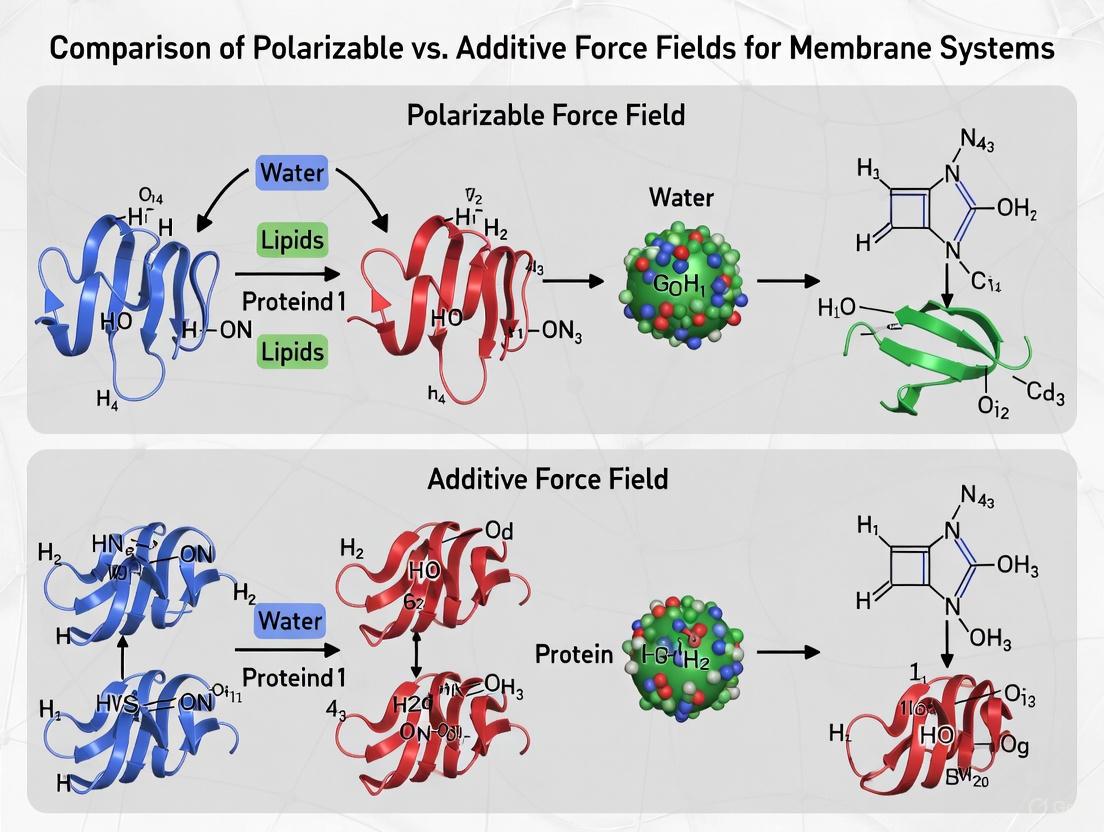
This article provides a comprehensive comparison of polarizable and additive force fields specifically for simulating complex membrane systems.
Polarizable vs Additive Force Fields for Membrane Systems: A Comprehensive Guide for Biomedical Research
Abstract
This article provides a comprehensive comparison of polarizable and additive force fields specifically for simulating complex membrane systems. Aimed at researchers and drug development professionals, it covers the foundational principles of both approaches, with a focus on their application to lipid bilayers and membrane proteins. It explores advanced methodological considerations for implementing these force fields, addresses common troubleshooting and optimization challenges, and provides a rigorous framework for validation and comparative analysis against experimental data. The content synthesizes the latest advancements to guide the selection and application of force fields, ultimately improving the predictive accuracy of molecular dynamics simulations in biomedical research, particularly for studying drug-membrane interactions and pathogen-host interfaces.
Understanding Force Fields: From Additive Foundations to Polarizable Frontiers
In the realm of molecular dynamics (MD) simulations, additive force fields have long been the cornerstone for studying biomolecular systems, from proteins and nucleic acids to lipid membranes. [1] [2] These empirical models, characterized by fixed, atom-centered point charges, offer a computationally efficient framework for simulating biological processes at an atomistic level. The potential energy in these class I additive force fields is typically calculated as a sum of bonded terms (bonds, angles, dihedrals) and nonbonded terms, the latter comprising Lennard-Jones interactions for van der Waals forces and Coulomb's law for electrostatic interactions between fixed partial charges. [2] This simplicity has enabled simulations of ever-increasing size and timescale, providing invaluable insights into biomolecular structure and function. However, the inherent limitation of this model—its inability to account for electronic polarization—becomes particularly pronounced in heterogeneous systems like biological membranes, where dielectric environments vary dramatically. This review objectively compares the performance of the established additive force field paradigm with its emerging challenger, polarizable force fields, focusing specifically on their application in membrane systems research, a critical area for drug development and understanding cellular processes.
Fundamental Principles and Methodologies
The Additive Force Field Framework
The CHARMM36 (C36) additive force field is a widely used and representative example of this paradigm. Its potential energy function includes harmonic terms for bonds and angles, a Fourier series for dihedrals, and a 6-12 Lennard-Jones potential plus Coulombic interactions for nonbonded terms. [2] A key feature is the use of fixed partial charges assigned to each atom, parameterized to mimic the average electronic polarization expected in a specific environment, typically aqueous solution. This mean-field approximation is computationally efficient because the energy of a system can be expressed as a simple sum of the energies of its components plus pairwise interaction energies. However, this transferability is limited; the fixed charges cannot adapt when a molecule moves between environments with different dielectric properties, such as from aqueous solution to a nonpolar lipid bilayer interior. [2] [3] To address known shortcomings, refined versions like CHARMM 36m have introduced targeted modifications, such as NBFIX corrections (pair-specific adjustments to Lennard-Jones parameters) and scaled charges for ionized groups to mitigate overbinding in charged interactions. [4]
The Polarizable Force Field Approach
Polarizable force fields, such as the CHARMM Drude model, explicitly account for the response of electronic charge distribution to a changing environment. [2] [5] In the Drude oscillator model, polarizability is introduced by attaching a virtual particle (a Drude oscillator) with a negative charge to each polarizable atom via a harmonic spring. The displacement of this Drude particle in an electric field creates an induced atomic dipole moment, allowing the molecular electrostatic surface to adapt dynamically during a simulation. [2] [5] This model is inherently more physically realistic than the additive approximation, as it directly captures how the electron density of a molecule is perturbed by its surroundings. This is crucial in membrane systems, where components experience dielectric environments ranging from the high-dielectric aqueous solution to the low-dielectric hydrocarbon core of the bilayer. [3] The trade-off is a significant increase in computational cost, though advances in software and hardware have made simulations of biologically relevant systems and timescales increasingly tractable. [3]
Comparative Experimental Protocols
Evaluations of force field performance, particularly for membrane systems, rely on MD simulations of well-defined benchmark systems followed by comparison of calculated properties with experimental data. A typical protocol for comparing additive and polarizable models involves simulating systems of pure alkanes or lipid bilayers. [6]
System Setup: Initial coordinates for systems containing hundreds of molecules (e.g., 256 molecules of hexadecane) are built using tools like Packmol. [6] The system is solvated and placed in a simulation box with periodic boundary conditions.
Simulation Parameters: Simulations are performed using software such as CHARMM, NAMD, or GROMACS. Temperature is maintained with thermostats (e.g., Nosé-Hoover), and pressure is controlled with barostats (e.g., Andersen-Hoover). Long-range electrostatic interactions are typically handled using the Particle-Mesh Ewald (PME) method. [6] A critical consideration for membrane systems is the accurate treatment of long-range Lennard-Jones interactions, which can be achieved with methods like LJ-PME. [6]
Production and Analysis: Following equilibration, production runs are conducted, and trajectories are analyzed to compute properties such as density (( \rho )), surface tension (( \gamma )), isothermal compressibility (( \beta_T )), viscosity (( \eta )), and diffusion constants (( D )). For bilayers, key properties include surface area per lipid, membrane thickness, and lipid order parameters. The results are then statistically compared against experimental measurements to assess force field accuracy. [6] [7]
Diagram 1: MD workflow for comparing additive and polarizable force fields.
Performance Comparison in Membrane and Related Systems
Quantitative comparison of simulated properties against experimental data provides a critical benchmark for force field accuracy. The table below summarizes results from studies that directly compared the CHARMM36 additive and CHARMM Drude polarizable force fields, particularly when employing a consistent treatment of long-range Lennard-Jones interactions with LJ-PME. [6]
Table 1: Quantitative Comparison of Additive vs. Polarizable Force Fields for Alkanes (Model Lipid Tails)
| Property | Experiment | C36 / LJ-PME | Drude / LJ-PME | Key Implication |
|---|---|---|---|---|
| Dielectric Constant (ε) of Decane | 1.97 [6] | ~1.02 [6] | 2.06 [6] | Drude accurately captures electrostatics in nonpolar environments. |
| Surface Tension of Alkanes | Varies by compound & temperature [6] | Good agreement [6] | Good agreement [6] | LJ-PME improves both models; cancellation of errors possible in C36. |
| Diffusion Constant in Lipid Bilayers | Experimental reference [6] | Overestimated by factor of ~3 [6] | Closer to experiment [6] | Drude improves dynamic properties. |
| Isothermal Compressibility & Thermal Expansion | Specific trends with temperature [6] | Trends improved with LJ-PME [6] | Most accurate reproduction of trends [6] | Drude better captures temperature-dependent thermodynamics. |
Biomembrane Simulations and Protein-Membrane Interactions
Beyond simple alkane systems, force fields are ultimately tested in complex biomembrane simulations. The additive CHARMM36 force field has been successfully used to study various membrane-embedded systems, such as the Piezo1 mechanosensitive ion channel. [7] Simulations utilizing C36 have revealed how the protein-membrane "nanodome" flattens under tension, providing insights into the mechanism of mechanosensation. [7] However, a fundamental shortcoming of additive force fields in such simulations is their treatment of dielectric properties. For instance, the dipole potential of bilayers is often overestimated, and the dielectric constant of membrane interiors is too low because fixed charges cannot adjust to the hydrophobic environment. [6] [3] Polarizable force fields automatically correct this; the Drude model yields a dielectric constant for a decane-like environment that is nearly identical to experiment, whereas the additive model gives roughly half the experimental value. [6] This accurate treatment of electrostatics is critical for modeling processes like ion permeation, the binding of charged ligands to membranes, and the function of voltage-gated or mechanosensitive ion channels. [3]
The Scientist's Toolkit: Essential Research Reagents and Solutions
Table 2: Key Resources for Biomolecular Force Field Simulations
| Resource Name | Type | Primary Function | Relevance to Force Field Research |
|---|---|---|---|
| CHARMM [6] | MD Software | Simulation engine for running MD calculations. | The primary platform for developing and testing CHARMM additive and Drude polarizable force fields. |
| CHARMM36 (C36 & C36m) [4] [2] | Additive Force Field | Parameter set for proteins, lipids, nucleic acids, etc. | The benchmark additive force field for comparative studies; widely used for membrane simulations. |
| CHARMM Drude FF [6] [2] [5] | Polarizable Force Field | Parameter set incorporating explicit polarization via Drude oscillators. | The leading polarizable challenger for studying environments with varying dielectric properties. |
| Lennard-Jones PME (LJ-PME) [6] | Computational Method | Accurately treats long-range van der Waals interactions. | Critical for obtaining correct structural & thermodynamic properties in anisotropic systems like membranes. |
| Packmol [6] | System Builder | Tool for building initial coordinates of complex molecular systems. | Used to set up simulation boxes for benchmark systems like pure alkanes or lipid mixtures. |
| GAFF/CGenFF [8] | General Force Field | Provides parameters for a broad range of organic molecules. | Used for simulating small molecule ligands or non-standard lipids within a consistent force field framework. |
The additive force field paradigm, exemplified by CHARMM36, remains a powerful and widely used tool in biomolecular simulation. Its computational efficiency and extensive parameterization, refined over decades, make it suitable for a vast range of applications, including the study of membrane-embedded proteins. [4] [7] However, quantitative comparisons reveal that its underlying approximation—fixed atomic charges—limits its physical accuracy, particularly for electrostatic properties in heterogeneous environments. The explicit inclusion of polarizability in the Drude model and others systematically improves the agreement with experiment for key properties like dielectric constants, dipole potentials, and the balance of intermolecular interactions. [6] [3] [5]
For researchers in membrane biophysics and drug development, the choice of force field involves a trade-off between computational cost and physical fidelity. For many applications, particularly where electrostatic responses are not the primary focus, additive force fields like CHARMM36m provide robust results. However, when modeling processes where changing electronic polarization is fundamental—such as ion permeation, small molecule partitioning, or interactions involving highly charged species—polarizable force fields offer a more accurate and transferable model. As computational resources continue to grow and polarizable parameters become more comprehensive, the use of these advanced models is expected to become more routine, ultimately providing a more reliable platform for understanding complex biological phenomena and guiding drug discovery.
Molecular dynamics (MD) simulations are indispensable tools for studying biomolecular systems, yet the accuracy of their predictions hinges on the physical models embedded in the force fields used. In membrane environments, which are electrostatically complex and heterogeneous, traditional additive force fields—which assign fixed atomic charges—face significant limitations. This guide compares these conventional approaches with advanced polarizable force fields, which explicitly model electronic polarization, providing objective performance data and methodologies to help researchers select the appropriate tool for membrane-bound systems.
The Electrostatic Challenge in Membrane Biophysics
Biological membranes are complex, anisotropic environments where electrostatic interactions are crucial for the structure and function of embedded proteins. These membranes are fluid layers of discrete lipid molecules that solvate membrane proteins, and their surfaces are chemically and geometrically irregular. Achieving optimal solvation requires adaptations in the spatial distribution of different lipid types, making the local electrostatic environment highly heterogeneous [9].
Traditional additive force fields model electrostatics using fixed point charges on atoms, with polarization incorporated only in an average, mean-field manner. This approximation is problematic for membrane proteins, which traverse environments with dramatically different dielectric properties—from the polar aqueous exterior and lipid headgroups to the non-polar hydrocarbon core. A fixed charge distribution cannot adapt as a protein conformational change exposes it to these different environments, potentially leading to inaccurate energetic calculations [5] [3]. Explicit treatment of electronic polarization is therefore not merely an refinement but a critical necessity for realistic simulations of membrane processes.
Force Field Comparison: Additive vs. Polarizable Models
Fundamental Theoretical Differences
The core distinction between these force fields lies in their treatment of electrostatic interactions.
- Additive Force Fields: Electrostatic energy is calculated simply as the sum of Coulombic interactions between fixed atomic partial charges. Polarization is included implicitly by using enhanced, "gas-phase" charges that represent an average polarization state [3].
- Polarizable Force Fields: These explicitly model the redistribution of electron density in response to the local electric field. The main implementations are:
- Classical Drude Oscillator (or Charge-on-Spring) Model: Represents polarization by attaching a negatively charged "Drude particle" via a harmonic spring to the nucleus of a polarizable atom. The displacement of this particle creates an inducible dipole [6] [5].
- Induced Dipole Model: Directly assigns a polarizability to an atom, allowing an induced dipole moment to form in response to the instantaneous electric field [5] [3].
- Fluctuating Charge (or Charge Equilibration) Model: Allows charge to flow between atoms to equalize electronegativity, capturing some aspects of polarization [5].
Quantitative Performance Benchmarking in Membrane-Related Systems
The following table summarizes key performance metrics from simulation studies, directly comparing additive and polarizable force fields. The data primarily focuses on lipid bilayers and their constituents, which are the foundational elements of membrane environments.
Table 1: Comparison of Force Field Performance for Properties Relevant to Membrane Systems
| Property | System | Additive Force Field (CHARMM36) | Polarizable Force Field (CHARMM Drude) | Experimental Reference | Citation |
|---|---|---|---|---|---|
| Static Dielectric Constant (ε) | Liquid Decane | 1.02 (CHARMM27r) | 2.06 | 1.97 | [6] |
| Surface Tension | Pure Alkane Slab | Does not reproduce monolayer surface tensions well | Improved agreement with experiment | Experimental values | [6] |
| Diffusion Constants | Lipid Bilayers | Overestimated by a factor of ~3 | Improved agreement (vs. experiment) | Experimental values | [6] |
| Density (ρ) & Isothermal Compressibility (βT) | Liquid Hexadecane | Good agreement with experiment | Improved agreement with experiment and corrects temperature dependence trends | Experimental values | [6] |
| Ion Conductivity | Gramicidin A Channel | Requires empirical corrections | Accurately reproduced without corrections | Experimental conductance | [3] |
| Partition Coefficients (log K) | DMPC Membrane | Good correlation with experiment (<0.75 log units) | Information not available in results | Experimental log K | [10] |
Detailed Experimental Protocols from Cited Studies
To ensure reproducibility and provide a clear framework for benchmarking, here are the detailed methodologies from key studies cited in this guide.
Protocol 1: Assessing Long-Range Interactions and Polarization in Alkanes (Source: [6])
- System Preparation: Initial coordinates for systems containing 256 molecules of pure alkanes (e.g., hexadecane, C16H34) were built using Packmol. Box sizes (~50-51 Å) were made sufficiently larger than the radius of gyration to avoid finite-size effects.
- Force Field Specifications: Simulations were run using CHARMM36 additive and CHARMM Drude polarizable force fields, both with and without the Lennard-Jones Particle-Mesh Ewald (LJ-PME) method for long-range dispersion interactions.
- Simulation Parameters: Simulations used periodic boundary conditions, a 1-fs timestep, the Nosé-Hoover thermostat, and an Andersen-Hoover barostat. Long-range electrostatics were handled with PME.
- Property Calculation: Multiple 30-100 ns simulations in NPT and NVT ensembles were used to calculate density, isothermal compressibility, viscosity, surface tension, and diffusion constants. Standard errors were estimated from block averages.
Protocol 2: Studying Lipid Regulation of Membrane Protein Dimerization (Source: [9])
- Research Objective: To understand how lipid composition modulates the dimerization equilibrium of the CLC-ec1 membrane protein.
- Computational Method: A multi-faceted simulation approach was employed:
- All-Atom MD: A 40-microsecond trajectory of a CLC-ec1 monomer in a mixed POPC/DLPC bilayer was run to analyze lipid dynamics at the dimerization interface.
- Coarse-Grained MD (CGMD): Used to compute the solvation free energy of monomeric and dimeric CLC-ec1 in different lipid mixtures (POPC vs. POPC/DLPC), linking molecular details to thermodynamic stability.
- Key Analysis: The simulations focused on "preferential lipid solvation"—a dynamic enrichment of certain lipid types at the protein surface without long-lived binding—to explain how lipid composition shifts the conformational equilibrium.
Visualizing the Research Workflow
The diagram below outlines the logical workflow for a molecular dynamics study comparing force fields in a membrane system, from system setup to data analysis and validation.
Table 2: Key Software, Force Fields, and Analytical Tools for Membrane Simulations
| Tool Name | Type | Primary Function in Research | Citation |
|---|---|---|---|
| CHARMM | MD Simulation Software | Package for performing simulations with both additive and polarizable (Drude) force fields. | [6] |
| CHARMM36 | Additive Force Field | A widely used additive force field for lipids, proteins, nucleic acids, and carbohydrates. | [6] [11] [10] |
| CHARMM Drude | Polarizable Force Field | A polarizable force field based on the Drude oscillator model for more accurate electrostatics. | [6] [11] [3] |
| AMOEBA | Polarizable Force Field | A polarizable force field that uses permanent atomic multipoles and induced dipoles. | [11] [3] |
| LJ-PME | Computational Method | Treats long-range Lennard-Jones interactions, crucial for accurate properties in anisotropic membrane systems. | [6] |
| CGMD | Simulation Method | Coarse-Grained Molecular Dynamics for simulating larger systems and longer timescales to study phenomena like lipid sorting. | [9] |
| NAMD | MD Simulation Software | A widely parallelized MD program capable of simulating both additive and polarizable force fields. | [11] [3] |
| Packmol | System Setup Tool | Used to build initial coordinates for complex molecular systems, such as a box of lipid molecules. | [6] |
The drive to incorporate electronic polarization into force fields for membrane simulations is motivated by fundamental physical principles. Quantitative evidence shows that polarizable force fields, particularly the CHARMM Drude and AMOEBA models, provide superior accuracy for key properties like dielectric response, ion conductivity, and the thermodynamic driving forces behind lipid-regulated protein conformational changes. While additive force fields like CHARMM36 remain useful and computationally efficient for many applications, their inherent limitations in handling variable dielectric environments are significant. For research where electrostatic fidelity is paramount—such as drug binding studies, ion channel gating, and understanding lipid-specific protein regulation—investing in the development and application of polarizable models is no longer a luxury but a necessity for achieving predictive, experimentally-validated results.
Molecular dynamics (MD) simulations are indispensable tools for studying biological membranes at the atomic level. The accuracy of these simulations fundamentally depends on the underlying force fields—mathematical functions that approximate the potential energy of atomic systems. Traditional additive force fields model electrostatics using fixed partial atomic charges, treating electronic polarization in a mean-field manner. While computationally efficient, this approach struggles to accurately represent heterogeneous environments like lipid bilayers, where the dielectric constant varies dramatically between polar headgroup regions and hydrophobic cores. Polarizable force fields address this limitation by explicitly modeling how atomic charge distributions respond to their local electrostatic environment, providing a more physically realistic description of biomolecular systems.
For membrane simulations, the inclusion of explicit polarizability is particularly crucial. Studies have demonstrated that additive force fields can significantly underestimate the dielectric constant of hydrophobic regions; for example, the CHARMM27r additive force field yields a dielectric constant of 1.02 for decane, approximately half the experimental value of 1.97. This error artificially increases charge-charge interactions across bilayers and distorts the balance of forces governing membrane structure and dynamics. The development of polarizable models represents an active frontier in computational biophysics, with three principal approaches emerging as the most widely adopted: induced dipole, fluctuating charge, and Drude oscillator models. This guide provides a comprehensive comparison of these key methodologies, focusing on their theoretical foundations, implementation details, and performance in membrane systems research.
Comparative Analysis of Polarizable Force Fields
Fundamental Methodologies and Physical Principles
Table 1: Core Methodologies of Major Polarizable Force Fields
| Model Type | Fundamental Approach | Key Mathematical Formulation | Atomic Parameters | Treatment of Mutual Polarization |
|---|---|---|---|---|
| Induced Dipole | Assigns inducible point dipoles to atomic sites | $E{elec} = \sum{i} \left( \mui \cdot Ei^0 \right) + \sum{i} \frac{1}{2} \mui \cdot E_i^{\mu}$ | Atomic polarizabilities ($\alpha_i$), Thole damping factors | Self-consistent field (SCF) iteration until convergence |
| Drude Oscillator | Attaches charged auxiliary particles via harmonic springs | $\mui = q{D,i} \cdot di = \frac{q{D,i}^2}{k{D,i}} \cdot Ei$ | Drude charge ($qD$), spring constant ($kD$), Thole factors | Extended Lagrangian with dual thermostats (1 K for Drude particles) |
| Fluctuating Charge | Treats partial atomic charges as dynamical variables | $\frac{\partial E}{\partial qi} = \chii^0 + \sumj \eta{ij}^0 qj + \sum{j \neq i} \frac{qj}{r{ij}} = \lambda$ | Electronegativity ($\chii^0$), chemical hardness ($\etai^0$) | Extended Lagrangian with fictitious charge masses |
Performance Comparison in Biomolecular Simulations
Table 2: Quantitative Performance Comparison for Membrane-Relevant Systems
| Property | Additive CHARMM36 | Drude Polarizable | Experimental Reference | System | Citation |
|---|---|---|---|---|---|
| Dielectric constant (ε) of decane | 1.02 | 2.06 | 1.97 | Pure alkane | [6] |
| Bilayer dipole potential (mV) | Overestimated | Improved agreement | ~250-450 mV | Lipid bilayers | [6] |
| Alkane density (g/cm³ at 303K) | Slight overestimate | Accurate | 0.773 (C₁₆H₃₄) | Hexadecane | [6] |
| Isothermal compressibility | Less accurate | Improved trends | Temperature-dependent | Hexadecane | [6] |
| Molecular polarizability | Mean-field only | Environment-dependent | QM reference | Proteins in solvent | [12] |
| Out-of-plane polarization | Not applicable | Limited | QM reference | Planar systems | [12] |
The Drude polarizable force field demonstrates superior performance for nearly all lipid and alkane properties compared to additive models. Implementation of the Drude model with long-range Lennard-Jones particle-mesh Ewald (LJ-PME) treatment yields significant improvements in reproducing experimental densities, compressibilities, and dielectric constants of hydrophobic media. For example, while the CHARMM36 additive force field significantly underestimates the dielectric constant of decane (ε = 1.02 versus experimental 1.97), the Drude model achieves near-perfect agreement (ε = 2.06) [6]. This accurate treatment of dielectric properties is particularly important for modeling charge transport across membranes and ion partitioning between aqueous and lipid phases.
The induced dipole model offers a physically intuitive approach but faces computational challenges due to the need for self-consistent field iteration to achieve mutual polarization convergence. Recent developments like the iAMEOBA model attempt to address this limitation by performing only a single SCF step, though concerns remain about accuracy in highly heterogeneous systems like lipid bilayers [12]. The fluctuating charge model naturally captures charge transfer effects but requires careful parametrization to avoid unphysical intermolecular charge transfer and has inherent limitations in modeling out-of-plane polarization for planar systems without adding auxiliary sites [12].
Experimental Protocols and Validation Methodologies
Simulation Standards for Membrane Force Field Validation
Table 3: Key Research Reagents and Computational Tools
| Resource Category | Specific Tools/Models | Primary Function | Application Context |
|---|---|---|---|
| Force Fields | CHARMM36 (additive), CHARMM Drude (polarizable), CHeq (fluctuating charge) | Define potential energy functions | Biomolecular MD simulations |
| Water Models | SWM4-NDP (polarizable), mTIP3P (additive) | Solvent representation | Aqueous and membrane systems |
| Software Packages | CHARMM, NAMD, GROMACS, OpenMM | MD simulation engines | Scientific computation |
| Analysis Tools | VMD, MDAnalysis, in-house scripts | Trajectory analysis | Data processing and visualization |
| Validation Metrics | Density, compressibility, diffusion constants, order parameters, dielectric constants | Performance assessment | Force field benchmarking |
System Setup Protocol: For comprehensive force field validation, researchers typically employ multiple system types: (1) Pure alkane systems (e.g., 256 molecules of hexadecane) to isolate hydrophobic chain behavior; (2) Lipid bilayer patches (72-144 lipids per leaflet) with hydrating solution; and (3) Membrane-protein systems where available. Initial configurations are built using tools like Packmol, with sufficient water layers to fully hydrate lipid headgroups (typically 30-40 waters per lipid for bilayers). Simulation boxes must exceed the average radius of gyration and root-mean-square end-to-end distance of the molecules to avoid finite-size effects [6].
Simulation Parameters: Production simulations typically employ a 1-2 fs timestep, with constraints applied to bonds involving hydrogen atoms (SHAKE or LINCS algorithms). Long-range electrostatic interactions are treated using particle-mesh Ewald (PME) with a 10-12 Å real-space cutoff. For polarizable simulations, the Drude model utilizes an extended Lagrangian integrator with a dual thermostat—a low-temperature thermostat (typically 1 K) for the relative Drude-core motion and a primary thermostat for the remaining degrees of freedom. This approach maintains the adiabatic separation between physical and Drude particles while enabling efficient sampling [12] [6].
Validation Metrics and Analysis: Key properties for assessing force field performance for membrane systems include: (1) Thermodynamic properties: density, isothermal compressibility, thermal expansion coefficient; (2) Structural properties: radial distribution functions, order parameters (SCD) from NMR; (3) Dynamic properties: viscosity, translational diffusion constants, rotational correlation times; (4) Dielectric properties: dielectric constants of hydrophobic and hydrophilic regions; and (5) Interfacial properties: surface tension, dipole potentials. For bilayer systems, additional validation against experimental scattering form factors, surface areas per lipid, and thickness measurements is essential [6] [13].
Application to Membrane Systems and Research Implications
Impact on Membrane Biophysics and Drug Development
The implementation of polarizable force fields has yielded significant insights into membrane structure and function. For example, simulations with the Drude model reveal that protein backbone and side-chain dipole moments exhibit substantial variability as a function of environment, with significant fluctuations occurring during simulations [12]. Similarly, water molecules in protein hydration layers show small but systematic changes in dipole moments, with the direction of change dependent on local environment. These findings suggest that the inclusion of explicit electronic polarizability leads to significant differences in the physical forces affecting the structure and dynamics of proteins in membrane environments.
For drug development professionals, polarizable force fields offer improved modeling of membrane partitioning and permeation—critical processes for drug absorption and distribution. The more accurate treatment of dielectric responses in heterogeneous environments enables better prediction of small molecule transfer free energies between aqueous and lipid phases. Additionally, polarizable models show promise for studying ion transport through membrane channels and pores, where charge-induced polarization effects significantly influence conduction mechanisms and selectivity. The improved physical realism of polarizable force fields makes them particularly valuable for studying complex biological processes involving charge separation or transfer at membrane interfaces, such as electron transport chains and membrane potential generation.
Current Limitations and Future Directions
Despite their theoretical advantages, polarizable force fields face challenges in widespread adoption for membrane research. Computational cost remains 2-4 times higher than additive force fields, though this penalty has decreased with algorithmic improvements and specialized hardware. Parameterization is more complex, requiring optimization of additional parameters (atomic polarizabilities, Thole factors, etc.) and careful validation against both quantum mechanical data and experimental observables. For membrane systems specifically, further validation is needed for complex lipid compositions, including glycolipids, lipopolysaccharides, and sterols [8].
Future developments will likely focus on several key areas: (1) Continued refinement of parameters for lipid membranes, particularly for complex bacterial membranes with unique lipid components [8]; (2) Integration with emerging machine learning approaches that incorporate polarizable electrostatics [14] [15]; (3) Improved sampling algorithms to address the timescale limitations of polarizable simulations; and (4) Extension to membrane-protein systems, where polarization effects are expected to play crucial roles in function. As these methodological advances mature, polarizable force fields are poised to become the standard for membrane simulations, offering unprecedented accuracy for studying biological processes at cellular interfaces.
The accurate representation of lipid membranes is paramount for simulating fundamental biological processes, from drug permeation to protein-membrane interactions. At the heart of this challenge lies the precise modeling of electrostatic forces, which govern molecular organization, dynamics, and function within the membrane environment. Traditional molecular dynamics (MD) simulations rely on mathematical models known as force fields to calculate the potential energy of a system based on atomic coordinates. The most commonly used force fields employ an additive model, where the interaction energy is a simple sum of pairwise interactions between fixed, atom-centered charges [16]. This approximation, while computationally efficient, fails to capture the critical physical phenomenon of electronic polarization—the redistribution of electron density in response to the local electric field [16]. This limitation manifests as two significant challenges in lipid membrane simulations: electrostatic anisotropy (directional dependence of electrostatic interactions) and charge penetration (the imperfect shielding of charge in dense, low-dielectric media).
The development of polarizable force fields represents a paradigm shift aimed at overcoming these limitations. By explicitly modeling how the electronic structure of a molecule changes in its environment, polarizable force fields offer a more physically realistic description of electrostatics. This review provides a comparative analysis of additive and polarizable force fields, focusing on their performance in simulating membrane systems. We objectively evaluate their capabilities in capturing key biophysical properties, supported by experimental data and detailed methodological protocols to guide researchers in making informed choices for their specific applications.
Force Field Architectures: A Technical Comparison
Additive Force Fields: Prevalence and Limitations
Additive force fields, such as CHARMM, AMBER, OPLS, and GROMOS, use a fixed functional form for potential energy. The energy calculation includes terms for bonds, angles, dihedrals, and non-bonded interactions (van der Waals and electrostatic) [16]. The electrostatic component is described by a simple Coulomb potential with fixed partial atomic charges, neglecting the environment's influence on a molecule's electron distribution. This simplification is the primary source of error in modeling anisotropic effects and charge penetration.
Recent developments in specialized additive force fields highlight both the demand for accuracy and the inherent limitations of the approach. For instance, the BLipidFF (Bacteria Lipid Force Fields) was developed specifically for the complex lipids of the Mycobacterium tuberculosis outer membrane [8]. Its parameterization involved rigorous quantum mechanics (QM) calculations for charge derivation and torsion optimization, demonstrating that system-specific refinement can improve agreement with biophysical experiments like Fluorescence Recovery After Photobleaching (FRAP) [8]. However, such targeted development is resource-intensive and does not address the fundamental physical omission of polarization.
Polarizable Force Fields: A Physically Grounded Alternative
Polarizable force fields introduce explicit terms to model the induction of dipoles (or other multipoles) in response to the instantaneous electric field. Common methods include induced point dipoles, fluctuating charges, and classical Drude oscillators. The IPolQ model used in the AMBER ff14ipq and ff15ipq force fields is an example of an implicit polarization approach, where partial charges are derived as an average between vacuum and solvated QM charges, effectively "building in" a polarized state [16]. While this improves the balance of solute-solvent and solute-solute interactions, it remains a static approximation compared to fully polarizable models that dynamically respond to the changing environment.
Quantitative Comparison of Force Field Performance
The true test of any force field is its ability to reproduce experimentally observed structural, dynamic, and thermodynamic properties. The table below summarizes quantitative comparisons for key membrane properties.
Table 1: Comparison of Force Field Performance for Key Membrane Properties
| Property | Experimental Reference | Additive Force Field Performance | Polarizable Force Field Potential | Notes & Key Evidence |
|---|---|---|---|---|
| Area Per Lipid (APL) | X-ray Scattering | Varies significantly between force fields; Often requires empirical adjustment [17]. | Aims for more transferable parameters via physical model. | No single additive FF clearly outperforms others across all properties [17]. |
| Lipid Tail Order (SCD) | NMR Spectroscopy | CHARMM36 shows good agreement for DOPC; General FF lacks specificity for mycobacterial lipids [8] [18]. | Expected to better capture field-induced ordering. | BLipidFF captures high tail rigidity in mycobacterial lipids, matching experiments [8]. |
| Lateral Diffusion | FRAP / NMR | Can be too fast or slow; sensitive to system size and cholesterol content [17]. | Improved dynamics via explicit environment response. | BLipidFF-predicted diffusion for α-mycolic acid matches FRAP data [8]. |
| Response to Electric Fields | Bright-field Imaging | CHARMM36: EVert has minimal effect on APL; EHorz reduces APL and increases order [18]. | Should inherently capture dielectric response. | EHorz causes ~2.6% APL decrease in DOPC, a distinct effect additive FFs can capture [18]. |
| Membrane Rigidity | Various Biophysical Assays | General FFs poorly describe rigidity of unique lipids (e.g., α-mycolic acid) [8]. | Potential for accurate mechanical property prediction. | BLipidFF, an additive FF, was specifically parameterized to capture this rigidity [8]. |
Detailed Experimental Protocols for Validation
To ensure the reliability of simulation data, researchers must validate their force fields against robust experimental protocols. Below are detailed methodologies for key experiments cited in this review.
Fluorescence Recovery After Photobleaching (FRAP) for Lateral Diffusion
- Objective: To measure the lateral diffusion coefficient (D) of lipids or proteins within a membrane bilayer.
- Workflow:
- Sample Preparation: A planar lipid bilayer (e.g., giant unilamellar vesicle or supported lipid bilayer) is prepared with a trace amount (typically <1%) of fluorescently labeled lipid.
- Photobleaching: A high-intensity laser pulse is briefly focused onto a small, defined area of the membrane, permanently bleaching the fluorescent probes within that spot.
- Recovery Monitoring: A low-intensity laser monitors the fluorescence in the bleached area over time. Fluorescent lipids from the surrounding membrane diffuse back into the bleached spot, causing a gradual recovery of fluorescence.
- Data Analysis: The fluorescence recovery curve is fitted to a mathematical model to extract the characteristic half-time of recovery (t1/2), which is then used to calculate the lateral diffusion coefficient D.
- Relevance to Force Field Validation: MD simulations calculate the Mean Squared Displacement (MSD) of lipid molecules over time. The lateral diffusion coefficient is derived from the slope of the MSD versus time plot (D = limt→∞ MSD / 4t). A direct comparison can be made between the simulated D and the value measured by FRAP, as was successfully done for the BLipidFF and α-mycolic acid [8].
Deuterium Order Parameters (SCD) from NMR Spectroscopy
- Objective: To quantify the structural order and flexibility of lipid acyl chains.
- Workflow:
- Sample Preparation: Lipids with deuterated acyl chains (typically at specific carbon positions) are incorporated into membranes.
- NMR Measurement: 2H NMR spectra are acquired. The quadrupolar splitting (ΔνQ) of the deuterium nuclei is directly measured from the spectrum.
- Calculation: The deuterium order parameter, SCD, is calculated for each deuterated carbon position using the relation |SCD| = ΔνQ / (3/4 * (e2qQ/h)), where (e2qQ/h) is the static quadrupole coupling constant.
- Relevance to Force Field Validation: In MD simulations, SCD is calculated from the orientation of carbon-deuterium bonds relative to the membrane normal over the simulation trajectory. A direct, carbon-by-carbon comparison between simulated and experimental SCD profiles provides a stringent test of a force field's ability to capture lipid packing and tail disorder [17].
Area Per Lipid (APL) from X-ray Scattering
- Objective: To determine the average area occupied by a single lipid molecule in a bilayer.
- Workflow:
- Sample Preparation: Highly oriented, multi-lamellar lipid bilayer stacks are prepared.
- Data Collection: X-ray scattering data is collected, producing a series of Bragg peaks corresponding to the lamellar repeat spacing.
- Analysis: The lamellar repeat period (D) is obtained from the Bragg peak positions. The bilayer thickness (DB) is then estimated by subtracting the thickness of the water layer (obtained from the electron density profile). The APL is calculated as APL = 2VL / DB, where VL is the lipid volume, typically determined experimentally.
- Relevance to Force Field Validation: In simulations, the APL is trivially calculated as the simulation box area in the membrane plane divided by the number of lipids in one leaflet. It is a fundamental metric for assessing the overall packing and structural accuracy of a membrane model [17].
Diagram 1: Force field development and validation involves an iterative cycle of parameterization, simulation, and comparison against experimental data.
Diagram 2: The structural response of a lipid bilayer is highly dependent on the orientation of the applied electric field, a subtlety force fields must capture.
Table 2: Key Reagents and Computational Tools for Membrane Simulation Research
| Item Name | Function/Description | Relevance to Electrostatic Modeling |
|---|---|---|
| CHARMM36 Force Field | An extensively validated additive force field for lipids and proteins. | Common benchmark for additive methods; captures EHorz-induced APL changes [18]. |
| BLipidFF | A specialized additive force field for bacterial (mycobacterial) membrane lipids. | Demonstrates improvement via targeted QM parameterization for complex lipids [8]. |
| Slipids Force Field | An additive force field known for its accurate description of lipid structure. | Provided the best overall performance in a study of phospholipid-cholesterol mixtures [17]. |
| GROMACS | A high-performance MD simulation package. | Used in many referenced studies for simulating membranes under electric fields [18]. |
| Gaussian & Multiwfn | Software for quantum mechanical calculations and RESP charge fitting. | Critical for deriving accurate partial charges and torsion parameters during force field development [8]. |
| Deuterated Lipids | Lipids with deuterated acyl chains for NMR experiments. | Enable experimental measurement of SCD order parameters for force field validation [17]. |
| Planar Lipid Bilayer Setup | Experimental apparatus for forming suspended lipid bilayers. | Used in bright-field imaging and electrophysiology to study membrane response to electric fields [18]. |
The choice between additive and polarizable force fields for membrane modeling is a trade-off between computational efficiency and physical completeness. Additive force fields, particularly those that are highly specialized or recently refined, can yield excellent agreement with a wide range of experimental data, as evidenced by the success of BLipidFF for mycobacterial membranes [8]. However, their parameters are often tuned to reproduce specific properties and may lack transferability. The inherent lack of polarization remains a fundamental limitation for modeling phenomena like charge penetration and precise dielectric responses.
Polarizable force fields represent the future of high-fidelity membrane simulations, as they are built on a more physically rigorous foundation. While their adoption is currently hindered by greater computational cost and complexity, ongoing algorithm development and increasing computational power are rapidly closing this gap. For researchers today, the optimal strategy may involve using well-validated additive force fields for large-scale or high-throughput screening studies, while reserving polarizable models for investigating specific phenomena where electronic polarization is suspected to play a critical role. As the field progresses, the integration of automated fitting methods and a broader set of experimental solution data, as seen in modern protein force field development [16], will be crucial for creating the next generation of robust and accurate force fields for complex membrane systems.
Implementing Force Fields in Membrane Simulations: Methodologies and Practical Applications
Molecular dynamics (MD) simulations have become an indispensable tool for studying biological membranes at atomic resolution, providing insights into structural properties, dynamics, and interactions that are challenging to capture experimentally [8] [19]. The accuracy of these simulations fundamentally depends on the empirical potential energy functions, known as force fields, that describe the interactions between atoms [8]. For lipid membrane simulations, researchers can choose between two primary philosophical approaches: additive force fields, which use fixed atomic partial charges, and polarizable force fields, which explicitly model how electronic charge distribution responds to the local environment [5]. This distinction represents a critical trade-off between computational efficiency and physical accuracy, particularly for complex, heterogeneous membrane systems like those found in mycobacteria or other pathogens.
The development of specialized lipid force fields has emerged as a necessary response to the limitations of general-purpose force fields when applied to unique membrane compositions. While traditional force fields like CHARMM36, AMBER/Lipid21, and Slipids have proven reasonably successful for modeling conventional phospholipid bilayers [8] [19], they often fail to accurately capture the properties of membranes containing lipids with complex architectures, such as the exceptionally long-chain mycolic acids (C60-C90) found in Mycobacterium tuberculosis [8]. This limitation has driven the creation of specialized force fields like BLipidFF, which employ rigorous parameterization strategies tailored to specific chemical features of bacterial membrane lipids [8]. As membrane simulations increasingly focus on pathogenic organisms, drug delivery systems, and synthetic biology applications, understanding the capabilities and limitations of these specialized force fields becomes essential for researchers in structural biology and drug development.
Comparative Analysis of Specialized Lipid Force Fields
BLipidFF: A Tailored Solution for Bacterial Membranes
BLipidFF represents a specialized all-atom force field developed specifically for key bacterial lipids, with initial parameterization focused on four representative Mycobacterium tuberculosis (Mtb) outer membrane lipids: phthiocerol dimycocerosate (PDIM), α-mycolic acid (α-MA), trehalose dimycolate (TDM), and sulfoglycolipid-1 (SL-1) [8]. The development of BLipidFF addressed a critical gap in membrane simulation capabilities, as Mtb's unique cell envelope rich in complex lipids is central to its pathogenicity, host interactions, and antibiotic tolerance [8]. Unlike general force fields, BLipidFF employs a modular parameterization strategy combined with quantum mechanical calculations to accurately capture the distinctive chemical features of these complex lipids.
The parameterization methodology for BLipidFF involved several sophisticated steps. First, researchers defined atom types based on both elemental category and chemical environment, with specialized types for mycobacterial-specific motifs like cyclopropane rings and trehalose groups [8]. Partial charge parameters were derived using a divide-and-conquer strategy where large lipid molecules were divided into segments, with charges calculated for each segment via quantum mechanical methods at the B3LYP/def2TZVP level using the Restrained Electrostatic Potential (RESP) fitting method [8]. To ensure robustness, charges were averaged across 25 conformations randomly selected from long MD simulation trajectories [8]. For torsion parameter optimization, researchers further subdivided molecules and optimized parameters to minimize the difference between quantum mechanical and classical potential energies [8].
Validation studies demonstrated BLipidFF's superior performance for its target systems compared to general force fields like GAFF, CGenFF, and OPLS [8]. Specifically, BLipidFF successfully captured the high rigidity and slow diffusion rates of α-mycolic acid bilayers, with predicted lateral diffusion coefficients showing excellent agreement with Fluorescence Recovery After Photobleaching (FRAP) experimental measurements [8]. The force field also accurately reproduced differences in order parameters arising from different tail chain groups, highlighting its sensitivity to subtle structural variations in bacterial lipids [8].
Advanced Polarizable Force Fields
Polarizable force fields represent a more sophisticated approach to modeling biomolecular systems by explicitly accounting for electronic polarization effects—the response of atomic charge distributions to their changing environments [5]. This capability is particularly important for membrane systems, where molecules experience dramatically different dielectric environments across the bilayer and in protein binding sites [5] [11]. The three primary classical polarization models include the induced dipole model, where polarizable sites develop induced dipoles in response to electric fields; the Drude oscillator model (also called charge-on-spring or shell model), where Drude particles carrying partial charges are attached to core atoms via harmonic springs; and the fluctuating charge model (also known as charge equilibration or chemical potential equilibration), which allows charge redistribution among atoms based on electronegativity equalization principles [5].
The Drude polarizable force field, implemented in the CHARMM framework, has seen significant development for biomolecular simulations [11]. After establishing appropriate integrators for computationally efficient extended Lagrangian MD simulations, developers optimized water models (SWM4-DP and later SWM4-NDP) to reproduce key properties of liquid water [11]. Parameterization then expanded to small molecules covering functional groups common in biomolecules, including alkanes, alcohols, aromatic compounds, N-methyl acetamide (NMA), nitrogen-containing heteroaromatic compounds, ethers, sulfur-containing compounds, nucleic acid bases, and acyclic polyalcohols [11]. Early simulations demonstrated the feasibility of this approach for DNA and lipid bilayers [11].
The AMOEBA (Atomic Multipole Optimized Energetics for Biomolecular Applications) polarizable force field employs a more sophisticated electrostatic model based on atomic multipoles (including dipoles and quadrupoles) rather than simple point charges, combined with explicit polarization [5]. This approach better captures anisotropic charge distributions—such as σ-holes, lone pairs, and π-bonding—that are critical for specific molecular interactions but poorly represented by standard point charge models [5]. For example, the σ-hole phenomenon explains halogen bonding behavior that cannot be captured by conventional force fields with spherical atomic charges [5].
Machine Learning-Driven Coarse-Grained Approaches
Recent advances in machine learning have introduced new methodologies for developing coarse-grained (CG) lipid force fields. Researchers have successfully implemented graph neural networks (GNNs) based on the TorchMD-GN architecture to create CG lipid models for DOPC, DOPS, and mixed DOPC/DOPS lipid bilayers [20]. These models employ a six-bead representation per lipid, with specific beads for headgroups, middle groups, and tail segments, striking a balance between computational efficiency and structural accuracy [20].
The GNN training process utilizes the variational force-matching method, which minimizes the mean squared error between mapped all-atom forces and CG forces derived from the neural network potential [20]. This approach allows the network to implicitly capture many-body effects by aggregating neighbor information through multiple interaction blocks [20]. The resulting models demonstrate excellent performance in reproducing structural correlations from all-atom simulations while accelerating lipid dynamics by approximately 9.4 times [20]. Notably, these ML-based CG models exhibit some degree of temperature transferability and can be enhanced by training on lipid bicelles for improved performance in self-assembly and vesicle simulations [20].
Table 1: Comparison of Specialized Force Fields for Membrane Simulations
| Force Field | Type | Key Applications | Parameterization Basis | Notable Features |
|---|---|---|---|---|
| BLipidFF | Additive (all-atom) | Mycobacterial membranes (PDIM, α-MA, TDM, SL-1) | Quantum mechanics (B3LYP/def2TZVP), RESP charges | Modular approach for complex lipids, validated against biophysical experiments |
| Drude | Polarizable (all-atom) | Proteins, nucleic acids, lipids | Classical polarization with Drude oscillators, SWM4-NDP water model | Explicit electronic polarization, improved dielectric properties |
| AMOEBA | Polarizable (all-atom) | Proteins, small molecules | Atomic multipoles (dipoles, quadrupoles) with polarization | Anisotropic electrostatics, captures σ-holes and lone pairs |
| TorchMD-GN (ML-CG) | Coarse-grained (machine learning) | DOPC, DOPS, mixed bilayers | Graph neural networks trained on all-atom data via force-matching | 9.4× acceleration vs all-atom, captures many-body effects |
Performance Benchmarking and Experimental Validation
Accuracy in Predicting Membrane Properties
Rigorous benchmarking studies provide critical insights into the performance characteristics of different force fields for membrane simulations. In one comprehensive assessment, researchers evaluated five force fields—Berger, Slipids, CHARMM36, GAFFlipids, and GROMOS 43A1-S3—for calculating free energy profiles of 11 molecules across a model dimyristoylphosphatidylcholine (DMPC) membrane bilayer [10]. The study found that all-atom force fields (Slipids, CHARMM36, and GAFFlipids) and the semicontinuous tool COSMOmic all predicted partition coefficients within 0.75 log units of experimental values [10]. Among these, Slipids emerged as the best-performing force field overall, though the authors recommended CHARMM36 for studies of hydrophilic molecules and Slipids for more complex systems when considering all factors [10].
For specialized bacterial membrane systems, BLipidFF demonstrated superior performance in capturing key membrane properties that are poorly described by general force fields [8]. The rigidity and diffusion rates of α-mycolic acid bilayers were particularly well-represented by BLipidFF, with predictions showing excellent agreement with biophysical experimental observations [8]. This accurate representation of membrane dynamics is crucial for understanding drug permeation mechanisms through mycobacterial membranes, which exhibit exceptional low permeability contributing to antibiotic resistance [8].
The performance of polarizable force fields has been validated through simulations of various membrane systems. The Drude polarizable force field has shown success in properly treating dielectric constants—a property considered essential for accurate modeling of hydrophobic solvation in biomolecules [11]. Early simulations of dipalmitoylphosphatidylcholine (DPPC) bilayers and monolayers demonstrated the feasibility of applying polarizable models to membrane systems [11].
Response to External Perturbations
Membranes in biological systems experience various external perturbations, including electric fields, mechanical stresses, and interactions with proteins or small molecules. Understanding how force fields capture these responses is essential for simulating biologically relevant scenarios. Recent research has investigated the distinct structural responses of lipid bilayers to horizontal (in-plane) versus vertical (transmembrane) electric fields [18].
Using molecular dynamics simulations with the CHARMM36 force field, researchers found that horizontal electric fields induce greater structural changes than vertical fields, including membrane area reduction and increased lipid tail ordering, even at high cholesterol concentrations [18]. Specifically, application of a horizontal electric field of 0.05 V/nm reduced the area per lipid (APL) in pure DOPC bilayers by 2.6%, while vertical fields of the same strength had no significant effect [18]. This compression under horizontal fields was accompanied by enhanced tail alignment and reduced segmental flexibility, particularly in the terminal segments of acyl chains where order parameters increased by 8-9% [18]. These findings highlight the capability of modern force fields to capture subtle electromechanical coupling in membrane systems—a phenomenon potentially relevant to physiological processes in epithelial cells and neurons [18].
Table 2: Performance Comparison Across Membrane Properties
| Property | BLipidFF | CHARMM36 | Drude Polarizable | ML-CG (TorchMD-GN) |
|---|---|---|---|---|
| Complex lipid structure | Excellent for target lipids | Moderate | Not specifically tested | Not applicable |
| Diffusion rates | Matches FRAP experiments for α-MA | Varies by lipid type | Improved with polarization | 9.4× acceleration vs all-atom |
| Order parameters | Captures tail-specific variations | Good for standard lipids | Enhanced through polarization | Reproduces AA correlations |
| Membrane rigidity | Excellent for mycobacterial lipids | Good for standard lipids | Potentially improved | Coarse-grained representation |
| Electrostatic response | Standard fixed charges | Standard fixed charges | Explicit polarization | Not specifically tested |
| Computational cost | Moderate (all-atom) | Moderate (all-atom) | High (3-5× additive) | Low (∼10× faster than AA) |
Methodologies: Experimental Protocols and Parameterization
BLipidFF Development Workflow
The development of specialized force fields follows rigorous parameterization protocols to ensure physical accuracy and transferability. For BLipidFF, the process began with atom type definition based on both elemental category and chemical environment [8]. Atomic nomenclature used a dual-character system: a lowercase letter denoting elemental category (c: carbon, o: oxygen, s: sulfur, h: hydrogen) and an uppercase letter specifying chemical environment (e.g., T: lipid tail, A: headgroup, E: electron-withdrawing substituent) [8]. This approach resulted in 18 chemically distinct atom categories, with specialized types for mycobacterial-specific motifs like cX (cyclopropane carbons) and cG (trehalose carbons) [8].
The charge parameter calculation employed a divide-and-conquer strategy where large lipid molecules were segmented for manageable quantum mechanical computations [8]. Each segment underwent a two-step QM protocol: geometry optimization in vacuum at the B3LYP/def2SVP level followed by charge derivation via the Restrained Electrostatic Potential (RESP) fitting method at the B3LYP/def2TZVP level [8]. To enhance conformational sampling, researchers used 25 conformations for each lipid randomly selected from long MD simulation trajectories, with final RESP charges obtained by averaging across all conformations [8]. This extensive sampling helps ensure parameter transferability across different molecular configurations.
For torsion parameter optimization, developers further subdivided molecules beyond the segmentation used for charge calculations [8]. They optimized torsion parameters to minimize the difference between energies calculated by quantum mechanical and classical potential methods [8]. All torsion parameters consisting of heavy atoms underwent specific parameterization, while bond, angle parameters and torsions containing non-heavy atoms were adopted from GAFF [8]. This hybrid approach balances computational efficiency with specificity to the target lipid systems.
Diagram 1: Force Field Development Workflow. The process begins with atom type definition, proceeds through quantum mechanical parameterization, and concludes with experimental validation before production use.
Validation Methodologies
Experimental validation is crucial for establishing the reliability of force fields for membrane simulations. BLipidFF validation incorporated biophysical experiment comparisons, particularly focusing on membrane rigidity and diffusion rates [8]. Researchers compared MD simulation predictions against experimental observations, including direct comparison of predicted lateral diffusion coefficients for α-mycolic acid with values measured via Fluorescence Recovery After Photobleaching (FRAP) experiments [8]. This quantitative validation against kinetic measurements provides strong evidence for the force field's accuracy in capturing dynamic membrane properties.
For coarse-grained machine learning force fields, validation follows a different approach centered on reproduction of all-atom reference data [20]. The training process uses the variational force-matching method, minimizing the mean squared error between mapped all-atom forces and CG forces derived from the neural network potential [20]. Performance is evaluated by comparing structural correlations (such as radial distribution functions) between CG simulations and the original all-atom references, and assessing the stability of bilayers in CG simulations [20]. Additionally, developers test the transferability of CG models across different temperatures and initial configurations [20].
Polarizable force fields undergo validation against both quantum mechanical calculations and experimental data. For the Drude force field, validation targets include reproduction of gas-phase quantum mechanical interaction energies, liquid-phase thermodynamic properties (density, enthalpy of vaporization), and dielectric constants [11]. The ability to properly model dielectric properties is particularly important for membrane systems, where molecules experience different dielectric environments across the bilayer [11].
The Scientist's Toolkit
Successful implementation of membrane simulations requires careful selection of force fields, software tools, and validation methodologies. The table below outlines key resources for researchers embarking on studies of complex membrane systems.
Table 3: Research Reagent Solutions for Membrane Simulations
| Resource Category | Specific Tools | Application Context | Key Considerations |
|---|---|---|---|
| Specialized Force Fields | BLipidFF, CHARMM36, Drude, AMOEBA | Depends on membrane complexity and research goals | BLipidFF for bacterial membranes; polarizable for heterogeneous dielectric environments |
| Quantum Chemistry Software | Gaussian09, Multiwfn | RESP charge calculations, torsion parameter optimization | B3LYP/def2TZVP level recommended for charge derivation |
| Simulation Packages | GROMACS, NAMD, OpenMM | Production MD simulations | GPU acceleration essential for large polarizable systems |
| Validation Methods | FRAP, NMR order parameters, X-ray scattering | Experimental validation of simulation predictions | Lateral diffusion and order parameters as key metrics |
| Analysis Tools | VMD, MDAnalysis, GROMACS analysis suite | Trajectory analysis and visualization | Automated scripts for efficient processing of large datasets |
| Machine Learning Frameworks | PyTorch, TorchMD-Net | ML-based coarse-grained force field development | Graph neural network architecture for many-body effects |
The development of specialized lipid force fields represents an ongoing effort to balance physical accuracy with computational feasibility in membrane simulations. BLipidFF has demonstrated the value of domain-specific parameterization for complex bacterial membranes, particularly for Mycobacterium tuberculosis lipids that are poorly described by general force fields [8]. Meanwhile, polarizable force fields like Drude and AMOEBA offer more sophisticated electrostatic models that explicitly account for electronic polarization—a critical effect in heterogeneous environments like membrane interfaces [5] [11]. The recent introduction of machine learning-based coarse-grained approaches, such as GNNs trained on all-atom data, provides promising avenues for accelerating simulations while maintaining accuracy [20].
For researchers studying conventional membrane systems, well-established force fields like CHARMM36 and Slipids continue to offer excellent performance [8] [10]. However, for investigations of complex bacterial membranes or systems with strong polarization effects, specialized tools like BLipidFF or polarizable force fields may be necessary. As membrane simulations continue to advance, we can anticipate further integration of machine learning methods, improved polarization models, and increasingly accurate parameterization for diverse lipid species—ultimately enhancing our understanding of membrane-mediated biological processes and facilitating drug development targeting membrane-associated proteins and pathways.
The accurate simulation of membrane systems, crucial for drug development and biological research, hinges on the precision of the underlying molecular force fields. These computational models define the potential energy of a system based on atomic positions and are broadly categorized into additive (non-polarizable) and polarizable force fields [5] [21]. Additive force fields, a long-standing standard, utilize fixed point charges to represent electrostatic interactions. While computationally efficient, this approach fails to capture the critical response of electron distribution to a changing molecular environment, such as across different regions of a lipid bilayer or near ion channels [5]. Polarizable force fields address this fundamental limitation by explicitly modeling electronic polarization, offering a more physically realistic description of electrostatics, which is paramount for heterogeneous systems like membranes [5].
The parameterization of force fields for novel lipid molecules—a key task in lipid nanoparticle (LNP) design for mRNA therapeutics—is a central challenge [22]. This guide objectively compares the dominant parameterization strategies: those rooted in Quantum Mechanical (QM) calculations and modular (transferable) approaches. The performance of these strategies has direct implications for the choice between polarizable and additive force fields, influencing the reliability of simulations in predicting molecular structure, dynamics, and interactions within complex membrane environments.
Theoretical Foundations of Force Field Parameterization
The Energy Function of a Force Field
A force field's functional form decomposes the total potential energy of a system into bonded and non-bonded interaction terms. The general form for an additive force field is given by [21]: [ E{\text{total}} = E{\text{bonded}} + E_{\text{nonbonded}} ] where:
- ( E{\text{bonded}} = E{\text{bond}} + E{\text{angle}} + E{\text{dihedral}} ) describes the energy associated with covalent bond stretching, angle bending, and dihedral torsions.
- ( E{\text{nonbonded}} = E{\text{electrostatic}} + E_{\text{van der Waals}} ) describes interactions between atoms not directly bonded, typically using Coulomb's law for electrostatics and a Lennard-Jones potential for van der Waals forces [21].
Polarizable force fields introduce additional energy terms to account for the change in charge distribution. The most common models are the induced dipole and Drude oscillator (charge-on-spring) models [5]. In the induced dipole model, the self-energy term is ( E{\text{self}}^{\text{Ind}} = \sumi \frac{1}{2} \alphai^{-1} \mui^2 ), where ( \alphai ) is atomic polarizability and ( \mui ) is the induced dipole moment. In the Drude model, the analogous term is ( E{\text{self}}^{\text{Drude}} = \sumi \frac{1}{2} k{D,i} di^2 ), where ( k{D,i} ) is the force constant and ( di ) is the displacement of the Drude particle [5].
Key Parameterization Philosophies
The process of assigning numerical values to the parameters in these energy functions can be approached through distinct philosophies, each with implications for novel lipid development:
QM-Based Parameterization: This strategy derives parameters directly from high-level quantum mechanical calculations [23]. For electrostatics, this often involves fitting atomic point charges (or higher-order multipoles) to replicate the QM-derived electrostatic potential (ESP) around a molecule [5]. Other parameters, like bond force constants and equilibrium angles, are derived from QM calculations of the energy landscape of small molecular fragments. The primary strength of this approach is its high accuracy and physical rigor, as it is grounded in first-principles quantum theory. This makes it particularly valuable for modeling novel chemical structures lacking experimental data. Its main drawback is the high computational cost associated with QM calculations for large molecules.
Modular (Transferable) Parameterization: This approach builds parameters for a new molecule by reusing and combining parameter sets from established molecular fragments or "atom types" [21]. For instance, parameters for a new lipid might be assembled from pre-parameterized alkane chains, ester linkages, and head groups. This method is highly efficient and reproducible, facilitating the rapid screening of large virtual libraries of novel lipids for LNP design [22]. However, its accuracy is limited by the transferability of the existing parameters and may fail to capture unique electronic effects in novel chemical spaces.
Empirical Parameterization: This method involves adjusting force field parameters to match experimental macroscopic observables, such as density, enthalpy of vaporization, or NMR order parameters [17] [21]. While this can improve agreement with specific experimental data, it can introduce a risk of over-fitting and may reduce the physical interpretability of the parameters.
Table 1: Comparison of Force Field Parameterization Strategies
| Strategy | Fundamental Data Source | Advantages | Disadvantages | Best-Suited Applications |
|---|---|---|---|---|
| QM-Based | Quantum Mechanical (QM) Calculations [23] | High physical rigor; Applicable to novel chemistries; Less empirical bias | Computationally expensive; Requires expertise | Polarizable force fields; Novel lipid scaffolds; Validating modular parameters |
| Modular (Transferable) | Pre-existing parameter libraries [21] | Fast and high-throughput; Reproducible; Standardized | Potential transferability errors; May miss system-specific effects | Initial screening of lipid libraries; Additive force fields for known chemistries |
| Empirical | Macroscopic experimental data [17] | Can improve agreement with specific target properties | Risk of over-fitting; May reduce physical basis | Fine-tuning specific properties (e.g., area per lipid) |
Comparative Performance in Membrane Systems
Quantitative Comparison of Simulation Outputs
The choice of parameterization strategy and force field type directly impacts the quantitative accuracy of membrane simulations. Below is a comparison of key physicochemical properties critical for membrane and LNP research, benchmarked against experimental data.
Table 2: Quantitative Performance of Different Force Field/Parameterization Approaches in Membrane Systems
| Property | Experimental Benchmark | Additive FF (Modular Param.) | Polarizable FF (QM Param.) | Implications for Membrane/LNP Research |
|---|---|---|---|---|
| C-H Bond Order Parameters (NMR) | SCH from 2H NMR spectroscopy [17] | Shows systematic deviations; varies by force field [17] | Generally improved agreement (due to better electronic response) [5] | Directly reports on lipid acyl chain order and membrane fluidity |
| Area Per Lipid | X-ray scattering data [17] | Can be accurate but often requires empirical lipid-specific adjustment [24] | A fundamental outcome of balanced LJ and electrostatic terms [5] | Affects membrane thickness, protein embedding, and fusion kinetics |
| Lateral Diffusion | FRAP or NMR spectroscopy [17] | Often underestimated; can be ~2-3x too slow [17] | Can be more accurate due to more realistic interactions [5] | Critical for modeling molecular encounters in signaling and LNP-cell interactions |
| Electrostatic Potential | Computational benchmarks from QM/MM | Fixed charges cannot capture polarization effects [5] | Accurately models internal membrane potential and ion binding [5] | Key for ion channel function, membrane protein insertion, and LNP endosomal escape |
A case study on the glycophorin A transmembrane helix dimer highlights the consequences of imperfect force field balance. Simulations using the additive CHARMM36 force field, parameterized with a combination of QM and modular data, initially predicted an unstable native dimer in phosphatidylcholine bilayers, contradicting experimental evidence. This was traced to inaccuracies in protein-lipid dispersion interactions. A marginal, physically-guided reduction of these interactions was sufficient to stabilize the native dimer, demonstrating how targeted empirical adjustment can correct for residual errors in a primarily QM-informed parameter set [24].
Performance in Simulating Lipid Nanoparticle (LNP) Components
For LNP development, simulating the behavior of ionizable lipids—a critical component for mRNA encapsulation and endosomal escape—is a stringent test. The protonation state of these lipids is highly environment-dependent, a phenomenon that fixed-charge additive force fields handle poorly. Polarizable force fields, parameterized with high-fidelity QM data on the lipid's electronic structure and protonation energies, can automatically adapt the charge distribution as the lipid moves from the LNP surface to the acidic endosome interior [5] [22]. This provides a more reliable simulation of the "proton sponge" effect believed to facilitate endosomal escape and mRNA release [22].
Experimental Protocols for Force Field Validation
To ensure the reliability of simulations for novel lipids, a rigorous validation protocol against experimental data is mandatory. The following methodologies are standard in the field.
NMR Order Parameter Analysis
- Objective: To validate the conformational order and dynamics of lipid acyl chains.
- Protocol:
- Run an all-atom MD simulation of the lipid bilayer for at least 100-200 ns to ensure equilibrium.
- Extract the coordinates of C-H bond vectors from the simulation trajectory.
- Calculate the ScH order parameter for each carbon atom in the acyl chain using the formula: ( S_{CH} = \frac{1}{2} \langle 3\cos^2\theta - 1 \rangle ), where ( \theta ) is the angle between the C-H bond vector and the bilayer normal.
- Compare the simulation-derived ScH profile with experimental data obtained from 2H NMR spectroscopy [17].
X-ray Scattering Form Factor and Electron Density Profile
- Objective: To validate the structural dimensions and electron density distribution of the bilayer.
- Protocol:
- From the MD simulation trajectory, calculate the time-averaged electron density profile along the bilayer normal (z-axis).
- Compute the form factor F(q) as the Fourier transform of the electron density profile.
- Compare the simulated F(q) and the resulting electron density profile against experimental X-ray scattering data [17]. Key comparison points include the location and depth of the form factor minima and the peak-to-peak distance in the electron density profile, which reports on the headgroup separation.
Lateral Diffusion Coefficient Measurement
- Objective: To validate the fluidity and dynamics of the lipid membrane.
- Protocol:
- Track the mean-squared displacement (MSD) of lipid molecules in the plane of the bilayer from the simulation trajectory.
- Calculate the lateral diffusion coefficient (Dlat) using the Einstein relation: ( D{lat} = \frac{1}{4} \lim{t \to \infty} \frac{d}{dt} \langle | \mathbf{r}(t) - \mathbf{r}(0) |^2 \rangle ), where the MSD is in two dimensions.
- Compare the calculated Dlat with experimental values from techniques like Fluorescence Recovery After Photobleaching (FRAP) or pulsed-field gradient NMR [17]. It is critical to account for finite-size effects in simulations by extrapolating from multiple box sizes [17].
Visualization of Workflows
The following diagram illustrates the logical relationship and workflow between the key parameterization strategies and their role in force field development for novel lipids.
Diagram: Force Field Parameterization and Refinement Workflow for Novel Lipids. The process often involves an iterative cycle of adjustment and refinement based on validation outcomes.
Table 3: Key Research Reagents and Computational Tools for Force Field Development
| Tool/Reagent | Category | Function in Parameterization/Validation |
|---|---|---|
| GROMACS | Software | A high-performance molecular dynamics package used for running simulations and analyzing trajectories [24]. |
| CHARMM | Force Field & Software | A comprehensive suite for simulation, including the CHARMM36 additive force field, widely used for lipids and proteins [24]. |
| AMBER | Force Field & Software | Another major MD software and force field suite, supporting both additive and polarizable (AMOEBA) models [5]. |
| OpenMM | Software | A toolkit for MD simulations designed for high performance on GPUs, emphasizing flexibility and open-source standards [21]. |
| VASP/CP2K/Gaussian | Software | Quantum chemistry software packages used for performing QM calculations to derive target data for parameterization [23]. |
| POPC (1-palmitoyl-2-oleoyl-sn-glycero-3-phosphocholine) | Lipid Reagent | A common phospholipid used as a standard model membrane for experimental and simulation validation studies [17]. |
| Cholesterol | Lipid Reagent | A key sterol component of mammalian membranes, used to test force field performance in multi-component mixtures [17]. |
| Ionizable Lipids (e.g., DLin-MC3-DMA) | Lipid Reagent | Proprietary lipids used in LNPs; serve as targets for novel parameterization to simulate protonation and fusogenicity [22]. |
The choice between QM-based and modular parameterization strategies presents a fundamental trade-off between physical accuracy and computational efficiency. For the development of novel lipids, particularly for advanced applications like LNPs, a hybrid approach is often most effective. Initial high-throughput screening of lipid candidates can be performed using efficient additive force fields with modular parameters. However, for lead optimization and the detailed mechanistic study of processes like endosomal escape, investing in QM-parameterized polarizable force fields becomes critical. The field is moving toward greater automation and integration of machine learning to bridge this gap, but rigorous experimental validation remains the non-negotiable standard for ensuring that simulations of membrane systems provide true predictive power for drug development.
Molecular dynamics (MD) simulations are indispensable for studying membrane systems, yet their predictive accuracy hinges on the careful selection and compatibility of force fields (FFs) for proteins, lipids, and solvents. This guide objectively compares the performance of polarizable versus additive FFs, with supporting experimental data. Findings indicate that while additive FFs like CHARMM36 are robust, polarizable FFs such as CHARMM Drude show superior accuracy in reproducing key physicochemical properties, particularly when long-range interactions are properly accounted for using methods like Lennard-Jones Particle-Mesh Ewald (LJ-PME).
In molecular dynamics simulations of biological membranes, the interaction between proteins, lipids, and solvent molecules dictates the accuracy of the resulting model. A force field that is highly accurate for one component may perform poorly when combined with another, leading to unrealistic system behavior. The core challenge lies in achieving a balanced representation of the complex interplay of electrostatic, van der Waals, and hydrophobic interactions. This balance is particularly critical in membrane systems, where the heterogeneous environment spans low-dielectric lipid tails, high-dielectric aqueous solvents, and the intricate polar interfaces in between.
The fundamental choice between additive and polarizable force fields frames this compatibility discussion. Additive FFs, such as CHARMM36, assign fixed partial charges to atoms and have been the workhorse for membrane simulations for years. In contrast, polarizable FFs, like the CHARMM Drude model, incorporate electronic responsiveness by using dynamic dipoles, which is essential for accurately modeling phenomena like dielectric screening and dipole potentials. The decision between these approaches directly impacts the fidelity of simulated membrane properties, from lipid diffusion and area per lipid to the binding of drugs and peptides.
Comparative Methodologies: Protocols for Force Field Validation
To ensure a fair and objective comparison between different force fields, standardized simulation protocols and validation metrics must be employed. The following methodologies are commonly used in the field to assess force field performance for membrane systems.
Simulation Specifications and System Setup
Simulations comparing force fields should be conducted with consistent settings. A typical protocol involves:
- System Construction: Building initial coordinates for systems containing hundreds of lipid molecules (e.g., 256 molecules of a lipid like hexadecane) using tools like Packmol to achieve a cubic box size sufficiently larger than the lipid's radius of gyration to avoid finite-size effects [6].
- Thermostat and Barostat: Using the Nosé-Hoover thermostat to maintain system temperature and a modified Andersen-Hoover barostat for constant pressure simulations [6].
- Integration and Constraints: Employing a 1-fs or 2-fs timestep and applying the SHAKE algorithm to constrain all covalent bonds involving hydrogen atoms [6].
- Electrostatic Treatment: Evaluating long-range electrostatic interactions using the Particle-Mesh Ewald (PME) method. When LJ-PME is not used, a typical real-space cutoff of 12 Å is used, which can be reduced to 10 Å when LJ-PME is active [6].
Key Validation Metrics and Properties
The accuracy of a force field is quantified by comparing simulation-derived properties against experimental data. Critical properties for membrane systems include:
- Structural Properties: Density (ρ), area per lipid, bilayer thickness, and radial distribution functions (g(r)) [6].
- Thermodynamic Properties: Isothermal compressibility (βT), surface tension (γ), coefficient of thermal expansion (αV), and viscosity (η) [6].
- Dynamical Properties: Translational diffusion constants (D) and NMR relaxation times (e.g., 13C T1) [6].
- Order Parameters: Deuterium order parameters (SCD) from NMR experiments, which report on the conformational order of lipid acyl chains [25].
Performance Analysis: Additive vs. Polarizable Force Fields
The following analysis compares the performance of established additive and polarizable force fields against experimental data, highlighting the importance of long-range interaction treatments.
Table 1: Performance Comparison of Additive and Polarizable Force Fields for Liquid Alkanes
| Property | CHARMM36 (Additive) | CHARMM36 with LJ-PME | CHARMM Drude (Polarizable) | CHARMM Drude with LJ-PME | Experimental Reference |
|---|---|---|---|---|---|
| Density (ρ) | Good agreement | Improved agreement | Good agreement | Excellent agreement | Varies by temperature [6] |
| Isothermal Compressibility (βT) | Less accurate | Improved | Good | Excellent agreement | Varies by temperature [6] |
| Surface Tension (γ) | Less accurate | Improved | Good | Excellent agreement | Varies by temperature [6] |
| Viscosity (η) | Less accurate | Improved | Good | Excellent agreement | Varies by temperature [6] |
| Dielectric Constant (ε) of decane | ~1.02 (Major underestimate) | Not Reported | 2.06 (Excellent agreement) | Not Reported | 1.97 [6] |
| Translational Diffusion (D) | Overestimated | Improved | More accurate | Most accurate | Experiment [6] |
The Impact of Long-Range Lennard-Jones Interactions
A critical finding from recent studies is that the accurate treatment of long-range van der Waals interactions is as important as the choice between additive and polarizable models. The standard approach of using a cutoff (e.g., 10–12 Å) for Lennard-Jones (LJ) interactions can introduce significant artifacts.
- LJ-PME Method: The recently refined Lennard-Jones particle-mesh Ewald (LJ-PME) method extends the PME technique to LJ interactions, making it suitable for anisotropic systems like lipid bilayers [6].
- Improved Agreement: Implementation of LJ-PME with both the CHARMM36 additive and CHARMM Drude polarizable force fields significantly improved agreement with experiment for a range of structural and thermodynamic properties of pure alkanes, including density, isothermal compressibility, and surface tension [6].
- Molecular Order: The use of LJ-PME is particularly crucial for systems like hexadecane, where molecular order was found to extend to nearly 20 Å, well beyond the usual cutoffs used in most simulations [6].
Performance in Complex Bacterial Membrane Models
The need for specialized force fields becomes apparent when simulating the unique lipids found in bacterial membranes, such as those of Mycobacterium tuberculosis.
Table 2: Comparison of General and Specialized Force Fields for Bacterial Membrane Lipids
| Force Field | Type | Headgroup Order Parameters | Tail Order Parameters | Lateral Diffusion | Computational Cost |
|---|---|---|---|---|---|
| CHARMM36 | Additive | Excellent accuracy [25] | Overestimated [25] | Overestimated [6] | High [25] |
| Slipids | Additive | Least accurate [25] | Excellent accuracy [25] | Not Reported | High [25] |
| GROMOS-CKP | Additive | Reasonable accuracy [25] | Reasonable accuracy [25] | Not Reported | Medium [25] |
| BLipidFF | Additive (Specialized) | Not Reported | Captures unique tail rigidity [8] | Agrees with FRAP data [8] | Not Reported |
- CHARMM36 provides nearly perfect estimates for the order parameters of lipid headgroups but tends to overestimate those of the lipid tails [25].
- Slipids are notably effective at replicating the order parameters for all acyl chains but offer less accurate results for headgroup parameters [25].
- BLipidFF, a specialized force field developed for bacterial lipids, uniquely captures the high rigidity of mycobacterial lipid tails and shows excellent agreement with experimental lateral diffusion coefficients [8].
Table 3: Key Software and Force Fields for Membrane Simulations
| Resource | Type | Function and Description |
|---|---|---|
| CHARMM | MD Software | A versatile program for macromolecular simulation that includes implementations of various force fields and methods like LJ-PME [6]. |
| CHARMM36 (C36) | Additive Force Field | A widely used and validated additive force field for lipids, proteins, and nucleic acids. Good for homogeneous bilayers [6] [25]. |
| CHARMM Drude | Polarizable Force Field | A polarizable force field based on the classical Drude oscillator model, offering improved accuracy for electrostatic properties [6]. |
| BLipidFF | Specialized Force Field | A specialized all-atom force field for key bacterial lipids, parameterized using quantum mechanics to capture unique membrane properties [8]. |
| Packmol | Setup Tool | A tool used to build initial coordinates for MD simulations by packing molecules in defined simulation boxes [6]. |
| LJ-PME | Simulation Method | A method for treating long-range Lennard-Jones interactions, crucial for accurate simulation of anisotropic systems like membranes [6]. |
Workflow for Force Field Selection and Application
The following diagram outlines a logical workflow for selecting and applying compatible force fields in membrane system research.
The objective comparison of force fields for membrane systems reveals a clear trajectory toward more physically accurate models. While well-parameterized additive force fields like CHARMM36 remain powerful and computationally efficient tools for many applications, the evidence shows that polarizable force fields, particularly when combined with accurate treatments of long-range Lennard-Jones interactions via LJ-PME, offer superior performance for a wide range of thermodynamic, structural, and dynamic properties.
The future of membrane simulations lies in the continued refinement of polarizable models and the development of specialized force fields for unique biological systems, such as the bacterial membranes exemplified by BLipidFF. Furthermore, the emergence of machine learning-assisted coarse-grained models promises to bridge the gap between atomic-level accuracy and the simulation of large-scale membrane events [20]. For researchers and drug development professionals, the key to success is a judicious approach to force field compatibility, ensuring that the models for proteins, lipids, and solvents work in concert to reproduce the complex biophysical reality of biological membranes.
Cytochrome P450 enzymes (CYPs) are membrane-associated proteins responsible for metabolizing a vast array of drugs and xenobiotics. For these enzymes, the cellular membrane is not merely a passive barrier but an active mediator that concentrates hydrophobic substrates and influences protein structure and dynamics. Approximately 60% of drug targets are membrane-associated, making understanding membrane-mediated interactions crucial for drug development [26]. The membrane accumulates hydrophobic molecular species, yielding up to a 10-million-fold enrichment within the membrane compared to their concentration in aqueous solution, dramatically affecting drug availability to membrane-bound proteins like CYPs [26]. Accurately simulating these interactions requires force fields that faithfully represent the complex physics of biomolecular systems, particularly the balance between additive (non-polarizable) and polarizable approaches.
This case study objectively compares the performance of additive versus polarizable force fields for simulating CYP-membrane interactions. We provide quantitative comparisons of their ability to reproduce key membrane and protein properties, detail experimental validation protocols, and offer practical guidance for researchers investigating membrane-protein systems.
Force Field Fundamentals: Additive vs. Polarizable Models
Additive (Non-Polarizable) Force Fields
Additive force fields represent the current standard for most biomolecular simulations. They describe electrostatic interactions using fixed partial charges assigned to each atom, with polarization effects incorporated only in a mean-field manner through enhanced charge values [3]. While computationally efficient and extensively refined through decades of parameterization, this approach cannot capture the dynamic response of electron clouds to changing molecular environments—a significant limitation in heterogeneous systems like membrane-protein interfaces [5] [3].
Popular additive force fields include:
- CHARMM36 (C36): Features a revised backbone CMAP potential and optimized side-chain dihedrals for improved protein dynamics [11].
- AMBER ff99SB-ILDN: Includes modifications to backbone and side-chain torsion potentials for better conformational sampling [11].
- GAFF (Generalized Amber Force Field): Designed for drug-like small molecules, often used in conjunction with AMBER protein force fields [26].
- OPLS-AA: Optimized for liquids, with parameters for proteins, nucleic acids, and lipids [27].
Polarizable Force Fields
Polarizable force fields explicitly model the redistribution of electron density in response to the local environment, providing a more physical representation of electrostatics. This capability is particularly important for processes where electrostatic interactions fluctuate significantly or where polarization is fundamental, such as cation-π interactions, hydrogen bonding cooperativity, and ion binding [3]. The three primary approaches to modeling polarization are:
- Drude Oscillator (DO): Also known as the shell model or charge-on-spring, this approach attaches a charged "Drude particle" to core atoms via a harmonic spring, creating inducible dipoles through displacement [11] [3].
- Induced Dipole (Point-Polarizable Dipole): Places polarizable sites on atoms that develop induced dipoles proportional to the local electric field [5] [3].
- Fluctuating Charge (FQ): Allows charge to flow between atoms based on electronegativity equalization principles [5] [3].
The CHARMM Drude and AMOEBA force fields represent the most developed polarizable models for biomolecular simulations, with parameters available for proteins, lipids, nucleic acids, and small molecules [11] [3].
Table 1: Fundamental Comparison of Additive and Polarizable Force Fields
| Feature | Additive Force Fields | Polarizable Force Fields |
|---|---|---|
| Electrostatics | Fixed point charges | Environment-responsive charges/dipoles |
| Polarization | Mean-field approximation | Explicitly modeled |
| Computational Cost | 1x (Reference) | ~2-4x higher [3] |
| Parameter Maturity | High, extensively refined | Good and improving |
| Treatment of Heterogeneous Environments | Approximate, may require reparameterization | More physically realistic |
Comparative Performance Data for Membrane Systems
Membrane Structure and Dynamics
Accurate simulation of membrane properties is fundamental to studying CYP-membrane interactions. Force fields must reproduce key structural and dynamic properties measurable through experimental techniques.
Table 2: Performance Comparison for Key Membrane Properties
| Property | Experimental Reference | Additive FF (e.g., CHARMM36) | Polarizable FF (e.g., Drude) |
|---|---|---|---|
| Bilayer Thickness | ~4 nm [26] | Accurate | Accurate |
| Area Per Lipid | Varies by lipid type (~60-70 Ų for DPPC) | Good agreement | Good agreement |
| Electron Density Profile | X-ray scattering | Good overall match | Improved headgroup ordering |
| Membrane Dipole Potential | ~500-600 mV | Approximate | More accurate [3] |
| Lateral Diffusion | FRAP measurements | Slightly fast | Improved with explicit polarization [8] |
| Order Parameters (Scd) | NMR | Slightly elevated in tails | Improved tail dynamics [8] |
Small Molecule Partitioning and Permeation
The membrane's role in concentrating substrates is crucial for CYP function. Polarizable force fields can provide more accurate descriptions of small molecule partitioning and permeation, which are governed by the molecule's interaction with the varying dielectric environment across the bilayer [26] [3]. Studies have shown that explicit polarization is particularly important for modeling the permeation of ions and highly polar molecules through the low-dielectric membrane core, where additive force fields may significantly overestimate barriers [3].
Protein-Membrane Interactions
The accuracy of force fields in modeling protein-membrane interfaces is critical for CYP simulations. Polarizable force fields show promise in better describing the interactions of charged side chains with lipid headgroups and the behavior of aromatic residues at the membrane interface [3]. Furthermore, the heterogeneous dielectric environment at the protein-lipid-water interface is more naturally captured by polarizable models.
Experimental Validation Protocols
Experimental Data for Force Field Validation
The predictive power of any simulation depends on rigorous experimental validation. The following experimental techniques provide essential data for validating force fields in membrane systems:
- X-ray and Neutron Scattering: Provide electron density profiles across the bilayer, revealing the precise positioning of lipid components and validating bilayer thickness and structure [19].
- NMR Spectroscopy: Measures order parameters (Scd) of lipid acyl chains, providing detailed information about membrane fluidity and packing [26] [19].
- Fluorescence Recovery After Photobleaching (FRAP): Quantifies lateral diffusion coefficients of lipids and proteins within the membrane plane [8].
- Isothermal Titration Calorimetry (ITC): Measures binding affinities of small molecules to membranes and membrane proteins [26].
- Vibrational Spectroscopy: Infrared and Raman spectroscopy probe lipid chain conformation and hydration of headgroups, sensitive to membrane order and dynamics [3].
Specialized Force Fields for Complex Membranes
For simulating bacterial membranes, such as those of Mycobacterium tuberculosis which contain unique lipids like phthiocerol dimycocerosate (PDIM) and mycolic acids, specialized force fields like BLipidFF have been developed [8]. These force fields employ quantum mechanics (QM)-based parameterization strategies to capture the unusual rigidity and slow dynamics of these membranes, demonstrating the importance of tailored parameterization for specific biological systems. Validation of the BLipidFF force field showed excellent agreement with FRAP measurements for the lateral diffusion of mycolic acids, a property poorly described by general force fields [8].
Implementation and Workflow Guidance
System Setup and Simulation Parameters
Simulations of CYP-membrane systems typically follow a standardized workflow to ensure reproducibility and comparability between force fields. The membrane composition should reflect the biological context of the specific CYP isoform, with phosphatidylcholine (POPC) commonly used as a model system.
Diagram Title: Force Field Selection Workflow
Enhanced Sampling Techniques
Due to the timescales involved in membrane partitioning and protein conformational changes, enhanced sampling methods are often necessary:
- Umbrella Sampling: Applies harmonic biases along a defined reaction coordinate (e.g., substrate position along membrane normal) to calculate free energy profiles [26].
- Metadynamics: Builds free energy surfaces by adding repulsive biases in the space of collective variables, useful for complex conformational transitions [26].
- Explicit Ligand Sampling (ELS): Multiple copies of a ligand are randomly placed in the system to improve statistics for binding and partitioning events [26].
Computational Requirements
Polarizable simulations typically require 2-4 times more computational resources than additive force fields due to the self-consistent calculation of induced dipoles or Drude particle positions [3]. This cost can be mitigated through optimized algorithms and GPU acceleration. For initial explorations or large systems, additive force fields remain practical, but polarizable simulations are becoming increasingly feasible for biologically relevant system sizes and timescales.
Table 3: Key Research Reagents and Computational Tools
| Resource | Type | Function/Application | Examples/Notes |
|---|---|---|---|
| CHARMM36 | Additive Force Field | General-purpose biomolecular simulations | Gold standard for membranes; balanced parameters [11] [19] |
| AMBER ff99SB-ILDN | Additive Force Field | Protein simulations with improved side chains | Often combined with GAFF for small molecules [11] |
| CHARMM Drude | Polarizable Force Field | Simulations requiring explicit polarization | More accurate electrostatics; higher computational cost [11] [3] |
| AMOEBA | Polarizable Force Field | Advanced electrostatics with multipoles | Includes atomic multipoles and polarization [5] [11] |
| BLipidFF | Specialized Force Field | Bacterial membrane simulations | QM-derived parameters for complex lipids [8] |
| GAFF/CGenFF | General Force Fields | Small molecule parameterization | Compatible with AMBER/CHARMM ecosystems [26] [27] |
| GROMACS/NAMD/OpenMM | MD Software | Simulation engines | Support both additive and polarizable models [11] |
| MDAnalysis/VMD | Analysis Tools | Trajectory analysis and visualization | Essential for analyzing membrane and protein properties |
Based on the current state of force field development and validation, we provide the following recommendations for simulating CYP-membrane interactions:
For standard simulations and large systems, well-validated additive force fields like CHARMM36 provide a robust balance between accuracy and computational efficiency, particularly when the primary interest is in structural and dynamic properties rather than detailed electronic responses.
For processes involving charge separation, ion interactions, or heterogeneous dielectric environments, polarizable force fields like CHARMM Drude or AMOEBA offer significant advantages and more physically realistic descriptions, despite their higher computational cost.
For specialized membrane systems containing unique lipids or drug molecules with complex electronic properties, consider QM-derived parameterization approaches or specialized force fields like BLipidFF to ensure accurate representation of molecular interactions.
As computational power increases and polarizable force fields continue to mature, they are poised to become the standard for simulating complex biomolecular systems like CYP-membrane interactions, offering unprecedented insights into drug metabolism and membrane biology.
Troubleshooting Membrane Simulations: Force Field Pitfalls and Optimization Strategies
Molecular dynamics (MD) simulations have become an indispensable tool for studying biological membranes, providing atomistic insights into their structure, dynamics, and interactions with proteins and drug molecules. The accuracy of these simulations, however, critically depends on the choice of force field (FF), the mathematical model describing interatomic interactions. A fundamental division exists between additive force fields, which use fixed partial atomic charges, and polarizable force fields, which explicitly account for electronic polarization effects by allowing charge distribution to respond to the local electrostatic environment. For membrane systems, this distinction is particularly consequential, as the heterogeneous dielectric environment of lipid bilayers—ranging from nonpolar hydrocarbon tails to polar headgroups and aqueous surroundings—makes polarization effects especially significant.
The development of polarizable FFs like the CHARMM Drude FF represents a significant advancement in accurately modeling these complex biomolecular systems. Despite improvements, all FFs are susceptible to producing artifacts that can compromise biological interpretations. This guide systematically compares polarizable versus additive FFs through the lens of three critical challenges in membrane simulation: misfolding of membrane-associated peptides, unrealistic bilayer physical properties, and poor convergence of thermodynamic properties. By examining quantitative data and methodological approaches, we provide researchers with a framework for selecting appropriate FFs and identifying potential artifacts in their membrane simulations.
Quantitative Comparison of Force Field Performance
Table 1: Key Performance Metrics for Additive vs. Polarizable Force Fields in Membrane Simulations
| Performance Metric | CHARMM36 (Additive) | C36/LJ-PME (Additive with LR-LJ) | Drude2023 (Polarizable) | Experimental Reference |
|---|---|---|---|---|
| DPPC Diffusion Constant | Overestimates by ~150% [28] | Overestimates by ~60% [28] | Agrees well with experiment [28] | Varies by system size and method |
| DOPC Diffusion Constant | Overestimates by ~150% [28] | Overestimates by ~60% [28] | Agrees well with experiment [28] | Varies by system size and method |
| Lipid Wobble Relaxation | Less accurate [28] | More accurate [28] | Equally accurate as C36/LJ-PME [28] | Fluorescence/quasielastic scattering |
| Pore Formation (70% Lysolipid) | No pores in 24 μs [28] | Data Not Available | Pores in <1 μs (4/15 replicates) [28] | Accelerated by lysolipids |
| Ion-Graphene Interaction | Fails to capture specific adsorption [29] | Data Not Available | Captures specific ion adsorption & solvation shell effects [29] | Second harmonic generation |
Table 2: Analysis of Common Artifacts Across Force Field Types
| Artifact Category | Manifestation in Additive FFs | Manifestation in Polarizable FFs | Recommended Detection Methods |
|---|---|---|---|
| Misfolding & Unrealistic Peptide Behavior | Incorrect tilt angles under hydrophobic mismatch; inadequate snorkeling of lysine residues [30] | More accurate peptide tilting and sidechain positioning; validated against experimental tilt angles | Compare tilt angles with experimental data (e.g., NMR); monitor residue localization at lipid/water interface [30] |
| Unrealistic Bilayer Properties | Overly fast lipid diffusion; inaccurate membrane viscosity; incorrect ion distribution at interfaces [28] [29] | Improved diffusion rates and viscosities; better capture of ion-specific effects at hydrophobic interfaces [28] [29] | Calculate lipid MSD/diffusion; compare with NMR/FRAP data; analyze ion density profiles at interfaces [31] |
| Poor Convergence & Sampling | May require longer simulations to achieve equilibrium lipid sorting; insufficient sampling of pore formation pathways [28] [9] | Can accelerate certain processes like pore formation; improved description of lipid dynamics around proteins [28] [9] | Monitor lipid enrichment over multiple replicates; use advanced analysis (e.g., ABF) for free energy convergence [29] |
Detecting and Correcting Common Artifacts
Misfolding and Unrealistic Peptide Behavior
Hydrophobic mismatch—when the length of a transmembrane peptide's hydrophobic segment differs from the bilayer's hydrophobic thickness—poses a significant challenge for FFs. Additive FFs like CHARMM36 may produce incorrect tilt angles and inadequate snorkeling of lysine residues under negative mismatch conditions. Polarizable FFs demonstrate more biologically realistic adaptations through a combination of peptide tilting, local bilayer bending, and proper sidechain positioning [30].
Detection Protocols:
- Calculate peptide tilt angles relative to the bilayer normal over production trajectories
- Monitor lysine snorkeling by tracking the distance between lysine NZ atoms and lipid phosphate groups
- Analyze local membrane deformation by measuring bilayer thickness around peptides
Unrealistic Bilayer Physical Properties
Lipid diffusion constants serve as sensitive indicators of FF accuracy. Standard additive FFs typically overestimate diffusion by a factor of 2.5, while inclusion of long-range Lennard-Jones interactions (C36/LJ-PME) reduces this error to ~60%. The Drude2023 polarizable FF demonstrates the most accurate diffusion behavior, agreeing well with experimental measurements [28].
Detection Protocols:
- Calculate mean-squared displacement (MSD) of lipid headgroups:
- Extract diffusion constant (D) from linear slope of MSD vs. time: D = (1/(2n)) × lim(t→∞) d(MSD)/dt, where n=2 for bilayer
- Compare with experimental values from NMR or FRAP measurements
- Analyze membrane viscosity through reverse Fourier transform of the height spectrum
Poor Convergence and Sampling Issues
Lipid sorting and enrichment around membrane proteins requires sufficient sampling, which can be problematic for additive FFs. Polarizable FFs may demonstrate accelerated sampling for certain processes like peptide-induced pore formation, as observed in simulations of influenza fusion peptides with lysolipids where Drude2023 formed pores in 70% lysolipid systems while C36 showed no pore formation even in significantly longer simulations [28].
Detection Protocols:
- Perform multiple independent replicates to assess variability
- Calculate lipid enrichment factors around proteins using grid-based density analysis
- Monitor convergence of potential of mean force (PMF) for processes like ion adsorption
Methodologies for Force Field Validation
Experimental Validation Workflow
The diagram below illustrates a comprehensive workflow for validating force field performance against experimental data:
Advanced Simulation Approaches
Adaptive Biasing Force (ABF) Methods: For quantifying ion-membrane interactions, ABF simulations provide potential of mean force (PMF) profiles that reveal binding energetics. Polarizable FFs capture anion-specific interactions with graphene surfaces that are absent in additive FFs, demonstrating the importance of explicit polarization for interface phenomena [29].
Preferential Solvation Analysis: To study lipid regulation of membrane proteins, analyze lipid enrichment factors around proteins. Unlike specific binding, preferential solvation shows no saturation with increasing lipid concentration and involves rapidly exchanging lipid molecules [9].
Essential Research Reagents and Tools
Table 3: Key Research Reagents and Computational Tools for Membrane Simulations
| Reagent/Tool | Type | Primary Function | Example Applications |
|---|---|---|---|
| CHARMM36 | Additive Force Field | Standard for membrane simulations; balanced parameters for lipids/proteins | Baseline comparison for new FFs; large-scale membrane protein simulations [28] |
| Drude2023 | Polarizable Force Field | Explicit electronic polarization via Drude oscillators | Membrane systems where polarization effects are critical; ion-lipid interactions [28] |
| C36/LJ-PME | Modified Additive FF | Includes long-range Lennard-Jones interactions | Improved lipid diffusion without polarization overhead [28] |
| MARTINI | Coarse-Grained FF | Extended spatial/temporal scales; membrane remodeling | Large-scale membrane remodeling; protein insertion; self-assembly [31] |
| NAMD | Simulation Package | Scalable MD with polarizable FF support | Large membrane systems with Drude FFs; free energy calculations [29] |
| GROMACS | Simulation Package | High-performance MD with extensive analysis tools | High-throughput membrane simulations; lipid property analysis [31] |
| MEMBPLUGIN | Analysis Tool | Calculation of membrane properties from trajectories | Bilayer thickness; curvature; leaflet analysis [31] |
The comparison between polarizable and additive force fields reveals a nuanced landscape for membrane simulations. While additive FFs like CHARMM36 offer computational efficiency and extensive validation, they can produce artifacts in lipid dynamics, ion interface behavior, and membrane peptide interactions. Polarizable FFs like Drude2023 demonstrate superior accuracy for these properties but at significantly higher computational cost. The recent development of the CHARMM Drude2023 force field represents a substantial advancement, achieving experimental agreement for lipid diffusion constants and providing more realistic descriptions of pore formation kinetics [28].
Future developments will likely focus on improving the balance between accuracy and computational cost, potentially through more efficient implementations of polarizable models or multi-scale approaches that apply polarization only where critically needed. As membrane simulations continue to address increasingly complex biological questions—from lipid-mediated protein regulation to drug-membrane interactions—the careful selection and validation of force fields remains paramount for generating biologically meaningful insights.
Molecular dynamics (MD) simulations provide an atomic-resolution "computational microscope" for studying lipid membranes, but their predictive accuracy is fundamentally limited by two challenges: the empirical force field and insufficient sampling of rare events. This review examines how enhanced sampling techniques, specifically Replica Exchange with Solute Tempering (REST2), address sampling limitations in complex lipid systems. We objectively compare the performance of polarizable versus additive force fields, demonstrating how polarizable models combined with REST2 provide superior characterization of lipid dynamics, membrane-protein interactions, and drug permeation pathways—critical insights for pharmaceutical development and membrane biophysics.
Molecular dynamics simulations have become an indispensable tool for studying biological membranes, revealing details inaccessible to experimental techniques. However, the scientific utility of these simulations is constrained by two fundamental limitations: the accuracy of the force field and the adequacy of conformational sampling.
Force field accuracy dictates how well the computational model represents physical reality. Traditional additive force fields use fixed atomic charges that cannot adapt to different dielectric environments, making them particularly problematic for heterogeneous systems like lipid bilayers where the environment transitions from aqueous solution to hydrophobic core over short distances [2]. Polarizable force fields, such as the classical Drude oscillator model, explicitly treat electronic polarization by attaching virtual particles with charge to atoms via harmonic springs, allowing charge distribution to respond to the local environment [2] [32].
Sampling limitations arise because biomolecular systems have rough energy landscapes with many local minima separated by high-energy barriers. Conventional MD simulations can easily become trapped in these minima, failing to observe biologically relevant conformational changes that occur on timescales beyond the simulation window [33]. This is particularly problematic for lipid systems showing slow relaxation processes, phase transitions, and rare permeation events.
Enhanced sampling algorithms like REST2 effectively address this sampling problem, while polarizable force fields improve physical representation. When combined, they enable more reliable simulations of complex lipid dynamics with direct relevance to drug delivery systems and membrane protein function.
Understanding REST2: Technical Framework and Implementation
Replica Exchange with Solute Tempering (REST2) is an enhanced sampling algorithm that improves upon traditional temperature replica exchange MD (T-REMD). Where T-REMD requires replicas spanning a temperature range for the entire system, REST2 focuses the temperature acceleration on a specific "hot region" (typically the solute), while the solvent remains at the target temperature [34]. This strategic focus dramatically reduces the number of replicas needed, making REST2 computationally efficient for large biomolecular systems in explicit solvent.
Mathematical Foundation
In REST2, all replicas run at the same physical temperature, but the potential energy function for the hot region is scaled differently in each replica. The modified potential energy is given by:
[ Em^{REST2}(X) = \frac{\betam}{\beta0}E{ss}(X) + \sqrt{\frac{\betam}{\beta0}}E{sw}(X) + E{ww}(X) ]
Where:
- (E{ss}), (E{sw}), and (E_{ww}) represent solute-solute, solute-solvent, and solvent-solvent interaction energies
- (X) represents the configuration of the whole system
- (\betam = 1/kBTm) where (T0) is the target temperature [34]
This scaling effectively raises the temperature for the solute-solute and solute-solvent interactions while maintaining realistic solvent behavior. The algorithm periodically attempts exchanges between neighboring replicas based on a Metropolis criterion, allowing configurations to perform a random walk in effective temperature space and overcome energy barriers more efficiently.
Implementation Workflow
The following diagram illustrates the REST2 simulation workflow as implemented in modern MD software like NAMD:
Diagram 1: REST2 Enhanced Sampling Workflow
A key advantage of REST2 is its generic implementation in highly scalable programs like NAMD, where force field parameter rescaling is executed in force computing classes and the hot region selection is facilitated through user-friendly interfaces [34]. This implementation minimizes communication overhead during exchange attempts and allows seamless integration with other advanced sampling methods.
Comparative Analysis: Polarizable vs. Additive Force Fields for Lipid Systems
The choice between polarizable and additive force fields significantly impacts the accuracy of membrane simulations. The table below summarizes key performance differences established through validation studies:
Table 1: Force Field Performance Comparison for Lipid Bilayer Simulations
| Property | Additive (CHARMM C36) | Polarizable (Drude2023) | Experimental Reference | System |
|---|---|---|---|---|
| Surface Area per Lipid (Ų) | 66.0 (DPPC) | 65.8 (DPPC) | 64.0 (DPPC) | DPPC Bilayer [32] |
| Bilayer Compressibility Modulus (KA, mN/m) | 265 (DPPC) | 235 (DPPC) | 231 (DPPC) | DPPC Bilayer [32] |
| Water Permeability (×10⁻³ cm/s) | 9.6 (DPPC) | 7.1 (DPPC) | 6.9 (DPPC) | DPPC Bilayer [32] |
| Lateral Diffusion Coefficient (×10⁻⁷ cm²/s) | 1.1 (DPPC) | 5.8 (DPPC) | ~7-14 (DPPC) | DPPC Bilayer [32] |
| Membrane Dipole Potential (mV) | ~600-800 | ~250-450 | ~200-400 | Various PC Bilayers [32] |
| Order Parameters (SCD) | Slightly overestimated near headgroups | Improved agreement throughout tails | NMR measurements | DPPC Bilayer [32] |
Fundamental Limitations of Additive Force Fields
Additive force fields like CHARMM36 and GAFF use fixed atomic partial charges, treating electrostatic interactions through Coulomb's law without environmental response [2] [35]. This approach implicitly incorporates polarization in a mean-field manner, typically by overestimating gas-phase dipole moments by approximately 20% to better represent condensed-phase environments [35]. However, this fixed-charge approximation fails dramatically when molecules transition between environments with different dielectric properties, such as a drug molecule permeating through a lipid bilayer or an ion moving through a membrane channel.
The hydrocarbon core of a membrane represented by a nonpolarizable force field effectively corresponds to a vacuum-like medium with dielectric constant ε=1, significantly impacting transfer free energies of charged and polar moieties [32]. For example, the CHARMM36 additive force field overestimates water transfer free energy from water to hexadecane by 1.0 kcal/mol, while the transfer free energy for ethane is too negative by 0.4 kcal/mol [32]. These inaccuracies limit predictive capabilities for permeability of drug-like molecules through membranes.
Advantages of Polarizable Force Fields
Polarizable force fields explicitly treat electronic polarization, allowing charge distribution to respond to local electric fields. The Drude oscillator model, used in the Drude2023 lipid force field, attaches virtual charged particles to atoms via harmonic springs, with the position of these Drude particles adjusting according to the electrostatic environment [2] [32].
This physical representation provides several advantages for membrane systems:
- Environment-dependent electrostatics: Molecular dipole moments automatically adjust when moving between aqueous and hydrophobic environments
- Improved membrane potentials: More accurate representation of membrane dipole potentials, critical for ion and drug permeation [32]
- Better dynamics: Lipid diffusion coefficients closer to experimental values compared to additive force fields [32]
- Transferability: Parameters transfer more reliably between different phases and environments
The Drude2023 force field shows notable improvements for water permeability, membrane dipole potentials, and lipid diffusion coefficients compared to the additive C36 force field [32]. These advancements make it particularly valuable for studying drug permeation through membranes and ion transport across bilayers.
Experimental Protocols and Validation Methodologies
REST2 Implementation for Lipid Systems
Implementing REST2 for lipid membrane simulations requires careful system preparation and parameter selection:
System Setup:
- Build membrane system: Create a solvated lipid bilayer using membrane builder tools, ensuring appropriate lipid composition matching the biological system of interest
- Define hot region: Select the lipid molecules or specific regions (e.g., headgroups, lipid tails) as the REST2 hot region using visualization software like VMD
- Parameter file preparation: Prepare force field parameter files with rescaled parameters for different replicas, typically 16-32 replicas spanning effective temperatures from 300K to 600K [34]
- Simulation protocol: Run parallel MD simulations with exchange attempts every 1-2 ps to ensure sufficient acceptance probability [34]
Validation Metrics:
- Replica mixing: Monitor replica transitions to ensure proper random walk through temperature space
- Property convergence: Check convergence of key properties like area per lipid and order parameters across independent replicas
- Acceptance rates: Maintain exchange acceptance rates of 15-25% for optimal sampling efficiency
Force Field Validation Protocols
Validating force fields for lipid systems requires comparison against multiple experimental observables:
Table 2: Essential Validation Metrics for Lipid Force Fields
| Validation Category | Specific Properties | Experimental Methods | Computational Methods |
|---|---|---|---|
| Structural Properties | Surface area per lipid, Membrane thickness, Form factors | X-ray scattering, Neutron scattering | Area per lipid calculation, Electron density profiles |
| Dynamical Properties | Lateral diffusion, Order parameters, Water permeability | FRAP, NMR relaxation, Permeability assays | Mean square displacement, SCD order parameters, Permeation events |
| Thermodynamic Properties | Compressibility moduli, Phase transition temperatures, Surface tensions | Langmuir trough, DSC | Fluctuation analysis, Umbrella sampling |
| Electrostatic Properties | Dipole potentials, Ion binding | Electrophysiology, Fluorescence probes | Potential of mean force, Potential calculations |
The robustness of a force field increases when it can simultaneously reproduce multiple experimental observables rather than optimizing for a single property [36]. Recent validation efforts for the Drude2023 polarizable force field included surface area/lipid for DPPC, DSPC, DMPC, and DLPC bilayers and NMR order parameters for DPPC bilayers [32]. Validation further extended to membrane thickness, form factors, electrostatic potential profiles, compressibility moduli, water permeability, NMR relaxation times, diffusion constants, and monolayer surface tensions [32].
Table 3: Essential Research Reagents and Computational Tools
| Resource Category | Specific Tools/Components | Function/Purpose |
|---|---|---|
| Simulation Software | NAMD, GROMACS, AMBER, CHARMM | Molecular dynamics engines with enhanced sampling capabilities |
| Visualization/Analysis | VMD, PyMol, MDAnalysis | System setup, trajectory analysis, and visualization |
| Force Fields | CHARMM36 (additive), Drude2023 (polarizable), SLipids, GAFF/Lipid21 | Potential energy functions and parameters for lipids and small molecules |
| Enhanced Sampling Methods | REST2, T-REMD, Metadynamics, Umbrella Sampling | Accelerate conformational sampling and barrier crossing |
| Membrane Building Tools | CHARMM-GUI, Membrane Builder in VMD, Packmol | Setup complex membrane systems with various lipid compositions |
| Specialized Lipid Types | Phosphatidylcholines (DPPC, DOPC), Phosphatidylethanolamines, Ionizable lipids | Model specific biological membranes or drug delivery systems |
The combination of enhanced sampling techniques like REST2 with polarizable force fields represents a significant advancement for simulating complex lipid dynamics. REST2 addresses the sampling challenge by efficiently accelerating conformational exploration of lipid molecules, while polarizable force fields like Drude2023 provide a more physically realistic representation of the underlying electrostatic interactions.
Validation studies demonstrate that polarizable force fields offer notable improvements over additive models for key membrane properties including water permeability, membrane dipole potentials, and lipid diffusion coefficients [32]. These advancements are particularly valuable for pharmaceutical applications, such as predicting drug permeation through membranes and designing lipid nanoparticles for drug delivery.
Future developments will likely focus on further refining polarizable force field parameters, improving computational efficiency to enable longer timescales, and developing automated parameterization workflows. Additionally, combining REST2 with other enhanced sampling methods and applying these techniques to increasingly complex membrane systems—including heterogeneous lipid rafts, membrane protein complexes, and drug delivery vehicles—will provide deeper insights into membrane biology and facilitate rational drug design.
Molecular dynamics (MD) simulations have become an indispensable tool for studying biological membrane systems at atomic resolution, providing insights into fundamental processes such as ion transport, peptide-induced pore formation, and drug-membrane interactions. The predictive accuracy of these simulations fundamentally hinges on the molecular force fields employed to describe atomic interactions. Within membrane systems research, a significant methodological division exists between traditional additive force fields and increasingly sophisticated polarizable force fields. Additive force fields, such as the widely-used CHARMM36 (C36), calculate potential energy as a simple sum of individual bonded and non-bonded terms, treating electronic polarizability only in an average, implicit manner. In contrast, polarizable force fields like Drude2023 explicitly account for the dynamic redistribution of electron density in response to changing molecular environments, providing a more physically realistic description of intermolecular interactions at the cost of increased computational complexity [28].
The "balancing act" referenced in this article's title represents the central challenge force field developers face: refining backbone potentials and side-chain dihedrals to achieve an optimal compromise between physical accuracy, computational efficiency, and transferability across diverse molecular systems. For membrane simulations, this balance is particularly crucial as lipid bilayers present a unique heterogeneous environment with regions of dramatically different dielectric properties—from nonpolar hydrocarbon tails to highly polar headgroup interfaces and surrounding aqueous solution. This review provides a comprehensive comparison of contemporary force field methodologies for membrane systems, evaluating their performance against experimental data and highlighting recent advances in parameterization strategies that improve the description of both lipid backbone physics and side-chain conformational dynamics.
Methodological Approaches: Force Field Development and Validation
Parameterization Strategies for Membrane Systems
The development of accurate force fields for membrane systems requires specialized parameterization approaches that account for the unique chemical features and physical environments found in lipid bilayers. Two recent efforts exemplify the methodological progression in this domain: the Drude2023 polarizable force field and the BLipidFF (Bacteria Lipid Force Fields) specialized parameter set.
The Drude2023 polarizable force field incorporates explicit electronic polarizability through the classical Drude oscillator model, where auxiliary particles connected to atomic cores represent charge distributions that respond to local electric fields. This approach specifically improves the description of intermolecular interactions at lipid membrane interfaces, where dielectric constants vary dramatically over short spatial distances. For membrane systems, key parameterization targets include surface viscosity, lipid diffusion coefficients, and peptide-lipid interactions, with validation against experimental measurements of these properties [28].
For specialized membrane systems, particularly bacterial membranes with unique lipid compositions, the BLipidFF approach employs a modular parameterization strategy combined with high-level quantum mechanical calculations. This methodology involves:
- Atom Type Definition: Specialized atom typing based on location and chemical environment, with distinct categories for headgroup atoms (cA), lipid tail atoms (cT), cyclopropane carbons (cX) in mycobacterial lipids, and trehalose carbons (cG) [8].
- Charge Parameter Calculation: Partial charges derived from quantum mechanical calculations using a divide-and-conquer strategy where large lipid molecules are divided into segments. Each segment undergoes geometry optimization at the B3LYP/def2SVP level followed by charge derivation via Restrained Electrostatic Potential (RESP) fitting at the B3LYP/def2TZVP level [8].
- Torsion Parameter Optimization: Torsion parameters optimized to minimize the difference between quantum mechanical and classical potential energy surfaces, with specific attention to dihedral angles in lipid tails and headgroups that govern conformational flexibility [8].
Experimental Validation Protocols
The accuracy of force fields for membrane systems is established through rigorous validation against experimental data. Standard validation protocols typically involve multi-faceted comparisons with biophysical measurements:
- Diffusion Constants: Measured through fluorescence recovery after photobleaching (FRAP) experiments and compared with simulated lipid translational diffusion rates [28] [8].
- Membrane Viscosity: Derived from simulated lipid wobble relaxation times and compared with experimental hexadecane viscosity measurements [28].
- Order Parameters: Calculated from deuterium order parameters (SCD) in NMR experiments and compared with values derived from MD simulations [25].
- Structural Parameters: Including area per lipid, bilayer thickness, and electron density profiles compared with X-ray and neutron scattering data [25].
- Pore Formation Kinetics: For systems with antimicrobial peptides, pore formation rates and pathways are compared between simulation and experimental conductance measurements [28].
Table 1: Key Experimental Validation Metrics for Membrane Force Fields
| Validation Metric | Experimental Method | Simulation Calculation | Physical Significance |
|---|---|---|---|
| Lipid Diffusion | FRAP | Mean squared displacement | Membrane fluidity and dynamics |
| Order Parameters | (^2)H-NMR | C-H bond vector orientation | Acyl chain packing and rigidity |
| Area Per Lipid | X-ray scattering | Simulation box dimensions | Lateral packing density |
| Bilayer Thickness | X-ray scattering | Headgroup phosphate distance | Membrane structural organization |
| Pore Formation | Conductance measurements | Water ion penetration | Peptide-membrane interactions |
Comparative Performance Analysis
Additive vs. Polarizable Force Fields for Lipid Bilayers
Direct comparisons between additive and polarizable force fields reveal significant differences in their ability to reproduce experimental observables in membrane systems. A comprehensive evaluation of the newly developed CHARMM polarizable lipid force field (Drude2023) against the additive CHARMM36 (C36) and its extension with long-range Lennard-Jones interactions (C36/LJ-PME) demonstrated several key distinctions:
Dynamics and Diffusion Properties:
- The Drude2023 polarizable force field showed excellent agreement with experimental diffusion constants for dipalmitoylphosphatidylcholine (DPPC) and dioleoylphosphatidylcholine (DOPC) when extrapolated to infinite system size [28].
- The C36/LJ-PME additive force field overestimated experimental diffusion constants by approximately 60% on average [28].
- The standard C36 additive force field overestimated experimental diffusion constants by a factor of 2.5, indicating substantially faster than realistic lipid dynamics [28].
- Both C36/LJ-PME and Drude2023 described the relaxation time of lipid wobble with similar accuracy, consistent with the hexadecane viscosity for the force field, and both outperformed the standard C36 model [28].
Membrane Organization and Structure:
- Polarizable force fields increase membrane surface viscosity, which contributes to the more accurate diffusion constants by providing greater resistance to lipid translational motion [28].
- CHARMM36 provides nearly perfect estimates for order parameters of lipid headgroups but tends to overestimate those of lipid tails, suggesting imperfect balance between headgroup and tail interactions [25].
- The Slipids force field performs exceptionally well for acyl chain order parameters in both pure and mixed lipid systems but offers less accurate results for headgroup parameters [25].
Functional Phenomena:
- In simulations of bilayers containing influenza fusion peptides with high fractions of lysolipids, pore formation rates were comparable between C36 and Drude2023 for systems with 80% and 90% lysolipid content [28].
- In systems with 70% lysolipid, while no pores formed in 24 μs of simulation time with C36 (including a single 20 μs trajectory), 4 of 15 replicates formed pores in less than 1 μs with the Drude2023 force field, indicating significantly accelerated pore formation kinetics with the polarizable model [28].
- The pathway to poration is qualitatively similar for both additive and polarizable force fields, suggesting that while kinetics may differ, the fundamental mechanism remains consistent [28].
Specialized vs. General Force Fields for Complex Membranes
For biologically relevant membrane systems with complex lipid compositions, specialized force fields parameterized specifically for target molecules often outperform general-purpose alternatives:
Bacterial Membrane Systems:
- The BLipidFF force field, specifically developed for mycobacterial membrane lipids, uniquely captures the high degree of tail rigidity characteristic of outer membrane lipids like α-mycolic acid (α-MA), while simultaneously accounting for differences in order parameters arising from different tail chain groups [8].
- BLipidFF accurately reproduces the slow diffusion rates of α-mycolic acid bilayers, showing excellent agreement with values measured via Fluorescence Recovery After Photobleaching (FRAP) experiments, where general force fields like GAFF, CGenFF, and OPLS show significant deviations [8].
- The modular parameterization approach of BLipidFF enables accurate description of complex lipids like phthiocerol dimycocerosate (PDIM), α-mycolic acid (α-MA), trehalose dimycolate (TDM), and sulfoglycolipid-1 (SL-1) that are poorly described by general force fields [8].
Multi-Force Field Comparisons:
- In comparative studies of bacterial membrane models, no single force field emerges as clearly superior, with each exhibiting specific strengths and weaknesses [25].
- Slipids performs notably well for acyl chain order parameters in lipid mixtures but provides less accurate headgroup parameters [25].
- CHARMM36 delivers excellent headgroup order parameters but overestimates tail order parameters [25].
- GROMOS-CKP and its accelerated variant GROMOS-H2Q offer reasonable order parameters for entire lipid molecules with significantly higher computational efficiency—GROMOS-H2Q is at least 3 times faster than GROMOS, which is already faster than both CHARMM and Slipids [25].
Table 2: Performance Comparison of Force Fields for Membrane Systems
| Force Field | Type | Lipid Diffusion | Order Parameters | Pore Formation | Computational Cost |
|---|---|---|---|---|---|
| Drude2023 | Polarizable | Excellent agreement with experiment | Accurate for tails and headgroups | Accelerated kinetics | High (2-4x additive) |
| CHARMM36 | Additive | Overestimates by 2.5x | Excellent headgroups, overestimates tails | Slower kinetics | Moderate |
| C36/LJ-PME | Additive with long-range LJ | Overestimates by 60% | Improved over C36 | Similar to C36 | Moderate-High |
| BLipidFF | Specialized Additive | Experimentally accurate for target lipids | Captures unique lipid rigidity | Not specifically reported | Moderate |
| Slipids | Additive | Varies by system | Excellent for tails, less accurate headgroups | Not specifically reported | Moderate |
| GROMOS-CKP | Additive | Reasonable | Balanced for entire molecules | Not specifically reported | Lower |
Diagram 1: Force field development and validation workflow for membrane systems, highlighting the parallel parameterization strategies for different force field types and their subsequent validation against experimental data.
Research Reagent Solutions: Force Field Tools for Membrane Simulations
Table 3: Essential Research Reagents for Membrane Force Field Development and Application
| Reagent/Tool | Type | Primary Function | Example Applications |
|---|---|---|---|
| CHARMM36 | Additive Force Field | General-purpose biomolecular simulations | Standard phospholipid bilayers, mixed membranes [28] [25] |
| Drude2023 | Polarizable Force Field | Membrane simulations requiring explicit electronics | Peptide-lipid interactions, interface phenomena [28] |
| BLipidFF | Specialized Force Field | Bacterial membrane simulations | Mycobacterial membranes, complex lipid systems [8] |
| Slipids | Additive Force Field | Accurate lipid tail order parameters | Mixed lipid systems, bilayer structure studies [25] |
| GROMOS-CKP | Additive Force Field | Computationally efficient membrane simulations | Large systems, extended timescales [25] |
| GAFF | General Force Field | Small molecule parameterization | Drug-membrane interactions, ligand parameterization [8] [27] |
| RESP Charges | Parameterization Method | Partial charge derivation from QM calculations | New lipid molecule parameterization [8] |
| TIP3P/TIP4P | Water Models | Solvation environment | General hydration (TIP3P), improved properties (TIP4P) [27] [37] |
The refinement of backbone potentials and side-chain dihedrals in membrane force fields represents an ongoing pursuit of balancing physical accuracy with computational tractability. Based on comprehensive benchmarking studies, several key conclusions emerge:
First, polarizable force fields like Drude2023 demonstrate superior performance for properties dependent on electronic response, such as lipid diffusion constants and peptide-induced pore formation kinetics. The explicit treatment of electronic polarizability comes at significant computational cost—typically 2-4 times that of additive force fields—but provides more physically realistic descriptions of heterogeneous membrane environments where dielectric properties vary dramatically over molecular length scales [28].
Second, specialized force fields parameterized for specific membrane systems can outperform general-purpose alternatives for their target applications. The BLipidFF force field for bacterial membrane lipids exemplifies how targeted parameterization using high-level quantum mechanical calculations and modular approaches can capture unique biophysical properties like the extreme rigidity of mycobacterial lipid tails [8]. This specialization strategy appears particularly valuable for membranes with complex lipid compositions that diverge significantly from the standard phospholipids used in most force field parameterization.
Third, no single force field currently dominates all aspects of membrane simulation. The comparative analysis reveals a trade-space where researchers must select force fields based on their specific priorities: CHARMM36 for headgroup properties, Slipids for acyl chain ordering, GROMOS for computational efficiency, and Drude2023 for electronic response phenomena [25]. This specialization suggests that future force field development may increasingly focus on modular approaches that allow system-specific parameterization without sacrificing transferability.
As membrane simulations continue to address more complex biological questions—from lipid rafts and protein-membrane interactions to antibiotic penetration and viral fusion mechanisms—the balancing act between backbone potentials and side-chain dihedrals will remain central to achieving physically meaningful results. The ongoing refinement of both additive and polarizable force fields, informed by direct comparison against experimental data, promises to enhance the predictive power of molecular dynamics simulations across the spectrum of membrane biophysics research.
Diagram 2: Decision framework for selecting appropriate force fields based on membrane system type and research priorities, highlighting how different force fields excel in specific applications.
Force Field Comparison: Performance Metrics at a Glance
The selection of a molecular dynamics force field is critical for simulating biomembrane systems accurately. The table below summarizes the key performance metrics of popular polarizable and nonpolarizable (additive) force fields for properties relevant to membrane rigidity, lateral diffusion, and protein insertion.
Table 1: Key Performance Metrics of Force Fields for Membrane Simulations
| Force Field | Type | Membrane Structure (Order Parameters) | Ion Binding Affinity | Lipid Headgroup Conformational Dynamics | Computational Cost (Relative to Nonpolarizable) |
|---|---|---|---|---|---|
| CHARMM-Drude | Polarizable | Mixed accuracy; improvements in recent versions [38] | Some improvement observed, especially in recent parameters [38] | Can exhibit inaccuracies and excessively slow dynamics [38] | ~4x higher [38] |
| AMOEBA-based | Polarizable | Evaluated against experimental data [38] | Evaluated against experimental data [38] | Excellent dynamics; among best for this metric [38] | ~10-100x higher [38] |
| CHARMM36 | Nonpolarizable (Additive) | Top-performing for many lipids [38] | Top-performing for this property [38] | Accurate and fast dynamics [38] | Baseline (1x) |
| Martini | Coarse-Grained (Additive) | Useful for large-scale properties and protein insertion [39] [40] | Parameters available for ions [39] | Effective for assembly processes [39] | Lower than atomistic (enables μs-ms simulations) [39] [40] |
Experimental Protocols for Key Metrics
Protocol for Assessing Membrane Structure and Rigidity
Nuclear Magnetic Resonance (NMR) Order Parameters: This is a primary method for validating the structural properties of a lipid bilayer, which are directly linked to membrane rigidity.
- Experimental Reference Data: The experimental benchmark is the measurement of C−H bond order parameters (S_C-H) from deuterium NMR (²H-NMR) experiments [38].
- Simulation Analysis: From an MD trajectory, the order parameter for each carbon in the lipid acyl chains is calculated using the formula: S_C-H = (1/2)⟨3cos²θ - 1⟩ where θ is the angle between the C-H bond vector and the bilayer normal, and the angle brackets indicate an ensemble and time average [38].
- Validation: The simulated S_C-H profile across the lipid acyl chains is compared directly to the experimental NMR data. A strong agreement indicates that the force field correctly captures the membrane's average structure and liquid-crystalline order, which are manifestations of its rigidity [38].
Protocol for Assessing Lateral Diffusion
Mean Squared Displacement (MSD) Analysis: This quantifies the Brownian motion of lipids within the membrane plane.
- Simulation Analysis: The lateral movement of individual lipid molecules is tracked over time. The MSD in the x-y plane (the membrane plane) is calculated as: MSD(t) = ⟨|r_i(t + τ) - r_i(τ)|²⟩ where r_i(t) is the 2D position of lipid i at time t, and the average is over all lipids and time origins [38].
- Diffusion Coefficient Calculation: The lateral diffusion coefficient (D_L) is then derived from the slope of the MSD versus time plot using the Einstein relation: D_L = (1/4) * lim_(t→∞) (d(MSD(t))/dt)
- Validation: The calculated D_L is compared with experimental values obtained from techniques such as Fluorescence Recovery After Photobleaching (FRAP) or pulsed-field gradient NMR. Accurate diffusion is critical for modeling processes like protein insertion and domain formation.
Protocol for Assessing Protein Insertion and Curvature Footprints
Membrane Deformation Analysis: The local membrane curvature induced by a transmembrane protein is a key metric of its insertion and interaction with the bilayer.
- System Setup: A transmembrane protein is embedded in a generously sized lipid bilayer (extending at least 5 nm from the protein surface) to avoid periodic boundary artifacts [40].
- Simulation Analysis (Sphere Fitting): For each simulation frame, a sphere is fitted via least-squares to the phosphorus atoms (PO4 beads in Martini) of the lipid headgroups within a 1 nm proximity of the protein. This is done for each leaflet separately. The average radius of curvature (R) from both leaflets is reported [40].
- Simulation Analysis (Mean Curvature): As a complementary approach, the
MembraneCurvaturetool from MDAnalysis can be used to compute the global mean curvature (C = 1/R) over the entire membrane surface. The analysis is then restricted to grid points in the immediate vicinity of the embedded protein [40]. - Validation: The direction and magnitude of the simulated local curvature are compared with experimental data from cryo-EM or fluorescence microscopy, where available [40]. This validates the force field's ability to capture protein-lipid interactions that drive insertion and assembly.
Workflow for Diagnostic Validation of Membrane Simulations
The following diagram illustrates the integrated workflow for diagnosing key issues in membrane simulations, connecting the specific metrics and protocols detailed above.
The Scientist's Toolkit: Essential Research Reagents and Solutions
To implement the diagnostic protocols outlined, researchers require a suite of software tools, force fields, and data resources. The following table details these essential components.
Table 2: Essential Research Reagents and Solutions for Membrane Simulation Diagnostics
| Category | Item | Function / Description |
|---|---|---|
| Software & Tools | CHARMM-GUI [41] [38] | A web-based platform for building complex membrane systems with proteins and generating input files for various simulation packages. |
| MDAnalysis (MembraneCurvature) [40] | A Python library for analyzing MD trajectories, including specific tools for calculating membrane curvature. | |
| OpenMM [38] | An MD simulation package that supports both AMOEBA and Drude polarizable force fields. | |
| GROMACS [38] | A high-performance MD package widely used for (nonpolarizable) membrane simulations; has experimental support for Drude. | |
| Force Fields | CHARMM-Drude [38] | A polarizable force field using the classical Drude oscillator model. |
| AMOEBA [38] | A polarizable force field based on an induced point dipole/multipole approach. | |
| CHARMM36 [38] | A top-performing nonpolarizable (additive) force field for lipid membranes. | |
| Martini [39] [40] | A coarse-grained force field that enables simulation of large systems and long timescales. | |
| Data Resources | NMRlipids Databank [38] | An open resource providing curated experimental data on lipid bilayers for force field validation and development. |
| PPM 3.0 Server [40] | A web service for predicting the positioning and orientation of proteins in membranes, including curved bilayers. |
Benchmarking Performance: A Rigorous Framework for Force Field Validation
The choice of a molecular dynamics (MD) force field is a critical determinant of the accuracy and reliability of simulations in computational biophysics and drug development. For membrane systems, where the molecular environment varies dramatically from aqueous solution to hydrophobic core, this choice is particularly consequential. The central thesis of this guide is that while polarizable force fields offer a more physically realistic model of electrostatics, the latest generation of additive force fields can, for specific properties and systems, deliver comparable or even superior performance against experimental benchmarks, at a substantially lower computational cost. This article provides a quantitative comparison of these force field paradigms, focusing on three key metrics: order parameters, diffusion rates, and dielectric constants. We summarize experimental data, detail validation methodologies, and provide a practical toolkit for researchers to inform their simulation design.
Force Field Paradigms: Additive vs. Polarizable
The Additive Force Field Model
Additive force fields, such as CHARMM36, OPLS-AA, and GAFF, form the backbone of traditional biomolecular simulation. In these models, the total potential energy of a system is a simple sum of bonded terms (bonds, angles, dihedrals) and nonbonded terms (van der Waals and electrostatic interactions) [2]. The electrostatic component is represented by fixed, atom-centered point charges. The primary advantage of this model is its computational efficiency, enabling simulations of large systems on biologically relevant timescales. Its main limitation is the inability of the fixed charge distribution to respond to changes in the local dielectric environment, an effect that is particularly pronounced in heterogeneous systems like lipid bilayers [2] [5].
The Polarizable Force Field Model
Polarizable force fields explicitly model the electronic response of molecules to their environment. The three most common approaches are the induced dipole model (e.g., AMOEBA), the Classical Drude Oscillator model (e.g., CHARMM-Drude), and the fluctuating charge model [5]. In the Drude model, for instance, a virtual particle (the "Drude oscillator") carrying a portion of the atomic charge is attached to its parent atom by a harmonic spring. The displacement of this particle in an electric field creates an induced dipole moment, allowing the electron distribution to polarize [2]. While this offers a more physically accurate description of electrostatics, it comes with a significantly increased computational cost—typically 4-fold or more compared to additive simulations—and often requires a shorter integration time step [38].
Quantitative Metrics for Force Field Comparison
To objectively evaluate the performance of force fields, researchers rely on quantitative metrics that can be directly benchmarked against experimental data. The following section details three of the most critical metrics for membrane systems.
Order Parameters
Lipid order parameters, specifically the deuterium order parameter (|SCD|), are measured experimentally via NMR spectroscopy and report on the conformational freedom and rigidity of lipid acyl chains. They are a fundamental metric for assessing the structural fidelity of a membrane model.
- Experimental Protocol: The primary experimental method is ^2H NMR. In experiments, deuterated lipid chains are incorporated into bilayers. The quadrupolar splitting (ΔνQ) observed in the NMR spectrum is directly related to the |SCD| parameter for each carbon atom in the chain. The order parameter profile along the chain provides a detailed report on membrane fluidity and packing [38].
- Computational Calculation: In MD simulations, the |SCD| for a carbon atom is calculated from the average orientation of the C-H bond vector (or C-D in deuterated chains) relative to the bilayer normal. The formula is |SCD| = |(3cos²θ - 1)/2|, where θ is the instantaneous angle between the C-H bond and the bilayer normal, and the angle brackets denote an ensemble and time average.
Diffusion Rates
The lateral diffusion of lipids within the membrane plane is a key dynamic property that influences processes like domain formation and protein-lipid interactions.
- Experimental Protocol: A common technique is Fluorescence Recovery After Photobleaching (FRAP). A fluorescently labeled lipid is introduced into the membrane, and a small region is photobleached with a laser. The rate at which fluorescence recovers due to the influx of unbleached lipids from the surrounding membrane is monitored, allowing for the calculation of the lateral diffusion coefficient (Dlat) [8].
- Computational Calculation: In MD simulations, the lateral diffusion coefficient is typically calculated using the Einstein relation, which relates the mean squared displacement (MSD) of the lipids' centers of mass to time: Dlat = limt→∞ ⟨|r(t) - r(0)|²⟩ / 4t, where r(t) is the position of a lipid at time t, and the MSD is averaged over all lipids of the same type.
Dielectric Constants
The dielectric constant (ε) describes a material's ability to screen electrostatic interactions. A membrane exhibits a dielectric gradient, which is crucial for processes like ion transport and the insertion of charged molecules.
- Experimental Context: Direct, spatially resolved experimental measurement of the dielectric profile across a lipid bilayer is challenging. Information is often inferred from electrophysiology experiments, capacitance measurements, or by using molecular probes whose spectroscopic signals are sensitive to the local dielectric environment.
- Computational Calculation: In MD simulations, the relative permittivity ε(z) as a function of the depth (z) in the bilayer can be computed from fluctuations of the net polarization perpendicular to the membrane plane. This analysis provides an atomic-level view of the dielectric landscape that is difficult to obtain experimentally.
Comparative Performance Data
The tables below synthesize quantitative data from simulation studies benchmarked against experimental results.
Table 1: Comparison of Simulated and Experimental Order Parameters (|SCD|) and Diffusion Rates for POPC Bilayers
| Force Field | Type | Avg. | SCD | (C2-C15) | Relative Error | Lateral Diffusion (10⁻⁸ cm²/s) | Relative Error | Source |
|---|---|---|---|---|---|---|---|---|
| Experimental Reference | --- | ~0.20 | --- | ~1.2 | --- | [38] | ||
| CHARMM36 (C36) | Additive | 0.203 | +1.5% | 1.15 | -4.2% | [38] | ||
| CHARMM-Drude (2017) | Polarizable | 0.228 | +14.0% | 0.43 | -64.2% | [38] | ||
| CHARMM-Drude (2023) | Polarizable | 0.215 | +7.5% | 0.58 | -51.7% | [38] | ||
| AMOEBA | Polarizable | 0.195 | -2.5% | 0.06 | -95.0% | [38] |
Table 2: Comparison of Thermodynamic and Interfacial Properties for Diisopropyl Ether (DIPE)
| Force Field | Type | Density (g/cm³) at 298 K | Error vs. Exp. | Shear Viscosity (cP) | Error vs. Exp. | Interfacial Tension with Water (mN/m) | Source |
|---|---|---|---|---|---|---|---|
| Experimental Reference | --- | ~0.718 | --- | ~0.32 | --- | ~21.0 | [42] |
| CHARMM36 | Additive | 0.720 | +0.3% | 0.33 | +3.1% | 21.5 | [42] |
| GAFF | Additive | 0.740 | +3.1% | 0.52 | +62.5% | --- | [42] |
| OPLS-AA/CM1A | Additive | 0.739 | +2.9% | 0.74 | +131% | --- | [42] |
| COMPASS | Polarizable | 0.719 | +0.1% | 0.35 | +9.4% | 23.8 | [42] |
Experimental Protocols for Force Field Validation
This section outlines the standard workflows for setting up, running, and analyzing simulations to validate force fields against the key metrics discussed.
Table 3: Key Software Tools and Resources for Membrane Force Field Research
| Category | Item | Function | Example Use Case |
|---|---|---|---|
| Simulation Software | GROMACS, NAMD, OpenMM, AMBER | MD simulation engines that perform the numerical integration of equations of motion. | OpenMM supports both AMOEBA and Drude force fields, while NAMD is specialized for CHARMM-Drude [38]. |
| Parameter Resources | CHARMM-GUI, CGenFF, GAFF | Web servers and programs that generate topologies and force field parameters for molecules. | CHARMM-GUI simplifies setting up complex membrane systems for both additive and Drude force fields [38]. |
| Analysis Tools | MDAnalysis, GROMACS analysis suite, VMD, MemSurfer | Software libraries and tools for analyzing MD trajectories to compute metrics like order parameters, diffusion, and more. | Calculating the lateral diffusion coefficient from a trajectory using the MSD module in GROMACS. |
| Force Fields | CHARMM36(m), CHARMM-Drude, AMOEBA, GAFF, OPLS-AA | The empirical parameter sets defining the potential energy function for different classes of molecules. | Using CHARMM36 for efficient, well-validated membrane simulations; using CHARMM-Drude for studies where polarization effects are critical [2] [42] [38]. |
| Specialized Force Fields | BLipidFF (Bacteria Lipid Force Fields) | A specialized force field developed for the unique lipids of bacterial membranes, like those in M. tuberculosis [8]. | Simulating the rigid, complex mycolic acid membranes of mycobacteria with higher accuracy than general force fields [8]. |
The quantitative data presented in this guide reveals a nuanced landscape for force field selection in membrane simulations. For properties like lipid order parameters and bulk thermodynamic properties (e.g., density, viscosity), modern additive force fields like CHARMM36 demonstrate remarkable accuracy, often outperforming or matching their polarizable counterparts [42] [38]. However, polarizable force fields like CHARMM-Drude are expected to provide a more fundamental advantage in processes where electronic response is critical, such as ion binding and the behavior of molecules across dielectric boundaries, though their parameterization is still evolving [5] [38].
A critical finding from recent benchmarks is that polarizable models can suffer from excessively slow lipid dynamics and residual inaccuracies in conformational ensembles, which are areas requiring further refinement [38]. For specialized systems, such as the complex membranes of Mycobacterium tuberculosis, dedicated force fields like BLipidFF show that a targeted parameterization strategy can yield significant improvements over general models [8].
In conclusion, the choice between additive and polarizable force fields should be guided by the specific research question. For many applications, especially with phospholipid bilayers, additive force fields remain a robust and efficient choice. For problems where a realistic, environment-dependent electrostatic response is paramount, polarizable force fields are the path forward, provided the researcher is aware of their current limitations and higher computational cost. As both paradigms continue to mature, this quantitative framework will be essential for rigorous validation and scientific progress.
Biological membranes are fundamental architectural elements of the living cell, serving as dynamic barriers that control the flow of information and material while providing a specialized fluid environment for integral membrane proteins. Molecular dynamics (MD) simulations have become an indispensable tool for investigating the physical properties of membranes at atomistic resolution, complementing continuum theory and experimental approaches. The accuracy of these simulations, however, hinges critically on the underlying molecular force fields—the parametric equations that govern how atoms interact. For membrane systems, researchers primarily choose between two classes of force fields: additive (fixed-charge) models, which account for electronic polarization in a mean-field average way using effective empirical fixed charges, and polarizable models, which explicitly treat the response of electron clouds to their changing environment. This guide provides an objective comparison of these approaches, focusing on their validation against key experimental benchmarks—NMR spectroscopy, Fluorescence Recovery After Photobleaching (FRAP), and X-ray scattering—to aid researchers in selecting appropriate models for membrane simulation studies.
The limitation of the fixed-charge approximation is cause for serious concerns, particularly for lipid membranes where the molecular environment undergoes dramatic variations over microscopic length scales. Polarizable force fields based on the classical Drude oscillator offer a practical and computationally efficient framework for an improved representation of electrostatic interactions in molecular simulations. By attaching auxiliary particles (Drude oscillators) to atoms via harmonic springs, these models mimic electronic polarization by allowing charge distribution to respond to the local environment. Building on our understanding of these fundamental approaches, we now compare their performance against experimental observables.
Force Field Performance Against Key Experimental Validations
Nuclear Magnetic Resonance (NMR) Spectroscopy
Experimental Protocol: NMR measurements provide atomic-level insights into lipid dynamics and structure in bilayers. Deuterium order parameters (SCD) are derived from ²H-NMR quadrupolar splitting, reporting on the angular fluctuations of C-D bonds along lipid acyl chains. NMR relaxation rates (T₁, T₂) inform on molecular dynamics across different timescales. Additionally, NOE-based distance measurements can characterize membrane protein structures and their lipid interactions.
Performance Comparison:
Table 1: Force Field Performance Against NMR Observables
| Force Field Type | NMR Order Parameters | Headgroup Conformation | Comparison to Experiment |
|---|---|---|---|
| Additive (CHARMM36) | Reproduces plateau region values well; may show deviations in glycerol backbone | Good agreement for headgroup structure with proper parameterization | Systematically validated against experimental SCD; matches 13C T₁ relaxation times [43] |
| Polarizable (Drude) | Improved agreement via restrained ensemble-maximum entropy methodology [44] | Accurately matches NMR order parameters in polar headgroup region [44] | Iterative optimization protocol to balance QM data and experimental condensed properties [44] |
Additive force fields like CHARMM36 have demonstrated success in reproducing the characteristic plateau and decreasing trend of SCD parameters along lipid acyl chains. The polarizable Drude force field employs a sophisticated parameterization strategy based on a restrained ensemble-maximum entropy methodology to accurately match experimental NMR order parameters, particularly in the challenging polar headgroup region where electrostatic interactions are critical [44]. NMR data also serve as restraints in refining membrane protein structures in explicit membranes, as demonstrated for the DAP12-NKG2C immunoreceptor transmembrane helix complex [45].
X-ray Scattering
Experimental Protocol: X-ray scattering techniques characterize membrane structure and mechanical properties. Area per lipid (Aℓ) is typically derived from electron density profiles using gravimetric or volumetric methods. Bilayer bending constants (KC) are obtained through various methods including X-ray, pipette aspiration, and vesicle flicker experiments. Form factors are measured from diffuse X-ray scattering, with electron density profiles reconstructed via Fourier transformation.
Performance Comparison:
Table 2: Force Field Performance Against X-ray Scattering Data
| Force Field Type | Area Per Lipid (Aℓ) | Bilayer Bending Constant (KC) | Electron Density Profiles |
|---|---|---|---|
| Additive (CHARMM36) | Agrees very well with experiment for phosphatidylcholine lipids [43] | Near quantitative agreement with vesicle flicker experiments; larger than X-ray/pipette values for saturated lipids [43] | Reproduces characteristic features of experimental electron density profiles |
| Polarizable (Drude) | Good balance with experimental condensed phase properties [44] | Not fully characterized in current literature | Improved dipole potential representation at membrane-water interface [44] |
X-ray methods work particularly well for obtaining surface areas of lipids with phosphatidylcholine head groups, while presenting challenges for phosphatidylethanolamine lipids. Additive force fields like CHARMM36 reproduce area per lipid values that "agree very well with experiment" for a range of lipid types [43]. The polarizable Drude force field has been parameterized to achieve "a good balance between reproducing quantum mechanical data and experimental condensed phase properties of bilayers," including structural parameters accessible via X-ray scattering [44].
Fluorescence Recovery After Photobleaching (FRAP)
Experimental Protocol: FRAP measures lateral diffusion of lipid components in membranes. A defined region of fluorescently labeled membrane is photobleached with high-intensity laser, followed by time-lapse imaging to monitor fluorescence recovery as unbleached molecules diffuse into the bleached area. Recovery kinetics are analyzed to determine diffusion coefficients, providing insight into membrane fluidity and microdomain organization.
Performance Comparison:
While the search results don't contain specific FRAP diffusion coefficients from simulations, MD simulations directly compute lateral lipid diffusion through mean-squared displacement analysis. The results are influenced by the force field's representation of intermolecular interactions. Both additive and polarizable force fields can reproduce membrane fluidity trends, though the explicit treatment of polarization in Drude models may better capture environmental effects on diffusion in heterogeneous membranes. Validation against FRAP data provides crucial information about membrane dynamics that complements structural data from NMR and X-ray techniques.
Comparative Analysis of Force Field Methodologies
Electrostatic Treatment
Table 3: Fundamental Differences in Electrostatic Treatment
| Feature | Additive Force Fields | Polarizable Force Fields |
|---|---|---|
| Polarization Treatment | Mean-field average via effective fixed charges [44] | Explicit via Drude oscillators or induced dipoles [5] |
| Computational Cost | Lower; enables longer simulations | Higher (1.5–4×); limits accessible timescales |
| Environmental Response | Fixed charge distribution | Charge distribution responds to environment |
| Membrane Interface | Limited dipole potential accuracy [44] | Improved interfacial potential representation [44] |
Additive force fields are designed to account for induced electronic polarization in a mean-field average way using effective empirical fixed charges, while polarizable force fields based on the classical Drude oscillator offer a practical and computationally efficient framework for an improved representation of electrostatic interactions in molecular simulations [44]. The lack of induced polarization in fixed charge models of hydrocarbons significantly impacts the dipole potential at the membrane-water interface, a property that strongly affects the permeation of charged species [44].
Parameterization Strategies
The parameterization of both additive and polarizable force fields follows a similar philosophy but differs in key aspects. Additive force fields like CHARMM36 combine quantum mechanical calculations on small model compounds with validation against experimental bilayer data, ultimately requiring some fitting to experimental data [43]. The Drude polarizable force field employs an iterative optimization protocol that aims to balance reproduction of quantum mechanical data for model compounds representing phospholipids with experimental condensed phase properties of bilayers [44]. This includes using a restrained ensemble-maximum entropy methodology to accurately match experimental NMR order parameters [44].
Experimental Workflows and Methodologies
The validation of molecular force fields against experimental data requires careful execution of both simulation and experimental protocols. The diagram below illustrates the integrated workflow for force field validation against the three experimental techniques discussed in this guide.
Table 4: Key Research Reagents and Computational Tools for Membrane Force Field Validation
| Reagent/Resource | Function/Purpose | Examples/Notes |
|---|---|---|
| Lipid Bilayer Systems | Provide experimental benchmark data | DPPC, DMPC, POPC, DOPC, DPPE, POPE [44] [43] |
| MD Simulation Software | Execute molecular dynamics simulations | GROMACS, NAMD, CHARMM, AMBER [46] |
| NMR Spectrometers | Measure order parameters and dynamics | Provides SCD order parameters and relaxation data |
| X-ray Scattering Equipment | Determine structural parameters | Measures area per lipid and form factors |
| FRAP Microscopy Setup | Quantify lateral diffusion | Determines lipid diffusion coefficients |
| Quantum Chemistry Codes | Generate target data for parameterization | Gaussian 09 for QM calculations on model compounds [44] |
The parameterization and validation of force fields require diverse lipid systems to ensure broad applicability. The Drude polarizable force field has been expanded beyond the initial DPPC model to include DMPC, DLPC, POPC, DOPC, DPPE, POPE, and DOPE lipids, chosen because of their abundance in biological membranes [44]. Similarly, additive force fields like CHARMM36 have been parameterized for a wide range of lipid types to enable realistic simulations of biological membranes [43].
The validation of molecular force fields against experimental data remains an ongoing process, with both additive and polarizable approaches showing distinct strengths. Additive force fields currently offer better computational efficiency and extensive validation history, while polarizable force fields provide more physically realistic electrostatic treatments, particularly important for heterogeneous environments like membranes. As the Drude polarizable force field continues to expand its coverage of lipid types and undergoes refinement based on experimental data, it represents a promising direction for more accurate membrane simulations. The ideal force field choice depends on the specific research question, balancing computational cost, parameter maturity, and the critical need for explicit polarization effects in the system of interest.
Molecular dynamics (MD) simulations are indispensable for studying biomolecular systems, with the choice of force field (FF) being a critical determinant of simulation accuracy. This guide provides a comparative analysis of polarizable FFs—CHARMM Drude and AMOEBA—against leading additive FFs, including AMBER, GAFF, and OPLS/AA, with a specific focus on membrane systems. Additive FFs use fixed point charges to represent electrostatics, while polarizable FFs explicitly model electronic polarization, allowing charge distributions to respond to their local environment. It is often assumed that this explicit treatment of polarization yields superior accuracy, albeit at a significantly higher computational cost. However, recent systematic evaluations reveal a more nuanced picture, particularly in complex, heterogeneous environments like lipid bilayers. This guide synthesizes current evidence to help researchers select the most appropriate force field for their specific membrane research applications, from investigating ion binding to characterizing lipid and membrane protein dynamics.
Additive (Nonpolarizable) Force Fields
Additive force fields, such as AMBER, GAFF (Generalized Amber Force Field), OPLS/AA (Optimized Potentials for Liquid Simulations - All Atom), and CHARMM36, form the backbone of traditional biomolecular simulations. They calculate electrostatic interactions using fixed, atom-centered point charges. Electronic polarization is not explicitly modeled but is incorporated implicitly in an averaged way during the parametrization process. Their primary advantage is computational efficiency, allowing for longer simulations and larger systems. They are generally well-tested and have been successfully applied to a vast range of biological problems.
Polarizable Force Fields
Polarizable force fields aim to provide a more physically realistic description of electrostatics by allowing the molecular charge distribution to adapt to the changing environment.
- CHARMM Drude: Also known as the classical Drude oscillator model, this approach attaches charged, massless "Drude" particles to atoms via harmonic springs. These oscillators displace in response to the local electric field, creating an inducible atomic dipole. The model includes anisotropic polarizability on halogen bond acceptors and lone pairs to improve the description of directional interactions [47]. A key feature is the use of a dual-Langevin thermostat and a 1 fs integration time step, which is shorter than the typical 2 fs used in additive simulations, contributing to its increased computational cost [38].
- AMOEBA (Atomic Multipole Optimized Energetics for Biomolecular Applications): This FF employs a more complex approach to electrostatics. It utilizes permanent atomic multipoles (charge, dipole, and quadrupole moments) and explicitly treats polarization through inducible atomic dipoles. This multipole expansion aims for a more accurate description of the electrostatic potential, especially in anisotropic environments. However, this comes with a significant computational burden, making AMOEBA simulations substantially slower than even Drude-based simulations [38].
Table 1: Fundamental Characteristics of the Force Fields
| Force Field | Type | Electrostatic Model | Key Features | Primary Application Scope |
|---|---|---|---|---|
| CHARMM Drude | Polarizable | Drude Oscillator | Inducible dipoles; anisotropic polarizability; dual-Langevin thermostat. | Proteins, lipids, nucleic acids, small molecules. |
| AMOEBA | Polarizable | Inducible Point Dipoles | Permanent atomic multipoles; inducible dipoles; high physical fidelity. | Proteins, lipids, small molecules, organic solvents. |
| AMBER | Additive | Fixed Point Charges | Well-balanced for proteins/NA; extensive toolchain (e.g., AMBERtools). | Proteins, nucleic acids, carbohydrates. |
| GAFF | Additive | Fixed Point Charges | Designed for drug-like small molecules; compatible with AMBER. | Organic molecules, ligands, pharmaceuticals. |
| OPLS/AA | Additive | Fixed Point Charges | Optimized for liquid properties; good for condensed-phase simulations. | Proteins, liquids, membranes. |
Performance Benchmarking in Membrane and Biomolecular Systems
Recent comprehensive studies have benchmarked these force fields against high-quality experimental data, providing critical insights into their performance for membrane simulations.
Membrane Structural Properties
A 2024 study leveraging the NMRlipids Databank directly evaluated CHARMM-Drude and AMOEBA-based lipid parameters against experimental NMR and X-ray scattering data for common lipids like POPC and POPE [38] [48]. The results were surprising: the best nonpolarizable force fields (e.g., CHARMM36) tended to outperform their polarizable counterparts across several key membrane properties. The identified shortcomings of polarizable models included inaccuracies in describing the lipid conformational space and, in some cases, excessively slow conformational dynamics [38].
Ion Binding to Membranes
Ion binding is a process where explicit polarization is expected to be particularly important due to the high electric fields near the membrane interface. Here, polarizable force fields show some improvement. The most recent CHARMM-Drude parameters demonstrated a better description of ion binding to membranes, as measured by salt-induced changes in NMR C−H bond order parameters [38]. This suggests that the added physical complexity of the Drude model is beginning to pay dividends for specific, electrostatically driven phenomena.
Conformational Dynamics and Stability
The performance of force fields in modeling dynamics and structural stability varies significantly:
- AMOEBA: Shows excellent conformational dynamics of lipid headgroups [38].
- CHARMM Drude: The initial 2013 protein FF exhibited instability in β-sheet structures in simulations longer than 100 ns and larger deviations from crystal structures compared to the additive CHARMM36 FF [47]. This was attributed to overestimated atomic polarizabilities on certain side-chain atoms. The updated Drude-2019 protein FF addressed these issues through re-optimization, leading to more stable simulations and improved agreement with NMR data [47].
- Additive FFs: In a comparison of five force fields (AMBER99SB-ILDN, CHARMM36, OPLS-AA/L, GROMOS54A7) for simulating the multidrug efflux protein P-glycoprotein (P-gp) in a membrane, considerable differences were found among the conformational ensembles [49]. Although each ensemble corresponded similarly to the available experimental data, the limited conformational overlap highlights the strong influence of force field choice on simulated protein dynamics.
Solvation Free Energies and Transferability
Solvation free energy is a key metric for force field accuracy. A study evaluating the AMOEBA polarizable FF for small molecules in organic solvents (toluene, chloroform, acetonitrile, DMSO) found its performance to be close to "chemical accuracy" [50] [51]. However, the additive GAFF force field performed surprisingly well, with statistically significantly more accurate results than AMOEBA in some solvents [50]. This indicates that for certain properties, well-parameterized additive models can be highly competitive, and the advantage of polarizable models is not universal.
Table 2: Summary of Force Field Performance from Benchmarking Studies
| Property / System | CHARMM Drude | AMOEBA | Additive (AMBER, CHARMM36, etc.) | Key Experimental Data |
|---|---|---|---|---|
| Lipid Bilayer Structure | Mixed performance, improvements in newer versions [38] | Mixed performance, excellent headgroup dynamics [38] | Outperforms polarizable FFs in best cases [38] | NMR order parameters, SAXS [38] |
| Ion Binding to Membranes | Improved description with recent parameters [38] | Not specifically highlighted | Less accurate in some cases [38] | Salt-induced NMR order parameter changes [38] |
| Protein Structural Stability | β-sheet instability in Drude-2013, corrected in Drude-2019 [47] | Information not in sources | Generally stable, but biases exist (e.g., P-gp study) [49] | Crystallographic B-factors, NMR data [47] |
| Solvation Free Energies | Information not in sources | Good, near chemical accuracy [50] | Surprisingly accurate (e.g., GAFF) [50] | Experimental solvation free energies [50] |
| Computational Cost | ~4x slower than CHARMM36 [38] | ~10-100x slower than CHARMM36 [38] | Baseline (1x) | N/A |
Experimental Protocols and Methodologies
The comparative insights discussed above are derived from rigorous computational experimental designs. The following workflow and methodologies are representative of the benchmarks cited.
Figure 1: General Workflow for Force Field Benchmarking.
System Setup and Simulation Parameters
- Membrane System Building: Tools like CHARMM-GUI Membrane Builder are widely used to construct complex membrane systems. It supports over 670 lipid types and generates inputs for multiple MD engines (AMBER, CHARMM, GROMACS, NAMD, OpenMM) compatible with various force fields, including CHARMM, AMBER, OPLS, and Drude [52].
- Polarizable Simulations: Specialized tools are required. CHARMM-GUI Drude Prepper can convert additive CHARMM systems to the Drude polarizable FF and generate inputs for simulation packages like CHARMM, GROMACS, NAMD, and OpenMM [53].
- Simulation Conditions: For polarizable FFs, specific parameters are critical. CHARMM-Drude simulations typically use a 1 fs time step and an extended Lagrangian framework with a dual-Langevin thermostat [38]. AMOEBA can use a multi-timestep algorithm (e.g., 2 fs for non-electronic terms, shorter for polarization) to partially mitigate its high computational cost [38]. System sizes, ion concentrations, and temperature/pressure control methods are matched as closely as possible between compared FFs.
Key Validation Metrics and Experimental Data
The following experimental observables are used for quantitative validation:
- Lipid Properties: NMR C−H bond order parameters, scattering form factors (SAXS), headgroup conformational populations, and spin relaxation rates [38].
- Ion Interactions: Salt-induced changes in lipid order parameters and direct calculation of ion density profiles [38].
- Protein Structure & Dynamics: Root-mean-square deviation (RMSD) from crystal structures, NMR scalar couplings (J-couplings), and spin relaxation data [47].
- Energetics: Solvation free energies in water and organic solvents, calculated using alchemical free energy methods (e.g., thermodynamic integration) [50].
Table 3: Key Software and Datasets for Force Field Research
| Resource Name | Type | Function in Research | Relevant Force Fields |
|---|---|---|---|
| CHARMM-GUI Membrane Builder [52] | Web-based Tool | Builds complex membrane and membrane-protein systems. | CHARMM, AMBER, OPLS, Slipids, Drude |
| CHARMM-GUI Drude Prepper [53] | Web-based Tool | Prepares systems and inputs for Drude polarizable simulations. | CHARMM Drude |
| NMRlipids Databank [38] | Data Repository | Provides curated experimental data and simulation trajectories for lipid validation. | All (Used for benchmarking) |
| OpenMM [38] | MD Simulation Package | Supports both AMOEBA and Drude FFs; used for benchmarking. | AMOEBA, Drude, Additive |
| TINKER | MD Simulation Package | Widely used for AMOEBA simulations. | AMOEBA |
| GROMACS | MD Simulation Package | Supports additive FFs and Drude (via a specialized branch). | Drude, AMBER, CHARMM, OPLS |
The choice between polarizable and additive force fields is not straightforward. While polarizable FFs like CHARMM Drude and AMOEBA incorporate more physically rigorous electrostatics, current benchmarks indicate that top-performing additive FFs can still provide superior accuracy for many membrane properties, particularly lipid bilayer structure, at a fraction of the computational cost.
- Use Additive FFs (CHARMM36, AMBER, OPLS/AA) for: Routine simulations of membrane structure and dynamics, high-throughput screening, and systems where extensive sampling is the primary concern.
- Consider CHARMM Drude for: Processes where explicit polarization is likely critical, such as ion binding to membranes, pore formation, or studying highly charged interfaces, especially if using the latest optimized parameters (Drude-2019/2023).
- Consider AMOEBA for: Studies where superior conformational dynamics or a highly detailed electrostatic model is the priority, and substantial computational resources are available.
The ongoing development of polarizable FFs is rapidly addressing their identified shortcomings. Researchers are encouraged to consult the latest literature and parameter versions, as the performance landscape is continually evolving. Ultimately, the selection should be guided by the specific scientific question, the availability of experimental data for validation, and the computational resources at hand.
Molecular dynamics (MD) simulation has become an indispensable tool for studying membrane proteins and their interactions with lipids, providing atomic-level insights into processes central to drug discovery and basic biology. The accuracy of these simulations hinges on the underlying molecular mechanics force fields—the mathematical models that describe the potential energy of a system. For membrane systems, which include proteins, complex lipids, and water, the choice of force field is critical. This guide focuses on a key dichotomy in the field: the comparison between traditional additive (nonpolarizable) force fields and more advanced polarizable force fields for modeling membrane protein structure and lipid-protein interactions.
Additive force fields, such as CHARMM36m and AMBER Lipid21, use fixed partial atomic charges and pairwise additive approximations for electrostatic interactions. In contrast, polarizable force fields like DRUDE2019 explicitly incorporate electronic polarization effects, allowing charge distribution to respond to the local molecular environment. This distinction is particularly important in heterogeneous membrane systems, where dielectric properties vary dramatically between lipid tails, headgroups, and aqueous regions. The following sections provide a detailed comparison of these approaches, supported by experimental data and specific application protocols for membrane protein research.
Force Field Comparison: Methodologies and Performance Metrics
Additive (Nonpolarizable) Force Fields
Additive force fields remain the most widely used models in biomolecular simulations due to their computational efficiency and extensive validation. These force fields calculate potential energy as a sum of bonded interactions (bonds, angles, dihedrals) and nonbonded interactions (van der Waals and electrostatic), with the latter treated through a fixed-charge, pairwise additive approximation [1].
CHARMM36m is a leading all-atom additive force field for proteins and lipids. Its development involved extensive parameterization against experimental data and quantum mechanical calculations, making it particularly well-suited for membrane protein simulations [8]. AMBER Lipid21 represents another sophisticated additive force field with a modular design that ensures compatibility with AMBER force fields for proteins, nucleic acids, and carbohydrates [8]. The Slipids force field employs RESP charges and high-level quantum mechanics for torsions, enabling stable tensionless simulations that accurately reproduce lipid structures [8].
Table 1: Key Additive Force Fields for Membrane Systems
| Force Field | Developer | Key Features | Best Applications |
|---|---|---|---|
| CHARMM36m | CHARMM Consortium | Optimized for proteins & membranes; Extensive validation | Membrane protein folding; Lipid-protein interactions |
| AMBER Lipid21 | AMBER Community | Modular design; Broad biomolecular compatibility | Complex membrane-protein assemblies |
| Slipids | Stockholm University | RESP charges; QM-derived torsions; Stable tensionless simulations | Pure lipid membrane properties |
Polarizable Force Fields
Polarizable force fields address a fundamental limitation of additive models: the inability of fixed atomic charges to respond to changing molecular environments. The DRUDE2019 force field implements an explicit polarization scheme by attaching charged "Drude oscillators" to atoms, which can displace in response to local electric fields [54] [1]. This approach provides a more physical representation of electrostatic interactions, particularly important in membrane environments where dielectric constants vary from ~2 in hydrocarbon cores to ~80 in bulk water.
Recent comparative studies highlight both advantages and limitations of polarizable models. In simulations of the Im7 protein, DRUDE2019 demonstrated superior stabilization of α-helices, including shorter helices containing helix-breaking residues, compared to CHARMM36m [54]. Additionally, DRUDE2019 with updated NBFIX and NBTHOLE parameters showed improved accuracy in modeling Na+-protein interactions [54]. However, both polarizable and nonpolarizable force fields underestimated loop dynamics in flexible regions, indicating persistent challenges in balancing bonded and nonbonded interactions [54].
Table 2: Comparative Performance: Additive vs. Polarizable Force Fields
| Performance Metric | CHARMM36m (Additive) | DRUDE2019 (Polarizable) | Experimental Reference |
|---|---|---|---|
| α-helix stability | Moderate stabilization | Enhanced stabilization | NMR data [54] |
| Loop dynamics | Restricted sampling | Restricted sampling | NMR data [54] |
| Salt bridge stabilization | Environment-dependent | Preferential for specific pairs | NMR data [54] |
| Ion-protein interactions | Standard accuracy | Improved with updated parameters | Cation binding assays [54] |
| Computational cost | Baseline (1x) | 3-5x higher | N/A |
Specialized Force Fields and Coarse-Grained Approaches
Specialized Lipid Force Fields
The unique lipid composition of biological membranes, particularly in pathogens like Mycobacterium tuberculosis, has prompted development of specialized force fields. BLipidFF is a recently developed all-atom force field specifically parameterized for bacterial membrane lipids, including phthiocerol dimycocerosate (PDIM), α-mycolic acid (α-MA), trehalose dimycolate (TDM), and sulfoglycolipid-1 (SL-1) [8].
Unlike general force fields, BLipidFF employs a modular parameterization strategy with rigorous quantum mechanical calculations. This approach successfully captures key membrane properties such as the high rigidity and slow diffusion rates of α-mycolic acid bilayers, demonstrating excellent agreement with biophysical experiments including Fluorescence Recovery After Photobleaching (FRAP) [8]. The development framework establishes a standardized protocol for parameterizing diverse bacterial membrane components, significantly improving studies of bacterial pathogenicity and host-pathogen interactions.
Coarse-Grained Force Fields
Coarse-grained (CG) force fields offer a complementary approach by mapping multiple atoms onto single interaction sites, dramatically increasing simulation efficiency and enabling studies of larger spatial and temporal scales. The Martini force field is a widely used CG model for biomolecular simulations.
Recent applications of Martini have demonstrated its utility in studying membrane curvature induced by transmembrane proteins. Simulations of five different TM proteins revealed curvature generation in good agreement with experimental reference data, capturing both the direction and magnitude of membrane deformation [55]. The model also successfully reproduced specific lipid-protein and protein-protein interactions that contribute to membrane remodeling [55].
Experimental Protocols and Validation Methods
Validation Against Experimental Data
Robust validation against experimental data is essential for assessing force field accuracy. Key validation metrics for membrane protein force fields include:
Comparison with NMR Data: NMR spectroscopy provides valuable reference data for protein structure and dynamics. For the Im7 protein study, simulations were validated against NMR measurements of secondary structure stability and loop flexibility [54].
Biophysical Measurements of Membrane Properties: Specialized force fields like BLipidFF should reproduce experimental measurements of membrane properties such as lateral diffusion coefficients (from FRAP), order parameters, and bilayer thickness [8].
X-ray and Neutron Diffraction: These techniques provide structural information about lipid bilayers, including electron density profiles and membrane thickness, which can be compared with simulation results [56].
Cryo-Electron Microscopy: Recent advances in cryo-EM have enabled high-resolution structures of membrane proteins in lipid environments, providing direct evidence for lipid-protein interactions that can validate simulation findings [57].
The following diagram illustrates a typical workflow for force field validation in membrane protein studies:
Free Energy Calculations
Advanced sampling methods and free energy calculations provide quantitative assessments of force field performance. These include:
Water-to-Bilayer Transfer Free Energies: Comparing calculated transfer free energies of amino acid analogs with experimental scales (e.g., the Moon and Fleming scale) validates the balance of protein-lipid interactions [58].
Binding Free Energies: Calculating the binding affinities of specific lipids to protein binding sites tests the accuracy of lipid-protein interaction energetics [57].
Protein Folding/Stability: Measuring the relative stability of native vs. non-native protein conformations in membrane environments assesses the force field's ability to maintain functional structures.
Table 3: Key Research Reagents and Computational Tools for Membrane Protein Simulations
| Tool/Resource | Type | Function | Application Context |
|---|---|---|---|
| CHARMM-GUI | Web-based toolkit | Membrane system building | Setup of complex membrane-protein simulation systems [58] |
| BLipidFF | Specialized force field | Bacterial membrane simulations | Studies of mycobacterial membranes and pathogenicity [8] |
| Martini | Coarse-grained force field | Large-scale membrane simulations | Membrane remodeling, protein insertion, and curvature generation [55] |
| NAMD | Molecular dynamics engine | Running simulations | Flexible, scalable MD simulations of biomolecular systems [58] |
| MDAnalysis | Python toolkit | Trajectory analysis | Analysis of simulation data, including property calculations [58] |
| Gaussian09 | Quantum chemistry software | Parameter derivation | QM calculations for force field parameterization [8] |
The comparative analysis of force fields for membrane protein simulations reveals a nuanced landscape where no single approach universally outperforms others. Polarizable force fields like DRUDE2019 offer physically more realistic electrostatic interactions and show promise in stabilizing secondary structures and modeling ion-protein interactions. However, they come with significantly higher computational costs and lingering challenges in accurately capturing the dynamics of flexible regions.
Additive force fields like CHARMM36m and AMBER Lipid21 remain highly valuable for their computational efficiency and extensive validation, providing reliable results for many membrane protein systems. Specialized force fields like BLipidFF address unique membrane compositions that general models handle poorly, while coarse-grained models like Martini enable studies at previously inaccessible scales.
Future developments will likely focus on improving the balance between bonded and nonbonded interactions in polarizable models, optimizing computational efficiency, and developing more sophisticated coarse-grained and machine learning potentials. As force fields continue to evolve, researchers must carefully match their choice of model to their specific biological questions, computational resources, and required accuracy, while maintaining rigorous validation against experimental data.
Conclusion
The choice between polarizable and additive force fields is pivotal for the accuracy of membrane simulations. While modern additive force fields like CHARMM36 and AMBER Lipid21 provide a robust and computationally efficient foundation, polarizable force fields such as CHARMM Drude and AMOEBA represent the next frontier, offering a more physical description of electrostatic interactions in heterogeneous membrane environments. The key takeaway is that force field selection must be guided by the specific biological question, weighing the need for electrostatic accuracy against computational cost. For simulations involving ion permeation, drug partitioning, or highly charged protein-membrane interfaces, polarizable force fields show significant promise. Future directions include the continued refinement of polarizable parameters for a wider range of lipids, the development of standardized validation protocols for membrane systems, and the increased application of these advanced models to study pathogen-host interactions and the molecular basis of diseases linked to membrane dysfunction. This progress will undoubtedly enhance the role of molecular dynamics as a predictive tool in rational drug design and biomedicine.
References
- 1. Review The continuous evolution of biomolecular force fields [https://www.sciencedirect.com/science/article/abs/pii/S0969212625001911]
- 2. CHARMM additive and polarizable force fields for biophysics ... [https://pmc.ncbi.nlm.nih.gov/articles/PMC4334745/]
- 3. Polarisable force fields: what do they add in biomolecular ... [https://www.sciencedirect.com/science/article/abs/pii/S0959440X19301514]
- 4. CHARMM 36m Additive Force Field [https://www.emergentmind.com/topics/charmm-36m-additive-force-field]
- 5. Polarizable force fields for biomolecular simulations [https://pmc.ncbi.nlm.nih.gov/articles/PMC6520134/]
- 6. Comparison of Additive and Polarizable Models with ... [https://pmc.ncbi.nlm.nih.gov/articles/PMC6295151/]
- 7. Conformational changes, excess area, and elasticity of the ... [https://elifesciences.org/articles/105138]
- 8. Development of force field parameters for the atomic ... [https://www.nature.com/articles/s42004-025-01722-9]
- 9. Molecular basis for the regulation of membrane proteins ... [https://www.nature.com/articles/s41589-025-02032-w]
- 10. Benchmarking of Force Fields for Molecule-Membrane ... [https://pubmed.ncbi.nlm.nih.gov/26588554/]
- 11. Current Status of Protein Force Fields for Molecular ... [https://pmc.ncbi.nlm.nih.gov/articles/PMC4554537/]
- 12. Recent Advances in Polarizable Force Fields for ... [https://pmc.ncbi.nlm.nih.gov/articles/PMC4167036/]
- 13. Exploring the Properties of Curved Lipid Membranes [https://pubmed.ncbi.nlm.nih.gov/38990314/]
- 14. A foundation machine learning potential with polarizable ... [https://www.nature.com/articles/s41467-025-65496-3]
- 15. A foundation machine learning potential with polarizable ... [https://arxiv.org/html/2410.13820]
- 16. Integration of experimental data and use of automated ... [https://www.nature.com/articles/s42004-022-00653-z]
- 17. Quantitative Comparison Against Experiments Reveals ... [https://chemrxiv.org/engage/chemrxiv/article-details/648acb0de64f843f41d0183a]
- 18. Distinct Structural Responses of Lipid Bilayers to Horizontal ... [https://pmc.ncbi.nlm.nih.gov/articles/PMC12536441/]
- 19. Force Field Development for Lipid Membrane Simulations [https://www.sciencedirect.com/science/article/pii/S0005273615004393]
- 20. Development of Coarse-Grained Lipid Force Fields Based ... [https://pmc.ncbi.nlm.nih.gov/articles/PMC12487984/]
- 21. Force field (chemistry) [https://en.wikipedia.org/wiki/Force_field_(chemistry)]
- 22. Design Strategies for Novel Lipid Nanoparticle for mRNA ... [https://pmc.ncbi.nlm.nih.gov/articles/PMC12497691/]
- 23. Modeling the potential energy surface by force fields for ... [https://pubs.rsc.org/en/content/articlehtml/2025/sc/d5sc02715b?page=search]
- 24. Balancing Force Field Protein–Lipid Interactions To ... [https://pmc.ncbi.nlm.nih.gov/articles/PMC5852462/]
- 25. Simulating Bacterial Membrane Models at the Atomistic Level [https://pmc.ncbi.nlm.nih.gov/articles/PMC12442013/]
- 26. The Cellular Membrane as a Mediator for Small Molecule ... [https://pmc.ncbi.nlm.nih.gov/articles/PMC4983535/]
- 27. Benchmarking forcefields for molecular dynamics ... [https://www.sciencedirect.com/science/article/abs/pii/S0376738824010871]
- 28. Effects of a Polarizable on Force Dynamics: Surface... Field Membrane [https://pubmed.ncbi.nlm.nih.gov/39936400/]
- 29. Capturing charge and size effects of ions at the graphene–electrolyte... [https://pubs.rsc.org/en/content/articlehtml/2023/na/d2na00733a]
- 30. Molecular Dynamics Simulations of Model Trans ... [https://www.sciencedirect.com/science/article/pii/S0006349506724171]
- 31. Shedding light on the structural properties of lipid bilayers ... [https://pmc.ncbi.nlm.nih.gov/articles/PMC9060685/]
- 32. Drude Polarizable Lipid Force Field with Explicit Treatment of ... [https://pmc.ncbi.nlm.nih.gov/articles/PMC10404126/]
- 33. Enhanced Sampling Techniques in Molecular Dynamics ... [https://pmc.ncbi.nlm.nih.gov/articles/PMC4339458/]
- 34. A generic implementation of replica exchange with solute ... [https://www.sciencedirect.com/science/article/abs/pii/S001046551500329X]
- 35. Force fields for small molecules - PMC [https://pmc.ncbi.nlm.nih.gov/articles/PMC6733265/]
- 36. Validating lipid force fields against experimental data [https://www.sciencedirect.com/science/article/pii/S0005273616300281]
- 37. Benchmarking Molecular Dynamics Force Fields for All- ... [https://pmc.ncbi.nlm.nih.gov/articles/PMC11169342/]
- 38. Evaluating Polarizable Biomembrane Simulations against ... [https://pmc.ncbi.nlm.nih.gov/articles/PMC11137822/]
- 39. Insertion and Assembly of Membrane Proteins via Simulation [https://pmc.ncbi.nlm.nih.gov/articles/PMC4618310/]
- 40. Curvature Footprints of Transmembrane Proteins in ... [https://pmc.ncbi.nlm.nih.gov/articles/PMC11216194/]
- 41. Efficient preparation and analysis of membrane and ... [https://www.sciencedirect.com/science/article/pii/S0005273616300761]
- 42. Force field comparison for molecular dynamics simulations ... [https://www.sciencedirect.com/science/article/abs/pii/S0167732224024061]
- 43. Mechanical properties of lipid bilayers from molecular ... [https://pmc.ncbi.nlm.nih.gov/articles/PMC4684433/]
- 44. Drude Polarizable Force Field for Molecular Dynamics ... [https://pmc.ncbi.nlm.nih.gov/articles/PMC5595662/]
- 45. NMR Observable-Based Structure Refinement of DAP12- ... [https://www.sciencedirect.com/science/article/pii/S0006349512002792]
- 46. Simulation Best Practices for Lipid Membranes [Article v1.0] [https://pmc.ncbi.nlm.nih.gov/articles/PMC9534443/]
- 47. Further Optimization and Validation of the Classical Drude ... [https://pmc.ncbi.nlm.nih.gov/articles/PMC7306265/]
- 48. Evaluating Polarizable Biomembrane Simulations against ... [https://cris.vtt.fi/en/publications/evaluating-polarizable-biomembrane-simulations-against-experiment]
- 49. Effect of the Force Field on Molecular Dynamics ... [https://pubmed.ncbi.nlm.nih.gov/34506133/]
- 50. Evaluation of solvation free energies for small molecules ... [https://pmc.ncbi.nlm.nih.gov/articles/PMC5111595/]
- 51. Evaluation of solvation free energies for small molecules ... [https://pubmed.ncbi.nlm.nih.gov/27757978/]
- 52. CHARMM-GUI Membrane Builder: Past, Current, and Future ... [https://pmc.ncbi.nlm.nih.gov/articles/PMC10174225/]
- 53. CHARMM-GUI Drude prepper for molecular dynamics ... [https://www.osti.gov/pages/biblio/1995504]
- 54. Comparative Analysis of Polarizable and Nonpolarizable ... [https://pubmed.ncbi.nlm.nih.gov/40704671/]
- 55. Curvature Footprints of Transmembrane Proteins in ... [https://pubmed.ncbi.nlm.nih.gov/38860934/]
- 56. Chapter 4 Molecular Dynamics Simulation of Lipid–Protein ... [https://www.sciencedirect.com/science/article/abs/pii/S1063582308000045]
- 57. Emerging Diversity in Lipid–Protein Interactions - PMC [https://pmc.ncbi.nlm.nih.gov/articles/PMC6509647/]
- 58. Protein Structure Prediction and Design in a Biologically ... [https://pmc.ncbi.nlm.nih.gov/articles/PMC7175592/]