Molecular Mechanics Force Fields Explained: How AMBER and CHARMM Power Biomolecular Simulations
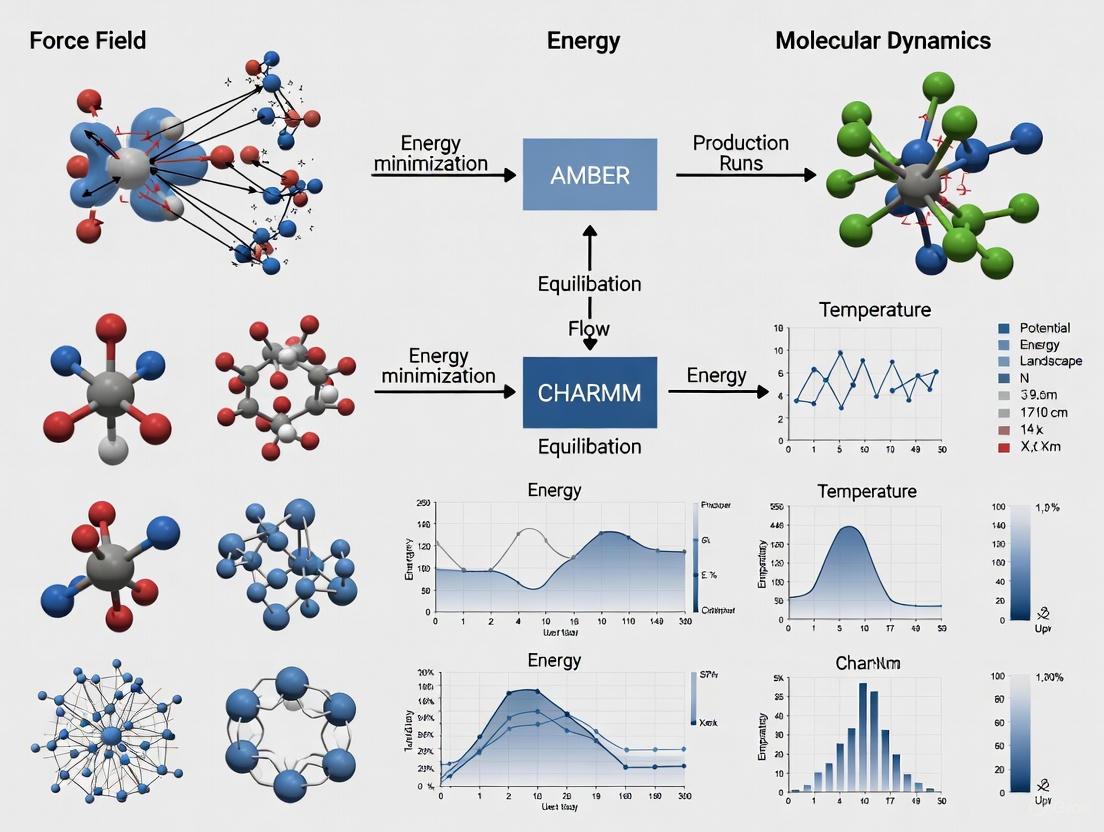
This article provides a comprehensive guide for researchers and drug development professionals on the role of molecular mechanics force fields, specifically AMBER and CHARMM, in molecular dynamics (MD) simulations.
Molecular Mechanics Force Fields Explained: How AMBER and CHARMM Power Biomolecular Simulations
Abstract
This article provides a comprehensive guide for researchers and drug development professionals on the role of molecular mechanics force fields, specifically AMBER and CHARMM, in molecular dynamics (MD) simulations. It covers the foundational principles of how these force fields mathematically represent atomic interactions, the methodologies for their parameterization and application in studying proteins and nucleic acids, strategies for troubleshooting common inaccuracies and optimizing parameters, and finally, the rigorous benchmarks used for their validation and selection. By synthesizing insights from current literature, this resource aims to equip scientists with the knowledge to effectively utilize and critically assess force fields in computational drug discovery and biomolecular research.
The Engine of Simulation: Foundational Principles of AMBER and CHARMM Force Fields
In the context of molecular dynamics (MD) simulations, a force field refers to the functional forms and parameters of mathematical functions used to describe the potential energy of a system of particles (atoms or molecules) [1] [2]. It is a computational model that describes the forces between atoms within molecules or between molecules, enabling the calculation of a system's potential energy on an atomistic level [2]. The fundamental connection between force and potential energy is expressed by the relationship that the force is the negative gradient of the potential energy, ( \vec{F} = -\nabla U(\vec{r}) ) [3] [4]. This relationship is central to MD simulations, as it allows for the calculation of forces acting on every particle from the potential energy function, which in turn determines how the positions of those particles evolve over time [4].
Force fields are primarily used in molecular dynamics or Monte Carlo simulations [2]. The parameters for a chosen energy function may be derived from classical laboratory experiment data, calculations in quantum mechanics, or a combination of both [2]. The accuracy of these potential energy functions is crucial, as the lower energy states are expected to be more populated, and the forces derived from the energy gradient drive atomic motions in MD simulations [5].
Mathematical Decomposition of the Potential Energy Function
The total potential energy in an additive force field is typically decomposed into bonded and non-bonded interaction terms [2] [4]. The general form can be written as: [ E{\text{total}} = E{\text{bonded}} + E{\text{nonbonded}} ] where ( E{\text{bonded}} = E{\text{bond}} + E{\text{angle}} + E{\text{dihedral}} ) and ( E{\text{nonbonded}} = E{\text{electrostatic}} + E{\text{van der Waals}} ) [2].
The following diagram illustrates the hierarchical decomposition of the total potential energy into its constituent components:
Bonded Interaction Terms
Bonded interactions describe the energy associated with the covalent bond structure of molecules and are typically subdivided into several components.
Bond Stretching
The bond stretching term describes the energy required to stretch or compress a covalent bond from its equilibrium length. The most simplistic approach utilizes a Hooke's law formula, which provides a harmonic (quadratic) approximation [6] [2] [4]: [ E{\text{bond}} = \frac{k{ij}}{2}(l{ij} - l{0,ij})^2 ] where ( k{ij} ) is the force constant for the bond between atoms ( i ) and ( j ), ( l{ij} ) is the actual bond length, and ( l_{0,ij} ) is the equilibrium bond length [2]. Although a more realistic description is provided by the Morse potential, which allows for bond breaking, the harmonic approximation is computationally efficient and sufficiently accurate for most bonded interactions near equilibrium [2] [4].
Angle Bending
The angle bending term describes the energy associated with the bending of the angle between two covalent bonds. It is also modeled using a harmonic potential [4]: [ E{\text{angle}} = k{\theta}(\theta{ijk} - \theta{0})^2 ] where ( k{\theta} ) is the angle force constant, ( \theta{ijk} ) is the actual angle between the two bonds, and ( \theta_{0} ) is the equilibrium bond angle [4]. The force constants for angle bending are typically about five times smaller than those for bond stretching [4].
Torsional (Dihedral) Rotation
The torsional term describes the energy associated with rotation around a central bond, which is a function of the dihedral angle ( \phi ) defined by four sequentially bonded atoms [4]. Its functional form is a periodic function, often a cosine series [6] [4]: [ E{\text{dihedral}} = k{\phi}(1 + \cos(n\phi - \delta)) + \ldots ] where ( k_{\phi} ) is the dihedral force constant, ( n ) is the periodicity (multiplicity, representing the number of potential minima or maxima in a 360° rotation), and ( \delta ) is the phase shift angle [4]. This term is crucial for correctly representing energy barriers to internal rotation and maintaining proper molecular geometry.
Improper Torsions
Improper torsions, or "out-of-plane bending" terms, are used to enforce the planarity of aromatic rings and other conjugated systems, and to maintain chirality [2] [4]. They are typically defined for a group of four atoms where the central atom is connected to three peripheral atoms and are often given by a harmonic function [4]: [ E{\text{improper}} = k{\phi}(\phi - \phi_0)^2 ] where ( \phi ) is the angle between the plane formed by the central atom and two peripheral atoms and the plane formed by the central atom and the third peripheral atom [4].
Non-Bonded Interaction Terms
Non-bonded interactions describe the energy between atoms that are not directly connected by covalent bonds, or are separated by more than three bonds.
Van der Waals Interactions
Van der Waals interactions account for attractive (London dispersion) and repulsive (Pauli exclusion) forces between non-bonded atoms. The most common potential used is the Lennard-Jones (LJ) 12-6 potential [6] [2] [4]: [ E_{\text{LJ}}(r) = 4\epsilon \left[ \left(\frac{\sigma}{r}\right)^{12} - \left(\frac{\sigma}{r}\right)^6 \right] ] where ( \epsilon ) is the depth of the potential well (representing the strength of the interaction), ( \sigma ) is the finite distance at which the inter-particle potential is zero, and ( r ) is the distance between the atoms [6] [4]. The ( r^{-12} ) term describes the strong Pauli repulsion at short ranges, while the ( r^{-6} ) term describes the weaker attractive forces (London dispersion) at intermediate ranges [4].
An alternative to the LJ potential is the Buckingham potential, which replaces the repulsive ( r^{-12} ) term with an exponential function, providing a more realistic description of electron density but at a higher computational cost and with a risk of numerical instability ("Buckingham catastrophe") at very short distances [4]: [ V_{B}(r) = A \exp(-Br) - \frac{C}{r^{6}} ]
Electrostatic Interactions
Electrostatic interactions between charged atoms are described by Coulomb's law [6] [2] [4]: [ E{\text{Coulomb}} = \frac{1}{4\pi\epsilon0} \frac{qi qj}{\epsilonr r{ij}} ] where ( qi ) and ( qj ) are the partial atomic charges on atoms ( i ) and ( j ), ( r{ij} ) is the distance between them, ( \epsilon0 ) is the permittivity of free space, and ( \epsilon_r ) is the relative dielectric constant [2] [4]. The assignment of these partial atomic charges is critical for accurately simulating the geometry, interaction energy, and reactivity of molecules, particularly polar molecules and ionic compounds [2].
Table 1: Summary of Core Potential Energy Terms in Molecular Mechanics Force Fields
| Interaction Type | Mathematical Formulation | Key Parameters | Physical Description |
|---|---|---|---|
| Bond Stretching | ( E = \frac{k{ij}}{2}(l{ij} - l_{0,ij})^2 ) [2] [4] | Force constant ( k{ij} ), equilibrium length ( l{0,ij} ) | Energetic cost of stretching/compressing covalent bonds from equilibrium |
| Angle Bending | ( E = k{\theta}(\theta{ijk} - \theta_{0})^2 ) [4] | Force constant ( k{\theta} ), equilibrium angle ( \theta{0} ) | Energetic cost of bending bond angles from equilibrium |
| Dihedral Torsion | ( E = k_{\phi}(1 + \cos(n\phi - \delta)) ) [4] | Force constant ( k_{\phi} ), periodicity ( n ), phase ( \delta ) | Energy barrier for rotation around a central bond; governs conformation |
| Improper Torsion | ( E = k{\phi}(\phi - \phi0)^2 ) [4] | Force constant ( k{\phi} ), equilibrium angle ( \phi0 ) | Enforces planarity of rings and chiral centers |
| van der Waals (LJ) | ( E = 4\epsilon \left[ (\sigma/r)^{12} - (\sigma/r)^6 \right] ) [6] [4] | Well depth ( \epsilon ), van der Waals radius ( \sigma ) | Pauli repulsion (r⁻¹²) and London dispersion attraction (r⁻⁶) |
| Electrostatics | ( E = \frac{1}{4\pi\epsilon0} \frac{qi qj}{\epsilonr r} ) [2] [4] | Atomic partial charges ( qi, qj ) | Coulombic interaction between permanently charged atoms |
Parameterization and Combining Rules
Force Field Parameterization
The parameters for the potential energy functions (e.g., force constants, equilibrium values, atomic charges) are determined through a careful parameterization process, which is crucial for the accuracy and reliability of the force field [2]. These parameters can be derived from various sources:
- Quantum mechanical calculations performed on small model compounds, providing data on conformational energies, electrostatic potentials, and vibrational frequencies [2].
- Experimental data, such as enthalpies of vaporization, enthalpies of sublimation, dipole moments, liquid densities, and various spectroscopic properties [2].
- A combination of both approaches, often using QM for intramolecular interactions and macroscopic properties for refining intermolecular dispersive interactions [2].
Atom types are defined not only for different elements but also for the same element in different chemical environments (e.g., an oxygen atom in water versus an oxygen atom in a carbonyl group) [2]. A typical molecular force field parameter set includes values for atomic mass, atomic charge, Lennard-Jones parameters for every atom type, and equilibrium values for bond lengths, bond angles, and dihedral angles [2].
Combining Rules
To avoid the need for parameters for every possible pair of different atom types, combining rules are used to calculate the interaction parameters between dissimilar atoms [4]. Different force fields employ different rules:
- Lorentz-Berthelot rules are used in CHARMM and AMBER force fields [4]: [ \sigma{ij} = \frac{\sigma{ii} + \sigma{jj}}{2}, \quad \epsilon{ij} = \sqrt{\epsilon{ii} \times \epsilon{jj}} ]
- Geometric Mean rules are used in GROMOS and OPLS force fields [4]: [ \sigma{ij} = \sqrt{\sigma{ii} \times \sigma{jj}}, \quad \epsilon{ij} = \sqrt{\epsilon{ii} \times \epsilon{jj}} ]
These combining rules, while practical, are known to have issues, such as overestimating the well depth for some interactions [4].
Major Biomolecular Force Fields: CHARMM and AMBER
The functional forms described above are implemented in various specific force fields. CHARMM and AMBER are two prominent class I additive force fields widely used for biomolecular simulations [6] [5] [4].
The CHARMM Force Field
The CHARMM (Chemistry at HARvard Macromolecular Mechanics) force field is an all-atom additive force field with broad coverage for proteins, nucleic acids, lipids, carbohydrates, and small organic molecules (via CGenFF) [6] [5] [1]. Its potential energy function includes a CMAP (Correction MAP) term, which is an additive grid-based potential that corrects for the correlated motion of pairs of backbone dihedral angles, significantly improving the structural and dynamic properties of proteins [6] [5].
The CHARMM force field has undergone continual refinement. The C36 version introduced a new backbone CMAP potential optimized against experimental data, new side-chain dihedral parameters, and improved Lennard-Jones parameters for aliphatic hydrogens [5]. For non-bonded interactions, newer CHARMM styles (e.g., charmmfsw, charmmfsh) use force switching for LJ interactions and force shifting for Coulombic interactions to avoid artifacts associated with older energy-switching functions [6].
The AMBER Force Field
The AMBER (Assisted Model Building with Energy Refinement) force field, developed by Peter Kollman's group, also follows the standard additive form but does not include a CMAP term [6] [1]. The AMBER family includes several specialized parameter sets:
- ff99SB and its variants (e.g., ff99SB-ILDN, ff99SB-ILDN-Phi) for proteins, with improvements to backbone and side-chain torsion potentials [5].
- GAFF (Generalized AMBER Force Field) for small organic molecules [1].
- GLYCAM for carbohydrates [1].
The ff99SB-ILDN force field, for instance, introduced modifications to the side-chain torsion potentials for four amino acid types (Isoleucine, Leucine, Asparagine, Aspartic acid) to better match experimental NMR data [5] [7].
Table 2: Comparison of CHARMM and AMBER Additive Force Fields
| Feature | CHARMM | AMBER |
|---|---|---|
| Full Name | Chemistry at HARvard Macromolecular Mechanics [1] | Assisted Model Building with Energy Refinement [1] |
| Coverage | Proteins, nucleic acids, lipids, carbohydrates, organic molecules (CGenFF) [5] [1] | Proteins, nucleic acids (ff10), carbohydrates (GLYCAM), organic molecules (GAFF) [5] [1] |
| Key Potential Terms | Bond, Angle, Dihedral, Improper, LJ, Coulomb, CMAP [6] [5] | Bond, Angle, Dihedral, Improper, LJ, Coulomb (No CMAP) [6] |
| CMAP Term | Yes, corrects backbone dihedral correlations [6] [5] | No [6] |
| Recommended Water Model | TIP3P strongly recommended [6] | TIP3P, TIP4P-Ew used in parameterization [5] |
| Notable Versions | C22/CMAP, C36 (updated backbone CMAP, side-chain dihedrals) [5] | ff99SB, ff99SB-ILDN (updated side-chains), ff99SB-ILDN-Phi [5] [7] |
Advanced Force Field Types: Towards Polarizability
While Class I additive force fields like CHARMM and AMBER have been highly successful, a major limitation is their treatment of electrostatics using fixed, static atomic charges. This approach does not account for electronic polarization—the redistribution of electron density in response to the local electric field from ions, solvent, or other macromolecules [5]. Polarizable force fields represent the next major step in improving force field accuracy [5]. The main types include:
- Drude Oscillators (or Shell Models): Massless charged particles (Drude particles) are attached to atoms via harmonic springs, representing the electronic degrees of freedom [5] [4]. The CHARMM Drude polarizable force field is under active development and has been parameterized for various lipids, proteins, and nucleic acids [5].
- Induced Point Dipoles: Atoms are given a polarizability, allowing them to develop induced dipoles in response to the electric field from other charges and dipoles in the system. The AMOEBA (Atomic Multipole Optimized Energetics for Biomolecular Applications) force field is a prominent example that uses permanent atomic multipoles (beyond just charges) and inducible point dipoles [5] [4].
- Fluctuating Charges: The atomic charges are allowed to fluctuate dynamically based on the electronegativity equalization principle, modeling polarization as a charge transfer process [4].
The following diagram illustrates the workflow for parameterizing and applying a force field in MD simulations, highlighting the iterative process of validation and refinement:
Table 3: Key Software Tools and Resources for Force Field-Based Research
| Tool / Resource | Type / Category | Primary Function in Research |
|---|---|---|
| CHARMM-GUI [6] | Web-Based Input Generator | Provides a web-based interface for building complex molecular systems and generating input files for MD simulations, including LAMMPS scripts with recommended CHARMM force field styles [6]. |
| msi2lmp [6] [8] | Force Field Parameter Tool | A tool (though noted as old and largely unmaintained) for creating LAMMPS template input and data files from BIOVIA's Materials Studio files, particularly for the COMPASS force field [6] [8]. |
| NAMD [5] | Molecular Dynamics Program | A widely used, highly parallel MD simulation package commonly used with the CHARMM force field and capable of simulating the Drude polarizable model [5]. |
| OpenMM [5] | MD Simulation Suite | A suite of utilities for GPU-accelerated MD simulations, which includes support for polarizable force fields like the Drude model [5]. |
| GROMACS [1] [4] | Molecular Dynamics Package | A high-performance MD simulation package that supports multiple force fields (AMBER, CHARMM, GROMOS) and allows specification of combining rules in its input files [1] [4]. |
| Force Field Databases (e.g., MolMod, openKim) [2] | Digital Repository | Online databases that collect, categorize, and make force field parameters digitally available for specific types of systems (e.g., molecular, ionic, organic) [2]. |
Within the realm of molecular dynamics (MD) simulations, force fields serve as the fundamental mathematical framework that translates the atomic configuration of a system into a numerical representation of its potential energy and the forces acting upon its atoms. This conversion is the cornerstone of simulating the temporal evolution of molecular systems, from small organic compounds to massive biological assemblies like the SARS-CoV-2 virion, which has been simulated in its entirety with over 300 million atoms [4]. The potential energy function, U, in a biomolecular force field is a sum of contributions from various intra- and intermolecular interactions, which are empirically parameterized to reproduce key quantum-mechanical or experimental data [9] [4]. These interactions are broadly categorized into bonded interactions, which maintain the structural integrity of molecules, and non-bonded interactions, which describe the forces between atoms that are not directly connected by chemical bonds. The accurate description of these interactions by force fields such as AMBER, CHARMM, GROMOS, and OPLS-AA enables researchers to probe biological phenomena, such as protein folding, ligand-receptor binding, and ion transport through membranes, with atomic-level precision [9].
Bonded Interaction Terms
Bonded interactions describe the energy costs associated with deviations from the ideal geometry of a molecule's covalent framework. They are essential for maintaining molecular structure during simulations and are calculated for atoms that are directly connected by chemical bonds.
Mathematical Formulations of Bonded Potentials
The potential energy from bonded terms is calculated as the sum of individual interactions involving atoms that are covalently linked. The mathematical forms used in Class 1 force fields like AMBER and CHARMM are relatively simple, allowing for efficient computation [4].
Table 1: Core Bonded Interaction Potentials in Biomolecular Force Fields
| Interaction Type | Mathematical Formulation | Key Parameters | Physical Interpretation |
|---|---|---|---|
| Bond Stretching | $V{Bond} = kb(r{ij}-r0)^2$ | $kb$ (force constant), $r0$ (equilibrium bond length) | Harmonic oscillation about an ideal bond length [4]. |
| Angle Bending | $V{Angle} = kθ(θ{ijk}-θ0)^2$ | $kθ$ (force constant), $θ0$ (equilibrium angle) | Harmonic oscillation about an ideal bond angle [4]. |
| Proper Torsion | $V{Dihed} = kφ(1+cos(nφ-δ))$ | $k_φ$ (force constant), $n$ (periodicity), $δ$ (phase angle) | Periodic potential describing rotation around a central bond [4]. |
| Improper Torsion | $V{Improper} = kφ(φ-φ_0)^2$ | $kφ$ (force constant), $φ0$ (equilibrium angle) | Harmonic potential enforcing planarity (e.g., in aromatic rings) [4]. |
Parameterization and Functional Forms
Class 1 force fields, including AMBER and CHARMM, use simple harmonic potentials for bonds and angles, which provides a good approximation for these interactions at moderate temperatures [4]. The force constants for angle bending are typically about five times smaller than those for bond stretching, reflecting the relative ease of deforming angles compared to bonds [4]. Class 2 force fields (e.g., MMFF94) extend this model by adding anharmonic cubic and/or quartic terms to the potential energy for bonds and angles, and also incorporate cross-terms that describe the coupling between adjacent internal coordinates [4]. For proper dihedral angles, the potential is represented as a sum of cosine functions with different periodicities (e.g., n=2, 3) to accurately capture the energy barriers associated with bond rotation, such as trans/gauche energy differences [4].
Figure 1: Hierarchy and mathematical forms of bonded interactions in molecular force fields.
Non-Bonded Interaction Terms
Non-bonded interactions describe the forces between atoms that are not directly connected by covalent bonds, encompassing both van der Waals forces and electrostatic interactions. These interactions are computationally demanding as they must be calculated for all pairs of atoms that are not excluded by bonding connectivity, making them the primary performance bottleneck in MD simulations [10] [11].
Van der Waals Interactions
Van der Waals (vdW) interactions are short-range forces arising from transient electron density fluctuations that induce complementary dipoles in nearby atoms. In most biomolecular force fields, including AMBER and CHARMM, these interactions are modeled using the Lennard-Jones (LJ) 6-12 potential [11] [4]. The LJ potential has a simple form that combines a favorable attraction ($r^{-6}$ term) and a strong repulsion ($r^{-12}$ term) at short distances:
$V{LJ}({r{ij}}) = 4\epsilon{ij}\left[\left(\frac{\sigma{ij}}{{r{ij}}}\right)^{12} - \left(\frac{\sigma{ij}}{{r_{ij}}}\right)^{6} \right]$ [11]
Here, $σ{ij}$ represents the collision diameter (distance where the potential is zero), and $ε{ij}$ is the well depth representing the strength of the interaction [11]. The $r^{-12}$ term approximates the Pauli repulsion originating from orbital overlap, while the $r^{-6}$ term describes the attractive London dispersion forces [4]. An alternative to the LJ potential is the Buckingham potential, which replaces the repulsive $r^{-12}$ term with an exponential function that more realistically describes electron density, though it is computationally more expensive and risks a "Buckingham catastrophe" at very short distances where the potential can approach negative infinity [11] [4].
Electrostatic Interactions
Electrostatic interactions between charged or partially charged atoms are described by Coulomb's law, which represents a long-range interaction that decays slowly with distance ($r^{-1}$) [11] [4]:
$Vc({r{ij}}) = f \frac{qi qj}{{\varepsilonr}{r{ij}}}$ [11]
In this equation, $qi$ and $qj$ are the partial atomic charges, $εr$ is the relative dielectric constant, and $f$ is a conversion factor that equals $1/(4πε0) = 138.935.458$ in GROMACS units [11]. The treatment of long-range electrostatics presents a significant computational challenge. While a simple cutoff scheme can be applied to short-range vdW interactions, a plain Coulomb interaction with cutoff introduces significant artifacts due to its abrupt termination [11]. Modern MD simulations therefore employ sophisticated methods like the Particle Mesh Ewald (PME) algorithm, which splits the calculation into short-range real-space and long-range reciprocal-space components, effectively and accurately computing the electrostatic interactions in periodic systems [10].
Combining Rules and Parameterization
Since explicitly parameterizing every possible atom pair interaction is infeasible, force fields use combining rules to determine the LJ parameters ($σ{ij}$, $ε{ij}$) for interactions between different atom types based on their individual parameters [11] [4]. Different force fields employ different rules:
- AMBER and CHARMM use the Lorentz-Berthelot rules: $σ{ij} = (σ{ii} + σ{jj})/2$ and $ε{ij} = \sqrt{ε{ii} ε{jj}}$ [4].
- OPLS uses a geometric mean for both parameters: $σ{ij} = \sqrt{σ{ii} σ{jj}}$ and $ε{ij} = \sqrt{ε{ii} ε{jj}}$ [11].
- GROMOS uses geometric means for the C12 and C6 coefficients: $C12{ij} = \sqrt{C12{ii} C12{jj}}$ and $C6{ij} = \sqrt{C6{ii} C6{jj}}$ [11].
The Lorentz-Berthelot rules are known to sometimes overestimate the well depth between unlike atoms, leading to the development of alternative rules like Waldman-Hagler for specific applications [4].
Table 2: Non-Bonded Interaction Potentials and Treatment in MD Simulations
| Interaction Type | Mathematical Formulation | Combining Rules | Long-Range Treatment |
|---|---|---|---|
| Lennard-Jones | $V_{LJ}(r) = 4\epsilon\left[\left(\frac{\sigma}{r}\right)^{12} - \left(\frac{\sigma}{r}\right)^{6} \right]$ [11] | Lorentz-Berthelot (AMBER, CHARMM) [4] | Cutoff schemes (e.g., Potential-shift) [12] [11] |
| Buckingham | $V_{Bh}(r) = A\exp(-Br) - \frac{C}{r^6}$ [11] | $A{ij}=\sqrt{A{ii}A{jj}}$, $B{ij}=2/(1/B{ii} + 1/B{jj})$, $C{ij}=\sqrt{C{ii}C_{jj}}$ [4] | Cutoff schemes |
| Coulomb | $Vc(r) = f \frac{qi qj}{\varepsilonr r_{ij}}$ [11] | None (point charges assigned directly) | PME, Ewald summation, Reaction field [13] [10] [11] |
Intramolecular Non-Bonded Interactions and Scaling
A critical aspect of force field implementation involves the treatment of non-bonded interactions between atoms within the same molecule. These intramolecular non-bonded interactions are subject to specific scaling rules based on the topological separation between atoms, defined by the number of intervening bonds [14].
- 1-2 and 1-3 interactions: Pairs of atoms separated by one or two bonds (directly bonded or sharing a common atom) typically do not include van der Waals or electrostatic interactions, as these effects are incorporated into the parameterization of bond stretching and angle bending terms [14].
- 1-4 interactions: Atoms separated by exactly three bonds have their van der Waals and electrostatic interactions scaled by specific factors. In the AMBER force field, for example, LJ interactions are scaled by a factor of 1/2, while electrostatic interactions are scaled by 1/1.2 [14].
- 1-5 and beyond: All non-bonded interactions between atoms separated by four or more bonds are typically calculated without any scaling, provided the distance between them is less than the non-bonded cutoff [14].
This nuanced treatment ensures that the force field accurately captures the appropriate physics for atoms that are part of the same molecule but may still interact through space.
Implementation in MD Software Packages
The mathematical formulations of force fields are implemented in various MD software packages, each with optimizations for performance and accuracy. The non-bonded interactions, being computationally intensive, receive particular attention.
Treatment of Long-Range Interactions and Cutoffs
In the Verlet cut-off scheme used in GROMACS, both the LJ and Coulomb potentials are shifted by a constant so that the potential is zero at the cut-off distance [12] [11]. This potential-shift approach ensures that the force is the exact integral of the potential, improving energy conservation without influencing the system's dynamics since only forces affect the equations of motion [12] [11]. For electrostatics, the Reaction Field method offers an alternative by assuming a constant dielectric environment beyond the cutoff $rc$, with a dielectric constant of $ε{rf}$ [11]. The modified potential becomes:
$V{crf} = f \frac{qi qj}{\varepsilonr}\left[\frac{1}{r{ij}} + k{rf} r{ij}^2 - c{rf}\right]$ [11]
where $k{rf}$ and $c{rf}$ are constants derived from $rc$ and $ε{rf}$ [11]. This modification makes the derivative of the potential (and thus the force) go to zero at the cutoff distance [11].
Optimization of Non-Bonded Calculations
Modern MD engines, such as the one in CHARMM, employ sophisticated algorithms to accelerate non-bonded force calculations. These include:
- Splitting inner loops: Creating separate computation loops for solute-solute, solute-solvent, and solvent-solvent interactions to reduce code branching [10].
- Single-Instruction-Multiple-Data (SIMD) vectorization: Using hardware-specific instructions to perform multiple operations simultaneously [10].
- Lookup tables: Precalculating potential and force values to avoid expensive function evaluations during simulation [10].
These optimizations can lead to significant speedups; the new CHARMM MD engine demonstrated a 1.9-fold improvement in the direct non-bonded force calculation compared to its predecessor [10].
Figure 2: Classification of non-bonded interactions, highlighting the critical distinction between short-range van der Waals forces and long-range electrostatic forces that require specialized treatment methods.
The Scientist's Toolkit: Essential Components for Non-Bonded Interaction Analysis
Table 3: Key Research Reagents and Computational Tools for Force Field Applications
| Tool/Solution | Function/Application | Example Use Case |
|---|---|---|
| Particle Mesh Ewald (PME) | Efficient algorithm for calculating long-range electrostatic forces in periodic systems [10]. | Essential for accurate simulation of ionic solutions, protein-ligand binding, and membrane systems [15] [10]. |
| Verlet Cutoff Scheme | Neighborhood searching algorithm that enables modern, efficient non-bonded calculations with potential shifting [12] [11]. | Default cutoff method in GROMACS; improves energy conservation by ensuring potentials reach zero at cutoff [12] [11]. |
| Lorentz-Berthelot Combining Rules | Standard method for determining cross-term Lennard-Jones parameters between different atom types [4]. | Used in AMBER and CHARMM force fields to calculate σ and ε for non-bonded pairs without explicit parameterization [4]. |
| Reaction Field Method | Continuum dielectric correction for electrostatic interactions beyond cutoff distance [11]. | Alternative to PME for homogeneous systems; approximates solvent as dielectric continuum beyond cutoff [11]. |
| SHAKE/LINCS Algorithms | Constraint algorithms that fix bond lengths involving hydrogen atoms, allowing for longer integration time steps [4]. | Critical for maintaining molecular geometry while enabling 2-fs time steps in MD simulations [4]. |
| Isotropic Periodic Sum (IPS) | Method for calculating long-range interactions in finite or periodic systems without cutoffs [13] [16]. | Recommended in CHARMM for membrane systems (2D IPS) or homogeneous 3D systems [13] [16]. |
Comparative Analysis of Force Field Performance
The choice of force field significantly impacts the accuracy of MD simulations, particularly for properties sensitive to non-bonded interactions. Different force fields employ distinct parameterization strategies and mathematical formulations, leading to variations in their performance for specific systems and properties.
Case Study: Liquid Membrane Simulations
A comparative study of all-atom force fields (GAFF, OPLS-AA/CM1A, CHARMM36, and COMPASS) for simulating diisopropyl ether (DIPE) as a model for liquid membranes revealed substantial differences in their ability to reproduce experimental data [15]. The study calculated density and shear viscosity across a temperature range of 243–333 K and evaluated mutual solubility, interfacial tension, and partition coefficients [15]. The results demonstrated that GAFF and OPLS-AA/CM1A overestimated DIPE density by 3-5% and viscosity by 60-130%, while CHARMM36 and COMPASS provided quite accurate density and viscosity values [15]. Furthermore, CHARMM36 outperformed COMPASS in modeling ether-based liquid membranes, particularly for properties relevant to ion-selective barrier function [15]. This highlights how non-bonded parameterization directly influences the predictive power of simulations for complex thermodynamic and transport properties.
Protocol for Force Field Validation
To assess the accuracy of a force field for a specific system, researchers typically follow a systematic validation protocol:
- Property Selection: Identify key experimental properties (density, viscosity, diffusion coefficients, free energies of solvation) relevant to the system of interest [15].
- System Setup: Construct simulation boxes with appropriate numbers of molecules (e.g., 3375 DIPE molecules in the membrane study) to balance statistical accuracy and computational cost [15].
- Equilibration: Perform extensive equilibration in the appropriate ensemble (NPT for density calculations) until properties stabilize [15].
- Production Simulation: Run sufficiently long simulations to obtain reliable averages and uncertainties for target properties [15].
- Comparison with Experiment: Quantitatively compare simulation results with available experimental data to validate the force field or identify its limitations [15].
This methodology ensures that force fields are evaluated based on their ability to reproduce experimentally measurable quantities, establishing their reliability for predictive simulations.
Advanced Developments and Future Directions
Force field development continues to evolve, addressing limitations of current models through more sophisticated physical representations and novel parameterization approaches.
Polarizable Force Fields
Traditional fixed-charge force fields (Class 1) cannot account for electronic polarization, the phenomenon where the electron distribution of an atom or molecule changes in response to its local environment. This limitation has spurred the development of polarizable force fields (Class 3), which explicitly model this effect through various approaches [4]:
- Drude Oscillators: Massless charged particles attached to atoms via harmonic springs (used in CHARMM-Drude and OPLS-AA) [4].
- Inducible Point Dipoles: Atoms carry dipoles that respond to the local electric field (used in AMOEBA) [4].
- Fluctuating Charges: Polarization is modeled as a charge transfer process between atoms [4].
These more physically realistic models come at increased computational cost but offer improved accuracy for properties sensitive to electronic polarization, such as dielectric constants and ion solvation free energies.
Machine Learning Force Fields
Recent advances in machine learning (ML) have enabled the development of novel approaches to constructing force fields. The Gradient-Domain Machine Learning (GDML) method, for instance, directly learns the functional relationship between atomic coordinates and interatomic forces, explicitly constructing an energy-conserving force field by restricting the solution space to conservative gradient fields [17]. This approach can reproduce global potential energy surfaces with high accuracy (0.3 kcal mol⁻¹ for energies and 1 kcal mol⁻¹ Å̊⁻¹ for atomic forces) using only a limited number of training configurations from ab initio MD trajectories [17]. By learning from quantum mechanical data while respecting the physical constraint of energy conservation, ML force fields promise to bridge the accuracy gap between quantum chemistry and classical MD without the need for predefined functional forms.
The decomposition of molecular mechanics force fields into bonded and non-bonded interaction terms provides both the conceptual foundation and practical framework for molecular dynamics simulations. Bonded interactions maintain molecular connectivity through harmonic and periodic potentials, while non-bonded interactions capture the essential physics of intermolecular forces through Lennard-Jones and Coulomb potentials. The accurate treatment of long-range electrostatics through methods like PME, the careful application of scaling rules for intramolecular non-bonded interactions, and the implementation of optimized algorithms in software packages like CHARMM and GROMACS together enable the simulation of complex biological systems with remarkable fidelity. As force field development continues to advance through polarizable models and machine learning approaches, the fundamental distinction between bonded and non-bonded interactions will remain central to understanding, applying, and improving these critical tools for computational molecular science.
Molecular dynamics (MD) simulations have matured into an indispensable tool for studying biological processes at atomic resolution, serving as a computational microscope for researchers across structural biology, biophysics, and drug discovery [18]. The reliability of these simulations stands and falls with the accuracy of the force fields that describe the forces between all atoms in the system [18]. Among the most influential frameworks in this domain is the AMBER (Assisted Model Building with Energy Refinement) force field, whose philosophical approach to parameterization has guided its development from pioneering beginnings to its current status as a cornerstone of computational biochemistry. The AMBER philosophy prioritizes a carefully balanced approach where parameters are derived from quantum mechanical calculations on small model compounds and systematically validated against experimental data for biomolecular systems. This review examines the historical development, core parameterization strategies, and evolving methodologies that constitute the AMBER philosophy, framing it within the broader context of how force fields function in MD simulations research.
Historical Development of the AMBER Force Field
The historical trajectory of AMBER is characterized by foundational parameterizations followed by iterative refinements to address limitations revealed through extensive testing.
The Foundational Formulation
The comprehensive parameterization of the AMBER force field functional form by Cornell et al. in 1995 represents a milestone in force field development [18]. This parameter set established the philosophical and technical foundation for subsequent AMBER force fields. The functional form itself follows traditional molecular mechanics conventions:
This equation encompasses harmonic potentials for bond stretching and angle bending, periodic functions for torsional energies, and Lennard-Jones plus Coulombic terms for non-bonded interactions [18] [19].
The Cornell et al. parameterization implemented specific strategic choices that would become characteristic of the AMBER philosophy [18]:
- Equilibrium parameters (r₀, θ₀) were determined from X-ray structures
- Force constants (kᵣ, kθ) were derived from interpolation of observed distances and vibrational analysis
- Dihedral parameters were primarily parameterized empirically based on population of specific substates, with exceptions for key flexible segments
- Van der Waals parameters were introduced as universal sets based on hybridization states
- Partial atomic charges were derived from Hartree-Fock calculations using the Restrained Electrostatic Potential (RESP) method
- Electrostatic 1–4 interactions were scaled by 1/1.2, while vdW 1–4 interactions were scaled by 0.5
Table 1: Key Historical AMBER Force Field Versions and Their Improvements
| Force Field Version | Year | Key Improvements and Focus Areas |
|---|---|---|
| Cornell et al. | 1995 | Foundational parameterization for proteins and nucleic acids |
| parm98 | 1998 | Improved sugar-puckering and glycosidic dihedrals based on QM calculations |
| parm99 | 1999 | Revised torsional profiles for sugar rings |
| bsc0 | 2007 | Corrected α/γ dihedral transitions causing DNA distortion |
| ol-series (ol15, ol21) | 2010-2021 | Enhanced accuracy for Z-DNA and B-DNA description |
| bsc1 | 2016 | Corrected systematic undertwisting of DNA double helix |
| Tumuc1 | 2022 | Refined nonbonded parameters to address overstable base stacking |
Evolutionary Refinements and Specialized Extensions
The development of AMBER force fields has followed an iterative process where limitations identified through extensive simulation testing prompted targeted refinements.
A significant challenge emerged when 50-ns MD simulations using the parm99 force field resulted in severe distortions of the DNA double helix due to unrealistic transitions in the dihedral angles [18]. This prompted Perez et al. to develop the bsc0 modification with revised α and γ dihedral parameters based on quantum mechanical scans, illustrating how the AMBER philosophy embraces empirical feedback to guide theoretical refinements [18].
This corrective process continued with two parallel refinement branches: the ol-series from the Sponer group (ol15, ol21) and the bsc1 force field from the Orozco group [18]. These efforts addressed persistent issues such as the systematic undertwisting of the DNA double helix present in bsc0 and improved the description of Z-DNA structures and BI/BII equilibria in B-DNA [18].
Specialized extensions have also emerged within the AMBER ecosystem, such as the Lipid14/Lipid21 force fields with modular design for seamless integration with AMBER force fields for proteins, nucleic acids, and carbohydrates [20]. More recently, ByteFF represents a modern data-driven approach for drug-like molecules, employing an edge-augmented, symmetry-preserving molecular graph neural network trained on 2.4 million optimized molecular fragment geometries with analytical Hessian matrices and 3.2 million torsion profiles [21].
The AMBER Parameterization Methodology
The AMBER parameterization strategy follows a multi-stage process that balances theoretical calculations with empirical validation, creating a self-consistent parameter set optimized for condensed-phase biomolecular simulations.
Quantum Mechanical Foundations
At the core of the AMBER philosophy is the reliance on high-level quantum mechanical calculations to derive key parameters [18]. The approach for nucleic acids exemplifies this methodology:
- Partial atomic charges were derived from Hartree-Fock calculations at the 6-31G* level using the RESP method [18]
- Dihedral parameters around critical phosphorus-ester bonds in the DNA/RNA backbone were adjusted with quantum mechanical calculations at the MP2/6-31G* level [18]
- Geometry optimization typically employs density functional theory methods such as B3LYP with appropriate basis sets [20]
For the development of specialized force fields, the divide-and-conquer strategy has proven effective for complex molecules. As demonstrated in the BLipidFF development for mycobacterial membranes, large lipids are divided into segments, with each segment undergoing a two-step QM protocol: geometry optimization in vacuum at the B3LYP/def2SVP level followed by charge derivation via RESP fitting at the B3LYP/def2TZVP level [20]. Multiple conformations (e.g., 25) are typically used to eliminate errors from specific molecular arrangements [20].
Torsional Parameter Refinement
The refinement of torsional parameters represents a particularly sophisticated aspect of the AMBER philosophy. The process involves optimizing torsion parameters to minimize the difference between energies calculated by quantum mechanical and classical potential methods [20]. Torsion parameters consist of three main terms:
- Vₙ (the barrier term split by the divider)
- n (periodicity)
- γ (phase)
For complex molecules, further subdivision is often necessary. In the BLipidFF development for PDIM lipids, the molecule was divided into 31 different elements to make high-level torsion calculations computationally feasible [20].
Figure 1: The AMBER Force Field Parameterization Workflow. The process integrates quantum mechanical calculations with empirical validation through molecular dynamics simulations.
Nonbonded Parameter Strategy
The AMBER philosophy has maintained a consistent approach to nonbonded parameters, particularly Lennard-Jones terms. Notably, state-of-the-art nucleic acids force fields still use the same Lennard-Jones parameters derived 25 years ago, despite the fact that these parameters were generally not fitted specifically for nucleic acids [18]. In the original Cornell et al. parameterization:
- sp³-hybridized carbon atoms share the same atom-type and vdW parameters
- sp²-hybridized carbon atoms similarly share universal parameters
- vdW parameters for carbon atoms were originally fitted to reproduce densities and enthalpies of vaporization for alkanes and benzenes
- Parameters for oxygens, nitrogens, and phosphorus stem from earlier studies parameterized to reproduce liquid properties and fit lattice energies and crystal structures [18]
Recent assessments, however, suggest that this conservative approach may contribute to certain systematic deficiencies. Studies indicate that with these nonbonded parameters, base pairing is understabilized while base stacking is significantly overstabilized, and protein-DNA interactions become excessively attractive, leading to unrealistic aggregation during MD simulations [18].
AMBER in Comparative Context
Understanding the AMBER philosophy requires examination of its performance relative to other major force fields, particularly CHARMM, in biomolecular simulations.
Performance Assessment for Proteins and Nucleic Acids
Comparative studies between AMBER and CHARMM force fields reveal both consistencies and meaningful differences in their treatment of biomolecules. In simulations of natively unfolded fragment peptides, the AMBER ff99SB-ILDN, CHARMM22/CMAP, and CHARMM36 force fields showed general agreement but with distinctive characteristics [7]:
- All three force fields consistently showed that NTL9(6-17) is completely unstructured, while NTL9(1-22) transiently samples various β-hairpin states
- The radius of gyration of the two peptides was force field independent but potentially underestimated due to limitations of additive force fields
- Compared to CHARMM force fields, ff99SB-ILDN gave slightly higher β-sheet propensity and more native-like residual structures for NTL9(1-22), potentially attributed to its known β preference
- CHARMM force fields sampled slightly more ionic contacts between sequence-local pairs of charged residues
For nucleic acids, the OL-force fields and Tumuc1 are arguably the best force fields to describe the DNA double helix, though no force field is flawless [18] [19]. Particular challenges remain in the description of sugar puckering—a persistent problem for nucleic acids force fields [18].
Liquid-State Properties and Phase Behavior
Beyond biomolecular specificity, force fields are validated through their ability to reproduce fundamental physicochemical properties. A comparative study of vapor-liquid coexistence curves and liquid densities assessed multiple force fields for small organic molecules representative of protein side chains [22].
Table 2: Performance Comparison of Force Fields for Liquid Density Prediction
| Force Field | Primary Parameterization Focus | Performance for Liquid Densities | Remarks |
|---|---|---|---|
| TraPPE | Fluid phase equilibria | Most accurate across error tolerances | Specifically designed for phase behavior |
| CHARMM | Biomolecular simulations | Nearly as accurate as TraPPE | Only notably worse at 1% error tolerance |
| AMBER | Biomolecular simulations | Reasonable agreement with experiment | Average RMS error of 0.04 g/ml for challenge dataset |
| OPLS | Liquid densities | Good performance for organic liquids | Parameterized specifically for liquid properties |
| COMPASS | Liquid densities and polymers | Good accuracy | Fit to reproduce liquid densities |
| GROMOS | Biomolecular simulations | Variable performance | Parameterized primarily for biomolecules |
| UFF | Universal coverage | Less accurate for liquid properties | Primarily intended for single molecule structure |
For vapor density prediction, the best force field depended on error tolerance—AMBER was most likely to reproduce experimental vapor densities to 1%, 2%, or 5% error tolerance, but failed by relatively large amounts for some components [22].
The development and application of AMBER force fields relies on a sophisticated suite of computational tools and methodologies that constitute the essential research reagents for force field parameterization.
Table 3: Essential Research Reagents for Force Field Development
| Resource Category | Specific Tools/Methods | Function in Force Field Development |
|---|---|---|
| Quantum Chemistry Software | Gaussian, Multiwfn | Perform electronic structure calculations, geometry optimizations, and RESP charge fitting |
| Molecular Dynamics Engines | AMBER, NAMD, GROMACS, CHARMM | Execute MD simulations for parameter validation and testing |
| Force Field Parameterization Tools | RESP, Force Field Toolkit (fftk) | Derive partial charges and optimize parameters |
| Reference Datasets | Nucleic Acids Database, Protein Data Bank | Provide experimental structural data for target validation |
| Specialized Analysis Tools | CPPTRAJ, VMD | Analyze simulation trajectories and compare with experimental data |
| High-Performance Computing | GPU clusters, Supercomputers | Enable computationally intensive QM calculations and long MD simulations |
The AMBER philosophy continues to evolve in response to emerging challenges and opportunities in biomolecular simulation. Several key directions are shaping the next generation of AMBER force fields:
Addressing Limitations and Incorporating Polarization
Recent assessments have highlighted specific limitations in current AMBER force fields, particularly regarding nonbonded parameters. Evidence suggests that the Cornell et al. nonbonded parameters are suboptimal for nucleic acids, with base pairing understabilized and base stacking overstabilized [18]. This can lead to unrealistic aggregation in protein-DNA simulations [18]. The CUFIX parameter set developed by the Aksimentiev group represents one approach to addressing these issues by calibrating Lennard-Jones parameters to reproduce experimentally measured osmotic pressure [18].
A more fundamental challenge lies in the incorporation of polarizability. Traditional additive force fields like the standard AMBER variants systematically overestimate molecular dipoles of compounds in the gas phase to better reproduce electrostatic interactions in condensed phase environments [23]. This approach deliberately sacrifices agreement with gas-phase data to improve condensed-phase performance, but fundamentally lacks the ability to describe locally induced polarization events [23]. The latest developments in force field science are increasingly exploring polarizable models such as the classical Drude oscillator implementation in CHARMM [23], suggesting a future direction for AMBER evolution as well.
Data-Driven and Automated Approaches
The future of the AMBER philosophy is likely to be significantly influenced by data-driven parameterization approaches. The recently developed ByteFF exemplifies this direction, utilizing a modern graph neural network trained on an expansive dataset of 2.4 million optimized molecular fragment geometries and 3.2 million torsion profiles [21]. Such approaches enable broad chemical space coverage while maintaining the philosophical commitments to quantum mechanical accuracy and condensed-phase validation that have characterized AMBER from its inception.
The AMBER philosophy represents a distinctive approach to force field development that balances theoretical rigor with empirical validation. Its historical development has been characterized by foundational parameterizations followed by iterative refinements based on insights from increasingly sophisticated MD simulations. The core parameterization strategy emphasizes high-level quantum mechanical calculations for key parameters like partial charges and torsional potentials, combined with systematic validation against experimental structural and thermodynamic data.
As biomolecular simulations continue to grow in complexity and timescale, the AMBER philosophy provides a adaptable framework for force field development—one that respects its historical foundations while continuously evolving to address newly identified limitations and incorporate methodological advances. The future of AMBER will likely involve greater integration of data-driven approaches, more sophisticated treatment of electronic polarization, and continued refinement of nonbonded parameters to better capture the intricate balance of interactions that govern biomolecular structure and dynamics.
In the realm of computational biophysics and computer-aided drug design, Molecular Mechanics (MM) serves as the cornerstone method for studying biomolecular systems at an atomistic level. The scientific utility of these simulations lies in their ability to function as an "ultimate microscope," enabling researchers to study proteins and other nanoscale structures in their native environment with exceptional spatial and temporal resolution. While reality at the molecular level is dominated by Quantum Mechanics (QM), the extremely poor computational scaling of QM methods makes them prohibitive for biologically relevant system sizes and time scales. This limitation prompted the development of simplified models known as empirical force fields, which approximate atomic-scale reality using classical mechanics. Among these force fields, CHARMM (Chemistry at HARvard Macromolecular Mechanics) has emerged as one of the most well-established and pioneering frameworks for molecular dynamics (MD) studies of biomolecular systems [24] [25].
The CHARMM philosophy represents a distinct approach to energy representation that prioritizes the balanced parametrization of diverse biomolecular components within a consistent physical framework. This review examines the core principles, mathematical foundations, parametrization methodologies, and practical applications that define the CHARMM approach, positioning it within the broader context of how force fields operate in MD simulations research.
Core Philosophical Principles of the CHARMM Force Field
Foundational Philosophy and Parametrization Strategy
The CHARMM development philosophy centers on creating a comprehensive biomolecular force field with consistent parameters for proteins, nucleic acids, lipids, carbohydrates, and drug-like small molecules. This holistic approach ensures balanced interactions between different biomolecular classes within complex heterogeneous systems [26]. A defining characteristic of the CHARMM philosophy is its emphasis on condensed-phase properties during parametrization, aiming to reproduce experimental data such as liquid densities, hydration free energies, and crystal structures, thereby ensuring physical behavior in biologically relevant environments [24] [27].
Unlike force fields parameterized primarily for gas-phase properties, CHARMM incorporates extensive experimental validation supplemented by quantum mechanical (QM) calculations. This dual approach creates parameters that transfer reliably to various simulation conditions. The force field maintains a conservative extension policy, where new parameters must remain consistent with existing ones, preserving the balance across the entire biomolecular force field [24] [26].
Transferability and Systematic Parametrization
CHARMM employs a systematic parametrization protocol that begins with model compounds representing key functional groups. For the CHARMM General Force Field (CGenFF), which extends coverage to drug-like molecules, the protocol emphasizes quality over transferability while maintaining an extensible framework [26]. The parametrization process follows a hierarchical approach, where internal parameters (bonds, angles, dihedrals) are optimized first against QM data, followed by optimization of nonbonded parameters (atomic charges, Lennard-Jones parameters) to reproduce liquid-state properties and interaction energies [26].
This methodology recognizes that Class I additive force fields, which do not explicitly treat electronic polarization, will only perform well in a specific dielectric medium. CHARMM parameters are therefore optimized for the polar environments typically encountered in biological systems, with partial charges specifically tuned to produce balanced interactions with the TIP3P water model [26].
Mathematical Framework and Energy Representation
The CHARMM Class I Additive Potential Energy Function
The CHARMM36 additive force field utilizes a Class I additive potential energy function, which partitions the total potential energy of the system into bonded and nonbonded components [24]:
CHARMM Energy Function Components: This diagram illustrates the hierarchical structure of the CHARMM Class I potential energy function, showing the relationship between bonded and nonbonded terms.
The bonded energy component is mathematically represented as [24]:
$$ \begin{align} E_{\text{bonded}} = & \sum_{\text{bonds}} K_b(b - b_0)^2 + \sum_{\text{angles}} K_{\theta}(\theta - \theta_0)^2 \ & + \sum_{\text{improper dihedrals}} K_{\varphi}(\varphi - \varphi_0)^2 \ & + \sum_{\text{dihedrals}} \sum_{n=1}^6 K_{\phi,n}[1 + \cos(n\phi - \delta_n)] \end{align} $$
The nonbonded component accounts for van der Waals and electrostatic interactions [24]:
$$ E{\text{nonbonded}} = \sum{\text{nonbonded pairs } i,j} \frac{qi qj}{4\pi D \|\mathbf{r}i - \mathbf{r}j\|} + \sum{\text{nonbonded pairs } i,j} \varepsilon{ij} \left[ \left( \frac{R{\min,ij}}{\|\mathbf{r}i - \mathbf{r}j\|} \right)^{12} - 2 \left( \frac{R{\min,ij}}{\|\mathbf{r}i - \mathbf{r}j\|} \right)^6 \right] $$
Extended Functional Forms
CHARMM incorporates several extensions to the basic Class I potential energy function. The Urey-Bradley term introduces a harmonic potential between the terminal atoms (1,3) that define a valence angle, improving vibrational modes of model compounds [24]:
$$ E{\text{UB}} = \sum{\text{angles}} K{\text{UB}}(r{1,3} - r_{1,3;0})^2 $$
The CMAP (correction map) term represents a significant innovation in protein backbone representation. Implemented as a 2D grid of energy corrections in (ϕ,ψ) space with bicubic spline interpolation, it substantially improves conformational properties and secondary structure propensities [24] [28].
Parametrization Methodologies and Protocols
Target Data and Optimization Procedures
CHARMM parameter development follows a systematic optimization protocol that balances quantum mechanical calculations with experimental validation. The parametrization of the CHARMM General Force Field (CGenFF) emphasizes QM calculations more strongly than the biomolecular CHARMM force fields, facilitating broader coverage of drug-like molecules while maintaining consistency [26].
Table 1: Target Data for CHARMM Parameter Optimization
| Target Data Category | Specific Properties | Parametrization Stage |
|---|---|---|
| Quantum Mechanical | Conformational energies, Geometries, Vibrational spectra, Interaction energies | Initial parameter optimization |
| Experimental Condensed Phase | Liquid densities, Enthalpies of vaporization, Hydration free energies, Crystal structures | Nonbonded parameter refinement |
| Biological System Validation | Protein folding, Nucleic acid structure, Lipid bilayer properties | Final validation |
The parametrization process employs a model compound approach, where small molecules representing key functional groups are parameterized first. For example, alkane parameters are derived from propane and butane simulations, with bond and angle parameters optimized to reproduce QM geometries and vibrational frequencies [28].
Charge Derivation and Nonbonded Parameter Optimization
A distinctive aspect of the CHARMM philosophy is its approach to partial charge assignment. Charges are optimized to reproduce QM interaction energies and dipole moments, with specific attention to interactions with water molecules. This approach differs from force fields like AMBER, which typically fit charges to electrostatic potential surfaces [27].
The optimization of Lennard-Jones parameters follows a meticulous procedure targeting experimental condensed-phase properties such as density and enthalpy of vaporization. This ensures balanced solute-solute and solute-solvent interactions in biological simulations [24] [22].
Comparative Analysis with Other Force Fields
Functional Form Differences
CHARMM differs from other biomolecular force fields in several key aspects. Unlike AMBER, CHARMM includes a Urey-Bradley term for angle bending and does not scale 1,4-nonbonded interactions [29]. The CMAP correction for protein backbone dihedrals represents another CHARMM innovation subsequently adopted by other force fields.
Table 2: Force Field Comparison in Viral Capsid Simulation (400 ns MD)
| Force Field | Average RMSD (nm) | Radius of Gyration (nm) | Secondary Structure Preservation |
|---|---|---|---|
| CHARMM36 | 0.374 ± 0.06 | 13.200 ± 0.006 | Good |
| CHARMM36m | 0.368 ± 0.06 | 13.200 ± 0.006 | Best |
| CHARMM22* | 0.281 ± 0.02 | 13.282 ± 0.004 | Good |
| AMBER ff14SB | 0.233 ± 0.01 | 13.232 ± 0.003 | Moderate |
| AMBER ff99SB*-ILDNP | 0.261 ± 0.02 | 13.248 ± 0.004 | Moderate |
| AMBER ff03* | 0.264 ± 0.02 | 13.238 ± 0.004 | Moderate |
Data adapted from Teo & Tieleman (2022) study on EV-D68 viral capsid simulations [29].
Performance in Biomolecular Simulations
In viral capsid simulations, CHARMM force fields demonstrate distinct characteristics. CHARMM36 and CHARMM36m sample a larger conformational space (higher RMSD values) while maintaining secondary structures consistent with experimental data. The radius of gyration remains stable across CHARMM and AMBER force fields, with differences not exceeding 0.082 nm [29].
For small molecule hydration free energies, both CGenFF and GAFF show comparable overall accuracy, but exhibit systematic deviations for specific functional groups. Molecules with nitro-groups are over-solubilized in CGenFF but under-solubilized in GAFF, while amine-groups are under-solubilized more significantly in CGenFF [27].
The CHARMM Drude Polarizable Force Field
Beyond the Additive Approximation
Recognizing the limitations of fixed partial charges in additive force fields, the CHARMM development includes a polarizable force field based on the classical Drude oscillator model. This approach explicitly accounts for electronic polarization effects, which is particularly important in heterogeneous systems with varying dielectric environments [24].
In the Drude model, a virtual particle (Drude particle) with charge qD,i is connected to the core of each polarizable atom by a harmonic spring with force constant kD. The additional energy term is represented as [24]:
$$
\begin{align}
E_{\text{Drude}} = & \frac{1}{4\pi D} \left( \sum_{i
Parametrization and Applications of the Polarizable Force Field
The Drude polarizable force field parametrization follows a philosophy similar to the additive force field but includes additional targets such as molecular polarizabilities and dielectric constants. The current Drude force field allows microsecond-scale simulations of proteins, DNA, lipids, and carbohydrates, providing a more accurate physical model for studying electrostatic interactions in biological systems [24] [25].
Implementation and Research Applications
The Scientist's Toolkit: CHARMM Research Reagents
Table 3: Essential CHARMM Research Resources and Their Functions
| Resource | Type | Primary Function |
|---|---|---|
| CHARMM36 | Parameter Set | Comprehensive biomolecular force field for proteins, nucleic acids, lipids |
| CGenFF | Parameter Set | Extension to drug-like molecules and heterocyclic compounds |
| CHARMM Drude | Parameter Set | Polarizable force field for more accurate electrostatic modeling |
| CHARMM Program | Simulation Software | Integrated MD simulation package with comprehensive analysis tools |
| PARAALLG | Software Module | Parallel simulation capabilities for large systems |
| CORREL | Software Module | Time series and correlation analysis of trajectory data |
| TIP3P | Water Model | Standard water model for CHARMM simulations |
| CHARMM-GUI | Web Interface | System setup and parameter generation for complex simulations |
Experimental Protocols and Validation
CHARMM force field validation follows rigorous protocols involving multiple types of simulations. For protein validation, simulations examine secondary structure stability, conformational dynamics, and folding properties. Lipid bilayers are validated against experimental order parameters, area per lipid, and electron density profiles. Nucleic acid parameters are tested for their ability to maintain duplex stability and reproduce sequence-dependent conformational preferences [24] [29].
The hydration free energy (HFE) calculation protocol exemplifies the careful methodology employed in CHARMM-based research. This alchemical free energy method utilizes the Bennett Acceptance Ratio (BAR) or Multistate BAR (MBAR) approaches, with careful attention to soft-core potentials, finite-size corrections, and convergence testing [27].
HFE Calculation Workflow: This diagram outlines the alchemical free energy protocol for calculating hydration free energies using CHARMM, illustrating the dual pathway approach for solvent and vacuum transformations.
The CHARMM philosophy represents a comprehensive approach to biomolecular energy representation that prioritizes balanced parameters across different molecular classes, condensed-phase behavior, and systematic validation against experimental data. Its distinctive features—including the Urey-Bradley term, CMAP correction, and recently developed Drude polarizable model—provide a physically consistent framework for studying complex biological systems.
As molecular simulations continue to address increasingly complex biological questions and play a greater role in drug discovery, the CHARMM philosophy of balanced parametrization and comprehensive coverage ensures its continued relevance. The ongoing development of polarizable force fields and automated parameterization tools represents the natural evolution of this philosophy, addressing new challenges in computational biophysics and computer-aided drug design while maintaining the foundational principles that have made CHARMM a cornerstone of molecular simulation research.
In the realm of molecular dynamics (MD) simulations, force fields provide the essential mathematical framework that defines the potential energy of a system based on the relative positions of its atoms [2]. Classical MD simulations model the atoms and bonds of biomolecular systems as balls and springs and rely on force fields to propagate their motion [30]. The accuracy and reliability of simulations investigating biological processes, from protein folding to drug binding, are fundamentally dependent on the force field's ability to realistically represent molecular interactions [31].
This technical guide examines the core analytical forms that constitute modern biomolecular force fields like AMBER and CHARMM, with specific focus on harmonic bonds, harmonic angles, and periodic dihedral functions. These bonded interactions work in concert with non-bonded terms to describe the complete energy landscape, enabling researchers to study the structural biology techniques with a "computational microscope" that reveals details inaccessible to experimental methods [30].
Core Analytical Forms of Bonded Interactions
The total potential energy in an additive force field is typically decomposed into bonded and non-bonded components, expressed as ( E{\text{total}} = E{\text{bonded}} + E{\text{nonbonded}} ) where ( E{\text{bonded}} = E{\text{bond}} + E{\text{angle}} + E_{\text{dihedral}} ) [2]. Bonded interactions are based on a fixed list of atoms and include multi-body terms that maintain molecular geometry through covalent connections [32].
Table 1: Core Components of Bonded Interactions in Force Fields
| Interaction Type | Mathematical Form | Key Parameters | Physical Interpretation |
|---|---|---|---|
| Bond Stretching | ( Vb(r{ij}) = \frac{1}{2}k^b{ij}(r{ij}-b_{ij})^2 ) | ( k^b{ij} ) (force constant), ( b{ij} ) (equilibrium distance) | Energy penalty for deviation from ideal bond length |
| Angle Bending | ( Va(\theta{ijk}) = \frac{1}{2}k^{\theta}{ijk}(\theta{ijk}-\theta_{ijk}^0)^2 ) | ( k^{\theta}{ijk} ) (force constant), ( \theta{ijk}^0 ) (equilibrium angle) | Energy penalty for deviation from ideal bond angle |
| Proper Dihedral | ( Vd(\phi{ijkl}) = k_{\phi}(1 + \cos(n\phi - \delta)) ) | ( k_{\phi} ) (force constant), ( n ) (periodicity), ( \delta ) (phase angle) | Energy barrier for rotation around central bond |
Harmonic Bond Potential
The harmonic bond potential serves as the fundamental representation of covalent bond stretching in most biomolecular force fields. This potential describes the energy associated with the extension or compression of a chemical bond between two atoms ( i ) and ( j ) using a simple quadratic function [32]:
[ Vb(r{ij}) = \frac{1}{2}k^b{ij}(r{ij}-b_{ij})^2 ]
The corresponding force is derived as the gradient of this potential [32]:
[ \mathbf{F}i(\mathbf{r}{ij}) = k^b{ij}(r{ij}-b{ij}) \frac{\mathbf{r}{ij}}{r_{ij}} ]
In practice, the harmonic potential provides a reasonable approximation for bond stretching near equilibrium geometry, though it becomes less accurate for significant deviations from the equilibrium bond length [2]. The bond stretching constant ( k_{ij} ) differs for different pairs of chemical elements and also depends on the bond order (single, double, triple) and surrounding chemical environment [2].
Table 2: Example Bond Parameters from CHARMM Force Field
| Atom Type 1 | Atom Type 2 | Force Constant ( K_b ) (kcal/mol·Å²) | Equilibrium Length ( b_0 ) (Å) | Application |
|---|---|---|---|---|
| CG331 | HGA3 | 322.00 | 1.1110 | Alkane C-H bonds in propane |
| CG321 | HGA2 | 340.00 | 1.1110 | Alkane C-H bonds in propane |
Harmonic Angle Potential
The harmonic angle potential describes the energy associated with the bending of the angle between three covalently bonded atoms ( i )-( j )-( k ) and is crucial for maintaining molecular geometry [28]:
[ Va(\theta{ijk}) = \frac{1}{2}k^{\theta}{ijk}(\theta{ijk}-\theta_{ijk}^0)^2 ]
The force calculations for angle bending are more complex than for bond stretching due to the three-body nature of the interaction. The forces on the end atoms (( i ) and ( k )) are derived using the chain rule, with the force on the central atom ( j ) determined by conservation of momentum [32]:
[ \mathbf{F}j = -\mathbf{F}i-\mathbf{F}_k ]
Some force fields incorporate a Urey-Bradley term to account for interactions between the terminal atoms of the angle, adding a harmonic potential based on the distance between atoms ( i ) and ( k ) [28]:
[ V{\text{Urey-Bradley}} = K{UB}(S - S_0)^2 ]
Table 3: Example Angle Parameters from CHARMM Force Field
| Atom Type 1 | Atom Type 2 | Atom Type 3 | Force Constant ( K_{\theta} ) (kcal/mol·rad²) | Equilibrium Angle ( \theta_0 ) (degrees) | Urey-Bradley Constant ( K_{UB} ) (kcal/mol·Å²) | Urey-Bradley Distance ( S_0 ) (Å) |
|---|---|---|---|---|---|---|
| CG331 | CG321 | HGA2 | 34.60 | 110.10 | 22.53 | 2.17900 |
Dihedral Angle Potential
The dihedral angle potential describes the energy associated with rotation around a central bond connecting four sequentially bonded atoms ( i )-( j )-( k )-( l ). Unlike harmonic potentials for bonds and angles, the dihedral potential employs a periodic function to capture the complex energy landscape of bond rotation [28]:
[ Vd(\phi{ijkl}) = k_{\phi}(1 + \cos(n\phi - \delta)) ]
In this expression, ( k_{\phi} ) represents the dihedral force constant controlling the barrier height, ( n ) is the periodicity (multiplicity) of the angle, and ( \delta ) is the phase shift [28]. The periodicity ( n ) determines how many energy minima and maxima occur through a full 360° rotation, corresponding to the symmetry of the central bond.
Some force fields employ a slightly modified form without the "1+" term, while others combine multiple dihedral terms with different periodicities to create complex rotational profiles. For example, the CHARMM force field uses the following equation for proper dihedrals [28]:
[ V{\text{dihedral}} = K{\chi}(1 + \cos(n\chi - \delta)) ]
Improper dihedrals serve a different purpose, primarily enforcing planarity in aromatic rings and other conjugated systems or preventing chirality changes. These typically use a harmonic functional form [2]:
[ V{\text{improper}} = \frac{1}{2}k{\psi}(\psi - \psi_0)^2 ]
Advanced and Specialized Potentials
Morse Potential for Bond Breaking
While harmonic bond potentials are sufficient for most simulations near equilibrium, studying chemical reactions or material failure requires potentials that accommodate bond dissociation. The Morse potential provides a more realistic representation that allows bonds to break at large separations [33] [32]:
[ V{\text{morse}}(r{ij}) = D{ij}[1 - \exp(-\beta{ij}(r{ij}-b{ij}))]^2 ]
The Morse potential parameters include the bond dissociation energy ( D{ij} ) and the steepness parameter ( \beta{ij} ), which can be derived from the harmonic force constant [32]:
[ \beta{ij} = \sqrt{\frac{k{ij}}{2D_{ij}}} ]
For small displacements ( (r{ij}-b{ij}) ), the Morse potential approximates the harmonic potential, maintaining compatibility with standard parameterization approaches [32]. Recent implementations like the Reactive INTERFACE Force Field (IFF-R) have demonstrated that replacing harmonic bonds with Morse potentials enables bond dissociation while maintaining approximately 30 times higher computational efficiency compared to reactive bond-order potentials like ReaxFF [33].
Cosine-Based Angle Potential
The GROMOS force family employs an alternative angle potential based on cosine functions rather than direct angle bending [32]:
[ Va(\theta{ijk}) = \frac{1}{2}k^{\theta}{ijk}\left(\cos(\theta{ijk}) - \cos(\theta_{ijk}^0)\right)^2 ]
This formulation offers computational advantages in certain implementations, though it describes conceptually similar physics. The relationship between cosine-based and harmonic angle force constants is given by [32]:
[ k^{\theta} \sin^2(\theta_{ijk}^0) = k^{\theta,\mathrm{harm}} ]
CMAP Corrections
Modern protein force fields like CHARMM22/36 and AMBER ff19SB incorporate grid-based correction maps (CMAP) to address inaccuracies in backbone torsion potentials. The CMAP term provides a corrective energy surface for pairs of dihedral angles (φ and ψ) to better reproduce quantum mechanical conformational energy surfaces [30] [28].
In CHARMM parameter files, CMAP corrections are defined on a grid spanning -180° to 180° for both dihedrals, with energy corrections provided at 15° increments [28]. AMBERff encodes CMAPs on a per-residue basis, while CHARMM format files encode them based on combinations of four atom types, requiring special atom type handling when implementing AMBERff in non-native simulation engines [30].
Implementation in Molecular Dynamics Engines
Force Field Compatibility Across Software
Major MD packages including AMBER, CHARMM, NAMD, and GROMACS support common force fields with varying implementation strategies [34]. The functional forms are largely consistent across packages, though file formats and parameter handling differ. GROMACS natively supports multiple AMBER force fields (AMBER94, AMBER96, AMBER99, AMBER99SB, AMBER99SB-ILDN, AMBER03, AMBERGS) and provides specific settings for optimal use of CHARMM36 [34].
Recent advances enable cross-compatibility, such as implementing AMBER force fields in NAMD for large-scale simulations encompassing up to two billion atoms [30]. This implementation overcomes limitations in AMBER's PRMTOP file format by converting parameters to CHARMM format and utilizing PSF or JS molecular topology files [30].
Parameterization Methodologies
Force field parameters are derived through a combination of experimental data and quantum mechanical calculations [2]. Bond and angle parameters are typically optimized to reproduce vibrational frequencies and crystal structures, while dihedral parameters are tuned to match conformational energies from quantum mechanics [2].
The parameterization of specialized systems often requires additional development efforts. For example, the BLipidFF force field was specifically created for mycobacterial membrane lipids using quantum mechanics-based parameterization to capture unique membrane properties that general force fields poorly describe [35]. Similarly, the Stapline pipeline addresses the need for force field parameters covering various stapled peptide moieties important in therapeutic development [36].
Diagram 1: Force Field Parameterization Workflow. This diagram illustrates the iterative process of developing force field parameters, combining quantum mechanical calculations and experimental data with validation against target properties.
The Scientist's Toolkit: Research Reagent Solutions
Table 4: Essential Tools for Force Field Development and Application
| Tool Name | Type | Primary Function | Application Context |
|---|---|---|---|
| tleap | Software Tool | AMBER system building with PRMTOP generation | Molecular topology construction for AMBER simulations |
| psfgen | Software Tool | PSF/JS file generation for NAMD | System preparation for large-scale simulations |
| BLipidFF | Specialized Force Field | Parameters for bacterial membrane lipids | Mycobacterial membrane simulations |
| Stapline | Parameterization Pipeline | Stapled peptide moiety parameters | Therapeutic peptide design and analysis |
| IFF-R | Reactive Extension | Morse potential implementation | Bond dissociation and material failure studies |
| CMAP | Correction Map | Backbone torsion energy correction | Improved protein secondary structure accuracy |
The analytical forms of bonded interactions—harmonic bonds, harmonic angles, and periodic dihedrals—constitute the fundamental framework through which force fields describe molecular geometry and flexibility in MD simulations. While these classical potentials have proven remarkably successful across diverse biological applications, ongoing research continues to refine their parameterization and extend their capabilities.
Recent developments in reactive potentials, specialized parameter sets for unique chemical environments, and cross-platform compatibility demonstrate the dynamic evolution of force field methodology. As MD simulations tackle increasingly complex biological questions, from entire viral capsids to minimal cellular environments, the core analytical forms covered in this guide will continue to serve as essential components in the computational microscope that reveals atomic-level insights into biological function.
In molecular dynamics (MD) simulations, the forces between atoms are described by a molecular mechanics force field. These force fields, such as AMBER and CHARMM, decompose the total potential energy of a system into various contributions, with electrostatic and van der Waals interactions representing the core non-bonded components essential for modeling the behavior of biomolecules and drug-like compounds in silico [27] [37]. This guide details the theoretical foundations, standard parameterization methods, and computational protocols for these critical forces.
Electrostatic Interactions: Point Charges and Beyond
Electrostatic interactions are a primary force that determines the structure of biomolecules [37]. They are critical for modeling the dynamics of charged molecules like proteins, DNA, and membranes in explicit solvent simulations [37].
The Fundamental Model: Coulomb's Law
The foundational model for electrostatic interactions in force fields is Coulomb's Law. For two point charges ( qi ) and ( qj ), separated by a distance ( r{ij} ) in a medium with dielectric constant ( \epsilonr ), the potential energy is given by [37] [38]: [ V{\text{Elec}}(r{ij}) = \frac{qi qj}{4\pi\epsilon0 \epsilonr r{ij}} ] where ( \epsilon0 ) is the permittivity of free space. This interaction is long-range, meaning it decays slowly ((1/r)) and remains significant even at large atomic separations [37] [38].
Parameterization of Atomic Charges
The assignment of partial atomic charges ((q_i)) is a critical step, and the philosophy differs between major force fields [27]:
- CHARMM/CGenFF: Atomic charges are assigned to best represent the Coulombic interaction energy between the atom and a proximal TIP3P water molecule, evaluated at the HF/6-31G(d) ab initio quantum mechanical (QM) level. This approach aims to implicitly capture some condensed-phase polarization effects [27].
- AMBER/GAFF: Uses the AM1-BCC charge model, which is designed to accurately reproduce the gas-phase molecular electrostatic potential (ESP) derived from HF/6-31G* QM calculations [27].
Computational Methods for Long-Range Electrostatics
The slow decay of the Coulomb potential makes its computation the most time-consuming part of any MD simulation [37] [38]. Simple truncation of the potential introduces severe artifacts, so specialized long-range algorithms are essential [37].
The Particle Mesh Ewald (PME) method is the most widely used algorithm in modern MD software like AMBER, NAMD, and GROMACS [37] [38]. PME splits the slowly converging summation into two rapidly converging parts [38]:
- A short-ranged component in real space, computed by direct summation but only within a defined cutoff.
- A long-ranged, smoothly varying component computed in reciprocal Fourier space on a grid.
Table 1: Key Parameters Controlling the PME Method in Major MD Packages [38]
| Variable | GROMACS | NAMD | AMBER |
|---|---|---|---|
| Fourier Grid Spacing | fourierspacing (~1.2 Å) |
PMEGridSpacing (~1.5 Å) |
nfft[1,2,3] |
| Direct Space Tolerance | ewald-rtol (e.g., (10^{-5})) |
PMETolerance (e.g., (10^{-5})) |
dsum_tol (e.g., (10^{-6})) |
| Interpolation Order | pme-order (e.g., 4) |
PMEInterpOrder (e.g., 4) |
order (e.g., 4) |
The following diagram illustrates the workflow of the PME algorithm for a system under Periodic Boundary Conditions (PBCs), which are used to eliminate surface artifacts and facilitate the Ewald summation [37].
Van der Waals Interactions: The Lennard-Jones Potential
The van der Waals (vdW) interaction encompasses short-range repulsion due to overlapping electron orbitals and longer-range attraction (dispersion forces) from correlated electron fluctuations [39] [40] [41]. It is strongly coupled to the electrostatic energy term in a force field [42].
The Lennard-Jones 12-6 Potential
The most common mathematical model for vdW interactions is the Lennard-Jones (LJ) 12-6 potential [39] [43] [42]. Its form is: [ V_{\text{LJ}}(r) = 4\epsilon \left[ \left( \frac{\sigma}{r} \right)^{12} - \left( \frac{\sigma}{r} \right)^{6} \right] ] Here:
- ( \epsilon ) is the well depth, a measure of the strength of the interaction (units of energy) [39] [43].
- ( \sigma ) is the distance at which the intermolecular potential is zero (units of distance). It provides a measure of the atomic size and is related to the van der Waals radius [39].
- ( r ) is the distance between the two particles [39].
- The ( (1/r)^{12} ) term models the Pauli repulsion at short ranges [40].
- The ( - (1/r)^{6} ) term models the London dispersion attraction at moderate distances [39] [41].
The potential reaches a minimum at ( r{\text{min}} = 2^{1/6}\sigma ), where ( V(r{\text{min}}) = -\epsilon ) [43].
Parameterization and Combining Rules
Van der Waals parameterization is one of the most challenging aspects of force field development [42]. Parameters for atom types (i) and (j) are typically derived from atomic parameters ( (Ri^*, \epsiloni) ) and ( (Rj^*, \epsilonj) ) using combining rules, with the Lorentz-Berthelot rules being the most common [42]: [ R{ij}^* = Ri^* + Rj^* \quad \text{and} \quad \epsilon{ij} = \sqrt{\epsiloni \epsilonj} ] These parameters are not derived from theory alone but are optimized to reproduce high-level ab initio interaction energies and experimental condensed-phase properties like densities and heats of vaporization for pure liquids [42]. This ensures the force field accurately captures the balance between gas-phase dimer energies and bulk liquid behavior [42].
Computational Treatment: Truncation and Shifting
While the full LJ potential has an infinite range, it decays rapidly as (1/r^6) [37] [43]. In practice, it is computationally truncated at a cutoff distance ( (rc) ) to make simulations feasible [43] [40]. A common cutoff is ( rc = 2.5\sigma ), beyond which the potential is negligible (( |V(r>rc)| < 0.02\epsilon )) [40]. To avoid a discontinuity in the potential (and thus energy conservation issues), the potential is often shifted to zero at the cutoff, creating the Lennard-Jones Truncated and Shifted (LJTS) potential [43]: [ V{\text{LJTS}}(r) = \begin{cases} V{\text{LJ}}(r) - V{\text{LJ}}(rc) & r \leq rc \ 0 & r > rc \end{cases} ] For purely repulsive interactions, a cutoff at the potential minimum ( rc = 2^{1/6}\sigma ) with an upward shift of ( +\epsilon ) creates the Weeks-Chandler-Andersen (WCA) potential [40].
Experimental Protocols: Calculating Hydration Free Energies
The accuracy of electrostatic and vdW parameters is often benchmarked by calculating a molecule's absolute hydration free energy (HFE), which measures its affinity for water and is a critical filter in computer-aided drug design [27].
Thermodynamic Cycle and Alchemical Transformation
HFE is computed using an alchemical free energy method implemented via a thermodynamic cycle [27]. The solute is annihilated (its non-bonded interactions are turned off) both in vacuum and in solvent. The HFE ( (\Delta G{\text{hydr}}) ) is given by [27]: [ \Delta G{\text{hydr}} = \Delta G{\text{vac}} - \Delta G{\text{solvent}} ] where ( \Delta G{\text{vac}} ) and ( \Delta G{\text{solvent}} ) are the free energies of annihilating the solute in vacuum and aqueous solution, respectively [27].
Detailed Computational Protocol in CHARMM
The following protocol, implemented using the CHARMM program with GPU-accelerated interfaces (OpenMM, BLaDE), details the steps for an absolute HFE calculation [27].
Protocol Steps [27]:
System Setup: Place the solute molecule in a cubic box of explicit TIP3P water molecules. The box side length is chosen so that the minimum distance between the solute and any box edge is 14 Å. Apply Periodic Boundary Conditions (PBC). Non-bonded interactions are typically truncated at a 12 Å cutoff.
Alchemical Setup: Use the BLOCK module in CHARMM to define three groups:
- BLOCK 1: All water molecules.
- BLOCK 2: A DUMMY atom (with zero charge and Lennard-Jones parameters).
- BLOCK 3: The solute molecule.
Hybrid Hamiltonian: A hybrid Hamiltonian ( H(\lambda) = \lambda H0 + (1-\lambda)H1 ) is used, where ( H0 ) and ( H1 ) are the Hamiltonians of the reactant (solute present) and product (solute annihilated, dummy present) states, respectively. The energy of the dummy (BLOCK 2) is scaled by ( \lambda ) and the solute (BLOCK 3) by ( (1-\lambda) ).
Simulation: For a series of ( \lambda ) values (e.g., 0.0, 0.1, ..., 1.0), run molecular dynamics simulations. As ( \lambda ) progresses from 0 to 1, the solute's interactions with its environment and its own internal non-bonded interactions are incrementally turned off.
Free Energy Analysis: The free energy change ( (\Delta G{\text{solvent}} ) and ( \Delta G{\text{vac}} ) ) for the transformation is computed from the ensemble of simulations at different ( \lambda ) values using methods like the Multistate Bennett Acceptance Ratio (MBAR) or Thermodynamic Integration (TI).
The Scientist's Toolkit: Essential Research Reagents
Table 2: Key Software and Computational Tools for Force Field Simulations
| Tool / Reagent | Function / Purpose |
|---|---|
| CHARMM | A comprehensive MD simulation program used for force field development and application, featuring tools like the BLOCK module for alchemical free energy calculations [27]. |
| AMBER | A suite of biomolecular simulation programs that implement the GAFF force field and PME for electrostatics [37] [38]. |
| GROMACS | A high-performance MD software package known for its speed, implementing the PME algorithm for long-range electrostatics [37] [38]. |
| NAMD | A parallel MD code designed for high-performance simulation of large biomolecular systems, also using PME [37] [38]. |
| Particle Mesh Ewald (PME) | The standard algorithm for accurately and efficiently calculating long-range electrostatic interactions in periodic systems [37] [38]. |
| Multistate BAR (MBAR) | A free energy analysis method used to compute potentials of mean force and free energy differences from alchemical simulations [27]. |
| TIP3P Water Model | A widely used 3-site model for explicit water molecules in simulations with the CHARMM and AMBER force fields [27]. |
| HF/6-31G(d) QM Theory | A level of ab initio quantum mechanics used as a target for parameterizing atomic charges in the CGenFF force field [27]. |
The Critical Role of Water Models (TIP3P, TIP4P, OPC) in Solvated Simulations
Molecular dynamics (MD) simulations have become an indispensable tool for researchers, scientists, and drug development professionals studying biological processes at atomic resolution. The predictive power of these simulations hinges on the accuracy of the force fields that describe interatomic interactions and the water models that represent the solvent environment. This technical guide examines the integral role of explicit and implicit solvent models within the broader framework of popular force fields like AMBER and CHARMM. We provide a systematic analysis of model performance, detailed experimental methodologies, and practical implementation guidelines to enable robust biomolecular simulations, with a particular emphasis on challenging charged systems such as glycosaminoglycans.
In the context of chemistry and molecular modelling, a force field is a computational model that describes the forces between atoms within molecules or between molecules, enabling the calculation of a system's potential energy at the atomistic level. [2] Force fields for molecular systems decompose the total energy into bonded terms (including bond stretching, angle bending, and dihedral torsions) and nonbonded terms (encompassing electrostatic and van der Waals interactions). [2] Prominent examples include the AMBER and CHARMM force fields, which are extensively used for simulating biomolecules like proteins, nucleic acids, and lipids. [44] [45] [34]
The solvation environment is critical because most biological processes occur in aqueous solution. Solvent models directly impact the simulation's accuracy by affecting:
- Electrostatic screening between charged groups
- Hydrogen bonding networks that stabilize structure
- Hydrophobic effects that drive folding and assembly
- Ligand binding affinities and kinetics
The choice between explicit solvent models (which represent individual water molecules) and implicit solvent models (which treat water as a continuous dielectric medium) represents a fundamental trade-off between physical fidelity and computational efficiency. For systems where water-mediated interactions are crucial, such as protein-glycosaminoglycan complexes where approximately half of the residue contacts are mediated by water, explicit solvent models are often necessary. [46]
Theoretical Foundations of Water Models
Explicit Water Models
Explicit solvent models represent water molecules as discrete entities with specific atomic coordinates and interaction parameters. The functional form for nonbonded interactions in these models typically employs a Lennard-Jones potential for van der Waals forces and Coulomb's law for electrostatic interactions. [2]
The most common explicit water models fall into several categories based on their interaction sites:
Table 1: Categories of Explicit Water Models
| Model Type | Interaction Sites | Representative Examples | Key Characteristics |
|---|---|---|---|
| Three-site | 3 (O, H, H) | TIP3P, SPC/E | Computational efficiency; widely used |
| Four-site | 4 (O, H, H, M) | TIP4P, TIP4P-EW, OPC | Improved electrostatic distribution |
| Five-site | 5 (O, H, H, LP, LP) | TIP5P | Accurate geometry but computationally expensive |
In these models, the atomic charges ((qi)) and Lennard-Jones parameters are critical for reproducing water's unique properties. The electrostatic interaction between two atoms (i) and (j) is calculated using Coulomb's law: (E{\text{Coulomb}} = \frac{1}{4\pi\varepsilon0}\frac{qi qj}{r{ij}}), where (r_{ij}) is the distance between atoms. [2]
Implicit Solvent Models
Implicit solvent models, such as the Generalized Born (GB) model, approximate the solvent as a continuous dielectric medium characterized by a dielectric constant (typically ε=80 for water). These models replace explicit water molecules with a reaction field that polarizes in response to the solute's charge distribution. In AMBER, various GB models are available (IGB=1, 2, 5, 7, 8), each with different parameterizations and performance characteristics. [46]
The primary advantage of implicit solvent is significantly reduced computational cost, as the thousands of explicit water molecules are replaced by a continuum approximation. However, these models may fail to capture specific water-mediated interactions, such as those occurring in protein-GAG interfaces where structured water molecules play crucial stabilizing roles. [46]
Figure 1: Decision workflow for selecting appropriate solvent models in MD simulations, highlighting the relationship between force fields, solvent type, and application requirements.
Performance Benchmarking of Water Models
Structural Accuracy Across Water Models
Recent comprehensive comparisons of water models provide critical insights for model selection. A 2025 study comparing 44 classical water potential models found that while recent three-site models show considerable progress, the best agreement with experimental structural data across temperatures was achieved with four-site, TIP4P-type models. [47] The analysis indicated that models with more than four interaction sites, as well as flexible or polarizable models with higher computational requirements, did not provide significant advantages for describing liquid water structure. [47]
Solvent Model Performance with Charged Biomolecules
For charged biomolecules like glycosaminoglycans (GAGs), solvent model selection is particularly crucial. A 2023 benchmark study of heparin (HP) dp10 simulations compared five implicit (IGB=1, 2, 5, 7, 8) and six explicit (TIP3P, SPC/E, TIP4P, TIP4PEw, OPC, TIP5P) solvent models over 5 μs of aggregate simulation time. [46] The study analyzed key molecular descriptors including:
- End-to-end distance (EED)
- Radius of gyration
- Ring puckering equilibria
- Intramolecular hydrogen bonds
- Dihedral angle distributions
The results demonstrated significant variations in heparin's conformational properties across different solvent models, emphasizing that the common default choice of TIP3P may not be optimal for all biomolecular systems. [46]
Table 2: Quantitative Comparison of Explicit Water Models in Heparin dp10 Simulations
| Water Model | Type | Site Count | Relative EED | Radius of Gyration | H-bond Stability | Computational Cost |
|---|---|---|---|---|---|---|
| TIP3P | Explicit | 3 | Baseline | Baseline | Moderate | Low |
| SPC/E | Explicit | 3 | +2.1% | +1.7% | High | Low |
| TIP4P | Explicit | 4 | +3.8% | +2.9% | High | Medium |
| TIP4PEw | Explicit | 4 | +4.2% | +3.3% | Very High | Medium |
| OPC | Explicit | 4 | +5.1% | +4.2% | Very High | Medium |
| TIP5P | Explicit | 5 | +3.9% | +3.1% | High | High |
Note: Percentage values represent approximate deviations from TIP3P baseline observations for heparin dp10 simulations. Actual values may vary by system and simulation conditions. [46]
Integration of Water Models with AMBER and CHARMM Force Fields
Force Field and Water Model Compatibility
Modern simulation platforms like CHARMM-GUI now support the preparation of systems with Amber force fields, enabling seamless integration of specific water models with compatible force fields. [44] [45] The currently supported combinations in CHARMM-GUI include:
- Proteins: ff14SB/ff19SB
- DNA: Bsc1
- RNA: OL3
- Carbohydrates: GLYCAM06
- Lipids: Lipid17
- Small molecules: GAFF/GAFF2
- Water: TIP3P, TIP4P-EW, OPC
- Ions: 12-6-4 ion models [45]
This interoperability allows researchers to construct complex biomolecular systems with compatible force field parameters. For example, a simulation of the GABAA receptor (PDB ID 5O8F) - a large glycosylated transmembrane protein - can utilize ff14SB for the protein, GLYCAM06j for carbohydrates, LIPID21 for lipids, GAFF2 for ligands, and TIP3P for water within a consistent framework. [44]
System Setup and Optimization
When building simulation systems with specific water models, several technical considerations must be addressed:
System Alignment and Solvation: For membrane proteins, proper alignment relative to the lipid bilayer is crucial. Structures from the OPM database are pre-aligned, while RCSB structures may require manual orientation. [44] The solvation box should provide sufficient buffer distance (typically ≥8.0 Å) between the solute and box edge to prevent artificial interactions with periodic images. [46]
Efficiency Optimization: For large systems, hydrogen mass repartitioning can be employed to increase the simulation time step from 2 to 4 fs, significantly reducing computational time without sacrificing accuracy. [44]
Electrostatics Treatment: Most modern MD simulations employ the Particle Mesh Ewald (PME) method for long-range electrostatics with a cutoff of 8-12 Å for short-range interactions, which is particularly important for maintaining accuracy with explicit solvent models. [46]
Experimental Protocols and Methodologies
Standard MD Protocol for Explicit Solvent Simulations
Based on the heparin benchmark study [46], the following protocol provides a robust methodology for explicit solvent simulations:
System Preparation
- Obtain initial structure from PDB or model building
- Parameterize using appropriate force fields (e.g., GLYCAM06 for carbohydrates)
- Assign atomic charges (e.g., using RESP fitting for ligands)
Solvation and Neutralization
- Solvate in an octahedral periodic box with minimum 8.0 Å distance between solute and box edge
- Neutralize with counterions (e.g., Na+ for anionic systems)
- Add additional ions to achieve physiological concentration if required
Energy Minimization
- Perform 1,500 steepest descent cycles + 1,000 conjugate gradient cycles with harmonic restraints (100 kcal mol⁻¹ Å⁻²) on solute atoms
- Perform 6,000 steepest descent cycles + 3,000 conjugate gradient cycles without restraints
System Equilibration
- Heat system from 0 to 300 K over 10 ps with restraints on solute atoms (NVT ensemble)
- Equilibrate for 50 ps at 300 K and 105 Pa without restraints (NPT ensemble)
Production MD
- Run simulation in NPT ensemble at 300 K and 105 Pa
- Use Langevin thermostat and Berendsen barostat
- Apply SHAKE algorithm to constrain bonds involving hydrogen
- Use 2 fs time integration step
- Employ 8 Å cutoff for nonbonded interactions
- Utilize Particle Mesh Ewald for long-range electrostatics
Figure 2: Detailed workflow for MD system preparation and simulation, highlighting the sequential steps from initial setup to production simulation and analysis.
Advanced Simulation Techniques
For systems requiring enhanced sampling or special treatment of electrostatic interactions, several advanced protocols can be implemented:
MM/GBSA Calculations: The Molecular Mechanics Generalized Born Surface Area method can be used for free energy calculations on trajectories obtained from explicit solvent simulations. In AMBER, different GB models (IGB=1, 2, 5, 7, 8) offer varying performance characteristics. [46]
Hydrogen Mass Repartitioning: For large systems, repartitioning hydrogen masses allows a 4 fs time step, significantly accelerating simulations. This technique is particularly valuable for membrane protein systems with large numbers of lipid and water molecules. [44]
The Scientist's Toolkit: Essential Research Reagents
Table 3: Key Computational Tools and Parameters for MD Simulations
| Tool/Parameter | Function/Purpose | Example Applications | Implementation Notes |
|---|---|---|---|
| CHARMM-GUI | Web-based platform for building complex simulation systems | Membrane proteins, protein-glycan complexes, multicomponent systems | Supports Amber force fields; automated system building [44] [45] |
| AMBER Force Fields | Parameter sets for biomolecules (proteins, DNA, RNA, carbs) | ff14SB (proteins), GLYCAM06 (carbohydrates), Lipid17 (lipids) | Compatible with TIP3P, TIP4P-EW, OPC water models [44] [45] |
| GAFF/GAFF2 | Generalized Amber Force Field for small molecules | Drug-like molecules, cofactors, organic compounds | Transferable parameters for diverse chemical space [45] |
| Particle Mesh Ewald | Algorithm for long-range electrostatic calculations | All explicit solvent simulations with periodic boundary conditions | Essential for accuracy with charged systems [46] |
| Hydrogen Mass Repartitioning | Technique to increase simulation time step | Large systems (membrane proteins, complexes) | Enables 4 fs time step, improving efficiency [44] |
Future Directions and Emerging Methodologies
The field of molecular dynamics continues to evolve with several promising developments:
Machine-Learned Force Fields: New approaches using symmetrized gradient-domain machine learning (sGDML) enable the construction of force fields with quantum-chemical CCSD(T) level accuracy, potentially overcoming limitations of classical force fields for certain applications. [48]
Polarizable Force Fields: Next-generation models that explicitly account for electronic polarization effects promise more accurate representation of electrostatic interactions across diverse environments, though at significantly higher computational cost.
Enhanced Water Models: Continued refinement of water models focuses on improving the balance between computational efficiency and physical accuracy, particularly for biological systems with complex electrostatic environments.
These advances, coupled with growing computational resources, will further enhance the predictive power of molecular simulations in drug discovery and structural biology.
Water model selection represents a critical decision point in the MD simulation workflow that significantly influences the accuracy and reliability of results. While TIP3P remains the most widely used explicit water model due to its computational efficiency and extensive validation, evidence from recent benchmarking studies suggests that four-site models like OPC and TIP4P-EW may provide superior performance for systems where solvent structure and electrostatic interactions play decisive roles.
The integration of these water models with modern force fields like AMBER and CHARMM through platforms such as CHARMM-GUI has dramatically simplified the process of building complex simulation systems. However, researchers must remain mindful of the physical approximations inherent in each model class and select their simulation parameters based on the specific requirements of their biological system, particularly for highly charged molecules like glycosaminoglycans where solvent-mediated interactions dominate.
As the field progresses toward more accurate and computationally efficient models, the rational selection of water models and force fields will continue to be essential for extracting meaningful biological insights from molecular dynamics simulations.
From Parameters to Prediction: Methodologies and Real-World Applications in Drug Discovery
Molecular dynamics (MD) simulations are an indispensable tool in computational chemistry and drug development, providing atomic-level insights into biological processes. The accuracy of these simulations is fundamentally dependent on the force field (FF)—a mathematical model describing the potential energy of a system as a function of its atomic coordinates [2]. The process of defining the functional forms and numerical parameters for these energy terms is known as parameterization. Traditional parameterization combines rigorous fitting to quantum mechanical (QM) data for intramolecular forces with calibration against experimental properties for intermolecular and bulk behaviors [49] [50]. For biomolecular force fields like AMBER and CHARMM, this dual approach ensures that parameters accurately capture both the intrinsic energy landscapes of molecules and their behavior in complex, condensed-phase environments, which is crucial for reliable drug discovery applications.
Conceptual Foundations of Force Field Parameterization
The Functional Form of a Force Field
The total potential energy in a typical classical, additive force field is decomposed into bonded and nonbonded components [2]:
E_total = E_bonded + E_nonbonded
The bonded terms account for interactions between atoms connected by covalent bonds:
- Bond stretching: Typically modeled as a harmonic potential,
E_bond = k_ij/2 (l_ij - l_0,ij)^2, wherek_ijis the force constant andl_0,ijis the equilibrium bond distance [2]. - Angle bending: Also typically harmonic, describing the energy cost of distorting bond angles from their equilibrium values.
- Torsional rotations: Described by periodic functions that capture the energy barriers to rotation around bonds.
The nonbonded terms describe interactions between atoms not directly bonded:
- van der Waals forces: Usually modeled with a Lennard-Jones potential [2].
- Electrostatic interactions: Calculated using Coulomb's law with fixed partial atomic charges [2].
The following diagram illustrates the workflow for a typical traditional parameterization process, showing how QM data and experimental properties are integrated.
Parameterization Strategies: Component-Specific vs. Transferable
A critical distinction in parameterization is between component-specific and transferable approaches [2]. Component-specific parametrization is developed for a single substance (e.g., a specific protein or solvent), optimizing parameters exclusively for that system. In contrast, transferable force fields define parameters as building blocks (e.g., for a methyl group) that can be applied to many different molecules [2]. Biomolecular force fields like AMBER and CHARMM primarily use transferable parameter sets, allowing them to model vast arrays of proteins, nucleic acids, and drug-like molecules without re-parameterization. This is achieved through atom typing, where atoms are classified not just by element, but also by their chemical environment [2]. For example, an oxygen atom in a water molecule and an oxygen in a carbonyl group are assigned different atom types with distinct parameters.
Fitting to Quantum Mechanical Data
Quantum mechanical calculations provide a high-accuracy reference for molecular properties that are difficult to measure experimentally. The following QM data types are essential targets for parameterization [49] [50]:
- Optimized Geometries: Equilibrium bond lengths and angles for ground-state structures.
- Potential Energy Surfaces (PES): Scans of energy variation with bond stretching, angle bending, and most importantly, dihedral rotations. These are critical for determining torsional parameters.
- Vibrational Frequencies: Second derivatives of the energy, used to validate and refine bond and angle force constants.
- Electrostatic Properties: Molecular dipole moments and electrostatic potentials (ESP), which are used to derive partial atomic charges.
- Interaction Energies: QM-calculated energies for model compounds interacting with water or other probes, used to refine nonbonded parameters.
Methodologies for Deriving Parameters from QM Data
Bond and Angle Parameters: Equilibrium values are taken directly from QM-optimized geometries. Force constants (k_ij) are initially fitted to reproduce QM vibrational frequencies [50].
Torsional Parameters: Dihedral terms are parameterized by performing QM potential energy scans—calculating the single-point energy of a molecule while systematically rotating a dihedral angle. The force field parameters (V_n, n, δ) are then optimized to reproduce this QM energy profile [50].
Atomic Partial Charges: The restrained electrostatic potential (RESP) method is the standard in AMBER force fields [51]. It involves:
- Calculating the QM-derived electrostatic potential around the molecule.
- Fitting atomic charges to reproduce this potential, subject to constraints that improve transferability and prevent over-polarization.
- For better transferability, charges are often derived from a Boltzmann-weighted ensemble of multiple conformations rather than a single snapshot [51].
Handling Missing Parameters: For molecules containing functional groups not in the existing force field, parameters are derived by analogy. Tools like parmcal in AMBERTOOLS can generate missing bond, angle, and dihedral parameters by fitting to QM-optimized geometries and potential energy scans [52]. The MCPB.py program provides a specialized pipeline for parameterizing metal ions in proteins, generating bonded and nonbonded parameters fitted to QM data [53].
Table 1: Key Quantum Mechanical Data Used in Traditional Parameterization
| QM Data Type | Force Field Parameter Target | Parameterization Methodology |
|---|---|---|
| Optimized Geometry | Equilibrium bond lengths (l_0) and angles (θ_0) |
Direct transfer from QM-optimized structure [50] |
| Vibrational Frequencies | Bond (k_b) and angle (k_θ) force constants |
Fit force constants to reproduce QM Hessian [50] |
| Dihedral PES Scans | Torsional barrier heights (V_n), periodicities (n), and phases (δ) |
Optimize dihedral terms to match QM rotational profile [50] |
| Electrostatic Potential (ESP) | Atomic partial charges (q_i) |
Restrained Electrostatic Potential (RESP) fitting [51] |
| Water-Compound Interaction Energies | van der Waals parameters, charge scaling factors | Optimize nonbonded parameters to reproduce QM interaction energies and distances [50] |
Calibration with Experimental Properties
Critical Experimental Data for Force Field Validation
While QM data ensures accurate intramolecular energies, experimental properties of liquids and solids are essential for validating and refining intermolecular interactions. Key experimental benchmarks include [50]:
- Thermodynamic Properties: Enthalpy of vaporization, enthalpy of sublimation, and free energies of solvation/hydration.
- Bulk Liquid Properties: Density, heat of vaporization, isothermal compressibility, and thermal expansion coefficient.
- Structural Data: From techniques like X-ray crystallography and NMR spectroscopy, used to validate simulated structures and conformational distributions.
- Spectroscopic Data: Vibrational frequencies from infrared and Raman spectroscopy for validating bond and angle parameters.
Pure solvent properties are particularly valuable for optimizing the Lennard-Jones parameters that govern van der Waals interactions [50]. For example, density and enthalpy of vaporization directly reflect the balance of cohesive intermolecular forces and repulsive molecular volumes.
Integrated Parameter Refinement Protocols
The most robust parameterization strategies iteratively refine parameters against both QM and experimental data. The recent optimization of the CHARMM General Force Field (CGenFF v5.0) exemplifies this approach. Its training set was expanded by 1,390 molecules selected to represent new chemical connectivities. Bonded parameters and partial atomic charges were optimized against QM data (geometries, dihedral scans, dipole moments, water interactions), while the resultant parameters were validated against pure solvent properties to ensure the Lennard-Jones parameters, previously optimized for CHARMM36, remained accurate [50]. This dual fitting ensures parameters are not only intrinsically correct for an isolated molecule but also perform well in the condensed phase, which is the real environment for most drug discovery simulations.
Table 2: Key Experimental Properties for Force Field Validation and Refinement
| Experimental Property | Force Field Aspect Validated | Significance in Biomolecular Simulation |
|---|---|---|
| Liquid Density (ρ) & Enthalpy of Vaporization (ΔH_vap) | Lennard-Jones parameters; nonbonded interaction balance | Determines packing and cohesive energy in protein cores and binding pockets [50] |
| Free Energy of Solvation (ΔG_sol) | Solute-solvent interactions; balance of electrostatic and van der Waals terms | Critical for predicting ligand binding affinities and partition coefficients [50] |
| NMR Observables (e.g., J-couplings, NOEs) | Conformational populations and dynamics | Validates backbone and side chain dihedral preferences in proteins and nucleic acids [54] |
| X-ray Crystallographic Structures | Equilibrium bond lengths, angles, and molecular geometry | Ensures accurate representation of ground-state molecular structures [54] |
| Vibrational Spectroscopy (IR, Raman) | Bond and angle force constants | Validates local flexibility and thermal stability of molecular structures [50] |
Practical Workflow and Research Tools
A Standard Parameterization Workflow
Parameterizing a novel molecule, such as a non-canonical amino acid (ncAA) for peptide drug design, follows a systematic protocol [51]:
- Initial Structure Generation: Obtain a high-quality 3D structure, typically as an Ace-ncAA-NMe capped dipeptide, with specified chirality and protonation states.
- Quantum Mechanical Calculations: Perform geometry optimization and vibrational frequency analysis to obtain equilibrium geometries and force constants. Conduct dihedral potential energy scans for all rotatable bonds.
- Charge Derivation: Calculate the electrostatic potential (ESP) for a Boltzmann-weighted conformational ensemble. Derive partial atomic charges using the RESP method.
- Parameter Assignment: Assign atom types and initial parameters by analogy to existing force field terms. Use programs like
MCPB.pyfor metal ions orparmcalfor organic molecules to generate missing parameters [52] [53]. - File Generation: Create the necessary topology and parameter files for the target MD engine (e.g.,
.prepiand.frcmodfiles for AMBER). - Validation: Run MD simulations and compare the resulting properties (conformational preferences, densities, interaction energies) against QM and experimental benchmarks.
Table 3: Key Software Tools for Force Field Parameterization
| Tool Name | Primary Function | Application Context |
|---|---|---|
| GAUSSIAN, ORCA | Quantum Chemistry Calculation | Provides target QM data (geometries, ESP, PES scans) for parameter derivation [51] |
AMBERTOOLS (parmcal) |
Parameter Generation | Derives missing bond, angle, and dihedral parameters by fitting to QM data [52] |
| MCPB.py | Metal Ion Parameterization | Python-based tool for building parameters for metal ions in proteins [53] |
| CGenFF Program | Automated Parameter Assignment | CHARMM's tool for assigning parameters and charges to new organic molecules [50] |
| RESP | Charge Fitting | Standalone or Antechamber module for deriving partial charges from ESP [51] |
| Rosetta | Biomolecular Modeling | Utilizes custom parameter files (.params) for design and scoring of non-canonical molecules [51] |
Traditional parameterization, which carefully balances quantum mechanical data with experimental validation, remains the cornerstone of developing reliable force fields for molecular dynamics. This rigorous methodology ensures that force fields like AMBER and CHARMM can accurately simulate the complex conformational landscapes and interaction energies crucial in drug development. As force fields continue to evolve, the expansion of training sets [50] and the development of more automated parameterization workflows [51] will be key to extending their coverage and accuracy. This will empower researchers to model increasingly complex biological systems and novel drug candidates with greater confidence, pushing the boundaries of computational drug discovery.
Molecular dynamics (MD) simulations are a cornerstone of modern computational chemistry and drug discovery, providing atomic-level insights into biomolecular interactions, dynamics, and thermodynamics. The accuracy of these simulations is fundamentally governed by the molecular mechanics (MM) force fields upon which they are built, such as AMBER and CHARMM. Traditionally, the development and parameterization of these force fields have relied on human-expert curation, discrete atom typing, and look-up tables. This review explores the paradigm shift towards data-driven force field parameterization, focusing on the rise of machine learning (ML) and graph neural networks (GNNs). We provide an in-depth technical examination of next-generation approaches like Espaloma and ByteFF, which leverage GNNs to create extensible, differentiable, and highly accurate force fields. Framed within the broader context of how classical force fields operate in MD research, this guide details their core methodologies, benchmarks their performance against traditional models, and outlines practical experimental protocols for their application, thereby serving as a resource for researchers and drug development professionals navigating this rapidly evolving field.
Molecular mechanics force fields are the mathematical engines that power molecular dynamics simulations. They approximate the potential energy of a molecular system as a function of its nuclear coordinates, enabling the calculation of forces and the simulation of motion. Conventional force fields like AMBER, CHARMM, and OPLS decompose this energy into a series of bonded and non-bonded terms [55] [27]:
[ E{MM} = E{\text{bonded}} + E{\text{non-bonded}} = \sum{\text{bonds}} kr(r - r0)^2 + \sum{\text{angles}} k\theta(\theta - \theta0)^2 + \sum{\text{torsions}} \frac{k\phi}{2} [1 + \cos(n\phi - \phi0)] + \sum{i
The critical challenge lies in assigning the parameters—force constants ((k)), equilibrium values ((r0, \theta0)), partial charges ((q)), and van der Waals parameters ((\epsilon, \sigma))—to any given molecule. Traditional force fields accomplish this through discrete atom types, which are human-curated rules that map chemical environments to specific parameters [56] [57]. For example, a carbonyl carbon in a protein backbone and a carbonyl carbon in a drug-like molecule might be assigned different atom types based on their distinct chemical contexts. While this approach has been immensely successful, it suffers from limited transferability, poor extensibility, and an inability to systematically optimize parameters against large-scale quantum chemical or experimental data [55].
The rapid expansion of synthetically accessible chemical space, particularly in drug discovery, has exposed the limitations of this traditional paradigm. This has catalyzed the emergence of a new paradigm: data-driven force fields that use machine learning to perceive chemical environments and assign parameters in a continuous, differentiable, and end-to-end fashion [55] [57].
The Core of Data-Driven Parameterization: Graph Neural Networks
Graph Neural Networks (GNNs) provide a natural and powerful framework for representing molecular systems. In a GNN, atoms are represented as nodes, and chemical bonds are represented as edges. This graph structure allows the model to learn rich, continuous representations of atomic chemical environments by iteratively passing and updating messages between connected nodes [56] [57].
The Espaloma Architecture
Espaloma (Extensible Surrogate Potential Optimized by Message-passing for Alchemical and Atomistic systems) exemplifies the GNN approach. It implements a multi-stage, end-to-end differentiable pipeline for force field construction [56] [57]:
- Representation Learning: A GNN processes the molecular graph to produce a continuous, vector embedding for each atom. This embedding encapsulates the atom's chemical environment.
- Invariance-Preserving Prediction: These atom embeddings are then used by specialized, invariance-preserving layers to predict the final MM parameters. For instance, bond force constants are predicted from the embeddings of the two participating atoms, ensuring the parameter is permutationally invariant.
- Energy Evaluation and Differentiation: The predicted parameters are used within a conventional MM energy functional to compute energies and forces. Because every step—from chemical perception to parameter assignment—is built from smooth neural functions, the entire process is differentiable. This allows for direct optimization of the model parameters against quantum chemical or experimental data using gradient-based methods.
The ByteFF Approach
ByteFF is another state-of-the-art, Amber-compatible force field that uses an edge-augmented, symmetry-preserving GNN. Its development highlights key aspects of modern data-driven force field construction [55]:
- Expansive Dataset: ByteFF was trained on a massive and highly diverse quantum chemical (QM) dataset generated at the B3LYP-D3(BJ)/DZVP level of theory. This dataset includes 2.4 million optimized molecular fragment geometries with analytical Hessian matrices and 3.2 million torsion profiles.
- Differentiable Hessian Loss: A key innovation in ByteFF's training is the use of a differentiable partial Hessian loss. The Hessian matrix (the matrix of second derivatives of energy with respect to atomic coordinates) provides rich information about the curvature of the potential energy surface, which is directly related to bonded force constants. Incorporating this into the loss function significantly improves the model's accuracy in predicting vibrational frequencies and relaxed geometries [55].
The following diagram illustrates the unified architectural workflow shared by these GNN-based approaches.
Quantitative Performance Comparison
The performance of data-driven force fields is evaluated on their accuracy in predicting quantum chemical potential energy surfaces (PES) and key molecular properties. The table below summarizes benchmark results for ByteFF and Espaloma against traditional force fields.
Table 1: Performance Benchmark of Data-Driven vs. Traditional Force Fields
| Force Field | Core Approach | Key Metrics | Chemical Space Coverage | Notable Advantages |
|---|---|---|---|---|
| ByteFF [55] | GNN trained on 5.6M QM data points | State-of-the-art accuracy for relaxed geometries, torsional profiles, and conformational energies/forces. | Highly diverse drug-like molecules (from ChEMBL, ZINC20). | Differentiable Hessian loss; iterative training; exceptional torsion accuracy. |
| Espaloma-0.3 [56] [58] | End-to-end differentiable GNN | Superior accuracy in relative alchemical free energy calculations vs. experiment; high-quality partial charges. | Small molecules, proteins, RNAs. | Unified parameters for biopolymers and small molecules; orders-of-magnitude faster charge assignment. |
| GAFF/OpenFF [55] [27] | Traditional atom typing / SMIRKS | Generally accurate for HFE, but with systematic errors for specific functional groups (e.g., nitro, amine). | Drug-like molecules. | Established, widely studied; baseline for comparison. |
| CGenFF [27] | Traditional atom typing | Comparable HFE accuracy to GAFF, but with different error trends (e.g., under-solubilization of amines). | Drug-like molecules. | Consistent with CHARMM biomolecular force field. |
A critical test for any force field is its ability to predict experimentally measurable properties. A study analyzing the absolute hydration free energy (HFE) predictions of GAFF and CGenFF for over 600 molecules from the FreeSolv database revealed that while generally accurate, these traditional force fields exhibit systematic errors linked to specific functional groups. For instance [27]:
- Nitro-groups: Molecules with nitro-groups are over-solubilized in CGenFF and under-solubilized in GAFF.
- Amine-groups: Under-solubilized in both force fields, more so in CGenFF.
- Carboxyl groups: Over-solubilized in GAFF.
These findings, often pinpointed using ML-based analysis tools like SHAP, highlight the limitations of traditional parameterization and underscore the need for more adaptive, data-driven models like ByteFF and Espaloma, which are trained to minimize such systematic discrepancies across a broad chemical space [55] [27].
Experimental Protocols and Deployment
Protocol: Deploying a Pretrained GNN Force Field
For researchers, deploying a pretrained model like Espaloma in a standard MD workflow is straightforward. The following protocol uses the Espaloma-0.3.2 model as an example [56] [58].
Protocol: Workflow for Training a Data-Driven Force Field (ByteFF)
The construction of a robust force field like ByteFF involves a rigorous, large-scale workflow for generating training data and optimizing the model [55].
Table 2: The Scientist's Toolkit for Data-Driven Force Field Development
| Tool / Reagent | Function / Purpose | Example in Context |
|---|---|---|
| Chemical Databases | Source of diverse molecular structures for training. | ChEMBL and ZINC20 databases were used by ByteFF to ensure coverage of drug-like chemical space [55]. |
| Fragmentation Algorithm | Cleaves large molecules into smaller, tractable fragments while preserving local chemical environments. | ByteFF used an in-house graph-expansion algorithm to generate 2.4 million unique molecular fragments [55]. |
| Quantum Chemistry Software | Generates high-quality reference data (energies, forces, Hessians) for target molecules. | Q-Chem was used by ByteFF to compute optimized geometries and Hessian matrices at the B3LYP-D3(BJ)/DZVP level of theory [55]. |
| Graph Neural Network Framework | The core ML model that learns to map chemical structure to force field parameters. | ByteFF used an edge-augmented, symmetry-preserving GNN. Espaloma uses a message-passing GNN built with DGL and PyTorch [56] [55]. |
| Differentiable Loss Function | A function that quantifies the difference between model predictions and reference data; must be differentiable for gradient-based optimization. | ByteFF's key innovation was a differentiable partial Hessian loss, in addition to standard energy and force losses [55]. |
The rise of data-driven parameterization, powered by machine learning and graph neural networks, represents a fundamental shift in the way molecular mechanics force fields are constructed and applied. Approaches like Espaloma and ByteFF are moving beyond the inflexible, human-curated atom types of traditional force fields like AMBER and CHARMM towards a more scalable, accurate, and automated paradigm.
The core advantages of this new paradigm are clear:
- Accuracy: Demonstrated superior performance in reproducing quantum chemical potential energy surfaces, especially for torsional profiles and conformational energies [55].
- Chemical Transferability: GNNs can perceive complex chemical environments continuously, allowing them to generalize more effectively to novel molecules not seen in training [56] [57].
- Unification: Models like Espaloma can self-consistently parameterize small molecules, proteins, and RNAs within a single framework, reducing inconsistencies at the interfaces between different parameter sets [58].
- Efficiency: While training requires significant computational investment, deployment is as fast as traditional MM, making these force fields practical for production MD simulations [56].
As the field progresses, future efforts will focus on incorporating more complex physical phenomena, such as explicit polarization, and on training against a wider array of data, including experimental physicochemical properties. The integration of these data-driven force fields into automated drug discovery pipelines promises to significantly enhance the reliability and predictive power of molecular simulations in rational drug design.
Molecular dynamics (MD) simulations provide an atomic-level description of biomolecular processes, such as protein folding, that are difficult to observe experimentally. The accuracy of these simulations is fundamentally dependent on the molecular mechanics force field—a mathematical model that describes the potential energy of a system as a function of its atomic coordinates. Force fields approximate this energy through a sum of bonded terms (chemical bonds, angles, dihedrals) and non-bonded terms (van der Waals and electrostatic interactions). Within the realm of biomolecular simulations, the AMBER and CHARMM families represent two of the most widely used and respected force fields. This case study examines the application of two specific variants—AMBER ff99SB and CHARMM36—in simulating protein folding and stability, providing a technical guide for researchers and drug development professionals. We will explore their theoretical foundations, performance in reproducing experimental data, and provide detailed protocols for their implementation.
Theoretical Foundations of AMBER ff99SB and CHARMM36
The AMBER ff99SB Force Field
The AMBER (Assisted Model Building with Energy Refinement) force field is a cornerstone for simulating proteins and nucleic acids. The ff99SB variant is a particularly successful reparameterization of the original parm99 force field. Its primary improvement lies in the optimization of backbone dihedral potentials (specifically for the φ and ψ angles) to correct a slight bias toward helical structures present in the earlier version. This refinement was achieved by fitting torsional parameters to high-level quantum mechanical data, leading to a more balanced representation of the protein's Ramachandran map. The force field follows the standard AMBER additive energy function, which decomposes the total energy into bonded and non-bonded components. The functional form is:
[ E{\text{total}} = E{\text{bond}} + E{\text{angle}} + E{\text{torsion}} + E{\text{van der Waals}} + E{\text{electrostatic}} ]
where bonds and angles are typically modeled by harmonic potentials, torsions by periodic functions, and non-bonded interactions by a Lennard-Jones potential and Coulomb's law with partial atomic charges.
The CHARMM36 Force Field
The CHARMM (Chemistry at HARvard Macromolecular Mechanics) force field is another leading model, with CHARMM36 representing a state-of-the-art version for proteins. A defining feature of the CHARMM force field is the inclusion of the CMAP (Correction Map) potential, an additive grid-based energy term that directly corrects the backbone φ and ψ dihedral angles. The original CHARMM22/CMAP force field was known to have an α-helical bias. The CHARMM36 protein force field includes a revised CMAP potential that was optimized to achieve a better balance between different types of secondary structure (α-helical and β-sheet), resulting in improved cooperativity for both helix-coil transitions and β-hairpin formation. This correction captures many-body effects missing from an energy surface fitted only to gas-phase quantum mechanical calculations on dipeptides, making it more transferable to folded and intrinsically disordered proteins.
Key Conceptual Differences
While both force fields aim to accurately represent molecular interactions, their philosophical and technical approaches differ, leading to distinct simulation behaviors.
Case Study: Folding of the Villin Headpiece
A seminal study directly compared the performance of several force fields, including a variant of ff99SB (ff99SB-ILDN) and a precursor to CHARMM36 (CHARMM22), in simulating the folding of a fast-folding variant of the villin headpiece [59]. This small, three-helix bundle protein serves as an excellent model system due to its size and rapid folding kinetics. The simulations were conducted on the special-purpose Anton supercomputer, enabling microsecond-long timescales and the observation of numerous folding and unfolding events for robust statistical analysis.
Quantitative Performance Comparison
All force fields successfully reproduced the experimental native-state structure and folding rate, but key differences emerged in the description of the folding mechanism and the properties of the unfolded state. The table below summarizes the quantitative findings from the villin headpiece folding study [59].
Table 1: Force Field Performance on Villin Headpiece Folding
| Parameter | AMBER ff99SB*-ILDN | CHARMM22* | Experimental Value |
|---|---|---|---|
| Simulation Temperature (K) | 380 | 360 | 370 |
| Folding Free Energy, ΔGf (kcal mol⁻¹) | 0.70 ± 0.1 | 1.0 ± 0.2 | ~0.8 |
| Folding Enthalpy, ΔHf (kcal mol⁻¹) | 19.7 ± 1 | 17.0 ± 1 | ~25 |
| Folding Time (μs) | 3.0 ± 0.4 | 2.6 ± 0.5 | ~0.7 - 1 |
| Native State Cα-RMSD (Å) | 0.7 | 0.7 | (Reference) |
| Helicity in Unfolded State (%): | |||
| Helix 1 | 22 | 41 | Not Determined |
| Helix 2 | 17 | 9 | Not Determined |
| Helix 3 | 59 | 44 | Not Determined |
Insights into Folding Mechanisms
The quantitative data reveals critical differences in the simulated folding mechanisms:
- Native State and Folding Rate: Both ff99SB-ILDN and CHARMM22 produced native structures with a Cα-RMSD of 0.7 Å from the experimental structure and folding times on the same order of magnitude as the experimental value (~1 μs), validating their ability to predict the correct folded state and approximate kinetics [59].
- Unfolded State and Pathway: The most significant differences were observed in the nature of the unfolded state and the resulting folding pathway. The CHARMM22* force field resulted in a more helical unfolded state, particularly for Helix 1 (41% helicity compared to 22% in ff99SB*-ILDN). This influenced the order of helix formation during folding. In the AMBER simulation, the relatively unstable Helix 1 was nearly always the last to form, whereas the CHARMM simulations showed a substantial fraction of events where Helix 1 formed first or second, leading to a more heterogeneous folding mechanism [59].
- Thermodynamic Properties: The folding enthalpy (ΔHf) for CHARMM22* (17.0 kcal mol⁻¹) was closer to the experimental value (~25 kcal mol⁻¹) than the ff99SB-ILDN value (19.7 kcal mol⁻¹), though both were still underestimated. The CHARMM22 force field also required a lower simulation temperature (360 K) to achieve a similar folded-state population as AMBER ff99SB*-ILDN at 380 K, indicating differences in the temperature dependence of the force fields [59].
Comparative Analysis of Secondary Structure Cooperativity
The ability to accurately simulate the formation of secondary structures, such as α-helices and β-hairpins, is a critical test for a force field. The CHARMM36 force field, with its revised CMAP correction, was specifically designed to enhance the cooperativity of these transitions.
Table 2: Secondary Structure Cooperativity in Force Fields
| Feature | AMBER ff99SB | CHARMM36 (with revised CMAP) |
|---|---|---|
| α-Helix Bias | Corrected via refit torsions (ff99SB) | Corrected via revised 2D CMAP potential [60] |
| Helix-Coil Transition | Good balance for small proteins | Improved cooperativity; better agreement with experimental nucleation/elongation parameters [60] |
| β-Hairpin Formation | Reasonably stable | Highly improved cooperativity relative to earlier force fields [60] |
| Source of Improvement | Parametrization on dipeptide QM data | Empirical CMAP corrections capturing many-body effects in proteins [60] |
A key finding is that the enhanced cooperativity in CHARMM36 is directly attributable to the empirical CMAP corrections, which effectively capture many-body effects missing from force fields parameterized solely on gas-phase quantum mechanical calculations of dipeptides [60]. This makes CHARMM36 particularly suitable for studying protein folding mechanisms and the behavior of intrinsically disordered proteins.
Experimental Protocols and Methodologies
To ensure reproducibility and reliability, MD simulations must follow rigorous protocols. Below is a detailed workflow for setting up and running a protein folding simulation, incorporating best practices for both AMBER and CHARMM force fields.
Detailed Methodology for a Folding Simulation
The following protocol is adapted from the villin headpiece study and contemporary simulation practices [59] [61].
System Preparation:
- Obtain the initial protein coordinates, which can be the native structure (for stability studies) or an unfolded structure (for folding studies). For the villin headpiece, the native structure (PDB: 2F4K) was used as a reference.
- Use a tool like
pdb4amber(for AMBER) orCHARMM-GUI(for CHARMM) to remove crystallographic ligands and water molecules, add any missing heavy atoms or hydrogens, and assign protonation states.
Force Field Selection and Parameterization:
- For AMBER ff99SB: Use the
ff99SBparameter set (or the more recentff19SB). In the cited study, theff99SB*-ILDNvariant was used, which includes side-chain torsion improvements. - For CHARMM36: Use the
charmm36parameter set along with the appropriate CMAP correction file, which is typically applied automatically by modern MD software. - Assign partial atomic charges and atom types according to the chosen force field's rules.
- For AMBER ff99SB: Use the
Solvation and Ionization:
- Immerse the protein in a box of explicit water molecules. The TIP3P water model is standard for both AMBER and CHARMM simulations, though TIP4P variants are also used.
- Ensure the box extends at least 10 Å from the protein surface to avoid periodic image interactions.
- Add ions (e.g., Na⁺ or Cl⁻) to neutralize the system's net charge. Additional ions can be added to match a specific physiological concentration (e.g., 150 mM NaCl).
Energy Minimization:
- Perform a two-stage minimization to remove bad contacts.
- First, restrain the protein heavy atoms and minimize only the solvent and ions.
- Second, perform a full minimization of the entire system without restraints.
- Use a steepest descent algorithm for the first 1000 steps, followed by conjugate gradient until convergence.
System Equilibration:
- Gradually heat the system from 0 K to the target temperature (e.g., 360 K or 380 K, as in the case study) over 100-200 ps while applying restraints to the protein backbone.
- Use a Langevin thermostat and a Berendsen barostat (or the modern Parrinello-Rahman barostat) to maintain constant temperature and pressure (NPT ensemble).
- Equilibrate without restraints for a further 50-100 ps until system density and temperature stabilize.
Production MD Simulation:
- Run the production simulation without any positional restraints.
- Use a time step of 2 fs, with constraints applied to bonds involving hydrogen atoms (e.g., using LINCS or SHAKE).
- Employ long-range electrostatics methods like Particle Mesh Ewald (PME).
- The required simulation length is system-dependent. For fast-folding proteins like villin, tens to hundreds of microseconds may be needed to observe multiple folding/unfolding events. This often requires specialized hardware (e.g., Anton) or massive GPU parallelism.
Trajectory Analysis:
- Root Mean Square Deviation (RMSD): Measure the structural drift of the protein backbone relative to the native state.
- Root Mean Square Fluctuation (RMSF): Quantify the flexibility of individual residues.
- Secondary Structure Analysis: Use tools like DSSP or STRIDE to monitor the formation and persistence of α-helices and β-sheets over time.
- Folding Metrics: Define folded and unfolded states using a combination of RMSD and radius of gyration. Calculate folding rates and populations using Markov State Models or direct counting of transitions.
Successful MD simulations rely on a suite of software, hardware, and parameter sets. The following table details key "research reagent solutions" essential for conducting protein folding studies with these force fields.
Table 3: Essential Research Reagents and Resources for MD Simulations
| Item Name | Type | Function and Description |
|---|---|---|
| AMBER ff99SB/(-ILDN) | Force Field Parameter Set | Provides optimized parameters for proteins, with improved backbone torsions for accurate secondary structure balance [59]. |
| CHARMM36 | Force Field Parameter Set | Provides optimized parameters for proteins, including the CMAP correction for enhanced cooperativity in secondary structure formation [60]. |
| TIP3P Water Model | Solvent Model | A standard 3-site water model used for explicit solvation in both AMBER and CHARMM simulations [61]. |
| GPUs (NVIDIA) | Hardware | Graphics processing units dramatically accelerate MD calculations, making microsecond-to-millisecond simulations feasible. |
| Anton Supercomputer | Hardware | A special-purpose machine designed by D.E. Shaw Research for extremely long-timescale MD simulations, pivotal for folding studies [59]. |
| AMBER / GROMACS | MD Software | Software suites (e.g., AMBER, GROMACS, NAMD) that integrate force fields, simulation algorithms, and analysis tools to run and process MD trajectories. |
| CHARMM-GUI | Web-Based Tool | A server that provides a graphical interface for building complex simulation systems and generating input files for various MD packages, including CHARMM, GROMACS, and AMBER. |
| Particle Mesh Ewald | Computational Method | An algorithm for efficiently calculating long-range electrostatic interactions in periodic systems, essential for simulation accuracy. |
| DSSP | Analysis Tool | A program that assigns secondary structure (e.g., helix, sheet, coil) to atomic coordinates in a trajectory. |
This technical guide has detailed the application of the AMBER ff99SB and CHARMM36 force fields to the critical problem of protein folding. The case study of the villin headpiece demonstrates that while both force fields can accurately predict the native structure and approximate folding rates, they can differ significantly in their description of the folding mechanism and the nature of the unfolded state. CHARMM36's incorporation of the CMAP correction makes it particularly powerful for capturing the cooperativity of secondary structure formation. The choice between them should be guided by the specific protein system and the scientific question, emphasizing the need for validation against multiple experimental observables.
The field continues to advance rapidly. Future directions include the development of polarizable force fields to more accurately model electrostatics and the integration of machine learning. ML-based approaches are now being used to develop entirely new data-driven force fields like ByteFF [62] and highly efficient coarse-grained models like CGSchNet [63], which can navigate protein energy landscapes with unprecedented speed and accuracy. These innovations promise to further bridge the gap between simulation and experiment, offering new opportunities in drug discovery and protein engineering.
The accuracy of molecular dynamics (MD) simulations of biomolecules is fundamentally constrained by the quality of the force fields employed. Force fields are mathematical representations of the potential energy of a molecular system and serve as the physical model that governs atomic interactions during simulations. Within the context of a broader thesis on how force fields like AMBER and CHARMM function in MD simulations research, this review examines the application, performance, and limitations of two specific modifications to the AMBER nucleic acid force field: bsc1 and OL15. These force fields represent the current state-of-the-art for modeling DNA in MD simulations, and their development highlights the continuous, iterative process required to achieve a physically accurate model of nucleic acid structure and dynamics [61] [64].
The necessity for such refinements stems from the critical role DNA's three-dimensional structure and dynamics play in biological functions, including gene expression regulation and cancer development [64]. Early versions of the AMBER force field, while groundbreaking, exhibited artifacts in simulating DNA, such as improper populations of certain dihedral angles, which became apparent as increased computational power enabled longer, more revealing simulations [61]. This case study will provide an in-depth technical analysis of the bsc1 and OL15 force fields, summarizing their comparative performance against experimental data, detailing protocols for their implementation, and situating them within the essential toolkit for researchers, scientists, and drug development professionals.
Force Field Development and Historical Context
The development of the AMBER force field for DNA has progressed along two primary, complementary paths, resulting in the bsc1 and OL15 parameter sets. Both are rooted in the original parm94/99 force fields but incorporate targeted corrections to specific dihedral parameters to better match experimental observables [61].
The bsc1 force field (ff99bsc1) was developed by the Orozco group. Its development path began with the bsc0 modification, which corrected inaccuracies in the α and γ dihedral angles. The bsc1 update further refined the sugar pucker, the χ glycosidic torsion, and the ε and ζ dihedrals to improve the description of the DNA backbone [61].
The OL15 force field (ff99bsc0+χOL4+ε/ζOL1+βOL1) originated from collaborative work by research groups in the Czech Republic. Its development was more incremental, with "OL" referring to Olomouc. Key improvements include the χOL4 modification for the glycosidic torsion, the ε/ζOL1 update for the backbone, and the βOL1 correction, which was parametrized to improve substates in Z-DNA. OL15 represents a comprehensive, uncoupled parametrization of all DNA backbone dihedral potentials based on the Cornell et al. foundation [61] [65].
The following diagram illustrates the evolutionary development paths of these AMBER DNA force fields:
Performance Comparison: bsc1 vs. OL15
A landmark study directly compared the bsc1 and OL15 force fields using extensive MD simulations aggregating over 14 milliseconds of sampling time. The test systems included solution NMR structures, high-resolution X-ray structures of B-form DNA, and a Z-DNA crystal structure. The study concluded that both bsc1 and OL15 are "a remarkable improvement" over the previous bsc0 force field, with both producing average structures that deviate less than 1 Å from average experimental structures [61].
To ensure statistical convergence, the Drew–Dickerson dodecamer (DDD) system was simulated using 100 independent MD simulations, each extended to at least 10 μs, which were then concatenated into a single 1 millisecond long trajectory for each force field and water model combination. This level of sampling demonstrated that the internal structure of a DNA helix (excluding base pair opening events) can be converged on the 1–5 μs timescale [61] [66].
Quantitative Comparison of Key Structural Properties
Table 1: Comparison of bsc1 and OL15 Performance on Key DNA Structural Metrics
| Structural Property | bsc1 Performance | OL15 Performance | Experimental Reference | Notes |
|---|---|---|---|---|
| Overall RMSD | < 1.0 Å | < 1.0 Å | NMR & X-ray structures [61] | Both show significant improvement over bsc0 |
| Backbone Dihedrals | Improved α/γ, ε/ζ, and χ [61] | Improved ε/ζ, χ, and β [61] | High-resolution structures | Corrects overpopulation of gauche+ (α) and trans (γ) states |
| BII Substate Population | Increased | Increased | NMR data [61] | Better agreement with experimental backbone flexibility |
| Groove Width | Improved agreement | Improved agreement | Crystal structures [61] | More accurate major and minor groove dimensions |
| Z-DNA Stability | Not explicitly parametrized | Improved with βOL1 correction [61] | Z-DNA crystals [61] | OL15 includes specific Z-DNA parameters |
When compared to the CHARMM36 force field in a less extensive but still substantial (~90 μs aggregate) simulation of the DDD, both bsc1 and OL15 produced structures closer to the NMR average, with CHARMM36 resulting in root-mean-square deviations (RMSD) of around 1.3 Å [61]. For protein-DNA interactions or systems containing intrinsically disordered peptides, studies suggest that while AMBER and CHARMM force fields are globally in agreement, they can differ in details such as the native-likeness of residual structures and specific ionic contacts [7].
Experimental and Simulation Protocols
Standard System Setup and Simulation Workflow
The following protocol, adapted from an AMBER tutorial for simulating the Drew–Dickerson dodecamer, outlines the standard procedure for setting up and running a DNA simulation with the OL15 or bsc1 force fields [65].
- Initial Structure Preparation: Obtain or generate a starting PDB file for the DNA molecule.
- Force Field Loading in tleap: Use the
tleapmodule from AMBER to load the desired force field and solvate the system.- For OL15:
source leaprc.DNA.OL15 - For bsc1:
source leaprc.DNA.bsc1
- For OL15:
- Solvation and Neutralization: Add water molecules and counterions to neutralize the system's charge. The OPC water model is a recommended choice, though it may slow simulations by ~30% [61] [65].
- Commands in
tleap:
- Commands in
- Energy Minimization: Relax the system, typically with restraints on the DNA heavy atoms to prevent large distortions while relaxing the solvent and ions.
- System Heating: Gradually heat the system to the target temperature (e.g., 300 K) under constant volume conditions, maintaining restraints on the DNA.
- Equilibration: Equilibrate the system at constant temperature and pressure (NPT ensemble) with gradually reduced or removed restraints on the DNA.
- Production MD: Run the final, unrestrained simulation for as long as sampling requires. For converging internal helix dynamics, 1–5 μs is often sufficient, while base pair opening events require significantly longer time scales [66].
The workflow for a typical DNA MD simulation can be summarized as follows:
Simulation Parameters and Cutoffs
For AMBER force field simulations, a common setup involves using a 9.0 Å cutoff for non-bonded interactions, with long-range electrostatics treated using the Particle Mesh Ewald (PME) method [65] [67]. The specific mdin parameters for a production run in AMBER's pmemd are shown below:
This configuration runs a 200 ps simulation (nstlim=100000 * dt=0.002). For microsecond-scale simulations, nstlim must be increased accordingly [65].
Table 2: Essential Tools and Parameters for DNA MD Simulations
| Tool/Resource | Function/Purpose | Example/Value |
|---|---|---|
| Force Fields | Provides parameters for potential energy calculations | leaprc.DNA.OL15, leaprc.DNA.bsc1 [65] [68] |
| Water Models | Solvates the system and models solvent interactions | OPC, TIP3P, TIP4P/Ewald [61] [65] |
| Ion Parameters | Neutralizes charge and models physiological ionic strength | Joung/Cheatham parameters for monovalent/divalent ions [64] [69] |
| MD Software | Engine for running simulations and performing analysis | AMBER, GROMACS (with AMBER force fields) [65] [67] |
| Analysis Tools | Processes simulation trajectories to extract metrics | CPPTRAJ (in AMBERTools) [65] |
| System Builder | Prepares topology and initial coordinate files | tleap (AMBER) [65] |
| Cutoff Radius | Distance for direct non-bonded interaction calculation | 9.0 - 10.0 Å [67] |
| Long-Range Electrostatics | Handles interactions beyond the cutoff | Particle Mesh Ewald (PME) [67] |
Current Challenges and Future Directions
Despite the significant advances represented by bsc1 and OL15, challenges remain in the MD simulation of DNA. A key limitation is the accurate description of ion interactions, particularly with divalent ions like Mg²⁺, which are known to be involved in key biological processes but are often poorly captured due to strong overbinding artefacts in current force fields [69].
Recent work, such as the Amber-OL15-ECC force field, explores improving ion-binding properties by incorporating electronic polarization through a charge-scaling strategy limited to the phosphate backbone. This approach has shown promising results in improving both monovalent ion retention in G-quadruplexes and divalent ion pairing, without degrading the conformational properties of DNA [69].
Another persistent challenge is the simulation of non-canonical DNA structures like G-quadruplexes, triplexes, and Z-DNA. While OL15 includes specific corrections (βOL1) for Z-DNA, the community continues to assess and refine force fields for these special cases [61] [68]. Furthermore, the simulation of modified nucleotides presents a parameterization challenge, as researchers must often rely on tools like antechamber and GAFF/GAFF2 to derive parameters for non-standard residues, which can be complex for large modifications [70].
Finally, achieving convergence for rare events, such as terminal base pair opening ("fraying"), requires simulation timescales significantly longer than 10 μs, pushing the limits of conventional computing resources [61] [66]. These challenges collectively define the frontier of future force field development.
The bsc1 and OL15 force fields represent the current pinnacle of the AMBER DNA force field lineage, enabling microsecond-scale simulations that yield structures with sub-angstrom deviation from experimental references. Their development underscores a core principle in the broader thesis of force field science: that physical models are not static but must evolve through continuous, rigorous validation against experimental data. This iterative process is driven by the community's access to increasing computational power and its commitment to identifying and correcting subtle yet critical deficiencies.
For researchers and drug development professionals, the choice between bsc1 and OL15 is not a matter of one being universally superior. Both perform exceptionally well for standard double-stranded B-DNA simulations. The decision may be guided by specific needs: OL15 includes targeted improvements for Z-DNA, while both are actively being integrated with solutions for ion interaction artefacts. As the field moves forward, the integration of polarizable force fields and improved treatments of ion interactions, building upon the robust foundation of bsc1 and OL15, will further enhance the accuracy of DNA simulations. This will open new frontiers in understanding DNA's role in health, disease, and the design of novel nucleic acid-based therapeutics.
Molecular dynamics (MD) simulation has become an indispensable tool for investigating the atomic-scale structure and transport properties of polyamide (PA) membranes used in water desalination and purification. The predictive accuracy of these simulations is fundamentally governed by the choice of the force field—the set of mathematical functions and parameters that describe the potential energy of a molecular system. Generalized force fields, such as the General AMBER Force Field (GAFF) and the CHARMM General Force Field (CGenFF), are particularly valuable as they provide broad coverage for a wide range of organic molecules, including the complex polymers that constitute PA membranes. Framed within the broader context of how force fields from the AMBER and CHARMM families operate in MD research, this case study examines the specific application, performance, and protocol for using GAFF and CGenFF to model cross-linked aromatic polyamide membranes formed from monomers like m-phenylene diamine (MPD) and trimesoyl chloride (TMC). Their capacity to accurately simulate these materials directly impacts the design of more efficient and selective membranes [71] [72].
Force Field Performance Benchmarking
Quantitative Comparison of Force Fields
Selecting an appropriate force field is a critical first step in any MD study. While several force fields have been employed to simulate polyamide membranes, systematic benchmarking against experimental data is essential for validating their accuracy. A comprehensive study evaluated eleven different forcefield-water combinations for simulating cross-linked polyamide membranes, providing crucial insights into the relative performance of GAFF and CGenFF [72].
Table 1: Benchmarking of Force Fields for Polyamide Membrane Properties [72]
| Force Field | Dry Density Prediction | Hydrated Density & Water Uptake | Young's Modulus Prediction | Pure Water Permeability Prediction | Key Characteristics | | :--- | :--- | :--- | : | :--- | :--- | | CGenFF | Accurate | Accurate | Accurate | Accurate within 95% CI | Balanced and reliable for structural and transport properties. | | GAFF | Slight overestimate | Underestimates water uptake | Less accurate | Not the most accurate | Good with some deviations in hydration. | | SwissParam | Accurate | Accurate | Accurate | Accurate | Robust performance, comparable to CGenFF. | | PCFF | Inaccurate | Overestimates water uptake | Inaccurate | Overestimates | Developed for polymers but showed poor accuracy. | | CVFF | Accurate | Accurate | Accurate | Inaccurate | Good for equilibrium structure, poor for flow. | | DREIDING | Inaccurate | Inaccurate | Inaccurate | Inaccurate | Over-simplified atom typing leads to inaccuracies. |
The benchmarking reveals that CGenFF is a top-tier choice, consistently delivering accurate predictions for key membrane properties including dry density, hydrated density, mechanical modulus, and, crucially, pure water permeability, which was validated against experimental confidence intervals [72]. GAFF also performs reasonably well, though with a noted tendency to slightly overestimate dry density and underestimate water uptake compared to CGenFF [72]. This systematic comparison provides researchers with a clear rationale for force field selection, with CGenFF emerging as a highly robust option for simulating polyamide membrane systems.
Performance in Specialized Contexts
Beyond general benchmarking, the performance of these force fields can be context-dependent. In studies focusing on the in silico synthesis of polyamide membranes, both GAFF and the OPLS-AA force field have been successfully employed to model the polymerization process and the resulting membrane structure [71]. Furthermore, a validation study against experimental osmotic coefficient data for small drug-like molecules found that GAFF, CGenFF, and OPLS-AA all produced results in good agreement with experiments, highlighting their general reliability for organic molecules, albeit with some noted issues for specific molecule types like purine derivatives [73]. This external validation supports their use for the molecular components that make up polyamide membranes.
Experimental Protocols for Membrane Simulation
Workflow for Membrane Construction and Simulation
The process of simulating a polyamide membrane involves a multi-step protocol to ensure a realistic and equilibrated system. The following diagram outlines the generalized workflow, which integrates steps from both manual procedures and automated platforms like PX-MDsim [74] [72].
Key Phases in the Workflow
Monomer Preparation and Force Field Assignment: The process begins with obtaining or creating the 3D structure files (e.g.,
.pdbor.mol2) for the MPD and TMC monomers. Force field parameters are then assigned. For GAFF or CGenFF, this typically involves using tools likeantechamber(for GAFF) or theCGenFFweb server to generate the necessary topology and parameter files [74]. The PX-MDsim platform automates the conversion of CHARMM-style force field files (.str) into a format compatible with GROMACS [74].Initial System Construction and Relaxation: The monomers are packed into a simulation box at a specific molar ratio (e.g., MPD:TMC of 3:2) and target density (e.g., 1.3 g/cm³) using tools like Packmol [74] [72]. The system then undergoes energy minimization to remove bad contacts, followed by simulated annealing cycles (repeated heating and cooling) to optimize the initial geometry of the unreacted monomer mixture [72].
Cross-linking Simulation: This step mimics the interfacial polymerization reaction. Algorithms identify amino and carboxyl groups within a certain reaction cutoff distance and form amide bonds between them, often while updating the system's topology and redistributing atomic charges. This can be done with in-house scripts or automated platforms like PX-MDsim [74].
Long-term Equilibration: A critical and computationally expensive phase. After cross-linking, the polymer matrix contains significant residual mechanical strain. Studies emphasize that simulation times of up to several microseconds under isothermal-isobaric (NPT) ensemble conditions are necessary to fully relax the membrane and achieve equilibrium properties like a stable density and uniform pressure tensor [71].
Production Simulation and Analysis: Once equilibrated, the membrane is used for production runs. These can be Equilibrium MD (EMD) to study structural properties (e.g., pore size distribution) or Non-Equilibrium MD (NEMD) to simulate transport phenomena, such as water permeability and salt rejection under an applied pressure gradient [72].
Table 2: Key Software and Resources for Polyamide Membrane MD Simulations
| Tool / Resource | Type | Primary Function | Relevance to PA Membrane Simulation |
|---|---|---|---|
| GROMACS | MD Software | High-performance MD simulation engine. | The primary software for running energy minimization, equilibration, and production MD simulations [74] [72]. |
| GAFF | Force Field | Generalized force field for organic molecules. | Provides parameters for MPD, TMC, and the polyamide polymer; requires external parameterization [72]. |
| CGenFF | Force Field | CHARMM-generalized force field. | Provides parameters compatible with CHARMM; can be automated via PX-MDsim [74] [72]. |
| PX-MDsim | Automated Platform | End-to-end cross-linking simulation. | Automates system building, force field assignment, cross-linking, and charge updates for amino-carboxyl systems [74]. |
| Packmol | Software Tool | Initial system packing. | Arranges monomers in the simulation box without overlaps before cross-linking [74] [72]. |
| MPD & TMC | Chemical Monomers | Building blocks for polyamide. | The standard reactants for forming the cross-linked aromatic polyamide active layer in reverse osmosis membranes [71] [72]. |
This application case study demonstrates that force fields like GAFF and CGenFF are powerful tools for enabling accurate atomic-scale simulations of polyamide membrane systems. The benchmarking data shows that CGenFF, in particular, offers a robust balance, reliably predicting structural, mechanical, and transport properties of cross-linked polyamide. The established protocols, whether manual or automated, provide a roadmap for researchers to construct, equilibrate, and simulate these complex polymer networks. As the field advances, the integration of these validated force fields into user-friendly platforms like PX-MDsim is lowering the barrier to entry, allowing more researchers to leverage molecular dynamics for membrane design. Future work will likely focus on further refining force field parameters for specific membrane chemistries, improving the efficiency of the cross-linking and equilibration process, and integrating machine learning techniques to accelerate the discovery of next-generation membrane materials with tailored properties.
Molecular dynamics (MD) simulations provide atomic-level insight into the structure, dynamics, and function of biological macromolecules, playing an indispensable role in modern drug discovery and development. The accuracy of these simulations fundamentally depends on the empirical force fields that define the potential energy surface of the system. Among the most established are the AMBER (Assisted Model Building with Energy Refinement) and CHARMM (Chemistry at HARvard Macromolecular Mechanics) force fields. These mathematical functions describe the energy of a molecular system as a sum of bonded terms (bonds, angles, dihedrals) and non-bonded terms (electrostatics, van der Waals interactions), effectively capturing the physics of atomic interactions [5]. The effectiveness of MD research hinges on a well-defined workflow that integrates system preparation with simulation execution, often leveraging the complementary strengths of AMBER, CHARMM, and high-performance simulation packages like NAMD (Nanoscale Molecular Dynamics) [75] [76]. This guide details this integrated workflow, providing researchers with the methodologies to conduct robust and reproducible simulations.
Theoretical Foundation: AMBER and CHARMM Force Fields
Additive Force Fields and Their Evolution
The standard AMBER and CHARMM force fields are classified as "additive," meaning the electrostatic model employs fixed, pre-assigned partial atomic charges. The CHARMM additive all-atom force field has undergone continuous development, with the C36 version representing a significant update that addressed previously identified limitations in protein backbone and side-chain conformations [5]. Key improvements included a new backbone CMAP potential optimized against experimental data and revised side-chain dihedral parameters fitted to quantum mechanical energies [5].
Similarly, the AMBER force field has seen iterative improvements. The ff99SB version introduced important corrections to the backbone potential, which was later refined in the ff99SB* and ff03* versions to achieve a better balance between helical and coil conformations [5]. Further updates, such as ff99SB-ILDN, modified side-chain torsions for specific amino acids, enhancing the accuracy of native state simulations [5].
The Next Frontier: Polarizable Force Fields
A major limitation of additive force fields is their inability to account for electronic polarization, where the electron distribution of an atom changes in response to its local environment. This has spurred the development of polarizable force fields, which represent the next major step in improving simulation accuracy [5]. Two prominent examples are:
- The Drude Polarizable Force Field: Developed for CHARMM, this model incorporates polarization by attaching a negatively charged "Drude particle" via a harmonic spring to each polarizable atom, representing its electronic cloud [5]. This model is supported by simulation packages including NAMD [5].
- The AMOEBA Polarizable Force Field: This model employs a polarizable multipole electrostatics approach, utilizing permanent atomic dipoles and quadrupoles that can adapt to the local electric field [5].
Table 1: Key Characteristics of Major Biomolecular Force Fields
| Force Field | Type | Key Features/Updates | Supported Molecules |
|---|---|---|---|
| CHARMM36 [5] | Additive | Updated CMAP backbone potential, revised side-chain dihedrals, LJ parameters for aliphatic hydrogens. | Proteins, nucleic acids, lipids, carbohydrates. |
| AMBER ff19SB [77] | Additive | Refined backbone and side-chain parameters for improved accuracy. | Proteins, nucleic acids (via ff10 collection), carbohydrates (via GLYCAM). |
| CHARMM Drude [5] | Polarizable | Drude oscillator model for electronic polarization; improves dielectric properties. | Proteins, nucleic acids, lipids, small molecules. |
| AMOEBA [5] | Polarizable | Atomic multipole electrostatics with inducible dipoles for a more detailed electrostatic model. | Proteins, small molecules. |
Integrated Workflow: From System Building to Production Simulation
A successful MD project follows a structured pathway from initial coordinates to production simulation and analysis. The integration point for AMBER and CHARMM/NAMD workflows is often the CHARMM-GUI platform, a web-based toolkit that streamlines the preparation of complex systems for a wide array of simulation packages, including NAMD, AMBER, GROMACS, and OpenMM [77] [78].
The following diagram illustrates the complete, integrated workflow for molecular dynamics simulations, showcasing the roles of AMBER, CHARMM, and NAMD tools.
System Preparation with CHARMM-GUI
CHARMM-GUI acts as a central hub, generating consistent starting systems for various simulation engines. Its Input Generator modules support numerous biomolecular systems:
- Solution Builder: For solvating proteins, nucleic acids, or ligands in an aqueous environment.
- Membrane Builder: For embedding membrane proteins in lipid bilayers [77].
- Glycan & LPS Modeler: For constructing complex carbohydrate systems.
- PDB Reader & Manipulator: For preparing and checking initial protein structures, including protonation state assignment [79].
A critical feature is its ability to prepare systems using AMBER force fields (e.g., FF14SB/FF19SB for proteins, LIPID21 for lipids) for AMBER, GROMACS, and OpenMM simulations [77]. This ensures that researchers can leverage the latest AMBER parameters while using the automated, reproducible setup provided by CHARMM-GUI.
File Conversion and Parameterization
For simulations using the NAMD software, which is file-compatible with AMBER, CHARMM, and X-PLOR, a key step is preparing the correct topology and parameter files [76].
- Using AMBER Files in NAMD: NAMD can natively read AMBER format parameter and topology files (e.g.,
prmtop), facilitating a seamless workflow [79]. This is particularly useful for employing the SIRAH coarse-grained force field, which is distributed with AMBER and AmberTools [79]. - Force Field Converter: CHARMM-GUI includes this module to convert a pre-equilibrated system (in PSF and CRD files) into the input format for another simulation program, enhancing workflow flexibility [77].
The Scientist's Toolkit: Essential Research Reagents and Software
Table 2: Essential Software Tools and Resources for MD Simulations
| Tool/Resource | Category | Primary Function | Integration Role |
|---|---|---|---|
| CHARMM-GUI [77] [78] | Web-based Platform | Interactive building of complex simulation systems and input generation. | Central hub for preparing inputs for NAMD, AMBER, GROMACS, etc. |
| NAMD [76] [80] | Simulation Engine | High-performance, parallel molecular dynamics code. | Executes simulations using CHARMM, AMBER, and other force fields. |
| AMBER Tools [75] | Software Suite | System preparation (tLEaP, antechamber), simulation (sander, pmemd), and analysis (ptraj). | Prepares systems and runs simulations with AMBER force fields. |
| VMD [79] | Visualization & Analysis | Molecular visualization, trajectory analysis, and simulation setup. | Universal tool for visualizing inputs and analyzing outputs from all workflows. |
| CHARMM Force Fields [5] | Force Field | Empirical parameters for proteins, nucleic acids, lipids, and carbohydrates. | Provides energy functions for simulations in CHARMM and NAMD. |
| AMBER Force Fields [5] [77] | Force Field | Empirical parameters for biomolecules (e.g., FF19SB, LIPID21). | Can be used in AMBER simulations and, via conversion, in NAMD. |
Practical Protocols for Simulation Execution
Building a Membrane Protein System for NAMD
This protocol outlines the steps to build and simulate a membrane protein system using CHARMM-GUI and NAMD.
- Initial Structure Preparation: Submit your membrane protein's PDB file to the CHARMM-GUI PDB Reader & Manipulator. This module assigns protonation states at a given pH, fixes missing heavy atoms, and orientates the protein for membrane insertion [77].
- System Assembly in Membrane Builder: Use the Membrane Builder module. Select the lipid composition for each leaflet, specify the water box size and water type (e.g., TIP3P), and set the ion concentration. In the final step, select NAMD as the target simulation software [77] [78].
- Download and Equilibrate: CHARMM-GUI provides a complete package of files, including the structure (PSF, PDB), parameter files, and a multi-step NAMD equilibration input script. It is normal for the initial assembled system to have some overlapping atoms; these steric clashes are resolved during the stepwise equilibration process [77].
- Production Simulation: Following equilibration, launch the production run using NAMD. The sample batch script below is tailored for a large system on a high-performance computing cluster.
Sample NAMD Batch Script for Production Run
The following is an example of a PBS script for running NAMD on a cluster with GPU acceleration, based on documentation from the Argonne Leadership Computing Facility (ALCF) [80].
Table 3: Key Performance Metrics for NAMD Simulations
| System Scale | Hardware Configuration | Performance | Use Case |
|---|---|---|---|
| ~1 million atoms [80] | 16 CPU cores, 1 Node | ~45 ns/day | Standard GPU-resident run for typical biomolecular systems. |
| ~1 million atoms [80] | 1536 CPU cores, Multi-node | ~114 ns/day | GPU-offload run for faster throughput on large clusters. |
| >100 million atoms [80] | Specialized "memopt" build | N/A | Largest-scale simulations requiring parallel I/O and memory optimization. |
Employing the AMBER Force Field in a NAMD Simulation
To use an AMBER force field (like FF19SB) within a NAMD simulation, the workflow leverages the format compatibility between the software suites [79].
- Generate AMBER Format Files: Use CHARMM-GUI and select an AMBER force field during input generation, or use the
tLEaPprogram from AmberTools to load the AMBER force field and create the topology (prmtop) and coordinate (inpcrd) files [79] [75]. - Configure NAMD Input: In the NAMD configuration file (
production.conf), specify the AMBER format files and parameters. - Execute with NAMD: Run NAMD as usual. The software will read the AMBER files and parameters directly, calculating energies and forces according to the AMBER force field [79].
The integrated use of AMBER and CHARMM/NAMD software represents a powerful paradigm in modern computational biomedicine. By leveraging the system preparation capabilities of CHARMM-GUI and the high-performance simulation engine of NAMD, researchers can efficiently utilize the latest developments in both the AMBER and CHARMM force fields. This workflow not only streamlines the technical process but also ensures the scientific rigor and reproducibility of simulations. As force fields continue to evolve, particularly with the advent of robust polarizable models, this integrated framework will be crucial for tackling increasingly complex biological questions in drug development, from understanding allosteric mechanisms to predicting ligand binding affinities with unprecedented accuracy.
Navigating Force Field Challenges: Troubleshooting Biases and Optimization Strategies
Identifying and Correcting Known Force Field Biases (e.g., Helical Over-stabilization in early AMBER versions)
Empirical force fields form the foundational framework for molecular dynamics (MD) simulations, enabling the study of complex biological phenomena ranging from protein folding to drug binding. These mathematical models calculate the potential energy of a system as a function of its atomic coordinates, determining the forces that drive molecular motion [23] [5]. The accuracy of these force fields is paramount, as deficiencies can lead to systematic biases that compromise the predictive power of simulations. Within the context of a broader thesis on how force fields like AMBER and CHARMM function in MD simulations research, understanding these biases—their origins, identification, and correction—becomes essential for advancing computational methodologies. The most significant force field developments have occurred through iterative cycles of simulation, experimental validation, bias identification, and parameter refinement [23] [5]. This technical guide examines documented force field biases, with particular emphasis on the historical helical bias in AMBER force fields, and details the methodologies employed to identify and correct these systematic errors to enhance the reliability of biomolecular simulations.
Understanding and Quantifying the Helical Bias in AMBER
Historical Context and Initial Observations
The propensity of early AMBER force fields to over-stabilize helical structures represents a classic case study in force field bias. This systematic error became increasingly apparent as computational resources expanded, allowing for longer timescale simulations that could more thoroughly sample conformational space. In one prominent example, a 10-μs simulation of the Fip35 mutant of the human Pin1 WW domain—a protein that natively folds into a three-stranded β-sheet—failed to sample any native-like β-structures. Instead, the simulation trajectory was dominated by an array of non-native helical structures, suggesting a fundamental issue with the energy function [81]. This failure occurred despite using the CHARMM22 force field with CMAP corrections, indicating that helical bias was not exclusive to AMBER and could affect other force fields to varying degrees.
Quantitative Free Energy Analysis of the Helical Bias
To determine whether the observed misfolding resulted from kinetic trapping or a fundamental thermodynamic preference, researchers employed the deactivated morphing (DM) method to calculate free energy differences between the native β-sheet state and three commonly observed helical states (helixU, helixL, and helixV) [81]. This sophisticated free energy calculation approach revealed that under the simulation conditions, all three helical states were favored over the native state by 4.4–8.1 kcal/mol, providing quantitative evidence that the failure was thermodynamic in nature rather than merely kinetic [81]. This significant energy bias explained why extended simulations failed to reach the native state—the force field itself incorrectly identified non-native helical structures as lower in free energy than the biologically relevant fold.
Table 1: Key Evidence of Helical Bias in Protein Folding Simulations
| System Studied | Force Field(s) Used | Observed Bias | Quantification Method | Energy Difference |
|---|---|---|---|---|
| Pin1 WW Domain (Fip35 mutant) | CHARMM22/CMAP | Formation of non-native helices instead of native β-sheet | Deactivated Morphing (DM) | Helical states favored by 4.4–8.1 kcal/mol [81] |
| Fast-folding proteins | Multiple AMBER variants | Over-sampling of helical content in unfolded states | Replica-exchange MD simulations | Varies by force field; ff99SB-ILDN showed higher β-sheet propensity [7] |
Methodologies for Identifying and Quantifying Force Field Biases
Advanced Free Energy Calculations
The deactivated morphing method represents a sophisticated approach for calculating conformational free energy differences between distinct structural states. The process involves several carefully designed stages to ensure accurate estimation of free energy differences between reference conformations [81]. As shown in Figure 1, the methodology proceeds through a series of restrained and deactivated states to facilitate the transformation between structural ensembles.
Figure 1: Workflow of the Deactivated Morphing Method for Calculating Free Energy Differences Between Conformational States. The process involves transforming between unrestrained ensembles (E) through a series of restrained (K1), fully restrained (Q), and dummy states (D) with modified interaction parameters [81].
The DM method divides the calculation of conformational free energy difference between any two reference conformations (A and B) into a series of steps between intermediates. The approach defines several key states: the unrestrained ensemble of structures within a specified protein RMSD cutoff of a reference conformation (E); the state with harmonic restraints applied to all protein atoms (K1); the deactivated state with all protein atoms restrained to their coordinates in the reference state (Q); and a "dummy" state with a uniform set of van der Waals parameters and charges applied (D) [81]. Calculation of the free energy difference between E(A) and E(B) follows a path from E(A) through increasingly restrained states to D(A), then morphs D(A) to D(B) along the least-squares path, and finally follows a path of decreasing restraints to E(B). Each transition is further subdivided to provide sufficient overlaps between adjacent states, ensuring numerical accuracy in the free energy estimation [81].
Comparative Force Field Assessment Using Model Systems
Another powerful methodology for identifying force field biases involves comparative simulations of model systems using multiple force fields. In one such study, researchers compared the performance of AMBER ff99SB-ILDN, CHARMM22/CMAP, and CHARMM36 force fields in modeling natively unfolded fragment peptides, NTL9(1-22) and NTL9(6-17), using explicit-solvent replica-exchange molecular dynamics simulations [7]. This approach revealed subtle but important differences in force field behavior: while all three force fields agreed that NTL9(6-17) was completely unstructured, they showed variations in their sampling of transient β-hairpin states in NTL9(1-22). Compared to the CHARMM force fields, ff99SB-ILDN displayed slightly higher β-sheet propensity and more native-like residual structures, which the authors attributed to its known β preference [7]. These findings highlight how comparative studies on well-characterized model systems can reveal force-field-specific preferences that might lead to biases in more complex simulations.
Extended Timescale Simulations of Protein Folding
The initial observation of the helical bias in the Pin1 WW domain emerged from extended timescale simulations (≥1 μs) that became feasible with advances in computing power [81]. To rule out kinetic trapping as the cause of the observed misfolding, researchers performed three additional multiple-microsecond folding trajectories starting from different initial conditions: one from a fully extended conformation (SimFold2, 3.4 μs) and two from heat-denatured structures (SimFold3 and SimFold4, 4.1 and 4.4 μs respectively) [81]. The consistent failure across all simulations to progress toward native-like structures, regardless of starting configuration, provided strong evidence for a thermodynamic rather than kinetic origin of the observed bias. This case demonstrates how extended timescale simulations can serve as crucial tools for identifying force field deficiencies that may not be apparent in shorter simulations.
Table 2: Experimental Protocols for Identifying Force Field Biases
| Methodology | Key Technical Details | System Requirements | Primary Applications |
|---|---|---|---|
| Deactivated Morphing | Harmonic restraints with κ = 1000 kcal/mol·Å²; NPT ensemble; Langevin damping constant of 1.0 ps⁻¹; Particle Mesh Ewald electrostatics [81] | High-performance computing clusters; Specialized sampling algorithms | Quantifying free energy differences between folded and misfolded states [81] |
| Replica-Exchange MD | Multiple temperature replicas (e.g., 12-56 replicas from 270-500 K); Explicit solvent models (TIP3P, TIP4P-Ew); Periodic boundary conditions [7] | Significant computational resources for parallel tempering | Comparing conformational ensembles of unfolded peptides and intrinsic disorder [7] |
| Long-Timescale Folding Simulations | ≥1 μs simulation length; Langevin thermostat with damping constant 0.1 ps⁻¹; 2-4 fs timestep with hydrogen mass repartitioning [81] [82] | Specialized hardware (ANTON) or large-scale computing clusters | Observing complete folding events and identifying misfolding tendencies [81] |
Correction Strategies for Force Field Biases
Backbone Potential Refinements
The development of correction maps (CMAP) represents a particularly effective approach for addressing biases in protein backbone conformational sampling. CMAP applies additional energy corrections to the (ϕ, ψ) dihedral angles of the protein backbone based on grid-based corrections that are derived from high-level quantum mechanical calculations and experimental data [5]. In the CHARMM force field, the C36 update introduced a new backbone CMAP potential optimized against experimental data on small peptides and larger, folded proteins, which significantly improved the balance between different secondary structure elements [5]. Similarly, the AMBER ff99SB-ILDN force field incorporated modifications to the backbone potential by fitting to additional quantum-level data to produce better balanced sampling of helix and coil conformations [5]. These corrections typically involve minor adjustments to the potential energy surface that can correct systematic biases without compromising the agreement with other experimental observables.
Side-Chain Dihedral Parameter Optimization
In addition to backbone corrections, reparameterization of side-chain dihedral angles has proven essential for addressing force field biases. The CHARMM C36 force field included new side-chain dihedral parameters optimized using QM energies for dipeptides, conformational sampling in model systems like (Ala)₄-X-(Ala)₄, and NMR data from unfolded proteins [5]. This simultaneous optimization of backbone and side-chain parameters ensured that their contributions to protein structure and dynamics remained balanced. In the AMBER family, the ff99SB-ILDN force field introduced modifications to the side-chain torsion potentials for four specific amino acid types (Isoleucine, Leucine, Asparagine, and Aspartic acid), which improved the representation of side-chain rotamer distributions [5]. These targeted parameter optimizations demonstrate how addressing specific chemical environments can correct broader force field biases.
Polarizable Force Fields as a Long-Term Solution
While additive force fields deliberately overestimate molecular dipoles in the gas phase to better reproduce condensed-phase electrostatic interactions, this approach fundamentally lacks the ability to describe locally induced polarization events [23]. To address this limitation, major efforts are underway to develop polarizable force fields that explicitly model electronic polarization effects. The classical Drude oscillator model, implemented in the CHARMM Drude polarizable force field, attaches a massless point charge (the Drude particle) to each non-hydrogen atom via a harmonic spring [23] [5]. This Drude particle responds to the surrounding electrostatic environment, effectively shifting electron density and creating atomic and molecular dipoles that adapt to the local environment. The atomic polarizability (α) of an atom is related to the charge of the attached Drude particle and the associated harmonic spring through the equation: α(A) = qD²(A)/kD, where qD is the Drude charge and kD is the force constant [23]. This explicit treatment of polarization is expected to represent a significant improvement over additive force fields, particularly for simulations involving heterogeneous environments like membrane-protein interfaces or binding pockets with strong electrostatic fields.
Table 3: Key Research Reagent Solutions for Force Field Validation
| Tool/Resource | Function | Application Context |
|---|---|---|
| NAMD | Highly parallel molecular dynamics simulation package | Running long-timescale folding simulations and free energy calculations [81] |
| CHARMM | Comprehensive molecular simulation program with broad energy functions and sampling methods | Performing simulations with CHARMM additive and polarizable force fields [83] |
| Deactivated Morphing Methodology | Free energy calculation technique for conformational differences | Quantifying thermodynamic preferences between native and misfolded states [81] |
| Replica-Exchange MD | Enhanced sampling method for overcoming energy barriers | Comparing conformational ensembles across multiple force fields [7] |
| Particle Mesh Ewald | Accurate treatment of long-range electrostatics in periodic systems | Essential for proper representation of electrostatic interactions in MD simulations [81] |
| CHARMM General Force Field (CGenFF) | Extended parameter set for drug-like molecules | Enabling simulations of protein-ligand complexes [5] |
The identification and correction of force field biases represents an ongoing challenge in the molecular simulation community. The historical example of helical over-stabilization in early force fields illustrates how systematic errors can significantly impact the predictive power of simulations, while also demonstrating the community's capacity to address these deficiencies through rigorous validation and parameter refinement. Current research directions include the continued development of polarizable force fields, such as the Drude and AMOEBA models, which aim to provide a more physical representation of electrostatic interactions by explicitly accounting for electronic polarization [23] [5]. Additionally, machine learning approaches are being explored to accelerate force field parameterization and identify regions of parameter space that require refinement [84]. The recent introduction of reactive force fields, such as IFF-R, which replace harmonic bond potentials with reactive Morse potentials, further expands the capabilities of molecular simulations to include bond breaking and formation events [33]. As these methodologies mature, they promise to enhance the accuracy and applicability of force fields across diverse biological and materials systems, ultimately strengthening the role of MD simulations as predictive tools in scientific research.
Advanced Parameter Optimization with Genetic Algorithms and Bayesian Methods
Molecular dynamics (MD) simulations are indispensable tools in computational chemistry, materials science, and drug discovery, enabling the study of molecular systems' dynamical behavior at an atomic level. The accuracy of these simulations critically depends on the force field—a mathematical model that describes the potential energy surface of a molecular system as a function of atomic positions [62]. Conventional molecular mechanics force fields (MMFFs), such as AMBER, CHARMM, GAFF, and OPLS-AA, decompose this energy into bonded interactions (bonds, angles, torsions) and non-bonded interactions (electrostatics, van der Waals) [62] [15]. The functional forms of these terms are largely fixed; their accuracy hinges on the specific numerical parameters assigned to each atom type and interaction. However, the parameterization of these force fields represents a significant inverse problem: identifying the parameter set that minimizes the discrepancy between simulation results and reference data, which can come from quantum mechanical calculations or experimental measurements [85] [62].
This parameter optimization is a complex, high-dimensional, and often multi-objective challenge. The traditional "by hand" calibration is difficult, time-consuming, and requires deep expert knowledge, particularly for advanced constitutive models with many parameters [86]. The problem is exacerbated by the rapid expansion of synthetically accessible chemical space in drug discovery, which demands force fields that maintain accuracy for an ever-wider array of molecules [62]. Consequently, automated, robust, and efficient parameter optimization strategies are not merely desirable but essential for advancing the capabilities of MD simulations. This guide examines how modern optimization algorithms, specifically Bayesian optimization (BO) and genetic algorithms (GA), are being leveraged to tackle this critical task, thereby enhancing the reliability and predictive power of computational molecular science.
Fundamental Optimization Concepts and Algorithms
Bayesian Optimization (BO)
Bayesian optimization (BO) is a principled global optimization strategy designed to find the extrema of black-box functions that are expensive, noisy, or lack a known analytical form—characteristics typical of force field parameterization [87] [88]. Its efficiency stems from using a probabilistic surrogate model to approximate the unknown objective function and an acquisition function to guide the search optimally.
The core problem BO addresses is: x* = arg min x∈X g(x) where g is the costly black-box function (e.g., the error between simulation and reference data), and x is a vector within the parameter space X [87].
Surrogate Models: The surrogate model, often a Gaussian Process (GP), provides a posterior distribution over the possible functions g(x). A GP is defined by a mean function and a kernel function, such as the Radial Basis Function (RBF) kernel: kRBF(x, x′) = σ² exp(−‖x − x′‖² / (2ℓ²)) Here, σ is the amplitude, and ℓ is the lengthscale, which can be isotropic or anisotropic (Automatic Relevance Detection, ARD) [87]. ARD allows the model to learn the sensitivity of the objective to each parameter individually, significantly improving performance and robustness [87]. Random Forest (RF) models are also used as non-parametric, distribution-free alternatives to GPs and have been shown to deliver comparable performance with lower computational complexity [87].
Acquisition Functions: The acquisition function uses the surrogate's posterior to decide which parameter set to evaluate next. It balances exploration (probing regions of high uncertainty) and exploitation (probing regions with promising predicted values). Common acquisition functions include:
- Expected Improvement (EI): Selects the point that offers the highest expected improvement over the current best observation [87] [88].
- Upper Confidence Bound (UCB): Selects points based on a weighted sum of the mean and uncertainty of the prediction [87].
- Probability of Improvement (PI): Selects the point with the highest probability of being better than the incumbent best [88].
Table 1: Key Components of Bayesian Optimization
| Component | Description | Common Choices |
|---|---|---|
| Surrogate Model | Probabilistic model of the objective function | Gaussian Process (GP), Random Forest (RF) |
| Kernel Function | Defines covariance/correlation between data points | RBF, Matérn (with anisotropic variants for GP) |
| Acquisition Function | Decision policy for selecting next evaluation point | Expected Improvement (EI), Upper Confidence Bound (UCB), Probability of Improvement (PI) |
| Optimization Loop | Iterative process of model updating and evaluation | Typically requires 100-200 iterations to locate optimum [86] |
Genetic Algorithms (GA) and Hybrid Approaches
Genetic Algorithms (GAs) are population-based stochastic optimizers inspired by natural selection. They operate by maintaining a population of candidate solutions (force field parameter sets) and iteratively improving them through selection, crossover (recombination), and mutation operations [85] [86]. While powerful and capable of avoiding local minima, GAs can be computationally intensive and their performance is sensitive to the pre-defined search space [86].
Hybrid approaches that combine the strengths of different algorithms have emerged as particularly effective. For instance, one can use BO's efficiency in navigating large, multi-dimensional spaces to first rapidly locate a promising, reduced search domain. A GA is then employed within this optimized space to find the precise best solution. This BO-GA hybrid has been demonstrated to reduce calibration errors by over 40% compared to using a GA alone, all without requiring an accurately pre-defined manual search space [86]. Other successful hybrids combine Simulated Annealing (SA) and Particle Swarm Optimization (PSO), sometimes augmented with a "concentrated attention mechanism" (CAM) that weights key data more heavily, leading to faster and more accurate ReaxFF parameter training [85].
Optimization Workflows and Experimental Protocols
The application of BO and GA to force field parameterization follows a structured workflow. The diagrams below illustrate two common paradigms: a standard BO loop and a hybrid BO-GA workflow.
Diagram 1: Bayesian Optimization Workflow for Parameterization. This iterative loop begins with an initial design, then uses a surrogate model and acquisition function to intelligently select the most promising parameter sets to evaluate until a stopping criterion is met [87] [88].
Diagram 2: Hybrid BO-GA Workflow for Parameter Calibration. This hybrid approach uses BO's global scouting ability to find a promising region in a vast parameter space, then switches to a GA for a refined local search, combining speed and precision [86].
Detailed Protocol: BO-GA for Soil Model Calibration
The following protocol, adapted from a study calibrating the Clay and Sand Model (CASM), exemplifies a hybrid approach [86].
Problem Formulation and Error Definition:
- Objective: Calibrate seven soil model parameters (x = [M, μ, κ, Γ, λ, n, ξR]) to minimize the difference between simulated and experimental triaxial test data.
- Error Function: A weighted sum of errors across different test types (e.g., drained, undrained) and data series (e.g., stress-strain, volume change). A typical formulation is:
Error(x) = Σ (W_j * Σ (w_ji * error_ji))whereW_jandw_jiare weights for test type j and data series ji, respectively [86].
Initialization:
- Define a very large initial search space for each parameter to minimize prior bias.
- Randomly select a small number of initial parameter sets (e.g., 5-10) and evaluate the error function for each.
Bayesian Optimization Phase:
- Surrogate Model: Use a Gaussian Process with an anisotropic kernel (e.g., Matérn 5/2 with ARD) to model the error function.
- Acquisition: Use the Expected Improvement (EI) acquisition function.
- Iteration: Run the BO loop for a fixed number of iterations (e.g., 100). With each iteration, the GP model is updated, and EI is maximized to propose the next parameter set for evaluation.
- Output: After ~100 iterations, BO identifies a region with a minimized error. A reduced, high-probability search space is defined around the best-found parameters.
Genetic Algorithm Phase:
- Initialization: Generate an initial population of parameter sets within the BO-optimized reduced space.
- Evolution: Run the GA for multiple generations. In each generation:
- Evaluate the fitness (error function) of each individual in the population.
- Select the fittest individuals for reproduction.
- Apply crossover and mutation operators to create a new generation.
- Output: The parameter set with the lowest error after convergence.
This protocol reduced the search time and improved accuracy, cutting errors by 46.4% for clays and 41.2% for sands compared to a GA working from the original large space [86].
Detailed Protocol: SA-PSO with CAM for Reactive Force Fields
This protocol outlines a hybrid metaheuristic approach used for optimizing ReaxFF parameters [85].
Problem Formulation:
- Objective: Optimize ReaxFF parameters (e.g., for atomic charges, bond energies, valence angles, van der Waals interactions) to reproduce DFT-calculated target properties.
- Multi-objective Error: The error function is a weighted sum of differences between ReaxFF-calculated and DFT-calculated values for all target properties.
Concentrated Attention Mechanism (CAM):
- Before optimization, key data points (e.g., representative molecular structures, transition states) are identified. The error function is designed to assign higher weights to these critical data, ensuring the optimization prioritizes their accurate reproduction.
Hybrid SA-PSO Algorithm:
- The optimization combines Simulated Annealing's global search with Particle Swarm Optimization's efficiency.
- Initialization: Generate an initial population of parameter sets.
- Iteration: In each step:
- SA-based Exploration: Apply an SA-inspired operator to help the population escape local optima.
- PSO-based Guidance: Update the parameters of each particle based on its personal best and the global best solution, recorded during the process to increase optimization efficiency.
- The CAM-weighted error function is used to evaluate all candidate parameter sets.
This method was shown to be faster and more accurate than using SA alone for training ReaxFF parameters for H/S systems [85].
Table 2: Key Software and Computational Tools for Force Field Optimization
| Tool / Resource | Function / Description | Application in Optimization |
|---|---|---|
| LAMMPS | A highly versatile and widely used open-source MD simulator. [89] | The primary engine for evaluating candidate parameter sets by running simulations and computing target properties. |
| GAFF/OpenFF | Family of general-purpose force fields for organic molecules. OpenFF uses SMIRKS for chemical perception. [62] | Provides the initial functional forms and parameters; the target for automated parameter refinement. |
| Quantum Chemistry Software (e.g., Gaussian, ORCA) | Software for performing ab initio quantum mechanical calculations. [62] | Generates high-quality reference data (geometries, energies, Hessians) used as optimization targets. |
| Graph Neural Networks (GNNs) | Machine learning architecture for graph-structured data. [62] | Used in data-driven force fields like Espaloma and ByteFF to predict parameters directly from molecular structure. |
| Python-based HTMD Platform | A high-throughput molecular simulation environment. [89] | Automates the entire optimization pipeline: model building, simulation execution, and result analysis. |
| BNOmics/BaNDyT | Software for Bayesian Network modeling, specialized for MD trajectory analysis. [90] | Provides an interpretable machine learning method for analyzing simulation outcomes and understanding parameter relationships. |
Performance Benchmarks and Comparative Analysis
The effectiveness of optimization algorithms is quantitatively assessed using metrics like acceleration factor (reduction in iterations needed) and enhancement factor (improvement in the final objective value) compared to a baseline, such as random search [87].
Table 3: Performance Comparison of Optimization Algorithms
| Algorithm | Reported Performance / Advantage | Application Context |
|---|---|---|
| BO (GP with ARD) | Most robust performance across diverse materials datasets; outperforms isotropic GP. [87] | General materials optimization (polymers, nanoparticles, perovskites). |
| BO (Random Forest) | Comparable performance to GP-ARD; lower time complexity; fewer hyperparameters. [87] | General materials optimization (viable alternative to GP). |
| BO-GA Hybrid | Reduced calibration errors by 46.4% (clays) and 41.2% (sands) vs. conventional GA. [86] | Automatic parameter calibration of soil constitutive models (CASM). |
| SA-PSO-CAM Hybrid | Faster and more accurate convergence than SA alone for parameter training. [85] | Reactive force field (ReaxFF) parameter optimization for H/S systems. |
| ML Surrogate Model | Reduced optimization time by a factor of ≈20 by replacing MD with a neural network. [91] | Multi-scale optimization of Lennard-Jones parameters for n-octane. |
A critical advancement is using machine learning surrogate models to replace the most time-consuming component of the optimization: the MD simulation itself. In one study, a neural network was trained to predict bulk density and conformational energies from force field parameters. When this surrogate model was used within the optimization loop, the total optimization time was reduced by a factor of approximately 20 while producing force fields of similar quality [91]. This approach, illustrated in the diagram below, makes intensive optimization workflows vastly more practical.
Diagram 3: ML-Accelerated Force Field Optimization. This workflow replaces computationally expensive MD calculations with a fast ML model, dramatically speeding up the inner loop of the optimization process [91].
The field of force field optimization is moving toward increasingly automated, data-driven, and integrated workflows. Key trends include the development of end-to-end differentiable frameworks, broader chemical space coverage via graph neural networks trained on massive quantum chemical datasets as seen with the ByteFF force field, and tighter integration of experimental data for validation [62]. Hybrid strategies that synergistically combine the global navigation capabilities of BO with the refined search of GA or PSO, and further accelerated by ML surrogates, represent the current state of the art.
In conclusion, advanced parameter optimization methods are transforming force field development from a manual, expertise-limited process into a more automated, efficient, and robust computational pipeline. Bayesian optimization and genetic algorithms, particularly in hybrid forms, have demonstrated significant improvements in accuracy and efficiency for a wide range of applications, from classical MD force fields to reactive and constitutive models. As these methods continue to mature and integrate with modern machine learning techniques, they will play a pivotal role in enhancing the predictive power of molecular simulations, thereby accelerating discoveries in drug development and materials science.
Addressing Limitations in Chemical Space Coverage and Transferability
The accuracy of Molecular Dynamics (MD) simulations is fundamentally constrained by the underlying molecular mechanics force fields, which describe the potential energy surface of a system as a function of atomic positions. [62] With the rapid expansion of synthetically accessible chemical space—driven by advances in synthetic chemistry and high-throughput screening—the demand for force fields that can provide accurate predictions for diverse drug-like molecules has intensified. [62] Traditional force fields like AMBER, CHARMM, OPLS, and GAFF face significant challenges in achieving comprehensive coverage while maintaining transferability and accuracy. [27] [92] These force fields employ indirect chemical perception, relying on fixed atom type libraries that struggle to represent molecular environments not explicitly parameterized during their development. [93] This technical guide examines the inherent limitations in chemical space coverage and transferability within conventional force fields, explores innovative methodological approaches to overcome these challenges, and provides detailed experimental frameworks for force field validation and parameterization.
Fundamental Limitations of Conventional Force Fields
Philosophical and Methodological Constraints
Generalized force fields such as the CHARMM General Force Field (CGenFF) and the Generalized AMBER Force Field (GAFF) were developed to extend biomolecular force fields to drug-like small molecules. [27] However, their parameterization schemes stem from fundamentally different philosophies that introduce distinct limitations. CGenFF assigns charges to best represent Coulombic interactions with a proximal TIP3 water molecule evaluated at the HF/6-31G(d) quantum mechanical level, aiming to capture condensed-phase polarization effects more explicitly. [27] In contrast, GAFF utilizes the AM1-BCC charge model that reproduces gas-phase electrostatic surface potential, presuming condensed-phase polarization effects are fortuitously present. [27] Despite these philosophical differences, both approaches face challenges in transferability across diverse chemical environments.
The fixed functional forms of conventional molecular mechanics force fields present intrinsic accuracy limitations. [62] [92] These force fields approximate the potential energy surface through relatively simple analytical functions that cannot capture the full complexity of quantum mechanical interactions, particularly non-pairwise additivity of non-bonded interactions. [62] The atom-centered point charge model has two critical shortcomings: inability to describe anisotropy of charge distribution (such as σ-holes, lone pairs, and aromatic systems), and failure to account for charge penetration effects arising from electron cloud shielding during atomic overlap. [92] These deficiencies significantly impact the accurate representation of molecular complexes where such effects determine equilibrium geometry and interaction energy. [92]
Functional Group-Specific Deficiencies
Systematic analyses reveal that inaccuracies in force field parameterization are often linked to specific functional groups. A study evaluating the hydration free energy (HFE) of over 600 small molecules from the FreeSolv dataset found that molecules containing nitro-groups, amine-groups, and carboxyl groups exhibited significant, force field-dependent errors. [27] The research demonstrated that nitro-groups in CGenFF and GAFF respectively cause over- or under-solubilization in aqueous medium; amine-groups are under-solubilized more severely in CGenFF than in GAFF; and carboxyl groups are more over-solubilized in GAFF than in CGenFF. [27] These systematic errors highlight the chemical transferability limitations arising from insufficient parameterization for specific molecular motifs.
Table 1: Functional Group-Specific Limitations in Generalized Force Fields
| Functional Group | CGenFF Behavior | GAFF Behavior | Impact on Physical Properties |
|---|---|---|---|
| Nitro-group | Over-solubilization in aqueous medium | Under-solubilization in aqueous medium | Incorrect hydration free energy predictions |
| Amine-group | Significant under-solubilization | Moderate under-solubilization | Erroneous binding affinity estimates |
| Carboxyl-group | Moderate over-solubilization | Significant over-solubilization | Inaccurate solvation and partitioning |
The Atom Typing Bottleneck
Conventional force fields rely on atom type libraries where parameters are assigned based on predefined atom classifications. [93] This approach creates a fundamental coverage problem: as novel chemical structures emerge, they may contain atomic environments not represented in existing type libraries. The OPLS3e force field attempted to address this by expanding its torsion types to 146,669, but this exemplifies the combinatorial explosion required to cover chemical space through discrete typing. [62] This limitation is particularly acute in drug discovery, where medicinal chemistry often explores structural motifs not present in biomolecular training sets used for force field development. [27] [62]
Innovative Approaches to Expand Chemical Coverage
Direct Chemical Perception with SMIRKS
The Open Force Field (OpenFF) initiative has pioneered an alternative approach using direct chemical perception based on SMIRKS patterns. [93] This method assigns parameters through substructure queries that directly match chemical environments in molecules, rather than through intermediate atom types. The SMIRNOFF (SMIRKS Native Open Force Field) format implements this strategy, significantly reducing the number of empirical parameters needed while improving transferability across diverse chemistries. [93] This approach provides more physically intuitive parameter assignment and facilitates rapid refitting to improve accuracy as new training data becomes available.
Data-Driven Parameterization with Machine Learning
Recent advances leverage machine learning to predict force field parameters directly from chemical structure. The ByteFF force field exemplifies this approach, utilizing an edge-augmented, symmetry-preserving molecular graph neural network trained on 2.4 million optimized molecular fragment geometries and 3.2 million torsion profiles. [62] This data-driven parameterization enables comprehensive coverage of expansive chemical spaces while maintaining physical constraints such as permutational invariance, chemical symmetry, and charge conservation. [62]
Espaloma represents another neural network-based approach that introduces an end-to-end workflow where molecular mechanics parameters are predicted by graph neural networks. [62] These machine-learned force fields demonstrate state-of-the-art performance in predicting relaxed geometries, torsional energy profiles, and conformational energies while covering broader chemical spaces than traditionally parameterized force fields. [62]
Specialized Force Fields for Unique Biomolecular Systems
For specific biological systems with unique chemical components, specialized force fields provide enhanced accuracy. The BLipidFF (Bacteria Lipid Force Fields) project addresses the challenge of simulating mycobacterial membranes containing complex lipids like phthiocerol dimycocerosate (PDIM) and α-mycolic acid. [20] These lipids exhibit exceptional structural complexity with elongated fatty acyl chains (C60-C90) that are poorly described by general force fields. [20] BLipidFF employs a modular parameterization strategy combining quantum mechanical calculations with divide-and-conquer approaches for large lipids, demonstrating the need for system-specific force fields when studying specialized biological structures. [20]
Table 2: Comparison of Modern Force Field Parameterization Approaches
| Approach | Key Methodology | Advantages | Limitations |
|---|---|---|---|
| Direct Chemical Perception (OpenFF) | SMIRKS-based parameter assignment | Reduced parameter count; Improved transferability | Limited by SMIRKS pattern completeness |
| Graph Neural Networks (ByteFF, Espaloma) | ML-predicted parameters from molecular structure | Expansive chemical coverage; Physical constraints preservation | Large training data requirements; Computational complexity |
| Modular Specialization (BLipidFF) | System-specific QM parameterization | High accuracy for target systems; Validated against experimental data | Limited transferability beyond target systems |
Experimental Protocols for Force Field Evaluation
Hydration Free Energy Calculations
Hydration free energy (HFE) serves as a critical benchmark for evaluating force field accuracy in modeling solvation, which directly influences drug-receptor binding affinity predictions. [27] The alchemical free energy method implemented in CHARMM provides a rigorous framework for HFE calculation:
Protocol:
- System Setup: Place the solute molecule in a cubic box of explicit water (TIP3P model) with box dimensions allowing at least 14Å between the solute and box edges in all directions. [27]
- Thermodynamic Cycle: Employ an alchemical transformation approach where the solute is annihilated in both aqueous phase and vacuum. [27]
- Hamiltonian Setup: Use the hybrid Hamiltonian H(λ) = λH₀ + (1-λ)H₁, where H₀ and H₁ represent the Hamiltonians of the reactant and product states respectively. [27]
- Simulation Blocks: Implement three simulation blocks: BLOCK 1 (water molecules), BLOCK 2 (DUMMY particle with zero charge and LJ parameters), and BLOCK 3 (solute). [27]
- λ Coupling: Scale the energy of BLOCK 2 by λ and BLOCK 3 by 1-λ, progressively turning off solute-environment and intra-solute non-bonded interactions. [27]
- Free Energy Calculation: Compute ΔGhydr = ΔGvac - ΔGsolvent using Multistate BAR (MBAR) methods implemented through pyMBAR or FastMBAR. [27]
This protocol enables precise quantification of force field accuracy in modeling aqueous solvation and identification of functional group-specific errors. [27]
Torsion Parameter Optimization
Accurate torsion parameters are crucial for predicting conformational distributions, which directly impact protein-ligand binding affinity. [62] The following protocol describes torsion parameter optimization:
Protocol:
- Quantum Mechanical Reference: Perform torsion scans using high-level quantum mechanical methods (e.g., B3LYP-D3(BJ)/DZVP) to generate reference potential energy surfaces. [62]
- Parameter Initialization: Initialize torsion parameters (Vn, n, γ) from existing force fields or heuristic rules. [62]
- Optimization Objective: Minimize the difference between QM and MM energies across torsion profiles using gradient-based optimization or Bayesian methods. [62]
- Validation: Evaluate optimized parameters on held-out torsion types and assess transferability to molecules not included in training. [62]
For complex molecules, a segmentation approach may be necessary where large molecules are divided into smaller fragments for QM calculations, then parameters are reassembled for the complete molecule. [20]
Lennard-Jones Parameter Training Against Condensed Phase Data
The OpenFF Sage force field introduced a novel approach for refitting Lennard-Jones parameters against condensed phase mixture data: [93]
Protocol:
- Data Curation: Collect experimental measurements of densities and enthalpies of mixing from databases like the NIST ThermoML Archive, focusing on binary mixtures. [93]
- System Selection: Choose systems that represent diverse chemical functionalities and interaction types. [93]
- Simulation Setup: Simulate each mixture at multiple concentrations using initial valence parameters from an existing force field (e.g., Parsley 1.3.0). [93]
- Objective Function: Define a loss function that penalizes deviations between simulated and experimental densities and enthalpies of mixing. [93]
- Parameter Optimization: Iteratively adjust LJ parameters (σ and ε) to minimize the objective function using optimization algorithms like gradient descent or Bayesian optimization. [93]
- Validation: Test refined parameters on pure liquid properties and transfer free energies to ensure they maintain predictive accuracy for systems not included in training. [93]
This approach represents a significant advancement over traditional parameterization against pure liquid properties alone, as mixture data better captures interactions between unlike molecules. [93]
Table 3: Key Research Reagents and Computational Tools
| Resource | Type | Function | Application Context |
|---|---|---|---|
| FreeSolv Database [27] | Experimental Benchmark Dataset | Provides experimental hydration free energies for 600+ molecules | Force field validation for solvation properties |
| ChEMBL Database [62] | Chemical Structure Database | Source of diverse, drug-like molecules for parameterization | Training set construction for general force fields |
| NIST ThermoML Archive [93] | Experimental Physical Properties Database | Provides access to curated mixture thermodynamics data | Lennard-Jones parameter optimization |
| SMIRNOFF Format [93] | Force Field Specification | Enables direct chemical perception via SMIRKS patterns | Parameter assignment without atom typing |
| OpenFF Toolkit [93] | Software Library | Implements SMIRNOFF-based force field assignment | Application of modern force fields to diverse molecules |
| B3LYP-D3(BJ)/DZVP [62] | Quantum Mechanical Method | Balanced accuracy and cost for reference calculations | Training data generation for valence parameters |
| RESP Charge Fitting [20] | Electrostatic Parameterization | Derives partial charges from quantum mechanical electrostatic potentials | Charge assignment for neutral molecules |
| AM1-BCC [93] | Semi-empirical Charge Model | Rapid partial charge assignment for organic molecules | High-throughput parameterization of drug-like molecules |
| CHARMM/OpenMM & CHARMM/BLaDE [27] | MD Simulation Interfaces | GPU-accelerated molecular dynamics | High-performance free energy calculations |
| pyCHARMM [27] | Python Framework | Embedding CHARMM functionality in Python workflows | Custom simulation protocols and analysis |
Workflow Visualization
The following diagram illustrates the integrated workflow for developing and validating force fields with expanded chemical space coverage:
Data-Driven Force Field Development Workflow
Addressing limitations in chemical space coverage and transferability represents a critical frontier in molecular simulations. While traditional force fields like AMBER and CHARMM provide reliable performance for biomolecules within their parameterized domains, their extension to diverse drug-like molecules reveals systematic deficiencies. The emerging paradigm integrates direct chemical perception, machine-learning-driven parameterization, and condensed-phase target data to create more transferable and accurate force fields. These approaches, implemented in next-generation force fields like OpenFF Sage and ByteFF, demonstrate that comprehensive chemical space coverage is achievable through thoughtful combination of computational advances and experimental validation. As force field development continues to evolve, the integration of physics-based models with data-driven methods will be essential for achieving the accuracy required for predictive molecular simulations across the vast expanse of chemical space relevant to drug discovery and materials design.
Refining Torsional Parameters for Accurate Conformational Sampling
Molecular dynamics (MD) simulations serve as a cornerstone in modern computational biology, chemistry, and drug development, providing atomic-level insights into biomolecular structure, dynamics, and interactions. The accuracy of these simulations critically depends on the underlying molecular mechanics force fields, which are empirical energy functions that approximate the potential energy surface of biological macromolecules. Among the various components of a force field—including bond stretching, angle bending, and nonbonded interactions—the torsional parameters represent a particularly crucial element for achieving accurate conformational sampling. These parameters directly govern the rotation around chemical bonds, dictating the populations of side-chain rotamers and backbone conformations that define protein structure and dynamics [94] [95].
Force fields like AMBER and CHARMM employ similar mathematical representations for torsional energy, typically using a periodic function of the form: [ E{\text{dihedral}} = \sum{n} \frac{Vn}{2} [1 + \cos(n\phi - \gamma)] ] where (Vn) represents the torsional force constant, (n) is the periodicity, (\phi) is the dihedral angle, and (\gamma) is the phase angle. The accurate parameterization of these terms is essential because torsional barriers directly influence transition rates between conformational states and the equilibrium distribution of rotamers [26] [96]. Despite significant advances in force field development over decades, torsional parameters have remained a primary target for refinement, as inaccuracies in these terms can propagate to errors in simulating complex biological processes such as protein folding, ligand binding, and allosteric transitions [94] [97].
This technical guide examines the methodologies, challenges, and recent advances in refining torsional parameters to achieve balanced and accurate conformational sampling in MD simulations, with a specific focus on the AMBER and CHARMM force field families within the context of a broader thesis on force field functionality.
Theoretical Foundations of Torsional Parameterization
The Energy Function and Parametrization Philosophy
The parametrization of torsional terms in molecular force fields follows distinct philosophical approaches that balance accuracy, transferability, and computational efficiency. The CHARMM force field family employs a class I additive energy function that includes bond stretching, angle bending, proper and improper dihedrals, Urey-Bradley terms, and nonbonded interactions (electrostatics and van der Waals) [26]. Within this framework, torsional parameters must be carefully balanced against other energy terms to avoid overcounting specific interactions. The development of the CHARMM General Force Field (CGenFF) for drug-like molecules emphasizes quality at the expense of transferability, focusing on extensibility and systematic optimization protocols that prioritize quantum mechanical (QM) calculations as target data [26].
The AMBER force field family follows a similar approach but has evolved to incorporate more sophisticated correction methods. Recent versions utilize the CMAP (cross-term energy correction map) method, which applies a two-dimensional grid-based correction to backbone dihedral angles. This approach effectively corrects the correlated motion of adjacent torsional angles that cannot be adequately captured by simple Fourier series expansions [98] [96]. The energy function with CMAP correction takes the form: [ E{\text{total}} = E{\text{FF14SB}} + E{\text{CMAP}} ] where (E{\text{FF14SB}}) represents the standard AMBER energy terms and (E_{\text{CMAP}}) is the grid-based correction term [98].
Challenges in Balanced Parametrization
A fundamental challenge in torsional parameterization involves achieving a balanced representation of diverse conformational states. Early force fields often over-stabilized specific secondary structure elements (α-helices or β-sheets) at the expense of others, leading to biased conformational sampling [97]. This imbalance becomes particularly problematic when simulating intrinsically disordered proteins (IDPs) or partially unfolded states, where accurate representation of the conformational continuum is essential [98].
Another significant challenge arises from the interdependence between torsional and nonbonded parameters. Since torsional profiles are influenced by surrounding electrostatic and van der Waals interactions, changes to torsion parameters must be evaluated in the context of the complete energy function. The development of the OPLS-AA/M force field highlighted this issue, demonstrating that refinements to torsional terms must account for their coupling with other energy components to avoid introducing new errors while correcting existing ones [95].
Methodological Approaches for Parameter Refinement
Quantum Mechanical Target Data
High-level quantum mechanical calculations provide the foundational target data for modern torsional parameter refinement. The parametrization of OPLS-AA/M exemplifies this approach, utilizing ωB97X-D/6-311++G(d,p) for geometry optimizations followed by B2PLYP-D3BJ/aug-cc-pVTZ single-point energy calculations to generate reference potential energy surfaces [95]. This two-step methodology ensures accurate representation of both geometries and relative energies of conformational minima and barriers.
For the AMBER ff99SB-ILDN force field, developers employed DF-LMP2 quantum mechanical scans to refine the χ1 torsion potentials for isoleucine, leucine, aspartate, and asparagine side chains [94]. These residues were specifically targeted after analysis of helical peptides revealed significant deviations from Protein Data Bank rotamer distributions, demonstrating how systematic comparison with experimental data can guide selective parameter refinement.
Table 1: Quantum Mechanical Methods Used in Torsional Parameter Refinement
| Force Field | QM Method | Application Scope | Reference Data |
|---|---|---|---|
| OPLS-AA/M | B2PLYP-D3BJ/aug-cc-pVTZ//ωB97X-D/6-311++G(d,p) | Full φ,ψ,χ₁,χ₂ scans | Gas-phase dihedral scans |
| AMBER ff99SB-ILDN | DF-LMP2 | Side-chain χ₁ rotations | Helical peptide conformations |
| CHARMM CGenFF | Multiple levels (varies) | Drug-like molecules | Conformational energies & geometries |
| AMBER ff14IDPs | Not specified (CMAP fitting) | Disorder-promoting residues | Coil library statistics |
Boltzmann-Weighted Error Minimization
The fitting of torsional parameters to QM target data typically employs Boltzmann-weighted error functions to prioritize the accurate reproduction of low-energy regions of the potential energy surface. The OPLS-AA/M development systematically evaluated weighting temperatures of 500K, 1000K, and 2000K, ultimately selecting 2000K as optimal for balancing the reproduction of both minima and barriers [95]. The error function takes the form: [ \text{Error} = \sum{i} wi (E{\text{MM},i} - E{\text{QM},i})^2 ] where (wi = \exp(-E{\text{QM},i}/kB T)) represents the Boltzmann weight for conformation (i), and (E{\text{MM},i}) and (E_{\text{QM},i}) are the molecular mechanics and quantum mechanical energies, respectively.
CMAP Corrections for Backbone Dihedrals
The CMAP methodology represents a more recent advancement in torsional parameterization, explicitly addressing correlations between adjacent backbone dihedrals. In the AMBER ff14IDPs force field, CMAP corrections were applied to eight disorder-promoting amino acids (Gly, Ala, Ser, Pro, Arg, Gln, Glu, and Lys) to improve the sampling of intrinsically disordered protein conformations [98]. The correction grid was optimized to minimize the root mean square deviation (RMSD) between MD-sampled φ/ψ distributions and benchmark data from coil regions of high-resolution crystal structures.
The CHARMM force field also incorporates CMAP corrections for protein backbone dihedrals, with the parameter file specifying the eight atom types involved in two adjacent dihedrals followed by a 2D array of energy correction values [96]. This approach has proven particularly valuable for correcting known deficiencies in backbone conformational sampling, such as the overpopulation of the β-region or inaccuracies in α-helical propensities.
Figure 1: Workflow for torsional parameter refinement, integrating quantum mechanical and experimental data with multiple refinement approaches.
Experimental Validation of Refined Parameters
NMR Spectroscopy and Scalar Couplings
Nuclear magnetic resonance (NMR) spectroscopy provides essential experimental validation data for assessing refined torsional parameters. The 3J coupling constants between protons separated by three bonds are particularly valuable, as they report on dihedral angles through Karplus relationships [94]. For the validation of AMBER ff99SB-ILDN, researchers computed 3J coupling constants from microsecond-timescale MD simulations and compared them with experimental measurements for hen egg white lysozyme, bovine pancreatic trypsin inhibitor, ubiquitin, and the B3 domain of Protein G [94].
The validation protocol involved:
- Running extended MD simulations (up to 1.2 μs) with the refined force field
- Calculating 3J coupling constants from sampled torsion angles using amino acid-specific Karplus relationships
- Comparing computed values with experimentally measured couplings through linear regression analysis
- Assessing improvements over the previous force field through reduced RMSD between calculated and experimental values
This approach demonstrated significant improvements for all four modified residues (Ile, Leu, Asp, Asn), with the refined force field exhibiting considerably better agreement with NMR data [94].
Small-Angle X-Ray Scattering (SAXS)
For intrinsically disordered proteins, small-angle X-ray scattering (SAXS) provides validation data on global chain dimensions. Recent force field refinements have incorporated SAXS profiles to assess the accuracy of IDP conformational ensembles [97]. The introduction of Amber ff99SBws-STQ′ and ff03w-sc demonstrated improved agreement with experimental SAXS data while maintaining the stability of folded domains, addressing a common limitation where force fields optimized for IDPs destabilize structured proteins [97].
Protein Stability and Dynamics Assessments
Long-timescale simulations of folded proteins provide critical validation of force field transferability. Recent refinements have emphasized the importance of maintaining folded protein stability while improving the representation of flexible regions. For example, the ff99SBws force field maintained the structural integrity of ubiquitin and Villin HP35 over microsecond simulations, while ff03ws exhibited significant instability for both proteins [97]. This highlights the delicate balance required in parameter refinement, where improvements for one class of proteins (e.g., IDPs) must not come at the expense of accuracy for other systems (e.g., globular proteins).
Table 2: Experimental Validation Methods for Refined Torsional Parameters
| Validation Method | Experimental Observables | Force Fields Validated | Key Metrics |
|---|---|---|---|
| NMR Spectroscopy | 3J scalar couplings, chemical shifts, RDCs | ff99SB-ILDN, OPLS-AA/M | Q-factor, RMSD, correlation coefficients |
| SAXS | Radius of gyration, Kratky plots | ff99SBws-STQ′, ff03w-sc | χ² of SAXS profile fit |
| Protein Stability | RMSD, RMSF, secondary structure retention | ff99SBws, ff03ws | Fraction of native contacts, RMSD from crystal structure |
| Crystal Structure | Torsion angle distributions, rotamer populations | ff14IDPs, ff99SB-ILDN | χ² of dihedral distributions |
Case Studies in Force Field Refinement
AMBER ff99SB-ILDN for Side-Chain Rotamers
The development of AMBER ff99SB-ILDN exemplifies a targeted approach to torsional refinement. Researchers first identified specific residues (Ile, Leu, Asp, Asn) whose rotamer distributions in helical peptides deviated significantly from Protein Data Bank statistics [94]. After optimizing the χ1 torsion potentials using DF-LMP2 quantum scans, they validated the refined parameters against extensive NMR data, demonstrating substantially improved agreement with experimental 3J couplings [94]. This case study illustrates the effectiveness of problem-driven parameter refinement, where specific deficiencies are identified and systematically addressed.
AMBER ff14IDPs for Intrinsically Disordered Proteins
The ff14IDPs force field addressed the challenge of simulating intrinsically disordered proteins by applying CMAP corrections to eight disorder-promoting residues [98]. The parameterization used coil regions from crystal structures as training data, with the hypothesis that these regions approximate the conformational preferences of disordered residues. The refinement process involved:
- Extracting 54,838 coil fragments containing 346,335 pairs of backbone dihedrals from the PDB
- Applying iterative CMAP optimization (up to 7 steps) to minimize the RMSD between MD and benchmark dihedral distributions
- Validating against experimental secondary chemical shifts for five IDP systems
The resulting force field improved conformational sampling of IDPs while maintaining compatibility with structured proteins, demonstrating the utility of targeted corrections for specific protein classes [98].
Balanced Protein-Water Interactions in Recent Refinements
The most recent force field developments recognize that torsional parameters cannot be optimized in isolation from nonbonded interactions. The introduction of Amber ff03w-sc and ff99SBws-STQ′ incorporated either selective upscaling of protein-water interactions or targeted improvements to backbone torsional sampling [97]. These refinements emerged from the observation that improved water models or enhanced protein-water interactions could correct for overly compact IDP ensembles but sometimes at the expense of folded protein stability. This case study highlights the ongoing effort to achieve comprehensive balance across diverse protein classes and interaction types.
Table 3: Research Reagent Solutions for Torsional Parameter Development
| Tool/Resource | Function in Parameter Refinement | Examples/Implementation |
|---|---|---|
| Quantum Chemistry Software | Generate target potential energy surfaces | Gaussian, Q-Chem, ORCA |
| Molecular Dynamics Engines | Validate parameters against experimental data | Desmond, AMBER, CHARMM, GROMACS |
| Force Field Parameterization Tools | Optimize parameters to fit target data | Force Field Toolkit (fftk), MATCH |
| CMAP Implementation | Apply 2D corrections to backbone dihedrals | CHARMM, AMBER (patched) |
| Boltzmann Weighting Algorithms | Prioritize low-energy regions during fitting | Custom scripts in Python/MATLAB |
| NMR Analysis Software | Calculate J-couplings from trajectories | Karplus equation implementations |
| SAXS Prediction Tools | Compute theoretical profiles from ensembles | CRYSOL, FOXS |
The refinement of torsional parameters remains an active and critical area of force field development, directly impacting the accuracy of molecular dynamics simulations across structural biology, drug discovery, and biomolecular engineering. The methodologies reviewed in this guide—including high-level quantum mechanical targeting, Boltzmann-weighted error minimization, CMAP corrections, and rigorous experimental validation—represent the current state of the art in torsional parameter refinement.
Recent advances have demonstrated that balanced force fields must carefully integrate torsional parameters with nonbonded interactions, particularly protein-water interactions, to achieve accurate sampling across diverse protein classes [97]. The emergence of transferable force fields that simultaneously describe folded proteins, intrinsically disordered regions, and protein-protein complexes represents a significant milestone, though challenges remain in achieving universal accuracy across all biomolecular systems.
Future developments will likely incorporate more sophisticated QM methods, explicit treatment of polarization effects, and machine learning approaches to further refine torsional energetics. Additionally, the increasing availability of experimental data from advanced spectroscopic techniques and structural genomics initiatives will provide richer validation datasets to guide parameter optimization. Through continued refinement of these essential parameters, force fields will become increasingly reliable tools for understanding and predicting biomolecular structure and dynamics.
Optimizing van der Waals Parameters to Reproduce Liquid-State Properties
In molecular dynamics (MD) simulations, the accuracy of the results is critically dependent on the quality of the force field, an empirical mathematical model that describes the potential energy of a system of particles. Among the various components of a force field, the van der Waals (vdW) parameters are fundamental for modeling non-bonded interactions. These parameters are essential for reproducing key liquid-state properties, such as density and heat of vaporization, which are vital for simulating biologically relevant environments in drug development research [42] [99].
Force fields like AMBER and CHARMM are widely used in the simulation of biomolecules. Their functional forms are similar, typically comprising bonded terms (for bonds, angles, and dihedrals) and non-bonded terms (electrostatics and van der Waals interactions). The van der Waals forces are most commonly described by the Lennard-Jones 6-12 potential, which captures both the attractive (dispersion) and repulsive (Pauli exclusion) components of the interaction [42] [100] [101]. A central challenge in force field development is the parameterization of these vdW terms, as they are strongly coupled with the electrostatic components and require careful optimization to achieve physical accuracy in condensed-phase simulations [42] [99].
This guide provides an in-depth technical overview of the strategies, methodologies, and challenges associated with optimizing van der Waals parameters to accurately reproduce liquid-state properties, situating this process within the broader context of how classical force fields function in MD research.
The Role of van der Waals Interactions in Force Fields
Theoretical Foundation
Van der Waals forces are distance-dependent interactions between atoms or molecules that arise from correlations in the fluctuating polarizations of nearby particles. These forces include attractive and repulsive components and are generally weaker than covalent or ionic bonds [101]. In the context of MD force fields, the Lennard-Jones (L-J) potential is the most widely used function to model these interactions due to its computational simplicity and effectiveness [42] [99]. The L-J potential is expressed as:
\[
V_{vdW} = \sum_{i
Here, \( \epsilon_{ij} \) represents the well depth of the potential, and \( R_{\mathrm{min},ij} \) is the distance at which the potential is minimum. The parameters \( A_{ij} \) and \( B_{ij} \) are related to these values as shown in Equations 1b and 1c [42]. The parameters for unlike atom pairs are typically obtained from the atomic parameters using the Lorentz-Berthelot combining rules: \( R_{\mathrm{min},ij} = (R_{\mathrm{min},i} + R_{\mathrm{min},j})/2 \) and \( \epsilon_{ij} = \sqrt{\epsilon_{i} \epsilon_{j}} \) [42].
The Parameterization Challenge
Parameterizing van der Waals interactions is considered one of the most difficult aspects of force field development [42]. The challenge arises from several factors:
- Strong Coupling: The vdW parameters are intrinsically coupled with the electrostatic terms (atomic partial charges) and the polarization model. A change in one parameter can necessitate the re-optimization of others [42] [99].
- Transferability vs. Accuracy: Parameters optimized for a specific class of molecules or for a particular phase (e.g., liquid) may not perform well for other molecules or in different phases (e.g., gas or solid) [99].
- Multi-Objective Optimization: A successful parameter set must simultaneously reproduce a wide range of target data, including ab initio interaction energies of small molecular dimers and experimental condensed-phase properties like density and heat of vaporization [42]. Focusing on only one type of data can lead to failures in other areas.
Table 1: Key Target Properties for vdW Parameter Optimization
| Target Data Type | Specific Properties | Role in Validation |
|---|---|---|
| Quantum Mechanical Data | Interaction energies of molecular dimers [42] | Ensures accurate pairwise interactions at the electronic structure level |
| Condensed-Phase Experimental Data | Density (ρ), Heat of Vaporization (ΔHvap) [42] [99] | Validates the force field's performance in reproducing bulk liquid properties |
| Solvation Properties | Hydration free energy [42] | Tests the transferability of the force field to aqueous environments, crucial for drug discovery |
Optimization Strategies and Methodologies
Two main philosophical approaches exist for vdW parameterization: one relies heavily on reproducing ab initio data, while the other prioritizes the reproduction of experimental liquid properties. However, a hybrid approach that leverages both types of data is increasingly recognized as the most robust strategy [42].
The Hybrid Approach
A hybrid approach uses both ab initio interaction energies and experimental liquid properties as optimization targets. This method helps to avoid the pitfalls of either approach used in isolation. For instance, a parameter set optimized solely for dimer interaction energies might fail to reproduce experimental liquid densities, and vice-versa [42]. The optimization is often framed as a problem of minimizing the root-mean-square errors (RMSE) for the chosen target properties.
Automated Optimization Algorithms
Given the complexity and high-dimensionality of the parameter space, automated optimization algorithms are now essential tools.
Genetic Algorithms (GA)
Genetic Algorithms (GAs) are a class of evolutionary algorithms that simulate natural selection. In the context of vdW optimization, a "chromosome" represents a set of vdW parameters. The "fitness" of this chromosome is a function of the RMSE between the properties calculated with that parameter set and the target data (both QM and experimental) [42] [99].
The GA process involves:
- Initialization: Generating an initial population of random parameter sets.
- Selection: Selecting parent parameter sets based on their fitness.
- Crossover: Combining parts of parent "chromosomes" to create offspring.
- Mutation: Introducing random changes to parameters in the offspring to maintain diversity.
- Evaluation: Calculating the fitness of the new generation and repeating the cycle until convergence [99].
A significant advantage of GAs is their ability to handle multi-parameter, non-linear optimization problems without requiring an initial guess close to the optimum [99].
Gradient-Based and Reweighting Methods
Semi-automated methods, such as the Force Balance protocol, use thermodynamic reweighting to estimate the sensitivity of equilibrium properties to parameter changes. The sensitivity of a property f to a parameter λ is calculated as:
\[ S_{\text{prop}}(\lambda, \delta\lambda) = \frac{1}{\delta\lambda} \left[ \langle f \rangle_{\lambda + \delta\lambda} - \langle f \rangle_{\lambda} \right] \approx \frac{1}{\delta\lambda} \left[ \frac{ \langle f e^{-\beta [U(\lambda + \delta\lambda) - U(\lambda)]} \rangle }{ \langle e^{-\beta [U(\lambda + \delta\lambda) - U(\lambda)]} \rangle } - \langle f \rangle_{\lambda} \right] \]
This approach allows for efficient gradient-based optimization by leveraging existing simulation trajectories to predict how a change in parameters would affect observables, thereby reducing the number of new simulations required [102].
Addressing the Computational Bottleneck
A major challenge in using optimization algorithms like GAs is the high computational cost of evaluating the fitness function, which traditionally requires running full MD simulations for each candidate parameter set. To overcome this, innovative solutions have been developed.
One notable method involves predicting liquid densities for a given vdW parameter set by using mean residue-residue interaction energies as a proxy. This technique involves pre-computing a reference set of interaction energies and their corresponding densities. For a new parameter set, the density is estimated through interpolation or extrapolation based on its mean interaction energy, thus avoiding the need for a full simulation during the optimization cycle [42]. Costly MD simulations are only performed for the most promising parameter sets at the end of the optimization.
Table 2: Comparison of Optimization Algorithms for vdW Parameterization
| Algorithm | Key Principle | Advantages | Disadvantages |
|---|---|---|---|
| Genetic Algorithm (GA) | Evolutionary natural selection [42] [99] | Does not require derivative information; good for global optimization in complex spaces [99] | Can require a high number of fitness evaluations; computationally intensive |
| Gradient-Based (Reweighting) | Thermodynamic reweighting of trajectories [102] | Efficient use of existing simulation data; faster convergence near minimum [102] | Requires careful selection of targets and reweighting settings; can be noisy for anisotropic systems [102] |
Experimental Protocols and Workflows
A Generalized Workflow for vdW Optimization
The following diagram illustrates a comprehensive workflow for optimizing van der Waals parameters, integrating elements from the hybrid approach and automated algorithms.
Diagram 1: Workflow for vdW parameter optimization. The process iteratively adjusts parameters to minimize the error against quantum mechanical and experimental target data, using estimation techniques to improve computational efficiency.
Protocol for GA-Driven Optimization
The following is a detailed protocol based on a successful implementation for the AMBER force field [42]:
Target Data Preparation:
- Quantum Mechanical Data: Perform high-level ab initio calculations (e.g., MP2/6-31G(d)) to compute the interaction energies for a diverse set of molecular dimers. These dimers should represent the key building blocks of the biological molecules of interest (e.g., amino acids and nucleic acids). The set should contain hundreds to thousands of data points to ensure statistical significance [42].
- Experimental Data: Compile a database of experimental liquid-state properties for pure liquids, including density (ρ) and heat of vaporization (ΔHvap). The number of compounds should be sufficiently large; one cited study used 59 pure liquids for validation [42].
Initialization and Fitness Evaluation:
- Define the vdW parameters (e.g., \( R^{*}_{i} \) and \( \epsilon_{i} \)) to be optimized as the "genes" in the GA.
- Generate an initial population of parameter sets randomly within physically reasonable bounds.
- For each parameter set in the population, calculate the fitness, which is a function of the RMSE for both the QM interaction energies and the experimental liquid densities.
- To avoid running a full MD simulation for every candidate, use the interpolation method based on mean residue-residue interaction energies to estimate the liquid densities [42].
Genetic Operations and Convergence:
- Apply selection, crossover, and mutation operations to create a new generation of parameter sets.
- Iterate the process for many generations (e.g., >100,000 fitness evaluations in a typical GA run) until the fitness score converges and no longer shows significant improvement [42].
- For the final candidate parameter sets, run full MD simulations to accurately compute the target liquid properties and confirm the fitness.
Validation:
- Validate the optimized parameter set against a hold-out set of molecules not included in the training. Calculate the errors for density, heat of vaporization, and hydration free energy to ensure transferability [42].
The Scientist's Toolkit: Essential Research Reagents
The following table details key software tools and computational resources essential for conducting vdW parameter optimization.
Table 3: Essential Tools for Force Field Parameterization
| Tool / Resource | Function in Optimization | Relevant Context |
|---|---|---|
| MD Simulation Engines(e.g., GROMACS, LAMMPS, OpenMM, NAMD) | Running simulations to calculate condensed-phase properties for candidate parameter sets [102] [103]. | OpenMM supports GPU-acceleration, crucial for high-throughput sampling [102]. |
| Quantum Chemistry Packages(e.g., Gaussian, Psi4) | Generating target data, such as dimer interaction energies and dihedral scans, for fitting [42] [100]. | Psi4 is integrated into the CGenFF Optimizer for automated QM data generation [100]. |
| Optimization Toolkits(e.g., Force Balance, ffTK, ParaMol) | Providing algorithms and workflows for systematic parameter optimization against QM and experimental data [102] [104]. | Force Balance uses gradient-based sensitivity analysis [102]. ffTK is a GUI plugin for VMD that guides users through parametrization [104]. |
| Genetic Algorithm (GA) Frameworks(Custom implementations) | Conducting global optimization of vdW parameters by maximizing fitness functions based on target data RMSE [42] [99]. | An in-house GA was pivotal in refining the Thole polarizable model vdW parameters [42]. |
The accurate parameterization of van der Waals interactions is a cornerstone of reliable molecular dynamics simulations. As this guide has detailed, achieving parameters that robustly reproduce liquid-state properties requires a careful, multi-faceted strategy. This involves a hybrid approach that leverages both ab initio quantum mechanical data and experimental condensed-phase properties, sophisticated automated optimization algorithms like genetic algorithms and gradient-based methods, and innovative computational techniques to manage the inherent computational costs.
The ongoing development of force fields like AMBER and CHARMM is a dynamic field. The integration of machine learning for rapid property prediction [103], more explicit treatment of long-range dispersion [102], and increasingly automated parameterization workflows [100] [104] promise to enhance the accuracy and efficiency of this critical process. For researchers in computational chemistry and drug development, a deep understanding of these principles and methodologies is essential for leveraging MD simulations to uncover meaningful biological insights and advance the design of novel therapeutics.
Balancing Computational Efficiency with Model Accuracy and System Size
Molecular dynamics (MD) simulations provide a computational microscope for studying biological processes at an atomic level. The fidelity of these simulations is fundamentally governed by the force field—the mathematical model that describes the potential energy of a system as a function of its atomic coordinates. For researchers employing MD in areas like drug development, a critical challenge persists: balancing the competing demands of model accuracy, computational efficiency, and the size of the system under study. Force fields such as AMBER and CHARMM are continually refined to navigate these trade-offs, but the optimal choice is highly dependent on the specific biological context, whether it involves DNA, proteins, membranes, or complex multi-component systems.
This guide synthesizes current evidence to help researchers select and apply force fields appropriately. It outlines the core limitations of older force fields, presents quantitative data on the performance of modern versions, and provides protocols for their application, enabling scientists to make informed decisions that maximize the reliability of their simulation outcomes.
Force Field Evolution and the Accuracy-Efficiency Trade-off
The development of biomolecular force fields is an iterative process driven by the increasing time- and length-scales accessible to MD simulations. As simulations have extended from nanoseconds to microseconds and beyond, limitations in older force field parameterizations have become apparent, necessitating continual refinement.
The AMBER family of force fields for DNA exemplifies this process. The parm99 force field addressed early parm94 twist artifacts but introduced artifactual α/γ transitions that accumulated over multi-nanosecond simulations [105]. This was corrected by the parmbsc0 (BSC0) modification, which became the gold standard for nearly a decade. Subsequent microsecond-scale simulations identified remaining inaccuracies, leading to the development of parmbsc1 (BSC1) and a series of specialized refinements like BSC0OL1 (for ε/ζ backbone dihedrals), BSC0OL4 (for χ torsion), and BSC0OL15 (which includes corrections for the β backbone dihedral) [105]. A similar error-driven refinement path has been followed by the CHARMM family of force fields [105].
Underpinning this evolution is a fundamental trade-off. More accurate force fields are often computationally similar in cost to their predecessors; the efficiency challenge lies in the fact that higher accuracy is typically validated on longer timescales, which are inherently more demanding to simulate. Furthermore, the choice of water model, integral to the solvation environment, can significantly impact both accuracy and efficiency. For instance, simulations of intrinsically disordered proteins (IDPs) have revealed that the TIP3P water model can induce an artificial structural collapse, while the TIP4P-D model significantly improves reliability, albeit at a slightly higher computational cost due to its fourth site [106].
Quantitative Performance of Modern Force Fields
The performance of a force field must be evaluated against experimental observables. The table below summarizes key findings from recent benchmark studies across different biomolecular systems.
Table 1: Performance Summary of Modern Force Fields Across Different Systems
| Biomolecular System | High-Performing Force Fields | Key Experimental Observables Matched | Noted Limitations |
|---|---|---|---|
| B-DNA Dodecamers [105] | AMBER BSC1, BSC0OL15 | NMR observables (NOE, J-couplings), global duplex structure, fine sequence-dependent details | Not all force fields equally reliable; some show artifacts on sub-microsecond timescales |
| Intrinsically Disordered Proteins (IDPs) [106] | AMBER99SB-ILDN, CHARMM36m, CHARMM22* (with TIP4P-D water) | NMR chemical shifts, residual dipolar couplings (RDCs), paramagnetic relaxation enhancement (PRE), NMR relaxation, Radius of Gyration (Rg) | TIP3P water model leads to artificial collapse and unrealistic NMR relaxation properties |
| Liquid Membranes (Diisopropyl Ether) [15] | CHARMM36, COMPASS | Density, shear viscosity, interfacial tension, mutual solubility, partition coefficients | GAFF and OPLS-AA/CM1A overestimate density by 3-5% and viscosity by 60-130% |
| Constant-pH MD Simulations [107] | AMBER ff19sb/OPC (more accurate than ff14sb/TIP3P) | pKa values of buried residues and salt-bridges | All tested force fields (ff19sb, ff14sb, c22/CMAP) overestimate pKa downshifts for salt-bridges |
Performance in DNA Simulations
A rigorous assessment of DNA force fields involved comparing MD trajectories of dodecamers against de novo NMR data. The study found that while technical details in NMR refinement could induce local structural changes, simulations using the AMBER BSC1 and BSC0OL15 force fields demonstrated strong predictive power at the multi-microsecond scale. These force fields accurately reproduced the global structure of DNA duplexes and fine sequence-dependent details, with an expected quality not worse than that of NMR-derived structures themselves [105].
Performance for Proteins with Ordered and Disordered Regions
Proteins containing both structured domains and intrinsically disordered regions (IDRs) present a particular challenge. Benchmarking studies have shown that the water model is a critical factor. The TIP3P model, commonly used for efficiency, often leads to an artificial collapse of IDRs, resulting in overly compact structures and unrealistic NMR relaxation properties. Combining protein force fields like AMBER99SB-ILDN, CHARMM22*, or CHARMM36m with the TIP4P-D water model significantly improved the agreement with experimental data, including NMR parameters and radius of gyration [106].
Performance for Constant-pH Simulations
The accuracy of constant-pH molecular dynamics (CpHMD) simulations, which allow protonation states to respond to pH and local environment, is sensitive to the underlying force field. A study on the mini-protein BBL found that all tested force fields (AMBER ff19sb, ff14sb, and CHARMM c22/CMAP) overestimated the pKa downshifts for buried histidines and glutamic acids involved in salt-bridge interactions. However, the combination of AMBER ff19sb with the OPC water model proved significantly more accurate than ff14sb with TIP3P [107].
Methodologies for System Setup and Force Field Evaluation
To ensure reproducible and reliable results, a standardized protocol for system setup and validation is essential. The following workflow and detailed methodology outline the key steps.
Diagram 1: A generalized workflow for MD system setup, equilibration, and validation.
System Preparation and Simulation Protocol
The methodology below is adapted from several high-quality studies [105] [107] [106].
System Preparation:
- Initial Coordinates: Begin with an experimental structure (from the PDB) or a modeled structure. For non-standard residues or ligands, tools like
antechamber(for GAFF/GAFF2) orOpenFFtoolkit can be used to generate parameters [108]. - Solvation: Solvate the protein/nucleic acid in a periodic box (e.g., truncated octahedron or rhombic dodecahedron) of water molecules, maintaining a minimum distance (e.g., 10-15 Å) between the solute and the box edge [105] [106].
- Neutralization and Ion Concentration: Add counter-ions (e.g., Na+ or Cl−) to neutralize the system's net charge. Then, add additional ions (e.g., NaCl) to achieve a physiologically relevant concentration, typically 100-150 mM [105] [106].
- Initial Coordinates: Begin with an experimental structure (from the PDB) or a modeled structure. For non-standard residues or ligands, tools like
Energy Minimization and Equilibration:
- Minimization: Perform energy minimization (e.g., 10,000 steps of steepest descent/conjugate gradient) with positional restraints (e.g., 100 kcal·mol⁻¹·Å⁻²) on solute heavy atoms to relieve steric clashes [107].
- Heating: Gradually heat the system from 100 K to the target temperature (e.g., 300 K) over 1 ns in the NVT ensemble, maintaining restraints on solute atoms [107].
- Equilibration: Conduct a multi-stage equilibration in the NPT ensemble (1 atm). Gradually reduce and then remove the positional restraints on the solute over several nanoseconds [107].
Production MD:
Key Reagents and Computational Tools
Table 2: Essential Research Reagent Solutions for MD Simulations
| Item | Function/Description | Example Use Case |
|---|---|---|
| Force Field Parameters | Mathematical functions and parameters defining interatomic potentials. | AMBER BSC1 for DNA; CHARMM36m for disordered proteins [105] [106]. |
| Water Model | A set of parameters defining the behavior of water molecules. | TIP4P-D for IDP simulations; TIP3P for general efficiency [106]. |
| Ion Parameters | Specific non-bonded parameters for ions (e.g., Na+, Cl−). | Smith and Dang parameters for AMBER; default CHARMM parameters [105]. |
| Simulation Software | High-performance MD engines. | NAMD, GROMACS, AMBER, LAMMPS for large systems [109]. |
| Enhanced Sampling Algorithms | Techniques to improve sampling of rare events. | Replica-Exchange MD (REMD), Constant-pH MD (CpHMD) [107]. |
A Practical Framework for Selecting a Force Field
Choosing the correct force field is the most critical step in ensuring a simulation's validity. The following diagram and guidelines provide a decision-making framework.
Diagram 2: A force field selection guide based on the primary biomolecular system.
The selection strategy should be guided by the following principles:
- Leverage System-Specific Benchmarks: Always prefer force fields that have been rigorously validated for your specific type of system (e.g., DNA, membrane, ordered protein, IDP) using relevant experimental data, as summarized in Table 1.
- Prioritize the Water Model: The choice of water model can be as important as the protein force field. For systems containing disordered regions, TIP4P-D is strongly recommended over TIP3P. For general protein simulations, OPC is showing improved accuracy [107] [106].
- Validate Against Available Data: Whenever possible, compare a short preliminary simulation with any available experimental data (e.g., NMR chemical shifts, NOEs, or SAXS profiles) to assess the force field's performance for your specific molecule before committing to a long production run.
- Acknowledge Inherent Limitations: Be aware of known limitations. For example, no force field is perfect, and challenges remain in accurately simulating certain properties like pKa values of buried residues or the precise balance of protein-water interactions [107] [110].
Balancing computational efficiency, model accuracy, and system size remains a central challenge in molecular dynamics simulations. While modern force fields like AMBER BSC1/BSC0OL15 for DNA and CHARMM36m with TIP4P-D for hybrid ordered/disordered proteins have dramatically improved predictive power, there is no universal solution. Computational efficiency is now less a matter of the force field's mathematical form and more a function of the required simulation timescale and system size, which are directly determined by the biological question. Success, therefore, hinges on a careful, system-aware selection of the force field and water model, combined with rigorous validation against experimental data. As the field progresses, this disciplined approach will ensure that MD simulations continue to provide reliable and insightful atomic-level descriptions of biological mechanisms.
Benchmarking Biomolecular Models: A Guide to Force Field Validation and Selection
Molecular dynamics (MD) simulations have become an indispensable tool for studying biomolecular processes at an atomic level, with empirical force fields serving as the foundation that describes interatomic interactions. These simulations provide critical insights into functional mechanisms, including structural transitions, atomic fluctuations, and molecular recognition events that occur on picosecond to millisecond timescales [111]. The reliability of these simulations depends critically on the quality of the force field employed and the rigor with which it has been validated for specific applications [112]. This technical guide examines the framework for validating MD simulation results against key experimental data sources—NMR spectroscopy, X-ray crystallography, and thermodynamic measurements—within the broader context of understanding how force fields like AMBER and CHARMM function in MD research.
The force fields commonly used in protein simulations, including CHARMM, AMBER, OPLS, and GROMOS, employ similar functional forms for representing bonded and nonbonded interactions but vary significantly in their parametrization strategies [112]. These parameter sets have been refined over decades through adjustments based on new theoretical calculations, additional experimental data, and increased computational power. However, force field validation remains challenging due to the poorly constrained nature of empirical parametrization, where parameters are highly correlated and alternative combinations can yield similar results [112]. Furthermore, the choice of target properties for validation is complicated by the fact that parameters adjusted for proteins in one environment may perform poorly in different conditions.
Force Field Fundamentals: AMBER and CHARMM
AMBER Force Fields
AMBER (Assisted Model Building and Energy Refinement) comprises both a set of molecular mechanical force fields for biomolecular simulation and a package of molecular simulation programs. GROMACS supports multiple AMBER force fields natively, including AMBER94, AMBER96, AMBER99, AMBER99SB, AMBER99SB-ILDN, AMBER03, and AMBERGS [113]. The Generalized Amber Force Field (GAFF) provides parameters suitable for small molecules that maintain compatibility with AMBER protein/nucleic acid force fields. Conversion tools such as amb2gmx.pl or ACPYPE enable the use of AMBER systems in GROMACS, though they typically require an AmberTools installation [113].
CHARMM Force Fields
CHARMM (Chemistry at HARvard Macromolecular Mechanics) includes both united atom (CHARMM19) and all-atom (CHARMM22, CHARMM27, CHARMM36) force fields. The CHARMM27 force field has been officially ported to GROMACS, while CHARMM36 force field files can be obtained directly from the MacKerell lab website, which regularly produces updated CHARMM force field files in GROMACS format [113]. For optimal use of CHARMM36 in GROMACS, the following .mdp file settings are recommended:
It is important to note that dispersion correction should be applied for lipid monolayers but not for bilayers, and the switching distance remains a topic of debate dependent on the specific lipid type being simulated [113].
Validation Metrics and Methodologies
Challenges in Force Field Validation
The testing and validation of protein force fields presents multiple challenges that researchers must confront. First, empirical force field parametrization is inherently a poorly constrained problem, where some properties exhibit exquisite sensitivity to small parameter variations while others appear quite insensitive [112]. The high correlation between parameters means that alternative combinations can yield similar results, and varying one parameter may render others suboptimal.
A second challenge concerns the choice of target properties for validation. Parameters adjusted to reproduce conformational properties in one environment may perform poorly in different conditions [112]. Additionally, the theoretical and experimental data used for validation contain their own uncertainties. Experimental data can be direct (e.g., NMR NOE intensities, J-coupling constants, X-ray reflection intensities) or derived (e.g., protein structural models, torsional angles, NOE-derived distances) [112]. While direct experimental data is preferable in principle, calculating equivalent quantities from simulations often involves approximations that complicate comparisons.
Finally, statistical significance remains a persistent concern in validation studies. Historically, validation efforts have been limited by short simulation times, small numbers of proteins, and narrow protein selection, making it difficult to distinguish meaningful differences between force fields [112].
Validation Against NMR Spectroscopy Data
Nuclear Magnetic Resonance (NMR) spectroscopy provides unique insights into protein structure and dynamics, making it particularly valuable for force field validation. NMR structure determination involves several key steps: acquisition of experimental data, spectral assignment, extraction of structural restraints (distance, dihedral angle, orientational), and structure calculation using restrained molecular dynamics or other methods [114].
Table 1: Key NMR Validation Metrics for MD Simulations
| Validation Metric | Description | Experimental Source | Calculation Method |
|---|---|---|---|
| J-coupling constants | Scalar couplings between nuclei through chemical bonds | J-coupling experiments | Karplus relation from simulated ϕ/ψ angles |
| Nuclear Overhauser Effect (NOE) intensities | Through-space dipole-dipole interactions between nuclei | NOESY spectra | Interatomic distances from simulation trajectories |
| Residual Dipolar Couplings (RDCs) | Residual orientation constraints in weakly aligning media | RDC experiments | Molecular alignment tensor calculation |
| Chemical Shifts | Local electronic environment of nuclei | Chemical shift assignment | Empirical or quantum chemical prediction |
| Order Parameters (S²) | Bond vector mobility from relaxation | NMR relaxation data | Variance of bond vector orientations |
The precision of NMR structure ensembles is typically described using coordinate root-mean-square deviation (RMSD), though this parameter should be interpreted cautiously as it can be influenced by a small number of outlier atoms or flexible regions [114]. For meaningful validation, simulations should reproduce not only the structural restraints but also the dynamic information contained in NMR data.
Validation Against X-ray Crystallography Data
X-ray crystallography provides high-resolution structural information that serves as a fundamental reference for force field validation. While X-ray structures are often perceived as "ground truth," they are themselves models built to represent experimental electron density data and contain uncertainties [112].
Table 2: X-ray Crystallography Validation Metrics
| Validation Metric | Description | Interpretation |
|---|---|---|
| Heavy-atom RMSD | Positional deviation from crystal structure | Lower values indicate better structural preservation |
| Radius of Gyration | Overall compactness of protein structure | Deviations may indicate over-compaction or unfolding |
| Solvent-Accessible Surface Area (SASA) | Surface area accessible to solvent | Hydration and packing assessment |
| Hydrogen Bond Retention | Preservation of native hydrogen bonds | Secondary structure stability |
| B-factor Correlation | Comparison of atomic displacement parameters | Dynamic fluctuation agreement |
The 2003 release of AMBER employed a novel validation approach using its ability to distinguish experimentally derived models from decoy structures for 54 unique proteins, though each simulation was just 10 ps in length and used implicit solvation [112]. Modern validation should employ longer simulations with explicit solvent for more reliable assessment.
Validation Against Thermodynamic Data
Thermodynamic properties provide essential information about biomolecular stability and interactions that complement structural validation.
Table 3: Thermodynamic Validation Metrics
| Validation Metric | Description | Calculation Method |
|---|---|---|
| Free Energy of Solvation | Hydration thermodynamics | Alchemical free energy calculations |
| Binding Affinities | Molecular interaction strengths | Free energy perturbation or MM-PBSA |
| Heat Capacity | Temperature-dependent energetics | Energy fluctuation analysis |
| Phase Transition Temperatures | Condensation, boiling, freezing points | Temperature-based simulations [111] |
Practical example: Argon simulations demonstrate how thermodynamic validation can be implemented. By simulating argon gas at 100K (above its boiling point) and performing gradual cooling (simulated annealing), researchers can observe condensation to liquid argon and calculate potential energy changes [111]. The diffusion constant of liquid argon can be calculated using the Einstein formula, which relates the mean atomic displacement to the diffusion constant: gmx msd -s -o msd.xvg -f traj_comp.xtc -trestart 50 -b 100 [111].
Experimental Protocols and Workflows
NMR Validation Workflow
Diagram 1: NMR Structure Determination and Validation Workflow
MD Simulation Setup and Validation Workflow
Diagram 2: MD Simulation Setup and Validation Workflow
Detailed Protocol: Protein Simulation Setup with GROMACS
A typical MD simulation protocol for protein validation includes these critical steps:
System Preparation: Obtain protein coordinates from PDB. Generate molecular topology using the appropriate force field (e.g.,
pdb2gmxin GROMACS).Solvation and Ion Addition: Place the protein in a solvent box (e.g., SPC water model). Add ions to neutralize system charge and achieve physiological concentration.
Energy Minimization: Remove bad contacts using steepest descent or conjugate gradient methods until maximum force < 1000 kJ/mol/nm.
Equilibration:
- NVT equilibration: 100 ps with position restraints on protein heavy atoms, using thermostat (e.g., Berendsen, V-rescale) to reach target temperature.
- NPT equilibration: 100-200 ps with position restraints, using barostat (e.g., Parrinello-Rahman) to reach target pressure.
Production MD: Run unrestrained simulation for timescales relevant to the biological process (nanoseconds to microseconds).
Trajectory Analysis: Calculate validation metrics (RMSD, Rg, SASA, hydrogen bonds, etc.) using GROMACS tools (
rms,gyrate,sasa,hbond).Experimental Comparison: Compare simulation-derived properties with experimental data from NMR, X-ray, or thermodynamic measurements.
The Scientist's Toolkit: Essential Research Reagents and Materials
Table 4: Essential Tools for MD Simulation and Validation
| Tool/Reagent | Function/Purpose | Examples/Implementation |
|---|---|---|
| MD Software | Simulation engine for trajectory generation | GROMACS [111], AMBER, CHARMM, NAMD |
| Force Fields | Mathematical representation of interatomic potentials | AMBER99SB-ILDN [113], CHARMM36 [113], OPLS-AA, GROMOS |
| Visualization Tools | Trajectory inspection and analysis | VMD [111], PyMOL, Chimera |
| Analysis Suites | Calculation of properties from trajectories | GROMACS tools [111], MDAnalysis, Bio3D |
| Experimental Data | Validation benchmarks | NMR restraints [114], X-ray structures [112], thermodynamic measurements |
| Solvent Models | Aqueous environment representation | SPC, TIP3P, TIP4P water models |
| Temperature Coupling | Thermostat algorithms | Berendsen, Nosé-Hoover, V-rescale |
| Pressure Coupling | Barostat algorithms | Berendsen, Parrinello-Rahman |
Validating MD simulations against experimental data requires a multifaceted approach that considers multiple structural and thermodynamic properties across diverse protein systems. No single metric sufficiently captures force field performance, as improvements in one property may come at the expense of others [112]. The framework presented here emphasizes statistical rigor, diverse validation targets, and awareness of the limitations in both simulation and experimental methods.
Future directions in force field validation will likely involve larger-scale benchmarking across more protein systems, longer simulation timescales, and more sophisticated methods for comparing simulation results with experimental data. As force fields continue to evolve, robust validation practices will ensure they accurately represent the underlying potential energy surfaces of biomolecular systems.
Systematic Benchmarking Across Diverse Peptide Folding Behaviors
Molecular dynamics (MD) simulations have become an indispensable tool for studying peptide structure, dynamics, and folding, with direct implications for understanding biological processes and accelerating drug discovery. The accuracy of these simulations fundamentally depends on the empirical force fields that describe the potential energy of the system as a function of atomic coordinates. Among the most widely used force fields are AMBER (Assisted Model Building and Energy Refinement) and CHARMM (Chemistry at HARvard Macromolecular Mechanics), which have undergone continuous refinement over decades [113]. While significant progress has been made in improving force fields for folded proteins, their accuracy for modeling the diverse conformational landscapes of peptides—ranging from structured miniproteins to intrinsically disordered sequences—remains a subject of intense investigation [7] [115].
The peptide modeling problem presents unique challenges that distinguish it from protein folding studies. Peptides frequently sample multiple conformational states, exhibit context-dependent folding, and often lack stable tertiary structure, making their simulation particularly sensitive to force field biases [115]. Understanding these limitations is crucial for researchers relying on MD simulations to study peptide-mediated biological interactions or design peptide-based therapeutics. This technical guide provides a systematic examination of force field performance across diverse peptide systems, offering evidence-based protocols and practical recommendations for the computational modeling community.
Comparative Performance of AMBER and CHARMM Force Fields
Systematic Benchmarking Across Diverse Peptide Systems
Recent comprehensive studies have revealed how force field selection influences the accuracy of peptide folding simulations. A landmark 2025 systematic benchmark evaluated twelve popular and emerging fixed-charge force fields across a curated set of twelve peptides spanning structured miniproteins, context-sensitive epitopes, and disordered sequences [115]. Each peptide was simulated from both folded (200 ns) and extended (10 μs) states to assess stability, folding behavior, and force field biases. The analysis revealed consistent trends: some force fields exhibit strong structural bias, others allow reversible fluctuations, and no single model performs optimally across all systems [115]. This finding underscores the importance of matching force field selection to specific peptide characteristics and research objectives.
Earlier comparative studies focusing on natively unfolded fragment peptides provided important insights into force field behavior. Research comparing AMBER ff99SB-ILDN, CHARMM22/CMAP, and CHARMM36 for modeling NTL9(1-22) and NTL9(6-17) peptides using explicit-solvent replica-exchange molecular dynamics simulations found that while all three force fields correctly identified NTL9(6-17) as completely unstructured, they differed in their predictions for NTL9(1-22), which transiently samples various β-hairpin states [7] [116]. Compared to the CHARMM force fields, ff99SB-ILDN displayed slightly higher β-sheet propensity and more native-like residual structures for NTL9(1-22), which may be attributed to its known β preference [7]. Interestingly, the radius of gyration of the two peptides was largely force field independent but potentially underestimated due to a general deficiency of additive force fields [116].
Performance with Non-Natural Peptide Systems
The accuracy of force fields extends beyond natural peptides to include peptidomimetics with important pharmaceutical applications. A 2023 study evaluated AMBER, CHARMM, and GROMOS force fields for modeling β-peptides, the closest homologues of natural peptides [117]. The results demonstrated that a recently developed CHARMM force field extension performed best overall, reproducing experimental structures accurately in all monomeric simulations and correctly describing all oligomeric examples [117]. The AMBER and GROMOS force fields could only treat some of the seven tested peptides without further parametrization, with AMBER performing better for β-peptides containing cyclic β-amino acids [117].
Table 1: Force Field Performance Across Peptide Types
| Peptide Category | Best Performing Force Fields | Key Limitations | Recommended Applications |
|---|---|---|---|
| Structured miniproteins | CHARMM36m, AMBER ff99SB-ILDN | Over-stabilization of native contacts in some systems | Folding mechanisms, native state stability |
| Intrinsically disordered peptides | CHARMM36, newer AMBER variants | Underestimation of radius of gyration | Protein-protein interactions, conformational sampling |
| β-hairpin forming peptides | AMBER ff99SB-ILDN | Slight overestimation of β-sheet propensity | β-sheet folding kinetics, residual structure |
| β-peptides & peptidomimetics | CHARMM (custom extension) | Limited transferability without parametrization | Peptide drug design, foldamers |
| Context-sensitive epitopes | Varies by sequence | Balance of disorder and secondary structure | Linear motif studies, signaling peptides |
Addressing Force Field Artifacts and Limitations
Despite continuous improvements, common artifacts persist across force fields that researchers must consider when interpreting simulation results. A significant issue identified in multiple studies is the artificial compaction of unfolded states and the potential for non-physical aggregation driven by artificially strong charge-charge and hydrophobic interactions [116] [118]. These limitations can lead to systematic errors in estimating the dimensions of disordered peptides and the thermodynamics of folding transitions.
To address these shortcomings, specialized corrections have been developed, such as the CUFIX (Non-bonded Fix) parameters for CHARMM and AMBER force fields [118]. These surgical corrections to Lennard-Jones parameters for specific atom pairs (amine-carboxylate, amine-phosphate, and aliphatic carbon-carbon interactions) have demonstrated remarkable success in improving agreement with experimental data without introducing new artifacts [118]. Implementation of these corrections has shown particular value in simulations of multi-component systems where artificial aggregation was previously problematic.
Experimental Protocols for Force Field Benchmarking
Standardized Benchmarking Methodology
The growing recognition of force field limitations has spurred the development of standardized benchmarking approaches to quantitatively assess performance across diverse peptide systems. The following protocol outlines key considerations for conducting rigorous force field evaluations based on current best practices:
System Preparation and Simulation Parameters:
- Construct initial peptide structures in both folded and extended conformations to assess stability and folding pathways respectively [115]
- Utilize the GROMACS simulation package as a common engine for impartial force field comparison, ensuring consistent implementation of algorithms [117]
- Employ explicit solvent models (TIP3P for CHARMM, TIP3P or SPC/E for AMBER) with periodic boundary conditions [116]
- Apply the Particle Mesh Ewald method for long-range electrostatics with a 9-12 Å cutoff for van der Waals interactions [116]
- Maintain physiological conditions (300 K, 1 atm pressure) using appropriate thermostats (velocity rescaling) and barostats (Parrinello-Rahman) [116]
Enhanced Sampling Techniques:
- Implement replica-exchange molecular dynamics (REMD) to improve conformational sampling, particularly for peptides with rugged energy landscapes [116]
- Utilize temperature ranges of 280-450 K with exponentially spaced replicas (typically 45-55 replicas for 15-25 residue peptides) [116]
- Consider solvation in appropriate media (water, methanol, DMSO) depending on experimental comparison data [117]
Convergence Assessment:
- Conduct multiple independent simulations from different initial conditions to assess reproducibility
- Monitor convergence of structural properties (radius of gyration, secondary structure content) and energy distributions
- Ensure adequate simulation length based on peptide size and complexity, typically ranging from 100 ns for stability assessments to 10 μs for folding studies [115]
Diagram 1: Force Field Benchmarking Workflow. This flowchart outlines the iterative process for systematically evaluating force field performance against experimental data.
Key Analytical Metrics for Performance Assessment
Comprehensive force field evaluation requires multiple complementary analysis approaches to assess different aspects of performance:
Structural Properties:
- Radius of gyration (Rg) to assess chain compaction and compare with experimental measurements [116]
- Secondary structure propensity using defined dihedral angle criteria (e.g., DSSP) or hydrogen bonding patterns
- Native contact analysis to evaluate preservation of experimentally observed interactions
- Residual dipolar couplings comparison with NMR data when available
Dynamics and Sampling:
- Root mean square fluctuation (RMSF) to assess residue flexibility
- Transition rates between conformational states to evaluate kinetic properties
- Free energy landscapes constructed using collective variables relevant to folding
Experimental Validation:
- Chemical shifts comparison with NMR data [116]
- J-couplings for backbone dihedral angle validation
- Scattering profiles comparison with SAXS data for disordered peptides
- Hydrogen exchange rates comparison with experimental measurements
Practical Implementation Guide
Force Field Selection Framework
Based on comprehensive benchmarking studies, researchers can employ the following decision framework for force field selection:
Table 2: Force Field Selection Guide for Specific Research Applications
| Research Goal | Recommended Force Fields | Key Settings | Expected Limitations |
|---|---|---|---|
| De novo peptide folding | CHARMM36m, AMBER ff19SB | Replica-exchange, extended initial states | Possible bias toward compact states |
| Disordered peptide ensemble | CHARMM36 with CUFIX, AMBER ff19SB with corrections | Long simulations (≥10 μs), multiple replicates | Potential residual structure overestimation |
| Peptide-membrane interactions | CHARMM36 with CUFIX, SLIPIDS | PME, long cutoffs, pressure coupling | Headgroup interaction artifacts |
| Peptide-drug design | CHARMM36 with CUFIX, GAFF2 for small molecules | Mixed systems, accurate partial charges | Transferability between molecule types |
| β-peptide simulations | CHARMM custom extension | Specialized parameters, torsion matching | Limited residue types without parametrization |
Table 3: Essential Computational Tools for Peptide Folding Studies
| Tool/Resource | Type | Function | Access |
|---|---|---|---|
| GROMACS | MD Simulation Engine | High-performance molecular dynamics | Open source |
| AMBER Tools | Software Suite | MD simulation and analysis | Commercial/Academic |
| CHARMM | Software Suite | MD simulation and analysis | Academic Licensing |
| CUFIX Parameters | Force Field Correction | Improved non-bonded interactions | Publicly available |
| PyMOL | Molecular Visualization | Structure analysis and rendering | Commercial/Open Source |
| MDAnalysis | Python Library | Trajectory analysis | Open source |
| VMD | Molecular Visualization | Trajectory analysis and rendering | Open source |
| PLUMED | Enhanced Sampling Plugin | Free energy calculations | Open source |
Implementation Protocols for GROMACS
For researchers utilizing the GROMACS simulation package, the following configuration guidelines ensure proper implementation:
CHARMM Force Fields:
AMBER Force Fields:
Diagram 2: Force Field Selection Hierarchy. This diagram illustrates the major force field families and their variants, highlighting specialized corrections that address specific limitations.
Emerging Trends and Methodological Advances
The field of peptide force field development continues to evolve rapidly, with several promising directions emerging from current research. The integration of machine learning approaches with physical force fields shows potential for addressing longstanding challenges in conformational sampling and property prediction [119]. Specifically, graph-based models have demonstrated superior performance in predicting cyclic peptide membrane permeability, suggesting possible applications for improving force field accuracy [119].
Another significant trend is the development of specialized corrections targeting specific known limitations, such as the CUFIX parameters that address artificial aggregation in nucleic acids and proteins [118]. These surgical adjustments to non-bonded interactions represent a more nuanced approach to force field refinement compared to comprehensive reparameterization.
The emergence of large-scale benchmark studies across diverse peptide systems provides an important foundation for future force field development [115]. The establishment of standardized test sets and evaluation metrics enables more rigorous comparison between force fields and identification of systematic weaknesses. This data-driven approach promises to accelerate iterative improvement of physical models for peptide simulations.
Systematic benchmarking across diverse peptide folding behaviors reveals that while significant progress has been made in force field development, important challenges remain. The performance of AMBER and CHARMM force fields depends critically on the specific peptide system and research question, with trade-offs between stability, accuracy, and transferability [7] [115] [117]. Based on current evidence, researchers should:
- Employ multiple force fields for critical simulations to assess robustness of conclusions
- Implement specialized corrections (e.g., CUFIX) for systems prone to artificial aggregation
- Validate against available experimental data rather than relying solely on simulation results
- Consider peptide-specific characteristics when selecting force fields, particularly for non-natural or disordered sequences
As force field development continues to advance, maintaining rigorous benchmarking practices and cross-validation with experimental data will remain essential for producing reliable insights into peptide structure and function. The computational tools and protocols outlined in this guide provide a foundation for conducting such rigorous investigations across diverse peptide systems.
Molecular dynamics (MD) simulations provide an atomic-resolution view of biomolecular structure, dynamics, and interactions, serving as a crucial computational microscope for modern biological research. The accuracy of these simulations is fundamentally governed by the molecular mechanical force fields that describe the potential energy of the system as a function of nuclear coordinates. Among the various available force fields, AMBER (Assisted Model Building and Energy Refinement) and CHARMM (Chemistry at HARvard Macromolecular Mechanics) represent two of the most widely used and actively developed families of biomolecular force fields. This review provides a comprehensive technical comparison of AMBER and CHARMM performance specifically for DNA and protein systems, synthesizing insights from extensive validation studies to guide researchers in selecting appropriate force fields for their specific scientific inquiries. The evaluation is situated within the broader context of how force fields operate within MD simulation research, emphasizing the critical interplay between parameter development, conformational sampling, and experimental validation.
Force Field Philosophies and Developmental Trajectories
AMBER Force Field Family
The AMBER force field for biomolecules has evolved through multiple generations of refinement. For proteins, the ff14SB force field represents a standard choice, improving side chain and backbone parameters from its ff99SB predecessor [120] [121]. For DNA simulations, the AMBER force field has undergone significant specialization with two primary developmental branches emerging: the bsc1 (Barcelona Supercomputing Center) modification and the OL15 (Olomouc) modification [61].
The bsc1 modification includes corrections to the α and γ dihedrals to address populations of gauche+ conformations, along with improvements to the sugar pucker, χ glycosidic torsion, and ε and ζ dihedrals [61]. The OL15 force field represents a comprehensive one-dimensional parametrization of all DNA dihedral backbone potentials, combining parm99 with bsc0, χOL4, ε/ζOL1, and βOL1 modifications [61]. Both are considered remarkable improvements over previous versions and are recommended for double-stranded DNA simulations [61].
CHARMM Force Field Family
The CHARMM force field embodies a distinct developmental philosophy with consistent parametrization across biomolecular classes. The CHARMM36 force field represents the current state-of-the-art, including specific refinements for DNA that address known limitations in earlier versions [122] [121]. Key improvements in CHARMM36 include a reparametrization to enhance sampling of the BII backbone conformation (defined by ε-ζ > 0), which was significantly underrepresented in CHARMM27 simulations [122]. Additional adjustments to sugar puckering parameters facilitate better sampling of A-form DNA under appropriate environmental conditions [122].
The CHARMM development approach typically involves parameter optimization guided by quantum mechanical calculations on model compounds, followed by validation against experimental data in the condensed phase [122]. This methodology ensures physical transferability while maintaining consistency across different molecular classes.
Table 1: Force Field Variants for DNA and Protein Systems
| Force Field | Biomolecule Type | Key Variants | Primary Improvements |
|---|---|---|---|
| AMBER | Proteins | ff14SB, ff19SB | Improved side chain and backbone parameters |
| DNA | bsc1, OL15 | Corrected α/γ dihedrals, improved ε/ζ and χ torsions | |
| RNA | OL3 | Enhanced description of RNA-specific interactions | |
| CHARMM | Proteins | CHARMM36m | Optimized for folded and intrinsically disordered proteins |
| DNA | CHARMM36 | Better BI/BII equilibrium, improved sugar puckering | |
| RNA | CHARMM36 | Refined parameters based on QM calculations and experimental data |
Performance on DNA Systems
Accuracy Against Experimental Structures
Rigorous validation studies have quantified the performance of both AMBER and CHARMM force fields against high-resolution experimental structures. For the Drew-Dickerson dodecamer (DDD), a standard benchmark system for B-DNA simulations, extensive sampling has revealed significant differences between force fields.
AMBER bsc1 and OL15 force fields produce average structures that deviate less than 1 Å from average experimental NMR structures when simulated with concatenated trajectories reaching 1 ms of aggregate sampling time [61]. In contrast, similar but less exhaustive simulations with CHARMM36 (aggregating ~90 μs) performed well but produced structures with larger root-mean-square deviations of approximately 1.3 Å from the DDD NMR average structures [61].
Both AMBER bsc1/OL15 and CHARMM36 represent substantial improvements over their predecessors. The collaborative effort to improve DNA force fields has addressed previously identified artifacts, leading to more accurate representation of DNA conformation, flexibility, and sequence-specific properties [61] [121].
BI/BII Backbone Equilibria
The equilibrium between BI (ε-ζ < 0) and BII (ε-ζ > 0) backbone conformations represents a critical test for DNA force fields, as this equilibrium influences DNA groove dimensions, helical parameters, and protein recognition [122]. CHARMM27 significantly underestimated BII populations, which was a primary motivation for the CHARMM36 reparametrization [122].
The optimized CHARMM36 force field better reproduces experimentally observed BII sampling, including its sequence dependence [122]. Similarly, the AMBER bsc1 and OL15 modifications have improved the treatment of backbone dihedrals, leading to more accurate representation of the BI/BII equilibrium [61]. Both modern force fields now capture this essential conformational heterogeneity more reliably than their predecessors.
Environmental Responsiveness
Accurate DNA force fields should respond appropriately to environmental changes. CHARMM36 demonstrates improved responsiveness to environmental conditions, successfully reproducing the transition from B-form to A-form DNA in 75% ethanol solutions [122]. It also stabilizes Z-DNA conformations for appropriate sequences in crystal environments [122].
The AMBER force fields similarly show robust performance across diverse environments. Both families have benefited from parameter adjustments that enhance their transferability across different simulation conditions, including variations in ionic strength and solvent composition.
Table 2: DNA Force Field Performance Metrics
| Performance Characteristic | AMBER bsc1/OL15 | CHARMM36 |
|---|---|---|
| RMSD to DDD NMR structures | < 1.0 Å | ~1.3 Å |
| BI/BII equilibrium | Improved agreement with experiment | Corrected underestimation in CHARMM27 |
| Z-DNA stability | Stable with appropriate sequences | Stable in crystal environment |
| A-form in ethanol | Reproduces environmental sensitivity | Reproduces transition to A-form in 75% ethanol |
| Backbone dihedral sampling | Corrected α/γ populations in bsc1; comprehensive dihedral parametrization in OL15 | Improved ε/ζ parameters for better BII sampling |
Sampling Considerations
The extraordinary sampling in recent validation studies—aggregating over 14 milliseconds of simulation time across five DNA systems—has provided unprecedented insight into force field performance [61]. Such extensive sampling demonstrates that the internal portions of DNA helices (absent base pair opening) can converge on the microsecond timescale, enabling meaningful force field validation [61]. This represents a significant milestone where sampling limitations can be separated from force field limitations for many DNA structural properties.
Performance on Protein Systems
Protein Force Field Variants
For protein simulations, both AMBER and CHARMM offer refined parameter sets. The AMBER ff14SB force field improves upon the ff99SB model by better reproducing the balance between helical and coil structures and enhancing side chain rotamer sampling [120] [121]. The CHARMM CHARMM36m force field provides improvements for both folded and intrinsically disordered proteins, addressing previously observed overcompactness in disordered regions [121].
Recent studies have highlighted the importance of balanced protein-water interactions in both force fields, with adjustments made to improve the description of hydration properties and non-specific protein association [121].
DNA-Protein Interactions
Accurate modeling of DNA-protein interactions presents particular challenges for force fields. Recent studies have revealed that standard force fields tend to prescribe overly attractive DNA-DNA and DNA-protein interactions [121]. This excessive attraction can compromise the description of diffusion-controlled processes like protein seeking of target sites on DNA.
Both AMBER and CHARMM force fields have undergone refinements to address these issues. Improvements in nonbonded interaction parameters, including optimized treatment of amine-carboxylate and amine-phosphate interactions, have enhanced the realism of DNA-protein simulations [121]. The development of pair-specific corrections to non-bonded interactions represents a promising direction for further refinement of both force fields [121].
Implementation and Practical Considerations
Simulation Software and Compatibility
Both AMBER and CHARMM force fields are implemented in multiple MD software packages, enhancing their accessibility to researchers. The AMBER force fields are naturally optimized for use with the AMBER MD package but are also supported in other widely used programs like GROMACS [34]. CHARMM force fields are implemented in the CHARMM MD program and have also been ported to GROMACS and other simulation platforms [34] [123].
For AMBER simulations in GROMACS, recommended parameters include using the Verlet cutoff scheme with potential-shift modifiers for both van der Waals and electrostatic interactions [12]. For CHARMM36 simulations in GROMACS, the recommended settings specify the force-switch modifier for van der Waals interactions with a switching distance between 1.0-1.2 nm, along with Particle Mesh Ewald for electrostatics [34].
System Setup and Automation
Tools like CHARMM-GUI significantly streamline the process of preparing complex biomolecular systems for simulation [120]. This web-based interface supports both CHARMM and AMBER force fields, allowing researchers to build systems containing proteins, DNA, and RNA with appropriate ionization and solvation [120]. For instance, setting up a protein-DNA-RNA complex like the Cas9 endonuclease (PDB ID 6O0Z) involves selecting appropriate force fields (e.g., ff14SB for proteins, bsc1 for DNA, OL3 for RNA) and water models (TIP3P) [120].
Water Models and Integration
The choice of water model can influence simulation outcomes. The standard TIP3P model is commonly used with both force fields, but alternative models like OPC (Optimal Point Charge) have shown promise [61]. The OPC model, parametrized to capture water's charge asymmetry, has demonstrated slight improvements in DNA simulations despite a computational cost increase of approximately 30% [61].
Table 3: Key Research Reagents and Computational Tools
| Resource | Type | Function | Availability |
|---|---|---|---|
| CHARMM-GUI | Web-based interface | System building for biomolecular simulations | http://charmm-gui.org |
| AMBER Tools | Software suite | System preparation and analysis for AMBER | http://ambermd.org |
| ff14SB | Force field | Protein parameters for AMBER | Included with AMBER distribution |
| bsc1 | Force field | DNA parameters for AMBER | Included with recent AMBER distributions |
| CHARMM36 | Force field | Comprehensive biomolecular parameters for CHARMM | MacKerell lab website |
| TIP3P | Water model | Standard water model for biomolecular simulations | Widely implemented in MD codes |
| OPC | Water model | Advanced water model with improved charge asymmetry | Available in multiple MD codes |
Methodological Protocols
DNA Force Field Validation Protocol
Comprehensive validation of DNA force fields typically follows a multi-stage protocol:
System Selection: Diverse DNA sequences including standard B-form dodecamers (e.g., Drew-Dickerson), A-form DNA under low water activity, and Z-DNA conformers [61] [122].
System Preparation: Solvation with explicit water (TIP3P), addition of ions to neutralize charge and achieve physiological concentration, application of periodic boundary conditions [122].
Equilibration: Stepwise minimization and thermalization, typically involving:
- 500 steps of energy minimization with harmonic restraints (5 kcal/mol/Ų) on solute atoms
- 20 ps NPT simulation with maintained restraints
- Additional minimization without restraints
- Gradual heating to target temperature (typically 298 K) [122]
Production Simulation: Extended MD using NPT ensemble with temperature control (Hoover thermostat) and pressure regulation (Langevin piston), 2 fs time step with bond constraints (SHAKE), Particle Mesh Ewald for long-range electrostatics [122].
Enhanced Sampling: For thorough validation, multiple independent simulations (e.g., 100 simulations of 10 μs each) are concatenated to achieve millisecond-scale aggregate sampling [61].
Analysis: Comparison to experimental data (NMR, crystal structures) focusing on backbone dihedrals, helical parameters, groove dimensions, and BI/BII equilibria [61] [122].
Protein-DNA Complex Setup Protocol
Setting up protein-DNA complexes for MD simulation involves specialized steps:
Structure Retrieval and Assessment: Obtain structure from PDB, identify missing residues/atoms, and plan modeling strategies [120].
Force Field Selection: Combine appropriate protein (ff14SB for AMBER, CHARMM36 for CHARMM) and DNA (bsc1/OL15 for AMBER, CHARMM36 for CHARMM) parameters [120].
Missing Structure Modeling: Build missing residues using sequence information and structural databases [120].
System Assembly: Solvate in appropriate water box (octahedral or rectangular) with 10 Å minimum padding from solute to box edge [120].
Ion Placement: Add ions to neutralize charge and achieve desired concentration (e.g., 0.15 M KCl) using Monte-Carlo placement for optimal distribution [120].
Performance Optimization: Apply hydrogen mass repartitioning to enable 4 fs time steps [120].
Workflow for Comparative MD Studies
The continued refinement of biomolecular force fields represents an active research frontier. Recent efforts have focused on addressing overly attractive non-bonded interactions in both AMBER and CHARMM force fields [121]. The development of pair-specific corrections to non-bonded interactions shows promise for improving the description of DNA-DNA and DNA-protein interactions [121]. Incorporating polarizable force fields represents a longer-term goal for both families, though additive models continue to dominate practical applications.
For researchers investigating DNA systems, both AMBER bsc1/OL15 and CHARMM36 provide excellent performance, with the AMBER variants showing marginally better agreement with NMR structures for standard B-DNA benchmarks [61]. For protein-DNA complexes, careful attention to non-bonded interaction parameters is essential, as both force fields have historically exhibited excessive attraction between biomolecules [121]. System setup tools like CHARMM-GUI provide robust platforms for constructing complex simulation systems with either force field [120].
As MD simulations continue to evolve toward longer timescales and more complex systems, the ongoing refinement and validation of force fields will remain essential for generating biologically meaningful insights. The comparative assessment presented here provides a framework for researchers to make informed decisions about force field selection for specific DNA and protein simulation projects.
Force Field Components and Performance Metrics
Molecular dynamics (MD) simulations have become an indispensable tool in modern scientific research, providing atomistic-level insight into the structural dynamics and thermodynamic properties of biomolecular systems, which are crucial for fields like drug discovery. [124] The accuracy of these simulations is fundamentally dependent on the molecular mechanics force field (MMFF) employed. While AMBER and CHARMM are prominent for biomolecules, other powerful force fields—namely OPLS, GROMOS, COMPASS, and GAFF—are critical for a broader range of applications. Each force field is characterized by a unique combination of a potential energy function and its associated parameters, designed with different philosophies and optimization targets. [92] [125] This review provides an in-depth evaluation of these four force fields, outlining their theoretical foundations, comparative performance in specific applications, and detailed protocols for their use, thereby serving as a technical guide for researchers in the field.
Force Field Fundamentals and Characteristics
Historical Development and Philosophical Distinctions
Force field development has evolved significantly from early efforts like the Consistent Force Field (CFF) and Allinger's MM series. [92] A major historical distinction lies in the representation of atoms. United-atom models, such as those in GROMOS, combine aliphatic carbon atoms and their bonded hydrogens into a single interaction site to enhance computational efficiency. In contrast, all-atom models, like OPLS-AA, GAFF, and COMPASS, represent every hydrogen atom explicitly, which can provide a more accurate description of specific interactions like hydrogen bonding and π-stacking. [92] Modern all-atom force fields have largely superseded united-atom models for most applications requiring high accuracy, though the speed of united-atom models remains advantageous for certain large-scale simulations.
The four force fields discussed herein were developed with distinct primary objectives, which influence their strengths:
- OPLS (Optimized Potentials for Liquid Simulations): As the name implies, this family was parametrized primarily to reproduce thermodynamic properties of organic liquids. [92] [126]
- GROMOS (GROningen MOlecular Simulation): This united-atom force field is designed for biomolecular simulations and is geared toward accurately describing thermodynamic properties. [92]
- GAFF (General AMBER Force Field): Developed for small organic molecules, it is designed to be compatible with the AMBER protein and nucleic acid force fields, facilitating drug discovery. [127] [125]
- COMPASS (Condensed-phase Optimized Molecular Potentials for Atomistic Simulation Studies): This force field was developed for simulations of organic molecules, inorganic small molecules, and polymers, and its energy function includes cross-terms for bonds and angles. [92]
Key Technical Specifications
Table 1: Core Characteristics of the Force Fields
| Force Field | Atom Representation | Primary Application Domain | Typical Water Model | Charge Derivation Method |
|---|---|---|---|---|
| OPLS-AA | All-atom | Organic liquids, drug-like molecules | TIP3P, SPC | Fit to liquid thermodynamic properties [92] [126] |
| GROMOS | United-atom (aliphatic H) | Biomolecular systems | SPC | Fit to thermodynamic data [34] [92] |
| GAFF | All-atom | Small organic molecules, pharmaceuticals | TIP3P | AM1-BCC or RESP (from QM) [127] [125] |
| COMPASS | All-atom | Polymers, inorganic molecules, organics | Varies | QM-derived, empirically adjusted [92] |
A critical consideration is that force fields from different families are not generally mixable. Their parameters—including Lennard-Jones terms and partial charges—are derived using different strategies and combination rules. Using a water model or protein parameters from one force field family with a small molecule from another can lead to inaccurate results. [128] It is therefore essential to use the complete set of parameters and simulation settings recommended for a specific force field.
Comparative Performance Evaluation
Reproducing Thermodynamic and Bulk Properties
The ability to accurately predict thermodynamic properties is a key benchmark for force field validation. A comprehensive study evaluating nine force fields against a matrix of experimental cross-solvation free energies for 25 organic molecules provides revealing performance metrics. [129]
Table 2: Performance in Solvation Free Energy Calculations (RMSE in kJ/mol)
| Force Field | Root-Mean-Square Error (RMSE) | Average Error (AVEE) | Relative Performance |
|---|---|---|---|
| OPLS-AA | 2.9 | +0.2 | Best |
| GROMOS-2016H66 | 2.9 | -0.8 | Best |
| GAFF2 | 3.3 to 3.6 | Not specified | Intermediate |
| GAFF | 3.3 to 3.6 | +1.0 | Intermediate |
| GROMOS-54A7 | 4.0 to 4.8 | Not specified | Lower |
| CHARMM-CGenFF | 4.0 | +0.2 | Lower |
This data shows that OPLS-AA and the newer GROMOS-2016H66 perform best for solvation thermodynamics, while GAFF and GAFF2 show intermediate accuracy. Another study focusing on biofuels like furfural and 2,5-dimethylfuran found that OPLS-AA most accurately reproduced experimental liquid densities, with GAFF showing a slight systematic overestimation and CHARMM27 a more significant deviation. [126]
Application-Specific Performance
Biomolecular Systems: The Case of P-glycoprotein
A 2021 study compared conformational ensembles of the large membrane protein P-glycoprotein generated using five different force fields (AMBER99SB-ILDN, CHARMM36, OPLS-AA/L, GROMOS 54A7, and the coarse-grained MARTINI). The study revealed considerable differences among the conformational ensembles produced by the different force fields, with little overlap between them. [130] Each force field corresponded to a similar extent with certain structural data, yet each trajectory was still sampling new conformations at a high rate after 500 ns, suggesting that significantly more sampling is required for such complex systems and that the choice of force field introduces a distinct bias.
Organic Crystals and Drug Formulations
For studying crystallization, a force field must perform well for both solid and solution phases. A 2023 assessment of GAFF and OPLS for urea crystallization identified specific variants of each that showed the best overall performance: a charge-optimized GAFF force field and the original all-atom OPLS force field. [127] This highlights that even within a single force field family, variant selection is critical. COMPASS, parameterized for polymers and condensed phases, is particularly relevant for pharmaceutical development applications, such as studying the stability of amorphous drug formulations and the solubility of drug compounds. [92] [124]
Experimental and Simulation Protocols
To ensure reproducibility and reliability, adherence to standardized protocols for parameterization and simulation is essential. Below is a generalized workflow for setting up and running a simulation with a small molecule force field, synthesizing common steps from the cited literature.
Detailed Methodologies from Cited Studies
Protocol for Gibbs Free Energy of Solvation Calculation [129]:
- System Setup: Solvate a single solute molecule in a box containing 500 to 1000 solvent molecules. Employ periodic boundary conditions.
- Electrostatics: Use the Particle Mesh Ewald (PME) method for long-range electrostatics.
- Van der Waals: Apply a twin-range cutoff (e.g., 0.8/1.4 nm for GROMOS) or a force-switched cutoff (e.g., 1.0-1.2 nm for CHARMM36).
- Free Energy Calculation: Utilize free-energy perturbation (FEP) or thermodynamic integration (TI) methods to annihilate the solute molecule in both the solvent and the gas phase. The solvation free energy is the difference between these two values.
- Validation: Compare the calculated solvation free energy against a curated set of experimental data for a diverse range of molecules.
Protocol for Vapor-Liquid Equilibria (VLE) of Biofuels [126]:
- Simulation Method: Perform Gibbs Ensemble Monte Carlo (GEMC) simulations. No explicit interface is present; the two phases are simulated in separate boxes that exchange volume and particles.
- Conditions: Run simulations at multiple temperatures to map the coexistence curve.
- Properties Measured: Calculate saturated liquid density, saturated vapor density, and vapor pressure.
- Analysis: Compare results directly with experimental VLE data and correlations from equations of state like PC-SAFT.
Protocol for Protein-Ligand Binding Studies [124]:
- System Preparation: Embed the protein target (e.g., a G-protein coupled receptor) in a lipid bilayer mimicking its native environment. Solvate the entire system in an aqueous solution (e.g., TIP3P water model) and add ions to neutralize the system and achieve physiological concentration.
- Equilibration: Carry out a multi-step equilibration, first restraining the heavy atoms of the protein and ligand, then gradually releasing the restraints.
- Production Simulation: Run multiple independent MD simulations (replicas) for hundreds of nanoseconds to microseconds.
- Binding Analysis: Use the resulting trajectories to compute binding free energies via methods like MM/PBSA or alchemical FEP, and to analyze binding kinetics.
The Scientist's Toolkit: Essential Research Reagents and Software
Table 3: Key Software Tools for Force Field Application
| Tool Name | Function | Relevant Force Field(s) |
|---|---|---|
| ANTECHAMBER | Automated parameter generation for GAFF/GAFF2 | GAFF, GAFF2 [127] |
| LigParGen | Web server for generating OPLS-AA parameters | OPLS-AA [125] |
| Automated Topology Builder (ATB) | Generates parameters for GROMOS family | GROMOS [129] |
| QUBEKit | Derives force field parameters directly from QM | Bespoke parameters [125] |
| GROMACS | Molecular dynamics simulation package | All (GROMOS, OPLS, GAFF, etc.) [34] [124] |
| AMBER | Molecular dynamics simulation package | GAFF, AMBER [124] |
| CHARMM | Molecular dynamics simulation package | CHARMM, CGenFF [124] |
Emerging Trends and Developments
Force field development is a dynamic field. Recent progress is marked by several key trends:
- Automation and Machine Learning: Traditional parameterization is tedious. New toolkits like ForceGen and QUBEKit automate parameter derivation. [125] Machine learning is now being applied to predict partial charges and dihedral parameters with high efficiency, using methods like graph convolutional networks and neural network potentials. [125]
- Beyond Atom Types: Approaches like the SMIRKS Native Open Force Field (SMIRNOFF) and H-TEQ are moving away from predefined atom types. They use chemical perception rules and principles like hyperconjugation to define parameters on the fly, improving transferability. [125]
- Polarizable Force Fields: A major limitation of traditional fixed-charge force fields is their inability to account for environment-dependent polarization. Polarizable models (e.g., Drude oscillator, induced dipole) are under active development to address this, leading to more accurate simulations of heterogeneous environments like protein binding sites. [92] [125]
The evaluation of OPLS, GROMOS, COMPASS, and GAFF reveals that there is no single "best" force field for all applications. The choice is inherently application-dependent. OPLS-AA often excels in reproducing thermodynamic properties of organic liquids and biofuels. GROMOS provides a efficient united-atom option for biomolecular simulations. GAFF offers excellent compatibility with AMBER and broad coverage for drug-like molecules. COMPASS is a strong candidate for materials science and polymer applications. Researchers must therefore carefully consider the known limitations and intended domain of a force field, validate against available experimental data for their specific system of interest, and ensure that consistent parameters and simulation settings are used throughout. As force fields continue to evolve with more rigorous physical models and extensive parametrization, their power to provide quantitative insights in drug discovery and materials science will only increase.
Molecular dynamics (MD) simulations serve as a computational microscope, enabling researchers to observe biological and material processes at an atomic level. The accuracy of these simulations is fundamentally dependent on the molecular mechanical force fields that describe the potential energy of the system. While force fields like AMBER and CHARMM have been highly successful for simulating folded proteins and other well-structured biomolecules, they face significant challenges when applied to more complex systems such as intrinsically disordered proteins (IDPs) and diverse non-biological materials. This technical guide examines the performance assessment of these force fields on challenging systems, providing methodologies, benchmarking data, and protocols for researchers engaged in advanced simulation work, particularly in drug development where accurate modeling of flexible systems is increasingly critical.
Force Field Fundamentals and Challenges
Theoretical Underpinnings of Classical Force Fields
Classical MD force fields, including AMBER, CHARMM, OPLS-AA, and GROMOS, employ mathematical functions to calculate the potential energy of a molecular system based on nuclear positions. The typical functional form includes terms for bonded interactions (bonds, angles, dihedrals) and non-bonded interactions (van der Waals, electrostatic) [131]:
This formulation allows for efficient computation of large systems but requires careful parameterization to accurately represent diverse molecular interactions. Traditionally, parameterization has relied on quantum mechanical calculations for small model compounds and experimental data for crystalline structures, hydration free energies, and NMR observables of folded proteins [132] [131].
Specific Challenges with Disordered Peptides and Non-Biological Materials
Intrinsically disordered proteins (IDPs) lack stable tertiary structures and exist as dynamic conformational ensembles, participating in crucial biological processes like molecular recognition, assembly, and post-translational modifications [133]. They are implicated in numerous diseases, including cancers, cardiovascular diseases, and neurodegenerative disorders [133]. Traditional force fields often fail to accurately capture IDP behavior due to several factors:
- Structural Flexibility: IDPs sample broader conformational spaces than folded proteins, making them more sensitive to inaccuracies in torsional parameters [133].
- Balance of Interactions: The equilibrium between protein-water and protein-protein interactions differs significantly in IDPs, where nonpolar residues are often exposed to solvent [134].
- Secondary Structure Propensities: Many standard force fields overestimate populations of secondary structure elements (α-helices and β-sheets) in disordered regions [133].
For non-biological materials including drug-like molecules, nanomaterials, and inorganic compounds, challenges arise from the absence of specific parameters in biomolecular force fields, requiring researchers to generate new parameters often by analogy, which can limit accuracy [131].
Performance Assessment on Disordered Peptides
Benchmarking Methodologies and Observables
Accurately assessing force field performance for IDPs requires multiple complementary approaches that evaluate both global and local structural properties. The following experimental protocols are essential for comprehensive benchmarking:
Table 1: Key Experimental Observables for Assessing IDP Force Field Performance
| Observable | Experimental Method | Computational Measurement | Information Gained |
|---|---|---|---|
| Radius of Gyration (Rg) | Small-Angle X-Ray Scattering (SAXS) | Direct calculation from atomic coordinates | Global compactness/extension of conformational ensemble |
| Secondary Structure Propensity | Circular Dichroism (CD), NMR chemical shifts | DSSP or similar assignment algorithms | Local tendencies for helix, sheet, or coil formation |
| Intra-molecular Contacts | NMR paramagnetic relaxation enhancement (PRE) | Distance calculations between specific residues | Long-range and short-range interactions within chain |
| Inter-molecular Contacts | Analytical ultracentrifugation, light scattering | Distance calculations between chains | Propensity for self-association or aggregation |
Protocol 1: Multi-Scale Conformational Sampling Assessment
- System Preparation: Construct initial extended structures of the IDP of interest using model building software.
- Simulation Setup: Solvate the IDP in an appropriate water model (e.g., TIP3P, TIP4P/2005, OPC) with sufficient ion concentration for physiological conditions.
- Enhanced Sampling: Perform replica exchange MD (REMD) or long-scale conventional MD (≥1 μs per replica) to ensure adequate conformational sampling.
- Trajectory Analysis: Calculate Rg distributions, end-to-end distances, and residue-residue contact maps across the ensemble.
- Validation: Compare computational ensembles with experimental SAXS data and NMR observables.
Protocol 2: Secondary Structure Propensity Quantification
- Reference Data Collection: Obtain experimental secondary structure measurements via NMR chemical shifts or CD spectroscopy.
- Simulation Analysis: Calculate secondary structure propensities along MD trajectories using defined algorithms (e.g., DSSP).
- Statistical Comparison: Quantify deviations between simulated and experimental propensities using statistical measures (RMSD, χ²).
Comparative Performance of Modern Force Fields
Recent systematic benchmarking studies reveal significant differences in how various force fields handle disordered peptides. A 2023 study evaluating 13 force fields on the R2-FUS-LC region (an IDP implicated in ALS) employed a comprehensive scoring system combining Rg, secondary structure propensity, and contact map agreement [134].
Table 2: Force Field Performance Ranking for IDP Simulations (Adapted from Scientific Reports 2023)
| Force Field | Water Model | Rg Score | SSP Score | Contact Score | Final Score | Key Characteristics |
|---|---|---|---|---|---|---|
| CHARMM36m2021 | mTIP3P | 0.74 | 0.57 | 0.49 | 0.60 | Most balanced, samples diverse conformations |
| a99SB-ildn | TIP4P-EW | 0.73 | 0.52 | 0.41 | 0.55 | Good balance, slightly compact conformations |
| a19SB | OPC | 0.70 | 0.53 | 0.42 | 0.54 | Good balance, computationally demanding |
| CHARMM36m | TIP3P | 0.69 | 0.51 | 0.39 | 0.52 | Slightly extended conformations |
| a99SB-ildn-phi | TIP3P | 0.58 | 0.61 | 0.35 | 0.51 | Good secondary structure balance |
| a14SB | TIP3P | 0.21 | 0.52 | 0.45 | 0.39 | Overly compact conformations |
| CHARMM27 | TIP3P | 0.19 | 0.31 | 0.28 | 0.26 | Poor overall performance |
The study found that CHARMM36m2021 with mTIP3P water provided the most balanced performance, capable of generating diverse conformations compatible with experimental observations [134]. AMBER-family force fields (a99SB-ildn, a19SB) generally produced more compact conformations with more non-native contacts compared to CHARMM FFs [134].
Specialized Strategies for IDP Force Field Development
Several specialized approaches have been developed to improve IDP simulation accuracy:
Dihedral Parameter Refinement: Adjusting backbone dihedral parameters (φ and ψ) using coil library data or quantum mechanical calculations of dipeptides to rebalance secondary structure propensities [133]. For example, ff03* and ff99SB* implemented this strategy with varying results—ff03* overestimated helical content while ff99SB* underestimated it [133].
CMAP Corrections: Adding grid-based energy correction maps that modify the potential energy surface based on backbone dihedral angles, originally implemented in CHARMM22/CMAP (CHARMM27) and subsequently refined in CHARMM36 [133].
Water Model Adjustments: Pairing protein force fields with specific water models (e.g., TIP4P/2005, TIP4P-D) that better balance protein-water versus protein-protein interactions [133] [135].
Residue-Specific Dihedral Potentials: Developing unique dihedral parameters for each amino acid type based on statistical distributions from protein coil libraries, as implemented in RSFF1 and RSFF2 [133].
The following diagram illustrates the relationship between different force field correction strategies and their effects on IDP simulations:
Performance Assessment on Non-Biological Materials
Automated Parameterization Methods
For non-biological molecules not covered by standard biomolecular force fields, automated parameterization tools have been developed to ensure consistency and transferability:
Protocol 3: Automated Parameterization Using GAAMP The General Automated Atomic Model Parameterization (GAAMP) method generates parameters for small molecules using quantum mechanical (QM) target data [131]:
- Input Preparation: Provide a structure file (PDB or mol2 format) with correct protonation states and reasonable initial geometry.
- Initial Parameter Generation: Use programs like Antechamber (for GAFF) or ParamChem (for CGenFF) to generate initial topology and parameters.
- QM Target Calculations: Perform ab initio QM calculations to obtain:
- Electrostatic potential (ESP) around the molecule
- Interaction energies with water molecules for hydrogen bonding groups
- Dihedral potential energy scans for flexible torsion angles
- Parameter Optimization: Iteratively refine partial charges and dihedral parameters to minimize the difference between MM and QM target data.
- Validation: Calculate solvation free energy and compare with experimental values where available.
This approach combines ESP fitting (used in AMBER development) with explicit water interaction fitting (used in CHARMM development) for more robust parameterization [131].
Machine Learning Force Fields
Machine learning force fields (MLFFs) represent an emerging alternative to classical force fields. Studies comparing MLFFs like ANI-1ccx with classical force fields like GAFF for organic molecules in solution found that MLFFs better reproduce quantum mechanical reference data for solute conformation, solvation shell structure, and hydrogen bonding dynamics [136].
Table 3: Comparison of Force Field Approaches for Non-Biological Molecules
| Feature | Classical Force Fields (GAFF, CGenFF) | Machine Learning FF (ANI-1ccx) | Ab Initio MD (Reference) |
|---|---|---|---|
| Parameterization Basis | Predefined atom types with tabulated parameters | Neural networks trained on QM data | Direct electronic structure calculation |
| Computational Cost | Low | Moderate | High |
| Transferability | Good for similar functional groups | Limited to chemical space of training set | Universal |
| Solute Conformation | Agrees with DFT for rigid solutes, diverges for flexible | Better agreement with DFT for flexible solutes | Reference standard |
| Solvation Structure | Less accurate solvent positioning | Better agreement with AIMD for first solvation shell | Reference standard |
| Hydrogen Bonding | Weaker H-bonds with longer bond lengths | Stronger H-bonds, better agreement with DFT | Reference standard |
Application in Self-Assembled Nanomedicine
MD simulation plays a crucial role in designing self-assembled cancer nanomedicine, where non-covalent interactions (hydrophobic forces, π-π stacking, electrostatic interactions, hydrogen bonding) drive the assembly of drug molecules into functional nanostructures [137]. Accurate force fields are essential to model these multi-component systems and predict their assembly behavior, stability, and interactions with biological targets.
Protocol 4: Simulating Self-Assembly Processes
- System Construction: Create simulation boxes containing randomly distributed drug, polymer, or imaging molecules at appropriate concentrations.
- Force Field Selection: Use specialized parameters for non-biological components (GAFF for small molecules, GLYCAM for carbohydrates) combined with biomolecular force fields for peptides/proteins.
- Assembly Monitoring: Run extended MD simulations (hundreds of nanoseconds to microseconds) while tracking:
- Cluster formation and growth
- Solvent-accessible surface area changes
- Inter-molecular contact persistence
- Radial distribution functions between components
- Property Calculation: From assembled structures, calculate critical properties like drug loading capacity, release kinetics, and membrane interaction potentials.
Integrated Workflow for Force Field Assessment
The following diagram illustrates a comprehensive workflow for assessing force field performance on challenging systems:
Table 4: Essential Resources for Force Field Development and Assessment
| Resource Category | Specific Tools/Software | Primary Function | Applicability |
|---|---|---|---|
| Biomolecular Force Fields | CHARMM36m, AMBER ff19SB, a99SB-disp | Provide parameters for proteins, nucleic acids, lipids | Standard biomolecular simulations |
| Small Molecule Force Fields | GAFF2, CGenFF | Parameterize drug-like molecules, ligands | Drug discovery, nanomaterials |
| Automated Parameterization | GAAMP, ParamChem, Antechamber | Generate new parameters for novel compounds | Non-biological materials, drug candidates |
| Machine Learning FF | ANI-1ccx | ML-based potential for organic molecules | Solvation studies, reaction modeling |
| Water Models | TIP3P, TIP4P/2005, OPC, TIP4P-D | Represent water interactions accurately | Affects protein solvation, aggregation |
| Simulation Software | GROMACS, AMBER, NAMD, CHARMM | Run MD simulations with various force fields | Production MD trajectories |
| Enhanced Sampling | PLUMED, COLVARS | Implement advanced sampling techniques | Improve conformational sampling |
| Benchmarking Datasets | IDP conformational ensembles, NMR J-couplings | Reference data for force field validation | Performance assessment |
Accurately simulating disordered peptides and non-biological materials remains a significant challenge for classical force fields. Systematic benchmarking reveals that while modern force fields like CHARMM36m and AMBER ff19SB have improved performance for IDPs, no single force field consistently outperforms others across all systems and observables. The optimal choice depends on the specific system and properties of interest. For non-biological materials, automated parameterization tools and emerging machine learning approaches show promise for improving accuracy beyond traditional analogy-based methods. As force field development continues, researchers should employ multi-metric assessment strategies, carefully select water models, and validate against diverse experimental data to ensure reliable results for their specific applications. The integration of machine learning approaches with physics-based models presents an exciting direction for future force field development, potentially offering improved accuracy while maintaining transferability across chemical space.
Community Standards and Best Practices for Force Field Selection
The accuracy of molecular dynamics (MD) simulations is fundamentally governed by the choice of force field—the mathematical model describing interatomic forces. This technical guide establishes community standards and best practices for force field selection, framed within the context of AMBER and CHARMM, two predominant force field families in computational research. We synthesize current methodologies for evaluating force field performance across diverse biomolecular systems, emphasizing validation protocols against experimental and quantum mechanical data. By providing structured comparison frameworks and implementation guidelines, this whitepaper aims to enhance reproducibility and reliability in MD simulations for drug development and basic research.
In molecular dynamics simulations, force fields (FFs) serve as the foundational physical model that determines the accuracy and reliability of computed results. Empirical force fields are mathematical functions and parameter sets that describe the potential energy of a system of atoms as a function of their coordinates, enabling the calculation of forces that drive atomic motion [23]. The chosen force field significantly affects simulation outcomes, sometimes dramatically, making selection a critical scientific decision rather than a mere technical step [138].
The AMBER (Assisted Model Building with Energy Refinement) and CHARMM (Chemistry at HARvard Macromolecular Mechanics) families represent two of the most widely used and rigorously developed force fields for biomolecular simulations. These force fields share similar functional forms but differ in their parameterization philosophies and specific optimization targets. Both have evolved substantially from their initial protein-centric foci to encompass nucleic acids, lipids, carbohydrates, and drug-like small molecules [23] [139]. Understanding their capabilities and limitations is essential for researchers across computational chemistry, biophysics, and drug development.
Force Field Fundamentals: AMBER and CHARMM
Theoretical Foundations
The potential energy function for additive force fields, common to both AMBER and CHARMM, contains terms for bonded interactions (bonds, angles, dihedrals) and non-bonded interactions (van der Waals, electrostatics) [23]. The CHARMM additive force field utilizes the following potential energy function:
[ U(\vec{R}) = \sum{\text{bonds}} Kb(b - b0)^2 + \sum{\text{angles}} K\theta(\theta - \theta0)^2 + \sum{\text{Urey-Bradley}} K{UB}(S - S_0)^2 ] [
- \sum{\text{dihedrals}} K\chi(1 + \cos(n\chi - \delta)) + \sum{\text{impropers}} K{\text{imp}}(\phi - \phi_0)^2 ] [
- \sum{\text{nonbonded } i \ne j} \left( \varepsilon{ij} \left[ \left( \frac{R{\text{min},ij}}{r{ij}} \right)^{12} - 2 \left( \frac{R{\text{min},ij}}{ r{ij}} \right)^6 \right] + \frac{qi qj}{\varepsilonL r{ij}} \right) ]
where (\vec{R}) represents the atomic coordinates, with force constants ((K)) and equilibrium values (subscript 0) for various internal coordinates, and non-bonded parameters including Lennard-Jones well depths ((\varepsilon{ij})), distances of minimum interaction energy ((R{\text{min},ij})), and partial atomic charges ((q_i)) [23].
AMBER force fields employ a similar formalism but with specific differences in parameter derivation and optimization strategies. For example, the AMBER parmbsc0 force field for nucleic acids introduced a refined description of α/γ concerted rotations through reparameterization of relevant torsional terms, correcting systematic artifacts observed in longer DNA simulations [140].
System-Driven Selection Framework
The diagram below outlines a systematic workflow for force field selection based on system composition and research objectives:
Quantitative Performance Comparison
Systematic comparison of force field performance against experimental and quantum mechanical reference data provides the empirical basis for selection. The following tables summarize key benchmarking studies across biomolecular classes.
Protein and Intrinsically Disordered Protein Performance
Table 1: Force field performance for folded and intrinsically disordered proteins
| Force Field | Water Model | Folded Protein Stability | IDP Structural Ensemble | Key Strengths | Documented Limitations |
|---|---|---|---|---|---|
| CHARMM36m [141] | CHARMM-modified TIP3P | Excellent (tested on 15 proteins, all stable over 1μs) | Improved vs CHARMM36 (reduces aberrant left-handed helix) | Balanced for folded/disordered proteins; improved backbone conformational ensembles | May underestimate stability of some β-hairpins [141] |
| CHARMM36 [106] | TIP3P | Good | Poor (overly compact, high αL propensity) | Good for folded domains | Artificial structural collapse in disordered regions [106] |
| Amber99SB-ILDN [106] | TIP3P | Good | Moderate | Established parameters | TIP3P water model limitations affect IDP dimensions |
| CHARMM22* [106] | TIP3P | Moderate | Moderate | Historical significance | Outperformed by newer variants |
Nucleic Acids and Small Molecule Performance
Table 2: Force field performance for nucleic acids and small molecules
| Force Field | System Type | Performance Metrics | Validation Method | Key Findings |
|---|---|---|---|---|
| AMBER parmbsc0 [140] | DNA duplex | Corrects α/γ = (g+,t) overpopulation | 200ns simulations vs experimental data | Enables stable DNA simulations >10ns; validated on 97 structures |
| CHARMM36 [15] | Diisopropyl ether (DIPE) | Density: ~0.71 g/cm³ vs exp 0.72; Viscosity: ~0.35 cP vs exp 0.32 | Density/shear viscosity 243-333K | Accurate for organic liquids; better than GAFF, OPLS-AA/CM1A |
| GAFF [15] | Diisopropyl ether (DIPE) | Density: +3-5% overestimate; Viscosity: +60-130% overestimate | Thermodynamic/transport properties | Systematic overestimation of density/viscosity |
| OPLS-AA/CM1A [15] | Diisopropyl ether (DIPE) | Similar overestimation to GAFF | Mutual solubility, interfacial tension | Less accurate for ether-based systems |
Best Practices in Force Field Validation
Comprehensive Validation Protocol
Robust force field validation requires comparison against multiple experimental observables to ensure balanced performance. The diagram below illustrates an integrated validation workflow:
Experimental Benchmarking Methodology
For protein systems, particularly those containing intrinsically disordered regions, the validation protocol should include:
NMR Data Comparison: Compute chemical shifts, J-couplings, residual dipolar couplings (RDCs), paramagnetic relaxation enhancement (PRE), and relaxation rates (R₁, R₂) from MD trajectories and compare with experimental NMR data [106]. NMR relaxation parameters are particularly sensitive to force-field choice and can reveal artificial structural collapse [106].
Scattering Techniques: Calculate the radius of gyration (Rg) and SAXS profiles from simulation ensembles and compare with experimental small-angle X-ray scattering data [106] [141]. For example, CHARMM36m improves agreement with experimental SAXS curves for disordered peptides compared to its predecessor [141].
Thermodynamic and Transport Properties: For small molecules and solvents, compute density, shear viscosity, mutual solubility, interfacial tension, and partition coefficients [15]. These properties are particularly important for biomembrane and drug partitioning studies.
Kinetic Measurements: Compare simulation-derived kinetic properties with experimental measurements, such as loop closure rates in peptides measured by triplet quenching experiments [141].
Implementation Guidelines
Simulation Parameterization
Proper technical implementation is essential for obtaining reliable results:
Ab-initio Setup: For machine-learned force field training, ensure electronic minimization convergence with appropriate k-point sampling, plane wave cutoff (ENCUT), and avoid using MAXMIX, which can cause non-converged electronic structures between first-principles calculations [142].
Molecular Dynamics Parameters: Use integration time steps not exceeding 0.7 fs for hydrogen-containing systems and 1.5 fs for oxygen-containing compounds. For heavy elements like silicon, 3 fs may be acceptable [142].
Ensemble Selection: Prefer training runs in the NpT ensemble (ISIF=3) when possible, as cell fluctuations improve force field robustness. For fluids, constrain cell shape to prevent extreme tilting [142].
Temperature Control: Gradually heat systems from low temperature to about 30% above the desired application temperature to explore larger phase space regions [142].
The Researcher's Toolkit
Table 3: Essential resources for force field selection and implementation
| Resource Category | Specific Tools/Platforms | Primary Function | Access Method |
|---|---|---|---|
| Force Field Repositories | NIST Interatomic Potentials Repository [138] | Archive of validated potentials | Public web access |
| Simulation Software | AMBER, CHARMM, GROMACS, NAMD, LAMMPS [138] [23] | MD simulation engines | Academic/Commercial licensing |
| Parameterization Tools | LEaP (AMBER) [139] | System parameterization | Bundled with AMBER |
| Cloud Platforms | DiPhyx [139] | Cloud-native MD simulation | Platform as a Service |
| Analysis Tools | cpptraj (AMBER) [139] | Trajectory analysis | Open source |
| Validation Databases | Protein Data Bank, Nucleic Acid Database | Experimental reference structures | Public web access |
Emerging Directions and Community Standards
Machine Learning Force Fields
Machine-learned force fields (MLFFs) represent a paradigm shift, combining ab-initio accuracy with classical MD scalability [142]. Best practices for MLFFs include:
Training Strategy: Train system components separately (e.g., crystal surface then adsorbate molecule) to reduce computational burden in complex systems [142].
Species Treatment: Treat atoms of the same element in different chemical environments as separate species (e.g., "O1" and "O2" for oxygen atoms with different oxidation states) to improve accuracy, despite increased computational cost [142].
Applicability Domain Recognition: MLFFs only provide reliable results for phases and conditions represented in their training data [142].
Reproducibility and Documentation Standards
Community standards for force field documentation and reproducibility are evolving:
Force Field Archiving: Potentials should be archived and distributed electronically as part of manuscript publication, particularly when developed with public funding [138].
Implementation Transparency: Authors should explicitly document which specific force field version was used, as general descriptors like "water" or "aluminum" are insufficient—the specific model (e.g., TIP3P vs. TIP4P) must be specified [138].
Validation Reporting: Publications should include sufficient validation against experimental data, with particular attention to properties relevant to the biological or chemical question being addressed [138] [106].
Systematic force field selection following community-established best practices is fundamental to producing reliable, reproducible molecular dynamics simulations. The guidelines presented here emphasize evidence-based selection through rigorous validation against experimental data, appropriate consideration of system-specific requirements, and adherence to evolving community standards. As force field development continues—with improvements in polarizable models, machine learning approaches, and expanded chemical coverage—the principles of critical evaluation and comprehensive validation will remain essential for researchers in drug development and molecular sciences.
Conclusion
AMBER and CHARMM force fields are sophisticated, continually evolving tools that provide the fundamental framework for modern biomolecular simulation. Their accuracy hinges on a careful balance of mathematical representation, parameterization against high-quality quantum mechanical and experimental data, and rigorous validation. The emergence of data-driven and machine learning methods promises to overcome limitations of traditional approaches, enabling faster development of highly accurate parameters across expansive chemical spaces—a critical need for drug discovery. Future directions point toward more robust, universally applicable force fields that better capture complex phenomena like disorder and conformational selection. For researchers, a nuanced understanding of how these force fields work, their known strengths and weaknesses, and the methodologies for their validation is indispensable for generating reliable, actionable insights from molecular dynamics simulations, thereby accelerating innovation in biomedical science and therapeutic development.
References
- 1. Example of force | PPTX fields [https://www.slideshare.net/slideshow/example-of-force-fields/11485544]
- 2. Force field (chemistry) [https://en.wikipedia.org/wiki/Force_field_(chemistry)]
- 3. 2.5: Force and Potential Energy [https://phys.libretexts.org/Under_Construction/Purgatory/2%3A_Applying_Models_to_Mechanical_Phenomena/2.5%3A_Force_and_Potential_Energy]
- 4. Force Fields and Interactions - GitHub Pages [https://computecanada.github.io/molmodsim-md-theory-lesson-novice/01-Force_Fields_and_Interactions/index.html]
- 5. Current Status of Protein Force Fields for Molecular ... [https://pmc.ncbi.nlm.nih.gov/articles/PMC4554537/]
- 6. 10.4.2. CHARMM , AMBER , COMPASS, DREIDING, and OPLS force ... [https://docs.lammps.org/Howto_bioFF.html]
- 7. Comparison of the AMBER and CHARMM Force Fields [https://pubmed.ncbi.nlm.nih.gov/26020564/]
- 8. 8.5.1. CHARMM , AMBER , COMPASS, and DREIDING force ... fields [https://gensoft.pasteur.fr/docs/lammps/2020.03.03/Howto_bioFF.html]
- 9. Comparison of protein force fields for molecular dynamics ... [https://pubmed.ncbi.nlm.nih.gov/18446282/]
- 10. New faster CHARMM molecular dynamics engine - PMC [https://pmc.ncbi.nlm.nih.gov/articles/PMC3966901/]
- 11. Non-bonded interactions - GROMACS 2025.4 documentation [https://manual.gromacs.org/documentation/current/reference-manual/functions/nonbonded-interactions.html]
- 12. Mdp parameters for non-bonded interaction using the AMBER ... [https://gromacs.bioexcel.eu/t/mdp-parameters-for-non-bonded-interaction-using-the-amber-force-field/6458]
- 13. Generation of Non-bonded Interactions [https://www.charmm-gui.org/charmmdoc/nbonds.html]
- 14. intramolecular nonbonded interactions in AMBER force field [http://archive.ambermd.org/200504/0338.html]
- 15. Force field comparison for molecular dynamics simulations ... [https://www.sciencedirect.com/science/article/abs/pii/S0167732224024061]
- 16. nbonds (c45b1) [https://academiccharmm.org/documentation/version/c45b1/nbonds]
- 17. Machine learning of accurate energy-conserving molecular ... [https://pmc.ncbi.nlm.nih.gov/articles/PMC5419702/]
- 18. The development of nucleic acids force fields - PubMed Central [https://pmc.ncbi.nlm.nih.gov/articles/PMC10398263/]
- 19. Review The development of nucleic acids force fields [https://www.sciencedirect.com/science/article/pii/S0006349522039327]
- 20. Development of force field parameters for the atomic ... [https://www.nature.com/articles/s42004-025-01722-9]
- 21. Data-driven parametrization of molecular mechanics force ... [https://pubs.rsc.org/en/content/articlelanding/2025/sc/d4sc06640e]
- 22. Comparison of the AMBER, CHARMM, COMPASS ... [https://www.sciencedirect.com/science/article/abs/pii/S0378381206003323]
- 23. Recent Developments and Applications of the CHARMM ... [https://pmc.ncbi.nlm.nih.gov/articles/PMC3468154/]
- 24. CHARMM additive and polarizable force fields for biophysics ... [https://pmc.ncbi.nlm.nih.gov/articles/PMC4334745/]
- 25. Review CHARMM additive and polarizable force fields for ... [https://www.sciencedirect.com/science/article/abs/pii/S0304416514002736]
- 26. CHARMM General Force Field (CGenFF) - PubMed Central [https://pmc.ncbi.nlm.nih.gov/articles/PMC2888302/]
- 27. Exploring the limits of the generalized CHARMM and ... [https://pmc.ncbi.nlm.nih.gov/articles/PMC11275216/]
- 28. Lesson 3: Parameter Files [https://charmm-gui.org/?doc=lecture&module=molecules_and_topology&lesson=3]
- 29. Evaluation of all-atom force fields in viral capsid simulations ... [https://pubs.rsc.org/en/content/articlehtml/2022/ra/d1ra08431c]
- 30. AMBERff at Scale: Multimillion-Atom Simulations with ... [https://pmc.ncbi.nlm.nih.gov/articles/PMC10806814/]
- 31. Force Fields in Molecular Dynamics Simulations: Choosing ... [https://www.iaanalysis.com/molecular-dynamics-simulation-force-field.html]
- 32. Bonded interactions - GROMACS 2025.3 documentation [https://manual.gromacs.org/documentation/2025.3/reference-manual/functions/bonded-interactions.html]
- 33. Implementing reactivity in molecular dynamics simulations ... [https://www.nature.com/articles/s41467-024-50793-0]
- 34. Force fields in GROMACS [https://manual.gromacs.org/current/user-guide/force-fields.html]
- 35. Development of force field parameters for the atomic ... [https://pubmed.ncbi.nlm.nih.gov/41214160/]
- 36. Stapline: Development of a Force Field Library for Stapled ... [https://chemrxiv.org/engage/chemrxiv/article-details/68c3511c23be8e43d6760a9c]
- 37. Review of Electrostatic Force Calculation Methods and ... [https://pmc.ncbi.nlm.nih.gov/articles/PMC9494432/]
- 38. Electrostatic Interactions [https://computecanada.github.io/molmodsim-md-theory-lesson-novice/06-electrostatics/index.html]
- 39. Lennard-Jones Potential [https://chem.libretexts.org/Bookshelves/Physical_and_Theoretical_Chemistry_Textbook_Maps/Supplemental_Modules_(Physical_and_Theoretical_Chemistry)/Physical_Properties_of_Matter/Atomic_and_Molecular_Properties/Intermolecular_Forces/Specific_Interactions/Lennard-Jones_Potential]
- 40. Introductory Tutorial: Lennard-Jones Liquid [https://espressomd.github.io/tutorials/lennard_jones/lennard_jones.html]
- 41. Van der Waals potential [http://lampz.tugraz.at/~hadley/ss1/molecules/VdW.php]
- 42. van der Waals parameterization [https://pmc.ncbi.nlm.nih.gov/articles/PMC3391542/]
- 43. Lennard-Jones potential [https://en.wikipedia.org/wiki/Lennard-Jones_potential]
- 44. Amber Force Fields: Preparation of protein/N-glycan/ligand ... [https://charmm-gui.org/?doc=demo&id=amber_ff&lesson=1]
- 45. CHARMM-GUI supports the Amber force fields [https://pubmed.ncbi.nlm.nih.gov/32716185/]
- 46. Solvent Model Benchmark for Molecular Dynamics of ... [https://pmc.ncbi.nlm.nih.gov/articles/PMC10091405/]
- 47. Comparison of water models for structure prediction [https://arxiv.org/abs/2505.23446]
- 48. Towards exact molecular dynamics simulations with ... [https://www.nature.com/articles/s41467-018-06169-2]
- 49. Exploiting the quantum mechanically derived force field for ... [https://www.nature.com/articles/s41524-021-00628-z]
- 50. Increasing the Accuracy and Robustness of the CHARMM ... [https://chemrxiv.org/engage/chemrxiv/article-details/6782d5fc6dde43c90825183f]
- 51. Parameterizing non-canonical amino acids for cyclic ... [https://www.sciencedirect.com/science/article/abs/pii/S0076687925003921]
- 52. [AMBER] Query: Generating Force Field Parameters for TCO ... [http://archive.ambermd.org/202503/0048.html]
- 53. Metalloprotein parameters in molecular dynamics... [https://journals.innovareacademics.in/index.php/ijap/article/view/51513]
- 54. [PDF] Improved Parameterization of... | Semantic Scholar [https://www.semanticscholar.org/paper/Improved-Parameterization-of-Amine-Carboxylate-and-Yoo-Aksimentiev/58bef3287db9323cc1cd56c385cae8b0b8d39b44]
- 55. Data-driven parametrization of molecular mechanics force ... [https://pmc.ncbi.nlm.nih.gov/articles/PMC11721737/]
- 56. GitHub - choderalab/espaloma: Extensible Surrogate ... [https://github.com/choderalab/espaloma]
- 57. End-to-end differentiable construction of molecular mechanics ... [https://pubs.rsc.org/en/content/articlelanding/2022/sc/d2sc02739a]
- 58. Self-consistently simulating small molecules, proteins and ... [https://openforcefield.org/community/news/science-updates/espaloma-03/]
- 59. How Robust Are Protein Folding Simulations with Respect ... [https://pmc.ncbi.nlm.nih.gov/articles/PMC3149239/]
- 60. Inclusion of Many-Body Effects in the Additive CHARMM ... [https://www.sciencedirect.com/science/article/pii/S0006349512008557]
- 61. Assessing the Current State of Amber Force Field ... [https://pmc.ncbi.nlm.nih.gov/articles/PMC4980684/]
- 62. Data-driven parametrization of molecular mechanics force ... [https://pubs.rsc.org/en/content/articlehtml/2025/sc/d4sc06640e]
- 63. Advancing Protein Simulation with Machine Learning [https://www.fu-berlin.de/en/presse/informationen/fup/2025/fup_25_124_clementi-nature/index.html]
- 64. Computational Modeling of DNA 3D Structures [https://pmc.ncbi.nlm.nih.gov/articles/PMC10303651/]
- 65. Analysis of a nucleic acid simulation [https://amberhub.chpc.utah.edu/analisis-of-nucleic-acid-simulation/]
- 66. Convergence and reproducibility in molecular dynamics ... [https://www.sciencedirect.com/science/article/pii/S0304416514003092]
- 67. Mdp parameters for non-bonded interaction using the AMBER ... [https://gromacs.bioexcel.eu/t/mdp-parameters-for-non-bonded-interaction-using-the-amber-force-field/6458/6]
- 68. [AMBER] OL15 (leaprc.DNA.OL15) vs bsc1 (leaprc.DNA.bsc1). [http://archive.ambermd.org/201802/0215.html]
- 69. an Amber force field for nucleic acids with improved ion ... [https://chemrxiv.org/engage/chemrxiv/article-details/6812282150018ac7c5d447a7]
- 70. [AMBER] Force field for modified DNA (OL15 or PARMBSC1) [http://archive.ambermd.org/202402/0142.html]
- 71. Molecular simulation of a reverse osmosis polyamide ... [https://www.sciencedirect.com/science/article/abs/pii/S0376738821009510]
- 72. Benchmarking forcefields for molecular dynamics ... [https://www.sciencedirect.com/science/article/abs/pii/S0376738824010871]
- 73. Validation of the Generalized Force Fields GAFF, CGenFF, ... [https://pubmed.ncbi.nlm.nih.gov/31557024/]
- 74. PX-MDsim: a rapid and efficient platform for large-scale ... [https://pmc.ncbi.nlm.nih.gov/articles/PMC11843911/]
- 75. The Amber Biomolecular Simulation Programs - PMC [https://pmc.ncbi.nlm.nih.gov/articles/PMC1989667/]
- 76. NAMD [https://www.osc.edu/resources/available_software/software_list/namd]
- 77. FAQ [https://charmm-gui.org/faq]
- 78. CHARMM-GUI [https://www.charmm-gui.org/]
- 79. NAMD — SIRAH Force Field documentation - GitHub Pages [https://sirahff.github.io/documentation/Tutorials%20namd.html]
- 80. NAMD on Polaris - ALCF User Guides [https://docs.alcf.anl.gov/polaris/applications-and-libraries/applications/namd/]
- 81. Force Field Bias in Protein Folding Simulations - PMC [https://pmc.ncbi.nlm.nih.gov/articles/PMC2711430/]
- 82. Assessing the Current State of Amber Force Field ... [https://pmc.ncbi.nlm.nih.gov/articles/PMC10339676/]
- 83. CHARMM | CHARMM [https://academiccharmm.org/]
- 84. Speed up Multi‐Scale Force‐Field Parameter Optimization ... [https://pmc.ncbi.nlm.nih.gov/articles/PMC12530876/]
- 85. An improved reactive force field parameter optimization ... [https://www.sciencedirect.com/science/article/abs/pii/S0927025625001193]
- 86. A Bayesian optimization-genetic algorithm-based ... [https://www.sciencedirect.com/science/article/abs/pii/S0266352X24006566]
- 87. Benchmarking the performance of Bayesian optimization ... [https://www.nature.com/articles/s41524-021-00656-9]
- 88. Diagnosing and fixing common problems in Bayesian ... [https://arxiv.org/html/2406.07709v1]
- 89. Machine Learning-Assisted High-Throughput Molecular ... [https://pmc.ncbi.nlm.nih.gov/articles/PMC7764054/]
- 90. Bayesian Network modeling of molecular Dynamics Trajectories [https://pmc.ncbi.nlm.nih.gov/articles/PMC11581029/]
- 91. Speed up Multi-Scale Force-Field Parameter Optimization ... [https://pubmed.ncbi.nlm.nih.gov/40911030/]
- 92. Supplemental: Overview of the Common Force Fields [https://computecanada.github.io/molmodsim-md-theory-lesson-novice/S01-Force_Fields_Overview/index.html]
- 93. Development and Benchmarking of Open Force Field 2.0.0 [https://pmc.ncbi.nlm.nih.gov/articles/PMC10269353/]
- 94. Improved side-chain torsion potentials for the Amber ... [https://pmc.ncbi.nlm.nih.gov/articles/PMC2970904/]
- 95. Improved Peptide and Protein Torsional Energetics with ... [https://pmc.ncbi.nlm.nih.gov/articles/PMC4504185/]
- 96. parmfile (c39b2) [https://academiccharmm.org/documentation/version/c39b2/parmfile]
- 97. Optimized protein-water interactions and torsional ... [https://www.nature.com/articles/s41467-025-65603-4]
- 98. ff14IDPs Force Field Improving the Conformation Sampling ... [https://pmc.ncbi.nlm.nih.gov/articles/PMC5480619/]
- 99. Efficient parameterization of intermolecular force fields for ... [https://www.sciencedirect.com/science/article/abs/pii/S0167732221013039]
- 100. CGenFF: CHARMM General Force Field [https://docs.silcsbio.com/2019.2/cgenff/cgenff.html]
- 101. Van der Waals force [https://en.wikipedia.org/wiki/Van_der_Waals_force]
- 102. SEMI-Automated Optimization of the CHARMM36 Lipid ... [https://pmc.ncbi.nlm.nih.gov/articles/PMC8059446/]
- 103. Rapid Prediction of a Liquid Structure from a Single ... [https://pmc.ncbi.nlm.nih.gov/articles/PMC10302466/]
- 104. On the force field optimisation of $$\beta$$ -lactam cores ... [https://link.springer.com/article/10.1007/s10822-022-00464-3]
- 105. How accurate are accurate force-fields for B-DNA? - PMC [https://pmc.ncbi.nlm.nih.gov/articles/PMC5397185/]
- 106. Choice of Force Field for Proteins Containing Structured and ... [https://pmc.ncbi.nlm.nih.gov/articles/PMC7136338/]
- 107. Force Field Limitations of All-Atom Continuous Constant ... [https://pmc.ncbi.nlm.nih.gov/articles/PMC12231151/]
- 108. When optimizing AMBER molecular dynamics parameters ... [https://mattermodeling.stackexchange.com/questions/11923/when-optimizing-amber-molecular-dynamics-parameters-for-protein-ligand-interacti]
- 109. Molecular dynamics simulations of large macromolecular ... [https://pmc.ncbi.nlm.nih.gov/articles/PMC4476923/]
- 110. Assessing the accuracy of physical models used in protein ... [https://www.sciencedirect.com/science/article/pii/S0959440X13002157]
- 111. Practical 1: Introduction to molecular dynamics simulations [http://www3.mpibpc.mpg.de/groups/de_groot/compbio1/p1/index.html]
- 112. On the Validation of Protein Force Fields Based on Structural ... [https://pmc.ncbi.nlm.nih.gov/articles/PMC11103706/]
- 113. Force fields in GROMACS [https://manual.gromacs.org/2025.1/user-guide/force-fields.html]
- 114. Validation of protein structures derived by NMR spectroscopy [https://www.sciencedirect.com/science/article/abs/pii/S0079656504000500]
- 115. How Well Do Molecular Dynamics Force Fields Model ... [https://pubmed.ncbi.nlm.nih.gov/40766644/]
- 116. Conformational dynamics of two natively unfolded fragment ... [https://pmc.ncbi.nlm.nih.gov/articles/PMC4685472/]
- 117. Comparative Study of Molecular Mechanics Force Fields for β ... [https://pmc.ncbi.nlm.nih.gov/articles/PMC10302482/]
- 118. CUFIX: Non-bonded Fix (NBFIX) parameters for the CHARMM and... [https://bionano.physics.illinois.edu/CUFIX]
- 119. Systematic benchmarking of 13 AI methods for predicting ... [https://jcheminf.biomedcentral.com/articles/10.1186/s13321-025-01083-4]
- 120. prepare the protein/DNA/RNA complex 6O0Z [https://charmm-gui.org/?doc=demo&id=amber_ff&lesson=2]
- 121. Molecular dynamics simulations of DNA–DNA and ... [https://www.sciencedirect.com/science/article/abs/pii/S0959440X20301056]
- 122. Optimization of the CHARMM additive force field for DNA [https://pmc.ncbi.nlm.nih.gov/articles/PMC3285246/]
- 123. CHARMM: The Biomolecular Simulation Program - PMC [https://pmc.ncbi.nlm.nih.gov/articles/PMC2810661/]
- 124. Molecular Dynamics Simulations in Drug Discovery and ... [https://www.mdpi.com/2227-9717/9/1/71]
- 125. Recent progress in general force fields of small molecules [https://www.sciencedirect.com/science/article/abs/pii/S0959440X21001603]
- 126. Comparison of the GAFF, OPLSAA and CHARMM27 force ... [https://www.sciencedirect.com/science/article/abs/pii/S0378381221003939]
- 127. Assessment of GAFF and OPLS Force Fields for Urea [https://pmc.ncbi.nlm.nih.gov/articles/PMC10767702/]
- 128. 10.4.1. Some general force field considerations [https://docs.lammps.org/Howto_FFgeneral.html]
- 129. Evaluation of nine condensed-phase force fields ... [https://pubs.rsc.org/en/content/articlehtml/2021/cp/d1cp00215e]
- 130. Effect of the Force Field on Molecular Dynamics ... [https://pubmed.ncbi.nlm.nih.gov/34506133/]
- 131. AUTOMATED FORCE FIELD PARAMETERIZATION FOR ... [https://pmc.ncbi.nlm.nih.gov/articles/PMC3819940/]
- 132. Are Protein Force Fields Getting Better? A Systematic ... [https://pmc.ncbi.nlm.nih.gov/articles/PMC3383641/]
- 133. Recent Force Field Strategies for Intrinsically Disordered ... [https://pmc.ncbi.nlm.nih.gov/articles/PMC8256680/]
- 134. Benchmarking of force fields to characterize the intrinsically ... [https://www.nature.com/articles/s41598-023-40801-6]
- 135. Assessment of transferable forcefields for protein ... [https://www.sciencedirect.com/science/article/pii/S2001037021001628]
- 136. Comparison of Machine-Learning and Classical Force ... [https://chemrxiv.org/engage/chemrxiv/article-details/65411481c573f893f183705b]
- 137. Application of molecular dynamics simulation in self ... [https://biomaterialsres.biomedcentral.com/articles/10.1186/s40824-023-00386-7]
- 138. Considerations for choosing and using force fields and ... [https://www.sciencedirect.com/science/article/abs/pii/S1359028613000788]
- 139. Navigating AMBER Force Fields [https://diphyx.com/stories/amber-force-fields/]
- 140. Refinement of the AMBER Force Field for Nucleic Acids [https://pmc.ncbi.nlm.nih.gov/articles/PMC1868997/]
- 141. CHARMM36m: An Improved Force Field for Folded and ... [https://pmc.ncbi.nlm.nih.gov/articles/PMC5199616/]
- 142. Best practices for machine-learned force fields [https://www.vasp.at/wiki/index.php/Best_practices_for_machine-learned_force_fields]