Mastering MD Equilibration: Best Practices for Robust Biomolecular Simulations
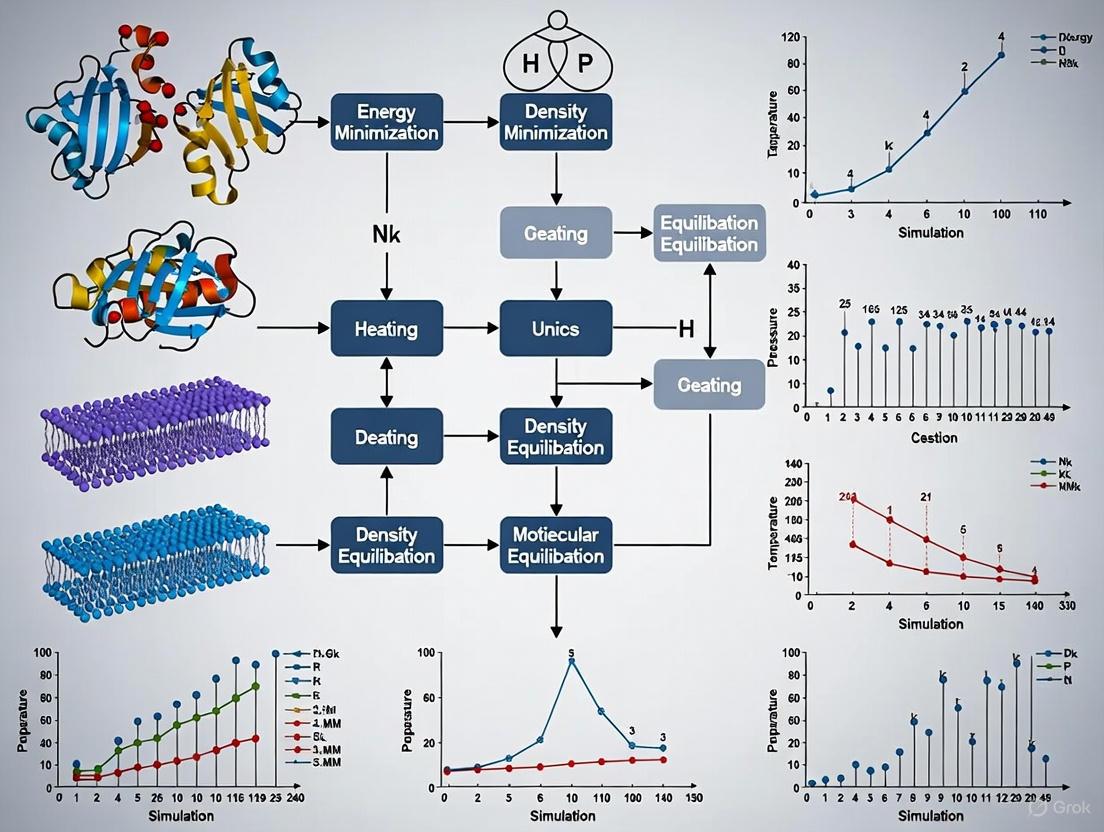
Effective equilibration is a critical, yet often overlooked, prerequisite for obtaining physically meaningful results from molecular dynamics simulations.
Mastering MD Equilibration: Best Practices for Robust Biomolecular Simulations
Abstract
Effective equilibration is a critical, yet often overlooked, prerequisite for obtaining physically meaningful results from molecular dynamics simulations. This article provides a comprehensive guide for researchers and drug development professionals, covering the foundational principles of thermodynamic equilibrium, systematic methodological protocols for diverse systems, advanced troubleshooting strategies, and rigorous validation techniques. By synthesizing current research, we outline a framework to transform equilibration from a heuristic process into a quantifiable procedure, ultimately enhancing the reliability of simulations in drug discovery and structural biology.
Why Equilibration Matters: Defining Convergence and Thermodynamic Equilibrium in MD
Frequently Asked Questions (FAQs)
FAQ 1: What does it mean for a molecular dynamics simulation to be "equilibrated"?
A system is considered equilibrated when it has reached a stable, thermodynamically consistent state, and the measured properties have converged. Formally, a property A is considered equilibrated if the fluctuations of its running average, 〈A〉(t), remain small for a significant portion of the trajectory after a convergence time, t_c. When all individual properties of the system meet this criterion, the system is considered fully equilibrated [1].
FAQ 2: Why is proper equilibration critical for the validity of my simulation results?
Equilibration is essential to ensure that the subsequent production run yields results that are neither biased by the initial configuration nor deviate from the target thermodynamic state. If a system has not reached equilibrium, the resulting trajectories are not reliable for predicting equilibrium properties, which can invalidate the core findings of a study. Proper equilibration transforms the simulation from a theoretical exercise into a meaningful representation of a physical system [2].
FAQ 3: My simulation energy seems stable. Is this sufficient to confirm equilibrium?
While a stable potential energy is a common and useful initial check, it is often insufficient on its own. Energy minimization alone may only place the system in a deep local minimum, and the RMSD (Root-Mean-Square Deviation) reaching a plateau does not necessarily confirm that the potential energy is at a global minimum. More sophisticated checks, such as analyzing the convergence of multiple structural, dynamic, and cumulative properties, are recommended for a robust assessment [1].
FAQ 4: How long should I equilibrate my system?
There is no universal answer, as the required equilibration time depends on the system's size and complexity, the property of interest, and the initial configuration. Studies have shown that properties of biological interest can converge in multi-microsecond trajectories for several proteins. However, properties like transition rates to low-probability conformations may require much more time. A systematic framework using uncertainty quantification can help determine equilibration adequacy based on specified tolerance for uncertainty in your desired output properties [1] [2].
FAQ 5: What is the difference between "partial equilibrium" and "full equilibrium"?
- Partial Equilibrium: Some average properties (e.g., a distance between two protein domains), which depend mostly on high-probability regions of conformational space, have reached their converged values.
- Full Equilibrium: All properties, including those that depend explicitly on low-probability regions of conformational space (e.g., free energy, entropy, and transition rates), have converged. A system can be in partial equilibrium but not full equilibrium [1].
Troubleshooting Guides
Problem 1: Non-Converging or Drifting Properties
Symptoms: Key properties, such as radius of gyration, potential energy, or RMSD, do not stabilize but instead show a continuous drift over time.
| Possible Cause | Solution |
|---|---|
| Insufficient simulation time | The system may be trapped in a local energy minimum or simply require more time to explore its conformational space. Extend the simulation time and monitor multiple properties for convergence [1]. |
| Poor initial configuration | The starting structure may be too far from the equilibrium state, leading to extended relaxation. Consider using improved position initialization methods, such as a perturbed lattice or a Monte Carlo pair distribution method, which can reduce equilibration time, especially at high coupling strengths [2]. |
| Incorrect thermostat protocol | An inappropriate thermostat coupling strength or algorithm can prevent proper thermalization. Weaker thermostat coupling generally requires fewer equilibration cycles. Furthermore, OFF-ON thermostating sequences (where the thermostat is off initially) often outperform ON-OFF approaches for most initialization methods [2]. |
Workflow for Diagnosing Non-Convergence The following diagram outlines a logical workflow for troubleshooting non-converging simulations.
Problem 2: Excessive Equilibration Time
Symptoms: The system takes an impractically long time to reach a stable state, making production runs computationally prohibitive.
| Possible Cause | Solution |
|---|---|
| Suboptimal position initialization | The initial placement of atoms can significantly impact equilibration efficiency. At high coupling strengths, physics-informed methods (like a perturbed BCC lattice) demonstrate superior performance and reduce equilibration time compared to simple uniform random placement [2]. |
| Overly aggressive thermostatting | Strong thermostat coupling can artificially constrain the system. Using weaker thermostat coupling generally reduces the number of equilibration cycles needed [2]. |
| System starting from a high-energy state | Severe atomic overlaps or clashes from a poor initial structure inject large amounts of energy into the system. Perform an energy minimization step before heating and equilibration. Using a "uniform random with rejection" initialization method can prevent unrealistically close particle placements [2]. |
Problem 3: Property-Dependent Convergence
Symptoms: Some properties (e.g., overall protein structure) appear converged, while others (e.g., side-chain rotamer distributions) do not.
| Possible Cause | Solution |
|---|---|
| Different properties sample different regions of phase space | This is an expected phenomenon. Average properties (e.g., distances, angles) that depend on high-probability regions of conformational space will converge faster than properties that depend on infrequent transitions or low-probability conformations [1]. |
| The system is in partial, but not full, equilibrium | Recognize that for many biological questions, partial equilibrium may be sufficient if the properties of interest have converged. If the non-converging property is critical (e.g., a reaction rate), enhanced sampling techniques or much longer simulation times may be necessary [1]. |
Experimental Protocols & Data
Quantitative Convergence Times for Various Properties
The table below summarizes findings on the convergence behavior of different property types, illustrating that convergence is not uniform.
| Property Type | Example Metrics | Typical Convergence Time Scale | Notes |
|---|---|---|---|
| Structural & Energetic | Potential Energy, Overall RMSD | Microseconds [1] | Often the first metrics checked; can give a false sense of security if used alone. |
| Dynamical | Mean-Square Displacement, Autocorrelation Functions | Microseconds to tens of microseconds [1] | Convergence can be slow and is often non-exponential. |
| Cumulative (Low-Probability) | Transition Rates, Free Energy of Rare Conformations | >100 microseconds [1] | Requires thorough exploration of conformational space; most challenging to converge. |
Methodology: A Framework for Adaptive Equilibration
This protocol outlines a systematic approach to move equilibration from a heuristic process to a quantifiable procedure [2].
Position Initialization: Choose an initialization method appropriate for your system.
- Low coupling/High temp: Uniform random (with rejection) or quasi-random sequences (Halton, Sobol) are sufficient.
- High coupling/Low temp: Physics-informed methods like a perturbed Body-Centered Cubic (BCC) lattice or a Monte Carlo pair distribution (MCPDF) method are superior.
Velocity Initialization: Sample velocities from a Maxwell-Boltzmann distribution at the target temperature.
Thermostating Protocol:
- Use an OFF-ON duty cycle for the thermostat (i.e., thermostat off at the start of equilibration).
- Prefer weaker thermostat coupling strengths over stronger ones.
- Compare algorithms (e.g., Berendsen vs. Langevin) for your specific system.
Uncertainty Quantification (UQ) and Termination:
- Define the key output property of interest (e.g., diffusion coefficient, viscosity).
- Use temperature forecasting to turn temperature uncertainty into an uncertainty in your target property.
- Continue equilibration until the uncertainty in the target property falls below a pre-specified tolerance.
Research Reagent Solutions: Equilibration Toolkit
The table below lists key methodological "reagents" for designing a robust equilibration protocol.
| Item / Method | Function in Equilibration | Considerations |
|---|---|---|
| Perturbed Lattice Initialization | Provides initial atomic positions that are physically realistic, reducing initial energy injection and equilibration time. | Superior performance at high coupling strengths (low temperature, high density) [2]. |
| Uncertainty Quantification (UQ) Framework | Provides a quantitative, criterion-driven metric for determining when equilibration is sufficient. | Transforms equilibration from an open-ended, heuristic step into a rigorous procedure with clear termination points [2]. |
| OFF-ON Thermostating | A protocol where the thermostat is initially off, then switched on. | Demonstrated to outperform ON-OFF sequences for most initialization methods, leading to more efficient thermalization [2]. |
| Weak vs. Strong Thermostat Coupling | Governs how aggressively the thermostat corrects the system temperature. | Weaker coupling generally requires fewer equilibration cycles and is less likely to produce artifacts [2]. |
| Multi-Property Convergence Analysis | Simultaneous monitoring of structural, dynamic, and system-specific properties. | Essential for diagnosing partial vs. full equilibrium and ensuring the properties of interest are stable [1]. |
Equilibration and Validation Workflow
A complete MD study involves a careful equilibration phase before production data can be collected. The following workflow integrates the key concepts and troubleshooting points.
Defining Partial vs. Full Equilibrium for Different Molecular Properties
A guide to diagnosing and resolving equilibration issues in Molecular Dynamics simulations.
Molecular Dynamics (MD) simulations rely on the fundamental assumption that the simulated system has reached a sufficient state of equilibrium. However, the concept of "equilibrium" is not binary. This guide explains the critical distinction between partial equilibrium (where some properties have stabilized) and full equilibrium (where all properties have stabilized), a concept essential for interpreting your results correctly [3] [4].
What is the difference between partial and full equilibrium in an MD simulation?
In the context of MD simulations, equilibrium is defined relative to the specific properties you are measuring [3] [4].
- Full Equilibrium: A system is considered fully equilibrated only when every individual property of interest (e.g., energy, structure, dynamics) has reached a stable, converged value. This implies that the simulation has thoroughly explored all relevant regions of the conformational space, including low-probability states [3].
- Partial Equilibrium: This state is achieved when some, but not all, properties have converged. A system can be in partial equilibrium when average structural properties (like a domain-distance) have stabilized, but properties that depend on rare events (like transition rates between conformations) have not [3] [4].
The core of the distinction lies in the extent of conformational sampling. Average properties often depend on high-probability regions of conformational space and can converge relatively quickly. In contrast, properties like free energy and entropy depend on the entire conformational space, including low-probability regions, and thus require much longer simulation times to converge [3] [4].
How can I determine if my simulation has reached equilibrium?
Determining equilibrium is not a precise art but involves monitoring the time-evolution of key properties. A standard working definition is [3]:
"Given a system’s trajectory, with total time-length T, and a property Aᵢ extracted from it, and calling 〈Aᵢ〉(t) the average of Aᵢ calculated between times 0 and t, we will consider that property 'equilibrated' if the fluctuations of the function 〈Aᵢ〉(t), with respect to 〈Aᵢ〉(T), remain small for a significant portion of the trajectory after some 'convergence time', t_c."
The following workflow and diagnostic table can help you systematically assess equilibration:
Table 1: Key Properties for Monitoring Equilibration
| Property Category | Specific Metric | What It Indicates | Convergence Time |
|---|---|---|---|
| Energetic | Potential Energy, Total Energy | Stability of the force field interactions and overall system energy. | Often fast, but can drift if structure is unstable. |
| Structural | Root-Mean-Square Deviation (RMSD) | Deviation from the initial structure; a plateau suggests a stable fold or state [3] [4]. | Varies by system size and flexibility; can be misleading if trapped in a local minimum. |
| Dynamical | Autocorrelation Functions (ACF), Mean-Square Displacement | How quickly a system "forgets" its prior state; decay indicates dynamic sampling [3]. | Can require very long timescales (microseconds+); often the last to converge [3]. |
| Cumulative | Average of a Distance or Angle | Convergence of a specific, biologically relevant measurement [3] [4]. | Depends on the property; can be fast for local, high-probability states. |
My simulation is not equilibrating. What should I check?
If your properties are not showing signs of convergence, investigate the following common issues:
- Review Your Equilibration Protocol: Ensure you have performed adequate energy minimization and gradual heating (e.g., in an NVT ensemble) and pressurization (e.g., in an NPT ensemble) before starting production runs [3] [4]. Double-check that temperature and pressure coupling parameters are correctly transferred from equilibration to production simulations [5].
- Extend the Simulation Time: Convergence is a function of time. Some properties, especially those related to large-scale conformational changes or dynamics, may require multi-microsecond or longer simulations to converge [3]. What converges also depends on the property; biologically relevant averages may converge in multi-microsecond trajectories, while transition rates to low-probability conformations will take much longer [3] [4].
- Check for Technical Errors: Verify that all constraints (e.g., bond constraints allowing a larger timestep) are correctly applied [6] [5]. Confirm that the input paths for restarting simulations are correct to avoid inconsistencies [5].
- Consider a Different Starting Point: If the system is trapped in a deep local energy minimum, it may not equilibrate in a feasible simulation time. Using a different initial structure or pre-equilibrating with a different method (e.g., Born-Oppenheimer MD for ab initio simulations) can help [7].
Table 2: Key Resources for MD Equilibration Studies
| Resource / Reagent | Function / Description |
|---|---|
| Biomolecular Force Fields (e.g., AMBER, CHARMM) | A set of empirical parameters describing bonded and non-bonded interactions between atoms, determining the potential energy of the system [6]. |
| Explicit Solvent Models (e.g., TIP3P, TIP4P) | Water models that represent solvent molecules as a collection of interaction sites; critical for simulating physiological conditions [6] [8]. |
| Molecular Dynamics Software (e.g., GROMACS, AMBER, CP2K) | Software packages that perform the numerical integration of the equations of motion to propagate the system through time [6] [5] [7]. |
| Long-Timescale Simulation Hardware/Cloud | Specialized hardware (e.g., Anton) or cloud computing credits are often necessary to achieve the microsecond-to-millisecond simulations required for full convergence of some properties [3] [6]. |
| Trajectory Analysis Tools (e.g., MDTraj, BioSimSpace) | Software libraries and tools for analyzing simulation outputs, such as calculating RMSD, energies, and other properties to assess convergence [8]. |
Successfully navigating equilibration in MD simulations requires understanding that partial equilibrium for some average properties is a common and often useful outcome, even when full thermodynamic equilibrium is not achieved [3] [4]. By carefully defining the properties of biological interest and systematically monitoring their convergence over time, you can ensure the validity and interpretability of your simulation results.
Challenges of Non-Equilibrium Behavior in Biomolecular Simulations
Troubleshooting Guides
Guide 1: Addressing Poor Convergence in Free Energy Calculations
Problem: Free energy differences (ΔA) calculated using nonequilibrium work (NEW) simulations show poor convergence and high statistical error, leading to unreliable results for drug binding affinities.
Symptoms:
- Large variance in work values from switching simulations.
- Computed free energy differences do not converge even with increased sampling.
- Outliers in work values deviate significantly from the mean.
Solutions:
- Use fewer, longer switches: Instead of many short simulations, perform fewer but longer switching simulations. Research indicates that as few as 200 sufficiently long switches can yield well-converged results, reducing computational cost by a factor of 40 compared to protocols using many short switches [9].
- Analyze work values as a quasi-time series: Plot work values in the order of their generation from equilibrium simulations. This helps identify if insufficient equilibration time is the root cause of poor convergence [9].
- Employ Principal Component Analysis (PCA): Use PCA to detect if different conformational substates at low and high theory levels cause convergence issues. This helps identify problematic dihedral angles or other degrees of freedom [9].
Guide 2: Managing Unrealistic Ostwald Ripening in Biomolecular Condensates
Problem: In simulations of liquid-liquid phase separation (LLPS), the system exhibits unrealistic Ostwald ripening (where small droplets disappear and large ones grow indefinitely), which is not observed in living cells under non-equilibrium conditions.
Symptoms:
- Continuous growth of large droplets at the expense of smaller ones.
- Failure to maintain a population of stable, finite-sized droplets.
- System evolves toward a single large droplet, unlike biological condensates in cells.
Solutions:
- Introduce non-equilibrium driving forces: Model cellular energy input by implementing random transitions between particle states (e.g., AB) to mimic ATP-driven activity. This arrests Ostwald ripening and maintains multiple stable droplets [10].
- Use modified interaction potentials: Employ double-well potentials for specific particle interactions (e.g., B-B interactions) to create competition between different energy minima, preventing dominant droplet growth [10].
Guide 3: Overcoming Inefficient Equilibration and Thermalization
Problem: Molecular dynamics simulations take excessively long to equilibrate, or system properties do not stabilize, wasting computational resources.
Symptoms:
- Drifting temperature or energy measurements.
- Transport properties (e.g., diffusion coefficient) do not reach stable values.
- System remains trapped in non-equilibrium states for prolonged simulation times.
Solutions:
- Select appropriate initialization methods: At high coupling strengths, use physics-informed initialization methods like perturbed lattices or Monte Carlo pair distribution instead of random placement. This can significantly reduce equilibration time [11].
- Optimize thermostating protocols: Use OFF-ON thermostating sequences rather than ON-OFF approaches. Apply weaker thermostat coupling strengths, which generally require fewer equilibration cycles [11].
- Implement temperature forecasting: Use temperature stability as a quantitative metric for thermalization. This transforms equilibration from a heuristic process to a rigorous procedure with clear termination criteria based on uncertainty tolerances [11].
Frequently Asked Questions
Q1: How can I confirm my system has transitioned from subdiffusive to diffusive behavior before starting production simulations? A: Carefully analyze the mean-squared displacement (MSD) as a function of time during equilibration. The MSD should exhibit a linear trend with time, indicating normal diffusive behavior. Persistent subdiffusive behavior suggests incomplete equilibration, and production simulations should not commence until proper diffusive behavior is established [12].
Q2: What are the best practices for ensuring robust and reproducible biomolecular simulations? A: Maintain a hypothesis-driven approach, use reliable tools and databases for data curation, and implement practices that promote reproducibility and accessibility. Proper documentation of all simulation parameters and protocols is essential for both reproducibility and peer validation [13].
Q3: How can I accelerate charge estimation in reactive molecular dynamics simulations without sacrificing accuracy? A: Employ machine learning surrogate models, specifically physics-informed neural networks. Long Short-Term Memory (LSTM) networks trained on Smooth Overlap of Atomic Positions (SOAP) descriptors can predict charge density evolution two orders of magnitude faster than conventional methods, with less than 3% error, while enforcing physical constraints like charge neutrality [14].
Q4: What is the optimal number of nonequilibrium work switches for calculating free energy corrections between different theory levels? A: Research shows that using fewer but longer switches is more efficient than many short switches. Specifically, approximately 200 sufficiently long switches can provide well-converged free energy differences ΔAlow→high between theory levels, significantly reducing computational cost while maintaining accuracy [9].
Experimental Protocols & Data
Table 1: Performance Comparison of Initialization Methods for Equilibration
The following data summarizes findings from a systematic evaluation of seven initialization approaches on equilibration efficiency, particularly relevant for high coupling strength conditions [11].
| Initialization Method | Performance at Low Coupling | Performance at High Coupling | Thermalization Speed |
|---|---|---|---|
| Uniform Random | Adequate | Poor | Slow |
| Halton Sequence | Adequate | Moderate | Moderate |
| Sobol Sequence | Adequate | Moderate | Moderate |
| Perfect Lattice | Adequate | Good | Fast |
| Perturbed Lattice | Adequate | Excellent | Fastest |
| Monte Carlo Pair Distribution | Adequate | Excellent | Fastest |
Table 2: Thermostating Protocol Impact on Equilibration Efficiency
This table compares the effectiveness of different thermostating protocols based on the number of equilibration cycles required for system thermalization [11].
| Thermostating Protocol | Coupling Strength | Equilibration Cycles Required | Temperature Stability |
|---|---|---|---|
| ON-OFF Duty Cycle | Strong | High | Moderate |
| ON-OFF Duty Cycle | Weak | Moderate | Good |
| OFF-ON Duty Cycle | Strong | Moderate | Good |
| OFF-ON Duty Cycle | Weak | Low | Excellent |
| Berendsen | Standard | Moderate | Good |
| Langevin | Weak | Low | Excellent |
Protocol 1: Optimized NEW Switching for Free Energy Calculations
This protocol describes an optimized approach for calculating free energy differences between low and high levels of theory using nonequilibrium work (NEW) simulations [9].
- Equilibration: Perform sufficient equilibration at the low level of theory. Check convergence by analyzing work values in a quasi-time series manner to ensure proper sampling.
- Switching Parameters: Use relatively long switching lengths (though still practical for QM/MM calculations) rather than many short switches.
- Number of Switches: Perform approximately 200 switching simulations per transformation.
- Conformational Analysis: Apply Principal Component Analysis (PCA) to detect if different conformational preferences between theory levels might hinder convergence.
- Free Energy Calculation: Use Jarzynski's equation with the collected work values to compute ΔAlow→high.
Protocol 2: Simulating Arrested Ostwald Ripening in Biomolecular Condensates
This protocol describes how to simulate non-equilibrium biomolecular condensates that exhibit arrested Ostwald ripening, mimicking behavior observed in living cells [10].
- System Setup: Create a three-dimensional isolated box containing particles that can exist in two states (A and B).
- Interaction Potentials:
- Use standard Lennard-Jones potential for A-A and A-B interactions.
- Implement a double-well potential for B-B interactions by adding a shifted Gaussian to a Lennard-Jones potential: VBB(r) = VLJ(r) + [H/(δ√(2π))] exp[-(r-a)²/(2δ²)].
- Parameters: H = -0.7, δ = 0.2, and a = 1.5, 2.2, or 3.5 (in Lennard-Jones reduced units).
- Non-Equilibrium Driving: Introduce random transitions between states A and B with fixed probabilities to mimic cellular energy input.
- Simulation Execution: Run molecular dynamics simulations and observe the formation of multiple stable droplets without continuous growth.
The Scientist's Toolkit
Table 3: Research Reagent Solutions for Non-Equilibrium Simulations
| Reagent / Method | Function in Simulation | Application Context |
|---|---|---|
| Nonequilibrium Work (NEW) Switching | Calculates free energy differences between theory levels | Binding affinity calculations, QM/MM free energy corrections [9] |
| Double-Well Potential | Models complex interactions with multiple minima | Arrested Ostwald ripening, biomolecular condensates [10] |
| Smooth Overlap of Atomic Positions (SOAP) Descriptors | Represents local atomic environments for machine learning | Accelerated charge estimation, property prediction [14] |
| Physics-Informed Neural Networks (PINNs) | Enforces physical constraints in machine learning models | Charge prediction with conservation laws [14] |
| Principal Component Analysis (PCA) | Identifies key conformational degrees of freedom | Diagnosing convergence issues in free energy calculations [9] |
| Modified Lennard-Jones Potential | Creates competing interactions for stability | Non-equilibrium droplet formation and stabilization [10] |
Workflow Diagrams
Equilibration Protocol Optimization
Convergence Analysis Pathway
Troubleshooting Guide: Partition Functions and Ensembles
This guide addresses common challenges researchers face when applying statistical mechanics concepts to molecular dynamics (MD) simulations, particularly during the critical equilibration phase.
FAQ 1: What is the physical significance of the partition function, and why is it fundamental to my analysis?
- Problem: Researchers often treat the partition function as a mere normalization factor without grasping its physical meaning, leading to difficulties in interpreting simulation results and connecting them to thermodynamic observables.
- Solution: The partition function, ( Z ), is more than a normalization constant; it is a measure of the number of thermally accessible microstates of a system at a given temperature [15]. In the canonical ensemble (NVT), it is defined as ( Z = \sumi e^{-\beta Ei} ), where ( \beta = 1/kB T ) and ( Ei ) is the energy of microstate ( i ) [16]. It encapsulates all the thermodynamic properties of the system. For instance, the Helmholtz free energy is directly derived from it: ( F = -k_B T \ln Z ) [16] [15]. A higher value of ( Z ) indicates a system with more accessible states, which has implications for stability and entropy.
FAQ 2: How does the choice of statistical ensemble affect my equilibration protocol in molecular dynamics?
- Problem: An inappropriate choice of ensemble during equilibration can lead to unrealistic system properties, such as incorrect pressure or energy distributions, compromising the production simulation.
- Solution: The ensemble defines the thermodynamic conditions under which your system evolves, and each has a specific partition function.
- Use the Canonical (NVT) Ensemble when your system is in contact with a heat bath to maintain a constant temperature. This is crucial for equilibration before production runs.
- Use the Microcanonical (NVE) Ensemble for an isolated system with constant energy, often used after initial equilibration to study natural dynamics.
- Use the Isothermal-Isobaric (NPT) Ensemble to equilibrate both temperature and pressure, which is essential for simulating biological systems at experimental conditions. The partition function and the associated thermodynamic potential differ for each ensemble, guiding which quantities are conserved during your simulation [16].
FAQ 3: Why does my system show an energy drift, and how can I minimize it?
- Problem: A gradual change in the total energy of a system in the NVE ensemble, or temperature/pressure drift in other ensembles, indicates a lack of proper equilibration or algorithmic errors.
- Solution: Energy drift can stem from several sources, many related to how forces and neighbors are handled. A common cause in MD is an infrequently updated neighbor list [17]. The GROMACS documentation recommends using a Verlet buffer with a tolerance on energy drift to automatically determine the neighbor list update frequency [17]. Furthermore, ensure that the center-of-mass motion is removed at every step, as the update algorithm can otherwise introduce a slow change in the center-of-mass velocity, affecting the total kinetic energy interpretation [17].
Foundational Concepts & Quantitative Data
To effectively troubleshoot, a firm grasp of the core concepts is essential. The following table summarizes the key partition functions and their relationships to thermodynamics.
Table 1: Summary of Primary Statistical Ensembles and Partition Functions
| Ensemble | Partition Function Symbol | Definition | Key Thermodynamic Connection | Constant Parameters |
|---|---|---|---|---|
| Microcanonical | ( Z_{mc} ) | ( \frac{1}{N! h^{3N}} \int_{E<\mathcal{H} | ( S = kB \ln Z{mc} ) [15] | N, V, E |
| Canonical | ( Z ) or ( Z_c ) | ( Z = \sumi e^{-\beta Ei} ) (Discrete) [16] | ( F = -k_B T \ln Z ) [16] [15] | N, V, T |
| Grand Canonical | ( Z_{gc} ) | ( Z{gc} = \sum{N=0}^{\infty} e^{\beta \mu N} Z_c(N,V,T) ) [15] | ( PV = kB T \ln Z{gc} ) [15] | μ, V, T |
The following diagram illustrates the logical workflow for selecting an appropriate statistical ensemble based on the system's thermodynamic boundaries, which is the first step in designing any equilibration protocol.
Diagram 1: A workflow for selecting the appropriate statistical ensemble based on the system's thermodynamic boundaries.
The Scientist's Toolkit: Essential Research Reagents
This table details key "reagents" or components in the theoretical and computational toolkit for working with partition functions and ensembles.
Table 2: Essential Components for Statistical Mechanics Analysis
| Item | Function & Explanation |
|---|---|
| Boltzmann Constant ((k_B)) | The fundamental bridge between microscopic energy and macroscopic temperature. It appears in the exponent of the partition function, ( \beta = 1/k_BT ), scaling the energy of microstates [16]. |
| Hamiltonian (( \mathcal{H} )) | The function that defines the total energy (kinetic + potential) of the system as a function of all particle positions and momenta. It is the core of the classical partition function integral [16] [15]. |
| Inverse Temperature (( \beta )) | Defined as ( \beta = 1/k_BT ), this is the crucial weighting factor in the partition function. It determines the probability of a microstate; states with energy much higher than ( 1/\beta ) are exponentially suppressed [16] [15]. |
| Planck's Constant ((h)) | Used in the denominator of the classical canonical partition function integral ( \frac{1}{h^{3N}} \int... ) to make the partition function dimensionless and consistent with quantum mechanics [16] [15]. |
| Chemical Potential (( \mu )) | The energy change when a particle is added to the system. It is the controlling parameter for particle exchange in the grand canonical ensemble, appearing in the weighting term ( e^{\beta \mu N} ) [15]. |
Advanced Troubleshooting: Equilibration Protocol Artifacts
FAQ 4: After reverse-mapping from a coarse-grained (CG) to an all-atom (AA) model, my ion channel pore shows artificially high lipid density and low hydration. What went wrong?
- Problem: A common hybrid protocol—using CG for efficient equilibration followed by AA for production—can introduce persistent artifacts if the CG equilibration step is incomplete [18].
- Solution & Experimental Protocol: Recent research identifies the root cause as a lack of initial pore hydration during the CG simulation, which allows lipids to enter the pore lumen through gaps between helices [18]. The slower kinetics of lipids in the subsequent AA simulation then trap them there, despite an unfavorable free energy [18].
- Detailed Methodology: To eliminate this artifact, the following protocol was tested and validated:
- System Setup: Construct the protein-lipid-water system and simulate using a CG force field (e.g., Martini) for initial equilibration.
- Protocol Intervention: During the CG equilibration phase, apply positional restraints to the entire lipid membrane. This prevents excessive lipid entry into the protein pore while allowing the rest of the system, including water, to equilibrate around the protein.
- Reverse Mapping & AA Production: Reverse-map the equilibrated CG system to an AA model and proceed with the production run without restraints.
- Outcome: This protocol was found to produce pore hydration levels consistent with results from full AA simulations, effectively eliminating the artifact for further studies of protein-lipid interactions [18].
- Detailed Methodology: To eliminate this artifact, the following protocol was tested and validated:
The following diagram outlines this improved hybrid equilibration workflow, highlighting the critical step that prevents the artifact.
Diagram 2: A workflow comparing standard and improved CG-to-AA equilibration protocols to avoid pore hydration artifacts.
Building a Robust Equilibration Protocol: From Initialization to Production
Frequently Asked Questions
Q1: What is the primary goal of the equilibration phase in a Molecular Dynamics (MD) simulation? The equilibration phase brings the system to a stable, thermodynamically consistent state before data collection commences. This step is essential to ensure that subsequent results are neither biased by the initial configuration nor deviate from the target thermodynamic state, thus guaranteeing physically meaningful outcomes [2] [19].
Q2: My simulation "explodes" during equilibration. What are the most common causes? System instability, often manifested by LINCS warnings or unrealistic bond stretching in visualization tools, can stem from several sources:
- Poor Initial Configuration: The starting positions of particles may have severe overlaps or unphysical clashes, leading to extremely high repulsive forces [2] [20].
- Incorrect Simulation Parameters: Using an improperly large timestep or an incorrect value for a physical property, such as the isothermal compressibility for a solvent, can cause instability [20].
- Insufficient Equilibration: The system may require a longer NVT equilibration period to stabilize the temperature before proceeding to NPT equilibration [20].
Q3: How does the choice of position initialization method impact my simulation's efficiency? The initialization method significantly impacts equilibration efficiency. At low coupling strengths, the choice is relatively inconsequential. However, at high coupling strengths, physics-informed methods demonstrate superior performance by providing a better starting approximation of the true desired state, which reduces the required equilibration time and minimizes initial temperature spikes [2].
Q4: Is it normal to see broken bonds when visualizing my equilibrated system? This is often a visualization artifact and does not mean the bonds are physically broken. In classical MD with constrained bonds (e.g., LINCS algorithm), bond lengths are mathematically constrained and cannot break. The visualization software may simply be drawing a bond between two atoms that have moved far apart but are still connected via periodic boundary conditions [20].
Q5: What is the recommended thermostat sequence for equilibration? Research indicates that an OFF-ON thermostating sequence (where the thermostat is initially off for a period before being switched on) outperforms an ON-OFF approach for most initialization methods. Furthermore, weaker thermostat coupling generally requires fewer equilibration cycles [2].
Troubleshooting Guides
Issue 1: System Instability and "Blow-Ups" During Equilibration
Symptoms:
- The simulation crashes with LINCS warnings or errors related to "bond constraints" [20].
- Visualization shows atoms or molecules in unrealistic positions or with "broken" bonds [20].
- The simulation log indicates an uncontrollable rise in energy or temperature.
Resolution Protocol:
- Verify Initial Configuration: Check for atomic overlaps in your initial structure (.gro, .pdb file). Ensure that inserted molecules (e.g., a solute into a solvent box) do not clash. Using a pre-equilibrated solvent box can help [20].
- Re-run Energy Minimization: A robust energy minimization is a prerequisite to equilibration. Ensure the minimization converges properly to remove any high-energy contacts from the initial structure [20].
- Apply Restraints: For complex molecules like proteins, use position restraints (
define = -DPOSRES) on the heavy atoms or the entire solute during the initial NVT and NPT stages. This allows the solvent to relax around a fixed solute frame before the full system is released [20] [18]. - Check Physical Parameters: Incorrect parameters, such as the isothermal compressibility for your solvent, can cause instability. For example, a value of
1e-2 bar^-1for chloroform caused a failure, while correcting it to~1e-4 bar^-1resolved the issue. Always double-check unit conversions [20]. - Adjust Simulation Parameters: Reduce the integration timestep (e.g., to 1 fs) during equilibration. For certain force fields like AIREBO, a timestep of 0.5 fs may be required. Consider using the C-rescale barostat for pressure coupling during equilibration for better stability [20] [21].
Issue 2: Slow or Incomplete Equilibration
Symptoms:
- The system temperature or pressure oscillates wildly and does not stabilize around the target value, even after an extended run [19].
- The potential energy of the system fails to reach a stable plateau.
- Different parts of the system (e.g., protein vs. solvent) show significantly different temperatures.
Resolution Protocol:
- Re-evaluate Initialization Method: If simulating a high-coupling strength system (e.g., a dense liquid or solid), switch from a simple uniform random method to a physics-informed method like a perturbed lattice or the Monte Carlo pair distribution (MCPDF) method. This provides a better starting point and can drastically reduce equilibration time [2].
- Monitor Component Temperatures: For systems with distinct groups (e.g., solute and solvent), ensure that the translational (
Tt), rotational (Tr), and vibrational (Tv) temperatures are all equilibrating. The Langevin thermostat can be effective at equilibrating these different temperatures faster than some other thermostats [19]. - Extend Equilibration Duration: There is no universal "correct" length for equilibration. Use quantitative metrics, such as temperature forecasting or the uncertainty in your target output properties, to determine when equilibration is sufficient. Continue the equilibration run until these metrics meet your tolerance levels [2].
- Optimize Thermostat Coupling: Weaker thermostat coupling (a larger
tau_tvalue) can often lead to faster equilibration. Also, consider using an OFF-ON duty cycle for the thermostat [2].
Issue 3: Artifacts in the Production Run Traced to Equilibration
Symptoms:
- Unphysical densities of specific molecules in confined spaces (e.g., lipids trapped in a protein pore) [18].
- The system properties in the production run show a persistent drift.
- The final simulation results are inconsistent between replicas.
Resolution Protocol:
- Assess Coarse-to-Fine Graining Protocols: When reverse-mapping from a coarse-grained (CG) to an all-atom (AA) model, artifacts can be "locked in" during the CG equilibration. If lipids or solvents enter regions they shouldn't during CG simulation, they may become trapped in the subsequent, slower AA simulation. To fix this, apply restraints to the entire lipid or solute molecule during the CG equilibration phase to maintain the pore hydration and prevent artifactual trapping [18].
- Ensure Equilibration of All Properties: Do not proceed to production until all relevant properties (temperature, pressure, potential energy, density) have stabilized. An NVT equilibration that only stabilizes temperature may not be sufficient; the subsequent NPT equilibration must also be run until the density and pressure stabilize [19].
- Systematic Initialization Testing: For critical results, validate your equilibration protocol by testing different position initialization methods and comparing the resulting system properties and equilibration times. The following table summarizes the performance of common methods [2].
The table below summarizes key initialization methods based on a systematic study, providing guidance on their performance and best-use scenarios [2].
| Method | Description | Computational Scaling | Best Use Case / Performance |
|---|---|---|---|
| Uniform Random (Uni) | Places particles uniformly at random in the simulation box. | O(N) | Low coupling strength systems. Fast but prone to particle clashes. |
| Uniform Random w/ Rejection (Uni Rej) | Random placement with a minimum enforced distance between particles. | O(N) to O(N²) | Prevents severe clashes, improving over pure random. |
| Halton / Sobol Sequence | Uses low-discrepancy, quasi-random sequences for placement. | O(N) | Provides more uniform spatial coverage than pure random. |
| Body-Centered Cubic (BCC) | Places particles on a perfect crystalline lattice. | O(N) | Low-temperature solids; provides a very ordered start. |
| Perturbed BCC (BCC Beta) | BCC lattice with physical perturbations based on a compact beta function. | O(N) | High-performance at high coupling strengths; excellent for dense liquids/solids. |
| Monte Carlo Pair (MCPDF) | Mesh-based Monte Carlo method matching an input pair distribution function. | O(N) to O(N²) | High-performance; uses physics-based sampling for a near-equilibrium start. |
The Scientist's Toolkit: Essential Research Reagents & Methods
This table lists key "research reagents" – in this context, computational methods and protocols – essential for conducting a comparative analysis of position initialization.
| Item | Function in the Experiment |
|---|---|
| Yukawa One-Component Plasma | An exemplar model system used for the systematic evaluation of equilibration techniques, allowing for controlled studies across coupling regimes [2]. |
| Microfield Distribution Analysis | A diagnostic tool that provides insights into thermal behaviors by analyzing the distribution of electric fields within the system, helping to assess equilibration quality [2]. |
| Uncertainty Quantification (UQ) Framework | A methodology that transforms equilibration from a heuristic process into a quantifiable procedure. It links temperature uncertainty to the uncertainty in target output properties (e.g., diffusion coefficient), providing clear termination criteria [2]. |
| Temperature Forecasting | A quantitative metric used to determine system thermalization, allowing users to decide if equilibration is adequate based on specified uncertainty tolerances [2]. |
| Automated High-Throughput Workflow | A framework (e.g., within atomate) that automates job submission, error recovery, and data management, enabling large-scale, reproducible testing of different initialization and equilibration protocols [22]. |
Experimental Protocol: Comparative Analysis of Initialization Methods
This protocol is adapted from a systematic study on adaptive equilibration [2].
1. Objective: To quantitatively compare the efficiency and effectiveness of seven particle position initialization methods in achieving thermal equilibration across different coupling strength regimes.
2. System Generation:
- Model System: A Yukawa one-component plasma is used as the model system for its well-characterized physics [2].
- Initialization Methods: Generate initial configurations using the seven methods under investigation:
- Uniform Random (Uni)
- Uniform Random with Rejection (Uni Rej)
- Halton Sequence
- Sobol Sequence
- Perfect Body-Centered Cubic (BCC) Lattice
- Perturbed BCC Lattice (BCC Beta)
- Monte Carlo Pair Distribution Function (MCPDF) method.
- System Sizing: Perform this for multiple system sizes (e.g., N=500, 4000 particles) to assess scaling [2].
3. Simulation Setup:
- Velocity Initialization: For all systems, draw initial velocities from a Maxwell-Boltzmann distribution corresponding to the target temperature. Remove center-of-mass motion to prevent overall drift [17] [19].
- Thermostating Protocols: Run simulations with different thermostats (e.g., Berendsen vs. Langevin) and coupling strengths. Test different duty cycles, specifically comparing OFF-ON versus ON-OFF sequences [2].
- Force Calculation: Use a Verlet cut-off scheme with buffered neighbor lists to efficiently compute non-bonded forces [17].
4. Data Collection & Analysis:
- Primary Metric - Equilibration Time: Record the number of simulation steps required for the system temperature to stabilize within a specified tolerance of the target value.
- Temperature Stability: Monitor the instantaneous temperature and its fluctuations throughout the equilibration phase.
- Microfield Analysis: Compute the distribution of microfields during the early stages of equilibration to gain diagnostic insights into the system's thermal behavior [2].
- Uncertainty Quantification: Apply the UQ framework to relate temperature uncertainty to uncertainties in transport properties like the diffusion coefficient and viscosity. This provides a physics-based criterion for declaring equilibration complete [2].
Experimental Workflow and Decision Framework
The following diagrams illustrate the core experimental workflow and a logical framework for selecting an initialization method.
Core Experimental Workflow
Initialization Method Selection Guide
Frequently Asked Questions
FAQ 1: My simulation's temperature is stable, but my colleague says the ensemble is incorrect. What does this mean and how can I fix it? The Berendsen thermostat is known for efficiently stabilizing temperature but not for producing a correct thermodynamic ensemble. It suppresses temperature fluctuations, which can lead to unphysical dynamic behaviors and an ill-defined ensemble [23]. For production runs, switch to a thermostat that properly samples the canonical (NVT) ensemble, such as the Langevin, Nosé-Hoover, or Bussi thermostat [24].
FAQ 2: How do I choose the optimal coupling strength or time constant for my thermostat?
The coupling strength (Langevin) or time constant (Berendsen) is system-dependent. A value that is too strong (low τ_T or high γ) can over-constrain the system, while a value that is too weak can lead to poor temperature control and energy drift [23].
- Langevin: The friction coefficient (
γ) should be chosen based on the physical properties of your solvent. For water, a common value is 0.01 fs⁻¹ (or 10 ps⁻¹) [24]. - Berendsen: The relaxation time (
τ_T) is often chosen empirically. A value of 0.1 ps is typical for condensed-phase systems, but it should be considered for equilibration only [23]. Weaker thermostat coupling generally requires fewer equilibration cycles [11].
FAQ 3: What is the practical difference between global and local thermostats? Global thermostats like Berendsen apply a uniform scaling factor to all atom velocities at once. In contrast, local thermostats like Langevin and Andersen apply stochastic forces or velocity reassignments to individual atoms [23]. Local thermostats are generally preferred for production runs as they produce correct ensemble fluctuations and are better at handling non-uniform systems.
FAQ 4: I am simulating a protein in explicit solvent. Should I thermostat the entire system or just the solvent? A novel protocol suggests coupling only the solvent to the heat bath and monitoring the protein's temperature until it equilibrates with the solvent [25]. This method can save simulation time, avoid bias from non-equilibrium events, and result in trajectories with lower root-mean-square deviation (RMSD) from the native structure [25].
Troubleshooting Guides
Problem: Unphysical Energy Drift in NVE Simulation After Equilibration
- Description: After switching from an NVT equilibration to an NVE production run, the total energy of the system consistently increases or decreases over time.
- Potential Causes & Solutions:
- Insufficient Equilibration: The system was not fully equilibrated before switching off the thermostat. Solution: Ensure the system energy and temperature have stabilized. A protocol coupling only the solvent can provide a clear metric for equilibration by monitoring when the protein and solvent temperatures equalize [25].
- Incorrect Thermostat for Production: The Berendsen thermostat was used for final equilibration. Its suppressed fluctuations can cause an "energy hole" that manifests as drift in NVE. Solution: For the final equilibration stage before NVE, use a stochastic thermostat like Langevin or a deterministic one like Nosé-Hoover, which generate correct fluctuations [24].
- Time Step Too Large: An excessively large time step can cause instability and energy drift, especially in systems with light atoms or stiff bonds. Solution: Reduce the time step. For systems with hydrogen atoms, 1-2 fs is often necessary, while 5 fs may be acceptable for some metallic systems [24].
Problem: Poor Temperature Control or System "Blowing Up"
- Description: The system temperature deviates significantly from the target or the simulation fails due to extremely high forces.
- Potential Causes & Solutions:
- Weak Coupling (Berendsen): If the Berendsen
τ_Tis too large, the system is weakly coupled to the bath, leading to poor temperature control. Solution: For faster equilibration, use a smallerτ_T(e.g., 0.01-0.1 ps) [23]. - Extreme Stochastic Forces (Langevin): A very high friction coefficient (
γ) in Langevin dynamics can introduce large random forces that destabilize the simulation. Solution: Use a physically motivated friction coefficient. For water, 0.01 fs⁻¹ is a standard value [24]. - Energy Conservation Issues (NVE): A large time step can make Velocity Verlet dynamics unstable. Solution: As noted in the ASE documentation, if the energy increases dramatically, the time step is too large and must be reduced [24].
- Weak Coupling (Berendsen): If the Berendsen
Comparison of Thermostat Protocols
The following table summarizes the key characteristics of the Berendsen and Langevin thermostats, two commonly used algorithms.
| Feature | Berendsen Thermostat | Langevin Thermostat |
|---|---|---|
| Algorithm Type | Deterministic, global velocity rescaling [23] | Stochastic, adds friction and random forces per atom [26] [24] |
| Generated Ensemble | Ill-defined; does not reproduce the canonical ensemble [23] | Correctly samples the canonical (NVT) ensemble [24] |
| Temperature Fluctuations | Suppresses fluctuations exponentially towards the target [23] | Represents physical fluctuations correctly [24] |
| Primary Use Case | Rapid initial equilibration and heating/cooling [23] [24] | Production runs requiring correct sampling [24] |
| Key Control Parameter | Relaxation time (τ_T); typical value: ~0.1 ps [23] |
Friction coefficient (γ); for water: ~0.01 fs⁻¹ [24] |
| Advantages | High efficiency and stability for reaching a target temperature [23] | Simple implementation, correct ensemble, good for stiff systems [24] |
| Disadvantages | Produces unphysical dynamics; not for production [23] [24] | Stochastic nature can alter dynamics at low friction [24] |
Workflow: Selecting and Applying a Thermostat
The following diagram illustrates a decision workflow for selecting and applying thermostats during different stages of a molecular dynamics simulation, incorporating best practices for equilibration.
The Scientist's Toolkit: Essential Components for Equilibration
This table lists key "research reagents" – the computational tools and parameters – essential for performing effective thermal equilibration in molecular dynamics.
| Item | Function / Description |
|---|---|
| Velocity Verlet Integrator | A symplectic algorithm used to numerically integrate the equations of motion, providing good long-term energy conservation [24]. |
| Maxwell-Boltzmann Distribution | The probability distribution used to assign random initial velocities to atoms at a given temperature, providing the starting point for equilibration [17]. |
| Thermostat Coupling Parameter | The key knob for controlling equilibration: τ_T (Berendsen) or γ (Langevin). It determines how aggressively the thermostat corrects the system temperature [23] [24]. |
| Solvent-Accessible Surface Area (SASA) | A property that can be used to compute physically realistic friction coefficients for Langevin dynamics in coarse-grained models, making them dependent on the local environment [26]. |
Time Step (Δt) |
The interval for numerical integration. It must be small enough to capture the fastest motions (e.g., ~1-2 fs for systems with H-bonds) to prevent instability [24]. |
| Temperature Monitoring | The process of tracking the instantaneous temperature of different system components (e.g., protein, solvent) separately to gauge equilibration progress [25]. |
Frequently Asked Questions (FAQs)
1. What is the fundamental difference between OFF-ON and ON-OFF thermostat duty cycles? The OFF-ON sequence involves an initial period of dynamics without a thermostat (OFF), allowing the system's natural forces to distribute energy, followed by a production phase with the thermostat active (ON). Conversely, the ON-OFF sequence starts with the thermostat active to immediately drive the system to the target temperature, then turns it off for data collection.
2. Under what conditions should I prefer an OFF-ON sequencing approach? Recent research indicates that OFF-ON thermostating sequences outperform ON-OFF approaches for the majority of system initialization methods [11]. This sequence is particularly advantageous when using physics-informed initialization methods for systems at high coupling strengths, as it can lead to a shorter overall equilibration time [11].
3. How does thermostat coupling strength affect my equilibration process? Weaker thermostat coupling generally requires fewer equilibration cycles [11]. While tight coupling (small timescale parameter) brings the system temperature to the target quickly, it can interfere more significantly with the natural dynamics of the system. A looser coupling (larger timescale parameter) is often preferable for production simulations where accurate dynamics are important [27].
4. My gas-phase simulation is not achieving proper energy equipartition. What thermostat should I use? For gas-phase systems where thermalizing collisions are infrequent, the Langevin thermostat has been shown to achieve equipartitioning in a reasonable simulation time where other thermostats like Nosé-Hoover may struggle [28]. This is because the Langevin thermostat individually couples each particle to the heat bath, which is more effective for sparse systems.
5. How can I quantitatively determine when my system has reached equilibration? A modern approach is to use temperature forecasting as a quantitative metric for system thermalization. This enables users to determine equilibration adequacy based on specified uncertainty tolerances in desired output properties, transforming equilibration from a heuristic process to a rigorously quantifiable procedure with clear termination criteria [11].
Troubleshooting Guides
Problem: Large Temperature Fluctuations During Initial Equilibration
Symptoms: The system temperature shows sharp, unphysical spikes (e.g., thousands of Kelvin when the target is 300 K) during the first few steps of simulation, often accompanied by severe structural expansion [29].
Possible Causes and Solutions:
| Cause | Diagnostic Steps | Solution |
|---|---|---|
| Incorrect unit system | Verify that the force field parameter file is compatible with the MD engine's unit setting [29]. | Ensure consistency between force field requirements (e.g., 'real' units) and simulation script units (e.g., 'metal'). |
| Poor initial structure | Check for unrealistic atomic clashes or distorted geometries in the starting configuration. | Perform energy minimization before dynamics. Use physics-informed initialization methods for complex systems at high coupling strengths [11]. |
| Excessive initial velocities | Confirm that initial velocities are drawn from a proper Maxwell-Boltzmann distribution at the correct temperature [27]. | Use the "Maxwell-Boltzmann" initial velocity type with the target temperature specified. |
| Inappropriate time step | Monitor the conservation of total energy in a short NVE test simulation [27]. | Reduce the time step, particularly if light atoms (e.g., hydrogen) are present. A time step of 1 fs is a safe starting point [27]. |
Problem: Failure to Achieve Energy Equipartition
Symptoms: The kinetic energy is not correctly distributed among all degrees of freedom (translational, rotational, vibrational), which is critical for obtaining correct thermodynamic properties and reaction dynamics [28].
Possible Causes and Solutions:
| Cause | Diagnostic Steps | Solution |
|---|---|---|
| Inefficient thermostat for system type | Check the efficiency of different thermostats (Nosé-Hoover, CSVR, Langevin) for equilibrating your specific system [28]. | For gas-phase or sparse systems, use the Langevin thermostat, which couples each particle individually to the heat bath [28]. |
| Insufficient equilibration time | Monitor temperature and potential energy time series for stability. | Extend the equilibration period. Use quantitative metrics like temperature forecasting to determine adequate equilibration [11]. |
| Overly tight thermostat coupling | Check if dynamic properties are artificially suppressed. | For production runs, use weaker thermostat coupling or switch to the NVE ensemble after equilibration to measure dynamical properties [27]. |
Quantitative Data and Experimental Protocols
Comparison of Common Thermostat Algorithms
The table below summarizes key characteristics of popular thermostat algorithms to guide appropriate selection.
| Thermostat Type | Ensemble Sampled | Typical Use Case | Advantages | Disadvantages |
|---|---|---|---|---|
| Nosé-Hoover Chain [27] | Canonical (NVT) | Production simulations | Generally reliable; correctly samples canonical ensemble. | Can cause persistent temperature oscillations; may require chain length adjustment. |
| Berendsen [27] | Approximately NVT | Equilibration only | Suppresses temperature oscillations; robust temperature control. | Does not exactly reproduce canonical ensemble; can produce "flying ice cube" effect. |
| Langevin [27] [28] | Canonical (NVT) | Systems requiring fast equilibration (e.g., gas-phase) | Fast equipartitioning; good for structure generation and ensemble sampling. | Suppresses natural dynamics; not ideal for measuring transport properties. |
| Bussi-Donadio-Parrinello [27] | Canonical (NVT) | Stochastic variant of Berendsen | Correctly samples canonical ensemble; stable. | Stochastic nature may not be desired for all applications. |
Experimental Protocol: Evaluating Thermostat Sequences
This protocol provides a methodology for systematically comparing OFF-ON versus ON-OFF thermostat duty cycles, as referenced in recent literature [11].
1. System Preparation
- Initialization: Prepare the molecular system using one of seven common approaches: uniform random, uniform random with rejection, Halton sequence, Sobol sequence, perfect lattice, perturbed lattice, or Monte Carlo pair distribution method [11].
- Parameter Setting: Define the coupling strength regime (low vs. high) based on your system properties.
2. Equilibration Setup
- Thermostat Selection: Choose thermostats for comparison (e.g., Berendsen vs. Langevin).
- Sequence Definition:
- OFF-ON Protocol: Set
Thermostat TypetoNonefor the initial equilibration phase, then activate the chosen thermostat. - ON-OFF Protocol: Activate the thermostat immediately at the start of equilibration, then deactivate it for production.
- OFF-ON Protocol: Set
- Coupling Strength: Configure the thermostat coupling parameter (
Tau). Test weaker versus stronger coupling strengths [11].
3. Simulation Execution
- Run multiple independent replicas for each sequence and parameter combination.
- For each run, record the number of steps or time required to reach equilibration.
4. Data Analysis
- Primary Metric: Measure the number of equilibration cycles required for each protocol [11].
- Secondary Metrics:
- Termination Criterion: Use temperature forecasting to determine when the system has reached adequate thermalization based on predefined uncertainty tolerances in output properties [11].
Workflow Visualization: Thermostat Sequencing Evaluation
Research Reagent Solutions
The table below details essential computational materials and their functions for conducting research on thermostat sequencing in molecular dynamics.
| Research Reagent | Function / Purpose |
|---|---|
| Yukawa One-Component Plasma System [11] | Exemplar model system for comprehensive evaluation of equilibration efficiency across different initialization methods and thermostat protocols. |
| Seven Initialization Approaches [11] | Includes uniform random, Halton and Sobol sequences, perfect/perturbed lattices, and Monte Carlo pair distribution; enables study of initialization impact on equilibration. |
| Berendsen Thermostat [11] [27] | Provides robust, oscillation-free temperature control during equilibration phases; useful for its stability though not for production sampling. |
| Langevin Thermostat [11] [28] | Enables fast equipartitioning, especially critical for gas-phase systems or cases where other thermostats struggle to achieve equilibrium. |
| Microfield Distribution Analysis [11] | Diagnostic tool that provides insights into thermal behaviors and helps assess the quality of equilibration. |
| Temperature Forecasting Metric [11] | Quantitative method to determine equilibration adequacy based on user-specified uncertainty tolerances in output properties. |
Troubleshooting Guides
FAQ: My membrane simulation becomes unstable, with water leaking into the hydrophobic region. What is causing this, and how can I fix it?
- Problem: The "leaky membrane" effect, where water molecules penetrate the hydrophobic core of a membrane, is a known issue when simulating highly charged glycolipids like Lipopolysaccharides (LPS) or Lipid-A [30].
- Cause: This instability often originates from the initial steps of equilibration. When using a standard NPT-only protocol starting from non-pre-equilibrated coordinates, a transient, very high pressure can cause a small box expansion, allowing water to trickle into the membrane [30].
- Solution: Implement a stepwise thermalization protocol. Begin with a short simulation in the NVT (constant Number of particles, Volume, and Temperature) ensemble to stabilize the temperature before switching to the NPT (constant Number of particles, Pressure, and Temperature) ensemble for pressure equilibration [30]. This allows the system to adjust the temperature without immediate volume changes, preventing the initial pressure spike.
FAQ: After reverse-mapping a coarse-grained (CG) system to all-atom (AA) resolution, I observe artificially high lipid density in my ion channel pore and reduced hydration. What went wrong?
- Problem: In hybrid CG/AA simulations of membrane proteins (e.g., the Piezo1 channel), lipids can become trapped in the channel pore, reducing hydration levels in the subsequent AA production run compared to a pure AA simulation [18].
- Cause: During the CG equilibration phase, if the protein's pore is not initially hydrated, lipids can enter the upper pore lumen through gaps between helices. The slower kinetics of AA lipids compared to CG lipids then prevent these lipids from escaping during the AA simulation, creating a non-equilibrium artifact [18].
- Solution: Modify your CG equilibration protocol. Applying positional restraints to the lipid molecules during the CG simulation phase can prevent excessive lipid entry into the pore, resulting in pore hydration consistent with pure AA simulations and eliminating the artifact [18].
FAQ: I am getting a domain decomposition error when equilibrating my protein system in GROMACS 2024.1. The same setup worked in an older version. What should I do?
- Problem: An error stating "One or more atoms moved too far between two domain decomposition steps" can occur during equilibration in newer versions of GROMACS, indicating an unstable system that is "exploding" [31].
- Cause: The issue may be related to the choice of barostat and its parameters. The Parrinello-Rahman barostat, while good for production runs, can sometimes be too responsive for equilibration of unstable systems [31].
- Solution:
- Change the barostat: Switch to the
c-rescalebarostat for the equilibration phase [31]. - Adjust barostat parameters: If you must use the Parrinello-Rahman barostat, significantly increase its time constant (e.g., set
tau_p = 10) [31]. - Lengthen equilibration: Perform a longer equilibration (e.g., 2-10 ns) using the more stable Berendsen barostat before switching to a different barostat for production [31].
- Change the barostat: Switch to the
Recommended Equilibration Protocols
Standard Stepwise Equilibration for Biomolecular Systems
A robust equilibration strategy involves a multi-stage approach to gradually relax the system. The following workflow is a general best-practice guideline.
Table: Key Parameters for Standard Stepwise Equilibration
| Parameter | Energy Minimization | NVT Equilibration | NPT Equilibration |
|---|---|---|---|
| Integrator | Steepest descent / L-BFGS | md (leap-frog) |
md (leap-frog) |
| Ensemble | N/A | Constant Volume, Temperature | Constant Pressure, Temperature |
| Temperature Coupling | N/A | V-rescale / Nose-Hoover | V-rescale / Nose-Hoover |
| Pressure Coupling | N/A | N/A | Parrinello-Rahman / C-rescale |
| Position Restraints | N/A | Applied to protein heavy atoms | Often applied, then released |
Specialized Protocol for Charged Glycolipid Membranes
For systems containing highly charged molecules like LPS, a specific stepwise thermalization protocol is recommended to avoid the leaky membrane effect [30].
Detailed NVT/NPT Protocol:
- Initialization: Start from the energy-minimized structure.
- NVT Phase: Perform a short simulation (e.g., 100-200 ps) in the NVT ensemble at the target temperature (e.g., 300 K). This stabilizes the temperature without allowing volume fluctuations that can cause pressure spikes.
- NPT Phase: Continue with equilibration in the NPT ensemble at the same temperature. Use a barostat with a time constant (
tau_p) of 1.0-2.0 ps and a target pressure of 1.0 bar.
Table: Comparison of Barostat Performance During Equilibration
| Barostat | Recommended Use Case | Advantages | Disadvantages / Cautions |
|---|---|---|---|
| Berendsen | Initial equilibration stages | Very robust; efficiently rescales pressure and drives system to equilibrium [30] [31] | Does not generate a correct canonical ensemble [30] |
| Parrinello-Rahman | Production runs, final equilibration | Correct ensemble generation; good for stable systems | Can be too responsive for unstable systems; may require a large tau_p (e.g., 10) during equilibration [31] |
| C-rescale | Equilibration and production | Good alternative to Berendsen; generates correct ensemble [31] | Less performance data available in cited literature |
Specialized Protocol for Membrane Protein Systems (CG to AA)
When using a hybrid CG-to-AA approach, the CG equilibration protocol is critical to avoid artifacts in the AA production run [18].
Key Modification: During the CG equilibration phase, apply positional restraints to the entire lipid molecules. This prevents excessive lipid penetration into protein pores or gaps, which can become trapped upon conversion to the AA model due to slower lipid kinetics [18]. This ensures the starting structure for the AA simulation has proper hydration levels.
The Scientist's Toolkit: Research Reagent Solutions
Table: Essential Materials and Algorithms for MD Equilibration
| Reagent / Algorithm | Function / Description |
|---|---|
| GROMACS | A versatile software package for performing MD simulations; used in several cited studies [30] [31]. |
| GROMOS Force Field | An empirical force field parameter set, extended for simulating complex glycolipids like LPS [30]. |
| Martini Coarse-Grained FF | A coarse-grained force field used for efficient equilibration of large systems, such as membrane proteins, before reverse-mapping to all-atom models [18]. |
| Berendsen Thermostat/Barostat | A widely used algorithm for temperature and pressure coupling during equilibration due to its robustness, though it has known artefacts [30]. |
| Parrinello-Rahman Barostat | A barostat that generates a correct isobaric-isothermal (NPT) ensemble, often recommended for production simulations [30] [31]. |
| Langevin Thermostat | A stochastic thermostat that can equilibrate vibrational, rotational, and translational temperatures faster than some deterministic algorithms [19]. |
| Particle-Mesh Ewald (PME) | The standard method for handling long-range electrostatic interactions in MD simulations, essential for charged systems like LPS membranes [30]. |
A technical guide for researchers navigating the critical preparatory stages of molecular dynamics simulations.
Molecular dynamics (MD) simulations are a cornerstone of modern computational chemistry and drug development, enabling the study of biomolecular motion and interactions at atomic resolution. The reliability of these simulations is profoundly dependent on the careful execution of preliminary equilibration stages. This guide provides a detailed, step-by-step workflow for energy minimization, heating, and restrained equilibration, framing these steps within the broader thesis that a rigorous and systematic initialization protocol is a best practice essential for obtaining physically meaningful results [32] [2].
Frequently Asked Questions
Why is energy minimization necessary before heating? The initial system assembly, which involves placing a solute in a solvent box and adding ions, often creates steric clashes and unfavorable geometries. Energy minimization relieves these high-energy interactions, preventing the simulation from "blowing up" when kinetic energy is introduced during heating [32] [33].
My NPT equilibration fails with a "Too many warnings" error. What should I do? This is a common issue. If the warning states that the Berendsen barostat "does not generate any strictly correct ensemble," it is a recommendation, not a fatal error. The simulation can often proceed, but for production runs, it is a best practice to switch to a more modern barostat like the C-rescale algorithm [34].
What is the purpose of positional restraints during heating and equilibration? Restraints allow you to thermalize the solvent and ions around a stable solute structure. By applying harmonic restraints to the protein's heavy atoms, you prevent the protein from undergoing large-scale unfolding motions before the solvent environment has stabilized, which is particularly important during the introduction of thermal energy [35] [33].
How long should the equilibration phase last? There is no universal answer, as equilibration time depends on the system size and composition. A systematic approach involves monitoring system properties like temperature, pressure, and density until they stabilize around the target values. Recent research suggests using uncertainty quantification of target properties (e.g., diffusion coefficient) to determine adequate equilibration, transforming it from a heuristic to a quantifiable procedure [2]. For protein-ligand systems, some studies have found ~2 ns beneficial [36].
The Core Three-Stage Protocol
The following workflow outlines a standard protocol for transitioning a raw, assembled system to a fully equilibrated state ready for production simulation.
Stage 1: Energy Minimization
The goal of this stage is to resolve steric clashes and find a low-energy starting configuration for the system.
Detailed Methodology:
- System Preparation: Begin with a fully assembled system, including the solvated and neutralized protein-ligand complex, described by both topology (.top, .prmtop) and coordinate (.gro, .pdb, .inpcrd) files [37] [33].
- Input Parameter Configuration: In your MD parameter file (e.g.,
.mdpfor GROMACS ormin.infor AMBER), set the key flags for minimization. The table below summarizes critical parameters for both GROMACS and AMBER.
Table 1: Key Parameters for Energy Minimization
| Parameter | GROMACS (mdp) | AMBER (in) | Description |
|---|---|---|---|
| Integrator | integrator = steep / integrator = cg |
imin = 1 |
Activates minimization. |
| Algorithm | integrator option |
ntmin = 0, 1, 2, 3 |
Chooses method (steepest descent, conjugate gradient, L-BFGS). |
| Max Steps | nsteps = 1000-5000 |
maxcyc = 1000-5000 |
Maximum cycles of minimization. |
| Restraints | define = -DPOSRES |
ntr = 1 |
Applies positional restraints. |
restraint_wt = 10.0 |
Restraint force constant (kcal/mol/Ų). | ||
restraintmask |
AMBER mask specifying restrained atoms. |
- Execution: Run the minimization using the appropriate command for your software (
gmx mdrunfor GROMACS,pmemdorsanderfor AMBER). A successful minimization will show a steep drop in potential energy, converging to a stable value [35]. - Best Practice: A two-stage minimization is often employed. First, minimize with strong positional restraints on the solute (protein and ligand) to relax only the solvent and ions. Second, perform a full-system minimization without any restraints to relieve any remaining internal strain [33].
Stage 2: System Heating
This stage gradually introduces kinetic energy by raising the system temperature from a low value (e.g., 0 K or 100 K) to the target temperature (e.g., 300 K) in a controlled manner [33].
Detailed Methodology:
- Initial Configuration: Use the minimized coordinates and system topology from the previous stage.
- Input Parameter Configuration: Set parameters for a constant-volume (NVT) simulation with weak coupling to a thermostat. Positional restraints on the solute are typically maintained.
Table 2: Key Parameters for System Heating
| Parameter | GROMACS (mdp) | AMBER (in) | Description |
|---|---|---|---|
| Integrator | integrator = md |
imin = 0 |
Activates molecular dynamics. |
| Time Step | dt = 0.001 |
dt = 0.001 |
Time step (ps). Often 1 fs for heating. |
| Initial/Target Temp | tempi = 100, ref-t = 300 |
tempi = 100, temp0 = 300 |
Initial and target temperature (K). |
| Thermostat | tcoupl = v-rescale |
ntt = 3 |
Temperature coupling method. Langevin (ntt=3) or Berendsen are common. |
tau-t = 1.0 |
gamma_ln = 1.0 |
Thermostat coupling time (ps) or collision frequency (ps⁻¹). | |
| Constraints | constraints = h-bonds |
ntc = 2, ntf = 2 |
Enables SHAKE to constrain bonds involving H, allowing a 2 fs dt. |
| Restraints | define = -DPOSRES |
ntr = 1, restraint_wt = 5.0 |
Applies positional restraints, often with a lower force constant. |
- Execution: Run the heating simulation. The gradual temperature ramp, typically over 50-200 ps, is crucial to avoid "thermal shock" that could distort the solute structure [35] [33].
Stage 3: Restrained Equilibration
The final stage achieves the correct system density and pressure by allowing the simulation box to adjust in an isothermal-isobaric (NPT) ensemble, while still protecting the solute conformation.
Detailed Methodology:
- Initial Configuration: Use the final coordinates and velocities from the heating stage.
- Input Parameter Configuration: Switch to a constant-pressure simulation (NPT) using a barostat. Maintain solute restraints.
Table 3: Key Parameters for Restrained Equilibration (NPT)
| Parameter | GROMACS (mdp) | AMBER (in) | Description |
|---|---|---|---|
| Ensemble | pcoupl = Parrinello-Rahman / C-rescale |
ntb = 2, ntp = 1 |
Activates constant-pressure dynamics. |
| Barostat | tau-p = 2.0 |
pres0 = 1.0, taup = 2.0 |
Target pressure (1 bar) and relaxation time (ps). |
| Thermostat | tcoupl = v-rescale |
ntt = 3, temp0 = 300 |
Maintains target temperature. |
| Restarts | gen-vel = no |
irest = 1, ntx = 5 |
Continues the simulation using velocities from the heating stage. |
| Restraints | define = -DPOSRES |
ntr = 1, restraint_wt = 1.0-5.0 |
Maintains restraints, potentially with a further reduced force constant. |
- Execution and Monitoring: Run the equilibration simulation for a sufficient duration (often hundreds of picoseconds to nanoseconds). Monitor the system density, temperature, and pressure to confirm they have stabilized around their target values [32] [36]. The system is considered equilibrated when these properties plateau.
The Scientist's Toolkit
This table details essential software and force fields used in the parameterization and simulation of biomolecular systems.
Table 4: Essential Research Reagents and Software Solutions
| Item | Type | Primary Function |
|---|---|---|
| GROMACS | Software Suite | A high-performance MD simulation package for simulating Newton's equations of motion for biomolecules [38] [39]. |
| AMBER | Software Suite | A package of MD programs (e.g., pmemd, sander) and force fields specifically designed for biomolecular simulations [35] [33]. |
| pdb2gmx | Tool (GROMACS) | Generates topologies and coordinates for a protein from a PDB file, using a specified force field [39] [32]. |
| acpype | Tool | A script that interfaces with AmberTools to generate topologies for small molecules (ligands) in formats suitable for GROMACS and AMBER [37]. |
| LEaP | Tool (AMBER) | The module in AmberTools used for system assembly: loading force fields, solvating systems, and adding ions [33]. |
| ff19SB | Force Field | An AMBER force field known for its accuracy in describing protein backbone and side-chain dynamics [33]. |
| GAFF2 | Force Field | The General AMBER Force Field 2, parameterized for a wide range of small organic molecules [33]. |
| TIP3P/OPC | Water Model | Explicit water models that reproduce the physical properties of water in simulations [37] [33]. |
Advanced Troubleshooting Guide
This section addresses specific error messages and provides data-driven recommendations.
- Problem: "Atom index in position_restraints out of bounds" (GROMACS)
- Cause: This usually occurs when position restraint include files (
posre.itp) are placed in the topology after the[ molecules ]directive, or when the atom indices in the restraint file do not correspond to the correct molecule block [39]. - Solution: Ensure that every position restraint include file is placed immediately after the corresponding
[ moleculetype ]definition in the topology, as shown below.
- Cause: This usually occurs when position restraint include files (
- Problem: Choosing an Initialization Method
- Context: The initial placement of particles can significantly impact equilibration efficiency [2].
- Data-Driven Guidance: Recent systematic analysis of seven initialization methods provides practical insights [2]:
- For low coupling strength systems, the choice of initialization method is relatively inconsequential.
- For high coupling strength systems, physics-informed methods (like perturbed lattices) demonstrate superior performance and reduce equilibration time.
- Weaker thermostat coupling and "OFF-ON" thermostating sequences (where the thermostat is off during an initial microcanonical phase) generally lead to fewer required equilibration cycles.
Diagnosing and Solving Common Equilibration Failures
Frequently Asked Questions
1. What does "energy drift" in an NVE simulation indicate? Energy drift refers to a gradual, unphysical change in the total energy of a system simulated in the NVE (constant Number of particles, Volume, and Energy) ensemble. In a perfectly numerically integrated and isolated system, the total energy should be conserved. A significant drift indicates that approximations in the simulation algorithm are introducing errors, causing the system to artificially heat up or cool down [40] [17].
2. My system has a non-zero total charge. Could this cause instability? Yes. A non-integer total system charge can lead to unrealistic electrostatic interactions, particularly when using Particle Mesh Ewald (PME) for long-range electrostatics. This can manifest as instability or unphysical forces. GROMACS itself will issue a warning note if it detects a non-zero total charge, recommending investigation into the cause [40].
3. Why is equilibration so important, and what are its goals? Equilibration is a preliminary simulation phase designed to bring the system to a stable, thermodynamically consistent state before production data is collected. Its goal is to remove artifacts from the initial configuration and ensure the system reaches the desired temperature, pressure, and density. Skipping or inadequately performing equilibration can lead to biased results, unphysical dynamics, and inaccurate property calculations in the subsequent production run [2] [18] [19].
4. How does the initial placement of molecules affect the simulation? The method used to generate initial particle positions significantly impacts equilibration efficiency. Poor initialization, such as random placement that causes atoms to be too close together, results in large repulsive forces. This "clumping" injects a large amount of energy into the system, leading to characteristic temperature spikes and extended thermalization times to dissipate this excess energy [2].
Troubleshooting Guide: Diagnosing and Correcting Drift
Verlet Buffer and Neighbor List Parameters
The Verlet cutoff scheme uses a buffered neighbor list to avoid updating the list at every step. If the buffer is too small, particles can move from outside the interaction cut-off to inside it between list updates, causing missed interactions and energy drift [17].
Diagnosis:
- Check the energy drift reported in your log file. The GROMACS manual suggests that in practice, the energy drift for atomistic simulations is often around 0.0001 kJ/mol/ps per particle, and the default tolerance for automatic buffer setting is 0.005 kJ/mol/ps per particle [17].
- A drift significantly higher than this, especially orders of magnitude higher as reported in one forum post, suggests a problem [40].
Solution:
- Automatic Buffer Tuning: The best practice is to allow GROMACS to automatically determine the Verlet buffer size. This is typically the default behavior. The buffer is calculated based on the temperature and a predefined energy drift tolerance [17].
- Manual Adjustment: If needed, you can manually adjust the
verlet-buffer-tolerancein your MDP file. A smaller tolerance value (e.g.,0.0005) will result in a larger buffer, potentially reducing drift at the cost of more frequent neighbor list updates [40].
System Topology and Electrostatics
Incorrect system topology, particularly related to charge, is a common source of instability.
Diagnosis:
- GROMACS may output a warning:
"System has non-zero total charge: X.XXXX"[40]. - Look for unexpected forces or system explosion early in the simulation.
Solution:
- Neutralize the System: Ensure your system has a net integer charge (preferably zero). This may require adding counter-ions.
- Check Topology Files: Verify that all residues and molecules in your coordinate files have correct atom names and charges that match the entries in your chosen force field's residue topology database (rtp) [41].
- Investigate Sources: If using externally generated structures or topologies (e.g., from LigParGen), double-check the final total charge [40].
Initialization and Equilibration Protocol
A poor initial structure or a suboptimal equilibration protocol can introduce long-lasting artifacts.
Diagnosis:
- Monitor temperature and energy during equilibration. A large initial spike followed by a very slow stabilization can indicate a bad starting configuration [2] [19].
- In multi-scale simulations, artifacts from a coarse-grained equilibration stage can persist in the all-atom production run, such as excessive lipid density in a protein pore [18].
Solution:
- Improved Initialization: For high-coupling strength systems, use physics-informed initialization methods like a perturbed lattice or Monte Carlo pair distribution instead of simple uniform random placement to avoid atomic clashes [2].
- Energy Minimization: Always perform energy minimization before equilibration to relieve any high-energy contacts in the initial structure.
- Staged Equilibration: Equilibrate in stages, typically starting with NVT (constant particle count, Volume, and Temperature) to thermalize the system, followed by NPT (constant particle count, Pressure, and Temperature) to achieve the correct density [19].
- Protocol-Specific Restraints: When reverse-mapping from coarse-grained to all-atom, consider applying restraints during the CG equilibration (e.g., on the whole lipid) to prevent artifacts like pore dehydration [18].
Thermostat Choice and Coupling Strength
The thermostat algorithm and how strongly it couples to the system can affect the quality of equilibration.
Diagnosis:
- The system temperature fails to converge to the target value or exhibits large oscillations.
- The chosen thermostat may be inefficient at equilibrating all degrees of freedom (translational, rotational, vibrational) [19].
Solution:
- Thermostat Selection: For faster equilibration, consider using the Langevin thermostat, which can equilibrate vibrational, rotational, and translational temperatures faster than some alternatives like the Berendsen or Nosé-Hoover thermostats [19].
- Coupling Strength: Weaker thermostat coupling generally requires fewer equilibration cycles and is less likely to perturb the natural dynamics of the system. The optimal coupling strength depends on the system [2].
- Duty Cycle: Research indicates that for most initialization methods, an OFF-ON thermostating sequence (where the thermostat is off initially and then turned on) outperforms an ON-OFF sequence [2].
Energy Drift and Verlet Buffer Settings
The following table summarizes data and recommendations related to energy drift from the search results [40] [17].
| Parameter | Reported Problematic Value | Recommended / Typical Value | Notes |
|---|---|---|---|
| Energy Drift | 4x10⁴ kBT/ns per atom [40] | < 0.005 kJ/mol/ps per particle (default tolerance) [17] | The problematic value was 8-9 orders of magnitude too high. |
| Verlet Buffer Tolerance | Not specified | 0.005 (default, set automatically) [17] | A manual setting of 0.0005 was tested to improve drift [40]. |
Neighbor List Update Frequency (nstlist) |
40 [40] | Set automatically based on buffer | A larger buffer may allow for a less frequent update. |
Comparison of Position Initialization Methods
The following table summarizes different initialization methods and their characteristics, as evaluated in the search results [2].
| Method | Description | Impact on Equilibration |
|---|---|---|
| Uniform Random (Uni) | Places particles uniformly at random in the box. | Fast but leads to atomic "clumping"; results in large energy injection and long thermalization times. |
| Uniform Random w/ Rejection (Uni Rej) | Places particles randomly but enforces a minimum rejection radius. | Directly addresses clumping; better performance than pure random. |
| Low-Discrepancy Sequences (Halton, Sobol) | Uses quasi-random sequences for more uniform coverage. | Not specifically detailed, but part of the systematic comparison. |
| Monte Carlo Pair PDF (MCPDF) | Uses a Monte Carlo method to match an input pair distribution function. | A physics-informed method that demonstrates superior performance at high coupling strengths. |
| Perturbed Lattice (BCC Beta) | Starts particles on a Body-Centered Cubic lattice and perturbs them physically. | A physics-informed method that reduces equilibration time, especially at high coupling strengths. |
Experimental Protocols
- System Exemplar: The study used the Yukawa one-component plasma as a model system to investigate equilibration techniques.
- Initialization: Seven different position initialization algorithms were implemented and tested:
- Uniform Random (Uni)
- Uniform Random with Rejection (Uni Rej)
- Halton sequence
- Sobol sequence
- Monte Carlo pair distribution function (MCPDF)
- Body-Centered Cubic (BCC) lattice (BCC Uni)
- Perturbed BCC lattice using a compact beta function (BCC Beta)
- Thermalization: The performance of these initialization methods was compared across different thermostating protocols, including:
- Thermostat Algorithms: Berendsen versus Langevin.
- Coupling Strength: Impact of strong vs. weak coupling to the thermal bath.
- Duty Cycles: ON-OFF versus OFF-ON sequences of thermostat application.
- Analysis: The adequacy of equilibration was determined using an uncertainty quantification framework. Temperature forecasting was used as a metric, and equilibration was considered sufficient once the uncertainty in targeted output properties (e.g., diffusion coefficient, viscosity) fell below a specified tolerance.
Workflow for System Equilibration
The following diagram illustrates a robust equilibration workflow that incorporates best practices from the search results.
Troubleshooting Logic for Energy Drift
This diagram outlines a logical pathway for diagnosing the root causes of energy drift.
The Scientist's Toolkit: Research Reagent Solutions
This table lists key computational "reagents" and their functions for managing simulation stability.
| Item | Function / Explanation |
|---|---|
| Verlet Buffer Tolerance | A parameter controlling the extra margin for the neighbor list cut-off. A smaller tolerance increases the buffer size, reducing the chance of missed interactions and energy drift [40] [17]. |
| Langevin Thermostat | A stochastic thermostat that can provide efficient thermalization by adding a friction force and a random force, often equilibrating different temperature components faster than deterministic thermostats [19]. |
| Counter-Ions | Ions (e.g., Na⁺, Cl⁻) added to a system to neutralize the net charge of the solute, preventing unphysical electrostatic interactions and artifacts in PME calculations [40] [41]. |
| Perturbed Lattice Initialization | A physics-informed starting configuration that places particles on a lattice and then displaces them, avoiding high-energy clashes that occur with random placement and speeding up equilibration [2]. |
| Charge Equilibration (Qeq) Method | A classical approach to determine partial atomic charges based on the principle of electronegativity equalization. Modern machine learning potentials are incorporating this method to better model long-range electrostatic interactions [42]. |
FAQs on Convergence Analysis
Q1: Why is observing a plateau in the RMSD trace not sufficient to prove my simulation has converged? A plateau in the RMSD trace, calculated with respect to the initial frame, suggests that the structure is no longer drifting away from its starting point. However, this does not guarantee that the simulation has sampled a representative set of conformations from the equilibrium distribution. The system could be trapped in a local energy minimum, or the initial reference structure might not be representative of the average equilibrium structure. True convergence requires that properties calculated from the trajectory are stable and do not depend on the starting configuration [43] [1].
Q2: What is lagged RMSD-analysis, and how does it improve convergence assessment?
Lagged RMSD-analysis is a method that evaluates the root mean square deviation between pairs of configurations separated by a variable time interval, Δt. Instead of using only the first frame as a reference, it computes the average RMSD for all pairs of frames separated by the same time lag. The resulting curve, RMSD(Δt), shows how the structural similarity evolves with the time separation. A simulation can be considered converged only when this RMSD(Δt) curve reaches a stationary shape, indicating that configurations separated by a given time lag are, on average, as similar as any other pair of configurations separated by the same lag [43].
Q3: What is the difference between partial and full equilibrium in MD simulations? This is a crucial distinction for understanding convergence:
- Partial Equilibrium: A system is in partial equilibrium when the average values of some specific properties (e.g., a distance between two domains) have stabilized. These properties often depend mainly on high-probability regions of conformational space and can converge relatively quickly [1].
- Full Equilibrium: A system reaches full equilibrium only when the averages of all properties, including those that depend on low-probability regions (e.g., transition rates to rare conformations), have stabilized. Achieving full equilibrium is much more difficult and time-consuming [1].
Q4: My simulation starts from a crystal structure. Why does this make equilibration particularly important? Crystal structures are determined under non-physiological conditions (e.g., in a crystal lattice) and are not necessarily in equilibrium for a simulation run in solution under physiological conditions. Therefore, the initial phase of an MD simulation is a relaxation period where the structure adjusts to its new environment. Metrics like energy and RMSD must be monitored to ensure this equilibration is complete before production data is collected [1].
Troubleshooting Guides
Problem: Uncertainty about convergence after a long simulation time. Solution: Implement lagged RMSD-analysis.
- Calculation: From your trajectory, calculate the RMSD between every pair of configurations separated by a time lag Δt. This produces an
RMSD(Δt)dataset. - Averaging: For each value of Δt, compute the average
RMSD(Δt)over the entire trajectory. - Fitting and Assessment: Fit the Hill equation to the averaged data:
RMSD-(Δt) = a * Δt^γ / (τ^γ + Δt^γ). The parameterarepresents the plateau value. The simulation can be considered converged if theRMSD(Δt)curve has reached a stable plateau shape. If the curve is still rising, the simulation has not run long enough [43].
Problem: High early pressure during equilibration causing destabilization (e.g., in charged glycolipid membranes). Solution: Employ a stepwise thermalization protocol. A standard NPT-only equilibration can sometimes cause a "leaky membrane" effect, where water molecules penetrate the hydrophobic core due to high initial pressure. To prevent this:
- Start with NVT: Begin with a short simulation in the NVT ensemble (constant Number of particles, Volume, and Temperature) at the target temperature. This allows the temperature to stabilize without large box fluctuations.
- Switch to NPT: After temperature stabilization, continue the equilibration in the NPT ensemble (constant Number of particles, Pressure, and Temperature) to achieve the correct density. This two-step protocol provides a more stable start for systems sensitive to initial conditions [30].
Problem: Determining if a specific property has converged. Solution: Use the running average method.
- Calculate the Property: Compute the property of interest (e.g., radius of gyration, specific distance) for each frame of the trajectory.
- Compute the Running Average: Calculate the cumulative average of the property from the start of the trajectory to time
t. - Assess Stability: The property can be considered "equilibrated" if the fluctuations of this running average around the final average value remain small for a significant portion of the trajectory after a convergence time,
t_c[1].
Quantitative Data for Convergence Metrics
The following table summarizes key parameters from a study that employed lagged RMSD-analysis on MD simulations of a TCRpMHC complex, providing a reference for what type of data to extract [43].
Table 1: Example Parameters from Lagged RMSD-analysis of a TCRpMHC System
| Trajectory | Total Simulation Time (ns) | Peptide Sequence | Number of Configurations (n) | Configuration Interval (ps) |
|---|---|---|---|---|
| Trajectory 1 | 10 | FLRGRAYGL | 3500 | 3 |
| Trajectory 2 | 50 | FLRGRAYGL | 1000 | 50 |
| Trajectory 3 | 200 | FLRGRAYGL | 4322 | 50 |
| Trajectory 4 | 10 | FLRGRAAGL | 3500 | 3 |
| Trajectory 5 | 50 | FLRGRAAGL | 1000 | 50 |
| Trajectory 6 | 200 | FLRGRAAGL | 4322 | 50 |
Detailed Experimental Protocol: Lagged RMSD-Analysis
This protocol outlines the steps to perform a lagged RMSD-analysis using GROMACS, as described in the primary literature [43].
Objective: To assess the convergence of a molecular dynamics trajectory by analyzing the average RMSD as a function of time lag.
Software Requirements:
- GROMACS (version 4.0 or later used in the cited study)
- MATLAB (or similar software for nonlinear fitting)
Methodology:
- Simulation Setup: Run a standard MD simulation to generate a trajectory file.
- RMSD Matrix Calculation: Use the GROMACS
g_rmsmodule to compute the RMSD between every pair of configurations in the trajectory. The command structure is: This generates ann x nmatrix of RMSD values, wherenis the number of frames. - Lagged Averaging: For each time lag
Δt, extract all RMSD values from the matrix where the frame indices differ byΔt. Average these values to obtainRMSD-(Δt). - Model Fitting: Fit the averaged
RMSD-(Δt)data to the Hill equation:RMSD-(Δt) = a * Δt^γ / (τ^γ + Δt^γ)where:ais the plateau RMSD value (RMSD-(Δt → ∞)τis the time lag at which half-saturation is achievedγis the Hill coefficient governing the sigmoidicity of the curve. The fitting can be done using thenlinfitfunction in MATLAB's Statistics Toolbox.
- Convergence Diagnosis: The simulation can be considered converged if the
RMSD-(Δt)curve has reached a clear plateau. If the curve is still increasing at the maximum time lag (which should be chosen as half the total simulation time), the simulation has not run long enough [43].
The Scientist's Toolkit: Essential Research Reagents & Software
Table 2: Key Computational Tools for Convergence Analysis
| Item | Function in Convergence Analysis | Example/Note |
|---|---|---|
| GROMACS | MD engine used to run simulations and perform initial trajectory analysis (e.g., RMSD matrix calculation). | Open-source, widely used MD software package [43]. |
| MATLAB | Platform for advanced data analysis and nonlinear fitting of the RMSD(Δt) data to the Hill equation. |
Statistics Toolbox required for nlinfit function [43]. |
| Hill Equation | Empirical model used to fit the lagged RMSD data and extract quantitative parameters (plateau, half-saturation time). | RMSD-(Δt) = a * Δt^γ / (τ^γ + Δt^γ) [43]. |
| NPT Ensemble | Standard ensemble for production simulations, maintaining constant Number of particles, Pressure, and Temperature. | Closely resembles experimental conditions [44]. |
| NVT Ensemble | Used prior to NPT for initial temperature stabilization without box size fluctuations. | Part of a robust stepwise equilibration protocol [30]. |
Workflow Diagram: Convergence Assessment Protocol
The diagram below illustrates the logical workflow for assessing convergence using advanced metrics like lagged RMSD-analysis.
Convergence Assessment Workflow
Frequently Asked Questions (FAQs)
Q1: Why is the equilibration phase in Molecular Dynamics (MD) simulations so critical? Equilibration is essential for ensuring your simulation reaches a stable, thermodynamically consistent state before you begin collecting production data. Without proper equilibration, your results can be biased by the initial configuration and may not accurately represent the target thermodynamic state, leading to unreliable predictions [11] [2].
Q2: My equilibration time is always long. What is the most significant factor I can optimize? Your choice of initial particle placement has a profound impact on equilibration efficiency. Using physics-informed initialization methods, especially for systems with high coupling strengths, can dramatically reduce the time needed to reach equilibrium [2].
Q3: How can I move away from guessing when my equilibration is "good enough"? Implement an Uncertainty Quantification (UQ) framework. By linking the stability of a property like temperature to the uncertainty in your final output (e.g., a diffusion coefficient), you can define clear, quantitative termination criteria. This transforms equilibration from a heuristic process into a rigorous, quantifiable procedure [11] [45].
Q4: Which thermostating protocol is more effective for equilibration? Research indicates that for most initialization methods, an OFF-ON thermostating sequence (where the thermostat is initially off and then switched on) outperforms an ON-OFF sequence. Furthermore, using weaker thermostat coupling strengths generally requires fewer equilibration cycles [11] [2].
Q5: Are systematic errors or random errors a greater concern in MD simulations? Both are critical, but they must be addressed differently. Systematic errors originate from force field inaccuracies and model approximations, while random/stochastic errors arise from the intrinsically chaotic nature of MD. Controlling random errors through ensemble runs is a fundamental first step before you can accurately quantify systematic errors [45].
Troubleshooting Guides
Issue 1: Extended or Non-Converging Equilibration
| Symptom | Potential Cause | Solution |
|---|---|---|
| Temperature drifts persistently and does not stabilize. | Poor initial configuration with particles too close, causing large repulsive forces and energy injection [2]. | Switch from uniform random placement to a method with a rejection radius or a perturbed lattice structure [2]. |
| Equilibration is inefficient, especially at high coupling strengths. | Suboptimal initialization method that does not approximate the equilibrium state well [11]. | Use a physics-informed initialization method, such as the Monte Carlo pair distribution (MCPDF) method or a perturbed lattice [11] [2]. |
| Uncertainty in target properties remains high despite long simulation time. | Inadequate sampling of the configurational space; equilibration terminated based on time rather than a quantitative metric [45] [46]. | Adopt a UQ framework. Use temperature forecasting and terminate equilibration only when the uncertainty in your desired output property falls below a pre-defined tolerance [11]. |
Issue 2: High Uncertainty in Target Properties After Equilibration
| Symptom | Potential Cause | Solution |
|---|---|---|
| High uncertainty in calculated transport coefficients (e.g., diffusion). | The analysis protocol itself (fitting window, estimator choice) is a major source of uncertainty, not just the simulation data [47]. | Systematically evaluate how choices in your analysis pipeline (e.g., OLS vs. WLS regression, MSD fitting window) impact the final uncertainty [47]. |
| Large variation in results between different simulation runs. | Underestimation of "dark uncertainty" stemming from finite-size effects and limited sampling of polymer-network configurations [46]. | Perform a pooling analysis. Combine results from multiple smaller simulations to reliably estimate the uncertainty comparable to a larger, more expensive simulation [46]. |
| The simulated property has not converged to its bulk value. | The system size is too small, and finite-size effects are significant [46]. | Use a mixed-effects statistical model to quantify within- and between-simulation uncertainties, and increase system size if bias is detected [46]. |
Experimental Protocols & Methodologies
Protocol: Evaluating Position Initialization Methods
This protocol is based on the comprehensive comparison detailed in the research by Silvestri et al. [2].
1. Objective: To systematically evaluate different particle placement algorithms to determine which one minimizes equilibration time for a given system.
2. Methods Summary: The table below summarizes seven initialization methods evaluated in the study.
| Method Name | Description | Key Characteristic |
|---|---|---|
| Uniform Random (Uni) | Each coordinate sampled uniformly from available space. | Fast but high probability of particle clashing [2]. |
| Uniform Random w/ Rejection (Uni Rej) | Positions resampled if within a specified rejection radius. | Prevents unphysical overlaps; better for large N [2]. |
| Halton Sequence | Uses a low-discrepancy quasi-random sequence. | Generates more uniform coverage than pure random [2]. |
| Sobol Sequence | Uses a different low-discrepancy sequence. | Similar to Halton; aims for uniform space filling [2]. |
| Monte Carlo PDF (MCPDF) | Mesh-based Monte Carlo to match an input pair distribution function. | Physics-informed; excellent for high coupling strength [2]. |
| BCC Lattice (BCC Uni) | Places particles on a perfect Body-Centered Cubic lattice. | Ordered start; may be unrealistic for liquids/glasses [2]. |
| Perturbed BCC Lattice (BCC Beta) | BCC lattice with physical perturbations using a compact beta function. | Adds disorder to a lattice; often performs well [2]. |
3. Procedure: a. System Generation: For your specific system (e.g., Yukawa one-component plasma), generate initial configurations using each of the seven methods. b. Equilibration Run: Run equilibration simulations for each configuration using identical thermostating protocols (e.g., Langevin thermostat with OFF-ON duty cycle). c. Data Collection: Monitor the evolution of temperature and other relevant properties over time. d. Analysis: Use a metric like "number of cycles to reach temperature stability" or "integrated deviation from target temperature" to quantitatively compare the performance of each method.
Protocol: Implementing a UQ Framework for Equilibration
This protocol provides a workflow to use uncertainty quantification for determining equilibration adequacy [11] [45] [46].
1. Objective: To replace heuristic equilibration checks with a rigorous, criterion-driven procedure for terminating the equilibration phase.
2. Procedure: a. Define Target Property: Identify the key output of your simulation (e.g., self-diffusion coefficient, viscosity, glass transition temperature). b. Establish Uncertainty Relationship: Determine how fluctuations in a primary metric like temperature stability propagate into uncertainty in your target property. This may require an approximate model for the property's temperature dependence [11]. c. Set Uncertainty Tolerance: Define the maximum acceptable uncertainty for your target property based on the requirements of your study. d. Monitor and Forecast: During equilibration, continuously monitor the system temperature. Use forecasting to predict the future state. e. Terminate Equilibration: The equilibration phase is complete when the forecasted uncertainty for the target property falls below your pre-defined tolerance level.
The following workflow diagram illustrates the UQ-based equilibration process:
The Scientist's Toolkit: Key Research Reagents & Materials
This table lists essential computational "reagents" for implementing advanced equilibration protocols.
| Item | Function / Description | Relevance to Equilibration |
|---|---|---|
| Yukawa One-Component Plasma | A model system with screened Coulomb interactions. | Serves as an excellent exemplar system for developing and testing equilibration frameworks [11] [2]. |
| Langevin Thermostat | A stochastic thermostat that mimics the effect of a heat bath by adding friction and noise. | Found to be effective in equilibration protocols; coupling strength is a key parameter to optimize [11]. |
| Berendsen Thermostat | A deterministic thermostat that scales velocities to adjust temperature. | Often compared with Langevin; choice of thermostat impacts equilibration efficiency [11]. |
| Uncertainty Quantification (UQ) Suite | A set of statistical tools (e.g., hyperbola regression, pooling analysis, mixed-effects models). | Critical for moving from heuristic to quantitative equilibration. Quantifies error from dynamics, finite-size effects, and analysis choices [45] [46]. |
| Mean-Squared Displacement (MSD) | A measure of the deviation of a particle's position over time. | The primary data from which diffusion coefficients are derived; its analysis protocol is a major source of uncertainty [47]. |
Troubleshooting Guide & FAQ
Frequently Asked Questions
Q1: Why do my simulations show artificially high binding of ions like sodium or calcium to lipid membranes? This is a known issue with standard force fields, which tend to systematically overestimate cation binding affinities to membranes due to inadequate treatment of electronic polarizability [48]. The overbinding manifests as excessive accumulation of ions at membrane interfaces and can be identified by monitoring changes in lipid head-group order parameters [48].
Q2: What methods can correct ion overbinding artifacts in charged membrane systems? Two primary approaches have demonstrated success:
- Electronic Continuum Correction (ECC): Scaling all partial charges by a factor of 0.75 to implicitly account for electronic polarizability [48]
- NBFIX: Adding specific repulsive potential corrections between ion and lipid atom types [48] These corrections bring simulated binding affinities in closer alignment with experimental observations.
Q3: How can I validate whether my solvent shell has properly equilibrated around proteins? Compare radius of gyration (Rg) values from explicit-solvent SAXS/SANS calculations against consensus experimental data [49]. The hydration shell effect on Rg (ΔRg) provides a quantitative footprint of protein-water interactions, with typical values ranging from 0.2-0.9 Å depending on protein surface characteristics [49].
Q4: What specific pitfalls should I avoid when using coarse-grained to all-atom mapping for membrane proteins? The hybrid CG-equilibrium-AA-production protocol may introduce artifacts including artificially increased lipid density and decreased hydration in protein pores [50]. This occurs when initial pore hydration is insufficient, allowing excessive lipids to enter through transmembrane gaps during CG simulation that become kinetically trapped in subsequent AA simulations [50].
Troubleshooting Common Issues
Problem: Kinetically trapped lipids in ion channel pores after CG-to-AA mapping
- Root Cause: Lack of initial pore hydration permits lipids to enter upper pore lumen through gaps between pore helices during CG simulation [50]
- Solution: Implement whole-lipid restraints (rather than headgroup-only restraints) during CG equilibration to maintain proper pore hydration [50]
- Validation: Calculate absolute binding free energy of pore lipids using free energy perturbation/λ replica-exchange MD (FEP/λ-REMD) to identify thermodynamically unfavorable binding [50]
Problem: Inaccurate hydration shell density in protein simulations
- Root Cause: Force field inaccuracies in protein-water interactions, particularly dispersion forces [49]
- Solution: Use validated force field/water model combinations such as:
- Validation: Compute SAXS-derived Rg values from explicit-solvent simulations and compare with consensus experimental data [49]
Force Field Performance for Membrane Ion Placement
Table 1: Correction Methods for Ion Overbinding in Charged Membrane Simulations
| Method | Key Principle | Implementation | Effect on Binding |
|---|---|---|---|
| ECC (Electronic Continuum Correction) | Implicit electronic polarizability via charge scaling | Scale all partial charges by 0.75 [48] | Reduces Na+/Ca²⁺ overbinding [48] |
| NBFIX | Additional repulsive potential terms | Add repulsive corrections between ion-lipid atom pairs [48] | Improves binding affinity accuracy [48] |
| Whole-Lipid Restraint | Prevents lipid intrusion during CG equilibration | Positional restraints on entire lipid molecules during CG [50] | Maintains pore hydration in CG-to-AA protocols [50] |
Water Model Performance for Solvent Shell Accuracy
Table 2: Hydration Shell Capture by Force Field and Water Model Combinations
| Protein Force Field | Water Model | Hydration Shell Contrast | ΔRg Accuracy vs Experiment |
|---|---|---|---|
| CHARMM36 | TIP3P | Underestimated | Poor [49] |
| AMBER ff99SBws | TIP4P/2005s | Accurate | Excellent [49] |
| CHARMM36 (modified) | TIP4P/2005 | Improved | Good [49] |
| AMBER ff14SB | OPC | Moderate | Variable [49] |
Detailed Experimental Protocols
Protocol 1: Electronic Continuum Correction for Charged Membranes
Application: Correcting overbinding of cations to phosphatidylcholine membranes [48]
System Setup:
- Build membrane system with standard CHARMM36 lipid parameters
- Place charged molecules in aqueous phase using 3D grid with equidistant positioning
- Solvate with TIP3P water and neutralize with counterions
Parameter Modification:
Simulation and Analysis:
- Run simulations with GROMACS using particle mesh Ewald electrostatics
- Monitor convergence from different starting configurations (all molecules in water vs. pre-bound)
- Calculate lipid head-group order parameters (SCH = ⟨3 cos²θ - 1⟩/2) to assess binding effects
- Analyze density distributions along membrane normal and potential of mean force profiles
Protocol 2: CG-to-AA Mapping with Controlled Pore Hydration
Application: Preventing lipid trapping in membrane protein pores during multiscale simulations [50]
Coarse-Grained Equilibration:
- Build system using INSANE membrane builder with Martini v2.2 force field
- Apply positional restraints to protein backbone (10,000 kJ/mol/nm²)
- Use whole-lipid restraints rather than headgroup-only restraints
- Implement slow-release equilibrium protocol with gradual restraint reduction
Reverse Mapping to All-Atom:
- Convert equilibrated CG model to CHARMM36 AA representation
- Solvate with CHARMM TIP3P water and 150 mM KCl
- Use GROMACS "solvate" with careful deletion of overlapping waters
Validation and Production:
- Conduct absolute binding free energy calculations using FEP/λ-REMD
- Compare lipid density in pore region with cryo-EM experimental data
- Run production simulations with backbone restraints to maintain structure
Protocol 3: Solvent Shell Validation via SAXS/SANS Comparison
Application: Quantifying hydration shell accuracy in protein simulations [49]
System Preparation:
- Select appropriate force field/water model combination (see Table 2)
- Run unrestrained MD simulations with explicit solvent
- Ensure sufficient sampling (multiple replicas recommended)
Explicit-Solvent SAS Calculations:
- Compute SAXS curves from electron density distributions
- Compute SANS curves in D₂O from neutron scattering length densities
- Calculate Rg values via Guinier fit: ln[I(q)/I₀] ≈ -(qRg)²/3
Hydration Shell Analysis:
- Calculate ΔRg = Rg[SAS] - Rg[Protein] to isolate hydration shell contribution
- Compare with consensus experimental data from round-robin studies
- Analyze solvent density as function of distance from protein Van-der-Waals surface
Workflow Visualization
The Scientist's Toolkit
Table 3: Essential Research Reagents and Computational Tools
| Resource | Type | Primary Function | Application Context |
|---|---|---|---|
| CHARMM36 | Force Field | Biomolecular parameterization | Standard for lipids and proteins [48] [50] |
| Martini v2.2 | Coarse-Grained FF | Accelerated membrane simulations | CG equilibration prior to AA mapping [50] |
| ECC Correction | Method | Implicit electronic polarizability | Correcting ion overbinding [48] |
| TIP4P/2005s | Water Model | Improved water structure | Accurate hydration shell modeling [49] |
| GROMACS | MD Software | Simulation engine | Production MD simulations [48] [50] |
| INSANE | Building Tool | Membrane system construction | CG membrane protein setup [50] |
| FEP/λ-REMD | Method | Binding free energy calculation | Lipid binding validation [50] |
Benchmarking Equilibration Quality: Metrics, Validation, and Cross-Comparison
A technical guide for molecular dynamics researchers seeking to eliminate subjectivity from their simulation protocols.
Frequently Asked Questions
Q1: Why is objectively identifying the equilibration time so important in Molecular Dynamics simulations?
Equilibration is required because the initial input structure is typically not within the equilibrium phase space of the simulation conditions. Artifactual trajectories of protein dynamics can occur if the simulation begins production before equilibration is complete. Current equilibration methodologies often contain ambiguities, leading to equilibration times that are either too long (wasting computational resources) or too short (producing results that do not accurately represent the physical system) [51]. An objective method prevents these inefficiencies and inaccuracies.
Q2: How does the Normal Mode Analysis (NMA)-based protocol provide a more objective measure of equilibration?
This protocol is based on the physical model of Normal Mode Analysis. It uses a stretched exponential approximation to model the root-mean-square deviation (RMSD) of the protein's atoms, which enables an analytically tractable and physically meaningful form. The fitting parameters of this model correspond to physical properties of the protein. During simulation, these parameters fluctuate initially but then stabilize. The equilibration time is definitively identified as the point where these parameters attain constant values, indicating the protein has entered an energetic basin [51].
Q3: What is the practical impact of using this objective method on a typical simulation?
It significantly narrows the estimated equilibration window, leading to a more objective choice. For instance, for the bovine pancreatic trypsin inhibitor protein, traditional methods suggested an equilibration range of 0.2-10 ns. In contrast, the NMA-based parameter stabilization method identified a substantially narrower and more reliable range of 4.5-5.5 ns [51].
Q4: What are common errors during system preparation that can undermine equilibration?
Several common errors during setup can prevent a system from ever reaching a proper equilibrated state [52] [53]:
- Incorrect Topology: Missing bonds, angles, or incorrect charge assignments can cause structural instabilities.
- Force Field Incompatibility: Using a force field that lacks parameters for your residues or is unsuitable for your molecule type leads to inaccurate interactions.
- Poor Starting Configuration: Overlapping atoms or steric clashes in the initial structure result in extremely high energies that are difficult to minimize.
- Insufficient Energy Minimization: Failure to adequately minimize the system's energy before equilibration can cause the simulation to "blow up" during the NVT or NPT steps.
Q5: How can I confirm my system has reached equilibrium in the NVT and NPT stages?
For NVT equilibration, the key indicator is the stabilization of the system's temperature. Plot the temperature over time; it should fluctuate around a stable average at your target value (e.g., 300 K). Typically, 50-100 ps might be sufficient, but if the temperature has not stabilized, you must extend the equilibration time [54]. For NPT equilibration, you must monitor both the pressure and the density of the system. The running averages of these properties should reach a plateau at the desired values [12] [55].
Q6: What should I do if my NPT equilibration fails or behaves erratically?
A frequent cause is using an incorrect input structure. The input for the NPT step must be the output from a successful NVT equilibration (or a previous NPT run). Using a structure from minimization, or the original PDB file, will lead to failure. Always ensure continuity in your workflow: Minimization → NVT → NPT [55]. Other causes include inappropriate barostat settings or an insufficiently equilibrated temperature before starting the NPT step.
Troubleshooting Guide
| Error Symptom | Potential Cause | Solution |
|---|---|---|
| Lack of convergence in energy minimization [53] | Poor starting configuration (atomic overlaps), inadequate minimization parameters, or overly stringent constraints. | Ensure a reasonable starting structure; adjust the minimization algorithm (e.g., start with steepest descent); relax constraints. |
| Temperature or pressure does not stabilize during equilibration [53] [54] | Insufficient equilibration time or inappropriate coupling parameters. | Extend the simulation time; verify and adjust the time constants for the thermostat (e.g., v-rescale) and barostat (e.g., c-rescale). |
| "Atom index in position_restraints out of bounds" in GROMACS [52] | Position restraint files included in the wrong order in the topology. | Ensure #include "posre_A.itp" is placed directly after #include "topol_A.itp" in the topology file. |
"Residue not found in residue topology database" in pdb2gmx [52] |
The chosen force field does not have an entry for the residue 'XXX' in your structure. | Verify residue names; consider using a different force field; or manually parameterize and add the residue to the database. |
"Found a second defaults directive" in grompp [52] |
The [defaults] directive appears more than once in your topology or force field files. |
Ensure the [defaults] directive appears only once, typically in the main forcefield .itp file. Comment it out in other included files. |
"Long bonds and/or missing atoms" in pdb2gmx [52] |
Atoms are missing from the initial PDB file, causing the program to connect distant atoms. | Check the PDB file for REMARK 465 and REMARK 470 entries that list missing atoms. Use external software to model in the missing atoms. |
Experimental Protocol: Implementing the NMA-Based Equilibration Detection
This protocol outlines the methodology for objectively identifying the equilibration time, as described by Walton et al. [51].
Objective
To define the point at which nonequilibrium effects from the initial MD simulation configuration are minimized, marking the beginning of equilibrium phase-space exploration.
The following diagram illustrates the logical process for determining the equilibration time using the NMA-based parameter stabilization method:
Step-by-Step Methodology
Run the Simulation: Execute your molecular dynamics simulation as usual, ensuring you save the trajectory at a frequency high enough to observe the system's early evolution.
Calculate the RMSD: For every saved frame in the trajectory, calculate the root-mean-square deviation (RMSD) of the protein's atomic positions relative to the initial energy-minimized structure.
Model the RMSD with a Stretched Exponential: Fit the calculated RMSD over time to a stretched exponential function. This function provides an analytically tractable form derived from the physical principles of Normal Mode Analysis. The fit will yield specific parameters with physical interpretations related to the protein's dynamics.
Monitor Parameter Stability: Plot the values of the fitting parameters obtained in Step 3 as a function of simulation time. Initially, these parameters will fluctuate.
Identify the Equilibration Time: The equilibration time is defined as the point in the simulation beyond which the fitting parameters attain and maintain constant values. This indicates that the protein has entered a local energetic basin and the system's properties have stabilized.
Key Quantitative Outcomes
The primary advantage of this method is the quantitative narrowing of the equilibration window, as demonstrated in the original research [51]:
| Method for Identifying Equilibration Time | Estimated Equilibration Time for BPTI (ns) |
|---|---|
| Traditional/Existing Methods | 0.2 - 10.0 |
| NMA & Parameter Stabilization (This Protocol) | 4.5 - 5.5 |
The Scientist's Toolkit
| Research Reagent / Tool | Function in Protocol |
|---|---|
| Molecular Dynamics Software (e.g., GROMACS, NAMD, AMBER) | Executes the molecular dynamics simulation and generates the trajectory data. |
Trajectory Analysis Tool (e.g., gmx rms in GROMACS) |
Calculates the root-mean-square deviation (RMSD) of atomic positions for each frame of the trajectory relative to a reference structure. |
| Non-linear Curve Fitting Library (e.g., in Python/SciPy, MATLAB, Origin) | Fits the time-dependent RMSD data to the stretched exponential model to extract the physical fitting parameters. |
| Stretched Exponential Model | The analytical function used to model the RMSD, enabling the extraction of physically meaningful parameters that report on the system's state. |
| Visualization/Plotting Software | Used to graph the fitting parameters versus simulation time, allowing for visual identification of the point of stabilization. |
Should you require further assistance, the official documentation for most MD software packages provides extensive resources and community support [52] [56].
Frequently Asked Questions (FAQs)
FAQ 1: What are the most critical metrics for validating a model after MDFF refinement? It is recommended to use multiple metrics to provide a full and objective assessment. Key metrics fall into two categories [57]:
- Fit-to-Map Metrics: These evaluate how well the atomic model agrees with the experimental cryo-EM density. Crucial metrics include Q-score (assesses atom resolvability), Map-Model FSC (Fourier Shell Correlation), and EMRinger (evaluates sidechain fit) [57].
- Model Quality Metrics: These evaluate the structural and geometric integrity of the refined model. Essential checks include MolProbity (which reports clashscores, Ramachandran outliers, and rotamer outliers), and CaBLAM (evaluates protein backbone conformation to catch peptide bond mis-orientations) [57].
FAQ 2: My MDFF refinement resulted in a model with poor geometry. What went wrong? This is a common issue if the fitting force overwhelms the molecular mechanics forcefield. Poor geometry often manifests as high Clashscores, Ramachandran outliers, or errors flagged by CaBLAM [57]. This can be due to:
- Overfitting: The model is forced into low-resolution or noisy regions of the map.
- Insufficient Sampling: The simulation did not run long enough for the model to relax into a low-energy, physically realistic conformation.
- Incorrect Force Scaling: The balance between the density-guided potential and the chemical forcefield is skewed.
FAQ 3: How can I improve the radius of convergence for fitting into low-resolution or difficult maps? Standard MDFF can struggle with large conformational changes. Enhanced sampling techniques significantly improve the radius of convergence [58]:
- Cascade MDFF (cMDFF): The model is sequentially refined against a series of maps that start blurred and progressively sharpen to the target resolution. This solves large-scale features first before refining atomic details [58].
- Resolution Exchange MDFF (ReMDFF): This method uses a replica exchange molecular dynamics scheme, allowing the system to escape local energy minima and find a better global fit to the density [58].
FAQ 4: What should I do if no high-quality template structure is available for my target state? Generative AI combined with flexible fitting provides a powerful solution. You can generate an ensemble of plausible starting models using tools like AlphaFold2 with stochastic subsampling of the multiple sequence alignment (MSA) [59]. This ensemble is then clustered, and cluster representatives are used in density-guided simulations. The final model is selected based on a combination of map fit and model quality scores [59].
Troubleshooting Guides
Issue 1: Overfitting and Model Distortion
Problem: After MDFF, the model fits the map well according to cross-correlation but shows unrealistic bond lengths, high steric clashes, or abnormal torsion angles.
| Troubleshooting Step | Action & Rationale |
|---|---|
| Monitor Geometry | Continuously track geometry metrics (Clashscore, Ramachandran) during refinement, not just at the end [57]. |
| Use a Compound Score | Select your final model based on a balance of good fit (high cross-correlation) and good geometry (e.g., a favorable MolProbity or GOAP score) [59]. |
| Apply Restraints | Use secondary structure restraints cautiously to prevent unrealistic deformation of helices and sheets, but be aware this may limit the ability to model genuine conformational changes [59]. |
| Adjust Force Constants | Reduce the scaling factor of the density-guided potential to give more weight to the chemical forcefield, preventing the model from being pulled into weak density. |
Issue 2: Incomplete Fitting and Limited Radius of Convergence
Problem: The initial model fails to move sufficiently to fit the target density, leaving large parts of the map unoccupied or poorly fitted.
| Troubleshooting Step | Action & Rationale |
|---|---|
| Use Cascaded Refinement | Implement cMDFF or ReMDFF. Starting with a blurred map allows the model to correct large-scale domain movements before fitting fine details, achieving a radius of convergence of ~25 Å [58]. |
| Generate Diverse Starters | If the initial template is poor, do not rely on a single model. Use AI-based sampling (e.g., AlphaFold2 MSA subsampling) to create a diverse ensemble of starting models for fitting [59]. |
| Validate with Local Metrics | Use local resolution estimates and per-residue metrics like Q-score or EMRinger to identify regions where the fit remains poor and may require manual intervention or different starting models [57]. |
Issue 3: Validating the Final Model Against Experimental Data
Problem: Uncertainty in determining which refined model is the most accurate and trustworthy representation of the experimental data.
| Troubleshooting Step | Action & Rationale |
|---|---|
| Employ Multi-Metric Validation | No single metric is sufficient. Use a table of metrics for a comprehensive view. The following table summarizes key validation metrics recommended by the EMDataResource challenge [57]: |
| Check Ligand and Cofactor Fit | Ensure that bound ligands, ions (e.g., Zn²⁺), and cofactors (e.g., NAD) are present in the model. Their absence often leads to local modeling errors and mistracing of the backbone [57]. |
| Assess B-Factors | MDFF simulations can provide a physical basis for B-factor determination based on the root-mean-square fluctuations (RMSF) of atoms during the simulation, which can indicate flexible regions and validate the local sharpening of the map [58]. |
Key Validation Metrics for MDFF-Refined Models
Table: Essential metrics for validating cryo-EM models refined with MDFF, as recommended by community standards [57].
| Metric Category | Specific Metric | Description | Optimal Value/Range |
|---|---|---|---|
| Fit-to-Map | Q-score | Measures atom resolvability in the density; higher is better. | > ~0.7 at 3 Å |
| Map-Model FSC | Global correlation between model and map in Fourier space. | FSC=0.5 at reported resolution | |
| EMRinger | Evaluates sidechain placement in density; sensitive to rotamer correctness. | Score > 2 suggests good fit | |
| Model Quality | MolProbity Clashscore | Measures steric overlaps per 1000 atoms; lower is better. | < 10-20 (depends on resolution) |
| Ramachandran Outliers | % of residues in disallowed regions of phi/psi plot; lower is better. | < 1-2% | |
| CaBLAM | Identifies misplaced peptide bonds and backbone outliers; lower is better. | < 1% outliers |
Experimental Protocols & Workflows
Detailed Methodology: Cascade MDFF (cMDFF)
The following protocol is adapted from Singharoy et al. for refining structures against high-resolution cryo-EM maps [58].
Objective: To achieve a high-accuracy atomic model with a large radius of convergence by progressively refining against sharper maps.
Workflow:
- Generate Resolution Series: Create a series of maps from your experimental cryo-EM map. Start with a highly blurred map (e.g., 8-10 Å resolution) and generate progressively sharper maps, ending with the original, unmodified experimental map.
- Initial Rigid-Body Fitting: Place your initial search model into the target density using rigid-body docking.
- Sequential MDFF Simulation: Launch a multi-step MDFF simulation:
- Step 1: Refine the model against the most blurred, low-resolution map. This allows for large-scale domain movements and corrects global topology without getting trapped by local minima.
- Step N: Use the output model from the previous step as the input for the next, sharper map in the series.
- Final Step: Perform the final refinement using the original, high-resolution experimental map. This step optimizes side-chain placements and fine-tunes atomic details.
- Validation: Upon completion, validate the final model using the multi-metric approach described in the tables above.
Detailed Methodology: Ensemble-Based Fitting with AI-Generated Models
This protocol is for cases where a suitable template for the target state is unavailable [59].
Objective: To generate and select an accurate model for a target cryo-EM map by combining AI-based structure prediction with density-guided simulations.
Workflow:
- Generate Ensemble: Use AlphaFold2 to generate a large number of models (e.g., 1000+) for your protein sequence. Introduce diversity by using stochastic subsampling of the multiple sequence alignment (MSA) depth.
- Filter and Cluster: Filter out misfolded models using a structure-quality score like GOAP (Generalized Orientation-Dependent All-Atom Potential). Then, use a k-means clustering algorithm based on the Cartesian coordinates of the filtered models to identify a manageable set of structurally distinct cluster representatives.
- Rigid-Body Alignment: Perform a rigid-body fit of each cluster representative into the target cryo-EM density map.
- Density-Guided Simulations: Launch parallel density-guided MD simulations (e.g., using MDFF in GROMACS) for each aligned representative model.
- Model Selection: Monitor both the cross-correlation (fit-to-map) and a geometry score (like GOAP) during simulations. For each simulation, select the frame that maximizes a compound score (the sum of normalized cross-correlation and geometry score). The final model is the one with the highest compound score across all simulations.
Workflow and Pathway Diagrams
MDFF Refinement and Validation Workflow
Cascade MDFF Equilibration Protocol
The Scientist's Toolkit: Research Reagent Solutions
Table: Key computational tools and resources for MDFF and cryo-EM model validation.
| Tool Name | Type | Primary Function | Relevance to MDFF & Validation |
|---|---|---|---|
| MDFF | Simulation Plugin | Flexible fitting of atomic models into cryo-EM density maps. | Core methodology for integrating models with experimental data. Available for NAMD and VMD [58]. |
| cMDFF/ReMDFF | Enhanced Algorithm | Advanced MDFF protocols for improved radius of convergence and sampling. | Critical for refining models against high-resolution maps and overcoming large conformational changes [58]. |
| MolProbity | Validation Suite | Comprehensive structure validation (clashes, rotamers, Ramachandran). | Essential for assessing the geometric quality of the refined model post-MDFF [57]. |
| Phenix | Software Suite | Integrated software for cryo-EM structure determination and validation. | Provides tools for real-space refinement, Map-Model FSC, and other key validation metrics [57]. |
| EMRinger | Validation Metric | Quantifies sidechain fit in the density map. | Sensitive metric for validating sidechain placement, especially after MDFF refinement [57]. |
| AlphaFold2 | AI Structure Prediction | Predicts protein structures from amino acid sequences. | Generates initial models for MDFF when experimental templates are unavailable for the target state [59]. |
| Amazon Web Services | Cloud Platform | On-demand cloud computing resources. | Enables running computationally expensive MDFF simulations without local hardware, via a cost-effective and accessible interface [58]. |
Frequently Asked Questions
Q1: Why do water molecules occasionally leak into the hydrophobic region of my charged glycolipid membrane during equilibration?
This is a known "leaky membrane effect," particularly common for highly charged systems like lipopolysaccharide (LPS) membranes. It occurs when an NPT-only equilibration protocol is used, starting from non-pre-equilibrated coordinates. The initial high pressure in the early NPT phase can cause a small box expansion, allowing water molecules to trickle into the hydrophobic core [30] [60].
- Solution: Replace the NPT-only protocol with a stepwise-thermalization NVT/NPT protocol. Begin with a short NVT equilibration at a lower temperature (e.g., 100 K) before gradually increasing the temperature and switching to NPT. This allows the system to relax structurally before pressure coupling is applied, preventing the initial pressure spike and associated volume expansion [30] [60].
Q2: My simulation fails with a "Pressure scaling more than 1%" error. What does this mean and how can I fix it?
This error indicates large oscillations in the simulation box size due to substantial pressure imbalances and a barostat coupling constant that may be too small. This can lead to system resonance and eventual crash [61].
- Solution:
- Ensure your system is well-equilibrated before applying pressure coupling. Incomplete energy minimization or temperature equilibration can lead to unrealistic initial pressures.
- Increase the barostat's time constant (
tau-p) to slow down its response to pressure changes. A slower response can dampen these oscillations. The optimal value depends on your system, but increasing it from the default is a good starting point [61].
Q3: What should I do if I encounter "LINCS/SETTLE/SHAKE warnings" during my run?
These warnings signal that the constraint algorithms (which keep bond lengths fixed) are failing. This is often a symptom of a larger problem with system stability, rather than an issue with the algorithms themselves [61].
- Solution:
- Diagnose the root cause. Common underlying issues include:
- Insufficient Energy Minimization: The initial structure may have atomic overlaps or high-energy distortions.
- Topology Errors: Incorrect parameters for bonds, angles, or atom types in your topology file.
- Overly Large Integration Time Step: A time step that is too long can cause instability, especially if high-frequency motions are not properly constrained.
- Re-run energy minimization and check your topology parameters carefully. If the problem persists, consider reducing your integration time step [61].
- Diagnose the root cause. Common underlying issues include:
Q4: How can I resolve an "Out of memory" error when allocating arrays?
This error occurs when the program cannot allocate the required memory, which is often related to the system size and the analysis being performed [52].
- Solution:
- Reduce the system's scope for analysis by selecting a smaller group of atoms or a shorter trajectory segment.
- Check for configuration errors. A common mistake is unit confusion (e.g., Ångström vs. nanometer) when building the system, leading to a simulation box billions of times larger than intended [52].
- If the system is legitimately large, use a computer with more RAM or install more memory [52].
Troubleshooting Guides
Issue: Unphysical Lipid Accumulation and Dehydrated Pores in Membrane Protein Simulations
Problem Description: When using a common hybrid protocol (coarse-grained equilibration followed by reverse mapping to all-atom for production), an artifact can occur where lipids become trapped in the upper lumen of ion channel pores, simultaneously decreasing hydration in the pore region. This stems from a mismatch in lipid kinetics between representations [18].
Recommended Protocol:
| Protocol Step | Description | Key Parameters & Rationale |
|---|---|---|
| CG Equilibration | Perform coarse-grained simulation with restraints applied to the entire lipid molecule. | Prevents excessive lipid entry into the pore through gaps between helices during the CG phase, resulting in more realistic initial hydration [18]. |
| Reverse Mapping | Convert the equilibrated CG system to an all-atom representation. | Standard procedure for converting system resolution [18]. |
| AA Production | Run all-atom production simulation. | The improved initial configuration from the restrained CG equilibration prevents trapped lipids and leads to a more accurate protein-lipid interface [18]. |
Issue: Instability and "Blowing Up" of Charged Molecular Aggregates During Equilibration
Problem Description: Simulations of highly charged systems like lipopolysaccharide membranes become unstable, with atoms acquiring very large velocities, leading to a "range checking error" or simulation crash. This is often traced to the initial equilibration protocol [30] [60] [61].
Step-by-Step Resolution Protocol:
- Verify Topology and Protonation States: Ensure all charged groups have correct protonation states and that the system is properly neutralized with ions. Incorrect charges are a primary source of instability [30] [60].
- Thorough Energy Minimization: Use the steepest descent algorithm to remove any atomic clashes and high-energy distortions in the initial structure. Confirm convergence by checking that the maximum force (
Fmax) is below a reasonable threshold [61]. - Implement a Stepwise NVT/NPT Equilibration: Avoid a single NPT equilibration from the start. Follow the workflow below for a stable and reliable equilibration process.
Guide to Key Equilibration Parameters
The choice of parameters in your molecular dynamics parameter (.mdp) file is critical. The table below compares parameters that can induce instability versus those that promote stability for challenging systems.
| Parameter | Problematic Setup (Induces Instability) | Recommended Setup (Promotes Stability) | Rationale |
|---|---|---|---|
| Equilibration Type | pcoupl = Berendsen (or other) from step one [30] [60] |
Initial pcoupl = no (NVT), then pcoupl = Berendsen (or Parrinello-Rahman) [30] [60] |
Allows structural relaxation at fixed volume before pressure coupling, avoiding initial pressure spikes [30] [60]. |
| Thermostat | tcoupl = Berendsen at final temperature [30] |
tcoupl = Berendsen with stepwise temperature increase (e.g., 100 K → 200 K → 300 K) [30] [60] |
A gradual temperature ramp avoids applying excessive kinetic energy to a non-relaxed structure. |
| Barostat Time Constant | tau-p = 1.0 (or lower) [61] |
tau-p = 2.0 - 5.0 [61] |
A longer time constant slows the barostat's response, damping oscillations and preventing the "Pressure scaling more than 1%" error [61]. |
| Constraint Algorithm | constraints = none |
constraints = h-bonds (or all-bonds) [6] |
Constraining bond vibrations involving hydrogen allows for a larger integration time step (e.g., 2 fs) without causing instability [6]. |
| Initialization | Using high-temperature velocities from scratch [11] | Physics-informed initialization (e.g., perturbed lattices) or low-temperature start [30] [11] | Provides a more physically realistic starting configuration, reducing equilibration time and initial stresses [30] [11]. |
The Scientist's Toolkit: Research Reagent Solutions
| Item | Function in Simulation |
|---|---|
| GROMOS Force Field (Extended) | A molecular mechanics force field providing parameters for atoms and molecules; extended versions are available for specific molecules like LPS [30] [60]. |
| Particle-Mesh Ewald (PME) | An algorithm for accurately calculating long-range electrostatic interactions in periodic systems, essential for simulating charged molecules like glycolipids [30] [60]. |
| Berendsen Thermostat/Barostat | A commonly used algorithm for controlling temperature and pressure during equilibration. It is efficient but has known artifacts and is often recommended for equilibration rather than production [30]. |
| Parrinello-Rahman Barostat | A more advanced barostat that samples the correct isothermal-isobaric (NPT) ensemble. More suitable for production runs but can also be used in equilibration [30]. |
| Coarse-Grained Martini Force Field | A force field that groups several atoms into a single "bead," greatly increasing simulation speed and is often used for initial system equilibration before reverse mapping to all-atom [18]. |
Using Local Root Mean Square Fluctuations as a Dynamic Validation Criterion
Frequently Asked Questions (FAQs)
Q1: What is the fundamental difference between RMSD and RMSF in molecular dynamics analysis? A1: Root Mean Square Deviation (RMSD) measures the average global change in atomic positions of a structure (e.g., a protein backbone) compared to a reference structure over time. In contrast, Root Mean Square Fluctuation (RMSF) measures the local flexibility of individual atoms or residues around their average position throughout the simulation. While RMSD gives an overview of the system's overall stability, RMSF provides insights into which specific regions are more flexible or rigid [62] [63].
Q2: Why should I be cautious about using RMSD plots to determine equilibration? A2: Relying solely on visual inspection of RMSD plots to determine equilibration is highly subjective and can be misleading. Studies have shown that when different scientists are presented with the same RMSD data, there is no mutual consensus on when equilibrium is reached. Their decisions can be significantly biased by factors like the plot's color and y-axis scaling. Therefore, RMSD should not be used as the sole criterion for declaring equilibrium [62].
Q3: How can RMSF be used as a dynamic validation criterion during equilibration? A3: RMSF can be used to monitor when the local flexibility of the protein stabilizes. During the initial, non-equilibrated part of a simulation, the RMSF values for residues will fluctuate as the protein settles into a new energetic basin. The equilibration stage is complete when the pattern of local fluctuations stabilizes, indicating that the protein is now sampling configurations from a consistent equilibrium distribution. This provides a more residue-specific validation of equilibration than global RMSD [51].
Q4: What are the advantages of a solvent-coupling equilibration protocol? A4: In a novel solvent-coupling protocol, only the solvent atoms are coupled to the thermal bath, rather than all atoms in the system. This offers several advantages:
- It provides a more physical representation of the heat bath, as the solvent is in direct contact with the solute.
- It offers a unique, unambiguous measure of equilibration progress by monitoring when the solute (e.g., protein) temperature matches the solvent temperature.
- Simulations using this method can show significantly less undesirable divergence and improved stability compared to traditional methods [25].
Q5: My RMSD plot shows large, unstable fluctuations. What is a common cause and solution?
A5: Large, unrealistic jumps in RMSD are frequently caused by periodic boundary condition (PBC) artifacts, where molecules are incorrectly split across the edges of the simulation box. A common troubleshooting step is to process your trajectory to correct for these artifacts using commands like gmx trjconv with the -pbc mol or -pbc nojump flags to ensure the protein and any ligands remain whole throughout the trajectory before analysis [64] [65].
Troubleshooting Guide: Resolving Common RMSF and Equilibration Issues
Problem 1: High or Unstable Global RMSD
- Symptoms: The RMSD plot shows large deviations (e.g., several nm) or sudden, drastic jumps after a period of stability [64] [65].
- Investigation and Solutions:
- Check for PBC Artifacts: This is the most common cause. Visualize your trajectory to see if parts of your protein or ligand are "jumping" to the other side of the box.
- Solution: Process the trajectory to make molecules whole. In GROMACS, use a command sequence like:
- Then, recalculate RMSD on the processed trajectory (
md_fit.xtc) [64].
- Verify Ligand Topology: If your system includes a ligand, an incorrectly parametrized topology (e.g., with unbalanced charges) can cause unrealistic interactions and lead to dissociation and high RMSD.
- Solution: Use reliable tools like the CGenFF server for ligand parametrization and ensure the protonation states are correct for your simulated conditions [65].
- Assess System Stability: The large deviation might be real, indicating a major conformational change or unfolding.
- Solution: Cross-reference with other metrics like RMSF, radius of gyration, and secondary structure analysis to determine if the change is biologically relevant or an artifact.
- Check for PBC Artifacts: This is the most common cause. Visualize your trajectory to see if parts of your protein or ligand are "jumping" to the other side of the box.
Problem 2: Determining the Equilibration Time
- Symptoms: Uncertainty about how much of the initial simulation trajectory to discard before the system is considered equilibrated for data collection.
- Investigation and Solutions:
- Avoid Visual RMSD Guesswork: Do not rely on "eyeballing" an RMSD plateau, as this method is unreliable and subjective [62].
- Use a Robust Protocol: Implement a method like the one proposed by Walton et al., which is based on Normal Mode Analysis.
- Methodology: Fit the RMSD of the protein's atoms to a stretched exponential function. The fitting parameters correspond to physical properties of the protein.
- Solution: The equilibration time is objectively identified as the point when these parameters stop drifting and attain constant values, indicating the protein has entered an energetic basin. This provides a much narrower and more reliable estimate than traditional methods [51].
- Monitor Solvent-Protein Temperature Equilibrium: When using a solvent-coupling scheme, the system is thermally equilibrated when the temperature of the protein matches the temperature of the solvent bath. Monitoring this difference provides a clear, physical metric for thermal equilibration [25].
Problem 3: Interpreting Local RMSF Patterns
- Symptoms: Uncertainty about whether the observed flexibility of a protein region (e.g., a loop) is a genuine dynamic property or a sign of poor equilibration or instability.
- Investigation and Solutions:
- Compare to Experimental Knowledge: Cross-reference high RMSF regions with known flexible domains from experimental structures (e.g., B-factors in crystallographic data) or biological function.
- Check for Stabilization: Ensure that the RMSF values themselves are derived from a well-equilibrated portion of the trajectory. The per-residue fluctuation pattern should be stable and reproducible over time in the production run.
- Use for Validation: A stable, physically reasonable RMSF profile that matches experimental expectations is a strong indicator of a successful equilibration protocol and a dynamically valid simulation [51].
Quantitative Data on Equilibration and Fluctuations
Table 1: Comparison of Equilibration Method Performance This table summarizes findings from a study comparing a novel solvent-coupling method against traditional all-atom coupling [25].
| Protocol | Thermal Bath Coupling | Equilibration Criterion | Reported Performance |
|---|---|---|---|
| Traditional | All atoms | Heuristic RMSD plateau | Higher RMSD, greater undesirable divergence |
| Novel Solvent-Coupling | Solvent atoms only | Protein temp. = Solvent temp. | Significantly less divergence, more stable simulation |
Table 2: Equilibration Time Estimates for a Model Protein This table compares the range of equilibration times identified for Bovine Pancreatic Trypsin Inhibitor (BPTI) using different methods, highlighting the precision of the stretched exponential fitting approach [51].
| Method for Identifying Equilibration | Estimated Equilibration Time Range |
|---|---|
| Existing Traditional Methods | 0.2 - 10 ns |
| Stretched Exponential Fitting (Walton et al.) | 4.5 - 5.5 ns |
Experimental Protocols for Equilibration and Analysis
Detailed Methodology: Solvent-Coupled Thermal Equilibration
This protocol is adapted from a procedure designed to achieve thermal equilibration between a protein and solvent with a well-defined completion point [25].
- System Preparation: Start with a solvated protein structure, neutralized with counterions. Protein atoms are initially fixed, and the system undergoes energy minimization.
- Solvent Equilibration: Perform a short MD simulation (e.g., 50 ps) at the target temperature (e.g., 300 K), with the heat bath coupled only to the solvent atoms using a thermostat like Berendsen. Pressure is maintained at 1 atm.
- Release of Restraints: Remove the restraints on the protein atoms and perform a final energy minimization.
- Production Simulation with Monitoring: Begin the production-phase simulation. During this phase, separately calculate the instantaneous temperature of the protein atoms and the solvent atoms.
- Criterion for Equilibration: Thermal equilibration is achieved when the average kinetic energy (temperature) of the protein matches that of the solvent. The time required to reach this state is the defined equilibration time.
Detailed Methodology: Determining Equilibration via RMSD Stabilization
This protocol uses a physically motivated model to objectively determine when a protein has equilibrated with respect to its initial configuration [51].
- Trajectory Generation: Run a standard MD simulation starting from the experimental structure.
- RMSD Calculation: Calculate the RMSD of the protein's atomic positions relative to the initial structure for every frame of the trajectory.
- Stretched Exponential Fitting: Fit the time-dependent RMSD data to a stretched exponential function of the form ( y = A(1 - e^{-(t/\tau)^\beta}) ), where ( A ), ( \tau ), and ( \beta ) are fitting parameters related to the system's physical properties.
- Parameter Stability Analysis: Monitor the values of the fitting parameters ( A ), ( \tau ), and ( \beta ) as a function of simulation time.
- Criterion for Equilibration: The equilibration time is defined as the point in the simulation beyond which these fitting parameters attain and maintain constant values, indicating the protein has settled into a local energetic minimum.
Workflow Visualization
Diagram 1: Standard vs. Enhanced Equilibration Workflow
Diagram 2: Dynamic Validation via RMSF Analysis
The Scientist's Toolkit: Essential Research Reagents and Materials
Table 3: Key Software and Force Fields for MD Simulations
| Item Name | Function / Purpose | Example Use Case |
|---|---|---|
| GROMACS | A software package for performing MD simulations and analysis. It is highly optimized for speed. | Used in numerous studies for simulation production runs and trajectory analysis [64] [66]. |
| NAMD | A parallel MD simulation package designed for high-performance simulation of large biomolecular systems. | Employed for simulating solvated protein systems and implementing novel protocols like solvent-coupling [25]. |
| CHARMM36 | A family of molecular mechanics force fields with parameters for proteins, lipids, nucleic acids, and carbohydrates. | Used to describe molecular interaction energies in simulations of protein-ligand and protein-protein complexes [66]. |
| CGenFF | The CHARMM General Force Field, used for parametrizing a wide range of drug-like small molecules. | Critical for generating accurate topologies for ligands to prevent simulation artifacts and unrealistic behavior [65]. |
| Particle Mesh Ewald (PME) | An algorithm for efficiently calculating long-range electrostatic interactions in periodic systems. | A standard method for handling electrostatics in MD simulations of solvated biomolecules [66]. |
| LINCS | An algorithm for constraining bond lengths, which allows for a longer integration time step, speeding up the simulation. | Commonly applied to constrain all bonds involving hydrogen atoms, enabling a 2-fs time step [66]. |
Conclusion
A systematic and validated equilibration protocol is not merely a preliminary step but the foundation for reliable molecular dynamics simulations. By adopting the best practices outlined—from physics-informed initialization and optimized thermostating to objective convergence metrics—researchers can significantly reduce artifacts and enhance the predictive power of their work. The ongoing development of adaptive equilibration frameworks, powered by uncertainty quantification and machine learning, promises to further automate and robustify this process. For drug discovery and pharmaceutical development, where clinical failure is often rooted in an incomplete understanding of target dynamics, rigorous equilibration is a crucial step toward ensuring that simulation results translate into real-world therapeutic insights.
References
- 1. Convergence and equilibrium in molecular dynamics ... [https://www.nature.com/articles/s42004-024-01114-5]
- 2. Adaptive Equilibration of Molecular Dynamics Simulations [https://arxiv.org/html/2505.04362v1]
- 3. Convergence and equilibrium in molecular simulations dynamics [https://www.nature.com/articles/s42004-024-01114-5?error=cookies_not_supported&code=2e427955-90c8-43df-861b-283a1e4af0bb]
- 4. Convergence and equilibrium in molecular simulations... dynamics [https://pmc.ncbi.nlm.nih.gov/articles/PMC10850365/]
- 5. Avoiding Common Mistakes When Setting Up a Production ... [https://blog.samson-connect.net/avoiding-common-mistakes-when-setting-up-a-production-md-simulation]
- 6. Best Practices for Foundations in Molecular Simulations ... [https://pmc.ncbi.nlm.nih.gov/articles/PMC6884151/]
- 7. SGCPMD: problem with equilibration? [https://groups.google.com/g/cp2k/c/szqcpFj4G3c]
- 8. fails with TIP4/5P · Issue #171 · michellab/BioSimSpace Equilibration [https://github.com/michellab/BioSimSpace/issues/171]
- 9. Optimizing the Calculation of Free Energy Differences in ... [https://pmc.ncbi.nlm.nih.gov/articles/PMC9036525/]
- 10. Arrested Ostwald Ripening in Non-Equilibrium Systems [https://arxiv.org/html/2507.23580v1]
- 11. Adaptive Equilibration of Molecular Dynamics Simulations [https://arxiv.org/abs/2505.04362]
- 12. A compact guide to performing Molecular Dynamics ... [https://www.sciencedirect.com/science/article/pii/S0167273825001869]
- 13. Addressing challenges in data generation, analysis, and ... [https://www.sciencedirect.com/science/article/pii/S2666386425001651]
- 14. Accelerating charge estimation in molecular dynamics ... [https://www.nature.com/articles/s41524-024-01495-0]
- 15. What is the physical meaning of the partition function in ... [https://physics.stackexchange.com/questions/203697/what-is-the-physical-meaning-of-the-partition-function-in-statistical-physics]
- 16. Partition function (statistical mechanics) [https://en.wikipedia.org/wiki/Partition_function_(statistical_mechanics)]
- 17. Molecular Dynamics - GROMACS 2025.4 documentation [https://manual.gromacs.org/documentation/current/reference-manual/algorithms/molecular-dynamics.html]
- 18. Importance of molecular dynamics equilibrium protocol on ... [https://www.sciencedirect.com/science/article/pii/S2667074722000374]
- 19. Equilibration — JKCS 3.0 documentation [https://jkcs.readthedocs.io/en/main/JKMD/Equilibration.html]
- 20. System blowing up during equilibration step - GROMACS forums [https://gromacs.bioexcel.eu/t/system-blowing-up-during-equilibration-step/10344]
- 21. Npt/nvt equilibration problem - LAMMPS General Discussion [https://matsci.org/t/npt-nvt-equilibration-problem/47587]
- 22. A high-throughput framework for lattice dynamics [https://www.nature.com/articles/s41524-024-01437-w]
- 23. Berendsen Thermostat - an overview [https://www.sciencedirect.com/topics/engineering/berendsen-thermostat]
- 24. Molecular dynamics — ASE documentation [https://wiki.fysik.dtu.dk/ase/ase/md.html]
- 25. Novel procedure for thermal equilibration in molecular ... [https://pmc.ncbi.nlm.nih.gov/articles/PMC4128190/]
- 26. Molecular Dynamics with the United-Residue Model ... [https://pmc.ncbi.nlm.nih.gov/articles/PMC2564622/]
- 27. Molecular Dynamics - QuantumATK [https://docs.quantumatk.com/manual/technicalnotes/molecular_dynamics/molecular_dynamics.html]
- 28. Further cautionary tales on thermostatting in Molecular ... [https://chemrxiv.org/engage/chemrxiv/article-details/63dc9816805bad91da1160db]
- 29. How to control the temperature fluctuation during MD ... [https://matsci.org/t/how-to-control-the-temperature-fluctuation-during-md-simulations-with-reaxff/60162]
- 30. Out of Sight, Out of Mind: The Effect of the Equilibration ... [https://pmc.ncbi.nlm.nih.gov/articles/PMC7663769/]
- 31. Equilibration issue with GROMACS 2024.1 - User discussions [https://gromacs.bioexcel.eu/t/equilibration-issue-with-gromacs-2024-1/10597]
- 32. System preparation - GROMACS 2025.4 documentation [https://manual.gromacs.org/current/user-guide/system-preparation.html]
- 33. Software | HS-KY - iGEM 2025 [https://2025.igem.wiki/hs-ky/software.html]
- 34. Error in NPT equilibration in protein-ligand complex [https://gromacs.bioexcel.eu/t/error-in-npt-equilibration-in-protein-ligand-complex/5326]
- 35. Running Molecular Dynamics Simulations with AMBER [https://computecanada.github.io/molmodsim-amber-md-lesson/13-Running_Simulations/index.html]
- 36. Practical guidelines for optimising free energy calculations ... [https://www.sciencedirect.com/science/article/pii/S0009261425005378]
- 37. High Throughput Molecular Dynamics and Analysis [https://training.galaxyproject.org/training-material/topics/computational-chemistry/tutorials/htmd-analysis/tutorial.html]
- 38. Molecular dynamics parameters (.mdp options) [https://manual.gromacs.org/2025.1/user-guide/mdp-options.html]
- 39. Common errors when using GROMACS [https://manual.gromacs.org/2025.1/user-guide/run-time-errors.html]
- 40. Energy drift in NVE - User discussions - GROMACS forums [https://gromacs.bioexcel.eu/t/energy-drift-in-nve/4423]
- 41. Common errors when using GROMACS [https://manual.gromacs.org/current/user-guide/run-time-errors.html]
- 42. Learning non-local molecular interactions via equivariant ... [https://www.nature.com/articles/s41524-025-01790-4]
- 43. Relaxation Estimation of RMSD in Molecular Dynamics ... [https://pmc.ncbi.nlm.nih.gov/articles/PMC3457668/]
- 44. NPT Equilibration [http://www.mdtutorials.com/gmx/lysozyme/07_equil2.html]
- 45. Uncertainty quantification in classical molecular dynamics - PMC [https://pmc.ncbi.nlm.nih.gov/articles/PMC8059622/]
- 46. Uncertainty quantification in molecular dynamics studies of ... [https://www.sciencedirect.com/science/article/abs/pii/S003238611630074X]
- 47. Uncertainty in MD-Derived Diffusion Coefficients Depends ... [https://chemrxiv.org/engage/chemrxiv/article-details/69171ab6a10c9f5ca15bda41]
- 48. Charged Small Molecule Binding to Membranes in MD ... [https://pmc.ncbi.nlm.nih.gov/articles/PMC9483918/]
- 49. Scrutinizing the protein hydration shell from molecular ... [https://www.nature.com/articles/s42004-023-01067-1]
- 50. Importance of molecular dynamics equilibrium protocol on ... [https://pmc.ncbi.nlm.nih.gov/articles/PMC9680783/]
- 51. Equilibration of experimentally determined protein ... [https://pubmed.ncbi.nlm.nih.gov/17280090/]
- 52. Common errors when using GROMACS [https://manual.gromacs.org/2024.4/user-guide/run-time-errors.html]
- 53. 12 GROMACS Errors: From Setup to Execution [https://parssilico.com/blogs/99-12-gromacs-errors-from-setup-to-execution]
- 54. GROMACS Wizard - Step 3: NVT Equilibration [https://documentation.samson-connect.net/tutorials/gromacs-wizard/nvt-equilibration/]
- 55. Avoiding Errors in NPT Equilibration: How to Use the Right ... [https://blog.samson-connect.net/avoiding-errors-in-npt-equilibration-how-to-use-the-right-input-in-gromacs-wizard]
- 56. System preparation - GROMACS 2025.0 documentation [https://manual.gromacs.org/2025.0/user-guide/system-preparation.html]
- 57. Cryo-EM model validation recommendations based on ... [https://www.nature.com/articles/s41592-020-01051-w]
- 58. Molecular dynamics-based refinement and validation for ... [https://elifesciences.org/articles/16105]
- 59. Modeling cryo-EM structures in alternative states with ... [https://www.nature.com/articles/s42004-025-01751-4]
- 60. Out of Sight, Out of Mind: The Effect of the Equilibration ... [https://www.mdpi.com/1420-3049/25/21/5120]
- 61. Navigating mdrun Challenges in GROMACS Simulations [https://blog.bioinfoquant.com/navigating-mdrun-challenges-in-gromacs-simulations-part-i]
- 62. Is an Intuitive Convergence Definition of Molecular ... [https://pmc.ncbi.nlm.nih.gov/articles/PMC3145956/]
- 63. Root mean square deviation of atomic positions [https://en.wikipedia.org/wiki/Root_mean_square_deviation_of_atomic_positions]
- 64. Unstable RMSD Fluctuations in Protein Simulation: Potential ... [https://gromacs.bioexcel.eu/t/unstable-rmsd-fluctuations-in-protein-simulation-potential-issues/10412]
- 65. High RMSD value and Fluctuations - GROMACS forums [https://gromacs.bioexcel.eu/t/high-rmsd-value-and-fluctuations/6008]
- 66. Molecular dynamics simulations highlight the altered binding ... [https://pmc.ncbi.nlm.nih.gov/articles/PMC9420038/]