Machine Learning vs. Traditional Force Fields: A New Paradigm for Molecular Simulation and Drug Discovery
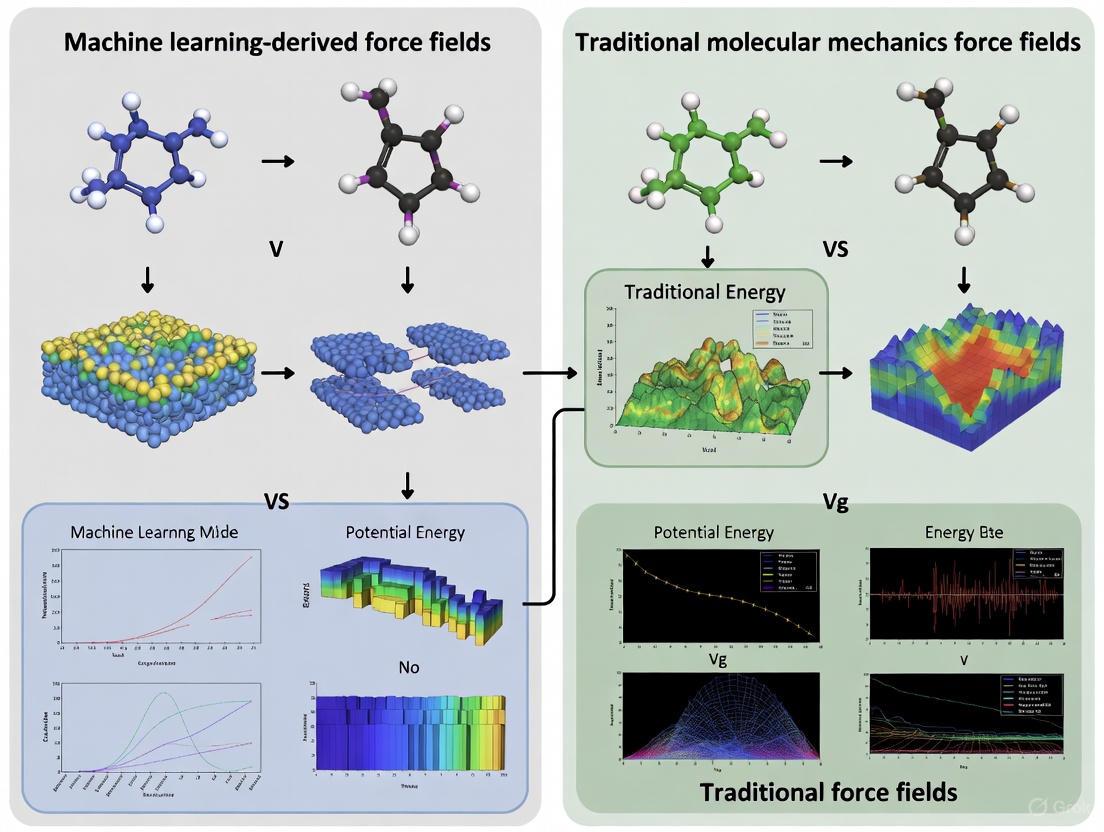
This article provides a comprehensive comparison between emerging machine learning-derived force fields and traditional molecular mechanics force fields, tailored for researchers and professionals in computational chemistry and drug development.
Machine Learning vs. Traditional Force Fields: A New Paradigm for Molecular Simulation and Drug Discovery
Abstract
This article provides a comprehensive comparison between emerging machine learning-derived force fields and traditional molecular mechanics force fields, tailored for researchers and professionals in computational chemistry and drug development. It explores the foundational principles of both approaches, detailing how ML force fields like Grappa and Vivace use graph neural networks to predict parameters directly from molecular structures, moving beyond the fixed atom types of traditional force fields. The content covers key methodological differences, practical applications in simulating biomolecules and polymers, and tackles central challenges such as data requirements, computational cost, and transferability. Finally, it synthesizes validation strategies and performance benchmarks, offering a forward-looking perspective on how ML force fields are set to enhance the accuracy and scope of molecular simulations in biomedical research.
From Fixed Parameters to Learned Potentials: Understanding Force Field Fundamentals
The Core Principles of Traditional Molecular Mechanics Force Fields
Molecular Mechanics (MM) force fields are the cornerstone of computational molecular modeling, providing the mathematical framework that enables the simulation of biological macromolecules and drug-like molecules at an atomistic level. These computational models describe the potential energy of a system as a function of nuclear coordinates, approximating the quantum mechanical energy surface with a classical mechanical model to decrease computational cost by orders of magnitude [1]. In the context of drug discovery, MM force fields remain the method of choice for protein simulations and protein-ligand binding studies, as they facilitate the simulation of entire proteins in aqueous environments over relevant timescales [1]. This article examines the fundamental principles, functional forms, parametrization strategies, and limitations of traditional MM force fields, providing a foundational comparison for evaluating emerging machine-learning alternatives.
Fundamental Components and Functional Forms
The core architecture of traditional MM force fields decomposes the total potential energy into distinct contributions from bonded and non-bonded interactions [2] [1]. This additive approach allows for computationally efficient evaluation of energy and forces, enabling molecular dynamics simulations of large systems.
Bonded Interactions
Bonded terms describe the energy associated with the covalent structure of molecules and are typically represented by simple analytical functions [2] [1].
Bond Stretching: The energy required to stretch or compress a chemical bond from its equilibrium length is most commonly modeled using a harmonic potential, analogous to a spring obeying Hooke's law [2]: ( E{\text{bond}} = \sum{\text{bonds}} Kb(b - b0)^2 ) where ( Kb ) is the bond force constant, ( b ) is the actual bond length, and ( b0 ) is the reference equilibrium bond length [1]. While a Morse potential provides a more realistic description that allows for bond breaking, it is computationally more expensive and rarely used in standard biomolecular force fields [2].
Angle Bending: The energy associated with the deviation of valence angles from their equilibrium values is also typically represented by a harmonic term [1]: ( E{\text{angle}} = \sum{\text{angles}} K\theta(\theta - \theta0)^2 ) where ( K\theta ) is the angle force constant, ( \theta ) is the actual angle, and ( \theta0 ) is the reference equilibrium angle.
Torsional Rotations: The energy barrier associated with rotation around chemical bonds is described by a periodic function [1]: ( E{\text{dihedral}} = \sum{\text{dihedrals}} \sum{n=1}^6 K{\phi,n}(1 + \cos(n\phi - \deltan)) ) where ( K{\phi,n} ) is the torsional force constant, ( n ) is the multiplicity, ( \phi ) is the dihedral angle, and ( \delta_n ) is the phase angle. Proper parametrization of dihedral terms is particularly crucial for accurately reproducing conformational energetics [1].
Improper Dihedrals: These terms enforce out-of-plane bending, typically to maintain the planarity of aromatic rings and other conjugated systems [2] [1]: ( E{\text{improper}} = \sum{\text{improper dihedrals}} K\varphi(\varphi - \varphi0)^2 )
Non-Bonded Interactions
Non-bonded terms describe interactions between atoms that are not directly connected by covalent bonds and primarily govern intermolecular interactions and long-range intramolecular effects [2].
Electrostatics: The classical Coulomb potential describes electrostatic interactions between atomic partial charges [2] [1]: ( E{\text{electrostatic}} = \sum{\text{nonbonded pairs } ij} \frac{qi qj}{4\pi D r{ij}} ) where ( qi ) and ( qj ) are partial charges, ( r{ij} ) is the interatomic distance, and ( D ) is the dielectric constant. The assignment of atomic charges is typically based on heuristic approaches using quantum mechanical calculations [2].
van der Waals Forces: The Lennard-Jones potential captures both attractive (dispersion) and repulsive (electron cloud overlap) components of van der Waals interactions [1]: ( E{\text{vdW}} = \sum{\text{nonbonded pairs } ij} \varepsilon{ij} \left[ \left( \frac{R{\min,ij}}{r{ij}} \right)^{12} - 2 \left( \frac{R{\min,ij}}{r{ij}} \right)^6 \right] ) where ( \varepsilon{ij} ) represents the well depth and ( R_{\min,ij} ) defines the distance at which the potential reaches its minimum [1].
Table 1: Core Energy Terms in Class I Additive Force Fields
| Energy Component | Functional Form | Key Parameters | Physical Basis |
|---|---|---|---|
| Bond Stretching | ( Kb(b - b0)^2 ) | ( Kb ), ( b0 ) | Covalent bond vibration |
| Angle Bending | ( K\theta(\theta - \theta0)^2 ) | ( K\theta ), ( \theta0 ) | Valence angle deformation |
| Proper Dihedral | ( K{\phi,n}(1 + \cos(n\phi - \deltan)) ) | ( K{\phi,n} ), ( n ), ( \deltan ) | Torsional rotation barrier |
| Improper Dihedral | ( K\varphi(\varphi - \varphi0)^2 ) | ( K\varphi ), ( \varphi0 ) | Out-of-plane bending |
| Electrostatics | ( \frac{qi qj}{4\pi D r_{ij}} ) | ( qi ), ( qj ) | Coulomb interaction between partial charges |
| van der Waals | ( \varepsilon{ij} \left[ \left( \frac{R{\min,ij}}{r{ij}} \right)^{12} - 2 \left( \frac{R{\min,ij}}{r_{ij}} \right)^6 \right] ) | ( \varepsilon{ij} ), ( R{\min,ij} ) | Dispersion and exchange-repulsion |
Diagram 1: Architecture of traditional molecular mechanics force fields showing the decomposition of total potential energy into bonded and non-bonded components.
The development of accurate force fields requires careful parameterization, where functional forms are combined with specific parameter sets to describe interactions at the atomistic level [2]. This process represents a significant challenge in force field development.
Parameter Determination Strategies
Force field parameters are derived through two primary approaches, often used in combination [2]:
Quantum Mechanical Calculations: High-quality quantum mechanical data on molecular geometries, vibrational frequencies, and torsion energy profiles provide target data for parametrizing bonded interactions and atomic charges [2] [3]. For example, the ByteFF force field was trained on QM data for 2.4 million optimized molecular fragment geometries with analytical Hessian matrices [3].
Experimental Data: Macroscopic experimental properties such as enthalpy of vaporization, enthalpy of sublimation, dipole moments, and liquid densities are used to refine parameters, particularly for non-bonded interactions [2]. This approach ensures the force field reproduces bulk material properties accurately.
Atom Typing and Transferability
A fundamental concept in traditional force fields is atom typing, where atoms are classified not only by element but also by their chemical environment [2]. For instance, oxygen atoms in water and oxygen atoms in carbonyl functional groups are assigned different force field types with distinct parameters [2]. This approach enables limited transferability, where parameters developed for small molecules can be applied to larger systems with similar chemical motifs [3]. However, this transferability is constrained by the predefined atom types and may fail for novel chemical structures not represented in the training set.
Table 2: Comparison of Force Field Parametrization Approaches
| Parametrization Aspect | Traditional Heuristic Approach | Modern Data-Driven Approach |
|---|---|---|
| Parameter Assignment | Look-up tables based on atom types | Graph neural networks predicting parameters [3] |
| Chemical Environment Handling | SMIRKS patterns [3] | Continuous learned representations [3] |
| Training Data Source | Combination of QM calculations and experimental data [2] | Large-scale QM datasets (millions of molecules) [3] |
| Transferability | Limited by predefined atom types and chemical patterns | Potentially broader coverage of chemical space [3] |
| Dihedral Treatment | Predefined torsion parameters with limited coverage | Extensive torsion profiles (e.g., 3.2 million in ByteFF) [3] |
Classification and Generations of Force Fields
Traditional force fields can be categorized into different classes based on their complexity and the physical phenomena they incorporate [1] [4].
Class I Force Fields
Class I potential energy functions represent the most widely used category in biomolecular simulations [1]. These employ simple harmonic potentials for bond and angle terms, periodic functions for dihedrals, and pairwise additive non-bonded interactions [1]. Popular Class I force fields include AMBER, CHARMM, OPLS, and GROMOS, which form the backbone of contemporary molecular dynamics simulations in drug discovery [1]. Their computational efficiency makes them suitable for simulating large systems over extended timescales, but they lack explicit treatment of electronic polarization and may struggle with accurately modeling heterogeneous environments.
Class II and III Force Fields
More sophisticated force fields incorporate additional physical effects to improve accuracy [1]:
Anharmonicity: Class II and III force fields include cubic and/or quartic terms in the potential energy for bonds and angles, allowing for more accurate reproduction of quantum mechanical potential energy surfaces and experimental vibrational spectra [1].
Cross Terms: These force fields incorporate coupling between internal coordinates, such as bond-bond, bond-angle, and angle-torsion cross terms, to better model vibrational spectra and subtle structural effects [1].
Polarizability: Advanced force fields include explicit polarization effects through methods such as fluctuating charges, Drude oscillators, or induced dipoles, though these come with significantly increased computational cost [2] [1].
Diagram 2: Traditional force field development workflow showing the iterative process of parameter optimization against quantum mechanical and experimental target data.
Limitations and Challenges
Despite their widespread success, traditional molecular mechanics force fields face several fundamental limitations that impact their accuracy and transferability.
Fixed Functional Forms
The predetermined analytical forms used in MM force fields inherently limit their ability to capture the full complexity of quantum mechanical potential energy surfaces [3]. This is particularly problematic for systems where non-pairwise additivity of non-bonded interactions is significant or where the simple functional forms cannot adequately represent complex bonding situations [3].
Limited Transferability
Traditional force fields struggle with transferability—the ability to accurately simulate conditions beyond those for which they were specifically optimized [5]. This limitation becomes particularly evident when exploring the vast chemical space of drug-like molecules or synthetic polymers, where chemical environments may differ significantly from the training data used for parameterization [5].
Fixed Charge Models
The additive electrostatic model used in most biomolecular force fields employs fixed partial charges that cannot respond to changes in their electrostatic environment [1]. This limitation affects the accuracy of simulations in heterogeneous environments such as protein-ligand binding sites or membrane interfaces, where polarization effects can be substantial [1].
Inability to Model Bond Breaking
Standard Class I force fields cannot simulate chemical reactions because their harmonic bond potentials do not allow for bond dissociation [5]. While reactive force fields such as ReaxFF have been developed to address this limitation, they require laborious reparameterization for different chemical systems [6].
Table 3: Key Resources for Traditional Force Field Research and Application
| Resource Category | Specific Examples | Function and Application |
|---|---|---|
| Force Field Databases | OpenKim [2], TraPPE [2], MolMod [2] | Collections of parameter sets for different molecular systems |
| Parameterization Tools | FFBuilder [3], SMIRKS patterns [3] | Assist in developing and refining force field parameters |
| Quantum Chemistry Codes | Gaussian, ORCA, PSI4 | Generate reference data for force field parametrization |
| Molecular Dynamics Engines | GROMACS, AMBER, NAMD, OpenMM | Perform simulations using force field parameters |
| Experimental Reference Data | Enthalpy of vaporization, liquid densities, vibrational spectra | Experimental validation of force field accuracy [2] |
Traditional molecular mechanics force fields provide a computationally efficient framework for simulating molecular systems through their decomposition of potential energy into physically intuitive bonded and non-bonded terms. The Class I additive potential energy function, with its harmonic bond and angle terms, periodic torsions, and pairwise non-bonded interactions, has proven remarkably successful across diverse applications in drug discovery and materials science. However, fundamental limitations arising from fixed functional forms, limited transferability, and the inability to model chemical reactions and polarization effects have motivated the development of machine-learning approaches. Understanding these core principles and limitations provides essential context for evaluating the performance and advancements of emerging machine learning force fields in computational chemistry and drug design.
Molecular dynamics (MD) simulations are a cornerstone of modern computational science, enabling the study of material properties and biomolecular processes at the atomic level. The underlying engine of these simulations is the force field (FF)—a mathematical model that describes the potential energy surface and forces acting within a molecular system. For decades, traditional molecular mechanics force fields have dominated this landscape, operating under a fundamental constraint: the trade-off between computational efficiency and physical accuracy. While highly optimized for simulating large systems over extended timescales, these conventional FFs often lack the quantum-mechanical precision required for predictive modeling. The emergence of machine learning force fields (MLFFs) represents a paradigm shift, offering a path to reconcile this long-standing compromise. This guide provides a comprehensive comparison between these approaches, examining their theoretical foundations, performance benchmarks, and practical applications in contemporary research.
Fundamental Concepts and Comparison Framework
Traditional Molecular Mechanics Force Fields
Traditional force fields employ physics-inspired analytical functions with pre-defined parameters to describe interatomic interactions. The total potential energy is typically decomposed into bonded terms (bond stretching, angle bending, dihedral torsions) and non-bonded terms (van der Waals, electrostatic interactions):
[ E{\text{total}} = E{\text{bond}} + E{\text{angle}} + E{\text{torsion}} + E{\text{vdW}} + E{\text{electrostatic}} ]
These additive all-atom FFs assign fixed partial charges to each atom and calculate non-bonded interactions using a pairwise additive approximation [7]. Their efficiency stems from these simplified functional forms, but this very simplification limits their ability to capture complex quantum mechanical effects such as polarization, charge transfer, and bond formation/breaking.
A significant limitation of traditional FFs is their reliance on atom typing—a manual classification system where parameters are assigned based on chemical identity and local environment. This process is labor-intensive and inherently limited to chemical spaces covered by existing parameter sets [7]. Furthermore, traditional FFs typically require reparameterization for different conditions or molecule types, lacking true transferability across diverse chemical environments [5].
Machine Learning Force Fields
MLFFs replace the pre-defined functional forms of traditional FFs with flexible, data-driven models trained on high-fidelity quantum mechanical calculations or experimental data. Unlike traditional FFs with their fixed mathematical expressions, MLFFs learn the relationship between atomic configurations and potential energies/forces directly from reference data [8].
Two primary architectural paradigms have emerged:
End-to-End MLFFs: These models directly map atomic configurations to energies and forces using sophisticated neural network architectures such as Graph Neural Networks (GNNs) or equivariant networks [8] [5] [9]. Examples include MACE-OFF and Vivace, which demonstrate remarkable transferability across organic molecules and polymers, respectively.
ML-Augmented Molecular Mechanics: This hybrid approach retains the computational efficiency of traditional FF functional forms but uses machine learning to predict their parameters. Grappa exemplifies this strategy, employing a graph neural network to predict MM parameters directly from molecular structure, thereby eliminating the need for manual atom typing [10].
Table 1: Fundamental Characteristics of Traditional vs. Machine Learning Force Fields
| Feature | Traditional Force Fields | Machine Learning Force Fields |
|---|---|---|
| Functional Form | Pre-defined, physics-based analytical functions | Flexible, data-driven models (e.g., neural networks) |
| Parameterization | Manual atom typing and empirical fitting | Learned automatically from reference data (QM or experimental) |
| Computational Cost | Very low | Moderate to high (but significantly cheaper than QM) |
| Accuracy | Limited by functional form; system-dependent | Can approach quantum mechanical accuracy |
| Transferability | Limited to parameterized chemical spaces | High; can generalize to unseen molecules |
| Bond Breaking/Forming | Generally not possible without reparameterization | Can be modeled inherently by some architectures |
| Long-Range Interactions | Approximated via fixed charges or polarizable models | Varies; some include explicit long-range treatments |
Experimental Performance Benchmarks
Quantitative Accuracy Comparisons
Rigorous benchmarking against experimental data and quantum mechanical references reveals significant performance differences between traditional and machine learning FFs.
Organic Molecules and Biomolecules: The MACE-OFF force field demonstrates exceptional capability in reproducing gas and condensed-phase properties of organic molecules. It accurately predicts dihedral torsion scans of unseen molecules, describes molecular crystals and liquids reliably (including quantum nuclear effects), and determines free energy surfaces in explicit solvent [9]. Notably, MACE-OFF successfully simulates the folding dynamics of peptides and enables nanosecond-scale simulation of fully solvated proteins, achieving accuracy previously inaccessible to traditional FFs at comparable computational cost [9].
Polymer Systems: A recent study introduced PolyArena, a benchmark for evaluating MLFFs on experimentally measured polymer properties including densities and glass transition temperatures (Tgs) [5]. The Vivace MLFF significantly outperformed established classical FFs in predicting polymer densities and captured second-order phase transitions, enabling accurate estimation of polymer Tgs—a longstanding challenge in molecular modeling [5].
Broad Chemical Space Evaluation: The UniFFBench framework systematically evaluated six state-of-the-art UMLFFs against approximately 1,500 experimentally determined mineral structures [11]. This comprehensive assessment revealed that while the best-performing MLFFs achieve mean absolute percentage errors below 10% for density and lattice parameters, they still systematically exceed the experimentally acceptable density variation threshold of 2-5% required for practical applications [11]. This "reality gap" highlights remaining challenges in bridging computational accuracy with experimental precision.
Table 2: Performance Comparison of Force Fields Across Different Material Classes
| Material System | Traditional FF Performance | MLFF Performance | Key Metrics |
|---|---|---|---|
| Organic Molecules | Moderate accuracy for equilibrium properties; poor transferability | High accuracy for torsion barriers, crystal properties, and solvation free energies [9] | Dihedral scans, lattice parameters, free energy surfaces |
| Proteins/Peptides | Adequate for folded state stability; limitations in conformational sampling | Accurate folding dynamics of small peptides; stable µs-scale protein simulations [9] | Folding pathways, J-coupling constants, stability metrics |
| Polymers | Limited transferability; unable to predict Tg from first principles | Accurate density prediction (<5% error); captures glass transition phenomena [5] | Density, Tg, thermal expansion coefficients |
| Complex Minerals | Often unstable or inaccurate for multi-element systems | Variable performance; best models achieve <10% MAPE for lattice parameters [11] | Density, lattice parameters, elastic tensors |
Data Fusion Strategies
A particularly promising approach for enhancing MLFF accuracy involves fusing data from both quantum mechanical calculations and experimental measurements. Research on titanium systems demonstrates that ML potentials can be concurrently trained on Density Functional Theory (DFT) calculations and experimentally measured mechanical properties and lattice parameters [8]. This fused data learning strategy satisfies all target objectives simultaneously, resulting in molecular models with higher accuracy compared to models trained on a single data source [8]. The inaccuracies of DFT functionals for target experimental properties were corrected through this approach, while off-target properties were generally unaffected or mildly improved [8].
Diagram 1: Fused Data Training Workflow for Enhanced MLFF Accuracy
Detailed Experimental Protocols
Fused Data Learning Methodology
The integrated training of MLFFs using both computational and experimental data follows a structured protocol:
DFT Data Generation: Perform high-throughput DFT calculations to generate a diverse dataset of atomic configurations with corresponding energies, forces, and virial stresses. For titanium, this involved 5,704 samples including equilibrated, strained, and randomly perturbed structures across multiple phases (hcp, bcc, fcc), along with configurations from high-temperature MD simulations [8].
Experimental Data Curation: Collect experimentally measured properties under well-defined conditions. For the titanium case study, researchers used temperature-dependent elastic constants of hcp titanium measured at 22 different temperatures (4-973 K) and corresponding lattice constants [8].
Alternating Training Protocol: Implement an iterative training scheme that alternates between:
- DFT Trainer: Optimizes ML potential parameters to match DFT-calculated energies, forces, and virial stresses using standard regression.
- EXP Trainer: Employs the Differentiable Trajectory Reweighting (DiffTRe) method to optimize parameters such that properties from ML-driven simulations match experimental values, avoiding backpropagation through entire MD trajectories [8].
Model Selection: Train models for a fixed number of epochs with early stopping based on validation performance. Comparative approaches include DFT-pre-trained models (DFT trainer only), DFT-EXP sequential models (EXP trainer only), and DFT & EXP fused models (alternating trainers) [8].
ML-Augmented Molecular Mechanics Parameterization
The Grappa framework implements a specialized protocol for machine-learned molecular mechanics:
Molecular Graph Representation: Represent the molecular system as a graph where nodes correspond to atoms and edges represent chemical bonds.
Atom Embedding Generation: Process the molecular graph using a graph attentional neural network to generate d-dimensional atom embeddings that encode chemical environments [10].
MM Parameter Prediction: For each interaction type (bonds, angles, torsions, impropers), predict MM parameters using transformer modules that operate on the embeddings of participating atoms, respecting appropriate permutation symmetries [10].
Energy Evaluation: Compute the potential energy using standard molecular mechanics energy functions with the predicted parameters, enabling compatibility with existing MD software such as GROMACS and OpenMM [10].
End-to-End Optimization: Differentiably optimize the model parameters to reproduce quantum mechanical energies and forces, leveraging the differentiability of the entire mapping from molecular graph to potential energy [10].
Research Reagent Solutions
Table 3: Essential Computational Tools for Force Field Development and Validation
| Tool Name | Type | Primary Function | Application Context |
|---|---|---|---|
| Grappa [10] | ML-FF framework | Predicts MM parameters from molecular graphs | Biomolecular simulations with MM efficiency and enhanced accuracy |
| MACE-OFF [9] | Transferable ML-FF | Short-range potential for organic molecules | Drug discovery, peptide folding, material property prediction |
| Vivace [5] | Polymer ML-FF | Specialized architecture for polymer systems | Prediction of polymer densities and glass transition temperatures |
| DiffTRe [8] | Training algorithm | Enables gradient-based training on experimental data | Fusing experimental observations into ML potential training |
| UniFFBench [11] | Benchmarking framework | Evaluates MLFFs against experimental measurements | Systematic validation of force field reliability and transferability |
| PolyArena [5] | Benchmark dataset | Experimental polymer properties for validation | Performance assessment on industrially relevant polymer systems |
The longstanding compromise between accuracy and efficiency in molecular simulations is being fundamentally transformed by machine learning approaches. Traditional force fields, while computationally efficient and deeply integrated into biomolecular simulation workflows, face inherent limitations in accuracy and transferability due to their simplified functional forms and dependency on manual parameterization. Machine learning force fields demonstrate superior accuracy in reproducing quantum mechanical and experimental observations across diverse systems—from organic molecules and polymers to complex minerals—while maintaining computational costs orders of magnitude lower than quantum mechanical methods.
Nevertheless, important challenges remain for MLFFs. Computational expense relative to traditional FFs still limits their application to extremely large systems or millisecond timescales. Benchmarking studies reveal a persistent "reality gap" between quantum mechanical accuracy and experimental precision [11]. The most promising paths forward include continued development of fused data learning strategies that integrate both computational and experimental information [8], architectural innovations that balance expressivity with computational efficiency [5] [9], and comprehensive benchmarking frameworks grounded in experimental measurements [11]. As these technologies mature, MLFFs are positioned to enable truly predictive molecular simulations across chemistry, materials science, and drug discovery.
The Rise of Machine Learning in Molecular Modeling
Molecular modeling stands as a cornerstone of modern scientific inquiry, enabling researchers to probe the structure, dynamics, and function of molecules at an atomic level. For decades, this field has been governed by a fundamental compromise: researchers could prioritize either computational efficiency or quantum-level accuracy, but not both simultaneously. Traditional molecular mechanics (MM) force fields, with their fixed functional forms and predefined parameters, offered the computational speed necessary to simulate large biological systems like proteins over biologically relevant timescales. However, this efficiency came at the cost of reduced accuracy, particularly for systems where electronic effects dominate. Conversely, quantum mechanical (QM) methods provide high accuracy but at computational costs that render them prohibitive for systems exceeding a few hundred atoms or simulations longer than nanoseconds [10].
The emergence of machine learning force fields (MLFFs) represents a paradigm shift, offering a path to reconcile this longstanding trade-off. By leveraging pattern recognition capabilities of neural networks trained on quantum mechanical data, MLFFs learn the underlying potential energy surface of molecular systems, achieving accuracy approaching their QM training data while maintaining computational costs comparable to traditional MM force fields [10] [8]. This transformative capability is reshaping computational chemistry, materials science, and drug discovery, enabling researchers to explore molecular phenomena with unprecedented fidelity and scale. This guide provides a comprehensive comparison of ML-derived force fields against traditional molecular mechanics approaches, examining their respective architectures, performance metrics, and applicability across diverse scientific domains.
Technical Foundations: Architectural Comparison
Traditional Molecular Mechanics Force Fields
Traditional MM force fields employ physics-inspired functional forms with parameters derived from experimental data and quantum calculations. The total potential energy is typically decomposed into bonded terms (bonds, angles, dihedrals) and non-bonded terms (van der Waals, electrostatic) [10]:
\[
E{\text{MM}} = \sum{\text{bonds}} k{ij}(r{ij}-r{ij}^{(0)})^2 + \sum{\text{angles}} k{ijk}(\theta{ijk}-\theta{ijk}^{(0)})^2 + \sum{\text{torsions}} \sumn k{ijkl}^{(n)}\left[1+\cos(n\phi{ijkl}-\phi{ijkl}^{(0)})\right] + \sum{i
These force fields rely on a finite set of atom types characterized by chemical properties, with parameters assigned via lookup tables. This approach provides excellent computational efficiency and interpretability but suffers from limited transferability and accuracy, particularly for chemical environments not well-represented in the parameterization set [10] [4].
Machine Learning Force Fields
MLFFs replace the fixed functional forms of traditional approaches with flexible neural network architectures that learn the relationship between atomic configurations and potential energy. Most modern MLFFs adopt graph-based representations where atoms constitute nodes and chemical bonds form edges, with message-passing operations enabling information exchange across the molecular structure [10] [5].
The Grappa force field exemplifies this approach, employing a graph attentional neural network to construct atom embeddings from molecular graphs, followed by a transformer with symmetry-preserving positional encoding to predict MM parameters [10]. This architecture respects the permutation symmetries inherent in molecular systems while learning chemically aware representations directly from data.
For complex materials systems, models like Vivace implement strictly local SE(3)-equivariant graph neural networks, ensuring rotational and translational invariance while maintaining computational efficiency for large-scale simulations [5]. The fundamental distinction lies in MLFFs learning the energy function from data rather than relying on predetermined physical approximations.
Multi-Fidelity and Hybrid Approaches
Recent advances have introduced multi-fidelity MLFF frameworks that integrate diverse data sources of varying accuracy levels. These architectures employ a shared graph neural network backbone with dedicated output heads and composite loss functions to harmonize low-cost computational data (e.g., non-magnetic DFT) with high-fidelity references (e.g., CCSD(T) or experimental measurements) [12]. By simultaneously leveraging abundant low-fidelity and scarce high-fidelity data, these approaches achieve chemical accuracy with minimal reliance on prohibitively expensive reference calculations, significantly enhancing data efficiency for complex materials systems [12].
Performance Comparison: Quantitative Benchmarks
Accuracy Metrics on Standardized Benchmarks
Rigorous evaluation through community benchmarks provides critical insights into the relative performance of MLFFs versus traditional approaches. The TEA Challenge 2023 conducted comprehensive assessments of modern MLFFs including MACE, SO3krates, sGDML, SOAP/GAP, and FCHL19* across diverse molecular systems, interfaces, and periodic materials [13].
Table 1: Force Field Performance Comparison
| Force Field | System Type | Energy MAE (meV/atom) | Force MAE (meV/Å) | Reference |
|---|---|---|---|---|
| Grappa (ML) | Small molecules | ~43 (chemical accuracy) | ~80 | [10] |
| Traditional MM | Small molecules | >100 | >150 | [10] |
| Vivace (ML) | Polymers | N/A | ~40-60 | [5] |
| Classical FF | Polymers | N/A | >100 | [5] |
| DFT & EXP fused | Titanium | ~43 | ~80 | [8] |
| DFT-only | Titanium | ~43 | ~80 | [8] |
The data demonstrates that MLFFs consistently achieve errors significantly lower than traditional force fields, with several models reaching chemical accuracy (approximately 43 meV/atom) that has long been considered the gold standard in computational chemistry [10] [8]. For polymer systems, MLFFs like Vivace demonstrate substantial improvements in force prediction accuracy, which directly translates to more reliable molecular dynamics simulations and property predictions [5].
Experimental Property Reproduction
Beyond quantum mechanical accuracy, the true test for any force field lies in its ability to reproduce experimentally measurable properties. Recent studies have evaluated MLFFs against critical experimental benchmarks including densities, glass transition temperatures, reduction potentials, and electron affinities [5] [8] [14].
Table 2: Experimental Property Prediction Accuracy
| Property | System | MLFF Performance | Traditional FF Performance | Reference |
|---|---|---|---|---|
| Density | Various polymers | ~2-5% error | ~5-15% error | [5] |
| Glass transition | Various polymers | Captures transition | Varies significantly | [5] |
| J-couplings | Peptides | Closely reproduces | Requires correction maps | [10] |
| Reduction potential | Organometallics | MAE: 0.262-0.365 V | MAE: 0.414 V (B97-3c) | [14] |
| Elastic constants | Titanium | Matches experiment | Deviates from experiment | [8] |
For polymer property prediction, MLFFs demonstrate remarkable capability in capturing complex phenomena like glass transitions, which require accurate description of both local and non-local interactions across multiple length and time scales [5]. In electrochemical applications, OMol25-trained neural network potentials predict reduction potentials for organometallic species with accuracy exceeding traditional DFT methods, despite not explicitly considering Coulombic interactions in their architecture [14].
Methodologies: Experimental Protocols
Training Workflows for Machine Learning Force Fields
The development of accurate MLFFs follows carefully designed training protocols that vary depending on data availability and target applications. Two primary paradigms have emerged: bottom-up learning from quantum mechanical data and top-down learning from experimental observations, with fused approaches combining both strategies [8].
Bottom-up learning employs high-fidelity quantum calculations—typically density functional theory or coupled cluster theory—to generate energies, forces, and virial stresses for diverse atomic configurations [8]. These data serve as training targets for the neural network, with models typically optimized using composite loss functions that balance energy, force, and stress errors:
\[ \mathcal{L} = \lambdaE \ellH(E{\text{pred}} - E{\text{DFT}}) + \lambdaF \ellH(\mathbf{F}{\text{pred}} - \mathbf{F}{\text{DFT}}) + \lambda\sigma \ellH(\boldsymbol{\sigma}{\text{pred}} - \boldsymbol{\sigma}{\text{DFT}}) \]
where \(\ell_H\) represents the Huber loss function that combines MSE and MAE advantages [12].
Top-down learning directly incorporates experimental measurements like elastic constants, lattice parameters, and thermodynamic properties into the training process through differentiable trajectory reweighting techniques [8]. This approach circumvents limitations of quantum methods while ensuring agreement with empirical observations.
Fused data learning strategies, as demonstrated for titanium systems, alternate between DFT and experimental trainers, enabling simultaneous reproduction of quantum mechanical predictions and experimental measurements [8]. This hybrid approach corrects known DFT inaccuracies while maintaining the comprehensive coverage provided by quantum training data.
Simulation and Validation Protocols
Robust validation of force fields requires standardized simulation protocols and comprehensive benchmarking against diverse properties. For biomolecular force fields like Grappa, validation includes:
- Energy and force accuracy on held-out quantum mechanical datasets [10]
- Dihedral angle potential energy scans compared to high-level quantum calculations [10]
- J-couplings comparison to experimental NMR measurements [10]
- Protein folding stability through molecular dynamics simulations of fast-folding proteins [10]
- Transferability assessments on chemically distinct systems like peptide radicals [10]
For materials-focused force fields, validation typically includes:
- Lattice constant prediction across temperature ranges [8]
- Elastic constant calculation compared to experimental measurements [8]
- Phase behavior through analysis of phase transitions [5]
- Bulk property prediction including densities and thermal expansion [5] [8]
Molecular dynamics simulations for validation are typically performed using highly optimized engines like GROMACS, OpenMM, or LAMMPS, with simulation parameters carefully controlled to enable direct comparison between different force fields [10] [13].
Software and Computational Infrastructure
Table 3: Essential Research Tools for MLFF Development and Application
| Tool | Function | Application |
|---|---|---|
| GROMACS | Molecular dynamics engine | High-performance biomolecular simulation [10] |
| OpenMM | GPU-accelerated MD | Rapid force field validation [10] |
| PyTorch, JAX | Deep learning frameworks | ML model development and training [10] [5] |
| Allegro, MACE | MLFF architectures | Equivariant neural network potentials [5] [13] |
| Differentiable Trajectory Reweighting | Gradient calculation through MD | Training on experimental data [8] |
Benchmark Datasets and Training Data
The development of accurate MLFFs relies on high-quality, diverse datasets for training and evaluation:
- OMol25: Over 100 million computational chemistry calculations at ωB97M-V/def2-TZVPD level for general molecular applications [14]
- PolyData: Specifically designed polymer datasets including packed structures (PolyPack), dissociated chains (PolyDiss), and molecular fragments (PolyCrop) [5]
- Espaloma dataset: Over 14,000 molecules and one million conformations covering small molecules, peptides, and RNA [10]
- PolyArena: Experimental densities and glass transition temperatures for 130 polymers under standard conditions [5]
Applications and Transferability
Biomolecular Simulations
Grappa demonstrates exceptional capability in biomolecular modeling, accurately predicting energies and forces for small molecules, peptides, and RNA at state-of-the-art MM accuracy [10]. The force field reproduces experimentally measured J-couplings without requiring correction maps like CMAP used in traditional protein force fields. Most significantly, Grappa exhibits remarkable transferability to macromolecular systems, enabling stable molecular dynamics simulations from small fast-folding proteins up to complete virus particles, with the same computational cost as established protein force fields [10].
Polymer and Materials Science
Machine learning force fields have shown particular promise in polymer science, where traditional force fields often struggle with transferability across diverse chemical structures. Vivace accurately predicts polymer densities and captures second-order phase transitions, enabling prediction of glass transition temperatures that have long challenged computational models [5]. For complex materials systems, multi-fidelity MLFF frameworks have demonstrated accurate prediction of alloy mixing energies and ionic conductivities even when high-fidelity training data is sparse or unavailable [12].
Chemical Space Exploration
The data-driven nature of MLFFs facilitates extension into uncharted regions of chemical space without requiring manual parameterization. Grappa's simple input features and high data efficiency make it well-suited for modeling exotic chemical species, as demonstrated for peptide radicals [10]. Similarly, foundational MLFFs like those trained on the OMol25 dataset exhibit surprising accuracy for charge-related properties of organometallic species despite not explicitly considering Coulombic physics in their architecture [14].
Limitations and Future Directions
Despite remarkable progress, machine learning force fields face several important challenges. Long-range noncovalent interactions remain problematic for many MLFF architectures, requiring special caution in simulations where such interactions dominate [13]. The computational cost of MLFFs, while significantly lower than quantum methods, still exceeds traditional MM force fields by approximately one order of magnitude, though this gap continues to narrow with architectural improvements [10] [5].
The field is rapidly evolving toward multi-fidelity approaches that leverage diverse data sources, foundation models pretrained on extensive chemical spaces, and improved architectures for capturing long-range interactions and electronic effects [12]. As benchmark methodologies mature and standardized evaluation protocols emerge, the integration of machine learning force fields into mainstream research workflows is expected to accelerate, potentially transforming computational molecular modeling across chemistry, materials science, and drug discovery.
Machine learning force fields represent a transformative advancement in molecular modeling, effectively bridging the longstanding divide between computational efficiency and quantum-level accuracy. Through comprehensive benchmarking across diverse molecular systems, MLFFs consistently demonstrate superior accuracy compared to traditional molecular mechanics approaches while maintaining the computational performance necessary for biologically and industrially relevant simulations.
As the field matures, the combination of bottom-up learning from quantum data and top-down learning from experimental observations promises to deliver force fields of unprecedented accuracy and transferability. For researchers and developers, this evolving landscape offers powerful new tools to probe molecular phenomena with fidelity that was previously inaccessible, potentially accelerating discovery across domains from drug development to advanced materials design.
The development of molecular mechanics force fields (FFs) has long been governed by empirical parametrization and fixed functional forms, creating a persistent trade-off between accuracy and computational efficiency. Machine learning-derived force fields (MLFFs) are disrupting this paradigm by leveraging data-driven approaches to achieve quantum-level accuracy while maintaining the speed of classical simulations. This guide provides an objective comparison of MLFFs against traditional FFs, detailing their performance, underlying methodologies, and practical applications in drug discovery. Supported by experimental data, we demonstrate that MLFFs represent a significant advancement, enabling more reliable predictions of biomolecular interactions, ligand binding, and solvation phenomena.
Molecular dynamics (MD) simulations are indispensable in computational chemistry and drug discovery, enabling the study of biomolecular structure, dynamics, and interactions at atomic resolution. The accuracy of these simulations hinges entirely on the quality of the force field (FF)—the mathematical model that describes the potential energy of a system as a function of its atomic coordinates.
Traditional molecular mechanics (MM) FFs, such as those in the AMBER, CHARMM, and OPLS families, employ pre-defined physical functional forms for bonded and non-bonded interactions, with parameters assigned based on a finite set of atom types. While highly efficient, this approach sacrifices accuracy and transferability, particularly for chemically diverse molecules or non-equilibrium configurations [10]. The limitations of traditional FFs are especially apparent in the simulation of RNA–ligand complexes, where maintaining structural fidelity and stable binding poses remains challenging [15].
Machine learning-derived force fields (MLFFs) represent a paradigm shift. Instead of relying on fixed functional forms, MLFFs learn the relationship between molecular structure and potential energy directly from reference quantum mechanical (QM) data or even experimental observations [16] [8]. This data-driven approach bypasses many approximations inherent in traditional FFs, offering a path to quantum accuracy at a fraction of the computational cost of ab initio MD. This guide objectively compares the performance, methodologies, and applications of this new generation of force fields against established alternatives.
Comparative Performance Data
The following tables summarize key quantitative comparisons between MLFFs and traditional FFs across various benchmarks, including energy and force accuracy, torsional profile reproduction, and performance in free energy calculations.
Table 1: Overall Accuracy Benchmarks for Small Molecules and Peptides
| Force Field | Type | Energy MAE (meV) | Force MAE (meV/Å) | Torsion Energy MAE | Reference |
|---|---|---|---|---|---|
| Grappa | MLFF (MM-based) | Not Specified | Not Specified | Outperforms FF19SB (no CMAP) | [10] |
| ByteFF | MLFF (MM-based) | State-of-the-art | State-of-the-art | State-of-the-art | [17] |
| Organic_MPNICE | MLFF (MLP) | Not Specified | Not Specified | Not Specified | [18] |
| AMBER FF19SB | Traditional MM | Not Applicable | Not Applicable | Reference (requires CMAP) | [10] |
| DFT Pre-trained MLP | MLFF (MLP) | < 43 | Reported | Not Specified | [8] |
Table 2: Performance in Free Energy and Binding Calculations
| Force Field / Method | HFE MAE (kcal/mol) | Application Notes | Reference |
|---|---|---|---|
| Organic_MPNICE (MLFF) | < 1.0 | 59 diverse organic molecules; outperforms classical FFs and implicit solvation | [18] |
| State-of-the-art Classical FF | > 1.0 | Fundamentally limited by simplified functional forms | [18] |
| DFT Implicit Solvation | > 1.0 | Less accurate than the MLFF workflow | [18] |
| Current RNA FFs (e.g., OL3) | N/A | Struggles with consistently stable RNA-ligand complexes | [15] |
Table 3: Performance in Reproducing Experimental Observables
| Force Field / Approach | Lattice Parameters | Elastic Constants | Phase Diagram | Reference |
|---|---|---|---|---|
| DFT & EXP Fused MLP | Accurate | Accurate | Improved | [8] |
| DFT-only MLP | Inaccurate | Inaccurate | Often Deviates | [8] |
| Classical MEAM Potential | Inaccurate | Inaccurate | Not Specified | [8] |
Experimental Protocols and Validation
The superior performance of MLFFs is validated through rigorous and standardized computational experiments. Below are the detailed methodologies for key benchmark tests cited in this guide.
Hydration Free Energy (HFE) Calculations
The accurate prediction of HFEs is a critical test for any force field in drug discovery, as it directly relates to solvation and binding.
- Workflow: A robust and general protocol was used, combining the broadly trained
Organic_MPNICEMLFF with enhanced sampling techniques [18]. - System Preparation: A diverse set of 59 organic molecules was selected. The MLFF was applied to both solute and solvent molecules in explicit water simulations.
- Sampling: The solute-tempering technique was employed to achieve sufficient conformational and statistical sampling, which is crucial for converging the free energy estimate.
- Free Energy Calculation: The free energy perturbation (FEP) method was used to compute the HFE relative to experimental measurements.
- Result: The MLFF-based workflow achieved a sub-kcal/mol mean absolute error, a significant improvement over state-of-the-art classical FFs [18].
RNA–Ligand Complex Stability
Assessing the ability of FFs to maintain experimental structures and stable interactions in challenging biomolecular systems.
- System Selection: 10 RNA–small molecule structures were curated from the HARIBOSS database, encompassing diverse RNA topologies (double helices, hairpins) and binding modes (groove binding, intercalation) [15].
- Simulation Protocol: Each system was simulated for 1 μs using multiple state-of-the-art FFs (e.g., OL3, DES-AMBER) in AMBER20 or GROMACS2023. Ligands were parametrized with GAFF2 and RESP2 charges for a direct comparison [15].
- Analysis Metrics:
- RMSD and LoRMSD: Measured the structural drift of the entire RNA and the ligand relative to the RNA backbone, respectively.
- Contact Map Analysis: Quantified the stability of native RNA-ligand contacts and the formation of non-native interactions over the simulation trajectory [15].
- Key Finding: Current traditional FFs, while improving, still show ligand mobility and contact instability, whereas MLFFs like Grappa show promise in reproducing experimentally measured J-couplings for RNA [15] [10].
Fused Data Learning for Materials Properties
This innovative protocol addresses the inaccuracies of DFT-based training by directly incorporating experimental data.
- Training Loop: The method alternates between two trainers [8]:
- DFT Trainer: Performs standard regression to match QM-calculated energies, forces, and virial stress from a database of atomic configurations.
- EXP Trainer: Uses the Differentiable Trajectory Reweighting (DiffTRe) method to optimize the MLFF so that properties (e.g., elastic constants) computed from MD simulations match experimental values.
- Target Data: For titanium, training used a DFT database (5,704 configurations) and experimental hcp elastic constants measured at four temperatures (23–923 K) [8].
- Validation: The "fused" model was validated on out-of-target properties like phonon spectra and liquid phase properties, showing mostly positive transferability [8].
The following diagram illustrates the fused data learning workflow.
The Scientist's Toolkit: Essential Research Reagents
This section catalogs key software tools, datasets, and force fields that constitute the essential "research reagents" in the MLFF landscape.
Table 4: Key Research Reagents in MLFF Development
| Tool / Resource | Type | Function & Application | Reference |
|---|---|---|---|
| Grappa | Machine Learned MM Force Field | Predicts MM parameters from molecular graphs; offers high accuracy with standard MD efficiency in GROMACS/OpenMM. | [10] |
| ByteFF | Machine Learned MM Force Field | Amber-compatible FF for drug-like molecules; trained on massive QM dataset for expansive chemical space coverage. | [17] |
| Q-Force | Automated Parameterization Toolkit | Systematically derives bonded coupling terms for force fields, enabling novel treatments of 1-4 interactions. | [19] |
| DiffTRe | Differentiable Learning Algorithm | Enables gradient-based optimization of MLFFs directly from experimental data without backpropagating through entire MD trajectories. | [8] |
| HARIBOSS | Curated Structural Database | A collection of RNA-small molecule complex structures used for rigorous validation of force fields in drug-binding contexts. | [15] |
| Espaloma Dataset | Benchmark QM Dataset | Contains over 14,000 molecules and 1M+ conformations for training and testing MLFFs on small molecules, peptides, and RNA. | [10] |
The evidence from comparative benchmarks indicates that machine learning-derived force fields constitute a genuine paradigm shift in molecular simulation. MLFFs consistently demonstrate superior accuracy in predicting energies, forces, and critical drug discovery properties like hydration free energies, while also showing unique capabilities in integrating both computational and experimental data sources. Although traditional force fields remain viable for well-trodden applications, the expanding coverage, improving efficiency, and demonstrable accuracy of MLFFs position them as the future cornerstone for high-fidelity simulations in computational chemistry and rational drug design.
Molecular mechanics (MM) force fields are the computational engines that power molecular dynamics simulations, enabling the study of structural, dynamic, and functional properties of biomolecules and materials. The accuracy of these simulations is critically dependent on the force field—the mathematical model used to approximate atomic-level forces. A foundational aspect differentiating modern force fields lies in how they represent and assign parameters to atoms based on their chemical context. This comparison guide examines the two dominant paradigms: the traditional approach using hand-crafted atom types and the emerging machine learning (ML)-driven approach employing learned chemical environments.
The established methodology, utilized by force fields such as AMBER, CHARMM, and OPLS-AA, relies on expert-defined atom types—a finite set of atom classifications characterized by the atom's chemical properties and those of its bonded neighbors. Parameters are then assigned via lookup tables. In contrast, machine learning force fields like Grappa and Espaloma replace this scheme by learning to assign parameters directly from the molecular graph, creating dynamic, data-driven representations of chemical environments. This guide provides an objective, data-driven comparison of these methodologies, detailing their fundamental principles, performance, and practical implications for research.
Fundamental Principles and Definitions
Hand-Crafted Atom Types: A Rule-Based System
Traditional MM force fields express the potential energy of a system as a sum of bonded (bonds, angles, dihedrals) and non-bonded interactions. The parameters for these interactions (e.g., force constants and equilibrium values) are not assigned to individual atoms directly but to atom types [20].
- Philosophy: This approach relies on human expertise to predefine a finite set of atom types. Each type is characterized by hand-crafted rules based on the atom's element, hybridization state, and local bonding environment (e.g., an sp³ carbon in a methyl group versus an sp² carbon in an aromatic ring) [20].
- Parameterization Process: The molecular graph is analyzed, and each atom is assigned one or more specific types from a fixed lookup table. The MM parameters for all possible combinations of these types (e.g., the bond parameters for a type C.3 - O.2 interaction) are pre-tabulated based on fits to quantum mechanical data and experimental observations [20] [21].
- Implicit Representation: The chemical environment is implicitly captured by the chosen atom type. The representation is static; an atom's type and, consequently, its parameters do not change based on a more extensive, non-local chemical context.
Learned Chemical Environments: A Data-Driven Representation
Machine learning force fields reframe parameter assignment as a learning problem, replacing lookup tables with a function (a neural network) that maps the molecular graph to MM parameters.
- Philosophy: Instead of using fixed types, these models learn to create a continuous, numerical representation (an embedding) for each atom that captures its chemical environment directly from data [20].
- Parameterization Process: Models like Grappa employ a graph neural network to process the entire molecular graph. This network generates a d-dimensional embedding vector, ν, for each atom. This embedding represents the atom's chemical environment based on the structure of the molecular graph. A subsequent transformer network then predicts the MM parameters for an interaction (a bond, angle, etc.) as a function of the embeddings of the atoms involved:
ξ_ij...(l) = ψ(l)(ν_i, ν_j, …)[20]. - Explicit Representation: The chemical environment is explicitly and dynamically represented by the atom embedding, which is constructed from the molecular graph. This allows for a more nuanced and continuous representation of chemical space, as the embeddings can capture subtle differences that might be lost in a discrete atom-typing scheme.
Comparative Analysis: Performance and Experimental Data
The transition from hand-crafted rules to learned representations is driven by demonstrable improvements in accuracy and transferability. The following sections compare the performance of both approaches across key benchmarks.
Accuracy on Quantum Mechanics (QM) and Experimental Benchmarks
Extensive testing on diverse molecular sets reveals that ML-derived force fields can achieve superior accuracy while maintaining the computational efficiency of traditional MM.
Table 1: Performance Comparison on Benchmark Datasets
| Metric / Benchmark | Traditional MM (e.g., AMBER ff19SB) | Machine Learned MM (Grappa) | Notes & Experimental Protocol |
|---|---|---|---|
| QM Energy & Forces (Espaloma dataset: >14,000 molecules, >1M conformations) | Lower accuracy | Outperforms tabulated and other machine-learned MM force fields [20] | Protocol: Models are trained to predict QM energies and forces. Accuracy is evaluated by comparing force field predictions to reference QM calculations on a held-out test set of small molecules, peptides, and RNA [20]. |
| Peptide Dihedral Landscapes | Matched by Grappa, but requires additional CMAP corrections [20] | Closely reproduces QM potential energy landscapes without needing CMAP [20] | Protocol: Torsion energy profiles for peptide dihedral angles are calculated with the force field and compared against high-level QM reference data [20]. |
| J-Couplings (NMR) | Good agreement with experiment | Closely reproduces experimentally measured J-couplings [20] | Protocol: Long-timescale MD simulations are performed. J-couplings are calculated from the simulated ensemble and compared directly to experimental NMR data [20] [21]. |
| Protein Folding (Chignolin) | Calculates folding free energy with some error | Improves upon the calculated folding free energy [20] | Protocol: Multiple simulations are run from folded and unfolded states. The free energy difference between states is computed and compared to the experimental value [20] [21]. |
| Transferability | Limited to pre-defined atom types; struggles with "uncharted" chemistry (e.g., radicals) | High transferability; demonstrated on peptide radicals without re-parameterization [20] | Protocol: The model is applied to chemical systems (e.g., molecules with radicals) not present in the training data. Performance is assessed by its ability to produce stable simulations and reasonable geometries/energies [20]. |
A foundational study systematically validating traditional force fields highlights their capabilities and limitations. The 2012 study by Lindorff-Larsen et al. evaluated eight protein force fields (e.g., Amber ff99SB-ILDN, CHARMM22*, OPLS-AA) by comparing multi-microsecond simulations to experimental data. It found that while force fields had improved and could describe many structural and dynamic properties of folded proteins, they exhibited biases and deficiencies, such as instability in certain native states and imbalances in secondary structure propensities [22] [21]. This underscores the need for the improvements shown by ML approaches.
Computational Efficiency and Scalability
A key advantage of both traditional and ML-derived molecular mechanics force fields is their high computational efficiency compared to both ab initio methods and more complex machine learning potentials.
Table 2: Computational Workflow and Efficiency Comparison
| Aspect | Hand-Crafted Atom Types | Learned Chemical Environments |
|---|---|---|
| Parameter Assignment | Instantaneous via table lookup | Requires one-time inference pass of the neural network per molecule |
| Energy/Force Evaluation Cost | Very low (standard MM cost) | Identically low (standard MM cost after parameter assignment) [20] |
| Simulation Engine Compatibility | Directly compatible with GROMACS, OpenMM, etc. | Directly compatible (parameters are generated once, then simulation runs natively) [20] |
| Scalability to Large Systems | Excellent (e.g., millions of atoms) | Excellent; demonstrated on a million-atom virus particle on a single GPU [20] |
| Cost vs. E(3)-Equivariant NN Potentials | N/A (MM is the baseline) | ~4 orders of magnitude faster than E(3)-equivariant neural network potentials [20] |
The workflow difference is critical: after Grappa's neural network predicts the MM parameters for a given molecule, those parameters are fixed. The subsequent molecular dynamics simulation uses the standard, highly optimized MM energy functional, resulting in no ongoing computational overhead from the ML model [20].
Methodologies and Experimental Protocols
To ensure reproducibility and provide context for the data presented, here are detailed methodologies for key experiments cited.
Protocol for Force Field Validation against NMR Data
This is a standard protocol for assessing a force field's ability to describe the structure and dynamics of folded proteins [21].
- System Preparation: A protein with a high-quality solution NMR structure and extensive J-coupling or order parameter data is selected (e.g., Ubiquitin, GB3). The protein is solvated in a water box with ions to neutralize the system.
- Simulation: Multiple, independent, long-timescale (microsecond to millisecond) MD simulations are performed using the force field under evaluation.
- Analysis: From the simulated trajectory, the following are computed:
- Backbone RMSD: The root-mean-square deviation of the protein backbone from the experimental structure to assess structural stability.
- J-Couplings: Scalar J-couplings are calculated from the simulated ensemble using the Karplus relationship.
- Order Parameters: S² order parameters are calculated from the molecular reorientation dynamics.
- Comparison: The computed values are directly compared to the experimental NMR data. A more accurate force field will show better agreement across all metrics.
Protocol for Benchmarking on the Espaloma Dataset
This protocol evaluates a force field's generalizability across a broad chemical space [20].
- Dataset: The Espaloma benchmark dataset is used, containing over 14,000 molecules and more than one million conformations, covering small molecules, peptides, and RNA.
- Training/Test Split: The dataset is split into training, validation, and test sets, ensuring no data leakage.
- Model Training (for ML-FFs): The machine-learned force field (e.g., Grappa, Espaloma) is trained to predict QM energies and atomic forces. The training is typically done end-to-end, with the loss function incorporating both energy and force terms.
- Evaluation: The trained model (or the traditional force field) is used to predict energies and forces for all conformations in the held-out test set.
- Metrics: The accuracy is reported using metrics like Mean Absolute Error (MAE) or Root Mean Square Error (RMSE) for energies and forces, comparing the force field's predictions to the reference QM data.
Visualization of Workflows
The fundamental difference between the two parameterization approaches is best understood through their workflows.
The Scientist's Toolkit: Essential Research Reagents
This section details key software, datasets, and computational tools essential for research and application in this field.
Table 3: Key Research Reagents and Tools
| Item Name | Type | Function/Brief Explanation |
|---|---|---|
| Grappa | Machine Learned Force Field | An ML framework that predicts MM parameters directly from the molecular graph using a graph attentional network and transformer. Offers high accuracy without hand-crafted features [20]. |
| Espaloma | Machine Learned Force Field | A predecessor to Grappa that also learns MM parameters from a graph representation, but relies on some hand-crafted chemical features as input [20]. |
| AMBER | Traditional Force Field Suite | A family of widely used force fields (e.g., ff19SB) and simulation tools that rely on hand-crafted atom types and lookup tables for proteins and nucleic acids [21]. |
| CHARMM | Traditional Force Field Suite | Another major family of force fields (e.g., CHARMM22, CHARMM27) using expert-defined atom types, often enhanced with corrections like CMAP for backbone accuracy [21]. |
| GROMACS | MD Simulation Engine | A high-performance software package for performing MD simulations; compatible with both traditional and ML-generated MM parameters [20]. |
| OpenMM | MD Simulation Engine | A flexible, open-source toolkit for MD simulations that supports a wide variety of force fields and hardware platforms [20]. |
| Espaloma Dataset | Benchmark Dataset | A large-scale dataset containing over 14,000 molecules and more than one million conformations with QM reference data, used for training and benchmarking ML force fields [20]. |
| DPA-2 | Large Atomic Model (LAM) | A multi-task pre-trained model for molecular modeling that represents the trend towards large, foundational models in atomistic simulation, beyond classical MM force fields [23]. |
Architectures and Actions: How ML Force Fields Work and Where They Excel
The development of accurate and efficient force fields is a cornerstone of molecular modeling, directly impacting the reliability of molecular dynamics (MD) simulations. Traditional molecular mechanics (MM) force fields, while computationally inexpensive, often struggle with transferability and accurately describing reactive processes and complex quantum mechanical effects [24]. The emergence of machine learning (ML) has introduced a new paradigm, with ML-derived force fields promising to bridge the gap between the quantum-level accuracy of ab initio methods and the computational efficiency of classical MM force fields [8] [25]. Among the various ML architectures, Graph Neural Networks (GNNs) and Transformers have recently come into sharp focus. This guide provides an objective comparison of these two pioneering architectures, evaluating their performance, data efficiency, and applicability against traditional MM force fields and each other, supported by current experimental data.
GNNs and Transformers approach the problem of approximating molecular potential energy surfaces from fundamentally different starting points. The table below summarizes their core characteristics and how they contrast with traditional MM force fields.
Table 1: Fundamental Characteristics of Force Field Architectures
| Feature | Traditional MM Force Fields | Graph Neural Networks (GNNs) | Transformer-based Models |
|---|---|---|---|
| Architectural Principle | Pre-defined analytical potential functions with fitted parameters [26]. | Message-passing on molecular graphs defined by atomic connectivity or proximity [27] [28]. | Self-attention mechanism applied to sequences or sets of atoms, often without a pre-defined graph [29] [27]. |
| Physical Inductive Biases | Explicitly built-in via functional forms (e.g., harmonic bonds, Lennard-Jones potentials) [26]. | Explicitly built-in via graph structure, radial cutoffs, and often rotational equivariance [27]. | Minimal; biases like distance-based interactions must be learned from data [27]. |
| Handling of Long-Range Interactions | Typically limited to pre-defined cutoffs, with Ewald sums for electrostatics. | Limited by the graph's receptive field, which is constrained by the number of message-passing layers [28]. | Naturally global receptive field via self-attention; can attend to any atom in the system [27]. |
| Computational Efficiency | Very high (fastest). | Moderate (slower than MM, faster than Transformers in some implementations). | Can be higher than GNNs for inference on modern hardware due to dense matrix operations [27]. |
| Data Efficiency | High for systems within their parameterized domain, low for new chemistries. | High, especially when geometric symmetries are incorporated [25]. | Potentially lower for small datasets, but exhibits predictable scaling with data and model size [27]. |
| Representative Examples | AMBER, CHARMM, GAFF | SchNet, NequIP, MACE, Grappa [26] [28] | Graph-Free Transformers [27], Molecular LLMs [30] |
Quantitative benchmarks are essential for a meaningful comparison. The following table compiles reported performance metrics from recent studies on standardized tasks.
Table 2: Experimental Performance Comparison on Benchmark Tasks
| Model (Architecture) | Test System | Energy MAE | Force MAE | Key Experimental Finding | Source |
|---|---|---|---|---|---|
| EMFF-2025 (GNN-based NNP) | 20 C/H/N/O HEMs | ~0.1 eV/atom | ~2.0 eV/Å | Achieved DFT-level accuracy for structure, mechanics, and decomposition of energetic materials. | [24] |
| Grappa (GNN-based MM) | Small molecules, peptides, RNA | N/A (MM accuracy) | N/A (MM accuracy) | Outperformed other MM force fields, reproduced experimental J-couplings, transferable to a whole virus particle. | [26] |
| Graph-Free Transformer (Transformer) | OMol25 dataset | Competitive with SOTA GNN | Competitive with SOTA GNN | Achieved similar errors to a SOTA equivariant GNN under matched compute; learned inverse-distance attention. | [27] |
| BIGDML (Kernel-based Global MLFF) | 2D/3D semiconductors, metals, adsorbates | << 1 meV/atom | N/A | Unprecedented data efficiency, achieving meV/atom accuracy with only 10-200 training geometries. | [25] |
| GNN MLFF (GNN) | Lennard-Jones Argon | N/A | N/A | Successfully predicted phonon spectra and vacancy migration rates in solids for configurations absent from training data. | [28] |
| Fused Data Model (GNN) | Titanium | < 43 meV/atom | Lower than DFT pre-trained model | Concurrently satisfied DFT and experimental targets (lattice parameters, elastic constants) with high accuracy. | [8] |
Detailed Experimental Protocols and Workflows
To ensure reproducibility and provide a clear framework for benchmarking, this section details the methodologies from key experiments cited in this guide.
Protocol: Benchmarking a Transformer against a GNN on the OMol25 Dataset
A pivotal study [27] directly compared a standard Transformer architecture with a state-of-the-art equivariant GNN, providing a clear protocol for a fair architectural comparison.
- Dataset: The Open Molecules 2025 (OMol25) dataset, a large-scale dataset of molecular configurations with DFT-computed energies and forces.
- Model Training:
- Transformer: An unmodified Transformer architecture was trained directly on Cartesian atomic coordinates. No pre-defined molecular graph or physical inductive biases (e.g., rotational equivariance) were built into the model.
- GNN: A modern equivariant GNN was trained on the same data, utilizing its inherent biases like local message-passing and rotational equivariance.
- Control Variable: The computational budget for training was matched for both models to ensure a fair comparison.
- Primary Metrics:
- Mean Absolute Error (MAE) on energy predictions (eV/atom).
- MAE on force predictions (eV/Å).
- Inference wall-clock time.
- Analysis:
- Quantitative errors were compared.
- The learned attention maps of the Transformer were analyzed to identify if physically meaningful patterns (e.g., decay of attention with interatomic distance) emerged from the data.
Protocol: Validating Generalizability of a GNN Force Field for Solid-State Properties
This protocol [28] assesses a GNN's ability to extrapolate to solid-state phenomena not seen during training.
- Training Data Generation:
- An MD simulation of a perfect face-centered cubic (FCC) crystal of Lennard-Jones Argon at various thermodynamic states is performed.
- Atomic configurations, forces, and energies are collected to form the training dataset. Crucially, configurations containing crystal defects like vacancies are excluded.
- Model Training: A GNN-based MLFF is trained on the collected data to predict atomic forces.
- Validation on Unseen Configurations:
- Phonon Density of States (PDOS): The Hessian matrix is computed from the MLFF-predicted forces using numerical differentiation (see Equation 2 in [28]). The PDOS and phonon dispersion curves for a perfect FCC crystal at zero and finite temperatures are then calculated and compared to reference data.
- Vacancy Migration: The energy barrier for vacancy migration is computed using the string method in an imperfect crystal containing a vacancy. The vacancy jump rate is also extracted from direct MD simulations using the MLFF.
- Success Criterion: The MLFF's predictions for PDOS and vacancy migration rates/barriers must show good agreement with results from the original reference potential, demonstrating transferability beyond its training distribution.
Workflow Visualization
The following diagram illustrates a generalized workflow for developing and benchmarking an ML force field, integrating elements from the protocols above.
The Scientist's Toolkit: Essential Research Reagents
Building, training, and validating modern ML force fields requires a suite of software tools and data resources. The table below lists key "research reagents" for practitioners in the field.
Table 3: Essential Tools and Resources for ML Force Field Research
| Tool/Resource Name | Type | Primary Function | Relevance to GNNs/Transformers |
|---|---|---|---|
| DP-GEN [24] | Software Framework | Active learning platform for generating training data and building ML potentials. | Used with Deep Potential (GNN) models; relevant for robust dataset generation for any architecture. |
| OMol25 Dataset [27] | Dataset | A large-scale dataset of molecular configurations with quantum mechanical labels. | Serves as a key benchmark for training and comparing GNN and Transformer models. |
| DiffTRe [8] | Method / Algorithm | Differentiable Trajectory Reweighting; enables training ML potentials directly on experimental data. | Allows GNNs or Transformers to be trained against experimental observables, correcting for DFT inaccuracies. |
| GROMACS / OpenMM [26] | MD Simulation Engine | High-performance software for running molecular dynamics simulations. | MLFFs like Grappa are implemented as plugins, allowing efficient production MD runs. |
| Equivariant GNN Architectures (e.g., NequIP, MACE) | Model Architecture | GNNs that build in rotational equivariance, improving data efficiency and accuracy. | Represents the state-of-the-art in GNN-based MLIPs, often used as a performance benchmark. |
| Global Descriptors (e.g., sGDML, BIGDML [25]) | Model Architecture | Kernel-based methods that treat the entire molecular system as a whole, avoiding locality approximations. | Provides an alternative, highly data-efficient approach; a different point of comparison for GNNs/Transformers. |
Molecular Mechanics (MM) force fields are the computational engines behind molecular dynamics (MD) simulations, enabling scientists to study the motion and interactions of biological molecules over time. Traditional force fields, such as AMBER and CHARMM, rely on lookup tables of pre-defined atom types to assign parameters governing bond stretching, angle bending, and torsional rotations [20]. While highly efficient, this approach suffers from limited transferability and accuracy, as the finite set of atom types cannot fully capture the diverse chemical environments found in complex biomolecular systems [31]. Recent advances in machine learning have introduced a new paradigm: neural network potentials that can learn force field parameters directly from quantum mechanical data. Among these, Grappa (Graph Attentional Protein Parametrization) represents a significant innovation by combining the accuracy of machine-learned potentials with the computational efficiency of traditional molecular mechanics [26]. This case study provides a comprehensive comparison of Grappa's performance against traditional and other machine-learned force fields, examining its architectural innovations, benchmark results, and practical applications in biomolecular simulation.
Grappa's Architectural Innovation
Two-Stage Prediction Pipeline
Grappa employs a sophisticated yet conceptually elegant two-stage architecture that transforms molecular graphs into physically meaningful force field parameters [20] [31]:
Stage 1 - Atom Embedding: A graph attentional neural network processes the molecular graph to generate d-dimensional embedding vectors for each atom. These embeddings numerically represent the local chemical environment of each atom without relying on hand-crafted chemical features [20].
Stage 2 - Parameter Prediction: Specialized transformer modules with symmetry-preserving positional encoding map these atom embeddings to the final MM parameters (force constants, equilibrium values) for bonds, angles, and dihedrals [20] [32].
This approach eliminates the need for manual atom typing that plagues traditional force fields, instead learning chemically meaningful representations directly from data [31]. A key innovation lies in how Grappa respects the fundamental permutation symmetries of molecular mechanics: bond parameters must be symmetric when atom order is reversed, angle parameters must be invariant to end-atom swapping, and torsion parameters must respect specific periodicity constraints [20].
Workflow Visualization
The following diagram illustrates Grappa's complete operational workflow, from molecular graph input to MD simulation:
Performance Comparison
Energy and Force Accuracy
Grappa was rigorously evaluated against established force fields and other machine learning approaches using the Espaloma benchmark dataset, containing over 14,000 molecules and more than one million conformations spanning small molecules, peptides, and RNA structures [20] [26].
Table 1: Performance on Espaloma Benchmark Dataset
| Force Field | Type | Small Molecule Energy MAE | Peptide Energy MAE | RNA Energy MAE | Computational Cost |
|---|---|---|---|---|---|
| Grappa | ML-MM | Best Performance | Best Performance | Best Performance | Traditional MM cost |
| Espaloma | ML-MM | Intermediate | Intermediate | Intermediate | Traditional MM cost |
| AMBER ff94 | Traditional | Higher | Higher | Higher | Traditional MM cost |
| AMBER ff99 | Traditional | Higher | Higher | Higher | Traditional MM cost |
| CHARMM27 | Traditional | Higher | Higher | Higher | Traditional MM cost |
Grappa demonstrated superior accuracy across all molecular categories compared to both traditional force fields (AMBER variants, CHARMM27) and the machine-learned Espaloma force field [20]. Notably, it achieved this enhanced accuracy while maintaining the same computational efficiency as traditional molecular mechanics force fields, as the machine learning component is only used for parameter assignment prior to simulation [26].
Specialized Biomolecular Applications
RNA Tetraloop Stability
RNA tetraloops, particularly UUCG and GNRA variants, represent challenging test cases for force field accuracy due to their complex structural features and non-canonical base pairing [33]. Traditional force fields have historically struggled to maintain the characteristic structural signatures of these motifs during MD simulations [33].
Table 2: RNA Tetraloop Performance Comparison
| Force Field | UUCG Stability | GNRA Stability | Glycosidic Torsion | Overall Performance |
|---|---|---|---|---|
| Grappa | High | High | Accurate | Best |
| AMBER ff94 | Low | Low | Poor | Problematic |
| AMBER ff99 | Low | Low | Poor | Problematic |
| AMBER ff99bsc0 | Intermediate | Intermediate | Improved | Intermediate |
| CHARMM27 | Low | Low | Poor | Problematic |
Grappa significantly outperformed traditional force fields in maintaining the structural integrity of these challenging RNA motifs, properly capturing both the syn glycosidic torsion region of UNCG tetraloops and the anti/high-anti region critical for maintaining canonical A-RNA geometry [26] [33].
Peptide and Protein Folding
For peptide systems, Grappa closely reproduced experimentally measured J-couplings and improved the calculated folding free energy of the mini-protein chignolin [20]. Most impressively, when starting from unfolded initial states, MD simulations with Grappa recovered experimentally determined native structures for small proteins, demonstrating that the force field captures the essential physics underlying protein folding [20].
Experimental Methodology
Training Protocol and Data
Grappa was trained end-to-end to reproduce quantum mechanical energies and forces using a multi-dataset approach combining several quantum chemical datasets [20] [32]:
- Training Objective: Minimize the difference between Grappa-predicted energies/forces and reference quantum mechanical calculations using a combined loss function [20]
- Dataset Composition: The training incorporated diverse molecular classes including small organic molecules, peptides, and RNA structures [32]
- Reference Data: High-quality quantum mechanical calculations provided target energies and forces [20]
The model's data efficiency enables strong performance even with limited training examples, facilitating extensions to unexplored chemical domains [26].
Benchmarking Methodology
Comprehensive evaluation employed multiple complementary approaches [20]:
- Static Conformational Assessment: Compare energies and forces for fixed conformations against QM reference data
- Thermodynamic Stability Tests: Run MD simulations of structured RNA elements and proteins
- Experimental Validation: Compare simulation outcomes with experimental measurements like J-couplings
This multi-faceted methodology ensures that Grappa not only reproduces QM reference data but also generates physically realistic dynamics in actual MD simulations [20].
Practical Implementation
Research Reagent Solutions
Table 3: Essential Tools for Grappa Implementation
| Resource | Type | Function | Availability |
|---|---|---|---|
| Grappa GitHub Repository | Software | Core library for Grappa force field | Public [32] |
| GROMACS Integration | MD Engine | High-performance molecular dynamics | Open Source [32] |
| OpenMM Integration | MD Engine | GPU-accelerated molecular dynamics | Open Source [32] |
| Pretrained Models (grappa-1.4) | Model Weights | Production model for biomolecules | Public [32] |
| Colab Tutorials | Educational | Example workflows and usage | Public [32] |
Integration Workflow
Grappa seamlessly integrates with established MD workflows through two primary pathways:
For GROMACS, users first parametrize their system with a traditional force field, then apply Grappa as a command-line tool to generate a new topology file with improved bonded parameters [32]. In OpenMM, Grappa wraps around a classical force field, replacing only the bonded terms while preserving nonbonded parameters from established force fields [32].
Discussion and Outlook
Advantages and Limitations
Grappa represents a significant advancement in force field technology, but has specific capabilities and constraints:
Strengths:
- Accuracy: Outperforms traditional and other machine-learned force fields across diverse molecular systems [26]
- Efficiency: Maintains computational cost identical to traditional MM force fields [20]
- Transferability: Demonstrated on systems from small molecules to entire virus particles [26]
- Extensibility: Architecture facilitates expansion to new chemical spaces like peptide radicals [26]
Limitations:
- Bonded Terms Only: Currently predicts only bonded parameters, relying on traditional force fields for nonbonded terms [20]
- Fixed Topology: Like all MM force fields, cannot handle chemical reactions or bond breaking/formation [20]
- Training Data Dependency: Performance depends on coverage and quality of QM training data [20]
Future Directions
Grappa's architecture opens several promising research avenues. Future versions could incorporate nonbonded parameter prediction, further improving accuracy, particularly for charged and heterogeneous systems [20]. The model's success with peptide radicals suggests potential for extension to reactive intermediates and excited states, expanding into traditionally challenging areas of chemical space [26]. Integration with active learning approaches could create self-improving force fields that identify and target their own weaknesses during deployment [20].
Grappa successfully bridges the divide between the accuracy of machine learning potentials and the computational efficiency of traditional molecular mechanics. By learning MM parameters directly from molecular graphs using advanced neural architectures, it achieves state-of-the-art accuracy while maintaining the practical utility required for biomolecular simulations. As the field progresses toward chemical accuracy in molecular modeling, Grappa's approach of enhancing rather than replacing traditional MM force fields provides a pragmatic and powerful path forward. For researchers investigating protein dynamics, RNA structure, or drug design, Grappa offers an accessible yet sophisticated tool that combines the best of physical modeling and machine learning.
Polymeric materials are foundational to modern life, with widespread applications ranging from consumer products to aerospace and medicine. [5] However, their complex, multi-scale nature presents significant modeling challenges. The behavior of polymeric systems spans multiple length and time scales, arising from diverse local interactions within monomer structures and long-range interactions between polymer chains. [5] Traditional computational approaches have struggled to balance accuracy with computational feasibility. Classical force fields, while computationally efficient, suffer from limited transferability and cannot model bond-breaking events crucial for understanding polymer synthesis and degradation. [5] Conversely, quantum-chemical methods provide high accuracy but are computationally prohibitive for the large systems and long timescales required to simulate relevant polymer phenomena. [5] Machine learning force fields (MLFFs) have emerged as a promising middle ground, potentially achieving quantum chemical accuracy at a fraction of the computational cost. [34] This case study examines Vivace, a specialized MLFF developed by Microsoft Research, and evaluates its performance against traditional and alternative machine learning approaches.
Vivace: Architectural Innovations for Polymer Modeling
Vivace is a local SE(3)-equivariant graph neural network (GNN) specifically engineered for the speed and accuracy requirements of large-scale atomistic polymer simulations. [5] Its architecture incorporates several key innovations tailored to address the unique challenges of polymer systems:
Multi-cutoff strategy: The model employs different cutoff radii for different interaction types—expensive equivariant operations for short-range interactions (≤3.8 Å) and efficient invariant operations for longer-range interactions (up to 6.5 Å). This design balances accuracy with computational efficiency. [34]
Local information flow: Unlike message-passing models where information propagates beyond immediate neighbors, Vivace's receptive field equals its cutoff radius, enabling better parallelization across multiple GPUs. [34]
Efficient SE(3) operations: The implementation uses lightweight tensor products and efficient inner-product operations to capture three-body interactions with significantly reduced computational complexity compared to previous architectures. [34]
The training protocol uses a two-stage approach: pre-training on non-periodic structures followed by fine-tuning on the full dataset with higher weight on periodic configurations to properly learn intermolecular interactions. [34] This specific focus on periodicity is crucial for capturing bulk polymer properties.
Comparative Performance Analysis
Density Prediction Accuracy
Density is a fundamental polymer property that determines bulk characteristics such as mechanical properties and thermal stability. [5] Accurate density prediction requires precise description of both intra- and intermolecular interactions.
Table 1: Density Prediction Performance (MAE in g/cm³)
| Method | Type | MAE | Key Characteristics |
|---|---|---|---|
| Vivace | MLFF | 0.04 [34] | Trained on quantum data; no experimental parameterization |
| PCFF | Classical FF | 0.07 [34] | Expert-parameterized with experimental data |
| OPLS3e | Classical FF | 0.10 [34] | Expert-parameterized with experimental data |
| MACE-OFF | MLFF | ~0.05* [34] | Universal MLFF for organic molecules |
| UMA | MLFF | >0.04* [34] | Universal model for atoms |
Note: Exact values for MACE-OFF and UMA not explicitly provided in sources; relative performance indicated.
Vivace demonstrates remarkable accuracy in predicting polymer densities, achieving a mean absolute error (MAE) of 0.04 g/cm³ across the PolyArena benchmark, significantly outperforming established classical force fields. [34] The model also shows strong generalization capabilities, with only a modest increase in error for unseen polymers (0.06 g/cm³ vs 0.04 g/cm³ for training polymers). [34] This transferability is crucial for practical applications where new polymer chemistries need rapid evaluation.
Glass Transition Temperature Prediction
The glass transition temperature (T_g) is a critical parameter determining a polymer's thermal stability and application range. Accurate simulation of the glass transition is particularly challenging as it requires capturing a complex interplay of local and non-local interactions across multiple length and time scales. [5]
Table 2: Glass Transition Temperature Prediction (MAE in Kelvin)
| Method | Type | MAE | Notes |
|---|---|---|---|
| Vivace | MLFF | 43 [34] | Predicts second-order phase transitions |
| PCFF | Classical FF | 49 [34] | Traditional parameterized approach |
| MACE-OFF | MLFF | 62 [34] | Alternative MLFF implementation |
Vivace successfully captures second-order phase transitions, enabling glass transition temperature prediction with a MAE of 43 K across 10 selected polymers. [34] This performance is comparable to established classical force fields and superior to other MLFFs tested. The methodology uses an automated fitting procedure to identify the characteristic change in thermal expansion coefficient that defines the glass transition, representing the first demonstration of an MLFF capturing such complex thermodynamic phenomena in polymers. [34]
Computational Efficiency
While accuracy is crucial, computational efficiency determines the practical applicability of force fields for large-scale simulations.
Table 3: Computational Performance Comparison
| Method | Speed (ns/day) | Hardware | System Size |
|---|---|---|---|
| Vivace | 0.52 [34] | Single A100 GPU | Standard polymer system |
| Vivace | 1.18 [34] | 8x A100 GPUs | 15,552 atoms |
| PCFF | 17.68 [34] | Conventional CPU | Standard polymer system |
| MACE-OFF | 0.51 [34] | Single A100 GPU | Standard polymer system |
| UMA | 0.03 [34] | Single A100 GPU | Standard polymer system |
Vivace achieves competitive simulation speeds, significantly faster than UMA and comparable to MACE-OFF. [34] While classical force fields remain an order of magnitude faster, Vivace's efficiency makes large-scale polymer simulations feasible with near quantum chemical accuracy. The architecture also shows strong multi-GPU scaling, enabling larger and more complex simulations. [34]
Experimental Methodology and Benchmarking
Benchmarking Framework: PolyArena and PolyData
A significant contribution of the Vivace development is the creation of comprehensive benchmarking frameworks:
PolyArena: Provides experimental benchmarks for 130 polymers, including volumetric mass densities and glass transition temperatures sourced from standardized conditions. [5] This represents the first large-scale experimental benchmark for validating MLFFs on soft matter systems, spanning polymers containing main-group elements from the first three periods (H, C, N, O, F, Si, S, and Cl) and various polymer families. [5]
PolyData: An accompanying quantum chemical dataset containing three complementary subsets designed to capture the full range of interactions in polymeric systems: [5]
- PolyPack: Densely packed polymer chains at various densities, optimized using r²SCAN density functional theory
- PolyDiss: Single chains in periodic boxes at different separations to probe intermolecular interactions
- PolyCrop: Non-periodic polymer fragments providing structural diversity and high-energy configurations
Critical Importance of Intermolecular Interactions
The research reveals the crucial importance of training on periodic systems to capture intermolecular interactions. Models trained only on non-periodic data produced severely underestimated densities (MAE: 0.60 g/cm³), highlighting how standard molecular benchmarks may not translate to bulk property prediction. [34] This finding underscores a critical limitation in many existing MLFF approaches not specifically designed for polymeric systems.
Diagram 1: Force Field Development Workflow Comparison
Alternative MLFF Approaches
Grappa: Machine-Learned Molecular Mechanics
Grappa represents an alternative approach that maintains the traditional molecular mechanics functional form while using machine learning to predict parameters. Key characteristics include:
- Predicts molecular mechanics parameters from the molecular graph using a graph attentional neural network and transformer with symmetry-preserving positional encoding. [10]
- Maintains the computational efficiency of traditional force fields while improving accuracy through learned parameter assignment. [10]
- Currently only predicts bonded MM parameters, with nonbonded parameters taken from established MM force fields. [10]
- Demonstrates transferability to macromolecules in MD simulations from a small fast-folding protein up to a whole virus particle. [10]
General-Purpose MLFFs
Other approaches include universal MLFFs that aim for broad applicability across chemical space:
- MACE-OFF: A short-range transferable machine learning force field for organic molecules used as a performance benchmark in the Vivace study. [34]
- UMA: A family of universal models for atoms that serves as another comparison point, though with significantly slower performance for polymer simulations. [34]
Research Reagent Solutions
Table 4: Essential Research Tools for Polymer MLFF Development
| Tool/Resource | Type | Function | Application in Vivace |
|---|---|---|---|
| PolyArena | Experimental Benchmark | Provides experimental densities and T_g values for 130 polymers | Validation against experimental data [5] |
| PolyData | Quantum Chemical Dataset | Contains labeled atomistic structures for training | MLFF training on polymer-specific interactions [5] |
| r²SCAN Functional | DFT Method | High-accuracy quantum chemical calculations | Generating reference data for training [34] |
| Allegro Architecture | MLFF Foundation | SE(3)-equivariant neural network | Base for Vivace's local architecture [5] |
| CMAP Dihedral Terms | Force Field Enhancement | Improved dihedral angle representation | Used in specialized FFs like PLAFF3 [35] |
Vivace represents a significant advancement in computational polymer science, demonstrating that machine learning force fields trained exclusively on first-principles data can accurately predict macroscopic experimental properties without experimental parameterization. [34] The model's performance in predicting polymer densities and glass transition temperatures outperforms established classical force fields and alternative MLFF approaches, while maintaining sufficient computational efficiency for practical applications.
The key differentiator of Vivace lies in its specialized design for polymeric systems, particularly its emphasis on capturing intermolecular interactions through targeted training data and architectural choices. This specialization addresses a critical gap in general-purpose MLFFs that often fail to properly model bulk polymer properties. The introduction of comprehensive benchmarking frameworks like PolyArena and PolyData further establishes a foundation for continued progress in polymer MLFF development.
For researchers in materials science and drug development, Vivace offers a powerful tool for computational polymer design, enabling rapid screening of new materials and deeper understanding of structure-property relationships. While classical force fields retain advantages in pure computational speed, Vivace's quantum-mechanical accuracy and transferability make it particularly valuable for exploring uncharted regions of polymer chemical space.
Molecular dynamics (MD) simulations serve as a critical tool across diverse scientific fields, from drug discovery to materials science. The accuracy of these simulations is fundamentally governed by the force field (FF) employed—a set of mathematical functions and parameters that describe the potential energy of a molecular system. For decades, researchers have relied on traditional molecular mechanics (MM) force fields, which use fixed, pre-determined parameters based on a finite set of atom types. However, the emergence of machine learning (ML) is revolutionizing this domain by enabling the development of force fields that combine the computational efficiency of MM with significantly enhanced accuracy. This guide provides an objective comparison of traditional and ML-derived force fields, examining their performance across a spectrum of biological systems—from small molecules and peptides to large proteins and entire viruses—to inform researchers and drug development professionals in their selection of appropriate simulation tools.
Traditional vs. Machine Learning Force Fields: A Fundamental Comparison
Core Principles of Traditional Molecular Mechanics Force Fields
Traditional MM force fields utilize a physics-inspired functional form to calculate a system's potential energy. The energy is expressed as a sum of bonded interactions (bonds, angles, dihedrals) and non-bonded interactions (van der Waals, electrostatics) [36] [10]. A typical potential energy function includes harmonic potentials for bond stretching and angle bending, a periodic cosine series for dihedral angles, and Lennard-Jones and Coulomb potentials for non-bonded interactions [36].
These force fields rely on lookup tables with a finite set of atom types characterized by the chemical properties of the atom and its bonded neighbors. Prominent examples include:
- CHARMM36: An all-atom force field for proteins, nucleic acids, lipids, and carbohydrates [37].
- AMBER ff99SB: Part of the AMBER force field collection, with improvements to backbone and side-chain potentials [37].
- OPLS-AA: Known for accurate reproduction of liquid properties and used in various biomolecular simulations [38].
- GAFF (General AMBER Force Field): Designed for drug-like small molecules [36].
- CGenFF (CHARMM General Force Field): Compatible with CHARMM36 for drug-like molecules [36].
A significant limitation of most traditional FFs is their additive (non-polarizable) nature. They use static atomic charges, treating induced polarization in a mean-field average way. This approach underestimates electronic polarizability in condensed phases and struggles to accurately represent electrostatic properties when molecules move between environments of different polarity, such as a ligand binding to a protein or traversing a membrane [36].
The Machine Learning Revolution in Force Fields
Machine learning force fields represent a paradigm shift, replacing the traditional lookup table approach with models that learn parameters directly from the molecular graph or quantum mechanical (QM) data.
Grappa, a leading ML-derived MM force field, exemplifies this approach [10]. It employs a graph attentional neural network to construct atom embeddings from the 2D molecular graph, followed by a transformer that predicts MM parameters (bond, angle, and dihedral force constants and equilibrium values). These parameters are then used in a standard MM energy function, allowing Grappa to be integrated into existing MD engines like GROMACS and OpenMM with identical computational cost to traditional FFs [10].
Other ML-FF approaches include:
- Espaloma and GB-FFs: Earlier ML-FFs that learn parameter assignment based on graph representations using hand-crafted chemical features [10].
- MPNICE (Message Passing Network with Iterative Charge Equilibration): An MLFF architecture that explicitly incorporates equilibrated atomic charges and long-range electrostatics, spanning 89 elements [39].
- E(3) Equivariant Neural Networks: Highly accurate but computationally expensive models that directly predict energies and forces, often several orders of magnitude slower than MM FFs [10].
Table 1: Fundamental Comparison Between Traditional and ML-Derived Force Fields
| Feature | Traditional MM Force Fields | ML-Derived MM Force Fields (e.g., Grappa) |
|---|---|---|
| Parameter Source | Lookup tables based on finite atom types | Learned directly from molecular graph or QM data |
| Transferability | Limited to predefined chemical space | Highly transferable to novel chemical entities |
| Polarization Handling | Typically additive (fixed charges); some specialized polarizable models (Drude, AMOEBA) | Uses nonbonded parameters from established FFs; polarization can be incorporated via charge equilibration (MPNICE) |
| Computational Cost | Standard MM cost | Standard MM cost (after initial parameter prediction) |
| Expert Knowledge | Requires significant expertise for parametrization | Reduced reliance on hand-crafted rules |
Performance Benchmarking Across Biological Systems
Small Molecules and Peptides
Traditional Force Field Performance: Traditional FFs have demonstrated utility in simulating small molecules and peptides but with notable limitations. Systematic benchmarking of twelve fixed-charge force fields across twelve peptides revealed that while some FFs exhibit strong structural biases, others allow reversible fluctuations, and no single model performs optimally across all systems [40]. The study highlighted limitations in balancing disorder and secondary structure, particularly for peptides exhibiting conformational selection.
ML Force Field Advancements: Grappa significantly outperforms traditional MM FFs and the machine-learned Espaloma FF on a benchmark dataset containing over 14,000 molecules and more than one million conformations covering small molecules, peptides, and RNA [10]. For peptide dihedral angle landscapes, Grappa matches the performance of Amber FF19SB without requiring specialized corrections like CMAPs [10]. It also closely reproduces experimentally measured J-couplings, indicating superior representation of local conformational preferences.
Proteins and Enzymes
Traditional Force Field Applications: Proteins represent a mature application area for traditional FFs. Studies benchmarking FFs for the SARS-CoV-2 papain-like protease (PLpro) found that most tested FFs (OPLS-AA, CHARMM27, CHARMM36, AMBER03) could reproduce the native fold over short timescales [38]. However, in longer simulations, OPLS-AA-based setups showed better performance in accurately reproducing the folding of the catalytic domain and preventing local unfolding of the N-terminal segment [38]. The OPLS-AA/TIP3P combination was particularly effective for both the apo-form and inhibitor-bound holo-form of the enzyme.
Polarizable Force Field Developments: Recognizing the limitations of additive models, significant efforts have been made to develop polarizable force fields like the CHARMM Drude and AMOEBA models [36] [37]. These explicitly treat electronic polarization, providing a better physical representation of intermolecular interactions. The Drude FF, which attaches a charged virtual particle to atoms via a harmonic spring to model electron redistribution, has shown improvements over additive FFs in simulating ion channels, lipid bilayers, and protein-ligand binding [36] [37].
ML Force Field Transferability: Grappa demonstrates remarkable transferability to proteins. MD simulations of small proteins parametrized by Grappa, starting from unfolded states, successfully recover experimentally determined folded structures [10]. This suggests that Grappa captures the essential physics underlying protein folding without requiring protein-specific parameter tuning.
Complex Assemblies: Membranes, Viruses, and Materials
Specialized Traditional FFs for Complex Lipids: The accurate simulation of specialized biological membranes often requires purpose-built FFs. For example, BLipidFF was developed specifically for mycobacterial outer membrane lipids, which exhibit extraordinary structural complexity [41]. Compared to general FFs like GAFF, CGenFF, and OPLS, BLipidFF better captures crucial membrane properties such as tail rigidity and diffusion rates, with predictions showing excellent agreement with biophysical experiments [41].
ML FFs for Macromolecular Assemblies: Grappa demonstrates exceptional scalability, enabling MD simulations of systems up to one million atoms on a single GPU [10]. This efficiency, equivalent to traditional MM FFs, has been demonstrated on massive assemblies including an entire virus particle. This performance surpasses that of E(3) equivariant neural networks, which would require thousands of GPUs to simulate similar systems [10].
Materials Science Applications: MLFFs like MPNICE and UMA (Universal Models for Atoms) have enabled accurate simulations of complex materials systems that were previously computationally prohibitive, including battery electrolytes, OLED materials, and catalytic surfaces [39]. These models offer near-DFT accuracy with orders of magnitude reduction in computational time while spanning a chemical space of up to 89 elements.
Table 2: Performance Comparison Across Biological Systems
| System Type | Representative Traditional FFs | Representative ML FFs | Key Performance Insights |
|---|---|---|---|
| Small Molecules & Peptides | GAFF, CGenFF, AMBER ff19SB | Grappa, Espaloma | Grappa outperforms traditional FFs on extensive benchmarks and reproduces experimental J-couplings [10]. |
| Proteins & Enzymes | CHARMM36, AMBER ff99SB, OPLS-AA | Grappa | OPLS-AA excels in long-protein simulations [38]; Grappa recovers native folds from unfolded states [10]. |
| Membranes | CHARMM36m, Lipid21, BLipidFF | - | Specialized FFs (BLipidFF) are often necessary for complex bacterial membranes [41]. |
| Viruses & Large Assemblies | Standard protein/nucleic acid FFs | Grappa | Grappa simulates million-atom virus systems on a single GPU with traditional MM cost [10]. |
| Materials | OPLS-AA, OPLS5 | MPNICE, UMA | MLFFs enable simulations of reactive systems and complex materials with near-DFT accuracy [39]. |
Experimental Protocols and Methodologies
Parameterization of Traditional Force Fields
The development of traditional FFs follows rigorous parameterization protocols. For the BLipidFF, the process involved [41]:
- Atom Type Definition: Atoms are categorized based on location and chemical environment (e.g.,
cTfor tail carbon,oSfor ether oxygen). - Charge Calculation: Using quantum mechanics (QM) at the B3LYP/def2TZVP level, with partial charges derived via the Restrained Electrostatic Potential (RESP) method. For large lipids, a "divide-and-conquer" strategy segments the molecule, calculates charges for each segment, and reintegrates them.
- Torsion Parameter Optimization: Torsion parameters are optimized to minimize the difference between QM-calculated energies and classical potential energies.
- Validation: MD simulations validate the FF against experimental data, such as lateral diffusion coefficients measured by Fluorescence Recovery After Photobleaching (FRAP).
Training and Inference for ML Force Fields
The workflow for Grappa, representative of modern ML-FFs, involves [10]:
- Training: The model is trained end-to-end on QM data (energies and forces) for a diverse set of molecules. The graph neural network learns to predict MM parameters that, when used in the MM energy function, reproduce QM energies and forces.
- Inference (Parameter Prediction): For a new molecule:
- Input the 2D molecular graph.
- The Grappa model generates atom embeddings.
- A transformer network predicts the complete set of bonded MM parameters (bonds, angles, torsions, impropers).
- Nonbonded parameters are taken from an established traditional FF.
- Simulation: The predicted parameters are written in standard format (e.g., .top and .gro for GROMACS) and MD simulations are run using highly optimized MM engines.
Benchmarking Protocols
Objective benchmarking requires standardized protocols [40] [38]:
- System Selection: Use curated sets of peptides or proteins with known structural and dynamic properties.
- Simulation Conditions: Run simulations from both folded and extended states to assess stability and folding capability.
- Comparison Metrics: Analyze root mean square deviation (RMSD), radius of gyration, secondary structure preservation, and correlation with experimental data (NMR J-couplings, FRAP measurements).
Table 3: Key Software Tools and Force Fields for Biomolecular Simulation
| Tool/Force Field Name | Type | Primary Application | Key Function |
|---|---|---|---|
| Grappa | Machine-Learned MM Force Field | General (Small Molecules to Viruses) | Predicts MM parameters from molecular graph for use in standard MD engines [10]. |
| CHARMM36 | Traditional MM Force Field | Biomolecules (Proteins, Lipids, Nucleic Acids) | All-atom additive force field for complex biological systems [37]. |
| AMBER ff19SB | Traditional MM Force Field | Proteins | Optimized protein force field, often used with the CMAP correction [10]. |
| OPLS-AA | Traditional MM Force Field | Biomolecules and Ligands | Force field known for good performance in protein folding simulations [38]. |
| BLipidFF | Specialized Traditional FF | Bacterial Membranes | Provides accurate parameters for unique mycobacterial lipids [41]. |
| Drude Polarizable FF | Polarizable Force Field | Biomolecules | Explicitly includes electronic polarization via classical Drude oscillators [36] [37]. |
| GROMACS | MD Simulation Engine | General | Highly optimized software for running MD simulations with various FFs [10]. |
| OpenMM | MD Simulation Engine | General | GPU-accelerated toolkit for MD simulations, supports custom FFs [10]. |
| ParamChem | Parameterization Server | Small Molecules | Automated atom typing and parameter generation for CGenFF [36]. |
| AnteChamber | Parameterization Tool | Small Molecules | Automated parameter assignment for GAFF/AMBER FFs [36]. |
The landscape of molecular force fields is undergoing a transformative shift. Traditional MM force fields like CHARMM36, AMBER, and OPLS-AA provide a well-validated, performance-predictable foundation for a wide range of biomolecular simulations. However, they face inherent challenges in chemical transferability, systematic parametrization, and the accurate treatment of electronic polarization. Machine-learned force fields, particularly those like Grappa that retain the computational efficiency of MM, represent a significant advance. They demonstrate superior accuracy across diverse chemical spaces, from small molecules and peptides to large proteins, and offer the scalability to simulate massive complexes like viruses. For researchers, the choice of force field must be guided by the specific system and scientific question. While specialized traditional FFs remain crucial for certain applications like complex membranes, ML-derived force fields are poised to become the new standard for general-purpose simulations, offering a more automated path to high-accuracy modeling in drug discovery and materials science.
The computational design of polymers demands tools that can accurately capture phenomena across multiple spatiotemporal scales, from local bond rotations to large-scale phase transitions. Traditional Molecular Mechanics Force Fields (MMFFs) have been the workhorse for such simulations, but their fixed functional forms and parametrization often limit their accuracy and transferability [42] [43]. Conversely, quantum-chemical methods like Density Functional Theory (DFT) offer high accuracy but are computationally prohibitive for the large systems and long timescales required to simulate relevant polymer behavior [42]. This gap has spurred the development of a third approach: Machine Learning Force Fields (MLFFs). MLFFs aim to combine near-quantum accuracy with the computational efficiency of classical force fields, positioning them as a transformative technology for polymer science [42] [8] [39]. This guide provides an objective comparison of these methodologies, focusing on their performance in capturing complex polymer phenomena and phase transitions.
Methodological Comparison: Principles and Protocols
Traditional Molecular Mechanics Force Fields (MMFFs)
MMFFs use a fixed, physics-inspired functional form to describe the potential energy of a system. The energy is typically a sum of bonded terms (bonds, angles, dihedrals) and non-bonded terms (van der Waals, electrostatics), with parameters derived from experiments and quantum calculations [10]. Their primary advantage is computational efficiency, allowing simulations of large systems for long durations. However, their simplified functional forms can fail to capture complex quantum mechanical effects, and their parametrization often lacks the flexibility to be accurate across a wide range of chemical environments [42] [43]. For instance, comparative studies on peptides have shown that different conventional force fields can yield conformational distributions that vary by a factor of 30, highlighting a significant transferability problem [44].
Machine Learning Force Fields (MLFFs)
MLFFs bypass predefined functional forms by using machine learning models to learn the potential energy surface directly from reference quantum-mechanical data. Two prominent architectures include:
- End-to-End MLFFs: Models like MPNICE and UMA learn to predict energies and forces directly from atomic configurations, offering high flexibility and accuracy [39].
- Machine-Learned Molecular Mechanics (ML-MM): Approaches like Grappa and Espaloma retain the computationally efficient functional form of MMFFs but use machine learning to predict the force field parameters (e.g., force constants, equilibrium bond lengths) from the molecular graph. This offers improved accuracy over tabulated MMFFs while maintaining their high speed and stability [10].
A key innovation in MLFF training is fused data learning, which combines bottom-up learning from quantum simulations (DFT) with top-down learning from experimental data. This concurrent training on both data sources helps correct for known inaccuracies in the underlying quantum method and results in a molecular model of higher overall accuracy [8].
Experimental and Simulation Protocols for Validation
To objectively compare force fields, researchers rely on standardized protocols and benchmark datasets that assess performance across key properties.
Table 1: Key Experimental and Simulation Metrics for Polymer Force Field Validation
| Property Category | Specific Metrics | Simulation Protocol | Experimental Reference |
|---|---|---|---|
| Equilibrium Structural Properties | Polymer density, Chain dimensions (Rg), Lattice parameters | NPT ensemble MD simulations at target temperature and pressure [42] [8]. | X-ray scattering, Crystallography [8] |
| Thermodynamic & Phase Transition Properties | Glass Transition Temperature (Tg), Liquid-liquid phase separation, Critical phenomena | MD simulations with cooling/heating cycles; Analysis of specific volume vs. temperature or order parameters [42] [45]. | Differential Scanning Calorimetry (DSC) [42] |
| Dynamic Properties | Viscosity, Diffusion coefficient, Relaxation times | Long-timescale MD simulations in NVT or NVE ensemble; Analysis of mean-squared displacement and correlation functions [46]. | Dynamic Light Scattering (DLS), Rheology [46] |
| Mechanical Properties | Elastic constants (C11, C12, C44), Bulk/Shear modulus | Application of small strain deformations; Analysis of stress-strain response in NVT ensemble [8]. | Ultrasonic measurements, Mechanical testing [8] |
For polymer science, critical benchmarks include the SimPoly benchmark, which provides experimental bulk properties for 130 polymers and an accompanying quantum-chemical dataset [42]. Performance on these benchmarks, especially for properties like density and glass transition temperature, serves as a key differentiator between force fields.
Performance Data: A Comparative Analysis
Quantitative comparisons reveal the evolving performance landscape of MLFFs versus traditional methods.
Table 2: Quantitative Performance Comparison of Force Field Methodologies
| Force Field Type | Density Error (g/cm³) | Tg Prediction | Elastic Constant Error | Computational Cost (Relative to DFT) | Key Supporting Evidence |
|---|---|---|---|---|---|
| Traditional MMFFs | Variable; Can be significant [42] | Often inaccurate without re-parametrization [42] | Can deviate from experiment [8] | ~10-6 to 10-5 [39] | Established but limited by functional form [43] |
| MLFF (SimPoly) | Accurately predicted ab initio, outperforming established force fields [42] | Captures second-order phase transitions enabling prediction [42] | N/A | Several orders cheaper than DFT [42] | Benchmark of 130 polymers; Quantum-chemical dataset [42] |
| MLFF (Fused Data - Ti) | N/A | N/A | Corrects DFT inaccuracies to match experiment [8] | Several orders cheaper than DFT [8] | Concurrent training on DFT & experimental mechanical data [8] |
| ML-MM (Grappa) | N/A | N/A | N/A | Same cost as traditional MMFFs [10] | Outperforms traditional MMFFs on peptide dihedrals and J-couplings [10] |
The data shows that MLFFs, particularly those using fused data strategies, can achieve a level of accuracy that is difficult to reach with traditional MMFFs. For instance, the fused data model for titanium was able to correct known inaccuracies of the underlying DFT functional and faithfully reproduce experimental temperature-dependent elastic constants [8]. Meanwhile, ML-MM methods like Grappa demonstrate that the accuracy of MMFFs can be significantly enhanced without sacrificing their exceptional computational efficiency [10].
Research Workflows and Signaling Pathways
The following diagram illustrates the integrated workflow for developing and validating a machine learning force field, particularly one utilizing a fused data approach.
Successful implementation and testing of force fields, particularly MLFFs, rely on a suite of software tools and datasets.
Table 3: Essential Research Reagents and Computational Tools
| Tool / Resource Name | Type | Function in Research | Relevant Context |
|---|---|---|---|
| SimPoly Benchmark [42] | Dataset | Provides benchmark experimental bulk properties for 130 polymers for force field validation. | Critical for evaluating polymer-specific force field performance. |
| Grappa [10] | ML-MM Force Field | Predicts MM parameters from molecular graphs; offers improved accuracy at standard MM cost. | Used in MD engines (GROMACS, OpenMM) for biomolecular simulations. |
| MPNICE / UMA Models [39] | End-to-End MLFF | Provides pre-trained MLFF models for a wide range of elements for materials simulation. | Integrated into commercial platforms (Schrödinger) for batteries, polymers, catalysis. |
| Differentiable Trajectory\nReweighting (DiffTRe) [8] | Algorithm | Enables gradient-based training of ML potentials directly on experimental data. | Key for fused data learning strategies, correcting DFT inaccuracies. |
| DFT Database (e.g., Ti) [8] | Dataset | Contains energies, forces, and virial stress for various atomic configurations. | Serves as the foundational quantum data for bottom-up MLFF training. |
| Molecular Dynamics Engines\n(GROMACS, OpenMM, Desmond) [10] [39] | Simulation Software | High-performance software to run MD simulations with various force fields. | The environment where force fields are deployed and tested. |
The comparative analysis indicates that while traditional MMFFs remain valuable for their speed and stability, MLFFs and ML-MM force fields represent a significant leap forward in accuracy for modeling complex polymer phenomena and phase transitions. The ability of MLFFs to learn from high-fidelity quantum data and be further refined with experimental measurements via fused data learning makes them particularly powerful for in silico materials design [42] [8].
Future progress will likely involve expanding the chemical space covered by robust MLFFs, improving their data efficiency, and further developing multi-scale modeling frameworks that seamlessly bridge from electronic to mesoscopic scales. As these tools mature and become more integrated into research platforms, they are poised to revolutionize the discovery and development of next-generation polymeric materials.
Navigating the Challenges: Data, Cost, and Transferability in ML Force Fields
Molecular mechanics (MM) force fields are empirical models that describe the potential energy surfaces of biomolecular systems by treating them as collections of atomic point masses interacting via non-bonded and valence terms. These models are indispensable for biomolecular simulation and computer-aided drug design, enabling tasks ranging from enumeration of putative bioactive conformations to estimation of protein-ligand binding free energies via alchemical free energy calculations [47]. The development of reliable and extensible force fields represents a critical challenge in computational chemistry, balancing the competing demands of computational efficiency and physical accuracy. Traditional Class I MM force fields have enjoyed widespread adoption due to their computational efficiency afforded by simple functional forms, achieving extraordinary speed on inexpensive hardware where modern GPU-accelerated molecular simulation frameworks can generate more than 1 microsecond per day for many biomolecular drug targets [47].
The emergence of machine learning (ML) has catalyzed a paradigm shift in force field development, introducing novel approaches that leverage large-scale quantum chemical data to overcome limitations of traditional methods. This comparison guide examines the current landscape of ML-derived force fields alongside traditional molecular mechanics approaches, focusing specifically on the critical role of training data—its quality, quantity, and composition—in determining model performance across diverse chemical domains relevant to drug discovery. We present an objective analysis of performance metrics, experimental methodologies, and practical considerations for researchers seeking to navigate this rapidly evolving field.
Traditional vs. ML-Force Fields: A Fundamental Shift
The Traditional Parametrization Challenge
Traditional MM force field parametrization relies heavily on expert knowledge of physical organic chemistry to build atom-typing rules that classify atoms into discrete categories representing distinct chemical environments. This approach creates an intractable mixed discrete-continuous optimization problem that is both labor-intensive and limited in accuracy by the resolution of chemical perception [47]. The combinatorial explosion of bond, angle, and torsion parameters imposes strong practical limits on accuracy, as attempting to improve resolution by increasing atom types quickly becomes unmanageable [47]. Furthermore, traditional approaches often employ a divide-and-conquer strategy, building separate force fields for proteins, small molecules, and other biomolecules independently, then attempting to combine them for complex, heterogeneous systems. This introduces significant caveats when multiple classes of biomolecules interact, with no guarantee that parameters in overlapping chemical regions remain compatible [47].
The Machine Learning Alternative
Machine learning force fields (MLFFs) represent a fundamental departure from traditional approaches, replacing discrete atom-typing schemes with continuous atomic representations generated by graph neural networks that operate on chemical graphs [47]. This end-to-end differentiable framework enables direct optimization of force field parameters using standard machine learning frameworks to fit quantum chemical and/or experimental data. The expressiveness of these continuous atomic representations eliminates the need to combine force fields developed for different chemical domains, enabling self-consistent parametrization of any system of molecules with elemental coverage in the training set [47]. This approach demonstrates significant promise for systematically building more accurate and extensible force fields that can be fine-tuned with additional quantum chemical data, analogous to how foundational large language models can be adapted to domain-specific tasks [47].
Comparative Performance Analysis
Accuracy Across Chemical Domains
Table 1: Performance Comparison of Force Fields on Quantum Chemical Benchmarks
| Force Field | Type | Training Data Size | Conformational Energy MAE (kcal/mol) | Torsional Profile MAE (kcal/mol) | Small Molecule Geometry | Condensed Phase Stability |
|---|---|---|---|---|---|---|
| espaloma-0.3 | ML-FF | 1.1M QC calculations [47] | Not specified | Not specified | Maintains QC energy-minimized geometries [47] | Preserves properties of peptides and folded proteins [47] |
| ByteFF | ML-FF | 2.4M optimized geometries + 3.2M torsion profiles [17] | State-of-the-art [17] | State-of-the-art [17] | Excellent relaxed geometry prediction [17] | Not specified |
| ResFF | Hybrid ML-FF | Not specified | 1.16 (Gen2-Opt), 0.90 (DES370K) [48] | 0.45 (TorsionNet-500), 0.48 (Torsion Scan) [48] | Precise energy minima reproduction [48] | Stable MD of biological systems [48] |
| Traditional Class I | Traditional | Varies by specific force field | Generally higher than ML-FFs [47] | Generally higher than ML-FFs [47] | Good for parametrized molecules [47] | Excellent for parametrized systems [47] |
The performance advantages of ML-derived force fields are most evident in their ability to accurately reproduce quantum chemical energetic properties across diverse chemical spaces, including small molecules, peptides, and nucleic acids [47]. Espaloma-0.3 demonstrates robust performance across these domains while maintaining quantum chemical energy-minimized geometries of small molecules and preserving condensed phase properties of peptides and folded proteins [47]. The ResFF framework shows particularly strong performance in generalization tasks, achieving mean absolute errors of 1.16 kcal/mol on the Gen2-Opt dataset and 0.90 kcal/mol on DES370K, along with exceptional accuracy in torsional profiles (0.45-0.48 kcal/mol MAE) and intermolecular interactions (0.32 kcal/mol MAE on S66×8) [48].
Transferability and Chemical Space Coverage
Table 2: Chemical Space Coverage and Extensibility
| Force Field | Chemical Coverage | Extensibility Approach | Protein-Ligand Binding Free Energy | Specialized Hardware Requirements |
|---|---|---|---|---|
| espaloma-0.3 | Small molecules, peptides, nucleic acids [47] | End-to-end differentiable framework [47] | Highly accurate predictions [47] | Single GPU-day training [47] |
| ByteFF | Drug-like molecules [17] | Data-driven parametrization [17] | Not specified | Not specified |
| ResFF | Biological systems [48] | Hybrid physical-ML approach [48] | Not specified | Not specified |
| Traditional Class I | Domain-specific (requires combining force fields) [47] | Manual atom-typing and parametrization [47] | Accurate for parametrized systems [47] | No specialized requirements [47] |
A critical advantage of ML force fields is their inherent extensibility to new chemical domains without the combinatorial explosion of parameters that plagues traditional atom-typing approaches. Espaloma-0.3 can self-consistently parametrize protein-ligand systems applicable for real-world drug discovery purposes, representing a significant advancement over traditional approaches that require combining separate force fields for proteins and ligands [47]. ByteFF addresses the rapid expansion of synthetically accessible chemical space through a modern data-driven approach trained on an expansive and highly diverse molecular dataset, demonstrating state-of-the-art performance across various benchmarks for drug-like molecules [17].
Experimental Protocols and Benchmarking
Training Data Generation and Curation
The quality and quantity of quantum chemical training data represent a critical differentiator among ML force field approaches. Espaloma-0.3 was trained on a large and diverse curated quantum chemical dataset of over 1.1 million energy and force calculations for 17,000 unique molecular species [47]. ByteFF employs an even more extensive dataset with 2.4 million optimized molecular fragment geometries with analytical Hessian matrices, along with 3.2 million torsion profiles generated at the B3LYP-D3(BJ)/DZVP level of theory [17]. These massive datasets enable comprehensive coverage of relevant chemical space, allowing the models to generalize to unseen molecules while maintaining quantum chemical accuracy.
The CHIPS-FF benchmarking platform provides a robust framework for evaluating MLFFs beyond conventional metrics such as energy and forces, focusing on complex properties including elastic constants, phonon spectra, defect formation energies, surface energies, and interfacial and amorphous phase properties [49] [50]. This platform integrates the Atomic Simulation Environment (ASE) with JARVIS-Tools to facilitate automated high-throughput simulations, evaluating force fields on a set of 104 materials including metals, semiconductors, and insulators representative of those used in semiconductor components [49].
Model Architecture and Training Strategies
Figure 1: ML Force Field Training Workflow
Espaloma employs a graph neural network (GNN) that operates on chemical graphs to generate continuous atomic representations, which are then coupled with symmetry-preserving pooling layers and feed-forward neural networks to enable fully end-to-end differentiable construction of MM force fields [47]. This approach replaces rule-based discrete atom-typing schemes with learned continuous representations that more capably capture chemical environment nuances. The ResFF framework introduces a hybrid approach that employs deep residual learning to integrate physics-based learnable molecular mechanics covalent terms with residual corrections from a lightweight equivariant neural network [48]. Through a three-stage joint optimization, the two components are trained complementarily to achieve optimal performance, merging physical constraints with neural expressiveness.
Validation Methodologies
Comprehensive validation of force fields requires multiple orthogonal approaches to assess different aspects of performance. Quantum chemical property reproduction evaluates how well the force field reproduces target quantum chemical data, including conformational energies, forces, and torsional profiles [47] [17]. Geometry preservation assesses the model's ability to maintain quantum chemical energy-minimized geometries of small molecules and biomolecular fragments [47]. Condensed phase stability testing validates performance in realistic simulation conditions, including preservation of folded protein structures and peptide behavior in solution [47]. Functional property prediction evaluates the force field's performance on application-specific tasks such as protein-ligand binding free energy calculations [47].
The Scientist's Toolkit: Essential Research Reagents
Table 3: Key Research Tools and Resources for Force Field Development and Application
| Tool Name | Type | Function | Relevance to ML-FF Development |
|---|---|---|---|
| Espaloma | Software Framework | End-to-end differentiable force field parametrization using GNNs [47] | Core infrastructure for developing ML-derived force fields |
| CHIPS-FF | Benchmarking Platform | Universal, open-source benchmarking for MLFFs [49] [50] | Standardized evaluation of force field performance across diverse properties |
| ByteFF | Force Field | Amber-compatible force field for drug-like molecules [17] | Data-driven approach to expansive chemical space coverage |
| ResFF | Hybrid Force Field | Integration of physics-based terms with neural corrections [48] | Combines physical constraints with neural network expressiveness |
| Open Force Field Initiative | Research Consortium | Develops modern, open-source tools, datasets, and force fields [47] | Community-driven force field advancement and standardization |
| ALIGNN-FF, CHGNet, MatGL, MACE | MLFF Models | Graph-based "universal" machine learning force fields [49] | Diverse architectural approaches for materials and molecules |
Discussion and Future Directions
The development of machine learning force fields represents a significant advancement in molecular modeling, addressing fundamental limitations of traditional approaches while maintaining the computational efficiency essential for practical drug discovery applications. The data dilemma—balancing quality, quantity, and diversity in quantum chemical training sets—remains a central challenge in the field. Current evidence suggests that ML-derived force fields like espaloma-0.3, ByteFF, and ResFF can achieve superior accuracy across diverse chemical domains while maintaining the stability required for production simulations [47] [17] [48].
Future developments will likely focus on several key areas: continued expansion of quantum chemical training datasets to cover increasingly diverse chemical space, development of more efficient model architectures that maintain accuracy with reduced computational requirements, improved integration of physical constraints and known physics into ML frameworks, and enhanced benchmarking methodologies that better capture performance on pharmaceutically relevant properties. The emergence of standardized benchmarking platforms like CHIPS-FF will enable more objective comparisons between approaches and guide the field toward solutions that balance accuracy, efficiency, and practical utility [49] [50].
As the field matures, ML-derived force fields show tremendous promise for transforming computational drug discovery by providing more accurate, extensible, and automated parametrization of diverse chemical entities, ultimately enabling more reliable prediction of biomolecular interactions and properties. The integration of physical constraints with data-driven approaches, as demonstrated by ResFF's hybrid methodology, may represent a particularly fruitful path forward, combining the interpretability and reliability of physics-based models with the expressive power of neural networks [48].
The advent of machine learning force fields (MLFFs) represents a paradigm shift in molecular simulations, promising to bridge the long-standing gap between the accuracy of quantum mechanical (QM) methods and the computational efficiency of classical Molecular Mechanics (MM) force fields. This comparison guide provides an objective analysis of the trade-offs between the significant training overhead of MLFFs and their subsequent simulation efficiency, contrasting them with established traditional MM and QM methods. The pursuit of chemical accuracy in simulations of biomolecules, materials, and polymers necessitates a thorough understanding of these computational economics, guiding researchers in selecting appropriate tools for drug development and materials science.
Fundamental Approaches to Force Field Development
- Traditional Molecular Mechanics (MM) Force Fields: These employ fixed, physics-inspired functional forms with parameters assigned via lookup tables based on a finite set of atom types. This makes them highly computationally efficient but limited in accuracy and transferability due to their simplified representations of the potential energy surface [10].
- Machine Learning Force Fields (MLFFs): MLFFs learn the relationship between atomic configurations and energies/forces directly from reference data, typically from QM calculations. They forego fixed functional forms for more flexible, data-driven models, which enables quantum-level accuracy but introduces substantial upfront computational costs for data generation and model training [8] [5].
- Hybrid Approaches (e.g., Grappa, Espaloma): These novel methods use machine learning to predict the parameters of a traditional MM functional form from the molecular graph. This approach aims to enhance the accuracy and chemical transferability of MM force fields while preserving their computational efficiency, as the ML model is invoked only during parameterization, not during the simulation itself [10].
Core Comparison Metrics
Our analysis focuses on three primary dimensions essential for force field selection in research applications, particularly in pharmaceutical development:
- Training/Development Overhead: The total computational cost and human effort required to develop a usable force field, including reference data generation, model training, and parameterization.
- Simulation Efficiency: The computational cost and speed of performing molecular dynamics (MD) or energy evaluations once the force field is operational.
- Accuracy and Transferability: The ability of the force field to reproduce QM-level energies and forces, as well as experimental observables, across diverse chemical environments not included in its development data.
Quantitative Performance Comparison
Table 1: Computational Cost and Performance Comparison of Force Field Paradigms
| Force Field Type | Typical Training/Development Cost | Simulation Speed (Relative to QM) | Key Accuracy Limitations | Best-Suited Applications |
|---|---|---|---|---|
| Traditional MM | Low (Parameter fitting to experimental/data) | ~10⁵–10⁶ times faster than DFT [10] | Fixed functional form; Limited transferability; Cannot describe bond breaking [5] | Long-timescale biomolecular simulations; Equilibrium property prediction |
| MLFFs (from DFT) | High (DFT data generation + NN training) | ~10³–10⁴ times faster than DFT [5] | Limited by DFT functional accuracy; Potential instability in long MD [8] [51] | Accurate property prediction for specific materials; Reactive systems |
| ML-MM (Grappa) | Medium (NN training on QM data) | Equivalent to Traditional MM [10] | Inherits MM functional limitations; Fixed bonding topology [10] | High-throughput screening of molecular systems; Extended biomolecular simulations |
| Hybrid QM/MM | Medium (System setup and partitioning) | Dictated by QM region size and method | QM/MM boundary artifacts; High cost for large QM regions [52] | Enzymatic reactions; Catalysis in biomolecular environments |
Table 2: Experimental Performance Data on Representative Systems
| Force Field / System | Property Predicted | Accuracy vs Experiment/DFT | Computational Cost Detail |
|---|---|---|---|
| DFT & EXP Fused (Titanium) [8] | Elastic constants, Lattice parameters | Corrects DFT inaccuracies; Concurrently satisfies all target objectives | DFT database: 5704 samples; Experimental data at 4 temperatures |
| Grappa (Small Molecules, Peptides) [10] | Energies, Forces, J-couplings | Outperforms traditional MM (AMBER) and ML-MM (Espaloma) | "With the same computational cost as established force fields"; Single GPU for 1M atoms |
| Vivace (Polymers) [5] | Densities, Glass Transition Temperatures | Outperforms classical FFs; Accurately captures phase transitions | Training data: 130 polymers; Fast, scalable architecture for large systems |
| StABlE Training [51] | Simulation Stability, Observables | Improves stability and data efficiency; Better agreement with reference observables | Reduces need for additional ab-initio calculations to correct instabilities |
Experimental Protocols and Workflows
Fused Data Learning for MLFFs
The fused data learning strategy combines bottom-up learning from Density Functional Theory (DFT) data with top-down learning from experimental data to create ML potentials that overcome the limitations of either single-source approach [8].
Diagram 1: Fused Data Training Workflow illustrates the iterative process of combining DFT and experimental data for training ML potentials [8].
Key Methodological Details:
- DFT Trainer: Implements standard regression where the ML potential takes atomic configuration (S) as input and predicts potential energy (U), from which forces (F) and virial stress (V) are computed via differentiation. Parameters are optimized to match target values in the DFT database [8].
- EXP Trainer: Employs the Differentiable Trajectory Reweighting (DiffTRe) method, where parameters are optimized such that properties computed from ML-driven simulations match experimental values. This avoids backpropagation through entire simulations [8].
- Training Protocol: Alternates between DFT and EXP trainers after processing respective training data for one epoch. Models are initialized with DFT pre-trained values to avoid unphysical trajectories common in purely top-down learning [8].
ML-Derived Molecular Mechanics (Grappa Protocol)
Grappa represents a hybrid approach that maintains the computational efficiency of traditional MM while enhancing accuracy through machine-learned parameterization [10].
Diagram 2: Grappa Architecture and Workflow shows how Grappa predicts MM parameters from molecular graphs then uses standard MD engines for simulation [10].
Key Methodological Details:
- Architecture: Grappa employs a graph attentional neural network to construct atom embeddings from molecular graphs, followed by a transformer with symmetry-preserving positional encoding. The model respects permutation symmetries inherent to MM energy contributions [10].
- Training: The mapping from molecular graph to energy is differentiable, allowing optimization on QM energies and forces end-to-end. The ML model prediction is conformation-independent, needing evaluation only once per molecule [10].
- Parameterization: Grappa currently predicts only bonded MM parameters, taking nonbonded parameters from established MM force fields. This ensures proper description of solute interactions and melting points [10].
The Scientist's Toolkit: Research Reagents and Computational Solutions
Table 3: Essential Software and Computational Tools for Force Field Development and Application
| Tool Name | Type/Function | Key Applications in Research |
|---|---|---|
| DiffTRe [8] | Differentiable Trajectory Reweighting Method | Enables gradient-based training of MLFFs on experimental data without backpropagation through entire MD simulations |
| Grappa [10] | Machine-Learned Molecular Mechanics Force Field | High-accuracy simulations of biomolecules at traditional MM cost; compatible with GROMACS/OpenMM |
| StABlE Training [51] | Stability-Aware Boltzmann Estimator Training | Improves MLFF stability and data efficiency; reduces need for additional ab-initio calculations |
| MiMiC [52] | Multiscale Modeling Framework | Facilitates advanced QM/MM MD simulations with efficient parallelization across computing architectures |
| Vivace [5] | Polymer-Specialized MLFF | Accurate prediction of polymer densities and glass transition temperatures; fast and scalable architecture |
| GROMACS/OpenMM [10] [52] | High-Performance MD Engines | Industry-standard software for running production simulations with various force fields |
Analysis of Computational Trade-Offs
Training Overhead: The Hidden Cost of MLFFs
The development of accurate MLFFs incurs substantial upfront computational costs that must be factored into research planning:
- Data Generation Bottleneck: MLFFs typically require thousands of DFT calculations for training, with CCSD(T)-level accuracy being computationally prohibitive for large datasets. Most ML potentials settle for more affordable but less accurate DFT calculations, which can propagate functional inaccuracies into the ML model [8].
- Active Learning Requirements: Optimal dataset generation often necessitates active learning approaches where datasets are increased during training, requiring robust uncertainty quantification schemes that remain challenging for neural network-based potentials [8].
- System Size Limitations: Due to the cubic scaling of DFT implementations, training configurations typically contain fewer than one hundred atoms for dense periodic systems, potentially limiting the learning of long-range interactions critical for many material properties [8].
Simulation Efficiency: The Performance Payoff
Once trained, MLFFs offer compelling advantages in simulation efficiency compared to QM methods:
- Quantum Accuracy at Fractional Cost: MLFFs provide quantum-level accuracy at computational costs several orders of magnitude lower than direct QM calculations, though they remain more expensive than traditional MM force fields [5].
- Specialized Architectures: Models like Vivace for polymers are engineered for speed and scalability, enabling large-scale atomistic simulations previously inaccessible to QM methods [5].
- Hybrid Efficiency: Approaches like Grappa achieve their performance by decoupling the machine learning cost from the simulation cost. The ML model runs only during parameterization, while the actual MD utilizes highly optimized MM code, resulting in computational efficiency identical to traditional MM [10].
Stability and Reliability Considerations
A critical factor in the computational economics of MLFFs is their simulation stability:
- Instability Challenges: Conventional MLFFs can produce unstable simulations that limit their ability to model phenomena over longer timescales, compromising the quality of estimated observables [51].
- Stability-Aware Training: The StABlE training method addresses these issues by leveraging joint supervision from reference QM calculations and system observables, iteratively running many MD simulations in parallel to seek out and correct unstable regions without additional ab-initio calculations [51].
- Impact on Timesteps: Crucially, stability improvements from specialized training cannot be matched by simply reducing simulation timesteps, meaning that effectively StABlE Training allows for larger timesteps in MD simulations, further enhancing computational efficiency [51].
The choice between traditional MM force fields and MLFFs involves a fundamental trade-off between development overhead and simulation performance. Traditional MM force fields remain the most computationally efficient option for well-established chemical systems where their fixed functional forms are adequate. In contrast, MLFFs offer superior accuracy for novel materials and complex chemical environments but require substantial upfront investment in training data generation and model development.
Hybrid approaches like Grappa represent a promising middle ground, enhancing the accuracy of MM simulations through machine-learned parameterization while preserving their computational efficiency. For research applications requiring quantum-level accuracy in reactive or electronically complex systems, full MLFFs trained on DFT data with experimental fusion provide the highest fidelity, particularly when incorporating stability-aware training protocols.
Researchers should select force fields based on their specific application requirements, considering the trade-offs between training costs, simulation efficiency, and accuracy needs. As MLFF methodologies continue to mature, particularly in stability and data efficiency, they are poised to become increasingly accessible tools for drug development professionals and materials scientists seeking to combine quantum accuracy with molecular dynamics scalability.
The exploration of uncharted chemical space represents a central challenge in computational chemistry and drug discovery. This space encompasses the vast, high-dimensional landscape of possible molecular compositions, structures, and conformations that have not been experimentally characterized or included in training datasets for computational models. For force fields—the mathematical functions that calculate the potential energy of a molecular system—performing reliably in these regions is the ultimate test of their predictive power and transferability. The core thesis of modern force field development posits that Machine Learning Force Fields (MLFFs) offer a transformative approach over traditional Molecular Mechanics (MM) force fields by achieving quantum-mechanical accuracy while maintaining computational efficiency for simulating large biological systems. Traditional MM force fields rely on fixed, pre-defined parameters based on a limited set of atom types, causing them to struggle when encountering molecular environments not represented in their parameterization schemes. In contrast, MLFFs learn the relationship between chemical structure and potential energy from reference quantum mechanical data, promising better generalization to novel chemical structures. This guide provides an objective comparison of these competing paradigms, focusing on their performance in extrapolating to uncharted chemical territories.
Methodological Frameworks: How Transferability is Tested
Experimental Protocols for Evaluating Force Fields
Systematic assessment of force field transferability requires carefully designed experimental protocols that move beyond simple error metrics to examine performance under realistic, challenging conditions. Key methodologies include:
Benchmarking on Diverse Molecular Sets: Models are evaluated on benchmark datasets containing a wide variety of molecular structures, including small molecules, peptides, and nucleic acids. Performance is measured by comparing force field predictions against reference quantum mechanical calculations for energies and forces. The Espaloma dataset, for instance, contains over 14,000 molecules and more than one million conformations for this purpose [10].
Temporal Split Validation: To simulate real-world discovery scenarios, models can be tested on chemical structures that were discovered after the model was trained. This involves splitting datasets chronologically, training on structures known before a certain date, and testing on those published later, thus directly testing predictive capability for genuinely novel chemistry [53].
Out-of-Distribution Testing: Specifically designing tests that probe regions of chemical space not represented in training data, such as unusual bonding geometries, strained conformations, or novel functional groups. This includes evaluating performance on peptide radicals and other reactive intermediates that traditional force fields struggle to describe accurately [10].
Stability in Long Molecular Dynamics (MD) Simulations: Beyond static comparisons, force fields must demonstrate stability in MD simulations. This involves running simulations of proteins or other biomolecules and checking for unphysical distortions, energy drift, or failure to maintain native structures [54].
Specialized software like FFAST (Force Field Analysis Software and Tools) has been developed to provide deep insights into MLFF performance, enabling researchers to analyze error distributions, identify problematic configurations, and visualize errors directly on molecular structures [55].
Quantitative Metrics for Comparison
The performance of force fields in uncharted chemical space is quantified using multiple complementary metrics:
- Force and Energy Errors: The root-mean-square error (RMSE) and mean absolute error (MAE) between force field predictions and reference quantum mechanical calculations for energies and atomic forces. Lower errors indicate better accuracy.
- Stability Metrics: In MD simulations, metrics such as energy conservation (for NVE ensembles), structural drift (e.g., RMSD from native structure), and simulation longevity without crash are critical for assessing practical utility.
- Property Reproduction: Accuracy in reproducing experimentally measurable properties such as J-couplings, protein folding free energies, and vibrational spectra provides external validation [10].
- Data Efficiency: The amount of training data required to achieve a target level of accuracy, which is crucial for extending models to new chemical domains where data may be scarce.
Comparative Performance Analysis: MLFFs vs. Traditional MM
The table below summarizes quantitative performance data for leading force field technologies across multiple test domains, highlighting their capabilities in both familiar and uncharted chemical territories.
Table 1: Quantitative Comparison of Force Field Performance Across Chemical Domains
| Force Field | Type | Test System | Energy Error (RMSE) | Force Error (RMSE) | Performance in Uncharted Regions |
|---|---|---|---|---|---|
| Grappa | MLFF | Small Molecules (Espaloma dataset) | ~ 1.2 kcal/mol | ~ 4.5 kcal/mol/Å | Accurately models peptide radicals without specific training [10] |
| Grappa | MLFF | Peptides/Proteins | N/A | N/A | Recovers experimental protein folding structures; transferable to virus particles [10] |
| Traditional MM (e.g., AMBER) | MM | Small Molecules | Varies by system | Varies by system | Limited by fixed atom types; requires manual reparameterization for new chemistries |
| Espaloma | MLFF | Small Molecules | ~ 1.5 kcal/mol | ~ 5.2 kcal/mol/Å | Outperformed by Grappa on its own benchmark dataset [10] |
| MLFF (General) | MLFF | Complex Sugars (e.g., Stachyose) | N/A | N/A | Higher errors for atoms in glycosidic bonds [55] |
Table 2: Computational Efficiency and Applicability Scope
| Force Field | Computational Cost Relative to QM | Typical Maximum System Size (atoms) | Supported MD Engines | Special Requirements |
|---|---|---|---|---|
| Traditional MM | ~ 10⁻⁵ - 10⁻⁶ times QM cost | Millions (e.g., full virus particles) | GROMACS, OpenMM, AMBER, CHARMM | Parameterization for new molecules |
| Grappa | Same as traditional MM (after initial prediction) | Millions (demonstrated for virus particles) [10] | GROMACS, OpenMM | Quantum data for training |
| E(3) Equivariant NN | ~ 10⁻² - 10⁻³ times QM cost [10] | Thousands to tens of thousands | Often custom implementations | Significant GPU resources |
| Grappa (Initial Prediction) | One-time cost per molecule | No inherent size limit | GROMACS, OpenMM | Molecular graph as input |
Case Study: Grappa's Extension to Peptide Radicals
Grappa, a machine learned molecular mechanics force field, exemplifies the potential of MLFFs to navigate uncharted chemical space. Unlike traditional MM force fields that rely on hand-crafted atom types and lookup tables, Grappa employs a graph attentional neural network and transformer to predict MM parameters directly from the molecular graph, eliminating the need for expert-defined chemical features [10]. This architecture enables Grappa to generalize to chemical environments absent from its training data. In a direct demonstration of this capability, Grappa accurately modeled peptide radicals—reactive intermediates with unpaired electrons that are particularly challenging for traditional force fields due to their unusual electronic structures. Grappa achieved this without specific training on these systems, leveraging its learned representations of chemical bonding environments to assign appropriate parameters [10]. This case illustrates the fundamental advantage of MLFFs: by learning the underlying principles of molecular interactions rather than memorizing specific cases, they can extrapolate more effectively to novel chemistries.
The Challenge of Complex Molecular Interactions
Despite promising results, MLFFs still face challenges in uncharted regions, particularly for complex, cooperative interactions. Analysis with FFAST software revealed that for the complex sugar molecule stachyose, MLFFs exhibited higher prediction errors for carbon and oxygen atoms involved in or near glycosidic bonds [55]. Similarly, in simulations of docosahexaenoic acid (DHA), a flexible fatty acid, prediction errors increased as the molecule folded, particularly for the carboxylic group at its edge [55]. These examples highlight that even advanced MLFFs may struggle with specific chemical environments that are under-represented in training data or involve complex conformational dynamics. The performance gap narrows but doesn't completely disappear when moving from traditional MM to MLFFs, emphasizing the need for continued improvement in model architectures and training methodologies.
The Scientist's Toolkit: Essential Research Reagents and Solutions
Table 3: Key Software Tools for Force Field Development and Validation
| Tool Name | Type | Primary Function | Application in Uncharted Space |
|---|---|---|---|
| FFAST | Analysis Software | Provides detailed insights into MLFF performance, including error distributions and outlier detection [55] | Identifies specific atom types and molecular configurations where models fail in novel regions |
| VASP | Electronic Structure & MLFF | Performs ab-initio calculations and constructs machine-learned force fields [54] | Generates reference quantum mechanical data for training and validation |
| GROMACS | Molecular Dynamics Engine | High-performance MD simulations [10] | Tests force field stability and transferability in large-scale biomolecular simulations |
| OpenMM | Molecular Dynamics Engine | Flexible platform for MD simulations with hardware acceleration [10] | Rapid prototyping and testing of new force fields on novel systems |
| Grappa | Machine-Learned Force Field | Predicts MM parameters from molecular graphs [10] | Extends force field accuracy to molecules not covered by traditional atom typing |
Technical Workflow: From Training to Transfer Testing
The following diagram illustrates the comprehensive workflow for developing and rigorously testing the transferability of machine-learned force fields to uncharted chemical space.
Diagram 1: Workflow for Force Field Transferability Testing
The transferability test in uncharted chemical space reveals a nuanced landscape where MLFFs demonstrate significant advantages over traditional molecular mechanics approaches, while still facing important challenges. Grappa and similar architectures represent a paradigm shift, showing that machine learning can extend the reach of force fields to novel molecular systems like peptide radicals without sacrificing the computational efficiency that enables large-scale biomolecular simulations [10]. However, systematic assessment using tools like FFAST continues to identify specific failure modes, particularly for complex functional groups and highly flexible molecules [55]. The future of force field development lies in addressing these limitations through improved model architectures, better training strategies that explicitly account for distribution shifts, and more comprehensive benchmarking that rigorously probes the boundaries of chemical space. As these technologies mature, they promise to accelerate computational drug discovery and materials science by providing reliable physical models across the vast expanse of possible molecules, ultimately bringing more of the uncharted into the realm of the predictable.
Molecular dynamics (MD) simulations are a cornerstone of modern computational chemistry and materials science. For decades, these simulations have relied on traditional molecular mechanics (MM) force fields, which use pre-defined, physics-inspired mathematical functions to describe interatomic interactions. While highly efficient, their simplified functional forms and reliance on fixed bonding topologies have limited their accuracy and applicability, particularly for processes involving bond breaking, formation, or complex electronic interactions. The emergence of machine learning (ML) force fields promises to overcome these fundamental limitations by using data-driven models to represent the potential energy surface with near-quantum accuracy while remaining computationally tractable for large systems and long timescales. This guide provides a objective comparison of these two approaches, focusing on their performance in simulating complex chemical phenomena.
Molecular Mechanics vs. Machine Learning Force Fields: A Fundamental Comparison
The core distinction between traditional and ML force fields lies in their functional form and parameterization.
Traditional Molecular Mechanics Force Fields employ a fixed, physics-based functional form. The potential energy is a sum of bonded terms (bonds, angles, dihedrals) and non-bonded terms (e.g., Lennard-Jones and Coulomb potentials). Parameters for these functions are derived from experimental data and quantum mechanical (QM) calculations on small molecules and are typically assigned via lookup tables based on a finite set of atom types. This makes them highly efficient but limits their transferability and accuracy, especially for states far from the parameterization conditions. Crucially, the assumption of a constant molecular graph topology prohibits the description of chemical reactions.
Machine Learning Force Fields replace the fixed functional form with a flexible, data-driven model. They learn a mapping from atomic configurations to energies and forces, typically trained on a large dataset of QM calculations. This allows them to capture complex, multi-body interactions without explicit prescription. While early ML potentials were computationally expensive, new approaches like Grappa bridge the gap by predicting MM parameters directly from the molecular graph using a neural network. The resulting force field retains the computational efficiency and stability of traditional MM because it uses the standard MM energy function for simulations; however, the parameters are no longer based on a limited set of atom types but are specifically tailored for any given molecule, leading to superior accuracy.
Table 1: Fundamental Comparison of Force Field Approaches.
| Feature | Traditional MM Force Fields | Machine Learning Force Fields (e.g., Grappa) |
|---|---|---|
| Functional Form | Fixed, physics-inspired (harmonic bonds, periodic torsions) | Learned, data-driven (neural networks predict MM parameters) |
| Parameter Source | Lookup tables based on hand-crafted atom types | Machine learning model trained on quantum mechanical data |
| Treatment of Bonds | Fixed topology; cannot break or form bonds | Fixed topology in current implementations like Grappa |
| Computational Cost | Very low (highly optimized for CPU/GPU) | Same cost as traditional MM once parameters are assigned [10] |
| Accuracy | Good for systems close to parameterization data | High, can approach quantum mechanical accuracy [10] [8] |
| Transferability | Limited to predefined atom types and chemistries | High, can be extended to new molecules via the graph network |
Direct Performance Comparison: Accuracy, Efficiency, and Beyond
Quantitative benchmarks reveal the trade-offs and advantages of each approach. The following data, synthesized from recent studies, compares their performance across key metrics.
Accuracy in Reproducing Quantum Mechanics and Experiment
A critical test for any force field is its ability to reproduce reference data. ML force fields demonstrate a clear advantage in accurately reproducing QM energies and forces.
Table 2: Accuracy Comparison on a Standard Quantum Mechanics Test Set (Espaloma Dataset) [10].
| Force Field | Energy Error (meV) | Force Error (meV/Å) | Notes |
|---|---|---|---|
| Traditional MM (e.g., GAFF, OPLS-AA) | Not Specified | Not Specified | Performance varies significantly; can show large deviations for certain molecules. |
| ML-MM (Espaloma) | ~28 | ~39 | A previously developed machine-learned MM force field. |
| ML-MM (Grappa) | ~26 | ~37 | Outperforms both traditional MM and other ML-MM fields on this benchmark. |
Furthermore, ML force fields can be trained to correct for known inaccuracies in their training data. For instance, a fused data learning strategy was used to train a titanium potential on both Density Functional Theory (DFT) data and experimental mechanical properties. The resulting ML potential concurrently satisfied all target objectives, achieving higher accuracy than models trained on a single data source and correcting known inaccuracies of the DFT functionals [8].
Performance in Simulating Physical Properties
For specific applications like liquid membranes, the choice of force field profoundly impacts the reliability of results. A study on diisopropyl ether (DIPE) compared common all-atom force fields:
Table 3: Performance of Traditional Force Fields in Simulating DIPE Physical Properties [56].
| Force Field | Density Prediction | Shear Viscosity Prediction | Suitability for Liquid Membranes |
|---|---|---|---|
| GAFF | Overestimates by 3-5% | Overestimates by 60-130% | Poor |
| OPLS-AA/CM1A | Overestimates by 3-5% | Overestimates by 60-130% | Poor |
| COMPASS | Quite accurate | Quite accurate | Good |
| CHARMM36 | Quite accurate | Quite accurate | Best |
This highlights that even among traditional force fields, performance can vary drastically. ML force fields like Grappa aim to achieve high accuracy across a broad range of molecules without requiring such specific, case-by-case validation [10].
Computational Efficiency
A common perception is that ML force fields are inherently slower than traditional MM. However, the reality is more nuanced. Once the parameters are assigned by the model, a force field like Grappa leverages the exact same, highly optimized MM energy functions as traditional force fields, leading to identical computational cost during the MD simulation itself [10].
As one benchmark confirms, "It seems hard to imagine an ML method that's truly faster than a good implementation of a force field," as traditional force field terms use only a few, highly optimized arithmetic operations [57]. However, the gap is closing with specialized approaches. The Grappa force field, for example, can simulate a million-atom system on a single GPU with a similar performance as a highly optimized E(3) equivariant neural network running on thousands of GPUs [10].
Experimental Protocols and Methodologies
To ensure reproducibility and provide context for the data presented, here are the detailed methodologies from the key studies cited.
- System Preparation: Initial configurations were created using 64 different cubic unit cells, each containing 3375 DIPE molecules.
- Simulation Details: Molecular dynamics simulations were performed using the GAFF, OPLS-AA/CM1A, CHARMM36, and COMPASS force fields. The temperature range of 243–333 K was investigated.
- Property Calculation:
- Density: Calculated from the average volume of the simulation box during equilibrium runs.
- Shear Viscosity: Evaluated using equilibrium MD and the Green-Kubo relation, which relates viscosity to the integral of the stress autocorrelation function.
- Analysis: Results were directly compared to experimental measurements of density and viscosity from literature.
- Data Fusion: The training process alternates between two trainers:
- DFT Trainer: A standard regression where the ML potential (a Graph Neural Network) is trained to reproduce energies, forces, and virial stress from a database of DFT calculations.
- EXP Trainer: The model is optimized so that properties (elastic constants, lattice parameters) computed from ML-driven MD simulations match experimental values. Gradients are computed using the Differentiable Trajectory Reweighting (DiffTRe) method.
- Training: The model is not initialized randomly but with a pre-trained model from the DFT data. Trainers are switched after each epoch.
- Validation: The final model is tested on "out-of-target" properties (e.g., phonon spectra, liquid properties) not included in the training.
- Architecture: Grappa uses a graph attentional neural network to generate atom embeddings from the 2D molecular graph. A transformer then predicts the MM parameters (bond, angle, torsion) from these embeddings.
- Training: The model is trained end-to-end on a large dataset of QM calculations (the Espaloma dataset) to accurately predict QM energies and forces.
- Validation: The force field is tested on its ability to:
- Reproduce QM energies and forces on a held-out test set.
- Match the potential energy landscape of peptide dihedral angles.
- Reproduce experimentally measured J-couplings in proteins.
- Simulate the correct folding of small proteins like chignolin.
The Scientist's Toolkit: Research Reagent Solutions
This table details key software and computational methods essential for working with modern force fields.
Table 4: Essential Tools for Force Field Development and Molecular Dynamics.
| Tool Name | Type | Primary Function |
|---|---|---|
| GROMACS | MD Simulation Software | A high-performance engine for running molecular dynamics simulations; supports both traditional and ML force fields [10]. |
| OpenMM | MD Simulation Software | An open-source, GPU-accelerated toolkit for molecular simulation, enabling rapid evaluation of force fields [10]. |
| Grappa | Machine-Learned Force Field | A framework that predicts molecular mechanics parameters from a molecular graph for use in standard MD engines [10]. |
| DiffTRe | Computational Algorithm | A method for training force fields directly on experimental data by differentiating through the simulation trajectory [8]. |
| ESPALOMA | Machine-Learned Force Field | A predecessor to Grappa that also assigns MM parameters via machine learning, using hand-crafted chemical features [10]. |
Workflow Visualization
The following diagram illustrates the integrated data fusion workflow for developing a highly accurate machine learning force field, as described in [8].
The adoption of Machine Learning Force Fields (MLFFs) represents a paradigm shift in computational chemistry and materials science, promising to bridge the long-standing gap between the accuracy of quantum mechanical (QM) methods and the computational efficiency of classical molecular mechanics force fields (FFs) [16]. As researchers and drug development professionals seek to incorporate these powerful tools into established simulation workflows, they face significant integration hurdles. This comparison guide objectively examines the performance of MLFFs against traditional FFs across critical metrics including accuracy, computational efficiency, stability, and practical implementation requirements. By synthesizing recent benchmarking studies and experimental data, we provide a comprehensive framework for evaluating when and how to integrate MLFFs into existing research pipelines.
Performance Benchmarks: MLFFs vs. Traditional Force Fields
Accuracy and Transferability
| Metric | Traditional FFs | MLFFs | Experimental Basis |
|---|---|---|---|
| Energy/Force Accuracy | Limited by pre-defined functional forms; typically >1-3 kcal/mol error [58] | Can achieve quantum-chemical accuracy (<1 kcal/mol) for trained chemical spaces [59] | Benchmarking against DFT and ab initio calculations [58] [59] |
| Structural Prediction | Often inadequate for adsorbate-induced deformation in complex systems like MOFs [58] | Superior for emulating DFT-level deformation behavior [58] | Adsorption energy errors in metal-organic frameworks (MOFs) [58] |
| Transferability | Generally transferable within parameterized domains but may lack specificity [16] | Limited transferability; performance degrades outside training data distribution [59] [11] | Evaluation on diverse chemical spaces (e.g., MinX mineral dataset) [11] |
| Experimental Agreement | Systematic errors in complex materials; density errors can exceed 10% [11] | Mixed performance; best models show ~2-10% density error but often exceed practical thresholds [11] | Validation against experimental crystal structures and properties [11] |
The accuracy advantages of MLFFs are most pronounced in systems where traditional FFs struggle with complex atomic interactions. For example, in modeling metal-organic frameworks (MOFs) for direct air capture applications, classical FFs like UFF4MOF were found "insufficient for describing MOF deformation," particularly when strong interactions exist between adsorbed molecules and the MOF framework [58]. In contrast, emerging MLFFs including CHGNet, MACE-MP-0, and Equiformer V2 demonstrated "more promising" capabilities for emulating density functional theory (DFT)-level deformation behavior [58].
However, comprehensive experimental validation reveals significant limitations in MLFF transferability. When evaluated against the MinX dataset of approximately 1,500 mineral structures, even state-of-the-art UMLFFs exhibited a substantial "reality gap," with prediction errors correlating directly with training data representation rather than modeling methodology [11]. This indicates current MLFFs often fail to achieve true universality, instead performing well only on chemical environments well-represented in their training data.
Computational Efficiency and Stability
| Metric | Traditional FFs | MLFFs | Experimental Basis |
|---|---|---|---|
| Single-point Calculation Speed | Extremely fast; highly optimized for CPU/GPU [57] | Slower than classical FFs; variable by architecture [57] [60] | Benchmarks of MD simulation step times [57] [60] |
| Simulation Stability | Generally high stability across diverse systems [11] | Highly variable; some models show >85% failure rates in MD [11] | Molecular dynamics simulation completion rates on diverse structures [11] |
| Resource Requirements | Minimal memory footprint [11] | Significant memory requirements; can fail on complex systems [11] | Memory overflow failures during forward passes [11] |
| Time-to-Solution | Fast for large systems and long timescales [57] | Potentially faster than QM but slower than FFs for equivalent systems [57] | Comparison of MLFFs vs. FFs for producing 1M MD steps [59] |
Computational efficiency remains a complex trade-off in the MLFF vs. traditional FF debate. While MLFFs achieve orders of magnitude speedup compared to quantum mechanical calculations, they "appear to be slower than molecular mechanics potentials" for equivalent simulations [57]. This performance gap stems from the more complex mathematical operations required by neural network architectures compared to the simple arithmetic operations of traditional FFs, which are "intentionally designed to use only a few arithmetic operations" and are "highly optimized for both GPU and CPU implementations" [57].
Stability concerns present perhaps the most significant practical hurdle for MLFF integration. Evaluation of six universal MLFFs revealed dramatic differences in simulation robustness, with some models like CHGNet and M3GNet suffering "failure rates exceeding 85%" across diverse mineral structures [11]. These failures often occur without warning indicators and stem from two primary mechanisms: "memory overflow during forward passes, where structural instabilities generate excessive edges in graph representations, and computationally prohibitive integration timesteps required when forces become unphysically large (>100 eV/Å)" [11]. This instability necessitates careful validation and may limit use in production workflows for unfamiliar systems.
Implementation Considerations
| Aspect | Traditional FFs | MLFFs | Practical Implications |
|---|---|---|---|
| Setup Complexity | Well-established parameterization protocols [16] | Data collection, training, and validation required [16] | MLFFs require significant expertise and resources for development |
| Integration with Existing Tools | Universal support in MD software packages [16] | Limited support in traditional drug discovery suites [16] | MLFFs may require custom integration efforts |
| Interpretability | Physically interpretable parameters [16] | "Black box" nature with limited physical intuition [16] | Traditional FFs offer better understanding of interactions |
| Specialized Hardware | Good CPU/GPU performance [57] | Often require GPUs for practical performance [60] | MLFFs may necessitate hardware investments |
Implementation hurdles extend beyond raw performance metrics. Traditional FFs benefit from decades of development and integration into standard simulation packages, while MLFFs often require specialized expertise and computational environments. The "black box" nature of many MLFF architectures also presents challenges for researchers who rely on physically interpretable models to guide molecular design [16]. Furthermore, successful MLFF implementation typically requires substantial training data, with model accuracy directly dependent on "the quality and volume of training datasets" [16].
Experimental Protocols for MLFF Evaluation
Benchmarking Methodologies
Robust evaluation of MLFF performance requires standardized protocols that assess both accuracy and practical utility. The TEA Challenge 2023 established a comprehensive framework for "crash testing" MLFFs across diverse applications, evaluating their ability to "reproduce potential energy surfaces, handle incomplete reference data, manage multi-component systems, and model complex periodic structures" [59]. This approach involves:
- Training Phase: Developers train models on provided datasets with limited information about data generation details, making independent choices regarding "model size, accuracy and computational efficiency" [59].
- Testing Phase: Organizers conduct independent tests "running molecular dynamics (MD) simulations using the final MLFF models under identical conditions within the same platform on the same High Performance Cluster (HPC)" [59].
- Analysis Phase: Models are evaluated on "accuracy, stability, and efficiency based on the computational resources required to produce 1 million steps of a classical MD simulation" [59].
The UniFFBench framework extends this approach by incorporating experimental validation against the MinX dataset, which includes "ambient conditions, extreme thermodynamic environments, compositional disorder through partial occupancies, and mechanical properties via experimentally measured elastic tensors" [11]. This provides essential grounding in real-world material behavior absent from purely computational benchmarks.
Performance Metrics and Validation
Comprehensive MLFF evaluation should incorporate multiple complementary metrics:
- Energy and Force Accuracy: Root mean squared errors in energies and forces compared to reference quantum mechanical calculations [59].
- Simulation Stability: Percentage of completed molecular dynamics simulations without catastrophic failure [11].
- Structural Fidelity: Accuracy in predicting lattice parameters, densities, and bond lengths compared to experimental measurements [11].
- Property Prediction: Capability to reproduce experimental mechanical properties, including elastic tensors and bulk moduli [11].
- Computational Efficiency: Time-to-solution for standardized simulation tasks, typically measured as "computational resources required to produce 1 million steps of a classical MD simulation" [59].
Critically, evaluation should not rely solely on computational benchmarks against DFT or other QM methods, as these may create "training-evaluation circularity" that "overestimate model reliability when extrapolated to experimentally complex chemical spaces" [11].
MLFF Integration Workflow
The following diagram illustrates the critical decision points and validation steps required for successful MLFF integration into established research workflows.
The Scientist's Toolkit: Essential Research Reagents
Successful integration of MLFFs requires familiarity with both traditional and emerging tools. The following table details key solutions and their functions in computational research workflows.
| Tool/Category | Function | Representative Examples |
|---|---|---|
| Traditional Force Fields | Provide physically interpretable, fast potentials for molecular simulations | AMBER, CHARMM, OPLS, UFF4MOF [58] [16] |
| Universal MLFFs | Offer quantum-chemical accuracy for broad chemical spaces | CHGNet, M3GNet, MACE, MatterSim [11] |
| Specialized MLFFs | Target specific applications or molecular systems | MPNICE (Schrödinger) for materials science [60] |
| Benchmarking Platforms | Standardized evaluation of force field performance | UniFFBench, TEA Challenge, Matbench [59] [11] |
| Reference Data | Training and validation datasets | Materials Project, Open DAC, MinX dataset [58] [11] |
The integration of machine learning force fields into established simulation workflows presents both significant opportunities and substantial hurdles. While MLFFs demonstrate superior accuracy for specific applications and chemical environments well-represented in their training data, they face challenges in computational efficiency, simulation stability, and practical implementation compared to traditional molecular mechanics force fields. The decision to adopt MLFFs must be guided by careful consideration of accuracy requirements, available computational resources, and the representation of target systems in MLFF training data. As the field evolves, improved architectures, better training methodologies, and more comprehensive benchmarking will likely address many current limitations. However, for the foreseeable future, traditional FFs will maintain importance for applications requiring maximum stability, computational efficiency, and physical interpretability. Successful integration will therefore depend on a hybrid approach that strategically deploys each tool according to its strengths within the research workflow.
Benchmarks and Real-World Performance: Putting Force Fields to the Test
Molecular mechanics (MM) force fields have long been the computational engine driving molecular dynamics simulations in drug discovery and materials science. Traditional MM force fields, based on pre-parameterized lookup tables for specific atom types, offer computational efficiency but face significant challenges in accuracy and transferability across expansive chemical spaces. The emergence of machine learning force fields (MLFFs) represents a paradigm shift, promising to bridge the accuracy gap between quantum mechanical (QM) calculations and classical simulations while maintaining computational tractability for biologically relevant systems and timescales [10] [5].
This comparison guide objectively evaluates the performance of modern ML-derived force fields against established traditional MM force fields across multiple benchmarks. We examine how these approaches differ in their fundamental architectures, training methodologies, and most importantly, their performance on predicting both quantum chemical properties and experimentally measurable quantities. The rapid evolution of MLFFs necessitates robust benchmarking frameworks to guide researchers in selecting appropriate force fields for specific applications, from small molecule drug design to polymer materials science and biomolecular simulations.
Performance Benchmarking: Quantitative Comparisons
Accuracy Across Chemical Spaces and System Dimensionalities
Table 1: Performance comparison of MLFFs and traditional FFs across key benchmarks
| Force Field | Type | Training Data | Geometric Accuracy (Å) | Energy Accuracy (kcal/mol) | Experimental Property Prediction |
|---|---|---|---|---|---|
| Grappa [10] | ML-MM | QM (Small molecules, peptides, RNA) | N/A | State-of-the-art MM accuracy | J-couplings, protein folding |
| ByteFF [17] | ML-MM | 2.4M optimized geometries, 3.2M torsion profiles | N/A | Improved over traditional FFs | Torsional profiles, conformational energies |
| Universal MLIPs [61] | ML-IP | Multi-dataset (Materials Project, Alexandria, etc.) | 0.01-0.02 (all dimensionalities) | <10 meV/atom (∼0.23 kcal/mol) | Varies with dimensionality |
| Vivace [5] | ML-IP | Polymer-specific QM data | N/A | N/A | Polymer densities, glass transition temperatures |
| QMPFF2 [62] | QM-Polarizable | 144 molecules, 79 dimers QM data | 0.09 (dimer geometries) | 0.38 (dimer energies) | Water density, binding energy, diffusion |
| Organic_MPNICE [18] | ML-IP | Organic molecules QM data | N/A | N/A | Hydration free energies (<1 kcal/mol error) |
| Traditional MM [10] | Classical | Empirical/Expert | N/A | Reference | Limited transferability |
Table 2: Performance across system dimensionalities (universal MLIPs) [61]
| Dimensionality | System Types | Best Position Error (Å) | Best Energy Error (meV/atom) | Top Performing Models |
|---|---|---|---|---|
| 0D | Molecules, atomic clusters | 0.01-0.02 | <10 | eSEN, ORB-v2, EquiformerV2 |
| 1D | Nanowires, nanotubes | 0.01-0.02 | <10 | eSEN, ORB-v2, EquiformerV2 |
| 2D | Atomic layers, slabs | 0.01-0.02 | <10 | eSEN, ORB-v2, EquiformerV2 |
| 3D | Bulk materials | 0.01-0.02 | <10 | eSEN, ORB-v2, EquiformerV2 |
Computational Efficiency and Transferability
The computational efficiency of MLFFs varies significantly based on their architectural choices. ML-enhanced molecular mechanics (ML-MM) approaches like Grappa achieve computational costs identical to traditional force fields once parameters are assigned, enabling simulation of million-atom systems on a single GPU [10]. In contrast, machine learning interatomic potentials (ML-IPs) have higher computational overhead but remain substantially faster than quantum mechanical methods, with performance dependent on model complexity and implementation [61].
Transferability presents a key differentiator between traditional and machine learning approaches. Traditional force fields exhibit limited transferability due to their fixed atom typing systems, while MLFFs demonstrate improved capability to generalize across chemical spaces. However, even universal MLIPs show performance degradation when applied to system dimensionalities underrepresented in their training data [61]. This highlights the critical importance of matched training data composition for target applications.
Methodological Approaches: Architectural Foundations
Machine Learning-Enhanced Molecular Mechanics
Grappa represents a hybrid approach that maintains the functional form of traditional molecular mechanics but uses machine learning to predict parameters directly from molecular graphs. It employs a graph attentional neural network to construct atom embeddings, followed by a transformer with symmetry-preserving positional encoding to predict bond, angle, and torsion parameters [10]. This architecture specifically respects the permutation symmetries inherent in molecular mechanics energy functions, ensuring physical meaningfulness of predictions.
ByteFF similarly uses an edge-augmented, symmetry-preserving molecular graph neural network trained on extensive quantum chemical data across drug-like chemical space [17]. Both approaches maintain the computational efficiency of traditional force fields after the initial parameter assignment, enabling integration into established molecular dynamics engines like GROMACS and OpenMM without modification.
Machine Learning Interatomic Potentials
MLIPs like those benchmarked for universal applicability employ fundamentally different architectures that directly map atomic configurations to energies and forces without intermediate physical functional forms. The best-performing models including eSEN (equivariant Smooth Energy Network), ORB-v2, and EquiformerV2 utilize Euclidean-equivariant architectures that naturally respect physical symmetries [61]. These models demonstrate remarkable accuracy across dimensionalities, with errors in atomic positions of 0.01-0.02 Å and energies below 10 meV/atom when evaluated consistently.
For specialized applications like polymer modeling, Vivace implements a strictly local SE(3)-equivariant graph neural network based on the Allegro architecture, optimized for the large-scale simulations required for polymer property prediction [5].
Traditional Molecular Mechanics Force Fields
Traditional force fields such as those in the AMBER, CHARMM, and OPLS families utilize fixed functional forms with parameters assigned via lookup tables based on atom types. These atom types are characterized by hand-crafted rules considering chemical environment, hybridization, and other properties [10]. While computationally efficient, this approach inherently limits chemical space coverage and transferability to novel molecular systems not contemplated during parameterization.
Experimental Protocols and Benchmarking Methodologies
Quantum Mechanical Accuracy Validation
Standardized protocols for evaluating quantum mechanical accuracy involve comparing force field predictions against high-level quantum chemical calculations for molecular properties. The benchmark for universal MLIPs [61] employs consistent computational parameters across all dimensionalities to avoid systematic discrepancies from different functionals. Key validation metrics include:
- Geometric accuracy: Root-mean-square deviation (RMSD) of optimized molecular structures compared to reference QM geometries
- Energy accuracy: Mean absolute error in energy predictions per atom relative to QM references
- Force accuracy: Errors in predicted forces, critical for molecular dynamics simulations
For ML-MM force fields like Grappa, the evaluation includes reproducing QM torsion profiles and conformational energies across diverse molecular sets [10]. ByteFF validation includes predicting relaxed geometries and torsional energy profiles across its expansive training chemical space [17].
Experimental Property Prediction Benchmarks
Polymer Properties Benchmarking: The PolyArena benchmark [5] provides a standardized framework for evaluating force fields on experimentally measured polymer properties. The protocol involves:
- Generating initial polymer structures with assigned initiator and terminator groups
- Performing molecular dynamics simulations using the target force field
- Calculating density from equilibrated simulations under standard conditions
- Determining glass transition temperature (T_g) by monitoring density changes during cooling simulations
- Comparing predictions against experimental values from the Bicerano handbook
Hydration Free Energy Calculations: The protocol for hydration free energy prediction [18] combines MLFFs with enhanced sampling techniques:
- Using the Organic_MPNICE force field trained on diverse organic molecules
- Applying solute-tempering techniques to improve conformational sampling
- Performing free energy perturbation (FEP) calculations with sufficient statistical sampling
- Comparing results against experimental hydration free energy measurements
Biomolecular Simulation Validation: For protein and nucleic acid force fields, key validation protocols include:
- Comparing simulated J-couplings to experimental NMR measurements [10]
- Assessing protein folding capability using small fast-folding proteins like chignolin [10]
- Evaluating transferability to macromolecular assemblies up to complete virus particles [10]
Transferability Across Dimensionalities
The benchmark for universal MLIPs [61] employs a systematic methodology for evaluating performance across dimensionalities:
- Test set construction: Creating consistent datasets for 0D (molecules), 1D (nanowires), 2D (monolayers), and 3D (bulk materials) systems
- Model evaluation: Calculating energy and force errors for each dimensionality category
- Consistency verification: Ensuring consistent computational parameters across all reference data
- Performance analysis: Identifying systematic variations in accuracy across dimensionalities
Table 3: Key research reagents and computational resources for force field development and benchmarking
| Resource | Type | Function | Representative Uses |
|---|---|---|---|
| PolyArena [5] | Experimental Benchmark | Provides experimental densities and glass transition temperatures for 130 polymers | Validation of MLFFs for polymer property prediction |
| Espaloma Dataset [10] | QM Dataset | Contains >14,000 molecules and >1 million conformations | Training and testing ML-MM force fields |
| Materials Project [61] | Materials Database | Contains DFT calculations for >100,000 materials | Training universal MLIPs on 3D systems |
| ANl-2x [61] | QM Dataset | Covers 7 chemical elements in molecular systems | Training MLIPs on 0D systems |
| PolyData [5] | QM Dataset | Polymer-specific training data with three subsets (PolyPack, PolyDiss, PolyCrop) | Training MLFFs for polymer applications |
| OpenMM [10] | MD Engine | High-performance molecular dynamics toolkit | Running simulations with Grappa and other FFs |
| GROMACS [10] | MD Engine | Advanced molecular dynamics simulation package | Integrating ML-derived parameters for production runs |
| Path Integral MD [63] | Simulation Method | Incorporates nuclear quantum effects | Improving agreement with experimental liquid properties |
The benchmarking data presented in this guide demonstrates significant progress in machine learning force fields, with multiple approaches now matching or exceeding the accuracy of traditional molecular mechanics while maintaining computational efficiency for biologically relevant systems. ML-enhanced molecular mechanics force fields like Grappa and ByteFF show particular promise for biomolecular applications, offering state-of-the-art accuracy with computational costs identical to established force fields [10] [17].
Universal MLIPs have reached sufficient accuracy to serve as replacements for density functional theory calculations across diverse dimensionalities, though careful attention to training data composition remains essential for optimal performance [61]. For specialized applications including polymer science and solvation thermodynamics, MLFFs now outperform traditional force fields on experimental property prediction, signaling their growing maturity [5] [18].
Future developments will likely focus on improving data efficiency, expanding chemical space coverage, and developing more sophisticated benchmarking frameworks that directly connect quantum accuracy to experimental observables. As these technologies mature, robust benchmarking practices will become increasingly critical for guiding force field selection and development in computational drug discovery and materials design.
Molecular dynamics (MD) simulations are a cornerstone of modern scientific research, enabling the study of material and biological systems at the atomic level. The accuracy of these simulations is fundamentally governed by the force fields (FFs) used to calculate the potential energy and atomic forces. The field is currently witnessing a paradigm shift, with machine learning force fields (MLFFs) emerging as powerful alternatives to traditional molecular mechanics force fields (MMFFs). While MMFFs rely on fixed, physics-inspired functional forms, MLFFs utilize flexible, data-driven models to approximate the potential energy surface. This guide provides a objective, data-driven comparison of the accuracy of these approaches in predicting energies and forces, drawing on performance data from standardized benchmarks and experimental validations. A critical finding from recent research is the emergence of a "reality gap" – models achieving high accuracy on computational benchmarks sometimes fail to maintain this performance when validated against experimental data [11].
Force Field Categories at a Glance
The table below summarizes the core characteristics of the main force field types compared in this guide.
Table 1: Overview of Force Field Types
| Force Field Type | Underlying Philosophy | Functional Form | Key Advantage | Key Limitation |
|---|---|---|---|---|
| Traditional Molecular Mechanics (MMFF) | Physics-based parametrization using simplified potential functions [43]. | Predefined analytical form (e.g., harmonic bonds, periodic torsions) [10]. | High computational efficiency, physical interpretability, and proven stability for large systems [10]. | Accuracy is limited by the rigidity of the functional form and parametrization [43]. |
| Machine Learning Force Fields (MLFF) | Data-driven approximation of the potential energy surface from quantum mechanical calculations [8]. | Flexible, non-linear models (e.g., Neural Networks) with no pre-specified form [8]. | Quantum-level accuracy with the ability to capture complex atomic interactions [8] [64]. | High computational cost; risk of being under-constrained and poor transferability if training data is insufficient [8] [11]. |
| Machine-Learned Molecular Mechanics (ML-MM) | Uses ML to predict parameters for traditional MM functional forms [10]. | Predefined MM functional form, but parameters are assigned by a ML model [10]. | State-of-the-art MM accuracy with high data-efficiency and the stability of MM [10]. | Limited by the fundamental constraints of the underlying MM functional form [10]. |
Quantitative Accuracy Comparison on Standardized Benchmarks
Performance on standardized datasets provides a crucial, though incomplete, view of force field capabilities. The following tables summarize key accuracy metrics for energy and force predictions.
Performance on Quantum Mechanical (QM) Test Sets
Table 2: Accuracy on QM Datasets (Forces and Energy)
| Force Field Model | Type | Test System | Force Error (eV/Å) | Energy Error (meV/atom) | Citation |
|---|---|---|---|---|---|
| DFT Pre-trained Model (Titanium) | MLFF | HCP, BCC, FCC Ti structures | Reported as "low" / "favorable" | < 43 (Chemical Accuracy) | [8] |
| Grappa | ML-MM | Small molecules, peptides, RNA (Espaloma dataset) | Outperforms traditional MMFFs | Outperforms traditional MMFFs | [10] |
| MACE-based Model (Proteins) | MLFF | Solvated protein fragments | Assessed vs. DFT reference | Assessed vs. DFT reference; evidence of increased accuracy over classical FFs on some systems | [64] |
Performance Against Experimental Measurements
Validation against experimental data is the ultimate test for a force field's real-world predictive power. The UniFFBench study provides a systematic evaluation of Universal MLFFs (UMLFFs) against experimental mineral data.
Table 3: Accuracy Against Experimental Data (UniFFBench)
| Force Field Model | Structural Accuracy (Density MAPE) | Elastic Property Accuracy | MD Simulation Stability | Citation |
|---|---|---|---|---|
| Orb | < 10% | Not specified | 100% completion rate | [11] |
| MatterSim | < 10% | Not specified | 100% completion rate | [11] |
| MACE | < 10% | Not specified | ~95% (degraded for disordered systems) | [11] |
| SevenNet | < 10% | Not specified | ~95% (degraded for disordered systems) | [11] |
| CHGNet | Not specified (high failure rate) | Not specified | < 15% completion rate | [11] |
| M3GNet | Not specified (high failure rate) | Not specified | < 15% completion rate | [11] |
A critical finding was that even the best-performing UMLFFs exhibited density errors higher than the 2% threshold required for practical applications. The study also revealed a disconnect between stability and accuracy; a model could complete simulations stably yet still fail to predict correct mechanical properties [11].
Detailed Experimental Protocols
To ensure reproducibility and provide context for the data, this section outlines the key experimental methodologies used in the cited studies.
Fused Data Training for ML Potentials
A study on titanium demonstrated a method to concurrently train an ML potential on both Density Functional Theory (DFT) data and experimental data [8].
- DFT Trainer: A standard regression loss is used to match the ML model's predictions of energy, forces, and virial stress to values from a DFT database (5,704 samples).
- Experimental Trainer: A Differentiable Trajectory Reweighting (DiffTRe) method is used. The model's parameters are optimized so that properties (elastic constants, lattice parameters) computed from ML-driven MD simulations match experimental values.
- Training Strategy: The two trainers are used alternately during training. This approach can correct for known inaccuracies in the base DFT functionals [8].
Diagram 1: Fused data training workflow.
UniFFBench Evaluation Framework
The UniFFBench framework was designed to evaluate UMLFFs against a hand-curated dataset of ~1,500 experimentally determined mineral structures (MinX) [11].
- Datasets: The MinX dataset is divided into four subsets:
- MinX-EQ: Structures at ambient conditions.
- MinX-HTP: Structures under high temperature/pressure.
- MinX-POcc: Structures with partial atomic occupancies (disorder).
- MinX-EM: Structures with experimentally measured elastic tensors.
- Models Evaluated: Six state-of-the-art UMLFFs (CHGNet, M3GNet, MACE, MatterSim, SevenNet, Orb).
- Evaluation Metrics:
- MD Stability: Percentage of completed simulations without crashes.
- Structural Accuracy: Mean Absolute Percentage Error (MAPE) for density and lattice parameters.
- Mechanical Properties: Accuracy of predicted elastic tensors vs. experiment.
The Scientist's Toolkit: Key Research Reagents & Solutions
The following table lists essential resources and tools for conducting force field comparisons and development.
Table 4: Essential Research Reagents and Solutions
| Item Name | Function / Utility | Example Use Case |
|---|---|---|
| DFT Databases (e.g., MPtrj, OC22) | Provides quantum mechanical reference data (energy, forces) for training and testing bottom-up MLFFs. | Training an MLFF to reproduce quantum interactions in a material. |
| Experimental Datasets (e.g., MinX) | Provides ground-truth data for top-down training or validation, ensuring real-world predictive accuracy. | Benchmarking a force field's ability to predict material densities or elastic moduli. |
| Differentiable Simulation Software | Enables gradient-based optimization of force fields directly against experimental or thermodynamic observables. | Implementing the DiffTRe method to train an ML potential using experimental data [8]. |
| Molecular Dynamics Engines (e.g., GROMACS, OpenMM) | Highly optimized software to run MD simulations; support for various force field formats is critical. | Running stable, long-timescale simulations to test a force field's performance and stability [10]. |
| Benchmarking Frameworks (e.g., UniFFBench) | Standardized protocols and datasets for fair and comprehensive evaluation of force fields. | Systematically comparing the stability and accuracy of multiple UMLFFs across diverse chemical spaces [11]. |
This comparison guide reveals a nuanced landscape for force field accuracy. MLFFs offer a powerful path to quantum-level accuracy and can be further refined by fusing simulation and experimental data [8]. However, their performance on standardized QM benchmarks does not always translate to reliable predictions in experimentally complex scenarios, as evidenced by the "reality gap" and stability issues identified in UMLFFs [11]. Machine-learned MM force fields like Grappa represent a promising middle ground, offering improved accuracy over traditional MMFFs while retaining their computational efficiency and stability [10]. The choice of a force field therefore depends on the specific application: traditional MMFFs for large, well-understood systems where speed is paramount; MLFFs for maximum accuracy where data is sufficient and computational cost is acceptable; and ML-MM for a balanced approach. Ultimately, robust benchmarking against experimental data, as facilitated by frameworks like UniFFBench, is indispensable for selecting the right tool and driving the field toward more reliable and universal force fields.
The accurate prediction of macroscopic properties from atomistic simulations is a cornerstone of computational materials science and drug development. For decades, classical molecular mechanics force fields (FFs) have been the workhorse for such simulations, modeling interatomic interactions using fixed, pre-defined mathematical functions parameterized against experimental and quantum chemical data [2] [65]. While computationally efficient, their fixed functional forms and limited transferability can constrain their accuracy for predicting complex, multi-scale properties [5] [66].
A paradigm shift is emerging with machine learning force fields (MLFFs), which use statistical models trained directly on high-quality quantum-mechanical reference data to approximate the potential energy surface [65]. Without presupposing a specific functional form, MLFFs offer the potential for ab initio accuracy at a fraction of the computational cost of quantum methods [5] [65]. This comparison guide objectively evaluates the performance of modern MLFFs against established classical FFs in predicting two critical macroscopic properties: density and the glass transition temperature (Tg).
Comparative Performance Data
The following tables summarize quantitative comparisons between ML-derived and traditional force fields, highlighting their performance in predicting key macroscopic properties.
Table 1: Performance Comparison in Predicting Polymer Densities
| Force Field Type | Specific Model / Study | Performance on Density | Key Findings |
|---|---|---|---|
| ML Force Field | SimPoly (Vivace) [5] | Accurately predicted densities for a broad range of polymers | Outperformed established classical force fields; prediction was ab initio, without fitting to experimental data. |
| Classical Force Field | Not Specified [5] | Lower accuracy than MLFFs | Provided as a benchmark; demonstrated the limitations in accuracy and transferability of conventional FFs. |
| Classical Force Field | COMPASS, PCFF, OPLS-AA [67] | Used in all-atom MD simulations for rubber materials | Capable of computing structural property parameters, though typically less accurate than MLFFs for property prediction across diverse chemical spaces. |
Table 2: Performance Comparison in Predicting Glass Transition Temperature (Tg)
| Force Field Type | Specific Model / Study | Performance on Tg | Key Findings |
|---|---|---|---|
| ML Force Field | SimPoly (Vivace) [5] | Captured second-order phase transitions, enabling Tg estimation | Demonstrated the capability of MLFFs to model complex thermodynamic transitions. |
| Classical Force Field | Not Specified (for PA6T/66 copolymer) [68] | Revealed Tg trends aligning with experimental data | Successfully captured the non-monotonic trend of Tg with changing copolymer composition, linked to hydrogen bonding. |
| Classical Force Field | COMPASS [67] | Used as foundation for AAMD simulations to generate Tg training data for ML | Serves as a reference method, but its computational cost for direct screening is high. |
| Machine Learning (QSPR) | Categorical Boosting (CATB) on PI data [69] | R² of 0.895 for test set; deviation from MD simulation as low as ~6.75% | Highlights ML as a highly accurate and resource-efficient alternative to direct MD simulation for Tg prediction. |
Experimental Protocols and Methodologies
Benchmarking Workflow for Force Field Validation
The evaluation of force fields, whether ML-based or classical, follows a structured workflow to ensure a fair and rigorous comparison of their ability to predict macroscopic properties. The diagram below illustrates this general benchmarking process.
Diagram 1: The Force Field Benchmarking Workflow. This general protocol is used to objectively compare the performance of different force fields.
Key Methodologies for Tg Prediction
A critical test for force fields is the prediction of the glass transition temperature (Tg), a complex second-order transition. The following diagram details the standard protocol for its calculation from simulation data.
Diagram 2: Molecular Dynamics Protocol for Tg Calculation. The transition temperature is identified from the change in the thermal expansion coefficient.
The Scientist's Toolkit: Research Reagent Solutions
This section catalogs essential computational tools and datasets used in modern force field development and validation, as identified in the research.
Table 3: Key Resources for Force Field Research and Application
| Resource Name | Type | Function in Research |
|---|---|---|
| PolyArena [5] | Experimental Benchmark | Provides a curated set of experimental densities and Tg values for 130 polymers to standardize the evaluation of MLFFs. |
| PolyData [5] | Quantum-Chemical Dataset | A companion dataset to PolyArena containing atomistic polymer structures with quantum-chemical labels for training MLFFs. |
| Vivace [5] | ML Force Field | A fast, scalable, and local SE(3)-equivariant graph neural network (GNN) architecture designed for large-scale polymer simulations. |
| COMPASS [67] | Classical Force Field | A condensed-phase optimized force field often used for all-atom MD simulations of polymers and as a baseline for comparison. |
| OPLS-AA [67] | Classical Force Field | An all-atom force field widely used for simulating organic molecules and polymers; another common benchmark. |
| Categorical Boosting (CATB) [69] | Machine Learning Algorithm | A high-performance regression algorithm used to build Quantitative Structure-Property Relationship (QSPR) models for Tg prediction. |
| All-Atom MD (AAMD) [68] [67] | Simulation Method | A high-precision simulation technique that uses all-atom force fields to explore structure-property relationships at the molecular level. |
The comparative data indicates a significant shift in the capabilities of atomistic simulation. Machine Learning Force Fields are demonstrating superior accuracy in predicting bulk densities for a broad range of polymers compared to established classical FFs [5]. This suggests that MLFFs can better capture the intricate intra- and intermolecular interactions that govern this fundamental property.
Regarding the glass transition temperature, a more complex picture emerges. Classical FFs can successfully replicate experimental Tg trends, as demonstrated in the study of PA6T/66 copolymers, where the model captured the non-monotonic relationship between composition and Tg by revealing the underlying balance between hydrogen bonding and steric hindrance [68]. However, MLFFs have also proven capable of capturing this second-order phase transition, marking a significant achievement [5]. Furthermore, machine learning models trained directly on chemical structure data can achieve exceptional accuracy in predicting Tg, often at a fraction of the computational cost of running full MD simulations [69] [67].
In conclusion, while classical force fields remain valuable and capable for specific applications, MLFFs represent a transformative advancement. They offer a path toward high-accuracy, ab initio prediction of macroscopic properties without reliance on experimental parameterization, potentially revolutionizing the in-silico design of new polymers and biomolecules [5] [65]. The choice between them depends on the specific need for computational efficiency versus the highest possible accuracy and transferability across diverse chemical spaces.
Molecular dynamics (MD) simulations rely on force fields (FFs) to model the potential energy surface of a system, determining the forces acting on atoms. While traditional molecular mechanics (MM) force fields have been the cornerstone of computational chemistry, machine learning force fields (MLFFs) represent a paradigm shift, offering a different balance of accuracy, efficiency, and applicability. [70] This guide provides an objective comparison of these two approaches for researchers and scientists in drug development and materials science.
Defining the Force Fields
- Traditional Molecular Mechanics (MM) Force Fields: These are physics-based models that use pre-defined, simple functional forms (e.g., harmonic bonds, periodic torsions, Lennard-Jones potentials) to describe interatomic interactions. They rely on a finite set of atom types, and parameters are assigned via lookup tables based on these types. Examples include AMBER, CHARMM, and GROMOS. [10] [7] [70]
- Machine Learning Force Fields (MLFFs): These are data-driven models that use machine learning architectures (e.g., graph neural networks, equivariant networks) to learn the relationship between atomic configuration and potential energy directly from quantum mechanical (QM) data. They can be further subdivided into purely neural network potentials and hybrid models that predict parameters for a classical MM functional form. [10] [8] [70]
Comparative Analysis at a Glance
The table below summarizes the core characteristics of traditional and machine learning force fields.
| Feature | Traditional Force Fields | Machine Learning Force Fields |
|---|---|---|
| Functional Form | Pre-defined, physics-inspired (e.g., harmonic oscillators, Lennard-Jones) [10] [70] | Learned from data; can be a neural network or used to predict MM parameters [10] [8] [70] |
| Parameterization | Based on a finite set of atom types; parameters assigned via lookup tables [10] [7] | Atom typing eliminated or automated; parameters predicted from molecular graph/geometry [10] [7] |
| Computational Cost | Very low; cost is from evaluating simple functions [10] [70] | Varies widely: MM-based MLFFs (e.g., Grappa) have cost identical to traditional FFs. Pure ML potentials are more expensive but cheaper than QM [10] [60] |
| Accuracy | Good for well-parameterized regions; known limitations (e.g., in torsional profiles) [48] [15] | Can reach near-QM accuracy; outperforms traditional FFs on quantum-level targets (energy, forces) and complex chemical spaces [10] [8] [48] |
| Transferability | High for systems similar to training data; limited in uncharted chemical space [10] | Promising for new chemical spaces (e.g., peptide radicals) but can fail on systems far from training data distribution [10] [11] |
| Handling Bond Breaking/Formation | Not possible with standard MM FFs; requires specialized reactive force fields (ReaxFF) [70] | Inherently capable if trained on relevant reaction pathways [70] |
| Interpretability | High; parameters have clear physical meaning (e.g., bond length, force constant) [70] | Low; models are often "black boxes," though some architectures (e.g., Grappa) retain physical functional forms [10] [70] |
| Data Efficiency & Training | Relies on expert knowledge and fitting to QM/experimental data; many parameters are transferable [7] [70] | Requires large, diverse QM datasets for training; data hunger is a challenge, though some models show high data efficiency [10] [8] |
| Experimental Agreement | Mature FFs are highly optimized for specific biomolecular classes and often agree well with experiment [7] [15] | Can suffer from a "reality gap"; high accuracy on QM data does not always translate to correct experimental properties [11] [8] |
Experimental Protocols & Validation
Evaluating force fields requires robust benchmarks that assess both computational performance and real-world predictive power. Key experimental protocols include:
Quantum Mechanical Benchmarking
- Objective: To validate the core accuracy of the force field in reproducing its training data source.
- Methodology: A standard protocol involves calculating the error in energy and forces on a held-out test set of atomic configurations with known QM-calculated energies and forces. [8] Metrics like Mean Absolute Error (MAE) are used.
- Workflow: Generate diverse molecular conformations → Calculate reference energies/forces with QM (e.g., DFT) → Compute FF/MLFF energies/forces → Calculate MAE. [8] [48] ResFF, for example, achieved an MAE of 1.16 kcal/mol on the Gen2-Opt benchmark. [48]
Unbiased Molecular Dynamics Stability Testing
- Objective: To assess the robustness and numerical stability of a force field in long-time-scale simulations.
- Methodology: Running MD simulations for hundreds of nanoseconds to microseconds on a diverse set of structures (e.g., proteins, RNA, materials) and monitoring for catastrophic failures, such as unphysical bond stretching or simulation collapse. [11] [15] The completion rate of simulations is a key metric.
- Workflow: Curate a diverse set of initial structures (e.g., MinX dataset for materials, HARIBOSS for RNA-ligand complexes) [11] [15] → Run production MD simulations with the target FF → Analyze simulation logs for crashes and structural integrity. Studies show that even some universal MLFFs can have failure rates exceeding 85% on complex mineral structures. [11]
Experimental Property Reproduction
- Objective: To bridge the "reality gap" and ensure the force field predicts experimentally observable properties.
- Methodology: Using the force field to compute macroscopic properties from MD simulations and comparing them directly to experimental measurements. This is a crucial test for practical applicability. [11] [8]
- Workflow:
- Run MD simulations under specific thermodynamic conditions (NPT, NVT).
- Calculate target properties from the trajectory:
- Compute error metrics (e.g., Mean Absolute Percentage Error) against experimental data. A MAPE below 10% for density/lattice parameters is considered good for MLFFs, though this may still exceed the 2% threshold required for some practical applications. [11]
The Scientist's Toolkit
The table below lists key software, datasets, and tools essential for force field development and validation.
| Tool Name | Type | Primary Function |
|---|---|---|
| GROMACS [10] [15] | MD Software | A highly optimized, open-source package for performing MD simulations; compatible with both traditional and MLFFs. |
| OpenMM [10] | MD Software | An open-source toolkit for MD simulation that emphasizes flexibility and GPU acceleration. |
| AMBER [15] | MD Software / Force Field | A suite of biomolecular simulation programs and a family of traditional force fields (e.g., OL3, DES-AMBER). |
| UniFFBench / MinX [11] | Benchmarking Framework & Dataset | A framework and curated dataset of ~1,500 mineral structures for evaluating force fields against experimental data. |
| HARIBOSS [15] | Dataset | A curated database of RNA-small molecule complexes used for validating simulations of drug-RNA interactions. |
| DiffTRe [8] | Algorithm / Method | A differentiable trajectory reweighting method that enables training ML potentials directly on experimental data. |
| PLUMED [15] | Plugin | A library for adding enhanced sampling algorithms and analyzing MD trajectories. |
| Grappa [10] | Machine Learning FF | An MLFF that predicts MM parameters from a molecular graph, offering QM-like accuracy at traditional FF cost. |
| MPNICE [60] | Machine Learning FF | Schrödinger's MLFF architecture that incorporates atomic charges and long-range electrostatic interactions. |
| ResFF [48] | Machine Learning FF | A hybrid MLFF that uses deep residual learning to combine physics-based MM terms with neural network corrections. |
Key Insights for Practitioners
- For Biomolecular Simulation Stability: Established traditional FFs like AMBER remain a safe choice for achieving stable, long-timescale simulations of proteins and nucleic acids. [7] [15] While MLFFs like Grappa show promise in reproducing folded states of small proteins, their stability in massive systems (e.g., a full virus particle) is an area of active demonstration. [10]
- For Exploring Uncharted Chemical Space: When studying molecules with unusual chemistries not well-represented by standard atom types (e.g., peptide radicals, novel catalysts), MLFFs that bypass manual atom typing offer a significant advantage in transferability. [10] [70]
- Beware the "Reality Gap" in MLFFs: High accuracy on QM benchmarks does not guarantee correct prediction of experimental observables. [11] For critical applications, always validate MLFF performance against a relevant experimental property (e.g., density, lattice parameter, or binding mode stability) before drawing conclusions. [11] [8] [15]
- The Rise of Hybrid and Fused-Data Strategies: The distinction between traditional and ML FFs is blurring. New approaches like ResFF (hybrid physical-ML model) and fused-data learning (training on both QM and experimental data simultaneously) are emerging as powerful paths to create more robust and accurate potentials. [8] [48]
In computational chemistry and drug development, force fields (FFs) serve as fundamental mathematical models that describe the potential energy surface of molecular systems as a function of atomic coordinates. The ongoing evolution of these models has created a significant divide between traditional molecular mechanics (MM) force fields with their physically interpretable functional forms and emerging machine learning force fields (MLFFs) that offer quantum-mechanical accuracy but often operate as "black-box" models [71] [7]. This interpretability gap represents a critical challenge for researchers, particularly in drug development where understanding the physical basis of molecular interactions is as important as predicting their outcomes.
The "black-box problem" in artificial intelligence refers to systems whose internal workings are not easily accessible or interpretable, making it difficult to understand their decision-making processes [72]. While highly accurate, MLFFs often suffer from this opacity, creating trust issues among scientists who require not just predictions but also physical insights [73]. This guide systematically compares traditional and ML-based approaches through the lens of interpretability, providing researchers with objective data and methodologies to navigate this evolving landscape.
Force Field Comparison: Interpretability Versus Performance
Traditional Molecular Mechanics Force Fields
Traditional MM force fields employ physically motivated functional forms that directly correspond to chemical concepts familiar to researchers. These include:
- Bonded interactions: Harmonic bonds and angles, periodic torsions
- Non-bonded interactions: Coulombic electrostatics, Lennard-Jones potentials
- Fixed partial charges: Assigned to atoms based on chemical environment [7]
The AMBER, CHARMM, OPLS, and GAFF families represent the most widely used traditional force fields in biomolecular simulations [74]. Their primary advantage lies in transparent interpretability—each parameter has direct physical meaning, and energy contributions can be decomposed into intuitive components [75]. For example, in the APACHE II model used in critical care, a patient's disease severity is calculated linearly based on the sum of points associated with physiological variables, making the model completely transparent in its workings [73].
However, traditional force fields face significant limitations in accuracy and transferability. Their fixed functional forms cannot fully capture complex quantum mechanical effects, particularly in regions far from equilibrium or involving bond breaking/formation [71]. The parameterization process relies heavily on "atom typing"—where atoms are categorized based on chemical identity and environment—which is often manual, labor-intensive, and difficult to extend to novel chemical spaces [7].
Machine Learning Force Fields
MLFFs represent a paradigm shift from physically constrained functions to data-driven approaches that learn the potential energy surface directly from quantum mechanical calculations [71]. These include:
- Neural network potentials (SchNet, DeepMD, ANI)
- Kernel-based methods (Gaussian Approximation Potential, GDML)
- Active learning frameworks (FLARE) that adaptively improve with new data [76]
The primary advantage of MLFFs is their remarkable accuracy, often achieving quantum-level fidelity while remaining orders of magnitude faster than ab initio methods [71]. Recent variants have surpassed "chemical accuracy" (1 kcal/mol) on limited chemical spaces, enabling realistic chemical predictions previously impossible with traditional FFs [75].
The fundamental trade-off emerges in interpretability: MLFFs typically provide minimal insight into the physical nature of interactions, creating challenges for validation and trust [72] [73]. As one review notes, "Without model uncertainty, a laborious fitting procedure is required, which usually involves manually or randomly selecting thousands of reference structures from a database of first principles calculations" [76].
Table 1: Comparative Analysis of Traditional MM vs. ML Force Fields
| Feature | Traditional MM FFs | Machine Learning FFs |
|---|---|---|
| Interpretability | High - Physically intuitive functional forms | Low - "Black-box" neural networks |
| Accuracy | Limited by fixed functional forms | Quantum-mechanical accuracy achievable |
| Transferability | Limited to parameterized chemical spaces | Potentially higher with sufficient data |
| Computational Speed | Very fast (~0.005 ms/molecule) | Slower (~1 ms/molecule) but improving |
| Training Data Requirements | Minimal | Extensive quantum calculations needed |
| Physical Insights | Direct from functional forms | Limited without explanation methods |
| Domain Adoption | Widespread in drug discovery | Emerging, with promising applications |
Table 2: Performance Comparison of Force Fields for Molecular Dynamics Simulations
| Force Field | Density Error (%) | Viscosity Error (%) | Interpretability | Best Application |
|---|---|---|---|---|
| CHARMM36 | Low (~1%) | Moderate | High | Ether-based membranes [56] |
| COMPASS | Low (~1%) | Moderate | High | Bulk liquids [56] |
| GAFF | High (3-5%) | High (60-130%) | High | Standard organic molecules [56] |
| OPLS-AA/CM1A | High (3-5%) | High (60-130%) | High | Drug-like compounds [56] [74] |
| MLFFs (e.g., SchNet) | Quantum accuracy | Quantum accuracy | Low | Complex reactions, rare events [76] [71] |
Bridging the Gap: Methods for Enhancing Interpretability in MLFFs
Interpretable Machine Learning Approaches
The field of Explainable Artificial Intelligence (XAI) offers methodologies to make black-box models more transparent [72]. These include:
- Intrinsically interpretable models: Simplified ML architectures like decision trees that produce human-readable rules [73]
- Post-hoc interpretation methods: Techniques like SHapley Additive exPlanations (SHAP) that provide explanations after model creation [72]
- Uncertainty quantification: Bayesian approaches that provide error estimates alongside predictions [76]
For example, Bayesian inference methods in frameworks like FLARE provide uncertainty estimates that help researchers identify when predictions are reliable, addressing a key limitation of black-box models [76].
Physically Inspired ML Architectures
Emerging approaches aim to embed physical principles directly into ML architectures:
- Low-dimensional Gaussian Process models that decompose energies into 2- and 3-body contributions, maintaining physical interpretability while leveraging data-driven accuracy [76]
- End-to-end learning frameworks like SchNet that use continuous-filter convolutional layers to model quantum interactions without hand-crafted descriptors [71]
- SMIRKS-based parameterization (SMIRNOFF) that moves beyond traditional atom typing toward automated parameter assignment [74]
These hybrid approaches represent promising avenues to balance the accuracy of ML with the interpretability of traditional force fields.
Experimental Protocols and Methodologies
Standard Force Field Validation Protocol
To objectively compare traditional and ML force fields, researchers should implement this comprehensive validation protocol:
Reference Data Generation
- Perform ab initio calculations (DFT, CCSD) for diverse molecular conformations
- Include equilibrium and non-equilibrium structures
- Calculate energies, forces, and spectroscopic properties
Training Procedure
- For traditional FFs: Parameter optimization via least-squares fitting to reference data
- For MLFFs: Train neural networks or kernel models on energy/force data
- Implement k-fold cross-validation to prevent overfitting
Validation Metrics
- Energy errors (RMSE, MAE) relative to quantum calculations
- Force component errors
- Thermodynamic property accuracy (density, viscosity, free energies)
- Transferability tests to novel molecular systems
Interpretability Assessment
- Parameter physical meaning evaluation
- Uncertainty quantification analysis
- Feature importance visualization (e.g., via SHAP plots)
Active Learning for MLFFs
The FLARE framework demonstrates an advanced protocol for adaptive MLFF training [76]:
- Initialization: Train initial Gaussian Process model on small DFT dataset
- Molecular Dynamics with Uncertainty Monitoring:
- Run MD simulations using current force field
- Compute epistemic uncertainty σ_iα for each force component
- Decision Point:
- If max uncertainty > threshold: Perform DFT calculation, add to training set
- Else: Accept ML prediction
- Model Update: Retrain GP with expanded training data
- Iteration: Continue until uncertainties fall below desired threshold
This active learning approach minimizes the number of expensive quantum calculations while ensuring reliability in regions of configuration space with high uncertainty.
Research Reagent Solutions: Essential Tools for Force Field Development
Table 3: Essential Software Tools for Force Field Research and Development
| Tool Name | Function | Applicability |
|---|---|---|
| AMBER/CHARMM | MD simulation with traditional FFs | Biomolecular systems |
| SchNet | Neural network potential training | General molecular systems |
| GDML | Kernel-based force field | Small to medium molecules |
| FLARE | Bayesian active learning | Rare events, diffusion |
| QUBEKit | Automated parameterization | Traditional FF development |
| LigParGen | OPLS-AA parameter generation | Drug-like molecules |
| SMIRNOFF | SMIRKS-based FF format | Traditional FFs with extendability |
Visualizing the Force Field Development Workflow
The following diagram illustrates the comparative workflows for developing traditional and machine learning force fields, highlighting key decision points and interpretability characteristics:
The comparison between traditional molecular mechanics and machine learning force fields reveals a fundamental trade-off: physical interpretability versus quantum-mechanical accuracy. Traditional FFs provide transparent, physically intuitive models but with limited accuracy, while MLFFs offer exceptional predictive power but often at the cost of interpretability.
For researchers and drug development professionals, the optimal approach depends on the specific application. Traditional force fields remain sufficient for many biomolecular simulations where established parameters exist, while MLFFs show exceptional promise for modeling complex chemical reactions, rare events, and systems with significant quantum effects.
The most promising future direction lies in hybrid approaches that embed physical constraints into machine learning architectures and develop explanation methods for black-box predictions. As interpretable ML techniques advance, the gap between these paradigms will likely narrow, potentially delivering both the accuracy of quantum mechanics and the physical insights of traditional force fields.
Conclusion
The integration of machine learning into force field development marks a transformative advancement for molecular simulation and drug discovery. While traditional force fields offer proven reliability and superb computational efficiency for well-trodden chemical spaces, ML-derived force fields demonstrate superior accuracy and the potential for much greater transferability across diverse molecules, from therapeutic proteins to complex polymers. Key challenges remain, particularly concerning data requirements, computational cost for large systems, and model interpretability. Future progress will likely stem from more extensive and diverse training datasets, architectural innovations that further bridge the efficiency gap, and the development of hybrid models that marry the physical rigor of traditional methods with the adaptive power of ML. As these technologies mature, they promise to enable more predictive simulations of biological processes and accelerate the design of novel therapeutics and materials, fundamentally reshaping computational approaches in biomedical research.
References
- 1. Molecular Mechanics - PMC - PubMed Central - NIH [https://pmc.ncbi.nlm.nih.gov/articles/PMC4026342/]
- 2. Force field (chemistry) [https://en.wikipedia.org/wiki/Force_field_(chemistry)]
- 3. Data-driven parametrization of molecular mechanics force ... [https://pubs.rsc.org/en/content/articlehtml/2025/sc/d4sc06640e]
- 4. A review on all-atom force fields capabilities to predict ... [https://www.sciencedirect.com/science/article/pii/S0927025625002046]
- 5. Simulation of Polymers with Machine Learning Force ... [https://arxiv.org/html/2510.13696v1]
- 6. Classical and reactive molecular dynamics: Principles and ... [https://www.sciencedirect.com/science/article/pii/S036012852300014X]
- 7. Review The continuous evolution of biomolecular force fields [https://www.sciencedirect.com/science/article/abs/pii/S0969212625001911]
- 8. Accurate machine learning force fields via experimental ... [https://www.nature.com/articles/s41524-024-01251-4]
- 9. Short Range Transferable Machine Learning Force Fields ... [https://arxiv.org/html/2312.15211v4]
- 10. Grappa – a machine learned molecular mechanics force field [https://pubs.rsc.org/en/content/articlehtml/2025/sc/d4sc05465b]
- 11. Evaluating Universal Machine Learning Force Fields ... [https://arxiv.org/html/2508.05762v1]
- 12. Multi-Fidelity ML Force Field Framework [https://www.emergentmind.com/topics/multi-fidelity-machine-learning-force-field-framework]
- 13. Crash testing machine learning force fields for molecules ... [https://pubs.rsc.org/en/content/articlelanding/2025/sc/d4sc06530a]
- 14. Benchmarking OMol25-Trained Models on Experimental ... [https://rowansci.com/publications/omol25-redox]
- 15. Success and Limitations of Current Force Fields for the ... [https://pmc.ncbi.nlm.nih.gov/articles/PMC12621256/]
- 16. The emergence of machine learning force in fields design drug [https://pubmed.ncbi.nlm.nih.gov/38173298/]
- 17. Data-driven parametrization of molecular mechanics force for... fields [https://pubs.rsc.org/en/content/articlelanding/2025/sc/d4sc06640e]
- 18. Accurate Hydration Free Energy Calculations for Diverse Organic... [https://chemrxiv.org/engage/chemrxiv/article-details/68c48aa423be8e43d6a4015e]
- 19. Improved Treatment of 1-4 interactions in Force Fields for ... [https://arxiv.org/html/2504.14398v2]
- 20. Grappa – a machine learned molecular mechanics force field [https://pmc.ncbi.nlm.nih.gov/articles/PMC11734696/]
- 21. Systematic Validation of Protein Force Fields against ... [https://journals.plos.org/plosone/article?id=10.1371/journal.pone.0032131]
- 22. Systematic validation of protein force fields against ... [https://pubmed.ncbi.nlm.nih.gov/22384157/]
- 23. DPA-2: a large atomic model as a multi-task learner [https://www.nature.com/articles/s41524-024-01493-2]
- 24. EMFF-2025: a general neural network potential for ... [https://www.nature.com/articles/s41524-025-01809-w]
- 25. BIGDML—Towards accurate quantum machine learning ... [https://www.nature.com/articles/s41467-022-31093-x]
- 26. Grappa – a machine learned molecular mechanics force field [https://pubs.rsc.org/en/content/articlelanding/2025/sc/d4sc05465b]
- 27. Transformers Discover Molecular Structure Without Graph ... [https://arxiv.org/html/2510.02259v1]
- 28. Generalizability of Graph Neural Network Force Fields for ... [https://arxiv.org/html/2409.09931v1]
- 29. A review of transformer models in drug discovery and beyond [https://pmc.ncbi.nlm.nih.gov/articles/PMC12240084/]
- 30. Transformers and Large Language Models for Chemistry ... [https://arxiv.org/abs/2310.06083]
- 31. A Machine Learned Molecular Mechanics Force Field [https://arxiv.org/html/2404.00050v1]
- 32. graeter-group/grappa: A machine learned Molecular ... [https://github.com/graeter-group/grappa]
- 33. of Performance for RNA... Molecular Mechanics Force Fields [https://pubmed.ncbi.nlm.nih.gov/35283696/]
- 34. Simulation of Polymers with Machine Learning Force ... [https://www.alphaxiv.org/overview/2510.13696v1]
- 35. Development of force field parameters for molecular ... [https://pmc.ncbi.nlm.nih.gov/articles/PMC3237685/]
- 36. Force fields for small molecules - PMC [https://pmc.ncbi.nlm.nih.gov/articles/PMC6733265/]
- 37. Current Status of Protein Force Fields for Molecular ... [https://pmc.ncbi.nlm.nih.gov/articles/PMC4554537/]
- 38. Benchmarking biomolecular force fields for molecular ... [https://www.sciencedirect.com/science/article/pii/S2405844025019644]
- 39. Machine learning force fields for improved materials modeling [https://www.schrodinger.com/materials-science/learn/white-papers/machine-learning-force-fields-for-improved-materials-modeling/]
- 40. How Well Do Molecular Dynamics Force Fields Model ... [https://pubmed.ncbi.nlm.nih.gov/40766644/]
- 41. Development of force field parameters for the atomic ... [https://www.nature.com/articles/s42004-025-01722-9]
- 42. SimPoly: Simulation of Polymers with Machine Learning Force ... Fields [https://www.microsoft.com/en-us/research/publication/simpoly-simulation-of-polymers-with-machine-learning-force-fields-derived-from-first-principles/]
- 43. Comparison of database potentials and molecular ... [https://www.sciencedirect.com/science/article/pii/S0959440X97800255]
- 44. Comparison of a QM/MM force field and molecular ... - PubMed [https://pubmed.ncbi.nlm.nih.gov/12557187/]
- 45. in Phase Systems | SpringerLink Transitions Polymeric [https://link.springer.com/chapter/10.1007/978-94-011-0065-6_12]
- 46. Advanced Topics in Polymer Physics [https://www.numberanalytics.com/blog/advanced-polymer-physics]
- 47. Machine-learned molecular mechanics force fields from large ... [https://pmc.ncbi.nlm.nih.gov/articles/PMC11322960/]
- 48. Deep Residual Learning for Molecular Force Fields [https://chemrxiv.org/engage/chemrxiv/article-details/68f04cb3bc2ac3a0e03449c3]
- 49. CHIPS-FF: Evaluating Universal Machine Learning Force ... [https://arxiv.org/abs/2412.10516]
- 50. Benchmarking Universal Machine Learning Force Fields ... [https://nanohub.org/resources/41935?r=nl90]
- 51. Stability-Aware Training of Machine Learning Force Fields ... [https://openreview.net/forum?id=ZckLMG00sO]
- 52. Insights from hybrid QM/MM MD simulations [https://www.sciencedirect.com/science/article/abs/pii/S002195172500586X]
- 53. Exploration of crystal chemical space using text-guided ... [https://www.nature.com/articles/s41467-025-59636-y]
- 54. Best practices for machine - learned - VASP Wiki force fields [https://www.vasp.at/wiki/Best_practices_for_machine-learned_force_fields]
- 55. Analyzing Machine with FFAST Learning Force Fields [https://scisimple.com/en/articles/2025-09-29-analyzing-machine-learning-force-fields-with-ffast--a9nrwyo]
- 56. Force field comparison for molecular dynamics simulations ... [https://www.sciencedirect.com/science/article/abs/pii/S0167732224024061]
- 57. Benchmark Timings of Machine Learning Potentials vs ... [https://mattermodeling.stackexchange.com/questions/2172/benchmark-timings-of-machine-learning-potentials-vs-molecular-mechanics-force-fi]
- 58. Comparing Classical and Machine Learning Force Fields for ... [https://pmc.ncbi.nlm.nih.gov/articles/PMC12451742/]
- 59. Crash testing machine learning force fields for molecules ... [https://pubs.rsc.org/en/content/articlehtml/2025/sc/d4sc06529h]
- 60. Advancing machine learning force fields for materials science ... [https://www.schrodinger.com/materials-science/resources/webinar/advancing-machine-learning-force-fields-for-materials-science-applications/]
- 61. Universal Machine Learning Potential for Systems with ... [https://arxiv.org/html/2508.15614v1]
- 62. Simulations by a general-purpose quantum mechanical ... [https://pmc.ncbi.nlm.nih.gov/articles/PMC1466545/]
- 63. Learning Accurate and Transferable Force Fields for ... [https://chemrxiv.org/engage/chemrxiv/article-details/68186aaf50018ac7c57446ac]
- 64. Machine Learning of Force Fields for Molecular Dynamics ... [https://instadeep.com/research/paper/machine-learning-of-force-fields-for-molecular-dynamics-simulations-of-proteins-at-dft-accuracy/]
- 65. Machine Learning Force Fields - PMC - PubMed Central - NIH [https://pmc.ncbi.nlm.nih.gov/articles/PMC8391964/]
- 66. Validating Molecular Dynamics Simulations Against ... [https://pmc.ncbi.nlm.nih.gov/articles/PMC6420231/]
- 67. Predicting glass transition temperature of polymers by ... [https://www.sciencedirect.com/science/article/abs/pii/S2352492824021627]
- 68. Investigating glass transition in a PA6T/66 copolymer through ... [https://pubs.rsc.org/en/content/articlehtml/2025/sm/d5sm00165j]
- 69. Prediction and Interpretability Study of the Glass Transition ... [https://www.mdpi.com/2073-4360/17/15/2083]
- 70. Modeling the potential energy surface by force fields for ... [https://pubs.rsc.org/en/content/articlehtml/2025/sc/d5sc02715b?page=search]
- 71. Machine Learned Force Fields: Fundamentals, its reach, ... [https://arxiv.org/html/2503.05845v1]
- 72. Interpreting Black-Box Models: A Review on Explainable ... [https://link.springer.com/article/10.1007/s12559-023-10179-8]
- 73. Demystifying the Black Box: The Importance of ... [https://pmc.ncbi.nlm.nih.gov/articles/PMC9343258/]
- 74. Recent Progress in General Force Fields of Small Molecules [https://pmc.ncbi.nlm.nih.gov/articles/PMC8860847/]
- 75. On the design space between molecular mechanics and ... [https://arxiv.org/html/2409.01931v1]
- 76. On-the-fly active learning of interpretable Bayesian force ... [https://www.nature.com/articles/s41524-020-0283-z]