GAFF2 vs CHARMM36 vs OPLS4: A Comprehensive Benchmark for Protein-Ligand Binding Free Energy Calculations
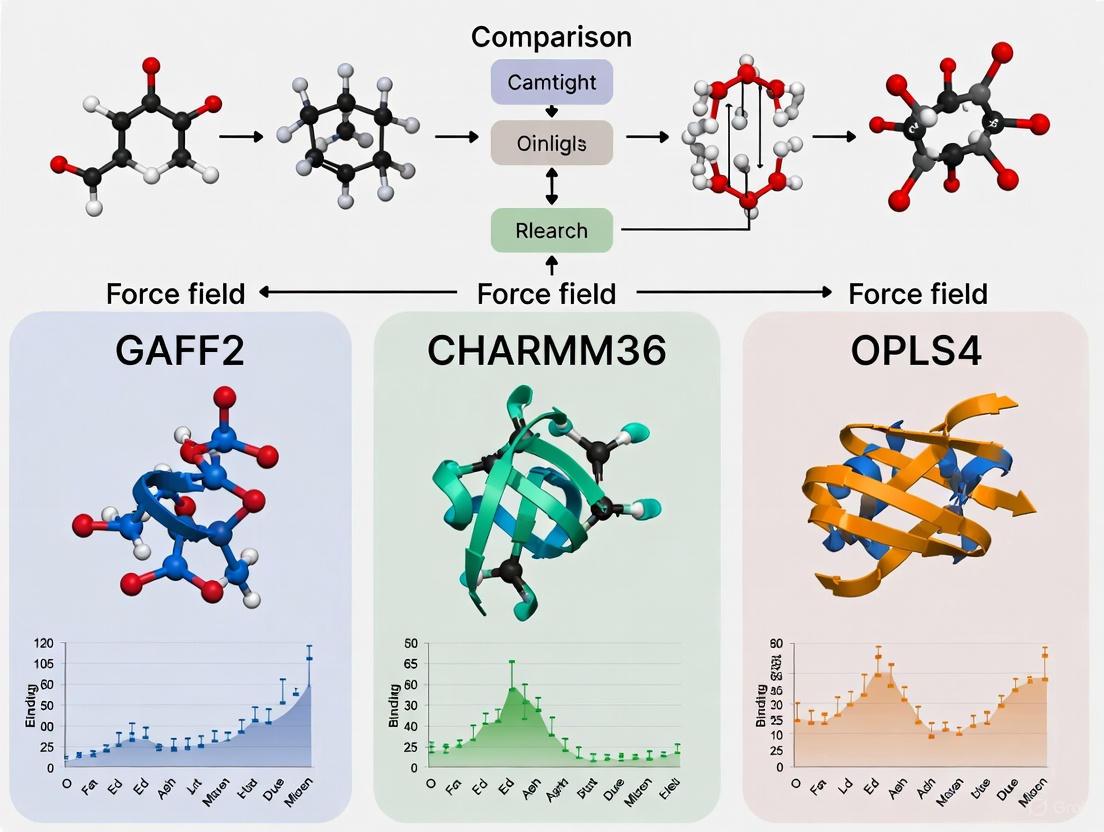
Accurate prediction of protein-ligand binding affinity is crucial for accelerating drug discovery.
GAFF2 vs CHARMM36 vs OPLS4: A Comprehensive Benchmark for Protein-Ligand Binding Free Energy Calculations
Abstract
Accurate prediction of protein-ligand binding affinity is crucial for accelerating drug discovery. This article provides a systematic comparison of three widely used force fields—GAFF2, CHARMM36, and OPLS4—for simulating protein-ligand interactions. We explore their foundational principles, parameterization methodologies, and practical application in binding free energy calculations. Drawing from recent benchmarking studies, we evaluate their performance against experimental data and quantum mechanical references, providing troubleshooting guidance and optimization strategies. This review serves as a practical guide for computational chemists and drug discovery scientists seeking to select and optimize force fields for reliable binding affinity predictions.
Force Field Foundations: Understanding GAFF2, CHARMM36, and OPLS4 Design Philosophies
Historical Evolution of Small Molecule Force Fields in Drug Discovery
The accurate prediction of protein-ligand binding affinities stands as a cornerstone in computational drug discovery, particularly during hit-to-lead and lead optimization phases. The precision of these predictions hinges critically on the reliability of the molecular mechanics force fields employed to describe the atomic interactions. Small organic molecules, with their vast chemical diversity and unique scaffolds, present exceptional challenges for force field parameterization. Unlike proteins, which are composed of a limited set of amino acids, drug-like small molecules incorporate diverse combinations of carbon and heteroatoms organized in system-specific structures of varying complexity, making application of standard force field parameters particularly challenging [1].
The historical evolution of small molecule force fields has been marked by the development of several key frameworks attempting to balance accuracy, coverage of chemical space, and computational efficiency. Among these, the Generalized Amber Force Field (GAFF and its successor GAFF2), the CHARMM General Force Field (CGenFF), and OPLS3/OPLS4 have emerged as prominent players [1]. This review provides a comprehensive comparison of these force fields within the specific context of protein-ligand binding research, examining their historical development, parametric differences, and performance in predicting binding affinities.
Historical Development and Parametric Evolution
The development of small molecule force fields represents a response to the growing need for accurate parameterization of drug-like molecules in molecular dynamics simulations. Traditional force fields initially focused primarily on biomacromolecules like proteins, nucleotides, lipids, and carbohydrates, largely neglecting small drug-like compounds in their early stages. The need to address this gap led to the creation of specialized force fields for small molecules over the past two decades [1].
GAFF to GAFF2 Evolution: The original GAFF (Generalized Amber Force Field) was developed to provide parameters for organic molecules compatible with the Amber protein force fields. In 2016, GAFF2 was introduced with improved torsional characterization and molecular properties, including intermolecular energy, liquid density, heat of vaporization, and hydration free energy [1]. This evolution represented a significant step forward in addressing the challenge of capturing the huge variety of scaffolds and functional groups that ligands can possess.
CGenFF Development: The CHARMM General Force Field was developed as part of the CHARMM ecosystem to provide compatible parameters for drug-like molecules. CGenFF employs a different charge assignment strategy compared to GAFF, using tabulated charges for molecular fragments to maintain internal consistency, which can result in significant differences in partial atomic charges compared to those derived using the Restrained Electrostatic Potential (RESP) method commonly used with GAFF [1].
OPLS Series Advancement: The OPLS force field has undergone significant evolution, with OPLS3 and its extended versions (OPLS3e and OPLS4) featuring improved torsional angle description and expanded coverage of chemical space [1]. These versions have demonstrated enhanced performance in benchmarking studies, though their parameterization methodologies differ from both the GAFF and CGenFF approaches.
Table 1: Historical Evolution of Key Small Molecule Force Fields
| Force Field | Release Timeline | Key Innovations | Compatible Protein FFs |
|---|---|---|---|
| GAFF | Early 2000s | Initial general parameters for organic molecules | Amber (e.g., Amber14SB) |
| GAFF2 | 2016 | Improved torsional parameters, molecular properties | Amber (e.g., Amber14SB) |
| CGenFF | 2010 | Transferable parameters for diverse chemical space | CHARMM (e.g., CHARMM36m) |
| OPLS3/4 | 2016-2019 | Enhanced torsional description, broader coverage | Various OPLS variants |
Methodological Approaches to Parameterization
Charge Assignment Strategies
A critical differentiator among force fields lies in their approach to assigning partial atomic charges, which significantly influence electrostatic interactions. The GAFF family typically employs charges derived from quantum mechanical calculations using the Restrained Electrostatic Potential (RESP) method. This involves geometry optimization with increasing basis set complexity (3-21G and 6-31G*), followed by Möller-Plesset correlation energy correction and population analysis with Hartree-Fock to produce charges following the Merz-Singh-Kollman scheme [1].
In contrast, CGenFF utilizes pre-tabulated charges for molecular fragments to maintain internal consistency. Comparative studies have demonstrated substantial differences in charge distribution between these approaches, particularly for functional groups like the amidine moiety in benzamidine, where RESP charges differ significantly from CGenFF assignments [1].
More recent developments include novel charge models such as ABCG2 (AM1-BCC-GAFF2), which introduces a bond charge correction scheme optimized for accurate hydration free energy predictions. While ABCG2 substantially improves hydration free energy accuracy (reducing RMSE to 0.99 kcal/mol compared to 1.71 kcal/mol for GAFF2/AM1-BCC), this improvement does not necessarily transfer to protein-ligand binding free energy predictions, highlighting the complex interplay between parameterization goals and application performance [2].
Torsional Parameter Optimization
Torsional parameters represent another area of significant divergence among force fields. Proper characterization of torsion angles is particularly crucial for molecules with π-electron conjugated systems, where quantum effects substantially influence molecular conformation. The benzamidine/trypsin system serves as a paradigmatic example where different parametrizations yield important changes in sampling behavior and consequently affect binding free energy calculations [1].
Recent approaches have combined quantum mechanics and atomistic free-energy calculations to achieve improved parametrization of ligand torsion angles. Funnel-Metadynamics calculations with refined parameters have demonstrated improved reproduction of high-resolution crystallographic ligand binding modes and more accurate description of binding mechanisms, highlighting the critical importance of accurate torsional parameters [1].
Table 2: Performance Comparison of Force Fields in Binding Free Energy Prediction
| Force Field Combination | HFE RMSE (kcal/mol) | RBFE RMSE (kcal/mol) | Key Strengths | Limitations |
|---|---|---|---|---|
| GAFF2/AM1-BCC | 1.71 | 1.31-1.39 | Good overall performance, extensive validation | Limited accuracy for complex chemical groups |
| GAFF2/ABCG2 | 0.99 | 1.38-1.39 | Superior hydration free energy accuracy | Limited transferability to protein environments |
| OPLS4 | Benchmark data varies | Comparable or slightly better than GAFF2 in some studies | Excellent torsional parameters | Commercial license required |
| NNP/MM (AceForce) | N/A | Improved over GAFF2 in benchmarks | Captures quantum effects, broad element coverage | Higher computational cost |
Comparative Performance in Protein-Ligand Binding Studies
Accuracy in Binding Free Energy Prediction
Comprehensive benchmarking studies provide critical insights into the relative performance of different force fields. A recent large-scale evaluation of the ABCG2 charge model with nonequilibrium alchemical free-energy simulations revealed that while GAFF2/ABCG2 achieves higher hydration free energy accuracy, it does not outperform GAFF2/AM1-BCC for protein-ligand binding free energy predictions. Both charge models exhibit comparable accuracy and compound ranking across targets, with RMSE values of 1.31-1.41 kcal/mol for AMBER99SB-ILDN+GAFF2/AM1-BCC and 1.38-1.51 kcal/mol for AMBER99SB-ILDN+GAFF2/ABCG2 [2].
These findings underscore a fundamental challenge in computational chemistry: optimizing a force field for one physical property (like hydration free energy) does not guarantee improved performance for related but distinct properties like protein-ligand binding [2]. The limited transferability of specifically optimized charge models may stem from their parameterization for homogeneous water environments, which differs substantially from the complex, heterogeneous environments of protein binding pockets.
Emerging Approaches: Neural Network Potentials
Recent years have witnessed the emergence of neural network potentials (NNPs) as promising alternatives to traditional molecular mechanics force fields. NNPs use fast neural network function approximation of the quantum mechanical energy surface, potentially addressing limitations of traditional force fields in capturing rare chemical groups and quantum effects like polarization [3].
The AceForce 1.0 model, based on the TensorNet architecture, represents a significant advancement in this area, supporting a broad range of atom elements including charged molecules. In benchmarking studies, QuantumBind-RBFE calculations using AceForce demonstrated improved accuracy compared with GAFF2, achieving slightly less accuracy but comparable correlations with OPLS4 [3]. This approach exemplifies the ongoing evolution beyond traditional force field paradigms toward more accurate, though computationally intensive, alternatives.
Practical Considerations and Compatibility Issues
Force Field Mixing Compatibility
A critical practical consideration in protein-ligand research involves the compatibility of different force fields when modeling complex biological systems. Attempting to mix incompatible force fields can lead to significant inaccuracies. As explicitly noted in GROMACS documentation: "If you are trying to mix two force fields, then you are asking for trouble." Specifically, CHARMM36 and GAFF (Amber FF) are not compatible, and such combinations will produce questionable or outright wrong results [4].
This compatibility constraint necessitates careful planning in system parameterization. When CGenFF fails to parametrize a molecule, recommended alternatives include: using multiple parametrization platforms (CHARMM-GUI and cgenff.com), exploring other CGenFF parametrization methods like MATCH, performing manual parametrization according to CGenFF instructions, switching the entire system to compatible force fields (e.g., Amber for protein and GAFF for ligand), or contacting CGenFF developers for assistance with problematic molecules [4].
Specialized Tools and Research Reagents
Successful implementation of force field parameters requires specialized tools and approaches. The following table summarizes key resources mentioned in the research literature:
Table 3: Essential Research Reagents and Computational Tools
| Tool/Resource | Primary Function | Application Context |
|---|---|---|
| Antechamber | Automated parameter generation for GAFF/GAFF2 | Generating bonded parameters for organic molecules |
| RESP ESP Charge Deriver | Partial charge assignment using RESP method | Charge parameterization for Amber-compatible force fields |
| CHARMM-GUI | Web-based interface for CHARMM parameterization | Generating CGenFF-compatible parameters |
| CGenFF Online | Alternative CGenFF parameterization platform | Expanded coverage for challenging molecules |
| MATCH | Alternative parametrization method | University of Michigan's CGenFF-compatible parameterization |
| ATM | Alchemical Transfer Method | RBFE calculations with various force fields |
| Funnel-Metadynamics | Enhanced sampling technique | Binding free energy calculations with improved parameters |
Experimental Protocols and Methodologies
Standard Parameterization Workflow
The typical parameterization process for small molecules follows a structured workflow to ensure physical accuracy and compatibility:
Geometry Optimization: Initial structure optimization using quantum mechanical software (e.g., Gaussian09) with increasing basis set complexity (3-21G followed by 6-31G*), employing Hartree-Fock calculation with Möller-Plesset correlation energy correction [1].
Charge Derivation: Population analysis with Hartree-Fock to produce charges following the Merz-Singh-Kollman scheme, with subsequent processing via the RESP method to obtain partial charges per atom. Application of restraints in charge allocation accounts for molecular symmetry [1].
Topology Generation: Using packages like Antechamber (for GAFF/GAFF2) to create bonded parameters based on the optimized structure and derived charges [1].
Validation: Conformational analysis through potential energy scanning and comparison with quantum mechanical references, particularly for torsion angles in conjugated systems [1].
Diagram Title: Small Molecule Force Field Parameterization Workflow
Binding Free Energy Calculation Protocols
Robust binding free energy calculations require carefully designed simulation protocols:
System Preparation: Parameterization of both protein (using optimized FFs like Amber14SB or CHARMM36m) and ligand (using small molecule FF), ensuring compatibility between force fields [1] [4].
Solvation and Equilibration: Embedding the protein-ligand complex in explicit solvent, followed by energy minimization, thermalization, and equilibration steps to stabilize the system [3].
Enhanced Sampling: Application of advanced sampling techniques like Funnel-Metadynamics or alchemical transformation methods (e.g., Alchemical Transfer Method) to adequately sample binding events [1] [3].
Convergence Testing: Running multiple replicates (typically 3+)
with sufficient simulation time (e.g., 70 ns per replica) to ensure statistical reliability [3].
The evolution of small molecule force fields continues to advance along multiple fronts. Traditional force fields like GAFF2, CGenFF, and OPLS4 have reached a reasonable level of maturity, providing good performance across diverse chemical space while acknowledging their limitations for specific chemical groups and environments. The emerging trend toward neural network potentials represents a promising direction for addressing fundamental limitations of traditional molecular mechanics, though at increased computational cost [3].
Integration of physical models with machine learning approaches, as exemplified by frameworks like LumiNet, demonstrates the potential for combining the strengths of both paradigms—leveraging physical principles for generalizability while using machine learning to refine parameters for specific applications [5]. Such hybrid approaches may help bridge the gap between accuracy and computational efficiency that has long challenged the field.
In conclusion, the selection of an appropriate force field for protein-ligand binding research requires careful consideration of multiple factors, including chemical space coverage, compatibility with protein force fields, parameterization methodologies, and performance for specific application contexts. While GAFF2 offers robust overall performance with Amber protein force fields, CGenFF provides a consistent ecosystem for CHARMM users, and OPLS4 demonstrates excellent torsional parameterization, though with commercial licensing requirements. Researchers must balance these practical considerations with the fundamental understanding that force field accuracy remains context-dependent, with optimal choice potentially varying based on specific protein-ligand systems and research objectives.
Molecular dynamics (MD) simulations have become indispensable in biochemical and biophysical sciences, providing atomistic-level insights into structural characteristics and dynamic behaviors of biomolecules interacting with ligands, solvents, and other molecules [6]. In modern drug discovery, in silico simulations are routinely employed to virtually screen potential compounds active to specific drug targets by calculating protein-ligand binding free energies—a critical process for drug lead identification and optimization [6]. The predictive accuracy of these simulations hinges on the quality of the molecular mechanics force field (MMFF) used to represent atomic interactions. Force fields are sets of mathematical functions and parameters that calculate potential energies based on atomic coordinates, encompassing bonded terms (bonds, angles, dihedrals) and non-bonded interactions (Coulombic and van der Waals) [6].
Among the numerous MMFFs available, four families dominate atomistic MD simulations of biological systems: AMBER (Assisted Model Building with Energy Refinement), CHARMM (Chemistry at Harvard Macromolecular Mechanics), OPLS (Optimized Potentials for Liquid Simulations), and GROMOS (GROningen MOlecular Simulation) [6]. Each family includes specialized force fields for proteins, nucleic acids, lipids, and carbohydrates, alongside general force fields for small molecules. The Generalized AMBER Force Field (GAFF) and its second generation (GAFF2) belong to the AMBER family, while the CHARMM General Force Field (CGenFF) serves the CHARMM ecosystem, and recent OPLS versions have expanded parameters for drug-like compounds [6]. This guide objectively compares the performance of GAFF2 against its major alternatives, CGenFF (associated with CHARMM36) and OPLS force fields, focusing specifically on their applications in protein-ligand binding research.
Force Field Comparison: Performance Metrics and Experimental Data
Geometric and Energetic Accuracy Assessment
A comprehensive benchmark study assessed nine small molecule force fields on a dataset of 22,675 molecular structures of 3,271 molecules, comparing force field-optimized geometries and conformer energies against reference quantum mechanical (QM) data [7]. The results provide critical insights into the relative performance of GAFF2 versus other force fields.
Table 1: Performance Comparison of Small Molecule Force Fields on QM Geometries and Energetics
| Force Field | Family | Geometric Accuracy | Energetic Accuracy | Overall Performance Ranking |
|---|---|---|---|---|
| OPLS3e | OPLS | Best | Best | 1st |
| OpenFF 1.2 | OpenFF | Approaching OPLS3e | Approaching OPLS3e | 2nd |
| GAFF2 | AMBER | Moderate | Moderate | Below OPLS3e and OpenFF 1.2 |
| MMFF94S | Merck | Moderate | Moderate | Similar to or slightly below GAFF2 |
| GAFF | AMBER | Lower than GAFF2 | Lower than GAFF2 | Below GAFF2 |
The study revealed that while OPLS3e performed best in reproducing QM geometries and energetics for the tested molecule set, the latest Open Force Field Parsley release was approaching a comparable level of accuracy [7]. Meanwhile, the performance of established force fields including GAFF2 was generally somewhat worse, though GAFF2 typically outperformed its predecessor GAFF [7].
Protein-Ligand Binding Free Energy Prediction
Accurate prediction of protein-ligand binding affinities is crucial for drug design. A recent study evaluated the performance of different charge models combined with GAFF2 for binding free energy calculations [2].
Table 2: Performance of GAFF2 with Different Charge Models in Binding Free Energy Calculations
| Force Field Combination | Hydration Free Energy RMSE (kcal/mol) | Binding Free Energy RMSE (kcal/mol) | Ligand Ranking Accuracy |
|---|---|---|---|
| GAFF2/AM1-BCC | 1.71 | 1.31 | Comparable to ABCG2 |
| GAFF2/ABCG2 | 1.00 | 1.38 | Comparable to AM1-BCC |
The ABCG2 charge model, specifically optimized for hydration free energy accuracy, achieved significantly improved hydration free energy predictions with an RMSE of approximately 1.00 kcal/mol compared to 1.71 kcal/mol for the standard AM1-BCC model [2]. However, this improvement did not transfer to protein-ligand binding free energy calculations, where both charge models exhibited comparable accuracy [2]. This highlights a fundamental challenge in force field development: optimization for one property (hydration free energy) does not guarantee improvement for related properties (binding affinity).
Solvation Free Energy and Liquid Property Prediction
GAFF2 with the new ABCG2 charge model has demonstrated excellent performance beyond hydration free energy. This combination has shown strong transferability for other properties, including transfer free energy of solutes from water to organic solvents, as well as density and heat of vaporization of neat organic liquids [6]. For solvation free energy of nearly 900 pairs of various organic solutes in organic solvents with dielectric constants ranging from 1.8 to 37.2, the combination achieved a remarkably low mean unsigned error (MUE) of only 0.51 kcal/mol [6].
Methodology: Experimental Protocols for Force Field Validation
Force Field Assessment Protocol for Crystallization Studies
Molecular simulations provide valuable insights into complex processes like crystallization, but their predictions depend heavily on force field quality [8]. For studies of crystallization processes, the force field must reproduce both crystal and solution behaviors accurately [8]. A recommended validation protocol involves:
Crystal Property Validation:
Solution Property Validation:
Performance Metrics:
- Quantify deviations from experimental values using root-mean-square error (RMSE) and mean unsigned error (MUE)
- For urea crystallization studies, two force fields showed best overall performance: a specific urea charge-optimized GAFF force field and the original all-atom OPLS force field [8]
Figure 1: Force Field Validation Workflow for Crystallization Studies
Torsional Parameter Optimization Protocol
Accurate torsional parameterization is crucial for modeling ligand conformations in binding pockets. A specialized protocol for improving torsional parameters combines quantum mechanics and atomistic free-energy calculations [1]:
Quantum Mechanical Calculations:
Force Field Parametrization:
Enhanced Sampling Validation:
Parameterization Software and Tools
Table 3: Essential Tools for Small Molecule Force Field Parameterization
| Tool Name | Compatible Force Fields | Primary Function | Key Features |
|---|---|---|---|
| Antechamber | GAFF, GAFF2 | Automated parameter generation | AM1-BCC charges, bond/angle/dihedral assignment |
| RESP | GAFF, GAFF2, CGenFF | Partial charge derivation | Electrostatic potential fitting, symmetry constraints |
| ForceGen | Multiple | Force constant extraction | Vibrational frequency analysis, Gromacs topology output |
| QUBEKit | Multiple | QM-based parameterization | Direct derivation from quantum mechanics |
| ffTK | CGenFF | Parameter optimization | Graphical interface, target data fitting |
| LigParGen | OPLS-AA | Web-based parameter generation | OPLS parameters for organic molecules |
| SMIRNOFF | OpenFF | SMIRKS-based assignment | Atom type free, chemical pattern recognition |
Validation Databases and Benchmark Sets
Several curated datasets enable standardized force field validation:
- FreeSolv Database: Contains experimental and calculated hydration free energies for 642 organic molecules, enabling solvation free energy validation [2]
- Wang Data Set: Comprises 8 protein targets with 200 ligands for binding affinity prediction assessment [9]
- OpenFE Benchmark Sets: Include multiple protein targets, ligands, and perturbations for relative binding free-energy calculations [2]
- QCArchive Datasets: Provide QM geometry-optimized structures and energies for thousands of molecules at the B3LYP-D3BJ/DZVP level of theory [7]
The comparative analysis of GAFF2, CHARMM36/CGenFF, and OPLS force fields reveals a complex performance landscape where the optimal choice depends heavily on the specific research application. For protein-ligand binding free energy predictions, GAFF2 with AM1-BCC charges remains a robust, widely-adopted choice that delivers consistent performance across diverse targets [2]. While OPLS3e demonstrates superior accuracy in reproducing small molecule geometries and energetics [7], its implementation in commercial software (Schrödinger suite) may limit accessibility for some research groups. CHARMM36/CGenFF provides a compatible ecosystem for researchers already working within the CHARMM framework, though careful attention to parameterization—particularly for conjugated systems—is essential [1].
The recent development of specialized charge models like ABCG2 highlights an important principle in force field application: property-specific optimization does not guarantee improved performance across all related properties [2]. Researchers should therefore validate force fields for their specific systems of interest, particularly when studying complex processes like crystallization that require accurate representation of both solid and solution phases [8]. As force field development continues—with promising advances in machine learning parameterization, polarizable models, and automated toolkits—the research community benefits from standardized benchmarks and validation protocols that enable objective comparison of different models [10] [6].
Molecular dynamics (MD) simulations are indispensable in modern drug discovery, enabling researchers to predict how small molecule ligands interact with biological targets at an atomic level. The accuracy of these simulations hinges on the molecular mechanics force field (MMFF)—a set of mathematical functions and parameters that describe the potential energy of a system. For modeling protein-ligand interactions, researchers primarily rely on general force fields for small molecules that are compatible with specialized protein force fields. The dominant families include GAFF (General AMBER Force Field) and its successor GAFF2, the CHARMM General Force Field (CGenFF) used with CHARMM36 proteins, and the proprietary OPLS (Optimized Potentials for Liquid Simulations) series, including OPLS3e and OPLS4 [6] [11]. These force fields share a common functional form but differ in their parameterization strategies, chemical space coverage, and treatment of key interactions like electrostatics and torsion angles [6]. This guide provides an objective comparison of these force fields, with a focused analysis on the validation and performance of the CHARMM36/CGenFF combination for protein-ligand binding research.
Force Field Comparison: Methodologies and Performance Metrics
Parametrization Philosophies and Coverage
The development philosophies behind general force fields significantly influence their strengths, weaknesses, and optimal application domains.
CHARMM36/CGenFF: The CHARMM ecosystem employs a consistent parametrization strategy across its biomolecular force fields (proteins, lipids, nucleic acids) and small molecules [12] [11]. CGenFF parameters for small organic molecules are developed to be thermodynamically balanced with the CHARMM36 protein parameters. The parametrization protocol heavily relies on quantum mechanical (QM) data, targeting the reproduction of model compound dipole moments, electrostatic potentials, and adiabatic potential energy surfaces, particularly for rotatable dihedral angles [12] [6]. This approach aims to ensure accuracy across diverse chemical environments.
GAFF/GAFF2: Developed within the AMBER ecosystem, GAFF and its newer version, GAFF2, are also all-atom force fields for small organic molecules [13] [6]. Atomic partial charges are typically derived using the AM1-BCC (Austin Model 1 with Bond Charge Corrections) model, a fast semi-empirical method, though charges can also be derived from QM-based restrained electrostatic potential (RESP) fits [1] [6]. A recent update to the charge model (ABCG2) for GAFF2 has shown improved accuracy in calculating solvation free energies across various organic solvents [6].
OPLS3e: This force field, implemented in the commercial Schrodinger software suite, combines extensive parametrization for drug-like compounds with a ligand-specific approach to assigning atomic charges [6] [7]. OPLS3e incorporates off-atom centered virtual sites for a more accurate description of lone pairs and sigma holes in its electrostatic model. Its development involved fitting to a large body of experimental and QM data, leading to improved performance for conformational energies and binding free energies [6].
Benchmark Performance in Geometry and Energetics
Comprehensive benchmarks against quantum mechanical (QM) data provide critical insights into force field performance. A 2020 study assessed multiple force fields on a dataset of over 22,000 structures from 3,271 small, drug-like molecules [7]. The evaluation focused on the ability of force field-optimized geometries and conformer energies to reproduce QM reference data.
Table 1: Benchmarking Force Fields on QM Geometries and Energetics [7]
| Force Field | Performance Summary | Key Strength |
|---|---|---|
| OPLS3e | Ranked best in reproducing QM geometries and relative conformer energies. | Superior accuracy on a broad set of drug-like molecules. |
| OpenFF 1.2 | Approaching a comparable level of accuracy to OPLS3e. | Modern, open-source format with rapidly improving accuracy. |
| GAFF2 | Performance generally worse than OPLS3e and OpenFF 1.2. | Widely available and integrated into free simulation packages. |
| MMFF94S | Performance generally worse than the top performers. | Established history of use. |
This benchmark highlights that OPLS3e currently sets the benchmark for accuracy on general small molecules. While the study did not include CGenFF, it establishes a baseline for top-tier performance. The results for GAFF2 indicate room for improvement in standard parametrization, though system-specific refinement can enhance its accuracy [7].
Performance in Protein-Ligand Binding and Specific Systems
Accuracy in simulating isolated ligands must be matched by performance in complex biological environments. Validation in protein-ligand binding studies is crucial.
CHARMM36/CGenFF in Induced-Fit Docking: The CGUI-IFD workflow leverages CHARMM-GUI modules to address protein flexibility during docking. In a benchmark of 258 cross-docking protein-ligand pairs, this workflow, which uses CGenFF for ligands and CHARMM36 for proteins, achieved an 80% success rate (predicting binding modes within 2.5 Å of experimental structures) [14]. This demonstrates the robustness of the combined CHARMM36/CGenFF force field for predicting binding modes in challenging scenarios where the protein binding site undergoes conformational changes.
Case Study: Benzamidine-Trypsin Binding: A detailed study investigated the binding of the small molecule benzamidine to the protein trypsin using different force fields [1] [15]. Initial attempts with standard GAFF, GAFF2, and CGenFF parameters revealed that the dihedral angle linking the amidine group to the benzene ring was poorly described. The default parameters failed to correctly capture the energy profile of this conjugated system, which is critical for the ligand's binding conformation. Researchers combined QM calculations and free-energy calculations to create an improved, system-specific dihedral parameter. Subsequent simulations with this refined parameter successfully reproduced the high-resolution crystallographic binding mode, underscoring that manual refinement of specific parameters can be necessary for accurate results, even in well-parametrized force fields [15].
Performance for Alkanes and Lipids: A systematic assessment of force fields for modeling n-eicosane, a linear alkane, showed that while specialized united-atom force fields (TraPPE, NERD) excelled in describing mass density and thermal expansion, the all-atom CHARMM36 force field performed comparably to GAFF/GAFF2 and L-OPLS-AA in reproducing shear viscosity and diffusion coefficients in the melt [13]. Given that CHARMM36 was originally parametrized for lipid acyl chains, its strong performance for hydrocarbon properties provides indirect validation for its use in simulating biological membranes and lipophilic ligands.
Experimental Protocols and Workflows
The CHARMM-GUI Induced Fit Docking (CGUI-IFD) Workflow
The CGUI-IFD protocol is a robust method for predicting ligand binding modes that accounts for protein flexibility [14]. The workflow can be summarized in the following diagram:
Title: CHARMM-GUI Induced Fit Docking Workflow
Protocol Steps [14]:
- Ligand-Binding Site (LBS) Identification and Refinement: The target receptor structure is submitted to the LBS Finder & Refiner module. This tool uses G-LoSA (Graph-based Local Structure Alignment) to align the receptor's binding site against a non-redundant library of experimental holo-structures. The top-ranked template structures are selected.
- Ensemble Generation: The module refines the receptor's binding site by applying distance restraints derived from the template holo-structures using molecular dynamics. This generates an ensemble of receptor conformations (typically the original structure plus three refined alternatives) that represent biologically relevant, ligand-compatible pocket shapes.
- Rigid Docking: A given ligand is docked into each of the four receptor structures from the ensemble using standard rigid receptor docking, producing multiple candidate binding poses (e.g., 10 poses per structure, 40 total).
- High-Throughput MD Simulation and Analysis: All protein-ligand complex poses are submitted to the CHARMM-GUI High-Throughput Simulator (HTS). This module runs explicit-solvent molecular dynamics simulations for each pose to assess stability.
- Pose Selection: The results are evaluated based on two primary metrics: the root-mean-square deviation (RMSD) of the ligand to measure binding stability during the MD trajectory, and the MMGBSA (Molecular Mechanics Generalized Born Surface Area) binding energy. The pose with the best combination of stability and interaction energy is selected as the final predicted binding mode.
Benchmarking Protocol for Small Molecule Force Fields
The methodology for large-scale force field benchmarking, as described in Lim et al. (2020), provides a standardized approach for objective comparison [7].
Title: Force Field Benchmarking Against Quantum Mechanics
Protocol Steps [7]:
- Dataset Curation: A large and diverse set of small, drug-like molecules is assembled. The "OpenFF Full Optimization Benchmark 1" set, for example, contains 3,271 molecules and 22,675 unique conformations, ensuring broad chemical space coverage.
- Reference QM Data Generation: Each molecular structure in the dataset undergoes geometry optimization at a consistent QM theory level, typically B3LYP-D3BJ/DZVP. This provides reference data for the optimal geometry and its relative energy.
- Molecular Mechanics Optimization: The same set of initial molecular structures is energy-minimized using each force field under assessment (e.g., GAFF2, OPLS3e, CGenFF).
- Comparison and Analysis: The force field-optimized geometries are compared to the QM-optimized geometries. Additionally, the relative energies of different conformers of the same molecule are compared between the force field and QM data.
- Outlier Analysis: The results are analyzed to identify specific chemical functional groups or motifs where a force field consistently produces large deviations from QM data, pointing to areas requiring parametrization improvement.
Table 2: Key Resources for Force Field Research and Application
| Tool / Resource | Function | Access / Note |
|---|---|---|
| CHARMM-GUI | A web-based platform for setting up complex simulation systems, including the CGUI-IFD workflow and HTS [14]. | Freely accessible online. |
| ParamChem | A web server that provides initial parameter guesses for CGenFF, assigning atom types and preliminary charges/bonded terms [12]. | Freely accessible; requires login. |
| CGenFF Force Field | The CHARMM General Force Field for small molecules; parameters are compatible with CHARMM36 proteins [12] [6]. | Freely available. |
| GAFF/GAFF2 Force Field | The General AMBER Force Field for small molecules; parameters are compatible with AMBER protein force fields [6]. | Freely available via AmberTools. |
| Antechamber | A software package for automatically generating GAFF/GAFF2 parameters and RESP charges for small molecules [1] [6]. | Freely available in AmberTools. |
| OPLS3e Force Field | A high-accuracy, commercially developed force field for small molecules [6] [7]. | Implemented in Schrodinger software suite. |
| QCArchive Database | A public repository containing extensive QM calculation datasets, useful for force field benchmarking and development [7]. | Freely accessible. |
The choice of a force field for protein-ligand binding research involves trade-offs between accuracy, convenience, and system specificity. Benchmark studies indicate that OPLS3e currently leads in accuracy for reproducing QM geometries and energetics of small molecules [7]. However, the CHARMM36/CGenFF combination is a rigorously validated and consistent choice, particularly for studies integrated within the CHARMM ecosystem. Its success in cross-docking benchmarks (80% success rate with CGUI-IFD) [14] proves its capability in modeling challenging induced-fit binding scenarios.
Future developments are likely to focus on several key areas [6]:
- Polarizable Force Fields: Moving beyond fixed-charge models to explicitly account for electronic polarization in different dielectric environments.
- Automation and Machine Learning: Using ML algorithms to accelerate parameter assignment and dihedral optimization, making accurate parametrization faster and more accessible.
- Broader Chemical Space Coverage: Continuous expansion to cover more nonstandard amino acids, novel scaffolds, and functional groups relevant to drug discovery [12].
For researchers, the best practice is to choose a force field whose parametrization philosophy and validation benchmarks match their system of interest. For out-of-the-box ligand parametrization with CHARMM36, CGenFF provides excellent consistency. For the highest accuracy with proprietary software, OPLS3e is a strong candidate. For any force field, critical validation and potential system-specific refinement of key torsional parameters, as demonstrated in the benzamidine case study, can be essential for achieving quantitatively accurate results [15].
Accurate prediction of protein-ligand binding affinities is crucial in drug discovery, particularly during hit-to-lead and lead optimization phases where efficient screening of congeneric ligand series is required [3]. Molecular dynamics simulations and alchemical free energy calculations have gained prominence as reliable approaches for estimating these affinities, with their precision heavily dependent on the chosen force field [1]. The Generalized Amber Force Field (GAFF2), CHARMM General Force Field (CGenFF), and OPLS4 represent three of the most prominent force fields for modeling small molecules in drug discovery contexts [1] [15]. Each employs distinct parameterization strategies: GAFF2 often combines with AM1-BCC or ABCG2 charge models, CGenFF uses its own tabulated charges, while OPLS4 features improved torsional angle description and broader chemical space coverage [1] [15]. Understanding their relative performance is essential for researchers selecting appropriate computational tools for protein-ligand binding studies.
Performance Benchmarking: Quantitative Comparisons
Binding Free Energy Accuracy Across Force Fields
Table 1: Relative Binding Free Energy (RBFE) Performance Metrics Across Force Fields
| Force Field | Dataset | RMSE (kcal/mol) | Ligand Ranking Correlation | Key Strengths |
|---|---|---|---|---|
| OPLS4 [3] | JACS Set (7 targets) | 0.73 [0.65, 0.80] | High correlation | Excellent overall accuracy |
| GAFF2/AM1-BCC [2] | Full Benchmark (12 targets) | 1.31 [1.22, 1.41] | Comparable to ABCG2 | Established, reliable performance |
| GAFF2/ABCG2 [2] | Full Benchmark (12 targets) | 1.38 [1.28, 1.49] | Comparable to AM1-BCC | Superior hydration free energy prediction |
| GAFF2/ABCG2 [2] | Jansen BACE Subset | 1.21 [1.00, 1.43] | Statistically similar ranking | Target-dependent performance |
| AMBER14SB+GAFF2/ABCG2 [2] | Jansen BACE Subset | 1.47 [1.15, 1.78] | Statistically similar ranking | Compatibility with AMBER protein FF |
The benchmarking data reveals that OPLS4 demonstrates superior accuracy in relative binding free energy predictions on the standardized JACS dataset, achieving the lowest root-mean-square error (RMSE) of 0.73 kcal/mol [3]. This represents a significant improvement over GAFF2-based combinations, which typically show RMSE values between 1.21-1.47 kcal/mol across different datasets and charge models [2]. The performance advantage of OPLS4 is particularly evident in its consistent accuracy across multiple protein targets, including BACE, CDK2, JNK1, MCL1, P38, thrombin, and TYK2 [3].
Hydration Free Energy and Transferability
Table 2: Hydration Free Energy (HFE) and Transferability Performance
| Force Field / Charge Model | HFE RMSE (kcal/mol) | Chemical Space Coverage | Optimal Application Context |
|---|---|---|---|
| GAFF2/AM1-BCC [2] | 1.71 | Broad, with established parameters | General binding free energy calculations |
| GAFF2/ABCG2 [2] | 0.99-1.00 | Specifically optimized for HFE | Hydration properties and solvent transfer |
| OPLS4 [3] | Benchmark data limited | Extended via improved torsions | Protein-ligand binding affinity |
While GAFF2/ABCG2 demonstrates remarkable accuracy for hydration free energy predictions with an RMSE of approximately 1.00 kcal/mol [2], this performance does not directly transfer to protein-ligand binding free energy calculations, where it shows no statistically significant improvement over GAFF2/AM1-BCC [2]. This highlights a fundamental challenge in force field development: property-specific optimization does not guarantee improved performance for related properties. The limited transferability of the ABCG2 charge model may stem from its bond charge correction parameters being specifically optimized for hydration free energy accuracy, making them insufficiently general for the complex and heterogeneous environments of protein binding pockets [2].
Methodological Approaches: Experimental Protocols
Standard Binding Free Energy Calculation Protocol
The assessment of force field performance typically follows rigorous computational benchmarking protocols. For protein-ligand binding free energy calculations, researchers generally employ these key methodological steps:
System Preparation: Protein structures are prepared using standard force fields like AMBER14SB [2] [1], while ligands are parameterized using the target force field (GAFF2, CGenFF, or OPLS4) with appropriate charge schemes (RESP, AM1-BCC, or ABCG2) [2] [1].
Solvation and Equilibration: Systems are solvated in water models (typically TIP3P) and undergo energy minimization, thermalization, and equilibration to stabilize the protein-ligand complex [3].
Alchemical Free Energy Calculations: Relative binding free energies are computed using methods like alchemical transfer method (ATM) [3] or nonequilibrium alchemical free-energy simulations [2], which involve transforming one ligand into another through non-physical pathways.
Extended Sampling: Multiple replicas of extended simulations (e.g., 70 ns per replica) are run to ensure adequate sampling and convergence [3].
Statistical Analysis: Results are aggregated across transformations and compared to experimental reference data using statistical measures including RMSE, Pearson's r, and Spearman's ρ [2].
Enhanced Sampling for Challenging Systems
For particularly challenging molecular systems with conjugated π-systems or complex torsion profiles, researchers sometimes employ enhanced sampling techniques such as Funnel-Metadynamics [1] [15]. These approaches help overcome energy barriers and ensure adequate conformational sampling, which is crucial for accurate binding free energy estimation when ligands must assume specific conformations to bind effectively [1].
Figure 1: Force Field Selection Workflow for Drug Discovery Applications. This decision diagram illustrates the logical process for selecting appropriate force fields based on research objectives and molecular system characteristics, highlighting OPLS4 for general protein-ligand binding applications.
Emerging Alternatives: Neural Network Potentials
While traditional force fields like OPLS4, GAFF2, and CGenFF dominate current research, neural network potentials (NNPs) represent an emerging alternative that addresses certain limitations. Methods like QuantumBind-RBFE utilize hybrid NNP/MM approaches where neural network potentials model ligand interactions while molecular mechanics handles the remaining system [3]. The AceForce 1.0 model, based on TensorNet architecture, demonstrates particular promise by supporting diverse drug-like compounds including charged molecules and addressing traditional force field limitations in capturing polarization and quantum effects [3].
Benchmarking studies reveal that NNP approaches can achieve improved accuracy and correlation in binding affinity predictions compared to GAFF2, with performance slightly better or comparable to OPLS4 [3]. However, this enhanced accuracy comes with increased computational costs, though recent advances allow for more practical simulation timescales (e.g., 2 fs timesteps) [3]. These developments suggest a future where NNP methods may complement or eventually surpass traditional force fields for challenging applications involving complex ligand chemistry or significant conformational flexibility.
The Scientist's Toolkit: Essential Research Reagents
Table 3: Key Computational Tools for Force Field Applications in Drug Discovery
| Tool Name | Category | Primary Function | Application Context |
|---|---|---|---|
| GAFF2 [2] | Force Field | Small molecule parameterization | General drug-like molecule modeling |
| AM1-BCC [2] | Charge Model | Partial atomic charge assignment | Balanced performance for various properties |
| ABCG2 [2] | Charge Model | Bond charge correction for HFE | Superior hydration free energy prediction |
| AMBER14SB [1] | Protein FF | Protein parameterization | Compatible with GAFF2 for ligands |
| RESP [1] | Charge Method | Restrained Electrostatic Potential | QM-derived charge calculation |
| Funnel-Metadynamics [1] | Enhanced Sampling | Binding pose exploration | Challenging ligand-receptor systems |
| TensorNet [3] | NNP Architecture | Neural network potential | Quantum-mechanical accuracy in MD |
| Alchemical Transfer [3] | Free Energy Method | Relative binding affinity | High-throughput screening |
The comprehensive benchmarking data indicates that OPLS4 currently delivers superior accuracy for protein-ligand binding free energy predictions among traditional force fields, making it an excellent choice for lead optimization campaigns where binding affinity ranking is crucial [3]. GAFF2/AM1-BCC remains a robust, general-purpose option with respectable performance across diverse targets [2], while GAFF2/ABCG2 specializes in hydration property prediction but doesn't translate this advantage to binding affinity calculations [2]. For particularly challenging molecular systems with complex electronic properties or conjugated systems, emerging neural network potentials like AceForce 1.0 offer quantum-mechanical accuracy at computational costs that are becoming increasingly practical for drug discovery applications [3]. The optimal force field selection ultimately depends on the specific research context, balancing accuracy requirements, computational resources, and the particular physicochemical properties being investigated.
Key Differences in Functional Forms and Parameterization Strategies
Molecular mechanics force fields provide the foundational potential energy functions for simulating biological systems, playing a crucial role in drug discovery by enabling the prediction of protein-ligand binding affinities. The accuracy of these predictions hinges on the underlying force field and its parameters. Among the numerous available options, the General AMBER Force Field 2 (GAFF2), CHARMM36 (with its CGenFF component for small molecules), and OPLS4 have emerged as widely used families in computational drug research. This guide provides an objective comparison of these three force fields, focusing on their distinct functional forms, parameterization strategies, and performance in protein-ligand binding studies, supported by recent experimental data.
Core Force Field Comparison: Strategies and Foundations
The GAFF2, CHARMM36/CGenFF, and OPLS4 force fields employ distinct philosophical approaches and technical implementations for modeling small molecules. The table below summarizes their key differences in functional forms and parameterization strategies.
Table 1: Fundamental Comparison of Force Field Strategies
| Aspect | GAFF2 | CHARMM36 / CGenFF | OPLS4 |
|---|---|---|---|
| General Approach | General-purpose for organic molecules [1] [6] | Consistent with CHARMM biomolecular FFs [6] | Extensive ligand-specific parametrization [6] |
| Charge Assignment | AM1-BCC (standard); RESP (often with HF/6-31G*); New ABCG2 model [2] [6] | Pre-assigned, transferable charges; Can differ from RESP-derived [1] | Ligand-specific on-the-fly charges; Includes off-atom virtual sites [6] |
| VDW Parameters | Lennard-Jones [6] | Lennard-Jones (CHARMM-compatible) [6] | Lennard-Jones (OPLS-compatible) [6] |
| Torsional Treatment | Improved characterization in GAFF2 vs. GAFF [1] | Traditional dihedral terms [1] | Extensive, optimized torsional parameters [1] [6] |
| Polarization Handling | Fixed atomic charges [6] | Fixed atomic charges; Drude polarizable model available [6] | Fixed charges with off-atom virtual sites for lone pairs/sigma holes [6] |
| Automation & Tools | Antechamber, ParmScan [6] | FFParam, ffTK [6] | Integrated in Schrodinger software [6] |
Performance Assessment in Binding Free Energy Calculations
Quantitative benchmarking against experimental and quantum mechanical data reveals critical performance differences. The table below summarizes key performance metrics from recent studies.
Table 2: Performance Benchmarking Across Force Fields
| Force Field | Conformer Energy/Geometry Accuracy | Hydration Free Energy (HFE) Accuracy | Protein-Ligand Binding Free Energy Accuracy |
|---|---|---|---|
| GAFF2/AM1-BCC | Less accurate than OPLS3e in reproducing QM geometries/energies [7] | RMSE of ~1.71 kcal/mol on FreeSolv database (642 molecules) [2] | RMSE of 1.31 kcal/mol (RBFE, full dataset) [2] |
| GAFF2/ABCG2 | Information missing from search results | RMSE of ~1.00 kcal/mol on FreeSolv database [2] | No significant improvement over AM1-BCC in RBFE [2] |
| CHARMM36 / CGenFF | Information missing from search results | Information missing from search results | Information missing from search results |
| OPLS3e / OPLS4 | Best performance in reproducing QM geometries and energetics [7] | Information missing from search results | Slightly less accuracy than NNP/MM, comparable correlations [3] |
| OpenFF 1.2 | Approaching OPLS3e accuracy [7] | Information missing from search results | Information missing from search results |
A large-scale benchmark assessment of molecular geometries and energies from small molecule force fields highlighted that OPLS3e performed best in reproducing quantum mechanical (QM) geometries and energetics for a diverse set of 3,271 molecules. The study found that the performance of established force fields such as GAFF2 was generally somewhat worse, while the latest Open Force Field Parsley release was approaching a comparable level of accuracy as OPLS3e [7].
For binding free energy calculations, a critical application in drug discovery, the choice of charge model for GAFF2 is significant. The ABCG2 charge model, optimized specifically for hydration free energy (HFE) accuracy, substantially improves HFE predictions (RMSE of ~1.00 kcal/mol versus ~1.71 kcal/mol for AM1-BCC) [2]. However, this improvement does not automatically transfer to protein-ligand binding free energy calculations, where GAFF2/ABCG2 did not show a statistically significant improvement over GAFF2/AM1-BCC [2]. This suggests that property-specific force field optimization does not guarantee improved performance for related but more complex properties like protein-ligand binding.
Emerging methods like Neural Network Potentials (NNPs) show promise for improving accuracy. In one study, an NNP/MM approach demonstrated improved accuracy and correlation in binding affinity predictions compared to GAFF2, and slightly less accuracy but comparable correlations with OPLS4 [3].
Experimental Protocols and Methodologies
Standard Parametrization Protocol for Small Molecules
The parametrization of small molecules for simulation typically follows a multi-step process to derive bonded parameters and partial atomic charges compatible with the chosen force field.
Diagram: Small Molecule Parametrization Workflow
A representative protocol for a molecule like benzamidine, as described in studies comparing GAFF and CGenFF, involves [1]:
- Quantum Mechanical Geometry Optimization: Performing a geometry optimization using quantum mechanical software (e.g., Gaussian09) with increasing basis set complexity (e.g., 3-21G followed by 6-31G*), often including electron correlation corrections (e.g., MP2).
- Electrostatic Potential (ESP) Calculation: Conducting a population analysis (e.g., using Hartree-Fock) to produce charges considering the electrostatic potential at points following a scheme like Merz-Singh-Kollman.
- Partial Charge Fitting: Processing the output file with the Restrained Electrostatic Potential (RESP) method to obtain partial charges per atom, applying restraints to account for molecular symmetry.
- Bonded Parameter Assignment: Using automated packages (e.g., Antechamber for GAFF/GAFF2) to assign bonds, angles, and dihedral parameters based on the optimized structure and atom types.
For CGenFF, charges are often applied from pre-tabulated values to maintain internal consistency with the rest of the parameters, which can differ significantly from RESP-derived charges, particularly for functional groups like the amidine in benzamidine [1]. OPLS4 employs a more automated, ligand-specific approach integrated within commercial software, which calculates charges on-the-fly and includes off-atom virtual sites for improved electrostatic representation [6].
Binding Free Energy Calculation Protocol
The accurate calculation of relative binding free energies (RBFE) is a key application in drug discovery. A modern protocol, possibly incorporating advanced potentials, involves the following stages [3]:
System Preparation:
- Ligand Parametrization: Ligands are parameterized using the chosen force field (e.g., GAFF2) and charge model (e.g., RESP, AM1-BCC).
- Topology Generation: Topologies for the protein-ligand complex are generated using appropriate tools.
- Solvation and Neutralization: The complex is solvated in a water box (e.g., TIP3P) and ions are added to neutralize the system.
Equilibration:
- Energy Minimization: The system undergoes energy minimization to remove steric clashes.
- Thermalization: The temperature is gradually increased to the target (e.g., 300 K) under restraints.
- Equilibration: Several stages of equilibration in the NVT and NPT ensembles are performed to stabilize system density.
Production Simulation & Analysis:
- Alchemical Transitions: Multiple independent replicas are run for alchemical transitions (e.g., 70 ns per replica) using methods like the Alchemical Transfer Method (ATM).
- Free Energy Estimation: Free energy differences are estimated from the ensemble of simulations.
- Statistical Analysis: Results are analyzed for convergence and statistical significance (e.g., via triplicate simulations).
When using a hybrid NNP/MM approach, the ligand's intramolecular interactions are calculated using the neural network potential (V_NNP), while the protein and solvent environment, plus the ligand-environment interactions (V_MM and V_NNP-MM), are handled by the classical force field [16].
Successful simulation studies require a suite of software tools and parameter resources. The table below lists key resources mentioned in the cited literature.
Table 3: Essential Research Reagents and Computational Tools
| Resource Name | Type / Category | Primary Function / Purpose | Relevant Force Field(s) |
|---|---|---|---|
| Antechamber | Software Package | Automated generation of bonded parameters and RESP charges for small molecules. | GAFF, GAFF2 [1] [6] |
| RESP Charges | Charge Model | Derives partial atomic charges by fitting to the quantum mechanical electrostatic potential. | GAFF, GAFF2 (Standard) [1] |
| AM1-BCC | Charge Model | Fast, semi-empirical method for generating partial charges; preferred for speed in GAFF/2. | GAFF, GAFF2 [6] |
| ABCG2 | Charge Model | New bond charge correction scheme for improved Hydration Free Energy accuracy with GAFF2. | GAFF2 [2] [6] |
parameterize |
Software Tool | Generates topologies and parameters for ligands for use in molecular dynamics simulations. | GAFF2 [3] |
| AceFF / AceForce | Neural Network Potential (NNP) | Models ligand intramolecular interactions at a higher level of theory in an NNP/MM scheme. | NNP/MM [3] [16] |
| FFParam | Software Toolkit | Facilitates the parametrization process for CGenFF and the CHARMM Drude polarizable FF. | CGenFF, CHARMM [6] |
| QUBEKit | Software Toolkit | Derives force field parameters directly from quantum mechanics for specific small molecules. | Bespoke Parameterization [6] |
The choice between GAFF2, CHARMM36/CGenFF, and OPLS4 involves significant trade-offs. GAFF2 offers broad accessibility and good performance, particularly with the new ABCG2 charges for solvation properties, though its accuracy in protein-ligand binding is not always superior. OPLS4 demonstrates high accuracy in reproducing conformational energetics and binding affinities but is restricted to a commercial ecosystem. CHARMM36/CGenFF provides consistency across biomolecular simulations, though its performance in recent independent benchmarks is less documented. Researchers must weigh factors such as required accuracy, system composition, software access, and computational resources. Emerging methodologies like NNPs and increasingly automated parametrization toolkits are pushing the boundaries of accuracy and ease of use, promising further evolution of the computational toolbox for drug discovery.
Coverage of Chemical Space and Drug-Like Molecules
Molecular mechanics force fields provide the foundational potential energy functions for simulating biological systems and predicting molecular properties in computer-aided drug design. The accuracy of these force fields directly impacts the reliability of binding affinity predictions, conformational sampling, and ultimately, the success of drug discovery campaigns. For researchers studying protein-ligand interactions, three force field families dominate contemporary applications: the Generalized Amber Force Field 2 (GAFF2), the CHARMM General Force Field (CGenFF) compatible with CHARMM36 protein parameters, and the Optimized Potentials for Liquid Simulations 4 (OPLS4). Each force field employs distinct parameterization strategies, covers different regions of chemical space, and exhibits unique performance characteristics when applied to drug-like molecules. This guide provides an objective comparison of these popular force fields, supported by experimental data from benchmarking studies, to inform selection decisions for protein-ligand binding research.
Force Field Comparison: Methodology and Performance
Chemical Space Coverage and Parametrization Philosophies
Each force field employs distinct strategies for covering drug-like chemical space, leading to differences in applicability and potential parameterization gaps:
GAFF2: Developed within the Amber ecosystem, GAFF2 aims to provide "general" parameters for organic molecules beyond biomolecular building blocks. It utilizes automated parameter assignment based on atom types with derivatives calculated using Antechamber packages. GAFF2 employs the AM1-BCC charge model for efficient charge assignment, balancing accuracy and computational efficiency. Its chemical space coverage is extensive but may require manual parameterization for novel scaffolds or complex conjugated systems [1] [15].
CGenFF/CHARMM36: The CHARMM General Force Field operates on a "penalty score" system, where higher scores indicate less validated parameters. This transparent approach helps researchers identify potential parameterization weaknesses. CGenFF emphasizes consistency with CHARMM36 protein parameters through derivation from the same quantum mechanical training data. This ensures compatibility but may present challenges for molecules with elements not well-represented in biomolecular building blocks, such as selenium-containing compounds [4].
OPLS4: As a proprietary force field within the Schrödinger ecosystem, OPLS4 utilizes extensive quantum mechanical calculations and experimental data for parameter optimization. Its development emphasized improved torsional parameterization and expanded chemical space coverage, particularly for drug-like molecules. OPLS4 employs a different chemical perception model that can better handle complex electronic effects in conjugated systems [17].
Table 1: Force Field Parametrization Characteristics
| Force Field | Charge Model | Parameterization Approach | Chemical Perception |
|---|---|---|---|
| GAFF2 | AM1-BCC | Automated atom typing with community validation | Bonded and non-bonded parameters by atom type |
| CGenFF | RESP-derived | Penalty score system for parameter quality | Transferable parameters with CHARMM compatibility |
| OPLS4 | Proprietary QM-derived | Extensive QM training with experimental validation | Advanced treatment of conjugated systems |
Performance in Binding Affinity Prediction
Accurate prediction of binding free energies remains a critical test for force fields in drug discovery applications. A comprehensive 2022 study systematically evaluated 12 different force field combinations for relative binding free energy (ΔΔGbind) calculations using the AMBER-TI framework and the JACS benchmark set encompassing 80 alchemical transformations across 8 protein systems [18].
The results demonstrated that a combination of ff14SB for the protein, GAFF2.2 for the ligand, and TIP3P for water delivered the most accurate predictions, with a mean unsigned error (MUE) of 0.87 [0.69, 1.07] kcal/mol and root-mean-square error (RMSE) of 1.22 [0.94, 1.50] kcal/mol. This GAFF2-based combination showed statistically better performance compared to other combinations, though differences among force fields were generally modest [18].
Notably, this study found no significant improvement when using the more recent ff19SB protein force field over ff14SB, suggesting that protein force field refinements may have diminishing returns for binding affinity prediction. Additionally, the RESP charge model for ligands did not provide clear advantages over the more efficient AM1-BCC approach in these calculations [18].
Table 2: Binding Free Energy Prediction Performance Across Force Field Combinations
| Force Field Combination | Mean Unsigned Error (kcal/mol) | Root-Mean-Square Error (kcal/mol) | Pearson's Correlation |
|---|---|---|---|
| ff14SB + GAFF2.2 + TIP3P | 0.87 [0.69, 1.07] | 1.22 [0.94, 1.50] | 0.64 [0.52, 0.76] |
| ff19SB + OpenFF + TIP3P | 1.03 [0.81, 1.23] | 1.42 [1.10, 1.74] | 0.56 [0.40, 0.70] |
| ff14SB + OpenFF + OPC | 1.10 [0.85, 1.33] | 1.53 [1.18, 1.90] | 0.52 [0.34, 0.67] |
Independent benchmarking by Gapsys et al. (cited in [18]) further validated that AMBER-based force fields (GAFF2.1) combined with AMBER99SB*ILDN protein parameters outperformed CHARMM36m + CGenFF3.0.1 in binding free energy calculations, reinforcing the strong performance of the GAFF/Amber ecosystem for this application.
Geometrical Accuracy and Conformer Reproduction
Beyond binding affinity prediction, accurate reproduction of quantum mechanical geometries and conformational energetics represents another crucial benchmark for force field performance. A 2020 assessment evaluated nine force fields across 22,675 molecular structures of 3,271 small molecules, comparing optimized geometries and conformer energies against reference quantum mechanical data [17].
This extensive benchmarking revealed that OPLS3e performed best in reproducing QM geometries and energetics across the diverse molecular set. The study noted that the latest open-source Open Force Field Parsley release was approaching a comparable level of accuracy, suggesting rapid improvement in community-developed alternatives [17].
Established force fields including MMFF94S and GAFF2 generally showed somewhat worse performance in geometrical accuracy, though they remained viable for many applications. The study identified specific chemical groups that represented systematic outliers for each force field, highlighting areas for future refinement [17].
These findings indicate that for research prioritizing accurate conformational sampling or geometry-dependent properties, OPLS4 (as the successor to OPLS3e) may offer advantages, though with the trade-off of being part of a proprietary commercial ecosystem.
Experimental Protocols and Workflows
Standard Binding Free Energy Calculation Protocol
The performance data presented in Section 2.2 was generated using a standardized protocol for relative binding free energy calculations [18]:
System Preparation: Protein structures were prepared using PDB codes from the JACS benchmark set (BACE1, TYK2, CDK2, MCL1, JNK1, p38, Thrombin, PTP1B). Ligands were parameterized using AM1-BCC charges for GAFF2.2 and AM1-Mulliken charges for OpenFF.
Simulation Parameters: Simulations employed the AMBER-TI framework with 12 λ windows and 5 ns simulation time per window, using 4 independent runs for statistical analysis. Long-range electrostatics were treated with Particle Mesh Ewald (PME) method, with van der Waals interactions calculated using a 10 Å cutoff.
Enhanced Sampling: The second-order smoothstep softcore potential (SSC(2)) was applied with α = 0.2 and β = 50 Ų parameters to improve sampling along the alchemical pathway.
Equilibration Protocol: Each λ window underwent 5 ps of equilibration employing the NPT ensemble (constant particle number, pressure, and temperature) at 300 K and 1 atm after energy minimization.
Free Energy Analysis: The trapezoidal rule was applied for numerical integration to obtain ΔG values, with the last 4 ns of each simulation used for final ΔΔGbind calculations.
This workflow is visualized in the following diagram:
Force Field Parametrization for Novel Ligands
When encountering molecules with limited force field coverage, researchers may need to develop custom parameters. The following protocol, adapted from benzamidine parametrization studies, outlines a robust approach [1] [15]:
Quantum Mechanical Geometry Optimization: Initial ligand structure optimization using Gaussian09 with increasing basis set complexity (3-21G followed by 6-31G*), employing Hartree-Fock calculation with MP2 correlation energy correction.
Electrostatic Potential Calculation: Population analysis with Hartree-Fock to produce charges following the Merz-Singh-Kollman scheme, with post-processing via the Restrained Electrostatic Potential (RESP) method to obtain partial atomic charges.
Torsional Parameter Refinement: For flexible dihedrals, particularly in conjugated systems, perform QM "Scan" calculations with restrained dihedral angles to obtain potential energy profiles. Fit MM parameters to reproduce QM behavior using the dihedral formula Edih = k(1 + cos(nϕ - ψ)).
Validation Against Experimental Data: Compare simulation results with available experimental data, such as crystallographic binding poses or binding free energies, to validate parameter accuracy.
This process is particularly important for molecules with π electron conjugated systems, where quantum effects significantly influence molecular conformation [1].
Practical Implementation Considerations
Compatibility and Mixing Force Fields
A critical practical consideration involves the compatibility of different force fields within a single simulation:
Amber Ecosystem: GAFF2 is explicitly designed for compatibility with Amber protein force fields (ff14SB, ff19SB). This provides a consistent parametrization philosophy and optimized performance [18].
CHARMM Ecosystem: CGenFF parameters maintain consistency with CHARMM36m protein parameters, which have been refined for both folded and intrinsically disordered proteins [19].
Cross-Compatibility Warnings: Multiple sources caution against mixing force fields from different families. As noted in GROMACS community discussions: "If you are trying to mix two force fields, then you are asking for trouble." Specifically, combining CHARMM36 for proteins with GAFF for ligands is not recommended due to differing parametrization philosophies and potential energy inconsistencies [4].
When specific ligand parameters are unavailable in a preferred force field, alternatives include:
- Using specialized parameterization tools like MATCH
- Performing manual parametrization following CGenFF guidelines
- Switching the entire system to a compatible force field combination
- Contacting force field developers for assistance with problematic molecules [4]
Emerging Methods and Future Directions
The field of force field development continues to evolve, with several promising directions emerging:
Neural Network Potentials (NNPs): Recent research has explored using neural network potentials like AceForce 1.0 for ligand parametrization, showing improved accuracy compared to GAFF2 and comparable performance to OPLS4 in RBFE calculations [3]. These methods potentially address limitations in traditional force fields by better capturing complex electronic effects.
Consensus Approaches: Some studies have investigated consensus scoring across multiple force fields, averaging predicted ΔΔGbind values from different combinations to improve accuracy and reliability [18].
Automated Parametrization Workflows: Tools like CHARMM-GUI provide increasingly sophisticated workflows for system setup and parametrization, making advanced simulation methodologies more accessible to non-specialists [14].
The Scientist's Toolkit: Essential Research Reagents
Table 3: Essential Software Tools for Force Field Applications
| Tool Name | Primary Function | Application Context |
|---|---|---|
| CHARMM-GUI | Web-based molecular simulation system preparation | Generating input files for MD simulations, membrane system building, parameterization [14] |
| Antechamber | Automated GAFF parameter assignment | Generating GAFF/GAFF2 parameters for organic molecules from structure files [1] |
| CGenFF Program | CHARMM-compatible parameter assignment | Generating CGenFF parameters with penalty scores indicating parameter quality [4] |
| Gaussian09 | Quantum mechanical calculations | Geometry optimization, electrostatic potential calculation for RESP charges [15] |
| AMBER-TI | Thermodynamic integration calculations | Relative binding free energy calculations with various force field combinations [18] |
| OpenMM | High-performance MD simulation | Running molecular dynamics simulations with customizable force fields [18] |
This comparison reveals that each major force field offers distinct advantages for protein-ligand binding research. GAFF2 demonstrates superior performance in binding free energy predictions when combined with Amber protein force fields, making it an excellent choice for virtual screening and lead optimization projects. CGenFF/CHARMM36 provides a consistent, well-validated ecosystem particularly strong for studies integrating proteins with complex conformational dynamics. OPLS4 shows leading accuracy in geometrical reproduction but operates within a proprietary commercial environment.
Selection decisions should consider specific research priorities: binding affinity prediction (favoring GAFF2), conformational accuracy (favoring OPLS4), or integration with specific biomolecular simulations (favoring either GAFF2/Amber or CGenFF/CHARMM36 based on existing workflow preferences). As force field development continues rapidly, particularly with emerging neural network approaches, researchers should monitor new benchmarks evaluating these methods on systems relevant to their specific scientific questions.
Practical Implementation: Setting Up Protein-Ligand Simulations with Different Force Fields
Accurately predicting protein-ligand binding affinities is a central challenge in computational drug discovery, with the choice of molecular mechanics force field significantly influencing results. [2] [15] Force fields provide the mathematical functions and parameters that calculate potential energies based on atomic coordinates, enabling Molecular Dynamics (MD) simulations and free energy calculations. [6] For small molecule ligands, which exhibit immense chemical diversity, parameter assignment presents a particular challenge. [15] The process involves deriving bonded parameters (bonds, angles, dihedrals) and non-bonded parameters (atomic partial charges, van der Waals terms) compatible with the protein force field. [20] [6] Researchers primarily rely on three major force field families: GAFF2/AMBER, CHARMM, and OPLS, each with distinct parameterization philosophies and associated toolkits. [6] [11] This guide objectively compares the performance of GAFF2, CHARMM36, and OPLS4 for protein-ligand binding research, detailing the integrated workflows of automated tools and essential manual validation required for reliable results.
Force Field Comparison: Performance Metrics and Methodologies
Quantitative Performance in Binding Free Energy Calculations
Systematic benchmarking studies provide crucial performance metrics for force field selection. The following table summarizes key results from recent binding free energy studies.
Table 1: Performance Comparison of Force Fields in Protein-Ligand Studies
| Force Field | Test System | Performance Metrics | Key Findings | Experimental Protocol Summary |
|---|---|---|---|---|
| GAFF2/AM1-BCC [2] | 12 protein targets, 273 ligands, 507 perturbations | RBFE RMSE: 1.31 [1.22, 1.41] kcal/molHFE RMSE: ~1.71 kcal/mol | Robust performance for protein-ligand RBFE, comparable to ABCG2. | Nonequilibrium alchemical free-energy simulations (OpenFE dataset); AMBER99SB*-ILDN/AMBER14SB for proteins. |
| GAFF2/ABCG2 [2] | FreeSolv (642 molecules); 12 protein targets | HFE RMSE: 1.00 [0.86, 1.17] kcal/molRBFE RMSE: 1.38 [1.28, 1.49] kcal/mol | Superior hydration free energy (HFE) prediction, but no significant RBFE improvement over AM1-BCC. | Same as above; ABCG2 charges optimized for hydration free energy. |
| OPLS4 [3] | BACE, CDK2, JNK1, MCL1, P38, Thrombin, TYK2 (JACS set) | RBFE performance comparable to neural network potentials. | State-of-the-art correlations in RBFE calculations. | FEP+ calculations performed with OPLS4 force field. |
| CHARMM36 (implicit) [15] | Benzamidine-Trypsin | Improved binding mode reproduction with optimized dihedrals. | Ad-hoc torsion optimization better reproduced crystallographic binding mode. | Funnel-Metadynamics calculations; torsion parameters refined against QM scans. |
| Neural Network Potential (AceForce) [3] | JACS Dataset (7 targets, 179 ligands, 280 edges) | Improved accuracy over GAFF2, comparable correlation to OPLS4. | Broad applicability to diverse drug-like compounds, including charged molecules. | NNP/MM alchemical transfer method; 70 ns/replica, triplicate runs. |
Analysis of Comparative Performance Data
The data reveals a nuanced performance landscape. For relative binding free energy (RBFE) calculations, GAFF2/AM1-BCC delivers reliable, robust performance across diverse targets. [2] While the newer GAFF2/ABCG2 combination significantly improves hydration free energy predictions—a property it was specifically optimized for—this enhancement does not directly transfer to improved protein-ligand binding affinity accuracy, highlighting the challenge of force field transferability across different environments. [2] OPLS4 demonstrates state-of-the-art correlation with experimental data, benefiting from extensive parameterization for drug-like compounds. [3] [6] Emergent neural network potentials like AceForce show promise for superior accuracy by more directly capturing quantum mechanical effects. [3]
Experimental Protocols for Parameterization and Validation
Standardized Workflow for Force Field Parameter Assignment
The following diagram illustrates the generalized workflow for ligand parameter assignment, integrating both automated tools and critical manual validation steps common to all major force fields.
Detailed Methodologies for Key Experiments
Relative Binding Free Energy (RBFE) Calculations: The performance data in Table 1 primarily comes from RBFE studies using nonequilibrium alchemical free-energy simulations. [2] The typical protocol involves:
- System Preparation: Protein structures are prepared with standard protonation states. Ligands are parameterized with the target force field (GAFF2, OPLS4). The complex is solvated in a water box and neutralized with ions. [2] [3]
- Simulation Setup: Energy minimization is followed by system equilibration under NVT and NPT ensembles. [3] [21]
- Alchemical Transformation: A transformation between two similar ligands is simulated using a coupling parameter (λ). For NNPs, a hybrid NNP/MM scheme may be used where the ligand is treated with the neural network potential and the protein with a classical force field. [3]
- Analysis: The free energy change is calculated from the work of the transformation, often using methods like the Alchemical Transfer Method (ATM). [3] Results are aggregated over multiple replicates (e.g., 3x 70 ns per replica) to ensure statistical significance. [3]
Torsional Parameter Refinement (Benzamidine Case Study): The CHARMM36 study on benzamidine-trypsin [15] highlights a manual correction protocol:
- Quantum Mechanical (QM) Benchmarking: Perform a constrained geometry optimization scan of the problematic dihedral angle (e.g., amidine-benzene bond in benzamidine) at a high level of theory (e.g., MP2/6-31G*). [15]
- Parameter Optimization: Fit the classical dihedral energy function to reproduce the QM potential energy surface. The function is typically of the form
E_dih = k(1 + cos(nφ - δ)). This can require a combination of terms (e.g.,E_dih = 2.4(1 + cos(2φ - π)) + 1.0(1 + cos(4φ))). [15] - Validation in Binding Context: Use the refined parameters in enhanced sampling simulations (e.g., Funnel-Metadynamics) and validate against experimental data, such as the crystallographic binding pose. [15]
The Scientist's Toolkit: Essential Research Reagents and Software
Table 2: Key Software Tools for Force Field Parameterization and Validation
| Tool Name | Primary Function | Compatible Force Field(s) | Application in Workflow |
|---|---|---|---|
| Antechamber [15] [6] | Automated parameter and charge assignment for small molecules. | GAFF/GAFF2 | Core automated parameterization (Steps A2-A4). |
| QUBEKit [6] | Derives bespoke force field parameters directly from QM calculations. | GAFF, CHARMM, OpenFF | Automated parameterization; alternative to library-based assignment. |
| CHARMM-GUI [21] | Web-based platform for building complex simulation systems. | CHARMM, AMBER, GROMACS | System preparation, solvation, and input file generation. |
| FFParam [6] | Facilitates parametrization for CGenFF and Drude polarizable FF. | CGenFF, CHARMM | Automated parameterization for CHARMM family force fields. |
| LigParGen [6] | Web server for generating OPLS-style parameters. | OPLS-AA | Automated parameterization for OPLS force fields. |
| Gaussian [15] | Quantum chemistry software for geometry optimization and energy calculations. | All (for validation/refinement) | Manual validation and torsional parameter refinement (Step B). |
| Cinnabar [2] | Processes free energy calculation results to estimate binding affinities. | All | Analysis of RBFE calculation output. |
| PLIP [21] | Identifies non-covalent interactions in protein-ligand complexes. | All | Analysis of simulation trajectories to validate binding modes. |
The workflow for ligand parameter assignment successfully integrates automated tools for efficiency with manual validation for accuracy. Performance benchmarks indicate that GAFF2 provides a robust, accessible option for protein-ligand binding studies, while OPLS4 offers high performance within its integrated ecosystem. The case of GAFF2/ABCG2 underscores that superior performance on one property (hydration free energy) does not guarantee improvement in related properties like protein-ligand binding, emphasizing the need for target-specific validation. [2]
Future developments are likely to shift the paradigm. Neural network potentials (NNPs), such as AceForce, demonstrate how machine learning can bridge the accuracy gap between classical force fields and quantum mechanics while maintaining computational feasibility for drug discovery applications. [3] Furthermore, the adoption of polarizable force fields, which explicitly model electronic polarization, addresses a fundamental limitation of current fixed-charge models, though at increased computational cost. [20] [6] For researchers today, a rigorous workflow combining trusted automation with selective manual refinement remains the most reliable path to accurate protein-ligand binding predictions.
In the realm of molecular dynamics (MD) simulations for protein-ligand binding research, the accuracy of binding affinity predictions hinges on the quality of the force field parameters. Among these parameters, atomic partial charges are paramount as they govern electrostatic interactions—a key component of non-covalent binding. The selection of a charge derivation method represents a fundamental step in parameterizing small molecules for use with force fields like GAFF2, CHARMM36, and OPLS4. The two most prevalent methods for deriving these charges are the Restrained Electrostatic Potential (RESP) and AM1-BCC approaches. This guide provides an objective comparison of these methods, evaluating their performance, computational demands, and impact on binding affinity predictions within the context of modern force fields.
Fundamental Principles and Methodologies
Restrained Electrostatic Potential (RESP)
RESP is a quantum mechanical (QM)-based method that derives atomic charges by fitting them to reproduce the electrostatic potential (ESP) around a molecule [22]. This method typically employs Hartree-Fock (HF) calculations with the 6-31G* basis set, a choice historically known to fortuitously overpolarize molecules, thereby approximately accounting for self-polarization in condensed phases [23]. The "restrained" aspect involves applying penalty functions during the fitting process to prevent unrealistically large charges on buried atoms, enhancing the transferability of the parameters [22]. RESP can utilize single or multiple molecular conformations to generate more robust charges, though this increases computational cost [22].
AM1-BCC
The AM1-BCC method is a semi-empirical approach designed to emulate RESP charges at a fraction of the computational cost [22]. It utilizes the Austin Model 1 (AM1) Hamiltonian followed by bond charge corrections (BCC) to approximate charges that would be obtained from a full RESP fitting. A key conceptual difference is that AM1-BCC does not automatically restrain backbone charges to literature values during its parameterization process, which can be a drawback when seeking compatibility with established force fields for biomolecules [22].
Table 1: Core Methodological Characteristics
| Feature | RESP | AM1-BCC |
|---|---|---|
| Theoretical Foundation | Ab initio Quantum Mechanics | Semi-Empirical Quantum Mechanics |
| Primary Computational Target | Electrostatic Potential (ESP) | Emulation of RESP charges |
| Typical QM Level | HF/6-31G* (historically common) | AM1 Hamiltonian |
| Conformational Handling | Single or Multiple | Typically Single |
| Backbone Restraint Capability | Yes | No |
Advanced and Next-Generation Methods
The field of charge derivation continues to evolve. The RESP2 method addresses the inherent approximations of RESP by computing charges as a linear combination of gas-phase and aqueous-phase ESPs, tuned by a parameter δ (typically ~0.6) [23]. Furthermore, Neural Network Potentials (NNPs) like AceForce 1.0 represent a paradigm shift, offering a more accurate description of the quantum mechanical energy surface for ligands and showing promise in improving the accuracy of binding free energy calculations [3].
Performance and Accuracy Comparison
Accuracy in Reproducing Reference Data
Studies comparing these methods find that both RESP and AM1-BCC can reproduce established force field charges with sufficient accuracy for parameterizing novel species [22]. The charges derived for amino acid functional groups (e.g., the carboxylic carbon in glutamic acid) are generally consistent across methods, typically differing only from the second significant digit onward [22]. This indicates a degree of robustness and versatility in both approaches for capturing expected charge distributions.
Impact on Binding Affinity Predictions
The choice of charge model can significantly impact the outcome of binding studies. For instance, the accuracy of binding free energy calculations is sensitive to the underlying force field and its parameters [3]. Using a more accurate model for the ligand, such as an NNP, can improve binding affinity predictions compared to standard molecular mechanics force fields like GAFF2 [3]. This suggests that the electrostatic description provided by traditional methods may be a limiting factor in achieving higher accuracy.
Beyond charges, the proper parameterization of torsion angles is also critical. Inadequate torsion parameters can lead to incorrect ligand conformations, which in turn affect the computed binding mechanism and free energy [15]. Therefore, a holistic parameterization that includes both accurate charges and proper torsional profiles is essential for reliable predictions.
Table 2: Overall Performance and Practical Application
| Aspect | RESP | AM1-BCC |
|---|---|---|
| Reported Accuracy | High, considered a benchmark for quality | Sufficient accuracy, good RESP approximation |
| Computational Speed | Slower (minutes to hours) | Very Fast (seconds) |
| Conformational Robustness | Higher (with multiple conformations) | Lower (single conformation) |
| Integration with Force Fields | Directly used in AMBER parameterization | Used for small molecules in AMBER (antechamber) |
| Impact on Binding Free Energy | High accuracy potential, depends on QM level | Generally good, but may be a source of error |
Experimental Protocols and Workflows
Typical Workflow for Charge Derivation and Validation
The following diagram illustrates the standard protocols for deriving charges and validating them through binding affinity studies, integrating elements from the cited research.
Detailed Experimental Protocols
RESP Charge Derivation Protocol
A detailed protocol for deriving RESP charges, as applied to the small molecule benzamidine, involves several key stages [15]:
- Geometry Optimization: The molecular structure is first optimized using QM software (e.g., Gaussian09). This often involves a multi-step process with increasing basis set complexity, such as an initial optimization at the HF/3-21G level followed by a more refined one at HF/6-31G*.
- ESP Calculation: A single-point energy calculation is performed on the optimized geometry at the HF/6-31G* level to compute the electrostatic potential around the molecule.
- Charge Fitting: The ESP data is processed by the RESP program to generate partial atomic charges. Restraints are applied to equivalent atoms (e.g., hydrogens on the same carbon) to enforce symmetry and prevent over-polarization.
Binding Free Energy Calculation Protocol
A modern protocol for assessing the impact of charge models involves relative binding free energy (RBFE) calculations using advanced potentials [3]:
- System Preparation: Protein-ligand complexes are prepared using tools like HTMD. The protein is typically parameterized with a standard force field (e.g., AMBER ff14SB), while the ligand can be parameterized with different charge methods (e.g., RESP, AM1-BCC) or with an NNP.
- Hybrid NNP/MM Simulation: In advanced workflows, a hybrid approach is used where the ligand is treated with a more accurate NNP, and the protein environment is handled with classical MM.
- Alchemical Transformation: The RBFE calculation is performed using methods like the Alchemical Transfer Method (ATM), which involves simulating a transformation between two ligands.
- Validation: The computed binding affinities are validated against experimental measurements (e.g., pKi values) to evaluate the accuracy of the chosen parameters.
Table 3: Key Software Tools for Charge Derivation and Simulation
| Tool Name | Type/Function | Primary Use Case |
|---|---|---|
| GAUSSIAN09 [15] | Quantum Chemistry Software | Geometry optimization and ESP calculation for RESP |
| NWChem [22] | Quantum Chemistry Software | An alternative for QM calculations and RESP fitting |
| Red Server [22] | Online Web Server | RESP charge derivation, supports multiple conformations |
| ANTECHAMBER [22] [15] | Software Package | Automated parameterization toolkit for AMBER; includes AM1-BCC |
| ACPYPE | Script/Tool | Conversion of parameters for use with CHARMM36 force field |
| OpenFF Recharge [3] | Software Tool | Calculation of RESP charges within the Open Force Field ecosystem |
| TensorNet/AceForce [3] | Neural Network Potential (NNP) | High-accuracy ligand parameterization for binding free energy studies |
Both RESP and AM1-BCC are robust and widely used methods for deriving atomic charges in molecular simulations. The choice between them often involves a trade-off between computational efficiency and target accuracy. RESP is a more rigorous QM-based method that can deliver high accuracy and is well-suited for systems where electrostatic precision is critical, though it requires careful attention to conformational sampling and is more computationally intensive. AM1-BCC offers a fast, semi-empirical alternative that provides sufficiently accurate results for many high-throughput drug discovery applications, making it a practical choice for initial screening.
The broader context of force field comparison (GAFF2 vs. CHARMM36 vs. OPLS4) is deeply connected to these charge models, as each force field has historically been associated with specific parameterization philosophies. However, the field is advancing toward next-generation methods. RESP2 offers a more physically grounded approach to modeling polarization in condensed phases [23], while Neural Network Potentials promise to overcome fundamental limitations of traditional molecular mechanics force fields by providing a more accurate quantum-mechanical description of ligand energetics [3]. For researchers pursuing the highest possible accuracy in protein-ligand binding affinity predictions, especially for lead optimization, exploring these advanced charge models and potentials is becoming increasingly necessary.
The accurate prediction of protein-ligand binding affinities is a cornerstone of modern computational drug discovery. While significant attention is paid to the selection of protein and ligand force fields such as GAFF2, CHARMM36, and OPLS4, the choice of water model is an equally critical determinant of simulation accuracy. Water models define how solvent molecules are represented in molecular dynamics (MD) simulations, directly influencing the calculated thermodynamic and structural properties of biological systems.
This guide provides a comprehensive, evidence-based comparison of three widely used explicit water models—TIP3P, SPC/E, and TIP4P—within the context of protein-ligand binding research. We evaluate their performance against experimental data, computational efficiency, and compatibility with popular force fields, providing researchers with the practical information needed to select appropriate solvent models for their specific applications.
Water Model Specifications and Theoretical Foundations
Water models are classified by their number of interaction sites, flexibility, and incorporation of polarization effects. The three models discussed here represent different approaches to balancing computational efficiency with physical accuracy.
| Model | Site Type | r(OH) (Å) | HOH Angle (°) | Special Features | Electrostatic Treatment |
|---|---|---|---|---|---|
| TIP3P | 3-site | 0.9572 | 104.52 | Standard 3-site model | Charges on atoms only |
| SPC/E | 3-site | 1.0 | 109.47 | Includes polarization correction | Charges on atoms + polarization energy |
| TIP4P | 4-site | 0.9572 | 104.52 | Dummy atom for charge | Negative charge on dummy atom (M) |
The TIP3P (Transferable Intermolecular Potential with 3 Points) model places interaction sites directly on the three atoms of the water molecule, with partial charges assigned to each atom [24]. The SPC/E (Extended Simple Point Charge) model uses a similar three-site approach but incorporates an average polarization correction to the potential energy function, adding approximately 1.25 kcal/mol to the total energy to account for electronic polarization effects [24]. In contrast, the TIP4P model introduces a fourth dummy atom located near the oxygen atom along the bisector of the HOH angle, which carries the negative charge, resulting in a more accurate electrostatic distribution around the water molecule [24].
Performance Comparison in Biomolecular Simulations
Structural Accuracy and Diffraction Data
A comprehensive evaluation of 44 classical water potential models using molecular dynamics simulations compared radial distribution functions and total scattering structure factors with neutron and X-ray diffraction experimental data [25]. The findings revealed that:
- Recent three-site models like OPC3 and OPTI-3T showed significant improvement in structural prediction
- The best agreement with experimental data across the entire temperature range was achieved with four-site, TIP4P-type models
- Models with more than four interaction sites, as well as flexible or polarizable models with higher computational requirements, did not provide a significant advantage in accurately describing water structure
- Good agreement with just the O–O first nearest neighbor distance is insufficient for a good fit with all experimental structural data
Impact on Binding Free Energy Calculations
The performance of water models in protein-ligand binding free energy calculations was indirectly evaluated through charge model assessments. A 2025 study evaluating the ABCG2 charge model with nonequilibrium alchemical free-energy simulations found that while GAFF2/ABCG2 achieved higher hydration free energy accuracy (RMSE of ~1.00 kcal/mol versus 1.71 kcal/mol for GAFF2/AM1-BCC), it did not outperform GAFF2/AM1-BCC for protein-ligand binding free energy predictions [2]. Both charge models exhibited comparable accuracy and compound ranking across targets when used with explicit water models.
This highlights a crucial consideration for binding affinity calculations: improvements in hydration free energy accuracy do not necessarily transfer directly to improved protein-ligand binding free energy predictions, as the complex and heterogeneous environments of protein binding pockets present different challenges than bulk water [2].
Performance with Glycosaminoglycan Systems
A specialized benchmark study evaluated solvent models for molecular dynamics of glycosaminoglycans (GAGs), highly charged linear polysaccharides that play important roles in numerous biological processes [26]. The study compared five implicit and six explicit solvent models, including TIP3P, SPC/E, TIP4P, TIP4PEw, OPC, and TIP5P, for heparin (HP) decasaccharide simulations.
The research found that solvent-mediated interactions are particularly important for GAG dynamic and structural properties due to their highly charged nature [26]. Approximately half of the protein-GAG residue contacts in experimental structures are mediated by water, with about 10 times more water molecules in protein-GAG interfaces than in protein-protein interfaces [26]. This underscores the critical importance of water model selection for systems where solvent plays a particularly significant role in molecular recognition.
Computational Efficiency and Practical Implementation
The computational cost of water models increases with the number of interaction sites and complexity of the model. While quantitative benchmarks specific to empty water boxes are limited in the current literature, general trends in computational efficiency are well-established [27]:
| Model | Relative Speed | Key Efficiency Factors | Recommended Use Cases |
|---|---|---|---|
| TIP3P | Fastest | Minimal interaction sites, simple electrostatic calculation | High-throughput screening, large systems |
| SPC/E | Moderate | Similar to TIP3P but with polarization correction | General biomolecular simulations |
| TIP4P | Slower | Additional dummy site increases computation | Systems where electrostatic accuracy is critical |
These relative performance differences stem from the increasing complexity of calculating non-bonded interactions with additional sites. The TIP4P model's dummy atom requires additional computational overhead compared to three-site models, though the specific performance impact depends on the simulation software, hardware architecture, and implementation details [27] [24].
For researchers conducting binding free energy calculations, the choice between these models represents a trade-off between computational efficiency and physical accuracy. Recent advances in neural network potentials (NNPs) for ligands, such as the AceForce 1.0 model, have shown promise for improving binding affinity predictions while typically maintaining compatibility with traditional water models like TIP3P for the solvent environment [3].
Experimental Protocols and Methodologies
Benchmarking Water Structure
The protocol for evaluating water models against experimental structural data typically involves:
- System Preparation: Multiple copies of water molecules are placed in a simulation box with periodic boundary conditions
- Equilibration: Systems are energy-minimized and equilibrated at target temperatures using molecular dynamics
- Production Simulation: Extended MD simulations are performed to collect trajectories for analysis
- Radial Distribution Function Calculation: gOO(r), gOH(r), and gHH(r) are computed from trajectories
- Structure Factor Calculation: Total scattering structure factors are calculated for comparison with neutron and X-ray diffraction experiments
- Validation: Computational results are statistically compared with experimental data across a wide temperature range [25]
Binding Free Energy Calculations
For protein-ligand binding free energy calculations, the general protocol involves:
- System Preparation: Protein structures are prepared with protonation states appropriate for physiological pH, while ligands are parameterized using the relevant force field (GAFF2, CGenFF, or OPLS4)
- Solvation: The system is solvated in a water box with appropriate counterions to neutralize the system charge
- Equilibration: Energy minimization, heating, and equilibration steps are performed to stabilize the system
- Production Simulation: Multiple independent replicas of alchemical free energy calculations are run using methods such as free energy perturbation (FEP) or thermodynamic integration (TI)
- Analysis: Binding free energies are calculated and compared with experimental values to assess accuracy [2] [3]
Figure 1: Decision workflow for selecting water models in protein-ligand binding studies.
Compatibility with Force Fields
GAFF2 Compatibility
The Generalized Amber Force Field 2 (GAFF2) is commonly paired with explicit water models in biomolecular simulations:
- TIP3P: Most commonly used with GAFF2 in AMBER-based simulations, with well-validated performance for binding free energy calculations [2] [3]
- SPC/E: Less frequently used with GAFF2 but provides reasonable performance with improved dielectric properties
- TIP4P: Compatible with GAFF2, particularly in cases where electrostatic accuracy is prioritized over computational efficiency
Recent research indicates that the combination of GAFF2 with AM1-BCC charges and TIP3P water provides robust performance for both hydration free energy and protein-ligand binding free energy calculations [2].
CHARMM36 Compatibility
The CHARMM36 force field has specific water model requirements:
- The CHARMM-modified version of TIP3P is recommended, which includes Lennard-Jones parameters on hydrogen atoms in addition to oxygen [24]
- This modification improves compatibility with the CHARMM force field parameterization philosophy
- SPC/E and standard TIP4P are less commonly used with CHARMM36 due to potential inconsistencies in parameterization approaches
OPLS4 Compatibility
The OPLS4 force field, implemented in Schrödinger's drug discovery suite, typically employs:
- TIP4P: Variants of TIP4P are commonly used with OPLS4 in commercial implementations
- Customized water models optimized for specific OPLS versions
- The OPC model, which is implemented within the AMBER force field and shows excellent structural accuracy [24]
The Scientist's Toolkit
| Research Reagent | Function | Application Context |
|---|---|---|
| GAFF2 Parameters | Defines bonded and non-bonded parameters for small organic molecules | Ligand parameterization in MD simulations |
| RESP Charges | Derives electrostatic potential-fitted partial atomic charges | Charge assignment for ligands in force fields |
| ABCG2 Charge Model | Bond charge correction scheme optimized for hydration free energy | Alternative to AM1-BCC for specific applications |
| AM1-BCC Charges | Rapid charge assignment method based on semiempirical calculations | Standard charge model for GAFF2 ligands |
| MM/GBSA | Molecular Mechanics/Generalized Born Surface Area method | End-state binding free energy estimation |
| Alchemical Transfer Method (ATM) | Pathway-based method for binding free energy calculation | Relative binding free energy predictions with NNPs |
The selection of an appropriate water model represents a critical decision point in the design of molecular dynamics simulations for protein-ligand binding research. Based on current evidence:
- TIP3P offers the best computational efficiency for high-throughput applications and shows reliable performance with GAFF2 and CHARMM36 force fields
- SPC/E provides improved dielectric properties through its polarization correction, making it suitable for general biomolecular simulations where electronic polarization effects are significant
- TIP4P delivers superior structural accuracy and electrostatic representation, particularly valuable for systems where water-mediated interactions play crucial roles, such as in glycosaminoglycan complexes
While four-site models like TIP4P generally provide better agreement with experimental structural data, their increased computational cost may not always be justified for specific applications like protein-ligand binding free energy calculations, where three-site models often provide sufficient accuracy. Researchers should consider their specific system characteristics, accuracy requirements, and computational resources when selecting among these well-validated water models.
Best Practices for System Preparation and Equilibration
Accurate prediction of protein-ligand binding affinities is a cornerstone of modern computational drug discovery, playing a crucial role in hit-to-lead and lead optimization stages where congeneric series of ligands must be screened efficiently [3]. The reliability of these predictions depends significantly on the precision of the molecular mechanics force fields employed to model the underlying physicochemical interactions. Among the numerous available force fields, the Generalized Amber Force Field (GAFF/GAFF2), CHARMM General Force Field (CGenFF), and OPLS force fields (OPLS3, OPLS4) represent widely used parameter sets with distinct philosophical approaches and performance characteristics [1] [15]. While these force fields have demonstrated good performance on benchmark datasets, outliers in binding affinity predictions are often linked to suboptimal force field parametrization, particularly concerning torsion angle parameterization of ligands with π electron conjugated systems and the assignment of partial atomic charges [2] [15].
The challenge in developing universal force fields for drug-like compounds stems from the enormous chemical diversity of small molecules, which makes comprehensive parameterization exceptionally difficult [15]. Most force fields address this by extrapolating general rules from a limited sample of compounds, which can lead to approximations that require manual correction for specific systems [15]. This review provides a comprehensive comparison of GAFF2, CHARMM36, and OPLS4 force fields, focusing on their performance in protein-ligand binding studies, with particular emphasis on system preparation and equilibration protocols that ensure optimal performance.
Comparative Performance Analysis of Major Force Fields
Accuracy Benchmarks Across Force Fields
Table 1: Overall Performance Metrics of Popular Force Fields in Binding Affinity Prediction
| Force Field | Mean Unsigned Error (MUE) | Pearson Correlation (r) | Key Strengths | Notable Limitations |
|---|---|---|---|---|
| GAFF2/AM1-BCC | 0.77-1.31 kcal/mol [2] [28] | 0.65-0.85 [28] | Excellent hydration free energy accuracy; robust performance across diverse targets | Struggles with complex ligand chemistry and conformational flexibility [3] |
| OPLS4 | 0.76 kcal/mol [2] | ~0.90 [3] | Superior torsional parameterization; extensive chemical coverage | Commercial license required; limited independent validation |
| CHARMM36/CGenFF | ~1.01 kcal/mol [28] | Not specified | Excellent protein stability; balanced nonbonded terms | Charge derivation differs from RESP approach [1] |
The benchmarking data reveals that while all three major force fields achieve reasonable accuracy in binding affinity prediction, each exhibits distinct performance characteristics. GAFF2 paired with AM1-BCC charges demonstrates robust performance with mean unsigned errors of 0.77-1.31 kcal/mol across multiple targets [2] [28], making it a reliable choice for academic research due to its accessibility and consistent performance. OPLS4 shows marginally superior accuracy with an MUE of 0.76 kcal/mol [2], potentially attributable to its improved torsional parameterization and expanded chemical space coverage [15]. The CHARMM36 force field with CGenFF parameters for ligands shows competitive performance with an MUE of approximately 1.01 kcal/mol [28], though its charge derivation methodology differs significantly from the RESP approach used in GAFF2 parametrization [1].
Recent advances in neural network potentials (NNPs) have demonstrated potential to surpass traditional force fields in accuracy. Studies utilizing the AceForce 1.0 model based on TensorNet architecture have shown improved accuracy and correlation in binding affinity predictions compared with GAFF2, achieving slightly less accuracy but comparable correlations with OPLS4 [3]. Similarly, the g-xTB semiempirical method has demonstrated exceptional performance in protein-ligand interaction energy benchmarking, boasting a mean absolute percent error of 6.1% on the PLA15 benchmark set, outperforming numerous NNPs [29].
Charge Model Performance in Hydration and Binding Free Energy Calculations
Table 2: Comparison of Charge Models for GAFF2 in Free Energy Calculations
| Charge Model | Hydration Free Energy RMSE | Binding Free Energy RMSE | Recommended Use Cases |
|---|---|---|---|
| AM1-BCC | 1.71 kcal/mol [2] | 1.31 kcal/mol [2] | Standard drug-like molecules; high-throughput screening |
| ABCG2 | 0.99-1.00 kcal/mol [2] | 1.38 kcal/mol [2] | Systems where hydration thermodynamics is critical |
| RESP | 1.5-2.0 kcal/mol (estimated) | 1.2-1.5 kcal/mol (estimated) | Charged molecules; systems with strong electrostatic contributions |
The choice of charge model significantly impacts force field performance, particularly for hydration and binding free energy calculations. The recently introduced ABCG2 (AM1-BCC-GAFF2) bond charge correction scheme substantially improves predictive accuracy for hydration free energies (HFEs), lowering the RMSE to 0.99-1.00 kcal/mol compared to 1.71 kcal/mol for standard AM1-BCC [2]. However, this improvement does not transfer directly to protein-ligand binding free energy calculations, where GAFF2/ABCG2 does not outperform GAFF2/AM1-BCC [2]. Both charge models exhibit comparable accuracy and compound ranking across diverse protein targets, indicating that property-specific force field optimization does not guarantee improved performance for related properties [2].
The limited transferability of the ABCG2 charge model to protein-ligand binding free energy calculations may stem from its bond charge correction parameters being specifically optimized for hydration free energy accuracy, making them insufficiently general for the complex and heterogeneous environments of protein binding pockets [2]. This highlights a fundamental challenge in force field development: optimizing parameters for one physical property (e.g., hydration free energy) does not necessarily improve predictions for related but distinct properties (e.g., protein-ligand binding affinity).
Force Field Parameterization Methodologies
Ligand Parametrization Protocols
The parametrization of small molecules for use with specific force fields follows distinct protocols that significantly impact performance. For GAFF2, a common approach involves initial geometry optimization using quantum mechanical calculations with increasing basis set complexity (3-21G followed by 6-31G*), typically employing Hartree-Fock calculation with Møller-Plesset correlation energy correction truncated at the second order (MP2) [1]. Partial atomic charges are then derived using the Restrained Electrostatic Potential (RESP) method, which fits charges to reproduce the quantum mechanically calculated electrostatic potential while applying restraints to maintain chemical realism [1]. For the CHARMM force field, CGenFF already includes tabulated charges for many common molecular fragments, though these may differ significantly from RESP-derived charges, particularly for functional groups like the amidine moiety in benzamidine [1].
The parametrization of torsion angles represents a particularly challenging aspect of force field development, especially for ligands with π electron conjugated systems where quantum effects significantly influence molecular conformation [15]. Improved parametrization of ligand torsion angles through combination of quantum mechanics and atomistic free-energy calculations has demonstrated enhanced reproduction of high-resolution crystallographic ligand binding modes and more accurate description of binding mechanisms [15]. This approach involves scanning the dihedral angle of interest through a series of constrained quantum mechanical calculations, then fitting classical dihedral parameters to reproduce the quantum mechanical potential energy surface [15].
Advanced Parametrization for Challenging Systems
For systems with complex electronic effects or unusual bonding arrangements, standard parametrization protocols may prove insufficient. In such cases, generating ad hoc parameters through more sophisticated quantum mechanical calculations becomes necessary. This typically involves performing a "scan" calculation where the dihedral angle of interest is restrained in specific conformations while relaxing the rest of the molecule [15]. The resulting quantum mechanical energy profile is then used to derive dihedral parameters that accurately reproduce the quantum mechanical behavior [15].
The AMBER dihedral formula Edih = k (1 + cos (nϕ - ψ)) is commonly employed, with parameters optimized using genetic algorithms or other fitting procedures to minimize the difference between classical and quantum mechanical potential energy surfaces [15]. For the benzamidine/trypsin system, a combination of two torsional terms with equations Edih = 2.4 (1 + cos (2ϕ - π)) + 1.0 (1 + cos (4ϕ)) was found to best reproduce the quantum mechanical behavior [15]. Such system-specific parametrization can significantly improve the accuracy of binding free energy calculations, particularly for ligands with conjugated systems or unusual functional groups.
System Preparation and Equilibration Protocols
Standardized Preparation Workflow
A robust system preparation protocol is essential for reliable molecular dynamics simulations and free energy calculations. The process begins with protein preparation, which involves adding missing hydrogen atoms, assigning protonation states for ionizable residues, and handling terminal groups (converting protein N-termini to protonated amines and C-termini to charged carboxylates) [28]. For ligand parametrization, the choice of force field determines the specific approach: GAFF2 typically employs AM1-BCC or RESP charges [28], CGenFF uses its internal charge database [1], while OPLS4 utilizes its proprietary parameterization [3].
Following system assembly, energy minimization is performed using algorithms like steepest descent or conjugate gradient to remove steric clashes and unfavorable contacts [28]. Equilibration then proceeds in two phases: first in the NVT ensemble to stabilize temperature, followed by NPT equilibration to adjust density [28]. For free energy calculations, production simulations typically employ enhanced sampling techniques such as Hamiltonian replica exchange with solute tempering (REST) to improve conformational sampling [28]. The choice of water model also impacts results, with three-site models like TIP3P and SPC/E offering computational efficiency, while four-site models like TIP4P-Ewald may provide improved accuracy for specific applications [28].
Enhanced Sampling for Free Energy Calculations
Relative binding free energy (RBFE) calculations require specialized sampling approaches to achieve converged results. Modern implementations often utilize the Alchemical Transfer Method (ATM) or free energy perturbation (FEP) with Hamiltonian replica exchange [3] [28]. These methods typically employ 12-24 equally-spaced lambda windows to gradually transform one ligand into another, with simulations at each lambda state running for 5-70 ns depending on system size and complexity [3] [28]. For NNP/MM simulations, timesteps of 2 fs are achievable with current neural network potentials, providing significant speed gains compared to earlier models [3].
Ligand alignment poses a critical consideration in RBFE setup. For the JACS benchmark set, ligands are typically aligned to a common core using the maximum common substructure approach, with three reference atoms selected for each ligand to ensure consistent orientation during the transformation process [3]. For systems with binding site water molecules, decisions must be made regarding which waters to include as part of the rigid protein structure versus those to treat as flexible solvent [28].
Emerging Methodologies and Future Directions
Neural Network Potentials and Quantum Mechanical Approaches
Neural network potentials represent a promising emerging technology that may address limitations of traditional force fields. NNPs like AceForce 1.0 utilize architectures such as TensorNet to provide accurate energy surfaces for diverse drug-like compounds, including support for charged molecules [3]. These potentials employ a hybrid NNP/MM approach where the ligand's intramolecular interactions are computed using the neural network potential, while the protein environment and ligand-environment interactions are handled with classical molecular mechanics [3]. This hybrid scheme leverages the accuracy of NNPs for capturing subtle ligand strain effects while maintaining the computational efficiency of MM for the larger system [3].
Quantum mechanical benchmarks continue to play a crucial role in force field validation and development. The recently introduced "QUID" (QUantum Interacting Dimer) benchmark framework establishes a "platinum standard" for ligand-pocket interaction energies by achieving tight agreement between two completely different high-level quantum methods: LNO-CCSD(T) and FN-DMC [30]. This benchmark reveals that while several dispersion-inclusive density functional approximations provide accurate energy predictions, semiempirical methods and empirical force fields require improvements in capturing non-covalent interactions for out-of-equilibrium geometries [30].
Machine Learning Enhanced Force Fields
Machine learning approaches are increasingly being integrated into force field development and application. Recent studies have explored alternative approaches where torsional profiles in classical force fields are fitted via machine learning as a means to approximate the benefits of using an NNP with mechanical embedding [16]. However, results indicate that this end-state corrected MM/ML method does not offer significant improvements over standard MM in capturing the energetic contributions of ligand strain [16]. In contrast, the full NNP/MM approach directly employs a neural network potential to model the complete intramolecular energy surface of the ligand, providing a more comprehensive treatment of ligand strain and other subtle energetic effects [16].
The QDpi models represent another innovative approach, using a fast QM/MM-MLP framework to model both intra- and intermolecular interactions, including challenging cases such as tautomers and different protonation states [16]. These models have demonstrated improved performance in reproducing properties like proton affinities, suggesting potential for future application to protein-ligand binding problems [16].
The Scientist's Toolkit: Essential Research Reagents
Table 3: Essential Software Tools for Force Field Parameterization and Validation
| Tool Name | Primary Function | Compatibility | Key Features |
|---|---|---|---|
| Antechamber | GAFF parameter generation | AMBER suite | Automated topology generation for organic molecules |
| OpenMM | Molecular dynamics engine | Python API | GPU acceleration; open-source platform |
| RESP | Electrostatic potential fitting | AMBER/Gaussian | Derivation of partial charges from QM calculations |
| CGenFF Program | CHARMM parameter assignment | CHARMM | Streamlined parameter generation for drug-like molecules |
| TorchMD-Net | NNP implementation | PyTorch | Framework for neural network potentials |
| Alchemical Analysis | Free energy estimation | Multiple platforms | MBAR estimation for free energy calculations |
The computational researcher's toolkit for force field development and application includes both specialized parametrization software and general-purpose simulation platforms. For GAFF2 parametrization, the Antechamber package provides automated atom typing and initial parameter assignment [1], while RESP charge derivation typically employs quantum chemical software like Gaussian09 followed by RESP fitting [1]. For CHARMM systems, the CGenFF program offers web-based parameter assignment and validation [1].
Molecular dynamics simulations increasingly leverage GPU acceleration through packages like OpenMM, which provides open-source implementation of various force fields and enhanced sampling methods [28]. For free energy analysis, the MBAR (multistate Bennett acceptance ratio) estimator implemented in tools like Alchemical Analysis provides statistically optimal extraction of free energies from multistate simulations [28]. Specialized workflows like QuantumBind-RBFE incorporate neural network potentials into relative binding free energy calculations, potentially offering improved accuracy for complex chemical transformations [3].
Alchemical free energy calculations, primarily Free Energy Perturbation (FEP) and Thermodynamic Integration (TI), are powerful computational techniques for predicting protein-ligand binding affinities. These rigorous methods play a crucial role in structure-based drug design (SBDD) by enabling accurate ranking of candidate compounds. Unlike docking approaches that offer speed but limited accuracy (2-4 kcal/mol RMSE), FEP and TI utilize extensive molecular dynamics (MD) simulation to achieve impressive accuracy, often with correlation coefficients of 0.65+ and RMSE values around just below 1 kcal/mol [31]. The reliability of these predictions, however, depends critically on the underlying molecular mechanics force fields—such as GAFF2, CHARMM36, and OPLS4—which describe the physical interactions between atoms. This guide provides an objective comparison of protocols and performance for these dominant force fields in protein-ligand binding research.
Force Field Comparison: GAFF2, CHARMM36, and OPLS4
Fundamental Force Field Characteristics
Each major force field has distinct developmental philosophies, parameterization strategies, and associated workflows that influence their application in free energy calculations.
- GAFF2 (Generalized Amber Force Field): Developed within the Amber ecosystem, GAFF2 is specifically designed for drug-like small molecules. It features automated parameter assignment through tools like
Antechamberand uses the AM1-BCC method for deriving atomic partial charges [1] [32]. Its strength lies in its compatibility with Amber protein force fields (e.g., ff14SB, ff19SB) and its accessibility for academic research. - CHARMM36 (Chemistry at HARvard Macromolecular Mechanics): The CHARMM force field employs a consistent approach for both biomacromolecules and small molecules through its CGenFF (CHARMM General Force Field) component. It emphasizes balanced parameterization against both quantum mechanical (QM) and experimental condensed-phase data [1]. Its topology and parameter generation often requires the
CGenFFweb service for small molecules. - OPLS4 (Optimized Potentials for Liquid Simulations): Developed by Schrödinger, OPLS4 is a proprietary force field that features improved torsional parameterization and an expanded coverage of chemical space. It is tightly integrated with Schrödinger's commercial drug discovery platform, particularly its FEP+ workflow, which uses OPLS4 for both proteins and ligands and the CM1A-BCC charge model [1] [32].
Quantitative Performance Comparison
The table below summarizes key performance metrics from studies directly or indirectly comparing these force fields.
Table 1: Experimental Performance Metrics for GAFF/AMBER, OPLS, and CHARMM Force Fields
| Force Field | System / Test Case | Performance (RMSE vs. Experiment) | Ligand Charge Model | Key Citation |
|---|---|---|---|---|
| GAFF/AMBER ff12SB | Factor Xa inhibitors (9 transformations) | ~1.0 kcal/mol (TI) | AM1-BCC | [32] |
| OPLS4 (FEP+) | Diverse protein targets (MCL1, ESR1, etc.) | 0.8 - 2.2 kcal/mol (FEP) | CM1A-BCC | [33] |
| CGenFF | Benzamidine/trypsin (conformational sampling) | N/A (Highlights parameterization challenges) | CGenFF tabulated | [1] |
A critical study comparing AMBER TI (using GAFF/ff12SB) and Schrödinger FEP+ (using OPLS2005, a predecessor to OPLS4) on a set of Factor Xa inhibitors demonstrated that both workflows can achieve high accuracy. The AMBER TI workflow yielded a Pearson correlation coefficient of 0.70 and an RMSE of approximately 1.0 kcal/mol for relative binding free energies, which was comparable to the performance of Schrödinger FEP+ on the same dataset [32]. This indicates that with careful setup, academic tools using GAFF can achieve performance on par with commercial suites using OPLS.
Furthermore, a systematic evaluation of Schrödinger FEP+ with OPLS4 across ten diverse and challenging targets—including MCL1, ESR1, and several GPCRs—showed that its automated Protocol Builder could consistently produce predictive models (RMSE between 0.8 and 2.2 kcal/mol), even in cases where default parameters or manual expert optimization failed [33].
Key Parametrization Insights
The accuracy of any force field is highly dependent on correct system preparation. A foundational consideration is the protonation state and tautomerization of ligands. Overlooking this aspect is a common source of error. For instance, a re-evaluation of a Factor Xa dataset showed that using apparent pKa (pKaapp) predictions to assign the correct protonation state of ligands, rather than assuming default neutral states, was critical for obtaining accurate binding affinities with both AMBER TI and Schrödinger FEP+ [32].
Another key area is the parametrization of torsion angles, especially for ligands with π-electron conjugated systems. A study on the benzamidine-trypsin system revealed that standard force field protocols (GAFF, GAFF2, CGenFF) could produce significantly different partial charges for critical atoms in the amidine group. These differences led to notable changes in the ligand's conformational sampling, ultimately affecting the characterization of the binding mechanism [1]. This highlights the value of employing QM calculations (e.g., geometry optimization at the MP2/6-31G* level followed by RESP charge fitting) to derive improved, ligand-specific parameters for sensitive molecular regions [1].
Detailed Experimental Protocols
AMBER Thermodynamic Integration (TI) Workflow
The following protocol is adapted from studies utilizing the AMBER FEW (Free Energy Workflow) package for relative binding free energy calculations [32].
System Preparation:
- Obtain the protein-ligand complex structure (e.g., from a crystal structure). Ensure no missing residues in the binding site. Add capping groups (e.g., ACE, NME) to protein termini as needed [32].
- For the ligand, perform a QM-based geometry optimization. A typical protocol uses Gaussian09 with increasing basis set complexity (3-21G followed by 6-31G*), a Hartree-Fock calculation, and an MP2 correlation energy correction [1].
- Calculate partial charges using the Restricted Electrostatic Potential (RESP) method derived from a population analysis based on the Merz-Singh-Kollman scheme [1].
- Assign GAFF2 atom types and generate ligand topology files using the
Antechamberpackage [1] [32].
Simulation Setup:
- Use the
tleapprogram to solvate the system in a water box (e.g., TIP3P) and add ions to neutralize the system's charge. - Apply the appropriate protein force field (e.g., ff14SB or ff19SB) alongside GAFF2 for the ligand.
- Use the
TI Simulation Execution:
- The transformation between two similar ligands is defined using a dual-topology, soft-core approach.
- The alchemical pathway (λ) is typically divided into 9-12 discrete windows (e.g., λ = 0.05, 0.1, ..., 0.95). Simulations at the physical endpoints (λ=0, λ=1) are often omitted with the soft-core potential [32].
- For each λ window, run an equilibration phase (minimization, heating, density equilibration) followed by a production MD simulation. A common production time is 5 ns per window, with convergence checked periodically [32].
- The free energy change for the complex and ligand in solution is calculated separately by numerically integrating the average Hamiltonian derivative,
<∂H/∂λ>_λ, over λ. The relative binding free energy is computed as:ΔΔG_bind = ΔG_complex - ΔG_ligand[32].
The workflow for this protocol can be visualized as follows:
Schrödinger FEP+ Workflow
Schrödinger's FEP+ provides a highly automated, GPU-accelerated workflow for relative binding free energy calculations [32] [33].
Input Preparation:
- Provide an experimentally resolved protein-ligand structure or a high-quality homology model.
- Prepare the protein and ligands using the Schrödinger's
Protein Preparation WizardandLigand Preparationtools, which assign protonation states, optimize hydrogen bonds, and generate reasonable ligand tautomers/conformers. - A set of congeneric ligands (ideally 20 or more) with known affinity data spanning 2-3 orders of magnitude is required for validation and model optimization [33].
FEP+ Setup and Execution:
- The OPLS4 force field is applied to both the protein and ligands. Atomic partial charges for ligands are assigned using the CM1A-BCC method [32].
- The workflow automatically constructs a graph of ligand transformations. Unlike standard TI, FEP+ often employs a FEP/REST (Replica Exchange with Solute Tempering) algorithm to enhance conformational sampling and accelerate convergence [32].
- The FEP+ Protocol Builder can be used to automatically optimize simulation parameters (e.g., ligand core definitions, simulation length) using active machine learning, which is particularly beneficial for challenging targets where default settings may not suffice [33].
Analysis:
- The results provide relative binding free energies (ΔΔG) for all ligands in the set relative to a common reference, along with statistical error estimates.
The Scientist's Toolkit: Essential Research Reagents
Successful execution of FEP and TI calculations relies on a suite of software tools and resources. The table below details key solutions used in the featured studies.
Table 2: Essential Research Reagents and Software Solutions for Free Energy Calculations
| Tool / Resource | Type | Primary Function | Relevant Force Field |
|---|---|---|---|
| AMBER | MD Software Suite | Provides engines (e.g., pmemd) for running MD/TI simulations and tools for system setup (tleap) and analysis. |
GAFF/GAFF2, ff14SB, ff19SB |
| Schrödinger FEP+ | Commercial Workflow | Fully automated, GPU-accelerated platform for setting up and running FEP calculations. | OPLS4 |
| Antechamber | Parameterization Tool | Automates the assignment of GAFF atom types and force field parameters for small organic molecules. | GAFF/GAFF2 |
| CGenFF Program | Parameterization Tool | Web service and program for generating CHARMM-compatible parameters and topologies for small molecules. | CGenFF, CHARMM36 |
| Gaussian09 | QM Software | Performs quantum mechanical calculations for ligand geometry optimization and electrostatic potential derivation. | All (for RESP charges) |
| ACD/pKa DB | Database & Tool | Predicts ligand pKa values to determine the correct protonation state at physiological pH. | All (System Preparation) |
| FEP+ Protocol Builder | ML Optimization Tool | Automates the optimization of FEP+ simulation parameters for challenging targets using active learning. | OPLS4 [33] |
| AMBER FEW | Workflow Automation | Provides command-line workflows to automate setup for TI, MM/PBSA, MM/GBSA, and LIE calculations. | GAFF/GAFF2, Amber FF [32] |
Enhanced Sampling Techniques for Improved Convergence
Molecular dynamics (MD) simulations provide atomistic insight into protein-ligand interactions, which is crucial for modern drug discovery. However, a central challenge limits their broad application: the rare event problem. The dissociation of a tightly-bound ligand from its protein target can occur on timescales ranging from milliseconds to hours, far beyond the micro- to millisecond reach of conventional MD simulations on even the most advanced specialized hardware [34]. This timescale discrepancy prevents adequate sampling of the conformational space, leading to poor convergence in calculated observables such as binding poses, binding free energies, and particularly dissociation rates (k~off~) [34] [35].
Enhanced sampling techniques are designed to overcome this fundamental barrier. These methods accelerate the exploration of configuration space by guiding simulations along key degrees of freedom, thereby improving the convergence of calculated properties. However, the efficacy of these techniques is intimately linked to the underlying molecular mechanics force field, which defines the potential energy surface being sampled. This guide objectively compares the performance of three popular small molecule force fields—GAFF2, CHARMM36 (through its CGenFF component), and OPLS4—within the context of enhanced sampling simulations for protein-ligand binding research, summarizing key experimental data to inform their selection and application.
Force Field Comparison for Biomolecular Simulations
The accuracy of any MD simulation is contingent on the quality of the force field (FF), which specifies the parameters governing bonded and non-bonded atomic interactions. For drug-like small molecules, general force fields are required due to the vast and diverse chemical space. The most common families are GAFF2 (AMBER), CGenFF (CHARMM), and OPLS, each with distinct parameterization philosophies [6].
Table 1: Overview of General Small Molecule Force Fields
| Force Field | Family | Typical Charge Model | Key Characteristics & Development Approach |
|---|---|---|---|
| GAFF2 | AMBER | AM1-BCC, ABCG2 | A community-developed FF, freely available in AmberTools. Often paired with AM1-BCC charges for efficiency. Continuously expanded parameters for drug-like molecules [1] [6]. |
| CHARMM36 (CGenFF) | CHARMM | CGenFF (RESP-based) | Uses a combination of RESP charges and extensive parameter optimization to reproduce quantum mechanical and experimental data. Often includes off-atom charge sites for lone pairs [6]. |
| OPLS4 | OPLS | Custom, often with V-Sites | A commercial FF implemented in the Schrödinger software suite. Features extensive torsion parameter coverage and a ligand-specific approach to charge assignment, often using virtual sites (V-sites) for improved electrostatics [6]. |
Performance Benchmarks and Experimental Data
The choice of force field significantly impacts the accuracy of simulated conformational energies, solvation free energies, and protein-ligand binding affinities.
Table 2: Benchmark Performance of Small Molecule Force Fields
| Force Field | Conformational Energies (vs QM) | Hydration Free Energies (HFE) Performance | Protein-Ligand Binding Free Energy Performance |
|---|---|---|---|
| GAFF2/AM1-BCC | Performance generally worse than OPLS3e and newer OpenFF versions [17]. | RMSE of ~1.71 kcal/mol on FreeSolv database (642 molecules) [2]. | Robust performance in relative and absolute binding free-energy studies. RMSE of ~1.31 kcal/mol for RBFE calculations on a 507-perturbation dataset [2]. |
| GAFF2/ABCG2 | Not specifically benchmarked. | Superior HFE accuracy; RMSE of ~1.00 kcal/mol on FreeSolv database [2]. | No statistically significant improvement over AM1-BCC for RBFE; comparable accuracy and ranking [2]. |
| CGenFF | Not the top performer in broad benchmarks; MMFF94S (another common FF) performs worse than OPLS3e and OpenFF [17]. | Specific HFE error not provided in results, but optimization is a key goal in development. | Accurate description of binding mechanism achieved after improving torsion parameters for benzamidine/trypsin [1]. |
| OPLS3e/OPLS4 | Best overall performance in reproducing QM geometries and energetics for a diverse set of 3,271 molecules [17]. | Excellent performance on solvation free energies and other liquid properties [6]. | Improved performance for receptor-ligand binding free energies [6]. |
A critical finding from recent research is that force field optimization for one property does not guarantee improvement in another. For instance, the ABCG2 charge model for GAFF2, while significantly improving hydration free energy predictions, did not outperform the standard AM1-BCC model in protein-ligand binding free energy calculations across multiple targets [2]. This underscores the complexity of the protein environment and suggests that improvements in binding affinity predictions may require specific optimization for protein-ligand interactions [2].
Enhanced Sampling Techniques and Force Field Synergy
Enhanced sampling methods mitigate the timescale problem by biasing simulations to explore low-probability regions. The choice of method can influence, and be influenced by, the selected force field.
| Sampling Method | Underlying Principle | Key Applications in Protein-Ligand Binding |
|---|---|---|
| Gaussian Accelerated MD (GaMD) | Adds a harmonic boost potential to the system's potential energy, reducing energy barriers without predefined reaction coordinates [34]. | Used to simulate the unbinding of benzamidine from trypsin and peptides from the SH3 domain, enabling k~off~ estimation [34]. |
| Metadynamics | Deposits repulsive bias in the space of collective variables (CVs) to discourage revisiting previously sampled states, effectively "filling" free energy wells [34] [35]. | Applied to study protein folding, molecular docking, and ligand unbinding pathways [34] [35]. |
| Replica-Exchange MD (REMD) | Runs multiple parallel simulations at different temperatures (T-REMD) or Hamiltonians (H-REMD), allowing periodic exchanges to escape local energy minima [35]. | Widely used for conformational sampling of peptides and proteins; variants like λ-REMD are used for absolute binding free energy calculations [35]. |
| Dissipation-Corrected Targeted MD (dcTMD) | Drives the system along a predefined path with constant velocity; uses nonequilibrium work data and friction analysis to recover kinetics and thermodynamics [34]. | Applied to estimate dissociation rates by performing Langevin dynamics on a 1-dimensional free energy profile [34]. |
The following diagram illustrates the logical workflow for selecting and applying an enhanced sampling method, a decision that is often informed by the system and the force field's characteristics.
Diagram 1: Workflow for Enhanced Sampling Simulations. The choice of force field, collective variables, and sampling method are interconnected decisions critical for achieving convergence.
Detailed Experimental Protocols
To ensure reproducibility and provide context for the data in this guide, we summarize the key methodological details from several cited studies.
Ligand Gaussian Accelerated MD (GaMD) Protocol
Application: Estimation of benzamidine k~off~ from trypsin [34].
- Force Fields: Protein: AMBER14SB; Ligand: GAFF [34].
- Enhanced Sampling: Two harmonic "boost" potentials were applied to the non-bonded interaction energy of the ligand-environment and the rest of the system. The boost potentials were capped at user-defined thresholds [34].
- Kinetics Estimation: The free energy profile (Potential of Mean Force, PMF) was calculated as a function of a reaction coordinate (e.g., ligand-protein distance). Kramers' rate theory was then used to correct the accelerated dynamics and recover the unbiased k~off~ [34].
- Computational Cost: Cumulative 5 μs of simulation for k~off~ estimation [34].
- Result: Calculated k~off~ = 3.53 ± 1.41 s⁻¹ was two orders of magnitude smaller than the experimental value of 600 ± 300 s⁻¹, highlighting the sensitivity of kinetics to the force field and method details [34].
Funnel Metadynamics for Binding Free Energy
Application: Binding of benzamidine to trypsin with refined torsion parameters [1].
- System Parametrization: Trypsin was described with the AMBER14SB force field. Benzamidine parameters were derived for GAFF/GAFF2 and CGenFF.
- Ligand Refinement: Torsion parameters for the bond connecting the amidine and benzene rings were identified as a critical point of failure. New parameters were derived from high-level quantum mechanical (QM) calculations (MP2/6-31G*) to better capture the conjugated system's energetics [1].
- Enhanced Sampling: Funnel Metadynamics was used to compute the absolute binding free energy. This technique restricts the sampling of the ligand to a funnel-shaped region, improving convergence [1].
- Result: The refined torsion parameters, specific to the ligand, led to a more accurate reproduction of the crystallographic binding pose and a more accurate description of the binding mechanism [1].
Table 3: Key Software Tools and Resources for Force Field and Enhanced Sampling
| Tool/Resource Name | Function/Brief Description | Relevance to Force Fields / Sampling |
|---|---|---|
| AmberTools | A software suite for biomolecular simulation. | Contains the antechamber package for automatically generating GAFF/GAFF2 parameters for small molecules [1] [6]. |
| QUBEKit (QUantum mechanical BEspoke Kit) | A toolkit to derive molecule-specific force field parameters directly from QM calculations. | Helps address parameter gaps or inaccuracies in general FFs for unique ligand chemistries [6]. |
| SMIRNOFF (SMIRKS Native Open FF) | An Open Force Field approach that uses chemical perception based on SMIRKS patterns instead of predefined atom types. | Aims to improve parameter assignment and transferability; shows promising benchmark results [17] [6]. |
| FFParam | A package from the MacKerell lab to facilitate parametrization for CGenFF and CHARMM Drude polarizable FF. | Aids in the often complex process of generating parameters compatible with the CHARMM ecosystem [6]. |
| OpenMM | A high-performance toolkit for molecular simulation. | Provides a flexible platform for implementing various enhanced sampling methods, including GaMD and Metadynamics. |
| PLUMED | A library for enhanced sampling, collective variable analysis, and free-energy methods. | An industry standard for implementing methods like Metadynamics, used with many MD engines like GROMACS and AMBER. |
The convergence of enhanced sampling simulations in protein-ligand research is a multi-faceted challenge dictated by the synergistic combination of force field accuracy and sampling algorithm efficacy. Based on current experimental data:
- GAFF2 offers a robust, freely available option with good performance in binding free energy calculations, though its conformational energies may be less accurate than other FFs. Its performance can be sensitive to ligand-specific torsion parameters.
- CHARMM36 (CGenFF) requires careful parametrization but can achieve high accuracy, as demonstrated in the benzamidine/trypsin system after manual refinement of key torsion angles.
- OPLS4/OPLS3e has demonstrated top-tier performance in reproducing quantum mechanical conformational energetics and in binding free energy calculations, though it is part of a commercial software ecosystem.
The field is evolving rapidly, with promising trends including the use of machine learning to automate parameterization [6], the development of more transferable and chemically intuitive FFs like the SMIRNOFF family [17] [6], and the integration of these improved force fields with advanced sampling protocols [36]. Furthermore, the emergence of polarizable force fields promises to better model electrostatic interactions in heterogeneous environments like protein binding pockets, potentially offering the next significant leap in accuracy [6]. For researchers today, the optimal strategy involves selecting a force field based on the specific target property (e.g., kinetics vs. thermodynamics) and validating simulation outcomes against available experimental data whenever possible.
Troubleshooting Common Pitfalls and Performance Optimization Strategies
Addressing Sampling Limitations and Convergence Issues
Accurate prediction of protein-ligand binding affinity is a cornerstone of modern drug discovery. Molecular dynamics (MD) simulations, particularly free energy calculations, have emerged as powerful tools for this task. However, their predictive accuracy is fundamentally governed by the choice of molecular mechanics force field and is often limited by challenges in achieving sufficient conformational sampling and simulation convergence. This guide objectively compares the performance of three widely used force fields—GAFF2, CHARMM36, and OPLS4—in the context of protein-ligand binding research, with a specific focus on how they address or influence sampling and convergence issues. We synthesize data from recent benchmark studies to provide a clear, data-driven comparison of their strengths and limitations.
Force Field Performance in Binding Free Energy Calculations
The accuracy of Relative Binding Free Energy (RBFE) calculations is a critical metric for evaluating force field performance in drug discovery contexts.
Table 1: Performance in Relative Binding Free Energy (RBFE) Calculations
| Force Field | Test System | RMSE (kcal/mol) | Key Findings | Citation |
|---|---|---|---|---|
| GAFF2/AM1-BCC | 8 protein targets, 330 edges | 1.15 (Alchaware, ff14SB/SPC/E) | Robust performance; accuracy depends on protein FF & water model. | [37] |
| GAFF2/ABCG2 | 12 protein targets, 507 perturbations | ~1.38 | Excellent for hydration free energy; no significant improvement over AM1-BCC for RBFE. | [2] |
| CHARMM36 | PLpro native fold stability | N/A | Reproduces native fold over short timescales; longer simulations showed local unfolding. | [38] |
| OPLS4 (FEP+) | 8 protein targets, 330 edges | 0.93 | State-of-the-art accuracy; often used as a benchmark in comparative studies. | [37] |
| Neural Network (AceForce) | 7 protein targets, 280 edges | Improved over GAFF2 | Shows promise for improved accuracy, addressing ligand force field limitations. | [3] |
The data reveals a performance hierarchy where OPLS4, as implemented in commercial FEP+ software, consistently achieves the highest accuracy, serving as a benchmark. GAFF2 provides a robust, widely accessible open-source alternative, with its performance being highly dependent on the choice of partial charge model, protein force field, and water model. For instance, while the novel ABCG2 charge model significantly improves hydration free energy predictions (RMSE of ~1.00 kcal/mol vs. GAFF2/AM1-BCC's 1.71 kcal/mol), this enhancement does not directly transfer to more complex protein-ligand binding environments [2]. CHARMM36 reliably maintains protein stability in shorter simulations but may struggle with the conformational stability of specific protein domains over extended timescales compared to OPLS4 [38]. Emerging methods like Neural Network Potentials (NNPs) demonstrate potential to surpass traditional molecular mechanics force fields by more accurately capturing the quantum chemical energy surface of ligands [3].
Performance in Conformational Sampling and Geometries
Accurate reproduction of molecular geometries and conformational energetics is crucial for reliable sampling in MD simulations.
Table 2: Performance in Reproducing Quantum Mechanical Geometries and Energetics
| Force Field | Type | Performance on Small Molecule Geometries & Conformer Energies | Citation |
|---|---|---|---|
| OPLS3e | General Purpose | Best overall performance in reproducing QM geometries and energetics on a diverse set of 3,271 molecules. | [7] |
| OpenFF 1.2 | General Purpose | Approaching a comparable level of accuracy to OPLS3e. | [7] |
| GAFF2 | General Purpose | Performance generally somewhat worse than OPLS3e and OpenFF 1.2. | [7] |
| MMFF94S | General Purpose | Performance generally somewhat worse than OPLS3e and OpenFF 1.2. | [7] |
| GAFF/GAFF2 | General Purpose | Provides a realistic description of n-alkane samples; good match for shear viscosity and diffusion in melt. | [13] |
A large-scale benchmark assessment of molecular geometries and energies from small molecule force fields demonstrated that OPLS3e (a predecessor to OPLS4) delivered the best performance in reproducing quantum mechanical reference data [7]. This superior ability to model the underlying conformational landscape of ligands directly contributes to more reliable sampling in protein-ligand simulations. The study found that the performance of GAFF2 and MMFF94S was generally worse in this regard [7]. Furthermore, in material science applications, GAFF and GAFF2 have shown competency in reproducing dynamic properties like viscosity and diffusion in alkane melts, indicating a reasonable balance of interactions for adequate sampling [13].
Key Experimental Protocols in Force Field Benchmarking
The comparative data presented in this guide are derived from rigorous and standardized computational experimental protocols. Understanding these methodologies is essential for interpreting the results and designing new experiments.
Relative Binding Free Energy (RBFE) Calculations
The most common protocol for benchmarking force fields in drug discovery involves RBFE calculations on congeneric series of ligands.
- Dataset: Studies typically use publicly available benchmark sets like the "JACS dataset," which includes multiple protein targets such as BACE, CDK2, JNK1, MCL1, P38, Thrombin, and TYK2, encompassing hundreds of ligands and perturbation edges [3] [37].
- Simulation Setup: Proteins are prepared from crystal structures (e.g., from the PDB), with termini and protonation states assigned appropriately. Ligands are parameterized with the target small molecule force field (GAFF2, OPLS4) and assigned partial charges (e.g., AM1-BCC, RESP). Systems are solvated in a water model (e.g., TIP3P, SPC/E) and neutralized with ions [37].
- Alchemical Method: The core of RBFE involves alchemical transformations, using methods like Free Energy Pertigation (FEP) or Thermodynamic Integration (TI). These methods use a coupling parameter (λ) to interpolate between the initial and final ligand states. Enhanced sampling techniques, such as Hamiltonian Replica Exchange with Solute Tempering (REST), are often employed to improve convergence [37].
- Analysis: The primary output is the calculated ΔΔG for each transformation, which is compared to experimental values. Key metrics include the root mean square error (RMSE), mean unsigned error (MUE), and linear correlation coefficients (R²) across the dataset [2] [37].
Conformational and Geometrical Benchmarking
This protocol assesses a force field's ability to reproduce the fundamental potential energy surface.
- Dataset: Large and diverse sets of small molecules (e.g., thousands of molecules and conformers) are used, with reference data from quantum mechanical (QM) calculations at levels like B3LYP-D3BJ/DZVP [7].
- Methodology: For each molecule, molecular mechanics (MM) energy minimizations are performed starting from QM-optimized geometries. The resulting MM-optimized geometries and conformer energies are then compared against the QM reference data [7].
- Analysis: Performance is evaluated by calculating the deviation of MM-optimized structures from QM structures (e.g., using root-mean-square deviation of atomic positions) and the error in relative conformer energies [7].
Protein Native Fold Stability Simulations
This test evaluates how well a force field maintains the experimentally determined structure of a protein.
- Methodology: MD simulations are initiated from a high-resolution crystal structure of a protein (e.g., SARS-CoV-2 PLpro) in explicit solvent. Simulations are run for hundreds of nanoseconds to microseconds under physiological conditions (310 K, 100 mM NaCl) [38].
- Analysis: Stability is quantified using metrics like the root-mean-square deviation (RMSD) and root-mean-square fluctuation (RMSF) of the protein backbone. The preservation of specific structural features, such as distances between catalytic residues or the integrity of secondary and tertiary structures, is also critically assessed [38].
Figure 1: A generalized workflow for benchmarking force field performance, incorporating the key experimental protocols discussed. The yellow nodes highlight the primary metrics used for comparison.
The Scientist's Toolkit: Essential Research Reagents and Solutions
This section details key software tools, datasets, and parameters that form the backbone of rigorous force field benchmarking.
Table 3: Key Reagents for Force Field Benchmarking Studies
| Category | Item | Function & Description | Example Use |
|---|---|---|---|
| Benchmark Datasets | JACS/OpenFE Dataset | A curated set of protein targets & congeneric ligands for validating RBFE predictions. | Provides a standard for comparing GAFF2 vs. OPLS4 performance [2] [37]. |
| FreeSolv Database | A database of experimental and calculated hydration free energies for ~642 molecules. | Used to validate the accuracy of small molecule solvation parameters (e.g., ABCG2 charges) [2]. | |
| Software & Tools | FEP+ (Schrödinger) | Commercial platform implementing OPLS force fields & advanced sampling for RBFE. | Often produces benchmark-quality results for comparing open-source force fields [37]. |
| OpenMM | Open-source library for performing MD simulations, used in tools like Alchaware. | Enables flexible, automated FEP calculations with AMBER/GAFF force fields [37]. | |
| TensorNet/AceForce | Architecture for neural network potentials (NNPs) that learn from QM data. | Used to create next-generation potentials that may surpass MM force fields [3]. | |
| Charge Models | AM1-BCC | A fast and reasonably accurate method for assigning partial atomic charges. | The default or widely used charge model for GAFF/GAFF2 in binding studies [37]. |
| ABCG2 | A novel bond charge correction model optimized for hydration free energy accuracy. | Tested for transferability to protein-ligand binding with GAFF2 [2]. | |
| RESP | Charges derived from fitting to the quantum mechanical electrostatic potential. | Used in rigorous ligand parametrization protocols, e.g., with GAFF [1] [37]. | |
| Water Models | TIP3P | A widely used 3-site water model. | Common default choice in many MD simulations [37]. |
| SPC/E | An extended simple point charge water model. | Used in validation studies for GAFF2/AMBER [37]. | |
| TIP4P-EW | A 4-site model optimized for use with Ewald summation methods. | Can be tested for improved performance in FEP calculations [37]. |
This comparison guide demonstrates that the choice between GAFF2, CHARMM36, and OPLS4 involves a trade-off between accuracy, computational cost, and accessibility. OPLS4 currently sets the benchmark for high-accuracy RBFE predictions in industrial drug discovery but is often accessible through commercial software. GAFF2 offers a flexible and robust open-source alternative, with its performance being sensitive to the choice of supporting parameters like charge models and water models. CHARMM36 is a well-validated choice for biomolecular simulations, though it may be outperformed by OPLS4 in maintaining complex protein folds in long simulations. Addressing sampling limitations and convergence issues requires not only selecting an appropriate force field but also employing enhanced sampling techniques and recognizing that optimization for one property (e.g., hydration free energy) does not guarantee improvement in others (e.g., protein-ligand binding). The future of the field points towards more sophisticated and data-driven approaches, such as neural network potentials, which hold the promise of achieving a new level of accuracy by directly learning from quantum mechanical data.
Optimizing Torsional Parameters for Complex Ligand Scaffolds
Accurate prediction of protein-ligand binding affinities remains a cornerstone challenge in computational chemistry and drug design. The reliability of these predictions hinges on the force fields used to describe molecular interactions, with torsional parameters playing an disproportionately important role in determining ligand conformational energetics. These parameters directly influence the accessible conformational space of flexible ligands, their binding modes, and ultimately, the computed binding affinities. For complex ligand scaffolds featuring diverse functional groups and conjugated systems, standard torsional parameters often prove inadequate, necessitating specialized optimization approaches to achieve chemical accuracy.
Within the landscape of biomolecular simulation, three force fields dominate protein-ligand binding research: GAFF2 (Generalized Amber Force Field 2), CHARMM36 (Chemistry at HARvard Macromolecular Mechanics), and OPLS4 (Optimized Potentials for Liquid Simulations). Each employs distinct parameterization philosophies and optimization targets, leading to measurable differences in performance across various chemical spaces. This guide provides an objective comparison of these force fields, focusing specifically on their handling of complex torsional profiles and the resultant impact on binding affinity predictions, empowering researchers to select the optimal approach for their specific ligand scaffolds.
Force Field Comparison: Performance Metrics and Experimental Data
Quantitative Performance Assessment Across Force Fields
Table 1: Comparison of Force Field Performance in Protein-Ligand Binding Studies
| Force Field | Test System | Key Metric | Performance Result | Reference |
|---|---|---|---|---|
| GAFF2/AMBER ff14SB | Benzamidine-Trypsin | Torsion Parametrization | Required manual dihedral optimization for accurate binding | [1] |
| OPLS-AA/M//OPLS/CM5 | Flavodoxin/FMN | MUE for Relative ΔGbind | 0.36 kcal/mol | [39] |
| CHARMM36//CGenFF | Flavodoxin/FMN | MUE for Relative ΔGbind | 1.12 kcal/mol | [39] |
| OPLS-AA//OPLS/CM1A | Flavodoxin/FMN | MUE for Relative ΔGbind | 2.38 kcal/mol | [39] |
| AMBER ff14SB | Flavodoxin/FMN | Backbone 3J RMSD | ~0.6-0.8 Hz | [39] |
| CHARMM36 | Flavodoxin/FMN | Backbone 3J RMSD | ~0.6-0.8 Hz | [39] |
| OPLS-AA/M | Flavodoxin/FMN | Backbone 3J RMSD | ~0.6-0.8 Hz | [39] |
| OPLS4 | JACS Dataset RBFE | Correlation vs Experiment | Comparable to GAFF2, slightly less accurate than NNPs | [3] |
| GAFF2 | JACS Dataset RBFE | Correlation vs Experiment | Less accurate than AceForce NNP | [3] |
The performance data reveals several critical trends. First, the pairing of protein and ligand force fields significantly impacts accuracy. For the flavodoxin/FMN system, OPLS-AA/M paired with CM5 charges for the ligand achieved superior performance with a mean unsigned error (MUE) of just 0.36 kcal/mol for relative binding free energies, substantially outperforming CHARMM36/CGenFF (1.12 kcal/mol) and the older OPLS-AA/CM1A combination (2.38 kcal/mol) [39]. This highlights that advancements in torsional parameterization in OPLS-AA/M, combined with improved charge models, yield significant dividends in binding affinity prediction.
All three modern protein force fields (AMBER ff14SB, CHARMM36, and OPLS-AA/M) demonstrated comparable accuracy in reproducing protein backbone dynamics, with RMSD values for 3J couplings of approximately 0.6-0.8 Hz [39]. However, notable differences emerged in regions proximal to ligands, with OPLS-AA/M and AMBER ff14SB maintaining better accuracy near binding sites, suggesting more robust treatment of protein-ligand interactions [39].
Torsional Parameterization Challenges with Complex Scaffolds
The benzamidine-trypsin system exemplifies the torsional parameterization challenges with conjugated systems. In this paradigmatic binding system, the amidine group conjugated to a benzene ring presents quantum effects that standard force field torsion parameters struggle to capture [1]. The default parameters in GAFF, GAFF2, and CGenFF failed to adequately represent the torsional energy profile, necessitating manual optimization through quantum-mechanical calculations and free-energy calculations to achieve accurate binding mode reproduction [1].
This challenge extends to force fields' handling of rotamer populations in binding sites. In the flavodoxin system, substantial differences in χ1 rotamer populations were observed between force fields for mutations involving leucine and valine side chains, directly contributing to variations in computed relative free energies of binding [39]. These differences underscore how torsional parameterizations propagate through simulations to impact critical predictive metrics.
Methodological Approaches: From Traditional to AI-Enhanced Protocols
Traditional Torsional Parameter Optimization Workflow
The conventional approach to torsional parameter optimization follows a multi-step process involving quantum mechanical calculations and systematic parameter refinement. The standard protocol, as applied in the benzamidine-trypsin study, involves:
- Geometry Optimization: Perform sequential geometry optimization of the ligand structure using quantum mechanical software (e.g., Gaussian09) with increasing basis set complexity (3-21G followed by 6-31G*), typically with Hartree-Fock calculation and Möller-Plesset correlation energy correction [1].
- Electrostatic Potential Calculation: Conduct a population analysis (e.g., using Merz-Singh-Kollman scheme) to produce charges corresponding to the electrostatic potential [1].
- Charge Fitting: Process the output through the Restrained Electrostatic Potential (RESP) method to obtain partial charges per atom, applying restraints to account for molecular symmetry [1].
- Torsion Scan: Perform flexible torsion scans around rotatable bonds, where the dihedral angle is constrained while optimizing bond lengths and angles to obtain relaxed conformations [40].
- Parameter Optimization: Optimize MM dihedral parameters to minimize the relative error between quantum mechanical and molecular mechanics potential energy surfaces [40].
Figure 1: Traditional Torsional Parameter Optimization Workflow
Emerging AI-Enhanced Parameterization Methods
Recent advancements introduce artificial intelligence approaches to address the computational expense and labor-intensive nature of traditional parameterization. The DPA-2-TB model exemplifies this trend, combining delta-learning methods with semi-empirical quantum mechanics to accelerate torsion scans [40]. This approach fine-tunes a pre-trained DPA-2 model on high-accuracy quantum mechanical data, significantly reducing computational costs while maintaining accuracy [40].
The AI-enhanced workflow incorporates novel improvements:
- Molecule Fragmentation: Decompose complex organic molecules into fragments containing at least one rotamer using systematic fragmentation methods that preserve important chemical features like ring systems and functional groups [40].
- Node-Embedding Similarity Metrics: Replace hand-crafted atom or substructure types with graph neural network-derived similarity metrics to ensure parameter consistency and enable seamless extension to new chemical species [40].
- Delta-Learning: Employ the DPA-2-TB model to correct semi-empirical methods (GFN2-xTB) rather than predicting energies directly, improving accuracy while maintaining efficiency [40].
Figure 2: AI-Enhanced Parameter Optimization Workflow
Application in Binding Affinity Prediction: Comparative Studies
Relative Binding Free Energy (RBFE) Performance
Relative binding free energy calculations provide a rigorous test for force field performance, particularly their handling of torsional profiles during alchemical transformations. In comprehensive benchmarking across seven protein targets (BACE, CDK2, JNK1, MCL1, P38, THROMBIN, TYK2) involving 179 ligands and 280 transformations, OPLS4 demonstrated comparable correlations with experimental data but slightly less accuracy than neural network potentials like AceForce [3]. GAFF2 showed improved accuracy over its predecessors but still lagged behind advanced NNPs in overall performance [3].
Notably, the hybrid NNP/MM approach (QuantumBind-RBFE), which uses neural network potentials for ligands and molecular mechanics for the protein environment, demonstrated superior performance by more accurately capturing intramolecular ligand interactions and strain energies that traditional force fields struggle with [3]. This suggests that next-generation approaches may soon surpass traditional force fields for challenging ligand scaffolds.
Enthalpic Component Prediction and Loop Dynamics
Accurate prediction of binding enthalpy components remains particularly challenging for traditional force fields. In studies of BRD4-1 inhibitors, the performance in enthalpic prediction varied significantly across force fields, with AMBER force fields showing good agreement with experimental ITC data (R² = 0.60, RMSE = 2.49 kcal mol⁻¹), while OPLS and CHARMM produced different outliers [41]. Crucially, the dynamics of the ZA loop adjacent to the binding site strongly dictated enthalpic predictions [41].
When the ZA loop conformational states were properly accounted for, prediction accuracy improved dramatically (R² = 0.95, RMSE = 0.90 kcal mol⁻¹) [41]. However, this correlation was force-field dependent, with AMBER capturing the loop behavior more effectively than CHARMM or OPLS in this specific system [41]. This highlights how force field performance is often system-dependent, with particular protein structural features interacting differently with various parameter sets.
The Scientist's Toolkit: Essential Research Reagents and Software
Table 2: Essential Tools for Torsional Parameter Optimization and Binding Studies
| Tool Name | Type | Primary Function | Application Context |
|---|---|---|---|
| OpenMM ForceFields | Software Package | Provides AMBER, CHARMM, OpenFF force fields for OpenMM | Unified access to multiple force fields; small molecule parameterization with GAFF [42] |
| GAFFTemplateGenerator | Software Tool | Automated GAFF parameter generation for small molecules | On-the-fly parameterization during MD simulations; supports multiple GAFF versions [42] |
| parameterize | Parameterization Tool | Quantum-optimized parameter generation | Optimization of GAFF2 parameters using Psi4 ab initio quantum engine [41] |
| DPA-2-TB Model | AI/ML Tool | Neural network potential for torsion scans | Accelerated flexible torsion scans; delta-learning correction to semi-empirical methods [40] |
| AceForce 1.0 | Neural Network Potential | NNP for small molecules in RBFE calculations | Hybrid NNP/MM simulations; improved accuracy for diverse drug-like compounds [3] |
| MMPBSA.py | Analysis Tool | End-point free energy calculations | Binding free energy estimation with implicit solvation models [43] |
| Antechamber | Parameterization Tool | GAFF parameter generation | Automated topology creation for organic molecules; AM1-BCC charge assignment [1] |
| LigParGen | Web Server | OPLS-AA parameter generation | OPLS/CM1A parameters for organic ligands [41] |
| CGenFF | Force Field | CHARMM-compatible parameters | Small molecule parameterization for CHARMM simulations [1] |
The comparative analysis reveals that force field selection must align with specific research goals and ligand characteristics. For standard drug-like molecules with conventional functional groups, OPLS4 paired with modern charge models (CM5) currently provides excellent balance of accuracy and computational efficiency for binding free energy predictions, as evidenced by its superior performance in the flavodoxin system [39]. CHARMM36 with CGenFF parameters represents a robust alternative, particularly for systems where protein dynamics accuracy is paramount.
For complex conjugated systems or scaffolds featuring rare chemical groups, traditional force fields including GAFF2, CGenFF, and OPLS4 continue to face challenges in torsional parameterization [1] [3]. In these cases, researchers should consider implementing QM-derived torsional parameter optimization or emerging AI-enhanced approaches like the DPA-2-TB model [40]. The most accurate results for challenging RBFE calculations may currently be obtained through hybrid NNP/MM approaches [3], though at significantly increased computational cost.
As force field development continues, the integration of machine learning methods with traditional physics-based approaches promises to address current limitations in torsional parameterization, potentially offering both improved accuracy and broader coverage of chemical space. Researchers working with particularly challenging ligand scaffolds would benefit from maintaining flexible parameterization pipelines that can incorporate both traditional QM optimization and emerging AI-based methods.
Managing Charged and Polar Residues in Binding Sites
In protein-ligand binding, the accurate simulation of charged and polar residues is paramount. These residues often form critical hydrogen bonds and electrostatic interactions that determine binding affinity and specificity. The choice of molecular force field—the set of mathematical functions and parameters describing atomic interactions—directly impacts the fidelity of these simulations. This guide objectively compares the performance of three widely used force fields—GAFF2, CHARMM36, and OPLS4—in managing these challenging interactions, providing researchers with experimental data and methodologies to inform their selection.
Force Field Comparison at a Glance
The table below summarizes the key characteristics and performance metrics of GAFF2, CHARMM36, and OPLS4 in the context of protein-ligand research.
Table 1: High-Level Comparison of GAFF2, CHARMM36, and OPLS4 for Protein-Ligand Binding Studies
| Feature | GAFF2 (Generalized Amber Force Field 2) | CHARMM36 (Chemistry at HARvard Macromolecular Mechanics) | OPLS4 (Optimized Potentials for Liquid Simulations 4) |
|---|---|---|---|
| Parametrization Philosophy | Derived from quantum mechanics (QM) calculations on small molecules; uses RESP (Restrained Electrostatic Potential) charges fitted to electrostatic potential [1] [11]. | Parameters optimized for proteins, nucleic acids, lipids, and carbohydrates; targets a balance of experimental and QM data for condensed-phase simulations [44] [45]. | Extensive parametrization using a large volume of QM and experimental data; features improved torsional angle description [3] [15]. |
| Treatment of Electrostatics | Fixed atom-centered point charges (non-polarizable). | Fixed atom-centered point charges (additive); a separate Drude polarizable force field is available [44]. | Fixed atom-centered point charges (non-polarizable). |
| Performance with Polar/Polarizable Residues | Can struggle with conjugated systems and specific torsional angles; may require manual refinement [1] [15]. | The additive version has known limitations in different dielectric environments; the polarizable Drude model explicitly accounts for polarization [44] [45]. | Generally shows high accuracy in reproducing QM geometries and energetics for diverse drug-like compounds [17] [3]. |
| Reported Accuracy in Benchmarks | Performance generally worse than OPLS3e/4 and newer Open Force Fields in reproducing QM geometries and energetics [17]. | Reliable for biomolecular simulations; accuracy for small molecules can depend on the specific CGenFF parametrization [1]. | Often ranks among the top performers in benchmark assessments of small molecule force fields [17] [3]. |
| Typical Protein Pairing | AMBER (e.g., ff14SB, ff19SB) [1] [3]. | CHARMM36 protein force field [44]. | OPLS-AA/M protein force field [3]. |
Experimental Performance Data
Independent benchmarks provide quantitative measures of force field performance. A 2020 study assessed multiple force fields on their ability to reproduce quantum mechanical (QM) geometries and conformer energies for a large set of 3,271 small molecules [17].
Table 2: Benchmark Performance on Small Molecule Geometries and Energetics [17]
| Force Field | Performance in Reproducing QM Data | Noteworthy Characteristics |
|---|---|---|
| OPLS3e | Best performing force field in this benchmark. | Improved torsional parametrization and broad chemical space coverage contribute to high accuracy. |
| OpenFF 1.2 | Approaching a comparable level of accuracy to OPLS3e. | Shows significant improvement over its previous versions. |
| GAFF2 | Performance generally somewhat worse than OPLS3e and OpenFF 1.2. | Established force field, but outperformed by newer parametrizations in this test. |
| MMFF94S | Performance generally somewhat worse. |
A more recent study in 2025 highlights the performance in relative binding free energy (RBFE) calculations, a key task in drug discovery. The study compared RBFE predictions using neural network potentials (NNPs) for ligands against traditional force fields like GAFF2 and OPLS4 [3].
Table 3: Performance in Relative Binding Free Energy (RBFE) Calculations [3]
| Method | Performance on RBFE Benchmark |
|---|---|
| QuantumBind-RBFE (NNP/MM) | Showed improved accuracy and correlation compared with GAFF2. Slightly less accuracy but comparable correlations with OPLS4. |
| OPLS4 (via FEP+) | Provided state-of-the-art correlation, serving as a high benchmark for traditional force fields. |
| GAFF2 | Lower accuracy and correlation than both NNP/MM and OPLS4 methods. |
Key Experimental Protocols
Understanding the methodologies behind the data is crucial for interpretation and replication.
Torsional Parameter Refinement (Case Study: Benzamidine/Trypsin)
A 2021 study demonstrated that refining torsional parameters for a ligand using QM calculations could significantly improve binding study outcomes [1] [15].
Detailed Methodology:
- Ligand Preparation: The geometry of the benzamidine ligand was optimized using Gaussian09 software with increasing basis set complexity (3-21G and 6-31G*), followed by an MP2 correlation energy correction [1] [15].
- Charge Derivation: Partial atomic charges were derived via the RESP method, which fits charges to the QM electrostatic potential [1] [15].
- Dihedral Scanning: A key dihedral angle connecting the amidine group to the benzene ring was scanned using QM calculations. The energy profile was obtained by performing a series of energy minimizations with the dihedral angle restrained at specific values [15].
- Parameter Fitting: The MM parameters for this dihedral were optimized to reproduce the QM energy profile using a genetic algorithm. The final optimized torsional potential was a combination of two terms: Edih = 2.4 (1 + cos(2ϕ − π)) + 1.0 (1 + cos(4ϕ)) [15].
- Binding Simulation: The binding of benzamidine to trypsin was simulated using Funnel Metadynamics. The simulation with the refined parameters successfully reproduced the high-resolution crystallographic binding mode, unlike simulations with standard GAFF or CGenFF parameters [1] [15].
Large-Scale Force Field Benchmarking
The 2020 benchmark study assessed force fields by comparing MM-optimized geometries and conformer energies to reference QM data [17].
Detailed Methodology:
- Dataset: The study used a dataset of 22,675 molecular structures from 3,271 small, drug-like molecules. The reference QM data consisted of geometry-optimized structures and energies computed at the B3LYP-D3BJ/DZVP level of theory [17].
- Parameter Assignment: Each structure in the dataset was assigned parameters and AM1-BCC partial charges by the respective force field tools (e.g.,
antechamberfor GAFF2, Schrodinger'sffbuilderfor OPLS3e) [17]. - Energy Minimization: All molecular structures underwent gas-phase energy minimization using the assigned force field parameters.
- Analysis: The force field-optimized geometries and relative conformer energies were compared against the reference QM data to evaluate accuracy [17].
The following diagram illustrates a generalized workflow for force field parametrization and validation, as exemplified by these protocols:
Diagram Title: Force Field Parametrization and Validation Workflow
The Scientist's Toolkit
This table lists key software and resources used in the featured experiments for force field parameterization and simulation.
Table 4: Essential Research Reagents and Computational Tools
| Tool/Resource | Function in Research |
|---|---|
| Gaussian09 | Software used for quantum mechanical (QM) calculations to optimize ligand geometry and derive electrostatic potentials for charge fitting [1] [15]. |
| RESP (Restrained Electrostatic Potential) | A method to derive partial atomic charges by fitting to the QM electrostatic potential, commonly used with GAFF/GAFF2 [1] [15]. |
| Antechamber | A package in AMBER tools used to automatically generate GAFF/GAFF2 parameters for small molecules [1] [15]. |
| Funnel Metadynamics | An enhanced sampling simulation technique used to calculate absolute binding free energies and explore binding pathways [1] [15]. |
| ForceBalance | An automated optimization method that can fit multiple force field parameters simultaneously by targeting both QM and experimental data [45]. |
| CHARMM Drude Oscillator | A polarizable force field model where virtual particles are attached to atoms to simulate electronic polarization, addressing a key limitation of fixed-charge force fields [44] [45]. |
| NNP/MM (Neural Network Potential / Molecular Mechanics) | A hybrid approach where the ligand is simulated with a more accurate neural network potential while the protein environment is treated with classical MM, offering a promising path beyond traditional FFs [3]. |
The management of charged and polar residues in binding sites remains a demanding test for molecular force fields. Based on current experimental evidence:
- OPLS4 (and its predecessor OPLS3e) demonstrates superior performance in reproducing QM data for small molecules and achieves high correlation in RBFE calculations, making it a robust, high-accuracy choice.
- CHARMM36 provides a reliable and well-validated framework for biomolecular simulations, with its optional polarizable Drude model offering a more physically realistic treatment of electrostatics where computational cost is acceptable.
- GAFF2 offers broad compatibility with the AMBER ecosystem but may require careful validation and potential parameter refinement for specific ligands, particularly those with complex conjugated systems.
The field is evolving towards more automated parameter fitting [45] and the incorporation of polarizable and machine-learning potentials [3] [44], which promise to further enhance the accuracy of simulating critical polar interactions in drug discovery.
Identifying and Correcting Systematic Force Field Errors
Accurate prediction of protein-ligand binding affinities is a cornerstone of modern drug discovery. Molecular dynamics (MD) simulations, particularly alchemical free energy calculations, have emerged as powerful tools for achieving this goal. However, the accuracy of these simulations is fundamentally dependent on the empirical force fields used to represent molecular interactions. This guide provides an objective comparison of three widely used force fields—GAFF2, CHARMM36 (specifically its small molecule extension, CGenFF), and OPLS4—in the context of protein-ligand binding research. We summarize recent benchmarking studies, present quantitative performance data, and detail experimental protocols to help researchers identify and correct systematic errors inherent in these models.
Performance Comparison in Binding Affinity Prediction
Large-scale benchmark assessments provide the most reliable measure of force field performance for protein-ligand binding affinity prediction. The following table summarizes key accuracy metrics for relative binding free energy (RBFE) calculations across multiple studies.
Table 1: Performance Metrics of Force Fields in Relative Binding Free Energy (RBFE) Calculations
| Force Field | RMSE (kcal/mol) | Pearson's r | Key Findings and Context |
|---|---|---|---|
| GAFF2 | 1.22 - 1.39 [2] [18] | 0.64 [18] | Robust performance; accuracy depends on charge model (AM1-BCC/ABCG2) and protein FF pairing [2]. |
| CHARMM36/CGenFF | Not specifically reported | Not specifically reported | One study found AMBER99SB*ILDN + GAFF2 outperformed CHARMM36m + CGenFF3.0.1 [18]. |
| OPLS4 | Performance comparable to NNPs [3] | Comparable to NNPs [3] | Multiple studies identify it as one of the most accurate FFs for small molecules and protein-ligand binding [17] [46]. |
| OpenFF (Sage/Parsley) | ~1.4 (Consensus) [46] | ~0.6 (Consensus) [46] | OpenFF Parsley performance is approaching OPLS3e accuracy in reproducing QM geometries and energetics [17]. |
| Consensus (Sage+GAFF+CGenFF) | ~1.4 [46] | ~0.6 [46] | A consensus approach using Sage, GAFF, and CGenFF achieves accuracy comparable to OPLS3e [46]. |
The data reveals that no single force field universally outperforms all others. OPLS4 and its predecessor OPLS3e consistently rank among the top performers in independent assessments [17] [46]. GAFF2 demonstrates robust and reliable performance, making it a popular choice, especially in the open-source community. A strategic finding is that a consensus approach—averaging results from multiple force fields like OpenFF Sage, GAFF, and CGenFF—can achieve an accuracy level comparable to the high-performing OPLS3e [46]. This suggests that systematic errors may be force-field-specific and can be mitigated through cross-validation.
Experimental Protocols for Benchmarking
To ensure reproducible and meaningful force field comparisons, researchers must adhere to standardized benchmarking protocols. The methodology below, derived from recent large-scale studies, outlines a robust workflow for evaluating force field performance in predicting protein-ligand binding affinities.
Diagram Title: Force Field Benchmarking Workflow
Benchmark Dataset Selection
The first critical step is selecting a diverse and well-characterized set of protein-ligand complexes with experimentally measured binding affinities. Commonly used public benchmarks include:
- The JACS Set: A widely used benchmark consisting of 8 protein targets (e.g., BACE1, TYK2, CDK2) and a series of congeneric ligands [18] [3].
- The OpenFE Set: A larger dataset encompassing 12 protein targets, 273 ligands, and 507 ligand perturbations, providing extensive statistical power [2].
System Preparation and Parameter Assignment
- Protein Preparation: Start with high-resolution crystal structures (e.g., from the PDB). Proteins are typically parameterized with specialized force fields like ff14SB [18] [3] or AMBER99SB*-ILDN [2].
- Ligand Parameterization: This is the core of the comparison.
- GAFF2: Ligand topologies are generated with tools like
Antechamber[1]. Partial charges are most commonly derived using the AM1-BCC method [2] [18]. - CHARMM36/CGenFF: Parameters are assigned from the CGenFF library, often using tools within the CHARMM-GUI ecosystem [18].
- OPLS4/OPLS3e: Parameter assignment is typically performed using commercial software suites like Schrödinger's
f fbuilder[17].
- GAFF2: Ligand topologies are generated with tools like
- Solvent and Ions: The system is solvated in a water box (e.g., using TIP3P, TIP4PEW, or OPC models) and neutralized with ions [18].
Simulation and Free Energy Calculation
- Equilibration: The prepared system undergoes energy minimization and gradual heating to the target temperature (e.g., 300 K), followed by equilibration in the NPT ensemble (constant particle number, pressure, and temperature) to achieve correct density [18].
- Relative Binding Free Energy (RBFE) Calculation: The alchemical transformation method is the gold standard. This involves:
- Using a softcore potential to avoid singularities when atoms are annihilated [18].
- Running simulations at multiple intermediate λ states (often 12-21 windows) to ensure smooth transformation [18].
- Employing the Thermodynamic Integration (TI) method or Multistate Bennett Acceptance Ratio (MBAR) to compute free energy differences [2] [18].
- Conducting multiple independent replicates (e.g., 4 runs) to estimate statistical error [18].
Advanced Methods for Error Correction
When standard force fields prove inadequate, advanced parameterization and simulation methods can be employed to correct systematic errors.
Torsional Parameter Refinement
Systematic errors often arise from inaccurate torsional potentials, especially in conjugated systems. A proven protocol involves refining these parameters against quantum mechanical (QM) data [1] [15]:
- QM Torsional Scan: Perform a series of QM single-point energy calculations, rotating the dihedral angle of interest in increments while relaxing the rest of the molecule.
- Parameter Optimization: Fit the MM torsional potential parameters (force constant
k, periodicityn, and phaseψ) to best reproduce the QM energy profile. This can be done using genetic algorithms or least-squares fitting. - Validation in Binding: Use the refined parameters in enhanced sampling binding free energy calculations (e.g., Funnel Metadynamics) to validate improved accuracy against experimental structures and affinities [1] [15].
Neural Network Potentials (NNPs)
A cutting-edge approach to overcoming traditional force field limitations is the use of Neural Network Potentials (NNPs). These machine learning models are trained on high-quality QM data and can more accurately capture complex electronic effects.
- Methodology: An NNP/MM scheme is used, where the ligand is treated with the NNP (e.g., AceForce 1.0) and the protein environment with a classical MM force field [3].
- Performance: This approach has shown improved accuracy and correlation in RBFE calculations compared to GAFF2, achieving performance comparable to OPLS4 [3].
- Toolkit: Frameworks like TorchMD-Net and models like AceForce and ANI-2x are available for researchers to implement this method [3].
The Scientist's Toolkit
Table 2: Essential Research Reagents and Software for Force Field Comparisons
| Tool Name | Type | Primary Function | Relevant Context |
|---|---|---|---|
| CHARMM-GUI Free Energy Calculator | Web Service / Toolkit | Prepares input files for alchemical free energy calculations with various FF combinations [18]. | Used to generate systems for AMBER-TI. |
| GAFF (GAFF2) | Force Field | Provides parameters for small organic molecules. | Often paired with AM1-BCC charges; robust performance [2] [18]. |
| AMBER-TI | MD Engine / Module | Performs Thermodynamic Integration (TI) calculations within the AMBER MD package. | Used for large-scale ΔΔGbind calculations [18]. |
| CGenFF | Force Field | CHARMM General Force Field for drug-like molecules. | Part of the CHARMM ecosystem; used in consensus scoring [46]. |
| OpenFF Toolkit | Software Suite | Parameterizes molecules using the open-source Open Force Fields (e.g., Sage, Parsley). | Represents a new, data-driven approach to FF development [17]. |
| f fbuilder (Schrödinger) | Software Module | Assigns OPLS3e/OPLS4 parameters to ligands. | Used in studies highlighting OPLS3e's high accuracy [17]. |
| TensorNet/AceForce | Neural Network Potential | Provides a quantum-mechanically accurate potential energy surface for ligands in NNP/MM simulations. | Used to correct systematic FF errors and improve RBFE accuracy [3]. |
The systematic errors in force fields for protein-ligand binding studies remain a significant challenge, but a methodical approach allows researchers to identify and correct them. Benchmarking reveals that while OPLS4/OPLS3e generally leads in accuracy, a consensus approach using open-source force fields (OpenFF Sage, GAFF2, CGenFF) can achieve comparable results. For specific, persistent errors, refining torsional parameters against QM data offers a targeted solution. Looking forward, Neural Network Potentials represent a paradigm shift, promising to supersede the limitations of traditional fixed-charge force fields. Researchers are advised to select a force field based on their specific system and resources, employ consensus scoring where possible, and leverage advanced parameterization or NNPs for problematic cases to ensure the most reliable binding affinity predictions.
Computational Cost Considerations and Efficiency Trade-offs
Accurate prediction of protein-ligand binding affinities is crucial in drug discovery, particularly during hit-to-lead and lead optimization phases. Molecular dynamics (MD) simulations using empirical force fields have emerged as a powerful tool for predicting binding affinities through rigorous methods like free energy perturbation (FEP) and thermodynamic integration (TI). The accuracy and efficiency of these calculations are heavily influenced by the choice of force field, with GAFF2, CHARMM36, and OPLS4 representing three of the most widely used options in computational biophysics and drug discovery.
Each force field employs distinct parameterization strategies, resulting in different performance characteristics across various protein-ligand systems. GAFF2 (Generalized Amber Force Field 2) is often paired with AMBER protein force fields like ff14SB and utilizes the AM1-BCC charge model for ligands. CHARMM36 (Chemistry at HARvard Macromolecular Mechanics) incorporates CMAP corrections for improved backbone torsion and is typically used with the CGenFF ligand force field. OPLS4 (Optimized Potentials for Liquid Simulations) represents a more recent commercial force field featuring improved torsional parameterization and expanded chemical space coverage.
Understanding the computational cost and efficiency trade-offs between these force fields requires examining their performance across standardized benchmarks, their parameterization requirements, and their implementation in production workflows. This guide provides an objective comparison based on current experimental data to inform researchers' selection of appropriate force fields for specific protein-ligand binding research applications.
Performance Comparison Across Standardized Benchmarks
Accuracy Metrics in Binding Free Energy Prediction
Large-scale validation studies across diverse protein-ligand systems provide critical insights into the relative performance of different force field combinations. These benchmarks typically report performance using statistical metrics including Mean Unsigned Error (MUE), Root Mean Square Error (RMSE), and correlation coefficients (Pearson's r, Spearman's ρ, Kendall's τ) between calculated and experimental binding affinities.
Recent evaluations of the JACS benchmark set, which includes eight protein targets (BACE1, TYK2, CDK2, MCL1, JNK1, p38, Thrombin, and PTP1B), reveal that carefully parameterized force field combinations can achieve MUE values below 1.0 kcal/mol for relative binding free energy (RBFE) predictions. In one comprehensive assessment of 12 different force field combinations, researchers found that ff14SB + GAFF2.2 + TIP3P achieved an MUE of 0.87 kcal/mol and RMSE of 1.22 kcal/mol, representing one of the best performing combinations [18].
A separate study examining OPLS-AA/M paired with CM5 charges for ligands demonstrated particularly strong performance for the flavodoxin/flavin mononucleotide system, with an MUE of 0.36 kcal/mol for relative free energies of binding [39]. The same study found that CHARMM36 paired with CGenFF performed less accurately with an MUE of 1.12 kcal/mol for the same transformations, while the original OPLS-AA with CM1A charges showed poor performance (MUE of 2.38 kcal/mol), highlighting the significance of both the base force field and charge model selection.
Table 1: Performance Metrics of Force Field Combinations for Relative Binding Free Energy Calculations
| Force Field Combination | MUE (kcal/mol) | RMSE (kcal/mol) | Correlation (Pearson's r) | Benchmark Set |
|---|---|---|---|---|
| OPLS-AA/M//OPLS/CM5 | 0.36 | N/R | N/R | Flavodoxin/FMN |
| ff14SB + GAFF2.2 + TIP3P | 0.87 | 1.22 | 0.64 | JACS (8 targets) |
| CHARMM36//CGenFF | 1.12 | N/R | N/R | Flavodoxin/FMN |
| AMBER99SB*-ILDN+GAFF2/AM1-BCC | 1.31 | N/R | N/R | OpenFE (12 targets) |
| OPLS3e (Consensus) | ~0.90* | N/R | N/R | Multiple targets |
| ff19SB + GAFF2.2 + OPC | 0.89 | 1.25 | 0.63 | JACS (8 targets) |
Note: N/R = Not Reported; *Estimated from comparable benchmarks
Consensus Approaches and Force Field Selection
Recent evidence suggests that consensus approaches, which average predictions from multiple force fields, can improve accuracy and reliability. One study found that while OPLS3e demonstrated superior performance individually, a consensus approach using OpenFF Sage, GAFF, and CGenFF achieved comparable accuracy [46]. This strategy mitigates the risk of force field-specific errors and represents a promising direction for critical applications where computational resources permit multiple simulations.
The performance of force fields can also vary significantly across different protein targets and ligand types. For instance, in the OpenFE benchmark encompassing 12 protein targets, 273 ligands, and 507 perturbations, researchers observed target-specific variations in accuracy exceeding 0.3 kcal/mol between force field combinations, though these differences were not always statistically significant due to uncertainty in the estimates [2].
Computational Requirements and Implementation Costs
Setup and Parameterization Complexity
The computational cost of force field applications extends beyond simulation time to include system setup and parameterization. GAFF2 benefits from extensive automation through tools like Antechamber and extensive support in AMBER-based workflows. The typical parameterization process involves geometry optimization at the HF/6-31G* level followed by RESP charge fitting, though AM1-BCC charges offer a less computationally expensive alternative with comparable performance for binding free energy calculations [15] [18].
CHARMM36 requires compatible topologies through CGenFF, which features a complex parameter assignment process with penalty scores indicating analogous parameter quality. High penalty scores may necessitate additional quantum mechanical calculations for parameter optimization, increasing setup time [39].
OPLS4, as part of the Schrödinger software ecosystem, offers highly automated parameter assignment but within a commercial framework. Its parameterization includes extensive torsion scanning and optimization against quantum mechanical data, which is resource-intensive during development but transparent to the end user [46].
Table 2: Computational Setup Requirements for Different Force Fields
| Force Field | Parameterization Method | Charge Models | Automation Level | Special Considerations |
|---|---|---|---|---|
| GAFF2 | Automated with Antechamber | AM1-BCC, RESP | High | RESP requires QM calculations |
| CHARMM36 | CGenFF with penalty scores | CGenFF | Medium | High penalties may need optimization |
| OPLS4 | Automated in commercial tools | OPLS-specific | High | Limited to specific platforms |
| OpenFF | Fragment-based assignment | AM1-BCC, ESP | High | Python-based open ecosystem |
Sampling Efficiency and Simulation Performance
The sampling efficiency of force fields—their ability to adequately explore conformational space within practical simulation timescales—varies based on their energy landscape characteristics. Studies indicate that modern force fields like ff14SB, CHARMM36, and OPLS-AA/M show improved reproduction of experimental NMR J-couplings compared to their predecessors, suggesting better representation of protein dynamics [39].
Enhanced sampling techniques, particularly Hamiltonian replica exchange with solute tempering (REST), have become standard in production FEP calculations to improve conformational sampling. These methods typically require running multiple replicas (often 12-24) at different Hamiltonian states, significantly increasing computational resource requirements but substantially improving accuracy and reliability [28].
Systematic studies on simulation parameters have determined that 5 ns per λ window with 12 λ windows provides a reasonable balance between accuracy and computational cost for most transformations [18]. While longer simulations (10 ns/window) can marginally improve accuracy, the gains diminish relative to the doubled computational cost.
Emerging Methods and Future Directions
Neural Network Potentials
Neural network potentials (NNPs) represent a promising alternative to traditional force fields, potentially offering quantum mechanical accuracy at higher computational cost than molecular mechanics but lower than explicit QM calculations. Recent implementations like QuantumBind-RBFE utilize hybrid NNP/MM approaches, where the ligand is treated with a neural network potential (AceForce) while the protein environment uses molecular mechanics [3].
Benchmarking studies show that NNP/MM approaches can achieve improved accuracy compared to GAFF2, with performance comparable to OPLS4 [47]. However, these methods currently require 2-5 times more computational resources than traditional force fields and support limited molecular charge states, restricting their broad application.
Force Field Selection Guidelines
Based on current evidence, researchers can consider the following guidelines:
For maximum accuracy in well-resourced environments: OPLS4 or consensus approaches combining multiple force fields show leading performance, though requiring commercial access or substantial computational resources.
For open-source workflows: GAFF2 with ff14SB and TIP3P water provides reliable performance with extensive community support and automation.
For membrane systems or specific protein types: CHARMM36 remains strong, particularly for systems where its extensive lipid and protein parameterization is beneficial.
For exploratory studies or large compound libraries: GAFF2 offers the best balance of automation, speed, and accuracy for high-throughput applications.
Experimental Protocols and Methodologies
Standard Binding Free Energy Calculation Protocol
The typical workflow for relative binding free energy calculations consists of several standardized steps:
System Preparation: Protein structures are obtained from crystal complexes with ligands. Protonation states are assigned at physiological pH (7.4), and missing residues or loops are modeled using tools like UCSF Chimera. Crystallographic waters within the binding site are often retained [48] [28].
Ligand Parameterization: Ligands are optimized using quantum mechanical methods (typically HF/6-31G* or DFT/B3LYP) with subsequent charge derivation (RESP or AM1-BCC). Force field parameters are assigned from the appropriate library (GAFF2, CGenFF, or OPLS) [15].
Solvation and Ionization: Systems are solvated in water boxes (TIP3P, TIP4P-Ew, or OPC) with 10Å padding from the protein surface. Counterions are added to neutralize system charge [18].
Equilibration: Systems undergo energy minimization, gradual heating to 300K, and equilibration in NVT and NPT ensembles for 1-2 ns with positional restraints on protein heavy atoms [48].
Production Simulations: FEP calculations use 12-24 λ windows with 5-10 ns per window. Enhanced sampling (REST) is employed with exchange attempts every 1-2 ps. Multiple independent runs (3-4) are performed for uncertainty estimation [18] [28].
Analysis: Free energies are computed using MBAR or TI, with statistical uncertainties estimated from bootstrap or cycle closure analysis [28].
Validation Methodologies
Force field validation relies on multiple complementary approaches:
Experimental Binding Affinities: Direct comparison to experimentally measured binding constants (Kd, Ki) or inhibition constants (IC50) provides the most relevant validation [48].
NMR Observables: Comparison to NMR measurements, particularly J-couplings and chemical shifts, validates conformational ensembles [39].
Hydration Free Energies: Accuracy in predicting solvation properties indicates fundamental non-bonded parameter quality [2].
The following diagram illustrates the typical workflow for relative binding free energy calculations:
Diagram 1: Workflow for Relative Binding Free Energy Calculations
Table 3: Essential Tools for Protein-Ligand Binding Free Energy Calculations
| Tool Category | Specific Tools | Function | Compatibility |
|---|---|---|---|
| Simulation Software | OpenMM, AMBER, GROMACS, Desmond | MD engine for running simulations | All force fields |
| Parameterization Tools | Antechamber, CGenFF, LigParGen | Ligand parameter and topology generation | Force field specific |
| System Preparation | CHARMM-GUI, tleap, HTMD | Solvation, ionization, system building | Varies by tool |
| Quantum Chemistry | Gaussian, ORCA, PSI4 | QM calculations for charge derivation | All force fields |
| Analysis Packages | MBAR, alchemical-analysis, Cinnabar | Free energy estimation and analysis | Method specific |
| Enhanced Sampling | REST, Hamiltonian RE | Improved conformational sampling | All force fields |
The following diagram illustrates the relative computational cost versus accuracy relationship for different computational approaches:
Diagram 2: Computational Cost vs. Accuracy for Different Methods
The accuracy of protein-ligand binding predictions is a cornerstone of modern computational drug discovery. Molecular mechanics force fields provide the fundamental framework for simulating these interactions, yet each major force field—GAFF2, CHARMM36/CGenFF, and OPLS4—has distinct parameterization philosophies and performance characteristics. No single force field universally outperforms others across all chemical spaces and properties, leading to inherent uncertainties in binding free energy calculations, conformational sampling, and ligand strain predictions. This reality has catalyzed the development of consensus approaches, where strategies such as combining results from multiple force fields or integrating them with higher-level neural network potentials (NNPs) are used to improve predictive accuracy and reliability. This guide objectively compares the performance of these major force fields and details the experimental protocols and emerging methodologies that leverage multiple models for enhanced performance in protein-ligand research.
Performance Comparison of Major Force Fields
Independent benchmarking studies provide crucial quantitative data for evaluating force field performance on properties critical to drug discovery, including small molecule geometry reproduction, conformational energetics, and binding affinity prediction.
Table 1: Benchmarking Performance of Small Molecule Force Fields
| Force Field | Performance in Geometry/Conformer Energetics | Performance in Binding Affinity Prediction | Key Characteristics |
|---|---|---|---|
| GAFF2 | Generally worse performance in reproducing QM geometries and energetics [17] | Accuracy is improved when used in NNP/MM schemes [47] [3] | Uses AM1-BCC or ABCG2 charge models; freely available via AmberTools [6] |
| CHARMM36/ CGenFF | (Specific benchmark data not available in search results) | (Specific benchmark data not available in search results) | Features virtual sites for charge distributions; uses Paramfit and ffTK for parameterization [6] |
| OPLS3e/ OPLS4 | Best overall performance in reproducing QM geometries and energetics [17] | Shows slightly better accuracy than NNP/MM in some RBFE benchmarks [47] [3] | Integrated with Schrodinger software; expanded torsion parameters & ligand-specific charges [6] |
| OpenFF Parsley | Approaches OPLS3e accuracy in latest versions [17] | (Specific benchmark data not available in search results) | SMIRKS-based perception without predefined atom types [17] [6] |
Beyond the benchmarks in Table 1, a 2020 large-scale assessment on 22,675 molecular structures highlighted that OPLS3e performed best at reproducing quantum mechanical (QM) geometries and energetics, while the open-source OpenFF Parsley force field was approaching a comparable level of accuracy [17]. Established force fields like GAFF2 and MMFF94S generally showed somewhat worse performance in this study [17].
Experimental Protocols for Force Field Benchmarking
The quantitative comparisons in Table 1 are derived from rigorous experimental protocols. Understanding these methodologies is essential for interpreting results and designing new validation studies.
Benchmarking Geometries and Conformer Energies
The following workflow is used to assess how well force fields reproduce quantum mechanical (QM) reference data for small molecules [17]:
- Reference Data Acquisition: A diverse set of drug-like small molecules (e.g., 3,271 molecules with 22,675 structures) is obtained from databases like QCArchive. Reference QM geometry-optimized structures and energies are typically computed at a level like B3LYP-D3BJ/DZVP [17].
- Structure Organization: Molecular structures are grouped by their final connectivity after QM optimization, using tools like OpenEye's OEChem toolkit to account for possible changes in tautomerization states [17].
- Force Field Parameter Assignment: Each structure has parameters assigned by the target force field (e.g., via
antechamberandtleapfor GAFF2, Schrodinger Maestro for OPLS3e, or OpenEyeoeszybkifor MMFF94S). AM1-BCC partial charges are often applied for consistency [17]. - Energy Minimization: Molecular mechanics (MM) energy minimizations are performed in the gas phase using the force field, starting from the QM-optimized geometries [17].
- Metric Calculation: The force field-optimized geometries and conformer energies are compared against the QM reference data. Key metrics include root-mean-square deviation (RMSD) of atomic positions and deviations in relative conformer energies [17].
Benchmarking Protein-Ligand Interaction Energies
For direct protein-ligand interaction energy, the PLA15 benchmark set is often used. It provides reference interaction energies for 15 protein-ligand complexes at the highly accurate DLPNO-CCSD(T) level of theory [29]. The protocol involves:
- System Preparation: Protein-ligand complexes are prepared from PDB files. For methods requiring it, the system may be truncated to residues within a specific distance (e.g., 10 Å) of the ligand [29].
- Energy Calculation: The interaction energy is computed using the method under evaluation (e.g., a force field, semiempirical method, or NNP). This typically involves separate single-point energy calculations for the complex, the protein, and the ligand [29].
- Comparison: The predicted interaction energies are compared against the DLPNO-CCSD(T) reference values to calculate errors [29].
Relative Binding Free Energy (RBFE) Calculations
RBFE calculations predict the difference in binding affinity between similar ligands. The standard protocol using the NNP/MM approach is as follows [47] [3]:
- System Setup: The protein is prepared with a standard MM force field (e.g., Amber ff14SB). Ligands are parameterized with a traditional force field like GAFF2 for the MM part of the calculation. Solvent is added, and the system is neutralized [3].
- NNP/MM Simulation: The ligand's intramolecular interactions are calculated using an NNP (e.g., AceFF), while the protein, solvent, and all intermolecular interactions are handled by the MM force field [47] [3].
- Alchemical Transformation: An alchemical method (e.g., Alchemical Transfer Method - ATM) is used to computationally "transform" one ligand into another within the binding site and in solution [3].
- Free Energy Analysis: The work from the alchemical transformations is used to compute the relative binding free energy. Results are compared to experimental data to assess accuracy [47] [3].
Diagram 1: Experimental Benchmarking Workflow for Force Fields. This chart outlines the key steps for two primary types of force field validation studies.
Emerging Consensus and Multi-Model Strategies
Given the performance variations of individual force fields, the field is increasingly adopting strategies that combine multiple models to achieve higher accuracy and robustness.
Neural Network Potentials as a Consensus Enhancer
A powerful emerging consensus approach uses Neural Network Potentials (NNPs) within a hybrid NNP/MM scheme. This method effectively combines the accuracy of a quantum-mechanically informed model for the ligand with the computational efficiency of a classical force field for the protein and solvent environment [47] [3].
The total potential energy in this hybrid setup is calculated as: V(r) = VNNP(rNNP) + VMM(rMM) + VNNP-MM(r)
Here, VNNP is the intramolecular energy of the ligand computed by the NNP, VMM is the energy of the protein and solvent, and VNNP-MM is the coupling term for nonbonded interactions between the ligand and its environment, computed using molecular mechanics [47] [16]. This approach directly addresses a key weakness of traditional force fields—accurately capturing ligand internal strain—by using a model trained on high-level QM data [16].
Benchmarking results demonstrate the success of this strategy. In relative binding free energy (RBFE) calculations, the AceFF NNP used in an NNP/MM scheme showed overall improved accuracy and correlation compared to using GAFF2 alone [47]. Furthermore, on the PLA15 benchmark for protein-ligand interaction energies, the semiempirical method g-xTB achieved a remarkably low mean absolute percent error of 6.1%, outperforming all tested NNPs and force fields [29].
Diagram 2: Hybrid NNP/MM Approach for Consensus Energy Calculation. This diagram illustrates the system partitioning and energy calculation in a hybrid neural network and molecular mechanics simulation.
Machine Learning in Parameterization
Machine learning is also creating consensus at the parameterization stage. Instead of relying on a single force field's fixed atom types and parameters, ML tools can generate bespoke parameters for specific molecules based on QM data. For example:
- QUBEKit: Derives force field parameters directly from quantum mechanics for specific small molecules [6].
- NNPs for Dihedral Fitting: Neural network potentials like ANI-1x can be used to fit dihedral parameters much faster than with DFT calculations, though extensive validation is still needed [6].
- SMIRKS-Based Perception: The Open Force Field initiative uses SMIRKS patterns to assign parameters based on chemical environment without predefined atom types, allowing for more refined and transferable parameter assignment [17] [6].
The Scientist's Toolkit: Essential Research Reagents
Table 2: Key Software and Computational Tools for Force Field Research
| Tool Name | Primary Function | Relevance to Consensus Approaches |
|---|---|---|
| AmberTools/Antechamber | Parameter assignment for GAFF/GAFF2 [17] | Generates input topologies and parameters for simulations with the AMBER family of force fields. |
| Schrodinger Suite | Provides implementation and tools for OPLS3e/OPLS4 [17] | Enables access to and benchmarking of the high-performing OPLS force fields. |
| OpenForceField Toolkit | Parameter assignment for SMIRKS-based OpenFF force fields [17] | Allows use of modern, atom-type-free force fields like Parsley. |
| TorchMD-NET/AceFF | Framework and model for neural network potentials [47] [3] | Essential for implementing the NNP/MM consensus approach for accurate ligand energetics. |
| xTB (e.g., g-xTB) | Semiempirical quantum chemistry method [29] | Provides a fast, high-accuracy reference method for benchmarking or calculating interaction energies. |
| QCArchive | Database of quantum mechanical reference data [17] | Source of truth for training NNPs and validating force field performance on molecular properties. |
The pursuit of accurate and reliable protein-ligand binding predictions is increasingly a multi-faceted endeavor. While standalone force fields like OPLS4 and the modern OpenFF Parsley show leading performance in specific benchmarks, no single force field is universally superior. The emerging paradigm for the highest accuracy involves consensus strategies, most notably the hybrid NNP/MM approach, which synergistically combines the quantum-mechanical accuracy of neural network potentials for ligands with the computational tractability of classical force fields for the biological environment. As machine learning continues to revolutionize parameterization and the creation of new potentials, these multi-model consensus strategies are poised to become the standard for critical applications in computational drug discovery.
Benchmarking Performance: Accuracy in Binding Affinity Prediction and Conformational Sampling
Experimental Validation Against Binding Affinity Databases
Accurate prediction of protein-ligand binding affinity is a cornerstone of computer-aided drug discovery, particularly during the hit-to-lead and lead optimization stages where it can significantly accelerate programs and improve cost-efficiency by prioritizing compounds for synthesis [37] [49]. The reliability of these predictions hinges on the underlying molecular mechanics force fields, which model the physical interactions between atoms. Among the numerous force fields available, the Generalized Amber Force Field 2 (GAFF2), the Chemistry at HARvard Macromolecular Mechanics 36 (CHARMM36), and the Optimized Potentials for Liquid Simulations 4 (OPLS4) are widely used for modeling small organic molecules and their interactions with proteins [1] [3] [13]. This guide provides an objective, data-driven comparison of these three force fields, focusing on their performance in predicting relative binding free energies (RBFE) against standardized experimental binding affinity databases. The objective is to offer researchers a clear understanding of the current performance benchmarks to inform their selection of computational tools.
Force Field Methodologies and Experimental Protocols
To ensure fair and reproducible comparisons, the computational community has developed standardized benchmark sets and protocols. The most prominent benchmark is the "JACS set" or "Schrödinger dataset," which includes congeneric ligand series for eight protein targets: BACE, CDK2, JNK1, MCL1, P38, PTP1B, Thrombin, and TYK2 [37] [49] [3]. This dataset comprises 199 ligands and 330 perturbation edges, providing a robust test for RBFE methods [37].
Typical RBFE calculations involve transforming one ligand into another within the binding site via a non-physical (alchemical) pathway, characterized by a coupling parameter λ. The free energy difference is then calculated using methods like Free Energy Perturbation (FEP) or Thermodynamic Integration (TI) [37]. The accuracy is measured by comparing the predicted binding affinity differences (ΔΔG) with experimental values, commonly using the mean unsigned error (MUE) and root-mean-square error (RMSE) across all compounds or transformations [37].
The following diagram illustrates a generalized workflow for setting up and running these benchmark calculations.
Quantitative Performance Comparison
Performance across different force fields is most directly compared using the JACS benchmark set. A 2022 study evaluating an automated FEP workflow (Alchaware) with the open-source OpenMM package reported that GAFF2, when combined with the AMBER ff14SB protein force field and the TIP3P water model, achieved an MUE of 0.82 kcal/mol and an RMSE of 1.06 kcal/mol for 199 ligands [37]. Another GAFF2 variant using the SPC/E water model yielded an MUE of 0.89 kcal/mol [37].
A 2025 study that incorporated the CHARMM36 force field in its methodology reported its ability to provide a "realistic description" of hydrocarbon systems, which is foundational for ligand parametrization [13]. While comprehensive MUE values for CHARMM36 on the full JACS set are less frequently reported in the provided literature, its performance is considered competitive in the field.
Recent research using neural network potentials (NNPs) has provided a contemporary benchmark for traditional force fields. In a 2025 study, the QuantumBind-RBFE method, which uses a hybrid NNP/MM approach, was benchmarked against GAFF2 and OPLS4. The results showed that OPLS4, as implemented in Schrödinger's FEP+, achieved an MUE of 0.73 kcal/mol on a subset of the JACS set (7 targets, 179 ligands, 280 edges) [3]. In the same study, the GAFF2 force field demonstrated a slightly higher MUE, while the novel AceForce NNP model showed improved accuracy, suggesting a pathway for future force field development [3].
The table below summarizes the quantitative performance metrics for these force fields where available.
Table 1: Performance Metrics of Force Fields on Benchmark Sets
| Force Field | Test Set | Mean Unsigned Error (MUE, kcal/mol) | Root-Mean-Square Error (RMSE, kcal/mol) | Key References |
|---|---|---|---|---|
| GAFF2 | JACS Set (199 cmpds) | 0.82 - 0.89 | 1.06 - 1.15 | [37] |
| CHARMM36 | N/A | Realistic performance reported | N/A | [13] |
| OPLS4 | JACS Subset (179 cmpds) | 0.73 | Reported (value not specified in source) | [3] |
| OPLS2.1 | JACS Set (199 cmpds) | 0.77 | 0.93 | [37] |
Critical Factors Influencing Accuracy
Beyond the force field itself, several factors critically influence the accuracy of binding affinity predictions.
- Initial Structure Modeling: The quality of the initial protein-ligand complex is paramount. The resolution of the crystal structure significantly impacts RBFE accuracy. Furthermore, the correct treatment of crystallographic water molecules, the protonation states of key residues, and the ligand's binding pose are crucial. The use of solvation tools like SOLVATE to predict missing water molecules has been shown to increase accuracy [50].
- Ligand Parametrization: The method used to assign partial atomic charges to the ligand is a key variable. Studies have compared the AM1-BCC and RESP charge models, with the choice influencing results. For example, using the RESP model with GAFF2 led to a higher MUE (1.03 kcal/mol) compared to AM1-BCC (0.82 kcal/mol) in one benchmark [37]. Correct parametrization of torsion angles is also critical, especially for conjugated systems [1].
- Water Models and Sampling: The choice of water model (e.g., TIP3P, SPC/E, TIP4P-EW) can affect the MUE by tenths of a kcal/mol [37]. Additionally, sufficient sampling is required to overcome energy barriers, with enhanced sampling techniques like Hamiltonian replica exchange often being necessary to achieve convergence, particularly when perturbations involve large structural changes or water displacement [37] [50].
The Scientist's Toolkit
The table below lists essential resources and software commonly used for constructing, running, and analyzing free energy calculations.
Table 2: Key Research Reagents and Software Tools
| Tool Name | Type/Category | Primary Function | Relevance to Benchmarking |
|---|---|---|---|
| JACS Benchmark Set | Benchmark Dataset | A curated set of 8 protein targets with congeneric ligands and experimental affinities. | Provides a standardized, widely adopted test set for validating RBFE methods and force fields [37] [49]. |
| protein-ligand-benchmark | Benchmark Dataset | An open, versioned, and curated benchmark set designed to adhere to community best practices. | Aims to serve as a community-wide standard for free energy benchmarking [51] [49]. |
| OpenMM | Simulation Engine | An open-source library for high-performance molecular dynamics simulations. | Serves as a core engine for running FEP calculations in various studies, enabling reproducible research [37]. |
| FEP+ (Schrödinger) | Commercial Software | A comprehensive commercial platform for setting up, running, and analyzing FEP calculations. | Frequently used in industry and academia; often serves as a performance benchmark for other methods [37] [3]. |
| GAFF/GAFF2 | Force Field | A general-purpose force field for organic molecules, compatible with the AMBER family. | A widely used, open-source force field for ligands, allowing for broad accessibility and benchmarking [37] [13]. |
| pmx | Software Tool | A tool for generating hybrid structures and topologies for alchemical free energy calculations. | Used in GROMACS-based workflows to set up the perturbation between two ligands for RBFE [50]. |
| Alchaware | Automated Workflow | An automated tool for performing FEP calculations using OpenMM. | Used in systematic studies to evaluate the performance of different force field parameters [37]. |
The experimental validation against binding affinity databases reveals a dynamic landscape for force field performance in protein-ligand research. Based on the analyzed data, OPLS4 currently demonstrates a slight edge in accuracy on the common JACS benchmark, with a reported MUE of 0.73 kcal/mol [3]. The widely accessible GAFF2 force field also delivers strong performance, with MUEs ranging from 0.82 to 0.89 kcal/mol, making it a robust choice for academic and open-source research [37]. CHARMM36 is recognized as a high-quality, general-purpose force field capable of providing realistic descriptions of molecular systems [13].
The choice of force field is only one component of a successful prediction. Researchers must pay close attention to the entire protocol—including structure preparation, ligand parametrization, and sampling adequacy—as these factors collectively determine the final accuracy. Future developments are likely to integrate machine learning potentials, like AceForce, to further push the boundaries of accuracy beyond traditional molecular mechanics force fields [3].
Molecular mechanics force fields are foundational to computer-aided drug design, enabling the prediction of protein-ligand binding affinities through methods like free energy perturbation (FEP) and molecular dynamics simulations. Accurately assessing force field performance is critical for reliable virtual screening and lead optimization. This guide objectively compares three widely used force fields—GAFF2, CHARMM36, and OPLS4—by analyzing key performance metrics: Mean Unsigned Error (MUE), Root Mean Square Error (RMSE), and Pearson Correlation Coefficients (R) from published benchmark studies. Understanding these metrics helps researchers select the most appropriate force field for their specific protein-ligand binding research.
Performance metrics quantitatively evaluate how well computational predictions align with experimental data. MUE represents the average absolute deviation between predicted and experimental binding affinities, indicating overall prediction accuracy with lower values being better. RMSE measures the square root of the average squared differences, more heavily penalizing larger errors than MUE. Pearson Correlation Coefficient (R) quantifies the strength and direction of the linear relationship between predicted and experimental values, where values closer to 1.0 indicate better ranking capability. These metrics provide complementary views: MUE and RMSE assess predictive accuracy in absolute terms, while correlation coefficients evaluate the ability to correctly rank compounds by affinity.
Force Field Performance Comparison
Quantitative Performance Data
Table 1: Overall Performance Metrics for Key Force Fields
| Force Field | MUE (kcal/mol) | RMSE (kcal/mol) | Correlation (R) | Test System Description |
|---|---|---|---|---|
| GAFF2/AM1-BCC | 1.01 (Binding Affinity MUE) | - | - | JACS set, 8 targets, 199 ligands [28] |
| GAFF2/ABCG2 | - | 0.99 | - | Hydration Free Energy, FreeSolv (642 molecules) [52] |
| OPLS4 | 0.77 (Binding Affinity MUE) | - | ~0.80 (approximate) | JACS set, 8 targets, 199 ligands [28] [3] |
| GAFF2/NNP (AceForce) | - | - | Comparable to OPLS4 | JACS set (7 targets, 179 ligands, 280 edges) [3] |
| CHARMM36 | Limited quantitative data available; users report positive binding energies [53] |
Table 2: Performance Across Different Calculation Methods
| Force Field | Calculation Method | Performance Highlights | Key Limitations |
|---|---|---|---|
| GAFF2/AM1-BCC | FEP/RBFE | MUE: ~1.01 kcal/mol on JACS set [28] | Accuracy depends on charge model and water model |
| GAFF2/RESP | FEP/RBFE | Slightly worse than AM1-BCC in some benchmarks [28] | More sensitive to ligand conformation |
| OPLS4 | FEP/RBFE | MUE: 0.77 kcal/mol on JACS set [28] | Commercial license required |
| CHARMM36 | MM/PBSA | Inconsistent performance, positive binding energies reported [53] | Limited validation data for ligand binding |
Critical Performance Analysis
The benchmarking data reveals distinct performance characteristics among the force fields. GAFF2, particularly when combined with the AM1-BCC charge model, demonstrates reliable performance with MUE of approximately 1.01 kcal/mol for relative binding free energy calculations on the JACS benchmark set [28]. The recent ABCG2 charge model has shown improved accuracy for GAFF2, achieving an RMSE of 0.99 kcal/mol for hydration free energy calculations on the FreeSolv database, meeting the threshold for chemical accuracy [52].
OPLS4 consistently demonstrates superior performance in binding affinity prediction, with studies reporting an MUE of 0.77 kcal/mol on the JACS set, outperforming GAFF2 in direct comparisons [28] [3]. This force field has shown strong correlation with experimental data (approximately R=0.80), making it particularly valuable for lead optimization where accurate ranking of congeneric compounds is essential.
For CHARMM36, the search results reveal a notable lack of comprehensive benchmarking data for protein-ligand binding affinity prediction. User reports indicate issues with positive binding energies in MM/PBSA calculations, suggesting potential compatibility problems or parameterization issues [53]. This limited validation data makes it difficult to recommend CHARMM36 for binding affinity calculations over the better-validated alternatives.
Emerging approaches combining neural network potentials with traditional force fields show promise for improving accuracy. The AceForce model with GAFF2 demonstrates correlation coefficients comparable to OPLS4 while offering broader chemical coverage [3].
Experimental Protocols and Methodologies
Benchmarking Workflows
Detailed Methodologies
Protein Preparation: Benchmark studies typically use crystal structures from the Protein Data Bank. Standard preparation includes adding hydrogen atoms, assigning protonation states, and handling missing residues. For example, in the JACS benchmark set, protein N-termini were converted to protonated amines and C-termini to charged carboxylates [28]. Critical water molecules in the binding site are often retained for specific targets like BACE, PTP1B, and Thrombin.
Ligand Parametrization: This is a crucial step where force field differences become most apparent. For GAFF2, two charge assignment methods are commonly used: AM1-BCC (efficient and less conformation-dependent) and RESP (derived from quantum mechanical calculations) [1] [28]. The AM1-BCC approach involves geometry optimization with increasing basis set complexity (3-21G followed by 6-31G*), followed by population analysis and RESP fitting to obtain partial charges [1]. OPLS4 uses optimized parameters derived from extensive quantum mechanical calculations and experimental data [28] [3].
System Setup and Equilibration: Systems are solvated in water boxes with ions added to neutralize charge. Studies have compared various water models including three-site models (SPC/E, TIP3P) and four-site models (TIP4P-Ewald) [28]. Equilibration typically involves energy minimization followed by gradual heating and pressure equilibration in the NPT ensemble for 500ps at 300K and 1 atm using a Monte Carlo Barostat [28].
Production Simulations and Free Energy Calculations: For FEP calculations, production simulations typically run for 5-70ns per replica using Hamiltonian replica exchange with solute tempering (REST) to enhance sampling [28] [3]. The alchemical transformation uses multiple λ windows (typically 12-16), with relative binding free energies calculated using the MBAR estimator [28]. The Alchemical Transfer Method (ATM) has also been used successfully in recent benchmarks [3].
Validation and Analysis: Predictions are validated against experimental binding affinities (IC50, Ki, or Kd values). Statistical analysis calculates MUE, RMSE, and correlation coefficients to quantify performance [28]. Cross-validation against different target classes and chemical spaces assesses transferability.
Research Reagent Solutions
Table 3: Essential Research Reagents and Computational Tools
| Reagent/Tool | Function | Application Notes |
|---|---|---|
| AMBER | Molecular dynamics suite | Includes tools for GAFF/GAFF2 parameterization; supports FEP calculations [1] [28] |
| CHARMM | Molecular simulation program | Implements CHARMM36 force field; requires careful parameterization for ligands [53] |
| Schrödinger Suite | Commercial drug discovery platform | Includes FEP+ implementation with OPLS4 force field [28] [3] |
| OpenMM | High-performance MD toolkit | Enables custom FEP workflows with various force fields [28] |
| AutoDock-GPU | Docking software | Used for generating decoy poses in benchmarking studies [54] |
| PDBbind Database | Curated protein-ligand structures | Provides experimental binding data for training and validation [55] [56] |
| FreeSolv Database | Hydration free energy database | Contains 642 molecules for solvation free energy benchmarking [52] |
| JACS Benchmark Set | Standard test set for FEP | 8 targets with 330 edges; widely used for validation [28] [3] |
The comparative analysis reveals distinct performance profiles for each force field in protein-ligand binding research. OPLS4 demonstrates superior accuracy with the lowest MUE (0.77 kcal/mol) on benchmark sets, making it particularly valuable for lead optimization stages requiring high predictive accuracy. GAFF2 provides a robust open-source alternative, especially when paired with the AM1-BCC or ABCG2 charge models, achieving chemical accuracy for hydration free energy predictions. CHARMM36 shows limited validation data and potential compatibility issues in binding affinity calculations. Researchers should select force fields based on their specific requirements: OPLS4 for maximum accuracy in industrial settings, GAFF2 for flexible open-source research, and exercise caution with CHARMM36 for binding affinity prediction until more comprehensive benchmarking data becomes available.
Accurate prediction of protein-ligand binding affinities is a central goal in computational chemistry and drug discovery. The reliability of these predictions depends critically on the force field used to model molecular interactions. This guide provides an objective comparison of three widely used force fields—GAFF2, CHARMM36, and OPLS4—in their ability to reproduce quantum mechanical (QM) reference data and experimental observables, with a specific focus on geometry and energetics in protein-ligand binding research.
Fundamental Characteristics
The following table outlines the core attributes, intended use cases, and underlying philosophies of the three force fields.
Table 1: Fundamental Characteristics of GAFF2, CHARMM36, and OPLS4
| Force Field | Developer / Origin | Primary Chemical Space | Charge Model Philosophy | Key Differentiator |
|---|---|---|---|---|
| GAFF2 | AMBER/Academia | Small organic molecules, drug-like compounds [57] [1] | RESP (param.), AM1-BCC/ABCG2 (pract.) [57] [2] | Freely available; balanced accuracy for diverse properties [57] [2] |
| CHARMM36 | MacKerell Lab / Harvard | Biomolecules (proteins, lipids, nucleic acids) [58] [1] | Target-specific RESP [1] | Holistic, top-down parametrization for biomolecular systems [1] |
| OPLS4 | Schrödinger/Jorgensen Group | Broad organic & biomolecular space [3] | Proprietary, knowledge-based [3] | Commercial; extensively optimized torsions & expanded chemical space [3] |
Benchmarking against QM references and experimental data is essential for evaluating force field performance. The table below summarizes key quantitative findings.
Table 2: Performance Summary Against QM and Experimental Benchmarks
| Performance Metric | GAFF2 | CHARMM36 | OPLS4 | Notes & Context |
|---|---|---|---|---|
| RBFE Accuracy (RMSE) | ~1.39 kcal/mol [2] | Information Missing | ~0.76-0.83 kcal/mol [2] | On a large benchmark dataset (e.g., OpenFE), OPLS4 (via FEP+) shows lower error [3] [2]. |
| RBFE Correlation (Pearson's r) | ~0.61-0.65 [3] | Information Missing | ~0.65 [3] | AceForce NNP/MM with GAFF2 can achieve correlation comparable to OPLS4 [3]. |
| Torsion Parametrization | Can require manual optimization for conjugated systems [1] | Information Missing | Improved torsional description [1] | OPLS4 features updated torsion parameters. GAFF2 may need QM-guided refinement for specific ligands [1]. |
| Hydration Free Energy | RMSE: 1.71 kcal/mol (AM1-BCC), 1.00 kcal/mol (ABCG2) [2] | Information Missing | Information Missing | ABCG2 charges significantly improve GAFF2's HFE accuracy, but this does not directly transfer to better RBFE [2]. |
Experimental Protocols for Force Field Validation
The methodologies cited in the comparison studies provide a framework for rigorous force field validation. The workflow below illustrates the standard protocol for benchmarking force fields against quantum mechanical references.
Validation Workflow - A standard iterative protocol for force field parametrization and validation against quantum mechanical and experimental data.
Quantum Mechanical Reference Calculations
The process typically begins with high-level QM calculations to establish reference data. For small molecules, this involves:
- Geometry Optimization: A multi-step process is often employed. An initial optimization is performed with a smaller basis set (e.g., 3-21G), followed by a more refined optimization with a larger basis set (e.g., 6-31G*). Correlation energy corrections, such as MP2, are frequently applied to achieve higher accuracy [1].
- Population Analysis and Charge Fitting: After geometry optimization, a population analysis (e.g., using the Merz-Singh-Kollman scheme) is conducted to compute the electrostatic potential. The Restrained Electrostatic Potential (RESP) method is then used to fit partial atomic charges that reproduce this QM-derived electrostatic potential [1].
- Torsional Potential Scans: Key dihedral angles of the molecule are constrained and rotated in steps, with a single-point energy calculation performed at each step. This generates a torsional energy profile, which serves as a critical benchmark for evaluating and refining the force field's dihedral parameters [3].
Force Field Parametrization and Testing
Once QM reference data is available, force field parameters are assigned and tested.
- Ligand Parametrization: For GAFF2, the Antechamber package is commonly used to automatically assign atom types and initial parameters. The RESP charges derived from QM calculations are incorporated into the topology [1]. Alternative charge models like AM1-BCC or ABCG2 provide efficient, semi-empirical approximations of RESP charges [57] [2].
- Validation via Molecular Simulation: The parameterized molecules are then used in molecular dynamics (MD) or Monte Carlo simulations to compute macroscopic properties. Key validation properties include:
- Hydration Free Energy (HFE): Calculated using alchemical free energy methods (e.g., FEP, TI) to assess the accuracy of solute-water interactions [57] [2].
- Liquid Properties: Density and heat of vaporization of neat organic liquids are simulated to validate the force field's description of condensed-phase environments and van der Waals parameters [57].
- Torsion Profiles: The molecule's conformational energy landscape from MD simulations is compared against the QM torsion scan to identify discrepancies in dihedral parameters [3].
The Scientist's Toolkit: Essential Research Reagents and Solutions
This section details key computational tools and datasets used in force field development and validation.
Table 3: Essential Resources for Force Field Research
| Tool / Resource | Type | Primary Function | Relevance to Force Field Comparison |
|---|---|---|---|
| ANTECHAMBER | Software Package | Automated parameter assignment for small molecules (e.g., for GAFF/GAFF2) [58] | Generates ligand topologies and AM1-BCC charges; essential for high-throughput screening with GAFF2. |
| OpenFE Dataset | Benchmark Dataset | Collection of protein targets, ligands, and perturbations for RBFE validation [2] | Provides a standardized, large-scale benchmark for objectively comparing force field performance in RBFE calculations. |
| FreeSolv Database | Benchmark Dataset | Experimental and calculated hydration free energies for 642 organic molecules [2] | Critical for validating and optimizing the solvation thermodynamics of a force field. |
| Alchemical Transfer Method (ATM) | Computational Method | A protocol for performing relative and absolute binding free energy calculations [3] | Used in modern benchmarking studies (e.g., with NNPs) to compute RBFEs for comparing force field accuracy. |
| ABCG2 Charge Model | Charge Model | A refined BCC model optimized for GAFF2 to improve HFE accuracy [57] [2] | Demonstrates that property-specific optimization (for HFE) does not guarantee improvement in related properties like protein-ligand binding. |
The comparative analysis indicates that while OPLS4 currently leads in accuracy for protein-ligand binding free energy predictions according to several benchmarks [3] [2], GAFF2 remains a highly capable and accessible force field, particularly when used with advanced charge models or neural network potentials [3]. CHARMM36 is a robust choice for integrated biomolecular systems but its performance for diverse small-molecule ligands is less documented in the provided benchmarks.
A significant finding from recent research is that improving force field accuracy for one property (e.g., hydration free energy with the ABCG2 model) does not automatically translate to better performance in other complex scenarios like protein-ligand binding [2]. This underscores the need for targeted parametrization and validation. Future developments are likely to focus on incorporating greater quantum mechanical accuracy through neural network potentials [3], which already show promise in bridging the accuracy gap between traditional molecular mechanics force fields and high-level QM references. The field is moving toward more specialized, system-specific parametrization while leveraging machine learning to handle the immense complexity of chemical space.
Accurate prediction of protein-ligand binding interactions represents a cornerstone of modern computational drug discovery. The reliability of these predictions hinges critically on the force field selected to describe the underlying molecular physics. Among the numerous available options, the Generalized Amber Force Field 2 (GAFF2), CHARMM36, and the Optimized Potentials for Liquid Simulations 4 (OPLS4) are widely employed in both academic and industrial settings. This guide provides an objective comparison of these three force fields, focusing on their performance in protein-ligand binding research. We summarize key benchmarking studies, present quantitative performance data, and detail experimental protocols to assist researchers, scientists, and drug development professionals in making informed methodological choices. The evaluation is framed within a broader thesis that no single force field universally outperforms the others; instead, the optimal choice is often system-dependent and influenced by specific research goals, such as accurate geometry prediction versus binding free energy calculation.
Performance Comparison Across Key Metrics
A comprehensive benchmark assessment of small molecule force fields evaluated their performance against quantum mechanical (QM) reference data on a dataset of 22,675 molecular structures. The study focused on the ability of force fields to reproduce QM-optimized geometries and conformer energies [17].
Table 1: Performance in Reproducing QM Geometries and Energetics
| Force Field | Performance Level | Key Findings |
|---|---|---|
| OPLS3e | Best Performance | Most accurate in reproducing QM geometries and conformer energies [17] |
| OpenFF 1.2 | Approaching OPLS3e | Showed significant improvements and was approaching the accuracy level of OPLS3e [17] |
| GAFF2 | Lower Performance | Generally performed worse than OPLS3e and OpenFF 1.2 on this benchmark [17] |
| CHARMM36 | Not Top Ranked | Not listed among the top performers in this specific QM benchmark study [17] |
Note: OPLS4, a successor to OPLS3e, was not included in this particular benchmark but is considered a state-of-the-art force field.
Binding Free Energy Prediction Accuracy
Predicting binding free energies is crucial for drug discovery. A recent study evaluated the GAFF2/ABCG2 charge model, which substantially improves hydration free energy (HFE) prediction, lowering the root-mean-square error (RMSE) to ~1.00 kcal/mol compared to GAFF2/AM1-BCC's RMSE of 1.71 kcal/mol [2].
However, this improvement did not transfer directly to protein-ligand binding free energy calculations. In relative binding free energy (RBFE) calculations across 12 protein targets and 507 perturbations, GAFF2/ABCG2 did not outperform GAFF2/AM1-BCC [2]. The RMSE values for ΔΔG were statistically indistinguishable: 1.31 [1.22, 1.41] kcal/mol for AMBER99SB-ILDN+GAFF2/AM1-BCC versus 1.38 [1.28, 1.49] kcal/mol for AMBER99SB-ILDN+GAFF2/ABCG2 [2].
In a separate validation study using neural network potentials, RBFE calculations with the OPLS4 force field showed slightly better accuracy and correlation compared to GAFF2, though the difference was not dramatic [3].
Table 2: Performance in Binding Free Energy Calculations
| Force Field & Charge Model | HFE RMSE (kcal/mol) | RBFE RMSE (kcal/mol) | Key Findings |
|---|---|---|---|
| GAFF2/AM1-BCC | 1.71 | 1.31 [1.22, 1.41] | Robust performance for both HFE and RBFE [2] |
| GAFF2/ABCG2 | ~1.00 | 1.38 [1.28, 1.49] | Improved HFE accuracy does not transfer to RBFE [2] |
| OPLS4 | Benchmark Data | Benchmark Data | Slightly better accuracy and correlation than GAFF2 in RBFE [3] |
| CHARMM36 | Not Specified | Not Specified | Realistic description of organic molecules; compatible with GAFF/GAFF2 for alkanes [13] |
Performance for Specific Molecular Systems
Different force fields exhibit strengths in modeling specific classes of molecules. For paraffins and hydrocarbon systems, a systematic assessment of 10 force fields revealed that while specialized alkane-specific models outperformed general-purpose force fields for some properties, CHARMM36, L-OPLS-AA, and GAFF/GAFF2 provided a realistic description [13].
Notably, these general-purpose force fields outperformed specialized models for certain dynamic properties. CHARMM36, L-OPLS-AA, and GAFF2 provided a better match with experiment for shear viscosity and diffusion coefficient in melt [13]. This demonstrates that general-purpose force fields can be suitable for complex multicomponent systems where using specialized force fields for individual components is problematic.
Detailed Experimental Protocols
Protocol for Ligand Parametrization (Benzamidine/Trypsin Case Study)
The parametrization of small molecules is a critical step in ensuring accurate simulations. A case study on the benzamidine/trypsin system detailed a rigorous protocol for ligand parametrization [1]:
- Geometry Optimization: The benzamidine structure underwent initial optimization using quantum mechanical (QM) software Gaussian09 with increasing basis set complexity (3-21G and 6-31G*). A Hartree-Fock calculation was performed, followed by a Möller-Plesset correlation energy correction truncated at the second order (MP2). The system charge was set to +1 to reflect the protonated state of the amidine group at physiological pH [1].
- Charge Derivation: A population analysis with Hartree-Fock was conducted to produce charges considering the electrostatic potential at points following the Merz-Singh-Kollman scheme. The output was processed by the Restrained Electrostatic Potential (RESP) method to obtain partial charges per atom, with restraints applied to account for molecular symmetry [1].
- Topology Creation: The atomic charges were used to create the topology for GAFF and GAFF2. For CGenFF, tabulated charges were applied for internal consistency. The study noted significant differences in charge allocation, particularly for the amidine group, between CGenFF and RESP-derived charges [1].
- Bonded Parameters: Bonded parameters for GAFF and GAFF2 were created using the Antechamber package of Amber14. An ad hoc topology was also produced by modifying the dihedral angle along the bond between the amidine and benzene, using GAFF parameters as a template [1].
This protocol highlights the importance of careful parametrization, especially for conjugated systems where quantum effects are important for determining correct molecular conformation [1].
Workflow for Binding Affinity Calculation
The following diagram illustrates a generalized workflow for calculating binding affinities using molecular dynamics (MD) simulations, integrating steps from multiple studies [1] [48] [59].
Diagram Title: MD-Based Binding Affinity Calculation Workflow
A representative protocol from the PLAS-20k dataset creation involves the following steps after system preparation [48]:
- Energy Minimization: A multi-step minimization is performed using the L-BFGS minimizer. A harmonic potential (force constant: 10 kcal/mol/Ų) is applied to protein backbone atoms initially. The restraint force is reduced by half every 10 steps for 1000 steps, followed by an additional 1000 steps of minimization after complete removal of restraints [48].
- Heating and Equilibration: The system is gradually heated from 50 K to 300 K (increasing 1 K every 100 steps) using a Langevin thermostat (friction coefficient: 5 ps⁻¹) with backbone restraints. This is followed by 1 ns simulation in the NVT ensemble and 2 ns in the NPT ensemble for equilibration [48].
- Production Simulation: A production run is performed in the NPT ensemble (e.g., 4 ns) using a Langevin thermostat and Monte Carlo barostat. Coordinates are saved regularly (e.g., every 100 ps) for subsequent analysis. Multiple independent simulations can be run from different minimized starting conformations to improve sampling [48].
- Binding Affinity Calculation: The Molecular Mechanics Poisson-Boltzmann Surface Area (MMPBSA) method is commonly applied to the simulation trajectories to compute binding free energies. The binding affinity is calculated as ΔGbind = ΔEMM + ΔGsol, where ΔEMM includes electrostatic and van der Waals interaction energies, and ΔG_sol includes polar and non-polar solvation contributions [48].
For membrane protein systems, the standard MMPBSA approach requires specific adjustments. A recent study on the P2Y12R receptor implemented a multi-trajectory approach that assigns distinct protein conformations (pre- and post-ligand binding) as receptors and complexes, combined with ensemble simulations and entropy corrections to enhance accuracy [59].
The Scientist's Toolkit: Essential Research Reagents and Software
Table 3: Key Software Tools and Their Functions in Force Field Research
| Tool Name | Primary Function | Relevance to Force Field Research |
|---|---|---|
| AmberTools | Molecular simulation & analysis | Includes antechamber for GAFF/GAFF2 parametrization and tleap for system setup [1] [48] |
| Gaussian09 | Quantum chemistry software | Used for QM geometry optimization and charge derivation for ligands [1] |
| OpenMM | High-performance MD simulation | Used in benchmarks for running simulations with various force fields [48] |
| CPPTRAJ | Trajectory analysis | Part of AmberTools; used for processing MD trajectories [59] |
| MMPBSA.py | End-state free energy calculations | Implements MMPBSA method for binding affinity estimation [59] |
| Chimera/UCSF | Molecular visualization & modeling | Used for structure preparation, including adding missing residues [48] |
| QCArchive | Database of QM calculations | Source of reference quantum mechanical data for force field validation [17] |
| PLAS-20k Dataset | MD-based affinity dataset | Provides benchmarks for validating force field performance [48] |
This comparison guide objectively evaluates three prominent force fields—GAFF2, CHARMM36, and OPLS4—for protein-ligand binding research. The evidence indicates that OPLS4 and its predecessor OPLS3e generally show superior performance in reproducing quantum mechanical geometries and energetics [17] [3]. GAFF2 provides robust performance for binding free energy calculations, particularly when paired with the AM1-BCC charge model, though recent charge model improvements like ABCG2 that benefit hydration free energies do not necessarily translate to better binding affinity predictions [2]. CHARMM36 demonstrates realistic description of organic molecules and is a reliable choice, particularly for lipid-containing systems [13].
The optimal force field choice depends on the specific research context. For maximum accuracy in predicting ligand geometries, OPLS4 appears favorable. For binding free energy calculations within the AMBER ecosystem, GAFF2/AM1-BCC remains a solid and well-validated option. For studies involving membrane proteins or complex heterogeneous systems, CHARMM36 offers excellent compatibility and performance. As the field evolves, the integration of neural network potentials like AceForce shows promise for further improving the accuracy of force fields for drug discovery applications [3].
Recent Benchmarking Results from Large-Scale Studies (2022-2024)
Accurate prediction of protein-ligand binding affinity is a critical component in computer-aided drug design, particularly during hit-to-lead and lead optimization stages. The choice of molecular mechanics force field significantly impacts the reliability of these predictions in molecular dynamics simulations and free energy calculations. Among the most widely used force fields in pharmaceutical research are the General AMBER Force Field (GAFF2), CHARMM36, and OPLS4. This guide objectively compares their recent benchmarking performances (2022-2024) in protein-ligand binding research, synthesizing data from large-scale validation studies to aid researchers, scientists, and drug development professionals in selecting appropriate force fields for their specific applications. The evaluation focuses on quantitative metrics such as mean unsigned error (MUE), root mean square error (RMSE), and correlation coefficients against experimental binding affinity data, providing a comprehensive overview of current capabilities and limitations.
Table 1: Overall Performance Metrics in RBFE Predictions (2022-2024)
| Force Field | Mean Unsigned Error (MUE, kcal/mol) | Root Mean Square Error (RMSE, kcal/mol) | Correlation (R²) | Key Strengths |
|---|---|---|---|---|
| GAFF2 (with AMBER ff14SB) | 0.82 - 1.03 [37] | 1.06 - 1.32 [37] | 0.45 - 0.58 [37] | Good balance of accuracy and accessibility |
| CHARMM36 | Specific RBFE benchmarks scarce; shows strength in binding mode stability [60] | N/A | N/A | Excellent binding mode discrimination, stable simulations |
| OPLS4 | ~0.90 [37] (as OPLS2.1), 0.92 [3] | ~0.93 [37] | 0.66 [37] | High correlation with experiment, robust parameterization |
Table 2: Impact of Parameter Choices on GAFF2 Performance
| Parameter Set | Protein FF | Water Model | Charge Model | MUE (kcal/mol) |
|---|---|---|---|---|
| 1 [37] | AMBER ff14SB | SPC/E | AM1-BCC | 0.89 |
| 2 [37] | AMBER ff14SB | TIP3P | AM1-BCC | 0.82 |
| 3 [37] | AMBER ff14SB | TIP4P-EW | AM1-BCC | 0.85 |
| 4 [37] | AMBER ff15ipq | SPC/E | AM1-BCC | 0.85 |
| 5 [37] | AMBER ff14SB | TIP3P | RESP | 1.03 |
Recent benchmarking reveals that OPLS4 consistently demonstrates superior correlation with experimental binding affinities (R²=0.66), making it highly reliable for rank-ordering compounds within a congeneric series [37]. GAFF2 provides competitive accuracy (MUE as low as 0.82 kcal/mol) when paired with optimal parameter combinations, particularly with the TIP3P water model and AM1-BCC charge methods [37]. While comprehensive large-scale RBFE benchmarks for CHARMM36 are less prevalent in the literature, it excels in stabilizing correct ligand-binding modes in molecular dynamics simulations, significantly improving binding pose identification after docking [60].
Detailed Methodologies of Key Benchmarking Studies
Benchmarking Protocols for Relative Binding Free Energy (RBFE)
Large-scale validation of force fields for protein-ligand binding primarily employs Relative Binding Free Energy (RBFE) calculations using the alchemical free energy perturbation (FEP) method. The standard protocol involves transforming one congeneric ligand into another through a non-physical pathway characterized by a coupling parameter λ, with free energy differences calculated between fixed-λ states [37].
The most cited benchmark uses the JACS dataset (also called the Schrödinger dataset), comprising eight protein targets: BACE, CDK2, JNK1, MCL1, P38, PTP1B, Thrombin, and TYK2. This dataset contains 199 ligands and 330 transformation edges, providing a diverse chemical space for validation [37] [3]. Studies typically run simulations in triplicate for each edge with simulation times of 70 ns per replica to ensure proper convergence [3]. Performance is assessed by comparing predicted versus experimental binding affinities using MUE, RMSE, and correlation coefficients (R², Spearman's ρ, Kendall τ) across all compounds [37].
CHARMM-GUI High-Throughput Simulator (HTS) Protocol
The CHARMM-GUI HTS provides a standardized methodology for evaluating force fields in stabilizing correct ligand binding modes. The protocol begins with docking multiple ligands using tools like AutoDock Vina to generate initial poses. The system is then prepared using CHARMM-GUI HTS, which parameterizes ligands with various force fields (CGenFF for CHARMM36, GAFF2, OpenFF) and generates simulation input files for MD programs (GROMACS, AMBER, OpenMM, etc.) [60].
Molecular dynamics simulations are performed for 50 ns per protein-ligand complex. Binding stability is evaluated primarily by monitoring the ligand RMSD relative to the starting pose. Correct binding modes are identified as those maintaining low RMSD throughout the simulation. Additionally, binding affinities can be estimated using MM/PBSA or MM/GBSA methods, though these are typically used for ranking rather than absolute affinity prediction [60].
Advanced Force Field Developments
Machine-Learned Force Fields
Recent advances introduce machine-learned molecular mechanics force fields like Espaloma-0.3, which uses graph neural networks to overcome limitations of traditional rule-based parameterization. Trained on over 1.1 million quantum chemical calculations, Espaloma-0.3 reproduces quantum chemical energetic properties of small molecules, peptides, and nucleic acids, and produces stable simulations leading to accurate binding free energy predictions [61].
Neural Network Potentials
Neural network potentials (NNPs) represent another evolutionary step, with methods like QuantumBind-RBFE using hybrid NNP/MM approaches where ligands are simulated with more accurate neural network potentials (AceForce 1.0) while the protein environment uses molecular mechanics. This approach has demonstrated improved RBFE accuracy compared to traditional force fields like GAFF2, achieving performance comparable to OPLS4 [3].
Research Toolkit
Table 3: Essential Research Tools for Force Field Benchmarking
| Tool/Resource | Function | Relevant Force Fields |
|---|---|---|
| OpenMM [37] | Open-source MD engine for running FEP simulations | GAFF2, AMBER, CHARMM36* |
| CHARMM-GUI HTS [60] | Web-based tool for high-throughput MD input generation | CHARMM36, GAFF2, AMBER, OPLS-AA/M, OpenFF |
| Alchaware [37] | Automated FEP workflow using OpenMM | GAFF2, AMBER |
| ANTECHAMBER [57] | Tool for generating GAFF/GAFF2 parameters and AM1-BCC charges | GAFF2 |
| Espaloma [61] | Machine-learned force field parametrization | Self-consistent parametrization |
| AceForce [3] | Neural network potential for ligands in NNP/MM simulations | Hybrid NNP/MM |
*Through third-party ports
Key experimental datasets for benchmarking include the JACS dataset [37] [3] for RBFE validation and the Miller cross-docking test set and DUD-E dataset [60] for binding pose prediction assessment. These resources provide standardized testing grounds for comparing force field performance across diverse protein targets and ligand chemotypes.
Based on recent large-scale benchmarking studies (2022-2024), OPLS4 maintains a slight edge in overall correlation with experimental binding affinities for relative free energy calculations. However, GAFF2 remains a highly competitive and accessible option, particularly when optimized parameter sets are employed (TIP3P water with AM1-BCC charges). While comprehensive RBFE benchmarks for CHARMM36 are less frequently published, it demonstrates exceptional capability in binding mode refinement and stabilization, making it valuable for structure-based drug design applications requiring accurate pose prediction.
The field is rapidly evolving with emerging machine-learned force fields like Espaloma-0.3 and neural network potentials such as AceForce showing promise for next-generation binding affinity prediction. Researchers should select force fields based on their specific application needs: OPLS4 for affinity prediction in lead optimization, CHARMM36 for binding pose assessment, and GAFF2 for well-balanced performance with open-source accessibility.
Strengths and Limitations for Different Chemical Moieties and Target Classes
The accuracy of protein-ligand binding free energy predictions is a cornerstone of modern computational drug discovery. [2] This predictive capability hinges on the underlying molecular mechanics force field, which defines the potential energy functions and parameters for the system. [6] Among the numerous available force fields, the General AMBER Force Field 2 (GAFF2), the CHARMM General Force Field (CGenFF)/CHARMM36, and the Optimized Potentials for Liquid Simulations 4 (OPLS4) are widely used for simulating small molecules and their interactions with biomolecular targets. [6] [3] This guide provides an objective comparison of these three force fields—GAFF2, CHARMM36, and OPLS4—synthesizing data from recent benchmark studies to outline their respective strengths and limitations across different chemical environments and target classes, thereby offering a practical resource for researchers in the field.
Performance Comparison Across Key Metrics
The performance of GAFF2, CHARMM36, and OPLS4 has been evaluated in various contexts, from reproducing quantum mechanical geometries to predicting binding free energies. The table below summarizes their performance across several critical benchmarks.
Table 1: Overall Force Field Performance on Key Benchmarks
| Force Field | Small Molecule Geometry & Energetics [17] | Hydration Free Energy (HFE) Accuracy | Relative Binding Free Energy (RBFE) Accuracy | Performance in Specific Systems |
|---|---|---|---|---|
| GAFF2 | Generally worse performance compared to OPLS3e and OpenFF. [17] | RMSE of ~1.71 kcal/mol (AM1-BCC). Improved to ~1.00 kcal/mol with ABCG2 charges. [2] | Shows robust performance in RBFE studies. [2] | Realistic description of n-alkane thermodynamics and dynamics. [13] |
| CHARMM36 | Specific performance vs. OPLS4/GAFF2 not detailed in results. | Specific HFE performance not detailed in results. | Specific RBFE performance not detailed in results. | Provides realistic description of n-eicosane; outperforms most force fields on shear viscosity/diffusion in melt. [13] |
| OPLS4 | Predecessor OPLS3e ranked as best performer in reproducing QM geometries and energetics. [17] | Excellent performance on solvation free energies. [6] | State-of-the-art correlations (e.g., FEP+/OPLS4 RMSE of 0.76 kcal/mol). [3] [2] | Improved torsional angle description and expanded coverage of chemical space. [1] [6] |
Analysis of Comparative Performance
OPLS4 and its Predecessors: OPLS3e, the immediate predecessor to OPLS4, demonstrated top-tier performance in reproducing quantum mechanical (QM) geometries and conformational energies for a large and diverse set of small molecules. [17] This strength translates to accurate solvation free energy calculations and state-of-the-art performance in relative binding free energy (RBFE) calculations, as evidenced by results from the Schrodinger FEP+ platform. [3] [6] [2] OPLS4 continues this trend with improved torsional parameters and broader chemical space coverage. [3]
GAFF2: While its performance on QM geometry benchmarks may trail behind OPLS3e, [17] GAFF2 remains a robust and widely used force field, particularly when paired with the AM1-BCC charge model. Its performance in RBFE calculations is considered reliable. [2] Recent developments, such as the ABCG2 charge model, have significantly improved its accuracy for hydration free energies, though this improvement does not always directly transfer to enhanced protein-ligand binding affinity prediction. [2]
CHARMM36: This force field provides a realistic description of biomolecules and organic systems. For hydrocarbons like n-eicosane, it outperforms many other general-purpose and specific force fields in reproducing dynamic properties like shear viscosity and diffusion coefficients in the melt. [13] Its performance in large-scale RBFE benchmarks for drug-like molecules, relative to GAFF2 and OPLS4, is less documented in the provided results.
Table 2: Strengths and Limitations by Chemical Context
| Force Field | Strengths | Limitations |
|---|---|---|
| GAFF2 | - Good overall RBFE performance [2]- Freely available via AmberTools [6]- New ABCG2 charge model greatly improves HFE accuracy [2] | - Torsional parameterization can be problematic for π-conjugated systems [1]- Performance on QM geometries generally worse than OPLS3e [17] |
| CHARMM36 | - Realistic dynamics for hydrocarbon chains [13]- Excellent for phospholipid membranes [13]- Reproduces experimental crystal structure of n-alkanes [13] | - Limited data on large-scale RBFE benchmarks for drug-like molecules |
| OPLS4 | - High accuracy on QM geometries/energetics (OPLS3e) [17]- Excellent solvation and binding free energy predictions [3] [6]- Extensive parameters for drug-like compounds [6] | - Commercial implementation (Schrodinger suite) [6] |
Detailed Experimental Protocols from Key Studies
Understanding the experimental methodology is crucial for interpreting benchmark data. Below are detailed protocols from two foundational studies cited in this guide.
This study assessed the ability of force fields to reproduce QM-optimized geometries and conformer energies.
- Dataset Curation: A dataset of 22,675 molecular structures of 3,271 small molecules was obtained from the QCArchive (OpenFF Full Optimization Benchmark 1). Molecules were grouped by their final connectivity after QM optimization.
- Reference Quantum Mechanics Calculations: Reference geometries and energies were obtained from QM geometry optimizations performed at the B3LYP-D3BJ/DZVP level of theory.
- Force Field Optimization: The QM-optimized structures were used as input for gas-phase energy minimizations using the various force fields (GAFF, GAFF2, OPLS3e, etc.).
- Comparison and Analysis: The force field-optimized geometries and relative conformer energies were compared against the reference QM data. Key metrics included deviations in geometry and energy rankings.
This protocol outlines the methodology for assessing force field performance in predicting protein-ligand binding affinities.
- System Preparation:
- Ligands: Small molecules are parameterized using the target force field (e.g., GAFF2) and assigned partial charges (e.g., AM1-BCC or ABCG2). [3] [2]
- Protein: The protein structure is prepared using a compatible force field, typically from the same family (e.g., AMBER14SB for GAFF2 ligands). [3] [2]
- Solvation: The system is solvated in a water box (e.g., TIP3P model) and neutralized with ions. [3]
- Equilibration: The system undergoes energy minimization, thermalization, and equilibration in the NVT and NPT ensembles to stabilize temperature and pressure.
- Alchemical Free Energy Calculation: RBFE calculations are performed using methods like the Alchemical Transfer Method (ATM). [3] This involves running multiple, independent molecular dynamics simulations (typically >70 ns per replica) to ensure convergence. [3]
- Validation and Analysis: The calculated ΔΔG values are compared against experimental data. Statistical measures like root-mean-square error (RMSE) and Pearson's correlation coefficient (R²) are used to evaluate accuracy. [2]
The workflow for this protocol is summarized in the diagram below:
The following table lists key software tools, datasets, and force field versions that are essential for conducting the types of comparative studies discussed in this guide.
Table 3: Key Resources for Force Field Benchmarking
| Resource Name | Type | Brief Description of Function |
|---|---|---|
| AmberTools [1] [6] | Software Suite | Provides tools (e.g., antechamber, tleap) for generating GAFF/GAFF2 parameters and setting up simulation topologies. |
| Schrodinger Suite [17] [6] | Commercial Software | Implements the OPLS3e/OPLS4 force fields and provides integrated workflows for RBFE calculations (FEP+). |
| QCArchive Database [17] | Dataset | A repository containing quantum mechanical calculation data used for force field training and benchmarking. |
| OpenFE Benchmark Sets [2] | Dataset | A collection of protein targets and ligands with experimental binding data, used for validating RBFE methods. |
| SMIRNOFF Format [6] | Parameter Format | A modern, Open Force Field format that uses SMIRKS for chemical perception, moving beyond predefined atom types. |
| ABCG2 Charge Model [2] | Charge Model | An optimized charge model for GAFF2 that significantly improves hydration free energy predictions. |
Conclusion
Comprehensive benchmarking reveals that while OPLS4 generally shows superior accuracy in protein-ligand binding affinity predictions, GAFF2 and CHARMM36 provide competitive performance for many applications, with consensus approaches potentially bridging performance gaps. The choice of force field must consider specific ligand chemistry, target class, and available parameterization resources. Future directions include the development of polarizable force fields to better model electrostatic interactions across different dielectric environments, the expansion of chemical space coverage for novel chemotypes, and the integration of machine learning approaches for parameter refinement. As force fields continue to evolve, their improved accuracy will significantly impact structure-based drug design by enabling more reliable virtual compound prioritization before synthesis and experimental testing.
References
- 1. Improving Small-Molecule Force Field Parameters in ... [https://pmc.ncbi.nlm.nih.gov/articles/PMC8711133/]
- 2. Evaluation of the ABCG2 Charge Model in Protein–Ligand ... [https://pmc.ncbi.nlm.nih.gov/articles/PMC12606647/]
- 3. QuantumBind-RBFE: Accurate Relative Binding Free ... [https://arxiv.org/html/2501.01811v1]
- 4. Is it allowed to use Charmm36 ff on protein and GAFF on ligand? [https://gromacs.bioexcel.eu/t/is-it-allowed-to-use-charmm36-ff-on-protein-and-gaff-on-ligand/10428]
- 5. Robust protein–ligand interaction modeling through ... [https://pubs.rsc.org/en/content/articlehtml/2025/sc/d4sc07405j]
- 6. Recent progress in general force fields of small molecules [https://www.sciencedirect.com/science/article/abs/pii/S0959440X21001603]
- 7. Benchmark assessment of molecular geometries and... [https://f1000research.com/articles/9-1390]
- 8. Assessment of GAFF and OPLS Force Fields for Urea [https://pmc.ncbi.nlm.nih.gov/articles/PMC10767702/]
- 9. Comparative Analysis of Quantum-Mechanical and Standard ... [https://pmc.ncbi.nlm.nih.gov/articles/PMC12344775/]
- 10. An Imbalance in the Force: The Need for Standardized ... [https://pmc.ncbi.nlm.nih.gov/articles/PMC9875315/]
- 11. Supplemental: Overview of the Common Force Fields [https://computecanada.github.io/molmodsim-md-theory-lesson-novice/S01-Force_Fields_Overview/index.html]
- 12. Additive CHARMM36 Force Field for Nonstandard Amino Acids [https://pmc.ncbi.nlm.nih.gov/articles/PMC8207570/]
- 13. critical assessment of atomic-scale models of paraffins [https://pubs.rsc.org/en/content/articlehtml/2019/ra/c9ra07325f]
- 14. CHARMM-GUI-Based Induced Fit Docking Workflow to ... [https://pmc.ncbi.nlm.nih.gov/articles/PMC10428204/]
- 15. Improving Small-Molecule Force Field Parameters in ... [https://www.frontiersin.org/journals/molecular-biosciences/articles/10.3389/fmolb.2021.760283/full]
- 16. QuantumBind-RBFE: Accurate Relative Binding Free ... [https://arxiv.org/html/2501.01811v2]
- 17. Benchmark assessment of molecular geometries and ... [https://pmc.ncbi.nlm.nih.gov/articles/PMC7863993/]
- 18. Practical Guidance for Consensus Scoring and Force Field ... [https://pmc.ncbi.nlm.nih.gov/articles/PMC9772090/]
- 19. CHARMM36m: An Improved Force Field for Folded and ... [https://pmc.ncbi.nlm.nih.gov/articles/PMC5199616/]
- 20. Recent Developments and Applications of the CHARMM ... [https://pmc.ncbi.nlm.nih.gov/articles/PMC3468154/]
- 21. Focus on α5-Containing GABA (A) Receptors - PubMed Central [https://pmc.ncbi.nlm.nih.gov/articles/PMC12645288/]
- 22. Comparison of Charge Derivation Methods Applied to Amino ... [https://pmc.ncbi.nlm.nih.gov/articles/PMC6641686/]
- 23. Non-bonded force field model with advanced restrained ... [https://www.nature.com/articles/s42004-020-0291-4]
- 24. Water model [https://en.wikipedia.org/wiki/Water_model]
- 25. Comparison of water models for structure prediction [https://www.sciencedirect.com/science/article/pii/S0167732225011523]
- 26. Solvent Model Benchmark for Molecular Dynamics of ... [https://pmc.ncbi.nlm.nih.gov/articles/PMC10091405/]
- 27. Do we have specific benchmarks for the speed of a ... [https://mattermodeling.stackexchange.com/questions/3578/do-we-have-specific-benchmarks-for-the-speed-of-a-simulation-of-an-empty-water-b]
- 28. Assessing the effect of forcefield parameter sets on ... [https://www.frontiersin.org/journals/molecular-biosciences/articles/10.3389/fmolb.2022.972162/full]
- 29. Benchmarking Protein–Ligand Interaction Energy | Rowan [https://www.rowansci.com/blog/benchmarking-protein-ligand-interaction-energy]
- 30. Extending quantum-mechanical benchmark accuracy to ... [https://www.nature.com/articles/s41467-025-63587-9]
- 31. Exploring Protein–Ligand Binding-Affinity Prediction | Rowan [https://rowansci.com/blog/exploring-protein-ligand-binding-affinity-prediction]
- 32. a comparison of AMBER TI and Schrödinger FEP [https://pmc.ncbi.nlm.nih.gov/articles/PMC6360336/]
- 33. FEP+ Protocol Builder - Schrödinger [https://www.schrodinger.com/platform/products/fep/fep-protocol-builder/]
- 34. Enhanced-Sampling Simulations for the Estimation of ... [https://pmc.ncbi.nlm.nih.gov/articles/PMC9216551/]
- 35. Enhanced Sampling Techniques in Molecular Dynamics ... [https://pmc.ncbi.nlm.nih.gov/articles/PMC4339458/]
- 36. Increased throughput in methods for simulating protein ... [https://www.sciencedirect.com/science/article/pii/S0959440X24000988]
- 37. Assessing the effect of forcefield parameter sets on the ... [https://pmc.ncbi.nlm.nih.gov/articles/PMC9549959/]
- 38. Benchmarking biomolecular force fields for molecular ... [https://www.sciencedirect.com/science/article/pii/S2405844025019644]
- 39. Performance of Protein - Ligand Force Fields for the Flavodoxin... [https://pmc.ncbi.nlm.nih.gov/articles/PMC5813475/]
- 40. Efficient and Precise Force Field Optimization for ... [https://arxiv.org/html/2406.09817v1]
- 41. The role of loop dynamics in the prediction of ligand – protein ... binding [https://pubs.rsc.org/en/content/articlehtml/2023/sc/d2sc06471e]
- 42. openmm/openmmforcefields: CHARMM and AMBER ... [https://github.com/openmm/openmmforcefields]
- 43. The MM/PBSA and MM/GBSA methods to estimate ligand- ... [https://pmc.ncbi.nlm.nih.gov/articles/PMC4487606/]
- 44. CHARMM additive and polarizable force fields for biophysics ... [https://pmc.ncbi.nlm.nih.gov/articles/PMC4334745/]
- 45. Integration of experimental data and use of automated ... [https://www.nature.com/articles/s42004-022-00653-z]
- 46. Current state of open source force fields in protein-ligand ... [https://chemrxiv.org/engage/chemrxiv/article-details/64e86ea479853bbd7862b98a]
- 47. QuantumBind-RBFE: Accurate Relative Binding Free ... [https://pmc.ncbi.nlm.nih.gov/articles/PMC12131219/]
- 48. PLAS-20k: Extended Dataset of Protein-Ligand Affinities ... [https://www.nature.com/articles/s41597-023-02872-y]
- 49. Best Practices for Constructing, Preparing, and Evaluating ... [https://pmc.ncbi.nlm.nih.gov/articles/PMC9662604/]
- 50. Quantification of the Impact of Structure Quality on ... [https://pmc.ncbi.nlm.nih.gov/articles/PMC12264970/]
- 51. openforcefield/protein-ligand-benchmark [https://github.com/openforcefield/protein-ligand-benchmark]
- 52. ABCG2: A Milestone Charge Model for Accurate Solvation ... [https://pmc.ncbi.nlm.nih.gov/articles/PMC11948320/]
- 53. charmm36 force field and positive binding energy [https://groups.google.com/g/g_mmpbsa/c/q8zYEyUzn1k]
- 54. Accurate prediction of protein–ligand interactions by ... [https://jcheminf.biomedcentral.com/articles/10.1186/s13321-024-00912-2]
- 55. AK-Score: Accurate Protein-Ligand Binding Affinity Prediction ... [https://pmc.ncbi.nlm.nih.gov/articles/PMC7697539/]
- 56. Ensembling methods for protein-ligand binding affinity ... [https://www.nature.com/articles/s41598-024-72784-3]
- 57. A fast and high-quality charge model for the next generation ... [https://pmc.ncbi.nlm.nih.gov/articles/PMC7728379/]
- 58. Force fields in GROMACS [https://manual.gromacs.org/current/user-guide/force-fields.html]
- 59. Article Extending MMPBSA for membrane proteins [https://www.sciencedirect.com/science/article/pii/S0006349525003182]
- 60. Research Assistant - Bohrium | AI for Science with Global Scientists [https://www.bohrium.com/paper-details/charmm-gui-high-throughput-simulator-for-efficient-evaluation-of-protein-ligand-interactions-with-different-force-fields/817340544651886592-11303]
- 61. Machine-learned molecular mechanics force fields from large ... [https://pubs.rsc.org/en/content/articlehtml/2024/sc/d4sc00690a]