Force Field Validation with Statistical Ensembles: Methods, Challenges, and Applications in Drug Discovery
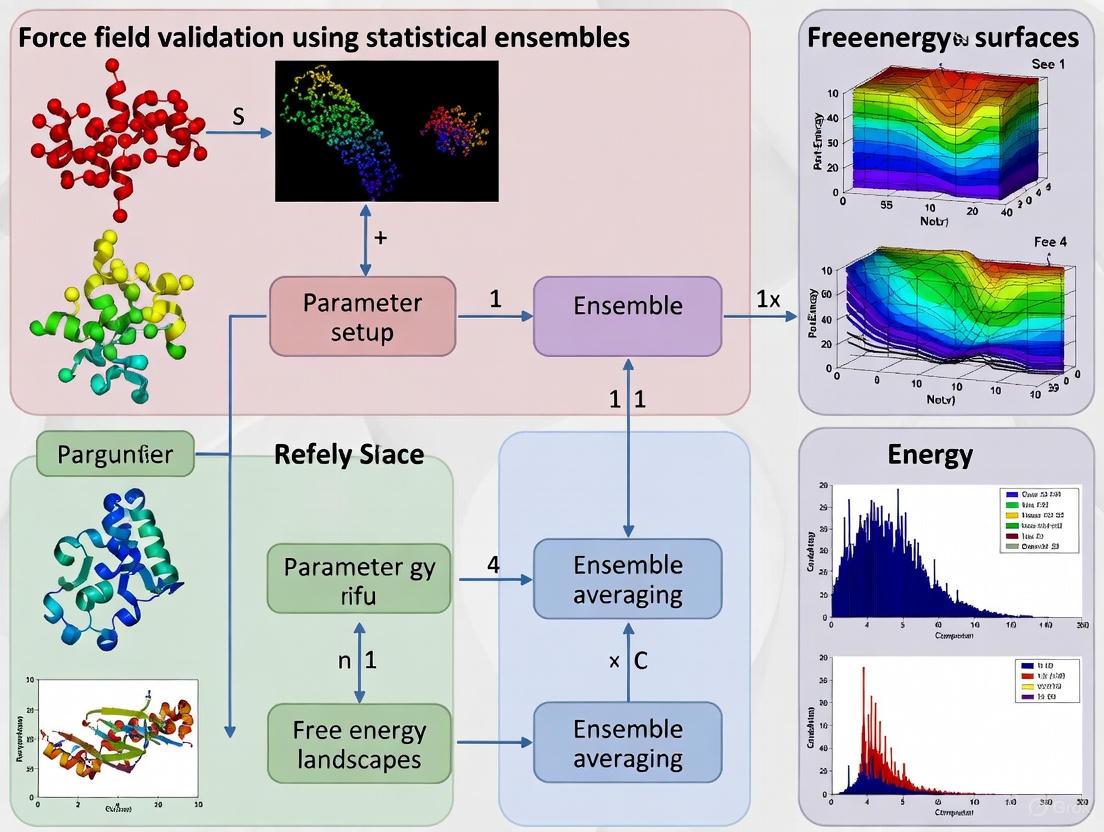
This article provides a comprehensive guide to force field validation using statistical ensembles, a critical process for ensuring the reliability of molecular simulations in biomedical research.
Force Field Validation with Statistical Ensembles: Methods, Challenges, and Applications in Drug Discovery
Abstract
This article provides a comprehensive guide to force field validation using statistical ensembles, a critical process for ensuring the reliability of molecular simulations in biomedical research. We cover foundational principles, exploring the necessity of validation for intrinsically disordered proteins and advanced peptidomimetics. The review details cutting-edge methodological approaches, including maximum entropy reweighting that integrates simulation with experimental data. We address key troubleshooting and optimization strategies to overcome sampling limitations and force field selection challenges. Finally, we present a rigorous framework for the comparative analysis of different force fields, highlighting their performance across diverse biological systems. This resource is tailored for researchers and drug development professionals seeking to implement robust validation protocols for their computational studies.
The Critical Role of Statistical Ensembles in Biomolecular Force Field Validation
The Force Field Concept and Its Parametrization Dilemma
In molecular dynamics (MD) simulations, a force field (FF) refers to the mathematical model and associated parameters that describe the potential energy of a system as a function of its atomic coordinates [1]. These empirical models use simple analytical functions to represent interatomic interactions, enabling the study of processes ranging from peptide folding to functional motions of large protein complexes [2]. The most common functional form includes terms for bonded interactions (bonds, angles, dihedrals) and non-bonded interactions (electrostatics and van der Waals forces) [1].
The fundamental challenge in force field development lies in the parametrization process. Force field parametrization is a poorly constrained problem where some properties exhibit exquisite sensitivity to small parameter variations while others appear quite insensitive [2]. The parameters within a given force field are also highly correlated, meaning that alternative parameter combinations can yield similar results, and varying one parameter may render other parameters suboptimal [2]. This complexity creates what is often termed a "parametrization dilemma," where improvements in agreement for one property may come at the expense of accuracy in another [2].
Historical Evolution of Validation Approaches
The validation of protein force fields has evolved significantly, with early studies suffering from limited statistical power. In seminal work from 1995, the validation of the AMBER ff94 force field relied heavily on a single 180 ps simulation of ubiquitin in water, where a root-mean-square deviation (RMSD) difference of 0.05 nm was claimed as significant improvement despite being within uncertainty [2]. Subsequent studies by Smith et al. (1995) utilized three 1 ns simulations of hen egg lysozyme but highlighted the difficulty of obtaining sufficient convergence for meaningful conclusions [2].
The early 2000s saw modest improvements. The 2003 AMBER release was validated based on the ability to distinguish experimental structures from decoys for 54 proteins using 10 ps simulations with implicit solvation [2]. Van der Spoel and Lindahl (2003) conducted one of the first validation studies with extended sampling (28 × 50 ns simulations) but still struggled to distinguish force fields even for simple systems [2]. By 2007, Villa et al. attempted to address poor statistics by simulating 31 proteins in triplicate for 5-10 ns but remained unable to demonstrate statistically significant differences between force fields due to variations between proteins and replicates [2].
A significant advancement came in 2012 with a systematic evaluation of eight different protein force fields using multi-microsecond simulations, allowing more robust comparison with experimental NMR data [3] [4] [5]. This study established that force fields could be categorized into distinct performance tiers and provided evidence for continued improvements in accuracy [4] [5].
Current State of Force Field Performance
Modern force fields have demonstrated progressively better performance across diverse protein systems, though significant challenges remain. The table below summarizes the performance characteristics of major force field families based on recent validation studies:
Table 1: Performance Characteristics of Major Force Field Families
| Force Field Family | Strengths | Limitations | Representative Versions |
|---|---|---|---|
| AMBER | Accurate collagen dihedrals and SAXS data [6]; Good for folded proteins and IDPs [7] [1] | Early versions (ff94, ff99) showed limited sampling [2] | ff14ipq, ff15ipq, ff19SB [1] |
| CHARMM | Good performance on folded proteins [4] [5] | Systematic shifts in collagen ϕ/ψ dihedrals [6]; Overstructuring of peptides [6] | CHARMM22*, CHARMM27, CHARMM36m [4] [6] |
| GROMOS | Validation using lysozyme NMR data [2] | Performance varies significantly by version [2] | 43A1, 45A3, 53A5, 53A6 [2] |
| OPLS | Reasonable short-timescale agreement [4] | Substantial conformational drift in long simulations [4] | OPLS-AA, OPLS-AA/L [4] |
Recent validation studies have revealed that force fields can be ranked into different performance tiers. For folded proteins like ubiquitin and GB3, CHARMM22, CHARMM27, Amber ff99SB-ILDN, and Amber ff99SB-ILDN demonstrated reasonably good agreement with experimental NMR data, while Amber ff03 and ff03* showed intermediate agreement, and OPLS and CHARMM22 exhibited substantial conformational drift [4] [5]. For intrinsically disordered proteins (IDPs), a99SB-disp, CHARMM22*, and CHARMM36m have shown promising results, though their performance varies across different disordered systems [7].
The performance of force fields is highly system-dependent. In collagen triple helix simulations, AMBER force fields accurately reproduced dihedrals, side-chain torsions, and SAXS data, while CHARMM force fields systematically shifted backbone dihedrals and overstructured the peptides [6]. For IDPs like COR15A, a 2025 study found that only DES-amber adequately reproduced both structure and dynamics, while ff99SBws captured helicity differences but overestimated them [8].
Key Methodologies in Force Field Validation
Experimental Observables for Validation
Validation of force fields relies on comparing simulation outcomes with experimental data. The choice of target properties presents a significant challenge, as parameters adjusted to reproduce conformational properties in one environment may fail in different environments [2]. Experimental data can be categorized as direct (quantities directly observed) or derived (quantities inferred from experimental data) [2].
Table 2: Key Experimental Data Used in Force Field Validation
| Experimental Method | Measured Observables | Advantages | Limitations |
|---|---|---|---|
| X-ray Crystallography | High-resolution protein structures [2] | Atomic-level structural details | Crystal packing effects; Static picture |
| NMR Spectroscopy | J-coupling constants, NOE intensities, chemical shifts, residual dipolar couplings, relaxation parameters [2] [7] | Solution-state data; Dynamic information | Interpretation model-dependent [2] |
| Small-Angle X-Ray Scattering (SAXS) | Ensemble-averaged structural parameters [7] [8] | Solution-state under native conditions; Low requirements | Sparse data; Multiple structural interpretations |
| Vibrational Spectroscopy | Bond vibrations and energies [1] | Information on local bonding | Limited structural information |
Statistical and Computational Frameworks
Robust validation requires sufficient sampling to distinguish force field deficiencies from statistical uncertainties. The essential subspace analysis using Principal Component Analysis (PCA) provides a method to compare structural ensembles across different force fields [4] [5]. The Root Mean Square Inner Product (RMSIP) quantifies the similarity between regions of conformational space sampled by different trajectories [5].
Integrative approaches that combine experimental data with simulations have grown increasingly popular, especially for IDPs [7]. The maximum entropy principle provides a framework for reweighting MD simulations with experimental data, introducing minimal perturbation to computational models required to match experimental datasets [7]. Automated parameter optimization methods like ForceBalance have enabled more systematic parameter fitting using both quantum mechanical and experimental target data [1].
Experimental Protocols for Force Field Validation
Protocol for Validating Folded Proteins
The validation of force fields for folded proteins typically follows a multi-step process that emphasizes comparison with experimental NMR data. The workflow below illustrates this comprehensive validation approach:
A typical validation protocol for folded proteins involves:
Test Set Selection: Curate a diverse set of high-resolution protein structures (e.g., 52 structures including 39 X-ray and 13 NMR-derived structures as in [2]).
Extended MD Simulations: Perform multiple long-timescale simulations (microsecond to millisecond) to ensure sufficient sampling and statistical precision [4]. For example, 10-microsecond simulations of ubiquitin and GB3 were used to evaluate eight different force fields [4] [5].
Comparison with NMR Data: Calculate experimental observables from simulations and compare with:
- J-coupling constants: Sensitive to backbone dihedral angles [2]
- Nuclear Overhauser Effect (NOE) intensities: Provide interproton distance information [2]
- Residual dipolar couplings (RDCs): Report on molecular orientation and dynamics [2]
- Order parameters (S²): Characterize bond vector flexibility [4]
Structural Metrics Analysis: Compute ensemble properties including:
Statistical Significance Testing: Determine if observed differences between force fields are statistically significant rather than resulting from sampling limitations [2].
Protocol for Validating Intrinsically Disordered Proteins
Validating force fields for IDPs presents unique challenges due to their heterogeneous conformational ensembles. The maximum entropy reweighting approach has emerged as a powerful method for determining accurate conformational ensembles of IDPs:
The protocol for IDP force field validation involves:
Initial Ensemble Generation: Perform long-timescale all-atom MD simulations (e.g., 30 μs as in [7]) using different force fields (a99SB-disp, CHARMM22*, CHARMM36m).
Experimental Data Collection: Obtain extensive experimental datasets, typically from NMR spectroscopy (chemical shifts, J-couplings, paramagnetic relaxation enhancements) and small-angle X-ray scattering (SAXS) [7].
Forward Model Application: Use mathematical models to predict experimental observables from each conformation in the MD ensemble [7].
Maximum Entropy Reweighting: Apply a reweighting procedure that introduces minimal perturbation to the initial ensemble while maximizing agreement with experimental data [7]. The effective ensemble size is controlled using the Kish ratio (typically K=0.10, retaining ~3000 structures) [7].
Convergence Assessment: Determine if reweighted ensembles from different initial force fields converge to similar conformational distributions, indicating a force-field independent approximation of the true solution ensemble [7].
The Scientist's Toolkit: Essential Research Reagents
Table 3: Essential Tools and Resources for Force Field Validation
| Tool/Resource | Type | Function in Validation | Examples/References |
|---|---|---|---|
| MD Software Packages | Software | Perform molecular dynamics simulations | GROMACS, AMBER, CHARMM, NAMD [6] |
| ForceBalance | Automated fitting | Optimize force field parameters against QM and experimental data | Used in AMBER ff15-FB development [1] |
| Maximum Entropy Reweighting | Computational method | Integrate MD simulations with experimental data | IDP ensemble determination [7] |
| Protein Data Bank | Structural database | Source of experimental structures for validation | Curated test sets [2] |
| NMR Data | Experimental | Validate structural ensembles and dynamics | Chemical shifts, J-couplings, NOEs [7] |
| SAXS | Experimental | Validate global structural properties | IDP compaction, ensemble properties [7] [8] |
Force field validation has progressed from qualitative assessments based on limited sampling to rigorous statistical comparisons using extensive simulation datasets and diverse experimental observables. The field has developed frameworks for evaluating force fields across different protein classes, including folded proteins, intrinsically disordered proteins, and specialized systems like collagen triple helices.
Despite these advances, fundamental challenges remain. No single force field currently excels across all protein types and properties, and the risk of overfitting to specific validation targets persists [2]. The integration of experimental data directly into parameter optimization, the development of polarizable force fields, and the use of automated fitting methods represent promising directions for future improvement [1]. Recent methodologies that enable the determination of accurate, force-field independent conformational ensembles of IDPs suggest the field may be maturing toward true atomic-resolution integrative structural biology [7].
The central challenge of validation continues to drive innovation in both force field development and assessment methodologies, with the ultimate goal of creating transferable parameters that accurately reproduce structural, dynamic, and thermodynamic properties across diverse biological systems.
Why Statistical Ensembles are Non-Negotiable for Accurate Biomolecular Modeling
Statistical ensembles have emerged as a foundational component in biomolecular modeling, transforming the field from qualitative visualization to quantitative, predictive science. This guide compares the performance of ensemble-based approaches against single-trajectory simulations, demonstrating through experimental data how ensembles are indispensable for robust force field validation, reliable free energy estimation, and accurate characterization of dynamic biological processes. The integration of ensemble methods with experimental data and advanced sampling algorithms represents a paradigm shift in computational biophysics, enabling researchers to achieve statistically significant results and avoid erroneous conclusions that plague insufficiently sampled simulations.
The Statistical Imperative: Why Single Simulations Fail
Biomolecular systems are inherently dynamic, sampling vast conformational landscapes that directly influence their function. Traditional molecular dynamics (MD) simulations relying on single trajectories are fundamentally limited for studying these complex systems due to several critical factors:
Statistical Fluctuations: Computational simulations, akin to wet lab experimentation, are subject to statistical fluctuations that must be quantified through uncertainty estimates. Without sufficient sampling, these fluctuations can lead to substantially erroneous interpretation of simulation data and wrong overall conclusions [9].
Sampling Deficiencies: Considering the stochastic nature of molecular dynamics sampling algorithms, biomolecular trajectories represent multidimensional random walks especially prone to suffering from sampling deficiencies. Relevant protein conformations are often not sampled in single trajectories, creating substantial associated errors in estimated thermodynamic and kinetic properties [9].
Force Field Validation Challenges: Assessing force field accuracy requires extensive sampling across diverse molecular systems. Single simulations provide inadequate data for meaningful force field comparison or validation against experimental observables [7].
The critical importance of statistical ensembles becomes evident when examining case studies where initial findings based on limited sampling were later refuted with proper statistical treatment. One prominent example involves claims about simulation box size effects on thermodynamic quantities, which subsequent ensemble studies demonstrated disappeared with increased sampling [9]. This scientific discussion highlights how insufficient statistics can lead to unfounded claims about physical phenomena.
Performance Comparison: Ensemble vs. Single Trajectory Approaches
Table 1: Quantitative Comparison of Simulation Approaches for Key Biomolecular Modeling Tasks
| Modeling Task | Single Trajectory Performance | Ensemble Approach Performance | Experimental Validation |
|---|---|---|---|
| Hydration Free Energy (Small Molecule) | Erroneous trends (upward/downward) appearing in individual runs [9] | Box-size independence confirmed (Mean ΔG: -8.5 ± 0.3 kcal/mol across 20 replicates) [9] | Consistent with experimental hydration values |
| Protein Solvation Free Energy | Highly variable results depending on starting structure | Statistically consistent values across box sizes when properly sampled | Requires integration with experimental techniques |
| IDP Conformational Sampling | Limited structural diversity, force-field dependent biases | Converged ensembles across force fields after maximum entropy reweighting [7] | Agreement with NMR and SAXS data (χ² improvement > 70%) [7] |
| Kinetic Parameter Estimation | Poor convergence of transition rates | Robust estimation through Markov State Models [10] | Validated through experimental kinetics |
| Force Field Validation | Inconclusive or misleading comparisons | Quantitative assessment across multiple properties | Direct experimental comparability |
Table 2: Statistical Reliability Assessment Across Sampling Methods
| Statistical Metric | Single Long Trajectory | Basic Ensemble (10 trajectories) | Advanced Adaptive Ensemble |
|---|---|---|---|
| Uncertainty Quantification | Limited to block averaging | Robust confidence intervals | Bayesian uncertainty estimates |
| Phase Space Coverage | Incomplete, path-dependent | Moderate improvement | Comprehensive exploration |
| Convergence Assessment | Challenging to verify | Statistical tests applicable | Automated convergence detection |
| Computational Efficiency | Low for rare events | Moderate | High (100-1000x improvement) [10] |
| Force Field Discrimination | Poor sensitivity | Moderate discrimination power | High sensitivity to force field differences |
Experimental Protocols and Methodologies
Ensemble-Based Free Energy Calculations
Protocol for Hydration Free Energy Validation [9]
System Setup: Create multiple independent simulation systems for the target molecule (e.g., anthracene) solvated in water boxes of varying sizes (473 to 5334 water molecules)
Replica Generation: Generate 20 independent replicates per box size with different initial random seeds
Alchemical Sampling: Perform free energy calculations using Hamiltonian replica exchange with 32 discrete λ-windows between coupled and decoupled states
Convergence Monitoring: Track statistical uncertainties through:
- Standard deviations across replicates
- Confidence interval calculations (95% confidence level)
- Time-series analysis of free energy estimates
Statistical Testing: Apply hypothesis testing to identify significant trends versus random fluctuations
Key Experimental Insight: When all replicates (N=20) are considered, no trend in computed hydration free energy is observed as a function of simulation box size. However, reliance on single realizations can produce any type of trend (upward, downward, or non-monotonic), illustrating how anecdotal evidence leads to erroneous conclusions [9].
Workflow for Determining Accurate IDP Conformational Ensembles
Methodology Details:
Initial Ensemble Generation:
- Run 30μs all-atom MD simulations using three different protein force field/water model combinations (a99SB-disp/a99SB-disp water, Charmm22*/TIP3P, Charmm36m/TIP3P)
- Collect 29,976 structures from each unbiased MD ensemble
Experimental Data Integration:
- Acquire nuclear magnetic resonance (NMR) data including chemical shifts, J-couplings, and residual dipolar couplings
- Obtain small-angle X-ray scattering (SAXS) data providing global structural parameters
- Calculate experimental observables from ensemble structures using established forward models [7]
Maximum Entropy Reweighting:
- Apply the minimal perturbation to computational models required to match experimental data
- Automatically balance restraint strengths from different experimental datasets
- Use Kish ratio (K=0.10) to maintain effective ensemble size (~3000 structures)
- Optimize weights to maximize agreement while preserving statistical robustness
Performance Outcome: For three of five IDPs studied (Aβ40, drkN SH3, and ACTR), ensembles derived from different force fields converged to highly similar conformational distributions after reweighting, demonstrating force-field independent ensemble determination [7].
Protocol for Enhanced Kinetics Estimation:
Initial Exploration: Launch multiple parallel simulations from diverse starting conformations
Progress Monitoring: Track collective variables or state assignments in real-time
Adaptive Resampling: Dynamically allocate computational resources to under-sampled regions
Model Building: Construct Markov State Models or weighted ensemble frameworks
Iterative Refinement: Continuously improve sampling based on intermediate results
Efficiency Gains: Adaptive ensemble algorithms can increase simulation efficiency by greater than a thousand-fold compared to traditional single-trajectory approaches [10].
The Scientist's Toolkit: Essential Research Reagents and Solutions
Table 3: Key Computational Tools for Ensemble-Based Biomolecular Modeling
| Tool/Category | Specific Examples | Function/Purpose | Performance Considerations |
|---|---|---|---|
| MD Simulation Engines | GROMACS [9], AMBER, CHARMM, NAMD [10] | Core molecular dynamics propagation | Optimized for ensemble execution on HPC resources |
| Enhanced Sampling Algorithms | Replica Exchange MD, Weighted Ensemble, Metadynamics [10] | Accelerate barrier crossing and rare events | Tradeoffs between scalability and system size |
| Ensemble Analysis Frameworks | Markov State Models, MILESTONING [10] | Extract kinetics and thermodynamics from ensemble data | Model quality depends on state definition and sampling |
| Experimental Integration Tools | Maximum Entropy Reweighting [7], Bayesian Inference | Combine simulation with experimental data | Manages experimental uncertainty and force field errors |
| Adaptive Execution Platforms | Copernicus, Ensemble Toolkit, Swift/T [10] | Dynamically control ensemble simulations based on intermediate results | Requires sophisticated workflow management |
| Force Fields | a99SB-disp, CHARMM36m, CHARMM22* [7] | Molecular interaction potentials | Ensemble approaches reveal force field limitations |
Force Field Validation Through Statistical Ensembles
Statistical ensembles provide the essential framework for rigorous force field validation, moving beyond qualitative assessment to quantitative statistical comparison. The integration of experimental data with ensemble simulations has revealed that in favorable cases, IDP ensembles obtained from different MD force fields converge to highly similar conformational distributions after maximum entropy reweighting [7].
Force Field Validation Through Ensemble Convergence
Key Validation Insights:
Convergence Testing: When ensembles from different force fields converge to similar distributions after experimental reweighting, this indicates force-field independent approximation of the true solution ensemble [7].
Discrimination Power: For IDPs where unbiased MD simulations with different force fields sample distinct conformational regions, ensemble reweighting clearly identifies the most accurate representation of the true solution ensemble [7].
Statistical Significance: Ensemble approaches enable proper statistical testing to determine whether differences between force fields exceed natural variability and sampling limitations.
The experimental evidence comprehensively demonstrates that statistical ensembles are fundamental requirements—not optional enhancements—for accurate biomolecular modeling. The comparative data reveals several unequivocal conclusions:
Statistical Reliability: Ensemble methods provide the only mathematically sound approach for quantifying uncertainties in computed biomolecular properties, without which conclusions remain suspect [9].
Force Field Development: Modern force field validation absolutely requires ensemble approaches to assess performance across diverse molecular systems and conditions [7].
Computational Efficiency: Adaptive ensemble simulations can achieve thousand-fold improvements in sampling efficiency compared to single-trajectory methods [10].
Experimental Integration: Maximum entropy and similar ensemble-based frameworks provide the most robust methodology for integrating simulation with experimental data [7] [11].
For researchers in computational biophysics and drug development, embracing statistical ensembles represents an essential paradigm shift from qualitative observation to quantitative, statistically rigorous biomolecular modeling. The experimental comparisons clearly demonstrate that ensemble approaches consistently outperform single-trajectory methods across all metrics of reliability, accuracy, and efficiency, making them truly non-negotiable for cutting-edge research in the field.
Conformational Ensembles, Sampling, and the Force Field Fitting Problem
Molecular dynamics (MD) simulations provide a powerful vehicle for capturing the structures, motions, and interactions of biological macromolecules in full atomic detail, serving as a computational microscope for researchers and drug development professionals [12]. The accuracy of such simulations, however, is critically dependent on the force field—the mathematical model used to approximate the atomic-level forces acting on the simulated molecular system [12]. The "force field fitting problem" refers to the fundamental challenge of developing energy functions that accurately reproduce the true potential energy surface of diverse molecular systems, from folded proteins to intrinsically disordered regions and macrocyclic therapeutics. This challenge is particularly acute for modeling conformational ensembles—the collections of interconverting structures that flexible molecules adopt in solution. Recent advances in sampling algorithms and force field parameterization have progressively improved the accuracy of these computational models, yet significant limitations remain, especially for complex systems with heterogeneous dynamics [13].
Force Field Comparison: Performance Across Molecular Systems
Performance Benchmarking for Macrocycles
Macrocycles represent a promising class of therapeutic compounds for difficult drug targets due to their favorable combination of properties, including improved binding affinity compared to their linear counterparts and reduced conformational flexibility [14]. A 2024 benchmark study evaluated four different force fields for macrocyclic compounds by performing replica exchange with solute tempering (REST2) simulations of 11 macrocyclic compounds and comparing conformational ensembles to nuclear Overhauser effect (NOE) distance bounds from NMR experiments [14]. The results demonstrated that modern force fields, particularly OpenFF 2.0 and XFF, yielded the best performance, outperforming established force fields like GAFF2 and OPLS/AA [14].
Table 1: Force Field Performance for Macrocyclic Compounds
| Force Field | Overall Performance | Strengths | Limitations |
|---|---|---|---|
| OpenFF 2.0 (Sage) | Good to excellent | Accurate ensembles for most macrocycles | Varies by specific compound |
| XFF | Good to excellent | Good performance with DASH partial charges | Recently developed, less extensively tested |
| GAFF2 | Moderate | Widely adopted, AM1-BCC charges | Underperforms vs. modern alternatives |
| OPLS/AA | Moderate to poor | Established history | Lower accuracy for macrocyclic ensembles |
However, the study also highlighted that for certain compounds, all examined force fields failed to produce ensembles satisfying experimental constraints, indicating persistent challenges in force field accuracy [14]. This underscores that while force fields have improved, the "fitting problem" remains partially unsolved, particularly for specialized molecular systems.
Performance for Intrinsically Disordered Proteins
Intrinsically disordered proteins (IDPs) represent a particularly challenging case for force fields due to their lack of stable tertiary structure and existence as dynamic conformational ensembles [7] [15]. Recent studies have evaluated force fields by comparing simulations to experimental data from NMR spectroscopy and small-angle X-ray scattering (SAXS) [7].
Table 2: Force Field Performance for Intrinsically Disordered Proteins
| Force Field | Performance IDPs | Key Characteristics |
|---|---|---|
| a99SB-disp | Good overall | Specifically designed for disordered proteins |
| CHARMM36m (C36m) | Good overall | Refined to reduce overpopulation of left-handed helicies |
| CHARMM22* | Variable | Improved backbone parameters |
| a99SB-ILDN | Poor for IDPs | Optimized for folded proteins, predicts overly compact ensembles |
A 2025 study demonstrated that through maximum entropy reweighting—integrating MD simulations with experimental data—ensembles from different force fields could be made to converge to highly similar conformational distributions [7]. This suggests that in favorable cases where initial agreement with experiments is reasonable, reweighted ensembles can provide force-field independent approximations of true solution ensembles [7].
Performance for Folded Proteins and Peptides
Early systematic validation studies compared eight protein force fields through extensive simulations of folded proteins, secondary structure elements, and folding events [12]. These investigations revealed that while all force fields had strengths and weaknesses, some—particularly Amber ff99SB-ILDN and CHARMM22*—provided the best overall agreement with experimental NMR data for folded proteins like ubiquitin and GB3 [12]. The study also highlighted specific deficiencies, such as the inability of CHARMM22 to maintain the native state of GB3, which unfolded during simulation [12].
Advanced Sampling and Validation Methodologies
Enhanced Sampling Techniques
Accurate determination of conformational ensembles requires adequate sampling of the accessible conformational space, which can be computationally prohibitive using standard MD simulations [16]. Enhanced sampling techniques have been developed to address this challenge:
Replica Exchange with Solute Tempering (REST2): Scales down dihedral angle terms and intramolecular nonbonded interactions of the solute to accelerate transitions while maintaining high replica-exchange acceptance probability [14]. Studies have shown that including bond-angle terms in REST2 is necessary for proper sampling of compounds with strained ring systems [14].
Gaussian Accelerated MD (GaMD): Provides unbiased reweighting of conformational distributions while accelerating sampling of energy barriers, successfully applied to study proline isomerization in disordered proteins [16].
Replica-Exchange MD (REMD): Multiple copies of the system simulate at different temperatures, allowing exchange between replicas to overcome energy barriers [14].
Integrative Approaches Combining Simulation and Experiment
Due to limitations in both force field accuracy and conformational sampling, integrative approaches that combine computational models with experimental data have emerged as powerful methodologies:
Maximum Entropy Reweighting: A robust procedure that introduces minimal perturbation to computational models required to match experimental data [7]. This approach automatically balances restraints from different experimental datasets based on the desired effective ensemble size, producing statistically robust ensembles with minimal overfitting [7].
Quality Evaluation Based Simulation Selection (QEBSS): A protocol that combines MD simulations with NMR-derived protein backbone ¹⁵N spin relaxation times (T1 and T2) and hetNOE values to identify conformational ensembles with realistic dynamics [13]. QEBSS quantitatively evaluates simulation quality and systematically selects ensembles that best reproduce experimental observations [13].
Table 3: Experimental Techniques for Force Field Validation
| Experimental Method | Information Provided | Applications in Validation |
|---|---|---|
| NMR Spectroscopy | Interatomic distances, dynamics, secondary structure | NOE distance bounds, chemical shifts, spin relaxation |
| Small-Angle X-Ray Scattering (SAXS) | Global dimensions, shape | Radius of gyration, Kratky plots |
| Förster Resonance Energy Transfer (FRET) | Inter-domain distances, dynamics | Distance distributions between fluorophores |
| Circular Dichroism (CD) | Secondary structure content | Helical, sheet, and random coil proportions |
The Scientist's Toolkit: Essential Research Reagents and Solutions
Table 4: Essential Research Tools for Conformational Ensemble Determination
| Tool/Reagent | Function/Role | Examples/Notes |
|---|---|---|
| MD Simulation Software | Generate conformational ensembles | GROMACS, AMBER, OpenMM, Desmond |
| Force Field Parameters | Define energy functions | OpenFF 2.0, CHARMM36m, a99SB-disp, GAFF2 |
| Enhanced Sampling Algorithms | Improve conformational sampling | REST2, GaMD, REMD, Metadynamics |
| Experimental Data | Validate and refine ensembles | NMR (NOE, relaxation), SAXS, FRET |
| Reweighting/Bayesian Methods | Integrate simulations with experiments | Maximum entropy, Bayesian inference |
| Analysis Tools | Quantify ensemble properties | MDTraj, MDAnalysis, VMD |
Workflow and Signaling Pathways
Flowchart for Conformational Ensemble Determination
Integrative Structural Biology Approach
The accurate determination of conformational ensembles remains challenging due to the intertwined problems of force field accuracy and adequate sampling. Recent advances in force field development, particularly OpenFF 2.0, XFF, a99SB-disp, and CHARMM36m, have demonstrated improved performance for diverse molecular systems including macrocycles, IDPs, and folded proteins [14] [7]. Enhanced sampling methods like REST2 and integrative approaches such as maximum entropy reweighting and QEBSS provide pathways to more accurate ensembles by combining computational and experimental data [14] [7] [13].
Emerging methods using artificial intelligence show promise in overcoming limitations of traditional MD simulations by learning complex sequence-to-structure relationships from large datasets [16]. However, these approaches still face challenges including dependence on training data quality and limited interpretability [16]. The most promising future direction appears to be hybrid approaches that integrate physics-based simulations with AI methods and experimental data, potentially leading to more accurate, efficient, and force-field independent determination of conformational ensembles for drug development and molecular design.
The Critical Importance for Intrinsically Disordered Proteins (IDPs)
Intrinsically Disordered Proteins (IDPs) and regions (IDRs) represent a substantial fraction of eukaryotic proteomes, playing critical roles in cellular signaling, transcriptional regulation, and dynamic protein-protein interactions [17]. Unlike structured proteins, IDPs lack a stable three-dimensional structure under physiological conditions, existing instead as dynamic conformational ensembles [18]. This structural flexibility allows them to participate in vital biological processes but also makes them exceptionally challenging to characterize and target. IDPs are frequently associated with major human diseases, including cancer, cardiovascular diseases, and neurodegenerative disorders such as Alzheimer's and Parkinson's disease [18] [17]. Their prevalence in disease pathways, coupled with their lack of stable binding pockets, has historically rendered many IDPs "undruggable" [17]. However, recent advances in computational structural biology and force field development are now enabling researchers to accurately model IDP conformational ensembles, opening new avenues for therapeutic intervention targeting these critical proteins.
Force Field Performance Comparison for IDP Simulations
Molecular dynamics (MD) simulations provide atomistically detailed structural ensembles of IDPs, but their accuracy depends critically on the force fields used. Recent developments have yielded several force fields specifically optimized for IDP simulations. The table below summarizes the performance characteristics of contemporary force fields validated against experimental data from nuclear magnetic resonance (NMR) spectroscopy and small-angle X-ray scattering (SAXS).
Table 1: Comparison of Modern Force Fields for IDP Simulations
| Force Field | Base Force Field | Key Improvements | Performance Summary | Known Limitations |
|---|---|---|---|---|
| DES-Amber [19] | Amber ff99SB | Reparameterized dihedral and non-bonded interactions using osmotic pressure data | Best performer for COR15A dynamics; captures helicity differences between wild-type and mutant | Does not perfectly reproduce all experimental data |
| Amber ff99SBws [20] | Amber ff99SB | Upscaled protein-water interactions (10%) with TIP4P2005 water | Improved IDP chain dimensions; maintains folded protein stability | Overestimates helicity in some systems [19] |
| Amber ff03w-sc [20] | Amber ff03 | Selective protein-water interaction scaling | Accurate IDP dimensions and secondary structure propensities | Improves folded protein stability over ff03ws |
| CHARMM36m [18] [15] | CHARMM36 | Refined CMAP potentials and added NBFIX for salt bridges | Balanced performance for folded/disordered proteins; correct Aβ16-22 aggregation | Initial versions overpopulated left-handed helicies [15] |
| a99SB-disp [7] | Amber ff99SB | Modified TIP4P-D water with enhanced backbone hydrogen bonding | State-of-the-art performance in multiple IDP benchmarks | Overestimates protein-water interactions in some cases [20] |
Quantitative validation studies reveal that in favorable cases where different force fields show reasonable initial agreement with experimental data, reweighted ensembles converge to highly similar conformational distributions [7]. For example, in a comprehensive assessment of five IDPs (Aβ40, drkN SH3, ACTR, PaaA2, and α-synuclein), three force fields (a99SB-disp, CHARMM22*, and CHARMM36m) produced highly similar conformational distributions after maximum entropy reweighting with extensive NMR and SAXS datasets [7].
Experimental Protocols for Force Field Validation
Maximum Entropy Reweighting Protocol
A robust methodology for determining accurate atomic-resolution conformational ensembles integrates MD simulations with experimental data using a maximum entropy reweighting procedure [7]. The workflow involves:
Initial Ensemble Generation: Running long-timescale (e.g., 30μs) all-atom MD simulations of IDPs using different protein force field and water model combinations (e.g., a99SB-disp with a99SB-disp water, CHARMM22* with TIP3P water, CHARMM36m with TIP3P water) [7].
Experimental Data Collection: Acquiring extensive experimental datasets, primarily from NMR spectroscopy (chemical shifts, scalar couplings, relaxation data) and SAXS, which provide ensemble-averaged structural information [7].
Observable Prediction: Using forward models to predict experimental observables from each frame of the unbiased MD ensemble [7].
Reweighting Procedure: Applying maximum entropy reweighting to introduce minimal perturbation to computational models required to match experimental data, typically resulting in ensembles containing ~3000 structures with a Kish Ratio threshold of K=0.10 [7].
The following diagram illustrates this integrative structural biology workflow:
Force Field Validation on Challenging Systems
Rigorous validation involves testing force fields against IDPs with specific characteristics. A recent study evaluated 20 MD models on COR15A, "an IDP just on the verge of folding," using a two-step approach [19]:
Primary Screening: Initial validation of short 200-ns simulations against SAXS data to identify promising candidates.
Detailed Evaluation: Extended 1.2-μs MD simulations of the six best-performing models against NMR data, including a single-point mutant with slightly increased helicity.
Dynamic Assessment: Analysis of NMR relaxation times at different magnetic field strengths to evaluate conformational dynamics.
This systematic approach revealed that only DES-amber adequately reproduced both structural and dynamic properties of COR15A, highlighting the importance of rigorous, multi-faceted force field validation [19].
Therapeutic Targeting Strategies for IDPs
Biomolecular Condensates as Therapeutic Targets
IDPs frequently drive the formation of biomolecular condensates through liquid-liquid phase separation (LLPS), and abnormal condensates are implicated in cancer and neurodegenerative diseases [17]. Therapeutic strategies have evolved to target these assemblies through several mechanisms:
Table 2: Classification of Condensate-Modifying Drugs (c-mods)
| Category | Mechanism of Action | Example Compound | Therapeutic Effect |
|---|---|---|---|
| Dissolvers | Dissolve or prevent condensate formation | ISRIB | Reverses stress granule formation and restores translation [17] |
| Inducers | Trigger condensate formation to alter reaction rates | Tankyrase inhibitors | Promote degradation condensates that reduce beta-catenin [17] |
| Localizers | Alter subcellular localization of condensate components | Avrainvillamide | Restores NPM1 to nucleus/nucleolus in AML [17] |
| Morphers | Modify condensate morphology and material properties | Cyclopamine | Alters RSV condensate properties, inhibiting replication [17] |
AI-Driven Binder Design for IDPs
Recent breakthroughs in AI-based protein design have enabled targeting of disordered proteins previously considered undruggable. Two complementary strategies have emerged:
'Logos' Approach: A design strategy that creates binders by assembling proteins from a library of 1,000 pre-made parts, successfully generating tight binders for 39 of 43 tested disordered targets [21].
RFdiffusion-Based Method: Uses generative AI to produce proteins that wrap around flexible targets, achieving high-affinity binders (3-100 nM) for targets including amylin, pathogenic prion core, and IL-2 receptor γ-chain [21].
These approaches have demonstrated promising functional outcomes, including blocking pain signaling, dismantling toxic aggregates, and disabling prion seeds in cell-based tests [21].
The following diagram illustrates the therapeutic targeting strategies for IDPs and biomolecular condensates:
Table 3: Key Research Reagents and Computational Tools for IDP Research
| Resource Category | Specific Tools | Function and Application |
|---|---|---|
| Force Fields | DES-Amber, CHARMM36m, ff99SBws, ff03w-sc | Provide physical models for MD simulations of IDPs [19] [20] |
| Water Models | TIP4P/2005, TIP4P-D, TIP3P (modified) | Critical for balancing protein-water and protein-protein interactions [18] [20] |
| Reweighting Software | Maximum entropy reweighting protocols | Integrate MD simulations with experimental data [7] |
| IDP Prediction Tools | IDP-FSP, IDP-EDL, FusionEncoder | Predict disordered regions from sequence [22] [23] |
| Experimental Data | NMR chemical shifts, J-couplings, SAXS profiles | Validate and refine computational models [7] [19] |
| AI Design Platforms | RFdiffusion, 'Logos' method | Design binders to target disordered proteins [21] |
The field of IDP research is rapidly advancing, with recent progress in force field development, integrative structural biology, and therapeutic targeting strategies. Force fields such as DES-Amber and ff03w-sc demonstrate that balanced parameterization can simultaneously describe folded domains and disordered regions with improved accuracy [19] [20]. Integrative approaches that combine MD simulations with experimental data through maximum entropy reweighting are enabling determination of force-field independent conformational ensembles [7]. Most promisingly, AI-driven methods for designing binders to disordered targets are overcoming historical barriers to targeting IDPs therapeutically [21]. As these computational and experimental methodologies continue to mature, researchers are increasingly positioned to exploit the critical importance of IDPs in both fundamental biology and drug development, potentially unlocking new treatments for cancer, neurodegenerative diseases, and other disorders linked to disordered proteins.
In the last two decades, non-natural peptidic compounds have demonstrated remarkable structural diversity and widespread applicability across numerous fields [24]. Among these, β-peptides—composed of β-amino acids with an extra backbone carbon atom—have emerged as particularly promising scaffolds for biomolecular engineering. These foldamers can adopt diverse secondary structures including helical conformations, sheet-like formations, hairpins, and even higher-ordered oligomers and nanofibers [24]. The growing interest in β-peptides stems from their unique structural properties and broad potential applications in nanotechnology, biomedical fields, biopolymer surface recognition, catalysis, and biotechnology [24] [25]. Unlike natural peptides, β-peptides possess important structural differences primarily arising from the properties of the amino acid backbone, which may enable functions so far unseen for natural biomolecules [24].
Computer-assisted study and design of these non-natural peptidomimetics has become increasingly important, with molecular dynamics (MD) simulations playing a crucial role in accurately describing both monomeric and oligomeric states [24]. However, the accuracy of these computational predictions hinges on the quality of the empirical force fields used to describe atomic interactions. This case study examines the current state of force field performance for β-peptides, comparing the accuracy of three major force field families and their ability to predict both secondary structure and oligomerization behavior.
Force Field Performance: A Comparative Analysis
Quantitative Comparison of Force Field Accuracy
Recent research has systematically evaluated the performance of three major force field families specifically tailored for β-peptides: CHARMM, Amber, and GROMOS [24]. A 2023 comparative study tested these force fields across seven different β-peptide sequences with diverse structural characteristics, simulating each system for 500 nanoseconds and testing multiple starting conformations [24].
Table 1: Force Field Performance Across β-Peptide Systems
| Force Field | Successfully Modeled Peptides | Experimental Structure Reproduction | Oligomer Formation & Stability |
|---|---|---|---|
| CHARMM | 7/7 sequences | Accurate in all monomeric simulations | Correctly described all oligomeric examples |
| Amber | 4/7 sequences | Successful for β-peptides with cyclic β-amino acids | Maintained pre-formed associates but failed at spontaneous oligomer formation |
| GROMOS | 4/7 sequences | Lowest performance in structure reproduction | Limited oligomerization capabilities |
The results demonstrated clear performance differences among the force fields. The CHARMM force field extension, developed through torsional energy path matching against quantum-chemical calculations, performed best overall, accurately reproducing experimental structures in all monomeric simulations and correctly describing all oligomeric systems [24]. In contrast, the Amber force field successfully modeled only four of the seven β-peptide sequences, particularly those containing cyclic β-amino acids, while the GROMOS force field also handled only four sequences and showed the lowest performance in reproducing experimental secondary structures [24].
Specialized Force Field Extensions for β-Peptides
Each major force field family has undergone specific extensions to accommodate β-peptides:
CHARMM: The Cui group initially extended CHARMM for β-peptides [24], with subsequent improvements by Wacha et al. involving rigorous study of backbone torsions to eliminate correlations between dihedral angle parameters [24]. This resulted in better reconstruction of the ab initio potential energy surface and closer matching of experimentally determined structural quantities.
Amber: Two separate extension attempts exist in the literature—the AMBER*C variant validated for cyclic β-amino acids by the Gellman group, and the extension by the Martinek research group for both cyclic and acyclic β-amino acids [24].
GROMOS: This was the first force field to support β-peptides "out of the box" as early as 1997, developed by the original van Gunsteren group [24]. The 54A7 and 54A8 versions both support β-amino acids without further modification, though derivation of some residues by analogy is sometimes required [24].
Methodological Framework for Force Field Validation
Experimental Protocols and Simulation Methodologies
The comparative analysis of force field performance followed rigorous methodological standards to ensure impartiality and reproducibility [24]. Each simulation employed consistent protocols across all tested force fields:
Table 2: Key Research Reagents and Computational Tools
| Research Tool | Specific Type/Version | Function in β-Peptide Research |
|---|---|---|
| MD Engine | GROMACS 2019.5 | Common simulation platform for impartial force field comparison |
| Force Fields | CHARMM36m (Mar 2017), Amber ff03, GROMOS 54A7/54A8 | Empirical interaction potentials with β-amino acid parameters |
| Topology Generation | pdb2gmx (CHARMM/Amber), make_top/OutGromacs (GROMOS) | Generate molecular topologies and interaction parameters |
| Visualization & Modeling | PyMOL 2.3.0 with pmlbeta extension | Molecular graphics and β-peptide model construction |
| Analysis Package | gmxbatch Python package | Trajectory analysis and run preparation |
Simulation Workflow: Molecular models of β-peptides were built using PyMOL with specialized extensions for β-peptides [24]. After initial energy minimization in vacuo, peptide molecules were folded by setting backbone torsion angles to values corresponding to desired secondary structures. The folded peptides were solvated in appropriate solvents (water, methanol, or DMSO) in a cubic box with proper peptide-wall distances [24]. For oligomerization studies, eight copies of the solvated peptide were assembled in a 2×2×2 cube after applying random rotations to each chain [24]. The systems underwent energy minimization with position restraints on peptide heavy atoms, followed by a 100 ps MD run in the NVT ensemble for temperature coupling at 300 K [24].
Special Considerations: For short peptides, terminal groups profoundly influence folding behavior, requiring careful attention to correct termini application as reported in literature [24]. This presented challenges for some force fields—Amber lacked neutral N- and C-termini, while GROMOS was missing neutral amine and N-methylamide C-termini, limiting their applicability for certain β-peptide sequences [24].
Test System Diversity
The force field validation employed seven diverse β-peptide sequences representing various structural motifs [24]:
Peptide I: A common benchmark that folds in methanol into a left-handed 314 helix with approximately three β-amino acid residues per turn [24].
Peptides II & III: Test cases for Amber-compatible parameter derivation; Peptide II prefers 314 helical conformation in aqueous media, while Peptide III is disordered in water [24].
Peptide IV: Among the first β-peptides composed exclusively of acyclic β-amino acids adopting stable 314 conformation in water, designed as protein-protein interaction inhibitors [24].
Peptide V: Designed to adopt hairpin-like conformations in aqueous solution [24].
Peptide VI: Forms elongated strands in DMSO and assembles into nanostructured sheet-mimicking fibers in methanol and water [24].
Peptide VII (Zwit-EYYK): Designed to form stable octameric bundles in the shape of two cupped hands with four "fingers" of 314 helices each [24].
This diversity ensured comprehensive assessment of force field performance across different secondary structures and association behaviors.
Figure 1: Molecular Dynamics Workflow for β-Peptide Force Field Validation
Advanced Applications: β-Peptide Self-Assembly and Functional Materials
Supramolecular Self-Assembly and Stimuli-Responsive Materials
Beyond monomeric structures, β-peptides demonstrate remarkable supramolecular self-assembly capabilities, forming well-defined nanostructures with applications in tissue engineering, cell culture, and drug delivery [25]. These foldectures—self-assembled molecular architectures of β-peptide foldamers—exhibit uniform alignment in response to external magnetic fields and show instantaneous orientational motion in dynamic magnetic fields [26]. This magnetotactic behavior stems from amplified anisotropy of diamagnetic susceptibilities resulting from well-ordered molecular packing, reminiscent of magnetosomes in magnetotactic bacteria [26].
The magnetic alignment of foldectures can be explained by collective diamagnetic anisotropy in their ordered molecular packing. Theoretical calculations of diamagnetic susceptibilities along orthogonal crystallographic axes reveal that foldectures align their easy magnetization axis (the direction with the largest, least negative diamagnetic susceptibility) parallel to applied static magnetic fields [26]. For instance, rhombic rod foldectures (F1) from BocNH-ACPC6-OH align their longitudinal axes parallel to the field direction, while rectangular plates (F2) from BocNH-ACPC8-OBn align their minor axes parallel to the field [26]. This precise control over molecular orientation enables design of stimuli-responsive molecular systems capable of undergoing mechanical work, providing inspiration for next-generation biocompatible peptide-based molecular machines [26].
Challenges in Modeling Self-Assembly
Computational modeling of β-peptide self-assembly presents significant challenges, as accurate prediction requires capturing the collective balance of non-covalent interactions that drive association under different conditions [25]. While molecular modeling can provide crucial insights into self-assembly mechanisms and atomistic models of resulting materials, only CHARMM successfully demonstrated ability to both maintain pre-formed associates and yield spontaneous oligomer formation in simulations [24]. Amber could hold together already formed associates but failed to produce spontaneous oligomer formation, while GROMOS showed limited oligomerization capabilities [24].
Emerging Methodologies in Force Field Optimization
Bayesian Inference for Force Field Refinement
Recent advances in force field optimization leverage Bayesian inference methods to address challenges in parameterizing models against experimental data. The Bayesian Inference of Conformational Populations (BICePs) algorithm provides a robust framework for refining force field parameters against ensemble-averaged experimental measurements that are often sparse and/or noisy [27]. BICePs samples the full posterior distribution of conformational populations and experimental uncertainty, treating uncertainty in observables as nuisance parameters [27].
The algorithm uses a replica-averaged forward model that becomes a maximum-entropy reweighting method in the limit of large replica numbers [27]. This approach employs specialized likelihood functions, including Student's likelihood models, that automatically detect and down-weight data points subject to systematic error—a significant advantage when working with experimental measurements containing unknown random and systematic errors [27]. The BICePs score, a free energy-like quantity reflecting total evidence for a model, serves as an objective function for variational optimization of force field parameters [27].
Future Directions in Force Field Development
The extension of BICePs for automated force field refinement represents a promising direction for robust parameterization of molecular potentials [27]. By efficiently optimizing complex parameter spaces through calculation of first and second derivatives of the BICePs score, this approach enables automatic force field optimization against ensemble-averaged observables [27]. Such methodologies may address current limitations in β-peptide modeling, particularly for challenging systems like self-assembling foldectures and complex oligomeric bundles.
Future force field development will likely focus on improving transferability across diverse β-peptide sequences, accuracy in predicting association behavior, and compatibility with enhanced sampling methods. As β-peptides continue to find applications in designing functional nanomaterials and biomedical constructs, reliable computational models will remain indispensable for molecular-level understanding and rational design.
This case study demonstrates that accurate modeling of β-peptides and non-natural foldamers remains challenging but achievable with carefully parameterized force fields. The CHARMM family, particularly with recent improvements in backbone torsion parameters, currently provides the most reliable performance across diverse β-peptide systems [24]. However, limitations persist in modeling spontaneous oligomerization, an area where further force field refinement is needed.
The synergy between experimental and computational approaches continues to drive progress in this field, enabling fully atomistic models of β-peptide materials and their functional properties [25]. Emerging methodologies like Bayesian inference for force field optimization offer promising avenues for addressing current challenges, particularly in handling experimental uncertainty and systematic errors [27]. As computational power increases and algorithms improve, molecular dynamics simulations will play an increasingly vital role in unlocking the potential of β-peptides for designing novel biomaterials with tailored structures and functions.
Methodologies for Integrating Simulations and Experiments for Robust Ensembles
The characterization of biomolecular conformational ensembles, particularly for intrinsically disordered proteins (IDPs), represents a significant challenge in structural biology and drug development. IDPs, which lack a stable three-dimensional structure and instead populate a heterogeneous ensemble of conformations, are implicated in a wide range of biological processes and human diseases [28] [29]. The accurate description of these conformational ensembles is crucial for understanding their biological functions and for rational drug design efforts targeting these proteins [30].
In this landscape, the Maximum Entropy Reweighting framework has emerged as a powerful approach for integrating experimental data with computational models to determine accurate conformational ensembles. This framework enables researchers to refine ensembles derived from molecular dynamics (MD) simulations by incorporating experimental measurements while introducing minimal bias [28] [30] [29]. The core principle of maximum entropy reweighting is to find the least biased adjustment to a simulated ensemble that improves agreement with experimental data, thereby preserving the physical realism of the original simulation while correcting for force field inaccuracies or sampling limitations [29].
This guide provides a comprehensive comparison of maximum entropy reweighting against alternative methods for force field validation and conformational ensemble determination, with specific emphasis on applications for IDPs. We present experimental data, detailed methodologies, and practical resources to assist researchers in selecting and implementing the most appropriate integration strategy for their specific research needs.
Key Integration Approaches for Conformational Ensemble Determination
Multiple computational strategies have been developed to integrate experimental data with simulations for conformational ensemble determination, each with distinct theoretical foundations and practical implications.
Table 1: Comparison of Integrative Methods for Conformational Ensemble Determination
| Method | Theoretical Basis | Key Advantages | Limitations | Representative Applications |
|---|---|---|---|---|
| Maximum Entropy Reweighting | Information theory; minimal perturbation principle | Preserves original simulation diversity; minimal bias introduction; handles multiple data types | Dependent on quality of initial sampling; cannot generate new conformations | IDP ensembles with NMR/SAS data [31] [30] [32] |
| Bayesian/Maximum Entropy (BME) | Bayesian inference with maximum entropy prior | Accounts for experimental and prediction errors; systematic uncertainty quantification | Hyperparameter (θ) selection requires careful validation [31] | IDP ensembles with NMR chemical shifts [31] [32] |
| Maximum Entropy Optimized Force Fields | Iterative parameter optimization with maximum entropy biases | Creates transferable force fields; enables de novo prediction | Requires multiple proteins for parameterization; linear approximation limitations | MOFF force field for IDPs [33] |
| HDX Ensemble Reweighting (HDXer) | Maximum entropy applied to hydrogen-deuterium exchange data | Specifically tailored for HDX-MS data; handles exchange-competent states | Dependent on accuracy of protection factor prediction model | Membrane proteins like LeuT [34] |
Maximum Entropy Reweighting: Core Theoretical Framework
The maximum entropy reweighting framework operates on the principle of minimizing the perturbation to the original simulated ensemble while maximizing agreement with experimental data. Mathematically, this is achieved by optimizing the weights (w_t) of individual conformations in the ensemble to minimize the function:
[ L = \sumt wt \ln \frac{wt}{wt^0} + \sumi \lambdai \left( \langle Oi^{calc} \rangle - Oi^{exp} \right) ]
where (wt^0) are the original weights from the simulation (typically uniform), (\lambdai) are Lagrange multipliers that enforce agreement with experimental observables, (\langle Oi^{calc} \rangle) is the ensemble-averaged calculated value of observable (i), and (Oi^{exp}) is the corresponding experimental value [28] [29]. This formulation ensures that the relative entropy (Kullback-Leibler divergence) between the initial and reweighted ensembles is minimized while satisfying the experimental constraints.
The Bayesian extension of maximum entropy (BME) incorporates uncertainties in both experimental measurements and forward model predictions through a hyperparameter θ that balances the trust between the prior simulation and experimental data [31] [32]:
[ \chi^2 = \sumi \frac{(\langle Oi^{calc} \rangle - Oi^{exp})^2}{\sigmai^2} + \frac{1}{\theta} \sumt wt \ln \frac{wt}{wt^0} ]
where (\sigma_i) represents the uncertainty in experimental measurements and forward model predictions [31] [32]. The optimal value of θ is typically determined through validation methods, such as using a subset of experimental data not included in the reweighting procedure [31].
Experimental Protocols and Validation
Standard Protocol for Maximum Entropy Reweighting
The implementation of maximum entropy reweighting follows a systematic workflow that can be applied to various biological systems and experimental data types:
Generation of Initial Conformational Ensemble: Perform extensive MD simulations using state-of-the-art force fields to sample the conformational space. For IDPs, this typically involves microsecond-timescale simulations with force fields such as a99SB-disp, CHARMM36m, or AMBER03ws [31] [30].
Selection and Calculation of Experimental Observables: Identify appropriate experimental measurements for reweighting, such as NMR chemical shifts, residual dipolar couplings, J-couplings, or SAXS profiles. Calculate these observables from each conformation in the ensemble using appropriate forward models [30] [29].
Application of Reweighting Algorithm: Optimize conformational weights using maximum entropy or Bayesian maximum entropy algorithms to improve agreement between calculated and experimental ensemble averages while minimizing the perturbation to the original ensemble [31] [30].
Validation of Reweighted Ensemble: Assess the quality of the reweighted ensemble through statistical measures such as the Kish ratio (effective ensemble size) and cross-validation with experimental data not included in the reweighting process [31] [30].
Analysis of Conformational Properties: Examine the structural and dynamic properties of the reweighted ensemble, including secondary structure propensity, radius of gyration, and transient structural elements [30].
Experimental Data Supporting Method Efficacy
Recent studies have provided robust quantitative evidence demonstrating the effectiveness of maximum entropy reweighting for determining accurate conformational ensembles:
Table 2: Experimental Validation of Maximum Entropy Reweighting for IDP Ensemble Determination
| System Studied | Experimental Data | Force Fields Compared | Key Result | Reference |
|---|---|---|---|---|
| ACTR (71 residues) | NMR chemical shifts | a99SB-disp, a03ws, C36m | BME reweighting improved agreement with target ensemble; consistent results across force fields after reweighting | [31] [32] |
| Aβ40, drkN SH3, ACTR, PaaA2, α-synuclein | NMR chemical shifts, J-couplings, RDCs, SAXS | a99SB-disp, C22*, C36m | Converged ensembles obtained for 3/5 IDPs after reweighting; force-field independent ensembles achieved | [30] |
| LeuT (membrane transporter) | HDX-MS data | Multiple simulation conditions | HDXer correctly identified relevant conformational states from artificial data | [34] |
A particularly compelling demonstration comes from a 2025 study that applied maximum entropy reweighting to five IDPs using three different force fields [30]. This research found that for three of the five IDPs (Aβ40, ACTR, and drkN SH3), the reweighted ensembles converged to highly similar conformational distributions regardless of the initial force field used. This convergence suggests that with sufficient experimental data, maximum entropy reweighting can produce force-field independent approximations of the true solution ensembles [30]. For the remaining two IDPs (PaaA2 and α-synuclein), where initial force fields sampled distinct regions of conformational space, the reweighting procedure clearly identified the most accurate representation of the solution ensemble [30].
Visualization and Workflow
Maximum Entropy Reweighting Workflow
The following diagram illustrates the standard workflow for implementing maximum entropy reweighting of molecular dynamics simulations with experimental data:
Theoretical Basis of Maximum Entropy Principle
The mathematical foundation of maximum entropy reweighting balances agreement with experiment against minimal perturbation to the original simulation:
Research Reagent Solutions
Implementation of maximum entropy reweighting requires specific computational tools and resources. The following table outlines essential components for successful application of these methods:
Table 3: Essential Research Reagents for Maximum Entropy Reweighting
| Resource Type | Specific Examples | Function and Application | Availability |
|---|---|---|---|
| Molecular Dynamics Engines | GROMACS, AMBER, CHARMM, OPENMM | Generate initial conformational ensembles through MD simulation | Open source and commercial |
| Forward Model Software | SPARTA+, SHIFTX2, PPM, PALES | Calculate NMR observables (chemical shifts, RDCs) from structures | Open source |
| Reweighting Algorithms | BME, HDXer, PLUMED | Implement maximum entropy and Bayesian reweighting protocols | Open source |
| Benchmark IDP Systems | ACTR, Aβ40, α-synuclein, drkN SH3 | Test and validate reweighting methodologies | Protein Ensemble Database |
| Experimental Data Repositories | BMRB, SASBDB, PED | Provide experimental data for reweighting and validation | Public databases |
The Maximum Entropy Reweighting framework represents a robust and powerful approach for integrating experimental data with molecular simulations to determine accurate conformational ensembles of biomolecules, particularly for challenging systems such as IDPs. Through systematic comparison with alternative integration methods, we have demonstrated that maximum entropy reweighting provides an optimal balance between respecting the physical realism of simulations and incorporating experimental constraints.
The experimental data and protocols presented in this guide highlight the method's ability to produce convergent, force-field independent ensembles when sufficient experimental data is available. As the field of structural biology continues to grapple with the characterization of heterogeneous and dynamic biomolecules, maximum entropy reweighting stands as an essential tool in the researcher's toolkit, enabling statistically rigorous integration of diverse experimental data sources for force field validation and conformational ensemble determination.
For researchers embarking on studies of IDPs and other flexible systems, the implementation of maximum entropy reweighting with the reagents and protocols outlined here provides a pathway to determining accurate atomic-resolution ensembles that can inform biological mechanism and drug discovery efforts.
Utilizing Experimental Restraints from NMR, SAXS, and other Biophysical Techniques
Molecular dynamics (MD) simulations have become an indispensable tool for studying biological macromolecules at atomic resolution. The accuracy of these simulations, however, is critically dependent on the empirical force fields that describe interatomic interactions. The validation and refinement of these force fields against experimental data is a fundamental challenge in computational biophysics. Within this framework, experimental restraints from techniques such as Nuclear Magnetic Resonance (NMR) spectroscopy and Small-Angle X-Ray Scattering (SAXS) provide essential data for assessing and improving the accuracy of force field parameters. These techniques offer highly complementary information: NMR yields atomic-resolution detail on local structure and dynamics for moderately sized biomolecules, while SAXS provides low-resolution information on overall shape, size, and flexibility over a wide range of particle sizes. The joint application of these techniques facilitates comprehensive characterization of biomacromolecular solutions and creates a robust benchmark for validating the statistical ensembles generated by MD simulations.
Comparative Performance of Modern Force Fields
Extensive validation studies have been conducted to evaluate the performance of different protein force fields against experimental data from NMR and other biophysical techniques. The tables below summarize key findings from systematic comparisons.
Table 1: Summary of Force Field Performance in Folded State Simulations [2] [12]
| Force Field | Backbone RMSD (Å) | Native Hydrogen Bonds | Radius of Gyration | J-coupling Constants | Side-Chain χ₁ Angles |
|---|---|---|---|---|---|
| Amber ff99SB-ILDN | 1.5-2.5 | Good agreement | Slight compaction | Good agreement | Improved agreement |
| CHARMM22* | 1.4-2.3 | Good agreement | Good agreement | Good agreement | Good agreement |
| CHARMM27 | 1.6-2.8 | Slight deviations | Moderate expansion | Moderate deviations | Significant deviations |
| CHARMM36m | 1.3-2.2 | Best agreement | Good agreement | Best agreement | Good agreement |
| OPLS-AA | 1.7-2.9 | Moderate deviations | Moderate expansion | Moderate deviations | Moderate deviations |
Table 2: Performance Assessment with Intrinsically Disordered Proteins (IDPs) [7]
| Force Field | SAXS Profile Agreement (χ²) | NMR Chemical Shifts | Ensemble Diversity | Convergence after Reweighting |
|---|---|---|---|---|
| a99SB-disp | 0.8-1.5 | Excellent | Accurate | High |
| CHARMM22* | 1.2-2.1 | Good | Slightly overcompact | Moderate |
| CHARMM36m | 1.0-1.8 | Very Good | Accurate | High |
| Amber ff99SB-ILDN | 1.5-3.0 | Moderate | Overcompact | Low |
Table 3: Agreement with Specific NMR Observables [2] [12]
| Force Field | Backbone NOEs | Side-Chain NOEs | RDCs (Residual Dipolar Couplings) | ³JHNα-Couplings | Order Parameters (S²) |
|---|---|---|---|---|---|
| CHARMM22* | >95% satisfied | >90% satisfied | Q-factor: 0.25-0.35 | RMSD: 0.8-1.2 Hz | Good correlation |
| CHARMM36m | >97% satisfied | >92% satisfied | Q-factor: 0.20-0.30 | RMSD: 0.7-1.0 Hz | Excellent correlation |
| Amber ff99SB-ILDN | >92% satisfied | >85% satisfied | Q-factor: 0.30-0.40 | RMSD: 1.0-1.5 Hz | Moderate correlation |
| OPLS-AA | >90% satisfied | >82% satisfied | Q-factor: 0.35-0.45 | RMSD: 1.2-1.8 Hz | Moderate correlation |
The validation data reveal that while modern force fields have improved significantly, they exhibit distinct strengths and weaknesses. CHARMM36m and a99SB-disp generally show excellent agreement with experimental data for both folded proteins and intrinsically disordered proteins. The performance gaps are more pronounced for IDPs, where some force fields tend to produce overly compact structures. Recent versions that incorporate additional backbone and side-chain corrections generally outperform their predecessors.
Experimental Protocols and Methodologies
NMR Data Collection for Structural Validation
NMR provides multiple types of experimental parameters for force field validation. The standard protocol involves:
Sample Preparation: Protein samples (typically 0.5-1.0 mM) in appropriate buffers are prepared with uniform ¹⁵N and/or ¹³C labeling for multidimensional NMR experiments [12].
Data Collection:
- NOESY Spectra: Nuclear Overhauser Effect spectroscopy provides distance restraints (typically 1.8-6.0 Å) between proton pairs [2].
- Residual Dipolar Couplings (RDCs): Measured in weakly aligning media, RDCs provide orientational restraints relative to a molecular frame [35].
- J-coupling Constants: Three-bond J-couplings (³JHNα) report on backbone dihedral angles [12].
- Chemical Shifts: Particularly sensitive to secondary structure and conformational dynamics [7].
- Relaxation Measurements: ¹⁵N R₁, R₂, and NOE provide information on dynamics across various timescales [12].
Data Analysis: Experimental data are compared with back-calculated values from MD simulations using specialized software such as SHIFTX2 for chemical shifts and PALES for RDCs [7].
SAXS Data Acquisition and Processing
SAXS provides low-resolution structural information in solution. The standard experimental workflow includes:
Sample Preparation and Data Collection:
- Highly pure, monodisperse protein solutions at multiple concentrations (typically 1-10 mg/mL) are required [36].
- Measurements are performed at synchrotron beamlines or with laboratory sources, with exposure times optimized to minimize radiation damage [36].
- Data are collected over a momentum transfer range of 0.01 < q < 5 nm⁻¹, where q = 4πsin(θ)/λ [36].
Primary Data Analysis:
- Radius of Gyration (Rg): Determined from the Guinier plot (ln[I(s)] vs. s²) at low angles (s < 1.3/Rg) [36].
- Molecular Mass: Estimated from the forward scattering I(0) by comparison with standard proteins [36].
- Distance Distribution Function: p(r) computed via indirect Fourier transformation of I(s) using programs such as GNOM [36].
- Kratky Plot: (s²I(s) vs. s) used to assess the degree of foldedness and flexibility [7].
Validation Against Simulations: Theoretical scattering profiles are computed from MD trajectories using methods such as CRYSOL and compared with experimental data [7].
The most powerful validation strategies combine data from multiple experimental techniques:
Maximum Entropy Reweighting: This approach integrates MD simulations with experimental data by minimizing the perturbation to the simulated ensemble while maximizing agreement with experiments [7]. The protocol involves:
- Generating an initial ensemble from extended MD simulations.
- Calculating experimental observables for each frame using appropriate forward models.
- Optimizing conformational weights to satisfy experimental restraints while maintaining maximum entropy [7].
Bayesian Inference of Conformational Populations (BICePs): This method samples the full posterior distribution of conformational populations and experimental uncertainty, providing robust validation even with sparse or noisy data [27].
Hybrid Structure Determination: SAXS data can be incorporated as restraints in NMR structure calculation routines, improving the accuracy of domain positioning in multi-domain proteins [36].
Diagram: Force Field Validation Workflow Integrating Experimental and Computational Approaches
The Scientist's Toolkit: Essential Research Reagents and Solutions
Table 4: Essential Research Reagents and Computational Tools
| Reagent/Tool | Function/Purpose | Examples/Implementation |
|---|---|---|
| Isotopically Labeled Proteins | Enables multidimensional NMR experiments | ¹⁵N, ¹³C-labeled proteins expressed in E. coli |
| Alignment Media | Induces weak molecular alignment for RDC measurements | PH phage, stretched gels, bicelles |
| SEC-SAXS Systems | Provides monodisperse sample for accurate SAXS | In-line size exclusion chromatography with SAXS |
| Forward Model Software | Calculates experimental observables from structures | SHIFTX2 (chemical shifts), CRYSOL (SAXS), PALES (RDCs) |
| Reweighting Algorithms | Integrates simulations with experimental data | Maximum entropy, BICePs, Bayesian/Maximum Entropy (BME) |
| Validation Metrics | Quantifies agreement with experiments | Q-factors (RDCs), χ² (SAXS), RMSD (NOEs) |
| Force Field Refinement Tools | Optimizes force field parameters | ForceBalance, QUBEKit, variational optimization |
The integration of experimental restraints from NMR, SAXS, and other biophysical techniques provides an essential framework for force field validation and development. Systematic comparisons reveal that while modern force fields have reached a high level of accuracy, particularly for folded proteins, challenges remain in modeling intrinsically disordered proteins and complex conformational dynamics. The emergence of robust computational frameworks for integrating experimental data with molecular simulations, such as maximum entropy reweighting and Bayesian inference, represents significant progress toward force-field independent conformational ensembles. Future developments will likely focus on optimizing force field parameters against increasingly diverse experimental datasets, improving the treatment of uncertainty in both simulations and experiments, and developing more automated parameterization protocols. These advances will enhance the predictive power of molecular simulations and strengthen their role in biological research and drug development.
In the field of structure-based drug discovery, molecular docking serves as a cornerstone technique for predicting how small molecule ligands interact with target proteins. However, traditional docking methods often treat the protein receptor as a rigid body, an oversimplification that fails to capture the dynamic nature of biomolecular recognition. This limitation is particularly problematic within the context of force field validation statistical ensembles research, where accurately representing the conformational landscape of proteins is essential for predicting ligand binding. The Relaxed Complex Scheme (RCS) represents a significant methodological advancement that addresses this challenge by explicitly incorporating receptor flexibility through the use of structural ensembles derived from molecular dynamics (MD) simulations [37] [38].
The fundamental premise of RCS aligns with the concept of conformational selection, where ligands selectively bind to pre-existing conformational states within the protein's energy landscape [38]. This scheme bridges the gap between static structural snapshots and the dynamic reality of protein-ligand interactions, thereby offering a more physically realistic framework for virtual screening. As computational approaches increasingly focus on validating force fields against statistical ensembles, RCS provides a practical application for assessing how well computational models reproduce biologically relevant conformational states.
The Methodological Framework of the Relaxed Complex Scheme
The Relaxed Complex Scheme integrates molecular dynamics simulations with ensemble docking to account for receptor flexibility in virtual screening. The core innovation of RCS lies in its use of MD-generated conformational ensembles as docking targets, moving beyond single, static crystal structures to better represent the dynamic binding interface [37]. This approach is particularly valuable for identifying cryptic pockets and modeling allosteric modulation, both of which involve conformational changes that are difficult to capture with rigid receptors [37].
The theoretical foundation of RCS connects to implicit ligand theory, where the standard binding free energy (ΔG°) can be expressed as an exponential average of the binding potential of mean force across the ensemble of receptor conformations [39]. In practical terms, RCS implementations often use either the minimum docking score as a dominant state approximation or the ensemble average docking score as the first-order cumulant expansion of this exponential average [39].
Table: Core Components of the Relaxed Complex Scheme
| Component | Description | Function in RCS |
|---|---|---|
| Molecular Dynamics (MD) Simulations | Computationally simulated trajectories of protein motion | Generates an ensemble of receptor conformations for docking |
| Enhanced Sampling Methods | Techniques like Gaussian accelerated MD (GaMD) or accelerated MD (aMD) | Improves sampling of relevant conformational states, including cryptic pockets |
| Ensemble Reduction | Clustering or selection of representative structures | Identifies non-redundant conformations for efficient docking |
| Ensemble Docking | Docking against multiple receptor conformations | Accounts for receptor flexibility in binding predictions |
Performance Comparison and Benchmarking Studies
Multiple studies have evaluated the performance of the Relaxed Complex Scheme against traditional rigid-receptor docking and other ensemble docking strategies. The incorporation of receptor flexibility through MD-derived ensembles consistently demonstrates improved performance in retrospective virtual screening campaigns.
Application to Pharmaceutical Targets
In a study on the adenosine A1 receptor (A1AR), a pharmaceutically relevant GPCR, researchers implemented ensemble docking that integrated Gaussian accelerated MD (GaMD) simulations. This approach significantly outperformed docking against a single cryo-EM structure, with calculated enrichment factors (EFs) and the area under the receiver operating characteristic curves (AUC) showing marked improvement [40]. This demonstrates RCS's particular value for challenging membrane protein targets where conformational flexibility plays a critical role in ligand recognition.
The Cathepsin S protease, another important drug target for autoimmune diseases, served as a benchmark system in the D3R Grand Challenge 4. Participants employed RCS with various clustering methods for ensemble reduction, including time-lagged independent component analysis, principal component analysis, and GROMOS RMSD clustering [41]. While Cathepsin S proved to be a difficult target for molecular docking overall, the study highlighted the importance of ensemble strategies for addressing receptor flexibility in real-world drug discovery applications.
Comparative Performance of Selection Strategies
Research has systematically evaluated snapshot selection strategies for ensemble docking using a quality metric from stratified sampling called the efficiency of stratification. This metric compares the variance of a selection strategy to simple random sampling [39]. Key findings include:
- For estimating ensemble averages and exponential averages with few snapshots (<25), medoid-based selection from clusters proved most efficient
- For larger numbers of snapshots, optimal allocation and proportional allocation strategies became more efficient
- For estimating minima, proportional allocation appeared to be the most consistently efficient strategy [39]
Table: Performance Comparison of Ensemble Docking Strategies
| Target Protein | Method | Performance Metric | Result | Reference |
|---|---|---|---|---|
| A1AR (GPCR) | GaMD Ensemble Docking | Enrichment Factor (EF) & AUC | Significant improvement over single structure | [40] |
| Cathepsin S | RCS with various clustering | Correlation with experimental affinity | Challenging target, benefits from advanced restraints | [41] |
| Multiple Proteins | Stratified Sampling Strategies | Efficiency of Stratification | Optimal/proportional allocation best for large ensembles | [39] |
Experimental Protocols and Workflows
Implementing the Relaxed Complex Scheme requires a structured workflow that integrates molecular dynamics, ensemble processing, and docking. Below, we detail the key experimental protocols employed in benchmark studies.
Molecular Dynamics Simulation Protocol
The foundation of RCS lies in generating physically realistic conformational ensembles through MD simulations:
- System Preparation: Start with an experimental structure (from PDB) of the target protein. For apo simulations, remove any bound ligands. Add missing hydrogen atoms and assign protonation states appropriate for physiological conditions (e.g., using PROPKA at pH 5.0-7.4). Cap protein termini with acetyl and N-methyl amide groups [41].
- Force Field Parameterization: Employ standard biomolecular force fields (CHARMM, AMBER) for the protein. For ligands, derive parameters using tools like GAFF with partial charges calculated via the restrained electrostatic potential (RESP) method based on quantum mechanical calculations [41].
- Enhanced Sampling: Apply advanced sampling techniques such as Gaussian accelerated MD (GaMD) or accelerated MD (aMD) to overcome energy barriers and sample relevant conformational states more efficiently [40] [37]. GaMD adds a harmonic boost potential to smooth the energy landscape, enabling better sampling of transitions between states [40].
- Simulation Conditions: Run simulations in explicit solvent with physiological ion concentrations. Maintain temperature (typically 300-310 K) and pressure (1 atm) using thermostats and barostats. Simulation lengths vary from hundreds of nanoseconds to microseconds, depending on system size and sampling method [41].
Ensemble Generation and Reduction Methods
Processing MD trajectories to generate non-redundant structural ensembles is crucial for efficient docking:
- Trajectory Frame Extraction: Save snapshots at regular intervals (e.g., every 0.2-1.0 ps) from stable portions of the MD trajectory, avoiding initial equilibration phases [40].
- Collective Variable Identification: Select features that capture relevant conformational changes, such as distance measurements between key residues, dihedral angles, or pocket volumes. Newer automated methods like af2rave can identify important collective variables without extensive prior system knowledge [42].
- Clustering Approaches: Apply clustering algorithms to identify representative conformations:
- Representative Structure Selection: Choose medoids (central structures of clusters) or implement stratified sampling strategies based on cluster populations [39].
Ensemble Docking and Validation
The final stage involves docking compound libraries against the structural ensembles:
- Docking Protocol: Perform molecular docking against each representative structure using standard docking software (AutoDock Vina, Schrödinger Glide, GNINA). For each ligand, record the best score across all conformations [41].
- Scoring Functions: Employ physics-based, empirical, or knowledge-based scoring functions to rank ligand poses. Some implementations use machine learning-enhanced scoring functions like those in GNINA [43].
- Validation Metrics: Evaluate performance using:
- Experimental Confirmation: Select top-ranked compounds for experimental testing to validate predictions, completing the discovery cycle [37].
The following workflow diagram illustrates the complete Relaxed Complex Scheme protocol:
Successful implementation of the Relaxed Complex Scheme requires specialized computational tools and resources. The following table details key components of the RCS workflow and their functions in ensemble docking studies.
Table: Essential Research Reagents and Computational Tools for RCS
| Tool Category | Specific Examples | Function in RCS Workflow |
|---|---|---|
| Molecular Dynamics Engines | AMBER, NAMD, GROMACS, OpenMM | Generate conformational ensembles through MD simulations |
| Enhanced Sampling Methods | GaMD, aMD, Metadynamics | Accelerate sampling of relevant conformational states |
| Structure Prediction | AlphaFold2, Modeller | Provide initial structural models when experimental structures are unavailable |
| Ensemble Generation | af2rave, MSMBuilder | Combine ML-based prediction with physics-based sampling for diverse conformations |
| Clustering Algorithms | GROMOS, PCA/tICA with K-means | Identify representative structures from MD trajectories |
| Molecular Docking Software | AutoDock Vina, Schrödinger Glide, GNINA | Perform docking against multiple receptor conformations |
| Scoring Functions | Physics-based, Empirical, Knowledge-based | Rank ligand poses and predict binding affinities |
Integration with Modern AI Approaches and Future Directions
The field of molecular docking is rapidly evolving with the integration of artificial intelligence methods. Recent benchmarking studies comparing traditional physics-based docking with AI approaches reveal that AI-based methods have surpassed physics-based approaches in overall docking accuracy, particularly in cross-docking scenarios where ligands are docked to non-cognate receptor structures [43] [44]. However, these AI methods often benefit from physics-based post-processing relaxation to resolve steric clashes and improve structural plausibility [43] [44].
The emergence of AI co-folding methods like AlphaFold3, RoseTTAFold-All-Atom, and NeuralPLexer represents a complementary approach to RCS [44]. These methods simultaneously predict protein and ligand conformations, potentially capturing induced-fit effects that are challenging for traditional docking. However, they often face challenges with ligand chirality and require careful validation [44].
Future developments in RCS will likely focus on integrating AI-based structure prediction with physics-based sampling methods. Tools like af2rave exemplify this trend by combining reduced MSA AlphaFold2 predictions with biased MD simulations to efficiently explore conformational space [42]. Such hybrid approaches leverage the strengths of both paradigms: the rapid hypothesis generation of AI methods and the physical validation of force field-based simulations.
For researchers working within the framework of force field validation statistical ensembles, these integrated approaches offer promising avenues for improving the representativeness of structural ensembles used in docking studies. As both AI methods and molecular dynamics force fields continue to advance, the Relaxed Complex Scheme remains a versatile framework for incorporating increasingly sophisticated models of protein flexibility into structure-based drug discovery.
The accuracy of a molecular dynamics (MD) simulation is fundamentally determined by the force field—the mathematical model that describes the potential energy of a system as a function of its atomic coordinates. As computational approaches expand from traditional molecular mechanics to incorporate machine learning (ML), researchers are faced with a complex landscape of methods for generating conformational ensembles. This guide provides an objective comparison of contemporary force field paradigms, focusing on their performance in reproducing statistically valid ensembles for proteins and complex molecular systems. Within the broader context of force field validation, the choice of methodology directly impacts the reliability of simulated ensembles for predicting folding mechanisms, discovering metastable states, and computing free energies—all critical aspects of modern drug development.
Traditional Molecular Mechanics Force Fields
Traditional molecular mechanics (MM) force fields employ physics-inspired analytical functions to describe bonded interactions (bonds, angles, dihedrals) and non-bonded interactions (van der Waals, electrostatics). They rely on parameter lookup tables based on finite sets of atom types, which are characterized by the chemical properties of the atom and its bonded neighbors [45]. Established force fields like AMBER, CHARMM, and OPLS-AA are extensively parameterized against experimental data and quantum mechanical calculations for specific classes of biomolecules. Their advantages include computational efficiency, physical interpretability, and proven transferability across a wide range of biological systems. However, their fixed functional forms and limited atom types can restrict accuracy, particularly for describing complex electronic phenomena or regions of chemical space not covered during parameterization [46].
Systematic comparisons of traditional force fields, such as those reviewed for organic molecule conformational analysis, often identify MMFF94, MM3, and AMOEBA as top performers for reproducing energies and geometries close to quantum mechanical or experimental references [46]. The polarizable AMOEBA force field consistently shows strong performance due to its more sophisticated treatment of electrostatics. In contrast, more generic force fields like UFF, which are not specifically parameterized for organic molecules, generally show weaker performance and are not recommended for high-accuracy conformational studies [46].
Machine-Learned Molecular Mechanics Force Fields
A hybrid approach has emerged that retains the computationally efficient functional form of traditional MM force fields but uses machine learning to assign parameters directly from the molecular graph. Frameworks like Grappa and Espaloma replace manual atom typing and lookup tables with graph neural networks that predict MM parameters based on the chemical environment of each atom [45]. This approach maintains the computational cost and stability of traditional MM while improving accuracy and transferability. Since the ML model predicts parameters only once per molecule, the subsequent MD simulations can run in standard, highly optimized MD engines like GROMACS and OpenMM with no additional computational overhead [45].
Grappa, for instance, employs a graph attentional neural network to construct atom embeddings, followed by a transformer with symmetry-preserving positional encoding to predict bonded MM parameters. It has been shown to outperform traditional MM force fields and other machine-learned MM force fields on benchmark datasets containing over 14,000 molecules and more than one million conformations covering small molecules, peptides, and RNA [45]. This methodology addresses a fundamental limitation of standard MM—the reliance on hand-crafted rules and finite atom type sets—by learning a more continuous and chemically aware parameterization scheme.
Machine-Learned Potentials with Novel Functional Forms
The most radical departure from traditional force fields comes from ML potentials that abandon the conventional MM functional form altogether. Models such as CGSchNet use deep learning to directly represent the potential energy surface, often learning many-body interactions that are difficult to capture with classical sums of pairwise terms [47]. These models are typically trained using a bottom-up approach, such as variational force-matching, to reproduce the equilibrium distribution of all-atom simulations [47].
While these models can achieve high accuracy and are capable of simulating large systems over long timescales, they come with significantly higher computational cost compared to traditional MM force fields—sometimes several orders of magnitude higher [45]. However, coarse-grained (CG) versions of these models, such as the machine-learned CG model based on CGSchNet, can provide exceptional computational efficiency, being orders of magnitude faster than all-atom MD while still capturing folding transitions, disordered protein fluctuations, and relative folding free energies [47]. These models represent a shift toward data-driven, rather than physics-inspired, functional forms, with the potential to more accurately capture complex quantum mechanical effects at a fraction of the cost of explicit quantum calculations.
Table 1: Comparison of Force Field Paradigms for Ensemble Generation
| Feature | Traditional MM | ML-Parametrized MM | ML Potentials (Novel Form) |
|---|---|---|---|
| Functional Form | Physics-inspired analytical | Physics-inspired analytical | Data-driven neural network |
| Computational Cost | Low | Low | High (Atomistic); Low (Coarse-Grained) |
| Parameter Source | Lookup tables & atom types | ML from molecular graph | ML from reference data (e.g., QM, AA-MD) |
| Transferability | Established for biomolecules | High, facile extension to new chemical space | Demonstrated for proteins [47] |
| Physical Interpretability | High | High (inherits MM form) | Lower (black box model) |
| Key Examples | AMBER, CHARMM, OPLS-AA | Grappa [45], Espaloma | CGSchNet [47], E(3) equivariant NNs |
Performance Comparison and Experimental Data
Accuracy in Conformational Landscapes and Thermodynamics
Rigorous validation of force fields requires comparing their predictions of conformational ensembles against experimental data and high-level theoretical references. For traditional MM force fields, studies often evaluate their performance by comparing calculated conformational energies and geometries to quantum mechanical results or experimental measurements [46]. For instance, MM2, MM3, and MMFF94 often show strong performance in reproducing the relative energies of organic molecule conformers, with the polarizable AMOEBA force field also delivering consistently accurate results [46].
Machine-learned force fields have demonstrated remarkable capabilities in predicting complex conformational landscapes. The Grappa force field, for example, accurately reproduces potential energy landscapes of dihedral angles for peptides and closely matches experimentally measured J-couplings, a sensitive probe of local structure [45]. It also improves upon the calculated folding free energy of the small protein chignolin compared to traditional force fields [45].
Similarly, the transferable coarse-grained model CGSchNet has been shown to successfully predict metastable states of folded, unfolded, and intermediate structures for fast-folding proteins like chignolin, TRP-cage, BBA, and the villin headpiece [47]. The free energy surfaces generated by CGSchNet closely match reference all-atom simulations, with the model correctly stabilizing native-like folded states (with a fraction of native contacts Q near 1 and low Cα root-mean-square deviation values) and capturing folding/unfolding transitions. Furthermore, the model accurately predicts the fluctuations of intrinsically disordered proteins and the relative folding free energies of protein mutants, demonstrating its capability for both structural and thermodynamic accuracy [47].
Transferability and Scalability
A critical test for any force field is its transferability—the ability to perform accurately on systems not included in its training set. The machine-learned CG model CGSchNet exemplifies this capability, demonstrating successful extrapolation to proteins with low (16-40%) sequence similarity to those in its training set [47]. The model maintained predictive performance for proteins of varying sizes and structural complexities, from small peptides to the 73-residue protein alpha3D, and was able to fold these proteins to their correct native structures from extended configurations [47].
In terms of scalability, ML-potentials show particular promise. The CGSchNet model, for instance, is orders of magnitude faster than all-atom MD simulations, enabling the exploration of full free energy landscapes for proteins where atomistic simulations cannot sample folding/unfolding transitions in reasonable time [47]. This computational efficiency does not come at the expense of stability; Grappa can simulate systems of up to one million atoms on a single GPU with performance comparable to highly optimized traditional MM force fields [45].
Table 2: Quantitative Performance Metrics Across Force Field Types
| Performance Metric | Traditional MM (AMBER/CHARMM) | ML-Parametrized MM (Grappa) | ML Potential (CGSchNet) |
|---|---|---|---|
| Folding Free Energy (Chignolin) | Reference | Improved calculation [45] | Comparable to all-atom MD [47] |
| Peptide Dihedral Landscapes | Good (force field dependent) | Matches QM reference [45] | Matches all-atom reference [47] |
| J-Couplings (Experiment) | Variable | Closely reproduced [45] | Not reported |
| Structural Fluctuations (IDPs) | Often too compact or extended | Not reported | Matches experiment [47] |
| Relative Folding Free Energies (Mutants) | Computationally demanding | Not reported | Accurately predicted [47] |
| Simulation Speed vs All-Atom | ~1x (baseline) | ~1x (same cost as traditional MM) [45] | >1000x faster (coarse-grained) [47] |
Experimental Protocols for Force Field Validation
Benchmarking and Enhanced Sampling Methodologies
Robust validation of force fields for ensemble generation requires standardized benchmarking and enhanced sampling techniques. A modular benchmarking framework that uses weighted ensemble (WE) sampling has been developed to address this need [48]. This approach, implemented with the WESTPA software, enables fast and efficient exploration of protein conformational space by running multiple replicas of a system and periodically resampling them based on progress coordinates derived from Time-lagged Independent Component Analysis (TICA) [48]. The framework supports arbitrary simulation engines and includes a comprehensive evaluation suite capable of computing more than 19 different metrics and visualizations.
The standard protocol involves:
- System Preparation: Construct molecular models of the system of interest. For proteins, this typically involves obtaining initial structures from the Protein Data Bank and processing them to repair missing residues, atoms, and termini, as well as assigning standard protonation states.
- Simulation Setup: Employ explicit or implicit solvent models with appropriate ion concentrations. For all-atom MD, tools like OpenMM are commonly used with parameters such as a 2-fs time step, temperature coupling at 300 K using a Langevin integrator, and pressure maintenance at 1 atm with a Monte Carlo barostat [48].
- Enhanced Sampling: Apply WE sampling or other enhanced sampling methods (e.g., parallel tempering) to ensure adequate coverage of conformational space, particularly for rare events like folding/unfolding transitions.
- Analysis: Compare results against ground truth data using metrics such as Cα root-mean-square deviation (RMSD), fraction of native contacts, radius of gyration, and free energy surfaces along relevant collective variables.
Metrics for Ensemble Comparison and Validation
Quantitative comparison of conformational ensembles requires specialized metrics beyond traditional RMSD, which is poorly suited for describing heterogeneous ensembles. Distance-based metrics have been developed that compute matrices of Cα-Cα distance distributions within ensembles and compare these matrices between ensembles [49]. Key metrics include:
- ens_dRMS: A global similarity measure defined as the root mean-square difference between the medians of the Cα-Cα distance distributions of two ensembles [49]. This provides an RMSD-like quantity that is superimposition-free.
- Difference Matrices: These matrices evaluate local similarities between specific regions of the polypeptide by computing the absolute differences between median distances (Diffdμ) and their standard deviations (Diffdσ) for individual residue pairs [49].
- Statistical Significance Testing: The nonparametric Mann-Whitney-Wilcoxon test is used to assess the statistical significance of differences between distance distributions, ensuring that observed variations are meaningful [49].
These metrics enable rigorous investigation of structure-function relationships in conformational ensembles of intrinsically disordered proteins and proteins containing both structured and disordered regions, providing both local and global assessments of ensemble similarity.
Diagram 1: A standardized workflow for force field validation integrates simulation with multiple reference data sources for comprehensive benchmarking.
Table 3: Essential Software and Resources for Force Field Development and Validation
| Resource Name | Type | Primary Function | Key Application in Ensemble Generation |
|---|---|---|---|
| GROMACS [45] | MD Engine | High-performance molecular dynamics | Running production simulations with traditional and ML force fields |
| OpenMM [48] | MD Engine | Flexible, GPU-accelerated MD | Rapid testing and simulation with custom force fields |
| WESTPA [48] | Enhanced Sampling | Weighted Ensemble sampling | Efficient exploration of rare events in conformational space |
| Grappa [45] | ML Force Field | Predicts MM parameters from molecular graph | Accurate molecular mechanics without manual parameterization |
| CGSchNet [47] | ML Force Field | Coarse-grained potential for proteins | Fast, accurate simulation of protein folding and dynamics |
| Protein Ensemble Database (PED) [49] | Data Repository | Stores experimental conformational ensembles | Benchmarking and validation of simulated ensembles |
| Standardized Benchmark [48] | Evaluation Framework | Multi-metric assessment of MD methods | Objective comparison of force field performance across diverse proteins |
The field of force field development is undergoing a transformative shift, with machine learning approaches complementing and enhancing traditional molecular mechanics paradigms. For researchers in drug development, the choice of force field involves important trade-offs between computational efficiency, accuracy, and transferability. Traditional force fields offer proven reliability and interpretability for many biological systems, while ML-parametrized MM force fields like Grappa provide improved accuracy without computational overhead. For the most challenging applications requiring maximum speed while maintaining accuracy, particularly in protein folding and disordered protein dynamics, novel ML potentials like CGSchNet show remarkable promise. As standardized benchmarking frameworks become more widely adopted, the objective comparison and validation of these diverse approaches will accelerate the development of more predictive models, ultimately enhancing the reliability of molecular simulations in drug discovery and structural biology.
Intrinsically Disordered Proteins (IDPs) are a class of proteins that lack a fixed three-dimensional structure under physiological conditions, yet perform critical biological functions. Their inherent flexibility makes them impossible to describe with a single structure; instead, they must be represented as a collection of interconverting conformations, known as a conformational ensemble. Determining accurate, atomic-resolution ensembles is a fundamental challenge in structural biology, with significant implications for understanding cellular signaling, molecular recognition, and for the rational design of therapeutics targeting these proteins. [7]
This guide focuses on the practical application of an integrative method that combines molecular dynamics (MD) simulations with experimental data to determine accurate conformational ensembles. We objectively compare the performance of this method across different molecular mechanics force fields, providing the experimental data and protocols needed for researchers to implement and validate this approach in their own work on IDP systems.
The core methodology for determining accurate IDP ensembles involves integrating all-atom molecular dynamics (MD) simulations with experimental data using a maximum entropy reweighting procedure. This approach seeks to introduce the minimal perturbation to a computational model required to match a set of experimental measurements, thereby preserving the physical realism of the simulation while correcting for force field inaccuracies. [7]
Core Principles and Workflow
The following diagram illustrates the automated, iterative workflow of the maximum entropy reweighting process:
This workflow demonstrates how multiple independent MD simulations, initiated with different force fields, are integrated with experimental data through a maximum entropy reweighting algorithm to produce a final, accurate conformational ensemble.
Key Concepts and Parameters
- Maximum Entropy Principle: This foundational principle ensures that the reweighting process introduces the minimal possible bias into the simulation to achieve agreement with experimental data, thus preserving the maximum amount of information from the original physical model. [7]
- Kish Ratio (K): A key parameter in the reweighting procedure, defined as a measure of the fraction of conformations in an ensemble with statistical weights substantially larger than zero. It effectively controls the effective ensemble size of the final calculated ensemble. A typical threshold of K = 0.10 results in a final ensemble containing approximately 3000 structures from an initial pool of nearly 30,000. [7]
- Force Field Independence: The primary goal is to achieve conformational ensembles that are highly similar regardless of the force field used to generate the initial MD simulation, providing an approximation of the true underlying solution ensemble. [7]
Performance Comparison Across Force Fields
Quantitative Assessment of Force Field Accuracy
The maximum entropy reweighting approach has been systematically validated across five well-studied IDP systems using three state-of-the-art force fields. The table below summarizes the quantitative performance of each force field before and after reweighting, based on agreement with experimental NMR and SAXS data.
Table 1: Force Field Performance in IDP Ensemble Determination
| Force Field & Water Model | Initial Agreement with Experiment | Post-Reweighting Convergence | Recommended Use Case |
|---|---|---|---|
| a99SB-disp / a99SB-disp water | Reasonable initial agreement for multiple IDPs | High convergence to similar conformational distributions | Primary choice for IDP systems, particularly when seeking force-field independent ensembles |
| Charmm22* / TIP3P water | Reasonable initial agreement for multiple IDPs | High convergence to similar conformational distributions | Reliable alternative; good balance of accuracy and efficiency |
| Charmm36m / TIP3P water | Variable performance across different IDPs | Converges well where initial agreement is reasonable | Recommended for systems with stable helical elements |
Interpretation of Comparative Results
For three of the five tested IDPs (Aβ40, ACTR, and drkN SH3), ensembles derived from different force fields converged to highly similar conformational distributions after reweighting, suggesting these can be considered force-field independent approximations of the true solution ensembles. This convergence represents substantial progress in the field of IDP ensemble modeling. [7]
However, for two of the five IDPs studied, the unbiased MD simulations performed with different force fields sampled relatively distinct regions of conformational space. In these cases, the reweighting method clearly identified one ensemble as the most accurate representation of the true solution ensemble, demonstrating its utility in assessing force field quality. [7]
Experimental Protocols and Data Integration
Essential Experimental Measurements
The accuracy of the conformational ensemble is directly dependent on the quantity and quality of experimental data used for reweighting. The following experimental approaches provide critical restraints for IDP ensemble determination:
Nuclear Magnetic Resonance (NMR) Spectroscopy: Provides atomic-level information about local structure and dynamics. Key measurements include:
- Chemical Shifts: Sensitive to local backbone and sidechain conformation
- J-Couplings: Provide information on backbone dihedral angles
- Residual Dipolar Couplings (RDCs): Offer orientational restraints
- Relaxation Parameters: Inform on local dynamics and timescales
Small-Angle X-Ray Scattering (SAXS): Provides low-resolution information about the global dimensions and shape of the IDP in solution, particularly valuable for restraining the overall size distribution of the ensemble. [7]
Calculation of Experimental Observables from Ensembles
To enable direct comparison between simulation and experiment, forward models are used to predict experimental observables from each conformation in the ensemble. These mathematical models establish the relationship between atomic coordinates and experimental measurements: [7]
- NMR Chemical Shift Prediction: Algorithms such as SHIFTX2 or SPARTA+ calculate expected chemical shifts from atomic coordinates
- SAXS Profile Calculation: Methods like CRYSOL or FOXS compute theoretical scattering profiles from protein structures
- J-Coupling Calculation: Empirical relationships between protein geometry and scalar couplings
- Ensemble Averaging: The final predicted experimental value is computed as the weighted average across all structures in the ensemble
Successful implementation of atomic-resolution IDP ensemble determination requires specific computational tools and data resources. The table below catalogues the essential components of the methodological pipeline.
Table 2: Essential Research Reagents and Computational Tools for IDP Ensemble Determination
| Category | Specific Tool/Resource | Function in Workflow |
|---|---|---|
| MD Simulation Engines | GROMACS, AMBER, NAMD | Performing all-atom molecular dynamics simulations of IDPs |
| Force Fields | a99SB-disp, CHARMM36m, CHARMM22* | Physics-based models governing atomic interactions |
| Water Models | a99SB-disp water, TIP3P | Solvation environment for IDP simulations |
| Reweighting Software | Custom Python scripts (GitHub repository) | Implementing maximum entropy reweighting algorithm |
| Forward Model Tools | SHIFTX2, CRYSOL | Calculating experimental observables from structures |
| Data Repository | Protein Ensemble Database | Depositing and accessing validated IDP ensembles |
Implementation Notes
The code used to perform the maximum entropy reweighting and analyze the resulting ensembles is freely available from the GitHub repository: https://github.com/paulrobustelli/BorthakurMaxEntIDPs_2024/. [7]
Reweighted ensembles of each protein derived from different force fields have been deposited in the Protein Ensemble Database (PED), providing reference datasets for method validation and comparison. [7]
Based on the comprehensive comparison of force field performance and methodological considerations, we provide the following recommendations for researchers determining atomic-resolution ensembles of IDPs:
For Maximum Force Field Independence: Utilize the maximum entropy reweighting approach with multiple force fields (prioritizing a99SB-disp) when determining conformational ensembles of IDPs. Convergence of results across different force fields after reweighting provides strong evidence for the accuracy of the final ensemble.
For Experimental Design: Collect extensive NMR and SAXS data to provide sufficient restraints for the reweighting procedure. Sparse datasets may lead to underdetermined ensembles and continued force field dependence.
For Methodological Validation: Always assess the similarity of ensembles derived from different force fields after reweighting. High similarity suggests a force-field independent, accurate ensemble, while divergence indicates potential issues with sampling or insufficient experimental restraints.
The maximum entropy reweighting procedure presented here facilitates the integration of MD simulations with extensive experimental datasets and enables progress toward the calculation of accurate, force-field independent conformational ensembles of IDPs at atomic resolution. As these methods continue to mature, they provide increasingly reliable structural models for understanding IDP function and for structure-based drug design targeting these important biomolecules.
Overcoming Common Pitfalls: Sampling, Overfitting, and Force Field Selection
Addressing the Inherent Sampling Problem in Molecular Dynamics
Molecular dynamics (MD) simulations are a cornerstone of computational biology, chemistry, and materials science, providing atomistic insight into molecular processes. However, a fundamental limitation persists: the inherent sampling problem. Rugged free energy landscapes confine classical MD simulations to microsecond timescales and nanometer length scales, which are often inadequate to overcome energy barriers and sufficiently sample relevant phase space for biologically significant events [50]. This sampling challenge is intrinsically linked to force field validation, as the accuracy of any physical model is contingent upon its ability to reproduce true conformational ensembles when adequately sampled [2]. The problem is particularly acute for complex systems like intrinsically disordered proteins (IDPs), where characterizing heterogeneous ensembles is essential for understanding function [7].
Enhanced sampling methods address this by identifying collective variables (CVs) – differentiable functions of atomic coordinates – and applying biases to explore the space defined by these CVs, thereby overcoming barriers and accelerating the calculation of free energy landscapes [50]. This guide objectively compares contemporary solutions, focusing on their methodologies, performance, and applicability to force field validation research.
Enhanced Sampling Methods: A Comparative Analysis
Enhanced sampling techniques manipulate regular MD simulations to more effectively sample configuration space and calculate thermodynamic properties like free energy surfaces (FES). The canonical partition function (Z(\xi)) for a collective variable (\hat{\xi}({{r}{i}})) is expressed as: [ Z(\xi)\propto \int\,{d}^{N}{r}{i}\,\delta (\hat{\xi}({{r}{i}})-\xi )\,{e}^{-U({{r}{i}})/{k}{{{{\rm{B}}}}}T} ] From this, the probability (p(\xi) = Z(\xi)/(\int d\xi Z(\xi))) and Helmholtz free energy (A(\xi) = -{k}{{{{\rm{B}}}}}T\ln(p(\xi)) + C) can be derived, forming the theoretical foundation for many enhanced sampling approaches [50].
Methodologies and Experimental Protocols
2.1.1 PySAGES: A Flexible Platform for Advanced Sampling PySAGES is a Python-based suite implementing the SSAGES design with full GPU support for massively parallel enhanced sampling [50]. Its workflow is as follows:
Diagram 1: PySAGES enhanced sampling workflow.
Key Experimental Protocol for PySAGES:
- Setup: Wrap traditional backend scripting code into simulation generator functions supporting HOOMD-blue, OpenMM, LAMMPS, JAX MD, and ASE [50].
- Initialization: PySAGES queries particle information and computational device, performs automatic differentiation of CVs via JAX's grad transform, and generates specialized routines for the sampling method [50].
- Execution: During time integration, PySAGES updates the sampling method state and adds computed biasing forces to the backend net forces using a Snapshot object for backend-agnostic data access [50].
- Analysis: Utilize PySAGES' analyze interface for post-simulation free energy calculation [50].
2.1.2 Weighted Ensemble Sampling for Benchmarking Weighted Ensemble (WE) sampling addresses rare event characterization by running multiple replicas and periodically resampling based on progress coordinates [51] [48]. The standardized benchmarking protocol uses:
Diagram 2: Weighted ensemble benchmarking methodology.
Key Experimental Protocol for Weighted Ensemble Benchmarking:
- System Preparation: Select diverse proteins (e.g., 10-224 residues) covering various folding complexities and topologies [48].
- Ground Truth Generation: Run MD simulations from multiple starting points (e.g., 372-2560 per protein) with 1,000,000 steps at 4 fs timestep (4 ns per starting point) at 300K using explicit solvent models [48].
- WE Simulation: Implement WE sampling via WESTPA using progress coordinates derived from Time-lagged Independent Component Analysis (TICA) [51].
- Evaluation: Compute multiple metrics including TICA energy landscapes, contact map differences, radius of gyration distributions, and quantitative divergence metrics (Wasserstein-1, Kullback-Leibler divergences) [48].
2.1.3 Maximum Entropy Reweighting for Integrative Structural Biology For IDPs, maximum entropy reweighting integrates MD simulations with experimental data (NMR, SAXS) to determine accurate conformational ensembles [7]:
Key Experimental Protocol for Maximum Entropy Reweighting:
- Simulation: Run long-timescale MD simulations (e.g., 30μs) with different force fields (a99SB-disp, Charmm22*, Charmm36m) [7].
- Forward Calculation: Predict experimental observables for each frame using forward models [7].
- Reweighting: Apply maximum entropy principle with Kish ratio threshold (e.g., K=0.10) to determine ensemble weights that best match experimental data while minimizing perturbation from simulation distribution [7].
- Validation: Assess convergence of ensembles from different force fields and similarity to experimental benchmarks [7].
Performance Comparison of Enhanced Sampling Approaches
Table 1: Comparative analysis of enhanced sampling methods and platforms
| Method/Platform | Sampling Methodology | Key Features | Supported Backends/Force Fields | Performance Advantages | Validation Capabilities |
|---|---|---|---|---|---|
| PySAGES [50] | Multiple enhanced sampling methods | Python/JAX-based, full GPU support, automatic differentiation | HOOMD-blue, OpenMM, LAMMPS, JAX MD, ASE | Massively parallel execution on GPUs/TPUs | Free energy calculation, CV analysis |
| Weighted Ensemble Benchmarking [51] [48] | WESTPA with TICA progress coordinates | Standardized evaluation, modular framework | Supports arbitrary simulation engines (classical and ML) | Fast exploration of conformational space | 19+ metrics including structural fidelity, slow-mode accuracy |
| Maximum Entropy Reweighting [7] | Biasing of MD ensembles to match experiments | Force field-independent ensembles, automated balancing | Various force fields (a99SB-disp, Charmm22*, Charmm36m) | Integrates simulation with experimental data | Direct comparison with NMR, SAXS data |
| drMD [52] | Metadynamics (enhanced sampling implementation) | Automated pipeline, user-friendly interface | OpenMM | Reduces expertise requirement for running simulations | Quality-of-life features for non-experts |
Table 2: Enhanced sampling methods available in PySAGES
| Sampling Method | Theoretical Basis | Best For | Computational Demand |
|---|---|---|---|
| Adaptive Biasing Force (ABF) | Instantaneous force estimation | Free energy calculations of defined pathways | High (requires force estimation) |
| Metadynamics/Well-Tempered Metadynamics | History-dependent bias potential | Exploring unknown free energy landscapes | Medium-high (bias potential maintenance) |
| Umbrella Sampling | Harmonic biasing potential | Targeted sampling along predefined CVs | Medium (multiple simulations) |
| Forward Flux Sampling | Transition path sampling | Rare events with clear reaction coordinates | High (multiple path simulations) |
| String Method | Path finding in CV space | Identifying minimum free energy paths | High (path optimization) |
| Artificial Neural Network Sampling | Machine-learned free energy surfaces | Complex landscapes with multiple CVs | Variable (training + simulation) |
The Scientist's Toolkit: Essential Research Reagents and Solutions
Table 3: Key research reagents and software solutions for enhanced sampling studies
| Tool/Reagent | Function/Purpose | Application Context | Key Features |
|---|---|---|---|
| PySAGES [50] | Advanced sampling library | General enhanced sampling MD | GPU acceleration, multiple method implementations, JAX differentiation |
| WESTPA [51] [48] | Weighted ensemble sampling | Rare event sampling, method benchmarking | Progress coordinate-based resampling, parallelization |
| OpenMM [48] [52] | MD simulation engine | Running production simulations | High performance, GPU support, Python API |
| AMBER14 [48] | All-atom force field | Protein simulations with explicit solvent | Compatibility with TIP3P-FB water model, accurate protein dynamics |
| Charmm36m [7] | All-atom force field | IDP and folded protein simulations | Improved accuracy for disordered proteins |
| a99SB-disp [7] | All-atom force field with disp water model | High-accuracy IDP simulations | Transferable disperion corrections, excellent for conformational ensembles |
| Maximum Entropy Reweighting Code [7] | Integrative ensemble determination | Combining MD with experimental data | Automated balancing of experimental restraints |
Discussion: Implications for Force Field Validation
Robust force field validation requires addressing the sampling problem comprehensively. The GROMOS protein force field validation study [2] highlights that while statistically significant differences between parameter sets can be detected, improvements in one metric often come with trade-offs in others. This underscores the need for enhanced sampling methods that provide adequate conformational coverage for meaningful force field assessment.
The standardized benchmarking framework [51] [48] enables objective comparison between simulation approaches, addressing critical validation challenges. Similarly, maximum entropy reweighting [7] demonstrates that in favorable cases, IDP ensembles from different force fields converge to similar distributions after reweighting with sufficient experimental data, suggesting progress toward force field-independent conformational determination.
For drug discovery applications, community-wide benchmarking initiatives analogous to CASP for protein structure prediction are essential [53]. Enhanced sampling methods like those in PySAGES provide the computational tools needed to generate sufficient sampling for reliable force field validation, while standardized benchmarks offer the framework for objective comparison crucial for methodological advances in molecular simulation.
Diagnosing and Mitigating Overfitting in Machine-Learned Force Fields
Machine-Learned Force Fields (MLFFs) have emerged as a transformative technology in computational chemistry and materials science, promising to combine the accuracy of quantum mechanical methods with the computational efficiency of classical simulations [54]. However, the development of robust and reliable MLFFs faces a significant obstacle: overfitting. This occurs when a model learns the noise and specific patterns in its training data too closely, failing to generalize to new, unseen configurations or chemical environments. The problem is particularly acute in computational chemistry, where collecting extensive quantum mechanical training data is prohibitively expensive, and models must operate across diverse thermodynamic conditions and structural motifs [55] [56].
Within the context of force field validation statistical ensembles, diagnosing and mitigating overfitting is not merely about achieving low training errors but ensuring that the model faithfully reproduces physically meaningful behavior across different statistical ensembles (NVE, NVT, NPT) and their corresponding properties. This guide provides a comprehensive comparison of contemporary strategies for identifying and preventing overfitting in MLFFs, supported by experimental data and practical implementation protocols.
Diagnostic Tools: Identifying Overfitting in MLFFs
Performance Metrics and Their Interpretation
A primary method for diagnosing overfitting is the discrepancy between a model's performance on training data versus a held-out test set. Key metrics include energies, forces, and virial stress errors.
Table 1: Key Performance Metrics for Diagnosing MLFF Overfitting
| Metric | Description | Target Value for Good Generalization | Indicator of Overfitting |
|---|---|---|---|
| Energy Error | Mean absolute error in total energy per atom. | Approaches chemical accuracy (~1 kcal/mol or 43 meV/atom) [56]. | Test error significantly higher than training error. |
| Force Error | Mean absolute error in atomic forces. | System-dependent; should be a small fraction of typical force magnitudes [56]. | Test error is high even when training error is low. |
| Virial Stress Error | Mean absolute error in the stress tensor. | Comparable to or lower than the inherent error of the reference method. | Poor correlation between predicted and reference stress. |
| Property-based Validation | Error in derived properties (lattice parameters, elastic constants). | Should match experimental or high-level ab initio data [56]. | Model reproduces energies/forces but fails on macroscopic properties. |
The Critical Role of Validation Statistical Ensembles
Relying solely on static error metrics is insufficient. A robust diagnosis requires validating the MLFF's performance across different statistical ensembles not used during training. Overfitting becomes evident when a model that minimizes training errors fails to produce stable Molecular Dynamics (MD) simulations or accurately predict properties in these new ensembles.
- NVE Ensemble (Microcanonical): Validate energy conservation. A poorly generalizing model often exhibits significant energy drift in NVE simulations due to unphysical forces.
- NVT/NPT Ensembles (Canonical/Isothermal-Isobaric): Validate against experimental or benchmark ab initio MD data for properties like radial distribution functions, diffusion coefficients, lattice parameters, and thermal expansion [56] [57]. For example, a model may show excellent force accuracy on a training set yet fail to predict the correct temperature-dependent lattice constants [56].
Comparative Analysis of Mitigation Strategies
Several advanced strategies have been developed to mitigate overfitting in MLFFs. The following table and analysis compare the most prominent approaches.
Table 2: Comparison of Mitigation Strategies Against Overfitting in MLFFs
| Mitigation Strategy | Core Principle | Key Advantages | Limitations & Challenges | Reported Performance |
|---|---|---|---|---|
| Data Fusion (Hybrid Training) [56] | Combine ab initio data (energies, forces) with experimental data (lattice parameters, elastic constants) in the loss function. | Corrects inherent biases in DFT functionals; constrains model to physically realistic properties; improves generalization [56]. | Experimental data can be scarce and noisy; requires careful weighting of different loss terms. | For Ti, achieved concurrent satisfaction of DFT and experimental targets; errors on out-of-target properties mildly affected [56]. |
| Test-Time Refinement [55] | Apply unsupervised refinement (e.g., via physical priors or graph alignment) to out-of-distribution configurations at inference time. | No need for expensive ab initio labels for new data; minimal computational cost; significantly improves OOD performance [55]. | Adds complexity to the inference pipeline; the choice of physical prior is system-dependent. | Significantly reduced errors on OOD systems, suggesting MLFFs are undertrained for generalization [55]. |
| Active Learning [57] | Dynamically expand training data by identifying and labeling configurations where model uncertainty is high. | Builds optimally diverse training sets; prevents extrapolation; highly automated. | Requires a robust and efficient uncertainty quantification scheme, which remains challenging [57]. | Successfully used to parametrize accurate MLFFs for MOFs with close to DFT accuracy [57]. |
| Domain Adaptation [58] | Align the feature distribution of a source domain (e.g., theoretical data) with a target domain (e.g., experimental data). | Effective under small sample conditions; leverages rich source data; improves generalization to target domain. | Performance depends on the composition and size of the target domain dataset [58]. | In cutting force modeling, achieved <5% error with only 8 experimental data points [58]. |
| Physical Constraints & Advanced Architectures | Use equivariant neural networks (e.g., Allegro, NequIP) that inherently respect physical symmetries [59]. | Reduces the functional space for unphysical models; improves data efficiency; better generalization. | Can be computationally more expensive than simpler models. | Achieved force errors as low as ~0.01 eV/Å for moiré systems, enabling accurate relaxation [59]. |
Workflow for Integrated Overfitting Mitigation
A modern, robust pipeline for developing MLFFs combines several of these strategies. The following diagram illustrates a recommended workflow that integrates multiple mitigation techniques.
MLFF Development and Mitigation Workflow: This diagram outlines an integrated strategy. The process begins with an initial dataset and enters an Active Learning Loop to build a robust training set. The model is then trained using Hybrid Data Fusion, incorporating both ab initio and experimental data. The critical next step is Cross-Ensemble Validation against properties from statistical ensembles not used in training. If validation fails, the loop continues. For deployed models encountering out-of-distribution data, Test-Time Refinement offers a final mitigation layer.
Experimental Protocols for Validation
To ensure the reliability of an MLFF, specific experimental protocols should be followed, focusing on validation across statistical ensembles.
Protocol for NVE Ensemble Validation
- Simulation Setup: Initialize a system with a realistic configuration at a target temperature.
- Production Run: Perform a long-term MD simulation in the NVE ensemble.
- Data Collection: Record the total energy of the system at every time step.
- Analysis: Calculate the energy drift as the slope of the total energy over time. A well-trained, generalizable MLFF should exhibit minimal energy drift, indicating energy conservation and numerical stability [57].
Protocol for NPT Ensemble Validation
- Simulation Setup: Choose a system for which experimental structural data (e.g., lattice constants) is available.
- Production Run: Perform MD simulations in the NPT ensemble at the relevant temperatures and pressures.
- Data Collection: Extract the average lattice parameters over the simulation trajectory.
- Analysis: Compare the simulated lattice parameters against experimental data. As demonstrated for titanium, a fused data approach can concurrently satisfy both DFT-derived and experimental targets, a strong indicator against overfitting [56].
The Scientist's Toolkit: Essential Research Reagents
This section details key software and data "reagents" essential for implementing the aforementioned diagnostic and mitigation strategies.
Table 3: Key Research Reagents for MLFF Development
| Tool/Resource | Type | Primary Function | Relevance to Overfitting |
|---|---|---|---|
| DPmoire [59] | Software Package | Constructs accurate MLFFs for complex moiré systems. | Provides a structured workflow for generating diverse training and test sets, mitigating the risk of under-sampling complex configuration spaces. |
| Alexandria Chemistry Toolkit (ACT) [60] | Software Toolkit | Implements evolutionary machine learning for physics-based FFs. | Uses genetic algorithms and Monte Carlo methods for global parameter search, helping to avoid local minima that can lead to poor generalization. |
| DiffTRe Method [56] | Algorithmic Method | Enables gradient-based training of MLFFs on experimental data. | Allows the incorporation of experimental observables into the loss function, providing additional constraints that fight overfitting to quantum data. |
| PolyArena Benchmark [61] | Benchmark Dataset | Provides experimental bulk properties (density, Tg) for 130 polymers. | Serves as a rigorous testbed for validating the generalization capability of MLFFs beyond their quantum mechanical training data. |
| VASP MLFF Module [57] | On-the-fly Learning | Integrates active learning into MD simulations within the VASP code. | Dynamically identifies and adds new configurations to the training set, preventing extrapolation and improving model robustness. |
The path to robust, generalizable Machine-Learned Force Fields requires a vigilant and multi-faceted approach to diagnosing and mitigating overfitting. Key takeaways for researchers and drug development professionals include:
- Move Beyond Static Metrics: Validation must be performed across multiple statistical ensembles (NVE, NVT, NPT) to assess true thermodynamic consistency and generalization.
- Embrace Data Diversity: Combining ab initio data with experimental properties through data fusion provides powerful physical constraints that combat overfitting [56].
- Plan for the Unknown: Strategies like active learning and test-time refinement are essential for preparing models to handle the inevitable out-of-distribution configurations encountered in real-world simulations [55] [57].
- Leverage Specialized Tools: Utilizing emerging software toolkits and benchmarks, such as DPmoire and PolyArena, can streamline the development of more reliable models [59] [61].
By adopting these integrated strategies, the field can advance towards MLFFs that not only achieve low training errors but also possess the predictive power and reliability required for groundbreaking discoveries in materials science and drug development.
In both machine learning and computational scientific research, the accurate interpretation of training-set versus test-set errors is not merely a technical exercise—it is a fundamental determinant of model validity and real-world utility. For researchers, scientists, and drug development professionals working with force field validation and statistical ensembles, this distinction carries particular significance. The ability to properly diagnose a model's performance through error analysis directly impacts the reliability of predictive simulations in drug discovery pipelines, where inaccurate models can contribute to the 90% failure rate observed in clinical drug development [62].
Force field validation relies on statistical ensembles derived from experimental data, creating an intrinsic connection between the machine learning concepts of training/test error and the computational assessment of physical models. In molecular dynamics (MD) simulations, the "training" occurs when force fields are parameterized against reference data, while "testing" happens when these parameterized models are applied to predict new experimental observables. The discrepancy between these performances—analogous to the gap between training and test error—reveals the true generalizability of a force field beyond the specific systems used in its development. This comparative guide objectively analyzes these error interpretation principles, providing experimental frameworks and data presentation formats essential for rigorous force field validation in pharmaceutical research and development.
Fundamental Concepts: Defining Error Types and Their Relationships
Core Definitions and Purpose
Understanding the distinct roles of different data partitions is essential for accurate error interpretation in both machine learning and force field validation:
Training Error: The error rate measured on the dataset used to train the model or parameterize the force field. This quantifies how well the model has learned the patterns present in the training data itself [63]. In force field development, this corresponds to how well the parameterized model reproduces the training data (e.g., quantum mechanical energies) used during parameterization.
Test Error: The error rate measured on a completely separate, unseen dataset that was not used during training [63] [64]. This assesses how well the model generalizes to new data. For force fields, this represents predictive accuracy for molecular properties not included in the parameterization dataset.
Validation Error: An intermediate error metric used during model development to tune hyperparameters and optimize model architecture without touching the test set [64] [65]. In force field validation, this might involve adjusting non-physical parameters or methodological choices to improve agreement with experimental data without overfitting.
The Relationship Between Errors and Model Complexity
The behavior of training and test errors as model complexity changes follows a predictable pattern that serves as a crucial diagnostic tool:
Table: Characteristic Error Behavior Across Model Complexity Regions
| Complexity Region | Training Error | Test Error | Model State | Interpretation in Force Field Context |
|---|---|---|---|---|
| Underfitting | High | High | Too simplistic | Force field lacks necessary functional forms or parameters to capture molecular interactions |
| Optimal Fit | Low | Low | Well-balanced | Force field achieves good balance between specificity and transferability |
| Overfitting | Very Low | High | Overly complex | Force field has memorized training data but lost predictive capability for new systems |
As model complexity increases, training error typically decreases monotonically, while test error initially decreases then eventually increases, forming a characteristic U-shaped curve [63]. The optimal model complexity occurs at the minimum of the test error curve, representing the best balance between bias and variance. In force field terms, this might correspond to the optimal number of parameter types or functional form complexity.
Visualizing the Error-Complexity Relationship
The fundamental relationship between model complexity and error rates can be visualized through the following diagnostic diagram:
Experimental Protocols: Methodologies for Error Assessment
Standard Data Splitting Methodology
Proper experimental design begins with appropriate data partitioning to enable accurate error assessment:
Standard Split Ratios: A conventional approach allocates 60% of data for training, 20% for validation, and 20% for testing [64]. However, these ratios should be adjusted based on dataset size and characteristics.
Stratified Sampling: For classification tasks or systems with distinct molecular classes, maintaining class balance across splits through stratified sampling is essential [64].
Temporal Considerations: For time-series data or sequential simulations, chronological splitting may be necessary to prevent data leakage.
Complete Isolation: The test set must remain completely untouched during model development and tuning to provide an unbiased evaluation of generalization performance [64] [65].
The following workflow illustrates the standard protocol for dataset partitioning and error measurement:
Case Study: Elastic-Net Regression Example
A concrete example from scikit-learn documentation illustrates the error assessment process using an Elastic-Net regression model [66]:
Experimental Protocol:
- Data Generation: Generated sample dataset with 75 training samples, 150 test samples, and 500 features using
make_regression()function - Model Selection: Implemented Elastic-Net regression with L1 ratio of 0.7
- Parameter Scanning: Tested 60 different regularization parameters (α) logarithmically spaced between 10⁻⁵ and 10¹
- Performance Measurement: Quantified performance using explained variance (R² score) for both training and test sets
- Optimal Parameter Identification: Selected the regularization parameter that maximized test set performance
Key Findings: The experiment demonstrated that as regularization increases, training performance decreases monotonically while test performance reaches an optimum within a specific range of regularization values [66]. This exemplifies the classic bias-variance tradeoff and underscores why test error—not training error—should guide model selection.
Application to Force Field Validation
In force field validation, similar principles apply but with specific methodological considerations:
Maximum Entropy Reweighting Protocol: Recent approaches for determining accurate conformational ensembles of intrinsically disordered proteins (IDPs) integrate molecular dynamics simulations with experimental data using maximum entropy reweighting [7]. The protocol involves:
- Initial Ensemble Generation: Running long-timescale all-atom MD simulations using different force fields
- Experimental Restraints: Incorporating extensive experimental datasets from NMR spectroscopy and SAXS
- Reweighting Procedure: Applying maximum entropy principle to minimally perturb simulation ensembles to match experimental data
- Convergence Assessment: Quantifying similarity between ensembles derived from different force fields after reweighting
This approach demonstrates how the "training" (force field parameterization) versus "test" (prediction of new experimental observables) paradigm applies specifically to molecular simulations, with the reweighting procedure effectively bridging the gap between computational models and experimental validation [7] [11].
Quantitative Comparison: Error Metrics and Performance Data
Decision Tree Classifier Error Measurements
To illustrate typical error relationships, consider a decision tree classifier example for predicting house prices based on features like size, location, and age [63]:
Table: Error Progression in Decision Tree Classifier Example
| Model State | Tree Depth | Training Error | Test Error | Error Gap | Interpretation |
|---|---|---|---|---|---|
| Underfitting | Shallow | 15% | 20% | 5% | Model too simple, fails to capture patterns |
| Optimal Fit | Moderate | 5% | 10% | 5% | Good generalization balance |
| Overfitting | Extreme | 1% | 15% | 14% | Model memorized noise, poor generalization |
The code implementation for measuring these errors demonstrates the practical process [63]:
Force Field Performance Comparison
In force field validation, similar comparative analysis can be applied to assess different force fields or reweighting approaches:
Table: Exemplary Force Field Performance Metrics for IDP Conformational Ensembles
| Force Field | Training Metric | Test Metric | Effective Ensemble Size | Convergence with Experiment |
|---|---|---|---|---|
| a99SB-disp | High initial agreement with NMR data | Good prediction of SAXS data | ~3000 structures | High similarity after reweighting |
| Charmm22* | Moderate initial agreement with NMR data | Variable SAXS prediction | ~3000 structures | Moderate similarity after reweighting |
| Charmm36m | High initial agreement with NMR data | Good prediction of SAXS data | ~3000 structures | High similarity after reweighting |
This data is adapted from studies that reweighted 30μs MD simulations of IDPs using three different protein force fields, with reweighting performed using a Kish Ratio threshold of K = 0.10, yielding ensembles of approximately 3000 structures each [7].
Error Interpretation in Scientific Context: Applications to Force Field Validation
Diagnostic Interpretation of Error Patterns
The relationship between training and test errors provides critical diagnostic information about model behavior:
Converging Errors: When training and test errors are both low and closely aligned, this indicates a well-generalized model that captures the underlying patterns without overfitting [65]. In force field terms, this corresponds to a physical model that accurately represents both the training data and new molecular systems.
Diverging Errors: When training error remains low while test error is significantly higher, this signals overfitting [63] [65]. For force fields, this might indicate overparameterization or excessive tuning to specific training systems.
Parallel High Errors: When both training and test errors remain high, this indicates underfitting [63]. In force field development, this suggests missing physical terms or inadequate functional forms.
Implications for Drug Development Applications
Proper error interpretation has direct implications for pharmaceutical research, where inaccurate models contribute to development failures:
Efficacy Prediction: Approximately 40-50% of clinical drug development failures result from lack of clinical efficacy [62], highlighting the importance of accurate predictive models during early-stage discovery.
Toxicity Assessment: Another 30% of failures stem from unmanageable toxicity [62], which could potentially be predicted earlier with better-validated computational models.
Force Field Selection: The maximum entropy reweighting approach demonstrates that in favorable cases, IDP ensembles from different force fields converge to similar conformational distributions after reweighting with experimental data [7]. This represents progress toward force-field independent conformational ensembles.
Research Reagent Solutions
Table: Essential Tools for Error Analysis in Computational Research
| Tool Category | Specific Solution | Function/Purpose |
|---|---|---|
| Modeling Frameworks | Scikit-learn | Provides standardized implementations for error measurement and model validation [66] [63] |
| Validation Metrics | Explained Variance (R²) | Quantifies performance in regression tasks [66] |
| Accuracy Score | Measures classification performance [63] | |
| Data Management | Structured Data Entry Systems | Reduces transcriptional errors in experimental data [67] |
| Experimental Validation | NMR Spectroscopy | Provides experimental restraints for force field validation [7] |
| SAXS | Offers structural validation for conformational ensembles [7] | |
| Error Correction | B-score Normalization | Corrects systematic errors in high-throughput screening data [68] |
| Ensemble Methods | Maximum Entropy Reweighting | Integrates MD simulations with experimental data [7] |
Implementation Considerations
When implementing error analysis protocols, several practical considerations emerge:
Error Propagation: In metabolomics and other complex experimental systems, error analysis must account for propagation of uncertainty through multiple analysis stages [69].
Systematic Error Detection: Statistical tests (e.g., t-test, Kolmogorov-Smirnov test) can detect systematic errors in high-throughput screening data before applying correction methods [68].
Automation Benefits: Lab automation and electronic lab notebooks (ELNs) reduce human errors in experimental data collection, improving the quality of validation data used for error assessment [67].
The critical distinction between training-set and test-set errors provides an essential framework for evaluating model performance in both machine learning and force field validation. Through proper experimental design—including appropriate data splitting, rigorous error measurement, and careful interpretation of error relationships—researchers can develop more reliable models with greater predictive power. For drug development professionals, these principles offer methodology to reduce the high failure rates in clinical development by improving the quality of computational models used in early-stage discovery. The integration of computational predictions with experimental validation through approaches like maximum entropy reweighting represents a promising path toward more accurate, force-field independent conformational ensembles that can better guide pharmaceutical development.
Molecular dynamics (MD) simulations have become a cornerstone of computational materials science and drug development, providing atomistic insights into the behavior of proteins, nanomaterials, and complex molecular systems. The accuracy of these simulations, however, is fundamentally governed by the choice of force field—the mathematical model that describes the potential energy of a system of particles. The challenge researchers face is selecting an appropriate force field from dozens of available options, each with different parameterization strategies, intended applications, and performance characteristics. This selection dilemma has become increasingly complex with the recent emergence of machine learning (ML) force fields that promise quantum-level accuracy at dramatically reduced computational cost. Unfortunately, impressive performance on computational benchmarks does not always translate to accurate predictions of real-world experimental observables, creating a significant "reality gap" in many applications [70].
The selection process is further complicated by the fact that force field accuracy is highly system-dependent. A force field that excellently reproduces the properties of folded, globular proteins may perform poorly for intrinsically disordered proteins (IDPs) [7]. Similarly, a model parameterized for organic molecules may fail catastrophically when applied to metallic systems [56] or complex mineral structures [70]. This guide provides a systematic framework for force field selection based on comprehensive evaluation studies, experimental validation metrics, and practical considerations for different biological and materials systems. By integrating recent advances in force field validation statistical ensembles research, we aim to equip researchers with decision-making tools that bridge computational predictions with experimental reality.
Force Field Evaluation Methodologies
Experimental Validation Frameworks
Validating force fields against experimental data requires carefully designed protocols that probe different aspects of system behavior. The most informative validation approaches utilize multiple complementary experimental techniques to create a comprehensive picture of force field performance.
For biomolecular systems, nuclear magnetic resonance (NMR) spectroscopy provides particularly valuable validation data through measurements of chemical shifts, J-couplings, and residual dipolar couplings. These parameters are sensitive to local conformational preferences and dynamics, offering a stringent test of force field accuracy. Small-angle X-ray scattering (SAXS) provides complementary information about global molecular dimensions and shape, which is especially important for disordered systems [7]. The maximum entropy reweighting approach has emerged as a powerful method for integrating these experimental datasets with MD simulations to determine accurate conformational ensembles. This method introduces minimal perturbation to computational models while ensuring agreement with experimental observations, effectively bridging the gap between simulation and experiment [7].
For materials systems, validation typically focuses on thermodynamic properties (density, thermal expansion), mechanical properties (elastic constants, bulk modulus), and structural properties (lattice parameters, radial distribution functions). The UniFFBench framework represents a comprehensive approach to materials force field validation, curating approximately 1,500 mineral structures with experimentally determined properties spanning ambient conditions, extreme thermodynamic environments, compositional disorder, and mechanical responses [70]. This multi-faceted evaluation reveals that successful force fields must not only reproduce static structural properties but also maintain stability during molecular dynamics simulations and accurately predict derivative properties like elastic constants.
Information-Theoretic Analysis
Beyond direct comparison with experimental measurements, information-theoretic analysis provides a complementary approach to force field evaluation by quantifying how well different models reproduce fundamental electronic structure properties. This methodology calculates descriptors such as Shannon entropy, Fisher information, and statistical complexity from electron probability distributions in both position and momentum spaces [71]. These measures capture subtle aspects of electronic delocalization, localization, and structural sophistication that traditional force field validation might miss. Studies on water clusters have demonstrated that information-theoretic analysis can discriminate between force fields with similar performance on standard benchmarks, revealing underlying electronic structure deficiencies that correlate with inaccuracies in bulk properties [71].
Performance Comparison Across Systems
Protein Force Fields
Systematic evaluation of protein force fields against extensive NMR datasets has identified leading performers for different protein classes. A comprehensive study assessing 55 force field/water model combinations against 524 NMR measurements on dipeptides, tripeptides, tetra-alanine, and ubiquitin found that force fields combining recent side chain and backbone torsion modifications achieved the highest accuracy [72].
Table 1: Performance of Selected Protein Force Fields Against NMR Data
| Force Field | Overall Accuracy (χ²) | Dipeptides | Tripeptides | Ubiquitin | Best Application |
|---|---|---|---|---|---|
| ff99sb-ildn-nmr | Highest | Excellent | Excellent | Excellent | Folded proteins, NMR refinement |
| ff99sb-ildn-phi | High | Excellent | Excellent | Excellent | General folded proteins |
| CHARMM27 | Moderate | Good | Moderate | Good | Membrane proteins |
| ff03* | Moderate | Good | Moderate | Moderate | Early development |
| ff99 | Low | Poor | Poor | Poor | Legacy systems |
For folded proteins like ubiquitin, the ff99sb-ildn-nmr and ff99sb-ildn-phi force fields achieve accuracy comparable to the uncertainty in the experimental comparison itself, suggesting that extracting further improvements may require advances in J-coupling and chemical shift prediction methods rather than additional force field refinement [72]. These force fields combine the ff99sb-ildn side chain optimizations with refined backbone torsion potentials, either through direct NMR data incorporation (ff99sb-ildn-nmr) or ϕ' potential modification (ff99sb-ildn-phi).
Intrinsically Disordered Proteins
IDPs present unique challenges for force field development due to their conformational heterogeneity and increased solvent exposure. Recent evaluations indicate that no single force field consistently outperforms others across all IDP systems, but the a99SB-disp, CHARMM22* (C22*), and CHARMM36m (C36m) force fields generally provide reasonable initial agreement with experimental data [7]. The maximum entropy reweighting procedure has demonstrated that when IDP ensembles from different force fields show reasonable initial agreement with experimental data, they can converge to highly similar conformational distributions after reweighting [7]. This suggests that with sufficient experimental constraints, force-field independent IDP ensembles can be achieved, representing significant progress toward accurate atomic-resolution structural biology for disordered systems.
Machine Learning Force Fields
ML-based force fields represent a paradigm shift in computational materials science, offering the potential to achieve quantum-level accuracy at dramatically reduced computational cost. Unlike traditional empirical force fields with fixed functional forms, ML potentials use flexible models (typically neural networks) to represent the potential energy surface, trained on quantum mechanical calculations or experimental data [56].
Table 2: Performance Evaluation of Universal Machine Learning Force Fields (UMLFFs) on UniFFBench [70]
| Model | MD Completion Rate | Density MAPE | Lattice Parameter MAPE | Elastic Property Accuracy | Computational Cost |
|---|---|---|---|---|---|
| Orb | 100% | <10% | <10% | Variable | High |
| MatterSim | 100% | <10% | <10% | Variable | Medium |
| SevenNet | ~75-95% | <10% | <10% | Variable | Medium |
| MACE | ~75-95% | <10% | <10% | Variable | High |
| M3GNet | <15% | N/A | N/A | N/A | Low |
| CHGNet | <15% | N/A | N/A | N/A | Low |
A critical finding from systematic evaluations is that UMLFFs trained exclusively on density functional theory (DFT) data often exhibit a substantial "reality gap" when confronted with experimental measurements [70]. Even the best-performing models typically exceed the experimentally acceptable density variation threshold of 2%, highlighting limitations in current training approaches. Furthermore, prediction errors correlate strongly with training data representation rather than modeling methodology, demonstrating systematic biases rather than universal predictive capability [70].
Specialized Material Systems
For specific material classes, customized force fields continue to offer advantages over general approaches. In cellulose Iβ modeling, the OPLS-CM5 force field combining the carbohydrate OPLS-AA force field with the CM5 charge model significantly outperforms both the original OPLS-AA and other common carbohydrate force fields (CHARMM36, GLYCAM06) [73]. The OPLS-CM5 model reproduces unit cell parameters with less than 1.5% error compared to experimental data, retains 90% of tg conformations of primary alcohol groups, and maintains 64-90% of hydrogen bond populations during simulation [73]. This specialized parameterization enables accurate modeling of surface-functionalized cellulose Iβ, previously challenging with most standard force fields.
Decision Framework and Protocols
Systematic Selection Workflow
The following diagram illustrates a comprehensive decision framework for force field selection based on system characteristics, target properties, and available validation data:
This workflow emphasizes the importance of selecting force fields based on the specific system characteristics and target properties of interest. For biomolecular systems, the critical distinction lies between folded proteins with stable tertiary structures and intrinsically disordered proteins with conformational heterogeneity. Similarly, material systems require different force field approaches depending on whether they involve metallic bonding, organic crystals, or complex mineral structures. At each decision point, researchers should consult the performance comparisons outlined in Sections 3.1-3.4 to identify suitable candidate force fields.
Experimental Validation Protocol
Once candidate force fields are identified, a rigorous validation protocol should be implemented:
System Preparation: Construct initial coordinates based on experimental structures (crystallographic or NMR-derived) or reasonable computational models. Ensure proper solvation and ionization state.
Equilibration: Perform gradual equilibration with position restraints on heavy atoms, followed by unrestrained equilibration until system properties (energy, density, pressure) stabilize.
Production Simulation: Conduct multiple independent simulations with different initial velocities to assess convergence. Simulation length should exceed the timescales of relevant processes by at least an order of magnitude.
Observable Calculation: Use established forward models to compute experimental observables from simulation trajectories:
- NMR chemical shifts: SPARTA+ or SHIFTX2
- J-couplings: Karplus relations parameterized for specific nuclei pairs
- SAXS profiles: CRYSOL or FoXS
- Elastic constants: Stress-strain relationships from deformation simulations
Statistical Analysis: Compare computed and experimental observables using appropriate statistical measures (χ², RMSE, Pearson correlation). Account for experimental uncertainty and forward model error in the comparison.
For systems with extensive experimental data, maximum entropy reweighting or Bayesian Inference of Conformational Populations (BICePs) can be employed to refine initial force field ensembles [7] [27]. These approaches systematically incorporate experimental constraints while minimizing perturbation to the original force field.
Emerging Approaches and Future Directions
Data Fusion Strategies
Traditional force field development has followed either "bottom-up" approaches (parameterization against quantum mechanical data) or "top-down" approaches (fitting to experimental data). A promising emerging strategy fuses both data sources during training, creating force fields that simultaneously reproduce quantum mechanical accuracy and experimental observables. For titanium, this fused approach trained a machine learning potential on both DFT calculations and experimentally measured mechanical properties and lattice parameters [56]. The resulting model concurrently satisfied all target objectives with higher accuracy than models trained on either data source alone, effectively correcting known inaccuracies in DFT functionals while maintaining reasonable performance for off-target properties [56].
Bayesian Parameter Optimization
Bayesian methods offer a rigorous framework for force field parameterization that naturally accounts for uncertainty in both experimental measurements and forward model predictions. The Bayesian Inference of Conformational Populations (BICePs) algorithm samples the full posterior distribution of conformational populations and experimental uncertainty, enabling robust parameter optimization even with sparse or noisy experimental data [27]. This approach uses a variational method to minimize the BICePs score—a free energy-like quantity that reflects the total evidence for a model—and has been extended to optimize neural network potential parameters through automatically calculated gradients [27].
Universal Machine Learning Force Fields
While current UMLFFs show impressive breadth across the periodic table, their real-world accuracy remains limited by training data representation and the "reality gap" between DFT calculations and experimental measurements [70]. Future development efforts should focus on incorporating experimental data directly into training workflows, improving uncertainty quantification, and developing more robust architectures that maintain stability during long molecular dynamics simulations. The systematic benchmarking provided by frameworks like UniFFBench will be essential for tracking progress toward truly universal force field capabilities [70].
Table 3: Key Research Resources for Force Field Selection and Validation
| Resource | Type | Function | Application |
|---|---|---|---|
| UniFFBench [70] | Benchmarking Framework | Evaluates force fields against experimental mineral data | Materials force field selection |
| BICePs [27] | Reweighting Algorithm | Bayesian refinement against sparse experimental data | Biomolecular ensemble determination |
| MaxEnt Reweighting [7] | Statistical Method | Integrates MD with experimental restraints | IDP ensemble modeling |
| DiffTRe [56] | Optimization Method | Enables gradient-based training on experimental data | ML force field development |
| SPARTA+ [72] | Chemical Shift Prediction | Calculates NMR chemical shifts from structures | Protein force field validation |
| AMBER/CHARMM/GROMACS | MD Software | Performs molecular dynamics simulations | Force field implementation |
| Protein Ensemble Database | Data Repository | Archives conformational ensembles of IDPs | Reference data for validation |
This toolkit provides essential resources for researchers engaged in force field selection, development, and validation. The benchmarking frameworks and validation databases enable systematic comparison of force field performance across diverse systems, while the specialized algorithms facilitate integration of experimental data with computational models.
In computational research, particularly in force field validation and molecular simulation, the accuracy of models is paramount. Two foundational strategies for enhancing predictive performance are hyperparameter tuning for machine learning (ML) models and ensemble refinement for statistical ensembles. This guide objectively compares the performance of various hyperparameter optimization (HPO) algorithms and ensemble reweighting methods, contextualized within force field validation research. We present supporting experimental data, detailed methodologies, and essential toolkits for researchers and drug development professionals, drawing from recent and authoritative studies.
Hyperparameter Tuning: A Comparative Analysis
Hyperparameter tuning is a critical step in developing robust machine learning models, ensuring they generalize well to unseen data. This section compares the performance of several HPO methods across different scientific applications.
Performance Comparison of HPO Algorithms
The following table summarizes quantitative findings from recent studies that evaluated multiple HPO algorithms, highlighting their performance in optimizing various ML models.
Table 1: Comparative Performance of Hyperparameter Optimization Algorithms
| Optimization Algorithm | Model Tuned | Application Domain | Key Performance Metrics | Reference |
|---|---|---|---|---|
| Genetic Algorithm (GA) | LSBoost | Predicting mechanical properties of FDM-printed nanocomposites | Best for yield strength (RMSE: 1.9526 MPa, R²: 0.9713) and toughness (RMSE: 102.86 MPa, R²: 0.7953); consistently outperformed BO and SA. | [74] |
| Bayesian Optimization (BO) | LSBoost | Predicting mechanical properties of FDM-printed nanocomposites | Best for modulus of elasticity (R²: 0.9776, RMSE: 130.13 MPa). | [74] |
| Simulated Annealing (SA) | LSBoost | Predicting mechanical properties of FDM-printed nanocomposites | Generally outperformed by GA and BO across most mechanical properties. | [74] |
| Optuna | Not Specified (Housing Price Prediction) | Urban Sciences (Housing Transaction Data) | Substantially faster (6.77 to 108.92x) than Random and Grid Search; consistently achieved lower error values. | [75] |
| Random Search | Not Specified (Housing Price Prediction) | Urban Sciences (Housing Transaction Data) | Outperformed by Optuna in both speed and accuracy. | [75] |
| Grid Search | Not Specified (Housing Price Prediction) | Urban Sciences (Housing Transaction Data) | Slowest method; outperformed by both Optuna and Random Search. | [75] |
| Various HPO methods | Extreme Gradient Boosting (XGBoost) | Predicting high-need high-cost healthcare users | All HPO methods improved model discrimination (AUC=0.84) and calibration over default hyperparameters (AUC=0.82). Performance was similar across methods, attributed to large sample size and strong signal-to-noise ratio. | [76] |
Experimental Protocol for HPO in Predictive Modeling
The comparative analysis of HPO methods often follows a standardized experimental protocol to ensure a fair evaluation. The following workflow illustrates a generalized methodology for benchmarking HPO algorithms, synthesizing approaches from the cited studies [76] [74] [75].
The typical workflow for benchmarking HPO algorithms involves several key stages [76] [74] [75]:
- Problem Formulation: An ML model (e.g., XGBoost, LSBoost) and a primary evaluation metric (e.g., AUC, RMSE, R²) are defined. The HPO task is framed as an optimization problem: λ* = argmax f(λ), where λ is a hyperparameter configuration from the search space Λ [76].
- Search Space and Data Partitioning: The bounds and distributions for each hyperparameter are specified. The dataset is randomly split into training, validation, and held-out test sets [76].
- HPO Execution: Each HPO algorithm is allocated a fixed budget of trials (e.g., S=100). In each trial, a hyperparameter set λ is proposed, a model is trained on the training set, and its performance f(λ) is evaluated on the validation set [76].
- Final Evaluation: The best configuration λ* identified by each HPO method is used to train a final model on the entire training set. This model's performance is rigorously assessed on the held-out test set for internal validation and, ideally, on a temporally independent dataset for external validation [76].
Ensemble Refinement in Force Field Validation
Ensemble refinement, or reweighting, is a powerful integrative approach for reconciling molecular dynamics (MD) simulations with experimental data, crucial for developing accurate force fields.
Performance of Ensemble Refinement Methods
The table below compares contemporary ensemble refinement strategies used in force field validation and parameter optimization.
Table 2: Comparative Performance of Ensemble Refinement and Force Field Optimization Methods
| Refinement Method | Application Context | Key Performance Findings | Reference |
|---|---|---|---|
| Maximum Entropy Reweighting | Determining conformational ensembles of Intrinsically Disordered Proteins (IDPs). | Reweighted ensembles from different force fields (a99SB-disp, C22*, C36m) converged to highly similar distributions for 3 out of 5 IDPs, demonstrating progress towards force-field-independent ensembles. | [7] |
| Bayesian Inference of Conformational Populations (BICePs) | Automated force field refinement using ensemble-averaged distance measurements. | The variational method minimized the BICePs score to robustly refine force field parameters, demonstrating resilience in the presence of random and systematic errors. | [27] |
| Fused Data Learning (DiffTRe) | Training a Machine Learning Force Field (MLFF) for Titanium. | The model trained on both DFT data and experimental properties (elastic constants, lattice parameters) concurrently satisfied all target objectives, achieving higher accuracy than models trained on a single data source. | [56] |
| Differentiable Force Field Refinement | Top-down optimization of force fields using phase diagrams as targets. | Refined force fields for Lennard-Jones and CO₂ systems yielded phase diagrams that matched experimental or reference simulation data, including improved prediction of critical points. | [77] |
| Vivace MLFF | Predicting bulk properties (densities, glass transition temps) of polymers. | The MLFF, trained on quantum-chemical data, accurately predicted densities for 130 polymers and captured second-order phase transitions, outperforming established classical force fields. | [61] |
Experimental Protocol for Ensemble Reweighting
A prominent and robust protocol for ensemble refinement is the maximum entropy reweighting procedure, as demonstrated for determining accurate conformational ensembles of intrinsically disordered proteins (IDPs) [7]. The following diagram and description outline this automated workflow.
The maximum entropy reweighting protocol aims to introduce the minimal perturbation to a computational ensemble required to match experimental data [7]. The key stages are:
- Prior Ensemble Generation: Long-timescale, unbiased all-atom MD simulations are performed using one or more state-of-the-art force fields (e.g., a99SB-disp, CHARMM36m) to generate an initial conformational ensemble [7].
- Observable Calculation: For every saved frame (conformation) in the MD ensemble, forward models are used to predict the values of all experimental observables used as restraints (e.g., NMR chemical shifts, J-couplings, SAXS intensities) [7].
- Reweighting Execution: The core of the method is a maximum entropy optimization. It finds a set of statistical weights for each conformation in the prior ensemble such that the reweighted ensemble's averaged observables match the experimental data. A key feature of the protocol is that the strength of the restraints from different experimental datasets is automatically balanced based on a single, user-defined parameter: the desired effective ensemble size, quantified by the Kish ratio [7].
- Validation and Analysis: The resulting reweighted ensemble is validated against its agreement with the input experimental data. Its structural properties and the similarity of ensembles derived from different initial force fields are analyzed to assess convergence towards a force-field-independent result [7].
The Scientist's Toolkit: Essential Research Reagents and Solutions
This section details key software, algorithms, and methodological solutions essential for conducting research in hyperparameter tuning and ensemble refinement.
Table 3: Essential Research Reagents and Solutions
| Tool/Reagent | Type | Primary Function | Application Context |
|---|---|---|---|
| Optuna | Software Framework | An advanced HPO framework that implements Bayesian optimization with pruning techniques. | Efficiently automates hyperparameter search for ML models in urban science and other data-rich fields [75]. |
| XGBoost | Machine Learning Model | A gradient boosting framework whose performance is highly dependent on judicious hyperparameter tuning. | A benchmark model for comparing HPO methods in clinical predictive modeling [76]. |
| BICePs Algorithm | Computational Method | A Bayesian reweighting algorithm that samples the posterior of conformational populations and uncertainty parameters. | Automated force field refinement against sparse or noisy ensemble-averaged experimental data [27]. |
| DiffTRe Method | Computational Method | Enables gradient-based optimization of ML potentials using experimental data via differentiable trajectory reweighting. | Fusing simulation and experimental data during ML force field training without backpropagating through the entire simulation [56]. |
| Maximum Entropy Reweighting | Computational Protocol | Integrates MD simulations with experimental data by minimizing the information loss from the prior ensemble. | Determining accurate, atomic-resolution conformational ensembles of biomolecules like IDPs [7]. |
| Vivace MLFF | Machine Learning Force Field | A fast, scalable, and local equivariant graph neural network for atomistic simulations. | Predicting ab initio accuracy bulk properties of polymers, such as densities and glass transition temperatures [61]. |
| Hyper-Parallel Tempering Monte Carlo (HPTMC) | Enhanced Sampling Method | Combines grand canonical ensemble sampling with parallel tempering to efficiently explore configuration space. | Used in force field refinement workflows to ensure robust sampling for calculating target observables like phase diagrams [77]. |
Integrated Discussion
The comparative data reveals that the optimal choice of an optimization strategy is highly context-dependent. For hyperparameter tuning of machine learning models, Genetic Algorithms (GAs) demonstrated superior performance in optimizing a LSBoost model for predicting complex mechanical properties in nanocomposites, consistently outperforming Bayesian Optimization and Simulated Annealing [74]. In contrast, for predicting healthcare utilization, multiple HPO methods achieved similar performance gains, a phenomenon attributed to the dataset's large sample size and strong signal-to-noise ratio, which may reduce the sensitivity to the specific HPO algorithm [76]. Beyond raw accuracy, efficiency is a critical differentiator, where modern frameworks like Optuna significantly outperform traditional methods like Grid and Random Search [75].
Within force field validation, Maximum Entropy Reweighting has proven highly effective as a robust and automated method for integrating MD simulations with experimental data. Its success is evidenced by its ability to produce highly similar conformational ensembles for IDPs starting from different initial force fields, suggesting a convergence towards a force-field-independent "ground truth" [7]. For force field parameterization itself, strategies that fuse data sources are superior. Training a Machine Learning Force Field concurrently on DFT data and experimental properties (a fused approach) yielded a model of higher accuracy that satisfied all target objectives, outperforming models trained solely on DFT data [56]. Similarly, top-down refinement using phase diagrams as a target provides a powerful mechanism for ensuring macroscopic predictive accuracy [77].
A common thread among advanced strategies in both domains is the emphasis on balancing multiple objectives or data sources. In HPO, this involves navigating a complex search space without overfitting the validation set. In ensemble refinement, it involves integrating diverse experimental restraints without overfitting to any single dataset, a challenge adeptly handled by protocols that automatically balance restraint strengths [7] or use specialized likelihoods to account for outliers and errors [27].
Benchmarking and Comparative Analysis of Modern Force Fields
Molecular dynamics (MD) simulations have become an indispensable tool in academic and industrial research, enabling the study of processes ranging from peptide folding to functional motions of large protein complexes in atomic detail [2]. The accuracy of these simulations, however, is critically dependent on the molecular mechanics force field—the mathematical model used to approximate the atomic-level forces acting on the simulated molecular system [12]. Force field validation represents a significant challenge because empirical force field parametrization is a poorly constrained problem where parameters are highly correlated, and alternative parameter combinations can yield similar results for some properties while differing for others [2]. Establishing a robust validation framework with appropriate metrics and statistical significance testing is therefore essential for assessing force field accuracy and guiding future development.
The fundamental challenge in force field validation lies in the fact that improvements in agreement with one experimental metric are often offset by loss of agreement with another [2]. Furthermore, the theoretical and experimental data used in force field development and validation themselves contain uncertainties, complicating direct comparisons [2]. This comparison guide examines current approaches for validating protein force fields, highlighting key metrics, statistical methods, and experimental protocols that researchers can employ to objectively assess force field performance across different biomolecular systems.
Key Validation Metrics and Observables
A comprehensive force field validation requires examining multiple structural and dynamic properties across diverse protein systems. The most effective validation strategies incorporate a range of complementary metrics rather than relying on a single observable.
Table 1: Key Validation Metrics for Protein Force Fields
| Metric Category | Specific Observables | Experimental Methods | Information Content |
|---|---|---|---|
| Structural Properties | Root-mean-square deviation (RMSD), Radius of gyration, Solvent-accessible surface area (SASA), Number of native hydrogen bonds [2] [12] | X-ray crystallography, Cryo-EM | Overall structural accuracy and compactness |
| Dynamic Properties | J-coupling constants, Nuclear Overhauser effect (NOE) intensities, Residual dipolar couplings (RDCs), Order parameters [2] [5] [12] | NMR spectroscopy | Backbone and side-chain dynamics |
| Secondary Structure | ϕ and ψ dihedral angle distributions, Prevalence of secondary structure elements [2] [12] | CD spectroscopy, NMR | Balance of helical, sheet, and coil conformations |
| Stability Metrics | Native state retention, Folding capability, Conformational drift [5] [12] | Thermal denaturation, Folding experiments | Thermodynamic stability of native state |
Validation studies typically employ a curated set of high-resolution protein structures, including both X-ray diffraction and NMR-derived structures, to assess how well different force fields maintain native structures and reproduce experimental observables [2]. For example, one comprehensive study used a test set of 52 high-resolution structures (39 X-ray and 13 NMR) to evaluate force fields based on backbone hydrogen bonds, native hydrogen bonds, polar and nonpolar SASA, radius of gyration, secondary structure prevalence, and dihedral angle distributions [2].
Beyond folded proteins, validation should also include peptides that preferentially populate specific secondary structures and the ability to fold small proteins from unfolded states [12]. This provides critical information about the force field's balance between different structural elements and its transferability across different conformational states.
Experimental Protocols and Methodologies
Simulation Protocols for Validation
Standardized simulation protocols are essential for meaningful force field comparisons. The following methodology has been employed in several systematic validation studies:
System preparation: Start from high-resolution experimental structures (X-ray or NMR) of validation proteins such as ubiquitin and GB3 [12]. These proteins are ideal for validation as they are small, well-characterized by NMR, and stable with relatively limited motion on timescales beyond microseconds [12].
Simulation parameters: For each force field, perform multiple extended simulations (e.g., 10 µs per protein) using explicit solvent models [5] [12]. Include replicates to assess statistical significance and convergence.
Control measures: Use consistent treatment of long-range electrostatics (typically Particle Mesh Ewald) and maintain constant temperature and pressure through appropriate thermostats and barostats [5].
Analysis framework: Calculate experimental observables from trajectories using established forward models and compare with experimental data using statistical measures [7].
The scale of validation studies is critical for obtaining statistically meaningful results. Early validation studies were limited by short simulation times and poor statistics [2]. For example, the original AMBER ff94 validation included only a single 180 ps simulation of ubiquitin, where a 0.05 nm difference in RMSD was claimed as significant improvement despite being within uncertainty [2]. Modern validation requires longer simulations and multiple replicates to ensure adequate sampling and convergence.
Integrative Approaches for IDP Ensemble Validation
Intrinsically disordered proteins (IDPs) present special challenges for force field validation due to their heterogeneous conformational ensembles. A robust protocol for IDP validation involves:
Multi-force field sampling: Generate extensive conformational ensembles using multiple state-of-the-art force fields such as a99SB-disp, CHARMM22*, and CHARMM36m [7].
Experimental data integration: Incorporate extensive experimental datasets from NMR (chemical shifts, J-couplings, residual dipolar couplings, relaxation parameters) and small-angle X-ray scattering (SAXS) [7].
Maximum entropy reweighting: Apply maximum entropy reweighting to refine initial ensembles against experimental data, using the Kish ratio to determine effective ensemble size [7].
Convergence assessment: Quantify similarity between reweighted ensembles from different force fields to identify force-field independent conformational distributions [7].
This approach has demonstrated that for favorable cases where IDP ensembles from different force fields show reasonable initial agreement with experimental data, reweighted ensembles converge to highly similar conformational distributions [7].
Figure 1: Comprehensive workflow for force field validation, incorporating multiple metrics and statistical significance testing.
Statistical Frameworks and Significance Testing
Assessing Statistical Significance
Robust statistical analysis is essential for determining whether observed differences between force fields represent genuine improvements or random variations. Several approaches have been developed to address this challenge:
Principal Component Analysis (PCA): PCA can be used to compare structural ensembles from different force fields in essential subspace [5]. The Root Mean Square Inner Product (RMSIP) provides a natural measure of similarity between regions of conformational space sampled by different trajectories [5].
Normalized RMSIP: To determine whether differences between simulations exceed what would be expected from sampling limitations, a normalized RMSIP score can be calculated by comparing the similarity between two simulations (RMSIPAB) to the self-similarity within each simulation (RMSIPA1A2 and RMSIP_B1B2) [5]. Values near 1 indicate that differences between force fields are comparable to variations within individual simulations due to sampling limitations.
Bayesian Inference: Bayesian Inference of Conformational Populations (BICePs) provides a framework for reconciling simulated ensembles with sparse or noisy experimental data while sampling the full posterior distribution of conformational populations and experimental uncertainty [27]. The BICePs score serves as a free energy-like quantity for model selection [27].
Statistical significance in force field validation requires careful consideration of effect sizes relative to natural variations. One study demonstrated that while statistically significant differences between average values of individual metrics could be detected, these were generally small, and improvements in one metric were often offset by losses in another [2]. This highlights the danger of inferring force field quality based on a small range of properties or limited number of proteins [2].
Advanced Statistical Methods
Table 2: Statistical Methods for Force Field Validation
| Method | Key Features | Applications | Advantages |
|---|---|---|---|
| Maximum Entropy Reweighting | Minimally invasive modification of ensembles to match experimental data [78] | IDP ensemble determination, Structured protein validation [7] | Preserves physical character of force field while improving agreement |
| Bayesian Inference (BICePs) | Samples full posterior of populations and uncertainties, Robust to outliers [27] | Force field refinement, Model selection [27] | Handles sparse/noisy data, Automatic detection of systematic errors |
| Restrained-Ensemble MD | Parallel simulations with biasing potential on ensemble averages [78] | NMR data integration, Membrane protein structure [78] | Formally equivalent to maximum entropy method for large replica numbers [78] |
Bayesian methods are particularly valuable for force field validation and refinement because they explicitly account for multiple sources of uncertainty. The BICePs algorithm, for instance, uses a replica-averaged forward model that becomes a maximum-entropy reweighting method in the limit of large replica numbers [27]. This approach includes specialized likelihood functions that automatically detect and down-weight data points subject to systematic error, making it robust in the presence of experimental outliers [27].
Comparison of Modern Force Field Performance
Systematic comparisons of force fields have revealed distinct performance characteristics across different protein systems and validation metrics. One extensive evaluation of eight protein force fields based on 10 µs simulations of ubiquitin and GB3 identified three tiers of performance [5]:
Best overall agreement: CHARMM22, CHARMM27, Amber ff99SB-ILDN, and Amber ff99SB-ILDN showed reasonably good agreement with NMR data for folded proteins [5].
Intermediate agreement: Amber ff03 and Amber ff03* provided an intermediate level of agreement with experimental data [5].
Lower agreement: OPLS and CHARMM22 showed reasonable agreement on short timescales but substantial conformational drift in longer simulations, with CHARMM22 eventually unfolding GB3 [5] [12].
Interestingly, force fields with different philosophical underpinnings can produce surprisingly similar conformational ensembles for certain proteins. For example, Amber ff99SB-ILDN and ff99SB*-ILDN, which differ substantially in their preferences for forming helical structures, result in structural ensembles that are essentially indistinguishable on microsecond timescales for folded proteins like ubiquitin and GB3 [5]. This explains why these simulations give rise to very similar agreements with experiments, and suggests that simulations of stable, folded proteins may provide relatively little information for modifying torsion parameters to achieve better balance between different secondary structural elements [5].
Figure 2: Iterative force field refinement cycle using Bayesian inference and experimental data integration.
Table 3: Research Reagent Solutions for Force Field Validation
| Tool Category | Specific Solutions | Function | Application Context |
|---|---|---|---|
| MD Simulation Software | GROMACS, AMBER, CHARMM, NAMD, OpenMM | Molecular dynamics engine | Running production simulations with different force fields |
| Force Field Packages | CHARMM, AMBER, GROMOS, OPLS-AA | Molecular mechanics parameters | Providing energy functions for simulations |
| Analysis Tools | MDTraj, MDAnalysis, VMD, PyMol | Trajectory analysis and visualization | Calculating metrics, generating structures |
| Specialized Hardware | Anton, GPU clusters | Accelerated sampling | Enabling microsecond-millisecond simulations |
| Experimental Data | PDB, BMRB, SASBDB | Reference data sources | Providing experimental benchmarks for validation |
The validation toolkit for force fields has evolved significantly, with Bayesian inference methods like BICePs now enabling automated force field refinement against ensemble-averaged measurements [27]. These methods can optimize complex parameter spaces using derivatives of the BICePs score and work with neural network potentials where parameters can be optimized through automatically calculated gradients [27].
For IDP ensemble determination, a simple, robust, and fully automated maximum entropy reweighting procedure has been developed that effectively combines restraints from multiple experimental datasets using a single adjustable parameter—the desired number of conformations in the calculated ensemble [7]. This approach produces statistically robust IDP ensembles with excellent sampling of the most populated conformational states and minimal overfitting to experimental data [7].
Establishing a comprehensive validation framework for protein force fields requires multiple complementary metrics, rigorous statistical significance testing, and diverse protein systems. No single metric can adequately capture force field performance, and validation must balance structural accuracy with dynamic properties across both folded and disordered proteins. The most effective validation strategies incorporate experimental data integration through maximum entropy or Bayesian approaches, which can help overcome limitations in individual force fields while preserving their physical character.
Future directions in force field validation will likely involve more sophisticated Bayesian methods that automatically handle experimental uncertainties and systematic errors [27], as well as increased focus on integrative structural biology approaches that combine computational and experimental data to determine force-field independent conformational ensembles [7]. As force fields continue to improve, validation frameworks must evolve accordingly, with particular attention to statistical rigor, comprehensive metric selection, and transferability across diverse biological systems.
Comparative Analysis of Major Force Fields (AMBER, CHARMM, GROMOS, OPLS)
Molecular mechanics force fields are fundamental to computational chemistry and biology, providing the mathematical framework and parameters that describe the potential energy of a system of atoms. The accuracy of molecular dynamics (MD) simulations is intrinsically tied to the quality of the force field employed. Among the numerous available options, AMBER, CHARMM, GROMOS, and OPLS have emerged as some of the most widely used families of force fields in biomolecular simulations. Each force field is developed with different parametrization philosophies and target properties, leading to distinct performance characteristics across various systems and applications. This guide provides an objective comparison of these major force fields, focusing on their performance in reproducing experimental observables, with a specific emphasis on validation within statistical ensembles. Understanding the relative strengths and limitations of these force fields is particularly crucial for researchers in structural biology and drug development who rely on MD simulations for insights into molecular mechanisms and interactions.
Historical Development and Core Principles
The four major force fields share a common foundation in their functional forms, typically comprising terms for bond stretching, angle bending, torsional rotations, and non-bonded interactions (van der Waals and electrostatic forces). However, they diverge significantly in their parametrization strategies and primary application domains. The AMBER (Assisted Model Building with Energy Refinement) force field was originally developed for simulations of proteins and nucleic acids, with parameters often derived from quantum mechanical calculations and fitted to reproduce experimental data for small molecule analogs. The CHARMM (Chemistry at HARvard Macromolecular Mechanics) force field employs a similar all-atom approach but with a stronger emphasis on reproducing crystal structures and vibrational frequencies, along with liquid-state properties. The GROMOS (GROningen MOlecular Simulation) force field follows a united-atom philosophy, representing aliphatic hydrogen atoms implicitly within their attached carbon atoms, and is parametrized primarily to reproduce thermodynamic properties of bulk liquids. The OPLS (Optimized Potentials for Liquid Simulations) force field, initially developed for organic liquids, prioritizes the accurate reproduction of liquid-state densities and enthalpies of vaporization, using combined quantum mechanical and experimental data for parametrization.
Key Differences in Parametrization Targets
The parametrization philosophy of each force field directly influences its performance for specific types of simulations. AMBER and CHARMM, with their focus on biological macromolecules, are often the first choice for protein and nucleic acid simulations. Their all-atom representation provides detailed atomic-level information, which is crucial for studying processes like enzyme catalysis or ligand binding. GROMOS, with its united-atom approach, offers computational efficiency while aiming to preserve accuracy in describing thermodynamic properties. OPLS stands out for its rigorous parametrization for condensed-phase properties, making it particularly suitable for studies of solvation, solvation free energies, and liquid structure. These philosophical differences mean that no single force field is universally superior; rather, the optimal choice depends heavily on the system under investigation and the properties of interest.
Performance Comparison Based on Experimental Data
Reproducing Thermodynamic and Liquid-State Properties
The accuracy of force fields in predicting thermodynamic properties is a critical benchmark, especially for simulations involving solvation, binding, and phase equilibria. A comprehensive study comparing AMBER-96, CHARMM22, COMPASS, GROMOS 43A1, OPLS-aa, TraPPE-UA, and UFF force fields for predicting vapor-liquid coexistence curves and liquid densities revealed significant performance variations [79]. The results, summarized in Table 1, showed that the TraPPE force field provided the most accurate liquid densities, with CHARMM22 performing comparably well, being "only notably worse than TraPPE at the 1% error tolerance and almost as accurate for all of the other error tolerances" [79]. For vapor densities, the AMBER-96 force field demonstrated the highest accuracy at various error tolerances, though it exhibited larger deviations in some cases.
Table 1: Performance of Force Fields in Reproducing Liquid and Vapor Densities (Adapted from [79])
| Force Field | Liquid Density Accuracy | Vapor Density Accuracy | Overall Ranking for Liquid Properties |
|---|---|---|---|
| TraPPE | Best | Good | 1st |
| CHARMM22 | Very Good | Moderate | 2nd |
| OPLS-aa | Good | Good | Middle Tier |
| AMBER-96 | Moderate | Best (with exceptions) | Middle Tier |
| GROMOS 43A1 | Moderate | Moderate | Middle Tier |
| UFF | Poor | Poor | Not Recommended |
A more recent evaluation of nine condensed-phase force fields against experimental cross-solvation free energies further quantified these differences [80]. The root-mean-square errors (RMSEs) for solvation free energies across the tested force fields were: GROMOS-2016H66 and OPLS-AA (2.9 kJ mol⁻¹), OPLS-LBCC, AMBER-GAFF2, AMBER-GAFF, and OpenFF (3.3 to 3.6 kJ mol⁻¹), and GROMOS-54A7, CHARMM-CGenFF, and GROMOS-ATB (4.0 to 4.8 kJ mol⁻¹) [80]. This indicates that GROMOS-2016H66 and OPLS-AA provided the most accurate solvation thermodynamics among the tested force fields, though the differences were noted as "statistically significant but not very pronounced" and heterogeneously distributed across different types of compounds [80].
Accuracy for Biomolecular Systems: Proteins and IDPs
The performance of force fields becomes more complex and system-dependent when simulating biomolecules like folded proteins and intrinsically disordered proteins (IDPs). A 2021 study on the multidrug efflux protein P-glycoprotein (P-gp) highlighted "considerable differences among the ensembles with little conformational overlap" when simulating the same system with AMBER 99SB-ILDN, CHARMM36, OPLS-AA/L, and GROMOS 54A7 force fields [81]. Despite these differences, all trajectories corresponded similarly to available structural data from electron paramagnetic resonance and cross-linking studies, suggesting a degree of equifinality where different force fields achieve comparable agreement with experiment through different conformational sampling [81].
For intrinsically disordered proteins (IDPs), which lack a stable tertiary structure, force field performance is an area of active development and validation. A 2023 study benchmarking 13 force fields on the disordered R2-FUS-LC region found that CHARMM36m2021 with the mTIP3P water model was the most balanced, capable of generating various conformations compatible with known experimental structures [82]. The study also noted a general tendency for AMBER force fields to generate more compact conformations with more non-native contacts compared to CHARMM force fields [82]. A 2025 study presented a maximum entropy reweighting procedure to integrate MD simulations with NMR and SAXS data for determining accurate conformational ensembles of IDPs [7]. The research demonstrated that for three out of five IDPs studied, conformational ensembles derived from different force fields (a99SB-disp, CHARMM22*, and CHARMM36m) converged to highly similar distributions after reweighting with extensive experimental data, suggesting a path toward "force-field independent" IDP ensembles in favorable cases [7].
Table 2: Performance of Force Fields for Specific Biomolecular Systems
| System Type | Recommended Force Fields | Key Observations | Citation |
|---|---|---|---|
| General Organic Molecules | TraPPE, CHARMM22, OPLS-AA | Best for liquid densities and solvation free energies | [79] [80] |
| P-glycoprotein (Membrane Protein) | Varies | Considerable conformational differences between force fields; all showed some agreement with sparse experimental data | [81] |
| Intrinsically Disordered Proteins (IDPs) | CHARMM36m, a99SB-disp | CHARMM36m2021 with mTIP3P was most balanced for R2-FUS-LC; a99SB-disp also performed well when reweighted with experimental data | [7] [82] |
| Proteins (General) | AMBER, CHARMM | AMBER99SB-ILDN, CHARMM36 are widely used; performance can be system-dependent | [81] |
Experimental Protocols and Validation Methodologies
Simulation and Validation Workflow
A standardized workflow is crucial for the fair comparison of force fields. The typical process involves system preparation, MD simulation, trajectory analysis, and comparison with experimental or benchmark data. The diagram below illustrates this general workflow, highlighting key validation metrics.
Key Validation Metrics and Experimental Observables
The validation of force fields relies on comparing simulation-derived observables with experimental measurements. Key metrics provide insights into different aspects of force field performance. Liquid densities and vapor-liquid coexistence curves are fundamental thermodynamic properties that test the balance of intermolecular interactions in the force field [79]. Solvation free energies, particularly cross-solvation matrices where each molecule in a set acts as both solute and solvent, provide a rigorous test of a force field's ability to describe heterogeneous molecular interactions [80]. For proteins, the radius of gyration (Rg) is a crucial global metric that measures the compactness or extension of the structure, especially important for IDPs [82]. Secondary structure propensity (SSP) and contact maps assess the force field's ability to reproduce local structural features and specific atomic contacts observed in experimental structures [82]. NMR observables, such as chemical shifts, J-couplings, and residual dipolar couplings, along with SAXS profiles, provide ensemble-averaged data that are highly sensitive to conformational distributions and are particularly valuable for validating IDP simulations [7].
To facilitate rigorous force field evaluation, researchers require access to standardized datasets, software tools, and computational resources. The table below details key "research reagent solutions" essential for conducting comparative force field analyses.
Table 3: Essential Resources for Force Field Validation
| Resource Name/Type | Function/Purpose | Example/Implementation |
|---|---|---|
| Cross-Solvation Free Energy Matrix | Systematic evaluation of solute-solvent interactions across a diverse molecular set | 25x25 matrix of small molecules (alkanes, alcohols, amines, etc.) [80] |
| Vapor-Liquid Coexistence Data | Validation of force fields for phase equilibria and thermodynamic properties | Gibbs ensemble Monte Carlo simulations [79] |
| IDP Experimental Datasets | Benchmarking force fields for disordered proteins | NMR chemical shifts, J-couplings, SAXS profiles [7] |
| Maximum Entropy Reweighting | Integrative approach to refine computational ensembles with experimental data | Automated procedure combining MD with NMR/SAXS data [7] |
| Molecular Dynamics Engines | Software to perform the actual simulations | GROMACS [83], MCCCS Towhee [79] |
| Enhanced Sampling Methods | Accelerate exploration of conformational space | Variational force matching for coarse-grained ML potentials [84] |
This comparative analysis reveals that the choice of an optimal force field is highly dependent on the specific system and properties of interest. For simulations prioritizing accurate liquid densities and solvation thermodynamics, the TraPPE, OPLS-AA, and CHARMM families generally show strong performance [79] [80]. For structured proteins, AMBER and CHARMM remain the most widely validated choices, though significant differences can emerge in the conformational ensembles they generate for flexible systems [81]. In the challenging area of IDP simulations, recent variants like CHARMM36m and a99SB-disp have demonstrated improved performance, particularly when integrated with experimental data through reweighting procedures [7] [82]. The GROMOS family, while computationally efficient due to its united-atom approach, shows variable performance across different validation metrics and systems [79] [80] [81].
The field is progressing toward integrative approaches, where experimental data is used to refine and validate computational ensembles, potentially overcoming force field-specific biases [7]. Furthermore, emerging machine learning methods, including coarse-grained potentials and generative models, show promise for simulating and predicting protein ensembles but are not yet mature enough to replace traditional force fields for most applications [84]. Researchers are advised to consider these performance characteristics, consult the most recent benchmarks for their specific system type, and whenever possible, validate their simulation results against available experimental data.
Performance Assessment for Folded Proteins vs. Disordered Systems
The accuracy of molecular force fields is paramount for reliable computational predictions in structural biology and drug development. However, the strategies for validating their performance critically depend on the nature of the protein system under investigation. For folded, globular proteins, the native state is typically associated with a unique, well-defined three-dimensional structure stabilized by strong intramolecular interactions [85]. In contrast, intrinsically disordered proteins (IDPs) and disordered regions exist as dynamic structural ensembles of rapidly interconverting conformations, lacking a stable tertiary structure [7]. This fundamental difference necessitates distinct approaches for force field validation, employing different experimental benchmarks and computational frameworks to assess accuracy. This guide provides a comprehensive comparison of performance assessment methodologies for folded versus disordered systems within the broader context of force field validation and statistical ensembles research.
Fundamental Differences in Validation Approaches
The core distinction in validation approaches stems from the fundamental nature of the biological systems being studied. Folded proteins populate a specific, well-defined conformational state under native conditions, whereas IDPs sample a broad landscape of conformations.
Table 1: Core Differences Between Folded and Disordered Protein Systems
| Aspect | Folded/Globular Proteins | Intrinsically Disordered Proteins (IDPs) |
|---|---|---|
| Native State | Unique, rigid 3D structure [85] | Dynamic ensemble of interconverting structures [7] |
| Energy Landscape | Deep global free energy minimum [85] | Multiple shallow local minima with low energy barriers [85] |
| Primary Validation Data | High-resolution structures (X-ray, Cryo-EM), NMR order parameters, residual dipolar couplings [86] | Ensemble-averaged data (NMR chemical shifts, SAXS, PRE, FRET) [7] [87] |
| Computational Representation | Single structure or minimal ensemble | Statistical ensemble of thousands of conformations [7] |
| Key Challenge | Reproducing precise atomic positions and side-chain packing | Capturing the correct distribution of conformational states |
Quantitative Performance Benchmarks
Assessment Metrics for Folded Proteins
For folded proteins, force field validation focuses on the accuracy of the single, dominant conformation. Key metrics include:
- Structural Accuracy: Root-mean-square deviation (RMSD) from high-resolution crystal or cryo-EM structures.
- Dynamic Properties: Agreement with NMR-derived order parameters (S²) and residual dipolar couplings (RDCs) that probe ps-ns timescale backbone dynamics [86].
- Local Conformational Equilibrium: Accuracy in reproducing experimental J-coupling constants, which are sensitive to backbone dihedral angles. For example, studies on the ff99SB force field showed excellent agreement with order parameters but required careful assessment against J-couplings for short polyalanines [86].
Assessment Metrics for Disordered Proteins
IDP validation requires comparing computed ensembles with ensemble-averaged experimental data. The following table summarizes key metrics and recent performance data for different force fields when applied to IDPs.
Table 2: Force Field Performance Metrics for Intrinsically Disordered Proteins
| Force Field | Validation Method | Representative IDP | Key Performance Outcome |
|---|---|---|---|
| a99SB-disp [7] | Integrative reweighting with NMR/SAXS | Aβ40, α-synuclein | Shows reasonable initial agreement with experiment; reweighted ensembles converge accurately [7] |
| Charmm22* [7] | Integrative reweighting with NMR/SAXS | drkN SH3, ACTR | Performance varies; can require significant reweighting to match experimental data [7] |
| Charmm36m [7] | Integrative reweighting with NMR/SAXS | PaaA2, α-synuclein | Among the best-performing; reweighted ensembles show high similarity to other top force fields [7] |
| AlphaFold-Metainference [87] | SAXS distance distributions, NMR chemical shifts | Sic1, TDP-43 | Generates ensembles in good agreement with SAXS; improves over single AlphaFold structures [87] |
Performance is quantified by comparing simulation-derived observables to experimental data. For example, accurate IDP ensembles must reproduce the radius of gyration (Rg) from SAXS, as well as NMR chemical shifts and J-couplings [7] [87]. The accuracy is often reported as statistical agreement (e.g., χ² values) or similarity metrics (e.g., Kullback-Leibler divergence) between calculated and experimental distributions [7] [87].
Experimental Protocols for Validation
Protocol for Folded Protein Validation
- Structure Determination: Obtain a high-resolution reference structure using X-ray crystallography or cryo-electron microscopy.
- Simulation Setup: Perform molecular dynamics (MD) simulations starting from the experimental structure, using the force field to be evaluated.
- Trajectory Analysis: Calculate experimental observables from the simulation trajectory using physical models (forward models).
- Comparison and Validation:
- Compute RMSD of the simulated structure against the reference.
- Back-calculate NMR observables (e.g., order parameters, RDCs) from the trajectory and compare directly with experimental measurements [86].
- For peptides, calculate J-coupling constants using Karplus parameter sets and compare with NMR data [86].
Protocol for Disordered Protein Validation
The following workflow outlines the integrative approach for determining accurate conformational ensembles of IDPs, which combines computational simulations with experimental data.
Diagram 1: Workflow for determining accurate IDP conformational ensembles. The process integrates molecular dynamics simulations with experimental data via maximum entropy reweighting.
This integrative methodology involves:
- Generating Initial Ensembles: Run long-timescale all-atom MD simulations using one or more force fields to sample conformational space [7].
- Collecting Ensemble-Averaged Data: Obtain experimental data sensitive to the ensemble properties, primarily:
- Integrative Analysis:
- Use forward models to predict experimental observables from each conformation in the MD ensemble [7].
- Apply maximum entropy reweighting to adjust the statistical weights of conformations so that the ensemble-averaged observables match the experimental data, with minimal perturbation to the original force field distribution [7] [88].
- Validation: Assess the quality of the final ensemble by checking its agreement with independent experimental data not used in the reweighting procedure.
The Scientist's Toolkit: Key Reagents and Methods
Table 3: Essential Research Tools for Force Field Validation
| Tool Category | Specific Examples | Function in Validation |
|---|---|---|
| Experimental Techniques | NMR Spectroscopy, SAXS, FRET, Cryo-EM | Provide high-resolution structural and dynamic data for folded proteins and ensemble-averaged data for IDPs [7] [11] [86]. |
| Computational Force Fields | Amber (ff99SB, a99SB-disp), CHARMM (C22*, C36m), GROMOS | Molecular mechanics models that define energy functions and parameters for simulations [7] [86]. |
| Simulation & Analysis Software | GROMACS, AMBER, CHARMM, PLUMED | Perform MD simulations and analyze trajectories to calculate experimental observables [7]. |
| Integrative Modeling Methods | Maximum Entropy Reweighting, Metainference, AlphaFold-Metainference | Combine simulations and experimental data to derive accurate structural ensembles, particularly for IDPs [7] [87] [88]. |
The validation of molecular force fields requires a system-specific strategy. For folded proteins, the focus is on precision—reproducing a single, well-defined structure and its local dynamics with high accuracy. For intrinsically disordered systems, the priority is statistical accuracy—capturing the correct distribution of a heterogeneous conformational ensemble. Integrative approaches, particularly maximum entropy reweighting of MD simulations with experimental NMR and SAXS data, have emerged as powerful frameworks for determining accurate, force-field independent conformational ensembles of IDPs [7]. As force fields continue to improve and methods like AlphaFold-Metainference [87] evolve, the field progresses toward more reliable computational models for both structured and disordered proteins, with significant implications for understanding biological function and accelerating drug discovery.
Molecular dynamics (MD) simulations have become an indispensable tool for studying biological systems at atomic resolution, providing insights that are often difficult to obtain through experimental methods alone. The accuracy of these simulations, however, fundamentally depends on the quality of the physical models—or force fields—used to describe interatomic interactions. This comparison guide presents a systematic benchmarking of contemporary force fields across three challenging biological systems: liquid membranes, β-peptides, and intrinsically disordered proteins (IDPs). The evaluation is framed within the broader context of force field validation statistical ensembles research, emphasizing the critical importance of achieving a balance between different interaction types to accurately capture complex biomolecular behavior. With IDPs comprising approximately 30-40% of the human proteome and being increasingly recognized as important drug targets, the development of force fields capable of accurately describing their conformational ensembles has significant implications for drug discovery and the expansion of the druggable proteome [89] [7].
Force Field Performance Across Benchmark Systems
Intrinsically Disordered Proteins (IDPs)
Table 1: Performance of All-Atom Force Fields for IDP Simulations
| Force Field | Water Model | IDP Conformational Sampling | Secondary Structure Propensity | Experimental Agreement | Key Limitations |
|---|---|---|---|---|---|
| CHARMM36m [7] [90] | TIP3P* | Reasonable initial agreement with experiments [7] | Accurate residue-wise helical propensities [90] | Good agreement with NMR and SAXS after reweighting [7] | Slight over-stabilization of aggregates [90] |
| a99SB-disp [7] [90] | a99SB-disp water (modified TIP4P) | Expanded conformations [90] | Reasonable prediction [90] | Good agreement with NMR and SAXS after reweighting [7] | Overly weak intermolecular interactions [90] |
| ff19SB [90] | OPC | Balanced sampling [90] | Accurate prediction [90] | Best prediction of weak dimerization [90] | Still predicts aggregation of β-peptides [90] |
| ff14SB [90] | TIP3P | Overly compact disordered states [90] | Over-stabilized secondary structures [90] | Over-stabilizes aggregates [90] | Represents previous generation with known limitations [90] |
IDPs lack stable tertiary structures and exist as dynamic conformational ensembles, making them particularly challenging for molecular simulations. Recent force field developments have specifically addressed the tendency of earlier models to produce overly compact IDP conformations. When benchmarked against experimental data from nuclear magnetic resonance (NMR) spectroscopy and small-angle X-ray scattering (SAXS), state-of-the-art force fields show remarkable improvements, though important distinctions remain in their performance characteristics [90].
Integrative approaches that combine MD simulations with experimental data have demonstrated particular promise for determining accurate conformational ensembles. A maximum entropy reweighting procedure has shown that when force fields provide reasonable initial agreement with experimental data, the reweighted ensembles can converge to highly similar conformational distributions, suggesting progress toward force field-independent IDP ensembles [7].
Coarse-Grained Force Fields for IDPs
Table 2: Performance of Coarse-Grained Force Fields for IDP Simulations
| Force Field | Resolution | IDP Conformational Sampling | Experimental Agreement | Key Applications | Notable Features |
|---|---|---|---|---|---|
| Martini3-IDP [91] | Coarse-grained (with atomistic backbone) | Expanded conformations after bonded parameter optimization [91] | Greatly improved Rg values (MAE reduced from 1.058nm to 0.394nm) [91] | Multi-domain proteins, IDP-membrane binding, biomolecular condensates [91] | Maintains overall Martini 3 interaction balance [91] |
| HyRes [92] | Hybrid (atomistic backbone, CG side chains) | Semi-quantitative capture of residual helical propensity and chain dimensions [92] | Predicts increased β-structure in condensates consistent with CD data [92] | Direct simulation of phase separation, mutation effects [92] | Captures coupling between transient secondary structures and phase separation [92] |
| Cα-only models [92] | Coarse-grained (single bead per residue) | Limited by single bead representation [92] | Qualitative prediction of phase diagrams [92] | Phase separation of low-complexity domains [92] | Inability to accurately describe peptide backbone interactions [92] |
Coarse-grained (CG) models provide computational efficiency necessary for simulating IDPs at larger spatio-temporal scales, but have historically struggled with accurately describing backbone-mediated interactions and transient secondary structures. The latest Martini3-IDP force field addresses the tendency of previous versions to produce overly compact IDP conformations through optimized bonded parameters based on reference atomistic simulations [91]. This approach has yielded significant improvements in reproducing experimental radii of gyration (reducing the mean absolute error from 1.058 nm to 0.394 nm) while maintaining the overall interaction balance of the Martini framework [91].
Hybrid resolution models like HyRes, which feature an atomistic backbone with coarse-grained side chains, offer an alternative approach that balances accuracy and efficiency. HyRes has demonstrated capability in capturing sequence-specific phase separation behavior and the effects of disease-related mutations, successfully predicting increased β-structure formation in condensates consistent with experimental circular dichroism data [92].
Liquid Membranes and β-Peptides
Table 3: Specialized Force Fields for Membrane Systems
| Force Field | System Type | Key Developments | Validation Methods | Performance Highlights |
|---|---|---|---|---|
| BLipidFF [93] | Mycobacterial membranes | Specialized parameters for complex lipids (PDIM, α-MA, TDM, SL-1) [93] | QM calculations, FRAP experiments [93] | Captures membrane rigidity and diffusion rates consistent with experiments [93] |
| General lipid FFs (CHARMM36, AMBER Lipid21, Slipids) [94] | General biomembranes | Modular design for compatibility with proteins, nucleic acids [94] | Comparison with lipid bilayer properties [94] | Accurate simulation of various lipid bilayer properties [94] |
The accurate simulation of membrane systems requires specialized force fields that capture the unique properties of lipid molecules. While general biomembrane force fields like CHARMM36, AMBER Lipid21, and Slipids have demonstrated good performance for typical phospholipids, the complex lipid compositions of bacterial membranes present additional challenges [94]. The recently developed BLipidFF addresses this gap by providing specialized parameters for key mycobacterial outer membrane lipids, including phthiocerol dimycocerosate (PDIM), α-mycolic acid (α-MA), trehalose dimycolate (TDM), and sulfoglycolipid-1 (SL-1) [93]. This force field successfully captures important membrane properties such as rigidity and diffusion rates that are poorly described by general force fields, with predictions showing excellent agreement with fluorescence recovery after photobleaching (FRAP) experiments [93].
For β-peptides, force field performance is often assessed through the ability to accurately model aggregation behavior, a property relevant to amyloid diseases. Recent benchmarking reveals that while older force fields like ff14SB over-stabilize β-aggregates, modern force fields show improved but varying performance, with some still exhibiting tendencies toward over-stabilization of aggregates [90].
Experimental Protocols and Methodologies
Integrative Ensemble Determination
The determination of accurate conformational ensembles for IDPs increasingly relies on integrative approaches that combine computational simulations with experimental data. The maximum entropy reweighting procedure has emerged as a powerful method for this purpose, operating on the principle of introducing minimal perturbation to computational models required to match experimental data [7]. This protocol involves several key steps:
Extended MD Simulations: Long-timescale all-atom MD simulations (e.g., 30 μs) are performed using state-of-the-art force fields such as a99SB-disp, CHARMM22*, or CHARMM36m [7].
Experimental Restraints: Extensive experimental datasets from NMR spectroscopy (chemical shifts, J-couplings, residual dipolar couplings, NOEs) and SAXS are collected for the IDP systems [7].
Forward Model Calculations: Experimental observables are predicted from each frame of the MD ensemble using established forward models that calculate experimental measurements from atomic coordinates [7].
Reweighting Procedure: A maximum entropy approach is used to reweight the MD ensemble to match experimental data, with the strength of restraints automatically balanced based on the desired effective ensemble size [7].
Validation: The reweighted ensembles are validated through comparison with experimental data not used in the reweighting process and assessment of structural properties [7].
This methodology has demonstrated that in favorable cases where different force fields provide reasonable initial agreement with experimental data, the reweighted ensembles converge to highly similar conformational distributions, suggesting progress toward force field-independent IDP structural determination [7].
Figure 1: Workflow for Integrative Determination of Accurate IDP Conformational Ensembles. This diagram illustrates the maximum entropy reweighting procedure that combines molecular dynamics simulations with experimental data to generate force field-independent conformational ensembles for intrinsically disordered proteins [7].
Force Field Parameterization for Membrane Systems
The development of specialized force fields for complex membrane systems follows a rigorous parameterization protocol:
Atom Type Definition: Atoms are categorized based on location and chemical environment, with specialized types for unique molecular motifs like cyclopropane rings in mycobacterial lipids [93].
Charge Parameter Calculation: Partial atomic charges are derived from quantum mechanical calculations using a divide-and-conquer strategy where large lipids are divided into segments [93].
Torsion Parameter Optimization: Torsion parameters are optimized to minimize the difference between quantum mechanical and classical potential energy calculations [93].
Validation with Biophysical Experiments: The parameterized force fields are validated through comparison with experimental measurements such as FRAP for diffusion rates and fluorescence spectroscopy for membrane rigidity [93].
This approach has proven successful for the BLipidFF force field, which accurately captures the unique properties of mycobacterial membrane lipids that are poorly described by general force fields [93].
Bonded Parameter Optimization for Coarse-Grained Models
The development of Martini3-IDP involved a specialized protocol for optimizing bonded parameters to address the tendency of previous versions to produce overly compact IDP conformations:
Reference Atomistic Simulations: Extensive atomistic simulations of diverse IDPs were performed using the CHARMM36m force field to establish reference distributions for backbone and sidechain dihedrals [91].
Distribution Analysis: The effective angle and dihedral distributions from atomistic simulations were mapped to Martini resolution and compared with distributions from standard Martini 3 simulations, revealing significant discrepancies [91].
Parameter Fitting: Bonded parameters were optimized to reproduce the reference distributions from atomistic simulations, with special attention to residue-specific behaviors, particularly for Gly and Pro [91].
Comprehensive Validation: The optimized model was validated across multiple applications including multi-domain proteins, IDP-membrane interactions, and phase separation behavior [91].
This approach resulted in significant improvements in IDP conformational sampling while maintaining the overall interaction balance of the Martini framework [91].
Figure 2: Bonded Parameter Optimization Workflow for Coarse-Grained Force Fields. This diagram outlines the process for improving coarse-grained force fields through optimization of bonded parameters based on reference atomistic simulations [91].
Table 4: Essential Research Tools for Force Field Development and Validation
| Tool Category | Specific Tools | Function and Application | Key Features |
|---|---|---|---|
| All-Atom Force Fields | CHARMM36m [7] [90], a99SB-disp [7] [90], ff19SB [90] | Simulation of IDPs, membranes, and peptides with atomistic detail | Balanced description of ordered and disordered states |
| Coarse-Grained Force Fields | Martini3-IDP [91], HyRes [92] | Large-scale simulations of phase separation and membrane interactions | Computational efficiency with maintained accuracy |
| Specialized Force Fields | BLipidFF [93] | Simulation of bacterial membranes with complex lipid compositions | Parameters for mycobacterial lipids (PDIM, α-MA, TDM, SL-1) |
| Water Models | TIP3P*, OPC, TIP4P-D [90] | Solvation environment for biomolecular simulations | Critical for proper balance of protein-water interactions |
| Simulation Software | GROMACS, AMBER, CHARMM [95] | Molecular dynamics simulation engines | Efficient algorithms for large-scale biomolecular systems |
| Reweighting Tools | Maximum Entropy Reweighting Protocol [7] | Integration of experimental data with MD simulations | Generation of accurate conformational ensembles |
| Validation Methods | NMR spectroscopy, SAXS, FRAP [93] [7] | Experimental validation of simulation predictions | Assessment of structural and dynamic properties |
This benchmarking analysis demonstrates significant progress in force field development for challenging biological systems, particularly IDPs and complex membranes. Modern force fields show remarkable improvements in capturing the expanded conformational ensembles of IDPs while maintaining accurate description of structured proteins and membranes. The emergence of integrative methods that combine MD simulations with experimental data through maximum entropy reweighting represents a particularly promising approach for determining accurate, force field-independent conformational ensembles.
Despite these advances, challenges remain in achieving the perfect balance between different interaction types, with some force fields still exhibiting tendencies toward over-stabilization of aggregates or overly weak intermolecular interactions. The continued development of specialized force fields for specific system types, coupled with rigorous validation against diverse experimental data, will be essential for further improving the accuracy and transferability of molecular simulations. These advances hold particular promise for drug discovery applications, enabling the targeting of previously "undruggable" proteins through accurate modeling of conformational flexibility and transient binding sites.
In computational sciences, particularly in force field development and drug discovery, the reliance on a single performance metric presents a substantial risk of generating models that appear accurate in theory but fail in practical applications. Overfitting remains one of the most pervasive and deceptive pitfalls in predictive modeling, typically resulting from inadequate validation strategies that create models performing exceptionally well on training data but unable to generalize to real-world scenarios [96]. This phenomenon is especially critical in force field validation, where the complexity of molecular systems and the need for quantitative predictions demand rigorous, multi-faceted evaluation.
The limitations of single-metric validation become starkly evident when examining universal machine learning force fields (UMLFFs). Recent research reveals a substantial "reality gap" where models achieving impressive performance on computational benchmarks often fail when confronted with experimental complexity [70]. Even the best-performing UMLFFs exhibit higher density prediction errors than the threshold required for practical applications, demonstrating how computational benchmarks alone may overestimate model reliability when extrapolated to experimentally complex chemical spaces [70]. This validation gap underscores the necessity of a multi-metric framework that can comprehensively assess model performance across diverse conditions and applications.
The Validation Gap: Case Studies Across Disciplines
Sepsis Prediction Models: Performance Disparities in Clinical Validation
The critical importance of multi-metric validation is powerfully illustrated in healthcare applications, particularly in sepsis real-time prediction models (SRPMs). A systematic methodological review of 91 studies revealed that performance metrics diverge significantly depending on validation methodology [97]. When evaluated using only the Area Under the Receiver Operating Characteristic curve (AUROC), a common model-level metric, SRPMs maintained relatively stable performance between internal and external validation (median AUROC of 0.811 vs. 0.783) [97].
However, when outcome-level metrics were incorporated, a dramatically different picture emerged. The median Utility Score, which measures clinical usefulness by accounting for false positives and missed diagnoses, declined significantly from 0.381 in internal validation to -0.164 in external validation [97]. This striking discrepancy reveals how reliance on a single metric (AUROC) can mask critical performance deficiencies that only become apparent through multi-metric assessment.
Table 1: Performance Disparities in Sepsis Prediction Models Across Validation Methods
| Validation Type | Primary Metric | Median Performance | Performance Change |
|---|---|---|---|
| Internal Validation | AUROC | 0.811 | Baseline |
| External Validation | AUROC | 0.783 | -3.5% |
| Internal Validation | Utility Score | 0.381 | Baseline |
| External Validation | Utility Score | -0.164 | -143% |
Force Field Validation: The Computational-Experimental Divide
In force field development, the validation gap manifests as a disconnect between computational benchmarks and experimental measurements. The UniFFBench framework, which evaluates UMLFFs against approximately 1,500 experimentally determined mineral structures, demonstrates that prediction errors correlate directly with training data representation rather than modeling method, revealing systematic biases rather than universal predictive capability [70].
Most strikingly, research reveals a disconnect between simulation stability and mechanical property accuracy. Some models achieve impressive computational stability metrics yet fail to accurately predict essential material properties, suggesting that current training protocols require modification to incorporate higher-order derivative information beyond energies and forces [70]. This finding fundamentally challenges the sufficiency of single-metric validation protocols in force field development.
Pneumonia Mortality Prediction: The Generalization Challenge
Machine learning applications in healthcare further demonstrate the necessity of comprehensive validation. A study developing models for predicting in-hospital mortality in pneumonia patients conducted external validation across four distinct healthcare databases [98]. While the XGBoost algorithm achieved an optimal training AUC of 0.747, external validation performance varied across databases with AUCs of 0.672, 0.670, 0.695, and 0.653 [98]. This performance attenuation across validation contexts underscores how single-database validation inflates perceived model performance and highlights the value of multi-context validation as a component of robust evaluation.
Multi-Metric Validation Frameworks: Methodologies and Protocols
The UniFFBench Evaluation Framework
The UniFFBench framework establishes a comprehensive methodology for evaluating force fields against experimental measurements through four complementary approaches [70]:
- Structural Fidelity Assessment: Evaluating lattice parameters and density accuracy against experimental measurements at finite temperatures.
- Atomic-Scale Organization Analysis: Employing radial distribution functions and bond length analysis to probe local atomic arrangements.
- Dynamic Stability Testing: Conducting finite-temperature molecular dynamics simulations to assess stability under realistic conditions.
- Mechanical Response Validation: Predicting elastic tensor properties and comparing against experimentally measured elastic moduli.
This framework moves beyond conventional energy and force metrics to assess real-world applicability across diverse chemical environments, bonding types, and structural complexity [70]. The integration of multiple evaluation dimensions provides a more complete picture of model performance and limitations.
Integrative Approaches for Intrinsically Disordered Proteins
For intrinsically disordered proteins (IDPs), determining accurate conformational ensembles presents unique validation challenges. A robust maximum entropy reweighting procedure has been developed to integrate molecular dynamics simulations with experimental data from nuclear magnetic resonance spectroscopy and small-angle X-ray scattering [99]. This approach automatically balances restraint strengths from different experimental datasets based on the desired effective ensemble size, producing statistically robust ensembles with minimal overfitting [99].
The protocol involves:
- Using forward models to predict experimental measurements from unbiased molecular dynamics ensembles.
- Calculating statistical errors of forward model predictions across the ensemble.
- Determining weights for each structure that maximize the entropy while matching experimental values within uncertainty.
- Validating reweighted ensembles against additional experimental data not used in reweighting.
This methodology demonstrates that in favorable cases, IDP ensembles obtained from different molecular dynamics force fields converge to highly similar conformational distributions after reweighting with extensive experimental datasets [99].
Fused Data Learning for Machine Learning Force Fields
A powerful fused data training approach concurrently satisfies objectives from both computational and experimental data sources [56]. This methodology alternates between:
- DFT Trainer: Standard regression matching of machine learning potential predictions to density functional theory calculated energies, forces, and virial stress.
- EXP Trainer: Optimization to match properties computed from machine learning-driven simulations with experimental values, with gradients computed via the Differentiable Trajectory Reweighting method.
This approach demonstrates that combined training on density functional theory data and experimental mechanical properties and lattice parameters can satisfy all target objectives simultaneously, resulting in molecular models of higher accuracy compared to models trained with a single data source [56].
Experimental Protocols and Workflows
Multi-Database Validation Protocol
For predictive models in clinical settings, a rigorous multi-database validation protocol provides essential generalizability assessment [98]:
- Primary Training Dataset: Utilize a large, well-characterized database for initial model development.
- External Validation Datasets: Employ multiple independent databases representing diverse healthcare systems and patient populations.
- Feature Selection: Identify consistently important features across all datasets using robust algorithms.
- Performance Assessment: Evaluate using both model-level and outcome-level metrics across all validation contexts.
This protocol revealed nine consistently important features for pneumonia mortality prediction across four databases: age, diastolic blood pressure, heart rate, temperature, respiratory rate, creatinine, blood urea nitrogen, platelet count, and white blood cell count [98].
Force Field Experimental Validation Workflow
The following diagram illustrates the comprehensive multi-metric validation workflow for force field development, integrating both computational and experimental assessments:
Multi-Metric Force Field Validation Workflow
Data Fusion Methodology for Force Field Training
The fused data learning methodology enables simultaneous optimization against computational and experimental targets:
Table 2: Fused Data Training Methodology for Machine Learning Force Fields
| Training Phase | Data Source | Target Properties | Optimization Method |
|---|---|---|---|
| DFT Trainer | Density Functional Theory Calculations | Energies, Forces, Virial Stress | Batch Optimization |
| EXP Trainer | Experimental Measurements | Elastic Constants, Lattice Parameters | Differentiable Trajectory Reweighting |
| Combined Training | Both DFT and Experimental Data | All Target Properties Simultaneously | Alternating Optimization |
Essential Research Reagents and Computational Tools
Research Reagent Solutions for Force Field Validation
Table 3: Essential Research Reagents and Computational Tools for Force Field Validation
| Resource Category | Specific Tool/Database | Function and Application |
|---|---|---|
| Experimental Databases | MinX Dataset [70] | Curated mineral structures for experimental validation across diverse chemical environments |
| Computational Benchmarks | MPtrj, OC22, Alexandria [70] | DFT-calculated datasets for initial force field training and computational benchmarking |
| Force Field Models | CHGNet, M3GNet, MACE, MatterSim [70] | Universal machine learning force fields for comparative performance assessment |
| Validation Frameworks | UniFFBench [70] | Comprehensive benchmarking framework for evaluating force fields against experimental data |
| Integrative Methods | Maximum Entropy Reweighting [99] | Integrating molecular dynamics simulations with experimental data for conformational ensembles |
| Fused Learning Methods | Differentiable Trajectory Reweighting [56] | Enabling gradient-based optimization against experimental data |
| Multi-Metric Assessment | Structural, Mechanical, Dynamic Tests [70] | Comprehensive validation across multiple property classes |
The evidence across computational chemistry, materials science, and clinical informatics consistently demonstrates that single-metric validation creates significant blind spots in model assessment. The divergence between AUROC and Utility Score in sepsis prediction models, the disconnect between simulation stability and mechanical property accuracy in force fields, and the performance attenuation in multi-database validation of clinical prediction models all underscore the same fundamental principle: comprehensive validation requires multiple metrics assessing different performance dimensions [97] [98] [70].
For researchers in force field development and drug discovery, implementing robust multi-metric validation requires:
- Integrating Experimental Data Early: Incorporating experimental measurements during model development rather than as final validation [56].
- Assessing Multiple Property Classes: Evaluating structural, mechanical, and dynamic properties rather than focusing exclusively on energy and force accuracy [70].
- Implementing Multi-Context Validation: Testing generalizability across diverse chemical spaces, thermodynamic conditions, and structural complexities [70].
- Utilizing Specialized Validation Frameworks: Leveraging established benchmarks like UniFFBench that provide standardized evaluation protocols [70].
By adopting these practices, researchers can develop more reliable, generalizable models that bridge the reality gap between computational promise and experimental performance, ultimately accelerating the discovery and development of novel materials and therapeutics.
Conclusion
The rigorous validation of force fields using statistical ensembles is paramount for the credibility of molecular simulations in drug discovery. This synthesis of key intents demonstrates that accurate conformational sampling, achieved through integrative methods like maximum entropy reweighting, is foundational for modeling complex biological targets like IDPs and peptidomimetics. Methodologically, the fusion of MD simulations with diverse experimental data provides a path to force-field-independent, accurate ensembles. Troubleshooting efforts must remain vigilant against sampling limitations and overfitting. Finally, comprehensive comparative analyses reveal that no single force field is universally superior, underscoring the need for system-specific validation. Future directions point toward increased use of machine learning, automated validation pipelines, and the application of these robust ensembles to target ultra-large chemical spaces, ultimately accelerating the discovery of novel therapeutics. The convergence of these advanced computational strategies with experimental biology will continue to deepen our understanding of disease mechanisms and drug action at the atomic level.
References
- 1. Integration of experimental data and use of automated ... [https://www.nature.com/articles/s42004-022-00653-z]
- 2. On the Validation of Protein Force Fields Based on Structural ... [https://pmc.ncbi.nlm.nih.gov/articles/PMC11103706/]
- 3. Systematic validation of protein force fields against ... [https://pubmed.ncbi.nlm.nih.gov/22384157/]
- 4. Comparing Molecular Dynamics Force Fields in the Essential ... [https://journals.plos.org/plosone/article?id=10.1371/journal.pone.0121114]
- 5. Comparing Molecular Dynamics Force Fields in the ... [https://pmc.ncbi.nlm.nih.gov/articles/PMC4374674/]
- 6. Article Evaluation and refinement of all-atom force fields for ... [https://www.sciencedirect.com/science/article/abs/pii/S000634952500373X]
- 7. Determining accurate conformational ensembles of ... [https://www.nature.com/articles/s41467-025-64098-3]
- 8. Molecular Dynamics of the Intrinsically Disordered Protein ... [https://pubmed.ncbi.nlm.nih.gov/40907012/]
- 9. On the importance of statistics in molecular simulations for ... [https://pmc.ncbi.nlm.nih.gov/articles/PMC7481008/]
- 10. Adaptive ensemble simulations of biomolecules - PMC [https://pmc.ncbi.nlm.nih.gov/articles/PMC6394865/]
- 11. Integrating experimental data and dynamics [https://www.sciencedirect.com/science/article/pii/S0959440X25001733]
- 12. Systematic Validation of Protein Force Fields against ... [https://journals.plos.org/plosone/article?id=10.1371/journal.pone.0032131]
- 13. Quality Evaluation Based Simulation Selection (QEBSS) for ... [https://pmc.ncbi.nlm.nih.gov/articles/PMC12335556/]
- 14. Validating Small-Molecule Force Fields for Macrocyclic ... [https://pmc.ncbi.nlm.nih.gov/articles/PMC11523072/]
- 15. Force Field Development and Simulations of Intrinsically ... [https://pmc.ncbi.nlm.nih.gov/articles/PMC5826789/]
- 16. Use of AI-methods over MD simulations in the sampling ... [https://www.frontiersin.org/journals/molecular-biosciences/articles/10.3389/fmolb.2025.1542267/full]
- 17. Current perspectives in drug targeting intrinsically disordered ... [https://bmcbiol.biomedcentral.com/articles/10.1186/s12915-025-02214-x]
- 18. Recent Force Field Strategies for Intrinsically Disordered ... [https://pmc.ncbi.nlm.nih.gov/articles/PMC8256680/]
- 19. Molecular dynamics of the intrinsically disordered protein ... [https://chemrxiv.org/engage/chemrxiv/article-details/6867d0a4c1cb1ecda01bd26b]
- 20. Optimized protein-water interactions and torsional ... [https://www.nature.com/articles/s41467-025-65603-4]
- 21. Hitting 'undruggable' disease targets [https://www.bakerlab.org/2025/07/17/binding-disordered-targets/]
- 22. Identification of Intrinsically Disordered Proteins and ... [https://pmc.ncbi.nlm.nih.gov/articles/PMC6626971/]
- 23. Decoding disorder: Advances in predicting intrinsically ... [https://www.sciencedirect.com/science/article/pii/S157016462500030X]
- 24. Comparative Study of Molecular Mechanics Force Fields for β ... [https://pmc.ncbi.nlm.nih.gov/articles/PMC10302482/]
- 25. Tailoring β-Peptide Structure and Interactions via Synergy ... [https://www.sciencedirect.com/science/article/pii/S0022283624002419]
- 26. Magnetotactic molecular architectures from self-assembly ... [https://www.nature.com/articles/ncomms9747]
- 27. Automated optimization of force field parameters against ... [https://arxiv.org/html/2402.11169v2]
- 28. Combining simulations and experiments – a perspective on maximum ... [https://pubs.rsc.org/en/content/articlelanding/2025/cp/d5cp01263e]
- 29. a perspective on maximum entropy methods [https://pubs.rsc.org/en/content/articlehtml/2025/cp/d5cp01263e]
- 30. Determining accurate conformational... | Nature Communications [https://www.nature.com/articles/s41467-025-64098-3?error=cookies_not_supported&code=423a11c8-88bd-4b69-98a5-a324fbd1a34e]
- 31. Bayesian-Maximum-Entropy Reweighting of IDP ... [https://pmc.ncbi.nlm.nih.gov/articles/PMC7515419/]
- 32. Bayesian-Maximum-Entropy Reweighting of IDP ... [https://www.mdpi.com/1099-4300/21/9/898]
- 33. Maximum Entropy Optimized Force Field for Intrinsically ... [https://pmc.ncbi.nlm.nih.gov/articles/PMC7241281/]
- 34. Interpretation of HDX Data by Maximum-Entropy Reweighting ... [https://pmc.ncbi.nlm.nih.gov/articles/PMC7136279/]
- 35. Structural analysis of multi-helical RNAs by NMR-SAXS/WAXS [https://pmc.ncbi.nlm.nih.gov/articles/PMC4790120/]
- 36. Combining NMR and small angle X-ray scattering for the study ... [https://pmc.ncbi.nlm.nih.gov/articles/PMC5553349/]
- 37. Structure and dynamics in drug discovery [https://www.nature.com/articles/s44386-024-00001-2]
- 38. Bridging Molecular Docking to Molecular Dynamics in ... [https://www.frontiersin.org/journals/pharmacology/articles/10.3389/fphar.2018.00923/full]
- 39. Efficiency of Stratification for Ensemble Docking using ... [https://pmc.ncbi.nlm.nih.gov/articles/PMC6338335/]
- 40. Retrospective Ensemble Docking of Allosteric Modulators in ... [https://pmc.ncbi.nlm.nih.gov/articles/PMC7261249/]
- 41. Benchmarking ensemble docking methods in D3R Grand ... [https://link.springer.com/article/10.1007/s10822-021-00433-2]
- 42. protein ensemble generation with physics-based sampling [https://pubs.rsc.org/en/content/articlehtml/2025/dd/d5dd00201j]
- 43. PoseX: AI Defeats Physics Approaches on Protein-Ligand ... [https://arxiv.org/html/2505.01700v1]
- 44. PoseX: AI Defeats Physics-based Methods on Protein ... [https://arxiv.org/html/2505.01700v2]
- 45. Grappa – a machine learned molecular mechanics force field [https://pubs.rsc.org/en/content/articlehtml/2025/sc/d4sc05465b]
- 46. Comparisons of different force fields in conformational ... [https://www.sciencedirect.com/science/article/abs/pii/S0040402020311236]
- 47. Navigating protein landscapes with a machine-learned ... [https://www.nature.com/articles/s41557-025-01874-0]
- 48. A Standardized Benchmark for Machine-Learned ... [https://arxiv.org/html/2510.17187v1]
- 49. Distance-Based Metrics for Comparing Conformational ... [https://pmc.ncbi.nlm.nih.gov/articles/PMC7300341/]
- 50. PySAGES: flexible, advanced sampling methods ... [https://www.nature.com/articles/s41524-023-01189-z]
- 51. A Standardized Benchmark for Machine-Learned ... [https://arxiv.org/abs/2510.17187]
- 52. drMD: Molecular Dynamics for Experimentalists [https://www.sciencedirect.com/science/article/pii/S0022283624005485]
- 53. Activity prediction benchmarking [https://www.desertsci.com/2025/06/27/activity-prediction-benchmarking/]
- 54. Machine Learned Force Fields: Fundamentals, its reach, ... [https://arxiv.org/abs/2503.05845]
- 55. Understanding and Mitigating Distribution Shifts For ... [https://arxiv.org/abs/2503.08674]
- 56. Accurate machine learning force fields via experimental ... [https://www.nature.com/articles/s41524-024-01251-4]
- 57. Machine learned force-fields for an Ab-initio quality ... [https://www.nature.com/articles/s41524-024-01205-w]
- 58. Precise modeling of cutting forces based on domain ... [https://www.sciencedirect.com/science/article/abs/pii/S1755581724001901]
- 59. DPmoire: a tool for constructing accurate machine learning ... [https://www.nature.com/articles/s41524-025-01740-0]
- 60. Evolutionary machine learning of physics-based force fields in ... [https://pubs.rsc.org/en/content/articlehtml/2025/dd/d5dd00178a]
- 61. Simulation of Polymers with Machine Learning Force ... [https://arxiv.org/html/2510.13696v1]
- 62. Why 90% of clinical drug development fails and how to ... [https://pmc.ncbi.nlm.nih.gov/articles/PMC9293739/]
- 63. Deep Dive into Training Error vs. Test Error [https://www.linkedin.com/pulse/deep-dive-training-error-vs-test-luca-bigoni-mp7of]
- 64. Training Set vs Validation Set vs Test Set [https://www.codecademy.com/article/training-validation-test-set]
- 65. Should I Choose the best model based on test error or ... [https://stats.stackexchange.com/questions/408110/should-i-choose-the-best-model-based-on-test-error-or-validation-error]
- 66. Train error vs Test error [https://scikit-learn.org/1.5/auto_examples/model_selection/plot_train_error_vs_test_error.html]
- 67. Avoiding Human Errors in Experiments for Biologics [https://www.dotmatics.com/blog/avoiding-human-errors-in-experiments-for-biologics]
- 68. Systematic error detection in experimental high-throughput ... [https://bmcbioinformatics.biomedcentral.com/articles/10.1186/1471-2105-12-25]
- 69. review article error analysis and propagation in ... [https://www.sciencedirect.com/science/article/pii/S2001037014600490]
- 70. Evaluating Universal Machine Learning Force Fields ... [https://arxiv.org/html/2508.05762v1]
- 71. Information-Theoretic Analysis of Selected Water Force ... [https://pmc.ncbi.nlm.nih.gov/articles/PMC12563123/]
- 72. Are Protein Force Fields Getting Better? A Systematic ... [https://pmc.ncbi.nlm.nih.gov/articles/PMC3383641/]
- 73. Enhancing the OPLS-AA force field for cellulose Iβ [https://www.sciencedirect.com/science/article/pii/S0144861725003534]
- 74. Comparative performance analysis of optimization ... [https://www.sciencedirect.com/science/article/abs/pii/S0957417425017324]
- 75. Optimizing Machine Learning Models for Urban Sciences [https://www.mdpi.com/2413-8851/9/9/348]
- 76. Comparison of methods for tuning machine learning model ... [https://bmcmedresmethodol.biomedcentral.com/articles/10.1186/s12874-025-02561-x]
- 77. Force Field Refinement Strategy [https://www.emergentmind.com/topics/force-field-refinement-strategy]
- 78. On the statistical equivalence of restrained-ensemble ... [https://pmc.ncbi.nlm.nih.gov/articles/PMC3598863/]
- 79. Comparison of the AMBER, CHARMM, COMPASS ... [https://www.sciencedirect.com/science/article/abs/pii/S0378381206003323]
- 80. Evaluation of nine condensed-phase force fields ... [https://pubs.rsc.org/en/content/articlelanding/2021/cp/d1cp00215e]
- 81. Effect of the Force Field on Molecular Dynamics ... [https://pubmed.ncbi.nlm.nih.gov/34506133/]
- 82. Benchmarking of force fields to characterize the intrinsically ... [https://www.nature.com/articles/s41598-023-40801-6]
- 83. Force field - GROMACS 2025.3 documentation [https://manual.gromacs.org/documentation/2025.3/reference-manual/functions/force-field.html]
- 84. AI-based Methods for Simulating, Sampling, and Predicting ... [https://arxiv.org/html/2509.17224v1]
- 85. Ordered and Intrinsically Disordered Proteins, Their Folding ... [https://pmc.ncbi.nlm.nih.gov/articles/PMC2916636/]
- 86. Evaluating the Performance of the ff99SB Force Field Based ... [https://pmc.ncbi.nlm.nih.gov/articles/PMC2718158/]
- 87. AlphaFold prediction of structural ensembles of disordered ... [https://www.nature.com/articles/s41467-025-56572-9]
- 88. Optimizing Force Fields with Experimental Data Using ... [https://chemrxiv.org/engage/chemrxiv/article-details/660b35f29138d23161e932f0]
- 89. A comprehensive application of FiveFold for conformation ... [https://www.nature.com/articles/s41598-025-17022-0]
- 90. Assessment of transferable forcefields for protein ... [https://www.sciencedirect.com/science/article/pii/S2001037021001628]
- 91. Martini3-IDP: improved Martini 3 force field for disordered ... [https://www.nature.com/articles/s41467-025-58199-2]
- 92. Towards Accurate Simulation of Coupling between Protein ... [https://pmc.ncbi.nlm.nih.gov/articles/PMC10842759/]
- 93. Development of force field parameters for the atomic ... [https://www.nature.com/articles/s42004-025-01722-9]
- 94. Force Field Development for Lipid Membrane Simulations [https://www.sciencedirect.com/science/article/pii/S0005273615004393]
- 95. Statistical Thermodynamics of Biomembranes - PMC [https://pmc.ncbi.nlm.nih.gov/articles/PMC2854501/]
- 96. The importance of choosing a proper validation strategy in ... [https://www.sciencedirect.com/science/article/pii/S0003267025012322]
- 97. A methodological systematic review of validation and ... [https://www.nature.com/articles/s41746-025-01587-1]
- 98. Development and multi-database validation of interpretable ... [https://respiratory-research.biomedcentral.com/articles/10.1186/s12931-025-03348-w]
- 99. Determining accurate conformational ensembles of ... [https://pmc.ncbi.nlm.nih.gov/articles/PMC12514307/]