Force Field Drift in MD Simulations: Causes, Solutions, and Validation for Biomedical Research
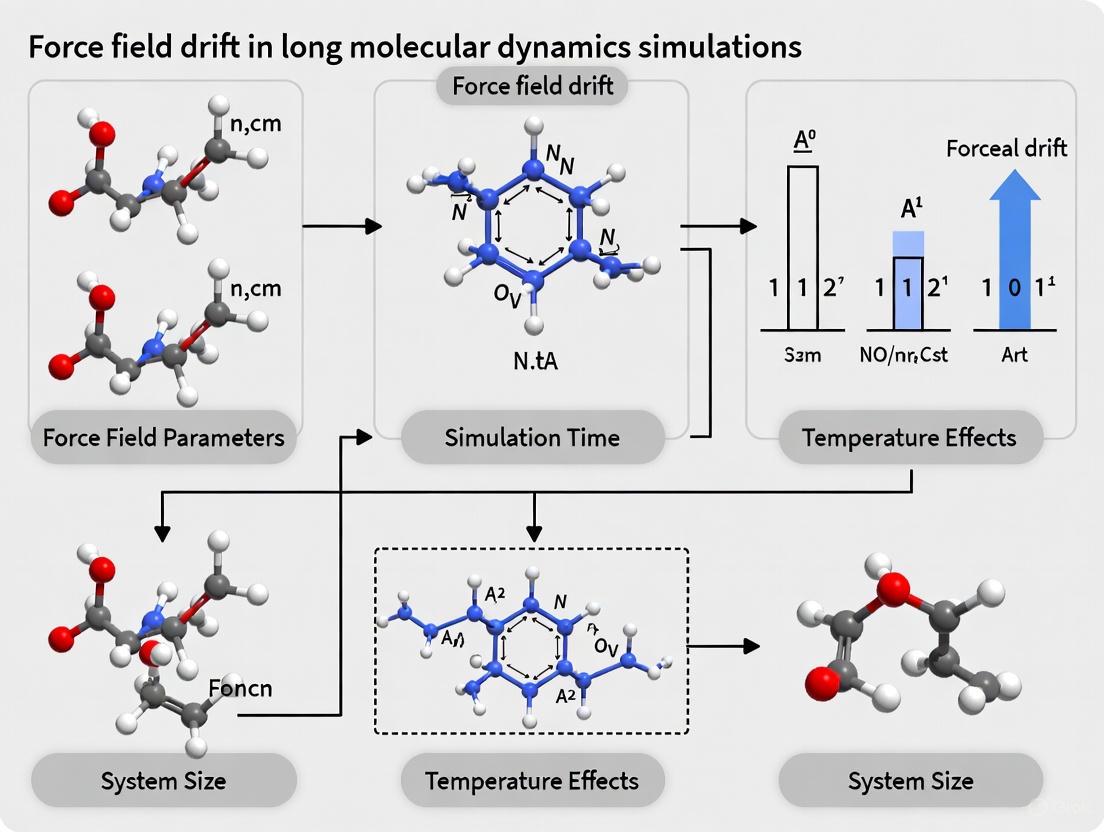
Long-timescale Molecular Dynamics (MD) simulations are pivotal for drug discovery and understanding biomolecular mechanisms, but their predictive power is often limited by force field drift—a gradual deviation from accurate physical...
Force Field Drift in MD Simulations: Causes, Solutions, and Validation for Biomedical Research
Abstract
Long-timescale Molecular Dynamics (MD) simulations are pivotal for drug discovery and understanding biomolecular mechanisms, but their predictive power is often limited by force field drift—a gradual deviation from accurate physical representation. This article provides a comprehensive analysis for researchers and drug development professionals, exploring the fundamental roots of this drift, from inadequate parameterization to the inherent limitations of traditional molecular mechanics. We examine cutting-edge methodological solutions, including machine-learned force fields, and offer a practical guide for troubleshooting and optimizing simulation stability. Finally, we establish a framework for validating force field accuracy against quantum mechanical and experimental data, ensuring reliable results for biomedical and clinical applications.
The Roots of Instability: Understanding What Causes Force Field Drift
In the context of molecular dynamics (MD) simulations, a force field refers to the computational model and empirical energy functions used to calculate the potential energy of a system of atoms or molecules, from which the forces acting on each particle are derived [1]. These force fields are the foundation for simulating biological processes, material properties, and drug-target interactions, enabling scientists to observe molecular phenomena that are difficult or impossible to capture experimentally. The accuracy of these simulations is entirely dependent on the force field's ability to realistically represent atomic interactions.
Despite continuous refinement, a significant challenge persists in long-timescale MD simulations: force field drift. This phenomenon can be defined as the gradual deviation of a simulated system from physically accurate behavior, manifesting as evolving inaccuracies in energy distributions, atomic coordinates, and ultimately, molecular conformations. Force field drift represents a critical limitation in achieving predictive simulations, particularly for complex biomolecular processes like protein folding and ligand binding that occur over micro- to milli-second timescales. Understanding its origins—spanning functional forms, parameter limitations, and environmental dependencies—is essential for advancing the reliability of computational molecular science.
The Fundamental Causes of Force Field Drift
Force field drift arises from inherent approximations and limitations in the construction of the empirical energy functions. These limitations become increasingly pronounced as simulation time increases, leading to a gradual divergence from realistic behavior.
Limitations in Functional Forms and Electrostatic Treatment
The standard functional form of an additive force field decomposes the total potential energy into bonded and non-bonded terms [1] [2]. A fundamental limitation is the use of simplified mathematical functions that cannot fully capture the complexity of quantum mechanical potential energy surfaces.
- Harmonic Approximations: Bond stretching and angle bending are typically modeled using harmonic (quadratic) potentials [1] [2]. While computationally efficient, these potentials do not allow for bond breaking and are poor approximations at high stretching, unlike more realistic but expensive potentials like the Morse potential [1].
- Inadequate Polarization Models: Traditional fixed-charge force fields do not account for electronic polarization—the response of a molecule's electron density to its changing environment [3] [4]. This is a significant source of drift, as the same fixed atomic charges are applied in different dielectric environments (e.g., a protein's hydrophobic core versus a hydrophilic solvent-exposed surface), leading to inaccurate electrostatic interactions over time [4]. Polarizable force fields, such as the Drude model and AMOEBA, seek to address this by explicitly modeling how charge distributions change [3] [4].
- Anisotropy and Charge Penetration: Atom-centered point charges cannot represent anisotropic charge distributions, such as sigma-holes (responsible for halogen bonding) or lone pairs [4]. Furthermore, they fail to model the charge penetration effect that occurs when electron clouds overlap, which is critical for accurate short-range electrostatics [4].
Parametrization Inconsistencies and Transferability Issues
The process of determining force field parameters is a major source of potential drift.
- Parametrization Strategies: Parameters are derived from various sources, including quantum mechanical calculations on small molecules and experimental data such as enthalpies of vaporization and vibrational frequencies [1]. This can lead to inconsistencies, as different parameter subsets may be optimized against different target data, creating an inherent lack of balance [5].
- The Transferability Problem: Force fields often assume that parameters are transferable between similar chemical contexts [1] [5]. However, a torsion parameter fit for a specific small molecule may perform poorly when the same chemical moiety is placed in a different molecular environment, a common occurrence in complex biomolecular simulations [5]. This limits the force field's generalizability and can cause slow conformational drift.
Accumulation of Errors in Long-Timescale Simulations
In long simulations, the limitations above cease to be mere approximations and become active drivers of system evolution.
- Error Propagation: Small, systematic inaccuracies in energy calculations for individual interactions can propagate over thousands of timesteps. These micro-errors accumulate, leading to macro-level deviations in the simulated system's properties and behavior.
- Conformational Sampling Bias: Inaccuracies in the backbone and side-chain dihedral potentials can result in a biased preference for certain conformations over others [3]. For example, early versions of the CHARMM force field were found to favor misfolded states for certain proteins because of small inaccuracies in the backbone potential energy surface [3]. This bias can steer a simulation away from the true native state and toward non-physical low-energy states.
Table 1: Primary Sources of Force Field Drift and Their Manifestations
| Source of Drift | Underlying Cause | Observed Manifestation in Simulation |
|---|---|---|
| Fixed-Point Charges | Inability to adapt to changing dielectric environments [4]. | Inaccurate protein-ligand binding affinities; unrealistic membrane-protein interactions. |
| Harmonic Potentials | Poor representation of potential energy surface far from equilibrium [1]. | Inability to model chemical reactivity; unrealistic bond/angle strain in crowded conformations. |
| Inadequate Dihedral Potentials | Improper balance of rotamer populations and backbone ϕ/ψ preferences [3]. | Misfolding of proteins; drift towards non-native conformational basins. |
| Non-Transferable Parameters | Parameters optimized for small molecules perform poorly in macromolecular contexts [5]. | Gradual distortion of ligand geometry; loss of specific interaction geometries (e.g., H-bonds). |
Quantitative and Qualitative Manifestations of Drift
Force field drift reveals itself through both quantitative metrics and qualitative structural changes, providing researchers with diagnostic tools for identifying its presence.
Energetic and Structural Divergence
The most direct signature of force field drift is a progressive deviation from expected energetic and structural benchmarks.
- Energy Divergence: The total potential energy of the system, or its components (e.g., torsional energy, non-bonded energy), may drift to values inconsistent with known stable states. This can be identified by comparing against reference quantum mechanical (QM) calculations or experimental thermodynamic data.
- Non-Physical Conformations: Simulated molecules may adopt highly strained or sterically clashed conformations that are energetically forbidden in reality. This includes distorted protein secondary structures, unphysical bond lengths or angles, and improper ring puckering in ligands or sugars [5].
- Deviation from Native States: In protein simulations, drift can cause a folded protein to slowly unfold or a protein in its native state to exhibit increasing root-mean-square deviation (RMSD) from the experimental crystal structure without any external perturbation. Conversely, an unfolded peptide might fail to fold into its known native state, instead populating misfolded or aggregated states that the force field incorrectly stabilizes [3].
Case Studies from Biomolecular Simulations
Documented instances in the literature highlight the real-world impact of force field drift.
- Protein Folding Inaccuracies: With the CHARMM C22/CMAP force field, long simulations of the fast-folding Villin headpiece did reach the native state, but the folding mechanism differed from experimental results. More critically, for the pin WW domain, free energy calculations revealed that misfolded states were incorrectly assigned lower free energies than the native folded state, a clear indication of force field imbalance [3].
- Challenges in Drug Discovery: Inaccuracies in torsional parameters, highly relevant for drug-like molecules, can lead to incorrect predictions of a ligand's bound conformation (pose) within a protein's active site [5]. This drift in conformational preference directly impacts the accuracy of virtual screening and binding affinity calculations, limiting the predictive power of structure-based drug design.
Table 2: Experimental Protocols for Detecting and Quantifying Force Field Drift
| Protocol Name | Methodology | Key Measurable Outputs |
|---|---|---|
| Long-Timescale Folding/Unfolding | Running multiple, ultra-long MD simulations of a protein starting from folded and unfolded states [3]. | Population of native vs. misfolded states; folding/unfolding rates; free energy difference between states. |
| Crystal Lattice Prediction | Generating thousands of alternative crystal packing arrangements for a small molecule and testing if the native crystal structure has the lowest energy [5]. | Lattice energy ranking; ability to discriminate native structure from decoys. |
| Dihedral Angle Scans | Comparing the force field's potential energy surface for key dihedral angles against high-level QM calculations [5]. | Torsional energy profiles; rotamer populations; identification of spurious minima or barriers. |
| Free Energy Perturbation (FEP) | Calculating the relative binding free energy of a congeneric ligand series or solvation free energies and comparing to experimental values [6]. | Error in predicted binding affinities (ΔΔG) or solvation free energies (ΔG_solv). |
Emerging Solutions: Mitigating Drift with Advanced Force Fields
The research community is actively developing next-generation force fields and parametrization strategies to combat drift, focusing on greater physical fidelity and improved parameter balance.
Polarizable Force Fields
A major advancement is the move beyond fixed-charge models to explicitly include electronic polarization.
- Drude Oscillator Model: This model attaches massless, charged "Drude" particles to atoms via harmonic springs [3] [4]. The displacement of these particles in an electric field creates induced dipoles, allowing the molecular charge distribution to respond to its environment. The CHARMM Drude FF has been developed for proteins, lipids, and nucleic acids [3].
- Inducible Point Dipoles: The AMOEBA force field uses permanent atomic multipoles (charge, dipole, quadrupole) and inducible point dipoles to achieve a more realistic description of electrostatics and polarization [3] [4]. This model better captures anisotropic effects like lone pairs and σ-holes.
- Fluctuating Charge Models: Also known as charge equilibration (CHEQ), these models allow atomic charges to fluctuate to equalize electronegativity across the molecule, effectively modeling charge transfer [4].
Machine Learning-Driven Approaches
Machine learning (ML) is revolutionizing force field development by enabling more accurate and transferable parameter assignment.
- ML-Parameterized Molecular Mechanics: Frameworks like Grappa and Espaloma use neural networks to predict MM parameters (bonds, angles, dihedrals) directly from the molecular graph [7]. This replaces the traditional system of hand-crafted atom types and lookup tables. The resulting force fields demonstrate improved accuracy on small molecules, peptides, and proteins while retaining the computational efficiency of traditional MM [7].
- End-to-End Training: These models can be trained end-to-end on quantum mechanical data, learning a mapping from molecular graph to a full set of MM parameters that best reproduce QM energies and forces for a vast array of conformations [7]. This holistic approach promotes internal consistency and reduces parametric conflicts.
- Crystal Structure-Informed Optimization: New methods optimize force field parameters by requiring that experimentally determined crystal structures have lower energy than all alternative packing arrangements [5]. This uses the rich structural information in thousands of small-molecule crystal structures to train a balanced and transferable energy model, as demonstrated by the improved performance of the resulting RosettaGenFF in ligand docking [5].
Advanced Parametrization Strategies
Refinements in how parameters are derived also contribute to stability.
- System-Wide Optimization: Instead of fitting different parameter classes independently, newer protocols perform more holistic optimizations. For example, the CHARMM36 force field involved a simultaneous refit of backbone (CMAP) and side-chain dihedral parameters to ensure a balanced contribution to protein structure and dynamics [3].
- Leveraging Diverse Data Sources: Integrating data from multiple levels of theory and experiment—from QM energies and experimental vibrational frequencies to liquid densities and crystallographic data—helps create a more robust and generalizable parameter set [1] [5].
Diagram 1: A map of force field drift illustrating the relationship between its root causes and the emerging computational solutions designed to mitigate them.
Table 3: Research Reagent Solutions for Force Field Development and Validation
| Tool / Resource | Type | Primary Function in Force Field Work |
|---|---|---|
| CHARMM [3] | MD Software & Force Field | Suite for simulation and force field development; includes additive (C36) and polarizable (Drude) FFs. |
| AMBER [3] | MD Software & Force Field | Suite for biomolecular simulation; includes the ff19SB protein force field and GALigandDock. |
| OpenMM [3] [7] | MD Simulation Toolkit | Highly optimized, cross-platform library for MD, supporting both traditional and ML-driven FFs. |
| GROMACS [7] [6] | MD Software Engine | High-performance MD package for running simulations with traditional and new FFs like Grappa. |
| RosettaGenFF [5] | Energy Function & Force Field | A generalized force field optimized using crystal structure data for small molecule and drug discovery applications. |
| Grappa [7] | Machine Learning Force Field | A framework that predicts molecular mechanics parameters from molecular graphs for state-of-the-art accuracy. |
| Cambridge Structural Database (CSD) [5] | Experimental Data Repository | A database of small molecule crystal structures used for force field training and validation. |
| DPmoire [8] | MLFF Software | An open-source tool for constructing accurate machine learning force fields for complex moiré materials. |
Diagram 2: A generalized workflow for developing and validating a new force field, showing the critical stages from parameter training to final application benchmarking.
Force field drift, characterized by a simulation's gradual progression toward energetically divergent and non-physical states, remains a central challenge in molecular dynamics. Its roots are multifaceted, stemming from the simplified functional forms of energy terms, the non-transferability of empirically derived parameters, and the critical omission of physical effects like electronic polarization. The manifestations of this drift—from protein misfolding to inaccurate ligand-binding poses—directly impact the predictive power of computational models in pharmaceutical and materials development.
The path forward is being shaped by several promising strategies. The adoption of polarizable force fields addresses a fundamental physical oversight in traditional models. Simultaneously, the integration of machine learning, as seen in approaches like Grappa and crystal-informed optimization, is enabling a more consistent and data-driven parametrization process that minimizes internal conflicts. As these next-generation force fields continue to mature and be validated against a broader range of experimental and quantum mechanical data, they hold the promise of significantly reducing force field drift. This progress will be crucial for achieving truly predictive simulations of complex biomolecular processes, ultimately enhancing the role of computational science in drug discovery and molecular engineering.
In molecular dynamics (MD) simulations, the force field serves as the fundamental mathematical model that defines the potential energy of a system based on its atomic coordinates. This model decomposes the total energy into contributions from bonded interactions (chemical bonds, angles, and dihedrals) and nonbonded interactions (van der Waals and electrostatic forces) [1]. The accuracy of these parameter sets directly determines the reliability of simulation predictions across diverse applications, from drug discovery to materials science [9] [10]. The "parameterization problem" refers to the systematic errors introduced when these terms imperfectly represent true interatomic forces, leading to force field drift—the gradual deviation of simulation trajectories from physically accurate behavior, particularly problematic in long-timescale simulations [11].
This parameterization challenge persists despite advances in force field development due to the inherent complexity of capturing quantum mechanical realities with classical approximations. As MD simulations extend to biologically relevant timescales (microseconds to milliseconds) and larger systems, once-minor inaccuracies in parameter sets accumulate into significant deviations, compromising the predictive value of simulations [11] [10]. Understanding the sources and impacts of these inaccuracies is thus crucial for researchers relying on MD for drug development, biomolecular engineering, and molecular biology research.
Mathematical Foundations and Functional Forms
Bonded interactions in molecular mechanics force fields are typically modeled using simple analytical functions that describe the energy costs associated with deviations from ideal geometry. The bond stretching energy between two atoms is most commonly represented by a harmonic potential: (E{\text{bond}} = \frac{k{ij}}{2}(l{ij}-l{0,ij})^2), where (k{ij}) is the force constant, (l{ij}) is the actual bond length, and (l_{0,ij}) is the equilibrium bond length [1]. Similarly, angle bending is modeled with a harmonic term for the energy required to deform an angle from its equilibrium value. While these simple approximations work well near equilibrium geometries, they fail to capture the anharmonicity of potential energy surfaces further from equilibrium, and cannot model bond breaking or formation [1].
For dihedral angles, the functional form becomes more complex, typically employing a periodic function such as: (E{\text{dihedral}} = k\phi(1 + \cos(n\phi - \delta))), where (k_\phi) is the force constant, (n) is the periodicity, (\phi) is the dihedral angle, and (\delta) is the phase shift [12] [1]. These terms describe the energy barriers to rotation around bonds and are crucial for capturing conformational preferences. The dihedral parameters are particularly challenging to optimize as they must reproduce complex torsional profiles that dictate molecular flexibility and conformational sampling [13].
Parameterization Methodologies and Limitations
The traditional approach to deriving bonded parameters relies on fitting to quantum mechanical (QM) calculations of small molecule fragments or model compounds [13]. This process involves:
- Target Data Generation: Performing QM calculations (typically at the HF or DFT level of theory) to generate potential energy scans for bond stretching, angle bending, and torsion rotations [13].
- Parameter Optimization: Iteratively adjusting force constants and equilibrium values until the molecular mechanics (MM) energy surface best reproduces the QM reference data [13].
- Transferability Assessment: Validating parameters across multiple chemical contexts to ensure broad applicability [13].
The Force Field Toolkit (ffTK) provides a semi-automated workflow for this process, implementing optimization algorithms that minimize the difference between MM and QM potential energy surfaces [13]. However, several fundamental limitations persist:
- Inadequate Sampling of Chemical Space: Parameterization typically uses small model compounds that may not represent the diverse environments in biomacromolecules [13].
- Limited Representation of Electronic Effects: Classical force fields cannot capture polarization, charge transfer, or other electronic effects that depend on molecular context [13] [11].
- Functional Form Limitations: The simple mathematical forms cannot accurately describe complex potential energy surfaces, particularly for distorted geometries or conjugated systems [1].
Table 1: Experimental Benchmark of Bonded Parameter Performance in Force Field Validation
| Force Field | Water Model | Charge Model | Mean Unsigned Error (kcal/mol) | RMSE (kcal/mol) | Correlation (R²) |
|---|---|---|---|---|---|
| AMBER ff14SB | SPC/E | AM1-BCC | 0.89 | 1.15 | 0.53 |
| AMBER ff14SB | TIP3P | AM1-BCC | 0.82 | 1.06 | 0.57 |
| AMBER ff14SB | TIP4P-EW | AM1-BCC | 0.85 | 1.11 | 0.56 |
| AMBER ff15ipq | SPC/E | AM1-BCC | 0.85 | 1.07 | 0.58 |
| AMBER ff14SB | TIP3P | RESP | 1.03 | 1.32 | 0.45 |
| AMBER ff15ipq | TIP4P-EW | AM1-BCC | 0.95 | 1.23 | 0.49 |
| OPLS2.1 (FEP+) | - | - | 0.77 | 0.93 | 0.66 |
| AMBER TI | - | - | 1.01 | 1.30 | 0.44 |
Data derived from validation studies on JACS benchmark set (199 compounds) showing performance of different parameter combinations for binding affinity prediction [9].
Figure 1: Workflow for bonded parameters optimization showing iterative process of quantum mechanical target data generation and parameter refinement.
Nonbonded Term Parameterization: Critical Challenges
Electrostatic Interactions and Charge Assignment
Electrostatic interactions are typically modeled using Coulomb's law: (E{\text{Coulomb}} = \frac{1}{4\pi\varepsilon0}\frac{qi qj}{r{ij}}), where (qi) and (qj) are partial atomic charges and (r{ij}) is the interatomic distance [1]. The assignment of these partial atomic charges represents one of the most significant challenges in force field development, with different philosophical approaches employed by major force fields:
- AMBER/GAFF: Typically uses RESP (Restrained Electrostatic Potential) charges derived from fitting to the quantum mechanical electrostatic potential [9] [13].
- CHARMM/CGenFF: Employs water-interaction profiles to optimize charges by reproducing quantum mechanical interaction energies with water molecules [13].
- OPLS: Derives charges directly by fitting to experimentally measured condensed phase properties [13].
Each approach carries distinct limitations. RESP charges can be conformation-dependent and may overpolarize molecules, while CHARMM's water-interaction method depends heavily on the choice of interaction sites and orientations [13]. The recently introduced AMBER ff15ipq force field attempts to address some charge transfer and polarization effects through implicitly polarized charges derived in the presence of explicit solvent, showing improved performance in some benchmark tests [9].
Van der Waals Interactions and Combination Rules
Van der Waals interactions model attractive dispersion forces and repulsive electron cloud overlap, most commonly using the Lennard-Jones 12-6 potential: (E{\text{vdW}} = 4\epsilon{ij}\left[\left(\frac{\sigma{ij}}{r{ij}}\right)^{12} - \left(\frac{\sigma{ij}}{r{ij}}\right)^{6}\right]), where (\epsilon{ij}) is the well depth and (\sigma{ij}) is the collision diameter [12] [1].
The parameters for unlike atom pairs (i.e., atoms of different types) are typically generated using combination rules rather than direct parameterization. The most common approach is the Lorentz-Berthelot rules: (\sigma{ij} = \frac{\sigmai + \sigmaj}{2}) and (\epsilon{ij} = \sqrt{\epsiloni \epsilonj}) [12]. These rules introduce systematic errors because real van der Waals interactions between different atom types do not necessarily follow these mathematical approximations. Specialized NBFIX corrections are sometimes implemented for specific problematic atom pairs, but this approach is not comprehensive [14].
Table 2: Impact of Force Field Components on Binding Affinity Prediction Accuracy
| Force Field Component | Variations Tested | Best Performing | Performance Impact (MUE) |
|---|---|---|---|
| Protein Force Field | AMBER ff14SB, ff15ipq | AMBER ff14SB | ±0.06-0.18 kcal/mol |
| Water Model | SPC/E, TIP3P, TIP4P-EW | TIP3P | ±0.07 kcal/mol |
| Charge Model | AM1-BCC, RESP | AM1-BCC | ±0.21 kcal/mol |
| Overall Best Combination | AMBER ff14SB/TIP3P/AM1-BCC | - | 0.82 kcal/mol |
Data synthesized from free energy perturbation validation studies showing relative importance of different force field components [9].
Force Field Drift: Accumulation and Impact in Long Simulations
Mechanisms of Error Accumulation
Force field drift manifests as gradual deviations in protein conformations, ligand binding poses, membrane properties, or solvent structure over the course of extended MD simulations. This drift occurs through several interconnected mechanisms:
- Error Propagation: Small energy errors at each timestep accumulate over millions of steps, steering the system toward incorrect regions of conformational space [11].
- Conformational Bias: Inaccuracies in torsional potentials systematically favor incorrect rotameric states or backbone conformations, which then propagate through dependent structural elements [9].
- Nonbonded Drift: Imperfect electrostatics or van der Waals parameters gradually alter protein solvation, ion distributions, and molecular association patterns [15].
- Cascading Errors: Initial inaccuracies trigger structural adjustments that create new environments where force field limitations become more pronounced [11].
In drug discovery applications, these errors directly impact the accuracy of binding free energy predictions, with studies showing mean unsigned errors of 0.8-1.0 kcal/mol even for well-validated force fields—sufficient to mislead lead optimization efforts [9].
Experimental Validation and Error Quantification
Rigorous validation against experimental data is essential for quantifying force field drift. The JACS benchmark set—encompassing BACE, CDK2, JNK1, MCL1, P38, PTP1B, Thrombin and TYK2—provides a standard for assessing prediction accuracy across diverse protein targets [9]. Key metrics include:
- Mean Unsigned Error (MUE): Difference between predicted and experimental binding affinities (typically 0.7-1.0 kcal/mol for current force fields) [9].
- Root Mean Square Error (RMSE): Magnitude of average error, which penalizes large deviations more heavily [9].
- Correlation Coefficients: Measure of how well computational predictions rank compounds by affinity [9].
Recent validation studies reveal that different force field parameter sets yield statistically significant variations in prediction accuracy, with errors substantially exceeding the threshold for chemical accuracy (1.0 kcal/mol) in many cases [9].
Emerging Solutions and Parameterization Protocols
Machine Learning and Automated Parameterization
Machine learning approaches are revolutionizing force field development by enabling direct fitting of potential energy surfaces to high-level quantum mechanical data [11]. The DeePMD framework uses deep neural networks to represent potential energy with near-quantum accuracy while maintaining computational efficiency comparable to classical force fields [11]. These methods can achieve root mean square errors below 0.4 kcal/mol for diverse molecular systems, significantly outperforming traditional parameterization for specific applications [11].
Complementing these ML potentials, new parameterization tools like the Force Field Toolkit (ffTK) semi-automate the traditional parameterization process, making rigorous parameter development more accessible to non-specialists [13]. ffTK implements the CHARMM/CGenFF parameterization philosophy through a structured workflow encompassing charge optimization, bonded parameter derivation, and dihedral fitting [13].
Advanced Chemical Perception
Traditional force fields rely on atom typing—classifying atoms into discrete types based on element, hybridization, and local chemical environment. This approach suffers from chemical resolution limitations and cannot represent continuous electronic effects [16]. The emerging SMIRNOFF (SMIRKS Native Open Force Field) approach uses direct chemical perception based on SMIRKS patterns, allowing more nuanced parameter assignment that better captures chemical context [16].
This approach enables the development of end-to-end differentiable force fields where graph convolutional networks perceive chemical environments and assign parameters in a manner differentiable with respect to model parameters, allowing force field optimization through backpropagation [16].
Figure 2: Error propagation pathway from initial parameter inaccuracies to force field drift, with mitigation strategies.
Table 3: Research Reagent Solutions for Force Field Development and Validation
| Tool/Resource | Type | Primary Function | Application Context |
|---|---|---|---|
| Force Field Toolkit (ffTK) | Software Plugin | Semi-automated parameterization | CHARMM-compatible parameter development for novel molecules [13] |
| OpenMM | MD Software Package | Molecular dynamics engine | Flexible, hardware-accelerated MD simulations with multiple force fields [9] |
| Alchaware | FEP Workflow | Automated free energy calculations | Validation of force fields through binding affinity prediction [9] |
| DeePMD | ML Framework | Neural network potentials | Machine learning force field training and deployment [11] |
| ParamChem | Web Server | Automated parameter assignment | Initial parameter generation for novel compounds via analogy [13] |
| SMIRNOFF | Force Field Format | Direct chemical perception | Modern force field specification avoiding atom types [16] |
| AMBER/GAFF | Force Field | Biomolecular simulation | Traditional force field for proteins, nucleic acids, and drug-like molecules [9] |
| CHARMM/CGenFF | Force Field | Biomolecular simulation | Alternative philosophy with optimized condensed-phase properties [13] |
| JACS Benchmark Set | Validation Set | Standardized test cases | Performance assessment across multiple protein targets [9] |
| ThermoML Archive | Experimental Database | Physical property data | Force field validation against thermodynamic measurements [16] |
The parameterization problem remains a fundamental challenge in molecular dynamics, with inaccuracies in both bonded and nonbonded terms introducing systematic errors that propagate through long simulations and limit predictive accuracy. Traditional approaches relying on atom typing and combination rules face inherent limitations in capturing complex chemical environments, particularly for novel molecular structures encountered in drug discovery [9] [13].
Promising paths forward include machine learning potentials that bypass traditional functional forms entirely [11], more sophisticated chemical perception methods that better capture molecular context [16], and automated parameterization pipelines that make rigorous parameter development more accessible [13]. Additionally, community-wide standardization of validation protocols and benchmarks ensures more robust assessment of force field performance [9] [16].
For researchers employing MD simulations in drug development and molecular biology, awareness of these parameterization challenges is essential for critical interpretation of simulation results and appropriate application of computational methods. As force fields continue to evolve toward greater accuracy and transferability, their capacity to guide experimental work and predict molecular behavior will increasingly fulfill their potential as indispensable tools in scientific discovery.
Classical molecular dynamics (MD) simulations are indispensable tools in computational chemistry and drug discovery, enabling the study of biological processes at atomic resolution. However, their predictive power is fundamentally constrained by the empirical force fields (FFs) that govern interatomic interactions. These FFs intentionally sacrifice quantum mechanical accuracy for the computational efficiency required to simulate large systems over biologically relevant timescales. This trade-off introduces systematic errors that accumulate over the course of long simulations, leading to a phenomenon known as force field drift, where sampled configurations progressively deviate from realistic behavior. This whitepaper examines the inherent limitations of classical FFs, their manifestation as drift in long-time simulations, and the emerging computational strategies designed to mitigate these deficiencies without wholly compromising computational tractability.
Molecular dynamics simulations provide a dynamic, particle-based description of molecular systems by numerically solving equations of motion to generate trajectories over time [17]. The heart of any MD simulation is its force field—a mathematical model that computes the potential energy of a system as a function of its atomic coordinates. Force fields are typically based on molecular mechanics (MM), which treats atoms as spheres and bonds as springs, using a large set of empirical parameters fitted to experimental or quantum mechanical (QM) data [17].
The primary compromise in classical FFs is the neglect of explicit electronic degrees of freedom. This simplification allows simulations to access microsecond to millisecond timescales for systems comprising hundreds of thousands of atoms, scales that are currently prohibitive for quantum mechanical methods [17]. However, this computational efficiency comes at the cost of reduced physical fidelity, particularly for processes involving electron transfer, bond breaking/formation, and polarization effects in complex charged fluids [18]. These limitations are the root cause of force field drift, where inaccuracies in the energy landscape cause simulations to sample increasingly unphysical states over time.
Fundamental Limitations of Classical Force Fields
The Fixed-Charge Approximation and Polarization Deficiencies
A central limitation of most classical FFs is their use of fixed partial atomic charges. In reality, electronic distributions respond instantaneously to their local chemical environment, a phenomenon known as polarization. Fixed-charge FFs cannot capture this effect, leading to systematic errors in describing electrostatic interactions, especially in heterogeneous environments like protein-ligand complexes or ionic liquids [18].
To overcome this, polarizable FFs have been developed that explicitly model electronic response, but at a significantly increased computational cost [18]. An alternative strategy has been to use non-polarizable FFs with reduced charges, which can improve the prediction of dynamic properties but often at the cost of structural accuracy [18].
Inability to Model Chemical Reactivity
Classical MD simulations generally maintain constant molecular topology throughout a simulation, meaning bond breaking and forming are not allowed [17]. This restriction precludes the study of chemical reactions, proton transfer processes, and other phenomena involving changes in chemical identity. While specialized reactive force fields (ReaxFF) have been developed to bridge this gap, they remain more computationally demanding than traditional FFs and require extensive parameterization [19].
Transferability and Parameterization Challenges
The concept of transferability—where a single set of parameters for a given atom type describes its behavior across diverse molecular contexts—faces particular challenges for small molecules [13]. The vast chemical space of drug-like molecules, often containing "exotic" functional groups and complex aromatic systems, runs counter to the principles of transferability [13]. Parameterization of novel chemical entities remains a significant bottleneck, with tools like the Force Field Toolkit (ffTK) aiming to minimize barriers through automation and guided workflows [13].
Table 1: Core Limitations of Classical Force Fields and Their Consequences
| Limitation | Physical Principle Compromised | Impact on Simulation Accuracy |
|---|---|---|
| Fixed Partial Charges | Electronic Polarization | Inaccurate electrostatic interactions in heterogeneous environments; poor description of dielectric response |
| Rigid Bond Connectivity | Chemical Reactivity | Inability to simulate bond breaking/formation, proton transfer, or reaction mechanisms |
| Functional Form | Quantum Mechanical Effects | Approximate potential energy surfaces; missing non-bonded terms (e.g., charge penetration, charge transfer) |
| Transferability Assumption | Chemical Specificity | Reduced accuracy for molecules with unique functional groups or complex electronic effects |
Force Field Drift: Causes and Consequences in Long Simulations
Force field drift refers to the progressive deviation of simulation trajectories from physically accurate sampling, becoming more pronounced in long timescale simulations. This phenomenon arises from the accumulation of small errors in the force field's description of the underlying potential energy surface.
Pathological Deficiencies in Complex Charged Fluids
In ionic liquids and other complex charged systems, classical FFs exhibit systematic pathologies that become increasingly evident in long simulations. These include:
- Inaccurate description of weak hydrogen bonds due to fixed charge distributions
- Hindered dynamics from the absence of electronic polarization effects
- Underprediction of transport properties like viscosity and conductivity [18]
These deficiencies directly impact the simulation of biologically relevant processes such as electrolyte behavior in batteries, where accurate description of ion transport is critical [18].
Error Accumulation in Free Energy Calculations
The accuracy of free energy calculations depends critically on the FF's ability to reproduce the true potential energy surface. When FFs contain systematic biases, these errors compound over simulation time, leading to:
- Inadequate sampling of high-energy states essential for accurate free energy estimation
- Poor extrapolation to regions of configuration space not well-represented in training data
- Divergence from experimental observables as simulation time increases [20]
Machine learning force fields (MLFFs) show promise in addressing these issues but face challenges in creating comprehensive training datasets that adequately represent the free energy surface [20].
Table 2: Manifestations of Force Field Drift in Extended Simulations
| Simulation Property | Short-Time Scale Behavior | Long-Time Scale Drift Manifestation |
|---|---|---|
| Structural Parameters | Reasonable agreement with experimental structures | Gradual deviation from reference structures; sampling of unphysical conformations |
| Dynamic Properties | Order-of-magnitude agreement with experiment | Progressive slowing or acceleration of dynamics; artificial trapping in metastable states |
| Energy Conservation | Well-conserved in microcanonical (NVE) ensemble | Energy drift due to force miscalculations and integration errors |
| Free Energy Estimates | Reasonable for small perturbations | Increasing systematic error for large conformational changes |
Emerging Solutions and Next-Generation Force Fields
Neural Network Force Fields
Neural network force fields (NNFFs) represent a paradigm shift, using machine learning to map atomic configurations to energies and forces with near-QM accuracy while maintaining much of the computational efficiency of classical FFs [18]. Frameworks like NeuralIL for ionic liquids have demonstrated capability to:
- Replicate molecular structures with improved accuracy
- Better predict weak hydrogen bonds and their dynamics
- Model proton transfer reactions inaccessible to classical FFs [18]
While NNFFs are approximately 10-100 times slower than classical FFs, they remain orders of magnitude faster than full ab initio MD, positioning them as a promising intermediate solution [18].
Reactive Force Fields (ReaxFF)
ReaxFF incorporates bond order formalism to enable dynamic bond formation and breaking within the MD framework, bridging the gap between quantum chemistry and classical MD [19]. Parameterized using QM calculations and experimental data, ReaxFF has been successfully deployed to study:
- Pyrolysis and oxidation processes in various fuel types
- Catalytic reaction mechanisms
- Soot formation and nanoparticle synthesis [19]
Advanced Parameterization Methodologies
Improved parameterization tools like the Force Field Toolkit (ffTK) address drift by enabling more rigorous development of CHARMM-compatible parameters [13]. ffTK implements a structured workflow that includes:
- Charge optimization from water-interaction profiles
- Bond and angle parameterization through fitting to QM potential energy surfaces
- Dihedral fitting using targeted optimization procedures [13]
Such methodologies help minimize parameter transferability errors that contribute to long-term drift.
Force Field Selection and Validation Workflow: This diagram illustrates the iterative process of selecting, parameterizing, and validating different classes of force fields against quantum mechanical or experimental data.
Table 3: Key Software Tools for Force Field Development and Validation
| Tool/Resource | Primary Function | Application Context |
|---|---|---|
| Force Field Toolkit (ffTK) | Guided parameterization workflow | CHARMM-compatible parameter development for small molecules [13] |
| NeuralIL | Neural network force field | Simulation of ionic liquids with QM accuracy [18] |
| ReaxFF | Reactive force field | Combustion, catalysis, and bond-breaking processes [19] |
| ParamChem/CGenFF | Automated parameter assignment | Initial parameter estimation by analogy [13] |
| Equivariant Graph Neural Networks | ML force field for free energy | Enhanced sampling and free energy surface prediction [20] |
The inherent limitations of classical force fields—particularly their fixed-charge approximation, inability to model chemical reactivity, and transferability constraints—represent a fundamental trade-off between computational efficiency and physical accuracy. These limitations directly contribute to force field drift in long molecular dynamics simulations, where systematic errors accumulate and lead to progressive deviation from physically realistic sampling.
Next-generation approaches, including neural network potentials and reactive force fields, show significant promise in mitigating these issues while maintaining reasonable computational cost. However, these advanced methods introduce their own challenges in parameterization, training data requirements, and computational overhead. The ongoing development of tools like ffTK that streamline parameterization and validation processes will be crucial for maximizing the predictive power of molecular simulations in drug discovery and materials design.
As computational resources continue to grow and machine learning methodologies mature, the gap between quantum mechanical accuracy and molecular dynamics efficiency will narrow, ultimately reducing the prevalence and impact of force field drift in long-timescale simulations.
In molecular dynamics (MD) simulations, the goal of predicting the time evolution of a system's energy as a function of its atomic coordinates is fundamental to studying processes ranging from protein folding and ligand binding to enzyme catalysis [3]. However, a central challenge in these simulations is the accumulation of numerical and physical inaccuracies over time, leading to significant drift that can compromise the validity of long-timescale results. This drift manifests as unphysical deviations in energy, temperature, structural properties, or thermodynamic observables, ultimately limiting the predictive power of simulation data.
Force fields—the set of potential energy functions from which atomic forces are derived—represent a primary source of these accumulating errors [3]. While current additive protein force fields have reached a mature state after 35 years of development, the next major step in advancing their accuracy requires an improved representation of the molecular energy surface, specifically through the inclusion of electronic polarization effects [3]. The accumulation of slight inaccuracies in these fundamental energy functions, combined with numerical integration errors, creates a compounding effect that becomes particularly problematic for the long simulations needed to study rare events or achieve proper conformational sampling.
This technical guide examines the fundamental causes of force field drift in MD simulations, presents quantitative analyses of error accumulation, details methodological approaches for error mitigation, and provides practical protocols for researchers seeking to minimize drift in their investigations. By addressing these issues systematically, the reliability of long-timescale molecular simulations for drug development and basic research can be significantly enhanced.
Force Field Limitations as a Primary Source of Systematic Drift
Additive vs. Polarizable Force Fields
Traditional additive force fields, while computationally efficient, inherently contain approximations that lead to systematic errors. These force fields use fixed atomic partial charges that cannot respond to changes in the electrostatic environment, such as those occurring during conformational transitions, binding events, or solvation changes [3]. This limitation becomes particularly significant in long simulations where sampling diverse electrostatic environments is essential.
Table 1: Comparison of Additive and Polarizable Force Fields
| Feature | Additive Force Fields | Polarizable Force Fields |
|---|---|---|
| Electrostatic Representation | Fixed atomic charges | Environment-responsive charges |
| Computational Cost | Lower | Significantly higher |
| Accuracy in Heterogeneous Environments | Limited | Improved |
| Parameterization Complexity | Moderate | High |
| Treatment of Many-Body Effects | Approximate | Explicit |
| Representative Examples | CHARMM36, AMBER ff99SB | CHARMM Drude, AMOEBA |
The CHARMM additive force field has undergone significant refinement, with the C36 version representing improvements through a new backbone CMAP potential optimized against experimental data on small peptides and folded proteins, and new side-chain dihedral parameters [3]. Similarly, the AMBER force field has seen continual improvements, with variants like ff99SB-ILDN-Phi introducing perturbations to the ϕ backbone dihedral potential to improve sampling in aqueous environments [3]. Despite these advances, the fundamental limitation of fixed electrostatics remains in additive force fields.
The Polarizable Force Field Solution
Polarizable force fields address key limitations of additive models by explicitly accounting for electronic polarization. The Drude polarizable force field in CHARMM, developed since 2001, incorporates electronic degrees of freedom through Drude particles (charged virtual sites) attached to atoms [3]. This approach allows the electronic structure to respond to changing electrostatic environments, more accurately capturing many-body effects.
The AMOEBA (Atomic Multipole Optimized Energetics for Biomolecular Applications) force field represents another polarizable approach, using atomic multipoles (rather than just partial charges) and explicit polarization [3]. Development has included implementation of appropriate integrators for computationally efficient extended Lagrangian MD simulations, optimization of water models (SWM4-DP and SWM4-NDP), and parametrization of small molecules covering functional groups commonly found in biomolecules [3].
Quantitative Analysis of Error Accumulation in Molecular Dynamics
Numerical Integration and Error Propagation
In MD simulations, the explicit time integration of Newton's equations of motion uses knowledge of the current state to compute the next state, with each calculation introducing small errors that propagate to following states [21]. This compounding effect creates a significant challenge for long-time-scale calculations, regardless of whether time steps are on the order of seconds or minutes. The overall calculation requires many time steps, involving substantial accumulated error without appropriate mitigation strategies [21].
Higher-order integration methods (e.g., Runge-Kutta, leapfrog) can minimize error at each time step, but for truly long-scale calculations, additional approaches are necessary [21]. These include careful numerical design (guarding against subtractive cancellation and error magnification), use of fused multiply-add operations, compensated computations (for dot products and polynomial evaluation), and quadruple- or arbitrary-precision computation when necessary [21].
Table 2: Error Accumulation and Mitigation in Numerical Integration
| Error Source | Impact on Long-Timescale Simulations | Mitigation Strategies |
|---|---|---|
| Finite Time Step | Truncation errors accumulating over millions of steps | Higher-order integration methods (e.g., 4th order Runge-Kutta) |
| Floating-Point Precision | Energy drift due to rounding errors in force calculations | Compensated summation algorithms, mixed-precision approaches |
| Force Calculation Approximations | Systematic deviations in molecular mechanics | Increased real-space cutoffs, improved lattice summation methods |
| Constraint Algorithms | Artificial energy redistribution over time | More accurate constraint solvers (e.g., LINCS, SHAKE) |
| Parallelization Artifacts | Non-deterministic force evaluations in parallel computing | Reproducible reduction algorithms, careful domain decomposition |
Energy Drift as a Diagnostic Metric
Energy drift in MD simulations serves as a key indicator of numerical stability and physical accuracy. In the NVE (microcanonical) ensemble, the total energy should remain constant, with fluctuations around a stable mean. A systematic drift in total energy indicates numerical problems or insufficient convergence of force calculations. Monitoring this drift provides researchers with a crucial diagnostic for simulation quality, particularly for long timescales where small per-step errors accumulate into significant deviations.
Methodological Approaches for Drift Mitigation
Advanced Force Calibration Techniques
Recent methodological advances in single-molecule force spectroscopy provide insights relevant to MD simulations. The Hadamard variance (HV) method has emerged as a robust approach for force calibration in magnetic tweezers measurements, demonstrating particular strength in mitigating drift effects [22]. This method exhibits similar or higher precision and accuracy compared to established techniques like power spectral density (PSD) and Allan variance (AV) analyses, yielding lower force estimation errors across a wide range of signal-to-noise ratios and drift speeds [22].
The HV method's significance lies in its drift-invariant properties—it maintains consistent uncertainty levels across diverse experimental conditions, making it particularly valuable for long-timescale measurements where drift becomes inevitable [22]. This approach remains robust against common sources of additive noise, such as white and pink noise, which often complicate experimental data analysis [22].
Evidence Accumulation Models for Error Analysis
Evidence Accumulation Models (EAMs) provide a powerful framework for understanding how errors accumulate in decision-making processes relevant to simulation analysis. The Drift Diffusion Model (DDM) conceptualizes behaviors as resulting from the noisy accumulation of evidence until a decision boundary is reached [23]. In MD simulations, analogous processes occur in conformational sampling and state transitions.
Research has shown that different components of these accumulation processes change on distinct timescales. In perceptual decision-making tasks, drift rate (sensitivity of evidence accumulation) was found to change as a continuous, exponential function of cumulative trial number, while response boundary (threshold for decision) changed within each daily session independently across sessions [23]. This separation of timescales suggests similar distinctions might exist in MD simulations, with some parameters evolving continuously while others reset between simulation segments.
Experimental Protocols for Drift-Robust Molecular Dynamics
Protocol 1: Force Field Validation and Benchmarking
Purpose: To establish baseline performance metrics for force fields and identify potential sources of systematic drift before embarking on production simulations.
Materials:
- Benchmark protein set: Include both folded and intrinsically disordered proteins
- Reference data: Experimental NMR measurements, crystallographic B-factors, and thermodynamic data
- Simulation software: Compatible with both additive and polarizable force fields
- Analysis tools: For calculating conformational properties, energy distributions, and time-correlation functions
Procedure:
- Initial Structure Preparation: Obtain and minimize starting structures for benchmark proteins
- Solvated System Setup: Place proteins in appropriate water boxes with physiological ion concentrations
- Equilibration Protocol: Perform gradual heating and equilibration with position restraints
- Production Simulations: Run multiple independent replicas (≥ 3) of 100-500 ns each
- Property Monitoring: Track backbone dihedral distributions, hydrogen bonding patterns, and salt bridge stability
- Drift Quantification: Calculate energy drift rates and structural deviation metrics
- Comparative Analysis: Evaluate performance against experimental references and between force fields
Validation Metrics:
- Backbone root-mean-square deviation (RMSD) stability over time
- Drift rate in total energy (should be < 0.01 kJ/mol/ns per atom)
- Reproduction of experimental conformational preferences
- Convergence of structural properties across independent replicas
Protocol 2: Long-Timescale Simulation with Intermediate Validation
Purpose: To enable extended simulation timescales while monitoring and correcting for force field drift.
Materials:
- Validated initial structure: From Protocol 1 or experimental source
- Checkpointing system: For simulation restart capability
- Reference snapshots: Experimentally determined structures when available
- Analysis framework: For periodic assessment of simulation quality
Procedure:
- Simulation Segmentation: Divide long simulations into manageable segments (50-100 ns)
- Intermediate Validation: After each segment, compare key structural metrics to reference data
- Drift Correction: Apply rotational and translational alignment to reference structures when appropriate
- Energy Redistribution: Monitor potential energy components for unphysical redistribution
- Constraint Stability: Verify bond length and angle constraints are not introducing artificial forces
- Continual Assessment: Use multiple metrics to detect subtle drift patterns
- Documentation: Maintain detailed records of all parameters and adjustments
Visualization of Error Accumulation Pathways
Diagram 1: Pathways of error accumulation in molecular dynamics simulations, showing how small initial inaccuracies compound into significant deviations.
Diagram 2: Comprehensive drift mitigation strategy spanning pre-simulation, during simulation, and post-simulation phases.
Table 3: Research Reagent Solutions for Drift Mitigation
| Resource Category | Specific Tools | Function in Drift Mitigation |
|---|---|---|
| Force Fields | CHARMM Drude, AMOEBA | Incorporate polarization for improved electrostatic response |
| Validation Databases | Protein Data Bank, NMR data repositories | Provide experimental reference data for force field validation |
| Specialized Software | NAMD, AMBER, GROMACS, OpenMM | Enable efficient implementation of advanced integration algorithms |
| Analysis Tools | MDAnalysis, VMD, PyTraj | Facilitate monitoring of simulation stability and drift metrics |
| Benchmark Systems | Fast-folding proteins, well-characterized peptides | Offer standardized test cases for force field evaluation |
| Uncertainty Quantification Tools | Bootstrapping libraries, statistical analysis packages | Enable rigorous assessment of simulation reliability |
Force field drift in long molecular dynamics simulations represents a fundamental challenge that requires multifaceted solutions. The accumulation of small errors—from force field approximations, numerical integration limitations, and sampling constraints—can compound into significant deviations that compromise predictive accuracy. Through the systematic implementation of advanced force fields incorporating polarization, robust validation protocols, careful numerical practices, and continuous monitoring strategies, researchers can significantly mitigate these effects.
The development of drift-invariant analysis methods, such as the Hadamard variance approach adapted from single-molecule force spectroscopy, provides promising directions for future methodological improvements [22]. Similarly, insights from evidence accumulation models about separate timescales for parameter evolution offer conceptual frameworks for understanding how different types of errors manifest over time [23]. As MD simulations continue to push toward longer timescales and more complex biological questions, addressing the fundamental challenge of error accumulation will remain essential for producing reliable, predictive results in drug development and basic research.
Next-Generation Solutions: Machine Learning and Advanced Parameterization
Molecular dynamics (MD) simulations are indispensable for studying biomolecular mechanisms, drug binding, and protein folding. The success of these simulations hinges on the accuracy of the underlying force field—the computational model that describes the potential energy of a system and the forces acting on its atoms. Traditional molecular mechanics (MM) force fields, which use physics-inspired functional forms, provide exceptional computational efficiency but are inherently approximate, trading accuracy for speed [24] [25]. This compromise manifests as force field drift in long-timescale simulations, where small inaccuracies in the energy function accumulate over time, steering the system toward unphysical states or incorrect thermodynamic equilibria. This drift often stems from an imperfect balance between different energy terms (e.g., backbone dihedrals) or an insufficient description of complex electronic effects like polarization [3].
The gold standard for accuracy is quantum mechanics (QM), particularly density functional theory (DFT), which explicitly treats electrons. However, QM calculations are computationally prohibitive for large systems and long timescales. Machine learning force fields (MLFFs), particularly those leveraging graph neural networks (GNNs), have emerged as a transformative technology that bridges this accuracy-efficiency gap [25] [26]. By learning the potential energy surface directly from large-scale QM data, GNN-based force fields offer a path to simulations that are both accurate and efficient, thereby directly addressing the fundamental causes of force field drift.
Graph Neural Networks: A Natural Framework for Molecular Representation
Graph Neural Networks (GNNs) are a class of deep learning models designed to operate on graph-structured data. This architecture is exceptionally well-suited for molecular systems, where atoms naturally constitute nodes and chemical bonds form edges [27]. The GNN's core operation is message passing, where each atom iteratively collects information from its neighboring atoms, building a rich numerical representation (an embedding) that encodes its local chemical environment [27] [28].
Table 1: Core Components of a Message-Passing Graph Neural Network
| Component | Mathematical Function | Role in Molecular Modeling |
|---|---|---|
| Node Embedding | ( hv^0 = fa(\text{One-Hot(Type(atom } v)) ) | Initial representation of an atom based on its element type. |
| Edge Embedding | ( h_{(v,w)}^0 = G( d(v,w) ) ) | Represents the bond or interatomic distance, often using a Gaussian filter. |
| Message Passing | ( mv^{t+1} = \sum{w \in N(v)} Mt(hv^t, hw^t, e{vw}) ) | Aggregates information from neighboring atoms ( w ) to atom ( v ). |
| Node Update | ( hv^{t+1} = Ut(hv^t, mv^{t+1}) ) | Updates the state of atom ( v ) based on the received messages. |
| Readout | ( y = R({h_v^K | v \in G}) ) | Pools all atom embeddings to a graph-level prediction (e.g., total energy). |
This message-passing framework allows GNNs to learn complex, high-dimensional relationships between atomic structure and potential energy without relying on hand-crafted features, enabling a more accurate and data-driven representation of the quantum mechanical energy landscape [27] [28].
GNN Architectures for Force Fields: From Energy Prediction to Direct Parametrization
Several specialized GNN architectures have been developed to construct machine-learned force fields. They primarily fall into two categories: those that learn the potential energy and differentiate it to obtain forces, and those that predict forces directly.
End-to-End Force Prediction (GNNFF, GAMD)
Architectures like the Graph Neural Network Force Field (GNNFF) bypass the computational bottleneck of energy differentiation by predicting atomic forces directly from automatically extracted, rotationally-covariant features of the local atomic environment [28]. Similarly, GNN Accelerated Molecular Dynamics (GAMD) directly maps the system's state (atom positions and types) to atomic forces, completely bypassing the explicit calculation of potential energy [29]. This direct approach leads to significant computational acceleration.
Machine-Learned Molecular Mechanics (Grappa, Espaloma)
An alternative strategy is to use GNNs to predict the parameters of a conventional molecular mechanics (MM) force field. Frameworks like Grappa and Espaloma employ a graph attentional neural network to analyze the molecular graph and assign optimal MM parameters (e.g., equilibrium bond lengths, force constants, and partial charges) [24] [30]. The resulting force field retains the computationally efficient functional form of traditional MM, ensuring compatibility with highly optimized MD software like GROMACS and OpenMM, but with significantly enhanced accuracy [24].
Quantitative Performance: Benchmarking GNN Force Fields
Extensive benchmarking demonstrates that GNN-based force fields can achieve quantum-chemical accuracy while maintaining the computational efficiency of classical molecular mechanics.
Table 2: Benchmarking Performance of Selected GNN Force Fields
| GNN Force Field | Key Architectural Feature | Reported Performance | Reference System |
|---|---|---|---|
| GNNFF | Direct force prediction with covariant features | 16% higher force accuracy and 1.6x faster than SchNet; Li diffusivity within 14% of AIMD [28]. | Organic molecules (ISO17), Li₇P₃S₁₁ |
| Grappa | Predicts MM parameters from molecular graph | Outperforms traditional MM/ML-MM force fields; matches experimental J-couplings & folding free energies [24]. | Small molecules, peptides, RNA |
| Espaloma-0.3 | Differentiable MM parameter assignment | Reproduces QM energies/geometries; stable simulations with accurate binding free energies [30]. | Small molecules, peptides, nucleic acids |
| GAMD | Direct force prediction, agnostic to system scale | Competitive performance with production-level MD software on large-scale simulation [29]. | Lennard-Jones system, Water system |
A critical advantage of MLFFs is their scalability. For instance, GNNFF trained on a small supercell of a lithium-ion conductor (1x2x1) was able to accurately predict the forces in a larger system (1x2x2) with only a 3% drop in accuracy [28]. This demonstrates the model's ability to learn generalizable local interactions, a key requirement for mitigating force field drift in large biomolecular systems.
Table 3: Essential Tools for Developing and Applying GNN Force Fields
| Tool / Resource | Type | Function in Research |
|---|---|---|
| QM Reference Data (DFT) | Data | Provides high-accuracy energy and force labels for training and validating MLFFs [8] [30]. |
| VASP MLFF Module | Software | An on-the-fly MLFF algorithm used to generate training data from ab initio MD simulations [8]. |
| Allegro / NequIP | Software | High-accuracy MLFF training frameworks capable of achieving errors of a fraction of meV/atom [8]. |
| DPmoire | Software | Open-source package for constructing MLFFs specifically tailored for complex moiré material systems [8]. |
| GROMACS / OpenMM | Software | Highly optimized MD engines where parameterized ML-MM force fields (e.g., Grappa) can be deployed [24]. |
| MPNICE (Schrödinger) | Pretrained Model | A commercial MLFF architecture that explicitly incorporates equilibrated atomic charges and long-range electrostatics [26]. |
Experimental Protocol: Constructing a Robust GNN Force Field
The following methodology, inspired by tools like DPmoire and research on Grappa/Espaloma, outlines a general protocol for building a transferable GNN force field [24] [8].
Step 1: Training Dataset Curation
- Structure Generation: Construct a diverse set of molecular structures covering the relevant chemical space. For biomolecules, this includes dipeptides, tripeptides, and small folded proteins.
- Configuration Sampling: Use classical MD or enhanced sampling to generate a wide range of conformations for each structure, ensuring coverage of relevant metastable states and transitions.
- QM Single-Point Calculations: Perform high-level QM calculations (e.g., DFT with an appropriate van der Waals correction) on all sampled configurations to obtain reference energies and atomic forces.
Step 2: Model Training and Validation
- Architecture Selection: Choose a GNN architecture (e.g., direct force prediction or MM parametrization) based on the desired trade-off between computational speed and physical interpretability.
- Symmetry Preservation: Ensure the model architecture is designed to be E(3)-equivariant (invariant to rotation and translation) and respects the required permutation symmetries of the energy function [24].
- Loss Function Definition: Train the model by minimizing a loss function that penalizes deviations from QM energies and forces, for example: ( L = \lambdaE (E{pred} - E{QM})^2 + \lambdaF \sumi |F{i, pred} - F_{i, QM}|^2 ).
- Validation: Rigorously test the trained model on a held-out test set of molecular structures and conformations not seen during training.
Step 3: Production MD Simulation and Validation
- Deployment: Integrate the trained MLFF into an MD engine (e.g., using OpenMM for Grappa or LAMMPS for GNNFF).
- Stability Test: Run a short, stable MD simulation of a small system to check for numerical instabilities.
- Property Validation: Compute experimentally measurable properties (e.g., J-couplings, diffusion coefficients, folding free energies) from the MLFF-driven simulation and validate against real experimental data to ensure physical correctness [24] [28].
Force field drift in long-timescale molecular dynamics simulations is a direct consequence of the approximations inherent in traditional molecular mechanics force fields. Graph Neural Network force fields present a paradigm shift, offering a path to quantum chemical accuracy without prohibitive computational cost. By learning the complex relationship between atomic structure and potential energy from vast QM datasets, GNNs directly address the root causes of inaccuracy. As these models continue to improve in data efficiency, generalization, and handling of long-range interactions, they are poised to become the standard for high-fidelity biomolecular simulation, ultimately enabling more reliable predictions in drug discovery and materials science.
Molecular dynamics (MD) simulations are indispensable for studying biomolecular structure and function, but their predictive power is limited by the accuracy of the underlying molecular mechanics (MM) force fields [4]. A significant challenge in long-time scale simulations is force field drift, where inaccuracies in the parametrized potential energy surface cause simulations to deviate from realistic physical behavior over time. This in-depth technical guide examines the novel machine learning (ML) frameworks Grappa and Espaloma, which aim to mitigate this drift by replacing traditional, hand-crafted parameter assignment with end-to-end learning of MM parameters directly from molecular graphs. We explore their architectures, provide detailed experimental protocols for their application and evaluation, and quantitatively analyze their performance. By achieving state-of-the-art accuracy while maintaining the computational efficiency of traditional MM, these force fields set the stage for more stable and reliable biomolecular simulations.
In classical MD, the potential energy of a system is calculated using a molecular mechanics force field, a computational model with a fixed functional form and empirical parameters [1]. Established force fields rely on lookup tables with a finite set of atom types, characterized by hand-crafted rules based on the chemical properties of an atom and its bonded neighbors [24] [31]. This approach, while computationally efficient, has limitations. The finite set of atom types cannot fully capture the diverse chemical environments found in complex biomolecules, leading to approximations and inaccuracies in the potential energy surface.
These inaccuracies are a primary source of force field drift in long simulations. Small, systematic errors in energy and force calculations can accumulate over nanoseconds to microseconds, causing the simulated system to gradually sample unrealistic conformations or deviate from experimentally observed dynamics. This drift undermines the reliability of simulations for predictive tasks, such as drug development, where accurate characterization of molecular interactions is critical.
The advent of geometric deep learning has enabled a new paradigm: machine-learned force fields. While E(3)-equivariant neural networks can achieve high accuracy, they remain orders of magnitude more computationally expensive than MM force fields, making them unsuitable for simulating large biomolecular systems over long time scales [24]. The frameworks Grappa (Graph Attentional Protein Parametrization) and Espaloma represent a hybrid approach. They retain the computationally efficient functional form of traditional MM but replace the lookup-table parameter assignment with a neural network that predicts parameters directly from the molecular graph [24] [31]. This end-to-end learning from data promises a more accurate and transferable description of the potential energy surface, thereby addressing the root cause of force field drift.
## 2 Molecular Mechanics and Parameter Prediction Fundamentals
The Molecular Mechanics Energy Function
In MM, the potential energy ( E ) of a molecular system is a sum of bonded and non-bonded interactions [24] [31] [2]. The general form is: [ E{\text{total}} = E{\text{bonded}} + E{\text{nonbonded}} ] [ E{\text{bonded}} = E{\text{bond}} + E{\text{angle}} + E{\text{dihedral}} ] [ E{\text{nonbonded}} = E{\text{electrostatic}} + E{\text{van der Waals}} ]
The bonded interactions are typically modeled as follows [31] [2]:
- Bond Stretching: ( E{\text{bond}} = \sum k{ij}(r{ij} - r{ij}^{(0)})^2 )
- Angle Bending: ( E{\text{angle}} = \sum k{ijk}(\theta{ijk} - \theta{ijk}^{(0)})^2 )
- Dihedral Torsions: ( E{\text{dihedral}} = \sum k{ijkl} \cos(n\phi_{ijkl} - \delta) )
The parameters for these functions—the force constants ( k ) and equilibrium values ( r^{(0)} ), ( \theta^{(0)} )—constitute the MM parameter set ( \bm{\xi} ) that Grappa and Espaloma are designed to predict [31].
Molecular mechanics energy decomposition into bonded and non-bonded terms. [1] [2]
From Atom Typing to Graph-Based Prediction
Traditional force fields use atom typing, where each atom is assigned a type based on its element and local chemical environment (e.g., an sp³ carbon vs. an aromatic carbon). Parameters are then assigned from fixed tables for all combinations of atom types involved in a bond, angle, or dihedral [24]. This method is limited by its reliance on human-expert-crafted rules and the finite nature of the type sets.
In contrast, Grappa and Espaloma treat the molecule as a graph ( \mathcal{G} = (\mathcal{V}, \mathcal{E}) ), where nodes ( \mathcal{V} ) represent atoms and edges ( \mathcal{E} ) represent bonds [24] [31]. A neural network maps this graph directly to the MM parameter set ( \bm{\xi} ). This data-driven approach captures chemical environments more flexibly and continuously, eliminating the discretization inherent in atom typing and improving transferability to molecules or functional groups not seen during force field development.
## 3 The Grappa and Espaloma Architectures
The Grappa Framework
Grappa is a machine learning framework that predicts MM parameters in two steps [24] [32]:
- Atom Embedding: A graph attentional neural network processes the molecular graph to generate a d-dimensional embedding ( \nu_i ) for each atom ( i ). This embedding aims to represent the atom's local chemical environment.
- Parameter Prediction: For each interaction type ( l ) (bond, angle, torsion, improper), a transformer ( \psi^{(l)} ) maps the embeddings of the involved atoms to the specific MM parameters: ( \xi{ij\ldots}^{(l)} = \psi^{(l)}(\nui, \nu_j, \ldots) ).
A critical feature of Grappa's architecture is its incorporation of physical symmetries. The models ( \psi^{(l)} ) are designed to be invariant under permutations of atoms that leave the respective internal coordinate invariant (e.g., ( \xi{ijk}^{\text{(angle)}} = \xi{kji}^{\text{(angle)}} )), ensuring that the predicted energy is physically sensible [24].
Grappa's two-step architecture: molecular graph to atom embeddings to MM parameters. [24]
Espaloma and the Shift to ML-Parameterized MM
Espaloma, the predecessor to Grappa, demonstrated that machine learning could be used to assign MM parameters from a molecular graph [24] [31]. A key distinction is that Espaloma's graph neural network relied on hand-crafted chemical features as node and edge inputs, such as orbital hybridization states and formal charge [24] [33]. Grappa builds upon this foundation by eliminating the need for these expert-derived features, learning a representation of chemical environment directly from the graph structure, which facilitates easier extension to new regions of chemical space [24].
## 4 Experimental Protocols and Performance Benchmarking
Training and Evaluation Methodology
Dataset: Both Grappa and Espaloma are trained and evaluated on the Espaloma benchmark dataset [24] [31]. This extensive dataset contains over 14,000 molecules and more than one million conformations, covering small molecules, peptides, and RNA [24]. The dataset includes quantum mechanical (QM) reference data for energies and forces.
Training Objective: The models are trained end-to-end to minimize the difference between the forces and energies computed from the predicted MM parameters and the reference QM data [24]. This is visualized in the workflow below.
End-to-end training workflow for machine-learned MM force fields. [24]
Key Experiments:
- Energy and Force Accuracy: The primary benchmark is the accuracy of energies and forces on held-out test molecules from the Espaloma dataset [24].
- Dihedral Scans: The accuracy of the potential energy landscape for dihedral angles in peptides is evaluated and compared to traditional force fields like Amber FF19SB [24].
- Agreement with Experiment: Performance is measured by the ability to reproduce experimentally measured values, such as J-couplings and folding free energies of small proteins like chignolin [24].
- Stability in MD: The transferability to macromolecules is tested by running MD simulations, from small fast-folding proteins up to an entire virus particle, to assess stability and the ability to recover experimentally determined folded structures [24].
Quantitative Performance Comparison
The following tables summarize key quantitative results demonstrating the performance of Grappa.
Table 1: Performance on the Espaloma Benchmark Dataset [24]
| Force Field | Energy MAE (kcal/mol) | Force MAE (kcal/mol/Å) | Notes |
|---|---|---|---|
| Grappa | Lowest | Lowest | Outperforms traditional and other machine-learned MM fields |
| Espaloma | Higher than Grappa | Higher than Grappa | Baseline machine-learned MM |
| Traditional MM (e.g., GAFF) | Highest | Highest | Relies on fixed atom types |
Table 2: Performance on Biomolecular Properties and Systems [24]
| Evaluation Metric | Grappa Performance | Significance |
|---|---|---|
| Peptide Dihedral Landscape | Matches Amber FF19SB | Achieves high accuracy without requiring corrective maps (CMAPs) |
| J-Couplings | Closely reproduces experiment | Validates physical correctness against empirical data |
| Protein Folding (Chignolin) | Improves folding free energy | Suggests better capture of protein folding physics |
| Macromolecular Simulation | Stable MD for proteins and a virus | Demonstrates transferability and robustness for large systems |
| Computational Cost | Equivalent to traditional MM in GROMACS/OpenMM | Enables million-atom simulations on a single GPU |
Application to Novel Chemical Space: Peptide Radicals
A key advantage of Grappa's lack of reliance on hand-crafted features is its facile extensibility. This was demonstrated by training a variant, grappa-1.4.1-radical, on datasets containing peptide radicals [32]. Grappa successfully predicted parameters for these systems, which are poorly covered by traditional atom typing schemes, showcasing its potential for exploring uncharted regions of chemical space [24].
Table 3: Essential Tools for Applying and Developing Grappa Force Fields
| Resource | Type | Function | Availability |
|---|---|---|---|
| Grappa GitHub Repository [32] | Software | Primary source code for the Grappa framework, including pre-trained models. | https://github.com/graeter-group/grappa |
| GROMACS [24] [32] | MD Engine | High-performance molecular dynamics package; Grappa can write bonded parameters directly into its topology files. | https://www.gromacs.org/ |
| OpenMM [24] [32] | MD Engine | Flexible toolkit for molecular simulation; includes a Python API wrapper for Grappa. | https://openmm.org/ |
| Espaloma Benchmark Dataset [24] | Dataset | Curated dataset of >14k molecules with QM reference data for training and evaluation. | Via the Grappa codebase / original Espaloma publication |
| Google Colab Tutorials [32] | Documentation | Example scripts for application and training, running entirely in the cloud without local installation. | Links provided in the GitHub repository |
| PyTorch & DGL | Software | Core machine learning libraries required for training custom Grappa models. | https://pytorch.org/, https://www.dgl.ai/ |
## 6 Implications for Force Field Drift and Future Directions
The end-to-end learning paradigm of Grappa and Espaloma directly addresses several root causes of force field drift. By providing a continuous, data-driven representation of chemical space, these models reduce the systematic biases introduced by discrete atom typing. Their superior accuracy in reproducing QM energies and forces, as well as experimental observables like J-couplings, indicates a more faithful representation of the true potential energy surface. This leads to more stable and physically realistic dynamics in long-time scale simulations, as evidenced by Grappa's ability to maintain the stability of a virus particle and fold small proteins [24].
Currently, Grappa predicts only bonded parameters (bonds, angles, dihedrals), while nonbonded parameters (partial charges, Lennard-Jones) are taken from established force fields [24] [32]. A key future direction is the extension to end-to-end prediction of all MM parameters, including nonbonded terms and explicit polarization [4]. Incorporating advanced electrostatic models like polarizable force fields or atomic multipoles could further enhance accuracy and combat drift in highly heterogeneous environments like protein-membrane interfaces [4]. As these machine-learned force fields continue to evolve, they promise to bring biomolecular simulations closer to the goal of "chemical accuracy" without sacrificing the computational efficiency that makes large-scale MD feasible.
Molecular Dynamics (MD) simulation is a cornerstone of computational research in drug development, materials science, and structural biology. The accuracy of any MD simulation is fundamentally governed by the force field—a set of empirical functions and parameters that describe the potential energy of a system. A persistent challenge in long-timescale simulations is force field drift, where inaccuracies in the force field can lead to a gradual, unphysical divergence of system properties from realistic behavior. This guide provides a technical framework for the practical integration of advanced, modern force fields into two popular MD engines, GROMACS and OpenMM, with the aim of achieving more stable and reliable simulations.
Force Field Fundamentals and the Genesis of Drift
At its core, a molecular mechanics force field describes the potential energy of a system as a sum of bonded and non-bonded interactions [17]:
[ E{\text{total}} = E{\text{bonds}} + E{\text{angles}} + E{\text{torsions}} + E{\text{van der Waals}} + E{\text{electrostatic}} ]
Force field drift can manifest as systematic errors in protein conformation, lipid bilayer properties, or ligand-binding affinities over time. This drift often originates from:
- Inadequate Parametrization: Parameters derived from limited training data (e.g., a small set of molecules or physical properties) may not generalize well to all chemical environments encountered in a long simulation.
- Improper Integration: Incorrectly applying a force field within an MD engine, such as using incompatible cut-off schemes or integration parameters, can exacerbate inherent force field limitations and lead to energy drift or structural artifacts.
- Limitations in Functional Form: Standard force fields cannot simulate bond breaking and forming, and may lack the flexibility to accurately capture complex electronic phenomena like polarization, which can become a significant source of error over long timescales [17].
Selecting a force field that is well-suited to your specific biological system is the first and most critical step in mitigating drift.
Table 1: Key all-atom force fields for biomolecular simulations, highlighting their common applications and considerations for use.
| Force Field | Common Variants | Key Characteristics | Typical Application Scope |
|---|---|---|---|
| AMBER | ff14SB, ff19SB [34] | Optimized for proteins and nucleic acids; often paired with GAFF for small molecules. | General biomolecular systems, including proteins, DNA, RNA, and small molecule ligands [35] [34]. |
| CHARMM | CHARMM27, CHARMM36 [35] | Comprehensive parameters for lipids, carbohydrates, proteins, and nucleic acids; careful treatment of dihedrals. | Complex membrane systems, lipid-protein interactions, and heterogeneous biomolecular assemblies [35]. |
| GROMOS | 54a7, 53a6 [35] | United-atom force field (non-polar hydrogens are implicit); parametrized with a focus on thermodynamic properties. | Condensed phase systems, particularly for consistency with thermodynamic experimental data [35]. |
| OPLS | OPLS-AA, OPLS-UA [35] | Originally developed for liquid simulations; widely used in drug discovery. | Organic molecules and peptides in solution; protein-ligand binding studies. |
Force Field Implementation in GROMACS
GROMACS provides native support for several force fields, but using them correctly requires careful attention to the parameter settings in the molecular dynamics parameter (mdp) file.
Standard Implementation
To use a built-in force field, simply specify it in your mdp file. GROMACS will look for the corresponding parameter files in its library.
Table 2: Key mdp settings for the CHARMM36 force field in GROMACS, as recommended by the GROMACS documentation [35].
| Parameter | Setting | Rationale |
|---|---|---|
constraints |
h-bonds |
Constrains bonds involving hydrogen to allow for a longer integration time step (e.g., 2 fs). |
cutoff-scheme |
Verlet |
Uses the modern Verlet buffering scheme for neighbor searching for better performance. |
vdw-modifier |
force-switch |
Applies a force-based switching function to smoothly bring van der Waals interactions to zero at the cutoff, which is critical for CHARMM36. |
rvdw-switch |
1.0 |
The distance (in nm) at which the switching function begins. |
coulombtype |
PME |
Uses Particle Mesh Ewald for accurate handling of long-range electrostatic interactions. |
Caution with GROMOS: The GROMOS force fields were parametrized using a physically incorrect multiple-time-stepping scheme. When used with modern, correct integrators in GROMACS, physical properties like density might deviate from intended values. Users are advised to check for validation studies on their specific molecules [35].
Handling Small Molecules with GAFF
Small molecules like drug candidates are often not covered by standard biomolecular force fields. The Generalized Amber Force Field (GAFF) is a common solution. While GROMACS itself does not parameterize molecules on the fly, you can use external tools to generate GROMACS topology and parameter files for your small molecule.
A typical workflow involves:
- Using a tool like
ACPYPEorantechamber(from AmberTools) to generate AMBER-style parameters and a topology for the small molecule. - Manually converting the output or using a script to integrate the small molecule parameters into the larger system topology for GROMACS simulation.
Force Field Implementation in OpenMM
OpenMM uses a flexible, XML-based definition for force fields and provides a powerful Python API for programmatic control, making it highly adaptable for complex systems and force field development [36].
Basic System Creation
The simplest way to create a system in OpenMM is by using the ForceField class with one or more XML files.
Advanced Force Field Handling withopenmmforcefields
The openmmforcefields package significantly extends OpenMM's capabilities, providing easy access to the latest AMBER and CHARMM force fields and enabling on-the-fly parameterization of small molecules [34].
This approach automates the parameterization process, ensuring that the small molecule is correctly handled with compatible parameters.
The OpenMM ForceField XML Structure
Understanding the structure of OpenMM's XML force fields is beneficial for debugging and customization. The main components are [36]:
- AtomTypes: Defines atom types with their element and class.
- Residues: Contains templates that map atoms in a residue (e.g., an amino acid) to their atom types and define the bonding pattern.
- Forces: Contains the actual parameters for bonds, angles, torsions, and non-bonded interactions, which are applied based on atom types or classes.
Experimental Protocols for Validation
Before embarking on long production runs, it is essential to validate that your force field and simulation setup are stable and produce physically realistic behavior.
Protocol 1: System Equilibration and Stability Check
- Energy Minimization: Use steepest descent or conjugate gradient minimizers to remove any bad contacts in the initial structure.
- Solvent Equilibration: Run a short simulation (50-100 ps) with heavy protein atoms harmonically restrained (e.g., with a force constant of 1000 kJ/mol/nm²). This allows the solvent and ions to relax around the solute.
- NPT Equilibration: Run a further simulation (100-200 ps) with weaker restraints on the protein backbone (e.g., 10 kJ/mol/nm²) to equilibrate the system's density and pressure.
- Stability Analysis: Monitor the potential energy, temperature, pressure, and system density during equilibration. A stable, fluctuating potential energy is a good indicator of a well-equilibrated system.
Protocol 2: Assessing Protein Structural Drift
- Simulation: Run multiple, independent replicas of a simulation for a well-studied protein (e.g., Villin headpiece, BPTI) for 100 ns - 1 µs.
- Analysis: Calculate the root-mean-square deviation (RMSD) of the protein backbone relative to the experimental structure over time.
- Validation: A force field that is accurate and stable for the protein fold will show an RMSD that plateaus. A continuous, linear increase in RMSD may indicate a force field drift, where the protein is slowly unfolding or moving towards an incorrect stable state.
Table 3: Essential software tools and resources for implementing force fields in MD simulations.
| Tool / Resource | Function | Relevant Engine |
|---|---|---|
| AmberTools | Provides antechamber and parmchk2 for generating AMBER/GAFF parameters for small molecules. |
GROMACS, OpenMM |
| openmmforcefields | Python package providing easy access to AMBER, CHARMM, and OpenFF force fields and automated small molecule parameterization. | OpenMM |
| OpenFF Toolkit & RDKit | Cheminformatics toolkits used to handle molecule representation and generate conformers for partial charge calculation. | OpenMM |
| ACPYPE | A tool for automatically converting AMBER topologies and parameters to GROMACS format. | GROMACS |
| CHARMM-GUI | A web-based interface for building complex systems (membranes, micelles) and generating input files for multiple MD engines, including GROMACS and OpenMM. | GROMACS, OpenMM |
Workflow Visualization
The following diagram summarizes the integrated workflow for setting up a simulation with a small molecule in OpenMM, leveraging the openmmforcefields package.
OpenMM Ligand Parameterization Workflow
Successfully integrating advanced force fields into MD simulations requires a dual focus: selecting a force field appropriate for the biological question and implementing it with the correct parameters and protocols within the chosen MD engine. By leveraging the native capabilities of GROMACS and the extensible, programmatic approach of OpenMM—especially with the openmmforcefields package—researchers can build more robust and reliable simulation systems. A rigorous validation protocol is non-negotiable, as it is the primary defense against the insidious problem of force field drift, ultimately leading to higher-quality, more reproducible science in computational drug development.
Molecular dynamics (MD) simulations are indispensable for studying protein and peptide structures, yet their long-term predictive accuracy is fundamentally limited by force field drift—the gradual divergence of a simulated structure from its true conformation due to inaccuracies in the empirical energy functions. This case study examines how data-driven parameterization strategies mitigate this drift. We focus on the integration of high-throughput experimental data and machine learning to create refined energy landscapes, enabling more stable and accurate simulations. The findings demonstrate that these approaches are critical for advancing computational design in therapeutic development, particularly for designing selective peptide inhibitors against challenging targets like the Bcl-2 protein family.
Force field drift is a critical challenge in long-timescale MD simulations, where small errors in the empirical potential energy functions accumulate, causing simulated structures to deviate from their experimentally observed conformations. This drift stems from approximations inherent in classical force fields, such as:
- Additive electrostatic models that neglect electronic polarization, a limitation increasingly addressed by polarizable force fields like Drude and AMOEBA [3].
- Inaccurate backbone and side-chain dihedral potentials that misrepresent the relative energies of different conformers [3].
- Imperfect balanced interactions between the protein and its solvent environment [3].
The consequences are significant: proteins may misfold, fail to remain in their native state, or exhibit incorrect binding affinities, undermining the reliability of simulations for drug discovery. This case study explores how parameterizing force fields with large, experimentally-derived datasets acts as a corrective measure, constraining simulations to a more accurate energy landscape and reducing the drift phenomenon.
Data-Driven Parameterization of Energy Landscapes
High-Throughput Experimental Data for Landscape Modeling
A powerful approach to creating accurate energy landscapes involves learning from high-throughput experimental measurements. A landmark study used an enhanced method called amped SORTCERY (affinity mapped SORTCERY) to quantitatively map the peptide-binding landscape for three Bcl-2 family proteins: Bcl-xL, Mcl-1, and Bfl-1 [37].
- Methodology: Amped SORTCERY combines yeast cell surface display, fluorescence-activated cell sorting (FACS), and deep sequencing. A diverse library of BH3-like peptides is displayed on yeast cells, which are sorted into bins based on binding affinity to a target protein. Deep sequencing of the peptide DNA in each bin allows for the reconstruction of binding affinities for thousands of peptides in parallel [37].
- Data Conversion: A key innovation was the inclusion of peptide standards with known affinities. This allowed the conversion of arbitrary FACS signals (Ā) into apparent binding free energies (in kcal/mol), creating a quantitative and reproducible dataset. The correlation between measured Ā and binding free energy was high (Pearson r = 0.82–0.92), with a root-mean-square error (RMSE) of 0.33–0.56 kcal/mol [37].
- Dataset Scale: The study quantified binding energies for 5,769 unique peptides, with 1,852 peptides characterized for binding to all three proteins. This provided a rich, multi-target dataset of affinity and specificity [37].
From Data to Design: Optimizing Peptide Specificity
The collected data was used to parameterize a computational model that relates peptide sequence to binding affinity and specificity. Optimization protocols were then applied to this model to design novel peptides with custom properties [37].
- Design Outcomes: The data-driven model generated 36 peptides, all of which bound with high affinity and specificity to just one of Bcl-xL, Mcl-1, or Bfl-1, as intended. The approach also successfully designed peptides that selectively bound to two out of the three proteins [37].
- Validation: Crystal structures of the designed peptides confirmed they engaged their targets as expected, demonstrating the high accuracy of the data-derived landscape model. This success highlights the power of moving beyond single-target design to a comprehensive landscape mapping paradigm [37].
The following diagram illustrates the integrated workflow of data collection, model parameterization, and peptide design.
Diagram 1: Workflow for Data-Driven Peptide Design. This diagram outlines the process of using high-throughput data to parameterize a model for designing peptides with customized binding properties.
Comparative Analysis of Computational Modeling Algorithms
Accurate initial structures are vital for MD simulations, as errors can exacerbate force field drift. A 2025 comparative study evaluated four modeling algorithms for short peptides, assessing their strengths and correlation with physicochemical properties [38].
Table 1: Comparison of Short Peptide Modeling Algorithms
| Algorithm | Modeling Approach | Strengths and Suitability | Performance Notes |
|---|---|---|---|
| AlphaFold | Deep Learning | Provides compact structures for most peptides; complements Threading for hydrophobic peptides [38]. | High backbone accuracy (0.96 Å RMSD for 250-residue proteins) but performance can vary with peptide properties [39]. |
| PEP-FOLD | De Novo Folding | Yields compact structures and stable dynamics for most peptides; complements Homology Modeling for hydrophilic peptides [38]. | Particularly effective for peptides with high hydrophilicity [38]. |
| Threading | Template-Based | Effective for hydrophobic peptides; complements AlphaFold [38]. | Performance is template-dependent. |
| Homology Modeling (Modeller) | Template-Based | Effective for hydrophilic peptides; complements PEP-FOLD [38]. | Provides near-realistic structures if a good template is available [38]. |
Key Findings: The study concluded that no single algorithm is universally superior. The suitability of a method depends on the peptide's physicochemical properties, such as hydrophobicity. An integrated approach that combines the strengths of different algorithms is recommended for optimal results [38].
Artificial Intelligence and Machine Learning Approaches
AI and machine learning are revolutionizing the design and simulation of peptides by providing powerful, data-driven proxies for expensive computations and enabling exploration of vast sequence spaces.
AI for Predicting and Designing Aggregation Propensity
A key study demonstrated the use of deep learning to design decapeptides (10-residue peptides) with tunable aggregation propensities (AP) [39].
- Aggregation Propensity Definition: AP was defined as the ratio of the solvent-accessible surface area (SASA) of a peptide aggregate before and after coarse-grained MD (CGMD) simulation. An AP > 1.5 indicates a high-aggregation-propensity peptide (HAPP) [39].
- AI Methodology: A Transformer-based deep learning model with a self-attention mechanism was trained on CGMD data. This model could predict AP directly from sequence with high accuracy (mean square error ~0.004), reducing assessment time from hours of simulation to milliseconds [39].
- De Novo Design: The study used a genetic algorithm to evolve peptide sequences towards high AP. Starting from 1,000 random sequences, the algorithm applied crossover and limited mutation (1% rate per residue). After 500 iterations, the average AP increased from 1.76 to 2.15. CGMD simulations validated the designs, confirming that sequences predicted to be HAPP (e.g., WFLFFFLFFW) formed large aggregates, while LAPP sequences (e.g., VMDNAELDAQ) remained dispersed [39].
Exploring Dark-Matter Protein Folds
Deep learning is also enabling the exploration of "dark-matter" protein folds—structures not observed in nature. Genesis, a convolutional variational autoencoder, learns patterns of protein structure and can transform simple fold representations into designable models [40].
- Workflow: When coupled with the trRosetta design tool, Genesis can rapidly generate sequences for novel target folds. This approach allows exploration of the uncharted "dark-matter" fold space within minutes [40].
- Validation: High-throughput assays based on protease resistance showed encouraging success rates for the folded state of the designed proteins, confirming the utility of the approach [40].
The following diagram illustrates the closed-loop AI design process.
Diagram 2: AI-Driven Design Pipeline. This diagram shows the iterative cycle of using machine learning models and search algorithms to design and optimize peptide sequences for a target property.
Experimental Protocols and Methodologies
Protocol: Amped SORTCERY for Binding Affinity Measurement
This protocol details the steps for high-throughput binding affinity measurement [37].
- Library Construction: Create a diverse library of peptides (e.g., BH3-like peptides with up to 8 mutations) displayed on the surface of yeast cells.
- Fluorescence-Activated Cell Sorting (FACS):
- Incubate the yeast library with a target protein (e.g., Bcl-xL) conjugated to a fluorescent label.
- Sort cells into multiple pools based on their normalized fluorescence intensity, which correlates with binding affinity.
- Deep Sequencing: Isolate and deep sequence the DNA encoding the displayed peptides from each sorted pool.
- Data Conversion:
- Include peptide standards with pre-determined binding affinities in the experiment.
- Use the standards to construct a linear calibration curve that converts the sequencing-derived abundance metrics (Ā) into apparent binding free energies (ΔG, kcal/mol).
Protocol: CGMD and AI Workflow for Aggregation Propensity
This protocol describes the process of defining and predicting peptide aggregation propensity [39].
- Coarse-Grained Molecular Dynamics (CGMD):
- System Setup: Place multiple copies of the peptide in a simulation box with water, ensuring a minimum inter-peptide distance (e.g., 0.4 nm) to prevent initial aggregation.
- Simulation Run: Perform CGMD simulations (e.g., 125 ns using the Martini force field).
- Analysis: Calculate the Solvent-Accessible Surface Area (SASA) of the peptide aggregate at the simulation's start and end.
- Calculate AP: Compute Aggregation Propensity as AP = SASAinitial / SASAfinal.
- AI Model Training:
- Dataset: Use thousands of peptide sequences and their CGMD-calculated AP values as training data.
- Model Architecture: Train a Transformer-based model that takes an index-encoded amino acid sequence as input and outputs a predicted AP value.
- Sequence Optimization:
- Employ a search algorithm like a genetic algorithm. Initialize with a population of random sequences.
- In each generation, evaluate sequences using the trained AI model, select the best performers, and create new sequences via crossover and mutation.
- Iterate until sequences with the desired AP are obtained.
The Scientist's Toolkit: Essential Research Reagents and Materials
Table 2: Key Research Reagents and Computational Tools
| Item/Tool Name | Function/Application | Relevance to Data-Driven Simulations |
|---|---|---|
| Amped SORTCERY | High-throughput measurement of protein-peptide binding affinities [37]. | Generates quantitative experimental data for parameterizing and validating computational binding landscape models. |
| AlphaFold | Protein structure prediction from amino acid sequence [38] [39]. | Provides accurate initial structural models for simulations, reducing initial conformational error that can contribute to force field drift. |
| PEP-FOLD | De novo prediction of peptide structures [38]. | Useful for modeling short peptides when no template structure is available, offering an alternative to template-based methods. |
| CHARMM Drude FF | Polarizable force field for molecular dynamics simulations [3]. | Incorporates electronic polarization, a physical effect missing in additive force fields, which improves simulation accuracy and helps mitigate force field drift. |
| Martini Coarse-Grained FF | Coarse-grained force field for molecular dynamics [39]. | Enables rapid simulation of large systems and long timescales (e.g., peptide aggregation), useful for generating training data for AI models. |
| Transformer Models | Deep learning architecture for sequence-to-property prediction [39]. | Acts as a fast and accurate surrogate for expensive MD simulations, allowing for the rapid screening and design of peptide sequences with desired properties. |
A Researcher's Guide to Mitigating and Correcting Drift
In long molecular dynamics (MD) simulations, force field drift represents a fundamental challenge that can compromise the validity and predictive power of computational research. This phenomenon occurs when the simulated system progressively deviates from its physically accurate trajectory due to the cumulative effects of numerical inaccuracies, approximations in the force field parameters, and sampling limitations. For researchers in drug development and molecular science, undetected drift can lead to erroneous conclusions about protein-ligand interactions, folding pathways, and thermodynamic properties. The core thesis of this work posits that force field drift stems from three primary sources: inadequate functional forms in the force field that fail to capture complex molecular interactions, numerical integration errors that accumulate over millions of time steps, and incomplete sampling of relevant conformational states within practical computational timeframes [17] [41]. Understanding and diagnosing this drift is not merely a technical exercise but a critical component of ensuring scientific rigor in computational investigations. This guide provides a comprehensive framework for identifying, monitoring, and addressing drift through specific metrics, experimental protocols, and visualization tools essential for maintaining simulation integrity.
Theoretical Foundations: The Origins of Drift in Molecular Systems
Force field drift in MD simulations manifests through several interconnected mechanisms that affect both the energy and structural fidelity of the simulated system. At its core, MD applies Newtonian equations of motion to propagate a system of particles through time, with the forces calculated from an empirical potential energy function—the force field [17]. The accuracy of this simulation depends critically on the numerical integration of these equations, typically using methods like the Verlet or leapfrog algorithms, which approximate continuous motion with discrete time steps.
The time step selection presents a fundamental trade-off: larger steps improve computational efficiency but introduce greater integration error, particularly for the fastest vibrational modes in the system (e.g., bond stretching involving hydrogen atoms) [17]. This numerical error accumulates over thousands to millions of steps, leading to energy drift where the total Hamiltonian of the system is not conserved. As noted in foundational MD literature, "The timestep for simulation is determined by the fastest frequency motion" [17], explaining why constraints on bond vibrations are often applied to permit larger time steps.
Beyond numerical considerations, the force field parameters themselves represent a source of potential drift. These parameters, derived from quantum mechanical calculations and experimental data, inevitably contain approximations that can magnify over long simulations. For instance, van der Waals interactions and electrostatic forces may be insufficiently described for certain molecular arrangements, leading to gradual structural deviations [17]. Recent research on RNA simulations confirms that "longer simulations (>50 ns) typically induced structural drift and reduced fidelity" [41], highlighting how force field limitations become more pronounced with extended sampling.
Table 1: Primary Sources of Force Field Drift and Their Physical Manifestations
| Drift Source | Physical Manifestation | Impact on Simulation Quality |
|---|---|---|
| Numerical Integration Error | Energy drift, temperature deviations | Violation of thermodynamic ensemble properties; non-physical energy flow between degrees of freedom |
| Inadequate Force Field Parameters | Structural deviation from reference data, unrealistic conformational preferences | Gradual distortion of molecular geometry; incorrect population of metastable states |
| Incomplete Sampling | Failure to converge equilibrium properties, trapping in local minima | Statistically insignificant results for thermodynamic observables; inaccurate free energy estimates |
Key Metrics and Monitoring Protocols for Diagnosing Drift
Energy Conservation and Thermodynamic Stability
The most fundamental indicator of simulation health is energy conservation, particularly in microcanonical (NVE) ensembles where the total Hamiltonian should remain constant. Monitoring the total energy drift over time provides a sensitive measure of numerical integration quality and force field stability. As established in MD best practices, "classical molecular models typically consist of point particles carrying mass and electric charge with bonded interactions and non-bonded interactions" [17], and the balance between these interactions must be maintained throughout the simulation.
A robust monitoring protocol involves:
- Recording total energy at regular intervals (every 100-1000 steps)
- Calculating the drift rate as the slope of total energy versus time
- Comparing potential and kinetic energy components to identify improper energy exchange
- Monitoring temperature deviations that indicate integration errors or thermostat artifacts
Research shows that structure-preserving integrators are essential for controlling energy drift, as they "preserve exactly, for any time step, a geometric term corresponding to an area element in phase space" [42]. The recent development of machine-learning integrators that learn symplectic maps demonstrates how "an action-derived ML integrator eliminates the pathological behavior of non-structure-preserving ML predictors" [42], offering promising approaches for long-time-step simulations where drift traditionally becomes problematic.
Structural Stability and Deviation Metrics
For biomolecular simulations in drug development, structural stability often matters more than strict energy conservation. Monitoring root mean square deviation (RMSD) of atomic positions relative to a reference structure provides crucial information about conformational drift. However, distinguishing physiological structural changes from force field artifacts requires complementary metrics:
- Root mean square fluctuation (RMSF) of residues to identify regions of abnormal mobility
- Secondary structure preservation using tools like DSSP to monitor unfolding events
- Interaction network stability for specific contacts (e.g., hydrogen bonds, salt bridges)
Benchmark studies on RNA systems reveal that "short simulations (10–50 ns) can provide modest improvements for high-quality starting models, particularly by stabilizing stacking and non-canonical base pairs" [41], whereas poorly predicted models deteriorate further. This highlights the importance of initial structure quality in determining drift susceptibility. The same research established that "longer simulations (>50 ns) typically induced structural drift and reduced fidelity" [41], suggesting that simulation length should be optimized rather than maximized.
Table 2: Quantitative Metrics for Diagnosing Force Field Drift
| Metric Category | Specific Measurements | Acceptable Thresholds | Monitoring Frequency |
|---|---|---|---|
| Energetic Stability | Total energy drift rate, Hamiltonian conservation | <0.1-1.0 kcal/mol/ns per atom | Every 1,000-10,000 steps |
| Structural Integrity | RMSD backbone atoms, secondary structure content | <2-3 Å for folded proteins/RNA | Every 10,000-100,000 steps |
| Force Field Sanity | Torsion angle distributions, non-bonded interaction energies | Comparison to quantum mechanical benchmarks | Initial validation and spot checks |
| Sampling Quality | Convergence of observables, replica exchange acceptance rates | <5% variation in block averages | Continuous assessment |
Statistical Detection Methods for Drift Identification
Beyond physical metrics, statistical detection methods adapted from data science can identify subtle drift patterns. The Kolmogorov-Smirnov (K-S) test compares distributions of key observables (e.g., dihedral angles, interaction energies) between simulation segments, with significant differences indicating drift [43]. The Population Stability Index (PSI) offers another approach, measuring distribution changes in binned data such as hydrogen bond lengths or solvent accessible surface areas [43].
For early drift detection, the Page-Hinkley method provides sequential monitoring that "continuously compares the observed data with the expected data distribution and accumulates a score based on the differences" [43]. This method is particularly valuable for identifying abrupt changes resulting from numerical instabilities or force field limitations under specific conditions.
Implementing these statistical controls involves:
- Establishing baseline distributions from validated simulation segments or experimental data
- Calculating divergence metrics at regular intervals during production simulations
- Setting alert thresholds based on statistical significance (e.g., p < 0.01 for K-S test)
- Implementing automated monitoring with visualization dashboards
These approaches parallel those used in machine learning model monitoring, where "drift refers to when changes cause the model's inputs and outputs to deviate in similarity to those that happened during training" [44], emphasizing that distributional stability is essential for predictive accuracy in both fields.
Experimental Protocols for Drift Diagnosis and Validation
Benchmarking and Control Simulations
Establishing a robust drift diagnosis protocol begins with controlled benchmarking against systems with known properties. This involves:
- Creating reference systems with well-characterized behavior (e.g., folded proteins in aqueous solution, double-stranded DNA)
- Running multiple independent replicas with different initial velocities to distinguish drift from stochastic variation
- Comparing against experimental data where available (NMR structures, X-ray crystallography B-factors)
- Validating against enhanced sampling methods when possible to confirm free energy landscapes
The CASP15 RNA assessment protocol exemplifies this approach, where researchers "systematically benchmarked the effect of MD on RNA models" to determine when MD improves structures versus introducing artifacts [41]. Their findings revealed that "MD works best for fine-tuning reliable RNA models and for quickly testing their stability, not as a universal corrective method" [41], highlighting the importance of selective application.
Progressive Testing Framework
A staged validation protocol efficiently diagnoses drift sources:
Stage 1: Minimal System Testing
- Begin with gas-phase simulations of small molecules
- Validate internal coordinate distributions against quantum mechanics
- Confirm rotational and translational invariance
Stage 2: Solvated System Validation
- Monitor solvation free energies and distribution functions
- Validate against experimental hydration free energies
- Check for proper ion pairing behavior where relevant
Stage 3: Full Biomolecular Assessment
- Implement the structural and energetic metrics from Table 2
- Compare essential dynamics modes with experimental data
- Validate collective variables against enhanced sampling methods
This progressive approach isolates potential drift sources before investing in extensive production simulations, aligning with best practices recommending that "a new practitioner does not have to be an expert in all of the fields that provide the foundation for our simulation methods" but should understand "key concepts from each of these disciplines" [17].
Diagram 1: Drift Diagnosis Workflow. This flowchart illustrates the continuous monitoring process for detecting and addressing force field drift during molecular dynamics simulations.
Visualization and Workflow Implementation
Integrated Monitoring System Architecture
An effective drift detection system requires systematic data collection and visualization infrastructure. The core components include:
- On-the-fly analysis tools that compute metrics during simulation runtime
- Time-series databases for storing structural, energetic, and statistical metrics
- Visualization dashboards that display key indicators with alert thresholds
- Automated reporting that triggers when drift exceeds acceptable limits
This architecture mirrors best practices in ML model monitoring where systems "ingest samples of input data and prediction logs, use them to calculate metrics, and forward these metrics to observability and monitoring platforms for alerting and analysis" [44]. For MD simulations, this means extracting relevant features (energy components, coordinates) from trajectory files and computing drift metrics in near-real-time.
Diagram 2: Monitoring System Architecture. This diagram shows the data flow from the MD engine through analysis tools to visualization and alert systems.
The Scientist's Toolkit: Essential Research Reagents and Solutions
Table 3: Research Reagent Solutions for Force Field Drift Diagnosis
| Tool Category | Specific Solutions | Function in Drift Diagnosis |
|---|---|---|
| Analysis Software | MDAnalysis, MDTraj, CPPTRAJ | Process trajectory files to compute RMSD, RMSF, and other structural metrics |
| Visualization Tools | VMD, PyMol, Matplotlib | Visualize structural changes and create monitoring dashboards |
| Statistical Packages | SciPy, R, scikit-learn | Implement K-S tests, PSI, and other statistical drift detection methods |
| Specialized Libraries | Encord Active, Evidently | Adapt ML drift detection tools for molecular simulation data [43] [44] |
| Benchmark Datasets | Protein Data Bank, CASP targets | Provide reference structures for validation and control simulations |
Diagnosing and mitigating force field drift requires a multifaceted approach that combines physical metrics like energy conservation with statistical detection methods adapted from data science. The protocols and frameworks presented here provide researchers with a systematic methodology for maintaining simulation integrity, particularly in long-timescale applications relevant to drug development. As molecular simulations continue to address increasingly complex biological questions, robust drift monitoring will become ever more critical for generating reliable, reproducible results. Future directions include developing machine-learning-enhanced integrators that preserve Hamiltonian structure while enabling longer time steps [42], and creating standardized benchmark sets specifically designed for validating force field stability across diverse molecular systems. By implementing the diagnostic approaches outlined in this guide, researchers can significantly improve the reliability of their simulation outcomes and accelerate the discovery process in computational drug development.
In long-timescale Molecular Dynamics (MD) simulations, force field drift represents a critical challenge that can compromise data integrity and lead to catastrophic simulation failure. This phenomenon manifests as a gradual deviation of simulated physical properties from their expected values, resulting from the accumulation of numerical errors, finite precision effects, and instabilities in integration algorithms. In the context of drug discovery and materials science, where simulations may run for months across thousands of processors, such drift can invalidate research findings and waste substantial computational resources.
Strategic checkpointing and restart protocols provide a essential safeguard against these failures, enabling simulations to survive hardware interruptions, software faults, and systematic errors while maintaining scientific validity. This technical guide examines the root causes of force field drift within a broader thesis on MD simulation stability and presents comprehensive protocols for implementing robust checkpointing systems that ensure both efficiency and reliability across diverse research computing environments.
Understanding Force Field Drift: Causes and Consequences
Force field drift arises from multiple sources within the MD simulation workflow, each contributing to progressive deviation from physical accuracy:
Numerical Precision Limitations
The chaotic nature of molecular systems means that even minor precision differences can lead to significant trajectory divergence over time. Floating-point arithmetic, with its inherent lack of associativity, causes non-deterministic outcomes when the same simulation is run across different processor configurations or resumed from checkpoints [45]. This is particularly problematic in parallel implementations where force accumulation order varies.
Integration Error Accumulation
The numerical integration of Newton's equations of motion introduces truncation errors at each timestep. While these errors are minimal individually, their cumulative effect over millions of steps can significantly alter system energy and dynamics, leading to unphysical states and eventual simulation instability.
Parameter Inconsistencies
Inaccurate or poorly parameterized force fields compound numerical errors, particularly in long simulations where minor force calculation inaccuracies manifest as drift in observables such as temperature, pressure, and density [46]. This is especially problematic in multi-scale simulations and when combining force fields from different sources.
Table 1: Primary Causes of Force Field Drift and Their System-Level Impacts
| Drift Category | Root Cause | Manifestation in MD Trajectories | Time Scale of Impact |
|---|---|---|---|
| Numerical Precision | Non-associative floating-point operations; Mixed precision models | Binary divergence of trajectories; Energy conservation violations | Medium-term (10⁴-10⁶ steps) |
| Integration Scheme | Finite timestep truncation errors; Resonance with system vibrations | Gradual energy drift; Temperature scaling requirements | Short-term (10³-10⁴ steps) |
| Parameterization | Inadequate torsional terms; Incorrect van der Waals parameters | Structural deviation from reference data; Incorrect free energy landscapes | Long-term (10⁶-10⁹ steps) |
| Sampling Limitations | Incomplete phase space exploration; Metastable state trapping | Non-ergodic behavior; Incorrect ensemble averages | Variable (system-dependent) |
Checkpointing Fundamentals: Theory and Implementation
Checkpointing operates on the principle of periodically saving the complete state of a simulation to persistent storage, enabling restart from an intermediate point rather than the beginning after an interruption. For MD simulations, this state encompasses not only atomic positions and velocities but also algorithmic states and system configurations necessary for exact continuation.
Checkpointing Theory and Failure Recovery
The fundamental equation governing checkpointing efficiency relates the optimal checkpoint interval (τ) to the mean time between failures (MTBF) of the system:
For a simulation of total time T with checkpoint cost C and restart cost R, the optimal checkpoint interval τ* minimizes the expected total runtime. The simplified Young's formula provides a practical approximation: τ* = √(2 × C × MTBF) [47].
Essential State Components for MD Simulations
A comprehensive MD checkpoint must capture:
- Atomic state: Positions, velocities, and forces for all atoms
- Integration state: Random number generator seeds, thermostat/barostat histories
- System configuration: Boundary conditions, external fields, constraints
- Algorithmic state: Neighbor lists, communication patterns, load balancing data
- Performance metrics: Timing data, load distribution maps for restart efficiency
Quantitative Analysis: Checkpointing Performance Across Systems
The efficiency of checkpointing strategies varies significantly across computing architectures and MD software implementations. Recent advances in hierarchical checkpointing demonstrate substantial improvements over conventional approaches.
Table 2: Checkpointing Performance Comparison Across MD Environments
| Software/Platform | Checkpoint Method | Checkpoint Frequency | State Size Relative to System | Restart Overhead | Failure Recovery Efficiency |
|---|---|---|---|---|---|
| GROMACS (Standard) [45] | Full system snapshot to parallel FS | 15-30 minutes (physical time) | ~2-3× coordinate set size | 10-20 minutes | 87-92% (3-hour intervals) |
| Gemini CPU-Based [47] | Tiered: CPU RAM → Remote storage | Every training step (ML); Every 100-1000 steps (MD) | ~1.5× coordinate set size | < 2 minutes | >92% (vs. standard approach) |
| LAMMPS/DeePMD-kit [48] | Model + atomic state to NVMe | Configurable (default: 100 steps) | Varies with deep potential model | 1-5 minutes | System dependent |
| CP2K [46] | Wavefunction + geometry to disk | User-defined; Task-dependent | Large (includes electronic structure) | 5-15 minutes | 80-90% (geometry optimization) |
The data reveals that approaches leveraging CPU memory for primary checkpointing (Gemini) achieve significantly higher efficiency than traditional storage-based methods, with 92% reduction in lost training time for large machine learning models – a relevant metric for AI-enhanced MD simulations [47].
Experimental Protocols: Implementing Robust Checkpointing
Protocol 1: GROMACS Checkpointing Configuration
The following protocol implements production-grade checkpointing in GROMACS, based on documented capabilities and recommended practices [45]:
Configure checkpoint parameters in the .mdp file:
Runtime execution with continuous checkpointing:
Restart procedure from existing checkpoint:
The -cpi flag specifies the input checkpoint file, while -cpo controls output checkpoint naming. The -noappend flag ensures separate output files for each segment, maintaining clarity in multi-part simulations [45].
Protocol 2: Force Matching and Parameter Optimization
For force field development and refinement, CP2K implements a force-matching approach to mitigate parameter-induced drift [46]:
Perform ab initio molecular dynamics (AIMD) to generate reference data:
- Run AIMD simulation using optimized geometry
- Extract trajectory and forces for fitting procedure
Configure force matching in CP2K input:
Execute parameter optimization using Powell search algorithm:
- Replace dummy parameters with optimized values from geometry optimization
- Copy trajectory and force files to matching directory
- Run
ff_match.into fit stretching and bending force constants
This protocol directly addresses force field drift by ensuring potential parameters accurately reproduce reference forces throughout the simulation trajectory [46].
Visualization: Checkpointing Workflows and System Architecture
Molecular Dynamics Checkpointing System Architecture
Force Field Parameterization and Validation Workflow
Table 3: Essential Computational Resources for Checkpointing and Drift Mitigation
| Resource Category | Specific Tool/Component | Function in Checkpointing/Drift Control | Implementation Example |
|---|---|---|---|
| MD Simulation Software | GROMACS [45], CP2K [46], LAMMPS [48] | Provides native checkpointing capabilities and force matching algorithms | gmx mdrun -cpi state.cpt (GROMACS restart) |
| Force Field Parametrization | RESP Charge Fitting [46], Force Matching | Generates optimized parameters to minimize systematic drift | CP2K ff_match.in for fitting force constants |
| Checkpointing Libraries | Gemini [47], DMTCP | Implements efficient checkpointing to CPU memory and remote storage | Gemini's tiered CPU memory approach |
| Performance Analysis | Integrated timing metrics, Load balancing data | Identifies performance degradation preceding failures | GROMACS log file analysis |
| Validation Suites | Vibrational frequency analysis [46], Thermodynamic property comparison | Validates force field transferability and detects parameter drift | Frequency comparison with experimental IR data |
Strategic checkpointing represents more than merely a fault tolerance mechanism; it is an essential component in the detection and mitigation of force field drift in long-timescale molecular simulations. By implementing the protocols and architectures outlined in this guide, researchers can significantly enhance the reliability and reproducibility of their computational investigations, particularly in pharmaceutical applications where simulation accuracy directly impacts drug development outcomes.
The integration of advanced checkpointing strategies with rigorous parameterization workflows creates a foundation for next-generation molecular simulation capable of leveraging exascale computing resources while maintaining scientific integrity across extended timescales.
Optimizing Simulation Box Size and Boundary Conditions to Minimize Artifacts
In molecular dynamics (MD) simulations, the choice of simulation box size and boundary conditions is not merely a technical prelude but a fundamental determinant of the simulation's physical accuracy and thermodynamic reliability. These parameters are especially critical within the broader context of investigating force field drift in long-timescale simulations, where subtle, systematic errors can accumulate, leading to unphysical system behavior and compromised results. Artifacts arising from an improperly configured simulation environment can manifest as distorted structural equilibria, erroneous thermodynamic properties, and artificial stabilization or destabilization of molecular complexes, all of which can be misattributed to inherent force field limitations [49] [50].
The core challenge lies in balancing computational efficiency with physical representativeness. While a smaller simulation box reduces computational cost by minimizing the number of explicit solvent molecules, an excessively small box introduces periodic boundary condition (PBC) artifacts. These artifacts occur when a molecule interacts with its own periodic images, leading to unrealistic correlations and altering the system's effective properties [50]. This interaction is a potent source of force field drift, as the imposed periodicity can artificially constrain the natural configurational sampling of biomolecules. This guide synthesizes current research to provide a structured framework for optimizing these crucial parameters, thereby minimizing artifacts and enhancing the reliability of long-timescale MD studies.
Theoretical Foundations: Artifacts and Their Origins
Periodic Boundary Conditions and Artifact Mechanisms
Periodic boundary conditions are a standard technique to eliminate surface effects and model a bulk environment. In this setup, the primary simulation cell is replicated infinitely in all spatial directions, creating a periodic lattice of image copies. As a particle moves in the primary box, its periodic images move in an identical fashion. When a particle exits the primary box, one of its images enters from the opposite side, conserving the number of particles [50].
However, this approach introduces two primary mechanisms for artifacts:
- Direct Self-Interaction: If the simulation box is too small, a molecule can directly interact with its own periodic images. This occurs when the minimum image distance—the shortest distance between an atom and any image of another atom—becomes less than the non-bonded interaction cutoff. This creates an unphysical coupling where a molecule "feels" itself, distorting conformational dynamics and energy landscapes [50].
- Suppression of Long-Range Fluctuations: The finite box size imposes an artificial periodicity that inherently restricts the wavelength of density and collective fluctuations that can be sampled. This can alter structural relaxation, hydrodynamic behavior, and the stability of large molecular assemblies, contributing to force field drift over long simulations [49].
The Link to Force Field Drift
Force field drift refers to the systematic deviation of a system's properties from their true equilibrium values over the course of a simulation. Inadequate box size exacerbates this drift by introducing a persistent, biasing influence from PBCs. For example, an artificially stabilized protein oligomer due to image interactions will not sample its genuine conformational ensemble. Over time, the force field, which is designed to represent true intermolecular potentials, yields increasingly erroneous results because it is operating under artificial physical constraints. This drift not only compromises the specific simulation but also confounds the validation and refinement of the force fields themselves [49] [3].
Quantitative Guidelines for Box Size Optimization
Establishing a Minimum Threshold
Determining the minimum acceptable box size is system-dependent, but a systematic study on lysozyme oligomers provides a concrete quantitative benchmark. Research aimed at establishing this minimum used the stability of lysozyme dimers and hexamers in crystallization solutions as a functional criterion. Since dimers are naturally stable in these conditions while hexamers are not, the correctness of the simulation was judged by its ability to reproduce this relative stability across different box sizes [49].
The study modeled dimer and hexamer systems in cubic boxes where the minimum distance between the protein atoms and the box face—known as the offset—was varied from 1.0 nm to 3.0 nm. The results demonstrated that a dimer remained more stable than a hexamer in all boxes, including the smallest one with a 1.0 nm offset. This finding established that an offset of 1.0 nm is the minimum permissible for studying protein crystallization solutions without introducing major artifacts that invert relative stability [49].
Table 1: Simulation Box Sizes and Resulting Protein Stability Metrics from Lysozyme Oligomer Study [49]
| Minimum Offset (nm) | Box Edge Length (nm) | Maximum RMSF (nm) | Observation on Stability | ||
|---|---|---|---|---|---|
| Dimer | Hexamer | Dimer | Hexamer | ||
| 1.0 | 8.6 | 10.9 | ≤ 0.7 | ≥ 1.4 | Dimer stable; Hexamer unstable |
| 1.5 | 9.7 | 11.9 | 0.6 | - | Dimer stable; Hexamer unstable |
| 2.0 | 10.6 | 12.9 | - | 1.2 | Dimer stable; Hexamer unstable |
| 2.5 | 11.6 | 13.9 | 0.7 | 1.2 | Dimer stable; Hexamer unstable |
| 3.0 | 12.6 | 14.9 | - | - | Dimer stable; Hexamer unstable |
Analysis of Stability Metrics
The data in Table 1 reveals a clear distinction in the behavior of the stable dimer versus the unstable hexamer. The Root-Mean-Square Fluctuation (RMSF), a measure of residual protein flexibility, was consistently at least twice as high for the hexamers compared to the dimers across all box sizes. For instance, with a 2.0 nm offset, the hexamer's RMSF was 1.2 nm, double the maximum value of 0.6-0.7 nm observed for the dimer. This indicates a significantly greater structural disruption in the artificially constrained hexamer [49].
Furthermore, the Radius of Gyration (Rg), which measures structural compactness, varied within 0.2 nm for the stable dimer regardless of box size. In contrast, even for the most stable hexamer (in the 2.0 nm offset box), the Rg varied by 0.8 nm, indicating large-scale structural dissociation. These results underscore that while a 1.0 nm offset is a functional minimum, larger boxes may be required to fully capture the dynamics of more complex or flexible systems [49].
Best Practices and Experimental Protocols
A Workflow for Determining Optimal Box Size
Implementing a systematic workflow ensures that simulation box size is chosen rigorously and consistently, mitigating the risk of artifacts. The following protocol, derived from the cited research, can be adapted for various biomolecular systems.
Detailed Protocol for a Box Size Benchmarking Experiment
The following protocol elaborates on the key experimental steps for a study analogous to the lysozyme oligomer benchmark [49].
Step 1: System Preparation
- Model Construction: Obtain initial coordinates from a protein data bank (e.g., PDB ID: 6QWY for the lysozyme octamer). Use a molecular visualization program like PyMOL to extract the oligomers of interest (e.g., dimer and hexamer) [49].
- Protonation States: Assign correct protonation states to amino acid residues at the target pH (e.g., pH 4.5) using a tool like the PROPKA server. This ensures realistic electrostatic interactions [49].
- Initial Solvation: Solvate the oligomer in a preliminary cubic box using a water model such as TIP4P-Ew. Add ions to neutralize the system's net charge and to match the experimental precipitant concentration (e.g., 0.4 M NaCl) [49].
Step 2: Define Simulation Series
- Create multiple copies of the initial system.
- For each copy, redefine the box size so that the minimum distance (offset) between any protein atom and the box face is a specific value. A recommended series is 1.0, 1.5, 2.0, and 2.5 nm [49].
Step 3: Energy Minimization and Equilibration
- Energy Minimization: Use the steepest descent algorithm (or similar) to minimize the energy of each system until the maximum force is below a threshold (e.g., 1000 kJ/(mol·nm)) to relieve any steric clashes [49].
- NVT Equilibration: Equilibrate the system for 100 ps in the canonical (NVT) ensemble using a thermostat like V-rescale to stabilize the temperature at the target value (e.g., 10°C) [49].
- NPT Equilibration: Further equilibrate for 100 ps in the isothermal-isobaric (NPT) ensemble using a barostat like Parrinello-Rahman to adjust the density of the system to the correct pressure (e.g., 1 bar) [49].
Step 4: Production Simulations and Analysis
- Production Run: Run a sufficiently long MD simulation for each box size. The required duration depends on the system; the referenced study used 1 μs for dimers and 700 ns for hexamers. Use a time step of 2 fs. Employ the LINCS algorithm to constrain bond lengths and the Particle Mesh Ewald (PME) method for long-range electrostatics, with a short-range cutoff of 1.0 nm [49].
- Trajectory Processing: Before analysis, process trajectories to remove periodicity-induced jumps using commands like
gmx trjconv -pbc nojumpand align structures to a reference frame [49]. - Stability Analysis: Calculate key metrics for the protein's Cα atoms using standard tools:
- RMSD (Root-Mean-Square Deviation): Measures structural drift from the starting configuration.
- RMSF (Root-Mean-Square Fluctuation): Quantifies per-residue flexibility.
- Rg (Radius of Gyration): Assesses global compactness.
- Interpretation: The optimal box size is the smallest one where the system's properties (e.g., relative oligomer stability, RMSD, Rg) converge to their values in larger boxes and agree with known experimental behavior [49].
Table 2: Key Software and Force Fields for MD Simulation Setup and Analysis
| Tool Name | Type | Primary Function | Application Note |
|---|---|---|---|
| GROMACS [49] | MD Software Suite | High-performance simulation engine for MD. | Widely used for its speed and comprehensive analysis tools. |
| Amber [49] | MD Software Suite | Simulation and analysis, includes force fields. | Used in studies comparing force field performance. |
| PyMOL [49] | Visualization | Molecular graphics and model building. | Used to extract oligomeric structures from crystal lattices. |
| PROPKA [49] | Web Server | Predicts pKa values and protonation states. | Critical for setting up correct electrostatics at a given pH. |
| Amber ff99SB-ILDN [49] | Additive Force Field | Parameters for proteins and nucleic acids. | Provides balanced backbone and side-chain torsion potentials. |
| CHARMM36 [3] | Additive Force Field | Comprehensive parameters for biomolecules. | Noted for ongoing development and coverage of chemical space. |
| CHARMM Drude [3] | Polarizable Force Field | Includes electronic polarization effects. | Can provide a more accurate description of electrostatic interactions. |
| TIP4P-Ew [49] | Water Model | A four-site rigid water model. | Parameterized for use with Ewald summation techniques for electrostatics. |
Optimizing the simulation box size and boundary conditions is a critical, non-trivial step in configuring a molecular dynamics simulation. The evidence demonstrates that a minimum offset of 1.0 nm can be sufficient to prevent catastrophic artifacts that invert the relative stability of protein oligomers. However, researchers must validate this threshold for their specific systems through controlled benchmarking studies that monitor key stability metrics like RMSD, RMSF, and Rg. Adhering to a rigorous protocol for box size selection, as outlined in this guide, is essential for minimizing PBC-induced artifacts, mitigating one source of force field drift, and ultimately ensuring the production of thermodynamically meaningful and reliable simulation data. This practice is a cornerstone of robust computational research, particularly in high-stakes applications like drug development.
Best Practices for Temperature and Pressure Coupling to Maintain Stability
In molecular dynamics (MD) simulations, the stability and physical accuracy of the generated trajectory are paramount. Achieving stable simulations that accurately represent experimental conditions requires the use of thermostats and barostats to maintain constant temperature (NVT ensemble) and constant pressure (NpT ensemble), respectively. The improper selection or parameterization of these coupling algorithms is a significant contributor to force field drift, a phenomenon where the potential energy of the system exhibits an unphysical, systematic change over long simulation timescales [51]. This drift can corrupt sampling, invalidate thermodynamic averages, and lead to incorrect conclusions about the system's behavior. This guide details the best practices for implementing temperature and pressure coupling to maintain stability, framed within the broader context of mitigating the sources of force field drift in long-timescale MD simulations.
Theoretical Foundations of Coupling to a Bath
The Need for Thermostats and Barostats
In the microcanonical (NVE) ensemble, where the number of particles, volume, and energy are constant, the temperature of the system will naturally fluctuate. If significant structural changes occur, the temperature can drift substantially [52]. Furthermore, most experiments are conducted under conditions of constant temperature and pressure, making the NVT and NpT ensembles the most biologically relevant. Coupling the system to a thermostat and barostat mimics its interaction with a surrounding environment, or "bath," ensuring that the simulation samples the correct thermodynamic ensemble.
Connecting Coupling to Force Field Drift
Force field drift can arise from inaccuracies in the underlying force field itself, such as a miscalibrated balance between different conformational states [51]. However, it can also be a direct consequence of poor coupling scheme practices:
- Inadequate Energy Exchange: Weak or infrequent coupling to the thermal bath can fail to dissipate excess energy from fast motions (e.g., bond vibrations), leading to a gradual buildup of energy in the system—a positive energy drift.
- Artifactual Forces: Overly strong coupling can impose artificial dynamics on the system, suppressing natural fluctuations and potentially driving it towards unphysical states. Stochastic thermostats can introduce random forces that, if not properly controlled, lead to instabilities.
- Inconsistent Ensembles: Using coupling algorithms that do not generate a correct canonical (NVT) or isothermal-isobaric (NpT) ensemble can result in systematically skewed thermodynamic averages, which is a form of observational drift.
Temperature Coupling (Thermostats) in Practice
Taxonomy of Thermostating Algorithms
Thermostats can be broadly categorized as stochastic or deterministic. The choice of algorithm involves a trade-off between computational efficiency, accurate ensemble reproduction, and minimal perturbation to the system's dynamics [52].
Table 1: Comparison of Common Thermostat Algorithms
| Algorithm | Type | Mechanism | Pros | Cons | Recommended Use |
|---|---|---|---|---|---|
| Langevin [52] [53] | Stochastic | Applies a friction force and a random Gaussian force. | Simple; correctly samples the ensemble. | Stochastic noise decorrelates velocities. | General purpose; systems in implicit solvent. |
| Nosé-Hoover Chain [52] | Deterministic | Treats the heat bath as an integral part of the system, with dynamic scaling variables. | Deterministic; well-studied; correct ensemble. | Can show oscillatory temperature fluctuations; slow to equilibrate. | Production simulations where deterministic dynamics are preferred. |
| Bussi (v-rescale) [52] | Stochastic | Rescales velocities stochastically to ensure correct kinetic energy fluctuations. | Simple; correctly samples the ensemble. | Stochastic. | Improved alternative to Berendsen for production. |
| Berendsen [52] | Deterministic | Weakly couples the system to a heat bath by scaling velocities. | Very efficient for relaxing to a target temperature. | Suppresses energy fluctuations; generates an incorrect ensemble. | Not recommended for production; use only for initial equilibration. |
| Andersen [52] | Stochastic | Randomly selects atoms and assigns new velocities from a Maxwell-Boltzmann distribution. | Simple. | Dramatically alters velocities of a few atoms, overly decorrelating velocities. | Not generally recommended. |
Best Practices for Temperature Coupling
- Coupling Frequency: The strength of the coupling is often controlled by a time constant,
tau_t(e.g., in GROMACS). This parameter defines the timescale on which the thermostat acts to correct the temperature. A very smalltau_t(strong coupling) can lead to artifacts, while a very largetau_t(weak coupling) may be insufficient to maintain the temperature. A value of 1-2 ps is a typical and robust starting point for most biomolecular simulations [53]. - Group-based Coupling: In complex systems with components of different masses and mobilities (e.g., protein, water, ions), it is often beneficial to couple different groups of atoms to the thermostat separately (
tc-grps). This prevents the transfer of excess heat from fast-moving solvents to slower biomolecules, which can cause instability [53]. - Initialization: Always start a simulation with velocities drawn from a Maxwell-Boltzmann distribution at the desired temperature [54].
The following diagram illustrates the logical decision process for selecting and applying a thermostat, integrating the considerations above to minimize the introduction of force field drift.
Pressure Coupling (Barostats) in Practice
Common Barostating Algorithms
Pressure is typically controlled by dynamically adjusting the simulation box size and shape. Like thermostats, barostats have different characteristics and suitability for various tasks.
Table 2: Comparison of Common Barostat Algorithms
| Algorithm | Type | Mechanism | Pros | Cons | Recommended Use |
|---|---|---|---|---|---|
| Parrinello-Rahman [53] | Deterministic | Uses an extended ensemble approach for the box vectors, allowing full flexibility. | Robust; accurate for anisotropic systems; correct ensemble. | More computationally expensive; can be unstable if not properly parameterized. | Production runs, especially for membrane proteins or crystalline systems. |
| Berendsen [53] | Deterministic | Weakly scales the box coordinates and coordinates to relax pressure towards a reference. | Very efficient and stable for pressure relaxation. | Generates an incorrect ensemble; suppresses fluctuations. | Not for production; use only for initial box equilibration. |
| Monte Carlo | Stochastic | Attempts random box volume changes, accepting or rejecting based on the Metropolis criterion. | Can be very efficient, especially for constant surface tension simulations. | Not a continuous dynamics method; can be inefficient for large volume changes. | An alternative for specific systems, like membranes. |
Best Practices for Pressure Coupling
- Coupling Time Constant: The pressure coupling time constant,
tau_p, should be chosen to be significantly longer than the temperature couplingtau_t. A value of 5-10 ps is generally recommended. Atau_pthat is too short can lead to high-frequency box oscillations and instability [53]. - Isotropic vs. Anisotropic: For simple solvated protein systems, isotropic coupling is usually sufficient, as the box is allowed to expand and contract equally in all dimensions. For simulations involving lipid bilayers or crystals, semi-isotropic (different scaling in x-y and z) or anisotropic (fully flexible box) coupling is necessary to capture the correct system physics. The Parrinello-Rahman barostat is well-suited for these cases [53].
- Compressibility: The isothermal compressibility of the system (
compressibility) is a key parameter for the barostat. Using an inaccurate value can lead to incorrect volume fluctuations and energy drift. For water, a standard value is (4.5 \times 10^{-5} \, \text{bar}^{-1}). This value is often a reasonable approximation for dilute biomolecular systems [53]. - Coupling Groups: Similar to temperature coupling, pressure coupling can be applied to different groups (e.g., protein and solvent). However, in most software, the default is to couple the entire system as a single group, which is typically acceptable.
An Integrated Protocol for Stable Simulations
The following protocol, adapted from a study on the conformational stability of the cyclic peptide octreotide, provides a concrete example of how to integrate these elements into a robust simulation workflow [55].
Objective: To determine the conformational properties of a cyclic peptide (octreotide) and its analogs in different solvents using MD simulation, ensuring stability and convergence.
Methodology:
System Setup:
Energy Minimization:
Equilibration - Phase I (NVT):
- The system was equilibrated for 100 ps in the NVT ensemble.
- Temperature Coupling: A Berendsen thermostat was used with a reference temperature of 337 K and a coupling constant
tau_tof 0.1 ps(^{-1}). The use of a robust thermostat like Berendsen is acceptable here for initial heating [55]. - Constraints: All bonds involving hydrogens were constrained using the LINCS or SHAKE algorithm, allowing a 2 fs timestep [55].
Equilibration - Phase II (NpT):
- The system was further equilibrated for 100 ps in the NpT ensemble.
- Temperature Coupling: Switched to a more production-ready thermostat. The protocol used a Langevin thermostat with a damping constant of 0.1 ps(^{-1}) [55].
- Pressure Coupling: A Berendsen barostat was used with a reference pressure of 1 bar and a coupling constant
tau_pof 0.5 ps. This is aggressive and suitable only for equilibration [55].
Production Simulation:
- Long-scale production runs (multiple microseconds) were performed.
- Temperature Coupling: A Langevin thermostat was maintained [55].
- Pressure Coupling: For production, the barostat should be switched to a more rigorous one like Parrinello-Rahman with a
tau_pof 5 ps to ensure correct ensemble generation, though the cited study used Berendsen for analysis [55] [53]. - Analysis: The conformational ensembles were analyzed for stability, flexibility, and agreement with experimental NMR data [55].
The Scientist's Toolkit: Essential Reagents and Software
Table 3: Key Research Reagent Solutions for Stable MD Simulations
| Item / Software | Type | Function in Maintaining Stability |
|---|---|---|
| GROMACS [54] [53] | MD Software Package | A highly optimized software suite for performing MD simulations; implements all standard thermostats and barostats and provides extensive analysis tools. |
| CHARMM22/36 [51] | Force Field | An empirical force field providing parameters for potential energy calculations; its accuracy is fundamental to preventing inherent force field drift. |
| TIP3P Water Model [55] | Solvent Model | A widely used 3-site water model; its properties (density, compressibility) are integrated with force fields and barostat parameters. |
| Langevin Thermostat [55] [52] [53] | Algorithm | A stochastic thermostat that maintains temperature by applying frictional and random forces, ensuring stable temperature control and correct ensemble sampling. |
| Parrinello-Rahman Barostat [53] | Algorithm | A deterministic barostat that allows for flexible box changes, maintaining constant pressure and generating the correct NpT ensemble for production simulations. |
| LINCS/SHAKE [55] [54] | Algorithm | Constrains bond lengths involving hydrogen atoms, which allows for a longer integration timestep (e.g., 2 fs) without sacrificing stability. |
| Particle Mesh Ewald (PME) [55] [54] | Algorithm | Handles long-range electrostatic interactions accurately; neglecting proper long-range electrostatics is a major source of energy drift and instability. |
The careful selection and parameterization of temperature and pressure coupling schemes are not merely technical details but are critical to the validity and stability of molecular dynamics simulations. By choosing modern, robust algorithms like the Langevin or Nosé-Hoover thermostats and the Parrinello-Rahman barostat for production runs, and by using appropriate coupling constants, researchers can effectively mitigate one of the key sources of force field drift. Adhering to these best practices, as part of a disciplined simulation workflow, ensures that simulations remain stable over long timescales, yielding physically meaningful and reliable results that can confidently guide scientific discovery and drug development efforts.
Benchmarking Accuracy: Validating Against QM Data and Experimental Reality
Force field drift, the phenomenon where molecular dynamics (MD) simulations progressively deviate from physically accurate states, represents a critical challenge in computational chemistry and drug development. This drift manifests as erros in simulated energies, forces, and structural properties over time, ultimately compromising the reliability of simulations for predicting molecular behavior, protein folding, and drug-target interactions. The root causes often stem from inherent approximations in molecular mechanics (MM) force fields, which trade quantum mechanical (QM) accuracy for computational efficiency by using simplified parametric functions to describe the potential energy surface.
Benchmarking simulation output against gold-standard QM data provides the most rigorous methodology for quantifying force field drift and identifying its sources. This technical guide details the protocols and resources for performing such benchmarks, enabling researchers to validate force field performance, diagnose inaccuracies, and develop more stable simulation methodologies for long-time scale MD.
The Gold Standard in Quantum Mechanical Data
For noncovalent interactions, the coupled-cluster method with single, double, and perturbative triple excitations [CCSD(T)] at the complete basis set (CBS) limit is widely regarded as the gold standard in electronic structure theory [56]. Its high computational cost, scaling as O(N⁷) with system size, makes its application to large systems or numerous conformations prohibitive, thus necessitating carefully curated benchmark datasets [56].
Key Benchmark Databases
Several public databases provide CCSD(T)-level interaction energies for benchmarking. The development of more approximate methods, including force fields, relies on these datasets for both accuracy assessment and parameterization [56].
Table 1: Key Quantum Chemical Benchmark Databases
| Database Name | Description | Number of Geometries | Level of Theory | Primary Use Case |
|---|---|---|---|---|
| DES370K [56] | Dimer interaction energies for ~3,700 distinct dimer types | 370,959 | CCSD(T)/CBS | Development and validation of density functionals, force fields, and machine learning models. |
| DES15K [56] | A core representative subset of DES370K | ~15,000 | CCSD(T)/CBS | Computationally demanding applications where using the full DES370K is prohibitive. |
| DES5M [56] | Predicted gold-standard dimer interaction energies | ~5,000,000 | SNS-MP2 (a machine learning approach with CCSD(T)-comparable accuracy) | Large-scale training and testing where direct CCSD(T) calculation is infeasible. |
These databases include diverse chemical species, including water and functional groups found in proteins, with geometries derived from both QM-optimized structures and MD simulations to ensure comprehensive sampling of the potential energy landscape [56].
Quantifying Force Field Performance: Benchmarking Methodologies
A robust benchmark requires comparing the output of a force field simulation—such as energies, forces, and derived properties—against QM reference data for identical molecular structures.
Energy and Force Comparisons
The most direct method for assessing force field accuracy is a conformational benchmark. Here, a set of diverse molecular geometries is generated, and the potential energy and atomic forces for each conformation are computed using both the force field and a high-level QM method.
Table 2: Core Metrics for Force Field Benchmarking
| Metric | Description | Formula | Interpretation | ||
|---|---|---|---|---|---|
| Mean Absolute Error (MAE) | The average magnitude of error in energy or force predictions. | `MAE = (1/N) * Σ | Ypred - Ytrue | ` | Lower values indicate better accuracy. |
| Root Mean Square Error (RMSE) | The square root of the average squared errors, penalizing larger errors more heavily. | RMSE = √[(1/N) * Σ(Y_pred - Y_true)²] |
Lower values indicate better accuracy and precision. | ||
| Energy Force Balance | Evaluates whether the force field reproduces the correct potential energy surface shape, not just absolute energies. | N/A; assessed by comparing force vectors in addition to scalar energy values. | A force field can have low energy MAE but high force RMSE, indicating poor local curvature. |
Machine learning force fields like Grappa are trained end-to-end on such data, using the difference between MM and QM energies and forces as a loss function to optimize the predicted parameters [7]. This approach has demonstrated state-of-the-art MM accuracy for small molecules, peptides, and RNA [7].
Reproducing Experimental Observables
A critical test for a force field is its ability to reproduce experimentally measurable quantities that serve as proxies for the correct underlying energy landscape. A key example is J-couplings (spin-spin coupling constants), which are sensitive to molecular geometry and can be measured via NMR spectroscopy. A force field that accurately reproduces experimental J-couplings demonstrates that it captures the essential physics of the molecular conformational ensemble [7]. Other experimental benchmarks include:
- Folding Free Energies: Testing if the force field can correctly predict the native state of a protein, as demonstrated for chignolin [7].
- Stability in Long-Time Simulations: Monitoring structural drift (e.g., in root-mean-square deviation, RMSD) from a known experimental structure over multi-microsecond simulations [41].
A Workflow for Force Field Benchmarking
The following diagram outlines a standardized workflow for benchmarking a force field against quantum mechanical benchmarks, integrating the concepts and data sources described above.
The Scientist's Toolkit: Key Research Reagents and Solutions
Successful benchmarking relies on a suite of software tools and data resources. The table below details essential "research reagents" for conducting force field validation studies.
Table 3: Essential Tools for Force Field Benchmarking
| Tool / Resource | Type | Primary Function | Relevance to Benchmarking |
|---|---|---|---|
| DES370K/DES15K [56] | Benchmark Data | Provides gold-standard CCSD(T) dimer interaction energies. | Serves as the ground truth for validating force field accuracy on noncovalent interactions. |
| Grappa [7] | Machine Learned Force Field | Predicts MM parameters directly from molecular graph using neural networks. | Demonstrates how ML can reduce drift by improving parameter assignment; a benchmark target itself. |
| LAMBench [57] | Benchmarking System | Evaluates Large Atomistic Models (LAMs) on generalizability, adaptability, and applicability. | Provides a standardized framework to test force field performance across diverse domains and tasks. |
| GROMACS / OpenMM [7] | MD Simulation Engine | Highly optimized software for running molecular dynamics simulations. | The platform where force fields are deployed and their stability over long timescales is assessed. |
| Amber with χOL3 [41] | MD Simulation & Force Field | A specific force field and software suite, often used for RNA. | Used in practical studies to benchmark MD refinement capabilities, e.g., on CASP RNA models [41]. |
Force field drift remains a significant obstacle to achieving predictive molecular simulations in drug development. Systematically benchmarking simulation output against quantum mechanical gold standards and experimental data provides the definitive method for quantifying this drift, diagnosing its origins in inadequate functional forms or parameterization, and guiding force field improvement. The advent of comprehensive benchmark datasets like DES370K, sophisticated benchmarking platforms like LAMBench, and novel, data-driven approaches like the Grappa force field, provides researchers with an powerful toolkit to build more accurate and stable models, ultimately pushing biomolecular simulations closer to chemical accuracy.
The accuracy of classical molecular dynamics (MD) simulations is fundamentally dependent on the empirical force fields that describe the potential energy surface of molecular systems. Force field drift, the phenomenon where simulations progressively deviate from realistic behavior, represents a major challenge, particularly in long-timescale studies of biomolecules. This drift manifests as gradual distortions in protein structure, unrealistic population of conformational states, and ultimately, a loss of predictive capability for biological function and drug binding. A critical strategy for diagnosing and correcting force field drift involves benchmarking against experimental observables, which serve as essential ground truths for validating the physical accuracy of simulations. This technical guide examines the central role of three key experimental observables—J-couplings, chemical shifts, and free energies—in detecting force field inaccuracies and guiding force field refinement, framed within the context of addressing force field drift in long MD simulations.
Classical Force Field Formulation
Classical molecular mechanics force fields compute potential energy as a sum of bonded and non-bonded interactions using the general form:
[ E{\text{total}} = E{\text{bond}} + E{\text{angle}} + E{\text{torsion}} + E{\text{van der Waals}} + E{\text{electrostatic}} ]
Where the individual terms are typically represented by harmonic potentials for bonds and angles, periodic functions for dihedrals, and Lennard-Jones and Coulomb potentials for non-bonded interactions [3] [7]. The functional form and parameters for these interactions are derived from both quantum mechanical calculations and experimental data, but necessarily involve approximations that can introduce systematic errors.
Force field drift originates from cumulative errors in several aspects of the energy function:
Inadequate backbone potentials: Early force fields showed tendencies to favor non-native secondary structures because of inaccuracies in the backbone dihedral potentials [3]. For instance, the CHARMM C22/CMAP force field exhibited deficiencies in folding certain fast-folding proteins like the pin WW domain and Villin headpiece, where misfolded states had lower free energies than the native state [3].
Implicit electronic polarization: Traditional additive force fields use fixed partial charges, neglecting the electronic polarization response to changing molecular environments. This approximation becomes particularly problematic in heterogeneous environments like protein-solvent interfaces, where polarization effects significantly influence electrostatic interactions [3].
Inaccurate torsional parameters: Parameterization against limited training sets can yield torsional potentials that perform poorly when transferred to molecules with different flanking chemical groups [5]. The parameterization process often fits different parameter subsets independently on different representative molecules, compromising transferability [5].
Non-bonded interaction imbalances: Inaccurate parameterization of van der Waals interactions or partial atomic charges can lead to systematic errors in solvation free energies, ion binding, and protein-ligand interactions [5].
Table 1: Major Force Field Families and Their Characteristics
| Force Field | Class | Key Features | Known Limitations |
|---|---|---|---|
| CHARMM36 [3] | Additive | Updated CMAP backbone potential; optimized side-chain dihedrals | Limited polarization response; backbone inaccuracies in some systems |
| AMBER ff99SB-ILDN [3] | Additive | Improved backbone and side-chain torsion potentials | Underlying fixed-charge approximation |
| Drude [3] | Polarizable | Explicit electronic polarization via Drude oscillators | ~4x computational cost vs. additive FFs |
| AMOEBA [3] | Polarizable | Polarizable multipole electrostatics | Higher computational complexity |
| IFF-R [58] | Reactive | Morse potentials for bond breaking | Requires template-based methods for bond formation |
J-Couplings as Structural and Dynamic Probes
Theoretical Basis and Relationship to Molecular Structure
J-couplings (scalar spin-spin couplings) are through-bond NMR parameters that provide information about dihedral angles and molecular conformation. These parameters are dominated by the Fermi contact mechanism and exhibit a strong dependence on interatomic distances and bonding geometry. The fundamental relationship between J-couplings and molecular structure makes them particularly valuable for validating torsional parameters in force fields [59] [60].
For example, the strong J-coupling of 145 Hz in [2-13C]lactate provides a distinctive spectral signature that enables differentiation from pyruvate even at low magnetic fields where chemical shift resolution is limited [59]. This sensitivity to molecular structure forms the basis for using J-couplings as validation metrics for force field accuracy.
Experimental Measurement Protocols
Accurate measurement of J-couplings requires careful experimental design:
Sample Preparation: For biological applications, prepare 1-10 mM protein or peptide solutions in appropriate buffers (e.g., phosphate buffer, 50-100 mM NaCl, pH 6.5-7.5). For small molecules, 5-20 mM concentrations in deuterated solvents (D₂O, CDCl₃, DMSO-d₆) are typical.
NMR Experiments: Utilize J-resolved experiments, E.COSY, or quantitative J-correlation methods. For protein backbone dihedral angles, measure ( ^3J_{\text{HN-Hα}} ) couplings using HNHA experiments. The strong J(C,H) coupling from [2-13C]pyruvate (145 Hz in lactate) can be exploited to monitor metabolic conversion in cancer cells [59].
Data Processing: Apply appropriate window functions (exponential, Gaussian, or sine-bell) prior to Fourier transformation. Extract J-couplings by direct measurement of peak splittings in 1D spectra or using automated fitting routines in multidimensional spectra.
Computational Prediction and Force Field Validation
J-couplings can be calculated from MD trajectories using empirical Karplus relationships or quantum mechanical approaches:
Karplus Equations: Use parameterized relationships such as ( ^3J_{\text{HN-Hα}} = A\cos^2(\phi - 60^\circ) + B\cos(\phi - 60^\circ) + C ), where φ is the protein backbone dihedral angle and A, B, C are empirically determined parameters.
QM Calculations: Perform density functional theory (DFT) calculations on snapshots extracted from MD trajectories to compute J-couplings directly from electronic structure.
Validation Protocol:
- Run MD simulation of the target system
- Extract snapshots at regular intervals (e.g., every 10-100 ps)
- Calculate J-couplings for each snapshot using empirical or QM methods
- Compute ensemble averages and compare with experimental values
Machine learning force fields like Grappa have demonstrated the ability to closely reproduce experimentally measured J-couplings, indicating improved accuracy in representing the underlying potential energy surface [7].
Chemical Shifts as Sensitive Probes of Local Environment
Theoretical Background
Chemical shifts (δ) represent the resonant frequency of nuclei relative to a standard reference compound, expressed in parts per million (ppm). These parameters are exquisitely sensitive to local electronic environment, making them powerful reporters of molecular structure and dynamics [60] [61]. The chemical shift of a nucleus depends on factors including bond hybridization, ring currents, electric field effects, and hydrogen bonding [61].
Experimental Determination
Chemical shift assignment follows a standardized workflow:
Sample Requirements: Protein concentrations of 0.5-2 mM in 90% H₂O/10% D₂O or 100% D₂O for exchangeable and non-exchangeable protons, respectively. Temperature optimization (15-35°C) helps balance line broadening and amide proton exchange.
Backbone Assignment: Utilize triple-resonance experiments including HNCO, HNCA, HNCACB, and CBCACONH for establishing sequential connectivity. These experiments correlate amide protons with adjacent carbon atoms to establish sequential walk.
Sidechain Assignment: Employ HCCH-TOCSY, (H)CCCONH, and H(C)CH-TOCSY experiments for complete sidechain chemical shift assignment. For aromatic residues, specific experiments like (HB)CB(CGCD)HD and (HB)CB(CGCDCE)HE can be used.
Data Processing and Analysis: Process multidimensional data with appropriate weighting functions and zero-filling. Use automated or semi-automated assignment tools like NMRFAM-SPARKY, CARA, or Mars for efficient assignment.
Computational Prediction from Structures
Chemical shifts can be predicted from molecular structures using three primary approaches:
Empirical Methods: Algorithms like SHIFTX2 and SPARTA+ use chemical shift statistics derived from protein structures in the PDB to predict chemical shifts based on local sequence and structure patterns [61].
Quantum Chemical Methods: Density functional theory (DFT) calculations provide first-principles predictions of chemical shifts but at significantly higher computational cost [60] [62]. These methods are particularly valuable for non-standard residues or chemical modifications.
Hybrid QM/MM Approaches: Combine quantum mechanical treatment of the region of interest with molecular mechanics description of the environment, balancing accuracy and computational efficiency [60].
Table 2: Comparison of Chemical Shift Prediction Methods
| Method | Theoretical Basis | Accuracy (Backbone RMSD) | Computational Cost | Applications |
|---|---|---|---|---|
| SHIFTX2 | Empirical parameterization | ~0.3 ppm (13Cα), ~0.5 ppm (13Cβ) | Low | High-throughput validation of structural models |
| SPARTA+ | Empirical parameterization | Similar to SHIFTX2 | Low | Rapid screening of structural ensembles |
| DFT (B3LYP) | First principles QM | ~0.1-0.2 ppm for small molecules | Very High | Reference calculations; small systems |
| QM/MM | Hybrid quantum/classical | Dependent on QM level | Medium-High | Membrane proteins; complex environments |
Diagnostic Applications for Force Field Drift
Chemical shifts serve as early indicators of force field drift through several diagnostic applications:
Secondary Structure Validation: Monitor backbone chemical shifts (particularly 13Cα, 13Cβ, 13C', and 1Hα) to detect gradual deviations from native secondary structure content. The difference between observed 13Cα chemical shifts and random coil values (Δδ13Cα) is particularly sensitive to secondary structure.
Hybrid Methods for Structure Determination: Integrate chemical shifts with molecular dynamics simulations using CS-Rosetta or other fragment-based methods to guide structure prediction and refinement [61]. These approaches leverage the high information content of chemical shifts to restrain conformational sampling.
Detection of Dynamic Changes: Analyze chemical shift deviations across simulation trajectories to identify regions undergoing conformational reorganization. Consistent deviations in specific regions may indicate force field imbalances in torsional potentials or non-bonded interactions.
The following diagram illustrates the workflow for utilizing chemical shifts in force field validation:
Free Energy Calculations and Force Field Balancing
Theoretical Foundations
Free energy represents the fundamental thermodynamic potential governing molecular stability, binding, and conformational equilibria. In biomolecular systems, the Gibbs free energy (G) determines the relative stability of different conformational states, protein-ligand binding affinities, and solvation thermodynamics. Accurate reproduction of experimental free energy differences provides the most stringent test of force field accuracy [5].
Alchemical Free Energy Methods
Alchemical free energy calculations estimate free energy differences by simulating non-physical pathways between states:
Thermodynamic Integration (TI): Integrate the derivative of the Hamiltonian with respect to a coupling parameter λ: ( \Delta G = \int0^1 \left\langle \frac{\partial H(\lambda)}{\partial \lambda} \right\rangle\lambda d\lambda )
Free Energy Perturbation (FEP): Use the Zwanzig formula to compute free energy differences: ( \Delta G = -kB T \ln \left\langle \exp\left(-\frac{HB - HA}{kB T}\right) \right\rangle_A )
Bennett Acceptance Ratio (BAR): An optimized method that uses data from both endpoints to provide minimum-variance free energy estimates.
Experimental Free Energy Reference Data
Key experimental measurements for free energy validation include:
Solvation Free Energies: Transfer free energies of small molecules from gas phase to solution, measured experimentally through vapor pressure and solubility determinations.
Protein-Ligand Binding Affinities: Determined via isothermal titration calorimetry (ITC), surface plasmon resonance (SPR), or inhibitory concentration (IC50, Ki) measurements.
Conformational Equilibria: Populations of different conformational states measured through NMR relaxation, circular dichroism, or other spectroscopic methods.
The RosettaGenFF development utilized an innovative approach where force field parameters were optimized by requiring that experimentally determined crystal lattice arrangements have lower energy than alternative packing arrangements [5]. This method effectively uses the crystal packing free energy as a target for parameter optimization.
Detection of Force Field Drift Through Free Energy Monitoring
Force field drift can be detected by monitoring the temporal evolution of free energy differences in long simulations:
Conformational Free Energy Tracking: Calculate free energy differences between known conformational states (e.g., helical vs. extended regions) as a function of simulation time. Systematic drift in these free energy differences indicates force field instability.
Solvation Free Energy Validation: Compute solvation free energies for small molecule probes at different stages of force field development and application. Consistent errors across multiple molecule types suggest fundamental issues with partial charges or Lennard-Jones parameters.
Ligand Binding Affinity Correlations: For protein-ligand systems, monitor the relationship between computed and experimental binding free energies. Degradation of this correlation in longer simulations suggests force field drift affecting non-bonded interactions.
Integrated Validation Workflow and Case Studies
Comprehensive Validation Protocol
A robust protocol for force field validation integrates multiple experimental observables:
Initial Structure Preparation: Obtain starting coordinates from crystal structures or NMR ensembles. Ensure proper protonation states and missing residue completion.
Equilibration Protocol: Perform gradual relaxation of the system using standard MD equilibration procedures with position restraints on heavy atoms.
Production Simulation: Run extended simulations (≥100 ns for small proteins, ≥1 μs for larger systems) using the target force field.
Observable Calculation: Extract J-couplings, chemical shifts, and free energy differences from the simulation trajectory using appropriate computational methods.
Statistical Comparison: Quantify agreement with experimental data using correlation coefficients, root-mean-square deviations, and population distribution analyses.
Iterative Refinement: Use identified discrepancies to guide targeted force field improvements.
Case Study: AMBER ff99SB-ILDN Refinement
The AMBER ff99SB force field underwent several iterations of refinement based on validation against experimental observables. The ff99SB-ILDN version introduced modifications to the side-chain torsion potentials for four amino acid types (Isoleucine, Leucine, Asparagine, Aspartic acid) to improve agreement with NMR data [3]. Further enhancements produced the ff99SB-ILDN-NMR force field, which was optimized specifically against experimental NMR data [3]. This iterative refinement process demonstrates how experimental observables guide systematic force field improvement.
Case Study: CHARMM36 Backbone Corrections
The CHARMM36 force field incorporated a new backbone CMAP potential optimized against experimental data on small peptides and larger folded proteins [3]. This correction addressed imbalances in the backbone potential that led to misfolding in certain protein systems. The optimization process simultaneously adjusted backbone and side-chain parameters to ensure balanced contribution to protein structure and dynamics [3].
Emerging Methods and Future Directions
Machine Learning Force Fields
Machine learning approaches are revolutionizing force field development by enabling more accurate parameterization from quantum mechanical data. The Grappa force field uses a graph attentional neural network to predict molecular mechanics parameters directly from molecular graphs, eliminating the need for hand-crafted atom typing rules [7]. This approach has demonstrated improved accuracy for small molecules, peptides, and RNA, while maintaining computational efficiency comparable to traditional force fields [7].
Polarizable Force Fields
Traditional fixed-charge force fields neglect electronic polarization, which becomes significant in heterogeneous environments. Polarizable force fields like Drude and AMOEBA explicitly model electronic polarization, providing more accurate representation of electrostatic interactions [3]. The Drude polarizable force field, for instance, incorporates electronic degrees of freedom via Drude oscillators and has been parameterized for proteins, lipids, and nucleic acids [3].
Reactive Force Fields
Most standard force fields assume fixed molecular topology, preventing simulation of chemical reactions. The Reactive INTERFACE Force Field (IFF-R) addresses this limitation by replacing harmonic bond potentials with reactive Morse potentials, enabling bond dissociation [58]. This approach maintains the computational efficiency of classical force fields while adding reactive capabilities, though bond formation still requires template-based methods [58].
Table 3: Advanced Force Field Methods for Improved Accuracy
| Method | Key Innovation | Advantages | Computational Overhead |
|---|---|---|---|
| Grappa (ML-FF) [7] | Graph neural network parameter prediction | Improved accuracy without expert parameterization; reproduces J-couplings | Same as traditional MM |
| Drude Polarizable [3] | Drude oscillators for polarization | More accurate electrostatics; environment-dependent response | ~4x additive FFs |
| AMOEBA [3] | Polarizable atomic multipoles | Superior electrostatic description | ~10-20x additive FFs |
| IFF-R [58] | Morse potentials for bond breaking | Enables bond dissociation; 30x faster than ReaxFF | Moderate increase |
| QMDFF [63] | QM-derived parameters | Automated parameterization; no empirical fitting | Similar to traditional MM |
The following diagram illustrates the decision process for selecting appropriate validation observables based on the force field components being evaluated:
Table 4: Essential Computational Tools for Force Field Validation
| Tool Name | Type | Primary Function | Application in Validation |
|---|---|---|---|
| GROMACS [7] | MD Engine | High-performance molecular dynamics | Production simulations for trajectory generation |
| OpenMM [7] | MD Engine | GPU-accelerated molecular dynamics | Rapid sampling and free energy calculations |
| NAMD [3] | MD Engine | Parallel molecular dynamics | Large-scale biomolecular simulations |
| CP2K | Quantum Chemistry | DFT and electronic structure | Reference calculations for parameterization |
| GAMMA [60] | NMR Simulation | NMR spectrum simulation | Prediction of NMR parameters from structures |
| SHIFTX2 [61] | Chemical Shift Prediction | Empirical chemical shift prediction | Rapid chemical shift calculation from coordinates |
| SIMPSON [60] | NMR Simulation | Solid-state NMR simulation | NMR spectrum simulation for powders |
| Rosetta [5] | Biomolecular Modeling | Structure prediction and design | Force field optimization and validation |
| PLUMED | Enhanced Sampling | Free energy calculation | Implementation of advanced sampling methods |
Reproducing experimental observables provides the essential foundation for validating and refining molecular force fields, directly addressing the critical challenge of force field drift in long-timescale simulations. J-couplings serve as sensitive probes of torsional potentials, chemical shifts report on local structural environments and electronic distributions, while free energies provide integrated measures of overall force field balance. The continued development of polarizable, reactive, and machine learning force fields promises more accurate representation of molecular interactions, while advanced computational methods enable more rigorous validation against experimental data. By maintaining close integration between simulation and experiment, researchers can systematically address force field drift, enabling more reliable and predictive molecular simulations for drug discovery and biomolecular research.
In molecular dynamics (MD) simulations, the empirical potential energy function, or force field (FF), is the fundamental determinant of the accuracy and reliability of the simulated biological and chemical phenomena. Force field drift, a divergence of simulation trajectories from experimentally verifiable reality over extended timescales, poses a significant challenge in computational research. This drift often stems from inaccuracies in the underlying energy surfaces, the neglect of critical physical effects like electronic polarization, and the inherent limitations of fixed functional forms. This analysis examines the performance of three dominant force field classes—Traditional Additive, Polarizable, and Machine-Learned—within the context of mitigating force field drift, providing a structured comparison of their methodologies, applications, and limitations to guide researchers in drug development and biomolecular science.
Force Field Fundamentals and the Origin of Drift
Theoretical Foundations
A force field comprises a set of functions and parameters that describe the potential energy of a molecular system as a function of its atomic coordinates. The total energy is typically a sum of bonded and non-bonded terms [64]: [ E{\text{total}} = E{\text{bond}} + E{\text{angle}} + E{\text{torsion}} + E{\text{vdW}} + E{\text{electrostatic}} ] Traditional force fields use relatively simple mathematical forms for these terms, such as harmonic potentials for bonds and angles and Lennard-Jones potentials for van der Waals interactions. This classical "ball and spring" model treats atoms as hard spheres and bonds as springs, deliberately avoiding the computational expense of directly treating electrons [64].
Root Causes of Force Field Drift
Force field drift in long-timescale simulations manifests as gradual deviations from native structures, unrealistic conformational sampling, or incorrect thermodynamic properties. The primary sources of this drift include:
Parametrization Incompleteness: Force fields are parameterized against limited experimental or quantum mechanical data, which may not adequately represent the vast conformational space explored during long simulations [3]. For instance, initial parametrization might prioritize folded structures over disordered states, leading to systematic bias.
Lack of Electronic Polarizability: Traditional additive force fields assign fixed partial charges to atoms, unable to respond to changes in the local electrostatic environment during dynamics. This omission is a critical source of error, particularly in systems with ions, interfaces, or strongly polarizing groups [3].
Functional Form Limitations: The use of simple harmonic potentials and the neglect of coupling terms between different internal coordinates (e.g., between bond stretching and angle bending) can lead to an inaccurate representation of the complex potential energy landscape, causing energy to accumulate in unrealistic modes over time [64].
Inadequate Balance Between Solvent and Solute: The performance of a biomolecular force field is highly dependent on the water model used. The common TIP3P water model, for example, has been shown to cause an artificial structural collapse in intrinsically disordered proteins (IDPs), a clear form of drift, whereas the TIP4P-D model significantly improves reliability [65].
Traditional Additive Force Fields
Traditional additive force fields remain the workhorse for most biomolecular simulations due to their computational efficiency and extensive validation. Their key characteristic is the use of fixed atomic partial charges and pairwise additive non-bonded interactions. Major families include the CHARMM, AMBER, and OPLS force fields [3].
Systematic refinements have led to versions like CHARMM36 and Amber ff99SB-ILDN, which improved backbone and side-chain torsional potentials to achieve better agreement with experimental NMR data and protein folding behavior [3]. The CHARMM36m update further enhanced the description of intrinsically disordered proteins [65].
Performance and Limitations in Long Simulations
Despite their successes, traditional force fields are prone to specific drift phenomena, as shown in the table below.
Table 1: Performance and Limitations of Traditional Additive Force Fields
| Force Field | Key Features | Documented Drift/Errors | Recommended Use |
|---|---|---|---|
| CHARMM36/C36m | Updated CMAP backbone potential; improved balance for folded and disordered proteins [3] [65] | Misfolding in long simulations of certain proteins (e.g., pin WW domain) with earlier versions [3] | Folded proteins and systems with ordered/disordered regions [65] |
| Amber ff99SB-ILDN | Refined backbone and side-chain torsions [3] [65] | Artifactual structural collapse of IDPs with TIP3P water [65] | Structured proteins; use with TIP4P-D water for flexibility |
| MMFF94 | Strong performance for conformational analysis of organic molecules [64] | Not designed for large biomolecules | Small organic molecules, drug-like ligands |
| UFF/UFF4MOF | Highly transferable; convenient for structure prediction [66] | Poor description of dynamical properties; sizable errors in thermal conductivity and elastic constants [66] | Rapid structure screening of MOFs; not for dynamics |
Advanced Force Field Paradigms
Polarizable Force Fields
Polarizable force fields represent a significant step toward a more physical representation by incorporating electronic responsiveness.
- Theoretical Basis: These models account for the fact that a molecule's electron distribution, and thus its dipole moment, changes in response to its local environment. The two main approaches are the Drude oscillator model (also known as the shell model) and the AMOEBA model, which uses induced atomic dipoles [3].
- Implementation and Performance: In the Drude model, auxiliary particles (Drude oscillators) are attached to atoms via harmonic springs to represent the polarizable electron cloud. This allows the model to accurately reproduce dielectric constants and improve the description of interactions with ions [3]. The AMOEBA force field has also demonstrated consistently strong performance in conformational analysis of organic molecules [64].
Machine-Learned Force Fields (MLFFs)
MLFFs represent a paradigm shift, using machine learning (ML) to learn the potential energy surface directly from high-quality quantum mechanical (e.g., Density Functional Theory (DFT)) data.
- Development Workflow: MLFFs are trained on a diverse set of reference configurations and their associated DFT-calculated energies and forces. Active learning strategies are crucial, where the MD simulation itself identifies and queries new configurations for which the ML model is uncertain, automatically expanding its training set [66].
- Key Types and Performance:
- Advantages for Mitigating Drift: By closely replicating the ab initio energy surface, MLFFs dramatically reduce parametric errors. They have demonstrated near-DFT accuracy in predicting structures, elastic constants, phonon spectra, and thermal transport properties for complex systems like Metal-Organic Frameworks (MOFs), a task where traditional FFs like UFF4MOF fail significantly [66].
Table 2: Comparison of Advanced Force Field Paradigms
| Feature | Polarizable (Drude/AMOEBA) | Machine-Learned (MLFF) | Ab Initio (DFT) |
|---|---|---|---|
| Physical Basis | Empirical with explicit polarization | Learned from QM data | Quantum mechanics |
| Accuracy | More physical than additive FFs; good for dielectrics | Near-ab initio quality for trained systems | Highest (reference) |
| Comp. Cost | ~3-10x higher than additive FFs [3] | Highly efficient vs. DFT; varies by type [66] | Prohibitively high for long/large scales |
| Transferability | High (system-independent) | Lower (often system-specific) | Universal |
| Key Limitation | Higher cost; parameter complexity | Training data requirements; transferability | Computational expense |
Methodologies for Performance Benchmarking
Experimental Protocols for Validation
Robust benchmarking is essential for quantifying force field drift and performance. The following experimental protocols, often used in combination, provide a multi-faceted validation framework.
- NMR Spectroscopy Prediction: MD trajectories are used to predict NMR observables, which are then compared directly to experimental data. This is a stringent test for dynamics.
- Chemical Shifts and Residual Dipolar Couplings (RDCs): Sensitive to local conformational preferences and structural orientation [65].
- Spin Relaxation and Paramagnetic Relaxation Enhancement (PRE): Particularly sensitive to picosecond-to-nanosecond dynamics and long-range contacts, making them highly effective at detecting force field inaccuracies, such as overly collapsed IDPs [65].
- Analysis of Conformational Ensembles: For folded proteins, this involves assessing the stability of the native state. For disordered proteins, the radius of gyration (Rg) and end-to-end distance are compared to small-angle X-ray scattering (SAXS) data [65].
- Thermodynamic and Material Property Calculation: For MOFs and materials, properties like thermal conductivity and elastic constants are computationally predicted and validated against single-crystal experimental measurements [66].
Workflow for Force Field Comparison and Drift Assessment
The following diagram visualizes a standard integrated protocol for evaluating and comparing different force fields to detect and quantify drift.
Diagram 1: Force field evaluation workflow to assess drift.
Table 3: Key Software and Force Fields for Molecular Simulation
| Tool Name | Type | Primary Function | Application Notes |
|---|---|---|---|
| GROMACS | MD Software | High-performance MD simulation engine | Widely used with CHARMM, AMBER, GROMOS FFs [67] |
| AMBER | MD Software/FF Suite | MD simulation and analysis | Includes ff99SB, ff14SB, etc.; for proteins, DNA [3] |
| NAMD | MD Software | Parallel MD simulator | Supports additive and Drude polarizable FFs [3] |
| VASP | DFT/MLFF Software | Ab initio electronic structure | Includes kernel-based active learning MLFF [66] |
| MLIP | MLFF Software | Parametrization and simulation with MTPs | For Moment Tensor Potentials [66] |
| CHARMM36 | Additive Force Field | Biomolecular simulation | For proteins, nucleic acids, lipids [3] |
| Drude FF | Polarizable Force Field | Biomolecular simulation with polarization | More accurate electrostatics; higher cost [3] |
| TIP3P/TIP4P-D | Water Model | Solvent representation | TIP4P-D mitigates collapse in disordered proteins [65] |
| MOF-FF | System-Specific FF | Classical FF for MOFs | High accuracy but cumbersome parametrization [66] |
The mitigation of force field drift in molecular dynamics simulations requires a careful balance between physical fidelity, computational cost, and system-specific demands. Traditional additive force fields, while efficient and continually refined, possess intrinsic limitations in their fixed-charge formalism that can lead to drift in long simulations or for challenging systems like IDPs. Polarizable force fields address a key physical omission—electronic polarization—offering a more robust physical basis at a higher computational cost. Machine-learned force fields emerge as a transformative technology, capable of achieving near-ab initio accuracy for specific systems and demonstrating exceptional performance in predicting complex materials properties, thereby offering a potent solution to parametric drift. The optimal choice of force field is thus context-dependent. Future progress hinges on the continued development of polarizable models, the refinement of MLFFs for broader transferability and easier training, and the unwavering commitment to rigorous, multi-faceted experimental validation.
The accuracy of molecular dynamics (MD) simulations is fundamentally constrained by the empirical parameters that define the interactions between atoms, collectively known as a force field (FF). A central tenet in biomolecular simulation is the concept of transferability—the assumption that parameters derived from small molecules remain valid when applied to complex macromolecules like proteins and viruses. However, this assumption is frequently challenged by phenomena such as force field drift, where inaccuracies propagate and magnify over long simulation timescales, leading to unphysical results and a divergence from experimentally observed properties. This technical guide examines the physical origins of limited transferability, surveys current and emerging solutions, and provides a framework for assessing force field performance within the critical context of long-timescale simulations.
Force field drift describes the gradual, unphysical deviation of a simulated system from its true equilibrium state, often manifesting as protein misfolding, unrealistic lipid bilayer properties, or incorrect ligand-binding modes. While sampling limitations can be a cause, a fundamental source of drift is the force field's inability to accurately describe the energy landscape for all possible molecular configurations and environments [68].
The standard functional form of classical force fields includes bonded terms (bonds, angles, dihedrals) and non-bonded terms (electrostatics, van der Waals). For computational efficiency, most widely used FFs like AMBER, CHARMM, GROMOS, and OPLS-AA employ a fixed-point charge model to describe electrostatics [3] [4]. These charges are typically derived from quantum mechanical (QM) calculations on small molecules in isolation or in a homogeneous environment, with the implicit assumption that they will remain valid in the heterogeneous, polarized environments within proteins or at virus-cell interfaces. This neglect of electronic polarization—the redistribution of electron density in response to the local electric field—is a major physical limitation that undermines transferability [3] [4]. For instance, the charge distribution of a amino acid sidechain in a hydrophobic protein core differs from its distribution in aqueous solution, a nuance fixed-charge models cannot capture.
Fundamental Challenges in Force Field Transferability
The Polarization Deficit
The omission of electronic polarization is arguably the most significant barrier to achieving transferable force fields. Fixed-charge models cannot account for the changes in electron density when a molecule moves between different dielectric environments, such as from water to a protein-binding pocket or a membrane interface [4].
- Impact on Electrostatic Properties: Key properties like dielectric constants and dipole moments are often inaccurately represented by fixed-charge models. Polarizable force fields, in contrast, properly treat the dielectric constant, which is essential for accurate modeling of phenomena like hydrophobic solvation [3].
- Anisotropic Charge Distributions: Fixed point charges are inherently spherical and cannot represent anisotropic features of electron density, such as sigma-holes (responsible for halogen bonding), lone pairs, and π-orbitals. This limits the FF's ability to model highly specific intermolecular interactions critical for molecular recognition [4].
Parametrization and Transferability Gaps
The parametrization of modern force fields is a meticulous, multi-decade process. However, its inherent methodology introduces challenges.
- Organic Development: Biomolecular force fields have been developed organically over 50 years through regular updates. While improvements are evident, systematic, "from-scratch" design has not been fully realized, and intramolecular energy functions may still have room for significant improvement [69].
- Limited Validation Data: The parametrization process relies on a limited library of empirical parameters developed for small molecules. This process is labor-intensive, and the reference data used for force field development lacks standardization, making apples-to-apples comparisons between different FFs difficult [69] [70].
- Environmental Dependence of Parameters: It is well-established that dispersion (van der Waals) coefficients are sensitively dependent on an atom's local chemical environment and long-range electrodynamic screening, effects not captured by transferable Lennard-Jones parameters [70].
The Convergence Illusion in Long-Timescale Simulations
A critical but often overlooked question is whether MD simulations ever reach true thermodynamic equilibrium, which has profound implications for assessing force field transferability.
- The Equilibration Assumption: Many studies operate on the assumption that a simulation has equilibrated after properties like energy or Root-Mean-Square Deviation (RMSD) reach a plateau. However, studies have shown that convergence is not guaranteed, even on multi-microsecond timescales [68].
- Partial vs. Full Equilibrium: A system may be in "partial equilibrium," where properties depending on high-probability regions of conformational space (e.g., average distances) have converged, while properties depending on low-probability regions (e.g., transition rates between rare states) have not [68]. This distinction is vital for validating FFs, as a force field might appear valid for one class of properties but fail for another.
Table 1: Key Challenges in Force Field Transferability and Their Manifestations in Simulation
| Challenge | Physical Origin | Manifestation in Simulation |
|---|---|---|
| Lack of Polarization | Fixed charge distributions cannot respond to changing local electric fields. | Inaccurate dielectric screening; poor treatment of solvation in heterogeneous environments; misrepresentation of halogen bonds. |
| Isotropic Atom-Centered Charges | Inability to represent directional features of electron density (lone pairs, π-orbitals). | Failure to correctly model specific molecular recognition events in binding pockets. |
| Non-Transferable van der Waals Parameters | Dispersion forces are environment-dependent, but parameters are fixed. | Inaccurate free energies of hydration; errors in packing within protein cores or lipid membranes. |
| Insufficient Conformational Sampling | The system is trapped in a local minimum of the energy landscape. | "Force field drift"; failure to observe rare but biologically critical events; non-convergent properties. |
Current and Emerging Solutions
Polarizable Force Fields
The next major step in advancing force field accuracy is the explicit inclusion of electronic polarization. Two main approaches have been extensively developed for biomolecular simulations:
- The Drude Oscillator Model: Also known as the "shell model" or "charge-on-spring," this approach attaches a negatively charged Drude particle to its parent atom via a harmonic spring. The displacement of this particle in an electric field creates an induced dipole moment. The CHARMM Drude FF has been developed for proteins, lipids, nucleic acids, and carbohydrates [3] [4].
- The Induced Dipole Model: In this model, polarizable sites are given a polarizability, which allows them to develop an induced dipole moment in response to the total electric field. This method is used in the AMOEBA (Atomic Multipole Optimized Energetics for Biomolecular Applications) force field, which also incorporates atomic multipoles for a more accurate description of the permanent electrostatic distribution [3] [4].
Table 2: Comparison of Major Polarizable Force Field Approaches
| Feature | Drude Oscillator Model | Induced Dipole Model (e.g., AMOEBA) |
|---|---|---|
| Core Mechanism | Auxiliary charged particle connected by a spring. | Polarizability tensor at each atom site. |
| Permanent Electrostatics | Atom-centered point charges. | Atomic multipoles (up to quadrupole). |
| Handling of Anisotropy | Limited; may require extra off-center particles. | Excellent, via higher-order multipoles. |
| Computational Cost | Moderate (extended Lagrangian dynamics). | Higher (often requires iterative SCF). |
| Key Biomolecular FFs | CHARMM Drude | AMOEBA |
Environment-Specific and Atoms-in-Molecule Force Fields
A paradigm shift from transferable to environment-specific force fields is emerging, facilitated by advances in linear-scaling Density Functional Theory (LS-DFT).
- Atoms-in-Molecule (AIM) Approach: This method uses LS-DFT to compute the total electron density of a system (e.g., a protein-ligand complex) and then partitions it into atomic basins. From this, both partial atomic charges and Lennard-Jones parameters are derived directly, making them specific to the chemical environment of every atom in the macromolecular system [70].
- Benefits and Promise: This approach drastically reduces the number of empirical parameters, inherently includes polarization in both charges and dispersion forces, and ensures consistency between the protein and small-molecule parameters. It represents a move towards "bespoke" force fields derived ab initio for the specific system under study [70].
Systematic Parametrization and Validation
Addressing the transferability problem also requires improvements in the parametrization process itself.
- Automated Parameter Optimization: Tools like ForceBalance enable systematic, data-driven parameter optimization against large datasets of experimental and QM target data, reducing human bias and improving reproducibility [70].
- Standardized Benchmarking: There is a growing recognition of the need for standardized reference data and validation benchmarks to enable meaningful comparisons between different force fields [69]. This includes rigorous testing on properties like protein folding, liquid properties, and protein-ligand binding free energies.
Experimental Protocols for Assessing Transferability
To empirically evaluate force field transferability and diagnose force field drift, researchers should implement the following protocols, focusing on both structural and dynamic properties.
Protocol 1: Convergence Analysis of Long-Timescale Trajectories
Objective: To determine if a simulation has reached a converged state and to identify signs of force field drift. Method:
- Run multiple, independent long-timescale (multi-microsecond) simulations, starting from different conformations (e.g., native and unfolded states if possible).
- Calculate time-series of key properties, including:
- Root-mean-square deviation (RMSD): Measures overall structural drift from a reference.
- Radius of gyration (Rg): Monitors compaction.
- Secondary structure content (e.g., via DSSP): Tracks loss or gain of helical/beta-sheet structure.
- Energy components: Checks for energy drift.
- Instead of relying on a single "plateau," compute the running average of each property,
<A_i>(t). A property can be considered "equilibrated" if the fluctuations of<A_i>(t)remain small for a significant portion of the trajectory after a convergence time,t_c[68]. - Compare the distributions of these properties across all independent simulations. Well-converged simulations should sample statistically similar distributions.
Protocol 2: Validation Against Experimental Data for Macromolecules
Objective: To benchmark force field performance against known experimental observables. Method:
- NMR Spectroscopy: Compare simulated data with experimental Nuclear Magnetic Resonance data.
- Compute
^3J-coupling constants from trajectory dihedral angles and compare to measured values. - Calculate NMR order parameters (S²) from backbone N-H bond vector fluctuations and compare to experimental relaxation data.
- Compute
- Free Energy Calculations: Calculate absolute or relative binding free energies and compare to experimental values (e.g., from Isothermal Titration Calorimetry). This is a stringent test of the non-bonded parameters.
- Liquid Properties: For force fields intended for general use, validate against experimental densities, enthalpies of vaporization, and free energies of hydration for a wide range of small molecules, which serve as proxies for the chemical groups found in macromolecules [70].
The Scientist's Toolkit: Essential Research Reagents and Solutions
Table 3: Key Software Tools and Force Fields for Transferability Research
| Tool/Resource Name | Type | Primary Function in Assessment |
|---|---|---|
| CHARMM | MD Software & FF | Simulation suite with both additive (C36) and polarizable (Drude) FFs for direct comparison [3]. |
| AMBER | MD Software & FF | Suite containing the ff19SB protein force field and support for polarizable simulations [3]. |
| OpenMM | MD Software | High-performance toolkit supporting GPUs; includes capabilities for simulating the Drude model [3]. |
| ForceBalance | Parametrization Tool | Enables systematic optimization of force field parameters against QM and experimental data [70]. |
| PLUMED | Enhanced Sampling Plugin | Used to compute collective variables, perform convergence analysis, and accelerate sampling of rare events. |
| VMD/MDAnalysis | Analysis Software | For visualization, trajectory analysis, and calculation of properties like RMSD and Rg. |
Diagram: Workflow for Force Field Assessment and Validation
The following diagram outlines a logical workflow for a rigorous assessment of force field transferability, integrating the protocols and concepts discussed above.
The challenge of force field transferability from small molecules to macromolecules and viruses lies at the heart of achieving predictive accuracy in molecular simulations. Force field drift in long simulations is often a symptom of underlying transferability failures, primarily stemming from the neglect of polarization, the use of isotropic electrostatic models, and the reliance on environment-independent parameters. While modern additive force fields have achieved remarkable success, the next frontier is the widespread adoption of polarizable and environment-specific force fields. By employing rigorous convergence analysis and systematic validation against experimental data, researchers can not only diagnose and mitigate these issues but also contribute to the iterative refinement of the next generation of force fields, ultimately enhancing the reliability of simulations in drug discovery and structural biology.
Conclusion
Force field drift remains a central challenge in achieving chemically accurate MD simulations, but the convergence of advanced methodologies offers a clear path forward. The foundational understanding of error accumulation, combined with the rise of machine-learned force fields like Grappa, provides researchers with powerful tools to enhance simulation fidelity. By adhering to rigorous troubleshooting protocols and validating results against both QM calculations and experimental data, scientists can significantly improve the reliability of their models. For biomedical research, these advancements promise more accurate predictions of drug-target interactions, protein folding pathways, and allosteric mechanisms, ultimately accelerating the development of novel therapeutics and deepening our understanding of disease at a molecular level. Future directions will likely involve the expansion of these robust force fields to cover broader regions of chemical space, including post-translational modifications and novel chemistries critical for drug development.
References
- 1. Force field (chemistry) [https://en.wikipedia.org/wiki/Force_field_(chemistry)]
- 2. Force Fields and Interactions - GitHub Pages [https://computecanada.github.io/molmodsim-md-theory-lesson-novice/01-Force_Fields_and_Interactions/index.html]
- 3. Current Status of Protein Force Fields for Molecular ... [https://pmc.ncbi.nlm.nih.gov/articles/PMC4554537/]
- 4. Polarizable force fields for biomolecular simulations [https://pmc.ncbi.nlm.nih.gov/articles/PMC6520134/]
- 5. Force field optimization guided by small molecule crystal ... [https://pmc.ncbi.nlm.nih.gov/articles/PMC8218654/]
- 6. Molecular Dynamics Simulations in Drug Discovery and ... [https://www.mdpi.com/2227-9717/9/1/71]
- 7. Grappa – a machine learned molecular mechanics force field [https://pubs.rsc.org/en/content/articlehtml/2025/sc/d4sc05465b]
- 8. DPmoire: a tool for constructing accurate machine learning ... [https://www.nature.com/articles/s41524-025-01740-0]
- 9. Assessing the effect of forcefield parameter sets on the ... - PMC [https://pmc.ncbi.nlm.nih.gov/articles/PMC9549959/]
- 10. Molecular dynamics simulation for all - PMC - PubMed Central [https://pmc.ncbi.nlm.nih.gov/articles/PMC6209097/]
- 11. Accurate and efficient molecular dynamics based on ... [https://www.nature.com/articles/s41524-022-00773-z]
- 12. Parameter files - GROMACS 2024.4 documentation [https://manual.gromacs.org/documentation/2024.4/reference-manual/topologies/parameter-files.html]
- 13. Rapid parameterization of small molecules using the Force ... [https://pmc.ncbi.nlm.nih.gov/articles/PMC3874408/]
- 14. namd-l: Re: Martini CG models parameters errors [https://www.ks.uiuc.edu/Research/namd/mailing_list/namd-l.2016-2017/0924.html]
- 15. Generation of Non-bonded Interactions [https://www.charmm-gui.org/charmmdoc/nbonds.html]
- 16. forcefield parameterization — Publications [https://www.choderalab.org/publications/tag/forcefield+parameterization]
- 17. Best Practices for Foundations in Molecular Simulations ... [https://pmc.ncbi.nlm.nih.gov/articles/PMC6884151/]
- 18. Addressing pathological deficiencies in the simulation of ... [https://www.nature.com/articles/s41598-025-04482-7]
- 19. Classical and reactive molecular dynamics: Principles and ... [https://www.sciencedirect.com/science/article/pii/S036012852300014X]
- 20. Considerations in the use of machine learning force fields ... [https://pubmed.ncbi.nlm.nih.gov/40326596/]
- 21. How to avoid accumulated error over time and "drift" in ... [https://stackoverflow.com/questions/72194135/how-to-avoid-accumulated-error-over-time-and-drift-in-numerical-time-integrati]
- 22. Accurate drift-invariant single-molecule force calibration ... [https://pmc.ncbi.nlm.nih.gov/articles/PMC11617635/]
- 23. Multiple timescales of learning indicated by changes in ... [https://pmc.ncbi.nlm.nih.gov/articles/PMC10250420/]
- 24. Grappa – a machine learned molecular mechanics force field [https://pmc.ncbi.nlm.nih.gov/articles/PMC11734696/]
- 25. Recent advances in artificial intelligence-driven ... [https://pubmed.ncbi.nlm.nih.gov/41273961/]
- 26. Machine learning force fields for improved materials modeling [https://www.schrodinger.com/materials-science/learn/white-papers/machine-learning-force-fields-for-improved-materials-modeling/]
- 27. Graph neural networks for materials science and chemistry [https://www.nature.com/articles/s43246-022-00315-6]
- 28. Accurate and scalable graph neural network force field and ... [https://www.nature.com/articles/s41524-021-00543-3]
- 29. Graph Neural Networks Accelerated Molecular Dynamics [https://arxiv.org/abs/2112.03383]
- 30. Machine-learned molecular mechanics force fields from ... [https://arxiv.org/html/2307.07085v4]
- 31. A Machine Learned Molecular Mechanics Force Field [https://arxiv.org/html/2404.00050v1]
- 32. graeter-group/grappa: A machine learned Molecular ... [https://github.com/graeter-group/grappa]
- 33. A Machine Learned Molecular Mechanics Force Field [https://arxiv.org/html/2404.00050v2]
- 34. openmm/openmmforcefields: CHARMM and AMBER ... [https://github.com/openmm/openmmforcefields]
- 35. Force fields in GROMACS [https://manual.gromacs.org/current/user-guide/force-fields.html]
- 36. 7. Creating Force Fields [https://docs.openmm.org/latest/userguide/application/06_creating_ffs.html]
- 37. Peptide design by optimization on a data-parameterized ... [https://pmc.ncbi.nlm.nih.gov/articles/PMC6217393/]
- 38. A comparative study of computational modeling ... [https://www.nature.com/articles/s41598-025-16866-w]
- 39. Artificial intelligence-driven approaches for the rational ... [https://www.nature.com/articles/s44431-025-00005-6]
- 40. Exploring “dark-matter” protein folds using deep learning [https://www.sciencedirect.com/science/article/pii/S2405471224002709]
- 41. When Does Molecular Dynamics Improve RNA Models ... [https://www.sciencedirect.com/science/article/pii/S2001037025004040]
- 42. Learning the action for long-time-step simulations of ... [https://arxiv.org/html/2508.01068v1]
- 43. Detect Data Drift on Datasets | Encord [https://encord.com/blog/detect-data-drift/]
- 44. Machine learning model monitoring : Best practices | Datadog [https://www.datadoghq.com/blog/ml-model-monitoring-in-production-best-practices/]
- 45. Managing long simulations [https://manual.gromacs.org/current/user-guide/managing-simulations.html]
- 46. exercises:2014_uzh_molsim:h2o_ff [CP2K Open Source Molecular Dynamics ] [https://www.cp2k.org/exercises:2014_uzh_molsim:h2o_ff]
- 47. More-efficient recovery from failures during large-ML- ... [https://www.amazon.science/blog/more-efficient-recovery-from-failures-during-large-ml-model-training]
- 48. 10.3. Run MD with LAMMPS — DeePMD-kit documentation [https://docs.deepmodeling.com/projects/deepmd/en/stable/third-party/lammps-command.html]
- 49. Minimum Acceptable Simulation Box Size Based on a ... [https://link.springer.com/article/10.1134/S2635167624602304]
- 50. Simulation Box - an overview [https://www.sciencedirect.com/topics/engineering/simulation-box]
- 51. Bias in Protein Folding Force - PMC Field Simulations [https://pmc.ncbi.nlm.nih.gov/articles/PMC2711430/]
- 52. Molecular dynamics — ASE documentation [https://wiki.fysik.dtu.dk/ase/ase/md.html]
- 53. Molecular dynamics parameters (.mdp options) [https://manual.gromacs.org/current/user-guide/mdp-options.html]
- 54. Molecular Dynamics - GROMACS 2025.4 documentation [https://manual.gromacs.org/documentation/current/reference-manual/algorithms/molecular-dynamics.html]
- 55. A molecular dynamics simulation investigation of the ... [https://www.sciencedirect.com/science/article/abs/pii/S0968089616305946]
- 56. Quantum chemical benchmark databases of gold-standard ... [https://www.nature.com/articles/s41597-021-00833-x]
- 57. LAMBench: A Benchmark for Large Atomistic Models [https://arxiv.org/html/2504.19578v2]
- 58. Implementing reactivity in molecular dynamics simulations ... [https://www.nature.com/articles/s41467-024-50793-0]
- 59. Biological J‐Coupling Spectroscopy at Low Magnetic Field [https://pmc.ncbi.nlm.nih.gov/articles/PMC12622443/]
- 60. Exploring the Frontiers of Computational NMR: Methods ... [https://pmc.ncbi.nlm.nih.gov/articles/PMC12530207/]
- 61. Chemical shift-based methods in NMR structure ... [https://www.sciencedirect.com/science/article/abs/pii/S0079656518300098]
- 62. Quantum Chemistry Calculations for Metabolomics [https://pmc.ncbi.nlm.nih.gov/articles/PMC8161423/]
- 63. Exploiting the quantum mechanically derived force field for ... [https://www.nature.com/articles/s41524-021-00628-z]
- 64. Comparisons of different force fields in conformational ... [https://www.sciencedirect.com/science/article/abs/pii/S0040402020311236]
- 65. Choice of Force Field for Proteins Containing Structured and ... [https://pmc.ncbi.nlm.nih.gov/articles/PMC7136338/]
- 66. Machine learned force-fields for an Ab-initio quality ... [https://www.nature.com/articles/s41524-024-01205-w]
- 67. Molecular dynamics simulations of proteins: an in-depth ... [https://pubmed.ncbi.nlm.nih.gov/41003729/]
- 68. Convergence and equilibrium in molecular dynamics ... [https://www.nature.com/articles/s42004-024-01114-5]
- 69. Systematic design of biomolecular force fields [https://www.sciencedirect.com/science/article/pii/S0959440X2030141X]
- 70. Biomolecular Force Field Parameterization via Atoms-in- ... [https://pmc.ncbi.nlm.nih.gov/articles/PMC4864407/]