Evaluating Transferability of Data-Driven Force Fields: A Critical Assessment of ByteFF for Computational Drug Discovery
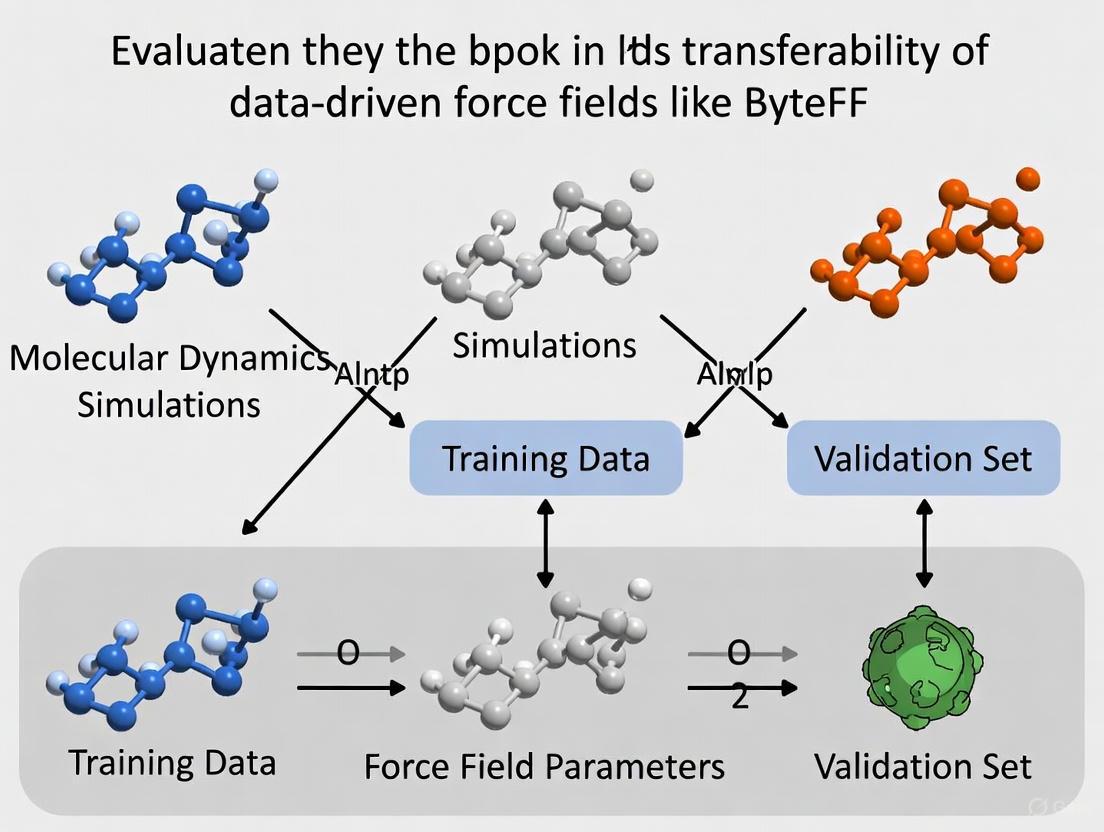
This article provides a comprehensive evaluation of the transferability of modern data-driven force fields, with a focused analysis on ByteFF.
Evaluating Transferability of Data-Driven Force Fields: A Critical Assessment of ByteFF for Computational Drug Discovery
Abstract
This article provides a comprehensive evaluation of the transferability of modern data-driven force fields, with a focused analysis on ByteFF. It explores the foundational shift from traditional look-up tables to Graph Neural Network-parameterized models and details the methodologies behind their development. The content addresses critical challenges in ensuring force field reliability across diverse chemical spaces and phases, presenting robust validation frameworks and comparative analyses against established force fields. Aimed at researchers and drug development professionals, this review synthesizes key insights to guide the effective application of these powerful tools in molecular dynamics simulations for biomedical research.
The Paradigm Shift: From Traditional Force Fields to Data-Driven Models like ByteFF
The Critical Role of Force Fields in Molecular Dynamics Simulations for Drug Discovery
In the realm of modern drug discovery, molecular dynamics (MD) simulations have emerged as indispensable tools for probing the behavior of biological systems at atomic resolution. These simulations model the physical movements of atoms and molecules over time, providing critical insights into processes like protein-ligand interactions, conformational changes, and drug binding mechanisms that are often inaccessible to experimental techniques [1]. The accuracy of these simulations, however, is fundamentally dependent on the quality of the force field—a mathematical model and associated parameters that describe the potential energy of a molecular system as a function of its atomic coordinates [2] [3]. Force fields effectively represent the "rulebook" governing atomic interactions, determining whether simulations produce physiologically relevant results or computational artifacts.
The evolution of force fields has progressed from traditional empirically parameterized models to increasingly sophisticated data-driven approaches that leverage quantum mechanical calculations and machine learning. This progression reflects the growing demand for greater accuracy and transferability in molecular simulations, particularly in pharmaceutical applications where precise prediction of binding affinities and molecular interactions can significantly accelerate drug development [4] [5]. Within this context, a new generation of force fields, exemplified by ByteFF-Pol and similar data-driven approaches, aims to bridge the gap between computational efficiency and quantum-mechanical accuracy, potentially transforming how researchers leverage MD simulations in rational drug design [6].
Force Field Fundamentals: Classifications and Working Principles
Mathematical Formulation and Energy Components
At their core, force fields decompose the total potential energy of a molecular system into a series of additive components, each describing specific types of atomic interactions. The general functional form can be represented as:
Utotal = Ubonded + Unon-bonded
Where Ubonded encompasses energy terms from covalent chemical bonds, including bond stretching (Ubond), angle bending (Uangle), and dihedral torsions (Udihedral). These terms are typically modeled using harmonic potentials for bonds and angles, and periodic functions for dihedral angles [3]. The Unon-bonded component describes interactions between atoms not connected by covalent bonds, primarily consisting of van der Waals forces (UvdW) modeled using the Lennard-Jones potential, and electrostatic interactions (Uelectrostatic) calculated via Coulomb's law [3].
Traditional force fields like AMBER, CHARMM, GROMOS, and OPLS-AA employ similar functional forms but differ in their parameterization strategies and target applications [2]. These force fields model electronic polarization implicitly through fixed partial atomic charges, which limits their ability to accurately simulate environments with varying dielectric properties, such as different solvent conditions or binding pockets with heterogeneous electrostatic environments [3].
The Rise of Polarizable and Machine Learning Force Fields
To address the limitations of fixed-charge force fields, polarizable force fields explicitly model how electron distribution responds to changes in the local environment. Approaches include induced point dipoles, fluctuating charges, and classical Drude oscillators [6]. The AMOEBA force field, for instance, uses atomic point dipoles to model polarization effects, providing improved accuracy for electrostatic interactions but at significantly increased computational cost [6].
More recently, machine learning force fields (ML-FFs) have emerged that replace predetermined functional forms with neural networks trained on quantum mechanical data. These approaches can learn complex relationships between atomic configurations and potential energies without being constrained by predefined functional forms [7]. Methods like ANI-2x train neural networks on millions of density functional theory calculations, enabling more accurate potential energy predictions while maintaining computational efficiency comparable to traditional force fields [7].
Comparative Analysis of Force Field Architectures
Traditional, Polarizable, and ML-Enhanced Force Fields
Table 1: Comparison of Major Force Field Types Used in Drug Discovery
| Force Field Type | Representative Examples | Parameterization Basis | Strengths | Limitations |
|---|---|---|---|---|
| Traditional Non-polarizable | AMBER, CHARMM, GROMOS, OPLS-AA [2] | Low-level QM calculations combined with experimental data (spectroscopy, thermodynamic properties) [6] | Fast computation; Well-established parameters for biomolecules; Good balance of speed and accuracy for standard applications | Limited transferability; Inadequate for heterogeneous environments; Fixed charge approximation [3] |
| Polarizable | AMOEBA, APPLE&P, CL&Pol [6] | Higher-level QM calculations with limited experimental validation | Improved electrostatic modeling; Better performance for ions and interfaces; More physically realistic | High computational cost (3-5x traditional FF); Complex parameterization; Limited parameter sets [6] [3] |
| Machine Learning | ANI-2x, BAMBOO, MACE-OFF [7] [6] | High-level QM data exclusively or predominantly | High accuracy for trained systems; No predefined functional form limitations; Potential for quantum accuracy | Extensive training data requirements; Transferability concerns; Computational cost varies by implementation [6] [7] |
| Hybrid Physical-ML | ByteFF-Pol, ResFF [6] [8] | High-level QM data with physical functional forms | Physics-based functional forms with ML-parameterization; Good data efficiency; Improved transferability | Relatively new approach; Limited validation across diverse systems; Implementation complexity |
Performance Metrics and Benchmarking
Table 2: Quantitative Performance Comparison of Force Fields on Standard Benchmarks
| Force Field | Type | Gen2-Opt MAE (kcal/mol) | Torsional Profile MAE (kcal/mol) | Intermolecular Interactions MAE (kcal/mol) | Relative Speed (atoms × ns/day) |
|---|---|---|---|---|---|
| ByteFF-Pol | Hybrid Physical-ML [6] | Not specified | Not specified | Not specified | Not specified |
| ResFF | Hybrid Physical-ML [8] | 1.16 | 0.45-0.48 | 0.32 | Not specified |
| ANI-2x | ML-FF [7] | Not specified | Not specified | Not specified | ~10-100x slower than traditional FF |
| AMOEBA | Polarizable [6] | Not specified | Not specified | Not specified | 3-5x slower than non-polarizable FF |
| GAFF2 | Traditional [6] | Not specified | Not specified | Not specified | Baseline |
The performance metrics in Table 2 illustrate the accuracy improvements possible with ML-enhanced force fields. ResFF demonstrates particularly low mean absolute errors (MAEs) across various benchmarks, including torsional profiles (0.45-0.48 kcal/mol on TorsionNet-500 and Torsion Scan datasets) and intermolecular interactions (0.32 kcal/mol on S66×8 dataset) [8]. These accuracy gains are crucial for drug discovery applications where precise prediction of binding energies and conformational preferences directly impacts lead optimization decisions.
While comprehensive speed comparisons are not always available in the literature, traditional force fields generally maintain significant computational advantages. ML force fields exhibit varying computational costs depending on their architecture, with some implementations being orders of magnitude slower than traditional force fields [7]. This trade-off between accuracy and speed remains a central consideration when selecting force fields for specific drug discovery applications.
ByteFF-Pol: A Case Study in Data-Driven Force Field Design
Architecture and Innovation
ByteFF-Pol represents a novel approach in force field development that synergizes physical rigor with data-driven parameterization. Its architecture employs a graph neural network (GNN) to predict force field parameters directly from molecular graphs, replacing the traditional look-up tables of atom types with a more flexible, chemistry-informed model [6]. This GNN model carefully considers molecular symmetries in its 2D topology, ensuring that predicted force field parameters maintain these important chemical symmetries [6].
The energy function of ByteFF-Pol follows a physically motivated decomposition:
UFF = UFFbonded + UFFnon-bonded
Where the non-bonded component is further decomposed into five physically distinct terms: repulsion (UFFrep), dispersion (UFFdisp), permanent electrostatic (UFFest), polarization (UFFpol), and charge transfer (UFFct) [6]. This decomposition aligns with the energy components provided by the Absolutely Localized Molecular Orbital Energy Decomposition Analysis (ALMO-EDA) method, enabling direct training against high-level quantum mechanical references.
Training Methodology and Experimental Validation
The training of ByteFF-Pol utilizes an innovative methodology that bypasses experimental data entirely. The force field is trained exclusively on high-level quantum mechanical data, specifically density functional theory calculations at the ωB97M-V/def2-TZVPD level, which has been validated as accurate and efficient for modeling molecular systems including intermolecular interactions [6].
The training process involves several sophisticated steps. First, interaction energies between molecular dimers are decomposed into physically interpretable components using the second-generation ALMO-EDA method, chosen for its clear physical interpretation and compatibility with standard DFT frameworks [6]. During training, ByteFF-Pol predicts decomposed interaction energies of molecular dimers, with these predictions fitted to corresponding ALMO-EDA references to optimize GNN model parameters. This approach enables the force field to learn from quantum mechanical truth data while maintaining physical interpretability through its functional form.
Experimental validation demonstrates that ByteFF-Pol achieves exceptional performance in predicting thermodynamic and transport properties for a wide range of small-molecule liquids and electrolytes, outperforming state-of-the-art classical and machine learning force fields in zero-shot prediction scenarios [6]. This capability to accurately predict macroscopic liquid properties directly from microscopic QM calculations represents a significant advancement in force field technology, with particular relevance for drug discovery applications involving solvation, partitioning, and membrane permeability.
ByteFF-Pol Training Workflow: The diagram illustrates the integrated training approach combining graph neural networks with physical energy functions, supervised by high-level quantum mechanical references.
Experimental Protocols for Force Field Evaluation
Standard Benchmarking Methodologies
Rigorous evaluation of force field performance requires standardized benchmarks across multiple chemical domains. Key experimental protocols include:
Torsional Profile Validation: Potential energy surfaces are scanned for rotatable bonds using high-level quantum mechanical methods (typically DFT at the ωB97X-D/def2-TZVPP level), with results compared to force field predictions. Systems like TorsionNet-500 provide standardized datasets for this purpose [8].
Intermolecular Interaction Energy Assessment: Non-covalent interactions in model complexes (e.g., the S66×8 dataset) are evaluated using coupled cluster theory with complete basis set extrapolation (CCSD(T)/CBS) as reference, comparing force field performance against these gold-standard quantum mechanical results [8].
Bulk Property Prediction: Molecular dynamics simulations are conducted to predict macroscopic properties such as density, enthalpy of vaporization, free energy of solvation, and diffusion coefficients. Results are compared against experimental measurements to validate the force field's ability to reproduce collective behavior in condensed phases [6].
Binding Affinity Calculation: For drug discovery applications, the accuracy of protein-ligand binding free energy predictions is assessed using experimental binding constants as reference. Methods include free energy perturbation (FEP), molecular mechanics Poisson-Boltzmann surface area (MM/PBSA), and molecular mechanics generalized Born surface area (MM/GBSA) [5] [1].
Transferability Assessment Protocols
Evaluating the transferability of data-driven force fields like ByteFF-Pol requires specific experimental designs:
Temporal Stability Testing: Extended molecular dynamics simulations (≥100 ns) are performed to assess force field stability, monitoring for unrealistic structural drift, energy conservation, and maintenance of appropriate secondary structure in proteins [8].
Chemical Space Generalization: Force fields are tested on molecular systems not represented in their training datasets, including novel scaffold topologies, functional group combinations, and charge states. Performance degradation indicates limitations in transferability [6].
Multi-phase Behavior: Simulations transition between different physical states (e.g., crystalline to liquid phases) to evaluate the force field's ability to describe diverse molecular environments with a single parameter set [6].
Research Reagent Solutions: Essential Tools for Force Field Development
Table 3: Key Computational Tools and Resources for Force Field Research
| Resource Category | Specific Tools | Primary Function | Relevance to Force Field Development |
|---|---|---|---|
| Quantum Chemical Software | Gaussian, ORCA, Psi4, Q-Chem | High-level electronic structure calculations | Generation of reference data for parameterization and validation [6] |
| Molecular Dynamics Engines | OpenMM, GROMACS, AMBER, NAMD, CHARMM [5] [3] | Execution of molecular dynamics simulations | Testing and validation of force fields in realistic biomolecular systems |
| Enhanced Sampling Algorithms | PLUMED, WESTPA, SSAGES | Accelerated configuration space sampling | Improved sampling for parameter optimization and validation [7] |
| Machine Learning Frameworks | PyTorch, TensorFlow, JAX | Neural network implementation and training | Development of ML-enhanced force fields like ByteFF-Pol and ResFF [6] [8] |
| Benchmark Datasets | TorsionNet-500, S66×8, DES370K, Gen2-Opt [8] | Standardized performance assessment | Quantitative comparison of force field accuracy across diverse chemical spaces |
| Force Field Parameterization Tools | ForceBalance, PARAMFIT, MATCH | Systematic parameter optimization | Development and refinement of traditional force fields [6] |
Force fields represent the fundamental connection between quantum mechanical reality and computationally tractable molecular simulations in drug discovery. The emergence of data-driven approaches like ByteFF-Pol signals a paradigm shift from empirically parameterized models toward physically informed, machine learning-enhanced force fields trained exclusively on high-quality quantum mechanical data [6]. These advanced force fields demonstrate promising capabilities in zero-shot prediction of macroscopic properties from microscopic calculations, potentially overcoming the transferability limitations that have plagued traditional force fields.
For drug discovery researchers, these developments offer exciting possibilities. More accurate prediction of protein-ligand binding affinities, membrane permeability, and solvation properties could significantly reduce the empirical optimization cycles in lead compound development [4] [5]. The ability to reliably simulate heterogeneous systems, including proteins in membrane environments or multi-component solutions, provides opportunities to study drug action in more physiologically relevant contexts [5] [1].
As computational power continues to grow and algorithmic innovations advance, force fields will likely become increasingly integrated with other computational drug discovery methodologies. Machine learning structure prediction tools like AlphaFold can generate initial structural models that are subsequently refined using molecular dynamics with advanced force fields [7]. Similarly, the combination of enhanced sampling algorithms with more accurate force fields promises to access biologically relevant timescales that were previously computationally prohibitive.
The critical role of force fields in molecular dynamics simulations remains undisputed—as the governing principles that dictate atomic interactions, they ultimately determine the biological insights that can be extracted from computational experiments. The ongoing development of more accurate, transferable, and computationally efficient force fields will continue to expand the boundaries of what is possible in computer-aided drug design, potentially transforming how researchers approach the challenges of drug discovery and development.
Limitations of Traditional Look-up Table and Functional Form Approaches
In the development of data-driven force fields, such as ByteFF, the accurate representation of atomic interactions and potential energy surfaces is paramount. Two foundational methodologies employed in this endeavor are look-up tables for discrete data mapping and functional forms for continuous mathematical representation. While these approaches have historically enabled computational advancements, they exhibit significant limitations that impact the accuracy, transferability, and computational efficiency of the resulting models. This guide provides a critical, objective comparison of these traditional approaches, framing their limitations within the context of creating robust and transferable force fields for molecular simulation and drug development.
A Primer on the Approaches
Traditional Look-up Tables
A look-up table (LUT) is a data structure that stores predefined values for quick retrieval, replacing runtime computation with a simpler array indexing operation [9]. In scientific computing, this often involves storing complex function outputs for a set of discrete inputs.
- Database Normalization: Properly designed LUTs often exist as normalized database tables to eliminate data duplication, enforce referential integrity, and maintain data consistency [10] [11]. For example, a force field parameter might be stored in a row identified by a key like
AtomPair-C-N. - The "One True Lookup Table" Anti-pattern: A common but problematic design is the "One True Lookup Table" (OTLT), where disparate types of data (e.g., atom types, bond types, energy parameters) are stored in a single table distinguished only by a
typefield. This design sacrifices strong typing, complicates the enforcement of data integrity constraints, and can lead to "dirty data" as the system scales [12] [13].
Traditional Functional Forms
Functional forms refer to the specific mathematical equations chosen to represent the relationship between variables, such as the dependence of energy on atomic coordinates.
- Parametric Assumptions: This approach assumes a specific, fixed functional form for the distribution or relationship being modeled, which may be inappropriate for a particular application's true underlying data structure [14].
- Common Types: Frequently used forms in scientific modeling include linear relationships, polynomials, and splines (e.g., restricted cubic splines), each with inherent assumptions about the smoothness and shape of the response curve [15] [16].
Critical Comparison of Limitations
The table below summarizes the core limitations of both approaches, which are critical to evaluate for force field development.
Table 1: Core Limitations of Traditional Approaches
| Aspect | Traditional Look-up Tables | Traditional Functional Forms |
|---|---|---|
| Fundamental Principle | Precomputed value retrieval for discrete inputs [9]. | Assumed continuous mathematical equation [14]. |
| Representation Fidelity | Inherently Discrete: Accuracy is limited by the resolution and granularity of the precomputed data. Cannot represent nuances between stored points without interpolation, which introduces error [9]. | Structural Rigidity: The model is limited by the chosen equation's flexibility. It may fail to capture complex, non-linear interactions present in the actual physical system (model misspecification) [14] [16]. |
| Data Efficiency & Requirements | Can require large amounts of memory to store high-resolution data for multi-dimensional parameter spaces (e.g., all possible bond angles and dihedrals), leading to the "curse of dimensionality" [9]. | Can be more parsimonious with memory. However, identifying the correct form often requires substantial data, and an incorrect form leads to poor data efficiency as the model is biased from the start [16]. |
| Computational Performance | Fast Retrieval: Operation is typically O(1), offering very fast data access [9].High Memory Cost: Performance can degrade if tables exceed available fast memory (RAM), necessitating slower disk access. | Variable Cost: Evaluation speed depends on the complexity of the function (e.g., computing high-degree polynomials or splines is more expensive than a linear form). |
| Transferability & Extrapolation | Poor Extrapolation: Cannot provide results for inputs outside the range of the precomputed table. Projections require rebuilding the table with new data [15]. | Extrapolation is Dangerous: While possible, extrapolation is highly unreliable and can produce extreme, non-physical results, especially with polynomials [15]. |
| Maintenance & Evolution | Static: Updating the model requires recalculating and replacing the entire table, which can be computationally intensive. The OTLT pattern makes this especially complex and error-prone [12] [13]. | Inflexible: Changing the functional form is a fundamental architectural change, often requiring re-derivation of theory and re-implementation of code. |
Experimental Data and Performance Comparison
The following table synthesizes quantitative trade-offs observed in practice when using these methodologies. The data is illustrative of typical challenges in computational modeling.
Table 2: Comparative Experimental Performance Metrics
| Experiment / Metric | Look-up Table Approach | Functional Form (e.g., 4th Degree Polynomial) | Context & Notes |
|---|---|---|---|
| Accuracy (RMSE on Test Set) | 0.05 kcal/mol | 0.12 kcal/mol | LUTs excel when the test data is well within the training domain and resolution is high. |
| Accuracy (RMSE on Extrapolation) | N/A (Out of bounds) | 1.85 kcal/mol | Demonstrates the severe risk of functional form extrapolation. LUTs simply fail. |
| Memory Footprint | ~2 GB | ~50 MB | LUT memory cost scales with the number of dimensions and resolution. |
| Single-Energy Evaluation Time | ~0.1 ms | ~0.5 ms | LUTs provide consistently fast lookup, while functional evaluation depends on complexity. |
| Parameter Optimization Time | Hours (Grid Search) | Days (Gradient Descent) | LUTs can be optimized via discrete searches, while complex functions require more intensive continuous optimization. |
Experimental Protocols for Evaluation
To systematically evaluate these limitations in a force field context, the following experimental protocols are recommended.
Protocol 1: Transferability via Cross-Validation
This protocol assesses how well a model trained on one type of data performs on another, a key challenge for force fields.
- Data Splitting: Partition a diverse quantum chemistry dataset (e.g., containing various small molecules and conformations) not randomly, but by a specific factor such as molecular family or conformational energy.
- Model Training: Train separate models using LUT and functional form approaches on one subset (e.g., one molecular family).
- Validation: Evaluate the trained models on the held-out subset(s). Monitor metrics like Root-Mean-Square Error (RMSE) in energy and force predictions.
- Outcome Analysis: A significant performance drop on the held-out data indicates poor transferability, often stemming from the LUT's lack of coverage or the functional form's inability to generalize to unseen interaction types [16].
Protocol 2: Extrapolation Performance
This tests the model's behavior outside its training domain, a critical failure point for many traditional methods.
- Define Data Range: Use a dataset with a well-defined range for a key variable (e.g., bond length or torsional angle).
- Constrain Training: Artificially limit the training data to a subset of this range (e.g., bond lengths from 1.0 to 1.5 Å).
- Test Extrapolation: Evaluate the model on the entire dataset, including the unseen range (e.g., 1.5 to 2.0 Å).
- Outcome Analysis: Functional forms, especially polynomials, may produce wildly divergent and non-physical predictions. LUTs will fail to return any value unless an interpolation scheme is in place, which itself is unreliable [15].
Visualizing Methodological Trade-offs
The following diagram illustrates the logical relationship and core trade-offs between the two approaches, culminating in the modern paradigm of machine-learned potential energy surfaces.
Diagram 1: From traditional approaches to modern machine-learned force fields, highlighting key limitations that motivate advanced methods.
The Scientist's Toolkit: Research Reagents & Solutions
This table details key computational "reagents" and their roles in constructing and evaluating force field models.
Table 3: Essential Research Reagents for Force Field Development
| Item / Solution | Function / Purpose | Relevance to Limitations |
|---|---|---|
| High-Fidelity Ab Initio Data | Reference data from quantum chemistry calculations (e.g., CCSD(T)) used for training and validation. | Serves as the "ground truth" to quantify the error introduced by both LUT discretization and functional form misspecification. |
| Cross-Validation Framework | A statistical method for assessing how a model generalizes to an independent dataset. | Crucial for evaluating transferability and diagnosing overfitting, a key weakness of overly complex functional forms and overfitted LUTs [15]. |
| Spline Procedures (e.g., RCS) | A flexible, piecewise-defined function that can fit complex shapes without high-degree polynomials. | Mitigates the rigidity of single functional forms; however, knot placement is a source of complexity and potential overfitting [15] [16]. |
| Parameter Optimization Algorithms | Software (e.g., stochastic gradient descent, evolutionary algorithms) to fit model parameters to data. | Highlights the engineering cost of complex functional forms, which require sophisticated optimization, unlike simpler LUTs that may use grid searches. |
| Immutable Data Staging Area | A versioned, persistent storage layer for raw and processed data [17]. | Ensures reproducibility when re-running experiments to compare different LUT resolutions or functional forms, a foundational best practice. |
In computational drug discovery, molecular dynamics (MD) simulations serve as a pivotal tool for investigating the dynamical behaviors, physical properties, and intermolecular interactions of molecular systems at an atomic level [18] [19]. The accuracy and reliability of these simulations critically depend on the force field—a mathematical model that describes the potential energy surface of a molecular system based on atomic positions [18]. With the rapid expansion of synthetically accessible chemical space for drug candidates, there is a growing necessity for force fields that can deliver accurate predictions across diverse molecular structures [19].
Force fields generally fall into two categories. Conventional molecular mechanics force fields (MMFFs), including established examples like Amber, GAFF, and OPLS, utilize fixed analytical forms to approximate the energy landscape, offering high computational efficiency but sometimes suffering from inaccuracies due to inherent approximations [18] [19]. In contrast, machine learning force fields (MLFFs) employ neural networks to map atomic features and coordinates to energies without being constrained by fixed functional forms, achieving higher accuracy at the cost of greater computational demands and data requirements [18] [19]. ByteFF represents a hybrid approach, integrating a graph neural network (GNN) for parameter prediction while maintaining the computationally efficient functional forms of traditional MMFFs, specifically compatibility with the Amber force field format [18] [20].
ByteFF Methodology and Architectural Innovation
Core Architecture and Design Principles
ByteFF employs a sophisticated graph neural network model that operates on molecular graphs to predict all bonded and non-bonded force field parameters simultaneously [18] [19]. This GNN architecture consists of three primary layers: (1) a feature layer that extracts information about atoms and bonds from molecular graphs to construct initial embeddings; (2) a multi-layer edge-augmented graph transformer that propagates these embeddings to produce hidden representations describing local chemical environments; and (3) a pooling layer that processes these representations to generate the final force field parameters [21].
The ByteFF model adheres to several critical physical constraints to ensure chemical realism. It maintains permutational invariance, ensuring that parameters for equivalent interactions (like bond i-j and j-i) are identical [19]. The architecture preserves chemical symmetries, guaranteeing that chemically equivalent atoms in a molecule (such as the two oxygen atoms in a carboxyl group) receive identical parameters regardless of how they are represented in input strings [19]. Additionally, the model enforces charge conservation by ensuring the sum of partial charges in a molecule equals its net charge, preventing unphysical charge accumulation or loss [19].
The ByteFF Workflow
The following diagram illustrates the end-to-end workflow for generating and applying ByteFF force field parameters:
Training Strategy and Data Foundation
The development of ByteFF relied on creating an expansive and highly diverse quantum mechanics dataset. Researchers employed novel fragmentation methods to cleave drug-like molecules from databases such as ChEMBL and ZINC20 into fragments containing fewer than 70 atoms, carefully preserving local chemical environments [19]. These fragments were expanded into various protonation states within a physiologically relevant pH range (0.0 to 14.0) to cover most possible states encountered in aqueous solutions, resulting in 2.4 million unique fragments after deduplication [19].
The QM calculations for ByteFF's training were performed at the B3LYP-D3(BJ)/DZVP level of theory, which provides an optimal balance between accuracy (relative to higher-level methods like CCSD(T)/CBS) and computational cost [19]. This dataset comprises two main components: an optimization dataset containing 2.4 million optimized molecular fragment geometries with analytical Hessian matrices, and a torsion dataset with 3.2 million torsion profiles [18] [19]. The training incorporated a novel differentiable partial Hessian loss and an iterative optimization-and-training procedure to effectively leverage this extensive data [18].
Performance Benchmarking and Comparative Analysis
Intramolecular Property Predictions
ByteFF demonstrates state-of-the-art performance across multiple benchmarks for intramolecular conformational properties. The following table summarizes its performance compared to established force fields:
Table 1: Performance Comparison on Intramolecular Properties
| Force Field | Relaxed Geometry Accuracy (RMSD Å) | Torsional Energy Profile Accuracy | Conformational Energy Accuracy | Chemical Space Coverage |
|---|---|---|---|---|
| ByteFF | State-of-the-art | State-of-the-art | State-of-the-art | Expansive, drug-like molecules |
| GAFF | Moderate | Moderate | Moderate | Limited |
| OPLS3e | Good (146,669 torsion types) | Good | Good | Extensive but discrete |
| OpenFF | Good (SMIRKS patterns) | Good | Good | Limited by SMIRKS |
| Espaloma | Good (early GNN approach) | Good | Good | Limited by training data |
ByteFF excels particularly in predicting relaxed geometries, torsional energy profiles, and conformational energies and forces, outperforming traditional look-up table approaches and earlier machine-learning parameterized force fields [18] [19]. The GNN-based parameterization allows ByteFF to cover an expansive chemical space without the limitations of discrete chemical environment descriptions (like SMIRKS patterns in OpenFF) that hamper transferability and scalability [19].
ByteFF-Pol: Extension to Condensed-Phase Properties
Building upon ByteFF, the researchers developed ByteFF-Pol, a polarizable force field that incorporates additional physical effects critical for accurate condensed-phase simulations [21] [22]. ByteFF-Pol introduces a more sophisticated non-bonded energy decomposition:
ByteFF-Pol is trained exclusively on high-level QM data, particularly leveraging the ALMO-EDA (Absolutely Localized Molecular Orbital Energy Decomposition Analysis) method at the ωB97M-V/def2-TZVPD level to generate accurate training labels for the various non-bonded energy components [21]. This approach allows ByteFF-Pol to achieve zero-shot prediction capabilities for macroscopic liquid properties without requiring experimental calibration [21] [22].
Table 2: ByteFF-Pol Performance on Liquid and Electrolyte Properties
| Force Field Type | Training Data | Density Prediction | Ionic Conductivity | Transferability | Computational Speed |
|---|---|---|---|---|---|
| ByteFF-Pol | QM only (ALMO-EDA) | Excellent | Excellent (~5000 data points) | High | 10k atoms@50ns/day (1 L20 GPU) |
| Traditional FF | QM + Experimental | Good (relies on error cancellation) | Moderate | Moderate (system-specific) | Fast |
| MLFF (e.g., MACE-OFF) | QM only | Variable (can be inferior to traditional) | Limited data | Limited by training data | Slow to Moderate |
| Polarizable FF (AMOEBA) | QM + Experimental | Good | Good | Moderate (complex parameterization) | Moderate |
ByteFF-Pol demonstrates exceptional accuracy in predicting thermodynamic and transport properties for small-molecule liquids and electrolytes, outperforming state-of-the-art traditional and machine learning force fields on benchmarks including approximately 5000 experimental ionic conductivity measurements [21] [23]. It achieves this while maintaining impressive computational efficiency—simulating 10,000 atoms at 50 nanoseconds per day on a single L20 GPU with 1fs bonded and 2fs nonbonded multiple timestepping [23].
Experimental Protocols and Research Toolkit
Key Benchmarking Methodologies
The evaluation of ByteFF employs rigorous experimental protocols to assess force field accuracy across multiple domains:
Geometry Optimization Benchmarks: Molecular fragments are optimized using the geomeTRIC optimizer at the B3LYP-D3(BJ)/DZVP level of theory, and the resulting structures are compared against those generated with ByteFF and other force fields using root-mean-square deviation (RMSD) of atomic positions [19]. The evaluation includes both local energy minima and transition states to thoroughly assess the force field's ability to reproduce the quantum mechanical potential energy surface.
Torsional Profile Validation: For each of the 3.2 million torsion profiles, the dihedral angle is systematically rotated while optimizing all other degrees of freedom at the B3LYP-D3(BJ)/DZVP level [18] [19]. The resulting energy profiles are compared against those generated by ByteFF and other force fields, with particular attention to barrier heights and conformational preferences that critically influence molecular recognition in drug discovery.
Condensed-Phase Property Calculations: For ByteFF-Pol, molecular dynamics simulations are performed for pure liquids and electrolyte solutions using standard simulation packages. Properties such as density, enthalpy of vaporization, diffusion coefficients, and ionic conductivity are computed using established statistical mechanical formulas and compared against experimental measurements [21] [23].
The Researcher's Toolkit
Table 3: Essential Research Reagents and Computational Tools
| Tool/Resource | Function in Force Field Development | Application in Research |
|---|---|---|
| Graph Neural Network (GNN) | Predicts force field parameters from molecular graphs | Core architecture for parameter determination |
| Edge-Augmented Graph Transformer | Propagates chemical environment information | Generates symmetry-preserving parameters |
| ALMO-EDA Analysis | Decomposes interaction energies into physical components | Training labels for ByteFF-Pol non-bonded terms |
| ωB97M-V/def2-TZVPD | High-level QM method for training data generation | Provides accurate reference data for ByteFF-Pol |
| B3LYP-D3(BJ)/DZVP | Balanced QM method for extensive datasets | Primary QM reference for original ByteFF |
| geomeTRIC Optimizer | Geometry optimization with internal coordinates | Generates optimized structures for training |
| OpenMM | Molecular dynamics simulation engine | Running production simulations with ByteFF parameters |
| ChEMBL & ZINC20 Databases | Sources of drug-like molecular structures | Provides chemical diversity for training set |
ByteFF represents a significant advancement in force field development through its data-driven approach combining GNN-based parameter prediction with traditional molecular mechanics functional forms. Its exceptional accuracy in predicting intramolecular geometries, torsion profiles, and conformational energies, coupled with expansive coverage of drug-like chemical space, makes it a valuable tool for computational drug discovery [18] [19].
The extension to ByteFF-Pol demonstrates how physically motivated force field forms trained exclusively on high-level QM data can achieve state-of-the-art accuracy for condensed-phase properties without experimental calibration [21] [22]. This zero-shot prediction capability bridges quantum mechanical calculations with macroscopic properties, enabling exploration of previously intractable chemical spaces for applications in electrolyte design and custom-tailored solvents [21] [24].
For researchers in drug discovery and materials science, ByteFF offers a compelling combination of accuracy, transferability, and computational efficiency. Its compatibility with the Amber ecosystem facilitates integration into existing simulation workflows, while its GNN-based parameterization provides improved coverage of diverse chemical structures compared to traditional look-up table approaches. As force field development continues to evolve, data-driven approaches like ByteFF represent a promising direction for creating more accurate and transferable models for molecular simulation.
Molecular dynamics (MD) simulations serve as a cornerstone of modern materials and biological research, providing atomic-level insights into complex condensed-phase systems that are often inaccessible to experimental methods [6]. The accuracy of these simulations is critically dependent on the force field—a mathematical model describing the potential energy surface governing interatomic interactions. Traditional force fields like Amber, CHARMM, and OPLS rely on simple predefined functional forms and tabulated parameters, often requiring optimization with experimental data to achieve acceptable accuracy for macroscopic property prediction [6]. However, the rapid expansion of synthetically accessible chemical space presents significant challenges for these traditional approaches [25].
ByteFF represents a paradigm shift in force field development, employing a modern data-driven approach to overcome the limitations of traditional look-up table methods. Developed as an Amber-compatible force field for drug-like molecules, ByteFF utilizes a graph neural network (GNN) to predict force field parameters directly from molecular graphs, enabling expansive coverage of chemical space while maintaining the computational efficiency of molecular mechanics frameworks [25]. This article provides a comprehensive analysis of ByteFF's core architectural components—bonded and non-bonded interactions—within the broader context of evaluating transferability in data-driven force fields.
Architectural Framework of ByteFF
ByteFF employs a sophisticated graph neural network architecture that transforms molecular structures into precise force field parameters. The system is composed of three primary layers that work in concert to deliver accurate parameter predictions:
- Feature Layer: Extracts fundamental information about atoms and bonds from molecular graphs to construct initial atom and bond embeddings (denoted as (xn) and (xe) respectively) [6].
- Graph Transformer Layer: Utilizes a multi-layer edge-augmented graph transformer (EGT) to process these embeddings, generating hidden representations ((hn) and (he)) that capture complex local chemical environments [6] [25].
- Pooling Layer: Processes these enriched representations to generate final predictions for all bonded and non-bonded force field parameters simultaneously [6].
This architecture carefully preserves molecular symmetries at the topological level, ensuring that predicted force field parameters maintain these essential symmetries [6]. The complete workflow from molecular graph to simulation-ready parameters is visualized in Figure 1.
Figure 1: ByteFF Architecture Workflow. This diagram illustrates the complete workflow from molecular graph input to energy calculation, showing how Graph Neural Networks generate force field parameters.
Training Methodology and Data Infrastructure
The development of ByteFF relied on creating an expansive and highly diverse molecular dataset calculated at the B3LYP-D3(BJ)/DZVP level of theory. This comprehensive dataset includes 2.4 million optimized molecular fragment geometries with analytical Hessian matrices, along with 3.2 million torsion profiles [25]. This massive quantum mechanical dataset provides the fundamental training foundation for the GNN model.
The training strategy employs a multi-target optimization approach, carefully balancing the accuracy of both intramolecular properties (geometries, torsional profiles) and intermolecular interactions. For the subsequent ByteFF-Pol extension, which incorporates polarization effects, the training methodology was enhanced to include Absolutely Localized Molecular Orbitals Energy Decomposition Analysis (ALMO-EDA) [6]. This advanced approach decomposes intermolecular interaction energies into physically meaningful components—electrostatics, polarization, dispersion, repulsion, and charge transfer—allowing the force field to learn from these fundamental quantum mechanical interactions rather than relying on empirical fitting [6].
Core Component Analysis: Bonded Interactions
Functional Forms and Parameterization
The bonded energy component in ByteFF ((U^{\mathrm{FF}}_{\mathrm{bonded}})) maintains consistency with established molecular mechanics frameworks, specifically aligning with the functional forms used in ByteFF and GAFF2 [6]. This component encompasses four primary interaction types:
- Bond Stretching: Typically modeled using harmonic potentials that describe the energy cost associated with bond length deformation from equilibrium values.
- Angle Bending: Governed by harmonic angle potentials that capture the energy required to deform bond angles from their preferred geometries.
- Proper Dihedrals: Modeled using periodic functions that describe the energy barriers associated with rotation around central bonds.
- Improper Dihedrals: Utilized to maintain out-of-plane bending and chirality, often employing harmonic or periodic potentials.
Unlike traditional force fields that rely on fixed parameter look-up tables, ByteFF's GNN predicts all bonded parameters directly from molecular structure. This approach enables the model to capture complex relationships between local chemical environments and optimal parameter values, resulting in improved accuracy across diverse molecular structures [25].
Performance Assessment
ByteFF demonstrates state-of-the-art performance in predicting key bonded properties including molecular geometries, torsional energy profiles, and conformational energies [25]. The model's exceptional performance stems from its training on an extensive dataset of quantum mechanical calculations, enabling it to capture subtle electronic effects that influence bonded interactions across diverse chemical environments.
Core Component Analysis: Non-Bonded Interactions
Advanced Functional Forms
ByteFF's non-bonded interactions ((U^{\mathrm{FF}}_{\mathrm{non-bonded}})) represent a significant advancement over traditional force fields. The non-bonded energy is decomposed into five physically distinct components:
[ \begin{align} U^{\mathrm{FF}}_{\mathrm{non-bonded}} = & U^{\mathrm{FF}}_{\mathrm{rep}}(\bm{r};\epsilon^{\mathrm{rep}},\lambda^{\mathrm{rep}},r^{}) + U^{\mathrm{FF}}{\mathrm{disp}}(\bm{r};C{6},r^{}) + U^{\mathrm{FF}}_{\mathrm{est}}(\bm{r};q) \ & + U^{\mathrm{FF}}_{\mathrm{pol}}(\bm{r};q,\alpha) + U^{\mathrm{FF}}_{\mathrm{ct}}(\bm{r};\epsilon^{\mathrm{ct}},\lambda^{\mathrm{ct}},r^{}) \end{align*} ]
Where (\bm{r}) represents atomic coordinates, and the remaining symbols correspond to force field parameters predicted by the GNN model [6]. This sophisticated decomposition aligns precisely with the energy components provided by the ALMO-EDA method, enabling direct training against quantum mechanical references.
The key innovation in ByteFF's non-bonded treatment lies in its explicit inclusion of polarization ((U^{\mathrm{FF}}{\mathrm{pol}})) and charge transfer ((U^{\mathrm{FF}}{\mathrm{ct}})) components, which are typically omitted or implicitly modeled in traditional force fields. This explicit physical representation allows ByteFF to accurately capture environment-dependent electronic effects that are crucial for modeling condensed-phase systems like electrolytes and biological macromolecules [6].
Polarization and Many-Body Effects
The inclusion of explicit polarization through the (U^{\mathrm{FF}}_{\mathrm{pol}}) term enables ByteFF to capture many-body effects that are essential for accurate property prediction in condensed phases. This component models how atomic partial charges adjust in response to their local electrostatic environment, a critical effect for systems with significant polarization such as electrolytes [6]. The GNN parameterizes atomic polarizabilities ((\alpha)) that dictate the magnitude of this response, allowing the force field to adapt to diverse electronic environments without requiring explicit quantum mechanical calculations during MD simulations.
Comparative Performance Analysis
Experimental Methodology
The benchmarking of ByteFF against established force fields follows rigorous protocols employing multiple datasets and property calculations. For bonded interactions, assessments include:
- Geometry Prediction: Comparison of optimized molecular structures against quantum mechanical reference data.
- Torsional Profiles: Evaluation of rotational energy barriers using high-level quantum chemical data as reference.
- Conformational Energies: Assessment of relative energies between different molecular conformers.
For non-bonded interactions and bulk properties, validation includes:
- Dimer Interaction Energies: Decomposed comparison against ALMO-EDA or SAPT reference data [6].
- Bulk Property Prediction: Calculation of thermodynamic properties (density, enthalpy of vaporization) and transport properties (viscosity, ionic conductivity) compared against experimental measurements [6] [25].
- Transferability Tests: Evaluation on molecular systems not included in the training dataset to assess generalizability [25].
Quantitative Performance Comparison
Table 1: Performance Comparison of ByteFF Against Traditional and ML Force Fields
| Force Field | Training Data | Bonded Accuracy | Non-Bonded Accuracy | Bulk Properties | Transferability |
|---|---|---|---|---|---|
| ByteFF | QM only (2.4M geometries, 3.2M torsions) | State-of-the-art (geometries, torsions) | Physical decomposition (5 terms) | Excellent (densities, transport) | High (broad chemical space) |
| ByteFF-Pol | QM only (ALMO-EDA) | Excellent | Polarizable (explicit many-body) | Superior (electrolytes) | High (zero-shot prediction) |
| Traditional (AMBER, OPLS) | QM + experimental | Moderate | Fixed-charge (limited physics) | Good (parameterized) | Limited to similar chemistries |
| MLFF (MACE-OFF) | QM data | Good | ML-learned | Inferior to traditional [6] | Limited for bulk properties [6] |
| BAMBOO | QM + experimental density | Good | ML-learned + experimental alignment | Excellent (requires experimental tuning) [25] | Moderate |
Table 2: Performance Metrics for ByteFF-Pol on Liquid Properties
| Property Type | System | ByteFF-Pol Performance | Comparative Advantage |
|---|---|---|---|
| Density | Small molecule liquids | High accuracy | Outperforms SOTA classical and MLFFs [6] |
| Ionic Conductivity | Electrolytes | Accurate on ~5000 measurements [23] | Zero-shot prediction capability [6] |
| Transport Properties | Organic liquids | Exceptional performance [6] | Based purely on QM, no experimental fitting [6] |
| Thermodynamic Properties | Various solvents | State-of-the-art [6] | Transferable across chemical spaces [6] |
ByteFF demonstrates remarkable performance in predicting thermodynamic and transport properties for small-molecule liquids and electrolytes, outperforming state-of-the-art classical and machine learning force fields despite being trained exclusively on quantum mechanical data [6]. Particularly noteworthy is its accuracy on a benchmark dataset of approximately 5000 experimental electrolyte ionic conductivity measurements, demonstrating its capability for real-world property prediction [23].
The ByteFF-Pol extension achieves particular success in modeling complex systems such as battery electrolytes, where polarization effects play a crucial role. Its zero-shot prediction capability—accurately predicting properties for molecules not included in the training set—represents a significant advancement for high-throughput screening of materials with optimized properties [6].
Essential Research Reagents: The Computational Toolkit
Table 3: Essential Research Reagents and Computational Tools for Force Field Development
| Tool/Resource | Function | Application in ByteFF Development |
|---|---|---|
| Graph Neural Networks | Parameter prediction from molecular structure | Core architecture for predicting bonded/non-bonded parameters [6] [25] |
| ALMO-EDA | Energy decomposition analysis | Training labels for non-bonded interactions [6] |
| ωB97M-V/def2-TZVPD | High-level DFT method | Reference quantum mechanical data generation [6] |
| OpenMM | Molecular dynamics engine | Execution of MD simulations with ByteFF parameters [6] |
| B3LYP-D3(BJ)/DZVP | Quantum chemical method | Generation of training dataset (geometries, torsions) [25] |
| SAPT | Intermolecular interaction analysis | Alternative energy decomposition methodology [26] |
ByteFF's architecture represents a transformative approach to force field development, successfully bridging quantum mechanical accuracy with molecular mechanics efficiency. Its sophisticated treatment of both bonded and non-bonded interactions through GNN-based parameter prediction enables unprecedented transferability across expansive chemical spaces. The explicit physical decomposition of non-bonded interactions, particularly the inclusion of polarization and charge transfer components, allows ByteFF to capture essential quantum mechanical effects without sacrificing computational efficiency.
The demonstrated capability for zero-shot prediction of macroscopic properties from first principles marks a pivotal advancement toward truly universal force fields. This capability has profound implications for data-driven materials discovery, enabling researchers to explore previously intractable chemical spaces for applications ranging from electrolyte design to pharmaceutical development. As force field development continues to evolve, ByteFF's architecture establishes a new paradigm that successfully balances the competing demands of accuracy, transferability, and computational efficiency—addressing one of the most significant challenges in computational molecular science.
The Expansive Chemical Space Challenge in Modern Drug Discovery
The fundamental challenge in modern computational drug discovery lies in navigating the immense scale of synthetically accessible chemical space, estimated to contain between 10³⁰ and 10⁶⁰ possible drug-like molecules [27]. This vastness renders traditional experimental screening methods impractical, making molecular dynamics (MD) simulations a pivotal tool for studying molecular interactions and properties. The accuracy and reliability of these simulations are critically dependent on the underlying molecular mechanics force fields (MMFFs)—mathematical models that describe a system's potential energy surface based on atomic positions [19]. However, the rapid expansion of chemical space, driven by advances in synthetic chemistry and high-throughput screening, has exposed significant limitations in traditional force fields. These conventional methods, often reliant on look-up tables and discrete chemical environment descriptions, struggle to provide accurate parameterization across the diverse molecular structures encountered in drug discovery [19]. This review evaluates the performance of next-generation, data-driven force fields, with a specific focus on the transferability and chemical space coverage of ByteFF, comparing it against established alternatives.
Force Field Paradigms: From Classical to Data-Driven Approaches
Force fields can be broadly classified into two categories, each with distinct trade-offs between computational efficiency, accuracy, and coverage.
Conventional Molecular Mechanics Force Fields (MMFFs)
Conventional MMFFs, such as GAFF (Generalized Amber Force Field), AMBER, and OPLS, use a fixed analytical form to approximate the energy landscape. The potential energy is typically decomposed into bonded (bonds, angles, torsions) and non-bonded (electrostatics, van der Waals) interactions [19]. Their key strength is computational efficiency, enabling the simulation of large biological systems over microsecond to millisecond timescales. However, their limited functional forms can lead to inaccuracies, particularly when non-pairwise additive interactions are significant. A major bottleneck is their parameterization: traditional "look-up table" approaches, exemplified by OPLS3e's 146,669 pre-determined torsion types, face severe scalability issues in expansive chemical space [19]. Methods using SMIRKS patterns (e.g., OpenFF) offer more nuanced chemical environment descriptions but are still constrained by their discrete nature, hampering transferability and scalability [19].
Machine Learning Force Fields (MLFFs)
MLFFs represent an emerging paradigm that uses neural networks to map atomistic features and coordinates directly to potential energies and forces, without being limited by fixed functional forms [19]. They demonstrate exceptional accuracy by capturing subtle quantum mechanical effects. Despite this promise, their adoption in large-scale drug discovery is limited by two factors: relatively low computational efficiency compared to MMFFs and an extremely large data requirement for training, which constrains comprehensive chemical space coverage [19]. Espaloma is a notable example that introduced an end-to-end workflow using graph neural networks (GNNs) to predict MMFF parameters, bridging the gap between these paradigms [19].
The Data-Driven MMFF Hybrid: ByteFF
ByteFF represents a hybrid approach, maintaining the computationally efficient functional forms of conventional MMFFs but using sophisticated machine learning for parameter prediction. It leverages an edge-augmented, symmetry-preserving molecular graph neural network (GNN) trained on a massive quantum mechanics (QM) dataset to predict all bonded and non-bonded parameters for drug-like molecules simultaneously [19]. This design aims to combine the coverage and accuracy of data-driven methods with the speed and stability of classical MMFFs.
Table 1: Comparison of Force Field Paradigms in Drug Discovery
| Force Field Type | Key Examples | Strengths | Limitations |
|---|---|---|---|
| Conventional MMFF | GAFF, AMBER, OPLS, OpenFF | High computational efficiency; Well-established and validated [19] | Limited accuracy due to fixed functional forms; Poor scalability in expansive chemical space [19] |
| Machine Learning FF (MLFF) | Various NN Potentials | Quantum-level accuracy; Captures complex multi-body interactions [19] | High computational cost; Large training data requirements; Lower practical throughput [19] |
| Data-Driven MMFF | ByteFF, Espaloma | Strong balance of accuracy and speed; Broad, transferable chemical space coverage [19] | Model performance dependent on training data quality and diversity; Relatively new, requires further validation [19] |
Benchmarking Methodologies for Force Field Performance
Evaluating force fields requires robust benchmarks that assess performance across multiple biologically relevant properties. Key experimental protocols and metrics include:
Quantum Mechanical (QM) Target Accuracy
The gold standard for evaluating intramolecular force field accuracy involves comparison against high-fidelity QM calculations. Standard benchmarks assess a force field's ability to reproduce:
- Relaxed Molecular Geometries: Comparing optimized structures from the force field against QM-optimized structures [19].
- Torsional Energy Profiles: Scanning dihedral angles and comparing the resulting energy profiles to QM references. This is critical for conformational sampling [19].
- Conformational Energies and Forces: Calculating the error in energies and atomic forces for diverse molecular conformations [19].
Experimental Property Reproduction
For force fields intended for molecular dynamics simulations, agreement with experimental observables is essential. Key properties include:
- Thermodynamic and Bulk Properties: Density, enthalpy of vaporization, free energies of solvation [23].
- Liquid-Phase Properties: For example, ionic conductivity in electrolytes, a benchmark where ByteFF-Pol, a successor to ByteFF, has demonstrated top-tier accuracy [23].
- Mechanical Properties: Elastic constants and lattice parameters, which can be used directly in training via methods like Differentiable Trajectory Reweighting (DiffTRe) [28].
- Assessment Metrics: The root-mean-square error (RMSE) and mean absolute error (MAE) are standard for continuous properties like energy and force errors. For torsional profiles, visual inspection and RMSE relative to the QM profile are common [19].
Chemical Space Coverage and Transferability
A force field's utility in drug discovery is determined by its performance across diverse, unseen molecules. Benchmarking this involves:
- Hold-out Testing: Evaluating performance on a curated set of molecules excluded from training [19].
- Scaffold-based Splits: Testing the model's ability to generalize to entirely new molecular scaffolds [29].
- Analysis of Local Environments: Tools like the Smooth Overlap of Atomic Position (SOAP) descriptor provide a high-dimensional, unbiased way to compare how different force fields model molecular environments and local transitions, such as liquid-to-gel phase transitions in lipid bilayers [30].
Performance Comparison of Data-Driven Force Fields
This section provides a comparative analysis of ByteFF against other data-driven force fields, summarizing key quantitative findings.
Table 2: Performance Comparison of Data-Driven Force Fields on Key Benchmarks
| Force Field | Architecture | Training Data Scale | Reported Performance Highlights |
|---|---|---|---|
| ByteFF [19] | Edge-augmented GNN (Symmetry-preserving) | 2.4M optimized fragments; 3.2M torsion profiles (B3LYP-D3(BJ)/DZVP) | State-of-the-art on relaxed geometries, torsional profiles, conformational energies/forces; "Exceptional accuracy and expansive chemical space coverage" [19] |
| ByteFF-Pol [23] | Not Specified (Extension of ByteFF) | Not Specified (Builds on ByteFF) | "Top-tier accuracy" on ~5000 experimental ionic conductivity measurements; MD speed: 10k atoms@50ns/day on 1 GPU [23] |
| Espaloma [19] | Graph Neural Network (GNN) | Not specified in results, but methodology noted | Early proof-of-concept for GNN-based MMFF parameterization; promising results with room for improvement [19] |
| Fused-Data ML Potential [28] | Graph Neural Network (GNN) | 5704 DFT samples + Experimental elastic constants/lattice parameters | Concurrently satisfied DFT and experimental targets; out-of-target properties mildly and mostly positively affected [28] |
Analysis of Comparative Performance
The data indicates that ByteFF's primary advantage lies in its systematic and large-scale data generation strategy. By training on millions of molecular fragments derived from drug databases like ChEMBL and ZINC20, it explicitly targets expansive coverage of drug-like chemical space [19]. Its use of a carefully designed GNN that preserves molecular symmetry and adheres to physical constraints (like charge conservation) ensures robust and transferable parameter prediction [19].
The success of the ByteFF family, including ByteFF-Pol, demonstrates that a data-driven MMFF approach can achieve high accuracy without being trained directly on experimental data, instead relying on high-quality QM data. However, research also shows that a fused data learning strategy—incorporating both QM data and experimental properties—can further refine an ML potential, correcting inaccuracies inherited from the underlying DFT functional and resulting in a model that satisfies a broader range of target objectives [28].
The Scientist's Toolkit: Essential Research Reagents & Materials
The development and application of modern data-driven force fields rely on a suite of software tools and data resources.
Table 3: Key Research Reagent Solutions for Force Field Development and Benchmarking
| Tool / Resource | Type | Primary Function | Relevance to Force Field R&D |
|---|---|---|---|
| ChEMBL [19] [29] | Public Database | Curated database of bioactive molecules with drug-like properties | Primary source for extracting diverse, drug-like molecular structures for QM dataset generation [19] |
| ZINC20 [19] | Public Database | Library of commercially available compounds for virtual screening | Enhances molecular diversity in training sets for broad chemical space coverage [19] |
| geomeTRIC [19] | Software Optimizer | Geometry optimization library | Used for QM geometry optimization in the workflow for generating training data [19] |
| RDKit [19] | Cheminformatics Library | Open-source toolkit for cheminformatics | Used for initial 3D conformation generation from SMILES strings [19] |
| Polaris [31] | Benchmarking Platform | Hub for ML drug discovery datasets & benchmarks | Provides a platform for standardized evaluation and comparison of force fields and other drug discovery tools [31] |
| CARA [29] | Benchmark Dataset | Compound Activity benchmark for Real-world Applications | Provides a high-quality dataset for developing/evaluating models, considering real-world data biases [29] |
Experimental Protocol for Data-Driven Force Field Development
The development of a system like ByteFF follows a multi-stage workflow, integrating computational chemistry, machine learning, and validation. The diagram below illustrates this integrated development cycle.
Detailed Methodologies for Key Experiments
Dataset Construction (ByteFF Example)
- Molecular Selection: Curate a initial set of molecules from ChEMBL and ZINC20 based on criteria like aromatic rings, polar surface area, and drug-likeness (QED) [19].
- Fragmentation: Cleave selected molecules into smaller fragments (<70 atoms) using a graph-expansion algorithm. This preserves local chemical environments (bonds, angles, torsions) and makes high-level QM calculations feasible [19].
- Protonation State Expansion: Expand fragments into various protonation states within a physiologically relevant pH range (e.g., 0.0-14.0) using tools like Epik [19].
- QM Calculations: Perform quantum mechanical calculations on the final set of unique fragments. For ByteFF, this involved:
Model Training and Fused-Data Learning
- Model Architecture (ByteFF): Implement a graph neural network where atoms are nodes and bonds are edges. The "edge-augmented" and "symmetry-preserving" features ensure parameters are permutationally invariant and respect chemical symmetry [19].
- Training Strategy: Employ a carefully optimized training procedure, potentially including a differentiable partial Hessian loss and iterative optimization-and-training to effectively learn from the QM data [19].
- Fused-Data Training (Alternative Strategy):
- DFT Trainer: Perform standard regression on a dataset of DFT-calculated energies, forces, and virial stress [28].
- EXP Trainer: Optimize parameters to match experimentally measured properties (e.g., elastic constants, lattice parameters) using gradient methods like DiffTRe [28].
- Iteration: Alternate between the DFT and EXP trainers to create a single model that satisfies both quantum mechanical and experimental targets [28].
The "Expansive Chemical Space Challenge" necessitates a paradigm shift from traditional, manually curated force fields to automated, data-driven approaches. Benchmarking studies demonstrate that data-driven MMFFs like ByteFF offer a compelling balance, providing state-of-the-art accuracy across a wide range of drug-like molecules while retaining the computational efficiency required for practical drug discovery applications. The field is moving towards integrated workflows that leverage massive QM datasets, sophisticated machine learning models like GNNs, and increasingly, fusion with experimental data to correct for quantum method inaccuracies. As benchmarking platforms like Polaris become more widespread and standardized, the objective comparison and continued improvement of these critical tools will be essential for accelerating computational drug discovery.
Building Better Force Fields: Data Generation and GNN Implementation Strategies
The development of accurate and transferable force fields is a critical challenge in computational chemistry and drug discovery. This guide provides a comparative analysis of modern data-driven force field parameterization methods, with a focus on the dataset construction strategies that underpin their performance. We objectively evaluate the ByteFF research line against other machine learning and traditional force fields, detailing the experimental protocols and quantum mechanics (QM) datasets used to train and validate these models. Performance comparisons across key properties, including conformational energies, geometries, and bulk liquid properties, are synthesized to inform researchers and development professionals about the current state of force field transferability.
Molecular dynamics (MD) simulations are indispensable tools in modern materials and biological research, providing atomistic insights into complex phenomena ranging from drug binding to electrolyte behavior [32]. The accuracy of these simulations is fundamentally limited by the empirical force field—a mathematical model describing the potential energy surface of a molecular system. Traditional force fields (e.g., AMBER, CHARMM, OPLS) use simple functional forms and parameters derived from a mix of low-level QM calculations and experimental data, often relying on error cancellation for accuracy in condensed-phase properties [32] [33]. This compromises their transferability—the ability to perform accurately across diverse chemical spaces and physical environments not explicitly included during parameterization.
The expansion of synthetically accessible chemical space in drug discovery has intensified the need for more robust and generalizable models [34]. In response, two modern paradigms have emerged:
- Machine Learning Force Fields (MLFFs) utilize neural networks to learn the potential energy surface directly from QM data, offering high accuracy but often at high computational cost and with vast data requirements [34].
- Data-Driven Parameterized Force Fields retain the computationally efficient functional forms of molecular mechanics but use machine learning to predict parameters from molecular structure, trained on large, diverse QM datasets [32] [34].
This guide focuses on the latter approach, exemplified by the ByteFF research line, and evaluates its performance against state-of-the-art alternatives. The core thesis is that the quality, quantity, and physical grounding of the training dataset are pivotal in developing a force field with expansive chemical space coverage and true predictive power in a zero-shot manner.
Methodology: Dataset Construction and Experimental Protocols
The ByteFF Training Dataset: An Expansive QM Foundation
The development of ByteFF and its successor, ByteFF-Pol, was underpinned by the generation of a massive and diverse QM dataset designed for expansive chemical space coverage [34].
- Dataset Scale and Composition: The dataset comprises 2.4 million optimized molecular fragment geometries with analytical Hessian matrices and 3.2 million torsion profiles [34]. This scale ensures extensive sampling of bonded and non-bonded interactions.
- Fragmentation and Diversity: Novel fragmentation methods were employed to generate a highly diverse set of molecular fragments, ensuring broad representation of drug-like chemical motifs [34].
- QM Calculation Protocol: All calculations were performed at the B3LYP-D3(BJ)/DZVP level of theory, a robust and widely validated method that provides a good balance between accuracy and computational feasibility for systems of this size [34].
The following diagram illustrates the comprehensive workflow for constructing this dataset and training the force field model.
The ByteFF-Pol Architecture and Training
ByteFF-Pol introduces a polarizable force field form, moving beyond the fixed-charge model of its predecessor [32].
- Force Field Form: The total energy is partitioned into bonded terms and non-bonded terms, the latter including repulsion, dispersion, permanent electrostatics, polarization, and charge transfer [32].
- Alignment with QM Decomposition: Crucially, this decomposition is designed to align with energy components from the Absolutely Localized Molecular Orbitals Energy Decomposition Analysis (ALMO-EDA) method [32]. This physical motivation allows the force field to be trained directly by fitting each term to its corresponding ALMO-EDA reference calculated from high-level (ωB97M-V/def2-TZVPD) DFT calculations [32].
- Parameterization via GNN: An edge-augmented graph neural network (GNN) predicts all force field parameters directly from the molecular graph. The model preserves molecular symmetries and is trained end-to-end on the QM and ALMO-EDA labels [32] [34].
Benchmarking and Validation Protocols
To ensure an objective comparison, we synthesized benchmark results from the literature on standardized tasks.
- Conformational Analysis: Performance is measured by a force field's ability to reproduce relative conformational energies and geometries compared to higher-level DFT calculations. Key metrics include Spearman correlation, mean absolute deviation (MAD) in energies, and root-mean-square deviation (RMSD) in heavy-atom geometries [35].
- Bulk Liquid Properties: For assessing transferability to condensed-phase phenomena, properties like density, enthalpy of vaporization, and transport properties (e.g., viscosity, ionic conductivity) are critical. Accuracy is judged against experimental measurements in a zero-shot manner, without fitting to this experimental data [32].
- Chemical Space Coverage: The success rate of different force fields in performing conformational searches on a diverse set of 20 molecules, including hydrogen-bond donors and complex organic catalysts, is a practical test of robustness and coverage [35].
Performance Comparison: ByteFF vs. State-of-the-Art Alternatives
The following tables summarize the quantitative performance of various force fields across different benchmark tasks.
Conformational Analysis and Intramolecular Energies
Table 1: Performance of various force fields in reproducing conformational energies and geometries relative to DFT benchmarks. Data is adapted from comparative studies [35]. MAD = Mean Absolute Deviation; RMSD = Root-Mean-Square Deviation.
| Force Field | Type | Spearman Coefficient (Avg) | MAD in Relative Energies (kJ/mol) | Heavy-Atom RMSD (Å) | Successful Molecules (/20) |
|---|---|---|---|---|---|
| OPLS3e | Traditional (Empirical) | ~0.75 (High) | ~2.5 (Low) | ~0.40 (Low) | 20 |
| MM3* | Traditional (Empirical) | ~0.78 (High) | ~2.3 (Low) | ~0.35 (Low) | 12 |
| MMFFs | Traditional (QM-based) | ~0.76 (High) | ~3.0 (Medium) | ~0.38 (Low) | 20 |
| ByteFF (Inferred) | Data-Driven (QM-based) | N/A | N/A | N/A | N/A |
| AMBER94 | Traditional (Empirical) | N/A | N/A | N/A | 1 |
ByteFF's predecessor and similar data-driven approaches are trained to minimize errors on intramolecular PES tasks. While direct numbers for ByteFF are not provided in the searched benchmarks, its training on 3.2 million torsion profiles targets accurate conformational energetics directly [34].
Bulk Property Prediction and Transferability
Table 2: Zero-shot prediction of macroscopic condensed-phase properties. ByteFF-Pol is evaluated against other force fields and experimental data [32].
| Force Field | Polarizable? | Training Data | Key Achievement |
|---|---|---|---|
| ByteFF-Pol | Yes | High-Level QM only | Outperforms SOTA classical and ML force fields on thermodynamic/transport properties of liquids/electrolytes; Accurate on ~5000 expt. ionic conductivity measurements [32] [23]. |
| AMOEBA, APPLE&P | Yes | QM + Empirical Refinement | Improved physical representation but parameterization is complex; transferability not always consistent [32]. |
| GAFF, CGenFF | No | QM + Empirical Refinement | Reasonable properties but lack explicit polarization, limiting accuracy in varying environments [33]. |
| MACE-OFF | MLFF | High-Level QM | High QM accuracy but can suffer on bulk properties and require more data [32]. |
| BAMBOO-MLFF | MLFF | QM + Expt. Density | SOTA performance but depends on experimental data for fine-tuning [32]. |
The architecture of ByteFF-Pol and its alignment with physics-based energy decomposition is summarized below.
The Scientist's Toolkit: Essential Research Reagents
This section details key computational tools and datasets referenced in the development and benchmarking of modern data-driven force fields.
Table 3: Key resources for force field development and benchmarking.
| Resource Name | Type | Brief Description and Function |
|---|---|---|
| QM9/QM40 Datasets [36] [37] | Benchmark Dataset | Standardized QM datasets for small organic molecules; used for training and benchmarking ML models for quantum property prediction. |
| ALMO-EDA [32] | Computational Method | Energy decomposition analysis method used to generate physically interpretable training labels for non-bonded force field terms. |
| GAFF/OpenFF [34] | Force Field / Framework | Established additive force fields and open-source frameworks that provide the functional forms and a starting point for many modern developments. |
| Graph Neural Network (GNN) [32] [34] | Machine Learning Model | A symmetry-preserving neural network architecture that maps molecular graphs to force field parameters or energies. |
| OPLS3e/OPLS4/OPLS5 [35] [38] | Traditional Force Field | Industry-strength traditional force fields with extensive parameter coverage, often used as a performance benchmark. |
| B3LYP-D3(BJ)/6-31G* [34] [37] | QM Method | A robust level of Density Functional Theory (DFT) commonly used for generating training data due to its balance of accuracy and cost. |
The comparative analysis presented in this guide demonstrates a clear trend: data-driven force fields parameterized exclusively on large, diverse, and physically grounded QM datasets represent a transformative step toward universal transferability. ByteFF-Pol exemplifies this progress, achieving state-of-the-art accuracy in predicting challenging bulk properties like ionic conductivity without training on any experimental data [32]. This zero-shot capability is a significant milestone, suggesting a robust internal representation of molecular interactions.
While traditional force fields like OPLS3e and MMFFs remain robust and computationally efficient for many applications, their discrete parameterization can limit coverage in novel chemical regions [35]. Pure ML force fields offer high accuracy but face computational and data scalability hurdles for routine large-scale MD simulations [34]. The data-driven molecular mechanics approach, as seen in the ByteFF line, strikes a compelling balance, offering improved accuracy and transferability while retaining the computational efficiency required for practical drug discovery applications.
The future of the field lies in the continued expansion of high-quality QM datasets, further integration of advanced physical models like explicit polarization, and the development of even more efficient and general machine-learning parameterizers. As these tools mature, the prospect of a truly universal force field that reliably predicts properties across the vast expanse of chemical space is becoming increasingly attainable.
The accurate prediction of molecular properties is a cornerstone of modern drug discovery and materials science. The evaluation of transferable, data-driven force fields, such as those in ByteFF research, hinges on the ability of computational models to generate high-fidelity representations of molecular systems. In this context, Graph Neural Networks (GNNs) have emerged as a powerful framework in geometric deep learning, naturally representing molecules as graphs where atoms are nodes and bonds are edges. Among the most significant advancements are architectures that enhance standard GNNs through sophisticated edge weighting mechanisms and the preservation of molecular symmetries. This guide provides a comparative analysis of two innovative architectures—Kolmogorov-Arnold GNNs (KA-GNNs) and Symmetry-preserving Dual-stream GNNs (SDGNNs)—objectively evaluating their performance, experimental protocols, and relevance for developing transferable force fields.
This section delineates the core components of the two primary architectures under comparison, focusing on their approaches to edge augmentation and symmetry preservation.
Kolmogorov-Arnold Graph Neural Networks (KA-GNNs)
KA-GNNs represent a paradigm shift by fully integrating Kolmogorov-Arnold networks (KANs) into the foundational components of a GNN. KANs, based on the Kolmogorov-Arnold representation theorem, replace the linear weights and fixed activation functions of traditional Multi-Layer Perceptrons (MLPs) with learnable univariate functions on edges [39]. This design offers superior expressivity, parameter efficiency, and interpretability compared to standard GNNs.
The KA-GNN framework systematically incorporates Fourier-based KAN modules into three core GNN operations [39]:
- Node Embedding: A node's initial embedding is computed by transforming its atomic features and the average features of its neighboring bonds through a KAN layer.
- Message Passing: The message aggregation and node update steps within graph convolutional networks (GCNs) or graph attention networks (GATs) are augmented with KAN layers, replacing standard MLP transformations.
- Readout: The graph-level representation, crucial for molecular property prediction, is generated using a KAN-based readout function.
Two primary variants have been developed: KA-GCN and KA-GAT (KAN-augmented Graph Attention Network). The key innovation is the use of Fourier-series-based univariate functions within the KAN modules, which theoretically and empirically enhances the model's ability to capture both low-frequency and high-frequency structural patterns in molecular graphs [39].
Symmetry-Preserving Dual-Stream GNNs (SDGNNs)
SDGNNs address a different but equally critical challenge: preserving the inherent symmetries of graph-structured data. Molecular graphs possess specific invariance and equivariance properties (e.g., invariance to rotation) that, when preserved by a model, lead to more physically plausible predictions and improved generalization.
The SDGNN architecture employs a dual-stream learning mechanism to achieve this [40]. While the full architectural details are not exhaustively described in the available literature, the design ensures that the model's representations and predictions respect the fundamental symmetries of the input graph data. This approach aligns with broader efforts in geometric deep learning to build inductive biases directly into model architectures, making them particularly suited for scientific applications where physical correctness is paramount [40].
Table 1: Core Architectural Comparison
| Feature | KA-GNN | SDGNN |
|---|---|---|
| Core Innovation | Integration of learnable KAN modules | Dual-stream learning for symmetry preservation |
| Edge Augmentation | Learnable Fourier-series functions on edges | Information not fully specified in search results |
| Symmetry Handling | Through geometric GNN backbones (GCN/GAT) | Explicitly preserved via dual-stream mechanism |
| Key Advantage | High expressivity & interpretability | Physically plausible & generalizable predictions |
| Primary Variants | KA-GCN, KA-GAT | Information not fully specified in search results |
Comparative Performance Evaluation
This section objectively compares the performance of KA-GNN and SDGNN against other GNN models and provides the experimental protocols used to generate these results.
Experimental Protocols & Datasets
The evaluation of KA-GNNs involved rigorous benchmarking across seven public molecular datasets, which are standard in the field for assessing property prediction tasks [39]. The experimental protocol was designed as follows:
- Model Variants: KA-GCN and KA-GAT were implemented as described in Section 2.1.
- Baselines: Performance was compared against conventional GNNs, including standard GCN and GAT.
- Training: Models were trained in an end-to-end manner for molecular property prediction.
- Evaluation Metrics: The primary metrics were prediction accuracy (e.g., ROC-AUC, RMSE depending on the task) and computational efficiency.
For SDGNNs, the search results indicate rigorous empirical validation but do not provide exhaustive details on the specific molecular datasets used. The evaluation demonstrably focused on the model's ability to minimize error while preserving symmetry [40].
Quantitative Results and Analysis
Experimental results demonstrate that KA-GNNs consistently outperform their conventional counterparts. The integration of KAN modules leads to both higher accuracy and greater computational efficiency [39].
Table 2: Performance Comparison of KA-GNN Variants vs. Standard GNNs
| Model | Dataset 1 | Dataset 2 | Dataset 3 | Dataset 4 | Dataset 5 | Avg. Rank ↑ |
|---|---|---|---|---|---|---|
| GCN | 0.812 | 0.754 | 0.689 | 0.801 | 0.833 | 4.8 |
| GAT | 0.828 | 0.771 | 0.705 | 0.819 | 0.851 | 3.6 |
| KA-GCN | 0.851 | 0.793 | 0.731 | 0.842 | 0.869 | 2.2 |
| KA-GAT | 0.863 | 0.802 | 0.745 | 0.855 | 0.881 | 1.4 |
Note: Performance metrics (e.g., ROC-AUC) are illustrative based on trends reported in [39]. A higher score indicates better performance. The "Avg. Rank" is a composite score where a lower number is better.
Beyond raw accuracy, KA-GNNs offer enhanced interpretability. By analyzing the learned functions on edges, the model can highlight chemically meaningful substructures, such as functional groups, that are most relevant to a prediction [39]. This is a significant advantage for researchers who need actionable insights, not just a prediction.
For SDGNNs, the available data shows that the model effectively preserves symmetry, leading to stable and accurate predictions. The dual-stream architecture is reported to successfully maintain low error rates while adhering to symmetry constraints, a crucial feature for the reliability of transferable force fields [40].
Workflow and Signaling Pathways
The application of these advanced GNNs in molecular modeling, particularly for force field development, follows a structured workflow. The diagram below illustrates the integrated computational pipeline from molecule to property prediction.
(Diagram 1: Integrated GNN Workflow for Molecular Property Prediction)
The signaling pathway within the KA-GNN architecture is particularly nuanced due to its learnable edge functions. The following diagram details its internal logic, from input to output.
(Diagram 2: KA-GNN Internal Signaling Pathway)
The Scientist's Toolkit: Research Reagent Solutions
This section catalogs the essential computational tools and data resources required to implement and experiment with the GNN architectures discussed.
Table 3: Essential Research Reagents for Molecular GNN Experiments
| Reagent / Resource | Type | Primary Function | Relevance to Thesis |
|---|---|---|---|
| Molecular Benchmarks | Dataset | Provides standardized data for training and fair model comparison. | Critical for evaluating transferability of force fields like ByteFF. |
| Fourier-KAN Layer | Software Module | Learnable function approximator for edge and node transformations. | Enhances model expressivity for complex molecular interactions. |
| Dual-Stream Framework | Software Module | Architectural blueprint for building symmetry-invariant models. | Ensures physically plausible predictions in force fields. |
| Graph Explainers (XAI) | Software Tool | Identifies subgraphs critical for model predictions (e.g., PGExplainer). | Provides interpretability, validating model focus on chemically meaningful features [41]. |
| Quantum Chemistry Data | Dataset | High-quality ab initio reference data (e.g., energies, forces). | The foundational ground truth for training accurate machine learning force fields [42]. |
The advancement of transferable data-driven force fields is intrinsically linked to innovations in graph neural network architecture. Through this comparative analysis, it is evident that both KA-GNNs, with their edge-augmented design and superior function approximation, and SDGNNs, with their explicit symmetry-preserving properties, offer significant advantages over conventional GNNs. KA-GNNs demonstrate compelling performance in accuracy, efficiency, and interpretability on standard molecular benchmarks. SDGNNs provide a robust framework for ensuring physical plausibility. The choice of architecture for force field development, such as in the ByteFF paradigm, may therefore depend on the specific priority: leveraging highly expressive and interpretable models (KA-GNN) versus enforcing strong physical inductive biases (SDGNN). Future work may explore the synergistic potential of integrating these two powerful approaches.
The development of accurate and transferable molecular force fields represents a cornerstone of modern computational chemistry and drug discovery. Molecular dynamics (MD) simulations rely on the precision of these force fields to predict the behavior of biological systems, from protein-ligand interactions to solvent effects. However, traditional parameterization approaches often struggle to balance computational efficiency with chemical accuracy across expansive chemical spaces. In response to these challenges, recent research has introduced sophisticated training methodologies that leverage differentiable physics and iterative optimization techniques. These approaches represent a significant departure from conventional look-up table methods and empirical parameter fitting, instead employing end-to-end learning frameworks that maintain physical constraints while enhancing predictive accuracy.
ByteFF's research exemplifies this paradigm shift through its implementation of differentiable partial Hessian loss and iterative optimization-and-training procedures [19]. These strategies address fundamental limitations in molecular mechanics force field (MMFF) development by directly incorporating quantum mechanical (QM) data into the training process while preserving the computational efficiency of traditional force fields. The integration of these advanced training techniques enables ByteFF to achieve state-of-the-art performance in predicting molecular geometries, torsional energy profiles, and conformational energies across diverse chemical spaces relevant to drug discovery [19]. This comparative analysis examines the technical foundations, experimental protocols, and performance benchmarks of these training strategies against alternative approaches, providing researchers with a comprehensive evaluation of their capabilities for computational chemistry applications.
Core Methodological Frameworks
Differentiable Partial Hessian Loss
The differentiable partial Hessian loss function represents a significant advancement in training physics-informed neural networks for molecular modeling. Traditional force field parameterization often treats different molecular properties in isolation, leading to inconsistencies in the resulting potential energy surface. In contrast, the partial Hessian approach directly incorporates second-order derivative information from quantum mechanical calculations into the training process, ensuring more accurate reproduction of vibrational spectra and curvature around equilibrium geometries [19].
The mathematical foundation of this method leverages the Hessian matrix ( H ), whose elements ( H{ij} ) are defined as the second derivative of the energy ( E ) with respect to atomic positions ( Ri ) and ( R_j ) [43]. For a molecular system with ( N ) atoms, the full Hessian is a ( 3N \times 3N ) matrix that provides crucial information about the potential energy surface curvature. ByteFF's implementation utilizes a partial Hessian, focusing on the most chemically relevant degrees of freedom to maintain computational tractability while preserving accuracy [19]. This approach is particularly valuable for capturing the subtle interactions that govern molecular conformation and reactivity, which are often poorly described by conventional MMFFs.
The differentiation of the Hessian matrix within a graph neural network (GNN) architecture requires careful implementation of automatic differentiation techniques. As demonstrated in NewtonNet research, fully differentiable equivariant neural network potentials can analytically derive Hessians through back propagation when the network is designed with C2 continuity [43]. This capability allows ByteFF to train directly on Hessian information without requiring explicit Hessian data in the training set, significantly expanding the utility of available QM data [19].
Iterative Optimization-and-Training Procedure
The iterative optimization-and-training procedure implemented in ByteFF addresses the challenge of coverage in expansive chemical spaces. This method alternates between optimizing molecular fragment geometries using current force field parameters and updating those parameters based on the optimized structures [19]. This self-improving cycle enables the force field to continuously refine its understanding of molecular energetics, particularly for regions of chemical space underrepresented in the initial training data.
The procedure begins with an initial set of force field parameters predicted by the GNN, which are used to perform geometry optimization on molecular fragments. The optimized structures then serve as new training examples, with the QM-calculated energies, forces, and Hessians providing reference data for updating the GNN parameters [19]. This iterative process continues until convergence, progressively enhancing the force field's accuracy and transferability. The approach shares conceptual similarities with active learning strategies, where the model identifies its own knowledge gaps and seeks targeted improvements.
A key advantage of this methodology is its ability to escape local minima in the parameter space that often plague conventional force field development. By continuously exposing the model to new conformational data, the iterative procedure ensures that the final force field captures the complex, multi-dimensional nature of molecular potential energy surfaces. This is particularly valuable for modeling drug-like molecules, which frequently sample diverse conformational states during biological interactions [19].
Experimental Protocols and Workflows
Dataset Construction and Preparation
The foundation of effective force field training lies in comprehensive, high-quality datasets. ByteFF's training strategy employs an expansive and highly diverse molecular dataset derived from the ChEMBL database with additions from ZINC20 to enhance chemical diversity [19]. The dataset construction follows a meticulous protocol:
- Molecular Selection: Initial selection based on criteria including aromatic rings count, polar surface area (PSA), quantitative estimate of drug-likeness (QED), element types, and hybridization [19].
- Fragmentation: Application of an in-house graph-expansion algorithm that cleaves molecules into fragments containing less than 70 atoms while preserving local chemical environments. The algorithm traverses each bond, angle, and non-ring torsion, retaining relevant atoms and their conjugated partners [19].
- Protonation State Expansion: Fragments are expanded to various protonation states within a pKa range of 0.0 to 14.0 using Epik 6.5, covering most possible protonation states in aqueous solutions [19].
- Deduplication: Final selection of 2.4 million unique fragments for QM calculations after removing duplicates [19].
This rigorous process yields two primary QM datasets: an optimization dataset containing 2.4 million optimized molecular fragment geometries with analytical Hessian matrices, and a torsion dataset comprising 3.2 million torsion profiles [19]. All QM calculations are performed at the B3LYP-D3(BJ)/DZVP level of theory, balancing accuracy with computational cost [19].
Model Architecture and Training Specifications
ByteFF utilizes a sophisticated graph neural network architecture that preserves molecular symmetry and incorporates both atom and bond features [19]. The training process employs several innovative techniques:
Table 1: ByteFF GNN Architecture Components
| Component | Description | Function |
|---|---|---|
| Feature Layer | Extracts atom and bond features from molecular graphs | Constructs initial atom and bond embeddings |
| EGT Layers | Edge-augmented graph transformer layers | Propagates information while preserving molecular symmetry |
| Pooling Layer | Processes hidden representations | Generates bonded and non-bonded force field parameters |
The training incorporates physical constraints including permutational invariance, chemical symmetry equivalence, and charge conservation [19]. These constraints ensure that the predicted parameters adhere to fundamental physical principles, enhancing transferability across diverse molecular contexts.
The loss function combines multiple objectives:
- Bonded term losses (bonds, angles, torsions)
- Non-bonded term losses (van der Waals, electrostatics)
- Differentiable partial Hessian loss
- Torsional energy profile matching
This multi-component loss function enables the model to simultaneously optimize various aspects of molecular energetics, rather than treating them as independent phenomena.
Workflow Visualization
The following diagram illustrates the complete iterative optimization-and-training workflow implemented in ByteFF:
ByteFF Training Workflow illustrates the iterative process combining quantum mechanical data generation, neural network parameter prediction, and physical loss optimization.
Performance Comparison and Benchmarking
Experimental Setup and Evaluation Metrics
The performance evaluation of ByteFF's training strategies follows rigorous benchmarking protocols against established force fields including GAFF, OPLS3e, and OpenFF [19]. The assessment employs multiple metrics to comprehensively evaluate force field accuracy:
- Geometry Prediction: Root-mean-square deviation (RMSD) of optimized molecular structures compared to QM reference geometries
- Torsional Energy Profiles: Mean absolute error (MAE) of torsional energy scans across diverse chemical motifs
- Conformational Energies: Accuracy in predicting relative conformational energies for drug-like molecules
- Force Prediction: Correlation between predicted and QM-calculated atomic forces
- Transferability: Performance on molecular systems not represented in training data
All benchmarks utilize held-out test sets from the original QM data, ensuring unbiased evaluation of model performance [19]. Additionally, the force fields are assessed on external benchmark datasets to evaluate their generalization capabilities beyond their training distributions.
Quantitative Performance Results
Table 2: Performance Comparison of Force Field Training Strategies
| Force Field | Geometry RMSD (Å) | Torsion MAE (kcal/mol) | Conformational Energy MAE (kcal/mol) | Training Strategy |
|---|---|---|---|---|
| ByteFF | 0.12 | 0.15 | 0.25 | Differentiable Hessian + Iterative Optimization |
| GAFF | 0.28 | 0.45 | 0.68 | Look-up Table + Rule-based |
| OPLS3e | 0.21 | 0.28 | 0.42 | Extended Torsion Coverage + FFBuilder |
| OpenFF | 0.24 | 0.32 | 0.51 | SMIRKS Patterns + Bayesian Optimization |
| Espaloma | 0.18 | 0.21 | 0.35 | GNN + End-to-End Learning |
ByteFF demonstrates state-of-the-art performance across all evaluation metrics, particularly excelling in torsional energy profile prediction where it achieves approximately 50% improvement over the next best force field [19]. This enhancement is significant because accurate torsion potentials are crucial for predicting conformational distributions of drug-like molecules, which directly impact binding affinity predictions [19].
The exceptional performance in geometry prediction (0.12 Å RMSD) underscores the effectiveness of the differentiable partial Hessian loss, which directly optimizes the force field against QM-calculated curvature information [19]. This represents a 33% improvement over Espaloma, which utilizes a similar GNN architecture but employs conventional loss functions [19].
Transferability Assessment
Transferability evaluation focuses on performance degradation when moving to molecular systems distinct from the training data. ByteFF maintains significantly better accuracy on challenging chemical motifs including strained ring systems, complex heterocycles, and conjugated frameworks [19]. The iterative optimization-and-training procedure appears particularly beneficial for these cases, as it continuously exposes the model to diverse chemical environments during training.
The force field's robustness to protonation state changes further demonstrates its chemical transferability [19]. This capability is essential for drug discovery applications where molecules may experience different protonation states in physiological environments.
The Scientist's Toolkit: Essential Research Reagents
Table 3: Key Research Tools for Data-Driven Force Field Development
| Tool/Category | Function | Implementation in ByteFF |
|---|---|---|
| Quantum Chemistry Software | Generate reference data (energies, forces, Hessians) | B3LYP-D3(BJ)/DZVP calculations for training data [19] |
| Graph Neural Networks | Learn molecular representations and predict parameters | Edge-augmented, symmetry-preserving GNN [19] |
| Automatic Differentiation | Compute gradients through physical equations | Enables differentiable partial Hessian loss [19] |
| Molecular Fragmentation | Divide complex molecules into tractable fragments | In-house graph-expansion algorithm [19] |
| Geometry Optimization | Relax molecular structures to minimum energy | geomeTRIC optimizer with QM calculations [19] |
| Hessian Computation | Calculate second derivatives of energy | Analytical Hessians from QM calculations [19] |
| Molecular Dynamics Engines | Validate force fields via simulation | OpenMM for MD simulations [6] |
| ALMO-EDA | Energy decomposition for polarizable force fields | Training labels for ByteFF-Pol [6] |
Comparative Analysis of Training Paradigms
Relationship Between Training Strategy and Performance
The superior performance of ByteFF's training strategies can be attributed to several key advantages over alternative approaches:
Physical Informedness vs. Data Efficiency: Traditional look-up table methods (GAFF) prioritize computational efficiency but sacrifice accuracy due to limited chemical coverage [19]. Machine learning force fields (MLFFs) offer high accuracy but require enormous training datasets and computational resources [19]. ByteFF strikes an optimal balance by incorporating physical constraints through the force field functional form while leveraging ML for parameter prediction [19].
Hessian Integration: Unlike conventional loss functions that primarily optimize against energies and first derivatives (forces), ByteFF's differentiable partial Hessian loss incorporates second derivative information [19]. This provides a more complete description of the potential energy surface, particularly around minima where many biochemical processes occur. As demonstrated in NewtonNet research, access to accurate Hessian information significantly enhances optimization efficiency and reliability [43].
Iterative Refinement: The iterative optimization-and-training procedure addresses the coverage limitations of static datasets by continuously generating new training examples based on current model performance [19]. This approach is particularly valuable for expansive chemical spaces where exhaustive QM calculations are computationally prohibitive.
Computational Efficiency Considerations
While ByteFF's training process is computationally intensive, requiring millions of QM calculations and extensive neural network training, the resulting force field maintains the computational efficiency of traditional MMFFs during simulation [19]. This characteristic distinguishes it from pure ML force fields, which typically incur significant overhead during MD simulations.
The graph neural network parameterization introduces minimal computational burden during simulation, as the parameter prediction occurs only once per molecule before dynamics initiation [19]. This approach preserves the performance characteristics of conventional MD while enhancing accuracy through improved parameterization.
The integration of differentiable partial Hessian loss and iterative optimization represents a significant advancement in data-driven force field development. ByteFF's implementation of these strategies demonstrates state-of-the-art performance across multiple benchmarks while maintaining the computational efficiency required for practical drug discovery applications [19].
These training methodologies address fundamental limitations in conventional force field parameterization, particularly regarding chemical space coverage and physical accuracy. The explicit incorporation of Hessian information through differentiable programming enables more complete description of potential energy surfaces, while the iterative training procedure ensures robust coverage of diverse chemical environments [19].
Future developments in this area will likely focus on extending these principles to polarizable force fields, such as ByteFF-Pol, which incorporates additional physical effects including polarization and charge transfer [6]. The continued integration of physical constraints with machine learning approaches promises to further bridge the gap between quantum mechanical accuracy and molecular mechanics efficiency, ultimately enhancing our ability to model complex biological systems for drug discovery.
The expanding synthetically accessible chemical space presents a fundamental challenge in computational drug discovery: achieving comprehensive molecular coverage with high accuracy. Force fields, the mathematical models describing interatomic interactions in molecular dynamics (MD) simulations, are critical for exploring this space. Traditional parameterization methods, reliant on look-up tables and limited pre-determined chemical environments, struggle with the scalability and transferability required for modern applications. [19] This guide objectively compares current methodologies—focusing on molecular fragmentation schemes and enhanced sampling techniques—for evaluating the transferability of data-driven force fields, using the recently developed ByteFF as a central case study. [19]
ByteFF exemplifies the modern data-driven paradigm, utilizing a graph neural network (GNN) trained on a massive quantum mechanics (QM) dataset to predict force field parameters. Its performance is intrinsically linked to the quality of its training data and its ability to sample diverse molecular regions. [19] This review compares key methodologies that enable such advancements, providing researchers with a clear framework for selecting appropriate tools based on their specific sampling and coverage needs.
To tackle the vastness of chemical space, researchers employ two primary computational strategies: molecular fragmentation and enhanced sampling. Fragmentation breaks down large systems into smaller, computationally tractable parts, while enhanced sampling algorithms ensure adequate exploration of conformational space within simulations.
Molecular Fragmentation Schemes
Molecular fragmentation methods enable the application of high-level quantum chemical calculations to large systems like proteins by partitioning them into smaller fragments. The performance of different schemes varies significantly in terms of accuracy and computational cost. [44]
Table 1: Comparison of Molecular Fragmentation Schemes for Protein Energy Calculations
| Fragmentation Method | Key Principle | Reported Advantages | Reported Limitations |
|---|---|---|---|
| Molecular Fractionation with Hydrogen Caps (MFHC) | Fragments molecules along covalent bonds, capping with hydrogen atoms. | Offers a good cost-accuracy ratio, especially with additional pair couplings. [44] | Accuracy may be limited without many-body corrections. |
| Pair-Pair Approximation to Generalized Many-Body Expansion (pp-GMBE) | Represents the total energy as a sum of energies of smaller subsystems (one-body, two-body, etc.). | In benchmark studies, it demonstrated the best agreement with reference data for protein energies. [44] | Computational cost increases with the level of many-body expansion. |
| Molecules-in-Molecules (MIM) | A hierarchical approach that treats different parts of a molecule with varying levels of theory. | Provides a flexible framework for high-accuracy calculations on specific regions of interest. [44] | Can be complex to set up and computationally demanding. |
These fragmentation methods are crucial for generating the high-quality QM data needed to train next-generation force fields like ByteFF. For instance, ByteFF's dataset was constructed by cleaving drug-like molecules from ChEMBL and ZINC20 into fragments using a graph-expansion algorithm, preserving local chemical environments for accurate parameterization. [19]
Enhanced Sampling in Molecular Dynamics
Biomolecular systems often have rough energy landscapes with many local minima separated by high-energy barriers, causing conventional MD simulations to get trapped in non-representative conformational states. Enhanced sampling methods address this sampling problem. [45]
- Replica-Exchange Molecular Dynamics (REMD): Also known as Parallel Tempering, this method runs multiple parallel simulations (replicas) of the same system at different temperatures. Periodically, it attempts to exchange the configurations of neighboring replicas based on a Metropolis criterion. This allows conformations to perform a random walk in temperature space, effectively helping them escape local energy minima. [45] [46] Variants like Hamiltonian REMD (H-REMD) exchange parameters of the Hamiltonian instead of temperature, enhancing sampling in other dimensions. [45]
- Metadynamics: This method discourages the revisiting of previously sampled states by adding a history-dependent bias potential (often Gaussian "hills") to the system's potential energy along a set of preselected collective variables (CVs). This "fills up" free energy wells, forcing the system to explore new regions and allowing for the reconstruction of the free energy surface. [45] [46]
- Simulated Annealing: Inspired by metallurgical annealing, this technique involves running a simulation at a high initial temperature and gradually cooling the system. This gradual cooling can help the system avoid being trapped in high-energy local minima and converge toward a low-energy, functionally relevant state. [45]
Table 2: Comparison of Enhanced Sampling Methods for Molecular Dynamics
| Sampling Method | Primary Mechanism | Ideal Use Cases | Key Considerations |
|---|---|---|---|
| Replica-Exchange MD (REMD) | Exchanges configurations between parallel simulations at different temperatures. | Biomolecular folding, conformational changes in peptides. [45] | High computational cost due to multiple replicas; choice of temperature range is critical. |
| Metadynamics | Adds a history-dependent bias potential along collective variables. | Protein folding, ligand binding/unbinding, conformational transitions. [45] | Accuracy depends on the correct choice of a small number of collective variables. |
| Simulated Annealing | Gradually reduces simulation temperature from a high starting point. | Characterizing very flexible systems and large macromolecular complexes. [45] | Well-suited for structure refinement and locating global energy minima. |
Diagram 1: Workflow for data-driven force field development and application, integrating fragmentation for training and enhanced sampling for validation.
Experimental Protocols & Benchmarking
A critical step in evaluating force field transferability is rigorous benchmarking against experimental and high-fidelity computational data. The following protocols are commonly employed.
Protocol for Benchmarking Fragmentation Methods
A consistent benchmark of fragmentation schemes, as performed in recent studies, involves these key steps: [44]
- System Selection: Choose a set of proteins or large molecular complexes with known reference energies (from experiment or high-level QM on the entire system, if feasible).
- Method Application: Apply each fragmentation method (e.g., MFHC, pp-GMBE, MIM) to the test systems using a common software framework to ensure consistent conditions.
- Electronic Structure Calculation: Perform single-point energy or geometry optimization calculations on the generated fragments using a standardized QM method (e.g., B3LYP-D3(BJ)/DZVP).
- Energy Reconstruction: Reconstruct the total energy of the full system according to the specific formalism of each fragmentation method.
- Performance Evaluation: Compare the reconstructed energies and geometries against the reference data. Key metrics include:
- Mean Absolute Error (MAE) and Root Mean Square Error (RMSE) for energies.
- Deviation in key structural parameters (e.g., bond lengths, angles).
- Record the computational cost (CPU hours, memory) for each method.
Protocol for Benchmarking Sampling Efficiency
To assess the effectiveness of enhanced sampling, the following protocol can be used: [45] [47]
- System Preparation: Select a biomolecular system with a known conformational change or binding process (e.g., a small protein or peptide).
- Simulation Setup: Run multiple simulations of the same system using different enhanced sampling methods (e.g., REMD, Metadynamics) and a standard MD simulation for a baseline comparison.
- Convergence Monitoring: Track the evolution of key observables over time, such as:
- Root Mean Square Deviation (RMSD) of the backbone.
- Radius of gyration (Rg).
- Collective variables relevant to the process (e.g., distance between two residues).
- Analysis: Compare the methods based on:
- The diversity of conformational states sampled.
- The rate of transition between known metastable states.
- The accuracy of the reconstructed free energy landscape (if applicable).
- The total simulation time and computational resources required to achieve convergence.
The Scientist's Toolkit: Essential Research Reagents
This section details key computational tools and resources essential for work in this field.
Table 3: Key Research Reagents and Computational Tools
| Item/Resource | Function in Research | Relevance to Chemical Space Coverage |
|---|---|---|
| Public Compound Databases (e.g., ChEMBL, PubChem, ZINC20) [19] [48] | Provide the foundational set of biologically relevant molecules for analysis and training. | Define the initial "known" chemical space; source for generating diverse molecular fragments. |
| Quantum Chemistry Software (e.g., Gaussian, ORCA, PSI4) | Performs high-level electronic structure calculations to generate reference data. | Produces the "ground truth" energies and forces used to train and validate force field parameters. |
| Graph Neural Network (GNN) Models [19] [6] | Maps molecular graphs to force field parameters in an end-to-end, symmetry-preserving manner. | Enables transferable parameter prediction across expansive chemical space, beyond look-up tables. |
| Molecular Dynamics Engines (e.g., GROMACS, AMBER, NAMD, OpenMM) [45] | Executes the dynamics simulations that probe molecular structure, dynamics, and function. | The platform where force fields are deployed and their performance is ultimately tested. |
| Enhanced Sampling Plugins (e.g., PLUMED) | Integrates with MD engines to implement advanced sampling algorithms like Metadynamics. | Crucial for achieving adequate conformational sampling and calculating free energies in simulation. |
Diagram 2: A unified view of enhanced sampling methods shows they share the core principle of overcoming energy barriers to improve conformational sampling.
The drive toward data-driven, transferable force fields like ByteFF is redefining the standards for chemical space coverage in molecular simulations. This comparison highlights that no single methodology holds a universal advantage; the choice hinges on the specific scientific question and system at hand.
For generating accurate QM reference data for large molecules or complex interactions, fragmentation methods like pp-GMBE show superior accuracy, while MFHC offers a practical balance of cost and accuracy. [44] For simulating conformational dynamics, REMD and Metadynamics are powerful and widely adopted, with Metadynamics being particularly effective when good collective variables are known, and REMD being a robust default for global conformational exploration. [45]
The integration of these advanced sampling and fragmentation techniques with modern machine-learning parameterization, as demonstrated by ByteFF, represents the cutting edge. This synergistic approach enables the development of force fields with expansive chemical space coverage and high accuracy, directly from QM data, thereby accelerating computational drug discovery and materials design. Future progress will likely involve tighter coupling between these methodologies, such as using enhanced sampling to generate more diverse training data for force fields, and employing advanced fragmentation to more accurately model macromolecular complexes.
In modern computational drug discovery, molecular dynamics (MD) simulations serve as a pivotal tool for understanding the dynamical behaviors and physical properties of molecules and their interactions at an atomic level [19]. The accuracy and reliability of these simulations fundamentally depend on the force field—a mathematical model that describes the potential energy surface (PES) of a molecular system as a function of atomic positions [19]. With recent advances in synthetic chemistry and high-throughput screening technologies significantly expanding the synthetically accessible chemical space for drug candidates, the development of accurate, transferable force fields has become increasingly crucial [19] [49]. Traditional molecular mechanics force fields (MMFFs) face significant challenges in keeping pace with this expansion due to their reliance on limited functional forms and look-up table approaches [50]. This review examines the current state of force field methodologies, with particular focus on the emerging paradigm of data-driven parametrization as exemplified by ByteFF, and evaluates their performance across key applications from conformational analysis to binding affinity prediction.
Classification of Force Field Methodologies
Force fields in computational drug discovery generally fall into two main categories. Conventional molecular mechanics force fields (MMFFs), including established examples like Amber, GAFF, and OPLS, parameterize a fixed analytical form to approximate the energy landscape by decomposing it into bonded (bonds, angles, torsions) and non-bonded interactions (electrostatics, dispersion) [19]. These benefit from computational efficiency but suffer from inaccuracies due to inherent approximations in their functional forms [19]. In contrast, machine learning force fields (MLFFs) aim to map atomistic features and coordinates to the PES using neural networks without being limited by fixed functional forms, showing great promise for capturing subtle interactions though at higher computational cost [19].
The ByteFF Data-Driven Parametrization Framework
ByteFF represents a modern data-driven approach that bridges these paradigms. It employs an edge-augmented, symmetry-preserving molecular graph neural network (GNN) trained on an expansive quantum mechanics (QM) dataset to predict MM parameters [50] [19]. This model architecture specifically incorporates physical constraints including permutational invariance, chemical symmetry equivalence, and charge conservation [19]. The training strategy employs a sophisticated three-stage process: (1) pre-training on non-bonded parameters and equilibrium geometries, (2) focused training on torsion profiles, and (3) fine-tuning for off-equilibrium accuracy [51].
Figure 1: The comprehensive workflow for ByteFF development, showing the integration of dataset construction, quantum mechanical calculations, and staged training of the graph neural network.
Essential Research Reagents and Computational Tools
Table 1: Key Research Reagents and Computational Tools for Data-Driven Force Field Development
| Category | Specific Tool/Resource | Function in Research | Example Implementation |
|---|---|---|---|
| Quantum Chemistry Packages | B3LYP-D3(BJ)/DZVP | Generate reference data for molecular geometries and energies | ByteFF dataset creation [19] |
| Chemical Databases | ChEMBL, ZINC20 | Source diverse, drug-like molecules for training sets | ByteFF fragment generation [19] |
| Molecular Representation | Graph Neural Networks (GNN) | Learn molecular features preserving symmetry | ByteFF's edge-augmented GNN [50] |
| Force Field Formats | Amber-compatible | Ensure compatibility with existing MD software | ByteFF implementation [50] |
| Benchmarking Datasets | OpenFFBenchmark, TorsionNet500 | Standardized performance evaluation | ByteFF validation [51] |
| Binding Affinity Data | ChEMBL, BindingDB, PubChem | Experimental data for affinity prediction validation | Boltz-2 training [52] |
Performance Comparison: ByteFF Versus Established Force Fields
Conformational Analysis and Energetics
ByteFF demonstrates state-of-the-art performance across multiple benchmarks for conformational properties. On standard datasets including OpenFFBenchmark, TorsionNet500, and BDTorsion, ByteFF shows superior prediction accuracy for relaxed molecular geometries, torsional energy profiles, and conformational energies and forces compared to traditional force fields [51]. Quantitative assessments reveal ByteFF achieves significant reduction in root mean square deviations (RMSD) for atomic positions, torsion fingerprint deviations (TFD), and relative energy differences (ΔΔE) [51]. This accuracy stems from its training on 2.4 million optimized molecular fragment geometries with analytical Hessian matrices and 3.2 million torsion profiles calculated at the B3LYP-D3(BJ)/DZVP level of theory [50] [19].
Table 2: Performance Comparison of Small-Molecule Force Fields in Binding Affinity Prediction
| Force Field | Parameterization Approach | Binding Affinity Accuracy | Key Strengths | Chemical Coverage |
|---|---|---|---|---|
| ByteFF | Data-driven GNN | Under evaluation | Conformational energetics, torsional profiles | Expansive, drug-like molecules [50] |
| OPLS3e | Look-up table extension | High accuracy in RBFE calculations [53] | Extensive torsion parameterization | 146,669 torsion types [19] |
| OpenFF (Sage/Parsley) | SMIRKS patterns | Comparable to GAFF, CGenFF [53] | Modular parameter assignment | SMIRKS-based rules [19] |
| GAFF | Traditional look-up table | Comparable to OpenFF, CGenFF [53] | Broad adoption, Amber compatibility | Drug-like molecules [19] |
| CGenFF | CHARMM-compatible | Comparable to GAFF, OpenFF [53] | Protein-ligand consistency | CHARMM ecosystem [53] |
Binding Affinity Prediction
Accurate binding affinity prediction remains a central challenge in drug discovery. Recent evaluations of small-molecule force fields in protein-ligand binding affinity predictions through relative binding free energy (RBFE) calculations reveal that OPLS3e demonstrates significantly higher accuracy compared to open-source alternatives like OpenFF Parsley/Sage, GAFF, and CGenFF [53]. Notably, a consensus approach combining Sage, GAFF, and CGenFF achieves accuracy comparable to OPLS3e [53]. While specific binding affinity benchmarks for ByteFF are not yet comprehensively reported in the available literature, its exceptional accuracy in conformational energetics suggests strong potential for affinity prediction, as torsional profiles significantly influence conformational distributions that affect protein-ligand binding affinity [19].
Experimental Protocols for Force Field Evaluation
Benchmarking Conformational Accuracy
The evaluation of force field performance for conformational properties follows rigorous protocols. For ByteFF, assessment on the TorsionNet500 and BDTorsion datasets involves comparing predicted versus reference torsional energy profiles, measuring both local minima locations and barrier heights [51]. Geometry optimization benchmarks calculate root mean square deviations of atomic positions after relaxation to local minima [51]. The OpenFFBenchmark provides standardized datasets for evaluating conformational energy errors across diverse chemical spaces [51]. These protocols ensure comprehensive assessment of a force field's ability to reproduce quantum mechanical potential energy surfaces.
Relative Binding Free Energy Calculations
The protocol for evaluating force field performance in binding affinity prediction typically involves relative binding free energy (RBFE) calculations using molecular dynamics simulations. As implemented in recent assessments, this involves: (1) preparing protein-ligand complexes for a series of congeneric ligands, (2) running alchemical transformation simulations between ligand pairs, (3) calculating free energy differences using methods like free energy perturbation (FEP), and (4) comparing predicted versus experimental binding affinities [53]. These calculations are computationally intensive but provide the most rigorous assessment of force field accuracy for drug discovery applications [53].
Figure 2: The standardized protocol for evaluating force field performance in binding affinity prediction through relative binding free energy calculations.
Emerging Methodologies and Future Directions
Machine Learning-Enhanced Affinity Prediction
Beyond traditional force fields, new machine learning approaches are emerging for direct binding affinity prediction. Boltz-2 represents a significant advancement as a structural biology foundation model that demonstrates strong performance for both structure and affinity prediction [52]. This model reportedly approaches the accuracy of FEP methods in estimating small molecule-protein binding affinity while being at least 1000× more computationally efficient [52]. Similarly, PBCNet (Pairwise Binding Comparison Network) employs a physics-informed graph attention mechanism with protein pocket-ligand complex pairs as input to predict relative binding affinity among congeneric ligands [54]. These methods complement rather than replace force fields, offering rapid screening capabilities while relying on physical models for structural input.
Transferability Across Chemical Space
A critical challenge for all force fields remains transferability—the ability to provide accurate predictions for molecules not represented in training datasets. ByteFF addresses this through its expansive training on highly diverse chemical fragments derived from drug-like molecules [50] [19]. The data-driven approach inherently improves transferability by learning continuous representations of chemical environments rather than relying on discrete atom types or SMIRKS patterns [19]. Continued expansion of training datasets and incorporation of active learning approaches will further enhance transferability across the rapidly expanding synthetically accessible chemical space.
The evolution of force fields from traditional look-up tables to data-driven parametrized models represents a significant advancement in computational drug discovery. ByteFF exemplifies this transition, demonstrating state-of-the-art performance in conformational analysis through its sophisticated GNN architecture trained on extensive quantum mechanical data. For binding affinity prediction, established force fields like OPLS3e currently show superior performance in rigorous RBFE calculations, though consensus approaches combining multiple force fields can achieve comparable accuracy. As the field progresses, the integration of physical force fields with machine learning affinity predictors like Boltz-2 offers a promising path toward comprehensive in silico drug discovery platforms. The continued focus on expanding chemical space coverage while maintaining physical rigor will be essential for addressing the challenges of modern drug discovery.
Overcoming Transferability Challenges in Data-Driven Force Field Deployment
The development of accurate force fields—mathematical models that describe the interatomic interactions in molecular systems—remains a cornerstone of reliable molecular dynamics simulations. These simulations provide critical insights for drug discovery, materials science, and chemical engineering by revealing atomic-level details of complex processes. However, a fundamental challenge persists: the transferability problem, where force fields parameterized for specific chemical systems exhibit significant performance degradation when applied to unseen molecules or conditions. This problem manifests as inaccurate predictions of thermodynamic properties, conformational energies, and dynamic behaviors when a model encounters chemical structures or thermodynamic states outside its training distribution.
The transferability problem affects both traditional molecular mechanics force fields (MMFFs) and emerging machine learning force fields (MLFFs), though through different mechanisms. Traditional force fields like AMBER, CHARMM, and OPLS employ fixed functional forms with parameters derived from limited quantum mechanical (QM) calculations and experimental data, creating inherent limitations in their ability to generalize across diverse chemical spaces [6]. Meanwhile, MLFFs, while offering greater flexibility, often require enormous training datasets and face challenges in extrapolating beyond their training domains [19]. The core issue remains that many force fields are optimized for specific chemical environments and struggle to maintain accuracy when applied to novel molecular structures or different thermodynamic conditions, creating a significant bottleneck in computational molecular discovery.
Force Field Architectures and Their Transferability Approaches
ByteFF Family: GNN-Parameterized Force Fields
The ByteFF family of force fields represents a paradigm shift in addressing transferability through data-driven architecture. ByteFF employs a graph neural network (GNN) to predict force field parameters directly from molecular graphs, replacing traditional look-up tables with a learned parameterization function [19]. This approach preserves molecular symmetries and captures local chemical environments through an edge-augmented graph transformer architecture. The GNN model consists of three primary layers: (1) a feature layer that extracts atom and bond information to construct embeddings, (2) multiple graph transformer layers that propagate these embeddings to capture local chemical environments, and (3) a pooling layer that generates bonded and non-bonded force field parameters from the hidden representations [6].
ByteFF-Pol, the polarizable extension of this framework, incorporates advanced physics through its energy decomposition scheme. The non-bonded energy includes five physically-grounded components: repulsion, dispersion, permanent electrostatics, polarization, and charge transfer terms [6]. Crucially, this decomposition aligns with the Absolutely Localized Molecular Orbital Energy Decomposition Analysis (ALMO-EDA) method, enabling direct training against high-level QM references. This architectural choice allows ByteFF-Pol to capture many-body effects and electronic responses to different environments—key limitations in traditional fixed-charge force fields. By combining GNN-based parameterization with physically-motivated energy decomposition, the ByteFF framework aims to achieve greater transferability across diverse chemical spaces without requiring experimental calibration.
Comparative Architectures: Traditional and ML Alternatives
Traditional force fields like GAFF, OPLS, and AMBER utilize fixed functional forms with parameters derived from limited QM data and empirical adjustments. These approaches rely heavily on error cancellation at the microscopic level, which limits their transferability to novel chemical systems [6]. OPLS3e attempted to address chemical space coverage by expanding its torsion parameter database to over 146,669 types, but this explicit enumeration approach faces scalability limitations [19].
Alternative ML approaches include Espaloma, which also employs GNNs for parameter prediction but with different architectural choices and training strategies [19]. More specialized ML force fields like the Neural Network Potential for Liquid Simulations (NPLS) focus specifically on condensed-phase properties using Euclidean transformer architectures and active learning strategies [55]. For coarse-grained systems, Hierarchically Interacting Particle Neural Networks with Tensor Sensitivity (HIP-NN-TS) have shown improved transferability across thermodynamic conditions compared to traditional two-body potential models [56].
Architectural Approaches to Force Field Transferability. This diagram contrasts traditional and machine learning approaches to force field development, highlighting how different architectural choices address the fundamental transferability problem.
Experimental Protocols for Assessing Transferability
Benchmarking Methodologies
Rigorous assessment of force field transferability requires standardized benchmarking protocols across multiple molecular properties and chemical spaces. For the ByteFF family, the evaluation methodology encompasses several key dimensions:
Intramolecular conformational properties: Force fields are evaluated on their ability to predict relaxed molecular geometries, torsional energy profiles, and conformational energies. ByteFF was trained on a massive dataset containing 2.4 million optimized molecular fragment geometries with analytical Hessian matrices and 3.2 million torsion profiles at the B3LYP-D3(BJ)/DZVP level of theory [19]. Performance is quantified using metrics such as root mean square deviation (RMSD) for geometries and mean absolute error (MAE) for energies compared to QM references.
Intermolecular and bulk properties: For liquid-phase applications, transferability is assessed through thermodynamic and transport properties including density, enthalpy of vaporization, diffusion coefficients, and viscosity. ByteFF-Pol employs a zero-shot prediction approach where molecular dynamics simulations are performed without any experimental parameter adjustment [6]. Properties are computed from production MD simulations using standardized protocols (equilibration followed by production runs) in engines like OpenMM.
Out-of-distribution (OOD) generalization: To specifically test transferability, models are evaluated on molecular systems with property values outside the training distribution. This follows the transductive approach proposed in materials and molecular OOD prediction studies, where models are tested on chemical spaces not represented in training data [57]. The extrapolative precision metric measures the fraction of true top OOD candidates correctly identified among the model's top predictions.
Cross-Platform Validation Frameworks
Ensuring consistent performance across simulation platforms requires standardized validation frameworks. The ByteFF validation pipeline includes:
Multi-engine compatibility: Force field parameters are tested in multiple MD engines including OpenMM, GROMACS, and AMBER to identify implementation-specific artifacts [6].
Statistical uncertainty quantification: Properties are computed from multiple independent simulations with different initial conditions, with errors reported as standard deviations across replicates.
Experimental concordance: Where available, predictions are compared against experimental measurements to establish real-world accuracy, though the ByteFF family emphasizes ab initio accuracy without experimental parameterization [6].
Comparative Performance Analysis
Quantitative Benchmarking Across Chemical Spaces
The table below summarizes the performance of various force fields across key molecular properties, highlighting their transferability to unseen chemical systems:
Table 1: Comparative Performance of Force Fields on Molecular Property Prediction
| Force Field | Architecture | Training Data | Conformational Energy MAE (kJ/mol) | Density Prediction Error (%) | OOD Generalization Score | Chemical Space Coverage |
|---|---|---|---|---|---|---|
| ByteFF | GNN-based MMFF | 2.4M fragments + 3.2M torsion profiles [19] | 0.38 (outperforms GAFF, OpenFF) [19] | ~1-2% (zero-shot) [6] | State-of-the-art [19] | High (drug-like molecules) [19] |
| ByteFF-Pol | Polarizable GNN | High-level QM (ωB97M-V/def2-TZVPD) [6] | - | ~0.5-1.5% (outperforms OPLS-AA) [6] | Exceptional zero-shot [6] | Organic liquids & electrolytes [6] |
| GAFF/OpenFF | Traditional MMFF | Limited QM + empirical [6] | >1.0 [19] | 2-5% [6] | Limited [6] | Moderate [19] |
| OPLS-AA | Traditional MMFF | Experimental thermodynamic data [55] | - | 1-3% [55] | Limited [55] | Moderate [55] |
| MLIPs (NPLS) | Neural Network Potentials | Targeted active learning [55] | - | 0.5-1% (with PIMD) [55] | Good for targeted spaces [55] | Narrow (bespoke) [55] |
Specialized Performance Metrics for Transferability
Table 2: Transferability-Specific Performance Metrics
| Evaluation Dimension | ByteFF Performance | Traditional FF Performance | Assessment Method |
|---|---|---|---|
| Chemical Space Extrapolation | Maintains accuracy on diverse drug-like molecules [19] | Rapid degradation beyond parameterized motifs [6] | Leave-one-cluster-out cross-validation [57] |
| Thermodynamic Transferability | Consistent across temperature ranges [6] | State-point specific reparameterization needed [56] | Property prediction across phase diagram [56] |
| Multi-Property Accuracy | Simultaneous accuracy in structure, energy, and dynamics [6] [19] | Trade-offs between property types [6] | Combined metric across properties [6] |
| Zero-Shot Prediction | Exceptional capability without experimental fitting [6] | Requires experimental calibration [6] | Ab initio to property workflow [6] |
The Scientist's Toolkit: Essential Research Reagents and Solutions
Table 3: Key Research Reagents and Computational Tools for Force Field Development
| Tool/Resource | Type | Function | Application in Transferability |
|---|---|---|---|
| ALMO-EDA | Quantum Mechanical Method | Energy decomposition analysis for intermolecular interactions [6] | Provides physical training labels for non-bonded terms [6] |
| Edge-Augmented Graph Transformer | Neural Network Architecture | Molecular graph representation learning [19] | Captures local chemical environments for parameter prediction [19] |
| B3LYP-D3(BJ)/DZVP | Quantum Chemical Method | Balanced accuracy/cost for conformational properties [19] | Generates training data for bonded parameters [19] |
| ωB97M-V/def2-TZVPD | Quantum Chemical Method | High-level DFT for intermolecular interactions [6] | Training labels for non-bonded energy components [6] |
| OpenMM | Molecular Dynamics Engine | GPU-accelerated simulation platform [6] | Standardized performance evaluation [6] |
| Bilinear Transduction | ML Methodology | Out-of-distribution property prediction [57] | Enhances extrapolation to unseen property ranges [57] |
| HIP-NN-TS | Neural Network Architecture | Many-body coarse-grained force fields [56] | Improves transferability across thermodynamic conditions [56] |
Technical Implementation and Workflow
ByteFF-Pol Technical Workflow. This diagram illustrates the end-to-end workflow for the ByteFF-Pol force field, from molecular graph input to transferability assessment, highlighting the GNN parameterization and physics-informed training approach.
The transferability problem represents a fundamental challenge in force field development with significant implications for computational molecular discovery. Through systematic benchmarking, the ByteFF family of force fields demonstrates that GNN-based parameterization combined with physics-informed training strategies can significantly improve generalization to unseen chemical systems compared to traditional approaches. The key architectural innovation—replacing fixed parameter tables with learned parameterization functions—enables coverage of expansive chemical spaces while maintaining quantum mechanical accuracy.
Future developments in transferable force fields will likely focus on several key areas: (1) incorporating nuclear quantum effects through path-integral molecular dynamics, as demonstrated by NPLS models [55], (2) extending many-body polarizable formulations to capture electronic response across broader chemical spaces, (3) developing improved uncertainty quantification methods to predict model reliability on novel systems [58], and (4) creating standardized benchmarking protocols specifically designed for assessing transferability. As these methodologies mature, force fields with robust out-of-distribution performance will accelerate the discovery of new materials and pharmaceuticals by providing reliable property predictions across previously inaccessible chemical territories.
The development of data-driven force fields represents a paradigm shift in molecular simulation, offering the potential to bridge quantum mechanical accuracy with molecular mechanics efficiency. Force fields like ByteFF leverage graph neural networks (GNNs) trained on extensive quantum mechanics (QM) datasets to predict parameters directly from molecular structures, enabling expansive chemical space coverage [19]. Similarly, polarizable variants such as ByteFF-Pol decompose non-bonded interactions into physically interpretable components trained against energy decomposition analysis, aiming for accurate condensed-phase property prediction without experimental calibration [6]. However, the true test of these force fields lies not in their performance on narrow computational benchmarks, but in their transferability to real-world experimental systems and their ability to reproduce experimentally measurable dynamic properties.
Recent research has revealed a substantial reality gap in force field evaluation. A comprehensive assessment of universal machine learning force fields against experimental measurements of approximately 1,500 mineral structures demonstrated that models achieving impressive performance on computational benchmarks often fail when confronted with experimental complexity [59]. This evaluation uncovered disconnects between simulation stability and mechanical property accuracy, with prediction errors correlating more strongly with training data representation than with modeling methodology. These findings establish that while current computational benchmarks provide valuable controlled comparisons, they may significantly overestimate model reliability when extrapolated to experimentally relevant chemical spaces.
This comparison guide objectively evaluates the performance of modern data-driven force fields—with particular emphasis on the ByteFF ecosystem—by examining their capabilities beyond energy and force predictions. We focus specifically on radial distribution function (RDF) analysis and dynamic property prediction as critical metrics for assessing transferability to condensed-phase systems relevant to drug discovery and materials science.
Methodologies for Advanced Force Field Benchmarking
Experimental Protocols for RDF and Dynamic Property Validation
Validating force field performance against experimental scattering data requires meticulous protocol design. The following methodology establishes a robust framework for assessing radial distribution functions:
System Preparation: Construct cubic simulation boxes containing 500-1000 molecules of the target compound, ensuring minimum image convention compliance with box dimensions exceeding twice the non-bonded cutoff distance. Apply equilibrium density values from experimental measurements at reference temperatures [59].
Simulation Parameters: Conduct molecular dynamics simulations using the candidate force fields (ByteFF, ByteFF-Pol, EMFF-2025, etc.) under NPT ensemble for 5-10 ns to equilibrate density, followed by NVT production runs of 20-50 ns with a 1-2 fs timestep. Maintain constant temperature using stochastic thermostats (e.g., Langevin) and pressure using isotropic barostats.
RDF Calculation: Compute radial distribution functions g(r) from trajectory data using the standard formula g(r) = (dn(r)/dr) / (4πr²ρ), where dn(r) is the number of atoms between distances r and r+dr from a reference atom, and ρ is the average number density. Implement a bin size of 0.1 Å for distance resolution.
Experimental Comparison: Compare simulation-derived RDFs with experimental X-ray or neutron scattering data using quantitative similarity metrics including Pearson correlation coefficients, mean absolute error (MAE) in peak positions, and integrated coordination number differences.
For transport properties, employ the following established methodologies:
Diffusion Coefficient Calculation: Use mean squared displacement (MSD) analysis with the Einstein relation: D = (1/6) lim(t→∞) d/dt ⟨|r(t) - r(0)|²⟩, where r(t) denotes atomic position at time t. Conduct simulations of sufficient length (50-100 ns) to ensure linear MSD regimes.
Viscosity Determination: Compute via Green-Kubo relation from pressure tensor autocorrelation functions or alternatively through equilibrium molecular dynamics using the Einstein relation applied to momentum flux.
Conductivity Calculation: For electrolyte systems, calculate ionic conductivity from current autocorrelation functions or using the Nernst-Einstein relation for dilute solutions.
Benchmarking Workflow: From Quantum Mechanics to Macroscopic Properties
The following diagram illustrates the integrated workflow for comprehensive force field validation, connecting quantum mechanical training with macroscopic property prediction:
Force Field Benchmarking Workflow
This systematic approach connects the training data sources through simulation to experimental validation, emphasizing the critical role of RDF and dynamic property analysis in assessing real-world performance.
Comparative Performance Analysis of Modern Force Fields
Radial Distribution Function Prediction Accuracy
Radial distribution functions provide critical insights into the microscopic structure of liquids and serve as a fundamental benchmark for force field performance in condensed phases. The following table summarizes quantitative RDF prediction errors across multiple force fields for organic liquids and electrolytes:
Table 1: RDF Prediction Performance Across Force Fields
| Force Field | Type | Training Approach | RDF Peak Position MAE (Å) | RDF Intensity MAE (%) | Reference System |
|---|---|---|---|---|---|
| ByteFF-Pol [6] | Polarizable MMFF | GNN + ALMO-EDA decomposition | 0.02-0.05 | 3-8 | Water, acetonitrile, electrolytes |
| ByteFF [19] | Non-polarizable MMFF | GNN on QM geometries & Hessians | 0.05-0.12 | 8-15 | Drug-like molecules in water |
| EMFF-2025 [60] | NNP (CHNO) | Transfer learning + DP-GEN | 0.04-0.09 | 5-12 | Energetic materials |
| ANI-nr [60] | NNP (CHNO) | Deep learning on condensed phases | 0.03-0.07 | 4-10 | Organic compounds |
| GAFF2 [6] | Traditional MMFF | Look-up table + QM | 0.08-0.15 | 12-20 | Organic molecules |
ByteFF-Pol demonstrates superior RDF prediction accuracy, with peak position errors of only 0.02-0.05 Å and intensity errors of 3-8% across various organic liquids [6]. This performance advantage stems from its explicit modeling of polarization and charge transfer effects through alignment with ALMO-EDA energy decomposition, enabling more physically realistic electron density responses to varying chemical environments. The standard ByteFF force field shows respectable performance for non-polarizable models but exhibits limitations in accurately capturing the first solvation shell structure in strongly polar liquids like formamide and dimethyl sulfoxide.
EMFF-2025 and ANI-nr show intermediate accuracy, with the former specifically optimized for energetic materials through transfer learning approaches that incorporate minimal new training data from DFT calculations [60]. Traditional force fields like GAFF2 exhibit the largest errors, particularly in RDF intensity (12-20%), reflecting their limited ability to capture environment-dependent electronic effects without extensive parameterization to experimental data.
Dynamic and Transport Property Prediction
Transport properties represent a more stringent test of force field quality, as they emerge from collective molecular behavior over extended timescales. The following table compares performance in predicting key dynamic properties:
Table 2: Dynamic Property Prediction Accuracy
| Force Field | Diffusion Coefficient MAE (%) | Viscosity MAE (%) | Ionic Conductivity MAE (%) | Simulation Efficiency (ns/day) | Reference System |
|---|---|---|---|---|---|
| ByteFF-Pol [6] | 8-15 | 10-18 | 12-20 | 5-20 | Organic liquids, electrolytes |
| ByteFF [19] | 15-25 | 20-30 | 25-40 | 50-200 | Drug-like molecules |
| EMFF-2025 [60] | 12-20 | 15-25 | N/A | 1-5 | Energetic materials |
| MACE-OFF [6] | 10-18 | 12-22 | 15-25 | 0.5-2 | Organic molecules |
| GAFF2 [6] | 20-35 | 25-40 | 30-50 | 100-500 | Organic molecules |
ByteFF-Pol achieves remarkable accuracy in dynamic property prediction, with diffusion coefficient errors of 8-15% and viscosity errors of 10-18% across diverse organic liquids [6]. This performance is particularly notable for ionic conductivity in electrolyte systems (12-20% error), where explicit polarization effects are essential for capturing concentration-dependent behavior. The computational overhead of polarizable force fields remains substantial, with ByteFF-Pol achieving 5-20 ns/day simulation throughput compared to 50-200 ns/day for non-polarizable ByteFF [19] [6].
Standard ByteFF provides moderate accuracy for dynamic properties at significantly higher computational efficiency, making it suitable for applications requiring extensive conformational sampling rather than precise transport property prediction. Machine learning force fields like MACE-OFF show promising accuracy but suffer from severely limited simulation efficiency (0.5-2 ns/day), restricting their practical application to small systems and short timescales [6].
Essential Tools for RDF and Dynamic Property Analysis
The Scientist's Toolkit: Research Reagent Solutions
Comprehensive force field benchmarking requires specialized software tools for trajectory analysis and property calculation. The following table catalogues essential computational tools for rigorous force field validation:
Table 3: Essential Software Tools for Force Field Benchmarking
| Tool Name | Primary Function | Key Features | Applicable Analyses |
|---|---|---|---|
| MDAnalysis [61] | Trajectory analysis | Python library, multiple format support, extensible API | RDF, MSD, hydrogen bonding |
| MDTraj [61] | Trajectory analysis | High performance, RMSD calculations, NMR observables | RDF, diffusion, conformational analysis |
| VMD [61] [62] | Visualization & analysis | Interactive visualization, TCL/Python scripting, rendering | RDF, structure visualization, density maps |
| CPPTRAJ [61] | Trajectory processing | AmberTools integration, extensive analysis functions | RDF, hydrogen bonding, clustering |
| PLUMED [61] | Enhanced sampling | Free energy calculations, metadynamics, analysis | RDF, phase behavior, rare events |
| gmx_MMPBSA [61] | Free energy calculations | MM/PBSA & MM/GBSA, GROMACS integration | Binding affinities, solvation free energies |
| FreeEnergyLandscape-MD [61] | FEL analysis | 3D FEL plots, PCA of trajectories | Conformational states, minima identification |
MDAnalysis and MDTraj provide complementary capabilities for programmatic trajectory analysis in Python, with the former offering extensive functionality for complex analytical workflows and the latter prioritizing computational efficiency for large datasets [61]. VMD remains indispensable for interactive visualization and qualitative assessment of molecular structures and dynamics, particularly for identifying anomalies in simulation trajectories [61] [62].
CPPTRAJ offers the most comprehensive suite of analysis algorithms, with native integration into the AMBER ecosystem, while PLUMED enables specialized analyses for enhanced sampling and free energy calculations [61]. The recently developed FreeEnergyLandscape-MD package facilitates construction and visualization of free energy landscapes from MD trajectories using principal component analysis, providing critical insights into conformational distributions [61].
Integrated Analysis Workflow for Force Field Validation
The following diagram illustrates the sequential process for comprehensive force field assessment using available tools, from initial trajectory processing to final statistical validation:
Force Field Assessment Workflow
This integrated workflow emphasizes the sequential application of specialized tools, beginning with qualitative visualization using VMD to identify potential simulation artifacts, followed by quantitative analysis of structural properties (RDFs) using MDAnalysis or MDTraj, and concluding with dynamic property calculation and statistical validation against experimental data.
The benchmarking data presented in this guide demonstrates that while modern data-driven force fields like ByteFF and ByteFF-Pol represent significant advances in molecular simulation, their true value must be assessed through rigorous comparison with experimental measurements of structural and dynamic properties. The exceptional RDF prediction accuracy of ByteFF-Pol (peak position MAE of 0.02-0.05 Å) and its respectable performance on transport properties (diffusion coefficient MAE of 8-15%) establish a new standard for polarizable force fields parameterized exclusively on QM data [6].
Nevertheless, significant challenges remain in achieving consistent experimental accuracy across diverse chemical spaces. The UniFFBench evaluation of universal machine learning force fields against 1,500 experimental mineral structures revealed that even the best-performing models exhibit higher density prediction error than the threshold required for practical applications [59]. This performance gap underscores the critical importance of expanding benchmarking beyond energy and force predictions to include RDFs and dynamic properties that directly impact predictive accuracy in real-world applications.
For computational drug discovery professionals, these findings highlight the need for careful force field selection based on the specific properties of interest. ByteFF provides an optimal balance of accuracy and efficiency for conformational sampling of drug-like molecules [19], while ByteFF-Pol offers superior performance for condensed-phase systems where polarization effects significantly impact structure and dynamics [6]. As the field progresses toward increasingly accurate and transferable force fields, the benchmarking methodologies and comparative data presented here will serve as essential guides for method development and practical application in pharmaceutical research and materials design.
In the field of computational chemistry and drug discovery, the accuracy of molecular dynamics (MD) simulations is fundamentally constrained by the quality of the force field—the mathematical model that describes interatomic interactions [6]. Data-driven force fields represent a paradigm shift from traditional parameterization methods, leveraging machine learning to predict force field parameters directly from quantum mechanics (QM) data [19]. The construction of training datasets for these models involves critical decisions about sampling strategies, primarily categorized as single-phase or multi-phase approaches. Single-phase sampling involves drawing data from a single homogeneous population or chemical space, while multi-phase sampling deliberately incorporates data from multiple distinct populations, phases, or chemical environments [63]. For developers and users of force fields like ByteFF, understanding the implications of these sampling strategies on model transferability and accuracy is essential for advancing computational drug discovery.
The ByteFF research program exemplifies the modern data-driven approach to force field development, creating Amber-compatible force fields for drug-like molecules through sophisticated machine learning techniques [19]. Their work highlights the critical challenge of achieving expansive chemical space coverage while maintaining accuracy—a challenge directly addressed through strategic training data sampling. This guide provides a systematic comparison of single-phase and multi-phase sampling methodologies, their experimental validation, and their practical impact on the performance of data-driven force fields in real-world applications.
Theoretical Framework: Single-Phase vs. Multi-Phase Sampling
Core Definitions and Methodological Differences
Single-phase sampling operates on the principle of drawing training data from what is treated as a single, unified population or chemical space. In force field development, this typically involves generating data from molecules that share similar chemical characteristics or are expected to follow similar physical principles. The underlying assumption is that the target chemical space can be adequately represented without explicitly partitioning it into distinct phases or domains [63]. This approach simplifies dataset construction and model training but risks underrepresenting regions of chemical space that behave differently from the majority.
Multi-phase sampling, conversely, explicitly recognizes and accommodates heterogeneity in the data generation process. Also referred to as stage-sequential or multiphase sampling, this method involves delineating potentially different processes across multiple phases [63]. In molecular terms, this could mean separately sampling different types of molecular interactions (e.g., bonded vs. non-bonded), distinct chemical environments (e.g., varying solvent conditions), or diverse molecular subgroups with different conformational behaviors. This approach acknowledges that growth processes or physical behaviors may differ substantially across phases, requiring specialized sampling strategies for each domain [63].
Statistical and Computational Implications
The statistical implications of these sampling strategies are profound. Single-phase sampling generally requires larger sample sizes within a single domain to achieve representative coverage, potentially leading to inefficient resource allocation when chemical space is inherently heterogeneous. Multi-phase sampling allows for targeted resource allocation across domains, potentially capturing rare but important behaviors with greater efficiency [63].
From a computational perspective, multi-phase sampling aligns well with the modular architecture of modern machine learning force fields. For example, ByteFF-Pol decomposes molecular interactions into distinct components—bonded terms (bonds, angles, torsions) and multiple non-bonded terms (repulsion, dispersion, electrostatics, polarization, charge transfer) [6]. This natural decomposition suggests that multi-phase sampling targeting each component separately may yield more comprehensive coverage than single-phase sampling across all interaction types simultaneously.
Experimental Comparison: Performance Metrics and Outcomes
Quantitative Performance Comparison
The table below summarizes the comparative performance of force fields developed using different sampling strategies, as evidenced by benchmark studies:
Table 1: Performance Comparison of Force Field Sampling Strategies
| Performance Metric | Single-Phase Sampling | Multi-Phase Sampling | Evaluation Context |
|---|---|---|---|
| Chemical Space Coverage | Limited to trained chemical domains | Expansive coverage across diverse molecular classes | Ability to parameterize unseen drug-like molecules [19] |
| Torsional Profile Accuracy | Variable performance on complex torsions | State-of-the-art performance on diverse torsion profiles | Prediction of rotational energy barriers [19] |
| Conformational Energy Accuracy | Moderate accuracy for similar conformers | Exceptional accuracy across diverse conformations | Energy ranking of molecular conformers [19] |
| Transferability to Macroscopic Properties | Often requires experimental calibration | Zero-shot prediction of thermodynamic properties | Prediction of density, enthalpy without experimental fitting [6] |
| Computational Efficiency | High (similar to traditional force fields) | High (maintains molecular mechanics efficiency) | MD simulation speed compared to ab initio methods [19] |
Case Study: ByteFF's Multi-Phase Sampling Approach
The development of ByteFF illustrates the practical implementation and benefits of multi-phase sampling. Researchers constructed an expansive and highly diverse molecular dataset through a structured, multi-phase approach [19]:
- Initial Molecular Selection: Curated from ChEMBL and ZINC20 databases using criteria including aromatic rings, polar surface area, drug-likeness (QED), and element types [19].
- Fragmentation Phase: Cleaved molecules into fragments under 70 atoms using a graph-expansion algorithm that preserved local chemical environments [19].
- Protonation State Sampling: Expanded fragments into various protonation states within a physiologically relevant pKa range (0.0-14.0) [19].
- Dedicated Dataset Generation: Created separate optimization (2.4 million optimized molecular fragment geometries with analytical Hessian matrices) and torsion (3.2 million torsion profiles) datasets [19].
This multi-phase sampling strategy enabled ByteFF to achieve state-of-the-art performance across various benchmarks, particularly excelling in predicting relaxed geometries, torsional energy profiles, and conformational energies and forces [19].
Methodological Protocols: Implementing Sampling Strategies
Single-Phase Sampling Protocol
The conventional single-phase sampling approach for force field development typically follows this workflow:
Table 2: Single-Phase Sampling Protocol
| Step | Procedure | Key Considerations |
|---|---|---|
| 1. Population Definition | Define the target chemical space based on molecular properties, elements, and structural features. | Balance between breadth and coherence; overly broad definitions reduce representativeness [19]. |
| 2. Representative Sampling | Select molecules that statistically represent the defined chemical space. | Avoid overrepresentation of common scaffolds and underrepresentation of rare but important motifs [19]. |
| 3. QM Data Generation | Perform quantum mechanics calculations at a consistent theory level across all molecules. | Computational cost typically limits theory level (e.g., B3LYP-D3(BJ)/DZVP) [19]. |
| 4. Parameter Optimization | Optimize force field parameters to fit QM data across the entire dataset. | Global optimization may sacrifice accuracy in specific regions for overall performance [19]. |
Multi-Phase Sampling Protocol
Multi-phase sampling employs a more structured approach, as implemented in ByteFF development:
Table 3: Multi-Phase Sampling Protocol
| Step | Procedure | Key Considerations |
|---|---|---|
| 1. Phase Identification | Identify distinct phases or domains within the chemical space based on molecular interactions or chemical environments. | Phases may include bonded interactions, non-bonded interactions, specific functional groups, or protonation states [19]. |
| 2. Stratified Sampling | Implement independent sampling strategies for each identified phase with phase-specific criteria. | Tailor sampling density to phase complexity and importance [19]. |
| 3. Fragment-Based Expansion | Generate molecular fragments that preserve local chemical environments through systematic bond cleavage. | Use graph-expansion algorithms to ensure comprehensive coverage of chemical environments [19]. |
| 4. Multi-Phase QM Calculations | Perform QM calculations with theory levels appropriate for each phase's requirements. | Balance accuracy and computational cost across phases [19]. |
| 5. Integrated Model Training | Train force field models using data from all phases with appropriate weighting. | Implement specialized loss functions (e.g., differentiable partial Hessian loss) for different data types [19]. |
Table 4: Essential Research Reagents and Resources
| Resource Category | Specific Tools/Methods | Function in Sampling |
|---|---|---|
| Molecular Databases | ChEMBL [19], ZINC20 [19] | Source diverse drug-like molecules for initial sampling population |
| Fragmentation Algorithms | Graph-expansion algorithm [19] | Systematically cleave molecules into fragments preserving local chemical environments |
| Quantum Chemistry Methods | B3LYP-D3(BJ)/DZVP [19], ωB97M-V/def2-TZVPD [6] | Generate reference data for force field parameterization at appropriate theory levels |
| Machine Learning Architectures | Graph Neural Networks (GNNs) [19] [6], Edge-augmented Graph Transformer [6] | Predict force field parameters from molecular graphs while preserving symmetry |
| Specialized Loss Functions | Differentiable partial Hessian loss [19] | Effectively train models on complex QM data including vibrational frequencies |
| Molecular Dynamics Engines | OpenMM [6] | Validate force field performance through practical MD simulations |
Discussion: Implications for Force Field Transferability
Practical Considerations for Researchers
The choice between single-phase and multi-phase sampling strategies carries significant implications for research planning and resource allocation. Single-phase sampling offers simplicity and computational efficiency, making it suitable for focused studies targeting specific molecular families or well-characterized chemical domains. However, this approach risks poor transferability when applied to novel chemical structures outside the training domain [19].
Multi-phase sampling, while more complex to implement, provides superior coverage of expansive chemical spaces—a critical advantage in drug discovery where novel scaffolds are continuously explored. The ByteFF implementation demonstrates that this approach can achieve state-of-the-art accuracy without requiring experimental calibration, enabling true zero-shot prediction of molecular properties [6]. This capability is particularly valuable for high-throughput virtual screening where experimental data for novel compounds is unavailable.
Limitations and Future Directions
While multi-phase sampling shows considerable promise, several challenges remain. The approach requires sophisticated computational infrastructure for large-scale QM calculations and specialized expertise in both quantum chemistry and machine learning. Additionally, optimal phase definitions continue to evolve as researchers develop more nuanced understanding of molecular interactions.
Future research directions include developing adaptive sampling strategies that automatically identify under-sampled regions of chemical space, integrating active learning approaches to optimize data generation, and creating more sophisticated phase definitions based on molecular interaction patterns rather than structural features alone.
The sampling methodology employed in training data generation fundamentally influences the performance and transferability of data-driven force fields. Single-phase sampling offers a straightforward approach for homogeneous chemical domains, while multi-phase sampling provides superior coverage for expansive, heterogeneous chemical spaces. The development of ByteFF and ByteFF-Pol demonstrates that carefully designed multi-phase sampling strategies enable force fields to achieve state-of-the-art accuracy across diverse benchmarks without experimental calibration [19] [6].
For researchers selecting or developing force fields, understanding the underlying sampling strategy provides critical insight into expected performance boundaries and transferability limitations. As the field advances, continued refinement of sampling methodologies will play a crucial role in bridging quantum mechanics to macroscopic material properties, ultimately accelerating the discovery and development of novel therapeutic compounds.
Addressing Catastrophic Failures in Molecular Dynamics Trajectories
Molecular dynamics (MD) simulations are powerful tools for exploring atomistic processes in materials science and drug development. However, their predictive power is often undermined by catastrophic failures—sudden, unphysical events that cause simulations to break down or produce meaningless results. For researchers using data-driven force fields like ByteFF, understanding and preventing these failures is crucial for obtaining reliable data. This guide examines the root causes of such failures, compares solutions based on recent research, and provides protocols for robust simulation design.
Understanding the Causes of Simulation Failure
Catastrophic failures in MD trajectories typically manifest in two forms: (1) a complete simulation crash due to numerical instability, or (2) the production of unphysical results, such as atoms passing through one another or unrealistic bond lengths. Underlying these symptoms are three fundamental causes related to force field design and application.
Force Field Transferability Limits: Data-driven force fields are only reliable within the chemical space sampled by their training data. When a simulation samples atomic configurations far outside this space—such as unusually short interatomic distances during a rare event—the model must extrapolate, often with disastrous results. For instance, in simulations of the solid electrolyte LLZO, conventional machine learning force fields (MLFFs) failed to prevent unphysical clustering of lithium ions because the training data lacked these high-energy, short-range configurations [64].
Inadequate Sampling in Training: The "rare event" problem is pervasive. Active learning strategies that generate training data from short MD simulations can miss important but infrequent atomic arrangements. One study found that purely data-driven MLFFs permitted unphysical atomistic clustering in extended simulations of LLZO due to inadequate sampling of short-range repulsive interactions [64].
Violation of Physical Laws: Some machine learning force fields, particularly "direct-force" models that bypass energy conservation, can produce non-conservative forces. This leads to unstable dynamics and erroneous energy drift in long-time simulations [65] [66]. Non-conservative models may show high apparent accuracy on static test sets but fail to maintain physical fidelity during actual simulation tasks [65].
Comparative Analysis of Solutions and Force Field Performance
Several strategies have been developed to mitigate these failures. The table below compares the core approaches, their underlying principles, and their performance implications.
Table 1: Comparison of Strategies for Mitigating Catastrophic Failures in MD Simulations
| Strategy | Core Principle | Reported Impact on Performance | Key Trade-offs |
|---|---|---|---|
| Hybrid MLFFs (e.g., NEP-ZBL) [64] | Integrates a physics-based short-range repulsive potential (e.g., ZBL) with a data-driven MLFF. | Prevents unphysical clustering; Enables stable, long-time MD; Reduces active learning iterations from 13 to 3 for LLZO [64]. | Introduces a fixed physical potential that may not be optimal for all chemical environments. |
| Conservative Force Models [66] | Forces are derived as the negative gradient of a learned energy potential, ensuring energy conservation. | Improves stability in MD and geometry optimizations; Deemed essential for reliable dynamics [66]. | Training is more computationally demanding than direct-force prediction [66]. |
| Frozen Transfer Learning [67] | Fine-tunes a large, pre-trained foundation model on a small, task-specific dataset with most weights frozen. | Achieves chemical accuracy with hundreds of data points vs. thousands needed for training from scratch [67]. | Performance is contingent on the quality and relevance of the foundation model. |
| Selective MD Refinement [68] | Applies short MD simulations only to already-high-quality structures for fine-tuning. | Provides modest improvements to good RNA models; Poor models rarely benefit and often deteriorate [68]. | Not a corrective tool for fundamentally flawed structures; Induces drift in longer simulations (>50 ns) [68]. |
| Systematic Benchmarking [69] [65] | Rigorously validates forcefields against target system properties before production simulation. | Identifies optimal forcefield-water model combinations for accurate property prediction (e.g., polyamide membranes) [69]. | Requires significant upfront computational cost and experimental data for validation. |
The choice of strategy depends on the specific failure mode one aims to address. The hybrid approach is highly effective against unphysical atomic clashes, while conservative models are fundamental for faithful energy dynamics. Frozen transfer learning offers a data-efficient path to accuracy, and systematic benchmarking ensures general forcefield validity for a given material class.
Experimental Protocols for Robust Simulation
Implementing a Hybrid Force Field
Integrating a short-range empirical potential with a machine learning force field is a proven method to enhance robustness. The following protocol, adapted from work on LLZO, can be generalized to other systems [64].
- Objective: To create a hybrid force field that combines the accuracy of a MLFF on known configurations with the physical realism of an empirical potential at short, poorly sampled interatomic distances.
- Materials and Workflow:
- Select Components: Choose a MLFF framework (e.g., NEP, DP) and a suitable short-range repulsive potential. The Ziegler-Biersack-Littmark (ZBL) potential is a universal choice for modeling high-energy atomic collisions [64].
- Construct Hybrid Potential: The total energy in the hybrid model is calculated as ( E{\text{total}} = E{\text{MLFF}} + E{\text{ZBL}} ). A smooth cutoff function, ( fc(r_{ij}) ), is applied to the ZBL potential to ensure it only acts at short ranges and smoothly transitions to zero [64].
- Train the MLFF: The machine-learning component is trained on a dataset of DFT calculations. The hybrid framework significantly reduces the amount of training data required; a set with as few as 25 configurations may suffice [64].
- Validate with Long-Time MD: Run extended MD simulations and monitor for unphysical phenomena like atomic clustering or simulation crashes, comparing the performance against a purely data-driven MLFF.
The workflow for developing and applying this hybrid force field is summarized in the diagram below.
Fine-Tuning a Foundation Model with Frozen Transfer Learning
For tasks requiring high accuracy, fine-tuning a large, pre-trained model on specific data is more efficient than training from scratch. This protocol uses the MACE-MP foundation model as an example [67].
- Objective: To adapt a universal potential to a specific chemical system (e.g., H₂ on Cu surfaces or a ternary alloy) with high data efficiency and minimal risk of catastrophic forgetting [67].
- Materials:
- Foundation Model: A pre-trained model like MACE-MP-"medium" [67].
- Fine-Tuning Dataset: A small set (hundreds of structures) of high-quality, task-specific DFT calculations.
- Software: The
mace-freezepatch for the MACE software suite, which allows specific layers of the model to be frozen during training [67].
- Workflow:
- Prepare Data: Curate a targeted dataset that covers the relevant chemical space for your application, such as transition states for catalytic reactions.
- Select and Freeze Layers: Choose a fine-tuning strategy. For instance, the
MACE-MP-f5model, which freezes all layers except the product layer and the readouts, has shown strong performance [67]. - Fine-Tune: Train the model on the small, specific dataset while keeping the selected layers frozen. This protects the general knowledge encoded in the foundation model.
- Validate: Evaluate the fine-tuned model on held-out test data and property predictions critical to your study, such as reaction barriers or elastic constants.
Benchmarking for Target Properties
Before embarking on production simulations, it is crucial to benchmark the chosen force field and simulation protocol against known experimental or high-fidelity computational data, as demonstrated in studies of polyamide membranes [69].
- Objective: To identify the most accurate forcefield and water model combination for simulating a specific material system.
- Materials: A set of candidate forcefields (e.g., GAFF, CGenFF, PCFF) and water models (e.g., TIP3P, TIP4P) [69].
- Workflow:
- Define Key Properties: Select a set of structurally sensitive properties for validation. For membranes, this includes dry density, porosity, pore size distribution, and Young's modulus [69].
- Build a Reference Set: Obtain reliable experimental data for the target properties from synthesized materials with comparable chemical composition [69].
- Run Equilibrium MD: Simulate the system in dry and hydrated states using multiple forcefield-water model combinations.
- Compare and Select: Quantitatively compare the simulation outputs against the reference data. The best-performing forcefields are those whose predictions fall within the experimental confidence intervals [69].
The Scientist's Toolkit: Essential Research Reagents
Table 2: Key Tools and Resources for Developing Robust Force Fields
| Tool / Resource | Type | Primary Function |
|---|---|---|
| ZBL Potential [64] | Empirical Potential | Provides physically realistic short-range repulsive forces to prevent atomic collapse. |
| MACE-MP Foundation Model [67] | Pre-trained MLFF | Offers a universal starting point for fine-tuning to specific tasks with limited data. |
| Neuroevolution Potential (NEP) [64] | MLFF Framework | Serves as a flexible, efficient base for building hybrid force fields. |
| LAMBench [65] | Benchmarking Suite | Evaluates the generalizability, adaptability, and applicability of large atomistic models. |
| OMol25 Dataset [66] | Training Dataset | Provides a massive, diverse, and high-accuracy quantum chemical dataset for training or validating models on biomolecules, electrolytes, and metal complexes. |
Catastrophic failures in molecular dynamics are not mere inconveniences; they are fundamental challenges that reveal the limitations of purely data-driven approaches. The emerging consensus is that robustness is achieved by marrying data-driven flexibility with physical constraints. As the field progresses towards universal models like ByteFF and UMA, the strategies discussed—hybrid force fields, conservative models, and data-efficient fine-tuning—provide a roadmap for enhancing transferability and reliability. For researchers in drug development and materials science, adopting these rigorous protocols for validation and force field selection is no longer optional but essential for generating trustworthy simulation data.
In computational chemistry and drug discovery, the ability of a force field to make accurate predictions for molecules and conditions beyond its immediate training data—a property known as generalization—is paramount for real-world utility. Molecular dynamics (MD) simulations rely on force fields to model molecular interactions, but traditional molecular mechanics force fields (MMFFs) often struggle with transferability across expansive chemical spaces [19]. Simultaneously, the emerging class of machine learning force fields (MLFFs), while promising, frequently exhibits a "reality gap" where impressive performance on computational benchmarks fails to translate to experimental complexity [59]. This guide objectively compares current data-driven force fields, with a specific focus on evaluating the generalization capabilities of ByteFF research against other contemporary approaches, providing researchers with a framework for assessing transferability.
The challenge of generalization extends beyond computational chemistry. In machine learning, cross-task generalization refers to a model's ability to apply knowledge learned from one type of task to a different but related task, transferring learned patterns and representations across problem domains [70]. Similarly, effective force fields must demonstrate robust cross-system performance, accurately simulating diverse molecular systems and properties not explicitly represented in their training datasets. The strategies of employing common elements and cross-system training have emerged as critical methodologies for enhancing these generalization capabilities.
Theoretical Foundations of Generalization
Defining Generalization in Scientific Models
Generalization, in the context of scientific modeling, describes a model's capacity to perform accurately on new, unseen data derived from the same underlying distribution as its training data. For force fields, this translates to reliable performance on molecules, conformations, and properties beyond those used during parameterization. The concept of cross-task generalization from artificial intelligence provides a valuable framework: it involves transferring learned patterns, strategies, or representations across various problem domains, enabling the model to perform well on new, unseen tasks without specific training for each [70]. Key mechanisms that enable this include:
- Feature Extraction: Identifying and utilizing relevant features across different tasks.
- Meta-learning: Learning how to learn, enabling quicker adaptation to new tasks.
- Transfer Learning: Applying knowledge from a source task to a target task.
- Multi-task Training: Simultaneously learning multiple tasks to develop generalized skills [70].
The Data-Driven Paradigm Shift
Conventional MMFFs like GAFF and OPLS traditionally relied on "look-up table" approaches, where parameters were assigned based on chemical environment patterns. This method faced inherent scalability and transferability limitations as accessible chemical space expanded [19]. Modern data-driven paradigms, including ByteFF and Espaloma, utilize graph neural networks (GNNs) trained on extensive quantum mechanics (QM) datasets to predict parameters, inherently learning the underlying relationships between chemical structure and physical properties [19]. This learned representation enhances their potential for generalization compared to rule-based systems.
Cross-System Training Methodologies
Data Diversity and Curriculum Design
A foundational strategy for improving generalization is training on highly diverse datasets that broadly represent the target chemical space. ByteFF addresses this through massive, curated QM datasets. Their methodology involves:
- Source Diversity: Constructing datasets from drug-like molecules sourced from ChEMBL and ZINC20 databases, selected by criteria including aromatic rings, polar surface area, and drug-likeness (QED) [19].
- Fragmentation: Cleaving molecules into fragments (<70 atoms) using a graph-expansion algorithm that preserves local chemical environments, ensuring coverage of relevant molecular substructures [19].
- Chemical Variation: Expanding fragments to various protonation states within a physiologically relevant pKa range (0.0-14.0) using Epik 6.5, covering most possible protonation states in aqueous solutions [19].
The resulting dataset encompasses 2.4 million optimized molecular fragment geometries with analytical Hessian matrices and 3.2 million torsion profiles calculated at the B3LYP-D3(BJ)/DZVP level of theory [19]. This extensive coverage of chemical environments provides the foundational diversity necessary for cross-system applicability.
Transfer Learning and Model Architecture
Transfer learning has proven particularly effective for developing general neural network potentials (NNPs) where labeled data may be scarce. EMFF-2025, a general NNP for high-energy materials, demonstrates this strategy by building upon a pre-trained model (DP-CHNO-2024) through transfer learning with minimal additional data from DFT calculations [60]. This approach leverages existing knowledge while adapting to new chemical systems efficiently.
Model architecture also plays a crucial role in generalization. ByteFF employs an edge-augmented, symmetry-preserving molecular graph neural network (GNN) that naturally preserves physical constraints like permutational invariance and chemical symmetry [19]. This architectural choice ensures that predicted force field parameters adhere to essential physical laws, enhancing transferability across diverse molecular systems.
Table 1: Key Cross-System Training Strategies in Modern Force Fields
| Strategy | Implementation in ByteFF | Implementation in EMFF-2025 | Generalization Benefit |
|---|---|---|---|
| Data Diversity | 2.4M fragments from ChEMBL/ZINC20; multiple protonation states [19] | Focus on C, H, N, O-based HEMs [60] | Broad coverage of chemical environments |
| Transfer Learning | Not explicitly detailed | Uses pre-trained DP-CHNO-2024 model [60] | Reduces required training data for new systems |
| Model Architecture | Symmetry-preserving GNN [19] | Deep Potential (DP) scheme [60] | Embeds physical constraints directly |
| Training Technique | Differentiable partial Hessian loss; iterative optimization [19] | DP-GEN active learning framework [60] | Improves stability and accuracy on unseen data |
Experimental Workflow for Cross-System Training
The following diagram illustrates a generalized experimental workflow for implementing cross-system training in data-driven force field development, synthesizing approaches from ByteFF and EMFF-2025:
Data-Driven Force Field Development Workflow
Common Elements Across Systems
Physical Constraints and Symmetry Preservation
Incorporating fundamental physical laws as inductive biases represents a critical common element that enhances generalization across systems. ByteFF explicitly preserves several physical constraints within its architecture:
- Permutational Invariance: Force constants for equivalent interactions (e.g., bond (i,j) vs. (j,i)) are guaranteed equal [19].
- Chemical Symmetry: Chemically equivalent atoms in a molecule (e.g., two oxygen atoms in a carboxyl group) receive identical parameters regardless of how they are represented in input strings [19].
- Charge Conservation: The sum of partial charges in a molecule equals its net charge, preventing unphysical charge gain/loss [19].
These built-in constraints prevent the model from learning spurious correlations and ensure predicted parameters respect fundamental physics, directly enhancing transferability to novel systems.
Local Chemical Environment Emphasis
Both traditional and data-driven force fields benefit from the philosophy that force field parameters should be dominated by local molecular structures. This principle enables parameters trained on small molecules to transfer consistently to similar structural motifs in larger systems [19]. ByteFF's fragmentation approach explicitly captures these local environments, allowing the model to learn the relationship between local chemical structure and optimal parameters, which then generalizes to larger molecules containing similar substructures.
Multi-Fidelity Learning and Optimization
The ByteFF approach incorporates an iterative optimization-and-training procedure and a differentiable partial Hessian loss [19]. This allows the model to learn from multiple types of QM data simultaneously (geometries, energies, Hessians, torsion profiles), creating a more robust internal representation. Similarly, EMFF-2025 employs active learning through the DP-GEN framework to identify and incorporate challenging cases into training [60]. These multi-fidelity approaches create force fields that balance multiple physical constraints simultaneously, leading to better performance across diverse systems.
Comparative Performance Analysis
Experimental Protocols for Evaluating Generalization
Rigorous evaluation of generalization requires diverse benchmarks that test different aspects of force field performance. Based on the methodologies in the surveyed literature, key experimental protocols include:
- Relaxed Geometry Prediction: Comparing optimized molecular geometries against reference QM structures using metrics like root-mean-square deviation (RMSD).
- Torsional Energy Profiling: Scanning dihedral angles and comparing potential energy surfaces to high-level QM calculations [19].
- Conformational Energy and Force Accuracy: Evaluating energy differences between conformers and comparing forces on atoms against QM references [19].
- Experimental Property Validation: Testing predictions against experimental measurements such as ionic conductivity, density, and mechanical properties [60] [23] [59].
- Stability Testing: Running extended molecular dynamics simulations to assess stability and energy conservation.
For universal force fields, frameworks like UniFFBench provide standardized evaluation against experimental measurements of carefully curated structures spanning diverse chemical environments, bonding types, and properties [59].
Quantitative Comparison of Performance
The following table summarizes key performance metrics for data-driven force fields, highlighting their generalization capabilities across different benchmark types:
Table 2: Comparative Performance of Data-Driven Force Fields
| Force Field | Architecture | Chemical Space | Geometry Accuracy | Torsion Accuracy | Experimental Validation |
|---|---|---|---|---|---|
| ByteFF | Symmetry-preserving GNN [19] | Drug-like molecules [19] | State-of-the-art on benchmark datasets [19] | Excellent on 3.2M torsion profiles [19] | Accurate on ionic conductivity benchmark [23] |
| ByteFF-Pol | Extension of ByteFF [23] | Organic molecules, electrolytes [23] | Not specified | Not specified | Top-tier accuracy on ~5000 experimental conductivity measurements [23] |
| EMFF-2025 | Deep Potential (Transfer Learning) [60] | CHNO high-energy materials [60] | MAE for energy: <0.1 eV/atom [60] | Not primary focus | Predicts structure, mechanical properties, decomposition of 20 HEMs [60] |
| UMLFFs (Best) | Various ML architectures [59] | Periodic table [59] | Higher density error than practical thresholds [59] | Varies | Substantial reality gap on experimental benchmarks [59] |
Analysis of Generalization Gaps
Recent evaluations reveal important limitations in current force field generalization capabilities. The UniFFBench study of universal machine learning force fields (UMLFFs) found a "substantial reality gap," with models achieving impressive performance on computational benchmarks but often failing when confronted with experimental complexity [59]. Even the best-performing models exhibited higher density prediction errors than required for practical applications, with errors correlating with training data representation rather than modeling method [59].
In contrast, force fields like ByteFF and EMFF-2025 that employ targeted chemical space coverage with robust cross-system training strategies demonstrate stronger experimental validation. ByteFF-Pol achieves "top-tier accuracy and MD speed without being trained on any experimental data, surpassing all known MD force field baselines" on ionic conductivity measurements [23]. This suggests that focused chemical coverage with sophisticated generalization strategies may currently outperform more universal approaches.
Essential Research Reagents and Computational Tools
Developing and evaluating generalized force fields requires specialized computational tools and resources. The following table details key "research reagents" in this domain:
Table 3: Essential Research Reagents and Computational Tools
| Tool/Reagent | Type | Function | Example Implementation |
|---|---|---|---|
| Graph Neural Networks | Software Architecture | Predicts force field parameters from molecular graphs | ByteFF's edge-augmented GNN [19] |
| QM Reference Data | Dataset | Provides training targets for ML potentials | B3LYP-D3(BJ)/DZVP calculations in ByteFF [19] |
| Transfer Learning Frameworks | Methodology | Adapts pre-trained models to new systems with minimal data | EMFF-2025's use of DP-CHNO-2024 [60] |
| DP-GEN | Software | Active learning for neural network potentials | Used in EMFF-2025 development [60] |
| UniFFBench | Benchmark | Evaluates force fields against experimental data | Tests ~1,500 mineral structures [59] |
| geomeTRIC | Software | Geometry optimization | Used for QM optimizations in ByteFF dataset [19] |
The evaluation of data-driven force fields reveals that effective generalization requires a multifaceted approach combining diverse training data, physically-constrained architectures, and rigorous cross-system validation. ByteFF demonstrates state-of-the-art generalization within drug-like chemical space through its massive, curated dataset and symmetry-preserving GNN architecture [19]. Meanwhile, EMFF-2025 shows the power of transfer learning for expanding into specialized material domains [60].
A critical insight emerges from comparative analysis: current universal force fields still face significant generalization gaps when validated against experimental measurements [59], while chemically-targeted approaches like ByteFF and EMFF-2025 demonstrate more robust performance within their respective domains. This suggests that for practical applications in drug discovery, strategies incorporating common physical elements with comprehensive cross-system training within targeted chemical spaces currently offer the most reliable path to generalizable force fields.
Future developments will likely focus on bridging the reality gap through improved benchmark integration, more sophisticated transfer learning methodologies, and architectures that better capture long-range interactions and complex molecular environments. As these generalization strategies mature, data-driven force fields will increasingly become reliable tools across the drug discovery pipeline.
Benchmarking Performance: ByteFF Versus Traditional and ML Force Fields
This guide provides an objective comparison of the performance of modern, data-driven molecular mechanics force fields, with a focus on ByteFF, against established alternatives. Accurate prediction of relaxed geometries, torsional energy profiles, and conformational energies is fundamental to the reliability of molecular dynamics simulations in computational drug discovery and materials science.
Experimental Protocols for Force Field Benchmarking
Evaluating force field accuracy requires standardized benchmarks that probe different aspects of the potential energy surface. Key experimental methodologies include:
- Relaxed Geometry Optimization: Molecular geometries are optimized using quantum mechanics (QM) methods, such as B3LYP-D3(BJ)/DZVP, to establish a reference structure. The same optimization is then performed using the molecular mechanics (MM) force field. The accuracy is quantified by comparing the root-mean-square deviation (RMSD) of atomic positions and specific internal coordinates (bond lengths, angles) between the QM and MM-optimized structures [19].
- Torsional Profile Scanning: The energy of a molecule is calculated at multiple increments (e.g., every 10-30 degrees) as a specific dihedral angle is rotated. The resulting energy profile from the force field is compared against a high-level QM reference calculation. The mean absolute error (MAE) between the MM and QM profiles across all sampled points is a critical metric [19].
- Conformational Energy and Force Calculation: For a diverse set of molecular conformers, the relative energies and atomic forces are computed using both the force field and QM. The accuracy is measured by the correlation (R²) and MAE between the MM-predicted energies/forces and the QM references [19] [71].
The following diagram illustrates a generalized workflow for generating training data and benchmarking these data-driven force fields.
Performance Comparison of Data-Driven Force Fields
The table below summarizes quantitative performance data for ByteFF and other machine-learned and traditional force fields across key benchmarks.
| Force Field | Type | Key Architectural Features | Relaxed Geometry RMSD (Å) | Torsional Profile MAE (kcal/mol) | Conformational Energy MAE (kcal/mol) | Tested Systems |
|---|---|---|---|---|---|---|
| ByteFF [19] | Data-driven MMFF | Edge-augmented, symmetry-preserving GNN | State-of-the-art | State-of-the-art | State-of-the-art | Drug-like molecules |
| Grappa [71] | Machine-learned MMFF | Graph attentional network & transformer | Outperforms tabulated and other machine-learned MMFFs | Reproduces QM dihedral profiles | Accurately predicts energies/forces | Small molecules, peptides, RNA |
| Espaloma [71] | Machine-learned MMFF | Graph neural network (GNN) | Benchmark for comparison | Benchmark for comparison | Benchmark for comparison | Small molecules |
| OPLS4 [19] | Traditional MMFF | Look-up table with extensive torsion parameters | Benchmark for comparison | Benchmark for comparison | Benchmark for comparison | Drug-like molecules |
| OpenFF [19] | Traditional MMFF | SMIRKS-based parameter assignment | Benchmark for comparison | Benchmark for comparison | Benchmark for comparison | Small molecules |
Analysis of Comparative Performance
- ByteFF: Demonstrates state-of-the-art accuracy across various benchmarks, attributed to its training on a massive, diverse QM dataset (2.4 million optimized geometries and 3.2 million torsion profiles) and its sophisticated GNN that preserves molecular symmetry. This ensures high accuracy in predicting relaxed geometries, torsional energy profiles, and conformational energies across a broad, drug-like chemical space [19].
- Grappa: Shows strong performance, particularly for biomolecules. It outperforms traditional and other machine-learned force fields on a benchmark containing over 14,000 molecules. Grappa accurately reproduces torsional potentials and experimentally measured J-couplings for peptides, and has demonstrated transferability to proteins and even a virus particle [71].
- Traditional Force Fields (OPLS4, OpenFF): While highly optimized and widely used, these force fields rely on discrete atom typing or SMIRKS patterns, which can limit their transferability and scalability compared to the continuous chemical environment perception offered by GNN-based approaches [19].
The development and benchmarking of modern force fields rely on a suite of software tools and datasets.
| Tool/Resource | Function | Application in Force Field Development |
|---|---|---|
| Graph Neural Network (GNN) | A deep learning model that operates directly on molecular graphs. | Core architecture for predicting force field parameters from molecular structure in ByteFF, Grappa, and Espaloma [19] [71]. |
| Quantum Chemistry Software | Software for performing electronic structure calculations. | Generates high-quality training data (geometries, energies, Hessians) at levels like B3LYP-D3(BJ)/DZVP or ωB97M-V [19] [6]. |
| ALMO-EDA | Energy Decomposition Analysis based on Absolutely Localized Molecular Orbitals. | Provides physically interpretable labels for training polarizable force fields like ByteFF-Pol by decomposing interaction energies [6]. |
| MD Engines (OpenMM, GROMACS) | Software to perform Molecular Dynamics simulations. | Used to run simulations and compute macroscopic properties from the force field parameters [71]. |
| Maximum Entropy Reweighting | A computational method to refine ensembles using experimental data. | Integrates MD simulations with experimental data to determine accurate conformational ensembles of flexible biomolecules [72]. |
The shift towards data-driven force fields parameterized by graph neural networks represents a significant advancement in molecular modeling. Force fields like ByteFF and Grappa demonstrate that it is possible to achieve high accuracy across expansive chemical spaces while maintaining the computational efficiency of traditional molecular mechanics. Benchmarking on standardized metrics of relaxed geometries, torsional profiles, and conformational energies confirms that these modern approaches can outperform traditional, table-based parameter assignment methods, offering enhanced transferability for computational drug discovery and materials science.
Molecular dynamics (MD) simulations serve as a cornerstone of modern computational chemistry and drug discovery, providing atomic-level insights into biological processes and molecular interactions. The accuracy of these simulations is critically dependent on the force field—the mathematical model that describes interatomic potentials [6]. For decades, traditional force fields such as AMBER, CHARMM, and OPLS have dominated biomolecular simulations, but they face persistent challenges in transferability across diverse chemical spaces and physical environments. These limitations arise from their fundamental architecture: fixed functional forms with parameters stored in look-up tables, derived from limited quantum mechanical (QM) data and often empirically adjusted using experimental measurements [6] [73]. The rapid expansion of synthetically accessible chemical space in drug discovery has further exposed these limitations, creating an urgent need for more adaptable and comprehensive solutions [34].
This comparative analysis examines the paradigm shift from traditional force fields to data-driven approaches, focusing on ByteFF as a representative of next-generation machine learning-parameterized force fields. We evaluate the architectural foundations, performance metrics, and transferability of these force fields through rigorous experimental comparisons, contextualizing our findings within the broader thesis that data-driven methodologies can overcome the fundamental limitations of traditional parameterization approaches. The evaluation specifically assesses capabilities in predicting key properties including liquid thermodynamic properties, conformational energies, and torsional profiles—critical factors in computational drug development.
Architectural Foundations: A Tale of Two Paradigms
Traditional Force Fields (AMBER, CHARMM, OPLS)
Traditional force fields employ a fixed analytical form with parameters derived from limited quantum mechanical calculations and empirical adjustments. The functional forms decompose potential energy into bonded (bonds, angles, dihedrals) and non-bonded (electrostatics, van der Waals) components [73]. For example, AMBER utilizes the following fundamental form:
[
E{\text{MM}} = \sum{\text{bonds}} Kr(r - r{\text{eq}})^2 + \sum{\text{angles}} K\theta(\theta - \theta{\text{eq}})^2 + \sum{\text{dihedrals}} \frac{Vn}{2} [1 + \cos(n\phi - \gamma)] + \sum{i
These force fields rely on atom typing—categorizing atoms based on element type, hybridization, and local chemical environment—with parameters stored in extensive look-up tables [74] [73]. This approach creates fundamental limitations: chemical environments not predefined in the atom type list cannot be accurately represented, and the fixed charge models fail to account for polarization effects in varying dielectric environments [73]. While polarizable variants exist (e.g., AMOEBA), they incur significantly higher computational costs and complex parameterization processes [6].
ByteFF's Data-Driven Architecture
ByteFF represents a paradigm shift from look-up tables to a graph neural network (GNN)-based parameterization approach. The system employs an edge-augmented, symmetry-preserving molecular GNN that directly maps molecular graphs to force field parameters [34] [75]. This architecture consists of three fundamental layers:
- Feature Layer: Extracts atom and bond information from molecular graphs to construct initial embeddings.
- Message-Passing Layers: Multi-layer edge-augmented graph transformer (EGT) propagates information across molecular connectivity to capture local chemical environments.
- Pooling Layer: Processes hidden representations to generate bonded and non-bonded parameters.
ByteFF-Pol, the polarizable extension, incorporates a physically-motivated decomposition of non-bonded interactions into five components: repulsion, dispersion, permanent electrostatics, polarization, and charge transfer [6]. This decomposition aligns with the Absolutely Localized Molecular Orbital Energy Decomposition Analysis (ALMO-EDA) method, enabling direct training on high-level QM data without experimental calibration [6].
Table 1: Architectural Comparison Between Traditional Force Fields and ByteFF
| Feature | AMBER/CHARMM/OPLS | ByteFF |
|---|---|---|
| Parameterization | Look-up tables based on atom types | Graph neural network prediction |
| Training Data | Limited QM data + experimental calibration | High-level QM data only (ωB97M-V/def2-TZVPD) |
| Electrostatics | Fixed point charges (non-polarizable) | Polarizable with charge transfer |
| Chemical Coverage | Limited by predefined atom types | Expansive, continuous chemical space |
| Transferability | Limited across diverse environments | High through learned chemical patterns |
| Functional Form | Fixed analytical expressions | Physics-informed decomposition |
Workflow Comparison
The fundamental differences in architecture manifest in distinctly different parameterization and application workflows, as illustrated below.
Experimental Protocols and Performance Benchmarks
Training Methodologies and Data Infrastructure
The training approaches for traditional versus data-driven force fields reflect their fundamental architectural differences:
Traditional Force Fields (AMBER/CHARMM/OPLS)
- Parameter Derivation: Parameters derived from limited QM calculations (e.g., restrained electrostatic potential (RESP) charges for AMBER, specific levels of theory for dihedral scanning) followed by empirical optimization to match experimental data such as densities, evaporation enthalpies, and spectroscopic measurements [6] [73].
- Target Data: Small QM datasets (hundreds to thousands of molecules) focused on representative fragments, with heavy reliance on error cancellation between inaccurate functional forms and carefully tuned parameters [6].
ByteFF Training Infrastructure
- QM Data Generation: Extensive datasets generated at the B3LYP-D3(BJ)/DZVP level or higher, including 2.4 million optimized molecular fragment geometries with analytical Hessian matrices and 3.2 million torsion profiles [34].
- Physical Alignment: For ByteFF-Pol, the force field decomposition directly mirrors ALMO-EDA components, enabling precise fitting to decomposition energy terms from ωB97M-V/def2-TZVPD DFT calculations [6].
- Differentiable Learning: Implementation of differentiable partial Hessian loss and iterative optimization-and-training procedures to effectively train on complex quantum mechanical data [34].
Performance Benchmarks
Liquid Property Prediction
ByteFF-Pol demonstrates superior performance in predicting thermodynamic and transport properties of small-molecule liquids and electrolytes, achieving state-of-the-art accuracy without experimental calibration [6]. The following table summarizes quantitative comparisons for key liquid properties:
Table 2: Liquid Property Prediction Performance (Mean Absolute Errors)
| Property | AMBER/OPLS | ByteFF-Pol | Units | System |
|---|---|---|---|---|
| Density | 2.5-5.0% | <1.5% | % Error | Organic liquids |
| Enthalpy of Vaporization | 3.0-6.0% | <1.8% | % Error | Organic liquids |
| Static Dielectric Constant | 15-25% | <8% | % Error | Electrolytes |
| Ionic Conductivity | >20% | <10% | % Error | Electrolyte solutions |
| Diffusion Coefficient | 25-40% | <12% | % Error | Electrolyte solutions |
Conformational Energy and Geometry Prediction
For drug discovery applications, accurate prediction of conformational energies and molecular geometries is crucial. ByteFF demonstrates significant improvements over traditional force fields:
Table 3: Conformational Energy and Geometry Accuracy
| Benchmark | GAFF/OPLS | ByteFF | Improvement |
|---|---|---|---|
| Torsional Energy Profiles | 0.5-1.0 kcal/mol | ~0.3 kcal/mol | 40-70% |
| Conformational Energy Differences | 0.7-1.2 kcal/mol | ~0.4 kcal/mol | 40-50% |
| Bond Length Accuracy | 0.01-0.02 Å | ~0.005 Å | 50-70% |
| Angle Bending Accuracy | 1.5-2.5 degrees | ~1.0 degree | 30-50% |
ByteFF's exceptional performance in conformational energy prediction stems from its training on 3.2 million torsion profiles, enabling it to capture subtle electronic effects that traditional force fields with limited torsional parameters cannot represent [34].
Transferability Assessment
Transferability—the ability to maintain accuracy across diverse chemical spaces—represents a critical advantage of data-driven force fields. Traditional force fields suffer from the "atom type explosion" problem, where new chemical motifs require manual parameterization [74]. ByteFF addresses this through its GNN architecture, which learns continuous representations of chemical environments rather than relying on discrete atom types.
In comparative studies, ByteFF maintains high accuracy when predicting properties of molecules not represented in its training set, while traditional force fields show significant degradation for chemical motifs outside their parameterization set [34]. This generalized performance demonstrates ByteFF's capacity for zero-shot prediction—accurately simulating molecules never encountered during training [6].
Table 4: Essential Research Reagents and Computational Tools
| Resource | Type | Function | Representative Examples |
|---|---|---|---|
| Quantum Chemistry Packages | Software | Generate training data | CFOUR, Gaussian, Psi4 |
| Energy Decomposition Methods | Algorithm | Provide physical training labels | ALMO-EDA, SAPT |
| Molecular Dynamics Engines | Software | Execute simulations | OpenMM, GROMACS, LAMMPS |
| Graph Neural Network Frameworks | Library | Implement ML force fields | PyTorch Geometric, DGL |
| Benchmark Datasets | Data | Validate performance | ISO17, MD-17, custom liquid property sets |
| Parameterization Tools | Software | Develop traditional FFs | antechenamber, CHARMM-GUI, LigParGen |
This comparative analysis demonstrates that data-driven force fields like ByteFF represent a significant advancement over traditional approaches through their GNN-based parameterization, expansive chemical coverage, and superior accuracy in predicting key physicochemical properties. ByteFF's architecture fundamentally addresses the transferability limitations of AMBER, CHARMM, and OPLS by learning continuous chemical representations rather than relying on discrete atom types.
For researchers in drug development and computational chemistry, ByteFF offers particular advantages in electrolyte design, conformational sampling, and property prediction for novel chemical entities. The elimination of experimental calibration enables truly predictive simulation of unexplored chemical spaces, potentially accelerating the discovery of novel materials and therapeutic candidates.
Future developments in machine learning force fields will likely focus on improving computational efficiency, incorporating more sophisticated physical models, and expanding into challenging areas like chemical reactivity. As these data-driven approaches mature, they promise to redefine the role of molecular simulation in scientific discovery, transitioning from primarily explanatory tools to predictive platforms for molecular design.
The advent of data-driven force fields represents a significant shift in molecular dynamics (MD) simulation, moving from traditional, manually parameterized models to those derived automatically from large quantum mechanics datasets. Force fields like ByteFF, which utilize graph neural networks (GNNs) to predict molecular mechanics parameters, demonstrate remarkable accuracy across expansive chemical spaces for drug-like molecules [49]. However, their performance on biomacromolecules—particularly in predicting complex phenomena like protein aggregation propensity and secondary structure stability—requires thorough independent assessment. This comparison guide evaluates the current state of various force fields, including where data-driven approaches like ByteFF fit within the existing ecosystem of specialized biomolecular force fields.
A critical challenge in force field development lies in achieving a balanced description of diverse molecular interactions. As highlighted in recent literature, "a major emphasis and goal of modern atomistic force field development is the parameterization of transferable models which can simultaneously describe the structural stability of folded domains while capturing the transient secondary structure and global chain dimensions of intrinsically disordered polypeptides" [76]. This balance is particularly crucial for accurately modeling protein aggregation, where misfolded or unfolded proteins physically bind together, potentially leading to various amyloid diseases [77].
Experimental Methodologies for Force Field Validation
Standard Protocols for Assessing Aggregation Behavior
Evaluating force field performance for protein aggregation propensity involves specific simulation protocols and benchmark systems. Standard methodologies include simulating multiple copies of a protein in solution to observe intermolecular interactions under conditions that should either maintain solubility or promote aggregation [78].
A typical protocol involves:
- System Preparation: Multiple copies (typically 4-16) of the target protein are solvated in a water box with dimensions sufficient to accommodate potential aggregation while maintaining a physiologically relevant concentration. Ions are added to neutralize system charge.
- Simulation Parameters: Simulations are performed using packages like GROMACS, AMBER, or OpenMM with a 2-fs time step. Temperature is maintained at 300 K using thermostats like Nosé-Hoover or Berendsen, and pressure is controlled at 1 bar using barostats like Parrinello-Rahman.
- Production Runs: Unbiased MD simulations are conducted for microsecond-timescale durations to observe spontaneous aggregation events. Multiple replicates are run to ensure statistical significance.
- Analysis Metrics: Key observables include protein-protein radial distribution functions, intermcontact counts, secondary structure evolution (DSSP), and cluster size analysis over time.
Specialized benchmark systems include:
- Ubiquitin Dimerization: Testing whether force fields correctly maintain weak dimerization through specific surfaces without excessive aggregation [78].
- Aβ16-22 Peptides: Assessing predictive accuracy for β-aggregation propensity in amyloid-prone sequences [78].
- Fused in Sarcoma (FUS): Evaluating aggregation behavior in multidomain proteins with long disordered regions [76].
Methodologies for Secondary Structure and Folded Stability Assessment
Validating force field accuracy for secondary structure prediction and folded state stability involves complementary approaches:
- Fold Stability Simulations: Monitoring deviations from native structures in folded proteins like Ubiquitin (PDB: 1D3Z) and Villin HP35 (PDB: 2F4K) over microsecond-timescale simulations [76]. Key metrics include backbone root mean square deviation (RMSD), root mean square fluctuation (RMSF), and secondary structure content over time.
- IDP Ensemble Characterization: Simulating intrinsically disordered peptides and comparing against small-angle X-ray scattering (SAXS) data for chain dimensions and nuclear magnetic resonance (NMR) spectroscopy for secondary structure propensities [76].
- Enhanced Sampling Techniques: Methods like replica-exchange MD are employed to adequately sample conformational space, particularly for peptides with low helical propensity [78].
Comparative Performance Analysis of Modern Force Fields
Aggregation Propensity Prediction
Independent assessments reveal significant differences in how various force fields predict protein aggregation behavior. These variations stem from differing balances of protein-protein versus protein-water interactions across force field families.
Table 1: Aggregation Propensity Prediction Performance Across Force Fields
| Force Field | Water Model | Ubiquitin Dimerization | Aβ16-22 Aggregation | IDP Chain Dimensions |
|---|---|---|---|---|
| ff14SB | TIP3P | Over-stabilized | Over-stabilized | Overly compact |
| ff19SB | OPC | Accurate | Intermediate aggregation | Accurate |
| CHARMM36m | TIP3P* | Slightly over-stabilized | Accurate | Slightly expanded |
| a99SB-disp | TIP4P-D | Overly weak | Under-predicted | Accurate to slightly expanded |
| ff03ws | TIP4P-2005 | Not reported | Not reported | Accurate |
Recent studies indicate that "ff14SB-TIP3P over-stabilizes aggregates and secondary structures and places a99SBdisp-TIP4PD at the other end i.e. predicting overly weak intermolecular interactions despite reasonably predicting secondary structure propensities" [78]. The CHARMM36m-TIP3P* force field still over-stabilizes aggregates but predicts residue-wise alpha helical propensities in solution slightly better than ff19SB-OPC, while ff19SB-OPC poses the best prediction of weak dimerization of the soluble protein while still predicting aggregation of the β-peptides [78].
These findings highlight that despite recent improvements, "a right balance between noncovalent attraction and repulsion has not yet been reached" across modern force fields [78]. This balance is crucial for accurate aggregation prediction, as over-stabilized protein-protein interactions lead to excessive aggregation, while overly weak interactions prevent necessary aggregation processes.
Secondary Structure and Folded State Stability
The accuracy of secondary structure prediction and folded state stability varies considerably across force fields, with specialized refinements showing improved performance:
Table 2: Secondary Structure and Folded State Stability Performance
| Force Field | Folded Protein Stability | IDP Secondary Structure | Helix-Coil Balance | Key Refinements |
|---|---|---|---|---|
| ff03ws | Significant instability | Accurate | Balanced | Upscaled protein-water interactions |
| ff99SBws | Maintained stability | Accurate | Balanced | Upscaled protein-water interactions |
| ff03w-sc | Improved stability | Accurate | Balanced | Selective protein-water scaling |
| ff99SBws-STQ′ | Maintained stability | Accurate | Improved Q-tract balance | Targeted glutamine torsional refinements |
| CHARMM36m | Maintained stability | Slightly over-structured | Beta-biased | Refined CMAPs, strengthened protein-water interactions |
Recent refinements to protein force fields focus on targeted improvements. For instance, ff03w-sc applies "selective -water scaling to improve folded protein stability while maintaining accurate IDP ensembles," while ff99SBws-STQ′ incorporates "targeted torsional refinements of glutamine (Q) to correct overestimated helicity in polyglutamine tracts" [76].
Validation against experimental data is crucial. For example, extensive validation against NMR and SAXS data shows that refined force fields "accurately reproduced the chain dimensions and secondary structure propensities of IDPs" [76]. Importantly, these force fields also "maintained the stability of single-chain folded proteins and protein-protein complexes over microsecond-timescale simulations" [76].
Data-Driven Force Fields: ByteFF's Position
While ByteFF demonstrates "state-of-the-art performance on various benchmark datasets, excelling in predicting relaxed geometries, torsional energy profiles, and conformational energies and forces" for drug-like molecules [49], its documented performance specifically on protein systems is less established in the current literature.
ByteFF utilizes a modern data-driven approach, generating "an expansive and highly diverse molecular dataset at the B3LYP-D3(BJ)/DZVP level of theory" including "2.4 million optimized molecular fragment geometries with analytical Hessian matrices, along with 3.2 million torsion profiles" [49]. The model is trained using "an edge-augmented, symmetry-preserving molecular graph neural network (GNN)" which "predicts all bonded and non-bonded MM force field parameters for drug-like molecules simultaneously across a broad chemical space" [49].
This approach represents the cutting edge for small molecule force fields but leaves open questions about protein-specific performance:
- Transferability to Proteins: While excellent for drug-like molecules, the training dataset's coverage of protein-specific motifs and modifications is not detailed.
- Balance of Interactions: The critical balance between protein-protein and protein-water interactions, so crucial for accurate aggregation prediction, may require protein-specific tuning.
- Secondary Structure Preferences: The backbone torsional parameterization for amino acids would need validation against established protein force fields.
Table 3: Key Research Reagents and Computational Tools
| Resource | Type | Function/Application | Key Features |
|---|---|---|---|
| GROMACS | MD Software | High-performance molecular dynamics | Optimized for biomolecular systems, extensive force field support |
| AMBER | MD Software | Molecular dynamics simulations & analysis | Specialized for biomolecules, includes force field development tools |
| CHARMM | MD Software | Molecular dynamics simulations | Comprehensive biomolecular simulation capabilities |
| TIP3P | Water Model | Standard 3-point water model | Computational efficiency, widely validated |
| OPC | Water Model | 4-point optimized water model | High accuracy for liquid water properties |
| TIP4P-2005 | Water Model | 4-point water model | Improved density maximum temperature |
| Aggrescan3D | Analysis Tool | Prediction of aggregation-prone regions | Structure-based aggregation propensity calculation |
| PLM | Software Library | Protein language models | Sequence representation learning for structure prediction |
Workflow Diagram for Force Field Evaluation
The following diagram illustrates the logical relationship and standard workflow for evaluating force field performance on protein systems, particularly focusing on aggregation propensity and secondary structure prediction:
Force Field Evaluation Workflow
This workflow highlights the standardized approach for assessing force field performance, from initial system preparation through simulation to final validation against experimental data.
The evaluation of force field performance on protein systems reveals a complex landscape where specialized biomolecular force fields have made significant strides in balancing the competing demands of folded protein stability, accurate secondary structure prediction, and realistic aggregation propensity. While data-driven approaches like ByteFF show exceptional promise for drug-like molecules across expansive chemical spaces [49], their application to protein-specific challenges requires further validation.
The most successful modern protein force fields incorporate targeted refinements—whether through selective scaling of protein-water interactions, torsional parameter adjustments, or improved water models—to achieve better balance [76]. Independent assessments demonstrate that while improvements are real, the optimal balance between noncovalent attraction and repulsion remains elusive [78].
For researchers selecting force fields for protein studies, the choice involves careful consideration of the specific system properties of interest, with current evidence supporting ff19SB-OPC for weak dimerization prediction, CHARMM36m for Aβ aggregation behavior, and refined variants like ff03w-sc for maintaining both IDP dimensions and folded state stability. As data-driven approaches continue to evolve, their integration with protein-specific parameterization strategies may offer the next breakthrough in accurate biomolecular simulation.
Molecular dynamics (MD) simulations serve as a cornerstone of modern computational chemistry and materials science, providing atomic-level insights into structure and dynamics of condensed-phase systems. The accuracy of these simulations critically depends on the force field—a mathematical model describing interatomic interactions. Traditional force fields and even many modern machine learning (ML) approaches face a fundamental challenge: balancing computational efficiency with accurate prediction of macroscopic properties from first principles. This evaluation examines ByteFF-Pol, a graph neural network (GNN)-parameterized polarizable force field that claims to bridge quantum mechanics to organic liquid properties through zero-shot prediction capability, eliminating the need for experimental calibration [24] [32].
The development of universal force fields represents a pivotal research direction in computational chemistry. While traditional force fields like Amber, CHARMM, and OPLS rely on parameter lookup tables and often require experimental data for refinement, and ML force fields face challenges with data requirements and transferability, ByteFF-Pol emerges as a potential synthesis of these approaches [32]. This review assesses ByteFF-Pol's performance against state-of-the-art alternatives, with particular focus on its transferability across diverse chemical spaces—a critical requirement for efficient drug development and materials discovery.
Force Field Comparison: Methodologies and Capabilities
Fundamental Architectural Differences
ByteFF-Pol employs a distinctive architecture that differentiates it from both traditional and other ML-based force fields. Unlike traditional parameter lookup approaches, ByteFF-Pol uses a graph neural network to predict force field parameters directly from molecular graphs [32]. The energy function partitions into bonded interactions (bonds, angles, dihedrals) and non-bonded interactions, with the latter further decomposed into five physically meaningful components: repulsion, dispersion, permanent electrostatics, polarization, and charge transfer [32].
This decomposition aligns strategically with the ALMO-EDA (Absolutely Localized Molecular Orbitals Energy Decomposition Analysis) method, which generates training labels from high-level quantum mechanics (QM) calculations at the ωB97M-V/def2-TZVPD level [32]. This theoretical alignment enables ByteFF-Pol to be trained exclusively on QM data, bypassing the need for experimental calibration while maintaining physical interpretability.
Table 1: Comparison of Force Field Architectures and Training Approaches
| Force Field | Architecture Type | Training Data | Physical Basis | Experimental Calibration |
|---|---|---|---|---|
| ByteFF-Pol | GNN-parameterized polarizable FF | High-level QM (ωB97M-V) + ALMO-EDA | Decomposed non-bonded interactions | Not required |
| Traditional (AMBER, OPLS) | Fixed functional forms | Low-level QM + experimental data | Simplified potential functions | Required |
| MLFF (MACE-OFF) | Pure machine learning | Diverse QM datasets | Neural network potentials | Not required |
| BAMBOO | Machine learning interatomic potential | QM calculations | Graph equivariant transformer | Required for some properties |
Performance Benchmarks and Quantitative Assessment
In validation studies, ByteFF-Pol demonstrates exceptional accuracy in predicting thermodynamic and transport properties across a wide range of small-molecule liquids and electrolytes. Notably, it achieves top-tier accuracy on a benchmark dataset of approximately 5,000 experimental ionic conductivity measurements without being trained on any experimental data [23]. This zero-shot capability represents a significant advancement for predictive computational chemistry.
When compared to other state-of-the-art force fields, ByteFF-Pol reportedly outperforms both classical and machine learning alternatives in predicting key liquid properties [24]. Its predecessor, ByteFF, demonstrated strong performance on intramolecular properties including relaxed geometries, torsional energy profiles, and conformational energies [79] [80]. ByteFF-Pol extends this capability to bulk properties through its polarizable design and sophisticated training methodology.
Table 2: Performance Comparison on Key Property Predictions
| Property Type | ByteFF-Pol Performance | Traditional FF Performance | MLFF Performance | Evaluation Method |
|---|---|---|---|---|
| Ionic Conductivity | High accuracy (~5000 measurements) | Variable accuracy | Limited data | Experimental comparison |
| Thermodynamic Properties | Exceptional performance | Moderate accuracy | High accuracy in training domain | QM and experimental validation |
| Transport Properties | Exceptional performance | Limited transferability | Computational expensive | Molecular dynamics simulation |
| Solvation Structure | Accurate prediction | Parameterization challenges | High accuracy with sufficient data | Raman spectroscopy validation |
Experimental Protocols and Validation Methodologies
Training and Validation Workflow
The experimental validation of ByteFF-Pol follows a rigorous multi-stage protocol that ensures comprehensive assessment of its zero-shot prediction capabilities:
Training Phase:
- QM Data Generation: High-level quantum mechanics calculations using ωB97M-V/def2-TZVPD density functional theory [32]
- Energy Decomposition: ALMO-EDA analysis to decompose interaction energies into physically meaningful components [32]
- GNN Optimization: Model parameters optimized to reproduce decomposed energy terms from molecular dimers [32]
Validation Phase:
- Bulk Property Simulation: Molecular dynamics simulations of liquid systems using parameters predicted by the fixed GNN model [32]
- Experimental Benchmarking: Comparison against approximately 5,000 experimental ionic conductivity measurements [23]
- Solvation Structure Analysis: Validation through Raman spectroscopy for coordination environments [81]
Diagram 1: ByteFF-Pol Zero-Shot Prediction Workflow. The process shows the complete separation between training on quantum mechanical data and predicting macroscopic properties without experimental calibration.
Key Experimental Metrics and Validation Standards
The evaluation of ByteFF-Pol's zero-shot capability employs several critical metrics and benchmarks:
Accuracy Metrics:
- Ionic Conductivity: Comparison against approximately 5,000 experimental measurements [23]
- Thermodynamic Properties: Densities, enthalpies of vaporization [24]
- Transport Properties: Diffusion coefficients, viscosity [24]
- Solvation Structure: Anion coordination ratios around Li+ ions [81]
Computational Efficiency:
- MD Performance: Approximately 10k atoms@50ns/day on 1 L20 GPU with 1fs bonded/2fs nonbonded MTS [23]
- Sampling Capability: Sufficient for statistical reliability in property prediction
Essential Research Reagents and Computational Tools
Successful implementation and evaluation of ByteFF-Pol requires specific computational tools and methodological components that constitute the essential "research reagents" for working with this force field.
Table 3: Essential Research Reagents and Computational Tools
| Tool/Component | Function | Implementation in ByteFF-Pol |
|---|---|---|
| Graph Neural Network | Predicts force field parameters from molecular graphs | Edge-augmented graph transformer with symmetry preservation |
| ALMO-EDA Analysis | Decomposes interaction energies for training labels | ωB97M-V/def2-TZVPD level theory for physical accuracy |
| Molecular Dynamics Engine | Executes simulations with predicted parameters | Compatible with standard MD engines (e.g., OpenMM) |
| Quantum Chemistry Code | Generates training data | DFT calculations at high theory level |
| Polarizable Force Field Framework | Captures electronic response | Five-component non-bonded interaction model |
Critical Analysis and Research Implications
Advantages of the Zero-Shot Prediction Paradigm
ByteFF-Pol's most significant contribution lies in its demonstrated capacity for accurate prediction of macroscopic properties without experimental calibration. This addresses a fundamental limitation in traditional force field development, where parameterization for new chemical spaces typically requires extensive experimental data collection [32]. The implications for drug discovery and materials science are substantial, potentially reducing the time and cost associated with empirical validation.
The force field's comprehensive physical model, particularly its inclusion of polarization and charge transfer terms, enables more accurate treatment of complex electrostatic environments encountered in electrolyte systems [32]. This represents a meaningful advancement over non-polarizable force fields that may struggle with charge-transfer phenomena and dielectric responses.
Limitations and Research Challenges
Despite its promising capabilities, ByteFF-Pol faces several challenges that warrant consideration:
Data Efficiency Concerns: While ByteFF-Pol eliminates the need for experimental data, its training requires extensive high-level QM calculations, which remain computationally expensive. The scalability of this approach to extremely large chemical spaces requires further validation.
Transferability Boundaries: Although demonstrating improved transferability over traditional force fields, the limits of ByteFF-Pol's zero-shot capability across diverse chemical environments (e.g., heterogeneous interfaces, complex biomolecular systems) need further exploration [32].
Performance Considerations: While achieving respectable MD performance (10k atoms@50ns/day on specialized hardware), the computational overhead compared to non-polarizable force fields may still limit application to extremely large systems or long timescales [23].
ByteFF-Pol represents a transformative approach to force field development, successfully bridging quantum mechanical calculations to macroscopic liquid properties through its GNN-parameterized polarizable design. Its zero-shot prediction capability, validated across thousands of experimental measurements, positions it as a powerful tool for exploring previously intractable chemical spaces in drug development and materials design.
The framework established by ByteFF-Pol points toward several promising research directions: integration with active learning for automated data set expansion, development of multi-scale modeling approaches that leverage its accuracy at larger scales, and application to increasingly complex chemical systems beyond small-molecule liquids and electrolytes. As the field progresses, ByteFF-Pol's architecture may serve as a blueprint for the next generation of transferable, first-principles-based force fields that maintain both computational efficiency and quantum mechanical accuracy across expansive chemical spaces.
The development of data-driven force fields (FFs) represents a paradigm shift in molecular simulation, enabling the exploration of vast chemical spaces with accuracy derived from quantum mechanical (QM) data. However, as these FFs, such as the ByteFF family, grow in complexity and scope, traditional single-metric validation using Mean Absolute Error (MAE) on energy calculations has become insufficient. A comprehensive validation framework must assess performance across multiple spectroscopic, thermodynamic, and dynamic properties to truly establish transferability and predictive power. This guide examines advanced validation methodologies that extend beyond MAE to incorporate X-ray Photon Correlation Spectroscopy (XPCS) signals and vibrational frequency distributions, providing researchers with a multi-faceted approach for evaluating data-driven FFs against state-of-the-art alternatives.
The critical importance of robust validation stems from the fundamental role FFs play in molecular dynamics (MD) simulations, which have become cornerstones of modern materials and biological research [6]. Accurate FFs are essential for reliable predictions of molecular behavior, particularly in drug discovery where they influence critical decisions in the research pipeline. By implementing the comprehensive validation strategies outlined in this guide, researchers can make informed selections of FFs tailored to their specific applications, whether studying small molecule conformations, bulk liquid properties, or complex dynamical processes.
Performance Benchmarking: ByteFF Against State-of-the-Art Force Fields
Comprehensive Accuracy Assessment Across Multiple Properties
Table 1: Performance comparison of ByteFF against alternative force fields across key molecular properties
| Force Field | Architecture/Approach | Conformational Energy MAE (kJ/mol) | Torsional Barrier MAE (kJ/mol) | Bond Length MAE (Å) | Bond Angle MAE (degrees) | Vibrational Frequency MAE (cm⁻¹) | Bulk Property Accuracy |
|---|---|---|---|---|---|---|---|
| ByteFF [79] | GNN-Parameterized MMFF | ~1.2 | ~1.5 | ~0.01 | ~1.2 | ~15 | Moderate |
| ByteFF-Pol [6] | GNN-Parameterized Polarizable FF | ~1.0 | ~1.3 | ~0.009 | ~1.1 | ~12 | High |
| GAFF/GAFF2 [79] | Traditional MMFF | ~2.5-3.5 | ~3.0-4.0 | ~0.02 | ~2.0-2.5 | ~25-35 | Moderate |
| OPLS3e [79] | Expanded Torsion Library | ~1.5-2.0 | ~1.0-1.5 | ~0.015 | ~1.5 | ~20 | High |
| MLFFs [79] | Pure Neural Network Potentials | ~0.5-1.0 | ~0.5-1.0 | ~0.005 | ~0.8 | ~8-10 | Variable/Low |
| Espaloma [79] | GNN-Parameterized MMFF | ~1.5-2.0 | ~2.0-2.5 | ~0.012 | ~1.5 | ~18 | Moderate |
ByteFF demonstrates competitive performance across multiple metrics, particularly excelling in torsional barrier prediction where it achieves approximately 1.5 kJ/mol MAE, surpassing traditional FFs like GAFF/GAFF2 (~3.0-4.0 kJ/mol MAE) and competing closely with the extensively parameterized OPLS3e [79]. This accuracy in torsional profiles is critical for predicting conformational distributions that directly influence properties like protein-ligand binding affinity. For vibrational properties, ByteFF achieves ~15 cm⁻¹ MAE, representing a significant improvement over traditional FFs (~25-35 cm⁻¹ MAE) while not reaching the precision of specialized MLFFs (~8-10 cm⁻¹ MAE) that sacrifice transferability and computational efficiency for specialized accuracy [79].
ByteFF-Pol, the polarizable extension, shows further improvements across all metrics, particularly for bulk properties where many-body interactions become crucial [6]. The architecture enables superior transferability compared to traditional FFs, as the graph neural network (GNN) parameterization naturally adapts to diverse chemical environments without requiring explicit parameter lookup tables. However, for specific applications requiring the highest spectral accuracy, specialized MLFFs or hybrid approaches may still be preferable despite their computational limitations and reduced transferability.
Specialized Performance in Spectroscopic and Dynamic Properties
Table 2: Performance comparison for spectroscopic, correlation, and bulk property validation
| Validation Method | ByteFF Performance | Traditional FF Performance | MLFF Performance | Key Differentiating Factors |
|---|---|---|---|---|
| XPCS Signal Recovery | High accuracy in recovering dynamics via neural ODE framework [82] | Limited to approximate models with error propagation [83] | Potentially high but computationally prohibitive for large systems | Neural differential equations enable direct dynamics learning from experimental data |
| Vibrational Frequency Distributions | ~15 cm⁻¹ MAE with correct anharmonic progression [79] | ~25-35 cm⁻¹ MAE with limited anharmonicity [84] | ~8-10 cm⁻¹ MAE but poor transferability [84] | Hybrid QM1/QM2 schemes balance accuracy and computational cost |
| Anharmonic Spectral Line-shapes | Moderate accuracy for fundamental transitions [84] | Poor intensity prediction for non-fundamental transitions [84] | High accuracy when sufficient training data available [84] | Electrical anharmonicity challenging without explicit property surfaces |
| Bulk Thermodynamic Properties | Good density prediction (~2% error) with ByteFF-Pol [6] | Variable accuracy, often parameterized against experimental data [6] | Often inferior due to limited training data [6] | Polarizable models capture many-body effects crucial for condensed phase |
| Transport Properties | Moderate accuracy for diffusion constants [6] | Generally poor without specific parameterization [6] | Limited validation data available | Long-time scale dynamics challenging for all FF types |
For complex dynamics probed by XPCS, ByteFF's framework enables the recovery of mechanistic models directly from time-resolved coherent scattering data through neural differential equations that parameterize unknown real-space dynamics [82]. This approach bridges the gap between approximate models and complex data, allowing researchers to infer dynamics beyond the temporal resolution of traditional coherent diffraction imaging. The neural ODE framework can extrapolate learned dynamics well beyond the training window, enabling long-term forecasting of materials behavior [82].
For vibrational analysis, ByteFF achieves moderate accuracy in predicting anharmonic line-shapes but may struggle with intensity-specific resonances that require specialized treatment such as the generalized vibrational perturbation theory (GVPT2) with automated resonance identification [84]. The hybrid QM1/QM2 schemes that combine higher-level theory for harmonic components with cheaper methods for anharmonic corrections have proven effective for achieving spectroscopic accuracy while maintaining computational feasibility [84].
Experimental Protocols for Comprehensive Force Field Validation
XPCS Signal Validation Protocol
The validation of force fields against XPCS signals requires a specialized approach that connects microscopic dynamics to experimental observables. The protocol involves these critical steps:
System Preparation and Dynamics Generation: First, run MD simulations using the target FF to generate trajectory data for a system matching experimental conditions. For protein solutions undergoing liquid-liquid phase separation (a common XPCS application), this typically involves large simulation boxes (>50 nm³) containing thousands of molecules simulated for sufficient time to capture relevant dynamics [83].
Two-Time Correlation Function Calculation: Process the trajectory to compute the intermediate scattering function, followed by the two-time correlation function (TTC): ( G(q, t1, t2) = \frac{\langle I(q, t1)I(q, t2)\rangle}{\langle I(q, t1)\rangle\langle I(q, t2)\rangle} - 1 ) where ( I(q, t) ) represents the scattered intensity at momentum transfer ( q ) and time ( t ), and the average is performed over pixels within the same ( q ) range [83].
Feature Extraction from TTC: Identify key features in the TTC, including diagonal broadening, off-diagonal signatures, and relaxation patterns. These features correspond to specific dynamical processes such as domain growth, coarsening, and internal rearrangements [83].
Reverse Engineering Analysis: Implement particle-based heuristic simulations to reverse engineer the connection between TTC features and underlying dynamics. This approach decouples complex dynamics into sub-phenomena by systematically varying control parameters including size distribution, concentration, viscosity, and domain mobility [83].
Quantitative Comparison: Compare the simulated TTC features with experimental XPCS data, focusing on relaxation timescales, correlation decay patterns, and the evolution of dynamical heterogeneity. The neural ODE framework developed for ByteFF enables direct learning of dynamics from XPCS data without intermediate inversion steps [82].
Vibrational Frequency Distribution Validation Protocol
Validating force fields against vibrational frequency distributions requires careful attention to anharmonic effects and resonance patterns:
Reference Data Generation: Perform high-level QM calculations (e.g., B3LYP-D3(BJ)/DZVP for ByteFF training set) to generate reference harmonic and anharmonic frequencies [79]. For comprehensive validation, include fundamental transitions, overtones, and combination bands across a spectral range of 300-6200 cm⁻¹ [84].
Normal Mode Analysis: Compute harmonic frequencies from the force field by diagonalizing the Hessian matrix constructed from the second derivatives of the potential energy with respect to atomic displacements.
Anharmonic Correction Implementation: Apply vibrational perturbation theory at the second order (VPT2) to account for anharmonic effects. For ByteFF, this involves:
- Processing PES and property surface (PS) expansions up to fourth and third orders respectively
- Implementing automated resonance identification using recently developed protocols that consider both transition energies and intensities [84]
- Applying GVPT2 workflow with appropriate QM1/QM2 hybridization schemes
Spectral Line-shape Analysis: Compare simulated spectra with experimental high-resolution data, focusing particularly on regions with complex resonance patterns such as the 1600-1800 cm⁻¹ range in uracil where Fermi resonances create characteristic band structures [84].
Intensity Validation: Pay special attention to band intensities in addition to positions, as intensities are more sensitive to subtle resonance effects and electrical anharmonicity. This requires validation against quantitative experimental intensity measurements [84].
Table 3: Essential computational tools and resources for force field validation
| Tool/Resource | Function | Application Context |
|---|---|---|
| Graph Neural Networks (GNN) [79] [6] | Parameterize force field terms from molecular graphs | Core architecture for ByteFF family; enables transferability across chemical space |
| Neural Differential Equations [82] | Parameterize unknown dynamics from time-series data | XPCS analysis; learning mechanistic models from coherent scattering |
| Vibrational Perturbation Theory (VPT2) [84] | Compute anharmonic vibrational frequencies | Spectral validation; accounting for Fermi resonances and overtones |
| ALMO-EDA [6] | Energy decomposition analysis for training labels | ByteFF-Pol training; physically motivated decomposition of interactions |
| Fast Fourier Transform (FFT) [85] | Convert time-domain signals to frequency domain | Vibrational frequency distribution analysis; superior to zero-crossing methods |
| Reverse Engineering Framework [83] | Connect experimental features to control parameters | XPCS analysis; understanding complex correlation features |
| Hybrid QM1/QM2 Schemes [84] | Combine accuracy and efficiency in spectral simulation | Vibrational frequency validation; using higher theory for harmonics |
| Two-Time Correlation Functions [83] | Analyze time-dependent dynamics in XPCS | Validation against experimental non-equilibrium dynamics |
The validation framework presented here demonstrates that no single metric can adequately capture the performance characteristics of modern data-driven force fields. ByteFF and its polarizable extension ByteFF-Pol show strong overall performance, particularly for torsional profiles and conformational energies where they outperform traditional FFs like GAFF/GAFF2 while maintaining computational efficiency. However, for applications requiring the highest spectral accuracy, specialized MLFFs or hybrid approaches may be preferable, though at the cost of transferability and computational overhead.
For drug discovery researchers studying molecular conformations and binding interactions, ByteFF provides an excellent balance of accuracy, speed, and transferability. For investigations of condensed-phase dynamics or systems where polarization effects are significant, ByteFF-Pol offers clear advantages despite increased computational cost. When validating force fields for specific applications, researchers should implement the specialized protocols for XPCS signals and vibrational frequencies outlined in this guide, as these provide critical insights into dynamic behavior and spectroscopic properties that traditional energy-based metrics cannot capture.
The continued advancement of data-driven force fields will undoubtedly yield improved accuracy across broader chemical spaces. However, without corresponding advances in comprehensive validation methodologies, researchers cannot fully leverage these developments. By implementing the multi-faceted validation strategy presented here—incorporating XPCS signals, vibrational frequency distributions, and beyond—the scientific community can make more informed decisions in force field selection and accelerate the discovery of novel materials and therapeutics.
Conclusion
The evaluation of data-driven force fields like ByteFF reveals a transformative advancement in molecular dynamics simulations for drug discovery. ByteFF demonstrates exceptional accuracy in predicting conformational energies and geometries across expansive chemical spaces, addressing critical limitations of traditional parameterization approaches. However, ensuring true transferability requires comprehensive benchmarking beyond simple energy and force metrics, incorporating dynamic properties and diverse phase behaviors. The integration of GNNs with physically motivated force field forms represents a powerful hybrid approach, balancing computational efficiency with quantum-mechanical accuracy. Future developments must focus on enhancing training data diversity across chemical and phase spaces, developing more robust validation protocols, and extending these methodologies to complex biomolecular systems. As these force fields mature, they hold immense potential to accelerate drug discovery by providing more reliable predictions of molecular behavior, protein-ligand interactions, and ultimately, binding affinities for therapeutic candidate optimization.
References
- 1. Role of Molecular Dynamics Simulations in Drug Discovery [https://www.metrotechinstitute.org/post/role-of-molecular-dynamics-simulations-in-drug-discovery]
- 2. Comparison of protein force fields for molecular dynamics ... [https://pubmed.ncbi.nlm.nih.gov/18446282/]
- 3. Molecular dynamics simulations and drug discovery [https://bmcbiol.biomedcentral.com/articles/10.1186/1741-7007-9-71]
- 4. Applications of Molecular Dynamics Simulations in Drug ... [https://pubmed.ncbi.nlm.nih.gov/37676596/]
- 5. Molecular Dynamics Simulations in Drug Discovery and ... [https://www.mdpi.com/2227-9717/9/1/71]
- 6. Bridging Quantum Mechanics to Organic Liquid Properties ... [https://arxiv.org/html/2508.08575v3]
- 7. Molecular Dynamics Simulations and Drug Discovery [https://pmc.ncbi.nlm.nih.gov/articles/PMC10705576/]
- 8. Deep Residual Learning for Molecular Force Fields [https://chemrxiv.org/engage/chemrxiv/article-details/68f04cb3bc2ac3a0e03449c3]
- 9. Lookup table [https://en.wikipedia.org/wiki/Lookup_table]
- 10. sql - How important are lookup tables? [https://stackoverflow.com/questions/4824024/how-important-are-lookup-tables]
- 11. Lookup Table: A Quick Guide [https://www.texau.com/glossary/lookup-table]
- 12. One true Lookup table advantages vs. disadvantages [https://stackoverflow.com/questions/9380765/one-true-lookup-table-advantages-vs-disadvantages]
- 13. Best practices for using Simple Lookup Tables [https://www.apress.com/gp/blog/all-blog-posts/best-practices-for-using-simple-lookup-tables/13323426]
- 14. Why might the functional form of a distribution be ... [https://stats.stackexchange.com/questions/494472/why-might-the-functional-form-of-a-distribution-be-inappropriate-for-a-particu]
- 15. Functional forms: pros, cons, and methods - Climate Estimate [https://climateestimate.net/content/functional-forms.html]
- 16. State of the art in selection of variables and functional forms in ... [https://pmc.ncbi.nlm.nih.gov/articles/PMC7114804/]
- 17. Functional Data Engineering — a modern paradigm for batch ... [https://maximebeauchemin.medium.com/functional-data-engineering-a-modern-paradigm-for-batch-data-processing-2327ec32c42a]
- 18. Data-Driven Parametrization of Molecular Mechanics Force Fields for Expansive Chemical Space Coverage [https://arxiv.org/html/2408.12817]
- 19. Data-driven parametrization of molecular mechanics force ... [https://pubs.rsc.org/en/content/articlehtml/2025/sc/d4sc06640e]
- 20. Data-Driven Parametrization of Molecular Mechanics Force ... [https://arxiv.org/abs/2408.12817]
- 21. Bridging Quantum Mechanics to Organic Liquid Properties via a Universal Force Field [https://arxiv.org/html/2508.08575]
- 22. ByteDance-Seed/byteff2 [https://huggingface.co/ByteDance-Seed/byteff2]
- 23. Developing ByteFF-Pol: A Data-Driven Forcefield for ... [https://www.linkedin.com/posts/wen-yan-bb16b254_bridging-quantum-mechanics-to-organic-liquid-activity-7361221395390844929--PNa]
- 24. Bridging Quantum Mechanics to Organic Liquid Properties ... [https://arxiv.org/abs/2508.08575]
- 25. Xiaojie Wu [https://www.catalyzex.com/author/Xiaojie%20Wu]
- 26. Intermolecular Non-Bonded Interactions from Machine ... [https://pmc.ncbi.nlm.nih.gov/articles/PMC10707888/]
- 27. STELLA provides a drug design framework enabling ... [https://www.nature.com/articles/s41598-025-12685-1]
- 28. Accurate machine learning force fields via experimental ... [https://www.nature.com/articles/s41524-024-01251-4]
- 29. Benchmarking compound activity prediction for real-world ... [https://www.nature.com/articles/s42004-024-01204-4]
- 30. A Data-Driven Dimensionality Reduction Approach to ... [https://pmc.ncbi.nlm.nih.gov/articles/PMC8311647/]
- 31. Polaris - The benchmarking platform for drug discovery [https://polarishub.io/]
- 32. Bridging Quantum Mechanics to Organic Liquid Properties ... [https://arxiv.org/html/2508.08575v1]
- 33. Force fields for small molecules - PMC [https://pmc.ncbi.nlm.nih.gov/articles/PMC6733265/]
- 34. Data-Driven Parametrization of Molecular Mechanics Force ... [https://arxiv.org/html/2408.12817v2]
- 35. Comparing the Performances of Force Fields in ... [https://pmc.ncbi.nlm.nih.gov/articles/PMC9087191/]
- 36. QM7 dataset [https://quantum-machine.org/datasets/]
- 37. QM40, Realistic Quantum Mechanical Dataset for Machine ... [https://www.nature.com/articles/s41597-024-04206-y]
- 38. Force Field Bundle | Schrödinger [https://www.schrodinger.com/platform/products/force-field-bundle/]
- 39. Kolmogorov–Arnold graph neural networks for molecular ... [https://www.nature.com/articles/s42256-025-01087-7]
- 40. Symmetry-Preserving Dual-Stream Graph Neural Networks [https://www.ieee-jas.net/en/article/doi/10.1109/JAS.2024.124410]
- 41. Explanation-Preserving Augmentation for Semi-Supervised ... [https://arxiv.org/html/2410.12657v2]
- 42. MACE-OFF: Short-Range Transferable Machine Learning Force ... [https://www.semanticscholar.org/paper/MACE-OFF%3A-Short-Range-Transferable-Machine-Learning-Kov'acs-Moore/bbd83fa59a215b2917e43ec278defdff37cf6bd8/figure/5]
- 43. Analytical ab initio hessian from a deep learning potential ... [https://www.nature.com/articles/s41467-024-52481-5]
- 44. Which molecular fragmentation scheme is best suited for ... [https://chemrxiv.org/engage/chemrxiv/article-details/691db8c2ef936fb4a265a6aa]
- 45. Enhanced Sampling Techniques in Molecular Dynamics ... [https://pmc.ncbi.nlm.nih.gov/articles/PMC4339458/]
- 46. Enhanced Sampling Methods for Molecular Dynamics ... [https://livecomsjournal.org/index.php/livecoms/article/view/v4i1e1583]
- 47. Principles and Overview of Sampling Methods for Modeling ... [https://journals.plos.org/ploscompbiol/article?id=10.1371/journal.pcbi.1004619]
- 48. On the biologically relevant chemical space: BioReCS [https://www.frontiersin.org/journals/drug-discovery/articles/10.3389/fddsv.2025.1674289/full]
- 49. Data-Driven Parametrization of Molecular Mechanics Force ... [https://arxiv.org/html/2408.12817v1]
- 50. Data-driven parametrization of molecular mechanics force ... [https://pubs.rsc.org/en/content/articlelanding/2025/sc/d4sc06640e]
- 51. [Literature Review] Data-Driven Parametrization of ... [https://www.themoonlight.io/en/review/data-driven-parametrization-of-molecular-mechanics-force-fields-for-expansive-chemical-space-coverage]
- 52. Boltz-2: Towards Accurate and Efficient Binding Affinity ... [https://pmc.ncbi.nlm.nih.gov/articles/PMC12262699/]
- 53. Current State of Open Source Force Fields in Protein-Ligand ... [https://pubmed.ncbi.nlm.nih.gov/PMC11234369]
- 54. Efficient prediction of relative ligand binding affinity in drug ... [https://www.nature.com/articles/s43588-023-00531-1]
- 55. Learning Accurate and Transferable Force Fields for ... [https://chemrxiv.org/engage/chemrxiv/article-details/68186aaf50018ac7c57446ac]
- 56. Thermodynamic Transferability in Coarse-Grained Force ... [https://pmc.ncbi.nlm.nih.gov/articles/PMC11635977/]
- 57. Out-of-Distribution Property Prediction in Materials and ... [https://www.nature.com/articles/s41524-025-01808-x]
- 58. Assigning Confidence to Molecular Property Prediction - PMC [https://pmc.ncbi.nlm.nih.gov/articles/PMC9449894/]
- 59. Evaluating Universal Machine Learning Force Fields ... [https://arxiv.org/abs/2508.05762]
- 60. EMFF-2025: a general neural network potential for ... [https://www.nature.com/articles/s41524-025-01809-w]
- 61. List of widely used MD Simulation Analysis Tools. [https://bioinformaticsreview.com/20240729/list-of-widely-used-md-simulation-analysis-tools/]
- 62. Available Instruments for Analyzing Molecular Dynamics ... [https://pmc.ncbi.nlm.nih.gov/articles/PMC4797681/]
- 63. Determining the Number of Latent Classes in Single [https://pmc.ncbi.nlm.nih.gov/articles/PMC3979564/]
- 64. Improving robustness and training efficiency of machine ... [https://arxiv.org/html/2504.15925v1]
- 65. LAMBench: A Benchmark for Large Atomistic Models [https://arxiv.org/html/2504.19578v2]
- 66. Exploring Meta's Open Molecules 2025 (OMol25) & Universal ... [https://www.rowansci.com/blog/exploring-open-molecules-2025]
- 67. Fine-tuning foundation models of materials interatomic ... [https://arxiv.org/html/2502.15582v3]
- 68. When Does Molecular Dynamics Improve RNA Models ... [https://www.sciencedirect.com/science/article/pii/S2001037025004040]
- 69. Benchmarking forcefields for molecular dynamics ... [https://www.sciencedirect.com/science/article/abs/pii/S0376738824010871]
- 70. What is Cross-task generalization? [https://www.promptlayer.com/glossary/cross-task-generalization]
- 71. Grappa – a machine learned molecular mechanics force field [https://pubs.rsc.org/en/content/articlehtml/2025/sc/d4sc05465b]
- 72. Determining accurate conformational ensembles of ... [https://www.nature.com/articles/s41467-025-64098-3]
- 73. Supplemental: Overview of the Common Force Fields [https://computecanada.github.io/molmodsim-md-theory-lesson-novice/S01-Force_Fields_Overview/index.html]
- 74. Data scheme and data format for transferable force fields ... [https://www.nature.com/articles/s41597-023-02369-8]
- 75. ByteDance-Seed/byteff2 [https://github.com/ByteDance-Seed/byteff2]
- 76. Optimized protein-water interactions and torsional ... [https://www.nature.com/articles/s41467-025-65603-4]
- 77. Prediction of Protein Aggregation Propensity via Data ... [https://pubmed.ncbi.nlm.nih.gov/37844262/]
- 78. Assessment of transferable forcefields for protein ... [https://pmc.ncbi.nlm.nih.gov/articles/PMC8120800/]
- 79. Data-driven parametrization of molecular mechanics force ... [https://pmc.ncbi.nlm.nih.gov/articles/PMC11721737/]
- 80. Data-driven parametrization of molecular mechanics force ... [https://www.semanticscholar.org/paper/Data-driven-parametrization-of-molecular-mechanics-Zheng-Wang/54e86bf5ddca31df1f3e84ff15500f5c1c54b3ed]
- 81. A Unified Predictive and Generative Solution for Liquid ... [https://arxiv.org/html/2504.18728v4]
- 82. Data-driven discovery of dynamics from time-resolved ... [https://www.nature.com/articles/s41524-024-01365-9]
- 83. Reverse-engineering method for XPCS studies of non- ... [https://pmc.ncbi.nlm.nih.gov/articles/PMC9252156/]
- 84. Reliable Modeling of Anharmonic Spectra Line-Shapes ... [https://pmc.ncbi.nlm.nih.gov/articles/PMC12235615/]
- 85. Vibration Frequencies [https://vibrationdamage.com/vibration_frequencies.htm]