Electron Density Partitioning: A Critical Factor for Accurate Dispersion Parameters in Drug Discovery
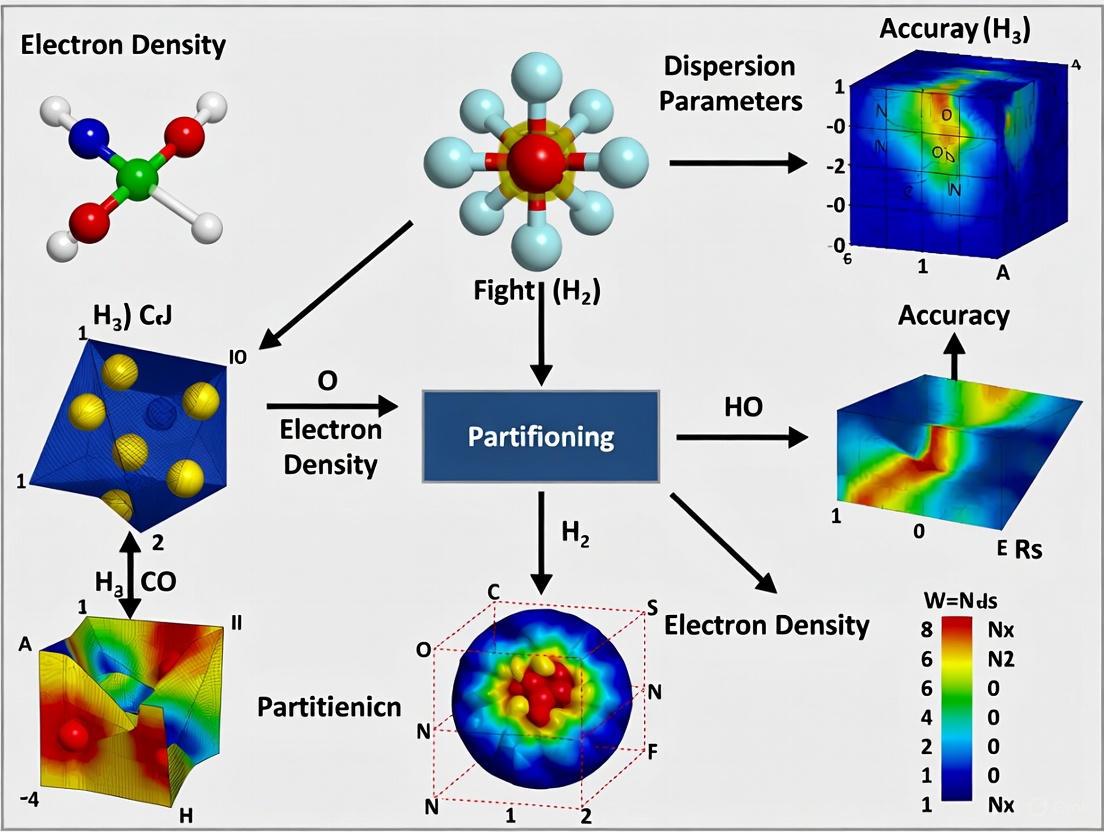
Accurately modeling dispersion interactions is crucial for predicting molecular binding in drug design, yet the accuracy of these parameters is intrinsically linked to how a molecule's electron density is partitioned...
Electron Density Partitioning: A Critical Factor for Accurate Dispersion Parameters in Drug Discovery
Abstract
Accurately modeling dispersion interactions is crucial for predicting molecular binding in drug design, yet the accuracy of these parameters is intrinsically linked to how a molecule's electron density is partitioned into atomic contributions. This article explores the fundamental relationship between electron density partitioning schemes and the fidelity of derived dispersion parameters. We examine foundational partitioning theories like Atoms in Molecules (AIM) and Hirshfeld, detail their methodological implementation in quantum chemistry, and address common challenges in achieving parameter accuracy. By comparing the performance of different partitioning-based methods against robust quantum-mechanical benchmarks for biological ligand-pocket interactions, this review provides drug development researchers with a clear guide for selecting and validating computational approaches to improve the prediction of binding affinities and material properties.
The Quantum Mechanical Basis: Linking Electron Density to Dispersion Forces
In quantum chemistry, the ability to predict and rationalize noncovalent interactions is paramount for advancements in drug design, materials science, and crystal engineering. While the molecular electrostatic potential is well-established for interpreting "hard-type" charge-controlled interactions, the "soft-type" orbital-controlled interactions are governed by a molecule's ability to redistribute its electron density in response to an external electric field [1]. This phenomenon is quantitatively described by the polarizability density, a second-order tensor function that has emerged as a fundamental bridge connecting the abstract concept of molecular polarizability to tangible chemical reactivity and molecular recognition processes [1]. The accurate prediction of dispersion interactions—long-range attractive forces between atoms and molecules—depends critically on how we model the underlying electron density and its response properties [2].
This technical guide explores the central role of polarizability density in modern computational chemistry, with particular emphasis on how different schemes for partitioning molecular electron density into atomic components directly impact the accuracy of derived dispersion parameters. As molecular polarizability itself is a integrated quantity obtained by summing the polarizability density over all space, the choice of partitioning scheme becomes crucial for developing accurate, transferable models for complex molecular systems [1]. Recent studies have demonstrated that van der Waals dispersion interactions can induce significant polarization in electron density, with the magnitude of this effect growing with system size [2]. This finding underscores the intimate connection between electron density, polarizability, and dispersion forces—a relationship that forms the core of this examination.
Theoretical Foundation of Polarizability Density
Mathematical Definition and Physical Interpretation
The polarizability density, denoted as χ(r), is formally defined as the field derivative of the total charge density distribution, constituting a second-order tensor with components given by:
[ \chi{ij}(\mathbf{r}) = ri \frac{\partial \rho{\text{tot}}(\mathbf{r})}{\partial Fj(\mathbf{r})} ]
where (ri) is the i-th component of the position vector (\mathbf{r}), and (Fj(\mathbf{r})) is the j-th component of the electric field vector at position (\mathbf{r}) [1]. At each point in space, χ(r) is represented by a 3×3 matrix that describes how the electron density at that point responds to each component of an applied electric field.
The molecular polarizability tensor α is obtained by integrating the polarizability density over the entire molecular volume:
[ \alpha{ij} = \int \chi{ij}(\mathbf{r}) d^3r ]
This integral formulation establishes the fundamental relationship between the local response described by χ(r) and the global molecular property α [1]. The trace of the polarizability density, Tr[χ(r)], provides a scalar field that identifies regions of a molecule most susceptible to polarization, though it loses the directional information contained in the full tensor.
Key Features and Characteristics
The polarizability density exhibits several important characteristics that distinguish it from the unperturbed electron density:
- Spatial Distribution: The most polarizable regions occur primarily in the valence shells, as core electrons are more tightly bound to nuclei and consequently more difficult to polarize [1].
- Sign Asymmetry: Unlike the electron density which is strictly positive everywhere, Tr[χ(r)] can exhibit both positive and negative values in different molecular regions. Negative values indicate regions that polarize opposite to the applied field, representing a reaction against stronger polarization occurring elsewhere in the molecule [1].
- Tensor Asymmetry: The full χ(r) tensor is inherently asymmetric (( \chi{ij}(r) \neq \chi{ji}(r) ) for ( i \neq j )) except at points lying on molecular symmetry elements that impose constraints on the tensor components [1].
- Integrated Symmetry: Despite the local asymmetry of χ(r), the integrated molecular polarizability tensor α is necessarily symmetric and positive definite, as it derives from a second derivative of the energy with respect to applied electric field components [1].
Table 1: Comparative Features of Electrostatic Potential and Polarizability Density
| Feature | Electrostatic Potential φ(r) | Polarizability Density χ(r) |
|---|---|---|
| Physical Interpretation | Potential energy of a unit positive charge at point r | Response of electron density at point r to external electric field |
| Dominant Interaction Type | Hard-type (charge-controlled) | Soft-type (orbital-controlled) |
| Mathematical Nature | Scalar field | Second-order tensor field |
| Sign Definiteness | Can be positive or negative | Trace can be positive or negative |
| Computational Complexity | Relatively straightforward to compute | Requires response property calculations |
| Common Applications | Identifying reactive sites, hydrogen bonding | Understanding polarization, dispersion, donor-acceptor interactions |
Partitioning Schemes and Atomic Polarizabilities
Approaches to Electron Density Partitioning
The partitioning of molecular electron density into atomic contributions represents a cornerstone for understanding how molecular polarizability emerges from atomic and bond contributions. Currently, three principal schemes dominate the literature, each with distinct theoretical foundations and practical implications.
The Quantum Theory of Atoms in Molecules (QTAIM) approach, developed by Bader, partitions space into non-overlapping atomic basins bounded by zero-flux surfaces in the electron density gradient [1] [3]. This method provides well-defined atomic domains with clear physical interpretation based on topological analysis of the electron density. QTAIM generally produces atomic polarizabilities that demonstrate better transferability between chemical environments compared to other methods [3]. The Hirshfeld partitioning scheme employs a fuzzy boundary approach where atomic densities are determined by iterative partitioning of the molecular electron density based on a reference promolecular density [3] [4]. Recent advances like the expHAR (exponential Hirshfeld partition scheme) have improved the accuracy of hydrogen positions and X-hydrogen bond lengths in Hirshfeld atom refinement [4]. The Voronoi partitioning method divides space into polyhedral cells around each atom based solely on nuclear coordinates, creating hard-space partitions without reference to the electron density distribution [1]. While computationally efficient, this approach often produces atomic volumes and polarizabilities with limited chemical interpretability.
Impact on Atomic Polarizability Tensors
The choice of partitioning scheme significantly influences the calculated atomic polarizabilities and their physical interpretation. In the QTAIM framework, the atomic polarizability tensor for domain Ω is calculated as:
[ \alpha{ij}(\Omega) = \int{\Omega} \chi_{ij}(\mathbf{r}) d^3r ]
which can be equivalently expressed using the atomic dipole moment μ(Ω) as:
[ \alpha{ij}(\Omega) = \frac{\partial \mui(\Omega)}{\partial F_j} ]
The atomic dipole moment itself contains two distinct contributions: the internal polarization arising from deformation of electronic charge within the atomic basin, and bond polarization resulting from charge transfer between atoms through chemical bonds [1].
Unlike the molecular polarizability tensor, atomic polarizability tensors are not guaranteed to be symmetric unless the atomic basin possesses specific symmetry elements [1]. This asymmetry reflects the anisotropic electronic environment experienced by atoms in molecules and has important implications for constructing transferable force fields and dispersion models.
Table 2: Comparison of Electron Density Partitioning Schemes for Polarizability Calculations
| Partitioning Scheme | Space Type | Boundary Definition | Atomic Polarizability Transferability | Computational Cost |
|---|---|---|---|---|
| QTAIM | Non-overlapping (hard) | Zero-flux surfaces in ∇ρ(r) | High | High |
| Hirshfeld | Overlapping (fuzzy) | Iterative stockholder partitioning | Moderate | Moderate |
| Voronoi | Non-overlapping (hard) | Nuclear coordinates only | Low | Low |
| Voronoi-Deformation Density (VDD) | Non-overlapping (hard) | Voronoi with deformation density correction | Moderate | Moderate |
Computational Methodologies and Protocols
Quantum Chemical Methods for Polarizability Calculation
The accurate computation of molecular polarizabilities and polarizability densities requires careful selection of both electronic structure methods and basis sets. Traditional approaches calculate the molecular polarizability tensor via finite differentiation of the molecular dipole moment with respect to applied electric field components:
[ \alpha{ij} = \frac{\partial \mui}{\partial F_j} ]
Density Functional Theory (DFT) with hybrid functionals like B3LYP and SCAN0 provides a reasonable balance between computational cost and accuracy for polarizability calculations [5]. However, benchmark studies reveal that even hybrid DFT functionals can exhibit substantial errors, with B3LYP showing a mean absolute error of 0.302 atomic units compared to coupled-cluster references for small organic molecules [5]. The linear response coupled cluster singles and doubles (LR-CCSD) method represents the gold standard for polarizability calculations, but its O(N⁶) scaling limits application to small molecules [5]. For the 7,211 molecules in the QM7b database, LR-CCSD with diffuse basis sets like d-aug-cc-pVDZ provides benchmark-quality polarizabilities [5].
The emerging Machine Learning (ML) approaches, particularly symmetry-adapted Gaussian process regression (SA-GPR), can predict polarizability tensors with errors approximately 50% smaller than hybrid DFT at negligible computational cost [5]. These models learn from high-quality reference data and can achieve coupled-cluster level accuracy for diverse molecular sets including conjugated systems, carbohydrates, small drugs, amino acids, and nucleobases [5].
Accounting for Nuclear Vibrations
Conventional polarizability calculations typically employ optimized molecular geometries, neglecting the impact of nuclear vibrations. However, recent investigations reveal that vibrational effects can introduce significant uncertainties—up to 6% in sensing devices and 50% in optical devices [6]. The Nuclear Ensemble (NE) method samples geometries according to the nuclear wavefunction and computes polarizabilities for each configuration, providing a distribution that reflects vibrational effects [6]. For molecules like CF₂Cl₂ and CF₃CH₂F used in refrigerant and detection technologies, the isotropic polarizability distribution shows standard deviations of 1.8-6.7% relative to the mean value [6].
The Zero-Point Vibrational Average (ZPVA) correction represents an alternative approach, expanding the electronic property as a function of normal mode coordinates via first and second derivatives at the equilibrium geometry [6]. For accurate modeling of polarizability-dependent phenomena, particularly in spectroscopy and sensing applications, incorporating vibrational corrections is essential.
Experimental Protocols for Validation
Computational predictions of polarizabilities require validation against experimental measurements. Several established experimental techniques provide reference data:
- Refractometry: Measures the refractive index of gases or liquids, related to the mean polarizability through the Lorentz-Lorenz equation.
- Dielectric Constant Measurements: Provides information on the polarizability in condensed phases.
- Depolarization Ratios in Rayleigh Scattering: Determines the anisotropy of the polarizability tensor.
- Electron Impact Ionization Cross Sections: Correlates with isotropic polarizability, particularly relevant for gas sensing applications [6].
For the 23 drug molecules investigated in environmental partitioning studies, quantum mechanical calculations of polarizabilities and other physicochemical properties provide essential data where experimental measurements are limited by legal restrictions or molecular complexity [7].
Table 3: Research Reagent Solutions for Polarizability Density Calculations
| Tool/Category | Specific Examples | Function/Purpose | Key Considerations |
|---|---|---|---|
| Electronic Structure Codes | Gaussian, ORCA, CFOUR, Psi4 | Compute electron density, response properties, and polarizabilities | Support for LR-CCSD, E-field perturbations, analytical derivatives |
| Partitioning Software | AIMAll, Multiwfn, NoSpherA2 | Perform QTAIM, Hirshfeld, and Voronoi partitioning | Integration with crystallographic data, user-friendly visualization |
| Basis Sets | d-aug-cc-pVDZ, aug-cc-pVTZ, aug-cc-pVQZ | Ensure proper description of diffuse electron regions | Balance between computational cost and completeness |
| Machine Learning Frameworks | AlphaML, SA-GPR models | Predict polarizability tensors with coupled-cluster accuracy | Transferability to new chemical spaces, data requirements |
| Visualization Tools | VMD, Jmol, VESTA | Analyze and visualize polarizability density and molecular response | Tensor visualization capabilities, isosurface rendering |
| Benchmark Databases | QM7b, S12L, L7 | Provide reference data for method validation and ML training | Diversity of chemical structures, property availability |
Applications in Molecular Recognition and Materials Design
Secondary Interactions and Supramolecular Chemistry
Polarizability density analysis provides unique insights into secondary interactions that govern molecular recognition and supramolecular assembly. Unlike the electrostatic potential which identifies σ-holes and π-holes as regions of positive potential, the polarizability density reveals these as areas with enhanced polarizability, offering a complementary perspective on their reactivity [1] [3]. For electron donor-acceptor complexes and other molecular adducts, distributed atomic polarizabilities derived from polarizability density partitioning enable precise modeling of induction energies and polarization contributions to binding [1].
In halogen bonding, chalcogen bonding, and pnictogen bonding, the interplay between electrostatic and polarization components determines the strength and directionality of interactions. Polarizability density maps can predict which molecular regions are most susceptible to deformation during complex formation, providing a powerful tool for rational design of supramolecular systems [3].
Dispersion Interactions and van der Waals Forces
Dispersion interactions, responsible for long-range attraction between nonpolar molecules, are intrinsically linked to polarizability through the London dispersion formula. Recent advances demonstrate that van der Waals interactions themselves induce significant polarization in electron density, with the effect growing linearly with system size [2]. For polyaromatic hydrocarbons and supramolecular complexes, this dispersion-driven polarization can alter long-range electrostatic potentials by up to 4 kcal/mol and reshape noncovalent interaction surfaces [2].
The Many-Body Dispersion (MBD) method, particularly the fully coupled and optimally tuned variant (MBD@FCO), accurately captures these polarization effects by modeling collective electron density fluctuations through coupled quantum Drude oscillators [2]. This approach bridges energy-based dispersion models with density-based chemical analysis, enabling more realistic modeling of noncovalent interactions in complex systems.
Environmental Partitioning of Drug Molecules
The polarizability of drug molecules directly influences their environmental partitioning behavior, governing distribution between air, water, and organic phases [7]. For the 23 prominent drug molecules studied in environmental monitoring, including fentanyl, cocaine, methamphetamine, and LSD, quantum chemical calculations of polarizabilities provide essential parameters for predicting partition coefficients (logKOW, logKOA, logKAW) when experimental data is unavailable due to legal restrictions or molecular complexity [7].
The relationship between polarizability and hexadecane/air partition coefficients (logKHdA) is particularly important for understanding the behavior of semi-volatile organic compounds in indoor environments, where partitioning between gas phase, particle phase, and house dust determines exposure pathways [7]. Accurate prediction of these partitioning coefficients requires reliable polarizability data, which in turn depends on the chosen electron density partitioning scheme.
Current Challenges and Future Perspectives
Despite significant advances in computational methods for calculating polarizability density and atomic polarizabilities, several challenges remain unresolved. The transferability of atomic polarizabilities between different chemical environments continues to be limited, particularly for atoms in conjugated systems or unusual coordination environments [1] [5]. The non-additivity of polarizabilities observed in ionic liquids and other complex systems presents additional complications for force field development [3].
The integration of machine learning approaches with high-quality quantum chemical reference data offers promising avenues for accurate polarizability prediction at minimal computational cost [8] [5]. For gold nanoclusters and other nanomaterials, ML models like artificial neural networks, Gaussian process regression, and kernel ridge regression have demonstrated excellent performance in predicting polarizabilities, outperforming conventional DFT approaches [8].
The emerging field of quantum crystallography combines advanced crystallographic techniques with quantum mechanical calculations to extract precise electron density distributions from experimental measurements [4]. Methods like Hirshfeld Atom Refinement (HAR) and the electron density-based multipole model provide experimental validation for computational predictions of electron density and its response properties [4]. As these techniques become more widespread, they will enable more rigorous testing and refinement of polarizability density models.
Future research directions will likely focus on improving the description of frequency-dependent polarizabilities, extending methods to larger systems including biomolecules and materials, and developing more sophisticated partitioning schemes that better capture the effects of chemical environment on atomic response properties. The integration of polarizability density analysis into automated computational workflows for drug discovery and materials design represents another promising frontier for this fundamental bridge between electron density and molecular polarizability.
The distribution of electrons, described by the electron charge density ( \rho(\mathbf{r}) ), is a fundamental quantity in chemistry, dictating chemical bonding, molecular interactions, and material properties. [1] Within the framework of Atoms in Molecules (AIM) theory, a rigorous method for partitioning a molecular system into its constituent atoms is provided by the topology of ( \rho(\mathbf{r}) ). This partitioning is not merely conceptual; it is essential for quantifying atomic properties, understanding intermolecular interactions, and predicting the behavior of molecules in complex environments. The accuracy of derived properties, including dispersion parameters critical for modeling weak van der Waals forces, is inherently linked to the method used to define an "atom" in a molecule.
This technical guide explores the core concepts of AIM theory—atomic basins and the zero-flux condition—and frames them within a critical research context: how the choice of electron density partitioning scheme impacts the accuracy of computed dispersion energies. Such energies are vital in fields like drug development, where reliable prediction of ligand-receptor binding, which often involves secondary interactions, depends on accurate physical models. [1]
Theoretical Foundations of AIM
The Topology of the Electron Density
The electron density ( \rho(\mathbf{r}) ) is a scalar function that exhibits characteristic features in a molecule. AIM theory, developed by Bader, uses the topology of ( \rho(\mathbf{r}) ) to partition molecular space. Key topological features include:
- Critical Points (CPs): Points in space where the gradient of the density, ( \nabla \rho(\mathbf{r}) ), vanishes.
- Atomic Basins: Regions of space bounded by surfaces through which the gradient flux is zero.
- Bond Paths: Lines of maximum electron density connecting bonded atomic nuclei, identified by the paths followed from bond critical points.
The Zero-Flux Condition and Atomic Basins
The cornerstone of AIM partitioning is the zero-flux condition. This condition defines the boundary between two atomic basins. For an atomic basin ( \Omega ), the boundary surface ( S(\Omega) ) satisfies:
[ \nabla \rho(\mathbf{r}) \cdot \mathbf{n}(\mathbf{r}) = 0 \quad \text{for all } \mathbf{r} \in S(\Omega) ]
where ( \mathbf{n}(\mathbf{r}) ) is the unit vector normal to the surface at point ( \mathbf{r} ). This condition ensures that no electron density lines of force cross the boundary of the atomic basin; they are all tangential to it. Consequently, each atomic basin encompasses a single atomic nucleus and a well-defined share of the total electron density.
An atomic basin ( \Omega ) is thus defined as a region of space bounded by a zero-flux surface in the gradient vector field of ( \rho(\mathbf{r}) ) and containing one nucleus. The integrated properties within this basin, such as the electron population, energy, and volume, are assigned to that atom.
Partitioning Schemes and Their Impact on Property Prediction
The choice of partitioning scheme directly influences the computed atomic and molecular properties. Two primary approaches exist:
- Hard Space (Non-overlapping) Partitioning: Schemes like AIM define sharp, non-overlapping atomic boundaries via zero-flux surfaces. [1]
- Fuzzy (Overlapping) Partitioning: Schemes such as Hirshfeld or Mulliken populations define atoms with overlapping boundaries, often leading to different atomic charges and multipole moments. [1]
This distinction is critical for properties derived from the electron density response, such as polarizability. The molecular polarizability tensor ( \alpha ) describes how a molecule's electron density distorts under an external electric field. It can be partitioned into atomic contributions ( \alpha_{ij}(\Omega) ) by integrating the polarizability density ( \chi(\mathbf{r}) ) over an atomic basin ( \Omega ): [1]
[ \alpha{ij}(\Omega) = \int{\Omega} \chi_{ij}(\mathbf{r}) d^3r ]
where ( \chi{ij}(\mathbf{r}) = ri \frac{\partial \rho{tot}(\mathbf{r})}{\partial Fj} ) is a tensor component of the polarizability density. [1] The atomic dipole moment ( \boldsymbol{\mu}(\Omega) ) and its response to the field can be similarly decomposed into internal polarization (charge deformation within the basin) and bond polarization (charge transfer between basins). [1] A key consequence of hard partitioning is that the resulting atomic polarizability tensors are not guaranteed to be symmetric unless the atomic basin itself possesses symmetry, a feature inherent to the asymmetric nature of ( \chi(\mathbf{r}) ). [1]
Connecting Atomic Polarizability to Dispersion Interactions
Dispersion interactions, a type of London force, are soft, orbital-controlled interactions governed by the ability of molecules to instantaneously polarize one another. [1] The strength of these interactions is related to the molecular polarizability. When molecular polarizability is inaccurately partitioned into atomic terms, the resulting dispersion parameters in force fields or interaction models become less transferable and accurate. For drug molecules, which often engage in secondary interactions (e.g., in electron donor-acceptor complexes), the precise description of these dispersion forces is crucial for predicting binding affinity and selectivity. [1] AIM theory provides a rigorous, physically grounded framework for this partitioning, thereby offering a pathway to more accurate dispersion parameters compared to methods that rely on more arbitrary atomic definitions.
Computational Protocols for AIM Analysis
The following workflow outlines the key steps for performing an AIM analysis to obtain atomic properties and assess their impact on dispersion energy predictions.
Detailed Methodologies
Step 1: Molecular Geometry Optimization
- Protocol: Perform a geometry optimization using quantum chemical methods such as Density Functional Theory (DFT) or Hartree-Fock (HF) with a medium-sized basis set (e.g., 6-31G*). This ensures the molecular structure is at a minimum on the potential energy surface.
- Software: Gaussian, ORCA, GAMESS.
Step 2: Electron Density Calculation
- Protocol: Using the optimized geometry, perform a single-point energy calculation with a high-quality, dense basis set (e.g., cc-pVTZ) to obtain an accurate electron density ( \rho(\mathbf{r}) ). The wavefunction file must be saved for subsequent AIM analysis.
Step 3: AIM Topological Analysis
- Protocol: Use an AIM analysis program (e.g., AIMAll, AIMAII) to process the wavefunction file. The software will calculate the gradient ( \nabla \rho(\mathbf{r}) ), locate all critical points (nuclear, bond, ring, cage), and identify the zero-flux surfaces that define the atomic basins.
Step 4: Property Integration and Polarizability Density Analysis
- Protocol: Within each atomic basin ( \Omega ), the software integrates the electron density to yield atomic charges, integrates the energy density to yield atomic energies, and, if calculated, integrates the polarizability density ( \chi(\mathbf{r}) ) to yield atomic polarizability tensors ( \alpha(\Omega) ). [1] The workflow for calculating ( \chi(\mathbf{r}) ) itself typically involves computing the response of the electron density to a finite or perturbative external electric field.
The Scientist's Toolkit: Essential Research Reagents and Computational Solutions
Table 1: Key Computational Tools and Resources for AIM and Property Calculation
| Tool/Resource | Type | Primary Function in AIM Research |
|---|---|---|
| AIMAll | Software Suite | Performs comprehensive AIM analysis, including basin integration and critical point location. |
| ORCA | Quantum Chemistry Package | Calculates electron densities and wavefunctions for subsequent AIM analysis; can compute response properties. |
| Gaussian | Quantum Chemistry Package | Performs geometry optimization, frequency, and single-point calculations to generate electron densities. |
| Promolecular Density | Calculation Model | A reference density constructed from superimposed, spherically averaged atomic densities; used as a starting point in some fuzzy partitioning schemes. [1] |
| Polarizability Density ( \chi(\mathbf{r}) ) | Mathematical Function | The key function for analyzing and predicting soft, orbital-controlled interactions and for partitioning molecular polarizability. [1] |
Quantitative Data from Partitioning Schemes
The choice of partitioning scheme leads to quantitatively different atomic descriptions. The table below summarizes a comparison of key features, as discussed in the literature. [1]
Table 2: Comparison of Hard-Space (AIM) and Fuzzy Electron Density Partitioning Schemes
| Feature | Hard-Space (AIM) Partitioning | Fuzzy (e.g., Hirshfeld) Partitioning |
|---|---|---|
| Atomic Boundaries | Sharp, defined by zero-flux surfaces. | Smooth, overlapping boundaries. |
| Transferability | Generally high for atomic properties in similar chemical environments. | Can be variable. |
| Atomic Polarizability Symmetry | Atomic tensor ( \alpha(\Omega) ) is not inherently symmetric. [1] | Dependent on the specific fuzzy recipe. |
| Treatment of Charge Transfer | Explicitly accounted for via bond polarization contribution to dipole. [1] | Implicitly contained within the overlapping charge distributions. |
| Connection to Dispersion | Provides a rigorous foundation for deriving atom-atom dispersion coefficients from first principles. | Less direct connection; often relies on parameterization. |
Atoms in Molecules theory, with its rigorous definition of atomic basins via the zero-flux condition, provides a physically sound and non-arbitrary method for partitioning molecular electron density. The resulting atomic properties, including the emerging field of atomic polarizability densities, are crucial for advancing the accuracy of molecular simulations. By establishing a direct and quantitative link between the topology of ( \rho(\mathbf{r}) ) and the parameters governing dispersion forces, AIM theory addresses a critical need in computational drug development: the reliable prediction of the secondary interactions that often determine the success or failure of a therapeutic candidate.
In computational chemistry and biomolecular modeling, the accurate description of dispersion forces remains a significant challenge. These forces, fundamental to molecular recognition, supramolecular interactions, and drug binding, are intimately connected to molecular polarizability—the ability of a molecule's electron density to distort in response to an external electric field [9]. While molecular polarizability is a well-defined quantum mechanical property, understanding and predicting dispersion interactions at the atomistic level requires partitioning this molecular response into atomic contributions. This partitioning is non-trivial and profoundly impacts the accuracy of dispersion parameters in polarizable force fields used for molecular dynamics simulations of biological systems [10] [11]. This technical guide examines the core challenge of deriving atomic polarizabilities from electron density, comparing partitioning schemes, and discussing the implications for the development of accurate force fields in drug development.
Theoretical Foundations of Polarizability
From Electron Density to Polarizability Density
The electron density distribution, ( \rho(\mathbf{r}) ), is a fundamental quantity in quantum chemistry, informing on chemical bonding and reactivity [9]. When a molecule is subjected to a uniform external electric field, its electron density redistributes. This response is captured by the polarizability density, ( \chi(\mathbf{r}) ), a second-order tensor function defined as the field derivative of the total charge density distribution [9] [1]: [ \chi{ij}(\mathbf{r}) = ri \frac{\partial \rho{\text{tot}}(\mathbf{r})}{\partial Fj(\mathbf{r}}) ] where ( F_j ) is the j-th component of the electric field vector. The trace of this tensor, ( \text{Tr} \chi(\mathbf{r}) ), identifies regions of a molecule that are most polarizable, playing a role for "soft" (orbital-controlled) interactions analogous to that of the electrostatic potential for "hard" (charge-controlled) interactions [9].
The molecular polarizability tensor, ( \alpha ), is obtained by integrating the polarizability density over the entire molecular volume [9] [1]: [ \alpha{ij} = \int \chi{ij}(\mathbf{r}) d^3r = \frac{\partial \mui}{\partial Fj} ] where ( \mu_i ) is the i-th component of the molecular dipole moment. Unlike the molecular polarizability tensor, which is symmetric and positive definite, the polarizability density ( \chi(\mathbf{r}) ) is inherently asymmetric and not positive everywhere, indicating that some molecular regions polarize oppositely to the applied field [9].
The Partitioning Problem
The central challenge is to decompose the integrated molecular polarizability into atomic contributions. If ( \Omega ) represents an atomic domain in space, the components of the polarizability tensor for that atom are [9]: [ \alpha{ij}(\Omega) = \int{\Omega} \chi{ij}(\mathbf{r}) d^3r = \frac{\partial \mui(\Omega)}{\partial Fj} ] The atomic dipole moment ( \mu(\Omega) ) itself consists of two parts [9]: [ \mu(\Omega) = \mu{\text{internal}}(\Omega) + \mu_{\text{bond}}(\Omega) ]
- Internal Polarization: Describes the deformation of the electronic charge distribution within the atomic basin. It is computed as ( \mu{\text{internal}}(\Omega) = -\int{\Omega} (\mathbf{r} - \mathbf{R}_{\Omega}) \rho(\mathbf{r}) d\mathbf{r} ) [9].
- Bond Polarization: Arises from charge transfer between atoms through bonds, calculated as ( \mu{\text{bond}}(\Omega) = \sum{\Omega'} [\mathbf{R}{\Omega} - \mathbf{R}{b(\Omega|\Omega')}] Q(\Omega|\Omega') ) [9].
This division highlights that the atomic response is not purely local but involves charge transfer between atoms. The lack of a unique way to partition the molecular electron density into atoms means there is no unique definition of atomic polarizabilities, leading to a variety of proposed partitioning schemes [9] [10].
Comparative Analysis of Partitioning Schemes
The choice of partitioning scheme significantly influences the calculated atomic contributions to polarizability and, consequently, the derived force field parameters. These schemes can be broadly categorized into two classes: those based on wavefunctions and orbital-based partition, and those based on real-space partition of the electron density.
Table 1: Classification of Electron Density Partitioning Schemes
| Category | Specific Schemes | Basis of Partitioning | Key Characteristics |
|---|---|---|---|
| Class II: Wavefunction-Based | Mulliken [10], Löwdin [10], Natural Population Analysis (NPA) [10] | Partitioning of the wavefunction (density matrix) over the basis functions. | Often lead to overlapping atoms. Can be sensitive to the choice of basis set, particularly Mulliken analysis. |
| Class III: Real-Space Density | Atoms-in-Molecules (AIM) [10] [11], Hirshfeld [10], Iterative Hirshfeld (Hirshfeld-I) [10], Becke [10] | Partitioning of the total electron density in three-dimensional space into atomic basins. | AIM uses zero-flux surfaces for non-overlapping atoms. Hirshfeld uses a "stockholder" approach for fuzzy, overlapping atoms. |
| Class IV: Electrostatic Potential | CHELPG, Merz-Kollman (MK-ESP) [10] | Fitting atomic charges to reproduce the molecular electrostatic potential (ESP) outside the molecule. | Does not directly partition density but derives parameters from its external effect. Charges are highly dependent on the fitting procedure and conformation. |
Impact on Polarizability Components
The choice of partitioning scheme directly affects the relative importance of the two components that contribute to the molecular polarizability: the charge fluctuation term (related to ( \mu{\text{bond}} )) and the induced atomic dipole term (related to ( \mu{\text{internal}} )).
A numerical study of 21 small molecules found that the charge fluctuation contribution dominates the molecular polarizability, but its computed ratio is highly scheme-dependent, ranging from 59.9% with the Hirshfeld or CM5 scheme to 96.2% with the Mulliken scheme [10]. This indicates that force fields based purely on induced dipoles (like the Drude oscillator or induced multipole models) might be missing a significant part of the response if their parameters are derived from schemes like Hirshfeld, whereas fluctuating charge models align more naturally with Mulliken-type partitions [10].
Furthermore, atomic polarizabilities are found to be highly anisotropic for most atoms [10]. Using an isotropic atomic polarizability, a common simplification in many force fields, is often inadequate to capture the true response of the electron density, particularly for atoms in anisotropic chemical environments like carbonyl oxygens or aromatic carbons.
Table 2: Performance of Selected Partitioning Schemes in Polarizability Calculations
| Partitioning Scheme | Dominant Polarizability Component | Transferability of Atomic Parameters | Computational Cost | Key Challenges |
|---|---|---|---|---|
| Mulliken | Charge Fluctuation (96.2%) [10] | Low (high basis-set sensitivity) | Low | Overestimates charge transfer; can yield unphysical results. |
| Hirshfeld | Mixed (Charge Fluctuation ~60%) [10] | Moderate | Moderate | "Fuzzy" atoms; atomic tensors may not be symmetric [9]. |
| AIM (QTAIM) | Induced Atomic Dipoles | High (well-defined basins) | High | Non-overlapping atoms; requires careful integration. |
| CM5 | Mixed (Charge Fluctuation ~60%) [10] | High (fitted to reproduce dipole moments) | Low (post-process) | Corrects Hirshfeld charges; but not a direct density partition. |
Methodologies and Protocols
Workflow for Calculating Distributed Polarizabilities
The following diagram outlines a general protocol for computing and partitioning molecular polarizability, integrating methodologies from the cited literature.
Key Computational Experiments
The finite-difference approach is a robust method for calculating molecular and atomic polarizabilities [10]. The protocol involves:
- System Preparation: Optimize the molecular geometry at a suitable level of theory (e.g., Density Functional Theory with a hybrid functional like B3LYP and a polarized basis set such as 6-311++G).
- Field Application: Perform single-point energy and property calculations with and without an external, uniform electrostatic field. The field is applied in six different directions (±x, ±y, ±z) with a strength typically on the order of 0.001 atomic units to remain within the linear response regime.
- Molecular Polarizability Calculation: For each field direction, compute the change in the molecular dipole moment. The components of the polarizability tensor are then obtained via finite differences: ( \alpha{ij} = \frac{\Delta \mui}{\Delta F_j} ).
- Electron Density Partitioning: Using the unperturbed electron density, partition the molecule into atomic fragments using the chosen scheme(s) (e.g., Hirshfeld, AIM).
- Atomic Dipole and Polarizability Calculation: For each atomic basin ( \Omega ) in the presence of the field, compute the atomic dipole moment ( \mu(\Omega) ). The atomic polarizability tensor components are then calculated as ( \alpha{ij}(\Omega) = \frac{\Delta \mui(\Omega)}{\Delta F_j} ).
Table 3: Essential Computational Tools for Polarizability and Partitioning Research
| Tool / Resource | Category | Function in Research | Example Software / Method |
|---|---|---|---|
| Quantum Chemistry Package | Software | Performs electronic structure calculations to obtain wavefunctions and electron densities. | Gaussian, GAMESS, ORCA, Psi4, CP2K |
| Partitioning Code | Software / Algorithm | Implements specific schemes to divide molecular electron density into atomic parts. | Multiwfn (for AIM, Hirshfeld), Hirschfeld (in Crystal), built-in tools in major packages |
| Polarizable Force Field | Application | Uses atomic polarizabilities and charges to model dispersion and polarization in MD simulations. | AMOEBA, CHARMM Drude, OPLS/CM1A |
| Linear-Scaling DFT | Method | Enables QM calculations on large systems (e.g., proteins) for environment-specific parameterization [11]. | ONETEP, CONQUEST, methods in CP2K |
| Charge Model 5 (CM5) | Model | Derives atomic charges from Hirshfeld populations to better reproduce molecular dipole moments [10]. | Available in GAMESS and as a standalone code |
Implications for Dispersion Parameter Accuracy
The partitioning challenge sits at the heart of developing accurate polarizable force fields for biomolecular simulations. Dispersion (London) forces are correlated with polarizability, and their accurate description in molecular dynamics (MD) simulations is critical for predicting protein-ligand binding affinities, protein folding, and material properties [11].
Force fields like AMBER and CHARMM traditionally use atomic polarizabilities derived either from molecular refraction measurements or fitted to reproduce quantum chemical results [10]. However, these parameters are often isotropic and transferable, meaning the same polarizability is assigned to a given atom type regardless of its local chemical environment. This approach neglects the environment-specific polarization effects, where the presence of electron-withdrawing or donating groups can significantly alter an atom's electronic character [11].
The move towards environment-specific force fields, where charges and Lennard-Jones parameters (which govern dispersion) are derived directly from quantum mechanical calculations of the specific system (e.g., a protein-ligand complex), is a promising direction [11]. By using AIM or Hirshfeld partitioning on the full system's electron density, the derived atomic polarizabilities and other parameters inherently include the effects of the environment, potentially leading to more accurate and predictive models without the need for extensive parameter libraries [11]. This approach ensures consistency between the electrostatic and dispersion parameters, as both are derived from the same underlying electron density.
Partitioning the molecular electron density to obtain meaningful atomic polarizabilities remains a complex but essential task for advancing the accuracy of computational models in drug development and materials science. The choice of partitioning scheme is not merely a technical detail; it fundamentally influences the balance between charge transfer and local dipole induction, the anisotropy of atomic response, and the ultimate transferability of parameters to complex biological environments. No single scheme is universally superior, with each offering distinct trade-offs between physical rigor, computational cost, and practicality for force field development. Future progress in accurately modeling dispersion interactions will likely rely on a more nuanced understanding of these partitioning choices and a move towards environment-specific, quantum-mechanically informed parameters that can capture the exquisite sensitivity of electron density to its chemical context.
Dispersion Forces as a Quantum Mechanical Phenomenon
Dispersion forces, or London forces, are a category of weak, attractive intermolecular interactions arising from correlated instantaneous dipoles in electron densities. These quantum mechanical phenomena are fundamental to a wide range of chemical and biological processes, from molecular recognition to the stability of amorphous solid dispersions in pharmaceutical science. The accurate quantification of dispersion energies remains a central challenge in computational chemistry. This whitepaper details how advancements in electron density partitioning methodologies provide a rigorous physical basis for deriving highly accurate, system-specific dispersion parameters, thereby enhancing the predictive power of next-generation molecular models and force fields.
Dispersion forces are a quintessential quantum mechanical phenomenon. They arise from the correlated, instantaneous fluctuations in the electron clouds of atoms and molecules, even those with no permanent dipole moment. These fluctuations create transient dipoles that induce complementary dipoles in neighboring species, resulting in a net attractive interaction. From a computational perspective, dispersion interactions represent a component of the dynamic electron correlation energy, which is challenging to describe with simple models [12].
The accurate representation of these forces in molecular modeling is non-negotiable for predicting the behavior of complex molecular systems. Traditional molecular mechanics force fields often treat dispersion through simple Lennard-Jones potentials, whose parameters are typically fit to experimental data. However, this approach can neglect system-specific polarization effects [13]. A more rigorous pathway involves deriving dispersion parameters directly from the underlying quantum mechanical (QM) electron density. The core thesis of this work is that the method chosen to partition the total electron density of a system into atomic contributions is a critical determinant in the accuracy of the resulting dispersion parameters. This whitepaper explores the theoretical foundation, computational protocols, and practical applications of this electron-density-centric approach.
Theoretical Foundation: From Electron Density to Interaction Energy
Electron Density Partitioning Methods
The first step in deriving dispersion parameters from first principles is to decompose the total electron density into atomic fragments. Several robust atoms-in-molecules (AIM) methods exist for this purpose:
- Density Derived Electrostatic and Chemical (DDEC): This method partitions the electron density into approximately spherical atom-centered basins by integrating the atomic electron density over all space. A key advantage is its ability to derive chemically meaningful charges and electron densities for both surface and buried atoms [13].
- Hirshfeld Partitioning: This approach weights the electron density at each point in space based on the relative contribution of the neutral, spherically symmetric atoms. Its iterative variant, Iterative Hirshfeld, is used to derive polarizable force field models [14].
- Minimal Basis Iterative Stockholder (MBIS): This modern partitioning scheme is used to map atomic electron densities, particularly their decay constants, to atom-specific Lennard-Jones parameters [14].
These partitioning schemes provide the atomic electron densities necessary to compute key dispersion-related properties.
The Tkatchenko-Scheffler Relation and Beyond
Once atomic electron densities are obtained, the Tkatchenko-Scheffler (TS) method is a widely used approach to derive dispersion coefficients. The TS method calculates the C6 dispersion coefficient for an atom in a molecule based on its partitioned volume and the known C6 coefficient of its free atom [14]. The formula is given by:
C6ᵢᵢ = (Vᵢ / Vᵢ⁰)² * C6ᵢ⁰
Where C6ᵢ⁰ and Vᵢ⁰ are the free-atom dispersion coefficient and volume, and Vᵢ is the atom-in-molecule volume. This method naturally incorporates the chemical environment's effect on an atom's dispersion interaction. More advanced models extend this to include higher-order terms (C8, etc.) and atomic polarizabilities [14].
Correlating Electron Density with Interaction Energy
Quantum Theory of Atoms in Molecules (QTAIM) analysis allows for the extraction of properties at bond critical points (BCPs), which can be correlated with interaction energies. For halogen bonds (a type of interaction with significant dispersion character), strong correlations have been established between the kinetic energy density (Gb) at the BCP and the interaction energy (Eint) [15].
Table 1: Correlations between Interaction Energy (Eint) and Electron Density Properties at the Bond Critical Point for Halogen Bonds [15].
| Interaction Type | Best-Fit Correlation | Coefficient of Determination (R²) | Mean Absolute Deviation (kcal/mol) |
|---|---|---|---|
| Cl···Cl | Eint = 0.49Vb ≈ -0.47Gb |
Not Specified | Not Specified |
| Br···Br | Eint = 0.58Vb ≈ -0.57Gb |
Not Specified | Not Specified |
| I···I | Eint = 0.68Vb ≈ -0.67Gb |
Not Specified | Not Specified |
| All Homo-Halogen Bonds | -Eint = 0.128Gb² - 0.82Gb + 1.66 |
0.91 | 0.39 |
These relationships provide a powerful tool for the express estimation of interaction strengths directly from a system's electron topology, bypassing more computationally expensive calculations.
Diagram 1: Workflow for deriving dispersion parameters and interaction energies from electron density. Two primary pathways are shown: one deriving C6 coefficients via the Tkatchenko-Scheffler method, and another estimating interaction energy via QTAIM property correlations.
Computational Protocols for Parameter Derivation
This section outlines detailed methodologies for deriving bespoke force field parameters, with a focus on dispersion.
The QUBEKit Workflow for Bespoke Force Fields
The Quantum Mechanical Bespoke (QUBE) force field and its associated software toolkit (QUBEKit) represent a comprehensive protocol for deriving system-specific force field parameters directly from QM calculations [13] [14]. The workflow is as follows:
- Quantum Mechanical Calculation: Perform an electronic structure calculation (typically Density Functional Theory with an appropriate functional like M06-2X) on the target molecule to obtain the wavefunction and electron density [15].
- Atoms-in-Molecule Analysis: Partition the electron density using a method like DDEC to obtain atomic charges and electron densities [13] [14].
- Bonded Parameter Derivation: Calculate bond and angle force constants from the QM Hessian matrix using the modified Seminario method [13].
- Non-Bonded Parameter Derivation:
- Atomic Charges: Derived directly from the DDEC-partitioned electron density [14].
- Lennard-Jones Parameters: The
C6dispersion coefficient is derived from the atomic electron densities using the Tkatchenko-Scheffler method. The repulsive (Rmin/σ) parameter is derived from atoms-in-molecule atomic radii [14].
- Torsion Parameter Fitting: Fit torsional parameters to reproduce QM dihedral potential energy scans [13].
- Refinement with Experimental Data: A small number of mapping parameters (e.g., free atom radii) can be tuned against experimental condensed-phase properties (e.g., liquid densities and enthalpies of vaporization) using tools like ForceBalance to ensure accuracy [14].
Table 2: Key Research Reagents and Software Solutions for Electron Density-Based Force Field Development.
| Reagent / Software | Function / Purpose | Application Context |
|---|---|---|
| DDEC Partitioning | Partitions electron density into atomic contributions for charge and dispersion derivation. | Core to QUBE force field; provides environment-specific atomic parameters [13] [14]. |
| Tkatchenko-Scheffler Method | Derives C6 dispersion coefficients from partitioned atomic volumes and electron densities. | Calculates the attractive part of the van der Waals interaction in bespoke force fields [14]. |
| Modified Seminario Method | Derives harmonic bond and angle force constants from the QM Hessian matrix. | Provides accurate bonded parameters without recourse to transferable libraries [13]. |
| QUBEKit | Software toolkit that automates the derivation of bespoke QM-based force fields. | Integrates the entire workflow from QM calculation to final force field parameter generation [14]. |
| ForceBalance | Software for systematic parameter optimization against QM and experimental target data. | Used to refine a small number of mapping parameters against liquid properties [14]. |
Protocol for Validating Dispersion Parameters in Amorphous Solid Dispersions
In pharmaceutical science, the physical stability of amorphous solid dispersions (ASDs) is heavily influenced by drug-polymer intermolecular interactions, including dispersion. The following protocol describes how to probe these interactions and their impact [16]:
- ASD Preparation: Prepare the amorphous solid dispersion using a method such as spray-drying or hot-melt extrusion.
- Solid-State Characterization:
- Differential Scanning Calorimetry (DSC): Measure the glass transition temperature (
Tg) of the ASD. An increase inTgand the absence of drug crystallization exotherms suggest strong drug-polymer interactions and good miscibility. - X-ray Powder Diffraction (XRPD): Confirm the amorphous nature of the dispersion and monitor for physical instability (crystallization) over time under stressed storage conditions (e.g., elevated temperature and humidity).
- Solid-State Nuclear Magnetic Resonance (ssNMR): Probe specific drug-polymer interactions, such as hydrogen or halogen bonding, and measure molecular mobility, which is directly related to physical stability.
- Differential Scanning Calorimetry (DSC): Measure the glass transition temperature (
- Computational Validation:
- Model the drug-polymer system using a force field with bespoke, density-derived dispersion parameters.
- Run molecular dynamics (MD) simulations to calculate interaction energies and assess the homogeneity of the dispersion.
- Correlate the computed interaction energies with experimental stability data (e.g., the time to crystallization from XRPD studies).
Applications and Impact on Predictive Modeling
The integration of accurate, QM-derived dispersion parameters has a transformative impact across multiple fields.
Drug Design and Protein-Ligand Binding
Accurate dispersion forces are critical for predicting protein-ligand binding affinities. A study demonstrated the advantage of using bespoke, environment-specific force fields for a protein–ligand complex. The computed relative binding free energy of indole and benzofuran to the lysozyme protein using these force fields (-0.4 kcal/mol) was in excellent agreement with experiment (-0.6 kcal/mol) and substantially more accurate than standard force fields (-2.4 kcal/mol) [13]. This highlights how moving beyond transferable parameters to system-specific ones, which include native-state polarization, improves predictive accuracy in computer-aided drug design.
Stabilization of Amorphous Solid Dispersions
Intermolecular interactions, including van der Waals forces and halogen bonding, are crucial for stabilizing amorphous solid dispersions (ASDs) of poorly water-soluble drugs. Drug-polymer interactions provide an energy barrier that drug molecules must overcome to aggregate and crystallize [16]. The accurate quantification of these dispersion-driven interactions through electron density partitioning helps formulators select optimal polymer carriers and predict the maximum stable drug loading, thereby enhancing the development of robust pharmaceutical products.
Diagram 2: The role of intermolecular interactions, including dispersion forces, in determining the physical stability of amorphous solid dispersions (ASDs). Strong interactions lead to stability, while weak interactions result in phase separation and crystallization.
Dispersion forces, rooted in the quantum mechanical nature of electron correlation, are indispensable for realistic molecular modeling. The accuracy with which these forces are represented hinges on the methodology used to partition the molecular electron density. Approaches like the DDEC and Hirshfeld partitioning, coupled with the Tkatchenko-Scheffler method, provide a physically rigorous pathway to derive system-specific dispersion parameters directly from first principles. The integration of these parameters into bespoke force fields, such as QUBE, has already demonstrated superior performance in challenging applications like binding affinity prediction and the stabilization of amorphous pharmaceuticals. As these protocols become more automated and accessible through software like QUBEKit, they pave the way for a new generation of highly accurate, predictive molecular simulations across chemistry and drug discovery.
Implementing Partitioning Schemes: From Theory to Computational Practice
Hirshfeld Atom Refinement (HAR) represents a significant advancement in crystallographic structure determination from X-ray diffraction data. Unlike the traditional Independent Atom Model (IAM), which treats crystals as collections of spherical, non-interacting atomic densities, HAR utilizes an aspherical atom partitioning of tailor-made ab initio quantum mechanical molecular electron densities [17] [18]. This method was developed to address a critical limitation of conventional X-ray crystallography: the inaccurate determination of hydrogen atom parameters [17]. Hydrogen atoms pose a particular challenge for X-ray diffraction because they contribute minimally to overall scattering due to having only a single electron [17] [18]. Consequently, IAM typically shortens X-H bond lengths by approximately 0.1 Å compared to benchmark neutron diffraction values and often yields non-positive definite anisotropic displacement parameters (ADPs) for hydrogen atoms [19].
HAR overcomes these limitations through an iterative quantum-mechanical approach that calculates molecular electron densities and partitions them into atomic contributions using the Hirshfeld partition [17] [18]. This method provides aspherical atomic form factors that more accurately represent the electron density distribution in molecular crystals, leading to substantial improvements in the accuracy and precision of structural parameters, particularly for hydrogen atoms [17]. The implementation of HAR has transformed X-ray crystallography into a more powerful tool for obtaining accurate structural information that was previously only accessible through neutron diffraction experiments [17].
Fundamental Principles and Methodology
Theoretical Foundation
HAR is grounded in the concept of stockholder partitioning of electron density, originally proposed by Hirshfeld [19]. In this approach, the electron density of a molecule in a crystal is partitioned into atomic basins based on a promolecular reference density. The key theoretical principle states that the electron density at any point in space is assigned to atoms in proportion to their contribution to a promolecular density composed of non-interacting atoms [19] [20]. This partitioning scheme generates aspherical atomic form factors that realistically reflect the deformation of electron density due to chemical bonding and intermolecular interactions [17].
The mathematical formalism of HAR utilizes these aspherical atomic form factors calculated from quantum mechanical wavefunctions rather than relying on the spherical scattering factors employed in IAM [17] [18]. This approach properly accounts for the contraction of electron density toward bonds and more accurately represents the actual electron distribution in molecular crystals. The scattering factors derived from Hirshfeld-partitioned atoms thus incorporate chemical bonding effects explicitly, leading to a more physically realistic model for structure refinement against X-ray diffraction data [19] [17].
The HAR Workflow
The HAR methodology follows an iterative computational procedure that cycles through successive stages of electron density calculation, Hirshfeld atom scattering factor computation, and structural least-squares refinement [17] [18]. The workflow can be summarized in several key steps:
Initial Structure Model: The process begins with a conventional IAM-refined structure, which serves as the starting point for quantum mechanical calculations [21].
Wavefunction Calculation: A single-point quantum mechanical calculation is performed on a molecular cluster or the crystal asymmetric unit to obtain the molecular electron density [17] [22]. This step incorporates effects of the crystal environment through cluster charges or periodic boundary conditions.
Electron Density Partitioning: The total electron density is partitioned into atomic contributions using the Hirshfeld method, where the electron density at each point is assigned to atoms based on their contribution to a promolecular reference density [19] [20].
Scattering Factor Calculation: Aspherical atomic scattering factors are derived from the Fourier transform of the Hirshfeld-partitioned electron densities [17] [21].
Structure Refinement: The crystal structure is refined against X-ray diffraction data using the newly calculated aspherical scattering factors, updating atomic positions and displacement parameters [17] [18].
Convergence Check: The process repeats from step 2 using the newly refined structure until convergence is achieved, typically when changes in structural parameters fall below predetermined thresholds [17].
This iterative cycle ensures consistency between the quantum mechanical electron density model and the refined structural parameters, leading to progressively improved accuracy [17].
Table 1: Comparison of Crystallographic Refinement Methods
| Feature | Independent Atom Model (IAM) | Multipole Model | Hirshfeld Atom Refinement (HAR) |
|---|---|---|---|
| Electron Density Treatment | Spherical atoms | Spherical harmonics expansion | Hirshfeld-partitioned molecular wavefunction |
| Hydrogen Atom Accuracy | Poor (X-H bonds ~0.1 Å too short) | Improved but often requires constraints | High (comparable to neutron diffraction) |
| Data Resolution Requirements | Standard | High (typically ≤0.5 Å) | Standard (successful at 0.65 Å) |
| Computational Demand | Low | Moderate | High |
| Treatment of Crystal Environment | None | Indirect via multipole parameters | Direct via cluster charges or periodic calculation |
| Parameter Transferability | Not applicable | Required for database approaches | Not required; system-specific |
Workflow Diagram
The following diagram illustrates the iterative HAR procedure:
Electron Density Partitioning in HAR
The Hirshfeld Partition and Its Variants
The core of HAR lies in the method used to partition the molecular electron density into atomic contributions. The original Hirshfeld partition, also known as the stockholder partition, divides the electron density at each point in space among atoms in proportion to their contribution to a promolecular density composed of spherical, neutral atoms [19] [20]. This approach can be expressed mathematically as:
[ \rhoA(\mathbf{r}) = \frac{\rhoA^0(\mathbf{r})}{\sumB \rhoB^0(\mathbf{r})} \rho_{\text{total}}(\mathbf{r}) ]
where (\rhoA(\mathbf{r})) is the assigned density for atom A at point (\mathbf{r}), (\rhoA^0(\mathbf{r})) is the promolecular atom density, and (\rho_{\text{total}}(\mathbf{r})) is the total molecular electron density [19].
Recent research has explored alternative partitioning schemes in a approach termed Generalized Atom Refinement (GAR) [19] [20]. These include:
- Iterative Hirshfeld: An extension where the promolecular density is updated iteratively based on the results of previous partitions [19] [20].
- Iterative Stockholder: A method that ensures the atomic densities integrate to the same populations as the original Hirshfeld scheme [19].
- Minimal Basis Iterative Stockholder (MBIS): Utilizes minimal basis sets to determine the partition [19] [20].
- Becke Partition: A space partitioning scheme based on atomic radii [19] [20].
Studies comparing these methods have found that while differences in R factors between partitions are small, systematic effects on bond lengths and ADP values of polar hydrogen atoms are observable [19] [20]. The Hirshfeld, iterative stockholder, and MBIS partitions have been identified as particularly promising for further optimization of GAR methodologies [19] [20].
Exponential Hirshfeld Partition
A recent innovation in electron density partitioning for HAR is the exponential Hirshfeld partition (expHAR) [23]. This modified approach introduces an adjustable parameter (n) that controls the overlap level of atomic electron densities:
[ wA(\mathbf{r}) = \frac{[\rhoA^0(\mathbf{r})]^n}{\sumB [\rhoB^0(\mathbf{r})]^n} ]
where (w_A(\mathbf{r})) is the weight function for atom A, and n is the adjustable parameter [23]. When n=1, the method reduces to the standard Hirshfeld partition. This parameterization provides additional flexibility in tailoring the electron density partition to specific chemical environments [23].
Application of expHAR has demonstrated improvements in hydrogen atom parameters compared to standard HAR, particularly in cases with the highest deviations from neutron diffraction reference values [23]. For B3LYP-based refinements, X-H bond lengths and hydrogen ADPs improved for 9 out of 10 structures, while MP2-based refinements showed improvements in 8 out of 9 structures [23].
Partitioning Methods Relationship
The relationships between different electron density partitioning methods in HAR can be visualized as follows:
Accuracy and Performance Assessment
Comparison with Neutron Diffraction
The gold standard for assessing hydrogen atom parameters in crystallography is neutron diffraction, as neutrons directly interact with atomic nuclei and provide accurate positions and displacement parameters for all atoms, including hydrogen [17] [18]. Multiple studies have validated HAR against neutron diffraction data, demonstrating remarkable agreement for both hydrogen atom positions and anisotropic displacement parameters (ADPs) [17].
In a comprehensive study on the dipeptide Gly-L-Ala at multiple temperatures (12, 50, 100, 150, 220, and 295 K), HAR with BLYP/cc-pVTZ calculations achieved an accuracy better than 0.009 Šfor X-H bond lengths at temperatures of 150 K or below [17]. For hydrogen ADPs, the accuracy was better than 0.006 Ų as judged by mean absolute X-ray minus neutron differences [17]. These results represent some of the most accurate hydrogen parameters ever obtained from X-ray diffraction data [17].
Notably, the precision of determining bond lengths and ADPs for hydrogen atoms through HAR is comparable to that from neutron measurements, achieved with X-ray data at a routinely achievable resolution of 0.65 Å [17] [18]. This represents a significant advancement over traditional IAM, where X-H bonds are typically underestimated by approximately 0.1 Å and hydrogen ADPs are often problematic [19] [17].
Table 2: Accuracy of Hydrogen Parameters in HAR vs Reference Methods
| Refinement Method | X-H Bond Length Accuracy (Å) | Hydrogen ADP Accuracy (Ų) | Data Resolution Requirements |
|---|---|---|---|
| Independent Atom Model (IAM) | ~0.1 shorter than neutron | Often non-positive definite | Standard |
| Multipole Model (TAAM) | ~0.02 shorter than neutron [19] | Improved but may require restraints | High (≤0.5 Å) |
| HAR (BLYP/cc-pVTZ) | <0.009 difference from neutron [17] | <0.006 difference from neutron [17] | Standard (0.65 Å sufficient) |
| HAR/3D ED | Comparable to neutron [21] | Comparable to neutron [21] | Electron diffraction data |
Comparison with Transferable Aspherical Atom Models
Transferable Aspherical Atom Models (TAAM) represent an alternative approach to incorporating aspherical scattering factors in crystallographic refinement [19] [23]. TAAM utilizes predefined sets of multipole parameters for atoms in specific chemical environments, based on the transferability principle that atoms in similar environments have similar electron density distributions [19] [23].
Comparative studies have revealed that HAR generally produces bond lengths slightly closer to neutron diffraction values than TAAM [19]. The average bond length underestimation was 0.020 Å for TAAM compared to 0.014 Å for HAR in one study [19]. This advantage of HAR is attributed to its ability to calculate system-specific electron densities without relying on transferability approximations, and its capacity to more accurately account for crystal environment effects [19] [23].
However, TAAM remains less computationally intensive than HAR and may be preferable for high-throughput applications where the highest accuracy for hydrogen parameters is not critical [19] [23].
Experimental Protocols and Methodologies
Standard HAR Protocol for X-ray Diffraction Data
The following protocol outlines a typical HAR procedure for single-crystal X-ray diffraction data:
Data Collection: Collect X-ray diffraction data to at least 0.65 Å resolution, though successful refinements have been demonstrated with even lower resolution data [17]. Low-temperature measurements (150 K or below) are recommended for improved accuracy [17].
Initial Refinement: Perform a conventional IAM refinement using standard crystallographic software to obtain initial atomic parameters for all atoms, including hydrogen [17] [22].
Wavefunction Calculation Setup:
- Select quantum chemical method (BLYP, B3LYP, or Hartree-Fock recommended) [17] [22]
- Choose basis set (cc-pVTZ or def2-SVP recommended) [17] [22]
- Define molecular cluster including the asymmetric unit and surrounding molecules to account for crystal environment effects [17]
- Implement crystal field representation via cluster multipoles or periodic calculations [19] [22]
Iterative HAR Procedure:
- Calculate molecular wavefunction using quantum chemical software [17] [18]
- Partition electron density using Hirshfeld or alternative method [19] [20]
- Compute aspherical atomic scattering factors from partitioned density [17] [21]
- Refine structure against X-ray data using new scattering factors [17] [18]
- Repeat until convergence (typically 3-5 cycles) [17]
Validation: Compare geometric parameters, particularly X-H bond lengths and hydrogen ADPs, with expected values from neutron diffraction or computational chemistry [17].
HAR with 3D Electron Diffraction Data
The combination of HAR with 3D Electron Diffraction (3D ED) has emerged as a powerful approach for studying nanocrystalline materials [21] [24]. The protocol differs from standard X-ray HAR in several key aspects:
Data Collection: Acquire 3D ED data using continuous rotation method with minimal electron dose to reduce radiation damage [21].
Dynamical Refinement: Account for multiple scattering of electrons through dynamical refinement prior to HAR implementation [21].
Small Cluster Calculations: Due to stronger interaction of electrons with matter, smaller molecular clusters may be sufficient for accurate electron density calculations [21].
This approach has been successfully applied to organic compounds including paracetamol, L-tyrosine, and 1-methyluracil, yielding hydrogen positions and ADPs comparable to neutron diffraction references [21] [24]. The most significant improvements were observed for hydrogen bond lengths and low-resolution reflection R-factors [21].
Computational Aspects and Parameters
Quantum Chemical Method Selection
The choice of quantum chemical methodology significantly influences HAR results [22]. Systematic benchmarking studies have revealed that:
Hartree-Fock (HF) method often outperforms density functional theory (DFT) for polar organic molecules, despite producing higher R factors in some cases [22]. HF tends to yield longer polar X-H bonds, which may be more accurate for certain systems [23].
Density Functional Theory with hybrid functionals containing approximately 25% Hartree-Fock exchange (such as B3LYP) typically provides the lowest R factors [23] [22]. The amount of exact exchange systematically influences X-H bond lengths, with higher percentages generally leading to longer bonds [23].
Post-HF Methods including second-order Møller-Plesset perturbation theory (MP2) and coupled cluster singles and doubles (CCSD) have been tested but show no clear advantage over less computationally expensive methods [19] [23].
Solvent Models incorporating implicit solvation systematically improve refinement results compared to gas-phase calculations for polar organic molecules [22].
Basis Set Selection
Basis set choice represents another critical parameter in HAR calculations [22]:
cc-pVDZ and cc-pVTZ: These correlation-consistent basis sets are commonly used in HAR. The larger cc-pVTZ generally provides more accurate results but at increased computational cost [17] [22].
def2-SVP and def2-TZVP: The Ahlrichs def2 series offers a cost-effective alternative with comparable performance to the cc-pVnZ sets [22].
Interestingly, smaller basis sets sometimes perform comparably or even better than larger ones in terms of the agreement with experimental data, possibly due to error cancellation effects [22].
Crystal Environment Treatment
Accurate representation of the crystal environment is crucial for successful HAR [19] [22]:
Cluster Charges: Placing point charges or multipoles on surrounding molecules to mimic the crystal field [19] [22].
Periodic Calculations: Using periodic boundary conditions to compute the wavefunction, which properly accounts for crystal periodicity but is computationally more demanding [22].
Fragmentation Approaches: Dividing large systems into smaller fragments for individual quantum chemical calculations [19] [21].
Studies indicate that accounting for intermolecular interactions improves HAR accuracy, particularly for systems with strong hydrogen bonds [19] [23].
Table 3: Essential Computational Tools for HAR Implementation
| Tool/Resource | Type | Function in HAR | Availability |
|---|---|---|---|
| OLEX2 | Software platform | Structure visualization, refinement, and analysis | Commercial with academic licenses |
| NoSpherA2 | HAR implementation | Native HAR inside OLEX2 without external dependencies | Integrated in OLEX2 |
| TONTO | Quantum crystallography software | Original HAR implementation with extensive features | Free for academic use |
| HARt | OLEX2 interface | Simplified access to basic HAR functionalities | Pre-installed in OLEX2 |
| ELMO Libraries | Database | Extremely localized molecular orbitals for fragmentation | Available with corresponding software |
| SHADE3 | ADP estimation | Hydrogen ADP prediction for constrained refinement | Web service |
| cc-pVnZ basis sets | Computational resource | Standard basis sets for quantum chemical calculations | Included in quantum chemistry packages |
| UBDB/MTAS | Aspherical scattering factor database | Transferable aspherical atom parameters for comparison | Publicly available |
Current Limitations and Future Directions
Despite its significant advantages, HAR faces several challenges and limitations:
Computational Demand: The need for repeated quantum mechanical calculations makes HAR computationally intensive, especially for large systems [19]. Fragmentation approaches and HAR-ELMO methods are being developed to address this limitation [19] [21].
Hydrogen ADP Accuracy: While greatly improved over IAM, hydrogen ADPs from HAR may still be less accurate than those derived from specialized estimation methods like SHADE3 or Normal Mode Refinement [23]. In some cases, fixing hydrogen ADPs to estimated values improves other refinement metrics [23].
Heavy Elements: Treatment of structures containing heavy metals remains challenging due to limited basis set availability and the need for relativistic methods [19].
Disorder Refinement: Proper handling of disordered regions in crystal structures is not yet fully implemented in most HAR software [19].
Macromolecular Applications: Extension to protein crystallography is still in development, though progress has been made with fragmentation techniques and database approaches [19] [21].
Future developments in HAR will likely focus on addressing these limitations through methodological improvements and computational optimizations. The integration of machine learning approaches for rapid electron density prediction, development of more efficient quantum chemical methods, and enhanced treatment of crystal environments represent promising research directions [19] [23] [22].
Hirshfeld Atom Refinement has revolutionized the accuracy of crystallographic structure determination, particularly for hydrogen atom parameters that are essential for understanding molecular structure, bonding, and interactions. By incorporating system-specific aspherical scattering factors derived from quantum mechanical calculations, HAR achieves accuracy comparable to neutron diffraction while using routinely accessible X-ray diffraction data [17]. The ongoing development of alternative electron density partitioning schemes [19] [23] [20], improved treatment of crystal environments [22], and extension to emerging techniques like 3D electron diffraction [21] [24] promise to further enhance the applicability and accuracy of this powerful method. As computational resources continue to grow and methodologies refine, HAR is poised to become an increasingly standard approach in crystallography, providing unprecedented insights into molecular structure and properties.
Theoretical Foundations
The Atom In Molecules Localization and Delocalization Matrices (AIMLDM) approach is a sophisticated framework that integrates Bader's Quantum Theory of Atoms in Molecules (QTAIM) with chemical graph theory to quantify electron localization and delocalization in molecular systems [25] [26]. This methodology provides a robust mathematical foundation for understanding electronic distribution and has significant implications for improving the accuracy of dispersion parameters in computational chemistry and drug design.
Quantum Theory of Atoms in Molecules (QTAIM) Partitioning
The AIM approach, founded by Bader, provides a partitioning scheme that assigns a three-dimensional region of molecular electron density to each constituent atom [25]. This partitioning is physically justified because an atom does not completely lose its identity when it bonds to form a molecule. The fundamental premise states that the total electron density of a molecule (ρ) can be expressed as the sum of the electron densities of its atomic constituents (ρi):
[ \rho = \sumi \rhoi ]
In the QTAIM framework, atomic boundaries are defined by the zero-flux condition expressed by the equation:
[ \nabla\rho\cdot n = 0 ]
This condition describes surfaces where the gradient of the electron density (∇ρ) has no component perpendicular to the surface (normal vector n) [26]. For covalent bonds, electron density accumulates in the bonding region (∇²ρ < 0), while for ionic interactions, electron density is depleted in the bonding region (∇²ρ > 0) [25]. The atomic basin defined by these boundaries enables the calculation of definitive atomic properties through space integration.
Electron Localization and Delocalization Indices
The AIMLDM approach utilizes the QTAIM partitioning to create localization indices (LI) and delocalization indices (DI) that quantify the extent of electron localization within atomic basins and electron delocalization between them [25].
The concept of the Fermi hole is central to understanding these indices. Due to the Pauli exclusion principle, two electrons with the same spin cannot occupy the same orbital, creating a "hole" region around each electron where same-spin electrons are excluded [25]. Mathematically, this is represented through the pair density for electrons of the same spin state (α):
[ \rho^{\alpha\alpha}(r1,r2) = \rho^\alpha(r1){\rho^\alpha(r1) + h(r1,r2)} ]
where ρᵅ(r₁) and ρᵅ(r₂) represent one-electron densities at positions r₁ and r₂, and h(r₁, r₂) represents the Fermi hole. The exchange density ρᴺ(r₁, r₂) is then defined as:
[ \rho^X(r1,r2) = \rho^\alpha(r1)\cdot h(r1,r_2) ]
The localization index λ(A) represents the number of electrons localized within atomic basin A and is calculated by integrating the exchange density over the atomic region:
[ \lambda(A) = |F^\alpha(A,A)| + |F^\beta(A,A)| ]
where Fᵅ(A,A) and Fβ(A,A) pertain to excluded α and β electron density, respectively [25].
The delocalization index δ(A,B) quantifies the number of electrons shared between two atomic basins A and B:
[ \delta(A,B) = F^\alpha(A,B) + F^\beta(A,B) ]
These indices form the foundation of the localization-delocalization matrix (LDM), which provides a comprehensive representation of the electron distribution network within a molecule [26].
Computational Methodology
Constructing the Localization-Delocalization Matrix
The localization-delocalization matrix (ζ-matrix or LDM) is constructed by organizing the localization and delocalization indices into a symmetric matrix format [25] [26]. For a molecule containing n atoms, the LDM is an n×n matrix where:
- Diagonal elements aᵢ,ᵢ represent localization indices: aᵢ,ᵢ = λ(i,i)
- Off-diagonal elements aᵢ,ⱼ (where i ≠ j) represent delocalization indices: aᵢ,ⱼ = δ(i,j)
The LDM satisfies Bader's electron population summation rule, where the sum of any row or column yields the atomic population N(Ωᵢ) for atom i:
[ N(\Omegai) = \Lambda(\Omegai) + \frac{1}{2}\sum{j\neq i}^n \delta(\Omegai,\Omega_j) ]
The total molecular electron population (N) can then be expressed as the sum of localized (Nₗₒc) and delocalized (Nₕₑₗₒc) electron sub-populations:
[ N = \sum{i=1}^n N(\Omegai) = \sum{i=1}^n \Lambda(\Omegai) + \frac{1}{2}\sum{i=1}^n \sum{j\neq i}^n \delta(\Omegai,\Omegaj) = N{loc} + N{deloc} ]
Table 1: Localization-Delocalization Matrix (LDM) for Methane (CH₄) [25]
| Atom | C1 | H2 | H3 | H4 | H5 | Σ |
|---|---|---|---|---|---|---|
| C1 | 4.04 | 0.492 | 0.492 | 0.492 | 0.492 | 6.007 |
| H2 | 0.492 | 0.444 | 0.021 | 0.021 | 0.021 | 0.998 |
| H3 | 0.492 | 0.021 | 0.444 | 0.021 | 0.021 | 0.998 |
| H4 | 0.492 | 0.021 | 0.021 | 0.444 | 0.021 | 0.998 |
| H5 | 0.492 | 0.021 | 0.021 | 0.021 | 0.444 | 0.998 |
| Σ | 6.007 | 0.998 | 0.998 | 0.998 | 0.998 |
This table illustrates the complete LDM for the methane molecule, showing the localization indices along the diagonal (in bold) and delocalization indices off-diagonal. The row and column sums yield the atomic electron populations, demonstrating the conservation of electron count.
Workflow for AIMLDM Calculation
The following diagram illustrates the comprehensive workflow for calculating localization and delocalization indices within the AIMLDM framework:
Key Mathematical Relationships
Table 2: Fundamental Equations in AIMLDM Theory
| Concept | Mathematical Representation | Significance |
|---|---|---|
| Zero-Flux Condition | ∇ρ·n = 0 | Defines atomic boundaries in QTAIM partitioning [25] [26] |
| Fermi Hole | ρᵅᵅ(r₁,r₂) = ρᵅ(r₁){ρᵅ(r₁) + h(r₁,r₂)} | Quantifies same-spin electron exclusion due to Pauli principle [25] |
| Exchange Density | ρˣ(r₁,r₂) = ρᵅ(r₁)·h(r₁,r₂) | Represents the effective pair density for electron correlation [25] |
| Localization Index | λ(A) = |Fᵅ(A,A)| + |Fβ(A,A)| | Measures electrons localized in atomic basin A [25] |
| Delocalization Index | δ(A,B) = Fᵅ(A,B) + Fβ(A,B) | Measures electrons shared between basins A and B [25] |
| Atomic Population | N(Ωᵢ) = Λ(Ωᵢ) + ½∑δ(Ωᵢ,Ωⱼ) | Relates LI and DI to total atomic electron count [26] |
Practical Implementation
Computational Protocols
Implementing AIMLDM calculations requires specific computational protocols and parameter choices. The following workflow outlines the critical steps for obtaining reliable localization and delocalization indices:
Molecular Structure Optimization: Begin with a geometrically optimized molecular structure using appropriate quantum chemical methods (e.g., DFT with dispersion corrections) [27].
Electron Density Calculation: Perform high-quality quantum mechanical calculations to obtain the electron density distribution. Wavefunction-based methods (HF, MP2, CC) or density functional theory with appropriate basis sets are typically employed [25] [27].
QTAIM Analysis: Calculate the critical points and atomic basins through topological analysis of the electron density using specialized software (e.g., AIMAll, AIMAII) [26].
Integration of Fermi Hole: Perform spatial integration of the Fermi hole function over the atomic basins defined by the zero-flux surfaces to obtain the F(A,A) and F(A,B) values [25].
Matrix Construction: Compute localization and delocalization indices and assemble the LDM matrix according to the formalism described in Section 2.1.
Property Prediction: Utilize the LDM to predict molecular properties through quantitative structure-activity relationship (QSAR) models or by direct physical interpretation of the matrix elements [28] [26].
Research Reagent Solutions
Table 3: Essential Computational Tools for AIMLDM Research
| Tool Category | Specific Software/Code | Function in AIMLDM Analysis |
|---|---|---|
| Quantum Chemistry Packages | Gaussian, GAMESS, ORCA, CP2K | Electron density calculation via wavefunction or DFT methods [25] [27] |
| QTAIM Analysis Software | AIMAll, AIMAII, MORPHY | Topological analysis of electron density, atomic basin definition [26] |
| Specialized LDM Tools | AIMLDM program | Generation and analysis of electron localization-delocalization matrices [26] |
| Wavefunction Analysis | Multiwfn, Calego, APOST-3D | Analysis of electron delocalization and chemical bonding [26] |
| Polarizability Calculators | PolaBer | Atomic polarizability calculations using QTAIM partitioning [1] |
Applications in Dispersion Parameter Research
Connecting Electron Density to Dispersion Forces
The AIMLDM approach provides a fundamental bridge between electron density partitioning and the accuracy of dispersion parameters in empirical force fields. Dispersion forces, which arise from correlated electron density fluctuations between molecules, are notoriously challenging to parameterize in molecular mechanics force fields [1] [27].
The delocalization indices from AIMLDM directly quantify the extent of electron sharing between atoms, which correlates with the polarizability of molecular regions [1]. This information is crucial for developing accurate atom-centered polarizability models used in modern dispersion-corrected DFT methods and polarizable force fields [1].
Recent research has demonstrated that atomic polarizabilities computed using QTAIM partitioning (as implemented in tools like PolaBer) can be directly informed by localization-delocalization matrices [1]. The AIMLDM approach captures the internal polarization (electron density deformation within atomic basins) and bond polarization (charge transfer between atoms) that collectively determine molecular response properties [1].
Enhancing Force Field Accuracy
In drug design applications, accurately modeling ligand-protein interactions requires precise description of dispersion forces [27]. Traditional force fields often treat dispersion using effective pairwise approximations that lack transferability across different chemical environments [27]. The AIMLDM framework offers a quantum-mechanically rigorous approach to derive environment-dependent dispersion parameters.
The "QUantum Interacting Dimer" (QUID) benchmark framework has highlighted the critical importance of accurate non-covalent interaction energies, where even errors of 1 kcal/mol can lead to erroneous conclusions about relative binding affinities in drug design [27]. By providing a detailed picture of electron delocalization in molecular systems, AIMLDM helps bridge the gap between quantum mechanical accuracy and computationally efficient force fields for biomolecular simulations.
Predictive Modeling for Molecular Properties
The information contained in localization-delocalization matrices has proven valuable for predicting various molecular properties relevant to pharmaceutical development:
- Acidity Constants (pKa): LDMs have successfully predicted pKa values of para-substituted benzoic acids with high accuracy (r² = 0.986) [28]
- Spectral Properties: UV wavelengths of maximum absorbance (λₘₐₓ) can be predicted from LDM descriptors (r² = 0.973) [28]
- Olfactory Perception: Recent research has combined AIMLDM with graph neural networks to predict odorant properties directly from quantum mechanical data [25]
- Intermolecular Interactions: LDM analysis helps characterize secondary interactions in electron donor-acceptor complexes and other molecular adducts [1]
The quantitative structure-property relationship (QSPR) models built using LDM descriptors outperform those based on traditional molecular fingerprints because they encode essential information about electron distribution rather than just structural connectivity [25] [26].
Advanced Concepts and Recent Developments
Super-Atom Approach for Comparative Studies
A significant challenge in LDM applications involves comparing molecules with different atomic compositions. The "super-atom" approach addresses this by pruning substituent branches to equalize matrix dimensions across a molecular series [28]. This technique enables meaningful comparison of LDMs for congeneric series where a common molecular scaffold bears different substituents.
In practice, substituent atoms are collectively grouped into a single "super-atom" representation, allowing matrices of different molecules to be compared at the same dimensional level [28]. This approach has been successfully applied to predict substituent effects on acidity constants and spectral properties of benzoic acid derivatives [28].
Extension to Energy Decomposition
The LDM philosophy has been extended beyond electron distribution to energy partitioning through the Interacting Quantum Atoms (IQA) methodology [26]. IQA decomposes the total molecular energy into atomic self-energy terms (diagonal) and interatomic interaction terms (off-diagonal), creating an energy matrix analogous to the LDM [26].
This extension provides a comprehensive picture of both electron distribution and energy partitioning in molecular systems, offering unprecedented insights into the relationship between electronic structure and molecular stability [26].
Dynamic and Coarse-Grained LDMs
Recent developments include three-dimensional LDMs that evolve along reaction coordinates, capturing changes in electron delocalization during chemical reactions [26]. Additionally, coarse-grained LDMs enable the study of large biomolecular systems by representing groups of atoms as single nodes in the matrix [26].
These advances expand the applicability of the AIMLDM approach from small molecules to complex biological systems, opening new avenues for understanding electron-driven phenomena across multiple scales in pharmaceutical research and materials design.
Distributed Atomic Polarizabilities for Predicting Molecular Recognition
Accurate computational modeling of molecular recognition is vital for advancing fields such as drug design and materials science. Non-covalent interactions (NCIs) often determine the structural configuration and binding mechanisms between ligands and biological targets. [27] While electrostatic potentials effectively describe charge-controlled (hard-type) interactions, they provide an incomplete picture of molecular behavior. Polarizability density (χ(r)) offers a complementary framework for understanding soft-type interactions governed by a molecule's ability to redistribute electron density in response to external electric fields. [1] This technical guide explores how partitioning molecular polarizability into atomic contributions provides critical insights into molecular recognition processes, with particular emphasis on how electron density partitioning methodologies affect the accuracy of derived dispersion parameters.
The distribution and movement of electrons, represented by electron charge density (ρ(r)) and electron current density (J(r)), constitute fundamental quantities in chemistry. [1] While electrostatic potential (ϕ(r)) has been extensively mapped and analyzed for predicting charge-controlled interactions, polarizability density remains comparatively underexplored despite its crucial role in understanding polarization, dispersion, and other soft interactions that dominate in molecular recognition events. [1]
Theoretical Foundations
Polarizability Density and Molecular Response
Polarizability density represents a second-order tensor function that describes how electron density at each point in space responds to an external electric field. Mathematically, the components of this tensor are defined as: [1]
χij(r) = ri ∂ρtot(r)/∂Fj(r)
where ri is the i-th component of the position vector r, ρtot(r) is the total charge density distribution (sum of electron and nuclear contributions), and Fj(r) is the j-th component of the electric field vector at position r. [1] Unlike the molecular polarizability tensor (αij), which is necessarily symmetric and positive definite, the polarizability density tensor χ(r) is inherently asymmetric (χij(r) ≠ χji(r) for i ≠ j) unless point r lies on a molecular symmetry element. [1]
The molecular polarizability tensor components are obtained by integrating the polarizability density over the entire molecular volume: [1]
αij = ∫χij(r)d3r
This is equivalent to the derivative of the molecular dipole moment with respect to the applied field: αij = ∂μi/∂Fj. [1] The relationship between polarizability density and molecular polarizability underscores why χ(r) serves as a local descriptor of a molecule's response to external perturbations, making it particularly valuable for understanding site-specific interactions in molecular recognition.
Electron Density Partitioning Schemes
Partitioning the total electron density into atomic contributions is a prerequisite for calculating distributed atomic polarizabilities. If Ω represents an atomic domain in position space, the components of the polarizability tensor for that domain are calculated as: [1]
αij(Ω) = ∫Ωχij(r)d3r
The same partition can be applied to the dipole moment expression:
αij(Ω) = ∂μi(Ω)/∂Fj
where μi(Ω) is the i-th component of the atomic dipole moment, which consists of two contributions: [1]
μ(Ω) = μinternal(Ω) + μbond(Ω)
The internal polarization describes the deformation of electronic charge inside the atomic domain, while the bond polarization results from charge transfer between atoms through chemical bonds. [1]
Multiple approaches exist for defining atomic domains in molecules, each with distinct theoretical foundations and practical implications for calculating atomic polarizabilities.
Figure 1: Classification of electron density partitioning methods. Hilbert space methods operate in basis function space, while real space methods partition the physical 3D space around molecules.
Partitioning Schemes for Atomic Polarizabilities
Comparative Analysis of Partitioning Methods
Quantum Theory of Atoms in Molecules (QTAIM) defines atomic basins as non-overlapping regions bounded by zero-flux surfaces in the electron density gradient (where ∇ρ(r)·n = 0, with n being the surface normal). [29] [30] These are proper quantum atoms with well-defined boundaries and properties that sum to the molecular values. QTAIM provides physically rigorous atomic domains but requires careful numerical integration. [3] [30]
Hirshfeld partitioning employs a stockholder approach where the atomic weight functions are proportional to the electron density of the isolated atom. [3] [30] This method produces overlapping "fuzzy" atoms with smooth transitions between atomic basins. While computationally efficient, the resulting atomic properties depend on the choice of reference atomic densities. [3]
Becke/Voronoi partitioning uses weight functions based on nuclear-centered Voronoi polyhedra with smoothed boundaries to avoid numerical discontinuities. [30] The functions are defined as wA(r) = VA(r)/∑BVB(r), where VA(r) represents the Voronoi polyhedron function constructed from smoothing functions of confocal elliptical coordinates. [30]
Stewart pseudoatoms decompose the molecular electron density through a finite surface harmonic (multipole) expansion about each nucleus. [30] The pseudoatom density is expressed as ρA(rA) = fA(rA)†pA, where pA contains the multipole populations and fA(rA) consists of nuclear-centered solid harmonic functions. [30]
Table 1: Characteristics of Major Electron Density Partitioning Schemes
| Partitioning Scheme | Domain Type | Boundary Definition | Theoretical Foundation | Computational Efficiency |
|---|---|---|---|---|
| QTAIM | Non-overlapping | Zero-flux surfaces (∇ρ·n=0) | Quantum mechanical | Moderate (requires gradient calculations) |
| Hirshfeld | Fuzzy/Overlapping | Proportional to promolecular density | Information theory | High |
| Becke/Voronoi | Fuzzy/Overlapping | Smoothed Voronoi polyhedra | Geometric partitioning | High |
| Stewart Pseudoatoms | Non-overlapping | Multipole expansion | Least-squares fitting | Variable (depends on refinement) |
| Mulliken | Hilbert space | Basis function overlap | Population analysis | Very high |
Impact on Atomic Polarizability Calculations
The choice of partitioning scheme significantly impacts the calculated atomic polarizabilities and their transferability between molecules. QTAIM generally provides the most physically rigorous atomic definitions, as it naturally partitions the molecular space into proper quantum atoms with well-defined properties. [3] However, QTAIM atomic polarizability tensors may not be symmetric unless the atom resides on a molecular symmetry element, reflecting the intrinsic asymmetry of the polarizability density χ(r). [1]
Hirshfeld and Becke partitioning typically yield more symmetric atomic tensors but introduce dependence on the choice of reference atomic densities or atomic sizes. [3] These methods are particularly sensitive in ionic systems or molecules with significant charge transfer, where the reference state definition becomes crucial. [3]
The transferability of atomic polarizabilities between different molecular environments is directly affected by the partitioning choice. Studies indicate that QTAIM atomic polarizabilities often show better transferability for atoms in similar chemical environments, while fuzzy partitioning methods may provide better performance for modeling response properties in large systems due to their smoother spatial variation. [1] [3]
Experimental and Computational Protocols
Calculating Polarizability Density from Quantum Chemical Methods
The polarizability density can be computed from quantum chemical calculations through several approaches:
Wavefunction-based methods: For quantum computation, the electron density can be reconstructed from the one-particle reduced density matrix (1-RDM): [29]
ρ(r) = ∑pqσ Dpqσ φ*pσ(r)φqσ(r)
where Dpqσ = 〈a†pσaqσ〉 represents the 1-RDM elements, φqσ(r) are spin orbitals, and a†pσ, aqσ are fermionic creation and annihilation operators. [29] The polarizability density is then obtained as the field derivative of this density.
Density functional theory: Modern density functionals, particularly those including non-local van der Waals corrections, can provide accurate molecular polarizabilities. [27] The PBE0+MBD level of theory has been shown to yield reliable geometries and interaction energies for non-covalent complexes. [27]
Coupled Cluster and Quantum Monte Carlo: For benchmark accuracy, coupled cluster methods (particularly LNO-CCSD(T)) and quantum Monte Carlo (specifically FN-DMC) can achieve agreement within 0.5 kcal/mol for interaction energies, establishing a "platinum standard" for molecular interactions. [27]
Table 2: Computational Methods for Polarizability and Interaction Energy Calculations
| Method | Accuracy | Computational Cost | System Size Limit | Key Applications |
|---|---|---|---|---|
| Semiempirical Methods | Low to Moderate | Low | Large systems (>1000 atoms) | Initial screening |
| Density Functional Theory | Moderate to High | Moderate | Medium systems (50-500 atoms) | Property prediction |
| Coupled Cluster (LNO-CCSD(T)) | Very High (Benchmark) | High | Small to medium systems (<100 atoms) | Reference data |
| Quantum Monte Carlo (FN-DMC) | Very High (Benchmark) | Very High | Small systems (<50 atoms) | Reference data |
| Symmetry-Adapted Perturbation Theory | High for NCI components | High | Small to medium systems | Energy decomposition |
QUID Benchmark Framework for Ligand-Pocket Interactions
The "QUantum Interacting Dimer" (QUID) framework provides a robust benchmark for evaluating NCIs in systems modeling ligand-pocket interactions. [27] The protocol involves:
System Selection: Nine chemically diverse drug-like molecules (approximately 50 atoms each) with flexible chain-like geometries are selected from databases such as Aquamarine. [27] These represent common structural motifs in pharmaceutical compounds.
Probe Molecules: Two small monomers are used as probes: benzene (representing aromatic interactions) and imidazole (representing heteroaromatic and hydrogen-bonding interactions). [27] These capture the most frequent interaction types found on protein-ligand surfaces.
Structure Generation: Initial dimer conformations are generated with the aromatic ring of the small monomer aligned with the binding site at a distance of 3.55 ± 0.05 Å, followed by optimization at the PBE0+MBD level. [27] This produces equilibrium geometries representing aliphatic-aromatic, H-bonding, and π-stacking interactions.
Non-Equilibrium Sampling: For selected dimers, non-equilibrium conformations are generated along the dissociation pathway using a dimensionless factor q (ratio of inter-monomer distance to equilibrium distance), with values of 0.90, 0.95, 1.00, 1.05, 1.10, 1.25, 1.50, 1.75, and 2.00. [27] This samples the potential energy surface relevant to binding processes.
Interaction Energy Calculation: Robust binding energies are obtained using complementary coupled cluster and quantum Monte Carlo methods, achieving agreement of 0.5 kcal/mol - sufficient for predicting binding affinities in drug design. [27]
Figure 2: QUID benchmark framework workflow for generating and evaluating model ligand-pocket systems.
Distributed Atomic Polarizabilities from Partitioning Schemes
Once the electron density and its response to electric fields are computed, atomic polarizabilities can be derived using various partitioning schemes:
QTAIM Protocol:
- Calculate the electron density and its gradient field
- Locate zero-flux surfaces (∇ρ(r)·n = 0) that define atomic basins
- Integrate the polarizability density over each atomic basin
- Compute atomic dipole moments and their response to applied fields [1]
Hirshfeld Protocol:
- Compute electron densities for the molecule and reference atoms
- Calculate weight functions wA(r) = ρ0A(r)/∑Bρ0B(r)
- Obtain atomic electron densities ρA(r) = wA(r)ρmol(r)
- Derive atomic polarizabilities from the response of atomic dipole moments [3]
Multipole Expansion Protocol (Stewart):
- Perform least-squares fitting of the molecular electron density to a multipole expansion
- Extract pseudoatom populations in the form of spherical harmonics tensors
- Convert to traceless Cartesian moments via linear transformation
- Evaluate unabridged Cartesian moments through volume integration [30]
Applications in Molecular Recognition
Predicting Secondary Interactions
Distributed atomic polarizabilities and polarizability density analysis provide unique insights into secondary interactions critical for molecular recognition:
σ-holes and π-holes: Traditional analysis of these regions focuses on electrostatic potential. Polarizability density maps reveal how these regions respond to electric fields from interaction partners, offering a more complete picture of their interaction propensity. [3]
Donor-acceptor complexes: The direction and magnitude of charge transfer in electron donor-acceptor complexes can be predicted from the polarizability density distribution, particularly which molecular sites are most susceptible to polarization. [1]
Intermolecular forces: Beyond electrostatic interactions, polarization contributions significantly impact hydrogen bonding, halogen bonding, and van der Waals complexes. Distributed atomic polarizabilities enable quantitative prediction of these effects. [1]
Drug Design Applications
In pharmaceutical design, accurate modeling of ligand-protein interactions requires precise description of polarization effects. The QUID framework demonstrates that errors of just 1 kcal/mol in binding affinity predictions can lead to erroneous conclusions about relative binding potencies. [27]
Fragment-based drug design: Atomic polarizabilities derived from appropriate partitioning schemes facilitate the transfer of polarization parameters between molecular fragments, improving the accuracy of force fields for drug-like molecules. [27]
Solvation effects: Polarizability models informed by partitioned electron densities enhance the prediction of solvation energies, a critical factor in bioavailability and permeability. [7]
Research Reagent Solutions
Table 3: Essential Computational Tools for Electron Density Partitioning and Polarizability Analysis
| Tool Category | Specific Software/Package | Primary Function | Partitioning Schemes Supported |
|---|---|---|---|
| Quantum Chemistry Codes | PAMoC | Atomic property calculation | QTAIM, Hirshfeld, Becke, Stewart |
| Wavefunction Analysis | VALRAY, XD | Multipole refinement | Stewart pseudoatoms |
| Benchmark Databases | QUID | Non-covalent interaction benchmarks | N/A |
| QSAR Platforms | Chemopy, DataWarrior | Descriptor calculation and modeling | N/A |
| Docking & Screening | Molecular docking suites | Binding mode prediction | Implicit via force fields |
Distributed atomic polarizabilities provide a powerful framework for predicting and analyzing molecular recognition events. The choice of electron density partitioning scheme directly impacts the accuracy and transferability of derived dispersion parameters, with each method offering distinct advantages for specific applications. QTAIM delivers physically rigorous atomic definitions, while fuzzy partitioning methods like Hirshfeld and Becke offer computational efficiency and smooth spatial variation. Integration of these approaches with benchmark-quality interaction energies, as exemplified by the QUID framework, enables more reliable prediction of binding affinities in drug design and materials science. As quantum computational methods advance, experimentally determined electron densities will serve as crucial fidelity witnesses for validating classically intractable calculations of molecular response properties.
The accurate prediction and characterization of secondary non-covalent interactions represent a fundamental challenge in computational chemistry and drug design. Among these interactions, those facilitated by electron donor-acceptor (EDA) complexes play a crucial role in molecular recognition, chemical reactivity, and material science. The study of these complexes requires precise description of electron distribution and polarization effects, which directly influence interaction strengths and geometries. This technical guide explores the central thesis that electron density partitioning schemes critically determine the accuracy of derived dispersion parameters in molecular modeling, ultimately affecting the predictive capability for EDA complex behavior.
Traditional molecular mechanics force fields typically treat nonbonded interactions using limited libraries of empirical parameters developed for small molecules, an approach that fails to account for polarization in larger molecular systems and proteins [11]. The parametrization process remains labor-intensive, requiring meticulous fitting against ab initio binding energies and experimental properties. Environment-specific force fields derived from atoms-in-molecule (AIM) electron density partitioning offer a promising alternative by deriving charges and Lennard-Jones parameters directly from quantum mechanical calculations [11]. This approach significantly reduces the number of empirical parameters needed while naturally incorporating polarization effects that are essential for accurately modeling the subtle energetics of donor-acceptor interactions.
Molecular polarizability, which quantifies how easily an electron cloud distorts under an electric field, serves as a key property for understanding and predicting molecular recognition and chemical reactivity in EDA complexes [31]. The partitioning of molecular polarizability into atomic terms presents particular challenges, with the choice between hard-space and fuzzy partitioning schemes influencing the resulting accuracy for studying secondary interactions [31]. This guide examines these methodological considerations while providing practical protocols for researchers investigating EDA complexes within the framework of electron density partitioning and dispersion parameter accuracy.
Theoretical Framework and Computational Approaches
Electron Density Partitioning Methodologies
The theoretical foundation for analyzing donor-acceptor interactions begins with electron density partitioning, which enables the decomposition of molecular properties into atomic contributions. Two primary schemes dominate this field:
Hard-Space Partitioning: This approach divides space into well-defined, non-overlapping atomic regions using zero-flux surfaces as defined in Bader's Quantum Theory of Atoms in Molecules (QTAIM) [31]. While chemically intuitive and well-grounded in quantum mechanics, this method can be computationally demanding for large systems and may produce atomic basins with counterintuitive shapes for some molecular systems.
Fuzzy Partitioning: Alternatively known as density-based partitioning, this scheme employs continuous weighting functions to assign electron density to atoms, allowing for overlapping atomic basins [31]. This approach generally offers better convergence properties and reduced sensitivity to molecular conformation changes, making it particularly suitable for dynamic simulations of biomolecular systems [11].
The combination of AIM partitioning with linear-scaling density functional theory (LS-DFT) enables the calculation of atomic partial charges for systems comprising thousands of atoms, including proteins [11]. This methodology allows researchers to derive environment-specific force fields where both charge and Lennard-Jones parameters respond to the chemical environment of each atom, providing a more physically realistic description of intermolecular interactions in donor-acceptor complexes.
Molecular Orbital Theory of Donor-Acceptor Interactions
The formation of EDA complexes can be qualitatively understood through molecular orbital (MO) theory, which describes how atomic orbitals combine to form molecular orbitals when donor and acceptor molecules interact [32]. The interaction involves:
Frontier Molecular Orbital Overlap: The highest occupied molecular orbital (HOMO) of the electron donor interacts with the lowest unoccupied molecular orbital (LUMO) of the electron acceptor, leading to stabilizing interactions [32].
Charge Transfer Transitions: Under appropriate energy matching conditions, partial electron transfer occurs from donor to acceptor, creating new electronic transitions that can be characterized spectroscopically.
Symmetry Considerations: Effective orbital overlap requires matching symmetry between donor and acceptor orbitals, with σ-bonding generally exhibiting greater energy splitting than π-bonding interactions [32].
The bond order in MO theory provides a quantitative measure of interaction strength, calculated as half the difference between the number of electrons in bonding and antibonding orbitals [33]. For donor-acceptor complexes exhibiting partial charge transfer, this bond order typically falls between 0 and 1, reflecting the secondary interaction character of these complexes.
Computational Parameterization Workflows
Computational parameterization workflow for environment-specific force fields
Environment-Specific Force Field Development
The derivation of accurate dispersion parameters begins with quantum mechanical calculations on the target system. The recommended protocol proceeds as follows:
System Preparation
- Obtain or optimize the molecular geometry of the system of interest
- For large systems, consider fragmentation approaches or linear-scaling DFT methods
Quantum Mechanical Calculation
- Perform electronic structure calculation using density functional theory
- Select appropriate functional and basis set based on system size and required accuracy
- For systems exceeding 1000 atoms, employ linear-scaling DFT software [11]
Electron Density Partitioning
- Apply chosen partitioning scheme (hard-space or fuzzy) to the electron density
- Calculate atomic basins and associated properties
- Generate polarizability density maps for analyzing molecular recognition [31]
Parameter Derivation
- Compute atomic partial charges from partitioned electron density
- Derive environment-specific Lennard-Jones parameters from the same electron density [11]
- Ensure consistency between charge and dispersion parameters
This approach contains only seven fitting parameters, dramatically fewer than traditional force fields which require hundreds of parameters [11]. The derived parameters naturally include polarization effects, making them particularly suitable for modeling the subtle charge transfer interactions in donor-acceptor complexes.
Validation Protocols for Derived Parameters
The accuracy of environment-specific force fields must be rigorously validated against experimental and high-level theoretical data:
- Hydration Free Energies: Compare computed and experimental free energies of hydration for small organic molecules [11]
- Liquid Properties: Evaluate predicted densities and heats of vaporization for pure liquids
- Binding Affinities: Assess relative binding free energies for protein-ligand complexes [11]
- Spectroscopic Properties: Validate against experimental UV-Vis and fluorescence spectra where charge transfer transitions are observable
Table 1: Comparison of Force Field Parameterization Approaches
| Feature | Traditional Force Fields | Environment-Specific Force Fields |
|---|---|---|
| Parameter Source | Empirical fitting to small molecules | Direct derivation from QM electron density |
| Number of Fitting Parameters | Hundreds | Seven [11] |
| Polarization Treatment | Fixed charges or additive models | Naturally included via AIM partitioning |
| Transferability | Assumed across chemical spaces | Specific to each molecular environment |
| Computational Cost | Low after parameterization | Requires QM calculation for each system |
| Accuracy for EDA Complexes | Limited by transferability | Potentially higher due to environmental response |
Experimental Characterization of EDA Complexes
Synthetic Approaches to Donor-Acceptor Systems
The experimental investigation of EDA complexes requires careful design and synthesis of molecular components with tailored electronic properties. Recent work has demonstrated the utility of donor-acceptor-donor (D-A-D) architectures, where electron-rich donors flank a central electron-accepting core [34]. A representative synthetic protocol follows:
Representative Procedure: Synthesis of 3,5-di(thianthren-1-yl)pyridine (Py-2TA) [34]
Reaction Setup
- Charge a dry Schlenk flask with thianthren-1-ylboronic acid (1.2 equiv), 3,5-dibromopyridine (1.0 equiv), and tetrakis(triphenylphosphine)palladium(0) (0.05 equiv)
- Add degassed mixture of toluene/ethanol (4:1) and aqueous sodium carbonate solution (2M)
Reaction Execution
- Heat reaction mixture at 85°C under nitrogen atmosphere with stirring for 16-24 hours
- Monitor reaction progress by thin-layer chromatography
Workup and Purification
- Cool reaction mixture to room temperature and dilute with ethyl acetate
- Wash organic layer with brine, dry over anhydrous sodium sulfate, and concentrate
- Purify crude product by flash chromatography or recrystallization
- Characterize product by ( ^1H ) NMR, ( ^{13}C ) NMR, and high-resolution mass spectrometry
This general approach, utilizing Suzuki-Miyaura cross-coupling reactions, yields D-A-D structures with varied acceptor electrophilicity, enabling systematic study of structure-property relationships [34]. Similar protocols have been employed to create emitters with efficient room temperature phosphorescence by varying acceptor strength from weak (pyridine) to strong (pyridinecarbonitrile) electron-accepting characters.
Spectroscopic Characterization Techniques
Experimental characterization of EDA complexes relies heavily on spectroscopic methods to probe the nature and strength of interactions:
- UV-Vis Spectroscopy: Charge transfer bands typically appear as new absorption features at longer wavelengths than constituent molecular absorptions
- Fluorescence Spectroscopy: Quenching or enhancement of emission provides evidence of electronic interactions between donor and acceptor
- Phosphorescence Measurements: For D-A-D systems, efficient room temperature phosphorescence indicates strong spin-orbit coupling facilitated by charge transfer states [34]
Table 2: Spectroscopic Signatures of Donor-Acceptor Interactions
| Technique | Observable | Information Gained |
|---|---|---|
| UV-Vis Absorption | Charge transfer band position | Energy gap between donor HOMO and acceptor LUMO |
| Emission Spectroscopy | Quantum yield changes | Efficiency of energy/electron transfer processes |
| Lifetime Measurements | Fluorescence/phosphorescence decay | Dynamics of excited state processes |
| Electrochemical Methods | Oxidation/reduction potentials | Energetics of electron transfer |
| NMR Spectroscopy | Chemical shift perturbations | Ground-state electronic environment changes |
Applications in Chemical Synthesis and Materials Science
EDA complex mechanism in carbonyl alkylative amination
EDA Complexes in Synthetic Methodology
Donor-acceptor complexes have emerged as powerful tools in synthetic organic chemistry, enabling transformations under mild conditions without transition metal catalysts. A prominent application involves the synthesis of α-tertiary amino acids and amines via EDA complex photochemistry [35]:
Experimental Protocol: Carbonyl Alkylative Amination via EDA Complexes [35]
Reaction Components
- Electron-deficient imine (1.0 equiv) as acceptor
- 1,4-Dihydropyridine derivatives (1.0 equiv) as donor and reductant
- Alkene radical acceptor (3.0 equiv)
- Base: cesium carbonate (1.5 equiv)
- Solvent: acetone (0.1 M concentration)
Reaction Conditions
- Conduct reaction under inert atmosphere (nitrogen or argon)
- Irradiate with 455 nm blue LEDs at room temperature
- Monitor reaction progress by TLC or ( ^{19}F ) NMR spectroscopy
Product Isolation
- Concentrate reaction mixture under reduced pressure
- Purify crude product by flash chromatography
- Characterize products by NMR spectroscopy and mass spectrometry
This methodology leverages the formation of an EDA complex between electron-poor imines and electron-rich 1,4-dihydropyridine, facilitating α-amino radical generation through a photoinduced single-electron transfer process [35]. The approach provides efficient access to structurally diverse amine derivatives under mild conditions, demonstrating the synthetic utility of EDA complexes in complex molecule construction.
Materials Science Applications
The principles of donor-acceptor interactions extend beyond synthetic chemistry to advanced materials design:
Organic Photonic Materials: D-A-D architectures enable efficient room temperature phosphorescence for applications in information storage, sensing, and anti-counterfeiting [34]
Programmable Luminescent Tags: D-A-D emitters embedded in polymer matrices create rewritable storage media based on oxygen-dependent phosphorescence quenching [34]
Electronic Materials: Controlled donor-acceptor strength modulation allows fine-tuning of charge transport properties in organic semiconductors
Table 3: Research Reagent Solutions for EDA Complex Studies
| Reagent/Category | Function | Example Applications |
|---|---|---|
| 1,4-Dihydropyridines | Electron donor/reductant | Carbonyl alkylative amination [35] |
| Thianthrene Derivatives | Electron donor in D-A-D systems | Room temperature phosphorescence emitters [34] |
| Electron-Deficient Imines | Electron acceptor | α-Amino radical generation [35] |
| Benzophenone Acceptors | Strong electron acceptor | BP-2TA phosphorescent emitter [34] |
| Cesium Carbonate | Base for deprotonation | EDA-mediated radical reactions [35] |
Future Directions and Research Opportunities
The integration of electron density partitioning with donor-acceptor complex research presents numerous promising avenues for continued investigation:
Machine Learning Acceleration: Development of neural network potentials trained on AIM-derived properties could bridge the accuracy-efficiency gap for large-scale dynamics simulations of EDA complexes
Multiscale Modeling Frameworks: Hybrid approaches combining environment-specific force fields for interaction sites with coarse-grained models for extended systems
Dynamic Property Prediction: Extension of current methodologies to describe time-dependent polarization effects in fluctuating biomolecular environments
High-Throughput Screening: Implementation of automated AIM parameterization pipelines for virtual screening of EDA interactions in drug discovery
The systematic variation of acceptor electrophilicity in D-A-D systems, as demonstrated in recent RTP emitter studies [34], provides a template for future quantitative structure-property relationship studies across different application domains. Interestingly, while acceptor strength variation showed limited correlation with RTP efficiency, pronounced hybridization effects emerged as crucial design criteria, highlighting the complex interplay of multiple factors in determining EDA complex properties.
As computational resources continue to expand and quantum chemical methods become increasingly efficient, environment-specific force fields derived from electron density partitioning will likely play an expanding role in predicting and rationalizing the behavior of donor-acceptor complexes across chemical and biological contexts. The integration of these first-principles approaches with experimental validation offers a robust framework for advancing our understanding of secondary interactions in increasingly complex molecular systems.
Partitioning in Continuum Embedding Models for Solvation Effects
Molecular mechanics (MM) force fields are foundational to biomolecular modeling and computer-aided drug design. These force fields traditionally rely on transferable parameters, derived from small molecules and applied to larger systems like proteins, with the inherent assumption that these parameters are sufficiently accurate and transferable [11]. A significant limitation of this approach is its treatment of electrostatic and van der Waals interactions using fixed, atom-centered point charges and Lennard-Jones parameters, which do not automatically account for electronic polarization effects in varying chemical environments [11]. This is particularly critical for modeling solvation effects, where the interaction between a solute and a continuous solvent medium must be accurately captured.
This technical guide frames the discussion of continuum embedding models within a broader thesis: the method of electron density partitioning is a critical determinant in the accuracy of derived dispersion parameters, directly impacting the predictive power of subsequent solvation and binding free energy calculations. We explore how moving beyond traditional, transferable parameter libraries to environment-specific, quantum mechanical (QM)-derived parameters offers a path to higher accuracy in modeling solvation effects.
Theoretical Foundation
The Role of Electron Density Partitioning
At the heart of modern, QM-based force field parameterization is the concept of atoms-in-molecules (AIM) electron density partitioning. This method involves computing the total QM electron density of a system and then partitioning it into approximately spherical atomic basins [11].
- AIM Methodology: The total electron density is obtained from linear-scaling density functional theory (LS-DFT) calculations, which are now feasible for systems comprising thousands of atoms [11]. The partitioning is achieved through careful choice of weighting functions, optimized to produce chemically meaningful partial atomic charges, yield an efficiently converging multipole expansion of the electrostatic potential, and remain insensitive to small conformational changes or buried atoms [11].
- Link to Solvation Models: In continuum embedding models for solvation, the solute is treated at a quantum mechanical level, while the solvent is represented as a structureless dielectric continuum. The accuracy of this model depends profoundly on the representation of the solute's electron density and its polarization in response to the solvent reaction field. AIM partitioning provides a robust framework for quantifying this polarized electron density and deriving parameters that are specific to the solute-solvent system.
From Electron Density to Force Field Parameters
The partitioned electron density serves as the direct source for non-bonded force field parameters.
- Atomic Partial Charges: AIM-derived partial charges are computed directly from the partitioned electron density. These charges naturally include polarization effects because they are derived from the electron density of the entire system in its specific environment, be it a protein pocket or a solvent cage [11].
- Lennard-Jones Parameters: Crucially, the same AIM electron density can be used to derive Lennard-Jones parameters, which describe dispersion (van der Waals) interactions. This approach ensures that both electrostatic and dispersion parameters originate from the same quantum mechanical data, guaranteeing their inherent consistency. The dispersion parameters thus become responsive to the chemical environment, mirroring the known dependence of van der Waals coefficients on local environment and long-range electrodynamic screening [11].
Table 1: Key Properties Derived from AIM Electron Density Partitioning
| Property | Description | Role in Solvation Models |
|---|---|---|
| Atomic Partial Charges | Atom-centered point charges derived from partitioned electron density. | Define the electrostatic interaction between the solute and the continuum dielectric solvent; polarization is included by default. |
| Lennard-Jones Parameters | Atomic σ (sigma) and ε (epsilon) parameters for dispersion/repulsion. |
Describe the non-electrostatic, van der Waals component of the solute-solvent interaction. |
| System-Specificity | Parameters are derived for the specific molecular system and conformation. | Eliminates assumption of transferability; parameters are optimized for the specific solvation context. |
| Consistency | Charges and LJ parameters from the same QM electron density. | Ensures physical consistency between different components of the non-bonded force field. |
Computational Methodologies and Protocols
Workflow for Environment-Specific Parameterization
The derivation of environment-specific force fields for continuum solvation models follows a structured computational workflow. The diagram below outlines the key steps from the initial quantum mechanical calculation to the final simulation and validation.
Detailed Experimental Protocols
The validation of any new parameterization method requires benchmarking against robust experimental and quantum mechanical data. Key protocols include:
Free Energy of Hydration Calculations
- Purpose: To validate the accuracy of the solute-solvent interactions described by the AIM-derived parameters.
- Method: Use free energy perturbation (FEP) or thermodynamic integration (TI) methods. The solute is annihilated or decoupled from the solvent in a series of simulations, and the free energy change is computed.
- Comparison: The computed hydration free energies for a set of small organic molecules are compared directly with experimental values. For example, initial tests combining AIM charges with standard Lennard-Jones parameters showed a deviation of ~3 kcal/mol for acetamide, highlighting the need for consistent parameter derivation [11].
Pure Liquid Property Simulations
- Purpose: To assess the bulk behavior and intermolecular interactions of a liquid.
- Method: Conduct molecular dynamics (MD) simulations of the pure liquid for a compound using the environment-specific force field.
- Measured Properties:
- Liquid Density: Compared to experimental density at a given temperature and pressure.
- Heat of Vaporization: The enthalpy change for vaporizing the liquid at a specific temperature, which probes the strength of intermolecular interactions.
Protein-Ligand Binding Free Energy Calculations
- Purpose: A high-stakes test of the force field's ability to model complex biomolecular interactions, crucial for drug discovery.
- Method: Perform alchemical binding free energy simulations (e.g., with FEP). The ligand is annihilated or transformed within the protein binding pocket and in the solvent.
- System Example: The relative binding free energies of indole and benzofuran to the L99A mutant of T4 lysozyme can be computed and compared to experimental data [11]. This tests the force field's sensitivity to subtle chemical changes.
Table 2: Key Benchmarking Tests for Solvation Force Fields
| Test Type | Primary Properties Measured | Experimental Comparison | Information Gained |
|---|---|---|---|
| Hydration Free Energy | Free energy change of solute transfer from gas to aqueous phase. | Experimental hydration free energies. | Accuracy of solute-water interactions. |
| Pure Liquid Properties | Density, heat of vaporization. | Experimental liquid densities and enthalpies. | Accuracy of like-molecule interactions in bulk. |
| Binding Free Energies | Relative/absolute protein-ligand binding affinities. | Experimental binding constants (Kd, Ki). | Performance in complex, biologically relevant environments. |
| QM Benchmarking (QUID) | Interaction energies (Eint) for ligand-pocket motifs. | "Platinum standard" LNO-CCSD(T) and FN-DMC data [27]. | Quantum mechanical accuracy for non-covalent interactions. |
Performance Analysis and Validation
Quantitative Assessment of AIM-Derived Parameters
The transition to environment-specific force fields derived from AIM partitioning shows significant promise. The quantitative performance of these methods is summarized below.
Table 3: Performance of AIM-Derived Force Field Parameters
| Validation Metric | Performance of AIM-Derived FF | Comparison to Traditional FF |
|---|---|---|
| Number of Fitting Parameters | ~7 total parameters for non-bonded force field [11]. | Hundreds of empirical parameters required [11]. |
| Inclusion of Polarization | Natural and automatic via system-specific QM calculation [11]. | Typically absent; requires specialized polarizable FF. |
| Consistency of Parameters | Charges and LJ parameters from same QM data; inherently consistent [11]. | Charges and LJ parameters fit separately; potential inconsistency. |
| Accuracy for Protein-Ligand Systems | Reproduces experimental NMR order parameters; accurate binding free energies for test systems [11]. | Generally good, but can show inaccuracies or lack of transferability [27]. |
| Computational Cost | Requires LS-DFT on full system; becoming routine for 1000+ atoms [11]. | Low cost for simulation; high initial cost for parameter development. |
Critical Insights from the QUID Benchmark
The "QUantum Interacting Dimer" (QUID) benchmark framework provides a "platinum standard" for assessing interactions relevant to ligand-pocket binding, offering critical insights for dispersion parameter accuracy [27].
- Benchmark Design: QUID contains 170 molecular dimers (42 equilibrium, 128 non-equilibrium) modeling diverse ligand-pocket motifs, including aliphatic-aromatic, H-bonding, and π-stacking interactions [27].
- Key Findings:
- Several dispersion-inclusive density functional theory (DFT) methods can provide accurate interaction energy (Eint) predictions.
- However, these same DFT methods show discrepancies in the magnitude and orientation of the atomic van der Waals forces they predict [27]. This highlights a crucial distinction between achieving accurate energies and accurate forces, the latter being essential for reliable molecular dynamics simulations.
- Semi-empirical methods and empirical force fields were found to require significant improvements for accurately capturing non-covalent interactions (NCIs) at out-of-equilibrium geometries [27]. This underscores the limitation of traditional, transferable force fields and reinforces the value of environment-specific parameterization for modeling dynamic binding processes.
Implementation and Research Reagents
The Scientist's Toolkit
Implementing continuum embedding models with advanced partitioning requires a suite of computational tools and theoretical components. The following table details the essential "research reagents" for this field.
Table 4: Essential Research Reagents for AIM-Based Solvation Modeling
| Reagent / Tool | Type | Function / Description |
|---|---|---|
| Linear-Scaling DFT (LS-DFT) | Software/Algorithm | Enables QM calculations on systems of 1000+ atoms (e.g., TeraChem). Foundation for AIM partitioning [11]. |
| Atoms-in-Molecules (AIM) Partitioning | Theoretical Method | Partitions total electron density into atomic basins to derive chemically meaningful, system-specific atomic properties [11]. |
| QUID Benchmark Framework | Dataset/Method | Provides robust benchmark data for ligand-pocket interaction energies, enabling validation against a "platinum standard" [27]. |
| Free Energy Perturbation (FEP) | Simulation Method | Computes free energy differences (e.g., hydration, binding) to validate force field parameters against experiment [11]. |
| Symmetry-Adapted Perturbation Theory (SAPT) | Theoretical Method | Decomposes interaction energies into physical components (electrostatics, exchange, induction, dispersion), aiding analysis and force field development [27]. |
| ForceBalance | Software | Automated parameter optimization program that can fit traditional force field libraries to empirical and QM data [11]. |
Logical Relationship of Key Concepts
The relationship between the fundamental theories, computational methods, and the resulting physical properties in this domain can be visualized as a logical flow from first principles to application-specific accuracy.
Partitioning in continuum embedding models is a pivotal step that bridges quantum mechanical reality with computationally tractable simulations. The adoption of AIM electron density partitioning facilitates a paradigm shift from transferable, empirical force fields to environment-specific, QM-derived models. This shift is fundamentally guided by the thesis that the accuracy of derived dispersion and electrostatic parameters is inextricably linked to the method of electron density partitioning. As linear-scaling DFT and robust partitioning algorithms continue to mature, the generation of system-specific force fields that inherently include polarization and deliver superior accuracy for solvation effects and drug-binding predictions will become increasingly routine, defining a new era in biomolecular modeling and computer-aided drug design.
Overcoming Challenges: Pitfalls and Refinements in Parameter Accuracy
Addressing Asymmetry in Atomic Polarizability Tensors
The accurate partition of molecular polarizability into atomic contributions is a fundamental challenge in computational chemistry with significant implications for predicting molecular interactions and material properties. This technical guide examines the root causes and implications of asymmetry in atomic polarizability tensors, a phenomenon arising from the non-spherical distribution of electron density around atoms in molecules. By critically assessing both hard-space and fuzzy partitioning methodologies within the framework of electron density partitioning schemes, this review establishes a direct connection between the treatment of atomic polarizability asymmetry and the accuracy of derived dispersion parameters. For researchers in drug development and materials science, understanding these relationships is crucial for developing more accurate polarizable force fields that reliably predict biomolecular recognition, supramolecular assembly, and protein-ligand interactions.
In quantum chemistry, the molecular polarizability tensor describes how a molecule's electron cloud distorts in response to an external electric field. While the molecular polarizability tensor itself is symmetric, this symmetry is not necessarily preserved when partitioning the property into atomic contributions. The inherent asymmetry of atomic polarizability tensors presents significant theoretical and practical challenges for computational chemists developing next-generation force fields for biomolecular simulations [1].
The accuracy of dispersion interactions in molecular mechanics force fields depends critically on the quality of the underlying polarizability parameters. Electron density partitioning schemes form the theoretical foundation for deriving atomic polarizabilities, but the choice of partitioning method directly impacts the resulting parameters. As force field development increasingly moves toward environment-specific parameterization that accounts for polarization effects in proteins and other complex systems, addressing atomic polarizability tensor asymmetry becomes essential for advancing predictive accuracy in drug design applications [11].
Theoretical Foundations of Polarizability and Partitioning
From Molecular Polarizability to Atomic Contributions
The molecular polarizability tensor (α) is defined as the second derivative of the molecular energy with respect to applied electric field components [1]:
$$ \alpha{ij} = \frac{\partial^2 E}{\partial Fi \partial F_j} $$
This relationship can be equivalently expressed through the polarizability density function χ(r), which describes how each point in space contributes to the overall molecular polarizability [1]:
$$ \alpha{ij} = \int \chi{ij}(\mathbf{r}) d^3\mathbf{r} $$
The polarizability density function is fundamentally asymmetric (χij(r) ≠ χji(r) for i ≠ j) at most points in space, except where symmetry elements impose constraints. Only after integration over the entire molecular volume does the resulting molecular polarizability tensor become symmetric [1].
Atomic Partitioning Schemes
Partitioning molecular polarizability into atomic contributions requires defining atomic domains in space. For an atomic domain Ω, the components of the atomic polarizability tensor are calculated as [1]:
$$ \alpha{ij}(\Omega) = \int{\Omega} \chi_{ij}(\mathbf{r}) d^3\mathbf{r} $$
The two primary approaches for defining these atomic domains are:
- Hard Space Partitioning: Atoms occupy non-overlapping regions of space with clearly defined boundaries
- Fuzzy Partitioning: Atomic domains overlap with weight functions that gradually decrease between atomic centers
The atomic dipole moment used in these calculations contains two distinct components [1]:
$$ \mathbf{\mu}(\Omega) = \mathbf{\mu}{\text{internal}}(\Omega) + \mathbf{\mu}{\text{bond}}(\Omega) $$
where μinternal(Ω) describes electron density deformation within the atomic domain, and μbond(Ω) accounts for charge transfer between atoms through chemical bonds.
Origins and Implications of Atomic Tensor Asymmetry
Theoretical Origins of Asymmetry
The asymmetry in atomic polarizability tensors stems from two primary sources:
Mathematical Foundation: The polarizability density χ(r) is inherently asymmetric throughout most of the molecular volume. Since atomic tensors are obtained by integrating this asymmetric function over finite atomic domains, the resulting atomic tensors naturally inherit this asymmetry [1].
Chemical Environment Effects: Atoms in molecules experience anisotropic chemical environments that break spherical symmetry. The presence of chemical bonds, lone pairs, and neighboring atoms creates directional preferences in how atomic electron clouds respond to electric fields.
As Otero et al. noted, the asymmetry arises from how atomic dipole moments respond to applied electric fields in different directions, particularly through the bond polarization term that accounts for charge transfer between atoms [1].
Impact on Dispersion Parameter Accuracy
The accuracy of dispersion parameters in molecular mechanics force fields depends critically on the quality of atomic polarizabilities. Dispersion interactions are directly related to polarizability through the Casimir-Polder relationship, which connects the frequency-dependent polarizability to van der Waals coefficients [11].
When atomic polarizability tensors are asymmetric, it creates fundamental challenges for force field parameterization:
- Directional Dependence: Isotropic atomic polarizabilities cannot capture the directional nature of polarization responses in anisotropic molecular environments
- Transferability Issues: Asymmetric atomic tensors are less transferable between different molecular contexts, reducing the predictive power of force fields
- Parameter Inconsistency: Most current force fields assume symmetric polarizability tensors for simplicity, potentially introducing systematic errors in calculated dispersion energies [11]
Table 1: Impact of Partitioning Schemes on Atomic Polarizability Properties
| Partitioning Scheme | Tensor Symmetry | Transferability | Computational Cost |
|---|---|---|---|
| Hard Space | Generally asymmetric | Lower | Lower |
| Fuzzy/Overlapping | Can be symmetric | Higher | Higher |
| Atoms-in-Molecules | Environment-specific | Moderate | Moderate [11] |
Methodological Approaches and Experimental Protocols
Electron Density Partitioning Methodologies
Atoms-in-Molecules (AIM) Electron Density Partitioning
The AIM approach partitions the total quantum mechanical electron density into approximately spherical atomic basins [11]:
Protocol:
- Perform linear-scaling density functional theory (LS-DFT) calculation on the target system
- Partition total electron density into atomic basins using weighting functions
- Compute atomic partial charges and polarizabilities from partitioned densities
- Derive Lennard-Jones parameters consistent with AIM charges and polarizabilities
This method naturally includes polarization effects through environment-specific parameters derived directly from quantum mechanical calculations, significantly reducing the number of empirical parameters needed for force field development [11].
Induced Dipole Models with Modified Interactions
Polarizable force fields using induced dipole models address the "polarization catastrophe" problem through distance-dependent screening functions [36]:
Protocol for Thole Model Parameterization:
- Select a set of reference molecules with accurate experimental polarizabilities
- Define screening functions to dampen close-range dipole interactions
- Optimize atomic polarizabilities to reproduce molecular polarizabilities
- Validate transferability using independent test sets
The Thole model screening functions include [36]:
- Linear model: fe = 4v³ - 3v⁴, ft = v⁴ for v < 1
- Exponential model: fe = 1 - (v²/2 + v + 1)exp(-v), ft = 1 - (v³/6 + v²/2 + v + 1)exp(-v)
- Tinker-like model: fe = 1 - exp(-v³), ft = 1 - (v³ + 1)exp(-v³)
where v = rpq/[a(αpαq)¹/⁶] with a being the screening factor.
Protocol for Atomic Polarizability Calculation from Quantum Chemistry
Step 1: Electron Density Calculation
- Perform DFT or coupled-cluster calculation with diffuse basis functions
- Ensure adequate description of valence and semi-valence orbitals
- Include frequency-dependent response for dynamic polarizabilities if needed
Step 2: Response Property Calculation
- Compute dipole moment derivatives with respect to electric field components
- Use coupled-perturbed Hartree-Fock or DFT formalism
- Alternatively, employ finite-field method with multiple field strengths
Step 3: Atomic Partitioning
- Select partitioning scheme (AIM, Hirshfeld, etc.)
- Integrate polarizability density over atomic domains
- Calculate atomic tensor components αij(Ω)
Step 4: Symmetry Analysis
- Identify molecular symmetry elements
- Determine expected tensor symmetry for atomic positions
- Quantify asymmetry magnitude for off-diagonal components
Step 5: Parameter Validation
- Compare molecular polarizability from summed atomic contributions to direct calculation
- Validate against experimental molecular polarizabilities when available
- Test transferability in related molecular systems
Diagram 1: Workflow for atomic polarizability calculation and dispersion parameter derivation.
Quantitative Comparison of Partitioning Methods
Performance Metrics for Polarizability Models
The accuracy of different polarizability models is typically assessed using several quantitative metrics [36]:
- Average Percentage Error (APE): Measures relative deviation from experimental values
- Average Unsigned Error (AUE): Average absolute deviation in ų
- Root-Mean-Square Error (RMSE): Penalizes larger errors more heavily
Table 2: Performance of Polarizability Models on 420-Molecule Dataset [36]
| Model Type | Interactions Included | APE (%) | AUE (ų) | RMSE (ų) |
|---|---|---|---|---|
| Applequist | No 1-2, 1-3; Scaled 1-4 | 1.15-1.23 | 0.143-0.158 | - |
| Thole Linear | No 1-2, 1-3; Scaled 1-4 | 1.15-1.23 | 0.143-0.158 | - |
| Thole Exponential | No 1-2, 1-3; Scaled 1-4 | 1.15-1.23 | 0.143-0.158 | - |
| Thole Models | All 1-2, 1-3, 1-4 | 1.30-1.58 | 0.166-0.196 | - |
| Applequist | All 1-2, 1-3, 1-4 | 3.82 | 0.446 | - |
| Wang 14-Atom | Empirical atom types | 1.24 | 0.147 | 0.219 |
The data demonstrates that models excluding or scaling down short-range interactions (1-2 bonded pairs and 1-3 angle pairs) generally show better transferability and accuracy. The Applequist model performs significantly worse than Thole models when all short-range interactions are included, highlighting the importance of damping close-range dipole interactions [36].
Atomic Polarizability Transferability in Biomolecules
Studies applying AIM partitioning to proteins and biomolecules reveal important insights about polarizability transferability [11]:
- Chemical Environment Dependence: Atomic polarizabilities vary significantly based on local chemical environment, hybridization state, and neighboring functional groups
- Backbone vs. Sidechain Atoms: Protein backbone atoms show greater polarizability transferability compared to sidechain atoms
- Buried vs. Surface Residues: Solvent-exposed atoms exhibit larger polarizabilities due to reduced electronic confinement
Table 3: Environment-Specific Effects on Atomic Polarizabilities in Proteins
| Atomic Environment | Polarizability Variation | Impact on Dispersion Parameters |
|---|---|---|
| Buried Hydrophobic | Minimal variation | High transferability |
| Surface Charged | Significant variation | Low transferability |
| Active Site | Highly environment-specific | Requires specific parameterization |
| Membrane-Bound | Intermediate variation | Moderate transferability |
Research Reagents and Computational Tools
Table 4: Essential Computational Tools for Polarizability Research
| Tool/Resource | Type | Primary Function | Application in Polarizability Studies |
|---|---|---|---|
| LS-DFT Software | Computational Code | Large-scale density functional theory | Electron density calculation for large systems [11] |
| AIM Partitioning Code | Analysis Software | Atoms-in-molecules electron density partitioning | Derive atomic properties from molecular wavefunctions [11] |
| Thole Model Implementation | Parameterization Tool | Induced dipole interaction calculation | Polarizable force field development [36] |
| Genetic Algorithm Optimizer | Optimization Method | Parameter space exploration | Atomic polarizability parameter optimization [36] |
| Molecular Polarizability Database | Reference Data | Experimental validation | Benchmark computational methods [36] |
Implications for Drug Development and Biomolecular Modeling
The treatment of atomic polarizability asymmetry has direct practical implications for drug discovery applications:
Protein-Ligand Binding Accuracy
Accurate dispersion interactions are essential for predicting protein-ligand binding affinities. Studies comparing environment-specific force fields with traditional transferable force fields demonstrate [11]:
- Indole Binding to T4 Lysozyme L99A: Environment-specific parameters derived from AIM partitioning showed improved agreement with experimental binding free energies compared to transferable force fields
- Hydration Free Energies: AIM-derived parameters reproduced experimental hydration free energies for small organic molecules within chemical accuracy
Supramolecular Recognition Processes
Secondary interactions in supramolecular chemistry, including electron donor-acceptor complexes, are strongly influenced by polarization effects. The polarizability density function χ(r) provides key insights for predicting molecular recognition patterns that cannot be captured by electrostatic potential analysis alone [1].
Diagram 2: Relationship between atomic polarizability asymmetry, dispersion parameters, and drug design applications.
Addressing asymmetry in atomic polarizability tensors is not merely a theoretical concern but a practical necessity for advancing the accuracy of molecular simulations in drug development and materials science. The choice of electron density partitioning scheme fundamentally impacts the resulting atomic polarizabilities and derived dispersion parameters, creating a direct link between the treatment of tensor asymmetry and force field performance. Environment-specific force fields derived from atoms-in-molecules electron density partitioning offer a promising path forward, naturally incorporating polarization effects while maintaining consistency between charges and dispersion parameters. As computational resources continue to grow, these approaches will enable more accurate predictions of biomolecular interactions, ultimately enhancing the reliability of computer-aided drug design efforts.
The Impact of Partitioning Choice on van der Waals Force Prediction
The accurate computational prediction of van der Waals (vdW) dispersion forces is a cornerstone of modern molecular science, with profound implications for drug design, materials development, and supramolecular chemistry. These ubiquitous yet weak interactions originate from correlated electron density fluctuations that are intrinsically quantum mechanical in nature. Unlike covalent bonding, vdW forces are delocalized and lack directional preference in their simplest form, making them notoriously difficult to describe using conventional computational approaches. The central challenge lies in the fact that dispersion interactions are inherently non-local, extending well beyond typical chemical bonding distances, while most practical computational methods rely on partitioning schemes that decompose molecular systems into simpler, localized components.
The accuracy of vdW predictions critically depends on how we partition molecular electron density into atomic or sub-atomic contributions. Different partitioning schemes directly impact the derived atomic polarizabilities and dispersion parameters that form the basis for most efficient vdW methods. Within the context of broader research on electron density partitioning, this technical guide examines how partitioning choices propagate through computational pipelines to ultimately affect the reliability of dispersion energy predictions in complex systems. As noted in recent literature, "there is no unique way to partition the molecular electron density into atoms, and the same holds true for the molecular polarizability" [1]. This fundamental ambiguity presents both a challenge and an opportunity for refining our computational models.
Theoretical Foundation of Electron Density Partitioning
The Physical Basis of van der Waals Interactions
Van der Waals interactions emerge from correlated fluctuations of electron density between adjacent molecules or atoms. When two electronic systems approach each other, their instantaneous charge distributions interact through Coulomb forces, leading to an attractive interaction that scales approximately as R⁻⁶ at larger separations. In quantum mechanical terms, this corresponds to the coupling between virtual electron-hole pair excitations across the systems. The strength of this interaction is governed by the polarizability of the interacting systems – their ability to develop induced dipole moments in response to electric fields.
The polarizability density function, χ(r), serves as a key quantity for understanding soft-type interactions governed by polarization effects [1]. This tensor function describes how the electron density at each point in space responds to an external electric field:
χij(r) = ri ∂ρtot(r)/∂Fj(r)
where ρtot(r) is the total charge density distribution and Fj(r) is the j-th component of the electric field vector at position r. The molecular polarizability tensor α is then obtained by integrating χ(r) over the entire molecular volume. The trace of χ(r) identifies regions of a molecule that are more polarizable, highlighting that valence electrons dominate the polarization response while core electrons remain largely unaffected [1].
Classification of Partitioning Schemes
Partitioning schemes for molecular electron density generally fall into two broad categories: hard-space (non-overlapping) and fuzzy (overlapping) partitioning methods.
Table 1: Major Categories of Electron Density Partitioning Schemes
| Partition Type | Key Characteristics | Representative Methods | Advantages | Limitations |
|---|---|---|---|---|
| Hard-Space | Non-overlapping atomic basins | QTAIM, Hirshfeld-Iterative | Well-defined boundaries, conceptual clarity | Potential discontinuities, sensitive to boundary definitions |
| Fuzzy | Overlapping atomic densities | Hirshfeld, Iterative Hirshfeld | Smooth transitions, better transferability | More complex interpretation, parameter-dependent |
Hard-space partitioning methods divide three-dimensional space into non-overlapping atomic regions, typically bounded by zero-flux surfaces of the electron density gradient as in the Quantum Theory of Atoms in Molecules (QTAIM). While conceptually clear, these methods can produce artificial discontinuities in derived properties when atoms cross partition boundaries during molecular dynamics simulations.
Fuzzy partitioning schemes employ overlapping atomic densities, often using a weight function based on reference atomic densities to assign electrons to atoms. The Hirshfeld partitioning and its iterative variants fall into this category, providing smoother transitions of properties and often better transferability of parameters. As noted in recent work, "the distinction between internal and bond polarization could also be applied to the polarizability density itself, once a partition scheme is adopted" [1].
Methodological Approaches and Computational Protocols
Density-Based Partitioning Methods
The Hirshfeld partitioning method and its variants represent one of the most widely used approaches for fuzzy partitioning of molecular electron density. The standard protocol involves:
- Reference Density Preparation: Generate spherically averaged electron densities for free atoms in their ground state configurations
- Weight Function Calculation: At each point in space, compute the weight function: wA(r) = ρ^0A(r) / ΣB ρ^0B(r)
- Property Partitioning: Assign any density-dependent property P to atom A using: PA = ∫ wA(r) P(r) dr
The iterative Hirshfeld (Hirshfeld-I) method improves upon this by updating the reference densities to account for the molecular environment, leading to more chemically intuitive partitions.
The Many-Body Dispersion (MBD) method represents a more advanced approach that captures collective polarization effects through coupled quantum Drudge oscillators (QDOs). The recently developed MBD@FCO (fully coupled and optimally tuned) variant employs parameter-free coupling and has demonstrated improved accuracy for dispersion energies in supramolecular systems [2]. The implementation protocol involves:
- Oscillator Parameterization: Map each atom to a QDO using parameters {m, ω, q} derived from static polarizability (α₀) and dipolar dispersion coefficient (C₆)
- Coupling Calculation: Establish interoscillator coupling using the dipole-dipole interaction tensor T_AB without empirical short-range damping
- Hamiltonian Diagonalization: Solve the resulting eigenvalue problem to obtain the modes of collective fluctuation
- Energy Computation: Calculate the dispersion energy from the coupled fluctuation modes
Wavefunction-Based Correlation Partitioning
The Interacting Quantum Atoms (IQA) approach provides an alternative methodology for partitioning electron correlation energy directly from wavefunction-based methods. This approach enables a rigorous decomposition of Møller-Plesset perturbation theory correlation energies into atomic and interatomic contributions [12]. The experimental protocol involves:
- Wavefunction Calculation: Generate one- and two-particle density matrices from MP2, MP3, or MP4(SDQ) calculations
- Energy Decomposition: Partition the correlation energy into four components:
- Atomic self-energies
- Coulomb interaction energies
- Exchange interaction energies
- Dynamic electron correlation terms
- Analysis: Correlate the partitioned energies with geometric parameters and chemical intuition
Recent applications of IQA to small model systems (H₂, He₂, HF) have revealed that correlation energies primarily represent atomic stabilization by proximity to other atoms, rather than direct interactions between nearby atoms [12]. This perspective offers new avenues for developing DFT dispersion corrections free of empirical damping functions.
Quantitative Comparison of Partitioning Schemes
Performance Metrics for Partitioning Methods
The accuracy of vdW predictions derived from different partitioning schemes can be evaluated through systematic benchmarking against high-level quantum chemical calculations and experimental data. Key performance metrics include:
- Mean Absolute Relative Error (MARE) for dispersion energies compared to SAPT references
- Transferability of parameters across different chemical environments
- Scalability to large systems such as proteins and materials
- Robustness for non-equilibrium geometries encountered in molecular dynamics
Recent benchmarking studies reveal significant differences between partitioning methods. The MBD@FCO approach demonstrates a MARE of approximately 18% for dispersion energies in the S12L dataset of supramolecular dimers, a substantial improvement over empirically damped methods like MBD@rsSCS and XDM which underestimate dispersion by about 50% [2]. This improvement comes from the physically motivated coupling scheme that avoids DFA-specific short-range damping functions.
Atomic Polarizability Transferability
The transferability of atomic polarizabilities across different molecular environments serves as a critical test for partitioning schemes. Ideally, atomic parameters derived from small reference molecules should perform well when applied to larger, more complex systems without readjustment.
Table 2: Performance Comparison of Partitioning Methods for vdW Predictions
| Partitioning Method | Theoretical Basis | S66 MARE (%) | S12L MARE (%) | Computational Cost | Key Limitations |
|---|---|---|---|---|---|
| MBD@FCO | Fully coupled quantum Drude oscillators | 22 | 18 | Medium | Neglects beyond-dipole couplings |
| MBD@rsSCS | Empirical short-range damping | 45 | ~50 | Low | Systematic underestimation |
| IQA-MP2 | Wavefunction partitioning | N/A | N/A | High | Limited to small systems |
| Hirshfeld | Fuzzy atomic partitioning | 35 | 30 | Low | Environment dependence |
| Iterative Hirshfeld | Self-consistent fuzzy partitioning | 28 | 25 | Low-Medium | Reference density dependence |
The QUID (QUantum Interacting Dimer) benchmark framework, containing 170 non-covalent systems modeling ligand-pocket motifs, has enabled rigorous evaluation of partitioning-dependent vdW predictions [27]. Using complementary coupled cluster and quantum Monte Carlo methods as a "platinum standard," this benchmark revealed that while several dispersion-inclusive density functional approximations provide accurate energy predictions, their atomic van der Waals forces differ substantially in magnitude and orientation depending on the partitioning scheme employed.
Implications for Drug Development and Materials Design
Ligand-Protein Binding Affinity Predictions
In drug design, accurate prediction of ligand-protein binding affinities requires precise description of vdW interactions in binding pockets. The choice of partitioning scheme directly impacts the calculated interaction energies, with errors of just 1 kcal/mol potentially leading to erroneous conclusions about relative binding affinities [27].
Partitioning schemes that properly account for many-body dispersion effects and vdW-induced density polarization are particularly important for realistic binding affinity predictions. Recent studies demonstrate that dispersion-driven polarization alters long-range electrostatic potentials by up to 4 kcal/mol in prototype proteins like Fip35-WW, significantly reshaping noncovalent interaction regions [2]. The MBD@FCO method produces smoother and more connected interaction isosurfaces compared to semilocal DFAs, offering more chemically intuitive visualization of binding pockets.
Materials Property Predictions
Beyond molecular systems, partitioning choices significantly impact vdW predictions in materials science applications. Layered materials like graphite, hBN, and MoS₂ exhibit strong anisotropy in their polarizability, which conventional atom-centered partitioning schemes often fail to capture accurately [37].
The Wannier function-based partitioning implemented in the vdW-WanMBD approach provides a promising alternative for materials systems [37]. This method captures the full electronic and optical response properties of materials while enabling distinction between vdW and induction energies. For layered materials, this approach has demonstrated encouraging comparisons with experimental binding energy data, highlighting the importance of electronic-structure aware partitioning beyond simple atomic decomposition.
Table 3: Key Research Reagent Solutions for Partitioning and vdW Studies
| Tool/Resource | Type | Primary Function | Application Context |
|---|---|---|---|
| MBD@FCO | Method/Code | Computes many-body dispersion with full coupling | Supramolecular systems, proteins, materials |
| QUID Dataset | Benchmark Data | 170 dimer systems for ligand-pocket interactions | Method validation, force field development |
| IQA Methodology | Analysis Framework | Partitions electron correlation energy | Wavefunction analysis, conceptual insight |
| vdW-WanMBD | Method/Code | Wannier-function based vdW interactions | Layered materials, anisotropic systems |
| SAPT Reference Data | Benchmark Data | Symmetry-adapted perturbation theory results | Dispersion energy decomposition |
The choice of electron density partitioning scheme fundamentally impacts the accuracy of van der Waals force predictions across chemical and biological systems. Hard-space and fuzzy partitioning methods offer different trade-offs between conceptual clarity, computational efficiency, and physical accuracy. Recent advances in fully coupled MBD methods and wavefunction-based partitioning approaches have demonstrated significant improvements in dispersion energy predictions, particularly for large, polarizable systems where many-body effects dominate.
Future research directions should focus on developing partitioning schemes that seamlessly bridge molecular and materials domains, accurately capture anisotropy in polarizability responses, and efficiently scale to biological macromolecules. The integration of machine learning approaches with physically grounded partitioning schemes offers particular promise for next-generation vdW methods. As benchmarking efforts like QUID expand to more diverse chemical spaces, the relationship between partitioning choices and prediction accuracy will become increasingly clear, guiding the development of more reliable computational tools for drug discovery and materials design.
The ongoing challenge remains to develop partitioning schemes that respect the fundamentally non-local nature of dispersion interactions while maintaining computational efficiency for practical applications. By bridging energy-based dispersion models and density-functional theory, recent advances pave the way toward dispersion-consistent density functionals and improved machine-learned models based on physically sound electron density partitions.
Grid Effects and Smoothing Schemes in All-Electron DFT Calculations
In the realm of density functional theory (DFT), the choice between all-electron full-potential methods and pseudopotential-based approaches fundamentally influences how the electron density is represented and manipulated computationally. All-electron DFT, which explicitly treats all electrons in the system, employs overlapping atom-centered grids to accurately capture the steep variations and characteristic cusp of the electron density near atomic nuclei [38]. This representation provides high accuracy, particularly for properties sensitive to core electron distributions, but creates significant challenges when interfacing with computational methods that rely on regular, evenly-spaced grids. The core challenge lies in the inherent incompatibility between the sharply peaked, atom-centered electron density of all-electron methods and the smooth representations required for efficient computation on regular grids [39] [38].
The accuracy of derived molecular properties, including dispersion interactions crucial for drug development and molecular recognition, depends sensitively on how electron density is partitioned and represented [1] [40]. Dispersion forces, being weak, long-range electron correlation effects, are particularly sensitive to the treatment of electron density in the valence and semi-core regions [41] [40]. Smoothing schemes that transform the native all-electron density into a regular grid representation must therefore preserve key physical properties, especially multipole moments that govern long-range interactions, without which the accuracy of computed dispersion parameters becomes compromised [38]. This technical guide examines the grid effects, smoothing methodologies, and their critical impact on dispersion force accuracy within all-electron DFT frameworks.
Fundamental Challenges in Grid-Based Representations
Mathematical Incompatibilities Between Grid Systems
The core mathematical challenge arises from the fundamentally different basis set representations between all-electron and pseudopotential DFT codes. All-electron packages like FHI-aims utilize a partitioning scheme where the full electron density is separated into a free-atom contribution and a delta density: ρel(𝐫) = ∑ρatfree(rat) + δρ(𝐫) [38]. This delta density is further partitioned into atomic contributions and subsequently into multipole components δρ~at,lm(r) through spherical harmonic expansions [38]. The resulting representation, while highly accurate for all-electron calculations, cannot be directly mapped to regular grids without either prohibitive computational cost or significant loss of accuracy due to the cusp-like behavior at nuclear positions.
The sharp electron density peaks near atomic nuclei in all-electron calculations present particular difficulties for Fast Fourier Transform (FFT)-based solvers, which require data on regular grids [38]. For any practically feasible regular grid spacing, the representation of these sharp features leads to inconsistent results and numerical errors that propagate through subsequent property calculations [39]. These errors manifest particularly strongly in properties derived from the electron density response, such as polarizability and dispersion coefficients, which are essential for accurate description of intermolecular interactions in drug development applications [1] [40].
Consequences for Calculated Molecular Properties
The grid representation errors directly impact the accuracy of computed molecular properties, especially those relevant to drug development. The polarizability density χ(r), which governs a molecule's ability to redistribute charge under external perturbations, is particularly sensitive to electron density representation [1]. As a second-order tensor function with components χij(r) = ri∂ρtot(r)/∂Fj(r), its accurate calculation requires a faithful representation of how the electron density changes throughout space, especially in the valence regions where polarization effects are most pronounced [1].
For dispersion interactions, which are quantum mechanical in origin and arise from correlated electron density fluctuations, inadequate grid representation can lead to significant errors in binding energy predictions for drug-receptor systems [40]. The transferability of atom-in-material properties across different chemical environments – a key requirement for accurate force field parameterization – becomes compromised when grid artifacts introduce systematic errors in the partitioned electron density [1] [42].
Smoothing Methodologies for Regular Grid Representation
Multipole-Preserving Smoothing Schemes
To bridge the gap between all-electron DFT and regular grid-based solvers, researchers have developed specialized smoothing schemes that transform the atom-centered electron density into a regular grid representation while preserving crucial physical properties. The central innovation involves a smoothing procedure that maintains the accuracy of electrostatic calculations by conserving atomic multipole moments during the grid transformation process [38]. This approach enables a minimal and generic interface between all-electron codes and continuum embedding packages like Environ, facilitating interoperability while maintaining computational feasibility [39].
The multipole preservation is achieved through careful handling of the multipole expansion of the electron density. In the FHI-aims implementation, the electron density is represented as ρMP(𝐫) = ∑ρatfree(rat) + ∑∑∑δρ~at,lm(rat)Ylm(Ωat), where the functions ρatfree and δρ~at,lm depend only on the radial coordinate and are tabulated on dense one-dimensional grids [38]. The smoothing scheme ensures that when this native representation is mapped to a regular grid, the monopole, dipole, and quadrupole moments of the original density are preserved within acceptable tolerances, thus maintaining the accuracy of subsequent electrostatic calculations essential for property prediction [38].
Implementation Workflow for Density Smoothing
The practical implementation of a smoothing scheme for all-electron densities involves a multi-step process that ensures both numerical efficiency and physical fidelity. The interface between FHI-aims and Environ exemplifies this approach, where communication is restricted to grid information and essential physical data (electron density, molecular geometry, potential, energy, and forces) to maintain generality [38]. This minimalist interface design allows users to freely choose methods on either side while ensuring underlying physical model compatibility.
The key steps in the smoothing workflow include:
- Native Density Evaluation: The all-electron density is computed in its native atom-centered representation using radial grids that become denser closer to nuclei to accurately capture the density cusp [38].
- Multipole Moment Calculation: The multipole components of the density are extracted through spherical harmonic expansions, typically truncated at a finite order lmax that provides sufficient accuracy [38].
- Grid Transformation: The density is mapped to a regular grid using a transformation that preserves the calculated multipole moments through a constrained optimization procedure.
- Quality Validation: The smoothed representation is validated by comparing key properties (electrostatic potential, interaction energies) against the original all-electron results for benchmark systems [38].
This workflow enables the coupling of all-electron DFT with continuum embedding models that simulate solvent and electrolyte effects, significantly benefiting electrochemical and catalytic applications where environmental effects play a crucial role [39].
Impact on Dispersion Parameter Accuracy
Theoretical Connection Between Density Partitioning and Dispersion Forces
The accuracy of dispersion parameters in DFT calculations depends fundamentally on the faithful representation of electron density response properties. Dispersion interactions arise from instantaneous dipole-induced dipole correlations between electron densities, and their correct description requires an accurate treatment of how electron density redistributes under fluctuating electric fields [40]. The polarizability density χ(r), which is central to understanding soft-type intermolecular interactions, is defined as the field derivative of the total charge density distribution: χij(r) = ri∂ρtot(r)/∂Fj(r) [1].
When electron density is partitioned using hard-space or fuzzy partitioning schemes, the resulting atomic polarizabilities exhibit different transferability properties across molecular environments [1]. The asymmetry of the polarizability density χ(r) at the local level (where χij(r) ≠ χji(r) for i ≠ j) means that any subspace integration may not yield symmetric atomic polarizability tensors unless the atomic domain possesses appropriate symmetry elements [1]. This inherent mathematical property creates fundamental challenges for partitioning schemes that seek to decompose molecular polarizability into atomic contributions, with direct implications for the accuracy of atom-centered dispersion parameters derived from these partitioned quantities.
Practical Implications for Drug Development Applications
In pharmaceutical research, where DFT calculations guide drug design by predicting binding affinities and interaction mechanisms, the accuracy of dispersion corrections is paramount [40]. Studies on drug delivery systems, such as the Bezafibrate-pectin complex, have demonstrated that dispersion-corrected DFT calculations can reliably predict binding energies and interaction mechanisms when the electron density is properly treated [40]. The calculated adsorption energy of -81.62 kJ/mol for this system, which aligns with experimental observations, underscores the importance of accurate dispersion modeling enabled by faithful electron density representation [40].
The reduced density gradient (RDG) analysis of the Bezafibrate-pectin complex reveals that strong hydrogen bonding at two distinct sites (with bond lengths of 1.56 Å and 1.73 Å) plays a critical role in the binding process [40]. Such non-covalent interactions are particularly sensitive to the treatment of dispersion forces and electron density partitioning. When grid artifacts or inadequate smoothing schemes distort the electron density representation, the predicted interaction strengths and geometries become unreliable, potentially misleading drug design efforts.
Table 1: Comparison of DFT Methodologies for Dispersion-Corrected Calculations
| Methodology Aspect | All-Electron DFT | Pseudopotential DFT | Impact on Dispersion Accuracy |
|---|---|---|---|
| Core Electron Treatment | Explicit treatment of all electrons | Valence electrons only with pseudized core | All-electron provides better description of core-polarization effects |
| Density Representation | Atom-centered grids with multipole expansion | Plane waves with regular grids | Multipole expansion preserves moments critical for dispersion |
| Dispersion Correction | DFT-D3(BJ), TS, MBD [40] | DFT-D2, D3, vdW-DF [41] | D3(BJ) with all-electron improves mid-range dispersion |
| Grid Dependency | High (native grid); Moderate (smoothed) | Low (regular grid) | Smoothing must preserve multipole moments for accuracy |
| Computational Cost | Higher for accurate all-electron treatment | Lower due to reduced electron count | Cost-accuracy tradeoff favors all-electron for sensitive properties |
Experimental Protocols for Methodology Validation
Benchmarking Smoothing Scheme Performance
Validating the performance of smoothing schemes requires carefully designed benchmark calculations that assess both numerical efficiency and physical accuracy. The coupling between FHI-aims and Environ employs benchmark simulations that validate the proposed smoothing method by comparing key properties against reference calculations or experimental data [38]. These benchmarks typically focus on:
- Electrostatic Potential Accuracy: Comparing the electrostatic potential generated by the smoothed density against the reference all-electron potential at various distances from molecular surfaces.
- Interaction Energy Validation: Assessing the performance for non-covalent complexes where dispersion contributions dominate, such as stacked aromatic systems or halogen-bonded complexes.
- Solvation Energy Accuracy: Evaluating the method's performance for solvation energies and transfer free energies where continuum embedding plays a crucial role [39].
For each benchmark category, the mean absolute error (MAE), maximum deviation, and systematic biases are quantified to establish the reliability of the smoothing scheme for production calculations on diverse chemical systems [38].
Validation Workflows for Dispersion Parameter Reliability
Ensuring the reliability of dispersion parameters derived from partitioned electron densities requires specialized validation protocols. These typically involve:
Diagram 1: Dispersion parameter validation workflow
The reference data should include high-level quantum chemical calculations (CCSD(T), MP2) for interaction energies in benchmark complexes, experimental data for binding affinities where available, and structural parameters from crystallographic databases [40]. The error quantification step must separately assess errors for different interaction types (hydrogen bonding, dispersion-dominated, mixed interactions) to identify systematic deficiencies in the parameterization [41] [40].
Research Reagent Solutions: Computational Tools
Table 2: Essential Computational Tools for All-Electron DFT with Grid Smoothing
| Tool Category | Specific Implementation | Function in Research | Application Context |
|---|---|---|---|
| All-Electron DFT Codes | FHI-aims [38] [42] | All-electron full-potential DFT with numerical atom-centered orbitals | Basis for accurate electron density calculation without pseudopotentials |
| Continuum Embedding | Environ [39] [38] | Continuum solvation and electrolyte effects | Coupling with all-electron DFT via smoothing scheme |
| Electronic Structure | Quantum ESPRESSO [41] | Plane-wave DFT with pseudopotentials | Comparison with all-electron results |
| Wavefunction Analysis | Gaussian 09 [40] | Quantum chemistry calculations with various basis sets | Reference calculations and method validation |
| Dispersion Corrections | DFT-D3(BJ) [40] | London dispersion correction for DFT | Account for weak interactions in drug-receptor systems |
| Data Repository | NOMAD Archive [42] | Repository for computational materials science data | Access to reference data and benchmarking |
The representation of electron density on computational grids represents a fundamental aspect of all-electron DFT calculations with direct implications for the accuracy of derived properties, particularly dispersion parameters essential for drug development applications. Smoothing schemes that preserve multipole moments provide a viable pathway for coupling all-electron codes with grid-based continuum embeddings and other specialized solvers, but require careful validation to ensure physical fidelity. The interplay between electron density partitioning, grid representation, and dispersion accuracy remains an active research area, with ongoing efforts focused on improving the efficiency of all-electron hybrid functional calculations [42] and developing more sophisticated partitioning schemes for complex molecular systems [1].
For researchers in pharmaceutical and materials science, the choice of computational methodology must balance accuracy requirements with computational feasibility. All-electron methods with appropriate smoothing schemes offer the highest accuracy for properties sensitive to core electron density, while pseudopotential methods provide practical alternatives for larger systems where the computational cost of all-electron treatment becomes prohibitive. As method development continues, particularly in the realms of linear-scaling algorithms and machine-learned potentials, the accessibility of accurate all-electron treatments for large-scale biological systems is expected to increase significantly, opening new possibilities for reliable in silico drug design.
Balancing Computational Cost and Accuracy in High-Throughput Screening
High-throughput computational screening (HTCS) represents a transformative paradigm in materials science and molecular discovery that enables the rapid evaluation of vast candidate libraries for targeted properties using automated computational workflows [43]. These frameworks integrate physics-based models, surrogate predictors, machine learning, and database infrastructure to triage, prioritize, and rank candidates with substantially reduced labor and computational cost relative to traditional one-at-a-time simulations [43]. The ultimate objective is to efficiently maximize the yield of "positives"—candidates meeting user-defined performance criteria—while minimizing overall computational expenditure, often subject to hard resource constraints [43]. In drug discovery contexts, HTCS has evolved from traditional methodologies like molecular docking and QSAR modeling to contemporary strategies powered by artificial intelligence, machine learning, and big data analytics [44].
A critical challenge in HTCS implementation lies in balancing the competing demands of computational cost and predictive accuracy. This balance is particularly crucial when screening drug-like substances, where molecular complexity exceeds that of simple model systems, and when deriving force field parameters that accurately capture intermolecular interactions [45] [11]. The accuracy of these parameters, especially for dispersion interactions, is profoundly influenced by how molecular electron density is partitioned and utilized in parameterization schemes [11] [46]. Traditional force fields typically treat nonbonded interactions using a limited library of empirical parameters developed for small molecules, an approach that does not account for polarization in larger molecules or proteins and requires labor-intensive parametrization processes [11]. Environment-specific force fields derived from quantum mechanical calculations offer a promising alternative by automatically including polarization effects in charge and Lennard-Jones parameters [11].
Mathematical Foundations of Multi-Stage Screening
The formal structure of HTCS pipelines comprises a sequential, multi-stage process where a candidate library X, typically containing |X| ≫ 10⁴-10⁸ entities (molecules, crystals, structures, defects, or mutants), is filtered through N surrogate models of increasing fidelity and cost, S₁ → S₂ → ⋯ → SN [43]. Each stage Sᵢ is defined as a triplet (fᵢ, λᵢ, cᵢ), where fᵢ is a predictive model assigning a score yᵢ = fᵢ(x), λᵢ is a threshold, and cᵢ is the per-candidate computational cost [43]. The compound filtering criterion is x ∈ Xi : fᵢ(x) ≥ λᵢ, producing the final set of "positives" Y = {x ∈ XN : fN(x) ≥ λ_N} [43].
The central optimization metric in pipeline design is the return-on-computational-investment (ROCI), expressed as the expected yield per unit cost. The constrained optimization solves for optimal thresholds that maximize yield subject to computational budget constraints [43]. Thresholds are tuned via grid or gradient-based search, using numerically estimated probability distributions of surrogate scores [43]. This mathematical formalism enables systematic management of the cost-accuracy trade-off by strategically allocating computational resources across the screening pipeline.
Table 1: Key Mathematical Formulations in HTCS Optimization
| Concept | Mathematical Representation | Interpretation |
|---|---|---|
| Pipeline Structure | S₁ → S₂ → ⋯ → S_N with Sᵢ = (fᵢ, λᵢ, cᵢ) | Multi-stage filtering with increasing fidelity |
| Final Yield | Y = {x ∈ XN : fN(x) ≥ λ_N} | Candidates passing all screening stages |
| ROCI Metric | r(λ) = |X| · P(f₁≥λ₁, …, fN≥λN) | Expected number of positives per unit cost |
| Optimization Problem | ψ* = argmaxψ r([ψ, λN]) subject to h([ψ, λ_N]) ≤ C | Find thresholds that maximize yield within budget |
Multi-Fidelity Screening Strategies and Adaptive Frameworks
Multi-fidelity screening exploits predictors of differing accuracy and computational cost to optimize the overall efficiency of HTCS pipelines [43]. Early stages typically involve rapid, low-fidelity surrogates such as empirical force fields, machine learning-generated scores, or simplified physical models, while later stages employ expensive, high-fidelity ab initio methods like density functional theory (DFT), high-level quantum chemistry calculations, or full molecular dynamics simulations [43]. The optimal ordering generally aligns predictors by increasing cost, but the approach maintains robustness across variations in stage strength and joint score correlations [43].
Operational strategies in advanced HTCS implementations allow dynamic adjustment of thresholds λᵢ in response to evolving budget constraints or accuracy targets [43]. By tuning a trade-off parameter α in the objective function, pipelines can interpolate between throughput maximization and cost minimization, accommodating real-time monitoring and re-optimization as empirical pass-rates and budget consumption evolve [43]. Empirical studies demonstrate that high inter-stage score correlation (ρ ∼ 0.8-0.9) yields near-maximal cost savings, while even moderate correlation (ρ ∼ 0.5) provides substantial gains over single-fidelity or naïve strategies [43]. In realistic deployments targeting specific molecular properties, adaptive four-stage pipelines have achieved >44% cost savings while maintaining >96% accuracy compared to single-stage approaches [43].
The integration of machine learning has further enhanced multi-fidelity approaches, with active learning and closed-loop strategies employing iterative retraining and selection of high-uncertainty or high-value samples to optimize simulation resources [43]. Graph neural networks now enable electronic property prediction for complex systems like metal-organic frameworks, perovskites, and 2D materials, significantly reducing the need for costly ab initio computation in later screening stages [43].
Electron Density Partitioning and Force Field Parameterization
Theoretical Foundations of Electron Density-Based Parameterization
Electron density partitioning methods provide a rigorous quantum mechanical foundation for deriving nonbonded force field parameters that are chemically specific to the system under study [11]. The underlying principle is that the total quantum mechanical electron density of a system can be partitioned into approximately spherical atomic basins using atoms-in-molecule (AIM) approaches [11]. Through careful choice of weighting functions, these AIM densities can be optimized to simultaneously produce chemically meaningful partial atomic charges, yield an efficiently converging multipole expansion of the electrostatic potential, and maintain insensitivity to small conformational changes or buried atoms [11].
The molecular surface plays a fundamental role in numerous physicochemical properties and can be defined computationally as an iso-density surface beyond which the electron density drops below a certain threshold [47]. Experimental validation using thermodynamically effective (TE) surfaces derived from thermodynamic phase-change data has demonstrated that an electron density cut-off value of 0.0016 atomic units provides a thermodynamically consistent representation of atomic and molecular surfaces, with a mean unsigned percentage error of 1.6% and a correlation coefficient of 0.995 compared to experimental references [47]. This precise definition enables more accurate calculation of molecular surface areas critical for predicting solvation properties, dispersion interactions, and host-guest binding affinities [47].
Practical Implementation and Workflows
The implementation of electron density-based force field parameterization involves a computational workflow that derives atomic charges and Lennard-Jones parameters using partitioning methods such as the minimal basis iterative stockholder (MBIS) approach applied to the polarized electron density of configurations in both bound and unbound states [46]. This methodology significantly reduces the number of empirical parameters needed to construct molecular mechanics force fields, naturally includes polarization effects in both charge and Lennard-Jones parameters, and scales effectively to systems comprising thousands of atoms, including proteins [11].
For drug-like molecules, the process typically begins with quantum chemical calculations to determine the electron density distribution [45]. However, a key challenge arises from the presence of core electron orbitals, which create large variations in density values (from 10⁻²⁰ to 10⁴) and complicate model training [45]. This can be addressed through core suppression models that reduce the amplitude of core orbitals, serving as a crucial data normalization step for training on LCAO-based electron density data [45]. The resulting parameters have been shown to improve binding affinity predictions in host-guest systems, particularly for guests with adamantane cores where repulsive exchange and dispersion interactions dominate [46].
Domain-Specific Workflows and Applications
Drug Discovery and Binding Affinity Prediction
In drug discovery applications, HTCS workflows have been particularly valuable for predicting protein-ligand binding affinities and host-guest interactions [44] [46]. The accuracy of these predictions depends critically on the quality of the force field parameters describing nonbonded interactions [46]. Traditional transferable force fields often struggle with polarization effects that significantly alter chemistry through electron-withdrawing or electron-donating functional groups [11]. Environment-specific force fields derived from electron density partitioning automatically account for these effects, leading to improved predictions of binding free energies [11] [46].
For example, in studies of cucurbit[7]uril (CB7) host-guest systems, nonbonded force field parameters derived from MBIS partitioning of the molecular electron density demonstrated improved binding affinity predictions compared to standard parameters [46]. The improvement was particularly pronounced for guests with adamantane cores where repulsive exchange and dispersion interactions to the host dominate [46]. This approach maintains consistency between charges and Lennard-Jones parameters since both are computed from the same quantum mechanical data, eliminating the need for extensive parameter fitting and ensuring inherent compatibility [11].
Materials Discovery and Property Prediction
HTCS methodologies have demonstrated remarkable success across diverse materials science domains, with workflows tailored to specific property targets such as thermal conductivity, thermoelectric performance, ionic conductivity, catalysis, gas adsorption selectivity, piezoelectricity, and magnetic function [43]. In each application, the balance between computational cost and accuracy is managed through specialized descriptors and multi-stage screening approaches:
Thermal screening employs quasi-harmonic Debye models to compute Debye temperature, Grüneisen parameter, and lattice conductivity from DFT energy/volume curves, achieving throughput one to two orders of magnitude faster than full Boltzmann transport equation phonon calculations while maintaining Pearson correlation coefficients of approximately 0.88 with experimental results [43].
Thermoelectric materials screening utilizes effective mass and deformation potential-based electrical descriptors combined with elastic constant-based anharmonicity descriptors to rapidly estimate power factor and lattice conductivity, bypassing full electron-phonon calculations [43].
Ion conductors discovery leverages the pinball model, a frozen-host electrostatic potential energy surface approach that enables automated molecular dynamics for lithium-diffusion screening, drastically accelerating candidate evaluation relative to on-the-fly DFT molecular dynamics simulations [43].
Catalyst discovery employs density of states-based pattern similarity metrics that replace d-band center and higher moment descriptors, allowing candidates to be ranked via full slab DOS distance metrics validated by cost-normalized productivity and selectivity benchmarks [43].
Table 2: Domain-Specific Screening Approaches and Performance Metrics
| Application Domain | Screening Methodology | Accuracy Metrics | Computational Efficiency |
|---|---|---|---|
| Thermal Materials | Quasi-harmonic Debye models | Pearson r ≈ 0.88 vs experiment [43] | 10-100× faster than BTE [43] |
| Thermoelectrics | Effective mass & deformation potential descriptors | Spearman ρ ≈ 0.80 vs experiment [43] | Bypasses full e--phonon BTE [43] |
| Ion Conductors | Frozen-host electrostatic PES | Validated against experimental diffusivity [43] | Drastic acceleration vs DFT-MD [43] |
| Porous Materials | Geometric descriptors + GCMC/ML | Recall >90% against full simulation [43] | Screening of 10⁵-10⁶ candidates [43] |
| Catalysis | DOS similarity metrics | 9.5× cost-normalized productivity [43] | Efficient bimetallic screening [43] |
Computational Infrastructure and Best Practices
Workflow Orchestration and Automation
Robust workflow orchestration is essential for implementing effective HTCS pipelines at scale [43]. Specialized frameworks such as FireWorks, AiiDA, Maptool, Custodian, and the Atomic Simulation Environment (ASE) provide the necessary infrastructure for automating multi-stage screening campaigns, managing computational jobs across heterogeneous computing resources, and handling failures and resubmissions gracefully [43]. These tools enable researchers to construct complex, multi-step computational workflows that integrate simulations at different levels of theory, data analysis steps, and machine learning models into cohesive pipelines.
Best practices in HTCS implementation encompass several critical aspects: (1) careful structure and tolerance parameterization including maximum area, maximum mismatch, slab thickness, and vacuum settings; (2) automated failure recovery mechanisms for addressing electronic/ionic stability issues and elastic constant sampling problems; (3) versioned storage and comprehensive record-keeping for reproducibility; (4) strategic use of parameter sweeps and exploratory runs at modest computational cost, with full-fidelity refinement reserved for top candidates; and (5) proper thermodynamic or Boltzmann averaging for compositionally disordered systems [43]. These practices ensure that screening campaigns remain efficient, reproducible, and capable of generating scientifically valid results.
Data Management and Provenance Tracking
Stringent data management practices are crucial for successful HTCS implementations, typically involving JSON or HDF5 checkpointing, comprehensive metadata capture, and database integration [43]. Provenance tracking mechanisms document the complete lineage of each calculation, including input parameters, software versions, computational environment details, and relationships between intermediate results [43]. This thorough documentation enables reproducibility, facilitates error tracking and debugging, and supports retrospective analysis of screening campaigns.
Interoperability with specialized tools and libraries such as pymatgen for materials analysis and VASPsol for implicit solvation models extends the capabilities of HTCS workflows, particularly for interface systems and surface/ligand screening applications [43]. The integration of these specialized components with general workflow management systems creates a powerful ecosystem for accelerating materials and molecular discovery through computation.
Table 3: Key Computational Tools and Resources for Electron Density-Based Screening
| Tool/Resource | Type | Function/Purpose | Application Context |
|---|---|---|---|
| AiiDA [43] | Workflow Manager | Automated provenance tracking & workflow orchestration | Materials/molecular screening |
| DSD-PBEP86 [47] | DFT Functional | Double-hybrid functional for accurate electron densities | Iso-density surface computation |
| MBIS Partitioning [46] | Algorithm | Electron density partitioning for force field parameters | Charge/LJ parameter derivation |
| def2-QZVPD [47] | Basis Set | High-quality basis set for property prediction | Electron density calculation |
| LAGNet [45] | Neural Network | Electron density prediction for drug-like molecules | Accelerated property screening |
| ∇²DFT Dataset [45] | Database | Electron densities for drug-like substances | Training/validation for ML models |
| DeepDFT [45] | Architecture | Equivariant neural network for density prediction | Pre-screening electron densities |
The strategic balance between computational cost and accuracy in high-throughput screening represents a cornerstone of modern computational chemistry and materials science. Multi-stage, multi-fidelity screening approaches have demonstrated remarkable efficiencies, achieving >44% cost savings while maintaining >96% accuracy in realistic deployment scenarios [43]. The integration of electron density partitioning methods for force field parameterization has further enhanced predictive accuracy by providing a quantum mechanical foundation for describing nonbonded interactions that automatically accounts for polarization effects and chemical environment specificity [11] [46].
Future advancements in HTCS will likely focus on several key areas: improved multi-fidelity modeling techniques that better leverage correlations between computational methods at different levels of theory; enhanced active learning strategies that more efficiently select informative calculations to refine machine learning models; more sophisticated electron density prediction methods that accurately capture the electronic structure of complex, drug-like molecules [45]; and tighter integration of experimental validation throughout the screening process. As these methodologies continue to mature, they will further accelerate the discovery of novel materials and therapeutic agents with tailored properties, ultimately reducing the time and cost associated with empirical research and development.
Correcting Self-Interaction Error in Pure Density Functionals
Self-Interaction Error (SIE) represents one of the most fundamental limitations in modern density functional theory (DFT). Unlike wavefunction-based methods where electron self-repulsion cancels exactly, pure density functionals suffer from unphysical interactions of electrons with themselves due to the approximate nature of their exchange-correlation functionals [48]. This error manifests as improper asymptotic behavior of the exchange-correlation potential and systematic underestimation of energy barriers and band gaps [48] [49]. The presence of SIE has profound implications for electron density partitioning and directly impacts the accuracy of derived properties, including dispersion parameters essential for modeling non-covalent interactions in drug discovery and materials science [50] [49].
Within the context of dispersion parameter accuracy research, SIE correction becomes paramount because uncorrected electron densities lead to inaccurate partitioning of molecular systems and flawed descriptions of van der Waals interactions [49]. When electron densities delocalize unphysically due to SIE, the resulting dispersion parameters fail to capture genuine intermolecular forces, compromising the predictive capability of computational models in pharmaceutical formulation design and materials science [50] [51]. This technical guide systematically examines SIE correction methodologies, their implementation, and validation protocols, with particular emphasis on implications for electron density partitioning and dispersion force modeling.
Theoretical Foundations of Self-Interaction Error
Origins and Formal Definition
The self-interaction error originates from the imperfect approximation of the exchange-correlation functional in Kohn-Sham DFT. In exact DFT, the self-interaction component would naturally cancel, but in practical implementations using approximate functionals, this cancellation remains incomplete [48]. Formally, SIE can be separated into one-electron and many-electron components, with the one-electron SIE being particularly problematic for systems with localized electrons or stretched bonds [49].
The total energy in Kohn-Sham DFT is expressed as:
where T_S is the kinetic energy of non-interacting electrons, V_ext is the external potential, J is the classical Coulomb energy, and E_XC is the exchange-correlation energy [48]. The self-interaction error primarily arises from the E_XC term, which fails to properly cancel the self-repulsion contribution in J[ρ] [48] [49].
Manifestations and Consequences for Electron Density
SIE manifests in several critical ways that directly impact electron density distribution:
- Improper asymptotic behavior: The exchange-correlation potential decays exponentially rather than as -1/r, affecting long-range interactions [48]
- Excessive electron delocalization: Electrons spread unnaturally to minimize self-repulsion, distorting molecular charge distributions [49]
- Systematic underestimation of band gaps: HOMO-LUMO gaps are compressed due to unphysical stabilization of excited states [48]
- Inaccurate dissociation of heteronuclear diatomics: Cationic and anionic fragments exhibit incorrect charge distributions at dissociation limits [49]
These manifestations directly impact the accuracy of dispersion parameters derived from electron density partitioning schemes. When electron densities are improperly delocalized due to SIE, subsequent calculations of polarizabilities and van der Waals coefficients inherit these inaccuracies, compromising their predictive value in complex molecular systems [50] [49].
Correction Methodologies: From Theory to Implementation
Hybrid Functionals with Hartree-Fock Exchange
The most widely employed approach for SIE mitigation incorporates exact Hartree-Fock (HF) exchange into the density functional [48]. Hybrid functionals blend HF exchange with DFT exchange according to the formula:
where a represents the mixing parameter determining the fraction of HF exchange [48]. Popular global hybrids like B3LYP employ a=0.2 (20% HF exchange), which provides partial SIE correction but doesn't eliminate it entirely [48] [51].
Diagram 1: Logical workflow for constructing hybrid density functionals to mitigate Self-Interaction Error, showing the integration of Hartree-Fock exchange with pure DFT components.
Range-Separated Hybrids
Range-separated hybrids (RSH) provide a sophisticated solution by employing a distance-dependent mixing fraction that increases the HF component at long range [48]. This approach recognizes that HF exchange performs better at long distances while DFT exchange suffices for short-range interactions [48]. The RSH formalism utilizes the error function to smoothly transition between exchange treatments:
where SR and LR denote short-range and long-range components, respectively [48]. Functionals like CAM-B3LYP and ωB97X implement this scheme and demonstrate superior performance for systems prone to SIE, including charge-transfer species and transition states [48].
Specialized Corrections and Density-Based Treatments
Beyond hybrid approaches, several specialized corrections target SIE directly:
- Perdew-Zunger self-interaction correction (PZ-SIC): Applies orbital-by-orbital corrections to eliminate one-electron SIE exactly [49]
- Fermi-Löwdin orbital self-interaction correction (FLOSIC): A modern implementation of PZ-SIC using localized Fermi-Löwdin orbitals
- DFT+U methods: Introduces an on-site Coulomb repulsion term for strongly correlated systems
- Long-range correction schemes: Specifically optimize the functional form for correct asymptotic behavior [48]
These approaches directly modify the electron density partitioning, making them particularly valuable for dispersion parameter accuracy research where correct spatial distribution of electrons is paramount [49].
Quantitative Comparison of Correction Approaches
Table 1: Performance Characteristics of Major SIE Correction Methods
| Method Class | Representative Functionals | SIE Reduction | Computational Cost | Dispersion Accuracy | Key Limitations |
|---|---|---|---|---|---|
| Pure DFT | BLYP, PBE | Baseline | 1x | Poor [49] | Severe delocalization, incorrect asymptotics [48] |
| Global Hybrids | B3LYP, PBE0 | Moderate | 3-5x | Moderate [51] | Under-correction for charge transfer [48] |
| Range-Separated Hybrids | CAM-B3LYP, ωB97X | High | 5-8x | Good [48] | Parameter sensitivity, system-dependent performance [49] |
| Double Hybrids | DSD-PBEP86 | Very High | 10-15x | Very Good [50] | Prohibitive cost for large systems [50] |
| SIC Methods | PZ-SIC, FLOSIC | Highest | 15-20x | Excellent [49] | Computational complexity, size-extensivity issues [49] |
Table 2: One-Electron SIE Magnitude Across Functional Types (Hydrogenic Systems)
| Functional Type | H Atom Total Energy Error (kcal/mol) | H₂⁺ Bond Length Error (%) | Heavy Hydrogenic Systems Error Trend | Self-Dispersion Artifacts |
|---|---|---|---|---|
| LDA | -12.5 | -8.2 | Linear with nuclear charge [49] | Significant [49] |
| GGA | -8.3 | -5.7 | Linear with nuclear charge [49] | Moderate [49] |
| Global Hybrids | -4.1 | -2.3 | Near-linear [49] | Reduced [49] |
| Range-Separated | -1.8 | -1.1 | Non-linear [49] | Minimal [49] |
| SIC Methods | ~0.0 | ~0.0 | System-dependent [49] | None [49] |
Experimental Protocols for SIE Assessment
One-Electron System Benchmarking
Comprehensive SIE assessment begins with one-electron systems where the exact solution is known. The hydrogen atom provides the fundamental test case, as the non-interacting electron should experience no self-repulsion [49]. The protocol involves:
- Geometry optimization of hydrogen atom in a large simulation box to avoid boundary effects
- Total energy calculation comparing DFT result to exact analytical solution (-0.5 Ha)
- Error quantification as ΔE = EDFT - Eexact
- Extension to hydrogenic ions (He⁺, Li²⁺) to establish Z-dependence of SIE [49]
This methodology directly probes the one-electron SIE without complications from electron correlation. Recent comprehensive studies applying this protocol to 74 density functional approximations revealed that range separation alone doesn't guarantee SIE elimination, with some range-separated functionals showing substantial errors for heavier hydrogenic systems [49].
Charge Transfer and Dissociation Diagnostics
For many-electron systems, specialized diagnostics evaluate SIE impacts on electron density partitioning:
- Diatomic dissociation analysis: Stretching bonds to dissociation reveals spurious fractional charge formation in pure DFT [49]
- Charge transfer complexes: Electronic transitions between separated donors and acceptors probe delocalization error [48]
- DFT integrity condition testing: Verifies equivalence of Kohn-Sham and physical energy gaps [49]
These tests employ carefully constructed molecular systems with known reference data from high-level wavefunction theory. Implementation requires:
- Large basis sets with diffuse functions for proper asymptotic description
- Fine integration grids to minimize numerical errors
- Systematic bond stretching with single-point calculations at each geometry
- Population analysis (Mulliken, NBO, or Hirshfeld) to track electron distribution changes [49]
Dispersion Parameter Validation
The critical connection between SIE correction and dispersion accuracy requires specialized validation:
- Polarizability calculations: Static and dynamic polarizabilities compared to experimental references
- C6 coefficient derivation: From Casimir-Polder relation using dipole oscillator strength distributions
- Non-covalent interaction benchmarks: Binding energies for van der Waals complexes (S22, S66 datasets)
- Crystal structure prediction: Lattice parameters and cohesive energies for molecular crystals [50]
This multi-faceted approach ensures that SIE corrections genuinely improve physical predictions rather than introducing compensating errors. Successful methodologies should demonstrate systematic improvement across all validation tiers, not just selective benchmark performance.
The Scientist's Toolkit: Essential Research Reagents
Table 3: Computational Tools for SIE-Corrected Electron Density Partitioning
| Tool Category | Specific Solutions | Function in SIE Research | Key Features |
|---|---|---|---|
| Electronic Structure Packages | Q-Chem, Gaussian, ORCA, NWChem | Provide implemented SIE-corrected functionals | Production-grade codes with various SIE corrections [48] [51] |
| Analysis Utilities | Multiwfn, Bader Analysis, NBO | Electron density partitioning and topology analysis | Quantify electron distribution changes post-SIE correction [52] |
| Benchmark Databases | GMTKN55, S22, BSIE11 | Validation sets for SIE assessment | Curated systems with reference data [49] |
| Dispersion Corrections | D3, D4, vdW-DF | Add non-local dispersion to SIE-corrected functionals | Physics-based dispersion parameters [50] |
| Machine Learning Potentials | ANI, SchNet, PhysNet | Bridge accuracy and cost for complex systems | ML models trained on SIE-corrected DFT data [50] |
Implications for Pharmaceutical Formulation Design
The correction of self-interaction error in pure density functionals has profound implications for drug development, particularly in pharmaceutical formulation design where accurate modeling of molecular interactions is paramount [50]. DFT calculations with proper SIE correction enable:
API-Excipient Compatibility Prediction
SIE-corrected functionals provide accurate descriptions of active pharmaceutical ingredient (API)-excipient interactions, particularly crucial for Biopharmaceutics Classification System (BCS) II/IV drugs where >60% of formulation failures stem from unforeseen molecular interactions [50]. Key applications include:
- Co-crystal design through accurate Fukui function prediction of reactive sites [50]
- Stability optimization via precise intermolecular interaction energies [50] [51]
- Solid-form selection based on reliable lattice energy calculations [50]
Nanocarrier System Optimization
Drug delivery systems relying on nanocarriers benefit substantially from SIE-corrected DFT through:
- Surface charge distribution optimization via accurate van der Waals and π-π stacking energy calculations [50]
- Targeting efficiency improvement through precise ligand-receptor interaction energies [50]
- Controlled release mechanism modeling with reliable solvation thermodynamics [50]
Solvation and Release Kinetics
The integration of SIE-corrected functionals with solvation models (e.g., COSMO) enables:
- Quantitative polar environment effects on drug release kinetics [50]
- Accurate thermodynamic parameters (e.g., ΔG) for controlled-release formulation development [50]
- pH-responsive release mechanism modeling with reduced experimental validation cycles [50]
Diagram 2: Workflow for applying SIE-corrected DFT in pharmaceutical formulation design, showing how accurate electron density enables multiple drug development applications.
Future Directions and Multiscale Integration
The ongoing development of SIE correction methodologies increasingly focuses on multiscale frameworks and machine learning augmentation. Promising directions include:
Machine Learning-Augmented Functionals
Recent advances integrate machine learning with DFT to address SIE without prohibitive computational costs:
- Deep-learned kinetic energy functionals (e.g., M-OFDFT) improve orbital-free DFT accuracy [50]
- Neural network exchange-correlation functionals trained on high-level reference data [50]
- Graph neural networks for reaction yield prediction using DFT-derived atomic charges [50]
Embedded and Multiscale Schemes
Hybrid quantum-mechanical/molecular-mechanical (QM/MM) approaches leverage SIE-corrected functionals selectively:
- ONIOM methods applying high-level SIE corrections to reactive regions while using MM for environment [50]
- Fragment molecular orbital techniques combining accuracy and scalability for large biosystems [50]
- Density embedding techniques enabling different functional choices for subsystem densities [50]
These approaches recognize that different system regions have varying sensitivity to SIE, allowing strategic resource allocation for maximal accuracy impact in dispersion parameter derivation and electron density partitioning.
The correction of self-interaction error in pure density functionals represents an essential refinement for reliable electron density partitioning and accurate dispersion parameter derivation. Through methodical implementation of hybrid functionals, range separation, and specialized SIE corrections, researchers can achieve substantially improved physical predictions across pharmaceutical and materials applications. The direct connection between proper SIE treatment and dispersion force accuracy underscores the fundamental importance of these methodological advances for predictive computational modeling in drug formulation design and beyond. As multiscale frameworks and machine learning approaches continue to evolve, the integration of physical rigor with computational efficiency will further bridge the gap between theoretical accuracy and practical application in complex molecular systems.
Benchmarking Performance: How Partitioning Methods Stack Up
Accurate computational modeling of protein-ligand interactions is fundamental to accelerating early-stage drug development, where reliable experimental measurements of binding affinity are often costly and complicated by environmental factors [53]. The energetic contributions of non-covalent interactions (NCIs)—which include polarization, π–π stacking, and hydrogen and halogen bonds—govern structural configuration and binding mechanisms, making their precise description indispensable [53]. The challenge is particularly acute: errors as small as 1 kcal/mol can lead to erroneous conclusions about relative binding affinities, potentially derailing compound optimization [53]. Traditional molecular mechanics force fields and semi-empirical quantum-mechanical (QM) methods often treat polarization and dispersion using effective pairwise approximations, which can lack transferability across different chemical spaces [53]. While more advanced QM methods like Coupled Cluster (CC) and Quantum Monte Carlo (QMC) exist, their application to realistic ligand-pocket systems has been computationally prohibitive. Furthermore, disagreement between these "gold standard" methods has cast doubt on existing benchmarks for larger non-covalent systems [53]. The QUID (QUantum Interacting Dimer) framework was developed to address these limitations, establishing a new "platinum standard" for ligand-pocket interaction energies by achieving tight agreement between CC and QMC methodologies [53].
Framework Design and Composition of the QUID Dataset
The QUID benchmark framework comprises 170 chemically diverse large molecular dimers (42 equilibrium and 128 non-equilibrium) of up to 64 atoms, incorporating the H, N, C, O, F, P, S, and Cl elements most relevant to drug discovery [53]. Its design bridges a critical gap in existing benchmark datasets, which are often limited to smaller systems or lack the structural diversity of realistic ligand-pocket environments.
System Selection and Classification
The selection of ligand-pocket motifs began with an exhaustive exploration of nine large, flexible, chain-like drug molecules from the Aquamarine dataset, systematically probed with two small monomer ligands: benzene (C6H6) and imidazole (C3H4N2) [53]. This strategy models the three most frequent interaction types found on pocket-ligand surfaces: aliphatic-aromatic, H-bonding, and π-stacking [53]. Post-optimization at the PBE0+MBD level of theory, the 42 equilibrium dimers were classified into three structural categories based on the large monomer's conformation [53]:
- Linear: The original chain-like geometry is largely retained.
- Semi-Folded: Parts of the large monomer are bent while other sections remain linear.
- Folded: The large monomer encapsulates the smaller one, mimicking a crowded binding pocket.
This classification models a variety of pocket packing densities, from open surface pockets to deeply encapsulated binding sites, producing a wide spectrum of interaction energies ranging from -24.3 to -5.5 kcal/mol [53].
Non-Equilibrium Conformations
A representative selection of 16 dimers was used to construct non-equilibrium conformations along the dissociation pathway of the non-covalent bond, modeling snapshots of a ligand binding to a pocket [53]. These were generated at eight distances defined by a multiplicative factor ( q ) (the ratio of the inter-monomer distance to that of the equilibrium dimer), with ( q ) values of 0.90, 0.95, 1.00, 1.05, 1.10, 1.25, 1.50, 1.75, and 2.00 [53]. The resulting systems demonstrate the varied interaction energy spectrum for different pocket types in both equilibrium and dissociation states.
Table: Classification of QUID Equilibrium Dimers
| Structural Category | Description | Representative Model | Interaction Energy Range (PBE0+MBD) |
|---|---|---|---|
| Linear | Chain-like geometry retained | L2B1 (open surface pocket) | -5.5 to -24.3 kcal/mol |
| Semi-Folded | Partial bending of large monomer | - | -5.5 to -24.3 kcal/mol |
| Folded | Encapsulation of small monomer | F1I3 (crowded binding pocket) | -5.5 to -24.3 kcal/mol |
Methodological Foundation: Establishing the Platinum Standard
The core innovation of the QUID framework is its establishment of a "platinum standard" for interaction energies, moving beyond conventional single-method benchmarks to create a more robust reference.
The Challenge of Reference Calculations
For large molecular dimers modeling ligand-pocket interactions, achieving reliable reference interaction energies is challenging. The conventional "gold standard," CCSD(T) in the complete basis set (CBS) limit, becomes computationally prohibitive. Furthermore, observed disagreements between CCSD(T) and another high-level method, Quantum Monte Carlo (QMC), for larger non-covalent systems have created uncertainty in benchmark quality [53].
The QUID Approach: A Convergence of Methods
QUID addresses this by defining a "platinum standard" not through a single method, but by establishing a tight agreement (0.5 kcal/mol) between two fundamentally different, first-principles approaches to solving the Schrödinger equation [53]:
- Localized Natural Orbital Coupled Cluster (LNO-CCSD(T)): A highly accurate wavefunction-based electron correlation method.
- Fixed-Node Diffusion Monte Carlo (FN-DMC): A stochastic QMC method that directly treats the many-electron wavefunction.
This convergence drastically reduces the uncertainty in highest-level QM calculations for these complex systems, providing a firm foundation for evaluating more approximate methods [53].
Core Experimental and Computational Protocols
The experimental workflow within QUID integrates systematic structure generation, high-level quantum chemical calculations, and comprehensive analysis to probe non-covalent interactions.
Dimer Generation and Geometry Optimization Protocol
- Initial Structure Creation: For each of the nine large, drug-like molecules from the Aquamarine dataset, binding sites were probed by positioning the benzene or imidazole small monomer such that its aromatic ring aligned with the binding site's aromatic ring at a distance of 3.55 ± 0.05 Å [53].
- Geometry Optimization: The geometry of each resulting dimer complex was fully optimized using the PBE0 functional inclusive of many-body dispersion (MBD) corrections [53].
- Non-Equilibrium Pathway Sampling: For 16 selected equilibrium dimers, dissociation pathways were generated by scaling the distance between the monomers along the π–π or H-bond vector using the dimensionless factor ( q ). At each of the eight ( q ) values, the structure was re-optimized while keeping the heavy atoms of the small monomer and the corresponding binding site frozen [53].
Benchmark Energy Calculation Protocol
- Platinum Standard Calculation:
- Single-point interaction energy calculations were performed on the optimized structures using both the LNO-CCSD(T) and FN-DMC methods.
- The target was to achieve an agreement of 0.5 kcal/mol or better between these two methods for the calculated interaction energies, thus defining the platinum standard reference value [53].
- SAPT Analysis:
- Symmetry-Adapted Perturbation Theory (SAPT) calculations were performed to decompose the total interaction energy into fundamental physical components: electrostatics, exchange-repulsion, induction, and dispersion [53].
- This analysis verifies the broad coverage of non-covalent binding motifs within the QUID set.
- Method Evaluation:
- The platinum standard energies were used as a benchmark to evaluate the performance of a wide range of computational methods, including dispersion-inclusive Density Functional Theory (DFT), semi-empirical methods, and molecular mechanics force fields [53].
- The analysis focused on both the accuracy of interaction energies and the quality of predicted atomic forces, particularly for van der Waals interactions.
QUID Framework Workflow
Research Reagent Solutions
Table: Essential Computational Tools and Datasets in the QUID Framework
| Research Reagent | Function / Description | Role in QUID Framework |
|---|---|---|
| Aquamarine Dataset | A source of large (≈50 atoms), flexible, drug-like molecules. | Provides the nine large "host" monomers representing diverse protein pocket motifs [53]. |
| Benzene (C6H6) | Small, aromatic organic molecule. | One of two small "ligand" monomers; models aliphatic-aromatic and π-stacking interactions common in phenylalanine [53]. |
| Imidazole (C3H4N2) | Nitrogen-containing heterocycle. | Second small "ligand" monomer; models H-bonding and reactive interactions common in histidine and drug motifs [53]. |
| PBE0+MBD | Density functional theory (DFT) method with dispersion correction. | Used for the initial geometry optimization of all dimer structures [53]. |
| LNO-CCSD(T) | Localized Natural Orbital Coupled Cluster method. | One of the two high-level methods used to establish the "platinum standard" interaction energy benchmark [53]. |
| FN-DMC | Fixed-Node Diffusion Monte Carlo method. | The second high-level method used to establish the "platinum standard" benchmark [53]. |
| SAPT | Symmetry-Adapted Perturbation Theory. | Used to decompose total interaction energies into physical components (electrostatics, dispersion, etc.) [53]. |
Key Findings and Validation
The comprehensive analysis within the QUID framework yielded critical insights into the performance of various computational methods and the nature of ligand-pocket interactions.
Performance of Computational Methods
The benchmark data analysis revealed a varied performance landscape across different computational approaches [53]:
- Dispersion-Inclusive DFT: Several density functional approximations provided accurate energy predictions for interaction energies. However, their predictions for atomic van der Waals forces differed significantly in both magnitude and orientation, highlighting a potential limitation even for methods that get the energy right [53].
- Semi-Empirical Methods and Force Fields: These approaches required significant improvements in capturing non-covalent interactions, particularly for out-of-equilibrium geometries sampled along the dissociation pathways [53]. Their performance was less robust compared to the better DFT functionals.
Energetic and Structural Insights
Symmetry-adapted perturbation theory confirmed that the QUID dimers broadly cover the spectrum of relevant non-covalent binding motifs and their energetic contributions [53]. The analysis of molecular properties across the dataset provides insights that extend beyond the "gold standard" for QM benchmarks of ligand-protein systems, offering a rich resource for understanding the balance of different interaction types in binding [53].
Table: Method Validation Against QUID Platinum Standard
| Method Category | Example Methods | Performance on Interaction Energies | Performance on Atomic Forces |
|---|---|---|---|
| Platinum Standard | LNO-CCSD(T), FN-DMC | Reference (Agreement ~0.5 kcal/mol) | Reference |
| Dispersion-Inclusive DFT | PBE0+MBD, others | Accurate for several functionals | Varies in magnitude and orientation |
| Semi-Empirical Methods | Not specified | Requires improvement | Requires improvement |
| Empirical Force Fields | Not specified | Requires improvement | Requires improvement |
Integration with Broader Research Context
The QUID framework sits at the convergence of several advanced research themes in computational chemistry and drug discovery, most notably the challenge of accurately modeling electron density distributions to derive precise dispersion parameters.
Connection to Electron Density Partitioning and Dispersion Accuracy
Dispersion interactions, a key component of NCIs, are notoriously difficult to model because they arise from correlated electron fluctuations. Their accurate description in DFT and other methods often relies on empirical or semi-empirical corrections parameterized against benchmark data. The accuracy of these dispersion parameters is intrinsically linked to how electron density is partitioned and modeled in a system [53].
The QUID framework directly addresses this research context by:
- Providing a Rigorous Benchmark: By establishing a platinum standard for interaction energies in systems dominated by dispersion and other NCIs, QUID offers a definitive target for validating the electron density partitioning schemes underlying dispersion-corrected DFT [53].
- Highlighting Force Inaccuracies: The finding that even DFT methods with accurate energy predictions can yield poor atomic van der Waals forces points directly to limitations in how these methods handle the electron density response in gradient calculations [53]. This underscores the need for improved density functionals and dispersion models that are sensitive to these effects.
- Sampling Diverse Environments: The inclusion of folded, semi-folded, and linear motifs with varying packing densities tests dispersion models across a range of electron overlap and confinement scenarios, pushing beyond the capabilities of models trained only on small, simple dimers.
Relationship to Other Advanced Modeling Approaches
Other contemporary research efforts complement the goals of QUID. For instance, the LumiNet framework bridges physics-based models and deep learning by using neural networks to map protein-ligand complex structures into key physical parameters of classical force fields, enhancing absolute binding free energy calculations [54]. Furthermore, tools like qFit-ligand automatically resolve conformationally averaged ligand heterogeneity in crystal structures, revealing the widespread presence of alternate ligand conformations that are critical for understanding entropy and enthalpy balances in lead optimization [55]. These approaches, alongside QUID, represent a multi-faceted effort to increase the physical realism and predictive power of computational drug design.
Implications and Future Directions
The QUID framework represents a significant advancement for the field of computational chemistry and structure-based drug design.
Its primary implication is the provision of a robust, high-quality benchmark that can guide the future development of more accurate and transferable computational methods. By highlighting specific deficiencies in semi-empirical methods and force fields for non-equilibrium geometries, it provides a clear roadmap for their improvement [53]. The finding that atomic forces are poorly described even by some accurate DFT functionals suggests that future method development should focus not just on energetic accuracy, but also on the quality of predicted properties derived from electron density gradients.
The framework's coverage of diverse binding motifs and its analysis of interaction components equip medicinal chemists and drug designers with a deeper understanding of the non-covalent interactions that govern molecular recognition. This knowledge can be directly applied to rational ligand optimization in the drug discovery pipeline. The QUID benchmark dataset, with its platinum standard energies, is poised to become a critical tool for validating and training the next generation of machine-learning potentials and AI-driven scoring functions, ultimately accelerating the development of novel therapeutics.
Comparing AIM, Hirshfeld, and Multipole Models Against Robust Benchmarks
The accurate determination of electron density distribution is fundamental to interpreting and predicting chemical reactivity, molecular interactions, and material properties. For researchers in drug development and materials science, the choice of how to partition this electron density among atoms directly impacts the accuracy of derived structural parameters and, consequently, the reliability of subsequent molecular modeling. This review examines three predominant quantum crystallographic methods—Quantum Theory of Atoms in Molecules (QTAIM), Hirshfeld-based partitioning, and the Multipole Model (MM)—evaluating their performance against robust benchmarks like neutron diffraction data. Within the broader context of molecular modeling, the precision of these electron density models is inextricably linked to the development of accurate dispersion parameters, as the latter depend on a correct description of molecular electrostatic potentials and polarization responses [56] [19].
The limitations of the conventional Independent Atom Model (IAM) are well-documented, particularly for hydrogen atoms, where it systematically shortens X–H bond lengths by approximately 0.1 Å due to its failure to account for electron density deformation upon bond formation [56] [57] [19]. This deficiency has driven the development of aspherical atom models that provide a more physically realistic description of valence electron density. The core challenge lies in defining atomic boundaries within a molecule, a problem for which QTAIM, Hirshfeld, and MM offer distinct solutions, each with specific implications for the accuracy of resulting atomic positions, anisotropic displacement parameters (ADPs), and atomic charges [56] [58].
Core Theoretical Frameworks and Partitioning Methodologies
Quantum Theory of Atoms in Molecules (QTAIM)
Partitioning Principle: Bader's QTAIM provides a rigorous, physics-based partitioning scheme that defines atomic basins through the topology of the electron density. It identifies zero-flux surfaces in the electron density gradient field, satisfying the equation ∇ρ(r) ⋅ n(r) = 0, where n(r) is the vector normal to the surface. This approach creates quantum mechanically valid, non-overlapping atomic basins that allow for the integration of properties within these boundaries [56].
Key Characteristics:
- Non-Overlapping Atoms: Creates definitive boundaries between atomic basins.
- Observable-Linked: Enables computation of quantum mechanical operators within atomic basins.
- Charge Calculation: Atomic charges are derived by integrating the electron density within each atomic basin and subtracting from the nuclear charge [56].
- Application in Analysis: Often applied post-refinement to analyze experimental electron density distributions obtained from multipole or Hirshfeld refinements [56] [57].
Hirshfeld (Stockholder) Partitioning
Partitioning Principle: The Hirshfeld approach, foundational to Hirshfeld Atom Refinement (HAR), employs a weighted partitioning scheme where the molecular electron density is distributed among atoms according to their contribution to a reference procrystal density. Each atom receives a share of the electron density at a given point proportional to its isolated atom density's contribution to the total procrystal density at that point [56] [19] [58].
Mathematical Formulation:
The Hirshfeld atomic electron density (ρ_A(r)) for atom A is calculated as:
ρ_A(r) = w_A(r) ρ_mol(r)
where the weighting function w_A(r) is defined as:
w_A(r) = ρ_A^0(r) / ∑_B ρ_B^0(r)
Here, ρ_A^0(r) represents the spherically averaged electron density of the isolated atom A, and the denominator sums over all atoms in the molecule [56] [57].
Key Characteristics:
- Overlapping Atoms: Produces atomic densities that sum exactly to the molecular density but overlap in space.
- Iterative Variants: The Hirshfeld-Iterated (HD-I) method improves upon the original scheme by using fractional atomic charge densities that are updated self-consistently, leading to enhanced reproduction of molecular electrostatic properties [58] [59].
- Bonding Sensitivity: The resulting atomic form factors are sensitive to chemical bonding environment, enabling more accurate hydrogen atom positioning [56] [60] [21].
Hansen-Coppens Multipole Model (MM)
Partitioning Principle: The Hansen-Coppens Multipole Model describes atoms as aspherical entities composed of a spherical core density, a spherical valence density, and an aspherical valence deformation density. The model refines population parameters for multipole functions that describe deviations from spherical symmetry [56] [57].
Mathematical Formulation:
The atomic electron density in MM is expressed as:
ρ_a(r) = P_c ρ_core(r) + P_v κ^3 ρ_valence(κr) + Σ_{l=0}^{l_max} κ'^3 R_l(κ'r) Σ_{m=-l}^l P_lm y_lm(θ, φ)
where P_c and P_v are core and valence population parameters, κ and κ' account for valence shell contraction/expansion, R_l are radial functions, y_lm are spherical harmonics, and P_lm are refinable multipole population parameters [56] [57].
Key Characteristics:
- Parameter-Intensive: Requires refinement of numerous parameters for each atom.
- High Data Demands: Typically requires high-resolution diffraction data (d ≤ 0.5 Å).
- Transferability: Parameters for atoms in similar chemical environments can be transferred, forming the basis for Transferable Aspherical Atom Model (TAAM) approaches [57] [61].
Table 1: Fundamental Characteristics of Electron Density Partitioning Methods
| Partitioning Method | Atomic Boundaries | Basis of Partitioning | Typical Application Context |
|---|---|---|---|
| QTAIM | Non-overlapping (zero-flux surfaces) | Topology of electron density | Post-refinement analysis of charge distribution |
| Hirshfeld | Overlapping (weighted shares) | Isolated atom densities ratio | Hirshfeld Atom Refinement (HAR) |
| Multipole Model | Pseudo-atoms with deformed densities | Multipole expansion refinement | Experimental charge density studies |
Experimental Protocols and Benchmarking Methodologies
Benchmarking Against Neutron Diffraction Data
Neutron diffraction serves as the gold standard for benchmarking electron density models due to its direct sensitivity to atomic nuclei, providing highly accurate positions and anisotropic displacement parameters for all atoms, including hydrogen [56] [60]. The experimental protocol typically involves:
Data Collection Parameters:
- Multiple high-resolution X-ray diffraction datasets collected at different temperatures (e.g., 12K, 50K, 150K, 295K)
- High completeness, redundancy, and intensity ratios (I/σ(I))
- Resolution extending to at least 0.45 Å, with optimal datasets reaching 0.36 Å [56] [60] [57]
Comparative Metrics:
- Bond Length Accuracy: Mean absolute differences between X–H bond lengths from X-ray refinements and neutron-derived values
- ADP Agreement: Statistical measures including mean ratio of diagonal ADPs (ζ) and error-weighted root-mean-square difference (wRMSD) between X-ray and neutron ADPs
- Residual Density Analysis: Examination of difference Fourier maps for unmodeled features
- Figures of Merit: Comparison of R-factors and goodness-of-fit [60]
Hirshfeld Atom Refinement (HAR) Protocol
Standard Implementation:
- Initial Model: Begin with conventional IAM refinement
- Wavefunction Calculation: Perform quantum chemical calculation (typically DFT with PBE0 functional and cc-pVTZ basis set) on the isolated molecule or cluster
- Electron Density Partitioning: Apply Hirshfeld partitioning to obtain aspherical atomic electron densities
- Structure Factor Calculation: Compute aspherical structure factors from partitioned densities
- Parameter Refinement: Refine atomic positions and ADPs against experimental structure factors
- Iteration: Repeat steps 2-5 until convergence of structural parameters [56] [60] [19]
Environmental Considerations:
- Cluster Approximation: Surround the central molecule with a cluster of point charges and dipoles to simulate crystal field effects
- Periodic Calculations: Emerging approaches use periodic wavefunctions for more accurate environmental treatment [60] [19] [61]
Multipole Model Refinement Protocol
Standard Implementation:
- Data Requirements: High-resolution data (d ≤ 0.5 Å) with high redundancy
- Atom Characterization: Assign appropriate chemical environments and initial multipole populations
- Constrained Refinement: Apply chemical constraints and restraints to maintain reasonable chemical meaning
- Hydrogen Treatment: Fix hydrogen ADPs using external estimates (e.g., SHADE algorithm) rather than refining them freely
- Validation: Topological analysis of resulting electron density using QTAIM [56] [57]
Comparative Testing Frameworks
Rigorous comparisons employ identical diffraction datasets refined with different models, assessing:
- Performance across different data quality levels (varying resolution, completeness)
- Sensitivity to data cutoffs (e.g., comparing refinements with full resolution vs. cutoff at d = 0.45 Å)
- Computational requirements and convergence behavior
- Transferability to non-ideal experimental conditions [56] [57]
Quantitative Performance Comparison Across Molecular Systems
Accuracy of Structural Parameters
Table 2: Performance Comparison for X—H Bond Length Determination (Differences from Neutron Diffraction)
| System Class | IAM | Multipole Model | HAR | HAR with Environment | Reference |
|---|---|---|---|---|---|
| Coordination Compounds | ~ -0.10 Å | ~ -0.01–0.02 Å | ~ -0.01–0.02 Å | ~ +0.002 Å | [56] [57] |
| Organic Molecules | ~ -0.10 Å | ~ -0.02 Å | ~ -0.014 Å | ~ -0.005 Å | [60] [19] |
| Hydrogen-Bonded Systems | ~ -0.10 Å | ~ -0.03 Å | ~ -0.02 Å | ~ -0.01 Å | [56] [21] |
The tabulated data demonstrates HAR's superior performance in determining hydrogen positions, particularly when crystal environment effects are incorporated. For the coordination compound tetraaquabis(hydrogenmaleato)iron(II), HAR achieved Fe–O and O–H bond lengths differing by less than 0.01 Å from neutron diffraction benchmarks, outperforming both IAM and MM in many comparative metrics [56] [57].
Anisotropic Displacement Parameters (ADPs) Accuracy
Table 3: Comparison of Anisotropic Displacement Parameter (ADP) Accuracy
| Model | Non-Hydrogen ADPs | Hydrogen ADPs | Notes | Reference |
|---|---|---|---|---|
| IAM | Moderate agreement | Poor agreement, often non-positive definite | Systematic errors | [60] [19] |
| Multipole Model | Good agreement (wRMSD ~ 0.05-0.10) | Limited refinement possible | Hydrogen ADPs often constrained | [60] |
| HAR | Excellent agreement (wRMSD ~ 0.03-0.06) | Good agreement | Comparable to neutron values | [60] [21] |
For non-hydrogen atoms, both HAR and MM show excellent agreement with neutron-derived ADPs, significantly outperforming IAM. However, for hydrogen atoms, HAR demonstrates distinct advantages, enabling meaningful refinement of anisotropic displacement parameters even from standard-resolution X-ray data [60].
Electron Density and Atomic Charge Characterization
The evaluation of electron density models extends beyond structural parameters to the quality of the electron density itself:
Multipole Model Strengths:
- Provides detailed experimental electron density maps suitable for topological analysis
- Enables direct comparison with theoretical charge densities
- Atomic charges derived from multipole integration show good chemical transferability [56] [57]
Hirshfeld Approach Strengths:
- Residual density maps after HAR show fewer features than after MM, indicating better modeling of bonding density
- Hirshfeld atomic charges tend to be smaller in magnitude but show good reproducibility across similar systems
- The iterative Hirshfeld (HD-I) scheme significantly improves reproduction of molecular electrostatic potentials and dipole moments [60] [58] [59]
Performance in Challenging Systems: For the short intramolecular hydrogen bond in tetraaquabis(hydrogenmaleato)iron(II), both MM and HAR revealed a distinct character where the hydrogen interacts covalently with two oxygen atoms, demonstrating their utility for analyzing unusual bonding situations [56] [57].
Computational Requirements and Practical Implementation
Software and Implementation Landscape
Hirshfeld Atom Refinement:
- Olex2 with NoSpherA2: Most accessible implementation with graphical interface
- HARt: Terminal-based implementation within Olex2 ecosystem
- ORCA Integration: Uses ORCA quantum chemistry package for wavefunction calculations
- Cluster Environment: Capability to include surrounding molecules as point charges [56] [60] [19]
Multipole Model Refinement:
- XD Package: Traditional choice for multipole refinement
- MoPro: Comprehensive platform for charge density analysis
- JANA: Increasing capabilities for multipole refinement [56] [57]
QTAIM Analysis:
- AIMAll: Standard implementation for topological analysis
- TOPOND: Integrated with crystallographic software
- In-House Codes: Various research group-specific implementations [56]
Computational Cost Comparison
Table 4: Computational Requirements and Scalability
| Method | Typical Computation Time | Data Requirements | Scalability to Large Systems | Automation Level |
|---|---|---|---|---|
| IAM | Seconds to minutes | Standard resolution | Excellent | Fully automated |
| Multipole Model | Hours to days | High resolution (d ≤ 0.5 Å) | Moderate (parameter intensive) | Expert-guided |
| HAR (minimal) | Hours | Standard resolution | Moderate | Semi-automated |
| HAR (with environment) | Days | Standard resolution | Challenging | Expert-guided |
| THAM (Transferable Hirshfeld) | Minutes | Standard resolution | Good | Semi-automated |
The computational demands of HAR have driven the development of efficient approximations, including:
- Fragmentation Approaches: Divide large systems into smaller fragments for individual quantum chemical calculations
- HAR-ELMO: Uses extremely localized molecular orbitals from pre-computed databases
- Transferable Hirshfeld Atom Model (THAM): Applies pre-computed Hirshfeld atom form factors from databases, dramatically reducing computation time while maintaining accuracy [19] [61]
Implications for Dispersion Parameter Accuracy and Force Field Development
The choice of electron density partitioning method has profound implications for the development of accurate dispersion parameters in molecular force fields:
Electrostatic Potential Reproduction:
- Hirshfeld-Iterated atomic multipoles up to rank lmax = 4 (hexadecapoles) systematically improve reproduction of ab initio electrostatic potentials
- Multipole models derived from experimental charge density provide benchmark electrostatic models
- Atomic charges alone (regardless of partitioning scheme) insufficiently describe molecular electrostatic properties [58] [59]
Transferability Concerns:
- Gas-phase derived charges often poorly transfer to condensed phases
- Environmentally-responsive charges, such as those from the xDRESP method that dynamically generate multipoles during QM/MM simulations, offer promising alternatives
- Polarization effects captured by aspherical models are crucial for accurate dispersion parameterization [62]
Force Field Parameterization:
- Accurate atomic charges and multipoles from Hirshfeld partitioning provide superior starting points for force field development
- The combination of HAR with 3D electron diffraction enables accurate parameterization for molecular systems where neutron data is unavailable
- Topological analysis from QTAIM provides insights into bond character that inform potential energy functions [21] [59]
Visual Guide to Method Relationships and Workflows
This diagram illustrates the interconnected relationships between the different electron density modeling approaches, their dependencies on experimental data quality, and their convergence toward applications in molecular design and force field development.
Table 5: Essential Computational Tools for Advanced Electron Density Studies
| Tool Name | Primary Function | Application Context | Key Features |
|---|---|---|---|
| NoSpherA2 (Olex2) | HAR implementation | Routine crystallographic refinement | Graphical interface, ORCA integration |
| ORCA | Quantum chemical calculations | Wavefunction source for HAR | Extensive DFT and wavefunction methods |
| XD/MoPro | Multipole refinement | Charge density studies | Comprehensive multipole modeling tools |
| AIMAll | QTAIM analysis | Topological analysis | Bond critical point identification |
| ELMAM2/UBDB | Transferable atom databases | TAAM refinements | Pre-computed multipole parameters |
| SHADE | Hydrogen ADP estimation | Multipole refinements | External estimates for H-ADPs |
| HPAM | Hirshfeld multipoles | Force field development | Atomic multipoles from partitioned densities |
The comparative analysis of AIM, Hirshfeld, and Multipole models against robust benchmarks reveals a nuanced landscape where each method offers distinct advantages for specific applications. Hirshfeld Atom Refinement emerges as particularly valuable for drug development professionals requiring accurate hydrogen positioning and anisotropic displacement parameters from standard-resolution X-ray data. The Multipole Model remains indispensable for detailed experimental electron density studies when high-resolution data is available. QTAIM provides the rigorous theoretical framework for analyzing the resulting charge distributions.
Future methodological developments are likely to focus on reducing computational demands while maintaining accuracy, through transferable databases, fragmentation approaches, and machine learning acceleration. The integration of these electron density models with molecular dynamics simulations promises more accurate force fields with better-described polarization and dispersion interactions. For the drug development community, these advances translate to more reliable structure-based drug design, improved prediction of host-guest interactions, and enhanced understanding of molecular recognition processes fundamental to pharmaceutical development.
The convergence of quantum crystallographic methods with emerging experimental techniques like 3D electron diffraction demonstrates particular promise for characterizing pharmaceutical materials where traditional single-crystal X-ray studies face limitations. As these methods continue to mature and become more accessible, they will increasingly become standard tools in the molecular scientist's arsenal, providing deeper insights into the electronic structure underpinning molecular properties and interactions.
Accuracy of Dispersion-Inclusive Density Functionals Across Partitioning Schemes
Density Functional Theory (DFT) is a computational quantum mechanical modelling method widely used in physics, chemistry, and materials science to investigate the electronic structure of many-body systems, primarily the ground state. Its properties are determined by using functionals of the spatially dependent electron density. [63] Despite its popularity, a significant challenge for traditional DFT has been the accurate description of intermolecular interactions, particularly van der Waals forces (dispersion), which are critical for understanding chemical reactions, biomolecular interactions, and material properties. [63] [64]
The integration of dispersion corrections into DFT has marked a substantial evolution in the field. Over the past 25 years, remarkable progress has been made towards the accurate description of nonbonded interactions within DFT, leading to the development of various dispersion-inclusive methods. [64] These advancements are particularly crucial for applications in drug development and molecular crystals, where accurately balancing intramolecular and intermolecular energies determines predictive success. [65] This technical guide examines the accuracy of these functionals across different energy partitioning schemes, providing researchers with a framework for method selection and benchmarking.
Theoretical Foundations of DFT and Dispersion
Core Principles of Density Functional Theory
DFT simplifies the intractable many-body problem of interacting electrons into a tractable single-body problem. The foundational Hohenberg-Kohn theorems establish that the ground-state properties of a many-electron system are uniquely determined by its electron density, a function of only three spatial coordinates. [63] The Kohn-Sham equations then form the practical basis for most DFT calculations, mapping the system of interacting electrons onto a fictitious system of non-interacting electrons moving in an effective potential (V_eff). [63]
The total energy functional in Kohn-Sham DFT can be expressed as:
[ E[n] = Ts[n] + E{ext}[n] + EH[n] + E{XC}[n] ]
where (Ts[n]) is the kinetic energy of the non-interacting system, (E{ext}[n]) is the external potential energy, (EH[n]) is the Hartree energy, and (E{XC}[n]) is the exchange-correlation energy. The primary challenge lies in the accurate approximation of (E_{XC}[n]), which must capture all electron correlation effects not included in the preceding terms. [63]
The Dispersion Interaction Challenge
Dispersion interactions arise from correlated electron fluctuations between systems and are inherently long-range and non-local. Traditional semilocal DFT functionals fail to describe these interactions because they depend only on the local electron density and its gradient. [64] This failure manifests particularly in systems dominated by dispersion, such as noble gas dimers, or where dispersion competes significantly with other effects, as in biomolecules. [63]
The development of dispersion-inclusive DFT methods has proceeded along two main pathways: (1) the creation of new nonlocal functionals that inherently capture dispersion, such as the van der Waals density functional (vdW-DF) family, and (2) the introduction of additive dispersion corrections to existing semilocal or hybrid functionals, such as the Grimme D3, D4, and XDM models. [64]
Computational Methodologies and Partitioning Schemes
Energy Decomposition in Molecular Systems
Accurate computational modeling of molecular crystals, particularly for flexible molecules, requires careful partitioning of the total lattice energy into physically meaningful components. The fundamental partitioning scheme is expressed as:
[ E{latt-global} = E{inter} + E{intra-global} = E{inter} + (E{adjustment} + \Delta E{change-global}) ]
where (E{inter}) represents intermolecular interactions within the crystal lattice, and (E{intra-global}) represents the intramolecular energy penalty associated with conformational distortion from the gas-phase global minimum to the crystal conformation. [65] The intramolecular term can be further decomposed into the adjustment energy ((E{adjustment})), which is the strain energy required to distort a gas-phase conformer into the crystal conformation, and the global change energy ((\Delta E{change-global})), which captures the energy difference between this starting gas-phase conformer and the most stable gas-phase conformer. [65]
Benchmarking Protocols for Dispersion-Inclusive Methods
Systematic benchmarking against reliable experimental or high-level theoretical data is essential for validating dispersion-inclusive DFT methods. A robust benchmarking protocol should encompass the following steps:
Reference Data Selection: Curate a dataset of systems with accurately known structures and energies. For molecular crystals, this often includes polymorphic pairs with experimentally determined relative stabilities. [65]
Method Selection: Choose a representative set of dispersion-inclusive methods spanning different approaches (nonlocal functionals, additive corrections) and rungs of Jacob's Ladder (GGA, meta-GGA, hybrid, double-hybrid). [64] [66]
Computational Procedure:
- Geometry optimization using a consistent computational setup (basis set, integration grid, convergence criteria).
- Single-point energy calculations with higher-level methods if applicable.
- Lattice energy decomposition for crystalline systems.
Error Analysis: Calculate statistical errors (e.g., Mean Absolute Deviation, Root Mean Square Error) between computed and reference values to quantify performance.
The following diagram illustrates the generalized workflow for benchmarking DFT methods in molecular crystals, integrating the energy partitioning scheme:
Quantitative Performance Across System Sizes
Performance on Small Van der Waals Complexes
For small van der Waals complexes containing approximately 20 atoms, modern dispersion-inclusive DFT methods have achieved impressive accuracy. Systematic benchmarking against CCSD(T)/CBS (coupled-cluster with single, double, and perturbative triple excitations at the complete basis set limit) references reveals that a range of well-parameterized methods can compute interaction energies with mean absolute errors (MAE) of approximately 0.5 kcal/mol. [64]
Table 1: Performance of Dispersion-Inclusive DFT Methods for Small Dimers (~20 atoms)
| Functional Type | Representative Examples | Dispersion Treatment | MAE vs. CCSD(T)/CBS (kcal/mol) | Key Strengths |
|---|---|---|---|---|
| Hybrid GGA with Additive Correction | PBE0-D3, B3LYP-D3 | Grimme D3 | ~0.4-0.6 | Excellent cost/accuracy balance |
| Nonlocal Functionals | vdW-DF2, SCAN-rVV10 | Built-in nonlocal correlation | ~0.5-0.7 | No empirical parameters |
| Range-Separated Hybrid Meta-GGA | ωB97M-V | VV10 nonlocal correlation | ~0.3-0.5 | High accuracy across interaction types |
| Double-Hybrid with Correction | B2PLYP-D3 | MP2 + Empirical D3 | ~0.3-0.5 | Highest accuracy, higher cost |
The consistency across different methods for small dimers is remarkable, suggesting that the specific choice of dispersion-inclusive method is less critical for these systems than ensuring that some physically justified treatment of dispersion is included. [64] However, the magnitude of ad hoc dispersion corrections (like D3) are often systematically smaller than benchmark dispersion energies because some dispersion effects are already captured by the semilocal exchange-correlation functional. [64]
Challenges in Larger Systems and Molecular Crystals
As system size increases beyond approximately 100 atoms, the performance of dispersion-inclusive DFT methods becomes more variable and generally degrades. For nanoscale van der Waals complexes, errors in total interaction energies can reach 3-5 kcal/mol compared to ab initio benchmarks, though the benchmarks themselves have larger uncertainties at this scale. [64] This performance drop highlights the increasing complexity of many-body dispersion interactions and other effects in larger systems.
In molecular crystals, the balance between intramolecular strain and intermolecular stabilization becomes critical. Recent benchmarking on 17 polymorphic pairs of flexible molecules identified PBE-MBD (for intermolecular interactions) combined with B2PLYP-D (for intramolecular energies) as the best-performing model, achieving a MAD of just 2.3 kJ/mol (0.55 kcal/mol) relative to experimental stabilities. [65] This highlights the importance of using many-body dispersion (MBD) corrections over pairwise approaches like Tkatchenko-Scheffler (TS) for condensed phases.
Table 2: Accuracy of Selected DFT Methods for Lattice Energy Differences in Molecular Crystals
| Computational Model | Intermolecular Method | Intramolecular Method | Mean Absolute Deviation (kJ/mol) | Notes |
|---|---|---|---|---|
| PBE-MBD/B2PLYPD | PBE-MBD | B2PLYPD | 2.3 | Best performer for polymorph stabilities [65] |
| PBE-MBD/ωB97XD | PBE-MBD | ωB97XD | 2.4 | Near-top performance [65] |
| PBE-TS/B2PLYPD | PBE-TS | B2PLYPD | >2.3 | Inferior to PBE-MBD, highlights need for many-body dispersion [65] |
A key finding from lattice energy partitions of 125 crystal structures of flexible molecules is the "40% limit" empirical trend. This indicates that up to 40% of the intermolecular stabilization energy can compensate for intramolecular energy penalties associated with conformational changes. Beyond this ratio, the probability of observing a higher-energy conformation in the solid state becomes negligible. [65] The following diagram illustrates this critical energy balance:
Research Reagents: Computational Tools
The table below catalogs key computational "research reagents" – the density functionals, dispersion corrections, and energy decomposition schemes essential for investigating dispersion interactions across partitioning schemes.
Table 3: Essential Research Reagents for Dispersion-Inclusive DFT Studies
| Category | Specific Method/Functional | Primary Function | Key Characteristics |
|---|---|---|---|
| Exchange-Correlation Functionals | PBE [66], PBE0 [65], B3LYP [66] | Define the underlying approximation for the electronic exchange and correlation energy | PBE: GGA functional; PBE0: Hybrid global functional; B3LYP: Popular hybrid functional |
| Nonlocal Correlation Functionals | vdW-DF2 [64], VV10 [64] | Capture dispersion interactions inherently within the functional form | vdW-DF2: Second-generation van der Waals density functional; VV10: Nonlocal correlation functional used in ωB97M-V etc. |
| Additive Dispersion Corrections | D3(BJ) [64], D4 [64], MBD [65] | Add dispersion energy as a posteriori correction to standard DFT | D3: Grimme's dispersion with Becke-Jonson damping; D4: Successor with charge dependence; MBD: Many-body dispersion |
| Intramolecular Energy Methods | B2PLYPD [65], ωB97XD [65] | Provide accurate conformational energies for partitioned calculations | B2PLYPD: Double-hybrid functional; ωB97XD: Range-separated hybrid with dispersion |
| Energy Decomposition Schemes | Lattice Energy Partitioning [65] | Separate total crystal energy into intra- and intermolecular components | Enables analysis of the compensation between strain and stabilization |
The accuracy of dispersion-inclusive density functionals is intimately connected to the partitioning schemes used to dissect molecular and crystalline energies. For small van der Waals complexes (~20 atoms), the field has matured to a point where multiple methods consistently achieve high accuracy (errors ~0.5 kcal/mol). However, for larger systems exceeding 100 atoms, errors escalate to 3-5 kcal/mol, with significant variation between methods. [64] This indicates that nanoscale van der Waals complexes represent the new frontier in DFT development for noncovalent interactions.
The critical finding of the "40% rule" in molecular crystals – where intermolecular stabilization can compensate for up to 40% of intramolecular strain energy – provides a quantitative guideline for predicting crystallizability and ranking hypothetical structures. [65] This empirical trend, coupled with accurate lattice energy partitions from methods like PBE-MBD/B2PLYPD, offers a powerful framework for crystal structure prediction, particularly for pharmaceutical compounds where molecular flexibility is the norm.
Future progress will likely involve the refinement of nonlocal functionals and many-body dispersion corrections specifically parameterized for larger, more complex systems. Furthermore, the integration of machine learning approaches with DFT, as seen in efforts to predict electronic charge density, [67] holds promise for accelerating accurate calculations while preserving the physical insights provided by energy partitioning schemes. For researchers in drug development and materials science, the consistent application of the benchmarking protocols and energy decomposition schemes outlined in this guide will be essential for navigating the evolving landscape of dispersion-inclusive density functionals.
Performance Gaps in Semi-Empirical Methods and Classical Force Fields
This technical guide examines fundamental performance gaps in semi-empirical quantum methods and classical molecular mechanics force fields, with particular focus on how electron density partitioning methodologies impact dispersion parameter accuracy. In computational chemistry and drug development, these methods occupy a crucial middle ground between highly accurate but computationally expensive ab initio methods and oversimplified molecular mechanics approaches. However, their reliability is fundamentally constrained by parameterization limitations and inadequate treatment of non-covalent interactions. Recent advances in quantum-to-molecular mechanics (QM-to-MM) mapping and machine learning-assisted parameter optimization demonstrate promising pathways toward addressing these limitations, potentially expanding the applicable domain for predictive molecular modeling in pharmaceutical applications.
Semi-empirical methods and classical force fields represent essential computational tools for modeling molecular systems where quantum mechanical accuracy is desirable but computational resources are constrained. These methods bridge the critical gap between highly accurate but computationally intensive ab initio methods and efficient but chemically limited molecular mechanics approaches. However, this compromise inherently introduces performance gaps that manifest particularly in the prediction of thermodynamic properties, non-covalent interactions, and systems outside their parameterization domains.
The core thesis of this analysis centers on how electron density partitioning methodologies fundamentally impact the accuracy of derived dispersion parameters in both semi-empirical and force field approaches. As noted in development of the QUBE force field, "Between the empiricism of typical classical force fields and the accurate, yet expensive, ab initio derived force fields, increasing attention is being drawn to mapping physically motivated parameters from QM into simple MM functional forms" [14]. This QM-to-MM mapping approach significantly reduces the number of transferable, empirical parameters requiring fitting to experimental data while retaining the computational efficiency of molecular mechanics.
Performance Gaps in Semi-Empirical Methods
Known Limitations and Systematic Errors
Modern semi-empirical methods provide sufficient accuracy when modeling molecules similar to those used in their parameterization, but evidence shows "these methods are of very limited utility" outside that specific subset [68]. The development of PM7 aimed to address known faults in its predecessor PM6, which included incorrect prediction of linear geometry for Si-O-H systems and reduced or missing repulsion between specific atom pairs including Br–N, Br–O, S–S, S–O, and I–I interactions [68].
The accuracy limitations stem primarily from two sources: inadequate reference data during parameterization and approximations in the Neglect of Diatomic Differential Overlap (NDDO) formalism. As noted in the PM7 development, "The origins of the errors in NDDO methods have been examined, and were found to be attributable to inadequate and inaccurate reference data" [68]. This insight provides crucial direction for future methodological improvements.
Quantitative Performance Assessment
Table 1: Performance Comparison of PM6 and PM7 Semi-Empirical Methods
| System Type | Property | PM6 AUE | PM7 AUE | Improvement |
|---|---|---|---|---|
| Simple gas-phase organic systems | Bond lengths | Baseline | ~5% reduction | Moderate |
| Simple gas-phase organic systems | ΔHf | Baseline | ~10% reduction | Moderate |
| Organic solids | ΔHf | Baseline | 60% reduction | Significant |
| Organic solids | Geometries | Baseline | 33.3% reduction | Significant |
| Simple organic reactions | Barrier heights | 12.6 kcal/mol | 3.8 kcal/mol (PM7-TS) | Substantial |
AUE: Average Unsigned Error [68]
The performance gaps are particularly pronounced in specific chemical systems:
- Solid-state systems: Early NDDO methods demonstrated substantial errors when applied to crystalline systems due to infinite error accumulation in periodic structures [68]
- Transition metal complexes: Parameterization gaps limit accuracy across many biologically relevant metalloenzymes
- Non-covalent interactions: Dispersion forces require specific corrections in most semi-empirical methods
Methodological Improvements in PM7
The PM7 method introduced two key modifications to the NDDO formalism to address critical performance gaps:
- Improved electrostatic interactions: A smooth transition to exact point charge expressions at distances beyond 7.0 Å eliminated infinite errors in solids while maintaining accuracy for discrete molecules [68]
- Balanced multipole terms: Corrections to one-center multipole terms ensured no net attraction or repulsion between neutral atoms beyond 7 Å, addressing spurious contributions to solid-state energies [68]
Limitations in Classical Force Fields
Parameterization Challenges
Classical molecular mechanics force fields face fundamental challenges in parameter optimization that limit their predictive accuracy. As noted in recent research, "The scale of the parameter optimisation problem in traditional molecular mechanics force field construction means that design of a new force field is a long process, and sub-optimal choices made in the early stages can persist for many generations" [14]. This parameter persistence problem creates self-perpetuating accuracy limitations that become embedded in force field lineages.
The standard functional form for biological force fields includes harmonic bond-stretching and angle-bending terms, anharmonic 4-body torsion potentials, and non-bonded Coulombic and Lennard-Jones interactions. While bonded and charge parameters are often fit to quantum mechanical potential energy surfaces and electrostatic potentials, "the Lennard-Jones parameters are nearly always fit to experimental pure liquid properties" [14]. This creates a fundamental disconnect between the quantum mechanical origin of some parameters and the empirical fitting of others, particularly for dispersion interactions.
Performance in Binding Affinity Prediction
The performance gaps in classical force fields become particularly evident in blind challenges such as the SAMPL competitions, which have "shown that there is plenty of room for improvement when it comes to predictive molecular modelling with force fields" [14] for protein-ligand binding affinity prediction. These limitations directly impact computer-aided drug design applications where accurate binding free energy calculations are crucial.
Electron Density Partitioning: Bridging the Accuracy Gap
Theoretical Foundation
Electron density partitioning methods provide a physically motivated bridge between quantum mechanical accuracy and molecular mechanics efficiency. These approaches use quantum mechanical electron densities to derive force field parameters directly, significantly reducing the empirical parameter space. The critical insight is that "careful use of quantum mechanics to inform molecular mechanics parameter derivation (QM-to-MM mapping) should be used to significantly reduce the number of parameters that require fitting to experiment and increase the pace of force field development" [14].
The Tkatchenko-Scheffler van der Waals (TS-vdW) model exemplifies this approach by deriving dispersion interactions directly from electron densities. This method "yields in situ atomic polarizabilities, dispersion coefficients (C6), and vdW radii that reflect the local electronic environment" based on scaling free-atom values according to the Hirshfeld partition of the electron density [69]. The environment-dependent parameters are calculated as:
- C6,Aeff = C6,Afree(VA,eff/VA,free)2
- αA0,eff = αA0,free(VA,eff/VA,free)
- RvdW,Aeff = RvdW,Afree(VA,eff/VA,free)1/3
where the effective atomic volume VA,eff is determined from Hirshfeld partitioning [69].
Implementation in Modern Force Fields
The QUBE (QUantum mechanical BEspoke) force field represents a comprehensive implementation of QM-to-MM mapping principles. Its parameter derivation workflow includes:
- Bond and angle parameters: Derived from the QM Hessian matrix using the modified Seminario method
- Atomic partial charges: Computed from Density Derived Electrostatic and Chemical (DDEC) partitioned atomic electron densities
- Dispersion coefficients: Derived using the Tkatchenko-Scheffler method from atomic electron densities
- Lennard-Jones repulsive terms: Derived from atoms-in-molecule atomic radii
- Torsion parameters: Fit to QM dihedral scans using external QM and MM software interfaces [14]
This approach demonstrates how electron density partitioning can systematically address performance gaps in classical force fields while maintaining computational efficiency for molecular dynamics simulations.
Diagram 1: QUBEKit Force Field Derivation Workflow illustrating the integration of electron density partitioning for parameter derivation
Quantitative Performance of QM-Derived Force Fields
Table 2: Accuracy of QM-Derived Force Fields for Liquid Properties
| Force Field Protocol | Number of Fitting Parameters | Density AUE (g cm⁻³) | Heat of Vaporization AUE (kcal mol⁻¹) | Key Features |
|---|---|---|---|---|
| Best Performing QUBE Model | 7 | 0.031 | 0.69 | Optimized QM-to-MM mapping |
| Traditional Empirical FF | Dozens to hundreds | Varies by implementation | Varies by implementation | Standard Lennard-Jones fitting |
| Polarizable Model with Higher-Order Dispersion | 6 (of 138 total) | Not specified | Not specified | Hirshfeld-derived dispersion |
AUE: Average Unsigned Error compared to experimental data [14]
The most significant advantage of electron density-derived force fields is their ability to achieve high accuracy with minimal empirical parameters. Research demonstrates that "Our best performing model has only seven fitting parameters, yet achieves mean unsigned errors of just 0.031 g cm⁻³ and 0.69 kcal mol⁻¹ in liquid densities and heats of vaporisation, compared to experiment" [14]. This represents a substantial improvement in parameter efficiency while maintaining predictive accuracy.
Experimental Protocols and Methodologies
QM-to-MM Parameter Mapping Protocol
The QUBEKit software implements a systematic protocol for force field derivation through QM-to-MM mapping:
Input Structure Preparation
- Molecular geometry optimization using quantum chemistry packages
- Conformational sampling for flexible molecules
Quantum Mechanical Calculations
- Electron density calculation at specified QM level and basis set
- Hessian matrix calculation for vibrational analysis
- Dihedral potential energy scans for torsion parameters
Atoms-in-Molecule Analysis
- Electron density partitioning using Hirshfeld or DDEC methods
- Atomic volume and charge calculation
- Dispersion coefficient derivation using TS-vdW method
Parameter Derivation
- Bond and angle force constants from Hessian via modified Seminario method
- Partial charges from partitioned electron density
- Lennard-Jones parameters from atomic volumes and radii
- Torsion parameters fitted to dihedral scans
Validation and Optimization
- Molecular dynamics simulations of liquid properties
- Comparison to experimental densities and heats of vaporization
- Iterative refinement of mapping parameters using ForceBalance [14]
TS-vdW Dispersion Correction Implementation
The Tkatchenko-Scheffler van der Waals correction implements dispersion interactions through a pairwise-additive model:
where the damping function:
with d = 20 and functional-specific s_R parameter [69].
Table 3: Optimized s_R Parameters for TS-vdW Method with Different Density Functionals
| Functional | PBE | PBE0 | BLYP | B3LYP | revPBE | M06L | M06 |
|---|---|---|---|---|---|---|---|
| s_R | 0.94 | 0.96 | 0.62 | 0.84 | 0.60 | 1.26 | 1.16 |
Performance assessment shows that "for intermolecular interaction energies in the S66 data set, the TS-vdW correction added to PBE affords a mean absolute error of 0.4 kcal/mol and a maximum error of 1.5 kcal/mol, whereas the corresponding errors for PBE alone are 2.2 kcal/mol (mean) and 7.2 kcal/mol (maximum)" [69].
Force Field Hyperparameter Optimization
Modern force field development involves systematic testing of design choices or hyperparameters:
QM Method and Basis Set Selection
- Different density functionals and basis sets for electron density calculation
- Effect on derived parameters and final accuracy
Electron Density Partitioning Method
- Comparison of Hirshfeld, MBIS, and DDEC partitioning schemes
- Impact on atomic charges and dispersion parameters
Implicit Solvent Model Parameters
- Continuum solvent effects on charge derivation
- Pre-polarization for condensed phase simulations
Lennard-Jones Parameter Mapping
- Different approaches for deriving repulsive and attractive terms
- Treatment of polar hydrogen atoms
Virtual Sites for Electron Density Anisotropy
- Off-center charges to model directional interactions
- Incorporation in torsion parameter fitting [14]
Diagram 2: Force Field Hyperparameter Optimization Workflow showing systematic testing of design choices
The Scientist's Toolkit: Research Reagent Solutions
Table 4: Essential Software Tools for Force Field Development and Validation
| Tool Name | Type | Primary Function | Application in Research |
|---|---|---|---|
| QUBEKit | Software Toolkit | Automated force field derivation | QM-to-MM parameter mapping; bespoke force field generation |
| ForceBalance | Parameter Optimization | Systematic parameter fitting | Training force field parameters against experimental data |
| Chargemol | Atoms-in-Molecule Analysis | Electron density partitioning | DDEC and Hirshfeld atomic charge/population analysis |
| Gaussian | Quantum Chemistry Package | Electronic structure calculations | Reference QM calculations for parameter derivation |
| TS-vdW Implementation | Dispersion Correction | van der Waals interaction calculation | Environment-dependent dispersion in DFT calculations |
The performance gaps in semi-empirical methods and classical force fields fundamentally stem from limitations in their parameterization approaches and treatment of electron correlation effects. Semi-empirical methods suffer from transferability issues outside their training sets, while classical force fields often perpetuate suboptimal parameters through generations of development.
Electron density partitioning methods, particularly through QM-to-MM mapping approaches, offer a promising pathway to address these limitations by providing physically motivated parameters that reflect the local chemical environment. The TS-vdW dispersion model and QUBE force field demonstrate how environment-dependent parameters derived from quantum mechanical electron densities can significantly improve accuracy while reducing empirical parameter count.
Future directions should focus on several key areas:
- Machine learning-assisted parameterization: Combining physical models with machine learning for improved parameter discovery
- Systematic hyperparameter optimization: Automated testing of force field design choices across broader chemical spaces
- Improved treatment of polarization: Environment-dependent polarization models for more accurate electrostatic interactions
- Standardized validation protocols: Comprehensive benchmarking against expanded experimental and high-level computational data
These advances will progressively bridge the performance gaps in computational chemistry methods, expanding their reliable application in drug discovery and materials design while maintaining the computational efficiency required for biologically relevant systems.
The accurate prediction of partition coefficients is a cornerstone of modern drug discovery and environmental chemistry. These coefficients, which quantify how a compound distributes itself between immiscible phases, are critical for understanding a molecule's behavior in biological systems and the environment. For drug molecules, lipophilicity, often represented by the octanol-water partition coefficient (log KOW), profoundly influences absorption, distribution, metabolism, and excretion (ADME) properties, making it a key parameter in pharmacokinetic optimization [70]. In environmental science, partition coefficients between air, water, and organic phases help track the fate and transport of chemical substances, including illicit drugs, through ecosystems and indoor environments [71] [7].
This case study is framed within a broader investigation of how electron density partitioning affects dispersion parameter accuracy. The underlying electronic structure of a molecule, particularly the distribution of its electron density, dictates its intermolecular interaction capabilities. The accuracy of computational models in predicting partition coefficients fundamentally depends on their ability to capture these subtle, quantum mechanical effects that govern dispersion forces—weak intermolecular attractions crucial for solvation and partitioning behavior. Advanced quantum chemical methods and machine learning models that incorporate electronic structure information are now pushing the boundaries of prediction accuracy for complex drug molecules.
Computational Methodologies
Quantum Chemical Approaches
Quantum chemical methods provide a first-principles approach to predicting partition coefficients by computing the solvation free energies in different media. These methods calculate the energy required to transfer a molecule from one phase to another based solely on its electronic structure, without relying on experimental training data.
A recent study demonstrated the application of quantum mechanical (QM) methods for predicting the environmental partitioning of 23 prominent drug molecules, including compounds like fentanyl, cocaine, and amphetamines [7]. The researchers calculated logarithmic partition coefficients for octanol/water (log KOW), octanol/air (log KOA), and air/water (log KAW), in addition to the hexadecane/air partition coefficient (log KHdA) and the vapor pressure of the subcooled liquid (log PL) [7]. These calculations were performed as a function of temperature (223 < T/K < 333), acknowledging the significant temperature dependence of partitioning behavior.
The COSMO-RS (Conductor-like Screening Model for Real Solvents) method represents another significant quantum-chemical-inspired approach. It has been systematically evaluated for predicting partition coefficients in aqueous-organic biphasic systems, showing root mean square deviations (RMSD) below 0.8 when combined with TZVPD_FINE parametrization and experimental equilibrium data [72]. In fully predictive scenarios without experimental input, the accuracy decreases somewhat, particularly for systems with strong polarity differences like chloroform-water, where RMSD reached 1.09 [72].
Table 1: Performance of Quantum Chemical Methods for Partition Coefficient Prediction
| Method | Theoretical Basis | Application Domain | Reported Accuracy (RMSE) | Key Requirements |
|---|---|---|---|---|
| Quantum Mechanical Solvation | First-principles calculation of ΔGsolv | Drug molecules, complex structures | Variable; high for some drug classes [7] | High computational resources, expert knowledge |
| COSMO-RS | Quantum chemistry combined with statistical thermodynamics | Diverse organic solvents, biorefinery applications | 0.8 log units (with exp. data) [72] | 3D molecular structures, parametrization |
| Ab Initio Calculations | Density Functional Theory (DFT) | Semi-volatile compounds, ionizable substances | Temperature-dependent results [71] | Significant computing power, conformational sampling |
Machine Learning and Deep Learning Approaches
Machine learning, particularly deep neural networks (DNNs) and graph neural networks (GNNs), has revolutionized partition coefficient prediction by learning complex patterns directly from molecular structures and existing experimental data.
A comprehensive comparative analysis of Graph Neural Networks (GNNs) for molecular property prediction demonstrated their superiority over traditional descriptor-based machine learning models [73]. The study benchmarked three architectures: Graph Isomorphism Network (GIN), Equivariant Graph Neural Network (EGNN), and Graphormer. The results showed that Graphormer achieved the best performance on log KOW prediction with a mean absolute error (MAE) of 0.18, while EGNN, with its E(n)-equivariant updates and 3D coordinate integration, achieved the lowest MAE on geometry-sensitive properties like log KAW (0.25) [73]. This highlights the importance of architectural alignment with molecular property characteristics.
A specialized DNN model developed for log KOW prediction achieved a root mean square error (rmse) of 0.47 log units on test data and 0.33 for an external dataset from the SAMPL6 challenge [74]. Key innovations in this approach included data augmentation considering all potential tautomeric forms of chemicals, which significantly improved model robustness and prediction stability across different molecular representations.
For predicting toluene/water partition coefficients, multi-fidelity learning approaches that combine quantum chemical data with experimental measurements have shown particular promise [75]. These methods leverage large datasets generated by COSMO-RS (approximately 9,000 entries) as low-fidelity data, combined with smaller experimental datasets (about 250 entries) as high-fidelity data. The multi-target learning approach achieved an RMSE of 0.44 log P units for molecules similar to training data and 1.02 for more challenging molecules [75].
Table 2: Performance Comparison of Machine Learning Models for log KOW Prediction
| Model Type | Architecture/Approach | Dataset Size | Reported Accuracy | Key Innovations |
|---|---|---|---|---|
| Deep Neural Network | Graph convolutions with data augmentation | 13,889 chemicals | RMSE: 0.47 [74] | Tautomer consideration, error identification |
| Graph Neural Network | Graphormer architecture | Standardized benchmarks | MAE: 0.18 [73] | Global attention mechanisms |
| Multi-fidelity GNN | Transfer learning with QC data | ~9,000 QC + 250 experimental | RMSE: 0.44-1.02 [75] | Combines computational and experimental data |
| Equivariant GNN | EGNN with 3D coordinates | QM9, ZINC datasets | MAE: 0.25 (log KAW) [73] | Incorporates spatial molecular geometry |
Quantitative Structure-Property Relationships (QSPRs)
Traditional QSPR models remain widely used for partition coefficient prediction due to their computational efficiency and interpretability. These models correlate molecular descriptors—numerical representations of structural features—with measured partition coefficients.
A comprehensive comparison of three QSPR software packages (IFSQSAR, OPERA, and EPI Suite) assessed their prediction accuracy, applicability domain, and uncertainty for KOW, KOA, and KAW [76]. The study found that the IFSQSAR 95% prediction interval (PI95) calculated from root mean squared error of prediction (RMSEP) captured 90% of external validation data, while OPERA and EPI Suite required a factor increase of at least 4 and 2, respectively, for their PI95 to capture a similar percentage of experimental data [76]. This highlights significant differences in uncertainty estimation across commonly used platforms.
The research also identified specific challenges for data-poor chemicals, including polyfluorinated or per-fluorinated alkyl substances (PFAS), ionizable organic chemicals (IOCs), and chemicals with complex, multifunctional structures [76]. For these compounds, prediction uncertainty increases substantially, indicating areas where improved models and additional experimental data are most needed.
Experimental Protocols and Validation
Experimental Measurement Techniques
Accurate experimental data is crucial for both validating computational predictions and training machine learning models. The gold standard for partition coefficient measurement is the shake-flask method, as standardized by the Organization for Economic Cooperation and Development (OECD) [70]. Refinements of this method include high-throughput microscale shake flask and slow-stirring methods, the latter being particularly suitable for log KOW values >5 where analytical detection limits become challenging [74].
Potentiometric log P measurement represents an alternative approach, implemented in instruments like the Sirius T3 [70]. This method determines log P values directly using potentiometric titrations in an immiscible biphasic system. The shift of apparent pKa values when the aqueous phase is in contact with the octanol phase is used to estimate log P values for neutral species. The relationship for a monoprotic base is given by:
PO = (10-(pOKa-pKa) - 1)/R
where PO is the partition coefficient of the neutral species, pOKa is the apparent pKa in the presence of octanol, pKa is the aqueous pKa, and R is the octanol-water volume ratio [70].
The SAMPL (Statistical Assessment of the Modeling of Proteins and Ligands) challenges provide community-wide blind assessments of computational prediction methods [70]. The SAMPL6 Part II Octanol-Water Partition Coefficient Prediction Challenge used a subset of kinase inhibitor fragment-like compounds, with 11 compounds exhibiting log KOW values ranging from 1.95 to 4.09 [70]. Such community-driven benchmarks are invaluable for objectively evaluating method performance and driving methodological improvements.
Data Curation and Quality Assessment
The quality of experimental data used for training computational models significantly impacts their predictive performance. Research has shown that automated curation procedures are essential when working with large chemical datasets, as manual inspection of all data points becomes infeasible [74]. Ensemble models can help identify potential errors by flagging outliers for expert review.
In one log KOW modeling study, researchers utilized the dataset from Mansouri et al. containing 14,050 chemicals but excluded identified erroneous data points, resulting in a final set of 13,889 compounds [74]. The study emphasized that simply excluding outliers without proper cause is strictly discouraged, as this would lead to overfitting and decrease prediction reliability. Instead, careful manual inspection informed by domain knowledge is required to distinguish true outliers from measurement errors or misassigned structures.
The Scientist's Toolkit
Table 3: Essential Research Reagents and Computational Tools for Partition Coefficient Studies
| Tool/Reagent | Type | Primary Function | Application Notes |
|---|---|---|---|
| Sirius T3 Instrument | Experimental | Potentiometric log P measurement | Direct determination via pKa shifts in biphasic systems [70] |
| COSMO-RS | Computational | Partition coefficient prediction from molecular structure | Requires 3D molecular optimization with specific parametrization [72] [75] |
| DeepChem Library | Computational | Deep learning for molecular property prediction | Enables DNN development without extensive ML expertise [74] |
| Graph Neural Networks (GNNs) | Computational | Molecular graph-based property prediction | Architectures include GIN, EGNN, Graphormer with different strengths [73] |
| Octanol-Water Systems | Experimental | Reference partitioning system | Gold standard for lipophilicity measurement [70] |
| QSPR Software (EPI Suite, OPERA, IFSQSAR) | Computational | Descriptor-based property prediction | Differ in applicability domain and uncertainty estimation [76] |
Integrated Workflow for Prediction
Combining the various computational and experimental approaches into a cohesive workflow maximizes prediction accuracy while properly quantifying uncertainty. The relationship between electron density distributions in drug molecules and the resulting partition coefficients can be systematically explored through this integrated approach.
The multi-fidelity approach exemplified in recent research demonstrates how combining large, computationally-generated datasets with smaller, high-quality experimental measurements yields models with superior predictive performance and broader applicability [75]. This strategy is particularly valuable for predicting partition coefficients of novel drug molecules where experimental data is scarce but computational resources can generate relevant proxy data.
For drug molecules specifically, which often contain complex molecular structures and may be ionizable, zwitterionic, or capable of tautomerism, specialized modeling approaches are required. The quantum chemical study of 23 drug molecules highlighted the importance of considering these molecular complexities, as well as temperature effects, when predicting partitioning behavior [7]. Data augmentation techniques that account for all potential tautomeric forms have been shown to significantly improve prediction stability and accuracy for such compounds [74].
Predicting partition coefficients for drug molecules remains a challenging but essential task in pharmaceutical development and environmental risk assessment. The accuracy of these predictions hinges on computational models' ability to capture the relationship between electron density distributions and intermolecular interactions that govern partitioning behavior.
Quantum chemical methods provide a first-principles approach that directly addresses electronic structure but requires significant computational resources. Machine learning techniques, particularly graph neural networks and multi-fidelity learning approaches, offer powerful alternatives that can leverage both quantum chemical calculations and experimental measurements. Traditional QSPR models continue to be valuable, especially when their applicability domains and uncertainty estimates are properly considered.
Experimental validation through standardized methods and community-wide challenges like SAMPL ensures that computational predictions are grounded in reality. As drug molecules continue to increase in structural complexity, the integration of multiple computational approaches with high-quality experimental data will be essential for accurate partition coefficient prediction, ultimately supporting the development of safer and more effective pharmaceuticals.
Conclusion
The choice of electron density partitioning scheme is not merely a technical detail but a foundational decision that directly governs the accuracy of dispersion parameters in computational chemistry. As validated by high-accuracy benchmarks like the QUID framework, methods rooted in quantum-mechanical partitioning, such as those deriving from AIM and Hirshfeld refinement, provide a more reliable pathway for capturing the nuanced non-covalent interactions critical to ligand-protein binding. While challenges remain in computational efficiency and tensor symmetry, the ongoing development of these approaches, coupled with benchmark datasets, is bridging the gap between theory and reliable application. For biomedical research, this progress translates directly into more predictive in silico drug design, enabling the accurate simulation of binding affinities and the rational engineering of molecules with tailored interaction profiles, ultimately accelerating the development of new therapeutics.
References
- 1. Polarizabilities of Atoms in Molecules - PubMed Central - NIH [https://pmc.ncbi.nlm.nih.gov/articles/PMC12566477/]
- 2. Noncovalent Interactions in Density Functional Theory [https://pmc.ncbi.nlm.nih.gov/articles/PMC12593390/]
- 3. Polarizabilities of Atoms in Molecules [https://www.mdpi.com/1420-3049/30/20/4137/review_report]
- 4. Focus on Quantum Crystallography - IUCr Journals [https://journals.iucr.org/m/issues/2025/06/00/me6354/]
- 5. Accurate molecular polarizabilities with coupled cluster theory ... [https://pmc.ncbi.nlm.nih.gov/articles/PMC6397574/]
- 6. Vibrational effects on polarizability: insights from normal ... [https://www.nature.com/articles/s41598-025-88066-5]
- 7. Quantum chemical calculations for predicting the partitioning ... [https://pubs.rsc.org/en/content/articlehtml/2025/em/d5em00524h]
- 8. Machine learning approaches for modelling of molecular ... [https://www.sciencedirect.com/science/article/pii/S2949747724000381]
- 9. Polarizabilities of Atoms in Molecules [https://www.mdpi.com/1420-3049/30/20/4137]
- 10. Numerical Study on the Partitioning of the Molecular ... [https://pmc.ncbi.nlm.nih.gov/articles/PMC4521410/]
- 11. Biomolecular Force Field Parameterization via Atoms-in- ... [https://pmc.ncbi.nlm.nih.gov/articles/PMC4864407/]
- 12. Partitioning dynamic electron correlation energy: Viewing ... [https://www.sciencedirect.com/science/article/pii/S0009261416306947]
- 13. Development and Validation of the Quantum Mechanical ... [https://pmc.ncbi.nlm.nih.gov/articles/PMC6740169/]
- 14. Exploration and validation of force field design protocols ... [https://pubs.rsc.org/en/content/articlehtml/2022/cp/d2cp02864f]
- 15. Relationships between Interaction Energy and Electron ... [https://pmc.ncbi.nlm.nih.gov/articles/PMC6695802/]
- 16. A comprehensive overview of the role of intermolecular ... [https://www.sciencedirect.com/science/article/abs/pii/S0378517325002777]
- 17. Hirshfeld atom refinement - PMC - PubMed Central - NIH [https://pmc.ncbi.nlm.nih.gov/articles/PMC4174878/]
- 18. Hirshfeld atom refinement - IUCr Journals [https://journals.iucr.org/paper?fc5002]
- 19. Hirshfeld atom like refinement with alternative electron density ... [https://pmc.ncbi.nlm.nih.gov/articles/PMC7642787/]
- 20. Hirshfeld atom like refinement with alternative electron ... [https://pubmed.ncbi.nlm.nih.gov/33209330/]
- 21. Hirshfeld atom refinement on 3D electron diffraction data [https://www.sciencedirect.com/science/article/abs/pii/S0022286025014711]
- 22. Benchmarking crystal structure refinement: A systematic ... [https://pmc.ncbi.nlm.nih.gov/articles/PMC12422757/]
- 23. Towards improved accuracy of Hirshfeld atom refinement with ... [https://journals.iucr.org/m/issues/2025/01/00/fc5080/]
- 24. Hirshfeld atom refinement on 3D electron diffraction data [https://ui.adsabs.harvard.edu/abs/2025JMoSt134342798Y/abstract]
- 25. Dense Sense: a novel approach utilizing electron density ... [https://pubs.rsc.org/en/content/articlehtml/2025/dd/d5dd00224a]
- 26. A localization-delocalization matrices approach [https://www.sciencedirect.com/science/article/abs/pii/S2210271X17304954]
- 27. Extending quantum-mechanical benchmark accuracy to ... [https://www.nature.com/articles/s41467-025-63587-9]
- 28. Electron localization-delocalization matrices in the ... [https://www.sciencedirect.com/science/article/abs/pii/S0009261414006885]
- 29. The electron density: a fidelity witness for quantum computation [https://pubs.rsc.org/en/content/articlehtml/2024/sc/d3sc05269a]
- 30. Methods of Electron Density Partitioning into Atomic ... [https://www.pamoc.it/tpc_part_schemes.html]
- 31. Polarizabilities of Atoms in Molecules: Choice of the Partitioning ... [https://pubmed.ncbi.nlm.nih.gov/41157153/]
- 32. Molecular orbital diagram [https://en.wikipedia.org/wiki/Molecular_orbital_diagram]
- 33. 6.2 Molecular orbital diagrams and electron configurations [https://fiveable.me/theoretical-chemistry/unit-6/molecular-orbital-diagrams-electron-configurations/study-guide/l8bkDHmUyr74uPhB]
- 34. Systematic variation of the acceptor electrophilicity in donor ... [https://www.nature.com/articles/s42004-025-01620-0]
- 35. Electron donor–acceptor complex offers a diverse approach ... [https://pubs.rsc.org/en/content/articlehtml/2025/sc/d5sc04087f]
- 36. Development of Polarizable Models for Molecular ... [https://pmc.ncbi.nlm.nih.gov/articles/PMC3082581/]
- 37. Dissecting van der Waals interactions with Density ... [https://arxiv.org/html/2406.11658v1]
- 38. Coupling all-electron full-potential density functional theory ... [https://arxiv.org/html/2507.17672v2]
- 39. Coupling all-electron full-potential density functional theory ... [https://pubmed.ncbi.nlm.nih.gov/41123134/]
- 40. A dispersion-corrected DFT calculation on the drug ... [https://www.nature.com/articles/s41598-025-22765-x]
- 41. How accurate is density functional theory at high pressures? [https://www.sciencedirect.com/science/article/abs/pii/S0927025624006797]
- 42. Materials Database from All-electron Hybrid Functional ... [https://www.nature.com/articles/s41597-025-05867-z]
- 43. High-Throughput Computational Screening [https://www.emergentmind.com/topics/high-throughput-computational-screening]
- 44. opportunities for innovation in drug discovery - PubMed Central [https://pmc.ncbi.nlm.nih.gov/articles/PMC12641420/]
- 45. LAGNet: better electron density prediction for LCAO-based ... [https://pmc.ncbi.nlm.nih.gov/articles/PMC12042566/]
- 46. Non-bonded force field parameters from MBIS partitioning ... [https://chemrxiv.org/engage/chemrxiv/article-details/628f975f9e332683f6fadb2f]
- 47. Electron iso-density surfaces provide a thermodynamically ... [https://www.nature.com/articles/s41467-024-50408-8]
- 48. The "Charlotte's Web" of Density-Functional Theory (DFT) [https://rowansci.com/publications/the-charlottes-web-of-dft]
- 49. The one-electron self-interaction error in 74 density ... [https://pubs.rsc.org/en/content/articlelanding/2020/cp/d0cp01275k]
- 50. Application of Density Functional Theory to Molecular ... [https://pmc.ncbi.nlm.nih.gov/articles/PMC11989887/]
- 51. DFT based structural modeling of chemotherapy drugs via ... [https://www.nature.com/articles/s41598-025-97982-5]
- 52. Predicting Electron Distributions in Drug Molecules Using ... [https://figshare.com/articles/preprint/Predicting_Electron_Distributions_in_Drug_Molecules_Using_Density_Functional_Theory_in_Real_Space/24598284]
- 53. Extending quantum-mechanical benchmark accuracy to ... [https://pmc.ncbi.nlm.nih.gov/articles/PMC12479982/]
- 54. Robust protein–ligand interaction modeling through ... [https://pubs.rsc.org/en/content/articlehtml/2025/sc/d4sc07405j]
- 55. qFit-ligand reveals widespread conformational ... [https://pmc.ncbi.nlm.nih.gov/articles/PMC6820680/]
- 56. Multipolar model and Hirshfeld atom refinement of ... [https://pmc.ncbi.nlm.nih.gov/articles/PMC12147936/]
- 57. (IUCr) Multipolar model and Hirshfeld atom refinement of ... [https://journals.iucr.org/b/issues/2025/03/00/woz5002/]
- 58. HPAM: Hirshfeld partitioned atomic multipoles [https://www.sciencedirect.com/science/article/abs/pii/S0010465511003316]
- 59. HPAM: Hirshfeld Partitioned Atomic Multipoles - PMC [https://pmc.ncbi.nlm.nih.gov/articles/PMC3225920/]
- 60. Probing the accuracy and precision of Hirshfeld atom ... [https://pmc.ncbi.nlm.nih.gov/articles/PMC5755575/]
- 61. (IUCr) Transferable Hirshfeld atom model for rapid evaluation ... [https://journals.iucr.org/m/issues/2024/02/00/lt5065/]
- 62. Atom-centered electric multipole moments dynamically ... [https://arxiv.org/html/2511.02630v1]
- 63. Density functional theory [https://en.wikipedia.org/wiki/Density_functional_theory]
- 64. Density functional theory for van der Waals complexes [https://www.sciencedirect.com/science/article/abs/pii/S157414002400001X]
- 65. Lattice Energy Partitions in Crystals of Flexible Molecules ... [https://pmc.ncbi.nlm.nih.gov/articles/PMC12576777/]
- 66. Density Functionals (XC) — ADF 2025.1 documentation - SCM [https://www.scm.com/doc/ADF/Input/Density_Functional.html]
- 67. ECD: A Machine Learning Benchmark for Predicting ... [https://openreview.net/forum?id=SBCMNc3Mq3]
- 68. Optimization of parameters for semiempirical methods VI [https://pmc.ncbi.nlm.nih.gov/articles/PMC3536963/]
- 69. 5.7.4 Tkatchenko-Scheffler van der Waals Model (TS-vdW) [https://manual.q-chem.com/5.2/Ch5.S7.SS4.html]
- 70. Octanol-water partition coefficient measurements for the ... [https://pmc.ncbi.nlm.nih.gov/articles/PMC7301889/]
- 71. Quantum chemical calculations for predicting ... [https://pubs.rsc.org/en/content/articlelanding/2025/em/d5em00524h]
- 72. Prediction of partition coefficients in aqueous organic ... [https://www.sciencedirect.com/science/article/pii/S1383586625035397]
- 73. Advancing Molecular Property Prediction for Environmental ... [https://www.sciencedirect.com/science/article/abs/pii/S0169743925002667]
- 74. Exploring the octanol–water partition coefficient dataset ... [https://www.nature.com/articles/s42004-021-00528-9]
- 75. Multi-fidelity graph neural networks for predicting toluene ... [https://jcheminf.biomedcentral.com/articles/10.1186/s13321-025-01057-6]
- 76. Quantifying uncertainty in predicted chemical partition ratios ... [https://pubs.rsc.org/en/content/articlehtml/2025/em/d5em00357a]