Cross-Validating MD Simulations with Cryo-EM and X-ray Data: A Framework for Robust Structural Biology
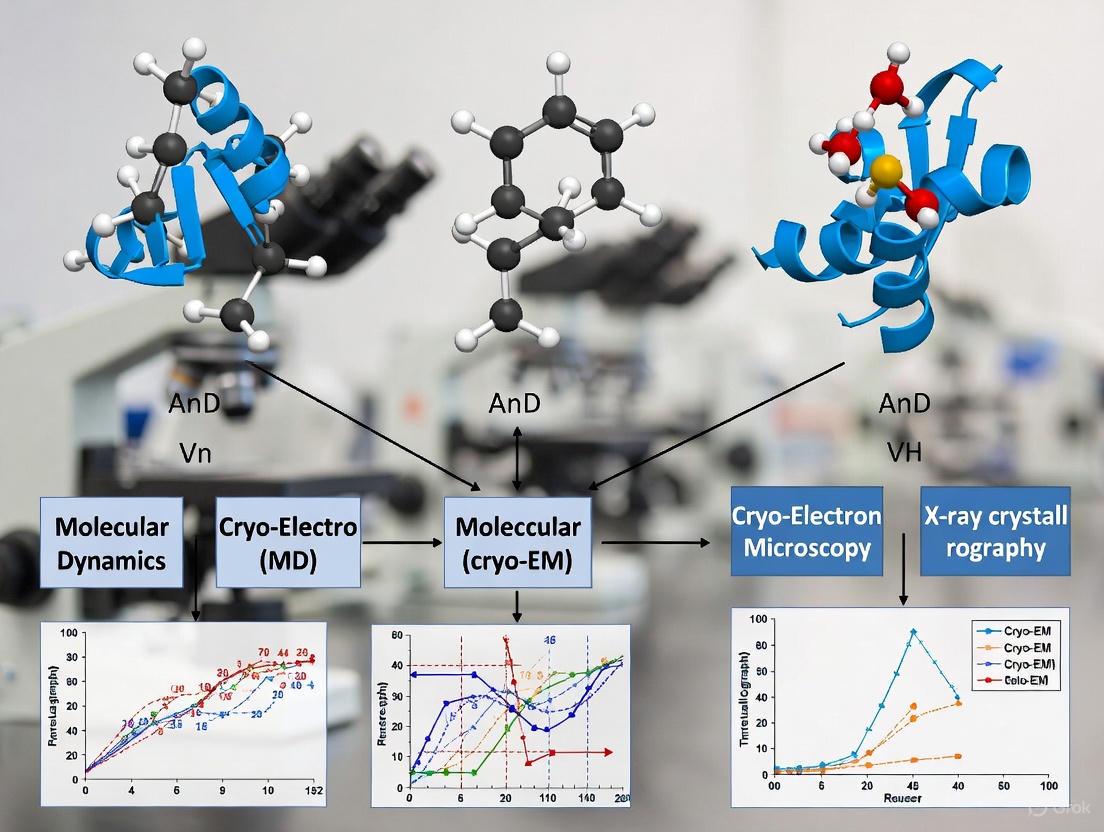
This article provides a comprehensive guide for researchers and drug development professionals on integrating Molecular Dynamics (MD) simulations with experimental structural data from cryo-electron microscopy (cryo-EM) and X-ray crystallography.
Cross-Validating MD Simulations with Cryo-EM and X-ray Data: A Framework for Robust Structural Biology
Abstract
This article provides a comprehensive guide for researchers and drug development professionals on integrating Molecular Dynamics (MD) simulations with experimental structural data from cryo-electron microscopy (cryo-EM) and X-ray crystallography. It covers the foundational principles of each technique, practical methodologies for cross-validation, strategies for troubleshooting and optimization, and a comparative analysis of validation metrics. By outlining robust frameworks for data compatibility and model assessment, this resource aims to enhance the reliability of dynamic structural models, thereby accelerating drug discovery and the understanding of complex biological mechanisms.
The Structural Trinity: Foundational Principles of MD, Cryo-EM, and X-ray Crystallography
Understanding the Resolution and Dynamic Range of Each Technique
In structural biology, the resolution of a technique defines its ability to distinguish fine details in a macromolecular structure, while its dynamic range—often an overlooked parameter—determines its capacity to resolve structural features of vastly different stabilities or electron densities within the same sample. For researchers cross-validating molecular dynamics (MD) simulations with experimental data, understanding these technical parameters is crucial for assessing the reliability and interpretive limits of structural models. Recent breakthroughs in cryo-electron microscopy (cryo-EM) and artificial intelligence (AI)-based structure prediction have revolutionized protein modeling by enabling near-atomic resolution visualization [1]. Meanwhile, time-resolved X-ray crystallography has achieved unprecedented temporal resolution, capturing biomolecular reactions at sub-10 millisecond timescales [2]. This guide objectively compares the resolution and dynamic range of predominant structural techniques, providing a framework for selecting appropriate methods to validate MD simulations across different biological contexts and temporal scales.
Technical Comparison of Structural Techniques
Table 1: Resolution and Dynamic Range Characteristics of Major Structural Biology Techniques
| Technique | Typical Resolution Range | Effective Dynamic Range | Temporal Resolution | Key Strengths | Principal Limitations |
|---|---|---|---|---|---|
| X-ray Crystallography | ~1.0-3.0 Å (Atomic) | Limited by crystal packing constraints | Milliseconds to hours (Time-resolved variants) [2] | Atomic resolution; Well-established workflows | Requires high-quality crystals; Limited to crystallizable samples |
| Cryo-EM (Single Particle) | ~1.8-4.0 Å (Near-atomic to Atomic) | Capable of resolving multiple conformational states [3] | Static snapshots (Milliseconds with time-resolved variants) [4] | Handles large complexes; No crystallization needed | Radiation damage; Sample thickness limitations |
| NMR Spectroscopy | ~1.0-3.5 Å (Atomic for small proteins) | Excellent for dynamic processes across timescales | Picoseconds to seconds | Solution-state dynamics; Atomic-level interaction data | Size limitations; Complex spectral analysis |
| MD Simulations | N/A (Computational model) | Theoretically unlimited for observable states | Femtoseconds to milliseconds | Atomic-level dynamics; Full temporal resolution | Force field dependencies; Sampling limitations |
Table 2: Quantitative Performance Metrics for Structural Techniques
| Technique | Sample Consumption | Data Collection Time | Minimum Sample Size | Optimal Application Scope |
|---|---|---|---|---|
| Serial X-ray Crystallography | ~450 ng (theoretical minimum) [5] | Minutes to days | Microcrystals (≥1-20 μm) [2] | Membrane proteins; Enzyme mechanisms |
| Cryo-EM SPA | ≤1 mg/mL [6] | Days to weeks | ~50 kDa complexes | Large macromolecular complexes; Flexible assemblies |
| NMR Spectroscopy | Milligram quantities | Hours to days | Proteins < 40-50 kDa [1] | Small protein dynamics; Drug binding interactions |
| Integrative Modeling | Varies by input data | Computational (days to months) | No inherent size limit | Heterogeneous systems; Multi-domain proteins |
Experimental Protocols for Technique Validation
Time-Resolved Mix-and-Quench X-ray Crystallography
This protocol enables high-resolution structural studies of enzymatic reactions with millisecond temporal resolution, providing valuable experimental data for validating MD simulations of dynamic processes [2].
Key Steps:
- Reaction Initiation: Rapidly mix protein crystals with substrate/ligand solution using precision dispensing systems
- Reaction Quenching: After precisely controlled time intervals (as short as 8 ms), rapidly cool samples to cryogenic temperatures (≤200 K) to trap intermediate states
- Data Collection: Collect X-ray diffraction data from quenched samples using standard cryocrystallography beamlines
- Structure Determination: Solve structures at multiple time points to reconstruct reaction trajectories
Critical Parameters:
- Temporal resolution determined by mixing efficiency, diffusion rates, and quenching speed
- Sample consumption can be as low as one crystal per time point [2]
- Optimal for studying ligand binding, enzymatic catalysis, and conformational changes
Ensemble Refinement for Cryo-EM Structures
Standard cryo-EM analysis condenses single-particle images into a single structure, which can misrepresent flexible molecules. This protocol uses MD simulations with cryo-EM density maps to better account for structural dynamics [3].
Metainference Workflow:
- Initial Model Preparation: Identify potentially mismodeled regions in the static cryo-EM structure through visual inspection and secondary structure prediction
- Helix Remodeling: Run short MD simulations (2.5 ns) with restraints to correctly remodel improperly paired RNA helices or protein domains
- Ensemble Refinement: Perform metainference MD simulations using multiple replicas (minimum 8) guided by cryo-EM density restraints
- Validation: Assess ensemble compatibility with experimental data and structural biology principles
- Trajectory Analysis: Identify flexible regions and functionally relevant conformational states
Application Notes:
- Particularly valuable for RNA-containing structures and flexible proteins [3]
- Requires significant computational resources for multi-replica simulations
- Effectively resolves heterogeneity in cryo-EM maps with resolutions of 2.5-4.0 Å
Tilt-Corrected Bright-Field STEM for Thick Samples
Conventional cryo-EM faces challenges with thick specimens due to inelastic scattering. This protocol describes a dose-efficient approach for imaging thick biological samples while maintaining high resolution [6].
Procedure:
- 4D-STEM Data Collection: Acquire convergent beam electron diffraction patterns over a 2D grid of probe positions using a pixelated detector
- Shift Measurement: Calculate aberration-induced image shifts between images formed from individual detector pixels
- Tilt Correction: Apply computed shifts to align individual images
- Image Integration: Sum shift-corrected images to produce a final high signal-to-noise ratio image
Performance Characteristics:
- Provides 3-5× improvement in dose efficiency compared to energy-filtered TEM for samples beyond 500 nm thickness [6]
- Enables sub-nanometer resolution single-particle analysis of virus-like particles from minimal particle counts
- Computationally efficient compared to iterative ptychography
Workflow Visualization
Figure 1: Integrated workflow for cross-validating molecular dynamics simulations with experimental structural biology techniques. The pipeline begins with sample preparation and proceeds through specialized data collection methods, integration of experimental constraints, and final validation and refinement of MD simulations.
Essential Research Reagent Solutions
Table 3: Key Research Reagents and Materials for Structural Biology Techniques
| Reagent/Material | Primary Technique | Function | Technical Specifications |
|---|---|---|---|
| Direct Electron Detectors | Cryo-EM | Capture high-resolution images with improved signal-to-noise | ~95% quantum efficiency; Rapid frame rates [1] |
| Microfluidic Mixers | Time-resolved Crystallography | Rapid reaction initiation for time-resolved studies | Sub-millisecond mixing; Minimal sample consumption [2] |
| Cryogenic Sample Supports | Cryo-EM & Crystallography | Maintain native sample structure at cryogenic temperatures | Low background scattering; Optimal ice thickness |
| Pixelated STEM Detectors | Cryo-STEM | 4D-STEM data acquisition for thick samples | Rapid CBED pattern collection; High dynamic range [6] |
| Metainference Software | Integrative Modeling | Ensemble refinement from cryo-EM data | Bayesian framework; Multi-replica MD support [3] |
The resolution and dynamic range of structural biology techniques collectively determine their effectiveness for validating molecular dynamics simulations. While X-ray crystallography provides exceptional atomic resolution for well-behaved crystalline samples, cryo-EM offers unique capabilities for visualizing large complexes and multiple conformational states. The emerging emphasis on ensemble refinement and time-resolved methods addresses the critical need to capture biomolecular dynamics rather than static snapshots. For researchers cross-validating MD results, the strategic selection of complementary techniques—each with characteristic resolution and dynamic range profiles—enables robust validation of simulation trajectories. Future advancements in detector technology, sample delivery systems, and integrative computational methods will further bridge the gap between experimental structural biology and molecular simulations, ultimately providing more complete understanding of biomolecular function across temporal and spatial scales.
Cryo-electron microscopy (cryo-EM) has revolutionized structural biology by enabling the visualization of macromolecular complexes in near-native states without requiring crystallization. This transformation, often termed the "resolution revolution," has positioned cryo-EM as a powerful complement to established techniques like X-ray crystallography and nuclear magnetic resonance (NMR) spectroscopy [7] [1]. The unique capability of cryo-EM to image vitrified hydrated samples preserves biological structures in functional conformations, providing unprecedented insights into dynamic cellular processes [7]. By early 2025, single-particle cryo-EM is poised to surpass X-ray crystallography as the most used method for experimentally determining new structures [8], marking a significant milestone in structural biology.
The technique's particular strength lies in its ability to handle structural heterogeneity and resolve multiple functional states within a single sample. This has proven invaluable for studying challenging targets such as membrane proteins, large complexes, and transient assemblies that have long eluded crystallization [1] [9]. Furthermore, the integration of artificial intelligence (AI) with cryo-EM has accelerated structure determination, enabling researchers to build accurate atomic models from medium-resolution maps and explore conformational diversity at unprecedented speed and scale [10] [11].
Comparative Analysis of Structural Biology Techniques
Technical Comparison of Major Methods
The three primary techniques in structural biology—cryo-EM, X-ray crystallography, and NMR spectroscopy—each offer distinct advantages and limitations. Understanding their complementary strengths is essential for selecting the appropriate method for specific research questions.
Table 1: Comparison of Major Structural Biology Techniques
| Parameter | Cryo-EM | X-ray Crystallography | NMR Spectroscopy |
|---|---|---|---|
| Sample State | Vitrified solution in near-native state | Crystalline lattice | Solution state |
| Sample Requirement | ~0.5-5 mg/mL, small volume [12] | 5-10 mg/mL, requires crystallization [12] | >200 µM, 250-500 µL volume [12] |
| Size Range | >50 kDa [7] | No strict upper limit, but crystallization challenging for large complexes | Generally <40 kDa [1] |
| Resolution Range | 1.5-10 Å (typically 2-4 Å) [11] [7] | 1-3 Å [13] | 1.5-3.5 Å for small proteins |
| Throughput | Medium-high, rapidly improving | High for crystallizable targets | Low-medium |
| Key Strengths | Handles flexibility and heterogeneity; no crystallization needed; visualizes large complexes | Atomic resolution; well-established workflows; high throughput for crystallizable targets | Studies dynamics in solution; no crystallization needed; provides thermodynamic parameters |
| Major Limitations | Radiation damage; requires significant computational resources | Cannot study molecules resistant to crystallization | Limited to smaller proteins; complex data analysis |
Quantitative Impact Assessment Across Techniques
The rapid adoption of cryo-EM is reflected in structural databases. According to recent Protein Data Bank (PDB) statistics, cryo-EM accounted for approximately 31.7% of structures released in 2023, while X-ray crystallography remained dominant at 66%, and NMR contributed only 1.9% [13]. This represents a dramatic shift from the early 2000s when cryo-EM contributions were almost negligible [13]. The growth is largely attributed to technological developments in direct electron detectors [1], improved image processing algorithms [7], and the integration of AI-based modeling tools [10].
The resolution achievable by cryo-EM has improved substantially, with current single-particle analyses routinely reaching 2-4 Å resolution, sufficient for de novo model building [10]. In exceptional cases, such as the β-galactosidase structure, resolutions of 1.5 Å have been achieved for the protein core, though bound ligands may be resolved to lower resolutions (3-3.5 Å) [11]. This positions cryo-EM between X-ray crystallography (routinely achieving 1-3 Å resolution) [13] and NMR (typically providing structural ensembles rather than single conformations) [12].
Experimental Protocols and Workflows
Cryo-EM Single Particle Analysis Workflow
The standard single-particle cryo-EM workflow involves multiple steps from sample preparation to final model validation, each requiring specialized instrumentation and expertise.
Sample Preparation and Vitrification: The process begins with purifying the macromolecular complex to homogeneity and vitrifying it by rapid plunge-freezing in liquid ethane. This preserves the sample in a thin layer of amorphous ice, maintaining near-native hydration and preventing ice crystal formation [7].
Data Acquisition: Vitrified samples are imaged using transmission electron microscopes equipped with direct electron detectors. Modern detectors provide dramatically improved signal-to-noise ratios, accurate electron counting, and rapid frame rates that enable correction of beam-induced motion [1]. Typically, hundreds to thousands of micrographs are collected with electron doses of 20-40 electrons/Ų to minimize radiation damage [7].
Image Processing and 3D Reconstruction: Individual particle images are extracted from micrographs and classified by orientation using computational approaches like projection-matching [7]. The "projection-slice theorem" is fundamental to this process, stating that the Fourier transform of a 2D projection corresponds to a central slice through the 3D Fourier transform of the structure [7]. Initial models are generated ab initio or by using known structures as references, followed by iterative refinement to produce the final 3D reconstruction [7].
Model Building and Validation: Atomic models are built into the cryo-EM density map using manual or automated approaches. Recent methods integrate AI-based structure prediction with density-guided molecular dynamics simulations to improve accuracy, particularly for conformational transitions and ligand binding sites [10] [11].
Integrative Approaches Combining AI and Cryo-EM
Recent advances have demonstrated the power of combining AlphaFold2-based models with cryo-EM data to resolve alternative conformational states, particularly for membrane proteins where traditional fitting approaches struggle [10].
Table 2: Research Reagent Solutions for AI-Cryo-EM Integration
| Reagent/Resource | Function/Role | Application Example |
|---|---|---|
| AlphaFold2 | Generative AI for protein structure prediction from sequence | Generating initial structural models for flexible fitting [10] |
| GROMACS with Density-Guided MD | Molecular dynamics software with cryo-EM map biasing potential | Flexible fitting of AI-generated models to experimental density [10] |
| ChimeraX | Molecular visualization and analysis | Rigid-body alignment of predicted models to cryo-EM maps [11] |
| GOAP Score | Generalized orientation-dependent all-atom potential | Quality assessment of protein geometry during refinement [10] |
| ModelAngelo | Automated model building for cryo-EM maps | De novo model building without templates [10] |
The protocol involves several key steps: First, multiple initial models are generated by stochastic subsampling of the multiple sequence alignment (MSA) space in AlphaFold2 to create structural diversity [10]. Next, structure-based k-means clustering identifies representative models, reducing computational costs while maintaining conformational diversity [10]. These cluster representatives then undergo density-guided molecular dynamics simulations where a biasing potential moves atoms toward the experimental map while maintaining proper stereochemistry [10]. Finally, the optimal model is selected based on a compound score balancing map fit (cross-correlation) and model quality (GOAP score) [10].
This approach has successfully resolved state-dependent conformational changes in membrane proteins including the calcitonin receptor-like receptor (helix bending), L-type amino acid transporter (rearrangement of neighboring helices), and alanine-serine-cysteine transporter (substantial conformational transition involving most transmembrane helices) [10]. The method is particularly valuable for medium-resolution maps (3-4 Å) where de novo building remains challenging [10].
Ligand Building in Cryo-EM Maps
A specialized application combining AI and cryo-EM focuses on resolving protein-ligand interactions, which is crucial for drug discovery but challenging due to typically lower ligand resolution [11]. The protocol takes three inputs: (1) protein amino acid sequence, (2) ligand specification (SMILES string), and (3) experimental cryo-EM map [11].
First, protein-ligand complex structures are predicted using AlphaFold3-like models (e.g., Chai-1) based solely on sequence and ligand information [11]. The predicted complexes are rigid-body aligned to the target cryo-EM map. Finally, density-guided molecular dynamics simulations refine the model, improving ligand model-to-map cross-correlation from 40-71% to 82-95% compared to deposited structures [11]. This pipeline has been successfully validated on biomedically relevant targets including kinases, GPCRs, and solute transporters not present in the AI training data [11].
Cross-Validation with Molecular Dynamics Simulations
Molecular dynamics (MD) simulations provide a critical bridge between static structural snapshots and biological function by modeling macromolecular motions. Cryo-EM density maps serve as excellent constraints for validating and refining MD simulations [10] [11]. In density-guided simulations, a biasing potential is added to the classical forcefield to move atoms toward the experimental map, enabling the exploration of conformational transitions while maintaining agreement with experimental data [10].
This approach is particularly valuable for studying functional mechanisms in membrane proteins, which often undergo substantial conformational changes. For example, in the calcitonin receptor-like receptor, density-guided simulations revealed bending of TM6 upon activation, a transition that could not be captured using standard fitting approaches starting from a single initial structure [10]. Similarly, for transporters like LAT1 and ASCT2, integrative modeling has elucidated the rearrangement of helices during substrate transport cycles [10].
The cross-validation process monitors multiple quality metrics during simulations, including model-to-map cross-correlation (fitting quality), protein-ligand interaction energy (favorable interactions without clashes), and GOAP score (structural geometry) [11]. By selecting simulation frames that optimize both fit and geometry, researchers obtain models that are consistent with both experimental data and physical principles [10].
Cryo-EM has firmly established itself as a cornerstone technique in structural biology, providing unique capabilities for visualizing macromolecular complexes in near-native states. Its integration with AI-based structure prediction and molecular dynamics simulations has created a powerful framework for elucidating biological mechanisms at unprecedented resolution and scale. As detector technology, image processing algorithms, and modeling approaches continue to advance, cryo-EM is poised to drive further discoveries in basic biology and drug development, particularly for challenging targets that have long resisted structural characterization.
The complementary strengths of cryo-EM, X-ray crystallography, and NMR spectroscopy ensure that each technique will continue to play vital roles in structural biology. However, the unique ability of cryo-EM to handle structural heterogeneity without crystallization positions it as an essential tool for studying the dynamic complexes that underlie cellular function. The ongoing integration of experimental and computational approaches promises to accelerate our understanding of structure-function relationships across diverse biological systems.
Determining the three-dimensional structure of biological macromolecules at atomic resolution is fundamental to understanding the mechanisms of life and disease. Among the techniques available to structural biologists, X-ray crystallography has long been the gold standard for achieving atomic-level precision, typically defined as resolutions better than 1.2 Å, where individual atoms become clearly distinguishable. [14] This capability provides critical insights into enzyme mechanisms, drug-target interactions, and the molecular basis of diseases.
The field of structural biology is powered by three principal techniques: X-ray crystallography, nuclear magnetic resonance (NMR) spectroscopy, and cryo-electron microscopy (cryo-EM). According to the Protein Data Bank (PDB) statistics, as of 2023, X-ray crystallography accounted for approximately 66% (over 9,601 structures) of all published protein structures, while cryo-EM accounted for 31.7% (4,579 structures), and NMR contributed only 1.9% (272 structures). [14] Although the proportion of structures determined by X-ray crystallography has declined with the recent rise of cryo-EM, it remains the dominant method in structural biology.
The precision offered by X-ray crystallography enables researchers to visualize not just the overall fold of a protein, but also the precise bond lengths and angles within active sites, the geometry of ligand binding, and the organization of solvent molecules. This information is indispensable for structure-based drug design, where atomic-level details guide the optimization of small molecules for enhanced potency and selectivity. This guide explores how X-ray crystallography achieves this precision, compares its capabilities with alternative structural methods, and examines its evolving role in the era of integrative structural biology.
Fundamental Principles and Technical Evolution
The Physical Basis of X-ray Crystallography
X-ray crystallography determines molecular structure by analyzing the diffraction patterns produced when X-rays interact with the electron clouds of atoms in a crystalline sample. The technique is governed by Bragg's Law (nλ = 2dsinθ), which relates the wavelength of incident X-rays (λ), the distance between crystal planes (d), and the angle of incidence (θ) to produce constructive interference. [14] By measuring the angles and intensities of these diffracted beams, scientists can compute a three-dimensional electron density map and build an atomic model that fits this experimental data.
The fundamental process involves several critical steps, each contributing to the final precision of the structure. It begins with protein crystallization, where the purified macromolecule is coaxed into forming a highly ordered crystal lattice. When exposed to an X-ray beam, typically from a synchrotron radiation source, the crystal produces a diffraction pattern that is captured by a detector. The resulting data undergoes complex computational processing to solve the "phase problem" – determining the phase angles associated with each diffracted wave – which is essential for electron density map calculation. The final stage involves iterative model building and refinement, where an atomic model is adjusted to achieve the best possible fit to the experimental electron density while maintaining realistic geometric constraints. [14]
Specialized Techniques Enhancing Precision
X-ray crystallography has evolved beyond conventional approaches to address increasingly challenging biological questions through specialized methodologies:
- Serial Femtosecond Crystallography (SFX): Utilizes extremely short X-ray pulses from free-electron lasers to collect diffraction data from microcrystals before radiation damage occurs, enabling studies of radiation-sensitive samples and time-resolved structural dynamics. [14]
- Anomalous Dispersion Methods (SAD/MAD): Exploit the anomalous scattering properties of specific elements (often incorporated as selenomethionine or heavy atoms) to solve the phase problem, enabling de novo structure determination without homologous models. [14]
- Quantum Crystallography: Emerging approaches use quantum mechanical methods to refine crystal structures beyond the limitations of the independent atom model, providing more accurate descriptions of electron density distributions and chemical bonding. [15] [16]
These advanced techniques demonstrate how X-ray crystallography continues to evolve, pushing the boundaries of atomic-level precision while addressing increasingly complex biological systems.
Comparative Analysis of Structural Biology Techniques
Performance Metrics Across Methods
The precision and applicability of structural biology methods vary significantly across different biological contexts. The table below provides a systematic comparison of X-ray crystallography with cryo-EM and NMR spectroscopy based on key performance metrics.
Table 1: Comparative Analysis of Major Structural Biology Techniques
| Feature | X-ray Crystallography | Cryo-Electron Microscopy | NMR Spectroscopy |
|---|---|---|---|
| Typical Resolution Range | 1.0 - 3.0 Å (Atomic) [14] | 3.0 - 10.0+ Å (Near-atomic to Molecular) [17] [18] | 3D Structures limited to < 100 kDa [14] |
| Sample Requirements | High-quality, well-ordered crystals | Purified complex in solution (vitreous ice) | Highly soluble, isotopically labeled protein in solution |
| Sample Size Limitations | Crystal size > few micrometers | Size > 50 kDa preferred [19] | Molecular weight < 40-50 kDa [14] |
| Throughput | Medium (crystallization bottleneck) | Increasingly high with automation | Low (data collection and analysis) |
| Information on Dynamics | Limited (static snapshot) | Multiple conformations possible (computational sorting) | Direct observation of dynamics at various timescales |
| Key Strengths | Atomic-level precision, High throughput once crystals obtained, Mature methodology | Handles large complexes, No crystallization needed, Visualizes multiple states | Studies dynamics in solution, No crystallization needed, Provides atomic detail for small proteins |
| Key Limitations | Crystallization bottleneck, Crystal packing artifacts, Radiation damage | Lower resolution for many targets, Complex data processing, Expensive equipment | Size limitation, Spectral complexity, Specialized expertise required |
Quantitative Resolution and Throughput Analysis
Beyond qualitative comparisons, quantitative metrics reveal distinct performance characteristics. The achievable resolution directly impacts the biological questions that can be addressed, particularly regarding drug discovery where atomic-level ligand placement is crucial.
Table 2: Quantitative Performance Metrics for Structural Biology Techniques
| Metric | X-ray Crystallography | Cryo-EM | NMR |
|---|---|---|---|
| Structures in PDB (2023) | ~9,601 (66%) [14] | ~4,579 (32%) [14] | ~272 (2%) [14] |
| Typical Data Collection Time | Seconds to minutes (synchrotron) | Days to weeks | Days to weeks |
| Information Content | Time-averaged electron density | Single-particle reconstructions | Chemical shifts, distance restraints |
| Ligand Binding Studies | Excellent (precise binding mode) | Good (if resolution < 3.5 Å) [17] | Good (binding constants, mapping) |
| Membrane Protein Structures | Possible with special techniques (LCP) [1] | Excellent (no crystallization needed) [1] | Challenging (with solid-state NMR) |
The data shows that while cryo-EM is rapidly growing, particularly for large complexes, X-ray crystallography remains the most prolific method and provides the highest resolution structures, making it indispensable for applications requiring atomic-level precision.
Experimental Protocols for High-Precision Structure Determination
Workflow for Atomic-Resolution X-ray Crystallography
The following diagram illustrates the comprehensive workflow for determining a protein structure at atomic resolution using X-ray crystallography:
Key Methodological Considerations for Atomic Precision
Achieving truly atomic resolution (better than 1.2 Å) requires meticulous attention to each step of the process:
Protein Engineering and Crystallization: Protein construct optimization often involves removing flexible regions to enhance crystallization propensity. Advanced crystallization techniques like lipidic cubic phase (LCP) crystallization have revolutionized membrane protein structural biology, enabling high-resolution structures of GPCRs and transporters. [1] The quality of diffraction is directly determined by crystal lattice order, making crystallization optimization critical for high-resolution studies.
Data Collection at Synchrotron Sources: Modern synchrotron beamlines provide intense, tunable X-ray sources with micro-focus capabilities that enable data collection from smaller crystals. Complete, high-resolution datasets require collecting hundreds of diffraction images with precise crystal orientation. For radiation-sensitive samples, cryo-cooling (typically to 100K) is essential to mitigate radiation damage during data collection. [14]
Phase Determination Methods: Molecular replacement remains the most common method when a homologous structure exists. For novel folds with no structural homologs, experimental phasing methods like Single-wavelength Anomalous Dispersion (SAD) or Multi-wavelength Anomalous Dispersion (MAD) are employed, requiring incorporation of anomalous scatterers (e.g., selenomethionine) into the protein. [14]
Model Building and Refinement Protocols: Atomic-resolution electron density maps allow for unambiguous placement of protein atoms, bound ligands, and solvent molecules. The refinement process involves iterative cycles of adjusting atomic coordinates and temperature factors to minimize the difference between observed and calculated structure factors (R-factors), while maintaining proper stereochemistry. [14] The precision of bond lengths and angles reaches ±0.001-0.003 Å and ±0.1-0.3°, respectively, at atomic resolution.
The Scientist's Toolkit: Essential Research Reagents and Materials
Successful structure determination requires specialized reagents and computational tools throughout the experimental pipeline. The following table details essential resources for high-precision X-ray crystallography.
Table 3: Essential Research Reagents and Computational Tools for X-ray Crystallography
| Category | Specific Examples | Function and Application |
|---|---|---|
| Crystallization Reagents | Commercial screening kits (e.g., from Hampton Research, Molecular Dimensions) | Provide systematic sampling of chemical space to identify initial crystallization conditions |
| Cryoprotectants | Glycerol, ethylene glycol, various cryosolutions | Protect crystals from ice formation during flash-cooling in liquid nitrogen |
| Phasing Reagents | Halide salts, heavy atom compounds (e.g., K₂PtCl₄, CH₃HgCl), selenomethionine | Introduce anomalous scatterers for experimental phasing (SAD/MAD) |
| Ligand Soaking | Components for co-crystallization or crystal soaking | Enable structural studies of protein-ligand complexes for drug discovery |
| Data Processing Software | XDS, HKL-2000, DIALS, CCP4 | Process raw diffraction images to integrated intensities and structure factors |
| Phasing Software | PHASER (Molecular Replacement), SHELXC/D/E, Auto-Rickshaw | Solve the phase problem to calculate electron density maps |
| Model Building Tools | Coot, O | Fit and adjust atomic models into electron density maps |
| Refinement Programs | phenix.refine, REFMAC5, BUSTER | Optimize atomic parameters against diffraction data with geometric restraints |
| Validation Tools | MolProbity, PDB-REDO, wwPDB Validation Server | Assess model quality and identify potential errors before deposition |
Cross-Validation with Computational and Hybrid Methods
Integrating X-ray Crystallography with Molecular Dynamics
The combination of X-ray crystallography with molecular dynamics (MD) simulations creates a powerful synergy for understanding both structure and dynamics. While crystallography provides the precise atomic coordinates, MD simulations can explore conformational flexibility around this starting structure. Cross-validation involves comparing MD simulation trajectories with crystallographic data beyond the atomic coordinates:
- B-factor Validation: The atomic displacement parameters (B-factors) derived from crystallography reflect atomic mobility and can be compared to root-mean-square fluctuations calculated from MD simulations. [15]
- Covalent Geometry: Bond lengths and angles from simulation averages can be validated against high-resolution crystal structures, with typical agreement within 0.01-0.02 Å for bonds and 1-2° for angles. [15]
- Electron Density Residuals: Quantum mechanical calculations applied to MD snapshots can generate theoretical electron density maps for comparison with experimental maps, identifying regions where static crystal structures may differ from dynamic behavior in solution.
Quantum Crystallography for Enhanced Precision
Emerging methods collectively termed Quantum Crystallography (QCr) use quantum mechanical calculations to enhance the precision and information content derived from crystal structures. [16] These approaches address limitations of the conventional independent atom model (IAM), which neglects the deformation of electron density due to chemical bonding:
- Hirshfeld Atom Refinement (HAR): Uses quantum-mechanically derived electron densities to improve the accuracy of hydrogen atom positions, which are typically poorly resolved by X-rays alone. HAR can achieve X—H bond lengths comparable to neutron diffraction standards. [16]
- Quantum-Based Restraints: Instead of relying on generic library values for bond lengths and angles during refinement, structure-specific restraints can be computed using quantum mechanical methods (e.g., molecule-in-cluster computations), resulting in more chemically accurate molecular geometries. [15]
- Multipolar Electron Density Models: These advanced models go beyond the spherical atom approximation to represent the aspherical nature of electron density in chemical bonds, lone pairs, and aromatic systems, providing more accurate structural parameters and insights into chemical bonding. [16]
Hybrid Approaches with Cryo-EM and AI
The integration of X-ray crystallography with cryo-EM and artificial intelligence represents the cutting edge of structural biology:
- AI-Assisted Model Building: Deep learning approaches like ModelAngelo and DeepTracer, originally developed for cryo-EM, are being adapted to improve automated model building in crystallography, particularly for interpreting lower-resolution electron density maps. [17] [20]
- Cross-Validation with Cryo-EM: For large complexes that prove difficult to crystallize, cryo-EM can provide a medium-resolution envelope into which high-resolution crystal structures of individual components can be fitted, combining the precision of crystallography with the size capability of cryo-EM. [18]
- AlphaFold Integration: Structures predicted by AlphaFold2 and AlphaFold3 can serve as starting models for molecular replacement in crystallography, significantly accelerating structure solution, particularly when experimental phases are difficult to obtain. [20] The following diagram illustrates this integrative approach:
X-ray crystallography remains an indispensable technique for achieving atomic-level precision in structural biology, continuing to produce the majority of high-resolution structures despite increasing competition from cryo-EM. Its unparalleled ability to provide precise atomic coordinates, detailed ligand binding information, and explicit solvent structures makes it particularly valuable for drug discovery and mechanistic studies.
The future of crystallography lies in its integration with complementary techniques. As quantum crystallographic methods mature, they will push the precision of charge density analysis and hydrogen atom positioning beyond current limits. [15] [16] Simultaneously, hybrid approaches that combine crystallographic data with cryo-EM, molecular dynamics simulations, and AI-based structure prediction will enable the solution of increasingly complex biological problems. [20] For the foreseeable future, X-ray crystallography will continue to provide the foundational atomic coordinates upon which our understanding of biological structure-function relationships is built, while evolving to incorporate new computational and experimental methodologies that enhance its precision and applicability.
Molecular dynamics (MD) simulation has emerged as a powerful computational microscope, enabling researchers to observe the motion and energetics of biomolecules at an atomic level. This guide provides an objective comparison of its performance against other structural biology techniques, focusing on its integration with cryo-electron microscopy (cryo-EM) and X-ray crystallography for cross-validation. The supporting experimental data and protocols outlined here offer a framework for researchers and drug development professionals to apply these integrated approaches.
Comparative Performance of MD with Experimental Structural Biology Techniques
The table below summarizes a quantitative comparison of Molecular Dynamics simulations with primary experimental structural biology methods, highlighting their respective strengths, limitations, and optimal use cases.
Table 1: Performance Comparison of MD Simulations with Key Experimental Techniques
| Method | Key Performance Metrics | Typical System Size & Scope | Key Strengths | Primary Limitations |
|---|---|---|---|---|
| Molecular Dynamics (MD) | - Provides time-resolution (fs to ms) [21]- Calculates interaction energies (e.g., PMF, van der Waals) [21]- Quantifies thermal fluctuations (thermal factor) [21] | - ~600 molecules for 50 ns simulation [21]- Full atomic detail of biomolecules in explicit solvent | - Captures dynamics and kinetics- Provides energetic insights- Simulates under physiological conditions | - Computationally expensive for large systems/long timescales- Force field accuracy is critical |
| Cryo-Electron Microscopy (Cryo-EM) | - Resolution (often 2.5-4.0 Å for dynamic systems) [22]- Map-to-model cross-correlation (e.g., 0.70-0.90) [10] | - Large complexes (>100 kDa)- Multiple structural states from one sample [23] | - Visualizes large, flexible complexes- Can resolve multiple conformational states [23] | - Can misrepresent flexible regions in single-state models [22]- Sample preparation and vitrification challenges |
| X-ray Crystallography | - Resolution (often <2.0 Å for well-diffracting crystals)- R-factor & R-free (e.g., <0.20) | - Requires high-quality crystals- Typically a single, static conformation | - Provides high atomic precision- Well-established refinement pipelines | - May contain questionable backbone conformations from modeling [24]- Difficult for membrane proteins and dynamic systems |
Integrated Workflows for Cross-Validation
The true power of modern structural biology lies in combining MD simulations with experimental data. The following workflows and case studies demonstrate how these methods are integrated for robust, dynamically-aware structure determination.
Workflow 1: MD for Validating and Refining Crystal Structures
X-ray crystallography provides high-resolution structural snapshots, but the resulting models can contain local misconformations introduced during crystallization or model building [24]. MD simulations are used to assess and refine these structures.
Experimental Protocol: Detecting Questionable Conformations in Crystal Structures [24]
- Energy Minimization: A set of non-redundant X-ray protein structure models undergoes an energy-minimization step to relax atomic geometry and reduce potential energy.
- Conformation Comparison: The local conformations of the original X-ray model and the energy-minimized model are compared using a structural alphabet (HMM-SA) to identify residues with "questionable conformations."
- MD Simulation & Validation: Molecular dynamics simulations are performed (e.g., on HIV-2 protease) to sample local conformations. Residues identified as questionable are further investigated to determine if their crystallographic conformation is sparsely sampled during MD or is a structural outlier, raising questions about its biological relevance.
Workflow 2: Cryo-EM and MD for Modeling Alternative States
A common challenge arises when a cryo-EM map is resolved for a protein in a functional state that differs substantially from any available template structure. A combined AI-MD workflow can successfully address this.
Experimental Protocol: Modeling Alternative States with AlphaFold2 and Density-Guided MD [10]
- Ensemble Generation: Generate a diverse set of initial models by stochastically subsampling the multiple sequence alignment (MSA) depth in AlphaFold2 (e.g., 1250 models per system).
- Model Filtering & Clustering: Filter models based on a structure-quality score (e.g., GOAP). Align the filtered models to a known-state structure and cluster them using k-means based on Cartesian coordinates.
- Density-Guided Simulation: Perform density-guided molecular dynamics simulations from each cluster representative. A biasing potential is added to the classical forcefield to move atoms toward the experimental cryo-EM density map.
- Model Selection: Monitor the cross-correlation (map fit) and GOAP score (model quality) during simulations. Select the final model based on the highest compound score, balancing fit and geometry.
Figure 1: AI and MD Workflow for Cryo-EM States.
Case Study: Unveiling Full-Length ACE Dynamics
Research on human angiotensin-I converting enzyme (ACE) showcases the power of integrating cryo-EM with MD. While cryo-EM resolved multiple structural states of the glycosylated full-length dimer, MD simulations were critical to elucidate the conformational dynamics and identify key regions mediating change, providing insights for designing domain-specific modulators [23].
Advanced Applications: Tackling RNA Flexibility with Ensemble Refinement
RNA molecules are inherently flexible, and standard single-structure approaches in cryo-EM often lead to mis-modeling of flexible helical regions [22]. Metainference, a Bayesian ensemble refinement method, combines MD with cryo-EM data to model a structural ensemble that better represents the molecule's dynamics.
Experimental Protocol: Ensemble Refinement for RNA Macromolecules [22]
- Initial Model Inspection & Preparation: Visually inspect the deposited cryo-EM structure and identify regions (e.g., RNA helices) that are not properly paired according to the predicted secondary structure.
- Helix Remodeling: Run a short MD simulation (e.g., 2.5 ns) with restraints to remodel the identified helices into canonical, properly paired duplexes.
- Metainference Simulation: Perform metainference MD simulations using multiple replicas (e.g., 8-64). The simulation is guided by a hybrid energy function that enforces agreement between the average of the simulated ensemble and the experimental cryo-EM density map.
- Ensemble Analysis: Analyze the resulting ensemble of structures to characterize the inherent plasticity and flexibility of the macromolecule, ensuring flexible regions are not misinterpreted as a single, static conformation.
Figure 2: Ensemble Refinement for RNA Structures.
The Scientist's Toolkit: Essential Research Reagents and Computational Solutions
Successful integration of MD with experimental data relies on a suite of specialized software and tools.
Table 2: Key Research Reagent Solutions for Integrated Structural Biology
| Tool Name | Type/Category | Primary Function in Workflow |
|---|---|---|
| GROMACS [21] [10] | Molecular Dynamics Software | Performs all-atom MD, simulated annealing, and density-guided simulations for structure refinement and dynamics analysis. |
| AlphaFold2 [10] [25] | AI-Based Structure Prediction | Generates initial protein structural models from sequence, used to create diverse starting ensembles for MD refinement. |
| CryoSPARC [26] [23] | Cryo-EM Data Processing | Processes single-particle cryo-EM data for 2D classification, 3D reconstruction, and heterogeneity analysis. |
| Chimera/X [27] [28] | Visualization & Analysis | Visualizes and analyzes 3D density maps (cryo-EM, AFM-derived) and atomic models, and calculates map-model correlations. |
| GOAP [10] | Model Quality Metric | Scores protein structural geometry to assess model quality and prevent overfitting during density-guided simulations. |
| Metainference [22] | Ensemble Refinement Method | Enables cryo-EM-guided MD ensemble refinement within integrative modeling platforms like PLUMED. |
The Complementary Nature of Experimental and Computational Data
In modern structural biology and drug development, the integration of experimental and computational data has transformed our ability to understand complex biological systems at molecular resolution. For decades, X-ray crystallography served as the dominant technique for atomic-resolution structure determination, accounting for approximately 84% of structures in the Protein Data Bank [12]. However, the recent "resolution revolution" in cryo-electron microscopy (cryo-EM) has established it as a powerful complementary method, particularly for large macromolecular complexes and membrane proteins that defy crystallization [29] [30]. Simultaneously, molecular dynamics (MD) simulations have evolved into "virtual molecular microscopes" that provide the atomistic details underlying protein dynamics, serving as both a validation tool and a bridge between experimental techniques [31] [32].
This comparison guide examines the complementary strengths and limitations of these principal structural biology methods, with a specific focus on how MD simulations are cross-validated against and enhance experimental data from cryo-EM and X-ray crystallography. For researchers in structural biology and drug development, understanding this integrative approach is crucial for selecting appropriate methodologies and maximizing structural insights.
Technical Principles and Comparative Analysis
Fundamental Principles of Each Technique
X-ray crystallography relies on Bragg's Law of X-ray diffraction by crystals. When X-rays strike a well-ordered three-dimensional crystal, they scatter at various angles, producing a diffraction pattern of sharp spots. The intensities of these spots, combined with phase information obtained through experimental or computational means, allow reconstruction of the electron density map and subsequent atomic model building [29]. The quality of the final structure heavily depends on crystal order, requiring extensive sample optimization and often molecular engineering [29].
Cryo-electron microscopy uses high-energy electrons rather than X-rays. In single-particle cryo-EM, molecules are flash-frozen in thin ice layers and imaged directly in a transmission electron microscope. The magnetic objective lens produces both diffraction patterns and magnified images containing full structural information. Hundreds of thousands of particle images are computationally aligned, classified, and averaged to reconstruct a three-dimensional density map [29] [30]. This method preserves molecules in a near-native state without crystallization, but must contend with structural heterogeneity and radiation damage [29].
Molecular dynamics simulations employ computational methods to probe dynamical properties of atomistic systems. MD simulations numerically solve Newton's equations of motion for all atoms in a molecular system, using empirical force fields to describe atomic interactions. This allows researchers to visualize protein motions and conformational changes across temporal and spatial scales that may be difficult to access experimentally [31].
Technical Comparison and Method Selection
The table below summarizes the key technical characteristics and requirements of each method, providing guidance for researchers selecting appropriate structural biology approaches.
Table 1: Technical comparison of structural biology methods
| Parameter | X-ray Crystallography | Cryo-EM | Molecular Dynamics |
|---|---|---|---|
| Optimal Molecular Size | <100 kDa [33] | >100 kDa [33] | No inherent size limit |
| Typical Resolution | 1.0-2.5 Å (up to sub-1Å possible) [33] | 2.5-4.0 Å (2-3Å maximum) [33] | N/A (atomistic by definition) |
| Sample Requirement | >2 mg, highly pure and homogeneous [33] [12] | 0.1-0.2 mg, moderate heterogeneity acceptable [33] | Atomic coordinates only |
| Sample State | Crystalline lattice [29] | Vitreous ice (near-native) [29] [30] | In silico solution environment |
| Temporal Information | Static snapshot [29] | Multiple static snapshots (heterogeneity) [33] | Dynamic trajectories (fs to μs) [31] |
| Key Limitations | Crystal packing artifacts, radiation damage [29] | Beam-induced motion, preferred orientation [30] | Force field accuracy, sampling limitations [31] |
| Best Applications | Small soluble proteins, atomic-resolution ligand binding [33] [12] | Large complexes, membrane proteins, flexible systems [29] [33] | Conformational dynamics, mechanism elucidation [31] [32] |
Experimental Protocols and Workflows
Sample Preparation and Data Collection
X-ray Crystallography Workflow:
- Protein Purification: Samples must be purified to homogeneity, typically requiring >2 mg of protein at ~10 mg/mL concentration [12].
- Crystallization: Through vapor diffusion or other methods, proteins are slowly brought out of solution to form ordered crystals. This can take weeks to months and represents the major bottleneck [12].
- Cryoprotection: Crystals are cryo-cooled to minimize radiation damage during data collection [12].
- Data Collection: X-ray diffraction data are collected at synchrotron facilities, with patterns recorded over minutes to hours [12].
- Phasing and Model Building: The "phase problem" is solved through molecular replacement or experimental phasing, followed by iterative model building and refinement [29] [12].
Cryo-EM Workflow:
- Grid Preparation: Ultra-thin carbon or gold grids are cleaned and prepared for sample application [30].
- Vitrification: Samples (3-5 μL) are applied to grids, blotted to remove excess liquid, and plunge-frozen in liquid ethane to form vitreous ice [30].
- Data Collection: Using direct electron detectors, thousands to millions of particle images are collected in "movie mode" over hours to days, using low electron doses (~20-40 electrons/Ų) to minimize radiation damage [30].
- Image Processing: Motion correction, contrast transfer function estimation, particle picking, 2D classification, and 3D reconstruction are performed using extensive computational resources [30] [34].
Molecular Dynamics Workflow:
- System Preparation: Initial coordinates are obtained from experimental structures (PDB), then solvated in water boxes with ions to achieve physiological conditions [31].
- Force Field Selection: Appropriate force fields (AMBER, CHARMM, GROMOS) are selected based on the system and research question [31].
- Energy Minimization and Equilibration: Systems are energy-minimized and gradually heated to target temperature with restrained protein atoms [31].
- Production Simulation: Unrestrained MD simulations are run for nanoseconds to microseconds, with coordinates saved at regular intervals for analysis [31].
- Enhanced Sampling (if needed): For slower processes, methods like replica-exchange or metadynamics may be employed to improve conformational sampling [32].
Integrated Structural Biology Workflow
The following diagram illustrates how these techniques converge in an integrated approach to structural biology:
Integrated Structural Biology Workflow
Cross-Validation Frameworks and Protocols
Validating Molecular Dynamics with Experimental Data
The accuracy of MD simulations is typically benchmarked against experimental observables. Key validation protocols include:
NMR Validation:
- J-couplings and Chemical Shifts: Back-calculated from MD trajectories using empirical predictors and compared to experimental NMR data [31] [32].
- Relaxation Parameters: NMR-derived order parameters (S²) compared to those calculated from MD simulations to validate internal dynamics [31].
- Residual Dipolar Couplings: Compared between experiment and simulation to validate molecular orientation and dynamics [32].
Cryo-EM Validation:
- Flexible Fitting: MD simulations with cryo-EM density restraints allow refinement of structures into medium-resolution maps while maintaining proper stereochemistry [32].
- Heterogeneity Analysis: Cryo-EM class averages representing different conformational states can be compared to MD-generated ensembles [34] [32].
- Map-Model Correlation: Quantitative metrics (FSC, Q-score) assess agreement between atomic models and cryo-EM density maps [34].
X-ray Crystallography Validation:
- B-factor Analysis: Crystallographic B-factors (temperature factors) compared to atomic positional fluctuations from MD simulations [31].
- Ensemble Refinement: X-ray structures refined against ensemble models from MD simulations to account for conformational heterogeneity [35].
- Ligand Binding: MD simulations of ligand-protein complexes validated against crystallographic electron density [33] [12].
Quantitative Validation Metrics
Table 2: Metrics for cross-validating MD simulations with experimental data
| Validation Metric | Experimental Source | Computational Calculation | Interpretation |
|---|---|---|---|
| Root Mean Square Deviation (RMSD) | X-ray crystallography [29] | Backbone atom deviation from experimental structure | Measures structural conservation during simulation; <2-3 Å typically acceptable |
| Radius of Gyration (Rg) | SAXS [32] | Mass-weighted root mean square distance of atoms from center of mass | Assesses global compactness; should match experimental Rg within uncertainty |
| J-couplings | NMR [32] | Empirical calculators (e.g., Karplus equation) from dihedral angles | Validates local conformation and dynamics |
| Order Parameters (S²) | NMR relaxation [31] | Angular fluctuations of bond vectors from MD trajectories | Quantifies residue-specific flexibility; range 0-1 (rigid) |
| Map Correlation Coefficient | Cryo-EM [34] | Correlation between simulated density and experimental map | Assesses model-map agreement; >0.7 typically indicates good fit |
| Small-Angle X-Ray Scattering Profile | SAXS [32] | CRYSOL or other methods to compute theoretical profile from MD frames | Validates overall shape and dimensions in solution |
Research Reagent Solutions and Essential Materials
Successful integration of experimental and computational approaches requires specific reagents and computational resources. The following table details essential materials for these methodologies.
Table 3: Essential research reagents and computational resources
| Category | Specific Items | Function and Application |
|---|---|---|
| Sample Preparation | Detergents (DDM, LMNG) [33] | Solubilization and stabilization of membrane proteins for structural studies |
| Lipidic Cubic Phase (LCP) materials [12] | Membrane protein crystallization matrix mimicking native lipid environment | |
| Cryo-protectants (glycerol, ethylene glycol) [12] | Prevent ice crystal formation during cryo-cooling of crystals or vitreous ice preparation | |
| Crystallization | Sparse matrix screens (Hampton Research) [12] | Pre-formulated crystallization condition arrays for initial crystal screening |
| SeMet media (Molecular Dimensions) [12] | Selenium-methionine labeling for experimental phasing via SAD/MAD | |
| Cryo-EM | UltrAuFoil grids (Quantifoil) [30] | Gold substrates with regular hole patterns for optimal ice thickness |
| Direct electron detectors (Gatan, FEI) [30] | High-sensitivity cameras enabling single-particle cryo-EM resolution revolution | |
| MD Simulations | Force fields (AMBER, CHARMM, GROMOS) [31] | Empirical potential energy functions defining atomic interactions in simulations |
| Enhanced sampling algorithms (REMD, metadynamics) [32] | Computational methods to accelerate sampling of rare events in MD | |
| Software Resources | Processing suites (PHENIX, CCP4, CryoSPARC, RELION) [34] [12] | Integrated software for experimental data processing and structure determination |
| Visualization/analysis (ChimeraX, VMD, PyMOL) [29] [31] | Tools for model building, simulation analysis, and results visualization |
Applications in Drug Discovery and Challenges
Synergistic Applications in Structure-Based Drug Design
The complementary use of experimental and computational methods has proven particularly valuable in drug discovery:
Membrane Protein Drug Targeting: Cryo-EM enables structure determination of membrane proteins like GPCRs and ion channels in near-native lipid environments, while MD simulations reveal drug-binding pathways and allosteric mechanisms that may be invisible to static structures [33]. X-ray crystallography provides atomic-level details of drug-target interactions for optimizing lead compounds [12].
Ligand Screening and Validation: X-ray crystallography remains the gold standard for fragment-based lead discovery through techniques like XCHEM, providing unambiguous electron density for bound ligands [12]. MD simulations can prioritize which fragments to test experimentally by predicting binding affinities and residence times [33].
Conformational Selection Drug Design: Cryo-EM can capture multiple conformational states of a drug target in a single sample [33], while MD simulations map the energy landscape between these states [31]. This enables design of drugs that stabilize specific conformations with therapeutic benefit.
Current Limitations and Validation Challenges
Despite significant advances, important challenges remain in integrating these methodologies:
Cryo-EM Validation: Single-particle cryo-EM structure validation is an area of much-needed development [34]. The reported resolution should not always be taken at face value, as local resolution variations and reconstruction artifacts can mislead interpretation. Development of robust validation metrics comparable to those in crystallography (Rfree, Ramachandran outliers) is ongoing [34].
Force Field Accuracy: Different MD packages (AMBER, GROMACS, NAMD) and force fields can produce divergent results, particularly for larger conformational changes [31]. While most differences are attributed to force fields themselves, other factors including water models, constraint algorithms, and treatment of non-bonded interactions significantly influence outcomes [31].
Experimental Interpretation: Experimental data represent ensemble averages over space and time, with underlying distributions often obscured [31]. Multiple conformational ensembles may produce averages consistent with experiment, creating ambiguity about which computational results are correct [31].
The following diagram illustrates the framework for validating and integrating MD simulations with experimental data:
MD-Experimental Data Validation Framework
The complementary nature of experimental and computational data in structural biology represents a paradigm shift in how we investigate biological macromolecules. No single method provides a complete picture: X-ray crystallography delivers atomic precision but sacrifices dynamic information and requires crystallization; cryo-EM captures near-native states and conformational heterogeneity but typically at lower resolution; MD simulations provide atomistic dynamics but depend on force field accuracy and sufficient sampling.
The most powerful insights emerge from integration rather than competition between these approaches. As cryo-EM continues its resolution revolution [30], MD force fields improve through experimental validation [31] [32], and X-ray methods advance through aspherical electron density models [35], the synergy between them will only deepen. For researchers in drug discovery and structural biology, the strategic combination of these techniques—using each to validate, inform, and extend the others—represents the most promising path toward understanding complex biological mechanisms and developing effective therapeutics.
The future lies not in declaring a "winner" among these techniques, but in developing more sophisticated frameworks for their integration, creating a whole that is truly greater than the sum of its parts in elucidating the structural and dynamic basis of biological function.
A Practical Workflow for Integrating and Validating Structural Data
The Relaxed Complex Method (RCM) is a powerful computational structure-based drug design strategy that synergistically combines Molecular Dynamics (MD) simulations with molecular docking to better account for protein flexibility. This guide objectively compares the RCM's performance against standard rigid docking, providing supporting data on its enhanced ability to identify true bioactive compounds and mitigate false positives. Furthermore, it details the experimental protocols for implementing RCM and frames its utility within the broader context of cross-validating computational results with experimental structural data from cryo-Electron Microscopy (cryo-EM) and X-ray crystallography.
Conventional molecular docking, a cornerstone of virtual screening, typically relies on a single, static protein structure derived from X-ray crystallography or cryo-EM. A significant limitation of this approach is its inability to fully capture the dynamic nature of proteins, which constantly sample a diverse array of conformations in solution. This rigidity can lead to the dismissal of potentially potent compounds that require a specific, but unrepresented, protein conformation for binding.
The RCM directly addresses this limitation through a fundamental paradigm shift. Instead of docking into one structure, it utilizes multiple snapshots extracted from an MD simulation trajectory of the target protein. MD simulations provide atomic-level insights into the temporal evolution and intrinsic flexibility of a protein, capturing fluctuations, loop movements, and side-chain rearrangements. By docking compound libraries into this ensemble of snapshots, the RCM effectively screens against a more physiologically relevant representation of the protein's conformational landscape. This increases the probability of identifying hits that bind to low-energy, but experimentally captured, states of the protein, thereby improving the success rate of virtual screening campaigns [36] [37] [38].
Performance Comparison: RCM vs. Standard Docking
The superior performance of the RCM over standard single-structure docking is demonstrated by its improved metrics in virtual screening, particularly in enrichment power and the reduction of false positives.
Case Study: Virtual Screening for Mdmx Inhibitors
A seminal study tested a two-stage virtual screening protocol on 130 nutlin-class compounds targeting the Mdmx protein [36] [37]. The protocol involved an initial docking screen using AutoDock, followed by MD simulation of the top-ranked complexes. The stability of the ligand-protein complex during MD was measured by its Root-Mean-Square Deviation (RMSD) from the initial docked pose.
The performance was quantitatively assessed using Receiver Operating Characteristic (ROC) analysis, which plots the true positive rate against the false positive rate. The key findings are summarized in the table below.
Table 1: Performance comparison of screening methods for Mdmx inhibitors [36] [37].
| Screening Method | Performance | Key Metric | Outcome |
|---|---|---|---|
| Docking Score Alone | Modest | AutoDock Score | Admitted many false positives |
| MD RMSD Filter | Dramatically Improved | Ligand RMSD | Effectively sieved out false positives |
| Two-Step Protocol | Excellent | Combined Score & RMSD | High correlation with experimental potency |
The study found that weakly binding or non-binding compounds exhibited significant ligand drifting during MD simulations, leading to high RMSD values. Using this RMSD as a filter dramatically improved the protocol's ability to distinguish true active compounds from inactive ones, a task at which the docking score alone performed only modestly [36] [37].
Benchmarking Docking Programs and Workflows
The choice of docking software itself is a critical variable. A benchmarking study evaluating five popular docking programs (GOLD, AutoDock, FlexX, MVD, and Glide) on cyclooxygenase (COX) enzymes highlighted significant differences in their ability to correctly predict binding poses [39].
Table 2: Performance of docking programs in pose prediction and virtual screening for COX enzymes [39].
| Docking Program | Pose Prediction Success (RMSD < 2 Å) | Virtual Screening AUC Range | Enrichment Factor |
|---|---|---|---|
| Glide | 100% | 0.61 - 0.92 | 8 - 40x |
| GOLD | 82% | Data not specified | Data not specified |
| AutoDock | 59% | Data not specified | Data not specified |
| FlexX | 59% | Data not specified | Data not specified |
| MVD | Not specified | Not tested | Not tested |
This study reinforces that while some docking programs are highly accurate, even the best performer can generate false positives. The RCM workflow, which can incorporate any docking engine, adds a crucial post-docking validation step via MD, improving the reliability of the final hit list regardless of the specific docking tool used [39].
Experimental Protocols and Workflows
A Standard RCM Protocol
The following workflow outlines a typical RCM pipeline for virtual screening:
Detailed Methodologies:
- System Preparation: The process begins with a high-resolution 3D structure of the target protein, typically from the Protein Data Bank (PDB). The structure is prepared for simulation by adding hydrogen atoms, assigning partial charges, and parameterizing any non-standard residues or small molecules using tools like Antechamber and the General Amber Force Field (GAFF) [36].
- Molecular Dynamics Simulation: The prepared system is solvated in a water box (e.g., using the TIP3P model) and neutralized with counter-ions. After energy minimization and equilibration, a production MD run is performed (e.g., using AMBER, GROMACS) to simulate the protein's motion under near-physiological conditions. Simulations typically range from nanoseconds to microseconds [36] [38].
- Snapshot Extraction: Hundreds to thousands of snapshots are extracted from the stable portion of the MD trajectory at regular time intervals. These snapshots represent the ensemble of protein conformations for docking.
- Ensemble Docking: A library of candidate compounds is docked into the binding site of each extracted snapshot using a docking program of choice (e.g., AutoDock Vina, Glide). Each compound generates multiple scores and poses across the conformational ensemble [36] [39].
- Post-Docking Analysis and MD Validation: The top-ranked compounds from the ensemble docking are selected. These compounds are then subjected to a second, more rigorous MD simulation in complex with the protein. The stability of the binding pose is quantified by calculating the ligand RMSD over the simulation time. Compounds that maintain a low RMSD (e.g., < 2-3 Å) are considered stable and prioritized as final hits, as this indicates a persistent binding mode unlikely to be a false positive [36] [37].
Cross-Validation with Experimental Structural Data
The RCM exists within an ecosystem of structural biology techniques. Cross-validation with experimental methods like cryo-EM and X-ray crystallography is crucial for verifying computational predictions and refining models.
Integration with Cryo-EM: Cryo-EM has become a powerhouse for determining the structures of large biomolecular complexes that are difficult to crystallize. However, maps for flexible regions are often at low resolution. MD simulations, including those used in RCM, are instrumental in interpreting these maps.
- MD Flexible Fitting (MDFF): This class of methods uses the cryo-EM density map as a restraint to guide an MD simulation, forcing the atomic model to fit into the experimental density. This is particularly useful for modeling flexible loops and domains [38].
- Capturing Transient States: MD simulations have demonstrated a remarkable ability to predict short-lived conformational states that are essential for function. A prominent example is the prediction of the active conformation of the CRISPR-Cas9 system through MD, a state that was later confirmed by a cryo-EM structure, showcasing the predictive power of MD to complement cryo-EM [38].
Integration with X-ray Crystallography: X-ray structures provide the initial, high-resolution models for MD simulations. The cross-validation is often a cyclical process:
- The crystal structure serves as the starting point for the MD simulation in the RCM.
- The conformational ensemble generated by MD can help explain binding affinity differences for ligands co-crystallized with the same protein and provide mechanistic insights that a single structure cannot.
- New crystal structures of protein-ligand complexes can subsequently be used to validate the binding poses predicted by the RCM docking step.
The Scientist's Toolkit: Essential Research Reagents & Software
Table 3: Key software and resources used in RCM and structural cross-validation.
| Category | Item/Software | Primary Function | Key Features/Applications |
|---|---|---|---|
| MD Engines | AMBER | Molecular Dynamics | Performs energy minimization, MD simulations; uses AMBER99SB force field [36]. |
| GROMACS | Molecular Dynamics | High-performance MD engine; includes tools for cryo-EM density refinement [38]. | |
| Docking Software | AutoDock Vina | Molecular Docking | Docks flexible ligands into rigid protein binding sites; used for initial screening [36] [39]. |
| Glide | Molecular Docking | High-accuracy docking program; top performer in pose prediction benchmarks [39]. | |
| GOLD | Molecular Docking | Uses genetic algorithm for docking; good performance in benchmarks [39]. | |
| Cryo-EM Integration | MDFF | Flexible Fitting | Fits atomic models into cryo-EM density maps using MD simulations [38]. |
| Situs | Flexible Fitting | Package for docking atomic structures into low-resolution density maps [38]. | |
| Analysis & Visualization | UCSF Chimera | Molecular Visualization | Fits and analyzes MD-derived structures with experimental (cryo-EM) maps [38]. |
| Benchmarking Resources | ZDOCK Benchmark | Protein Docking Benchmark | Provides test cases for evaluating protein-protein docking algorithms [40]. |
The Relaxed Complex Method stands as a superior alternative to standard rigid docking by explicitly incorporating protein flexibility through the use of MD-generated structural ensembles. Quantitative benchmarks demonstrate that this approach, particularly when combined with MD stability checks (RMSD filtering), significantly enhances the identification of true bioactive compounds and reduces false positives in virtual screening. The implementation of RCM requires a structured workflow involving system preparation, MD simulation, ensemble docking, and post-docking validation.
Furthermore, the power of MD simulations, the core of RCM, is magnified when its predictions are cross-validated with experimental structural biology techniques. The synergy between MD and cryo-EM—through methods like MDFF—and with X-ray crystallography creates a powerful feedback loop for model validation and refinement. This integrated approach provides researchers and drug developers with a more robust and reliable framework for uncovering novel therapeutic agents and understanding complex biological mechanisms at an atomic level.
Single-particle cryo-electron microscopy has emerged as a powerful tool for determining the structures of large macromolecules and complexes, often at subnanometer resolution. A common practice involves refining or flexibly fitting atomic models into experimentally derived cryo-EM density maps. However, these maps are typically at significantly lower resolution than electron density maps from X-ray diffraction experiments, creating a fundamental challenge: the number of parameters to be determined far exceeds the number of experimental observables [41]. This imbalance makes overfitting and misinterpretation of density a serious problem in the field.
Cross-validation approaches have been standard in X-ray crystallography for decades, but their adaptation to cryo-EM has been complicated by the very different nature of the experiment. The critical importance of cross-validation in cryo-EM stems from the low observation-to-parameter ratio at typical resolutions, making refinement highly susceptible to overfitting noisy density features [41]. Without proper validation, researchers risk building models that appear to fit the data well but actually represent incorrect interpretations of noisy or correlated density information.
The Overfitting Problem in Cryo-EM Reconstruction and Modeling
Fundamental Challenges in Cryo-EM Data Analysis
In single-particle cryo-EM, the reconstruction process combines thousands of projection images of individual particles to reconstruct a 3D density distribution representing an average over these particles. The resulting density maps typically reside in the medium- to low-resolution range of approximately 4-20 Å [41]. Unlike X-ray crystallography where the relationship between observations and parameters is more straightforward, cryo-EM faces several unique challenges:
- Parameter-to-observation imbalance: For large macromolecules, the number of atomic coordinates (parameters) vastly exceeds the number of experimental observables [41]
- Correlations in Fourier components: Neighboring structure factors in cryo-EM reconstructions are strongly correlated due to centering, smoothing, and image alignment procedures [41]
- Progressive signal-to-noise decline: The signal-to-noise ratio decreases for higher spatial frequencies, as measured by Fourier shell correlation [41]
Statistical Foundations of Overfitting
From a statistical perspective, overfitting represents a bias in parameter estimation that systematically distorts the reconstructed structure. The estimated structure can be modeled as:
[ \hat{V}(r) = V(r) + \Delta V(r) + \varepsilon(r) ]
Where (\hat{V}(r)) is the estimated structure, (V(r)) is the true underlying structure, (\Delta V(r)) is the structural bias (overfitting), and (\varepsilon(r)) is random fluctuation with zero mean [42]. While random noise decreases with more measurements, the bias systematically prevents visualization of the true structure and may stem from missing information, incorrect priors, local minima in parameter searches, or algorithmic limitations [42].
Table 1: Common Sources of Overfitting in Cryo-EM
| Source Type | Specific Examples | Impact on Model Quality |
|---|---|---|
| Algorithmic | Excessive weight on data versus prior, incorrect initial volume, misestimation of alignment parameters | Introduction of features not present in true structure |
| Sample-Related | Specimen denaturation at interfaces, non-uniform projection geometry | Underrepresented projection directions, distorted density |
| Processing | Imperfect particle alignment, poor modeling of beam-induced motion, imperfect detector DQE | Local errors in backbone and side-chain placement |
The Free Band Approach: Theory and Implementation
Limitations of Traditional Cross-Validation
In X-ray crystallography, cross-validation typically involves randomly selecting 10% of structure factors as a test set, with the remaining 90% (the work set) used for refinement. However, this approach is suboptimal for cryo-EM due to the strong correlations between neighboring Fourier components [41]. These correlations arise from multiple factors:
- Spatial limitations: The particle is usually centered and surrounded by a void, creating correlations between neighboring Fourier components
- Reconstruction artifacts: Smoothing by suppressing high-frequency Fourier components introduces correlations
- Alignment-induced correlations: The alignment of images during reconstruction introduces additional noise correlations [41]
The correlation problem is more severe at low resolution because low-resolution Fourier components are closer in reciprocal space (e.g., spatial frequencies of 1/8 and 1/9 Å are closer than 1/3 and 1/4 Å components) [41].
The Free Band Solution
To address these limitations, researchers have proposed using a continuous high-frequency band as the test set, rather than random structure factors [41]. This "free band" approach leverages the natural decline in signal-to-noise ratio at higher spatial frequencies, where the reconstructed density maps are typically filtered to remove noise.
The key advantages of this approach include:
- Reduced cross-talk: The wider the free band, the less cross-talk occurs between structure factors within and outside the band
- Natural independence: The high-frequency band is inherently less correlated with the work band containing lower frequencies
- Practical implementation: The free band can be implemented in real-space refinement programs by computing model density maps using only Fourier components from the work band and filtering the target density map with a rectangular filter defined by the work band [41]
Quantifying Correlations Through Perfect Overfitting
A crucial methodological development for validating the free band approach is the generation of a perfectly overfitted model to quantify correlations between free and work bands [41]. This procedure involves:
- Generating a generic bead model by randomly placing numerous point masses into the work map
- Refining the bead model against the work map using simulated annealing
- Achieving correlation better than 0.999 with the work map without using any information from the free band
If no correlations existed between free and work bands, the Fourier shell correlation of the perfectly overfitted model would drop from approximately one to zero exactly at the high-frequency cutoff of the work band. In practice, significant correlations are often detected, validating the need for the free band approach [41].
Experimental Protocols and Methodologies
Implementing Free Band Cross-Validation
The free band cross-validation approach has been implemented in real-space refinement programs such as DireX, which optimizes the overlap of a density map computed from the model with the target experimental density map [41]. The specific protocol involves:
- Band selection: Define a continuous high-frequency band as the free set for cross-validation
- Map filtering: Compute model density maps using only Fourier components from the work band
- Target processing: Filter the target density map with a rectangular filter defined by the work band
- Restraint optimization: Use DEN (Deformable Elastic Network) restraints to account for the low observation-to-parameter ratio, with parameters γ and wDEN optimized through cross-validation
Table 2: Key Parameters in DireX/DEN Refinement for Cryo-EM
| Parameter | Symbol | Function | Optimization Method |
|---|---|---|---|
| Deformability factor | γ | Controls network deformability (0 = no deformability, 1 = maximum deformability) | Cross-validation against free band |
| Restraint weight | wDEN | Determines strength of DEN restraints relative to other forces | Cross-validation against free band |
| Network range | - | Defines distance range for random atom pairs (typically 3-15 Å) | Fixed based on molecular characteristics |
Validation with Independent Particle Sets
Recent methodological advances have introduced validation using independent particle sets not used during 3D refinement [43]. This approach monitors how map probability evolves over a control set during refinement, providing complementary validation to the gold-standard procedure. The key steps include:
- Control set selection: Reserve a small set of particles omitted from refinement
- Probability monitoring: Calculate Bayesian inference of electron microscopy probability of maps given the independent particles
- Frequency analysis: Perform calculations for different low-pass frequency cutoffs
- Distribution comparison: Compute similarity between probability distributions of two reconstructions from gold-standard procedure
For high-quality maps, the probability should increase with higher frequency cutoffs and refinement iterations, while distributions should become more dissimilar as higher frequencies are included [43].
Detection and Quantification of Overfitting
Metrics for Assessing Overfitting
The 2019 EMDataResource Model Challenge evaluated multiple metrics for assessing model quality and detecting overfitting [44]. These metrics fall into three primary clusters:
- Cluster 1 (Real-space correlation measures): Includes six real-space correlation measures from TEMPy and Phenix that decrease with improving resolution
- Cluster 2 (Resolution-sensitive measures): Includes Phenix Map-Model FSC=0.5, Q-score, and EMRinger, with scores improving with higher resolution
- Cluster 3 (Full-map measures): Includes unmasked correlation functions, Refmac FSCavg, EMDB Atom Inclusion, and TEMPy ENV, sensitive to background noise
The challenge revealed that a model scoring well by one metric may perform poorly by another, emphasizing the need for multiple validation approaches [44].
Advanced Detection Methods
AI-Based Quality Assessment
Recent advances introduce artificial intelligence into quality assessment, with deep learning-based tools offering unique capabilities for validating cryo-EM-derived atomic models [28]. These tools learn local density features and can automatically identify regions prone to errors, particularly in areas of locally low resolution where manual building is challenging.
Unsupervised Outlier Detection
Machine learning approaches using histogram-based outlier scores provide unsupervised detection of anomalous residues in cryo-EM models [45]. These methods use high-resolution X-ray structures as reference data sets, collecting distal block distance, side-chain length, phi, psi, and first chi angles to establish expected distributions, then flagging residues in cryo-EM models that deviate significantly from these norms.
Research Reagent Solutions: Essential Tools for Implementation
Table 3: Key Software Tools for Cryo-EM Cross-Validation
| Tool Name | Primary Function | Implementation of Cross-Validation |
|---|---|---|
| DireX | Real-space refinement with DEN restraints | Free band cross-validation for optimizing γ and wDEN parameters [41] |
| BioEM | Bayesian inference of electron microscopy | Validation with independent particle sets [43] |
| qFit | Automated multiconformer model building | Bayesian Information Criterion for conformation selection [46] |
| MolProbity | All-atom contact analysis | Validation of stereochemical parameters and identification of outliers [44] |
| Phenix | Comprehensive structure solution | Map-model FSC calculation and real-space correlation [44] |
| TEMPy | Electron density evaluation | Multiple correlation scores and envelope assessment [44] |
Workflow Visualization: Implementing Free Band Cross-Validation
The following diagram illustrates the complete workflow for implementing free band cross-validation in cryo-EM structure refinement:
Free Band Cross-Validation Workflow in Cryo-EM
Comparative Analysis of Validation Metrics
Table 4: Performance Comparison of Cryo-EM Validation Metrics
| Metric Category | Specific Metrics | Resolution Trend | Strengths | Limitations |
|---|---|---|---|---|
| Real-space correlation | TEMPy CCC, SMOC, LAP; Phenix CCbox, CCpeaks, CCvol | Decreases with higher resolution | Sensitive to local fit quality | Requires resolution input, masked evaluation |
| Resolution-sensitive | Map-Model FSC=0.5, Q-score, EMRinger | Improves with higher resolution | Intrinsically sensitive to resolution | May miss local errors in moderate resolution |
| Full-map measures | TEMPy CCC (unmasked), ENV; Refmac FSCavg; EMDB Atom Inclusion | Lower for complex targets | Accounts for background noise | Sensitive to masking and thresholding |
| Geometry validation | MolProbity Clashscore, Rotamer, Ramachandran | Resolution-independent | Identifies stereochemical errors | Cannot detect correct but misplaced regions |
Cross-validation through the free band approach represents a crucial methodological advancement for detecting and preventing overfitting in cryo-EM structure determination. By adapting principles from X-ray crystallography to address the unique challenges of cryo-EM data, this approach provides a statistically rigorous framework for optimizing refinement parameters and validating final models.
The integration of independent particle validation, AI-based quality assessment, and multiconformer modeling represents the future of cryo-EM validation, moving beyond simple resolution estimates to comprehensive, multidimensional assessment of model quality and reliability. As cryo-EM continues to push toward higher resolutions and more challenging biological systems, robust cross-validation methodologies will remain essential for ensuring the accuracy and biological relevance of structural models.
The tools and methodologies described here—from the free band approach to independent particle validation—provide researchers with a powerful toolkit for critical assessment of cryo-EM structures, ultimately strengthening the structural biology foundation upon which mechanistic insights and drug discovery efforts are built.
Leveraging AlphaFold Models in the Absence of Experimental Structures
The revolution in artificial intelligence-based protein structure prediction, marked by the advent of AlphaFold2 (AF2), has fundamentally transformed structural biology research. By providing highly accurate protein models from amino acid sequences alone, AF2 has emerged as a powerful tool when experimental structures are unavailable. However, integrating these predictions into research pipelines—particularly for drug development and molecular dynamics (MD) simulations—requires careful cross-validation against established experimental methods like X-ray crystallography and cryo-electron microscopy (cryo-EM).
This guide provides a comprehensive comparison of AlphaFold model performance against experimental structural data, offering methodologies for validation and practical protocols for researchers navigating the transition between computational predictions and experimental verification. Within the broader thesis of cross-validating MD results with cryo-EM and X-ray crystallography, understanding the capabilities and limitations of AF2 models becomes paramount for generating biologically relevant insights.
AlphaFold2: Mechanism and Confidence Metrics
Core Architectural Principles
AlphaFold2 employs a sophisticated neural network architecture that integrates evolutionary information with physical and geometric constraints of protein structures. The system processes input sequences through two main stages [47]:
- Evoformer Block: A novel neural network module that processes multiple sequence alignments (MSAs) and residue-pair representations through attention mechanisms and triangular multiplicative updates to establish evolutionary and spatial relationships.
- Structure Module: An equivariant attention architecture that generates explicit 3D atomic coordinates from the processed representations, enabling end-to-end structure prediction with atomic-level detail.
This architecture differs fundamentally from physical simulation approaches, as it relies on patterns learned from the Protein Data Bank (PDB) rather than explicitly calculating molecular driving forces [48].
Critical Confidence Metrics
Interpreting AF2 models requires understanding two key confidence metrics:
- pLDDT (predicted Local Distance Difference Test): A per-residue confidence score ranging from 0-100, where >90 indicates very high confidence, 70-90 indicates confident, 50-70 indicates low confidence, and <50 indicates very low confidence [47] [48].
- PAE (Predicted Aligned Error): A matrix estimating the positional error between residue pairs, with higher values indicating lower confidence in the relative orientation and placement of different domains [48].
These metrics provide essential guidance for identifying reliable regions of models and planning experimental validation strategies.
Comparative Performance Analysis: AlphaFold2 vs. Experimental Methods
Global Structure Accuracy
Independent evaluations demonstrate that AlphaFold2 regularly predicts protein structures with remarkable accuracy, though with consistent limitations in specific domains.
Table 1: Overall Accuracy of AlphaFold2 Predictions Across Protein Types
| Protein Category | Performance Summary | Key Limitations | Representative Cα RMSD |
|---|---|---|---|
| Globular Proteins | High accuracy backbone prediction | Side-chain conformation variability | 0.4-1.0Å [49] |
| GPCRs (TM domains) | Captures overall backbone features | Extracellular/transmembrane domain assembly | 1.64±1.08Å (global) [50] |
| GPCRs (TM1-TM4) | Very accurate prediction | Limited conformational diversity | 0.79±0.19Å [50] |
| Proteins with Large ECDs | Accurate sub-domain prediction | Incorrect sub-domain assembly | 1.80-6.08Å (global) [50] |
| Peptides | Variable performance | Challenged by mixed secondary structures | High variability [48] |
Analysis of crystallographic electron density maps reveals that AF2 predictions typically achieve a mean map-model correlation of 0.56, substantially lower than the 0.86 correlation of deposited experimental models with the same maps [49]. This indicates that while AF2 produces structurally sound models, they frequently contain deviations from experimental electron density that may be biologically significant.
Performance in Specific Biological Contexts
G Protein-Coupled Receptors (GPCRs)
As important drug targets, GPCR structures present particular challenges for AF2. While the method captures overall transmembrane domain architecture well, several critical limitations emerge:
Table 2: GPCR-Specific Accuracy Assessment
| Structural Region | AF2 Performance | Implications for Drug Discovery |
|---|---|---|
| Orthosteric Ligand-Binding Sites | Accurate backbone but variable side chains | Compromised for structure-based drug design [50] |
| Transducer-Binding Interfaces | Incorrect conformations | Limited utility for studying activation mechanisms [50] |
| Extracellular Domains | Accurate in isolation | Incorrect assembly with transmembrane domains [50] |
| Overall Activation State | Tendency toward single conformation | Limited representation of conformational diversity [50] |
Molecular docking studies reveal that these structural differences significantly impact virtual screening performance. When compared to experimental structures, AF2 models consistently yield worse enrichment in high-throughput docking, with even small side-chain variations diminishing identification of true binders [51].
Membrane Proteins and Multi-Domain Proteins
AF2 exhibits particular challenges with membrane protein orientation and multi-domain assembly:
- Membrane Awareness: AF2 lacks explicit knowledge of the membrane plane and cannot correctly model relative orientations of transmembrane domains with extracellular and intracellular domains [52].
- Domain Assembly: Even when individual domains are predicted accurately, their relative orientation and assembly often differ from experimental structures, as reflected in high PAE values [48].
Experimental Validation Workflows
Cross-Validation Framework
Integrating AF2 predictions with experimental methods requires systematic validation. The following workflow outlines a comprehensive approach for cross-validation:
Validation Methodologies and Protocols
Global Structure Assessment
Protocol 1: Cα Root Mean Square Deviation (RMSD) Calculation
- Purpose: Quantifies global backbone accuracy by measuring the average distance between corresponding Cα atoms in predicted and experimental structures.
- Procedure: After optimal superposition of models, calculate RMSD using standard formulas. Values <1.0Å indicate high accuracy, 1.0-2.0Å moderate accuracy, and >2.0Å significant deviation [49].
- Interpretation: Low RMSD values confirm overall fold accuracy but do not guarantee local precision, particularly in functional sites.
Protocol 2: Map-Model Correlation Analysis
- Purpose: Directly evaluates how well the AF2 model matches experimental electron density from crystallography.
- Procedure: Compute correlation between model coordinates and experimental density maps determined without reference to deposited models [49].
- Interpretation: Correlation values >0.7 indicate good agreement, while lower values suggest regions requiring careful interpretation or refinement.
Local Structure and Functional Site Validation
Protocol 3: Side-Chain Conformation Analysis
- Purpose: Identifies local variations in residue geometry that impact functional sites.
- Procedure: Superimpose binding pockets or active sites and calculate all-atom RMSD for specific residues [50].
- Interpretation: Even high-confidence (pLDDT>90) regions may exhibit side-chain deviations that impact molecular interactions.
Protocol 4: Domain Placement Validation
- Purpose: Assesses accuracy of relative domain orientations critical for multi-domain proteins.
- Procedure: Analyze PAE plots for inter-domain confidence and compare with experimental structures [48].
- Interpretation: High PAE values (>5Å) between domains indicate uncertain relative positioning that may require experimental correction.
Table 3: Critical Resources for AlphaFold Model Validation
| Resource Category | Specific Tools/Services | Primary Function | Access Considerations |
|---|---|---|---|
| Structure Prediction | AlphaFold Protein Structure Database, ColabFold, OpenFold | Generate protein structure predictions from sequence | Database provides pre-computed models; servers allow custom predictions [48] |
| Experimental Structure Determination | X-ray crystallography, Cryo-EM, NMR spectroscopy | Provide experimental structures for validation | Cryo-EM excels for large complexes; crystallography for high-resolution; NMR for dynamics [53] |
| Validation Software | MolProbity, PDB Validation Server, Phenix | Assess model quality and geometry | Standard tools for experimental structure validation can be applied to AF2 models [49] |
| Comparison & Analysis | PyMOL, ChimeraX, LSQMAN | Structural alignment and deviation analysis | Enable quantitative comparison between predicted and experimental structures [50] |
| Specialized Facilities | Synchrotron beamlines, Cryo-EM centers, Core facilities | High-resolution data collection | Access typically requires proposals or collaboration [53] |
Strategic Implementation Guide
When to Rely on AlphaFold Predictions
AF2 models are most reliable for:
- Fold Recognition: Determining overall protein topology and domain organization [47]
- Template Generation: Providing initial models for molecular replacement in crystallography [49]
- Hypothesis Generation: Informing experimental design and functional studies [48]
- Disorder Prediction: Identifying intrinsically disordered regions through low pLDDT scores [52]
When Experimental Validation is Essential
Critical scenarios requiring experimental confirmation include:
- Drug Discovery Projects: When accurate binding pocket geometry is essential for virtual screening [51]
- Multi-Domain Proteins: When relative domain orientation may impact function [50]
- Membrane Proteins: When spatial relationships to membranes are functionally important [52]
- Conformational Studies: When investigating multiple biological states or dynamics [48]
- Ligand-Bound Structures: When characterizing interactions with small molecules, nucleic acids, or ions [52]
Integrated Workflow for Structure-Based Drug Discovery
Future Directions and Converging methodologies
The future of structural biology lies in integrating computational predictions with experimental methods. Emerging approaches include:
- Combined Cryo-EM and X-ray Analysis: Leveraging complementary strengths for studying dynamic processes [53]
- AI-Assisted Data Analysis: Using machine learning to interpret structural data and identify conformational states [53]
- Time-Resolved Structural Biology: Capturing molecular movies rather than static snapshots [53]
- Multi-State Prediction: Developing methods to predict alternative conformations and dynamics [48]
These converging methodologies promise to enhance the value of both predictions and experimental data, ultimately providing more comprehensive understanding of biological function.
AlphaFold2 represents a transformative advancement in protein structure prediction, providing researchers with powerful models when experimental structures are unavailable. However, treating these predictions as hypotheses rather than ground truth remains essential—particularly for applications requiring atomic precision in functional sites. By implementing rigorous cross-validation protocols and understanding the specific limitations of AF2 models, researchers can effectively leverage these tools while maintaining scientific rigor in drug discovery and mechanistic studies.
The most successful structural biology research programs will be those that strategically integrate computational predictions with experimental validation, creating a virtuous cycle where each approach informs and enhances the other. As the field continues to evolve, this integrated philosophy will maximize the impact of both computational and experimental structural biology.
Techniques for Cross-Validating Data Compatibility Between Modalities
In structural biology, the integration of data from multiple experimental techniques is fundamental to obtaining a comprehensive and accurate understanding of macromolecular structures. Cryo-electron microscopy (cryo-EM) and X-ray crystallography represent two powerful modalities that can provide complementary structural information. However, combining data from these techniques requires robust validation methods to ensure the compatibility and reliability of the integrated structural models. Cross-validation serves as a critical methodological framework for this purpose, helping researchers detect overfitting, prevent model bias, and verify that structural interpretations are consistent across different experimental approaches. The core principle of cross-validation involves partitioning the available data into independent sets—typically a work set used for model building and refinement and a test set used exclusively for validation. This process is particularly vital when refining atomic models into lower-resolution cryo-EM density maps, where the number of parameters in the atomic model vastly exceeds the number of experimental observables, creating a significant risk of overfitting [41].
The necessity for such techniques has grown with the increasing use of hybrid methods in structural biology. For instance, researchers often dock high-resolution X-ray crystallographic structures of individual components into lower-resolution cryo-EM maps of larger complexes, a practice that began in the 1990s with icosahedral viruses and helical filaments [29]. Similarly, molecular dynamics (MD) simulations increasingly incorporate experimental data from both cryo-EM and X-ray crystallography, making the cross-validation of data compatibility between these modalities an essential step in confirming the biological relevance of the obtained structures. This article provides a comprehensive overview of the technical approaches for cross-validating data compatibility between cryo-EM and X-ray crystallography, detailing specific methodologies, providing experimental protocols, and offering practical resources for researchers in the field.
Foundational Principles of Cryo-EM and X-Ray Crystallography
Understanding the fundamental differences between cryo-EM and X-ray crystallography is essential for developing effective cross-validation strategies, as the technical principles and nature of the data produced by each method directly influence the validation approach.
X-ray crystallography relies on the diffraction of X-rays by highly ordered, three-dimensional crystals of the macromolecule under study. When exposed to an X-ray beam, the crystal produces a diffraction pattern of sharp spots. The intensities of these spots are measured to determine the amplitude information, while phase information is typically obtained through experimental methods like SAD/MAD or molecular replacement using a known homologous structure. These data are then reconstructed into an electron density map, into which an atomic model is built and refined. The quality of the final structure is heavily dependent on the order and quality of the crystal, and the method routinely achieves atomic resolution (often better than 2.0 Å), providing exquisite detail on atomic positions and chemical bonds [29] [12] [54].
In contrast, cryo-electron microscopy (cryo-EM) images individual macromolecules flash-frozen in a thin layer of vitreous ice. A transmission electron microscope is used to collect tens of thousands to millions of two-dimensional projection images of these randomly oriented particles. Computational methods then align, classify, and average these images to reconstruct a three-dimensional density map. Cryo-EM does not require crystallization and preserves the sample in a near-native state, making it particularly suitable for large complexes, membrane proteins, and dynamic systems. While technical advancements have pushed cryo-EM to near-atomic resolution for many targets, the resulting maps are typically at a lower resolution (often in the 3-4 Å range) than those from X-ray crystallography, making the refinement of atomic models susceptible to over-interpretation and overfitting [29] [54].
Table 1: Fundamental Comparison of Cryo-EM and X-Ray Crystallography
| Characteristic | Cryo-EM | X-ray Crystallography |
|---|---|---|
| Sample State | Molecules in vitreous ice (near-native) | Molecules in a crystal lattice (packing constraints) |
| Key Data Output | 3D Coulomb potential density map | 3D electron density map |
| Typical Resolution | 2.5 - 4.0 Å (often lower) | < 2.0 Å (often higher) |
| Information Content | Amplitude and phase information | Amplitude information only (phases must be derived) |
| Major Challenge for Modeling | Lower resolution leads to a high parameter-to-observation ratio | High resolution can still lead overfitting if restraints are weak |
The following diagram illustrates the core workflow relationship between these techniques and the role of cross-validation.
Key Cross-Validation Techniques and Protocols
The Free Band Cross-Validation Method
A primary challenge in cryo-EM structure refinement is the severe risk of overfitting. This occurs because an atomic model contains a vast number of parameters (atomic coordinates), while the experimental cryo-EM density map provides a much smaller number of independent observables, especially at low and medium resolutions. To address this, a cross-validation method analogous to the R_free used in X-ray crystallography has been adapted for cryo-EM. The core idea is to withhold a portion of the experimental data—a "test set"—during the refinement process. The model is refined against the remaining "work set," and its quality is assessed by how well it fits the independent test set. A significant drop in fit to the test set versus the work set is a clear indicator of overfitting [41].
However, a direct translation of the crystallographic approach is complicated by the correlated nature of cryo-EM data. In cryo-EM reconstructions, Fourier components (structure factors) are not independent; neighboring components are correlated due to factors like the finite real-space support of the particle and the reconstruction algorithms themselves. Therefore, randomly selecting test set structure factors is suboptimal. Instead, the free band method is proposed. This involves defining the test set as a continuous high-frequency band in reciprocal space, which is more independent of the lower-frequency work set used for refinement. The width of this "free band" can be adjusted to minimize cross-talk between the work and test sets [41].
Quantifying Correlation with Perfect Overfitting: A sophisticated aspect of this method is a procedure to quantify the residual correlation between the work and free bands. This involves generating a "perfectly overfitted" model, such as a generic bead model that is refined to fit the work set with a near-perfect correlation. The Fourier Shell Correlation (FSC) of this overfitted model with the target density is then computed. In an ideal scenario with no correlation between bands, the FSC would drop to zero at the edge of the work band. Any significant correlation extending into the free band can be measured, providing a metric for the inherent correlation in the dataset and validating the chosen free band [41].
Table 2: Comparison of Key Cross-Validation Techniques
| Technique | Core Principle | Best Suited For | Key Advantage | Key Limitation |
|---|---|---|---|---|
| Free Band Method [41] | Withholding a high-frequency band of structure factors as a test set. | Refining atomic models into medium-resolution cryo-EM maps. | Effectively manages intrinsic correlations in cryo-EM data. | Requires careful selection of the free band to ensure independence. |
| Independent Particle Set Validation [55] | Withholding a subset of raw particle images from the initial 3D reconstruction. | Validating the final 3D cryo-EM density map itself. | Detects overfitting during the 3D reconstruction process. | Requires a larger initial dataset to be partitioned. |
| SAXS-EM Compatibility Check [56] | Comparing the 2D correlation of EM images with the Abel transform of SAXS data. | Quick check of data compatibility before fusion or complex modeling. | Fast; does not require 3D reconstruction or image alignment. | Low-resolution; confirms global shape compatibility, not atomic details. |
Independent Particle Set Validation
Beyond validating a refined atomic model, it is also crucial to validate the 3D cryo-EM density map itself to ensure it is not overfitted to the noisy raw data. A powerful method for this uses an independent particle set (or control set) that is completely withheld during the entire 3D reconstruction process. This approach is complementary to the standard "gold-standard" procedure in cryo-EM, where the dataset is split into two halves to generate two independent reconstructions [55].
The protocol involves monitoring the evolution of the map's quality using the independent control set. Specifically, the 3D reconstruction is iteratively refined using the main particle set. At various iterations, the current density map is low-pass filtered to different frequency cutoffs. The posterior probability of each of these filtered maps, given the independent control set, is then calculated. For a high-quality, non-overfitted reconstruction, this probability should increase both as a function of the refinement iteration and as higher frequency information is included. A decrease in probability at higher frequencies or in later iterations signals overfitting. Additionally, the similarity between the probability distributions of the two half-maps from the gold-standard reconstruction can be computed, with increasing dissimilarity at higher frequencies indicating the incorporation of valid signal rather than noise [55].
Protocol for SAXS and Cryo-EM Data Compatibility
While not a high-resolution validation tool, cross-validating data between Small-Angle X-ray Scattering (SAXS) and cryo-EM provides a fast and efficient method to check whether data from different modalities correspond to the same structural state before undertaking more intensive modeling. This is particularly useful for verifying conformational states of large biomolecular complexes [56].
The methodology is based on relating the planar correlation function of EM images to the SAXS data via the Abel transform. The key steps are:
- Calculate 2D Correlations: Compute the correlation functions of the raw cryo-EM images. A major benefit is that this does not require alignment, classification, or 3D reconstruction of the EM images.
- Average Correlations: Average the calculated 2D correlation functions from all EM images.
- Abel Transform SAXS Data: The SAXS data, represented by the pair-distance distribution function
p(r), is related to the spherical average of the 3D correlation function. The Abel transform is used to connect this spherical average to the planar average obtained from the EM images. - Compare: The averaged 2D correlation from EM is compared with the transformed SAXS data. A strong agreement indicates that the structures imaged in the cryo-EM experiment are compatible with the structure in solution measured by SAXS [56].
Successful cross-validation requires not only methodological knowledge but also access to specific software tools and computational resources. The following table details key solutions used in the field.
Table 3: Research Reagent Solutions for Cross-Validation
| Tool/Resource | Type | Primary Function in Cross-Validation | Application Context |
|---|---|---|---|
| DireX [41] | Software Suite | Real-space refinement with deformable elastic network (DEN) restraints and free band cross-validation. | Optimizing restraint parameters (e.g., wDEN, γ) during atomic model refinement into cryo-EM maps. |
| BioEM [55] | Software Tool | Calculating the posterior probability of a 3D density map given a set of particle images. | Validating a 3D reconstruction against an independent particle set. |
| Situs [29] | Software Package | Rigid-body and flexible docking of atomic models into low-resolution density maps. | Docking X-ray structures into cryo-EM maps; initial fitting before refinement. |
| MDFF [29] | Software Tool | Flexible fitting of atomic structures into density maps using molecular dynamics. | Introducing conformational changes to an X-ray structure to fit a cryo-EM map while stereochemistry. |
| High-Performance Computing Cluster | Hardware/Infrastructure | Processing large cryo-EM datasets and running computationally intensive refinements and validations. | Essential for all aspects of cryo-EM data processing, 3D reconstruction, and cross-validation. |
The workflow for integrating these tools into a cross-validation pipeline for a typical project involving MD, cryo-EM, and X-ray data can be visualized as follows.
The integration of computational methodologies with experimental structural biology has revolutionized the drug discovery pipeline, particularly in virtual screening and lead optimization phases. This transformation is largely driven by advances in artificial intelligence (AI) and high-resolution structural techniques that enable more accurate predictions and validations of drug-target interactions. The traditional drug discovery paradigm, characterized by lengthy development cycles exceeding 12 years and cumulative costs surpassing $2.5 billion, faces formidable challenges with precipitously declining clinical trial success rates from Phase I (52%) to Phase II (28.9%), culminating in an overall success rate of merely 8.1% [57]. In response, computational molecular modeling has catalyzed a paradigm shift in pharmaceutical research by enabling precise simulation of receptor-ligand interactions and optimization of lead compounds [57].
A critical development enhancing the reliability of these computational approaches is the cross-validation of molecular dynamics (MD) results with experimental structural data from cryo-electron microscopy (cryo-EM) and X-ray crystallography. This integrative framework addresses a fundamental challenge in structural biology: proteins are dynamic entities whose function arises from the interplay of structure, dynamics, and biomolecular interactions [58]. While cryo-EM and AI-based structure prediction have advanced significantly, capturing dynamic and energetic features remains challenging [58]. This review objectively compares the performance of current computational platforms while providing detailed experimental protocols for cross-validating MD simulations with cryo-EM and X-ray crystallography data—a methodology that is rapidly becoming standard practice in robust drug discovery pipelines.
Computational Methodologies for Virtual Screening
AI-Driven Drug-Target Interaction Prediction
Artificial intelligence has evolved from a disruptive concept to a foundational capability in modern R&D, with machine learning models now routinely informing target prediction, compound prioritization, and virtual screening strategies [59]. AI-driven approaches can be categorized into four principal paradigms: supervised learning, unsupervised learning, semi-supervised learning, and reinforcement learning [57]. The efficacy of these algorithms is intrinsically linked to the quality and volume of training data, particularly in deciphering latent patterns within complex biological datasets [57].
Recent work demonstrates that integrating pharmacophoric features with protein-ligand interaction data can boost hit enrichment rates by more than 50-fold compared to traditional methods [59]. For instance, deep graph neural networks trained on comprehensive high-throughput experimentation (HTE) datasets have been used to accurately predict reaction outcomes and molecular properties, enabling the virtual screening of thousands of potential compounds before synthesis [60]. The CANDO (Computational Analysis of Novel Drug Opportunities) multiscale therapeutic discovery platform exemplifies this approach, ranking 7.4% and 12.1% of known drugs in the top 10 compounds for their respective diseases/indications using drug-indication mappings from the Comparative Toxicogenomics Database (CTD) and Therapeutic Targets Database (TTD), respectively [61].
Table 1: Performance Comparison of AI-Based Virtual Screening Platforms
| Platform/Method | Enrichment Rate | Success Metrics | Key Advantages |
|---|---|---|---|
| Pharmacophore + AI Integration [59] | 50-fold improvement | Hit enrichment rates | Enhanced mechanistic interpretability |
| CANDO Platform [61] | 7.4-12.1% top-10 recovery | Drug-indication association prediction | Multiscale therapeutic discovery |
| Geometric Deep Learning [60] | 4500-fold potency improvement | Subnanomolar inhibitors achieved | Integration of synthesis prediction |
| Deep Graph Neural Networks [60] | 26,375 molecules screened | 212 candidates identified | High-throughput reaction prediction |
Molecular Docking and Structure-Based Screening
Molecular docking and structure-based virtual screening have become indispensable frontline tools for triaging large compound libraries early in the drug discovery pipeline [59]. These methods enable the prioritization of candidates based on predicted binding affinity and drug-likeness, reducing the resource burden on wet-lab validation. Platforms like AutoDock and SwissADME are routinely deployed to filter for binding potential and drug-likeness before synthesis and in vitro screening [59].
The performance of these computational approaches has been enhanced through integration with experimental structural data. For example, density-guided molecular dynamics simulations have emerged as a powerful technique for refining protein structures based on sequence information and low- to medium-resolution cryo-EM data [10]. In one innovative approach, researchers combined AlphaFold2 with density-guided MD simulations to model atomic coordinates into target cryo-EM maps, resulting in improved fitting accuracy compared to single starting point scenarios for membrane proteins undergoing substantial conformational transitions [10].
Lead Optimization Strategies
AI-Guided Hit-to-Lead Progression
The traditionally lengthy hit-to-lead phase is being rapidly compressed through the integration of AI-guided retrosynthesis, scaffold enumeration, and high-throughput experimentation [59]. These platforms enable rapid design–make–test–analyze (DMTA) cycles, reducing discovery timelines from months to weeks [59]. A landmark 2025 study demonstrated this approach by using deep graph networks to generate over 26,000 virtual analogs through Minisci-type C-H alkylation reactions, resulting in sub-nanomolar monoacylglycerol lipase (MAGL) inhibitors with over 4,500-fold potency improvement over initial hits [60].
This integrated medicinal chemistry workflow effectively diversifies hit and lead structures by combining miniaturized HTE with deep learning and multi-dimensional optimization of molecular properties [60]. The virtual chemical library was evaluated using reaction prediction, physicochemical property assessment, and structure-based scoring, identifying 212 MAGL inhibitor candidates. Of these, 14 compounds were synthesized and exhibited subnanomolar activity, demonstrating the potential of this approach to reduce cycle times in hit-to-lead progression [60].
Table 2: Performance Metrics for Lead Optimization Platforms
| Optimization Method | Number of Compounds | Potency Improvement | Key Features |
|---|---|---|---|
| Minisci Reaction + Deep Learning [60] | 26,375 virtual compounds | 4,500-fold | Scaffold-based enumeration |
| Geometric Deep Learning [60] | 212 candidates identified | Subnanomolar activity | Structure-based scoring |
| AI-Driven Retrosynthesis [59] | 14 synthesized compounds | Subnanomolar IC50 | High-throughput experimentation |
| Multi-task Learning [60] | Reduced DMTA cycles | Weeks vs. months | Integrated property optimization |
Integrative Structural Biology in Optimization
Integrative structural biology approaches that combine computational predictions with experimental validation are playing an increasingly crucial role in lead optimization. Co-crystallization of computationally designed ligands with target proteins provides structural insights into binding modes that inform further optimization [60]. In the MAGL inhibitor study, co-crystallization of three computationally designed ligands with the MAGL protein provided atomic-level insights into their binding modes, enabling structure-based refinement [60].
Similarly, integrative modeling using the maximum entropy principle helps build dynamic ensembles from diverse experimental data while addressing uncertainty and bias [58]. These methods help resolve heterogeneity and interpret low-resolution data, providing a more comprehensive understanding of protein dynamics that informs lead optimization strategies. The combination of integrative modeling, enhanced sampling, and AI-driven tools enables new insights into slow, large-scale conformational changes that are often critical for drug binding and function [58].
Cross-Validation: Integrating MD with Experimental Structural Data
Methodologies for Cross-Validation
Cross-validating molecular dynamics simulations with cryo-EM and X-ray crystallography data requires sophisticated computational frameworks and rigorous experimental protocols. One advanced approach involves combining generative AI methods with flexible fitting to refine protein structures based on sequence information and low- to medium-resolution cryo-EM data [10]. The methodology comprises several key steps:
Ensemble Generation: Using stochastic subsampling of the multiple sequence alignment depth in AlphaFold2 to generate a broad ensemble of potential starting structures [10].
Structure Clustering: Applying structure-based k-means clustering to identify representative models [10].
Density-Guided Simulations: Performing density-guided molecular dynamics simulations from cluster representatives [10].
Model Selection: Selecting a final model based on both map fit and model quality using compound scoring metrics [10].
This approach has demonstrated success in modeling challenging membrane proteins like the calcitonin receptor-like receptor, L-type amino acid transporter, and alanine-serine-cysteine transporter, which undergo substantial conformational transitions between functional states [10]. The resulting models showed improved fitting accuracy compared to single starting point scenarios, with the method successfully resolving state-dependent differences including bending of individual helices, rearrangement of neighboring helices, and reformation of entire domains [10].
Workflow for Cross-Validating MD Simulations with Cryo-EM Data
Experimental Protocols and Benchmarking
Robust benchmarking is essential for validating the performance of computational drug discovery platforms. For MD simulation cross-validation, key quality metrics include the cross-correlation to the target map as a model-fitting metric and geometry quality scores such as the generalized orientation-dependent all-atom potential (GOAP) [10]. After normalizing both fitting and geometry metrics to [0, 1], the sum of the normalized GOAP score and cross-correlation can be computed as a compound score for each simulation frame, with higher scores representing a combination of good fit and geometry [10].
Quality benchmarking assists in designing and refining computational pipelines, estimating the likelihood of success in practical predictions, and choosing the most suitable pipeline for specific scenarios [61]. Most drug discovery benchmarking protocols start with a ground truth mapping of drugs to associated indications, though numerous "ground truths" are currently in use, requiring careful data splitting strategies such as k-fold cross-validation, training/testing splits, leave-one-out protocols, or temporal splits [61].
The integration of time-resolved structural biology approaches further enhances cross-validation capabilities. Techniques that combine cryo-EM with X-ray imaging enable researchers to visualize biological processes in real time and high resolution, creating "molecular films" that capture dynamic structural changes [62]. Multimodal imaging and AI-supported analysis methods make it possible to investigate biological processes in space and time with unprecedented resolution [62].
Table 3: Cross-Validation Metrics for Integrative Structural Biology
| Validation Method | Primary Metrics | Application Context | Reference Standards |
|---|---|---|---|
| Density-Guided MD [10] | Cross-correlation, GOAP score | Membrane protein conformations | Experimental structures (PDB) |
| Time-Resolved Studies [62] | Temporal resolution, Spatial resolution | Reaction intermediates | Theoretical models |
| Integrative Modeling [58] | Maximum entropy, Uncertainty quantification | Dynamic ensembles | Multiple experimental constraints |
| AI-Driven Fitting [10] | RMSD-to-target, Cluster spread | Alternative functional states | Known-state structures |
The Scientist's Toolkit: Essential Research Reagents and Platforms
Successful implementation of cross-validated drug discovery workflows requires access to specialized research reagents, computational platforms, and experimental resources. The following table summarizes key solutions essential for researchers in this field:
Table 4: Essential Research Reagent Solutions for Cross-Validated Drug Discovery
| Resource Category | Specific Tools/Platforms | Primary Function | Application in Workflow |
|---|---|---|---|
| AI Structure Prediction | AlphaFold2 [10], RoseTTAFold [1] | Protein structure prediction from sequence | Initial model generation |
| Molecular Dynamics | GROMACS [10], AMBER, CHARMM | Biomolecular simulation | Dynamics and binding studies |
| Structural Biology | Cryo-EM [63], X-ray crystallography [63] | Experimental structure determination | Method validation |
| Benchmarking Platforms | CANDO [61], ModelAngelo [10] | Performance assessment | Method comparison |
| Target Engagement | CETSA [59], HDX-MS, NMR | Binding confirmation in cellular context | Experimental validation |
| Chemical Synthesis | High-Throughput Experimentation [60] | Rapid compound synthesis | Library generation |
| Data Integration | Maximum Entropy Modeling [58] | Multi-data integration | Ensemble generation |
The integration of virtual screening and lead optimization platforms with experimental validation through cryo-EM and X-ray crystallography represents a paradigm shift in modern drug discovery. The cross-validation of molecular dynamics results with experimental structural data has emerged as a critical methodology for enhancing the reliability and accuracy of computational predictions. As the field continues to evolve, several key trends are shaping its future direction.
First, AI and machine learning are transitioning from promising technologies to foundational components of the drug discovery pipeline, with demonstrated successes in predicting drug-target interactions, optimizing lead compounds, and reducing development timelines [57] [59]. Second, integrative structural biology approaches that combine multiple experimental techniques with computational modeling are providing unprecedented insights into protein dynamics and function [58] [10]. Third, high-throughput experimentation coupled with AI-guided design is dramatically accelerating the hit-to-lead process, enabling the rapid optimization of compound properties [60].
The ongoing development of next-generation structural biology facilities, such as the PETRA IV synchrotron at DESY, promises further technological leaps forward [62]. Closer collaboration between structural biology and cryo-EM will open up new possibilities for capturing larger ranges and finer details of dynamic structural changes with higher contrast [62]. As these technologies mature, the cross-validation of computational predictions with experimental data will become increasingly seamless and automated, further accelerating the discovery of novel therapeutics for human disease.
Resolving Discrepancies and Optimizing Cross-Validation Strategies
In the pursuit of building reliable machine learning (ML) models for scientific discovery, particularly in validating molecular dynamics (MD) with cryo-electron microscopy (cryo-EM) and X-ray crystallography data, researchers must navigate two fundamental pitfalls: overfitting and model bias. These issues are manifestations of the bias-variance tradeoff, a core concept in machine learning that describes the tension between a model's simplicity and its complexity [64] [65]. A model with high bias is too simplistic and makes strong assumptions about the data, leading to underfitting, where it fails to capture underlying patterns [66] [67]. Conversely, a model with high variance is too complex and is overly sensitive to the training data, learning the noise and random fluctuations as if they were true concepts, a phenomenon known as overfitting [64] [66]. The ultimate goal is to find the "Goldilocks Zone" of model complexity—a sweet spot where the model is neither too simple nor too complex, thus generalizing effectively to new, unseen data [65].
Understanding and managing this tradeoff is paramount when cross-validating computational results with experimental structural data. An overfit MD simulation might appear perfect for its training set but fail to predict realistic molecular behavior when compared to cryo-EM maps. Similarly, a model with high bias might overlook subtle but critical conformational states captured by experimental data. This guide provides a structured comparison of these pitfalls, supported by experimental data and methodologies relevant to structural biology research.
Comparative Analysis: Overfitting vs. Underfitting
The table below provides a structured comparison of overfitting and underfitting, synthesizing their characteristics, identification methods, and remediation techniques [64] [66].
Table 1: A Comparative Guide to Overfitting and Underfitting
| Aspect | Overfitting | Underfitting |
|---|---|---|
| Core Problem | Model is too complex and learns noise from the training data [64] [66]. | Model is too simple and fails to learn the underlying patterns in the data [64] [66]. |
| Model Performance | Excellent on training data, poor on unseen (test/validation) data [66]. | Poor on both training and test data [64] [66]. |
| Error Source | High variance; model predictions are unstable and sensitive to small changes in data [65] [67]. | High bias; model consistently makes erroneous assumptions, leading to high error [65] [67]. |
| Analogy | A student who memorizes training answers but fails a real exam [66]. | A student who hasn't studied enough and fails both practice and real exams [66]. |
| Key Identification Methods | - Large gap between training and test/validation error [64].- High variance in performance during cross-validation [64].- Model performance degrades significantly upon deployment [64]. | - Training error is unacceptably high [64].- Test error is also high and may be close to the training error [64]. |
| Common Mitigation Strategies | - Reduce model complexity (e.g., simplify architecture) [66].- Increase training data volume [64] [66].- Apply regularization techniques (L1/Lasso, L2/Ridge) [64] [65].- Remove redundant features [64].- Use dropout (in neural networks) [66]. | - Increase model complexity (e.g., more parameters, deeper layers) [66].- Perform feature engineering to add more relevant features [66].- Reduce regularization power [64].- Train for more epochs [66]. |
Experimental Protocols for Diagnosis and Validation
Diagnosing the Bias-Variance Tradeoff with Learning Curves
A standard experimental protocol for diagnosing overfitting or underfitting involves plotting learning curves, which graph the model's error (or performance metric) against either the number of training iterations (epochs) or the size of the training dataset [67].
Methodology:
- Data Splitting: Reserve a portion of the available data as a fixed validation or test set that is never used for training.
- Iterative Training: Train the model multiple times on progressively larger subsets of the training data.
- Error Calculation: For each training subset size, calculate the model's error on both the training subset and the fixed validation set.
- Plotting and Analysis: Plot the training error and validation error against the training set size. A model that is overfitting will show a significant and persistent gap between the training and validation error curves, with the validation error potentially even increasing as more data is added. An underfit model will show both training and validation errors converging to a high value [67].
Diagram Title: Learning Curves for Model Diagnosis
Cross-Validation and Data Compatibility in Structural Biology
In the context of cross-validating MD results with cryo-EM and X-ray data, techniques must account for the different natures of these experimental modalities. A relevant methodological approach involves validating the compatibility of cryo-EM and Small-Angle X-ray Scattering (SAXS) data before attempting a full structural integration [56].
Methodology for SAXS/cryo-EM Data Compatibility Check [56]:
- Data Acquisition: Obtain the SAXS profile, which provides a low-resolution, spherically averaged representation of the molecular structure. Collect millions of noisy 2D projection images from the cryo-EM experiment.
- Correlation Calculation: Compute the average of the 2D correlation functions of the cryo-EM images. This step benefits from being translation-invariant, thus not requiring complex and noisy alignment of the individual EM images.
- Transformation and Comparison: Relate the averaged 2D correlation from cryo-EM to the 1D SAXS data through an Abel transform. The underlying mathematical relationship allows for a direct comparison without the need for a preliminary 3D reconstruction from the EM data.
- Validation: A strong correlation between the transformed cryo-EM data and the SAXS profile indicates that the two datasets are compatible and likely correspond to the same structural state, providing a robust validation step before committing to a full, resource-intensive integration.
Diagram Title: Workflow for SAXS and Cryo-EM Data Validation
The Scientist's Toolkit: Key Research Reagents and Solutions
The table below details essential computational tools and conceptual "reagents" for experiments aimed at mitigating overfitting and bias in computational structural biology.
Table 2: Research Reagent Solutions for Model Validation
| Reagent / Solution | Function & Purpose |
|---|---|
| L1 (Lasso) Regularization | A regularization technique that adds a penalty proportional to the absolute value of model coefficients. It can drive less important feature weights to zero, thus performing feature selection and reducing model complexity to combat overfitting [65]. |
| L2 (Ridge) Regularization | A regularization technique that adds a penalty proportional to the square of the model coefficients. It shrinks the coefficients of features without eliminating them entirely, which is particularly useful when dealing with correlated features [65]. |
| Cross-Validation Folds | A resampling procedure used to assess model generalizability. The data is split into 'k' folds; the model is trained on k-1 folds and validated on the remaining fold, repeated for each fold. High variance in performance across folds indicates instability and potential overfitting [64]. |
| Validation Dataset (Hold-out Set) | A subset of data not used during model training. It serves as a proxy for unseen real-world data to provide an unbiased evaluation of model fit and to detect overfitting [64] [67]. |
| Abel Transform | A mathematical operation used in the validation pipeline for cryo-EM and SAXS data. It allows the 2D correlation data from cryo-EM to be related to the 1D SAXS profile, enabling compatibility checks without a full 3D reconstruction [56]. |
Successfully navigating the challenges of overfitting and model bias is not merely an academic exercise but a practical necessity for producing reliable, validated results in computational structural biology and drug development. Researchers can systematically diagnose and mitigate these issues by leveraging a structured approach involving learning curves, robust cross-validation protocols, and data compatibility checks. The strategic application of regularization techniques and a disciplined methodology for integrating MD simulations with cryo-EM and X-ray crystallography data ensure that models are not just accurate on paper but are truly generalizable. This rigor builds trust in predictive models and accelerates the translation of computational insights into tangible scientific breakthroughs.
Optimizing MD Force Fields and Sampling with Experimental Restraints
Molecular Dynamics (MD) simulations serve as a "virtual molecular microscope," providing atomistic details of protein dynamics that are often obscured from traditional biophysical techniques [31]. However, the predictive power of MD is constrained by two fundamental challenges: the sampling problem, where simulations may be too short to observe slow biological processes, and the accuracy problem, where the mathematical force fields may insufficiently describe the underlying physics [31]. As simulations see increased usage by non-specialists, establishing quantitative bounds on their agreement with experimental data becomes paramount.
This guide examines how integration of experimental data—particularly from cryo-electron microscopy (cryo-EM) and X-ray crystallography—addresses both limitations through force field optimization and restrained sampling. We objectively compare performance across mainstream MD software and force fields, supported by experimental data, to establish best practices for the research and drug development community.
Cross-Validation Frameworks for Structural Refinement
The Overfitting Problem in Cryo-EM Modeling
Cryo-EM density maps typically range from 4-20 Å resolution, creating a scenario where the number of parameters (atomic coordinates) far exceeds the number of experimental observables [41]. This imbalance makes refinement highly susceptible to overfitting, where models memorize noise rather than capturing true biological signal. Unlike crystallography, which long ago adopted cross-validation approaches, cryo-EM faces additional complications due to correlations between structure factors introduced during image alignment and reconstruction [41].
Implementation of Cryo-EM Cross-Validation
A robust cross-validation approach for cryo-EM adapts crystallographic principles by partitioning structure factors into work and test sets. However, rather than random assignment, optimal cryo-EM validation uses a continuous high-frequency free band as the test set, as lower-frequency components are too strongly correlated [41]. This approach detects overfitting and enables optimization of restraint parameters during refinement. The method quantifies correlations by generating a "perfectly overfitted" bead model that fits the work map with correlation >0.999 while monitoring performance on the free set [41].
Table 1: Cross-Validation Metrics for Structural Refinement
| Validation Method | Application Domain | Key Metric | Advantages | Limitations |
|---|---|---|---|---|
| Free Band Cross-Validation | Cryo-EM refinement | Free R value (R~free~) | Detects overfitting in low-resolution maps | Requires sufficient independence between work and test sets |
| Perfect Bead Model Test | Cryo-EM method validation | Fourier Shell Correlation (FSC) | Quantifies correlation between work and test sets | Computational intensive for large systems |
| Crystallographic Cross-Validation | X-ray refinement | Free R value (R~free~) | Well-established with 20+ years of validation | Requires high-resolution data |
| Multi-Dimensional Feature Fusion | Drug-drug interactions | Accuracy, Precision, F1 Score | Integrates multiple data types for validation | Primarily for binding prediction, not refinement |
Force Field Performance Comparison with Experimental Benchmarks
Comparative Assessment of MD Packages and Force Fields
A systematic evaluation of four MD simulation packages (AMBER, GROMACS, NAMD, and ilmm) with three protein force fields (AMBER ff99SB-ILDN, CHARMM36, and Levitt et al.) revealed both consistencies and divergences when benchmarked against experimental data [31]. Using engrailed homeodomain (EnHD) and RNase H as test proteins with distinct topologies, all packages reproduced experimental observables equally well at room temperature overall, but showed subtle differences in underlying conformational distributions and sampling extent [31].
More significant divergence occurred during larger amplitude motions like thermal unfolding. Some packages failed to allow proper unfolding at high temperature or produced results contradictory to experiment [31]. This demonstrates that force field differences alone don't explain variations—implementation details including water models, constraint algorithms, nonbonded interaction treatment, and simulation ensemble significantly influence outcomes.
Experimental Data Types for MD Validation
Table 2: Experimental Observables for MD Force Field Validation
| Experimental Observable | Structural Information Provided | Timescale | Utility for MD Validation |
|---|---|---|---|
| X-ray crystallographic B-factors | Atomic displacement parameters | Time-averaged | Validates amplitude of atomic fluctuations |
| NMR chemical shifts | Local secondary structure | Nanoseconds | Sensitive to conformational ensembles |
| NMR relaxation data | Backbone and sidechain dynamics | Picoseconds-nanoseconds | Probes time-dependent behavior |
| Cryo-EM density maps | Global conformational states | Static snapshot | Validates large-scale structural features |
| Small-angle X-ray scattering | Global shape and dimensions | Time-averaged | Validates overall protein compactness |
Integrating Cryo-EM Data with Molecular Dynamics
Density-Guided Molecular Dynamics Simulations
Density-guided MD simulations incorporate cryo-EM data directly as a biasing potential within classical force fields. This approach moves atoms toward high-density regions of experimental maps while maintaining physical realism through the force field [68]. Recent advances employ adaptive force scaling to balance experimental fit with structural geometry, monitored through metrics like cross-correlation and geometry quality scores [10].
The success of density-guided MD critically depends on initial model quality. When starting structures differ substantially from target densities (e.g., different functional states), conventional flexible fitting may produce poorly fitting or nonphysical models [10]. Ensemble-based approaches that generate multiple starting structures through stochastic subsampling of multiple sequence alignments in AlphaFold2 demonstrate improved performance for modeling alternative states [10].
Cryo-EM Guided Ligand Docking Methods
Ligand modeling in cryo-EM maps presents special challenges due to lower local resolution around flexible small molecules. Specialized tools have emerged to address this limitation:
GOLEM (Genetic Optimization of Ligands in Experimental Maps) employs a Lamarckian genetic algorithm for global/local search of ligand conformational, orientational, and positional space [69]. Its scoring function combines molecular energetics with cryo-EM density correlation and explicitly models water molecules. As a VMD plugin, GOLEM typically generates optimized binding poses within hours [69].
EMERALD-ID identifies ligand identity and conformation using the RosettaGenFF small molecule force field combined with density correlation [70]. Benchmarking revealed 44% exact identification of common ligands and 66% success for closely related ligands. The method has discovered previously unidentified ligands and potential misidentifications in deposited structures [70].
Figure 1: Workflow for Experimental Data Integration in MD Simulations
Experimental Protocols and Methodologies
Protocol for Cross-Validated Cryo-EM Refinement
The cross-validation protocol for cryo-EM refinement involves these critical steps [41]:
- Map Partitioning: Split structure factors into work and test sets using a continuous high-frequency free band (typically 5-15% of highest resolution components)
- Restraint Optimization: Refine against the work set while systematically varying restraint weights (e.g., DEN, secondary structure)
- Validation: Monitor free R value (R~free~) calculated from the test set
- Correlation Assessment: Generate perfectly overfitted bead models to quantify work/test set independence
- Model Selection: Choose final model based on optimal R~free~ values, indicating minimal overfitting
Protocol for Ensemble-Based Flexible Fitting
For modeling alternative conformational states, the ensemble-based protocol combines AI-generated models with density-guided MD [10]:
- Ensemble Generation: Use stochastic MSA subsampling in AlphaFold2 to produce 1,000+ models
- Quality Filtering: Remove models scoring worse than -100 on GOAP structure-quality metrics
- Structure-Based Clustering: Apply k-means clustering based on Cartesian coordinates
- Representative Selection: Choose centroid structures from each cluster
- Density-Guided Simulation: Perform flexible fitting with cross-correlation and geometry monitoring
- Frame Selection: Select final model based on compound score balancing fit and geometry
The Scientist's Toolkit: Essential Research Reagents and Software
Table 3: Key Computational Tools for Experimental Restraint Integration
| Tool/Resource | Function | Application Context | Key Features |
|---|---|---|---|
| GOLEM | Ligand docking in cryo-EM maps | Drug discovery, structural biology | Lamarckian genetic algorithm, explicit water modeling, VMD integration |
| EMERALD-ID | Ligand identification | Cryo-EM ligand modeling | Combines physical forcefield with density agreement, 44% identification success |
| DireX with DEN | Flexible fitting | Cryo-EM structure refinement | Deformable elastic network restraints, cross-validation compatible |
| GROMACS with density-guided MD | Structure refinement | Alternative state modeling | Adaptive force scaling, geometry quality monitoring |
| AMBER ff99SB-ILDN | Force field | General purpose MD | Optimized for proteins, validated against experimental data |
| CHARMM36 | Force field | Membrane proteins, lipids | Broad biomolecular coverage, validated with experimental observables |
| Cross-Validation Toolkit | Overfitting detection | Method validation | Free band selection, correlation quantification |
Integration of experimental restraints represents a paradigm shift in molecular dynamics, transforming simulations from purely computational exercises to experimentally grounded methodologies. Cross-validation frameworks adapted from crystallography directly address the critical challenge of overfitting in cryo-EM refinement [41]. Systematic benchmarking reveals that while modern force fields perform comparably for native state dynamics, significant differences emerge for large conformational changes [31].
The emerging synergy between AI-based structure prediction and simulation shows particular promise. Generative models like AlphaFold2 provide diverse starting ensembles that, when refined through density-guided MD, enable accurate modeling of alternative states inaccessible through conventional approaches [10]. Similarly, specialized ligand docking tools like GOLEM and EMERALD-ID demonstrate how physical force fields combined with experimental density information can overcome the limitations of low local resolution around small molecules [70] [69].
For researchers and drug development professionals, these advances enable more reliable structural models of pharmacologically relevant targets—particularly membrane proteins with multiple functional states. As methods continue evolving, tighter integration between experimental data generation and computational simulation will further close the gap between simulation and reality, ultimately enhancing the predictive power of molecular dynamics in basic research and therapeutic development.
Handling Resolution Disparities and Map/Model Quality Issues
In structural biology, the resolution of experimental data directly dictates the atomic detail and reliability of biomolecular models. Resolution disparities across a single dataset and inherent map quality issues present significant challenges for accurate model building and the subsequent validation of molecular dynamics (MD) simulations. Cross-validation between computational predictions and experimental data is crucial for advancing our understanding of biomolecular function, particularly in drug discovery where dynamic interactions are key. This guide compares how modern techniques in cryo-electron microscopy (cryo-EM) and X-ray crystallography handle these challenges, providing a framework for researchers to critically assess and improve structural models.
Technical Comparison of Structural Methods
The following table summarizes the core approaches of cryo-EM and X-ray crystallography in managing resolution and model quality.
Table 1: Comparison of Methodologies for Handling Resolution and Model Quality
| Aspect | Cryo-Electron Microscopy (Cryo-EM) | X-Ray Crystallography |
|---|---|---|
| Primary Challenge | Non-uniform resolution within a map; flexible regions poorly resolved [71]. | Lattice constraints; potential for over-refined ensembles that do not reflect solution dynamics [72]. |
| Automated Model Building | AI-based tools (e.g., ModelAngelo, DeepMainmast) combine map density with protein sequence/structure data [73] [17]. | Buccaneer uses likelihood target and Ramachandran constraints; often part of iterative refinement cycles [17]. |
| Handling Solvent | Segmentation-guided water and ion modeling (SWIM) identifies ordered waters based on resolvability and chemical parameters [71] [74]. | Traditionally modeled as discrete atoms; advanced ensemble refinement can capture some solvent dynamics. |
| Cross-Validation Approach | Uses multiple independent cryo-EM maps and MD simulations to distinguish ordered water from flexible networks [71]. | Utilizes solution NMR data (e.g., Residual Dipolar Couplings) to validate and refine dynamic ensembles [72]. |
| Typical Sample Consumption | Minimal sample consumption due to grid-based vitrification. | Serial crystallography methods have reduced consumption to microgram levels, but screening remains a challenge [5]. |
Experimental Protocols for Map and Model Quality Control
Cryo-EM Protocol: Identifying Ordered Water and Ions with SWIM
The Segmentation-guided Water and Ion Modeling (SWIM) protocol provides a rigorous method for modeling the solvent environment in high-resolution cryo-EM maps, which is critical for validating MD simulations of hydration networks [71] [74].
- Map Quality Assessment: Before modeling, assess the local resolvability of the cryo-EM map using metrics like the Q-score. Restrict water modeling to regions where the RNA or protein atoms are well-resolved (e.g., Q-score > ~0.7) [71].
- Solvent Shell Segmentation: Automatically define a solvent shell directly adjacent to the biomolecule, typically limited to a distance of ~4.5–5.0 Å from non-solvent atoms. This focus ensures resolvability is sufficient for confident assignment [74].
- Peak Identification and Filtering: Within the segmented solvent shell, identify potential density peaks. Apply stringent chemical and spatial filters:
- Reject peaks that are too close to existing non-solvent atoms (modeled as noise).
- Reject peaks that are too far from potential hydrogen bond donors/acceptors (typically limited to 2.5–3.5 Å) [71].
- Ion vs. Water Discrimination: Differentiate between water (H₂O) and magnesium ions (Mg²⁺) based on:
- Density Peak Properties: Mg²⁺ ions typically exhibit a stronger, more spherical density due to their higher electron scattering.
- Chemical Coordination: Assess the coordination geometry and distance to ligands (e.g., phosphate oxygens). Mg²⁺ often displays octahedral coordination [71].
- Cross-Map Validation: When possible, validate assignments by comparing independent cryo-EM reconstructions of the same sample. "Consensus" waters appearing in multiple maps represent high-confidence, ordered solvent molecules [71].
X-ray Crystallography Protocol: Ensemble Refinement Validation with NMR
For X-ray structures, particularly those using ensemble refinement to represent dynamics, cross-validation with solution data is essential to ensure the model's biological relevance [72].
- Ensemble Model Generation: Generate multi-conformer models using refinement software (e.g., Phenix) that fits the crystallographic data (e.g., Rwork and Rfree) while introducing conformational diversity [72].
- Collection of Solution NMR Data: Acquire experimental Residual Dipolar Couplings (RDCs) for the protein in a weakly aligning medium. RDCs provide long-range structural restraints on bond vector orientations in solution [72].
- Calculation of Theoretical RDCs: Back-calculate the expected RDCs for each member of the X-ray-derived ensemble model.
- Fitting and Validation: Fit the calculated RDCs to the experimental RDC data. A good fit indicates that the conformational ensemble captured in the crystal state is a realistic representation of the solution dynamics [72].
- Ensemble Optimization (if needed): If the fit is poor, particularly for dynamic regions, combine multiple ensemble models or re-weight conformers to better match the solution RDCs. This can reveal over- or under-estimated motions in the crystallographic ensemble [72].
Workflow Visualization
The following diagram illustrates the integrated workflow for cross-validating structural models and MD simulations using cryo-EM and X-ray crystallography data.
Figure 1: Workflow for Cross-Validating Structural Models and MD.
Research Reagent Solutions
This table lists key computational tools and methods essential for handling resolution and model quality issues.
Table 2: Essential Research Reagents and Tools for Structural Biology
| Tool/Reagent | Type | Primary Function | Method |
|---|---|---|---|
| ModelAngelo [73] [17] | Software (AI) | Automated atomic model building in cryo-EM maps by integrating map density and sequence data. | Cryo-EM |
| SWIM [71] [74] | Software Algorithm | Automated, segmentation-guided modeling of water molecules and ions in high-resolution cryo-EM maps. | Cryo-EM |
| Buccaneer [17] | Software Algorithm | Automated protein chain tracing in electron density maps, often used in crystallography. | X-ray |
| Residual Dipolar Couplings (RDCs) [72] | NMR Data | Experimental data used to validate the dynamic behavior and accuracy of X-ray crystallographic ensemble models in solution. | X-ray/NMR |
| Fixed-Target Sample Delivery [5] | Hardware | Microfluidic devices that significantly reduce sample consumption in serial crystallography experiments. | X-ray |
| Q-score [71] | Metric | Quantifies the local resolvability of atoms in a cryo-EM map, guiding model building in regions of varying quality. | Cryo-EM |
| MD Force Fields | Parameter Set | Molecular dynamics potential functions; validated and improved by comparison with cryo-EM solvent networks [71]. | MD Simulation |
Strategies for Validating Flexible Regions and Ligand Binding Sites
The integration of computational modeling with experimental structural biology has become a cornerstone of modern drug discovery. Molecular dynamics (MD) simulations provide unparalleled insights into protein flexibility and function, yet their predictive accuracy must be rigorously validated against experimental data. This guide examines strategies for cross-validating MD results, particularly for flexible regions and ligand binding sites, with cryo-electron microscopy (cryo-EM) and X-ray crystallography data. As cryo-EM has emerged as a powerful tool in structural biology, providing molecular models that approach the resolution commonly achieved in X-ray crystallography, the development of robust validation methodologies has become increasingly important [75]. The fundamental challenge stems from the fact that cryo-EM density maps are typically significantly lower in resolution than electron density maps obtained from X-ray diffraction experiments, such that the number of parameters that need to be determined is much larger than the number of experimental observables, making overfitting and misinterpretation of the density a serious problem [41]. This guide objectively compares current methodologies, provides supporting experimental data, and outlines protocols for effective cross-validation within the context of a structural biology research pipeline.
Computational Methods for Binding Site and Flexible Region Validation
Ligand-Aware Binding Site Prediction
Accurate identification of protein-ligand binding sites is fundamental for validating MD simulations. Recent computational methods have evolved from single-ligand-oriented approaches to multi-ligand frameworks that incorporate explicit ligand information. LABind represents a significant advancement in this domain, utilizing a graph transformer to capture binding patterns within the local spatial context of proteins and incorporating a cross-attention mechanism to learn distinct binding characteristics between proteins and ligands [76]. This ligand-aware approach enables prediction of binding sites for small molecules and ions not encountered during training, addressing a critical limitation of earlier methods.
Traditional single-ligand-oriented methods such as IonCom, MIB, and GASS-Metal employ alignment algorithms to match known ligand binding sites from similar proteins to the query protein, but struggle without high-quality templates [76]. Structure-based methods including DELIA, GraphBind, and GeoBind leverage different representations of protein structural context, while multi-ligand-oriented methods like LMetalSite and GPSite utilize multi-task learning to combine multiple ligand datasets [76]. P2Rank, DeepSurf, and DeepPocket represent protein structures as features such as solvent accessible surface area but overlook differences in binding patterns among different ligands [76].
Table 1: Performance Comparison of Binding Site Prediction Methods on Benchmark Datasets
| Method | Approach Type | MCC | AUPR | Unseen Ligand Capability |
|---|---|---|---|---|
| LABind | Multi-ligand, structure-based | 0.692 | 0.781 | Yes |
| GraphBind | Single-ligand, structure-based | 0.634 | 0.712 | No |
| GPSite | Multi-ligand, structure-based | 0.651 | 0.738 | Limited |
| DeepPocket | Multi-ligand, structure-based | 0.613 | 0.695 | No |
| P2Rank | Multi-ligand, structure-based | 0.598 | 0.683 | No |
Experimental results across three benchmark datasets (DS1, DS2, and DS3) demonstrate LABind's superior performance with an AUPR of 0.781 compared to 0.712 for GraphBind and 0.683 for P2Rank [76]. The incorporation of ligand characteristics not only enhances model performance but also underscores the pivotal role of these big data-pretrained features in identifying binding sites. Furthermore, LABind outperforms competing methods in predicting binding site centers through clustering of predicted binding residues, with robustness maintained even when using predicted structures from ESMFold and OmegaFold [76].
Flexible Fitting and Quality Assessment for Cryo-EM Models
For regions exhibiting conformational flexibility, molecular dynamics flexible fitting (MDFF) has emerged as a powerful approach for refining structures of protein-ligand complexes from 3-5 Å electron density data. Modern implementations combine MDFF with enhanced sampling to explore binding pocket rearrangements and hybrid potential functions to accurately describe the conformational dynamics of chemically-diverse small-molecule drugs [75]. These pipelines offer structures commensurate with or better than recently-submitted high-resolution cryo-EM or X-ray models, even when given medium to low-resolution data as input.
A key innovation involves the use of neural-network potentials (NNPs) to represent intramolecular interactions of ligands, avoiding the need to re-parameterize new force fields for novel ligands where well-validated parameters may not exist [75]. The efficacy of NNP refinements has been validated through comparison with QM/MM refinements on the same systems, with the quality of predicted structures judged by density functional theory calculations of ligand strain energy [75]. This strain potential energy systematically decreases with better fitting to density and improved ligand coordination, indicating correct binding interactions.
Artificial intelligence has revolutionized quality assessment for cryo-EM modeling. Conventional QA methods assess map-model agreement and protein stereochemistry, while deep learning-based approaches like DAQ learn local density features to assess residue-level quality of protein models from cryo-EM maps [28]. DAQ-Refine can then automatically fix local errors identified by DAQ, creating an integrated refinement pipeline [28].
Diagram 1: Workflow for AI-enhanced flexible fitting and validation of cryo-EM models
Cross-Validation Frameworks and Protocols
Cross-Validation in Cryo-EM Based Structural Modeling
The fundamental challenge in cryo-EM refinement stems from the significantly lower resolution compared to X-ray crystallography, resulting in many more parameters than experimental observables. To address the overfitting problem, a cross-validation approach analogous to that used in crystallography has been developed for real-space refinement against cryo-EM density maps [41]. This approach detects overfitting and allows for optimizing the choice of restraints used in refinement.
The methodology involves splitting the dataset into independent work and test sets, with the test set comprising a continuous band (free band) from the high-frequency region where the signal-to-noise ratio for cryo-EM density maps decreases [41]. This approach differs from crystallographic cross-validation where structure factors are randomly chosen, as cryo-EM structure factors are too strongly correlated for random selection to be optimal. To quantify correlations between free and work bands, researchers generate a perfectly overfitted model by randomly placing point masses (beads) into the work map and refining this bead model against the work map using simulated annealing [41]. The Fourier shell correlation of this perfectly overfitted model reveals the inherent correlations between resolution shells.
Table 2: Cross-Validation Parameters for Cryo-EM Refinement
| Parameter | Typical Value | Function | Impact on Model Quality |
|---|---|---|---|
| Free Band Width | 5-10% of total resolution | Test set for validation | Prevents overfitting |
| DEN Weight (wDEN) | Optimized via cross-validation | Strength of deformable elastic network restraints | Balances flexibility and restraint |
| Deformability (γ) | 0-1 (0=rigid, 1=fully deformable) | Network deformability | Controls influence of reference model |
| FSC Threshold | 0.143 or 0.5 | Resolution cutoff | Determines resolvable features |
Implementation in refinement programs like DireX utilizes deformable elastic network (DEN) restraints to account for the low observation-to-parameter ratio at low resolution [41]. These harmonic restraints are defined between randomly chosen atom pairs within typically 3-15 Å distance range. The deformability allows the network potential minimum to move and balance the influence of the density map and reference coordinates. The cross-validation approach optimizes parameters γ (deformability) and wDEN (restraint strength) to allow sufficient flexibility while avoiding overfitting [41].
Cross-Validation of Data Compatibility Between Techniques
Before undertaking complex structural modeling, verifying the compatibility of data from different experimental sources is essential. A method has been developed to cross-validate cryo-EM and small-angle X-ray scattering (SAXS) data compatibility without requiring alignment, classification of EM images, or 3D reconstruction [56]. This approach is based on averaging the two-dimensional correlation of EM images and the Abel transform of the SAXS data, leveraging the translation-invariance property of the correlation function.
The mathematical relationship derives from modeling both SAXS and EM experiments as providing information about a uniform density complex. SAXS data represent the spherical average of the correlation function, while EM images are projections of randomly oriented copies of the complex [56]. The compatibility validation enables researchers to verify whether data acquired in SAXS and cryo-EM experiments correspond to the same structure before reconstructing the 3D density map, saving substantial computational resources when datasets are incompatible.
Diagram 2: Cross-validation workflow for SAXS and cryo-EM data compatibility
Experimental Protocols and Methodologies
Flexible Fitting Protocol for Protein-Ligand Complexes
The hybrid MD-based structure determination workflow combines molecular dynamics flexible fitting with enhanced sampling and hybrid potential functions [75]. The protocol involves these critical steps:
Initial Model Preparation: Generate initial ligand-docked models using docking programs like GLIDE, AUTODOCK, or ROSETTA-DOCK. For mid-resolution cryo-EM models, docking predictions often contain false positives from multiple local minima, necessitating enhanced sampling.
MDFF Refinement: Refine the initial model using molecular dynamics flexible fitting in the presence of an additional biasing force that conforms the refinement to the EM density data. The biasing potential is derived from the experimental density map.
Enhanced Sampling: Employ accelerated MD using the collective variable (COLVAR) module of NAMD to overcome energy barriers and explore conformational space more thoroughly. This addresses the multiple local minima problem in ligand docking.
Hybrid Potential Functions: Implement either QM/MM-MD platforms or combine traditional CHARMM force fields for proteins with neural network potentials (NNPs) for ligands. The NNP approach is particularly valuable for novel ligands where well-validated force fields are unavailable.
Quality Assessment: Monitor local geometry in the protein-ligand complex, consistency of ligand coordination states with high-resolution structures, and the interplay between protein-ligand interaction and ligand strain potential energies. The strain energy systematically decreases with better fitting to density and improved ligand coordination.
This protocol has been demonstrated on protein-ligand complexes of horse liver alcohol dehydrogenase, EGFR tyrosine kinase, and the kinase domain of the insulin receptor, producing structures comparable to or better than high-resolution cryo-EM or X-ray models even from medium to low-resolution data [75].
Binding Site Recognition and Validation Protocol
The COACH consensus approach combines multiple complementary prediction methods to achieve reliable ligand-binding site recognition [77]. The protocol integrates:
Structure-Based Prediction (TM-SITE): Derive ligand-binding sites by structurally comparing the query with proteins of known binding sites using an intermediate approach that balances global and local comparisons. The method compares structures of a subsequence from the first binding residue to the last binding residue (SSFL) on query and template proteins.
Sequence-Based Prediction (S-SITE): Identify binding sites through binding-specific sequence profile alignment, leveraging evolutionary conservation while addressing limitations of conservation-only approaches.
Consensus Approach (COACH): Combine TM-SITE and S-SITE with other available ligand-binding site tools using support vector machine (SVM) training. This combination increases the Matthews correlation coefficient by 15% over the best individual predictions.
The performance is evaluated using recall, precision, F1 score, Matthews correlation coefficient, area under the receiver operating characteristic curve, and area under the precision-recall curve [77]. Due to highly imbalanced distribution of binding and non-binding sites, MCC and AUPR are particularly reflective of model performance in this imbalanced two-class classification task.
The Scientist's Toolkit: Essential Research Reagents and Solutions
Table 3: Key Computational Tools for Validating Flexible Regions and Ligand Binding Sites
| Tool/Resource | Type | Primary Function | Application Context |
|---|---|---|---|
| NAMD with MDFF | Molecular Dynamics Platform | Flexible fitting of atomic models into cryo-EM density | Refining protein-ligand complexes from 3-5 Å EM data [75] |
| LABind | Binding Site Prediction | Predicting binding sites for small molecules and ions | Ligand-aware binding site identification for unseen ligands [76] |
| COACH | Consensus Method | Combining complementary binding site predictions | Reliable ligand-binding site recognition [77] |
| DireX with DEN | Refinement Program | Real-space refinement with deformable elastic network | Cryo-EM structure refinement with optimized restraints [41] |
| DAQ | AI-Based Quality Assessment | Assessing residue-level quality from cryo-EM maps | Validation and identification of local errors in models [28] |
| TM-SITE | Structure-Based Method | Binding site recognition via structural comparison | Template-based binding site prediction [77] |
| S-SITE | Sequence-Based Method | Binding site recognition via profile alignment | Evolution-based binding site prediction [77] |
The integration of computational and experimental approaches through robust validation frameworks has significantly advanced our ability to accurately model protein flexibility and ligand interactions. Cross-validation strategies that leverage complementary structural data from cryo-EM, X-ray crystallography, and SAXS provide essential safeguards against overfitting and model bias, particularly important for flexible regions and binding sites where resolution limitations challenge accurate interpretation. The continuing development of AI-enhanced quality assessment tools, ligand-aware binding site prediction, and hybrid potential functions for molecular dynamics promises to further strengthen these validation frameworks, ultimately enhancing the reliability of structural models for drug discovery and functional annotation.
Refining Restraint Parameters for Cryo-EM Real-Space Refinement
Real-space refinement of atomic models into cryo-electron microscopy (cryo-EM) density maps presents a critical challenge in structural biology: balancing the incorporation of experimental data with the maintenance of stereochemical合理性. This process is inherently an underdetermined problem due to the limited number of experimental observables relative to the parameters defining an atomic model. The optimal selection of restraint parameters—their types and relative weights—is therefore paramount for generating accurate, reliable structures. This guide objectively compares prevailing methodologies for restraint parameter refinement, emphasizing the central role of cross-validation to prevent overfitting. We present quantitative performance data across multiple computational frameworks and provide detailed protocols for implementing these strategies within a broader research thesis on cross-validating molecular dynamics (MD) with cryo-EM and X-ray crystallography data.
In cryo-EM, the number of parameters in an atomic model (the 3N coordinates for N atoms) vastly exceeds the number of independent experimental observations, especially at low-to-medium resolutions (worse than 4 Å). This imbalance makes the refinement process highly susceptible to overfitting, where a model learns the noise in the experimental density map rather than the genuine biological signal [41]. An overfitted model may exhibit an artificially good fit to the specific map it was refined against but possesses poor stereochemical quality and fails to represent the true underlying structure.
To combat this, the crystallographic field adopted cross-validation almost two decades ago, typically using a free R-value (( R_{free} )) calculated from a randomly selected subset of structure factors (the "test set") not used during refinement. However, the direct transfer of this approach to cryo-EM is non-trivial. Cryo-EM density maps are not derived from independent structure factors in the same way; the Fourier components are correlated due to factors like the finite real-space volume and the image alignment process during reconstruction [41]. This correlation means a randomly selected test set is not independent from the refinement (work) set.
A solution, as implemented in the DireX package, is to use a "free band" approach. This method designates a continuous high-frequency shell in Fourier space as the test set for cross-validation, quantified by a free R-value (( R_{free_band} )) [41]. The independence of this free band from the work set can be assessed by generating a "perfectly overfitted" model—such as a bead model refined to a correlation >0.999 against the work set—and verifying that its correlation with the free band drops to zero [41]. This cross-validation framework provides an objective means to optimize restraint parameters, ensuring they are tight enough to prevent overfitting but flexible enough to allow the model to conform to the genuine experimental density.
Methodologies for Restraint Refinement
Various software packages employ different strategies to manage the observation-to-parameter ratio. The following table summarizes the key approaches and their underlying philosophies.
Table 1: Comparison of Restraint Refinement Methodologies
| Method / Software | Type of Restraints | Key Refinable Parameters | Underlying Philosophy |
|---|---|---|---|
| DireX with DEN [41] | Deformable Elastic Network (DEN) | DEN weight (wDEN), deformability (γ) |
Uses a harmonic network of restraints that can "deform" to balance experimental data and a reference structure. |
| phenix.realspacerefine [78] | Geometry, rotamer, secondary structure, NCS | Data/restraint weight (wxc), individual restraint weights |
Employs a wide array of a priori chemical knowledge; uses a simplified target for fast weight optimization. |
| Correlation-Driven MD (CDMD) [79] | Molecular Dynamics Force Field | Force constant (k) for map bias, simulated annealing schedule |
Leverages a chemically accurate force field; uses adaptive resolution and simulated annealing to guide fitting. |
| MDFF / Cascade MDFF [38] | Molecular Dynamics Force Field | Scaling factor for density-derived forces, simulated annealing | Applies continuous forces from the density gradient to the MD potential; uses resolution exchange to avoid traps. |
The workflow for a cross-validation-driven refinement, integrating several of these concepts, can be summarized as follows:
Experimental Performance Comparison
Quantitative comparisons demonstrate the relative performance of different refinement methods. The following data, drawn from independent studies, highlights the effectiveness of cross-validation and modern MD-based approaches.
Table 2: Quantitative Performance of Refinement Methods Across Various Systems
| Method | Test System (Resolution) | Starting CC | Final CC | Key Metric Improvement | Reference |
|---|---|---|---|---|---|
| CDMD [79] | β-Galactosidase (3.2 Å) | 0.47 | 0.86 | Outperformed Phenix, Rosetta, and Refmac in model accuracy from distant starts. | [79] |
| DireX/DEN (Cross-Validated) [41] | Rotavirus DLP (8 Å) | - | - | Effectively detected and prevented overfitting via Free-Band R-value. | [41] |
| MDFF [38] | Ribosome (Subnanometer) | - | - | Successfully refined large complexes; overfitting mitigated with enhanced sampling. | [38] |
| phenix.realspacerefine [78] | 385 PDB Cryo-EM Models (≤6 Å) | - | - | Showed significant improvement in model quality and map fit after re-refinement. | [78] |
The 2019 EMDataResource Model Challenge provided critical community-based insights into model validation. The outcomes underscored that no single Fit-to-Map metric is sufficient for validation. The recommendations arising from the challenge encourage the use of multiple complementary metrics, which can be categorized as follows [44]:
- Cluster 1 (Real-space correlation scores): Score decreases with improved resolution, as they demand more detail from the model.
- Cluster 2 (Resolution-sensitive scores): Score improves with resolution (e.g., Q-score, EMRinger, Map-Model FSC). These are preferred for objective assessment.
- Cluster 3 (Global map scores): Sensitive to background noise, as they evaluate the full map without masking.
The integration of these metrics, particularly from Cluster 2, provides a robust framework for validating refinements optimized via cross-validation.
Practical Refinement Protocols
Protocol: Cross-Validation with DireX and DEN Restraints
This protocol is designed to optimize the key DEN parameters wDEN (restraint weight) and γ (deformability) [41].
- Map Splitting: Split the experimental density map into two bands in Fourier space: a work band (e.g., all frequencies up to 8 Å) and a free band (e.g., a continuous shell from 8 Å to 6 Å).
- Initial Refinement: Run DireX refinement against the filtered work band using a starting guess for
wDENandγ. - Cross-Validation: Calculate the free R-value (( R_{free_band} )) by comparing the refined model to the untouched free band.
- Overfitting Check: Generate a perfectly overfitted bead model against the work band. If this model shows significant correlation with the free band, the free band is not independent, and a new one must be selected.
- Parameter Optimization: Iterate steps 2-4, systematically varying
wDENandγ. The optimal parameters are those that minimize the ( R_{free_band} ) of the atomic model, indicating a good fit to the experimental data without overfitting.
Protocol: Correlation-Driven Molecular Dynamics (CDMD)
The CDMD protocol implemented in GROMACS uses a gradual, automated approach [79].
- Initialization: The atomistic model is placed in the experimental density map (
ρ_exp). - Low-Resolution Global Fitting: A simulated map (
ρ_sim) is calculated from the model at a very low resolution. The correlation coefficient (CC) betweenρ_expandρ_simis computed and used to define a biasing potential (V_fit). MD is run with a low force constant (k) forV_fit, allowing large-scale motions. - Gradual Refinement: The resolution of
ρ_simis progressively increased to the nominal resolution of the cryo-EM map. Simultaneously, the force constantkis gradually increased. This adapts the model from global to local fitting. - Final Annealing: A high-temperature simulated annealing stage is applied to optimize side-chain rotamers and local geometry against the high-resolution density features.
Protocol: Restraint Weight Optimization in PHENIX
The phenix.real_space_refine program employs a sophisticated weighting system [78].
- Task Definition: The user specifies refinement tasks (e.g., coordinate minimization, rigid-body, individual B-factors).
- Automatic Weighting: The software uses a simplified refinement target function that enables very fast calculation of the optimal data/restraint weight (
wxc). This is performed automatically within each macro-cycle. - Additional Restraints: The program can incorporate and automatically weight additional user-defined restraints for secondary structure, rotamers, and non-crystallographic symmetry (NCS).
The Scientist's Toolkit: Essential Research Reagents
Table 3: Key Software Tools for Cryo-EM Real-Space Refinement
| Tool / Resource | Function | Application in Refinement |
|---|---|---|
| DireX [41] | Real-space refinement with DEN | Primary refinement tool with built-in cross-validation via free-band R-value. |
| PHENIX [78] | Comprehensive software suite | User-friendly real-space refinement with automated weight optimization and geometry validation. |
| GROMACS (CDMD) [79] | Molecular dynamics simulator | Force-field based refinement using correlation-driven MD for high-accuracy results. |
| MDFF [38] | Molecular dynamics flexible fitting | Fitting high-resolution structures into low-resolution densities. |
| EMDataResource Validation Server [44] | Online model validation | Provides a suite of metrics (Q-score, EMRinger, etc.) for independent model assessment. |
| Chimera/X | Molecular visualization and analysis | Map visualization, model manipulation, and calculation of initial fit metrics (e.g., correlation coefficient). |
The refinement of restraint parameters is a critical step in determining biologically accurate structures from cryo-EM data. The methodologies presented here—from the DEN restraints in DireX optimized via cross-validation, to the force-field based approaches in CDMD and MDFF, and the automated weighting in PHENIX—offer a spectrum of powerful tools. The experimental data confirms that there is no one-size-fits-all solution; the choice of method may depend on factors like map resolution, system size, and starting model quality.
The consistent theme across all modern approaches is the imperative to avoid overfitting. The adoption of cross-validation techniques, inspired by crystallography but adapted for cryo-EM's unique challenges, provides a robust statistical framework for parameter optimization. Furthermore, the community consensus on using multiple, complementary validation metrics ensures that refined models are not only precise in their fit to the density but are also stereochemically reasonable and ultimately, trustworthy for generating biological hypotheses and guiding drug discovery efforts.
Benchmarking Success: Metrics and Comparative Analysis for Model Validation
Table of Contents
- Introduction
- Metric Comparison at a Glance
- Detailed Metric Analysis
- Experimental Protocols
- Integrated Validation Strategy
- Research Reagent Solutions
In structural biology, particularly with the rise of cryo-electron microscopy (cryo-EM), robust validation metrics are essential for assessing the quality and reliability of atomic models. Cross-validation of molecular dynamics (MD) results with experimental data from cryo-EM and X-ray crystallography further underscores the need for precise and trustworthy structural starting points. This guide provides a comparative analysis of four key validation metrics—FSC, Q-scores, EMRinger, and CaBLAM—focusing on their methodologies, applications, and roles in an integrated validation workflow [44]. These tools help researchers, scientists, and drug development professionals quantify model accuracy, identify local errors, and build confidence in structural interpretations.
Metric Comparison at a Glance
The table below summarizes the core characteristics, strengths, and limitations of each validation metric for a quick comparison.
| Metric | Primary Function | Spatial Scale | Key Parameters | Optimal Resolution Range | Key Advantages | Common Limitations |
|---|---|---|---|---|---|---|
| FSC (Fourier Shell Correlation) | Estimates global resolution of a cryo-EM map [44] | Global Map | FSC=0.5 or 0.143 threshold | All resolutions | Standardized, independent benchmark for map quality [44] | Does not directly validate the atomic model; global measure can mask local variations [44] |
| Q-score | Quantifies resolvability of individual atoms [80] | Atomic | Normalized cross-correlation (Q) between map profile and reference Gaussian [80] | ~1.5 Å and better (for high Q-scores) [80] | Directly measures atom resolvability; applicable to proteins, RNA, ligands, and solvent [80] | Performance degrades at lower resolutions; requires a well-fitted model for accurate assessment [80] |
| EMRinger | Assesses side-chain fit and backbone placement [81] | Side Chain / Backbone | EMRinger score (Z-score derived from rotameric enrichment) [81] [82] | 3.5 Å and better [81] [82] | Sensitive to backbone errors even when side chains are not modeled; robust to global signal [81] | Signal diminishes at resolutions worse than ~4.5 Å; primarily for protein side chains [81] |
| CaBLAM (C-Alpha Based Low-resolution Annotation Method) | Identifies protein backbone conformation errors [83] | Backbone (Residue) | Contour level (lower values indicate more severe outliers) [83] | Lower resolutions (2.5–4 Å) where Ramachandran analysis is less reliable [84] [83] | Effective at identifying peptide orientation and tracing errors where traditional metrics fail [84] [44] | Specific to protein backbone; does not assess side chains or ligands [83] |
Detailed Metric Analysis
FSC (Fourier Shell Correlation) The FSC is a fundamental metric for determining the resolution of a cryo-EM reconstruction. It works by comparing two independently reconstructed half-maps (from split datasets) in Fourier space [44]. The resolution is typically reported at the threshold where the correlation between the two half-maps drops to 0.5 or 0.143. While essential for stating map quality, the FSC is a global measure and does not validate the atomic model built into the map. Local resolution variations can occur, but the FSC itself does not pinpoint them [44].
Q-score The Q-score is a quantitative measure for assessing the resolvability of individual atoms in a cryo-EM map. It is calculated by comparing the electron density profile around an atom's position to an ideal, reference Gaussian function. The score is a normalized cross-correlation between the observed map values and the reference, resulting in a value between 0 and 1 [80]. A higher Q-score indicates better atom resolvability. This metric is particularly powerful because it can be applied to any atom in a structure, including those in proteins, nucleic acids, water molecules, and ligands, providing a universal gauge of local map quality [80].
EMRinger EMRinger leverages side-chain density to evaluate the fit of an atomic model to a cryo-EM map, with particular sensitivity to backbone positioning. The method rotates the Cγ atom of a side chain around its χ1 dihedral angle and samples the map value at each position [81] [82]. For a well-fit model, the peak density values for most side chains should cluster at standard rotameric angles (60°, 180°, and 300°). The EMRinger score is a Z-score-based statistic that quantifies this enrichment of rotameric peaks, with a higher score indicating better model-to-map fit [81]. It is especially useful for identifying regions where the backbone is slightly mispositioned, as this will cause the measured χ1 angle for a correctly placed side chain to appear non-rotameric [82].
CaBLAM (C-Alpha Based Low-resolution Annotation Method) CaBLAM is a validation tool designed to address the challenges of model validation at lower resolutions (typically 2.5–4 Å), where traditional metrics like Ramachandran plots become less sensitive [84] [83]. It evaluates protein backbone geometry using the positions of Cα atoms alone. By analyzing virtual dihedral angles and other measures derived from Cα geometry, CaBLAM identifies outliers where the backbone conformation is improbable compared to high-resolution reference data [83]. It is highly effective at detecting errors such as misoriented peptide bonds and local sequence mis-registration, which are common pitfalls in intermediate-resolution modeling and may not be flagged by other methods [44].
Experimental Protocols
Typical Workflow for Metric Calculation A standard workflow for applying these validation metrics begins after the initial 3D reconstruction and atomic model building. The following protocol outlines the key steps for a comprehensive validation.
Methodology Deep Dive: Q-score Calculation For a researcher to calculate Q-scores, the following specific procedure is typically employed [80]:
- Input Requirements: A cryo-EM density map and a corresponding atomic model that has been refined and fitted to the map.
- Atomic Profile Generation: For each atom in the model, calculate an atomic map profile. This involves sampling the map value at
Npoints (e.g., N=8) at increasing radial distances (from 0Å to 2.0Å) from the atom's center. Only map grid points that are closer to the target atom than to any other atom are considered. - Reference Gaussian: A reference Gaussian function is defined with a fixed width (σ=0.6 Å). Its amplitude (A) and baseline (B) parameters are derived from the mean (
avgM) and standard deviation (σM) of all values in the entire map:A = avgM + 10*σMandB = avgM - 1*σM[80]. - Correlation Calculation: The Q-score for the atom is computed as the normalized cross-correlation (about the mean) between the atomic profile values (
u) and the values from the reference Gaussian (v) using the formula:Q = ⟨u - u_mean⟩ ⟨v - v_mean⟩ / |u - u_mean| |v - v_mean|[80]. - Interpretation: The resulting score per atom can be averaged over residues or the entire chain. A higher average Q-score indicates better overall resolvability. Q-scores can also be visualized on a 3D model to identify poorly resolved regions.
Methodology Deep Dive: EMRinger Analysis To perform an EMRinger analysis, follow these steps [81] [82]:
- Input Requirements: A cryo-EM map and an atomic model. The map may benefit from B-factor sharpening to enhance high-resolution features for this analysis.
- Side Chain Sampling: For each eligible amino acid side chain (with a Cγ atom), the tool rotates the Cγ atom around the χ1 dihedral angle in small increments (e.g., 5°). At each angle, the value of the cryo-EM map is interpolated at the Cγ position.
- Peak Identification: For each side chain, the dihedral angle that corresponds to the peak map value is recorded.
- Rotameric Enrichment Calculation: A threshold for the minimum acceptable peak map value is applied. For side chains above this threshold, the fraction of peaks that fall within a defined range (e.g., ±30°) of the canonical rotameric angles (60°, 180°, 300°) is calculated.
- Score Generation: This fraction is compared to what would be expected from a random distribution using a Z-score. The Z-score is then scaled to produce the final, sample-size-independent EMRinger score. The analysis is typically repeated across a range of map value thresholds, and the maximum score is reported.
Integrated Validation Strategy
No single metric provides a complete picture of model quality. The 2019 EMDataResource Challenge demonstrated that these metrics can cluster into distinct groups, each reflecting different aspects of model-map fit [44]. For robust validation, it is crucial to use them in concert. The following diagram illustrates how these tools can be integrated into a structural biology workflow, from cryo-EM analysis to cross-validation with other methods like Molecular Dynamics (MD) and X-ray crystallography.
This integrated approach is vital for cross-validating MD results. A cryo-EM model rigorously validated by this suite of metrics provides a highly reliable starting structure for MD simulations. Conversely, MD simulations can provide dynamic information that explains conformational heterogeneity observed in cryo-EM datasets and can test the stability of the validated static model.
Research Reagent Solutions
The table below lists key software tools and resources essential for performing the validation analyses described in this guide.
| Tool Name | Type | Primary Function | Key Features | Access/Download |
|---|---|---|---|---|
| Phenix | Software Suite | Comprehensive structure determination and validation [83] [44] | Integrates tools for Q-score, EMRinger, CaBLAM, and Map-Model FSC calculation [44]. | Phenix Website |
| MolProbity | Web Service / Software | All-atom contact and geometry validation [84] | Integrates CaBLAM analysis, clashscores, rotamer, and Ramachandran outliers into a single report [84] [44]. | MolProbity Website |
| EMRinger | Software / Script | Side-chain-directed model and map validation [81] | Provides EMRinger score; available as standalone Python script and integrated into Phenix [82]. | GitHub Repository |
| CCP4 | Software Suite | Crystallographic and structural analysis | Provides an alternative platform for running MolProbity validation [84]. | CCP4 Website |
Interpreting Cryo-EM Model Validation Challenge Recommendations
Cryogenic Electron Microscopy (cryo-EM) has revolutionized structural biology by enabling the determination of complex macromolecular structures that were previously intractable. However, this rapid technological advancement has necessitated the development of robust validation methods to ensure the reliability and accuracy of the resulting models. The EMDataResource (EMDR) project has been at the forefront of addressing this need through community-wide challenges designed to establish validation standards and best practices. These challenges engage cryo-EM experts, modelers, and end-users to systematically evaluate modeling software, assess reproducibility, and compare performance of validation metrics [44]. The outcomes provide critical insights into the interpretation of cryo-EM structures, particularly important for researchers in structural biology and drug development who rely on these models for mechanistic insights and therapeutic design. This guide synthesizes key recommendations from recent EMDR challenges, focusing on practical implementation for cross-validating molecular dynamics (MD) simulations with experimental cryo-EM data.
Key Findings from Recent Validation Challenges
EMDataResource Model "Metrics" Challenge
The 2019 challenge represented a comprehensive effort to assess the quality of models generated from cryo-EM maps using current modeling software. Thirteen participating teams submitted 63 models for four benchmark maps, including a resolution series (1.8-3.1 Å) of human heavy-chain apoferritin (APOF) and a single map of horse liver alcohol dehydrogenase (ADH) [44]. The models were evaluated using multiple metrics across four tracks: Fit-to-Map, Coordinates-only, Comparison-to-Reference, and Comparison-among-Models.
A significant finding was that most submitted models scored well in "acceptable" regions across evaluation tracks, with many outperforming the associated reference structures. However, the assessment revealed several persistent issues: mis-assignment of peptide-bond geometry, misorientation of peptides, local sequence misalignment, and failure to model associated ligands [44]. Approximately two-thirds of submitted models contained one or more peptide-bond geometry errors, particularly problematic at resolutions near 3 Å where the carbonyl O protrusion disappears into the tube of backbone density.
EMDataResource Ligand Modeling Challenge
The 2021 challenge specifically addressed the growing need for reliable modeling of ligands bound to macromolecules. This challenge assessed the modeling of ligands in three published maps: E. coli beta-galactosidase with inhibitor, SARS-CoV-2 virus RNA-dependent RNA polymerase with covalently bound nucleotide analog, and SARS-CoV-2 virus ion channel ORF3a with bound lipid [85]. Seventeen research groups submitted 61 models, which were analyzed through visual inspection and quantification of local map quality, model-to-map fit, geometry, energetics, and contact scores.
A central conclusion was that a composite of multiple scores, rather than any single metric, is necessary to properly assess macromolecule-ligand model quality [85]. This finding has significant implications for drug development professionals who rely on accurate ligand positioning for structure-based drug design.
Quantitative Validation Metrics and Their Interpretation
Classification and Performance of Validation Metrics
Analysis of the 2019 challenge results revealed that Fit-to-Map metrics cluster into three distinct groups with different performance characteristics [44]. Understanding these clusters is essential for proper interpretation of validation results.
Table 1: Clusters of Fit-to-Map Validation Metrics
| Cluster | Trend | Example Metrics | Key Characteristics |
|---|---|---|---|
| Cluster 1 | Decreasing scores with improving resolution | TEMPy correlation measures, Phenix real-space correlation | Require map resolution as explicit input parameter; correlation performed after model-based masking |
| Cluster 2 | Improving scores with better resolution | Phenix Map-Model FSC=0.5, Q-score, EMRinger | Intrinsically sensitive to map resolution without requiring resolution as input |
| Cluster 3 | Lower scores for ADH vs. APOF targets | Unmasked TEMPy correlations, Refmac FSCavg, EMDB Atom Inclusion | Consider full experimental map without masking, sensitive to background noise |
The behavior of Cluster 1 metrics, which counterintuitively decrease with improving resolution, occurs because these measures require the input of map resolution as a parameter. As resolution increases, the model-map must replicate finer details to achieve high correlation [44]. In contrast, Cluster 2 metrics naturally account for resolution improvements without requiring resolution as an explicit parameter.
Critical Metrics for Model Validation
Based on challenge outcomes, several metrics have emerged as particularly valuable for comprehensive model validation:
- Q-score: Measures atom resolvability by assessing the density value at atom centers and its drop-off relative to expectations [44]. Higher values indicate better resolvability.
- EMRinger: Evaluates sidechain placement by rotating χ1 angles and assessing fit to density [44]. Particularly sensitive to correct rotamer placement.
- CaBLAM: Assesses protein backbone conformation using virtual dihedral angles, identifying issues not flagged by traditional Ramachandran analysis [44].
- Map-Model FSC: Calculates the Fourier Shell Correlation between the model and experimental map, with the 0.5 threshold commonly reported [44].
- LIVQ scores: A metric introduced in the ligand challenge that measures density fit for both the ligand and its immediate environment [85].
Table 2: Recommended Validation Metrics for Different Assessment Categories
| Assessment Category | Recommended Metrics | Optimal Values |
|---|---|---|
| Overall Model-Map Fit | Map-Model FSC (0.5 threshold), Q-score (global average) | FSC ≥ 0.5, Q-score > 0.7 at near-atomic resolution |
| Local Fit Assessment | LIVQ score, per-residue Q-score, EM Ringer score | LIVQ should show consistent fit for ligand and environment |
| Geometry Quality | MolProbity Clashscore, Ramachandran outliers, CaBLAM | Clashscore < 10, Ramachandran outliers < 3%, CaBLAM outliers < 3% |
| Ligand-Specific Validation | Q-score (ligand), Probescore, strain energy | Ligand Q-score comparable to surrounding protein, favorable interaction energies |
Experimental Protocols and Methodologies
Cross-Validation Against Independent Data
To address overfitting concerns in cryo-EM refinement, a cross-validation approach analogous to that used in crystallography has been developed. This method is particularly important when refining atomic models into medium-resolution density maps (4-15 Å), where the number of parameters far exceeds the number of experimental observables [41].
The protocol involves splitting the dataset into independent sets of structure factors. Unlike crystallography where random selection is effective, cryo-EM structure factors show significant correlations, necessitating a modified approach [41]. A recommended method defines a continuous high-frequency band as the test set ("free band"), as higher spatial frequencies typically have lower signal-to-noise ratios and demonstrate less correlation with lower frequencies.
The correlation between work and test sets can be quantified using a "perfectly overfitted" bead model, where a generic model with randomly placed point masses is refined against the work map without any information from the test set [41]. The Fourier Shell Correlation between this overfitted model and the experimental map reveals the degree of correlation between the bands.
Density Map Comparison Methodology
For comparing cryo-EM reconstructions or validating atomic model fit, a robust difference map methodology has been established with the following steps [86]:
- Map Preprocessing: Apply contour thresholds or masks to minimize background artifacts. Disconnected small densities are removed using dust filters, and edges are smoothed with Gaussian filtering.
- Low-Pass Filtering: When comparing experimental maps at different resolutions, filter both to the lower resolution using a hyperbolic tangent filter.
- Amplitude Scaling: Scale maps either globally or locally using sliding windows. Local scaling accounts for variability in local resolution, using a default window size of seven times the map resolution.
- Difference Calculation: Compute differences between scaled maps in real space to generate absolute difference maps.
- Interpretation: Calculate fractional differences relative to scaled maps and apply thresholds to identify significant differences.
This approach is particularly valuable for identifying conformational changes, compositional differences, and assessing model fit in specific regions of interest.
Recommended Best Practices
For General Model Validation
Based on the 2019 challenge outcomes, the following practices are recommended for validating cryo-EM models [44]:
- Employ Multiple Validation Metrics: Relying on any single metric provides an incomplete assessment. Instead, use combinations from different clusters (Tables 1 and 2) to obtain a comprehensive evaluation.
- Address Common Modeling Errors: Specifically check for peptide bond flips, sequence register errors, and proper ligand placement. Use CaBLAM to identify backbone issues not captured by Ramachandran plots.
- Consider Map Quality in Context: Be aware that global resolution estimates may mask local variations. Adjust interpretation and validation expectations based on local resolution variations.
- Include All Relevant Components: Ensure that ligands, ions, and other associated components are properly modeled and validated, as their absence often correlates with local modeling errors.
For Ligand Modeling Validation
The 2021 Ligand Challenge yielded specific recommendations for assessing ligand-containing structures [85]:
- Macromolecule Validation: Subject the macromolecular portion to standard geometric checks including covalent geometry, MolProbity evaluation (Clashscore, CaBLAM), and model-map fit assessment using EM Ringer and Q-scores.
- Ligand-Specific Checks: Validate ligand geometry using standard bond lengths, angles, planarity, and chirality measures. Assess fit to density using Q-scores and occupancy measures relative to the surrounding environment.
- Interaction Analysis: Evaluate ligand-binding site interactions using multiple independent metrics including pharmacophore modeling, LIVQ scores, and Probescore for identifying specific atomic contacts.
- Energetic Considerations: Examine ligand strain energy and the thermodynamic favorability of interactions with the binding site.
Visualization of Validation Workflows
Cryo-EM Model Validation Workflow
Table 3: Key Research Reagents and Computational Tools for Cryo-EM Validation
| Resource Category | Specific Tools/Packages | Primary Function | Access Information |
|---|---|---|---|
| Validation Software Suites | MolProbity, Phenix, CCP-EM | Comprehensive validation including geometry, fit-to-map, and various quality metrics | Freely available to academic researchers |
| Specialized Validation Tools | TEMPy, DireX, EMRinger, Q-score | Specific validation functions such as map-model comparison, real-space refinement | Open-source or freely available |
| Data Resources | EMDataResource, EMDB, PDB | Benchmark datasets, challenge results, and archival structures | Publicly accessible databases |
| Map Processing Tools | Relion, EMAN2, cryoSPARC | 3D reconstruction and post-processing including local resolution estimation | Varied licensing (academic licenses available) |
The EMDataResource Challenges have provided critical community-driven insights into cryo-EM structure validation, establishing that no single metric can comprehensively assess model quality. Instead, researchers should employ a combination of Fit-to-Map, geometry, and comparison metrics tailored to their specific resolution range and biological questions. For ligand modeling, additional specialized validations including LIVQ scores, interaction analysis, and strain energy calculations are essential. Implementation of these recommendations, particularly within the context of cross-validating MD simulations with cryo-EM data, will enhance the reliability of structural models and facilitate more accurate biological interpretations. As the field continues to evolve with improving resolutions and more complex targets, these validation frameworks will serve as essential guides for ensuring the quality and reproducibility of cryo-EM structures in fundamental research and drug development.
Comparative Analysis of Structures Solved by Multiple Methods
Structural biology has been revolutionized by the complementary use of multiple high-resolution techniques, including X-ray crystallography, cryo-electron microscopy (cryo-EM), and computational methods like molecular dynamics (MD) simulations. This comparative analysis examines the capabilities, limitations, and synergistic applications of these methods for determining biomolecular structures, with particular emphasis on cross-validating MD results with cryo-EM and X-ray crystallography data. As structural biology evolves from a structure-solving endeavor to a discovery-driven science, integrative approaches are increasingly essential for understanding dynamic biological processes and enabling drug discovery [1].
The validation of structures determined through these methods remains crucial, as evidenced by community-wide efforts such as the EMDataResource challenges, which assess model quality and reproducibility across different modeling software and approaches [44]. This review provides researchers, scientists, and drug development professionals with a framework for selecting appropriate methodologies and effectively integrating multiple structural approaches to address complex biological questions.
Technical Specifications and Performance Characteristics
Table 1: Comparison of major structural biology methods
| Method | Typical Resolution Range | Sample Requirements | Key Strengths | Principal Limitations |
|---|---|---|---|---|
| X-ray Crystallography | Atomic (1-3 Å) | High-quality crystals | Excellent resolution for atomic details; Well-established validation metrics | Difficulties with membrane proteins, flexible regions, and dynamic complexes |
| Cryo-EM | Near-atomic to atomic (1.5-4 Å) | Purified complexes in solution | Handles large complexes; No crystallization needed; Captures multiple conformations | Varying local resolution; Potential for overfitting in refinement |
| Molecular Dynamics | Atomic (theoretical) | Atomic coordinates as starting point | Provides dynamic information and time-resolved data; Captures short-lived states | Force field dependencies; Computational cost for large systems |
| Integrative/Hybrid Methods | Varies with component methods | Combination of experimental data | Combines strengths of multiple approaches; Models conformational heterogeneity | Complexity in data integration; Potential error propagation |
Validation Metrics and Performance Benchmarks
The 2019 EMDataResource Challenge provided critical insights into the validation of cryo-EM structures, establishing multiple scoring parameters for objective assessment of model quality [44]. The challenge revealed that most submitted models scored well in "acceptable" regions across evaluation tracks, with careful analysis exposing common issues including mis-assignment of peptide-bond geometry, misorientation of peptides, local sequence misalignment, and failure to model associated ligands.
Validation metrics cluster into three distinct groups based on their performance characteristics:
- Cluster 1 Metrics: Real-space correlation measures that decrease in score with improving map resolution
- Cluster 2 Metrics: Resolution-sensitive measures (Phenix Map-Model FSC=0.5, Q-score, EMRinger) that improve with better resolution
- Cluster 3 Metrics: Full-map correlation functions sensitive to background noise [44]
These findings underscore the importance of using multiple complementary validation metrics rather than relying on any single score when assessing model quality, particularly for near-atomic resolution structures.
Experimental Protocols for Cross-Validation
Cryo-EM Model Building and Validation Workflows
Modern cryo-EM structure modeling employs distinct approaches based on resolution. For maps with resolution better than 5Å, de novo modeling methods can accurately build atomic models, while structure-fitting approaches are required for lower-resolution maps [17]. Recent advances in artificial intelligence, particularly deep learning, have transformed cryo-EM structure modeling:
- DeepMainmast: Uses two U-Nets for key atom and amino acid type detection, combined with VRP solver and dynamic programming for chain tracing [17]
- ModelAngelo: Implements 3D-CNN for Cα detection and graph neural networks for chain tracing [17]
- qFit: Automated multiconformer model building for both X-ray crystallography and cryo-EM that identifies alternative protein conformations [87]
Table 2: Automated structure modeling tools for cryo-EM
| Software | Methodology | Key Features | Applicable Resolution |
|---|---|---|---|
| Buccaneer | Likelihood target function with fragment extension | Initial Cα position finding with Ramachandran constraints | Higher resolution maps |
| MAINMAST | Minimum spanning tree connection of residue positions | Constructs main-chain trace as paths on MST | Various resolutions |
| DeepTracer | Deep learning with four U-Nets | Detects atoms, secondary structure, amino acid types, and backbone | Up to ~5 Å |
| CR-I-TASSER | 3D-CNN for amino acid segmentation | Uses threading for chain tracing | Up to ~5 Å |
| qFit | Bayesian conformation selection | Automated multiconformer model building | Better than ~2 Å |
Integrative Approaches Combining MD with Experimental Data
Molecular dynamics simulations provide powerful complements to experimental methods by capturing transitions and short-lived conformational states of biomolecules. Several sophisticated algorithms enable the integration of MD with cryo-EM data:
- MD Flexible Fitting (MDFF): Guides MD simulations toward cryo-EM density by biasing the potential energy to reduce the gradient of experimental electronic density [88]
- Cascade MDFF and Resolution Exchange MDFF: Enhanced sampling simulations that fit structures sequentially to maps with increasing resolution [88]
- Metainference: A Bayesian approach that uses ensemble-averaged restraints to explore heterogeneous regions of free energy landscapes while maintaining agreement with cryo-EM data [3] [88]
- Gromacs 2020 Implementation: Uses gradient of similarity between MD-derived and experimental density with various similarity measurements to compute forces [88]
These methods address the challenge of overfitting to cryo-EM maps, which can lead to unphysical conformations, by combining experimental restraints with enhanced sampling techniques and ensemble-averaged approaches.
Workflow for integrative structural biology approaches combining computational and experimental methods.
Case Studies in Method Integration
RNA Structure Determination and Refinement
RNA molecules present particular challenges for structural determination due to their flexibility and structural heterogeneity. A recent study on the group II intron ribozyme demonstrated limitations of single-structure approaches for modeling complex RNA systems [3]. When researchers applied cryo-EM guided metainference MD simulations to this ~800-nucleotide RNA macromolecule, they discovered that:
- A minimum of 8 replicas was required to satisfy experimental restraints, indicating substantial dynamics of the ribozyme
- Single-structure refinement resulted in improperly paired RNA helices that conflicted with base-pairing expectations
- Ensemble refinement successfully reconciled experimental data with proper helical geometry while revealing the inherent plasticity of the macromolecular complex
- Flexible regions were predominantly located in exterior, solvent-exposed stem loops, while functional domains involved in catalysis remained well-ordered [3]
This case highlights how integrative approaches can address systematic issues in RNA structural biology, particularly for cryo-EM structures in the 2.5-4 Å resolution range where conventional refinement often produces mismodeled flexible helical regions.
Membrane Protein Studies and Drug Discovery Applications
Membrane proteins represent particularly valuable targets for comparative structural analysis, as they often prove refractory to single-method approaches. The TRPML1 lysosomal ion channel study exemplifies how high-throughput cryo-EM can provide structural understanding for modulators, determining structures for ten different ligand complexes [89]. This approach enabled researchers to:
- Resolve both agonist-induced open pore conformations and antagonist-induced closed pore conformations
- Gain detailed insights into structure-function relationships of diverse ligands
- Establish a foundation for structure-based drug design on this important biological target [89]
Similarly, analysis of cytochrome b6f complex structures revealed how this membrane protein utilizes the unique thylakoid lipid composition to drive reversible protein reorganizations during state transitions in photosynthesis [90]. By examining thirteen X-ray crystal and eight cryo-EM structures, researchers identified:
- Specific lipid binding preferences correlated with hydrophobic mismatch conditions
- Two novel types of lipid raft-like nanodomains devoid of typical components
- Lipid-mediated signaling pathways involving β-carotene [90]
These studies demonstrate how comparative analysis across multiple structures and methods can reveal fundamental biophysical mechanisms with implications for both basic biology and therapeutic development.
Essential Research Reagents and Computational Tools
Table 3: Key research reagents and computational tools for structural biology
| Category | Specific Tools/Reagents | Function/Purpose | Application Context |
|---|---|---|---|
| Modeling Software | Buccaneer, MAINMAST, DeepTracer, ModelAngelo | Automated structure modeling from density maps | Cryo-EM structure determination |
| Validation Tools | MolProbity, EMRinger, Q-score, CaBLAM | Model quality assessment | Cross-method validation |
| MD Integration | MDFF, Gromacs, Metainference, qFit | Combining simulations with experimental data | Integrative structural biology |
| Sample Preparation | Lipid cubic phase (LCP) crystallization | Membrane protein crystallization | X-ray crystallography of membrane proteins |
| Data Processing | cryoSPARC, RELION, Phenix | Cryo-EM image processing and reconstruction | Single-particle cryo-EM |
| Visualization | UCSF Chimera, Coot | Model building and analysis | All structural methods |
Emerging Trends and Future Directions
The field of structural biology continues to evolve rapidly, with several emerging trends shaping future methodological developments:
- AI-Driven Advances: Deep learning approaches are transforming cryo-EM structure modeling, enabling more accurate detection of structural features across various resolution ranges [17] [1]
- Time-Resolved Studies: Both experimental and computational methods are advancing toward capturing biomolecular dynamics with temporal resolution
- Hybrid Method Standardization: Increased development of standardized pipelines for integrating data from multiple structural methods
- Validation Innovations: New approaches for validating cryo-EM maps, including the use of independent particle sets to detect overfitting [55]
These advances are transforming structural biology from a predominantly structure-solving discipline to a discovery-driven science capable of generating novel hypotheses directly from structural data [1].
Methodological workflow for ensemble refinement of biomolecular structures, particularly relevant for flexible systems like RNA.
Assessing the Fit-to-Map and Geometric Quality of MD-Derived Models
The integration of Molecular Dynamics (MD) simulations with experimental structural data from cryo-Electron Microscopy (cryo-EM) and X-ray crystallography represents a powerful paradigm in modern structural biology. This approach enables researchers to model macromolecular flexibility and conformational changes, providing dynamic insights that static structures cannot capture. However, deriving atomic models from MD simulations and fitting them into medium to low-resolution cryo-EM maps presents significant challenges in validation. The central problem lies in balancing two often competing aspects of model quality: geometric quality (the stereochemical correctness of the model) and fit-to-map (how well the model represents the experimental density data) [91]. This balance is particularly crucial for MD-derived models, where the flexibility inherent in simulations can lead to geometric distortions when forced to fit experimental data, while excessive geometric restraints might result in models that poorly represent the actual experimental density.
The need for rigorous validation has become increasingly urgent as cryo-EM resolutions often reside in the 3-5 Å range or worse, where over 84% of EMDB depositions are found [91]. At these resolutions, the number of parameters in atomic models far exceeds the number of experimental observables, creating high susceptibility to overfitting and misinterpretation [41]. This review provides a comprehensive comparison of validation methodologies and tools, offering experimental protocols and quantitative frameworks for assessing MD-derived models within the broader context of cross-validating structural biology data.
Quantitative Comparison of Validation Metrics and Software Tools
Key Validation Metrics for Model Quality Assessment
Validation of integrated structural models requires multiple complementary metrics to evaluate different aspects of model quality. The table below summarizes the primary metrics used in the field.
Table 1: Key Validation Metrics for Structural Models
| Metric | Assessment Type | Optimal Values | Resolution Dependency | Primary Application |
|---|---|---|---|---|
| FSCavg | Fit-to-map | >0.5 [91] | High | Global map-model agreement |
| MolProbity Score | Geometry | <2.0 (comparable to 2.0Å structures) [91] | Low | Overall stereochemical quality |
| Ramachandran Z-score | Geometry | Near zero [91] | Low | Backbone dihedral angle distribution |
| CaBLAM | Geometry | NA [91] | Low | Backbone conformation quality |
| SMOC | Local fit-to-map | NA [91] | Medium | Per-residue map agreement |
| FDR-backbone | Local fit-to-map | NA [91] | Medium | Backbone tracing accuracy |
| PI-score | Interface quality | NA [91] | Medium | Subunit interface quality |
| Cross-correlation | Fit-to-map | Close to 1.0 [92] | Medium | Overall density agreement |
Comparative Analysis of Major Validation Software Tools
Various software packages have been developed to implement these validation metrics, each with distinct strengths and specializations. The following table provides a comparative overview of the major tools available to researchers.
Table 2: Comparison of Structural Validation Software Tools
| Software Tool | Primary Function | Key Metrics | Strengths | Usage Statistics |
|---|---|---|---|---|
| Situs | Rigid-body docking | Correlation coefficient, Laplacian filtering [92] | Robust for low-resolution docking; used by PDB for map-model overlap [92] | 26 PDB models [92] |
| DireX/DEN | Flexible refinement | R-free cryo-EM, FSC [41] | Implements DEN restraints and cross-validation [41] | NA |
| CCP-EM | Comprehensive validation | Multiple metrics (FSCavg, MolProbity, SMOC) [91] | Integrated suite with web service [91] | NA |
| MolProbity | Geometry validation | MolProbity score, Ramachandran, rotamer, clash [91] | Gold standard for geometry assessment [91] | Widely used |
| UCSF Chimera | Visualization/fitting | Correlation coefficient [92] | User-friendly visualization [92] | 61 PDB models [92] |
| MDFF | MD-based fitting | Correlation-guided MD [92] | Integrates MD simulation with experimental data [92] | 28 PDB models [92] |
Experimental Protocols for Validation
Cross-Validation Protocol to Prevent Overfitting
Overfitting represents a fundamental challenge in refining atomic models against cryo-EM maps, particularly given the low observation-to-parameter ratio. A cross-validation approach analogous to the R-free method in crystallography has been developed to address this issue [41]. The protocol involves the following critical steps:
Dataset Splitting: Divide the structure factors into two independent sets: a work set (used for refinement) and a test set (withheld for validation). In cryo-EM, unlike crystallography, a random selection of structure factors is suboptimal due to correlations between neighboring Fourier components. Instead, select a continuous high-frequency band as the test set (free band) where the signal-to-noise ratio is naturally lower [41].
Correlation Quantification: Generate a perfectly overfitted model using a generic bead model with randomly placed point masses refined against the work map. This model should ideally show no correlation with the free band if the sets are truly independent. Significant correlation indicates inherent data correlations that must be accounted for in interpretation [41].
Restraint Optimization: Refine the atomic model against the work set using various restraint parameters (e.g., DEN weight factor wDEN and deformability parameter γ in DireX). Monitor the free R value computed from the test set to identify parameter values that prevent overfitting [41].
Validation Assessment: Compute the free R value (Rfreeband) using only structure factors from the test set. This value serves as an unbiased indicator of overfitting, with significantly better work set metrics indicating potential overfitting [41].
Multi-Metric Validation Protocol for Balanced Assessment
A comprehensive validation protocol should evaluate both geometric quality and fit-to-map using multiple independent metrics:
Initial Geometry Assessment: Begin with MolProbity validation to identify and correct gross geometric outliers (clashes, Ramachandran outliers, poor rotamers) before proceeding with refinement [91].
Global Fit Assessment: Calculate FSCavg scores to evaluate overall agreement between the model and the entire cryo-EM map. An FSCavg score worse than 0.5 indicates poor agreement with data, regardless of excellent geometry metrics [91].
Local Fit Assessment: Utilize local fit metrics such as SMOC (per-residue fit) and FDR-backbone (backbone tracing accuracy) to identify regional discrepancies between model and map [91].
Restraint Weight Optimization: Employ Servalcat for automated weight estimation in REFMAC5 refinement, which determines optimal weights based on resolution and model-to-map volume ratios. Studies show this improves fit-to-data for 94% of models, with 44% showing simultaneous improvement in both geometry and fit metrics [91].
Independent Validation: Where possible, validate against multiple cryo-EM maps from different datasets or use complementary fitting software (e.g., EMFit for atomic contact scoring alongside density matching) to confirm robustness of results [92].
Workflow for Assessing MD-Derived Models
The following diagram illustrates the integrated validation workflow for MD-derived models, incorporating the protocols described above:
Case Study: Validation of SARS-CoV-2 Structures
Recent analysis of 720 cryo-EM structures of SARS-CoV-2 proteins deposited in the PDB reveals critical insights into current validation practices and limitations [91]. This comprehensive dataset, spanning resolutions from 2.08 Å to 13.5 Å, demonstrates that geometric quality (as measured by MolProbity scores) shows no clear relationship with data resolution, with 75% of structures achieving scores better than 2.0 regardless of resolution. However, 31.2% of these structures exhibited poor agreement with experimental data (FSCavg < 0.5), highlighting a significant bias toward geometric optimization at the expense of fit-to-map [91].
Re-refinement of these models using Servalcat with automated weight estimation demonstrated that fit-to-data could be improved in 94% of cases without substantial degradation of geometric quality. The improvement was particularly pronounced for lower-resolution structures (>5 Å), which showed a mean FSCavg improvement of 6.5% compared to 2.6% for higher-resolution structures [91]. This case study underscores the critical importance of balanced validation protocols that optimize both geometry and fit-to-data rather than prioritizing one at the expense of the other.
Table 3: Essential Research Reagents and Computational Tools for Structural Validation
| Tool/Resource | Type | Function | Application Context |
|---|---|---|---|
| Situs Package | Software Suite | Rigid-body docking using Laplacian filtering [92] | Low-resolution fitting (<10Å); required for docking small fragments [92] |
| DEN Restraints | Computational Method | Deformable elastic network restraints for flexible refinement [41] | Prevents overfitting while allowing conformational flexibility [41] |
| Servalcat | Refinement Tool | Automated weight estimation for REFMAC5 refinement [91] | Optimizes balance between geometry and fit-to-data [91] |
| CCP-EM Suite | Software Suite | Comprehensive validation metrics and tools [91] | Integrated workflow for map and model validation [91] |
| MolProbity | Validation Server | Stereochemical quality assessment [91] | Geometry validation across all resolution ranges [91] |
| Cross-correlation | Validation Metric | Quantitative fit-to-map assessment [92] | Primary metric for rigid-body docking evaluation [92] |
| FSCavg | Validation Metric | Fourier Shell Correlation for global fit assessment [91] | Standardized measure of map-model agreement [91] |
The integration of MD simulations with cryo-EM data holds tremendous potential for elucidating dynamic biological processes, but realizing this potential requires rigorous validation against both geometric standards and experimental data. Based on current research, the most effective validation strategy employs multiple complementary metrics rather than relying on any single indicator of quality. The optimal approach combines cross-validation to prevent overfitting, multi-metric assessment to evaluate both global and local model features, and independent validation using multiple software tools or experimental datasets.
Future methodological developments should focus on improving weight estimation algorithms for balancing geometry and fit-to-data, developing more sensitive local fit metrics for regional validation, and establishing standardized validation protocols for the broader structural biology community. As cryo-EM continues to evolve as a dominant structural biology technique, robust validation frameworks will be essential for ensuring the reliability and interpretability of integrative structural models, particularly those derived from molecular dynamics simulations.
Best Practices for Community-Wide Standards and PDB Deposition
The revolution in structural biology, driven by advances in cryo-electron microscopy (cryo-EM) and the continued importance of X-ray crystallography, has created an unprecedented flow of atomic-level information about biological macromolecules. This wealth of structural data provides critical insights for understanding cellular mechanisms and accelerating drug discovery. However, the true value of these structures emerges only when they meet consistent, community-wide standards that ensure their reliability and reproducibility. The Protein Data Bank (PDB) serves as the global archive for these structural data, and its deposition policies have evolved to maintain the integrity of the structural biology ecosystem.
The cross-validation of molecular dynamics (MD) simulations with experimental data from cryo-EM and X-ray crystallography represents a powerful paradigm in modern structural biology. MD simulations can capture biomolecular dynamics across timescales, while experimental methods provide static snapshots or conformational averages. Each method has distinct strengths and limitations, making their integration particularly powerful. Experimental structures provide the foundational frames for MD simulations, which in turn can test and validate structural hypotheses against experimental data. This synergy enables researchers to extract maximal information from their experimental results, creating a more complete picture of molecular function and dynamics.
Community-Wide Standards for Structural Validation
Validation Metrics and Challenges in Cryo-EM
The rapid advancement of cryo-EM has necessitated the development of robust validation standards. Community-wide efforts, such as the EMDataBank Challenges, have highlighted the need for consistent validation procedures for both density maps and atomic models [93]. One significant finding from these challenges was that map resolvability,
as judged by model-ability, varied substantially among maps with similar reported resolution. This discrepancy underscores the limitations of relying solely on Fourier Shell Correlation (FSC) for resolution estimation, especially with inconsistent masking practices [93].
Multiple validation metrics have been developed to assess different aspects of model quality:
- Global fit metrics: Map-vs-Model FSC and real-space correlation coefficient assess overall agreement between the model and density map
- Local fit metrics: EMRinger score measures side-chain placement within map density and has been shown to be largely independent of global fit metrics [93]
- Geometry metrics: Assess stereochemical plausibility including bond lengths, angles, and rotamer outliers
The assessment of cryo-EM model quality ultimately depends on map resolvability, which remains challenging to quantify from density alone. Model-based metrics are increasingly used to estimate not only model quality but also map resolvability, creating a circular dependency that the community continues to address [93].
Validation in X-ray Crystallography
X-ray crystallography benefits from longer-established validation practices with well-defined metrics. The wwPDB Validation Task Forces have developed recommendations that form the basis for validation reports generated during PDB deposition [94]. Key validation aspects include:
- Stereochemistry: Bond lengths, angles, and torsion angles
- Ramachandran plot quality: Assessment of backbone conformation plausibility
- Clashscore: Evaluation of steric overlaps between non-bonded atoms
- Data-to-model fit: Rwork and Rfree values assessing agreement between structure factors calculated from the model and experimental observations
Integrative/Hybrid Methods Validation
For structures determined using integrative/hybrid (I/H) methods, the PDB has developed the PDB-IHM deposition and archiving system [94]. These structures combine data from multiple experimental sources, including varied biophysical and proteomics methods such as small angle scattering (SAXS), atomic force microscopy (AFM), chemical crosslinking with mass spectrometry, FRET spectroscopy, EPR spectroscopy, and Hydrogen/Deuterium exchange (HDX) [95]. The validation of such integrative models presents unique challenges, as they must satisfy constraints from multiple experimental datasets simultaneously while maintaining physical plausibility.
Table 1: Comparison of Validation Approaches Across Structural Biology Methods
| Validation Aspect | Cryo-EM | X-ray Crystallography | Integrative/Hybrid Methods |
|---|---|---|---|
| Resolution Metric | Fourier Shell Correlation (FSC) | Bragg resolution limits | Multiple resolution metrics depending on data sources |
| Map/Data Quality | Local resolution variation, B-factor | Completeness, I/σI, Rmerge | Agreement between multiple data types |
| Model-to-Data Fit | Real-space correlation, EMRinger | Rwork, Rfree | Satisfaction of multiple experimental restraints |
| Geometry Validation | MolProbity-inspired metrics | MolProbity, Ramachandran | Physics-based force fields plus restraints |
| Dynamic Information | Limited to conformational heterogeneity | B-factors, multi-conformer models | Explicit representation of dynamics and uncertainty |
PDB Deposition Requirements and Procedures
Mandatory Deposition Requirements
The wwPDB has established clear requirements for PDB deposition, which vary according to the experimental method used for structure determination. These requirements ensure that sufficient information is available for validation, interpretation, and reuse of the structural data [95].
For X-ray crystallography depositions, mandatory requirements include:
- Three-dimensional atomic coordinates
- Structure factor data (mandatory since February 1, 2008)
- Information about composition (sample sequence, source organism, molecule names)
- Details of the structure determination process
- Author contact information [95]
For NMR spectroscopy depositions, requirements include:
- Three-dimensional atomic coordinates
- Restraint data (mandatory since February 1, 2008)
- Chemical shift data (mandatory since December 6, 2020)
- Information about the experimental setup and conditions [95]
For electron microscopy depositions, requirements include:
- Three-dimensional atomic coordinates (for structural models)
- Map volume deposition to EMDB (mandatory since September 5, 2016)
- For single-particle analysis (SPA), subtomogram averaging (STA), and helical reconstructions: upload of half maps used for FSC calculation
- Primary map in .mrc or .ccp4 format with voxel size and recommended contour level
- Image of the map (500 x 500 pixels) for visualization [96]
The wwPDB encourages deposition of additional data, including raw data (with associated DOI), FSC curves, layer line data, and structure factor data for EM maps [96].
The Deposition Process
The wwPDB provides the OneDep system as a unified deposition platform for all experimental methods. The deposition process involves several key steps [96]:
- Starting a deposition: Depositors can initiate a session using ORCiD or create a new deposition with country/location information
- File upload: Required files depend on the experimental method (coordinates, structure factors, restraints, etc.)
- Initial validation: Automated checks performed upon file upload
- Data entry: Providing metadata about the sample, experiment, and structure determination
- Validation review: Examining validation reports before submission
- Submission: Finalizing the deposition once all mandatory items are complete
The system provides visual indicators to guide depositors through the process, with red exclamation icons marking pages requiring mandatory data and green check marks indicating completed sections [96].
Special Deposition Cases
Re-refined Structures
The wwPDB has specific policies for depositing re-refined structures based on data from different research groups. Such depositions require an associated peer-reviewed publication describing the re-refined structure [95]. The entry will not be processed or released until the publication is publicly available, though exceptions for early processing to facilitate manuscript submission are considered case-by-case [95]. A dedicated remark is added to the file citing the original PDB entry.
Integrative Structures
Integrative structures of biological macromolecular systems computed by combining different types of experimental data, physical theories, and statistical preferences are accepted via the PDB-IHM system [95]. In addition to coordinates, these depositions require starting models, spatial restraints, modeling protocols, and specific metadata [95].
Large Assemblies and Symmetry
For structures with symmetry, such as viral capsids, depositors must provide the model in the standard crystal frame along with non-crystallographic symmetry (NCS) matrices [95]. For large assemblies generated through symmetry operations, authors should deposit only the chains that were fitted and refined, supplying the operators needed to generate the complete assembly [97].
Cross-Validation of Computational and Experimental Methods
Correlation-Driven Molecular Dynamics
The integration of molecular dynamics simulations with cryo-EM data has led to innovative refinement approaches such as correlation-driven molecular dynamics (CDMD). This method addresses three key challenges in cryo-EM refinement: resolution-independent density fitting, stereochemical accuracy, and automation [79].
CDMD utilizes a chemically accurate force field and thermodynamic sampling to improve the real-space correlation between the modeled structure and the cryo-EM map. The framework employs a gradual increase in resolution and map-model agreement combined with simulated annealing [79]. This approach allows fully automated refinement without manual intervention or additional rotamer- and backbone-specific restraints.
Key aspects of the CDMD method include:
- Adaptive resolution: The resolution of the simulated map is gradually increased from very low to the maximum available from cryo-EM data
- Progressive biasing: The relative weight of the fitting potential over the force field is gradually increased
- Simulated annealing: High-temperature phases enhance local map-model agreement while keeping well-refined parts unchanged [79]
This method has been tested across resolutions ranging from 2.6-7.0 Å and various system sizes, demonstrating improved performance compared to established methods like Phenix real-space refinement, Rosetta, and Refmac in most cases [79].
Cross-Validation Between SAXS and Cryo-EM Data
Small-angle X-ray scattering (SAXS) and cryo-EM provide complementary information about macromolecular structures in solution. A method for cross-validating data compatibility between these techniques has been developed based on relating the planar correlations of EM images to SAXS data through the Abel transform [56].
This approach enables validation without the need for aligning and classifying EM images or 3D reconstruction of the volume, which are computationally demanding steps [56]. The translation-invariance property of the correlation function is key to this method, allowing direct comparison of SAXS data with correlation functions of raw EM images.
The relationship between SAXS and EM data can be expressed mathematically as:
The SAXS data I(q) represents the spherical average of the correlation function of the structure, while the 2D correlation functions of raw EM images can be related to this same correlation function through the Abel transform [56]. This relationship provides a computationally efficient method for verifying that SAXS and EM data correspond to the same structural state before undertaking more intensive processing.
Figure 1: Cross-validation workflow integrating SAXS, Cryo-EM, and MD data sources for PDB deposition.
Metrics for Cross-Validation
Effective cross-validation requires multiple independent metrics to assess different aspects of model quality. The Cryo-EM Model Challenge demonstrated that different validation scores are often non-correlated, highlighting the importance of using multiple assessment methods [93].
Table 2: Cross-Validation Metrics for Assessing Model Quality Against Experimental Data
| Metric Category | Specific Metrics | Strengths | Limitations |
|---|---|---|---|
| Global Fit Metrics | Map-vs-Model FSC, Real-space correlation coefficient | Overall assessment of model-map agreement | May mask local errors, sensitive to masking |
| Local Fit Metrics | EMRinger score, residue-level density correlation | Identifies regional discrepancies, assesses side-chain placement | May be noisy in low-resolution regions |
| Geometry Metrics | Ramachandran outliers, rotamer outliers, clashscore | Assesses physical plausibility, identifies overfitting | Does not directly assess fit to experimental data |
| Comparison Metrics | RMSD to reference structures, sequence register analysis | Identifies major errors in chain tracing | Requires reference structure which may not be available |
| Dynamics Metrics | B-factors, residue displacement parameters | Identifies flexible regions, assesses conformational variability | Difficult to distinguish between flexibility and poor density fit |
Best Practices for Deposition and Validation
Preparing for Deposition
Successful PDB deposition begins with careful preparation. Depositors should gather all necessary information before starting the deposition process [97]:
- Sequence information: Obtain protein/nucleic acid sequences from databases like UniProtKB, with correct database references
- Ligand information: Prepare chemical descriptions for all non-polymeric components using resources like Ligand Expo
- Processing details: Collect log files from data processing, scaling, molecular replacement, and refinement programs
- Experimental details: Document data collection statistics, refinement parameters, and experimental conditions
- Author information: Have complete author lists with correct affiliations and contact information
Tools like pdb_extract can help harvest data from refinement program log files to generate complete PDBx/mmCIF format files [94].
Format Requirements and Recommendations
The wwPDB recommends using PDBx/mmCIF format for deposition, as it supports modern structural biology data better than the legacy PDB format [95]. Key considerations include:
- For structures with more than 99,999 atoms or 62 chains, PDBx/mmCIF format is required [97]
- Structure factor files can be converted to mmCIF format using SF-tool [94]
- For large symmetric assemblies, deposit only the asymmetric unit with symmetry operators [95]
The Scientist's Toolkit: Essential Research Reagent Solutions
Table 3: Essential Tools and Resources for Structural Biology Deposition and Validation
| Tool/Resource | Function | Access/Availability |
|---|---|---|
| OneDep System | Unified deposition platform for all experimental methods | https://deposit.wwpdb.org/ |
| pdb_extract | Extracts and harvests data from structure determination programs | Available through wwPDB |
| SF-Tool | Converts structure factor files between formats | Available through wwPDB |
| PDB Validation Server | Standalone validation of structures before deposition | http://wwpdb.org/validation |
| PDB-IHM | Specialized deposition for integrative/hybrid methods | https://pdb-ihm.org/deposit.html |
| EMRinger | Validates side-chain placement in cryo-EM maps | Integrated in Phenix and standalone |
| MolProbity | Comprehensive structure validation | Integrated in Phenix and standalone |
| Ligand Expo | Chemical reference dictionary for small molecules | https://ligand-expo.rcsb.org/ |
| UniProt | Reference sequences for macromolecules | https://www.uniprot.org/ |
Figure 2: PDB deposition workflow from preparation to release with essential preparation components.
The establishment and adherence to community-wide standards for structural validation and PDB deposition are fundamental to the progress of structural biology. As methods continue to evolve, particularly with the integration of computational approaches like molecular dynamics with experimental data from cryo-EM and X-ray crystallography, validation standards must similarly advance.
The cross-validation of MD results with experimental data represents a powerful approach for extracting maximal information from structural studies. Methods like correlation-driven MD that directly incorporate experimental densities into the simulation process show promise for automated, accurate refinement across resolution ranges. Similarly, computational approaches that enable cross-validation between different experimental modalities, such as SAXS and cryo-EM, provide efficient methods for verifying data consistency before undertaking extensive processing.
The structural biology community's continued commitment to rigorous validation and comprehensive deposition ensures that the PDB archive remains a trusted resource for understanding biological mechanisms and advancing drug discovery. By adhering to best practices in deposition and validation, researchers contribute to a cumulative scientific knowledge base that maintains the highest standards of reliability and reproducibility.
Conclusion
The synergistic integration of MD simulations with cryo-EM and X-ray crystallography data creates a powerful paradigm for dynamic structural biology. A robust cross-validation framework, utilizing multiple complementary metrics, is essential for producing reliable models that accurately reflect biological reality. This approach is already proving indispensable for studying membrane proteins, large complexes, and conformational dynamics in drug discovery. Future progress will be driven by advancements in high-performance computing, more sensitive detectors, and the development of integrated software suites that seamlessly blend simulation and experimental data, ultimately leading to more rapid and successful development of novel therapeutics.
References
- 1. High-resolution protein modeling through Cryo-EM and AI [https://pmc.ncbi.nlm.nih.gov/articles/PMC12590954/]
- 2. Instrumentation and methods for efficient time-resolved X- ... [https://journals.iucr.org/paper?min5001]
- 3. Ensemble refinement of mismodeled cryo-EM RNA ... [https://www.nature.com/articles/s41467-025-59769-0]
- 4. Dynamics-based drug discovery by time-resolved cryo-EM [https://www.sciencedirect.com/science/article/pii/S0959440X25000193]
- 5. Sample delivery methods for protein X-ray crystallography ... [https://www.nature.com/articles/s41467-025-65173-5]
- 6. Dose-efficient cryo-electron microscopy for thick samples ... [https://www.nature.com/articles/s41592-025-02834-9]
- 7. Cryo-EM: A Unique Tool for the Visualization of ... [https://pmc.ncbi.nlm.nih.gov/articles/PMC4441764/]
- 8. Extending the reach of single-particle cryoEM [https://www.sciencedirect.com/science/article/pii/S0959440X25000235]
- 9. High-resolution protein modeling through Cryo-EM and AI ... [https://www.frontiersin.org/journals/molecular-biosciences/articles/10.3389/fmolb.2025.1688455/full]
- 10. Modeling cryo-EM structures in alternative states with ... [https://www.nature.com/articles/s42004-025-01751-4]
- 11. Cryo-EM ligand building using AlphaFold3-like model and ... [https://pubmed.ncbi.nlm.nih.gov/40788932/]
- 12. Comparison Of Structural Techniques: X-ray, NMR, Cryo-EM [https://peakproteins.com/a-comparison-of-the-structural-techniques-used-at-sygnature-discovery-x-ray-crystallography-nmr-and-cryo-em/]
- 13. Comparison of X-ray Crystallography, NMR and EM [https://www.creative-biostructure.com/comparison-of-crystallography-nmr-and-em_6.htm?srsltid=AfmBOopw8Z7QT78CoHIGUDVi95UwBJzsRAFDYVEIjB5puEVdHfN9YH5z]
- 14. Comparison of X-ray Crystallography, NMR and EM [https://www.creative-biostructure.com/comparison-of-crystallography-nmr-and-em_6.htm?srsltid=AfmBOooC6uwIdT1KKCvd0YD5drB8K0L9ZK6BSfvs476QETCV0cUlz_hx]
- 15. (IUCr) Benchmarking quantum chemical methods with X-ray ... [https://journals.iucr.org/m/issues/2025/04/00/pl5046/]
- 16. Focus on Quantum Crystallography - PMC [https://pmc.ncbi.nlm.nih.gov/articles/PMC12573928/]
- 17. Advancing structure modeling from cryo-EM maps with ... [https://pmc.ncbi.nlm.nih.gov/articles/PMC12224893/]
- 18. Validation methods for low-resolution fitting of atomic ... [https://pmc.ncbi.nlm.nih.gov/articles/PMC4543555/]
- 19. Structural determination of small proteins by cryo-EM using ... [https://www.nature.com/articles/s41598-025-20608-3]
- 20. Multimodal deep learning integration of cryo-EM and ... [https://www.nature.com/articles/s42004-025-01718-5]
- 21. Molecular dynamics simulation to predict assembly structures ... [https://pubs.rsc.org/zh-tw/content/articlehtml/2025/cc/d4cc06482h]
- 22. Ensemble refinement of mismodeled cryo-EM RNA ... [https://pmc.ncbi.nlm.nih.gov/articles/PMC12084557/]
- 23. Dimerization and dynamics of human angiotensin-I ... [https://elifesciences.org/articles/106044]
- 24. Exploration of questionable backbone conformations in ... [https://pubmed.ncbi.nlm.nih.gov/41284362/]
- 25. Comparison, Analysis, and Molecular Dynamics ... [https://www.mdpi.com/2306-5354/10/9/1004]
- 26. Transitioning from X-ray Crystallography to Cryo-EM for ... [https://pmc.ncbi.nlm.nih.gov/articles/PMC12632879/]
- 27. A structural biology compatible file format for atomic force ... [https://www.nature.com/articles/s41467-025-56760-7]
- 28. AI-based quality assessment methods for protein structure ... [https://www.sciencedirect.com/science/article/pii/S2665928X25000017]
- 29. How cryo‐electron microscopy and X‐ray crystallography ... [https://pmc.ncbi.nlm.nih.gov/articles/PMC5192981/]
- 30. The development of cryo-EM into a mainstream structural ... [https://pmc.ncbi.nlm.nih.gov/articles/PMC4913480/]
- 31. Validating Molecular Dynamics Simulations Against ... [https://pmc.ncbi.nlm.nih.gov/articles/PMC6420231/]
- 32. Integrating experimental data with molecular simulations to ... [https://arxiv.org/html/2207.08622v4]
- 33. X-ray Crystallography vs Cryo-EM: Which is Best for Your ... [https://www.creative-biostructure.com/resource-cryo-em-vs-xray-crystallography-comparison.htm?srsltid=AfmBOoqr1ieWN6GGgsjzH3bXRgMhiAAcWJrVdwQ4rnUJecMVpkZJUrIw]
- 34. Single particle cryo-EM map and model validation: It's not ... [https://www.sciencedirect.com/science/article/pii/S0959440X24001453]
- 35. On the accuracy and precision of X-ray and neutron diffraction ... [https://pmc.ncbi.nlm.nih.gov/articles/PMC7467170/]
- 36. Performance of a docking/molecular dynamics protocol for ... [https://pmc.ncbi.nlm.nih.gov/articles/PMC5508530/]
- 37. Performance of a docking/molecular dynamics protocol for ... [https://www.sciencedirect.com/science/article/abs/pii/S1093326316304703]
- 38. Molecular Dynamics to Predict Cryo - EM : Capturing Transitions and... [https://pmc.ncbi.nlm.nih.gov/articles/PMC8053777/]
- 39. Benchmarking different docking protocols for predicting the ... [https://pmc.ncbi.nlm.nih.gov/articles/PMC10945300/]
- 40. Benchmark - ZDOCK: Protein Docking - ZLab [https://zlab.wenglab.org/zdock/benchmark.shtml]
- 41. Cross-validation in cryo-EM–based structural modeling [https://pmc.ncbi.nlm.nih.gov/articles/PMC3670386/]
- 42. On bias, variance, overfitting, gold standard and consensus ... [https://journals.iucr.org/paper?ic5116]
- 43. Validation tests for cryo-EM maps using an independent ... [https://pmc.ncbi.nlm.nih.gov/articles/PMC7385033/]
- 44. Cryo-EM model validation recommendations based on ... [https://www.nature.com/articles/s41592-020-01051-w]
- 45. A Visualization Tool for Cryo-EM Protein Validation with an ... [https://pmc.ncbi.nlm.nih.gov/articles/PMC6789601/]
- 46. Automated Multiconformer Model Building for X- ray ... [https://elifesciences.org/reviewed-preprints/90606]
- 47. Highly accurate protein structure prediction with AlphaFold [https://www.nature.com/articles/s41586-021-03819-2]
- 48. The power and pitfalls of AlphaFold2 for structure ... [https://pmc.ncbi.nlm.nih.gov/articles/PMC11956457/]
- 49. AlphaFold predictions are valuable hypotheses and ... [https://www.nature.com/articles/s41592-023-02087-4]
- 50. AlphaFold2 versus experimental structures: evaluation on ... [https://pmc.ncbi.nlm.nih.gov/articles/PMC9813356/]
- 51. How good are AlphaFold models for docking-based virtual ... [https://www.sciencedirect.com/science/article/pii/S2589004222021939]
- 52. Strengths and limitations of AlphaFold 2 [https://www.ebi.ac.uk/training/online/courses/alphafold/an-introductory-guide-to-its-strengths-and-limitations/strengths-and-limitations-of-alphafold/]
- 53. Research team sheds light on the future potential of X-ray ... [https://desy.de/e18959/e18960/e20311/index_eng.html]
- 54. X-ray Crystallography vs Cryo-EM: Which is Best for Your ... [https://www.creative-biostructure.com/resource-cryo-em-vs-xray-crystallography-comparison.htm?srsltid=AfmBOoqsdQ8XVpMkLWxeTWv6obV2zYaRG-mshft3EZ41JS7tFjtQWqM1]
- 55. Validation tests for cryo-EM maps using an independent ... [https://www.sciencedirect.com/science/article/pii/S2590152420300143]
- 56. Cross-Validation of Data Compatibility Between Small ... [https://pmc.ncbi.nlm.nih.gov/articles/PMC5220572/]
- 57. Progress of AI-Driven Drug–Target Interaction Prediction and ... [https://pmc.ncbi.nlm.nih.gov/articles/PMC12563295/]
- 58. From snapshots to ensembles: Integrating experimental ... [https://www.sciencedirect.com/science/article/abs/pii/S0959440X25001733]
- 59. Top 5 Drug Discovery Trends 2025 Driving Breakthroughs [https://www.pelagobio.com/cetsa-drug-discovery-resources/blog/drug-discovery-trends-2025/]
- 60. Expediting hit-to-lead progression in drug discovery ... [https://www.nature.com/articles/s41467-025-66324-4]
- 61. Strategies for robust, accurate, and generalizable ... [https://pmc.ncbi.nlm.nih.gov/articles/PMC12607264/]
- 62. Research team sheds light on the future potential of X-ray ... [https://www.controlled-molecule-imaging.org/news/news/2025/research_team_sheds_light_on_the_future_potential_of_x_ray_imaging_and_cryo_electron_microscopy/]
- 63. Advances in cryo-electron microscopy (cryoEM) and X-Ray for ... [https://pmc.ncbi.nlm.nih.gov/articles/PMC12596088/]
- 64. Overfitting vs. Underfitting: Making Sense of the Bias- ... [https://towardsdatascience.com/overfitting-versus-underfitting/]
- 65. Overfitting, Generalization, & the Bias-Variance Tradeoff [https://www.exxactcorp.com/blog/deep-learning/overfitting-generalization-the-bias-variance-tradeoff]
- 66. ML | Underfitting and Overfitting [https://www.geeksforgeeks.org/machine-learning/underfitting-and-overfitting-in-machine-learning/]
- 67. Overfitting, Variance, Bias and Model Complexity in Machine ... [https://www.pico.net/kb/overfitting-variance-bias-and-model-complexity-in-machine-learning/]
- 68. Single-particle Cryo-EM and molecular dynamics simulations [https://www.sciencedirect.com/science/article/pii/S0959440X24000526]
- 69. GOLEM: Automated and Robust Cryo-EM-guided Ligand ... [https://pmc.ncbi.nlm.nih.gov/articles/PMC12016184/]
- 70. Automated identification of small molecules in cryoelectron ... [https://www.sciencedirect.com/science/article/abs/pii/S0969212625002503]
- 71. Complex water networks visualized by cryogenic electron ... [https://www.nature.com/articles/s41586-025-08855-w]
- 72. Validation of X-ray Crystal Structure Ensemble ... [https://www.sciencedirect.com/science/article/pii/S0022283623001262]
- 73. Automated model building and protein identification in cryo ... [https://www.nature.com/articles/s41586-024-07215-4]
- 74. Complex Water Networks Visualized through 2.2–2.3 Å ... [https://pmc.ncbi.nlm.nih.gov/articles/PMC11785237/]
- 75. Flexible Fitting of Small-Molecules into Electron ... [https://pmc.ncbi.nlm.nih.gov/articles/PMC7311632/]
- 76. LABind: identifying protein binding ligand-aware sites via ... [https://www.nature.com/articles/s41467-025-62899-0]
- 77. Protein–ligand binding site recognition using ... [https://pmc.ncbi.nlm.nih.gov/articles/PMC3789548/]
- 78. Real-space refinement in PHENIX for cryo-EM and ... [https://pmc.ncbi.nlm.nih.gov/articles/PMC6096492/]
- 79. Automated cryo-EM structure refinement using correlation- ... [https://elifesciences.org/articles/43542]
- 80. Measurement of Atom Resolvability in CryoEM Maps with ... [https://pmc.ncbi.nlm.nih.gov/articles/PMC7446556/]
- 81. EMRinger: Side-chain-directed model and map validation for ... [https://pmc.ncbi.nlm.nih.gov/articles/PMC4589481/]
- 82. EMRinger: a side-chain-directed approach to study model ... [https://fraserlab.com/2015/02/18/EMringer/]
- 83. CaBLAM Validation in Phenix [https://phenix-online.org/documentation/reference/cablam_validation.html]
- 84. New tools in MolProbity validation: CaBLAM for CryoEM ... [https://pmc.ncbi.nlm.nih.gov/articles/PMC6933861/]
- 85. Cryo-EM Ligand Modeling Challenge Results & ... [https://www.emdataresource.org/news/ligand-challenge-publication.html]
- 86. Comparing Cryo-EM Reconstructions and Validating Atomic ... [https://pmc.ncbi.nlm.nih.gov/articles/PMC7254831/]
- 87. Automated multiconformer model building for X-ray ... [https://elifesciences.org/articles/90606]
- 88. Molecular Dynamics to Predict Cryo-EM: Capturing ... [https://www.frontiersin.org/journals/molecular-biosciences/articles/10.3389/fmolb.2021.641208/full]
- 89. High throughput cryo-EM provides structural understanding ... [https://www.sciencedirect.com/science/article/pii/S0969212625001923]
- 90. X-Ray Crystal and Cryo-Electron Microscopy Structure ... [https://www.mdpi.com/2077-0375/15/5/143]
- 91. Overview and applications of map and model validation tools ... [https://pubs.rsc.org/en/content/articlehtml/2022/fd/d2fd00103a]
- 92. Numerical geometry of map and model assessment - PMC [https://pmc.ncbi.nlm.nih.gov/articles/PMC4786442/]
- 93. Comparing Cryo-EM Structures - PMC [https://pmc.ncbi.nlm.nih.gov/articles/PMC6464812/]
- 94. Deposition Resources [https://www.rcsb.org/docs/general-help/deposition-resources]
- 95. wwPDB: Processing Procedures and Policies [https://www.wwpdb.org/documentation/policy]
- 96. wwPDB: Tutorial [https://www.wwpdb.org/deposition/tutorial]
- 97. wwPDB: FAQ [https://www.wwpdb.org/deposition/faq]