Convergence Analysis in Protein Folding: A Guide to Validating Trajectories from MD Simulations to Machine Learning
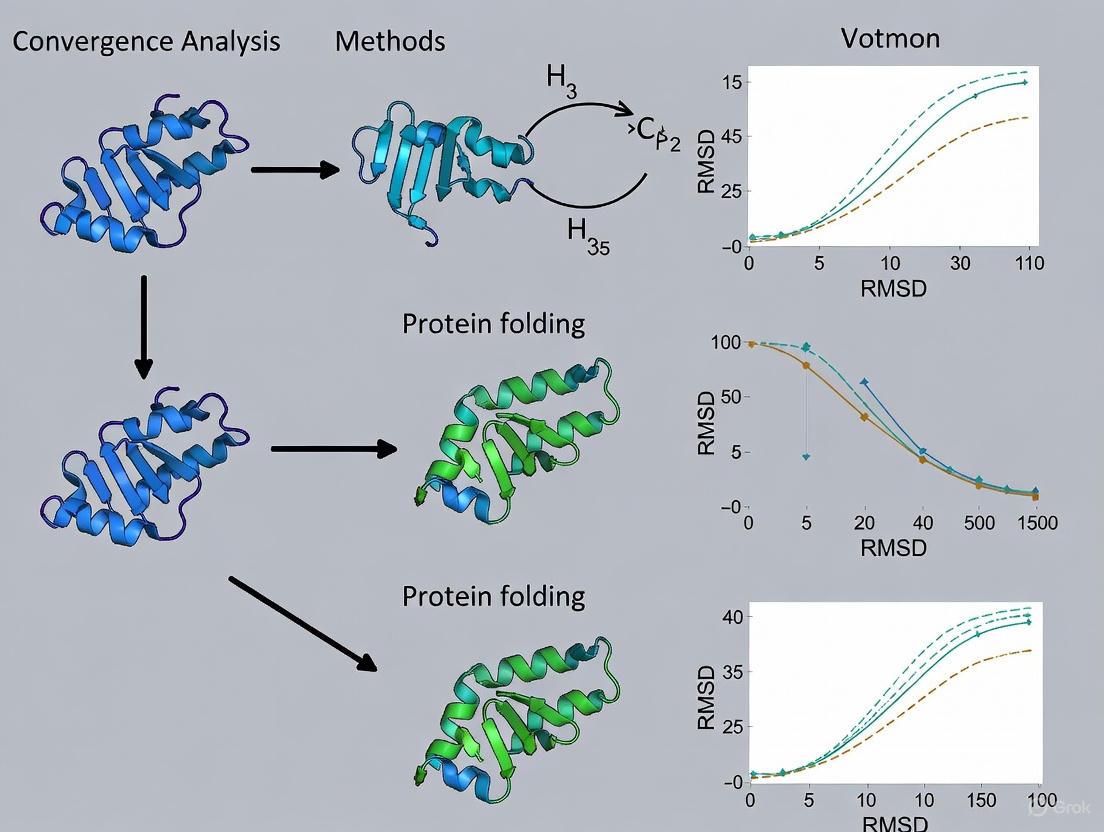
This article provides a comprehensive guide to convergence analysis for protein folding trajectories, a critical step for ensuring the reliability of computational studies.
Convergence Analysis in Protein Folding: A Guide to Validating Trajectories from MD Simulations to Machine Learning
Abstract
This article provides a comprehensive guide to convergence analysis for protein folding trajectories, a critical step for ensuring the reliability of computational studies. It covers the foundational importance of convergence, details key methodological approaches from traditional metrics to novel contact-map analyses, and addresses common troubleshooting scenarios. Furthermore, it presents a framework for the rigorous validation and comparative assessment of folding pathways, synthesizing insights from molecular dynamics, enhanced sampling, and deep learning methods like AlphaFold to empower researchers in making robust, biologically meaningful conclusions.
Why Convergence Matters: The Critical Role of Equilibrium in Protein Folding Simulations
Defining Convergence and Equilibrium in the Context of Biomolecular Simulations
Frequently Asked Questions (FAQs)
Q1: What is the practical difference between a converged simulation and one that has reached equilibrium?
In biomolecular simulations, equilibrium is a thermodynamic state where the system's properties no longer change systematically with time, and it explores its conformational space with correct Boltzmann-weighted probabilities. Convergence, however, refers to the practical assessment that your simulation has run long enough to provide reliable estimates for the specific properties you are measuring. A simulation can be at equilibrium (not systematically drifting) but still be unconverged if it hasn't sampled a sufficient number of independent configurations to reduce statistical error for your observable of interest [1] [2].
Q2: How can I detect if my simulation is trapped in a local energy minimum rather than exploring the true equilibrium distribution?
A key indicator is a lack of transitions between distinct conformational states. Monitor multiple order parameters (e.g., RMSD of different domains, radius of gyration, specific distances) and check if they fluctuate around a stable average and show reversible transitions. If your simulation remains in one narrow set of structures while experimental data or other simulations suggest greater flexibility, it is likely trapped. Using the structural histogram method to see if the populations of identified states stabilize over time can also diagnose this issue [2].
Q3: Why do my simulations sometimes show good convergence for some properties (e.g., energy) but not for others (e.g., a specific residue distance)?
Different properties have different correlation times and depend on different aspects of the conformational sampling. Global properties, such as total energy, often converge faster because they are averaged over the entire system and may be insensitive to slow, large-scale conformational changes. Local properties, especially those involving collective motions or transitions between metastable states, can have much longer timescales and thus require significantly more sampling to converge [1] [2]. This is a manifestation of "partial equilibrium."
Q4: Recent co-folding deep learning models like AlphaFold3 show remarkable accuracy. Can I use them to validate the native states from my folding simulations?
While these models are powerful and accurate for many protein-ligand complexes, they should be used with caution. Recent research has shown that these deep learning models can be susceptible to adversarial examples and may not always learn the underlying physics. For instance, they may incorrectly predict a ligand remains bound even when key binding site residues are mutated to residues that would destroy the interaction in reality [3]. They can also exhibit biases toward orthosteric sites seen in training data, potentially missing allosteric binding pockets [4]. They are excellent tools, but their predictions, especially in novel situations, should not be considered a ground-truth replacement for experimental validation or physically robust simulations.
Troubleshooting Guides
Diagnosis: Suspected Non-Convergence in Protein Folding Trajectories
Symptoms:
- Erratic or drifting values for root-mean-square deviation (RMSD), radius of gyration, or energy.
- Inability to replicate known experimental observables (e.g., NMR order parameters, FRET distances).
- Lack of reversible transitions between different conformational states in the free energy landscape.
Solutions:
- Extend Simulation Time: The most straightforward solution. For large proteins, folding events and full conformational sampling can require simulations spanning microseconds to milliseconds [5] [6].
- Employ Enhanced Sampling Techniques: If microsecond-scale simulations are not feasible, use methods like replica exchange molecular dynamics (REMD) or metadynamics to accelerate sampling over energy barriers.
- Run Multiple Independent Replicas: Initiate several simulations from different initial conditions (e.g., different velocities, unfolded states). Convergence is more credible when multiple replicas yield similar ensemble averages and distributions [2].
- Apply a Robust Convergence Metric: Use the structural decorrelation time (τdec) method [2]. This involves:
- Constructing a structural histogram by classifying frames in your trajectory against randomly selected reference structures.
- Determining the minimum time interval
τbetween frames such that the selected sub-sample behaves like a set of independent and identically distributed configurations. - The effective sample size is then approximately the total simulation time divided by
τdec. A large effective sample size indicates better convergence.
Diagnosis: Handling "Partial Equilibrium" in Large Protein Systems
Symptoms:
- The protein's core appears stable and converged, but flexible loops or terminal domains show continuous drift.
- Simulations of multi-domain proteins show converged intra-domain motions but unconverged inter-domain orientations.
Solutions:
- Define "Convergence for Purpose": Acknowledge that full convergence for all properties may be unattainable. Focus on the convergence of the specific properties relevant to your biological question [1].
- Targeted Analysis: If you are interested in a binding site, analyze convergence metrics specifically for residues in that pocket, rather than global RMSD.
- Use Multi-Microsecond Trajectories: Recent studies indicate that while some properties converge on the microsecond timescale, others (like transition rates to rare states) may require much longer [1]. The table below summarizes convergence behaviors for different properties from a study of multi-microsecond trajectories [1].
Table 1: Convergence Timescales for Different Biomolecular Properties
| Property Type | Example Metrics | Typical Convergence Timescale | Notes |
|---|---|---|---|
| Structural & Dynamical | Secondary structure stability, local residue fluctuations | Microseconds | Properties of most biological interest tend to converge in multi-µs trajectories [1]. |
| Cumulative Average Properties | Mean distance, average energy | Microseconds | Depends mostly on high-probability regions of conformational space [1]. |
| Transition Rates / Rare Events | Kinetics of folding/unfolding, conformational switching | Milliseconds or longer | Requires sampling of low-probability states; most challenging to converge [1]. |
Experimental Protocols
Protocol: Assessing Convergence Using Structural Decorrelation Time
Objective: To quantitatively determine the structural decorrelation time (τdec) of a molecular dynamics trajectory, thereby calculating its effective sample size [2].
Materials:
- A molecular dynamics trajectory file (e.g., in DCD or XTC format).
- Molecular visualization and analysis software (e.g., VMD, MDAnalysis).
- A custom analysis script implementing the steps below.
Method:
- Trajectory Preprocessing: Align the trajectory to a reference structure to remove global rotation and translation.
- Reference Structure Selection: Randomly select a set of
Msnapshot structures from the trajectory to serve as reference points for structural classification. - Structural Histogram Construction: For every frame
iin the trajectory, calculate the Root Mean Square Deviation (RMSD) to each of theMreference structures. Assign frameito the bin corresponding to the reference structure it is most similar to (lowest RMSD). This creates a structural histogram where each bin's population is the number of frames closest to a given reference. - Calculate τdec: Systematically create sub-samples of your trajectory by taking frames at increasing time intervals
ΔT. For eachΔT, treat the selected frames as a potential independent sample. - Statistical Test: For each
ΔT, calculate the variance in the bin populations across different subsets of the sample. Compare this variance to the theoretically expected variance for a truly independent and identically distributed (i.i.d.) sample. - Identify τdec: The smallest value of
ΔTfor which the observed variance matches the theoretical i.i.d. variance is the structural decorrelation time,τdec.
Interpretation: The effective number of independent samples in your trajectory of length T is N_eff = T / τdec. This N_eff should be used to estimate the true statistical error of averages computed from the trajectory. A small N_eff indicates poor convergence and that the simulation length is insufficient for reliable statistical conclusions [2].
Protocol: Testing the Physical Robustness of Co-folding Predictions
Objective: To evaluate whether a deep learning-based co-folding model (e.g., AlphaFold3, RoseTTAFold All-Atom) has learned physiochemical principles or is overfitting to patterns in its training data [3].
Materials:
- A high-resolution protein-ligand complex structure (e.g., from the PDB).
- Access to a co-folding model.
- Structure visualization software (e.g., PyMol).
Method:
- Baseline Prediction: Run the co-folding model on the wild-type protein and ligand sequence to establish a baseline prediction accuracy.
- Binding Site Mutagenesis:
- Challenge 1 (Removal): Mutate all key binding site residues to glycine, removing side-chain interactions but creating a sterically permissive cavity. Submit the mutated sequence and the same ligand to the model.
- Challenge 2 (Occlusion): Mutate all key binding site residues to bulky residues like phenylalanine, which should sterically occlude the original binding pocket. Submit this sequence and the ligand to the model.
- Analysis:
- Calculate the RMSD of the predicted ligand pose compared to the wild-type prediction and the original crystal structure.
- Check for steric clashes between the mutated residues and the predicted ligand pose.
- Visually inspect if the model still places the ligand in the original, now non-existent or occluded, binding site.
Interpretation: A model that understands physics is expected to predict the ligand being displaced or adopting a completely different pose when its binding site is removed or occluded. A model that consistently places the ligand in the original site despite these physically unrealistic mutations is likely overfitting or relying heavily on memorized patterns from its training data rather than generalizable physical principles [3].
The Scientist's Toolkit
Table 2: Essential Research Reagents and Computational Tools
| Item / Software | Function / Application | Key Features / Notes |
|---|---|---|
| Molecular Dynamics Software | Simulate the physical movements of atoms over time. | GROMACS, AMBER, NAMD, OpenMM. The choice depends on system size, force field, and hardware. |
| Co-folding Models | Predict protein-ligand complex structures from sequence. | AlphaFold3, RoseTTAFold All-Atom, NeuralPLexer, Boltz-1. Useful for generating hypotheses but may have physical robustness limitations [3] [4]. |
| ARTEMIS | Analyze communication networks in biomolecules using Mutual Information. | Python/C++ tool for identifying allosteric pathways and critical residues from MD or MSA data [7]. |
| Structure-Based Models (SBM) | Simulate protein folding using native-centric potentials. | Useful for studying folding mechanisms and the effects of native topology on folding, with lower computational cost than all-atom MD [5]. |
| Convergence Analysis Scripts | Implement metrics like structural decorrelation time. | Custom scripts (e.g., in Python) are often needed to implement advanced metrics like τdec [2]. |
Workflow and Pathway Diagrams
FAQs: Understanding Non-Convergence in Protein Folding
What does a "non-converged trajectory" mean in the context of protein folding? A non-converged trajectory refers to a computational simulation or prediction that has failed to reach a stable, reliable endpoint representing the protein's native state or a correct intermediate. Instead of settling into a low-energy, biologically relevant conformation, the model may produce results with significant steric clashes, incorrect binding poses, or other unphysical artifacts, indicating a failure to properly simulate the folding process or protein-ligand interaction [3].
Why should I be concerned about non-convergence in my protein-ligand binding predictions? Non-converged predictions can be dangerously misleading. A 2025 study demonstrated that even state-of-the-art co-folding models like AlphaFold3 and RoseTTAFold All-Atom can produce seemingly high-quality ligand binding poses (e.g., with low RMSD) even when critical binding site residues are mutated to glycine or phenylalanine, completely altering the site's chemistry and shape [3]. This indicates the model is overfitting to statistical patterns in its training data rather than learning the underlying physics of the interaction. Relying on such predictions for drug discovery could lead to incorrect conclusions about biological activity and binding affinity [3].
What are the practical consequences of using results from non-converged models? The consequences are particularly severe in applied fields like drug discovery and protein engineering. Incorrect structural predictions can derail research by:
- Providing a false understanding of biological activity and binding specificity [3].
- Leading to incorrect conclusions about binding affinity [3].
- Wasting significant resources on experimental validation of faulty predictions.
Troubleshooting Guide: Diagnosing and Addressing Non-Convergence
Common Problems and Research Reagent Solutions
The table below outlines frequent issues and the materials or methods to resolve them.
| Problem Category | Specific Issue | Research Reagent / Methodological Solution | Function of the Solution |
|---|---|---|---|
| Input & System Preparation | Biologically implausible system (e.g., unrealistic mutations) | Adversarial Testing Protocols [3] | Tests model robustness by introducing biophysically sound perturbations to input sequences. |
| Sampling & Energetics | Rugged or overly complex energy landscape | Enhanced Sampling Algorithms [8] | Improves exploration of conformational space beyond local energy minima. |
| Inaccurate energy evaluation | Molecular Dynamics with Explicit Solvent [8] | Provides a more physically realistic energy function, including protein-solvent interactions. | |
| Numerical & Physical Parameters | Large discrepancies in adjacent cell properties (in grid-based methods) | Grid-Smoothing Features [9] | Reduces sharp discontinuities in the simulation landscape that can prevent convergence. |
| Lack of lateral continuity between elements | Cell Rewetting Option [9] | Helps resolve issues with dry cells or discontinuity in the model domain. |
Detailed Experimental Protocols for Convergence Analysis
Protocol 1: Binding Site Mutagenesis Test for Co-folding Models
Objective: To evaluate whether a deep learning model for protein-ligand structure prediction learns the underlying physical principles or merely memorizes statistical patterns from its training data [3].
Methodology:
- Select a Protein-Ligand Complex: Choose a high-resolution structure from the PDB (e.g., ATP-bound CDK2) [3].
- Establish a Baseline: Run the co-folding model (e.g., AlphaFold3, RoseTTAFold All-Atom) with the wild-type sequence and confirm it can accurately reproduce the native pose.
- Design Adversarial Challenges: Systematically mutate the binding site residues and observe the model's predictions [3]:
- Challenge A (Binding Site Removal): Mutate all binding site residues to glycine to remove side-chain interactions.
- Challenge B (Steric Occlusion): Mutate all binding site residues to phenylalanine to occupy the physical space of the pocket.
- Challenge C (Chemical Inversion): Mutate each residue to a chemically dissimilar amino acid (e.g., acidic to basic, hydrophobic to polar).
- Analysis: Measure the Root-Mean-Square Deviation (RMSD) of the predicted ligand pose against the wild-type prediction. Critically, check for:
- Persistence of the ligand in the original binding site despite the loss of favorable interactions.
- Presence of unphysical steric clashes [3].
- Failure of the model to displace the ligand in response to steric occlusion.
Interpretation: A model that robustly understands physics should displace the ligand in these scenarios. A model that continues to place the ligand in the mutated pocket is likely overfitted and its predictions for novel systems should be treated with caution [3].
Protocol 2: Assessing Energy Landscape Sampling
Objective: To determine if a simulation has adequately sampled the conformational space to reach a thermodynamically stable state.
Methodology:
- Run Multiple Independent Trajectories: Initiate several simulations from different, unrelated starting conformations.
- Monitor Convergence Metrics: Track observables like Radius of Gyration (Rg), Root-Mean-Square Deviation (RMSD) from a reference structure, and the number of native contacts over time.
- Compare Distributions: At the end of the simulation time, compare the distributions of these key observables across all independent trajectories.
- Analysis: The system is considered converged when the distributions of key observables from different trajectories are statistically indistinguishable, indicating they are sampling from the same underlying equilibrium distribution.
Quantitative Data: Model Performance Under Adversarial Conditions
The following table summarizes the performance of various co-folding models when subjected to binding site mutagenesis, as documented in a recent study. The RMSD values are for the predicted ATP ligand pose in CDK2 after mutation [3].
| Model | Wild-Type RMSD (Å) | All-Glycine Mutation | All-Phenylalanine Mutation | Dissimilar Residue Mutation |
|---|---|---|---|---|
| AlphaFold3 | 0.2 Å | Ligand persists in binding site; precise placement lost [3]. | Ligand biased towards original site; steric clashes present [3]. | Ligand pose not significantly altered [3]. |
| RoseTTAFold All-Atom | 2.2 Å | Ligand persists; slight accuracy "improvement" (RMSD: 2.0 Å) [3]. | ATP remains entirely within the original binding site [3]. | Significant steric clashes in predictions [3]. |
| Chai-1 | Information Not Available | Ligand pose mostly unchanged [3]. | ATP remains entirely within the original binding site [3]. | Ligand pose not significantly altered [3]. |
| Boltz-1 | Information Not Available | Triphosphate placed in a slightly different position [3]. | Predictions show some adaptation but remain biased [3]. | Information Not Available |
Diagrams and Workflows
Energy Landscape of Protein Folding
Adversarial Testing Workflow for Co-folding Models
Frequently Asked Questions (FAQs)
FAQ 1: My simulations show a converging folding pathway, but the final predicted structure has unphysical steric clashes. What is the likely cause? This is a recognized limitation in some deep-learning-based co-folding models. Research indicates that despite high overall accuracy, these models can sometimes overfit to statistical patterns in their training data rather than learning the underlying physical principles. When presented with novel sequences or mutations not well-represented in the training set, the model may generate structures that violate steric constraints, as it prioritizes pattern recognition over physical plausibility [3].
FAQ 2: How can I determine if a predicted folding intermediate is biologically relevant or a computational artifact? A predicted intermediate's biological relevance should be assessed by its consistency with established physical and chemical principles. Artifacts often manifest as states that are not on a continuous, energetically favorable funnel toward the native state. You can test robustness by running simulations with slight perturbations; biologically relevant intermediates should be reproducible and stable, whereas artifacts may disappear. Furthermore, compare the intermediate's properties against experimental data, such as phi-values from protein engineering studies, which can provide independent validation of the structure of the transition state [8].
FAQ 3: Why does my convergence analysis suggest a single pathway, while experimental evidence indicates heterogeneity? Your analysis might be overlooking the ruggedness of the protein folding energy landscape. The energy landscape theory posits that a protein folds by navigating a funnel-shaped landscape that is often rugged, containing multiple minima and barriers. A single dominant pathway in analysis could result from insufficient sampling or an energy function that does not fully capture the delicate balance of forces. Enhancing sampling and employing energy functions that accurately reflect the contributions of hydrophobic interactions, hydrogen bonding, and van der Waals forces can help reveal the multiple pathways that constitute the folding mechanism [10] [8].
FAQ 4: What is the best way to validate the convergence of my folding trajectories? Convergence should be validated using multiple, orthogonal metrics. Key methods include:
- Cluster Analysis: Monitor the root-mean-square deviation (RMSD) of structures across different trajectories and assess if they cluster around a limited set of native-like states.
- Energy Time-Series: Track the potential energy of the system over time; convergence is suggested when energies from independent trajectories fluctuate around the same average value.
- Order Parameter Correlation: Calculate the correlation of key order parameters (e.g., radius of gyration, native contacts) between replicate simulations. High correlation indicates convergence. It is critical to initiate trajectories from different unfolded states to ensure the convergence is not a result of starting from a similar configuration [8].
Troubleshooting Guides
Issue 1: Handling Non-Converging Folding Trajectories
Problem: Simulated trajectories fail to converge on a common folded state or pathway, resulting in high structural variability.
| Potential Cause | Diagnostic Steps | Solution |
|---|---|---|
| Insufficient Sampling [8] | 1. Calculate the RMSD over time from multiple independent runs.2. Check if the number of native contacts plateaus at different values across runs. | Increase simulation time. Employ enhanced sampling techniques (e.g., replica exchange molecular dynamics, metadynamics) to overcome kinetic barriers and explore conformational space more efficiently [8]. |
| Inaccurate Energy Function [8] | Compare the stability of known native structures with misfolded decoys using your energy function. | Utilize a more refined energy function that better accounts for solvation effects (implicit or explicit solvent) and key interactions like hydrogen bonding and hydrophobic forces [10] [8]. |
| Over-reliance on a Single Starting Conformation | Initiate simulations from a diverse set of extended or partially folded structures. | Always use multiple, structurally distinct starting points for simulations to ensure the observed convergence is robust and not an artifact of the initial conditions. |
Issue 2: Interpreting the Biological Significance of Converged Pathways
Problem: Trajectories have converged, but the relationship between the dominant pathway and the protein's biological function is unclear.
| Potential Cause | Diagnostic Steps | Solution |
|---|---|---|
| Ignoring the Proteostasis Network [11] | Review literature for known chaperones or folding facilitators that interact with your protein of interest. | Frame your computational results within the cellular context. The dominant in vitro pathway may be assisted or altered in vivo by chaperones like HSP70 or GroEL/ES [11]. |
| Misinterpreting a Kinetic Trap | Analyze the energy landscape of the converged pathway for deep, off-native minima. | Use committor analysis to determine if a commonly observed intermediate is a true on-pathway intermediate or a kinetic trap. Experimentally, this can be tested by measuring folding rates under different conditions. |
| Lack of Connection to Function | Map critical functional residues (e.g., catalytic sites) onto the folding pathway. | Determine when in the folding pathway these functional motifs assemble. A pathway is more biologically relevant if it ensures the early and protected formation of functionally critical elements [10]. |
Table 1: Performance of Computational Folding and Docking Methods
Table comparing the accuracy of various structure prediction tools on specific tasks. [3]
| Method | Type | Task Description | Accuracy Metric | Result |
|---|---|---|---|---|
| AlphaFold3 | Deep Learning Co-folding | Blind docking of small molecules (PoseBusterV2) | Native pose within 2Å RMSD | ~81% |
| DiffDock | Deep Learning Docking | Blind docking of small molecules | Native pose within 2Å RMSD | ~38% |
| AutoDock Vina | Physics-based Docking | Docking with known binding site | Native pose within 2Å RMSD | ~60% |
| AlphaFold3 | Deep Learning Co-folding | Docking with known binding site | Native pose within 2Å RMSD | >93% |
Table 2: Key Forces in Protein Folding Thermodynamics
Summary of the major stabilizing forces in protein folding and their characteristics. [10]
| Force / Interaction | Estimated Contribution Strength | Role in Folding Code | Experimental Evidence |
|---|---|---|---|
| Hydrophobic Effect | 1-2 kcal/mol per side chain | Dominant driving force; promotes collapse and non-polar core formation | Transfer model studies; denaturation in non-polar solvents [10] |
| Hydrogen Bonding | 1-4 kcal/mol per bond | Critical for secondary structure stability and specificity | Mutational studies in different solvents [10] |
| van der Waals | Contributes significantly | Important for tight packing and specificity in the native state | Observation of dense, well-packed protein cores [10] |
| Electrostatic | Typically small effects | Contributes to stability and surface solubility; often context-dependent | Limited effects from charge mutations on stability [10] |
Experimental Protocols
Protocol 1: Adversarial Testing for Physical Robustness in Co-folding Models
Purpose: To evaluate whether a deep-learning-based co-folding model has learned the underlying physics of protein-ligand interactions or is overfitting to its training data [3].
Methodology:
- Select a Benchmark Complex: Choose a high-resolution protein-ligand structure from the PDB (e.g., ATP-bound CDK2).
- Generate Wild-Type Prediction: Run the co-folding model (e.g., AlphaFold3, RoseTTAFold All-Atom) with the native sequence to establish a baseline RMSD.
- Design Adversarial Mutations:
- Binding Site Removal: Mutate all binding site residues to glycine to strip away side-chain interactions.
- Binding Site Occlusion: Mutate all binding site residues to bulky residues (e.g., phenylalanine) to sterically block the pocket.
- Chemical Property Inversion: Mutate residues to chemically dissimilar ones (e.g., positively charged to negatively charged).
- Run Predictions and Analyze: Predict the structure for each mutated sequence and calculate the ligand RMSD compared to the wild-type prediction.
- Key Analysis Metrics: Ligand placement and pose, presence of steric clashes, and retention of favorable interactions despite their physical impossibility in the mutated context [3].
Protocol 2: Assessing Pathway Heterogeneity via Committor Analysis
Purpose: To determine if a commonly observed intermediate structure is a true on-pathway intermediate or a kinetic trap.
Methodology:
- Identify the Intermediate: From a set of folding trajectories, identify a recurrent non-native structural state (Intermediate I).
- Define the Reaction Coordinate: Establish an order parameter that distinguishes the unfolded state (U), Intermediate I, and the native state (N).
- Sample the Isocommittor Surface: Launch a large number (e.g., 100) of short, unbiased molecular dynamics simulations starting from configurations of Intermediate I.
- Calculate the Committor Probability: For each short simulation, record whether it reaches the native state (N) before the unfolded state (U). The committor probability (p-fold) is the fraction of simulations that fold to N.
- Interpretation:
- A true on-pathway intermediate will have a p-fold of ~0.5.
- A kinetic trap (off-pathway state) will have a p-fold close to 0.
Pathway and Workflow Visualizations
Folding Funnel Landscape
Adversarial Testing Workflow
The Scientist's Toolkit: Research Reagent Solutions
Table 3: Essential Reagents for Protein Folding and Convergence Analysis
| Reagent / Material | Function / Application |
|---|---|
| Molecular Chaperones (e.g., GroEL/ES, HSP70) | Assist in protein folding in vivo by preventing aggregation, providing a protected environment for folding, and rescuing misfolded proteins [11]. |
| Denaturants (e.g., Urea, GdnHCl) | Chemically denature proteins to create unfolded starting states for refolding experiments; used to measure folding stability and create chevron plots for kinetic analysis. |
| Fluorescent Dyes (e.g., ANS) | Bind to hydrophobic patches and are used to detect the formation of molten globule states or aggregation during folding experiments. |
| Stable Isotope-Labeled Amino Acids | Incorporated into proteins for Nuclear Magnetic Resonance (NMR) spectroscopy, allowing for residue-level probing of structure and dynamics in folding intermediates [11]. |
| Deep Learning Co-folding Models (e.g., AF3) | Predict the 3D structure of protein-ligand complexes from sequence and ligand SMILES strings; useful for generating structural hypotheses and assessing binding modes [3]. |
Frequently Asked Questions (FAQs) and Troubleshooting Guides
FAQ 1: What constitutes a "converged" protein folding simulation, and how can I measure it?
Answer: Convergence in protein folding simulations means that your sampling of the protein's energy landscape is sufficient to reproduce stable, statistically significant structural ensembles and thermodynamic properties. In the context of convergence analysis for folding trajectories, a lack of convergence often stems from the "rare event problem," where simulations get trapped in local energy minima and fail to observe transitions to the global minimum or other important states within practical timescales [12].
To diagnose and measure convergence, we recommend:
- Compare Multiple Independent Trajectories: Initiate several simulations from different starting conditions (e.g., fully unfolded, partially folded, native state). Convergence is indicated when properties like radius of gyration (Rg), root-mean-square deviation (RMSD), and secondary structure content stabilize and show overlap across all trajectories [13].
- Monitor Key Observables Over Time: Plot observables like potential energy, Rg, or native contacts as a function of simulation time. A system that has not converged will show secular drifts in these values, whereas a converged system will fluctuate around a stable average.
- Analyze State Populations: Use clustering algorithms to identify dominant conformational states. Convergence is achieved when the populations of these states remain constant over time and across independent replicates.
Troubleshooting Guide: Non-Converging Trajectories
| Symptom | Possible Cause | Solution |
|---|---|---|
| Trajectories remain stuck in a single, non-native conformation. | High energy barriers separating metastable states; insufficient simulation time. | Employ advanced sampling techniques like metadynamics or parallel tempering to enhance barrier crossing [13]. |
| Large variability in computed free energies between replicates. | Inadequate sampling of the full conformational ensemble. | Use ensemble-based restraints from methods like AlphaFold-Metainference to guide sampling towards experimentally consistent regions [13]. |
| Simulations fail to reach the experimentally known native state. | Inaccurate force field parameters or over-stabilization of non-native interactions. | Validate against experimental data (e.g., SAXS, NMR chemical shifts) and consider using a refined force field [13] [12]. |
FAQ 2: How can I extract meaningful data on transient folding intermediates from my simulations?
Answer: Transient intermediates are low-population, short-lived states that are crucial yet difficult to characterize. Specialized experimental-computational hybrid approaches are required.
- Experimental Restraints: Integrate experimental data directly into your simulations. For example, AlphaFold-Metainference uses predicted inter-residue distances from AlphaFold as restraints in molecular dynamics simulations to construct structural ensembles, including for disordered states and intermediates [13].
- Pressure-Jump NMR: This technique, combined with MD, can populate and characterize metastable intermediates. A rapid pressure drop initiates folding, and NMR measurements taken milliseconds later capture the intermediate's structure, which can be refined with computational tools like CS-Rosetta [12].
- Hydrogen-Deuterium Exchange Mass Spectrometry (HDX-MS): HDX-MS measures the energy of residue-level conformational fluctuations. Multiplexed HDX-MS (mHDX-MS) can do this for hundreds of protein domains in parallel, providing a large-scale dataset of opening energies (( \Delta G_{open} )) that reveal excited states invisible to other methods [14].
Troubleshooting Guide: Characterizing Intermediates
| Symptom | Possible Cause | Solution |
|---|---|---|
| Inability to detect or resolve intermediate states. | Low population and short lifetime of intermediates under native conditions. | Apply physical perturbations like pressure- or temperature-jumps to significantly populate these states for study [12]. |
| Predicted structural ensemble conflicts with experimental data (e.g., SAXS). | The simulation ensemble is incomplete or biased. | Use maximum entropy metainference, which restrains simulations to be consistent with experimental data while accounting for its uncertainty [13]. |
| High uncertainty in the atomic model of an intermediate. | Sparse experimental data for the transient state. | Combine multiple data sources (chemical shifts, NOEs, residual dipolar couplings) for integrated structural refinement [12]. |
FAQ 3: My thermal shift assay (TSA) shows irregular melt curves. How can I improve data quality?
Answer: Irregular melt curves in Differential Scanning Fluorimetry (DSF) or Cellular Thermal Shift Assays (CETSA) are common and often related to buffer composition or compound properties [15].
Troubleshooting Guide: Thermal Shift Assay Issues
| Symptom | Possible Cause | Solution |
|---|---|---|
| Noisy or erratic fluorescence signal in DSF. | Fluorescent dye is incompatible with buffer additives (e.g., detergents, high viscosity agents). | Optimize buffer composition. Use dye compatibility charts and avoid compounds that increase background fluorescence [15]. |
| "Bumpy" or multi-phasic melt curves. | Intrinsic fluorescence of the test compound or compound-dye interactions. | Include control wells with compound but no protein. Switch to a label-free method like Protein Thermal Shift Assay (PTSA) if issues persist [15]. |
| No stabilization shift is observed in CETSA, despite known binder. | The test compound cannot efficiently cross the cell membrane in whole-cell assays. | Confirm membrane permeability of the compound. Use cell lysate CETSA to bypass the membrane barrier [15]. |
| Poor protein detection in PTSA/CETSA Western blots. | Protein degradation or insufficient antibody specificity. | Include protease inhibitors and validate antibodies. Use a highly heat-stable loading control like SOD1 or APP-αCTF [15]. |
Essential Methodologies for Convergence and Energy Landscape Analysis
Methodology 1: AlphaFold-Metainference for Ensemble Prediction
This method integrates deep learning predictions with molecular dynamics to generate structurally accurate ensembles for both ordered and disordered protein regions [13].
- Input: Protein amino acid sequence.
- AlphaFold Prediction: Run AlphaFold to obtain a distogram (predicted distance map) for the sequence.
- Restraint Setup: Convert the AlphaFold-predicted distances into a set of harmonic restraints for use in MD simulations.
- Metainference Simulation: Run MD simulations using a metainference framework, which applies the AlphaFold-derived restraints according to the maximum entropy principle. This generates a structural ensemble consistent with the predicted distances.
- Validation: Validate the resulting ensemble against experimental data, such as SAXS profiles or NMR chemical shifts [13].
Methodology 2: Multiplexed HDX-MS for Large-Scale Energy Landscape Mapping
This high-throughput method measures the opening energies (( \Delta G_{open} )) for hundreds of protein domains simultaneously, revealing details of conformational fluctuations [14].
- Library Construction: Synthesize a DNA oligo pool library encoding hundreds to thousands of small protein domains (e.g., 28–64 amino acids).
- Expression and Purification: Express and purify all domains as a single complex mixture from E. coli.
- Deuterium Exchange: Incubate the protein mixture in D₂O for a series of time points (e.g., 25 seconds to 24 hours) across different pH values, then quench the reaction.
- Mass Spectrometry: Analyze each time point using liquid chromatography-ion mobility-mass spectrometry (LC-IMS-MS).
- Data Analysis: Use a computational pipeline with Bayesian inference to deconvolute overlapping isotopic distributions and infer the exchange rates (( k_{HX} )) for each domain.
- Energy Calculation: Calculate the approximate opening energy (( \Delta G_{open} )) distribution for each domain from its exchange rates, which reports on the energies of excited conformational states [14].
Research Reagent Solutions
A table of key materials and their functions in the featured experiments.
| Reagent / Material | Function in Research |
|---|---|
| AlphaFold-Metainference Server/Code | Provides a framework for integrating AlphaFold distance predictions into molecular dynamics simulations to generate structural ensembles [13]. |
| Polarity-Sensitive Fluorescent Dye (e.g., SyproOrange) | Used in DSF to track protein unfolding by binding to exposed hydrophobic residues, resulting in a fluorescence increase [15]. |
| Deuterium Oxide (D₂O) | The labeling agent in HDX-MS experiments; allows measurement of hydrogen exchange rates from which protein dynamics and opening energies are derived [14]. |
| Heat-Stable Loading Control Proteins (e.g., SOD1, APP-αCTF) | Essential for PTSA and CETSA Western blot normalization; these proteins remain stable at high temperatures, ensuring accurate quantification of target protein melting [15]. |
| Pressure-Jump NMR Apparatus | Enables rapid (< few ms) cycling of hydrostatic pressure to populate folding intermediates for high-resolution structural study by NMR [12]. |
Workflow and Pathway Visualizations
Protein Folding Analysis Workflow
TSA Experimental Decision Pathway
A Methodologist's Toolkit: From Traditional Metrics to Advanced Sampling for Convergence
Frequently Asked Questions (FAQs)
Q1: My RMSD values remain high throughout the simulation. Does this always mean my protein is unstable or failed to fold? Not necessarily. High RMSD can indicate instability, but it could also signify a conformational change or that the protein has settled into a stable, non-native fold. You should:
- Cross-validate with other metrics: Check the Radius of Gyration (Rgyr) and total energy. A stable, compact fold will have low, stable Rgyr and energy values even if RMSD is high [16].
- Investigate the trajectory visually: Use visualization software to inspect the structures corresponding to high RMSD values. They may reveal domain movements or alternative stable states.
- Consider the reference structure: Ensure you are using an appropriate native structure for RMSD calculation. If the native state is unknown, consider using reference-free methods like moving RMSD (mRMSD) [16].
Q2: The energy of my system is low and stable, but the RMSD is fluctuating wildly. Which metric should I trust? This discrepancy suggests your protein is sampling different conformations that are energetically favorable. A stable, low energy is a positive sign, but the high RMSD fluctuations require further investigation.
- Interpretation: The protein may be transitioning between different metastable states or undergoing localized fluctuations that do not significantly impact the global energy.
- Action: Perform a cluster analysis on your trajectory to identify the dominant conformations. Calculate the energy and Rgyr for each cluster to determine if the fluctuating states are compact, low-energy folds or unstructured states [17].
Q3: How can I determine if my folding simulation has converged and sampled enough of the conformational landscape? Convergence is a major challenge in protein folding simulations. Relying on a single metric like RMSD is insufficient.
- Multi-metric stability: Look for stability not just in RMSD, but also in Rgyr, total energy, and secondary structure content over a significant portion of the simulation time.
- Enhanced sampling: For complex proteins, standard MD may be inadequate. Use advanced sampling techniques like Hamiltonian Replica Exchange MD (H-REMD) to improve conformational sampling and better assess convergence [17].
- Repeat simulations: Run multiple independent simulations starting from different initial conditions (e.g., unfolded states). If they all converge to similar structural and energetic states, you have stronger evidence for convergence.
Troubleshooting Guides
Issue 1: Interpreting Contradictory Metric Behavior
Symptoms:
- RMSD suggests instability, but Rgyr indicates a stable, compact structure.
- Energy is low and stable, but RMSD is high.
Diagnosis and Resolution:
Table 1: Diagnosing Contradictory Metrics in Folding Simulations
| Observed Pattern | Potential Interpretation | Recommended Actions |
|---|---|---|
| High RMSD, Low & Stable Rgyr | The protein may be folded into a stable, compact structure that is structurally distinct from the reference (native) state used for RMSD calculation [16]. | 1. Visually inspect the final structure.2. Calculate the protein's internal energy to confirm stability.3. If no native structure is known, use mRMSD to analyze dynamics without a reference. |
| High RMSD, High Rgyr | The protein is likely unfolded or in a partially folded, extended state. | 1. Confirm by analyzing secondary structure content.2. Check if the simulation time is sufficient for folding.3. Consider if the environmental conditions (e.g., temperature, pH) are denaturing. |
| Low & Stable Energy, Fluctuating RMSD | The system is sampling multiple low-energy conformations, potentially indicating a multi-state protein or the presence of metastable folding intermediates [17]. | 1. Perform cluster analysis to identify and characterize the dominant conformations.2. Plot energy versus RMSD to see if distinct clusters form.3. Use a method like trajectory maps to visualize the location and timing of structural shifts [18]. |
Issue 2: Inadequate Conformational Sampling
Symptom: The simulation appears trapped in a single conformational state, failing to observe folding or unfolding events.
Resolution: Implement Enhanced Sampling Protocols
Hamiltonian Replica Exchange MD (H-REMD) is a powerful method to overcome energy barriers. Below is a detailed protocol based on the analysis of protein stabilization "hot spots" [17].
Experimental Protocol: Hamiltonian Replica Exchange for Folding
- Objective: To enhance the sampling of folding/unfolding transitions by selectively perturbing the interactions of key stabilizing residues.
- Principle: Multiple replicas of the system are run in parallel with progressively modified force-field parameters for critical "hot spot" residues. Exchanges between replicas allow the system to escape local energy minima.
Workflow: Hamiltonian Replica Exchange MD
Table 2: Research Reagent Solutions for H-REMD
| Item | Function / Description | Example / Note |
|---|---|---|
| Molecular Dynamics Software | Software suite to perform MD simulations. | GROMACS [19], AMBER, NAMD. |
| Replica Exchange Plugin | Tool to implement the replica exchange protocol. | PLUMED (a community-developed plugin). |
| Force Field | Set of parameters defining interatomic potentials. | CHARMM36 [19], AMBER force fields. |
| Energy Decomposition Script | Custom code to perform eigenvector analysis on the energy matrix. | Identifies "hot spot" residues critical for stability [17]. |
| Solvent Model | Water molecules and ions to solvate the protein. | TIP3P water model [19]. |
Methodology Details:
- Identify Folding Hot Spots:
- Run a short MD simulation (e.g., 1-10 ns) of the folded protein in explicit solvent.
- Compute the non-bonded interaction energy matrix between all residues.
- Perform eigenvalue decomposition on this matrix. The residues with the highest components in the eigenvector associated with the lowest eigenvalue are the "hot spots" critical for stability [17].
- Set Up H-REMD:
- Create multiple replicas of the system.
- In the first replica, use the standard, unmodified force field.
- In subsequent replicas, apply a scaling factor (a "soft core" potential) to the non-bonded interaction parameters (both electrostatic and Lennard-Jones) of the identified hot spot residues. The scaling factor should gradually increase from replica to replica, making the native state progressively less stable [17].
- Run and Analyze Simulation:
- Run the H-REMD simulation, allowing exchanges between neighboring replicas at regular intervals.
- Analyze the trajectory from the first replica (with the standard force field). The enhanced sampling should reveal reversible folding and unfolding events, providing a view of the folding landscape [17].
Issue 3: Choosing the Right Metric for the Research Question
Symptom: Uncertainty about which time-series analyses to use, especially for non-standard systems like protein-ligand complexes or proteins with unknown native states.
Resolution: Select metrics based on the system properties and research goals.
Table 3: Guide to Selecting Protein Folding Metrics
| Research Context | Recommended Primary Metrics | Complementary Metrics | Rationale |
|---|---|---|---|
| Folding with Known Native Structure | RMSD (Cα atoms) [16], Total Energy [16] | Rgyr, Solvent Accessible Surface Area (SASA) | RMSD directly measures deviation from the target. Energy confirms thermodynamic stability. |
| Folding with Unknown Native Structure | Moving RMSD (mRMSD) [16], Rgyr | End-to-End Distance, Trajectory Maps [18] | mRMSD identifies stable states without a reference. Rgyr reports on compaction and collapse. |
| Ligand Binding/Protein-Ligand Complex Stability | Ligand RMSD, Protein-Ligand Interaction Energy [19] | Protein SASA, Trajectory Maps [18] | Ligand RMSD tracks pose stability. Interaction energy quantifies binding affinity. |
| Identifying Local Flexibility & Structural Shifts | Root Mean Square Fluctuation (RMSF) [19], Trajectory Maps [18] | Secondary Structure Analysis | RMSF pinpoints flexible regions. Trajectory maps visualize spatial and temporal shifts in the backbone [18]. |
Auto-Correlation Functions and Time-Averaged Property Analysis
Autocorrelation analysis is a computational technique used to extract essential dynamic and structural information from complex protein data, such as Nuclear Overhauser Effect Spectroscopy (NOESY) trajectories, without requiring prior assignment of all peaks. This method transforms raw spectral data into a quantitative measure of residue compactness, providing insights into both folded and unfolded protein states. The core principle involves self-convolution of individual traces from a 3D ¹⁵N NOESY-HSQC spectrum, generating an autocorrelation function for each backbone residue position. The resulting function reflects the characteristic spatial environment of a particular residue, which can then be quantified using spectral entropy as an information measure. This approach has proven particularly valuable for identifying local compaction in polypeptide chains and transiently formed structural elements that are difficult to characterize with traditional methods. [20]
Key Concepts and Theoretical Framework
Spectral Entropy and Residue Compactness
The autocorrelation function C(i)(ω) derived from the NOESY-trace for a specific backbone residue position i encodes information about its spatial environment. The spectral entropy S(ν) serves as the information measure quantifying this environment:
- Low Entropy Values: Characterize residues in hydrophobic core regions with tightly interacting side chains and distinct chemical shift patterns. These regions exhibit highly ordered, compact structures.
- High Entropy Values: Found in structurally loosely defined regions, indicating greater conformational flexibility and less defined spatial environments.
- Intermediate Applications: Effectively probe local compaction due to transiently formed structural elements and subtle changes in side-chain packing, even in unfolded proteins or protein complexes. [20]
Relationship to Protein Folding Kinetics
Autocorrelation analysis provides experimental data that complements theoretical models of protein folding kinetics. Research has demonstrated that folding kinetics can be classified in terms of σ = (Tθ – TF)/Tθ, where Tθ and TF are the equilibrium collapse and folding transition temperatures, respectively. This parameter correlates strongly with folding time (τF) and determines the dominant folding mechanism: [21]
- Small σ values: Proteins fold via a direct native conformation nucleation collapse (NCNC) mechanism without detectable intermediates.
- Moderate to Large σ values: Folding follows the kinetic partitioning mechanism, where only a fraction of molecules (Φ) fold directly via NCNC, while the remainder become trapped in misfolded structures.
- Energy Landscape Implications: Small σ values correspond to energy landscapes with one dominant native basin of attraction (NBA), while large σ values feature competing basins of attraction (CBAs) that trap molecules in misfolded structures. [21]
Experimental Protocols & Methodologies
Autocorrelation Analysis of NOESY Data
Objective: To determine residue-specific compactness in folded and unfolded proteins without NOE cross-peak assignments. [20]
Materials:
- Purified protein sample (uniformly ¹⁵N-labeled)
- NMR spectrometer with NOESY-HSQC capability
- NMR data processing software (e.g., NMRPipe, TopSpin)
- Custom scripts for autocorrelation calculation (e.g., Python, MATLAB)
Procedure:
- Data Collection: Acquire a 3D ¹⁵N NOESY-HSQC spectrum of the protein under study.
- Trace Extraction: For each amide group (residue position i), extract individual traces S(i)(ω) from the spectrum.
- Self-Convolution: Apply a self-convolution procedure to each trace S(i)(ω) to generate the autocorrelation function C(i)(ω) for each residue position.
- Entropy Calculation: Compute the spectral entropy S(ν) for each autocorrelation function as a quantitative measure of the spatial environment.
- Interpretation: Map entropy values onto the protein sequence/residue number. Low entropy indicates compact, structured regions; high entropy indicates flexible, loosely defined regions.
Troubleshooting:
- Poor Signal-to-Noise: Ensure adequate protein concentration and acquisition time.
- Ambiguous Traces: Verify sample purity and consider adjusting acquisition parameters.
Rate of Convergence Analysis for Folding Prediction
Objective: To identify potential fast-folding proteins from amino acid sequences without prior knowledge of the native state. [22]
Materials:
- Amino acid sequence(s) of interest
- Molecular dynamics simulation software (e.g., GROMACS, AMBER)
- Computing cluster for trajectory analysis
- Custom scripts for convergence rate calculation
Procedure:
- Simulation Setup: Initialize molecular dynamics simulations for each amino acid chain of interest.
- Partial Trajectory Generation: Run multiple short simulations, using only the very initial parts of dynamical trajectories.
- Convergence Calculation: For each chain, calculate the rate of convergence toward the native structure using the initial trajectory data.
- Folding Prediction: Rank sequences by their convergence rates; faster convergence indicates better folding propensity.
- Validation: Determine optimal folding temperature from the simulation data.
Advantages: This method requires at least 3-4 orders of magnitude fewer time steps than computing actual folding times, making it highly efficient for screening potential fast-folding sequences. [22]
Computational Implementation & Workflows
Autocorrelation Analysis Workflow
Autocorrelation Analysis Workflow: From NMR data to structural interpretation.
Folding Convergence Analysis Workflow
Folding Convergence Analysis: Screening sequences for folding propensity.
Research Reagent Solutions
Table 1: Essential research reagents and computational tools for autocorrelation and convergence analysis.
| Item | Function/Purpose | Technical Specifications |
|---|---|---|
| ¹⁵N-labeled Proteins | Required for NOESY-HSQC experiments; enables detection of amide groups | Uniform ¹⁵N labeling >98%; concentration 0.5-1.0 mM in appropriate buffer |
| NMR Spectrometer | Acquisition of 3D NOESY-HSQC data | High-field (≥600 MHz) with cryoprobe; temperature control capability |
| Molecular Dynamics Software | Simulation of protein folding trajectories | GROMACS, AMBER, or CHARMM; compatible with force fields (e.g., AMBER99SB-ILDN, CHARMM36) |
| NOESY Processing Tools | Data processing and analysis of NMR spectra | NMRPipe, TopSpin, CCPN Analysis; custom scripts for autocorrelation calculation |
| Amino Acid Property Databases | Feature generation for folding kinetics prediction | Includes hydrophobicity scales, secondary structure propensities, charge parameters [23] |
Troubleshooting Common Experimental Issues
Q1: Our autocorrelation analysis shows uniformly high entropy values across all residues, suggesting no structured regions. What could be causing this?
A1: This pattern typically indicates one of several issues:
- Sample Denaturation: Verify that buffer conditions (pH, temperature, absence of denaturants) maintain native protein structure.
- Improper Data Processing: Check that the self-convolution procedure is correctly implemented and that spectral windows are appropriately sized.
- Rapid Exchange: For unfolded proteins, confirm that exchange processes aren't averaging out meaningful correlations. Adjust experimental conditions or consider alternative techniques if necessary.
Q2: When applying the rate of convergence method, how do we determine the optimal length for the "initial parts" of trajectories?
A2: The optimal trajectory length depends on your specific system:
- Start with Short Simulations: Begin with segments representing 0.5-1% of expected folding time.
- Convergence Testing: Systematically increase segment length until the relative ranking of sequences stabilizes.
- Validation: Compare predictions with known folders to establish appropriate length parameters for your protein class. [22]
Q3: How can we distinguish between genuine compactness signals and artifacts from spectral noise in autocorrelation analysis?
A3: Implement these validation steps:
- Noise Assessment: Compare signal amplitudes in experimental regions versus noise-only regions of the spectrum.
- Multiple Comparison: Analyze consistency across replicate experiments or different spectral regions.
- Control Calculations: Process blank samples or randomized data using the same autocorrelation procedure to establish baseline noise levels.
- Complementary Techniques: Verify results with alternative methods such as chemical shift analysis or relaxation measurements when possible.
Q4: What force field considerations are most critical when applying convergence analysis to predict folding?
A4: Force field selection significantly impacts convergence analysis:
- Balanced Stabilization: Ensure the force field doesn't over-stabilize non-native states (a known issue with some variants for specific proteins like Trpcage). [6]
- Solvent Model: Use explicit solvent models when possible, as water plays a crucial role in folding; implicit solvents may miss key stabilizing interactions. [6]
- Validation: Test force field performance on proteins with known folding properties before applying to unknown sequences.
Data Interpretation & Quantitative Analysis
Table 2: Quantitative parameters and their interpretation in folding convergence analysis.
| Parameter | Typical Range | Interpretation | Biological Significance |
|---|---|---|---|
| Spectral Entropy S(ν) | Variable (relative scale) | Low: Compact, ordered regionsHigh: Flexible, disordered regions | Identifies hydrophobic cores vs. flexible loops; detects local compaction in unfolded states [20] |
| Convergence Rate | Sequence-dependent | Faster convergence: Better folding propensitySlower convergence: Poor folding or trapping | Enables prediction of fast-folding sequences without full simulation [22] |
| σ = (Tθ – TF)/Tθ | 0 to 1 | Small σ: Direct folding (NCNC)Large σ: Kinetic partitioning with trapping | Classifies folding mechanism; predicts intermediate formation [21] |
| Amino Acid Replacements per Site | 0.2 to 3.0 | Lower values: Faster evolution of stable foldsHigher values: Sleeper evolutionary path | Quantifies evolutionary trajectory from random sequences to stable folds [24] |
Advanced Applications & Integration with Other Methods
Autocorrelation analysis integrates effectively with other biophysical and computational approaches:
- Complementary Folding Probes: Combine with molecular dynamics simulations, which provide atomic-resolution data on folding pathways but face challenges with sampling and force field accuracy. [6]
- Misfolding Detection: Autocorrelation signatures can help identify persistent misfolded states, including newly identified entanglement misfolds that evade cellular quality control systems. [25]
- Evolutionary Analysis: Link with in silico evolution approaches like the Protein Fold Evolution Simulator (PFES), which simulates how stable globular folds evolve from random sequences. [24]
- Machine Learning Integration: Combine with neural network approaches like AlphaFold, which incorporates physical and biological knowledge but operates through different principles. [26]
The continued development and application of autocorrelation methods, particularly when combined with these complementary approaches, provides powerful tools for understanding protein folding landscapes and their implications for both fundamental biology and therapeutic development.
Leveraging Contact-Map Representations for Discretized Pathway Analysis
Troubleshooting Guides and FAQs
Frequently Asked Questions
Q1: What are the primary advantages of using a discretized method like gdGSE over conventional continuous-value approaches for pathway analysis?
A1: The gdGSE algorithm employs discretized gene expression profiles to assess pathway activity, which effectively mitigates discrepancies caused by data distributions. Unlike conventional methods that rely on continuous gene expression values, this discretization approach has demonstrated enhanced utility in downstream applications: precise quantification of cancer stemness with significant prognostic relevance, improved clustering performance in stratifying tumor subtypes, and more accurate cell type identification. Furthermore, pathway activity scores from gdGSE showed >90% concordance with experimentally validated drug mechanisms [27] [28].
Q2: How can researchers handle the integration of contact-map representations from protein structure prediction tools like D-I-TASSER with discretized pathway analysis?
A2: D-I-TASSER generates spatial structural restraints including contact/distance maps through deep learning potentials (DeepPotential, AttentionPotential) and integrates them with iterative threading assembly simulations. For pathway analysis, these protein-level contact maps can inform the understanding of functional protein complexes within biological pathways. The domain partition and assembly module in D-I-TASSER is particularly valuable for analyzing large multidomain proteins that often execute higher-level functions through domain-domain interactions [29].
Q3: What steps should I take if my discretized pathway analysis yields results with poor reproducibility across datasets?
A3: Reproducibility issues, particularly common in studies of complex diseases like Alzheimer's, can be addressed through meta-analysis approaches. The SumRank method prioritizes differentially expressed genes (DEGs) that exhibit reproducible signals across multiple datasets by focusing on the reproducibility of relative differential expression ranks rather than relying on fixed statistical thresholds from individual studies. This non-parametric method has shown substantially higher sensitivity and specificity than dataset merging or inverse variance weighted p-value aggregation methods [30].
Q4: Why are my pathway visualization outputs difficult to interpret, and how can I improve the clarity of these representations?
A4: Visualization clarity depends heavily on sufficient color contrast between elements. According to WCAG 2.2 Level AAA guidelines for enhanced contrast, text and critical visual elements must maintain specific contrast ratios: at least 7:1 for standard text and 4.5:1 for large-scale text (approximately 18.66px or 14pt bold or larger). Ensure that any node containing text has explicitly set colors with high contrast between the text color (fontcolor) and node background color (fillcolor) [31] [32].
Common Experimental Issues and Solutions
| Problem | Possible Causes | Solution Steps |
|---|---|---|
| Inconsistent pathway activity scores | Data distribution discrepancies across samples | Apply gdGSE's statistical thresholding to binarize gene expression matrix before enrichment calculation [27] |
| Poor reproducibility in differential expression | Technical artifacts; biological variation in small samples | Implement SumRank meta-analysis to identify genes with reproducible relative ranks across multiple datasets [30] |
| Low contrast in visualization outputs | Insufficient color contrast between foreground and background | Validate all color pairs meet WCAG 2.2 enhanced contrast requirements (7:1 for text, 4.5:1 for large text) [31] |
| Inaccurate multidomain protein analysis | Lack of multidomain processing in conventional tools | Utilize D-I-TASSER's domain splitting and assembly protocol for automated modeling of large multidomain structures [29] |
| Low predictive power of identified DEGs | Overreliance on individual studies with limited samples | Replace fixed FDR cutoffs with cross-dataset validation using transcriptional disease scores (e.g., UCell scores) [30] |
Experimental Protocols and Methodologies
Protocol 1: gdGSE for Discretized Pathway Enrichment Analysis
Purpose: To evaluate pathway enrichment using discretized gene expression values rather than continuous values, mitigating data distribution discrepancies [27].
Workflow:
- Input: Raw gene expression matrix (bulk or single-cell RNA-seq data)
- Step 1 - Discretization: Apply statistical thresholds to binarize the gene expression matrix into high/low expression states
- Step 2 - Conversion: Transform the binarized gene expression matrix into a gene set enrichment matrix
- Output: Pathway activity scores that can be used for cancer stemness quantification, tumor subtyping, or cell type identification
Protocol 2: D-I-TASSER for Protein Contact-Map Generation
Purpose: To construct atomic-level protein structural models by integrating multisource deep learning potentials with iterative threading fragment assembly simulations, generating contact-map representations for structural analysis [29].
Workflow:
- Input: Protein sequence data
- Step 1 - Deep MSA Construction: Iteratively search genomic and metagenomic sequence databases to construct deep multiple sequence alignments (MSAs)
- Step 2 - Spatial Restraint Generation: Create spatial structural restraints using DeepPotential (deep residual convolutional networks), AttentionPotential (self-attention transformer networks), and AlphaFold2 (end-to-end neural networks)
- Step 3 - Model Assembly: Assemble template fragments from multiple threading alignments through replica-exchange Monte Carlo (REMC) simulations guided by a hybrid deep learning and knowledge-based force field
- Domain Processing: For multidomain proteins, implement domain boundary splitting and reassembly with domain-level and interdomain spatial restraints
- Output: Atomic-level protein tertiary structure models with contact-map representations
Protocol 3: SumRank Meta-Analysis for Reproducible DEG Identification
Purpose: To improve reproducibility of differentially expressed genes (DEGs) in transcriptomic studies through a non-parametric meta-analysis method based on reproducibility of relative differential expression ranks across datasets [30].
Workflow:
- Input: Multiple transcriptomic datasets from independent studies
- Step 1 - Data Processing: Perform standard quality control measures and cell type annotation using reference atlases
- Step 2 - Pseudobulk Analysis: Obtain transcriptome-wide gene expression values for each cell type within each individual to account for within-individual correlations
- Step 3 - Differential Expression Testing: Calculate DEGs for each dataset using appropriate methods (e.g., DESeq2 with pseudobulking)
- Step 4 - SumRank Implementation: Identify DEGs with reproducible relative rank positions across datasets rather than relying on fixed statistical thresholds
- Output: Reproducible DEGs with enhanced predictive power for case-control status
Table 1: Performance Comparison of Protein Structure Prediction Methods
| Method | Average TM-Score (500 Hard Domains) | Correctly Folded Domains (TM-score > 0.5) | Key Features |
|---|---|---|---|
| D-I-TASSER | 0.870 | 480 (96%) | Integrates deep learning potentials with physics-based force fields; domain splitting for multidomain proteins [29] |
| AlphaFold2.3 | 0.829 | 423 (85%) | End-to-end deep learning; direct structure prediction without fragment assembly [29] |
| AlphaFold3 | 0.849 | 452 (90%) | Enhanced with diffusion samples; improved generalization [29] |
| C-I-TASSER | 0.569 | 329 (66%) | Uses deep-learning-predicted contact restraints only [29] |
| I-TASSER | 0.419 | 145 (29%) | Traditional threading assembly refinement without deep learning integration [29] |
Table 2: Reproducibility of DEGs Across Neurodegenerative Disease Studies
| Disease | Number of Studies | DEG Reproducibility | Mean Predictive AUC | Recommended Solution |
|---|---|---|---|---|
| Alzheimer's (AD) | 17 snRNA-seq | <0.1% genes reproducible in >3 studies | 0.68 | SumRank meta-analysis [30] |
| Parkinson's (PD) | 6 snRNA-seq | Moderate reproducibility across studies | 0.77 | SumRank meta-analysis [30] |
| Huntington's (HD) | 4 snRNA-seq | Moderate reproducibility across studies | 0.85 | SumRank meta-analysis [30] |
| Schizophrenia (SCZ) | 3 snRNA-seq | Poor reproducibility | 0.55 | SumRank meta-analysis [30] |
| COVID-19 | 16 scRNA-seq | Moderate reproducibility | 0.75 | Standard differential expression methods sufficient [30] |
Research Reagent Solutions
Essential Materials for Contact-Map and Pathway Analysis Experiments
| Research Reagent | Function/Application | Key Features |
|---|---|---|
| gdGSE R Package | Discretized pathway enrichment analysis | Implements statistical thresholding for gene expression binarization; applicable to bulk and single-cell data [27] |
| D-I-TASSER Suite | Protein structure prediction with contact-maps | Integrates DeepPotential, AttentionPotential, and AlphaFold2 restraints with physics-based simulations [29] |
| SumRank Algorithm | Meta-analysis for reproducible DEG identification | Non-parametric method based on relative rank reproducibility across datasets [30] |
| DESeq2 with Pseudobulking | Differential expression analysis for scRNA-seq | Controls false positives by accounting for within-individual correlations [30] |
| Azimuth Toolkit | Cell type annotation for single-cell data | Provides consistent cell type annotations across datasets using reference atlases [30] |
Frequently Asked Questions
Q1: My enhanced sampling simulations show poor convergence in free energy estimates. What could be wrong?
Poor convergence often stems from inadequate sampling of slow degrees of freedom or improper collective variable (CV) selection [33]. For protein folding, ensure your CVs capture essential order parameters like radius of gyration, native contacts, or secondary structure content. With weighted ensemble methods, increasing the number of trajectory walkers along progress coordinates (such as normal modes) significantly improves convergence [34]. For Transition Path Sampling, extend simulation length beyond the slowest relaxation time of your system.
Q2: How do I choose between GDS, DPS, and TPS for my protein folding study?
Table: Method Selection Guide for Protein Folding Studies
| Method | Best For | System Size | Time Scales | Key Requirements |
|---|---|---|---|---|
| GDS | Exploring cryptic pockets, conformational selection | Medium-large proteins | Microseconds+ | Progress coordinates, reaction coordinates |
| DPS | Predicting folding pathways, intermediate states | Small-medium proteins | Nanoseconds-microseconds | Differentiable energy function |
| TPS | Rare events, folding mechanisms, kinetics | Any size | Limited by shooting efficiency | Order parameter, stable endpoints |
Q3: My simulations fail to discover known cryptic pockets in KRAS. What might be missing?
Cryptic pocket formation often requires enhanced sampling along collective motions [34]. Try these approaches:
- Incorporate normal modes as progress coordinates in weighted ensemble simulations
- Use mixed solvents (xenon, ethanol, benzene) to probe hydrophobic cavities
- Employ multiple trajectory analysis methods simultaneously (cavity detection, dynamic probe mapping, probe density analysis)
- Ensure sufficient simulation time (>400μs aggregate for complex systems like KRAS [34])
Q4: How can I validate the physical accuracy of AI-generated folding pathways?
Physical validation requires multiple complementary approaches:
- Compare with experimental NMR residual dipolar couplings and small-angle X-ray scattering
- Check energy conservation in Hamiltonian systems
- Verify structural metrics (RMSD, radius of gyration) against known folding intermediates
- Test predictive power on mutations with known effects (e.g., KRAS G12D stability changes [34])
- Use multiple force fields to confirm consistency
Troubleshooting Guides
Problem: Slow Convergence in Transition Path Sampling
Symptoms: Low acceptance ratio for shooting moves, poor sampling of transition paths, uneven committor distributions.
Solutions:
- Optimize shooting point selection: Use noise-induced shooting or aimless shooting for better coverage
- Adjust order parameters: Ensure they distinguish clearly between folded and unfolded states
- Increase path lengths: Extend simulation time beyond the correlation time of your slowest CV
- Parallelize shooting moves: Distribute across multiple GPUs/CPUs with different initial conditions
Validation Protocol:
Problem: Poor Performance in Differentiable Path Sampling
Symptoms: Gradient explosions/vanishing, failure to converge to physical paths, unphysical intermediate states.
Debugging Steps:
- Gradient Clipping:
Energy Function Regularization:
- Add harmonic restraints to prevent unphysical bond lengths
- Include solvation terms explicitly if using implicit solvent
- Verify energy landscape has smooth funnel toward native state [35]
Solver Selection: Compare adaptive step methods (dopri5, dopri8) for stability [35]
Table: ODE Solver Performance for Protein Folding
| Solver | Stability | Precision (RMSD Å) | Memory Use | Recommended For |
|---|---|---|---|---|
| dopri5 | High | 1.83 | 145MB | Most systems, balanced |
| dopri8 | Very High | 1.57 | 162MB | High-precision requirements |
| rk4 | Medium | 2.31 | 121MB | Quick explorations |
| implicit_adams | High | 1.76 | 189MB | Stiff systems |
Problem: Inadequate Sampling of Cryptic Pockets
Symptoms: Failure to reproduce known binding sites, poor drug candidate identification, missing allosteric networks.
Enhanced Protocol:
- Combine Multiple Enhanced Sampling Techniques:
- Solvent Selection Guide:
- Xenon: Excellent for hydrophobic pockets, fast diffusion, minimal bias [34]
- Ethanol: Good for polar and hydrophobic regions, moderate size
- Benzene: Aromatic interactions, larger cavities
- Acetone: Polar interactions, hydrogen bonding
Experimental Protocols
Protocol 1: Weighted Ensemble Sampling Along Normal Modes
Based on: Cryptic pocket exploration in KRAS [34]
Materials:
- Starting structure: PDB file (e.g., 4OBE for KRASWT, 7RPZ for KRASG12D)
- Simulation system: Solvated protein with ions, 150mM NaCl
- Enhanced sampling: WESTPA software with custom progress coordinates
- Analysis tools: MDTraj, PyEMMA, cavity detection scripts
Procedure:
- Normal Mode Calculation:
Progress Coordinate Definition:
- Project atomic displacements onto first 10 non-trivial normal modes
- Define bins along each mode for trajectory splitting
Weighted Ensemble Simulation:
- Run 100+ walkers in parallel
- Resample based on statistical weights every 10ps
- Continue until pocket opening events observed (>10 independent events)
Pocket Identification:
- Use FPOCKET or MDTraj for cavity detection
- Cluster similar pocket conformations
- Calculate solvent accessibility and volume
Protocol 2: Differentiable Path Sampling with TorchDiffEq
Based on: Continuous protein folding models [35]
Materials:
- Software: PyTorch, torchdiffeq, BioPython
- Data: PDB structures for native state, initial unfolded conformations
- Hardware: GPU recommended (≥8GB memory)
Implementation:
Training Procedure:
- Load native structure and generate random unfolded states
- Simulate folding with adaptive ODE solver (dopri5 recommended)
- Compute loss between final and native states
- Backpropagate through ODE solver using adjoint method
- Validate on test set of known folding proteins
Protocol 3: Transition Path Sampling for Folding Mechanisms
Materials:
- Initial path: Straight-line interpolation or short MD trajectory
- Order parameters: RMSD, native contacts, secondary structure
- Shooting algorithm: Aimless shooting with Maxwell-Boltzmann velocities
Workflow:
Key Parameters:
- Shooting move frequency: 10-100fs
- Path length: 1-10ns (system dependent)
- Ensemble size: 100-1000 paths for good statistics
- Committor analysis: 50-100 shots per configuration
Research Reagent Solutions
Table: Essential Tools for Enhanced Sampling Studies
| Reagent/Tool | Function | Application Examples | Source/Reference |
|---|---|---|---|
| WESTPA | Weighted ensemble simulation management | Cryptic pocket sampling, protein folding | [34] |
| TorchDiffEq | Differentiable ODE solvers | Continuous folding models, path optimization | [35] |
| Plumed | Collective variable analysis | TPS, metadynamics, umbrella sampling | [33] |
| BioPython | Structural biology utilities | PDB parsing, normal mode analysis | [36] |
| MixSolvent | Mixed solvent simulations | Cryptic pocket identification | [34] |
| AlphaFold2 | Structure prediction | Initial models, validation | [37] |
| MDTraj | Molecular dynamics analysis | RMSD, native contacts, clustering | [34] |
Method Integration Framework
For comprehensive protein folding analysis, integrate multiple methods:
This integrated approach ensures robust convergence analysis by combining global landscape exploration (GDS), optimized path finding (DPS), and rigorous rare event sampling (TPS) for comprehensive protein folding trajectory research.
Integrating AlphaFold Predictions and Machine Learning for Ensemble Generation
The following table summarizes the key computational methods that integrate AlphaFold with other techniques for generating structural ensembles of proteins.
Table 1: Methods for AlphaFold-Based Ensemble Generation
| Method Name | Core Integration | Primary Application | Key Output |
|---|---|---|---|
| AlphaFlow [38] | AlphaFold/ESMFind + Flow Matching | Learning conformational landscapes from PDB & MD simulations | Sequence-conditioned generative models |
| AlphaFold-Metainference [13] | AlphaFold-derived distances + MD simulations | Structural ensembles of disordered & partially disordered proteins | Ensembles consistent with experimental data |
| FiveFold [39] | AlphaFold2 + 4 other algorithms (RoseTTAFold, OmegaFold, ESMFold, EMBER3D) | Modeling conformational diversity, especially for IDPs | Consensus conformational ensembles |
| MSA Subsampling + SAS [40] | MSA subsampling + Small-Angle Scattering data | Weighted conformational ensembles under specific conditions | Condition-specific state populations & pathways |
Frequently Asked Questions (FAQs) & Troubleshooting
Q1: AlphaFold predicts a single static structure. How can I generate multiple conformations for a protein?
Answer: Several methods have been developed to drive AlphaFold to sample conformational diversity:
- MSA Subsampling: Stochastic subsampling of the multiple sequence alignment (MSA) depth can prompt AlphaFold to predict alternative conformations [40]. This approach mimics natural sequence variation to explore structural flexibility.
- Flow Matching: Repurpose AlphaFold as a generative model by fine-tuning it under a flow matching framework (AlphaFlow), enabling sampling from learned conformational distributions [38].
- Restrained MD Simulations: Use AlphaFold-predicted inter-residue distances as structural restraints in molecular dynamics simulations (AlphaFold-Metainference) to construct structural ensembles [13].
Troubleshooting Guide:
- Low Conformational Diversity: If subsampling yields few distinct states, ensure your MSA is deep and diverse enough. For shallow MSAs, consider using protein language model-based predictors like ESMFold within a framework like AlphaFlow [38].
- Non-Physical Structures: Filter sampled conformations using AlphaFold's self-confidence metrics. Discard models with average pLDDT < 75-85, as they often have poor structural quality [40].
Q2: How do I validate my generated ensemble and ensure it is biologically relevant?
Answer: Validation is crucial. Rely on a multi-faceted approach:
- Experimental Data Integration: Use low-resolution experimental data such as Small-Angle X-ray Scattering (SAXS) or Small-Angle Neutron Scattering (SANS) to select and weight conformations. Calculate theoretical scattering curves for your ensemble and compare with experimental data [13] [40].
- Higher-Order Observables: Compare ensemble-derived properties against experimental measurements not used in model building, such as radius of gyration (Rg), intermittent contacts, and solvent exposure [38].
- Confidence Metrics: Utilize AlphaFold's internal metrics, but be cautious. The standard ipTM score can be artificially lowered by disordered regions not involved in the core interaction [41].
Troubleshooting Guide:
- Poor Fit to SAXS/SANS Data: This may indicate missing conformational states. Try increasing the number of sampled models or adjusting sampling parameters (e.g., MSA subsampling rate) [40].
- Uncertain Biological State Assignment: Integrate your ensemble with other biological data. For ion channels, check if states correspond to known open/closed crystal structures. For disordered proteins, verify against NMR chemical shifts [13] [40].
Q3: My protein of interest is intrinsically disordered or has large disordered regions. How can I model its ensemble?
Answer: Standard AlphaFold is trained on folded proteins, but its predictions can be leveraged for disordered systems.
- Use Predicted Distances as Restraints: AlphaFold can predict average inter-residue distances even for disordered regions. Use these predicted distograms as restraints in maximum entropy metainference simulations to reconstruct a coherent ensemble (AlphaFold-Metainference) [13].
- Ensemble Methods: Employ frameworks like FiveFold that combine multiple algorithms, as they can better capture the conformational heterogeneity of disordered proteins [39].
- Focus on Accurate Regions: Analyze the pLDDT score per residue. Disordered regions typically show low pLDDT (<70). Use this information to identify and appropriately handle flexible segments in your analysis [13].
Troubleshooting Guide:
- Ensemble Too Compact/Extended: Compare the ensemble's calculated Rg and distance distributions against experimental SAXS data. Adjust the weighting or sampling strategy in your metainference protocol to improve agreement [13].
Q4: The interface pTM (ipTM) score for my protein complex is low, even though the core interaction looks correct. What could be wrong?
Answer: This is a known issue. The standard ipTM score is calculated over entire chains and is sensitive to non-interacting regions.
- Problem: If your construct includes long disordered regions or accessory domains not part of the interaction interface, the ipTM score can be significantly lowered, failing to reflect the true accuracy of the core interaction [41].
- Solution: Use an alternative metric like ipSAE (interaction prediction Score from Aligned Errors), which considers only residue pairs with good Predicted Aligned Error (PAE) scores and adjusts for sequence length, making it robust to disordered segments [41].
- Best Practice: When studying a specific domain-domain or domain-peptide interaction, create a truncated construct containing only the interacting modules and re-run the prediction. The ipTM score for this focused construct is often more informative [41].
Experimental Protocols & Workflows
Protocol 1: Generating Weighted Ensembles via MSA Subsampling and SAS Validation
This protocol details the method used to resolve the conformational ensemble of the GLIC ion channel [40].
1. Conformational Sampling via MSA Subsampling:
- Input: Protein sequence and its corresponding deep multiple sequence alignment (MSA).
- Procedure:
- Run AlphaFold multiple times (e.g., 960 runs), each time stochastically subsampling a fraction (e.g., 10% to 50%) of the sequences in the MSA.
- Collect all generated models.
2. Initial Quality Filtering:
- Calculate the average pLDDT score for each model.
- Filtering Criterion: Discard all models with an average pLDDT below a threshold (e.g., 75). This removes grossly misfolded structures [40].
3. Cluster Analysis Using Theoretical Scattering Curves:
- For each retained model, calculate its theoretical Small-Angle Scattering (SAS) curve (e.g., using Pepsi-SANS).
- Perform Principal Component Analysis (PCA) on the matrix of all theoretical SAS curves.
- Project all curves onto the first two principal components.
- Apply an agglomerative clustering algorithm (e.g., with average silhouette score analysis) to identify distinct conformational clusters. Iteratively increase the pLDDT cutoff (e.g., to ~87) until clusters are well-separated.
4. Ensemble Validation and Weighting:
- Select the highest-scoring model from each cluster as a representative conformation.
- Compute the theoretical SAS curve for each representative.
- Determine the population weight of each conformational state by optimizing the fit of the weighted average of the theoretical curves to the experimental SAS data obtained under specific conditions (e.g., resting vs. activating conditions for an ion channel).
Protocol 2: Constructing Ensembles for Disordered Proteins with AlphaFold-Metainference
This protocol is based on the approach described for modeling disordered and partially disordered proteins [13].
1. Obtain AlphaFold Predictions:
- Run AlphaFold on the full-length protein sequence, including disordered regions.
- Extract the predicted distogram (pairwise distance distribution).
2. Apply Restraint Filtering:
- Filter the predicted distances based on a confidence threshold or sequence separation to select the most reliable restraints for the disordered regions [13].
3. Run Metainference Molecular Dynamics:
- System Setup: Prepare a simulation system starting from an extended chain or an AlphaFold-predicted structure.
- Apply Restraints: Implement the filtered AlphaFold-derived distances as harmonic restraints within the metainference framework. This method allows for the reconciliation of potentially conflicting restraints by leveraging a Bayesian approach.
- Simulation: Perform extensive MD simulation (e.g., using GROMACS/PLUMED) to sample configurations consistent with the restraints.
4. Validate Against Experimental Data:
- Validate the final ensemble by comparing back-calculated properties (e.g., SAXS profile, NMR chemical shifts) with experimental data that was not used as a restraint [13].
The Scientist's Toolkit: Key Research Reagents & Computational Solutions
Table 2: Essential Tools for AlphaFold-Based Ensemble Modeling
| Tool/Reagent | Type | Primary Function | Application Notes |
|---|---|---|---|
| AlphaFold2/3 [38] [13] | Software | High-accuracy single-state protein structure prediction | Provides initial structural models and confidence metrics (pLDDT, PAE). |
| AlphaFlow [38] | Software | Generative model for conformational landscapes | Fine-tunes AlphaFold for sampling; can be trained on MD data. |
| Pepsi-SANS [40] | Software | Calculates theoretical SANS curves from atomic models | Critical for comparing AF-sampled models with experimental SAS data. |
| PLUMED [13] | Library | Molecular dynamics enhancement, implements metainference | Used to integrate AlphaFold-derived restraints into MD simulations. |
| FiveFold [39] | Framework | Consensus ensemble generator from multiple algorithms | Reduces bias from any single method; useful for IDPs. |
| ipSAE Score [41] | Metric | Robust scoring of protein-protein interaction accuracy | Use instead of ipTM for constructs with disordered regions. |
| MolProbity [40] | Software | Validates stereochemical quality of protein structures | Use to check for clashes and geometry in sampled conformations. |
| MSA Processor | Scripts | Tools for subsampling, filtering, and clustering MSAs | Enables stochastic MSA subsampling for conformational diversity. |
Troubleshooting Convergence Failures and Optimizing Simulation Protocols
Identifying and Escaping Metastable States and Kinetic Traps
Frequently Asked Questions
Q1: What are the key indicators that my simulation is trapped in a metastable state? A simulation is likely trapped in a metastable state if you observe a long-lived plateau in observables like Root-Mean-Square Deviation (RMSD) or radius of gyration (Rg), sustained secondary structure elements without progression to the native tertiary structure, or a high population of a specific non-native conformation that does not interconvert with others over a significant simulation timescale [42].
Q2: What experimental techniques can validate a computationally identified metastable state? Several biophysical techniques can characterize metastable states. Circular Dichroism (CD) Spectroscopy can identify non-native secondary structure content [42]. Nuclear Magnetic Resonance (NMR) Spectroscopy, particularly hydrogen/deuterium exchange, can probe solvent accessibility and structural dynamics [42]. Single-molecule Fluorescence Resonance Energy Transfer (smFRET) can measure distances and heterogeneity within a population of protein molecules [42].
Q3: How can adaptive sampling improve the exploration of a protein's energy landscape? Adaptive sampling is a computational strategy designed to efficiently explore complex energy landscapes. It involves running multiple parallel simulations (clones) from an initial set of conformations [43]. When new conformations are discovered, they are used as starting points for new simulation runs, thereby branching out to explore more of the landscape and preventing endless sampling of the same metastable region [43].
Q4: Are there specific protein folds or families particularly prone to kinetic traps? Yes, the serpin family of protease inhibitors is a classic example. They are biologically functional in a metastable, kinetically trapped state characterized by an exposed reactive center loop (RCL). Their folding involves a deferred folding step of the A beta-strand, which keeps the RCL exposed and creates a long-lived metastable form [42] [5]. Proteins with misfolding-prone mutations (e.g., superoxide dismutase 1, SOD1) or low-complexity regions are also susceptible [42].
Detection and Analysis Methods for Metastable States
The table below summarizes key quantitative and qualitative methods for identifying and characterizing metastable states in protein folding trajectories.
| Method Category | Specific Technique/Measure | Key Observable(s) | Typical Data Output | Primary Use |
|---|---|---|---|---|
| Computational Simulation | Markov State Model (MSM) Building [43] | Conformational states, transition probabilities | A model with thousands of conformations and transition rates | Mapping folding pathways and identifying kinetic traps |
| Computational Analysis | Free Energy Landscape Calculation [42] | Free energy as a function of collective variables (e.g., RMSD, Rg) | Energy landscape diagram with local minima (metastable states) | Visualizing stability and barriers between states |
| Experimental Structural | Hydrogen/Deuterium Exchange NMR [42] | Solvent accessibility, hydrogen bonding | Residue-specific protection factors | Identifying structured (protected) regions |
| Experimental Structural | Circular Dichroism (CD) Spectroscopy [42] | Secondary structure composition | Spectra indicating alpha-helix, beta-sheet, or disordered content | Characterizing global secondary structure |
| Experimental Single-Molecule | Single-molecule Force Spectroscopy [42] | Protein stability, unfolding/refolding pathways | Force-Extension curves | Probing mechanical stability and folding intermediates |
| Experimental Single-Molecule | Single-molecule FRET (smFRET) [42] | Distance changes between fluorophores | FRET efficiency histograms | Detecting conformational heterogeneity and dynamics |
Experimental Protocols
Protocol 1: Building a Markov State Model (MSM) Using Adaptive Sampling
This protocol outlines a computational method to map the folding landscape, including metastable states [43].
- Initial Conformation Generation: Heuristically generate a diverse set of initial protein conformations. Methods include:
- Running short simulations at high temperatures.
- Using structure prediction algorithms (e.g., Rosetta's Monte Carlo).
- Sampling from existing MSMs of similar proteins.
- Initiate a Run: Select one initial conformation. This starts a "Run."
- Launch Clones: Within the Run, launch many parallel simulations ("Clones"). Each Clone starts from the same conformation but with different initial atomic velocities.
- Branching: When Clones discover new, distinct conformations, terminate the current Run and start new Runs using these new conformations as starting points.
- Iteration and Data Collection: Repeat the process of branching from newly discovered states. This generates terabytes of trajectory data encompassing tens of thousands of conformations.
- Model Building: Analyze all trajectories to build an MSM. The model will show all sampled shapes, their relative energies, the probabilities of transitioning between them, and the timescales of these transitions.
Protocol 2: Characterizing a Metastable Molten Globule State Using Spectroscopy
This experimental protocol characterizes a metastable molten globule, which has native-like secondary structure but disordered tertiary structure [42].
- Sample Preparation: Purify the protein of interest. Induce the molten globule state under appropriate conditions (e.g., specific pH, denaturant concentration, or mutation) [42].
- Circular Dichroism (CD) Measurement:
- Use a CD spectropolarimeter.
- Record spectra in the far-UV region (e.g., 190-250 nm).
- Analysis: Compare the spectrum of the metastable state to the native and fully unfolded states. A molten globule will typically retain the secondary structure signatures (e.g., alpha-helical minima at 208 nm and 222 nm) seen in the native state.
- Fluorescence Spectroscopy Measurement:
- Use intrinsic fluorophores (like tryptophan) or extrinsic dyes.
- Measure emission spectra and/or anisotropy.
- Analysis: A shift in the emission wavelength or anisotropy compared to the native state indicates a change in the tertiary packing and solvent exposure of the fluorophore, consistent with a molten globule.
- Data Integration: Correlate CD and fluorescence results. The retention of secondary structure (from CD) with the loss of tight tertiary packing (from fluorescence) confirms a molten globule intermediate.
Energy Landscape of Protein Folding
The following diagram illustrates the concept of a folding energy landscape, highlighting metastable states and kinetic traps.
The Scientist's Toolkit: Essential Research Reagents and Materials
The table below lists key reagents, computational tools, and other materials used in the study of protein folding metastability.
| Item Name | Function / Application |
|---|---|
| Molecular Dynamics (MD) Simulation Software | Provides atomic-level simulations of protein folding dynamics and pathways. Used for adaptive sampling and generating data for MSMs [43] [5]. |
| Structure-Based Models (Gō Models) | A type of coarse-grained MD simulation that relies on the known native structure to study folding mechanisms and the effects of topology on metastability [5]. |
| Circular Dichroism (CD) Spectrometer | Measures the secondary structure composition of proteins in solution, crucial for identifying states like the molten globule [42]. |
| Hydrogen/Deuterium (H/D) Exchange Reagents | Used with NMR or Mass Spectrometry to probe protein dynamics and solvent accessibility, identifying structured regions in metastable states [42]. |
| Fluorescent Dyes (e.g., for FRET) | Label proteins to measure intramolecular distance changes and conformational heterogeneity via techniques like smFRET [42]. |
| Serpin Family Proteins (e.g., α1-antitrypsin) | Classic model systems for studying biologically functional metastable proteins and their associated folding pathways [42] [5]. |
| Mutant Proteins (e.g., SOD1) | Models for studying how mutations (e.g., SOD1G93A) induce metastability and misfolding, linked to diseases like ALS [42]. |
In molecular dynamics (MD) simulations of protein folding, achieving full thermodynamic equilibrium—a complete exploration of the conformational space—is often computationally unattainable. The concept of partial equilibrium addresses this by recognizing that a system can be considered 'equilibrated' for specific, biologically relevant properties before the entire system has fully converged. This technical guide provides support for researchers navigating convergence analysis, helping you determine when a simulated property is 'good enough' for reliable scientific conclusions.
Frequently Asked Questions (FAQs)
Q1: What is the fundamental difference between full equilibrium and partial equilibrium in the context of protein folding simulations?
Full thermodynamic equilibrium requires the system to have fully explored its available conformational space (Ω), meaning all possible states, including those with very low probability, have been sampled according to their Boltzmann weights. This is essential for calculating properties like the full partition function, free energy (F), or entropy (S), which depend on contributions from all regions of the conformational space [1].
In partial equilibrium, the system has not sampled the entire conformational space, but it has sufficiently sampled the most probable regions. Consequently, average properties—such as the mean distance between two residues or the root-mean-square deviation (RMSD) of a core domain—that depend predominantly on these high-probability regions can reach their converged values. A system can be in partial equilibrium for some properties but not for others [1].
Q2: How can I practically determine if a specific property in my simulation has converged?
A working definition for an equilibrated property is as follows [1]: Given a trajectory of total length T and a property A measured from it, let 〈A〉(t) be the cumulative average of A from time 0 to t. The property A is considered equilibrated if the fluctuations of 〈A〉(t) around the final average 〈A〉(T) remain small for a significant portion of the trajectory after a specific convergence time, tc (where 0 < tc < T).
The workflow for this assessment can be visualized as follows:
Q3: Are some properties more susceptible to non-convergence than others?
Yes. The convergence of a property depends on how much it is influenced by low-probability states.
- Faster to Converge: Average structural and dynamic properties (e.g., RMSD of the folded core, radius of gyration, solvent accessible surface area) often converge first because they are dominated by high-probability, native-like conformations [1].
- Slower to Converge: Properties that depend explicitly on infrequent events or rare states, such as transition rates between conformational substates or the precise calculation of the absolute free energy, require much longer simulations to achieve convergence. These need adequate sampling of low-probability regions of the conformational landscape [1].
Q4: My simulation started from an X-ray crystal structure. Is it initially at equilibrium?
No. Structures from the Protein Data Bank, often determined by X-ray crystallography, are obtained under strong non-equilibrium conditions (e.g., in a crystal lattice). Therefore, a simulation starting from such a structure begins in a non-equilibrium state and requires careful equilibration—energy minimization, heating, and pressurization—before production runs can be considered representative of a physiological state [1].
Troubleshooting Guides
Problem: Uncertainty in Determining Convergence from a Cumulative Average Plot
Issue: The plot of a cumulative average property shows drift or large fluctuations, making it difficult to judge if a plateau has been reached.
Solution:
- Extend Simulation Time: This is the most straightforward solution. If resources allow, extend the simulation and re-calculate the cumulative average.
- Calculate Block Averages: Divide the trajectory into multiple equal-sized blocks. Calculate the average of the property within each block. If the system is equilibrated, the block averages should fluctuate randomly around the overall mean without a systematic trend. The standard error between blocks can quantify uncertainty.
- Perform Multiple Independent Replicas: Run several independent simulations starting from different initial velocities. If the same average value for a property is obtained from multiple, independent trajectories, it provides strong evidence for convergence [44].
- Analyze Multiple Properties: Monitor several different properties (e.g., RMSD, potential energy, secondary structure content, specific distances). Convergence of multiple, independent metrics to stable values increases confidence in overall equilibration.
The following diagram outlines a multi-faceted strategy to diagnose and resolve convergence uncertainty:
Problem: Simulating a Large Protein System Where Full Convergence is Impractical
Issue: For large proteins or complexes, achieving full convergence of all properties may be impossible with available computational resources. The goal is to identify which biologically relevant conclusions are still valid.
Solution:
- Focus on Biologically Relevant Metrics: Prioritize the analysis of properties that are directly relevant to your biological question. For instance, if studying a binding site, monitor the local structure and dynamics of the site residues rather than the global RMSD of the entire protein.
- Acknowledge Partial Equilibrium: Clearly state in your reporting that while the system may not be in full equilibrium, specific properties of interest have converged. Use the definition from FAQ A2 to demonstrate this for your key metrics [1].
- Leverage Enhanced Sampling: If your research question involves rare events (e.g., large-scale conformational changes, folding/unfolding), consider using enhanced sampling methods (e.g., metadynamics, umbrella sampling) to improve sampling efficiency beyond standard MD.
- Reference Experimental Data: Where possible, compare your converged simulation averages with experimental data (e.g., NMR relaxation times, hydrogen-deuterium exchange rates, FRET distances) to validate that the simulation is capturing the correct physical behavior [45].
Key Quantitative Metrics for Convergence Analysis
The table below summarizes quantitative measures that can be used to assess convergence in your trajectories.
| Metric | Description | How to Use for Convergence | Interpretation of Convergence |
|---|---|---|---|
| Cumulative Average 〈A〉(t) | Running average of a property A from time 0 to t [1]. | Plot 〈A〉(t) vs. t. | The curve reaches a stable plateau with minimal fluctuations. |
| Potential Energy | Total potential energy of the system. | Monitor the cumulative average and variance. | Should fluctuate around a stable mean value. |
| Root-Mean-Square Deviation (RMSD) | Measure of structural drift from a reference. | Calculate relative to the starting structure or an average folded structure [1]. | Fluctuates within a stable range (e.g., 1-3 Å for a folded core). |
| Block Averages | Average of a property calculated over sequential blocks of the trajectory. | Calculate mean for each block; check for trends and calculate standard error. | Block means are randomly distributed with a small standard error. |
Experimental Protocol: Pressure-Dependent NMR for Equilibrium Folding Studies
This protocol details an experimental method used to map a protein folding landscape at equilibrium, which can serve as a benchmark for simulation studies [45].
Objective: To obtain a high-resolution structural and energetic map of a protein's folding free energy landscape under equilibrium conditions.
Materials and Reagents:
| Item | Function/Brief Explanation |
|---|---|
| 15N-labeled Protein Sample | Produced in E. coli in minimal media with 15N-labeled NH4Cl as the nitrogen source. Enables detection in NMR spectroscopy. |
| High-Pressure NMR Setup | Includes a spectrometer (e.g., 600 MHz AVANCE III), a high-pressure probe, and a ceramic NMR tube compatible with pressure. |
| Xtreme Syringe Pump | Applies hydrostatic pressure directly to the sample within the NMR magnet. |
| Urea (Optional) | Chemical denaturant used at low concentration (e.g., 1.4 M) to bring the unfolding transition into an accessible pressure range. |
Procedure:
- Sample Preparation: Confirm NMR peak assignments for the protein. If necessary, add a low concentration of urea to ensure unfolding occurs within the 1–2500 bar pressure range.
- Data Acquisition:
- Place the protein sample in the high-pressure NMR tube.
- Record 2D [1H-15N] HSQC spectra at increasing pressure steps (e.g., 200 bar intervals).
- Allow a relaxation time (e.g., 10 minutes) after each pressure change to ensure the system reaches equilibrium before acquisition.
- Repeat at multiple temperatures (e.g., 288, 293, 298, 303 K) for a more detailed energetic map.
- Data Analysis:
- Measure peak intensities or heights (e.g., via Lorentzian fitting) for each residue at every pressure.
- For each residue, fit the normalized peak intensity vs. pressure data to a two-state unfolding model to extract the residue-specific apparent free energy of folding (ΔGf⁰) and the equilibrium volume change (ΔVf).
- Integration with Simulation:
- Use the experimental data (e.g., residue-specific fractional contacts) to bias coarse-grained structure-based (Gō-model) simulations.
- This combination allows for the calculation of pseudo-free energy profiles and the characterization of intermediate states along the folding pathway.
The workflow for this integrated experimental-computational approach is summarized below:
Optimizing Simulation Length and Replica Design for Complex, Multi-Domain Proteins
Technical Support Center
Frequently Asked Questions (FAQs)
FAQ 1: How can I determine if my simulation of a large protein has run for a sufficient amount of time? Convergence for large, multi-domain proteins is not about observing a single folding event but ensuring that the simulated conformational ensemble is reproducible and consistent with experimental data. For proteins that fold on timescales from microseconds to tens of minutes, observing multiple full folding events with all-atom MD is often computationally infeasible [46]. You should:
- Use Multiple Replicas: Run several independent simulations and check if they sample similar distributions of key reaction coordinates.
- Validate with Experiments: Use Bayesian inference methods like BICePs to reweight your simulation ensemble against experimental data (e.g., NMR chemical shifts, NOEs, J-couplings). A low BICePs score indicates your ensemble agrees with experiments [47].
- Monitor Native Contacts: For large proteins, the number of native contacts formed is a good reaction coordinate. Analyze the persistence of native contacts versus non-native ones across your ensemble [46].
FAQ 2: My simulation is trapped in a misfolded state or a deep local energy minimum. What strategies can I use? This is a common challenge with large, slow-folding proteins that have rugged energy landscapes [6] [46].
- Employ Replica Exchange: Use Replica Exchange Molecular Dynamics (REMD) or Replica Exchange with Solute Tempering (REST2) to enhance sampling over energy barriers. This is particularly effective when combined with structure-based models [46].
- Leverage Native-Centric Models: Implement a structure-based model (SBM) or Gō model. These models bias the energy landscape toward the native fold, making folding events computationally accessible and providing initial folding pathways and intermediate states [46].
- Apply Advanced Sampling: Consider methods like metainference, which uses experimental or predicted data (e.g., from AlphaFold) as restraints to guide the simulation out of local minima and explore biologically relevant conformations [13].
FAQ 3: How should I design my replicas to effectively capture the folding of a multi-domain protein? The goal is to sample the interactions within and between domains.
- Focus on Domain Interactions: For proteins with known domain structures, design replicas that can test different relative domain orientations and interactions. Gō-model simulations are highly effective here, as they can predict how native contacts between domains influence the folding mechanism [46].
- Combine Different Resolution Models: Use a multi-scale approach. First, run extensive, computationally inexpensive coarse-grained Gō-model simulations to identify potential folding pathways and key intermediates. Then, use these insights to initialize and guide more detailed, all-atom simulations with chemistry-aware force fields to investigate specific interactions or the effects of mutations [46].
- Systematic Variation: When using AlphaFold-Multimer for complex prediction, generate a diverse set of replicas by varying the construction of paired Multiple Sequence Alignments (pMSAs), using different seeds, and increasing the number of recycling steps [48].
FAQ 4: How reliable are AI-predicted structures for initializing or validating my folding simulations? AI models like AlphaFold2 have revolutionized structure prediction but have limitations for folding studies.
- Excellent for Folded Domains: AlphaFold2 predictions are highly accurate for most folded protein domains and can serve as excellent starting points for the native state [49].
- Limitations for Dynamics and Disorder: Standard AlphaFold outputs a single, static structure and may struggle with functionally important conformational dynamics, multi-domain proteins with flexible linkers, and intrinsically disordered regions [50] [13]. It is not a substitute for simulations that explore the energy landscape.
- Use as Restraints, Not Absolute Truth: A promising approach is AlphaFold-Metainference, where inter-residue distances predicted by AlphaFold are used as flexible restraints in MD simulations. This allows the generation of a structural ensemble that is consistent with the AI predictions while maintaining physical dynamics, which is crucial for studying disordered proteins or conformational flexibility [13].
Troubleshooting Guides
Problem: Inability to Reach the Native State in All-Atom Simulations
- Symptoms: Simulations consistently get stuck in non-native conformations with incorrect secondary or tertiary structure.
- Potential Causes & Solutions:
- Cause 1: Inadequate sampling time. The simulation may simply be too short to observe a spontaneous folding event.
- Cause 2: Force field inaccuracies. The empirical potential energy function may incorrectly stabilize non-native states.
- Solution: Test different force fields (e.g., AMBER, CHARMM). Validate your simulation force field by checking if it can reproduce experimental observables like folding rates and stabilities for a smaller, well-characterized protein system [47] [6]. Consider using a reweighting method like BICePs to correct for force field bias against experimental data [47].
- Cause 3: A highly rugged energy landscape.
- Solution: Implement enhanced sampling techniques like replica exchange or bias-exchange metadynamics. For initial exploration, switch to a structure-based Gō model to understand the topology-defined folding landscape before moving to more complex force fields [46].
Problem: Disagreement Between Simulated Ensembles and Experimental Data
- Symptoms: Calculated observables (e.g., chemical shifts, SAXS profiles, NOEs) from your simulation ensemble do not match experimental measurements.
- Potential Causes & Solutions:
- Cause 1: Inaccurate conformational sampling.
- Solution: Use the Bayesian Inference of Conformational Populations (BICePs) algorithm. BICePs combines your prior simulation ensemble (p(X)) with experimental data (D) and a model for uncertainty (σ) to compute a reweighted posterior ensemble p(X,σ|D) that has maximum agreement with experiments. This also provides a score to quantitatively evaluate your force field [47].
- Cause 2: Over-reliance on a single, static AI-predicted structure.
- Solution: For systems with disorder or flexibility, do not use a single AlphaFold structure for validation. Instead, use the AlphaFold-Metainference approach to generate a structural ensemble that is consistent with both the AI-predicted distances and the physical principles of the force field, leading to better agreement with solution-based data like SAXS [13].
- Cause 1: Inaccurate conformational sampling.
Data Presentation Tables
Table 1: Quantitative Benchmarks of Protein Complex Prediction Methods on CASP15 Targets
| Method | Key Feature | Reported Improvement in TM-score | Key Application / Strength |
|---|---|---|---|
| DeepSCFold | Uses sequence-derived structural complementarity & interaction probability [48] | +11.6% over AlphaFold-Multimer; +10.3% over AlphaFold3 [48] | Excellent for complexes lacking clear co-evolution (e.g., antibody-antigen) [48] |
| AlphaFold-Multimer | Extension of AF2 for multimers; uses paired MSAs [48] | Baseline for comparison [48] | General-purpose protein complex prediction [48] |
| AlphaFold3 | End-to-end prediction for complexes with proteins, nucleic acids [49] | Baseline for comparison [48] | General-purpose biomolecular complex prediction [49] |
| Yang-Multimer | Advanced sampling and MSA generation strategies [48] | Superior performance in CASP15 [48] | High-accuracy multimer prediction [48] |
Table 2: Comparison of Simulation Methods for Large Protein Folding Studies
| Method | Spatial Resolution | Computational Cost | Best Use Case | Key Consideration |
|---|---|---|---|---|
| All-Atom MD (unbiased) | All-atom, chemistry-aware [6] | Very High [46] | Folding of small proteins (<100 aa); validating force fields; atomic-detail dynamics [6] | Limited to microseconds-milliseconds; may not fold large proteins [46] |
| Structure-Based Models (Gō) | Coarse-grained (Cα or a few beads/residue) [46] | Low [46] | Predicting folding pathways & intermediates of large proteins; understanding native topology effects [46] | Requires known native structure; ignores non-native interactions [46] |
| All-Atom with SBM Restraints | All-atom [46] | Medium-High [46] | Studying effects of mutations on folding; incorporating chemical detail [46] | More computationally expensive than coarse-grained SBMs [46] |
| AlphaFold-Metainference | All-atom [13] | Medium-High [13] | Generating structural ensembles for disordered proteins & flexible regions [13] | Ensemble is biased by AI predictions; not a true unbiased folding simulation [13] |
Experimental Protocols
Protocol 1: Bayesian Inference of Conformational Populations (BICePs) for Ensemble Validation and Reweighting
- Purpose: To reconcile molecular simulation data with experimental measurements, yielding a refined conformational ensemble and a quantitative score for model selection [47].
- Methodology:
- Prior Ensemble (p(X)): Generate a conformational ensemble from your MD simulations (e.g., of a mini-protein like chignolin) [47].
- Experimental Data (D): Collect experimental restraints, such as NMR chemical shifts, NOE distances, and J-coupling constants [47].
- Likelihood Function (p(D|X,σ)): Define a function that calculates the probability of observing the experimental data given a conformation X and an uncertainty parameter σ [47].
- Sampling: Use Bayes' Theorem to sample the posterior distribution:
p(X, σ | D) ∝ p(D | X, σ) · p(X) p(σ). This provides the reweighted ensemble and the most likely uncertainties [47]. - Model Selection: Calculate the BICePs score from the samples, which represents the free energy cost of applying the experimental restraints. A lower score indicates a force field or ensemble that is more consistent with experiment [47].
Protocol 2: AlphaFold-Metainference for Ensemble Generation of Disordered Proteins
- Purpose: To construct a structural ensemble of an ordered or disordered protein that is consistent with inter-residue distances predicted by AlphaFold [13].
- Methodology:
- Distance Prediction: Run AlphaFold on the target protein sequence to obtain a distogram (predicted distance distribution) [13].
- Restraint Setup: Use the predicted average distances from the distogram as structural restraints within a molecular dynamics simulation framework [13].
- Metainference Simulation: Implement these restraints according to the maximum entropy principle using the metainference approach. This allows for the generation of a heterogeneous ensemble of structures that satisfies the predicted distances in a statistically sound manner [13].
- Validation: Validate the final structural ensemble against experimental data, such as SAXS profiles or NMR chemical shifts, to ensure its accuracy [13].
Workflow and Pathway Diagrams
The Scientist's Toolkit: Research Reagent Solutions
Table 3: Essential Computational Tools and Resources
| Item | Function / Purpose | Example Use Case |
|---|---|---|
| BICePs Algorithm | Bayesian inference method to reweight simulation ensembles against experimental data, providing a quantitative model selection score [47]. | Validating a force field's accuracy for a mini-protein by reconciling simulation data with NMR observables [47]. |
| Structure-Based Model (SBM/Gō Model) | A knowledge-based potential that biases the energy landscape toward the native contacts, making folding simulations of large proteins computationally tractable [46]. | Predicting the folding pathway and identifying potential intermediates for a large protein like serpin α1-antitrypsin [46]. |
| AlphaFold-Metainference | A method that uses AlphaFold-predicted distances as restraints in MD simulations to generate structural ensembles, particularly for disordered proteins [13]. | Generating a conformational ensemble for an intrinsically disordered protein like α-synuclein that agrees with SAXS data [13]. |
| Replica Exchange MD (REMD) | An enhanced sampling technique that runs multiple replicas at different temperatures, allowing the system to overcome high energy barriers [46]. | Sampling the rugged energy landscape of a multi-domain protein to ensure proper convergence of the folded ensemble [46]. |
| Distributed Computing (e.g., Folding@home) | A platform that harnesses the power of thousands of volunteer computers to run extremely long simulations [47]. | Generating milliseconds of aggregate simulation data for a small protein to study folding kinetics and thermodynamics [47]. |
Addressing the Small-Barrier Problem in Accelerated Molecular Dynamics
Frequently Asked Questions (FAQs)
Q1: What is the "small-barrier problem" in accelerated molecular dynamics? The small-barrier problem refers to a challenge in accelerated molecular dynamics (AMD) where the presence of numerous, low energy barriers between similar states can hinder the efficient simulation of slower, rarer events. AMD methods can struggle when a system's dynamics involve a wide range of time scales, as accurately capturing the slow events requires proper treatment of these frequently occurring, small transitions [51].
Q2: Why is assessing convergence particularly important when studying protein folding? Assessing convergence is crucial because many fundamental aspects of molecular behavior, like the relative populations of different protein conformers, depend on it [52]. Without verifying that a simulation has sufficiently sampled the conformational space, results and conclusions about the folding process may be invalid or misleading [1]. A simulation must be long enough for the system to reach thermodynamic equilibrium for its properties to be reliable [1].
Q3: What are the limitations of simple metrics like RMSD for assessing convergence? While simple metrics like the root-mean-square deviation (RMSD) from a starting structure are commonly used, they are only indirectly related to structural sampling. A plateau in RMSD does not guarantee that the relative populations of different structural states have stabilized. The system may be stuck in a local minimum, and other structurally distinct but energetically similar states may not have been sampled or properly weighted [52] [1].
Q4: How can I self-consistently check the convergence of a simulation trajectory? A robust method involves classifying the trajectory into structural clusters and then comparing the relative populations of these clusters from different segments of the simulation (e.g., first half vs. second half) [52]. If the simulation is converged, the relative populations of the most populated substates should not change significantly over time. This method directly reports on the sampling of structural diversity [52].
Troubleshooting Guides
Problem 1: Simulation appears trapped, failing to observe major conformational changes.
- Potential Cause: The simulation may be stuck in a local energy minimum, and the intrinsic timescales of the transition events you wish to observe are longer than the simulated time.
- Solution:
- Consider Enhanced Sampling: Implement accelerated molecular dynamics (aMD) or other advanced sampling techniques (like replica exchange) that boost the potential energy, helping the system escape local minima and cross energy barriers more frequently [51].
- Extend Simulation Time: If computationally feasible, run a longer simulation. For complex biomolecules, convergence of biologically relevant properties may require multi-microsecond or longer trajectories [1].
- Use Multiple Starts: Initiate several independent simulations from different conformations to improve the exploration of conformational space [52].
Problem 2: Uncertainty in whether a simulation has converged for property analysis.
- Potential Cause: Relying on a single, insufficient metric for convergence analysis.
- Solution:
- Adopt a Structural Histogram Method:
- Step 1: Generate a set of reference structures that represent the structural diversity of your entire trajectory. This can be done by randomly selecting a structure, removing it and all structures within a cutoff RMSD, and repeating until all structures are clustered [52].
- Step 2: Classify every structure in the trajectory based on its nearest reference structure, creating a population histogram [52].
- Step 3: Split your trajectory into two halves (e.g., first and second). Project each half onto the same set of reference structures to get two separate histograms [52].
- Step 4: Compare the populations for each cluster between the two halves. Convergence is suggested when the relative populations of the major substates no longer change significantly [52].
- Analyze Multiple Properties: Monitor the convergence of various properties (e.g., radius of gyration, secondary structure content, specific distances/angles) in addition to energy and RMSD. A system can be in partial equilibrium for some properties but not others [1].
- Adopt a Structural Histogram Method:
Problem 3: Inefficient analysis of large trajectory files for convergence.
- Potential Cause: The sheer size of trajectory data makes clustering and analysis computationally demanding.
- Solution: Utilize high-performance, specialized analysis software.
- Use Lightweight Tools: Employ toolkits like
atomman(from NIST) orLOOS(Lightweight Object-Oriented Structure analysis) that are designed for efficient analysis of large-scale atomic systems and can be called directly from Python [53]. - Leverage Freud or MDAnalysis: Use the
freudlibrary (from Glotzer's group) orMDAnalysisfor powerful, Python-based analysis of standard and custom metrics. These tools are optimized for performance and support various input formats [53].
- Use Lightweight Tools: Employ toolkits like
Experimental Protocols for Convergence Analysis
Protocol 1: Structural Clustering for Population Convergence [52]
- Trajectory Preparation: Align your trajectory to a reference structure to remove global rotation/translation.
- Define Cutoff: Select a physiologically meaningful RMSD cutoff (d_c) to define structurally similar conformations.
- Generate Reference Set:
- Pick a structure S1 at random from the trajectory.
- Remove S1 and all structures within dc of S1.
- Repeat until all structures are assigned, creating a set of reference structures {Si}.
- Classify Trajectory: For every frame in the trajectory, find its nearest reference structure from {S_i}.
- Calculate Populations: For a given trajectory segment, the population of a cluster i is the number of frames classified to reference structure S_i.
- Compare Populations: Calculate the difference in normalized populations, ΔPi = |pi(1st half) - p_i(2nd half)|, for all clusters i. Small ΔP values for high-population clusters indicate convergence.
Protocol 2: Monitoring Cumulative Property Averages [1]
- Select Property: Choose a property A of biological interest (e.g., a key distance, an angle, or the radius of gyration).
- Calculate Running Average: For a trajectory of total length T, compute the cumulative average 〈A〉(t) from time 0 to t, for all t ≤ T.
- Assess Fluctuations: Plot 〈A〉(t) versus t. Look for a "convergence time" (t_c) after which the fluctuations of 〈A〉(t) around the final average 〈A〉(T) become small and remain stable for a significant portion of the trajectory.
Quantitative Data on Simulation Convergence
Table 1: Summary of Key Convergence Analysis Methods
| Method | Key Metric | What it Measures | Advantages | Limitations |
|---|---|---|---|---|
| Structural Histogram [52] | Cluster Population Difference (ΔP_i) | Sampling of structural states and their relative weights. | Directly assesses structural sampling; self-consistent. | Requires careful choice of cutoff; more computationally intensive than simple metrics. |
| Cumulative Average [1] | Running Average of Property 〈A〉(t) | Stability of a specific property's value over time. | Simple to implement and interpret for a given property. | Cannot confirm full equilibration; system may be stuck in a meta-stable state. |
| RMSD from Start | Root-Mean-Square Deviation | Deviation from the initial configuration. | Very simple and standard. | Poor indicator of convergence; a plateau does not guarantee adequate sampling [1]. |
| Energy Stability | Potential/Total Energy | Stability of the system's energy. | Easy to monitor. | Can plateau long before structural convergence is achieved [52]. |
Table 2: Essential Research Reagent Solutions (Software Tools)
| Tool Name | Function / Utility | Relevance to Convergence & AMD |
|---|---|---|
| LOOS [53] | Lightweight analysis library for MD trajectories. | Rapid development of custom convergence analysis scripts; package-agnostic. |
| OVITO [53] | Scientific visualization and data analysis. | Visual inspection of trajectories; interfaces well with LAMMPS output. |
| atomman [53] | Python package for manipulating atomic systems. | Preparing systems, running LAMMPS from Python, and analyzing results efficiently. |
| MDAnalysis [53] | Python library for analyzing MD trajectories. | Complex analysis tasks; supports many formats; powerful atom selections. |
| Freud [53] | Python library for high-performance analysis. | Computing standard metrics (RDFs, etc.) and novel analysis methods on large trajectories. |
Workflow and Conceptual Diagrams
Workflow for Convergence Analysis in AMD
Partial vs. Full Convergence Concept
Within convergence analysis research for protein folding trajectories, accurately validating the structures of short peptides (typically under 50 amino acids) presents a distinct set of challenges. Their inherent instability and conformational flexibility often render standard protein modeling algorithms insufficient [54]. This technical support center provides targeted guidance to help researchers navigate the strengths and weaknesses of prevalent computational approaches, select appropriate validation methodologies, and troubleshoot common issues in their experiments.
The table below summarizes the core characteristics and performance of four common modeling algorithms for short peptides, based on a comparative study [54].
| Algorithm | Core Methodology | Recommended Peptide Profile | Key Strengths | Key Weaknesses / Considerations |
|---|---|---|---|---|
| AlphaFold | Deep Learning / Co-evolutionary Data | Hydrophobic peptides [54] | Produces compact structures for most peptides; high benchmark accuracy for proteins [54] [55]. | Performance can degrade with short sequences (<10 aa); may not learn physical folding principles, leading to potential overfitting [55] [3]. |
| PEP-FOLD3 | De Novo / Fragment Assembly | Hydrophilic peptides [54] | Provides both compact structures and stable dynamics for most short peptides [54]. | Limited by the coverage of its fragment library. |
| Threading | Fold Recognition / Template-Based | Hydrophobic peptides [54] | Can complement AlphaFold for certain peptide classes [54]. | Highly dependent on the availability of suitable structural templates. |
| Homology Modeling | Comparative Modeling / Template-Based | Hydrophilic peptides [54] | Can provide nearly realistic structures if a high-quality template is available [54]. | Requires a close evolutionary homolog with a known structure. |
Frequently Asked Questions (FAQs) & Troubleshooting
My peptide has a low pLDDT score in AlphaFold. What does this mean and what should I do?
A low per-residue pLDDT score (below 70) indicates low confidence in the local structure prediction and is common for flexible peptide regions [55].
- Interpretation: This low confidence often reflects genuine structural flexibility or a lack of evolutionary constraints in the multiple sequence alignment (MSA) used by AlphaFold [55].
- Action:
- Do not use the low-confidence regions for detailed structural analysis or hypothesis generation.
- Cross-validate with a different algorithm, such as PEP-FOLD3, which may better capture the dynamics of unstable peptides [54].
- Utilize Molecular Dynamics (MD) Simulation to assess the stability of the predicted model over time [54].
The peptide structure from a co-folding model (e.g., AlphaFold 3) looks physically unrealistic or has steric clashes. Why?
Recent studies indicate that deep learning-based co-folding models may not always learn the underlying physics of molecular interactions and can overfit to their training data [3].
- Interpretation: When presented with novel peptide sequences or binding sites, the model may generate structures that violate steric constraints or maintain binding poses even after disruptive mutations to the binding site [3].
- Action:
- Run adversarial checks: Mutate key binding residues to alanine or glycine in silico. A model that understands physics should predict a displaced ligand, whereas an overfit model may not change the prediction significantly [3].
- Refine the model using physics-based methods like MD simulation or incorporate experimental data (e.g., NMR chemical shifts) as restraints [55].
How do I validate a predicted peptide structure in the absence of an experimental one?
Since experimental structures for many short peptides are unavailable, researchers must rely on computational validation and convergence of evidence [54].
- Recommended Validation Protocol:
- Use Multiple Algorithms: Generate models using at least two different algorithms (e.g., AlphaFold and PEP-FOLD3) and compare the consensus structural features [54].
- Perform MD Simulation: Run a 100 ns MD simulation for each predicted structure to assess its stability and compactness in a dynamic environment. A stable model will exhibit lower root-mean-square deviation (RMSD) fluctuations [54].
- Analyze Simulation Metrics:
- RMSD: Measures overall structural stability.
- Radius of Gyration (Rg): Indicates structural compactness.
- Ramachandran Plot: Validates the stereochemical quality of the backbone dihedral angles [54].
- Correlate with Physicochemical Properties: Use tools like ExPASy ProtParam to compute properties like instability index and grand average of hydropathicity (GRAVY), and check if the predicted structure's behavior aligns with these properties [54].
Experimental Protocols
Protocol 1: Comparative Algorithmic Modeling and Analysis
This protocol outlines a methodology for comparing structures from different prediction tools [54].
Structure Prediction:
- Input your peptide sequence (FASTA format) into at least two different modeling servers or software packages (e.g., AlphaFold via ColabFold, PEP-FOLD3).
- Download the top-ranked predicted model (typically in .pdb format) from each algorithm.
Initial Structural Validation:
- Ramachandran Plot Analysis: Use a tool like MolProbity or the RAMPAGE server to analyze the backbone torsion angles of each model. A high-quality model will have over 90% of residues in the favored regions.
- Steric Clash Analysis: Use a tool like VADAR or the "Validate Structure" function in UCSF Chimera to check for atom-atom overlaps.
Protocol 2: Molecular Dynamics Simulation for Model Validation
This protocol describes how to use MD simulation to assess the stability of a predicted peptide model [54].
System Preparation:
- Solvate the peptide model in a cubic water box (e.g., using TIP3P water molecules) with a minimum 1.0 nm distance between the peptide and the box edge.
- Add ions (e.g., Na⁺, Cl⁻) to neutralize the system and achieve a physiologically relevant salt concentration (e.g., 0.15 M).
Simulation Run:
- Perform energy minimization until the maximum force is below a threshold (e.g., 1000 kJ/mol/nm).
- Equilibrate the system first under an NVT ensemble (constant Number of particles, Volume, and Temperature) for 100 ps, then under an NPT ensemble (constant Number of particles, Pressure, and Temperature) for another 100 ps.
- Run a production simulation for a minimum of 100 ns, saving atomic coordinates every 10 ps.
Trajectory Analysis:
- RMSD: Calculate the Cα-RMSD of the peptide backbone relative to the starting structure to assess overall stability.
- Rg: Compute the radius of gyration to monitor compactness over time.
- Root-Mean-Square Fluctuation (RMSF): Analyze per-residue fluctuations to identify flexible regions.
Workflow Visualization
Algorithm Selection and Validation Workflow
The diagram below outlines a logical workflow for selecting modeling algorithms and validating their outputs, integrating the FAQs and protocols above.
The Scientist's Toolkit: Essential Research Reagents & Software
The following table lists key computational tools and resources for peptide folding research.
| Tool / Resource Name | Function / Purpose | Relevant Context |
|---|---|---|
| AlphaFold / ColabFold | Deep learning-based protein structure prediction. | Primary structure prediction; requires cross-validation for short peptides [55]. |
| PEP-FOLD3 | De novo peptide structure prediction from sequence. | Primary structure prediction; often provides stable dynamics for short peptides [54]. |
| GROMACS / AMBER | Software for Molecular Dynamics (MD) simulations. | Assessing model stability and conformational sampling over time [54]. |
| VADAR | Volume, Area, Dihedral Angle Reporter for structural quality analysis. | Analyzing steric clashes and structural quality post-prediction [54]. |
| RaptorX | Predicts secondary structure, solvent accessibility, and disorder. | Estimating disordered regions and secondary structure propensity before modeling [54]. |
| ExPASy ProtParam | Computes physicochemical properties from sequence. | Calculating instability index, GRAVY, and other properties to inform expectations [54]. |
| CS-Rosetta | Integrates NMR chemical shifts for 3D structure determination. | Refining predicted models with experimental NMR data [12]. |
Benchmarking and Validation: Ensuring Biological Fidelity of Folding Models
Frequently Asked Questions (FAQs)
Q1: Which modeling algorithm is best for short, hydrophilic peptides? For short, hydrophilic peptides, PEP-FOLD and Homology Modeling have been found to complement each other well [54]. PEP-FOLD, a de novo approach, is particularly effective for these sequences as it does not rely on evolutionary information and can produce compact structures with stable dynamics [54].
Q2: My peptide is highly hydrophobic. Which algorithm should I use? For more hydrophobic peptides, the strengths of AlphaFold and Threading complement each other [54]. AlphaFold can provide a compact structure, while Threading can help identify suitable folds from known protein structures.
Q3: How reliable is the structure of my peptide predicted by AlphaFold? AlphaFold provides two key confidence metrics: the predicted Local Distance Difference Test (pLDDT) and the Predicted Aligned Error (PAE) [55]. The pLDDT is a per-residue confidence score; values below 70 indicate low confidence and should be interpreted with caution. The PAE plot shows the confidence in the relative position of different parts of the model. Be aware that for peptides, the model with the highest pLDDT does not always have the lowest deviation from the experimental structure [55].
Q4: Why does my predicted peptide structure lack a well-defined shape? Short peptides are often inherently flexible and may not adopt a single, stable conformation in solution, instead existing as a dynamic conformational ensemble [55]. This intrinsic disorder can be a genuine biological characteristic, not necessarily a prediction failure. Computational analysis using tools like RaptorX can help predict disordered regions [54].
Q5: Can I use these tools for predicting protein-peptide complexes? Yes, but this presents additional challenges. While tools like AlphaFold-Multimer and DeepSCFold have been developed for complexes, accuracy can be lower than for monomeric proteins [48]. Success is highly dependent on the availability of co-evolutionary information between the peptide and the protein, which can be scarce for some interactions like antibody-antigen complexes [48].
Troubleshooting Guides
Low Confidence Scores (pLDDT) in AlphaFold
- Symptom: The predicted model has large regions, or the entire structure, colored orange or red in the 3D viewer, indicating low pLDDT scores.
- Potential Causes & Solutions:
- Cause 1: Lack of Evolutionary Information. AlphaFold's accuracy depends on the depth and diversity of the Multiple Sequence Alignment (MSA). Short peptides often have poor MSAs [55].
- Cause 2: Intrinsic Disorder. The peptide may be genuinely unstructured.
- Cause 3: Non-standard modifications. The peptide may contain post-translational modifications or non-natural amino acids that AF2 was not trained on.
- Solution: Model the unmodified peptide first, then add the modification and use MD simulation for refinement [54].
Unstable Structures in Molecular Dynamics Simulations
- Symptom: When the predicted model is used as a starting structure for MD simulation, it rapidly unfolds or adopts a different conformation.
- Potential Causes & Solutions:
- Cause 1: The initial model is not in a low-energy state.
- Solution: This is a common issue. Do not rely on a single algorithm. Cross-validate by modeling the same peptide with different algorithms (e.g., PEP-FOLD, Threading) and compare the stability of all models in MD [54]. The 2025 comparative study found that PEP-FOLD often provides structures with stable dynamics [54].
- Cause 2: The force field may not be ideal for the peptide.
- Solution: Research and select a force field that has been validated for peptides similar to yours. Prolong the MD simulation time to see if the structure converges to a stable fold.
- Cause 1: The initial model is not in a low-energy state.
Algorithm Selection for Novel Peptides
- Symptom: You have a novel peptide sequence with no known homologous structures and are unsure which algorithm to trust.
- Potential Causes & Solutions:
- Cause: No clear prior information.
- Solution: Follow an integrated workflow. Use the peptide's physicochemical properties (e.g., hydrophobicity, charge) as a guide, as outlined in the table below, which summarizes findings from a recent comparative study [54].
- Cause: No clear prior information.
Poor Loop or Terminal Region Modeling
- Symptom: Specific regions, especially loops or the N/C-termini, are poorly modeled with low confidence or unrealistic geometry.
- Potential Causes & Solutions:
- Cause 1: High flexibility. These regions are often flexible and less conserved.
- Solution: Check the pLDDT and PAE; low confidence in these regions is expected [55]. For homology models, use dedicated loop modeling tools.
- Cause 2: Lack of templates. In threading and homology modeling, a lack of good templates for the loop leads to poor modeling.
- Solution: Use de novo methods like PEP-FOLD, which are often better at modeling loops without templates.
| Algorithm | Primary Approach | Recommended for Peptide Type | Key Performance Finding |
|---|---|---|---|
| AlphaFold | Deep Learning / MSA | Hydrophobic Peptides [54] | Provides compact structures for most peptides [54] |
| PEP-FOLD | De Novo / Ab Initio | Hydrophilic Peptides [54] | Gives both compact structure and stable dynamics for most peptides [54] |
| Threading | Template-based / Fold Recognition | Hydrophobic Peptides [54] | Complements AlphaFold for hydrophobic sequences [54] |
| Homology Modeling | Template-based / Comparative | Hydrophilic Peptides [54] | Complements PEP-FOLD for hydrophilic sequences [54] |
| Metric | What It Measures | High Confidence Range | Low Confidence Indication |
|---|---|---|---|
| pLDDT | Per-residue model confidence [55] | > 70 [55] | Disordered region or inaccurate prediction [55] |
| PAE | Confidence in relative position of residues [55] | < 5 Å [55] | High flexibility or uncertainty in domain/region orientation [55] |
Experimental Protocol: A Comparative Modeling Workflow
This protocol outlines the methodology for a comparative analysis of peptide structures as used in recent studies [54]. Objective: To generate and evaluate the structural models of a short peptide sequence using four different computational algorithms. Step-by-Step Methodology:Sequence Preparation and Property Calculation
- Obtain the amino acid sequence of your target peptide in FASTA format.
- Calculate Physicochemical Properties: Use the ExPASy ProtParam tool to determine key properties such as the grand average of hydropathicity (GRAVY), instability index, and isoelectric point (pI) [54]. This helps in forming initial hypotheses about which algorithm might be most suitable.
- Predict Disorder: Run the sequence through the RaptorX server to predict solvent accessibility, secondary structure, and intrinsic disorder (DISO) [54].
Parallel Structure Modeling
- Using the same peptide sequence, run structure predictions independently through all four algorithms:
- AlphaFold (e.g., via ColabFold for ease of use)
- PEP-FOLD3
- Threading (e.g., using a tool like GenTHREADER)
- Homology Modeling (e.g., using MODELLER)
- Using the same peptide sequence, run structure predictions independently through all four algorithms:
Initial Structural Validation
- For each generated model, perform initial quality checks:
- Stereochemical Quality: Use Ramachandran plots to assess the torsion angles of the protein backbone. A high percentage of residues in the favored regions is expected for a good model.
- Packing and Volume Analysis: Use a tool like VADAR to analyze the overall packing quality, solvent accessibility, and bond lengths/angles [54].
- For each generated model, perform initial quality checks:
Molecular Dynamics (MD) Simulation for Stability Assessment
- To evaluate the dynamic stability of each model, set up MD simulations for all four structures of the peptide.
- Protocol:
- Solvate the peptide in a suitable water box (e.g., TIP3P) and add ions to neutralize the system.
- Energy minimize the system to remove bad contacts.
- Gradually heat the system to the target temperature (e.g., 300 K) under constant volume (NVT ensemble).
- Equilibrate the system under constant pressure (NPT ensemble).
- Run a production simulation for a sufficient time (e.g., 100 ns as in the cited study [54]).
- Analysis: Calculate the Root Mean Square Deviation (RMSD), Root Mean Square Fluctuation (RMSF), and Radius of Gyration (Rg) over the simulation trajectory to assess stability and compactness.
Comparative Analysis and Conclusion
- Correlate the initial structural quality, MD stability metrics, and the peptide's physicochemical properties to draw conclusions about which algorithm performed best for your specific peptide.
Workflow Visualization
*Comparative Peptide Modeling Workflow*
*Troubleshooting Low Confidence Predictions*
The Scientist's Toolkit: Research Reagent Solutions
*Table 3: Essential Software Tools for Peptide Structure Analysis*| Tool Name | Type | Primary Function | Application in Workflow |
|---|---|---|---|
| ExPASy ProtParam | Web Server / Tool | Calculates physicochemical properties from sequence [54] | Initial sequence analysis and hypothesis generation |
| RaptorX | Web Server | Predicts disorder, solvent accessibility, and secondary structure [54] | Assessing intrinsic disorder and structural propensity |
| ColabFold | Web Server / Software | Provides fast, accessible implementation of AlphaFold2 [55] [56] | Primary structure prediction via deep learning/MSA |
| PEP-FOLD3 | Web Server / Software | De novo peptide structure prediction [54] | Primary structure prediction without templates |
| VADAR | Web Server / Software | Analyzes volume, packing, and stereochemistry of 3D structures [54] | Validation of initial model quality |
| GROMACS/AMBER | Software Suite | Molecular Dynamics simulation [54] | Assessing model stability and dynamics over time |
Frequently Asked Questions (FAQs)
1. What is the primary advantage of using an integrative approach with SAXS, NMR, and smFRET? Integrative modeling combines the strengths of each technique, providing a more accurate and comprehensive characterization of protein conformational ensembles. SAXS provides information on the overall shape and dimension (radius of gyration, Rg), NMR offers insights into local structural propensities and contacts, and smFRET is sensitive to distances and dynamics between specific sites. Using them together allows for cross-validation and can resolve apparent discrepancies that arise when techniques are used in isolation, providing a high-confidence structural model [57].
2. My smFRET and SAXS data suggest different degrees of compactness for the same IDP. What could be the cause? Apparent discrepancies between smFRET-inferred end-to-end distances (Ree) and SAXS-inferred radii of gyration (Rg) are a known challenge. Key causes and solutions include:
- Inappropriate Polymer Model: Inferring Rg from smFRET data (or vice versa) often requires assuming a homopolymer model (e.g., Gaussian chain or self-avoiding walk). Real heteropolymeric IDPs can deviate significantly from these models. Avoid converting data between techniques using polymer models; instead, use the raw data to jointly restrain or validate computational ensembles [57].
- Dye-Protein Interactions: The fluorophores used in smFRET can interact with the protein surface, potentially leading to more compact measured distances than the actual polypeptide chain dimensions. This can be tested by using FRET pairs with different physicochemical properties or by comparing SAXS data from labeled and unlabeled protein samples [57].
- Technique-Specific Sensitivity: Each technique is sensitive to different moments of the conformational distribution. Resolving which explanation is correct requires additional experimental information, such as from NMR, to build a self-consistent ensemble [57].
3. How reproducible and accurate are distances derived from smFRET? A recent international blind study on proteins established that modern, standardized smFRET experiments can achieve high precision and accuracy. The study found an uncertainty in the FRET efficiency (E) of ≤ 0.06, which corresponds to an inter-dye distance precision of ≤ 2 Å and an accuracy of ≤ 5 Å. The precision for detecting distance changes (e.g., between apo and holo states) is even higher, with a standard deviation of ±0.02 or less in ΔE [58].
4. What is a recommended workflow for integrating SAXS, NMR, and smFRET data? A robust integrative workflow involves using a subset of the data for model generation and reserving another part for independent validation:
- Generate a Pool of Conformations: Create a large pool of possible protein conformations using molecular dynamics or other sampling methods.
- Restrain with Primary Data: Use quantitative data from NMR (e.g., chemical shifts, PREs) and SAXS to select a sub-ensemble that best fits this data.
- Validate with smFRET: Use the smFRET data as an independent validation metric. Calculate the predicted smFRET efficiency for the generated ensemble and compare it to the experimental value without having used it in the model construction. This tests the predictive power and realism of the ensemble [57].
5. What are the key correction factors required for accurate smFRET analysis? To obtain accurate, setup-independent FRET efficiencies (E) from raw photon counts, four correction factors are essential [58]:
- α (Alpha): Corrects for spectral crosstalk (leakage of donor emission into the acceptor detection channel).
- β (Beta): Normalizes for differences in the direct excitation fluxes of the donor and acceptor lasers.
- γ (Gamma): Accounts for differences in the quantum yields of the dyes and the detection efficiencies of the donor and acceptor channels.
- δ (Delta): Corrects for the ratio of indirect (via FRET) and direct excitation of the acceptor.
Troubleshooting Guides
Issue 1: Discrepancies Between Global Dimensions Inferred from SAXS and smFRET
Problem: The radius of gyration (Rg) calculated from SAXS data and the end-to-end distance (Ree) inferred from smFRET data suggest conflicting global dimensions for your intrinsically disordered protein (IDP).
Solution:
Step 1: Diagnose the Source of Discrepancy
- Action: Compare your SAXS data to a theoretical scattering curve generated from your smFRET-derived model (or vice versa) using tools like CRYSOL [59].
- Expected Outcome: A poor fit indicates a fundamental inconsistency in the structural ensembles suggested by each technique.
Step 2: Investigate Potential Artifacts
- Action (Dye Effects): Perform a control SAXS experiment on the unlabeled protein. If the Rg of the unlabeled protein matches the SAXS-inferred Rg but not the smFRET-inferred Rg, it suggests the fluorophores are perturbing the ensemble [57].
- Action (Sample Quality): Verify sample monodispersity and lack of aggregation in both experiments. SEC-SAXS is highly recommended for this [59].
Step 3: Adopt an Integrative Modeling Approach
- Action: Use an computational approach like the ENSEMBLE method to find a conformational ensemble that is simultaneously consistent with all primary experimental data.
- Procedure:
- Start with a large pool of conformations.
- Use the SAXS data and NMR data (e.g., chemical shifts, PREs) as restraints to select a sub-ensemble.
- Validate the final ensemble by comparing its predicted smFRET efficiency with your experimental smFRET data. Consistency indicates a robust model [57].
Issue 2: Achieving Accurate smFRET Efficiency Measurements
Problem: smFRET measurements are sensitive to instrumental setup and sample preparation, leading to potential inaccuracies in the reported FRET efficiency (E) and derived distances.
Solution:
Step 1: Implement Proper Corrections
- Action: Use Alternating Laser Excitation (ALEX) or Pulsed Interleaved Excitation (PIE) to measure and correct for the key factors (α, β, γ, δ) necessary for calculating accurate E values [58].
- Procedure: Use standardized software packages to perform these corrections on single-molecule burst data.
Step 2: Validate Measurements with a Standard
- Action: Use a system with known and fixed distances, such as double-stranded DNA (dsDNA) oligos, to calibrate your setup and procedures. This validates your ability to achieve the expected distance accuracy and precision [58].
Step 3: Perform Ligand Titration Controls
- Action: For protein systems, confirm that the labeled protein is functional. Perform a ligand titration and check that the smFRET signal changes as expected upon binding [58].
- Expected Outcome: A dose-dependent FRET shift confirms that the labeling procedure did not impair protein function and that the observed FRET states are biologically relevant.
The table below summarizes the key correction factors and their impact:
Table 1: Essential Correction Factors for Quantitative smFRET
| Factor | Symbol | Description | Impact if Uncorrected |
|---|---|---|---|
| Spectral Crosstalk | α | Donor emission detected in acceptor channel | Overestimation of FRET efficiency (E) |
| Direct Acceptor Excitation | δ | Acceptor excitation by donor laser line | Overestimation of FRET efficiency (E) |
| Detection Correction | γ | Differences in quantum yield & detection efficiency between channels | Inaccurate absolute E and distances |
| Excitation Normalization | β | Normalizes direct donor & acceptor excitation fluxes | Inaccurate stoichiometry & E calculation |
Issue 3: Processing SAXS Data for Integrative Modeling
Problem: How to process one-dimensional SAXS data to obtain structural parameters suitable for cross-validation with NMR and smFRET.
Solution:
Step 1: Data Reduction and Guinier Analysis
- Action: Use software like BioXTAS RAW to subtract buffer scattering and average data. Perform a Guinier fit (( I(q) = I(0) \exp(-(qR_g)^2/3) )) at low q-values to determine the radius of gyration (Rg) and check for aggregation (linear fit indicates a monodisperse sample) [59].
Step 2: Calculate the Pair Distribution Function, P(r)
- Action: Use the inverse Fourier transform program GNOM (or datGNOM in RAW) to calculate the P(r) function. This provides a real-space distribution of atom-atom distances within the protein and gives an alternative estimate of Rg and the maximum particle dimension (Dmax) [59].
Step 3: Evaluate Reconstruction Ambiguity and Generate Models
- Action: Before generating 3D models, use a tool like AMBIMETER to evaluate the potential ambiguity of the reconstruction. Then, use ab initio methods like DAMMIF/N or DENSS to generate bead models or electron density maps, respectively. Average or cluster multiple runs (e.g., using DAMAVER) to obtain a representative model [59].
Step 4: Fit and Compare Structural Models
- Action: If an atomic model (from homology modeling, NMR, or FRET-guided modeling) is available, use CRYSOL to calculate its theoretical scattering curve and fit it to the experimental SAXS data. Use SUPCOMB to superimpose the atomic model onto the ab initio SAXS envelope [59].
The Scientist's Toolkit: Research Reagent Solutions
Table 2: Essential Reagents and Software for Integrated Structural Biology
| Item Name | Function / Application | Key Considerations |
|---|---|---|
| Alexa Fluor 546 & 647 | A common dye pair for smFRET. | Well-characterized photophysics; used in multi-lab studies to establish accuracy benchmarks [58]. |
| Double-stranded DNA (dsDNA) Standards | Static molecular rulers for smFRET setup calibration. | Validate distance measurement accuracy and precision on your instrument [58]. |
| BioXTAS RAW | Comprehensive software for SAXS data reduction and analysis. | Processes images to 1D profiles, performs Guinier analysis, P(r) calculation, and SEC-SAXS deconvolution [59]. |
| ATSAS Suite | Software package for advanced SAXS analysis. | Used for ab initio shape reconstruction (DAMMIF/N), averaging (DAMAVER), and theoretical curve calculation (CRYSOL) [59]. |
| ENSEMBLE | Computational approach for generating structural ensembles. | Selects subsets of conformations from a large pool to achieve simultaneous agreement with multiple experimental data types (e.g., SAXS, NMR, smFRET) [57]. |
Frequently Asked Questions (FAQs)
FAQ 1: What is the core difference between Fréchet distance and simpler metrics like Hausdorff distance for comparing protein folding trajectories?
The Fréchet distance is a more robust similarity measure because it accounts for the order and continuity of points along the entire path of the trajectory. Think of it as the shortest leash required for a person and a dog to walk their respective paths from start to finish without going backward. This ensures the comparison respects the temporal sequence of conformational changes. In contrast, the Hausdorff distance only considers the closest points between two paths, regardless of their order, which can be misleading for dynamic processes like folding. It is possible for two curves to have a small Hausdorff distance but a large Fréchet distance [60].
FAQ 2: When validating a predicted folding pathway against a known Molecular Dynamics (MD) trajectory, my Fréchet distance value is high. What are the primary troubleshooting steps?
A high Fréchet distance indicates a significant discrepancy between the overall paths of the two trajectories. You should investigate the following areas:
- Check Temporal Alignment: Ensure the start (unfolded) and end (folded) states of both trajectories are correctly aligned. A misalignment in the definition of the initial or final frame can inflate the distance.
- Inspect for Major Deviations: Visualize the trajectories to identify where the largest deviations occur. Look for a specific intermediate state present in one trajectory but entirely absent in the other, or a different order of secondary structure formation.
- Evaluate the Metric Space: Confirm that the distance metric used within the Fréchet calculation (e.g., RMSD on Cα atoms, contact map difference) is appropriate for your system. A different projection might yield a more biologically relevant comparison.
- Consider the Discrete Approximation: If using the discrete Fréchet distance, remember that its value is bounded by the largest distance between adjacent vertices (e.g., simulation frames). A high value may simply reflect a coarse-grained representation [60].
FAQ 3: How can I handle the comparison of a large ensemble of folding trajectories without the analysis becoming computationally prohibitive?
For large-scale analyses, consider these strategies:
- Dimensionality Reduction: First, project your high-dimensional trajectory data (e.g., atom coordinates) into a lower-dimensional space. Common methods include using TICA (Time-lagged Independent Component Analysis) to identify slow collective variables or simply projecting onto a specific set of contacts or dihedrals [61]. The Fréchet distance is then computed in this simplified space.
- Leverage Discrete Representations: Convert continuous trajectories into a discrete sequence of states using clustering (e.g., on contact maps [62] or TICA components [61]). Comparing sequences of cluster labels can be more efficient and provide a different, yet insightful, perspective on pathway similarity.
- Optimized Code: Implement or use optimized libraries for calculating the discrete Fréchet distance, which can be efficiently computed with dynamic programming and has a quadratic runtime [60].
FAQ 4: My trajectory alignment method fails to identify a known intermediate state. What could be wrong?
The issue likely lies in how the intermediate is defined or detected. Troubleshoot using these methods:
- Refine State Definitions: The clustering resolution used to define states in your Markov State Model (MSM) might be too coarse. Increasing the number of microstates can help capture transient intermediates [61].
- Validate with Experimental Data: Compare your predicted intermediates against experimental data, such as residue-level folding order determined by hydrogen-deuterium exchange mass spectrometry (HDX-MS) or FRET. Tools like FoldPAthreader use such experimental data to validate predicted early folded regions [63].
- Use a Multi-Metric Approach: Relying on a single metric like RMSD might obscure the intermediate. Incorporate other metrics like native contact formation or radius of gyration to get a more holistic view of the folding process.
Troubleshooting Guides
Issue 1: Inconsistent Results from Trajectory Alignment with Discrete Fréchet Distance
Problem: When comparing two sets of folding trajectories using the discrete Fréchet distance, the results vary significantly when the same analysis is repeated, or when different frame sampling rates are used.
Diagnosis and Solution:
| Step | Diagnosis | Solution |
|---|---|---|
| 1 | Insufficient Sampling of Trajectories: The set of trajectories used for comparison might be too small, leading to poor statistical representation of the folding path ensemble. | Bootstrap your analysis by randomly selecting a subset (e.g., 80%) of trajectories multiple times to ensure the Fréchet distance results are consistent, as demonstrated in HTMD-based analysis pipelines [61]. |
| 2 | Improper Frame Alignment: The discrete Fréchet distance is sensitive to the specific vertices (frames) chosen. Using raw, unsmoothed trajectories with high-frequency noise can cause instability. | Pre-process trajectories by applying a mild smoothing filter (e.g., a moving average) before downsampling. This reduces noise while preserving the overall path shape. |
| 3 | Mismatched Trajectory Lengths: The compared trajectories may have different lengths or time scales, making a frame-by-frame comparison non-sensical. | Ensure all trajectories are scaled to a unified progress coordinate (e.g., from 0 to 1, representing unfolded to folded) before calculating the distance. The dropTraj function in analysis suites can be used to remove corrupted trajectories of incorrect length [61]. |
Issue 2: Poor Correlation Between Computational Pathways and Experimental Data
Problem: Your computationally predicted folding pathway (e.g., from a method like FoldPAthreader or a custom simulation) shows a high Fréchet distance when aligned against a pathway inferred from experimental data.
Diagnosis and Solution:
| Step | Diagnosis | Solution |
|---|---|---|
| 1 | Incorrect Comparison of Ensembles vs. Single Structures: Experimental techniques like SAXS provide data averaged over a massive ensemble of molecules, while a single simulation trajectory represents one possible folding path. | Compare like-with-like. Generate a large ensemble of predicted pathways and compute ensemble-averaged properties (e.g., radius of gyration, distance distributions) for comparison with experimental data, as done in the AlphaFold-Metainference approach [13]. |
| 2 | Mismatch in Resolution: The experimental data may be probing a specific aspect of folding (e.g., tertiary contact formation via FRET) that is not well-captured by the metric used in your Fréchet distance calculation. | Align your comparison metric with the experimental observable. If using HDX-MS data, calculate the predicted solvent accessibility along your trajectory and compare the formation order of protective structures. |
| 3 | Limitations of the Force Field: The statistical or physical potential energy force field used to generate the pathway may not accurately capture the specific interactions critical for the real protein's folding. | Consider using a dedicated folding force field, like the one in FoldPAthreader, which is derived from evolutionary information in large structure databases and designed to capture folding intermediates [63]. |
Table 1: Key Quantitative Metrics for Protein Folding Trajectory Analysis
| Metric | Core Principle | Data Input | Output Range & Interpretation | Key Strengths | Common Challenges |
|---|---|---|---|---|---|
| Fréchet Distance [60] | Measures the similarity of two curves considering the location and ordering of points. | Two polygonal curves (e.g., time series in a collective variable space). | A non-negative value. Lower values indicate greater similarity between trajectories. | Accounts for the flow and continuity of the entire path, making it superior to Hausdorff distance for dynamic processes. | Computationally more intensive than simpler metrics; requires careful parametrization of the curves. |
| Trajectory Alignment (MSM-based) [61] | Projects high-dimensional data onto a low-dimensional space, clusters conformations, and builds a kinetic model to define states and pathways. | An ensemble of MD simulation trajectories. | Implied timescales (ns), macrostate populations, and transition pathways. Converged timescales indicate a Markovian model. | Provides a quantitative, kinetic understanding of the folding process and identifies metastable states. | Quality depends heavily on the chosen projection (e.g., TICA) and clustering; requires significant data. |
| lDDT (local Distance Difference Test) [63] | Evaluates the local distance differences of atoms, assessing the quality of local structures at the residue level. | A predicted intermediate structure and the native state structure. | A score between 0 and 1. Higher scores indicate more native-like local geometry. | Residue-level resolution allows for comparing the folding order of different regions (e.g., EFR vs. LFR). | Only compares static structures, not the dynamic path taken to reach them. |
Table 2: Troubleshooting Common Scenarios with Quantitative Metrics
| Experimental Scenario | Recommended Primary Metric | Recommended Validation Metric | Purpose of Combination |
|---|---|---|---|
| Comparing two different simulation methods (e.g., MD vs. Monte Carlo) on the same protein. | Fréchet Distance in a collective variable space (e.g., contact map) [62]. | lDDT on clustered intermediate states [63]. | Fréchet assesses global path similarity, while lDDT validates the structural quality of key intermediates. |
| Validating a predicted folding pathway against experimental folding order data. | lDDT on Early vs. Late Folded Regions (EFR/LFR) [63]. | Fréchet Distance against an experimentally constrained computational ensemble [13]. | lDDT gives a direct, residue-by-residue comparison, while Fréchet checks the overall path against an experimental ensemble. |
| Characterizing the kinetics and intermediates from a long MD simulation. | MSM Implied Timescales & Macrostates [61]. | Native Contact Formation or Radius of Gyration. | MSM provides a quantitative kinetic model, while simpler metrics help validate and interpret the identified states. |
Experimental Protocols
Protocol 1: Calculating Fréchet Distance for Folding Trajectory Alignment
This protocol outlines the steps to quantitatively compare two protein folding trajectories using the discrete Fréchet distance.
Methodology:
- Trajectory Pre-processing:
- Filtering: Remove water and ions from the trajectories to speed up calculations, a standard step in tools like HTMD [61].
- Alignment: Structurally align all frames of both trajectories to a reference (e.g., the native state) to remove global rotation and translation.
- Downsampling: If trajectories are too long, downsample frames to a manageable number while preserving the overall shape of the path.
- Define the Metric Space:
- Project the high-dimensional atomic coordinates of each trajectory into a lower-dimensional space. A common and relevant choice is the residue-level contact map [62]. For each frame, calculate a 1D vector representing the presence or absence of specific residue-residue contacts.
- Alternatively, project onto the first few dimensions of a TICA projection to focus on slow, functionally relevant motions [61].
- Calculate Discrete Fréchet Distance:
- Treat each projected trajectory as a polygonal curve, where each vertex is a frame's position in the metric space.
- Implement a dynamic programming algorithm to compute the discrete Fréchet distance. The algorithm finds a coupling between the vertices of the two curves that minimizes the maximum distance between any two coupled points [60].
- Interpretation:
- A smaller Fréchet distance indicates the two trajectories follow a more similar path through the contact map (or other chosen) space.
- Use visualization (e.g., plotting the trajectories in the low-dimensional space) to understand where the largest deviations occur.
Protocol 2: Building a Markov State Model (MSM) for Trajectory Analysis
This protocol describes how to analyze an ensemble of folding trajectories to extract kinetic information and identify folding pathways.
Methodology:
- Featurization: Represent each frame of your simulation data with a set of features. Standard features include the distances between carbon alpha atoms (
protein and name CA), calculated as contacts [61]. - Dimensionality Reduction with TICA: Use Time-lagged Independent Component Analysis (TICA) on the featurized data. This identifies the collective variables that describe the slowest dynamical processes (e.g., folding). Project the data onto the top 2-3 TICA components for clustering [61].
- Clustering: Cluster all the projected conformations from all trajectories into a large number of microstates (e.g., 1000) using an algorithm like MiniBatch KMeans [61].
- Markov State Model Construction:
- Build MSMs at multiple lag times and plot the implied timescales. Choose a lag time where the top timescales converge (the Markov time) [61].
- Construct the final MSM at the chosen lag time. The MSM will provide the transition probabilities between microstates.
- Macrostate Identification and Analysis:
- Lump the many microstates into a smaller number of macrostates (e.g., 4-5) based on their kinetic connectivity. These often correspond to metastable states like the unfolded state, folded state, and key intermediates [61].
- Analyze the equilibrium populations of each macrostate, transition pathways, and rates between states to understand the folding mechanism.
Research Reagent Solutions
Table 3: Essential Software Tools for Folding Trajectory Analysis
| Tool Name | Function | Use Case in Convergence Analysis |
|---|---|---|
| GROMACS [64] | A high-performance molecular dynamics toolkit for simulating biomolecular systems. | Generating the primary folding trajectory data through MD simulations. |
| CHAPERONg [64] | An automation tool for setting up, running, and analyzing GROMACS-based MD simulations. | Streamlining the pre-processing and feature calculation steps for large datasets of trajectories. |
| HTMD [61] | A software for adaptive MD simulations and advanced trajectory analysis, including MSM construction. | Projecting trajectories, performing TICA, clustering, and building MSMs to identify states and pathways. |
| FoldPAthreader [63] | A method for predicting protein folding pathways using a novel folding force field. | Generating predicted folding pathways for comparison against simulation or experimental data. |
Workflow and Relationship Visualizations
Diagram 1: Workflow for Trajectory Comparison via Fréchet Distance
Trajectory Comparison via Fréchet Distance
Diagram 2: MSM Construction for Pathway Analysis
MSM Construction for Pathway Analysis
Technical Support & FAQs
Frequently Asked Questions
Q1: In Graphviz, I have set fillcolor for a node, but it does not appear filled in the output. What is the issue?
A: The fillcolor attribute only takes effect when the node's style is set to filled [65] [66]. You must add style=filled to the node's attributes.
- Incorrect Code:
- Corrected Code:
Q2: How can I ensure text inside my colored nodes is readable?
A: Always explicitly set the fontcolor attribute for nodes to ensure high contrast against the fillcolor [67] [68]. For example, use a light fontcolor on a dark fillcolor and vice-versa.
Q3: What color formats can I use in Graphviz? A: Graphviz supports several color formats [69]:
- Hexadecimal RGB (e.g.,
"#EA4335") or RGBA. - HSV/HSVA values (e.g.,
"0.95 0.78 0.80"). - Color names from supported schemes like the default X11 scheme (e.g.,
red,lightgrey) [70].
Troubleshooting Common Workflow Issues
Q1: My pathway diagram is too wide and gets cropped in my document.
A: Ensure your Graphviz output respects the maximum width. When using the dot command, you can specify the -Gsize option to scale the diagram. To generate a diagram with a 760px width, you might use a command like:
This sets the graph's maximum width to 7.6 inches at 100 DPI, resulting in a 760px image.
Q2: How can I highlight a specific pathway branch for a presentation?
A: Use a consistent color scheme to differentiate branches. Assign a unique fillcolor and color (for the node border and connecting edges) to all nodes and edges belonging to a specific branch. This creates a clear visual correlation, as demonstrated in the validation workflow diagram where different states are color-coded.
Experimental Protocols & Methodologies
Protocol 1: Pathway Validation Workflow
1. Objective: To systematically compare and validate computationally predicted protein folding pathways against pathways observed in direct molecular dynamics (MD) simulations.
2. Materials:
- Hardware: High-performance computing cluster.
- Software: MD simulation software, pathway analysis toolkit, Graphviz visualization suite.
3. Procedure:
- Input Structures: Initialize with a set of unfolded protein conformations.
- Simulation Execution:
- Run multiple, independent long-timescale MD simulations.
- Run enhanced sampling simulations to explore predefined pathways.
- Pathway Analysis:
- For MD trajectories: Use a clustering algorithm on trajectory frames to identify stable intermediates and transition states.
- For computed pathways: Parse the output data to extract predicted states and their connectivity.
- State Matching: Map intermediates from MD and computed pathways into a common conformational state space based on structural similarity.
- Graph Construction: Represent the entire landscape as a graph where nodes are conformational states and edges are transitions.
- Validation & Scoring: Quantify the overlap between MD-derived and computed pathways.
Protocol 2: Convergence Analysis for MD Trajectories
1. Objective: To determine if MD simulations have sampled a sufficient number of independent folding events to deem the observed pathway statistics converged and reliable.
2. Procedure:
- Trajectory Division: Split the total simulation time into multiple non-overlapping segments.
- Pathway Probability Calculation: For each segment, calculate the probability of observing each major folding pathway.
- Convergence Metric: Monitor the change in pathway probabilities as a function of cumulative simulation time.
- Stopping Criterion: Simulations are considered converged when the addition of more simulation time does not significantly alter the calculated pathway probabilities.
Research Reagent Solutions
The following table details key computational and analytical resources used in this study.
| Item Name | Function / Role in the Study |
|---|---|
| Molecular Dynamics Engine | Software that performs the atomic-level simulations of protein folding by numerically solving Newton's equations of motion. |
| Pathway Analysis Toolkit | A set of scripts or programs for identifying metastable states, transition states, and the connectivity between them from MD trajectories. |
| Clustering Algorithm | An algorithm used to group similar protein conformations from simulations into discrete states, reducing the complexity of the trajectory data. |
| Graph Visualization Tool | Software used to create clear and informative diagrams of the folding pathways and energy landscapes. |
| High-Performance Computing Cluster | The physical computing infrastructure required to run the computationally intensive MD simulations. |
Diagrams & Visualizations
Validation Workflow
This diagram illustrates the high-level process for validating computed protein folding pathways against simulations.
Pathway Convergence Logic
This diagram outlines the logical decision process for assessing the convergence of MD sampling.
Ranking Folding Pathways Based on Thermodynamic and Kinetic Feasibility
Frequently Asked Questions (FAQs)
1. My chevron plot does not show a symmetrical 'V' shape. What could be the cause? Asymmetry in chevron plots often indicates a deviation from ideal two-state folding behavior. This can be caused by the accumulation of stable folding intermediates or by changes in the folding pathway itself under different denaturant concentrations [71]. To troubleshoot:
- Check for intermediates: Use additional techniques like stopped-flow fluorescence or phi-value analysis to probe for the presence of intermediates.
- Verify linear free energy relationships: Ensure that the linear extrapolation method holds for your protein by checking the linearity of the unfolding and folding arms independently.
2. How reliable are m-values for characterizing the transition state? The m-value (the slope of the chevron plot arms) is a robust indicator of the solvent-accessible surface area (SASA) change during folding. The value mf / m, representing the fraction of the total SASA change that occurs upon reaching the transition state, is a key parameter [71]. It is reliable when:
- The protein exhibits two-state folding kinetics.
- The denaturant dependence of the folding and unfolding rates is linear.
- The m-value is correlated with other structural probes, such as mutational analysis.
3. My simulations show pathway diversity, but experiments suggest a single pathway. How can I resolve this? Pathway diversity is a common feature in simulations but can be difficult to detect experimentally due to ensemble averaging. Single-molecule experiments have provided clear evidence for this diversity [71]. To reconcile the results:
- Analyze your simulation data for a dominant pathway: Even with diversity, a statistically dominant transition state ensemble often exists.
- Compare with phi-values: Validate your simulated transition state ensemble by comparing its structural features with experimental phi-value data.
- Consider the denaturant effect: The transition state ensemble might become more heterogeneous at high denaturant concentrations.
4. Can I use AlphaFold to study the ensembles of disordered proteins? Yes, the AlphaFold-Metainference method has been developed for this purpose. It uses AlphaFold-predicted distances as restraints in molecular dynamics simulations to generate structural ensembles of disordered proteins, which show good agreement with experimental SAXS data [13].
5. How do I account for denaturant effects in my coarse-grained simulations? The Molecular Transfer Model (MTM) allows for the incorporation of denaturant effects into simulations. It uses experimentally measured denaturant-dependent transfer free energies for peptide groups and amino acid residues within a coarse-grained model to accurately simulate folding thermodynamics and kinetics as a function of denaturant concentration [71].
Troubleshooting Guides
Issue 1: Lack of Kinetic Cooperativity (Non-V-Shaped Chevron Plot)
A non-V-shaped chevron plot indicates a lack of clear two-state kinetics.
- Potential Cause 1: Stable Folding Intermediates. The protein populates a stable intermediate state that is distinct from the native and unfolded states.
- Solution:
- Probe for intermediates using multi-wavelength stopped-flow spectroscopy.
- Perform a chevron plot analysis using different spectroscopic probes (e.g., circular dichroism vs. fluorescence).
- If an intermediate is confirmed, analyze the data using a three-state kinetic model.
- Solution:
- Potential Cause 2: Denaturant-Induced Changes in Pathway. The folding mechanism changes across the studied denaturant range.
- Solution:
- Perform a more detailed structural analysis of the transition state using phi-value analysis at multiple denaturant concentrations.
- Use simulations (e.g., with MTM) to explore the denaturant-dependent energy landscape.
- Solution:
Issue 2: Large Discrepancy Between Simulated and Experimental Folding Rates
Simulated folding rates may be orders of magnitude faster than experimental rates.
- Potential Cause: Inaccurate Energy Landscape or Missing Physical Interactions. The simulation force field may not fully capture the complexity of the solvent-protein interactions or the desolvation barriers.
- Solution:
- Validate with a benchmark system: Ensure your simulation method reproduces the chevron plot and other properties for a well-characterized protein like the src SH3 domain [71].
- Refine the model: Consider using all-atom models with explicit solvent or more sophisticated coarse-grained potentials that better describe solvation effects.
- Check the reference temperature: Simulated folding rates are often calculated at a temperature Ts chosen to match the experimental stability at a different temperature TE. Confirm that this mapping is appropriate for kinetics [71].
- Solution:
Issue 3: Poor Agreement Between Predicted and Experimental Structural Ensembles for Disordered Proteins
Structural ensembles generated for an intrinsically disordered protein (IDP) do not match data from SAXS or NMR.
- Potential Cause: Over-reliance on a Single AlphaFold Structure. A single structure from AlphaFold is not representative of a disordered ensemble and will not agree with SAXS data [13].
- Solution:
- Use ensemble methods: Employ the AlphaFold-Metainference approach, which uses AlphaFold-predicted distances as restraints in MD simulations to generate a conformational ensemble [13].
- Validate with multiple data sources: Cross-validate your generated ensembles against multiple experimental techniques, such as SAXS-derived distance distributions and NMR chemical shifts [13].
- Solution:
Quantitative Data Tables
Table 1: Thermodynamic and Kinetic Parameters for src SH3 Domain Folding
This table summarizes key quantitative parameters from simulations and experiments for the src SH3 domain, a model system for folding studies [71].
| Parameter | Description | Simulated Value (GdmCl) | Experimental Value (GdmCl) | Simulated Value (Urea) |
|---|---|---|---|---|
| ΔGNU([0]) | Native state stability in water | -3.4 kcal/mol | -4.1 kcal/mol (at 295 K) | -4.2 kcal/mol |
| m-value | Slope of ΔGNU vs. [C] | 1.34 - 1.47 kcal/mol·M | 1.5 - 1.6 kcal/mol·M | 0.92 kcal/mol·M |
| Cm | Midpoint denaturant concentration | 2.5 M | 2.6 M | 4.7 M |
| mf / m | Fraction of SASA buried in Transition State | ~0.4 | ~0.4 | Not Provided |
Table 2: Comparison of Methods for Disordered Protein Ensemble Generation
This table compares different computational approaches for predicting the conformational properties of disordered proteins against experimental SAXS data [13].
| Method | Description | Agreement with SAXS Data (Kullback-Leibler Distance) | Key Strength |
|---|---|---|---|
| AlphaFold (Single Structure) | Direct output of AlphaFold structure prediction | Poor | Not recommended for disordered proteins |
| CALVADOS-2 | Coarse-grained simulation model with bespoke force field | Good | Physics-based model |
| AlphaFold-Metainference | MD simulation restrained by AlphaFold-predicted distances | Better | Leverages knowledge-based information from folded proteins |
Experimental Protocols
Protocol 1: Generating a Chevron Plot from Kinetic Experiments
Objective: To determine the denaturant dependence of protein folding and unfolding rates.
Materials:
- Stopped-flow spectrometer
- Purified protein sample in a native buffer
- High-concentration denaturant stock solution (e.g., 8M GdmCl) in the same buffer
Method:
- Prepare Solutions: Create a series of denaturant solutions covering a range from native conditions (0 M denaturant) to fully denaturing conditions (e.g., 6 M GdmCl).
- Rapid Mixing: For each denaturant concentration, rapidly mix the unfolded protein (in high denaturant) with the target denaturant solution to initiate folding, and vice-versa for unfolding.
- Data Collection: Monitor the change in a spectroscopic signal (e.g., fluorescence or CD) over time after mixing. Perform multiple replicates.
- Data Analysis:
- Fit the resulting kinetic traces to an exponential function to extract the observed rate constant, kobs.
- Plot ln(kobs) against the denaturant concentration [C].
- Fit the folding arm (low [C]) and unfolding arm (high [C]) to linear equations: ln(kobs) = ln(kf⁰) + *mf[C] (folding) and ln(kobs) = ln(ku⁰) + *mu[C] (unfolding) [71].
Protocol 2: Simulating a Chevron Plot using the Molecular Transfer Model (MTM)
Objective: To computationally simulate the denaturant-dependent folding kinetics of a protein.
Materials:
- High-performance computing cluster
- Coarse-grained protein force field (e.g., Cα-side chain model)
- Experimentally measured transfer free energies for amino acids and the peptide group in the denaturant of interest [71]
Method:
- Model Setup: Build a coarse-grained representation of the protein.
- Energy Function: Modify the potential energy function of the system to include the denaturant-dependent transfer free energy terms for each residue and the backbone.
- Simulation: Perform extensive molecular dynamics simulations at a fixed temperature (Ts) across a wide range of denaturant concentrations [C].
- Trajectory Analysis:
- Calculate a reaction coordinate (e.g., native contact fraction, Q) for each conformation.
- Construct free energy profiles as a function of Q for each [C].
- Use a kinetic analysis method (e.g., committor analysis, Markov State Models) to calculate the folding and unfolding rates at each [C].
- Plotting: Plot the logarithm of the calculated rates against [C] to generate the simulated chevron plot [71].
Methodology Visualization
Experimental and Simulation Workflow
Free Energy Landscape and Chevron Plot Relationship
The Scientist's Toolkit: Research Reagent Solutions
Table 3: Essential Reagents and Computational Tools
| Item | Function/Description |
|---|---|
| Denaturants (GdmCl, Urea) | Chemical denaturants used to perturb protein stability and populate unfolded states for thermodynamic and kinetic studies. The m-value is correlated with the amount of protein surface exposed to solvent upon unfolding [71]. |
| Stopped-Flow Spectrometer | An instrument for rapidly mixing solutions and monitoring reactions on millisecond timescales, essential for measuring fast folding/unfolding kinetics. |
| Molecular Transfer Model (MTM) | A computational model that incorporates experimentally measured, denaturant-dependent transfer free energies into simulations, enabling direct simulation of denaturant effects on folding [71]. |
| AlphaFold-Metainference | A hybrid method that uses inter-residue distances predicted by AlphaFold as restraints in molecular dynamics simulations to generate structural ensembles of disordered proteins [13]. |
| Coarse-Grained Force Fields (e.g., Cα-SC) | Simplified protein models that reduce computational cost, allowing for longer simulation timescales required to observe folding events while still capturing essential physics [71]. |
Conclusion
Convergence analysis is not a mere technical formality but the foundation for deriving trustworthy insights from protein folding simulations. A multi-faceted approach that combines traditional metrics with novel representations like contact-maps and cross-validates against experimental data is essential. The integration of powerful deep learning predictions from tools like AlphaFold with rigorous physical sampling methods represents the future of the field. As we move toward simulating larger and more complex proteins, including those with disordered regions, robust convergence analysis will be paramount for advancing drug discovery and understanding the molecular basis of folding-related diseases.
References
- 1. Convergence and equilibrium in molecular dynamics ... [https://www.nature.com/articles/s42004-024-01114-5]
- 2. On the structural convergence of biomolecular simulations ... [https://pmc.ncbi.nlm.nih.gov/articles/PMC2538559/]
- 3. Investigating whether deep learning models for co-folding ... [https://www.nature.com/articles/s41467-025-63947-5]
- 4. Co-folding, the future of docking – prediction of allosteric ... [https://www.sciencedirect.com/science/article/pii/S2667318525000121]
- 5. Successes and challenges in simulating the folding of ... [https://www.sciencedirect.com/science/article/pii/S0021925817495470]
- 6. Challenges in protein folding simulations: Timescale, ... [https://pmc.ncbi.nlm.nih.gov/articles/PMC3032381/]
- 7. ARTEMIS: an Information-Theory Based Framework for ... [https://chemrxiv.org/engage/chemrxiv/article-details/68f29c895dd091524f143f66]
- 8. towards solving the protein-folding problem computationally [https://pmc.ncbi.nlm.nih.gov/articles/PMC6790072/]
- 9. Tips when experiencing a non-convergence error. [https://www.waterloohydrogeologic.com/2017/10/20/experiencing-non-convergence-error-here-are-some-tips/]
- 10. The Protein Folding Problem - PMC - PubMed Central [https://pmc.ncbi.nlm.nih.gov/articles/PMC2443096/]
- 11. Navigating the landscape of protein folding and proteostasis [https://pmc.ncbi.nlm.nih.gov/articles/PMC12550075/]
- 12. Structure of a transient protein-folding intermediate by ... [https://pmc.ncbi.nlm.nih.gov/articles/PMC12541424/]
- 13. AlphaFold prediction of structural ensembles of disordered ... [https://www.nature.com/articles/s41467-025-56572-9]
- 14. Large-scale discovery, analysis, and design of protein ... [https://pmc.ncbi.nlm.nih.gov/articles/PMC11974690/]
- 15. Thermal shift assays in drug discovery [https://www.sciencedirect.com/science/article/abs/pii/S1056871925008007]
- 16. Analysis of Protein Folding Simulation with Moving Root Mean ... [https://pmc.ncbi.nlm.nih.gov/articles/PMC10015464/]
- 17. A Hamiltonian Replica Exchange Molecular Dynamics (MD ... [https://www.mdpi.com/1422-0067/14/6/12157]
- 18. Trajectory maps: molecular dynamics visualization and ... [https://pmc.ncbi.nlm.nih.gov/articles/PMC10789246/]
- 19. Standard Molecular Dynamics (MD) Simulations [https://docs.silcsbio.com/2025/cgenff/md.html]
- 20. Autocorrelation analysis of NOESY data provides residue ... [https://pubmed.ncbi.nlm.nih.gov/19364097/]
- 21. Protein folding kinetics: timescales, pathways and energy ... [https://www.sciencedirect.com/science/article/pii/S1359027897000023]
- 22. Selecting fast-folding proteins by their rate of convergence [https://pubmed.ncbi.nlm.nih.gov/23410366/]
- 23. Recognition of protein folding kinetics pathways based on ... [https://www.sciencedirect.com/science/article/pii/S0169743913000865#!]
- 24. In silico evolution of globular protein folds from random ... [https://pubmed.ncbi.nlm.nih.gov/40587803/]
- 25. New class of protein misfolding simulated in high definition [https://science.psu.edu/news/Obrien8-2025]
- 26. Highly accurate protein structure prediction with AlphaFold [https://www.nature.com/articles/s41586-021-03819-2]
- 27. gdGSE: An algorithm to evaluate pathway enrichment by ... [https://www.sciencedirect.com/science/article/pii/S200103702500159X]
- 28. gdGSE: An algorithm to evaluate pathway enrichment ... [https://pubmed.ncbi.nlm.nih.gov/40458635/]
- 29. Deep-learning-based single-domain and multidomain ... [https://www.nature.com/articles/s41587-025-02654-4]
- 30. Improving reproducibility of differentially expressed genes ... [https://www.nature.com/articles/s41467-025-62579-z]
- 31. Text has enhanced contrast | ACT Rule | WAI [https://www.w3.org/WAI/standards-guidelines/act/rules/09o5cg/]
- 32. Contrast requirements for WCAG 2.2 Level AA [https://www.makethingsaccessible.com/guides/contrast-requirements-for-wcag-2-2-level-aa/]
- 33. 机器学习如何加速分子动力学模拟:增强采样方法全景解析 [https://www.xinfinite.net/t/topic/14948]
- 34. 使用增强采样沿着正则模坐标来探索隐秘口袋 [http://blog.molcalx.com.cn/2025/09/10/exploration-of-cryptic-pockets-using-enhanced-sampling.html]
- 35. torchdiffeq在生物信息学中的应用:蛋白质折叠的连续模型 [https://blog.csdn.net/gitblog_00067/article/details/151882305]
- 36. TowardsDataScience 博客中文翻译2021(七百二十五) 原创 [https://blog.csdn.net/wizardforcel/article/details/142891694]
- 37. AlphaFold蛋白质预测案例研究原创 [https://blog.csdn.net/weixin_35307279/article/details/152332446]
- 38. AlphaFold Meets Flow Matching for Generating Protein ... [https://arxiv.org/html/2402.04845v2]
- 39. A comprehensive application of FiveFold for conformation ... [https://www.nature.com/articles/s41598-025-17022-0]
- 40. Resolving the conformational ensemble of a membrane ... [https://pmc.ncbi.nlm.nih.gov/articles/PMC12251176/]
- 41. What's wrong with AlphaFold's ipTM score and how to fix it [https://pmc.ncbi.nlm.nih.gov/articles/PMC11844409/]
- 42. The metastable states of proteins - PMC [https://pmc.ncbi.nlm.nih.gov/articles/PMC7314396/]
- 43. How do you build an MSM using adaptive sampling? [https://foldingathome.org/faqs/simulation/foldinghome-simulate-protein-folding/build-msm-using-adaptive-sampling/]
- 44. Ensemble-Based Convergence Analysis of Biomolecular ... [https://www.sciencedirect.com/science/article/pii/S0006349506717167]
- 45. High-Resolution Mapping of a Repeat Protein Folding Free ... [https://pmc.ncbi.nlm.nih.gov/articles/PMC5153537/]
- 46. Successes and challenges in simulating the folding of large ... [https://pmc.ncbi.nlm.nih.gov/articles/PMC6952611/]
- 47. Quantifying the accuracy of protein simulation models [https://foldingathome.org/2025/09/04/quantifying-the-accuracy-of-protein-simulation-models/]
- 48. High-accuracy protein complex structure modeling based ... [https://www.nature.com/articles/s41467-025-65090-7]
- 49. Artificial intelligence methods for protein folding and design [https://www.sciencedirect.com/science/article/abs/pii/S0959440X25000843]
- 50. Multimeric protein interaction and complex prediction [https://www.sciencedirect.com/science/article/pii/S2001037025001722]
- 51. Multiple-time scale accelerated molecular dynamics [https://pure.psu.edu/en/publications/multiple-time-scale-accelerated-molecular-dynamics-addressing-the/]
- 52. Ensemble-Based Convergence Analysis of Biomolecular ... [https://pmc.ncbi.nlm.nih.gov/articles/PMC1479051/]
- 53. Pre/Post Processing Tools for use with LAMMPS [https://www.lammps.org/prepost.html]
- 54. A comparative study of computational modeling ... [https://www.nature.com/articles/s41598-025-16866-w]
- 55. The power and pitfalls of AlphaFold2 for structure ... [https://pmc.ncbi.nlm.nih.gov/articles/PMC11956457/]
- 56. Before and after AlphaFold2: An overview of protein ... [https://www.frontiersin.org/journals/bioinformatics/articles/10.3389/fbinf.2023.1120370/full]
- 57. Conformational ensembles of an intrinsically disordered protein consistent with NMR, SAXS and single-molecule FRET - PMC [https://pmc.ncbi.nlm.nih.gov/articles/PMC9987321/]
- 58. Reliability and accuracy of single-molecule FRET studies ... [https://www.nature.com/articles/s41592-023-01807-0]
- 59. How to analyze SAXS data [https://www.bio.aps.anl.gov/pages/how-to-analyze-saxs.html]
- 60. Fréchet distance [https://en.wikipedia.org/wiki/Fr%C3%A9chet_distance]
- 61. Protein folding process analysis with MSM [https://software.acellera.com/htmd/tutorials/protein-folding-analysis.html]
- 62. Generating Protein Folding Trajectories Using Contact-Map ... [https://pmc.ncbi.nlm.nih.gov/articles/PMC10091407/]
- 63. FoldPAthreader: predicting protein folding pathway using a ... [https://genomebiology.biomedcentral.com/articles/10.1186/s13059-024-03291-x]
- 64. CHAPERONg: A tool for automated GROMACS-based ... [https://www.sciencedirect.com/science/article/pii/S2001037023003367]
- 65. fillcolor [https://graphviz.org/docs/attrs/fillcolor/]
- 66. why doesn't fillcolor work with graphviz? [https://stackoverflow.com/questions/17252630/why-doesnt-fillcolor-work-with-graphviz]
- 67. Node Attributes [https://graphviz.org/docs/nodes/]
- 68. fontcolor [https://graphviz.org/docs/attrs/fontcolor/]
- 69. color [https://graphviz.org/docs/attr-types/color/]
- 70. Color Names [https://graphviz.org/doc/info/colors.html]
- 71. Collapse kinetics and chevron plots from simulations of ... [https://pmc.ncbi.nlm.nih.gov/articles/PMC3093460/]