Bayesian Inference of Conformational Populations (BICePs): A Guide to Advanced Parameter Refinement in Structural Biology and Drug Development
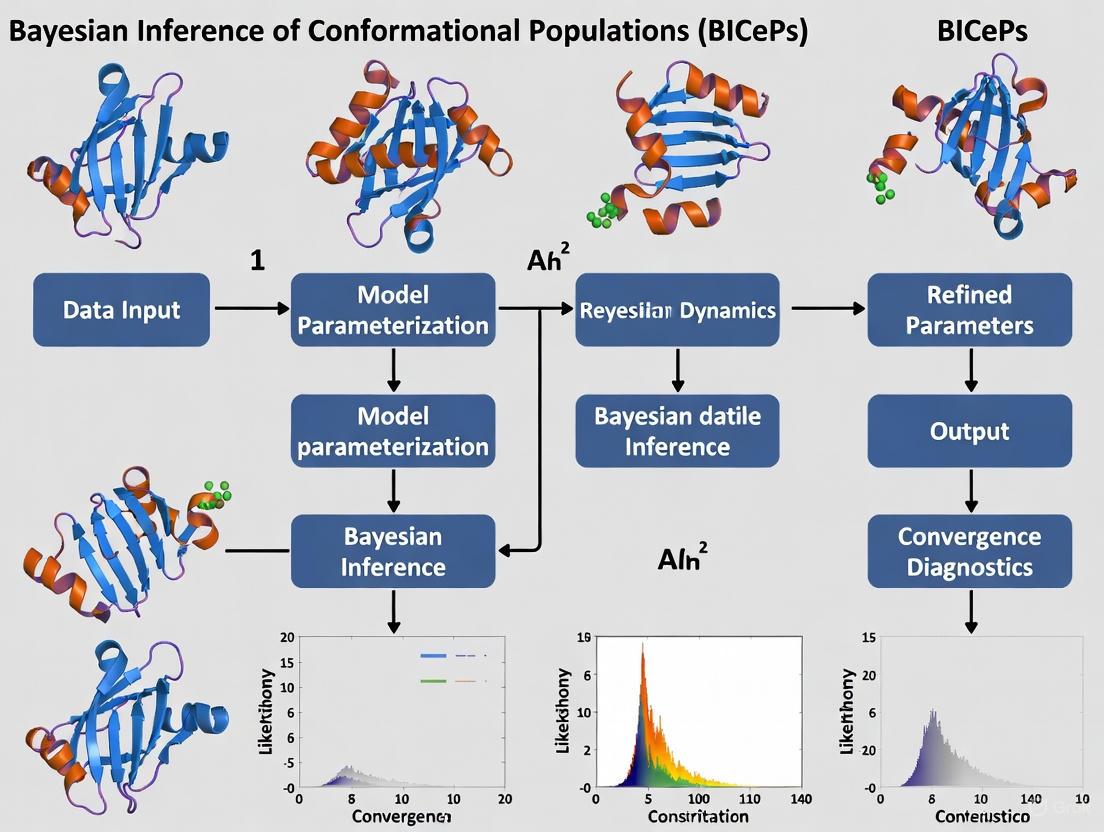
This article explores Bayesian Inference of Conformational Populations (BICePs), a powerful algorithm that refines computational models against sparse and noisy experimental data.
Bayesian Inference of Conformational Populations (BICePs): A Guide to Advanced Parameter Refinement in Structural Biology and Drug Development
Abstract
This article explores Bayesian Inference of Conformational Populations (BICePs), a powerful algorithm that refines computational models against sparse and noisy experimental data. BICePs addresses critical challenges in structural biology and drug development by sampling posterior distributions of conformational populations and uncertainties, enabling robust parameter refinement even with limited data. We detail its foundational Bayesian principles, core methodology for forward model parameterization, and strategies for troubleshooting systematic errors. The article also covers validation through the BICePs score for model selection and demonstrates its application in optimizing force fields and Karplus relations. Finally, we discuss its growing impact on accelerating rare disease drug development and the future integration of neural network-based forward models.
Foundations of BICePs: Core Principles and the Challenge of Sparse Biomolecular Data
The Problem of Sparse and Noisy Experimental Data in Structural Biology
Determining the three-dimensional structures of biomolecules is fundamental to understanding their function. However, structural biologists frequently face the challenge of working with experimental data that are both sparse and noisy. Proteins are dynamic molecules that exhibit a wide range of motions, and these conformational changes are often essential for biological functions such as enzymatic catalysis, cellular transport, and signaling [1]. The central problem lies in distinguishing true biological variability from artifacts introduced by experimental noise and limitations in data collection [1] [2]. This issue becomes particularly acute when studying complex biological processes that involve multiple conformational states or transient intermediates that are difficult to capture with traditional structural biology methods.
The emergence of integrative structural biology approaches, which combine data from multiple experimental sources with computational modeling, has created new opportunities but also intensified the need for robust methods to handle data imperfections. As noted in recent literature, "The problem with sparse data is that there are more parameters that need to be fit than observations, which may lead to an over-interpretation of the data" [2]. This review focuses specifically on the challenges posed by sparse and noisy experimental data in structural biology and presents the Bayesian Inference of Conformational Populations (BICePs) algorithm as a powerful framework for addressing these challenges.
Types of Sparse and Noisy Data in Structural Studies
Experimental data in structural biology can be "sparse" or "noisy" in several distinct ways, each presenting unique challenges for structure determination and validation:
Limited Experimental Restraints: In techniques like NMR spectroscopy, researchers may have only a limited number of distance or dihedral angle restraints—sometimes as few as two restraints per residue—which is insufficient for conventional structure determination methods [2]. Similarly, FRET experiments provide distance information but between limited pairs of labeled sites [3].
Low Sampling Frequency: Time-resolved studies often suffer from low temporal resolution, making it difficult to capture rapid conformational changes or transient intermediates [4]. This is particularly problematic in gene regulatory network studies but also affects structural studies of dynamic processes.
Incomplete Electron Density: In X-ray crystallography, poorly resolved regions in electron density maps, particularly flexible loops or terminal regions, result in structural uncertainty [1] [5]. At medium-to-low resolutions (> 1.5Å), B-factors act as "error-sinks," absorbing errors not necessarily related to protein motion [1].
Heterogeneous Ensembles: Solution-based techniques often capture an average over multiple conformations, making it difficult to deconvolute the contributions of individual states [1] [3]. As noted, "conformational variability in a protein might be present even in a single experiment, where the observed data is an average over multiple conformations" [1].
Consequences for Structural Analysis
The implications of sparse and noisy data extend throughout the structural biology workflow, potentially compromising the biological insights gained from structural models:
Overfitting: When the number of model parameters exceeds the number of experimental observations, there is a significant risk of over-interpretation, where models fit to noise rather than true signal [2].
Validation Challenges: Traditional validation metrics, such as R-factors in crystallography or RMSD values in NMR, may not adequately reflect model accuracy when working with sparse data [5] [2].
Difficulty in Capturing Dynamics: Sparse data struggle to reveal the full extent of conformational heterogeneity and dynamics that are often crucial for biological function [1] [3].
Reduced Reliability of Atomic Coordinates: Regions with limited experimental constraints may reflect force field preferences rather than experimental evidence, particularly in molecular dynamics simulations guided by sparse data [2].
Table 1: Common Experimental Observables and Their Sparse Data Challenges
| Experimental Method | Observable | Nature of Sparsity/Noise | Impact on Structure Determination |
|---|---|---|---|
| NMR Spectroscopy | Distance restraints (NOEs), dihedral angles | Limited number of restraints per residue; ambiguous assignments | Incomplete definition of structure; uncertainty in side chain positioning |
| smFRET | Distance distributions between dye pairs | Limited to specific labeled sites; dye dynamics complicate interpretation | Incomplete spatial information; challenges in converting to structural models |
| X-ray Crystallography | Electron density maps | Poorly resolved regions; incomplete model for flexible areas | Uncertain atomic coordinates in flexible regions; missing alternative conformations |
| Cryo-EM | 3D density maps | Resolution limitations; conformational heterogeneity | Difficulty in modeling atomic details; challenges in separating distinct states |
| HDX-MS | Hydrogen-deuterium exchange rates | Limited spatial resolution; protection factors represent averaged behavior | Ambiguity in pinpointing structural changes to specific regions |
BICePs: A Bayesian Framework for Sparse and Noisy Data
Theoretical Foundation of BICePs
The Bayesian Inference of Conformational Populations (BICePs) algorithm provides a principled framework for addressing the challenges of sparse and noisy experimental data. BICePs was specifically "developed to reconcile simulated ensembles with sparse experimental measurements" [6]. At its core, BICePs uses Bayesian inference to combine prior knowledge from theoretical models with experimental data, properly accounting for uncertainties in both information sources.
The fundamental Bayesian equation underlying BICePs is:
[ P(X|D) \propto Q(D|X)P(X) ]
where ( P(X|D) ) represents the posterior distribution of conformational states X given experimental data D, ( Q(D|X) ) is the likelihood function representing how well a conformation agrees with experimental measurements, and ( P(X) ) is the prior distribution derived from theoretical modeling [6].
A critical innovation in BICePs is the incorporation of reference potentials, which account for the varying information content of different experimental restraints. As explained in the BICePs literature, "The information gained upon obtaining a measurement is relative to the prior information we possess. For example, suppose we want to use Bayesian inference to refine the conformational distribution of a linear peptide, given an experimental distance measurement between two residues. The measurement is highly informative if the residues are distant in sequence, but non-informative if the residues are close in sequence" [6]. The reference potential properly calibrates the weighting of different types of experimental observations based on their inherent information content.
Key Features of BICePs for Handling Sparse Data
BICePs incorporates several sophisticated features that make it particularly suitable for working with sparse and noisy data:
Treatment of Nuisance Parameters: BICePs automatically handles uncertainty in error estimation (σ parameters) by treating them as nuisance parameters and sampling their joint distribution with conformational states [6].
Model Selection Capability: BICePs computes a Bayes factor-like quantity called the BICePs score that enables quantitative comparison of different models and assessment of their consistency with experimental data [6].
Uncertainty Quantification: Unlike methods that produce single structures, BICePs yields probability distributions over conformational space, explicitly representing the uncertainty inherent in sparse data [6].
Integration of Diverse Data Types: The flexible Bayesian framework allows incorporation of various experimental data types, including NMR chemical shifts, NOEs, J-couplings, FRET distances, and HDX protection factors [6].
Diagram 1: BICePs algorithm workflow, showing integration of prior knowledge with experimental data to produce posterior distributions with quantified uncertainty.
Application Notes: Implementing BICePs for Structural Biology
Research Reagent Solutions for BICePs Experiments
Table 2: Essential Research Reagents and Computational Tools for BICePs Experiments
| Category | Item | Specifications/Features | Application in BICePs Pipeline |
|---|---|---|---|
| Sample Preparation | Isotopically labeled proteins | ^15N, ^13C labeling for NMR studies | Enables collection of NMR restraints (NOEs, RDCs) for BICePs refinement |
| Site-specific labeling reagents | Cysteine-reactive dyes for FRET | Provides specific distance restraints for conformational analysis | |
| Hydrogen-deuterium exchange supplies | D₂O buffers, quench solutions | Generates HDX protection factors as experimental observables | |
| Computational Tools | Molecular dynamics software | GROMACS, AMBER, OpenMM | Generates prior conformational ensembles for BICePs analysis |
| Markov State Model algorithms | MSMBuilder, PyEMMA | Discretizes conformational space for prior distribution construction | |
| BICePs software package | BICePs v2.0+ | Core Bayesian inference engine for population reweighting | |
| Data Collection | NMR spectrometers | High-field instruments with cryoprobes | Collection of high-quality sparse NMR data |
| Single-molecule fluorescence | smFRET instrumentation with microfluidics | Generation of distance distributions between specific sites | |
| Mass spectrometry systems | High-resolution instruments for HDX-MS | Measurement of hydrogen exchange rates for structural validation |
BICePs Protocol for Handling Sparse NMR Data
Objective: Determine conformational populations of a protein domain using sparse NMR data and molecular dynamics simulations.
Step-by-Step Procedure:
Prior Ensemble Generation:
- Perform extensive molecular dynamics simulations (≥1 μs) of the protein system using appropriate force fields.
- Use Markov State Model (MSM) analysis to discretize the conformational space into distinct states.
- Calculate state populations from the MSM to define the prior distribution P(X).
Experimental Data Preparation:
- Collect NMR experimental data: chemical shifts, NOE distances, J-couplings, and/or residual dipolar couplings.
- Format experimental data with associated uncertainties (σ values).
- Group similar types of experimental observables (e.g., all NOE distances) for efficient processing.
BICePs Configuration:
- Set up the BICePs input file specifying the prior distribution and experimental restraints.
- Define reference potentials appropriate for each type of experimental observable.
- Configure Markov Chain Monte Carlo (MCMC) parameters: number of replicas, steps, and sampling frequency.
Posterior Sampling:
- Run BICePs sampling algorithm to generate the posterior distribution P(X|D).
- Monitor convergence using statistical diagnostics (autocorrelation, potential scale reduction factors).
- Ensure adequate sampling of both conformational states and nuisance parameters.
Analysis and Validation:
- Extract reweighted conformational populations from the posterior distribution.
- Calculate the BICePs score to assess consistency between prior ensemble and experimental data.
- Validate results through cross-validation, omitting portions of data and assessing predictive performance.
Diagram 2: Detailed BICePs protocol workflow, showing integration of experimental and computational phases for handling sparse data.
Protocol for Time-Resolved Studies with Sparse Sampling
Objective: Characterize conformational transitions using time-series data with limited temporal resolution.
Special Considerations:
Trajectory Sampling: For continuous-time methods, "sample the trajectory also between measurement times" to overcome low sampling frequency [4]. This statistical interpolation generates trajectories consistent with both the measured data and underlying dynamics.
Gaussian Process Models: Use Gaussian process dynamical models (GPDMs) to define a probability distribution over continuous gene expression trajectories, bypassing problematic derivative estimation from sparse time points [4].
MCMC Sampling: Employ advanced MCMC techniques to sample from the conditional probability distribution ( p(x|θ,Y) ) where x represents continuous trajectories, θ represents model hyperparameters, and Y represents the measured data [4].
Interpretation and Validation of BICePs Results
Analyzing BICePs Outputs
The BICePs algorithm produces several key outputs that require careful interpretation:
Reweighted Conformational Populations: These represent the posterior estimates of state populations that best reconcile the prior ensemble with experimental data. Significant changes from prior populations indicate regions where the theoretical model disagreed with experimental observations.
BICePs Score: This quantitative metric indicates the overall consistency between the prior ensemble and experimental data. Higher scores suggest better agreement, enabling model selection and force field validation [6].
Uncertainty Estimates: Posterior distributions provide natural uncertainty quantification for both conformational populations and experimental error parameters.
Table 3: Interpretation Guidelines for BICePs Results
| BICePs Output | What to Look For | Potential Interpretation |
|---|---|---|
| Reweighted Populations | Large shifts from prior populations | Prior force field may have incorrect preferences for certain conformations |
| Consistent populations across multiple independent runs | Robust, converged results independent of initial conditions | |
| Extreme population shifts (e.g., 0% or 100%) | Possible overfitting to sparse data; examine uncertainty estimates | |
| BICePs Score | Higher scores compared to alternative models | Better agreement with experimental data |
| Significant score differences (> 2-3 log units) | Meaningful model preference | |
| Consistently low scores across all models | Potential issues with experimental data or forward models | |
| Uncertainty Estimates | Narrow posterior distributions | High confidence in parameter estimates |
| Broad posterior distributions | Sparse data may be insufficient to constrain parameters |
Validation Strategies for Sparse Data Results
Given the challenges of working with sparse data, rigorous validation is essential:
Cross-Validation: Implement leave-one-out or k-fold cross-validation schemes where portions of experimental data are omitted during BICePs refinement and then used to assess predictive performance [2] [6].
Convergence Testing: Run multiple independent BICePs calculations with different initial conditions to ensure results are reproducible and not dependent on random number seeds.
Comparison with Alternative Methods: Validate BICePs results against other ensemble refinement techniques, such as maximum entropy methods or Metainference, where applicable.
Experimental Cross-Checking: When possible, compare BICePs predictions with additional experimental data not used in the refinement process.
The Bayesian Inference of Conformational Populations algorithm represents a powerful approach for addressing the pervasive challenge of sparse and noisy experimental data in structural biology. By providing a principled statistical framework that properly accounts for uncertainties and incorporates reference potentials to handle varying information content, BICePs enables researchers to extract meaningful biological insights from limited experimental observations.
The key advantages of BICePs—including its ability to perform post-simulation reweighting, compute model selection scores, and naturally handle diverse data types—make it particularly valuable for studying complex biomolecular systems where traditional structure determination methods struggle. As structural biology continues to push toward more challenging systems, including large complexes, membrane proteins, and transient assemblies, methods like BICePs that can maximize information extraction from sparse data will become increasingly essential.
Future developments in BICePs and related Bayesian methods will likely focus on improved scalability for larger systems, enhanced sampling algorithms, more sophisticated forward models for calculating experimental observables, and tighter integration with machine learning approaches. These advances will further strengthen our ability to confront the fundamental challenge of sparse and noisy data in structural biology, ultimately leading to more accurate models of biomolecular structure and dynamics.
Bayesian Inference of Conformational Populations (BICePs) represents a powerful statistical framework for reconciling computational simulations with sparse and noisy experimental data to determine accurate structural ensembles of proteins and other biomolecules. This approach addresses fundamental challenges in structural biology, particularly for flexible systems such as multi-domain proteins connected by flexible linkers and intrinsically disordered proteins, which exhibit substantial conformational heterogeneity that cannot be adequately described by single static structures. By sampling posterior distributions of conformational populations while simultaneously accounting for uncertainties in experimental measurements, BICePs enables researchers to derive ensembles that balance fit-to-data with model complexity, automatically implementing an Occam's razor effect to prevent overfitting. Recent methodological advances have extended BICePs beyond ensemble refinement to include forward model parameterization and force field validation, establishing it as a versatile tool for integrative structural biology. This protocol details the theoretical foundations, practical implementation, and key applications of BICePs, providing researchers with a comprehensive guide for employing these methods in their own investigations of biomolecular dynamics and function.
Theoretical Foundation
The Bayesian Framework for Conformational Ensembles
At the core of Bayesian Inference of Conformational Populations lies Bayes' theorem, which provides a mathematical framework for updating prior beliefs about conformational populations in light of experimental evidence. The fundamental equation can be expressed as:
$$f(\vec{w} | \vec{m}, S) = \frac{f(\vec{m} | \vec{w}, S) f(\vec{w} | S)}{f(\vec{m} | S)}$$
where $\vec{w} = [w1, ..., wn]$ represents the population weights of conformations, $S = {S1, ..., Sn}$ is a structural library, $\vec{m}$ represents experimental measurements, $f(\vec{w} | S)$ is the prior probability of weights, $f(\vec{m} | \vec{w}, S)$ is the likelihood function measuring how well a given model matches experimental data, and $f(\vec{w} | \vec{m}, S)$ is the posterior probability of the weights given the experimental measurements [7].
In practical terms, BICePs seeks to determine the conditional probability $p(X, \sigma | D)$ that quantifies the plausibility of conformational states $X$ and uncertainty parameters $\sigma$ in light of experimental data $D$:
$$p(X, \sigma | D) \propto p(D | X, \sigma) \cdot p(X) p(\sigma)$$
where $\text{posterior} \propto \text{likelihood} \cdot \text{priors}$ [8]. This formulation enables simultaneous estimation of conformational populations and uncertainty parameters directly from the data, providing a statistically rigorous approach to dealing with experimental noise and systematic errors.
Key Concepts and Terminology
Conformational Populations ($w_i$): The relative weights of different structural states in an ensemble, representing their probability or abundance in solution.
Forward Models: Computational frameworks that generate observable quantities from molecular configurations based on empirical relationships. Examples include Karplus relations for predicting J-coupling constants from dihedral angles or explicit-solvent models for predicting SAXS curves [9] [10].
Likelihood Function ($p(D | X, \sigma)$): A probability distribution that quantifies how likely observed experimental data are, given a particular conformational ensemble and uncertainty parameters. BICePs typically employs Gaussian likelihood functions to model experimental errors [7] [8].
Prior Distributions ($p(X), p(\sigma)$): Probability distributions representing initial beliefs about conformational populations and uncertainty parameters before considering experimental data. Molecular simulations often provide the prior for conformational states [8].
Posterior Distribution ($p(X, \sigma | D)$): The updated probability distribution over conformational states and uncertainty parameters after incorporating experimental data through Bayesian inference.
Nuisance Parameters ($\theta$): Additional unknown parameters required for evaluating whether an ensemble is compatible with experimental data, such as scale factors or background corrections [11].
BICePs Score: A free energy-like quantity that reports the free energy of "turning on" the experimental restraints, used as an objective function for model selection and parameter optimization [12] [8] [10].
Core BICePs Protocol
The following diagram illustrates the complete BICePs workflow for ensemble refinement and forward model parameterization:
Input Preparation
Structural Library Generation
Generate a diverse structural library that adequately samples the conformational space of your biomolecular system:
Source Structures: Create conformational ensembles using molecular dynamics simulations [11], Monte Carlo methods [7], or other conformational sampling techniques. For multi-domain proteins, focus sampling on flexible linker regions between structured domains.
Library Size: Typical libraries range from hundreds to thousands of structures, but the size should be balanced against computational cost. Large libraries may require initial clustering to reduce dimensionality.
Quality Assessment: Ensure physical plausibility of generated structures through energy evaluation and steric compatibility checks.
Experimental Data Collection
Gather ensemble-averaged experimental measurements suitable for restraining conformational ensembles:
Data Types: BICePs has been successfully applied with NMR observables (chemical shifts, J-couplings, NOEs) [12] [8], small-angle X-ray scattering (SAXS) data [7] [11], and other ensemble-averaged measurements.
Error Estimation: Determine experimental uncertainties ($\sigma_j$) for each data point. If uncertainties are unknown, BICePs can infer them during the inference process.
Sparsity Handling: BICePs is particularly useful for sparse data sets where traditional methods may struggle with overfitting.
Forward Model Specification
Define appropriate forward models that predict experimental observables from structural features:
Standard Forward Models: Utilize established empirical relationships such as Karplus equations for J-coupling constants [10] or explicit-solvent methods for SAXS curve prediction [11].
Custom Forward Models: Develop system-specific forward models when standard approaches are inadequate, ensuring they are differentiable for parameter optimization.
Neural Network Models: Recently, neural network-based forward models have been integrated with BICePs for enhanced predictive capability [10].
Bayesian Inference Implementation
Posterior Sampling
Perform Markov Chain Monte Carlo (MCMC) sampling to explore the posterior distribution:
Sampling Algorithm: Implement replica-exchange MCMC or other enhanced sampling techniques to improve convergence, especially for complex multi-modal distributions.
Convergence Assessment: Monitor convergence using statistical diagnostics such as Gelman-Rubin statistics, autocorrelation times, and trace plot inspection.
Iteration Count: Typical runs require thousands to millions of iterations, depending on system complexity and library size.
Uncertainty Quantification
Simultaneously sample uncertainty parameters to account for experimental errors:
Error Modeling: Treat experimental uncertainties as unknown parameters with non-informative priors (e.g., Jeffrey's prior $p(\sigma) \sim \sigma^{-1}$) [10].
Outlier Detection: Implement specialized likelihood functions that automatically detect and down-weight experimental outliers [9] [10].
Output Analysis and Validation
Posterior Analysis
Extract meaningful information from the sampled posterior distribution:
Population Weights: Calculate posterior means and credible intervals for conformational populations.
Ensemble Properties: Compute ensemble-averaged structural properties from the refined populations.
Uncertainty Estimates: Determine posterior distributions for experimental uncertainties and other nuisance parameters.
Model Validation
Assess the quality and reliability of the refined ensemble:
BICePs Score Evaluation: Use the BICePs score to compare different models or force fields [12] [8].
Predictive Assessment: Validate the refined ensemble against experimental data not used in the refinement process.
Physical Plausibility: Check that the refined populations maintain physical realism and consistency with known biochemical principles.
Advanced Applications
Forward Model Parameterization
BICePs has been extended to optimize empirical parameters in forward models through two complementary approaches:
Table: Methods for Forward Model Parameterization in BICePs
| Method | Key Principle | Advantages | Application Examples |
|---|---|---|---|
| Nuisance Parameter Integration | Treats forward model parameters as nuisance parameters, marginalizing over them in the posterior distribution [9] [10] | Propagates uncertainty in parameters to conformational populations; no additional optimization required | Karplus parameter refinement; hydration layer parameter optimization for SAXS [13] |
| Variational BICePs Score Minimization | Uses the BICePs score as an objective function for variational optimization of parameters [9] [10] | Provides efficient optimization with inherent regularization; enables gradient-based methods | Neural network forward model training; force field parameter optimization [10] |
The following diagram illustrates the two approaches for forward model parameterization:
Force Field Validation and Optimization
BICePs enables quantitative evaluation of molecular force fields through the BICePs score:
Protocol:
- Simulate conformational ensembles using different force fields
- Refine each ensemble against experimental data using BICePs
- Compute BICePs scores for each force field
- Compare scores to identify the most accurate force field
Application Example: In a recent study, BICePs was used to evaluate nine different protein force fields (A14SB, A99SB-ildn, A99, A99SBnmr1-ildn, A99SB, C22star, C27, C36, OPLS-aa) for the mini-protein chignolin against 158 experimental NMR measurements. The BICePs score successfully identified the best-performing force fields, demonstrating consistency with previous validation studies [12] [8].
Integration with Enhanced Sampling Methods
Combine BICePs with advanced sampling techniques to address challenging systems:
Multi-Ensemble Markov State Models: Incorporate BICePs reweighting into Markov State Model construction to improve kinetic and thermodynamic predictions.
Replica-Averaging: Implement replica-averaged forward models that enhance the agreement between simulation and experiment without adjustable regularization parameters [12].
The Scientist's Toolkit
Research Reagent Solutions
Table: Essential Computational Tools and Resources for BICePs
| Tool/Resource | Type | Function | Implementation Notes |
|---|---|---|---|
| BICePs Software Package | Software | Core algorithm implementation for Bayesian ensemble refinement | Version 2.0 includes improved likelihood functions and replica-averaging forward models [10] |
| Molecular Dynamics Engines | Software | Generation of structural libraries through conformational sampling | GROMACS, AMBER, OpenMM, or CHARMM compatible |
| SAXS Prediction Tools | Software | Forward calculation of SAXS profiles from atomic structures | CRYSOL, FoXS, or explicit-solvent methods [11] |
| NMR Chemical Shift Predictors | Software | Forward calculation of NMR observables from structures | SHIFTX2, SPARTA+, or neural network-based approaches [10] |
| Karplus Parameterizations | Empirical Relations | Forward models for J-coupling constants from dihedral angles | Optimizable parameters for different J-coupling types [9] [10] |
| Structural Clustering Algorithms | Computational Method | Reduction of structural library complexity | K-means, hierarchical clustering, or density-based methods |
| MCMC Sampling Libraries | Software | Bayesian posterior sampling | Custom implementations or probabilistic programming frameworks |
Troubleshooting and Optimization
Common Challenges and Solutions
Poor Convergence: If MCMC sampling fails to converge, consider increasing the number of replicas in replica-exchange sampling, adjusting temperature spacing, or extending sampling duration.
Over-regularization: If the refined ensemble shows insufficient deviation from the prior, check that experimental uncertainties are not overestimated and consider adjusting prior strengths.
Under-regularization: If the refinement appears to overfit noise in the data, verify that the BICePs score is being properly computed and consider implementing more conservative uncertainty priors.
Computational Bottlenecks: For large structural libraries, implement library reduction strategies such as clustering or sub-sampling while preserving conformational diversity.
Performance Optimization Guidelines
Structural Library Size: Balance comprehensiveness against computational cost. Libraries of 1,000-10,000 structures often provide sufficient coverage without excessive computation.
Experimental Restraint Selection: Include sufficient experimental data to meaningfully restrain the ensemble, typically at least 5-10 independent measurements per key conformational degree of freedom.
Parallelization Strategy: Leverage the inherent parallelism in replica-exchange MCMC to distribute computational load across multiple processors or nodes.
Convergence Monitoring: Implement comprehensive convergence diagnostics including multiple independent runs with different initial conditions to ensure robust results.
Bayesian Inference of Conformational Populations represents a sophisticated and statistically rigorous framework for determining biomolecular structural ensembles from computational models and experimental data. By properly accounting for uncertainties in both structural models and experimental measurements, BICePs enables researchers to derive ensembles that balance accuracy with physical plausibility. The recent extension of BICePs to forward model parameterization and force field validation further enhances its utility as a versatile tool in computational structural biology. As molecular simulations continue to advance in their temporal and spatial scope, Bayesian approaches like BICePs will play an increasingly important role in bridging the gap between simulation and experiment, ultimately providing more accurate models of biomolecular structure, dynamics, and function.
Bayesian Inference of Conformational Populations (BICePs) is a computational algorithm designed to reconcile theoretical predictions of molecular conformational ensembles with sparse and/or noisy experimental measurements. As a post-processing reweighting method, BICePs uses a rigorous Bayesian statistical framework to refine structural ensembles obtained from molecular simulations, making them more consistent with experimental observables without the need for adjustable regularization parameters [14]. This application note details the core components of the BICePs algorithm—priors, likelihood, and posterior—and provides structured protocols for its application in parameter refinement research, particularly in the context of drug development and biomolecular studies.
Core Components of the BICePs Algorithm
The BICePs algorithm is built upon the foundational principles of Bayesian statistics, which involve updating prior beliefs with new experimental data to obtain a refined posterior distribution [15]. The following sections break down these core components.
Prior Probability Distribution (P(X))
The prior distribution represents the initial theoretical estimate of conformational populations before incorporating experimental data. In BICePs, this prior typically comes from molecular dynamics (MD) simulations or other theoretical modeling approaches [14].
- Source: The prior
P(X)is derived from a theoretical model, such as an ensemble of conformational states generated by MD simulations on platforms like Folding@home [8]. - Role: It encapsulates the pre-existing knowledge about the system, serving as the starting point for Bayesian inference [14].
- Mathematical Representation: The prior is a probability distribution over conformational states
X. For a reference prior model, a uniform distribution of conformational states,P₀(X) ~ 1, can be used [14].
Likelihood Function (P(D|X,σ))
The likelihood function quantifies the probability of observing the experimental data D given a specific conformational state X and an uncertainty parameter σ [14].
- Purpose: It measures the agreement between theoretical predictions (forward model outputs) and experimental measurements [14].
- Formulation: For experimental observables with normally distributed errors, the likelihood takes the form of a Gaussian distribution:
P(D|X,σ) = ∏[j=1 to N_d] (1/√(2πσ²)) * exp[-(r_j(X) - r_j_exp)² / (2σ²)][14] Here,r_j(X)is the theoretical observable value calculated for conformationXusing a forward model,r_j_expis the corresponding experimental measurement, andσ_jis the uncertainty parameter for thej-thobservable. - Uncertainty Parameter (
σ): This nuisance parameter accounts for all sources of error, including experimental noise and forward model inaccuracies. It is often assumed to be the same for observables from the same experiment and is sampled alongside conformational states [14].
Posterior Probability Distribution (P(X,σ|D))
The posterior distribution is the final output of the BICePs algorithm, representing the updated beliefs about conformational populations and uncertainties after considering the experimental data [14].
- Calculation: According to Bayes' theorem, the posterior is proportional to the product of the likelihood and the priors:
P(X,σ|D) ∝ P(D|X,σ) * P(X) * P(σ)[8] [14] - Interpretation:
- The marginal distribution
P(X|D) = ∫ P(X,σ|D) dσprovides the reweighted populations of conformational states. - The marginal distribution
P(σ|D) = ∫ P(X,σ|D) dXprovides the posterior distribution of the uncertainty parameter, peaked at its most likely value [8].
- The marginal distribution
- Sampling: The posterior distribution is estimated using Markov Chain Monte Carlo (MCMC) sampling over the conformational states
Xand the uncertainty parameterσ[14].
Table 1: Summary of Key Components in the BICePs Algorithm
| Component | Symbol | Role in BICePs | Typical Source | |
|---|---|---|---|---|
| Prior | P(X) |
Initial estimate of conformational populations | Molecular dynamics simulations [8] | |
| Likelihood | `P(D | X,σ)` | Measures agreement between simulation and experiment | Comparison of forward model predictions to experimental data [14] |
| Posterior | `P(X,σ | D)` | Refined conformational populations and uncertainties given the data | Output of Bayesian inference via MCMC sampling [14] |
| Uncertainty Parameter | σ |
Accounts for random and systematic errors in data and models | Sampled as a nuisance parameter; uses a Jeffreys prior P(σ)=1/σ [14] |
The BICePs Workflow and Score
The practical application of BICePs involves a structured workflow that culminates in the calculation of a powerful scoring function for model selection.
The BICePs Workflow
The standard workflow, as implemented in BICePs v2.0, involves a logical series of steps [14]:
- Preparation: Input data for each conformational state is prepared, including experimental measurements and forward model predictions. This is handled by the
biceps.Preparationclass. - Sampling: MCMC sampling is performed to estimate the full posterior distribution
P(X,σ|D). - Convergence Checking: Automated analysis ensures the MCMC sampling has converged properly.
- Analysis: The results are analyzed to plot reweighted populations, posterior distributions of uncertainties, and extract the BICePs score.
The following diagram illustrates the logical flow of information and computation in the BICePs algorithm.
The BICePs Score for Model Selection
A key advantage of BICePs is its ability to compute an objective score for quantitative model selection, known as the BICePs score [14].
- Definition: The BICePs score,
f(k), is a free energy-like quantity calculated as the negative logarithm of the ratio of evidences:f(k) = -ln [ Z(k) / Z₀ ], whereZ(k)is the evidence for prior modelk, andZ₀is the evidence for a reference uniform prior model [14]. - Interpretation: A lower BICePs score indicates that the prior model
P(k)(X)is more consistent with the experimental measurements. This allows researchers to objectively rank different simulated ensembles or force fields by their accuracy [8] [14]. - Application: For example, the BICePs score was used to evaluate nine different force fields for the mini-protein chignolin, with results consistent with previous studies [8].
Advanced Applications: Forward Model Parameterization
Recent enhancements have extended BICePs beyond simple ensemble reweighting to the refinement of forward model (FM) parameters. A forward model is a computational framework that predicts experimental observables from molecular configurations [10].
- Theoretical Extension: The posterior distribution is expanded to include forward model parameters
θ:P(X, σ, θ | D) ∝ P(D | X, σ, θ) * P(X) * P(σ) * P(θ)[10] - Optimization Methods:
- Posterior Sampling: Treating FM parameters
θas nuisance parameters and sampling them within the full posterior distribution. - Variational Minimization: Using the BICePs score as an objective function to variationally optimize FM parameters [10].
- Posterior Sampling: Treating FM parameters
- Use Case: This approach has been successfully applied to refine Karplus parameters for
J-coupling constants in human ubiquitin, improving the agreement between simulations and NMR experiments [10].
Table 2: Experimental Observables and Forward Models in BICePs
| Experimental Observable | Forward Model Description | Application Example in BICePs |
|---|---|---|
| NMR NOE distances | Computed interatomic distances | Used as restraints in ensemble reweighting [14] |
| NMR chemical shifts | Empirical relationships linking structure to chemical shift | Refining conformational ensembles [14] |
| NMR J-couplings | Karplus relation (dihedral angle dependence) | Refinement of Karplus parameters for ubiquitin [10] |
| Hydrogen-Deuterium Exchange (HDX) | Protection factors based on H-bonding and solvent accessibility | Supported in BICePs v2.0 for ensemble analysis [14] |
Protocol: Force Field Validation Using BICePs
This protocol outlines the steps for using BICePs to validate and select the most accurate force field for a protein system, using chignolin as a reference example [8].
Research Reagent Solutions
Table 3: Essential Materials and Software for BICePs Implementation
| Item | Function / Role | Example or Specification |
|---|---|---|
| Molecular Dynamics Trajectories | Provides the prior ensemble of conformational states P(X) |
Simulations run using Folding@home; can use ensembles from AMBER, CHARMM, etc. [8] |
| Experimental Data | Provides the targets D for the likelihood function |
NMR measurements (NOEs, chemical shifts, J-couplings) [8] |
| BICePs Software | Python package for performing Bayesian reweighting | BICePs v2.0 (open-source) [14] |
| Forward Models | Functions r_j(X) to compute observables from structures |
Built-in models for NOEs, J-couplings, chemical shifts, HDX in BICePs [14] |
Step-by-Step Procedure
System Preparation and Prior Ensemble Generation:
- Perform MD simulations of the target protein (e.g., chignolin) using different force fields (e.g., A99SB-ildn, C36, OPLS-aa) [8].
- Cluster the trajectories to obtain a discrete set of conformational states
X. The population of each state in the simulation defines the priorP(X).
Experimental and Forward Model Data Preparation:
- Gather ensemble-averaged experimental data. For chignolin, this included 139 NOE distances, 13 chemical shifts, and 6 J-coupling constants [8].
- Use the
biceps.Preparationclass to prepare input files. For each conformational state and each force field, compute the corresponding forward model predictionsr_j(X)for all experimental observables [14].
BICePs Execution and Sampling:
- For each force field's prior ensemble, run BICePs to sample the posterior distribution
P(X,σ|D). The sampling involves MCMC over statesXand uncertaintyσ. - Use replica-averaging if applicable, which requires no adjustable parameters [10].
- For each force field's prior ensemble, run BICePs to sample the posterior distribution
Convergence Diagnostics:
- Use built-in BICePs v2.0 tools to check MCMC convergence. Analyze trace plots and the Gelman-Rubin statistic (R-hat) to ensure proper sampling [14].
Analysis and Model Selection:
- For each force field, compute the BICePs score
f(k). The force field with the lowest score is the most consistent with the experimental data. - Examine the reweighted conformational populations
P(X|D)to understand which states are favored after incorporating experimental evidence.
- For each force field, compute the BICePs score
The BICePs algorithm provides a robust and theoretically sound framework for integrating theoretical simulations with experimental data. Its core components—the prior, likelihood, and posterior—work in concert to refine conformational ensembles and quantify their uncertainty. The development of the BICePs score and the extension to forward model parameterization make it a powerful tool for force field validation and optimization. By following the detailed protocols outlined in this application note, researchers in structural biology and drug development can leverage BICePs to enhance the accuracy of their biomolecular models, thereby supporting more reliable insights into protein function and dynamics.
The Role of Reference Potentials in Accounting for Restraint Information Content
Application Notes
Theoretical Foundation of Reference Potentials in BICePs
Bayesian Inference of Conformational Populations (BICePs) is an advanced computational method that refines structural ensembles by reconciling theoretical models with sparse experimental data. At the core of this method lies a Bayesian framework that seeks to model a posterior distribution (P(X|D)) of conformational states (X), given experimental data (D) [16]. According to Bayes' theorem, this posterior is proportional to the product of a likelihood function (Q(D|X)) and a prior distribution (P(X)) representing prior knowledge from theoretical modeling [16].
Reference potentials are crucial for correctly implementing experimental restraints. Experimental observables (\mathbf{r} = (r1, r2, ..., r_N)) are low-dimensional projections of a high-dimensional state space (X). Therefore, these restraints must be treated as potentials of mean force [16]. The posterior distribution incorporating reference potentials becomes:
[ P(X | D) \propto \bigg[ \frac{Q(\mathbf{r}(X)|D)}{Q_{\text{ref}}(\mathbf{r}(X))} \bigg] P(X) ]
Here, the weighting function is a ratio where the numerator (Q(\mathbf{r}|D)) enforces experimental restraints, while the denominator (Q_{\text{ref}}(\mathbf{r})) represents the expected distribution of observables in the absence of experimental information [16]. This formulation ensures that only information content beyond inherent structural propensities restrains the ensemble.
Without reference potentials, the introduction of significant bias occurs when multiple non-informative restraints are used. The reference potential effectively discounts restraints that merely confirm what is already expected from the theoretical prior, allowing the experimental data to selectively refine aspects of the ensemble that are genuinely informative [16].
Practical Implications for Conformational Analysis
The practical importance of reference potentials can be illustrated through distance restraint applications. Consider an experimental distance restraint applied to two residues of a polypeptide chain [16]:
- For residues near each other along the chain sequence, a short-distance restraint may yield ([Q(\mathbf{r}|D)/Q_{\text{ref}}(\mathbf{r})] \sim 1), contributing little refinement to the conformational ensemble.
- For residues far apart along the chain, the same short-distance restraint becomes highly informative, with ([Q(\mathbf{r}|D)/Q{\text{ref}}(\mathbf{r})]) significantly rewarding small distances where the reference potential (Q{\text{ref}}(\mathbf{r})) is small [16].
This selective weighting enables BICePs to automatically identify and prioritize experimentally informative restraints, making efficient use of sparse data that is common in structural biology experiments such as NMR spectroscopy [17].
BICePs Score for Model Selection
A key advantage of the BICePs algorithm is its ability to perform quantitative model selection through the BICePs score [16]. For theoretical models (P^{(k)}(X)), where (k=1,...,K), the posterior likelihood (Z^{(k)}) is computed by integrating the (k^{th}) posterior distribution across all conformations (X) and nuisance parameters (\sigma):
[ Z^{(k)} = \int P^{(k)}(X,\sigma | D) dX d\sigma = \int P^{(k)}(X) Q(X) dX ]
This quantity represents the total evidence for a given model, equivalent to an overlap integral between the prior (P^{(k)}(X)) and the likelihood function from experimental restraints [16]. The BICePs score is then defined as:
[ f^{(k)} = -\ln \frac{Z^{(k)}}{Z_0} ]
where (Z_0) is the evidence for a reference model, typically a uniform prior representing no theoretical information [16]. The BICePs score provides an unequivocal measure of model quality, with lower scores indicating better models. This metric has proven valuable for force field validation and parameterization [16].
Experimental Protocols
General BICePs Workflow for Conformational Ensemble Refinement
Objective: To refine conformational ensembles and populations using theoretical modeling and sparse experimental data through Bayesian inference with reference potentials.
Materials:
- Structural models: Conformational states from molecular dynamics (MD), Monte Carlo simulations, or quantum mechanics (QM) calculations.
- Experimental data: Sparse experimental observables such as NMR chemical shifts, J-couplings, or distance restraints.
- Computational resources: BICePs software package (available as open-source code).
- Prior knowledge: Reference potential distributions for experimental observables.
Procedure:
Conformational Sampling:
- Generate an ensemble of conformational states (X) using MD simulations, QM calculations, or other theoretical methods. These states can be individual conformations or collections from trajectory clustering [16].
- For each conformational state, calculate the theoretical values of experimental observables (\mathbf{r}(X)).
Reference Potential Calculation:
- Determine the expected distribution (Q_{\text{ref}}(\mathbf{r})) for each observable in the absence of experimental information. For distance restraints, this may involve calculating the end-to-end distance distribution of a random-coil polymer with appropriate chain length [16].
- Establish the functional form of reference potentials based on the physical nature of each observable.
Likelihood Function Setup:
- Define the error model for experimental observations, accounting for both experimental uncertainty and conformational heterogeneity.
- Model uncertainties as nuisance parameters (\sigma) with prior distributions (P(\sigma)) [16].
- Construct the likelihood function (Q(D|X,\sigma)) reflecting how well each conformation agrees with experimental measurements.
Posterior Sampling:
- Use Markov Chain Monte Carlo (MCMC) sampling to explore the joint posterior distribution (P(X,\sigma | D)) over conformational states and uncertainty parameters [16] [17].
- Implement the reference potential correction by using the ratio (Q(\mathbf{r}(X)|D)/Q_{\text{ref}}(\mathbf{r}(X))) as a weighting factor during MCMC sampling.
Convergence Assessment:
- Monitor MCMC convergence using standard statistical diagnostics.
- Ensure adequate sampling of both conformational space and uncertainty parameters.
Analysis and Model Selection:
Protocol for Reference Potential Implementation in Distance Restraints
Objective: To correctly implement reference potentials for distance restraint data in BICePs calculations.
Procedure:
Characterize the Unrestrained System:
- For each pair of atoms subject to distance restraint, compute the expected distance distribution in the absence of experimental information.
- For polymer systems, use established statistical mechanical models (e.g., random coil distributions) appropriate for the chain length between residues [16].
Formulate the Reference Potential:
- Represent the reference distribution (Q_{\text{ref}}(d)) for distance (d) using the appropriate analytical form or numerical histogram.
- Ensure the reference potential accurately reflects the inherent distance preferences due to chain connectivity and excluded volume.
Implement the Restraint Potential:
- Define the experimental restraint function (Q(d|D,\sigma)) typically as a Gaussian error model centered on the experimental distance value with width determined by uncertainty parameter (\sigma).
- Construct the potential of mean force as (-\ln [Q(d|D)/Q_{\text{ref}}(d)]) for use in the BICePs likelihood function [16].
Validate the Implementation:
- Test the reference potential on systems with known behavior.
- Verify that the potential of mean force appropriately emphasizes distances that deviate from expected distributions.
Protocol for BICePs Score Calculation
Objective: To compute BICePs scores for quantitative comparison of different theoretical models.
Procedure:
Define Comparison Models:
- Select theoretical models (P^{(k)}(X)) to compare (e.g., different force fields, simulation protocols, or prior distributions).
- Establish a reference model (Z_0), typically a uniform prior representing no theoretical information [16].
Compute Evidence Terms:
- For each model (P^{(k)}(X)), compute the evidence (Z^{(k)} = \int P^{(k)}(X) Q(X) dX) where (Q(X)) incorporates both experimental restraints and reference potentials [16].
- Use numerical integration techniques or specialized algorithms to estimate these high-dimensional integrals.
Calculate BICePs Scores:
- Compute (f^{(k)} = -\ln [Z^{(k)}/Z_0]) for each model [16].
- Compare scores across models, where lower values indicate better agreement with experimental data.
Interpret Results:
- Use Bayes factors ((Z^{(1)}/Z^{(2)})) for pairwise model comparison.
- Consider differences in BICePs scores > 1-2 units as substantial evidence favoring one model over another.
Data Presentation
Quantitative Data Tables
Table 1: BICePs Analysis of Cineromycin B Conformational Populations
| Conformational State | Prior Population (%) | Posterior Population (%) | Population Change (%) | Agreement with NMR Data (χ²) |
|---|---|---|---|---|
| State A | 45.2 ± 3.1 | 62.3 ± 2.4 | +17.1 | 1.24 |
| State B | 32.7 ± 2.8 | 25.1 ± 1.9 | -7.6 | 2.17 |
| State C | 22.1 ± 2.3 | 12.6 ± 1.5 | -9.5 | 3.45 |
| Total | 100.0 | 100.0 | - | 2.12 |
Note: Populations derived from BICePs refinement using NMR data. The posterior populations show improved agreement with experimental observations compared to the prior theoretical model [17].
Table 2: BICePs Score Comparison for Force Field Validation
| Force Field | BICePs Score (f) | Bayes Factor (vs. FF1) | Consistency with Experimental Data |
|---|---|---|---|
| FF1 | 0.00 | 1.00 | Reference |
| FF2 | -1.45 | 4.26 | Strong improvement |
| FF3 | 2.31 | 0.10 | Weaker agreement |
| FF4 | -0.87 | 2.39 | Moderate improvement |
Note: Lower BICePs scores indicate better agreement with experimental data. Bayes factors > 3 provide substantial evidence for model preference [16].
Table 3: Effect of Reference Potentials on Restraint Efficacy
| Restraint Type | Number Applied | Without Reference Potential (χ²) | With Reference Potential (χ²) | Improvement (%) |
|---|---|---|---|---|
| Distance | 15 | 4.32 | 1.89 | 56.2 |
| Dihedral | 8 | 3.15 | 1.45 | 54.0 |
| J-coupling | 12 | 5.21 | 2.17 | 58.3 |
| Chemical Shift | 20 | 6.43 | 2.84 | 55.8 |
Note: Reference potentials significantly improve agreement with experimental data by properly weighting the informational content of each restraint type [16].
Visualization
BICePs Workflow with Reference Potentials
BICePs Workflow Diagram
Reference Potential Effect on Bayesian Inference
Reference Potential Bayesian Effect
Research Reagent Solutions
Table 4: Essential Research Tools for BICePs Implementation
| Tool Category | Specific Solution | Function in BICePs Research |
|---|---|---|
| Molecular Simulation Software | GROMACS, AMBER, OpenMM | Generates conformational ensembles for prior distribution (P(X)) through MD simulations [16] [17] |
| Quantum Chemistry Packages | Gaussian, ORCA, Q-Chem | Provides high-quality structural models and energy evaluations for small molecules [16] [17] |
| BICePs Software | BICePs Python Package | Implements core Bayesian inference algorithm with reference potentials and MCMC sampling [16] |
| Experimental Data Sources | NMR Spectroscopy, FRET, SAXS | Provides sparse experimental observables (D) for restraining conformational ensembles [17] |
| Reference Potential Calculators | Custom Python Scripts, Polymer Models | Computes (Q_{\text{ref}}(\mathbf{r})) distributions for different observable types [16] |
| Analysis and Visualization | MDTraj, PyEMMA, Matplotlib | Analyzes conformational ensembles and visualizes results [16] |
BICePs as a Post-Processing Reweighting Tool for Molecular Simulations
Bayesian Inference of Conformational Populations (BICePs) is a computational algorithm designed to reconcile theoretical predictions of structural ensembles from molecular simulations with sparse and/or noisy experimental data using a Bayesian statistical framework [18] [19]. This post-processing reweighting approach addresses a fundamental challenge in computational chemistry and biophysics: how to refine simulated conformational ensembles to better agree with experimental measurements while accounting for various sources of uncertainty [20]. BICePs was originally developed to predict conformational ensembles of organic molecules with significant structural heterogeneity in solution, such as natural product macrocycles and peptidomimetics [19]. Unlike methods that require additional simulations, BICePs performs population reweighting as a post-processing step, making it particularly valuable for leveraging existing molecular dynamics trajectories and Markov State Models [19].
The algorithm has proven especially useful in areas where accurate force fields are lacking, such as computational foldamer design, where general-purpose force fields may be insufficiently accurate for predictive design [18]. By combining high-quality theoretical ensembles with potentially sparse experimental observables, BICePs enables researchers to obtain more accurate conformational populations without performing additional costly simulations [18]. A key innovation of BICePs is its ability to provide objective model selection through a quantity called the BICePs score, which quantifies the evidence for a particular model given experimental data [18] [20]. This feature has opened up applications in force field validation and parameterization [18] [20].
Theoretical Foundation
Bayesian Inference Framework
BICePs is built upon a Bayesian inference framework that models the posterior distribution of conformational states ( X ) given experimental data ( D ) [18] [19]. According to Bayes' theorem, this posterior distribution is proportional to the product of a likelihood function and a prior distribution:
[P(X|D) \propto Q(D|X)P(X)]
Here, ( P(X) ) represents the prior distribution of conformational populations obtained from theoretical modeling, such as molecular dynamics simulations or quantum mechanical calculations [19]. The likelihood function ( Q(D|X) ) quantifies how well a given conformation ( X ) agrees with experimental measurements and typically assumes a normally-distributed error model [19]:
[Q(D|X,\sigma) = \prodj \frac{1}{\sqrt{2\pi\sigma^2}} \exp\left(-[rj(X)-r_j^{\text{exp}}]^2/2\sigma^2\right)]
In this formulation, ( rj(X) ) represents observables back-calculated from the theoretical model, ( rj^{\text{exp}} ) represents experimental values, and ( \sigma ) represents uncertainty parameters that capture both experimental noise and conformational heterogeneity [19].
Reference Potentials
A critical innovation in BICePs is the implementation of reference potentials that account for the varying information content of different experimental restraints [18] [19]. The modified posterior distribution with reference potentials becomes:
[P(X|D) \propto \left[\frac{Q(r(X)|D)}{Q_{\text{ref}}(r(X))}\right] P(X)]
The reference potential ( Q_{\text{ref}}(r) ) reflects the distribution of observables ( r ) in the absence of any experimental restraint information [18]. This implementation is crucial because experimental restraints in the space of observables need to be treated as potentials of mean force, as they represent low-dimensional projections of a high-dimensional state space [18].
For example, consider an experimental distance restraint applied to two residues of a polypeptide chain [18]. For residues close in sequence, a short-distance restraint may be relatively uninformative, as ( [Q(r|D)/Q{\text{ref}}(r)] \approx 1 ). In contrast, for residues far apart in sequence, a short-distance restraint can be highly informative, greatly rewarding small distances where the reference potential ( Q{\text{ref}}(r) ) is small [18]. This approach prevents the introduction of unnecessary bias when many non-informative restraints are used simultaneously [18].
The BICePs Score for Model Selection
The BICePs score is a key quantity that enables objective model selection [18] [20]. It represents a Bayes factor-like quantity that reflects the integrated posterior evidence in favor of a given model, computed through free energy estimation methods [18]. Formally, the BICePs score reports the free energy of "turning on" the experimental restraints [20] [21].
This score provides an unequivocal measure of model quality, allowing researchers to quantitatively estimate how consistent a simulated ensemble is with experimental data [18]. In practice, the BICePs score can be used to rank different simulated ensembles by their accuracy in reproducing experimental observables, making it invaluable for force field validation and parameterization [19] [20].
Table 1: Key Theoretical Components of the BICePs Algorithm
| Component | Mathematical Representation | Role in Bayesian Inference |
|---|---|---|
| Prior Distribution | ( P(X) ) | Represents initial conformational populations from theoretical models or simulations |
| Likelihood Function | ( Q(D|X,\sigma) ) | Quantifies agreement between conformational state and experimental data |
| Reference Potential | ( Q_{\text{ref}}(r(X)) ) | Accounts for information content of experimental restraints |
| Posterior Distribution | ( P(X|D) \propto \left[\frac{Q(r(X)|D)}{Q_{\text{ref}}(r(X))}\right] P(X) ) | Final refined conformational populations |
| BICePs Score | ( \text{BICePs} = -\ln Z ) | Model selection metric quantifying evidence for model given data |
BICePs Workflow and Implementation
The BICePs algorithm follows a structured workflow that transforms prior conformational ensembles into refined posterior ensembles consistent with experimental data. The diagram below illustrates this process:
BICePs Algorithm Workflow
Practical Implementation Considerations
Implementing BICePs requires careful attention to several practical aspects. The experimental uncertainty parameter ( \sigma ) is typically not known a priori and is treated as a nuisance parameter that is sampled alongside conformational states [19]. A non-informative Jeffreys prior (( P(\sigma) \sim 1/\sigma )) is commonly used for this parameter [19] [20].
Posterior sampling over conformational states ( X ) and uncertainty parameters ( \sigma ) is performed using Markov Chain Monte Carlo (MCMC) methods [18] [17]. This approach allows the algorithm to explore the joint distribution of conformations and uncertainties, with the final conformational populations obtained as the marginal distribution ( P(X|D) = \int P(X, \sigma|D)d\sigma ) [19].
For systems with significant conformational heterogeneity, BICePs can be implemented with a replica-averaging forward model, making it a maximum-entropy reweighting method [20] [21]. In this approach, replica-averaged observables are compared with ensemble-averaged experimental measurements, with errors estimated using the standard error of the mean [20].
Protocols for BICePs Application
Protocol 1: Basic Ensemble Reweighting with BICePs
This protocol describes the fundamental steps for reweighting a conformational ensemble using BICePs, applicable to various molecular systems from small molecules to proteins.
Table 2: Research Reagent Solutions for BICePs Implementation
| Research Reagent | Function in BICePs Workflow | Implementation Examples |
|---|---|---|
| Molecular Dynamics Trajectories | Provides prior conformational ensemble | GROMACS, AMBER, NAMD, OpenMM simulations |
| Experimental Observables | Sparse experimental data for Bayesian inference | NMR chemical shifts, J-couplings, NOE distances, SAXS data |
| Forward Models | Computational frameworks that generate observable quantities from molecular configurations | Karplus relations for J-couplings, SHIFTX for chemical shifts |
| Reference Potentials | Account for information content of experimental restraints | Random-coil polymer distances for chain segments, maximum-entropy distributions |
| MCMC Sampling Algorithm | Samples posterior distribution of conformational states and parameters | Custom Python implementations, ISD-inspired samplers |
Step-by-Step Procedure:
Prepare Prior Conformational Ensemble: Generate a set of discrete conformational states and their initial populations from molecular simulations [19]. For a 2D lattice protein toy model, this might involve enumerating possible chain configurations [18]. For all-atom systems like beta-hairpin peptides or ubiquitin, use replica-exchange molecular dynamics or enhanced sampling methods to ensure adequate coverage of conformational space [18] [20].
Select Experimental Restraints: Choose appropriate experimental observables for refinement. Common choices include NMR observables such as chemical shifts, J-coupling constants, and NOE distances [18] [19]. For the beta-hairpin peptide application, NMR chemical shifts were used [18]. For ubiquitin, J-coupling constants are appropriate [20].
Define Forward Models: Implement functions that calculate experimental observables from conformational states. For NMR chemical shifts, this may involve empirical relationships or machine learning models [20]. For J-couplings, use Karplus relations with initial parameter estimates [20].
Implement Reference Potentials: Choose appropriate reference potentials for each experimental observable. For distance restraints in linear chains, a Gaussian reference potential may be appropriate, while for cyclic molecules, a maximum-entropy distribution parameterized from average distances across the conformational state space is more suitable [18].
Run MCMC Sampling: Perform posterior sampling over conformational states and uncertainty parameters. Run the MCMC simulation for sufficient iterations to ensure convergence, typically monitoring using autocorrelation functions or multiple independent chains [18] [17].
Calculate BICePs Score: Compute the BICePs score to quantify the evidence for the reweighted ensemble [18] [20]. This score can be used to compare different prior ensembles or force fields [21].
Analyze Results: Extract the posterior conformational populations and assess agreement with experimental data. Compare the posterior populations with the prior populations to identify which conformational states are favored by the experimental restraints [19].
Protocol 2: Force Field Validation Using BICePs Scores
This protocol specifically leverages the BICePs score for force field comparison and validation, as demonstrated in applications with chignolin and ubiquitin [20] [21].
Step-by-Step Procedure:
Generate Ensembles with Multiple Force Fields: Simulate the same molecular system using different force fields. For example, in the chignolin study, nine different force fields (A14SB, A99SB-ildn, A99, A99SBnmr1-ildn, A99SB, C22star, C27, C36, OPLS-aa) were used with TIP3P water [21].
Prepare Experimental Dataset: Compile a comprehensive set of experimental measurements. For chignolin, this included 158 experimental measurements (139 NOE distances, 13 chemical shifts, and 6 vicinal J-coupling constants for HN and Hα) [21].
Run BICePs Reweighting for Each Force Field: Apply the basic BICePs protocol to each force field-generated ensemble separately, using the same experimental dataset for all.
Compute BICePs Scores: Calculate the BICePs score for each force field after reweighting. The BICePs score reports the free energy of "turning on" conformational populations along with experimental restraints [21].
Rank Force Fields by BICePs Scores: Force fields with better agreement with experimental data will have more favorable (lower) BICePs scores [20] [21].
Validate Results: Compare BICePs rankings with established metrics. In the chignolin study, BICePs scores provided rankings consistent with conventional χ² metrics previously used for small polypeptides and ubiquitin [21].
Protocol 3: Forward Model Parameterization with BICePs
This protocol describes how to refine empirical forward model parameters using BICePs, as demonstrated for Karplus relation parameterization [20].
Step-by-Step Procedure:
Define Parameterized Forward Model: Identify the forward model with tunable parameters. For Karplus relations for J-coupling constants, the standard form is ( J = A\cos^2(\theta) + B\cos(\theta) + C ), where ( \theta ) is the dihedral angle and ( A, B, C ) are parameters to be optimized [20].
Choose Optimization Method: Select one of two approaches:
- Posterior Sampling Method: Treat forward model parameters ( \theta ) as additional nuisance parameters in the posterior distribution: ( p(X, \sigma, \theta|D) \propto p(D|X, \sigma, \theta)p(X)p(\sigma)p(\theta) ) [20].
- Variational Optimization: Use variational minimization of the BICePs score with respect to forward model parameters [20].
Implement Optimization: For posterior sampling, include forward model parameters in MCMC sampling. For variational optimization, use gradient-based methods to minimize the BICePs score with respect to parameters.
Validate Parameterized Model: Test the refined forward model on independent data or through cross-validation to ensure improved performance.
Advanced Applications and Recent Developments
Forward Model Parameterization
Recent enhancements to BICePs have extended its capability to refine empirical forward model parameters directly from experimental data [20]. This addresses the challenge that model validation and refinement against NMR observables critically depend on reliable forward models that have been robustly parameterized to reduce error [20].
Two novel methods have been introduced for optimizing forward model (FM) parameters:
Nuisance Parameter Integration: FM parameters are treated as nuisance parameters and integrated over in the full posterior distribution [20].
Variational Minimization: Uses variational minimization of the BICePs score to optimize FM parameters [20].
This approach has been successfully demonstrated for refining Karplus parameters crucial for accurate predictions of J-coupling constants based on dihedral angles, with applications to human ubiquitin for predicting six sets of Karplus parameters [20].
Neural Network Forward Models
The BICePs framework naturally generalizes to optimize any differentiable forward model, including those constructed with neural networks [20]. This provides a promising direction for training and validating neural network-based forward models, such as those for chemical shift prediction [20].
The diagram below illustrates how BICePs enables refinement of both conformational ensembles and forward model parameters:
BICePs for Forward Model Refinement
Handling Experimental Outliers
Recent BICePs developments include specialized likelihood functions that allow for automatic detection and down-weighting of experimental observables subject to systematic error [20]. This robust error modeling makes BICePs particularly resistant to outliers in experimental datasets, enhancing the reliability of the refined ensembles.
Case Studies and Applications
Toy Model: 2D Lattice Protein
In the original BICePs development, a 2D lattice protein served as a toy model to demonstrate the algorithm's capability for force field parameterization [18]. The study showed that BICePs could select the correct value of an interaction energy parameter given ensemble-averaged experimental distance measurements [18]. Importantly, the results remained robust to experimental noise and measurement sparsity when conformational states were sufficiently fine-grained [18].
Beta-Hairpin Peptides
BICePs was applied to perform force field evaluations for all-atom simulations of designed beta-hairpin peptides against experimental NMR chemical shift measurements [18]. These tests demonstrated that BICePs scores could be used for model selection in the context of all-atom simulations, suggesting the approach would be particularly useful for computational foldamer design [18].
Protein Systems: Ubiquitin and Chignolin
More recent applications have extended BICePs to protein systems. For the mini-protein chignolin, BICePs was used to reweight conformational ensembles simulated with nine different force fields using a set of 158 experimental measurements [21]. In all cases, reweighted populations favored the correctly folded conformation, and BICePs scores provided a metric to evaluate each force field [21]. Similarly, BICePs has been applied to optimize Karplus parameters for J-coupling prediction in human ubiquitin [20].
Table 3: Quantitative Results from BICePs Applications
| Molecular System | Experimental Data Used | BICePs Application | Key Result |
|---|---|---|---|
| 2D Lattice Protein | Ensemble-averaged distance measurements | Force field parameterization | Correct interaction energy parameter selected; robust to noise and sparsity [18] |
| Beta-Hairpin Peptides | NMR chemical shifts | Force field evaluation | BICePs scores enabled model selection for all-atom simulations [18] |
| Chignolin Mini-Protein | 139 NOE distances, 13 chemical shifts, 6 J-couplings | Force field comparison across 9 force fields | Reweighted populations favored folded state; BICePs scores consistent with χ² metrics [21] |
| Human Ubiquitin | J-coupling constants | Karplus parameter optimization | Six sets of Karplus parameters refined for different J-coupling types [20] |
BICePs represents a powerful and versatile approach for reconciling theoretical predictions of conformational ensembles with experimental measurements. Its Bayesian foundation, proper implementation of reference potentials, and quantitative model selection via the BICePs score make it uniquely valuable for post-processing reweighting of molecular simulations. The protocols outlined in this document provide researchers with practical guidance for implementing BICePs in various scenarios, from basic ensemble refinement to force field validation and forward model parameterization.
Recent enhancements, including replica-averaging forward models, improved likelihood functions for handling outliers, and extensions to neural network forward models, continue to expand BICePs' capabilities [20] [21]. As molecular simulations continue to grow in complexity and scope, BICePs offers a robust statistical framework for integrating theoretical and experimental data to obtain more accurate conformational ensembles.
BICePs in Action: Methods for Parameter Refinement and Real-World Applications
Bayesian Inference of Conformational Populations (BICePs) is a reweighting algorithm that reconciles simulated molecular ensembles with sparse and/or noisy experimental observations [19]. Its core function is to refine conformational populations by sampling posterior distributions under experimental restraints, simultaneously quantifying uncertainties from random and systematic error [20] [22]. A crucial advancement in this framework is its extension to empirical forward model (FM) parameter refinement [20]. Forward models are computational frameworks that generate theoretical observables from molecular configurations, often relying on empirical relationships with parameters that require optimization [10] [22]. Without accurate FM parameters, even the most sophisticated simulations may disagree with experimental data. This application note details two novel methods implemented in BICePs for this purpose: posterior sampling of FM parameters and variational optimization using the BICePs score [20] [22]. These strategies enable researchers to optimize key parameters, such as those in the Karplus relation for J-coupling constants, thereby improving the agreement between theoretical predictions and experimental measurements for biomolecular systems [20].
Theoretical Foundation
Bayesian Framework of BICePs
The BICePs algorithm is built upon a Bayesian statistical framework. It models the posterior distribution ( p(X, \sigma | D) ) of conformational states ( X ) and nuisance parameters ( \sigma ), which represent uncertainty in the experimental observables ( D ) [20] [22]. The fundamental relationship is given by:
[ p(X, \sigma | D) \propto p(D | X, \sigma) p(X) p(\sigma) ]
Here, ( p(D | X, \sigma) ) is the likelihood function that enforces experimental restraints using a forward model, ( p(X) ) is the prior distribution of conformational populations from a theoretical model, and ( p(\sigma) ) is a non-informative Jeffrey’s prior for the uncertainty [20] [22]. A critical innovation in BICePs is the use of reference potentials [18] [19]. These account for the information content of experimental restraints by modeling the distribution of observables in the absence of experimental data, thus preventing the introduction of unnecessary bias when applying multiple restraints [19].
The Role of the BICePs Score
The BICePs score is a free energy-like quantity that reports the total evidence for a model and serves as a powerful objective function for model selection and parameterization [20] [18]. It is defined as the negative logarithm of the marginalized posterior probability:
[ \text{BICePS score} = -\ln \left[ \sum_X \int p(D | X, \sigma) p(X) p(\sigma) d\sigma \right] ]
A lower BICePs score indicates a model that is more consistent with the experimental data [18]. This score contains a form of inherent regularization, making it particularly effective when used with likelihood functions designed to handle experimental outliers [20].
Strategy 1: Posterior Sampling of Forward Model Parameters
The first strategy treats forward model (FM) parameters ( \theta ) as nuisance parameters that are directly sampled within the full posterior distribution [20] [22]. This approach integrates over these parameters to obtain their refined values. For a specific forward model ( g(X, \theta) ) with parameters ( \theta = (\theta1, \theta2, ..., \theta_m) ), the posterior distribution is extended to include them [20]:
[ p(X, \sigma, \theta | D) \propto p(D | X, \sigma, \theta) p(X) p(\sigma) p(\theta) ]
In this framework, ( p(\theta) ) represents the prior distribution for the FM parameters. The refined posterior distribution of the FM parameters ( p(\theta | D) ) is ultimately recovered by marginalizing over all conformational states ( X ) and uncertainties ( \sigma ) [22].
Protocol and Workflow
Procedure:
- Define the Full Posterior: Construct the joint posterior distribution ( p(X, \sigma, \theta | D) ) as shown in the equation above [20].
- Specify Priors:
- Use a theoretical model (e.g., from molecular dynamics simulations) for the conformational prior ( p(X) ) [19].
- Assign a non-informative Jeffrey's prior ( p(\sigma) \sim \sigma^{-1} ) for the experimental uncertainty [20] [22].
- Choose appropriate priors ( p(\theta) ) for the FM parameters, which could be uniform within a plausible range.
- Sample via MCMC: Use Markov Chain Monte Carlo (MCMC) sampling, such as the Metropolis-Hastings algorithm, to sample the full posterior distribution [22].
- Marginalize: Obtain the refined distribution for the FM parameters by marginalizing the sampled posterior: ( p(\theta | D) = \sum_X \int p(X, \sigma, \theta | D) d\sigma ) [22].
The following workflow diagram illustrates this process:
Application Example: Refining Karplus Parameters
This method was successfully applied to optimize six distinct sets of Karplus parameters for the human protein ubiquitin [20] [22]. The Karplus relation, ( J = A \cos^2(\phi) + B \cos(\phi) + C ), predicts J-coupling constants from dihedral angles ( \phi ), but its parameters ( A, B, C ) are system-dependent [20]. Using posterior sampling, BICePs refined parameters for:
- ( ^3J_{H^N H^{\alpha}} )
- ( ^3J_{H^{\alpha} C'} )
- ( ^3J_{H^N C^{\beta}} )
- ( ^3J_{H^N C'} )
- ( ^3J_{C' C^{\beta}} )
- ( ^3J_{C' C'} )
The refinement led to improved agreement between the simulated ensemble of ubiquitin and the experimental J-coupling measurements [20].
Strategy 2: Variational Optimization Using the BICePs Score
The second strategy employs variational minimization of the BICePs score [20]. In this approach, the BICePs score serves as a loss function that is minimized with respect to the forward model parameters ( \theta ). This method leverages the fact that the BICePs score reflects the total evidence for a model, and its minimization inherently balances model complexity with agreement to experimental data [20] [18]. The core optimization problem is:
[ \theta^* = \underset{\theta}{\text{argmin}} \left[ -\ln \left( \sum_X \int p(D | X, \sigma, \theta) p(X) p(\sigma) d\sigma \right) \right] ]
Where ( \theta^* ) represents the optimized FM parameters.
Protocol and Workflow
Procedure:
- Compute the BICePs Score: For a given set of FM parameters ( \theta ), compute the BICePs score. This involves evaluating the average energy ( \langle U(\theta) \rangle ) and entropy ( S(\theta) ) of the ensemble under the experimental restraints [20].
- Calculate Gradients: Utilize gradient information to inform parameter updates. The update mechanism can be summarized as:
( \theta{\text{trial}} = \theta{\text{old}} - \text{lrate} \cdot \nabla u + \eta \cdot \mathcal{N}(0,1) ) [22].
Here,
lrateis the learning rate, ( \nabla u ) is the gradient, and stochastic noise ( \eta ) helps escape local minima. - Iterate to Convergence: Repeat steps 1 and 2, updating ( \theta ) until the BICePs score is minimized and parameters converge.
The workflow for variational optimization is as follows:
Application Example: Neural Network Forward Models
As a proof-of-concept for complex, differentiable forward models, the BICePs score was used as a loss function to train a neural network to learn J-coupling constants from molecular dihedral angles [20] [22]. This demonstrates the framework's generality beyond simple parametric models. The neural network's weights and biases (its parameters ( \theta )) were variationally optimized by minimizing the BICePs score, effectively creating a forward model that maximizes the consistency between the neural network's predictions, the prior conformational ensemble, and the experimental data [20].
Comparative Analysis of the Two Strategies
The two strategies, while theoretically equivalent [20], offer different practical advantages and are suited to different scenarios. The following table provides a structured comparison for researchers deciding which method to implement.
| Feature | Posterior Sampling | Variational Optimization | |
|---|---|---|---|
| Core Principle | Treats FM parameters as nuisance parameters; samples their full posterior distribution [20] [22]. | Uses the BICePs score as a loss function for variational minimization [20]. | |
| Theoretical Equivalence | Equivalent to variational optimization in the limit of complete sampling [20]. | Equivalent to posterior sampling at the minimum of the BICePs score [20]. | |
| Computational Demand | Can be computationally intensive, especially for high-dimensional parameter spaces. | Faster convergence in high dimensions, especially when using gradients [22]. | |
| Primary Output | Full probability distribution ( p(\theta | D) ) for parameters [22]. | A single optimal parameter set ( \theta^* ). |
| Uncertainty Quantification | Directly provides uncertainty estimates from the posterior distribution. | Less straightforward; may require additional sampling around the optimum. | |
| Best Suited For | Problems where understanding parameter uncertainty is critical. | Refining complex models with many parameters (e.g., neural networks) [20] [22]. |
The Scientist's Toolkit: Essential Research Reagents and Materials
Successful implementation of these parameter refinement strategies requires a combination of software, theoretical models, and experimental data. The table below details key components of the research toolkit for BICePs-based studies.
| Tool/Reagent | Function/Description | Application Note | |
|---|---|---|---|
| BICePs Software Package | A user-friendly, extensible software package for performing Bayesian inference of conformational populations [23]. | Essential for executing both posterior sampling and variational optimization protocols. Version 2.0 includes improvements for ensemble reweighting [23]. | |
| Theoretical Prior Ensemble | A set of conformational states and their populations from molecular simulation (e.g., MD, MC) or other theoretical models [19]. | Serves as the prior distribution ( p(X) ). The quality and coverage of this ensemble are critical for accurate refinement. | |
| Experimental Observables (D) | Sparse and/or noisy ensemble-averaged experimental data (e.g., NMR J-couplings, chemical shifts, NOE distances) [18] [19]. | Used to construct the likelihood function ( p(D | X, \sigma) ). |
| Replica-Averaging Forward Model | A method where observables are averaged over multiple replicas of the system to estimate the true ensemble average [20]. | Enhances BICePs, making it a maximum-entropy reweighting method without needing adjustable regularization parameters [20]. | |
| Differentiable Forward Model | A forward model ( g(X, \theta) ) whose output can be differentiated with respect to its parameters ( \theta ). | Required for variational optimization using gradients. This includes neural network-based models [20] [22]. | |
| Karplus Relation | An empirical equation relating J-coupling constants to dihedral angles: ( J = A \cos^2(\phi) + B \cos(\phi) + C ) [20]. | A classic example of a forward model with tunable parameters ( A, B, C ) that can be refined using the described methods [20]. |
The integration of posterior sampling and variational optimization within the BICePs framework provides a powerful, dual-strategy approach for the refinement of empirical forward model parameters. These methods enable the simultaneous optimization of conformational ensembles and forward model parameters against experimental data, effectively addressing random and systematic errors [20]. The practical applications in refining Karplus parameters for ubiquitin and training neural network models underscore the generality and flexibility of this approach [20] [22]. By implementing the detailed protocols and utilizing the toolkit outlined in this document, researchers can enhance the predictive accuracy of computational models, bringing them into closer agreement with experimental observations and advancing fields such as structural biology and drug development.
Leveraging the BICePs Score as a Free Energy-like Objective Function
Bayesian Inference of Conformational Populations (BICePs) is a reweighting algorithm that reconciles molecular simulation data with sparse and/or noisy experimental measurements to refine structural ensembles [19]. A key innovation of this Bayesian framework is the BICePs score, a free energy-like quantity that provides an unequivocal measure of model quality for objective model selection and parameter refinement [18] [16]. This application note details the theoretical foundation, practical implementation, and experimental protocols for utilizing the BICePs score as a robust objective function in force field validation and forward model parameterization, with specific applications in computational biophysics and drug development.
Theoretical Foundation of the BICePs Score
The BICePs algorithm operates within a Bayesian framework to model the posterior distribution (P(X|D)) of conformational states (X) given experimental data (D). According to Bayes' theorem, this posterior is proportional to the product of a likelihood function (Q(D|X)) representing experimental restraints and a prior distribution (P(X)) from theoretical modeling [16]:
[P(X|D) \propto Q(D|X) P(X)]
In practice, the uncertainty parameter ( \sigma ), representing both experimental noise and conformational heterogeneity, is treated as a nuisance parameter with a non-informative Jeffreys prior ( P(\sigma) \sim \sigma^{-1} ), leading to the joint posterior [18] [16]:
[P(X,\sigma | D) \propto Q(D|X,\sigma) P(X) P(\sigma)]
A critical innovation in BICePs is the implementation of reference potentials (Q_{\text{ref}}(\mathbf{r})) which account for the baseline distribution of observables in the absence of experimental information. This transforms the weighting function into a ratio [18] [16]:
[P(X | D) \propto \bigg[ \frac{Q(\mathbf{r}(X)|D)}{Q_{\text{ref}}(\mathbf{r}(X))} \bigg] P(X)]
The BICePs score (f^{(k)}) is then defined as a free energy-like quantity computed from the negative logarithm of the posterior evidence (Z^{(k)}) for model (k) relative to a reference model (Z_0) (typically a uniform prior) [16]:
[f^{(k)} = -\ln \frac{Z^{(k)}}{Z_0}}]
where (Z^{(k)} = \int P^{(k)}(X,\sigma | D) dX d\sigma) represents the total evidence for model (P^{(k)}), acting as an overlap integral between the prior and the likelihood function specified by experimental restraints [16]. The BICePs score provides a powerful objective function for model selection because lower scores indicate better models, with the score reflecting the free energy of "turning on" the experimental restraints [20] [24].
The BICePs Score as an Objective Function
Quantitative Model Selection
The BICePs score provides an unequivocal metric for force field validation and parameterization [18]. In practical terms, the value of (Z^{(k)}) is maximal when the theoretical modeling prior (P^{(k)}(X)) most closely matches the likelihood distribution (Q(X)) specified by the experimental restraints [16]. The Bayes factor (Z^{(1)}/Z^{(2)}) serves as a likelihood ratio for choosing between competing models (1) and (2) [16].
Table 1: Interpretation of BICePs Score Differences
| ΔBICePs Score | Model Preference | Evidence Strength |
|---|---|---|
| 0-1 | Barely worth mentioning | Weak |
| 1-2.5 | Substantial | Positive |
| 2.5-5 | Strong | Moderate |
| >5 | Decisive | Strong |
Variational Optimization Framework
Recent enhancements to BICePs employ a replica-averaging forward model, making it a maximum-entropy (MaxEnt) reweighting method that requires no adjustable regularization parameters to balance experimental information with the prior [20] [24]. In this framework, the BICePs score becomes a powerful objective function for variational optimization of model parameters, containing a form of inherent regularization that automatically detects and down-weights experimental observables subject to systematic error [20] [22].
For a specific forward model (g(X, \theta)) with parameters (\theta = (\theta1, \theta2, ..., \theta_m)), the full posterior distribution including both conformational states and parameters becomes [20]:
[p(X,\sigma,\theta|D) \propto p(D|X,\sigma,\theta)p(X)p(\sigma)p(\theta)]
Two theoretically equivalent approaches have been developed for optimization [20]:
- Posterior Sampling: Treating FM parameters as nuisance parameters and integrating over them in the full posterior distribution
- Variational Minimization: Direct minimization of the BICePs score using gradient-based approaches
Computational Workflow and Visualization
The following diagram illustrates the integrated workflow for BICePs-based parameter refinement, combining both sampling and variational optimization approaches:
BICePs Parameter Refinement Workflow
Experimental Protocols
Protocol 1: Force Field Parameterization Using BICePs Score Minimization
Purpose: To refine force field parameters against ensemble-averaged experimental measurements by minimizing the BICePs score.
Materials and Methods:
- Input Data: Conformational states from molecular simulations (prior (P(X))) and ensemble-averaged experimental observables (D) (e.g., NMR J-couplings, chemical shifts, or distance measurements)
- Software Requirements: BICePs package (Python implementation with MCMC sampling capabilities)
- Computational Resources: Multi-core processor for parallel replica sampling
Procedure:
- Initialization:
- Generate conformational states (X) from molecular dynamics simulations or other theoretical models
- Define forward model (g(X, \theta)) relating conformational states to experimental observables
- Initialize force field parameters (\theta) to current best estimates
Replica-Averaged Posterior Sampling:
- Sample the joint posterior distribution using MCMC with replica-averaged forward model: [p(\mathbf{X},\bm{\sigma},\theta|D) \propto \prod{r=1}^{Nr}{p(Xr) \prod{j=1}^{Nj} \frac{1}{\sqrt{2\pi\sigmaj^2}}\exp\Big[-\frac{(dj - fj(\mathbf{X},\theta))^2}{2\sigmaj^2}\Big]p(\sigmaj)p(\theta)}] where (Nr) is the number of replicas and (Nj) is the number of experimental observables [24]
- Estimate total uncertainty (\sigmaj = \sqrt{(\sigma^Bj)^2 + (\sigma^{\text{SEM}}j)^2}) combining Bayesian uncertainty (\sigma^Bj) and standard error of the mean (\sigma^{\text{SEM}}_j)
BICePs Score Calculation:
- Compute the evidence (Z^{(k)}) for current parameter set (\theta) by marginalizing over conformational states and uncertainty parameters
- Calculate BICePs score (f^{(k)} = -\ln(Z^{(k)}/Z_0)) relative to reference model
Gradient-Based Optimization:
- Compute gradients of BICePs score with respect to parameters (\theta)
- Update parameters using gradient descent with stochastic noise: [\theta{\text{trial}} = \theta{\text{old}} - \text{lrate} \cdot \nabla u + \eta \cdot \mathcal{N}(0,1)] where (\text{lrate}) is the learning rate and (\eta) controls noise injection [22]
- Repeat steps 2-4 until convergence (minimal change in BICePs score)
Validation:
- Assess robustness through repeated optimizations with different initial parameters
- Test refined parameters on independent validation datasets
Troubleshooting:
- For slow convergence: Increase number of replicas (N_r) to improve estimation of (\sigma^{\text{SEM}})
- For trapped local minima: Adjust noise injection parameter (\eta) to enhance exploration
- For systematic errors: Implement Student's likelihood model to automatically detect outliers [24]
Protocol 2: Forward Model Parameterization for NMR Observables
Purpose: To refine Karplus relationship parameters for predicting J-coupling constants from protein dihedral angles.
Materials and Methods:
- System: Human ubiquitin protein (or target system of interest)
- Experimental Data: Six sets of J-coupling constants ((^3J{HNH\alpha}), (^3J{H\alpha C'}), (^3J{HNC\beta}), (^3J{HNC'}), (^3J{C'C\beta}), (^3J{C'C'})) [20]
- Forward Model: Karplus relation (J(\phi) = A\cos^2(\phi) + B\cos(\phi) + C) with parameters (\theta = (A, B, C)) for each J-coupling type
Procedure:
- Prior Ensemble Generation:
- Perform molecular dynamics simulations of target protein
- Cluster trajectory data to obtain representative conformational states (X)
- Assign prior populations (P(X)) based on simulation statistics
Multi-Observable Posterior Sampling:
- For (K) different forward models (J-coupling types), sample the full joint posterior: [p(X,\sigma,\theta^{(1)},\theta^{(2)},...\theta^{(K)}|D) \propto \prod{r=1}^{Nr}p(Xr) \prod{k=1}^{K}p(Dk|g(X,\theta^{(k)}),\sigmak)p(\sigma_k)p(\theta^{(k)})] where (\theta^{(k)}) are the Karplus parameters for the (k^{th}) J-coupling type [20]
Parameter Optimization:
- Employ gradient-assisted MCMC sampling for efficient exploration of parameter space
- Compute marginal posterior (p(\theta|D) = \sum_X \int p(X,\sigma,\theta|D)d\sigma) for each parameter set
Model Selection:
- Compare BICePs scores for different Karplus parameterizations
- Select model with minimal BICePs score as optimal parameter set
Expected Outcomes:
- Refined Karplus parameters for six J-coupling types specific to target system
- Quantitative assessment of parameter uncertainty through posterior distributions
- Improved agreement between experimental measurements and forward model predictions
Table 2: Essential Research Reagent Solutions for BICePs Implementation
| Reagent/Software | Function | Implementation Notes |
|---|---|---|
| Conformational Prior P(X) | Provides theoretical model of state populations | From MD simulation, MSM, or QM calculations; discrete states required |
| Forward Model g(X,θ) | Predicts experimental observables from structures | Differentiable models preferred for gradient-based optimization |
| Reference Potential Qref(r) | Accounts for baseline distribution of observables | Problem-specific; maximum-entropy distribution for cyclic molecules |
| Likelihood Function | Quantifies agreement with experimental data | Gaussian or robust Student's model to handle outliers |
| MCMC Sampler | Samples posterior distribution of parameters | Parallel tempering recommended for complex landscapes |
| Gradient Calculator | Computes derivatives for optimization | Automatic differentiation compatible with neural network FMs |
Applications and Case Studies
Lattice Protein Model Parameterization
A recent study demonstrated BICePs score minimization for force field parameterization using a 12-mer HP lattice protein model with ensemble-averaged distance measurements [24]. The algorithm successfully refined multiple bead interaction parameters despite significant random and systematic errors in the experimental restraints. Key findings included:
- Robust convergence to correct parameter values across repeated optimizations
- Effective handling of up to 25% experimental error in distance measurements
- Superior performance compared to non-Bayesian optimization approaches
Neural Network Forward Model Training
The BICePs framework naturally generalizes to complex, differentiable forward models, including neural networks [20] [22]. In a proof-of-concept demonstration:
- Neural networks were trained to learn J-coupling constants from protein dihedral angles
- The BICePs score served as the loss function during training
- The approach enabled simultaneous ensemble reweighting and neural network parameter optimization
- This methodology shows promise for chemical shift prediction and other complex forward models [20]
Technical Considerations and Limitations
Handling Experimental Uncertainties
The BICePs algorithm incorporates sophisticated error models that account for multiple sources of uncertainty:
- Experimental Noise: Modeled through Bayesian uncertainty parameters (\sigma^B_j)
- Finite Sampling Error: Estimated through standard error of the mean (\sigma^{\text{SEM}}_j) from replica averaging
- Systematic Errors: Addressed through robust likelihood functions (e.g., Student's t-distribution) that automatically detect and down-weight outliers [24]
Computational Efficiency
For high-dimensional parameter spaces, gradient-based approaches significantly accelerate convergence [22]. The integration of stochastic gradient descent with noise injection facilitates escape from local minima while maintaining efficient exploration of the parameter landscape.
The BICePs score serves as a powerful free energy-like objective function for Bayesian parameter refinement, combining rigorous statistical foundation with practical optimization capabilities. Its unique advantages include inherent regularization, robust handling of experimental uncertainties, and applicability to both traditional empirical functions and modern neural network models. The protocols outlined herein provide researchers with practical guidance for implementing this approach in force field validation, forward model parameterization, and structural biology applications, ultimately enhancing the reliability of computational models against experimental measurements.
Implementing Replica-Averaging for Maximum-Entropy Reweighting
The accurate determination of biomolecular conformational ensembles is fundamental to understanding biological function. Molecular simulations generate structural ensembles, but their quantitative agreement with experimental measurements relies critically on the accuracy of forward models—computational frameworks that predict observable quantities from molecular configurations [20]. Maximum-Entropy (MaxEnt) reweighting methods address this challenge by refining simulation ensembles against experimental data while minimizing unnecessary deviations from the simulated prior [25] [26].
A significant advancement in this domain is the integration of replica-averaging into the Bayesian Inference of Conformational Populations (BICePs) algorithm [20] [27] [24]. This approach transforms BICePs into a robust MaxEnt reweighting method that requires no adjustable regularization parameters to balance experimental information with the prior ensemble [20] [27]. This document provides detailed application notes and protocols for implementing replica-averaging, framed within a broader thesis on using BICePs for force field and forward model parameter refinement.
Theoretical Foundation
Core Principles of Bayesian/MaxEnt Reweighting
The core objective of reweighting is to reconcile a prior conformational ensemble from simulations with ensemble-averaged experimental observations. The Bayesian/MaxEnt solution yields a set of optimized weights for each conformation in the prior ensemble, resulting in a refined ensemble that:
- Reproduces experimental values within their uncertainties.
- Maximizes the relative Shannon entropy with respect to the original simulation ensemble, thereby introducing minimal bias [25] [26].
The Bayesian posterior distribution for conformational states ( X ) and uncertainty parameters ( \sigma ), given experimental data ( D ), is formulated as: [ p(X, \sigma | D) \propto p(D | X, \sigma) p(X) p(\sigma) ] where ( p(X) ) is the prior distribution from simulation, ( p(D | X, \sigma) ) is the likelihood function, and ( p(\sigma) ) is a non-informative Jeffreys prior for the uncertainty [20] [24].
The Replica-Averaging Formalism
The replica-averaging formalism enhances the BICePs algorithm by simulating a set of ( Nr ) replicas, ( \mathbf{X} = {Xr} ). The forward model prediction for an experimental observable is computed as an average over all replicas: [ fj(\mathbf{X}) = \frac{1}{Nr} \sum{r=1}^{Nr} fj(Xr) ] This replica average serves as an estimator for the true ensemble average [20].
A key feature of this approach is the sophisticated treatment of uncertainty. The total uncertainty ( \sigmaj ) for observable ( j ) combines the Bayesian error ( \sigmaj^B ) and the standard error of the mean (SEM) ( \sigmaj^{SEM} ), which arises from finite sampling of the replicas: [ \sigmaj = \sqrt{(\sigmaj^B)^2 + (\sigmaj^{SEM})^2} ] where ( \sigmaj^{SEM} ) is estimated from the variability of the forward model predictions across replicas and decreases with the square root of ( Nr ) [20] [24]. This explicit accounting for finite sampling error makes the method a rigorous MaxEnt reweighting approach in the limit of large replica counts [20].
Table 1: Key Mathematical Components of the Replica-Averaging BICePs Framework
| Component | Mathematical Representation | Description |
|---|---|---|
| Replica-Averaged Observable | ( fj(\mathbf{X}) = \frac{1}{Nr} \sum{r} fj(X_r) ) | Estimator of the ensemble average for observable ( j ). |
| Total Uncertainty | ( \sigmaj = \sqrt{(\sigmaj^B)^2 + (\sigma_j^{SEM})^2} ) | Combines experimental and finite-sampling errors. |
| Standard Error of the Mean | ( \sigmaj^{SEM} = \sqrt{ \frac{1}{Nr} \sumr (fj(Xr) - fj(\mathbf{X}))^2 } ) | Quantifies uncertainty from finite replica sampling. |
| BICePs Score | ( \text{BICePs} = -\ln Z ) | Free energy-like metric used for model selection and parameter optimization. |
The BICePs Score for Parameter Refinement
A powerful outcome of the replica-averaged BICePs framework is the BICePs score, a free energy-like quantity calculated as the negative logarithm of the Bayesian evidence, ( Z ) [20] [24]. The BICePs score measures the free energy of "turning on" the experimental restraints and serves as an objective function for model selection and parameterization [20] [27] [24].
This score can be used for the variational optimization of force field and forward model parameters. The optimization process involves minimizing the BICePs score with respect to parameters ( \theta ), which can be achieved through gradient-based methods as derivatives of the score can be computed automatically [24].
Workflow and Implementation
The following diagram illustrates the logical workflow for implementing replica-averaging for maximum-entropy reweighting, from data preparation to analysis and parameter refinement.
Protocol: Replica-Averaged Reweighting with BICePs
This protocol details the steps for applying replica-averaged reweighting to refine a conformational ensemble, corresponding to the workflow above.
Step 1: Generate the Prior Conformational Ensemble
- Procedure: Perform molecular dynamics (MD) or Monte Carlo (MC) simulations to generate a diverse set of molecular conformations. For complex systems with rough energy landscapes, consider using enhanced sampling techniques [26].
- Notes: The ensemble must comprehensively sample the relevant conformational space, as reweighting can only adjust weights of existing states, not generate new ones [26]. Save trajectories in a format accessible for subsequent analysis.
Step 2: Prepare Experimental Data and Forward Model
- Procedure:
- Notes: The accuracy of the forward model is critical. Our framework allows for the refinement of its parameters ( \theta ) (e.g., Karplus parameters) [20].
Step 3: Initialize Replicas and Compute Averages
- Procedure:
- Randomly select ( Nr ) conformations from the prior ensemble to initialize the replicas. ( Nr ) should be large enough to ensure small ( \sigma^{SEM} ); a value of 50-100 is a typical starting point [20].
- For each MCMC step, compute the replica-averaged prediction for each observable ( j ): ( fj(\mathbf{X}) = \frac{1}{Nr} \sum{r=1}^{Nr} fj(Xr) ).
- Compute the standard error of the mean ( \sigma_j^{SEM} ) for each observable from the distribution of values across the current set of replicas [20] [24].
Step 4: Sample the Posterior Distribution
- Procedure: Use Markov Chain Monte Carlo (MCMC) sampling to sample the full posterior distribution, which includes conformational states ( \mathbf{X} ) and uncertainty parameters ( \sigma ). For a model with a Gaussian likelihood, the posterior is: [ p(\mathbf{X}, \bm{\sigma} | D) \propto \prod{r=1}^{Nr} \left{ p(Xr) \prod{j=1}^{Nj} \frac{1}{\sqrt{2\pi\sigmaj^2}} \exp\left[-\frac{(dj - fj(\mathbf{X}))^2}{2\sigmaj^2}\right] p(\sigmaj) \right} ]
- Notes: Consider implementing more robust likelihood models, such as the Student's t-likelihood, to automatically detect and down-weight outliers subject to systematic error [20] [24].
Step 5: Assess Convergence and Compute the BICePs Score
- Procedure:
Step 6: Refine Model Parameters (Optional)
- Procedure: To refine force field or forward model parameters ( \theta ), treat the BICePs score as an objective function. Use a variational optimization algorithm to minimize the BICePs score with respect to ( \theta ). This can be done manually in an iterative loop or automatically if gradient calculations are available [20] [24].
Application to Forward Model Parameterization
The replica-averaged BICePs framework provides two principal methods for optimizing forward model (FM) parameters, both theoretically equivalent but with different practical considerations [20].
Table 2: Methods for Forward Model Parameter Optimization
| Method | Description | Key Steps | Considerations |
|---|---|---|---|
| 1. Posterior Sampling of FM Parameters | Treats FM parameters ( \theta ) as nuisance parameters sampled within the full posterior. | - Include ( \theta ) in the posterior with a prior ( p(\theta) ).- Sample ( p(X, \sigma, \theta | D) ) via MCMC. | Provides full posterior distribution for ( \theta ). Can be computationally demanding in high dimensions. |
| 2. Variational Minimization of the BICePs Score | Uses the BICePs score as a smooth, differentiable objective function for optimization. | - For a given ( \theta ), run BICePs to compute the score.- Use an optimizer to find ( \theta ) that minimizes the score. | Efficient for high-dimensional parameter spaces. Enables use of gradients for automatic refinement. |
Case Study: Refining Karplus Parameters for J-Couplings
Objective: Optimize the parameters ( A, B, C ) in the Karplus relation, ( J(\phi) = A \cos^2(\phi) + B \cos(\phi) + C ), used to predict ( ^3J )-coupling constants from protein backbone dihedral angles ( \phi ) [20].
Protocol:
- Prior Ensemble: Use an MD simulation of human ubiquitin.
- Experimental Data: Collect six sets of experimental ( ^3J )-coupling constants (( J{H^N H^\alpha} ), ( J{H^\alpha C'} ), etc.).
- Implementation:
- For the posterior sampling method, define uniform priors for the Karplus parameters and sample them alongside conformational populations and uncertainties.
- For the variational minimization method, for each candidate set of ( (A, B, C) ), compute the BICePs score. Use a minimization algorithm (e.g., L-BFGS-B) to find the parameters that yield the lowest score.
- Validation: Validate the refined parameters by assessing the agreement between the reweighted ensemble predictions and a withheld set of experimental data, or by comparing to literature values [20].
The Scientist's Toolkit: Essential Research Reagents
Table 3: Key Computational Tools and Resources
| Category | Item/Software | Function/Purpose |
|---|---|---|
| Core Algorithm | BICePs | A primary software implementation for Bayesian Inference of Conformational Populations, supporting replica-averaging [20] [27] [24]. |
| Sampling Engines | GROMACS, AMBER, CHARMM, OpenMM | Molecular dynamics simulation packages used to generate the prior conformational ensemble. |
| Forward Models | Karplus Relation (e.g., for J-couplings) [20], HDXer (for HDX-MS) [28], SHIFTX2, CAMSHIFT (for chemical shifts) | Empirical or machine learning models that predict experimental observables from atomic coordinates. |
| Data Handling | Python, NumPy, SciPy, PyMC | Programming languages and libraries for data analysis, model building, and implementing MCMC sampling. |
| Uncertainty Models | Student's t-likelihood | A robust error model implemented in BICePs to handle outliers and systematic errors in the data [20] [24]. |
Troubleshooting and Best Practices
- Handling Systematic Errors and Outliers: The standard Gaussian likelihood can be overly sensitive to outliers. Implement the Student's t-likelihood model available in BICePs, which marginalizes over individual uncertainties and is more robust to erratic measurements [20] [24].
- Ensuring Adequate Sampling: The initial conformational ensemble must be sufficiently diverse. If the prior ensemble lacks important conformational states, reweighting cannot recover them. Use long simulations or enhanced sampling methods to ensure broad coverage [26].
- Choosing the Number of Replicas: The number of replicas ( Nr ) controls the trade-off between computational cost and the precision of the replica average. Use as many replicas as computationally feasible to minimize ( \sigma^{SEM} ). Conduct a sensitivity analysis to ensure results are not affected by a small ( Nr ) [20].
- Validating Refined Parameters: When optimizing parameters, avoid overfitting by using cross-validation. Hold out a portion of the experimental data during the optimization process and use it to test the predictive power of the model with the refined parameters.
Nuclear magnetic resonance (NMR) spectroscopy is a cornerstone technique for determining the structure and dynamics of proteins in solution. Among the various NMR parameters, scalar J-couplings provide invaluable information about torsion angles through chemical bonds. These couplings are especially crucial for characterizing protein backbone conformation [29].
A Karplus relationship is an empirical equation that relates the value of a J-coupling to a molecular torsion angle. These relationships are typically of the form J = A·cos²(θ) + B·cos(θ) + C, where θ is the torsion angle, and A, B, and C are Karplus parameters [29]. While J-couplings can be measured with great precision, their interpretation relies heavily on the accuracy of these empirical calibration curves. The relationships are often approximate and can be ambiguous, meaning a single observed J-coupling value might correspond to two very different torsion angles [29].
The need for accurate Karplus parameters is particularly important for proteins like ubiquitin, a 76-residue protein that serves as a key model system in NMR studies. The complexity of ubiquitin's structure, with its network of over 1400 atomic interactions within 5 Å, makes the accurate interpretation of experimental data challenging and highly dependent on precise parameterization [29].
Bayesian Inference of Conformational Populations (BICePs) for Parameter Refinement
Theoretical Foundation of BICePs
Bayesian Inference of Conformational Populations (BICePs) is a reweighting algorithm that reconciles simulated structural ensembles with sparse and/or noisy experimental observables. It achieves this by sampling the posterior distribution of conformational populations while accounting for uncertainties from both random and systematic errors [9] [30] [19].
The core Bayesian framework of BICePs models the posterior distribution P(X, σ | D) of conformational states X and uncertainty parameters σ, given experimental data D, as proportional to the product of a likelihood function and prior distributions [8] [19]:
P(X, σ | D) ∝ Q(D | X, σ) · P(X) · P(σ)
Where:
- Q(D | X, σ) is the likelihood function representing experimental restraints
- P(X) is the prior distribution of conformational populations from theoretical modeling
- P(σ) is the prior distribution for uncertainty parameters [19]
A key advancement in BICePs is the incorporation of reference potentials (Qref(r)) that account for the inherent information content of different experimental restraints. This leads to a modified posterior [19]:
P(X | D) ∝ [Q(r(X) | D) / Qref(r(X))] · P(X)
The BICePs Score for Model Selection
BICePs calculates a quantity called the BICePs score, which reports the free energy of "turning on" the experimental restraints. This score serves as a powerful metric for model selection and validation, enabling researchers to objectively compare different force fields or parameter sets [30] [8].
Refining Karplus Parameters with BICePs
Methodological Approach
Recent enhancements to the BICePs algorithm have introduced novel methods for optimizing forward model (FM) parameters, including Karplus parameters [9]:
Nuisance Parameter Integration: Treats FM parameters as nuisance parameters, integrating over them in the full posterior distribution.
Variational Minimization: Employs variational minimization of the BICePs score to refine parameters [9].
These approaches, coupled with improved likelihood functions for handling experimental outliers, enable robust refinement of the parameters that modulate the Karplus relation [9].
Table 1: Key Components of the BICePs Refinement Protocol
| Component | Description | Role in Parameter Refinement |
|---|---|---|
| Prior Distribution P(X) | Conformational populations from molecular simulations | Provides initial structural ensemble for forward model calculations |
| Likelihood Function Q(D|X,σ) | Normal distribution comparing calculated and experimental observables | Quantifies agreement between simulation and experiment |
| Uncertainty Parameter σ | Represents experimental error and forward model inaccuracies | Sampled as nuisance parameter to account for errors |
| Reference Potential Qref(r) | Distribution of observables without experimental data | Accounts for information content of restraints |
| BICePs Score | Free energy of applying experimental restraints | Objective metric for parameter set optimization |
Application to Ubiquitin
In a recent study, BICePs was applied to human ubiquitin, demonstrating the prediction of six sets of Karplus parameters crucial for accurate predictions of J-coupling constants based on dihedral angles between interacting nuclei [9]. The refinement protocol was validated first with a toy model system before application to ubiquitin, ensuring methodological robustness [9].
The approach naturally generalizes to optimization of any differentiable forward model, making it particularly suited for Karplus parameter refinement where the relationship between structural features and experimental observables can be mathematically defined [9].
Experimental Protocols
Sample Preparation and NMR Data Collection
For ubiquitin, comprehensive NMR data acquisition should include:
NOE Distance Constraints: Collect 139 NOE distances to provide short-range structural constraints [30] [8].
Chemical Shift Measurements: Obtain 13 chemical shifts for backbone atoms (Cα, Cβ, C', N, Hα, HN) [30] [8].
J-Coupling Constants: Measure 6 vicinal J-coupling constants for H^N and H^α atoms, which are particularly sensitive to backbone torsion angles [30] [8].
All NMR experiments should be conducted at controlled temperature and pH conditions to ensure protein stability and data reproducibility.
Computational Workflow
The computational protocol for Karplus parameter refinement follows these key steps:
Molecular Dynamics Simulations: Generate conformational ensembles of ubiquitin using molecular dynamics simulations with explicit solvent.
Markov State Model Construction: Build Markov State Models to discretize the conformational landscape into kinetically relevant states [8].
Forward Model Calculation: Calculate theoretical observables (J-couplings) for each conformational state using initial Karplus parameters.
BICePs Reweighting: Apply BICePs to reconcile simulated ensembles with experimental data, sampling both conformational populations and uncertainty parameters.
Parameter Optimization: Refine Karplus parameters through variational minimization of the BICePs score.
Validation: Assess refined parameters through cross-validation with withheld experimental data.
Diagram 1: BICePs workflow for Karplus parameter refinement. The process iteratively improves parameters until optimal agreement with experimental data is achieved.
The Scientist's Toolkit: Research Reagent Solutions
Table 2: Essential Research Reagents and Computational Tools
| Tool/Reagent | Function | Application in Ubiquitin Study |
|---|---|---|
| Uniformly ¹⁵N/¹³C-labeled Ubiquitin | Enables multidimensional NMR experiments | Provides necessary sensitivity for measuring J-couplings and chemical shifts |
| BICePs Software | Bayesian inference of conformational populations | Core algorithm for reweighting and parameter refinement [9] [19] |
| Molecular Dynamics Engine | Generates conformational ensembles | Produces prior distribution of structures for BICePs refinement |
| SPARTA+ | Prediction of chemical shifts from protein structure | Forward model for chemical shift calculations [29] |
| TALOS-N | Prediction of backbone angles from chemical shifts | Provides initial estimates of backbone dihedral angles [29] |
| Karplus Parameter Sets | Relate torsion angles to J-coupling values | Empirical relationships refined through BICePs optimization [9] |
Results and Discussion
Quantitative Assessment of Refined Parameters
The BICePs refinement protocol enables quantitative assessment of Karplus parameter quality through several metrics:
BICePs Score Improvement: The primary metric for successful parameter refinement is a improved (more negative) BICePs score, indicating better agreement between theoretical predictions and experimental data [30] [8].
Uncertainty Quantification: BICePs provides posterior distributions of uncertainty parameters (σ), enabling explicit quantification of errors in both experimental measurements and forward models [8] [19].
Model Selection: The BICePs score allows objective comparison between different Karplus parameterizations, facilitating selection of optimal parameter sets [9] [30].
Comparison with Conventional Methods
Traditional approaches to force field validation often rely on χ² metrics that compare experimental measurements with values predicted from simulations [8]:
χ² = Σ[(dⱼ* - dⱼ)² / σⱼ²]
Where dⱼ* are calculated values, dⱼ are experimental measurements, and σⱼ² represents expected variances [8].
While χ² metrics work well for some applications, they require prior knowledge of variance parameters (σⱼ) that are often difficult to measure accurately. BICePs overcomes this limitation by inferring these uncertainties directly from the data through Bayesian sampling [8].
In studies comparing nine different force fields (A14SB, A99SB-ildn, A99, A99SBnmr1-ildn, A99SB, C22star, C27, C36, OPLS-aa), BICePs scoring produced results consistent with conventional χ² metrics for small polypeptides and ubiquitin, validating its effectiveness for parameter refinement and model selection [30] [8].
Diagram 2: Bayesian inference process in BICePs. The algorithm combines prior conformational ensembles with experimental data to produce reweighted ensembles and refined parameters, while simultaneously calculating a quality metric (BICePs score).
This case study demonstrates that BICePs provides a robust framework for refining Karplus parameters for J-coupling constants in ubiquitin. By leveraging Bayesian inference, the method simultaneously addresses three critical challenges in structural biology: (1) reconciling theoretical models with experimental data, (2) quantifying uncertainties in both measurements and forward models, and (3) providing objective metrics for parameter set selection [9] [19].
The successful application to ubiquitin, a benchmark system in protein NMR, establishes BICePs as a powerful tool for parameter refinement. The methodology naturally generalizes to other proteins and different types of experimental observables, offering broad applicability across structural biology [9].
Future developments in BICePs aim to integrate the approach into automated pipelines for systematic validation of conformational ensembles and use the BICePs score for variational optimization of potential energy functions and forward model parameters [8]. These advancements will further enhance our ability to extract accurate structural information from NMR experiments, particularly for dynamic or heterogeneous systems where conventional structure determination methods face limitations.
Bayesian Inference of Conformational Populations (BICePs) is a statistically rigorous reweighting algorithm designed to reconcile theoretical predictions of molecular conformational ensembles with sparse, noisy, or ensemble-averaged experimental measurements [24] [18]. The core challenge in computational biophysics and drug development is the creation of accurate molecular models. These models, whether force fields or neural network potentials, are essential for reliable molecular simulations, but their refinement is complicated by experimental data that is subject to random and systematic errors and which often represents averages across countless conformations [24]. BICePs addresses this by sampling the full posterior distribution of conformational populations while simultaneously treating experimental uncertainties as nuisance parameters [20]. A key output of the BICePs algorithm is the BICePs score, a free energy-like quantity that quantifies the evidence for a model given the experimental data [18]. This score has been extended beyond mere model selection to enable automated parameter refinement through variational optimization, providing a powerful pathway for optimizing both traditional molecular force fields and modern, differentiable neural network potentials [24] [20].
Core BICePs Methodology and Workflow
Theoretical Foundation
BICePs operates within a Bayesian framework to model the posterior distribution ( p(X, \sigma | D) ) of conformational states ( X ) and uncertainty parameters ( \sigma ), given experimental data ( D ) [24] [18]. The posterior is proportional to the product of a likelihood function and prior distributions:
[ p(X, \sigma | D) \propto \underbrace{p(D | X, \sigma)}{\text{likelihood}} \underbrace{p(X)}{\text{conformational prior}} \underbrace{p(\sigma)}_{\text{uncertainty prior}} ]
- Conformational Prior (( p(X) )): This is typically derived from a theoretical model, such as a molecular dynamics simulation or a Monte Carlo sampling, which provides an initial estimate of conformational state populations [24] [18].
- Likelihood Function (( p(D | X, \sigma) )): This function quantifies the agreement between forward-model predictions ( f(X) ) of conformational state ( X ) and the experimental data ( D ). A Gaussian likelihood is commonly used, but more robust alternatives are available for handling outliers [24].
- Uncertainty Prior (( p(\sigma) )): A non-informative Jeffreys prior (( p(\sigma) \sim \sigma^{-1} )) is often used, allowing the level of uncertainty to be inferred directly from the data [24] [20].
A critical advancement in BICePs is the use of a replica-averaged forward model. When equipped with this model, BICePs becomes a maximum-entropy (MaxEnt) reweighting method in the limit of large replica numbers [24] [20]. The replica-averaged forward model predicts an observable as ( fj(\mathbf{X}) = \frac{1}{Nr}\sum{r}^{Nr} fj(Xr) ), where ( \mathbf{X} ) is a set of ( Nr ) conformation replicas. This approach self-consistently accounts for the finite-sampling error (standard error of the mean, ( \sigma^{SEM} )) inherent in the simulation, combining it with the Bayesian error ( \sigma^{B} ) for a total uncertainty ( \sigmaj = \sqrt{(\sigma^Bj)^2 + (\sigma^{SEM}j)^2} ) [24].
Accounting for Systematic Error and Outliers
Experimental data, particularly from complex biophysical systems, often contains outliers and systematic errors. BICePs is equipped with specialized likelihood functions, such as the Student's t-model, to robustly handle these issues [24]. This model marginalizes over the uncertainty parameters for individual observables, operating under the assumption that while most data points share a typical noise level, a few erratic measurements (outliers) can have higher uncertainty. This approach automatically detects and down-weights the influence of such problematic data points during the inference process without requiring a priori knowledge of which data are outliers [24].
The BICePs Score for Model Selection and Optimization
The BICePs score is a free energy-like metric calculated by integrating the posterior probability over all parameters. It essentially measures the free energy of "turning on" the experimental restraints [24] [18]. A more favorable (lower) BICePs score indicates a model that has stronger evidence from the experimental data. This score can be used for:
- Model Selection: Comparing different force fields or forward models to identify which is most consistent with experimental data [18].
- Variational Optimization: Using the first and second derivatives of the BICePs score to perform automated, gradient-based optimization of model parameters (e.g., force field constants or neural network weights) [24] [20]. This transforms the BICePs score from a mere selection tool into an objective function for parameter refinement.
The following diagram illustrates the core workflow of the BICePs algorithm for parameter refinement.
Application Protocols
This section provides detailed methodologies for applying BICePs to specific parameter refinement problems, from simple proof-of-concept models to complex neural network potentials.
Protocol 1: Force Field Parameter Optimization for a Coarse-Grained System
This protocol outlines the steps for refining force field parameters using a toy model, such as a 12-mer HP lattice model, against ensemble-averaged distance measurements [24].
- Objective: To refine multiple bead-bead interaction parameters (( \epsilon )) in a coarse-grained force field to improve agreement with ensemble-averaged distance data.
Research Reagent Solutions:
- Initial Conformational Ensemble: Generate a prior ensemble ( p(X) ) by running simulations of the HP lattice model using an initial guess for the interaction parameters ( \theta_{\text{initial}} ). For a 12-mer chain, this might involve exhaustive enumeration or Monte Carlo sampling to cover the conformational space [24] [18].
- Synthetic Experimental Data (( D )): Generate ensemble-averaged distance measurements (e.g., ( \langle r_{ij} \rangle )) from a simulation using the "true" target parameters. Add random and systematic noise to these values to mimic real experimental error [24].
- Forward Model (( f(X) )): A simple function that calculates the distance between specific beads ( i ) and ( j ) for a given lattice conformation ( X ).
- BICePs Likelihood: Employ a Gaussian or Student's t-likelihood model to compare replica-averaged forward model predictions to the synthetic data ( D ) [24].
Step-by-Step Procedure:
- Initialization: Define the initial parameter set ( \theta0 ) and the number of replicas ( Nr ) (typically 5-20).
- Posterior Sampling: For the current parameters ( \thetak ), run MCMC sampling to sample the posterior distribution ( p(\mathbf{X}, \sigma | D, \thetak) ). Use multiple independent MCMC chains to assess convergence.
- Score Calculation: From the MCMC samples, calculate the BICePs score ( g(\theta_k) ) for the current model.
- Parameter Update: Compute the gradient ( \nabla g(\thetak) ) and optionally the Hessian. Use this information in a variational optimization algorithm (e.g., L-BFGS) to update the parameters: ( \theta{k+1} = \thetak - \alpha \nabla g(\thetak) ).
- Iteration: Repeat steps 2-4 until the BICePs score converges and the change in parameters falls below a predefined threshold (e.g., ( \| \theta{k+1} - \thetak \| < 10^{-4} )).
- Validation: Assess the refined parameters ( \theta_{\text{final}} ) by checking their recovery of the known "true" parameters and their ability to predict held-out experimental data.
Protocol 2: Forward Model Parameterization for NMR Observables
This protocol describes the refinement of empirical forward model parameters, such as those in the Karplus relationship for NMR J-coupling constants, using experimental data from a protein like ubiquitin [20].
- Objective: To optimize the coefficients ( A, B, C ) in the Karplus relation ( J(\phi) = A \cos^2(\phi) + B \cos(\phi) + C ) for different J-coupling types in ubiquitin.
Research Reagent Solutions:
- Prior Structural Ensemble (( p(X) )): An molecular dynamics (MD) simulation trajectory of ubiquitin, providing a set of conformations with associated backbone dihedral angles ( \phi ) [20].
- Experimental Data (( D )): A set of experimentally measured J-coupling constants (e.g., ( ^3J_{H^N H^{\alpha}} )) for ubiquitin.
- Differentiable Forward Model (( g(X, \theta) )): The Karplus equation, which takes a dihedral angle ( \phi ) and parameters ( \theta = (A, B, C) ) and predicts a J-coupling value. This model must be differentiable with respect to ( \theta ).
- Uncertainty Model: Use a replica-averaged forward model to account for finite sampling of the MD trajectory and employ a robust likelihood to handle potential outliers in the NMR data [24] [20].
Step-by-Step Procedure:
- Ensemble Preparation: Prepare the MD trajectory and extract the relevant dihedral angles for each residue.
- Posterior Sampling with FM Parameters: Two methods can be used:
- Method A (Nuisance Parameter Sampling): Treat the Karplus parameters ( \theta ) as nuisance parameters and include them in the MCMC sampling, sampling from the full posterior ( p(\mathbf{X}, \sigma, \theta | D) ) [20].
- Method B (Variational Optimization): Use the variational approach from Protocol 1, iterating between MCMC sampling of ( (\mathbf{X}, \sigma) ) and variational optimization of ( \theta ) by minimizing the BICePs score. These methods are theoretically equivalent [20].
- Convergence Check: Monitor the convergence of the Karplus parameters and the BICePs score. For Method A, analyze the marginal posterior distribution of ( \theta ). For Method B, check the gradient norm.
- Model Validation: Validate the refined Karplus parameters by assessing their consistency with values derived from high-level quantum mechanical calculations and their performance in predicting J-couplings in a different protein system.
Protocol 3: Training Neural Network Potentials
This protocol provides a proof-of-concept for using the BICePs framework to train neural network (NN) potentials, where the network's weights and biases are the parameters ( \theta ) to be optimized [24] [20].
- Objective: To train a neural network that maps molecular coordinates to potential energy, using ensemble-averaged experimental data as the primary source of information.
Research Reagent Solutions:
- Neural Network Architecture: A differentiable graph neural network or multilayer perceptron that takes atomic coordinates as input and outputs a scalar energy.
- Differentiable Sampling Engine: A sampling method (e.g., Monte Carlo) that can generate conformational states ( X ) from the NN potential and, crucially, backpropagate gradients from the BICePs score through the sampling process to the network parameters. This may require advanced techniques like reversible MCMC or approximate gradient methods.
- Experimental Restraints: Sparse experimental data such as NMR chemical shifts, J-couplings, or SAXS intensities.
Step-by-Step Procedure:
- Initialization: Initialize the neural network weights ( \theta_0 ) and prepare the experimental dataset ( D ).
- Sampling and Scoring Loop: a. Generate Prior Ensemble: Use the current NN potential ( U(X; \thetak) ) to generate a conformational ensemble ( {Xr} ) via MCMC or MD. b. Compute BICePs Score: Pass the ensemble through the BICePs algorithm to compute the score ( g(\thetak) ) and its gradient with respect to the ensemble-averaged observables. c. Backpropagate: Backpropagate the gradient through the forward model and the sampling process to compute ( \nabla{\thetak} g ). This step is non-trivial and is an active area of research. d. Update NN Parameters: Use ( \nabla{\thetak} g ) to update the neural network weights: ( \theta{k+1} = \thetak - \alpha \nabla{\theta_k} g ).
- Iteration: Repeat step 2 until the experimental restraints are satisfied and the BICePs score is minimized.
The following diagram illustrates the specialized uncertainty handling pipeline within BICePs, which is critical for robust parameter refinement.
Data Presentation and Analysis
The table below summarizes quantitative results and key features from representative studies employing BICePs for parameter refinement.
Table 1: Summary of BICePs Applications in Parameter Refinement
| Application System | Refined Parameters | Experimental Data Used | Key Performance Outcome | Handled Error Types |
|---|---|---|---|---|
| 12-mer HP Lattice Model [24] | Bead-bead interaction strengths (( \epsilon )) | Ensemble-averaged inter-residue distances | Successful recovery of true parameters; Resilience to high error extents. | Random & Systematic |
| Human Ubiquitin [20] | Karplus parameters (A, B, C) for 6 J-coupling types ((^3J_{H^N H^{\alpha}}), etc.) | NMR J-coupling constants | Refined parameters improve prediction of experimental data. | Random error & potential outliers |
| Neural Network Proof-of-Concept [24] [20] | Neural network weights and biases | Ensemble-averaged observables | Framework established for using BICePs score as loss function. | Not specified |
| β-Hairpin Peptides [18] | Force field selection (not refinement) | NMR chemical shifts | BICePs score correctly identified the most accurate force field. | Experimental noise |
The Scientist's Toolkit: Essential Research Reagents
The following table catalogs the essential computational tools and data required to implement the BICePs methodology for parameter refinement.
Table 2: Key Research Reagent Solutions for BICePs-Based Refinement
| Reagent / Solution | Function / Role in the Protocol | Example Instances |
|---|---|---|
| Prior Conformational Ensemble | Serves as the initial model ( p(X) ); the source of conformational states to be reweighted. | Molecular dynamics trajectories; Monte Carlo samples; enumerated lattice conformations [24] [18]. |
| Differentiable Forward Model | Maps a conformational state ( X ) to a predicted experimental observable; its parameters are refinement targets. | Karplus equation; distance calculator; neural network potential [20]. |
| Robust Likelihood Function | Quantifies agreement between prediction and data while accounting for error; down-weights outliers. | Student's t-likelihood model [24]. |
| Replica-Averaging Framework | Accounts for finite sampling error in the prior ensemble; enables maximum-entropy reweighting. | Implemented within BICePs, typically using 5-20 replicas [24] [20]. |
| MCMC Sampler | Engine for sampling the posterior distribution of populations and uncertainties. | Samplers implemented in BICePs software package [24]. |
| Variational Optimizer | Minimizes the BICePs score with respect to model parameters using gradient information. | L-BFGS or other gradient-based optimization algorithms [24]. |
The BICePs algorithm provides a unified and robust framework for parameter refinement across a wide spectrum of computational models. Its core strength lies in the Bayesian treatment of uncertainty, which explicitly accounts for noise, outliers, and finite sampling errors inherent in both experimental data and computational ensembles. The derivation of the BICePs score as a differentiable objective function has extended its utility from model selection to automated variational optimization, enabling the refinement of everything from simple force field constants in lattice models to the millions of parameters in a neural network potential [24] [20]. For researchers in drug development, this offers a principled path to create more reliable molecular models that are rigorously consistent with experimental data, thereby improving the predictive power of simulations for tasks like ligand binding affinity prediction and protein structure refinement. As the field moves forward, the integration of BICePs with increasingly complex and differentiable models, including machine learning potentials, promises to further automate and enhance the process of force field development and validation.
Overcoming Practical Hurdles: Handling Error, Improving Convergence, and Robust Implementation
Identifying and Managing Systematic Error and Experimental Outliers
In the refinement of empirical parameters through Bayesian Inference of Conformational Populations (BICePs), the ability to accurately identify and manage measurement error and outliers is paramount. BICePs reconciles simulated structural ensembles with sparse, noisy experimental data by sampling posterior distributions of both conformational populations and uncertainties attributable to random and systematic error [9]. Failure to properly account for these errors can skew parameter refinement, leading to incorrect structural models and invalid scientific conclusions, particularly in critical fields like drug development. This document provides detailed protocols for identifying, distinguishing, and managing systematic errors and experimental outliers within the BICePs framework, ensuring robust parameterization of forward models.
Defining Error Types: Systematic vs. Random
Measurement error is the difference between an observed value and the true value. The two primary types of error—systematic and random—have distinct characteristics and impacts on data [31].
Systematic Error (or bias) is a consistent, reproducible inaccuracy associated with faulty equipment, imperfect methods, or researcher bias. It skews data in a specific direction, away from the true value, compromising accuracy [32] [31] [33]. A key property is its consistency; repeating measurements does not reduce it [33].
Random Error results from unpredictable, stochastic fluctuations in the measurement process, environment, or instrument. It affects precision (reproducibility) but not necessarily accuracy, causing measurements to scatter randomly around the true value [32] [31].
Table 1: Characteristics of Systematic and Random Error
| Feature | Systematic Error | Random Error |
|---|---|---|
| Cause | Faulty instrument calibration, imperfect methods, researcher bias [31] [33] | Unpredictable environmental, instrumental, or human fluctuations [32] [31] |
| Impact | Reduces accuracy [31] | Reduces precision [31] |
| Direction | Consistent, unidirectional skew [31] | Scatter in all directions [31] |
| Reduce via | Calibration, triangulation, improved methods [31] [33] | Repeated measurements, larger sample sizes [31] |
Types of Systematic Error
- Offset Error (Zero-Setting Error): Occurs when a measuring instrument does not read zero when the quantity to be measured is zero, adding a constant value to all measurements [32] [33].
- Scale Factor Error (Multiplier Error): Occurs when measurements consistently differ from the true value by a proportional amount (e.g., 10%) [32] [33].
Quantitative Detection of Outliers
Outliers are extreme values that deviate markedly from other observations and can disproportionately influence statistical results [34] [35] [36]. Their reliable detection is a critical step before parameter refinement in BICePs.
Table 2: Methods for Outlier Detection
| Method | Description | Application Notes |
|---|---|---|
| Sorting Method | Sort data and scan for extreme low/high values [35] | Quick, initial check before sophisticated methods. |
| Visualization (Box Plot) | Uses quartiles and "fences" to visually identify outliers [35] | Effective for a glance at data distribution and extreme values. |
| Z-Score | ( Zi = \frac{Yi - \bar{Y}}{s} ); values with ( |Z| > 3 ) are potential outliers [36] | Misleading for small samples; maximum Z-score is limited by sample size (n) [36]. |
| Modified Z-Score | ( Mi = \frac{0.6745(xi - \tilde{x})}{\text{MAD}} ); values with ( |M| > 3.5 ) are potential outliers. MAD is median absolute deviation [36] | More robust for small sample sizes and non-normal data [36]. |
| Interquartile Range (IQR) | Lower Fence = Q1 - 1.5 * IQR; Upper Fence = Q3 + 1.5 * IQR. Points outside fences are outliers [35] | Robust method, not heavily influenced by extreme outliers themselves. |
| Grubbs' Test | Formal statistical test for a single outlier in normally distributed data [36] | Use when testing for exactly one outlier. |
| Generalized ESD Test | Formal test for up to ( k ) outliers in normal data; requires only an upper bound ( k ) [36] | Recommended when the exact number of outliers is unknown [36]. |
Protocol: IQR Method for Outlier Identification
This protocol provides a robust, step-by-step method for flagging potential outliers in a univariate dataset [35].
- Sort Data: Arrange data points in ascending order.
- Find Quartiles:
- Identify the first quartile (Q1, 25th percentile) and the third quartile (Q3, 75th percentile).
- Exclusive Method Example: With 11 data points, the median is the 6th value. Q1 is the median of the first 5 points, Q3 is the median of the last 5 points.
- Calculate IQR: IQR = Q3 - Q1.
- Establish Fences:
- Upper Fence = Q3 + (1.5 * IQR)
- Lower Fence = Q1 - (1.5 * IQR)
- Identify Outliers: Flag any data point that is greater than the Upper Fence or less than the Lower Fence.
Experimental Protocols for Error Management
Protocol: Minimizing Systematic Error
This protocol outlines procedures to reduce systematic bias in experimental measurements [31] [33].
Regular Calibration:
- Procedure: Before data collection, compare instrument readings against a known, traceable standard across the operating range.
- Frequency: Follow manufacturer guidelines or establish a schedule based on instrument usage and stability.
- Documentation: Maintain a log of all calibration activities, including dates, standards used, and adjustments made.
Triangulation:
- Procedure: Measure the same underlying variable using multiple, distinct techniques or instruments.
- Example: Assessing protein conformation via J-coupling constants, chemical shifts, and SAXS data independently.
- Analysis: Convergence of results from different methods increases confidence in accuracy.
Randomization:
- Procedure: In experimental design, use random number generators to assign samples to treatment groups or to randomize the order of experimental runs.
- Purpose: Helps distribute confounding variables evenly across groups, preventing systematic bias.
Masking (Blinding):
- Procedure: Conceal condition assignments from participants (single-blind) and/or researchers (double-blind) during data collection and analysis.
- Purpose: Mitigates biases like experimenter expectancies and demand characteristics.
Protocol: A Bayesian Framework for Handling Outliers (BICePs)
This protocol integrates outlier assessment directly into the BICePs algorithm for robust parameter refinement [9].
Model Specification:
- Define the posterior distribution, ( P(\theta, \sigma | D) ), where ( \theta ) represents conformational populations and forward model parameters, ( \sigma ) represents the uncertainty (encompassing both random and systematic error), and ( D ) is the experimental data.
- Incorporate improved likelihood functions that are less sensitive to extreme outliers.
Uncertainty Sampling:
- Sample the posterior distribution of uncertainties (( \sigma )) alongside populations and parameters. This allows the model to inherently account for the noise and potential bias in the data.
Forward Model Parameter Refinement:
- Nuisance Parameter Integration: Treat forward model (FM) parameters (e.g., Karplus parameters for J-couplings) as nuisance parameters and marginalize over them in the posterior.
- Variational Minimization: Alternatively, optimize FM parameters by minimizing the BICePS score, which reports the free energy of applying experimental restraints.
Validation:
- Apply the refined model to a toy system or a well-characterized protein (e.g., Ubiquitin) to validate that the predicted parameters and populations agree with known theoretical or experimental results.
The Scientist's Toolkit
Table 3: Essential Research Reagent Solutions for Biophysical Studies
| Reagent / Material | Function / Application |
|---|---|
| Deuterated Solvents (e.g., D₂O) | NMR spectroscopy; provides a non-interfering signal for locking and shimming the magnetic field. |
| Buffer Components (e.g., Tris, Phosphate) | Maintain constant pH and ionic strength, ensuring stable protein conformation and activity. |
| Isotopically Labeled Compounds (¹⁵N, ¹³C) | NMR spectroscopy; enables structural and dynamic studies of proteins and nucleic acids. |
| Chromatography Resins | Protein purification (e.g., Size Exclusion, Ion Exchange) to obtain a homogeneous sample for study. |
| Reference Standards (e.g., DSS for NMR) | Provides a chemical shift reference point for calibrating NMR spectra, critical for accuracy. |
| Stable Cell Lines | Produces recombinant proteins in sufficient quantities for biophysical characterization. |
Workflow Visualizations
Error and Outlier Management Workflow
BICePs Parameter Refinement Cycle
Within the framework of Bayesian Inference of Conformational Populations (BICePs), the accurate refinement of model parameters depends critically on the ability to reconcile computational simulations with sparse, noisy, and often contradictory experimental data. Conventional approaches frequently employ likelihood functions based on the normal distribution, which are highly sensitive to outliers. Even a single outlier can disproportionately influence parameter estimates, potentially leading to biased conformational ensembles and misleading biological conclusions. The Student's t-model presents a powerful alternative for robust error estimation, explicitly designed to handle datasets where the assumptions of normality are violated due to systematic errors, experimental artifacts, or unmodeled heterogeneity.
The integration of robust likelihood functions is particularly vital for advancing BICePs, a reweighting algorithm that refines structural ensembles against ensemble-averaged experimental observations. BICePs samples the posterior distribution of conformational populations under experimental restraints and simultaneously infers posterior distributions of uncertainties attributable to both random and systematic error [20] [10]. Replacing traditional normal-based likelihoods with the Student's t-model enhances the algorithm's resilience, enabling reliable parameter refinement and force field validation even in the presence of problematic data. This approach is aligned with a broader trend in scientific computing, where robust Bayesian methods are increasingly deployed to manage outliers and censored data in fields ranging from pharmacometric modeling [37] to quantitative structure–activity relationship (QSAR) predictions [38].
Theoretical Foundations of the Student's t-Model
The Student's t-distribution provides a mathematically tractable framework for robust statistical modeling. Its probability density function is characterized by heavier tails compared to the normal distribution, which mitigates the undue influence of outliers by assigning them lower probability in the likelihood calculation.
Probability Density and Hierarchical Formulation
The probability density function for a random variable ( y ) following a Student's t-distribution is given by: [ p(y | \mu, \sigma^2, \nu) = \frac{\Gamma\left(\frac{\nu+1}{2}\right)}{\Gamma\left(\frac{\nu}{2}\right)\sqrt{\pi\nu\sigma^2}} \left(1 + \frac{1}{\nu} \frac{(y - \mu)^2}{\sigma^2} \right)^{-\frac{\nu+1}{2}} ] where ( \mu ) is the location parameter, ( \sigma^2 ) is the scale parameter, and ( \nu ) represents the degrees of freedom. The gamma function, ( \Gamma ), ensures proper normalization. A key advantage of this distribution is its hierarchical representation as a scale mixture of normal distributions: [ \begin{aligned} y | \mu, \sigma^2, w &\sim \mathcal{N}(\mu, \sigma^2 / w) \ w | \nu &\sim \text{Gamma}(\nu/2, \nu/2) \end{aligned} ] In this latent variable model, ( w ) is a latent weight that follows a Gamma distribution [39]. This formulation is instrumental for developing efficient computational inference algorithms, such as Markov Chain Monte Carlo (MCMC) and Variational Inference (VI), as it restores conditional normality.
Robustness and Outlier Detection Mechanism
The degrees of freedom parameter, ( \nu ), acts as a robustness tuning parameter. As ( \nu \to \infty ), the t-distribution converges to the normal distribution. For small ( \nu ), the tails become heavier, providing the model with its robust characteristics. Within the hierarchical framework, the conditional posterior distribution of the latent weight ( w ) given the data and other parameters is: [ w | y, \mu, \sigma^2, \nu \sim \text{Gamma}\left( \frac{\nu+1}{2}, \frac{\nu + \frac{(y-\mu)^2}{\sigma^2}}{2} \right) ] The expected value of ( w ) is then: [ \mathbb{E}[w | y, \mu, \sigma^2, \nu] = \frac{\nu + 1}{\nu + \frac{(y-\mu)^2}{\sigma^2}} ] This expectation provides a natural mechanism for outlier detection. Data points that have a large squared Mahalanobis distance, ( \frac{(y-\mu)^2}{\sigma^2} ), will be assigned a low weight ( w ), automatically down-weighting their influence in the parameter estimation process [39]. The expected weights follow a Beta distribution, which can be used to establish a critical value for formally identifying outlying observations.
Integration with BICePs for Conformational Analysis
The BICePs algorithm employs a Bayesian framework to sample the posterior distribution of conformational populations, experimental uncertainties, and, as recently enhanced, forward model (FM) parameters [20]. Let ( X ) represent conformational states, ( \sigma ) represent experimental uncertainties, ( \theta ) represent FM parameters, and ( D ) represent experimental observables.
The standard BICePs posterior is [10]: [ p(X, \sigma | D) \propto p(D | X, \sigma) \, p(X) \, p(\sigma) ] To incorporate FM parameter refinement and robust error modeling, this is extended to: [ p(X, \sigma, \theta | D) \propto p(D | X, \sigma, \theta) \, p(X) \, p(\sigma) \, p(\theta) ] The key innovation is the specification of the likelihood function ( p(D | X, \sigma, \theta) ). Replacing a normal-based likelihood with a Student's t-model yields: [ p(D | X, \sigma, \theta) = \prod{i} \text{Student-t}(Di - g(X, \theta)i | 0, \sigmai^2, \nu) ] Here, ( g(X, \theta) ) is the forward model that predicts experimental observables from a molecular configuration ( X ) using parameters ( \theta ). The use of the Student's t-distribution for the residuals, ( Di - g(X, \theta)i ), ensures that the inference is robust to outliers. This approach allows for the simultaneous optimization of conformational weights, forward model parameters, and the identification of data points subject to systematic error.
Table 1: Key Parameters in the Robust BICePs Framework
| Parameter | Description | Role in Robust Estimation |
|---|---|---|
| ( X ) | Conformational states | Population of molecular structures to be refined. |
| ( \sigma ) | Scale parameter(s) for experimental noise | Quantifies uncertainty in experimental data. |
| ( \theta ) | Forward Model (FM) parameters | Empirical parameters (e.g., Karplus coefficients) refined within BICePs. |
| ( \nu ) | Degrees of freedom | Robustness tuning parameter; controls heaviness of tails. Low ( \nu ) = more robustness. |
| ( w ) | Latent weight | Automatically computed for each data point; outliers receive low ( w ). |
Protocol for Implementation: A Step-by-Step Guide
This protocol details the integration of a Student's t-likelihood into a BICePs workflow for robust refinement of conformational ensembles and forward model parameters.
Pre-processing and Model Specification
- Data Preparation: Compile a set of experimental observables ( D = {D1, D2, ..., D_N} ) (e.g., J-coupling constants, chemical shifts) and their associated uncertainties, if available.
- Prior Selection:
- Conformational Prior (( p(X) )): Obtain from molecular dynamics simulations or other theoretical models.
- Error Prior (( p(\sigma) )): A non-informative Jeffrey's prior, ( p(\sigma) \propto \sigma^{-1} ), is often suitable.
- FM Parameter Prior (( p(\theta) )): Define based on physical constraints or previous empirical estimates (e.g., uniform distributions over plausible ranges).
- Degrees of Freedom (( \nu )): Set an initial value (e.g., ( \nu = 4 )) or place a prior distribution on it to allow the data to inform its value.
- Forward Model Definition: Specify the function ( g(X, \theta) ) that maps a conformation ( X ) and parameters ( \theta ) to a predicted observable. This could be an empirical relation like the Karplus equation for J-couplings or a neural network.
Computational Inference via MCMC and VI
The hierarchical nature of the Student's t-model facilitates Gibbs sampling or hybrid MCMC schemes. The following steps are iterated until convergence is achieved.
- Sample Latent Weights (( w )): For each data point ( i ), draw a new weight ( wi ) from its full conditional posterior: [ wi | Di, X, \theta, \sigma, \nu \sim \text{Gamma}\left( \frac{\nu + 1}{2}, \frac{\nu + (Di - g(X, \theta)_i)^2 / \sigma^2}{2} \right) ]
- Sample Conformational Populations (( X )) and FM Parameters (( \theta )): Sample these parameters from their posterior distributions conditional on the current weights ( w ). The likelihood is now effectively a weighted normal distribution. For differentiable forward models (e.g., neural networks), Hamiltonian Monte Carlo (HMC) can be efficiently used in this step [20] [40].
- Sample Scale Parameters (( \sigma )): Sample the scale parameters of the error model from their conditional posteriors.
- (Optional) Sample Degrees of Freedom (( \nu )): If ( \nu ) is treated as unknown, update it using a Metropolis-Hastings step or a closed-form conditional if a conjugate prior is used.
For large-scale problems, Variational Inference (VI) offers a faster, though approximate, alternative. The goal is to find a tractable variational distribution ( q(X, \sigma, \theta, w) ) that minimizes the Kullback-Leibler divergence to the true posterior. The mean-field factorization is commonly employed: [ q(X, \sigma, \theta, w) = q(X) q(\sigma) q(\theta) q(w) ] The Student's t-likelihood can be incorporated into the update equations for ( q(w) ), while other parameters are updated following standard VI procedures. A hybrid VI-MCMC approach can also be implemented, where VI provides a good initial distribution to accelerate subsequent MCMC sampling [40].
Post-processing and Validation
- Outlier Diagnosis: Analyze the posterior distributions of the latent weights ( wi ). Data points with consistently low posterior mean ( \mathbb{E}[wi | D] ) are potential outliers and should be investigated.
- Model Assessment: Use the BICePs score—a free energy-like quantity that reports the evidence for a model—for model selection and validation [20] [10]. Compare the BICePs scores between models using normal and Student's t-likelihoods.
- Convergence Checks: Apply standard MCMC diagnostics (e.g., trace plots, Gelman-Rubin statistic) to ensure sampling has converged for all parameters.
Figure 1: Workflow for integrating a Student's t-model into the BICePs algorithm for robust Bayesian inference. Latent weights (w) are sampled to automatically down-weight outliers during posterior estimation.
Application Notes and Case Studies
Refinement of Karplus Parameters for J-Couplings
A prime application of this robust framework is the optimization of Karplus parameters for predicting J-coupling constants from dihedral angles. The standard Karplus relation, ( J = A \cos^2(\phi) + B \cos(\phi) + C ), is an empirical forward model with parameters ( \theta = (A, B, C) ) that are system-dependent. In a recent study, the BICePs algorithm with enhanced likelihood functions was used to predict six distinct sets of Karplus parameters for human ubiquitin [20] [9]. The robust treatment of likelihoods was critical for obtaining accurate parameters, as it prevented outliers—potentially caused by dynamics not captured in the prior ensemble or systematic measurement errors—from distorting the refined values for ( A ), ( B ), and ( C ).
Robust Meta-Analysis and Dose-Response Modeling
The principles underlying the Student's t-model for robustness extend to other methodological domains relevant to drug development. For instance, in meta-analysis, a novel robust model (tMeta) using the t-distribution for the marginal effect size has been shown to successfully accommodate and detect outlying studies, outperforming standard normal models and other complex robust models, especially in the presence of gross outliers [39]. Similarly, in dose-response analysis, the Robust and Efficient Assessment of Potency (REAP) method uses robust beta regression to handle extreme response values at low and high concentrations, providing more reliable estimates of key pharmacodynamic parameters like the Hill coefficient and IC50 [41].
Table 2: Research Reagent Solutions for Robust Bayesian Inference
| Tool / Reagent | Function | Application Context |
|---|---|---|
| BICePs Software | A Bayesian reweighting algorithm for structural ensembles. | Core platform for integrating Student's t-likelihoods for conformational population and FM parameter refinement. |
| REAP Web Tool | A shiny-based app for robust dose-response curve estimation. | User-friendly implementation of robust beta regression for potency (IC50, Hill slope) estimation, down-weighting extreme values. |
| tMeta Algorithm | A robust meta-analysis model using the t-distribution. | Accommodating and detecting outlying studies in meta-analyses of multiple independent studies. |
| MCMC/VI Samplers | Computational engines (e.g., Stan, PyMC) for Bayesian inference. | Enable efficient sampling from the complex posterior distributions arising from hierarchical Student's t-models. |
The integration of Student's t-models into advanced likelihood functions represents a significant step forward for robust error estimation in Bayesian inference. Within the BICePs paradigm, this approach provides a principled and automated mechanism for handling experimental outliers and systematic errors, thereby enhancing the reliability of refined conformational ensembles and empirical forward model parameters. The methodological framework, built upon a well-understood hierarchical model, is both mathematically tractable and computationally feasible using modern MCMC and VI techniques. As the complexity and scale of integrative structural biology and drug discovery efforts continue to grow, the adoption of such robust statistical methods will be indispensable for extracting trustworthy conclusions from imperfect, real-world data.
Utilizing Gradients and Stochastic Optimization for Efficient High-Dimensional Refinement
Within the framework of Bayesian Inference of Conformational Populations (BICePs), the refinement of high-dimensional models, such as molecular structures or force fields, presents a significant computational challenge. The core task involves reconciling simulated ensembles with sparse, noisy, and ensemble-averaged experimental data. Gradient-based stochastic optimization provides a powerful suite of algorithms to navigate this complex, high-dimensional parameter space efficiently. This document details protocols for integrating these optimization techniques with the BICePs algorithm, enhancing its capability for robust parameter refinement and model selection, which is crucial for applications in structural biology and drug development.
The BICePs algorithm is a reweighting method that samples the posterior distribution of conformational populations and uncertainties, reconciling theoretical models with experimental observations. A key objective metric in BICePs is the BICePs score, a free energy-like quantity that measures the evidence for a model upon introducing experimental restraints. This score can be leveraged as a powerful objective function for variational optimization of parameters, including those of empirical forward models or molecular force fields [9] [10] [42]. When optimizing against this score or similar high-dimensional loss landscapes, stochastic gradient descent (SGD) and its variants become indispensable due to their ability to handle large parameter sets with reduced computational burden per iteration compared to full-batch methods [43] [44].
Application Notes
Integration of Stochastic Optimization with BICePs Refinement
The fusion of stochastic optimization with the BICePs framework enables two primary refinement modalities: forward model parameterization and force field optimization. The high-dimensionality in these problems arises from the need to simultaneously infer conformational state populations, uncertainty parameters, and now, the empirical parameters of the models themselves.
Stochastic gradient descent is particularly well-suited for this integrative framework. In high-dimensional settings, where the number of parameters d is large, constant learning-rate SGD does not converge to a point but instead produces iterates that distribute around the mean of a stationary distribution. This asymptotic stationarity is a valuable property for exploring the posterior distribution in Bayesian inference problems [44]. The BICePs score, as an objective function, possesses suitable smoothness properties (e.g., differentiability), making it amenable to optimization via iterative gradient-based methods [43]. Advanced SGD variants, such as those employing a diagonal preconditioner computed via Hutchinson's estimator, can significantly improve convergence speed in ill-conditioned problems, a common feature in high-resolution refinement tasks [45].
Table 1: Key Stochastic Optimization Algorithms for High-Dimensional Refinement
| Algorithm | Key Mechanism | Advantages in BICePs Context | Considerations |
|---|---|---|---|
| Stochastic Gradient Descent (SGD) [43] | Uses a stochastic estimate of the gradient from a data subset. | Reduces computational cost per iteration; faster iterations. | Lower convergence rate; sensitive to learning rate. |
| SGD with Momentum (SGDM) [46] | Incorporates a moving average of past gradients. | Accelerates convergence; reduces oscillations in sharp valleys. | Requires tuning of momentum factor. |
| Preconditioned SGD [45] | Applies a preconditioning matrix to improve problem conditioning. | Dramatically improves convergence speed for ill-conditioned problems. | Additional overhead to compute preconditioner. |
| Dual Enhanced SGD (DESGD) [46] | Dynamically adapts both momentum and step size. | Superior performance in challenging landscapes (e.g., curved valleys). | Higher computational cost per iteration. |
Quantitative Performance and Error Analysis
The theoretical and practical performance of these algorithms has been quantitatively assessed in various scientific computing scenarios. For instance, in cryo-EM structure refinement, a preconditioned SGD approach was developed to address the large condition number that hinders standard gradient descent methods at high resolution [45]. In model selection and force field validation, the BICePs score has been used to successfully rank the performance of nine different molecular force fields (including A14SB, C22star, C36) when applied to the mini-protein chignolin, using a set of 158 experimental NMR restraints [12].
The resilience of a BICePs-based optimization strategy has been tested in a controlled environment, such as refining interaction parameters for a 12-mer HP lattice model. These studies assess performance under various extents of experimental error, demonstrating the method's robustness in the presence of both random and systematic uncertainties [42]. Furthermore, gradient-enhanced optimizers have demonstrated substantial improvements in convergence rates compared to their derivative-free counterparts. One study reported a gradient-enhanced stochastic optimizer achieving up to 81–95% fewer iterations and 66–91% less CPU time than SGDM on standard test functions, and a 67–78% reduction in iterations compared to Adam [46].
Table 2: Representative Quantitative Outcomes from Optimization Studies
| Application / Method | Key Performance Metric | Result | Contextual Notes |
|---|---|---|---|
| DESGD Optimizer [46] | Reduction in Iterations vs. SGDM | 81-95% | On Rosenbrock and Sum Square test functions. |
| DESGD Optimizer [46] | Reduction in CPU Time vs. Adam | 62-70% | On Rosenbrock and Sum Square test functions. |
| Gradient-Enhanced RBF [47] | Convergence Rate | Improved | Applied to CFD blade cascade pressure loss minimization. |
| BICePs Model Selection [12] | Force Fields Evaluated | 9 | Force fields like A99SB-ildn, OPLS-aa ranked for chignolin. |
Experimental Protocols
Protocol 1: Forward Model Parameterization using BICePs Score Minimization
This protocol describes the refinement of empirical forward model parameters, such as Karplus parameters for predicting J-coupling constants from dihedral angles.
Research Reagent Solutions:
- BICePs Software (v2.0+): A software package for Bayesian ensemble reweighting, which computes the posterior distribution and the BICePs score [10] [48].
- Molecular Simulation Data: An ensemble of molecular configurations (e.g., from molecular dynamics simulations) providing a prior distribution of structures
p(X)[10]. - Experimental Observables (
D): Sparse and/or noisy ensemble-averaged data, such as J-coupling constants, NOE distances, or chemical shifts [12] [10]. - Differentiable Forward Model (
g(X, θ))): An empirical model, such as the Karplus relation or a neural network, that computes predicted observables from a molecular configurationXusing parametersθ[9] [10].
Procedure:
- Initialization: Define the initial guess for the forward model parameters
θ₀. Set the optimization algorithm (e.g., SGD, Adam) and its hyperparameters (e.g., learning rate). - BICePs Evaluation: For the current parameters
θᵢ, run BICePs to compute the BICePs score,f(θᵢ). This involves sampling the posterior distributionp(X, σ | D, θᵢ)to evaluate the free energy of applying experimental restraints [9] [10]. - Gradient Computation: Calculate the gradient of the BICePs score with respect to the forward model parameters,
∇f(θᵢ). This requires the forward modelg(X, θ)to be differentiable. Utilize automatic differentiation if available. - Parameter Update: Update the forward model parameters using a stochastic optimization step. For example, with SGD:
θᵢ₊₁ := θᵢ - η ∇f(θᵢ), whereηis the learning rate [43]. - Iteration and Convergence: Repeat steps 2-4 until convergence is achieved, as determined by a minimal change in the BICePs score or parameter values over several iterations.
- Validation: Validate the refined parameters
θ*on a separate set of experimental data or a distinct molecular system to ensure transferability and avoid overfitting.
Protocol 2: High-Resolution Refinement with Preconditioned Stochastic Gradient Descent
This protocol is adapted from cryo-EM single-particle analysis but is broadly applicable to high-dimensional refinement problems where the optimization landscape is ill-conditioned [45].
Procedure:
- Problem Formulation: Define the objective function
L(β)for refinement, whereβrepresents the high-dimensional parameters (e.g., 3D voxel intensities of a molecular volume). - Condition Number Analysis: Assess the conditioning of the optimization problem. A large condition number will significantly slow down vanilla SGD.
- Preconditioner Calculation: Compute a diagonal preconditioning matrix
Musing Hutchinson's diagonal estimator:M = diag( E[ H v ] ), whereHis the Hessian of the loss andvis a random vector with Rademacher entries (±1). This estimates the diagonal of the Hessian, which captures the curvature of the loss landscape [45]. - Preconditioned SGD Update: At each iteration
k, update the parameters using the preconditioned stochastic gradient:βₖ = βₖ₋₁ - η M⁻¹ ∇g(βₖ₋₁, ξₖ)Here,∇g(βₖ₋₁, ξₖ)is the stochastic gradient estimate from a random data mini-batchξₖ[45]. - Iteration: Continue the iterative process until a high-resolution reconstruction is achieved, as measured by resolution estimates (e.g., Fourier Shell Correlation).
BICePs Parameter Refinement Workflow
The Scientist's Toolkit
Table 3: Essential Research Reagents and Computational Tools
| Item | Function/Description | Example Use Case |
|---|---|---|
| BICePs Software [10] [48] | A Bayesian inference package for conformational population reweighting and model selection. | Core engine for computing the posterior and the BICePs score in refinement protocols. |
| Differentiable Forward Model [9] [10] | A computational model (e.g., Karplus equation, neural network) that maps molecular structures to experimental predictions. | Essential for gradient-based optimization of model parameters. |
| Molecular Dynamics Engine | Software to generate prior conformational ensembles (e.g., GROMACS, AMBER, OpenMM). | Provides the theoretical ensemble p(X) for BICePs refinement. |
| Stochastic Optimizer [43] [46] | Algorithm for minimizing the objective function (e.g., SGD, Adam, DESGD). | Drives the parameter update loop using gradient information. |
| Preconditioning Library [45] | Tools to compute preconditioners (e.g., via Hutchinson's method) for ill-conditioned problems. | Accelerates convergence in high-resolution refinement tasks. |
Logical Data Flow in an Integrated Refinement Pipeline
Balancing Computational Cost and Accuracy with Replica-Averaged Forward Models
In the field of molecular modeling and dynamics, achieving a balance between computational cost and predictive accuracy is a fundamental challenge. The Bayesian Inference of Conformational Populations (BICePs) algorithm addresses this by reconciling simulated ensembles with sparse and/or noisy experimental observations through a sophisticated reweighting process [12]. A key enhancement to this method is the incorporation of a replica-averaging forward model, which transforms BICePs into a maximum-entropy (MaxEnt) reweighting method. This approach uniquely requires no adjustable regularization parameters to balance experimental information with the prior, and it provides an objective score for model selection [12] [20] [22]. This application note details the protocols for employing replica-averaged forward models within the BICePs framework, focusing on practical implementation for researchers engaged in force field validation, parameter refinement, and drug development.
Core Theory and Computational Balance
Theoretical Foundation of Replica-Averaging in BICePs
BICePs utilizes a Bayesian framework to sample the posterior distribution of conformational populations ( X ) and nuisance parameters ( \sigma ), which characterize uncertainty in experimental observables ( D ) [20] [22]: [ p(X,\sigma | D) \propto p(D | X,\sigma)p(X)p(\sigma) ]
When extended to include a forward model ( g(X, \theta) ) with parameters ( \theta ), the posterior becomes: [ p(X,\sigma,\theta | D) \propto p(D | X,\sigma,\theta)p(X)p(\sigma)p(\theta) ]
The replica-averaging forward model is defined over a set of ( N ) replicas, ( \mathbf{X} = {Xr} ), as ( g(\mathbf{X}, \theta) = \frac{1}{N}\sum{r}^{N} g(Xr, \theta) ). This quantity serves as an estimator of the true ensemble average, with an error due to finite sampling. For a given observable ( j ), this error is quantified by the standard error of the mean (SEM): ( \sigmaj^{\text{SEM}} = \sqrt{ \frac{1}{N} \sum{r}^{N} (gj(Xr, \theta) - \langle gj(\mathbf{X}, \theta) \rangle)^2 } ) [20] [22]. A critical insight is that ( \sigma_j^{\text{SEM}} ) decreases as the square root of the number of replicas ( N ), providing a direct mechanism to control uncertainty through computational investment.
The BICePS Score: A Metric for Model Selection and Parameterization
The BICePs score is a free energy-like quantity that reports the free energy of "turning on" the experimental restraints. It functions as a powerful objective function for both model selection and parameter optimization [12] [20] [22]. In the context of replica-averaging, it provides a robust metric that inherently balances the goodness-of-fit with the complexity of the model, without needing ad hoc regularization terms. This score can be used in two primary ways for parameter refinement:
- Posterior Sampling: Treating forward model parameters ( \theta ) as nuisance parameters and sampling them within the full posterior distribution [20] [22].
- Variational Minimization: Directly minimizing the BICePs score with respect to ( \theta ) using gradient-based optimization methods [20] [22].
Table 1: Key Quantitative Metrics in Replica-Averaged BICePs Applications.
| Metric | Symbol | Application Context | Reported Value/Range |
|---|---|---|---|
| BICePs Score | — | Force field evaluation for chignolin [12] | Objective metric for model selection; lower score indicates better model |
| Standard Error of the Mean (SEM) | ( \sigma_j^{\text{SEM}} ) | Uncertainty estimation for replica-averaged observable ( j ) [20] [22] | Decreases with ( \sqrt{N} ); directly controllable via replica count |
| Relative Efficiency | ( \eta_k ) | REMD vs. MD simulation efficiency [49] | ( \etak > 1 ) indicates REMD is more efficient than MD for sampling at temperature ( Tk ) |
| Contrast Ratio | — | Diagram accessibility (WCAG) [50] [51] | Minimum 4.5:1 for large text, 7:1 for other text |
Protocols for Application and Parameter Refinement
Protocol: Optimization of Forward Model Parameters
This protocol outlines the two methods for refining empirical forward model parameters, such as those in the Karplus relation for J-coupling constants.
Table 2: Research Reagent Solutions for BICePs Workflows.
| Reagent / Tool | Function / Description | Application Example |
|---|---|---|
| BICePs Software | A Bayesian reweighting algorithm for conformational populations. | Core engine for ensemble refinement and model selection [12] [20]. |
| Molecular Dynamics Engine | Software to generate the prior conformational ensemble (e.g., GROMACS, AMBER, OpenMM). | Generating simulation data for proteins like chignolin or ubiquitin [12]. |
| Replica-Averaged Forward Model | Computational framework that predicts observables from molecular configurations. | Calculating ensemble-averaged NMR observables (NOEs, J-couplings, chemical shifts) [12] [20]. |
| Karplus Relation Parameter Set | Empirical equation ( J = A \cos^2(\phi) + B \cos(\phi) + C ) for predicting J-couplings from dihedral angles ( \phi ). | Refining parameters ( A, B, C ) for different J-coupling types like ( ^3J_{H^N H^{\alpha}} ) [20] [22]. |
| Jeffrey's Prior | A non-informative prior ( p(\sigma) \sim \sigma^{-1} ) for scale parameters like uncertainties. | Used for the Bayesian uncertainty parameter ( \sigma_k ) in the likelihood function [20] [22]. |
Input: A prior ensemble of molecular structures ( {X} ), experimental observables ( D ), and an initial parameterized forward model ( g(X, \theta) ). Output: Refined forward model parameters ( \theta^* ) and a reweighted structural ensemble.
Steps:
- Posterior Setup: Define the joint posterior distribution that includes conformational states ( X ), uncertainty parameters ( \sigma ), and the forward model parameters ( \theta ) as in Eq. (2) [20] [22].
- Likelihood Specification: Implement a likelihood function, ( p(D | X, \sigma, \theta) ), that incorporates the replica-averaged forward model ( g(\mathbf{X}, \theta) ) and the total error ( \sigma = \sqrt{ (\sigma^{\text{SEM}})^2 + (\sigma^B)^2 } ), where ( \sigma^B ) is the Bayesian uncertainty parameter [20] [22].
- Choose Optimization Method:
- Method A: Full Posterior Sampling
- Method B: Variational Minimization of the BICePs Score
- Calculate the BICePs score for a given ( \theta ).
- Employ gradient-based optimization (e.g., stochastic gradient descent) to find ( \theta^* = \underset{\theta}{\text{arg min}} \left[ \text{BICePs score}(\theta) \right] ).
- The parameter update can be expressed as: ( \theta{\text{trial}} = \theta{\text{old}} - \text{lrate} \cdot \nabla u + \eta \cdot \mathcal{N}(0,1) ), where
lrateis the learning rate and ( \eta ) introduces stochastic noise to escape local minima [22].
- Validation: Validate the refined parameters and the resulting ensemble against a hold-out set of experimental data or by assessing the physical reasonableness of the reweighted populations.
Workflow: Force Field Evaluation for a Mini-Protein
This workflow was applied to evaluate nine different force fields (e.g., A14SB, C22star, OPLS-aa) using the mini-protein chignolin [12].
Experimental Data: 158 experimental restraints, comprising 139 NOE distances, 13 chemical shifts, and 6 vicinal J-coupling constants for ( H^N ) and ( H^\alpha ) [12]. Procedure:
- Prior Generation: For each force field, run molecular dynamics simulations of chignolin in explicit solvent (e.g., TIP3P water) to generate a conformational ensemble.
- BICePs Reweighting: For each force field's ensemble, perform BICePs reweighting using the replica-averaged forward model and the full set of experimental restraints.
- Model Scoring: Compute the BICePs score for each force field after reweighting. A lower (more negative) BICePs score indicates a better force field, as it implies a higher evidence for the model given the data.
- Result: The reweighted populations consistently favored the correctly folded conformation across all force fields. The BICePs score successfully ranked the force fields, yielding results consistent with previous studies that used conventional ( \chi^2 ) metrics [12].
Managing Computational Expense
The computational cost of replica-averaged methods is primarily determined by the number of replicas ( N ) and the complexity of the forward model. The following strategies are essential for maintaining efficiency:
- Replica Count Tuning: The statistical error ( \sigma_j^{\text{SEM}} \propto 1/\sqrt{N} ). This relationship allows for strategic tuning. One should choose ( N ) based on a trade-off between the desired precision and available computational resources, noting that doubling precision requires quadrupling the replica count [20] [22].
- Gradient Utilization: The use of gradients in the MCMC sampling or during variational minimization of the BICePs score significantly accelerates convergence, especially in high-dimensional parameter spaces. The hybrid Monte Carlo/stochastic gradient descent approach facilitates more informed parameter updates and helps avoid local minima [22].
- Replica Exchange Synergy: While distinct from replica-averaging, Replica Exchange Molecular Dynamics (REMD) can be a complementary strategy. The efficiency of REMD for sampling conformational space is given by ( \etak = \frac{1}{N} \sum{i=1}^{N} \frac{\tauk^{+} + \tauk^{-}}{\taui^{+} + \taui^{-}} ), where ( \taui^{+} ) and ( \taui^{-} ) are state lifetimes at temperature ( T_i ). This implies that including replicas at temperatures where transitions are faster (higher fluxes) can improve overall sampling efficiency at the temperature of interest [49].
Best Practices for Setting Up Nuisance Parameters and Prior Distributions
In the field of molecular modeling and structural biology, the Bayesian Inference of Conformational Populations (BICePs) algorithm has emerged as a powerful method for reconciling simulated structural ensembles with sparse and/or noisy experimental measurements [19]. A critical aspect of implementing BICePs effectively involves the careful setup of nuisance parameters and prior distributions, which directly impacts the algorithm's ability to accurately refine conformational ensembles and forward model parameters [52] [20]. This protocol provides detailed guidelines for establishing these parameters within the BICePs framework, specifically focusing on applications for parameter refinement research.
Nuisance parameters in BICePs primarily characterize the extent of uncertainty in experimental observables and forward model predictions [20] [22]. Proper configuration of these parameters, along with appropriate prior distributions, enables researchers to account for multiple sources of error, including random experimental noise, systematic errors, and forward model inaccuracies [52] [24]. The following sections outline standardized procedures for setting up these essential components, complete with practical implementation details and visual guides to the Bayesian inference workflow.
Theoretical Foundation
Bayesian Framework in BICePs
The BICePs algorithm employs a Bayesian statistical framework to model the posterior distribution of conformational states ( X ) and nuisance parameters ( \sigma ), given experimental data ( D ) [20] [22]:
[ p(X, \sigma | D) \propto p(D | X, \sigma) p(X) p(\sigma) ]
Here, ( p(X) ) represents the prior distribution of conformational populations from theoretical models, ( p(D | X, \sigma) ) is the likelihood function enforcing experimental restraints, and ( p(\sigma) ) is the prior for nuisance parameters characterizing uncertainty [22] [19]. When refining forward model (FM) parameters ( \theta ), this framework extends to:
[ p(X, \sigma, \theta | D) \propto p(D | X, \sigma, \theta) p(X) p(\sigma) p(\theta) ]
This formulation allows BICePs to simultaneously address conformational reweighting and parameter refinement while rigorously accounting for uncertainty [52] [20].
Key Concepts and Definitions
Nuisance Parameters (( \sigma )): These parameters characterize uncertainty in experimental observables and forward model predictions. They capture both experimental measurement errors and uncertainties in the theoretical model [20] [24].
Prior Distributions: Probability distributions representing preliminary knowledge about parameters before considering the current experimental data. In BICePs, priors are typically assigned to conformational populations, nuisance parameters, and forward model parameters [52] [22].
Likelihood Function: A function describing the probability of observing the experimental data given specific values of conformational states and parameters. BICePs uses this to enforce agreement between theoretical predictions and experimental measurements [20] [19].
Reference Potentials: Distributions of observables in the absence of experimental measurements, crucial for properly weighting the information content of experimental restraints [19].
Configuring Nuisance Parameters
Types of Nuisance Parameters
In BICePs calculations, nuisance parameters primarily represent uncertainties in experimental measurements. The configuration varies based on the experimental data type and error structure:
Table 1: Types of Nuisance Parameters in BICePs
| Parameter Type | Description | Application Context |
|---|---|---|
| Global Uncertainty (( \sigma )) | Single uncertainty parameter for all experimental observables | Simplified models with uniform expected error [19] |
| Group-Specific Uncertainty (( \sigma_j )) | Separate uncertainty parameters for different observable types (e.g., NOEs, J-couplings) | Datasets with different error characteristics by measurement type [19] |
| Total Error (( \sigma_k )) | Combined error from finite sampling and experimental uncertainty: ( \sigmak = \sqrt{(\sigmak^{SEM})^2 + (\sigma_k^B)^2} ) | Replica-averaged forward models with significant sampling error [20] [24] |
Practical Implementation
For replica-averaged forward models, the total error for observable ( k ) incorporates both Bayesian uncertainty (( \sigmak^B )) and standard error of the mean (( \sigmak^{SEM} )) from finite sampling [20] [24]:
[ \sigmak = \sqrt{(\sigmak^{SEM})^2 + (\sigma_k^B)^2} ]
where ( \sigmak^{SEM} = \sqrt{\frac{1}{N} \sum{r=1}^N (gj(Xr, \theta) - \langle g_j(\mathbf{X}, \theta) \rangle)^2} ) decreases with increasing replicas [20] [22].
For handling systematic errors and outliers, specialized likelihood functions such as the Student's model provide enhanced robustness by marginalizing uncertainty parameters for individual observables while assuming mostly uniform noise with a few erratic measurements [24].
Establishing Prior Distributions
Prior Selection Guidelines
Careful selection of prior distributions is essential for effective BICePs performance. The table below outlines recommended priors for different parameter types:
Table 2: Prior Distributions for BICePs Parameters
| Parameter Type | Recommended Prior | Rationale | Implementation Notes |
|---|---|---|---|
| Nuisance Parameters (( \sigma )) | Jeffrey's prior: ( p(\sigma) \sim \sigma^{-1} ) | Non-informative, scale-invariant [20] [22] | Default choice for most applications; proper for positive scale parameters |
| Conformational Populations (( X )) | Theoretical populations from molecular simulations or physical models [19] | Incorporates prior knowledge from computational modeling | Source from MD simulations, MSM builds, or other theoretical models |
| Forward Model Parameters (( \theta )) | Problem-dependent; uniform for bounded parameters, Gaussian for known approximate values [52] [20] | Balances prior knowledge with flexibility for refinement | For Karplus parameters, use literature values as starting points |
Advanced Prior Strategies
For hierarchical models with multiple forward models (e.g., different Karplus relations for various J-coupling types), the joint posterior distribution becomes:
[ p(X, \sigma, \theta^{(1)}, \theta^{(2)}, \ldots, \theta^{(K)} | D) \propto \prod{r=1}^N p(Xr) \prod{k=1}^K p(Dk | g(X, \theta^{(k)}), \sigmak) p(\sigmak) p(\theta^{(k)}) ]
where ( \theta^{(k)} ) represents parameters for the ( k^{th} ) forward model [22]. This approach allows simultaneous refinement of multiple parameter sets while properly accounting for their individual uncertainties.
Experimental Protocol for Parameter Setup
Step-by-Step Implementation Guide
Step 1: Define Nuisance Parameter Structure
- Identify the types of experimental observables in your dataset
- Determine whether a single global uncertainty parameter or group-specific parameters are appropriate
- For replica-averaged simulations, plan for incorporating standard error of the mean
Step 2: Establish Prior Distributions
- For conformational priors, prepare theoretical populations from molecular simulations
- For nuisance parameters, implement Jeffrey's prior as default
- For forward model parameters, define appropriate priors based on literature values or physical constraints
Step 3: Configure Likelihood Functions
- Select standard Gaussian likelihood for well-behaved data without significant outliers
- Implement Student's likelihood model when handling datasets with potential systematic errors or outliers
- Define reference potentials for proper weighting of experimental restraints
Step 4: Implement Sampling Strategy
- Set up Markov Chain Monte Carlo (MCMC) sampling of the full posterior distribution
- Consider gradient-assisted sampling for more efficient exploration of parameter space, especially for higher-dimensional problems [22]
- For forward model parameter refinement, use the update mechanism: ( \theta{\text{trial}} = \theta{\text{old}} - \text{lrate} \cdot \nabla u + \eta \cdot \mathcal{N}(0,1) ) where lrate is the learning rate and ( \eta ) controls stochastic noise [22]
Step 5: Validation and Convergence
- Monitor convergence of both conformational populations and parameter values
- Use the BICePs score for model selection and validation [52] [24]
- Perform sensitivity analysis on prior choices to ensure robustness of results
Workflow Visualization
The Scientist's Toolkit
Table 3: Essential Tools for BICePs Parameter Setup
| Resource Type | Specific Examples | Function in Parameter Setup |
|---|---|---|
| Sampling Algorithms | Markov Chain Monte Carlo (MCMC), Hamiltonian Monte Carlo | Sample posterior distribution of parameters [20] [22] |
| Gradient Methods | Stochastic gradient descent, Automatic differentiation | Efficient refinement of forward model parameters [52] [22] |
| Likelihood Functions | Gaussian likelihood, Student's t-distribution likelihood | Model experimental uncertainties and handle outliers [24] |
| Prior Distributions | Jeffrey's prior, Gaussian priors, Uniform priors | Incorporate prior knowledge about parameters [20] [22] |
| Validation Metrics | BICePs score, Posterior variance, Convergence diagnostics | Assess parameter refinement quality and model selection [52] [24] |
Advanced Applications and Case Studies
Forward Model Parameter Refinement
The BICePs framework has been successfully applied to refine Karplus relation parameters for predicting J-coupling constants from dihedral angles in proteins [52] [22]. In these applications:
- Forward model parameters were treated as nuisance parameters and sampled in the full posterior distribution
- Variational minimization of the BICePs score provided an alternative optimization approach
- The method successfully predicted six sets of Karplus parameters for human ubiquitin (( ^3J{H^NH^\alpha} ), ( ^3J{H^\alpha C'} ), ( ^3J{H^NC^\beta} ), ( ^3J{H^NC'} ), ( ^3J{C'C^\beta} ), ( ^3J{C'C'} )) [52] [22]
Force Field Optimization
BICePs has also been extended to automated force field refinement using ensemble-averaged measurements [24]. This approach:
- Uses variational minimization of the BICePs score to optimize force field parameters
- Simultaneously samples the full distribution of uncertainties
- Demonstrates resilience in the presence of unknown random and systematic errors
Uncertainty Modeling Diagram
Troubleshooting and Optimization
Common Challenges and Solutions
Poor MCMC Convergence: Implement gradient-assisted sampling for more efficient exploration of parameter space, especially for higher-dimensional problems [22]
Sensitivity to Prior Choices: Perform sensitivity analysis using different prior distributions and monitor stability of results
Handling Systematic Errors: Employ Student's likelihood model to automatically detect and down-weight outliers and systematically erroneous measurements [24]
High Computational Cost: Utilize replica-averaged forward models with smaller numbers of replicas, balancing statistical precision with computational efficiency
Validation Protocols
BICePs Score Calculation: Use the BICePs score, which reports the free energy of "turning on" experimental restraints, for model selection and validation [52] [24]
Convergence Diagnostics: Monitor convergence of both conformational populations and parameter values across multiple independent MCMC runs
Predictive Assessment: Validate refined parameters and models against hold-out experimental data not used in the refinement process
By following these protocols and best practices, researchers can establish robust configurations for nuisance parameters and prior distributions within the BICePs framework, enabling reliable refinement of conformational ensembles and forward model parameters against experimental data.
Validating and Comparing Models: The BICePs Score and Cross-Domain Impact
Bayesian Inference of Conformational Populations (BICePs) is a statistically rigorous method designed to reconcile theoretical predictions of conformational state populations with sparse and/or noisy experimental measurements. This algorithm addresses a critical challenge in computational chemistry and biophysics: determining molecular structure and function from ensemble-averaged experimental data that is often limited in quantity and quality. BICePs achieves this by modeling a posterior distribution (P(X|D)) of conformational states (X), given experimental data (D), according to Bayes' theorem: (P(X|D) \propto Q(D|X) P(X)). Here, (P(X)) represents prior knowledge from theoretical modeling, while (Q(D|X)) is a likelihood function reflecting how well conformation (X) agrees with experimental measurements [18] [16].
A key innovation of BICePs is its treatment of experimental uncertainty through nuisance parameters (\sigma), which account for both measurement noise and conformational heterogeneity. The full posterior distribution (P(X,\sigma | D) \propto Q(D|X,\sigma) P(X) P(\sigma)) is sampled using Markov Chain Monte Carlo (MCMC), allowing determination of conformational populations that balance theoretical predictions with experimental restraints [16]. This approach is particularly valuable for characterizing heterogeneous structural ensembles, such as those found in intrinsically disordered proteins, macrocycles, and foldamers, where conventional structure determination methods face significant limitations [18].
Theoretical Foundation of the BICePs Score
Quantitative Model Selection Framework
The BICePs score provides an unequivocal measure of model quality for objective model selection in computational chemistry. Consider (K) different theoretical models (P^{(k)}(X)), (k=1,...,K), which could represent simulations using different potential energy functions or force fields. To determine which model is most consistent with experimental data, BICePs computes the posterior likelihood (Z^{(k)}) for each model by integrating the (k^{th}) posterior distribution across all conformations (X) and uncertainty parameters (\sigma) [16]:
[Z^{(k)} = \int P^{(k)}(X,\sigma | D) dX d\sigma = \int P^{(k)}(X) Q(X) dX]
This quantity (Z^{(k)}) represents the total evidence in favor of model (P^{(k)}), and can be interpreted as an overlap integral between the prior (P^{(k)}(X)) and a likelihood function (Q(X)) specified by the experimental restraints. The value of (Z^{(k)}) is maximal when (P^{(k)}(X)) most closely matches the likelihood distribution (Q(X)) [16].
Definition and Interpretation
To assign each model a unique score, BICePs uses a free energy-like quantity defined as:
[f^{(k)} = -\ln \frac{Z^{(k)}}{Z_0}]
where (Z_0) is a reference model, typically chosen as the posterior for a uniform prior (P(X)) (i.e., no information from theoretical modeling). This quantity (f^{(k)}) is the BICePs score [16].
The BICePs score has a clear physical interpretation: it reflects the improvement (or disimprovement) of the posterior distribution when going from a conformational ensemble shaped only by experimental constraints to a new distribution additionally shaped by a theoretical model. A lower BICePs score indicates a better model, making it particularly useful for force field validation and parameterization [16]. In practice, the Bayes factor (Z^{(1)}/Z^{(2)}}) between competing models functions similarly to a likelihood-ratio test in classical statistics, providing a rigorous basis for model selection [18].
Table: Interpretation of BICePs Score Values
| BICePs Score Range | Model Quality Interpretation | Recommended Action |
|---|---|---|
| ( f^{(k)} \ll 0 ) | Strong evidence against model | Reject model parameterization |
| ( f^{(k)} < 0 ) | Moderate evidence against model | Consider model refinement |
| ( f^{(k)} \approx 0 ) | Model comparable to reference | Limited predictive value |
| ( f^{(k)} > 0 ) | Model better than reference | Promising model |
| ( f^{(k)} \gg 0 ) | Strong evidence for model | Preferred parameterization |
Critical Implementation Considerations
The Essential Role of Reference Potentials
A crucial advantage of the BICePs algorithm is its correct implementation of reference potentials, which is essential for proper weighing of experimental restraints. Experimental data used in BICePs typically comes from ensemble-averaged observables (\mathbf{r} = (r1, r2, ..., r_N)), which are low-dimensional projections of high-dimensional state space (X). These restraints must be treated as potentials of mean force [18] [16]:
[P(X | D) \propto \bigg[ \frac{Q(\mathbf{r}(X)|D)}{Q_{\text{ref}}(\mathbf{r}(X))} \bigg] P(X)]
The weighting function becomes a ratio, with the numerator (Q(\mathbf{r}|D)) enforcing experimental restraints, while the denominator (Q{\text{ref}}(\mathbf{r})) reflects a reference distribution for possible values of the observables (\mathbf{r}) in the absence of experimental restraint information. This ensures that (-\ln [Q(\mathbf{r}|D)/Q{\text{ref}}(\mathbf{r})]) is a proper potential of mean force [16].
Without reference potentials, significant unnecessary bias is introduced when multiple restraints are used simultaneously. For example, when applying an experimental distance restraint to two residues of a polypeptide chain, the reference potential (Q{\text{ref}}(r)) would correspond to the end-to-end distance of a random-coil polymer. For residues near each other along the chain, a short-distance restraint may have ([Q(\mathbf{r}|D)/Q{\text{ref}}(\mathbf{r})] \sim 1), contributing little information. However, for residues far apart along the chain, a short-distance restraint becomes highly informative, with ([Q(\mathbf{r}|D)/Q{\text{ref}}(\mathbf{r})]) greatly rewarding small distances where (Q{\text{ref}}(r)) is small [16].
Advantages Over Alternative Approaches
BICePs builds upon existing Bayesian inference methods like Inferential Structure Determination (ISD), MELD, BELT, Bayesian Weighting, and metainference, but offers two key advantages: (1) correct implementation of reference potentials, and (2) quantitative metrics for model selection through the BICePs score [18]. Unlike maximum entropy methods that use a likelihood functional relating an ensemble of structures to experimental data, BICePs uses a likelihood function that relates a single structure to the experimental data, making it more suitable for structured ensembles as opposed to highly disordered systems [18].
Additionally, BICePs serves as a post-processing algorithm that can reweight conformational states derived from modeling without requiring additional molecular dynamics or quantum mechanics calculations. It can incorporate conformational states from various sources, including individual conformations (like single-point QM minima) or collections of conformations from clustered trajectory data, provided experimental observables can be computed for each state [16].
Application Notes: Practical Implementation
Protocol for BICePs Score Calculation
Step 1: Ensemble Generation
- Perform molecular simulations (MD, MC, etc.) using the force field or model to be validated
- Cluster trajectories to obtain representative conformational states (X_i)
- Compute theoretical observables (rj(Xi)) for each state (e.g., distances, chemical shifts, J-couplings)
Step 2: Experimental Data Preparation
- Collect ensemble-averaged experimental measurements (D_j) with associated uncertainties
- Determine appropriate reference potentials (Q{\text{ref}}(rj)) for each observable type
- Define likelihood functions (Q(Dj|Xi,\sigma_j)) for each restraint
Step 3: Prior Specification
- Assign prior probabilities (P(X_i)) to conformational states based on theoretical populations
- Specify prior distributions (P(\sigma_j)) for uncertainty parameters
Step 4: Posterior Sampling
- Perform MCMC sampling of the posterior distribution (P(X,\sigma | D))
- Monitor convergence using standard diagnostics (autocorrelation, Gelman-Rubin statistic)
- Ensure adequate sampling of conformational states and uncertainty parameters
Step 5: BICePs Score Evaluation
- Compute evidence (Z^{(k)}) for each model using free energy estimation methods
- Calculate BICePs scores (f^{(k)} = -\ln Z^{(k)}/Z_0) relative to a uniform prior reference
- Compare scores across multiple models to identify optimal parameterization
Workflow Visualization
Validation Case Studies
2D Lattice Protein Model
In proof-of-concept studies using a 2D lattice protein as a toy model, BICePs successfully selected the correct value of an interaction energy parameter given ensemble-averaged experimental distance measurements. The results demonstrated that with sufficiently fine-grained conformational states, BICePs scores are robust to experimental noise and measurement sparsity [18]. This established the foundation for applying BICePs to more complex biomolecular systems.
Table: BICePs Performance with Sparse Experimental Data
| Experimental Data Condition | BICePs Score Accuracy | Parameter Recovery | Recommended Application |
|---|---|---|---|
| Complete data (no noise) | Excellent | >95% | Benchmark validation |
| 25% data missing | Very good | 85-90% | Standard applications |
| 50% data missing | Good | 75-85% | Sparse data regimes |
| High noise (20% error) | Good | 70-80% | Noisy experimental data |
| Very high noise (30% error) | Moderate | 60-70% | Preliminary screening |
All-Atom Beta-Hairpin Peptides
In a more biologically relevant application, BICePs was used to perform force field evaluations for all-atom simulations of designed beta-hairpin peptides against experimental NMR chemical shift measurements. The study demonstrated that BICePs scores could effectively discriminate between different force field parameterizations, identifying which most accurately reproduced the experimental data [18]. This application highlighted the potential of BICePs for computational foldamer design, where improving general-purpose force fields using sparse experimental measurements is particularly valuable.
Research Reagent Solutions
Table: Essential Computational Tools for BICePs Implementation
| Tool/Resource | Function | Application Notes |
|---|---|---|
| BICePs Software Package | Core algorithm implementation | Open-source Python library for BICePs score calculation; supports custom force fields and observables [16] |
| Molecular Dynamics Engines | Conformational ensemble generation | GROMACS, AMBER, OpenMM for prior distribution sampling |
| NMR Chemical Shift Predictors | Theoretical observable calculation | SHIFTX2, SPARTA+ for computing chemical shifts from structures |
| MCMC Sampling Tools | Posterior distribution sampling | Emcee, Stan for robust Bayesian inference |
| Reference Potential Libraries | Pre-calculated distributions for common observables | Database of polymer physics models for various molecular contexts [18] |
Advanced Protocols
Force Field Parameterization Protocol
Objective: Optimize force field parameters (\theta) using experimental data (D) and BICePs scores.
Procedure:
- Generate initial set of parameter candidates ({\theta1, \theta2, ..., \theta_n})
- For each (\thetai):
- Simulate conformational ensemble (P(X|\thetai))
- Compute BICePs score (f^{(i)}) against experimental data (D)
- Identify parameter set with optimal (lowest) BICePs score
- Refine parameters in region of optimal score using iterative sampling
- Validate final parameter set against withheld experimental data
This protocol was successfully applied in the beta-hairpin peptide study, where BICePs scores guided selection of optimal force field parameters against NMR data [18].
Experimental Design Optimization
Objective: Determine which experimental measurements provide maximum information for model discrimination.
Procedure:
- Compute BICePs scores for competing models using all available data
- Systematically remove individual experimental restraints and recompute scores
- Identify restraints that most significantly impact model discrimination
- Prioritize additional measurements for observables with high discriminative power
This approach is particularly valuable for guiding resource-intensive experimental work toward measurements that will most effectively constrain computational models.
The BICePs score represents a significant advance in quantitative model selection for computational chemistry and biophysics. By providing an unequivocal metric for force field validation and parameterization, it enables researchers to objectively assess how well theoretical models agree with experimental data. The robust theoretical foundation, incorporating proper reference potentials and Bayesian model evidence, distinguishes BICePs from alternative approaches.
As the field moves toward more complex molecular systems and increasingly sophisticated force fields, tools like BICePs will become essential for ensuring that computational models remain grounded in experimental reality. The continued development and application of BICePs promises to enhance our ability to characterize conformational ensembles, ultimately advancing drug discovery and biomolecular design.
Within the framework of research on Bayesian Inference of Conformational Populations (BICePs), rigorous benchmarking is a critical step for validating and refining computational methodologies. BICePs is a reweighting algorithm that reconciles simulated structural ensembles with sparse and/or noisy experimental observations by sampling the posterior distribution of conformational populations and uncertainty parameters [19]. Before applying such advanced methods to complex, real-world biological systems, it is essential to evaluate their performance on well-controlled benchmark systems. These systems, including toy models, lattice proteins, and mini-proteins, provide a tractable testing ground where the true conformational landscape is known or can be exhaustively sampled. This application note details the use of these systems for benchmarking the parameter refinement capabilities of BICePs, providing structured data, detailed protocols, and key resources for researchers.
Benchmarking Systems at a Glance
The following table summarizes the primary characteristics and applications of the main classes of benchmark systems used in BICePs development and validation.
Table 1: Key Benchmarking Systems for BICePs Parameter Refinement
| System Class | Key Characteristics | Primary Role in BICePs Benchmarking | Representative Examples |
|---|---|---|---|
| Toy Models | Simplified systems with few degrees of freedom; analytically tractable. | Validation of core algorithms and proof-of-concept for new parameter optimization methods. | 1D or 2D models used to test the refinement of Karplus parameters [9] [20]. |
| Lattice Proteins | Coarse-grained models where protein conformations are restricted to a lattice; enables exhaustive enumeration of conformational space. | Testing performance on protein-like energy landscapes; evaluation of force fields and forward models; fundamental studies on folding. | 3D-HP-SC model [53]; Miyazawa-Jernigan (MJ) model [54] [55]. |
| Mini-Proteins | Small, natural or designed peptides that fold into defined structures; bridge between simple models and biological complexity. | Validation against real experimental data (e.g., NMR); testing the integration of multiple data types. | WW domain [55]; cineromycin B [14] [19]; β-hairpin peptides [56]. |
Quantitative Performance Benchmarks
Performance across different benchmark systems is quantified using metrics such as the BICePs score, parameter recovery accuracy, and computational cost. The table below summarizes representative quantitative results.
Table 2: Representative Benchmarking Performance Data
| Benchmark System | Experimental Observables | Key Performance Results | Citation |
|---|---|---|---|
| Toy Model | J-couplings from dihedral angles | Successful refinement of Karplus relation parameters; validation of the BICePs score variational minimization approach. | [9] [20] |
| Lattice Proteins (3D-HP-SC) | Number of hydrophobic side-chain contacts | Optimal folds found with maximum hydrophobic contacts; highest similarity to biological structures at distance thresholds of 5.2–8.2 Å. | [53] |
| Lattice Proteins (MJ Model) | Contact energies from pairwise interactions | Quantum annealing used to find low-energy conformations (up to 81 qubits); proof-of-concept for solving biophysical problems on quantum devices. | [54] |
| Human Ubiquitin | Six sets of J-coupling constants (e.g., ( J{HNHα} ), ( J{HαC'} )) | Successful prediction of six distinct sets of Karplus parameters using BICePs forward model optimization. | [20] |
| Cineromycin B | NMR observables | Solution-state conformational populations determined by combining molecular modeling with sparse experimental data. | [19] |
Detailed Experimental Protocols
Protocol 1: Benchmarking with Lattice Protein Models
The following workflow describes the process of using lattice protein models to benchmark a BICePs refinement, based on the 3D-HP-SC model [53].
Input Preparation:
- Sequence and Structure Selection: Obtain a small protein sequence (< 100 amino acids) from the Protein Data Bank (PDB). For the 3D-HP-SC model, translate the sequence into a Hydrophobic-Polar (HP) alphabet.
- Generate Structural Library: Using an Integer Programming (IP) approach, compute the native lattice structure by maximizing the number of hydrophobic side-chain contacts. The objective function is:
( \text{Maximize} \sum{i
- Define Observables: Calculate the number of hydrophobic contacts for each conformer in the library. For comparison with real protein structures, a distance threshold between 5.2 Å and 8.2 Å for defining a contact is recommended [53].
BICePs Refinement and Benchmarking:
- Set Prior and Restraints: Use the theoretical model populations from the IP optimization as the prior, ( P(X) ). Define the experimental observable as the maximum number of hydrophobic contacts found.
- Run BICePs: Execute BICePs sampling to obtain the posterior distribution ( P(X, \sigma | D) ). Sample over conformational states ( X ) and the uncertainty parameter ( \sigma ) [19].
- Validation: Compare the BICePs-reweighted ensemble against the "true" optimal fold from the IP calculation. A low BICePs score indicates the prior model is consistent with the experimental restraint.
Protocol 2: Refining Forward Model Parameters for J-Couplings
This protocol outlines the use of a toy model or a mini-protein like ubiquitin to refine forward model parameters, specifically the Karplus parameters for calculating J-coupling constants from dihedral angles [9] [20].
Input Preparation:
- Generate Structural Ensemble: Run molecular dynamics simulations or collect a diverse set of conformational states for the target system (e.g., human ubiquitin).
- Compute Theoretical Observables: For each conformation, calculate the dihedral angles ( \phi ) related to the J-couplings of interest.
- Define the Forward Model: Use the Karplus relation as the forward model: ( J = A \cos^2(\phi) + B \cos(\phi) + C ) where ( A, B, C ) are the parameters to be refined.
BICePs Refinement of Forward Model (FM) Parameters:
- Define the Posterior: Include the FM parameters ( \theta = (A, B, C) ) directly in the posterior distribution: ( p(X, \sigma, \theta | D) \propto p(D | X, \sigma, \theta) p(X) p(\sigma) p(\theta) ) [20].
- Perform Sampling: Use Markov Chain Monte Carlo (MCMC) to sample the full posterior distribution, which now includes conformational states, uncertainties, and the Karplus parameters.
- Alternative: Variational Optimization: As an alternative to full posterior sampling, variationally minimize the BICePs score, ( f ), with respect to the FM parameters ( \theta ) to find their optimal values [20].
- Validation: Assess the accuracy of the refined Karplus parameters by their ability to predict J-coupling constants for a validation set not used in refinement.
Workflow Visualization
The following diagram illustrates the core iterative workflow for benchmarking and parameter refinement using BICePs.
BICePs Benchmarking and Refinement Cycle - The core iterative process for using benchmark systems to validate and improve force fields and forward models via BICePs.
The Scientist's Toolkit
Table 3: Essential Research Reagents and Computational Tools
| Tool / Resource | Function in Benchmarking | Key Features | Availability |
|---|---|---|---|
| BICePs Software (v2.0+) | Core algorithm for Bayesian ensemble reweighting and parameter refinement. | Supports NOEs, J-couplings, chemical shifts; computes BICePs score for model selection; user-friendly Python package. | Freely available, open-source [14]. |
| Lattice Protein (LP) Models | Provides simplified, exactly solvable protein models for controlled testing. | 3D-HP-SC and Miyazawa-Jernigan (MJ) models; enables exhaustive conformational sampling. | Custom implementation; benchmarks available [53] [55]. |
| Protein Data Bank (PDB) | Source of real protein structures for creating benchmark sequences and mini-protein tests. | Repository of experimentally-determined 3D structures of proteins and nucleic acids. | Public database (rcsb.org). |
| Integer Programming Solver | Finds optimal folds for lattice protein benchmarks. | Solves the NP-complete protein chain lattice fitting (PCLF) problem for small sequences. | Commercial (e.g., CPLEX) and open-source solvers [53]. |
| Karplus Relation | A specific forward model for benchmarking parameter refinement. | Empirical relationship between dihedral angles and J-coupling constants. | Standard model; parameters refinable via BICePs [20]. |
Comparative Analysis with Other Reweighting and Inference Methods
Bayesian Inference of Conformational Populations (BICePs) is an algorithm designed to reconcile molecular simulation ensembles with sparse and/or noisy experimental observables by sampling the full posterior distribution of conformational populations. [12] This approach allows researchers to refine structural ensembles against experimental data while simultaneously quantifying uncertainty. BICePs has emerged as a powerful tool for force field validation, model selection, and parameter refinement in structural biology and drug development. Unlike conventional methods that often rely on predefined error estimates, BICePs automatically infers uncertainties from the data itself, providing a more robust framework for integrating experimental restraints with computational models. [8]
This application note provides a detailed comparative analysis of BICePs against other prominent reweighting and inference methods, with specific focus on its theoretical foundations, practical implementation, and applications in biomolecular parameter refinement. We present structured protocols for employing BICePs in force field evaluation and forward model parameterization, along with visualization tools and reagent solutions to facilitate adoption by researchers in academic and industrial settings.
Theoretical Framework and Key Differentiators of BICePs
Core Bayesian Framework
BICePs employs a Bayesian statistical framework to model the posterior distribution for conformational states (X) and uncertainty parameters (\sigma) given experimental data (D): [20] [8]
[ p(X,\sigma|D) \propto p(D|X,\sigma)p(X)p(\sigma) ]
Here, (p(D|X,\sigma)) is the likelihood function that incorporates forward models to connect molecular configurations with experimental observables, (p(X)) represents prior conformational populations from theoretical models, and (p(\sigma)) is a non-informative Jeffrey's prior for uncertainty parameters. This formulation allows BICePs to simultaneously estimate conformational populations and experimental uncertainties directly from the data, without requiring pre-specified error estimates. [8]
Replica-Averaging Forward Model
A key enhancement to BICePs is the incorporation of replica-averaging in its forward model. When BICePs is used with a replica-averaged forward model, it becomes a maximum-entropy (MaxEnt) reweighting method in the limit of large replica numbers. [20] Consider a set of (N) replicas, (\mathbf{X} = {Xr}), where (Xr) is the conformational state sampled by replica (r). The replica-averaged forward model (g(\mathbf{X},\theta) = \frac{1}{N}\sum{r}^{N}g(Xr,\theta)) provides an estimator of the true ensemble average, with error due to finite sampling quantified through the standard error of the mean. [20]
The BICePs Score for Model Selection
BICePs computes a free energy-like quantity called the BICePs score, which reports the free energy of "turning on" conformational populations along with experimental restraints. [12] This score serves as an objective metric for model selection and parameter evaluation, with lower scores indicating better agreement between theoretical models and experimental data. The BICePs score contains inherent regularization and is particularly powerful when used with specialized likelihood functions that automatically detect and down-weight experimental observables subject to systematic error. [9] [20]
Comparative Analysis of Reweighting Methods
The table below summarizes key methodological features of BICePs in comparison to other ensemble reweighting and inference approaches:
Table 1: Comparison of Reweighting and Inference Methods
| Method | Theoretical Basis | Error Handling | Key Outputs | Model Selection Metric | Applicability |
|---|---|---|---|---|---|
| BICePs | Bayesian inference with replica averaging | Samples posterior of uncertainties | Reweighted ensembles, uncertainty parameters, BICePs score | BICePs score (free energy-like) | Sparse/noisy data, force field validation, FM parameterization [12] [20] |
| BioEn | Maximum entropy/ Bayesian inference | Gaussian error model | Optimized ensemble weights | Evidence (marginal likelihood) | SAXS, NMR, DEER data [57] |
| EMMI | Bayesian metainference | Models experimental errors during MD | Structural ensemble from biased MD | N/A | Cryo-EM maps integration during simulation [57] |
| cryoENsemble | Bayesian reweighting (BioEn extension) | Gaussian error model with resolution anisotropy | Reweighted ensembles from cryo-EM | KL divergence optimization | Heterogeneous cryo-EM maps [57] |
| χ² metric | Least-squares minimization | Predefined error estimates | Best-fit parameters | χ² value | Well-characterized systems with known errors [8] |
Key Advantages of BICePs
BICePs offers several distinct advantages over alternative methods:
Automatic Uncertainty Quantification: Unlike conventional χ² approaches that require predefined error estimates, BICePs samples the posterior distribution of uncertainties due to random and systematic error directly from the data. [8]
Handling of Sparse and Noisy Data: BICePs is specifically designed to work with sparse and/or noisy experimental observables, making it suitable for challenging systems where data is limited. [12]
Objective Model Selection: The BICePs score provides a rigorous metric for force field validation and model selection without requiring adjustable regularization parameters. [12] [20]
Flexibility in Forward Model Parameterization: Recent enhancements allow BICePs to refine empirical forward model parameters through either posterior sampling or variational minimization of the BICePs score. [9] [20]
BICePs Workflow and Implementation
Core BICePs Algorithm Workflow
The following diagram illustrates the standard BICePs workflow for ensemble reweighting and model selection:
Advanced Workflow for Forward Model Parameterization
For forward model parameter optimization, BICePs offers two complementary approaches:
Experimental Protocols
Protocol 1: Force Field Validation Using BICePs
This protocol details the application of BICePs for force field validation using the mini-protein chignolin as a model system, based on published studies. [12] [8]
1. System Preparation
- Generate conformational ensembles for chignolin using molecular dynamics simulations with different force fields (e.g., A14SB, A99SB-ildn, A99, A99SBnmr1-ildn, A99SB, C22star, C27, C36, OPLS-aa).
- Ensure sufficient sampling of folded and unfolded states through extended simulations or enhanced sampling techniques.
2. Experimental Data Compilation
- Collect 158 experimental NMR measurements for chignolin: 139 NOE distances, 13 chemical shifts, and 6 vicinal J-coupling constants for HN and Hα. [12]
- Organize data into appropriate format for BICePs input, specifying data types and any known measurement uncertainties.
3. BICePs Calculation Setup
- Configure BICePs with replica-averaging forward model.
- Set likelihood functions for different data types (NOE distances, chemical shifts, J-couplings).
- Define prior distributions for conformational populations based on simulation data.
- Use non-informative Jeffrey's prior for uncertainty parameters.
4. Posterior Sampling
- Perform MCMC sampling to obtain the posterior distribution of conformational populations and uncertainty parameters.
- Run sufficient iterations to ensure convergence (typically millions of steps).
- Use multiple independent chains to assess sampling quality.
5. Analysis and Interpretation
- Extract reweighted conformational populations for each force field.
- Calculate BICePs scores for each force field.
- Compare BICePs scores across force fields, with lower scores indicating better agreement with experimental data.
- Identify force fields that produce correctly folded populations consistent with experimental observations.
Protocol 2: Forward Model Parameter Optimization
This protocol describes the use of BICePs for refining forward model parameters, specifically Karplus parameters for J-coupling prediction. [9] [20]
1. Initial Setup
- Select a model system (e.g., human ubiquitin) with available experimental J-coupling data.
- Prepare structural ensemble from MD simulations.
- Compile experimental J-coupling measurements for multiple atom pairs ((J{H^NH^\alpha}), (J{H^\alpha C'}), (J{H^NC^\beta}), (J{H^NC'}), (J{C'C^\beta}), (J{C'C'})).
2. Forward Model Definition
- Implement Karplus relation forward model: (J = A\cos^2(\phi) + B\cos(\phi) + C), where (\phi) is the dihedral angle.
- Initialize Karplus parameters (A, B, C) with literature values.
3. Parameter Optimization Approach
Method A: Posterior Sampling
- Include Karplus parameters as variables in the posterior: (p(X,\sigma,\theta|D) \propto p(D|X,\sigma,\theta)p(X)p(\sigma)p(\theta)).
- Sample full posterior distribution using MCMC.
- Extract optimized parameter distributions from marginal posterior.
Method B: Variational Optimization
- Calculate BICePs score for initial parameters.
- Iteratively adjust parameters to minimize BICePs score using optimization algorithm.
- Validate convergence by monitoring score stabilization.
4. Validation
- Compare optimized parameters to reference values.
- Assess improvement in prediction accuracy using cross-validation.
- Test transferability to other systems.
Research Reagent Solutions
Table 2: Essential Research Reagents and Computational Tools for BICePs Implementation
| Reagent/Tool | Specifications | Function | Example Sources/Implementations |
|---|---|---|---|
| Molecular Dynamics Engine | GROMACS, AMBER, OpenMM, CHARMM | Generation of prior conformational ensembles | [8] |
| Experimental NMR Data | NOE distances, chemical shifts, J-coupling constants | Experimental restraints for reweighting | BMRB, PDB [12] |
| BICePs Software | BICePs v2.0+ with replica-averaging | Core reweighting and inference algorithm | https://github.com/vvoelz/biceps [12] |
| Forward Model Libraries | Karplus relations, chemical shift predictors, NOE calculators | Prediction of experimental observables from structures | [9] [20] |
| MCMC Sampler | Hybrid Monte Carlo, Gibbs sampling | Posterior distribution sampling | Included in BICePs package |
| Visualization Tools | Matplotlib, Seaborn, VMD | Analysis and presentation of results |
Application Notes and Case Studies
Case Study: Force Field Evaluation for Chignolin
In a comprehensive study evaluating nine protein force fields, BICePs was used to reweight conformational ensembles of chignolin against 158 experimental NMR measurements. [12] [8] The following table summarizes quantitative results from this analysis:
Table 3: BICePs Analysis of Force Fields for Chignolin Folding
| Force Field | BICePs Score | Correctly Folded Population (Reweighted) | Misfolded Population (Reweighted) | Agreement with Reference Study |
|---|---|---|---|---|
| A99SB-ildn | - | High | Low | Consistent with Beauchamp et al. |
| A14SB | - | High | Low | Consistent with Beauchamp et al. |
| A99 | - | High | Low | Consistent with Beauchamp et al. |
| A99SBnmr1-ildn | - | High | Low | Consistent with Beauchamp et al. |
| A99SB | - | High | Low | Consistent with Beauchamp et al. |
| C22star | - | High | Low | Consistent with Beauchamp et al. |
| C27 | - | High | Low | Consistent with Beauchamp et al. |
| C36 | - | High | Low | Consistent with Beauchamp et al. |
| OPLS-aa | - | High | Low | Consistent with Beauchamp et al. |
Note: Specific BICePs score values were not provided in the available literature, but relative rankings showed consistency with conventional χ² metrics from Beauchamp et al. (2012). [12] [8]
The study demonstrated that BICePs could correctly reweight conformational ensembles to favor the correctly folded state across all force fields tested, even for force fields like A99SB-ildn that initially favored misfolded states. [8] This highlights BICePs' robustness for force field validation and its ability to extract biologically relevant insights from simulation data.
Case Study: Karplus Parameter Optimization for Ubiquitin
In another application, BICePs was used to optimize six sets of Karplus parameters for J-coupling prediction in human ubiquitin. [9] [20] The study compared two approaches:
- Posterior Sampling Method: Treating FM parameters as nuisance parameters and integrating over them in the full posterior distribution.
- Variational Optimization: Minimizing the BICePs score with respect to FM parameters.
Both methods yielded equivalent results, confirming the theoretical consistency of the approaches. The optimized Karplus parameters showed improved agreement with experimental J-coupling data compared to standard literature parameters, demonstrating BICePs' utility for empirical forward model refinement.
Comparative Performance Analysis
The table below provides a systematic comparison of BICePs performance relative to other methods across key metrics:
Table 4: Performance Comparison of Reweighting Methods
| Method | Handling of Sparse Data | Uncertainty Quantification | Computational Cost | Ease of Implementation | Robustness to Outliers |
|---|---|---|---|---|---|
| BICePs | Excellent [12] | Bayesian sampling of full posterior [8] | Moderate to High | Moderate (requires MCMC expertise) | Excellent (with specialized likelihoods) [20] |
| BioEn | Good | Gaussian approximation | Low to Moderate | Easy | Moderate |
| EMMI | Good | Bayesian metainference | High (bias during MD) | Difficult (integrated with MD) | Good |
| cryoENsemble | Good for cryo-EM | Gaussian with resolution anisotropy | Low to Moderate | Moderate | Moderate |
| χ² metric | Poor | Requires predefined errors | Low | Easy | Poor |
Integration in Drug Development Pipelines
BICePs offers particular value in drug development contexts where accurate characterization of protein dynamics and conformational populations is critical for understanding ligand binding, allostery, and structure-based drug design. The method's ability to work with sparse experimental data makes it suitable for early-stage drug targets where comprehensive structural data may be limited.
Specific applications in pharmaceutical research include:
- Characterization of conformational ensembles for intrinsically disordered proteins
- Validation of molecular dynamics simulations of drug targets
- Refinement of structural models against limited NMR or cryo-EM data
- Quantification of uncertainty in structural ensembles for risk assessment
The BICePs score provides an objective metric for comparing different structural models or simulation conditions, supporting decision-making in structural biology efforts within drug discovery programs.
BICePs represents a significant advancement in Bayesian methods for biomolecular ensemble refinement, offering unique capabilities for handling sparse and noisy data, automatic uncertainty quantification, and objective model selection. The method's replica-averaging framework and BICePs score provide robust tools for force field validation and forward model parameterization that complement existing approaches in the computational structural biology toolkit.
As the field moves toward more complex systems and integrative structural biology approaches, BICePs' ability to simultaneously refine conformational populations and model parameters while quantifying uncertainties will be increasingly valuable for both basic research and applied drug development efforts.
Demonstrated Efficacy in Force Field Validation and Selection
The accuracy of molecular dynamics (MD) simulations is critically dependent on the force fields—the mathematical models that approximate atomic-level forces. The selection and validation of these force fields remain a central challenge in computational chemistry and drug development. Traditional validation methods often rely on comparing simulation outputs with experimental data, but these approaches can struggle with sparse, noisy data and the inherent complexity of conformational ensembles. The Bayesian Inference of Conformational Populations (BICePs) algorithm addresses these challenges by providing a robust framework for reconciling simulated ensembles with experimental observations, even when such data are limited or subject to error [9] [20]. This application note details protocols for using BICePs in force field validation and selection, highlighting its demonstrated efficacy through specific benchmarks and case studies. By leveraging Bayesian statistics and replica-averaging, BICePs enables researchers to objectively score force field performance, refine empirical parameters, and select optimal models for simulating biomolecular systems [30] [12].
BICePs Algorithm and Workflow
Theoretical Foundation
BICePs is a reweighting algorithm that operates within a Bayesian statistical framework. Its core function is to sample the posterior distribution of conformational populations while accounting for uncertainties in experimental measurements. The fundamental posterior distribution is expressed as:
p(X, σ | D) ∝ p(D | X, σ) p(X) p(σ)
Here, X represents the conformational states, D denotes the experimental observables, and σ symbolizes nuisance parameters that quantify uncertainty. The term p(D | X, σ) is the likelihood function that enforces experimental restraints, p(X) is the prior distribution of conformational populations from a theoretical model (e.g., an MD simulation), and p(σ) is a non-informative Jeffrey’s prior for the uncertainties [20].
A key enhancement in BICePs is the use of a replica-averaged forward model. When BICePs employs replica-averaging, it functions as a maximum-entropy (MaxEnt) reweighting method. For a set of N replicas, 𝐗 = {X_r}, the replica-averaged forward model g(𝐗, θ) = 1/N ∑_{r}^{N} g(X_r, θ) serves as an estimator of the true ensemble average for an observable. The uncertainty from finite sampling is estimated using the standard error of the mean (SEM) [20]. This formulation allows BICePs to balance simulation data with experimental evidence without requiring adjustable regularization parameters [30].
The BICePs Score for Model Selection
A critical innovation of the BICePs algorithm is the BICePs score, a free energy-like quantity that reports the evidence for a model. It is defined as the negative logarithm of the marginalized posterior probability:
BICePs score = -ln ∫ p(D | X, σ) p(X) p(σ) dX dσ
The BICePs score quantifies the free energy of "turning on" the experimental restraints. A lower BICePs score indicates a model that is more consistent with the experimental data, providing an objective metric for force field validation and parameterization [20] [12]. This score has been used for variational optimization of force field and forward model parameters, including in contexts as complex as training neural networks [9] [56].
Optimization of Forward Model Parameters
Recent advancements have extended BICePs to refine empirical parameters of forward models (FMs)—functions that predict experimental observables from molecular structures. Two novel methods have been introduced:
- Posterior Sampling of FM Parameters: FM parameters
θare treated as additional variables in the posterior distribution, which is then sampled comprehensively [20]:p(X, σ, θ | D) ∝ p(D | X, σ, θ) p(X) p(σ) p(θ) - Variational Minimization of the BICePs Score: The BICePs score is used as an objective function for variational optimization of parameters
θ[9] [56].
These methods are theoretically equivalent but offer different practical advantages for automated parameter refinement [20].
The following diagram illustrates the core workflow of the BICePs algorithm for force field validation and parameter optimization:
Figure 1: BICePs algorithm workflow for force field validation and parameter refinement.
Application Protocols
Protocol 1: Basic Force Field Validation and Selection
This protocol outlines the steps for using BICePs to compare and select the best-performing force field from a set of candidates for a specific molecular system.
- System Preparation: Select a biomolecular system (e.g., a mini-protein like chignolin or ubiquitin) with available ensemble-averaged experimental data. Suitable data types include NMR chemical shifts,
J-coupling constants, and Nuclear Overhauser Effect (NOE) distances [30] [12]. - Prior Ensemble Generation: Run MD simulations of the system using each candidate force field. Commonly tested force fields include AMBER (e.g., A14SB, A99SB-ildn), CHARMM (e.g., C22star, C36), and OPLS-aa [58] [12]. Conformational snapshots from these simulations form the prior ensembles,
p(X). - BICePs Calculation: Input the prior ensembles and experimental data into BICePs. The algorithm will sample the posterior distribution and compute the BICePs score for each force field.
- Model Selection: Rank the force fields based on their BICePs scores. The force field with the lowest score has the highest evidence and is the best model given the experimental data [12].
Protocol 2: Refinement of Forward Model Parameters
This protocol describes the use of BICePs to optimize empirical parameters within a forward model, such as the Karplus relation for J-coupling constants.
- Define the Forward Model: Identify the forward model
g(X, θ)and its tunable parametersθ. For Karplus relations, these parameters are the coefficientsA,B, andCin the equationJ(ϕ) = A cos²(ϕ) + B cos(ϕ) + C, whereϕis a dihedral angle [9] [20]. - Specify the Optimization Method:
- Nuisance Parameter Sampling: Treat
θas nuisance parameters and include them in the full posterior sampling, as shown in the theoretical section [20]. - Variational Minimization: Use the BICePs score as a loss function. Employ an optimization algorithm to find the parameters
θthat minimize the BICePs score [9] [56].
- Nuisance Parameter Sampling: Treat
- Validation: Assess the refined parameters by examining their consistency with known values (e.g., from literature) and their performance in predicting experimental data not used in the refinement.
Demonstrated Efficacy: Key Case Studies and Data
Force Field Selection for the Mini-Protein Chignolin
BICePs was used to evaluate nine different force fields by reweighting conformational ensembles of chignolin against 158 experimental measurements (139 NOE distances, 13 chemical shifts, and 6 J-coupling constants). The BICePs score successfully identified force fields that favored the correctly folded conformation, with results consistent with earlier studies that used conventional χ² metrics [12]. The table below summarizes the relative performance of the tested force fields based on the BICePs analysis.
Table 1: Relative performance of force fields for chignolin based on BICePs analysis [12].
| Force Field | Relative BICePs Score (Lower is Better) | Notes |
|---|---|---|
| A99SB-ildn | Lower | Good performance, favors folded state |
| C22star | Lower | Good performance, favors folded state |
| A14SB | Lower | Good performance, favors folded state |
| C36 | Lower | Good performance, favors folded state |
| OPLS-aa | Lower | Good performance, favors folded state |
| A99 | Higher | Less accurate |
| A99SBnmr1-ildn | Higher | Less accurate |
| A99SB | Higher | Less accurate |
| C27 | Higher | Less accurate |
Validation of Force Fields for Folded Proteins
In a landmark study, eight force fields were systematically validated against extensive NMR data for the folded proteins ubiquitin and GB3 [58] [59]. While this study used long-timescale MD simulations and direct comparison with experiment, its findings provide a critical benchmark. The results indicated that force fields like ff99SB-ILDN, ff99SB*-ILDN, CHARMM27, and CHARMM22* provided a reasonably accurate description of the native state and its fluctuations [58]. Subsequent work using BICePs to reweight ensembles has confirmed these findings, demonstrating BICePs' ability to reach similar conclusions even with sparse data by focusing on the most informative experimental restraints [12].
Optimization of Karplus Parameters for Ubiquitin
The BICePs-based refinement protocol was applied to optimize six distinct sets of Karplus parameters for J-coupling constants in human ubiquitin. The optimized parameters (θ for J_{HNHα}³, J_{HαC'}³, etc.) showed improved agreement with experimental data compared to standard literature parameters [9] [20]. This application highlights the power of BICePs to fine-tune forward models, which is crucial for accurately interpreting NMR observables in structural biology. The following table outlines the key parameters refined in this study.
Table 2: Overview of Karplus relations optimized using BICePs for human ubiquitin [20].
| J-Coupling Type | Dihedral Angle (ϕ) | Karplus Parameters Optimized |
|---|---|---|
J_{HNHα}³ |
- | A, B, C |
J_{HαC'}³ |
- | A, B, C |
J_{HNCβ}³ |
- | A, B, C |
J_{HNC'}³ |
- | A, B, C |
J_{C'Cβ}³ |
- | A, B, C |
J_{C'C'}³ |
- | A, B, C |
The Scientist's Toolkit
This section lists essential software and resources for implementing the BICePs protocols described in this note.
Table 3: Essential research reagents and software for BICePs-driven force field studies.
| Tool Name | Type | Function in Protocol | Access |
|---|---|---|---|
| BICePs Software | Software Package | Core algorithm for Bayesian reweighting, model scoring, and parameter refinement. | https://github.com/vvoelz/biceps |
| QUBEKit | Software Toolkit | Derives bespoke force field parameters directly from quantum mechanical (QM) calculations via QM-to-MM mapping. | https://github.com/qubekit/QUBEKit |
| ForceBalance | Software Tool | Automates force field parameter optimization against experimental and QM target data. | https://github.com/leeping/forcebalance |
| CHARMM | MD Simulation Engine | Generates prior conformational ensembles p(X) via molecular dynamics simulations. |
https://www.charmm.org |
| AMBER | MD Simulation Engine | Generates prior conformational ensembles p(X) via molecular dynamics simulations. |
https://ambermd.org |
| GROMACS | MD Simulation Engine | Generates prior conformational ensembles p(X) via molecular dynamics simulations. |
https://www.gromacs.org |
The BICePs algorithm provides a powerful, statistically rigorous framework for force field validation and selection. Its ability to handle sparse and noisy experimental data, coupled with the objective BICePs score, allows researchers to make informed decisions about the most accurate force fields for their specific systems. Furthermore, the extension of BICePs to refine forward model parameters opens new avenues for improving the empirical relationships that connect atomic structures to experimental observables. The protocols and case studies outlined herein offer a clear roadmap for researchers to integrate BICePs into their computational workflows, thereby enhancing the reliability of molecular simulations in drug development and structural biology.
Application Note: Enhancing Force Field Validation with BICePs
Background and Rationale
The accuracy of molecular force fields is paramount for reliable drug discovery simulations, yet their validation remains a significant challenge. The Bayesian Inference of Conformational Populations (BICePs) algorithm provides a statistically rigorous framework for force field validation and parameterization by reconciling theoretical predictions with experimental data [18]. This approach is particularly valuable for assessing force field performance against sparse experimental measurements, which is common in early-stage drug discovery projects, especially for rare diseases where data may be limited.
BICePs enables objective model selection through a quantity called the BICePs score, which reflects the integrated posterior evidence in favor of a given model [18]. This score allows researchers to quantitatively rank different force fields or parameter sets by their consistency with experimental observables, providing an unequivocal measure of model quality that goes beyond qualitative comparisons.
Key Applications in Drug Development
- Force Field Selection: BICePs can identify the most appropriate force field for simulating specific drug classes by evaluating which force field produces ensembles most consistent with experimental data [18].
- Parameter Optimization: The algorithm can guide the refinement of force field parameters by identifying values that yield conformational populations best aligned with experimental measurements [18].
- Foldamer Design: BICePs is particularly useful for computational foldamer design, where general-purpose force fields may lack accuracy, by serving as a tool for improving force fields given sparse experimental measurements [18].
Case Study: 2D Lattice Protein Validation
In a proof-of-concept demonstration, BICePs was applied to a 2D lattice protein model to validate interaction energy parameters against ensemble-averaged experimental distance measurements [18]. The results demonstrated that BICePs could successfully identify the correct value of an interaction energy parameter, with robustness to experimental noise and measurement sparsity when conformational states were sufficiently fine-grained. This toy model established the foundation for applying BICePs to more complex, real-world drug development scenarios.
Table 1: BICePs Applications in Drug Development Stages
| Drug Development Stage | BICePs Application | Key Benefit |
|---|---|---|
| Target Identification | Force field validation for target protein simulations | More accurate prediction of binding sites |
| Lead Optimization | Conformational ensemble refinement for drug candidates | Improved understanding of structure-activity relationships |
| Preclinical Testing | Validation of molecular dynamics simulations | Higher confidence in mechanistic studies |
Experimental Protocol: BICePs-Driven Force Field Evaluation
This protocol details the application of BICePs for force field evaluation using experimental NMR chemical shift measurements, based on established methodologies for assessing force field accuracy in simulating designed beta-hairpin peptides [18]. The workflow proceeds from prior distribution preparation through to Bayesian inference and model scoring.
Materials and Equipment
Table 2: Research Reagent Solutions for BICePs Implementation
| Item | Function | Implementation Example | |
|---|---|---|---|
| BICePs v2.0 Software | Open-source Python package for ensemble reweighting | Primary algorithm execution [14] | |
| Conformational States Dataset | Discrete states from molecular simulations | Prior distribution P(X) [18] | |
| Experimental Observables | Ensemble-averaged experimental measurements | Likelihood function Q(D | X) [18] |
| Markov Chain Monte Carlo Sampler | Posterior distribution estimation | Sampling of P(X,σ∣D) [14] | |
| Reference Potentials | Account for information content of restraints | Prevent bias from non-informative restraints [18] |
Step-by-Step Procedure
Step 1: Prior Distribution Preparation
- Generate conformational ensembles using molecular dynamics simulations with different force fields or parameter sets
- Convert continuous trajectories to discrete conformational states using clustering algorithms
- Calculate theoretical observables (e.g., NMR chemical shifts, J-couplings, NOE distances) for each conformational state using appropriate forward models
- Compute prior populations P(k)(X) for each force field model k based on simulation statistics [18]
Step 2: Experimental Data Preparation
- Collect experimental measurements (e.g., NMR chemical shifts) for the system of interest
- Format experimental data with appropriate metadata and uncertainty estimates
- For BICePs v2.0, prepare data using the biceps.Preparation class: [14]
Step 3: Likelihood Function Specification
Define the likelihood function Q(D|X,σ) assuming normally distributed errors:
$$ Q(D|X,\sigma) = \prodj^{Nd} \frac{1}{\sqrt{2\pi\sigma^2}} \exp\left[-\frac{(rj(X) - rj^{\text{exp}})^2}{2\sigma^2}\right] $$
where $rj(X)$ are theoretical observables and $rj^{\text{exp}}$ are experimental values [14]
- Implement reference potentials Qref(r) to account for the inherent information content of different restraint types [18]
Step 4: Posterior Sampling
- Sample the joint posterior distribution P(X,σ|D) using Markov Chain Monte Carlo (MCMC) methods
- Use a non-informative Jeffreys prior P(σ) = 1/σ for uncertainty parameters [14]
- Perform convergence testing using automated methods in BICePs v2.0
- Estimate conformational populations as the marginal distribution P(X|D) = ∫P(X,σ|D)dσ
Step 5: BICePs Score Calculation
Compute the evidence Z(k) for each prior model k:
$$ Z^{(k)} = \int P^{(k)}(X,σ|D) dX dσ $$
Calculate the BICePs score for model selection:
$$ f^{(k)} = -\ln \frac{Z^{(k)}}{Z_0} $$
where Z0 corresponds to a reference prior model with uniform conformational distribution [14]
- Lower BICePs scores indicate models more consistent with experimental data
Data Analysis and Interpretation
- Compare BICePs scores across different force fields to identify the most accurate one
- Analyze reweighted conformational populations to understand how force field accuracy varies across different regions of conformational space
- Evaluate posterior distributions of uncertainty parameters to assess consistency between theoretical predictions and experimental measurements
- Use statistical significance tests provided in BICePs v2.0 to validate findings
Application Note: BICePs in Rare Disease Therapeutic Development
Addressing the Challenges of Rare Disease Research
Rare disease drug development faces unique challenges, including limited patient data, smaller clinical trials, and heightened urgency for effective treatments. BICePs offers particular advantages in this context by enabling robust inferences from sparse data, which aligns with the data limitations common in rare disease research [18].
The ability of BICePs to work effectively with sparse and noisy experimental measurements makes it particularly suitable for rare disease applications, where comprehensive experimental characterization may be impractical due to limited biological samples or resources [18]. This capability allows researchers to extract maximal information from limited datasets, accelerating therapeutic development for rare conditions.
Integration with AI-Driven Drug Discovery
BICePs complements the growing application of artificial intelligence in pharmaceutical research, which has demonstrated significant potential to reduce development timelines and costs [60]. AI methods already account for 40.9% of machine learning applications in drug discovery, with molecular modeling and simulation comprising 20.7% [61]. BICePs enhances these approaches by providing a rigorous statistical framework for validating computational models against limited experimental data.
The algorithm's Bayesian framework aligns with the trend toward AI-driven drug discovery, where it can serve as a critical validation tool for physics-informed AI approaches that combine molecular simulations with machine learning [61]. This integration is particularly valuable for rare diseases, where traditional high-throughput screening approaches may be impractical.
Table 3: BICePs Applications in Rare Disease Contexts
| Rare Disease Challenge | BICePs Solution | Impact |
|---|---|---|
| Limited experimental data | Robust inference from sparse measurements | Maximizes information from small sample sizes |
| Heterogeneous patient populations | Uncertainty quantification in conformational ensembles | Accounts for biological variability |
| Urgent therapeutic need | Accelerated force field validation and parameterization | Reduces computational development time |
Advanced Protocol: BICePs for Orphan Drug Design
Specialized Workflow for Rare Disease Targets
This protocol adapts BICePs specifically for orphan drug design, where experimental data may be exceptionally sparse and therapeutic optimization must proceed efficiently despite limited resources. The approach focuses on combining computational predictions with minimal experimental validation to accelerate development timelines.
Specialized Materials
- Sparse Experimental Data: Limited NMR, HDX-MS, or other biophysical measurements feasible with rare disease protein samples
- Specialized Force Fields: Parameter sets optimized for specific molecular classes relevant to the rare disease target
- BICePs v2.0 with Custom Extensions: Modified version supporting specialized observables relevant to the specific rare disease pathology
Procedural Adaptations for Rare Disease Applications
Step 1: Sparse Data Optimization
- Implement aggressive reference potentials to maximize information extraction from limited measurements
- Use hierarchical Bayesian modeling to share information across related molecular systems when direct data is limited
- Apply stringent convergence criteria to ensure reliable results despite data sparsity
Step 2: Force Field Selection for Novel Targets
- Evaluate specialized force fields against available experimental data using BICePs scores
- Select the best-performing force field for production simulations of the rare disease target
- Iteratively refine force field parameters based on BICePs-directed insights
Step 3: Integration with AI Approaches
- Combine BICePs validation with AI-driven molecular generation techniques [60]
- Use BICePs scores to validate AI-generated conformational ensembles
- Implement active learning approaches where BICePs guides additional data collection to maximize information gain
Validation and Quality Control
- Perform cross-validation with any available complementary experimental data
- Conduct sensitivity analyses to ensure results are robust to specific experimental inputs
- Compare BICePs-derived populations with alternative methodological approaches when feasible
- Document all assumptions and limitations transparently given the constrained data environment
Future Directions and Implementation Guidelines
Emerging Applications
The application of BICePs in drug development continues to expand, with several promising directions:
Clinical Trial Optimization: As AI increasingly contributes to clinical trial design and patient stratification [61], BICePs can validate computational models used for these critical decisions, potentially improving trial success rates for rare disease therapeutics.
Multi-Scale Modeling Integration: BICePs can bridge different scales of simulation, from atomic to coarse-grained models, by providing consistent validation against experimental data across resolution levels.
Personalized Medicine Applications: The Bayesian framework of BICePs naturally accommodates patient-specific variability, potentially enabling customized therapeutic optimization for genetic subtypes of rare diseases.
Implementation Best Practices
Successful implementation of BICePs in drug development pipelines requires attention to several key factors:
Experimental Design: Plan experimental measurements to provide maximal information for BICePs validation, focusing on observables with high information content relative to reference potentials.
Computational Resources: Allocate sufficient sampling for convergence, particularly when working with complex conformational landscapes or multiple uncertainty parameters.
Validation Frameworks: Establish standardized protocols for BICePs score interpretation across different project teams and therapeutic areas.
Interdisciplinary Collaboration: Foster collaboration between computational scientists, experimentalists, and clinical researchers to ensure proper interpretation of BICePs results in biological and therapeutic contexts.
The continued development and application of BICePs in pharmaceutical research, particularly for challenging areas like rare diseases, promises to enhance the accuracy and efficiency of therapeutic development through rigorous integration of computational and experimental approaches.
Conclusion
Bayesian Inference of Conformational Populations (BICePs) provides a rigorous and versatile framework for parameter refinement, effectively bridging the gap between theoretical simulations and experimental data. Its core strength lies in the simultaneous treatment of conformational populations and multiple sources of uncertainty, yielding robust, automatically regularized parameters. The BICePs score offers an objective metric for model selection, proving invaluable for force field validation. Future directions point toward the seamless integration of BICePs with differentiable, neural network-based forward models and its expanded use in therapeutic development. By formally incorporating prior knowledge and handling data scarcity, BICePs is particularly poised to accelerate drug discovery for rare diseases, making it an indispensable tool for the next generation of biomedical research.
References
- 1. Sparse estimation for structural variability - PMC [https://pmc.ncbi.nlm.nih.gov/articles/PMC3101643/]
- 2. Statistical mechanics analysis of sparse data [https://www.sciencedirect.com/science/article/abs/pii/S1047847710002856]
- 3. FRET-based dynamic structural biology [https://elifesciences.org/articles/60416]
- 4. Gene regulatory network inference from sparsely sampled ... [https://www.nature.com/articles/s41467-020-17217-1]
- 5. Ten rules for a structural bioinformatic analysis - PMC [https://pmc.ncbi.nlm.nih.gov/articles/PMC12578330/]
- 6. Reconciling Simulations and Experiments With BICePs [https://pmc.ncbi.nlm.nih.gov/articles/PMC8144449/]
- 7. Bayesian inference of protein conformational ensembles from ... [https://pmc.ncbi.nlm.nih.gov/articles/PMC6312354/]
- 8. Quantifying the accuracy of protein simulation models [https://foldingathome.org/2025/09/04/quantifying-the-accuracy-of-protein-simulation-models/]
- 9. Automatic Forward Model Parameterization with Bayesian ... [https://arxiv.org/abs/2405.18532]
- 10. Automatic Forward Model Parameterization with Bayesian ... [https://arxiv.org/html/2405.18532v2]
- 11. Bayesian refinement of protein structures and ensembles ... [https://journals.plos.org/ploscompbiol/article?id=10.1371/journal.pcbi.1005800]
- 12. Model Selection Using Replica Averaging with Bayesian ... [https://pubmed.ncbi.nlm.nih.gov/40456681/]
- 13. Refining conformational ensembles of flexible proteins ... [https://www.sciencedirect.com/science/article/pii/S0006349521008286]
- 14. BICePs v2.0: Software for Ensemble Reweighting using ... [https://pmc.ncbi.nlm.nih.gov/articles/PMC10278562/]
- 15. Bayesian Statistics: A Modern Data Analysis in 2025 [https://clinilaunchresearch.in/guide-to-bayesian-statistics/]
- 16. Theory — BICePs 2.0 documentation [https://biceps.readthedocs.io/en/latest/theory.html]
- 17. Bayesian inference of conformational state populations ... [https://pubmed.ncbi.nlm.nih.gov/25250719/]
- 18. Model Selection Using BICePs: A Bayesian Approach for ... [https://pmc.ncbi.nlm.nih.gov/articles/PMC6473793/]
- 19. Reconciling Simulations and Experiments With BICePs [https://www.frontiersin.org/journals/molecular-biosciences/articles/10.3389/fmolb.2021.661520/full]
- 20. Automatic Forward Model Parameterization with Bayesian ... [https://arxiv.org/html/2405.18532v3]
- 21. Model Selection Using Replica Averaging with Bayesian ... [https://profiles.foxchase.org/en/publications/model-selection-using-replica-averaging-with-bayesian-inference-o/]
- 22. Automatic Forward Model Parameterization with Bayesian ... [https://pmc.ncbi.nlm.nih.gov/articles/PMC11160882/]
- 23. Automatic Forward Model Parameterization with Bayesian ... [https://www.semanticscholar.org/paper/Automatic-Forward-Model-Parameterization-with-of-Raddi-Marshall/6a69c3308194a1c1264d42e13de21422def61331]
- 24. Automated optimization of force field parameters against ... [https://arxiv.org/html/2402.11169v2]
- 25. Integrating Molecular Simulation and Experimental Data [https://pubmed.ncbi.nlm.nih.gov/32006288/]
- 26. a perspective on maximum entropy methods [https://pubs.rsc.org/en/content/articlehtml/2025/cp/d5cp01263e]
- 27. New preprint on BICePs with Replica-averaging – Voelz Lab [https://sites.temple.edu/voelzlab/2023/08/17/new-preprint-on-biceps-with-replica-averaging/]
- 28. Interpretation of HDX Data by Maximum-Entropy ... [https://www.sciencedirect.com/science/article/pii/S0006349520301247]
- 29. Dipolar Couplings, Chemical Shifts, and Protein Structure [https://www.ibbr.umd.edu/nmrpipe/dc.html]
- 30. Model selection using replica averaging with Bayesian ... [https://chemrxiv.org/engage/chemrxiv/article-details/64db8445dfabaf06ff507b5b]
- 31. Random vs. Systematic Error | Definition & Examples [https://www.scribbr.com/methodology/random-vs-systematic-error/]
- 32. Random vs. Systematic Error [https://www.physics.umd.edu/courses/Phys276/Hill/Information/Notes/ErrorAnalysis.html]
- 33. Systematic Errors in Research: Definition, Examples [https://www.formpl.us/blog/systematic-research-errors]
- 34. So many ways for assessing outliers: What really works ... [https://www.sciencedirect.com/science/article/abs/pii/S0148296321002290]
- 35. How to Find Outliers | 4 Ways with Examples & Explanation [https://www.scribbr.com/statistics/outliers/]
- 36. 1.3.5.17. Detection of Outliers [https://www.itl.nist.gov/div898/handbook/eda/section3/eda35h.htm]
- 37. Enhancing Pharmacometric Modeling with Full Bayesian ... [https://pubmed.ncbi.nlm.nih.gov/40706799/]
- 38. Enhancing uncertainty quantification in drug discovery with ... [https://www.sciencedirect.com/science/article/pii/S2667318525000042]
- 39. A novel robust meta-analysis model using the t distribution for ... [https://pmc.ncbi.nlm.nih.gov/articles/PMC12527545/]
- 40. Mixed Student's T-Distribution Regression Soft ... [https://www.mdpi.com/2227-9717/13/3/861]
- 41. Robust and Efficient Assessment of Potency (REAP) as a ... [https://elifesciences.org/articles/78634]
- 42. Automated optimization of force field parameters against ... [https://ui.adsabs.harvard.edu/abs/arXiv:2402.11169]
- 43. Stochastic gradient descent [https://en.wikipedia.org/wiki/Stochastic_gradient_descent]
- 44. Statistical Guarantees for High-Dimensional Stochastic ... [https://arxiv.org/html/2510.12013v1]
- 45. Efficient high-resolution refinement in cryo-EM with stochastic ... [https://pubmed.ncbi.nlm.nih.gov/40548951/]
- 46. A dual enhanced stochastic gradient descent method with ... [https://www.nature.com/articles/s41598-025-24689-y]
- 47. Gradient-enhanced stochastic optimization of high-fidelity ... [https://www.sciencedirect.com/science/article/pii/S0010465524000456]
- 48. Bayesian inference of conformational state populations from ... [https://www.semanticscholar.org/paper/Bayesian-inference-of-conformational-state-from-and-Voelz-Zhou/56e71901e8410f9aff944fb9552f15beed7b5744]
- 49. Error and efficiency of replica exchange molecular dynamics ... [https://pmc.ncbi.nlm.nih.gov/articles/PMC2780465/]
- 50. Text has enhanced contrast | ACT Rule | WAI [https://www.w3.org/WAI/standards-guidelines/act/rules/09o5cg/]
- 51. Text color must provide high contrast with its background [https://docs.acquia.com/web-governance/text-color-must-provide-high-contrast-its-background]
- 52. Automatic Forward Model Parameterization with Bayesian ... Inference [https://pubmed.ncbi.nlm.nih.gov/38855540/]
- 53. A benchmark of optimally folded protein structures using ... [https://www.sciencedirect.com/science/article/abs/pii/S147692711930475X]
- 54. Finding low-energy conformations of lattice protein models ... [https://www.nature.com/articles/srep00571]
- 55. Benchmarking Inverse Statistical Approaches for Protein ... [https://journals.plos.org/ploscompbiol/article?id=10.1371/journal.pcbi.1004889]
- 56. [PDF] Automated optimization of force field parameters ... [https://www.semanticscholar.org/paper/0ab47f090d8e64057036efdd4941bb0ed73cf626]
- 57. Bayesian reweighting of biomolecular structural ensembles ... [https://www.nature.com/articles/s41598-024-68468-7]
- 58. Systematic Validation of Protein Force Fields against ... [https://journals.plos.org/plosone/article?id=10.1371/journal.pone.0032131]
- 59. Systematic Validation of Protein Force Fields against ... [https://pmc.ncbi.nlm.nih.gov/articles/PMC3285199/]
- 60. The future of pharmaceuticals: Artificial intelligence in drug ... [https://www.sciencedirect.com/science/article/pii/S2095177925000656]
- 61. From Lab to Clinic: How Artificial Intelligence (AI) Is ... [https://pmc.ncbi.nlm.nih.gov/articles/PMC12298131/]