AM1-BCC vs RESP: A Practical Guide to Charge Models for Accurate Free Energy Calculations in Drug Discovery
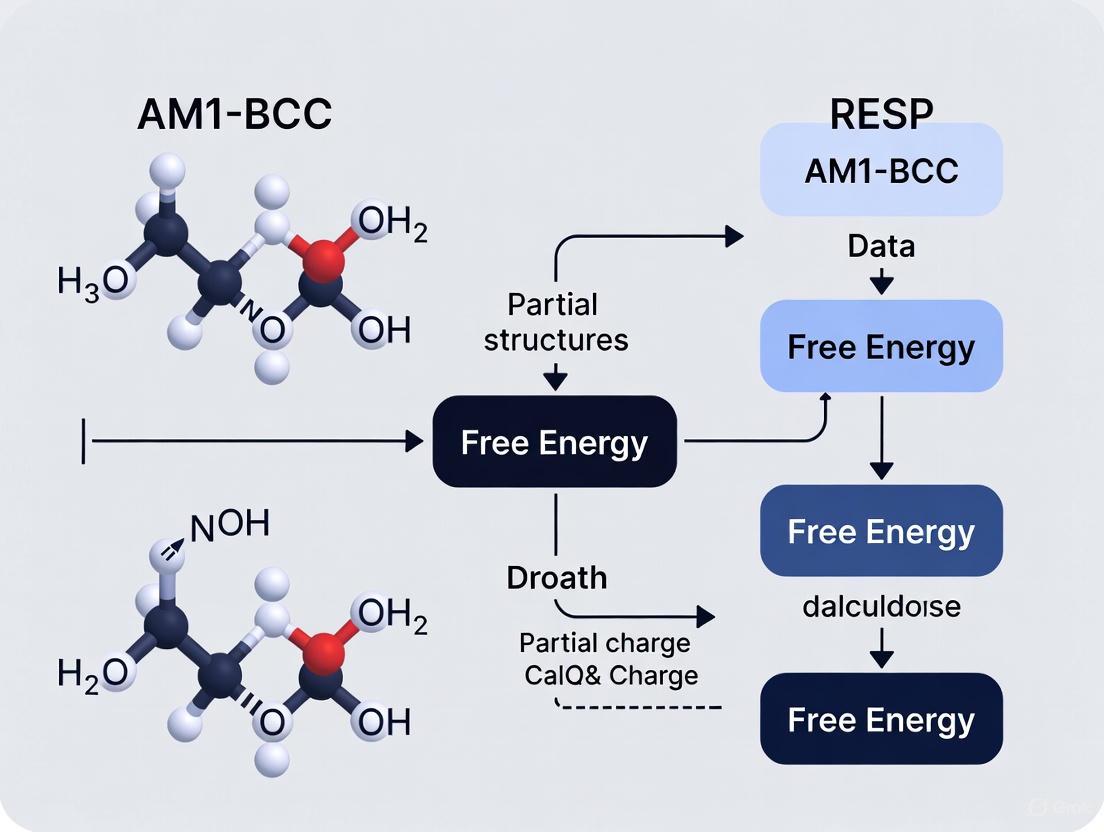
Accurate partial atomic charge assignment is a critical step in force field parameterization for molecular dynamics simulations, directly impacting the reliability of free energy calculations in computer-aided drug design.
AM1-BCC vs RESP: A Practical Guide to Charge Models for Accurate Free Energy Calculations in Drug Discovery
Abstract
Accurate partial atomic charge assignment is a critical step in force field parameterization for molecular dynamics simulations, directly impacting the reliability of free energy calculations in computer-aided drug design. This article provides a comprehensive comparison of the two predominant charge models, AM1-BCC and RESP, offering a foundational explanation of their theoretical underpinnings, detailed methodological guidance for application, strategies for troubleshooting and optimization, and a rigorous validation of their performance in predicting key properties like hydration free energy and binding affinity. Aimed at researchers and computational chemists, this review synthesizes current best practices and emerging trends to empower professionals in selecting and implementing the most appropriate charge model for their specific project needs, ultimately enhancing the predictive power of computational workflows in biomedical research.
Understanding the Basics: The Theory Behind AM1-BCC and RESP Charge Models
The Critical Role of Atomic Charges in Molecular Dynamics Force Fields
In the realm of molecular dynamics (MD) simulations, particularly for computer-aided drug design, the accurate prediction of molecular behavior and binding affinities depends critically on the underlying force field parameters. Among these parameters, atomic partial charges play a disproportionately significant role in governing electrostatic interactions—a fundamental component of molecular recognition, solvation, and binding. Fixed-charge force fields, which remain the workhorse for most practical applications due to their computational efficiency, rely entirely on these carefully assigned point charges to represent the complex electronic distribution within molecules. The selection of an appropriate charge assignment method can thus determine the success or failure of simulations aiming to predict physiologically relevant properties. Within the AMBER ecosystem and related molecular simulation frameworks, two charge assignment methodologies have emerged as prominent contenders: the Restrained Electrostatic Potential (RESP) method and the Austin Model 1 with Bond Charge Correction (AM1-BCC) approach. This guide provides an objective comparison of these two models, drawing on experimental data and performance benchmarks to inform researchers in their methodological selections.
Methodological Foundations: A Tale of Two Approaches
RESP: The Quantum Mechanics-Based Benchmark
The Restrained Electrostatic Potential (RESP) method is a highly regarded approach for assigning partial atomic charges. Its core methodology involves:
- Quantum Mechanical Foundation: RESP performs quantum mechanical (QM) calculations, typically at the Hartree-Fock (HF) level with the 6-31G* basis set, to compute the molecular electrostatic potential (ESP) around the molecule [1] [2].
- Charge Fitting Procedure: Atomic charges are derived through a fitting procedure that restrains the charges of non-hydrogen atoms to ensure chemical reasonability and transferability [3].
- Physical Basis: The choice of HF/6-31G* is intentional, as this level of theory fortuitously overpolarizes gas-phase charge distributions, approximately accounting for the polarization that occurs in condensed phases like water [3]. This cancellation of errors makes it suitable for simulations in aqueous environments.
A next-generation approach, RESP2, has been developed to address the inconsistent overpolarization of traditional RESP. RESP2 computes partial charges as a linear combination of gas-phase and aqueous-phase charges, tuned by a parameter δ (typically ≈0.6), scaling the contributions from gas- (40%) and aqueous-phase (60%) calculations [3].
AM1-BCC: The Efficient Semi-Empirical Alternative
The AM1-BCC method offers a computationally efficient alternative that bypasses expensive ab initio calculations:
- Two-Step Process: It first calculates Mulliken charges using the semi-empirical Austin Model 1 (AM1) method, then applies bond charge corrections (BCCs)—additive parameters applied to specific bond types—to emulate the HF/6-31G* electrostatic potential [1].
- Speed Advantage: By avoiding computationally intensive quantum mechanical calculations, AM1-BCC can generate charges rapidly, making it particularly suitable for high-throughput applications [4].
- Conformational Independence: An additional advantage lies in the produced atomic charges being less dependent on the input molecular conformation compared to RESP [1].
Recent developments include the ABCG2 model, a new set of BCC parameters specifically optimized for GAFF2 that significantly improves the accuracy of hydration free energy calculations [1].
Table 1: Fundamental Methodological Differences Between RESP and AM1-BCC
| Feature | RESP | AM1-BCC |
|---|---|---|
| QM Method | Hartree-Fock/6-31G* | Austin Model 1 (Semi-empirical) |
| Computational Cost | High | Low |
| Conformational Dependence | Higher | Lower |
| Primary Application | Benchmark quality | High-throughput screening |
| Parameterization Basis | ESP fitting with restraints | Bond charge corrections to AM1 charges |
Performance Comparison: Experimental Benchmarks
Hydration Free Energy Accuracy
Hydration free energy (HFE) represents a critical property for validating force fields, as it directly reflects the accuracy of solute-water interactions. Comparative studies reveal distinct performance characteristics:
- Original Parameter Performance: In the SAMPL4 hydration challenge, both RESP and AM1-BCC performed reasonably well (R² > 0.8) when combined with the GAFF force field [2]. AM1-BCC demonstrated particular advantages for tertiary amines and nitrates, though the overall difference in accuracy between the methods was not statistically significant [2].
- ABCG2 Advancement: The optimized ABCG2 charge model for GAFF2 has demonstrated remarkable improvements in HFE prediction, reducing the mean unsigned error (MUE) from 1.03 kcal/mol to 0.37 kcal/mol on a test set of 442 neutral organic solutes [1]. Large-scale validation on the FreeSolv database (642 organic molecules) showed GAFF2/ABCG2 achieved an RMSE of approximately 1.00 kcal/mol compared to the higher RMSE of GAFF2/AM1-BCC [5].
Table 2: Hydration Free Energy Prediction Performance
| Charge Model | Force Field | MUE (kcal/mol) | RMSE (kcal/mol) | Test Set Size |
|---|---|---|---|---|
| AM1-BCC | GAFF | ~1.0-1.1 | - | 47 (SAMPL4) |
| RESP | GAFF | ~1.0-1.1 | - | 47 (SAMPL4) |
| AM1-BCC | GAFF2 | 1.03 | ~1.71 | 442 |
| ABCG2 | GAFF2 | 0.37 | 0.99-1.00 | 442/642 |
Binding Free Energy Predictions
For drug discovery applications, accurate prediction of protein-ligand binding free energies is paramount. Surprisingly, improvements in HFE accuracy do not necessarily translate to better binding affinity predictions:
- Comparable Performance in RBFE: A 2025 evaluation of the ABCG2 model found that despite its superior HFE accuracy, it does not outperform GAFF2/AM1-BCC for protein-ligand binding free energy calculations [5]. Across 12 protein targets, 273 ligands, and 507 perturbations, both charge models exhibited statistically indistinguishable accuracy.
- Statistical Equivalence: RMSE values for relative binding free energy (RBFE) predictions were 1.31 kcal/mol for AM1-BCC versus 1.38 kcal/mol for ABCG2 (with AMBER99SB*-ILDN protein force field)—a non-significant difference [5].
- Ligand Ranking Capability: Both methods demonstrated similar performance in ranking candidate compounds by binding affinity, a critical task in lead optimization [5].
Transferability Across Environments
An ideal charge model should perform consistently across diverse dielectric environments, from aqueous solution to protein binding pockets:
- Organic Solvent Performance: The ABCG2 model demonstrates excellent transferability, accurately predicting solvation free energies across diverse organic solvents with different dielectric constants. In a test of 895 neutral organic solvent-solute systems, ABCG2 achieved an MUE of 0.51 kcal/mol and RMSE of 0.65 kcal/mol [1].
- Limited Transferability to Proteins: Despite excellent performance in hydration and transfer free energies, ABCG2's optimization for aqueous environments may limit its applicability to the complex, heterogeneous environments of protein binding pockets [5]. This suggests that improving binding free energy predictions may require specific optimization for protein-ligand interactions.
Experimental Protocols and Implementation
Workflow for Charge Assignment and Validation
The following diagram illustrates the generalized workflow for charge model assignment and validation in free energy calculations:
Key Experimental Considerations
Implementation details significantly impact the performance and reliability of both charge methods:
- Solvation Models for RESP: When calculating RESP charges, the inclusion of solvation effects is crucial. Common approaches employ a Poisson-Boltzmann solver with water as solvent during the charge fitting process [6].
- Geometry Optimization: For RESP charges, initial geometry optimization is typically performed at the HF/3-21G* level, followed by ESP calculation at the HF/6-31G level [6] [2].
- Automated Workflows: Tools like YASARA AutoSMILES implement automated AM1-BCC parameter assignment, further improving charges using known RESP charges of similar molecular fragments identified via SMILES strings [4].
- Free Energy Calculation Protocols: Binding free energy calculations typically employ alchemical transformation methods with Hamiltonian replica exchange to enhance sampling. Production simulations of 5-10 ns per λ window using a 4-fs timestep with hydrogen mass repartitioning are common [5] [6].
Research Reagent Solutions: Essential Tools for Charge Modeling
Table 3: Essential Software Tools for Charge Assignment and Validation
| Tool Name | Function | Compatible Charge Models |
|---|---|---|
| ANTECHAMBER | Automated parameterization of small molecules | AM1-BCC, RESP |
| Jaguar | Quantum mechanical calculations for RESP charges | RESP |
| YASARA AutoSMILES | Automated force field parameter assignment | AM1-BCC (with RESP fragment improvement) |
| OpenMM | Molecular dynamics engine for free energy validation | All major charge models |
| ForceBalance | Systematic parameter optimization | RESP2, LJ parameter co-optimization |
| AMBER Tools | Comprehensive simulation preparation and analysis | RESP, AM1-BCC |
The comparative analysis of RESP and AM1-BCC charge models reveals a nuanced landscape where methodological advantages must be weighed against specific research requirements:
- For Benchmark Studies: RESP remains the gold standard for maximum accuracy when computational resources permit, particularly for its rigorous QM foundation and well-established parameterization protocols.
- For High-Throughput Applications: AM1-BCC offers an excellent balance of efficiency and accuracy, with modern implementations like ABCG2 demonstrating remarkable performance in hydration free energy prediction.
- For Drug Discovery: The surprising finding that HFE improvements don't necessarily translate to better binding affinity predictions suggests that researchers should prioritize methodological consistency and integration with their existing workflows rather than seeking universal superiority of one method.
The ongoing development of next-generation models like RESP2 and ABCG2 indicates a healthy trajectory of methodological refinement. Future advances may focus on improving transferability between different dielectric environments and integrated optimization of charge and Lennard-Jones parameters for more accurate prediction of complex biomolecular interactions.
A fundamental challenge in molecular mechanics (MM) force fields is the accurate representation of molecular electron distribution, which directly influences electrostatic interactions crucial to biomolecular processes such as hydrogen bonding, solvation, and ligand-receptor recognition. The Restrained Electrostatic Potential (RESP) approach addresses this challenge through a philosophy grounded in quantum mechanical (QM) calculations and empirical restraint, balancing physical accuracy with computational practicality for molecular dynamics simulations [7].
Unlike simpler charge assignment methods, RESP employs a restraint function during charge fitting to mitigate excessive polarization known to occur with unrestrained ESP charges. The core objective is to generate atomic partial charges that reproduce the QM-derived molecular electrostatic potential while maintaining chemical reasonability through attenuated charge magnitudes [7]. This methodology reflects a fundamental principle in fixed-charge force field development: charges must represent environmentally averaged polarization rather than gas-phase electron distributions, as molecules in condensed phases experience electronic polarization from their surroundings [3].
Quantum Mechanical Foundations and Methodological Evolution
Theoretical Framework and RESP Methodology
The RESP approach derives atomic partial charges by fitting a classical Coulomb model to the quantum mechanical molecular electrostatic potential (ESP). The fundamental equation minimizes the difference between the QM potential ((Vi)) and classical potential ((\hat{Vi})) at points around the molecule [7]:
[ \chi{esp}^2 = \sumi (Vi - \hat{Vi})^2 ]
where (\hat{Vi} = \sumj \frac{qj}{r{ij}}) represents the classical electrostatic potential.
The distinctive feature of RESP lies in the introduction of a hyperbolic restraint function ((\chi_{rstr}^2)) that penalizes large atomic charges [7]:
[ \chi{resp}^2 = \chi{esp}^2 + \chi_{rstr}^2 ]
where
[ \chi{rstr}^2 = k{rstr} \sumj \left( \sqrt{qj^2 + b^2} - b \right) ]
This restraint function, with parameters (b) controlling tightness and (k_{rstr}) determining strength, effectively reduces charge magnitudes without significantly altering molecular dipole moments or net charges on ions [7].
RESP2: A Next-Generation Approach
The original RESP method (now often termed RESP1) utilizes Hartree-Fock calculations with the 6-31G* basis set, which fortuitously overpolarizes molecules approximately to the degree needed for hydrated environments [3]. This empirical finding, while useful, represents an inconsistency in the theoretical foundation.
The RESP2 method addresses this limitation by computing ESPs as a linear combination of gas-phase and aqueous-phase calculations [3]:
[ RESP2 = \delta \cdot ESP{aqueous} + (1 - \delta) \cdot ESP{gas} ]
This approach employs more advanced QM methods (PW6B95/aug-cc-pV(D+d)Z) for improved ESP accuracy and introduces the mixing parameter δ (typically ~0.6), which tunes charge polarity between aqueous and gas-phase environments [3]. RESP2 thus decouples charge derivation from the arbitrary overpolarization of HF/6-31G* while maintaining compatibility with fixed-charge force fields.
Table 1: Key Differences Between RESP Variants
| Feature | RESP (RESP1) | RESP2 |
|---|---|---|
| QM Method | HF/6-31G* | PW6B95/aug-cc-pV(D+d)Z |
| Basis Set Polarization | Fortuitous overpolarization | Explicit gas/aqueous mixing |
| Environmental Treatment | Implicit via basis set | Explicit via δ parameter |
| Theoretical Foundation | Empirical observation | Physically motivated |
| Computational Cost | Lower | ~7x higher (gas), ~20x higher (aqueous) |
RESP Workflow and Implementation
The standard RESP charge derivation follows a multi-step process integrating quantum chemistry and empirical fitting:
Diagram 1: RESP Charge Derivation Workflow
Detailed Computational Protocol
Molecular Geometry Optimization: Initial structure preparation using crystallographic data or optimized geometries [7]
Quantum Mechanical Calculation: Wavefunction calculation at specified QM level (traditionally HF/6-31G*) [7]
Electrostatic Potential Mapping: Generation of ESP points around molecular van der Waals surface using algorithms like CHELPG [7]
Restrained Charge Fitting: Least-squares fitting with hyperbolic restraints to determine optimal partial charges [7]
Validation: Assessment against experimental properties (liquid densities, hydration free energies) or crystal structures [7]
For carbohydrate systems, researchers have employed specialized validation through MD simulations of crystal structures, monitoring unit cell geometry stability as a sensitive probe of charge quality [7].
Comparative Performance in Free Energy Calculations
RESP vs. AM1-BCC for Biomolecular Simulations
The AM1-BCC method provides an efficient alternative to RESP, applying bond charge corrections to semiempirical AM1 Mulliken charges to approximate HF/6-31G* ESP charges without expensive ab initio calculations [1]. Performance comparisons reveal a complex trade-off between physical rigor and practical efficiency.
Table 2: Performance Comparison of Charge Models in Free Energy Calculations
| Application | Charge Model | Performance Metrics | Key Findings |
|---|---|---|---|
| Hydration Free Energy | GAFF2/AM1-BCC | RMSE: 1.71 kcal/mol [5] | Established baseline performance |
| Hydration Free Energy | GAFF2/ABCG2 | RMSE: 0.99-1.00 kcal/mol [5] | Significant improvement over AM1-BCC |
| Protein-Ligand Binding | GAFF2/AM1-BCC | RMSE: 1.31 kcal/mol [5] | Comparable performance in binding |
| Protein-Ligand Binding | GAFF2/ABCG2 | RMSE: 1.38 kcal/mol [5] | No improvement over AM1-BCC |
| Liquid Properties | RESP2 (δ=0.6) | Improved dielectric constants [3] | Enhanced electrostatic properties |
Limitations and Transferability Challenges
Recent large-scale assessments reveal that charge models optimized for specific properties (e.g., hydration free energy) do not necessarily transfer to related applications. The ABCG2 model, while significantly improving hydration free energy predictions, provides no statistically significant improvement for protein-ligand binding free energies [5]. This suggests that:
- Environmental heterogeneity in protein binding pockets presents challenges not fully addressed by hydration-optimized charges [5]
- Cancellation of errors between force field terms may contribute to the success of established methods [3]
- Protein force field compatibility may require coordinated optimization with ligand parameters [5]
Advanced Integration in Free Energy Methodologies
RESP in Alchemical Free Energy Calculations
RESP charges play critical roles in advanced free energy methods, particularly in alchemical free energy (AFE) calculations for binding affinity prediction. The recent development of quantum-centric AFE workflows integrates RESP charges with advanced QM methods, using the "book-ending" approach to correct MM free energies with QM/MM calculations [8].
These workflows employ RESP-derived charges as the MM baseline, with corrections applied through configuration interaction simulations to enhance accuracy [8]. This hybrid strategy leverages the sampling efficiency of MM with the accuracy of QM electronic structure methods.
Implicit Solvent Applications
RESP charges also feature in emerging implicit solvent approaches for absolute binding free energy calculations. Automated workflows implementing the double decoupling method (DDM) with generalized Born (GB) implicit solvent utilize RESP-derived charges while avoiding challenges associated with explicit solvent simulations [9]. These methods demonstrate particular utility for initial screening applications where computational efficiency is prioritized [9].
Research Reagent Solutions
Table 3: Essential Computational Tools for RESP Implementation
| Tool/Software | Function | Application Context |
|---|---|---|
| Gaussian | QM package for ESP calculation | Wavefunction generation for RESP fitting [7] |
| AMBER | MD simulation package | RESP implementation and validation [7] |
| ANTECHAMBER | Parameterization tool | Automated charge assignment [1] |
| ForceBalance | Parameter optimization | Systematic optimization of RESP2 and LJ parameters [3] |
| QUICK | QM engine for QM/MM | Book-ending corrections in AFE calculations [8] |
| PySCF | Quantum chemistry package | Configuration interaction calculations [8] |
The RESP methodology represents a sophisticated approach to partial charge assignment, balancing quantum mechanical rigor with empirical pragmatism. While AM1-BCC offers computational efficiency adequate for many applications, RESP provides a physically grounded foundation for force field development, particularly through next-generation implementations like RESP2.
Future advancements will likely focus on environment-specific parametrization addressing the transferability limitations observed in current models, particularly for heterogeneous protein environments. Additionally, increased integration with polarizable force fields and quantum computing approaches may further bridge the gap between computational efficiency and electronic structure accuracy.
The continued evolution of RESP methodologies underscores their fundamental role in achieving chemical accuracy in molecular simulations, particularly for drug discovery applications where reliable free energy predictions can significantly impact lead optimization efficiency.
In computational chemistry and drug discovery, the accuracy of molecular simulations is profoundly influenced by the quality of the partial atomic charges assigned to molecules. These charges are essential for modeling electrostatic interactions, which are a key component of non-bonded forces in molecular mechanics. Electrostatics influence a wide range of physicochemical properties, from binding affinities and solvation free energies to the accuracy of molecular docking poses. The challenge for researchers lies in selecting a charge derivation method that optimally balances computational cost with physical accuracy, a decision that becomes critical in high-throughput virtual screening where thousands or millions of molecules must be evaluated rapidly.
Two prominent methods for deriving these charges are the Restrained Electrostatic Potential (RESP) approach and the Austin Model 1 with Bond Charge Corrections (AM1-BCC). RESP charges are derived from quantum mechanical (QM) calculations and are considered a gold standard for accuracy in force field development [10]. However, this high accuracy comes at significant computational expense. In contrast, AM1-BCC is a semi-empirical method specifically parameterized to approximate RESP charges at a fraction of the computational cost [11]. This guide provides an objective comparison of these two approaches, focusing on their performance in free energy calculations and high-throughput applications, supported by experimental data and detailed methodologies.
Methodological Comparison: RESP vs. AM1-BCC
The RESP Charge Derivation Protocol
The Restrained Electrostatic Potential (RESP) fitting procedure is an ab initio quantum mechanical approach that assigns point charges to atoms based on a grid of electrostatic potential points derived from high-level quantum mechanical calculations [10]. The fundamental principle involves calculating the molecular electrostatic potential from a QM wavefunction and then fitting atomic charges to reproduce this potential, often with restraints to prevent charge drift and improve transferability.
A typical RESP protocol involves several key steps [10] [12]:
- Geometry Optimization: The molecule is first optimized at a QM level, typically Hartree-Fock (HF) with the 6-31G* basis set, though Density Functional Theory (DFT) methods like B3LYP are also used.
- Electrostatic Potential Calculation: The optimized structure is used to compute the electrostatic potential at a large number of points around the molecule.
- Conformational Sampling: For robust parameterization, multiple conformations (e.g., differing in backbone dihedrals φ and ψ) are often used to derive an averaged set of charges that are less dependent on a single molecular geometry [10].
- Fitting with Restraints: The final charges are obtained by fitting to the electrostatic potential while applying hyperbolic restraints to prevent excessively large charges on chemically equivalent atoms.
The significant computational expense of RESP arises from the QM calculations, particularly when using multiple conformations or larger basis sets. As noted in one study, "the conformation of the molecule has a great effect on the derived electrostatic potential: the same molecule in different orientations may produce different charge distributions" [10]. This necessitates careful conformational sampling for the most accurate results.
The AM1-BCC Charge Derivation Protocol
The AM1-BCC method is a two-stage semi-empirical approach designed to efficiently approximate RESP charges:
- AM1 Calculation: Initial Mulliken population analysis charges are calculated using the Austin Model 1 (AM1) semi-empirical Hamiltonian. This step is significantly faster than ab initio QM calculations.
- Bond Charge Correction (BCC): A set of empirically derived corrections is applied to the AM1 charges based on atom and bond types. These BCC parameters were optimized to reproduce target HF/6-31G* RESP charges for a training set of molecules [11] [13].
The AM1-BCC method is celebrated for its speed, operating within seconds for typical drug-like molecules, compared to the much longer times required for RESP calculations [10]. This efficiency comes from bypassing the expensive QM computation of the electrostatic potential. As one researcher notes, "AM1-bcc is only recommended to use when ab initio calculations are too expensive, such as in high throughput docking studies" [11]. An implementation is available through the Antechamber tool in AmberTools, using the MOPAC package for the AM1 calculation [11].
Table 1: Fundamental Characteristics of RESP and AM1-BCC Methods
| Feature | RESP | AM1-BCC |
|---|---|---|
| Theoretical Foundation | Ab initio Quantum Mechanics | Semi-Empirical QM with Empirical Corrections |
| Primary Computational Cost | High (HF/DFT calculation and ESP fitting) | Low (AM1 calculation with BCC rules) |
| Typical Calculation Time | Minutes to Hours | Seconds |
| Conformational Dependence | High (charges vary with conformation) | Low (AM1-Mulliken charges are conformationally robust) [11] |
| Key Implementation Tools | Gaussian, NWChem, Psi4, Multiwfn [10] [13] | AmberTools/Antechamber, OpenEye Toolkits |
The workflow below illustrates the fundamental differences in the procedural steps between the RESP and AM1-BCC charge derivation methods.
Performance Benchmarking in Free Energy Calculations
Accuracy in Hydration Free Energy Predictions
Hydration free energy (ΔG_hyd) calculations serve as a critical benchmark for force field accuracy, as they are highly sensitive to partial charges and provide a proxy for the accuracy expected in binding free energy calculations [14]. Multiple studies have systematically compared the performance of RESP and AM1-BCC charges in predicting these energies.
A key study assessing the SAMPL hydration free energy challenge found that both charge methods performed well, but with notable differences. Calculations based on the Generalized Amber Force Field (GAFF) with AM1-BCC charges achieved RMS errors against experimental data in the range of 1.4-2.2 kcal/mol [14]. The same study noted that using higher-quality MP2/cc-PVTZ SCRF RESP charges provided only marginally improved agreement with experiment over AM1-BCC. This suggests that for many practical applications in solvation free energy calculations, AM1-BCC offers a favorable accuracy-to-cost ratio.
Another investigation compared RESP and IPolQ-Mod charges (another method accounting for polarization) across 107 solute/solvent pairs and found that "the overall performance of GAFF/RESP and GAFF/IPolQ-Mod is similar," demonstrating RESP's compatibility with GAFF parameters [15]. This reinforces that while RESP is the benchmark for accuracy, other well-parameterized methods like AM1-BCC can approach its performance for many systems.
Table 2: Performance of Charge Methods in Hydration Free Energy Calculations
| Study Context | Charge Method | Force Field | Performance (RMS Error vs. Expt.) | Key Finding |
|---|---|---|---|---|
| SAMPL Challenge (Chlorinated hydrocarbons) [14] | AM1-BCC | GAFF | 1.4 - 2.2 kcal/mol | Good agreement with experiment; marginally worse than high-level RESP. |
| MP2/cc-PVTZ SCRF RESP | GAFF | ~1.4 kcal/mol (approx.) | Best agreement, but computational cost is high. | |
| Diverse Solute/Solvent Pairs [15] | RESP | GAFF | Good agreement overall | Compatible with GAFF; performance similar to IPolQ-Mod. |
| IPolQ-Mod | GAFF | Good agreement overall | Similar performance to RESP for most systems. |
Performance in Molecular Docking and Protein Simulations
In molecular docking, the speed of AM1-BCC makes it particularly advantageous for high-throughput screening where thousands of ligands must be processed quickly. A comparative evaluation states that "AM1-BCC and PM6 derived charges tend to offer a good balance between accuracy and computational efficiency" for docking [16]. The same source specifically recommends AM1-BCC over simpler methods like Gasteiger charges, which are faster but exhibit "poor" electrostatic quality.
For parameterizing non-natural amino acids in protein simulations, a 2018 study concluded that "all analyzed charge derivation methods reproduce with sufficient accuracy the literature values and can be used with confidence" [10]. This included both RESP and AM1-BCC. The study further noted that the obtained charges "were all very similar to each other across individual amino acids," with functional groups carrying the expected charge distributions. However, a limitation noted for AM1-BCC was its "inability to restrain backbone charges," which is automatically handled in the standard RESP protocol for biomolecules [10].
Conversely, a practical experience shared by a researcher highlighted potential limitations of AM1-BCC for larger systems: "I noticed that there was too much charge deviation (ie. +/- 0.5 to 1.0 charge unit deviation on individual atoms), especially in larger molecules... The AM1-BCC method may work better with smaller molecules with fewer functional groups" [12]. This suggests that while AM1-BCC is excellent for drug-like small molecules, RESP remains the preferred choice for highly complex or charged peptides and large systems where maximum accuracy is required.
The Scientist's Toolkit: Essential Research Reagents and Software
Successful implementation of charge derivation methods requires a suite of specialized software tools. The following table details key resources used in the featured experiments and their primary functions.
Table 3: Essential Software Tools for Charge Derivation and Validation
| Tool Name | Type/Category | Primary Function in Charge Research |
|---|---|---|
| AmberTools [10] [11] | Software Suite | Contains the antechamber program for calculating AM1-BCC charges and processing molecules for MD simulations. |
| NWChem [10] | Quantum Chemistry Package | Performs ab initio QM calculations (geometry optimization, ESP) required for RESP charge derivation. |
| Red Server [10] | Web-Based Service | Facilitates RESP charge derivation with support for multiple conformations and QM methods. |
| MultiWFN [13] | Analysis Software | Provides an easy-to-use platform for calculating RESP charges from QM output files (e.g., from Psi4). |
| Gaussian [12] | Quantum Chemistry Package | A widely used software for the QM calculations (optimization, ESP) that underpin the RESP method. |
| GROMACS [14] | Molecular Dynamics Engine | Used for running alchemical free energy calculations (e.g., hydration free energies) to validate charge sets. |
| OpenEye Toolkits [14] | Cheminformatics Library | Used for molecule manipulation and conformation generation; includes AM1-BCC charge assignment. |
The choice between RESP and AM1-BCC is not a simple declaration of one being universally superior, but rather a strategic decision based on the specific research context, system size, and computational constraints.
Use AM1-BCC for high-throughput applications and initial screening. Its superior speed, which provides results in seconds, makes it the pragmatic choice for virtual screening, molecular docking of large compound libraries, and the parameterization of small molecule ligands where computational efficiency is paramount [16] [10]. Its performance in hydration free energy calculations and for molecules with common functional groups is often sufficient for many research objectives [14].
Select RESP for benchmark studies and complex systems. When the highest possible accuracy is required for binding free energies, for parameterizing non-standard amino acids or complex peptides, and for final validation studies, RESP remains the gold standard [10] [12]. It is also the necessary choice when force field development or publication-quality results for unusual molecular systems are the goal.
In summary, AM1-BCC stands as a robust, fast, and sufficiently accurate semi-empirical method that successfully fulfills its design purpose: to approximate RESP charges for high-throughput computational tasks. RESP, with its rigorous ab initio foundation, provides the reference accuracy against which faster methods are measured. A tiered strategy—using AM1-BCC for rapid screening and reserving RESP for final validation of top candidates—leverages the strengths of both approaches for efficient and reliable computational research and drug discovery.
In computational chemistry and drug development, the accuracy of molecular dynamics (MD) and free energy calculations is fundamentally dependent on the quality of the underlying force field parameters. Atomic partial charges are among the most critical of these parameters, directly influencing the modeling of electrostatic interactions. For researchers simulating non-standard molecules, such as novel drug candidates, deriving these charges de novo is an essential yet complex step. The Restrained Electrostatic Potential (RESP) and Austin Model 1 with Bond Charge Correction (AM1-BCC) represent two predominant methodologies for this task, each embodying a different philosophy in the balance between computational accuracy and efficiency [10]. This guide provides an objective comparison of these two charge derivation models, focusing on their performance in free energy calculations, to inform scientists selecting the appropriate tool for their research.
Fundamental Methodologies and Theoretical Foundations
Restrained Electrostatic Potential (RESP)
The RESP method is a widely respected approach for deriving high-quality atomic charges. It operates on a principle of fitting atomic point charges to reproduce the quantum mechanically (QM) calculated electrostatic potential (ESP) around a molecule [10]. A key feature of RESP is the application of hyperbolic restraints, which penalize excessively large charges on individual atoms, particularly non-hydrogens. This restraint is crucial for generating chemically reasonable charges and improving the transferability of parameters across different molecular environments [10].
The procedural workflow for RESP is involved:
- Conformational Sampling: Multiple conformations of the target molecule are generated, often derived from statistical analysis of crystallographic databases for natural amino acids [10].
- Quantum Mechanical Calculation: For each conformation, a QM calculation (typically at the Hartree-Fock/6-31G level, though B3LYP/6-31G is also used) is performed to compute the electrostatic potential on a grid surrounding the molecule [10].
- Charge Fitting: A least-squares fitting procedure is applied to determine the set of atomic charges that best reproduces this QM ESP, subject to the mentioned restraints and symmetry constraints on equivalent atoms [10].
A significant advantage of the RESP protocol, as used in deriving charges for standard force fields like AMBER's FF14SB, is the ability to restrain the charges of backbone atoms to standardized literature values. This ensures modularity and compatibility when parameterizing new amino acids or other molecules meant to integrate seamlessly with existing force fields [10].
AM1 with Bond Charge Correction (AM1-BCC)
The AM1-BCC method was developed as a faster, more efficient alternative to RESP that still maintains good accuracy. It is a semi-empirical approach that combines the Austin Model 1 (AM1) Hamiltonian with post-processing bond charge corrections [10] [17].
Its workflow is more streamlined:
- Semi-Empirical Calculation: A single-point energy calculation is performed on the molecule using the AM1 method, which is computationally much less expensive than the ab initio QM calculations required for RESP [10].
- Application of Corrections: Pre-derived, transferable corrections (BCCs) are applied to the initial AM1 charges. These corrections are parameterized to force the final charges to emulate the results one would expect from a higher-level RESP/6-31G* calculation [17].
The primary strength of AM1-BCC is its speed, operating "within seconds" compared to the longer runtime of RESP calculations [10]. However, a noted limitation is that the standard AM1-BCC procedure does not automatically restrain backbone atoms to predefined values, which can lead to inconsistencies when integrating new molecules into established biomolecular force fields [10].
Comparative Performance Analysis
Quantitative Comparison of Accuracy and Efficiency
The table below summarizes the key performance characteristics of RESP and AM1-BCC charge derivation methods based on experimental data from computational studies.
Table 1: Performance Comparison of RESP and AM1-BCC Methods
| Feature | AM1-BCC | RESP |
|---|---|---|
| Theoretical Foundation | Semi-empirical QM with bond charge corrections [10] | Ab initio QM electrostatic potential fitting [10] |
| Computational Speed | Very fast (seconds) [10] | Slower (minutes to hours, depends on system size and method) [10] |
| Charge Deviation (MAD vs. other sets) | BH vs. BA charges: ~0.007 e [17] | RH vs. (BH/BA) charges: ~0.11 e [17] |
| Backbone Charge Restraint | Not typically applied in standard protocols [10] | Applied to ensure force field compatibility [10] |
| Conformational Sampling | Typically uses a single conformation [10] | Can utilize multiple conformations for robust parameterization [10] |
| Performance in FEP (MAD from expt.) | 2-3 kJ/mol for binding affinities [17] | 2-3 kJ/mol for binding affinities [17] |
Analysis of Comparative Data
The data reveals a core trade-off. RESP employs a more rigorous ab initio QM foundation, which provides a more theoretically sound basis for charge derivation. In contrast, AM1-BCC relies on parameterized corrections to a less accurate semi-empirical method [10]. This is reflected in the larger mean absolute deviation (MAD) of 0.11 e observed between RESP charges derived from Hartree-Fock geometry (RH) and the AM1-BCC sets, indicating tangible differences in the resulting charge values [17].
Despite these underlying differences, when evaluated in the context of practical application—specifically, predicting relative binding affinities in free energy perturbation (FEP) calculations—the two methods show remarkably similar performance. A study on galectin-3 inhibitors found that both RESP and AM1-BCC charges yielded near-identical results, with mean absolute deviations from experimental data of only 2-3 kJ/mol [17]. This suggests that for many practical drug discovery applications, the superior theoretical accuracy of RESP does not necessarily translate into a decisive practical advantage over the highly efficient AM1-BCC method.
Experimental Protocols for Method Evaluation
Protocol for Charge Derivation and Validation
The methodology for a typical study comparing charge derivation methods involves a structured workflow from system preparation to final validation through free energy calculations.
Diagram 1: Experimental workflow for charge model comparison.
The key steps involve:
- Test System Selection: Studies typically use a set of natural amino acids or a congeneric series of small molecule inhibitors (e.g., tetrafluorophenyl-triazole-thiogalactoside inhibitors of galectin-3) [10] [17]. For amino acids, they are often capped with acetyl (Ace) and N-methylamide (Nme) groups to mimic the peptide backbone environment [10].
- Charge Derivation: Charges are derived in parallel using RESP and AM1-BCC protocols. For RESP, this involves QM geometry optimization and ESP calculation using software like NWChem or Red Server, often with multiple conformations (e.g., αR and C5). For AM1-BCC, tools like antechamber in AMBERTools are used, typically on a single conformation [10] [17].
- Force Field Parameterization: The derived charges are integrated into a full force field (e.g., GAFF for small molecules, AMBER FF14SB for proteins) for subsequent simulations [17].
- Free Energy Calculation: The ultimate validation involves using the parameterized molecules in alchemical free energy calculations, such as FEP or Thermodynamic Integration (TI), to compute relative binding affinities or hydration free energies [17].
- Result Evaluation: The calculated free energies are benchmarked against experimental reference data to determine the accuracy of each charge derivation method [17].
The Scientist's Toolkit: Essential Research Reagents and Software
Table 2: Key Software and Resources for Charge Derivation and Free Energy Calculations
| Item Name | Function / Description | Relevance to Charge Models |
|---|---|---|
| AMBERTools | A suite of software for molecular mechanics simulations [10] [17]. | Contains the antechamber tool for automated parameterization, including AM1-BCC charge calculation [10]. |
| NWChem | An open-source quantum chemistry software suite [10]. | Used for high-level QM calculations (geometry optimization, ESP computation) required for the RESP method [10]. |
| Red Server | An online web service for RESP charge derivation [10]. | Provides an alternative, web-based platform for performing multi-conformational RESP fitting [10]. |
| General AMBER Force Field (GAFF) | A force field for small organic molecules [17]. | Commonly used to parameterize drug-like molecules; accepts charges from both RESP and AM1-BCC methods [17]. |
| AMBER / GROMACS | Molecular dynamics simulation packages [10] [18]. | The engine for running MD and FEP simulations to validate the performance of the derived charges [10] [18] [17]. |
| Hartree-Fock/6-31G* | A specific QM method and basis set [10] [17]. | The traditional level of theory for RESP charges, known for a fortuitous cancellation of errors [10]. |
The choice between AM1-BCC and RESP is not a matter of identifying a universally superior method, but rather of selecting the right tool for a specific research context based on the accuracy-efficiency trade-off.
Use AM1-BCC for high-throughput screening and rapid prototyping. Its exceptional speed, providing results in seconds, makes it ideal for projects requiring the parameterization of large virtual libraries in early-stage drug discovery. The minimal loss of accuracy for many practical applications, as demonstrated in FEP studies, justifies its use in these scenarios [10] [17].
Choose RESP for system-specific refinement and force field development. When parameterizing a critical, non-standard molecule for which the highest possible accuracy is desired, or when developing new force fields that require strict compatibility with existing parameters (via backbone restraints), RESP is the more rigorous choice [10]. It is also the preferred method when a multi-conformational representation of the molecule's charge distribution is necessary.
A robust strategy employed in modern computational research is to use variations in the charge derivation method, among other setup parameters, to generate independent simulations. This approach helps assess the stability of the calculated free energies and provides a more realistic estimate of the associated uncertainty, ultimately leading to more reliable predictions [17].
AM1-BCC vs RESP Charge Models for Free Energy Calculations
The accuracy of molecular dynamics (MD) simulations and free energy calculations in computational chemistry and drug discovery is critically dependent on the underlying force field parameters. Among these parameters, the assignment of partial atomic charges is paramount, as these charges dominate the electrostatic interactions that drive molecular recognition and binding [10]. The restrained electrostatic potential (RESP) and AM1-BCC charge models represent two widely adopted approaches for deriving these essential parameters, each with distinct theoretical foundations, historical development pathways, and performance characteristics [10] [3].
This guide provides an objective comparison of these fundamental charge derivation methods, tracing their evolution from initial development to contemporary variants. We present experimental data comparing their performance across diverse applications—from solvation free energy prediction to protein-ligand binding affinity calculations—to equip researchers with the practical knowledge needed to select appropriate charge models for specific computational challenges.
Historical Context and Methodological Evolution
The RESP Method: A Quantum Mechanics-Based Approach
The restrained electrostatic potential (RESP) method emerged in the early 1990s as a sophisticated approach for deriving partial atomic charges by fitting to the quantum mechanically calculated electrostatic potential (ESP) around a molecule [10] [3]. The original RESP implementation (now often called RESP1) utilized Hartree-Fock calculations with the 6-31G* basis set, which fortuitously overestimates gas-phase molecular polarity by approximately the right amount to yield charges appropriate for hydrated molecules [3]. This cancellation of errors made RESP1 surprisingly effective for biomolecular simulations despite its theoretical limitations.
A significant advancement came with the development of RESP2 in 2020, which addressed key limitations in the original approach [3]. Unlike RESP1, which relied exclusively on gas-phase calculations, RESP2 computes partial charges as linear combinations of both gas-phase and aqueous-phase ESP charges, with the relative contributions determined by a mixing parameter δ (typically δ ≈ 0.6, representing 60% aqueous and 40% gas-phase) [3]. This approach more systematically accounts for polarization effects in condensed phases without relying on the error cancellation that characterized RESP1.
The AM1-BCC Method: A Semiempirical Alternative
The AM1-BCC (Austin Model 1 with Bond Charge Corrections) method was developed as a faster, more efficient alternative to RESP [10]. Conceptually similar to RESP in its goal of reproducing electrostatic potentials, AM1-BCC utilizes semiempirical quantum mechanical calculations (AM1) followed by the application of bond charge corrections (BCC) derived from fitting to high-level reference data [10] [5]. This methodology provides a substantial computational advantage, generating charges in seconds rather than the minutes or hours required for RESP calculations [10].
The AM1-BCC approach has proven particularly valuable in high-throughput applications such as virtual screening and database generation, where computational efficiency is essential. Recent developments have focused on refining the BCC parameters, leading to variants such as the ABCG2 (AM1-BCC-GAFF2) model, which was specifically optimized to improve hydration free energy predictions [5] [19].
Table 1: Historical Development Timeline of Charge Models
| Year | Method | Key Innovation | Primary Application Domain |
|---|---|---|---|
| 1993 | RESP (RESP1) | ESP fitting with hyperbolic restraint; HF/6-31G* | Biomolecular force fields (AMBER) |
| 2000 | AM1-BCC | Semiempirical calculations with bond charge corrections | High-throughput small molecule parameterization |
| 2020 | RESP2 | Mixed gas/aqueous-phase ESP with tunable polarity | Improved accuracy for condensed-phase simulations |
| 2023 | ABCG2 | Optimized BCC terms for hydration free energy accuracy | Enhanced solvation property prediction |
Methodological Comparison: Computational Approaches and Protocols
Fundamental Theoretical Principles
The RESP approach operates by performing quantum mechanical calculations to determine the electrostatic potential around a molecule, then fitting atomic charges to reproduce this potential while applying geometric restraints to enhance transferability and numerical stability [10] [3]. The methodology can be implemented with various QM levels, from the traditional HF/6-31G* to more advanced density functional theory (DFT) with augmented basis sets [3].
In contrast, AM1-BCC employs semiempirical quantum calculations (AM1) to generate an initial set of charges, which are then refined using predetermined bond charge correction parameters derived from fitting to RESP charges or experimental data [10] [5]. This two-step process maintains much of the physical rigor of RESP while dramatically reducing computational cost.
Experimental Protocols for Charge Derivation
RESP Charge Derivation Protocol:
- Conformational Sampling: Generate multiple molecular conformations to account for charge dependence on molecular geometry [10]
- Quantum Mechanical Calculation: Compute electrostatic potentials using specified QM method (e.g., HF/6-31G* for RESP1 or PW6B95/aug-cc-pV(D+d)Z for RESP2) [10] [3]
- Implicit Solvation: For RESP2, perform additional calculations with implicit solvent model (typically water) [3]
- Charge Fitting: Fit atomic charges to reproduce ESP with restraints applied to equivalent atoms [10]
- Charge Combination: For RESP2, combine gas and aqueous-phase charges using specified δ parameter (typically 0.6) [3]
AM1-BCC Charge Derivation Protocol:
- Semiempirical Calculation: Perform AM1 calculation to obtain initial Mulliken charges [10]
- Bond Charge Correction: Apply predetermined BCC parameters to correct bond charges [5]
- Charge Assignment: Generate final atomic charges through BCC application without additional conformational averaging [10]
The following workflow diagram illustrates the key methodological differences between these approaches:
Performance Comparison: Experimental Data and Applications
Hydration Free Energy Prediction
Hydration free energy (HFE) prediction represents a fundamental benchmark for assessing charge model accuracy, as it directly probes solute-water electrostatic interactions. Experimental data across diverse compound sets reveals distinct performance patterns between charge methods:
Table 2: Hydration Free Energy Prediction Accuracy Across Charge Methods
| Charge Method | RMSE (kcal/mol) | Force Field | Dataset | Key Strengths |
|---|---|---|---|---|
| GAFF2/AM1-BCC | 1.71 | GAFF2 | FreeSolv (642 molecules) | Balanced performance, widely validated |
| GAFF2/ABCG2 | 0.99-1.00 | GAFF2 | FreeSolv (642 molecules) | Superior HFE accuracy [5] |
| RESP/HF/6-31G* | ~1.7 (estimated) | GAFF/GAFF2 | Drug-like molecules | Historical standard |
| RESP2 (δ=0.6) | ~1.0 (estimated) | Optimized LJ | Organic liquids | Optimized for condensed phase [3] |
The recently developed ABCG2 model, an AM1-BCC variant optimized for hydration free energies, demonstrates notably improved performance for this specific property, reducing root-mean-square error (RMSE) to approximately 1.00 kcal/mol compared to 1.71 kcal/mol for standard AM1-BCC [5]. This improvement stems from specifically optimized bond charge correction parameters tuned against hydration free energy data.
Protein-Ligand Binding Free Energy Calculations
While HFE prediction represents an important benchmark, protein-ligand binding free energy calculation constitutes the critical application for drug discovery. Surprisingly, charge models that excel in HFE prediction do not necessarily provide superior performance in binding affinity estimation:
Relative Binding Free Energy (RBFE) Calculations:
- GAFF2/AM1-BCC: RMSE = 1.31 [1.22, 1.41] kcal/mol (AMBER99SB*-ILDN protein FF) [5]
- GAFF2/ABCG2: RMSE = 1.38 [1.28, 1.49] kcal/mol (AMBER99SB*-ILDN protein FF) [5]
- GAFF2/ABCG2: RMSE = 1.39 [1.28, 1.51] kcal/mol (AMBER14SB protein FF) [5]
These results, derived from a substantial dataset (12 protein targets, 273 ligands, 507 perturbations), indicate that ABCG2 provides no statistically significant improvement over AM1-BCC in protein-ligand binding free energy calculations despite its superior HFE performance [5]. This highlights the complex nature of protein binding sites, where heterogeneous environments differ substantially from bulk water.
Condensed-Phase Physical Property Prediction
The accuracy of charge models extends beyond biological applications to the prediction of fundamental physicochemical properties. RESP2 with optimized Lennard-Jones parameters demonstrates particularly strong performance for condensed-phase properties:
Table 3: Physical Property Prediction with Different Charge Methods
| Property | Charge Method | Force Field | Performance | Application Context |
|---|---|---|---|---|
| Liquid density | RESP2 (δ=0.6) | Optimized LJ | High accuracy | Organic liquids [3] |
| Liquid density | RESP/AM1-BCC | GAFF | Moderate accuracy (2.1-3.07% error) | Acetic anhydride [20] |
| Heat of vaporization | RESP2 (δ=0.6) | Optimized LJ | High accuracy | Organic liquids [3] |
| Dielectric constant | RESP2 (δ>0.2) | Optimized LJ | Improved over RESP1 | Polar liquids [3] |
| Viscosity | CM1/CM5 | OPLS | High accuracy (0.1-0.5% error) | Acetic anhydride [20] |
Practical Implementation and Research Applications
Computational Requirements and Efficiency
A significant practical distinction between RESP and AM1-BCC methods lies in their computational demands:
AM1-BCC generates charges within seconds, making it suitable for high-throughput applications such as virtual screening of large compound libraries [10]. The method operates efficiently on standard desktop computers without requiring extensive computational resources.
RESP charge derivation requires minutes to hours per molecule depending on the QM level employed [10] [3]. Traditional RESP1 with HF/6-31G* calculations remains relatively efficient, while higher-level methods like PW6B95/aug-cc-pV(D+d)Z (used in RESP2) can be 7-20 times slower than HF/6-31G* [3]. RESP calculations typically benefit from access to high-performance computing resources, especially for large molecules or multi-conformation approaches.
The Scientist's Toolkit: Essential Research Reagents and Software
Table 4: Essential Tools for Charge Derivation and Free Energy Calculations
| Tool/Resource | Function | Method Availability | Key Features |
|---|---|---|---|
| AMBER Tools | Biomolecular simulation | RESP, AM1-BCC | Integrated workflow for force field parameterization [10] |
| NWChem | Quantum chemistry package | RESP | High-performance computational chemistry [10] |
| Red Server | Online charge derivation | RESP | Web-based interface for RESP calculations [10] |
| ForceBalance | Force field optimization | RESP2 | Systematic parameter optimization against experimental data [3] |
| OpenFE | Free energy calculations | AM1-BCC, ABCG2 | Standardized benchmarks for method validation [5] |
| FEP+ (Schrödinger) | Binding affinity prediction | Multiple charge models | Industry-standard drug discovery platform [21] [22] |
| GAFF/GAFF2 | Small molecule force field | AM1-BCC, ABCG2 | Generalizable parameters for organic molecules [5] |
The comparative analysis of AM1-BCC and RESP charge models reveals a nuanced performance landscape where methodological superiority depends significantly on the specific application context. AM1-BCC provides an optimal balance of computational efficiency and predictive accuracy for high-throughput applications, particularly in early-stage drug discovery where numerous compounds must be evaluated rapidly. The recent ABCG2 variant extends this approach with enhanced hydration free energy accuracy, though this improvement does not necessarily transfer to protein-ligand binding applications [5].
The RESP approach, particularly the next-generation RESP2 implementation, offers a more physically rigorous methodology that systematically accounts for condensed-phase polarization effects through its mixed gas/aqueous charge derivation [3]. This approach demonstrates superior performance for condensed-phase physical properties and benefits from compatibility with high-level QM methods, though at substantially higher computational cost.
For researchers engaged in free energy calculations, selection criteria should consider both application requirements and resource constraints: AM1-BCC represents the preferred choice for virtual screening and large-scale studies where computational efficiency is paramount, while RESP2 provides enhanced accuracy for focused studies of key compounds or lead optimization campaigns where resources permit more extensive computations. Future methodological developments will likely focus on bridging this efficiency-accuracy gap through machine learning approaches and improved transferable parameterization, further empowering computational scientists in drug discovery and molecular design.
Putting Theory into Practice: How to Implement AM1-BCC and RESP in Your Workflow
Step-by-Step Guide to Generating RESP Charges with Quantum Mechanics
Accurate prediction of molecular properties and binding affinities is fundamental to computational chemistry and drug discovery. The accuracy of these calculations depends critically on the reliable parametrization of force fields, particularly the assignment of partial atomic charges. Among various methods, the Restrained Electrostatic Potential (RESP) approach has emerged as a cornerstone for modeling electrostatic interactions in molecular mechanics simulations, especially within the AMBER force field ecosystem [23]. RESP charges are computationally derived by fitting atom-centered point charges to reproduce the quantum mechanically calculated molecular electrostatic potential (ESP) around the molecule, providing a robust bridge between quantum mechanical accuracy and molecular mechanics efficiency [23].
This guide details the theoretical foundation, practical implementation, and performance characteristics of the RESP methodology, with particular emphasis on its role in free energy calculations. We objectively compare RESP against the widely used semi-empirical AM1-BCC method and the recently introduced ABCG2 model, providing researchers with the necessary information to select appropriate charge models for their specific applications in drug discovery projects.
Theoretical Foundation of the RESP Approach
Fundamental Principles
The RESP method belongs to a class of charge derivation techniques based on fitting to an observable quantity—the molecular electrostatic potential. Unlike wavefunction-partitioning methods (e.g., Mulliken or Löwdin charges) or electron density partitioning schemes (e.g., Hirshfeld or Bader's AIM analysis), ESP-fitting approaches offer the significant advantage of directly reproducing an experimentally accessible property [23]. The core concept involves calculating the quantum mechanical electrostatic potential on grid points surrounding the molecule, then determining a set of atom-centered point charges that best reproduce this potential.
A fundamental challenge in ESP-fitting methods is the conformational dependency of derived charges—small changes in molecular geometry can lead to significantly different charge values. This limitation is mitigated in practice by using multiple conformations during the fitting procedure, substantially improving the transferability of the resulting charge set [23]. Additionally, ESP-fitting is an underdetermined problem, particularly for buried atoms within the molecular structure, where charges may converge to different values while still reproducing the ESP with comparable accuracy. To regularize this problem, the RESP approach introduces hyperbolic penalty functions that restrain atomic charges toward physically reasonable values [23].
The RESP Fitting Algorithm
The restrained ESP fitting process minimizes a loss function that balances two competing objectives: accurate reproduction of the reference electrostatic potential and maintenance of chemically reasonable charge values. Mathematically, this is expressed as:
[ L = \sum{p=1}^{N{\text{grid}}} \left( Vp^{\text{model}} - Vp^{\text{QM}} \right)^2 + wR \sum{i=1}^{N{\text{atoms}}} P(qi) ]
Where:
- ( V_p^{\text{model}} ) is the electrostatic potential at grid point ( p ) generated by the point charge model
- ( V_p^{\text{QM}} ) is the quantum mechanically calculated electrostatic potential at grid point ( p )
- ( N_{\text{grid}} ) is the number of grid points in the fitting set
- ( w_R ) is the weighting factor for the restraint function
- ( P(q_i) ) is the penalty function applied to the charge of atom ( i )
- ( N_{\text{atoms}} ) is the number of atoms in the molecule
The original RESP implementation uses a hyperbolic penalty function ( P(q) = \sqrt{q^2 + b^2} - b ), which gently restrains charges toward zero without imposing harsh constraints, allowing chemically significant charges to deviate as needed while preventing unphysical values for buried atoms [23].
RESP Charge Generation: A Step-by-Step Protocol
Initial Structure Preparation
Molecular Geometry Optimization: Begin with a high-quality molecular structure optimized at an appropriate level of quantum mechanical theory. For organic molecules and drug-like compounds, DFT methods like B3LYP with the 6-31G* basis set typically provide an excellent balance between accuracy and computational cost.
Conformational Sampling: For flexible molecules, generate multiple low-energy conformations to create a conformationally averaged charge set with improved transferability. This can be achieved through:
- Systematic conformational search
- Molecular dynamics simulations with enhanced sampling techniques
- Boltzmann-weighted ensemble of conformers
Quantum Mechanical Calculations
Single-Point Energy Calculation: Using the optimized geometry, perform a single-point calculation to obtain the wavefunction required for ESP generation. The widely validated protocol for biomolecular force fields uses:
- Method: Hartree-Fock or B3LYP density functional theory
- Basis Set: 6-31G* (Pople-style double-zeta with polarization functions)
- Program: Gaussian [8] or other quantum chemistry packages
Electrostatic Potential Generation: Calculate the molecular electrostatic potential on points surrounding the molecule. The standard Merz-Singh-Kollman scheme places points on multiple layers around the molecule, constructed as a union of spheres around each atom with radii ranging from 1.4 to 2.0 times the van der Waals radius [23].
RESP Fitting Procedure
ESP Fitting with Restraints: Perform the RESP fitting procedure with appropriately chosen restraint weights:
- Primary restraint weight: 0.0005 atomic units for heavy atoms
- Weaker restraint (0.001 au) for hydrogen atoms
- Multiple-stage fitting to improve convergence
Charge Validation: Validate the resulting charges by:
- Comparing the ESP generated by the point charges to the reference QM ESP
- Checking for chemical reasonableness (magnitude, trends across functional groups)
- Verifying molecular dipole moment alignment with QM reference
Table 1: Standard Quantum Chemistry Methods for RESP Charge Generation
| Computational Element | Recommended Method | Alternative Options | Key Considerations |
|---|---|---|---|
| Geometry Optimization | B3LYP/6-31G* | HF/6-31G* | HF may overestimate polarization; DFT provides better electron correlation |
| ESP Calculation | Merz-Singh-Kollman scheme | Connolly surface | Multiple layers (1.4-2.0× van der Waals radius) provide balanced sampling |
| Basis Set | 6-31G* | cc-pVDZ, 6-311G | Polarization functions essential for directional bonding |
| Restraint Weight | 0.0005 au (heavy atoms) | System-dependent adjustment | Higher weights increase regularization but may reduce ESP accuracy |
Advanced RESP Methodologies
Dynamically Generated RESP (D-RESP)
For systems where electronic polarization significantly impacts molecular properties, the standard gas-phase RESP approach may lack transferability to condensed phases. The D-RESP (Dynamically Generated RESP) method addresses this limitation by generating charges "on-the-fly" during QM/MM molecular dynamics simulations [23]. In this approach:
- RESP charges are computed at each MD step using the MM atom positions as probe sites for the ESP
- Reference charges are typically set to Hirshfeld values computed at each step, providing physically motivated restraints
- The method captures environment-dependent polarization effects while maintaining numerical stability
Extended D-RESP (xDRESP) for Multipole Moments
The recently introduced xDRESP (extended D-RESP) approach generalizes the core methodology to fit atom-centered electric multipole moments of arbitrary order, not just charges [23]. This extension addresses the fundamental limitations of point-charge models for describing complex electron distributions. The xDRESP loss function incorporates multipole contributions:
[ L = \sum{p=1}^{N^{\mathrm{SR}}} \left( Vp^{\mathrm{xDRESP}} - Vp^{\mathrm{QM \to MM}} \right)^2 + wR \sum{i=1}^{N^{\mathrm{QM}}} \left( Mi^{[0]} - q_i^{\mathrm{ref}} \right)^2 + \sigma ]
Where the xDRESP potential includes multipole contributions:
[ Vp^{\mathrm{xDRESP}} = \sum{i=1}^{N^{\mathrm{QM}}} \sum{|\alpha|=0}^{\Lambda} \frac{(-1)^{|\alpha|}}{\alpha!} Mi^{[\alpha]} T^{[\alpha]} (\mathbf{R}p, \mathbf{R}i) ]
This approach enables more accurate representation of electrostatic properties without increasing the number of interaction sites, though at the cost of additional complexity in force field parameterization and simulation.
Performance Comparison of Charge Models
Hydration Free Energy Accuracy
Hydration free energy (HFE) prediction serves as a critical benchmark for assessing charge model performance in condensed-phase simulations. Recent large-scale assessments reveal distinct performance characteristics across charge generation methods:
Table 2: Performance Comparison of Charge Models for Hydration Free Energy Prediction
| Charge Model | Computational Cost | HFE RMSE (kcal/mol) | Key Strengths | Key Limitations |
|---|---|---|---|---|
| AM1-BCC | Low | 1.71 [5] | Excellent cost/accuracy balance; widely validated | Systematic errors for certain functional groups |
| RESP/HF/6-31G* | High | ~1.7-2.0 [24] | Rigorous QM foundation; excellent for neutral molecules | Conformation-dependent; expensive for large molecules |
| ABCG2 | Low | 0.98-1.00 [5] | Superior HFE accuracy; optimized for hydration | Limited transferability to protein environments |
| RESP-QM/MM | Very High | Comparable to ABCG2 [24] | Includes environment polarization; high accuracy | Computationally prohibitive for high-throughput |
The recently introduced ABCG2 (AM1-BCC-GAFF2) model demonstrates remarkable performance for HFE prediction, achieving an RMSE of approximately 1.00 kcal/mol compared to 1.71 kcal/mol for its AM1-BCC predecessor [5]. This improvement stems from optimized bond charge correction (BCC) terms for specific functional groups, fine-tuned specifically for hydration thermodynamics. RESP charges derived at the HF/6-31G* level show comparable accuracy to AM1-BCC for general applications, though both are outperformed by the specialized ABCG2 model for hydration [24].
Protein-Ligand Binding Free Energy Performance
While HFE accuracy provides important validation, protein-ligand binding affinity prediction represents the ultimate application metric for drug discovery. Surprisingly, charge model performance for hydration does not directly translate to binding affinity prediction:
Table 3: Charge Model Performance in Protein-Ligand Binding Free Energy Calculations
| Charge Model | Binding ΔΔG RMSE (kcal/mol) | Ligand Ranking Accuracy | Transferability Assessment |
|---|---|---|---|
| GAFF2/AM1-BCC | 1.31 [1.22, 1.41] [5] | High (Pearson's r ~0.6-0.8) | Excellent across diverse targets |
| GAFF2/ABCG2 | 1.38 [1.28, 1.49] [5] | Comparable to AM1-BCC | No significant improvement despite better HFE |
| RESP/HF/6-31G* | Similar to AM1-BCC | Similar to AM1-BCC | System-dependent performance |
Notably, the ABCG2 model's superior performance for hydration free energies does not translate to improved binding affinity prediction. In comprehensive assessments across 12 protein targets, 273 ligands, and 507 perturbations, GAFF2/ABCG2 showed no statistically significant improvement over GAFF2/AM1-BCC [5]. This highlights a fundamental challenge in force field development: property-specific optimization does not guarantee transferability to related but distinct properties. The comparable performance of RESP and AM1-BCC charges in binding affinity calculations suggests that error cancellation and force field balancing may outweigh the advantages of more sophisticated charge generation methods in complex protein environments.
Experimental Protocols for Charge Model Validation
Hydration Free Energy Calculation Protocol
Accurate assessment of charge model performance requires carefully validated experimental protocols. For hydration free energy calculations, the established methodology involves:
System Preparation:
- Solute parameterization with target charge model (RESP, AM1-BCC, or ABCG2)
- Solvation in explicit water box (e.g., TIP3P, OPC) with minimum 24 Å padding
- Application of periodic boundary conditions
Molecular Dynamics Protocol:
- Energy minimization (steepest descent + conjugate gradient)
- NVT equilibration with gradual heating to 300 K
- NPT equilibration at 300 K and 1 atm pressure
- Production sampling with multiple λ windows for alchemical transformation
Free Energy Calculation:
- Thermodynamic Integration (TI) or Multistate Bennett Acceptance Ratio (MBAR)
- Evenly spaced λ windows for Hamiltonian scaling
- Long sampling times (≥10 ns) for convergence [8]
Relative Binding Free Energy Protocol
For protein-ligand binding affinity assessment, the nonequilibrium alchemical free energy protocol provides robust performance:
System Preparation:
- Protein preparation with standard force fields (AMBER14SB, AMBER99SB*-ILDN)
- Ligand parameterization with target charge model
- Solvation with explicit water molecules and ion concentration to physiological strength
Simulation Protocol:
- Dual-topology approach for ligand transformations
- Multiple independent runs for uncertainty estimation
- Enhanced sampling techniques (REMD) for challenging transformations
Analysis and Validation:
- Statistical analysis of ΔΔG values across transformation networks
- Comparison with experimental reference data
- Assessment of ligand ranking accuracy via Pearson's r, Spearman's ρ, and Kendall's τ [5]
Research Reagent Solutions
Table 4: Essential Computational Tools for RESP Charge Generation and Validation
| Tool Category | Specific Software | Primary Function | Key Features |
|---|---|---|---|
| Quantum Chemistry | Gaussian [8], GAMESS, ORCA | Wavefunction calculation and ESP generation | Support for HF, DFT methods; RESP fitting capabilities |
| Molecular Dynamics | AMBER [8], GROMACS, OpenMM | Free energy calculations and sampling | TI, MBAR implementation; alchemical pathway support |
| Force Field Parametrization | antechamber, ACPYPE, LigParGen | Automated charge assignment and topology generation | Support for multiple charge models; GAFF/GAFF2 compatibility |
| Visualization & Analysis | VMD, PyMOL, MDTraj | Simulation analysis and result visualization | Electrostatic potential mapping; trajectory analysis |
| Specialized RESP | xDRESP in MiMiC [23] | Polarizable charge generation in QM/MM | On-the-fly charge fitting; multipole moment support |
Workflow Visualization
The following diagram illustrates the complete RESP charge generation workflow and its context within the broader computational drug discovery pipeline:
The RESP charge model remains a robust, first-principles approach for molecular electrostatic representation, offering a rigorous connection to quantum mechanical calculations. Its performance in free energy calculations is comparable to the widely used AM1-BCC approach, though both are potentially surpassed by the specialized ABCG2 model for hydration-specific applications.
For researchers selecting charge generation methods, we recommend:
- RESP/HF/6-31G* for fundamental studies requiring rigorous QM foundation
- AM1-BCC for high-throughput virtual screening with balanced accuracy/efficiency
- ABCG2 for applications specifically focused on solvation thermodynamics
- D-RESP/xDRESP for systems where explicit polarization effects are critical
The comparable performance of simpler charge models in complex protein environments underscores the importance of force field balance and error cancellation. Future methodological developments will likely focus on polarizable force fields and machine learning approaches that maintain accuracy while improving computational efficiency for drug discovery applications.
Automating Charge Assignment with AM1-BCC via ANTECHAMBER
Atomic partial charges are a fundamental component of molecular mechanics force fields, directly influencing the accuracy of molecular dynamics (MD) simulations and free energy calculations in computer-aided drug design. The Restrained Electrostatic Potential (RESP) and Austin Model 1 with Bond Charge Corrections (AM1-BCC) have emerged as the two predominant methods for assigning these charges in the AMBER ecosystem and related force fields. RESP charges are derived from quantum mechanical (QM) calculations of the electrostatic potential, typically at the Hartree-Fock/6-31G* level, followed by a fitting procedure with restraints to mitigate overpolarization [10] [23]. In contrast, AM1-BCC is a semi-empirical approach that applies parameterized corrections to AM1 Mulliken charges to mimic RESP charges, offering significant computational advantages [11] [1].
The ANTECHAMBER tool, part of the AMBER software suite, provides automated parameterization for organic molecules, including robust support for AM1-BCC charge assignment [25]. This automation is crucial for high-throughput workflows, such as virtual screening and lead optimization in drug discovery projects. This guide objectively compares the performance of AM1-BCC and RESP charge models, with a specific focus on their implementation via ANTECHAMBER for free energy calculations.
Performance Comparison: Quantitative Data
Extensive benchmarking studies have evaluated the performance of AM1-BCC and RESP charges against experimental data and higher-level theoretical calculations. The tables below summarize key quantitative comparisons.
Table 1: Performance in Hydration Free Energy (HFE) Calculations (in kcal/mol)
| Charge Model & Force Field | Number of Solutes | Mean Unsigned Error (MUE) | Root-Mean-Square Error (RMSE) | Source/Reference |
|---|---|---|---|---|
| GAFF/AM1-BCC (Original) | 504 | 1.26 | ~1.53 | [26] |
| GAFF/AM1-BCC (Original) | 642 | 1.11 | 1.53 | [26] |
| GAFF2/ABCG2 (New AM1-BCC) | 642 | - | 0.99 | [26] |
| OPLS3e | 418 | 0.50 | 1.02 | [26] |
Table 2: Performance in Binding Free Energy (BFE) Calculations
| Charge Model | System | Performance vs. Experiment | Notes | Source |
|---|---|---|---|---|
| RESP (HF/6-31G*) | Galectin-3 inhibitors | MAD: 2-3 kJ/mol, R²: 0.5-0.8 | Similar results across charge sets | [17] |
| AM1-BCC | Galectin-3 inhibitors | MAD: 2-3 kJ/mol, R²: 0.5-0.8 | Performance nearly identical to RESP | [17] |
| RESP & AM1-BCC | Non-natural amino acids | Sufficient accuracy vs. literature values | Both methods recommended | [10] |
Table 3: Computational and Practical Characteristics
| Feature | AM1-BCC | RESP |
|---|---|---|
| Computational Cost | Seconds to minutes | Hours to days (requires ab initio QM) |
| Automation in ANTECHAMBER | Direct support via -c bcc [25] |
Requires external QM software (e.g., Gaussian, Psi4) [27] |
| Conformational Dependence | Less sensitive to input conformation [11] [26] | More sensitive; often requires multiple conformers for robustness [10] [23] |
| Recommended Use Case | High-throughput studies, initial screening, large systems [11] | Final parameterization for key compounds, force field development [10] |
Experimental Protocols and Workflows
Standard Protocol for AM1-BCC with ANTECHAMBER
The following workflow is a standard method for generating GAFF parameters with AM1-BCC charges for a ligand, starting from a PDB file [25].
- Prepare Ligand File: Isolate the ligand into a separate PDB file. If hydrogens are missing, they can be added using AMBER's
reducetool:$AMBERHOME/bin/reduce ligand.pdb > ligand_H.pdb. - Run ANTECHAMBER: Execute the program to assign AM1-BCC charges and create a MOL2 file. The critical flag is
-c bcc.-nc 0: Specifies the net charge of the ligand (e.g.,-nc -1for a -1 charge).-m 1: Specifies multiplicity (1 for singlet).
- Generate Force Field Parameters: Use
parmchk2to identify missing parameters and create a frcmod file. - Load in LEaP: The generated
ligand_bcc.mol2andligand.frcmodfiles are used in the LEaP module to create the final topology and coordinate files for simulation.
The following diagram visualizes this automated workflow:
Protocol for RESP Charge Derivation
For comparison, a typical RESP workflow is more complex and resource-intensive [10] [27]:
- Geometry Optimization: Optimize the ligand's geometry using a QM method (e.g., HF/6-31G*).
- Electrostatic Potential (ESP) Calculation: At the optimized geometry, compute the ESP on a grid surrounding the molecule. This often requires a licensed QM package like Gaussian, though open-source alternatives like Psi4 can be used [27].
- ESP Fitting with Restraints: Perform a two-stage fitting procedure to derive atomic charges that reproduce the QM ESP, using restraints to avoid large charges on buried atoms. Tools like
respfrom AmberTools or web servers like REDD Server facilitate this step [10]. - Parameterization: The final RESP charges are incorporated into a MOL2 file, and the process continues similarly to the AM1-BCC workflow with
parmchk2andLEaP.
The Scientist's Toolkit: Essential Research Reagents
Table 4: Key Software Tools for Charge Assignment and Validation
| Tool Name | Type/Brief Description | Primary Function in Workflow |
|---|---|---|
| ANTECHAMBER [25] | Software Tool (AmberTools) | Automated parameterization of organic molecules, including AM1-BCC charge assignment. |
| Psi4 [27] | Open-Source Quantum Chemistry Package | Calculate RESP charges as an alternative to Gaussian, often via Python scripts. |
| Generalized AMBER Force Field (GAFF/GAFF2) [1] | General Force Field | Provides bonded and van der Waals parameters for organic molecules. |
| Reduce [25] | Software Tool (AmberTools) | Adds missing hydrogen atoms to molecular structures in PDB files. |
| Parmchk2 [25] | Software Tool (AmberTools) | Generates force field parameter files (frcmod) for missing parameters in a molecule. |
| LEaP [25] | Software Module (AmberTools) | Creates complete simulation systems by integrating topology, coordinates, and force field parameters. |
The comparative data demonstrates that AM1-BCC implemented via ANTECHAMBER provides a robust, efficient, and accurate method for charge assignment, particularly suited for high-throughput applications and free energy calculations where its performance is often comparable to the more expensive RESP method [17]. Its speed and lower conformational dependence make it an excellent choice for automated pipelines.
The future of charge models is actively evolving. New methodologies like RESP2, which mixes gas-phase and implicit-solvent QM calculations to improve transferability, are being explored [28]. Furthermore, the recent development of the ABCG2 model, a re-parameterized AM1-BCC for GAFF2, has shown milestone accuracy in solvation free energy calculations, significantly reducing errors and pushing the boundaries of what is possible with fixed-charge models [1] [26]. For researchers, the choice between AM1-BCC and RESP should be guided by the specific balance required between computational cost, desired accuracy, and the scale of the project.
In the field of computational chemistry and drug design, the accuracy of molecular simulations is fundamentally tied to the quality of the force field parameters used. Among these parameters, the assignment of partial atomic charges via methods like AM1-BCC and RESP is critical, as they govern electrostatic interactions. A pivotal, yet sometimes overlooked, aspect of charge derivation is how molecular conformation is handled. The choice between using a single, static conformer or an ensemble of multiple conformers can significantly impact the resulting charges, their transferability, and ultimately, the predictive power of subsequent free energy calculations [10] [23]. This guide objectively compares these two conformational approaches within the broader thesis of evaluating AM1-BCC and RESP charge models, providing researchers with the experimental data and methodologies needed to inform their protocols.
Methodological Comparison: Single vs. Multiple Conformer Approaches
The core difference between the two approaches lies in how they account for the conformational flexibility of a molecule, which directly influences the calculated electrostatic potential (ESP) and the resulting fitted charges.
Single Conformer Approach: This method involves deriving atomic charges based on a single, representative molecular geometry, typically a minimum-energy conformation. The process is computationally efficient and straightforward. The molecular geometry is first optimized, and then the ESP is calculated for this single structure. Finally, charges are fitted to reproduce this ESP, often with restraints to ensure well-behaved values [10] [23]. However, a significant limitation is its conformational dependency. Since the ESP can vary with molecular geometry, charges derived from a single structure may not be transferable to other conformations the molecule adopts in dynamic simulations, potentially leading to inaccuracies [23].
Multiple Conformer Approach: This strategy aims to derive a single, robust set of charges that are averaged over an ensemble of low-energy conformations. The process is more computationally intensive. It begins by generating multiple conformers that represent the molecule's accessible spatial arrangements. The ESP is then calculated for each of these conformations. Finally, charges are fitted to reproduce the averaged ESP across all conformers [10] [23]. The primary advantage is the improved transferability of the charges. By accounting for conformational flexibility, the resulting charge set is less biased toward a single geometry and is more representative of the molecule's behavior in a dynamic environment like a solution or protein binding pocket [10].
Table 1: Core Comparison of Single and Multiple Conformer Approaches
| Feature | Single Conformer Approach | Multiple Conformer Approach |
|---|---|---|
| Fundamental Principle | Charges derived from one minimum-energy structure. | Charges derived from an ensemble of low-energy structures. |
| Computational Cost | Lower; faster to execute. | Higher; requires generation and QM calculation of multiple structures. |
| Conformational Handling | Static; assumes a single, representative geometry. | Dynamic; explicitly accounts for flexibility. |
| Primary Advantage | Simplicity and speed. | Improved robustness and transferability of charges. |
| Key Limitation | Risk of poor transferability to other conformations. | Increased complexity and resource requirements. |
The following diagram illustrates the key procedural differences between these two charge derivation workflows:
Experimental Protocols and Performance Data
Benchmarking Studies and Quantitative Outcomes
A direct comparison of the single and multiple conformer approaches was performed in a study parameterizing natural amino acids. The researchers derived RESP charges using both single conformations (αR and C5) and a multi-conformation ensemble, benchmarking them against established AMBER force field (FF14SB) values [10].
Table 2: Summary of Charge Derivation Methods from Benchmarking Study [10]
| Method | Conformational Approach | QM Level / Protocol | Key Findings |
|---|---|---|---|
| RESP (HF/6-31G*) | Single (αR & C5) & Multiple | Hartree-Fock with 6-31G* basis set. | Charges were conformationally dependent. Multi-conformer derivation produced more robust and transferable charges. |
| RESP (B3LYP/6-31G*) | Single (αR & C5) & Multiple | Density Functional Theory (B3LYP) with 6-31G* basis set. | Similar conformational dependency observed. Multi-conformer approach recommended for higher fidelity. |
| AM1-BCC | Single (αR & C5) | Semi-empirical quantum method. | Very fast computation. Charges were less sensitive to conformation, but inability to restrain backbone charges was a drawback. |
The study concluded that while all methods produced chemically reasonable charges, the multi-conformer RESP approach was the most robust, effectively mitigating the risk of deriving conformationally biased charges. The AM1-BCC method, while fast and useful for high-throughput applications like parameterizing small molecule ligands, showed limitations due to its inability to enforce consistency on backbone atoms in modular biomolecular building blocks [10].
Impact on Free Energy Calculations
The choice of charge model and its parameterization protocol has direct consequences for the accuracy of free energy calculations, a cornerstone of computational drug design. The performance of charge models optimized for one property does not guarantee success for another. For instance, the ABCG2 charge model, a recent refinement of AM1-BCC, was specifically optimized to achieve superior accuracy for hydration free energies (HFE), reducing the root-mean-square error (RMSE) to about 1.00 kcal/mol compared to GAFF2/AM1-BCC's 1.71 kcal/mol [5].
However, when evaluated for protein-ligand binding free energies, the GAFF2/ABCG2 combination did not yield a statistically significant improvement over the standard GAFF2/AM1-BCC model [5]. This highlights a critical challenge: the conformation-dependent nature of charges and the complex, heterogeneous environment of a protein binding pocket may require a different optimization than a homogeneous aqueous solution. This result underscores that a multi-conformer derived charge set, which better represents a molecule's flexible nature, could be more transferable to the complex task of binding affinity prediction.
Successfully implementing these charge derivation strategies requires a suite of software tools and resources. The table below details key solutions used in the featured experiments and the wider field.
Table 3: Essential Research Reagent Solutions for Charge Derivation and Validation
| Tool / Resource | Type | Primary Function | Relevance to Conformational Studies |
|---|---|---|---|
| NWChem [10] | Quantum Chemistry Software | Ab initio geometry optimization and ESP calculation. | Used for RESP fitting on single molecular conformations. |
| Red Server [10] | Online Charge Derivation Server | RESP charge fitting with support for multiple conformations. | Enables the multi-conformer approach for robust charge derivation. |
| AMBER / AnteChamber [10] | Molecular Simulation Suite | Tools for force field parameterization, including AM1-BCC. | Provides the AM1-BCC method for rapid charge assignment. |
| FEgrow [29] | Open-Source Workflow | Builds and optimizes ligand conformations in protein pockets. | Generates bioactive conformers for ligands, crucial for input to free energy calculations. |
| GAFF/GAFF2 [5] | General Force Field | Provides parameters for small molecules. | The standard force field often used with AM1-BCC and ABCG2 charges for benchmarking. |
| FreeSolv Database [5] | Benchmark Database | A curated set of experimental hydration free energies. | Used for validation and training of charge models like ABCG2. |
| OpenFE Datasets [5] | Benchmark Datasets | Includes protein targets and ligands for relative binding free energy calculations. | Provides a standard for testing charge model performance in protein-ligand binding. |
The handling of molecular conformation is a critical variable in the derivation of atomic charges for molecular simulations. The evidence indicates that the multiple conformer approach provides a more robust and reliable foundation for charge derivation, particularly for methods like RESP, by producing charges that are less sensitive to a single molecular geometry and are more transferable across different environments [10] [23]. While the single conformer approach with AM1-BCC remains a valuable tool for high-throughput scenarios due to its speed, it carries inherent risks of conformational bias [10].
For researchers conducting free energy calculations, the choice is not merely a technical detail but a strategic one. The experimental data shows that force field performance is highly context-dependent; excellence in predicting hydration free energies does not automatically translate to superior protein-ligand binding affinity predictions [5]. Therefore, employing a multi-conformer charge derivation protocol, as part of a carefully validated force field strategy, is a recommended best practice for achieving accurate and predictive simulations in drug development.
Best Practices for Capping and Parameterizing Non-Standard Amino Acids
The accurate parameterization of non-standard amino acids is a cornerstone of reliable molecular dynamics (MD) simulations in structural biology and computer-aided drug design. The electrostatic component, represented by atomic partial charges, is particularly crucial as it significantly influences conformational sampling, solvation behavior, and ultimately, the prediction of binding affinities. Within the AMBER force field ecosystem, two charge assignment methods predominate: the semi-empirical AM1-BCC (Austin Model 1 with Bond Charge Corrections) and the quantum mechanics-derived RESP (Restrained Electrostatic Potential). This guide provides an objective comparison of these methodologies, focusing on their application for parameterizing non-standard amino acids, with emphasis on capping schemes, reproducibility, and performance in free energy calculations.
Fundamental Principles and Workflows
The AM1-BCC and RESP methods differ fundamentally in their approach to assigning atomic partial charges.
AM1-BCC: This is a rapid, semi-empirical method designed to approximate the HF/6-31G* electrostatic potential without performing expensive ab initio calculations. It first calculates Mulliken charges using the AM1 Hamiltonian and then applies a set of additive bond charge corrections (BCCs) to emulate the target ESP [1]. Its key advantage is computational efficiency and reduced conformational dependence, making it suitable for high-throughput applications [1].
RESP: This method performs a ab initio quantum mechanical calculation (typically at the HF/6-31G* level) to compute the molecular electrostatic potential. A least-squares fitting procedure, often with hyperbolic restraints, is then used to derive atomic charges that best reproduce this potential [2]. This method is considered more rigorous but is computationally intensive and can exhibit higher sensitivity to molecular conformation and orientation during the fitting process [30].
The workflow for parameterizing a non-standard amino acid residue, including the critical capping step, is illustrated below.
The Imperative of Proper Capping
A critical step in parameterizing any amino acid fragment—standard or non-standard—is the use of proper capping groups to mimic the electronic structure of a residue within a polypeptide chain. Using uncapped residues with unnatural terminal charges (e.g., -NH2 and -COOH) leads to grossly incorrect charge distributions that invalidate subsequent simulations [30].
Standard Capping Groups:
- N-terminus: Acetyl cap (ACE; CH3CO-)
- C-terminus: N-methylamide cap (NME; -NHCH3)
These capping groups accurately represent the electronic environment of the peptide backbone, ensuring the derived partial charges for the central residue are transferable to a protein context. The charges for the capping atoms themselves are later discarded when building the final residue library for the MD simulator [30].
Quantitative Performance Comparison
The performance of AM1-BCC and RESP has been extensively benchmarked using experimental data, particularly hydration free energies (HFEs) and relative binding free energies (RBFEs). The tables below summarize key findings from multiple studies.
Table 1: Performance in Hydration Free Energy (HFE) Prediction
| Charge Model | Test System | Mean Unsigned Error (MUE) | Key Findings | Source |
|---|---|---|---|---|
| AM1-BCC (Original) | 442 neutral organic solutes / GAFF2 | 1.03 kcal/mol | Baseline performance with original parameters [1]. | ABCG2 Development Study [1] |
| AM1-BCC (ABCG2) | 442 neutral organic solutes / GAFF2 | 0.37 kcal/mol | New ABCG2 parameters significantly improve HFE accuracy [1]. | ABCG2 Development Study [1] |
| RESP | 47 diverse drug-like molecules / GAFF | ~0.8-1.0 kcal/mol (R² > 0.8) | Good overall performance, but larger errors for tertiary amines, nitrates [2]. | SAMPL4 Blind Challenge [2] |
| AM1-BCC | 47 diverse drug-like molecules / GAFF | ~0.8-1.0 kcal/mol (R² > 0.8) | Comparable to RESP overall; more accurate for tertiary amines and nitrates [2]. | SAMPL4 Blind Challenge [2] |
Table 2: Performance in Relative Binding Free Energy (RBFE) Prediction
| Charge Model | Force Field & Water Model | MUE in Binding Affinity | Key Findings | Source |
|---|---|---|---|---|
| AM1-BCC | ff14SB/GAFF2.11 with TIP3P | 1.07 kcal/mol | Good performance, suitable for many applications [6]. | RBFE Benchmark Study [6] |
| RESP | ff14SB/GAFF2.11 with TIP3P | 1.01 kcal/mol | Slightly more accurate on average in this benchmark [6]. | RBFE Benchmark Study [6] |
| AM1-BCC | ff15ipq/GAFF2.11 with TIP4P-Ewald | 0.87 kcal/mol | Best performance when combined with a modern, IPolQ-derived protein force field [6]. | RBFE Benchmark Study [6] |
Table 3: Practical and Methodological Characteristics
| Characteristic | AM1-BCC | RESP |
|---|---|---|
| Computational Cost | Very Low (semi-empirical) | High (ab initio QM) |
| Conformational Dependence | Low [1] | High [30] |
| Reproducibility | High (automated procedure) | Moderate (orientation dependence) [31] [30] |
| Recommended Capping | ACE/NME for peptide residues [30] | ACE/NME for peptide residues [30] |
| Multi-Conformation Fitting | Not standard | Required for high reproducibility [30] |
Expert Protocols for Parameterization and Validation
Recommended Protocol for AM1-BCC Charge Assignment
This protocol leverages the speed and robustness of AM1-BCC, making it ideal for high-throughput workflows or researchers new to parameterization.
- Structure Preparation and Capping: Isolate the non-standard amino acid side chain. Cap the backbone using an ACE group at the N-terminus and an NME group at the C-terminus to mimic the peptide environment [30].
- Geometry Optimization: Perform a quantum mechanical geometry optimization on the capped residue. A common and sufficient level of theory is HF/6-31G*.
- Charge Calculation: Use the
antechambermodule from AMBERTools with the-c bccflag to compute AM1-BCC charges directly from the optimized structure. - Library File Generation: Use
antechamberandparmchk2to generate the residue's.prepior.mol2file and check for missing parameters. The charges for the capping atoms are excluded in the final library file.
Recommended Protocol for RESP Charge Assignment
For systems where maximum electrostatic accuracy is desired, and computational resources allow, the RESP method with a multi-conformation approach is recommended.
- Structure Preparation and Capping: As with AM1-BCC, use ACE and NME capping groups [30].
- Conformational Sampling: Generate multiple low-energy conformations of the capped residue. This is critical to reduce orientation dependence and produce a more transferable charge set [30].
- Quantum Mechanical Calculations: For each conformation, perform a HF/6-31G* calculation to generate the electrostatic potential. The use of multiple orientations for each conformation is advised to further enhance reproducibility [30].
- Multi-Conformation RESP Fit: Use tools like the R.E.D. (RESP ESP charge Derive) server to perform a single RESP fit against the electrostatic potential data from all conformations and orientations. This yields a single, robust set of charges [31] [30].
- Library File Generation: Incorporate the final RESP charges into the residue's library file, again discarding the charges for the capping atoms.
Validation and Best Practices
- Solvation Free Energy Validation: After parameterization, validate the charge set by computing the hydration free energy of a small molecule analog of the side chain. Compare the result to experimental data or high-level theory calculations [1] [2].
- Force Field Consistency: Ensure that the non-bonded parameters (van der Waals) for the non-standard residue are compatible with the chosen force field (e.g., GAFF or GAFF2 for small molecules) [1] [6].
- Reproducibility Note: A key challenge with standard single-conformation RESP is its orientational dependence, leading to charge uncertainties on the order of 0.07 e for the same structure [30]. The multi-conformation approach is essential to mitigate this.
The Scientist's Toolkit: Essential Research Reagents and Software
Table 4: Key Software Tools for Parameterization and Simulation
| Tool Name | Function | Application Context |
|---|---|---|
| ANTECHAMBER | Automated parameterization tool | General purpose; primary tool for generating AM1-BCC charges and GAFF parameters [1]. |
| R.E.D. Server | Multi-conformation RESP charge derivation | Essential for generating reproducible, high-quality RESP charges [31] [30]. |
| GAFF/GAFF2 | General Amber Force Field | Provides bonded and van der Waals parameters for organic molecules, including non-standard residues [1]. |
| AMBER / OpenMM | Molecular Dynamics Engines | Perform subsequent MD and free energy simulations using the parameterized residues [6]. |
| Jaguar / Gaussian | Quantum Chemistry Packages | Perform ab initio calculations for RESP charge derivation [6]. |
The choice between AM1-BCC and RESP involves a trade-off between computational efficiency, practical reproducibility, and target accuracy.
- Use AM1-BCC when: You require a fast, robust method for high-throughput workflows; you are parameterizing many molecules; or your primary focus is on relative free energy calculations where some systematic error may cancel out. The modern ABCG2 parameter set is highly recommended for use with GAFF2 [1].
- Use RESP when: You are parameterizing a critical non-standard residue for absolute binding free energy calculations or studying systems where maximum electrostatic accuracy is paramount, and you have the resources to implement a multi-conformation, multi-orientation fitting protocol [30].
For most researchers engaged in drug discovery projects involving non-standard amino acids, starting with the modern AM1-BCC/ABCG2 approach offers an excellent balance of speed and accuracy. When higher precision is required or for specific electronic environments, a carefully executed multi-conformation RESP protocol remains the gold standard. In all cases, proper capping and rigorous validation against experimental benchmarks are non-negotiable for producing reliable simulation results.
This guide provides an objective comparison of the integration and performance of the AMBER, GROMACS, and CHARMM molecular dynamics (MD) packages, with a specific focus on their application in free energy calculations using the AM1-BCC and RESP charge models.
Force Field Integration and Native Support
The foundational step in any MD simulation is the selection and proper implementation of a force field. The three packages differ significantly in their native force field support and flexibility, which directly influences their applicability for specific research projects, particularly those involving advanced charge models.
AMBER: As both a force field and a software suite, AMBER provides native and seamless support for the AMBER family of force fields (e.g., AMBER99SB, AMBER99SB-ILDN, AMBER14SB) [32] [33]. This tight integration is a key reason for its reputation for high accuracy in biomolecular simulations [33]. Its tools, such as
Antechamber, are designed for parameterizing small molecules with the Generalized Amber Force Field (GAFF) and assigning charges, including AM1-BCC, ensuring compatibility [32].GROMACS: This package is distinguished by its exceptional versatility in force field support. GROMACS natively includes numerous force fields, such as AMBER94-03, CHARMM27, GROMOS, and OPLS, allowing researchers to select the most appropriate model for their system with minimal conversion effort [32] [33]. This flexibility makes it an excellent platform for comparative force field studies.
CHARMM: The CHARMM software natively supports the CHARMM force fields (e.g., CHARMM22, CHARMM27, CHARMM36) [32]. While the CHARMM27 force field has been ported to GROMACS and is officially supported, users often need to obtain the most recent CHARMM36 parameter files from the MacKerell lab website for use in non-CHARMMD software [32]. The correct implementation of CHARMM force fields in packages like GROMACS requires careful attention to specific simulation parameters, such as using a force-based switching function for van der Waals interactions [32].
Performance and Scalability in Free Energy Calculations
The computational efficiency and scalability of an MD package are critical for achieving sufficient sampling in free energy calculations, which are often computationally intensive.
Table 1: Performance and Scalability Comparison of MD Packages
| Feature | AMBER | GROMACS | CHARMM |
|---|---|---|---|
| Primary Strength | High accuracy for biomolecules, specialized tools [33] | Raw speed and high-performance scalability [33] | All-atom and united-atom simulations, robust parameterization [32] [34] |
| Hardware Optimization | Historically CPU-focused, with significant recent GPU acceleration (AMBER GPU) [33] | Highly optimized for both CPU and GPU parallel computations [33] [34] | Supports GPU acceleration [34] |
| Typical Use Case | Protein-ligand binding, nucleic acid dynamics, QM/MM simulations [33] | Large-scale systems, high-throughput studies, membrane proteins [33] | Biomolecular simulations with CHARMM force fields [32] |
For large-scale benchmarking studies, such as the SAMPL blind challenges, conversion tools like ParmEd and InterMol are essential. These tools enable the automated conversion of input files and parameters between AMBER, GROMACS, CHARMM, and other engines, ensuring that energy evaluations for equivalent starting configurations agree to within 0.1% when consistent cutoff parameters and physical constants (e.g., Coulomb's constant) are used [35].
Experimental Data: Charge Model Performance in Binding Free Energy Calculations
The choice of charge model is a critical factor in the accuracy of free energy predictions. A 2025 study directly evaluated the performance of the GAFF2 force field paired with either the traditional AM1-BCC or the novel ABCG2 charge model for protein-ligand binding free energy calculations [5].
Table 2: Performance of Charge Models in Free Energy Calculations
| Calculation Type | System / Metric | GAFF2/AM1-BCC | GAFF2/ABCG2 |
|---|---|---|---|
| Hydration Free Energy (HFE) | FreeSolv Database (642 molecules) - RMSE (kcal/mol) | 1.71 [5] | 1.00 [5] |
| Relative Binding Free Energy (RBFE) | 12 protein targets, 507 perturbations - RMSE (kcal/mol) | 1.31 [1.22, 1.41] [5] | 1.38 [1.28, 1.49] [5] |
| Ligand Ranking (ΔG) | Full Dataset - RMSE (kcal/mol) | 0.97 [0.88, 1.07] [5] | 1.05 [0.94, 1.16] [5] |
Key Conclusion from Experimental Data: The ABCG2 charge model, while significantly improving accuracy for hydration free energies, does not outperform AM1-BCC for protein-ligand binding free energy predictions [5]. Both models demonstrate comparable accuracy and compound ranking across diverse targets. This indicates that force field optimization for one property (like HFE) does not guarantee improved performance for a related but more complex property (like protein-ligand binding) [5].
Detailed Experimental Protocol
The experimental data in Table 2 was generated using a rigorous and widely adopted protocol for binding free energy calculations [5]:
- System Preparation: A subset of the OpenFE consortium's dataset was used, comprising 12 protein targets, 273 ligands, and 507 ligand perturbations [5].
- Parameterization: Ligands were parametrized with the GAFF2 force field. Partial atomic charges were assigned using either the AM1-BCC or the ABCG2 model [5].
- Protein Force Fields: Simulations were run with the ligand parameters combined with two different protein force fields: AMBER99SB*-ILDN and AMBER14SB [5].
- Simulation Method: Relative binding free energies (RBFE) were calculated using nonequilibrium alchemical free-energy simulations (a method applicable in AMBER, GROMACS, and CHARMM) [5].
- Analysis: The calculated ΔΔG values were compared to experimental data to determine root-mean-square error (RMSE) and other statistical measures. The Cinnabar tool was used for maximum likelihood estimation of absolute binding free energies (ΔG) for ranking analysis [5].
Workflow for Free Energy Comparison Studies
The diagram below illustrates a generalized workflow for setting up and running a comparative free energy study, such as evaluating charge models, across different MD packages.
The Scientist's Toolkit: Essential Research Reagents and Software
This table details key software tools and "reagents" essential for researchers conducting free energy calculations across these MD platforms.
Table 3: Essential Research Reagents and Software Solutions
| Tool / Reagent | Function / Description | Relevance to MD Packages |
|---|---|---|
| GAFF/GAFF2 | Generalized Amber Force Field for small molecules. | Native to AMBER; easily portable to GROMACS and CHARMM. |
| AM1-BCC | Fast, empirical charge model for small molecules. | Standard for GAFF in AMBER; widely used in GROMACS/CHARMM. |
| ABCG2 | Bond charge correction optimized for hydration free energy. | New model evaluated for transferability to binding free energy. |
| RESP | Charges derived from HF/6-31G* electrostatic potential. | Often used for higher-accuracy studies in AMBER. |
| ParmEd | A library for converting molecular topology files. | Critical for translating systems between AMBER, GROMACS, and CHARMM [35]. |
| InterMol | An all-to-all converter for molecular simulation files. | Converts between GROMACS, LAMMPS, and DESMOND formats [35]. |
| Antechamber | A toolkit for setting up molecules for AMBER. | Used to generate GAFF parameters and AM1-BCC/RESP charges [32]. |
| Coulomb's Constant | A fundamental physical constant. | A hidden source of discrepancy; must be consistent between codes for energy comparison [35]. |
Overcoming Challenges: Optimizing Charge Models for Performance and Accuracy
Addressing Conformational Dependence and Polarization Limitations
In the realm of computational chemistry and drug discovery, the accuracy of binding free energy calculations is paramount for reliably predicting how small molecules interact with biological targets. These predictions help prioritize promising compounds for synthesis, potentially saving years of resources in the drug development pipeline [36]. At the heart of these simulations lies the assignment of partial atomic charges—numerical values that represent the distribution of electrons in a molecule and govern its electrostatic interactions [36]. The choice of method for assigning these charges can significantly influence the outcome of free energy calculations, making it a critical decision point for researchers.
Two widely used methods for partial charge assignment are the AM1-BCC (Austin Model 1 with Bond Charge Corrections) and RESP (Restrained Electrostatic Potential) approaches. This guide provides a objective comparison of these methods, focusing on their performance, their handling of molecular conformational dependence (how much the charges change with the molecule's spatial arrangement), and their strategies for addressing electronic polarization (the change in a molecule's electron distribution in different environments). We summarize experimental data and methodologies to help researchers select the most appropriate model for their free energy calculations.
Performance Comparison: AM1-BCC vs. RESP and Next-Generation Models
Extensive benchmarking studies have evaluated the performance of charge models against experimental data, particularly for hydration free energies (HFE) and protein-ligand binding free energies.
Table 1: Accuracy of Charge Models for Hydration Free Energy (HFE) Prediction
| Charge Model | Force Field | Test System | Reported RMSE (kcal/mol) | Key Finding |
|---|---|---|---|---|
| AM1-BCC [5] | GAFF2 | 642 molecules (FreeSolv) | 1.71 | Established baseline performance |
| ABCG2 (AM1-BCC variant) [5] | GAFF2 | 642 molecules (FreeSolv) | ~1.00 | Significant improvement for HFE |
| RESP2 (δ=0.6) [3] | Optimized LJ | 71 organic liquids | Improved vs. RESP | Better liquid properties & HFE |
For protein-ligand binding free energies, the performance differences are less pronounced. A 2025 study evaluating the ABCG2 model found that despite its superior performance on HFEs, it did not outperform AM1-BCC in relative binding free energy (RBFE) calculations across 12 protein targets and 507 ligand perturbations. Both models showed statistically indistinguishable accuracy in ranking drug candidates [5]. This suggests that improvement in predicting one property (like HFE) does not guarantee better performance in more complex, heterogeneous environments like protein binding pockets [5].
Conformational Dependence of Partial Charges
A significant challenge with quantum mechanics-derived partial charges, including both RESP and AM1-BCC, is their conformational dependence—the fact that different three-dimensional shapes of the same molecule can lead to different assigned partial charges [36] [10].
Impact on Free Energy Calculations
This dependence is not merely a theoretical concern; it has direct, quantifiable consequences on simulation outcomes. A 2025 study demonstrated that using different input conformers to generate AM1-BCC charges resulted in atomic charge discrepancies of up to 0.681 e (electron units). This variation, in turn, caused differences of up to ±5.3 kcal/mol in calculated absolute hydration free energies [36]. Preliminary benchmarks from the Open Free Energy Project even showed variations of up to 9 kcal/mol in relative binding free energies due to conformer-dependent charge assignment [36]. Such large errors can severely compromise the reliability of compound ranking in drug discovery.
Mitigation Strategies
Researchers have developed strategies to enhance the robustness of charge assignment against conformational changes:
- Averaging over Multiple Conformers: Some protocols generate charges for several low-energy conformers and use the averaged values. The ELF10 method, for instance, selects the 10 conformers with the fewest intramolecular interactions, calculates their AM1-BCC charges, and averages them [36].
- Conformation-Independent Methods: Approaches like the Not Another Graph Library (NAGL) generate partial charges based solely on the molecular graph (the connectivity of atoms), making them inherently independent of conformation [36].
- Restrained Fitting Procedures: The RESP method incorporates restraints during the charge-fitting process, which helps reduce extreme charge values and can improve transferability across conformations [10].
Addressing Polarization Limitations
A fundamental limitation of standard fixed-charge force fields is their inability to explicitly model electronic polarization—the redistribution of electron density when a molecule moves from one environment (e.g., vacuum) to another (e.g., a protein binding site or solvent) [37]. Both AM1-BCC and the original RESP method use an implicit strategy to account for this effect.
Traditional Implicit Polarization
- RESP: Traditionally, RESP charges are derived from quantum mechanical calculations at the HF/6-31G* level in the gas phase. This level of theory is known to fortuitously overestimate molecular polarity, which serendipitously approximates the polarization that occurs in aqueous solution [3]. However, the degree of this overpolarization is inconsistent across different molecules [3].
- AM1-BCC: The AM1-BCC method was empirically parameterized to mimic RESP charges derived at the HF/6-31G* level, thereby indirectly incorporating a similar, implicit polarization treatment [37] [3]. It is often considered the "gold standard" for GAFF force fields due to its balance of speed and accuracy [37].
Advanced Models for Explicit Polarization
Next-generation charge models have been developed to more physically account for polarization.
- RESP2: This advanced method computes the electrostatic potential in both the gas phase and an aqueous continuum (implicit solvent). The final charges are a weighted mix of the two sets, with a mixing parameter δ (typically 0.6, or 60% aqueous). This directly incorporates environment-dependent polarization into the charge derivation process [3]. Studies show that RESP2, when combined with re-optimized Lennard-Jones parameters, can improve the accuracy of simulated liquid properties [3].
- APolQ (Alchemically Polarized Charges): This method involves generating two sets of charges for a solute: one in vacuum and one polarized in a continuum solvent. The free energy cost of polarizing the solute is then calculated during the alchemical decoupling/coupling process in the simulation [37].
- D-RESP (Dynamically Generated RESP): Implemented in QM/MM simulations, this approach dynamically updates the charges of the MM region to respond to the changing electronic structure of the QM region, offering a more explicit and on-the-fly treatment of polarization [23].
Experimental Protocols and Methodologies
To ensure the reproducibility of the findings discussed in this guide, this section outlines the key experimental protocols referenced in the literature.
- Conformer Generation: Generate multiple low-energy conformers for the molecule of interest.
- Charge Assignment: Input each conformer into a partial charge engine (e.g., AmberTools or OpenEye toolkits) to obtain a unique set of AM1-BCC charges for each conformation.
- System Preparation: Parameterize the molecule for simulation using the different charge sets, while keeping all other force field parameters identical.
- Absolute Hydration Free Energy (AHFE) Calculation: Perform alchemical free energy calculations (e.g., using double decoupling or thermodynamic integration) to compute the AHFE for each differently charged molecule.
- Analysis: Quantify the variation in the calculated AHFE values resulting from the different input conformers used for charge assignment.
- Geometry Optimization: Optimize the molecular geometry using a high-level quantum method (e.g., PW6B95/aug-cc-pV(D+d)Z).
- ESP Calculation in Two Environments:
- Perform a quantum calculation for the optimized structure in the gas phase.
- Perform a quantum calculation for the optimized structure in an implicit solvent model (e.g., IEF-PCM for water).
- Potential Fitting: Fit two separate sets of ESP charges—one from the gas-phase calculation and one from the aqueous-phase calculation.
- Charge Mixing: Generate the final RESP2 partial charges using the formula:
Q_RESP2 = δ * Q_aqueous + (1 - δ) * Q_gas, where the optimal δ value is typically found to be 0.6. - Force Field Compatibility: For highest accuracy, use these charges in conjunction with Lennard-Jones parameters that have been co-optimized for the RESP2 model.
Diagram 1: RESP2 charge generation workflow, combining gas and aqueous phase electrostatics.
Table 2: Key Software and Databases for Charge Model Development and Validation
| Resource Name | Type | Primary Function in Charge Research |
|---|---|---|
| FreeSolv Database [37] [5] | Experimental Database | A benchmark database of experimental and calculated hydration free energies for validation. |
| AmberTools [36] [9] | Software Suite | Provides the antechamber tool for generating AM1-BCC and RESP charges for molecules. |
| OpenEye Toolkits [36] | Software Suite | Offers alternative implementations of AM1-BCC and the specialized ELF10 conformer-averaging method. |
| ForceBalance [3] | Software Tool | Enables the systematic optimization of force field parameters (like LJ terms) against experimental data. |
| TPSSH/cc-pV(D+d)Z [20] | QM Method/Basis Set | A recommended level of theory for generating accurate electrostatic potentials for RESP2 charge derivation. |
| 3D-RISM-KH [38] | Solvation Theory | An alternative, statistical-mechanics-based method for calculating solvation free energies. |
The choice between AM1-BCC and RESP charge models involves a trade-off between computational efficiency, robustness, and physical representativeness.
- AM1-BCC remains a robust and fast choice for high-throughput studies, especially in protein-ligand binding free energy calculations, despite its known conformational dependence. Its performance is a well-established benchmark [5].
- RESP and its next-generation variant, RESP2, offer a more rigorous quantum mechanical foundation. RESP2's direct incorporation of solvation effects during charge derivation provides a more physically grounded approach to handling polarization, showing promise for improved accuracy in condensed-phase properties [3] [20].
A critical insight from recent research is that improving charge models alone is often insufficient; the Lennard-Jones parameters of the force field must be co-optimized with the charge model to achieve the best performance, as these terms are deeply interconnected [3]. Furthermore, as demonstrated by the ABCG2 model, superior performance on one property like hydration free energy does not automatically transfer to improved performance in protein-ligand binding [5].
Future developments will likely continue to bridge the gap between fixed-charge and polarizable force fields. Methods that generate charges on-the-fly during simulation, such as those used in advanced QM/MM frameworks [23], represent a promising direction for more accurately and dynamically capturing the electronic effects that govern molecular interactions in biology.
In the realm of molecular dynamics (MD) and free energy calculations for computer-aided drug design, the accuracy of atomic partial charges assigned by empirical force fields (FFs) fundamentally determines the reliability of simulation outcomes. For decades, the restrained electrostatic potential (RESP) and AM1-BCC methods have been the predominant approaches for assigning partial charges in general force fields like GAFF and GAFF2 [1]. Both methods derive charges from quantum mechanical calculations in the gas phase, with RESP fitting charges to the electrostatic potential (ESP) at the HF/6-31G* level, while AM1-BCC applies bond charge corrections to semi-empirical AM1 Mulliken charges to approximate RESP charges efficiently [37] [2]. However, these traditional methods incorporate solvent polarization effects only approximately through fortuitous error cancellation inherent in the HF/6-31G* method, which tends to overpolarize molecules [3]. This limitation has motivated the development of next-generation charge models that more physically account for environmental polarization, culminating in the introduction of the RESP2 method, which introduces tunable solvation polarity through a single mixing parameter, δ [3].
Fundamental Principles and Workflow
The RESP2 method represents a significant conceptual advance by explicitly incorporating both gas-phase and aqueous-phase electronic environments into charge derivation. Unlike its predecessor RESP (here termed RESP1), which relies solely on gas-phase quantum mechanics (QM), RESP2 computes partial charges as a linear combination of charges derived from gas-phase (qgas) and aqueous-phase (qsolv) QM calculations: qFF = δ · qgas + (1-δ) · q_solv [3] [28]. The mixing parameter δ (ranging from 0 to 1) controls the effective polarity of the resulting charges, enabling researchers to tune charge sets for optimal performance in different environments.
The selection of QM methods for ESP calculations in RESP2 also marks an improvement over RESP1. While RESP1 uses Hartree-Fock with the 6-31G* basis set, RESP2 typically employs higher-level density functional theory with larger basis sets (e.g., PW6B95/aug-cc-pV(D+d)Z), which provide more accurate electrostatic potentials as verified against gold-standard quantum methods [3].
The RESP2 Calculation Process
The following diagram illustrates the key stages in generating RESP2 partial charges:
Performance Comparison: RESP2 vs. Traditional Charge Models
Hydration Free Energy Predictions
Hydration free energy (HFE) represents a critical benchmark for assessing charge model accuracy, as it directly probes solute-water interactions. Comparative studies reveal distinct performance patterns across charge methods:
Table 1: Performance Comparison for Hydration Free Energy Calculations
| Charge Model | Mean Unsigned Error (kcal/mol) | Key Strengths | Key Limitations |
|---|---|---|---|
| RESP2 (δ=0.5) | 0.7-1.2 | Balanced polarity for diverse environments | Requires QM calculations |
| RESP2 (δ=0.6) | ~0.8 | Optimal for liquid properties | Slightly overpolarized for some applications |
| AM1-BCC | ~1.0 | Fast computation, reasonable accuracy | Limited transferability to non-aqueous solvents |
| RESP1 | 1.0-1.5 | Standard for GAFF/GAFF2 | Inconsistent polarization across molecules |
| IPolQ-Mod | ~1.0 | Physically rigorous polarization treatment | Computationally intensive |
Notably, a systematic evaluation of 45 neutral solute molecules from the FreeSolv database demonstrated that RESP2 with MBIS partial charges yielded absolute average deviations 1.5–1.9 kJ mol–1 lower than AM1-BCC [37]. In the SAMPL4 blind challenge assessing 47 compounds, both RESP and AM1-BCC performed reasonably well (R² > 0.8), with AM1-BCC showing particular advantages for tertiary amines and nitrates [2].
Bulk Liquid Properties and Dielectric Constants
When optimized in conjunction with Lennard-Jones parameters, RESP2 demonstrates marked improvements in predicting bulk liquid properties:
Table 2: Performance for Bulk Liquid Properties (with Optimized LJ Parameters)
| Property | RESP1 | RESP2 (δ=0.6) | Experimental Reference |
|---|---|---|---|
| Density (g/cm³) | MUE: 0.02-0.03 | MUE: ~0.01 | Various organic liquids |
| Heat of Vaporization (kcal/mol) | MUE: 0.8-1.0 | MUE: ~0.5 | Experimental literature values |
| Dielectric Constant | MUE: ~30% | MUE: ~10% | Measured dielectric properties |
The mixing parameter δ significantly influences property prediction accuracy. Values around 0.5-0.6 generally provide optimal balance, with δ=0.6 (60% aqueous, 40% gas-phase) identified as particularly effective for overall accuracy in condensed-phase simulations [3]. This balanced polarity mitigates the overstabilization of polar interactions that can occur with more polarized charge sets.
Solvation Free Energies in Organic Solvents
A critical test for charge model transferability is performance across diverse solvent environments. A large-scale validation of a new AM1-BCC parameter set (ABCG2) for GAFF2 demonstrated remarkable accuracy for solvation free energies in organic solvents, achieving a mean unsigned error of 0.51 kcal/mol across 895 neutral organic solvent-solute systems [1]. While this specialized AM1-BCC parameterization shows excellent performance, RESP2's physical basis for polarity adjustment suggests potentially broader transferability to novel chemical environments without requiring extensive reparameterization.
Experimental Protocols and Implementation
RESP2 Charge Generation Methodology
Implementing RESP2 requires specific computational protocols to ensure consistency and accuracy:
Conformational Preparation: Generate low-energy molecular conformers using molecular mechanics or semi-empirical QM methods (e.g., PM6) [37].
Quantum Mechanical Calculations:
Charge Fitting and Mixing:
- Fit ESP charges to both gas-phase and aqueous-phase electrostatic potentials using standard RESP fitting procedures [2].
- Combine charges using the selected δ parameter (typically 0.5-0.6) via the linear mixing equation.
Force Field Integration: Incorporate RESP2 charges with optimized Lennard-Jones parameters, as non-bonded parameter interdependence significantly influences overall accuracy [3] [28].
Free Energy Calculation Protocols
Standardized MD protocols enable fair performance comparisons between charge models:
- Software: Use production-quality MD packages (AMBER, GROMACS, OpenMM) with consistent force field parameters [39] [2].
- Solvation: Employ explicit solvent models (TIP3P, OPC3) in cubic boxes with sufficient solute-solvent distance (≥10 Å) [2].
- Electrostatics: Apply Particle-Mesh Ewald for long-range interactions with 10-12 Å direct space cutoff [2].
- Alchemical Transformations: Utilize multistage λ scheduling with soft-core potentials for van der Waals interactions [2].
- Sampling: Conduct 5+ ns per λ window with equilibration periods excluded from analysis [2].
- Analysis: Apply Bennett Acceptance Ratio (BAR) or Multistate BAR for free energy estimates with block averaging for error analysis [2].
Essential Research Reagents and Computational Tools
Successful implementation of RESP2 and comparative charge model assessments requires specific computational tools:
Table 3: Essential Research Tools for Charge Model Development and Validation
| Tool Category | Specific Examples | Primary Function |
|---|---|---|
| Quantum Chemistry Software | Psi4, Gaussian, GAMESS-US | Perform gas-phase and implicit solvent QM calculations for ESP derivation |
| Force Field Parameterization | ForceBalance, ANTECHAMBER | Optimize LJ parameters and assign bond/angle/torsion parameters |
| Molecular Dynamics Engines | AMBER, GROMACS, OpenMM, CHARMM | Conduct free energy calculations and property simulations |
| Partial Charge Methods | RESP2, IPolQ-Mod, AM1-BCC, RESP1 | Generate atomic partial charges for non-polarizable force fields |
| Validation Databases | FreeSolv, SAMPL challenges, ThermoML | Provide experimental reference data for method validation |
| Analysis Tools | MDAnalysis, cpptraj, in-house scripts | Process simulation trajectories and calculate thermodynamic properties |
The development of RESP2 represents a paradigm shift in partial charge assignment for molecular simulation, moving from dependence on error cancellation in gas-phase QM methods toward physically grounded incorporation of solvent effects. The tunable δ parameter provides researchers with a powerful mechanism to optimize charge polarity for specific applications, whether modeling bulk organic liquids, protein-ligand binding, or transfer between phases. While traditional AM1-BCC remains valuable for high-throughput applications due to its computational efficiency, RESP2 offers superior accuracy and transferability for rigorous free energy calculations, particularly when co-optimized with Lennard-Jones parameters.
Future directions in charge model development will likely integrate machine learning approaches for charge prediction [40], extend to explicitly polarizable force fields, and incorporate more sophisticated representations of electronic anisotropy, particularly for challenging chemical functionalities like halogen bonds [41]. As these methods mature, the underlying physical insights pioneered by RESP2 will continue to guide the evolution of more accurate and predictive molecular models for drug discovery and materials design.
Optimizing Bond Charge Correction (BCC) Parameters for GAFF2
This guide objectively compares the performance of the AM1-BCC charge model, specifically its newly optimized versions, against the traditional RESP model within the context of free energy calculations for computer-aided drug design.
Performance Comparison of Charge Models for GAFF2
The choice of charge model significantly impacts the accuracy of molecular simulations, particularly for properties like solvation and binding free energies. The table below summarizes the quantitative performance of different charge models when used with the GAFF2 force field.
Table 1: Performance Comparison of Charge Models with GAFF2
| Charge Model | Theoretical Basis | Computational Cost | Key Performance Metric | Reported Performance (MUE) | Primary Application Context |
|---|---|---|---|---|---|
| RESP (HF/6-31G*) | Fits charges to ab initio electrostatic potential [1] | High [10] | Hydration Free Energy (HFE) | Baseline (used for GAFF2 development) [42] | Gold standard for parameterization; requires significant resources [1] |
| Original AM1-BCC | Semi-empirical method with bond charge corrections [1] | Low [10] | Hydration Free Energy (HFE) | 1.03 kcal/mol [1] | Fast, practical alternative to RESP [1] [42] |
| ABCG2 (Optimized AM1-BCC) | Re-parameterized BCCs for GAFF2 [1] | Low [1] | Hydration Free Energy (HFE) | 0.37 kcal/mol [1] [43] | Designed for high accuracy and efficiency with GAFF2 [1] |
| ABCG2 (Optimized AM1-BCC) | Re-parameterized BCCs for GAFF2 [1] | Low [1] | Solvation Free Energy in Organic Solvents | 0.51 kcal/mol [1] [43] | Transferable across environments with different dielectric constants [1] |
The data shows that the newly developed ABCG2 model, an optimized version of AM1-BCC for GAFF2, delivers a substantial improvement in accuracy over the original AM1-BCC scheme, reducing errors in hydration free energy calculations by nearly two-thirds [1]. Furthermore, ABCG2 demonstrates exceptional transferability, performing well not only in aqueous solution but also across a wide range of organic solvents, which is critical for predicting properties like membrane permeability and protein-ligand binding [1] [43].
Experimental Protocols and Workflows
Understanding the methodologies used to generate and validate charge models is crucial for their proper application and for interpreting comparative data.
RESP Charge Derivation Protocol
The restrained electrostatic potential (RESP) method is a rigorous, ab initio approach. The following workflow details the standard protocol for deriving RESP charges, as used for force field parameterization [10].
Key Steps Explained:
- Geometry Optimization: The molecular structure is first optimized using quantum mechanical (QM) methods, typically at the HF/6-31G* level, to find a stable conformation [1] [10].
- ESP Calculation: The electrostatic potential is computed on a grid of points surrounding the optimized molecule using the same QM method [10].
- RESP Fitting: Atomic partial charges are derived by fitting them to the computed ESP. This step includes "restraints" to prevent adjacent atoms from becoming too large in charge, which improves numerical stability and transferability [10].
For biomolecular residues, this process is often performed on dipeptide analogs (capped with acetyl and N-methylamide groups) and may involve averaging charges over multiple statistically relevant conformations to enhance robustness [10].
AM1-BCC and ABCG2 Parameterization Protocol
The AM1-BCC method and its optimized successor, ABCG2, use a different strategy that bypasses expensive ab initio calculations. The core workflow for applying and optimizing these models is as follows.
Key Steps Explained:
- Base Charge Calculation: Fast, semi-empirical QM calculations (AM1 method) are used to generate initial Mulliken charges for the molecule [1] [4].
- Bond Charge Correction: A set of pre-defined corrections (BCCs) is applied to the charges of specific bond types. These corrections are designed to make the final charges emulate the HF/6-31G* RESP target [1].
- Optimization (for ABCG2): The development of the ABCG2 model involved a large-scale parameterization campaign. Researchers used a dataset of 442 neutral organic solutes with diverse functional groups and optimized the BCC parameters directly against experimental hydration free energies, significantly improving accuracy compared to the original model [1].
The Scientist's Toolkit: Essential Research Reagents and Solutions
The following table lists key software tools and resources essential for implementing the discussed charge models and force fields in research.
Table 2: Key Research Tools for Force Field Parameterization
| Tool Name | Type/Function | Relevance to Charge Models & GAFF2 |
|---|---|---|
| ANTECHAMBER | Software Suite | The primary tool in AMBER tools for automatically parameterizing small molecules. It can generate both RESP (calling external QM codes) and AM1-BCC charges [1] [42]. |
| GAFF/GAFF2 | General Force Field | The target force field for small molecules in the AMBER ecosystem. Its parameters were developed using RESP charges, but it is commonly used with AM1-BCC and ABCG2 [1] [42]. |
| Psi4 | Quantum Chemistry Package | An open-source QM program often used to perform the geometry optimization and ESP calculations required for generating RESP charges [42]. |
| AutoSMILES (YASARA) | Automated Parameterization | An implementation within YASARA that uses SMILES strings and the AM1-BCC/GAFF2 approach to automatically assign parameters for a wide range of molecules [4]. |
| QUBEKit | Automated Parameterization | A toolkit that derives force field parameters, including charges, directly from quantum mechanical calculations for specific small molecules [43]. |
For researchers using GAFF2, the choice of charge model involves a clear trade-off between computational cost and accuracy. The RESP model remains the gold standard for benchmark studies and provides the reference accuracy for which the force field was parameterized. However, the ABCG2 model presents a compelling alternative, offering a significant improvement over the original AM1-BCC method at a low computational cost. Its validated performance across diverse chemical environments makes it a robust and efficient choice for high-throughput free energy calculations in drug discovery.
Balancing Electrostatic and Lennard-Jones Parameters for Condensed Phases
The accuracy of molecular dynamics (MD) simulations in condensed phases is critically dependent on the balanced parametrization of the underlying force field. Non-bonded interactions, described primarily by electrostatic and Lennard-Jones (LJ) parameters, make substantial contributions to atomistic forces and energies [3]. While fixed-charge force fields represent the electrostatic landscape through atom-centered partial charges, the LJ potential models dispersion and steric repulsion. A significant challenge emerges from the fact that partial atomic charges and LJ parameters are correlated; optimal performance requires their co-optimization to avoid error cancellation and ensure physical transferability [3]. This guide objectively compares two predominant charge derivation methods—AM1-BCC and RESP/RESP2—within this parametrization context, examining their performance in conjunction with LJ parameters for free energy calculations relevant to drug development.
Comparative Analysis of Charge Derivation Methods
Fundamental Principles and Methodologies
Charge derivation methods aim to produce atomic partial charges that yield accurate molecular electrostatic potentials (ESPs), which are crucial for modeling intermolecular interactions.
AM1-BCC (Austin Model 1 with Bond Charge Correction): This is a semi-empirical method designed to emulate the more computationally intensive RESP fitting. It applies bond charge corrections (BCC) to initial AM1 charges to rapidly generate charges that approximate the HF/6-31G* electrostatic potential. Its key advantage is speed, producing charges in seconds, making it suitable for high-throughput studies [10]. A recent advancement, the ABCG2 model, refines BCC terms specifically for GAFF2 to improve hydration free energy (HFE) accuracy [5].
RESP (Restrained Electrostatic Potential): This method fits atom-centered point charges to reproduce a grid of electrostatic potential points derived from quantum mechanical (QM) calculations, typically at the HF/6-31G* level. The "restrained" aspect helps mitigate overfitting by imposing hyperbolic restraints on atoms, especially heavy atoms, leading to better transferability. The standard protocol often involves using multiple molecular conformations to derive robust, conformation-independent charges [10].
RESP2 (Next-Generation RESP): RESP2 addresses a key limitation of RESP—its reliance on the fortuitous, but inconsistent, overpolarization of HF/6-31G*. RESP2 computes charges as a linear combination of charges derived from gas-phase and aqueous-phase QM calculations (using an implicit solvent model), with the mixing parameter δ (ranging from 0 for pure gas phase to 1 for pure aqueous phase). Studies co-optimizing δ and LJ parameters found that δ ≈ 0.6 (60% aqueous, 40% gas-phase) yields optimal accuracy for condensed-phase simulations [3] [44].
The table below summarizes the core characteristics of these methods.
Table 1: Fundamental Characteristics of Charge Derivation Methods
| Method | Underlying QM Theory | Computational Speed | Key Features | Typical Application |
|---|---|---|---|---|
| AM1-BCC | Semi-empirical AM1 | Very Fast | Applies BCC schemes; fast but cannot restrain backbone atoms [10]. | High-throughput ligand parametrization in AMBER/GAFF. |
| RESP | HF/6-31G* | Slow | Fits to ESP with restraints; multi-conformation approach improves robustness [10]. | Standard for parametrizing new molecules in AMBER. |
| RESP2 | PW6B95/aug-cc-pV(D+d)Z (or other accurate methods) | Slow (~20x slower than HF/6-31G* with implicit solvent) [3] | Mixes gas- and aqueous-phase charges (δ≈0.6); more physically grounded polarization [3]. | High-accuracy condensed-phase simulations with co-optimized LJ parameters. |
Quantitative Performance Comparison
The performance of these charge models has been rigorously evaluated against experimental data, both with default and re-optimized LJ parameters.
Table 2: Performance Metrics of Charge Models in Condensed-Phase Simulations
| Charge Model | Hydration Free Energy (HFE) RMSE (kcal/mol) | Pure Liquid Density & Hvap MUE | Dielectric Constant Accuracy | Protein-Ligand RBFE RMSE (kcal/mol) |
|---|---|---|---|---|
| GAFF2/AM1-BCC | 1.71 [5] | Comparable to RESP1 for δ ~ 0.5 [3] | Less accurate than RESP2 (δ > 0.2) [3] | 1.31 (AMBER99SB*-ILDN) [5] |
| GAFF2/ABCG2 | 0.99-1.00 [5] | Accurate for neat liquids [5] | Not explicitly reported | 1.38 (AMBER99SB*-ILDN) [5] |
| RESP1 | Not explicitly reported | Baseline for comparison [3] | Baseline for comparison [3] | Not explicitly reported |
| RESP2 (δ=0.6) with optimized LJ | Not explicitly reported | Improved vs. baseline [3] | Improved vs. baseline [3] | Not explicitly reported |
A 2025 study evaluating the ABCG2 model confirmed its superior accuracy for HFEs, reducing the root-mean-square error (RMSE) to ~1.00 kcal/mol compared to 1.71 kcal/mol for AM1-BCC [5]. This demonstrates that property-specific optimization can yield significant improvements. Both GAFF2/AM1-BCC and GAFF2/ABCG2 also show good accuracy for other properties like transfer free energies and thermodynamic properties of neat organic liquids [5].
However, this improvement does not automatically transfer to all related properties. In relative binding free energy (RBFE) calculations across 12 protein targets, GAFF2/ABCG2 did not outperform GAFF2/AM1-BCC, with both showing statistically similar RMSEs (~1.3-1.4 kcal/mol) and ligand ranking capabilities [5]. This indicates that optimization for one property (like HFE) does not guarantee improvement in more complex, heterogeneous environments like protein binding pockets.
When LJ parameters are co-optimized with the charge model, the advantages of more advanced methods like RESP2 become clear. One study found that using RESP1 or RESP2 charges with existing LJ parameters did not dramatically improve liquid properties, though RESP2 improved dielectric constants [3]. However, after re-optimizing LJ parameters for each charge set, RESP2 (with δ ≈ 0.6) coupled with a reduced set of LJ atom types yielded significant improvements in accuracy for liquid densities, heats of vaporization, and dielectric constants compared to the optimized RESP1 model [3].
Experimental Protocols and Workflows
Charge Derivation and Validation Workflow
The following diagram illustrates a generalized workflow for deriving and validating charge models alongside LJ parameters, integrating elements from the reviewed methodologies.
Diagram 1: Charge and LJ Parametrization Workflow. The process involves iterative optimization of parameters against experimental data.
Key Experimental Protocols
The methodologies cited in this guide rely on specific, detailed protocols for generating and validating force field parameters.
1. Multi-Conformation RESP Derivation: The standard protocol for deriving RESP charges for amino acids involves building the residue as an Ace-X-Nme capped dipeptide. Multiple conformations (e.g., αR and C5) are generated by varying the backbone (φ, ψ) and side chain (χ1, χ2) dihedrals based on statistical analysis of crystallized proteins. For each conformation, geometry optimization and ESP calculation are performed at a specified QM level (e.g., HF/6-31G* for RESP1). The RESP fit is then applied, typically with restraints on the backbone atoms (N, H, C, O) to literature values and symmetry constraints on chemically equivalent atoms. Charges from different conformations can be averaged to produce a final robust set [10].
2. RESP2 and LJ Parameter Co-Optimization: This advanced protocol uses the Open Force Field infrastructure and ForceBalance software for automated parameter optimization [3]. The process begins by deriving initial RESP2 charges for a training set of organic molecules. For each molecule, ESP charges are computed at a high QM theory level (e.g., PW6B95/aug-cc-pV(D+d)Z) in both the gas phase and aqueous phase (using a continuum solvent model). The final charge is a linear combination: q_final = δ * q_aq + (1-δ) * q_gas. The mixing parameter δ and the LJ parameters (for a reduced set of atom types) are then treated as optimizable variables. ForceBalance iteratively adjusts these parameters to minimize the difference between simulated condensed-phase properties (e.g., density, enthalpy of vaporization, dielectric constant) and their experimental values [3].
3. Deep Learning-Assisted LJ Optimization: A cutting-edge protocol harnesses deep learning (DL) to efficiently sample the LJ parameter space [45]. Initially, an Orthogonal-maximin Latin Hypercube Design (LHD) is used to generate a wide range of initial LJ parameter sets (εi and Rmin,i) for multiple atom types. MD simulations are performed for training set molecules using each parameter set to calculate target condensed-phase properties (molecular volume Vm, enthalpy of vaporization ΔHvap, etc.). These parameter sets and the resulting properties form the training data for a DL model. The trained model can then predict properties for a vast number (e.g., 10^7) of parameter combinations, which are sorted using a custom error function. The optimal LJ parameters are selected from the best-performing subset based on their additional ability to reproduce quantum mechanical interaction energies [45].
The Scientist's Toolkit: Essential Research Reagents and Solutions
This table details key software tools and methods essential for force field parametrization and validation.
Table 3: Key Software Tools for Force Field Parametrization
| Tool Name | Type/Function | Key Use in Parametrization |
|---|---|---|
| NWChem/PSI4 | Quantum Chemistry Software | Perform the underlying QM calculations (geometry optimization, ESP derivation) for RESP charges [10] [45]. |
| Red Server | Online Charge Fitting Server | Provides a web-based platform for deriving RESP charges, supporting multiple conformations and QM methods [10]. |
| ANTECHAMBER | Software Suite (AMBER) | Automates parameterization for small molecules, including charge derivation via the AM1-BCC method [10]. |
| Open Force Field Toolkit & Smirnoff-Plugins | Force Field Assignment & Development | Enables direct chemical perception-based parameter assignment and provides a framework for extending functional forms (e.g., for double exponential potentials) and automated parameter fitting [46]. |
| ForceBalance | Parameter Optimization Software | Automates the systematic optimization of force field parameters (LJ, charges) against quantum chemical and experimental datasets [3] [45]. |
| OpenFF Evaluator | Property Calculation Framework | A scalable framework for evaluating physical properties from simulations, interfacing with ForceBalance for training against condensed-phase data [46]. |
The choice between AM1-BCC and RESP-type charge models for condensed phase simulations is nuanced. AM1-BCC, particularly in its latest ABCG2 incarnation, offers an excellent balance of computational efficiency and high accuracy for hydration free energies, making it a robust choice for high-throughput virtual screening. However, for achieving the highest possible accuracy in reproducing a broad range of condensed-phase properties, including dielectric constants, the RESP2 approach with a δ value of approximately 0.6 is superior, provided it is coupled with a systematic re-optimization of the accompanying Lennard-Jones parameters. Critically, improvement in one property (e.g., HFE) does not automatically confer universal improvement, as evidenced by the equivalent performance of AM1-BCC and ABCG2 in protein-ligand binding free energy calculations. Therefore, the optimal parametrization strategy is ultimately dictated by the specific properties of interest, the chemical space under investigation, and the available computational resources for both parametrization and subsequent production simulations.
This guide provides a comparative analysis of the AM1-BCC and RESP charge models, two predominant methods for assigning partial atomic charges in molecular mechanics force fields for free energy calculations. The performance of these models is critical in computer-aided drug design, where predicting binding affinities and solvation properties with high accuracy is paramount. The following sections present an objective, data-driven comparison based on established benchmarks and experimental protocols, focusing on their application in hydration free energy and relative binding free energy calculations.
Quantitative Performance Comparison
The accuracy of charge models is typically evaluated by their ability to predict experimental hydration free energies (HFEs) and relative binding free energies (RBFEs). The table below summarizes key performance metrics for the AM1-BCC and RESP models, primarily when used with the GAFF2 force field.
Table 1: Performance Metrics of AM1-BCC vs. RESP Charge Models
| Charge Model | Force Field | Application | Test Set | Performance (RMSE in kcal/mol) | Key Reference |
|---|---|---|---|---|---|
| AM1-BCC | GAFF2 | Hydration Free Energy (HFE) | FreeSolv (642 molecules) | 1.71 | [5] |
| ABCG2 (Advanced AM1-BCC) | GAFF2 | Hydration Free Energy (HFE) | FreeSolv (642 molecules) | 1.00 | [5] |
| RESP (MP2/cc-PVTZ SCRF) | GAFF2 | Hydration Free Energy (HFE) | SAMPL2011 Challenge | Marginally improved over AM1-BCC | [14] |
| AM1-BCC | GAFF2 + AMBER99SB*-ILDN | Relative Binding Free Energy (RBFE) | 7 protein targets, 507 perturbations | 1.31 | [5] |
| ABCG2 | GAFF2 + AMBER99SB*-ILDN | Relative Binding Free Energy (RBFE) | 7 protein targets, 507 perturbations | 1.38 (not a significant improvement) | [5] |
Key Insights from Quantitative Data:
- HFEs: The AM1-BCC model provides a solid baseline for HFE predictions. Its advanced variant, ABCG2, shows a significant improvement, reducing the RMSE from 1.71 kcal/mol to approximately 1.00 kcal/mol on the large FreeSolv database [5]. High-quality RESP charges can also offer marginal improvements over the standard AM1-BCC approach [14].
- RBFEs: Despite its superior performance for HFEs, the ABCG2 model does not yield a statistically significant improvement over AM1-BCC in protein-ligand binding free energy calculations [5]. This indicates that optimization for one property (e.g., hydration) does not guarantee improved performance for the related but more complex property of protein-ligand binding.
Detailed Experimental Protocols
A clear understanding of the methodologies used to generate performance data is essential for their interpretation.
Protocol for Hydration Free Energy (HFE) Calculations
The HFE is the free energy change for transferring a solute from the gas phase into aqueous solution. The following alchemical free energy calculation protocol is widely used [14]:
- System Setup: The small molecule is parameterized with a force field (e.g., GAFF2) and the chosen charge model (AM1-BCC or RESP). It is then solvated in a periodic box of explicit water molecules (e.g., TIP3P model).
- Alchemical Transformation: The solute-solvent interactions are "turned off" gradually using a coupling parameter,
λ. This process involves two stages:- Electrostatic Decoupling: The partial charges of the solute are scaled to zero over a series of
λvalues. - Lennard-Jones Decoupling: The van der Waals interactions of the solute are scaled to zero over a separate series of
λvalues.
- Electrostatic Decoupling: The partial charges of the solute are scaled to zero over a series of
- Molecular Dynamics (MD) Simulation: MD simulations are run at each intermediate
λstate to sample the system's configurations. - Free Energy Analysis: The free energy change for decoupling the solute in water (
ΔG_wat) and in vacuum (ΔG_vac) is computed using statistical methods like the Multistate Bennett Acceptance Ratio (MBAR). The HFE is calculated asΔG_hyd = ΔG_vac - ΔG_wat[14].
Protocol for Relative Binding Free Energy (RBFE) Calculations
RBFE calculations estimate the difference in binding affinity between two similar ligands to the same protein. The protocol for benchmarking charge models, as seen in a recent large-scale assessment, involves [5]:
- Dataset Selection: Using a publicly recognized benchmark (e.g., the "JACS dataset") containing multiple protein targets and a series of congeneric ligands with known experimental binding affinities.
- System Preparation: Ligands are parameterized with the target charge model (e.g., GAFF2/AM1-BCC or GAFF2/ABCG2). The protein is assigned a standard force field (e.g., AMBER99SB*-ILDN or AMBER14SB). The complex is solvated in explicit water.
- Alchemical Transformation: A perturbation from one ligand to another is simulated in both the protein's binding site and in aqueous solution. This is often done using non-equilibrium free energy protocols or methods like the Alchemical Transfer Method (ATM).
- Analysis: The relative binding free energy (
ΔΔG) is calculated for numerous ligand pairs across different protein targets. The accuracy is determined by comparing the computedΔΔGvalues to experimental data, with metrics like RMSE and correlation coefficients.
The following workflow diagram illustrates the general process for benchmarking a charge model in RBFE calculations:
The Scientist's Toolkit: Research Reagent Solutions
This table details essential computational tools and force fields used in the featured experiments.
Table 2: Key Research Reagents and Computational Tools
| Tool/Reagent Name | Provider / Type | Primary Function in Research |
|---|---|---|
| GAFF2 | Open Source (Force Field) | A general force field for organic molecules, providing parameters for bonds, angles, dihedrals, and van der Waals interactions for drug-like small molecules. |
| AM1-BCC | Open Source (Charge Model) | A rapid and automated method for deriving partial atomic charges, providing a good balance between accuracy and computational cost for high-throughput free energy calculations. |
| RESP | Open Source (Charge Model) | A charge model that derives partial atomic charges by fitting the quantum mechanical electrostatic potential (ESP) of a molecule, often considered a higher-accuracy but more intensive method. |
| AMBER99SB*-ILDN | Open Source (Force Field) | A high-quality force field for proteins and biomolecules, commonly used in conjunction with GAFF2 for ligands in binding free energy studies. |
| ABCG2 | Open Source (Charge Model) | A recently developed bond-charge correction scheme optimized for GAFF2 to achieve highly accurate hydration free energy predictions. |
| Alchemical Transfer Method (ATM) | Open Source (Method) | A protocol for performing relative binding free energy calculations by alchemically transforming one ligand into another in the binding site and in solution. |
Benchmarking Performance: A Data-Driven Comparison of AM1-BCC and RESP
Accurate prediction of Hydration Free Energy (HFE) is a cornerstone of computational chemistry and drug design, serving as a critical benchmark for the force fields and charge models used in molecular simulations. HFE, the free energy change associated with transferring a molecule from the gas phase into aqueous solution, directly influences solvation, partitioning, and ultimately, the binding affinity of drug candidates. The choice of partial atomic charge assignment method is a primary determinant of HFE prediction accuracy. This guide provides a statistical comparison of two predominant charge models—AM1-BCC and RESP—evaluating their performance across various benchmarks, force fields, and experimental protocols to inform researchers and development professionals.
Statistical Comparison of Charge Model Accuracy
The accuracy of AM1-BCC and RESP charge models has been extensively evaluated against experimental HFE data. The table below summarizes key statistical performance metrics from several benchmark studies.
Table 1: Statistical Performance of Charge Models in HFE Prediction
| Charge Model | Force Field | Test Set | RMSE (kcal/mol) | Mean Error (kcal/mol) | Pearson's r | Key Study Findings |
|---|---|---|---|---|---|---|
| AM1-BCC | GAFF/GAFF2 | FreeSolv (642 molecules) | 1.71 [5] | ~1.4-2.2 [14] | ~0.95 [5] | Robust, reliable performance; widely used standard [5] [14]. |
| RESP (HF/6-31G*) | GAFF | SAMPL Challenge | ~1.4-2.2 [14] | N/A | N/A | Marginally improved agreement over AM1-BCC for specific challenges [14]. |
| ABCG2 (AM1-BCC optimized) | GAFF2 | FreeSolv (642 molecules) | 0.99 - 1.00 [5] | N/A | ~0.98 [5] | Significantly lower RMSE than AM1-BCC; optimized for HFE [5] [47]. |
| AM1-BCC | GAFF + OPLS LJ | SAMPL Challenge | ~1.4-2.2 [14] | N/A | N/A | Combined with OPLS parameters, improves agreement with experiment [14]. |
The data indicates that while the standard AM1-BCC model provides robust and reliable predictions, the RESP model can offer marginal improvements in certain scenarios. A key development is the ABCG2 model, a re-parameterized version of AM1-BCC for GAFF2, which demonstrates a statistically significant enhancement in HFE accuracy, reducing the RMSE to approximately 1.00 kcal/mol [5]. However, it is crucial to note that superior performance on HFE does not automatically translate to more accurate protein-ligand binding free energy predictions, as the complex binding pocket environment presents additional challenges [5].
Experimental Protocols and Methodologies
The statistical data presented in the previous section is derived from rigorous computational experiments. Understanding the underlying methodologies is essential for interpreting results and designing new studies.
Alchemical Free Energy Calculations
The most rigorous approach for calculating HFE is through alchemical free energy methods, such as Free Energy Perturbation (FEP) or Thermodynamic Integration (TI). These methods use molecular dynamics (MD) simulations to compute the free energy change for "annihilating" or "decoupling" a solute molecule in the gas phase and in water.
- Protocol: A typical protocol, as used in studies of the SAMPL challenge, involves the following steps [14]:
- System Setup: The small molecule is parameterized with a force field (e.g., GAFF) and the chosen charge model (AM1-BCC or RESP). It is then solvated in a water box (e.g., TIP3P) with a minimum 1.2 nm distance to the box edge.
- Alchemical Transformation: The transformation is split into multiple intermediate "λ" states. The parameter λ controls the coupling of the solute to its environment, typically by first turning off the solute's partial charges (electrostatics) and then its Lennard-Jones interactions (van der Waals) [14].
- Simulation & Analysis: Each λ state is simulated independently. The free energy difference is computed using analysis methods like the Multistate Bennett Acceptance Ratio (MBAR), which leverages potential energy differences between neighboring states to provide a statistically optimal estimate [14].
Endpoint Methods (MM-PBSA/GBSA)
A less computationally intensive, though generally less accurate, alternative is the use of endpoint methods like Molecular Mechanics Poisson-Boltzmann Surface Area (MM-PBSA) or its Generalized Born (GBSA) variant.
- Protocol: These methods estimate solvation free energy using only snapshots from the endpoints of an MD simulation—the fully coupled and fully uncoupled states.
- The solvation free energy is calculated as:
ΔGsolv = ΔGpolar + ΔGnon-polar[48]. - The polar component (ΔGpolar) is determined by solving the Poisson-Boltzmann equation for the electrostatic potential of the solute in a continuum solvent [48] [47].
- The non-polar component (ΔGnon-polar) accounts for the energy of cavity formation and van der Waals interactions at the solute-solvent interface [48].
- The accuracy of PBSA is highly sensitive to the atomic radii used in the calculation. Recent work has shown that re-parameterizing these radii for use with the ABCG2 charge model can reduce the RMSE from 2.38 kcal/mol to 1.05 kcal/mol [47].
- The solvation free energy is calculated as:
Computational Workflow for HFE Prediction
The following diagram illustrates the standard workflow for predicting hydration free energies using alchemical free energy simulations, highlighting the key decision points for charge model selection.
The Scientist's Toolkit: Essential Research Reagents
To perform HFE calculations, researchers rely on a suite of software tools, force fields, and benchmark datasets.
Table 2: Key Resources for HFE Research
| Resource Name | Type | Primary Function | Relevance to HFE Studies |
|---|---|---|---|
| FreeSolv Database | Database | A curated benchmark of experimental and calculated HFEs for 642 small molecules [5] [49]. | The primary dataset for training and validating HFE prediction models. |
| GAFF/GAFF2 | Force Field | A general force field for small organic molecules parameterized to work with AM1-BCC charges [14] [47]. | The standard force field for drug-like molecules in HFE studies. |
| AMBER, GROMACS | MD Engine | Software packages for running molecular dynamics and alchemical free energy simulations [14] [50]. | Provide the computational infrastructure to perform FEP calculations. |
| MBAR | Analysis Tool | A statistical method (Multistate Bennett Acceptance Ratio) for analyzing free energy from simulation data [14]. | The gold-standard for estimating free energies from FEP simulations. |
| TIP3P, TIP4P/2005 | Water Model | Classical models of water used to represent the solvent environment in simulations [51] [14]. | The choice of water model can significantly impact predicted HFE values. |
The statistical analysis confirms that both AM1-BCC and RESP charge models provide a solid foundation for predicting hydration free energies, with RMSE values typically in the 1.4-2.2 kcal/mol range. The choice between them involves a trade-off: AM1-BCC offers high reliability and computational efficiency, while RESP can provide marginal gains in accuracy at a higher computational cost. The emergence of optimized models like ABCG2 demonstrates that significant improvements in HFE prediction are achievable, reducing RMSE to ~1.00 kcal/mol. However, researchers must be aware that force field parameters, water models, and the treatment of non-polar interactions also critically influence the final result. For projects where HFE is a primary endpoint, the ABCG2 model presents a compelling advance. For more complex simulations like protein-ligand binding, the established performance and transferability of AM1-BCC may still be the most pragmatic choice.
Performance in Solvation Free Energy Calculations Across Diverse Solvents
Solvation free energy (SFE) calculations are a cornerstone of computational chemistry and drug design, as they directly influence the accuracy of predicting solubility, membrane permeability, and protein-ligand binding affinities. The electrostatic model, defined by atomic partial charges, is a critical component determining the quality of these calculations. Among the various methods for deriving these charges, the Austin Model 1 with Bond Charge Correction (AM1-BCC) and the Restrained Electrostatic Potential (RESP) approaches are widely used in conjunction with fixed-charge force fields. This guide provides an objective comparison of these charge derivation methods, evaluating their performance, computational efficiency, and applicability in free energy calculations across diverse solvent environments for a research audience.
AM1-BCC: A Semi-Empirical Approach
The AM1-BCC method is a fast, semi-empirical technique designed to emulate charges derived from Hartree-Fock (HF) calculations with the 6-31G* basis set. Its core philosophy is to use AM1-derived Mulliken charges as a base and then apply additive bond charge corrections (BCCs) to approximate the target electrostatic potential. A key advancement is the ABCG2 model, a reparameterized version of AM1-BCC developed specifically for the GAFF2 force field. ABCG2 was optimized using a solvation free energy-based strategy on hundreds of organic molecules, significantly improving accuracy over its predecessor [1].
RESP: A Quantum Mechanics-Based Approach
The RESP method fits atomic point charges to reproduce the ab initio quantum mechanical (QM) electrostatic potential around a molecule. The "Restrained" aspect helps mitigate overfitting by applying hyperbolic restraints during the fitting process. The most common protocol, RESP/HF/6-31G, uses HF with the 6-31G basis set for the underlying electronic structure calculation, a level chosen historically for a fortuitous cancellation of errors [10]. More advanced and computationally expensive variants also exist, such as RESP-QM/MM, which models the solute at the QM level embedded in an explicit solvent (MM) environment to account for polarization effects [24].
Table 1: Key Characteristics of Charge Derivation Methods
| Feature | AM1-BCC | ABCG2 | RESP/HF/6-31G* | RESP-QM/MM |
|---|---|---|---|---|
| Method Type | Semi-empirical | Semi-empirical (reparameterized) | Ab initio QM | Ab initio QM/MM |
| Computational Cost | Low | Low | High | Very High |
| Primary Target | HF/6-31G* ESP | Hydration Free Energy | Molecular Electrostatic Potential | Polarized Charge Distribution |
| Conformational Dependence | Low [1] | Low | High [10] | High |
| Typical Application | High-throughput screening | High-throughput FEP calculations | Benchmark studies | Systems requiring explicit polarization |
Comparative Performance in Solvation Free Energy Calculations
Performance in Aqueous Solvation
The accuracy of SFE calculations in water (hydration free energy, HFE) is a critical benchmark. A large-scale validation on over 400 neutral organic molecules from the FreeSolv database revealed that the original AM1-BCC model, when paired with the GAFF2 force field, achieved a Mean Unsigned Error (MUE) of 1.03 kcal/mol [1]. In contrast, the optimized ABCG2 model dramatically reduced this error to 0.37 kcal/mol, demonstrating a significant leap in predictive performance for aqueous solvation [1].
Studies comparing RESP methods have shown that the standard RESP/HF/6-31G* approach can be outperformed by both modern semi-empirical and advanced QM methods. For instance, the Minimal Basis Iterative Stockholder (MBIS) method, which derives charges from electron densities computed with an implicit solvent model, achieved a root mean square error (RMSE) of 2.0 kcal/mol on the FreeSolv database, showing performance comparable to AM1-BCC [52]. Furthermore, advanced polarizable methods that update charges "on-the-fly" during simulation have also demonstrated superior accuracy compared to the fixed-charge AM1-BCC standard [53].
Performance in Organic Solvents and Partitioning
The transferability of a charge model is tested by its performance in diverse organic solvents. The ABCG2 model has exhibited remarkable transferability. In a comprehensive assessment across 895 neutral organic solvent-solute systems, ABCG2 yielded highly accurate predictions with an MUE of 0.51 kcal/mol and an RMSE of 0.65 kcal/mol across solvents with varying dielectric constants [1].
For water-octanol transfer free energies—a key property for predicting lipophilicity (log P)—ABCG2 benefits from systematic error cancellation, achieving "remarkable agreement with experimental data" and a mean unsigned error of below 1 kcal/mol. This performance was found to match that of the far more costly RESP-QM/MM approach [24] [54].
Table 2: Summary of Quantitative Performance Metrics
| Charge Method | Hydration Free Energy (MUE, kcal/mol) | Organic Solvent SFE (MUE, kcal/mol) | Water-Octanol Transfer (MUE, kcal/mol) |
|---|---|---|---|
| AM1-BCC (GAFF2) | 1.03 [1] | Not Explicitly Reported | >1.0 (inferred) |
| ABCG2 (GAFF2) | 0.37 [1] | 0.51 (overall) [1] | <1.0 [24] |
| RESP/HF/6-31G* | Variable, often higher than AM1-BCC/ABCG2 [24] | Variable | >1.0 (inferred) |
| RESP-QM/MM | High Accuracy | High Accuracy | ~1.0 [24] |
Experimental Protocols and Workflows
Fast-Growth Solvation Free Energy Calculations
A key methodology for assessing charge models is the non-equilibrium alchemical fast-growth method, implemented in tools such as the GROMACS simulation package [38]. The workflow involves decoupling the solute's interactions from its environment and is often assessed on challenging sets of drug-like molecules that span a broad chemical space [24]. The protocol can be summarized as follows:
Diagram 1: Fast-Growth SFE Workflow.
Researchers conducting these comparisons rely on a standard set of computational tools and databases.
Table 3: Key Research Reagents and Resources
| Resource Name | Type | Primary Function in SFE Comparisons |
|---|---|---|
| FreeSolv Database | Experimental Database | A benchmark database of experimental and calculated hydration free energies for over 600 organic molecules [52]. |
| GAFF/GAFF2 | General Force Field | A widely used force field for small organic molecules; provides bonded and van der Waals parameters [1]. |
| AMBER Tools (ANTECHAMBER) | Software Suite | Contains the antechamber tool for automatically generating force field parameters, including AM1-BCC and ABCG2 charges [1]. |
| GROMACS | Molecular Dynamics Engine | A high-performance MD package often used for running free energy calculations [38]. |
| NWChem / Red Server | Quantum Chemistry Software | Used for performing the ab initio calculations required for RESP charge derivation [10]. |
| TapRoom Database | Host-Guest Complex Database | A curated set of host-guest complexes used for validating binding free energy calculations [9]. |
The comparative data indicates a nuanced landscape. For high-throughput applications where computational efficiency is paramount, the AM1-BCC method, and particularly its successor ABCG2, offers an excellent balance of speed and accuracy. ABCG2 has demonstrated superior performance over both its predecessor and the standard RESP/HF/6-31G* method in solvation and transfer free energy calculations, even matching the accuracy of much more expensive QM/MM approaches for partition coefficients [24] [1].
The RESP/HF/6-31G* method, while a robust and widely adopted QM-based approach, can be outperformed by modern parameterized semi-empirical methods like ABCG2 in fixed-charge SFE predictions. Its performance is also more sensitive to molecular conformation, often requiring multiple conformations for robust charge derivation [10]. The future of charge models may lie in incorporating explicit polarization effects, either through advanced QM/MM protocols [24] [53] or the development of next-generation polarizable force fields, though these currently come with increased computational cost and complexity [52].
In summary, the choice between AM1-BCC and RESP depends on the specific research goal. For rapid and accurate SFE screening of drug-like molecules, ABCG2 is the current recommended choice. For studies where a direct link to a specific ab initio QM calculation is required, or for systems where polarization is critical and can be captured via a QM/MM approach, RESP-based methods remain a valuable tool.
Impact on Relative Binding Free Energy (RBFE) Calculations for Drug Discovery
Relative binding free energy (RBFE) calculations have become indispensable tools in computational drug discovery, providing rigorous, physics-based predictions of binding affinity differences between congeneric ligands during lead optimization [55] [56]. The accuracy of these alchemical methods, including free energy perturbation (FEP) and thermodynamic integration (TI), depends critically on the force field parameters used to describe molecular systems, with partial atomic charge assignment representing a particularly influential factor [57] [58].
The AM1-BCC (Austin Model 1 with Bond Charge Correction) and RESP (Restrained Electrostatic Potential) methods represent two widely adopted approaches for deriving partial charges in molecular dynamics simulations [58]. AM1-BCC employs a semi-empirical quantum mechanical method with parameterized corrections to efficiently generate charges, while RESP derives charges by fitting to electrostatic potential surfaces from more computationally intensive ab initio calculations [57] [58]. Understanding the performance characteristics of these charge models is essential for researchers seeking to optimize RBFE prediction accuracy across diverse drug discovery applications.
Quantitative Comparison of Charge Model Performance
Comprehensive Benchmarking Across Multiple Protein Targets
Rigorous validation studies have directly compared the performance of AM1-BCC and RESP charge models using established benchmark sets encompassing multiple pharmaceutically relevant protein targets. The table below summarizes key performance metrics from a large-scale assessment using the JACS benchmark set across eight protein systems:
Table 1: Performance Metrics of AM1-BCC vs. RESP Charge Models in RBFE Calculations
| Performance Metric | AM1-BCC (TIP3P) | RESP (TIP3P) | Experimental Benchmark |
|---|---|---|---|
| Mean Unsigned Error (MUE) | 0.82 kcal/mol | 1.03 kcal/mol | FEP+: 0.77 kcal/mol |
| Root Mean Square Error (RMSE) | 1.06 kcal/mol | 1.32 kcal/mol | FEP+: 0.93 kcal/mol |
| Pearson's R² | 0.57 | 0.45 | FEP+: 0.66 |
| Spearman's ρ | 0.75 | 0.65 | FEP+: 0.82 |
| Kendall's τ | 0.56 | 0.47 | FEP+: 0.62 |
Data sourced from large-scale validation study using the JACS benchmark set [58]
The data consistently demonstrates superior performance for the AM1-BCC charge model across all accuracy metrics when implemented with the TIP3P water model and AMBER ff14SB protein force field [58]. The approximately 20% improvement in MUE observed with AM1-BCC represents a statistically significant enhancement in predictive accuracy for RBFE calculations.
System-Dependent Performance Variations
While aggregate data favors AM1-BCC, performance differences between charge models can vary substantially across individual protein systems and ligand series. A study investigating TIES 20 with AM1-BCC charge assignment demonstrated improved agreement with experimental data by slightly over 10% compared to RESP, attributing this enhancement to the fact that "AM1-BCC affecting only the charges of the atoms local to the mutation, which translates to even fewer morphed atoms, consequently reducing issues with sampling and therefore ensemble averaging" [57].
This system-dependent variability underscores the importance of charge model selection within the broader context of force field parameterization, where interactions between charge assignment methods, water models, and protein force fields collectively influence overall RBFE prediction accuracy [58].
Experimental Protocols and Methodologies
Standardized Benchmarking Approaches
Comprehensive charge model evaluations typically employ established benchmark sets such as the JACS dataset, which includes BACE, CDK2, JNK1, MCL1, P38, PTP1B, Thrombin, and TYK2 targets [59] [58]. These benchmarks provide diverse protein-ligand systems with experimentally determined binding affinities, enabling standardized comparison of computational methods.
The typical RBFE calculation workflow incorporating charge model evaluation involves multiple stages of system preparation, simulation, and analysis, as illustrated below:
Figure 1: RBFE Calculation Workflow with Charge Model Integration
Ensemble Simulation Protocols
Modern RBFE protocols like TIES (Thermodynamic Integration with Enhanced Sampling) employ ensemble simulation approaches to account for the stochastic nature of molecular dynamics simulations [57]. The TIES protocol implements "an ensemble of MD simulations at every λ window" with different starting velocities to enhance sampling and improve reproducibility [57]. This methodology typically utilizes "5 to 20 replicas per λ window" to generate statistically robust free energy estimates [57].
The alchemical transformation pathway is characterized by a control parameter λ (ranging from 0 to 1) that governs the intermolecular and intramolecular interaction potentials as the system transitions from one ligand state to another [57]. The free energy change is calculated using the equation:
$$\Delta G{\text{binding}}^{\text{L1/L2}} = \Delta G{\text{alch}}^{\text{bound}} - \Delta G_{\text{alch}}^{\text{free}}$$
where $\Delta G{\text{alch}}^{\text{bound}}$ and $\Delta G{\text{alch}}^{\text{free}}$ represent the free energy changes of the ligand transformation in the bound and free states, respectively [57].
Mechanistic Insights into Charge Model Performance Differences
Sampling Efficiency and Region of Impact
The superior performance of AM1-BCC in RBFE calculations stems partly from its localized effect on charge distribution. Unlike RESP, which can potentially alter charges across broader molecular regions, AM1-BCC primarily affects "only the charges of the atoms local to the mutation" [57]. This localization results in "fewer morphed atoms" during alchemical transformations, which reduces sampling requirements and enhances convergence of ensemble averages [57].
This characteristic is particularly advantageous in lead optimization scenarios where congeneric series typically involve small, localized structural modifications. By minimizing perturbations to the overall molecular charge distribution, AM1-BCC maintains greater consistency in non-transformed regions, potentially reducing introduction of artifacts during alchemical transformations.
Compatibility with Force Fields and Water Models
Charge model performance exhibits significant dependence on complementary force field parameters and water models. Research indicates that AM1-BCC demonstrates particularly favorable performance when paired with the AMBER ff14SB protein force field and TIP3P water model, achieving an MUE of 0.82 kcal/mol [58]. This synergy likely reflects coordinated parameterization approaches and consistent treatment of electrostatic interactions across the force field components.
The integration of charge models with emerging neural network potentials (NNPs) represents a promising future direction. Hybrid NNP/MM approaches like QuantumBind-RBFE utilize "AceForce 1.0" potential which supports "a broad range of atom elements, including charged molecules" while maintaining computational efficiency [59]. Such advancements may potentially mitigate traditional force field limitations in modeling complex electronic effects.
Research Reagent Solutions for RBFE Studies
Table 2: Essential Computational Tools for RBFE Charge Model Evaluation
| Tool Category | Specific Implementations | Primary Function | Application Context |
|---|---|---|---|
| FEP/MD Engines | FEP+, OpenMM, GROMACS, AMBER | Execute molecular dynamics simulations | Core simulation infrastructure for RBFE calculations |
| Charge Methods | AM1-BCC, RESP | Assign partial atomic charges | Critical parameterization step for ligands |
| Workflow Tools | TIES, Alchaware, FESetup | Automate simulation setup and analysis | Standardize protocols and ensure reproducibility |
| Benchmark Sets | JACS Dataset, DUD Database | Provide validated test systems | Enable standardized method comparison |
| Analysis Packages | MBAR, Alchemical Analysis | Estimate free energies from simulation data | Extract quantitative binding affinity predictions |
Comparative evaluations consistently demonstrate that AM1-BCC charge assignment provides superior accuracy to RESP in RBFE calculations for drug discovery applications, with approximately 20% improvement in mean unsigned error across diverse protein targets [58]. This performance advantage stems from the localized nature of charge perturbations with AM1-BCC, which reduces sampling requirements and improves convergence during alchemical transformations [57].
The optimal performance of AM1-BCC emerges from its integration within consistent force field ecosystems, particularly when paired with AMBER protein force fields and three-site water models [58]. Future research directions likely include increased integration of machine learning approaches, with neural network potentials promising to address persistent limitations in modeling complex electronic effects [60] [59]. Additionally, ongoing efforts to automate RBFE workflows from SMILES strings to ΔΔG predictions will enhance accessibility and reproducibility across the drug discovery research community [61].
Comparative Analysis of Computational Cost and Scalability
Accurately predicting binding free energies is a critical task in computer-aided drug design, and the choice of atomic partial charge models plays a significant role in the balance between computational cost and prediction accuracy for molecular simulations. Researchers primarily employ two classes of charge assignment methods: the efficient semiempirical Austin Model 1 with bond charge corrections (AM1-BCC) and the more computationally demanding restrained electrostatic potential (RESP) approach, which derives charges from quantum mechanical calculations. This review provides a objective comparison of these methodologies, focusing on their computational scalability, implementation requirements, and performance in free energy calculations to guide researchers in selecting appropriate models for specific research applications.
Methodological Foundations and Key Differences
The fundamental distinction between AM1-BCC and RESP charge models lies in their approach to calculating atomic partial charges, which directly impacts their computational requirements and suitability for different research scenarios.
AM1-BCC (Austin Model 1 with Bond Charge Corrections) uses semiempirical quantum calculations to generate Mulliken charges, then applies predetermined bond charge corrections to emulate charges derived from Hartree-Fock calculations with the 6-31G* basis set. This method offers significant computational advantages by avoiding expensive ab initio quantum calculations. The process is highly automated through tools like the ANTECHAMBER module in AMBER software, enabling rapid parameterization of diverse molecular libraries [1]. AM1-BCC charges demonstrate low conformational dependence, meaning they remain relatively stable across different molecular geometries, which reduces the need for multiple quantum calculations for each conformational state [1].
RESP (Restrained Electrostatic Potential) charges are derived by fitting atomic charges to reproduce the quantum mechanical electrostatic potential around a molecule, typically using Hartree-Fock/6-31G* calculations. This approach explicitly accounts for the molecular electronic structure but requires computationally expensive quantum mechanical calculations for each molecule [7]. The RESP method inherently overestimates gas-phase molecular polarity, which fortuitously approximates polarization effects in aqueous environments, making it suitable for biomolecular simulations without explicitly modeling electronic polarization [3].
Advanced variations have emerged to address limitations in both approaches. The ABCG2 model represents an optimized version of AM1-BCC specifically parameterized for GAFF2 that significantly improves hydration free energy predictions [1]. The RESP2 method introduces a tunable parameter (δ, typically ≈0.6) that scales contributions from gas- and aqueous-phase quantum calculations, providing better accuracy for condensed-phase simulations [3].
Table 1: Fundamental Characteristics of Charge Assignment Methods
| Feature | AM1-BCC | RESP | ABCG2 | RESP2 |
|---|---|---|---|---|
| QM Method | Semiempirical (AM1) | Hartree-Fock/6-31G* | Semiempirical (AM1) | PW6B95/aug-cc-pV(D+d)Z |
| Computational Cost | Low | High | Low | Very High |
| Basis Set | N/A | 6-31G* | N/A | aug-cc-pV(D+d)Z |
| Solvation Treatment | Implicit (via parameterization) | Gas phase only | Implicit (via parameterization) | Mixed gas/aqueous (tunable) |
| Primary Application | High-throughput screening | Accurate single-molecule studies | Hydration free energy calculations | Condensed-phase properties |
Computational Cost and Scalability Analysis
The computational requirements and scalability characteristics of charge models directly impact their applicability to different research scenarios, particularly in drug discovery workflows that may involve thousands of molecules.
Time and Resource Requirements
RESP charges demand substantially greater computational resources than AM1-BCC due to the need for quantum mechanical geometry optimization and electrostatic potential calculation. A typical RESP calculation requires quantum chemical computations that can take 30-60 minutes per molecule on standard CPU resources, depending on molecular size and complexity [3]. In contrast, AM1-BCC calculations can be completed in seconds to minutes per molecule using the same hardware, enabling rapid screening of large compound libraries [1].
The next-generation RESP2 approach with PW6B95/aug-cc-pV(D+d)Z calculations is approximately 20 times slower than traditional RESP with HF/6-31G* when implicit solvent calculations are included, creating a significant bottleneck for high-throughput applications [3]. This substantial computational cost presents serious scalability challenges for research involving large virtual compound libraries.
Scalability in Research Applications
AM1-BCC demonstrates superior scalability for research requiring high-throughput compound screening. Its minimal computational requirements make it particularly suitable for large-scale relative binding free energy calculations, where hundreds or thousands of similar compounds must be evaluated [5]. The method's efficiency enables researchers to explore broader chemical space with limited computational resources.
RESP models face scalability limitations due to their significant computational demands but excel in applications requiring maximum accuracy for individual molecules or small compound series. The method remains valuable for definitive studies on lead compounds or parameterizing force fields for specific molecular classes [14].
Recent research indicates that efficiency improvements do not necessarily compromise accuracy in binding free energy predictions. The ANI_LIE method, which incorporates machine learning potentials with linear interaction energy approaches, achieves correlation coefficients of R = 0.87-0.88 with experimental binding free energies while reducing computational costs compared to traditional end-state methods [62].
Table 2: Computational Performance Comparison in Research Applications
| Application Scenario | AM1-BCC/ABCG2 Performance | RESP/RESP2 Performance | Recommended Use Case |
|---|---|---|---|
| High-Throughput Screening | Excellent (low resource needs) | Poor (high resource needs) | AM1-BCC for initial screening |
| Lead Optimization | Good (adequate accuracy) | Excellent (higher accuracy) | RESP for final candidates |
| Hydration Free Energy | ABCG2: RMSE ~1.0 kcal/mol [5] | RESP: RMSE ~1.4-2.2 kcal/mol [14] | ABCG2 for pure solvation properties |
| Protein-Ligand Binding | Comparable to RESP [5] | Comparable to AM1-BCC [5] | Either, based on resources |
| Chemical Space Exploration | Excellent (rapid sampling) | Limited (slow sampling) | AM1-BCC for diverse libraries |
Accuracy and Performance Comparison
Empirical evaluations across multiple benchmarks reveal a complex relationship between computational investment and prediction accuracy for different molecular properties.
Hydration and Solvation Free Energies
Hydration free energy (HFE) calculations represent a fundamental test of force field accuracy. The optimized ABCG2 charge model demonstrates remarkable performance for this specific property, reducing the mean unsigned error (MUE) for GAFF2 from 1.03 kcal/mol to 0.37 kcal/mol compared to the original AM1-BCC parameter set [1]. This improvement translates to exceptional accuracy across diverse organic solvents, with MUE of 0.51 kcal/mol across 895 neutral organic solvent-solute systems [1].
Traditional RESP charges with GAFF parameters achieve RMS errors in the range of 1.4-2.2 kcal/mol for hydration free energy calculations on SAMPL challenge molecules [14]. The RESP2 approach with optimized Lennard-Jones parameters shows systematic improvement over RESP1 for hydration free energies when using δ values between 0.5 and 1.0 [3].
Protein-Ligand Binding Free Energies
Despite superior performance for hydration free energies, the ABCG2 model does not demonstrate improved accuracy for protein-ligand binding free energy predictions compared to standard AM1-BCC. Large-scale relative binding free energy (RBFE) calculations across 12 protein targets, 273 ligands, and 507 transformations showed no statistically significant improvement with ABCG2 [5]. Root-mean-square errors for RBFE predictions were nearly identical: 1.31 kcal/mol for AM1-BCC versus 1.38 kcal/mol for ABCG2 [5].
This discrepancy between hydration and binding free energy performance highlights the complex nature of protein-ligand interactions versus simple solvation. The specific optimization of ABCG2 for aqueous solvation does not fully transfer to the heterogeneous environments of protein binding pockets, suggesting that improved accuracy for one property does not guarantee better performance for related but more complex phenomena [5].
Condensed-Phase Properties
For condensed-phase simulations including liquid densities, heats of vaporization, and dielectric constants, the RESP2 method with carefully tuned δ parameters (around 0.6) and re-optimized Lennard-Jones parameters demonstrates improved accuracy over traditional RESP [3]. This approach effectively addresses the overpolarization limitation of standard RESP charges while maintaining physical realism.
Experimental Protocols and Methodologies
Standardized computational protocols enable fair comparison between charge models across different research applications.
Relative Binding Free Energy Calculations
The protein-ligand binding free energy assessment comparing AM1-BCC and ABCG2 employed nonequilibrium alchemical free energy simulations [5]. The protocol involved:
System Preparation: Protein structures were prepared using AMBER99SB*-ILDN and AMBER14SB force fields, while ligands were parameterized with GAFF2 using both AM1-BCC and ABCG2 charge models [5].
Transformation Sampling: A total of 507 ligand perturbations across 12 protein targets from the OpenFE consortium dataset were simulated to ensure statistical significance [5].
Free Energy Calculations: Non-equilibrium switching simulations were performed using the pmx toolset, with analysis following the Bennetts Acceptance Ratio method to ensure consistent error estimation [5].
Statistical Analysis: Pearson's R, Spearman's ρ, Kendall's τ correlation coefficients, and root-mean-square errors were calculated against experimental reference data to quantify predictive accuracy [5].
Hydration Free Energy Calculations
The ABCG2 parameterization and validation employed thermodynamic integration (TI) or free energy perturbation (FEP) methods with explicit solvent models [1] [14]:
Reference Dataset: 442 neutral organic molecules with experimental hydration free energy data were used for parameter optimization [1].
Solvation Setup: Molecules were solvated in TIP3P water models with sufficient boundary distances (≥1.2 nm) to minimize finite-size effects [14].
Alchemical Transformation: Coupling parameters (λ) gradually turned off solute-solvent interactions, with separate pathways for electrostatic and Lennard-Jones interactions [14].
Analysis: Multistate Bennett Acceptance Ratio (MBAR) or TI analysis provided free energy estimates, with careful error analysis to ensure statistical significance [14].
Research Reagent Solutions
Table 3: Essential Computational Tools for Charge Model Implementation
| Tool/Resource | Primary Function | Compatibility | Application Context |
|---|---|---|---|
| ANTECHAMBER | Automated parameterization tool | AMBER suite | AM1-BCC charge generation for small molecules [1] |
| GAFF/GAFF2 | General Amber Force Field | AMBER, GROMACS, OpenMM | Small molecule parameters compatible with both charge models [1] |
| Psi4 | Quantum chemistry package | Standalone | RESP charge calculations with various QM methods [3] |
| AMBER Tools | Biomolecular simulation suite | AMBER package | RESP fitting and simulation setup [7] |
| GROMACS | Molecular dynamics engine | Multiple force fields | Free energy calculations with various charge models [14] |
| ForceBalance | Force field optimization | Multiple packages | Systematic parameter optimization for RESP2 [3] |
The choice between AM1-BCC and RESP charge models represents a fundamental trade-off between computational efficiency and potential accuracy gains for specific applications. AM1-BCC and its optimized variant ABCG2 offer superior computational efficiency and scalability for high-throughput applications, particularly in early drug discovery stages where large chemical spaces must be explored. RESP methods provide theoretically rigorous charge derivation with potential accuracy improvements for condensed-phase properties when used with re-optimized Lennard-Jones parameters, but at significantly higher computational cost that limits their scalability.
Notably, accuracy improvements in specific properties like hydration free energies do not necessarily transfer to protein-ligand binding predictions, as demonstrated by the equivalent performance of AM1-BCC and ABCG2 in relative binding free energy calculations despite ABCG2's superior hydration free energy predictions. Researchers should select charge models based on their specific research goals, computational resources, and the particular molecular properties of greatest interest to their research objectives.
Atomic partial charges are fundamental parameters in molecular dynamics (MD) simulations and free energy calculations, directly governing electrostatic interactions that dictate molecular recognition, binding affinities, and solvation behavior. For decades, the charge assignment landscape has been dominated by two principal approaches: the highly accurate but computationally expensive Restrained Electrostatic Potential (RESP) method and the efficient Austin Model 1 with Bond Charge Corrections (AM1-BCC) approximation. RESP charges are derived from quantum mechanical (QM) calculations at the HF/6-31G* level of theory, where point charges are fitted to reproduce the molecular electrostatic potential (ESP) while applying restraints to reduce conformational dependence [10]. In contrast, AM1-BCC utilizes semiempirical AM1 calculations with empirically-derived bond charge corrections to approximate RESP-quality charges at substantially reduced computational cost [63].
Recent advancements have introduced a third paradigm: machine learning (ML) approaches that leverage graph neural networks (GNNs) and other architectures to predict partial charges with both high speed and accuracy. These emerging methods—including EspalomaCharge, DASH, and related ML models—are demonstrating remarkable potential to overcome longstanding limitations of traditional approaches while introducing new considerations for researchers conducting free energy calculations in drug development [64] [65]. This comparison guide examines the evolving benchmarks across these methodological families, providing experimental data and implementation protocols to inform researchers' selection of charge assignment strategies for computational chemistry applications.
Methodological Foundations: Traditional and Machine Learning Approaches
RESP: The Quantum Mechanical Gold Standard
The RESP methodology follows a rigorous quantum mechanical protocol to derive electrostatic potential-derived charges [10]:
Conformational Sampling: Multiple conformations are generated for each molecule, typically differing in backbone dihedrals (φ, ψ) and sidechain rotamers (χ1, χ2), obtained through statistical analysis of crystallized proteins.
Quantum Mechanical Optimization: Each conformation undergoes geometry optimization and electrostatic potential calculation using QM methods, traditionally Hartree-Fock (HF) with the 6-31G* basis set, though density functional theory (DFT) methods like B3LYP are also employed.
Restrained ESP Fitting: Atomic point charges are fitted to reproduce the QM-derived electrostatic potential while applying hyperbolic restraints to buried atoms to reduce conformational dependence and improve transferability.
Symmetry Constraints: Chemically equivalent atoms (e.g., hydrogens on methyl groups, aromatic carbons in symmetric rings) are constrained to have identical charges.
Backbone Restraints: For biomolecular residues, backbone atoms (N, H, C, O) are typically restrained to preserve charge consistency with the force field's existing parameters [10].
The RESP approach achieves high accuracy by directly fitting to QM electrostatic potentials, but this comes at substantial computational cost that scales poorly with system size, making it prohibitive for high-throughput applications or large molecular systems [65].
AM1-BCC: The Efficient Semiempirical Workhorse
The AM1-BCC method was developed as a faster alternative to RESP while maintaining comparable accuracy for molecular simulations [63]:
AM1 Population Charges: Initial atomic charges are calculated using the semiempirical AM1 method, which provides reasonable electronic structure features at low computational cost.
Bond Charge Corrections: System-specific corrections are applied to bond centers based on an extensive parameterization against HF/6-31G* ESP charges for a training set of >2,700 organic molecules covering diverse functional groups.
Parameter Transfer: The parameterized BCC terms (354 total) allow the method to handle virtually all organic compounds listed in The Merck Index and NCI Database without additional QM calculations [63] [66].
AM1-BCC achieves its speed by avoiding expensive ab initio calculations, instead relying on pre-parameterized corrections that emulate the target level of theory (HF/6-31G*). While efficient, this approach has limitations in handling novel chemical moieties lacking BCC parameters and exhibits conformational dependence in charge assignment [65].
Machine Learning Approaches: Next-Generation Charge Assignment
Recent ML-based charge methods employ fundamentally different strategies [64] [65]:
Graph Neural Networks: Molecules are represented as graphs with atoms as nodes and bonds as edges. GNNs perform message-passing operations to capture atomic chemical environments, replacing discrete atom types with continuous embeddings.
Feature Encoding: Initial node features incorporate atomic properties (element type, hybridization, formal charge, etc.), while edge features encode bond characteristics.
Hybrid Physical/ML Models: Approaches like EspalomaCharge combine GNN-derived atomic electronegativities and hardness parameters with analytical charge equilibration (QEq) to determine optimal charges that preserve total molecular charge.
Hierarchical Assignment: Methods like DASH use attention mechanisms from GNNs to construct hierarchical trees that rank atomic functional groups by importance, enabling rule-based charge assignment without model retraining.
These ML approaches achieve speed by learning the mapping from chemical structure to charges from large QM datasets, then generalizing to novel molecules through continuous chemical environment perception rather than discrete atom typing [64].
Table 1: Comparison of Fundamental Methodological Approaches
| Feature | RESP | AM1-BCC | ML Approaches (EspalomaCharge, DASH) |
|---|---|---|---|
| Theoretical Basis | Ab initio QM (HF/6-31G*) | Semiempirical QM with empirical corrections | Pattern recognition from QM reference data |
| Primary Output | ESP-derived point charges | AM1 charges with BCC adjustments | GNN-predicted electronegativities or direct charge assignments |
| Conformational Handling | Multiple explicit conformations | Single or multiple conformations | Typically conformation-independent (2D structure sufficient) |
| Computational Scaling | 𝒪(N³) with QM steps | 𝒪(N²) with semiempirical calculation | 𝒪(N) with graph propagation |
| Transferability | Excellent for trained chemistries | Limited by BCC parameter coverage | Excellent for covered chemical space |
| Implementation | NWChem, Red Server, Gaussian | AMBER antechamber, OpenFF Toolkit | espaloma_charge, standalone packages |
Performance Benchmarks: Accuracy, Speed, and Robustness
Accuracy in Electrostatic Property Prediction
The accuracy of partial charge methods is typically validated against QM reference data and experimental observables:
Table 2: Accuracy Benchmarks Across Charge Methods
| Method | H-Bond Dimer Energies (RMSD from ab initio) | Hydration Free Energies (MUE from experiment) | Electrostatic Potential Reproduction |
|---|---|---|---|
| RESP | ~0.7-1.0 kcal/mol [10] | 1.03 kcal/mol (GAFF2) [1] | Gold standard (by definition) |
| AM1-BCC (Original) | 0.95 kcal/mol [63] | 0.69 kcal/mol [63] | Excellent approximation to HF/6-31G* [66] |
| AM1-BCC (ABCG2) | Not reported | 0.37 kcal/mol [1] | Improved for solvation |
| EspalomaCharge | Comparable to AM1-BCC [65] | Not reported | MAE ~0.01e vs AM1-BCC [65] |
| DASH | Not reported | Not reported | RMSE 0.03e vs DDEC [64] |
RESP remains the accuracy gold standard, directly reproducing QM electrostatic potentials. AM1-BCC faithfully approximates RESP charges, with hydrogen-bonded dimer energies within 0.95 kcal/mol of ab initio values and hydration free energies within 0.69 kcal/mol of experimental measurements [63]. The recently developed ABCG2 parameter set for AM1-BCC significantly improves hydration free energy prediction, reducing the mean unsigned error from 1.03 to 0.37 kcal/mol with GAFF2 [1].
ML methods demonstrate compelling accuracy, with EspalomaCharge reproducing AM1-BCC charges with mean absolute errors of approximately 0.01e (electron units)—well within the implementation variability between AMBERTools and OpenEye's oequacpac [65]. The DASH approach achieves RMSE of 0.03e against reference DDEC charges, demonstrating robust performance across diverse chemical spaces [64].
Computational Efficiency and Scaling
Computational requirements vary dramatically between methods, with important implications for application scope:
Table 3: Computational Efficiency Comparison
| Method | Time for Small Molecule | Scaling with System Size | Suitable for High-Throughput |
|---|---|---|---|
| RESP | Minutes to hours | 𝒪(N³) | Limited |
| AM1-BCC | Seconds to minutes | 𝒪(N²) | Moderate |
| EspalomaCharge | Milliseconds | 𝒪(N) | Excellent |
| DASH | Milliseconds | 𝒪(N) | Excellent |
AM1-BCC provides substantial speed advantages over RESP, typically completing charge assignment in seconds rather than minutes or hours [65]. This efficiency comes from replacing expensive ab initio calculations with semiempirical computations and parameterized corrections.
ML methods deliver revolutionary speed improvements, with EspalomaCharge operating approximately 2,000× faster than AMBERTools antechamber on the SPICE dataset [65]. This efficiency enables charge assignment for large molecular systems (including entire proteins) and high-throughput virtual screening of compound libraries approaching 10⁹ molecules [65].
The scaling behavior further distinguishes these approaches: RESP scales cubically with system size due to QM steps, AM1-BCC scales quadratically, while ML methods scale linearly—making them uniquely suitable for large systems [65].
Robustness and Transferability Assessment
Method robustness depends on handling diverse chemical functionalities, conformational dependence, and integration with force fields:
Chemical Space Coverage: RESP handles any chemistry amenable to HF/6-31G* calculation but requires new QM computations for novel moieties. AM1-BCC covers common organic functional groups well, with 354 BCC parameters trained on >2,700 molecules [63], but may lack parameters for exotic functionalities. ML methods generalize continuously across chemical space but depend on training data coverage, with performance potentially degrading for underrepresented element types or functional groups [64].
Conformational Dependence: RESP charges exhibit significant conformational variability, necessitating multiple conformations for robust assignment [10]. AM1-BCC shows reduced but non-negligible conformational dependence [65]. Most ML methods use 2D molecular graphs exclusively, eliminating conformational variability but potentially neglecting important electronic effects.
Force Field Compatibility: RESP charges are natively compatible with AMBER force fields, which were originally parameterized using RESP [10]. AM1-BCC was specifically designed as a RESP surrogate for AMBER force fields [63]. ML charges show promising compatibility—EspalomaCharge integrates with both AMBER and OpenFF toolkits, while DASH has been tested with OpenFF [64] [65].
Implementation Workflows and Experimental Protocols
RESP Charge Derivation Protocol
The standard RESP implementation follows a multi-step process that can be implemented using NWChem, Gaussian, or the Red Server web interface [10]:
Diagram 1: RESP Charge Derivation Workflow (Title: RESP Implementation Protocol)
Conformer Generation: Generate multiple molecular conformations (typically 2-10) representing different backbone (φ, ψ) and sidechain (χ1, χ2) dihedral combinations. For amino acids, common conformations include αR and C5 [10].
Quantum Mechanical Setup: Select QM method (HF recommended for compatibility) and basis set (6-31G* traditional). Consider single-point calculations on optimized geometries versus full optimization for each conformer.
Electrostatic Potential Calculation: Compute molecular electrostatic potential on a grid of points surrounding the van der Waals surface using the selected QM method.
Two-Stage RESP Fitting:
- Stage 1: Fit charges with weak restraints (0.0005 a.u.) on all atoms
- Stage 2: Fit with heavy restraints (0.001 a.u.) on non-hydrogen atoms only
Application of Symmetry Constraints: Force chemically equivalent atoms to have identical charges based on molecular symmetry.
Backbone Charge Restraints: For biomolecular residues, restrain backbone atoms (N, H, C, O) to preserve compatibility with existing force field parameters [10].
AM1-BCC Parameterization and Application
The AM1-BCC method employs a distinct parameterization strategy that can be applied through AMBER's antechamber or Open Force Field tools:
Diagram 2: AM1-BCC Charge Assignment (Title: AM1-BCC Implementation Workflow)
Original Parameterization Protocol [63]:
- Training Set Curation: 2,755 organic molecules representing diverse functional groups and chemical environments from The Merck Index and NCI Database.
Reference Charge Generation: HF/6-31G* RESP charges computed for all training molecules.
BCC Parameter Optimization: Bond charge correction terms optimized to minimize differences between AM1-derived and RESP reference charges.
Validation: Hydrogen-bonded dimer energies and hydration free energies calculated using AM1-BCC charges and compared against ab initio values and experimental data.
Application Workflow:
- AM1 Calculation: Perform semiempirical AM1 computation to obtain Mulliken population charges.
BCC Application: Apply relevant bond charge corrections from parameterized library based on molecular connectivity.
Charge Validation: Check for reasonable charge distributions and total molecular charge.
The recent ABCG2 reparameterization of AM1-BCC for GAFF2 followed a similar approach but specifically optimized for hydration free energy accuracy using 442 neutral organic solutes, demonstrating how target-specific optimization can enhance performance for particular applications [1].
Machine Learning Model Training and Deployment
ML charge methods employ sophisticated training protocols on large QM datasets:
EspalomaCharge Implementation [65]:
- Architecture: Graph neural network with message-passing layers to generate continuous atom embeddings.
Hybrid Physical Model: Network predicts atomic electronegativity and hardness parameters, followed by analytical charge equilibration to determine final charges under total charge constraint.
Training Data: Expanded set of protonation states and tautomers from the SPICE dataset, charged with AM1-BCC ELF10 references.
Deployment: Pip-installable package (espaloma_charge) providing drop-in replacements for AMBER antechamber and OpenFF Toolkit charging workflows.
DASH Methodology [64]:
- Attention Extraction: Train GNN on DDEC partial charges (TPSSh/def2-TZVP) for 348,935 molecules, then extract attention values quantifying neighbor importance in charge prediction.
Hierarchical Tree Construction: Use attention values to build dynamic hierarchical tree structure ranking atomic functional groups by importance.
Rule-Based Assignment: Implement human-readable decision tree for charge assignment independent of original ML model.
Uncertainty Quantification: Provide confidence estimates for each charge prediction based on tree traversal.
Table 4: Essential Tools for Partial Charge Assignment
| Tool/Resource | Function | Compatible Methods | Access |
|---|---|---|---|
| AMBER antechamber | Automated charge assignment | AM1-BCC, RESP | AMBERTools distribution |
| OpenFF Toolkit | Force field parameterization | AM1-BCC, ML charges | Open source |
| NWChem | Quantum chemistry calculations | RESP | Open source |
| Red Server | Web-based RESP fitting | RESP | Online service |
| espaloma_charge | ML charge assignment | EspalomaCharge | GitHub/pip install |
| RDKit | Cheminformatics toolkit | AM1-BCC wrappers | Open source |
| DASH | Hierarchical charge assignment | DASH | Public repository |
The expanding ecosystem of partial charge methods offers researchers multiple pathways balancing accuracy, efficiency, and practicality. RESP remains the gold standard for highest accuracy applications where computational cost is secondary, particularly for novel chemical entities requiring precise electrostatic characterization. AM1-BCC provides the established workhorse for routine molecular dynamics simulations, offering excellent accuracy with substantially improved efficiency, especially with next-generation parameterizations like ABCG2. Machine learning approaches (EspalomaCharge, DASH) represent the emerging frontier, delivering unprecedented speed and scalability for high-throughput applications, large systems, and integrated force field development.
For free energy calculations specifically, validation studies suggest AM1-BCC provides sufficient accuracy for most binding free energy applications, with ML methods offering compelling alternatives for large-scale virtual screening. As ML methods continue to mature and validate against broader experimental benchmarks, they are poised to become the dominant paradigm for charge assignment in computational drug discovery—enabling previously impractical calculations while maintaining or even enhancing predictive accuracy.
Conclusion
The choice between AM1-BCC and RESP is not a simple binary but a strategic decision based on the specific needs of a project. AM1-BCC offers remarkable speed and robustness for high-throughput virtual screening and lead optimization, proving to be highly accurate for hydration and solvation free energy calculations, especially with modern parameter sets like ABCG2. The traditional RESP method, while computationally more intensive, provides a rigorous QM-based standard for systems where maximum electrostatic accuracy is paramount. The emergence of next-generation models like RESP2, which intelligently blends gas- and aqueous-phase electrostatics, demonstrates a path forward for achieving even greater accuracy in condensed-phase simulations. For drug discovery professionals, this evolving landscape means that fixed-charge models will remain a practical and powerful tool, particularly when their parameters are systematically optimized against experimental data. Future developments will likely see increased integration of machine learning for charge assignment and a broader adoption of polarizable force fields, but for the foreseeable future, a deep understanding of AM1-BCC and RESP will continue to be essential for producing reliable and impactful free energy predictions in biomedical research.
References
- 1. A fast and high-quality charge model for the next generation ... [https://pmc.ncbi.nlm.nih.gov/articles/PMC7728379/]
- 2. The SAMPL4 hydration challenge: Evaluation of partial ... [https://pmc.ncbi.nlm.nih.gov/articles/PMC4006311/]
- 3. Non-bonded force field model with advanced restrained ... [https://www.nature.com/articles/s42004-020-0291-4]
- 4. Automatic force field parameter assignment in YASARA [https://www.yasara.org/autosmiles.htm]
- 5. Evaluation of the ABCG2 Charge Model in Protein–Ligand ... [https://pmc.ncbi.nlm.nih.gov/articles/PMC12606647/]
- 6. Assessing the effect of forcefield parameter sets on ... [https://www.frontiersin.org/journals/molecular-biosciences/articles/10.3389/fmolb.2022.972162/full]
- 7. Restrained electrostatic potential atomic partial charges for ... [https://pmc.ncbi.nlm.nih.gov/articles/PMC4191892/]
- 8. Quantum-Centric Alchemical Free Energy Calculations [https://arxiv.org/html/2506.20825v1]
- 9. Automated Workflow for Absolute Binding Free Energy ... [https://arxiv.org/html/2509.21808v1]
- 10. Comparison of Charge Derivation Methods Applied to Amino ... [https://pmc.ncbi.nlm.nih.gov/articles/PMC6641686/]
- 11. Re: AMBER: Antechamber/mopac am1-bcc charge [http://archive.ambermd.org/200806/0449.html]
- 12. Re: AMBER: RESP vs. AM1-BCC charges for isoprene [https://structbio.vanderbilt.edu/archives/amber-archive/2004/2489.php]
- 13. Calculate the RESP and AM - 1 charges of a molecule | Forum BCC [https://forum.psicode.org/t/calculate-the-resp-and-am1-bcc-charges-of-a-molecule/1276]
- 14. Alchemical prediction of hydration free energies for SAMPL [https://pmc.ncbi.nlm.nih.gov/articles/PMC3583515/]
- 15. Comparison of RESP and IPolQ-Mod Partial Charges for ... [https://pubmed.ncbi.nlm.nih.gov/29125770/]
- 16. Which semi-empirical partial charges are more accurate for molecular... [https://www.linkedin.com/pulse/which-semi-empirical-partial-charges-more-accurate-molecular-masand-ajarf]
- 17. Assessing the stability of free-energy perturbation ... [https://pmc.ncbi.nlm.nih.gov/articles/PMC5889414/]
- 18. Accurate Free Energy Calculation via Multiscale Simulations ... [https://pmc.ncbi.nlm.nih.gov/articles/PMC12288004/]
- 19. Solvation Free Energies of Drug-like Molecules via Fast ... [https://acs.figshare.com/collections/Solvation_Free_Energies_of_Drug-like_Molecules_via_Fast_Growth_in_an_Explicit_Solvent_Assessment_of_the_AM1-BCC_RESP_HF_6_31G_RESP-QM_MM_and_ABCG2_Fixed-Charge_Approaches/7976103]
- 20. A theoretical investigation of different point charges ... [https://www.sciencedirect.com/science/article/abs/pii/S0009261420306229]
- 21. FEP+ - Schrödinger [https://www.schrodinger.com/platform/products/fep/]
- 22. Harnessing free energy calculations for kinome-wide ... [https://www.nature.com/articles/s41467-025-62722-w]
- 23. Atom-centered electric multipole moments dynamically ... [https://arxiv.org/html/2511.02630v1]
- 24. Solvation Free Energies of Drug-like Molecules via Fast ... [https://pubmed.ncbi.nlm.nih.gov/40788784/]
- 25. Using antechamber and parmchk for Ligands [https://emleddin.github.io/comp-chem-website/AMBERguide-antechamber.html]
- 26. ABCG2: A Milestone Charge Model for Accurate Solvation ... [https://pmc.ncbi.nlm.nih.gov/articles/PMC11948320/]
- 27. RESP charges calculation using Psikit (Psi4 + RdKit) [https://msanchezmartinez.com/computer%20aided%20drug%20design/cadd/cheminformatics/structure%20based%20drug%20design/sbdd/python%20libraries/2021/09/13/resp/]
- 28. Towards New Fixed Charge Models [https://openforcefield.org/community/news/science-updates/2019-07-05-charge-model-update/]
- 29. An open-source molecular builder and free energy ... [https://www.nature.com/articles/s42004-022-00754-9]
- 30. Re: AMBER: Non-standard amino acid residue [https://csb.vanderbilt.edu/archives/amber-archive/2007/2812.php]
- 31. Re: AMBER: Non-standard amino acid residue [http://archive.ambermd.org/200707/0285.html]
- 32. Force fields in GROMACS - GROMACS .1 documentation 2025 [https://manual.gromacs.org/2025.1/user-guide/force-fields.html]
- 33. AMBER vs GROMACS [https://diphyx.com/stories/amber-vs-gromacs/]
- 34. Comparison of software for molecular mechanics modeling [https://en.wikipedia.org/wiki/Comparison_of_software_for_molecular_mechanics_modeling]
- 35. Lessons learned from comparing molecular dynamics ... [https://pmc.ncbi.nlm.nih.gov/articles/PMC5581938/]
- 36. Evaluating the Functional Importance of Conformer ... [https://pmc.ncbi.nlm.nih.gov/articles/PMC12079016/]
- 37. A Simple Method for Including Polarization Effects in ... [https://pmc.ncbi.nlm.nih.gov/articles/PMC7376688/]
- 38. Benchmarking Free Energy Calculations in Liquid Aliphatic ... [https://www.mdpi.com/2571-8800/4/4/44]
- 39. Comparing the performance of different AMBER protein ... [https://chemrxiv.org/engage/chemrxiv/article-details/61f415c4e4d9b8f149fae719]
- 40. Solvation Enthalpies and Free Energies for Organic ... [https://www.mdpi.com/2673-8015/4/3/30]
- 41. Solvation strategies for free-energy calculations in a halogen ... [https://pubs.rsc.org/en/content/articlelanding/2025/sc/d5sc06336a]
- 42. Preserving the Integrity of Empirical Force Fields - PMC [https://pmc.ncbi.nlm.nih.gov/articles/PMC9399073/]
- 43. Recent progress in general force fields of small molecules [https://www.sciencedirect.com/science/article/abs/pii/S0959440X21001603]
- 44. Force Field Partial Charges with Restrained Electrostatic ... [https://chemrxiv.org/engage/chemrxiv/article-details/60c745a09abda22807f8c5ea]
- 45. Harnessing Deep Learning for Optimization of Lennard-Jones ... [https://pmc.ncbi.nlm.nih.gov/articles/PMC9097857/]
- 46. A transferable double exponential potential for condensed ... [https://pmc.ncbi.nlm.nih.gov/articles/PMC10408570/]
- 47. Evaluation of ABCG2 charge model on solvation free ... [https://pubmed.ncbi.nlm.nih.gov/36807356/]
- 48. Recent Developments in Free Energy Calculations for Drug ... [https://pmc.ncbi.nlm.nih.gov/articles/PMC8387144/]
- 49. Enhancing Accuracy and Feature Insights in Hydration ... [https://pmc.ncbi.nlm.nih.gov/articles/PMC12268727/]
- 50. Assessing the stability of free-energy perturbation ... [https://link.springer.com/article/10.1007/s10822-018-0110-5]
- 51. Hydration Free Energies of Linear Alkanes [https://arxiv.org/html/2510.09900v1]
- 52. Hydration Free Energies in the FreeSolv Database ... [https://pmc.ncbi.nlm.nih.gov/articles/PMC6195221/]
- 53. Alchemical Hydration Free Energy Calculations Using ... [https://chemrxiv.org/engage/chemrxiv/article-details/60c7470c0f50db0d6f39653e]
- 54. Solvation Free Energies of Drug-like Molecules via Fast ... [https://www.semanticscholar.org/paper/Solvation-Free-Energies-of-Drug-like-Molecules-via-Orlandi-Geng/0e0f1ce43279e4f1a0a8eaf516bf14edde49b28e]
- 55. Understanding the impact of binding free energy and kinetics ... [https://pmc.ncbi.nlm.nih.gov/articles/PMC11108734/]
- 56. Recent Advances in Alchemical Binding Free Energy ... [https://pmc.ncbi.nlm.nih.gov/articles/PMC10009785/]
- 57. TIES 20: Relative Binding Free Energy with a Flexible ... [https://pmc.ncbi.nlm.nih.gov/articles/PMC7876800/]
- 58. Assessing the effect of forcefield parameter sets on the accuracy of... [https://pmc.ncbi.nlm.nih.gov/articles/PMC9549959/]
- 59. QuantumBind-RBFE: Accurate Relative Binding Free ... [https://arxiv.org/html/2501.01811v1]
- 60. QuantumBind-RBFE: Accurate Relative Binding Free ... [https://arxiv.org/abs/2501.01811]
- 61. Automated relative binding free energy calculations from ... [https://www.nature.com/articles/s42004-023-00859-9]
- 62. Accurate Binding Free Energy Method from End-State MD ... [https://pmc.ncbi.nlm.nih.gov/articles/PMC9472276/]
- 63. (PDF) Fast, efficient generation of high-quality atomic charges . [https://www.academia.edu/33923606/Fast_efficient_generation_of_high_quality_atomic_charges_AM1_BCC_model_II_Parameterization_and_validation]
- 64. DASH: Dynamic Attention-Based Substructure Hierarchy ... [https://pmc.ncbi.nlm.nih.gov/articles/PMC10565818/]
- 65. Machine learning-enabled ultra-fast partial charge assignment [https://ar5iv.labs.arxiv.org/html/2302.06758]
- 66. AMBER Archive (2004) - RE: AMBER: RESP vs. AM - 1 ... BCC charges [https://structbio.vanderbilt.edu/archives/amber-archive/2004/2587.php]