Advanced Strategies for Refining Force Field Parameters Against Experimental Data
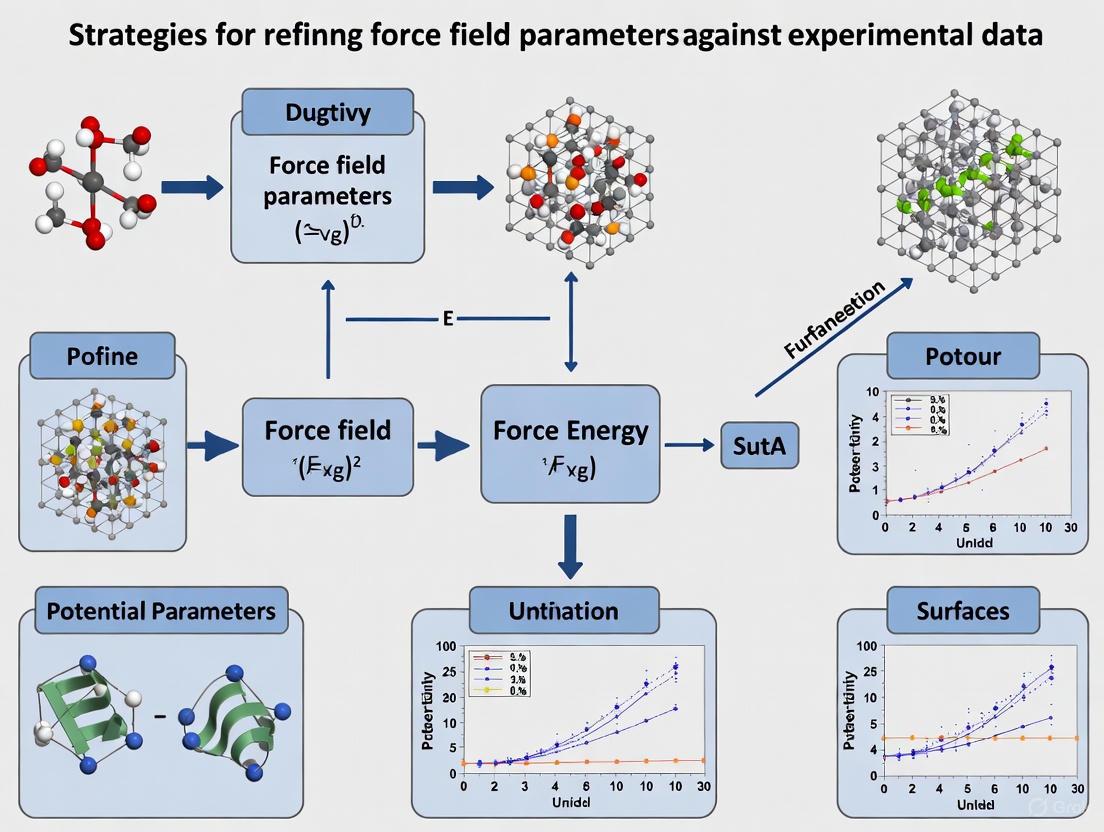
Accurate force fields are the cornerstone of reliable molecular dynamics simulations in computational drug discovery and materials science.
Advanced Strategies for Refining Force Field Parameters Against Experimental Data
Abstract
Accurate force fields are the cornerstone of reliable molecular dynamics simulations in computational drug discovery and materials science. This article provides a comprehensive guide for researchers on modern strategies for refining molecular mechanics force field parameters against experimental data. It covers foundational principles, from the critical role of force fields in simulating biomolecular systems to the inherent limitations of quantum mechanics (QM)-trained models. The content delves into advanced methodological frameworks, including Bayesian inference and machine learning (ML) techniques for parameter optimization. It further addresses practical challenges like handling data uncertainty and offers robust validation protocols to assess and compare refined force fields against both QM benchmarks and key experimental observables, empowering scientists to build more predictive computational models.
The Foundation of Force Field Refinement: Bridging Theory and Experiment
The Critical Role of Force Fields in Molecular Dynamics Simulations
Frequently Asked Questions (FAQs)
1.1 What are the most significant challenges in refining force fields against experimental data? Refining force fields involves several key challenges: achieving a balance between protein-protein and protein-solvent interactions to correctly model both folded and disordered proteins, dealing with sparse or noisy experimental data, and managing the high dimensionality and interdependence of force field parameters. Furthermore, integrating multiple data sources, such as various quantum chemical calculations and diverse experimental observables, without introducing conflicting parameter adjustments is non-trivial [1] [2] [3].
1.2 Which experimental observables are most valuable for force field validation and refinement? A combination of experimental data provides the most robust validation. Key observables include:
- NMR Data: Scalar coupling constants (nJHH, nJCH) and chemical shifts provide exquisite detail on local conformations and dynamics [4] [1].
- Scattering Data: Small-Angle X-Ray Scattering (SAXS) profiles report on global chain dimensions and are crucial for validating the ensembles of intrinsically disordered proteins [1] [2].
- Crystal Structure Data: Comparing simulated structures to aggregated crystal structure data helps validate backbone dihedrals and side-chain torsions in folded proteins [5].
- Mechanical Properties: For materials science applications, elastic constants and lattice parameters are fundamental targets for refinement [6].
1.3 My simulation of an intrinsically disordered protein (IDP) appears too compact. How can I address this? This is a classic force field limitation. Modern solutions involve using force fields specifically refined to enhance protein-water interactions. For example, the DES-Amber and ff99SBws force fields incorporate adjustments, such as scaled Lennard-Jones parameters, to improve hydration and reduce unnatural intramolecular attraction, resulting in more experimentally accurate expanded ensembles for IDPs [1] [2].
1.4 How can I refine force field parameters for a novel molecule, like a unique bacterial lipid? A systematic, quantum mechanics (QM)-based parameterization strategy is required. This involves:
- Atom Typing: Define new atom types based on the unique chemical environments of the molecule.
- Charge Derivation: Calculate partial atomic charges using methods like Restrained Electrostatic Potential (RESP) fitting based on QM calculations.
- Torsion Optimization: Optimize dihedral parameters by minimizing the difference between QM-calculated and classically computed torsion energies for key rotatable bonds [7].
1.5 Can machine learning be integrated with experimental data for force field development? Yes, this is a cutting-edge approach. Machine learning potentials can be trained not only on quantum chemical data (e.g., from Density Functional Theory) but also directly on experimental observables. A fused data learning strategy alternates training between DFT-calculated energies/forces and experimental properties (like elastic constants), resulting in a more accurate and constrained model that respects both first-principles physics and real-world measurements [6].
Troubleshooting Guides
Problem: Inaccurate Torsional Energy Profiles in Small Molecules
Issue: Simulations of drug-like small molecules fail to reproduce the correct rotational energy barriers around flexible bonds, leading to errors in conformational populations.
Solution: Implement a data-driven parameterization approach using high-quality quantum mechanics (QM) data and machine learning.
Investigation & Resolution Steps:
- Verify the Issue: Compare the torsional energy profile from your simulation against a high-level QM calculation for the same molecule or molecular fragment.
- Adopt a Modern Force Field: Consider using a recently developed, data-driven force field like ByteFF. This force field was trained on a massive dataset of 3.2 million torsion profiles and 2.4 million optimized molecular fragments at the B3LYP-D3(BJ)/DZVP level of theory, providing expansive coverage of chemical space [8].
- Utilize a Specialized ML Framework: For systems where no pre-parameterized force field exists, use a tool like the Alexandria Chemistry Toolkit (ACT). This software employs evolutionary machine learning (genetic algorithms combined with Monte Carlo) to discover optimal force field parameters that best reproduce the QM training data [9].
Preventative Measures:
- When working with novel chemical space, avoid relying solely on traditional look-up table-based force fields.
- Validate torsional profiles for a representative subset of molecules before embarking on large-scale production simulations.
Problem: Incorrect Structural Ensembles for Intrinsically Disordered Proteins (IDPs)
Issue: Simulated IDP ensembles are overly compact and do not match experimental data from techniques like SAXS or NMR.
Solution: Re-balance the force field by strengthening protein-water interactions or using refined torsional parameters.
Investigation & Resolution Steps:
- Quantify the Discrepancy: Calculate the radius of gyration (Rg) from your simulation and compare it to the Rg derived from experimental SAXS data.
- Switch to a Balanced Force Field: Select a force field that has been explicitly refined for IDPs. Based on recent benchmarks, the top performers include:
- Validate with Multiple Observables: Ensure the new force field not only corrects the Rg but also agrees with NMR data (e.g., scalar couplings, chemical shifts, and relaxation times) to confirm local structure is also correct [1].
Preventative Measures:
- Always consult recent literature for force field benchmarks on systems similar to yours, especially when simulating disordered states.
- Use a multi-observable validation strategy against NMR and SAXS data.
Problem: Force Field Inaccuracy in Specific Materials (e.g., Moiré Structures or Titanium)
Issue: For complex materials, universal force fields or those trained on general datasets fail to reproduce key material properties with the required meV-level accuracy.
Solution: Construct a highly accurate, system-specific Machine Learning Force Field (MLFF).
Investigation & Resolution Steps:
- Identify the Accuracy Gap: Benchmark your current force field or a universal MLFF against DFT-calculated forces and energies for a test set of relevant structures.
- Use a Specialized Workflow: For moiré structures (e.g., twisted bilayers), employ a tool like DPmoire. This software automates the generation of training data from shifted non-twisted bilayers and subsequent MLFF training, ensuring high accuracy for the target system [10].
- Implement Fused Data Learning: For materials like titanium, train the MLFF concurrently on both DFT data (energies, forces) and experimental data (elastic constants, lattice parameters). This hybrid approach corrects for inherent DFT inaccuracies and produces a model that satisfies all target objectives [6].
- Validate on Target Properties: Rigorously test the final MLFF on its ability to reproduce the properties it was designed for, such as electronic band structures in relaxed moiré systems [10] or temperature-dependent mechanical properties [6].
Table: Key Experimental Observables for Force Field Validation
| Observable | System Type | Information Provided | Common Experimental Sources |
|---|---|---|---|
| Scalar Couplings (nJ) | Biomolecules, Organic Molecules | Dihedral angles, conformational preferences, stereochemistry | NMR Spectroscopy [4] |
| Chemical Shifts | Biomolecules, Organic Molecules | Local electronic environment, secondary structure | NMR Spectroscopy [4] |
| Radius of Gyration | Intrinsically Disordered Proteins | Global chain dimensions and compaction | SAXS [1] [2] |
| Elastic Constants | Materials | Mechanical response to stress | Ultrasonic measurements, mechanical testing [6] |
| Lattice Parameters | Crystalline Materials | Unit cell dimensions | X-ray Diffraction (XRD) [6] |
| SAXS Form Factors | Proteins, Complex Structures | Solution-state structure and shape | SAXS [5] |
Problem: Parameterizing Force Fields for Novel Bacterial Membrane Lipids
Issue: Standard bio-membrane force fields (e.g., CHARMM36, Lipid21) do not contain parameters for unique bacterial lipids like those in Mycobacterium tuberculosis, leading to inaccurate simulations.
Solution: Develop dedicated force field parameters using a modular QM-based approach.
Investigation & Resolution Steps:
- Define New Atom Types: Create specialized atom types (e.g.,
cXfor cyclopropane carbons,cTfor lipid tail carbons) to capture the unique chemical features of the lipid [7]. - Calculate Partial Charges:
- Divide the large lipid molecule into manageable segments.
- For each segment, perform geometry optimization and RESP charge fitting at a high QM level (e.g., B3LYP/def2TZVP).
- Average charges over multiple conformations and reassemble the total molecular charge by integrating segments and removing capping groups [7].
- Optimize Torsion Parameters:
- Further subdivide the molecule into smaller elements containing the rotatable bonds.
- Optimize the torsion parameters (Vn, n, γ) to minimize the difference between the QM-calculated and classically computed potential energy for that torsion [7].
- Validate with Biophysical Data: Run simulations with the new parameters (e.g., BLipidFF) and validate against available experimental data, such as membrane rigidity and lateral diffusion coefficients measured by Fluorescence Recovery After Photobleaching (FRAP) [7].
Preventative Measures:
- For specialized systems, anticipate the need for bespoke parameterization.
- Establish a standardized QM calculation and validation protocol to ensure parameter consistency and quality.
Research Reagent Solutions
Table: Essential Tools and Resources for Force Field Refinement
| Reagent / Tool | Type | Primary Function | Example Use Case |
|---|---|---|---|
| BICePs Algorithm [3] | Software Algorithm | Bayesian inference for reconciling simulation ensembles with sparse/noisy experimental data. | Robust force field refinement against ensemble-averaged measurements like NMR J-couplings. |
| Alexandria Chemistry Toolkit (ACT) [9] | Software | Uses evolutionary machine learning (genetic algorithms) to optimize force field parameters from scratch. | Automated parameter discovery for organic molecules against QM training data. |
| DPmoire [10] | Software | Automated construction of machine learning force fields for twisted moiré material systems. | Generating accurate MLFFs for relaxed structures of twisted bilayer materials like WSe₂. |
| BLipidFF [7] | Force Field | Specialized all-atom force field for bacterial membrane lipids. | Simulating the unique structure and dynamics of the Mycobacterium tuberculosis outer membrane. |
| ByteFF [8] | Force Field | Data-driven, Amber-compatible force field for drug-like molecules. | Achieving accurate torsional profiles and conformational energies across expansive chemical space. |
| DES-Amber [1] | Force Field | Refined protein force field for balanced simulation of folded proteins and IDPs. | Simulating an IDP that undergoes a coil-helix transition without over-stabilizing compact states. |
| Validated NMR Dataset [4] | Experimental Dataset | Curated collection of proton-carbon and proton-proton scalar coupling constants for organic molecules. | Benchmarking computational methods for predicting NMR parameters or validating force fields. |
Workflow Diagrams
Force Field Refinement Workflow
ML Potential Training with Fused Data
Limitations of Purely QM-Trained Force Fields and the Experimental Gap
Frequently Asked Questions (FAQs)
FAQ 1: Why does my force field, trained only on quantum mechanics (QM) data, produce inaccurate macroscopic properties like density or viscosity in molecular dynamics (MD) simulations?
- Answer: This discrepancy arises because the limited functional forms of classical force fields are unable to fully capture the complex quantum mechanical nature of interatomic interactions. Purely QM-trained force fields often lack the error cancellation that occurs when parameters are refined against experimental data. Consequently, small errors in microscopic interactions can accumulate during MD simulations, leading to significant inaccuracies in predicted bulk properties [11].
FAQ 2: What is the "transferability" problem in machine-learned force fields (MLFFs)?
- Answer: Transferability refers to a force field's ability to make accurate predictions for molecular configurations or systems that were not included in its training data. MLFFs trained on QM data often struggle with this. They can be highly accurate within their training domain but fail when simulating different states of matter (e.g., liquids vs. crystals), chemical environments, or temperatures outside their training set. This is because they may not have learned the underlying physical laws that govern these new scenarios [12] [13].
FAQ 3: My force field fails to simulate bond formation and breaking correctly. What is the limitation?
- Answer: Standard classical force fields use fixed bonding terms (bonds, angles, dihedrals) and cannot dynamically model chemical reactions where bonds break and form. While reactive force fields (like ReaxFF) and some advanced MLFFs are designed for this purpose, they are more complex and computationally expensive to parameterize and train. A purely QM-trained non-reactive force field inherently lacks this capability [14].
FAQ 4: Why do my simulations of magnetic materials using a standard non-magnetic force field yield incorrect material properties?
- Answer: The properties of magnetic materials are governed by spin-dependent interactions. A standard force field trained on non-magnetic QM data completely neglects these spin degrees of freedom. This can lead to major inaccuracies in predicting key properties. For instance, a non-magnetic potential may correctly predict dynamic properties like viscosity at high temperatures where magnetic moments self-average, but it will fail to capture static properties like equilibrium lattice parameters, which are highly sensitive to magnetic states [12].
Troubleshooting Guides
Issue: Inaccurate Bulk Liquid Properties You have trained a force field on high-level QM data of isolated molecules and dimers, but MD simulations of the bulk liquid yield incorrect density, enthalpy of vaporization, or transport properties.
Root Cause: The force field's functional form may be too simplistic to capture many-body effects (e.g., polarization, charge transfer) critical in the condensed phase. The parameters derived from gas-phase QM calculations do not account for the complex many-body environment of a liquid [11].
Solution:
- Incorporate Polarizability: Move from a fixed-charge force field to a polarizable one. This allows the atomic charges to respond to their local electronic environment, more accurately modeling dielectric properties and interaction energies [11].
- Refit against Condensed-Phase QM: Use QM data of molecular clusters or periodic condensed-phase systems for training, which better represent the target environment.
- Refine against Experimental Data: As a final step, refine key force field parameters (e.g., Lennard-Jones, charge scaling factors) against a small set of experimental bulk properties like density and enthalpy of vaporization to achieve error cancellation [11].
Issue: Poor Performance for Intrinsically Disordered Proteins (IDPs) When simulating proteins, your force field incorrectly predicts overly collapsed or overly extended structures for disordered regions, not matching Small-Angle X-Ray Scattering (SAXS) or NMR data.
Root Cause: An imbalance between protein-protein and protein-water interactions. Many force fields over-stabilize protein-protein interactions due to imperfectly tuned van der Waals or electrostatic terms, leading to unnatural collapse of flexible regions [2].
Solution:
- Upscale Protein-Water Interactions: Empirically scale up the Lennard-Jones parameters between protein atoms and water molecules. This strengthens solvation and helps prevent excessive intramolecular association, leading to more realistic chain dimensions for IDPs [2].
- Use Advanced Water Models: Replace simple 3-site water models (e.g., TIP3P) with more accurate 4-site models (e.g., TIP4P2005, OPC) that have a better description of electrostatic distributions and dispersion forces [2].
- Refine Backbone Torsions: Reparameterize backbone torsional potentials against high-level QM data of peptide fragments or experimental NMR data (e.g., scalar couplings) to correct biases in secondary structure propensities [2].
Issue: Lack of Transferability Across Chemical Space Your MLFF performs well on its training molecules but shows degraded accuracy when applied to new molecules with different functional groups or elements.
Root Cause: The training dataset lacks sufficient chemical diversity, and the model has overfitted to the specific chemical motifs present in the training set. The locality approximation in many MLFFs can also limit their ability to capture long-range interactions [8] [13].
Solution:
- Expand and Diversify Training Data: Actively sample chemical space. Use algorithms to select maximally diverse training molecules or fragments, covering a wide range of functional groups, elements, and charge states relevant to your target application [8].
- Employ Active Learning: Implement an active learning workflow where the MLFF itself identifies gaps in its knowledge during MD simulations. Configurations with high predictive uncertainty are sent for QM calculation and then added to the training set, iteratively improving coverage and robustness [12].
- Adopt a Global Representation: For materials, consider using MLFF models with global representations (like BIGDML) that incorporate the full symmetry of the crystal and do not rely on a strict locality approximation, thus better capturing long-range correlations [13].
Experimental Protocols for Force Field Refinement
Protocol 1: Refining Force Fields Using SAXS Data for Biomolecules
This protocol details how to use Small-Angle X-Ray Scattering (SAXS) data to adjust force field parameters and achieve accurate conformational ensembles for proteins, especially Intrinsically Disordered Proteins (IDPs).
- Objective: To balance protein-water and protein-protein interactions by matching computed and experimental SAXS profiles.
- Materials & Reagents:
- Protein system of interest (e.g., an IDP sequence).
- Experimental SAXS data for the protein in solution.
- Molecular dynamics simulation software (e.g., GROMACS, AMBER, OpenMM).
- A modern force field (e.g., a variant of AMBER, CHARMM).
- A 4-site water model (e.g., TIP4P2005, OPC).
- Methodology:
- Initial Simulation: Run multiple, long-timescale MD simulations of the protein in explicit solvent using a baseline force field.
- Compute Theoretical SAXS: From the simulation trajectory, compute the theoretical SAXS intensity profile, I(q), using methods such as CRYSOL or FOXS.
- Compare to Experiment: Calculate the discrepancy (e.g., via χ² value) between the computed I(q) and the experimental I(q).
- Parameter Adjustment: If the computed chain dimensions are too collapsed compared to experiment, systematically scale up the Lennard-Jones (LJ) interaction parameters between protein atoms and water oxygen atoms by a small factor (e.g., 1.08 - 1.10).
- Iterate: Repeat steps 1-4 with the scaled parameters until the theoretical SAXS profile matches the experimental data within an acceptable error margin [2].
Protocol 2: Optimizing Torsional Parameters Against QM and NMR Data
This protocol uses quantum mechanics (QM) calculations and NMR spectroscopy data to refine torsional dihedral parameters, which are critical for accurate conformational sampling.
- Objective: To correct inaccuracies in backbone and sidechain dihedral potentials to match QM energy scans and experimental NMR observables.
- Materials & Reagents:
- Representative molecular fragments (e.g., dipeptides for backbone, isolated molecules for sidechains).
- Quantum chemistry software (e.g., Gaussian, Q-Chem) for QM calculations.
- Experimental NMR data (e.g., scalar J-couplings, chemical shifts).
- Force field parameterization tools.
- Methodology:
- QM Torsion Scans: For the molecular fragment of interest, perform a relaxed QM potential energy surface scan by rotating the target dihedral angle. The QM method should be a good balance of accuracy and cost (e.g., B3LYP-D3(BJ)/DZVP) [8].
- Compute MM Torsion Profile: Calculate the molecular mechanics (MM) energy for the same set of geometries using the initial force field parameters.
- Parameter Fitting: Adjust the torsional force constants (Vn) and phase shifts (γ) in the force field's dihedral term to minimize the difference between the QM and MM energy profiles.
- NMR Validation: Run MD simulations of a small peptide or protein with the refined parameters. Calculate NMR observables (e.g., J-couplings) from the simulation ensemble and compare them to experimental NMR data. This serves as a secondary, solution-phase validation of the torsional refinement [2].
Comparative Data on Force Field Performance
Table 1: Comparison of Force Field Types and Their Characteristic Limitations
| Force Field Type | Typical Number of Parameters | Key Limitations of Purely QM-Trained Variants | Common Experimental Refinement Targets |
|---|---|---|---|
| Classical Non-Reactive | 10 - 100 [14] | Cannot simulate chemical reactions; limited by fixed functional forms leading to inaccurate many-body interactions [14] [11]. | Density, enthalpy of vaporization, hydration free energy, SAXS profiles for IDPs [2] [11]. |
| Reactive Force Fields | 100+ [14] | High computational cost; parameterization is complex and can be system-specific [14]. | Reaction barriers, crystal structures, elastic constants. |
| Machine Learning (ML) | 100,000+ (network weights) [14] | Can lack transferability; data-inefficient if not properly constrained; may neglect long-range interactions [12] [13]. | Bulk properties (to ensure transferability), spectroscopic data. |
| Polarizable Force Fields | Varies | Parameterization is complex; higher computational cost than fixed-charge FFs; transferability can be uncertain [11]. | Dielectric constants, liquid densities, interaction energies of molecular dimers [11]. |
Table 2: Example Artifacts from the QM-Experiment Gap and Their Solutions
| Observed Artifact / Inaccuracy | Associated System | Proposed Refinement Strategy | Reference |
|---|---|---|---|
| Overly collapsed disordered protein chains | Intrinsically Disordered Proteins (IDPs) | Scale up protein-water van der Waals interactions; use 4-site water models [2]. | [2] |
| Incorrect lattice parameters & equilibrium volumes | Magnetic Fe-Cr-C alloys | Train on spin-polarized DFT data to account for magnetic moments; use transfer learning to reduce cost [12]. | [12] |
| Inaccurate bulk liquid density & transport properties | Organic liquids & electrolytes | Use polarizable force fields trained on energy decomposition analysis (EDA) of molecular dimers [11]. | [11] |
| Lack of transferability to new molecules | Drug-like small molecules | Train graph neural networks on massive, diverse QM datasets of molecular fragments [8]. | [8] |
The Scientist's Toolkit: Research Reagent Solutions
Table 3: Key Computational and Experimental Resources for Force Field Refinement
| Reagent / Resource | Function / Application | Example Use Case |
|---|---|---|
| 4-Site Water Models (TIP4P2005, OPC) | More accurate representation of water's electrostatic distribution and dispersion compared to 3-site models. | Rebalancing protein-water interactions to obtain correct IDP dimensions and folded protein stability [2]. |
| Energy Decomposition Analysis (ALMO-EDA) | Splits interaction energy into physically meaningful components (electrostatics, polarization, charge transfer). | Training polarizable force fields by fitting individual energy terms to their corresponding QM-derived components [11]. |
| Graph Neural Networks (GNNs) | Machine learning models that predict force field parameters directly from a molecule's 2D graph structure. | Creating transferable force fields that cover expansive chemical space for drug discovery [8] [11]. |
| Active Learning Workflows (e.g., DPGEN) | Automatically identifies and adds the most informative new configurations to a training dataset. | Efficiently building robust and transferable machine-learned force fields for complex materials [12]. |
| Small-Angle X-Ray Scattering (SAXS) | Provides low-resolution structural information about the size and shape of molecules in solution. | Validating and refining the global chain dimensions of IDPs from MD simulations [2]. |
| Symmetry-Enhanced Global Descriptors (BIGDML) | ML representations that use the full symmetry of a crystal, avoiding the locality approximation. | Achieving high data efficiency and accuracy in force fields for periodic materials [13]. |
Workflow Diagram: Bridging the QM-Experiment Gap
Force Field Refinement Workflow
Force Field Optimization by Imposing Kinetic Constraints with Path Reweighting
Frequently Asked Questions (FAQs)
FAQ 1: What types of experimental data are most critical for refining force field parameters? A comprehensive refinement strategy should target a diverse set of experimental data to ensure the force field is not overfitted to a single property. Key targets include:
- Thermodynamic Properties: Such as pure-liquid densities and vaporization enthalpies, which help calibrate cohesive energies and intermolecular interactions [15].
- Kinetic Properties: Such as rate constants for molecular processes like isomerization or protein-ligand unbinding. These provide crucial constraints on the energy landscape's dynamics [16].
- Structural Properties: Including data from X-ray crystallography and NMR (e.g., J-coupling constants, NOE intensities) to validate the ensemble of conformations a protein or molecule adopts [17].
FAQ 2: My force field reproduces thermodynamic data well but fails on kinetic properties. What should I do? This is a common issue, as many force fields are primarily optimized for structural and thermodynamic accuracy. To address this, consider methods that incorporate kinetic constraints directly into the optimization process. The path reweighting method, for example, allows you to adjust force field parameters so that simulated rate constants match experimental values. This is done by reweighting an ensemble of molecular trajectories from a prior simulation to satisfy the new kinetic constraints with minimal perturbation, following the Maximum Entropy principle [16].
FAQ 3: How can I handle uncertainty and potential errors in experimental data during force field optimization? Bayesian inference methods are particularly well-suited for this challenge. Algorithms like Bayesian Inference of Conformational Populations (BICePs) treat experimental uncertainty as a parameter to be sampled. This allows the optimization to automatically account for random and systematic errors in the data. BICePs can use specialized likelihood functions, such as a Student's model, to identify and down-weight outliers, leading to more robust parameterization [3].
FAQ 4: What is the risk of optimizing a force field against only a narrow set of experimental properties? Optimizing against a small range of properties carries a high risk of overfitting. A force field might show excellent performance for the targeted properties but perform poorly for others. For example, improvements in agreement with one metric (e.g., residual dipolar couplings) are often offset by a loss of agreement in another (e.g., structural or thermodynamic properties) [17]. A robust force field should be validated against a wide range of non-target properties to ensure its transferability [15].
FAQ 5: Are there automated approaches for force field parameterization against large, diverse chemical datasets? Yes, modern data-driven approaches are tackling this challenge. One method involves using graph neural networks (GNNs) trained on large-scale quantum mechanics (QM) datasets. These models predict bonded and non-bonded parameters for drug-like molecules directly from their chemical structure, ensuring permutational invariance and chemical symmetry. This approach allows for expansive chemical space coverage beyond traditional look-up tables [8].
Troubleshooting Guides
Issue 1: Poor Reproduction of Protein NMR Observables
Problem: Simulations using your refined force field do not match experimental NMR data, such as J-coupling constants or NOE intensities.
Diagnosis and Solution Steps:
| Step | Action | Technical Details |
|---|---|---|
| 1 | Verify Data Quality | Scrutinize the experimental data for sparseness or noise. NMR observables are ensemble-averaged and can have significant uncertainties [17]. |
| 2 | Use Bayesian Reweighting | Employ a tool like BICePs to reweight your simulation ensemble. BICePs samples the full posterior distribution of conformational populations while accounting for experimental uncertainty [3]. |
| 3 | Check for Compensating Errors | Ensure improvement in NMR observables isn't degrading other properties. Validate against a curated set of high-resolution protein structures and other metrics like radius of gyration or SASA [17]. |
| 4 | Refine Parameters | If reweighting is successful but the prior ensemble is poor, use the BICePs score as an objective function to automatically refine the underlying force field parameters against the NMR data [3]. |
Issue 2: Inaccurate Ligand Unbinding or Conformational Transition Rates
Problem: The simulated rates of key molecular processes (e.g., ligand unbinding, isomerization) are orders of magnitude slower or faster than experimental measurements.
Diagnosis and Solution Steps:
| Step | Action | Technical Details |
|---|---|---|
| 1 | Confirm Rare Event Sampling | Use enhanced sampling methods (e.g., metadynamics, umbrella sampling) to ensure adequate sampling of the transition state and free energy barriers. |
| 2 | Apply Path Reweighting | Implement a maximum-caliber path reweighting approach. Generate an ensemble of trajectories with an initial force field, then reweight this ensemble to impose experimental rate constants as constraints [16]. |
| 3 | Identify Sensitive Parameters | The reweighting procedure provides insight into which force field parameters (e.g., specific dihedral angles or non-bonded interactions) are most sensitive to the kinetics, guiding targeted refinement [16]. |
| 4 | Iterate and Validate | Run new simulations with the optimized parameters and re-calculate the rates to validate the improvement. |
Experimental Targets and Protocols
The table below summarizes key experimental properties used for force field refinement and their significance.
Table 1: Key Experimental Targets for Force Field Refinement
| Property Category | Specific Observable | Significance in Force Field Refinement | Common Experimental Source |
|---|---|---|---|
| Thermodynamic | Liquid Density ((\rho_{liq})) | Calibrates overall packing and van der Waals interactions in the condensed phase [15]. | Densimetry |
| Vaporization Enthalpy ((\Delta H_{vap})) | probes the strength of total intermolecular interactions (van der Waals and electrostatic) [15]. | Calorimetry | |
| Kinetic | Rate Constants (e.g., isomerization, unbinding) | Directly constrains the heights of free energy barriers and the dynamics on the energy landscape [16]. | Stopped-flow, FRET, single-molecule spectroscopy |
| Structural | J-coupling constants | Provides information on backbone and side-chain dihedral angle distributions [17]. | NMR Spectroscopy |
| NOE Intensities | Yields interatomic distance restraints for validating three-dimensional structures [17]. | NMR Spectroscopy | |
| Root-mean-square deviation (RMSD) | Measures the average deviation of simulated structures from a reference (e.g., X-ray structure) [17]. | X-ray Crystallography |
Workflow Diagram for Force Field Refinement
The following diagram illustrates a robust, iterative workflow for refining force fields against experimental data, integrating several modern methodologies discussed in the FAQs.
Force Field Refinement Workflow
The Scientist's Toolkit: Key Reagents & Solutions
Table 2: Essential Computational Tools for Force Field Refinement
| Tool / Resource | Function | Example Use Case |
|---|---|---|
| Path Reweighting Algorithm [16] | Adjusts force field parameters to match experimental kinetic data by reweighting trajectories. | Optimizing a protein-ligand force field to reproduce experimental unbinding rate constants. |
| BICePs Software [3] | A Bayesian reweighting algorithm that reconciles simulation ensembles with noisy experimental data. | Determining the most consistent conformational populations from a set of sparse NMR observables. |
| Graph Neural Networks (GNNs) [8] | Machine learning models that predict force field parameters directly from molecular structures. | Rapidly generating parameters for a novel drug-like molecule not covered by traditional force fields. |
| Quantum Mechanics (QM) Datasets [8] | Large-scale datasets of molecular energies, geometries, and Hessians used for training ML models. | Providing high-quality target data for training a GNN to predict accurate intramolecular parameters. |
| CombiFF Workflow [15] | An automated system for calibrating force field parameters against thermodynamic data for compound families. | Systematically optimizing Lennard-Jones parameters for a new class of organic molecules. |
Troubleshooting Guides and FAQs
FAQ: Addressing Data Challenges in Force Field Refinement
1. How can we improve force field accuracy when high-quality experimental data is scarce? Data scarcity is a common challenge in force field parameterization. A modern data-driven approach can address this by generating expansive and highly diverse molecular datasets for training. For instance, one methodology involves creating a dataset of 2.4 million optimized molecular fragment geometries with analytical Hessian matrices and 3.2 million torsion profiles at a consistent quantum mechanics (QM) level of theory (e.g., B3LYP-D3(BJ)/DZVP). A graph neural network (GNN) can then be trained on this dataset to predict all bonded and non-bonded molecular mechanics force field parameters simultaneously across a broad chemical space, achieving state-of-the-art performance [8].
2. What strategies exist for managing noisy or inconsistent historical experimental data? Historical datasets are often inconsistent or poorly annotated, which can mislead computational models. The primary solution is prioritizing data integrity first, algorithms second. Before using historical data for parameter refinement, invest in robust data curation to clean and properly annotate it. Implement FAIR (Findable, Accessible, Interoperable, and Reusable) data principles at the point of data generation, "baking it in by design" rather than treating it as an afterthought. This ensures data is captured with consistent terminology and rich metadata, making it reliable for future use [18].
3. Our force field performs well on folded proteins but fails on disordered polypeptides. How can we achieve better balance? Achieving a balance between modeling folded proteins and intrinsically disordered proteins (IDPs) is a recognized challenge. Imbalances often stem from inadequate protein-water interactions or torsional parameters. Two refined strategies have proven effective:
- Refining Protein-Water Interactions: Upscaling protein-water van der Waals interactions can improve the prediction of IDP chain dimensions while maintaining folded protein stability.
- Targeted Torsional Refinements: Specifically re-parameterizing backbone and side chain torsional parameters (e.g., for residues like glutamine) can correct biases, such as overestimated helicity, and yield more accurate conformational sampling for both folded and disordered states [2].
4. How can we integrate diverse data types (multi-omics, various assays) for more holistic force field validation? Integrating high-dimensional, heterogeneous data is complex. Multi-omics data integration methods offer a framework. Advanced computational techniques, particularly deep generative models like Variational Autoencoders (VAEs), are effective for this task. These methods can handle high-dimensionality and heterogeneity, performing tasks such as data imputation, denoising, and the creation of joint embeddings from different data types, which can be used to validate force fields against a wider set of experimental observables [19].
5. What is the impact of data imbalance on predictive maintenance models for laboratory equipment, and how can it be mitigated? In predictive maintenance, data is often severely imbalanced, with very few failure instances compared to many healthy operation instances. This can cause models to fail to learn failure patterns. A proven solution is the creation of failure horizons. This technique labels the last 'n' observations before a failure event as 'failure,' thereby increasing the number of failure cases in the training set and providing the model with a temporal window to learn pre-failure behavior [20].
Key Experimental Protocols
Protocol 1: Generating a High-Diversity QM Dataset for Force Field Parametrization
This protocol outlines the creation of a large-scale quantum mechanics dataset for training data-driven force fields, as demonstrated in the development of ByteFF [8].
- 1. Molecular Selection: Curate a initial set of drug-like molecules from databases like ChEMBL and ZINC20 based on criteria such as aromatic rings, polar surface area (PSA), and quantitative estimate of drug-likeness (QED).
- 2. Molecular Fragmentation: Cleave the selected molecules into smaller fragments (e.g., <70 atoms) using a graph-expansion algorithm that traverses each bond, angle, and non-ring torsion. This preserves local chemical environments.
- 3. Protonation State Expansion: Expand the fragment library to cover various protonation states within a physiologically relevant pKa range (e.g., 0.0 to 14.0) using tools like Epik.
- 4. QM Calculations: Perform quantum mechanics calculations on the final, deduplicated fragment set.
- Method: Use the B3LYP-D3(BJ)/DZVP level of theory.
- Optimization Dataset: Generate optimized geometries for all fragments.
- Torsion Dataset: Create torsion profiles by scanning dihedral angles.
Table: Key Components of a QM Dataset for Force Field Training
| Component | Description | Scale Example |
|---|---|---|
| Molecular Fragments | Cleaved molecules preserving local chemical environments. | 2.4 million unique fragments [8] |
| Optimized Geometries | Energy-minimized 3D structures with analytical Hessian matrices. | 2.4 million geometries [8] |
| Torsion Profiles | Scans of dihedral angles to capture rotational energy barriers. | 3.2 million profiles [8] |
| QM Theory Level | The specific method and basis set used for calculations (e.g., B3LYP-D3(BJ)/DZVP). | Balanced accuracy and computational cost [8] |
Protocol 2: Refining Force Fields for Balanced Protein and IDP Performance
This protocol describes a strategy to correct imbalances in protein force fields, enabling accurate simulation of both folded proteins and intrinsically disordered polypeptides (IDPs) [2].
- 1. Identify the Source of Imbalance: Run microsecond-scale simulations of benchmark systems (e.g., a stable folded protein like Ubiquitin and a known IDP). Compare results to experimental data from SAXS (chain dimensions) and NMR (secondary structure propensities) to identify deficiencies.
- 2. Select a Refinement Strategy:
- Option A: Refine Protein-Water Interactions. Selectively upscale the Lennard-Jones parameters between protein atoms and water to strengthen protein-water interactions, which can prevent IDPs from overly collapsing.
- Option B: Refine Torsional Parameters. Perform targeted re-parameterization of backbone and/or side chain dihedral parameters for specific amino acids (e.g., glutamine) that show biased sampling.
- 3. Validate the Refined Force Field: Conduct extensive simulations on a diverse set of protein systems, including:
- Folded proteins and protein-protein complexes (to assess stability).
- A series of IDPs with known experimental data (to assess chain dimensions and secondary structure).
- Compare all results against experimental observables to ensure balanced improvement.
Table: Validation Metrics for Balanced Protein Force Fields
| System Type | Key Validation Metrics | Experimental Technique |
|---|---|---|
| Folded Proteins | Backbone RMSD, RMSF, stability over µs-timescales | X-ray Crystallography, NMR |
| Protein Complexes | Binding interface stability, association free energy | NMR, SAXS, ITC |
| Intrinsically Disordered Proteins (IDPs) | Radius of gyration (Rg), end-to-end distance, secondary structure propensity | SAXS, smFRET, NMR |
Workflow Visualizations
Data-Driven Force Field Workflow
Force Field Refinement Cycle
The Scientist's Toolkit: Research Reagent Solutions
Table: Essential Computational Tools and Data for Force Field Research
| Item | Function / Description |
|---|---|
| Graph Neural Networks (GNNs) | Symmetry-preserving ML models that predict molecular mechanics force field parameters directly from molecular structure, ensuring permutational and chemical invariance [8]. |
| Generative Adversarial Networks (GANs) | A deep learning framework used to generate synthetic data that mimics real data patterns, helping to overcome data scarcity in model training [20] [21]. |
| Variational Autoencoders (VAEs) | Deep generative models particularly useful for multi-omics data integration, capable of data imputation, denoising, and creating joint latent representations from heterogeneous data sources [19]. |
| FAIR Data Principles | A set of guidelines (Findable, Accessible, Interoperable, Reusable) for data management to ensure data is clean, contextualized, and reusable, which is critical for AI-driven discovery [18] [22]. |
| Application Programming Interfaces (APIs) | Software intermediaries that allow different applications and siloed data sources (e.g., ELNs, LIMS) to communicate, enabling automated data integration and analysis [22]. |
| High-Throughput QM Datasets | Large-scale, high-quality quantum mechanics datasets (e.g., optimized geometries, torsion profiles) that serve as the foundational training data for developing accurate, data-driven force fields [8]. |
Methodologies for Experimental Data Integration: From Bayesian Inference to ML Potentials
Bayesian Inference of Conformational Populations (BICePs) for Robust Parameter Refinement
Bayesian Inference of Conformational Populations (BICePs) is a statistically rigorous algorithm designed to reconcile theoretical predictions of conformational state populations with sparse and/or noisy experimental measurements [23]. In computational chemistry and drug discovery, accurately determining structural ensembles is crucial for understanding biomolecular function, but this is often challenged by experimental data that are ensemble-averaged, sparse, and subject to random and systematic errors [3] [23].
BICePs addresses these challenges through a Bayesian framework that samples the full posterior distribution of conformational populations while simultaneously treating experimental uncertainties as nuisance parameters [3] [24]. A key advantage of BICePs is its ability to perform objective model selection and parameter optimization through a quantity called the BICePs score, which reflects the integrated posterior evidence in favor of a given model [23]. This makes BICePs particularly valuable for force field validation and refinement, where it can automatically discover optimal parameter sets while accounting for multiple sources of uncertainty [3] [24].
Core Concepts and Terminology
- Conformational Populations: The relative probabilities of different molecular structures or conformations that a molecule can adopt in solution.
- Prior Distribution (
p(X)): Theoretical predictions of conformational state populations, typically from molecular simulations [23]. - Likelihood Function (
p(D|X,σ)): Quantifies how well forward model predictionsf(X)agree with experimental dataD, incorporating uncertainty parametersσ[3]. - Posterior Distribution (
p(X,σ|D)): The refined conformational populations and uncertainty estimates obtained after combining prior knowledge with experimental data [3]. - BICePs Score: A free energy-like quantity used for model selection and parameter optimization [23].
- Forward Model: A computational framework that predicts experimental observables from molecular configurations [24].
- Reference Potentials: Distributions of observable values in the absence of experimental restraint information, crucial for avoiding unnecessary bias [23].
Troubleshooting Guide: Frequently Asked Questions
Q1: My BICePs calculations show poor convergence. What could be wrong?
Possible Causes and Solutions:
Insufficient Replica Sampling:
- Problem: The replica-averaged forward model requires enough replicas to accurately approximate the ensemble average. Too few replicas lead to high standard error of the mean (SEM), which can be misinterpreted as true uncertainty [3].
- Solution: Increase the number of replicas (
N_r). The SEM decreases with the square root of the number of replicas [3].
Poorly Parameterized Forward Model:
- Problem: Inaccurate empirical relationships (e.g., in Karplus parameters for J-coupling predictions) introduce systematic errors that hinder convergence [24].
- Solution: Use BICePs to refine the forward model parameters (
θ) by either sampling them as nuisance parameters or through variational minimization of the BICePs score [24].
Inadequate Treatment of Outliers:
- Problem: Experimental datasets often contain a few erratic measurements that can disproportionately influence the results [3].
- Solution: Employ BICePs' specialized likelihood functions, such as the Student's model, which marginalizes uncertainty parameters for individual observables and is robust to outliers [3].
Q2: How do I know if my force field parameters are optimized correctly?
Validation Strategies:
- Monitor the BICePs Score: The BICePs score reports the free energy of "turning on" the experimental restraints. During variational optimization, a lower (more negative) BICePs score indicates a model that has stronger evidence given the data [3] [24].
- Check Parameter Reproducibility: Perform repeated optimizations from different initial parameter values. Correctly optimized parameters should converge to the same optimal values, ensuring reproducibility [3].
- Assess Robustness to Error: Test the optimized parameters against synthetic datasets with varying extents of random and systematic error. A robust parameterization should perform well even in the presence of significant noise [3].
- Examine Posterior Distributions: Well-optimized parameters will yield posterior distributions of conformational populations that are consistent with the experimental data without overfitting, which is achieved through the inherent regularization in the BICePs score [3] [23].
Q3: What is the role of reference potentials, and how do I choose them?
Importance and Selection:
- Role: Reference potentials (
Q_ref(r)) account for the distribution of observable values in the absence of experimental information. They prevent unnecessary bias, especially when many simultaneous restraints are used, by ensuring that only informative data significantly reweights the ensemble [23]. - Selection Criteria:
- For distance restraints in linear chains, a Gaussian reference potential or one derived from polymer physics of a random-coil is appropriate [23].
- For cyclic molecules, a maximum-entropy distribution parameterized from average distances across the conformational state space is often effective [23].
- The choice can be problem-dependent, but the key is to use a physically reasonable model for the system in the absence of specific experimental restraints.
Q4: Can BICePs handle different types of experimental data?
Supported Data Types and Forward Models:
BICePs is adaptable to various ensemble-averaged experimental measurements through the use of appropriate forward models. The table below summarizes common data types and their corresponding forward models.
Table 1: Experimental Data Types and Forward Models Compatible with BICePs
| Experimental Data Type | Description of Forward Model | Key Parameters |
|---|---|---|
| NMR J-couplings [24] | Karplus relation: ^3J = A cos²(ϕ) + B cos(ϕ) + C |
Karplus parameters (A, B, C), dihedral angle (ϕ) |
| NMR chemical shifts [23] | Empirical or machine learning models mapping structure to chemical shift | Structure-based descriptors, neural network weights |
| NOE distance restraints [23] | Inverse sixth-power averaging: <r⁻⁶>^(-1/6) |
Interatomic distances |
| FRET efficiency [23] | Distance-dependent energy transfer models | Donor-acceptor distance, Förster radius |
Q5: How does BICePs compare to other Bayesian inference methods?
BICePs shares the core Bayesian framework of methods like Inferential Structure Determination (ISD) and MELD but offers key distinctions [23]. Its unique advantages include:
- Explicit use of reference potentials to avoid bias from non-informative restraints [23].
- Quantitative model selection via the BICePs score, which is computed through free energy estimation methods [23].
- A replica-averaged forward model that makes it a maximum-entropy reweighting method without needing adjustable regularization parameters [3] [24].
Essential Research Reagent Solutions
To implement BICePs for force field parameter refinement, researchers require a suite of computational tools and data.
Table 2: Essential Research Reagents for BICePs Experiments
| Reagent / Tool | Function / Purpose | Examples / Notes |
|---|---|---|
| Conformational Ensemble | Provides the prior distribution p(X) of molecular structures. |
Generated by MD simulation, Monte Carlo methods, or enhanced sampling [23]. |
| Experimental Datasets | Sparse, ensemble-averaged data used for reweighting and validation. | NMR observables (J-couplings, chemical shifts, NOEs), FRET data [23] [24]. |
| Forward Model | Computes theoretical observables f(X) from structural configurations. |
Empirical relationships (e.g., Karplus equation) or neural networks [24]. |
| BICePs Software | Core algorithm for sampling the posterior and computing scores. | Implementations may vary; the theoretical foundation is described in [3] [23] [24]. |
| Quantum Chemistry Data | High-quality reference data for validating and training force fields. | Used in workflows like ByteFF to generate accurate torsion profiles and Hessian matrices [8]. |
Standard Experimental Protocol for Parameter Refinement
This protocol outlines the steps for refining force field or forward model parameters using BICePs with a variational optimization approach [3] [24].
Step 1: Prepare the Prior Conformational Ensemble
- Generate a diverse set of molecular conformations using molecular dynamics or Monte Carlo simulations with an initial force field.
- Ensure adequate sampling of the relevant conformational space.
Step 2: Select and Prepare Experimental Data
- Gather ensemble-averaged experimental measurements (
D). - Choose appropriate forward models (
f_j) for each observable.
Step 3: Define the BICePs Posterior and Score
- Set up the replica-averaged posterior distribution, which includes likelihood functions (e.g., Gaussian, Student's-t), the prior
p(X), and priors for uncertaintiesp(σ)[3]. - The BICePs score is calculated as the free energy of applying the experimental restraints.
Step 4: Perform Variational Optimization
- Compute the first and second derivatives of the BICePs score with respect to the force field or forward model parameters (
θ). - Use an optimization algorithm to minimize the BICePs score, updating parameters to find the values with the strongest evidence given the data [3] [24].
Step 5: Validate the Refined Parameters
- Assess convergence by running repeated optimizations.
- Test the refined parameters on independent datasets or through cross-validation to ensure they are not overfitted.
The following diagram illustrates the iterative workflow for this protocol.
BICePs Parameter Refinement Workflow
Advanced Applications: Neural Network Forward Models
BICePs is not limited to empirical forward models. Its framework generalizes to any differentiable forward model, including neural networks (NNs) [24]. This is particularly promising for observables where empirical relationships are poorly defined or insufficiently accurate.
Troubleshooting NN Forward Models:
- Problem: Overfitting to sparse training data.
- Solution: The BICePs score provides a form of inherent regularization. Furthermore, the Bayesian framework allows for the treatment of NN weights as parameters to be sampled or optimized, naturally incorporating uncertainty [24].
- Problem: High computational cost of training.
- Solution: Leverage the derivatives of the BICePs score to perform efficient gradient-based optimization of the NN parameters, which can be more data-efficient than traditional training [24].
The following diagram contrasts the refinement of traditional analytical forward models with neural network-based models.
Forward Model Refinement Pathways
Differentiable Trajectory Reweighting (DiffTRe) for Gradient-Based Optimization
Differentiable Trajectory Reweighting (DiffTRe) presents a paradigm shift for refining force field parameters against experimental data. It addresses a central challenge in molecular dynamics: how to systematically improve the accuracy of a potential energy model, particularly a neural network potential (NNP), when high-fidelity ab initio data is unavailable or insufficient. DiffTRe enables gradient-based optimization of force fields by leveraging experimental observables within a top-down learning framework [25]. This methodology bypasses the need for differentiation through the entire molecular dynamics trajectory, which is computationally expensive and prone to numerical instability. Instead, it uses a reweighting scheme based on statistical mechanics to compute the gradients needed to update potential parameters, achieving around two orders of magnitude speed-up in gradient computation compared to methods that backpropagate through the simulation [25]. For researchers engaged in force field refinement, DiffTRe offers a path to enrich models with experimental data, thereby enhancing their predictive accuracy for real-world systems, from small molecules to complex biomolecules like proteins [26].
Frequently Asked Questions (FAQs)
Q1: What is the core computational advantage of DiffTRe over fully differentiable molecular simulations? DiffTRe's primary advantage is its avoidance of backpropagation through the MD simulation for time-independent observables. It achieves this by leveraging thermodynamic perturbation theory to reweight an existing trajectory generated with a reference potential. This bypasses the memory overhead and exploding gradients associated with storing all operations of a forward simulation for reverse-mode automatic differentiation [25] [26]. The result is a method that is more memory-efficient and numerically stable.
Q2: For which types of experimental observables is DiffTRe suitable? DiffTRe is explicitly designed for time-independent equilibrium observables [25] [27]. This includes a wide range of properties commonly measured in experiments, such as:
- Thermodynamic properties: Enthalpy of vaporization, pressure [25].
- Structural properties: Radial distribution functions (RDFs), angular distribution functions [25], and native protein conformations [26].
- Mechanical properties: Stiffness tensor [25]. It is important to note that DiffTRe is not generally applicable to time-dependent properties, such as diffusion coefficients, relaxation rates, or reaction rates [27] [28].
Q3: My training loss is unstable, and my potential is not improving. What could be wrong?
Instability often arises from a low effective sample size during reweighting. This occurs when the updated potential parameters θ produce energies that are too different from the reference potential θ̂, making a few states dominate the weighted average [25]. To troubleshoot:
- Monitor Effective Sample Size (Neff): Track
Neffduring training. A significant drop indicates the reference trajectory is no longer representative. The effective sample size is approximated byNeff ≈ exp(-Σi wi log(wi)), wherewiare the reweighting weights [25]. - Shorten the Update Interval: Regularly update the reference potential
θ̂and generate a new trajectory with the current parametersθbeforeNeffbecomes too small [25] [26]. - Verify Observable Calculation: Ensure that the observable calculated from your simulation (e.g., RDF) is computed correctly from the reweighted ensemble and that the loss function is appropriate for your target.
Q4: Can DiffTRe be applied to coarse-grained systems in addition to all-atom models? Yes, a significant strength of DiffTRe is its applicability to both all-atom and coarse-grained models. The method has been successfully used to learn a coarse-grained water model [25] and, importantly, to train neural network potentials for coarse-grained proteins using only their native experimental structures as training data [26]. This demonstrates its generality for developing transferable force fields at different resolutions.
Q5: How does DiffTRe compare to other gradient-based force field optimization methods? The table below summarizes how DiffTRe fits into the landscape of parameter optimization methods.
Table 1: Comparison of Gradient-Based Force Field Optimization Methods
| Method Class | Method Name | Key Advantages | Key Limitations |
|---|---|---|---|
| Ensemble-based | DiffTRe [25] | Memory-efficient; avoids exploding gradients; fast gradient computation. | Not applicable to time-dependent observables. |
| Ensemble Reweighting (e.g., ForceBalance [27]) | Applicable to a variety of equilibrium properties. | Not applicable to time-dependent properties. | |
| Trajectory-based | Differentiable Simulation (DMS) [27] | Accurate gradients; applicable to time-dependent observables. | Poor memory scaling with trajectory length; can be unstable. |
| Reversible Simulation [27] | Memory-efficient; applicable to time-dependent observables. | Requires custom implementation; can be unstable. | |
| Numerical | Finite Differences | Simple to implement; uses standard simulation software. | Poor scaling with parameter number; gradients can be inaccurate. |
Troubleshooting Guides
Diagnosing and Resolving Low Effective Sample Size
A low effective sample size (Neff) is the most common cause of poor training performance in DiffTRe. Follow this diagnostic flowchart to identify and correct the issue.
Problem: The reweighted ensemble is dominated by very few states from the reference trajectory, leading to high-variance gradients and unstable training.
Solution Steps:
- Quantify the Problem: Calculate
Neffduring each training step. A sharp drop is a clear warning sign [25]. - Update Reference State: The most direct solution is to update the reference potential parameters
θ̂with the current parametersθand generate a new, more representative trajectory. This should be done periodically during training [26]. - Adjust Optimization Hyperparameters: If
Neffdrops too rapidly between reference updates, reduce the learning rate of your optimizer (e.g., Adam). This results in smaller parameter updates and keepsθcloser toθ̂for longer.
Handling Non-Convergence and Poor Force Field Generalization
Problem: The training loss decreases, but the resulting force field performs poorly in validation simulations or fails to capture the target physics.
Solution Steps:
- Verify Reference Data: Ensure the experimental data used as the training target is accurate and appropriate for your system.
- Inspect the Prior Potential: When using a neural network potential, it is often paired with a classical prior potential
U_λ(e.g., for bonded terms and steric repulsion). An poorly defined prior can prevent the NNP from learning the correct corrections. Check that your prior does not already bias the system against the target state [26]. - Review the Training Set: For coarse-grained protein folding, using a diverse set of protein structures in training is crucial for developing a generalizable model (G-NNP). A model trained on a small, non-diverse set (FF-NNP) may not extrapolate well [26].
- Regularize the Loss Function: Add regularization terms to the loss function to prevent overfitting to the specific training observables at the expense of other important physical properties.
The Scientist's Toolkit: Essential Research Reagents
To implement a DiffTRe experiment for force field refinement, the following computational tools and reagents are essential.
Table 2: Key Research Reagents and Tools for DiffTRe Experiments
| Reagent / Tool | Function / Purpose | Implementation Examples |
|---|---|---|
| Differentiable MD Engine | A molecular dynamics engine that allows for gradient computation through energy and force calculations. | TorchMD [26], JAX-MD [29] |
| Neural Network Potential (NNP) Architecture | A flexible model to represent the potential energy function. | DimeNet++ [25], SchNet [26] |
| Thermodynamic Reweighting Core | The code that implements the reweighting of trajectory states using the DiffTRe equation. | Custom code in PyTorch [26] or JAX [25] |
| Reference Dataset | The experimental data used as the optimization target. | RDFs, enthalpies, protein native structures [25] [26] |
| Optimization Algorithm | A gradient-based optimizer to update force field parameters. | Adam [30] |
Standard Experimental Protocol: Refining a Coarse-Grained Protein Potential
This protocol outlines the key steps for training a coarse-grained neural network potential for proteins using DiffTRe, based on the methodology by Navarro et al. [26].
Objective: To train a coarse-grained NNP such that simulations with it produce ensembles with minimal RMSD to native protein conformations.
Step-by-Step Workflow:
System Setup and CG Mapping:
- Define the coarse-grained representation. A common choice is a Cα model where each amino acid is represented by a single bead located at its Cα atom [26].
- Assign bead types based on the 20 standard amino acids.
Define the Energy Function:
- The total potential energy is
U_total = U_θ(NNP) + U_λ(Prior). The prior potentialU_λincludes essential terms to prevent chain breaking and atomic overlap, and to enforce chirality [26]. - Choose and initialize a graph neural network architecture (e.g., SchNet) for
U_θ.
- The total potential energy is
Generate Initial Trajectory and Sample States:
- Using an initial set of parameters
θ̂, run short, parallel MD simulations starting from native or extended structures. - From these trajectories, sample
Kuncorrelated states{S_i}.
- Using an initial set of parameters
Compute Reweighted Ensemble Average:
- For each sampled state
S_i, compute the RMSD between its coordinates and the native conformation. - Calculate the ensemble average RMSD using the DiffTRe reweighting formula:
⟨RMSD⟩ = Σ_i [ w_i * RMSD(S_i) ]wherew_i = exp[-β(U_θ(S_i) - U_θ̂(S_i))] / Σ_j exp[-β(U_θ(S_j) - U_θ̂(S_j))][26].
- For each sampled state
Define and Compute Loss Function:
- A margin-ranking loss is often effective:
L = max(0, ⟨RMSD⟩ + m), wheremis a target margin (e.g., -1 Å). This prevents further optimization once the RMSD is sufficiently low [26].
- A margin-ranking loss is often effective:
Compute Gradients and Update Parameters:
- Compute the gradient of the loss
Lwith respect to the NNP parametersθusing automatic differentiation. - Update the parameters
θusing a gradient-based optimizer.
- Compute the gradient of the loss
Iterate to Convergence:
- Periodically update the reference potential
θ̂with the currentθand regenerate the trajectory to maintain a high effective sample size. - Repeat steps 3-6 until the training loss stabilizes and validation checks confirm the model's quality.
- Periodically update the reference potential
Advanced Applications and Integration
DiffTRe's flexibility allows it to be integrated into more sophisticated training schemes. It can be combined with other algorithms within a unified framework like chemtrain [31]. For instance, a potential can be pre-trained using bottom-up methods like Force Matching on ab initio data and subsequently refined against experimental data using DiffTRe in a top-down approach. This data fusion strategy leverages the strengths of both paradigms, resulting in a molecular model of higher accuracy than one trained on a single data source [31] [32]. Furthermore, DiffTRe generalizes classical bottom-up coarse-graining methods like Iterative Boltzmann Inversion, extending them to many-body correlation functions and arbitrary potential forms [25].
The refinement of molecular mechanics force fields is a critical endeavor in computational chemistry and drug development. Traditional parameterization strategies often rely exclusively on either quantum mechanical (QM) data or experimental observations. Training on QM data—a "bottom-up" approach—ensures a fundamental physical basis but can propagate and even amplify inaccuracies inherent in the underlying QM method, such as those from approximate Density Functional Theory (DFT) functionals [6]. Conversely, a "top-down" approach using only experimental data can result in force fields that are under-constrained, accurately reproducing a handful of target properties but failing unpredictably on others [6] [33]. Fused data learning emerges as a powerful strategy to overcome these limitations by concurrently training a single force field model on both QM-derived data (energies, forces, virial stresses) and experimentally measured properties (lattice parameters, elastic constants) [6]. This methodology leverages the complementary strengths of both data sources: the broad, high-resolution configurational sampling provided by QM calculations and the physical ground-truth embedded in experimental measurements. This technical support guide is framed within a broader thesis on refining force field parameters against experimental data, providing researchers with practical troubleshooting and foundational knowledge for implementing this advanced parameterization strategy.
The Scientist's Toolkit: Essential Reagents and Computational Solutions
The following table details the key computational tools, data types, and software required to implement a fused data learning protocol for force field development.
Table 1: Key Research Reagent Solutions for Fused Data Learning
| Item Name | Type | Primary Function in Fused Learning |
|---|---|---|
| DFT Database | Data | Provides target labels for energy, atomic forces, and virial stress across a diverse set of atomic configurations for "bottom-up" learning [6]. |
| Experimental Properties | Data | Supplies macroscopic target observables (e.g., elastic constants, lattice parameters) to constrain the force field to physical reality["top-down" learning] [6]. |
| Graph Neural Network (GNN) Potential | Model | A high-capacity machine learning model that serves as the flexible functional form for the force field, capable of learning complex multi-body interactions [6]. |
| Differentiable Trajectory Reweighting (DiffTRe) | Algorithm | Enables gradient-based optimization of force field parameters against experimental observables without backpropagating through the entire MD simulation, overcoming memory and instability issues [6]. |
| ForceBalance | Software | An automated parameter fitting tool that can optimize force field parameters against both QM and experimental target data simultaneously [33] [34]. |
Core Methodology and Workflow
The successful implementation of fused data learning requires a structured workflow that integrates data preparation, model training, and validation. The diagram below illustrates the high-level concurrent training protocol.
Workflow Description: The process begins with an initial Machine Learning (ML) potential, often pre-trained solely on DFT data [6]. The core of fused learning is the alternating training loop. In one epoch, the DFT Trainer updates the model parameters (θ) by minimizing the mean-squared error between the ML potential's predictions and the DFT-calculated energies, forces, and virial stresses. In the next epoch, the EXP Trainer takes over, using the Differentiable Trajectory Reweighting (DiffTRe) method to compute gradients of experimental observables with respect to θ and updating the parameters to match measured properties [6]. This cycle continues until the model converges, simultaneously satisfying the constraints from both data sources.
Detailed Experimental Protocol
The following steps outline a specific protocol for training an ML potential for a metallic system (e.g., titanium) using fused data learning, as demonstrated in the referenced research [6].
DFT Database Generation:
- Perform high-throughput Density Functional Theory (DFT) calculations on a diverse set of atomic configurations. This dataset should include:
- Equilibrium crystal structures (e.g., HCP, BCC, FCC).
- Strained and elastically deformed configurations.
- Randomly perturbed atomic structures.
- High-temperature molecular dynamics snapshots (generated via ab initio MD).
- The dataset should be broad enough to avoid distribution shift during subsequent MD simulations. For a typical system, this may involve thousands of configurations [6].
- Extract and store the target properties for each configuration: total energy, atomic forces, and the virial stress tensor.
- Perform high-throughput Density Functional Theory (DFT) calculations on a diverse set of atomic configurations. This dataset should include:
Experimental Data Curation:
- Collect experimentally measured mechanical properties and lattice parameters across a range of temperatures. For example, elastic constants and lattice parameters of HCP titanium from 4 K to 973 K [6].
- To balance computational cost with constraint quality, select a subset of representative temperatures (e.g., 23 K, 323 K, 623 K, 923 K) for the primary training loop. The remaining data can be used for validation.
Model and Training Configuration:
- Initialization: Initialize a Graph Neural Network (GNN) potential using parameters from a model pre-trained only on the DFT database. This provides a physically reasonable starting point and avoids the need for a simple prior potential [6].
- Loss Function Construction:
- DFT Loss Term: A weighted sum of mean-squared errors for energy, forces, and virial stress.
- Experimental Loss Term: A weighted sum of mean-squared errors between simulation-calculated and experimentally measured properties (e.g., elastic constants, lattice parameters via zero pressure condition).
- Training Loop: Implement an alternating training schedule. For one epoch, update parameters using batches from the DFT database. For the next epoch, update parameters by running NVT ensemble simulations at the target experimental temperatures and using the DiffTRe method to minimize the experimental loss [6]. Batch-wise switching is also a feasible alternative.
- Validation and Early Stopping: Monitor the model's error on a separate validation set of DFT data and experimental properties not used in training. Halt training when validation performance stops improving.
Troubleshooting Guides
Guide: Experimental Properties Are Not Reproduced Accurately
Problem: After training, your fused model fails to match the target experimental properties within an acceptable error margin.
Check 1: Insufficient Experimental Constraints
- Symptoms: Good performance on DFT test set but large deviations from experiment.
- Solution: Increase the weight of the experimental loss term during training. Furthermore, ensure your experimental dataset is diverse enough to constrain the model; a single data point is often inadequate [6]. Incorporate multiple types of properties (e.g., elastic constants, lattice parameters, and perhaps phonon frequencies) if available.
Check 2: Inconsistency Between DFT and Experimental Data
- Symptoms: The model struggles to minimize both DFT and experimental losses simultaneously, with errors oscillating without converging.
- Solution: This indicates a fundamental inconsistency, often where the DFT functional itself is inaccurate for the target properties [6]. The fused learning approach is designed to correct for this. Ensure the DFT training database is sufficiently diverse and trust the experimental data as the higher-level truth. The model should learn to deviate from the DFT baseline to match experiment.
Check 3: Poor Sampling in EXP Trainer Simulations
- Symptoms: Unstable or noisy gradients during the experimental training phase.
- Solution: The DiffTRe method relies on simulations to compute observables. Ensure your MD simulations in the EXP trainer are long enough to yield well-converged ensemble averages for properties like elastic constants. Check for equilibration before starting property measurement.
Guide: Model Fails to Generalize to "Off-Target" Properties
Problem: The model performs well on the trained-upon QM and experimental data but fails to accurately predict other properties (e.g., phonon spectra, liquid structure, or properties of a different phase).
Check 1: Overfitting to a Narrow Set of Configurations
- Symptoms: Excellent accuracy on target data but physically implausible results for other properties.
- Solution: Review the diversity of your DFT training database. It must sample the relevant regions of configurational space (e.g., different phases, defect structures, surfaces). A database containing only perfect crystal structures will not generalize to disordered systems. Augment the DFT database with active learning to include new configurations sampled during exploratory simulations [6].
Check 2: Lack of Long-Range Interactions in Training
- Symptoms: Failure to reproduce properties dependent on long-wavelength phonons or elastic phenomena.
- Solution: The DFT training data, often generated from small supercells (e.g., <100 atoms), may not capture long-range interactions [6]. If possible, incorporate larger-scale DFT calculations or use experimental data that inherently probes long-range effects (like elastic constants) to provide these constraints.
Guide: Unstable or Divergent Training Dynamics
Problem: The training process is unstable, with the loss function exhibiting large oscillations or diverging completely.
Check 1: Incorrect Loss Weighting
- Symptoms: Wild oscillations in error metrics after switching between DFT and EXP trainers.
- Solution: The relative weights of the energy, force, and virial terms in the DFT loss, and the weights between the DFT and Experimental losses, are critical hyperparameters [6]. If forces are prioritized too highly, energy and stress predictions may suffer, and vice-versa. Systematically tune these weights to achieve a balanced optimization. A common practice is to give higher weight to forces for MD applications.
Check 2: Inadequate Model Initialization
- Symptoms: Instability is particularly severe in the initial stages of fused training.
- Solution: Always initialize the fused training process from a model that has been pre-trained on DFT data. This provides a physically reasonable starting point that already knows basic chemistry and atomic interactions, preventing the model from exploring unphysical regions of parameter space during the early stages of experimental training [6].
Frequently Asked Questions (FAQs)
Q1: Why can't I just train my force field on experimental data alone? It seems more direct.
A1: Training solely on experimental data (top-down) is possible but presents significant challenges. Experimental datasets are typically small and can only provide a handful of macroscopic observables. A high-capacity ML force field has millions of parameters, making it severely under-constrained by experimental data alone. This can lead to models that, while fitting your target experiments, produce unphysical results for other properties or lack transferability [6] [33]. The fused approach uses the QM data to constrain the model to physically correct local interactions and the experimental data to correct for systematic errors (e.g., in the DFT functional) and ensure macroscopic accuracy.
Q2: What types of experimental data are most suitable for fused learning?
A2: Ideal experimental data are properties that can be reliably computed as ensemble averages from molecular dynamics or Monte Carlo simulations. This includes:
- Mechanical Properties: Elastic constants, bulk/shear moduli.
- Structural Properties: Lattice parameters, radial distribution functions.
- Thermodynamic Properties: Density, enthalpy of vaporization, free energy differences, and phase transition temperatures [33]. Properties that require specialized simulation techniques or are extremely computationally expensive to calculate may be less practical for the iterative training process.
Q3: My DFT calculations have known inaccuracies. Won't fused learning just create a model that is "garbage in, garbage out"?
A3: This is a key strength of the fused approach. The methodology is explicitly designed to correct for inaccuracies in the underlying QM data. For instance, a specific DFT functional might miscalculate the lattice parameter of a crystal. By including the experimental lattice parameter in the training, the ML potential learns to deviate from the DFT energy surface in a way that yields the correct experimental observable. The model effectively learns the "difference" or "correction" between the QM description and physical reality [6].
Q4: How do I balance the influence of QM data versus experimental data during training?
A4: The balance is primarily controlled by two factors: the relative weighting of the loss terms and the number of training steps dedicated to each data source. The referenced study used an alternating epoch strategy, performing one full pass through the DFT data followed by one full pass through the experimental data [6]. The relative importance is implicitly set by the number of data points and the inherent scale of the errors. For finer control, explicit loss weighting hyperparameters can be introduced and tuned on a validation set. The optimal balance is system-dependent and must be determined empirically.
Q5: Are there automated tools to help with the parameter optimization in fused learning?
A5: Yes, tools like ForceBalance are designed for this purpose [34]. ForceBalance uses automated optimization algorithms to fit force field parameters against a wide array of target data, which can include both QM (energies, forces, vibrational frequencies) and experimental (liquid densities, enthalpies of vaporization) properties simultaneously [33] [34]. This reduces manual effort and can lead to more robust and optimal parameter sets.
Frequently Asked Questions (FAQs)
FAQ 1: What are the primary strategies for automating force field parametrization for small molecules? Automated parametrization primarily utilizes optimization algorithms to avoid the manual tweaking of parameters. Key strategies include:
- Mixed-variable Particle Swarm Optimization (PSO): This approach, as implemented in tools like CGCompiler, simultaneously optimizes discrete variables (like predefined bead types in coarse-grained models) and continuous variables (like bond lengths and angles). It uses a fitness function that combines multiple targets, such as experimental partition coefficients (log P) and atomistic density profiles in lipid bilayers, to guide the parametrization [35].
- Bayesian Inference: Methods like Bayesian Inference of Conformational Populations (BICePs) sample the full posterior distribution of conformational populations and experimental uncertainty. BICePs uses a replica-averaged forward model to reconcile simulated ensembles with sparse or noisy experimental observables, providing a powerful objective function (the BICePs score) for model selection and parameter refinement [3].
- Data-Driven and Machine Learning Approaches: These methods use large, diverse quantum mechanics (QM) datasets to train models, such as graph neural networks (GNNs), to predict molecular mechanics force field parameters. An example is ByteFF, which is trained on millions of molecular fragments and torsion profiles to predict bonded and non-bonded parameters across a broad chemical space [8].
FAQ 2: Which experimental data types are most critical for refining small molecule force fields? Reproducing key experimental properties is essential for validating force fields. Critical data types include:
- Octanol-Water Partition Coefficients (log P): This is a primary indicator of hydrophobicity and membrane permeability. Matching experimental log P values ensures the model accurately captures a molecule's solvation and partitioning behavior [35].
- Density Profiles in Lipid Bilayers: Unlike bulk partitioning, density profiles provide a membrane-specific target that captures a molecule's spatial distribution, orientation, and insertion depth within a heterogeneous membrane environment. This is crucial for modeling drug-membrane interactions [35].
- Conformational Energies and Geometries: Accurate prediction of molecular geometries, torsion energy profiles, and conformational energies is vital for capturing the correct structural ensemble of a flexible molecule, which directly impacts properties like protein-ligand binding affinity [8].
FAQ 3: How do modern methods handle uncertainty and errors in experimental data during force field refinement? Advanced Bayesian methods like BICePs are specifically designed to handle uncertainty. They treat the extent of error in experimental observables as a nuisance parameter that is sampled alongside conformational states. Furthermore, BICePs can employ robust likelihood functions, such as a Student's model, which automatically detects and down-weights the influence of data points subject to large systematic errors or outliers, leading to more reliable parameter sets [3].
FAQ 4: What are the key advantages of coarse-grained vs. all-atom force fields for drug discovery applications?
- Coarse-Grained (CG) Force Fields (e.g., Martini 3): These merge multiple atoms into single interaction sites, dramatically reducing computational cost and enabling the simulation of larger systems over longer timescales. They are particularly valuable for studying phenomena like membrane permeation and protein-ligand interactions in complex environments [35].
- All-Atom Molecular Mechanics Force Fields (MMFFs) (e.g., ByteFF, GAFF): These offer atomic-level detail and high computational efficiency, making them the standard for many applications like conformational analysis and binding free energy calculations. Data-driven MMFFs are expanding their accurate coverage of chemical space [8].
Troubleshooting Guides
Issue 1: Poor Prediction of Membrane Partitioning
Problem: Your coarse-grained model fails to reproduce the experimental octanol-water partition coefficient (log P) of a small molecule.
| Possible Cause | Diagnostic Steps | Recommended Solution |
|---|---|---|
| Incorrect nonbonded interaction parameters. | Calculate the free energy of transfer between water and octanol phases using alchemical methods (e.g., MBAR). Compare the result to the experimental value. | Use an automated optimizer like CGCompiler. Define the experimental log P as a primary target in the fitness function to guide the optimization of bead types [35]. |
| Inadequate representation of molecular polarity. | Analyze the molecular mapping to ensure polar and non-polar regions are correctly grouped into separate beads. | Revisit the coarse-grained mapping scheme. A tool like Auto-Martini can provide an initial mapping, but manual adjustment may be necessary for Martini 3 [35]. |
| Missing or inaccurate bonded parameters affecting molecular shape. | Check the molecular volume and Solvent Accessible Surface Area (SASA) against atomistic reference simulations. | Include SASA and molecular volume as additional targets in the optimization workflow to ensure the model captures the correct overall shape and size [35]. |
Issue 2: Inaccurate Conformational Sampling
Problem: The force field produces an incorrect distribution of molecular conformers, leading to errors in properties like conformational energy or torsion profiles.
| Possible Cause | Diagnostic Steps | Recommended Solution |
|---|---|---|
| Inaccurate torsion parameters. | Scan the torsion angle in question and compare the energy profile to a high-quality QM reference calculation. | For MMFFs, use a force field like ByteFF where torsion parameters are predicted by a GNN trained on a massive dataset of QM torsion profiles [8]. For CG models, include relevant torsion angles in the optimizer's fitness function. |
| Systematic error in the experimental data used for refinement. | Use a Bayesian method like BICePs to assess the uncertainty and evidence for outliers in the restraint data. | Employ BICePs with a likelihood function robust to outliers. Its variational optimization can refine parameters while accounting for and down-weighting erroneous data points [3]. |
Issue 3: Low Transferability Across Chemical Space
Problem: A parameter set works well for one molecule but fails for a structurally similar one.
| Possible Cause | Diagnostic Steps | Recommended Solution |
|---|---|---|
| Over-reliance on limited training data. | Benchmark the force field on a diverse set of molecules not included in its training. | Adopt a data-driven MMFF like ByteFF, which is trained on an expansive and highly diverse dataset of 2.4 million molecular fragments, ensuring broader chemical space coverage [8]. |
| Violation of chemical symmetry in parameters. | Inspect the assigned parameters for chemically equivalent atoms or bonds (e.g., in a carboxyl group). | Use a parameterization method that preserves molecular and chemical symmetry by design, such as a symmetry-preserving graph neural network [8]. |
Experimental Protocols & Data Presentation
Detailed Methodology: Automated CG Parametrization with CGCompiler
This protocol outlines the steps for parametrizing a small molecule within the Martini 3 coarse-grained force field using the CGCompiler package [35].
1. Initial Mapping and Setup:
- Mapping: Determine the grouping of the molecule's atoms into coarse-grained beads. This can be done manually or using an automated tool like Auto-Martini.
- Topology Creation: Create an initial coarse-grained topology file. The crude parametrization from Auto-Martini can serve as a valuable starting point for refinement.
2. Define Optimization Targets (Fitness Function): The core of the process is defining a fitness function that the optimizer will minimize. Key targets include:
- log P Value: Provide the experimental octanol-water partition coefficient. CGCompiler will calculate the free energy of transfer ((\Delta G{\text{transfer}})) using the Multistate Bennett Acceptance Ratio (MBAR) method and aim to match the experimental value using the equation: (\log P = \frac{\Delta G{\text{transfer}}}{RT\ln(10)}) [35].
- Atomistic Density Profiles: Provide reference density profiles from all-atom simulations of the molecule within a lipid bilayer. This ensures accurate reproduction of membrane insertion and orientation.
- Structural Targets: Include targets like the Solvent Accessible Surface Area (SASA) and molecular volume, obtained from high-sampling atomistic simulations.
3. Configure and Run the Optimization:
- Algorithm: Employ the mixed-variable particle swarm optimization algorithm within CGCompiler.
- Execution: The algorithm will iteratively:
- Generate candidate parameters (bead types, bonds, angles).
- Run MD simulations for each candidate.
- Score the candidates based on the fitness function.
- Update the swarm of solutions and repeat until convergence.
Workflow Diagram: Automated Force Field Refinement
Automated Force Field Refinement Workflow
Table 1: Comparison of Automated Force Field Optimization Approaches
| Method / Platform | Force Field Type | Core Optimization Algorithm | Key Experimental Targets | Key Advantages |
|---|---|---|---|---|
| CGCompiler [35] | Coarse-Grained (Martini 3) | Mixed-variable Particle Swarm Optimization (PSO) | log P, density profiles in lipid bilayers, SASA | Simultaneously optimizes discrete (bead type) and continuous (bonded) parameters; avoids manual tweaking. |
| BICePs [3] | Generic (All-Atom & CG) | Variational optimization of the BICePs score (Bayesian) | Ensemble-averaged measurements (e.g., NMR distances) | Robust to sparse/noisy data and outliers; samples full uncertainty; model selection capability. |
| ByteFF [8] | All-Atom Molecular Mechanics | Graph Neural Network (GNN) trained on QM data | QM geometries, torsion profiles, Hessian matrices | Expansive chemical space coverage; end-to-end parameter prediction; preserves chemical symmetry. |
Table 2: Key Experimental Data for Force Field Validation
| Data Type | Measured Property | Role in Force Field Refinement | Example Method of Calculation |
|---|---|---|---|
| log P [35] | Solvation & partitioning free energy | Primary target for hydrophobicity & membrane permeability. | Free energy of transfer: (\Delta G{\text{transfer}} = \Delta G{o\rightarrow g} - \Delta G{w \rightarrow g}); then (\log P = \frac{\Delta G{\text{transfer}}}{RT\ln(10)}) |
| Density Profile [35] | Spatial distribution in a membrane | Provides membrane-specific target for orientation and insertion depth. | Comparison of CG and atomistic density profiles across a lipid bilayer. |
| Torsion Profile [8] | Conformational energy landscape | Critical for accurate conformational sampling and population prediction. | Comparison of molecular mechanics energy profile to quantum mechanics (QM) reference calculation. |
The Scientist's Toolkit: Essential Research Reagents & Solutions
Table 3: Key Software Tools for Force Field Refinement
| Item Name | Function / Purpose | Relevant Use Case |
|---|---|---|
| CGCompiler [35] | Python package for automated parametrization of molecules within the Martini coarse-grained model. | Refining small molecule parameters against experimental log P and bilayer density profiles. |
| BICePs [3] | Bayesian inference algorithm for reweighting simulated ensembles against experimental data. | Refining force field parameters against sparse, noisy, or uncertain ensemble-averaged data. |
| GROMACS [35] | High-performance molecular dynamics engine. | Used by CGCompiler and other methods to run the simulations required for parameter optimization. |
| Auto-Martini [35] | Tool for the automated mapping and initial parametrization of molecules for the Martini force field. | Generating a starting coarse-grained model for further refinement with an optimizer like CGCompiler. |
| ByteFF [8] | A data-driven, Amber-compatible molecular mechanics force field. | Obtaining accurate bonded and non-bonded parameters for drug-like molecules across expansive chemical space. |
Troubleshooting and Optimization: Navigating Uncertainty and Systematic Error
Identifying and Mitigating Systematic Errors in Experimental and Simulation Data
Troubleshooting Guides
Guide 1: Troubleshooting Systematic Errors in Force Field Refinement
Problem: My refined force field parameters fail to accurately reproduce experimental ensemble-averaged data, even after multiple optimization cycles. The simulated properties show a consistent, directional bias when compared to reference measurements.
Explanation: This persistent deviation often indicates the presence of unaccounted systematic errors in your experimental data or an inadequate force field functional form. Systematic errors are consistent, non-random inaccuracies that can originate from the experimental measurement process itself or from approximations in the computational forward model used to predict observables from simulation [3].
Solution: Implement a Bayesian refinement protocol that explicitly accounts for and quantifies uncertainty.
Step 1: Error Diagnosis Run a preliminary simulation with your current force field and calculate the deviation for each experimental observable. Plot these deviations. A strong, consistent bias across multiple related observables (e.g., multiple distance measurements) points to a potential systematic error in that dataset [3].
Step 2: Integrate a Robust Likelihood Function Incorporate a likelihood function into your refinement algorithm that is less sensitive to outliers. The Student's t-likelihood model is particularly effective as it can marginalize over uncertainty parameters, automatically detecting and down-weighting the influence of erratic measurements or data points subject to significant systematic error without requiring prior knowledge of the error's source [36] [3].
Step 3: Employ Bayesian Inference with Uncertainty Sampling Use a method like the Bayesian Inference of Conformational Populations (BICePs) algorithm. BICePs treats experimental uncertainties as nuisance parameters that are sampled alongside conformational populations. This allows the algorithm to reconcile the simulation data with noisy or sparse experimental observables and automatically refine force field parameters by minimizing the BICePs score, a free energy-like quantity [36] [3].
- Protocol:
- Input Preparation: Prepare your ensemble-averaged experimental data (e.g., NMR observables, distance measurements) and their corresponding forward model calculators.
- Parameter Setup: Configure the BICePs sampling to include uncertainty parameters (
σ) for your observables. - MCMC Sampling: Perform Markov Chain Monte Carlo (MCMC) sampling to explore the posterior distribution of both conformational states and the uncertainty parameters.
- Variational Optimization: Use the gradients of the BICePs score to iteratively adjust force field parameters towards optimal values that best fit the data, given the inferred uncertainties [3].
- Protocol:
Step 4: Validation Validate the refined parameters on a separate set of experimental data not used in the training (a test set). Confirm that the new force field improves the prediction of physical properties and does not lead to instabilities in molecular dynamics simulations [37].
Guide 2: Addressing Force Field Transferability Errors
Problem: After refinement against data from one molecular system (e.g., a small peptide), the force field performs poorly when applied to a different, but related, system (e.g., a larger protein or a different co-solvent).
Explanation: This is a transferability problem, often caused by over-fitting to the specific training data. The parameterization may have captured noise or system-specific artifacts rather than the underlying general physics [9].
Solution: Adopt a multi-system training approach and use global optimization algorithms.
Step 1: Multi-System Data Curation Collect a diverse set of experimental data and/or quantum mechanical calculations across multiple molecular systems and conditions (e.g., different solvents, small molecule fragments, and larger complexes) [9].
Step 2: Implement a Global Optimization Scheme Use a genetic algorithm or similar population-based method to explore the high-dimensional parameter space more effectively.
- Protocol (e.g., using the Alexandria Chemistry Toolkit - ACT):
- Encode Parameters: Describe the set of force field parameters as a "chromosome."
- Define Fitness: Establish a fitness function that measures how well the force field reproduces the quantum chemical and experimental training data across the entire curated multi-system dataset.
- Iterate and Evolve: The ACT implements a hierarchical scheme that alternates between a genetic algorithm (for global search) and Monte Carlo steps (for local search) to iteratively find the "genome" (parameter set) with the highest fitness. This helps avoid local minima and promotes a more generalizable solution [9].
- Protocol (e.g., using the Alexandria Chemistry Toolkit - ACT):
Step 3: Regularization Ensure your refinement objective function includes regularization terms that penalize overly complex models or large deviations from physically reasonable baseline parameters, thus reducing the risk of overfitting.
Guide 3: Managing Computational Cost and Stability in Refinement
Problem: The computational cost of force field refinement is prohibitively high, or the optimization process is unstable, failing to converge.
Explanation: High-dimensional parameter spaces and the need for extensive conformational sampling make refinement computationally expensive. Instability can arise from noisy gradients or an ill-conditioned optimization landscape [36] [38].
Solution: Leverage machine learning and efficient sampling strategies.
Step 1: Utilize Smooth Objective Functions Employ methods that provide a smooth and differentiable objective function, such as the BICePs score. This allows for the use of efficient gradient-based and second-order optimization methods, which can converge to optimal parameters much faster than non-gradient methods [3].
Step 2: Explore Machine Learning Force Fields (MLFFs) For specific chemical spaces, consider using MLFFs as a starting point or a surrogate model during refinement. While currently slower than traditional molecular mechanics, they can provide highly accurate energies and forces learned from quantum mechanical data, offering a different trade-off between speed and accuracy [38].
Step 3: Adopt a Staged Refinement Approach
- Stage 1: Roughly optimize parameters using a faster, less accurate method or a smaller subset of data.
- Stage 2: Use the rough optimum as a starting point for a more precise and computationally intensive refinement using the full dataset and a robust Bayesian method like BICePs.
Frequently Asked Questions (FAQs)
Q1: What is the fundamental difference between a systematic error and a random error in the context of force field development? Random errors are statistical fluctuations that average out with sufficient data and are typically handled by standard uncertainty analysis. Systematic errors, however, are consistent, directional biases in the data. They are more dangerous because they do not average out and can lead to a force field that is precisely wrong, consistently deviating from the true physical behavior in a particular direction. Managing systematic error requires specific statistical models, like the Student's likelihood in BICePs, that can identify and down-weight outliers [36] [3].
Q2: How can I assess the impact of an undetected systematic error on my simulations? A useful metric, adapted from clinical chemistry, is the "average number of patient samples affected before error detection" (ANPed). In a simulation context, you can think of this as the "number of simulation frames or calculated observables affected before an error is flagged." Running control simulations and comparing against known benchmarks or using multiple force fields can help estimate this "risk." Practices with low ANPed are more robust [39].
Q3: My refinement uses high-quality quantum mechanical data. Why do I still need to worry about experimental data? Quantum mechanical (QM) data is crucial for capturing short-range interactions and electronic properties. However, force fields are often used to simulate complex phenomena in solution or biological environments over long timescales. Experimental data provides the essential macroscopic validation that the force field correctly reproduces ensemble-averaged properties (e.g., density, viscosity, free energy of solvation, NMR observables) that emerge from the microscopic interactions. A force field refined only on QM data may not accurately predict these bulk properties [37] [9].
Q4: What are the most common sources of systematic error in the experimental data used for refinement? Common sources include:
- Instrument Calibration: Improperly calibrated equipment can introduce a constant bias.
- Sample Preparation: Impurities or incorrect concentrations.
- Data Processing Assumptions: Incorrect baselines or fitting models in spectroscopy.
- Forward Model Error: The mathematical model used to predict an experimental observable from atomic coordinates is itself an approximation and a major source of systematic error in refinement [3].
Q5: Can machine learning completely automate force field parameterization and error correction? Machine learning offers powerful tools for automation, as seen in the Alexandria Chemistry Toolkit's genetic algorithm and the use of neural network potentials. However, human expertise remains critical. A scientist must curate training data, select appropriate functional forms, design the fitness or loss function, and, most importantly, validate the final model. ML is a powerful tool within the workflow, not a full replacement for expert knowledge [9] [38].
Workflow Visualization
The following diagram illustrates the core workflow for identifying and mitigating systematic errors during force field refinement, integrating the BICePs method and key troubleshooting steps.
Research Reagent Solutions
The following table lists key computational tools and data types essential for modern force field refinement workflows.
| Research Reagent / Tool | Function in Refinement | Key Characteristics |
|---|---|---|
| BICePs Algorithm [36] [3] | Bayesian inference method for refining force field parameters and conformational populations against sparse/noisy data. | Handles uncertainty explicitly; uses replica-averaged forward model; robust to systematic errors with specialized likelihoods. |
| Alexandria Chemistry Toolkit (ACT) [9] | Open-source software for machine learning of physics-based force fields from scratch. | Uses a genetic algorithm for global optimization in high-dimensional parameter space. |
| Open Forcefield Toolkit [40] | A toolkit for force field parameterization using the SMIRNOFF format. | Direct chemical perception; enables systematic parameterization and exploration of novel functional forms. |
| Quantum Chemical Data | Provides high-accuracy target data for fitting energy surfaces. | Used for initial parameterization and training ML potentials; can be computationally expensive [38]. |
| Ensemble-Averaged Experimental Data (e.g., NMR, density, viscosity) [37] | Provides macroscopic validation for force fields refined against microscopic data. | Critical for ensuring transferability and correctness of emergent properties in condensed phases. |
| Machine Learning Force Fields (MLFFs) [38] | Neural network potentials trained on QM data to predict energies and forces. | High accuracy in limited chemical spaces; currently slower for large-scale MD than molecular mechanics. |
Frequently Asked Questions
1. My force field parameter refinement is highly sensitive to anomalous data points. Which robust methodology should I consider? The Robust Outlier-Adjusted Mean-Shift Estimation (ROAMS) framework is highly effective for this issue. ROAMS introduces time-indexed shift parameters that isolate outliers by attributing non-zero shifts to contaminated observations, effectively treating them as missing values during state updates. This method integrates a penalty on the number of flagged outliers directly into the maximum likelihood objective function, enabling simultaneous parameter estimation and automatic outlier detection without requiring prior knowledge of the contamination level [41].
2. How can I perform dimensionality reduction on multi-source data that contains outliers? Employ a Sparse, Outlier-Robust PCA designed for multi-source data. This method uses a robust covariance estimator, the spatially smoothed MRCD (ssMRCD), as a plug-in to counteract the influence of outliers. It incorporates regularization with structured sparsity penalties to distinguish between global patterns (shared across data sources) and local patterns (specific to individual sources), providing resistance to outliers while selecting important features [42].
3. What criteria are robust for variable selection in high-dimensional, contaminated datasets? Use robust variable selection criteria built upon divergence-based M-estimation integrated with penalization. This approach yields regression parameter estimates that are resistant to outliers while identifying relevant explanatory variables. It also offers robust counterparts to classical model selection criteria like Mallows’ Cp and AIC, which are known to perform poorly under heavy-tailed errors or contamination [43].
4. My dataset is sparse and high-dimensional. How can I ensure the interpretability of my principal components? Apply a sparse PCA methodology. Standard PCA loadings are often linear combinations of all variables, complicating interpretation. Sparse PCA induces sparsity in the loading vectors, setting many loadings to zero. This reveals the key variables contributing most significantly to each principal component, greatly enhancing interpretability in high-dimensional settings [42].
Experimental Protocols
Protocol 1: Implementing ROAMS for Robust Parameter Estimation
Objective: To robustly estimate state-space model parameters while automatically detecting and adjusting for additive outliers.
- Model Formulation: Augment the standard observation equation of a linear Gaussian state-space model with a mean-shift vector,
δ_t, for each time pointt:y_t = A * x_t + v_t + δ_t. - Objective Function: Construct the objective function to be minimized as the negative log-likelihood of the state-space model plus an L0-penalty term on the shift parameters:
-log(L(Θ | Y)) + λ * ||δ||_0, whereΘrepresents all model parameters,Yis the observed data, andλis a tuning parameter controlling the sparsity of outliers [41]. - Optimization & Detection: Implement an algorithm that jointly estimates the model parameters
Θand the shift parametersδ_t. Time points with non-zero estimatedδ_tare flagged as outliers. - State Estimation: During the Kalman filtering recursions, for time points flagged as outliers, set the Kalman gain to zero. This effectively excludes the contaminated observation from the state update, treating it as a missing value [41].
- Tuning Parameter Selection: Use a robust information criterion (BIC) curve, computed over a grid of
λvalues, to select the appropriate penalty level and determine the final set of outliers [41].
Protocol 2: Multi-Source, Outlier-Robust Sparse PCA
Objective: To perform principal component analysis on multiple related datasets that yields sparse, interpretable loadings and is robust to outliers.
- Robust Covariance Estimation: For each of the
Nrelated data sources, jointly estimate the covariance matrices using the ssMRCD (spatially smoothed Minimum Regularized Covariance Determinant) estimator. This provides an outlier-robust plug-in covariance matrix that accounts for the relationship between sources [42]. - Structured Sparsity Penalization: Frame the sparse PCA problem as a regularization problem that accommodates global-local structured sparsity patterns. Apply a combination of penalties (e.g., group-wise and element-wise) to the loading vectors to induce both shared sparsity across all data sources and source-specific sparsity patterns [42].
- Algorithmic Solution: Solve the resulting optimization problem using an efficient computational method such as the Alternating Direction Method of Multipliers (ADMM) [42].
- Interpretation: Analyze the resulting sparse loading matrices to distinguish between features that are important globally (across all data sources) and those that are only relevant locally (specific to one or a few sources) [42].
Research Reagent Solutions
Table: Essential Computational Tools for Robust Modeling
| Tool Name | Function | Application Context |
|---|---|---|
| ssMRCD Estimator | Jointly estimates robust covariance matrices for multiple, related data sources. | Outlier-robust PCA for multi-source data [42]. |
| ADMM Algorithm | Efficiently solves large-scale optimization problems with composite objective functions and constraints. | Implementing sparse, regularized estimators like sparse PCA [42]. |
| L0 Penalty | Provides a sparsity-inducing penalty that directly controls the number of non-zero parameters. | Automatically detecting outliers in the ROAMS framework [41]. |
| Divergence-based M-estimator | Provides a foundation for robust parameter estimation that is resistant to outliers. | Developing robust variable selection criteria for regression [43]. |
| Structured Sparsity Penalties | Encourages sparsity patterns that align with a predefined group structure (e.g., across data sources). | Differentiating global and local patterns in multi-source sparse PCA [42]. |
Workflow Visualization
Diagram 1: ROAMS Framework for Outlier Detection
Diagram 2: Sparse, Robust PCA for Multi-Source Data
Optimization Strategies for High-Dimensional and Interdependent Parameter Spaces
Frequently Asked Questions (FAQs)
FAQ 1: What are the primary challenges when working with high-dimensional parameter spaces in computational models?
The main challenges stem from the "curse of dimensionality":
- Exponential Volume Growth: The volume of the parameter space grows exponentially with the number of dimensions, making thorough exploration computationally intractable for naive sampling methods [44].
- Concentration of Measure: Functions of the parameters can exhibit sharp concentration around their mean values, making it difficult to discern the impact of individual parameter changes [44].
- Parameter Interdependence: Parameters in complex models, such as molecular force fields, are often highly correlated. Adjusting one parameter can render others suboptimal, creating a poorly constrained and complex optimization landscape [17].
FAQ 2: My geometry optimization is failing to converge or produces unstable results. What could be the cause?
Discontinuities in the energy function's derivative are a common cause. In force fields like ReaxFF, this can occur when a bond order crosses a specified cutoff value between optimization steps, leading to a sudden change in the calculated force. This instability can break the convergence of the optimization algorithm [45].
FAQ 3: How can I efficiently identify which parameters in my model are most important?
Sensitivity and Importance Analysis techniques are designed for this task. Instead of relying on computationally expensive one-at-a-time methods, use global sensitivity analysis (e.g., Sobol method) or leverage machine learning to build a surrogate model. Tools like ML-AMPSIT employ multiple algorithms (LASSO, Random Forest, Gaussian Process Regression) to robustly identify influential parameters from a relatively small number of model runs [46].
FAQ 4: What strategies exist to mitigate the "curse of dimensionality" during optimization?
A key strategy is Parameter Space Reduction:
- Active Subspaces: This method identifies linear combinations of the original parameters that dominate the variation in the model output [44] [47].
- Kernel-Based Active Subspaces: Extends the active subspaces concept to handle nonlinear relationships using kernel functions [44] [47].
- Nonlinear Level-Set Learning (NLL): Finds a low-dimensional nonlinear manifold that captures the essential parameter interactions [44] [47].
- Surrogate Modeling: A machine learning model is trained on a limited set of simulations to create a fast approximation of the complex model, which is then used for optimization [46].
Troubleshooting Guides
Issue: Geometry Optimization Non-Convergence
Problem Description The optimization process fails to find a stable geometry, with energies or forces oscillating or failing to meet convergence criteria within the allowed number of steps.
Diagnostic Steps
- Check Force Field Compatibility: Verify that all atom types in your system are supported by the chosen force field and that the force field parameters are consistent [48] [45].
- Inspect the Log File: Look for warnings about inconsistent Van der Waals parameters or suspicious electronegativity equalization method (EEM) parameters, which can indicate underlying force field issues [45].
Resolution Strategies
- Modify Cutoff Values: Decrease the
BondOrderCutoffvalue. This reduces the discontinuity when bonds cross the cutoff threshold, albeit with a slight computational cost increase [45]. - Enable Tapered Bond Orders: Use the
TaperBOoption, which applies a smoothing function to bond orders to make transitions more continuous [45]. - Update Torsion Formulation: Switch to a more modern treatment of torsion angles (e.g., setting the
Torsionsengine to "2013" in ReaxFF) for smoother behavior at lower bond orders [45].
Issue: Inefficient or Intractable High-Dimensional Optimization
Problem Description The optimization process is prohibitively slow or fails to find improved parameter sets due to the high number of interacting parameters.
Diagnostic Steps
- Quantify Parameter Dependence: Perform a global sensitivity analysis to understand which parameters and parameter interactions have the largest effect on your target outputs [46] [17].
- Assess Sampling Adequacy: Evaluate whether your training data covers a diverse and representative range of systems and properties to avoid overfitting [17].
Resolution Strategies
- Implement Dimensionality Reduction: Use a tool like ATHENA to apply Active Subspaces or Nonlinear Level-set Learning to project your high-dimensional parameter space to a more manageable lower-dimensional space before optimization [47].
- Adopt a Surrogate-Based Framework: Replace expensive direct simulations with a machine learning surrogate model for the optimization loop. The ML-AMPSIT tool provides a multi-method framework for this purpose [46].
- Use a Targeted Optimization Pipeline: Leverage integrated frameworks like OpenFF Evaluator with ForceBalance. These tools systematically compare model outputs against experimental data and use the deviations to guide parameter adjustments [49].
Experimental Protocols & Data Presentation
Protocol: Surrogate Model Construction for Sensitivity Analysis
This protocol outlines the use of machine learning to create an efficient surrogate model for parameter sensitivity analysis, based on the ML-AMPSIT methodology [46].
- Design of Experiments: Define a sampling strategy (e.g., Latin Hypercube) within the bounds of your high-dimensional parameter space to generate a set of input parameter combinations.
- High-Fidelity Model Execution: Run the full, computationally expensive model (e.g., a molecular dynamics simulation or a numerical weather model) for each parameter combination to collect the corresponding output data.
- Surrogate Model Training: Train a suite of machine learning regression algorithms (e.g., Random Forest, Support Vector Machine, Gaussian Process Regression) on the collected input-output data pairs.
- Model Validation & Selection: Validate the predictive accuracy of each surrogate model on a held-out test set of data. Select the best-performing model(s).
- Feature Importance Extraction: Use the selected surrogate model to calculate the sensitivity and importance of each input parameter. This can be done by analyzing the model's internal structure (e.g., Gini importance in Random Forest) or by performing a variance-based sensitivity analysis on the fast surrogate.
Quantitative Data on Sensitivity Analysis Methods
The table below compares common methods for analyzing parameter sensitivity and importance, summarizing their key characteristics and applications [46].
Table 1: Comparison of Parameter Sensitivity and Importance Analysis Methods
| Method | Type | Key Advantage | Primary Disadvantage | Ideal Use Case |
|---|---|---|---|---|
| One-at-a-Time (OAT) | Local | Simple to implement and interpret | Fails to capture parameter interactions; results not generalizable | Initial, rough screening of parameters |
| Sobol' Method | Global (Variance-based) | Quantifies individual and interactive effects | Computationally very intensive | Detailed analysis when computational budget is high |
| Machine Learning Surrogates | Global | Fast evaluation after training; handles complex relationships | Requires training data; model selection is critical | Complex models with non-linear parameter interactions |
Workflow Diagram: High-Dimensional Force Field Optimization
The following diagram illustrates a robust workflow for optimizing force fields in high-dimensional parameter spaces, integrating strategies like surrogate modeling and dimensionality reduction.
The Scientist's Toolkit: Research Reagent Solutions
Table 2: Essential Software Tools for High-Dimensional Parameter Optimization
| Tool / Solution | Function | Application Context |
|---|---|---|
| ATHENA | Open-source Python package for parameter space reduction using techniques like Active Subspaces and Nonlinear Level-set Learning. | Enhancing numerical analysis pipelines by tackling the curse of dimensionality in regression and sensitivity analysis [47]. |
| ML-AMPSIT | A machine learning-based tool that automates parameter sensitivity and importance analysis using multiple regression algorithms. | Providing a flexible framework for sensitivity analysis of complex models like weather and climate models [46]. |
| OpenFF Evaluator & ForceBalance | An integrated framework for force field optimization against experimental physical property data. | Systematically refining molecular force field parameters (e.g., Van der Waals interactions) to match experimental measurements [49]. |
| Interactive Configuration Explorer (ICE) | A visual analytics tool that helps analysts understand how a dependent variable is affected by categorical and numerical parameters. | Enabling interactive filtering and exploration of large parameter spaces to support optimization goals [50]. |
Balancing Multiple Experimental Observables and Avoiding Over-fitting
Frequently Asked Questions (FAQs)
Q1: What are the primary signs that my force field is overfitting the experimental data? A clear sign of overfitting is a significant discrepancy between performance on training data and validation data. If your refined force field reproduces the training data (e.g., specific molecule vaporization enthalpies) with very high accuracy but fails to accurately predict properties for a separate validation set of molecules, it has likely overfit [51]. This means it has memorized noise and specific patterns in the training set rather than learning generalizable physics [52].
Q2: How can I handle sparse or noisy experimental data during parameter refinement? Bayesian methods are particularly suited for this. Using a likelihood function that accounts for uncertainty, such as a Student's model, can make the refinement process robust to outliers and systematic errors [3]. These methods treat the extent of uncertainty in experimental observables as nuisance parameters that are sampled during the optimization, automatically down-weighting the influence of erratic measurements [3].
Q3: What is the role of cross-validation in preventing overfitting for force fields? In force field refinement, cross-validation involves splitting the available experimental data (e.g., for a family of molecules) into a training set for parameter optimization and a hold-out validation set for performance testing [53]. This process ensures that the model's performance is evaluated on data not used for training, which is a key indicator of its ability to generalize [51]. While computationally expensive, it reduces the probability that the final model is overfitted [51].
Q4: Can regularization be applied to force field parameter optimization? Yes. Regularization techniques add a penalty term to the objective function being minimized (e.g., the deviation from experimental data). L2 regularization, for instance, discourages force field parameters from taking on extreme values, promoting simpler, more robust models that are less likely to overfit [53] [52]. This is analogous to practices in machine learning where regularization constrains model complexity [51].
Q5: How does increasing the amount and variety of training data help? Using a larger and more diverse set of experimental observables for calibration forces the force field to become more flexible and general. For example, refining parameters against entire classes of organic molecules (e.g., the CombiFF approach) ensures the parameters are not tuned to just a few specific compounds but are transferable across a broader chemical space [54]. It becomes harder for the model to memorize specific patterns, encouraging solutions that accommodate more conditions [51].
Troubleshooting Guides
Problem: Force Field Fails to Generalize to New Molecular Systems
- Symptoms: Excellent agreement with experimental data used for training (e.g., liquid densities of calibration molecules) but poor prediction of properties for a validation set of molecules [54].
- Solution: Implement a robust validation protocol.
- Data Splitting: From the beginning of your project, split your experimental dataset into a dedicated training set and a hold-out test set. Do not use the test set for any parameter tuning [53].
- Regularization: Introduce L2 regularization to your objective function to penalize overly complex parameter sets that are prone to overfitting [52].
- Simplify the Model: Consider whether the number of parameters you are refining is too high for the available data. Reducing the number of adjustable parameters can directly mitigate overfitting [53].
Problem: Refinement is Overly Sensitive to Noisy or Outlier Data Points
- Symptoms: Small changes in the experimental dataset lead to large shifts in the optimized parameters, or a few data points exert a disproportionately large influence on the outcome.
- Solution: Incorporate better error models into your refinement algorithm.
- Robust Likelihoods: Switch from a standard Gaussian likelihood to a more robust one like the Student's t-distribution. This model limits the influence of individual, erratic measurements by marginalizing over their uncertainty parameters [3].
- Uncertainty Quantification: Use a method like Bayesian Inference of Conformational Populations (BICePs), which samples the posterior distribution of parameters while also inferring the uncertainty of the experimental data. This provides a more complete picture of the parameter confidence intervals [3].
Problem: Inconsistent or Non-Convergent Parameter Optimization
- Symptoms: The optimization process does not settle on a consistent set of parameters, or results vary significantly between repeated runs.
- Solution: Improve the stability of the optimization procedure.
- Check Gradients: Ensure the objective function is sufficiently smooth and that gradients can be calculated accurately for efficient optimization [3].
- Replica Averaging: Use a replica-averaged forward model to better approximate ensemble averages from finite simulation data. This accounts for sampling error in the theoretical predictions and leads to more stable convergence [3].
Experimental Protocols and Data
Table 1: Comparison of Force Field Refinement Methodologies
| Method | Key Principle | Treatment of Uncertainty | Best for Avoiding Overfitting? |
|---|---|---|---|
| CombiFF (FBFF) [54] | Automated refinement against experimental data for entire molecular families. | Relies on large, diverse datasets for inherent validation. | Yes, due to validation across a broad chemical space. |
| BICePs Optimization [3] | Variational optimization of a Bayesian score, sampling full posterior of uncertainties. | Explicitly infers uncertainty parameters for each observable. | Yes, via robust likelihoods and inherent regularization. |
| HYFF / QDFF [54] | Derivation of partial charges from QM calculations on target molecules. | Limited inherent treatment of experimental error. | Requires Care, risk of overfitting to QM level of theory. |
Table 2: Quantitative Metrics for Overfitting Detection
| Metric | Calculation | Interpretation |
|---|---|---|
| Training vs. Test Error | RMSDtrain vs. RMSDtest for a property (e.g., ΔHvap). | A large gap (e.g., RMSDtest >> RMSDtrain) indicates overfitting [51]. |
| BICePs Score [3] | Free energy of turning on conformational populations under experimental restraints. | A more negative score indicates a model with higher evidence, balancing fit and complexity. |
| Validation Set Performance [54] | Accuracy on a hold-out set of molecules not used in training (e.g., ρliq error). | The primary measure of generalizability and protection against overfitting. |
Detailed Protocol: Iterative Force Field Refinement with Cross-Validation This protocol is based on the CombiFF and BICePs approaches for robust parameterization [54] [3].
- Dataset Curation: Compile a large set of experimental condensed-phase data (e.g., liquid density ρliq and vaporization enthalpy ΔHvap) for a defined family of molecules (e.g., saturated acyclic O/N compounds).
- Data Splitting: Randomly split the molecular data into a calibration set (~70-80%) and a validation set (~20-30%). The validation set must never be used for parameter adjustment.
- Initial Simulation: Run molecular dynamics simulations for all molecules in both sets using a starting force field.
- Objective Function Calculation: For the calibration set, compute an objective function, such as the root-mean-square deviation (RMSD) between simulated and experimental values or the BICePs score.
- Parameter Adjustment: Adjust force field parameters to minimize the objective function for the calibration set.
- Validation Check: Use the new parameters to simulate the molecules in the hold-out validation set. Calculate the RMSD for this set.
- Iteration: Repeat steps 4-6. If the validation set error stops improving or starts to increase while the calibration set error continues to decrease, this signals overfitting. The best model is the one from the iteration before the validation error degraded.
Workflow and Pathway Visualizations
Diagram 1: Force field optimization with overfitting checks.
Diagram 2: Bayesian refinement with uncertainty sampling.
The Scientist's Toolkit: Research Reagent Solutions
Table 3: Essential Computational Tools for Force Field Refinement
| Item | Function | Example/Note |
|---|---|---|
| Bayesian Inference Software (e.g., BICePs) | Reweights simulation ensembles against sparse/noisy experimental data and provides a score for model selection and parameter optimization [3]. | Key feature: Uses robust likelihoods to handle outliers. |
| Automated Parameterization Workflow (e.g., CombiFF) | Systematically refines force field parameters against large, curated datasets of experimental condensed-phase properties for entire molecular families [54]. | Enables high-throughput, reproducible optimization. |
| Molecular Dynamics Engine | Simulates the physical system to generate prior ensemble data and compute theoretical observables for comparison with experiment. | GROMOS, GROMACS, AMBER, OpenMM. |
| Electronegativity-Equalization (EE) Scheme | A method to generate atomic partial charges that account for induction effects within molecules, using atomic hardness and electronegativity as parameters [54]. | Can be more transferable than fixed partial charges. |
| Cross-Validation Framework | A scripted pipeline to automatically split data, train models, and validate on hold-out sets to monitor for overfitting [53] [51]. | Critical for assessing generalizability. |
| Regularized Objective Function | An optimization target (e.g., BICePs score, RMSD + L2 penalty) that balances data fit with model complexity to prevent overfitting [3] [52]. | The L2 penalty discourages extreme parameter values. |
Validation and Comparative Analysis: Benchmarking Refined Force Fields
FAQ: Core Concepts in Force Field Validation
Q1: What are the primary categories of experimental data used for force field validation? Experimental data for validation can be broadly divided into two categories:
- Direct Data: Quantities that are directly observed in an experiment, such as Nuclear Magnetic Resonance (NMR) Nuclear Overhauser Effect (NOE) intensities, J-coupling constants, and X-ray reflection intensities [17].
- Derived Data: Quantities that are inferred from experimental data, such as protein structural models, torsional angles, and NOE-derived interatomic distances. While more commonly used, they incorporate additional layers of interpretation [17].
Q2: Why is it crucial to use a diverse set of proteins and multiple replicas during validation? Historically, validation studies were limited by poor statistics, using short simulation times and a small number of proteins, making it difficult to draw meaningful conclusions [17]. Using a diverse set of proteins and running multiple simulation replicates is essential to ensure that observed improvements are statistically significant and that the force field performs reliably across different chemical environments, not just the ones it was optimized for [17].
Q3: What is the risk of validating a force field against only a narrow set of observables? Force fields refined against a narrow range of observables (e.g., only residual dipolar couplings) may show improved performance for those specific properties but can experience degraded performance for other structural or thermodynamic properties [17]. A robust validation protocol must assess a wide range of metrics concurrently to avoid this overfitting [17].
Troubleshooting Common Validation Challenges
Q4: Issue: My force field reproduces one set of experimental data well but fails on another.
- Potential Cause: The parameter space is poorly constrained and highly correlated. Optimizing for one property can inadvertently make other parameters sub-optimal [17].
- Solution: Implement a multi-property validation strategy. Use frameworks like Bayesian Inference of Conformational Populations (BICePs), which can reconcile simulated ensembles with multiple, potentially sparse or noisy, experimental observables by sampling the full posterior distribution of uncertainties [3].
Q5: Issue: My simulation results do not agree with experimental measurements, but I am unsure if the error is in the force field or the experimental data.
- Potential Cause: Experimental data can contain random and systematic errors that are often unknown a priori [3].
- Solution: Employ validation methods that explicitly account for uncertainty. For instance, the BICePs algorithm uses specialized likelihood functions (e.g., a Student's model) that are robust in the presence of systematic error and can automatically detect and down-weight outliers in the experimental data [3].
Q6: Issue: I am developing a bespoke force field for a small organic molecule. What is an efficient way to parameterize and validate its liquid properties?
- Potential Cause: Traditional force field parameter optimization is a large, slow process where early sub-optimal choices can persist.
- Solution: Use a QM-to-MM mapping approach to reduce the number of parameters that require fitting to experiment. Protocols exist where only a handful of parameters need to be fit, yet achieve high accuracy against experimental liquid densities and heats of vaporization [34]. Software toolkits like QUBEKit can automate this derivation [34].
Key Validation Metrics
A comprehensive validation protocol should quantify agreement across multiple metrics. The tables below summarize key properties for different system types.
Table 1: Key Validation Metrics for Small Molecules and Liquids
| Metric Category | Specific Property | Description | Experimental Source |
|---|---|---|---|
| Thermodynamic Properties | Liquid Density | Mass per unit volume of a pure liquid [34]. | ThermoML Archive [55] |
| Heat of Vaporization (ΔHvap) | Energy required to vaporize a mole of liquid at its boiling point [34]. | ThermoML Archive [55] | |
| Structural Properties | Radial Distribution Function (RDF) | Probability of finding a particle at a distance from a reference particle. | X-ray/Neutron Scattering |
Table 2: Key Validation Metrics for Biomolecules (Proteins)
| Metric Category | Specific Property | Description | Experimental Source |
|---|---|---|---|
| Overall Structure | Root-Mean-Square Deviation (RMSD) | Average distance of atoms from a reference structure (e.g., crystal) [17]. | X-ray Crystallography, NMR |
| Radius of Gyration (Rg) | Measure of the compactness of a protein structure [17]. | X-ray Solution Scattering (SAXS/SANS) | |
| Solvent-Accessible Surface Area (SASA) | Surface area of a biomolecule accessible to a solvent molecule [17]. | Calculated from structure | |
| Secondary Structure | ϕ and ψ Dihedral Angles | Distribution of backbone dihedral angles [17]. | X-ray, NMR |
| Hydrogen Bond Count | Number of backbone and native hydrogen bonds [17]. | Calculated from structure | |
| NMR-Derived Data | J-Coupling Constants | Scalar couplings related to torsional angles [17] [56]. | NMR Spectroscopy |
| Nuclear Overhauser Effect (NOE) Intensities | Related to through-space dipolar couplings and interatomic distances [17] [56]. | NMR Spectroscopy | |
| Order Parameters (S²) | Measure of the amplitude of internal motion on the ps-ns timescale [17]. | NMR Relaxation |
Essential Benchmark Datasets
Publicly available, curated datasets are critical for reproducible validation. The following table lists key resources.
Table 3: Benchmark Datasets for Force Field Validation
| Dataset Name / Source | Content Type | Key Features | Access Location |
|---|---|---|---|
| Open Force Field Data [55] | Quantum Chemistry & Physical Properties | Datasets used to train and benchmark the Open Force Field Initiative's force fields; includes condensed-phase properties from NIST ThermoML. | Zenodo, QCArchive [55] |
| Protein-Ligand Benchmarks [55] | Binding Free Energies | Dataset for calculating protein-ligand binding free energies. | GitHub: ProteinLigandBenchmarks [55] |
| MiniDrugBank [55] | Small Molecules | A curated set of drug-like molecules filtered from DrugBank. | GitHub: MiniDrugBank [55] |
| Structure-Based Protein Datasets [56] | Protein Structures & NMR Data | A curated test set of 52 high-resolution structures (X-ray and NMR) for benchmarking protein force fields [17] [56]. | Associated with review article [56] |
Experimental Protocols for Validation
Protocol 1: Validating Small Molecule Liquid Properties
This protocol is used to validate or refine Lennard-Jones parameters for small organic molecules [34].
- System Preparation: Create a simulation box containing several hundred to a few thousand molecules of the target compound.
- Simulation Setup: Perform molecular dynamics (MD) simulations in the NPT (constant Number of particles, Pressure, and Temperature) ensemble at ambient conditions (e.g., 1 atm, 298 K).
- Production Run: Run a sufficiently long simulation to ensure equilibration of density, followed by a production phase for data collection.
- Data Analysis:
- Calculate the average liquid density from the simulation box volume during the production run.
- Calculate the heat of vaporization using the formula: ΔHvap = Egas - Eliq + RT, where Egas and Eliq are the average potential energies per molecule in the gas and liquid phases, respectively.
- Validation: Compare the simulated density and ΔHvap against experimental values from databases like the NIST ThermoML Archive [55].
Protocol 2: Validating Protein Structural Properties
This protocol outlines a general workflow for validating a protein force field against a curated set of experimental structures [17] [56].
- System Selection: Choose a diverse set of high-resolution protein structures (e.g., from a curated test set [17] [56]).
- System Preparation: Solvate each protein in a suitable water box, add ions to neutralize the system, and ensure proper protonation states.
- Simulation Setup: Energy minimize and equilibrate the system with restraints on protein heavy atoms, followed by a gradual release of restraints.
- Production Run: Run multiple, independent, unbiased MD simulations (replicates) for each protein to achieve reasonable conformational sampling.
- Data Analysis & Validation: From the production trajectories, calculate a suite of metrics and compare them to experimental data or derived models:
- Compute the RMSD and Radius of Gyration relative to the starting structure.
- Analyze the secondary structure retention over time.
- Calculate the distribution of backbone dihedral angles (ϕ/ψ) and compare to statistical distributions from the PDB.
- For NMR-derived structures, compute NMR observables like J-couplings and NOE intensities and compare directly to raw experimental data where possible [17] [56].
Workflow Visualization: Force Field Derivation and Validation
The diagram below illustrates a modern, automated workflow for deriving and validating force field parameters, integrating concepts from QM-to-MM mapping and experimental validation [34].
The Scientist's Toolkit: Research Reagent Solutions
Table 4: Essential Software Tools for Force Field Development and Validation
| Tool Name | Type / Category | Primary Function |
|---|---|---|
| QUBEKit [34] | Parameter Derivation Toolkit | Automates the derivation of bespoke force field parameters directly from quantum mechanical (QM) calculations via QM-to-MM mapping. |
| ForceBalance [34] | Parameter Optimization | Enables reproducible and automated force field parameterization against target data (both QM and experimental). |
| BICePs [3] | Bayesian Validation/Refinement | A reweighting algorithm that reconciles simulation ensembles with sparse/noisy experimental data, useful for validation and parameter refinement. |
| GROMACS/AMBER [17] | Molecular Dynamics Engine | High-performance software for running the MD simulations needed to generate data for validation. |
| OpenFF Evaluator [55] | Data Curation & Calculation | Provides utilities for automated selection and curation of physical properties datasets from sources like the NIST ThermoML archive. |
Welcome to the Technical Support Center for Molecular Force Fields. This resource is designed to help researchers, scientists, and drug development professionals troubleshoot common issues and make informed decisions when selecting and applying molecular mechanics force fields. The guidance below is framed within the broader thesis that refining force field parameters against experimental and high-quality quantum mechanical data is crucial for achieving accurate and reliable simulation results in computational chemistry and drug discovery.
Troubleshooting Guides & FAQs
FAQ 1: Which general force field should I use for simulating small organic molecules or biofuels?
The choice depends on the specific compounds and properties you are investigating. Based on comparative studies, here is a summary of recommended force fields:
| Force Field | Recommended Use Case | Performance Evidence |
|---|---|---|
| OPLS-AA | Reproduction of liquid densities and vapor-liquid equilibria for furanics (furfural, 2-methylfuran, etc.) [57]. Calculation of solvation free energies [58]. | Showed best accuracy for liquid density and vapor-liquid equilibria in a study comparing GAFF and CHARMM27 [57]. Tied for lowest error in cross-solvation free energies [58]. |
| GAFF/GAFF2 | General use for small organic and pharmaceutical molecules; studies of urea crystallization [59]. | Good performance for liquid densities, though slightly less accurate than OPLS-AA for some furanics [57]. A charge-optimized version (GAFF-D1) showed excellent performance for urea [59]. |
| CHARMM27 | Compatible with interface force fields for studying interactions with materials like electrodes [57]. | Showed larger deviations in liquid densities for some bio-compounds compared to OPLS-AA and GAFF [57]. Higher error in solvation free energies compared to OPLS-AA and GAFF [58]. |
| ByteFF | Drug discovery applications requiring expansive chemical space coverage and accurate conformational energies [8]. | A modern, data-driven force field that demonstrates state-of-the-art accuracy in predicting molecular geometries and torsional profiles [8]. |
FAQ 2: My simulations are not reproducing experimental thermodynamic properties. What should I check?
This is a common issue where force field refinement is often necessary. Follow this troubleshooting protocol:
- Step 1: Validate Your Force Field Selection. Before modifying parameters, consult the literature to see if your chosen force field has been validated for your specific compound and the property you are measuring (e.g., density, solvation free energy, solubility). Use the table above as a starting point.
- Step 2: Check the Parameter Source. If using GAFF, note that partial charges are not inherent to the force field and must be calculated. Ensure your charge derivation method (e.g., AM1-BCC, RESP) is appropriate and consistent with the force field's intended use [59].
- Step 3: Implement a Refinement Strategy. If the default force field is inadequate, a systematic refinement is needed. A modern strategy involves:
- Targeting Macroscopic Properties: Use a top-down approach, optimizing parameters to match experimental phase behavior (e.g., liquid densities, vapor-liquid equilibria) rather than just quantum mechanical energies [30].
- Using Enhanced Sampling: Employ methods like Hyper-Parallel Tempering Monte Carlo (HPTMC) to adequately sample configuration space and compute target observables like density distributions [30].
- Differentiable Programming: Leverage automatic differentiation frameworks to compute the gradient of a loss function with respect to force field parameters, enabling efficient and precise optimization [30].
FAQ 3: How do I validate a force field for crystallization studies?
Simulating crystallization requires a force field that accurately reproduces both solid and solution phases. It is recommended to adopt a testing protocol that includes both [59]:
- For the Crystal Phase:
- Property: Crystal lattice parameters and density.
- Method: MD simulation of the crystal unit cell.
- Validation: Compare simulated lattice parameters and density against experimental X-ray crystal structure data [59].
- For the Solution Phase:
A force field that performs well in only one phase may give misleading results during crystallization simulations [59].
Experimental Protocols & Workflows
Protocol 1: Workflow for Force Field Refinement Against Experimental Data
This workflow outlines a data-driven strategy for refining force field parameters, moving beyond traditional look-up tables [30] [8].
Step-by-Step Methodology:
- Initialization: Begin with initial force field parameters, which can be from a standard library (e.g., GAFF, OPLS-AA) or an initial machine learning prediction [30] [8].
- Ensemble Generation: Perform enhanced sampling simulations, such as Hyper-Parallel Tempering Monte Carlo (HPTMC) or Molecular Dynamics (MD), to generate a statistical ensemble of the system across relevant thermodynamic conditions [30].
- Observable Calculation: From the generated ensemble, calculate the target macroscopic observables, such as probability distributions of density or other thermodynamic properties [30].
- Loss Function Evaluation: Compare the simulated observables against reference experimental data (or high-level theoretical data) using a loss function. A common choice is the Kullback–Leibler (KL) divergence between the simulated and reference distributions [30].
- Parameter Update: Use an automatic differentiation framework to compute the gradient of the loss function with respect to the force field parameters. This gradient is used to update the parameters efficiently, minimizing the loss [30].
- Iteration: Iterate steps 2-5 until the loss function converges and the simulated properties match the experimental targets within a satisfactory margin.
Protocol 2: Protocol for Benchmarking Force Field Accuracy
This protocol describes how to quantitatively evaluate and compare the performance of different force fields, as seen in broader benchmarking studies [57] [58].
Step-by-Step Methodology:
- Force Field Selection: Choose the force fields to be evaluated (e.g., GAFF, OPLS-AA, CHARMM, OpenFF) [57] [58].
- Test Set Definition: Select a set of molecules and target thermodynamic properties for benchmarking. Common properties include liquid density, enthalpy of vaporization, and solvation free energy [57] [58]. The test set should be chemically diverse.
- Simulation Execution: Perform simulations (Molecular Dynamics or Monte Carlo) under standardized conditions (temperature, pressure) for all force fields and compounds. For solvation free energies, calculate a full matrix of cross-solvation free energies for a set of molecules if possible [58].
- Data Comparison: Collect the simulation results and compare them with reliable experimental data. Alternatively, compare results to correlations from an equation of state like PC-SAFT if experimental data is limited [57].
- Statistical Analysis: Calculate statistical error metrics such as Root-Mean-Square Error (RMSE) and Average Error (AVEE) to quantitatively rank the performance of the different force fields [58].
The Scientist's Toolkit
Research Reagent Solutions
This table lists key software tools and data resources essential for force field parameterization and validation.
| Tool / Resource | Function | Relevance to Force Field Refinement |
|---|---|---|
| ANTECHAMBER | A toolkit for parameterizing small molecules, particularly for use with GAFF [57]. | Automatically generates force field parameters and partial charges (e.g., via AM1-BCC) for organic molecules. |
| Differentiable Molecular Force Field (DMFF) | A framework using automatic differentiation for force field optimization [30]. | Enables gradient-based parameter refinement by differentiating a loss function with respect to force field parameters. |
| Multistate Bennett Acceptance Ratio (MBAR) | An algorithm for analyzing data from enhanced sampling simulations [30]. | Provides optimal, unbiased estimates of equilibrium thermodynamic properties and their dependence on force field parameters. |
| Graph Neural Networks (GNNs) | Machine learning models for predicting molecular properties [8]. | Used in modern force fields like ByteFF and Espaloma to predict MM parameters directly from molecular structure, ensuring symmetry and transferability. |
| PC-SAFT Equation of State | A theoretical model for calculating fluid phase equilibria and thermodynamic properties [57]. | Provides a reference for comparing simulation results, especially when experimental data is scarce or incomplete. |
Selecting and refining a force field is a critical step in ensuring the predictive power of molecular simulations. The comparative data and troubleshooting guides provided here underscore that while general force fields like OPLS-AA and GAFF are robust starting points, a systematic, data-driven refinement strategy is often necessary to achieve quantitative accuracy. The emergence of machine learning-powered force fields like ByteFF represents a significant advancement towards automated, accurate, and expansive parameterization for drug discovery. By integrating the protocols and validation checks outlined in this technical support center, researchers can more effectively navigate the complexities of force field selection and optimization.
{Assessing Transferability to Unseen Molecular Systems and Conditions}
## FAQs on Force Field Transferability
Q1: What does "Missing force field parameters" mean, and why does it occur? This error occurs when a molecular simulation engine encounters atom types or interactions in your molecular system for which no predefined energy calculation rules (parameters) exist in the chosen force field. This is a common transferability issue, especially when simulating novel drug-like molecules or functional groups (e.g., specific imides) not fully covered in the force field's original parameterization set [60].
Q2: What is "negative transfer" in molecular property prediction? Negative transfer is a phenomenon in machine learning where using a model pre-trained on a source task that is not sufficiently related to your target task leads to worse performance than training a model from scratch. In molecular property prediction, this can happen when the chemical space or the properties of the source and target molecules are too dissimilar, ultimately hindering drug discovery efforts [61].
Q3: How can I quickly check if a force field is suitable for my molecular system? Before running extensive simulations, you can perform a preliminary assessment by attempting to generate a topology for your molecule using the force field. Software like EMC will often produce warnings or errors about missing parameters for specific atom pairs or dihedrals, signaling potential transferability issues [60]. For AI models, the Principal Gradient-based Measurement (PGM) can be used to quantify the transferability between a source dataset and your target system prior to fine-tuning [61].
Q4: What are the main categories of force field parameters that need optimization? Force field optimization is broadly divided into two categories [62] [63]:
- Intermolecular Interactions: These govern interactions between molecules, such as van der Waals forces and electrostatic interactions.
- Intramolecular Interactions: These govern forces within a single molecule, including bond stretching, angle bending, and dihedral torsion profiles. Intramolecular optimization is often more complex and lacks a universal solution.
## Troubleshooting Guides
### Issue 1: Missing Bond Increment Parameters
Problem: Your simulation fails with an error about missing "bond increments" or "increment pairs," which are used for assigning partial atomic charges [60].
Solution Steps:
- Confirm the Error: Check the log file for warnings like "increment pair {c_1, na} not found" [60].
- Adjust Field Increment Handling: In your simulation script (e.g., an
.eshscript for EMC), you can change the behavior from a fatal error to a warning. This mimics how other software like Materials Studio operates, assuming a zero contribution for missing increments.- Code Example:
- Use
ignoreinstead ofwarnto suppress messages entirely [60].
- Manually Add Parameters: If the above is insufficient, you may need to manually define the missing bond increment parameters in the force field's parameter file (e.g.,
pcff_template.dat) [60].
### Issue 2: Handling Missing Torsion Parameters
Problem: Your molecule contains a rotatable bond for which the force field lacks dihedral parameters, leading to inaccurate conformational energies.
Solution Steps:
- Fragment the Molecule: Identify the rotatable bond and break the molecule into smaller fragments that include this bond and its chemical environment. Use tools like RDKit to perform the fragmentation while preserving key chemical features like ring systems and functional groups [63].
- Perform a Torsion Scan: Conduct a flexible scan on the high-accuracy potential energy surface (PES) of the fragment. This involves rotating the dihedral angle and optimizing the surrounding structure at each step to obtain relaxed conformational energies. To accelerate this computationally expensive step, use a fine-tuned neural network potential (NNP) like DPA-2-TB instead of traditional quantum mechanical (QM) methods [63].
- Optimize and Match Parameters: Optimize the molecular mechanics (MM) dihedral parameters to minimize the error between the high-accuracy PES and the MM PES. Use a node-embedding-based similarity metric to catalog the fragment and assign the new parameters consistently to similar chemical environments in your full molecule [63].
### Issue 3: Selecting a Source Model to Avoid Negative Transfer
Problem: You want to use a pre-trained model for molecular property prediction but are concerned that choosing the wrong source dataset will cause negative transfer and reduce accuracy.
Solution Steps:
- Calculate Principal Gradients: For your target dataset and all candidate source datasets, compute a "principal gradient." This optimization-free metric approximates the direction of model optimization for a given dataset [61].
- Measure PGM Distance: Calculate the distance between the principal gradient of each source dataset and your target dataset. This PGM distance quantitatively measures transferability [61].
- Build a Transferability Map: Visualize the PGM distances between multiple datasets in a map. This allows you to intuitively select the most suitable source dataset—the one with the smallest PGM distance to your target—for pre-training, thereby improving final performance and avoiding negative transfer [61].
## Experimental Protocols for Assessing Transferability
### Protocol 1: Crystal Lattice Discrimination Test
This protocol uses experimental crystal structure data to guide and validate force field parameter optimization for small molecules [64].
1. Objective: To optimize force field parameters such that the native crystal lattice arrangement of a small molecule has a lower energy than alternative decoy arrangements.
2. Materials and Workflow:
- Input Data: Curate a set of small molecule crystal structures from the Cambridge Structural Database (CSD). Filter for structures with one molecule per asymmetric unit and containing elements common in drug-like molecules (H, C, N, O, S, P, F, Cl, Br, I) [64].
- Decoy Generation: For each native crystal structure, generate thousands of alternative "decoy" lattice packing arrangements. This is done by sampling different space groups, perturbing lattice parameters, and varying the internal conformation and rigid-body orientation of the molecule within the lattice using a method like Metropolis Monte Carlo with minimization (MCM) [64].
- Parameter Optimization: Optimize the force field parameters (e.g., non-bonded and torsional terms) using an algorithm like dualOptE. The objective is to maximize the energy gap between the native crystal structure and all generated decoy structures [64].
The following diagram illustrates the workflow for this crystal-based parameter optimization:
Workflow for Crystal-Based Force Field Optimization
### Protocol 2: On-the-Fly Intramolecular Optimization
This protocol provides a detailed, automated method for deriving missing intramolecular parameters, enhancing transferability to novel molecules [63].
1. Objective: To efficiently generate accurate dihedral parameters for a novel molecule by leveraging machine learning and a node-embedding system.
2. Materials and Workflow: The workflow relies on several key computational tools and steps, outlined in the table below.
Table: Research Reagent Solutions for Intramolecular Optimization
| Item Name | Function / Description | Role in the Protocol |
|---|---|---|
| RDKit | An open-source cheminformatics toolkit. | Used for the initial step of fragmenting the complex molecule into chemically meaningful rotatable fragments [63]. |
| DPA-2-TB Model | A fine-tuned neural network potential (NNP) using delta-learning. | Dramatically accelerates the torsion scan process by predicting potential energy surfaces, replacing slow quantum mechanical calculations [63]. |
| Node-Embedding Similarity Metric | A method that represents molecular topology as a graph to assign consistent "fingerprints." | Replaces hand-crafted atom types. Ensures that chemically similar fragments across different molecules are assigned the same optimized parameters, promoting consistency and transferability [63]. |
| GFN2-xTB | A semi-empirical quantum mechanical method. | Provides the baseline energy calculation which the DPA-2-TB model corrects (delta-learning) for high accuracy and efficiency [63]. |
The following diagram illustrates the multi-step workflow for this protocol:
On-the-Fly Intramolecular Parameter Optimization
## Validation Data and Performance Metrics
After implementing parameter optimization protocols, it is crucial to validate the improved transferability of the force field. The table below summarizes key quantitative results from the cited studies, demonstrating the effectiveness of the described methods.
Table: Validation Metrics for Force Field Transferability
| Validation Method | Key Performance Metric | Reported Result | Implication for Transferability |
|---|---|---|---|
| Crystal Lattice Discrimination [64] | Success rate of bound structure recapitulation in cross-docking. | Improved by >10% over previous methods; over half of cases within <1 Å accuracy. | The force field is better balanced and more accurately predicts molecular interactions in diverse contexts. |
| Free Energy Perturbation (FEP) Calculation [63] | Error margin in relative binding free energy predictions. | Significantly improved accuracy for TYK2 and PTP1B systems compared to traditional force fields. | Optimized parameters directly enhance predictive reliability in drug discovery applications like ligand binding. |
| Molecular Geometry Prediction [63] | Error in bond lengths, angles, and torsional profiles. | Substantially lower errors compared to established benchmarks. | The internal strain and conformational energies of molecules are more accurately captured. |
| Transferability Map (PGM) [61] | Correlation between PGM distance and transfer learning performance. | Strong correlation demonstrated across 12 benchmark datasets. | Provides a quantitative, pre-training method to select optimal source tasks and prevent negative transfer. |
Benchmarking Against QM Accuracy and Experimental Ensemble-Averaged Data
Fundamental Concepts and Workflows
Force field refinement is challenged by several sources of error. The table below summarizes these key challenges and recommended mitigation strategies.
| Source of Error | Description | Mitigation Strategies |
|---|---|---|
| Sparse/Noisy Experimental Data | Ensemble-averaged measurements can be sparse and susceptible to unknown random and systematic errors [3]. | Use Bayesian methods (e.g., BICePs) that sample the full posterior distribution of uncertainties and use robust likelihood functions to down-weight outliers [3]. |
| Inaccurate Quantum Mechanical (QM) Data | Density Functional Theory (DFT) calculations, often used for training, are not always in quantitative agreement with experimental predictions or higher-level QM methods [6]. | Employ a "platinum standard" by establishing agreement between different high-level QM methods (e.g., LNO-CCSD(T) and FN-DMC) [65] or use fused data learning that incorporates both QM and experimental data [6]. |
| Force Field Parameter Interdependence | Parameters are highly correlated; varying one parameter can make others sub-optimal, making the parameterization a poorly constrained problem [17]. | Utilize optimization algorithms effective for high-dimensional, interdependent spaces (e.g., variational methods, genetic algorithms) and validate across a broad range of properties [3] [66]. |
| Inadequate Sampling & Validation | Short simulation times, few replicates, and a narrow range of test systems lead to poor statistics and an incomplete assessment of force field performance [17]. | Perform extended simulations with multiple replicates on a curated and diverse set of test proteins or molecules. Use a wide range of structural and thermodynamic metrics for validation [67] [17]. |
What is the core workflow for automated force field optimization against ensemble-averaged data?
The following diagram illustrates the automated refinement workflow using the BICePs (Bayesian Inference of Conformational Populations) algorithm, which is designed to handle experimental uncertainty.
This workflow leverages a replica-averaged forward model, making it a maximum-entropy reweighting method. It treats experimental uncertainties (σ) as nuisance parameters that are sampled alongside conformational states (X), making it resilient to noise and outliers [3].
How does a QM-to-MM parameter mapping workflow function?
For force fields derived from quantum mechanics, the following pipeline, as implemented in toolkits like QUBEKit, is commonly used.
This approach significantly reduces the number of empirical parameters that need to be fit to experiment. For instance, one model achieved high accuracy in liquid properties with only seven fitting parameters [34].
Troubleshooting Common Scenarios
My force field reproduces QM data but fails to match experimental observables. What should I do?
This is a common issue often stemming from the inaccuracies of the underlying QM data or a miscalibration between gas-phase and condensed-phase properties.
- Diagnosis: The force field is likely over-fitted to the QM reference data, which may not perfectly reflect the condensed-phase environment or may contain functional-specific errors.
- Solution: Implement a Fused Data Learning Strategy
A robust solution is to train your model concurrently on both QM and experimental data. This corrects inaccuracies inherited from the QM data while maintaining the physical realism learned from the quantum calculations [6].
- Workflow:
- Start with a model pre-trained on a robust set of QM data (energies, forces, virial stress).
- Define target experimental observables (e.g., liquid densities, heats of vaporization, lattice parameters, elastic constants).
- Employ an optimizer that alternates between minimizing the error against QM data and the error against experimental data. Techniques like DiffTRe (Differentiable Trajectory Reweighting) can efficiently compute gradients for experimental properties without backpropagating through the entire simulation [6].
- Workflow:
My refinement is overly sensitive to a few experimental data points that might be outliers.
Systematic errors and outliers in experimental data can severely bias force field parameterization.
- Diagnosis: The likelihood function in your refinement algorithm assigns too much weight to potentially erroneous data points.
- Solution: Use Robust Likelihood Functions
Replace the standard Gaussian likelihood with one that is more resilient to outliers.
- Student's t-likelihood Model: This model marginalizes over uncertainty parameters for individual observables. It operates on the assumption that while most data have a typical level of noise, a few "erratic" measurements (outliers) can have much higher uncertainty. This automatically detects and down-weights the influence of these outliers during the Bayesian inference process without requiring prior knowledge of which data points are faulty [3].
- Implementation: This robust likelihood function is a key feature of the BICePs algorithm and can be integrated into other Bayesian refinement frameworks.
How do I choose an optimization algorithm for parameter refinement?
The choice of optimization algorithm can significantly impact the efficiency and success of parameterization. The table below compares different approaches.
| Optimization Method | Type | Key Features | Best Use Cases |
|---|---|---|---|
| Variational Optimization (e.g., of BICePs score) [3] | Local | Uses first and second derivatives for efficient minimization; contains inherent regularization. | Automated refinement against ensemble data with Bayesian uncertainty treatment. |
| Multi-start Local (Simplex, Levenberg-Marquardt, POUNDERS) [66] | Local | Efficient for finding local minima; performance can be improved by starting from multiple points. | Well-defined parameter spaces where a good initial guess is available. |
| Genetic Algorithm (GA) [66] | Global | Explores parameter space broadly; less prone to getting stuck in local minima. | Complex, high-dimensional parameter spaces with unknown good starting points. |
| ForceBalance [34] | Local/Global | Specifically designed for force field parameterization; can fit to both QM and experimental data. | Systematic parameter fitting for small molecules and force fields with flexible protocol design. |
Essential Research Reagents and Tools
The table below lists key software and data resources essential for force field refinement and benchmarking.
| Tool Name | Type | Primary Function | Key Features / Relevance |
|---|---|---|---|
| BICePs [3] | Software Algorithm | Bayesian refinement of force fields against ensemble-averaged data. | Handles experimental uncertainty and outliers; provides BICePs score for model selection. |
| ForceBalance [34] | Software Toolkit | Automated parameter optimization for force fields. | Fits parameters to QM and experimental data; used for systematic protocol testing. |
| QUBEKit [34] | Software Toolkit | Derives bespoke force field parameters directly from QM calculations. | Implements QM-to-MM mapping; reduces number of empirical parameters. |
| QUID Dataset [65] | Benchmark Data | A dataset of 170 non-covalent molecular dimers modeling ligand-pocket motifs. | Provides robust QM benchmarks with "platinum standard" interaction energies for validation. |
| OpenFF Benchmark Set [67] | Benchmark Data | A diverse set of 22,675 molecular structures for 3,271 small molecules. | Used for benchmarking force field accuracy against QM geometries and conformer energies. |
| QCArchive [67] | Data Repository | A repository for quantum chemistry results. | Source for QM reference geometries and energies for benchmarking. |
Advanced Protocol: Fused Data Learning for an ML Potential
This protocol outlines the fused data learning strategy, which combines bottom-up (QM) and top-down (experimental) training for a Machine Learning (ML) potential [6].
Initialization (Pre-training):
- Begin by training an ML potential (e.g., a Graph Neural Network) on a large dataset of DFT-calculated energies, atomic forces, and virial stresses for diverse atomic configurations. This establishes a physically reasonable baseline model.
Concurrent Training Loop:
- Alternate between two trainers for multiple epochs:
- DFT Trainer: For one epoch, optimize the ML potential's parameters using batch optimization to minimize the loss against the DFT database (energy, forces, virial stress).
- EXP Trainer: For one epoch, optimize the parameters to minimize the difference between simulation observables and experimental values.
- Targets: Typically, temperature-dependent elastic constants and lattice parameters.
- Gradients: Use the DiffTRe method to compute gradients of the experimental loss with respect to the ML potential parameters, enabling efficient updates without backpropagation through the entire MD trajectory.
Validation and Selection:
- Use a separate test set of DFT data and experimental properties not used in training.
- Apply early stopping to select the final model that performs best on both the DFT and experimental validation metrics. This ensures the model does not over-fit to either data source.
Conclusion
The refinement of force field parameters against experimental data is a rapidly advancing field, moving beyond reliance solely on quantum mechanical data to create more experimentally accurate and predictive models. The integration of sophisticated computational frameworks—such as Bayesian inference to handle data uncertainty and machine learning for fused data learning—is proving essential for robust parameter optimization. These strategies enable the simultaneous satisfaction of multiple target properties, from thermodynamic quantities to transport properties, which is crucial for reliable simulations in drug discovery. Future progress hinges on developing more automated, scalable, and uncertainty-aware refinement pipelines. This will significantly enhance the predictive power of molecular simulations, accelerating the design of novel therapeutics and materials by providing a more trustworthy bridge between in silico models and real-world laboratory observations.
References
- 1. Molecular Dynamics of the Intrinsically Disordered Protein ... [https://pmc.ncbi.nlm.nih.gov/articles/PMC12461933/]
- 2. Optimized protein-water interactions and torsional ... [https://www.nature.com/articles/s41467-025-65603-4]
- 3. Automated optimization of force field parameters against ... [https://arxiv.org/html/2402.11169v2]
- 4. A validated experimental NMR parameter dataset of organic ... [https://pubs.rsc.org/en/content/articlehtml/2025/an/d5an00240k]
- 5. Evaluation and refinement of all-atom force fields for ... [https://www.sciencedirect.com/science/article/pii/S000634952500373X]
- 6. Accurate machine learning force fields via experimental ... [https://www.nature.com/articles/s41524-024-01251-4]
- 7. Development of force field parameters for the atomic ... [https://www.nature.com/articles/s42004-025-01722-9]
- 8. Data-driven parametrization of molecular mechanics force ... [https://pubs.rsc.org/en/content/articlehtml/2025/sc/d4sc06640e]
- 9. Evolutionary machine learning of physics-based force ... [https://pubs.rsc.org/en/content/articlelanding/2025/dd/d5dd00178a]
- 10. DPmoire: a tool for constructing accurate machine learning ... [https://www.nature.com/articles/s41524-025-01740-0]
- 11. Bridging Quantum Mechanics to Organic Liquid Properties ... [https://arxiv.org/html/2508.08575v3]
- 12. A Case Study on Fe-Cr-C [https://arxiv.org/html/2507.18935v1]
- 13. BIGDML—Towards accurate quantum machine learning ... [https://www.nature.com/articles/s41467-022-31093-x]
- 14. Modeling the potential energy surface by force fields for ... [https://pubs.rsc.org/en/content/articlehtml/2025/sc/d5sc02715b?page=search]
- 15. Force fields optimized against experimental data for large ... [https://www.sciencedirect.com/science/article/pii/S1093326322001917]
- 16. Force field optimization by imposing kinetic constraints with ... [https://arxiv.org/abs/2207.04558]
- 17. On the Validation of Protein Force Fields Based on Structural ... [https://pmc.ncbi.nlm.nih.gov/articles/PMC11103706/]
- 18. From Data Wrangling to Discovery: Fixing the Integration ... [https://revvitysignals.com/blog/data-wrangling-discovery-fixing-integration-crisis-drug-discovery]
- 19. A technical review of multi-omics data integration methods [https://pmc.ncbi.nlm.nih.gov/articles/PMC12315550/]
- 20. Strategies for overcoming data scarcity, imbalance, and ... [https://www.nature.com/articles/s41598-024-59958-9]
- 21. A survey on deep learning tools dealing with data scarcity [https://journalofbigdata.springeropen.com/articles/10.1186/s40537-023-00727-2]
- 22. Solving the data connectivity challenge in drug discovery ... [https://enpicom.com/news/solving-the-data-connectivity-challenge-to-accelerate-drug-discovery/]
- 23. Model Selection Using BICePs: A Bayesian Approach for ... [https://pmc.ncbi.nlm.nih.gov/articles/PMC6473793/]
- 24. Automatic Forward Model Parameterization with Bayesian ... [https://arxiv.org/html/2405.18532v3]
- 25. Learning neural network potentials from experimental data ... [https://www.nature.com/articles/s41467-021-27241-4]
- 26. Top-Down Machine Learning of Coarse-Grained Protein ... [https://pmc.ncbi.nlm.nih.gov/articles/PMC10777392/]
- 27. Reversible molecular simulation for training classical and ... [https://pmc.ncbi.nlm.nih.gov/articles/PMC12146726/]
- 28. Reversible molecular simulation for training classical and ... [https://arxiv.org/html/2412.04374v3]
- 29. A Differentiable Model of Nucleic Acid Dynamics [https://arxiv.org/html/2411.09216v1]
- 30. Force Field Refinement Strategy [https://www.emergentmind.com/topics/force-field-refinement-strategy]
- 31. chemtrain: Learning deep potential models via automatic ... [https://www.sciencedirect.com/science/article/pii/S0010465525000153]
- 32. Learning neural network potentials from experimental data ... [https://www.semanticscholar.org/paper/f9a2790c7c061467b69a13f2f57ed2ed427866ba]
- 33. Integration of experimental data and use of automated ... [https://pmc.ncbi.nlm.nih.gov/articles/PMC8979544/]
- 34. Exploration and validation of force field design protocols ... [https://pubs.rsc.org/en/content/articlehtml/2022/cp/d2cp02864f]
- 35. Automated parametrization of small molecules within the ... [https://www.nature.com/articles/s41598-025-24757-3]
- 36. Advancements in Automated Molecular Modeling - Simple Science [https://scisimple.com/en/articles/2025-08-26-advancements-in-automated-molecular-modeling--a3ddgn2]
- 37. Force field comparison for molecular dynamics simulations ... [https://www.sciencedirect.com/science/article/abs/pii/S0167732224024061]
- 38. Advancing Molecular Simulations with Machine Learning [https://scisimple.com/en/articles/2025-06-14-advancing-molecular-simulations-with-machine-learning--a9m22z0]
- 39. Number of patient samples affected before error detection [https://www.sciencedirect.com/science/article/abs/pii/S0009898125000452]
- 40. - forcefield · GitHub Topics · GitHub parameterization [https://github.com/topics/forcefield-parameterization?o=desc&s=updated]
- 41. Robust outlier-adjusted mean-shift estimation of state- ... [https://arxiv.org/html/2511.15155v1]
- 42. Sparse outlier-robust PCA for multi-source data [https://link.springer.com/article/10.1007/s11222-025-10771-y]
- 43. Robust variable selection criteria for the penalized regression [https://www.sciencedirect.com/science/article/abs/pii/S0047259X25001356]
- 44. High-Dimensional Parameter Spaces [https://www.emergentmind.com/topics/high-dimensional-parameter-spaces]
- 45. Troubleshooting and warnings — ReaxFF 2025.1 ... - SCM [https://www.scm.com/doc/ReaxFF/Troubleshooting.html]
- 46. ML-AMPSIT: Machine Learning-based Automated Multi ... - GMD [https://gmd.copernicus.org/articles/18/433/2025/]
- 47. ATHENA: Advanced Techniques for High dimensional ... [https://www.sciencedirect.com/science/article/pii/S2665963821000543]
- 48. Cannot set up force fields upon save [https://discuss.avogadro.cc/t/cannot-set-up-force-fields-upon-save/2466]
- 49. Tutorial 04 - Optimizing Force Fields — OpenFF Evaluator ... [https://docs.openforcefield.org/projects/evaluator/en/v0.1.1/tutorials/tutorial04.html]
- 50. [2204.13812] Visualization and Optimization Techniques ... [https://arxiv.org/abs/2204.13812]
- 51. Prevent overfitting and imbalanced data with Automated ML [https://learn.microsoft.com/en-us/azure/machine-learning/concept-manage-ml-pitfalls?view=azureml-api-2]
- 52. Understanding Overfitting: Strategies and Solutions [https://www.lyzr.ai/glossaries/overfitting/]
- 53. 8 Simple Techniques to Prevent Overfitting [https://towardsdatascience.com/8-simple-techniques-to-prevent-overfitting-4d443da2ef7d/]
- 54. Systematic optimization of a fragment-based force field ... [https://pmc.ncbi.nlm.nih.gov/articles/PMC8386690/]
- 55. Data [https://openforcefield.org/data/]
- 56. Structure-Based Experimental Datasets for Benchmarking ... [https://arxiv.org/abs/2303.11056]
- 57. Comparison of the GAFF, OPLSAA and CHARMM27 force ... [https://www.sciencedirect.com/science/article/abs/pii/S0378381221003939]
- 58. Evaluation of nine condensed-phase force fields ... [https://pubs.rsc.org/en/content/articlelanding/2021/cp/d1cp00215e]
- 59. Assessment of GAFF and OPLS Force Fields for Urea [https://pmc.ncbi.nlm.nih.gov/articles/PMC10767702/]
- 60. Missing force field parameters - EMC [https://matsci.org/t/missing-force-field-parameters/51247]
- 61. Fast and effective molecular property prediction with ... [https://www.nature.com/articles/s42004-024-01169-4]
- 62. Advancements in Molecular Force - Simple Science Field Optimization [https://scisimple.com/en/articles/2025-07-25-advancements-in-molecular-force-field-optimization--a3jq617]
- 63. Efficient and Precise Force for Biomolecules Using... Field Optimization [https://arxiv.org/html/2406.09817v1]
- 64. guided by small molecule crystal lattice data... Force field optimization [https://pmc.ncbi.nlm.nih.gov/articles/PMC8218654/]
- 65. Extending quantum-mechanical benchmark accuracy to ... [https://pmc.ncbi.nlm.nih.gov/articles/PMC12479982/]
- 66. Comparing optimization strategies for force field ... [https://ui.adsabs.harvard.edu/abs/arXiv:1812.00326]
- 67. Benchmark assessment of molecular geometries and ... [https://pmc.ncbi.nlm.nih.gov/articles/PMC7863993/]