A Practical Guide to Preparing Initial Structures for Reliable Molecular Dynamics Simulations
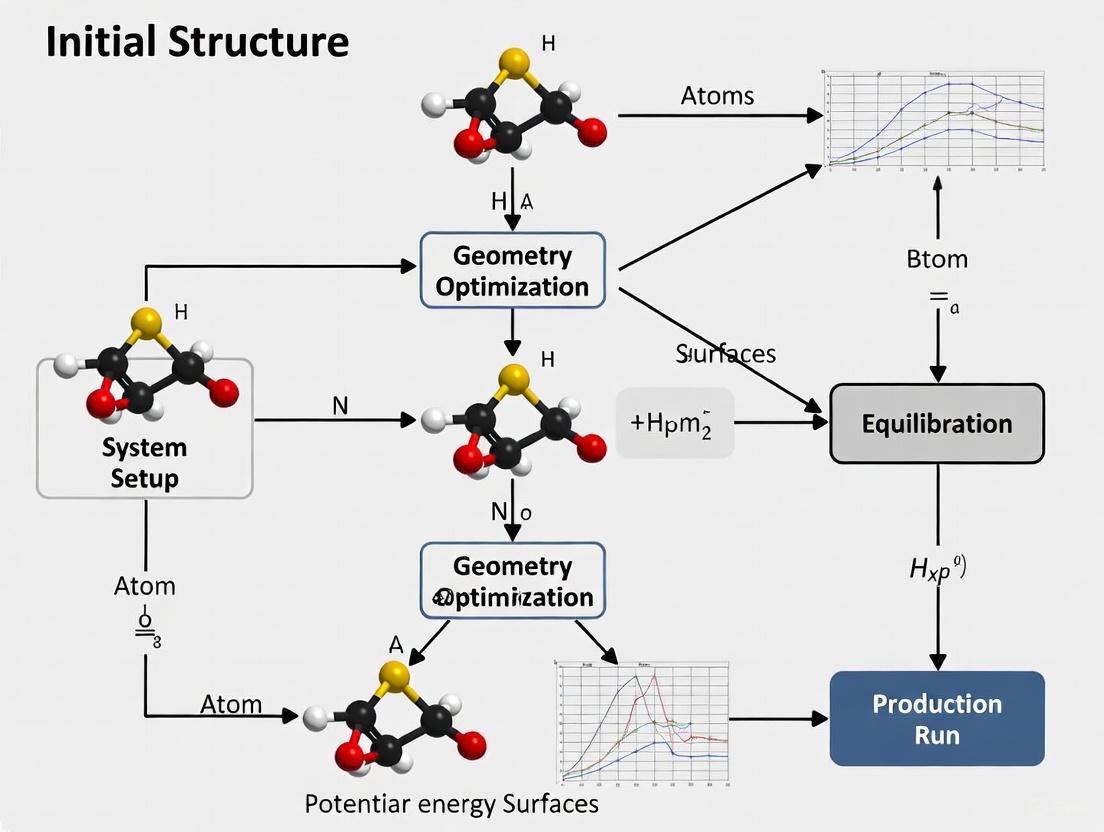
This guide provides a comprehensive framework for researchers and drug development professionals to prepare robust initial structures for Molecular Dynamics (MD) simulations.
A Practical Guide to Preparing Initial Structures for Reliable Molecular Dynamics Simulations
Abstract
This guide provides a comprehensive framework for researchers and drug development professionals to prepare robust initial structures for Molecular Dynamics (MD) simulations. Covering foundational principles to advanced validation, it details methods for obtaining and refining 3D structures from experimental data or homology modeling, setting up solvated systems with proper protonation states and force fields, and performing essential energy minimization. The article also addresses critical troubleshooting for unstable simulations and outlines validation techniques using tools like RMSD analysis and active learning, enabling accurate and efficient MD studies for protein dynamics, drug design, and understanding disease mechanisms.
Why Your Starting Point Matters: The Critical Role of Initial Structures in MD
The Impact of Initial Structure Quality on Simulation Stability and Results
The critical role of the three-dimensional (3D) structure of a protein in understanding its function and enabling drug discovery is well-established [1]. While wet-laboratory experiments like X-ray crystallography remain a primary source for these structures, their high cost and time-consuming nature have driven the development of computational prediction methods [1]. These methods, however, often generate multiple predicted structure models, necessitating the selection of the most accurate one through a process known as Model Quality Assessment (MQA) [1]. The central hypothesis of this work is that the quality of this initial protein structural model directly dictates its stability within an in silico molecular dynamics (MD) system, as revealed by the structural divergence from its starting conformation [1]. High-quality structures tend to maintain their stability, whereas low-quality models exhibit significant deviations and drastic changes due to inherent instability [1]. This technical guide explores the profound impact of initial structure quality on simulation stability and results, providing detailed methodologies and quantitative data for researchers and drug development professionals.
The Critical Link Between Model Quality and Simulation Stability
Protein structures are not static; they are flexible and dynamic, undergoing conformational changes influenced by environmental factors [1]. The accuracy of a predicted model significantly impacts its simulated stability. High-quality (accurate) models demonstrate resilience, maintaining their folded conformation near the equilibrium state during simulation. In contrast, low-quality (inaccurate) models exhibit substantial deviations and rapid, drastic structural changes originating from intrinsic instability [1]. This instability is a direct result of inaccuracies in the initial model, which are exacerbated over simulation time.
Model inaccuracies have a profound effect on protein stability, causing structural changes over time that are directly correlated with a loss of model quality [1]. This relationship provides a foundation for utilizing structural stability information as a powerful metric for MQA, a approach not employed by existing machine learning or deep learning-based methods that rely on geometric, sequence, and energetic features from static structures [1].
Quantitative Metrics for Assessing Stability in MD Simulations
To objectively quantify the stability of a protein structure during MD simulations, specific features must be extracted from the simulation trajectory. The following metrics, calculated in relation to the initial structure, serve as key indicators of stability and model quality [1]:
- Root-Mean-Square Deviation (RMSD): Measures the average distance between atoms in a trajectory of structures compared to a reference state, typically the initial structure. It quantifies the overall global structural deviation [1].
- Fraction of Native Contacts: Calculates the proportion of atomic contacts present in the initial structure that are maintained throughout the simulation. This metric is sensitive to the integrity of the protein's core and folding.
- Fraction of Secondary Structure: Tracks the preservation of secondary structural elements, such as alpha-helices and beta-sheets, relative to the initial model.
Table 1: Stability Metrics Extracted from MD Trajectories and Their Correlation to Model Quality
| Metric | Description | What It Reveals About Model Quality |
|---|---|---|
| Root-Mean-Square Deviation (RMSD) | Average distance of atoms between simulation frames and the initial structure [1]. | Lower final RMSD suggests a stable, high-quality model. High or rapidly increasing RMSD indicates instability and potential inaccuracies. |
| Fraction of Native Contacts | Proportion of initial atomic contacts preserved during simulation [1]. | A high fraction indicates a well-packed, stable core, characteristic of a high-quality model. |
| Fraction of Secondary Structure | Proportion of initial secondary structure elements (helices, sheets) maintained [1]. | Preservation of secondary structure suggests local structural accuracy and stability. |
In a novel approach to MQA, these three stability features—RMSD, fraction of native contacts, and fraction of secondary structure—were extracted from short MD simulations and used to assess model quality [1]. This method, despite using only these simple features and a small dataset with no training process, demonstrated performance comparable to state-of-the-art deep learning methods, highlighting the power of explicit stability information [1].
Experimental Protocol: From Initial Structure to Stability Assessment
This section details a reproducible methodology for assessing protein model quality through MD simulation, based on a published novel approach [1].
Data Set Curation
The protocol begins with the selection of a standard benchmark data set. The Critical Assessment of Structure Prediction (CASP) data sets are commonly used for this purpose. A typical setup involves selecting multiple protein pools, each containing numerous predicted structure models from different prediction methods for a single target protein [1].
Molecular Dynamics Simulation Setup
A relatively short and uniform MD simulation is performed to disclose structural stability information [1].
Table 2: Standardized MD Simulation Protocol for Stability Assessment
| Parameter | Specification | Rationale |
|---|---|---|
| Force Field | OPLS/AA [1] | A standard choice for protein simulations. |
| Water Model | SPC/E [1] | Explicit solvent model. |
| Ions | Na+, Cl- [1] | To neutralize system charge. |
| Temperature | 500 K [1] | Elevated temperature to accelerate stabilization effects within a short simulation time. |
| Simulation Time | 1 ns [1] | Relatively short simulation, sufficient to reveal stability trends. |
| Energy Minimization | Steepest descent [1] | Standard method for relieving atomic clashes. |
| Software | GROMACS version 2019.4 [1] | Widely-used MD simulation package. |
Feature Extraction and Analysis
Following the simulation, the three key stability metrics (RMSD, fraction of native contacts, fraction of secondary structure) are extracted from the generated trajectories using tools like the MDTraj library [1]. The simulation's validity is confirmed by ensuring the RMSD of the final trajectory to the initial structure is below a threshold of 2.5 Å, guarding against unrealistic movements from drastic structural changes or clashes [1].
The workflow below illustrates the entire experimental protocol, from the initial pool of predicted models to the final quality assessment.
Performance Benchmarking and Computational Efficiency
The computational cost of MD simulations is a critical consideration for their practical application. GPUs have become essential for accelerating MD engines like OpenMM, providing order-of-magnitude speedups over CPUs [2]. However, raw simulation speed is not the only factor; cost efficiency is equally important for extensive benchmarking studies.
Recent benchmarking data reveals the performance and cost-effectiveness of various GPU options for MD simulations. Key findings include [2]:
- H200 (Nebius): Achieves the highest performance at 555 ns/day, with a cost of $15.26 per 100 ns simulated.
- L40S (Nebius/Scaleway): Offers the best value, providing nearly H200-level speed (536 ns/day) at the lowest cost ($7.07 per 100 ns).
- T4 (AWS): A budget option for long queues, it is the slowest (103 ns/day) but has a low hourly cost, resulting in a baseline cost of $17.52 per 100 ns.
- V100 (AWS): While delivering solid speed (237 ns/day), it is the least cost-effective option at $30.99 per 100 ns.
Table 3: GPU Performance and Cost-Efficiency for MD Simulations (T4 Lysozyme System)
| GPU & Cloud Provider | Simulation Speed (ns/day) | Cost per 100 ns Simulated (USD) | Primary Use Case |
|---|---|---|---|
| H200 (Nebius) | 555 ns/day | $15.26 | Best raw performance; AI-enhanced workflows |
| L40S (Nebius) | 536 ns/day | $7.07 | Best value overall for traditional MD |
| L40S (Scaleway) | 536 ns/day | $7.21 | Best value overall for traditional MD |
| A100 (Hyperstack) | 250 ns/day | $12.96 | Budget-friendly, consistent performance |
| H100 (Scaleway) | 450 ns/day | $16.43 | Heavy-duty workloads requiring large storage |
| T4 (AWS) | 103 ns/day | $17.52 | Budget option for long simulation queues |
| V100 (AWS) | 237 ns/day | $30.99 | Poor value; not recommended for new workloads |
An often-overlooked bottleneck is disk I/O. Writing trajectory outputs too frequently can cause significant performance throttling—up to 4x slower—due to the overhead of transferring data from GPU to CPU memory [2]. Optimizing the output interval is therefore critical for maximizing GPU utilization and simulation throughput, especially in short runs.
This section catalogs the key software, data, and computational resources required to implement the described methodologies.
Table 4: Essential Research Reagents and Computational Tools
| Item Name | Type | Function / Application | Source / Reference |
|---|---|---|---|
| CASP Data Sets | Standardized Data | Benchmark data sets containing multiple predicted protein structures for evaluating MQA methods [1]. | https://predictioncenter.org/ [1] |
| GROMACS | Software | A versatile molecular dynamics simulation package used for trajectory generation [1]. | http://www.gromacs.org/ [1] |
| OpenMM | Software | A high-performance MD toolkit for GPU-accelerated simulations, used in benchmarking [2]. | https://openmm.org/ [2] |
| UnoMD | Software | An open-source Python package built on OpenMM, simplifying the process of running MD simulations [2]. | - |
| MDTraj | Software Library | A Python library enabling the analysis and manipulation of MD trajectories, used for feature extraction [1]. | https://mdtraj.org/ [1] |
| OPLS/AA | Force Field | A physics-based force field defining interatomic potentials for the MD simulation [1]. | - |
| NVIDIA H200/L40S | Hardware | High-performance GPUs offering optimal speed and cost-efficiency for MD simulations in the cloud [2]. | Cloud Providers (e.g., Nebius, Scaleway) [2] |
The integration of molecular dynamics simulations into the model quality assessment pipeline represents a paradigm shift, moving beyond static structural features to leverage dynamic stability information. The quantitative relationship between initial model quality and its behavior in an in silico environment, measurable through metrics like RMSD and native contacts, provides a robust and insightful method for selecting the most accurate protein models. By adopting the standardized protocols, performance benchmarks, and tools outlined in this guide, researchers can significantly enhance the reliability of their structural models, thereby accelerating progress in computational biology and structure-based drug discovery.
Molecular dynamics (MD) simulation has become an indispensable tool for studying the atomic-level behavior of biomolecules, providing insights into dynamics, function, and interactions that complement experimental approaches. The reliability of any MD simulation, however, is fundamentally constrained by the quality of the initial three-dimensional structural model used to initiate the calculations. These starting coordinates determine the system's potential energy landscape and profoundly influence the subsequent trajectory evolution. Within the context of preparing for MD research, this guide examines the three principal methods for obtaining initial 3D structures: experimental determination by X-ray crystallography and nuclear magnetic resonance spectroscopy, and computational prediction via homology modeling. The choice of method involves critical trade-offs between resolution, temporal information, and applicability, each presenting distinct advantages and limitations for supplying starting models for simulation studies.
The three primary techniques for structure determination offer complementary approaches to resolving macromolecular three-dimensional architecture. The following section provides a technical overview of each method, with a subsequent comparative analysis summarized in Table 1.
X-ray crystallography resolves protein structure by analyzing the diffraction patterns generated when X-rays interact with a crystalline sample. The resulting electron density maps are interpreted to build an atomic model [3] [4]. This method produces a static, high-resolution snapshot of the protein's most stable conformation, typically under crystalline conditions. About 85% of all known protein structures have been solved using this technique [4].
Solution NMR spectroscopy determines protein structures in a near-physiological liquid environment by deriving distance and dihedral angle restraints from Nuclear Overhauser Effects (NOEs) and scalar J-couplings [5] [6]. Unlike crystallography, NMR yields an ensemble of structures that represent the conformational space sampled by the protein on timescales from picoseconds to milliseconds. This method is particularly powerful for studying protein dynamics and transient states [5].
Homology modeling predicts the three-dimensional structure of a target protein based on its amino acid sequence and the experimental structure of a related homologous protein (the template) [7] [8]. Also known as comparative modeling, this approach relies on the observation that protein tertiary structure is evolutionarily more conserved than amino acid sequence [7]. The quality of a homology model is highly dependent on the degree of sequence identity between the target and template.
Table 1: Technical Comparison of Protein Structure Determination Methods
| Parameter | X-ray Crystallography | Solution NMR | Homology Modeling |
|---|---|---|---|
| Typical Resolution | Atomic (1-3 Å) | Atomic (Limited by ensemble) | Varies with sequence identity (1-4 Å Cα RMSD) [7] |
| Sample Requirement | High-purity, crystallizable protein | ~0.5 mL of 0.1-1 mM protein solution [5] | Amino acid sequence only |
| Temporal Information | Single static snapshot | Ensemble of structures representing dynamics [5] | Single static snapshot |
| Throughput | Medium to high | Low to medium (for full structure) | Very high |
| Size Limitation | Essentially none (requires crystals) | Typically < 25-30 kDa for full structure [5] | Limited only by template availability |
| Key Output | Single coordinate set with B-factors | Ensemble of coordinate sets, order parameters | Single coordinate set with model confidence metrics |
| Best Application for MD | Well-folded, crystallizable proteins; studying bound states | Intrinsically disordered proteins, dynamics studies [5] | When experimental structures are unavailable; large-scale screening |
Detailed Experimental and Computational Protocols
X-Ray Crystallography Workflow
The process of determining a protein structure via X-ray crystallography involves multiple stages from protein preparation to final refinement, as visualized in Figure 1.
Figure 1: X-ray Crystallography Workflow for Structure Determination
Protein Purification and Crystallization: The target protein must be expressed and purified to high homogeneity. Crystallization involves screening thousands of conditions to identify parameters that yield diffraction-quality crystals [3] [4]. This remains a major bottleneck in structural biology.
Data Collection and Processing: A single crystal is exposed to an intense X-ray beam, and the resulting diffraction pattern is collected on a detector. The data processing pipeline involves indexing the reflections, integrating their intensities, and scaling the datasets using programs like XDS or the CCP4 suite [3] [4]. The quality of the data is assessed by metrics such as resolution limit, completeness, and Rmerge.
Phase Problem Solution: Since the diffraction pattern only contains amplitude information, the phase information must be determined experimentally (e.g., via Multiple Isomorphous Replacement or Multi-wavelength Anomalous Dispersion) or computationally. Molecular Replacement is the most common method when a homologous structure is available (>25% sequence identity), using programs like Phaser or AMoRe to orient and position the search model within the unit cell [3].
Model Building, Refinement, and Validation: An initial atomic model is built into the experimental electron density map using programs like Coot [3]. The model is then iteratively refined against the diffraction data using restrained refinement protocols in programs like REFMAC or phenix.refine, with cross-validation using the Rfree value [3] [4]. The final model's quality is assessed by geometric correctness and fit to the electron density.
Solution NMR Workflow
Structure determination by NMR involves a distinct workflow centered on acquiring multidimensional spectra of isotope-labeled protein and extracting structural restraints, as shown in Figure 2.
Figure 2: Solution NMR Workflow for Protein Structure Determination
Isotope Labeling and Sample Preparation: Proteins are uniformly labeled with ¹⁵N and ¹³C isotopes, typically expressed in E. coli grown in defined media. This enables the acquisition of multidimensional heteronuclear NMR experiments that resolve and assign complex spectra [5]. Optimal buffer conditions (pH, salt, temperature) are determined by screening ¹H-¹⁵N HSQC spectra for sharp, well-dispersed signals [5].
NMR Experiments and Signal Assignment: A suite of two-, three-, and sometimes four-dimensional NMR experiments (e.g., NOESY, TOCSY, HSQC) is collected. The process of sequential assignment involves mapping NMR signals to specific atoms in the protein sequence through through-bond correlations [5] [6].
Restraint Extraction and Structure Calculation: The key distance restraints are derived from NOESY spectra, which provide information on protons within ~6 Å of each other [6]. Additional restraints include dihedral angles from J-couplings and orientational restraints from Residual Dipolar Couplings (RDCs). Structures are calculated using simulated annealing protocols with programs like CYANA or XPLOR-NIH, which minimize a hybrid energy function combining experimental restraints and molecular mechanics force fields [5].
Ensemble Validation: The result is an ensemble of structures that satisfy the experimental restraints. The precision of the ensemble is measured by the root-mean-square deviation (RMSD) of the backbone atoms, while accuracy is assessed by validation tools that check restraint violations and geometric quality [6].
Homology Modeling Workflow
Homology modeling predicts a protein's structure based on its sequence and a related template structure, following the systematic process shown in Figure 3.
Figure 3: Homology Modeling Workflow for Protein Structure Prediction
Template Identification and Selection: A BLAST or PSI-BLAST search is performed against the Protein Data Bank (PDB) to identify potential templates [7] [8]. The ideal template has high sequence identity (>30%), full coverage of the target sequence, and high experimental resolution. For difficult cases, fold recognition (threading) methods like RaptorX may identify more distantly related templates [7].
Target-Template Sequence Alignment: A precise alignment is critical, as misalignments are a major source of model errors. Profile-based methods (e.g., PSI-BLAST, HMM-HMM alignment) often outperform simple pairwise alignment [8]. Regions with low sequence similarity but known secondary structure can be manually adjusted.
Model Generation: The core backbone is constructed based on the conserved regions of the template. Several approaches are used:
- Fragment assembly builds the model from conserved structural fragments [7].
- Satisfaction of spatial restraints uses the alignment to generate spatial restraints and finds a structure that satisfies them (implemented in MODELLER) [7].
- Segment matching matches short segments of the target sequence to structural fragments in the PDB [7].
Loop Modeling and Side-Chain Placement: Non-conserved regions (insertions/deletions) require loop modeling, which is most accurate for segments up to 12-13 residues [8]. Side chains are added using rotamer libraries that statistically prefer conformations (e.g., with SCWRL) [8].
Model Refinement and Quality Assessment: The initial model may undergo energy minimization and molecular dynamics refinement to relieve steric clashes. Quality is assessed using geometry validation (Ramachandran plot), statistical potentials, and comparison to experimental data if available [8].
Table 2: Key Software Tools for Protein Structure Determination and Analysis
| Tool Name | Method | Primary Function | Application in MD Preparation |
|---|---|---|---|
| CCP4 Suite [3] [4] | X-ray | Data processing, molecular replacement, refinement | Process diffraction data to obtain initial coordinates |
| PHENIX [4] | X-ray | Automated structure solution, refinement | Refine atomic coordinates and B-factors |
| Coot [3] | X-ray | Model building and visualization | Manual model building and correction of electron density interpretation |
| CYANA/XPLOR-NIH [5] [6] | NMR | Structure calculation from restraints | Calculate structure ensembles satisfying NMR-derived restraints |
| MODELLER [8] | Homology Modeling | Comparative modeling by satisfaction of spatial restraints | Generate 3D models from sequence alignment |
| SWISS-MODEL [8] | Homology Modeling | Automated protein structure homology modeling | Web-based automated model generation |
| SCWRL4 [8] | Homology Modeling | Side-chain conformation prediction | Optimize side-chain packing in homology models |
| MolProbity [4] | Validation | Structure validation | Assess model quality before MD simulation |
Table 3: Critical Databases for Structural Biology
| Database | Content Type | Utility for Structure Determination |
|---|---|---|
| Protein Data Bank (PDB) [8] | Experimentally determined structures | Source of templates for molecular replacement and homology modeling |
| PDBx/mmCIF [8] | Modern PDB archive format | Robust format for deposition and programmatic applications |
| Materials Project/AFLOW [9] | Crystal structures (materials) | Source of initial structures for materials MD simulations |
| PubChem/ChEMBL [9] | Small molecule structures | Source of ligand parameters for complex assembly |
Integration with Molecular Dynamics Simulations
The choice of initial structure method profoundly impacts subsequent MD simulations. X-ray structures provide high-resolution starting points but represent a single, often low-energy conformation that may not reflect physiological states [10]. NMR ensembles offer multiple starting conformations that can be used to explore different basins on the energy landscape. Homology models enable MD simulations of proteins without experimental structures, though the simulations may be biased by template choice and modeling errors.
Recent advances integrate MD directly with structure determination. MD-MX methods combine molecular dynamics simulations of protein crystals with conventional crystallographic refinement [10]. This approach helps interpret ambiguous electron density, particularly at the protein-solvent interface, and can reveal alternative conformations and water networks missed by standard refinement. For NMR, Inferential Structure Determination (ISD) provides a Bayesian framework for calculating structures from experimental data, explicitly accounting for statistical uncertainties [6].
Notably, coarse-grained models like Elastic Network Models (ENMs) can efficiently identify collective motions favored by a protein's native topology [11]. These global modes are often insensitive to atomic details and can provide valuable insights for designing MD simulations focused on functional motions. A comparative analysis has shown that GNM predictions can exhibit better correlation with NMR ensemble fluctuations than with X-ray B-factors, suggesting these methods capture essential dynamics relevant for MD simulation planning [11].
The preparation of initial structures represents a foundational step in molecular dynamics research that demands careful consideration of methodological strengths and limitations. X-ray crystallography provides high-resolution static snapshots, NMR spectroscopy delivers dynamic ensembles in solution, and homology modeling offers predictive access to unsolved structures. Each method contributes uniquely to the structural biologist's toolkit, and the optimal choice depends on the biological question, protein characteristics, and available resources. As integrative approaches continue to blur traditional boundaries between experimental and computational methods, researchers are increasingly equipped to generate robust initial structures that enable biologically insightful MD simulations, ultimately advancing our understanding of protein function and facilitating drug discovery efforts.
Molecular dynamics (MD) simulation has emerged as a powerful theoretical tool for modeling atomic interactions in biological systems over time, providing crucial insights into protein folding, drug-target interactions, and molecular mechanisms that are difficult to observe experimentally [12]. The accuracy and reliability of these simulations depend critically on the initial preparation of the molecular structure, particularly the treatment of non-standard residues and crystallographic waters [13]. Pre-processing raw structures from experimental sources such as X-ray crystallography or nuclear magnetic resonance (NMR) represents a foundational step in the MD pipeline, as decisions made at this stage significantly influence all subsequent simulation outcomes, from system stability to the biological relevance of obtained results.
The process of preparing initial structures for MD simulation research involves navigating critical decisions about which structural components to retain, modify, or remove. Non-standard residues—including ligands, ions, and modified amino acids—and crystallographic water molecules present particular challenges. These components may be essential for maintaining structural integrity or mediating functionally important interactions, or they may simply be artifacts of the crystallization process that could impede simulation performance or lead to non-physiological behaviors [14]. This technical guide provides an in-depth examination of evidence-based strategies for making these determinations, placing them within the context of a comprehensive thesis on robust MD simulation research protocols. By establishing rigorous pre-processing methodologies, researchers can ensure their simulations yield biologically meaningful insights, particularly in structure-based drug design where accurate representation of solvation and binding environments is paramount [15] [16].
Understanding the Components: Non-Standard Residues and Crystallographic Waters
Non-Standard Residues in Experimental Structures
Non-standard residues encompass all molecular components in a protein structure that are not among the 20 standard amino acids. These include enzyme cofactors, pharmaceutical ligands, metal ions, modified amino acids (such as phosphorylated or glycosylated residues), and molecules from crystallization buffers. Each category requires individual evaluation based on its potential functional significance versus the risk of introducing artifacts into simulations.
Ions present a particularly nuanced decision point. As noted in community discussions, "Are the ions functionally important? Or are they an artifact of some crystallization buffer? There's no harm in keeping them but in most cases they're going to diffuse away as soon as equilibration starts" [14]. This observation highlights the importance of considering the biological context—ions in active sites or at critical protein-protein interfaces are more likely to be functionally relevant than those dispersed in the solvent or apparently trapped in crystal contacts. Similarly, small molecule ligands require careful assessment, especially in studies focused on drug binding, where the ligand may be the primary subject of investigation [13].
The Dual Nature of Crystallographic Waters
Water molecules observed in crystal structures present a complex challenge during pre-processing. These crystallographic waters represent positions where water molecules are sufficiently ordered to produce observable electron density, indicating stable interactions with the biomolecular environment [15]. The scientific literature reveals that "solvent structure is very important in biomolecular simulations for medicinal chemistry applications" and that "in protein crystallography, ordered water molecules give rise to regions of elevated solvent density" where interactions are "sufficiently strong to overcome the translational and rotational entropies favoring diffusion" [15].
Interfacial waters—those located at protein-protein or protein-ligand interfaces—often play particularly important structural and functional roles. Research has demonstrated that "water molecules also solvate protein structures" and "crystal structures often show crystal waters associated to the protein," with analysis showing "preferential binding to protein-protein interaction interfaces" [17]. In complexes such as barnase/barstar and colicin DNase E2/Im2, interfacial waters contribute significantly to stability and specificity [17]. These observations underscore why a blanket removal of all crystallographic waters represents an oversimplification that may discard functionally important structural information.
Table 1: Categorization and Treatment Recommendations for Common Non-Standard Components
| Component Type | Potential Functional Roles | Recommended Pre-processing Action |
|---|---|---|
| Active Site Ligands | Substrate analogs, cofactors, inhibitors | Retain if studying binding; remove otherwise |
| Metal Ions | Structural stability, catalytic cofactors | Retain if structurally or functionally integral |
| Buffer Molecules | Crystallization condition artifacts | Typically remove unless functionally relevant |
| Interface Waters | Mediate protein-protein interactions | Evaluate via occupancy/B-factors; often retain |
| Buried Waters | Structural integrity, hydrogen bonding | Generally retain due to structural importance |
| Surface Waters | Crystal packing, transient interactions | Typically remove and regenerate with solvent model |
Decision Framework: When to Remove or Retain Structural Components
Assessing Functional Relevance
Establishing a systematic decision framework for handling non-standard residues and crystallographic waters requires integrating multiple lines of evidence. The following workflow provides a structured approach to these critical pre-processing decisions, emphasizing functional relevance through biophysical properties and biological context.
Diagram 1: Decision workflow for structural components during pre-processing
The assessment of crystallographic data quality provides critical insights into the confidence with which water molecules or ligands have been modeled. Key metrics include:
- B-factors (temperature factors): Higher values indicate greater positional flexibility or disorder. Waters with B-factors significantly higher than the local protein environment may represent poorly ordered positions that can be safely removed and replaced by the solvent model during simulation setup.
- Occupancy values: Less than full occupancy (1.0) suggests partial occupancy or disorder, potentially making removal appropriate.
- Electron density evidence: Consulting the original electron density maps (where available) can help distinguish well-defined water positions from ambiguous density.
Research indicates that "the recall of crystallographic waters using strong peaks in the MD water electron density was very good" when using restrained simulations, suggesting that well-ordered waters correspond to thermodynamically favorable positions that should be preserved [15].
The biological and functional context of the simulation represents another crucial consideration. As explicitly stated in technical discussions: "Are the ions functionally important? Or are they an artifact of some crystallization buffer? Are the crystal waters relevant (as in an enzyme active site) or incidental?" [14]. This highlights the need for domain knowledge when making pre-processing decisions. For example, in a study of an enzyme mechanism, a crystallographic water positioned as a potential nucleophile or proton shuttle should likely be retained, whereas waters appearing to mediate crystal contacts without obvious functional roles might be removed.
Special Considerations for Buried and Interfacial Waters
Buried water molecules—those completely enclosed by protein structure with no access to bulk solvent—present a special case in pre-processing decisions. These waters often play important structural roles, forming integral parts of the protein's hydrogen-bonding network [18]. Their exchange with bulk solvent is typically slow on simulation timescales, making their spontaneous entry and correct positioning unlikely during conventional MD simulations [18]. As such, structurally integral buried waters identified in crystal structures should generally be retained, particularly when they mediate functionally important interactions.
Similarly, interfacial waters at protein-protein or protein-ligand interfaces frequently contribute significantly to binding affinity and specificity. Research on protein-protein complexes has shown that "interfacial waters are increasingly appreciated as playing a key role in protein-protein interactions" [17]. In the barnase/barstar complex, for instance, "a large amount of water molecules in its protein-protein interface, a third of which are fully buried" contribute to the association [17]. Retaining these carefully positioned waters during pre-processing may be essential for reproducing experimental binding affinities and mechanisms.
Table 2: Quantitative Assessment Metrics for Crystallographic Waters
| Assessment Metric | Interpretation Guidelines | Typical Threshold Values |
|---|---|---|
| B-factor (Relative) | Compare to local protein environment | Retain if within 1.5× of local protein B-factors |
| Occupancy | Indicator of positional stability | Retain if > 0.7; evaluate carefully if lower |
| Coordination Number | Number of hydrogen bonds to protein | Retain if ≥ 2 strong H-bonds to protein |
| Solvent Accessibility | Buried vs. surface location | Generally retain buried waters (ASA < 10 Ų) |
| Distance to Functional Sites | Proximity to active sites, binding interfaces | Retain if within 4Å of functional residues |
Experimental Protocols and Methodologies
Standardized Pre-processing Workflow
A robust, standardized protocol for pre-processing raw structures ensures consistency and reproducibility in MD simulation research. The following step-by-step methodology integrates best practices from multiple sources:
Structure Acquisition and Validation: Begin with the highest-quality experimental structure available. When multiple structures exist, prioritize those determined using joint X-ray and neutron diffraction, as these enable "experimentally assigned protonation states" [15]. Remove any alternate conformations present in the structure, keeping only the highest-occupancy or best-defined conformers.
Initial Component Analysis: Systematically inventory all non-standard residues and crystallographic waters. Tools like Chimera [13] or Phenix [19] can facilitate this analysis. Consult the original publication for functional annotations and any remarks about specific ligands, ions, or waters.
Protonation State Assignment: Assign physiologically appropriate protonation states to titratable residues, considering pH and local environment. As demonstrated in MD studies, "the protonation state of HIS residues was determined using the neutron diffraction data" when available [15]. In the absence of experimental data, computational tools such as PROPKA or H++ can provide estimates.
Component Evaluation and Culling: Apply the decision framework outlined in Section 3 to each non-standard component. Remove crystallization artifacts, buffer molecules, and ions not implicated in biological function. For waters, retain those with functional significance or strong biophysical evidence of stable positioning.
Structural Completion: Add missing atoms to incomplete residues using modeling tools. For significantly missing loops or regions, consider homology modeling or advanced approaches like AlphaFold [13] prediction, though these introduce their own uncertainties.
Topology Generation: Create force-field compatible topology files for the processed structure. Ensure parameters exist for any retained non-standard residues, generating them via tools like eLBOW [19] or antechamber when necessary.
This protocol emphasizes the importance of documentation at each step, creating a reproducible record of pre-processing decisions for future reference and publication.
Advanced Techniques for Enhanced Water Sampling
For cases where crystallographic waters are removed or when researchers wish to validate water positions predicted by MD against experimental data, advanced sampling techniques can be employed. These methods address the challenge that "water exchange between bulk and buried hydration sites can be slow compared to simulation timescales, thus leading to the inefficient sampling of the locations of water" [18].
The BLUES (NCMC/MD) method combines nonequilibrium candidate Monte Carlo (NCMC) with molecular dynamics to enhance water sampling. This approach "uses NCMC to gradually remove interactions between a selected water molecule and its environment, then translates the water to a new region, before turning the interactions back on" [18]. This allows the environment to relax in response to proposed water translations, improving acceptance of moves and accelerating water exchange in buried binding sites.
Other enhanced sampling methodologies include:
- Replica-exchange molecular dynamics (REMD): Enhances conformational sampling by running multiple replicas at different temperatures and periodically exchanging configurations [16].
- Metadynamics: Applies a history-dependent bias potential to encourage exploration of conformational space [16].
- Grand canonical Monte Carlo (GCMC): Attempts insertion and deletion of waters to maintain a specific chemical potential, though this approach "has been shown to be inefficient due to steric clashes which results in a high rejection of the proposed moves" [18].
These advanced techniques are particularly valuable when studying processes where water rearrangements play critical functional roles, such as ligand binding or conformational changes in buried environments.
Successful pre-processing of raw structures for MD simulations requires leveraging specialized software tools and computational resources. The following table catalogues essential solutions for handling non-standard residues and crystallographic waters.
Table 3: Essential Software Tools for Structure Pre-processing
| Tool Name | Primary Function | Application to Non-Standard Components |
|---|---|---|
| Chimera/ChimeraX [13] | Molecular visualization and analysis | Removing solvent, analyzing B-factors, preparing structures |
| Phenix [19] | Crystallography software suite | Refinement, validation of waters and ligands |
| GROMACS [20] | Molecular dynamics package | Topology generation, simulation execution |
| AMBER | Molecular dynamics package | Parameterization of non-standard residues |
| AquaSol [17] | Continuum solvation method | Prediction of water positions |
| BLUES [18] | Enhanced sampling method | Accelerated water sampling in buried sites |
Specialized tools like AquaSol implement continuum solvation models such as the Dipolar Poisson-Boltzmann-Langevin (DPBL) model, which "explicitly introduces solvent molecules in the form of point dipoles" and can be used to predict interfacial water positions [17]. Similarly, the BLUES framework specifically addresses water sampling challenges in buried binding sites through its hybrid NCMC/MD approach [18].
When working with non-standard residues, particularly small molecule ligands, parameterization represents a significant challenge. As noted in the Phenix documentation, problems often occur "when the restraints were generated using ReadySet from a PDB file, and the ligand code is not recognizable in the Chemical Components Database" [19]. For best results, "restraints for non-standard ligands should be generated in eLBOW using a SMILES string or similar source of topology information" [19].
Pre-processing raw structures by selectively removing non-standard residues and crystallographic waters represents a critical foundational step in molecular dynamics research. Rather than applying rigid rules, this process requires nuanced evaluation of each component based on crystallographic evidence, biological context, and research objectives. The decision framework and methodologies presented in this guide provide a systematic approach to these determinations, emphasizing evidence-based retention of functionally important elements while removing potential artifacts.
The implications of these pre-processing decisions extend throughout the entire simulation pipeline. Research has demonstrated that MD simulations with appropriate restraints can successfully "recover crystallographic water structure" [15], validating the importance of carefully considered initial conditions. Furthermore, advanced sampling techniques continue to evolve that address challenges in water placement and sampling, particularly for buried binding sites where water molecules often play decisive roles in molecular recognition and binding thermodynamics [18].
Integrating these pre-processing protocols into a broader thesis on MD simulation methodology establishes a rigorous foundation for producing reliable, biologically relevant simulations. By documenting and justifying decisions about which structural components to retain or remove, researchers enhance both the reproducibility of their own work and the collective advancement of computational biophysics. As MD simulations continue to grow in importance for drug discovery and structural biology, standardized, transparent pre-processing methodologies will remain essential for generating scientifically valid insights from these powerful computational approaches.
The accuracy of atomistic biomolecular modeling and simulation studies is fundamentally dependent on the accuracy of the input structures [21]. Molecular dynamics (MD) simulations have emerged as a powerful tool in biomedical research, offering insights into intricate biomolecular processes such as structural flexibility and molecular interactions [22]. These simulations capture the behavior of proteins and other biomolecules in full atomic detail and at very fine temporal resolution, making them invaluable for deciphering functional mechanisms of proteins, uncovering the structural basis for disease, and aiding the design and optimization of small molecules, peptides, and proteins [23]. However, a significant challenge persists: most experimentally determined structures contain structural gaps or inconsistencies that must be resolved before reliable MD simulations can be performed.
The primary source of biomolecular structures, the Protein Data Bank (PDB), contains a fundamental limitation for MD preparedness. Currently, only approximately 16% of all PDB entries (28,971 out of 181,847) contain hydrogen atoms [24]. This statistical shortfall exists because hydrogen atoms possess small size and low electron density, making them difficult to detect in most experimental structure determination methods like X-ray crystallography [25] [24]. This deficiency is particularly problematic because hydrogen atoms are crucial for detecting hydrogen bonds, understanding molecular interactions, and performing accurate molecular dynamics simulations [24]. Without complete molecular models, simulations may produce artifactual results or fail to capture essential biological mechanisms. This technical guide addresses these critical preparation steps within the broader context of preparing initial structures for MD simulation research, providing researchers with methodologies to bridge the gap between experimentally-determined structures and simulation-ready models.
The Hydrogen Placement Challenge: From Macromolecules to Small Ligands
The absence of hydrogen atoms represents the most common structural gap in biomolecular structures. Thorough structure analysis and simulations require precise knowledge of hydrogen atom positions, as they influence molecular geometry, electrostatic interactions, and hydrogen bonding networks [24]. Existing methods for hydrogen position prediction have historically been limited in scope. Some programs predict hydrogen positions based on force fields parametrized for only a limited number of molecules, while others focus primarily on small compounds and lack effectiveness for larger biomacromolecules [24].
The hydrogen placement challenge extends across all molecular components relevant to MD simulations:
- Protein backbone and side chains: Standard amino acids require accurate hydrogen placement, with special attention to titratable residues whose protonation states depend on physiological pH.
- Nucleic acids: DNA and RNA structures require hydrogen atoms on sugar moieties and bases, with correct tautomeric states.
- Small molecule ligands: Drug-like molecules and cofactors often contain complex functional groups with specific hydrogen bonding capabilities.
- Solvent and ions: Explicit solvent simulations require complete water models with correctly oriented hydrogen atoms.
The impact of improper hydrogen placement can propagate through MD simulations, affecting structural stability, interaction energies, and ultimately, the biological conclusions drawn from computational experiments. The following sections detail computational approaches to address this fundamental challenge.
Computational Methodologies for Adding Missing Atoms
Fragment-Based Library Approach
A novel algorithm for hydrogen atom placement leverages fragment libraries compiled from molecular fragments with known hydrogen atom positions [24]. This method addresses limitations of force-field parameterized approaches by utilizing geometrical information from reference structures, enabling hydrogen prediction for molecules containing equivalent groups, from small ligands to large macromolecules [24].
The methodology operates through a multi-stage process:
Library Compilation Reference molecules with known hydrogen positions are split into fragments, one for each heavy atom in the molecule [24]. Each fragment contains:
- The element, formal charge, and coordinates of the central heavy atom
- The coordinates of the bonded hydrogen atoms
- The coordinates of the bonded heavy atoms and their bond orders
- The chirality of the fragment, where applicable
These fragments are stored in a library data structure that maps specific molecular descriptors (central atom element, formal charge, chirality, and bond orders with connected heavy atoms) to the coordinates of connected heavy atoms and hydrogen atoms [24]. For specialized cases like nitrogen atoms capable of forming partial double bonds, separate bond orders account for planar conformations induced by such bonding [24].
Target Molecule Processing The target molecule undergoes similar fragmentation, creating target fragments that naturally lack hydrogen atoms [24]. For each target fragment, the algorithm selects a matching fragment from the library based on the same molecular descriptors. If no match exists, hydrogen atoms cannot be assigned to that central atom, highlighting the importance of a comprehensive fragment library. The implementation using all molecules from the Chemical Component Dictionary (CCD) ensures hydrogen atoms can be added to all molecules appearing in the PDB, with implicit support for most other organic molecules sharing the same fragments [24].
Fragment Superimposition and Hydrogen Placement The library fragment is superimposed onto the target fragment through translation and rotation operations that minimize the root-mean-square deviation between the fragments [24]. The hydrogen coordinates of the transformed library fragment then become the predicted hydrogen positions for the target fragment. This method generally produces accurate positions for most hydrogen atoms, as they are constrained by the position of their bonded heavy atom, with bond lengths and angles remaining approximately constant [24].
Terminal Group Relaxation
While the fragment superimposition method provides accurate initial placement for most hydrogen atoms, terminal heavy atoms connected with single bonds (e.g., hydroxy or methyl groups) represent a special case. These groups can rotate about the single bond, meaning they lack unambiguous hydrogen positions based solely on geometrical constraints [24]. These cases require a second relaxation step.
The relaxation process employs an energy function based on non-bonded interaction terms of the Universal Force Field (UFF) [24]. The function comprises:
- An electrostatic term calculated using partial atomic charges, typically computed via the PEOE (Partial Equalization of Orbital Electronegativities) method
- A Lennard-Jones term describing van der Waals interactions
The energy function is expressed as: [ V(\vec{r}i, \vec{r}j) = V\text{el}(\vec{r}i, \vec{r}j) + V\text{LJ}(\vec{r}i, \vec{r}j) ] [ V\text{el}(\vec{r}i, \vec{r}j) = 332.067 \frac{qi qj}{D{ij}} ] [ V\text{LJ}(\vec{r}i, \vec{r}j) = \epsilon{ij} \left( \left( \frac{\delta{ij}}{D{ij}}\right)^{12} - 2\left( \frac{\delta{ij}}{D{ij}}\right)^6 \right) ]
where (D{ij}) represents the Euclidean distance between atoms i and j, (\epsilon{ij}) represents the well depth, (\delta{ij}) represents the optimal distance between atoms, and q represents atomic charges [24]. To account for hydrogen bonding, the optimal distance parameter (\delta{ij}) is multiplied by 0.79 for potential hydrogen bond acceptor-donor pairs [24].
The algorithm calculates interactions between all pairs of rotatable hydrogen atoms and other atoms within a defined cutoff distance of 10 Å [24]. Using a variant of the hill climbing algorithm, the method iteratively rotates applicable hydrogen atoms about terminal heavy atom bonds to reach a local minimum of the energy function, thus determining the optimal orientation for rotatable hydrogens [24].
Integrated Structure Preparation Pipelines
For comprehensive structure preparation, researchers can leverage automated web servers like H++, which provides a streamlined workflow for preparing biomolecular structures for atomistic modeling and simulations [21]. H++ performs multiple essential tasks through a unified interface:
- Correcting structural errors and adding missing atoms
- Predicting pK values for titratable amino acids to determine protonation states at specific pH values
- Adding hydrogen atoms and valences
- Assigning predefined partial charges and radii to all atoms
- Generating force field parameter/topology files for MD simulations
This integrated approach is particularly valuable for ensuring consistency across preparation steps and managing the complex interdependencies between protonation states, hydrogen placement, and parameter assignment.
Quantitative Assessment of Structure Preparation Tools
Table 1: Comparison of Structural Gap Resolution Tools and Methods
| Tool/Method | Primary Function | Algorithm Basis | Applicable Molecular Scope | Key Advantages |
|---|---|---|---|---|
| Hydride [25] [24] | Hydrogen atom addition | Fragment superimposition | Organic molecules from small ligands to large protein complexes | No force-field parameters required for specific molecules; works out-of-box |
| H++ [21] | Comprehensive structure preparation | Poisson-Boltzmann pK prediction, force field parameterization | Proteins, nucleic acids, with ligand support | Automated workflow with extensive error checking; protonation state prediction |
| REDUCE [24] | Hydrogen addition | Force-field optimization | Macromolecules with limited organic molecules | Integrated with molecular dynamics packages |
| OpenBabel [24] | Chemical format conversion & hydrogen addition | Rule-based and force-field approaches | Focus on small molecules | Broad file format support; extensive chemical descriptor calculation |
| CHARMM HBUILD [24] | Hydrogen addition | Internal coordinate optimization | Biomolecules within CHARMM force field | Tight integration with CHARMM simulation package |
| GROMACS pdb2gmx [24] | Hydrogen addition & topology generation | Force-field based | Biomolecules within GROMACS force fields | Direct pipeline to MD simulation |
Table 2: Statistical Overview of Structural Gaps in Experimental Structures
| Structural Gap Category | Approximate Prevalence in PDB | Impact on MD Simulations | Resolution Methods |
|---|---|---|---|
| Missing hydrogen atoms | ~84% (152,876 entries) [24] | Affects hydrogen bonding, molecular interactions, and energy calculations | Computational addition via fragment libraries or force fields |
| Incorrect protonation states | Variable (pH-dependent) | Alters electrostatic interactions and binding affinities | pK prediction algorithms, Poisson-Boltzmann calculations |
| Missing heavy atoms (side chains) | ~8% (dependent on resolution) | Creates artificial cavities and disrupts packing | Loop modeling, structural homology |
| Chirality errors | Rare | Steric clashes and unnatural conformations | Validation tools, manual correction |
| Rotamer outliers | ~5-15% | Affects side chain packing and dynamics | Rotamer library sampling, energy minimization |
Experimental Protocols for Structure Preparation
Protocol 1: Hydrogen Addition Using Hydride
Purpose: To add missing hydrogen atoms to molecular models for subsequent MD simulation analysis.
Materials and Software:
- Hydride Python package (install via
pip install hydride) - Python 3.7 or higher
- Input structure file in PDB or similar format
- Computational environment with sufficient memory for large complexes
Methodology:
- Installation and Setup
Basic Command Line Execution
Library-Based Fragment Matching
- The algorithm splits the target molecule into fragments centered on each heavy atom
- For each fragment, identifies matching fragment in the pre-compiled library from the Chemical Component Dictionary (CCD)
- Performs geometric superimposition to determine optimal hydrogen coordinates
- Adopts hydrogen positions to the target molecule
Terminal Group Relaxation (optional but recommended)
- Identifies terminal heavy atoms connected via single bonds
- Calculates non-bonded interactions using Universal Force Field parameters
- Optimizes dihedral angles of rotatable hydrogen groups via hill climbing algorithm
- Minimizes energy function comprising electrostatic and Lennard-Jones terms
Validation
- Check for steric clashes using molecular visualization software
- Verify bond lengths and angles fall within chemical reasonable ranges
- For MD preparation, ensure compatibility with chosen force field
Protocol 2: Comprehensive Structure Preparation Using H++
Purpose: To prepare biomolecular structures for atomistic MD simulation, including protonation state prediction, hydrogen addition, and topology generation.
Materials and Software:
- H++ web server (http://biophysics.cs.vt.edu/)
- Input structure in PDB format
- Knowledge of physiological pH relevant to the biological system
Methodology:
- Structure Upload and Parameter Selection
- Upload target PDB file to H++ server
- Specify physiological pH (typically 7.4 for intracellular environments)
- Select internal/external dielectric constants appropriate for the system
- Choose force field (AMBER, CHARMM, etc.) compatible with intended MD package
Error Correction and Protonation State Prediction
- System identifies and corrects flipped side chain conformations for HIS, GLN, and ASN
- Calculates pK values for titratable amino acids using Poisson-Boltzmann methodology
- Assigns protonation states based on specified pH
- Handles special cases for histidine tautomers (HID, HIE, HIP)
Hydrogen Addition and Optimization
- Adds hydrogen atoms based on predicted protonation states
- Optimizes side chain conformations to minimize steric clashes
- For nucleic acids, adds hydrogens following standard base pairing rules
Output Generation
- Downloads final structure with all hydrogen atoms
- Generates force field parameter/topology files for major MD packages
- Provides solvent box with specified ions for explicit solvent MD
Validation and Quality Control
- Review protonation states of key residues in active sites
- Check hydrogen bonding networks in critical functional regions
- Verify compatibility with MD simulation package of choice
Workflow Visualization for Structure Preparation
Diagram 1: Comprehensive Workflow for MD Structure Preparation. This diagram illustrates the complete pathway from experimental structure to simulation-ready model, highlighting critical validation steps and remediation pathways for common structural gaps.
Diagram 2: Hydrogen Addition via Fragment Superimposition. This specialized workflow details the fragment-based approach for adding hydrogen atoms to molecular structures, showing the process from library matching through energy minimization of terminal groups.
Table 3: Research Reagent Solutions for Structural Gap Resolution
| Tool/Resource | Type | Primary Function | Access Method | Key Applications in Structure Preparation |
|---|---|---|---|---|
| Hydride [25] [24] | Software library/CLI tool | Hydrogen atom addition | Python package (pip install hydride) |
Adding hydrogens to organic molecules, ligands, and protein complexes without force-field parameters |
| H++ [21] | Web server | Comprehensive structure preparation | Online interface (http://biophysics.cs.vt.edu/) | Protonation state prediction, hydrogen addition, topology generation for MD simulations |
| Chemical Component Dictionary (CCD) [24] | Reference database | Fragment library source | Database download or API access | Providing reference fragments with known hydrogen positions for library-based methods |
| Universal Force Field (UFF) [24] | Force field parameters | Energy calculation for relaxation | Integrated in software packages | Optimizing positions of rotatable hydrogen atoms via energy minimization |
| PEOE Method [24] | Charge calculation algorithm | Partial atomic charge assignment | Implementation in bioinformatics libraries | Calculating atomic charges for electrostatic energy computations during relaxation |
| AMBER ff14SB [26] | Protein force field | Topology parameterization | MD software packages | Providing standardized parameters for simulation-ready structures |
| GROMACS [23] [22] | MD software package | Simulation execution | Software installation | Performing energy minimization and MD validation of prepared structures |
Addressing common structural gaps through robust computational methods represents a critical first step in ensuring the reliability of molecular dynamics simulations. The methodologies described in this guide—particularly fragment-based hydrogen addition and integrated structure preparation pipelines—provide researchers with powerful approaches to bridge the gap between experimentally-determined structures and simulation-ready models. As MD simulations continue to expand their impact in molecular biology and drug discovery [23], the importance of proper initial structure preparation cannot be overstated. These foundational steps directly influence the accuracy with which simulations can capture functional mechanisms of proteins, uncover structural bases for disease, and facilitate the design of therapeutic molecules [23] [22]. By adopting systematic approaches to adding missing atoms and resolving inconsistencies, researchers can establish a solid foundation for meaningful computational investigations of biomolecular systems.
Assigning Protonation States to Titratable Residues for Physiological Accuracy
The accuracy of a molecular dynamics (MD) simulation is fundamentally dependent on the quality of the initial structural model. A crucial, yet often overlooked, aspect of preparing this model is the assignment of physiologically accurate protonation states to titratable amino acid residues. Classical MD simulations typically keep the protonation states of residues fixed throughout the simulation trajectory. An improper initial assignment can therefore lead to a propagation of unrealistic electrostatic interactions, ultimately causing the simulation to diverge from the true physiological behavior of the protein [27]. For proteins where proton transfer reactions are central to function, such as many membrane transporters and channels, this assignment becomes even more critical [27] [28].
The challenge arises because the protonation state of a side chain is not an intrinsic property but is governed by its microenvironment. A residue's experimentally measured pKa value can be significantly shifted from its reference value in a capped amino acid due to factors such as the local electrostatic environment, hydrogen bonding, and solvent exposure [28] [29]. Consequently, simply assigning all titratable residues their standard charged states at pH 7 (e.g., Asp and Glu deprotonated; Lys and Arg protonated) is often insufficient and can lead to structural artifacts. This guide provides an in-depth technical overview of the methods and best practices for determining the correct protonation states, a vital step in preparing an initial structure for reliable MD research.
Understanding Titratable Residues and Environmental Influence
Key Titratable Amino Acids and Their Reference pKa Values
In proteins, the most common titratable residues are aspartate (Asp), glutamate (Glu), histidine (His), cysteine (Cys), tyrosine (Tyr), and lysine (Lys). The table below summarizes their standard protonation behavior and reference pKa values, which serve as a starting point for more sophisticated calculations [30].
Table 1: Titratable Amino Acid Residues and Their Properties
| Amino Acid | Titratable Residue Name (e.g., AMBER) | Reference pKa (capped amino acid) | Standard Protonation State at pH 7 |
|---|---|---|---|
| Aspartate | AS4 | 4.0 | Deprotonated (-1) |
| Glutamate | GL4 | 4.4 | Deprotonated (-1) |
| Histidine | HIP | 6.6 | Mostly Protonated (+1 or 0)* |
| Cysteine | CYS | 8.5 | Deprotonated (0) |
| Tyrosine | TYR | 9.6 | Deprotonated (0) |
| Lysine | LYS | 10.4 | Protonated (+1) |
*Note: Histidine can be protonated on either the delta or epsilon nitrogen, creating different tautomers, or on both (doubly protonated). The standard state "HIP" often refers to the doubly protonated form for titration purposes [30].
Factors That Shift pKa Values
A residue's observed pKa in a protein can deviate significantly from the reference values in Table 1. The primary factors causing these shifts include:
- Electrostatic Interactions: The presence of other charged residues or metal ions in close proximity can stabilize or destabilize a given protonation state, leading to substantial pKa shifts [28] [31]. For example, a negatively charged aspartate will have its pKa lowered (favoring deprotonation) if it is near a positively charged arginine.
- Solvent Exposure (Buriedness): Residues buried in the hydrophobic core of a protein are in a low-dielectric environment. This makes it energetically costly to have a charged species, often favoring the neutral state. This can result in a raised pKa for acidic residues (they remain protonated) and a lowered pKa for basic residues (they remain deprotonated) [28] [31].
- Hydrogen Bonding: Strong hydrogen bond networks can stabilize a particular protonation state, thereby shifting the pKa value to maintain that state under a wider pH range [29].
The following diagram illustrates the key factors and considerations involved in assigning protonation states.
Methodologies for Assigning Protonation States
Rule-Based Manual Assignment
For quick assessments or systems with a small number of critical residues, a manual, rule-based approach can be effective. This involves visually inspecting the protein structure using molecular visualization software and applying chemical intuition.
Protocol for Manual Inspection:
- Identify the Titratable Residues: List all Asp, Glu, His, Cys, Tyr, and Lys residues.
- Calculate Net Charge: Determine the protein's net charge at the target pH based on standard states. This informs how many counterions will be needed later.
- Visual Inspection: For each titratable residue, examine its local environment. Key questions include:
- Is the residue completely buried or solvent-exposed? Buried charges are unlikely unless stabilized.
- Are there any other charged groups (e.g., Lys, Asp, Arg, Glu, hemes) within 4-6 Å? Strong electrostatic couplings can flip a residue's state.
- Is the residue involved in a salt bridge? A salt bridge can stabilize the charged form of both partners.
- For Histidine, which nitrogens are involved in hydrogen bonding? This can help distinguish between delta (HID), epsilon (HIE), or doubly (HIP) protonated tautomers [31].
- Make Assignments: Based on the analysis, assign protonation states. Residues with ambiguous states based on manual inspection are strong candidates for more rigorous computational analysis.
Computational pKa Prediction via Continuum Electrostatics
The most common computational method for protonation state assignment is the use of continuum electrostatics calculations, often based on the Poisson-Boltzmann (PB) equation or Generalized Born (GB) models. These methods calculate the electrostatic work of adding a proton to a residue in the protein environment versus in solution, thereby predicting its pKa shift (ΔpKa).
Protocol for pKa Prediction with PROPKA or Similar Tools:
- Structure Preparation: Provide a clean PDB file of your protein structure. Remove crystallographic waters and heteroatoms unless they are known to be critical cofactors.
- Run pKa Calculation: Use software like PROPKA, H++, or the PDB2PQR web server. These tools are fast and can provide a full set of pKa predictions for all titratable residues.
- Interpret Results: The software will output a list of residues and their predicted pKa values.
- A residue with a predicted pKa lower than the environmental pH is favored to be deprotonated.
- A residue with a predicted pKa higher than the environmental pH is favored to be protonated.
- Handle Uncertainties: Be aware of residues with pKa values very close to the environmental pH (e.g., within 1 unit). For these, there may be no single correct state, and it may be necessary to run multiple simulations with different protonation states or use a method that allows dynamic titration [28].
A significant methodological consideration in these calculations is the choice of the protein dielectric constant (εprotein), which represents the polarizability of the protein interior. While values can range from 4 to 20 depending on the context, studies on narrow protein channels like OmpF have shown that for many residues, the predicted protonation state at neutral pH is often independent of the assumed dielectric constant. However, a small number of sensitive residues may have states that depend on this choice [28].
Advanced Sampling: Constant pH and Titration MD Simulations
To overcome the limitation of fixed protonation states, advanced methods allow the protonation state to change dynamically during the simulation. Constant pH Molecular Dynamics (CpHMD) is the primary technique for this.
Protocol for Constant pH MD (e.g., in AMBER):
- System Preparation: Prepare the protein topology and coordinate files as for a standard MD simulation, but with specific residue names for titratable groups (e.g., AS4 for Asp, GL4 for Glu) [30].
- Generate CPIN File: Use a utility like
cpinutil.pyto generate a constant pH input (cpin) file. This file specifies which residues are allowed to titrate and their initial states [30]. - Run the Simulation: Launch the CpHMD simulation, specifying the desired solvent pH. During the simulation, the MD trajectory is periodically interrupted by a Monte Carlo (MC) step that attempts a change in the protonation state of a randomly selected titratable residue. The change is accepted or rejected based on a Metropolis criterion, ensuring sampling from the correct thermodynamic ensemble [29].
- Analyze Results: Analysis involves determining the fraction of time a residue spends in each protonation state, from which its pKa can be calculated. This method is particularly valuable for capturing coupling between conformational dynamics and protonation [29].
A variation of this method is the pH-titration MD (pHtMD) protocol, which is inspired by wet-lab titration experiments. Instead of fixed pH simulations, it performs a consecutive series of MD simulations with small, incremental pH changes. This allows a smooth structural adaptation to the solvent pH and has been shown to produce accurate pKa predictions and model pH-dependent processes like dimer dissociation [29].
The Scientist's Toolkit: Essential Research Reagents and Software
Table 2: Key Software Tools for Protonation State Assignment and MD Setup
| Tool Name | Type/Category | Primary Function | Example Use Case |
|---|---|---|---|
| PROPKA | pKa Prediction | Predicts pKa values of titratable residues from a PDB file. | Fast, initial assessment of all residue pKas in a new structure. |
| PDB2PQR | Preprocessing Server | Prepares structures for simulations; includes pKa prediction and protonation state assignment. | Adding missing hydrogens and assigning states via a web interface. |
| AMBER (cpinutil.py) | MD Suite / Constant pH | Prepares input files for CpHMD simulations within the AMBER ecosystem. | Setting up a dynamic titration simulation for a protein [30]. |
| GROMACS (pdb2gmx) | MD Suite / Preprocessing | Generates topology and coordinates from a PDB file; can assign standard protonation states. | Initial structure preparation for MD; handles disulfide bonds [32]. |
| H++ | Web Server | Determines protonation states and adds missing hydrogens via continuum electrostatics. | Preparing a membrane protein system for simulation. |
| GRASP / GRID | Molecular Visualization & Analysis | Visualizes electrostatic potentials and identifies favorable ion binding sites. | Manually inspecting the electrostatic environment of a suspicious residue [31]. |
A Practical Workflow for Structure Preparation in MD Research
Integrating protonation state assignment into a robust structure preparation pipeline is essential for reliable simulations. The following workflow outlines this process.
Step-by-Step Explanation:
- Obtain and Clean Structure: Download the high-resolution structure from the PDB. Use tools like
pdb4amberorpdb2gmxto remove crystallographic waters, add missing disulfide bonds, and handle alternative conformations [33] [32]. - Initial pKa Prediction: Run the cleaned structure through a fast pKa prediction server like PROPKA. This provides a first-pass identification of residues with shifted pKa values.
- Decision and Assignment:
- For residues with predicted pKa values far from the target pH (> 1.5-2 units), assign the obvious protonation state.
- For residues with pKa values near the target pH or in strong electrostatic networks, perform a manual inspection. Use visualization software to check for stabilizing interactions and make an informed decision [31].
- For systems where protonation is critically linked to function or conformation, consider using CpHMD or pHtMD from the outset [27] [29].
- Build the System and Neutralize: Use a tool like
tleap(AMBER) orpdb2gmx(GROMACS) to generate the topology and coordinate files with the assigned protonation states. Subsequently, add counterions to neutralize the system's net charge. A common practice is to randomly place ions at a reasonable distance (e.g., >5-6 Å) from the protein surface [31] [32]. - Proceed with MD: With a physically realistic initial structure, you can proceed with the standard MD protocol of energy minimization, equilibration, and production simulation.
The assignment of physiologically accurate protonation states is not a mere preprocessing step but a foundational component of preparing an initial structure for meaningful MD simulations. Neglecting this aspect can introduce unrealistic electrostatic forces that compromise the structural integrity and dynamic behavior observed in the simulation. While simple rule-based methods can suffice for many residues, a systematic approach combining fast pKa prediction algorithms with careful manual inspection of the local environment provides a robust strategy for most research cases. For the most challenging systems, where protonation and conformation are dynamically coupled, advanced sampling techniques like Constant pH MD offer a powerful solution. By rigorously applying these principles, researchers can significantly enhance the biological relevance and predictive power of their molecular dynamics research.
From PDB to Simulation Box: A Step-by-Step Preparation Protocol
Structure Refinement with Tools Like pdb4amber and tleap
Molecular dynamics (MD) simulations provide atomic-resolution insights into biomolecular function and interactions, playing an increasingly critical role in structural biology and drug discovery. The reliability of any MD simulation is fundamentally constrained by the quality of the initial structural model. This technical guide details a robust methodology for preparing and refining protein structures for MD simulation research using the specialized tools pdb4amber and tleap from the AmberTools suite. We present a standardized workflow encompassing structure validation, protonation state assignment, topology generation, and solvation, enabling researchers to construct physically accurate simulation systems that maximize scientific validity and computational efficiency.
Molecular dynamics simulations function as a computational microscope, capturing atomic motions at femtosecond resolution to illuminate biomolecular mechanisms [34]. The predictive power of these simulations, however, depends critically on the initial structural model. A poorly prepared structure containing steric clashes, incorrect protonation states, or missing residues inevitably produces artifactual trajectories and compromised scientific conclusions.
Structure refinement addresses the inherent limitations of experimental structural biology methods. X-ray crystallography often fails to resolve hydrogen atoms and may contain disordered regions, while nuclear magnetic resonance structures can exhibit geometric strain. The refinement process transforms these raw experimental coordinates into physically plausible, simulation-ready models complete with appropriate hydrogens, solvent environments, and force field parameters.
This guide frames structure refinement within the broader thesis that meticulous initial system preparation is not merely a preliminary step but a foundational component of rigorous MD research. We present a standardized workflow utilizing the robust AmberTools suite, specifically focusing on pdb4amber for structure validation and cleaning and tleap for topology building and system assembly.
Essential Tools for Structure Preparation
The Scientist's Toolkit: AmberTools Utilities
| Tool Name | Primary Function | Key Applications in Structure Preparation |
|---|---|---|
| pdb4amber | Preprocesses PDB files for Amber MD suites [35] | Removes non-standard residues, renames residues, and cleans potential errors in protein structure [35]. |
| tleap | Generates topologies and coordinates for biological molecules [35] | Loads force fields, combines system components, solvates, adds ions, and outputs topology/coordinate files [36]. |
| antechamber | Creates parameters for non-standard residues and drug-like molecules [35] | Generates GAFF force field parameters for ligands and small molecules not in standard libraries [36]. |
| parmchk2 | Checks for missing force field parameters [35] | Identifies missing parameters for small molecules and generates necessary supplementary parameter files [36]. |
| cpptraj | Analyzes and post-processes MD trajectories [35] | Validates prepared structures and performs analysis on simulation outputs. |
| PROPKA/pH-based predictors | Estimates residue pKa values | Predicts protonation states of ionizable residues at physiological pH for simulation [35]. |
The following diagram illustrates the comprehensive workflow for preparing a biological system for molecular dynamics simulations, from initial structure acquisition to final simulation-ready system.
Structure Preprocessing with pdb4amber
Initial Structure Acquisition and Assessment
The refinement pipeline begins with acquiring a protein structure from the Protein Data Bank (PDB) or building a homology model if an experimental structure is unavailable [37]. Before processing, visually inspect the structure using molecular visualization software like PyMOL or VMD to identify obvious issues including missing loops, unresolved side chains, or unexpected voids [38]. At this stage, researchers should decide whether to include crystallographic waters or other heterogenous molecules; conserved waters often play important functional roles, while transient waters can be removed to be replaced during explicit solvation.
pdb4amber Execution and Output
The pdb4amber tool systematically prepares PDB files for Amber MD suites by performing multiple cleaning operations [35]. It removes non-standard residues and heteroatoms not recognized by force fields, renames residues to Amber conventions, and identifies potential structural errors. The tool is particularly valuable for handling structures containing multiple disulfide bonds, as it can properly identify and format these covalent linkages.
Basic pdb4amber command:
This command processes the input PDB file and generates a cleaned version compatible with Amber tools. The output should be carefully reviewed to ensure critical structural elements have been preserved while non-essential components have been removed.
Protonation State Management
Determining correct protonation states for ionizable residues represents one of the most critical aspects of structure preparation. At physiological pH (7.4), researchers should assess the protonation states of histidine, aspartic acid, glutamic acid, cysteine, lysine, and tyrosine residues [35]. Histidine presents particular complexity as it can exist in three protonation states: HIP (protonated on both nitrogens, positively charged), HID (protonated on the delta nitrogen), or HIE (protonated on the epsilon nitrogen).
Tools like PROPKA and online servers such as H++ provide pKa predictions to guide protonation state assignment [35]. For constant-pH simulations, residues must be renamed to their most protonated forms (e.g., HIP for histidine, AS4 for aspartic acid, GL4 for glutamic acid) [36]. The following script demonstrates automated residue renaming and hydrogen removal in preparation for subsequent processing:
Example preprocessing script:
Parameterization of Non-Standard Residues and Ligands
Ligand Preparation Protocol
Small molecules, cofactors, and drug compounds present special challenges for MD simulations as they lack predefined parameters in standard force fields. The antechamber tool generates parameters for these non-standard residues using the General Amber Force Field (GAFF) [35]. The parameterization process requires careful attention to partial charge assignment, which can be derived using various quantum mechanical or semi-empirical methods depending on the desired accuracy and computational resources available.
Ligand parameterization workflow:
The first command processes the ligand structure and assigns GAFF atom types, while the second checks for missing parameters and generates a supplemental parameter file (frcmod). Researchers should always validate the resulting parameters through comparison to known similar compounds and preliminary minimization runs.
Disulfide Bond and Special Residue Handling
For proteins containing disulfide bonds, cysteine residues involved in these linkages must be renamed from CYS to CYX [36]. Similarly, special attention should be paid to N- and C-terminal residues, which may require capping with neutral groups (e.g., acetyl and N-methyl groups) unless simulating intact biological termini. Metal ions and other inorganic cofactors require carefully parameterized non-bonded models or specialized force fields to accurately capture their coordination chemistry and charge effects.
System Assembly with tleap
tleap Scripting and Execution
The tleap program serves as the central hub for assembling complete simulation systems, integrating the protein, ligands, solvent, and ions into a coherent model with associated topology and coordinate files [36]. The tool can be run interactively or via script input, with the latter providing reproducibility and documentation of system preparation choices.
Basic tleap script for protein system:
For systems containing ligands, additional commands load the parameterized small molecule before combining it with the protein structure [36]:
Extended tleap script with ligand:
Solvation and Neutralization
Biological simulations require appropriate solvent environments, typically implemented using explicit water models such as TIP3P, SPC/E, or TIP4P [39]. The solvation process surrounds the biomolecule with water molecules, filling a predefined periodic box that eliminates vacuum boundaries and enables proper simulation of electrostatic interactions. Following solvation, the system must be neutralized by adding counterions (typically Na+ or Cl-) to balance the net charge of the protein and any ligands [37] [36].
tleap provides commands for both solvation and ion addition, with common box types including rectangular, truncated octahedral, and rhombic dodecahedron. The latter two options provide the most efficient packing for globular proteins, minimizing the number of water molecules required while maintaining adequate separation between periodic images.
Validation and Quality Control
Structure Verification Protocols
Following system assembly, rigorous validation ensures the prepared structure is physically reasonable and suitable for simulation. The check command in tleap provides initial feedback on bond lengths, angles, and potential steric clashes [36]. Additional validation should include:
- Visualization of the complete system to verify proper solvation and absence of vacuum pockets
- Measurement of distances between periodic images to ensure adequate separation (>10 Å recommended)
- Inspection of ligand binding sites to confirm proper orientation and interactions
- Verification of disulfide bond geometry and metal coordination spheres where applicable
Pre-simulation Minimization and Equilibration
Even meticulously prepared structures typically require energy minimization to relieve minor steric clashes introduced during the assembly process [35]. A brief minimization protocol (500-1000 steps of steepest descent) followed by equilibration with position restraints on the protein backbone allows the solvent to relax around the biomolecule while maintaining the overall protein structure. These steps prepare the system for production MD and provide additional validation—a system that fails to minimize or equilibrate properly likely contains errors in the initial preparation that must be addressed before proceeding.
Structure refinement using pdb4amber and tleap establishes a critical foundation for reliable molecular dynamics research. This guide has presented a comprehensive workflow encompassing raw structure processing, protonation state assignment, ligand parameterization, system assembly, and quality validation. By adhering to these standardized protocols, researchers can generate physically accurate simulation systems that maximize the scientific validity of their computational investigations, supporting the broader thesis that meticulous initial preparation is fundamental to advancing MD simulation research. The robustness of this approach enables studies of increasingly complex biological phenomena, from enzyme mechanisms to drug-receptor interactions, with atomic-level precision.
In molecular dynamics (MD) simulations, a force field refers to the computational model and parameter sets used to calculate the potential energy of a system of atoms and molecules. The functional form and parameters describe how the energy depends on the nuclear coordinates, thereby defining the acting forces on every particle as the gradient of this potential energy [40]. Force fields are essential for molecular mechanics calculations, which treat molecules as mechanically connected systems of atoms rather than explicitly modeling electrons, in contrast to quantum mechanical methods [41]. This approximation makes simulations of large biomolecular systems computationally feasible, though it limits the ability to model chemical reactions where bonds are broken or formed [41].
The accuracy of an MD simulation is profoundly influenced by the choice of force field, as this determines the energy landscape and consequently the structural, dynamic, and thermodynamic properties of the simulated system. Selecting an appropriate force field is therefore a critical step in the preparatory phase of any MD study, particularly for researchers in drug development who require reliable predictions of molecular behavior [42] [43]. The performance of a force field can vary significantly depending on the system being studied—whether it involves structured proteins, intrinsically disordered regions, nucleic acids, or small molecule ligands [43]. This guide provides an in-depth technical comparison of three widely used biomolecular force fields—AMBER, CHARMM, and OPLS/AA—within the context of preparing initial structures for MD simulation research.
Fundamental Components of a Force Field
Mathematical Formulation
The total potential energy in a typical classical force field is expressed as the sum of bonded and non-bonded interaction terms. The general form can be represented as:
[ E{\text{total}} = E{\text{bonded}} + E_{\text{nonbonded}} ]
Where the bonded terms include energy contributions from chemical bonds, angles, and dihedral angles, while the non-bonded terms account for van der Waals and electrostatic interactions [40]. The specific implementation of this general form varies between different force field families, leading to differences in their performance and applicability.
Bonded Interactions: These terms describe the energy associated with the covalent structure of the molecule:
- Bond Stretching: Usually modeled by a harmonic potential, ( E{\text{bond}} = \sum{i \in \text{bonds}} \frac{k{b,i}}{2}(li - l{0,i})^2 ), where ( kb ) is the force constant, ( li ) is the actual bond length, and ( l{0,i} ) is the equilibrium bond length [41] [40].
- Angle Bending: Also typically harmonic, ( E{\text{angle}} = \sum{i \in \text{angles}} \frac{k{\theta,i}}{2}(\thetai - \theta{0,i})^2 ), where ( k\theta ) is the angle force constant, ( \thetai ) is the actual angle, and ( \theta{0,i} ) is the equilibrium angle [41].
- Dihedral/Torsional Angles: Described by a periodic function, ( E{\text{dihedral}} = \sum{i \in \text{torsions}} \sumn \frac{1}{2} V{i,n} [1 + \cos(n\omegai - \gammai)] ), where ( V{i,n} ) is the torsional barrier, ( n ) is the periodicity, ( \omegai ) is the torsional angle, and ( \gamma_i ) is the phase shift [41] [44]. This term is crucial for describing rotation around bonds and maintaining proper stereochemistry.
Non-Bonded Interactions: These terms describe interactions between atoms not directly connected by covalent bonds:
- Van der Waals Forces: Typically modeled by a Lennard-Jones potential, ( E{\text{vdW}} = \sum{i
- Electrostatic Interactions: Calculated using Coulomb's law, ( E{\text{electrostatic}} = \sum{i
- Van der Waals Forces: Typically modeled by a Lennard-Jones potential, ( E{\text{vdW}} = \sum{i
Most biomolecular force fields are "pairwise additive," meaning that the non-bonded interactions are calculated as a sum of interactions between pairs of atoms, without explicitly including multi-body effects. This simplification enhances computational efficiency but can limit accuracy in certain situations, leading to the development of polarizable force fields that explicitly account for electronic polarization effects [42].
Parameterization Strategies
The parameters in a force field (force constants, equilibrium values, partial charges, etc.) are derived through a combination of experimental data and quantum mechanical calculations [40]. This process involves careful balancing to ensure the force field reproduces known structural and thermodynamic properties. Two important concepts in force field design are:
- Transferability: The ability of a force field to accurately describe molecules beyond those explicitly used in the parameterization process. Transferable force fields use building blocks (e.g., methyl groups) that can be combined to model different substances [40].
- Specificity vs. Generality: Some force fields are optimized for specific classes of molecules (e.g., proteins, nucleic acids), while others aim for broader applicability. For example, the CHARMM CGenFF (CHARMM General Force Field) is designed for drug-like molecules but may sacrifice some accuracy for specific subclasses [45].
The assignment of atomic partial charges is particularly important for electrostatic interactions. Different force fields employ various strategies for charge derivation, with many utilizing quantum mechanical calculations of the electrostatic potential followed by fitting procedures [40] [45]. These differences in parameterization philosophy contribute significantly to the variations observed between AMBER, CHARMM, and OPLS/AA.
Comparative Analysis of Major Force Fields
The AMBER Force Field
The AMBER (Assisted Model Building with Energy Refinement) force field was originally developed by Peter Kollman's group at the University of California, San Francisco [44]. Its functional form includes bond stretching, angle bending, torsional potentials, and non-bonded interactions using Lennard-Jones and Coulomb potentials [44]. A distinctive feature of the AMBER potential is the use of a scaling factor (( f_{ij} )) for non-bonded interactions between atoms involved in 1-4 interactions (atoms separated by three covalent bonds) [44].
AMBER employs a family of parameter sets, primarily identified by "ff" prefixes followed by year designations (e.g., ff99, ff14SB, ff19SB) [44]. These parameter sets are continuously refined to address limitations identified through extensive testing. For instance, the ff19SB force field is the primary protein model as of 2025, while nucleic acid parameters have been split into specialized force fields like OL24 for DNA [44]. For small organic molecules (such as drug ligands), AMBER provides the General AMBER Force Field (GAFF and its updated version GAFF2), which uses the AMBER functional form but with parameters designed to be transferable across a wide range of organic compounds [44].
The AMBER force field is parametrized to work with specific water models, with ff19SB recommended for use with the OPC water model, while ff14SB is tuned for the TIP3P water model [44]. This coupling between biomolecular and solvent parameters is crucial for achieving accurate simulation results.
The CHARMM Force Field
The CHARMM (Chemistry at HARvard Macromolecular Mechanics) force field was developed by Martin Karplus's group at Harvard University and has evolved through multiple versions [45]. The current all-atom protein force fields include CHARMM22 and its correction map (CMAP) extended version CHARMM22/CMAP, with later versions such as CHARMM36 and CHARMM36m offering further improvements [45]. CHARMM27 is commonly used for DNA, RNA, and lipids [45].
The CHARMM energy function contains terms similar to AMBER but includes additional components:
- An improper torsion term to enforce planarity in aromatic rings and other conjugated systems: ( E{\text{improper}} = \sum{\text{impropers}} k\omega(\omega - \omega0)^2 ) [45].
- A Urey-Bradley term that accounts for interactions between atoms separated by two bonds (1-3 interactions) using a harmonic function: ( E{\text{Urey-Bradley}} = \sum ku(u - u_0)^2 ) [45].
Like AMBER, CHARMM force fields are designed for use with specific water models, with CHARMM22 parametrized for the TIP3P explicit water model [45]. CHARMM also includes specialized force fields for different molecule types, and these can often be combined (e.g., CHARMM22 for proteins with CHARMM27 for DNA) for simulating complex biomolecular interactions [45]. For drug-like molecules, CHARMM provides the CGenFF (CHARMM General Force Field), which covers a wide range of chemical groups but with the understanding that it may be less accurate for specific subclasses than specialized force fields [45].
The OPLS/AA Force Field
The OPLS/AA (Optimized Potentials for Liquid Simulations / All-Atom) force field, while not as extensively detailed in the search results as AMBER and CHARMM, is another widely used force field in biomolecular simulations. A comparative study referenced in the search results examined OPLS-AA alongside several other force fields for simulating the Aβ21-30 peptide fragment [46]. The study found that while measures like radii of gyration and solvent accessible surface area were similar across force fields, secondary structure measures and intrapeptide hydrogen-bonding were significantly different [46]. Specifically, AMBER and CHARMM force fields tended to increase helical content compared to OPLS/AA [46].
OPLS/AA was originally developed with a focus on accurately reproducing liquid-state properties and thermodynamic quantities, which differentiates its parameterization strategy from force fields that may place greater emphasis on quantum mechanical calculations or specific structural data.
Comparative Table of Force Field Characteristics
Table 1: Comparison of Key Features of AMBER, CHARMM, and OPLS/AA Force Fields
| Feature | AMBER | CHARMM | OPLS/AA |
|---|---|---|---|
| Primary Developer | Kollman group (UCSF) [44] | Karplus group (Harvard) [45] | Jorgensen group (originally) |
| Functional Form | Bonds, angles, torsions, LJ 12-6, Coulomb [44] | Bonds, angles, torsions, impropers, Urey-Bradley, LJ 12-6, Coulomb [45] | Similar to AMBER/CHARMM |
| Protein Force Fields | ff19SB (primary as of 2025), ff14SB, ff15ipq [44] | CHARMM22/CMAP, CHARMM36, CHARMM36m [45] | OPLS-AA, OPLS-AA/M |
| Nucleic Acid Force Fields | OL24 (DNA), OL3 (RNA) [44] | CHARMM27 [45] | OPLS-AA nucleic acid parameters |
| Small Molecule FF | GAFF, GAFF2 [44] | CGenFF [45] | OPLS-AA small molecule parameters |
| Water Model Compatibility | ff19SB: OPC; ff14SB: TIP3P [44] | CHARMM22: TIP3P [45] | TIP4P, SPC, TIP3P |
| Special Features | Non-bonded scaling factors for 1-4 interactions [44] | Includes improper dihedrals and Urey-Bradley terms [45] | Emphasis on liquid properties and thermodynamics |
| Performance Notes | Good for proteins and nucleic acids; continuous updates | Good for biomolecules and membranes; additional energy terms | Balanced treatment of proteins and liquids; less helical bias for Aβ21-30 [46] |
Force Field Selection for Specific Biomolecular Systems
Proteins with Structured and Disordered Regions
The choice of force field becomes particularly important when simulating proteins containing both structured domains and intrinsically disordered regions (IDRs). Standard force fields optimized for globular proteins often fail to properly reproduce properties of IDPs [43]. A 2020 study compared several force fields for simulating such hybrid proteins and found that the water model parameters significantly impact the results [43].
The TIP3P water model, commonly used with many force fields, was found to cause an artificial structural collapse in disordered regions, leading to unrealistic NMR relaxation properties [43]. In contrast, the TIP4P-D water model, when combined with biomolecular force fields like Amber99SB-ILDN, CHARMM22, or CHARMM36m, significantly improved the reliability of simulations for hybrid proteins [43]. Among the tested combinations, CHARMM22 with TIP4P-D water was the only one capable of retaining a transient helical motif observed in NMR experiments for one of the test proteins [43].
Table 2: Recommended Force Fields for Different System Types
| System Type | Recommended Force Fields | Key Considerations |
|---|---|---|
| Structured Proteins | AMBER ff19SB [44], CHARMM36 [45] | Use with recommended water models (OPC for ff19SB, TIP3P for CHARMM36) |
| Proteins with IDRs | CHARMM22* + TIP4P-D [43], CHARMM36m + TIP4P-D [43] | TIP4P-D water model crucial to prevent artificial collapse |
| DNA G-Quadruplexes | Drude2017 [42] | Polarizable force field outperforms non-polarizable ones for ion channel stability |
| Nucleic Acids (General) | AMBER OL24 (DNA) / OL3 (RNA) [44], CHARMM27 [45] | Specialized nucleic acid parameters required |
| Small Molecule Ligands | GAFF2 (with AMBER) [44], CGenFF (with CHARMM) [45] | Parameters may be less accurate than biomolecule-specific FFs |
| Aβ Peptides (Amyloid) | OPLS/AA [46] | Shows less helical bias compared to AMBER/CHARMM for Aβ21-30 |
Nucleic Acids and G-Quadruplexes
For nucleic acid simulations, particularly complex structures like G-quadruplexes (GQs), force field selection is critical. A 2021 systematic benchmark study evaluated five force fields (parmbsc0, parmbsc1, OL15, AMOEBA, and Drude2017) for MD simulation of G-quadruplexes [42]. The results showed that the polarizable Drude2017 force field overall performed best, particularly in maintaining the stability of ions in the central channel of G-quadruplexes [42].
In simulations with non-polarizable force fields (parmbsc0, parmbsc1, OL15), terminal potassium ions frequently escaped from the GQ channel within nanoseconds, leading to structural distortions [42]. In contrast, the Drude force field successfully maintained ion positions throughout the simulations [42]. This superior performance is attributed to the explicit inclusion of electronic polarization, which is particularly important for accurately modeling the strong polarity of nucleotides, Hoogsteen hydrogen bonds, and metal cation interactions in G-quadruplexes [42].
Peptide Fragments and Secondary Structure Propensity
Different force fields can exhibit distinct biases in their propensity to form secondary structures. A comparative study of the Aβ21-30 peptide fragment under seven different force fields (including OPLS-AA, CHARMM27, and several AMBER variants) and three water models found significant variations in secondary structure measures and intrapeptide hydrogen-bonding, despite similar predictions for global properties like radii of gyration [46].
The AMBER (99, 99SB, 99SB-ILDN, 03) and CHARMM22/27 force fields showed a tendency to increase helical content compared to OPLS/AA [46]. Based on experimental data, the authors suggested that force fields suppressing helical formation might be more appropriate for modeling the Aβ21-30 peptide [46]. This finding highlights the importance of considering force field biases when simulating specific peptide sequences, and where possible, consulting benchmark studies for the particular system of interest.
Practical Protocol for Force Field Selection and Validation
Systematic Approach to Force Field Selection
Selecting the most appropriate force field requires a systematic approach that considers the specific characteristics of the system being studied. The following workflow provides a structured methodology for this critical step in MD simulation preparation:
Diagram 1: Force Field Selection Workflow. This diagram outlines a systematic approach for selecting appropriate force fields based on system composition and characteristics.
Experimental Validation Protocols
When preparing structures for MD simulations, it is essential to validate the chosen force field against available experimental data. The following protocols outline key methodologies for this validation:
Protocol 1: Validation Using NMR Observables
- Acquire NMR Data: Collect experimental NMR data including chemical shifts, residual dipolar couplings (RDCs), paramagnetic relaxation enhancement (PRE), and relaxation parameters (R1, R2, heteronuclear NOE) [43].
- Perform MD Simulation: Run multiple replicas of MD simulations (typically hundreds of nanoseconds to microseconds) using the candidate force field [43].
- Predict NMR Parameters: From the MD trajectory, calculate the corresponding NMR parameters using established computational methods [43].
- Statistical Comparison: Quantitatively compare predicted and experimental values using correlation coefficients and root-mean-square deviations [43].
- Assess Force Field Performance: Force fields that accurately reproduce experimental NMR parameters (particularly relaxation data, which is highly sensitive to dynamics) provide more reliable models [43].
Protocol 2: Validation for Nucleic Acid Systems
- Stability of Overall Structure: Monitor the root mean square deviation (RMSD) of backbone atoms throughout the simulation trajectory. Stable low RMSD values indicate maintenance of the global structure [42].
- Ion Channel Stability: For G-quadruplex systems, track the position of central ions throughout the simulation. Stable ions between tetrads are crucial for maintaining G-quadruplex structure [42].
- Hydrogen Bond Network Preservation: Calculate the persistence of Hoogsteen hydrogen bonds in G-quadruplexes or Watson-Crick base pairing in standard nucleic acids [42].
- Dihedral Angle Analysis: Monitor key dihedral angles (e.g., glycosidic torsion χ, backbone angles α/γ) to ensure they remain in experimentally observed ranges [42].
Protocol 3: Validation for Mixed Ordered/Disordered Systems
- Radius of Gyration Analysis: Compare computed Rg values from simulations with experimental data from SAXS (Small-Angle X-ray Scattering) [43].
- Secondary Structure Propensity: Calculate the percentage of helical or β-sheet content from simulation and compare with experimental observations from CD spectroscopy or chemical shifts [43] [46].
- Contact Map Analysis: For disordered regions, analyze transient intramolecular contacts and compare with PRE or FRET data if available [43].
- Segment-Specific Mobility: Calculate root mean square fluctuations (RMSF) for different protein regions and compare with experimental B-factors or NMR relaxation data [43].
Diagram 2: Force Field Validation Protocol. This workflow outlines the process for validating a selected force field against experimental data before proceeding with production simulations.
Table 3: Essential Resources for Force Field Selection and Application
| Resource Type | Specific Tools/Databases | Purpose and Application |
|---|---|---|
| Force Field Distributions | AMBER parameter database [44], CHARMM parameter website [45] | Source for the latest force field files and documentation |
| Parameterization Tools | AM1-BCC charge method [44], CGenFF program [45] | Derivation of partial charges and parameters for small molecules |
| Validation Software | MDTraj, CPPTRAJ, VMD | Analysis of simulation trajectories to compute validation metrics |
| Benchmark Databases | MolMod database [40], TraPPE database [40] | Access to validated force field parameters for various molecules |
| Specialized Force Fields | Forcefield_PTM [44], GLYCAM-06 [44], lipid21 [44] | Parameters for post-translational modifications, carbohydrates, and lipids |
| Water Models | TIP3P, TIP4P, TIP4P-D, OPC, SPC/E | Solvent models compatible with different force fields |
Selecting and applying appropriate force fields is a critical step in preparing initial structures for MD simulation research. The choice between AMBER, CHARMM, and OPLS/AA—as well as their various specialized versions—should be guided by the specific composition and characteristics of the system under study. Key considerations include the presence of intrinsically disordered regions, nucleic acid structures like G-quadruplexes, and the availability of compatible parameters for any small molecule ligands.
Recent research highlights that force field performance is highly system-dependent, with significant advances coming from the development of polarizable force fields (like Drude2017) for challenging systems such as G-quadruplexes, and refined water models (like TIP4P-D) for proteins with disordered regions. As force field development continues to evolve, researchers should stay informed about the latest parameter sets and validation studies relevant to their systems of interest.
By following the systematic selection approach, validation protocols, and utilizing the essential resources outlined in this guide, researchers can make informed decisions about force field application, leading to more reliable and biologically relevant MD simulations in drug development and basic research.
Molecular Dynamics (MD) simulation is an indispensable tool for studying biological and chemical systems at the atomic level. The accurate representation of the solvent environment is crucial, as it profoundly influences solute structure, dynamics, and function. Solvent models are broadly classified into two categories: explicit solvent, which treats individual solvent molecules, and implicit solvent, which models the solvent as a continuous dielectric medium [47]. This guide focuses on explicit water models, specifically the widely used three-point models TIP3P and SPC/E, providing a technical framework for their implementation within a broader thesis on preparing initial structures for MD simulation research.
Explicit vs. Implicit Solvation Models
The choice between explicit and implicit solvation is fundamental to designing an MD simulation. Each approach offers distinct advantages and limitations.
Explicit Solvent Models incorporate individual water molecules, typically using rigid or flexible water models like TIP3P or SPC/E. This approach explicitly captures specific solute-solvent interactions, such as hydrogen bonding, and allows for a natural description of solvent structure and dynamics. However, it is computationally expensive, as thousands of water molecules must be simulated, significantly increasing the number of particles in the system [48].
Implicit Solvent Models replace the explicit solvent with a continuous dielectric medium, representing the average effect of the solvent on the solute. Common methods include the Generalized Born (GB) model and the Poisson-Boltzmann (PB) equation [47]. The free energy of solvation in GB is calculated as: [ Gs = -\frac{1}{8\pi\epsilon0}\left(1-\frac{1}{\epsilon}\right)\sum{i,j}^{N}\frac{qi qj}{f{GB}} ] where ( f{GB} = \sqrt{r{ij}^2 + a{ij}^2 e^{-D}} ), ( a{ij} = \sqrt{ai aj} ), and ( D = (r{ij}/(2a{ij}))^2 ) [47]. While implicit models offer a substantial computational speed-up and reduce sampling errors, they lack the molecular granularity of explicit water. This can lead to an incorrect description of surface groups [48], an over-stabilization of salt bridges, and an inability to capture specific water-mediated interactions [47].
For simulations where the microscopic details of hydration are critical, such as in protein-ligand binding or studies of ion solvation, explicit solvent models are the preferred choice despite their computational cost.
Common Explicit Water Models
Explicit water models are typically characterized by the number of interaction sites, whether they are rigid or flexible, and if they include polarization effects [49]. Most non-polarizable models use the following general potential function: [ E{ab} = \sum{i}^{\text{on }a}\sum{j}^{\text{on }b}\frac{kC qi qj}{r{ij}} + \frac{A}{r{\text{OO}}^{12}} - \frac{B}{r_{\text{OO}}^{6}} ] where the first term describes Coulombic interactions between partial charges, and the second term describes Lennard-Jones interactions, usually applied only to the oxygen atoms [49].
Three-Site Water Models
Three-site models, such as TIP3P and SPC/E, are the most widely used due to their computational efficiency and reasonable accuracy. They feature interaction points corresponding to the three atoms of the water molecule. The table below summarizes key parameters for popular three-site models.
Table 1: Parameters for Common Three-Site Water Models [49]
| Model | r(OH) (Å) | ∠HOH (deg) | A (10³ kcal Ź²/mol) | B (kcal Å⁶/mol) | q(O) | q(H) |
|---|---|---|---|---|---|---|
| SPC | 1.0 | 109.47 | 629.4 | 625.5 | -0.82 | +0.41 |
| SPC/E | 1.0 | 109.47 | 629.4 | 625.5 | -0.8476 | +0.4238 |
| TIP3P | 0.9572 | 104.52 | 582.0 | 595.0 | -0.834 | +0.417 |
| Original TIP3P | 0.9572 | 104.52 | 582.0 | 595.0 | -0.834 | +0.417 |
- SPC/E (Extended Simple Point Charge): This model is a re-parameterization of the SPC model. It includes an average polarization correction to the potential energy function, which adds a constant term to the total energy and results in better predictions of density and diffusion constant compared to the standard SPC model [49].
- TIP3P (Transferable Intermolecular Potential with 3 Points): This model uses a geometry that matches the observed gas-phase water molecule more closely (HOH angle of 104.52°) compared to the ideal tetrahedral angle used in SPC and SPC/E. It should be noted that the TIP3P model implemented in the CHARMM force field includes Lennard-Jones parameters on hydrogen atoms, unlike the original formulation [49].
Four-Site and Five-Site Models
More complex models exist to achieve a higher degree of accuracy.
- Four-site models (e.g., TIP4P, OPC): These models add a dummy atom (labeled 'M') along the bisector of the H-O-H angle. This dummy atom carries the negative charge, which improves the electrostatic distribution around the water molecule and the reproduction of the molecular dipole moment [49].
- Five-site models (e.g., TIP5P): These models place negative charges on dummy atoms representing the oxygen atom's lone pairs. While they can more accurately represent the electrostatic potential, they are computationally more expensive [49].
Performance Benchmarking of Water Models
The choice of water model can significantly impact the outcome of MD simulations. Performance varies across different physical properties and application contexts.
Table 2: Performance Comparison of Selected Water Models
| Model | Liquid Density | Dielectric Constant | Diffusion Constant | Surface Tension | Protein-GAG Complexes |
|---|---|---|---|---|---|
| SPC/E | Good | Good | Good | - | Comparable to TIP3P [50] |
| TIP3P | Good | - | - | - | Standard, widely used [50] |
| Flexible SPC | Excellent [51] | Excellent [51] | - | 70.2 mN/m [51] | - |
| OPC | Excellent [49] | Excellent [49] | - | - | Recommended [50] |
- Bulk Water Properties: The flexible SPC model has been shown to yield a surface tension of 70.2 mN/m at 300 K, in reasonable agreement with the experimental value of 71.7 mN/m [51]. The SPC/E model provides benchmark data for saturation properties and equation of state, useful for validating simulation codes [52].
- Biomolecular Simulations: A 2024 benchmarking study on protein-glycosaminoglycan complexes revealed that the choice of water model (including TIP3P, SPC/E, and OPC) affects the observed binding descriptors. This underscores the importance of model selection for specific biological systems [50].
- Simulations with Metal Ions: Ion parameters are water-model dependent [53]. For simulating divalent metal ions, the OPC3 model has been reported to yield superior performance, although the standard 12-6 Lennard-Jones model often fails to simultaneously reproduce experimental hydration free energies and ion-oxygen distances [53].
Practical Protocols for Solvation Setup
This section provides detailed methodologies for incorporating solvent into your MD system.
Protocol: Solvating a Protein in an Explicit Water Box
This is a standard protocol for preparing a simulation system for a solvated protein.
1. Prepare the Protein Structure:
- Obtain the protein structure from a PDB file or homology modeling.
- Add missing hydrogen atoms using your MD software suite (e.g., CHARMM, GROMACS, AMBER).
- Assign protonation states for histidine residues and other titratable groups appropriate for the simulation pH.
2. Define the Simulation Box:
- Place the protein at the center of a predefined box (e.g., cubic, dodecahedral).
- Ensure the box size is large enough so that the protein does not interact with its own periodic image. A minimum distance of 1.0 to 1.2 nm between the protein surface and the box edge is recommended.
3. Add Water Molecules:
- Replace all atoms within the box that are not part of the protein with water molecules. Standard tools like
solvatein GROMACS orLEaPin AMBER are used for this step. - Specify the desired water model (e.g., "SPC/E", "TIP3P") during this process. The force field parameters for the water model are typically included in the force field directory of your MD software.
4. Add Ions:
- Add ions to neutralize the system's net charge.
- For physiological conditions, add additional ions (e.g., Na⁺ and Cl⁻) to reach the desired salt concentration (e.g., 150 mM).
- Ions should be force-field compatible; specific ion parameters are often developed for use with particular water models [53].
5. Energy Minimization:
- Run a steepest descent or conjugate gradient minimization to remove any bad contacts and relax the solvent around the solute.
Protocol: Benchmarking Water Models for a Specific System
To select the optimal water model for your research question, a benchmarking procedure is recommended.
1. Define the Property of Interest:
- Identify the key observable you wish to predict (e.g., protein-ligand binding affinity, ion coordination, lipid bilayer structure, diffusion constant).
2. Create Identical Systems with Different Models:
- Prepare the same molecular system (e.g., protein in water) multiple times, each with a different water model (e.g., TIP3P, SPC/E, OPC). Ensure all other parameters (force field, box size, number of ions) are identical.
3. Run Equilibration and Production Simulations:
- For each system, run a standardized MD protocol: energy minimization, NVT equilibration, NPT equilibration, and finally a production run. The NPT equilibration should be performed for at least 2 ns at 300 K and atmospheric pressure to adjust the system density [54].
4. Analyze and Compare Results:
- Calculate the property of interest from each production trajectory.
- Compare the results against experimental data or higher-level theoretical calculations to determine which water model performs best for your specific application [50].
The Scientist's Toolkit: Research Reagent Solutions
This table details essential "reagents" and tools for setting up and running solvated MD simulations.
Table 3: Essential Research Reagents and Tools for Solvated MD Simulations
| Item Name | Function/Description | Example Uses/Notes |
|---|---|---|
| SPC/E Water Model | Rigid 3-site model with polarization correction [49]. | Benchmarking; simulating bulk water properties [52]. |
| TIP3P Water Model | Rigid 3-site model with molecular geometry [49]. | Default for many force fields (CHARMM, AMBER); biomolecular simulations [50]. |
| OPC Water Model | Highly accurate 4-site model with optimized point charges [49]. | When high accuracy for liquid water properties is critical [50]. |
| GROMACS | MD simulation software package [54]. | Performing energy minimization, equilibration, and production MD runs. |
| CHARMM Force Field | Biomolecular force field [55]. | Often used with a modified TIP3P water model. |
| OPLS-AA Force Field | Force field for organic molecules [54]. | Used for simulating electrolytes and organic solvents. |
| Particle Mesh Ewald (PME) | Method for treating long-range electrostatics [54]. | Essential for accurate electrostatic forces in periodic systems. |
| Li+ Ion Parameters (12-6-4) | Non-bonded model for ions including ion-induced dipole effects [53]. | Accurate simulation of ion solvation with specific water models. |
Selecting and implementing an appropriate solvation model is a critical step in building a reliable MD simulation. The widely used three-point models TIP3P and SPC/E offer a good balance between computational cost and accuracy for many biomolecular applications. However, the choice must be guided by the specific scientific question, the biological system under study, and the force field being used. Adopting a systematic approach to solvation—involving careful system setup, neutralization, thorough equilibration, and, where necessary, benchmarking against experimental data—ensures the robustness and credibility of your simulation research. As the field advances, newer water models and hybrid implicit-explicit solvation schemes continue to offer pathways to greater accuracy and efficiency.
The preparation of a biologically relevant system for Molecular Dynamics (MD) simulation is a critical step that directly influences the physical accuracy and thermodynamic sampling of the subsequent trajectory. Within this process, system neutralization and the establishment of a physiologically accurate ionic strength are foundational. System neutralization involves the addition of counterions (typically Na⁺ and Cl⁻) to balance the net charge of the solute, preventing unphysical electrostatic forces that can distort the simulation. Concurrently, achieving the correct ionic strength by adding salt pairs is essential for modeling the electrostatic screening prevalent in biological environments, which profoundly affects processes like protein folding, conformational dynamics, and biomolecular recognition. This guide details the core concepts, quantitative methods, and practical protocols for implementing these steps within the context of preparing an initial structure for MD simulation research.
Core Concepts and Quantitative Foundations
The Imperative of System Neutralization
Biomolecules such as proteins, DNA, and RNA in their native states often possess a significant net charge. Simulating such a system in a non-neutral state using standard periodic boundary conditions and Ewald summation methods for electrostatics can lead to several pathologies. While modern Ewald methods do not cause simulations to diverge, an overall net charge creates a non-physical potential that can artifactually influence the conformation and dynamics of the solute. As noted in discussions on MD mailing lists, while simulations can technically run with a net charge, anomalies such as unrealistic extension of RNA structures have been observed, making neutralization a recommended practice [56].
Two primary neutralization strategies exist:
- Net Neutralization: This involves adding only enough counterions to bring the total net charge of the system to zero. For a protein with a net charge of +10e, one would add 10 Cl⁻ ions.
- Excess Salt (Experimental Matching): This involves adding both counterions (e.g., Cl⁻ for a positively charged solute) and co-ions (e.g., Na⁺ for a positively charged solute) to not only neutralize the system but also to achieve a target ionic concentration that mimics an experimental condition, such as physiological saline (~150 mM NaCl) [56]. This approach is generally preferred for its closer alignment with biological reality.
Quantifying Ionic Strength
Ionic strength (I) is a quantitative measure that represents the total concentration of ions in solution, weighted by the square of their charge. It is a critical parameter because it dictates the extent of electrostatic screening, which in turn influences the Debye length—the characteristic distance over which electrostatic interactions are felt in a solution [57]. The molar ionic strength is calculated as:
I = ½ Σ cᵢ zᵢ²
Where:
- I is the ionic strength (in mol/L, M).
- cᵢ is the molar concentration of ion i.
- zᵢ is the charge number of ion i.
- The sum is taken over all ion types in the solution [57].
The squaring of the charge number means that multivalent ions contribute disproportionately to the ionic strength. For instance, a Mg²⁺ ion contributes four times more to the ionic strength than a Na⁺ ion at the same concentration.
Table 1: Ionic Strength Calculation for Common Electrolytes
| Electrolyte | Dissociation | Ionic Strength (I) |
|---|---|---|
| NaCl | → Na⁺ + Cl⁻ | I = c |
| MgSO₄ | → Mg²⁺ + SO₄²⁻ | I = 4c |
| Na₂SO₄ | → 2Na⁺ + SO₄²⁻ | I = 3c |
Table 2: Example Calculation for a Mixed Salt Solution A solution of 0.050 M Na₂SO₄ and 0.020 M KCl has an ionic strength calculated as follows [57]:
| Ion | Concentration (M) | Charge (z) | c × z² |
|---|---|---|---|
| Na⁺ | 0.100 | +1 | 0.100 |
| SO₄²⁻ | 0.050 | -2 | 0.200 |
| K⁺ | 0.020 | +1 | 0.020 |
| Cl⁻ | 0.020 | -1 | 0.020 |
| Sum | 0.340 | ||
| I = ½ × Sum | 0.170 M |
Biological Significance of Ionic Strength
The ionic strength of the solvent environment is not a mere technicality; it is a determinant of biomolecular behavior. A computational study on human and rat beta-amyloid peptides demonstrated that increasing ionic strength from 0.15 M to 0.30 M NaCl led to decreased stability of secondary structural elements and altered atomic fluctuations within the hydrophobic core, highlighting how salt concentration can directly influence conformational dynamics [58]. Furthermore, research on gold nanoparticle-protein conjugates revealed that ionic strength is a key factor governing binding stability. High ionic strength can screen the electrostatic interactions that drive complex formation, potentially destabilizing the conjugate, a critical consideration for biosensor design [59].
Practical Methodology for MD System Setup
Workflow for System Preparation
The following diagram outlines the logical decision process for neutralizing a system and setting its ionic strength, from initial charge assessment to final system construction.
Step-by-Step Protocol
Step 1: Solute Preparation and Charge Determination
- Obtain your initial solute structure (e.g., protein, DNA) from a database or through modeling.
- Structurally relax the geometry to a local energy minimum to remove any excess potential energy before MD. This is typically done via geometry optimization (energy minimization) [60].
- Assign protonation states to all titratable residues (e.g., Asp, Glu, His, Lys, Arg) appropriate for the desired pH (e.g., pH 7.4). Tools like
PDB2PQRor theH++ servercan automate this. - Calculate the net formal charge (Q) of the solute based on the assigned protonation states.
Step 2: Neutralization
- Based on the net charge
Q, add the requisite number of counterions.- If
Qis positive, addQnumber of Cl⁻ ions. - If
Qis negative, add|Q|number of Na⁺ ions.
- If
- Most MD preprocessing tools (e.g.,
LEaPin AMBER,pdb2gmxin GROMACS) can perform this step automatically.
Step 3: Target Ionic Strength and Ion Count Calculation
- Choose a physiologically relevant target ionic strength, such as 0.15 M for intracellular conditions or 0.20 M for a slightly higher buffer concentration [56] [58].
- Calculate the number of salt pairs (Na⁺ and Cl⁻) required. This is done by determining the volume of the simulation box (after solvation) and using the formula for molarity. The following Perl script, adapted from an AMBER mailing list, automates this calculation [56]:
- Important Note: This calculation uses the total box volume and does not correct for the volume occupied by the solute, providing a slight overestimate which is often acceptable in practice [56].
Step 4: Ion Placement and System Finalization
- Use your MD preprocessing software to add the calculated number of Na⁺ and Cl⁻ ions to the already neutralized system. These ions are typically placed randomly in the solvent box, replacing water molecules at locations of favorable electrostatic potential.
- The system is now ready for the energy minimization and equilibration phases that precede production MD.
The Scientist's Toolkit: Research Reagent Solutions
Table 3: Essential Reagents and Tools for MD System Preparation
| Item | Function / Description | Example Use Case |
|---|---|---|
| Sodium Ions (Na⁺) | The most common monovalent cation used to neutralize negative charge and contribute to ionic strength. | Neutralizing a DNA strand; providing cationic screening in physiological saline simulation [56] [58]. |
| Chloride Ions (Cl⁻) | The most common monovalent anion used to neutralize positive charge and contribute to ionic strength. | Neutralizing a positively charged protein surface; balancing salt concentration in a buffer solution [56] [58]. |
| Water Model | An explicit solvent model representing the aqueous environment. | TIP3P and SPC/E are widely used 3-site models essential for solvating the simulation box [58]. |
| Force Field | A set of empirical parameters defining interatomic interactions. | AMBER ff03, CHARMM36, OPLS-AA. Critical for accurate description of ion, solvent, and solute behavior [58]. |
| Preprocessing Software | Tools for automating system assembly, solvation, and ionization. | LEaP (AMBER), pdb2gmx (GROMACS), CHARMM-GUI. Automate the steps of neutralization and ion addition based on user-defined parameters [56]. |
| Specialized Counterions | Aromatic or other functionalized ions studied for specific interfacial behavior. | Hydroxybenzoate and chlorobenzoate counterions can exhibit specific binding and location at surfactant interfaces, relevant for micellar studies [61]. |
Advanced Considerations and Validation
- Sampling and Artifacts: When adding excess salt, be aware that the dynamics of ion distribution around a highly charged solute can be slow. Inadequate sampling may lead to artifacts, such as artificial ion crystallization, particularly with older force field parameters [56]. Extended equilibration and multiple independent starting configurations can help mitigate this.
- Force Field Dependence: The accuracy of your simulation is contingent on the quality of the force field parameters for ions. It is crucial to use ion parameters that are specifically developed for and validated with your chosen water model and biomolecular force field.
- Validation: Prior to production runs, validate your prepared system. Checks should include:
- Verifying the total net charge is zero.
- Confirming the number of added ions matches the calculation.
- Inspecting the initial ion placement for any obvious steric clashes with the solute.
- Monitoring the stability of ion distributions and system energy during equilibration.
By meticulously following the principles and protocols outlined in this guide, researchers can construct MD simulation systems that are both physically realistic and primed to yield scientifically valid insights into biomolecular function and interaction.
In molecular dynamics (MD) simulations, the initial molecular structure obtained from experimental sources or modeling often contains steric clashes and unfavorable interactions that result in abnormally high potential energy. If used directly in dynamics simulations, these high-energy configurations would cause rapid, unphysical energy transfer leading to simulation instability and potentially destroying the system integrity. Energy minimization (also called geometry optimization) addresses this critical issue by computationally finding an atomic arrangement where the net inter-atomic force on each atom is acceptably close to zero, corresponding to a local minimum on the potential energy surface (PES) [62] [63]. This process is an indispensable first step in preparing initial structures for MD research, ensuring system stability before proceeding to equilibration and production phases.
Within the broader context of MD simulation preparation, energy minimization specifically addresses the problem of steric clashes—situations where atoms are positioned impossibly close together according to the physical model being used. These clashes manifest as extremely high forces in specific directions that must be relieved before applying thermal motion. The choice of minimization algorithm represents a trade-off between computational efficiency and convergence reliability, with Steepest Descent and L-BFGS representing two widely-used approaches at opposite ends of this spectrum [64] [65]. This technical guide examines the implementation, performance characteristics, and practical application of these two algorithms within the MD preprocessing workflow, providing researchers with the foundational knowledge to select appropriate minimization strategies for their specific systems.
Theoretical Foundations of Energy Minimization
The Mathematics of Molecular Energy Landscape
Energy minimization in molecular systems is fundamentally a multidimensional optimization problem in which the vector $\mathbf{r}$ represents the positions of all $N$ atoms ($3N$ coordinates) and $E(\mathbf{r})$ describes the potential energy as a function of these coordinates [62]. The optimization seeks to find a configuration where the gradient (vector of first derivatives) vanishes ($\nabla E(\mathbf{r}) = 0$) and the Hessian matrix (matrix of second derivatives) is positive definite, indicating a local minimum [62]. In physical terms, the gradient components correspond to the forces acting on each atom ($\vec{F} = -\nabla E$), while the Hessian describes the curvature of the potential energy surface around that point.
The potential energy function $E(\mathbf{r})$ is typically provided by a force field in classical MD simulations, consisting of both bonded terms (bond stretching, angle bending, torsional potentials) and non-bonded terms (electrostatics, van der Waals interactions) [12] [63]. The Lennard-Jones potential, a key component of most force fields, exemplifies the steep repulsive forces that generate steric clashes at short interatomic distances [63]. Minimization algorithms navigate this complex energy landscape by iteratively adjusting atomic positions to reduce the magnitude of forces until they fall below a specified threshold, typically measured as the maximum force on any atom in the system [66].
Algorithmic Approaches to Energy Minimization
Optimization algorithms for energy minimization fall into several categories based on their use of derivative information. Zero-order methods use only energy evaluations, while first-order methods utilize gradient (force) information, and second-order methods employ both gradients and the Hessian matrix [65] [62]. In practice, calculating the exact Hessian is computationally prohibitive for large systems, leading to the development of quasi-Newton methods that approximate the Hessian based on gradient information from previous steps [65].
Most optimization methods used in MD preprocessing follow an iterative procedure of the form $\mathbf{x}{new} = \mathbf{x}{old} + \Delta\mathbf{x}$, where the correction term $\Delta\mathbf{x}$ is computed differently by each algorithm [63]. The convergence criterion is typically based on the maximum force component falling below a threshold value ($f_{max}$), ensuring the system has reached a sufficiently stable configuration for subsequent MD simulation [66]. The efficiency of different algorithms varies significantly based on their convergence rate, memory requirements, and computational cost per iteration, making algorithm selection system-dependent [65].
Algorithm Deep Dive: Steepest Descent
Fundamental Principles and Implementation
The Steepest Descent algorithm is a first-order optimization method that forms the foundation for many more sophisticated approaches. At each iteration, the algorithm moves the atomic positions in the direction opposite to the energy gradient ($-\nabla E$), which corresponds to the direction of the steepest energy decrease [64] [67]. The update rule follows the formulation:
$$\mathbf{r}{n+1} = \mathbf{r}n + hn \frac{\mathbf{F}n}{\max(|\mathbf{F}_n|)}$$
where $\mathbf{r}n$ represents the current atomic positions, $\mathbf{F}n$ is the force vector (negative gradient), and $h_n$ is the maximum displacement allowed for that step [64]. The normalization by the maximum force component ensures that no single atom moves excessively in one step, maintaining numerical stability.
The step size adaptation in Steepest Descent follows a heuristic approach where successful steps (those decreasing the energy) lead to increased step sizes ($h{n+1} = 1.2hn$), while unsuccessful steps result in substantially reduced step sizes ($hn = 0.2hn$) [64]. This adaptive control allows the algorithm to make rapid progress in flat regions of the potential energy surface while maintaining stability in steep regions. The algorithm terminates when either a maximum number of iterations is reached or when the maximum force component falls below a user-defined threshold $\epsilon$ [64].
Practical Application and Performance
Steepest Descent is particularly effective in the initial stages of minimization when the system is far from equilibrium and contains severe steric clashes [64]. Its robust nature makes it well-suited for relieving high-energy contacts in poorly conditioned initial structures, such as those resulting from manual model building or incomplete experimental structures. The algorithm's simplicity translates to low computational overhead per iteration, with performance scaling linearly ($O(N)$) with system size [67].
However, Steepest Descent exhibits slow asymptotic convergence near minima, often requiring many iterations to achieve tight convergence [64] [67]. This characteristic makes it inefficient for final refinement where high precision is required. The algorithm tends to oscillate in narrow valleys of the potential energy surface, taking many small, orthogonal steps rather than following the natural curvature of the energy landscape [63]. Additionally, the algorithm's performance is sensitive to the choice of initial step size, though the adaptive control mechanism mitigates this issue to some extent [64].
Table: Steepest Descent Algorithm Characteristics
| Parameter | Typical Value | Description |
|---|---|---|
| Initial step size (h₀) | 0.01 nm | Maximum displacement for first step |
| Step increase factor | 1.2 | Multiplier after successful step |
| Step decrease factor | 0.2 | Multiplier after unsuccessful step |
| Convergence threshold (ε) | 1-10 kJ·mol⁻¹·nm⁻¹ | Based on maximum force component |
| Optimal use case | Initial minimization stages | Removing severe steric clashes |
Algorithm Deep Dive: L-BFGS
Fundamental Principles and Implementation
The Limited-memory Broyden-Fletcher-Goldfarb-Shanno (L-BFGS) algorithm represents a sophisticated quasi-Newton approach that approximates the inverse Hessian matrix using gradient information from a limited number of previous steps [64] [65]. Unlike the full BFGS method which requires storing a dense $O(N^2)$ Hessian approximation, L-BFGS maintains only a sliding window of the last $m$ position and gradient vectors, reducing memory requirements to $O(mN)$ while preserving superlinear convergence properties [64]. This makes it practical for large biomolecular systems where storing the full Hessian would be prohibitive.
The L-BFGS algorithm determines search directions by leveraging curvature information accumulated from recent iterations, allowing it to follow more direct paths to minima than first-order methods [65]. The position update incorporates information from multiple previous steps through the recurrence relation:
$$\mathbf{r}{n+1} = \mathbf{r}n - \alphan Hn \nabla E(\mathbf{r}_n)$$
where $Hn$ is the inverse Hessian approximation updated at each iteration using the differences in positions and gradients from previous steps [65]. The step length $\alphan$ may be determined through a line search procedure (LBFGSLineSearch) or directly from the Hessian approximation (standard LBFGS) [65] [66]. This use of approximate second derivative information enables L-BFGS to estimate not just the direction toward the minimum but also how far to move in that direction.
Practical Application and Performance
L-BFGS demonstrates particularly strong performance in the final stages of minimization when the system is already near a local minimum and the potential energy surface can be well-approximated by a quadratic function [65]. Its ability to account for coupling between degrees of freedom allows it to efficiently navigate the correlated motions often present in biomolecular systems. In benchmark studies, L-BFGS has shown faster convergence than conjugate gradient methods while maintaining reasonable memory requirements [64] [65].
The algorithm's performance is enhanced with switched or shifted interaction potentials, as discontinuous changes in the potential energy surface from sharp cutoffs can degrade the quality of the Hessian approximation built from previous steps [64]. Unlike conjugate gradient methods, L-BFGS in GROMACS cannot currently be used with constraints, including the SETTLE algorithm for water molecules, though this is typically not a limitation for minimization prior to normal-mode analysis [64]. The parallelization of L-BFGS remains challenging due to its sequential correction steps, potentially limiting its performance on highly parallel architectures compared to simpler algorithms [64].
Table: L-BFGS Algorithm Characteristics
| Parameter | Typical Value | Description |
|---|---|---|
| Memory (m) | 5-20 correction pairs | Number of previous steps stored |
| Convergence | Superlinear | Faster than CG near minimum |
| Memory scaling | O(mN) | Linear with system size |
| Constraints | Not supported | Cannot be used with SETTLE |
| Optimal use case | Final minimization stages | Efficient convergence near minimum |
Comparative Analysis and Protocol Development
Quantitative Algorithm Comparison
Benchmark studies provide critical insights into the relative performance of minimization algorithms across different system sizes and complexity. In tests comparing optimization algorithms for a Pt bulk system containing 256 atoms, the number of force evaluations required varied significantly: FIRE required the highest number, while BFGS, L-BFGS, and their LineSearch variants demonstrated similar, more efficient performance [65]. As system size increases, the computational cost per iteration becomes increasingly important, with L-BFGS maintaining approximately $O(N)$ scaling while full BFGS exhibits $O(N^2)$ scaling [65].
Table: Performance Comparison of Optimization Algorithms
| Algorithm | Force Evaluations (Pt₂₅₆) | Time/Step (Fe₄₀₀) | Memory Scaling | Convergence Rate |
|---|---|---|---|---|
| Steepest Descent | ~1000+ | ~0.08s | O(N) | Linear |
| Conjugate Gradient | ~100-300 | ~0.10s | O(N) | Linear |
| L-BFGS | ~100-200 | ~0.10s | O(mN) | Superlinear |
| BFGS | ~100-200 | ~0.42s | O(N²) | Superlinear |
| FIRE | ~300-500 | ~0.08s | O(N) | Linear |
The per-step computational time reveals important scaling characteristics: for a 400-atom iron system, L-BFGS required approximately 0.10 seconds per force evaluation, while full BFGS required 0.42 seconds due to its quadratic memory and computational requirements [65]. This difference becomes increasingly pronounced for larger systems, making L-BFGS the preferred quasi-Newton method for all but the smallest systems. Steepest Descent and FIRE maintain relatively constant per-step times across system sizes, though their slower convergence often results in longer total minimization times [65].
Integrated Minimization Protocol for MD Preparation
Based on algorithmic strengths and performance characteristics, an effective minimization protocol for MD preparation typically employs a hybrid approach:
Initial Steepest Descent Phase: Begin with 50-100 steps of Steepest Descent using a conservative step size (0.01 nm) and force tolerance of 100-500 kJ·mol⁻¹·nm⁻¹ to relieve severe steric clashes and high-energy contacts [64] [12]. This robust initial phase ensures stability before transitioning to more efficient methods.
Intermediate L-BFGS Refinement: Continue minimization using L-BFGS with a moderate memory setting (m=10-15) and tighter force tolerance (10-50 kJ·mol⁻¹·nm⁻¹) to achieve reasonable convergence [64] [65]. The improved convergence characteristics of L-BFGS make it efficient for this intermediate stage.
Final Tight Convergence: For simulations requiring high-precision starting structures (e.g., normal mode analysis), complete minimization with L-BFGS using a strict convergence threshold (1-10 kJ·mol⁻¹·nm⁻¹) [64]. The estimated appropriate threshold can be derived from the root mean square force of a harmonic oscillator at the temperature of interest [64].
This protocol balances the robustness of Steepest Descent for initial stabilization with the efficiency of L-BFGS for final refinement, providing an optimal balance of reliability and computational efficiency across diverse molecular systems.
Experimental Setup and Research Toolkit
Essential Software and Computational Tools
The practical implementation of energy minimization algorithms requires specialized molecular simulation software packages. GROMACS represents one of the most widely used tools, offering high performance for biomolecular simulations and implementing both Steepest Descent and L-BFGS minimizers [64] [12]. NAMD specializes in large-scale parallel simulations, while AMBER provides a comprehensive suite for MD simulations and analysis [12]. The Atomic Simulation Environment (ASE) offers a flexible Python framework that includes multiple optimization algorithms, facilitating method development and comparison [65] [66].
For specific applications, SCM Amsterdam Modeling Suite provides active learning workflows for machine learning potential development, incorporating energy minimization within broader simulation protocols [68]. Specialized packages like DFTB+ focus on efficient quantum-mechanical based simulations, while LAMMPS supports diverse force fields and system types [12] [60]. Visualization and analysis tools including VMD, PyMOL, and ChimeraX enable researchers to inspect minimized structures and verify minimization quality before proceeding to MD simulations [12].
Research Reagent Solutions
Table: Essential Computational Tools for Energy Minimization Research
| Tool Name | Type | Primary Function | Key Features |
|---|---|---|---|
| GROMACS | MD Software | Biomolecular simulation | High performance, L-BFGS & SD implementations |
| ASE | Python Library | Atomistic simulations | Multiple optimizers (FIRE, BFGS, L-BFGS) |
| AMBER | MD Suite | Biomolecular simulation | Comprehensive analysis tools |
| VMD | Visualization | Structure analysis | Trajectory visualization, structure quality check |
| M3GNet | ML Potential | Machine learning force field | Transfer learning for specific systems |
| ParAMS | Training Tool | ML potential parameterization | Training data management for active learning |
Workflow Visualization
Energy Minimization Workflow for MD Preparation
The workflow diagram illustrates the sequential decision process for structure minimization prior to MD simulations. The process begins with an assessment of initial structure quality, directing systems with severe steric clashes through an initial Steepest Descent phase to rapidly reduce high forces, while better-conditioned structures may proceed directly to L-BFGS refinement. Convergence checks at each stage ensure the system reaches appropriate stability before progression, with final validation confirming the structure meets thermodynamic criteria for subsequent equilibration.
Energy minimization represents a critical preparatory step in molecular dynamics simulations, directly impacting simulation stability and physical relevance. The complementary strengths of Steepest Descent and L-BFGS algorithms provide researchers with an effective strategy for addressing steric clashes and achieving stable starting configurations. Steepest Descent offers robustness and reliability for initial stabilization of poorly conditioned structures, while L-BFGS delivers efficient convergence for final refinement near minima. The integrated protocol presented in this guide enables researchers to systematically prepare structures for MD simulations, balancing computational efficiency with result quality. As molecular simulations continue to advance toward larger systems and longer timescales, the importance of efficient, reliable energy minimization will only grow, establishing these fundamental algorithms as essential components of the computational structural biology toolkit.
Avoiding Common Pitfalls: Troubleshooting Unstable Simulations
This technical guide addresses the critical challenge of managing high initial energy and steric clashes during the preparation of initial structures for molecular dynamics (MD) simulations. Steric clashes, characterized by unphysical atomic overlaps resulting in significant Van der Waals repulsion energy, represent a primary source of instability that can compromise simulation integrity [69]. Within the broader context of MD research methodology, proper initial structure preparation is a prerequisite for generating physically accurate trajectories. This whitepaper provides researchers and drug development professionals with quantitative frameworks for identifying molecular conflicts and detailed protocols for resolving them through energy minimization and equilibration procedures, enabling stable production simulations that reliably capture biomolecular behavior.
Molecular dynamics simulations predict atomic trajectories by numerically solving Newton's equations of motion, making the initial atomic positions and forces fundamental to simulation stability [34] [70]. Steric clashes occur when non-bonding atoms occupy overlapping spatial coordinates, creating unphysical repulsive forces that manifest as excessively high initial potential energy [69]. These artifacts frequently originate from experimental structural determination methods, homology modeling, or manual molecular building where atomic overlaps remain unresolved [69].
The physical manifestation of steric clashes is a dramatic increase in Van der Waals repulsion energy, which follows an inverse 12th-power relationship with atomic separation—meaning energy increases extremely rapidly as atoms approach closer than their combined Van der Waals radii [70]. In simulation systems, these clashes create massive initial forces that can cause numerical instability, integration errors, or catastrophic simulation failure if not properly addressed before production runs [71].
Within the broader thesis of MD structure preparation, identifying and resolving these conflicts represents the essential first step in transitioning from a static structural model to a dynamically stable simulation system. This process ensures that the subsequent simulation samples biologically relevant configurations rather than artifacts of poor initial geometry [72] [39].
Quantitative Identification of Steric Clashes
Energetic and Geometric Definitions
A robust quantitative definition distinguishes clinically significant steric clashes from acceptable atomic proximity. Researchers have established that a steric clash exists when the Van der Waals repulsion energy between two non-bonded atoms exceeds 0.3 kcal/mol (approximately 0.5 kBT) [69]. This threshold effectively identifies overlaps that impart substantial unphysical forces while ignoring minor overlaps present even in high-resolution experimental structures.
Table 1: Quantitative Criteria for Steric Clash Identification
| Parameter | Threshold Value | Measurement Basis | Exceptions |
|---|---|---|---|
| Van der Waals Repulsion Energy | > 0.3 kcal/mol | CHARMM19 force field non-bonded parameters | Bonded atoms, disulfide bonds, hydrogen-bonded heavy atoms |
| Interatomic Distance | < Sum of Van der Waals radii - 0.4Å | Atom-type specific radii | Backbone atoms separated by 2 residues |
| Clash-Score | > 0.02 kcal·mol⁻¹·contact⁻¹ | Total clash energy divided by number of atomic contacts | System-dependent based on protein size |
The clash-score metric normalizes total clash energy by the number of atomic contacts, enabling comparison between proteins of different sizes. Analysis of high-resolution crystal structures reveals that acceptable clash-scores fall within one standard deviation of the mean, typically below 0.02 kcal·mol⁻¹·contact⁻¹ [69].
Detection Methodologies
Multiple softwar tools implement these quantitative principles through different algorithmic approaches:
- WHAT_CHECK and Molprobity: Employ distance-based detection with a conservative 0.4Å overlap cutoff but lack energetic quantification [69]
- Chiron protocol: Uses grid-based search with local environment restriction for efficient clash identification, calculating Van der Waals repulsion using CHARMM19 parameters [69]
- Visualization software: Tools like VMD, PyMOL, and Chimera enable manual inspection and can highlight interatomic distances below threshold values [12]
The following workflow diagram systematizes the clash identification process:
Figure 1: Workflow for Systematic Steric Clash Identification
Experimental Protocols for Clash Resolution
Energy Minimization Techniques
Energy minimization algorithms iteratively adjust atomic coordinates to locate local energy minima, effectively resolving steric clashes by redistributing atomic positions to eliminate unphysical overlaps [72] [39]. The two primary approaches include:
Steepest Descent Algorithm: This robust method follows the negative gradient of the potential energy function, making it particularly effective for systems with severe steric clashes and high initial forces [39]. The protocol typically involves:
- Initial minimization: 1,000-5,000 steps of steepest descent minimization
- Convergence criteria: Energy change between steps below specified tolerance (e.g., 1000 kJ/mol/nm) or maximum force below threshold [39]
- Application: Especially recommended for initial minimization of systems with significant steric conflicts
Conjugate Gradient Algorithm: This approach converges more rapidly than steepest descent for systems near energy minima but may struggle with severely conflicted initial structures [69]. Implementation typically follows steepest descent minimization for fine-scale optimization.
The minimization process should be performed in stages, beginning with positional restraints on heavy atoms to allow solvent and side-chain optimization before full-system relaxation [71].
Solvation and Neutralization
Proper solvation and charge neutralization are essential for eliminating electrostatic artifacts that can contribute to system instability [72] [39]:
- Solvent placement: Immerse the biomolecule in a solvent box (e.g., TIP3P, SPC/E water models) with a minimum 1.0Å distance between protein atoms and box edge [72]
- System neutralization: Add counterions (Na+, Cl-) to neutralize the system's net charge using tools like GROMACS
genion[39] - Physiological ionic strength: Include additional ions to achieve desired ionic concentration (typically 150 mM NaCl) [12]
Equilibration Protocols
A structured equilibration protocol gradually relaxes positional restraints, allowing the system to reach appropriate thermodynamic conditions before production simulation [71]. The following multi-stage approach has demonstrated effectiveness across diverse system types:
Table 2: Multi-Stage Equilibration Protocol for Stable MD Simulations
| Stage | Restraints | Ensemble | Duration | Objective |
|---|---|---|---|---|
| Step 1 | Heavy atoms (5.0 kcal/mol/Å) | NVT | 15 ps | Solvent relaxation around fixed solute |
| Step 2 | Backbone atoms (2.0 kcal/mol/Å) | NPT | 15 ps | Side-chain and solvent density equilibration |
| Step 3 | Backbone atoms (0.1 kcal/mol/Å) | NPT | 15 ps | Final relaxation before production |
| Step 4 | None | NPT | Until density plateau | Full system equilibration |
The complete workflow for structure preparation incorporates these techniques sequentially:
Figure 2: Complete Structure Preparation Workflow
Table 3: Essential Software Tools for Structure Preparation and Validation
| Tool Name | Application | Key Functionality |
|---|---|---|
| GROMACS | MD Simulation Suite | Energy minimization, equilibration, production simulations with multiple force fields [72] [39] |
| AMBER | MD Simulation Suite | Assisted Model Building with Energy Refinement, particularly strong with nucleic acids [12] |
| CHARMM | MD Simulation and Force Field | Chemistry at HARvard Macromolecular Mechanics, extensive force field parameter library [69] [71] |
| VMD | Visualization and Analysis | Visual molecular dynamics; trajectory analysis and clash visualization [12] |
| PyMOL | Molecular Visualization | High-quality graphics and structural manipulation; ideal structure inspection [12] |
| Molprobity | Structure Validation | Steric clash identification, rotamer analysis, and structure quality assessment [69] |
| Chiron | Clash Resolution Protocol | Automated clash resolution using discrete molecular dynamics with minimal backbone perturbation [69] |
Advanced Resolution Techniques
Discrete Molecular Dynamics (DMD)
For severe clashes that resist conventional minimization, Discrete Molecular Dynamics (DMD) offers an alternative approach that uses square-well potentials instead of continuous functions, potentially enabling more efficient exploration of conformational space to resolve complex atomic conflicts [69]. The Chiron protocol implements DMD with CHARMM19 non-bonded potentials, EEF1 implicit solvation, and geometry-based hydrogen bonding to efficiently resolve severe clashes in low-resolution structures [69].
Targeted Restraint Strategies
Progressive relaxation of positional restraints represents a key strategy in advanced preparation protocols [71]. This involves:
- Initial mobile molecule relaxation: Strong positional restraints (5.0 kcal/mol/Å) on biomolecular heavy atoms while allowing solvent and ion mobility [71]
- Side-chain optimization: Medium restraints (2.0 kcal/mol/Å) on backbone atoms while permitting side-chain rearrangement
- Full system relaxation: Gradual reduction of restraint forces (0.1 kcal/mol/Å) followed by complete removal
Validation and Quality Control
Following clash resolution, validation ensures the prepared system maintains biological relevance while achieving physical stability. Critical validation metrics include:
- Potential energy stabilization: Total potential energy should fluctuate around a stable mean without dramatic drift [39]
- Density convergence: For explicit solvent simulations, system density should plateau at experimentally consistent values (e.g., ~1000 kg/m³ for aqueous systems) [71]
- Root mean square deviation (RMSD): Backbone RMSD should eventually plateau, indicating the system has reached conformational equilibrium [12] [39]
- Temperature and pressure stability: These thermodynamic parameters should maintain target values with appropriate fluctuations [70]
Validation should confirm that clash resolution has not introduced new structural artifacts while successfully eliminating unphysical atomic overlaps, creating a stable foundation for productive MD simulation.
Effective identification and resolution of steric clashes establishes the essential foundation for reliable molecular dynamics research. By applying the quantitative thresholds, minimization protocols, and equilibration strategies detailed in this technical guide, researchers can transform structurally conflicted initial models into dynamically stable simulation systems. The structured methodologies presented—from initial clash detection through progressive restraint relaxation—provide a reproducible framework supporting physically accurate biomolecular simulation. As MD simulations continue to grow in importance for drug development and mechanistic studies, rigorous attention to these initial preparation steps remains fundamental to generating scientifically valid insights from computational experiments.
Managing Uncontrolled Temperature Rise Due to Poor Initial Geometry
In Molecular Dynamics (MD) simulations, an uncontrolled temperature rise is a frequent and critical problem that often originates from a poorly prepared initial molecular geometry. This phenomenon occurs when the simulation system contains excess potential energy stored in the form of unfavorable molecular strains, such as atomic clashes, distorted bonds, or incorrect angles. Once the simulation begins, this potential energy rapidly converts into kinetic energy, manifesting as an unplanned and uncontrollable increase in system temperature that violates the designated thermodynamic ensemble [60] [73].
The integrity of any MD simulation is fundamentally dependent on the initial structure. A structure that is not at a local energy minimum introduces non-physical forces that corrupt the simulation's thermodynamics and dynamics, leading to unreliable trajectories and data. This guide provides a comprehensive technical framework for preparing stable initial geometries, thereby preventing temperature instabilities and ensuring the production of physically meaningful results within the broader context of robust MD research.
Root Causes: The Link Between Geometry and Temperature
The primary link between poor initial geometry and temperature rise lies in the conversion of potential energy to kinetic energy. The following issues are the most common culprits:
- Atomic Overlaps and Van der Waals Repulsion: When atoms are placed too close together in the initial model, the short-range repulsive component of the Lennard-Jones potential generates immense forces. These forces cause atoms to accelerate rapidly apart at the simulation's start, converting repulsive potential energy into kinetic energy and thus increasing temperature [73].
- Distorted Covalent Geometry: Bonds stretched away from their equilibrium length, or angles bent away from their ideal values, act like compressed springs. The force field, which typically models bonds as harmonic oscillators, immediately works to restore these parameters to their energy-minimized states, releasing energy in the process [73].
- Incorrectly Placed Ligands or Cofactors: Manually docking a small molecule into a binding pocket can easily result in unrealistic clashes with protein atoms, creating localized "hot spots" of high potential energy that destabilize the entire system.
- Incomplete or Incorrect Protonation States: Missing atoms or incorrect assignment of hydrogen states can lead to strong electrostatic repulsions or attractions, introducing significant strain.
A Systematic Protocol for Stable Initial Geometry
Step 1: Structure Acquisition and Pre-Processing
The first step involves obtaining and critically assessing the initial atomic coordinates.
- Source Selection: Always begin with the highest-resolution structure available from the Protein Data Bank (PDB). For cases where an experimental structure is unavailable, carefully evaluate and validate homology models, as errors in the modeling process can introduce significant structural artifacts [72].
- Structure Editing: Use a molecular visualization tool (e.g., Rasmol, VMD, PyMOL) and a text editor to meticulously prepare the PDB file. This involves:
- Removing extraneous water molecules and crystallographic additives unless they are critical for the system being studied.
- Separating non-standard ligands from the main protein file. Their topology and parameters must be defined separately and correctly integrated into the main topology file, as the MD software may not recognize them by default [72].
- Ensuring correct protonation states of residues like Histidine, as well as acidic and basic side chains, appropriate for the simulated pH conditions.
Step 2: Energy Minimization (Geometry Relaxation)
Energy minimization is a non-dynamic computational process that iteratively adjusts atomic coordinates to find the nearest local minimum on the potential energy surface. This step is essential for removing the kinetic energy traps that cause temperature spikes [60] [73].
- Objective: To relieve atomic clashes, geometric strain, and other structural imperfections without regard to the time evolution of the system.
- Protocol:
- Choose a Force Field: Select an appropriate all-atom force field (e.g., CHARMM, AMBER, GROMOS) that is compatible with your MD software and biological system [73].
- Set Minimization Parameters: A standard protocol often involves:
- Steepest Descent: Robust for initial, large steps to relieve severe clashes, typically run for 50-500 steps.
- Conjugate Gradient: More efficient for later stages of minimization to achieve a precise convergence, typically run for 50-500 steps.
- Define Convergence Criterion: The minimization should run until the maximum force (the largest component of the energy gradient) falls below a specified threshold, for example, 1000 kJ/mol/nm for initial rough minimization and 10-100 kJ/mol/nm for a more refined relaxation.
The following workflow diagram outlines the complete geometry preparation and monitoring process.
Step 3: System Assembly and Equilibration
After minimization, the relaxed structure must be placed in a realistic environment.
- Solvation: Place the energy-minimized structure in a box of explicit water molecules (e.g., TIP3P, SPC/E) using a command like
gmx solvatein GROMACS. Apply Periodic Boundary Conditions (PBC) to avoid edge effects and better mimic a bulk environment. A cubic or dodecahedral box with a minimum of 1.0-1.4 nm between the protein and the box edge is recommended [72]. - Neutralization: Add counter-ions (e.g., Na⁺, Cl⁻) to neutralize the total charge of the system using a command like
gmx genion. A charged system will produce non-physical electrostatic forces that can cause drift and heating [72]. - Gradual Equilibration: Before starting the production run, the system must be gently equilibrated to the target temperature and pressure. A two-step equilibration is standard practice:
- NVT Ensemble: Hold the Number of particles, Volume, and Temperature constant. This stabilizes the temperature, typically for 50-100 ps.
- NPT Ensemble: Hold the Number of particles, Pressure, and Temperature constant. This stabilizes the solvent density and pressure, typically for another 50-100 ps.
Advanced Parameter Optimization Techniques
For systems where standard force fields prove inadequate, advanced parameterization is essential. The table below compares modern optimization algorithms used for refining force field parameters.
Table 1: Comparison of Force Field Parameter Optimization Algorithms
| Algorithm | Key Principle | Advantages | Limitations | Best Suited For |
|---|---|---|---|---|
| Bayesian Optimization (BO) [74] | Uses a probabilistic surrogate model to balance exploration & exploitation | Highly sample-efficient; handles noisy functions; good for global optimization | Performance can degrade in very high-dimensional spaces | Optimizing coarse-grained bonded parameters (e.g., for polymers) |
| Genetic Algorithm (GA) [75] | Mimics natural selection by evolving a population of parameter sets | Effective for complex, non-convex problems; does not require gradients | Computationally expensive; many function evaluations needed | Optimizing reactive force field parameters (e.g., for silicon) |
| Particle Swarm Optimization (PSO) [74] | Simulates social behavior; particles move through parameter space | Simpler than GA; often finds good solutions quickly | Can get trapped in local optima; sensitive to parameters | General parameterization tasks with moderate complexity |
| Gradient-Based Methods [74] | Uses derivative information to find the steepest path to a minimum | Fast convergence for smooth, convex problems | Prone to local minima; requires differentiable objective function | Problems where a good initial guess is available |
These methods are particularly valuable for coarse-grained (CG) MD simulations, where top-down force fields like Martini3 offer computational efficiency but may lack accuracy for specific molecular classes. Bayesian Optimization, for instance, can efficiently refine a small set of bonded parameters (e.g., bond lengths b₀, bond constants k_b, angles Φ) by minimizing the discrepancy between CG simulation results and reference data from all-atom simulations or experiments [74].
The Scientist's Toolkit: Essential Research Reagents and Software
A successful MD simulation relies on a suite of specialized software and computational resources.
Table 2: Essential Research Reagents and Software for MD Simulations
| Item Name | Category | Primary Function | Example/Note |
|---|---|---|---|
| GROMACS [72] | MD Software Suite | A robust, high-performance MD engine for running simulations, analysis, and energy minimization. | Open-source, highly optimized for parallel computing. |
| CHARMM/AMBER [73] | Force Field | Defines the potential energy function and parameters for molecular interactions. | AMBER is well-suited for proteins/nucleic acids. |
| SPC/E, TIP3P [73] | Water Model | Provides an explicit solvent environment for the solute biomolecule. | Different models offer trade-offs in accuracy/speed. |
| Rasmol/PyMOL [72] | Visualization Tool | For visual inspection, rendering, and validation of molecular structures before and after simulation. | Critical for identifying gross structural errors. |
| HPCC/Computing Cluster [72] | Hardware | Provides the necessary parallel computing power to run simulations in a reasonable time. | Essential for production runs; pre-processing can be done on a workstation. |
| DFTB+ [60] | Simulation Software | An alternative software for quantum-mechanical MD or pre-MD geometry relaxation. | Useful for systems requiring electronic structure detail. |
Monitoring and Validation Strategies
Real-Time Diagnostics
During the equilibration and initial production phases, several thermodynamic properties must be monitored closely to detect instability.
- Temperature and Pressure: Plot these versus time. A stable simulation will fluctuate around the target value. A steady upward drift in temperature indicates ongoing energy release from the structure.
- Potential Energy: The total potential energy should stabilize and remain constant. A sudden drop at the beginning of a simulation is normal as minimizable strain is relieved, but a continuous decrease suggests the system is not yet equilibrated.
- Root Mean Square Deviation (RMSD): Calculate the RMSD of the protein backbone relative to the energy-minimized starting structure. The RMSD should plateau, indicating the structure has reached a stable conformational state.
Post-Simulation Validation
- Vibrational Mode Analysis: For a truly stable, minimized structure, a vibrational analysis can be performed. This involves calculating the mass-weighted Hessian matrix (second derivatives of energy with respect to atom positions) [60]. A correct local minimum will have no imaginary frequencies (negative eigenvalues). The presence of imaginary frequencies indicates that the structure is at a saddle point, not a minimum, and further minimization is required.
- Convergence of Properties: Ensure that key properties of interest (e.g., radius of gyration
Rg, root-mean-square fluctuationRMSF) have converged over the simulation time.
The following diagram illustrates the critical monitoring and feedback loop for maintaining stability.
Optimizing System Size and Solvation to Balance Accuracy and Computational Cost
In molecular dynamics (MD) simulation research, the preparation of the initial structure presents a fundamental trade-off: the need for atomistic detail to ensure biological and chemical relevance versus the computational feasibility of the simulation. The choices made regarding system size and solvation model directly dictate the accuracy of the simulation outcomes and the computational resources required. System size determines the number of particles to be simulated, scaling the computational cost, while the solvation model defines how the environment is represented, impacting the physical realism of solute-solvent and solvent-solvent interactions [76]. An optimized setup is not merely a preliminary step but a core determinant of a project's success, enabling researchers to extract maximum scientific insight from available computational resources. This guide provides a structured approach to navigating these critical choices within the broader context of preparing initial structures for MD simulation.
Core Trade-offs: System Size and Solvation Models
The System Size Dilemma
The computational cost of an MD simulation scales with the number of atoms in the system. A larger system size reduces artificial boundary effects, allows for the study of larger biomolecular complexes, and provides a more realistic solvation environment. However, this comes at a steep computational price. The cost of ab initio methods, such as Density Functional Theory (DFT), can scale cubically with the number of electrons, while classical force fields and machine-learned potentials (MLPs) typically scale linearly with the number of atoms [77]. This linear scaling can still prove prohibitive for large systems or long timescales. The goal is to select the smallest possible system that still captures the essential physics and chemistry of the process under investigation, such as ensuring a solute is sufficiently buffered from its periodic images in a simulation with periodic boundary conditions.
A Taxonomy of Solvation Models
Solvation models offer different pathways to manage computational cost, primarily by handling the solvent environment in distinct ways. The following table summarizes the primary models used in MD simulations.
Table 1: Classification and Comparison of Primary Solvation Models
| Solvation Model | Fundamental Approach | Key Advantages | Key Limitations |
|---|---|---|---|
| Explicit Solvent [76] | Each solvent molecule is modeled individually as a distinct particle. | High physical realism; captures specific solute-solvent interactions (e.g., hydrogen bonding), solvent structure, and collective dynamics. | Highest computational cost; requires extensive sampling of solvent degrees of freedom. |
| Implicit Solvent (Continuum) [76] | Solvent is modeled as a continuous, polarizable medium (a dielectric). | Drastically reduced computational cost; efficient for free energy calculations and conformational sampling. | Misses specific, atomistic solute-solvent interactions; approximations for non-electrostatic terms can be crude. |
| Hybrid Solvation [76] | Combines explicit solvent for the first solvation shell(s) with an implicit continuum model for the bulk. | Balances specific local interactions with reduced cost; useful for microsolvation and studying reactions where first-shell chemistry is critical. | The boundary between explicit and implicit regions can introduce artifacts. |
| Coarse-Grained (CG) Solvent [74] | Groups of atoms (e.g., 3-4 water atoms) are represented as a single, larger "bead." | Enables simulations of larger systems and longer timescales; faster dynamics and reduced particle count. | Loss of atomic detail; parameters may not be easily transferable; requires careful validation. |
Quantitative Data: Precision, Cost, and Hardware
The Cost of Precision in Training Data
The rise of machine-learned interatomic potentials (MLIPs) has created a new dimension for the accuracy-cost trade-off, situated at the level of training data generation. The precision of the reference ab initio (e.g., DFT) calculations used to train an MLIP can be tuned, with a direct impact on both the final model accuracy and the total computational budget. The following data, derived from a study on Beryllium, quantifies this relationship.
Table 2: Impact of DFT Precision Level on Computational Cost and MLIP Error [77]
| DFT Precision Level | k-point spacing (Å⁻¹) | Energy cut-off (eV) | Avg. Compute Time per Config. (sec) | Resulting MLIP Force RMSE (eV/Å) |
|---|---|---|---|---|
| 1 (Lowest) | Gamma Point only | 300 | 8.33 | ~0.1 |
| 2 | 1.00 | 300 | 10.02 | ~0.07 |
| 3 | 0.75 | 400 | 14.80 | ~0.05 |
| 4 | 0.50 | 500 | 19.18 | ~0.04 |
| 5 | 0.25 | 700 | 91.99 | ~0.03 |
| 6 (Highest) | 0.10 | 900 | 996.14 | ~0.028 |
The data reveals a key insight: significant reductions in computational cost (over 100x from level 6 to level 1) can be achieved with a relatively modest increase in force error, suggesting that lower-precision training sets can be sufficient for many application-specific MLIPs [77].
Hardware Considerations for Optimal Throughput
The choice of hardware is a practical manifestation of the accuracy-cost trade-off. The optimal configuration depends on the software and the type of simulation.
Table 3: Hardware Recommendations for MD Simulations in 2024 [78]
| Hardware Component | Recommended Choice | Key Rationale |
|---|---|---|
| CPU | AMD Threadripper PRO (e.g., 5995WX) or Intel Xeon Scalable | Balance of high clock speeds and core count; sufficient PCIe lanes and RAM capacity for multi-GPU setups. |
| GPU (General MD) | NVIDIA RTX 4090 | Best balance of price and performance with 16,384 CUDA cores and 24 GB GDDR6X VRAM. |
| GPU (Memory-Intensive) | NVIDIA RTX 6000 Ada | Superior for largest systems with 48 GB GDDR6 VRAM and 18,176 CUDA cores. |
| RAM | 128 GB - 512 GB | Capacity depends on system size; large biomolecular complexes with explicit solvent require higher capacity. |
Practical Protocols for Optimization
Workflow for Equilibration and Production
A robust equilibration protocol is essential to relax an initial structure before production simulation. The following diagram outlines a general workflow that incorporates a physically-motivated method for detecting equilibration completion.
Title: MD System Equilibration Workflow
This workflow integrates a specific protocol for thermal equilibration. Instead of coupling the entire system to a heat bath, coupling only the solvent atoms (e.g., water) to the thermal bath provides a more physical model. Thermal equilibration is then determined by monitoring the separate temperatures of the protein and solvent, considering the system equilibrated when these two temperatures converge [79]. This method provides a unique and objective measure for the equilibration time, avoiding the heuristic approaches that can lead to under- or over-equilibration.
Protocol for Calculating Relative Solubilities
A common application of solvation modeling is the calculation of solubility. While absolute solubility calculations are challenging, relative solubilities of a solute in different solvents can be computed efficiently from solvation free energies, leveraging the infinite dilution approximation [80].
Experimental Protocol: Relative Solubility from Solvation Free Energies
- System Preparation: For each solute-solvent pair of interest, create a simulation box containing one solute molecule solvated in explicit solvent molecules. The box size should ensure the solute is at infinite dilution.
- Simulation Details: Use a force field appropriate for the solute and solvent. Perform energy minimization and equilibration as described in Section 4.1.
- Free Energy Calculation: Employ alchemical free energy methods, such as Thermodynamic Integration (TI) or Free Energy Perturbation (FEP), to calculate the solvation free energy (ΔGsolv) for the solute in each solvent. This involves computationally decoupling the solute from its environment.
- Data Analysis: For a solute in two different solvents, α and ζ, the relative solubility is given by: ( \ln\left( \frac{c1^\alpha}{c1^\zeta} \right) = \beta \left( \Delta G{solv}^{\zeta, \infty} - \Delta G{solv}^{\alpha, \infty} \right) ) where ( c ) is the molar concentration at saturation, and ( \beta = 1/k_B T ) [80]. This approach bypasses the need to compute the fugacity of the pure solid solute.
Protocol for Dynamic Training of Machine-Learned Potentials
For those using MLPs, a novel training methodology called Dynamic Training (DT) can significantly enhance the potential's accuracy and stability in long MD simulations.
Experimental Protocol: Dynamic Training for an Equivariant Graph Neural Network [81]
- Data Preprocessing: From an ab initio MD (AIMD) trajectory, extract atomic configurations, energies, and forces. Instead of treating these as isolated points, structure the data into subsequences of a predefined length (Smax). For a given initial configuration at time *i*, store the subsequent Smax - 1 configurations from the AIMD trajectory.
- Initial Training: Begin by training the neural network potential (e.g., an Equivariant Graph Neural Network - EGNN) to predict energies and forces on single, isolated atomic structures (subsequence length S=1) to achieve baseline accuracy.
- Dynamic Training Loop: Increment the subsequence length (S). For the training loop: a. Initial Prediction: For the initial structure in the subsequence, predict energies and forces. b. MD Integration: Use the predicted forces, along with stored initial positions and velocities, to propagate the system forward in time using an integrator (e.g., velocity Verlet algorithm), generating a new atomic configuration. c. Iterate: Build a new graph from the updated coordinates and predict forces again. Repeat this MD integration loop S - 1 times to generate a full predicted trajectory subsequence. d. Loss Calculation: Compare the predicted energies and forces for the entire subsequence against the reference AIMD data. The loss is backpropagated through the entire computational graph, penalizing predictions that lead to accumulating error over time.
- Validation: Validate the model on much longer subsequences to ensure it can sustain stable dynamics.
Advanced Optimization Techniques
Refining Coarse-Grained Models with Bayesian Optimization
Coarse-grained (CG) models like Martini3 offer a powerful way to access larger systems and longer timescales. However, their general-purpose nature can limit accuracy for specific molecular classes. Bayesian Optimization (BO) provides an efficient framework for refining the bonded parameters (bond lengths, angles, and their force constants) of a CG topology against target data, such as properties from all-atom simulations or experiment [74].
The optimization problem is defined as finding the parameter set ( \boldsymbol{\theta} ) that minimizes the discrepancy between CG simulation results and reference data for properties like density (ρ) and radius of gyration (R_g). BO uses a probabilistic surrogate model to approximate the expensive-to-evaluate objective function (running a CG simulation) and an acquisition function to strategically select the next parameter set to test, balancing exploration and exploitation. This approach typically converges to an optimal solution with far fewer evaluations than genetic algorithms or particle swarm optimization [74].
Automated Equilibration Detection
Determining when a simulation has equilibrated is often subjective. An automated, objective method chooses the equilibration time ( t_0 ) that maximizes the number of effectively uncorrelated samples in the production segment of the trajectory. The method involves finding the point that minimizes the uncertainty in the estimated equilibrium average, which contains contributions from both the bias (from non-equilibrium data) and the variance (from having finite data) [82]. This approach avoids assumptions about the distribution of the data and provides a statistically robust start for production data analysis.
The Scientist's Toolkit: Essential Research Reagents
Table 4: Key Software and Methodologies for Solvation and System Optimization
| Tool / Reagent | Type | Primary Function in Optimization |
|---|---|---|
| NAMD / GROMACS [79] [78] | MD Simulation Engine | Executes the simulations; performance is highly dependent on GPU acceleration. |
| Machine-Learned Potentials (MLPs) [76] [81] | Interatomic Potential | Provides near-quantum mechanical accuracy at a fraction of the cost of ab initio MD for system size exploration. |
| Dynamic Training (DT) [81] | ML Training Protocol | Enhances the accuracy and long-term stability of MLPs for extended MD simulations. |
| Bayesian Optimization (BO) [74] | Optimization Algorithm | Efficiently refines coarse-grained model parameters against target data with minimal simulation evaluations. |
| Spectral Neighbor Analysis Potential (SNAP/qSNAP) [77] | ML Interatomic Potential | A specific, computationally efficient class of MLIP suitable for exploring accuracy/cost trade-offs. |
| Berendsen Thermostat [79] | Algorithm | A common method for temperature coupling during equilibration. |
| Velocity Verlet Algorithm [81] | Algorithm | Integrator used to propagate MD equations of motion; used within the Dynamic Training protocol. |
Choosing Between Explicit and Implicit Solvent Models for Your System
Preparing the initial structure is a critical first step in any molecular dynamics (MD) simulation research, and the choice of how to represent the solvent—the medium in which biomolecular processes occur—is a fundamental decision that directly impacts the accuracy and feasibility of the simulation. This choice primarily lies between two approaches: explicit and implicit solvent models. Selecting the appropriate model is essential for obtaining physically meaningful results that can reliably inform drug development and materials design. This guide provides researchers and scientists with a structured framework for making this critical decision based on their specific system and research objectives.
Core Concepts: Explicit vs. Implicit Solvation
The solvent environment profoundly influences a solute's structure, dynamics, and function. In computational chemistry, solvent models are methods that account for the behavior of solvated condensed phases [83].
Implicit Solvent Models (also known as continuum models) represent the solvent as a continuous, homogeneous medium characterized by its dielectric constant, rather than individual molecules [84] [83]. The solute is embedded in a cavity within this dielectric continuum, and the model calculates the solvation energy based on the solute's interaction with this polarized environment. Key models in this category include the Polarizable Continuum Model (PCM), the Conductor-like Screening Model (COSMO), and the Solvation Model based on Density (SMD) [84] [83].
Explicit Solvent Models represent solvent molecules as individual entities with their own atomic coordinates and degrees of freedom [85] [83]. This approach allows for a direct, atomistically detailed description of specific solute-solvent interactions, such as hydrogen bonding and other site-specific effects. Common explicit models for water include the TIPnP family and the Simple Point Charge (SPC) model [83].
A Comparative Framework: Key Factors for Model Selection
The choice between explicit and implicit solvation involves balancing computational cost against the required level of physical detail. The table below summarizes the core characteristics of each approach.
Table 1: Fundamental comparison between implicit and explicit solvent models
| Feature | Implicit Solvent Models | Explicit Solvent Models |
|---|---|---|
| Solvent Representation | Continuous dielectric medium [83] | Individual, discrete molecules [85] |
| Computational Cost | Low to moderate [83] | High, often by orders of magnitude [85] [86] |
| Treatment of Specific Solvent Interactions | Approximate or absent; struggles with hydrogen bonding and specific effects [84] [87] | Explicit and direct; captures hydrogen bonding, hydrophobic effects, and solvent structure [85] |
| Sampling Speed | Faster conformational sampling due to reduced viscosity and fewer atoms [86] | Slower dynamics due to explicit viscosity and friction of solvent [86] |
| Ideal Use Cases | Large systems, rapid screening, geometry optimizations, QM calculations where solvent is not reactive [84] [83] | Studies where accurate solvent structure or specific solvent-solute interactions are critical (e.g., binding, ion coordination) [85] [87] |
A critical quantitative difference lies in the speed of conformational sampling. A comparative study found that the speedup of implicit solvent (using a Generalized Born model) over explicit solvent (using PME/TIP3P) is highly system-dependent [86]. For large conformational changes, the speedup can range from approximately 1 to 100-fold, primarily due to the reduction in solvent viscosity in the implicit model [86].
Beyond this fundamental comparison, the selection of a specific model type within each category is guided by the system's properties and the research question. The following diagram illustrates the decision-making workflow for choosing a solvent model, starting from the prepared initial structure.
Advanced and Hybrid Modeling Approaches
For complex research problems, purely implicit or explicit models may not be sufficient. Advanced and hybrid approaches have been developed to bridge the gap between accuracy and computational efficiency.
Advanced Implicit Models: Recent developments include models like COSMO-RS (Real Solvents) for predicting thermodynamic properties and phase behavior, and non-uniform dielectric models that account for spatial variations in solvent polarity [87].
Hybrid QM/MM Models: These methods combine quantum mechanics (QM) to treat the core region of interest (e.g., a reaction active site) with molecular mechanics (MM) to describe the surrounding solvent and protein environment [83] [87]. This allows for modeling bond breaking/formation in a solvated environment.
Machine Learning (ML) Approaches: Emerging ML-based solvent models use neural networks to predict solvation energies and other properties, offering the potential for high accuracy at a fraction of the computational cost of traditional explicit simulations [87].
Table 2: Advanced solvent models and their typical applications
| Model Type | Specific Examples | Primary Applications |
|---|---|---|
| Advanced Implicit | COSMO-RS, IEF-PCM, SMD [87] | Solvation free energies, partition coefficients, reaction rates in solution [87] |
| Polarizable Explicit | AMOEBA, SIBFA, QCTFF [83] | Systems where electronic polarization is critical (e.g., ion solvation, spectroscopy) [83] |
| Hybrid Solvent | QM/MM with implicit bulk solvent [83] | Chemical reactions in solution, enzyme catalysis, where a few solvent molecules participate directly [83] [87] |
| Machine Learning | Neural Network Potentials, Graph Neural Networks [87] | High-throughput screening, generating accurate potentials for complex systems [87] |
Essential Reagents and Computational Tools
Successful implementation of solvent models requires a suite of software tools and parameter sets, often referred to as the "scientist's computational toolkit."
Table 3: Key research reagents and computational resources for solvent modeling
| Resource Type | Examples | Function & Purpose |
|---|---|---|
| Explicit Solvent Models | TIP3P, TIP4P, SPC water models [83] | Provide pre-parameterized force fields for simulating water molecules explicitly. |
| Implicit Solvent Models | PCM, COSMO, SMD, GB models [84] [83] | Provide algorithms and parameters for treating the solvent as a continuum dielectric. |
| Simulation Software | AMBER, GROMACS, NAMD, OpenMM | MD simulation packages that implement both explicit and implicit solvent methods. |
| Quantum Chemistry Software | Gaussian, ORCA, Q-Chem | Enable QM calculations with implicit solvation for properties like solvation free energy. |
| Structure Databases | PDB (proteins), Materials Project (crystals), PubChem (molecules) [9] | Provide initial atomic structures for solutes to be used in simulation setup. |
| Force Fields | AMBER, CHARMM, OPLS | Provide the functional forms and parameters for bonded and non-bonded interactions between all atoms (solute and solvent). |
Practical Protocols for Implementation
Protocol for Setting Up an Implicit Solvent Simulation
This protocol is ideal for large systems or initial screening where specific solvent effects are not the primary focus.
- System Preparation: Obtain your solute's initial structure from a database like the Protein Data Bank (PDB) or PubChem, or build it from scratch [9]. Ensure the structure is complete, adding missing atoms if necessary.
- Model Selection: Choose a specific implicit model (e.g., GB, PCM) appropriate for your property of interest. For example, use SMD for solvation free energies [84] [83].
- Parameter Assignment: Define the cavity creation algorithm (e.g., using a set of atomic radii) and set the dielectric constant corresponding to your solvent (e.g., ~78.4 for water at 25°C) [83].
- Energy Calculation: Perform the simulation or calculation. The software will iteratively solve the electrostatic equations to self-consistency, calculating the reaction potential at the cavity surface [83].
Protocol for Setting Up an Explicit Solvent Simulation
Use this protocol when specific solvent-solute interactions or detailed solvation dynamics are critical to your research question.
- Solute Preparation: As in the implicit protocol, start with a high-quality initial structure [9].
- Solvation: Place the solute into a pre-equilibrated box of explicit solvent molecules (e.g., TIP3P water). Ensure the box size is large enough so the solute does not interact with its own periodic image [83].
- System Initialization: Assign initial atomic velocities from a Maxwell-Boltzmann distribution corresponding to the desired simulation temperature [9].
- Force Calculation: At each simulation step, compute forces using the chosen force field. This includes bonded terms (bonds, angles) and non-bonded terms (electrostatics, van der Waals) for all solute and solvent atoms [9]. This step is computationally intensive and often optimized for GPUs [9].
- Time Integration: Update atomic positions and velocities by numerically solving Newton's equations of motion using a stable algorithm like the Verlet or leap-frog method, typically with a time step of 0.5-1.0 femtoseconds [9].
Protocol for a Hybrid QM/MM Simulation with Solvent
This advanced protocol is used when the solvent participates in a reaction or when high electronic accuracy is needed in a localized region.
- System Partitioning: Divide the system into three regions:
- Multi-Scale Calculation: At each step, calculate the energy of the QM region using quantum chemistry, the MM region using a classical force field, and couple them through a QM/MM interface. The implicit solvent model polarizes the entire system [87].
- Analysis: Focus analysis on the structure and dynamics of the QM region and the explicit solvent molecules within it, as these are most critical to the process being studied.
Refining the Integration Timestep and Constraint Algorithms (e.g., SHAKE)
In Molecular Dynamics (MD) simulations, the integration timestep is a critical parameter that determines the interval between successive calculations of atomic positions and velocities. The choice of timestep is fundamentally constrained by the fastest vibrational frequencies in the system, typically bond stretches involving hydrogen atoms, which occur on the order of femtoseconds (10⁻¹⁵ s) [88]. Explicitly integrating these motions requires a timestep of about 1 femtosecond (fs) to maintain numerical stability and avoid discretization errors [88] [89].
Constraint algorithms, such as the widely used SHAKE algorithm, provide a powerful solution to this limitation. These algorithms freeze the fastest degrees of freedom (like bond lengths) by imposing holonomic constraints, effectively removing their high-frequency vibrations from the integration problem [90]. This allows for a significant increase in the timestep, typically by a factor of two or more, enabling longer and more computationally efficient simulations without compromising energy conservation [90] [91]. Within the context of preparing initial structures for MD research, the decision to apply constraints is integral to the pre-processing stage, directly influencing the stability, performance, and timescales accessible to the subsequent production simulation.
Theoretical Foundation of Constraint Algorithms
The Mathematics of SHAKE
The SHAKE algorithm incorporates constraints into the equations of motion using the method of Lagrange multipliers. For a system with constraints defined by ( \sigma_{\alpha}(\mathbf{X}) = 0 ) for all constraints ( \alpha ), the constrained equations of motion become [90]:
[ M\frac{d^2\mathbf{X}}{dt^2} = -\nabla U - \sum{\alpha} \lambda{\alpha} \nabla \sigma_{\alpha} ]
Here, ( \lambda{\alpha} ) are the Lagrange multipliers to be determined, and ( \nabla \sigma{\alpha} ) is the gradient of the constraint function. For the common case of distance constraints, the constraint between particles ( j ) and ( k ) is formulated as [90]:
[ \sigma{\alpha \equiv (jk)}(\mathbf{X}) = r{jk}^2 - r_{jk,0}^2 = 0 ]
SHAKE operates as an iterative correction to an unconstrained coordinate update. Starting from an unconstrained prediction of new coordinates ( \mathbf{X}i^{(0)} ), the algorithm solves for the Lagrange multipliers that will enforce the constraints to within a specified tolerance. The core iterative linearized equation that SHAKE solves for the multipliers ( \lambda\beta ) is [90]:
[ \sum{\beta} A{\alpha\beta} \lambda{\beta} = \sigma{\alpha}(\mathbf{X}_i^{(0)}) ]
Where the matrix ( A{\alpha\beta} ) is defined as ( \nabla \sigma{\alpha}(\mathbf{X}i) \frac{\Delta t^2}{2} \nabla \sigma{\beta}(\mathbf{X}_i) ). The coordinates are then adjusted as [90]:
[ \mathbf{X}i^{(1)} = \mathbf{X}i^{(0)} - \frac{\Delta t^2}{2} M^{-1} \sum{\beta} \lambda{\beta}^{(0)} \nabla \sigma{\beta}(\mathbf{X}i) ]
This process is repeated until all constraints are satisfied within the desired accuracy.
Scope and Limitations of Constraint Approaches
While constraints on bond lengths are highly effective, the overall gain in timestep is often limited to a factor of about two. This is due to other fast degrees of freedom, such as transient collisions in the condensed phase and the vibrations of bond angles [90]. Although angle constraints are possible (e.g., by treating them as 1-3 distance constraints), their implementation is more complex [90]. It is crucial to understand that applying constraints alters the system's dynamics, and force fields must be parameterized accordingly to account for the lost flexibility [90].
Practical Implementation and Protocols
Configuring SHAKE in Simulation Packages
The SHAKE algorithm is implemented in most major MD software, though the exact parameters and commands vary.
Table 1: Implementation of SHAKE in Various MD Software
| Software | Configuration Command / Parameter | Key Parameters | Citation |
|---|---|---|---|
| GROMACS | constraints = h-bonds (or all-bonds) |
constraint-algorithm = shake |
[91] |
| xTB | shake = 1 (X-H bonds) or shake = 2 (all bonds) |
Defined in the $md input block |
[92] |
| LAMMPS | fix constrain Water shake 1.0e-4 100 0 b 1 a 1 |
Tolerance, maximum iterations, bond/angle types | [93] |
| NAMD | rigidBonds all |
rigidTolerance 0.0005 |
[91] |
A Protocol for Timestep Refinement
The following workflow provides a methodology for safely determining the maximum stable timestep for a system when using constraint algorithms.
Detailed Steps:
- System Preparation: Begin with a fully solvated and energy-minimized system. This ensures the initial structure is physically reasonable and has no high-energy clashes. As part of the topology generation, define which bonds will be constrained [94] [92].
- Initial Configuration: Enable the SHAKE algorithm for all bonds involving hydrogen atoms. Set a conservative initial timestep of 1.0 fs [91] [92].
- Short Simulation and Analysis: Run a short equilibration simulation in the NVT ensemble. Monitor the total energy drift and check the log files for SHAKE failures. The algorithm's tolerance (e.g.,
rigidTolerancein NAMD) defines how strictly constraints are enforced; a typical value is 0.0005 Å [91]. - Iterative Refinement: If the simulation is stable (minimal energy drift, constraints met), incrementally increase the timestep by 0.5 fs and repeat the short test simulation. A common target for all-atom simulations with bond constraints is 2.0 fs [91] [92].
- Termination Condition: The process is complete when the next timestep increment leads to noticeable energy drift or constraint violations. The last stable timestep is the optimal choice for production runs.
Quantitative Guidelines for Timestep Selection
Table 2: Recommended Timesteps Based on Constraint Level
| Constraints Applied | Recommended Timestep | Key Considerations | Citation |
|---|---|---|---|
| None | 0.5 - 1.0 fs | Required for explicit integration of all bond vibrations. | [88] |
| Bonds involving Hydrogen | 2.0 fs | Standard for most biomolecular simulations; allows stable integration. | [91] [92] |
| All Bonds | 2.0 - 4.0 fs | Possible in some software (e.g., xTB); requires careful validation of angle dynamics. | [90] [92] |
The Scientist's Toolkit: Essential Research Reagents
Table 3: Key Software and Parameters for Constrained Dynamics
| Item Name | Function / Role | Technical Specification |
|---|---|---|
| SHAKE Algorithm | Iteratively solves constraint equations to freeze bond lengths during integration. | Tolerance: ~0.0001 - 0.0005 Å; Max iterations: 100-1000. |
| LINCS Algorithm | A modern alternative to SHAKE; often faster and more stable for parallel computations. | Default in GROMACS for bond constraints. |
| Verlet Integrator | A numerical integration algorithm (e.g., leap-frog) that works with constraint methods. | The foundation for updating positions and velocities with a fixed timestep. |
| AMBER99SB-ILDN Force Field | An example of a force field parameterized for use with constraints. | Often used with TIP3P water model. |
| Constraint Tolerance | Defines the numerical accuracy to which constraints are satisfied. | rigidTolerance 0.0005 (NAMD), shake-tol (GROMACS). |
Advanced Considerations and Parallelization
A significant challenge with the classical bond-relaxation SHAKE algorithm is its inherent serial nature, which complicates efficient parallelization [90]. The iterative process of solving for Lagrange multipliers requires frequent synchronization across processors, creating a communication bottleneck. Alternative implementations and algorithms, such as constraint formulation using 1-3 distances (for angles), have been developed to better suit parallel architectures by minimizing communication and improving load balancing [90]. When planning large-scale simulations on high-performance computing systems, it is essential to verify the efficiency and scalability of the constraint method employed by the chosen MD software.
Beyond Setup: Validating Your Prepared System for Production Runs
Quantifying Stability with Root Mean Square Deviation (RMSD) Analysis
Within the comprehensive workflow of Molecular Dynamics (MD) simulation research, the preparation of the initial protein structure is a critical first step. However, determining whether this structure has reached a stable, equilibrated state during simulation is equally vital for ensuring the reliability of subsequent analyses. Root Mean Square Deviation (RMSD) serves as a fundamental metric for this purpose, providing a quantitative measure of structural stability and convergence. It calculates the average deviation in atomic positions between a structure from the simulation trajectory and a reference conformation, typically the initial experimental or predicted structure [95] [96]. By tracking RMSD over time, researchers can assess how much a protein deviates from its starting configuration, evaluate the stability of the simulated system, and make informed decisions about the quality of the simulation and the suitability of the initial structure preparation [95] [97]. This guide details the theoretical foundation, practical computation, and nuanced interpretation of RMSD, framing it as an essential tool for validating the prepared initial structure in MD research.
The Mathematical Foundation of RMSD
The RMSD is a measure of the average distance between the atoms of two superimposed molecular structures. For a system with ( N ) atoms, the RMSD between a target structure (( \mathbf{v} )) and a reference structure (( \mathbf{w} )) is defined by the following equation [95] [97] [96]:
[ RMSD(\mathbf{v}, \mathbf{w}) = \sqrt{\frac{1}{N}\sum{i=1}^{N} \| \mathbf{v}i - \mathbf{w}i \|^2 } = \sqrt{\frac{1}{N}\sum{i=1}^{N} \left( (v{ix} - w{ix})^2 + (v{iy} - w{iy})^2 + (v{iz} - w{iz})^2 \right) } ]
Here, ( \mathbf{v}i ) and ( \mathbf{w}i ) are the coordinate vectors of the ( i )-th atom in the two structures. Before calculating the RMSD, the two structures are typically aligned via a rigid-body superposition (translation and rotation) that minimizes the RMSD value itself. This step is crucial to isolate internal structural changes from overall translation and rotation in the simulation box [96]. Common algorithms for this optimal alignment include the Kabsch algorithm and quaternion-based methods [96].
Table 1: Key Components of the RMSD Equation
| Symbol | Description | Role in RMSD Calculation |
|---|---|---|
| ( N ) | Number of atoms included in the calculation | Determines the set of atoms over which the average distance is computed. |
| ( \mathbf{v}_i ) | Coordinates (x, y, z) of atom ( i ) in the target structure | Represents the atomic positions at a given time 't' in the simulation trajectory. |
| ( \mathbf{w}_i ) | Coordinates (x, y, z) of atom ( i ) in the reference structure | Serves as the baseline for comparison, often the initial structure. |
| ( | \mathbf{v}i - \mathbf{w}i | ) | Euclidean distance for atom ( i ) between the two structures | The fundamental distance measure that is squared, summed, and averaged. |
A Practical Guide to Calculating RMSD
Standard Protocol with GROMACS
The gmx rms tool in GROMACS is a standard method for computing RMSD from MD trajectories [95] [97]. The following workflow outlines the core steps:
Run the RMSD Analysis: The basic command to compute RMSD is:
Here,
-sspecifies the reference structure (e.g., the initial simulation frame),-fprovides the trajectory file, and-onames the output file containing the RMSD time series [97]. The-tu nsflag can be added to output time in nanoseconds [97].Select Atom Groups: The command prompts the user to select two groups [97]:
- Group for least squares fit: This group is used to perform the rotational and translational superposition to align each frame of the trajectory to the reference. Selecting the protein backbone (group 4) is common practice for this step, as it focuses on the structurally core part of the protein [95] [97].
- Group for RMSD calculation: This group defines the atoms whose positions will be used to compute the RMSD value after alignment. For assessing overall protein stability, the backbone (group 4) is again a standard choice. The selection can be automated by piping the group numbers to the command:
printf "4 4" | gmx rms -f md.xtc -s md.tpr -o rmsd.xvg[97].
Advanced Options: The
gmx rmstool offers flexibility for specific analyses:- Specific Time Frames: Use the
-band-eflags to compute RMSD for a specific time interval (e.g.,-b 1000 -e 2000for the period between 1000 and 2000 ps) [97]. - Specific Molecular Groups: To analyze a particular protein segment or domain not in the default groups, first create a custom index file using
gmx make_ndx, then reference it with the-n index.ndxflag [97].
- Specific Time Frames: Use the
Protocol with Python and MDAnalysis
For custom analyses or integration into Python-based workflows, the MDAnalysis library is a powerful alternative. The following Python code demonstrates how to compute and plot RMSD for protein backbone atoms [95]:
A challenge with conventional RMSD is its dependence on a fixed reference structure, which may be unknown for novel proteins. The moving RMSD (mRMSD) method addresses this by using a sliding window comparison. Instead of comparing every frame to a single initial structure, mRMSD calculates the RMSD between each structure at time ( t ) and a structure from a previous time point ( t - \Delta t ), where ( \Delta t ) is a defined time interval [98].
This approach does not require a pre-defined native structure and is particularly useful for analyzing simulations of proteins with unknown stable states or for identifying metastable states and major conformational shifts [98]. Research on Trp-cage and NuG2 proteins suggests that a time interval ( \Delta t \geq 20 ) ns is appropriate for investigating protein dynamics using mRMSD [98].
Interpreting RMSD Results and Quantitative Guidelines
Interpreting RMSD trajectories is critical for drawing meaningful conclusions about structural stability.
Table 2: Interpreting RMSD Trends and Values
| RMSD Profile | Qualitative Interpretation | Quantitative Guidance |
|---|---|---|
| Rapid initial increase followed by a stable plateau | The system is equilibrating and then converges to a stable state. This is a typical signature of a successful simulation. | A low plateau value (e.g., < 2 Å for the protein backbone) generally indicates high structural stability relative to the reference [95]. |
| Continuous, steady increase | The structure is undergoing a large conformational change or may be unfolding. The system has not reached equilibrium. | The simulation may need to be extended to see if it plateaus, or the initial structure may be unstable under the simulation conditions. |
| Sharp, large spikes | Possible simulation artifact, a transient event, or a major conformational transition. | Investigate the trajectory visually at the spike time points to determine the cause. |
| High-frequency fluctuations around a stable average | The system is stable but exhibits expected dynamic flexibility. | The average RMSD value of the plateau is the key metric, not the minor fluctuations. |
It is crucial to approach RMSD interpretation with caution. A study surveying scientists revealed that visual identification of equilibrium from RMSD plots can be highly subjective and influenced by factors like plot scaling, leading to inconsistent conclusions [99]. Therefore, RMSD should be one of several metrics (e.g., Root Mean Square Fluctuation (RMSF), radius of gyration, energy stability) used to comprehensively assess simulation convergence and stability [99].
Table 3: Key Research Reagent Solutions for RMSD Analysis
| Tool / Resource | Function / Purpose | Example Use Case |
|---|---|---|
| GROMACS | A versatile software package for performing MD simulations and analysis, including RMSD. | Calculating the backbone RMSD of a protein throughout a simulation trajectory to check for equilibration [97]. |
| MDAnalysis | A Python library for analyzing MD simulation trajectories. | Writing custom scripts to compute RMSD for a specific protein domain or to integrate RMSD analysis into a larger analytical workflow [95]. |
| Martinize2 | A program for converting atomistic protein structures into coarse-grained (CG) Martini models. | Generating a CG model and topology for a protein like casein kinase delta 1, which can then be used in a simulation for subsequent RMSD analysis [100]. |
| CHARMM-GUI | A web-based platform for building complex molecular simulation systems. | Preparing a solvated and neutralized system for an atomistic reference simulation, the trajectory of which can be analyzed with RMSD [100]. |
| DSSP | An algorithm for assigning secondary structure to protein coordinates. | Used by Martinize2 (-dssp flag) to add secondary structure-dependent bonded potentials to a Martini model, which influences the protein's flexibility and observed RMSD [100]. |
Workflow Integration and Conceptual Diagrams
The following diagram illustrates the central role of RMSD analysis within a typical MD simulation research workflow, starting from structure preparation.
The core calculation process for RMSD, from loading structures to generating a plot, can be summarized as follows:
RMSD analysis is an indispensable component of the MD simulation research pipeline, providing a direct, quantitative link between the quality of the prepared initial structure and the resulting dynamics. A thorough understanding of its calculation—from the fundamental equation to the practical commands in GROMACS or Python—empowers researchers to properly assess simulation stability. While a stable, low RMSD plateau is a positive indicator of a well-prepared and stable system, it is essential to interpret these trends objectively and in concert with other analytical metrics. By integrating rigorous RMSD analysis into the standard workflow, researchers can confidently validate their prepared structures, ensuring a solid foundation for all subsequent investigation into protein function and dynamics.
Assessing Local Flexibility with Root Mean Square Fluctuation (RMSF)
In molecular dynamics (MD) simulations, understanding the dynamic behavior of proteins is as crucial as knowing their static structure. Root Mean Square Fluctuation (RMSF) serves as a fundamental metric for quantifying the local flexibility of individual residues within a protein, providing invaluable insights into regions critical for function, stability, and molecular recognition. This analysis is particularly important within the context of preparing an initial structure for MD research, as the quality and treatment of the starting structure directly influence the interpretation of RMSF and the resulting biological conclusions. A well-prepared initial structure ensures that the observed fluctuations genuinely reflect the protein's dynamics rather than artifacts of poor preparation. RMSF analysis has become an indispensable tool for researchers and drug development professionals, enabling the identification of flexible binding sites, understanding allosteric regulation, and interpreting experimental data such as B-factors from X-ray crystallography within a dynamic framework [101] [34].
Theoretical Foundation of RMSF
Mathematical Definition
The Root Mean Square Fluctuation (RMSF) quantifies the deviation of a particle's position (typically an atom) from its average position over a simulation trajectory. It is calculated for each atom i using the equation below, where rᵢ is the coordinate vector of the particle, ⟨rᵢ⟩ is its time-averaged coordinate vector, and T represents the total number of frames in the trajectory [102] [103]. The angle brackets ⟨...⟩ denote the average over time.
In practical terms for protein analysis, the RMSF is most often calculated for the alpha-carbon (Cα) atoms of the protein backbone. This provides a residue-level measurement of flexibility, characterizing the motion of each amino acid while filtering out the often higher, but less structurally significant, fluctuations of side-chain atoms [102] [104].
RMSF vs. RMSD
While both Root Mean Square Deviation (RMSD) and RMSF are essential metrics in trajectory analysis, they provide distinct information and are used for different purposes. The table below summarizes their key differences.
Table 1: Core Differences Between RMSD and RMSF
| Feature | Root Mean Square Deviation (RMSD) | Root Mean Square Fluctuation (RMSF) |
|---|---|---|
| Reference Point | A single reference structure (e.g., the starting frame) [105] | The time-averaged structure of the trajectory itself [102] |
| What It Measures | Global, collective structural change over time [103] | Local, individual flexibility of residues/atoms over time [103] |
| Typical Plot | RMSD (Å) vs. Time (ns) [106] | RMSF (Å) vs. Residue Number [106] |
| Primary Application | Assessing system equilibration and global stability [105] | Identifying flexible/rigid regions and domains [102] |
Computational Methodologies
The accurate calculation of RMSF requires a properly prepared and aligned trajectory to remove global rotational and translational motions that would otherwise obscure the internal fluctuations of interest.
Prerequisite: Trajectory Alignment
Before calculating RMSF, the entire trajectory must be aligned to a reference structure, typically the average structure or the first frame, based on a stable subset of atoms. This fitting step is critical to ensure that the measured fluctuations are internal and not due to the whole molecule drifting or rotating in the simulation box [102] [106]. A common practice is to perform iterative fitting, excluding highly flexible regions to prevent them from biasing the alignment [103].
The following workflow diagram illustrates the standard procedure for RMSF calculation, from initial structure preparation to final visualization.
Calculation Protocols
RMSF can be computed using various MD software packages. The protocols below detail the process for three common tools: GROMACS, MDAnalysis, and cpptraj (AMBER).
GROMACS Protocol
The gmx rmsf command is used to compute RMSF. For analyzing protein backbone flexibility:
- Execute the command:
Where
-fspecifies the trajectory file,-sthe run input file,-othe output file, and-resflags calculation per residue [104]. - At the prompt, select the
C-alphagroup to analyze alpha-carbon atoms. - To analyze only the equilibrated portion of the trajectory, use the
-band-eflags to specify start and end times (in ps) [104].
MDAnalysis (Python) Protocol This method is ideal for integrated analysis within a Python script or Jupyter notebook [102].
- After aligning the trajectory, select Cα atoms and run the RMSF analysis:
- The results are stored in
R.results.rmsfand can be plotted directly using Matplotlib [102].
Cpptraj (AMBER) Protocol Cpptraj requires an input file that specifies the analysis steps [106].
- Create an input file (e.g.,
rmsf.in): This file instructs cpptraj to load the trajectory, perform a least-squares fit of the backbone (C, CA, N) to the first frame, and then calculate the atomic fluctuation per residue [106]. - Execute the analysis with:
Table 2: Summary of RMSF Calculation Software
| Software | Primary Command/Module | Key Strengths | Output Format |
|---|---|---|---|
| GROMACS | gmx rmsf |
Fast, integrated with simulation software, simple command line [104] | .xvg (plottable data) |
| MDAnalysis | rms.RMSF() |
High flexibility, integrates with Python analysis workflows [102] | NumPy array |
| AMBER/cpptraj | atomicfluct in cpptraj |
Powerful and versatile analysis suite, handles complex queries [106] | .dat (text data) |
Data Interpretation and Applications
Interpreting RMSF Profiles
A plot of RMSF versus residue number reveals the flexibility landscape of the protein.
- Low RMSF Values (Rigid Regions): Typically associated with elements of secondary structure like α-helices and β-sheets, which form the stable core of the protein [103].
- High RMSF Values (Flexible Regions): Often correspond to terminal (N- and C-termini), solvent-exposed loops, and flexible linkers between domains. These regions can be crucial for conformational changes, ligand binding, and protein-protein interactions [102].
For example, in a study of adenylate kinase (AdK), which undergoes a large conformational change between open and closed states, RMSF analysis clearly showed that the LID and NMP binding domains exhibited significantly higher fluctuations compared to the stable CORE domain, directly quantifying the intrinsic flexibility related to its function [102].
Relating RMSF to Experimental B-Factors
A powerful application of RMSF is the direct comparison with experimental B-factors (temperature factors) from X-ray crystal structures. B-factors measure atomic displacement from mean positions in the crystal, and MD-derived RMSF values can be converted to B-factors using the following relationship to facilitate this comparison [102] [104]:
Most MD analysis packages can write the RMSF values directly into the B-factor column of a PDB file. This allows researchers to visualize flexibility on the 3D structure using molecular visualization software like PyMOL or VMD, typically using a color gradient from blue (low fluctuation, rigid) to red (high fluctuation, flexible) [102] [104].
The following diagram illustrates the process of translating simulation data into an experimentally comparable format.
GROMACS Command for B-factor Analysis:
The -oq flag generates a PDB file (bfac.pdb) with the B-factor column populated [104].
The Scientist's Toolkit: Essential Reagents and Software
Table 3: Key Research Reagents and Computational Tools for RMSF Analysis
| Item/Software | Function/Role in RMSF Analysis | Example/Note |
|---|---|---|
| MD Simulation Engine | Executes the molecular dynamics simulation to generate the trajectory. | GROMACS [104], AMBER [106], NAMD [101] |
| Trajectory Analysis Tool | Performs the mathematical calculation of RMSF from the trajectory file. | MDAnalysis (Python) [102], cpptraj (AMBER) [106], gmx rmsf (GROMACS) [104] |
| Molecular Visualization Software | Visualizes the 3D protein structure colored by RMSF/B-factor. | PyMOL, VMD [104], NGLView [102] |
| Initial Protein Structure | The starting 3D atomic coordinates for the simulation. | From Protein Data Bank (PDB) [34]; must be carefully prepared [94] |
| Force Field | Defines the potential energy function and parameters governing atomic interactions. | AMBER99SB-ILDN [94], CHARMM36 [101]; choice affects observed dynamics |
| Plotting Library | Generates 2D plots of RMSF versus residue number for analysis. | Matplotlib (Python) [102] [106], Grace (xmgrace) [104] |
Advanced Applications in Drug Discovery
RMSF analysis provides critical insights for rational drug design by identifying and characterizing flexible regions that are often functionally important.
- Allostery and Conformational Selection: Many proteins function via allosteric mechanisms, where ligand binding at one site influences dynamics and function at a distant site. RMSF can detect these long-range dynamic changes, helping to identify allosteric sites and pathways [101] [34].
- Membrane Protein Dynamics: RMSF is widely used to study the flexibility of membrane proteins like G-protein coupled receptors (GPCRs) and ion channels. It can reveal how different parts of the protein, such as intracellular loops or binding pockets, fluctuate in a lipid environment, which is crucial for understanding their mechanism and designing drugs like allosteric modulators [101] [34].
- Assessing Model Quality: In coarse-grained (CG) simulations, such as those using the Martini force field, RMSF is a key metric for validating the model. The ΔRMSF (RMSFCG - RMSFatomistic) calculation helps tune parameters and judge how well a simplified model reproduces the flexibility profile of a more detailed, atomistic reference simulation [103].
To ensure the reliability and biological relevance of RMSF analysis, adhere to the following best practices:
- Use an Equilibrated Trajectory: Calculate RMSF only from the equilibrated portion of the simulation, as identified by a plateau in the RMSD plot. Fluctuations from the equilibration phase are not representative of the system's stable dynamics [105] [104].
- Proper Alignment is Critical: Always align the trajectory to a reference structure before RMSF calculation to remove global motion. Consider iterative fitting that excludes highly mobile regions for a more robust alignment [102] [103].
- Context-Dependent Interpretation: Interpret RMSF values in the context of the protein's structure and function. High flexibility is not inherently "bad"; it may be essential for function in loops and binding sites [102].
- Validate with Experiment: Whenever possible, compare the RMSF profile with experimental B-factors. A strong correlation increases confidence in the simulation results and their interpretation [102] [104].
Root Mean Square Fluctuation is a powerful and accessible metric that translates the raw data of an MD trajectory into a clear quantitative measure of local protein flexibility. When applied to a well-prepared initial structure and a properly equilibrated simulation, RMSF provides profound insights into the dynamic personality of a protein, revealing the rigid architectural elements and flexible functional regions alike. Its ability to bridge simulation data with experimental observables makes it a cornerstone of modern dynamic structural biology. For drug discovery professionals, mastering RMSF analysis is a key step toward understanding target mechanism, identifying allosteric sites, and ultimately guiding the design of more effective therapeutics.
Within the framework of molecular dynamics (MD) simulations, the meticulous preparation of an initial structure is a critical determinant of success. This in-depth technical guide focuses on the core preparatory stages of energy minimization and equilibration, framing them as essential processes for validating the system's energetics and ensuring thermodynamic stability. Directed at researchers and drug development professionals, this whitepaper details protocols for monitoring energy convergence, establishes quantitative criteria for validation, and discusses the implications of these steps within a broader research context, particularly for structure-based drug discovery.
The initial structure of a biomolecular system, often derived from experimental techniques like X-ray crystallography or cryo-EM, does not exist in a state suitable for immediate simulation [107]. The process of model building can introduce steric clashes—overlapping atoms that create regions of abnormally high potential energy. If unaddressed, these clashes can cause numerical instabilities in the integrator, leading to a simulation "crash" [108]. Furthermore, the experimental structure is typically obtained under non-physiological conditions (e.g., in a crystal lattice) and lacks the appropriate kinetic energy and solvent organization representative of a biological environment [107].
Therefore, preparing an initial structure is not merely a procedural step but a fundamental validation of the system's physical plausibility. This process involves a series of carefully controlled simulations designed to:
- Resolve Steric Conflicts: Energy minimization finds a local energy minimum, relieving strain from atomic overlaps.
- Establish Physiological Conditions: Equilibration brings the system to a stable thermodynamic state at the desired temperature and pressure, allowing solvent organization and realistic atomic motions.
The core thesis of this guide is that rigorous, quantitative monitoring of energy convergence during these phases is not optional but is integral to producing reliable, reproducible simulation data that can confidently inform drug discovery efforts, such as predicting ligand binding energetics or understanding protein function [101] [109].
Theoretical Foundation: Energy Minimization vs. Equilibration
While both energy minimization and equilibration aim to produce a stable starting configuration, they are fundamentally different processes with distinct objectives and underlying principles. A clear conceptual and practical distinction is vital. The table below summarizes the key differences.
Table 1: Core Differences Between Energy Minimization and Equilibration
| Feature | Energy Minimization | Equilibration |
|---|---|---|
| Primary Goal | Find a local minimum in the potential energy landscape by adjusting atomic positions [110]. | Allow the system to evolve dynamically to reach a stable thermodynamic state at a target temperature and pressure [110]. |
| Governed by | Optimization algorithms (e.g., steepest descent). Does not involve temperature [108]. | Newton's laws of motion; the system has a defined temperature and may also have a defined pressure [108]. |
| Physical State | Effectively at 0 Kelvin, with no kinetic energy. | At a specified temperature (e.g., 300 K), with kinetic energy and atomic velocities. |
| Key Metric | Potential energy and its gradient (first derivative) [108]. | Stability of thermodynamic properties like temperature, pressure, density, and potential energy over time [107]. |
| Solves | Steric clashes, unrealistic bond lengths/angles [108]. | Incorrect solvent packing, unstable density and temperature. |
A critical concept from statistical mechanics is that of convergence and equilibrium. A system is considered to be in thermodynamic equilibrium when its properties no longer exhibit a net change over time and are representative of a stable ensemble [107]. In practical MD terms, a property is considered "equilibrated" if its running average fluctuates around a stable value for a significant portion of the trajectory after a convergence time, ( t_c ) [107]. It is crucial to understand that a system can be in partial equilibrium for some properties (e.g., solvent structure) while others (e.g., slow protein conformational changes) may not have converged. This underscores the necessity of monitoring multiple properties.
Quantitative Metrics for Monitoring Convergence
Validating energetics requires tracking specific, quantifiable metrics during minimization and equilibration.
During Energy Minimization
The goal is to reduce the total potential energy of the system and, more importantly, the gradient of the energy. The gradient represents the forces on the atoms; a smaller gradient means the atoms are closer to an energy minimum where the net force is zero.
- Key Metric: The GRADIENT of the potential energy, typically reported in units of kcal/mol/Å [108]. The minimization is considered converged when this value falls below a predefined threshold, often in the range of 5.0 or less, indicating that no significant forces are pushing atoms away from their current positions [108].
- Monitoring Tool: The log file generated by the MD engine (e.g., NAMD, GROMACS). One can use command-line tools like
grepto extract the GRADIENT values over the course of the minimization [108].
During Equilibration
Equilibration requires monitoring the stability of several thermodynamic and structural properties.
- Temperature and Pressure: These must fluctuate around their target values (e.g., 300 K, 1 bar). A steady drift indicates the system is not yet equilibrated.
- Potential Energy: The total potential energy should reach a stable plateau.
- Volume/Density: For constant-pressure simulations (NPT ensemble), the volume of the simulation box must stabilize, indicating the system has reached the correct density [111].
- Root Mean Square Deviation (RMSD): The RMSD of the protein backbone relative to the starting structure often increases initially as the structure relaxes and should then plateau. This indicates the protein has settled into a stable conformational state [108] [107].
The following diagram illustrates the logical workflow for preparing and validating an initial structure, integrating both minimization and equilibration phases with their respective monitoring points.
Diagram 1: Workflow for MD System Preparation and Validation. Each step (minimization, heating, NPT equilibration) must pass a specific validation check before proceeding to the next stage.
Practical Protocols and Validation Criteria
This section provides detailed methodologies for executing and validating minimization and equilibration.
Energy Minimization Protocol
A standard protocol uses the steepest descent algorithm.
- Input Preparation: Provide the MD engine with the initial coordinate file (.pdb) and the protein structure file (.psf) that defines molecular connectivity [108].
- Configuration: In the parameter file (e.g.,
MIN00.namd), set thealgorithmto steepest descent and define theoutputnames for the log and trajectory files [108]. - Execution: Run the minimization. For a system of ~25,000 atoms, this may take about 10 minutes on a modern workstation [108].
- Validation and Analysis:
- Quantitative Check: Use command-line tools to extract the final gradient from the log file:
grep GRAD min00.log[108]. Convergence is typically achieved when the gradient is less than 5.0 kcal/mol/Å [108]. - Visualization: Plot the total potential energy and its components (bond, angle, electrostatic, van der Waals) against the minimization step number. A sharp initial drop that plateaus indicates successful minimization. The
.dcdtrajectory can be visualized in VMD to confirm the relief of steric clashes [108].
- Quantitative Check: Use command-line tools to extract the final gradient from the log file:
Multi-Stage Equilibration Protocol
A robust equilibration involves gradual heating and release of restraints [108].
- Heating (e.g., from 0K to 25K to 300K): The system is slowly heated from the minimized state (0K) to the target temperature (300K). During this phase, heavy restraints are placed on the protein backbone and key ions to prevent unfolding while the solvent organizes.
- Validation: Monitor the temperature and volume from the log file. They should smoothly rise and stabilize at their targets, respectively [108].
- NPT Equilibration (Constant Number, Pressure, Temperature): With the temperature at 300K, restraints are gradually reduced or completely removed, and the system is allowed to evolve under constant pressure to achieve the correct density.
- Validation: This is the most critical validation step. The following properties must be plotted as a function of time and must show a stable plateau for at least 100-500 picoseconds [107]:
- Total Potential Energy
- Temperature
- Density (or Box Volume)
- Protein Backbone RMSD
- Validation: This is the most critical validation step. The following properties must be plotted as a function of time and must show a stable plateau for at least 100-500 picoseconds [107]:
Table 2: Key Convergence Criteria and Analysis Tools for Equilibration
| Property to Monitor | Convergence Criterion | Analysis Method |
|---|---|---|
| Temperature | Fluctuates around the target value (e.g., 300 K ± 10) with no drift. | Plot time series from the simulation log file. |
| Density | Fluctuates around the experimental value for water (~1 g/cm³ for TIP3P) with no drift. | Plot time series from the simulation log file. |
| Potential Energy | Reaches a stable plateau with no drift. | Plot time series from the simulation log file. |
| RMSD | Increases from the start and then plateaus, indicating the protein has relaxed into a stable conformation. | Use analysis tools (e.g., gmx rms in GROMACS, RMSD Trajectory Tool in VMD) [108]. |
The relationship between the monitored properties and the state of the system during a successful equilibration is complex. The following diagram maps these properties to the system's progression towards equilibrium.
Diagram 2: Property Evolution Signaling System Equilibration. The transition from a non-equilibrium to an equilibrated state is marked by key thermodynamic and structural properties shifting from a drifting to a stable, fluctuating regime.
The Scientist's Toolkit: Essential Research Reagents and Software
Successful execution of minimization and equilibration relies on a suite of specialized software and force fields.
Table 3: Essential Research Reagents and Software for MD Preparation
| Tool Name | Type | Primary Function in Preparation |
|---|---|---|
| NAMD [108], GROMACS [111], AMBER [101] | MD Simulation Engine | Executes the energy minimization and equilibration simulations based on user-provided configuration files. |
| AMBER [109], CHARMM [109], GROMOS [109] | Molecular Mechanics Force Field | Provides the mathematical functions and parameters (e.g., for bonds, angles, electrostatics) to calculate the potential energy and forces between atoms. |
| VMD [108] | Molecular Visualization & Analysis | Visualizes the initial structure, minimization/equilibration trajectories, and analyzes structural properties like RMSD. |
| Python (with Matplotlib/NumPy) | Scripting & Data Analysis | Used for custom analysis, parsing log files, and generating publication-quality plots of energy, temperature, and other convergence metrics. |
| grep, xmgrace [108] | Command-line & Plotting Tools | Quickly extract specific data (e.g., GRADIENT) from large log files and create simple graphs for initial assessment. |
Advanced Considerations and Troubleshooting
Even with established protocols, researchers may encounter challenges.
- Failure to Converge: If the energy gradient during minimization fails to drop below the threshold, the initial structure may have severe steric issues that require manual inspection and correction. During equilibration, a continuous drift in energy or density can indicate an improperly set up system (e.g., incorrect periodic boundary conditions, insufficient solvent) [107].
- The Timescale Problem: A fundamental limitation is that many biologically relevant processes occur on timescales (milliseconds to seconds) far longer than typical equilibration phases (nanoseconds to microseconds) [109]. Consequently, a system may be equilibrated for local motions and solvent but not for slow, large-scale conformational changes. Techniques like accelerated MD [109] or the use of specialized hardware like Anton [109] can help overcome this barrier.
- Validation Against Experiment: Where possible, the equilibrated system should be validated against experimental data. For instance, the RMSD of the simulated structure can be compared to the experimental B-factors, and simulation-derived observables like NMR relaxation parameters should be consistent with measured values [109].
The processes of energy minimization and equilibration are the foundational pillars upon which reliable MD simulations are built. Within the broader thesis of preparing an initial structure for research, they represent the critical phase of validating the system's energetics. By rigorously applying the protocols outlined in this guide—meticulously monitoring quantitative metrics like the energy gradient, temperature stability, and RMSD plateau—researchers can confidently produce a well-equilibrated system. This diligence is paramount in drug discovery, where the accuracy of simulations used for binding site identification [101], ligand docking [88], and free energy calculations [112] is directly contingent on the physical plausibility of the initial simulation setup.
Comparing Power Spectra from MD to Quasi-Harmonic Vibrational Modes
The accuracy of molecular dynamics (MD) simulations and their subsequent vibrational analysis fundamentally depends on proper initial structure preparation. Within the context of a broader thesis on MD setup, this foundational step determines whether simulated dynamics faithfully represent real molecular behavior. A structurally sound initial configuration ensures that subsequent comparisons between different analytical methods—specifically, power spectra from MD trajectories and quasi-harmonic vibrational modes—are physically meaningful. The preparation process involves multiple critical stages: obtaining a clean initial structure, performing thorough energy minimization to remove steric clashes, and conducting careful equilibration to stabilize temperature and pressure [105] [39]. As emphasized in DFTB+ documentation, "The initial structure for starting a molecular dynamics simulation should usually be fully structurally relaxed. This is done to remove any excess potential energy, which would otherwise rapidly convert into kinetic energy (so heating up the system)" [60]. This initial relaxation is particularly crucial for vibrational analysis because unphysical strain or clashes can artificially alter vibrational frequencies and modes, compromising any comparative analysis.
Theoretical Foundations of Vibrational Analysis Methods
Quasi-Harmonic Approximation
The quasi-harmonic approximation expands upon the simple harmonic phonon model by allowing phonon frequencies to become volume-dependent. While the harmonic approximation holds for any specific volume, the model incorporates thermal effects by treating the lattice constant as an adjustable parameter [113]. This approach enables the description of temperature-dependent phenomena like thermal expansion, which pure harmonic models cannot capture.
In the quasi-harmonic framework, the Helmholtz free energy F is expressed as:
F(T,V) = Elat(V) + Uvib(T,V) - TS(T,V)
where Elat is the static internal lattice energy, Uvib represents the internal vibrational energy of the phonon system, T is absolute temperature, V is volume, and S is vibrational entropy [113]. The vibrational energy term includes both zero-point energy and thermal population of vibrational states:
Uvib(T,V) = (1/N)∑{k,i} [1/2 + n{k,i}(T,V)]ℏω{k,i}(V)
where n_{k,i} is the Bose-Einstein distribution function [113]. This formulation allows the approximation to account for thermal expansion through volume-dependent frequencies while maintaining computational efficiency compared to fully anharmonic methods.
Power Spectrum from Molecular Dynamics
In contrast to the quasi-harmonic approach, the power spectrum derived from MD trajectories captures the full anharmonicity of the system by analyzing atomic motions directly from simulation data. The power spectrum is obtained from the Fourier transform of the velocity autocorrelation function, effectively representing how kinetic energy distributes across different frequencies during the dynamics simulation [114] [115].
The mathematical foundation begins with mass-weighted velocities:
ṽi(t) = √mi v_i(t)
The velocity autocorrelation function is then computed:
Cṽ(τ) = ⟨ṽi(t)ṽj(t+τ)⟩t
Finally, the power spectrum (vibrational density of states) is obtained through Fourier transformation:
IVDoS(ω) = (2/kB T) ∫{-∞}^{+∞} exp(iωτ) Cṽ(τ) dτ [115]
This approach directly reflects the sampled configurational space during MD simulation, inherently including anharmonic effects without relying on local harmonic approximations.
Methodologies and Computational Protocols
Calculating Quasi-Harmonic Vibrational Modes
The quasi-harmonic analysis begins with a structurally relaxed system at a potential energy minimum. The methodology involves calculating the mass-weighted Hessian matrix through finite difference of analytical forces [60]:
Step-by-Step Protocol:
Structural Relaxation: Begin with a complete structural minimization until forces converge below a specified threshold (e.g., 0.001 eV/Å) to ensure the system is at a local potential energy minimum [60] [105].
Hessian Matrix Calculation: Enable second derivative calculation in your computational software. For example, in DFTB+, use:
The
Deltaparameter sets the finite difference step size (typically 0.0001 atomic units) for numerical differentiation [60].Vibrational Mode Calculation: Process the Hessian matrix using specialized software such as the
modescode. A sample input file (modes_in.hsd) includes:This configuration calculates the highest frequency modes and generates animation files for visualization [60].
Obtaining Power Spectra from MD Trajectories
Power spectrum extraction from MD simulations analyzes atomic velocities sampled during production dynamics. The DynaPhoPy package provides a comprehensive implementation [114]:
Step-by-Step Protocol:
Equilibration MD: Perform adequate NVT and NPT equilibration until system properties (temperature, pressure, energy, RMSD) stabilize around constant values [105] [39].
Production MD: Run a sufficiently long production simulation (timescale dependent on system and processes of interest) while writing atomic velocities at regular intervals (e.g., every 10-100 fs).
Power Spectrum Calculation: Use DynaPhoPy to process the trajectory. For Fourier transform method:
For Maximum Entropy method (smoother spectra):
The
-noption specifies the number of MD steps to analyze from the trajectory [114].Frequency Range and Resolution: Adjust spectral range and resolution as needed:
Mode-Specific Analysis: For phonon-mode-projected power spectra (requires precomputed harmonic modes):
The
-paflag enables peak analysis to extract anharmonic frequencies, linewidths, and frequency shifts [114].
Workflow Visualization
The following diagram illustrates the comparative workflow between these two methodological approaches:
Comparative Analysis: Key Differences and Applications
Theoretical and Practical Comparisons
Table 1: Fundamental Comparison Between Quasi-Harmonic and Power Spectrum Methods
| Aspect | Quasi-Harmonic Analysis | MD Power Spectrum |
|---|---|---|
| Theoretical Basis | Harmonic approximation with volume dependence [113] | Direct Fourier transform of velocity autocorrelation [114] [115] |
| Anharmonicity | Limited inclusion through volume dependence [113] | Fully includes anharmonic effects [114] [115] |
| Computational Cost | Moderate (requires Hessian calculation) [60] | High (requires full MD trajectory) [34] |
| Temperature Treatment | Incorporated via Boltzmann distribution in free energy [113] | Directly sampled from dynamics [114] |
| Frequency Shifts | Only through thermal expansion [113] | Includes all anharmonic contributions [114] |
| Linewidths | Typically narrow (lifetime broadening only) [60] | Broadened by anharmonicity and energy transfer [114] |
| System Size Limitations | Suitable for large systems [60] | Limited by MD timescale and size [34] |
Quantitative Comparison of Output Parameters
Table 2: Characteristic Output Parameters from Both Methods
| Parameter | Quasi-Harmonic Method | MD Power Spectrum Method |
|---|---|---|
| Frequencies | Harmonic frequencies at specific volume [60] [113] | Anharmonic frequencies with temperature dependence [114] |
| Linewidth (FWHM) | Not directly available [60] | Directly obtained from Lorentzian fitting (e.g., 0.99 THz) [114] |
| Frequency Shifts | Limited to thermal expansion effects [113] | Combined anharmonic and thermal expansion shifts (e.g., -0.82 THz) [114] |
| Thermal Expansion | Explicitly included in formalism [113] | Implicitly included in dynamics [114] |
| Zero-Point Energy | Included in free energy [113] | Not directly accessible in classical MD [116] |
| Mode Characterization | Fixed set of 3N-6 orthogonal modes [60] | Mode mixing and time-dependent character possible [115] |
The Scientist's Toolkit: Essential Research Reagents and Computational Solutions
Table 3: Essential Software Tools for Vibrational Analysis
| Tool/Software | Primary Function | Key Features | Method Applicability |
|---|---|---|---|
| DFTB+ | Electronic structure calculation | Second derivative driver for Hessian calculation [60] | Quasi-harmonic |
| Modes Code | Vibrational analysis | Processes Hessian to obtain vibrational modes and animations [60] | Quasi-harmonic |
| DynaPhoPy | MD trajectory analysis | Power spectrum calculation with multiple algorithms [114] | MD Power Spectrum |
| GROMACS | MD simulation engine | Complete MD workflow with velocity output capabilities [39] | MD Power Spectrum |
| Phonopy | Phonon analysis | Force constants and DOS calculations [114] | Both Methods |
| Q-Chem | Ab initio package | Quasi-classical MD for improved spectral analysis [116] | Both Methods |
Advanced Considerations and Emerging Methodologies
Addressing Limitations of Traditional Approaches
Both quasi-harmonic and power spectrum methods have specific limitations that researchers must consider when interpreting results. The quasi-harmonic approximation, while efficient, remains constrained by its fundamental harmonic assumption for any given volume. This makes it "ill-suited for the description of anharmonic low-frequency vibrations" that are thermally excited at room temperature [115]. Specifically, for frequencies below 6 THz (∼200 cm⁻¹), multiple vibrational states become populated at room temperature, leading to significant anharmonic effects that quasi-harmonic treatments cannot fully capture [115].
Power spectrum analysis from classical MD faces different challenges, particularly the "kinetic energy spilling" problem in quasi-classical trajectories, where artificial energy transfer between modes can occur [116]. Additionally, classical MD cannot properly represent quantum zero-point energy effects, potentially leading to inaccurate populations of high-frequency modes [116].
Fully Anharmonic Methodologies
Emerging methodologies like the FREquency-SElective ANharmonic (FRESEAN) mode analysis aim to overcome these limitations by employing a time-correlation formalism that "eliminates the need for harmonic or quasi-harmonic approximations" [115]. This approach analyzes the frequency-dependent velocity correlation matrix:
Cṽ,ij(ω) = (1/2π) ∫{-∞}^{+∞} exp(iωτ) C_ṽ,ij(τ) dτ
By computing eigenvalues and eigenvectors of this matrix at selected frequencies, the method identifies collective degrees of freedom associated with molecular vibrations at any given frequency without imposing harmonic constraints [115]. This enables unambiguous characterization of anharmonic low-frequency vibrations in the far-infrared spectrum that are particularly relevant for understanding conformational fluctuations in biomolecules.
The comparison between power spectra from molecular dynamics and quasi-harmonic vibrational modes reveals two fundamentally different approaches with complementary strengths and limitations. The quasi-harmonic method provides computational efficiency and clear mode assignment but lacks complete anharmonicity. The MD power spectrum approach captures full anharmonicity at greater computational cost but may suffer from sampling limitations and classical treatment of nuclear motion. For researchers pursuing a thesis in MD simulation preparation, the strategic integration of both methods offers the most robust approach to vibrational analysis. Beginning with quasi-harmonic analysis of a carefully prepared initial structure provides fundamental insights and validation, while subsequent MD power spectrum analysis reveals the true anharmonic character of low-frequency motions essential for understanding biomolecular function and conformational dynamics.
Leveraging Active Learning for On-the-Fly Validation and Model Retraining
The preparation of initial structures for Molecular Dynamics (MD) simulation research represents a critical bottleneck in computational drug discovery. Traditional approaches often rely on exhaustive, brute-force sampling methods, which are computationally prohibitive when dealing with the vastness of chemical space. Active learning (AL) emerges as a transformative paradigm by introducing an intelligent, iterative feedback loop into this process. This methodology enables on-the-fly validation and model retraining, allowing researchers to focus computational resources on the most informative molecular configurations. Within the context of a broader thesis on MD simulation preparation, this whitepaper details how active learning creates a dynamic, self-improving computational framework that significantly accelerates the identification of promising drug candidates while maintaining rigorous validation standards. By shifting from static to adaptive models, this approach rapidly refines the understanding of molecular interactions with each iteration, ensuring that the initial structures fed into MD simulations are of the highest probable quality [117].
The fundamental challenge in conventional MD setup is the sim-to-real gap, where unmodeled dynamics and environmental disturbances can degrade the predictive performance of computational models. Existing approaches, such as extensive domain randomization, often struggle with out-of-distribution conditions or require costly offline retraining. Active learning addresses these limitations head-on by implementing continuous, data-driven model refinement that captures unmodeled effects and disturbances—such as payload changes or solvation effects—during the simulation preparation phase itself. This framework for rapid policy adaptation enables gradient-based updates through differentiable simulation, facilitating sample-efficient model improvements beyond the reach of classical methods. Research demonstrates that such approaches can achieve substantial error reduction—up to 81% compared to traditional methods—while enabling adaptation to unseen disturbances within seconds of training [118].
Active Learning Framework for MD Simulation Preparation
Core Conceptual Workflow
The integration of active learning into MD simulation preparation establishes a closed-loop system that continuously cycles between prediction, validation, and retraining phases. This workflow begins with an initially small set of labeled molecular structures with known binding affinities or stability metrics. A surrogate model trained on this limited dataset then screens a vast pool of unlabeled molecular candidates, predicting their potential performance. Rather than processing all candidates exhaustively, an acquisition function strategically selects the most informative subsets for computationally intensive validation through docking simulations or preliminary MD runs. These newly validated structures then expand the training set, retraining the surrogate model to become progressively more accurate with each iteration. This cyclical process ensures that the model concentrates its evolving knowledge on chemically relevant regions of molecular space, dramatically increasing the efficiency of identifying viable initial structures for full-scale MD simulations [117].
This framework effectively combines the acquisition-function toolbox from Molecular Pool-based Active Learning (MolPAL) with the fast Quantitative Structure-Activity Relationship (QSAR) surrogate approach from Deep Docking. The MolPAL component provides the intelligent selection mechanisms that optimize which molecules to validate next, while Deep Docking contributes the concept of using fast surrogate models to shortcut exhaustive computational procedures. Together, they enable screening libraries approximately 50 times faster than standard docking approaches while focusing computational resources on the most informative or highest-affinity compounds. This synergistic combination is particularly valuable in drug discovery and computational chemistry where obtaining experimental or computational validation for vast molecular libraries is prohibitively expensive and time-consuming [117].
Quantitative Performance Metrics
The effectiveness of active learning approaches can be quantified through multiple performance dimensions, as summarized in Table 1. These metrics provide researchers with standardized measures for evaluating different active learning implementations within their MD simulation preparation workflows.
Table 1: Key Quantitative Metrics for Active Learning Performance Evaluation in MD Preparation
| Metric Category | Specific Metric | Description | Application in MD Preparation |
|---|---|---|---|
| Regression Accuracy | Root Mean Square Error (RMSE) | Measures differences between predicted and actual values | Accuracy of binding affinity or stability predictions |
| Mean Absolute Error (MAE) | Average magnitude of errors without considering direction | Robust assessment of model prediction errors | |
| Ranking Correlation | Kendall's Tau (τ) | Measures ordinal association between two measured quantities | Correlation between predicted and actual molecular rankings |
| Virtual Screening | Library Coverage | Percentage of molecular pool explored | Efficiency in exploring chemical space |
| ROC Analysis | Trade-off between true positive and false positive rates | Ability to identify true binders versus non-binders | |
| Adaptive Performance | Hovering Error Reduction | Reduction in positional or energy error over time | Model adaptation efficiency for structural optimization (Up to 81% reduction reported [118]) |
| Training Time to Adaptation | Time required for model to adjust to new data | Speed of on-the-fly learning (As low as 5 seconds [118]) |
These metrics collectively provide a comprehensive view of active learning performance, encompassing predictive accuracy, ranking capability, exploration efficiency, and adaptive responsiveness. The hovering error reduction metric is particularly relevant for MD simulation preparation, where accurate positioning of molecular structures is critical. Research demonstrates that adaptive learning frameworks can reduce hovering error by up to 81% compared to traditional methods like L1-MPC and 55% compared to other learning-based approaches like DATT, while achieving this adaptation within just 5 seconds of training [118].
Experimental Protocols and Methodologies
End-to-End Active Learning Implementation
The implementation of an active learning framework for MD simulation preparation follows a structured, iterative protocol that coordinates multiple computational components. The initial phase involves data preparation and partitioning, where available molecular structures are divided into labeled (initially small) and unlabeled (extensive pool) sets. For MD applications, this typically involves importing 3D molecular structures, calculating descriptors or features, and establishing baseline computational assays. The core active learning loop then begins with model training using the current labeled set, followed by predictive screening of the unlabeled pool. The acquisition function—whether uncertainty-based, diversity-based, or improvement-focused—then selects the most valuable candidates for computational validation through docking scores or short MD simulations [117].
This experimental protocol emphasizes computational efficiency through sharded data loading, where large compound libraries are streamed from multiple files without loading everything into memory simultaneously. The validation phase incorporates rigorous docking simulations that evaluate binding poses and affinity scores for selected candidates. These newly acquired labels are then added to the training set, and the model undergoes retraining with an early stopping mechanism to prevent overfitting. The entire process repeats for a predetermined number of iterations or until performance metrics converge, with comprehensive logging of all intermediate results for analysis and debugging. This structured approach enables researchers to systematically enhance their initial structure preparation while maintaining computational tractability [117].
Table 2: Research Reagent Solutions for Active Learning in MD Simulations
| Research Reagent | Function/Description | Application in Workflow |
|---|---|---|
| Compound Dataset Handler | Streams multi-million compound libraries from disk without RAM loading | Data structuring and accessibility |
| Docking Label Fetcher | Queries external docking pipeline and caches results | Label retrieval and validation |
| Molecular Feature Generator | Creates Morgan fingerprints, RDKit descriptors, or graph features | Feature extraction for model input |
| Surrogate Model Architectures | Neural networks (MLP, Transformer, Message-Passing) | Docking score prediction |
| Acquisition Strategies | Implements selection algorithms (UCB, EI, Thompson Sampling) | Informative sample selection |
| Differentiable Simulator | Enables gradient backpropagation through dynamics | Rapid policy adaptation |
| Active Learning Orchestrator | Manages iterative loop, logging, and early stopping | Workflow coordination |
Molecular Representation and Feature Engineering
The foundation of any successful active learning implementation for MD preparation lies in effective molecular representation. Multiple representation schemes offer complementary advantages for different aspects of molecular characterization. Extended-connectivity fingerprints (ECFPs) provide topological information that captures key functional groups and substructures, while RDKit descriptors offer comprehensive physicochemical properties including molecular weight, logP, and polar surface area. For deeper structural analysis, graph representations treat atoms as nodes and bonds as edges, enabling message-passing neural networks to learn complex structural relationships. For protein targets, local encoding strategies that emphasize binding pocket features more closely mimic the actual biological interaction environment, creating more biologically relevant representations for MD simulation input [119].
Recent advances in multimodal learning frameworks further enhance this representation by integrating molecular graphs with protein sequences, transcriptomic data, and textual descriptions from scientific literature. These approaches employ hierarchical attention fusion strategies to align intra- and inter-modal representations, creating a more comprehensive understanding of molecular behavior. To handle the inevitable incomplete or noisy data in real-world research settings, adaptive curriculum-guided modality optimization prioritizes reliable modalities during early training and gradually incorporates uncertain ones. This sophisticated representation learning enables the surrogate models to make more accurate predictions about which molecular structures will yield stable, productive MD simulations [119].
Visualization of Workflows and System Architecture
Active Learning Cycle for MD Preparation
The following diagram illustrates the core iterative process of active learning as applied to molecular dynamics simulation preparation, showing the continuous feedback loop between prediction, selection, and model improvement.
System Architecture for Active Learning Implementation
This system architecture diagram details the computational components and their interactions within a comprehensive active learning framework for molecular dynamics simulation preparation.
Advanced Implementation Considerations
Acquisition Function Strategies
The selection of appropriate acquisition functions represents a critical strategic decision in active learning implementation for MD preparation. Different functions prioritize distinct types of molecular candidates based on the specific research objectives. Uncertainty sampling targets molecules where the model's predictions have the highest variance, effectively addressing knowledge gaps in the surrogate model. Greedy selection (μ) focuses exclusively on candidates with the best-predicted performance, rapidly enriching for potentially successful structures. The Upper Confidence Bound (UCB) strategy balances exploration and exploitation by combining predicted performance (μ) with uncertainty (σ) through a tunable parameter (β). For lead optimization scenarios, Expected Improvement (EI) and Probability of Improvement (PI) functions specifically target molecules that exceed current best performers, while Thompson Sampling introduces beneficial stochasticity through random draws from the posterior distribution [117].
The choice of acquisition strategy should align with the specific stage of MD simulation preparation. During initial exploration phases, uncertainty-based approaches efficiently map the broader chemical space and identify diverse structural motifs. As research progresses toward optimization, improvement-based strategies become more valuable for refining promising lead compounds. Hybrid approaches that dynamically weight multiple acquisition functions throughout the active learning cycle can capture the benefits of each strategy while adapting to the evolving needs of the research project. Implementation flexibility that allows researchers to experiment with different acquisition functions is therefore invaluable for optimizing the active learning process for specific molecular systems and research objectives [117].
Multimodal and Differentiable Learning Approaches
Cutting-edge implementations of active learning for MD preparation increasingly incorporate multimodal learning frameworks that integrate diverse data types for more comprehensive molecular characterization. These approaches simultaneously process molecular graphs, protein sequences, transcriptomic responses, and textual knowledge from scientific literature, creating enriched representations that capture complementary aspects of molecular behavior. Through hierarchical attention mechanisms, these models learn to weight the importance of different modalities specific to each prediction task, effectively identifying which data sources are most informative for particular aspects of MD simulation preparation. This is particularly valuable for understanding complex biological phenomena like drug-target interactions and polypharmacology, where multiple factors influence molecular behavior [119].
The integration of differentiable simulation represents another advanced approach that enables gradient backpropagation through molecular dynamics processes. This technical innovation allows for direct optimization of molecular structures or simulation parameters based on desired outcomes, creating a more direct pathway from prediction to validation to model improvement. By uniting residual dynamics learning with real-time policy adaptation inside a differentiable simulation environment, this approach continuously refines simple initial dynamics models with real-world data to capture unmodeled effects and environmental disturbances. The resulting framework supports rapid, sample-efficient policy updates that exceed the capabilities of classical reinforcement learning methods, enabling adaptation to unseen molecular behaviors within remarkably short timeframes [118].
The integration of active learning methodologies into molecular dynamics simulation preparation represents a paradigm shift in computational drug discovery. By implementing intelligent, iterative cycles of prediction, validation, and model refinement, researchers can dramatically accelerate the identification of promising molecular candidates while maintaining scientific rigor. The frameworks outlined in this whitepaper—from basic active learning loops to advanced multimodal and differentiable learning approaches—provide a roadmap for developing more efficient, adaptive computational workflows. As these methodologies continue to evolve, they promise to further close the gap between computational prediction and experimental validation, reducing the time and resources required to advance from initial structure preparation to viable therapeutic candidates [118] [119] [117].
Looking forward, three cross-cutting priorities emerge for advancing active learning in MD research. First, the development of more sophisticated multimodal and multi-scale integration approaches will enhance model robustness, particularly through better handling of missing data as a norm rather than an exception. Second, increased emphasis on mechanistic plausibility and translational relevance will ensure that predictions align with established biological principles, reducing experimental risk. Third, improved human-centered usability through intuitive platforms, interpretable visualization, and optimization frameworks will transform advanced algorithms into practical decision-support tools for researchers. By pursuing these directions while continuing to refine the core active learning methodologies presented in this technical guide, the field will move closer to fully automated, self-improving systems for molecular dynamics simulation preparation that significantly accelerate the drug discovery pipeline [119].
Conclusion
A meticulously prepared initial structure is the non-negotiable foundation for any successful MD simulation, directly influencing the reliability of insights into protein folding, drug-target interactions, and molecular mechanisms. By systematically addressing structure acquisition, solvation, energy minimization, and rigorous validation, researchers can avoid common pitfalls and generate physically meaningful trajectories. Future advancements, particularly in machine learning-potential integration and automated validation workflows, promise to further streamline this process. For biomedical research, mastering these preparation steps is crucial for accelerating drug discovery and obtaining atomically detailed views of disease processes, ultimately bridging the gap between computational models and clinical application.
References
- 1. Protein Model Quality Estimation Using Molecular ... Dynamics [https://pmc.ncbi.nlm.nih.gov/articles/PMC9301944/]
- 2. GPUs for Benchmarking : Speed and Cost Insights... MD Simulations [https://www.shadeform.ai/blog/benchmarking-for-md-simulations]
- 3. by Protein - Structure Determination X Ray Crystallography [https://link.springer.com/protocol/10.1007/978-1-60327-159-2_3]
- 4. Validation and Analysis with Protein - Structure X Ray Crystallography [https://experiments.springernature.com/articles/10.1007/978-1-62703-977-2_29?error=cookies_not_supported&code=4cb0d273-03f0-4b31-838d-7c1cebf2045e]
- 5. Modern Technologies of Solution Nuclear Magnetic Resonance Spectroscopy for Three-dimensional Structure Determination of Proteins Open Avenues for Life Scientists - PMC [https://pmc.ncbi.nlm.nih.gov/articles/PMC5408130/]
- 6. Structural Biology by NMR: Structure, Dynamics, and Interactions - PMC [https://pmc.ncbi.nlm.nih.gov/articles/PMC2518859/]
- 7. Homology modeling - Wikipedia [https://en.wikipedia.org/wiki/Homology_modeling]
- 8. Ten quick tips for homology modeling of high-resolution protein 3D structures - PMC [https://pmc.ncbi.nlm.nih.gov/articles/PMC7117658/]
- 9. Molecular Dynamics Simulations for Materials and Molecule Discovery - From Fundamental to Emerging Trends- | Matlantis [https://matlantis.com/en/resources/blog/md-intro/]
- 10. Molecular-dynamics simulation methods for macromolecular crystallography - PMC [https://pmc.ncbi.nlm.nih.gov/articles/PMC9815100/]
- 11. A Comparative Analysis of the Equilibrium Dynamics of a Designed... [https://pmc.ncbi.nlm.nih.gov/articles/PMC2767477/]
- 12. Molecular dynamics simulations | Bioinformatics Class Notes | Fiveable [https://fiveable.me/bioinformatics/unit-10/molecular-dynamics-simulations/study-guide/mVyOdkbCpHu22M2G]
- 13. 2023 DOCK tutorial 2 with PDBID 3WZE - Rizzo_Lab [https://ringo.ams.stonybrook.edu/index.php/2023_DOCK_tutorial_2_with_PDBID_3WZE]
- 14. Retaining or removing ions and crystallographic in PDB files waters [https://gromacs.bioexcel.eu/t/retaining-or-removing-ions-and-crystallographic-waters-in-pdb-files/11011]
- 15. Biomolecular Solvation Structure Revealed by Molecular Dynamics Simulations - PMC [https://pmc.ncbi.nlm.nih.gov/articles/PMC6438627/]
- 16. Advances in Molecular and Enhanced... Dynamics Simulations [https://pmc.ncbi.nlm.nih.gov/articles/PMC7504087/]
- 17. On the ability of molecular dynamics simulation and continuum electrostatics to treat interfacial water molecules in protein-protein complexes | Scientific Reports [https://www.nature.com/articles/srep38259]
- 18. Enhancing Water Sampling of Buried Binding Sites Using Nonequilibrium ... [https://ncbi.nlm.nih.gov/pmc/articles/PMC7904576]
- 19. Frequently asked questions for phenix.refine [https://phenix-online.org/documentation/faqs/refine.html]
- 20. Using GROMACS: A Practical... Molecular Dynamics Simulations [https://nanoschool.in/nstc-blog/molecular-dynamics-simulations-using-gromacs-a-practical-approach-to-protein-structure-analysis/]
- 21. H++ 3.0: automating pK prediction and the preparation of biomolecular... [https://pubmed.ncbi.nlm.nih.gov/22570416/]
- 22. of proteins: an in-depth review of... Molecular dynamics simulations [https://link.springer.com/article/10.1007/s00422-025-01026-0]
- 23. for All Molecular Dynamics Simulation [https://pubmed.ncbi.nlm.nih.gov/30236283/]
- 24. hydrogen Adding to atoms via fragment... molecular models [https://almob.biomedcentral.com/articles/10.1186/s13015-022-00215-x]
- 25. buerbaumer/hydride_MOL: Adding hydrogens to molecular models [https://github.com/buerbaumer/hydride_MOL]
- 26. docking and Molecular approach to... | F1000 MD simulation Research [https://f1000research.com/articles/13-1271]
- 27. Role of Protonation in the Stability of Molecular Dynamics... States [https://pubmed.ncbi.nlm.nih.gov/38430110/]
- 28. Ionization States of Residues in OmpF and Mutants: Effects of Dielectric Constant and Interactions between Residues - PMC [https://pmc.ncbi.nlm.nih.gov/articles/PMC1303920/]
- 29. Mimicking titration experiments with MD : A protocol for the... simulations [https://www.nature.com/articles/srep22523?error=cookies_not_supported&code=606478c2-3896-4433-81e0-f18c9435308a]
- 30. Constant pH Molecular Dynamics Example - Calculating pKas for titratable side chains in HEWL [https://ambermd.org/tutorials/advanced/tutorial18/section1.php]
- 31. summary: titratable amino acids and counter ions [https://ambermd.org/Questions/mail/62.html]
- 32. Protocol for Molecular Dynamics Simulations of Proteins [https://en.bio-protocol.org/en/bpdetail?id=2051&type=0]
- 33. of a Protein – Molecular Mechanics Tools MD Simulation [https://education.molssi.org/mm-tools/03-md-bpti/index.html]
- 34. Molecular dynamics simulation for all - PMC [https://pmc.ncbi.nlm.nih.gov/articles/PMC6209097/]
- 35. Preparing to run biomolecular QM/MM simulations with CP2K using... [https://docs.bioexcel.eu/2020_06_09_online_ambertools4cp2k/reference.html]
- 36. 4. Preparing systems for constant-pH simulation — Protons... [https://protons.readthedocs.io/en/latest/modules/system%20preparation.html]
- 37. Protocol for Molecular Dynamics Simulations of Proteins [https://bio-protocol.org/e2051]
- 38. Preparing Your System for Molecular Dynamics (MD) | BioChemCoRe 2018 [https://ctlee.github.io/BioChemCoRe-2018/system-prep/]
- 39. Hands-on: Running molecular dynamics simulations using GROMACS / Running molecular dynamics simulations using GROMACS / Computational chemistry [https://training.galaxyproject.org/training-material/topics/computational-chemistry/tutorials/md-simulation-gromacs/tutorial.html]
- 40. (chemistry) - Wikipedia Force field [https://en.wikipedia.org/wiki/Force_field_(chemistry)]
- 41. Methods Force Field [https://www.cup.lmu.de/ch/compchem/tink/mm1.html]
- 42. Benchmark Force for the Molecular Dynamic Fields of... Simulation [https://pmc.ncbi.nlm.nih.gov/articles/PMC8434458/]
- 43. Choice of Force Field for Proteins Containing Structured and Intrinsically Disordered Regions - PMC [https://pmc.ncbi.nlm.nih.gov/articles/PMC7136338/]
- 44. AMBER - Wikipedia [https://en.wikipedia.org/wiki/AMBER]
- 45. CHARMM - Wikipedia [https://en.wikipedia.org/wiki/CHARMM]
- 46. - Force Induced Bias in the Structure of Aβ21-30: A Field ... Comparison [https://pubmed.ncbi.nlm.nih.gov/26629886/]
- 47. Implicit solvation - Wikipedia [https://en.wikipedia.org/wiki/Implicit_solvation]
- 48. Molecular dynamics simulation or structure refinement of proteins: are solvent molecules required? A case study using hen lysozyme | European Biophysics Journal [https://link.springer.com/article/10.1007/s00249-022-01593-1]
- 49. - Wikipedia Water model [https://en.wikipedia.org/wiki/Water_model]
- 50. Benchmarking Water Models in Molecular Dynamics of Protein-Glycosaminoglycan Complexes - PubMed [https://pubmed.ncbi.nlm.nih.gov/38410841/]
- 51. Molecular dynamics simulation study of water surfaces: comparison of flexible water models - PubMed [https://pubmed.ncbi.nlm.nih.gov/20939552/]
- 52. Results for Benchmark / SPC | NIST E Water [https://www.nist.gov/mml/csd/chemical-informatics-group/benchmark-results-spce-water]
- 53. Systematic Parametrization of Divalent Metal Ions for the OPC3, OPC... [https://pmc.ncbi.nlm.nih.gov/articles/PMC8173364/]
- 54. Enhanced Ion Solvation and Conductivity in Lithium-Ion Electrolytes via Tailored EMC-TMS Solvent Mixtures: A Molecular Dynamics Study - PMC [https://pmc.ncbi.nlm.nih.gov/articles/PMC11755145/]
- 55. Molecular Dynamics Simulations of Proteins: Can the Explicit Water Model Be Varied? - PubMed [https://pubmed.ncbi.nlm.nih.gov/26633225/]
- 56. Re: [AMBER] The Right Neutralization Procedure and Ionic ... Strength [http://archive.ambermd.org/200907/0332.html]
- 57. Ionic strength - Wikipedia [https://en.wikipedia.org/wiki/Ionic_strength]
- 58. How Ionic Strength Affects the Conformational Behavior of Human and Rat Beta Amyloids – A Computational Study | PLOS ONE [https://journals.plos.org/plosone/article?id=10.1371/journal.pone.0062914]
- 59. Role of Ionic Strength in the Formation of Stable Supramolecular Nanoparticle–Protein Conjugates for Biosensing - PMC [https://pmc.ncbi.nlm.nih.gov/articles/PMC8874478/]
- 60. for an Preparing calculation — DFTB+ Recipes MD [https://dftbplus-recipes.readthedocs.io/en/latest/moleculardynamics/startinggeometry.html]
- 61. Adsorption of aromatic counterions at the surfactant/water interface: a neutron reflectivity study of hydroxybenzoate and chlorobenzoate counterions at the hexadecyl trimethylammonium surfactant/water interface - PubMed [https://pubmed.ncbi.nlm.nih.gov/15350072/]
- 62. Energy minimization - Wikipedia [https://en.wikipedia.org/wiki/Energy_minimization]
- 63. Molecular Dynamics Simulation (MDSim) Module [https://www.utep.edu/science/upbit/curriculum/mdsim.html]
- 64. - GROMACS 2024.4 documentation Energy Minimization [https://manual.gromacs.org/2024.4/reference-manual/algorithms/energy-minimization.html]
- 65. Optimization algorithm — Atomistic Simulation Tutorial [https://docs.matlantis.com/atomistic-simulation-tutorial/en/2_3_opt-algorithm.html]
- 66. Structure optimization — ASE documentation [https://wiki.fysik.dtu.dk/ase/ase/optimize.html?highlight=bfgs]
- 67. Mastering Steepest for Energy Minimization Descent [https://www.numberanalytics.com/blog/mastering-steepest-descent-energy-minimization]
- 68. Simple ( MD ) Active Learning — Tutorials 2025 .1 documentation [https://www.scm.com/doc/Tutorials/WorkflowsAndAutomation/SimpleActiveLearning.html]
- 69. Automated Minimization of Steric in Protein Structures - PMC Clashes [https://pmc.ncbi.nlm.nih.gov/articles/PMC3058769/]
- 70. Molecular Dynamics Simulation of the p53 N-terminal peptide – Bonvin Lab [https://www.bonvinlab.org/education/molmod/simulation/]
- 71. A protocol for preparing explicitly solvated systems for stable molecular dynamics simulations - PMC [https://pmc.ncbi.nlm.nih.gov/articles/PMC7413747/]
- 72. Protocol for Molecular Dynamics Simulations of Proteins [https://bio-protocol.org/en/bpdetail?id=2051&type=0]
- 73. A brief overview on molecular dynamics simulation of biomolecular... [https://ijpsr.com/bft-article/a-brief-overview-on-molecular-dynamics-simulation-of-biomolecular-system-procedure-algorithms-and-applications/?view=fulltext]
- 74. Refining coarse-grained molecular topologies: a Bayesian optimization approach | npj Computational Materials [https://www.nature.com/articles/s41524-025-01729-9]
- 75. Parameter optimization in molecular dynamics simulations using a genetic algorithm - ScienceDirect [https://www.sciencedirect.com/science/article/abs/pii/S0168583X10008499]
- 76. Machine-Learned Potentials for Solvation Modeling [https://arxiv.org/html/2505.22402v3]
- 77. Application-specific Machine-Learned Interatomic Potentials – Exploring the Trade-off Between Precision and Computational Cost [https://arxiv.org/html/2506.05646v1]
- 78. Best CPU, GPU, RAM for Molecular Dynamics in 2024 [ Updated ] [https://bizon-tech.com/blog/best-cpu-gpu-ram-for-molecular-dynamics]
- 79. Novel procedure for thermal equilibration in molecular dynamics simulation - PMC [https://www.ncbi.nlm.nih.gov/pmc/articles/PMC4128190/]
- 80. Using MD to calculate how solvents modulate solubility... simulations [https://pmc.ncbi.nlm.nih.gov/articles/PMC4945102/]
- 81. Dynamic Training Enhances Machine Learning Potentials for Long-Lasting Molecular Dynamics - PMC [https://pmc.ncbi.nlm.nih.gov/articles/PMC12344694/]
- 82. A simple method for automated equilibration detection in molecular simulations - PMC [https://pmc.ncbi.nlm.nih.gov/articles/PMC4945107/]
- 83. - Wikipedia Solvent model [https://en.wikipedia.org/wiki/Solvent_model]
- 84. Mastering Solvent Effects in Computational Chemistry [https://www.numberanalytics.com/blog/solvent-effects-computational-chemistry-ultimate-guide]
- 85. - (General Chemistry II) - Vocab... | Fiveable Explicit solvent models [https://fiveable.me/key-terms/general-chemistry-ii/explicit-solvent-models]
- 86. Speed of conformational change: comparing and explicit ... implicit [https://pubmed.ncbi.nlm.nih.gov/25762327/]
- 87. Advanced Solvent Effects in Computational Chemistry [https://www.numberanalytics.com/blog/advanced-solvent-effects-computational-chemistry]
- 88. Molecular dynamics - Wikipedia [https://en.wikipedia.org/wiki/Molecular_dynamics]
- 89. - GROMACS Molecular .1 documentation Dynamics 2025 [https://manual.gromacs.org/2025.1/reference-manual/algorithms/molecular-dynamics.html]
- 90. SHAKE parallelization - PMC [https://pmc.ncbi.nlm.nih.gov/articles/PMC3285512/]
- 91. chryswoods.com | Part 2: Molecular Dynamics [https://chryswoods.com/dynamics/dynamics/shake.html]
- 92. Molecular Dynamics Simulations — xtb doc 2023 documentation [https://xtb-docs.readthedocs.io/en/latest/md.html]
- 93. Cg minimization + shake - LAMMPS Beginners - Materials... algorithm [https://matsci.org/t/cg-minimization-shake-algorithm/40169]
- 94. StreaMD: the toolkit for high-throughput molecular dynamics simulations | Journal of Cheminformatics | Full Text [https://jcheminf.biomedcentral.com/articles/10.1186/s13321-024-00918-w]
- 95. Understanding RMSD in Molecular Dynamics Simulations ... [https://www.linkedin.com/pulse/understanding-rmsd-molecular-dynamics-simulations-guide-vishal-ravi-mmhqc]
- 96. of atomic positions - Wikipedia Root mean square deviation [https://en.wikipedia.org/wiki/Root_mean_square_deviation_of_atomic_positions]
- 97. What is the RMSD and how to compute it with GROMACS - Compchems [https://www.compchems.com/what-is-the-rmsd-and-how-to-compute-it-with-gromacs/]
- 98. of Analysis Folding Simulation with Moving Protein ... Root Mean [https://pmc.ncbi.nlm.nih.gov/articles/PMC10015464/]
- 99. Is an Intuitive Convergence Definition of Molecular Dynamics... [https://pmc.ncbi.nlm.nih.gov/articles/PMC3145956/]
- 100. Tutorial I.I: Setup of Martini 3 Protein Models – Martini... Structure [https://cgmartini.nl/docs/tutorials/Martini3/ProteinsI/Tut1.html]
- 101. Molecular Dynamics Simulations in Drug Discovery and Pharmaceutical Development [https://www.mdpi.com/2227-9717/9/1/71]
- 102. the root mean square fluctuation over a trajectory... Calculating [https://userguide.mdanalysis.org/dev/examples/analysis/alignment_and_rms/rmsf.html]
- 103. Tutorial I.II - Metrics to Compare Protein Models – Martini... Structure [https://cgmartini.nl/docs/tutorials/Martini3/ProteinsI/Tut2.html]
- 104. How to compute the RMSF using GROMACS - Compchems [https://www.compchems.com/how-to-compute-the-rmsf-using-gromacs/]
- 105. Setting up a Molecular Dynamics simulation - Compchems [https://www.compchems.com/setting-up-a-molecular-dynamics-simulation/]
- 106. RMSD/RMSF Analysis | BioChemCoRe 2018 [https://ctlee.github.io/BioChemCoRe-2018/rmsd-rmsf/]
- 107. and equilibrium in molecular dynamics Convergence simulations [https://www.nature.com/articles/s42004-024-01114-5?error=cookies_not_supported&code=2e427955-90c8-43df-861b-283a1e4af0bb]
- 108. and minimization - BioSci 1540 equilibration [https://sites.pitt.edu/~epolinko/MD/minimization-and-equilibration/index.html]
- 109. Molecular dynamics simulations and drug discovery | BMC Biology | Full Text [https://bmcbiol.biomedcentral.com/articles/10.1186/1741-7007-9-71]
- 110. Difference between Energy and Minimization Equilibration [https://www.physicsforums.com/threads/difference-between-energy-minimization-and-equilibration.946444/]
- 111. Umbrella Sampling [http://www.mdtutorials.com/gmx/umbrella/04_EM_equil.html]
- 112. Free energy techniques – Martini Force Field Initiative [https://cgmartini.nl/docs/tutorials/Martini3/Free_Energy_Techniques/]
- 113. Quasi-harmonic approximation - Wikipedia [https://en.wikipedia.org/wiki/Quasi-harmonic_approximation]
- 114. Dynaphopy [https://abelcarreras.github.io/DynaPhoPy/description.html]
- 115. Frequency-Selective Anharmonic Mode Analysis of Thermally Excited... [https://pmc.ncbi.nlm.nih.gov/articles/PMC10624555/]
- 116. 10.7.5 Quasi -Classical Molecular ‣ 10.7 Ab Initio Dynamics ... Molecular [https://manual.q-chem.com/5.2/Ch10.S7.SS5.html]
- 117. GitHub - pranav-tandon/ active - learning -docking [https://github.com/pranav-tandon/active-learning-docking]
- 118. [2508.21065] Learning : Rapid Policy Adaptation via... on the Fly [https://arxiv.org/abs/2508.21065]
- 119. Frontiers | Editorial: Advancing drug with AI: discovery –target... drug [https://www.frontiersin.org/journals/pharmacology/articles/10.3389/fphar.2025.1721323/full]