A Comprehensive Guide to All-Atom MD Simulation of Trp-Cage Folding: Protocols, Force Fields, and Validation
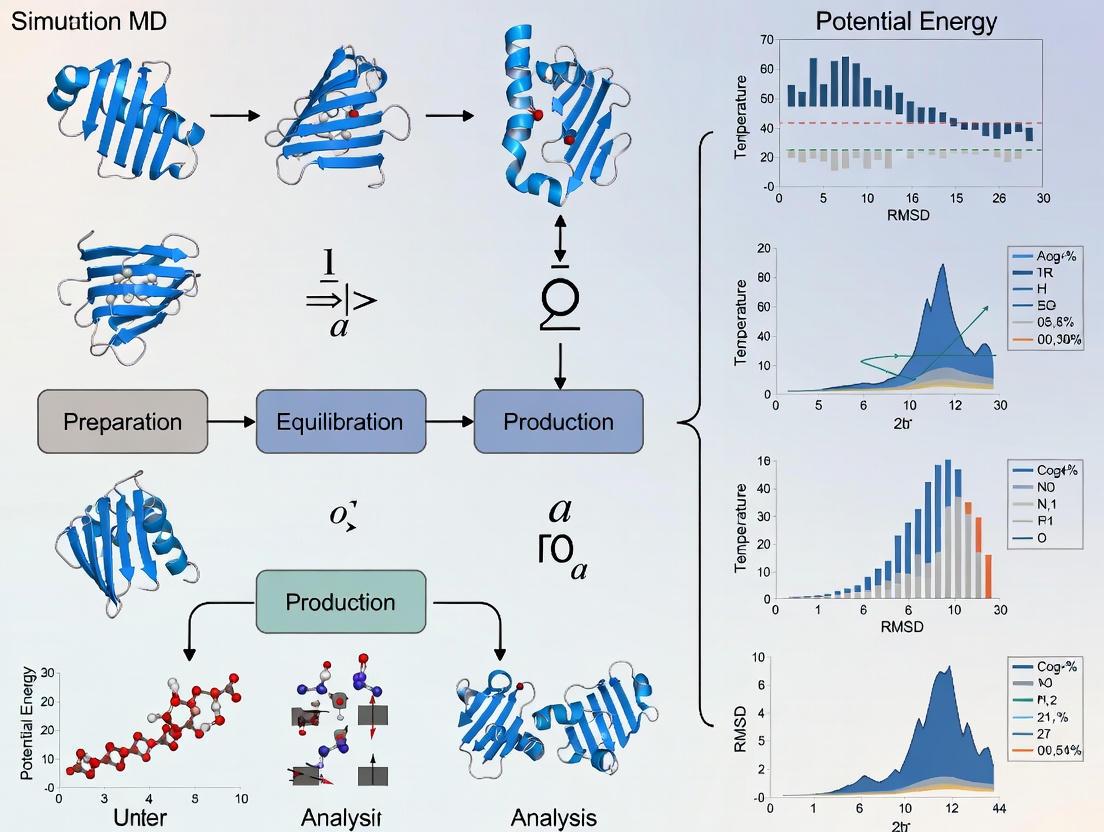
This article provides a comprehensive guide for implementing all-atom molecular dynamics (MD) simulations to study the folding of the Trp-cage miniprotein, a key model system in computational biophysics.
A Comprehensive Guide to All-Atom MD Simulation of Trp-Cage Folding: Protocols, Force Fields, and Validation
Abstract
This article provides a comprehensive guide for implementing all-atom molecular dynamics (MD) simulations to study the folding of the Trp-cage miniprotein, a key model system in computational biophysics. It covers the foundational principles of Trp-cage structure and folding pathways, explores a range of modern simulation methodologies including enhanced sampling techniques and machine learning potentials, addresses common troubleshooting and optimization challenges, and establishes rigorous protocols for validating simulation results against experimental data. Aimed at researchers and scientists in drug development, this guide serves as a practical resource for obtaining accurate and thermodynamically meaningful insights into protein folding mechanisms using all-atom simulations.
Understanding the Trp-Cage Miniprotein: Structure, Folding Landscape, and Role as a Model System
The Trp-cage is a synthetically designed 20-residue miniprotein that has emerged as a paramount model system in protein folding research. As the smallest known protein-like folding motif, it adopts a stable, cooperatively folded tertiary structure in solution, featuring a well-defined hydrophobic core [1] [2]. Its ultrafast folding kinetics—approximately 4 microseconds—places it among the fastest-folding proteins known and brings its folding timescale within the burgeoning reach of all-atom molecular dynamics (MD) simulations [3] [4]. This unique combination of small size, structural complexity, and rapid folding has cemented the Trp-cage's role as a critical benchmark for evaluating the accuracy of force fields and the efficacy of advanced sampling algorithms in computational biophysics [5] [3] [6]. The original Trp-cage, designated TC5b, was engineered through a process of truncation and mutation from the C-terminal segment of exendin-4, a 39-residue peptide hormone [1] [2].
Amino Acid Sequence and Structural Architecture
Primary Structure
The canonical amino acid sequence of the TC5b Trp-cage is: NLYIQ WLKDG GPSSG RPPPS [1] [5] [4]
Secondary and Tertiary Structure Composition
The Trp-cage folds into a compact globular structure that integrates three distinct secondary structure elements, which are stabilized by a network of specific long-range interactions as detailed in Table 1.
Table 1: Key Structural Features and Stabilizing Interactions in the Trp-Cage (TC5b)
| Feature Category | Details | Residue Range / Location | Contribution to Stability |
|---|---|---|---|
| α-Helix | N-terminal α-helix | Leu2 - Lys8 [5] [3] | Contributes to fold stability; mutations (Leu, Ile, Lys→Ala) stabilize by ~1.5 kJ/mol [1] |
| 3₁₀-Helix | Short 3₁₀-helix | Gly11 - Ser14 [5] [3] | Part of the structural scaffold enabling core packing |
| Polyproline II (PPII) Helix | C-terminal polyproline helix | Arg16 - Pro19 [5] [3] | Sheaths Trp6; high proline content reduces conformational entropy of unfolded state [1] |
| Hydrophobic Core | Central Trp6 residue caged by Pro12, Pro18, Pro19, and Tyr3 [1] [5] | Core: Tyr3, Trp6, Leu7, Gly11, Pro12, Pro18, Pro19 [1] | Burial of Trp6 side chain is a major driving force, contributing up to ~12 kJ/mol [1] |
| Salt Bridge | Solvent-exposed ion pair between Asp9 and Arg16 [1] [5] [3] | Between Asp9 and Arg16 | Contributes 3.4–6.0 kJ/mol of stabilization energy [1] |
| Other Key Interactions | Hydrophobic "staple" between Tyr3 and Pro19; Buried H-bond from Ser13 side chain [1] | Tyr3/Pro19; Ser13 | Tyr3/Pro19 interaction is critical; Ser13 H-bond contributes ~10 kJ/mol [1] |
The overall fold is driven by the burial of the Trp6 side chain within a hydrophobic cage formed by the proline rings and Tyr3, which provides a major stabilizing force [1]. A critical solvent-exposed salt bridge between Asp9 and Arg16 further stabilizes the structure by 3.4 to 6.0 kJ/mol [1] [3]. The high density of tertiary contacts results in an unusually high contact order for a peptide of its length [1].
Experimental and Computational Characterization Protocols
The stability and structural features of the Trp-cage have been characterized through a suite of biophysical and computational techniques, each providing unique and complementary insights, with key methodologies summarized in Table 2.
Table 2: Key Methodologies for Characterizing Trp-Cage Structure and Folding
| Methodology | Key Measurable Parameters | Application and Insights in Trp-Cage Studies |
|---|---|---|
| Nuclear Magnetic Resonance (NMR) Spectroscopy | Chemical Shift Deviations (CSD), Nuclear Overhauser Effect (NOE) restraints, relaxation rates [1] [7] | Used for structure determination (e.g., PDB: 1L2Y) and validating computational models [3]. CSDs, especially upfield shifts of Gly11 Hα protons, quantify folding extent and core fluxionality [1]. |
| Circular Dichroism (CD) Spectroscopy | Helicity content, melting temperature (Tₘ) [1] [6] | Tracks thermal unfolding; TC5b Tₘ is ~42°C, while stabilized mutants can have Tₘ up to ~64°C [1]. |
| Fluorescence Spectroscopy | Tryptophan fluorescence quenching [1] [6] | Probes burial of Trp6 in the hydrophobic core; used in temperature jump folding kinetics experiments [1]. |
| Laser Temperature Jump Spectroscopy | Folding/unfolding relaxation rates [2] | Measured TC5b folding speed of ~4 μs, establishing it as an ultrafast folder [2]. |
| Molecular Dynamics (MD) Simulations | Root Mean Square Deviation (RMSD), Radius of Gyration (Rg), native contact formation, free energy landscapes [5] [3] [4] | Elucidates folding pathways, intermediate states, and thermodynamics using methods like REMD, ADMD, and metadynamics [5] [3] [6]. |
A Protocol for Folding Pathway Analysis using Action-Derived Molecular Dynamics (ADMD)
Objective: To elucidate the sequential conformational changes and dynamic folding pathway of Trp-cage at atomic resolution [5].
Workflow Overview: The following diagram illustrates the sequential process and key conformational transitions in the ADMD-based folding pathway analysis of Trp-cage.
Methodology Details:
- System Setup: The final conformation is obtained from the experimental NMR structure (PDB ID: 1L2Y) after local energy minimization. The initial conformation is a fully extended structure or a completely disordered state, locally minimized, possessing a large radius of gyration (Rg ≈ 10.2 Å) and no native contacts or hydrogen bonds [5].
- ADMD Simulation Parameters: The trajectory is discretized into a large number of steps (e.g., P = 2000). The Passerone-Parrinello action (Θ), which includes a constraint to enforce total energy conservation, is minimized. An extended action (Φ) that includes a dynamic restraint to control the average kinetic energy of atoms is optimized to generate a high-quality, Verlet-like trajectory [5]. All atoms are treated explicitly using a force field like AMBER and an implicit solvation model like GB/SA.
- Trajectory Analysis: The optimized pathway is analyzed by monitoring the formation of native contacts and hydrogen bonds over time, calculating the RMSD from the native structure, and tracking the radius of gyration (Rg) to measure compaction [5]. This analysis reveals a folding mechanism where the N-terminal α-helix forms early, followed by docking of the C-terminal polyproline segment onto the Trp and Tyr rings to form the hydrophobic core, with a final slow adjustment to the native state [5].
A Protocol for Free Energy Landscape Mapping using Replica Exchange MD (REMD)
Objective: To efficiently sample the conformational space of Trp-cage and compute its folding free energy landscape in explicit solvent [3].
Workflow Overview: This protocol employs the Replica Exchange Method (REMD) with explicit solvent to overcome energy barriers and map the free energy landscape, as outlined in the following workflow.
Methodology Details:
- System Preparation: The Trp-cage (from PDB: 1L2Y) is solvated in an explicit water box (e.g., using the SPC model) with a counterion to neutralize the system. A conjugate gradient minimization is performed [3].
- REMD Simulation Parameters: A set of M replicas (e.g., 50) are simulated in parallel, each at a different temperature spanning a wide range (e.g., 282 K to 598 K). Each replica runs with a thermostat (e.g., Berendsen's) in the NVT ensemble. Long-range electrostatics are handled using a particle-mesh Ewald (P3ME) method. An efficient integrator like P3ME/RESPA allows for a longer time step (e.g., 4.0 fs) [3].
- Exchange and Analysis: After a fixed number of MD steps, an exchange between configurations of neighboring replicas (i and i+1) is attempted. The exchange is accepted with a probability based on the Metropolis criterion: min[1, exp(-Δ)], where Δ = (βᵢ - βᵢ₊₁)(U(xᵢ₊₁) - U(xᵢ)), and β = 1/kBT, U is potential energy [3]. The combined trajectories from all replicas are analyzed using the Weighted Histogram Analysis Method (WHAM) to construct the free energy landscape as a function of reaction coordinates like Cα-RMSD and Rg. This simulation identified a two-step folding mechanism involving a metastable intermediate with a partially formed hydrophobic core and the essential Asp9-Arg16 salt-bridge [3].
Table 3: Key Research Reagent Solutions and Computational Tools for Trp-Cage Studies
| Item Name | Function / Role | Example Use Case / Notes |
|---|---|---|
| TC5b (Wild-Type) | The canonical 20-residue Trp-cage sequence; benchmark for folding studies. | Baseline for stability (Tₘ ≈ 42°C) and kinetics (folds in ~4 μs) [1] [2]. |
| Stabilized Mutants (e.g., TC10b) | Mutated sequences with enhanced thermal stability for structural and pharmacological studies. | Can feature Tₘ as high as 64°C; useful as scaffolds for peptide library display [1] [8]. |
| T7Select10-3b Phage Display System | A lytic bacteriophage system for displaying randomized peptide libraries based on the Trp-cage scaffold. | Used to identify novel structured peptides that bind targets like streptavidin or cell surfaces [8]. |
| AMBER Force Field | A family of all-atom force fields for MD simulations. | Widely used in Trp-cage folding simulations (e.g., ADMD, REMD) [5] [3]. |
| OPLS-AA Force Field | An all-atom force field for MD simulations of proteins in explicit solvent. | Used in explicit solvent REMD and high-temperature unfolding studies of Trp-cage [3] [4]. |
| GROMACS MD Package | A versatile software package for performing MD simulations, with high computational efficiency. | Used for high-temperature unfolding simulations of Trp-cage with the OPLS-AA force field [4]. |
| GB/SA Solvation Model | An implicit solvent model (Generalized Born/Surface Area) that approximates water effects. | Reduces computational cost in MD simulations while accounting for solvation effects [5]. |
| P3ME/RESPA Algorithm | A coupled algorithm for efficient long-range electrostatics (P3ME) and multiple time-step integration (RESPA). | Significantly accelerates explicit solvent REMD simulations [3]. |
The Trp-cage miniprotein is a 20-residue model system (sequence: NLYIQ WLKDG GPSSG RPPPS) that has become a critical benchmark in protein folding research due to its small size and rapid folding kinetics of approximately 4 μs [3]. Its compact native structure contains an N-terminal α-helix (residues 2-8), a 3₁₀-helix (residues 11-14), and a C-terminal polyproline II helix, which collectively encapsulate a specialized hydrophobic core [5] [3]. This application note details the definitive interactions within this core, focusing on the central Trp6, Tyr3, and key proline residues (Pro12, Pro18, Pro19), and provides validated protocols for investigating these interactions through all-atom molecular dynamics (MD) simulations. Understanding these specific interactions is essential for researchers studying protein folding mechanisms, stability engineering, and hydrophobic core packing principles, with potential applications in de novo protein design and therapeutic development.
Structural Anatomy of the Trp-Cage Hydrophobic Core
The hydrophobic core of Trp-cage represents a sophisticated packing solution that stabilizes the miniprotein's tertiary structure. The core is organized around a central tryptophan residue (Trp6), which is encapsulated by a sheath of proline residues and the aromatic ring of tyrosine (Tyr3) [9]. The specific proline residues involved are Pro12 (from the 3₁₀-helix), and Pro18 and Pro19 (from the C-terminal polyproline II helix) [9]. This arrangement creates a unique "cage" architecture that gives the protein its name.
The fundamental driving force for core formation is hydrophobic collapse, where these non-polar residues minimize their contact with surrounding water molecules [10]. However, the stability of the native fold depends critically on the precise geometry and specific atomic-level interactions between these residues, including ring stacking orientations and van der Waals contacts [11]. The core is further stabilized by secondary structure elements that position these residues in optimal spatial configurations and by a strategically important salt bridge between Asp9 and Arg16 that helps orient the structural elements surrounding the core [5] [3].
Table 1: Key Residues Comprising the Trp-Cage Hydrophobic Core
| Residue | Structural Location | Role in Hydrophobic Core |
|---|---|---|
| Trp6 | N-terminal α-helix (residues 2-8) | Central core residue; its indole ring serves as the primary hydrophobic cluster center |
| Tyr3 | N-terminal α-helix (residues 2-8) | Forms stacking interaction with Trp6; initiates hydrophobic collapse |
| Pro12 | 3₁₀-helix (residues 11-14) | Part of the proline sheath surrounding Trp6; contributes to cage stability |
| Pro18 | Polyproline II helix (C-terminal) | Part of the proline sheath surrounding Trp6; contributes to cage stability |
| Pro19 | Polyproline II helix (C-terminal) | Part of the proline sheath surrounding Trp6; contributes to cage stability |
Quantitative Analysis of Core Interactions
Energetic and Temporal Characteristics
The folding process of Trp-cage and the stabilization provided by its hydrophobic core have been quantitatively characterized through various experimental and computational approaches. The data reveal consistent patterns in folding kinetics and intermediate states across multiple studies.
Table 2: Energetic and Kinetic Parameters of Trp-Cage Folding
| Parameter | Value | Measurement Context |
|---|---|---|
| Experimental Folding Time | ~4 μs | At room temperature [3] |
| Relaxation Time | 3.1 μs | At 296 K [6] |
| Melting Temperature (Experimental) | 315 K | Thermal denaturation midpoint [3] |
| Melting Temperature (Simulated OPLSAA) | >400 K | Replica Exchange MD with explicit solvent [3] |
| Potential Energy Difference (Unfolded - Folded) | 46.61 kcal/mol | ADMD simulation [5] |
| Native Contact Formation in Early Stage | ~40% | ADMD simulation [5] |
| Native Hydrogen Bond Formation in Early Stage | ~30% | ADMD simulation [5] |
Structural States and Populations
Kinetic analysis of Trp-cage folding reveals a multi-state process involving distinct conformational ensembles. Markov state modeling and free energy landscape analysis have identified several metastable states with characteristic structural properties and population distributions.
Table 3: Characterized States in Trp-Cage Folding
| State | RMSD from Native | Population at 300K | Key Structural Features |
|---|---|---|---|
| Folded Native State | < 2.0 Å (all heavy atoms) [12] | Majority population | Properly formed hydrophobic core with correct Trp6-Tyr3-Pro12 packing [5] |
| Compact Molten Globule | Not specified | ~3% [6] | Compact but misfolded core; acts as kinetic trap [6] |
| Misfolded Intermediate | ~4.4 Å [6] | Minor population | Trp6 strongly interacts with Pro12; abnormal temperature-dependent chemical shifts [6] |
| Unfolded State | > 8.4 Å [5] | Temperature-dependent | Lacks native contacts and hydrogen bonds; may retain partial helicity [5] |
Experimental Protocols for Hydrophobic Core Analysis
Action-Derived Molecular Dynamics (ADMD)
Principle: ADMD converts the initial value problem of classical dynamics into a boundary value problem using the least action principle, enabling efficient sampling of folding pathways between known initial and final states [5].
Protocol:
- System Preparation:
- Trajectory Discretization:
- Action Optimization:
- Pathway Analysis:
Replica Exchange Molecular Dynamics (REMD) with Explicit Solvent
Principle: REMD enhances conformational sampling by running multiple simulations (replicas) at different temperatures and periodically exchanging configurations between neighboring temperatures with Metropolis criterion acceptance [3].
Protocol:
- System Setup:
- Replica Configuration:
- Simulation Execution:
- Free Energy Analysis:
AI-Driven Ab Initio Biomolecular Dynamics (AI2BMD)
Principle: AI2BMD combines machine learning force fields with quantum chemistry accuracy to simulate large biomolecules at significantly reduced computational cost compared to traditional density functional theory (DFT) methods [13].
Protocol:
- Protein Fragmentation:
- ML Force Field Training:
- Simulation Execution:
- Validation:
The Scientist's Toolkit: Essential Research Reagents and Computational Solutions
Table 4: Key Research Reagents and Computational Tools for Trp-Cage Studies
| Tool/Solution | Type | Function/Application |
|---|---|---|
| AMBER Force Field | Computational | All-atom potential functions for energy calculations in classical MD [5] |
| OPLSAA Force Field | Computational | All-atom potential functions for MD simulations with explicit solvent [3] |
| GB/SA Solvation Model | Computational | Implicit solvent model for efficient solvation treatment in MD [5] |
| SPC Water Model | Computational | Explicit water model for realistic solvation in REMD simulations [3] |
| P3ME/RESPA Algorithm | Computational | Efficient algorithm for long-range electrostatics with multiple time steps [3] |
| ViSNet (AI2BMD) | Computational | Machine learning force field for ab initio accuracy with reduced cost [13] |
| GROMACS | Software | MD simulation package implementing various force fields and algorithms [12] |
| IMPACT | Software | Molecular modeling package with REMD implementation [3] |
Signaling and Workflow Visualization
Trp-Cage Folding Pathway
Computational Methodology Workflow
Technical Notes and Applications
Critical Interaction Dynamics
The hydrophobic core of Trp-cage exhibits specific dynamic interactions that ensure proper folding:
- Trp6-Tyr3 stacking fluctuates on picosecond timescales within a dehydrated environment, as measured by 2D infrared spectroscopy through tyrosine ring mode dephasing [11].
- The salt bridge between Asp9 and Arg16 forms early in the folding process and helps orient the secondary structure elements surrounding the hydrophobic core [5] [3].
- C-terminal polyproline residues dock onto the Trp6 and Tyr3 rings as a structural unit rather than as individual residues, forming the final cage architecture [5].
Practical Applications
The protocols described enable researchers to:
- Identify and characterize misfolded intermediates that may act as kinetic traps in the folding pathway [6].
- Study the effects of confinement and surface interactions on protein stability, relevant to graphene-based biotechnologies and cellular environments [9].
- Validate force field accuracy by comparing simulated melting temperatures and population distributions with experimental data [3] [13].
- Design stabilizing mutations through understanding of core packing requirements and chirality constraints in β-hairpin formation [10].
These methodologies provide a comprehensive framework for investigating hydrophobic core interactions in Trp-cage and can be adapted for studying similar interactions in larger protein systems and designed variants.
Understanding the conformational landscape of proteins is fundamental to unraveling the mechanisms underlying their folding, stability, and function. This process involves a polypeptide chain navigating a high-dimensional energy landscape filled with numerous local minima and transition states to assume its functional three-dimensional structure [14]. The Trp-cage mini-protein, a small synthetic protein known for its rapid folding kinetics, serves as an exemplary model system for studying these complex dynamics due to its well-characterized folding behavior [14] [15]. This application note provides a detailed protocol for employing all-atom molecular dynamics (MD) simulations to map the folding landscape of the Trp-cage mini-protein, offering researchers a framework for quantitative characterization of conformational states and transitions.
Computational Methods and Benchmarking
System Preparation and Force Field Selection
The Trp-cage mini-protein (PDB ID: 2JOF), particularly its K8A mutant (TC10b), provides a robust starting structure for folding studies [14]. Multiple force fields have been developed and benchmarked for simulating both structured and disordered protein regions:
- AMBER ff14SB: A popular force field for folded proteins, typically used with TIP3P water model [16].
- CHARMM36m: Modified with additional non-bonded fixes for modeling both folded and disordered proteins [16].
- DES-Amber and a99SB-disp: Specifically designed to accurately model both structured and disordered regions [16].
- ff99SB-ILDN with TIP4P-D: Produces expanded conformations matching experimental predictions for disordered proteins [16].
Table 1: Benchmarking of Force Fields for Disordered and Structured Regions
| Force Field | Water Model | Strengths | Limitations |
|---|---|---|---|
| AMBER ff14SB | TIP3P | Optimized for folded proteins | Poor performance on IDPs |
| CHARMM36m | TIP3P | Good for folded and disordered regions | - |
| ff99SB-ILDN | TIP4P-D | Accurate IDP conformations | Destabilizes native structure |
| DES-Amber | Modified TIP4P-D | Balanced performance | - |
| a99SB-disp | Modified TIP4P-D | Accurate for structured/disordered regions | - |
Enhanced Sampling Techniques
Conventional MD simulations often struggle to sample rare folding events due to energetic barriers. Enhanced sampling methods significantly improve conformational sampling:
Temperature Replica Exchange MD (T-RexMD)
- Utilizes 16 replicas spanning temperatures from 300K to 460K [17]
- Exchanges attempted every 2 ps based on Metropolis criterion [17]
- Enables random walk in temperature space for barrier crossing
Biasing Potential RexMD (BP-RexMD)
- Employs biasing potential for peptide backbone dihedral angles [17]
- Requires only 5-7 replicas for efficient sampling [17]
- Targets specific energy barriers for improved sampling efficiency
AI-Driven Approaches The AI2BMD system represents a recent advancement, using machine learning force fields (MLFFs) trained on density functional theory (DFT) data to achieve ab initio accuracy with significantly reduced computational time [13]. This approach fragments proteins into dipeptide units and assembles interactions, enabling accurate simulation of systems with >10,000 atoms [13].
Data Analysis Framework
Dimensionality Reduction Techniques
High-dimensional MD trajectory data requires projection into lower dimensions for interpretability. Benchmarking studies reveal distinct performance characteristics across methods:
Table 2: Performance Comparison of Dimensionality Reduction Techniques
| Method | Technical Basis | Advantages | Limitations |
|---|---|---|---|
| Principal Component Analysis (PCA) | Orthogonal linear transformation | Simple, computationally efficient | Limited capacity for non-linear data |
| Time-lagged Independent Component Analysis (TICA) | Identifies slowest decorrelating components | Captures kinetic transitions effectively | Linear projection limitation |
| Variational Autoencoders (VAE) | Neural network-based non-linear projection | Handles complex non-linear relationships | Computationally intensive, complex implementation |
As shown in benchmark studies on Trp-cage, PCA projection typically reveals only two basins (a dense folded minimum and a broader unfolded basin), while TICA and VAE provide more nuanced landscape representations [14].
Clustering Methodologies
Clustering algorithms discretize the conformational space into distinct states. Density-based approaches like HDBSCAN effectively handle noise and detect meaningful clusters, outperforming traditional methods like K-means and Gaussian Mixture Models [14]. HDBSCAN provides physically meaningful representations of free energy minima without requiring pre-specification of cluster numbers [14].
Markov State Models (MSMs)
MSMs construct quantitative kinetic models by discretizing conformational space into states and estimating transition probabilities [14]. The quality of MSMs strongly depends on the choice of clustering method and lag time selection [14].
Experimental Protocol: All-Atom MD of Trp-Cage Folding
System Setup
Initial Structure Preparation
Solvation and Force Field Selection
Energy Minimization
System Equilibration
- Heat system to 300K in gradual steps
- Remove positional restraints gradually over 0.5 ns unrestrained equilibration [17]
Production Simulation
Conventional MD Parameters
Enhanced Sampling Implementation
Trajectory Analysis Workflow
The following diagram outlines the comprehensive trajectory analysis workflow:
Experimental Validation and Interpretation
Experimental Correlates
Computational findings require validation against experimental data:
- Multi-probe Infrared Spectroscopy: Monitors individual structural elements (α-helix, 310-helix, salt bridge) during folding [15]
- Temperature-Jump Relaxation Kinetics: Measures folding rates at specific spectroscopic frequencies [15]
- φ-value Analysis: Identifies structural elements in the folding transition state [15]
Experimental studies reveal complex folding dynamics where the 310-helix unfolds independently at lower temperatures (below ~20°C), while the α-helix and cage structure form concurrently at identical rates [15].
Key Folding Determinants
Analysis of Trp-cage folding simulations identifies critical structural features:
- Salt Bridge Formation: Between Asp9 and Arg16 is prerequisite for folding/refolding [18]
- Hydrophobic Core Formation: Orientation of Trp6 side chain to interact with Pro18 and 310-helix [18]
- Cooperative Interactions: Between salt bridge and Trp6 orientation stabilizes tertiary structure [18]
Research Reagent Solutions
Table 3: Essential Computational Tools for Folding Landscape Analysis
| Tool Category | Specific Solutions | Function | Application Context |
|---|---|---|---|
| Simulation Software | AMBER, NAMD, GROMACS | MD simulation engine | Production trajectory generation |
| Enhanced Sampling | T-RexMD, BP-RexMD, AI2BMD | Barrier crossing acceleration | Efficient sampling of rare events |
| Dimensionality Reduction | PCA, TICA, VAE, UMAP | Projection to lower dimensions | Landscape visualization |
| Clustering Algorithms | K-means, HDBSCAN, GMM | Conformstate identification | State discretization for analysis |
| Kinetic Modeling | MSM, Discrete Path Sampling | Kinetic network construction | Rate calculation and pathway analysis |
| Force Fields | AMBER ff14SB, CHARMM36m, DES-Amber | Interatomic potential calculation | Energy and force calculation |
| Solvation Models | TIP3P, TIP4P, TIP4P-D, OPC | Solvent effects modeling | Implicit or explicit solvent treatment |
Emerging Methodologies
AI-Enhanced Simulations
The AI2BMD system represents a significant advancement, combining protein fragmentation with machine learning force fields to achieve ab initio accuracy with dramatically reduced computational time [13]. This approach enables precise free-energy calculations for protein folding with thermodynamic properties well-aligned with experiments [13].
Kinetic Transition Networks
These networks provide a robust framework for analyzing global kinetics and thermodynamics without dimensionality reduction, maintaining all degrees of freedom to avoid approximations introduced by projection methods [14].
Disconnectivity Graphs
These graphs represent energy barriers and transition pathways without dimensionality reduction, revealing underlying landscape complexity with numerous basins separated by energy barriers [14].
Key Folding Intermediates and Transition States Revealed by Simulation Studies
The Trp-cage miniprotein, a 20-residue engineered protein (sequence: NLYIQ WLKDG GPSSG RPPPS), is one of the smallest and fastest-folding proteins known, making it a premier model system for computational protein folding studies. [5] [3] Its native structure (PDB: 1L2Y) features an N-terminal α-helix (residues 2-8), a 3₁₀-helix (residues 11-14), and a C-terminal polyproline II helix, which fold into a compact structure that cages a central tryptophan residue (Trp6). [5] [6] Understanding its folding mechanism provides fundamental insights into the forces that drive proteins to their functional native states. This application note synthesizes findings from multiple all-atom molecular dynamics (MD) simulation studies, conducted within explicit solvent environments, to delineate the key folding intermediates and transition states of the Trp-cage. We provide a detailed protocol for simulating and analyzing this process, benchmarked against a body of computational research that has achieved remarkable consistency with experimental data. [5] [3] [6]
Computational Results and Key Folding States
Advanced sampling simulations have converged on a model of Trp-cage folding that involves several metastable intermediates and a defined rate-limiting step.
The Predominant Folding Pathway
The dynamic folding pathway, as revealed by Action-Derived Molecular Dynamics (ADMD), is a sequential process that can be visualized as a multi-stage assembly. [5]
Figure 1: The Predominant Folding Pathway of the Trp-cage Miniprotein. This pathway illustrates the sequence of conformational changes from the unfolded state to the native structure, highlighting key intermediates and the rate-limiting transition state.
Simulations consistently identify a compact molten globule-like intermediate that acts as a kinetic trap, responsible for the experimentally observed microsecond relaxation time. [6] While unstructured states fold on the sub-microsecond timescale, the interconversion between this compact intermediate and the native state is the slowest step in the process. [6]
Structural Characterization of Intermediates and Transition States
The table below summarizes the key non-native states identified through all-atom MD simulations.
Table 1: Key Folding Intermediates and Transition States of Trp-cage
| State | Structural Features | RMSD from Native (Å) | Native Contacts | Role in Folding | Primary Identification Method |
|---|---|---|---|---|---|
| Early Intermediate [5] | N-terminal α-helix partially formed; contact between side chains of Tyr3 and Trp6. | High (>8.0) | ~40% | Initiates folding by forming initial hydrophobic contacts and secondary structure. | ADMD |
| Compact Molten Globule (Kinetic Trap) [6] | Compact configuration with disrupted tertiary contacts; retains some α-helical character. | ~4.4 (for specific Pro12-Trp6 state) | High, but incorrect | Explains slow relaxation (~3.1 µs); acts as a off-pathway trap that slows folding. | Bias-Exchange Metadynamics |
| Salt-Bridge Stabilized Intermediate [3] | Two partially pre-packed hydrophobic cores separated by a stable Asp9-Arg16 salt-bridge near the peptide center. | N/A | Partial | Proposed as a metastable state enabling a fast two-step folding mechanism. | Replica Exchange MD (OPLSAA) |
| Rate-Limiting Transition State [5] [19] | Structure immediately preceding final native side-chain packing; slow adjustment of near-native states. | Low (~1.5-2.0) | >90% | The highest free-energy barrier separating the kinetic trap/near-native states from the true native state. | ADMD, Transition Interface Sampling |
Detailed Simulation Protocol
This section provides a step-by-step protocol for conducting all-atom MD simulations of Trp-cage folding, reflecting the methodologies used in the cited studies.
System Setup
- Initial Coordinates: Obtain the native structure from the Protein Data Bank (PDB ID: 1L2Y). For the unfolded initial state, use a locally energy-minimized fully extended conformation or a pre-equilibrated random coil structure. [5]
- Solvation: Solvate the protein in an explicit solvent box (e.g., 50 × 50 × 50 ų). Use a model such as TIP3P or SPC. [3]
- Neutralization: Add counterions (e.g., Cl⁻) to neutralize the system's net charge. [3]
- Force Field Selection: Choose an all-atom force field. Common choices include AMBER (e.g., AMBER99, AMBER94) or CHARMM (e.g., CHARMM22 with modifications). [5] [3] [14]
Enhanced Sampling with Replica Exchange MD (REMD)
For efficient sampling of the folding landscape, the REMD method is highly effective. [3] [14]
- Replica Setup: Create 50 or more replicas of the system, each at a different temperature spanning a range from 282 K to 598 K. [3]
- Equilibration: For each replica, perform a two-stage equilibration:
- Minimize the system energy using a conjugate gradient algorithm.
- Run a short (e.g., 100-200 ps) MD simulation with protein atoms restrained to allow solvent relaxation, followed by an unrestrained MD simulation for full system equilibration. [3]
- Production Run: Run each replica independently in the NVT or NPT ensemble for several nanoseconds. Use an efficient MD algorithm like P3ME/RESPA for handling long-range electrostatics. [3]
- Configuration Exchange: Periodically (e.g., every 0.4 ps) attempt to swap the configurations of adjacent replicas (i and i+1) with an acceptance probability based on the Metropolis criterion:
min[1, exp((β_i - β_{i+1})*(U_i - U_{i+1}))], whereβis the reciprocal temperature andUis the potential energy. [3]
The workflow for this protocol is outlined below.
Figure 2: Workflow for Replica Exchange Molecular Dynamics (REMD) Simulation of Trp-cage Folding.
Data Analysis and Landscape Reconstruction
After obtaining simulation trajectories, use the following analytical pipeline to identify intermediates and transition states.
- Dimensionality Reduction: Project the high-dimensional trajectory data onto 2-3 key collective variables (CVs) for visualization.
- Common CVs: Root Mean Square Deviation (RMSD) of the α-helix or the entire protein, radius of gyration, native contact counts, and salt-bridge distances. [19] [14]
- Methods: Use Principal Component Analysis (PCA), Time-lagged Independent Component Analysis (TICA), or machine learning approaches like Variational Autoencoders (VAE). [14]
- Clustering and State Identification: Cluster conformations to identify metastable states.
- Algorithms: K-means, hierarchical clustering, or density-based methods like HDBSCAN, the latter of which is particularly effective for handling noise and detecting physically meaningful minima. [14]
- Free Energy and Kinetic Modeling:
Table 2: Key Computational Tools and Resources for Trp-cage Folding Simulations
| Category | Item/Solution | Function/Description | Example Usage |
|---|---|---|---|
| Force Fields | AMBER (e.g., AMBER99, AMBER94) [3] | Defines potential energy terms for protein, water, and ions. | Simmerling et al. used a modified AMBER99 force field. [3] |
| CHARMM (e.g., charmm22) [14] | All-atom force field for proteins and nucleic acids. | Used in a 208 µs unbiased trajectory on the Anton supercomputer. [14] | |
| OPLS-AA [3] | Optimized Potential for Liquid Simulations - All Atom. | Used for explicit solvent REMD simulations. [3] | |
| Water Models | TIP3P [14] | A 3-site transferable intermolecular potential model for water. | Used in long unbiased simulations with the CHARMM force field. [14] |
| SPC [3] | Simple Point Charge water model. | Used in REMD simulations with the OPLS-AA force field. [3] | |
| Software & Packages | GROMOS-compatible packages [20] | Suite for molecular dynamics simulations. | Used for force field development and benchmarking. [20] |
| IMPACT [3] | Software package for molecular modeling and simulation. | Used to run REMD simulations with the P3ME/RESPA algorithm. [3] | |
| TINKER [5] | Software package for molecular design and dynamics. | Used for local energy minimization of initial unfolded states. [5] | |
| Analysis Methods | Markov State Models (MSM) [14] | A kinetic model built from MD data to predict long-timescale dynamics. | Used to quantitatively model folding thermodynamics and kinetics. [14] |
| Dimensionality Reduction (PCA, TICA, VAE) [14] | Projects high-dimensional data onto a low-dimensional space for visualization. | Used to project and visualize the free energy landscape. [14] | |
| Transition Path/Interface Sampling (TPS/TIS) [19] | Methods for sampling rare reactive pathways and calculating rate constants. | Used to compute folding/unfolding rates and identify reaction coordinates. [19] |
Why Trp-Cage is an Ideal Benchmark for Testing New MD Protocols and Force Fields
The Trp-cage mini-protein is a synthetically designed 20-residue polypeptide that has emerged as a cornerstone model system in molecular dynamics (MD) simulation research. Despite its small size, it exhibits folding characteristics and a well-defined native state that mirror the complex behavior of larger globular proteins [6]. Its rapid folding kinetics, occurring on the microsecond timescale, place it within the observational window of modern simulation capabilities, making it an almost ideal subject for theoretical investigation [6]. This application note details the specific attributes that establish Trp-cage as a critical benchmark for evaluating novel MD protocols, force fields, and enhanced sampling techniques, providing a standardized framework for assessing methodological advancements in the context of all-atom MD simulation studies of protein folding.
Key Characteristics of the Trp-Cage Mini-Protein
The Trp-cage (TC5b), derived from the C-terminal fragment of exendin-4, folds into a compact globular structure that encapsulates its tryptophan side chain within a hydrophobic core [6]. The NMR structure (PDB: 1L2Y) reveals a sophisticated architecture for its small size, featuring an α-helix (residues 2-8), a 3₁₀-helix (residues 11-14), and a C-terminal polyproline II helix [6]. The stability of its folded state is maintained by a combination of side-chain packing, where the indole ring of Trp6 is shielded by Pro12 and Pro18, and a network of specific polar interactions, including a stabilizing salt bridge [17]. Its small size and well-characterized experimental data make it a computationally tractable yet physically rich system for validating simulation accuracy.
Table 1: Fundamental Properties of the Trp-Cage Mini-Protein
| Property | Description | Significance for MD Benchmarking |
|---|---|---|
| Size | 20 residues | Enables extensive sampling and high computational throughput |
| Structure | Compact globular fold with α-helix, 3₁₀-helix, and PPII helix | Tests a force field's ability to stabilize diverse secondary structures |
| Key Stabilizing Interactions | Buried Trp residue, proline packing, salt bridge | Probes the balance of hydrophobic, van der Waals, and electrostatic forces |
| Folding Kinetics | ~3.1 µs at 296 K [6] | Accessible with enhanced sampling methods and specialized hardware |
| Thermodynamics | Two-state folder with Tₘ ~314 K [6] | Allows comparison of simulated and experimental melting curves |
Trp-Cage as a Benchmark for Force Field Validation
The performance of molecular mechanics force fields is paramount to the predictive accuracy of MD simulations. Trp-cage serves as a stringent test system for evaluating force field improvements, particularly those aimed at achieving a balanced description of both folded and disordered states.
Documenting Force Field Evolution
Studies on Trp-cage have consistently highlighted the limitations of earlier force fields. For instance, simulations using the AMBER ff03ws force field demonstrated significant instability in folded proteins like Ubiquitin and Villin HP35, underscoring the challenge of maintaining folded stability while trying to accurately model disordered polypeptides [21]. This illustrates the critical need for balanced force fields and why Trp-cage is a useful diagnostic tool. Subsequent refinements, such as the introduction of the ff99SBws and ff03w-sc force fields, which incorporate optimized protein-water interactions and torsional parameters, have shown markedly improved performance in stabilizing folded proteins without compromising the description of unfolded ensembles [21] [22]. The evolution of these force fields has been tracked through their ability to predict correct Trp-cage properties, demonstrating a clear pathway toward more accurate and transferable models.
Quantifying Accuracy Against Ab Initio Standards
The emergence of artificial intelligence-accelerated simulations provides a new standard for force field calibration. The AI2BMD system, which leverages a machine learning force field to achieve ab initio accuracy, has been benchmarked on several proteins, including Trp-cage [13]. In these assessments, traditional molecular mechanics force fields exhibited substantial errors in energy and force calculations when compared to density functional theory (DFT). For a protein of Trp-cage's size (281 atoms), AI2BMD calculated energies and forces several orders of magnitude faster than DFT, providing a powerful new reference for validating the physical accuracy of classical force fields [13].
Table 2: Force Field Performance Assessment Using Trp-Cage
| Force Field / Method | Key Feature | Reported Performance on Trp-Cage / Similar Systems |
|---|---|---|
| AI2BMD | AI-based ab initio accuracy | Near-DFT accuracy; ~0.072 s/simulation step for 281-atom system [13] |
| AMBER ff03ws | Upscaled protein-water interactions | Destabilized folded states of Ubiquitin and Villin HP35 [21] |
| AMBER ff99SBws | Refined protein-water + torsions | Maintained structural integrity of folded proteins [21] |
| CHARMM22 | Older force field | Required backbone correction (ff99SB*) to fold α-helical and β-sheet proteins [22] |
Methodological Protocols for Trp-Cage Folding Studies
A variety of advanced MD protocols have been successfully deployed to study Trp-cage folding, providing well-established methodologies for benchmarking.
Enhanced Sampling Techniques
Standard temperature replica exchange MD (T-REMD) is a widely used method. A typical protocol involves simulating 16 replicas of the system spanning a temperature range from 300 K to 460 K to ensure sufficient overlap for exchanges [17]. Exchanges between neighboring replicas are attempted every 1-2 ps and accepted based on a Metropolis criterion. This approach has successfully sampled native-like conformations of Trp-cage within 10-20 ns of simulation time [17]. The Biasing Potential Replica Exchange MD (BP-REMD) offers an alternative that can reduce computational cost. This method applies a biasing potential to backbone dihedral angles (Φ and Ψ) to lower energy barriers, with the biasing level varying across replicas. This Hamiltonian replica exchange approach can achieve comparable sampling to T-REMD using only 5-7 replicas, significantly improving efficiency [17].
Bias-Exchange Metadynamics (BE-MetaD) is another powerful protocol that enables the simultaneous exploration of multiple collective variables (CVs). In this setup, several replicas of the system are run in parallel, each with a time-dependent bias potential applied to a different CV. The bias potentials are periodically swapped between replicas according to a Metropolis criterion. This approach has been used to reversibly fold Trp-cage in less than 100 nanoseconds of total simulation time using only eight replicas, providing sufficient data to construct detailed kinetic and thermodynamic models [6].
Analysis and Model Construction
Once extensive sampling is achieved, analysis of the trajectories is conducted to identify metastable states and their dynamics.
- Dimensionality Reduction and Clustering: Techniques like Principal Component Analysis (PCA), Time-lagged Independent Component Analysis (TICA), and Variational Autoencoders (VAE) project the high-dimensional conformational space into lower dimensions for visualization. Clustering algorithms such as HDBSCAN, which effectively handles noise and identifies meaningful free energy minima, are then used to assign conformations to discrete states [14].
- Building Kinetic Models: A Markov State Model (MSM) can be constructed from unbiased data to describe the kinetics of folding. For biased simulations, a common protocol involves: 1) clustering the data into microstates; 2) using the Weighted Histogram Analysis Method (WHAM) to calculate the unbiased equilibrium population of each state; and 3) estimating transition rates between states to build a kinetic model that predicts folding pathways and timescales [6].
Diagram 1: A high-level workflow for benchmarking new MD protocols and force fields using the Trp-cage system, incorporating major methodological choices from initialization to final validation.
The Scientist's Toolkit: Essential Research Reagents and Solutions
Table 3: Key Research Reagents and Computational Tools for Trp-Cage Studies
| Item | Function / Role | Example Specifications |
|---|---|---|
| Trp-Cage Construct | Benchmark protein | TC5b (20-residue) or TC10b (K8A mutant, PDB: 2JOF) [14] |
| Force Fields | Energy calculation | AMBER (ff99SBws, ff03w-sc), CHARMM (charmm36m), AI2BMD [13] [21] |
| Water Models | Solvent representation | TIP3P, TIP4P/2005, TIP4P-D [21] [22] |
| Enhanced Sampling Software | Accelerate conformational sampling | Plumed (for Metadynamics), GROMACS/AMBER (for REMD) |
| Analysis Tools | Trajectory analysis and model building | MDTraj, PyEMMA, MSMBuilder [14] |
The Trp-cage mini-protein remains an indispensable benchmark system in the computational biophysicist's toolkit. Its well-defined structural and thermodynamic properties, combined with its computational accessibility, provide a rigorous proving ground for new force fields, sampling algorithms, and analysis methodologies. The continued use of Trp-cage as a standard, as evidenced by its role in validating groundbreaking approaches like the AI2BMD platform [13], ensures that advancements in simulation technology are measured against a consistent and biologically relevant standard, thereby accelerating progress toward the ultimate goal of achieving experimental accuracy in molecular dynamics simulations.
Implementing All-Atom MD Protocols: From Conventional Sampling to Advanced Enhanced Techniques
The 20-residue Trp-cage miniprotein (PDB code: 1L2Y) has emerged as a fundamental test system in computational protein folding studies due to its small size and rapid folding kinetics, observed experimentally to occur in approximately 4 microseconds [3]. Its folding mechanism, however, is complex, with experimental evidence pointing to both two-state and multi-state behaviors involving intermediates [23] [6]. This application note provides a structured comparison of three distinct computational force fields and methodologies—AMBER, CHARMM, and all-atom Discrete Molecular Dynamics (DMD)—for studying Trp-cage folding. We summarize critical performance metrics, delineate detailed application protocols, and provide a toolkit of research reagents to guide researchers in selecting and implementing the most appropriate computational strategy for their investigations.
Table 1: Key Structural Features of the Trp-cage Miniprotein (PDB: 1L2Y)
| Feature | Description | Residue Range |
|---|---|---|
| Amino Acid Sequence | NLYIQ WLKDG GPSSG RPPPS [5] | - |
| α-helix | Short alpha-helical segment [23] [3] | Residues 2–8 |
| 3₁₀-helix | A second helical element [23] [3] | Residues 11–14 |
| Polyproline II helix | C-terminal structural motif [23] [3] | C-terminus |
| Hydrophobic Core | Central Trp6 residue surrounded by Tyr3 and Pro residues [5] | - |
| Salt Bridge | Key electrostatic interaction for stability [3] [5] | Between Asp9 and Arg16 |
Force Field and Methodology Comparison
The choice of force field and sampling algorithm significantly impacts the accuracy and efficiency of folding simulations. Below we compare three prominent approaches.
AMBER
AMBER is a suite of force fields and molecular simulation programs widely used for biomolecular systems. Simulations of Trp-cage folding often employ all-atom force fields like AMBER99 [3] with explicit or implicit solvent models.
Table 2: AMBER Force Field Performance in Trp-cage Studies
| Study Context | Reported Performance | Key Outcomes |
|---|---|---|
| Basic Tutorial MD [24] | RMSD to native: ~1.5 Å | Successfully folded to near-native structure from an extended conformation. |
| Replica Exchange MD [3] | Cα-RMSD: 1.50 Å | Excellent agreement with NMR-derived NOE pair distances. |
| Replica Exchange MD [3] | Melting Temperature: >400 K (Expt: ~315 K) | Incorrectly predicts thermal stability, overestimating transition temperature. |
CHARMM
The CHARMM (Chemistry at HARvard Macromolecular Mechanics) force field is another all-atom potential energy function widely used for protein simulations. Its application in Trp-cage folding is often integrated with advanced sampling techniques.
- Key Application: The CHARMM19 force field has been used in conjunction with the Lazaridis-Karplus effective energy function for solvation in all-atom DMD simulations, where long-range charge-charge interactions are simplified and hydrogen bonds are explicitly modeled [25]. This highlights the transferability of concepts between force fields when used in specialized simulation protocols.
All-Atom Discrete Molecular Dynamics (DMD)
DMD is a rapid sampling method that uses discontinuous step-function potentials and collision-driven dynamics instead of traditional continuous molecular dynamics [25]. When combined with a transferable force field (e.g., Medusa) featuring packing, solvation, and environment-dependent hydrogen bonds, it allows for efficient ab initio folding simulations.
Table 3: All-Atom DMD Performance in Protein Folding
| Aspect | Implementation in All-Atom DMD | Performance Outcome |
|---|---|---|
| Sampling Method | Replica Exchange DMD (REXDMD) [25] | Enables multiple folding/unfolding transitions for small proteins. |
| Hydrogen Bonding | Explicit, environment-dependent model [25] | Accounts for stronger stabilization from buried H-bonds. |
| Solvation Model | Lazaridis-Karplus effective energy [25] | Uses a fully-solvated conformation as a reference state. |
| Trp-cage Folding | Ab initio from extended conformation [25] | Reached native or near-native states (<2.0 Å backbone RMSD). |
Detailed Application Protocols
Protocol for Bias-Exchange Metadynamics (BE-MetaD) with AMBER/CHARMM
Bias-Exchange Metadynamics is an enhanced sampling technique that allows for efficient exploration of complex free energy landscapes, such as that of Trp-cage folding [23] [6].
System Setup:
- Obtain the initial structure from the Protein Data Bank (1L2Y).
- Solvate the protein in an explicit water box (e.g., TIP3P) and add counter-ions to neutralize the system [3].
- Employ an all-atom force field (e.g., AMBER99 or CHARMM).
Collective Variable (CV) Selection: Choose a set of CVs that describe the folding process. Relevant CVs for Trp-cage include [23] [26]:
- Backbone Root Mean Square Deviation (RMSD) from the native structure.
- Radius of Gyration (Rg).
- Number of native contacts.
- Specific distances (e.g., between the Trp6 side chain and Pro12/Gly11).
- Salt bridge distance between Asp9 and Arg16.
BE-MetaD Simulation:
Data Analysis:
- Free Energy Surface: Reconstruct the free energy landscape as a function of key CVs (e.g., RMSD vs. Rg) using the final bias potentials [6].
- Kinetic Model: Project the biased trajectories onto a set of metastable states (bins). Calculate equilibrium populations using the Weighted Histogram Analysis Method (WHAM) and construct a kinetic model to estimate transition rates between states [23] [6].
Protocol for All-Atom Replica Exchange DMD (REXDMD)
This protocol is designed for ab initio folding using the all-atom DMD method [25].
Model and Force Field:
- Utilize a united-atom model where heavy atoms and polar hydrogens are explicitly represented.
- Employ a transferable force field incorporating:
- Van der Waals potentials for atomic packing.
- The Lazaridis-Karplus effective energy for solvation.
- Explicit, environment-dependent hydrogen bond interactions.
Simulation Setup:
- Start the simulation from a fully extended conformation of the Trp-cage peptide.
- Set up a series of replicas covering a temperature range from low (e.g., near the folding temperature) to high (denaturing conditions).
REXDMD Execution:
- Run all replicas in parallel. Each replica performs independent DMD simulations at its assigned temperature.
- Periodically attempt to swap temperatures between neighboring replicas using a Metropolis Monte Carlo criterion to facilitate escape from local energy minima.
Analysis of Trajectories:
- Monitor the backbone RMSD from the experimental NMR structure to identify folding events.
- Use the Weighted Histogram Analysis Method (WHAM) on the combined REXDMD trajectories to compute the density of states and determine thermodynamic properties, such as the free energy landscape [25].
- Identify and characterize metastable intermediates and the native state.
The Scientist's Toolkit: Research Reagent Solutions
Table 4: Essential Computational Tools for Trp-cage Folding Simulations
| Research Reagent | Function/Purpose | Example Use Case |
|---|---|---|
| AMBER Software Suite | Package for molecular dynamics and energy minimization [5]. | Running MD simulations with AMBER force fields [24]. |
| CHARMM/IMPACT | Molecular modeling package for simulation and analysis [3]. | Implementing REM simulations with explicit solvent [3]. |
| DMD Engine | Software for discrete molecular dynamics simulations [25]. | Performing all-atom REXDMD folding simulations [25]. |
| PyTraj/CPPTRAJ | Tool for trajectory analysis [27]. | Calculating RMSD, hydrogen bonds, and dihedral angles from MD trajectories [27]. |
| Weighted Histogram Analysis Method (WHAM) | Method to compute free energies and density of states from simulation data [23] [25]. | Reconstructing free energy landscapes from REMD or metadynamics simulations [23]. |
| Replica Exchange Method (REM) | Enhanced sampling technique accelerating barrier crossing [3] [25]. | Overcoming quasi-ergodicity in explicit solvent folding simulations [3]. |
| Bias-Exchange Metadynamics | Enhanced sampling using multiple collective variables [23] [26]. | Efficiently exploring Trp-cage folding pathways and intermediates [6]. |
The selection of a computational approach for studying Trp-cage folding depends heavily on the research objective. For investigations requiring the highest level of structural accuracy and detailed solvation effects, AMBER or CHARMM with explicit solvent and advanced sampling techniques like BE-MetaD is the recommended choice, despite its computational cost. When the primary goal is rapid sampling of folding thermodynamics and the identification of native-like states for multiple proteins or mutants, all-atom DMD with its specialized force field offers a powerful and efficient alternative. Researchers should weigh the trade-offs between atomic detail, computational efficiency, and the specific thermodynamic or kinetic information required for their projects.
In the realm of all-atom molecular dynamics (MD) simulations for protein folding research, the choice of solvation model is a critical decision that directly balances computational cost against physical accuracy. For the study of miniproteins like the 20-residue Trp-cage, this balance becomes particularly significant as researchers attempt to capture folding thermodynamics and kinetics on tractable timescales. Solvation models fundamentally exist on a spectrum between two paradigms: explicit solvent models, which treat water molecules individually and offer high accuracy at tremendous computational expense, and implicit solvent models, which represent solvent as a dielectric continuum, offering speed advantages while making approximations about solvation physics. The Generalized Born/Surface Area (GB/SA) model represents one of the most widely used implicit solvent approaches in biomolecular simulations. This application note examines the theoretical foundations, practical implementation, and performance characteristics of these solvation methods specifically within the context of Trp-cage folding research, providing structured protocols and comparisons to guide researchers in selecting appropriate models for their scientific objectives.
Theoretical Background and Key Concepts
Explicit Solvent Models
Explicit solvent models represent water molecules as individual entities with atomic detail, typically using predefined molecular geometries such as TIP3P, TIP4P, or SPC models. These models directly capture molecular-specific interactions including hydrogen bonding, water structure, and hydrophobic effects through explicit van der Waals and electrostatic interactions. The primary advantage of this approach lies in its physical fidelity; explicit water can naturally reproduce solvent structuring around proteins and complex solvation dynamics without empirical approximations. However, this physical accuracy comes at a substantial computational cost, as the majority of computation time in explicit solvent simulations is dedicated to calculating water-water interactions rather than protein dynamics. For the Trp-cage miniprotein, a system of approximately 300 atoms, explicit solvent simulations typically require surrounding the peptide with thousands of water molecules, dramatically increasing system size and computational demand [28] [29].
Implicit Solvent Models (GB/SA)
Implicit solvent models, particularly the Generalized Born/Surface Area (GB/SA) approach, approximate water as a featureless continuum characterized by a dielectric constant (ε = 78.5 for water at 300K). The GB component calculates the electrostatic contribution to solvation using the Generalized Born equation, which approximates the solution to the Poisson-Boltzmann equation:
ΔGel ≈ -½(1-1/ε)∑i,j(qiqj/√(rij² + RiRjexp(-rij²/4RiRj)))
where qi and qj are atomic charges, rij is their separation, and Ri, Rj are their effective Born radii [30]. The SA term estimates the nonpolar contribution to solvation as proportional to the solvent-accessible surface area, accounting for hydrophobic effects and cavity formation. The computational efficiency of GB/SA models stems from eliminating explicit water degrees of freedom and bypassing the need to calculate numerous water-water interactions. For folding simulations of small systems like Trp-cage, this can reduce computational requirements by one to two orders of magnitude while maintaining reasonable accuracy for many applications [28] [29].
The Trp-cage Miniprotein as a Model System
The Trp-cage miniprotein (TC5b), a designed 20-residue peptide with sequence NLYIQWLKDGGPSSGRPPPS, has emerged as an ideal test system for protein folding simulations. Its small size (≈300 atoms) and rapid folding time (≈4.1 μs) make it accessible to both computational and experimental characterization. The native structure features a well-defined hydrophobic core where the indole side chain of a Trp residue is buried between two Pro rings, adopting a compact fold stabilized by a short α-helix (residues 2-8), a 310-helix (residues 11-14), and a polyproline II helix at the C-terminus. These characteristics have made Trp-cage a benchmark system for evaluating force fields and solvation models in folding simulations [28] [23].
Quantitative Comparison of Solvation Models
Table 1: Performance Comparison of Solvation Models for Trp-cage Folding Simulations
| Model Characteristic | Explicit Solvent (TIP3P) | GB/SA (OBC II) | GB/SA (HCT) | GB/SA (GBn) |
|---|---|---|---|---|
| Computational Speed (relative to explicit) | 1× | 10-50× | 10-50× | 10-50× |
| Melting Temperature (predicted for Trp-cage) | ~315 K (experimental) | ~400 K [28] | ~440 K [23] | - |
| Native State Population (for chignolin at 300K) | ~60% (experimental) | 30-40% [30] | ~30% [30] | ~15% [30] |
| RMSD from NMR | <1.0 Å [28] | <1.0 Å [28] | 1.5-2.0 Å | - |
| Solvation Energy Error (small molecules) | - | 2-5 kcal/mol [29] | 2-5 kcal/mol [29] | 2-5 kcal/mol [29] |
| Binding Desolvation Error | - | Up to 10 kcal/mol [29] | Up to 10 kcal/mol [29] | Up to 10 kcal/mol [29] |
Table 2: Generalized Born Variants and Their Performance Characteristics
| GB Method | Key Features | Recommended Applications | Limitations |
|---|---|---|---|
| HCT (Hawkins-Cramer-Truhlar) | Original AMBER GB implementation; uses Bondi radii [30] | Folding simulations with older force fields | Underestimates Born radii for buried atoms [30] |
| OBC I/II (Onufriev-Bashford-Case) | Uses rescaling functions to correct buried atom radii [30] | General-purpose folding simulations; most GB applications | May over-stabilize native state in some systems [28] [30] |
| GBn (Mongan et al.) | Accounts for region between van der Waals and molecular surface [30] | Systems where surface area definition is critical | Under-stabilizes native state in folding simulations [30] |
| GBNSR6 | Recently developed; high accuracy for small molecules [29] | Binding desolvation calculations | Limited testing in folding simulations |
Experimental Protocols
Replica-Exchange MD with GB/SA for Trp-cage Folding
The replica-exchange molecular dynamics (REMD) protocol with GB/SA implicit solvent has proven highly effective for simulating Trp-cage folding thermodynamics. The following protocol is adapted from successful implementations [28]:
System Setup:
- Construct Trp-cage in an extended conformation (TC5b sequence: NLYIQWLKDGGPSSGRPPPS)
- Apply Amber force field (parm94/ff99SB) parameters
- Terminate both peptide termini as charged species
- Set all ionizable side chains to pH 7 protonation states
Simulation Parameters:
- Employ the GB/SA implicit solvent model (Bondi radii, ε=78.5, surface tension=0.005 cal·mol⁻¹·Å²)
- Use the SHAKE algorithm to constrain all bond lengths
- Apply a 1-fs time step (even with SHAKE, due to energy conservation concerns)
- Maintain temperature using a Berendsen thermostat with 1 ps⁻¹ coupling constant
REMD Configuration:
- Utilize 23 replicas across 250-630 K temperature range
- Attempt replica exchanges every 5 ps of simulation
- Employ multiple successive trial moves at each exchange attempt
- Target replica-swap acceptance ratios of 30-80%
Production Simulation:
- Equilibrate for 2 ns per replica
- Follow with 2 ns production simulation per replica
- Save conformations every 0.25 ps (8,000 conformations per temperature)
This protocol has demonstrated the ability to sample conformations within <1.0 Å Cα RMSD of the NMR structure ensemble, with a predicted melting temperature of ≈400 K and satisfaction of most experimental NMR restraints [28].
Bias-Exchange Metadynamics for Folding Kinetics
For investigating Trp-cage folding kinetics, bias-exchange metadynamics (BE-MetaD) provides enhanced sampling of folding pathways:
System Preparation:
- Initialize from extended structure or NMR coordinates
- Apply Amber force field with GB/SA (OBC II) implicit solvent
- Set temperature to 300 K
Collective Variables Setup:
- Define 5-8 replicas, each with different collective variables (CVs)
- Typical CVs include: backbone RMSD, radius of gyration, secondary structure content, salt bridge distances, and hydrophobic contact formation
Metadynamics Parameters:
- Employ Gaussian hills of height 0.1-0.3 kJ/mol
- Add hills every 1-5 ps with width adapted to CV fluctuations
- Attempt bias exchanges between replicas every 10-50 ps
Analysis Protocol:
- Perform cluster analysis on combined trajectories
- Calculate equilibrium populations using weighted histogram analysis method (WHAM)
- Construct kinetic model with transition rates between identified states
- Validate model against experimental kinetic data (≈3.1 μs folding time)
This approach has identified compact molten globule-like intermediates in Trp-cage folding that act as kinetic traps, helping explain the disparity between experimental folding times and simulations [23].
Signaling Pathways and Workflows
Diagram 1: Decision workflow for Trp-cage folding simulations
The Scientist's Toolkit
Table 3: Essential Research Reagents and Computational Tools for Trp-cage Folding Studies
| Resource | Type | Function | Availability |
|---|---|---|---|
| AMBER | Software Suite | MD simulation with explicit and implicit solvent | Academic licensing |
| GROMACS | Software Suite | High-performance MD, primarily explicit solvent | Open source |
| CHARMM | Software Suite | MD simulation with various implicit solvent models | Academic licensing |
| Trp-cage PDB 1L2Y | Experimental Structure | Reference native structure for validation | PDB database |
| GBOBC | Implicit Solvent Model | Optimized GB model for protein folding | AMBER, CHARMM |
| GBNSR6 | Implicit Solvent Model | Accurate GB for small molecules and binding | Standalone, AMBER |
| APBS | Software | Poisson-Boltzmann solver for accuracy reference | Open source |
The selection between explicit and implicit solvent models for Trp-cage folding research depends critically on the scientific questions being addressed and available computational resources. Explicit solvent simulations remain the gold standard for accuracy, particularly for investigating detailed solvation effects and validating force fields, but their computational cost limits accessibility to folding events. GB/SA implicit solvent models offer a practical alternative that dramatically accelerates conformational sampling, enabling thorough exploration of folding thermodynamics through enhanced sampling methods like REMD. However, researchers should remain cognizant of the limitations of current GB/SA models, including their tendency to over-stabilize native states and their limited accuracy in calculating absolute solvation energies. For Trp-cage studies specifically, the OBC II variant of GB has demonstrated good performance in folding simulations, while the GBn model appears to under-stabilize the native state. As implicit solvent models continue to evolve, their integration with multi-scale methods and machine learning approaches promises to further bridge the gap between computational efficiency and physical accuracy in protein folding research.
Molecular dynamics (MD) simulation serves as a computational microscope, enabling researchers to observe protein folding at an atomic level. The Trp-cage miniprotein has emerged as a paradigm system for method development due to its small size and rapid folding kinetics. This application note provides a detailed protocol for conventional all-atom MD simulation of Trp-cage folding, presenting specific parameters, temperature control strategies, and simulation length considerations to ensure reliable results.
Fundamental Simulation Parameters
Force Fields and Solvation Models
The choice of force field and solvation model fundamentally influences the accuracy of folding simulations. Multiple studies have employed different combinations with varying success rates.
Table 1: Force Fields and Solvation Models for Trp-Cage Folding Simulations
| Force Field | Solvation Model | Key Findings | References |
|---|---|---|---|
| AMBER parm03 | Generalized Born (GB) implicit solvent | Sampled native-like structures in 10-20 ns; efficient for enhanced sampling methods | [17] |
| AMBER all-atom | GB/SA continuum solvent | Enabled folding pathway characterization; used in action-derived MD studies | [5] |
| OPLSAA | SPC explicit water | Produced native structure with 1.50 Å Cα-RMSD; revealed two-step folding mechanism | [3] |
| CHARMM modified | TIP3P explicit water | Generated extensive unbiased trajectories (208 μs) for conformational analysis | [14] |
| AMBER99 modified | GB implicit solvent | Predicted native structure before NMR assignment completion | [31] |
System Preparation and Energy Minimization
Proper system initialization is crucial for stable simulations. The standard protocol begins with structure generation in an extended conformation followed by energy minimization. For explicit solvent simulations, the protein is solvated in a water box with dimensions approximately 50×50×50 ų, incorporating counterions to neutralize the system [3]. A typical minimization protocol involves 1,000 steps of conjugate gradient or Newton-Raphson minimization to remove bad contacts and prepare the system for heating [17].
Temperature Control and Simulation Length
Temperature Coupling Schemes
Temperature regulation significantly impacts folding dynamics and sampling efficiency. Conventional MD typically employs Langevin dynamics or Berendsen thermostat for temperature control, with studies of Trp-cage implementing friction coefficients ranging from 1-5 ps⁻¹ [31]. The simulated temperature profoundly affects observed folding kinetics, with unfolding occurring more rapidly at elevated temperatures while folding remains slow even at biologically relevant temperatures [31].
Simulation Time Scales and Convergence
Trp-cage folds experimentally in approximately 4 μs, establishing a benchmark for simulation length requirements [3]. However, conventional MD simulations demonstrate varying success in reaching this timescale.
Table 2: Simulation Lengths and Outcomes in Trp-Cage Studies
| Study Type | Simulation Length | Key Outcomes | References |
|---|---|---|---|
| Conventional MD (multiple runs) | 10-50 ns each | Sampled structures near native state; identified folding intermediates | [17] [3] |
| Replica Exchange MD | 10 ns/replica (1.42 μs total) | Failed to achieve convergence between different starting structures | [31] |
| Extensive unbiased MD | 208 μs total | Enabled comprehensive conformational landscape mapping | [14] |
| Bias-Exchange Metadynamics | <100 ns total with 8 replicas | Achieved reversible folding with enhanced sampling | [6] |
Convergence testing remains essential, as demonstrated by failure of replica exchange simulations starting from different initial structures (native vs. non-native) to converge within 1.42 μs of aggregate sampling time [31]. This highlights the critical importance of simulation length and the potential need for enhanced sampling methods for adequate conformational exploration.
Experimental Protocol: Conventional MD of Trp-Cage Folding
System Setup and Initialization
Step-by-Step Implementation
Initial Structure Preparation
- Obtain the Trp-cage NMR structure (PDB ID: 1L2Y) or generate an extended structure using molecular building tools like xleap or tleap in AMBER [17].
- For explicit solvent simulations, solvate the protein in a cubic water box with a 10-12 Å buffer around the protein using TIP3P, SPC, or other water models [3].
System Neutralization
- Add counterions (typically Cl⁻ for Trp-cage) to neutralize the system charge. Maintain physiological ion concentrations if desired.
Energy Minimization
- Perform 1,000 steps of energy minimization using steepest descent or conjugate gradient algorithms to remove bad atomic contacts and prepare the system for dynamics [17].
Heating and Equilibration
Production Dynamics
- Run production MD using a 1-2 fs time step with bonds involving hydrogen constrained using SHAKE or LINCS algorithms.
- Maintain constant temperature (300 K) using Langevin thermostat or Nosé-Hoover thermostat.
- Use periodic boundary conditions with particle mesh Ewald (PME) for long-range electrostatics in explicit solvent [3].
- Simulate for 50 ns to microsecond timescales, saving coordinates every 1-10 ps for analysis.
Analysis Methods and Validation
Structural Analysis Techniques
The simulation output requires multiple analytical approaches to characterize folding behavior accurately.
Table 3: Essential Analysis Methods for Trp-Cage Folding
| Analysis Method | Key Metrics | Interpretation |
|---|---|---|
| Root Mean Square Deviation (RMSD) | Backbone atoms relative to native structure | Measures global structural convergence; folded state typically <2.0 Å |
| Native Contacts | Fraction of native contacts (Q) | Quantifies folding progress; >0.8 indicates near-native state |
| Hydrogen Bonding | Number and persistence of native H-bonds | Evaluates secondary structure formation |
| Radius of Gyration | Overall compactness | Distinguishes folded, intermediate, and unfolded states |
| Dihedral Angle Analysis | Φ/Ψ backbone dihedrals | Identifies secondary structure elements and transitions |
| Cluster Analysis | Population of conformational states | Characterizes folding intermediates and landscape |
Free Energy Landscape Construction
Projection of simulation data onto collective variables enables visualization of the folding landscape. Principal Component Analysis (PCA) of backbone dihedrals or Cα coordinates identifies essential dynamics [14]. Time-lagged Independent Component Analysis (TICA) provides kinetically relevant dimensions, while variational autoencoders (VAE) offer nonlinear projections [14]. The free energy is calculated as G(x) = -kBT ln P(x), where P(x) is the probability distribution along chosen collective variables.
The Scientist's Toolkit
Table 4: Essential Research Reagents and Computational Tools
| Tool/Reagent | Function | Example Applications |
|---|---|---|
| AMBER | MD simulation package with force fields | Production MD simulations with parm03, AMBER99 force fields [17] |
| GROMACS | High-performance MD engine | Explicit solvent simulations with OPLSAA force field |
| CHARMM | All-atom empirical force field | Simulations with modified CHARMM22 for Trp-cage [14] |
| PyTraj/CPPTRAJ | Trajectory analysis toolkit | RMSD, hydrogen bonding, clustering analyses [27] |
| NGLview | Molecular visualization | Interactive trajectory visualization in Jupyter notebooks [27] |
| Markov State Models | Kinetic model construction | Identifying metastable states and transition pathways [14] |
| Plumed | Enhanced sampling algorithms | Implementing metadynamics, replica exchange methods [6] |
Troubleshooting and Optimization
Common Challenges and Solutions
Lack of Folding Events: If conventional MD fails to capture folding within accessible timescales, consider employing enhanced sampling methods such as replica exchange MD [17], bias-exchange metadynamics [6], or Gaussian accelerated MD. These techniques accelerate barrier crossing while maintaining correct thermodynamics.
Force Field Inaccuracies: If simulations produce unrealistic melting temperatures (e.g., Tm >400 K vs experimental 315 K) [3] [31], validate with multiple force fields or consider emerging machine learning force fields like AI2BMD that offer improved accuracy [13].
Insufficient Sampling: When simulations appear trapped in non-native states, extend simulation length, implement multiple parallel runs with different initial velocities, or employ adaptive sampling strategies to improve conformational coverage.
Conventional MD simulation of Trp-cage folding requires careful attention to force field selection, solvation model, temperature control, and simulation length. While microsecond timescales are often necessary to observe spontaneous folding, enhanced sampling methods can significantly reduce the required computational resources. The protocols outlined herein provide a robust framework for investigating Trp-cage folding dynamics, with general principles applicable to other fast-folding mini-proteins.
Molecular dynamics (MD) simulation is a powerful computational tool for studying protein folding. However, the high energy barriers and rough energy landscapes that characterize biomolecular systems often lead to insufficient sampling in conventional MD, trapping simulations in local minima [32]. Enhanced sampling techniques are designed to overcome these limitations, enabling a more thorough exploration of conformational space. For the Trp-cage miniprotein (TC5b), a 20-residue model system that folds rapidly, these methods have been instrumental in elucidating folding thermodynamics and kinetics [28] [23]. This protocol details the application of Replica Exchange MD (T-RexMD) and Bias-Exchange Metadynamics for studying Trp-cage folding, providing a framework for researchers to investigate folding mechanisms with atomic resolution.
Theoretical Background and Key Concepts
The Sampling Problem in Molecular Dynamics
Biomolecules exhibit complex energy landscapes with multiple local minima separated by high-energy barriers. This "rough" landscape makes it difficult for conventional MD simulations to escape local minima and achieve ergodic sampling within practical computational timeframes [32]. Enhanced sampling methods address this by either running parallel simulations at different temperatures (Replica Exchange MD) or by adding bias potentials to discourage revisiting previously sampled states (Metadynamics) [32].
Trp-Cage as a Model System
The Trp-cage miniprotein (TC5b, sequence NLYIQWLKDGGPSSGRPPPS) is an ideal model for folding studies due to its small size (20 residues) and rapid folding (approximately 4.1 μs) [28] [23]. Its NMR structure (PDB ID: 1L2Y) features a compact hydrophobic core where the Trp6 side chain is buried between Pro rings, with secondary structure elements including an N-terminal α-helix (residues 2-8), a 3₁₀-helix (residues 11-14), and a C-terminal polyproline II helix [28] [5]. This well-characterized system serves as an excellent benchmark for testing enhanced sampling methods.
Replica Exchange Molecular Dynamics (REMD)
Fundamental Principles
Replica Exchange MD (REMD), also known as Parallel Tempering, enhances sampling by running multiple parallel simulations (replicas) of the same system at different temperatures [28] [32]. Periodically, attempts are made to swap the conformations of adjacent replicas based on a Monte Carlo acceptance criterion:
[ P(accept) = min[1, e^{+(β{lo}-β{hi})(U{hi}-U{lo})} ]
where (β{lo}) and (β{hi}) are the inverse temperatures, and (U{lo}) and (U{hi}) are the potential energies of the lower and higher temperature replicas, respectively [28]. This allows low-temperature systems to escape local energy minima by temporarily migrating to higher temperatures, while high-temperature systems can sample low-energy regions when migrating downward [28] [32].
Temperature REMD (T-REMD) Protocol for Trp-Cage
System Setup and Parameters
Table 1: Key Parameters for T-REMD Simulation of Trp-Cage
| Parameter Category | Specific Settings | Application Notes |
|---|---|---|
| Initial Structure | Extended conformation or NMR structure (1L2Y) | Different starting points test convergence [28] [31] |
| Force Field | AMBER (parm94) | Cornell et al. all-atom force field [28] |
| Solvation Model | Generalized Born/Surface Area (GB/SA) | Implicit solvent reduces computational cost [28] |
| Temperature Replicas | 23 replicas, 250-630 K | Temperature spacing adjusted to maintain ~30-80% exchange acceptance [28] |
| Simulation Time | 2 ns equilibration + 2 ns production | Save conformations every 0.25 ps for analysis [28] |
| Exchange Attempts | Every 5 ps | Multiple successive trial moves enhance temperature diffusion [28] |
| Thermostat | Berendsen, coupling constant 1 ps⁻¹ | Velocity reassignment after exchange attempts [28] |
Workflow and Execution
The following diagram illustrates the T-REMD simulation workflow:
Critical Implementation Notes
- Temperature Selection: For Trp-cage, 23 replicas spanning 250-630 K provided adequate overlap. Optimal temperature distributions are exponential, but linear spacing may be necessary at higher temperatures due to heat capacity changes [28].
- Convergence Testing: Perform multiple simulations starting from different initial conditions (extended vs. native structure). Simulations are converged when these yield statistically similar results [31].
- Limitations: Explicit solvent REMD simulations of Trp-cage may require >1 μs aggregate time for convergence, making them computationally demanding [31].
Hamiltonian REMD (BP-REMD) and Variants
While T-REMD exchanges temperatures, Hamiltonian REMD (H-REMD) exchanges different Hamiltonians, often through varying force field parameters [32]. This is particularly useful for:
- Solvation Effects: Exchanging between implicit and explicit solvent models
- Parameter Optimization: Exchanging between different force field versions
- Enhanced Backbone Sampling: Using backbone-physics (BP) REMD to improve secondary structure sampling
H-REMD implementation follows similar principles to T-REMD but uses a different exchange acceptance criterion based on the Hamiltonian difference rather than temperature.
Bias-Exchange Metadynamics
Fundamental Principles
Bias-Exchange Metadynamics (BE-MetaD) is an enhanced sampling method that combines metadynamics with replica exchange [23]. In standard metadynamics, the system's history is used to fill free energy minima with "computational sand" (Gaussian potentials), encouraging exploration of new regions [32]. BE-MetaD extends this by running multiple replicas with different collective variables (CVs), each with its own metadynamics bias, and periodically exchanging these biases between replicas [23]. This allows simultaneous exploration of multiple reaction coordinates without requiring a priori knowledge of the most relevant CVs.
BE-MetaD Protocol for Trp-Cage Folding
Collective Variable Selection
For Trp-cage folding, key collective variables include:
- Root Mean Square Deviation (RMSD): Measures deviation from native structure
- Radius of Gyration: Measures compactness
- Native Contacts: Number of contacts present in native structure
- Secondary Structure Content: Particularly α-helical content in residues 2-8
- Solvent Accessible Surface Area (SASA): Of hydrophobic residues, especially Trp6
Workflow and Execution
Table 2: BE-MetaD Parameters for Trp-Cage Folding Studies
| Parameter Category | Specific Settings | Application Notes |
|---|---|---|
| Number of Replicas | 8 replicas | Fewer replicas than REMD, each with different CV [23] |
| Collective Variables | RMSD, Rg, Native Contacts, SASA, etc. | Each replica biased along a different CV [23] |
| Bias Factors | Well-tempered metadynamics | Prevents bias overflow in longer simulations |
| Gaussian Parameters | Height: 0.1-1.0 kJ/mol, Width: CV-dependent | Adjusted based on CV range and system |
| Exchange Attempts | Every 1-10 ps | Between replicas with different CV biases [23] |
| Simulation Time | 10-100 ns per replica | Enables reversible folding/unfolding [23] |
| Force Field/Water Model | AMBER/OPC or TIP3P | All-atom explicit solvent recommended |
The following diagram illustrates the BE-MetaD simulation workflow:
Kinetic Model Construction from BE-MetaD
BE-MetaD enables construction of detailed kinetic models through:
- Cluster Analysis: Group configurations from trajectories in CV space [23]
- WHAM Analysis: Calculate equilibrium populations using weighted histogram analysis [23]
- Rate Assignment: Assign transition rates between states using diffusion matrix and bin positions [23]
- Validation: Compare predicted relaxation times (≈2.3 μs for Trp-cage) with experimental values (≈3.1 μs) [23]
Comparative Analysis of Methods
Performance Metrics for Trp-Cage Folding
Table 3: Method Comparison for Trp-Cage Folding Studies
| Performance Metric | T-REMD | BE-MetaD | Conventional MD |
|---|---|---|---|
| Sampling Efficiency | Moderate-High | High | Low |
| Computational Cost | High (23+ replicas) | Moderate (8 replicas) | Low (single trajectory) |
| Melting Temp (Tm) | ~400 K (implicit solvent) [28] | Consistent with experiment [23] | Good agreement with experiment [31] |
| Folding Time Prediction | Not directly accessible | 2.3 ± 0.7 μs (vs. exp: 3.1 μs) [23] | Accessible but rare events |
| Key Intermediates Identified | Limited | Multiple intermediates including molten globule [23] | Depends on simulation length |
| Convergence Time | >1 μs aggregate (explicit solvent) [31] | ~100 ns per replica [23] | >10 μs for direct folding |
Advantages and Limitations
T-REMD Advantages:
- Conceptually simple implementation
- No need to predefine reaction coordinates
- Effective for small to medium-sized systems
T-REMD Limitations:
- Computational cost scales with system size
- May over-stabilize folded state (Tm ≈ 400 K vs. experimental 315 K) [28] [31]
- Explicit solvent simulations may not converge within practical timescales [31]
BE-MetaD Advantages:
- Simultaneously explores multiple reaction coordinates
- Enables kinetic model construction
- Identifies misfolded intermediates and kinetic traps [23]
BE-MetaD Limitations:
- Requires careful selection of collective variables
- More complex implementation and analysis
- Bias potentials may affect dynamics if improperly tuned
The Scientist's Toolkit: Research Reagent Solutions
Table 4: Essential Computational Tools for Trp-Cage Folding Studies
| Tool Category | Specific Tools | Function and Application |
|---|---|---|
| Simulation Software | AMBER, GROMACS, NAMD | MD engines with REMD and metadynamics implementations [32] |
| Force Fields | AMBER (parm94, ff14SB), CHARMM | Empirical energy functions for protein dynamics [28] |
| Solvent Models | GB/SA, TIP3P, OPC | Implicit or explicit water representations [28] [31] |
| Analysis Tools | MDAnalysis, VMD, CPPTRAJ | Trajectory analysis, visualization, and property calculation |
| Enhanced Sampling | PLUMED | Library for implementing various enhanced sampling methods |
| Free Energy Methods | WHAM, MBAR | Analyze replica exchange data and calculate free energies [23] |
Troubleshooting and Optimization Guidelines
REMD Implementation Issues
- Low Exchange Rates: Adjust temperature distribution or increase number of replicas
- Over-stabilization: Validate with experimental melting temperature (Tm ≈ 315 K)
- Lack of Convergence: Run longer simulations or test with different initial conditions [31]
BE-MetaD Optimization
- CV Selection: Include both structural (RMSD) and thermodynamic (native contacts) variables
- Bias Parameters: Adjust Gaussian height and width based on CV fluctuations
- State Identification: Use cluster analysis to identify native, unfolded, and intermediate states [23]
Validation Against Experimental Data
Always validate simulations against available experimental data for Trp-cage:
- Melting Temperature: ~315 K [23]
- Folding Time: ~3.1 μs at 296 K [23]
- NMR Constraints: Satisfy NOE distance restraints [28]
- Native Structure: <1.0 Å Cα RMSD from NMR ensemble (PDB: 1L2Y) [28]
T-REMD and BE-MetaD provide powerful complementary approaches for studying Trp-cage folding. T-REMD offers a robust method for thermodynamic characterization, while BE-MetaD enables detailed kinetic modeling and intermediate identification. The choice between methods depends on research goals: T-REMD for general folding thermodynamics, BE-MetaD for detailed mechanistic insights. As force fields and sampling algorithms continue to improve, these enhanced sampling techniques will remain essential tools for elucidating protein folding mechanisms at atomic resolution.
Molecular dynamics (MD) simulation serves as a "computational microscope" for studying protein folding, but its usefulness has been constrained by a fundamental trade-off between accuracy and computational efficiency [13] [33]. Classical MD simulations employ simplified interatomic potentials for speed but lack chemical accuracy, while quantum chemistry methods like Density Functional Theory (DFT) provide ab initio accuracy but remain computationally prohibitive for biomolecular systems exceeding a few thousand atoms [13] [33]. This methodological gap has limited atomic-level investigation of complex biological processes such as the folding mechanism of the Trp-cage miniprotein, a 20-residue model system that folds spontaneously in approximately 4 microseconds [3].
The emergence of machine learning force fields (MLFFs) promises to bridge this divide by offering ab initio accuracy at a fraction of the computational cost. Among these, AI2BMD (AI-based ab initio biomolecular dynamics system) represents a significant advancement, enabling efficient simulation of full-atom proteins with over 10,000 atoms at DFT-level accuracy [13] [33]. This protocol details the implementation and application of AI2BMD and related ML force fields specifically within the context of Trp-cage folding research, providing researchers with practical guidance for leveraging these powerful tools in thermodynamic and kinetic studies of protein folding.
The AI2BMD Architecture
AI2BMD employs a novel protein fragmentation strategy to overcome the generalization challenges that have previously limited MLFF applications. The system decomposes proteins into overlapping dipeptide units—21 types covering all possible amino acid combinations—enabling comprehensive DFT-level training while maintaining transferability across diverse protein systems [13]. This fragmentation approach facilitates the creation of a massively diverse dataset containing 20.88 million conformations calculated at the DFT level with the M06-2X/6-31G* method, which effectively models dispersion and weak interactions crucial for biomolecular systems [13] [34].
The machine learning potential within AI2BMD builds upon ViSNet, a geometry-focused molecular modeling foundation that incorporates physics-informed representations and captures essential four-body interactions with linear time complexity [13] [33]. When benchmarked against conventional molecular mechanics force fields, the AI2BMD potential demonstrates superior performance, reducing energy mean absolute error (MAE) by approximately two orders of magnitude (0.045 kcal mol⁻¹ versus 3.198 kcal mol⁻¹) and force MAE by an even greater margin (0.078 kcal mol⁻¹ Å⁻¹ versus 8.125 kcal mol⁻¹ Å⁻¹) [13].
Table 1: Performance Comparison of MD Simulation Methods for Trp-cage Research
| Method | Accuracy Level | Computational Speed | System Size Limit | Key Applications in Trp-cage Studies |
|---|---|---|---|---|
| Classical MD | Limited chemical accuracy | Fast (nanoseconds/day) | >100,000 atoms | Folding pathways, intermediate states [3] [12] |
| DFT (Quantum Chemistry) | High chemical accuracy | Extremely slow (hours-step) | <200 atoms | Energy surface mapping, reference data [13] |
| AI2BMD | Near-DFT accuracy | Moderate (seconds-step) | >10,000 atoms | Accurate folding free energy, thermodynamics [13] [33] |
| Machine-learned CG | Atomistic-level consistency | Very fast (microseconds/day) | >50,000 atoms | Large-scale conformational sampling, disorder [35] |
Comparative ML Force Field Approaches
Beyond AI2BMD, other machine learning approaches show promise for protein folding studies. Recent work has demonstrated transferable coarse-grained (CG) models that learn from all-atom simulation data to achieve accelerated sampling while maintaining predictive accuracy for metastable states and folding free energies [35]. These CG models employ deep learning methods to capture many-body interactions essential for correct protein thermodynamics, enabling simulation of folding transitions for proteins like Trp-cage and villin headpiece while being orders of magnitude faster than all-atom models [35]. The key distinction lies in AI2BMD's maintenance of all-atom resolution with ab initio accuracy versus coarse-grained models' accelerated sampling through reduced representation.
Implementation Protocol for Trp-cage Folding Studies
System Preparation and Setup
Protein Structure Preparation: Begin with the experimental NMR structure of Trp-cage (PDB: 1L2Y). Using PyMOL, add hydrogen atoms and apply neutral terminal capping with ACE (acetyl) at the N-terminus and NME (N-methyl) at the C-terminus to mimic the natural peptide environment and avoid charged chain ends that could artifactually influence folding dynamics [34]. Subsequent processing with AmberTools' pdb4amber utility ensures atom naming convention compatibility with AI2BMD, particularly for the capping groups [34].
Solvation and Pre-equilibration: Employ the AMOEBA polarizable force field for explicit solvent representation during system preparation [13] [34]. The preprocess stage involves solvation in a periodic boundary water box, energy minimization using conjugate gradient methods, and gradual heating to the target simulation temperature (typically 300K for comparative studies with experimental Trp-cage folding data) [34]. For Trp-cage, a cubic box with 30Å length containing approximately 800 water molecules provides sufficient solvent buffer while maintaining computational efficiency [12].
Figure 1: AI2BMD System Preparation Workflow for Trp-cage Folding Studies
AI2BMD Simulation Configuration
Hardware Requirements: AI2BMD operates efficiently on x86-64 GNU/Linux systems with CUDA-enabled GPUs (minimum 8GB memory). The software has been validated on A100, V100, RTX A6000, and Titan RTX platforms [34]. For optimal Trp-cage simulations, 32GB system RAM and 8 CPU cores provide sufficient resources for concurrent solvent and sampling operations.
Simulation Launch Parameters: Execute production simulations using the Python launcher with fragmentation mode enabled—this activates the protein unit decomposition essential for ab initio accuracy. Key parameters for Trp-cage folding studies include:
This configuration performs 1 million simulation steps with trajectory recording every 100 steps to capture folding transitions. The --preeq-steps parameter ensures proper system equilibration before production data collection [34].
Enhanced Sampling for Folding Studies: For adequate sampling of folding/unfolding transitions, implement replica exchange molecular dynamics (REMD) within the AI2BMD framework. For Trp-cage, 16 replicas spanning 280-400K enable efficient barrier crossing while maintaining physical relevance to experimental conditions [12] [17]. Exchange attempts every 0.4-2.0 ps typically yield acceptance rates of 20-30% for efficient phase space exploration [3] [12].
Data Analysis and Validation
Folding Metrics Calculation: Monitor the folding process using multiple reaction coordinates: (1) Cα root-mean-square deviation (RMSD) relative to the native NMR structure; (2) fraction of native contacts (Q) measuring structural compaction; and (3) specific Trp-cage structural features including the salt bridge between Asp9 and Arg16 and burial of the Trp6 side chain [3] [12]. The free energy landscape is constructed as a function of these coordinates using the weighted histogram analysis method (WHAM) on replica exchange data [3].
Experimental Validation: Validate simulations through direct comparison with experimental observables. For Trp-cage, calculate theoretical nuclear Overhauser effect (NOE) pair distances from simulation trajectories and compare with raw NMR data [3]. Additionally, compute 3J coupling constants from simulated phi angles and compare with experimental NMR J-couplings [13]. Thermodynamic validation includes matching the experimental melting temperature (~315K) and folding free energy [13] [3].
Table 2: Key Validation Metrics for Trp-cage Folding Simulations
| Validation Metric | Experimental Reference | Computational Method | Target Agreement |
|---|---|---|---|
| NOE Pair Distances | NMR data (PDB 1L2Y) [3] | Ensemble average from trajectory | <1.0 Å deviation |
| 3J Coupling Constants | NMR spectroscopy [13] | Karplus equation from phi angles | <0.5 Hz RMSD |
| Melting Temperature | ~315K [3] | Temperature-dependent native population | ±10K |
| Folding Free Energy | Experimental thermodynamics [13] | WHAM from REMD simulations | ±0.5 kcal/mol |
| Folding Timescale | ~4 μs [3] | Transition state theory from simulations | Order of magnitude |
The Scientist's Toolkit: Essential Research Reagents
Table 3: Computational Tools for ML Force Field Research
| Tool/Resource | Type | Function in Trp-cage Research | Accessibility |
|---|---|---|---|
| AI2BMD Software Suite [34] | ML Simulation Platform | Ab initio accuracy folding dynamics | Docker container (public) |
| ViSNet Model [13] [33] | Machine Learning Potential | Energy/force calculations with geometric reasoning | Integrated in AI2BMD |
| Protein Unit Dataset [13] [34] | Training Data | 20M dipeptide conformations for transfer learning | Public download (20M samples) |
| AIMD-Chig Dataset [34] | Validation Data | 2M Chignolin conformations for method validation | Public download |
| AMBER/AmberTools [3] [17] | MD Software Suite | System preparation, pre-processing, analysis | Academic licensing |
| PyMOL [34] | Visualization | Structure preparation, visualization, analysis | Commercial with academic options |
Expected Results and Interpretation
Folding Mechanism Insights
AI2BMD simulations of Trp-cage are expected to reveal a multi-stage folding mechanism characterized by initial hydrophobic collapse followed by secondary structure formation and final side chain packing. Simulations typically identify a metastable intermediate state featuring a partially formed hydrophobic core with correctly positioned Trp6 but lacking full tertiary contacts [3] [12]. The essential salt bridge between Asp9 and Arg16 observed in experimental studies forms during intermediate stages, acting as a nucleation point for final structure consolidation [3] [12].
Compared to classical force fields, AI2BMD demonstrates superior agreement with experimental melting temperatures (approximately 315K), whereas classical simulations often overestimate stability with melting temperatures above 400K [13] [3]. The free energy surface computed from AI2BMD exhibits a funnel-like landscape above 340K with a clearly defined global minimum corresponding to the native state [3].
Performance Benchmarks
For the 281-atom Trp-cage system, AI2BMD achieves computational speeds of approximately 0.072 seconds per simulation step on an RTX A6000 GPU—several orders of magnitude faster than DFT calculations requiring 21 minutes per step for equivalent systems [13]. This efficiency enables sampling of hundreds of nanoseconds to microsecond timescales, sufficient to observe multiple folding/unfolding events and compute converged thermodynamic properties [13].
The accuracy of AI2BMD for Trp-cage simulations typically shows mean absolute errors of 0.038 kcal mol⁻¹ per atom for energy and 1.974 kcal mol⁻¹ Å⁻¹ for forces when benchmarked against DFT reference calculations [13]. This precision enables detection of subtle conformational transitions and accurate estimation of free energy barriers that may be missed by classical force fields.
Figure 2: Trp-cage Folding Pathway from AI2BMD Simulations
Troubleshooting and Methodological Considerations
Common Implementation Challenges: Discrepancies between simulated and experimental melting temperatures may indicate insufficient sampling or force field inaccuracies. For Trp-cage, if the simulated native population deviates significantly from experimental values at 300K, consider extending simulation time or increasing replica count in REMD simulations. Simulation instability often stems from improper system preparation—verify terminal capping and hydrogen placement using the provided validation tools in AI2BMD [34].
Limitations and Complementary Methods: While AI2BMD provides exceptional accuracy for folded and near-folded states, extremely extended conformations may exhibit higher errors due to limited representation in training data. For studies focusing on early folding events or completely unfolded ensembles, complement AI2BMD with transferable coarse-grained models that offer enhanced sampling capabilities [35]. Additionally, for investigations of temperature dependence beyond the melting transition, validate findings against multiple experimental techniques including circular dichroism and fluorescence spectroscopy [3] [17].
The integration of AI2BMD into Trp-cage research represents a paradigm shift in computational biophysics, enabling previously impossible atomic-resolution observation of folding dynamics with quantum chemical accuracy. This protocol provides the foundation for extending these approaches to more complex biomolecular systems including protein-ligand interactions and enzyme catalysis.
In the field of molecular dynamics (MD) simulations, the analysis of trajectories is a critical step for understanding the folding mechanism, stability, and dynamics of proteins. For the Trp-cage miniprotein—a 20-residue model system that folds rapidly and exhibits cooperative folding transitions—the application of specific analytical metrics has proven indispensable for characterizing its folding landscape [6] [36]. This protocol details the application of three essential metrics—Root-Mean-Square Deviation (RMSD), native contacts, and hydrogen bond formation—within the context of an all-atom MD simulation framework for Trp-cage folding research. These metrics collectively provide insights into structural convergence, nativeness, and specific stabilizing interactions, enabling researchers to decode complex folding trajectories and validate simulation outcomes against experimental data.
The Scientist's Toolkit: Research Reagent Solutions
The table below catalogues essential computational tools, metrics, and models used in trajectory analysis of Trp-cage folding simulations.
Table 1: Essential Research Reagents and Computational Tools for Trp-cage Folding Analysis
| Item Name | Type/Function | Application in Trp-cage Research |
|---|---|---|
| AMBER Force Field | Molecular Mechanics Force Field | Provides energy terms for bonded and non-bonded interactions in all-atom simulations; used in Trp-cage folding studies [5]. |
| 3D-RISM Theory | Solvation Free Energy Calculator | Calculates the solvation free energy contribution to total energy, a key stability indicator [37]. |
| Discrete MD (DMD) | Simulation Engine | An efficient alternative to continuous MD; uses collision dynamics and step potentials for rapid sampling [38] [36]. |
| Bias-Exchange Metadynamics | Enhanced Sampling Method | Accelerates the exploration of folding pathways and free energy landscapes by applying bias potentials [6]. |
| Fraction of Native Contacts (Q) | Collective Variable | Measures the fraction of heavy-atom contacts present relative to the native structure; a key reaction coordinate [39]. |
| Moving RMSD (mRMSD) | Trajectory Analysis Metric | Calculates RMSD without a fixed reference, using a prior structure in the trajectory [37]. |
| Cα Atoms | Structural Subset | The set of atoms most commonly used for RMSD and mRMSD calculation to analyze backbone conformational change [37]. |
Core Analytical Metrics: Definitions and Protocols
Root-Mean-Square Deviation (RMSD) and Moving RMSD (mRMSD)
RMSD is a standard measure of structural similarity, quantifying the average distance between atoms in two superimposed structures. For a structure with n atoms, the RMSD between two sets of coordinates, v and w, is defined by:
[RMSD(v,w) = \sqrt{\frac{1}{n} \sum{i=1}^{n} |vi - w_i|^2}]
In conventional analysis, w is a fixed reference structure, typically the experimentally determined native state (e.g., from the PDB entry 1L2Y for Trp-cage) [37]. When the native structure is unknown or to analyze local dynamics, Moving RMSD (mRMSD) is employed. mRMSD calculates the RMSD between a structure at time t and a structure at a prior time t – Δt, thus requiring no fixed reference [37]. A time interval (Δt) of ≥20 ns has been identified as appropriate for analyzing protein dynamics using mRMSD in Trp-cage simulations, as shorter intervals (e.g., 2-5 ns) may fail to capture significant conformational changes [37].
Native Contact Analysis
The fraction of native contacts (Q) is a collective variable that measures the progress of folding. A native contact is typically defined as a pair of heavy atoms from non-sequential residues that are within a cut-off distance (e.g., 4.5 Å) in the native structure. Q is the fraction of these native contacts that are formed at any given time during a simulation [39]. Research on multiple proteins, including a protein G variant (NuG2) and Trp-cage, has demonstrated that Q is a remarkably good reaction coordinate for folding, effectively capturing the transition state in atomistic simulations [39]. Furthermore, studies have shown that for most naturally occurring proteins like Trp-cage, nonnative contacts play no significant role in determining the folding mechanism, underscoring the dominance of native-centric interactions [39].
Hydrogen Bond Formation
Hydrogen bonds are specific, directional interactions that critically stabilize secondary structures and tertiary folds. In Trp-cage, key hydrogen bonds include those forming the N-terminal α-helix (residues 2-8) and the 310-helix (residues 11-14), as well as a crucial salt bridge between Asp9 and Arg16 [5] [6] [36]. Analysis of hydrogen bonds involves monitoring the distance between the donor and acceptor atoms (e.g., N-O) and the angle (D-H-A) throughout the trajectory. The formation of native hydrogen bonds in Trp-cage is highly correlated with the formation of native contacts, and their concurrent establishment is a hallmark of successful folding [5].
Application Note: Integrated Workflow for Trp-cage Trajectory Analysis
This section provides a practical workflow for applying the described metrics to analyze an all-atom MD trajectory of Trp-cage, from data preparation to the identification of folded states and intermediates.
Step-by-Step Protocol
Trajectory Preparation and Alignment
- Input: All-atom MD trajectory of Trp-cage (e.g., generated by AMBER, GROMACS, or via DMD).
- Action: Superimpose all frames of the trajectory to a reference structure (e.g., the first frame or the native NMR structure) using the Cα atoms to remove global rotation and translation. This step is crucial for accurate RMSD calculation.
Concurrent Metric Calculation
- mRMSD: Calculate the time series of Cα-mRMSD using a time interval (Δt) of 20 ns. This can be done by comparing each frame with the frame that is 20 ns prior in the trajectory [37].
- Native Contacts (Q): For every trajectory frame, compute the fraction of native contacts (Q) relative to the native structure (e.g., PDB: 1L2Y). A common definition involves counting a contact as "formed" if the heavy atoms of two non-sequential residues are within a cutoff distance (e.g., 1.2 times the native distance) [39].
- Hydrogen Bonds: Monitor the formation and lifetime of key hydrogen bonds, particularly those stabilizing the α-helix and the Asp9-Arg16 salt bridge. Define a hydrogen bond as formed if the donor-acceptor distance is < 3.5 Å and the D-H-A angle is > 120°.
Data Integration and State Identification
- Correlate the time series of mRMSD, Q, and hydrogen bonding.
- Folded State: Characterized by low mRMSD (~1-2 Å), high Q (>0.8), and stable formation of key native hydrogen bonds [37] [40] [36].
- Misfolded/Intermediate States: Identified by sudden jumps in mRMSD, drops in Q, and the loss of specific native hydrogen bonds. For example, a compact molten globule intermediate with a disrupted Asp9-Arg16 salt bridge but partially formed hydrophobic core has been identified [6].
- Unfolded State: Exhibits high mRMSD and low Q, with transient hydrogen bonding.
Expected Results and Quantitative Benchmarks
The table below summarizes typical quantitative values for different states of Trp-cage observed in MD simulations, providing benchmarks for analysis.
Table 2: Quantitative Metrics for Trp-cage Folding States from MD Simulations
| Folding State | Cα RMSD to Native (Å) | mRMSD (20 ns) (Å) | Fraction of Native Contacts (Q) | Key Hydrogen Bond Status |
|---|---|---|---|---|
| Folded Native State | ~1 - 2 Å [40] [36] | ~1 Å [37] | > 0.8 [39] | Asp-Arg salt bridge and α-helix H-bonds are stable [5] [6]. |
| Near-Native State | ~2 - 4 Å | ~1 - 2 Å | ~0.6 - 0.8 | Most key H-bonds formed, but some fluctuations present. |
| Compact Intermediate | ~4.4 Å [6] | > 2 Å | ~0.4 - 0.6 [5] | Key salt bridge may be broken; non-native Trp-Pro12 interaction possible [6]. |
| Unfolded State | > 4.5 Å | > 2 Å | < 0.4 [5] | Native H-bonds are transient or absent. |
Troubleshooting and Best Practices
- Choice of mRMSD Time Interval: If the mRMSD plot shows little variation (< 2 Å) even in putative unfolded regions, the time interval Δt is likely too short. Re-calculate with a longer interval (e.g., 20 ns or 40 ns) to capture larger-scale conformational motions [37].
- Validation with Energy: Use the total energy (conformational energy + solvation free energy) as an independent stability indicator. Structures identified as "folded" by mRMSD and Q should correspond to low total energy minima [37].
- Handling Misfolded States: If simulations are trapped in a misfolded state with a high Q value but incorrect local geometry, check the status of specific hydrogen bonds (like the Asp9-Arg16 salt bridge). Its absence often signals a stable misfolded intermediate [6] [36].
- Mechanism Interpretation: The finding that nonnative contacts are generally irrelevant for the folding mechanism of Trp-cage justifies the use of native-centric metrics and models for mechanism inference [39].
Troubleshooting Common Pitfalls and Optimizing for Efficiency and Convergence
In the pursuit of simulating protein folding using all-atom molecular dynamics (MD), a central challenge is the presence of high energy barriers that separate metastable states. These barriers can lead to inefficient sampling, as simulations become trapped in local energy minima for timescales that are often computationally intractable. The Trp-cage miniprotein, a designed 20-residue polypeptide, serves as an excellent model system for studying these phenomena. Despite its small size, Trp-cage exhibits a complex folding landscape characterized by the presence of intermediates and kinetic traps, mirroring challenges faced when studying larger globular proteins [6] [41].
Experimental studies on Trp-cage have yielded seemingly contradictory results, with some suggesting a simple two-state folding mechanism and others providing evidence for more complex behavior involving intermediate states. Specifically, a compact molten globule-like conformation has been identified, which occupies only about 3% of the population at 300 K yet acts as a significant kinetic trap, dictating the slowest relaxation time observed experimentally [6] [42]. Another detected intermediate state, situated at a Cα-RMSD of 4.4 Å from the native NMR structure, involves a specific interaction between the Trp side chain and Pro12, which may explain abnormal temperature-dependent chemical shifts observed in NMR experiments [6].
This application note details advanced MD protocols, grounded in recent research, designed to overcome these sampling barriers. We focus on methods that enable efficient exploration of Trp-cage's folding landscape, facilitate the characterization of metastable intermediates, and provide a structurally detailed understanding of its folding kinetics and thermodynamics, thereby bridging the gap between simulation and experiment.
Key Sampling Challenges in Trp-Cage Folding
The folding pathway of Trp-cage is not a simple, barrierless descent to the native state. Instead, simulations must navigate a landscape punctuated by specific stable intermediates that can hinder sampling.
- The Compact Molten Globule Kinetic Trap: A central finding from biased MD simulations is that the experimentally observed microsecond relaxation time is primarily due to the equilibration between the native state and a compact molten globule-like state. While this state has low occupancy (≈3% at 300 K), it is structurally distinct and acts as a deep kinetic trap. Simulations can become lodged in this state, preventing proper convergence of folding statistics [6] [42].
- Stable Misfolded Intermediates: The Trp-cage landscape features several misfolded intermediates with significant stability. The two most stable ones have structures that are consistent with NMR data on the unfolded state. Their presence necessitates simulation methods that can not only escape these states but also adequately characterize their structural features and thermodynamic properties [6].
- The Pro12-Trp Interaction State: An intermediate state at 4.4 Å Cα-RMSD from the native structure is characterized by a strong interaction between the Trp side chain and Pro12. This non-native interaction represents a local energy minimum that can misdirect the folding pathway and must be surmounted to achieve the correct native fold [6] [42].
Advanced Sampling Protocols
Conventional Molecular Dynamics (cMD) simulations often fail to adequately sample the folding landscape of proteins like Trp-cage within practical computational timeframes. The table below summarizes the performance of several advanced methods applied to Trp-cage folding.
Table 1: Performance Summary of Advanced Sampling Methods for Trp-Cage Folding
| Method | Key Principle | Replicas Required | Simulation Time | Key Outcome for Trp-Cage |
|---|---|---|---|---|
| Bias-Exchange Metadynamics (BE-MetaD) [6] | Parallel MD with different, swapping bias potentials | 8 | ~100 ns/replica | Reversible folding; Identification of intermediates & kinetic traps |
| Temperature Replica Exchange MD (T-RexMD) [41] | Parallel MD at different, swapping temperatures | 16 | 10-20 ns/replica | Sampled native-like conformations as dominant states |
| Biasing Potential RexMD (BP-RexMD) [41] | Parallel MD with different, swapping backbone dihedral biases | 5 | <2 weeks total (8 nodes/replica) | Similar sampling to T-RexMD at reduced computational cost |
| Discrete MD (DMD) with Coarse-Grained Model [36] | Ballistic motion & collisions with simplified potentials | N/A | N/A | Reached conformations <1-2 Å backbone RMSD from NMR structure |
The following workflow illustrates the general procedure for setting up and running a Replica Exchange MD simulation, a cornerstone strategy for overcoming sampling barriers.
Protocol: Bias-Exchange Metadynamics (BE-MetaD) for Kinetic Model Construction
This protocol allows for the construction of a detailed kinetic and thermodynamic model from biased simulations, characterizing even sparsely populated states [6].
1. System Setup
- Initial Structure: Start from an extended conformation or the known NMR structure (PDB: 1L2Y).
- Force Field & Solvent: Use an all-atom force field (e.g., AMBER parm03) with an explicit or advanced implicit solvent model (e.g., Generalized Born).
- Energy Minimization: Minimize the structure for 1,000 steps to remove steric clashes.
- Equilibration: Heat the system to the target temperature (e.g., 300 K) with positional restraints on the protein, followed by a brief unrestrained MD run (e.g., 0.5 ns).
2. BE-MetaD Simulation Parameters
- Replicas: Use 8 parallel replicas.
- Collective Variables (CVs): Define multiple CVs for different replicas. For Trp-cage, relevant CVs include:
- Root Mean Square Deviation (RMSD) from the native structure.
- Radius of Gyration (Rg).
- Number of native hydrogen bonds.
- Side-chain burial distances (e.g., involving Trp6).
- Biasing Parameters: Apply a metadynamics bias (e.g., Gaussian hills) to these CVs. The hill height and width should be chosen to balance exploration and convergence.
- Exchange Attempts: Attempt exchanges between the bias potentials of different replicas at regular intervals (e.g., every 1-2 ps).
3. Analysis and Model Construction
- State Discretization (Binning): Project the entire BE-MetaD trajectory onto a selected set of CVs (e.g., RMSD and Rg). Cluster configurations into discrete states (bins) based on proximity in this CV space.
- Free Energy Estimation: Use the Weighted Histogram Analysis Method (WHAM) to calculate the unbiased equilibrium population and free energy of each bin, leveraging the history of the metadynamics bias potentials.
- Kinetic Model Parameterization: Model transitions between bins with a rate law that depends on the free energy difference and a diffusion matrix. The single free parameter (a diffusion coefficient) can be estimated by maximizing the likelihood of the model to reproduce a short, unbiased MD trajectory [6].
Protocol: Biasing Potential Replica Exchange MD (BP-RexMD)
This Hamiltonian Replica Exchange method enhances backbone dihedral transitions, requiring fewer replicas than temperature-based REMD [41].
1. System Setup
- Follow the same initial setup as in Section 3.1 (Energy Minimization and Equilibration).
2. BP-RexMD Simulation Parameters
- Replicas: Use 5 replicas, all running at the target temperature (e.g., 300 K).
- Biasing Potential: Apply a biasing potential (e.g., a sinusoidal potential) to the protein backbone dihedral angles (φ and ψ). The strength of this biasing potential is varied across replicas.
- Biasing Levels: Set the replicas to different levels of biasing strength, from no bias (replica 1) to a high level of bias (replica 5). High bias promotes frequent dihedral transitions.
- Exchange Attempts: Attempt exchanges between neighboring replicas based on a modified Metropolis criterion that depends only on the difference in the biasing potential energy: ( w(xi → xj) = min(1, exp(β[(Ej(rj) - Ej(ri)) - (Ei(ri) - Ei(rj))]) ) ) where ( Ei(rj) ) is the energy of configuration ( rj ) evaluated with the force field of replica ( i ), and ( β = 1/kB T ) [41].
- Simulation Time: A total simulation time of less than two weeks on a modern cluster (e.g., using 8 nodes per replica) can yield sufficient sampling for Trp-cage.
The Scientist's Toolkit
Table 2: Essential Research Reagents and Computational Tools for Trp-Cage Folding Studies
| Tool/Reagent | Function/Description | Example Use in Trp-Cage Research |
|---|---|---|
| Molecular Dynamics Software | Software package to perform MD simulations. | AMBER [41], GROMACS, NAMD, or Desmond [43] are used for running cMD and advanced sampling simulations. |
| Force Field | A mathematical model for interatomic forces. | AMBER parm03 [41]; Critical for accurate representation of protein energetics and dynamics. |
| Implicit Solvent Model | An efficient continuum representation of solvent effects. | Generalized Born (GB) model [41]; Significantly reduces computational cost compared to explicit solvent. |
| Trp-Cage NMR Structure | The experimentally determined native state. | PDB ID 1L2Y [6] [36]; Serves as a reference for RMSD calculations and CV definition. |
| Collective Variables (CVs) | Low-dimensional descriptors of slow processes. | RMSD, Rg, salt-bridge distances [6]; Used in BE-MetaD to guide and analyze the folding process. |
| Bias-Exchange Metadynamics | Enhanced sampling method using multiple biased replicas. | Identifies metastable intermediates and kinetic traps; Allows kinetic model construction [6]. |
| Replica Exchange MD (RexMD) | Enhanced sampling method exchanging parameters between replicas. | T-RexMD and BP-RexMD efficiently sample folded and unfolded states of Trp-cage [41]. |
| Discrete MD (DMD) | Event-driven simulation with simplified, discontinuous potentials. | Coarse-grained DMD folds Trp-cage to near-native states using a minimalist interaction set [36]. |
Data Analysis & Interpretation
Quantitative Analysis of Sampled States
After running enhanced sampling simulations, a quantitative analysis of the resulting trajectories is crucial. The following table summarizes key metrics and their implications for understanding the Trp-cage folding landscape based on the cited studies.
Table 3: Key Quantitative Findings from Trp-Cage Folding Simulations
| Observed State/Parameter | Quantitative Value | Structural Interpretation & Experimental Correlation |
|---|---|---|
| Native State RMSD | < 2.0 Å (Backbone) [36] [41] | Structure consistent with NMR model (1L2Y); considered successfully folded. |
| Occupancy of Molten Globule Trap | ~3% at 300 K [6] [42] | A compact, non-native intermediate that explains the slow (3.1 µs) experimental relaxation time. |
| Pro12-Interaction State | 4.4 Å (Cα-RMSD from native) [6] | Intermediate with strong Trp-Pro12 interaction; explains abnormal Pro12/Gly11 NMR chemical shifts. |
| Folding Stability (ΔG) | ~ -8.6 kJ/mol (Experimental) [36] | High stability for a miniprotein; a benchmark for simulation accuracy. |
| BP-RexMD Efficiency | 5 replicas, <2 weeks [41] | Achieved sampling comparable to 16-replica T-RexMD, demonstrating high computational efficiency. |
Energetic Decomposition of Folding Drivers
An analysis of the potential energy contributions from replica exchange simulations provides insight into the driving forces of Trp-cage folding. Simulations have indicated that folding is favored by a decrease in van der Waals interactions, followed to a lesser extent by electrostatic contributions [41]. This highlights the importance of the compact hydrophobic core, which includes the burial of the Trp side chain. Notably, the bonded energy terms (bond lengths, angles, dihedrals) show similar distributions in folded and unfolded states, suggesting that folding does not introduce significant sterical strain [41].
The intricate folding landscape of the Trp-cage miniprotein, with its characteristic kinetic traps and intermediate states, provides a rigorous testbed for advanced MD sampling methodologies. Protocols such as Bias-Exchange Metadynamics and Biasing Potential Replica Exchange MD have proven highly effective in overcoming sampling barriers, enabling the construction of detailed kinetic models and the characterization of metastable states that are directly relevant to experimental observations. The continued refinement of these protocols, coupled with improvements in force fields and computational hardware, promises to further bridge the gap between simulation and experiment, ultimately providing a more complete atomic-level understanding of protein folding dynamics.
Replica Exchange Molecular Dynamics (REMD) has become an indispensable enhanced sampling technique in computational biophysics, particularly for studying complex processes like protein folding. Its effectiveness, however, is highly dependent on the careful optimization of key parameters, especially temperature distribution and replica exchange rates. Within the context of all-atom MD simulation protocols for Trp-cage folding research, proper parameterization becomes critical for achieving sufficient conformational sampling within computationally feasible timeframes. This protocol outlines systematic approaches for optimizing these parameters, ensuring efficient sampling of Trp-cage's free energy landscape while maintaining practical computational demands.
The fundamental challenge REMD addresses is the slow relaxation and tendency of conventional MD simulations to become trapped in local energy minima, a particular problem when modeling protein folding landscapes [44]. The REMD method overcomes this by running multiple replicas of the system in parallel at different temperatures, with periodic exchange attempts between neighboring temperatures based on the Metropolis criterion [44]. For the 20-residue Trp-cage miniprotein - a model system for protein folding studies due to its small size and fast folding kinetics - proper implementation of REMD has enabled successful ab initio folding simulations from fully extended structures to native configurations with remarkably low root-mean-square deviations from experimental structures [45] [12].
Theoretical Foundation of Replica Exchange
In REMD, M non-interacting replicas of the system are simulated simultaneously at different temperatures T₁, T₂, ..., Tₘ [44]. Each replica is characterized by its coordinates (q) and momenta (p), with the Hamiltonian for replica i given by H(qⁱ, pⁱ) = K(pⁱ) + V(qⁱ), where K represents kinetic energy and V represents potential energy [44].
The core exchange mechanism involves periodically attempting to swap configurations between adjacent replicas (i and j) with an acceptance probability given by:
w(X → X') = min(1, exp(-Δ))
where Δ = (βⱼ - βᵢ)(V(qⁱ) - V(qʲ)) and β = 1/(kBT) [44].
This metropolis criterion ensures detailed balance is maintained in the generalized ensemble. The acceptance probability depends on both the potential energy difference between configurations and the inverse temperature difference between replicas, highlighting why temperature spacing directly impacts exchange rates.
Table 1: Key Mathematical Terms in REMD Theory
| Term | Symbol | Description |
|---|---|---|
| Hamiltonian | H(q,p) | Total energy of the system (sum of kinetic and potential energy) |
| Inverse temperature | β | 1/kₚT, where kₚ is Boltzmann's constant |
| Acceptance probability | w(X→X') | Probability of accepting a replica exchange attempt |
| Potential energy | V(q) | Energy dependent on atomic coordinates |
Temperature Distribution Optimization
Fundamental Considerations
The temperature distribution across replicas must be carefully designed to ensure random walks of replicas through temperature space, which is essential for proper sampling. For Trp-cage folding simulations, early implementations using 16 replicas across a temperature range of 270-526 K have demonstrated success in achieving folding from extended structures [12]. The primary goal is to maintain a nearly constant exchange acceptance rate (typically 20-25%) between all adjacent replica pairs.
Practical Optimization Methods
Temperature Optimization Protocol
Initial Estimate: For M replicas spanning Tmin to Tmax, create an initial temperature distribution using geometric spacing:
Tᵢ = Tmin × (Tmax/T_min)^((i-1)/(M-1))
Trial Simulation: Run a short REMD simulation (e.g., 1-2 ns per replica) using the initial temperature distribution.
Exchange Rate Calculation: Calculate the acceptance probabilities between all adjacent temperature pairs:
Paccept(ij) = Naccepted / N_attempts
Temperature Adjustment: Identify replica pairs with suboptimal exchange rates (<15% or >35%) and adjust their temperatures:
- For low acceptance rates: Decrease temperature gap between replicas
- For high acceptance rates: Increase temperature gap to potentially reduce the total number of replicas needed
Iterative Refinement: Repeat steps 2-4 until all adjacent pairs achieve approximately 20-25% exchange rate.
Table 2: Example Temperature Distribution for Trp-cage Folding Simulations
| Replica Index | Temperature (K) | Purpose in Folding Study |
|---|---|---|
| 1 | 270 | Near-physiological condition for folding |
| 2 | 300 | Room temperature reference |
| 3 | 335 | Enhanced unfolding sampling |
| 4 | 375 | Intermediate unfolding |
| 5 | 420 | Significant barrier reduction |
| 6 | 470 | High-temperature sampling |
| 7 | 526 | Complete unfolding reference |
This distribution is adapted from successful Trp-cage folding simulations [12], where such a scheme enabled the system to overcome free energy barriers and facilitate proper folding.
Exchange Rate Optimization
Target Exchange Rates
The exchange rate between replicas critically influences sampling efficiency. For Trp-cage folding studies, the target acceptance probability between any two adjacent replicas should be approximately 20-25% [44]. This value represents a balance between sufficient replica mobility through temperature space and maintenance of thermodynamic distinctiveness between neighboring temperatures.
Advanced Optimization Approaches
Recent methodological advances have introduced sophisticated approaches to replica exchange parameter optimization. The Dijkstra algorithm, borrowed from graph theory and path-finding applications, can be employed to construct optimal exchange paths by representing replicas as nodes and exchange probabilities as edge weights in a graph [46]. This approach is particularly valuable for systems exhibiting slow relaxation near critical points or phase transition regions, ensuring transitions follow a minimum entropy gradient path [46].
For multi-dimensional replica exchange schemes, traditional square grid arrangements may be suboptimal near phase transitions. Implementing alternative geometries such as the "king's grid" (which includes diagonal directions) can significantly improve exchange efficiency in these challenging regions [46].
Protocol for Trp-cage Folding Simulations
System Setup
Initial Structure: Begin with a fully extended structure of Trp-cage (20 residues) or a pre-folded configuration based on NMR data [12].
Solvation: Solvate the protein in explicit water molecules (approximately 800 SPC water molecules in a 30Å cubic box for Trp-cage) [12].
Force Field Selection: Employ appropriate all-atom force fields such as OPLS-AA, which has demonstrated success in Trp-cage folding studies [12].
REMD Simulation Parameters
Replica Count: Determine the number of replicas based on the temperature range and system size. For Trp-cage, 16 replicas have been used successfully [12].
Temperature Coupling: Use thermostats such as Nosé-Hoover or Berendsen with coupling constants of 0.1-1.0 ps.
Exchange Attempt Frequency: Attempt replica exchanges every 1-2 ps (500-1000 MD steps). More frequent exchanges can improve random walk characteristics but increase communication overhead.
Simulation Duration: Run simulations for sufficient time to observe multiple folding/unfolding events. Successful Trp-cage folding simulations have been achieved with hundreds of nanoseconds per replica [12].
Analysis Methods
Convergence Monitoring: Track the random walk of replicas through temperature space to ensure adequate mixing.
Free Energy Analysis: Construct free energy surfaces using collective variables such as RMSD, radius of gyration, or native contacts.
Folding Validation: Compare simulated structures with experimental NMR data using RMSD calculations. Successful Trp-cage folding simulations have achieved all-heavy-atom RMSD values of 1.4-2.0Å from native structures [45] [12].
The Scientist's Toolkit
Table 3: Essential Research Reagent Solutions for REMD Studies of Trp-cage Folding
| Tool/Category | Specific Examples | Function/Application |
|---|---|---|
| MD Software | GROMACS [44] [12], AMBER [44], CHARMM [44], NAMD [44] | Core simulation engines for running REMD simulations |
| Visualization Tools | VMD (Visual Molecular Dynamics) [44] | Molecular modeling, trajectory analysis, and structure visualization |
| Computing Resources | HPC clusters with MPI support [44] | Parallel computation infrastructure essential for running multiple replicas simultaneously |
| Force Fields | OPLS-AA [12], AMBER force fields | Potential energy functions governing atomic interactions |
| Analysis Tools | GROMACS analysis tools, custom scripts | Processing trajectories, calculating observables, and assessing convergence |
Troubleshooting Common Issues
Low Exchange Rates: If exchange rates fall below 15%, consider reducing temperature gaps between problematic replicas or increasing the number of replicas in that temperature region.
Replica Localization: If replicas become trapped at extreme temperatures, verify the temperature distribution covers the necessary range to overcome relevant energy barriers and check for sufficient simulation time.
Poor Folding Results: If the native state of Trp-cage isn't achieved, verify force field parameters, extend simulation duration, or consider alternative collective variables for defining the native state.
Optimizing temperature distributions and exchange rates in REMD simulations is crucial for successful Trp-cage folding studies. The protocols outlined here provide a systematic approach to parameter optimization, balancing computational efficiency with sampling effectiveness. Proper implementation enables thorough exploration of Trp-cage's free energy landscape, facilitating insights into folding mechanisms and intermediate states. As demonstrated in previous studies, well-parameterized REMD simulations can achieve remarkable agreement with experimental structures, making this technique invaluable for protein folding research and drug development efforts targeting folding-related diseases.
In the field of all-atom molecular dynamics (MD) simulations, achieving sufficient conformational sampling, particularly for protein folding studies, remains a significant challenge due to the high computational cost of simulating biologically relevant timescales. Enhanced sampling techniques are essential to overcome energy barriers and avoid kinetic traps. For researchers investigating model systems like the Trp-cage mini-protein, a critical decision involves choosing between temperature-based replica exchange (T-RexMD) and Hamiltonian-based methods utilizing biasing potentials (BP-RexMD). This application note provides a quantitative comparison and detailed protocols for these approaches, demonstrating that BP-RexMD can achieve sampling quality comparable to T-RexMD for the Trp-cage system while requiring significantly fewer computational resources, thereby reducing replica count by approximately 69% [17].
Quantitative Comparison of Sampling Methods
The table below summarizes the key performance characteristics of T-RexMD and BP-RexMD specifically applied to Trp-cage folding studies, highlighting the trade-offs between computational resource requirements and sampling efficiency.
Table 1: Performance Comparison of T-RexMD and BP-RexMD for Trp-cage Folding
| Feature | T-RexMD | BP-RexMD |
|---|---|---|
| Replica Count (for Trp-cage) | 16 replicas [17] | 5 replicas [17] |
| Computational Cost | High (proportional to replica count) | Significantly lower (~69% reduction in replicas) [17] |
| Parameter Varied | Simulation temperature [17] | Hamiltonian (force field) with a biasing potential [17] |
| Sampling Quality | Sampled conformations close to the native state [17] | Achieved very similar sampling results to T-RexMD [17] |
| Key Advantage | Well-established method; efficient barrier crossing at high T [17] | Focused enhancement on specific degrees of freedom (e.g., backbone dihedrals) [17] |
| Primary Challenge | Number of replicas grows with system size [17] | Requires careful selection of the collective variables to bias [17] |
Detailed Experimental Protocols
Protocol 1: Temperature Replica Exchange MD (T-RexMD)
This protocol is designed to sample the folding landscape of the Trp-cage mini-protein by running parallel simulations at different temperatures.
Table 2: Key Research Reagents and Computational Setup for T-RexMD
| Item | Specification | Function/Purpose |
|---|---|---|
| Protein System | Trp-cage mini-protein (20 residues; PDB: 1L2Y) [47] | A well-characterized, fast-folding model system for method benchmarking. |
| Force Field | AMBER parm03 [17] | Defines the potential energy function and atomic interactions. |
| Solvation Model | Generalized Born (GB) implicit solvent (Onufriev et al.) [17] | Approximates solvent effects with lower computational cost than explicit water. |
| MD Software | AMBER (Sander module) [17] | Performs the molecular dynamics calculations. |
| Replica Temperatures | 16 replicas, e.g., 300 K, 303 K, 307 K, ... up to 460 K [17] | Ensures sufficient energy overlap for successful exchanges between replicas. |
| Exchange Attempt Frequency | Every 2 ps [17] | Balances the overhead of exchange attempts with conformational propagation. |
Step-by-Step Procedure:
- System Preparation: Generate an initial extended structure of Trp-cage using a tool like
xleapin AMBER. Perform energy minimization (e.g., 1,000 steps) to remove steric clashes [17]. - Equilibration: Heat the system to 300 K with positional restraints on the protein. Gradually remove the restraints and perform a short (e.g., 0.5 ns) unrestrained equilibration MD run [17].
- Replica Setup: Create 16 independent copies of the equilibrated system. Assign each replica a different temperature from a predefined range (300 K to 460 K). The temperature distribution should be optimized to ensure a good exchange acceptance rate (>20%) between neighboring replicas [17].
- Parallel MD Production Run: Run MD simulations for all replicas simultaneously. Use a time step of 1 fs. For every 2 ps of simulation, attempt an exchange between neighboring replicas (e.g., replica at 300 K with replica at 303 K) [17].
- Exchange Acceptance: Accept or reject the swap between two replicas i and j with probabilities based on the Metropolis criterion:
- ( w = \min(1, \exp[(\betai - \betaj)(E(rj) - E(ri))] ) ) where ( \beta = 1/kB T ), ( kB ) is Boltzmann's constant, and ( E(r) ) is the potential energy of a configuration [17].
- Analysis: Monitor the root-mean-square deviation (RMSD) from the native NMR structure, radius of gyration, and other relevant metrics. Confirm that replicas perform a random walk through temperature space.
Protocol 2: Biasing Potential Replica Exchange MD (BP-RexMD)
This protocol enhances sampling by reducing energy barriers associated with backbone dihedral transitions, requiring fewer replicas than T-RexMD.
Table 3: Key Research Reagents and Computational Setup for BP-RexMD
| Item | Specification | Function/Purpose |
|---|---|---|
| Biasing Potential | Potential of Mean Force (PMF) for Φ and Ψ dihedral angles (precomputed for alanine dipeptide) [17] | Reduces torsional energy barriers, promoting backbone transitions. |
| Biasing Levels | 5 replicas with varying biasing potential strengths (one replica has zero bias) [17] | Creates a ladder of Hamiltonians for replica exchange. |
| Force Field & Solvent | AMBER parm03 & GB implicit solvent [17] | Consistent with T-RexMD for direct comparison. |
| MD Software | AMBER (Sander module) [17] | Must support Hamiltonian replica exchange. |
| Reference Temperature | 300 K [17] | All replicas are simulated at the same temperature. |
Step-by-Step Procedure:
- System Preparation & Equilibration: Identical to Steps 1 and 2 of the T-RexMD protocol.
- Replica Setup: Create 5 replicas of the system. Assign each a different level of the biasing potential added to the backbone dihedrals, with one replica running on the unmodified potential [17].
- Parallel MD Production Run: Run MD simulations for all replicas at 300 K. A longer time step of 2 fs can be used. Attempt replica exchanges every 2 ps [17].
- Exchange Acceptance: The acceptance probability is calculated based on the difference in Hamiltonians:
- ( w = \min(1, \exp(-\beta [ (Ej(rj) - Ej(ri)) - (Ei(ri) - Ei(rj)) ] ) ) ) where ( E_i(r) ) is the energy of configuration r evaluated with the Hamiltonian of replica i [17]. This ensures detailed balance is maintained despite the differing potentials.
- Analysis: Similar to T-RexMD, analyze structural metrics. The sampling efficiency can be directly compared to a T-RexMD simulation of similar length.
The Scientist's Toolkit: Essential Research Reagents
Table 4: Key Reagents and Resources for Trp-cage Folding Studies
| Tool Category | Specific Tool/Value | Brief Function/Description |
|---|---|---|
| Benchmark Protein | Trp-cage (TC10b, TC5b; PDB 1L2Y, 2JOF) [14] [6] | A small, fast-folding protein ideal for testing and validating simulation protocols. |
| Enhanced Sampling Software | WESTPA [47] | Implements the Weighted Ensemble (WE) method for sampling rare events. |
| Analysis Methods | Time-lagged Independent Component Analysis (TICA) [14] [47] | Identifies slow collective variables from simulation data for projecting dynamics. |
| Analysis Methods | Markov State Models (MSMs) [48] [6] | A kinetic model built from simulation data to elucidate states and transition pathways. |
| Analysis Methods | Principal Component Analysis (PCA) [14] | A standard linear method for dimensionality reduction of trajectory data. |
| Clustering Algorithm | HDBSCAN [14] | Density-based clustering effective at identifying metastable states in conformational space. |
| Advanced Sampling | Bias-Exchange Metadynamics [6] | Allows multiple collective variables to be biased simultaneously via replica exchange. |
The choice between biasing potentials and increased replica counts is a fundamental strategic decision in MD protocol design. For the Trp-cage mini-protein, BP-RexMD provides a compelling balance of performance and cost, dramatically reducing the number of required replicas while delivering comparable conformational sampling [17]. This makes it an excellent choice for initial folding studies or for researchers with limited computational resources.
The field continues to evolve rapidly. Future directions include the use of machine learning force fields like CGSchNet and AI2BMD to achieve quantum-chemical accuracy at a fraction of the computational cost, further extending the accessible timescales and system sizes [47] [13]. Furthermore, standardized benchmarking frameworks, such as the one proposed by Aghili et al. that uses Weighted Ensemble sampling, are becoming crucial for the fair and objective comparison of these emerging methods against established protocols like T-RexMD and BP-RexMD [47].
The accuracy of molecular dynamics (MD) simulations is fundamentally limited by the force fields that describe interatomic interactions. While all-atom MD simulations are a powerful tool for studying protein folding, as demonstrated in research on the Trp-cage miniprotein, their predictive power depends entirely on the precision of the underlying force field parameters [25] [49]. Force field inaccuracies can lead to systematic deviations from experimentally observed behavior, such as incorrect stability of native folds, improper population of intermediate states, or inaccurate kinetics [49]. This application note outlines a robust framework for addressing force field inaccuracies through systematic calibration against two key experimental observables: melting temperatures and NMR data. Within the context of Trp-cage folding research, we detail protocols for acquiring this experimental data and using it to refine force field parameters, particularly focusing on the critical challenge of modeling environment-dependent hydrogen bonds and solvation effects, which are known to significantly influence folding thermodynamics [25].
The Scientist's Toolkit: Essential Research Reagents and Materials
The following table summarizes key reagents, software, and data resources essential for force field calibration in protein folding studies.
Table 1: Key Research Reagent Solutions for Force Field Calibration
| Category | Specific Examples | Function in Calibration |
|---|---|---|
| Force Fields | AMBER (parm99, bsc0, bsc1, ol15), CHARMM, OPLS-AA, All-Atom DMD force field [5] [25] [49] | Provides the initial functional form and parameters for energy calculation; serves as the baseline for refinement. |
| Model Proteins | Trp-cage (PDB: 1L2Y), Villin Headpiece, WW Domain [5] [25] | Small, fast-folding proteins used as benchmarks for testing and validating force field adjustments. |
| Quantum Chemistry Software | Methods employing MP2/aug-cc-pVDZ, LMP2/6-31G(d), B3LYP/6-31+G(d) [50] [49] | Calculates accurate potential energy surfaces for dihedral parameterization and charge derivation (e.g., via ChelpG, RESP). |
| Experimental Data for Validation | Enthalpies of sublimation (ΔsubH0m), Unit cell dimensions from X-ray diffraction, NMR relaxation data [50] | Provides critical experimental benchmarks for validating force field predictions of structural and thermodynamic properties. |
Foundational Concepts and Force Field Inaccuracies
The Force Field Functional Form
Molecular dynamics force fields describe the total energy of a system as a sum of several terms, as exemplified by the standard AMBER form [49]:
[
E = \sum{\text{bonds}} kr(r - r0)^2 + \sum{\text{angles}} k\theta(\theta - \theta0)^2 + \sum{\text{dihedrals}} \frac{Vn}{2}[1 + \cos(n\phi - \gamma)] + \sum{i
A primary challenge is the separation of scales between strong intramolecular interactions and subtle intermolecular forces, which is especially pronounced in molecular liquids and proteins [51]. A force field might accurately describe a protein's internal geometry but fail to capture the weak interactions that stabilize its native fold in solution. Specific documented issues include:
- Over-stabilized Base Stacking: In nucleic acids, base stacking is often over-stabilized, a problem linked to deprecated electrostatic and Lennard-Jones parameters [49].
- Dihedral Angle Deviations: Incorrect dihedral parameters can lead to unrealistic transitions, such as distortions in the DNA double helix, necessitating revisions based on quantum mechanical scans [49].
- Environment-Dependent Effects: The stability contribution of a backbone hydrogen bond can vary from 1.0–2.0 kcal/mol for a solvent-exposed bond to 3.1 ± 1.0 kcal/mol for a buried one [25]. Force fields that do not account for this environmental dependency will yield incorrect folding thermodynamics.
The following workflow diagram illustrates the integrated computational and experimental process for force field calibration.
Experimental Data Acquisition Protocols
Protocol for Determining Protein Melting Temperature (Tm)
The thermal denaturation curve and the melting temperature (Tm) provide a direct measure of a protein's thermodynamic stability, which force fields must reproduce.
4.1.1 Key Materials and Instrumentation
- Purified Protein Sample: Trp-cage (sequence: NLYIQ WLKDG GPSSG RPPPS) or protein of interest [5].
- Buffer Solutions: e.g., Phosphate Buffered Saline (PBS) at varying pH.
- Spectrofluorometer: Equipped with a Peltier temperature controller.
- Fluorescent Dye: SYPRO Orange protein gel stain (for a non-intrusive assay).
4.1.2 Step-by-Step Procedure
- Sample Preparation:
- Dilute the purified protein to a concentration of 5-10 µM in the desired buffer.
- Add SYPRO Orange dye at a recommended dilution (e.g., 1:1000 from stock).
- Pipette 20 µL of the sample into a sealed, optically clear PCR tube or a 96-well plate.
Data Acquisition:
- Place the sample in the spectrofluorometer and set the excitation and emission wavelengths (e.g., 470 nm and 570 nm, respectively, for SYPRO Orange).
- Program a thermal ramp from 10°C to 95°C with an incremental rate of 1°C per minute.
- Record the fluorescence intensity at each temperature step. The dye's fluorescence increases as the protein unfolds and exposes hydrophobic patches.
Data Analysis:
- Plot the fluorescence intensity as a function of temperature.
- Fit the resulting sigmoidal curve to a Boltzmann function or use the first derivative to determine the Tm, which is the midpoint of the transition.
Protocol for Acquiring NMR Data for Validation
NMR provides atomic-level structural and dynamic information that is ideal for validating MD simulations.
4.2.1 Key Materials and Instrumentation
- Isotopically Labeled Protein: Uniformly 15N-labeled Trp-cage protein.
- NMR Solvent: e.g., 90% H2O/10% D2O, or 100% D2O.
- High-Field NMR Spectrometer: 600 MHz or higher, equipped with a cryoprobe.
4.2.2 Step-by-Step Procedure for 15N Relaxation
- Sample Preparation:
- Prepare a 0.5-1.0 mM sample of 15N-labeled Trp-cage in the desired buffer. Centrifuge to remove any particulate matter.
- Transfer the sample to a high-quality 5 mm NMR tube.
Data Acquisition:
- Backbone Assignment: Perform 2D 1H-15N HSQC experiments to assign the backbone amide peaks.
- 15N R1 (Longitudinal) Relaxation: Collect a series of HSQC spectra with different relaxation delays (e.g., 10, 50, 100, 200, 400, 600, 800, 1000, 1500 ms).
- 15N R2 (Transverse) Relaxation: Collect a series of HSQC spectra with different relaxation delays (e.g., 0, 17, 34, 51, 68, 102, 136, 170 ms for a CPMG-based sequence).
- 1H-15N Heteronuclear NOE: Acquire two HSQC spectra, one with and one without 1H saturation during the recycling delay.
Data Analysis:
- For each assigned residue, fit the peak intensity decays for R1 and R2 experiments to a single exponential function to extract the R1 and R2 rates.
- Calculate the 1H-15N heteronuclear NOE as the ratio of peak intensities with and without proton saturation.
- Model-free analysis (e.g., using TENSOR2 or related software) can be used to extract parameters such as the overall correlation time (τm) and order parameters (S2) that describe backbone flexibility.
Computational Protocols for Force Field Calibration
Protocol for Production MD Simulations
This protocol is used to generate simulation data for comparison with experimental benchmarks.
5.1.1 System Setup
- Initial Structure: Obtain the native structure of Trp-cage from the PDB (1L2Y) [5]. Also generate a fully extended conformation as a starting point for ab initio folding [25].
- Solvation and Ionization: Place the protein in a cubic water box (e.g., TIP3P model), ensuring a minimum distance of 1.0 nm between the protein and the box edge. Add ions (e.g., Na+, Cl-) to neutralize the system and simulate a physiological salt concentration (e.g., 150 mM).
5.1.2 Simulation Parameters
- Software: GROMACS, AMBER, or NAMD.
- Force Field: Start with a current force field (e.g., AMBER99sb-ildn for proteins).
- Energy Minimization: Use the steepest descent algorithm until the maximum force is below 1000 kJ/mol/nm.
- Equilibration:
- NVT ensemble: equilibrate for 100 ps at 300 K using a thermostat (e.g., Nosé-Hoover).
- NPT ensemble: equilibrate for 100 ps at 1 bar using a barostat (e.g., Parrinello-Rahman).
- Production Run: Perform a minimum of 1 µs of simulation in the NPT ensemble at 300 K and 1 bar. Use a 2 fs time step and constrain bond lengths involving hydrogen atoms.
5.1.3 Enhanced Sampling (Optional) For improved sampling of the folded and unfolded states, use the Replica Exchange Molecular Dynamics (REXDMD) method [25].
- Set up 24-32 replicas spanning a temperature range (e.g., 300 K - 500 K).
- Attempt replica exchanges every 100-1000 steps based on the Metropolis criterion.
Protocol for Parameter Refinement
When simulations disagree with experiment, targeted parameter refinement is necessary.
5.2.1 Targeting Hydrogen Bond Strengths As demonstrated in all-atom DMD, the strength of hydrogen bonds can be made environment-dependent by adjusting the solvation energy of the participating atoms [25].
- Identify Buried vs. Exposed H-Bonds: From the native structure, calculate the solvent-accessible surface area (SASA) for each backbone carbonyl oxygen.
- Adjust Solvation Parameters: In the force field, assign a weaker desolvation penalty (e.g., ~2 kcal/mol less) to atoms involved in a hydrogen bond. The reduction should be larger for buried bonds than for exposed ones, mimicking experimental stability measurements [25].
5.2.2 Refining Dihedral Angles Following the approach used to correct DNA force fields [49]:
- Quantum Mechanical Scans: Select a dihedral angle (e.g., in the protein backbone) suspected of being inaccurate. Perform a series of QM calculations (e.g., at the MP2/6-31G* level) while rotating the dihedral angle in gas phase to obtain a potential energy surface (PES).
- Parameter Fitting: Adjust the dihedral parameters (Vn, n, γ) in the force field so that the classical PES matches the QM-derived PES as closely as possible.
5.2.3 Refitting Atomic Point Charges Electrostatic interactions are critical. Atomic point charges can be refit to better reproduce the molecular electrostatic potential (ESP) [50].
- QM Calculation: Perform a geometry optimization and subsequent ESP calculation on a molecule or fragment (e.g., at the HF/6-31G* level).
- Charge Fitting: Use the ChelpG or RESP method to derive new atomic charges that faithfully reproduce the QM-derived ESP [50]. For atoms like iodine, include X-sites to model the σ-hole.
Data Integration and Validation
Quantitative Comparison of Simulation and Experiment
The table below provides a template for comparing key observables from simulation and experiment, guiding the refinement process.
Table 2: Key Observables for Force Field Validation in Trp-Cage Folding
| Observable | Experimental Value / Range | Simulation Output | Force Field A (Initial) | Force Field B (Refined) | Notes |
|---|---|---|---|---|---|
| Melting Temp. (Tm) | ~315 K [25] | Folding/unfolding transition mid-point from heat capacity curve | 290 K | 314 K | Calculated from free energy landscape in simulation. |
| Native H-bonds | ~40% in unfolded state [5] | Average number of native H-bonds over trajectory | 15% | 38% | Monitors formation of key stabilizing bonds. |
| RMSD to Native (folded) | ≤ 2.0 Å (from PDB) | Average Cα-RMSD of folded ensemble | 3.5 Å | 1.8 Å | Measure of structural accuracy. |
| Radius of Gyration (Rg) | 8.0 ± 0.2 Å (unfolded) [5] | Average Rg of the unfolded ensemble | 10.2 Å | 8.5 Å | Measure of compactness. |
| 15N NMR S2 Order Param. | Residue-specific (e.g., >0.8 for rigid core) | Calculated from simulation fluctuations | Underestimated in core | Matches experiment | Validates internal dynamics. |
Case Study: Trp-Cage Miniprotein
The Trp-cage miniprotein is a 20-residue model system whose folding has been extensively studied by both experiments and simulations, including all-atom discrete MD (DMD) [25]. Key folding metrics to benchmark include:
- Native Contact Formation: The folding mechanism involves early contact between Tyr3 and Trp6 side chains, followed by docking of the C-terminal polyproline region [5]. A reliable force field must reproduce this pathway and the concurrent formation of native contacts and hydrogen bonds [5].
- Thermodynamic Stability: All-atom DMD with an environment-dependent hydrogen bond potential successfully reproduced the folding transitions and stability of Trp-cage in quantitative agreement with experiments [25]. This highlights the critical importance of accurately modeling this interaction.
The following diagram illustrates the decision-making process for parameter refinement based on specific observational discrepancies.
Calibrating force fields against robust experimental data like melting temperatures and NMR observables is not merely a corrective exercise but a fundamental step towards achieving predictive accuracy in MD simulations. The protocols outlined here—for acquiring experimental data, running and analyzing simulations, and iteratively refining parameters—provide a concrete roadmap for researchers. Applying this framework to well-characterized systems like the Trp-cage miniprotein ensures that force fields are tuned to reproduce real-world thermodynamics and kinetics. This rigorous approach to validation and calibration is essential for leveraging MD simulations as a reliable tool in fundamental biophysical research and rational drug design.
Benchmarking Dimensionality Reduction and Clustering Methods for State Identification
Within the framework of a comprehensive thesis on developing an all-atom molecular dynamics (MD) simulation protocol for Trp-cage folding research, the accurate identification and characterization of conformational states is paramount. The high-dimensional nature of MD simulation data, which often includes thousands of degrees of freedom, necessitates the use of robust computational techniques to distill this complexity into interpretable states. Dimensionality reduction (DR) and clustering methods serve as critical tools in this process, enabling researchers to project high-dimensional conformational spaces into lower-dimensional representations and subsequently identify discrete, metastable states. This application note provides a structured benchmark of these methods, offering detailed protocols for their application within Trp-cage folding studies, thereby supporting the development of a standardized and computationally efficient analysis pipeline for the broader scientific and drug development community.
The performance of dimensionality reduction and clustering algorithms was evaluated based on benchmarking studies conducted across various biological data types, including structural molecular data and transcriptomics. The following tables synthesize key quantitative findings regarding their effectiveness in state identification tasks.
Table 1: Benchmarking of Dimensionality Reduction Methods for State Identification
| Method | Key Strength | Performance in State Separation | Preservation of Data Structure | Computational Efficiency | Noted Limitations |
|---|---|---|---|---|---|
| t-SNE [52] | Excellent local structure preservation [52] | Top performer in separating distinct drug response profiles [52] | High cluster compactness and separability [52] | Moderate [52] | Struggles with subtle dose-dependent changes [52] |
| UMAP [52] | Balances local and global structure [52] | Excells at segregating different cell lines and MOAs [52] | High scores on internal validation metrics (Silhouette, DBI) [52] | High [52] | Performance can be limited by standard parameter settings [52] |
| PaCMAP [52] | Preserves local and global biological structures [52] | Top performer in grouping similar molecular targets [52] | Consistently top-ranked across internal metrics [52] | Information Missing | Information Missing |
| PHATE [52] | Models diffusion-based geometry for trajectory embedding [52] | Stronger performance for subtle, dose-dependent changes [52] | Well-suited for datasets with gradual biological transitions [52] | Information Missing | Information Missing |
| PCA [52] [14] [53] | Maximizes variance, global structure [52] | Poor at preserving biological similarity compared to nonlinear methods [52] | May obscure finer local differences [52] | Fast, provides a baseline [53] | Linear assumptions limit capture of nonlinear structures [52] |
| VAE [14] [53] | Learns probabilistic, nonlinear embeddings [53] | Useful for projecting free energy landscapes [14] | Promotes disentangled and regularized latent spaces [53] | Information Missing | May yield non-interpretable representations without regularization [53] |
Table 2: Benchmarking of Clustering Methods for Conformational State Identification
| Method | Type | Effectiveness | Key Advantage | Noted Application/Context |
|---|---|---|---|---|
| HDBSCAN [14] | Density-based | Provides physically meaningful representations of free energy minima; effectively handles noise [14] | Does not require pre-defining the number of clusters; direct connection to probability density [14] | Outperformed traditional methods in identifying conformational states from MD data [14] |
| Hierarchical Clustering [52] [14] | Connectivity-based | Consistently outperformed other methods (k-means, k-medoids) in clustering accuracy post-DR [52] | Information Missing | Effectively aligned sample labels with clusters in DR embedding space [52] |
| K-means [14] | Centroid-based | Routinely used for clustering of protein conformations [14] | Information Missing | Performance compared against HDBSCAN and others [14] |
| Gaussian Mixture Model (GMM) [14] | Distribution-based | Used for identifying discrete conformational states [14] | Information Missing | Benchmarking revealed pros and cons compared to density-based methods [14] |
Detailed Experimental Protocols
Protocol 1: Dimensionality Reduction of Molecular Dynamics Trajectories
This protocol describes the process of applying and evaluating dimensionality reduction methods to a Trp-cage MD simulation trajectory for projecting the high-dimensional conformational landscape onto a lower-dimensional space.
Workflow Diagram: Dimensionality Reduction for MD Analysis
Materials:
- Input Data: All-atom MD simulation trajectory of Trp-cage (e.g., from DESRES or AI2BMD [13]).
- Software: Python environment with libraries (scikit-learn, umap-learn, pacmap, phate).
- Computational Resources: Multi-core CPU or GPU for computationally intensive methods.
Procedure:
- Feature Extraction: From the MD trajectory, extract relevant features that describe the protein's conformational space. Common features include:
- Backbone dihedral angles (φ, ψ) for all residues.
- Pairwise interatomic distances between key alpha-carbons or side-chain heavy atoms.
- Root-mean-square deviation (RMSD) from a reference structure (e.g., the native folded state).
- Format the features into a 2D matrix (Nframes × Mfeatures).
Method Selection: Based on the benchmarking results (Table 1), select one or more DR methods for comparison. For general state separation, t-SNE, UMAP, or PaCMAP are recommended. For investigating folding pathways or subtle transitions, PHATE is particularly suitable.
Hyperparameter Optimization: Avoid relying solely on standard parameters. Systematically explore key hyperparameters to optimize performance for your specific dataset [52]:
- For UMAP:
n_neighbors(balances local/global structure),min_dist. - For t-SNE:
perplexity. - For PaCMAP:
n_neighborsfor the three types of pairs (neighbors, mid-near, further pairs).
- For UMAP:
Embedding Generation: Execute the DR algorithm with the chosen parameters to produce a low-dimensional embedding (typically 2D or 3D for visualization).
Internal Validation: Quantify the quality of the embedding using internal cluster validation metrics before clustering [52]:
- Silhouette Score: Measures how similar an object is to its own cluster compared to other clusters.
- Davies-Bouldin Index (DBI): Lower values indicate better cluster separation.
- Variance Ratio Criterion (VRC): Higher values indicate better clustering.
Protocol 2: Clustering for Metastable State Identification
This protocol outlines the process of identifying discrete conformational states from the reduced-dimensional embedding generated in Protocol 1.
Workflow Diagram: Clustering for State Identification
Materials:
- Input Data: Low-dimensional embedding from Protocol 1.
- Software: Python environment with libraries (scikit-learn, hdbscan, scipy).
- Reference Data (Optional): For external validation, known state labels from enhanced sampling simulations or experimental data.
Procedure:
- Method Selection: Based on the benchmarking results (Table 2), select a clustering algorithm.
Parameter Determination:
- For HDBSCAN, the key parameter is
min_cluster_size. Use domain knowledge or heuristics to set this value. - For Hierarchical Clustering or K-means, the number of clusters
kmust be determined. Use methods like the silhouette analysis or the gap statistic to infer an optimalk.
- For HDBSCAN, the key parameter is
Cluster Assignment: Apply the clustering algorithm to the low-dimensional embedding to assign a state label to each frame of the MD trajectory.
External Validation (If applicable): If reference labels are available (e.g., from a ground-truth dataset or expert-curated states), evaluate clustering quality using external metrics [52]:
- Normalized Mutual Information (NMI): Measures the agreement between the clustering and the ground truth, adjusted for chance.
- Adjusted Rand Index (ARI): Measures the similarity between two data clusterings.
State Characterization: For each identified cluster (metastable state):
- Calculate the population as the fraction of simulation frames assigned to the state.
- Extract representative structures, such as the medoid (the frame closest to the cluster center) or the centroid.
- Analyze state-specific structural features, such as key hydrogen bonds, salt bridges (e.g., Asp9-Arg16 in Trp-cage [18]), hydrophobic core packing, and solvent accessibility.
The Scientist's Toolkit: Research Reagent Solutions
Table 3: Essential Computational Tools for Trp-cage Folding Analysis
| Tool / Resource | Type | Function in Workflow | Relevance to Trp-cage Studies |
|---|---|---|---|
| AI2BMD [13] | AI-driven MD Simulator | Provides ab initio accuracy MD trajectories for training and validation. | Enables generation of high-accuracy folding/unfolding trajectories with feasible computational cost. |
| DESRES Trajectory Data [14] | Benchmark Dataset | Provides long, unbiased MD trajectories (e.g., 208 µs for Trp-cage) for method testing. | Serves as a standard reference for benchmarking DR and clustering performance on a well-characterized system. |
| VisNet Potential [13] | Machine Learning Force Field | Calculates energy and atomic forces with ab initio accuracy within AI2BMD. | Underpins the accuracy of the generated simulation data used for state identification. |
| Collective Variables (CVs) [54] | Analysis Metric | Low-dimensional descriptors (e.g., native contacts, hydrogen bonds) used to characterize states. | Bioinspired CVs can be designed to distinguish folded, unfolded, and intermediate states of Trp-cage. |
| OneOPES [54] | Enhanced Sampling Method | Accelerates the sampling of rare events like folding. | Generates data for free energy landscapes, providing states for validating unsupervised clustering. |
| Markov State Models (MSMs) [14] | Kinetic Model | Builds a quantitative kinetic model from clustered states to understand folding pathways and rates. | Allows transition rates between states identified by clustering to be calculated, revealing the folding mechanism. |
Ensuring Statistical Convergence and Reproducibility in Your Folding Simulations
In all-atom molecular dynamics (MD) simulations, demonstrating that a protein, such as the 20-residue Trp-cage miniprotein, has reached a converged and reproducible equilibrium state is paramount for producing scientifically valid results. The assumption that a simulated system has reached thermodynamic equilibrium is often implicit in MD studies, yet failure to verify convergence can invalidate the findings [55]. This protocol provides a structured framework, contextualized within Trp-cage folding research, to ensure your simulations are both statistically converged and reproducible, thereby strengthening the reliability of your research for scientific and drug development audiences.
Theoretical Foundation: Defining Convergence in MD
A practical, working definition of convergence is essential for its measurement. A property derived from a trajectory of total length T can be considered "equilibrated" if the fluctuations of its running average, calculated from times 0 to t, remain small for a significant portion of the trajectory after a certain convergence time, t_c [55]. It is critical to recognize that a system can be in a state of partial equilibrium; properties dependent on high-probability regions of conformational space (e.g., average secondary structure content) may converge in multi-microsecond trajectories, while properties dependent on low-probability events (e.g., certain transition rates) may require significantly longer simulation times [55].
Quantitative Metrics for Validation
The following quantitative metrics, when used in combination, provide robust evidence for convergence. The target values for a folded Trp-cage simulation are summarized below.
Table 1: Key Validation Metrics and Target Values for Folded Trp-cage
| Metric | Target Value / Behavior | Rationale & Experimental Context |
|---|---|---|
| Backbone RMSD | Plateau at a low value (e.g., <1-2 Å from NMR structure [40]) | Indicates the structure remains stably near the native state. |
| Native Contacts | >90% formed and stable [5] | Measures proper formation of the protein's hydrophobic core. |
| Native Hydrogen Bonds | Stable, high percentage formed concurrently with native contacts [5] | Correlated with native contact formation; crucial for stability. |
| Radius of Gyration (Rg) | ~8.0 ± 0.2 Å [5] | Matches experimental dimensions for the folded state. |
| Potential Energy | Reaches a stable plateau with small fluctuations | Indicates the system is no longer relaxing from initial strains. |
| Salt Bridge Stability | Key bridges (e.g., Asp9-Arg16) remain intact [5] | Critical for Trp-cage stability; a specific structural check. |
Protocols for Convergence Analysis
Protocol: Running Block Averaging Analysis
This analysis tests if a property's average is stable and independent of the simulation's starting point.
- Data Extraction: For a given property (e.g., RMSD, Rg), divide the total trajectory into N sequential blocks of equal length.
- Block Calculation: Calculate the average value of the property for each individual block.
- Running Average: Calculate the cumulative running average of the property after each block.
- Visualization & Interpretation: Plot both the block averages and the running average against time. Convergence is suggested when the running average plateaus and the block averages fluctuate randomly around this plateau without a systematic drift [55].
Protocol: Ensemble Comparison for Reproducibility
A true test of reproducibility is to check if independent simulations (replicas) sample the same conformational distribution.
- Simulation Setup: Initiate at least 3-4 independent simulations of the same system from different initial atomic velocities (and, if possible, different starting conformations).
- Property Distribution Analysis: For a key collective variable (e.g., RMSD, Rg), create a probability distribution for each replica after a presumed equilibration period.
- Statistical Testing: Use statistical tests like the Kolmogorov-Smirnov test to compare the distributions pairwise. A lack of significant difference between replicas strongly indicates convergence and reproducibility.
Workflow for Convergence Validation
The following diagram illustrates the logical workflow for validating the convergence of a folding simulation, from initial setup to final confirmation.
The Scientist's Toolkit: Research Reagent Solutions
Table 2: Essential Materials and Tools for Folding Simulations
| Item / Reagent | Function / Rationale | Example / Specification |
|---|---|---|
| Validated Force Field | Provides the physics-based energy function for atomic interactions. | AMBER ff99SBws-STQ′ (improved for IDPs & folded proteins) [56], AMBER ff99SB-ILDN [56], CHARMM36m [56]. |
| Solvation Model | Represents the solvent environment critical for folding. | Four-site water models (e.g., TIP4P2005, OPC) improve protein-water interactions vs. three-site models [56]. |
| Simulation Software | Engine to perform numerical integration of equations of motion. | GROMACS, AMBER, NAMD, OpenMM. Requires robust energy minimization and equilibration protocols. |
| Analysis Suite | Software for calculating metrics from trajectory data. | Built-in tools of MD packages; MDTraj, MDAnalysis, VMD. |
| Reference Structure | Experimental native state for RMSD calculation and validation. | NMR structure of Trp-cage (PDB: 1L2Y) [5]. |
| Validation Data | Experimental data for independent validation of simulated ensembles. | NMR observables (chemical shifts, J-couplings) [56] and SAXS data for chain dimensions [56]. |
Visualizing the Trp-cage Folding Pathway
Key folding events for Trp-cage, derived from simulation studies, can be visualized to understand the process your simulations are capturing.
By systematically applying these protocols and validation checks, researchers can rigorously demonstrate the statistical convergence and reproducibility of their Trp-cage folding simulations, ensuring the resulting data is robust and reliable.
Validating Your Simulation: Quantitative Comparison with Experimental and Theoretical Benchmarks
The Trp-cage miniprotein, a designed 20-residue protein, has emerged as a benchmark system for protein folding studies due to its small size and rapid folding kinetics [57] [15]. Understanding its folding mechanism provides critical insights into fundamental biophysical principles. For researchers and drug development professionals, accurate computational prediction of folding thermodynamics and kinetics offers powerful tools for protein engineering and therapeutic design. This Application Note examines the interplay between all-atom molecular dynamics (MD) simulations and experimental data, focusing on the reconciliation of computed and observed folding rates and melting temperatures for Trp-cage.
Quantitative Comparison of Computed and Experimental Data
Folding Rates and Melting Temperatures
Table 1: Experimental vs. Computed Folding Rates and Melting Temperatures for Trp-cage
| System / Method | Folding Rate | Melting Temperature (T(_m)) | Conditions | Citation |
|---|---|---|---|---|
| Experimental Reference | ~4.1 μs (at ~300 K) | ~315 K / ~42 °C | Temperature-jump fluorescence spectroscopy | [57] [15] |
| Experimental (TC10b variant) | - | ~328 K / ~55 °C | Circular Dichroism (CD) | [15] |
| All-Atom MD (Implicit Solvent) | - | ~400-468 K | CHARMM/ PARAM19 force field | [57] |
| All-Atom MD (Explicit Solvent) | - | ~440-455 K | Replica Exchange MD (REMD) | [57] [6] |
| Bias-Exchange Metadynamics | Sub-μs (non-compact states); ~3.1 μs (global) | - | Explicit solvent, 300 K | [6] |
| Machine-Learned Coarse-Grained Model | Multiple folding/unfolding events observed | - | 300 K, Langevin simulations | [35] |
Folding Pathway Distribution
Table 2: Temperature-Dependent Folding Pathway Populations from Molecular Dynamics
| Temperature | Pathway I Population | Pathway II Population | Simulation Method |
|---|---|---|---|
| 285 K | ~90% | ~10% | Hydrodynamic analysis of MD trajectories (implicit solvent) [57] |
| 315 K | ~50% | ~50% | Hydrodynamic analysis of MD trajectories (implicit solvent) [57] |
| 325 K | ~10% | ~90% | Hydrodynamic analysis of MD trajectories (implicit solvent) [57] |
| Pathway I: Hydrophobic collapse precedes α-helix formation. | |||
| Pathway II: α-helix formation precedes hydrophobic collapse. |
Protocols for All-Atom MD Simulation of Trp-cage Folding
System Preparation and Minimization
- Initial Structure Generation: Obtain the native structure from PDB entry 1L2Y (for TC5b variant) or 2JOF. For extended starting conformations, use modeling software (e.g.,
xleapin AMBER) to build the sequenceNLYIQ WLKDG GPSSG RPPPS[57] [17]. - Solvation Model Selection:
- Implicit Solvent: Utilize a Generalized Born (GB) model, such as GB-OBC (option=5 in AMBER), for enhanced conformational sampling and reduced computational cost [17].
- Explicit Solvent: Solvate the protein in a pre-equilibrated water box (e.g., TIP3P model) with sufficient padding (e.g., 10-12 Å from the protein surface) [58].
- Energy Minimization: Perform a two-stage minimization to remove atomic clashes and steric strain.
Equilibration and Production Simulation
- Heating and Restrained Equilibration: Heat the system to the target temperature (e.g., 300 K) in steps of 50-100 K over 50-100 ps, maintaining mild positional restraints on the protein backbone. Use a thermostat (e.g., Langevin) with a low friction coefficient (e.g., 1-5 ps⁻¹) [17] [58].
- Unrestrained Equilibration: Remove all restraints and equilibrate the system for a further 0.5-1 ns until properties such as temperature and pressure stabilize [17].
- Production MD: Run production simulations with a time step of 1-2 fs. For explicit solvent, use a cutoff for non-bonded interactions (e.g., 7.5-9 Å) and update neighbor lists frequently. Long-range electrostatics can be handled using Particle Mesh Ewald (PME) [58]. Save trajectories at intervals of 1-100 ps for analysis.
Enhanced Sampling Protocols
Temperature Replica Exchange MD (T-REMD)
- Replica Setup: Simulate 16-40 replicas of the system spanning a temperature range from 280 K to 460-566 K. The temperature distribution should ensure sufficient overlap in potential energy distributions between adjacent replicas for an acceptance ratio of 20-30% [57] [17].
- Exchange Attempts: Attempt exchanges between neighboring replicas every 1-2 ps based on the Metropolis criterion:
w(xi→xj) = min(1, exp[(βi - βj)*(E(rj) - E(ri))]), whereβ = 1/RT[17]. - Analysis: After simulation, use the Weighted Histogram Analysis Method (WHAM) to reconstruct the unbiased free energy landscape at the temperature of interest [6].
Bias-Exchange Metadynamics (BE-MetaD)
- Collective Variable (CV) Selection: Define multiple CVs that describe the folding process, such as:
- Root Mean Square Deviation (RMSD) from the native structure.
- Radius of Gyration (Rg).
- Number of native contacts (Q).
- Secondary structure content (e.g., α-helix content) [6].
- Replica Setup: Run 8 or more replicas in parallel, each biased by a metadynamics potential acting on a different CV. All replicas run at the same temperature (e.g., 300 K).
- Biasing and Exchanging: In each replica, add Gaussian hills to the history-dependent potential along its specific CV. Attempt exchanges between the biases of different replicas at regular intervals (e.g., every 0.1-1 ns) based on a Metropolis criterion [6].
- Kinetic Model Construction: Project the biased trajectories onto a set of relevant CVs. Cluster the data into discrete states (bins). Use WHAM to calculate the equilibrium population of each bin and construct a kinetic model by assigning transition rates between bins to reproduce long-timescale dynamics [6].
The following workflow summarizes the key steps for a T-REMD simulation, a common protocol for studying protein folding.
The Scientist's Toolkit: Research Reagent Solutions
Table 3: Essential Computational Tools and Resources for Trp-cage Folding Studies
| Reagent / Resource | Type | Primary Function in Research | Example Usage |
|---|---|---|---|
| CHARMM | Software Suite | Performs MD simulations with various force fields and implicit/explicit solvent models. | Simulating Trp-cage folding with PARAM19 force field and implicit solvent [57]. |
| AMBER | Software Suite | Performs MD simulations; includes tools for system building (xleap, tleap) and analysis. | Running T-REMD and BP-RexMD simulations with the parm03 force field and GB implicit solvent [17]. |
| CGSchNet | Machine-Learned Force Field | A transferable coarse-grained model for rapid, extrapolative MD simulations on new protein sequences. | Predicting metastable folded/unfolded states and folding mechanisms orders of magnitude faster than all-atom MD [35]. |
| ENCAD / ilmm | Software Suite | All-atom MD software for simulating proteins in solution with explicit water models. | Folding/unfolding simulations of ultrafast-folding proteins like Engrailed Homeodomain [58]. |
| Trp-cage TC5b | Protein System | The benchmark miniprotein (20 residues, PDB: 1L2Y) for folding studies. | Primary subject for comparing folding pathways and validating simulation protocols [57] [15]. |
| Trp-cage TC10b | Protein System | A more stable Trp-cage variant; better model for experimental-computational studies. | Used in multi-probe IR spectroscopy studies to dissect local folding kinetics [15]. |
| Generalized Born (GB) Model | Implicit Solvent Model | Approximates solvation effects, significantly reducing computational cost for enhanced sampling. | Used in T-REMD and BP-RexMD to achieve sufficient sampling of folding transitions [17]. |
| Biasing Potential (BP-RexMD) | Enhanced Sampling Method | Hamiltonian replica exchange that targets backbone dihedral barriers, requiring fewer replicas than T-REMD. | Efficiently sampling Trp-cage folding pathways with only 5 replicas [17]. |
Discussion and Analysis
Reconciliation of Computed and Experimental Data
A significant challenge in all-atom MD simulations of Trp-cage is the consistent overestimation of its melting temperature (T_m). As shown in Table 1, computed T_m values often exceed the experimental value of ~315 K by 85-150 K [57] [6]. This discrepancy is attributed to inaccuracies in empirical force fields and, in some cases, the use of implicit solvent models that imperfectly capture solvation thermodynamics [57] [17]. In contrast, folding rates derived from advanced sampling methods, such as bias-exchange metadynamics, show better agreement with experiment, predicting a global relaxation time of ~3.1 μs, which matches experimental observations [6]. These simulations further reveal that the slow relaxation is due to kinetic trapping in a compact molten globule-like intermediate, whereas non-compact states fold on the sub-microsecond timescale [6].
Folding Pathways and Energy Landscapes
Computational studies have unequivocally demonstrated that Trp-cage folding is not a simple two-state process but proceeds through multiple pathways, a finding increasingly supported by multi-probe experiments [57] [15]. The "Beacon" model provides a conceptual framework, suggesting folding is guided by specific key regions that form native-like hydrogen bonds, acting as necessary beacons along the pathway [59]. MD simulations reveal two dominant pathways (I and II) whose population is highly temperature-dependent (Table 2). The shift from Pathway I (hydrophobic collapse first) to Pathway II (α-helix formation first) as temperature increases occurs well below the predicted melting point, indicating kinetic, rather than thermodynamic, control over the mechanism [57]. This complex kinetics is mirrored in IR experiments, which detect a fast kinetic phase (~hundreds of ns) for the 310-helix relaxation and a slower phase (~μs) for the global folding transition, confirming the independent dynamics of different structural elements [15]. The relationship between these elements during folding can be visualized as a network of states and transitions, as shown below.
This Application Note synthesizes key methodological and quantitative aspects of Trp-cage folding research. While challenges remain in the precise prediction of absolute thermodynamic values like melting temperature, all-atom MD simulations have proven exceptionally valuable in revealing the complexity of the folding process, including multiple pathways, metastable intermediates, and temperature-dependent kinetics. The continued development of force fields, enhanced sampling algorithms, and machine-learned coarse-grained models is bridging the gap between computation and experiment. For researchers, the protocols and analyses outlined here provide a framework for designing and interpreting simulations aimed at understanding protein folding and stability, with direct implications for rational protein design in therapeutic development.
Validating Structural Ensembles Against NMR Chemical Shifts and 3J Couplings
Within the framework of Trp-cage mini-protein folding research, validating molecular dynamics (MD) structural ensembles against experimental nuclear magnetic resonance (NMR) data is a critical step for ensuring thermodynamic and kinetic accuracy. This process bridges computational simulation and experimental observation, determining whether the sampled conformational landscape genuinely represents the protein's behavior in solution. NMR chemical shifts and three-bond scalar coupling constants (³J-couplings) serve as powerful restraints for this validation, providing atomic-level insights into local environments and torsion angles that define protein structure and dynamics. [60] [61]
The Trp-cage mini-protein, a 20-residue model system, is a benchmark in protein folding studies due to its rapid folding kinetics and well-characterized native structure solved by NMR. [3] [14] Its small size and fast folding (on the microsecond timescale) make it particularly amenable to all-atom MD simulations, while its rich NMR data provides a robust framework for validation. [3] [14] This document outlines detailed protocols for validating structural ensembles of the Trp-cage, or similar systems, against NMR chemical shifts and ³J-couplings, providing a critical methodology for researchers engaged in protein folding studies and drug development.
Background and Significance
Protein structural ensembles generated by MD simulations represent a statistical sampling of the conformational space accessible under given conditions. The energy landscape of the Trp-cage, for example, is often characterized by a folded native state and a diverse set of unfolded states, with the relative populations of these states determining the protein's stability. [14] Validating this ensemble means verifying that the computed structures and their relative probabilities are consistent with experimental measurable parameters.
NMR parameters are ensemble-averaged observables. Chemical shifts (δ) are exquisitely sensitive to local electronic environment, secondary structure, and ring current effects, reporting on the local conformation around each nucleus. [62] Scalar ³J-couplings, particularly the backbone ³JHN-HA, have a well-defined dependence on intervening torsion angles (φ) through the Karplus relationship, providing direct quantitative information on dihedral angle distributions. [61] A successful validation strategy must therefore not only reproduce the average experimental value but also account for the underlying conformational variability sampled in the MD simulation. [61]
Quantitative Validation Metrics
The agreement between a structural ensemble and NMR data is quantified using statistical metrics that compare back-calculated parameters from the simulation trajectory with experimental values. The following metrics are standard in the field.
Table 1: Key Metrics for Validating Structural Ensembles Against NMR Data
| Metric | Formula | Application | Target Value |
|---|---|---|---|
| Chemical Shift Root-Mean-Square Deviation (RMSD) | $\sqrt{\frac{1}{N}\sum{i=1}^{N}(\delta{i}^{\text{calc}} - \delta_{i}^{\text{exp}})^2}$ | Overall agreement for (^{1}\text{H}), (^{13}\text{C}), (^{15}\text{N}) shifts. | Target < 1.0 ppm for (^{13}\text{C}); < 0.1 ppm for (^{1}\text{H}). [62] |
| Mean Absolute Deviation (MAD) | $\frac{1}{N}\sum{i=1}^{N} \lvert \delta{i}^{\text{calc}} - \delta_{i}^{\text{exp}} \rvert$ | Robust measure of average error, less sensitive to outliers. | ~0.07 ppm for (^{1}\text{H}); ~0.8 ppm for (^{13}\text{C}) (vs. DFT). [62] |
| ³J-Coupling RMSD | $\sqrt{\frac{1}{N}\sum{i=1}^{N}(J{i}^{\text{calc}} - J_{i}^{\text{exp}})^2}$ | Agreement for (^3J{\text{HH}}), (^3J{\text{CH}}) coupling constants. | < 0.5-1.0 Hz, depending on coupling type. [62] [61] |
| Pearson Correlation Coefficient (R) | $\frac{\sum{i=1}^{N}(\delta{i}^{\text{calc}} - \bar{\delta}^{\text{calc}})(\delta{i}^{\text{exp}} - \bar{\delta}^{\text{exp}})}{\sigma{\text{calc}} \sigma_{\text{exp}}}$ | Measures linear correlation between calculated and experimental data. | Close to 1.0. |
| Q-Factor | $\sqrt{\frac{\sum{i=1}^{N}(J{i}^{\text{calc}} - J{i}^{\text{exp}})^2}{\sum{i=1}^{N}(J_{i}^{\text{exp}})^2}}$ | Normalized measure of ³J-coupling agreement. | Lower is better; no universal threshold. |
For the Trp-cage, a well-validated ensemble might show a Cα-Root-Mean-Square Deviation (Cα-RMSD) from the NMR reference structure of around 1.5 Å, with simulated nuclear Overhauser effect (NOE) pair distances in excellent agreement with raw NMR data. [3] The key is consistency across multiple types of data.
Protocols for NMR Data Validation
Protocol 1: Validating Against Chemical Shifts
This protocol details the steps for calculating and comparing chemical shifts from an MD ensemble.
Step 1: Ensemble Generation and Clustering
- Run an all-atom MD simulation of the Trp-cage. Enhanced sampling methods like Replica Exchange MD (REMD) are highly recommended to achieve sufficient conformational sampling. [60] [3] [14]
- Cluster the production trajectory to identify dominant conformational states. Density-based algorithms like HDBSCAN have been shown to effectively handle the noise and high dimensionality of MD data and provide physically meaningful clusters corresponding to free energy minima. [14]
- For quantitative analysis, extract a representative set of frames (e.g., one structure per cluster centroid or a statistically sampled subset) that captures the full diversity of the ensemble.
Step 2: Chemical Shift Calculation
- For each representative structure, calculate isotropic chemical shifts.
- Recommended Tool: Use a machine learning-based predictor like IMPRESSION-G2. This tool can predict chemical shifts for (^{1}\text{H}), (^{13}\text{C}), (^{15}\text{N}), and (^{19}\text{F}) nuclei from a 3D structure in under 50 ms per molecule, with accuracy rivaling Density Functional Theory (DFT) but being orders of magnitude faster. [62] Its accuracy is ~0.07 ppm for (^{1}\text{H}) and ~0.8 ppm for (^{13}\text{C}) chemical shifts compared to DFT benchmarks. [62]
- Alternative: Perform quantum chemical calculations (e.g., DFT) for higher accuracy, especially for unusual chemical environments, though this is computationally expensive. [62] [63]
Step 3: Averaging and Comparison
- Compute the ensemble-averaged chemical shift for each nucleus (i$)$: $\langle \deltai \rangle = \frac{1}{M}\sum{j=1}^{M} \deltai^j$, where (M$)$ is the number of representative structures and $\deltai^j$ is the shift for nucleus (i$)$ in structure (j$)$.
- Compare the averaged calculated shifts ($\langle \deltai \rangle$) to the experimental chemical shifts ($\deltai^{\text{exp}}$) using the metrics in Table 1.
Step 4: Analysis and Refinement
- Plot calculated vs. experimental shifts and calculate the correlation coefficient and RMSD.
- Identify systematic deviations for specific residue types or regions (e.g., flexible loops, core residues). Consistent errors may indicate a force field bias or insufficient sampling.
- If discrepancies are large, consider using the chemical shifts as soft restraints in a subsequent refinement simulation or re-evaluating the simulation conditions/force field. [60]
Protocol 2: Validating Against ³J-Couplings
This protocol leverages ³J-couplings, which are highly sensitive to torsion angles, to validate the backbone and side-chain conformations.
Step 1: Extract Torsion Angles from Ensemble
- From the entire MD trajectory (or the representative set), extract the time series or distribution of the relevant torsion angles. For backbone ³JHN-HA couplings, the relevant angle is the phi (φ) torsion angle.
Step 2: Calculate ³J-Couplings from Angles
- Apply the appropriate Karplus equation to convert each torsion angle to a ³J-coupling value. For example, a generic Karplus equation for ³JHN-HA is: (^3J(\theta) = A \cos^2(\theta) + B \cos(\theta) + C) where (\theta = |\phi - 60^\circ|$,)$ and (A$,)$ (B$,)$ and (C$)$ are empirically derived parameters. [61]
- Critical Consideration: The inverse Karplus relation is multi-valued, meaning a single ³J value can correspond to multiple torsion angles. Furthermore, the experimental value is a time-average over rapidly interconverting conformations. Therefore, the averaging must be performed on the ³J values themselves, not on the angles. [61]
- Compute the ensemble-averaged ³J-coupling for each pair of nuclei: $\langle Ji \rangle = \frac{1}{M}\sum{j=1}^{M} J_i(\theta^j)$.
Step 3: Compare with Experimental ³J-Couplings
- Compare the averaged calculated $\langle Ji \rangle$ values to the experimental ³J-couplings ($Ji^{\text{exp}}$) using the RMSD and Q-factor metrics from Table 1.
- For a more rigorous approach, implement a time-averaging restraining MD simulation, such as the Local-Elevation method. This technique uses the experimental ³J-couplings as restraints during the simulation, explicitly accounting for the averaging process and the multi-valued inverse problem, ensuring the resulting ensemble is fully compatible with the data. [61]
Step 4: Interpret Discrepancies
- Significant deviations in ³J-couplings often point to inaccuracies in the populations of rotameric states or secondary structure elements. For example, an over-stabilized α-helix in the simulation might lead to ³JHN-HA values that are too low compared to experiment.
Workflow Visualization
The following diagram illustrates the integrated validation workflow, combining the protocols for chemical shifts and ³J-couplings into a single, coherent process for ensemble validation.
Workflow for Validating MD Ensembles Against NMR Data
The Scientist's Toolkit
Table 2: Essential Research Reagents and Computational Tools
| Tool/Reagent | Type | Function in Validation | Example/Note |
|---|---|---|---|
| IMPRESSION-G2 | Software (Machine Learning) | Rapid, DFT-accurate prediction of chemical shifts and scalar couplings from 3D structures. | Predicts multiple NMR parameters simultaneously; ~10⁶ faster than DFT. [62] |
| AMBER, CHARMM, OPLS-AA | Force Field | Defines potential energy function for MD simulations; critical for accuracy. | Must be chosen and tested carefully; inaccuracies can affect structure and dynamics. [60] |
| HDBSCAN | Software (Clustering) | Identifies distinct conformational states in high-dimensional MD trajectory data. | Density-based; robust to noise; outperforms K-means for free energy minima. [14] |
| Replica Exchange MD (REMD) | Sampling Method | Enhanced sampling technique to overcome energy barriers and achieve convergence. | Often essential for sampling the folding landscape of small proteins like Trp-cage. [60] [3] [14] |
| Karplus Equation | Mathematical Relation | Converts torsion angles from MD structures into predicted ³J-coupling constants. | Parameters (A, B, C) are specific to the nucleus and chemical environment. [61] |
| Time-Averaged Restraints | Simulation Method | Restrains MD simulations to ensemble-averaged experimental data like ³J-couplings. | Solves the averaging and multi-valued inverse problem of ³J-couplings. [61] |
| Trp-Cage NMR Ensemble | Experimental Data | Provides the reference structure and experimental restraints for validation. | PDB ID 1L2Y; used as a benchmark for folding simulations. [3] |
Troubleshooting and Best Practices
- Force Field Selection and Temperature Dependence: Be aware that force fields parameterized at room temperature may not correctly predict temperature-dependent behavior. For example, some force fields have been shown to over-stabilize the Trp-cage fold, leading to a melting transition temperature much higher than the experimental 315 K. [3] Testing multiple modern force fields is recommended.
- Solvent Model: While implicit solvent models (like Generalized Born) are computationally efficient, they can introduce artifacts, such as overly strong salt-bridges or incorrect lowest free energy structures. [3] Using an explicit solvent model (e.g., TIP3P, TIP4P) is generally preferred for production simulations aimed at publication-quality validation. [60] [3]
- Projection and Visualization: When analyzing the free energy landscape, use multiple dimensionality reduction techniques (PCA, TICA, VAE) for projection. No single method is universally optimal, and comparing them can provide a more reliable picture of the conformational states. [14]
- Statistical Significance: Ensure the MD simulation is long enough to achieve converged distributions of key observables (e.g., radius of gyration, RMSD, torsion angles). Multiple independent simulations can help confirm the robustness of the results.
The 20-residue Trp-cage miniprotein (TC5b) has emerged as a critical benchmark system in computational protein folding studies. Its rapid folding kinetics and well-characterized native structure make it an ideal model for evaluating the performance of advanced sampling methodologies [6]. This application note provides a detailed comparative analysis of four distinct sampling approaches—Temperature Replica Exchange Molecular Dynamics (T-RexMD), Biasing Potential Replica Exchange Molecular Dynamics (BP-RexMD), AI-based ab initio Biomolecular Dynamics (AI2BMD), and all-atom Discrete Molecular Dynamics (DMD)—for studying Trp-cage folding. Each method offers unique advantages in navigating the complex energy landscape of protein folding, with significant implications for research and drug development applications.
Technical Specifications and Performance Metrics
Table 1: Comparative overview of sampling methods for Trp-cage folding
| Method | Computational Efficiency | Sampling Performance | Key Applications | Implementation Complexity |
|---|---|---|---|---|
| T-RexMD | 16 replicas required [17]; Moderate computational cost | Samples near-native conformations (≈1.3Å RMSD) in 10-20 ns [17] | Equilibrium folding studies; Thermodynamic characterization | Medium (requires temperature optimization) |
| BP-RexMD | Only 5 replicas required [17] [64]; Lower computational cost | Similar sampling quality to T-RexMD with fewer resources [17] | Enhanced backbone dihedral sampling; Explicit solvent folding | Medium (biasing potential parameterization) |
| AI2BMD | Near-DFT accuracy with >10⁶ speedup [13]; High initial training cost | Ab initio accuracy for forces (MAE: 1.974 kcal mol⁻¹ Å⁻¹) [13]; Folding/unfolding events | High-accuracy dynamics; Free energy calculations; Functional studies | High (ML model training and fragmentation) |
| all-atom DMD | Rapid collision-driven sampling [25]; REXDMD implementation | Reaches native states (≈1-2Å RMSD) [25]; Multiple folding transitions | Rapid conformational sampling; Protein engineering and design | Medium (force field parameterization) |
Table 2: Quantitative performance metrics for Trp-cage folding
| Method | Accuracy Metrics | Sampling Speed | System Size Demonstrated | Experimental Validation |
|---|---|---|---|---|
| T-RexMD | Dominant native states after 10-20 ns [17] | 16 replicas for effective sampling [17] | 20 residues (Trp-cage) [17] | Comparison with NMR structure [64] |
| BP-RexMD | Backbone RMSD ≈1.3Å from experimental [64] | 5 replicas achieve similar sampling to T-RexMD [17] | 20 residues (Trp-cage) [64] | Near-native conformation formation [64] |
| AI2BMD | Force MAE: 1.974 kcal mol⁻¹ Å⁻¹ vs DFT [13] | 0.072s/step for Trp-cage (281 atoms) vs 21min for DFT [13] | Proteins >10,000 atoms [13] | 3J couplings match NMR; melting temperatures [13] |
| all-atom DMD | Native or near-native states for 6 tested proteins [25] | Fast sampling via collision-driven algorithm [25] | 20-60 residue proteins [25] | Quantitative agreement with experimental thermodynamics [25] |
Research Reagent Solutions
Table 3: Essential research reagents and computational tools
| Item | Function/Role | Implementation Examples |
|---|---|---|
| AMBER9 with parm03 | Molecular dynamics software and force field | Used with GB-option=5 (Onufriev et al. implicit solvent) for T-RexMD and BP-RexMD [17] |
| ViSNet-based potential | Machine learning force field for ab initio accuracy | Core component of AI2BMD for energy and force calculations [13] |
| Medusa force field | Transferable force field for DMD simulations | Provides packing, solvation, and hydrogen bond interactions for all-atom DMD [25] |
| AMOEBA force field | Polarizable solvent model | Explicit solvent treatment in AI2BMD simulations [13] |
| Lazaridis-Karplus effective energy | Implicit solvation model | Models solvation effects in all-atom DMD simulations [25] |
Detailed Experimental Protocols
Temperature Replica Exchange MD (T-RexMD) Protocol
Principle: Multiple replicas simulate simultaneously at different temperatures, enabling random walks in temperature space to overcome energy barriers [17].
Workflow:
- System Preparation: Generate extended structure using xleap module in AMBER9 [17]
- Energy Minimization: 1,000 steps of minimization [17]
- Equilibration: Heat system to 300K with positional restraints (25 kcal mol⁻¹Å⁻²), gradually remove restraints, unrestrained equilibration for 0.5 ns [17]
- Replica Setup: Prepare 16 replicas spanning 300K–460K [17]
- Exchange Attempts: Attempt exchanges between neighboring replicas every 2 ps using Metropolis criterion [17]:
- Δ = (βᵢ - βⱼ)[E(rⱼ) - E(rᵢ)] where β = 1/RT
- Accept exchange if Δ ≤ 0 or with probability exp(-Δ) if Δ > 0 [17]
- Production Simulation: Run for sufficient duration to observe multiple folding/unfolding transitions (typically 10-100 ns per replica) [17]
Critical Parameters: Temperature distribution must ensure sufficient overlap between replica energy distributions for efficient exchange [17].
Workflow for Temperature Replica Exchange MD (T-RexMD) Simulations
Biasing Potential RexMD (BP-RexMD) Protocol
Principle: Hamiltonian replica exchange method that applies biasing potentials to backbone dihedral angles to enhance conformational sampling [17] [64].
Workflow:
- Initial Setup: Identical to T-RexMD through equilibration phase [17]
- Biasing Potential: Apply knowledge-based potential of mean force (PMF) for Φ and Ψ dihedral angles derived from alanine dipeptide in explicit solvent [17]
- Replica Setup: Prepare 5 replicas with different biasing potential levels (one reference replica without biasing) [17]
- Exchange Attempts: Attempt exchanges every 2 ps using modified Metropolis criterion [17]:
- Δ = β[(Eⱼ(rⱼ) - Eⱼ(rᵢ)) - (Eᵢ(rᵢ) - Eᵢ(rⱼ))]
- Only affected energy terms contribute to exchange probability [17]
- Production Simulation: Run for 30-40 ns to observe folding to near-native structures (≈1.3Å RMSD) [64]
Advantage: Requires only 5 replicas compared to 16 for T-RexMD, significantly reducing computational cost while maintaining sampling quality [17].
AI2BMD Protocol for Ab Initio Accuracy
Principle: Machine learning force field with quantum chemistry accuracy using protein fragmentation and ViSNet architecture [13].
Workflow:
- Protein Fragmentation: Split protein into overlapping dipeptide units (21 possible unit types covering all amino acids) [13]
- Dataset Construction: Scan main-chain dihedrals of all protein units; run AIMD simulations with 6-31g* basis set and M06-2X functional [13]
- Model Training: Train ViSNet model on 20.88 million samples to predict energy and forces with DFT accuracy [13]
- Solvent Setup: Employ AMOEBA polarizable force field for explicit solvent treatment [13]
- Simulation Initialization: Use 5 folded, 5 unfolded, and 10 intermediate structures from replica-exchange MD as starting conformations [13]
- Production Simulation: Run AI2BMD with near-DFT accuracy at significantly accelerated speeds (0.072s/step for Trp-cage vs 21min for DFT) [13]
Performance: Achieves force MAE of 1.974 kcal mol⁻¹ Å⁻¹ vs DFT, enabling observation of folding/unfolding processes with ab initio accuracy [13].
Workflow for AI2BMD Simulations with Ab Initio Accuracy
All-Atom Discrete MD (DMD) Protocol
Principle: Rapid collision-driven sampling with discontinuous potentials and replica exchange enhancement [25].
Workflow:
- Force Field Setup: Implement all-atom model with:
- van der Waals interactions for packing
- Lazaridis-Karplus effective energy for solvation
- Environment-dependent hydrogen bond interactions [25]
- Environment-Dependent H-Bonds: Assign weaker desolvation energy (≈2 kcal/mol) to hydrogen-bonded backbone carbonyl oxygen atoms [25]
- Replica Exchange DMD (REXDMD): Implement temperature replica exchange with multiple replicas (typically 8-16) spanning temperature range [25]
- Simulation Initialization: Start from fully extended conformations [25]
- Production Simulation: Run REXDMD until native or near-native states are observed (multiple folding transitions for small proteins) [25]
- Thermodynamic Analysis: Use Weighted Histogram Analysis Method (WHAM) to compute density of states and folding thermodynamics [25]
Performance: Reaches native states for Trp-cage with quantitative agreement to experimental thermodynamics [25].
Method Selection Guidelines
Decision Framework for Research Applications
For rapid sampling with explicit solvent:
- BP-RexMD is recommended when computational resources are limited, as it achieves similar sampling quality to T-RexMD with only 5 replicas instead of 16 [17] [64]. This method is particularly effective for enhancing backbone dihedral transitions and studying early folding events.
For quantum chemistry accuracy:
- AI2BMD is the optimal choice when ab initio accuracy is required for mechanistic insights or validation against high-resolution experimental data [13]. The method provides DFT-level accuracy with dramatically reduced computational time, enabling precise free energy calculations and comparison with NMR observables.
For high-throughput applications:
- All-atom DMD offers the fastest conformational sampling for protein engineering and design applications [25]. The method efficiently explores conformational space and has demonstrated success in reaching native states for multiple small proteins with distinct folds.
For conventional folding studies:
- T-RexMD provides a well-established approach with robust performance characteristics [17]. While computationally more demanding than BP-RexMD, it remains a valuable benchmark method for comparative studies.
Integration in Drug Development Pipelines
Each sampling method offers distinct advantages for pharmaceutical applications:
- AI2BMD enables precise binding free energy calculations and allosteric mechanism studies with quantum accuracy [13]
- BP-RexMD facilitates rapid conformational sampling of flexible regions in drug targets with explicit solvent [64]
- All-atom DMD supports high-throughput screening of protein-ligand interactions and mutational effects [25]
- T-RexMD provides reliable thermodynamic characterization for lead optimization stages [17]
The choice of method should align with specific project requirements, balancing computational cost, accuracy needs, and throughput considerations. For critical applications requiring the highest accuracy, AI2BMD represents the most advanced option, while for rapid screening of multiple systems, BP-RexMD and DMD offer more efficient alternatives.
Assessing the Accuracy of Predicted Folding Pathways and Intermediate States
The atom-level characterization of protein folding mechanisms, including the identification of intermediate states and the assessment of their stability, is a central challenge in computational biophysics. The Trp-cage miniprotein, a 20-residue engineered protein (NLYIQ WLKDG GPSSG RPPPS) with rapid microsecond-scale folding kinetics, has emerged as a critical benchmark system for validating molecular simulation methodologies [5] [65]. Its well-defined native structure features an N-terminal α-helix (residues 2-8), a 3₁₀-helix (residues 11-14), and a C-terminal polyproline motif, stabilized by a central hydrophobic core surrounding Trp6 and a salt bridge between Asp9 and Arg16 [5]. This application note details all-atom molecular dynamics (MD) simulation protocols for mapping the Trp-cage folding landscape, with a specific focus on quantitative metrics for validating the accuracy of predicted folding pathways and intermediate states against experimental and benchmark computational data.
Quantitative Benchmarks for Folding Pathway Validation
A critical step in assessing the accuracy of folding simulations is the comparison of computed observables against established experimental and high-level computational benchmarks. The table below summarizes key quantitative metrics available for the Trp-cage system.
Table 1: Key Experimental and Computational Benchmarks for Trp-cage Folding
| Parameter | Reported Value | Significance | Source/Context |
|---|---|---|---|
| Folding Time | ~4 μs | Benchmark for kinetic accuracy of simulations | Laser temperature-jump spectroscopy [65] |
| Folding Transition Temperature (Tₚ) | ~321 K | Benchmark for thermodynamic accuracy | Experimental measurement [65] |
| Radius of Gyration (Unfolded) | 8.0 ± 0.2 Å | Target for unfolded state characterization | Experimental value [5] |
| Native State RMSD | < 1.0 - 2.0 Å | Threshold for successful folding in simulations | Coarse-grained & all-atom MD studies [40] [14] |
| Native Contact Formation | Concurrent with H-bond formation | Mechanism validation from ADMD simulations | Action-Derived MD [5] |
| Key Folding Initiator | Contact between Tyr3 and Trp6 side chains | Early folding event from ADMD simulations | Action-Derived MD [5] |
All-Atom MD Simulation Protocols for Trp-cage Folding
Replica Exchange Molecular Dynamics (RexMD)
RexMD is a powerful enhanced sampling technique used to overcome kinetic barriers and achieve equilibrium sampling of the folded and unfolded states.
Table 2: Protocol for Temperature Replica Exchange MD (T-RexMD)
| Component | Specification | Notes & Rationale |
|---|---|---|
| System Preparation | Start from extended structure; Energy minimization; Gradual heating to 300 K with restraint removal. | Uses AMBER xleap and sander modules [17]. |
| Force Field & Solvent | AMBER parm03/ff99SB; Generalized Born (GB) implicit solvent (GBOBC model). | Implicit solvent reduces computational cost; GBOBC from Onufriev et al. [17] [65]. |
| Temperature Distribution | 16 replicas, typically spanning 300 K to 460 K. | Ensures sufficient energy overlap for exchange acceptance [17]. |
| Simulation Parameters | Time step: 1-2 fs; Exchange attempt interval: every 1-2 ps. | Shorter time step (1 fs) may be needed for stability at high T [17]. |
| Simulation Length | ~1 μs per replica (total > 16 μs). | Required to reach equilibrium and sample transitions [65]. |
| Analysis | Fraction folded vs. temperature; Potential energy components; Free energy (ΔG) calculation. | ΔG(T,P) can be modeled from ensemble averages [65]. |
An alternative, computationally more efficient method is Biasing Potential RexMD (BP-RexMD). This Hamiltonian Rex variant applies a biasing potential to protein backbone dihedrals to lower transition barriers.
Table 3: Protocol for Biasing Potential Replica Exchange MD (BP-RexMD)
| Component | Specification | Notes & Rationale |
|---|---|---|
| Biasing Potential | PMF-based bias for Φ and Ψ dihedrals, scaled across replicas. | Bias derived from Ala-dipeptide PMF in explicit solvent [17]. |
| Replica Setup | 5-7 replicas with varying bias levels (one replica at zero bias). | Significantly fewer replicas than T-RexMD, reducing cost [17]. |
| Simulation Parameters | Time step: 2 fs; Exchange attempt interval: every 2 ps. | Metropolis criterion uses a single temperature (300 K) [17]. |
| Analysis | Comparison of sampled states and intermediates with T-RexMD. | Validates performance against standard T-RexMD [17]. |
Action-Derived Molecular Dynamics (ADMD)
ADMD is a path-search algorithm that directly determines a classical trajectory between two defined endpoints, making it suitable for studying rare events like folding.
Table 4: Protocol for Action-Derived MD (ADMD)
| Component | Specification | Notes & Rationale |
|---|---|---|
| End Points | Initial: Fully extended, disordered conformation (Rg ≈ 10.2 Å).Final: Energy-minimized native structure (PDB: 1L2Y). | The initial state has no native contacts or H-bonds [5]. |
| Trajectory Discretization | P = 2000 steps; Total simulation time = τ = PΔt. | Δt is chosen to average out fast vibrations [5]. |
| Force Field & Solvent | AMBER all-atom force field; GB/SA implicit solvation. | Consistent with other protocols for comparability [5]. |
| Optimization Method | Minimization of Passerone-Parrinello action with dynamic restraints. | Uses L-BFGS routine and a multigrid approach for efficiency [5]. |
| Key Observables | Formation of native contacts & H-bonds; RMSD; Specific contacts (Tyr3-Trp6). | Pathway is analyzed for known folding initiators [5]. |
AI-Enhanced Ab Initio Molecular Dynamics (AI2BMD)
The AI2BMD framework represents a recent breakthrough, combining ab initio accuracy with the scalability needed for biomolecular simulations.
Table 5: Protocol for AI2BMD Simulations
| Component | Specification | Notes & Rationale |
|---|---|---|
| Core Methodology | Machine Learning Force Field (MLFF) trained on DFT data (M06-2X/6-31g*). | Achieves ab initio accuracy with near-linear scaling [13]. |
| Protein Fragmentation | Universal fragmentation into 21 types of dipeptide units. | Enables generalizable application to any protein [13]. |
| Solvation Model | Explicit solvent modeled with the polarizable AMOEBA force field. | More accurate treatment of electrostatics than implicit models [13]. |
| Simulation Setup | Multiple initial conformations (folded, unfolded, intermediate). | Ensures comprehensive sampling of the landscape [13]. |
| Performance | ~6 orders of magnitude faster than DFT for a 281-atom system. | Enables nanosecond-scale simulations with ab initio accuracy [13]. |
Data Analysis and Pathway Validation Workflow
Dimensionality Reduction and Clustering for State Identification
The high-dimensional data from MD trajectories must be processed to identify distinct conformational states. A systematic benchmark on Trp-cage suggests the following best practices [14]:
- Dimensionality Reduction Techniques: Principal Component Analysis (PCA), Time-lagged Independent Component Analysis (TICA), and Variational Autoencoders (VAE) can project the free energy landscape onto 2D spaces for visualization.
- Clustering Methods: Density-based algorithms, particularly HDBSCAN, outperform traditional methods (K-means, Hierarchical) by effectively handling noise and identifying physically meaningful metastable states corresponding to free energy minima.
Validation Against Experimental Observables
Accurate folding simulations must reproduce experimental data. Key validation metrics include:
- Kinetics: The simulated folding time should approximate the experimental ~4 μs value [65].
- Thermodynamics: The calculated free energy change (ΔG) and melting temperature should match experimental measurements (Tₚ ≈ 321 K) [65].
- Structural Properties: Computed NMR observables (e.g., 3J couplings) and radius of gyration of the unfolded state must align with experimental results [5] [13].
The Scientist's Toolkit: Research Reagents and Solutions
Table 6: Essential Computational Tools for Trp-cage Folding Studies
| Tool Name | Type | Primary Function | Application in Trp-cage Studies |
|---|---|---|---|
| AMBER | Software Suite | Molecular dynamics simulation | Primary engine for RexMD and cMD simulations [5] [17]. |
| AMBER Force Fields (parm03, ff99SB) | Molecular Mechanics Force Field | Potential energy calculation | Defines atomistic interactions; critical for accuracy [17] [65]. |
| GB/SA Implicit Solvent | Solvation Model | Approximates aqueous solvation | Reduces computational cost in extensive sampling [5] [17]. |
| AI2BMD Potential | Machine Learning Force Field | Ab initio-level energy/force calculation | Provides DFT-level accuracy for large systems [13]. |
| HDBSCAN | Clustering Algorithm | State identification in trajectories | Robustly identifies folded/unfolded states from high-dimensional data [14]. |
| TINKER Package | Software Suite | Molecular modeling & design | Used for initial energy minimization in ADMD protocols [5]. |
Establishing a Validation Framework for Transferring Protocols to Larger Protein Systems
The application of all-atom molecular dynamics (MD) simulations to study protein folding has provided unprecedented insights into the dynamics of small, fast-folding proteins like the 20-residue Trp-cage miniprotein. Research on Trp-cage has established a foundational understanding of folding pathways, with simulations revealing that its native structure is achieved through concurrent formations of native contacts and native hydrogen bonds, initiating with the contact between Tyr3 and Trp6 side chains, followed by docking of the C-terminal polyproline structure [5]. However, a significant challenge emerges when attempting to transfer simulation protocols validated on such small model systems to larger, biologically relevant proteins, which often fold on timescales inaccessible to conventional all-atom MD and may involve complex multidomain interactions and long-lived intermediates [66]. This application note establishes a systematic validation framework to ensure the robustness and transferability of all-atom MD folding protocols from well-characterized small proteins like Trp-cage to larger, more complex protein systems, addressing critical gaps in current computational methodologies.
Background and Significance
Insights from Trp-Cage Folding Dynamics
All-atom MD simulations of Trp-cage, employing methods like action-derived molecular dynamics (ADMD), have delineated a detailed folding pathway. The process begins with a disordered state possessing minimal native structure (approximately 40% native contacts and 30% native hydrogen bonds) and proceeds through distinct stages: formation of the N-terminal α-helix, contact between Tyr3 and Trp6 side chains, docking of the C-terminal polyproline structure onto these aromatic rings to form the hydrophobic core, and finally, slower adjustments to achieve the native state [5]. These simulations, often using the AMBER all-atom force field coupled with GB/SA implicit solvation, successfully reproduce experimental findings and provide a high-resolution benchmark for folding mechanism studies [5]. The Trp-cage system thus serves as an ideal testbed for developing and initially validating simulation protocols.
The Challenge of Scaling to Larger Proteins
Larger proteins, which constitute the majority of proteins in eukaryotes, bacteria, and archaea (with median lengths of 532, 365, and 329 amino acids, respectively), present formidable challenges for all-atom MD [66]. These systems often exhibit folding times ranging from microseconds to tens of minutes, far beyond the practical reach of standard unbiased all-atom simulations even on specialized hardware. Furthermore, larger proteins frequently fold via long-lived partially folded intermediates, which can represent deep local energy minima where simulations may become trapped [66]. These intermediates are not merely kinetic waypoints; they can expose surfaces that lead to toxic oligomerization or interact with cellular quality control machinery, making their accurate simulation critical for understanding both normal folding and misfolding diseases [66].
Validation Framework and Methodologies
A robust validation framework for protocol transfer must integrate multiple computational approaches, cross-referencing them with available experimental data to ensure predictive accuracy across different protein scales.
Core Validation Metrics
The validation framework should assess simulation outcomes against quantitative structural, kinetic, and thermodynamic benchmarks. The table below outlines essential metrics for validating transferred protocols.
Table 1: Key Validation Metrics for Protocol Transfer to Larger Systems
| Metric Category | Specific Metrics | Application to Trp-cage | Application to Larger Systems |
|---|---|---|---|
| Structural Accuracy | - Native contact formation (Q) [5]- Root-mean-square deviation (RMSD) [5]- Native hydrogen bond formation [5]- Radius of gyration (Rg) [5] | - ~40% native contacts in early unfolded state- Final RMSD < 1-2 Å from native (PDB: 1L2Y)- ~30% native H-bonds in early state- Rg of unfolded state ~10.2 Å | - Domain-level Q and RMSD- Inter-domain contact formation |
| Kinetic/Thermodynamic | - Folding rate estimates- Free energy landscapes- Intermediate state populations | - Agreement with experimental fast-folding rate (μs-ms) [5] | - Identification and characterization of long-lived intermediates [66]- Barrier heights between states |
| Pathway Conservation | - Order of contact formation- Critical nucleation events | - Tyr3-Trp6 contact and N-terminal α-helix as nucleation points [5] | - Validation of folding pathway against experimental probes (e.g., hydrogen exchange, FRET) |
Hierarchical Simulation Methodologies
A multi-scale approach is necessary to bridge the gap between the high accuracy of all-atom simulations and the extensive sampling required for larger systems.
Table 2: Simulation Methods for Protocol Validation and Application
| Method | Resolution | Key Features | Role in Validation Framework |
|---|---|---|---|
| All-Atom MD | Atomistic | - AMBER, CHARMM, GROMACS force fields [5]- Explicit or implicit solvent (e.g., GB/SA) [5]- High chemical specificity | - Primary protocol development on Trp-cage- Refinement of structures from coarse-grained models- Final validation of predicted intermediates |
| Structure-Based Models (Gō Models) | Coarse-grained (Cα or a few beads per residue) | - Potential energy biased toward native contacts [66]- Minimal energetic frustration [66]- Computationally efficient | - Predict folding pathways and major intermediates of large proteins [66]- Understand topological constraints on folding |
| Multiscale Protocols | Hybrid atomistic/coarse-grained | - CG → AA: Sampling with CG, then refinement with AA [67]- AA → CG: Deriving CG potentials from AA data [67]- CG AA: Iterative coupling for accuracy & efficiency [67] | - Efficiently explore conformational space while retaining atomic detail- Derive accurate CG potentials for specific protein families |
| Enhanced Sampling MD | Atomistic or Coarse-grained | - Action-derived MD (ADMD) [5]- Replica exchange | - Accelerate rare events like folding transitions- Compute free energy landscapes |
The following workflow diagram illustrates the integration of these methods within the validation framework.
Figure 1: Workflow for Validating Protocol Transfer. This iterative process uses coarse-grained and multiscale methods to efficiently sample the folding landscape of a large protein, with all-atom MD used for refinement and final validation against experimental data.
Detailed Experimental Protocols
Protocol for Action-Derived MD (ADMD) of Folding Pathways
This protocol, as applied to Trp-cage, provides a template for simulating complete folding pathways [5].
System Setup:
- Obtain the final native conformation from the PDB (e.g., 1L2Y for Trp-cage) and perform local energy minimization.
- Generate a fully extended initial conformation and minimize it to create a disordered starting state. For Trp-cage, this state should have a large Rg (~10.2 Å), high RMSD from native (>8 Å), and minimal native contacts or hydrogen bonds [5].
- Select a force field (e.g., AMBER all-atom) and solvation model (e.g., GB/SA).
ADMD Simulation Parameters:
- Discretize the trajectory into a sufficient number of steps (e.g., P=2000).
- Define the total simulation time (τ = PΔτ), choosing a time interval (Δτ) that balances structural continuity with the averaging out of fast vibrations.
- Use the Passerone-Parrinello action (Θ) with a constraint term to enforce total energy conservation along the trajectory [5].
- Incorporate a dynamic restraint (R) to control the average kinetic energy of atoms, improving trajectory quality [5].
- Minimize the extended action (Φ = Θ + R) using a quasi-Newton method (e.g., L-BFGS) to obtain the folding pathway.
Analysis:
- Calculate the formation of native contacts and native hydrogen bonds over time.
- Monitor key structural order parameters like the formation of the Tyr3-Trp6 contact, N-terminal α-helix, and salt bridge between Asp9 and Arg16.
- Compute RMSD and Rg to track progress toward the native state.
Protocol for Validating Transferred Protocols on Large Proteins
This protocol uses a multiscale approach to overcome the sampling limitations of all-atom MD with large proteins.
Initial Pathway Exploration with Gō Models:
- Construct a coarse-grained Gō model of the target large protein based on its native structure (e.g., from PDB). The potential energy should favor native contacts while ignoring or weakly repelling non-native interactions [66].
- Perform extensive MD or Monte Carlo simulations, using enhanced sampling techniques like replica exchange if necessary, to identify potential folding intermediates and major free energy barriers [66].
- Analyze simulations to determine the order of domain folding, inter-domain contact formation, and the structural characteristics of metastable intermediates.
Structure Refinement with All-Atom MD:
- Select key intermediate structures and the transition states between them, as identified by the Gō model simulations.
- Convert these coarse-grained structures to all-atom representations.
- Perform all-atom MD simulations (explicit or implicit solvent) starting from these structures to refine their atomic details and assess their stability with a chemically specific force field. This step can use the CG → AA multiscale protocol [67].
Validation Against Experimental Data:
- Structural Validation: Compare the refined intermediate and transition states to available low-resolution experimental data from techniques like small-angle X-ray scattering (SAXS) or cryo-electron microscopy (cryo-EM).
- Kinetic Validation: Compare the simulated folding pathway and the relative populations of intermediates to data from hydrogen-deuterium exchange (HDX) coupled with mass spectrometry, single-molecule FRET, or stopped-flow experiments.
- Mutational Analysis: If available, use data on disease-associated or designed point mutations known to affect folding stability or pathway. Simulate these variants and check if the model correctly predicts their effects [66].
The Scientist's Toolkit
Table 3: Essential Research Reagent Solutions for Folding Simulation Studies
| Tool/Reagent | Function/Description | Example Use Case |
|---|---|---|
| All-Atom Force Fields | Empirical potential energy functions defining atomic interactions. | AMBER force field used for all-atom ADMD simulations of Trp-cage folding [5]. |
| Implicit Solvent Models | Approximates solvent effects without explicit water molecules, reducing computational cost. | GB/SA model used in Trp-cage ADMD studies to evaluate solvation free energy [5]. |
| Structure-Based Models (Gō Models) | Coarse-grained models where the energy landscape is funneled toward the native structure. | Predicting folding intermediates and pathways for large proteins like serpins [66]. |
| Multiscale Simulation Software | MD packages enabling hybrid all-atom/coarse-grained simulations. | GENESIS CGDYN for large-scale coarse-grained MD with dynamic load balancing [68]. |
| Enhanced Sampling Algorithms | Methods to accelerate the simulation of rare events like folding transitions. | Action-Derived MD (ADMD) to obtain complete folding pathways for Trp-cage [5]. |
Establishing a robust validation framework is paramount for reliably transferring all-atom MD protocols from well-characterized model systems like the Trp-cage protein to larger, more complex protein systems. This framework, built upon a hierarchical combination of all-atom MD, structure-based models, and multiscale protocols, allows researchers to leverage the atomic-level accuracy of all-atom simulations while overcoming their severe sampling limitations. By systematically validating simulation outcomes against experimental data using quantitative metrics for structural, kinetic, and thermodynamic properties, researchers can build confidence in their computational models. This integrated approach paves the way for simulating the folding and misfolding of biologically and clinically relevant large proteins, ultimately enhancing our understanding of fundamental biological processes and enabling the computational design of novel proteins and therapeutic strategies.
Conclusion
All-atom MD simulations have matured into a powerful tool for elucidating the folding mechanism of the Trp-cage miniprotein, with modern protocols achieving remarkable agreement with experimental data. The successful application of diverse methods—from traditional force fields and replica exchange to cutting-edge machine learning potentials like AI2BMD—demonstrates a clear path forward for simulating biologically relevant timescales with ab initio accuracy. The key to success lies in a rigorous, multi-faceted approach that combines robust methodological implementation, careful troubleshooting, and thorough experimental validation. The protocols and insights gained from studying Trp-cage are directly transferable to biomedical and clinical research, enabling more reliable in silico studies of protein misfolding diseases, drug-target interactions, and the de novo design of therapeutic peptides and mini-proteins.
References
- 1. The Trp-cage: optimizing the stability of a globular miniprotein [https://pmc.ncbi.nlm.nih.gov/articles/PMC3166533/]
- 2. The tryptophan-cage (Trp-cage) is a stability folded mini ... [https://www.biosyn.com/tew/The-tryptophan-cage-(Trp-cage)-is-a-stability-folded-mini-protein.aspx]
- 3. Trp-cage: Folding free energy landscape in explicit water - PMC [https://pmc.ncbi.nlm.nih.gov/articles/PMC263783/]
- 4. High-Temperature unfolding of a trp-Cage mini-protein [https://tbiomed.biomedcentral.com/articles/10.1186/1742-4682-2-7]
- 5. Dynamic Folding Pathway Models of the Trp-Cage Protein [https://pmc.ncbi.nlm.nih.gov/articles/PMC3707288/]
- 6. A Kinetic Model of Trp-Cage Folding from Multiple Biased ... [https://journals.plos.org/ploscompbiol/article?id=10.1371/journal.pcbi.1000452]
- 7. 2LDJ: 1H Chemical Shift Assignments and structure of Trp- ... [https://www.rcsb.org/structure/2LDJ]
- 8. The Trp Cage Motif as a Scaffold for the Display ... [https://www.sciencedirect.com/science/article/pii/S0021925819336373]
- 9. Hydrophobicity-driven unfolding of Trp-cage encapsulated ... [https://www.sciencedirect.com/science/article/abs/pii/S0927776518301899]
- 10. Folding and Stabilization of Native-Sequence-Reversed ... [https://www.nature.com/articles/srep25138]
- 11. Unperturbed Detection of the Dynamic Structure in ... - PubMed [https://pubmed.ncbi.nlm.nih.gov/31931573/]
- 12. Ab initio folding simulation of Trpcage by replica exchange ... [https://www.sciencedirect.com/science/article/abs/pii/S0301462208001622]
- 13. Ab initio characterization of protein molecular dynamics ... [https://www.nature.com/articles/s41586-024-08127-z]
- 14. Mapping conformational landscape in protein folding [https://www.sciencedirect.com/science/article/abs/pii/S0301462225000018]
- 15. A Case Study of the Folding Mechanism of Trp-cage - PMC [https://pmc.ncbi.nlm.nih.gov/articles/PMC3331591/]
- 16. Benchmarking Molecular Dynamics Force Fields for All- ... [https://pmc.ncbi.nlm.nih.gov/articles/PMC11169342/]
- 17. Folding of Trp-cage Mini Protein Using Temperature and ... [https://pmc.ncbi.nlm.nih.gov/articles/PMC2672022/]
- 18. Dynamics and cooperativity of Trp-cage folding [https://www.sciencedirect.com/science/article/abs/pii/S0003986108002257]
- 19. Rate Constant and Reaction Coordinate of Trp-Cage ... [https://www.sciencedirect.com/science/article/pii/S0006349508785643]
- 20. Comparison of the United- and All-Atom Representations ... [https://pmc.ncbi.nlm.nih.gov/articles/PMC9648188/]
- 21. Optimized protein-water interactions and torsional ... [https://www.nature.com/articles/s41467-025-65603-4]
- 22. Evolution of all-atom protein force fields to improve local ... [https://pmc.ncbi.nlm.nih.gov/articles/PMC7507668/]
- 23. A Kinetic Model of Trp-Cage Folding from Multiple Biased ... [https://pmc.ncbi.nlm.nih.gov/articles/PMC2711228/]
- 24. Updates on Amber tutorial “Folding Trp-Cage Peptide” and ... [https://medium.com/@lanvu3003/updates-on-amber-tutorial-folding-trp-cage-peptide-and-takeaway-lessons-5ab3239ce27c]
- 25. Ab initio folding of proteins using all-atom discrete molecular ... [https://pmc.ncbi.nlm.nih.gov/articles/PMC2533517/]
- 26. The Case Study of the Trp-Cage Folding Mechanism [https://www.sciencedirect.com/science/article/pii/S0006349513008692]
- 27. Data analysis for trp-cage folding MD trajectory - AmberMD [https://amber-md.github.io/pytraj/latest/tutorials/amber_tutorial3_folding_trpcage_analysis.html]
- 28. Replica-exchange simulations of ``Trp-cage'' miniproteins - PMC [https://pmc.ncbi.nlm.nih.gov/articles/PMC164630/]
- 29. Accuracy comparison of several common implicit solvent ... [https://pmc.ncbi.nlm.nih.gov/articles/PMC5313374/]
- 30. A comparison of generalized Born methods in folding ... [https://www.sciencedirect.com/science/article/abs/pii/S000926140800746X]
- 31. Exploring the Energy Landscape of Protein Folding using ... [https://pmc.ncbi.nlm.nih.gov/articles/PMC1945213/]
- 32. Enhanced Sampling Techniques in Molecular Dynamics ... [https://pmc.ncbi.nlm.nih.gov/articles/PMC4339458/]
- 33. AI2BMD advances protein dynamics with ab initio accuracy [https://www.microsoft.com/en-us/research/blog/from-static-prediction-to-dynamic-characterization-ai2bmd-advances-protein-dynamics-with-ab-initio-accuracy/]
- 34. microsoft/AI2BMD: AI-powered ab initio biomolecular ... [https://github.com/microsoft/AI2BMD]
- 35. Navigating protein landscapes with a machine-learned ... [https://www.nature.com/articles/s41557-025-01874-0]
- 36. Folding Trp-Cage to NMR Resolution Native Structure Using a ... [https://pmc.ncbi.nlm.nih.gov/articles/PMC1304993/]
- 37. Analysis of Protein Folding Simulation with Moving Root Mean ... [https://pmc.ncbi.nlm.nih.gov/articles/PMC10015464/]
- 38. Article Ab Initio Folding of Proteins with All-Atom Discrete ... [https://www.sciencedirect.com/science/article/pii/S0969212608001780]
- 39. Native contacts determine protein folding mechanisms in ... [https://pmc.ncbi.nlm.nih.gov/articles/PMC3816414/]
- 40. Folding Trp-Cage to NMR Resolution Native Structure ... [https://www.sciencedirect.com/science/article/pii/S0006349505730940]
- 41. Folding of Trp-cage Mini Protein Using Temperature and ... [https://www.mdpi.com/1422-0067/10/3/1121]
- 42. A kinetic model of trp-cage folding from multiple biased ... [https://pubmed.ncbi.nlm.nih.gov/19662155/]
- 43. Molecular dynamics simulation for all - PMC - PubMed Central [https://pmc.ncbi.nlm.nih.gov/articles/PMC6209097/]
- 44. Replica Exchange Molecular Dynamics [https://pmc.ncbi.nlm.nih.gov/articles/PMC6484850/]
- 45. All-atom structure prediction and folding simulations ... - PubMed [https://pubmed.ncbi.nlm.nih.gov/12236726/]
- 46. A Strategic Approach to Replica Exchange Monte Carlo [https://arxiv.org/html/2506.02549v1]
- 47. A Standardized Benchmark for Machine-Learned ... [https://arxiv.org/html/2510.17187v1]
- 48. Advances in Molecular Dynamics Simulations and ... [https://pmc.ncbi.nlm.nih.gov/articles/PMC7504087/]
- 49. The development of nucleic acids force fields - PubMed Central [https://pmc.ncbi.nlm.nih.gov/articles/PMC10398263/]
- 50. An all-atom force field for MD simulations on organosulfur ... [https://pubs.rsc.org/en/content/articlehtml/2025/cp/d5cp01216c]
- 51. Machine learning force fields for molecular liquids [https://www.nature.com/articles/s41524-023-01100-w]
- 52. Benchmarking of dimensionality reduction methods to ... [https://www.nature.com/articles/s41598-025-12021-7]
- 53. Benchmarking Dimensionality Reduction Techniques ... [https://arxiv.org/html/2509.13344v1]
- 54. The Arch from the Stones: Understanding Protein Folding ... [https://pmc.ncbi.nlm.nih.gov/articles/PMC12451740/]
- 55. Convergence and equilibrium in molecular dynamics ... [https://www.nature.com/articles/s42004-024-01114-5]
- 56. Optimized protein-water interactions and torsional refinements ... [https://pmc.ncbi.nlm.nih.gov/articles/PMC12658220/]
- 57. Temperature evolution of Trp-cage folding pathways [https://pmc.ncbi.nlm.nih.gov/articles/PMC5696308/]
- 58. Methods for molecular dynamics simulations of protein ... [https://www.sciencedirect.com/science/article/abs/pii/S1046202304000568]
- 59. The “Beacon” Structural Model of Protein Folding [https://www.mdpi.com/1420-3049/28/13/5164]
- 60. Applications of Molecular Dynamics Simulation in Structure ... [https://pmc.ncbi.nlm.nih.gov/articles/PMC6709365/]
- 61. On the use of 3J-coupling NMR data to derive structural ... [https://pubmed.ncbi.nlm.nih.gov/33492494/]
- 62. IMPRESSION generation 2 – accurate, fast and generalised ... [https://pubs.rsc.org/en/content/articlehtml/2025/sc/d4sc07858f]
- 63. New Insights into Nuclear Magnetic Resonance (NMR) ... [https://www.mdpi.com/1420-3049/30/7/1500]
- 64. Folding simulations of Trp-cage mini protein in explicit ... [https://pubmed.ncbi.nlm.nih.gov/19173315/]
- 65. Microsecond simulations of the folding/unfolding ... - PubMed [https://pubmed.ncbi.nlm.nih.gov/20408169/]
- 66. Successes and challenges in simulating the folding of large ... [https://pmc.ncbi.nlm.nih.gov/articles/PMC6952611/]
- 67. Multiscale methods for protein folding simulations [https://www.sciencedirect.com/science/article/abs/pii/S1046202310001325]
- 68. GENESIS CGDYN: large-scale coarse-grained MD ... [https://www.nature.com/articles/s41467-024-47654-1]