Statistical Ensembles in Molecular Dynamics: A Guide for Biomedical Researchers
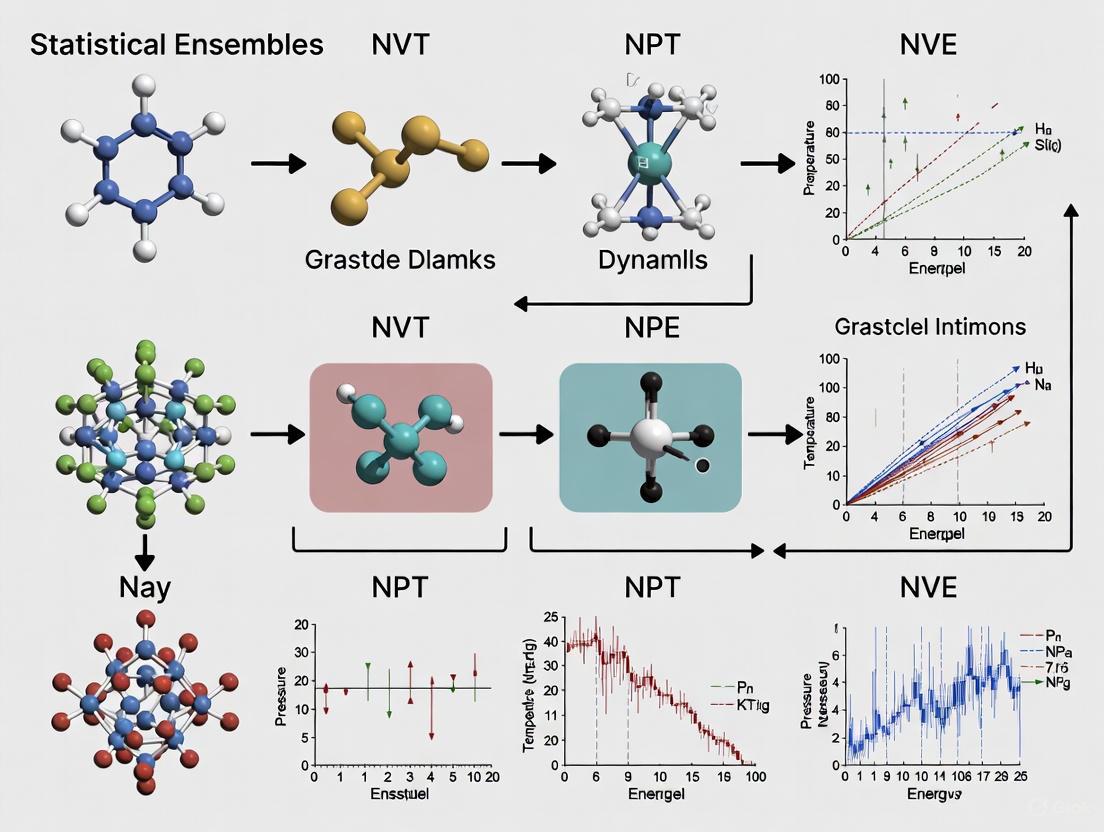
This article provides a comprehensive guide to the statistical ensembles used in Molecular Dynamics (MD) simulations, tailored for researchers and professionals in drug development.
Statistical Ensembles in Molecular Dynamics: A Guide for Biomedical Researchers
Abstract
This article provides a comprehensive guide to the statistical ensembles used in Molecular Dynamics (MD) simulations, tailored for researchers and professionals in drug development. It covers the foundational theory of statistical mechanics behind major ensembles (NVE, NVT, NPT, μVT), details their methodological implementation for simulating biomolecular processes like conformational changes and ligand binding, and offers practical guidance for troubleshooting common sampling issues. Furthermore, it explores advanced path sampling techniques like the Weighted Ensemble method for simulating rare events and discusses how to validate simulation results against experimental data, providing a complete framework for applying MD ensembles to challenges in biomedical research.
The Statistical Mechanics Foundation of MD Ensembles
Connecting Microscopic States to Macroscopic Thermodynamics
In the realm of molecular dynamics (MD) and statistical mechanics, thermodynamic ensembles provide the fundamental connection between the microscopic states of atoms and molecules and the macroscopic thermodynamic properties we measure in the laboratory. An ensemble, in this context, is an idealization consisting of a large number of copies of a system, considered simultaneously, with each copy representing a possible state that the real system might be in at any given moment [1]. These ensembles are not merely theoretical constructs but are essential tools for bridging the atomic and bulk scales, allowing researchers to derive thermodynamic properties from the laws of classical and quantum mechanics through statistical averaging [2].
The concept of phase space is central to understanding how ensembles function. In molecular dynamics, phase space is a multidimensional space where each point represents a complete state of the system, defined by all the positions and momenta of its components [3]. For a system containing N atoms, each with 3 spatial degrees of freedom, the phase space has 6N dimensions—3N position coordinates and 3N momentum coordinates [3]. As an MD simulation progresses over time, the system evolves and moves through different points in this phase space, effectively sampling different microscopic states [3]. The ensemble, therefore, represents the collection of these accessible points, and the averages of microscopic properties over this collection yield the macroscopic thermodynamic observables.
The choice of ensemble in molecular dynamics simulations depends primarily on the experimental conditions one wishes to mimic and the specific properties of interest. Different ensembles represent systems with different degrees of separation from their surroundings, ranging from completely isolated systems to completely open ones [2]. For researchers in drug development and materials science, selecting the appropriate ensemble is crucial for obtaining physically meaningful results that can be compared with experimental data. This technical guide explores the primary ensembles used in modern MD research, their mathematical foundations, implementation protocols, and applications in scientific discovery.
Fundamental Ensembles in Molecular Dynamics Research
Microcanonical Ensemble (NVE)
The microcanonical ensemble (NVE) represents the simplest case of a completely isolated system that cannot exchange energy or matter with its surroundings [1]. In this ensemble, the number of particles (N), the volume (V), and the total energy (E) all remain constant [2]. The NVE ensemble corresponds to Newton's equations of motion, where the total energy is conserved, though fluctuations between potential and kinetic energy components are still permitted [2].
In practical MD simulations, the microcanonical ensemble is generated by solving Newton's equations without any temperature or pressure control mechanisms [4]. However, due to numerical rounding and truncation errors during the integration process, small energy drifts often occur in practice [4]. Additionally, in integration algorithms like the Verlet leapfrog method, potential and kinetic energies are calculated half a timestep out of synchrony, contributing to fluctuations in the total energy [4].
While the NVE ensemble is mathematically straightforward, it has limitations for practical simulations. A sudden increase in temperature due to energy conservation can cause unstable behavior, such as protein unfolding in biomolecular simulations [2]. For this reason, constant-energy simulations are not generally recommended for equilibration but can be useful during production phases when exploring constant-energy surfaces of conformational spaces without the perturbations introduced by temperature and pressure coupling [4].
Canonical Ensemble (NVT)
The canonical ensemble (NVT) maintains a constant number of particles (N), constant volume (V), and constant temperature (T) [1]. Unlike the isolated NVE system, the NVT ensemble represents a system immersed in a much larger heat bath at a specific temperature, allowing heat exchange across the boundary while keeping matter constant [1].
Temperature control in NVT simulations is typically achieved by scaling particle velocities to adjust the kinetic energy, effectively implementing a thermostat in the simulation [2]. The system exchanges heat with this "thermostat" until thermal equilibrium is reached, maintaining a constant temperature throughout the simulation [1]. This ensemble is particularly important for calculating the Helmholtz free energy of a system, which represents the maximum amount of work a system can perform at constant volume and temperature [1].
In practice, the NVT ensemble is often the default choice in many MD packages, especially for conformational searches of molecules in vacuum without periodic boundary conditions [4]. Without periodic boundaries, volume, pressure, and density are not well-defined, making constant-pressure dynamics impossible [4]. Even with periodic boundaries, the NVT ensemble offers the advantage of less trajectory perturbation compared to constant-pressure simulations, as it avoids coupling to a pressure bath [4].
Isothermal-Isobaric Ensemble (NPT)
The isothermal-isobaric ensemble (NPT) maintains a constant number of particles (N), constant pressure (P), and constant temperature (T) [1]. This ensemble allows for both heat exchange and volume adjustments, with the system volume changing to maintain constant pressure against an external pressure source [2].
Pressure control is implemented through a barostat, which constantly rescales one or multiple dimensions of the simulation box to maintain the target pressure [2]. The NPT ensemble is especially valuable for simulating chemical reactions and biological processes that typically occur under constant pressure conditions in laboratory settings [2] [1]. This ensemble is essential for calculating the Gibbs free energy of a system, representing the maximum work obtainable at constant pressure and temperature [1].
For researchers in drug development, the NPT ensemble is particularly important for simulating biological systems in physiological conditions, where maintaining correct pressure, volume, and density relationships is crucial for obtaining physically meaningful results [4]. This ensemble can be used during equilibration to achieve desired temperature and pressure before potentially switching to other ensembles for data collection [4].
Other Specialized Ensembles
Beyond the three primary ensembles, several specialized ensembles cater to specific research needs:
Grand Canonical Ensemble (μVT): This ensemble maintains constant chemical potential (μ), volume (V), and temperature (T), allowing the number of particles to fluctuate during simulation [2]. The system is open and can exchange both heat and particles with a large reservoir [2]. While theoretically important, this ensemble is not widely supported in most MD software [2].
Constant-Pressure, Constant-Enthalpy Ensemble (NPH): The NPH ensemble is the constant-pressure analogue of the constant-volume, constant-energy ensemble, where enthalpy (H = E + PV) remains constant when pressure is fixed without temperature control [4].
Constant-Temperature, Constant-Stress Ensemble (NST): An extension of the constant-pressure ensemble, the NST ensemble allows control over specific components of the stress tensor, making it particularly useful for studying stress-strain relationships in polymeric or metallic materials [4].
Table 1: Comparison of Primary Thermodynamic Ensembles in Molecular Dynamics
| Ensemble | Constants | Control Method | Primary Applications | Theoretical Significance |
|---|---|---|---|---|
| Microcanonical (NVE) | Number of particles (N), Volume (V), Energy (E) | None (natural dynamics) | Exploring constant-energy surfaces; fundamental mechanics | Models isolated systems; basis for molecular dynamics |
| Canonical (NVT) | Number of particles (N), Volume (V), Temperature (T) | Thermostat (velocity scaling) | Conformational sampling at constant volume; vacuum simulations | Helmholtz free energy calculations |
| Isothermal-Isobaric (NPT) | Number of particles (N), Pressure (P), Temperature (T) | Thermostat + Barostat (volume scaling) | Mimicking laboratory conditions; biomolecular simulations in solution | Gibbs free energy calculations |
| Grand Canonical (μVT) | Chemical potential (μ), Volume (V), Temperature (T) | Particle reservoir | Systems with fluctuating particle numbers; adsorption studies | Open system thermodynamics |
Practical Implementation in Molecular Dynamics Research
Standard Simulation Protocol
In practical MD simulations, researchers typically employ multiple ensembles in sequence rather than relying on a single ensemble throughout the entire simulation. A standard protocol involves a carefully orchestrated sequence of simulations using different ensembles to properly equilibrate the system before production data collection [2]:
The workflow begins with an energy minimization phase to relieve any steric clashes or unrealistic high-energy configurations in the initial structure. This is followed by an NVT equilibration to bring the system to the desired target temperature, allowing the kinetic energy distribution to equilibrate while maintaining a fixed volume [2]. Subsequently, an NPT equilibration phase adjusts the system density to achieve the target pressure, allowing the simulation box size to fluctuate until the proper balance between temperature and pressure is established [2]. Finally, the production simulation is conducted in the appropriate ensemble (typically NPT for biomolecular systems or NVT for specific applications) to collect trajectory data for analysis [2].
This multi-ensemble approach ensures that the system is properly equilibrated in terms of both temperature and pressure before collecting production data, leading to more reliable and physically meaningful results [2].
Diagram 1: Standard MD Simulation Workflow
Advanced Applications and Recent Developments
The field of molecular dynamics continues to evolve with new methodologies and computational approaches enhancing the utility of traditional ensembles:
Neural Network Potentials (NNPs) represent a significant advancement, combining the accuracy of quantum mechanics with the computational efficiency of classical force fields. Recent developments like Meta's Open Molecules 2025 (OMol25) dataset and Universal Models for Atoms (UMA) architecture demonstrate how machine learning can enhance traditional MD approaches [5]. These models, trained on massive datasets of high-accuracy quantum chemical calculations, can achieve performance matching high-accuracy density functional theory while remaining computationally tractable for large systems [5].
The eSEN architecture, developed by Meta researchers, improves the smoothness of potential-energy surfaces compared to previous models, making molecular dynamics and geometry optimizations better behaved [5]. A particularly interesting innovation is the two-phase training scheme for conservative-force NNPs, which significantly reduces training time while improving performance [5].
For drug development professionals, these advances enable more accurate simulations of biomolecular systems, including protein-ligand complexes, nucleic acid structures, and dynamic processes that were previously computationally prohibitive [5]. The extensive sampling of biomolecular structures in datasets like OMol25, including various protonation states, tautomers, and docked poses, provides unprecedented coverage of biologically relevant chemical space [5].
Table 2: Research Reagent Solutions for Ensemble Simulations
| Tool/Component | Type | Function in Ensemble Simulation | Implementation Example |
|---|---|---|---|
| Thermostat | Algorithm | Maintains constant temperature by scaling velocities | Velocity rescaling, Nosé-Hoover, Berendsen |
| Barostat | Algorithm | Maintains constant pressure by adjusting simulation box dimensions | Berendsen, Parrinello-Rahman |
| Neural Network Potentials (NNPs) | Force field | Provides accurate energy surfaces with quantum mechanical accuracy | eSEN models, UMA architecture |
| Periodic Boundary Conditions | Simulation setup | Eliminates surface effects, enables bulk phase simulation | PBC with Ewald summation for electrostatics |
| Quantum Chemistry Datasets | Training data | Provides reference data for developing accurate potentials | OMol25, SPICE, ANI-2x |
Methodological Considerations for Robust Simulations
Ensuring Proper Phase Space Sampling
A fundamental challenge in molecular dynamics simulations is ensuring adequate sampling of the phase space to obtain statistically meaningful averages. The ergodic hypothesis assumes that over sufficient time, a system will visit all possible states consistent with its energy, making time averages equivalent to ensemble averages [3]. However, in practice, achieving true ergodicity is challenging, especially for complex systems with high energy barriers or rough energy landscapes.
Inadequate phase space sampling manifests as failure to converge properties, inaccurate thermodynamic averages, and poor reproducibility. For a system of N particles, the 6N-dimensional phase space is astronomically large, and practical simulations can only sample a tiny fraction of possible states [3]. Researchers must be vigilant for signs of poor sampling, such as drifts in average properties, failure to observe expected fluctuations, or dependence on initial conditions.
Strategies to improve sampling include extending simulation times, employing enhanced sampling techniques (such as replica exchange or metadynamics), and carefully selecting initial configurations. For drug development applications involving protein-ligand binding or conformational changes, specialized methods are often necessary to adequately sample the relevant states within feasible computational resources.
Current Limitations and Best Practices
While ensembles provide powerful frameworks connecting microscopic and macroscopic worlds, several limitations warrant consideration:
Energy drift in NVE simulations, caused by numerical integration errors, can lead to unphysical behavior over long timescales [4]. Non-conservative force models in some neural network potentials can cause similar issues, though recent advances like conservative-force eSEN models address this limitation [5]. Ensemble equivalence breaks down for small systems or near phase transitions, where fluctuations become significant and different ensembles may yield different results [4].
Best practices for ensemble selection include:
- Using NVT ensemble for systems with fixed volumes or when pressure control is unnecessary
- Employing NPT ensemble for simulating solution conditions or when density is an important variable
- Reserving NVE ensemble for specialized applications where energy conservation is paramount
- Implementing multi-ensemble equilibration protocols before production simulations
- Validating results through multiple independent simulations and convergence tests
For researchers in drug development, proper ensemble selection and implementation is crucial for generating reliable data on binding affinities, conformational dynamics, and solvation effects that can inform the design and optimization of therapeutic compounds.
Thermodynamic ensembles form the essential bridge between the microscopic world of atoms and molecules and the macroscopic thermodynamic properties measured in experiments. For researchers and drug development professionals, understanding the principles, applications, and implementation details of these ensembles is crucial for designing robust molecular dynamics simulations and interpreting their results meaningfully.
The continued development of advanced sampling methods, neural network potentials, and increasingly accurate force fields promises to enhance the utility of ensemble-based simulations in scientific discovery and drug development. As these computational approaches become more integrated with experimental research, their role in connecting microscopic behavior to macroscopic observables will only grow in importance.
In molecular dynamics (MD) research, statistical ensembles provide the foundational framework for simulating the thermodynamic behavior of molecular systems. Among these, the microcanonical ensemble, denoted as the NVE ensemble, represents the simplest and most fundamental statistical ensemble. It describes isolated systems characterized by a constant number of particles (N), a constant volume (V), and a constant total energy (E) [6] [2]. The NVE ensemble is a statistical ensemble that represents the possible states of a mechanical system whose total energy is exactly specified [6]. The system is assumed to be isolated in the sense that it cannot exchange energy or particles with its environment, so that the energy of the system does not change with time [6]. This ensemble is of particular importance in MD simulations as it corresponds directly to solving Newton's equations of motion without external thermodynamic controls, making it the natural starting point for understanding molecular dynamics [4] [7].
Table: Key Characteristics of the Microcanonical Ensemble
| Aspect | Description |
|---|---|
| Defining Macroscopic Variables | Number of particles (N), Volume (V), Total Energy (E) [6] |
| System Type | Isolated (no exchange of energy or matter with surroundings) [6] [8] |
| Fundamental Thermodynamic Potential | Entropy (S) [6] |
| Probability Postulate | All accessible microstates with energy E are equally probable [6] [8] |
| Primary Conservation Law | Total energy (E = K + V) is conserved [2] [4] |
Theoretical Foundation
Statistical Mechanical Basis
The microcanonical ensemble is built upon the principle of equal a priori probability, which states that all accessible microstates of an isolated system with a given energy E are equally probable [6] [8]. A microstate is defined by the precise positions and momenta of all N particles in the system, representing a single point in the 6N-dimensional phase space (3 spatial coordinates and 3 momentum components for each particle) [8]. The collection of all microstates with energy between E and E+δE defines the accessible region of phase space for the microcanonical ensemble.
The fundamental thermodynamic quantity derived from the microcanonical ensemble is entropy, which provides the connection between microscopic configurations and macroscopic thermodynamics. According to Boltzmann's formula, the entropy S is related to the number of accessible microstates Ω by:
S = k₠log Ω
where kâ‚ is Boltzmann's constant [6] [8]. This famous equation establishes that entropy quantifies the number of ways a macroscopic state can be realized microscopically. The temperature in the microcanonical ensemble is not an external control parameter but rather a derived quantity defined as the derivative of entropy with respect to energy [6].
Comparison with Other Ensembles
In MD research, the microcanonical ensemble serves as the foundation for understanding other commonly used ensembles. While the NVE ensemble describes isolated systems, most experimental conditions and biological processes require different ensemble representations.
Table: Comparison of Major Statistical Ensembles in Molecular Dynamics
| Ensemble | Constant Parameters | System Type | Common Applications in MD |
|---|---|---|---|
| Microcanonical (NVE) | N, V, E [6] [2] | Isolated [6] | Basic MD simulations; studying energy conservation [4] |
| Canonical (NVT) | N, V, T [2] [4] | Closed, isothermal [9] | Simulating systems at constant temperature [2] |
| Isothermal-Isobaric (NPT) | N, P, T [2] [4] | Closed, isothermal-isobaric [2] | Mimicking laboratory conditions [2] |
| Grand Canonical (μVT) | μ, V, T [2] | Open [2] | Systems exchanging particles with reservoir [2] |
Practical Implementation in Molecular Dynamics
Molecular Dynamics Protocol
In practical MD simulations, the NVE ensemble is implemented by numerically integrating Newton's equations of motion for all atoms in the system. The time evolution of positions and velocities follows from the Hellmann-Feynman forces acting on each atom [10]. A typical MD simulation procedure incorporates multiple ensembles sequentially rather than using a single ensemble throughout the entire simulation process [2].
Figure 1: Standard MD simulation workflow showing the placement of NVE ensemble in the production phase. The workflow progresses from initial structure preparation through equilibration in NVT and NPT ensembles before the final NVE production run for data collection.
Implementing NVE Ensemble in VASP
The Vienna Ab initio Simulation Package (VASP) provides multiple approaches to implement the NVE ensemble for molecular dynamics simulations. The simplest and recommended method involves using the Andersen thermostat with zero collision probability, effectively disabling the thermostat's influence on the system dynamics [10].
Table: NVE Ensemble Implementation Methods in VASP
| Method | MDALGO Setting | Additional Tags | Key Characteristics |
|---|---|---|---|
| Andersen Thermostat | 1 [10] | ANDERSEN_PROB = 0.0 [10] |
Simple and recommended approach [10] |
| Nosé-Hoover Thermostat | 2 [10] | SMASS = -3 [10] |
Effectively disables thermostat [10] |
To enforce constant volume throughout an NVE simulation in VASP, the ISIF tag must be set to a value less than 3 [10]. It is important to note that in NVE MD runs, there is no direct control over temperature and pressure, and their average values depend entirely on the initial structure and initial velocities [10]. Therefore, it is often desirable to equilibrate the system using NVT or NPT ensembles before switching to NVE ensemble for production sampling [10].
Example INCAR Configuration for NVE Ensemble
The following example INCAR file illustrates the key parameters for setting up an NVE ensemble molecular dynamics simulation in VASP using the Andersen thermostat approach [10]:
This configuration ensures that the system evolves according to Newton's equations of motion without artificial temperature control, maintaining constant energy throughout the simulation [10].
Research Applications and Protocols
Biomolecular Recognition Studies
The microcanonical ensemble plays a crucial role in studies of biomolecular recognition, which is fundamental to cellular functions such as molecular trafficking, signal transduction, and genetic expression [9]. MD simulations in the NVE ensemble allow researchers to investigate the thermodynamic properties driving these interactions without the artificial influence of thermostats. The statistical mechanics underlying the microcanonical ensemble provides the theoretical framework for connecting atomic-level interactions to macroscopic thermodynamic properties [9].
In practice, the NVE ensemble is particularly valuable for studying the dynamic behavior of biomolecules under conditions that approximate true isolation, allowing researchers to observe natural energy flow between different degrees of freedom. This has been instrumental in understanding the role of configurational entropy and solvent effects in intermolecular interactions [9].
Protein Structure Refinement
Recent advances in protein structure prediction have highlighted the importance of MD simulations for refining predicted protein structures. In a 2023 study comparing multiple neural network-based de novo modeling approaches, molecular dynamics simulations were employed to refine predicted structures of the hepatitis C virus core protein (HCVcp) [11]. The simulations enabled researchers to obtain compactly folded protein structures of good quality and theoretical accuracy, demonstrating that predicted structures often require refinement to become reliable structural models [11].
The key analysis metrics used in these MD refinement protocols include:
- Root Mean Square Deviation (RMSD): Measures the average distance between backbone atoms of different structures, providing insight into structural convergence and stability [11] [12].
- Root Mean Square Fluctuation (RMSF): Quantifies the flexibility of specific residues (typically Cα atoms) throughout the simulation [11].
- Radius of Gyration: Assesses the overall compactness of the protein structure [11].
- ERRAΤ and phi-psi plot analysis: Evaluates the quality of the refined protein structures [11].
Table: Key Research Reagents and Computational Tools for NVE Ensemble Simulations
| Item | Function/Description | Example Applications |
|---|---|---|
| VASP | First-principles molecular dynamics package [10] | Ab initio NVE simulations of materials [10] |
| ASE (Atomic Simulation Environment) | Python framework for working with atoms [7] | Setting up and running MD simulations [7] |
| ASAP3-EMT | Effective Medium Theory calculator [7] | Fast classical force field for demonstration [7] |
| GROMACS | Molecular dynamics package [2] | Biomolecular NVE simulations [2] |
| ANDERSEN_PROB parameter | Controls collision probability with fictitious heat bath [10] | Implementing NVE ensemble in VASP (set to 0.0) [10] |
| SMASS parameter | Controls mass of Nosé-Hoover virtual degree of freedom [10] | Implementing NVE ensemble in VASP (set to -3) [10] |
Technical Considerations and Limitations
Energy Conservation and Numerical Stability
In practical implementations, true energy conservation in NVE simulations is affected by numerical considerations. While the NVE ensemble theoretically conserves energy, numerical integration algorithms introduce slight drifts due to rounding and truncation errors [4]. For example, in the Verlet leapfrog algorithm, only r(t) and v(t - 1/2t) are known at each timestep, resulting in potential and kinetic energies being half a step out of synchrony [4]. This contributes to fluctuations in the total energy despite the theoretical foundation of energy conservation.
The choice of time step is critical for maintaining numerical stability in NVE simulations. Too large a time step can lead to significant energy drift and integration errors, while too small a time step unnecessarily increases computational cost [7]. For most biomolecular systems, time steps of 1-2 femtoseconds provide a reasonable balance between accuracy and efficiency when using the NVE ensemble [10] [7].
Applicability and System-Specific Considerations
The microcanonical ensemble is not always appropriate for all MD simulation scenarios. Constant-energy simulations are generally not recommended for the equilibration phase because, without energy flow facilitated by temperature control methods, the desired temperature cannot be reliably achieved [4]. The NVE ensemble is most valuable during production phases when researchers are interested in exploring the constant-energy surface of conformational space without perturbations introduced by temperature-bath coupling [4].
For small systems with limited degrees of freedom, the microcanonical ensemble can exhibit unusual thermodynamic behavior, including negative temperatures when the density of states decreases with energy [6]. These limitations make other ensembles more appropriate for many realistic systems that interact with their environment [6] [2].
The microcanonical (NVE) ensemble represents a fundamental approach in molecular dynamics research, providing insights into the behavior of isolated systems with conserved energy. While it has limitations for simulating experimental conditions where temperature and pressure control are essential, its theoretical importance and application in production MD simulations make it an indispensable tool in computational chemistry and biology. As MD methodologies continue to advance, the NVE ensemble maintains its role as the foundational framework for understanding energy conservation and natural system dynamics at the atomic level, particularly in biomolecular recognition studies and protein structure refinement protocols.
Molecular Dynamics (MD) simulation is a powerful computational technique that models the time evolution of a system of atoms and molecules by numerically solving Newton's equations of motion. The foundation of MD relies on statistical mechanics, which connects the microscopic behavior of individual atoms to macroscopic observable properties. This connection is formalized through the concept of statistical ensembles, which define the set of possible microstates a system can occupy under specific external constraints.
The canonical ensemble, or NVT ensemble, is one of the most fundamental and widely used ensembles in MD research. It describes a system that exchanges energy with its surroundings, maintaining a constant number of atoms (N), a constant volume (V), and a constant temperature (T). The temperature fluctuates around an equilibrium value, ⟨T⟩ [13]. This ensemble is particularly valuable for simulating real-world experimental conditions where temperature is a controlled variable, such as in studies of biochemical processes in a thermostatted environment or materials properties at specific temperatures. Its importance is highlighted by its central role in applications ranging from drug discovery, where it helps model solvation and binding [14] [15], to the design of new chemical mixtures for materials science [16].
Theoretical Foundation of the NVT Ensemble
From the Microcanonical (NVE) to the Canonical (NVT) Ensemble
In its purest form, an MD simulation based solely on Newton's equations of motion reproduces the microcanonical ensemble (NVE), where the number of atoms (N), the volume of the simulation box (V), and the total energy (E) are conserved. This corresponds to a completely isolated system that does not exchange energy or matter with its environment [17]. While physically rigorous, the NVE ensemble is often less practical for simulating experimental conditions, where temperature, not total energy, is the controlled variable.
The NVT ensemble relaxes the condition of constant total energy. Instead, the system is coupled to an external heat bath at a desired temperature. This allows the system to exchange energy with the bath, causing its instantaneous temperature to fluctuate around the target value. The temperature of a system is related to the average kinetic energy of the atoms. For a system in equilibrium, the following relation holds: [ \langle T \rangle = \frac{2 \langle Ek \rangle}{(3N - Nc) kB} ] where ⟨T⟩ is the average temperature, ⟨Eₖ⟩ is the average kinetic energy, ( N ) is the number of atoms, ( Nc ) is the number of constraints, and ( k_B ) is Boltzmann's constant. The role of a thermostat in NVT simulations is to manipulate the atomic velocities (and thus the kinetic energy) to maintain this relationship, effectively mimicking the presence of the heat bath.
Thermostating Algorithms: A Comparative Analysis
A key challenge in NVT simulations is controlling the temperature without unduly perturbing the system's natural dynamics. Several thermostating algorithms have been developed, each with a different theoretical approach and practical implications.
Table 1: Comparison of Common Thermostats for NVT Ensemble Simulations
| Thermostat | Underlying Principle | Ensemble Quality | Impact on Dynamics | Typical Use Case |
|---|---|---|---|---|
| Nosé-Hoover (NH) [13] [17] [18] | Deterministic; extends Lagrangian with a fictitious variable and mass representing the heat bath. | Canonical [18]. | Generally low with proper parameters; can exhibit energy drift in solids if potential energy is not accounted for [18]. | Production simulations; general-purpose use. |
| Nosé-Hoover Chains (NHC) [13] [17] | A chain of NH thermostats to control the first thermostat's temperature. | Canonical [18]. | More stable than single NH; suppresses energy drift. | Systems where standard NH shows poor stability. |
| Andersen [13] [18] | Stochastic; randomly assigns new velocities from a Maxwell-Boltzmann distribution. | Canonical. | High; stochastic collisions disrupt the natural dynamics. | Equilibration; sampling for static properties. |
| Berendsen [17] | Weak-coupling; scales velocities to exponentially relax the system to the target temperature. | Not strictly canonical [17] [18]. | Low; suppresses temperature fluctuations too aggressively. | Initial equilibration only. |
| Langevin [13] [17] | Stochastic; adds friction and random noise forces to the equations of motion. | Canonical. | High; friction term damps dynamics. | Equilibration; sampling for static properties. |
| CSVR / Bussi-Donadio-Parrinello [13] [17] | Stochastic; rescales velocities using a stochastic algorithm. | Canonical [17]. | Moderate to low; correct ensemble with less perturbation than Langevin. | Production simulations requiring correct sampling. |
The following diagram illustrates the logical decision process for selecting an appropriate thermostat based on the simulation goals:
Diagram 1: A logic flow for selecting a thermostat in NVT simulations, balancing the need for accurate dynamics, correct ensemble sampling, and computational efficiency.
Practical Implementation of NVT Simulations
Initialization and Equilibration Protocol
A successful NVT simulation requires careful preparation to ensure the system is properly equilibrated before data collection begins.
- System Setup: Begin with a stable initial structure, ideally from a previous geometry optimization or an NpT simulation to relax the lattice degrees of freedom [13]. The simulation box should be large enough to minimize finite-size effects, with cell lengths preferably larger than twice the interaction range of the potential [17].
- Initial Velocities: Atomic velocities are initialized, typically by drawing from a Maxwell-Boltzmann distribution at the target temperature [17] [19]. It is good practice to remove the overall center-of-mass motion to prevent spurious drift of the entire system [17] [19].
- Equilibration Run: The system is evolved under NVT dynamics for a sufficient number of steps until key observables (e.g., potential energy, temperature, pressure) stabilize around a stationary value. The Berendsen thermostat is often recommended for this initial equilibration phase due to its robust and fast relaxation to the target temperature, even though it does not generate a correct canonical ensemble [17].
- Production Run: Once equilibrated, the thermostat is switched to a more rigorous one (e.g., Nosé-Hoover or CSVR) for the production phase, during which the trajectory data is collected for analysis.
Thermostat Configuration and Parameters
The performance of a thermostat depends heavily on its coupling parameters.
- Nosé-Hoover Mass (SMASS in VASP): This parameter (often denoted as Q) determines the coupling strength between the system and the thermal reservoir. A large mass leads to slow, weak coupling and potentially poor temperature control, while a very small mass can cause high-frequency temperature oscillations [13] [18]. It is often set in relation to the system's natural vibrational periods.
- Thermostat Timescale (Ï„): In packages like QuantumATK, this parameter defines how quickly the system temperature approaches the reservoir temperature. A small timescale (tight coupling) forces the temperature to follow the reservoir closely but interferes more with the natural dynamics. A larger timescale (loose coupling) is preferable for measuring dynamical properties [17].
- Friction Coefficient (γ): For the Langevin thermostat, this parameter defines the strength of the frictional force. A higher value results in tighter coupling but more significantly modifies and damps the system's dynamics [17].
- Chain Length: In the Nosé-Hoover Chain thermostat, multiple thermostats are coupled to each other. A typical chain length of 3-5 is often sufficient, but it may need to be increased if persistent temperature oscillations are observed [17].
Table 2: Key Parameters for Different Thermostats in Popular MD Packages
| Thermostat | VASP Tag | QuantumATK Parameter | AMS/GROMACS Parameter | Recommended Value / Guidance |
|---|---|---|---|---|
| Nosé-Hoover | SMASS [13] |
Thermostat timescale [17] |
Tau (in Thermostat block) [20] |
VASP: -1 (Nose-Hoover chains), 0 (Nose-Hoover), >0 (mass); QuantumATK: System-dependent, e.g., 100 fs. |
| Andersen | ANDERSEN_PROB [13] |
- | - | Probability of collision per atom per timestep. |
| Langevin | LANGEVIN_GAMMA [13] |
Friction [17] |
- | Friction coefficient in psâ»Â¹. Lower for better dynamics. |
| CSVR | CSVR_PERIOD [13] |
- | - | Period of the stochastic velocity rescaling. |
| Berendsen | - | Thermostat timescale [17] |
Tau (in Thermostat block) [20] |
Good for equilibration; use a relatively short timescale. |
The Scientist's Toolkit: Essential Components for an NVT Simulation
Table 3: Key "Research Reagent Solutions" for NVT Molecular Dynamics
| Item / Component | Function in NVT Simulation | Technical Notes |
|---|---|---|
| Thermostat Algorithm | Controls the system temperature by mimicking energy exchange with a heat bath. | Choice depends on the need for a correct ensemble (e.g., Nosé-Hoover) vs. fast equilibration (e.g., Berendsen) [13] [17]. |
| Initial Coordinates (POSCAR) | Defines the starting atomic positions and simulation box. | The volume is fixed in NVT; initial box should be well-equilibrated from a previous NpT run or optimization [13]. |
| Maxwell-Boltzmann Velocity Distribution | Provides physically realistic initial atomic velocities. | Generated at the desired temperature; centers-of-mass motion should be removed [17] [19]. |
| Force Field / Potential | Computes the potential energy and forces between atoms. | Can be empirical (classical) or quantum mechanical (e.g., DFT); determines the physics of the interaction [17] [15]. |
| Time Step (Δt) | The discrete interval for numerical integration of equations of motion. | Must be small enough to resolve the highest atomic vibrations (e.g., 0.5-2 fs); critical for energy conservation [17]. |
| Simulation Software | The computational engine that performs the integration, force calculation, and temperature control. | Examples: VASP [13], QuantumATK [17], AMS [20], GROMACS [15] [19]. |
| Enpp-1-IN-6 | Enpp-1-IN-6, MF:C22H28N4O5S, MW:460.5 g/mol | Chemical Reagent |
| Bimatoprost-d4 | Bimatoprost-d4, MF:C25H37NO4, MW:419.6 g/mol | Chemical Reagent |
NVT Ensemble in Action: Applications in Drug Discovery and Materials Science
The NVT ensemble's ability to model systems at constant temperature makes it indispensable across scientific fields. A prominent application is in drug discovery, where MD simulations are used to study target structures, predict binding poses, and optimize lead compounds [14]. A specific example is the prediction of a critical physicochemical property: aqueous solubility.
A recent study integrated NVT (and NPT) MD simulations with machine learning to identify key molecular properties influencing drug solubility [15] [21]. The researchers ran MD simulations for 211 diverse drugs and extracted ten MD-derived properties. These properties, along with the experimental octanol-water partition coefficient (logP), were used as features to train machine learning models. The study found that seven properties were highly effective in predicting solubility: logP, Solvent Accessible Surface Area (SASA), Coulombic interaction energy (Coulombic_t), Lennard-Jones interaction energy (LJ), Estimated Solvation Free Energy (DGSolv), Root Mean Square Deviation (RMSD), and the Average number of solvents in the Solvation Shell (AvgShell) [15] [21]. This demonstrates how the NVT ensemble can generate trajectory data for calculating interaction energies and structural dynamics, which are valuable descriptors for predicting macroscopic properties.
The workflow for this application is summarized in the following diagram:
Diagram 2: Workflow for using NVT-based MD simulations to generate features for machine learning prediction of drug solubility.
In materials science, the NVT ensemble is used in high-throughput screening of chemical mixtures. For instance, a large-scale study generated a dataset of over 30,000 solvent mixtures using MD simulations to predict properties like packing density and enthalpy of mixing [16]. These simulation-derived properties showed strong correlation with experimental data (R² ≥ 0.84), validating the use of NVT simulations as a reliable and consistent method for generating data to train machine learning models for materials design [16].
The canonical (NVT) ensemble is a cornerstone of modern molecular dynamics research, enabling the simulation of systems under constant temperature conditions that mirror a vast array of laboratory experiments. Its implementation, through a variety of thermostating algorithms like Nosé-Hoover and CSVR, provides a robust link between microscopic atomic motions and macroscopic thermodynamic properties. As demonstrated by its growing application in data-driven drug discovery and materials design—where it helps generate essential physical properties for machine learning models—the NVT ensemble remains a vital tool. Its proper use, with careful attention to thermostat selection and equilibration protocols, allows researchers and developers to gain profound insights into the behavior of molecules and materials, accelerating innovation across scientific and industrial domains.
Molecular Dynamics (MD) simulations utilize statistical ensembles to define the thermodynamic conditions of a system. The Isothermal-Isobaric ensemble, universally known as the NPT ensemble, maintains a constant number of particles (N), constant pressure (P), and constant temperature (T). This ensemble holds fundamental importance in molecular simulation research because it directly mirrors the constant temperature and pressure conditions maintained in most laboratory experiments [22] [2]. While all ensembles are equivalent in the thermodynamic limit, switching between ensembles for finite-size systems can be challenging. The NPT ensemble is indispensable for studying systems where density is not known a priori, such as solvated proteins, membranes, micelles, or liquid mixtures [23].
In the broader taxonomy of statistical ensembles, NPT occupies a crucial position between the canonical NVT ensemble (constant volume) and the grand canonical μVT ensemble (constant chemical potential). It describes closed, isothermal systems that exchange energy and volume with their surroundings, making it the ensemble of choice for simulating most physical and chemical processes under realistic experimental conditions [22] [24]. The characteristic thermodynamic potential for this ensemble is the Gibbs free energy, connecting microscopic simulations to macroscopic thermodynamic properties [22] [24].
Theoretical Foundation
Statistical Mechanical Definition
The NPT ensemble describes equilibrium systems that exchange energy and volume with their surroundings, characterized by fixed temperature (T), pressure (P), and number of particles (N) [22]. The partition function for a classical NPT system provides the fundamental connection between microscopic behavior and macroscopic thermodynamics.
For a classical system, the isobaric-isothermal partition function, Δ(N,P,T), is derived from the canonical partition function Z(N,V,T) by incorporating volume fluctuations [22]:
$$ \Delta(N,P,T) = \int Z(N,V,T) e^{-\beta PV} C dV $$
Here, β = 1/kBT, where kB is Boltzmann's constant, and C is a constant that ensures proper normalization [22]. The probability of observing a specific microstate i with energy Ei and volume Vi is given by:
$$ pi = \frac{1}{\Delta(N,P,T)} e^{-\beta (Ei + PV_i)} $$
For quantum systems, the formulation requires a semiclassical density operator that accounts for the parametric dependence of the Hamiltonian on volume [24].
Thermodynamic Connections
The partition function Δ(N,P,T) directly connects to the Gibbs free energy, the thermodynamic characteristic function for variables N, P, and T [22] [24]:
$$ G(N,P,T) = -k_B T \ln \Delta(N,P,T) $$
This relationship enables the derivation of all relevant thermodynamic properties through appropriate differentiation [24]:
- Volume: $V = \left(\frac{\partial G}{\partial P}\right)_{T,N}$
- Entropy: $S = -\left(\frac{\partial G}{\partial T}\right)_{P,N}$
- Chemical Potential: $\mul = \left(\frac{\partial G}{\partial Nl}\right)_{T,P,N'}$
The enthalpy H = E + PV emerges as the central energy quantity, with fluctuations in H + PV related to the constant-pressure heat capacity [24]:
$$ CP = kB \beta^2 \langle [ (H+PV) - \langle H+PV \rangle ]^2 \rangle $$
Table 1: Thermodynamic Relations in the NPT Ensemble
| Thermodynamic Quantity | Statistical Mechanical Expression | Relationship to Partition Function |
|---|---|---|
| Gibbs Free Energy (G) | -kBT lnΔ(N,P,T) | Fundamental potential |
| Average Volume (⟨V⟩) | -kBT(∂lnΔ/∂P)T,N | First pressure derivative |
| Entropy (S) | kBT(∂lnΔ/∂T)P,N + kBlnΔ | Temperature derivative |
| Constant-Pressure Heat Capacity (CP) | kBβ²⟨δ(H+PV)²⟩ | Second β derivative |
Practical Implementation in Molecular Dynamics
Barostat and Thermostat Coupling
Implementing NPT conditions in MD simulations requires algorithms to control both temperature (thermostat) and pressure (barostat). Modern approaches combine novel features to create highly efficient and accurate numerical integrators [23]. The COMPEL algorithm exemplifies this trend, exploiting molecular pressure concepts, rapid stochastic relaxation to equilibrium, exact calculation of long-range force contributions, and Trotter expansion to generate a robust, stable, and accurate algorithm [23].
Thermostat methods include:
- Velocity rescaling: Direct adjustment of particle velocities
- Langevin dynamics: Stochastic terms that mimic thermal bath interactions
- Nosé-Hoover dynamics: Extended system with auxiliary variables that generate canonical distributions [23]
Barostat methods control pressure by allowing the simulation cell volume to fluctuate. The extended system approach of Andersen maintains pressure through an additional "piston" degree of freedom [23]. A significant advancement is the "Langevin piston" method, which couples an under-damped Langevin dynamics process to the piston equation to control oscillations and reduce relaxation time [23].
Molecular Pressure Formulation
The concept of "molecular pressure" provides significant advantages for molecular systems. Rather than using atomic positions and momenta, molecular pressure calculates the pressure using centers of mass of molecules [23]. This approach avoids complications from covalent bonding forces, as only non-bonding interactions contribute to the pressure calculation.
The equivalence between molecular and atomic formulations of pressure was first proved by Ciccotti and Ryckaert [23]. Molecular pressure provides two key advantages:
- Only inter-molecular forces contribute to the virial calculation
- Reduced pressure fluctuations by excluding rapidly changing covalent potential forces [23]
This formulation is particularly beneficial when holonomic constraints are applied to bond lengths, as it eliminates the need for special treatment of constraint forces in pressure calculation [23].
Barostat Methodologies: A Comparative Analysis
Parrinello-Rahman Barostat
The Parrinello-Rahman method is an extended system approach that allows all degrees of freedom of the simulation cell to vary [25]. The equations of motion incorporate additional variables that control cell deformation:
Here, h = (a, b, c) represents the cell vectors, η controls pressure fluctuations, ζ controls temperature fluctuations, and τT and τP are time constants for thermostat and barostat coupling, respectively [25].
A critical parameter in Parrinello-Rahman implementations is pfactor, which equals Ï„P²B, where B is the bulk modulus [25]. For crystalline metal systems, values between 10â¶-10â· GPa·fs² provide good convergence and stability [25].
Berendsen Barostat
The Berendsen barostat provides an alternative approach that efficiently controls pressure for convergence, though it doesn't generate exact NPT distributions [26]. It couples the system to a pressure bath using first-order kinetics:
Key parameters include barostat_timescale (time constant for pressure coupling) and compressibility (relating volume changes to pressure changes) [26]. The Berendsen method can operate in two modes: isotropic coupling (all cell vectors scaled equally) or anisotropic coupling (cell vectors rescaled independently) [26].
Table 2: Comparison of Barostat Methods in MD Simulations
| Feature | Parrinello-Rahman | Berendsen | Langevin Piston |
|---|---|---|---|
| Ensemble | Correct NPT sampling | Approximately correct | Correct NPT with stochastic elements |
| Cell Flexibility | Full variable cell shape and size | Isotropic or anisotropic scaling | Variable with stochastic control |
| Key Parameters | pfactor (τP²B) | barostat_timescale, compressibility | Piston mass, friction coefficient |
| Implementation | Extended system with equations for η | First-order coupling to bath | Langevin dynamics on piston |
| Advantages | High flexibility, correct sampling | Efficient convergence | Controlled oscillations, rapid equilibrium |
| Limitations | Sensitive to parameter choice | Does not generate exact NPT | Additional noise from stochastic elements |
Integration Schemes
Modern NPT implementations use symmetric Trotter expansions of the Liouville operator to create efficient integrators [23]. This approach dates to Ruth's work on symplectic integration and has been extended to stochastic differential equations. The under-damped Langevin equation for the piston can be decomposed into Hamiltonian components and Ornstein-Uhlenbeck equations, with the integrator constructed by composing Hamiltonian flows with exact distributional solutions of the linear stochastic system [23].
Applications in Research and Drug Development
Materials Science Applications
NPT simulations enable the investigation of fundamental material properties under realistic experimental conditions:
- Thermal expansion coefficients: By measuring volume changes across temperatures at constant pressure [25]
- Phase transitions: Observing structural changes in solids under varying pressure-temperature conditions
- Equation of state determination: Relating pressure, volume, and temperature for pure systems [22]
- Melting point prediction: Identifying solid-liquid phase transitions through gradual heating [25]
For example, calculating the thermal expansion coefficient of fcc-Cu involves running NPT simulations at temperature increments from 200K to 1000K with external pressure fixed at 1 bar, then determining the lattice constant at each temperature [25].
Pharmaceutical and Biomolecular Applications
In drug development, the NPT ensemble plays crucial roles in understanding molecular behavior under physiological conditions:
- Membrane-protein interactions: Studying lipid bilayers and embedded proteins at biological pressure and temperature [23]
- Solvated protein dynamics: Modeling proteins in aqueous environments at constant pressure
- Density prediction: Determining fluid-phase densities for drug delivery systems [25]
The Model-Informed Drug Development (MIDD) framework leverages computational approaches, including MD simulations, to optimize drug development pipelines [27]. Accurate modeling of biomolecular systems requires proper treatment of long-range interactions, as cutoff schemes for Lennard-Jones interactions can introduce deviations up to 5% in lipid bilayer order parameters [23].
Diagram 1: NPT Ensemble in Drug Development Workflow. The NPT ensemble bridges laboratory conditions and computational prediction of key drug properties.
Computational Protocols and Parameters
Typical Simulation Workflow
A standard MD procedure employs multiple ensembles sequentially for proper system equilibration [2]:
- NVT equilibration: Bringing the system to desired temperature with fixed volume
- NPT equilibration: Adjusting density to achieve target pressure at constant temperature
- Production run: Extended NPT simulation for data collection under equilibrium conditions [2]
This protocol ensures the system reaches proper equilibrium before production data collection begins.
Parameter Selection Guidelines
Successful NPT simulations require careful parameter selection:
- Time step: Typically 1-2 fs for atomistic simulations with bonds involving hydrogen [25]
- Thermostat time constant (Ï„T): 20-100 fs for gradual coupling [25]
- Barostat time constant (Ï„P): Should exceed Ï„T by approximately 5-fold for stability [26]
- Pressure coupling: Compressibility values of ~1×10â»â´ barâ»Â¹ for aqueous systems [26]
For the Parrinello-Rahman method in ASE, typical pfactor values range from 10â¶-10â· GPa·fs² for metal systems [25]. In VASP implementations, fictitious masses (PMASS) for lattice degrees of freedom around 1000 amu provide reasonable dynamics [28].
Research Reagent Solutions
Table 3: Essential Computational Tools for NPT Ensemble Research
| Tool Category | Specific Examples | Function in NPT Research |
|---|---|---|
| MD Software Packages | MOIL, ASE, GROMACS, VASP, QuantumATK | Implement NPT algorithms and integration schemes |
| Force Fields | AMBER, CHARMM, Martini, EMT | Define interatomic potentials for pressure calculation |
| Barostat Algorithms | Parrinello-Rahman, Berendsen, Langevin Piston | Control pressure during simulation |
| Analysis Tools | VMD, MDAnalysis, in-house scripts | Extract volume fluctuations, stress tensor components |
| Long-Range Solvers | Particle Mesh Ewald, PPPM | Accurate electrostatic and dispersive pressure contributions |
Advanced Considerations
Long-Range Interaction Treatment
Accurate pressure calculation requires proper treatment of long-range non-bonded forces. The Ewald summation method provides exact calculation of electrostatic contributions to the pressure [23]. Recently, similar approaches have been applied to Lennard-Jones interactions, as truncation at typical cutoffs (10Ã…) introduces pressure errors of hundreds of atmospheres due to neglected attractive interactions [23].
For anisotropic systems like membranes and proteins, the long-range correction can be calculated by measuring pressure with a very long distance cutoff periodically during simulation [23]. Implementation in the COMPEL algorithm combines molecular pressure with Ewald summation for long-range forces (thus the acronym: COnstant Molecular Pressure with Ewald sum for Long range forces) [23].
Specialized Ensembles and Extensions
The NPT ensemble forms part of a hierarchy of statistical ensembles. The μPT ensemble represents the natural extension, describing systems that exchange energy, particles, and volume with their surroundings [29]. This ensemble is particularly relevant for systems confined within porous and elastic membranes, small systems, and nanothermodynamics where the Gibbs-Duhem equation may not hold [29].
The generalized Boltzmann distribution provides a unifying framework:
$$ p(\mu, \mathbf{x}) = \frac{1}{\mathcal{Z}} \exp[-\beta \mathcal{H}(\mu) + \beta \mathbf{J} \cdot \mathbf{x}] $$
where for the NPT ensemble, J = -P and x = V [22].
Diagram 2: Relationship Between Statistical Ensembles. The NPT ensemble occupies a central position in the hierarchy of statistical mechanical ensembles.
The Isothermal-Isobaric ensemble represents an essential tool in molecular simulation research, providing the crucial link between computational modeling and experimental laboratory conditions. Through continuous algorithmic improvements—including molecular pressure formulations, advanced barostat methods, and exact long-range force calculations—NPT simulations have achieved high efficiency and accuracy in sampling condensed-phase systems.
As molecular dynamics continues to expand its applications in materials science and drug development, the NPT ensemble remains foundational for predicting material properties, biomolecular behavior, and phase equilibria under realistic conditions. Future developments will likely focus on improved scalability for complex systems, enhanced accuracy through machine-learning potentials, and tighter integration with experimental data through the Model-Informed Drug Development framework.
{#topic}
The Grand Canonical (μVT) Ensemble: Open Systems with Fluctuating Particle Number
The grand canonical ensemble stands as a cornerstone of statistical mechanics, providing the fundamental framework for describing open systems that can exchange both energy and particles with a reservoir. This in-depth technical guide explores the core principles, thermodynamic relations, and growing applications of the µVT ensemble, with a specific focus on its role in molecular dynamics (MD) research. For scientists and drug development professionals, understanding this ensemble is key to modeling critical processes such as biomolecular binding, phase transitions, and adsorption, where particle number fluctuations are not merely incidental but central to the phenomenon of interest. This review synthesizes theoretical foundations with practical simulation methodologies, detailing how the grand canonical ensemble enables the calculation of essential thermodynamic properties like binding free energies and provides unique insights into fluctuating systems that are difficult to capture with closed-ensemble approaches.
In statistical mechanics, the choice of ensemble dictates how a system's microscopic states are connected to its macroscopic thermodynamic properties. The grand canonical ensemble, also known as the µVT ensemble, describes the probabilistic state of an open system in thermodynamic equilibrium with a reservoir, with which it can exchange both energy and particles [30]. This makes it distinct from the more commonly encountered microcanonical (NVE), canonical (NVT), and isothermal-isobaric (NPT) ensembles, which assume a fixed number of particles. The independent thermodynamic variables for the grand canonical ensemble are the chemical potential (µ), volume (V), and temperature (T) [30].
The applicability of the grand canonical ensemble extends to systems of any size, but it is particularly crucial for modeling small systems where particle number fluctuations are significant, or for processes inherently involving mass exchange, such as adsorption, permeation, and binding [30] [31]. In the context of a broader thesis on statistical ensembles in MD research, the grand canonical ensemble represents the most general case for open systems, providing a foundation for understanding when particle number fluctuations must be explicitly accounted for to obtain accurate thermodynamic descriptions.
The probability ( P ) of the system being in a particular microstate with energy ( E ) and particle numbers ( N1, N2, \dots, Ns ) is given by the generalized Boltzmann distribution [30]: [ P = e^{(\Omega + \mu1 N1 + \mu2 N2 + \dots + \mus N_s - E)/(kT)} ] Here, ( k ) is the Boltzmann constant, ( T ) is the absolute temperature, and ( \Omega ) is the grand potential, a key thermodynamic potential for the µVT ensemble which serves to normalize the probability distribution.
An alternative formulation uses the grand canonical partition function, ( \mathcal{Z} = e^{-\Omega/(kT)} ), to express the probability as: [ P = \frac{1}{\mathcal{Z}} e^{(\mu N - E)/(kT)} ] The grand potential ( \Omega ) can be directly calculated from the partition function summing over all microstates: [ \Omega = -kT \ln \left( \sum_{\text{microstates}} e^{(\mu N - E)/(kT)} \right) ]
Core Principles and Thermodynamic Relations
The grand potential ( \Omega ) provides a direct link to the macroscopic thermodynamics of the open system. Its exact differential is given by [30]: [ d\Omega = -S dT - \langle N1 \rangle d\mu1 \ldots - \langle Ns \rangle d\mus - \langle p \rangle dV ] This relation reveals that the partial derivatives of ( \Omega ) yield the ensemble averages of key thermodynamic quantities:
- The average number of particles of each component: ( \langle Ni \rangle = -\frac{\partial \Omega}{\partial \mui} )
- The average pressure: ( \langle p \rangle = -\frac{\partial \Omega}{\partial V} )
- The entropy: ( S = -\frac{\partial \Omega}{\partial T} )
Furthermore, the average energy ( \langle E \rangle ) of the system can be obtained from the grand potential through the following fundamental relation [30]: [ \langle E \rangle = \Omega + \sum{i} \langle Ni \rangle \mui + ST ] The differential of this average energy resembles the first law of thermodynamics, but with average signs on the extensive quantities [30]: [ d\langle E \rangle = T dS + \sum{i} \mui d\langle Ni \rangle - \langle p \rangle dV ]
Fluctuations and Ensemble Equivalence
A defining characteristic of the grand canonical ensemble is that it allows for fluctuations in both energy and particle number. The variances of these fluctuations are directly related to thermodynamic response functions [30] [31].
The particle number fluctuation is directly connected to the isothermal compressibility, ( \kappaT ) [31]: [ \frac{\overline{(\Delta n)^2}}{\bar{n}^2} = \frac{kT \kappaT}{V} ] where ( n = N/V ) is the particle density. Similarly, the energy fluctuation in the grand canonical ensemble is given by [30] [31]: [ \overline{(\Delta E)^2} = \langle E^2 \rangle - \langle E \rangle^2 = kT^2 CV + \left[ \left(\frac{\partial U}{\partial N}\right){T,V} \right]^2 \overline{(\Delta N)^2} ] This shows that the energy fluctuation has two contributions: one from the canonical ensemble (( kT^2 C_V )) and an additional term arising from particle number fluctuations.
Ordinarily, for large systems far from critical points, the relative root-mean-square fluctuations are negligible, on the order of ( N^{-1/2} ). This underpins the equivalence of ensembles in the thermodynamic limit, where results from the microcanonical, canonical, and grand canonical ensembles converge [31] [32]. However, this equivalence breaks down near phase transitions. For instance, at the liquid-vapor critical point, the compressibility ( \kappa_T ) diverges, leading to anomalously large particle number fluctuations [31] [33]. In such regimes, the grand canonical ensemble becomes essential for a correct physical description, as it naturally incorporates these large fluctuations.
Table 1: Key Thermodynamic Relations in the Grand Canonical Ensemble
| Thermodynamic Quantity | Mathematical Expression | Relation to Grand Potential |
|---|---|---|
| Average Particle Number | ( \langle N_i \rangle ) | ( \langle Ni \rangle = -\left( \frac{\partial \Omega}{\partial \mui} \right){T,V,\mu{j \neq i}} ) |
| Entropy | ( S ) | ( S = -\left( \frac{\partial \Omega}{\partial T} \right)_{V,\mu} ) |
| Average Pressure | ( \langle p \rangle ) | ( \langle p \rangle = -\left( \frac{\partial \Omega}{\partial V} \right)_{T,\mu} ) |
| Average Energy | ( \langle E \rangle ) | ( \langle E \rangle = \Omega + \sumi \langle Ni \rangle \mu_i + ST ) |
| Particle Number Fluctuation | ( \overline{(\Delta N)^2} ) | ( \overline{(\Delta N)^2} = kT \left( \frac{\partial \langle N \rangle}{\partial \mu} \right)_{T,V} ) |
The Grand Canonical Ensemble in Molecular Dynamics Research
In the landscape of MD research, the choice of statistical ensemble is a fundamental decision that aligns the simulation with the experimental conditions or the physical processes of interest [32]. While the microcanonical (NVE) ensemble is the most natural for simulating isolated systems governed by Newton's equations, most biological and chemical processes occur in environments where temperature and, critically, particle exchange are controlled.
Ensemble Selection for Biomolecular Recognition
For processes like biomolecular recognition—the non-covalent interaction of biomolecules central to cellular functions like signal transduction and drug targeting—the grand canonical ensemble provides a powerful lens [9]. When calculating binding free energies, the relevant thermodynamic potential is often the Gibbs free energy, which is naturally connected to the isothermal-isobaric (NPT) ensemble. However, the grand canonical perspective is particularly insightful when the binding process involves the displacement of water molecules or ions from the binding site. In such cases, the system is effectively open to the exchange of these small particles with the bulk solvent, making the grand canonical ensemble a physically apt description for the binding site region [9].
The practical application of the µVT ensemble in MD has historically been less common than NVT or NPT due to the technical challenge of simulating particle exchange. However, its development was highly desirable because MD simulations, with their finite system sizes, do not automatically reach the thermodynamic limit where ensembles are equivalent [32]. Consequently, results can differ depending on the ensemble, making it crucial to employ the ensemble that most accurately reflects the experimental conditions or the nature of the process.
A Scientist's Toolkit: Research Reagent Solutions
The following table details key methodological "reagents" or computational tools used in grand canonical MD simulations and related free energy calculations.
Table 2: Essential Materials and Methods for Free Energy Calculations in MD
| Method / Tool | Function in Analysis |
|---|---|
| Lennard-Jones Fluid Model | A classical model system for simulating simple liquids and studying fundamental phenomena like critical point fluctuations [33]. |
| Alchemical Transformation | A computational method for calculating free energy differences by gradually transforming one molecule or system into another via a non-physical pathway [9]. |
| Potential of Mean Force (PMF) | The free energy as a function of a reaction coordinate, used to profile energy barriers and stable states in processes like binding or permeation [9]. |
| Thermostats (e.g., Nosé-Hoover) | Algorithms that maintain a constant temperature in NVT or µVT simulations by coupling the system to a heat bath [32]. |
| Isothermal Compressibility (( \kappa_T )) | A thermodynamic property that can be measured in simulations; its divergence is a signature of a critical point and is linked to large particle number fluctuations in the µVT ensemble [31]. |
| Terbutaline-d3 | Terbutaline-d3, MF:C12H19NO3, MW:228.30 g/mol |
| Lsd1-IN-6 | Lsd1-IN-6, MF:C15H13BrN2O3, MW:349.18 g/mol |
Experimental and Simulation Protocols
Implementing the grand canonical ensemble in molecular dynamics simulations requires specialized techniques to manage particle exchange. The following workflow and diagram outline a general protocol for conducting a grand canonical MD simulation, particularly for studying phenomena like critical points.
Diagram 1: Grand Canonical MD Simulation Workflow
A common and powerful approach is to hybridize MD with Grand Canonical Monte Carlo (GCMC) steps, as illustrated in Diagram 1. The protocol can be broken down as follows:
System Setup: Define the simulation box (fixed volume, V) and specify the chemical potential (µ) of the species of interest and the temperature (T). The chemical potential is typically pre-calculated for a bulk reservoir under known conditions (e.g., using a separate simulation of a bulk system at the desired pressure) [33].
Initial Equilibration: The system is first equilibrated under a different ensemble, often NVT or NPT, to establish a reasonable initial configuration and density.
GCMC/MD Hybrid Cycle: The core of the simulation involves a cyclic process:
- GCMC Step: A series of Monte Carlo moves are attempted, including particle insertions and deletions. The acceptance of these moves is based on the Metropolis criterion, which depends on the specified chemical potential µ. This step is responsible for regulating the particle number [33].
- MD Step: Following the GCMC step, a short segment of standard molecular dynamics is run. This evolves the system's coordinates and velocities under Newton's laws, sampling the phase space for the current number of particles. The MD step handles energy redistribution and relaxation.
Sampling and Analysis: Throughout the hybrid simulation, the instantaneous particle number N and total energy E are recorded. Their averages (〈N〉, 〈E〉) and fluctuations (〈(ΔN)²〉, 〈(ΔE)²〉) are calculated from this trajectory data. As derived from the core principles, these fluctuations can be used to compute properties like the isothermal compressibility, which exhibits characteristic behavior near critical points [31] [33].
Visualization of Particle Number Fluctuations at Criticality
The grand canonical ensemble's power to capture large fluctuations is most evident near critical points. Molecular dynamics simulations of classical fluids, such as the Lennard-Jones fluid, can directly visualize this phenomenon.
Diagram 2: Particle Number Fluctuations at Criticality
Diagram 2 provides a conceptual illustration of particle number fluctuations within a fixed sub-volume of a system. Under normal conditions (far from a critical point), density fluctuations are small and local, leading to a relatively uniform particle distribution. In contrast, near a critical point (e.g., the liquid-vapor critical point of a fluid), the compressibility diverges, and the system exhibits large-scale, long-wavelength density fluctuations [31]. This results in significant spatial heterogeneity, with some regions having a density much higher than the average and others much lower. These fluctuations are a direct manifestation of the system sampling a wide range of particle numbers in the grand canonical ensemble, and they are responsible for macroscopic phenomena like critical opalescence [31]. Modern MD studies explicitly track these fluctuations to locate critical points and study critical exponents [33].
Table 3: Particle Number Fluctuations in Different Regimes
| System Condition | Relative Fluctuation ( \frac{\sqrt{\overline{(\Delta N)^2}}}{\langle N \rangle} ) | Physical Origin | Implication for Simulation |
|---|---|---|---|
| Far from Critical Point | ( O(N^{-1/2}) ) (Negligible) | Random, uncorrelated particle motions. | Ensembles (NVT, NPT, µVT) are effectively equivalent. |
| At Critical Point | ( \gg O(N^{-1/2}) ) (Large, scaling with system size) | Divergence of compressibility and long-range correlations [31]. | Grand canonical ensemble is essential; other ensembles may yield incorrect results. |
Current research continues to leverage the grand canonical ensemble to tackle complex problems in molecular simulation. For instance, studies using classical Lennard-Jones fluids investigate how the large particle number fluctuations at a critical point are manifested differently when measurements are taken in coordinate space versus when momentum-space cuts are applied, with implications for interpreting event-by-event fluctuations in heavy-ion collision experiments [33].
In summary, the grand canonical (µVT) ensemble is an indispensable part of the statistical mechanics toolkit for MD research, especially when dealing with open systems. Its ability to naturally incorporate particle number fluctuations makes it uniquely suited for studying adsorption, binding, phase transitions, and critical phenomena. While technical challenges in its implementation remain, the development of robust hybrid GCMC/MD methods and a deeper understanding of fluctuation signatures ensure that the grand canonical ensemble will continue to provide critical insights at the intersection of physics, chemistry, and biology, ultimately aiding in the rational design of therapeutics and materials.
Implementing Ensembles for Biomolecular Simulation: Methods and Real-World Applications
In the field of molecular dynamics (MD) research, a statistical ensemble is an idealization consisting of a large number of virtual copies of a system, considered simultaneously, each representing a possible state that the real system might be in [34]. This fundamental concept, introduced by J. Willard Gibbs in 1902, provides the theoretical foundation for connecting microscopic molecular behavior to macroscopic thermodynamic observables [34]. In molecular dynamics simulations, the choice of statistical ensemble is paramount as it determines which thermodynamic quantities are conserved during the simulation and directly controls the sampling of phase space. The ensemble effectively represents the collection of possible microscopic states compatible with specific predetermined macroscopic variables, such as temperature or molecular concentration [35]. Understanding how to map simulation goals to appropriate thermodynamic conditions is therefore essential for obtaining physically meaningful results from MD simulations, particularly in biological applications such as drug development where accurate representation of molecular behavior under physiological conditions is critical.
Fundamental Ensemble Types and Their Physical Significance
Core Thermodynamic Ensembles
Statistical ensembles in molecular dynamics simulations are defined by their associated thermodynamic constraints and conserved quantities. The three primary ensembles form the foundation of most MD simulations, each tailored to specific experimental conditions and research questions.
Table 1: Fundamental Ensembles in Molecular Dynamics
| Ensemble Type | Conserved Quantities | Thermodynamic State | Common Applications |
|---|---|---|---|
| Microcanonical (NVE) | Number of particles (N), Volume (V), Energy (E) | Totally isolated system | Study of inherent dynamics without external influence; fundamental properties |
| Canonical (NVT) | Number of particles (N), Volume (V), Temperature (T) | System in thermal equilibrium with heat bath | Simulations at physiological temperature; standard biomolecular studies |
| Grand Canonical (μVT) | Chemical potential (μ), Volume (V), Temperature (T) | Open system exchanging particles and energy | Processes with changing particle number; binding studies, adsorption |
The microcanonical ensemble (NVE) describes completely isolated systems that cannot exchange energy or particles with their environment [34]. In this ensemble, all members have identical total energy and particle number, making it useful for studying the inherent dynamics of a system without external perturbations. The canonical ensemble (NVT) is appropriate for closed systems in thermal contact with a heat bath at fixed temperature [34]. This ensemble is particularly relevant for biological simulations where temperature is a controlled experimental parameter. The grand canonical ensemble (μVT) describes open systems that can exchange both energy and particles with their environment [34], making it valuable for studying processes like ligand binding or molecular adsorption where particle number fluctuates.
Extended and Specialized Ensembles
Beyond the three fundamental ensembles, specialized ensembles have been developed to address specific challenges in molecular simulations. The isothermal-isobaric ensemble (NPT) maintains constant number of particles, pressure, and temperature, making it ideal for simulating biomolecules under physiological conditions where both temperature and pressure are controlled. While not explicitly detailed in the search results, this ensemble is widely used in MD simulations for studying proteins in their native environments. Additionally, reaction ensembles allow particle number fluctuations according to specific chemical reaction stoichiometries [34], providing a framework for simulating chemical transformations.
In principle, these ensembles should produce identical observables in the thermodynamic limit due to Legendre transforms, though deviations can occur under conditions where state variables are non-convex, such as in small molecular systems [34]. This theoretical equivalence provides a foundation for selecting the most computationally efficient ensemble for a given research question while maintaining physical accuracy.
Ensemble Selection Framework for Biomolecular Simulations
Mapping Research Objectives to Ensemble Choice
Selecting the appropriate ensemble requires careful consideration of the scientific questions being addressed and the experimental conditions being modeled. The following decision framework aligns common research goals in drug development and protein studies with optimal ensemble selection.
Table 2: Ensemble Selection Guide for Biomolecular Simulation Goals
| Research Objective | Recommended Ensemble | Key Parameters | Physical Significance |
|---|---|---|---|
| Protein folding pathways | NPT | Temperature, Pressure | Mimics physiological aqueous environment |
| Ligand binding affinities | NVT or NPT | Temperature, (Pressure) | Maintains experimental conditions |
| Membrane protein dynamics | NPT | Temperature, Pressure | Preserves lipid bilayer properties |
| Intrinsic disorder sampling | Enhanced sampling methods | Temperature, Biasing potentials | Overcomes MD sampling limitations |
| Free energy calculations | Various with TI/FEP | Coupling parameters | Connects initial and final states |
For studies of protein folding and stability, the NPT ensemble is typically preferred as it maintains physiological conditions of constant temperature and pressure [36]. When investigating ligand-receptor interactions for drug development, either NVT or NPT ensembles are appropriate, with the latter providing more realistic solvation conditions. Research on intrinsically disordered proteins (IDPs) presents special challenges, as their conformational landscapes are vast and poorly sampled by conventional MD [37]. In these cases, advanced techniques such as Gaussian accelerated MD (GaMD) or AI-enhanced sampling may be necessary to adequately capture the diverse ensemble of interconverting conformations [37].
Practical Considerations in Ensemble Implementation
The mathematical representation of ensembles differs between classical and quantum mechanical frameworks. In classical mechanics, the ensemble is represented by a probability density function over the system's phase space, while in quantum mechanics, it is represented by a density matrix [34]. For MD simulations of biomolecules, classical representations are typically employed, with the ensemble represented by a joint probability density function Ï(pâ‚, ... pâ‚™, qâ‚, ... qâ‚™) over canonical momenta and coordinates [34].
In practical MD applications, such as those using the GROMACS software suite [36], the choice of ensemble determines which equations of motion are integrated and which constraint algorithms are applied. The setup includes defining parameters through .mdp files that specify thermodynamic conditions, with different integrators and coupling schemes implementing the various ensembles [36]. For instance, the canonical ensemble (NVT) requires a thermostat to maintain constant temperature, while the isothermal-isobaric ensemble (NPT) requires both a thermostat and a barostat.
Advanced Applications and Emerging Methodologies
Ensemble-Based Methods Beyond Conventional MD
While molecular dynamics generates ensembles by numerically solving equations of motion, ensemble-based methods represent a distinct class of computational approaches that generate diverse conformational ensembles without solving explicit dynamical equations [38]. These methods focus on the most important driving forces through simplified representations of molecular interactions, allowing more complete sampling than conventional MD can often provide [38].
One prominent class of ensemble-based methods includes Ising-like models, which decorate known protein structures with discrete "spin" variables representing folded or unfolded regions [38]. Methods such as COREX leverage this approach to characterize native state ensembles and allosteric effects in proteins [38]. By generating statistical ensembles of microstates and constructing partition functions, these methods can predict thermodynamic properties and quantify distal responses to perturbations without identifying specific pathways [38].
For intrinsically disordered proteins (IDPs), ensemble-based approaches are particularly valuable. IDPs challenge traditional structure-function paradigms by existing as dynamic ensembles rather than stable tertiary structures [37]. Their functional versatility stems from structural plasticity, allowing them to explore wide conformational landscapes [37]. Conventional MD struggles to adequately sample these landscapes due to computational limitations, making specialized ensemble methods essential for capturing their biological roles.
AI-Enhanced Sampling and Hybrid Approaches
Recent advancements integrate artificial intelligence with ensemble generation to overcome sampling limitations. Deep learning approaches demonstrate significant potential in modeling complex biological systems by learning intricate, non-linear relationships from large datasets without explicit programming of physical laws [37]. These AI methods can efficiently generate conformational ensembles for IDPs, outperforming MD in generating diverse ensembles with comparable accuracy [37].
Hybrid approaches that combine AI and MD bridge the gap between statistical learning and thermodynamic feasibility [37]. For example, AI can identify important regions of conformational space, which are then explored in detail using MD simulations. This division of labor leverages the strengths of both approaches: the pattern recognition capabilities of AI and the physical accuracy of MD force fields. Future directions include incorporating physics-based constraints into DL frameworks to refine predictions and enhance applicability [37].
Experimental Protocols and Methodological Guidelines
Standard MD Protocol for Ensemble Generation
The following protocol outlines key steps for setting up molecular dynamics simulations using the GROMACS suite, adaptable for different ensemble types [36]:
System Preparation: Obtain protein coordinates from the RCSB Protein Data Bank and pre-process the structure file. Convert to GROMACS format (.gro) and generate topology using the
pdb2gmxcommand:This step adds missing hydrogen atoms and prompts for force field selection [36].
Define Simulation Environment: Apply periodic boundary conditions to minimize edge effects using
editconfto create a simulation box around the protein. Solvate the system using thesolvatecommand and add counter ions to neutralize charge withgenion[36].Ensemble Specification: Select appropriate parameters in the .mdp file to define the thermodynamic ensemble. For NVT simulations, configure a thermostat (e.g., Nosé-Hoover); for NPT simulations, include both a thermostat and barostat (e.g., Parrinello-Rahman) [36].
Energy Minimization and Equilibration: Perform energy minimization to remove steric clashes, followed by stepwise equilibration in the desired ensemble to stabilize temperature, pressure, and density.
Production Simulation: Execute the production run in the chosen ensemble, ensuring sufficient duration for adequate phase space sampling. For enhanced sampling techniques, implement appropriate biasing potentials or algorithms.
Trajectory Analysis: Analyze the resulting ensemble using tools to compute thermodynamic properties, conformational distributions, and other relevant observables.
Research Reagent Solutions for Ensemble Studies
Table 3: Essential Tools and Resources for Ensemble Generation and Analysis
| Resource Category | Specific Tools/Resources | Function/Purpose |
|---|---|---|
| Simulation Software | GROMACS [36] | MD simulation suite supporting multiple ensembles and force fields |
| Visualization | Rasmol [36] | Molecular structure visualization and rendering |
| Force Fields | ffG53A7 [36] | Recommended force field for proteins with explicit solvent |
| Structure Repository | RCSB Protein Data Bank [36] | Source of initial protein coordinates |
| Analysis Tools | Grace [36] | 2D plotting for visualization of simulation results |
Visual Guide to Ensemble Selection and Simulation Workflow
Ensemble Selection Decision Pathway
Molecular Dynamics Simulation Workflow
The selection of appropriate statistical ensembles represents a critical bridge between simulation goals and thermodynamic reality in molecular dynamics research. By carefully mapping research objectives to ensemble characteristics—considering whether the system should maintain constant energy, temperature, pressure, or particle number—researchers can ensure their simulations generate physically meaningful results. For drug development professionals, this alignment is particularly crucial when simulating biomolecular interactions under physiological conditions. As methodologies continue to advance, particularly through integration of AI-based sampling with traditional physics-based approaches, the generation and interpretation of conformational ensembles will become increasingly sophisticated. This progression promises enhanced capability for capturing complex biomolecular behaviors, from protein folding and allostery to the dynamics of intrinsically disordered proteins, ultimately strengthening the foundation for rational drug design and therapeutic development.
Molecular dynamics (MD) simulation serves as a cornerstone technique in computational chemistry and biology, providing atomic-level insights into biomolecular processes critical for drug discovery. The reliability of any MD simulation is contingent upon a rigorous multi-step protocol that prepares the system in a state of thermodynamic equilibrium before production data is collected. This technical guide delineates a standardized workflow for system equilibration and production, emphasizing the critical role of sequential simulations within different statistical ensembles. Framed within a broader thesis on ensemble theory in MD, we demonstrate that a meticulous multi-ensemble approach—progressing from NVT to NPT conditions—is indispensable for achieving physically accurate and statistically converged simulations. The protocol is supplemented with quantitative parameter tables, detailed methodologies, and visual workflows tailored for researchers and drug development professionals.
In molecular dynamics, a statistical ensemble defines the collection of microstates that a system can access under specific thermodynamic constraints. The choice of ensemble directly controls the thermodynamic variables that remain constant during a simulation, thereby governing the system's behavior and the properties that can be calculated. For biomolecular simulations intended to mimic physiological conditions, the progression through ensembles is not arbitrary; it is a logical and necessary process to gradually relax the system to its equilibrium state.
The central challenge in MD is that simulations are initiated from static, often crystalline, structures that are not in equilibrium for a solvated, dynamic environment [39]. Directly commencing a production run from such a starting point can trap the system in high-energy, non-physical states, leading to aberrant dynamics and invalid results. Consequently, a multi-stage equilibration protocol is employed to slowly release constraints and allow the system to adopt a natural distribution of conformations and energies. This guide elaborates on the established workflow that leverages the NVT (Canonical) and NPT (Isothermal-Isobaric) ensembles to systematically achieve this goal, providing a foundation for reliable production simulations.
Foundational Concepts: NVT and NPT Ensembles
The MD equilibration process is built upon two primary statistical ensembles, each serving a distinct purpose in system preparation.
- The NVT (Canonical) Ensemble: In an NVT simulation, the Number of atoms (N), the Volume of the simulation box (V), and the Temperature (T) are held constant. This ensemble is typically the first step in equilibration. Its primary role is to stabilize the system's temperature after the initial assignment of velocities from a Maxwell-Boltzmann distribution, allowing the kinetic energy to equilibrate without yet adjusting the system's density [40].
- The NPT (Isothermal-Isobaric) Ensemble: In an NPT simulation, the Number of atoms (N), the Pressure (P), and the Temperature (T) are maintained constant. This is the most common ensemble for production runs as it best mimics experimental laboratory conditions (e.g., a solution at ambient pressure). During equilibration, the NPT step allows the volume of the simulation box to adjust to achieve the correct density for the chosen temperature and pressure [40].
Table 1: Key Statistical Ensembles in Molecular Dynamics
| Ensemble | Constant Parameters | Primary Role in Equilibration | Common Algorithms |
|---|---|---|---|
| NVT | Number of particles, Volume, Temperature | Stabilize temperature and kinetic energy; relax particle velocities. | Langevin thermostat, Nosé-Hoover thermostat |
| NPT | Number of particles, Pressure, Temperature | Achieve correct system density; allow box volume to fluctuate. | Langevin barostat, Monte Carlo barostat, Berendsen barostat |
| NVE | Number of particles, Volume, Energy | Microcanonical simulation; not typically used for equilibration. | Velocity Verlet integrator |
A Standard Multi-Ensemble Equilibration and Production Workflow
The following section provides a detailed, step-by-step protocol for system preparation, equilibration, and production. The entire process is summarized in the workflow diagram below.
Standard MD Simulation Workflow
System Preparation
The initial configuration, often derived from experimental structures like the Protein Data Bank, requires careful preparation for simulation [40].
- Simulation Box Setup: The molecule is placed in a virtual box, and Periodic Boundary Conditions (PBC) are applied to mimic a bulk environment and avoid surface artifacts.
- Solvation: The system is solvated with water molecules, using models such as TIP3P, to create a realistic aqueous environment [41].
- Neutralization: Counterions (e.g., Naâº, Clâ») are added to replace solvent molecules to achieve overall charge neutrality, which is essential for the accurate calculation of electrostatic interactions [42] [40].
Energy Minimization
Prior to dynamics, the energy of the prepared system must be minimized. The sudden introduction of solvent and ions can create steric clashes or unusual geometry that artificially raises the potential energy. Energy minimization, often using algorithms like steepest descent, relaxes the structure by adjusting atomic coordinates to find a local energy minimum [42] [40]. This provides a stable starting point for the subsequent dynamics phases.
System Equilibration
With a minimized structure, the multi-ensemble equilibration process begins. The system is now "heated" and gently relaxed to the target thermodynamic state.
NVT Equilibration
The minimized system is subjected to a short simulation (typically picoseconds to nanoseconds) in the NVT ensemble. The initial atomic velocities are assigned according to a Maxwell-Boltzmann distribution at the target temperature (e.g., 300 K). This phase allows the temperature to stabilize and the kinetic energy to distribute properly among degrees of freedom, while the volume remains fixed [40]. The duration should be sufficient for the temperature to reach and fluctuate around the target value.
NPT Equilibration
Following temperature stabilization, the system undergoes simulation in the NPT ensemble. In this phase, the pressure is controlled to the target value (e.g., 1 atm) using a barostat. This allows the size of the simulation box—and consequently, the density of the system—to adjust to the correct value [40]. Converged density is a critical indicator that the system is nearing equilibrium.
Production Run
The production run is the final and longest phase of the MD simulation, executed after the system has been equilibrated. The NPT ensemble is almost always used for production to model physiological conditions accurately [40]. During this phase, no restraints are applied, and the trajectory of the system's motion is saved at regular intervals. This trajectory forms the primary dataset for all subsequent analyses, such as calculating thermodynamic properties, observing conformational changes, or studying binding events.
Validation of Convergence and Equilibrium
A system is considered equilibrated when calculated properties cease to drift and instead fluctuate stably around a steady-state average. Monitoring these properties is essential before proceeding to production [39].
- Root Mean Square Deviation (RMSD): The RMSD measures the average displacement of atomic positions relative to a reference structure, typically the starting configuration. When the RMSD plot over time reaches a plateau and oscillates around a constant value, it suggests the protein has relaxed into a stable conformational state [40].
- Potential and Total Energy: The system's energies should stabilize and fluctuate steadily. A steady drift in potential energy indicates the system has not yet reached equilibrium.
- Temperature and Pressure: These should fluctuate around their set points.
- Density (for NPT): The system density should converge to the expected value for the chosen solvent model at the given temperature and pressure.
Table 2: Key Metrics for Validating System Equilibration
| Metric | What it Monitors | Interpretation of Convergence |
|---|---|---|
| RMSD | Structural drift from initial coordinates | Fluctuates around a stable average value; no sustained increasing trend. |
| Potential Energy | Stability of the system's potential energy | Fluctuates randomly around a steady average. |
| Temperature | Kinetic energy distribution | Fluctuates around the target value (e.g., 300 K). |
| Density | System compactness (NPT only) | Reaches and fluctuates around the expected experimental value. |
| Radius of Gyration | Overall compactness of a biomolecule | Reaches a stable value, indicating no further large-scale compression or expansion. |
Failure to achieve convergence in these metrics suggests the simulation requires further equilibration time or that the initial setup may contain issues, such as residual steric clashes.
Advanced Multi-Ensemble and Enhanced Sampling Methods
For complex biological processes like protein folding or ligand unbinding that occur on timescales beyond the reach of standard MD, advanced methods that combine multiple ensembles are employed.
- Weighted Ensemble (WE) Methods: WE strategies enhance the sampling of rare events by running multiple parallel simulations ("walkers") and periodically resampling them based on progress along a user-defined reaction coordinate. This allocates computational resources efficiently to simulate transitions that would otherwise be unobservable, without introducing bias into the dynamics [43] [41].
- Multi-Ensemble Markov Models (MEMM): Methods like the Transition-based Reweighting Analysis Method (TRAM) integrate data from both unbiased and biased (e.g., umbrella sampling, replica exchange) simulations. TRAM estimates a Markov model that provides full thermodynamic and kinetic information across all simulated ensembles, offering a statistically optimal approach for combining multi-ensemble data [44].
- Replica Exchange Solute Tempering (REST): A type of replica exchange method that enhances sampling for specific regions of a system (e.g., a solute), improving the convergence of conformational ensembles for challenging systems like intrinsically disordered proteins [45].
The Scientist's Toolkit: Essential Research Reagents and Software
A successful MD simulation relies on a suite of specialized software tools and "reagents."
Table 3: Essential Research Reagent Solutions for MD Simulations
| Tool/Reagent | Type | Primary Function | Application Note |
|---|---|---|---|
| CHARMM | Software Suite | System preparation: solvation, ionization, and initial topology generation. [42] | Often used via CHARMM-GUI for building complex systems like protein-ligand complexes. |
| NAMD | MD Engine | Performing energy minimization, equilibration, and production dynamics. [42] | Known for efficient parallel scaling on high-performance computing systems. |
| OpenMM | MD Engine | A highly flexible, hardware-accelerated toolkit for molecular simulation. [41] | Often used for its speed on GPUs and in advanced benchmarking studies. |
| WESTPA | Software Plugin | Orchestrating Weighted Ensemble simulations for enhanced sampling of rare events. [43] [41] | Requires defining a progress coordinate to guide the resampling of trajectories. |
| AMBER Force Fields | Parameter Set | Defining the potential energy function and empirical parameters for molecules. [41] | AMBER14 with TIP3P-FB is an example of a force field and water model combination. |
| TIP3P Water Model | Solvent Model | Representing water molecules in the simulation. [41] | A standard, widely used 3-site model for water. |
| Btk-IN-7 | Btk-IN-7|Potent BTK Inhibitor|For Research | Bench Chemicals | |
| Colistin adjuvant-1 | Colistin adjuvant-1, MF:C16H7F9N2O, MW:414.22 g/mol | Chemical Reagent | Bench Chemicals |
A rigorous, multi-ensemble workflow is the bedrock of reliable molecular dynamics simulations. The sequential application of NVT and NPT equilibration stages systematically prepares the system by first stabilizing temperature and then achieving the correct density, ultimately yielding a configuration representative of thermodynamic equilibrium. This protocol ensures that the subsequent production run samples from a physically meaningful ensemble, a non-negotiable prerequisite for obtaining valid mechanistic insights. As MD continues to evolve with more complex enhanced sampling and machine-learned methods, the standardized principles outlined in this guide will remain fundamental for researchers, particularly in drug development, where the accurate prediction of molecular behavior is paramount.
Molecular Dynamics (MD) simulations numerically solve Newton's equations of motion, by default sampling the microcanonical (NVE) ensemble, where the Number of particles, Volume, and total Energy are conserved [17]. However, to mimic common experimental conditions, simulations are typically performed in other statistical ensembles. The canonical (NVT) ensemble, which maintains constant Number of particles, Volume, and Temperature, is essential for studying temperature-dependent processes. The isothermal-isobaric (NPT) ensemble, with constant Number of particles, Pressure, and Temperature, is the most widely sampled ensemble in MD, as it replicates laboratory conditions where reactions are often performed at constant pressure and temperature [46] [47].
Thermostats and barostats are algorithms designed to maintain a system at a target temperature and pressure, respectively [48]. They work by modifying the Newtonian equations of motion or by scaling particle velocities and coordinates. The choice of algorithm is critical, as it can influence the accuracy of the sampled ensemble and the physical properties derived from the simulation [47]. This guide provides an in-depth examination of these algorithms, their theoretical foundations, and their practical application within a modern MD research context.
Thermostats: Algorithms for Temperature Control
Temperature in an MD simulation is related to the kinetic energy of the particles. Thermostats maintain a target temperature by manipulating the particle velocities, but they employ different strategies with significant implications for sampling accuracy and dynamic properties.
Classification and Theoretical Formulations
Thermostats can be broadly categorized into stochastic (velocity-randomizing) and deterministic (velocity-scaling) methods [47] [48].
Stochastic Methods: These algorithms incorporate random forces, mimicking collisions with particles from an external heat bath.
- Andersen Thermostat: Randomly selects particles and assigns them new velocities drawn from a Maxwell-Boltzmann distribution corresponding to the target temperature. The 'Andersen-Massive' variant randomizes all particle velocities at fixed intervals [47]. While it can produce a correct NVT ensemble, the frequent randomization dampens the natural dynamics of the system, making it unsuitable for calculating accurate dynamical properties like diffusion coefficients [47] [48].
- Langevin Thermostat: Integrates the Langevin equation of motion, which adds a friction term (
-mᵢγᵢ(drᵢ/dt)) and a stochastic noise term (rᵢ) to the Newtonian equations [47]. It thermostats on a local scale and is suitable for biological systems like proteins and water [48]. However, the damping effect also means it should not be used for determining transport properties like diffusion coefficients [48].
Deterministic Methods: These algorithms scale velocities in a predictable, non-random manner.
- Berendsen Thermostat: Couples the system weakly to an external heat bath by scaling velocities each time step with a factor,
λ[47]. It provides a first-order decay of temperature deviations without oscillations, making it highly efficient for driving a system to a target temperature during equilibration [47] [17]. Its main drawback is that it suppresses kinetic energy fluctuations and thus does not yield a correct NVT ensemble, making it unsuitable for production runs [47] [48]. - Nosé-Hoover Thermostat: An extended system method that introduces a fictitious friction parameter into the equations of motion. The friction itself has momentum, governed by a mass parameter, and evolves continuously [47]. This method generates slow, oscillatory relaxation towards the target temperature and is considered a gold standard because it correctly samples the NVT ensemble [48] [17]. It is suitable for all condensed matter systems, including liquids and biological molecules [48].
- V-Rescale Thermostat: A stochastic extension of the Berendsen thermostat that enforces the correct kinetic energy distribution by adding a properly constructed random force [47]. It retains the fast, exponential relaxation of Berendsen but samples the correct canonical ensemble, making it suitable for both equilibration and production runs [47].
- Berendsen Thermostat: Couples the system weakly to an external heat bath by scaling velocities each time step with a factor,
Table 1: Comparison of Common Thermostat Algorithms in Molecular Dynamics
| Algorithm | Type | Ensemble Sampling | Typical Use Case | Key Advantage | Key Disadvantage |
|---|---|---|---|---|---|
| Andersen | Stochastic | Correct NVT [47] | Systems where dynamics are not the focus | Simple, correct ensemble | Dampens system dynamics [47] |
| Langevin | Stochastic | Correct NVT [48] | Biological systems, coarse-grained models | Local thermostatting, stable | Dampens dynamics, affects diffusion [48] |
| Berendsen | Deterministic | Incorrect NVT [47] | Equilibration only [17] | Fast, stable relaxation | Suppresses energy fluctuations [47] |
| Nosé-Hoover | Deterministic | Correct NVT [48] | Production runs for all condensed matter | Correct ensemble sampling | Can introduce oscillations [47] |
| V-Rescale | Stochastic | Correct NVT [47] | Equilibration & Production [47] | Fast relaxation & correct ensemble | Stochastic component may not be desired |
Experimental Protocol: Implementing an NVT Simulation
A typical protocol for running an NVT simulation, whether for equilibration or production, involves several key steps and parameter choices.
- System Setup: Begin with a stable initial structure, ensuring the simulation box is large enough to avoid periodic image artifacts. The system should already be energy-minimized.
- Parameter Selection:
- Time Step (
Δt): This is a crucial parameter. A value of 1 fs is a safe starting point for systems with hydrogen atoms. Heavier systems may allow for larger time steps (e.g., 2 fs) [17]. - Thermostat Coupling Constant (
τ_T): This parameter determines how tightly the system is coupled to the heat bath. A typical value is 0.2 to 2.0 ps, with 0.75 ps being a common choice [48]. A smallerτ_Tgives tighter coupling but interferes more with the system's natural dynamics. - Initial Velocities: Assign initial velocities to all particles from a Maxwell-Boltzmann distribution at the target temperature [17].
- Time Step (
- Thermostat Choice:
- Simulation and Monitoring: Run the simulation while monitoring the instantaneous and average temperature to ensure stability. Also, monitor the potential and total energy to confirm the system has reached equilibrium before beginning data collection for production analysis.
Barostats: Algorithms for Pressure Control
Pressure in an MD simulation has both kinetic (from particle momenta) and virial (from interparticle forces) components. Barostats control pressure by dynamically adjusting the simulation box's size and shape.
Classification and Theoretical Formulations
Berendsen Barostat: Scales the coordinates of atoms and the simulation box vectors by a factor
λ^{1/3}at each time step [46]. The scaling factor is proportional to the difference between the instantaneous and target pressures, leading to a first-order kinetic relaxation (dP/dt = (P₀ - P)/τ_P) [47]. Its main advantage is the ability to quickly equilibrate the system's pressure. However, it suppresses volume fluctuations and therefore does not correctly sample the NPT ensemble [47] [48]. It is recommended for use only during equilibration [46].Parrinello-Rahman Barostat: An extended system method that introduces the box vectors as dynamic variables with an associated mass [47]. It allows for anisotropic deformation of the simulation box, meaning both the size and shape of the box can change independently [46] [47]. This method correctly samples the NPT ensemble and is currently the most widely used barostat for production simulations [46] [47]. A potential drawback is that it can produce unphysical large oscillations if the system is far from equilibrium or if the barostat mass parameter is set incorrectly [47].
Andersen Barostat: Also an extended system method, it couples the system to a virtual piston that scales the volume [46]. However, unlike Parrinello-Rahman, it typically only allows for isotropic deformation (uniform scaling in all directions) [46]. It correctly samples the NPT ensemble [46].
Table 2: Comparison of Common Barostat Algorithms in Molecular Dynamics
| Algorithm | Box Deformation | Ensemble Sampling | Typical Use Case | Key Advantage | Key Disadvantage |
|---|---|---|---|---|---|
| Berendsen | Isotropic | Incorrect NPT [47] | Equilibration only [48] | Fast, stable relaxation | Suppresses volume fluctuations [47] |
| Parrinello-Rahman | Anisotropic | Correct NPT [47] | Production runs for solids, liquids | Correct ensemble, allows shape change | Can oscillate if far from equilibrium [47] |
| Andersen | Isotropic | Correct NPT [46] | Production runs for isotropic fluids | Correct ensemble sampling | Limited to isotropic scaling [46] |
Experimental Protocol: Implementing an NPT Simulation
Running an NPT simulation requires careful coupling of both a thermostat and a barostat.
- Initial Equilibration: It is often good practice to first equilibrate the system in the NVT ensemble to stabilize the temperature before applying pressure control.
- Parameter Selection:
- Barostat Coupling Constant (
Ï„_P): This determines the timescale of pressure relaxation. A typical value is 0.5 to 4.0 ps, with 1.5 ps being a common choice [48]. - Isotropic vs. Anisotropic: For liquids or cubic crystals, isotropic coupling is sufficient. For studying solid-state phase transitions or materials with anisotropic strain, the Parrinello-Rahman barostat with anisotropic deformation is necessary [47] [17].
- Barostat Coupling Constant (
- Barostat Choice:
- For initial pressure equilibration, the Berendsen barostat is efficient.
- For production runs, the Parrinello-Rahman barostat is recommended for its correct sampling of the NPT ensemble, especially for solids [47].
- Combining with a Thermostat: An NPT simulation requires both a barostat and a thermostat. A typical and reliable combination for production runs is the Nosé-Hoover thermostat with the Parrinello-Rahman barostat [47].
- Monitoring: Monitor the instantaneous pressure, density, and box volume to ensure the system has reached a stable equilibrium. The average pressure should match the target, and the volume should fluctuate naturally.
The Scientist's Toolkit: Essential Reagents and Parameters
Table 3: Key "Research Reagent Solutions" for MD Simulations with Thermostats and Barostats
| Item / Parameter | Function / Role | Typical Value / Setting |
|---|---|---|
| Nosé-Hoover Thermostat | Correctly samples NVT ensemble for production runs [48] | Coupling constant (τ_T): 0.2 - 2.0 ps [48] |
| Berendsen Thermostat | Efficiently drives system to target temperature during equilibration [17] | Coupling constant (Ï„_T): 0.1 - 1.0 ps |
| Parrinello-Rahman Barostat | Correctly samples NPT ensemble, allows anisotropic box changes [47] | Coupling constant (Ï„_P): 0.5 - 4.0 ps [48] |
| Berendsen Barostat | Efficiently drives system to target pressure during equilibration [48] | Coupling constant (Ï„_P): 0.5 - 4.0 ps [48] |
Time Step (Δt) |
Interval for numerical integration of equations of motion [17] | 1 fs (systems with H), 2 fs (heavy atoms only) [17] |
| Maxwell-Boltzmann Distribution | Generates physically realistic initial particle velocities [17] | Applied at the desired target temperature |
| Thermostat Chain (Nosé-Hoover) | Prevents energy drift and oscillations in temperature [17] | Chain length = 3 (default) [17] |
| Prmt5-IN-12 | Prmt5-IN-12|Potent PRMT5 Inhibitor|For Research Use | Prmt5-IN-12 is a potent PRMT5 inhibitor for cancer research. It modulates arginine methylation. This product is for research use only (RUO) and not for human or veterinary diagnosis or therapeutic use. |
| KRAS G12C inhibitor 40 | KRAS G12C Inhibitor 40|Potent Covalent Inhibitor | KRAS G12C inhibitor 40 is a potent, covalent inhibitor for cancer research. This product is For Research Use Only. Not for human consumption. |
The choice of thermostat and barostat is a critical step in setting up an MD simulation, directly impacting the physical accuracy of the results. Berendsen algorithms are highly effective for the initial equilibration of temperature and pressure due to their fast and stable relaxation. However, for production runs, where correct sampling of the statistical ensemble is paramount, Nosé-Hoover and V-rescale thermostats, coupled with the Parrinello-Rahman barostat, represent the current gold standards. Understanding the theoretical underpinnings of these algorithms—whether stochastic or deterministic, and their impact on ensemble fluctuations and system dynamics—empowers researchers to make informed decisions, ensuring their simulations are both efficient and physically meaningful. This is especially crucial in fields like drug development, where accurate modeling of biomolecular flexibility and interactions under physiological conditions (NPT) is essential.
The accurate prediction of binding free energy (ΔG) is a cornerstone of computational drug design, providing a quantitative measure of the affinity between a potential drug molecule (ligand) and its biological target (usually a protein). This predicted interaction strength directly informs the potency of a drug and is crucial for guiding project teams toward compounds most likely to succeed experimentally, thereby saving significant time and resources [49]. The relationship between binding affinity (Kâ‚) and binding free energy is defined by the equation ΔGᵦ° = -RT ln(Kâ‚C°), where R is the gas constant, T is the temperature, and C° is the standard-state concentration (1 mol/L) [50]. Accurately calculating ΔG, however, is far from trivial. While absolute binding free energy (ABFE) calculation is ideal, it is often computationally expensive and can yield inaccurate results. Instead, calculating the relative binding free energy (RBFE)—the difference in ΔG between two similar molecules—is a significantly cheaper computational approach that has proven to provide useful guidance in compound selection and optimization [49].
Theoretical Frameworks and Statistical Ensembles
Binding free energy calculations rely on statistical mechanics to connect the microscopic simulations of a molecular system to its macroscopic thermodynamic properties. The methods operate within this theoretical framework to sample the relevant configurational ensembles, which are collections of molecular structures that represent the possible states of the system. The two primary families of methods for computing these energies are alchemical transformations and path-based methods [50].
- Alchemical Transformations: These methods use a non-physical pathway to connect two states of the system (e.g., a ligand in solution to the same ligand bound to a protein) through a coupling parameter, λ. The free energy difference is calculated along this λ pathway, often using techniques like Free Energy Perturbation (FEP) or Thermodynamic Integration (TI). As free energy is a state function, the result is independent of the path taken [50].
- Path-Based Methods: These methods aim to calculate the absolute binding free energy along a physical or geometric pathway that describes the binding process. The result is often a Potential of Mean Force (PMF)—the free energy profile along a selected collective variable (CV), such as the distance between the ligand and the protein's binding pocket [50].
The following table summarizes the core characteristics of these two approaches.
Table 1: Comparison of Alchemical and Path-Based Free Energy Methods
| Feature | Alchemical Methods | Path-Based Methods |
|---|---|---|
| Basis of Pathway | Non-physical, parameterized by a coupling parameter (λ) [50]. | Physical or geometric, parameterized by collective variables (CVs) [50]. |
| Typical Output | Free energy difference (ΔG) [50]. | Potential of Mean Force (PMF) and free energy difference (ΔG) [50]. |
| Primary Application | Relative Binding Free Energy (RBFE) calculations; widely used for lead optimization [49] [50]. | Absolute Binding Free Energy (ABFE) calculations [50]. |
| Key Advantage | Efficient for comparing analogous compounds; well-established in industry [50]. | Provides mechanistic insights into binding pathways and interactions [50]. |
| Key Limitation | Lacks ability to provide mechanistic or kinetic insights [50]. | Design of effective CVs is crucial and can be challenging [50]. |
Methodologies and Protocols
Alchemical Transformation Protocols
Alchemical methods, such as FEP and TI, simulate the transformation of one compound into another using a series of intermediate steps defined by the λ parameter. A hybrid Hamiltonian is used, commonly defined as a linear interpolation: V(q;λ) = (1-λ)Vâ‚(q) + λVÕ¢(q), where λ ranges from 0 (state A) to 1 (state B) [50].
- Thermodynamic Integration (TI): The free energy difference is obtained by integrating the average derivative of the Hamiltonian with respect to λ over the range from 0 to 1: ΔGâ‚Õ¢ = ∫⟨∂Vλ/∂λ⟩λ dλ [50].
- Free Energy Perturbation (FEP): The free energy difference is computed using the Zwanzig equation: ΔGâ‚Õ¢ = -βâ»Â¹ ln⟨exp(-βΔVâ‚Õ¢)⟩₠[50], where β = 1/RT.
A typical RBFE workflow involves running parallel simulations for the transformation of ligand A to ligand B, both in the binding site and in solution, and then using a thermodynamic cycle to compute the relative binding affinity [50]. These simulations require each intermediate step (λ window) to reach thermodynamic equilibrium, which can be computationally demanding [49].
Nonequilibrium Switching (NES)
Nonequilibrium switching (NES) is an advanced alchemical approach that offers a faster, more scalable alternative to traditional equilibrium methods like FEP and TI. Rather than simulating a gradual equilibrium pathway, NES uses many short, bidirectional, and independent transitions that drive the system far from equilibrium [49]. The collective statistics from these rapid "switches" are then used to yield an accurate free energy difference calculation via the Jarzynski equality or related nonequilibrium work theorems. This approach can achieve 5-10x higher throughput than traditional FEP/TI methods and is highly fault-tolerant, as the failure of individual runs does not invalidate the overall statistics [49].
Path-Based Methods and Collective Variables
Path-based methods estimate the absolute binding free energy by simulating the physical process of a ligand unbinding from or binding to its target. The key challenge is the design of effective collective variables (CVs) that can accurately capture the progress of this complex process [50]. Simple CVs can include distances or angles, while more sophisticated ones are needed for complex transitions.
- Path Collective Variables (PCVs): These are a powerful type of CV used to describe the evolution of a system relative to a predefined pathway in configurational space. PCVs consist of two variables: S(x), which measures progression along the path, and Z(x), which measures the deviation from the path [50]. They are defined as: S(x) = Σ i * exp(-λ||x - xáµ¢||²) / Σ exp(-λ||x - xáµ¢||²) Z(x) = -λâ»Â¹ ln [ Σ exp(-λ||x - xáµ¢||²) ] where p is the number of reference configurations in the pathway and ||x - xáµ¢||² is the distance between the current configuration and the i-th reference structure [50].
These methods can be combined with enhanced sampling techniques, such as Metadynamics, to efficiently overcome energy barriers and sample the binding/unbinding events [50].
Workflow Visualization
The following diagram illustrates the key decision points and methodologies in a binding free energy calculation pipeline, integrating both alchemical and path-based approaches.
The Scientist's Toolkit: Essential Research Reagents and Materials
Successful binding free energy calculations rely on a suite of software, hardware, and methodological "reagents." The following table details key components of a modern computational toolkit.
Table 2: Essential Research Reagents and Materials for Binding Free Energy Calculations
| Category | Item/Technique | Function and Description |
|---|---|---|
| Computational Methods | Relative Binding Free Energy (RBFE) [49] | Calculates the free energy difference between two similar ligands binding to the same target; primary workhorse for lead optimization. |
| Absolute Binding Free Energy (ABFE) [50] | Calculates the absolute free energy of binding for a single ligand; more challenging but provides a fundamental affinity measure. | |
| Nonequilibrium Switching (NES) [49] | An alchemical method using fast, independent transitions for rapid, scalable free energy estimation. | |
| Path Collective Variables (PCVs) [50] | Sophisticated collective variables that map binding/unbinding onto a curvilinear pathway for path-based free energy calculations. | |
| Software & Data | Molecular Dynamics (MD) Engines [51] | Software (e.g., GROMACS, AMBER, NAMD) that performs the all-atom simulations generating the dynamic trajectories for analysis. |
| Enhanced Sampling Algorithms [52] | Techniques (e.g., Metadynamics) that accelerate the sampling of rare events like ligand binding and unbinding. | |
| AlphaFold2-generated Structures [53] | AI-predicted protein structures used as accurate starting points for MD simulations and ensemble generation. | |
| NMR Relaxation Data [53] | Experimental data (e.g., Râ‚, Râ‚‚, NOE) used to validate and refine theoretical conformational ensembles from MD simulations. | |
| Hardware | High-Performance Computing (HPC) & GPUs [51] [50] | Critical infrastructure providing the immense computational power required for nanoseconds-to-microseconds of MD simulation. |
| Bopindolol fumarate | Bopindolol fumarate, CAS:79125-22-7, MF:C27H32N2O7, MW:496.6 g/mol | Chemical Reagent |
| Alk-IN-5 | Alk-IN-5, MF:C24H25FN6O3, MW:464.5 g/mol | Chemical Reagent |
Advanced Topics and Future Directions
The field of binding free energy calculation is rapidly evolving, with several advanced topics shaping its future. A significant challenge is obtaining accurate and holistic conformational ensembles—collections of structures that represent the dynamic nature of proteins in solution, which is essential for understanding function [53]. Integrating molecular dynamics simulations with experimental data, such as amide ¹âµN NMR relaxation parameters (Râ‚, NOE, ηxy), allows researchers to select MD trajectory segments that are consistent with experimental observables, leading to more biologically relevant ensembles [53].
Furthermore, artificial intelligence is beginning to transform the sampling of protein ensembles. AI-based generative models and coarse-grained machine learning potentials offer new paradigms for exploring conformational landscapes, potentially overcoming the timescale limitations of traditional MD [52]. These methods can draw statistically independent samples with fixed computational cost, bypassing the problem of correlated samples in MD and enabling high-throughput ensemble generation [52]. The combination of path-based methods with machine learning has also proven powerful for accurate path generation and free energy estimation, signaling a promising convergence of physical simulation and data-driven approaches in computational drug discovery [50].
Proteins are inherently dynamic molecules whose biological function is determined not by a single, static three-dimensional structure but by their dynamical properties and the resulting conformational ensembles [54]. Characterizing these ensembles is crucial for mechanistically understanding protein activity, regulation, and its implications for biomedical sciences and drug design [54]. The paradigm of a unique native structure must be replaced for many proteins—especially intrinsically disordered proteins (IDPs) and regions (IDRs)—by an ensemble representation that captures their structural variability [45] [55]. This shift in perspective is fundamental because the free energy governing protein function depends on this ensemble, driving conformational changes that enable proteins to perform their biological roles [55].
Sampling these ensembles presents significant challenges. For an IDR with just 20 residues, assuming each residue can adopt only three coarse-grained conformational states, the total number of possible molecular conformations is on the order of 10â¹ [45]. Even considering that some conformations are not viable due to steric clashes, comprehensively sampling this space remains computationally prohibitive with conventional methods [45]. Consequently, researchers must employ specialized sampling techniques and dimensionality reduction strategies to generate representative conformational ensembles that can reproduce key experimental observables [45].
Methodological Approaches for Ensemble Sampling
Molecular Dynamics-Based Sampling Methods
Molecular dynamics (MD) simulations are a cornerstone technique for investigating protein dynamics and generating structural ensembles by numerically solving equations of motion to sample possible configurations [55]. However, conventional MD faces formidable computational challenges due to high dimensionality and kinetic barriers that limit sampling [54]. Several advanced MD methods have been developed to address these limitations:
Table 1: Molecular Dynamics-Based Sampling Methods
| Method | Fundamental Principle | Key Advantages | Representative Applications |
|---|---|---|---|
| Replica Exchange Solute Tempering (REST) | Parallel simulations at different temperatures with exchanged configurations [45] | Enhanced sampling of conformational space; considered reference for accuracy [45] | Generating accurate conformational ensembles for IDRs [45] |
| Essential Dynamics Sampling (EDS) | Biased MD using collective coordinates from essential dynamics analysis [56] | Focuses sampling on functionally relevant motions; reduces dimensionality [56] | Simulating protein folding pathways [56] |
| Probabilistic MD Chain Growth (PMD-CG) | Builds ensembles using conformational probabilities from tripeptide MD simulations [45] | Extremely rapid ensemble generation after initial tripeptide calculations [45] | Quick generation of ensembles for IDRs like p53-CTD [45] |
| Markov State Models (MSMs) | Clusters MD structures into states and models transitions as Markov process [45] | Extracts kinetic information and long-timescale dynamics from shorter simulations [45] | Describing conformational ensembles and transitions [45] |
Machine Learning and Generative Approaches
Machine learning has emerged as a powerful strategy for accelerating the generation of protein dynamics and conformational ensembles [54]. These approaches can be trained on simulation data to directly generate physically realistic conformational ensembles without the need for extensive sampling and at negligible computational cost after training [54].
The idpGAN framework demonstrates this capability using a generative adversarial network (GAN) based on a transformer architecture with self-attention trained on coarse-grained simulations of intrinsically disordered peptides [54]. This conditional generative model can predict sequence-dependent coarse-grained ensembles for sequences not present in the training set, demonstrating transferability beyond the limited training data [54]. The generator network takes as input a latent sequence and the amino acid sequence, progressively updating it through transformer blocks to output 3D coordinates of Cα atoms [54].
Another approach, the Internal Coordinate Net (ICoN), learns physical principles of conformational changes from MD simulation data and identifies novel synthetic conformations with sophisticated large-scale sidechain and backbone arrangements [57]. Applied to the highly dynamic amyloid-β 1-42 monomer, this deep learning model provided comprehensive sampling of the conformational landscape, revealing clusters that help rationalize experimental findings [57].
Ensemble-Based Methods Without Explicit Dynamics
Ensemble-based methods generate diverse conformational ensembles without solving dynamical equations of motion by using simplified models with empirical parameters [55]. These methods make tradeoffs between atomic-level accuracy and computational speed, enabling rapid exploration of conformational space:
- Ising-like Models: Adapted from statistical mechanics, these models describe protein states using discrete variables that represent local structural elements (e.g., native vs. denatured). Methods like COREX or WSME are extremely fast but lack atomic coordinate information, focusing instead on thermodynamic and kinetic properties [55].
- Distance Constraint Models (DCM): These approaches describe protein thermodynamics through an ensemble of accessible conformational states, each with a specific network of distance constraints that determine molecular rigidity and flexibility [55]. The modular DCM (mDCM) represents an implementation that calculates free energies by reconstituting component energy and entropy parts based on a rigorous statistical mechanical framework [55].
Experimental Protocols and Methodologies
Protocol for Essential Dynamics Sampling (EDS)
EDS is a powerful method for simulating protein folding processes by biasing sampling along collective coordinates defined by essential dynamics analysis [56]:
Equilibrium Simulation and Essential Dynamics Analysis:
- Perform a molecular dynamics simulation of the native protein structure (e.g., 2660 ps for cytochrome c) [56].
- From the equilibrated portion of the trajectory, build and diagonalize the covariance matrix of positional fluctuations of Cα atoms to obtain eigenvectors representing concerted motions [56].
Expansion Procedure (Unfolding):
- Utilize the EDS technique in expansion mode at physiological temperature (300 K) [56].
- For each MD step, calculate the distance between the current structure and reference (native) structure in the subspace defined by selected eigenvectors [56].
- Accept steps that do not decrease the distance from the reference; otherwise, project coordinates and velocities radially onto a hypersphere maintaining the previous distance [56].
Contraction Procedure (Folding):
- Start from unfolded structures generated through expansion [56].
- Apply EDS in contraction mode, accepting only steps that do not increase the distance from the target native structure [56].
- Utilize a subset of essential eigenvectors (e.g., 100-200 vectors) to define the folding subspace, focusing on functionally relevant motions [56].
Protocol for Probabilistic MD Chain Growth (PMD-CG)
PMD-CG combines concepts from flexible-meccano and hierarchical chain growth approaches to rapidly generate conformational ensembles [45]:
Tripeptide Conformational Pool Generation:
Ensemble Construction:
Validation Against Experimental Data:
Workflow for Generative Machine Learning Approaches
The idpGAN framework implements a conditional generative model for protein conformations through these key steps [54]:
Network Architecture and Training:
- Generator (G): Based on transformer architecture; takes latent sequence and amino acid sequence as input; outputs 3D coordinates of Cα atoms [54].
- Discriminator (D): Receives protein conformation (as interatomic distance matrix) and amino acid sequence; outputs probability of conformation being "real" based on training data [54].
- Training: Adversarial training process where G learns to generate conformations that D cannot distinguish from MD simulation data [54].
Conformation Generation:
- For a protein with L residues, sample a latent sequence from a normal prior [54].
- Feed latent sequence and one-hot encoded amino acid sequence through trained generator network [54].
- Output produces 3D coordinates representing a statistically independent sample from the learned conformational distribution [54].
Ensemble Analysis:
Diagram 1: Workflow for Sampling Protein Conformational Ensembles showing multiple methodological approaches converging to validated ensemble models. Width: 760px.
Statistical Validation of Conformational Ensembles
Comparison of Sampling Efficiency and Accuracy
Validating conformational ensembles against experimental data is essential for assessing their accuracy and statistical robustness. Recent comparative studies have evaluated different sampling methods using experimental nuclear magnetic resonance (NMR) and small-angle X-ray scattering (SAXS) data as benchmarks [45].
Table 2: Statistical Accuracy of Different Sampling Methods for IDRs
| Method | Computational Efficiency | Accuracy vs NMR Data | Accuracy vs SAXS Data | Key Limitations |
|---|---|---|---|---|
| REST | Low (computationally intensive) | High (reference standard) | High (reference standard) | Extremely demanding computational resources [45] |
| Standard MD | Medium | Medium to High (depends on simulation length) | Medium to High | May require multiple long simulations for convergence [45] |
| PMD-CG | Very High (after tripeptide calculations) | High (agrees well with REST) | High (agrees well with REST) | Limited by tripeptide approximation; may miss long-range correlations [45] |
| MSM | Medium (depends on clustering) | Variable (depends on CV selection) | Variable (depends on CV selection) | Quality depends on choice of collective variables and state definitions [45] |
| idpGAN | Very High (after training) | Good agreement with training MD data | Good agreement with training MD data | Limited by training data quality and diversity [54] |
Key Experimental Observables for Validation
Several experimental techniques provide data for validating conformational ensembles:
- NMR Spectroscopy: Chemical shifts, scalar couplings, and residual dipalar couplings provide averaged information about backbone dihedral angle distributions and long-range contacts [45].
- SAXS/SANS: Small-angle X-ray and neutron scattering probe the apparent size and shape of proteins in solution [45].
- FRET: Förster resonance energy transfer provides distance information between specific labeled sites [45].
- PREs: Paramagnetic relaxation enhancements offer insights into transient long-range contacts [45].
The challenge in validation lies in the fact that the number of experimental observables is typically many orders of magnitude smaller than the size of the conformational ensemble, meaning different ensembles may provide the same experimental results within error margins [45]. This underscores the importance of using multiple complementary experimental techniques for robust validation.
Table 3: Key Research Reagents and Computational Tools for Sampling Protein Conformational Ensembles
| Resource Category | Specific Tools/Reagents | Function and Application |
|---|---|---|
| MD Software Packages | AMBER, GROMACS, NAMD, ilmm [58] | Molecular dynamics simulation engines with varying algorithms and performance characteristics |
| Force Fields | AMBER ff99SB-ILDN, CHARMM36, GROMOS [58] [59] | Empirical potential energy functions parameterized for different biomolecular systems and conditions |
| Enhanced Sampling Methods | REST, EDS, Targeted MD [56] [45] | Advanced algorithms to accelerate sampling of rare events and overcome energy barriers |
| Machine Learning Frameworks | idpGAN, ICoN [54] [57] | Generative models for rapid conformational ensemble generation from limited training data |
| Validation Data Types | NMR CS, SC, RDC; SAXS; FRET; PRE [45] | Experimental measurements for validating and refining computational ensembles |
| Coarse-Grained Models | MARTINI, SIRAH, Cα-based models [54] [59] | Simplified representations that enable longer timescale simulations at reduced computational cost |
| Analysis Tools | MDTraj, PyEMMA, MDAnalysis [45] | Software packages for analyzing simulation trajectories and quantifying ensemble properties |
Diagram 2: Validation Framework for Conformational Ensembles showing multiple experimental techniques for validation. Width: 760px.
Sampling protein conformational changes and folding pathways requires sophisticated computational approaches that balance atomic detail with computational feasibility. Traditional molecular dynamics methods like REST and EDS provide physically detailed sampling but at significant computational cost, while emerging machine learning approaches like idpGAN and ICoN offer rapid generation of conformational ensembles once trained [54] [57]. Ensemble-based methods that leverage statistical mechanics principles provide additional alternatives for rapidly exploring conformational space, particularly for studying thermodynamic properties [55].
The future of conformational sampling lies in hybrid approaches that combine the strengths of these methodologies. Integrating machine learning with physical principles, developing multi-scale methods that seamlessly transition between resolution levels, and creating more efficient enhanced sampling algorithms will further accelerate our ability to explore protein conformational landscapes. As these methods continue to mature, they will provide increasingly powerful tools for understanding protein function, designing novel therapeutics, and unraveling the fundamental principles connecting protein dynamics to biological activity.
Validation remains a critical challenge, as different conformational ensembles may yield similar experimental observables [45]. Developing more sophisticated validation protocols that leverage multiple experimental techniques and account for the inherent degeneracy in ensemble reconstruction will be essential for advancing the field. Ultimately, the combination of sophisticated sampling methods with rigorous experimental validation will provide unprecedented insights into the dynamic nature of proteins and their functional mechanisms.
Molecular Dynamics (MD) research relies on statistical ensembles to describe the thermodynamic state of a system. These ensembles, such as the NVT (canonical) or NPT (isothermal-isobaric) ensembles, define the distribution of possible configurations and momenta that a system can adopt. A fundamental goal of MD simulations is to adequately sample these ensembles to calculate thermodynamic and kinetic properties. However, a pervasive challenge, particularly in biomolecular simulations like protein folding, conformational changes, and binding events, is the presence of rare events. These are transitions between metastable states that are crucial for function but occur on timescales far longer than what can be routinely simulated with standard MD due to high free energy barriers [43].
The weighted ensemble (WE) method is a path sampling strategy designed to overcome this timescale problem. It is a rigorous, unbiased approach that enhances the sampling of rare events without altering the underlying dynamics of the system. By orchestrating parallel simulations with intermittent communication, the WE method focuses computational resources on the low-probability transitions of interest, enabling the calculation of key observables such as rate constants and pathways with superlinear scaling efficiency [43]. This guide provides an in-depth technical overview of the WE method, its integration with modern artificial intelligence techniques, and its application within the broader context of statistical ensembles in MD research.
Theoretical Foundations of the Weighted Ensemble Method
Core Algorithm and Historical Context
The WE method is a sophisticated implementation of a splitting strategy for simulating rare events. Its core principle is to run multiple weighted trajectory walkers in parallel, periodically resampling them to promote the exploration of configuration space while maintaining statistical rigor [43].
The theoretical basis of WE can be understood through the lens of non-equilibrium trajectory physics. Given stochastic dynamics, an initial distribution of phase-space points Ïâ‚€(xâ‚€) evolves over time into a well-defined distribution of trajectories. The WE algorithm explicitly works with this trajectory distribution, which contains more information than the configurational distributions at individual time points, as it preserves the sequence of configurations—the mechanistic information [43].
The algorithm proceeds via two alternating steps [43]:
- Dynamics Propagation: All trajectory walkers are simulated independently for a fixed, brief time interval using any stochastic dynamics engine.
- Statistical Resampling: The ensemble of walkers is resampled to maintain a productive distribution for sampling rare events. Trajectories in undersampled regions may be split, while those in oversampled regions may be merged, with statistical weights adjusted accordingly to preserve unbiasedness.
The concept of trajectory splitting has been rediscovered multiple times. It was first described by Kahn in 1951, attributing the idea to von Neumann for simulating neutron transmission. The modern formulation for biomolecular systems was introduced by Huber and Kim in 1996 [43].
The Resampling Procedure in Practice
Resampling is typically performed using bins that subdivide the configuration space, often based on a progress coordinate. The goal is usually to maintain a fixed number of walkers, M, per bin [43].
- Splitting: If a bin contains fewer than M walkers, a walker is replicated to create multiple child trajectories. The sum of the children's weights equals the parent's weight, and weights are typically made equal.
- Merging: If a bin contains more than M walkers, trajectories are pruned. A common method is to select a pair of walkers, choose one to survive with probability proportional to its relative weight, and have the survivor inherit the combined weight of the pair.
These procedures are mathematically rigorous and do not change the statistical properties of the trajectory ensemble, though they do introduce correlations that must be accounted for in error analysis [43].
Methodological Advances and Current State-of-the-Art
The core WE methodology has been significantly enhanced in recent years, particularly through integration with machine learning and AI, as summarized in the table below.
Table 1: Advanced Weighted Ensemble Methodologies
| Method | Core Innovation | Key Advantage | Application Example |
|---|---|---|---|
| WE with Reinforcement Learning (WE-RL) [60] | Automatically identifies the most effective progress coordinate from multiple candidates during a simulation using RL. | Eliminates trial-and-error in progress coordinate selection; adapts to changing relevant coordinates in multi-step processes. | Conformational sampling of an HIV-1 capsid protein dimer. |
| AI+RES for Extreme Weather [61] | Uses an AI weather emulator ensemble forecast as the score function to guide resampling in a physics-based model. | Provides a highly effective, physically informed score function for complex systems where simple persistence fails. | Sampling mid-latitude heatwaves in a global climate model. |
| Binless WE Frameworks [60] | Replaces fixed bins with dynamic clustering of conformations (e.g., via k-means) to guide resampling. | More flexibly adapts to the explored regions of configuration space without manual bin positioning. | Benchmark systems like egg-carton and S-shaped toy potentials. |
Synergy with Deep Generative Models
A parallel and complementary trend is the rise of deep generative models for sampling structural ensembles. Models like aSAM (atomistic structural autoencoder model) are latent diffusion models trained on MD simulation data to generate heavy-atom protein ensembles at a fraction of the computational cost of running new MD [62]. These models can learn accurate distributions of backbone and side-chain torsion angles.
The aSAMt variant conditions ensemble generation on temperature, a key thermodynamic variable. By training on multi-temperature MD datasets, aSAMt can recapitulate temperature-dependent ensemble properties and even generalize to temperatures outside its training data [62]. While these generative models do not directly provide kinetics, they represent a powerful data-driven approach for rapidly exploring conformational ensembles, the understanding of which can inform WE setup.
Practical Implementation and Workflow
Key Research Reagent Solutions
Successful application of the WE method relies on a suite of software tools and theoretical components.
Table 2: Essential Components for a Weighted Ensemble Study
| Component | Function | Examples & Notes |
|---|---|---|
| Dynamics Engine | Propagates the system's dynamics according to physical laws. | Standard MD packages (e.g., GROMACS, NAMD, OpenMM) or cell-modeling packages [43]. |
| WE Software | Manages the WE algorithm: trajectory tracking, resampling, and data output. | WESTPA (Weighted Ensemble Simulation Toolkit with Parallelization and Analysis) is a widely used open-source toolkit [43]. |
| Progress Coordinate | A low-dimensional descriptor that captures the slow, relevant motion of the rare event. | Can be a distance, root-mean-square deviation (RMSD), or a collective variable. Can be static or dynamically identified via WE-RL [60]. |
| Resampling Parameters | User-defined settings that control the WE simulation. | Resampling time interval (Ï„), number of walkers (M), and bin/cluster definitions [43]. |
| Validation Data | Experimental or theoretical data used to validate the generated ensembles and kinetics. | Experimental rate constants, population distributions from NMR or SAXS, or results from long, conventional MD simulations [62]. |
Detailed Workflow and Protocol
The following diagram illustrates the core workflow of a standard bin-based WE simulation, integrating the components from Table 2.
WE Simulation Workflow
For advanced methods like WE-RL, the resampling step is modified. The following diagram outlines the key reinforcement learning loop used to select the optimal progress coordinate on-the-fly.
Reinforcement Learning in WE-RL
A critical preparatory step for any WE study, or for training generative models like aSAM, is the generation of reference data. The protocol below outlines a general MD setup for this purpose.
Protocol: Molecular Dynamics Simulation for Ensemble Validation or Training Data
System Setup:
- Obtain the initial protein structure from a database (e.g., PDB).
- Use a tool like
pdb2gmx(GROMACS) orCHARMM-GUIto solvate the protein in a water box, add necessary ions to neutralize the system, and generate the topology file incorporating a suitable force field (e.g., CHARMM36, AMBER).
Energy Minimization:
- Run a steepest descent or conjugate gradient minimization to remove steric clashes and bad contacts in the initial structure.
- Success Criteria: The maximum force should be below a chosen threshold (e.g., 1000 kJ/mol/nm).
Equilibration:
- Perform equilibration in the NVT ensemble for 100-500 ps, using a thermostat like Nosé-Hoover or Berendsen to stabilize the temperature (e.g., 300 K).
- Perform equilibration in the NPT ensemble for 100-500 ps, using a barostat like Parrinello-Rahman or Berendsen to stabilize the pressure (e.g., 1 bar).
- Validation: Monitor potential energy, temperature, pressure, and density to ensure they stabilize around the target values.
Production Simulation:
- Run the production MD simulation for the desired timescale (nanoseconds to microseconds, depending on the system and resources). Use a different random seed for initial velocities if running replicates.
- Parameters: Use a 2-fs integration time step. Save trajectory frames frequently enough to resolve the dynamics of interest (e.g., every 10-100 ps).
- For multi-temperature studies to train models like aSAMt, repeat this process at different temperatures (e.g., from 320 K to 450 K as in the mdCATH dataset) [62].
The Weighted Ensemble method represents a powerful and rigorously correct approach for sampling rare events within the statistical ensembles central to MD research. Its core strength lies in providing unbiased kinetics and pathways by focusing computational effort on the transitions between metastable states. The field is rapidly evolving, with current state-of-the-art research focusing on integrating WE with AI, particularly through reinforcement learning to automate progress coordinate identification and through generative models for enhanced exploration. These hybrid approaches are pushing the boundaries of what is possible in simulating complex biological processes, from protein folding and binding to allosteric regulation, offering profound insights for drug development and basic science.
Troubleshooting Ensemble Simulations: Overcoming Sampling and Stability Challenges
Selecting an appropriate integration timestep is a critical decision in Molecular Dynamics (MD) simulation, directly influencing energy conservation, simulation stability, and the physical validity of the generated trajectory. An ill-chosen timestep can lead to unphysical energy increases, trajectory instability, and inaccurate sampling of the desired statistical ensemble. This guide provides researchers and drug development professionals with a rigorous framework for timestep selection to ensure reliable and computationally efficient MD simulations.
The Fundamentals of Timestep Selection
In MD, the integration timestep (Δt) is the finite time interval at which the equations of motion are solved to propagate the system forward in time. The primary constraint on its size is the fastest motion present in the system. To capture these motions accurately and maintain the stability of the numerical integration scheme, the timestep must be significantly smaller than the period of the highest frequency vibration, typically involving hydrogen atoms.
- The Stability Criterion: For biomolecular systems, the fastest motions are the stretching of bonds to hydrogen atoms (e.g., C-H, O-H, N-H), which have vibrational periods on the order of 10 femtoseconds (fs). A common rule of thumb is to set the timestep to about one-tenth of this period, leading to the standard usage of 1-2 fs.
- Consequences of a Too-Large Timestep: When the timestep exceeds this stability limit, the numerical integrator fails to accurately track the rapid oscillations of bond energies. This error propagates, leading to a catastrophic failure known as "blowing up," where the total energy of the system increases unphysically and the simulation collapses.
The following table summarizes the fundamental constraints and standard practices for timestep selection in classical MD.
Table 1: Fundamental Constraints on MD Integration Timestep
| Factor | Typical Limit | Rationale & Consequence |
|---|---|---|
| Fastest Vibration (X-H bonds) | ~10 fs period | Timestep must be a fraction of the period to accurately integrate the motion. |
| Standard Timestep | 1 - 2 fs | Provides a stable, conservative baseline for most biomolecular systems. |
| Instability Onset | >~2 fs (with flexible bonds) | Energy flows unphysically from high-frequency modes into lower-frequency degrees of freedom, causing a continuous energy increase and eventual simulation failure. |
Advanced Integration Protocols for Larger Timesteps
While the 1-2 fs timestep is robust, it severely limits the accessible simulation timescales. Several advanced protocols have been developed to circumvent this bottleneck, allowing for larger timesteps while aiming to control energy drift.
Constraint Algorithms
The most common approach to enable a 2 fs timestep is to constrain the bonds involving hydrogen atoms, effectively removing the fastest vibrations from the system.
- Methodology: Algorithms like SHAKE, LINCS, and SETTLE are applied at each integration step to adjust atom positions and velocities such that the lengths of specified bonds remain fixed [63] [64]. This allows the timestep to be safely increased from 1 fs to 2 fs.
- Protocol: The workflow involves modifying the force field parameters to define which bonds are to be constrained (all X-H bonds), and then applying the chosen constraint algorithm iteratively at every timestep to satisfy the geometric constraints.
Multiple Time-Step (MTS) Integration
MTS methods, such as the reversible Reference System Propagator Algorithm (r-RESPA), exploit the fact that different components of the force field vary in their computational cost and time scale of variation [63].
- Principle: Forces are divided into "fast" (e.g., bonded interactions) and "slow" (e.g., long-range non-bonded interactions) components. The fast, inexpensive forces are evaluated every small timestep (Δt), while the slow, computationally expensive forces are evaluated less frequently, at a larger "outer" timestep (e.g., 4Δt, 8Δt).
- Resonance Limitation: A critical caveat of MTS is the resonance phenomenon, where the outer timestep couples with intrinsic frequencies of the system (e.g., the period of slow bond angle vibrations, ~5 fs), leading to instabilities and energy drifts [63]. The maximum stable outer timestep is typically limited to approximately 4-6 fs when using constraint algorithms for bonds.
Hydrogen Mass Repartitioning (HMR)
HMR is a mass-scaling technique that allows for timesteps up to 4 fs.
- Methodology: Mass is repartitioned from a heavy atom (e.g., Carbon) to its bonded hydrogen atoms. For example, the mass of a methyl group (-CH₃) is redistributed so that the carbon mass is reduced and each hydrogen's mass is increased to ~3.024 atomic mass units (amu). This slows down the fastest vibrations, allowing a larger timestep while keeping the total molecular mass constant [64].
- Performance Caveat: A 2023 study revealed a significant pitfall: while HMR accelerates the wall-clock time per simulation step, it can retard the kinetics of biomolecular recognition. In protein-ligand binding simulations, ligands diffused faster in HMR simulations, reducing the survival probability of on-pathway intermediates and ultimately requiring longer simulation time to observe binding events. This can negate the intended performance benefit for processes like drug binding [64].
The relationships between these advanced protocols and their stability limits are summarized in the diagram below.
Quantitative Analysis of Timestep Methods
The choice of timestep protocol involves a trade-off between computational speed and physical accuracy. The following table provides a comparative overview of the key methods.
Table 2: Comparative Analysis of Advanced Timestep Protocols
| Method | Principle | Max Stable Timestep | Key Advantages | Key Disadvantages & Caveats |
|---|---|---|---|---|
| Constraint Algorithms (SHAKE, LINCS) | Removes high-frequency X-H bond vibrations. | 2 fs | Robust, widely available, no change to ensemble properties. | Does not allow timesteps >2 fs. |
| Multiple Time-Step (MTS/r-RESPA) | Evaluates forces on different time scales. | 4-6 fs (outer step) | Significant speed-up by reducing costly long-range force evaluations. | Prone to resonance instability; requires careful parameter tuning [63]. |
| Hydrogen Mass Repartitioning (HMR) | Increases mass of H atoms to slow vibrations. | 4 fs | Simple implementation, major speed-up in wall-clock time. | Can alter biomolecular kinetics (e.g., retard ligand binding) [64]. May require re-scaling of simulated time. |
| Machine Learning Generators (e.g., aSAM) | Learns and generates conformational ensembles from MD data. | N/A (Post-processing) | Extremely fast generation of ensembles after training; can model temperature effects. | Model-dependent accuracy; may not capture all physical details of long MD [62]. |
Table 3: Research Reagent Solutions for MD Timestep Optimization
| Tool / Resource | Function in Timestep Optimization |
|---|---|
| AMBER, NAMD, GROMACS, CHARMM | MD software packages that implement constraint algorithms, MTS, and HMR. |
| SHAKE / LINCS / SETTLE | Algorithms to constrain bond lengths, enabling a 2 fs timestep. |
| r-RESPA / Verlet-I | Specific MTS integration algorithms to evaluate forces on multiple time scales. |
| Hydrogen Mass Repartitioning (HMR) | A script or utility to modify the mass of atoms in the initial molecular topology file. |
| Force Fields (e.g., AMBER, CHARMM) | Parameter sets that define bond stiffness, influencing the highest frequency motion. |
Timestep Selection within Statistical Ensembles
The choice of timestep is intrinsically linked to the statistical ensemble being sampled, as it must preserve the phase space volume and energy properties that define the ensemble.
- Microcanonical (NVE) Ensemble: This ensemble conserves particle number (N), volume (V), and energy (E). It is the most sensitive to timestep errors. An overly large timestep causes a continuous unphysical energy increase, violating the fundamental definition of the ensemble. Therefore, rigorous energy conservation tests must be performed in NVE before proceeding to other ensembles.
- Canonical (NVT) and Isothermal-Isobaric (NPT) Ensembles: These are the workhorses of biomolecular simulation, modeling systems coupled to a thermostat (NVT) and/or barostat (NPT). While the thermostat (e.g., Langevin, Nosé-Hoover) dissipates heat and can mask energy drifts from a large timestep, it does not correct for the underlying inaccuracies in the generated trajectory. A poor timestep still leads to incorrect sampling of the phase space and unphysical dynamics, even if the average temperature is stable [63] [64].
The following workflow provides a recommended protocol for validating a timestep for a given system and ensemble.
Selecting an integration timestep is a critical balance between computational efficiency and physical fidelity. The standard 2 fs timestep with constraint algorithms provides a robust foundation for most simulations. While advanced methods like MTS and HMR offer enticing speed-ups, they introduce complexities such as resonance instability and altered kinetics. There is no universal "best" timestep; the optimal choice must be rigorously validated for each system and scientific question through careful energy conservation and kinetic analysis, ensuring that the simulation accurately samples the target statistical ensemble and produces physiologically meaningful results, particularly in critical applications like drug development.
Molecular Dynamics (MD) simulation serves as a virtual microscope, enabling researchers to study physical, chemical, and biological processes at atomic resolution [65]. However, a significant challenge limits its application: when free energy barriers between metastable states are large compared to thermal energy (kBT), transitions become rare events occurring on timescales far beyond the reach of standard MD simulations [65] [66]. This sampling problem severely hampers the study of crucial phenomena such as protein folding, ligand binding, and conformational changes essential to biological function [65] [67].
The core of this challenge lies in the rugged energy landscapes of biomolecular systems, which feature numerous local minima separated by high-energy barriers [66]. In such landscapes, simulations can become trapped in non-functional states for computationally infeasible timeframes [66] [67]. Enhanced sampling methods address this by accelerating the equilibration of slowly-evolving system modes, but their efficacy depends critically on identifying appropriate collective variables that capture the essential physics of the transition [65].
This technical guide examines advanced strategies for mitigating poor sampling, framed within the context of statistical ensembles used in MD research. We focus specifically on methods that address rare events and large conformational changes, with particular emphasis on recent innovations in machine learning and true reaction coordinate identification that have demonstrated significant accelerations in challenging biological systems [65] [67].
Theoretical Foundation: Statistical Ensembles and Sampling
Statistical Mechanical Framework
Molecular simulations derive their thermodynamic meaning from statistical ensembles, which describe the probabilistic distribution of system states at equilibrium [9]. The microcanonical ensemble (NVE) describes isolated systems with constant particle number (N), volume (V), and energy (E), where each accessible microstate is equally probable according to the fundamental postulate of statistical mechanics [9]. The entropy in this ensemble is given by Boltzmann's famous definition: S = klogΩ, where Ω represents the number of accessible microstates [9].
In practical molecular simulations, the canonical ensemble (NVT) provides a more relevant framework, describing systems in thermal equilibrium with their environment at constant temperature (T) [9]. This ensemble represents a special case of interacting microcanonical systems where one system (the environment) acts as a heat bath much larger than the system of interest [9]. Enhanced sampling methods typically operate within this ensemble or extensions of it, aiming to approximate the true Boltzmann distribution that would be obtained from infinite sampling [65] [68].
The Transfer Operator Formalism
A powerful theoretical framework for understanding enhanced sampling comes from the transfer operator formalism [65]. The transfer operator TÏ„ evolves the deviation of a probability distribution from Boltzmann equilibrium:
u{t+τ}(R) = Tτ ∘ ut(R)
where ut(R) = pt(R)/μ(R) represents the normalized probability deviation [65]. This operator has eigenfunctions {Ψi(R)} and eigenvalues {λi} satisfying:
Tτ ∘ Ψi(R) = λi Ψ_i(R)
The eigenvalues are bounded (λ0 = 1 > λ1 ≥ ... ≥ λi ≥ 0) and can be reparametrized as λi = e^{-τ/ti}, where ti represents the implied timescale of the i-th eigenfunction [65]. Critically, the eigenfunctions corresponding to the largest eigenvalues (slowest timescales) represent the ideal collective variables for enhanced sampling, as they describe the modes that most slowly approach equilibrium [65].
Methodological Approaches to Enhanced Sampling
Collective Variable-Based Methods
A dominant family of enhanced sampling methods relies on identifying a small set of collective variables (CVs) - functions of the system's atomic coordinates - and applying bias potentials to accelerate their sampling [65]. The efficacy of these methods hinges entirely on selecting CVs that capture the slowest degrees of freedom involved in state-to-state transitions [65] [67].
Table 1: Key Enhanced Sampling Methods Based on Collective Variables
| Method | Core Principle | Key Advantages | Representative Applications |
|---|---|---|---|
| Metadynamics [66] | Systematically "fills" free energy wells with computational bias | Direct exploration of free energy landscape; Qualitative topology information | Protein folding [66], Molecular docking [66], Conformational changes [66] |
| Variationally Enhanced Sampling (VES) [65] | Constructs bias potential using variational principle | Direct connection to transfer operator formalism; Robust convergence properties | Studying challenging rare events [65] |
| Adaptive Biasing Force (ABF) [66] | Applies bias to forces rather than potentials | Efficient barrier crossing; Smooth convergence | Conformational transitions [66] |
| On-the-fly Probability Enhanced Sampling (OPES) [65] | Iteratively constructs bias from current probability estimate | Combines with machine learning CVs; Efficient convergence | Protein folding, Crystallization [65] |
Generalized Ensemble Methods
Generalized ensemble methods enhance sampling by modifying the underlying ensemble or running multiple simulations in parallel, rather than applying bias potentials to specific CVs.
Table 2: Generalized Ensemble Sampling Methods
| Method | Core Principle | Key Advantages | Limitations |
|---|---|---|---|
| Replica Exchange MD (REMD) [66] | Parallel simulations at different temperatures exchange configurations | Avoids local minima trapping; Broad applicability | High computational cost; Temperature scaling challenges [66] |
| Replica Exchange Solute Tempering (REST) [69] | Temperatures only the solute degrees of freedom | Reduced computational cost; Better scaling for large systems | Validation required for specific systems [69] |
| Simulated Annealing [66] | Gradually reduces simulation temperature | Global minimum search; Analogous to physical annealing | Risk of quenching; Protocol-dependent results [66] |
Machine Learning and Data-Driven Approaches
Recent advances have integrated machine learning with enhanced sampling to systematically extract optimal CVs from simulation data [65]. These approaches address the fundamental challenge that identifying slow modes requires knowledge of long-term dynamics, which is precisely what enhanced sampling aims to achieve [65].
The variational approach to conformational dynamics (VAC) provides a principled framework for this identification [65]. By combining machine learning with biased simulations, researchers can determine efficient CVs starting from suboptimal initial simulations [65]. This approach uses a neural network ansatz to approximate the eigenfunctions of the transfer operator, effectively identifying the modes that most hinder convergence [65].
A particularly powerful innovation combines deep learning with the on-the-fly probability-enhanced sampling method, creating a robust algorithm that, given an initial enhanced sampling simulation, extracts transfer operator eigenfunctions and accelerates them to promote rare event sampling [65]. This approach has demonstrated effectiveness across diverse systems, from small molecule conformational transitions to protein folding and materials crystallization [65].
Cutting-Edge Advances: True Reaction Coordinates
Theoretical Foundation of True Reaction Coordinates
Recent groundbreaking work has focused on identifying true reaction coordinates (tRCs) - the few essential protein coordinates that fully determine the committor (pB) of any system conformation [67]. The committor represents the probability that a trajectory initiated from a given conformation will reach the product state before the reactant state [67]. True reaction coordinates precisely track the progression of conformational change, with pB = 0 for the reactant, pB = 1 for the product, and pB = 0.5 for the transition state [67].
True reaction coordinates are widely regarded as optimal CVs for accelerating conformational changes because they not only provide efficient acceleration but also generate trajectories that follow natural transition pathways [67]. This stems from their role in energy activation - the critical process where rare fluctuations channel energy into tRCs to propel the system over activation barriers [67].
Identifying True Reaction Coordinates via Energy Relaxation
A fundamental breakthrough has demonstrated that tRCs control both conformational changes and energy relaxation, enabling their computation from energy relaxation simulations alone [67]. This approach uses two complementary methods:
Potential Energy Flows (PEFs): The energy flow through individual coordinates measures their importance in driving conformational changes. The mechanical work done on a coordinate qi is given by dWi = -∂U(q)/∂qi dqi, representing the energy cost of the motion of q_i [67]. Coordinates with higher PEFs play more significant roles in dynamic processes.
Generalized Work Functional (GWF): This method generates an orthonormal coordinate system called singular coordinates that disentangle tRCs from non-essential coordinates by maximizing PEFs through individual coordinates [67]. True reaction coordinates are identified as the singular coordinates with the highest PEFs [67].
This approach has demonstrated remarkable accelerations - for example, biasing tRCs in HIV-1 protease in explicit solvent accelerated flap opening and ligand unbinding (experimental lifetime: 8.9×10^5 s) to just 200 ps, representing a 10^15-fold enhancement [67]. The resulting trajectories follow natural transition pathways and pass through transition state conformations, enabling efficient generation of unbiased reactive trajectories via transition path sampling [67].
Quantitative Comparison of Method Performance
Table 3: Quantitative Performance of Enhanced Sampling Methods Across Various Systems
| System | Method | Key Collective Variables | Acceleration Factor | Reference |
|---|---|---|---|---|
| HIV-1 Protease | True Reaction Coordinates | Identified via PEF/GWF | 10^15 (200 ps vs. 8.9×10^5 s) | [67] |
| Miniprotein Folding | Deep-LDA + OPES | Neural network-derived slow modes | Not quantified but "effective" | [65] |
| p53-CTD (IDR) | REST | Implicit in temperature exchange | Reference for comparison | [69] |
| PDZ2 Domain | True Reaction Coordinates | Identified via PEF/GWF | 10^5 acceleration demonstrated | [67] |
| Alanine Dipeptide | Machine Learning VAC | Transfer operator eigenfunctions | Effective convergence | [65] |
Practical Protocols and Implementation
Machine Learning-Enhanced Sampling Protocol
For systems where true reaction coordinates are not known, a robust protocol combines machine learning with enhanced sampling:
Initial Sampling Phase: Perform an initial enhanced sampling simulation using physically intuitive trial CVs or generalized ensembles. This simulation need not be optimal but should provide some state-to-state transitions [65].
Neural Network Training: Apply a nonlinear variant of the variational approach to conformational dynamics using a neural network ansatz to approximate the eigenfunctions of the transfer operator from the initial biased trajectories [65].
Slow Mode Identification: Extract the neural network-derived slow modes corresponding to the smallest eigenvalues of the transfer operator [65].
Iterative Refinement: Use the identified slow modes as CVs in subsequent enhanced sampling simulations (e.g., using OPES or metadynamics), potentially iterating the process until convergence [65].
This protocol has been successfully applied to systems ranging from small molecule conformational transitions to protein folding and materials crystallization [65].
True Reaction Coordinate Identification Protocol
For systems where maximum acceleration is required:
Input Structure Preparation: Begin with a single protein structure, which can be obtained from experimental data or structure prediction tools like AlphaFold [67].
Energy Relaxation Simulations: Perform MD simulations starting from the input structure and observe the energy relaxation process [67].
Potential Energy Flow Calculation: Compute the PEF through individual coordinates during energy relaxation using ΔWi(t1,t2) = -∫{qi(t1)}^{qi(t2)} ∂U(q)/∂qi dqi [67].
Singular Coordinate Generation: Apply the generalized work functional method to generate an orthonormal coordinate system that maximizes PEFs through individual coordinates [67].
True Reaction Coordinate Selection: Identify the singular coordinates with the highest PEFs as the true reaction coordinates [67].
Enhanced Sampling: Apply bias potentials (e.g., metadynamics or OPES) to the identified tRCs to achieve highly accelerated sampling [67].
The Scientist's Toolkit: Essential Research Reagents
Table 4: Key Computational Tools and Datasets for Enhanced Sampling Research
| Tool/Dataset | Type | Primary Function | Application Context |
|---|---|---|---|
| OMol25 Dataset [5] | Quantum Chemical Dataset | Provides 100M+ high-accuracy calculations for training neural network potentials | Biomolecules, electrolytes, metal complexes [5] |
| eSEN Models [5] | Neural Network Potential | Fast, accurate potential energy surface computation | Molecular dynamics with quantum accuracy [5] |
| Universal Model for Atoms (UMA) [5] | Unified Neural Network Potential | Cross-domain atomic modeling | Materials and molecules in multiple environments [5] |
| GROMACS [70] | MD Software Package | Molecular dynamics simulations with enhanced sampling methods | Biomolecular systems, chemical physics [70] |
| CHARMM Force Field [70] | Molecular Mechanics Force Field | Potential energy calculation for biological macromolecules | Protein, nucleic acid, and lipid simulations [70] |
| PLUMED | Enhanced Sampling Plugin | Collective variable analysis and enhanced sampling | CV-based methods implementation [65] |
| Antibacterial agent 80 | Antibacterial agent 80, MF:C14H21N3S2, MW:295.5 g/mol | Chemical Reagent | Bench Chemicals |
Uncertainty Quantification and Validation
Proper quantification of uncertainty is essential in enhanced sampling, given that many systems of interest operate at the edge of computational feasibility [68]. A tiered approach to uncertainty quantification is recommended:
Feasibility Assessment: Begin with back-of-the-envelope calculations to determine computational requirements [68].
Sampling Quality Checks: Perform semi-quantitative checks for adequate sampling before estimating observables [68].
Statistical Estimation: Calculate expectation values and uncertainties using appropriate statistical methods [68].
Key statistical measures include the experimental standard deviation s(x) = √[Σ(x_j - x̄)²/(n-1)] and the experimental standard deviation of the mean s(x̄) = s(x)/√n, which provides the standard uncertainty in mean estimates [68]. For correlated trajectory data, more sophisticated blocking methods or autocorrelation analyses are necessary to properly estimate uncertainties [68].
For methods using true reaction coordinates, validation includes demonstrating that biased trajectories pass through the full range of intermediate committor values (p_B ∈ [0.1, 0.9]) and follow natural transition pathways, in contrast to empirical CVs that may produce non-physical transition pathways [67].
The field of enhanced sampling for rare events and large conformational changes has undergone revolutionary advances, particularly through the integration of machine learning and rigorous physical principles. The identification of true reaction coordinates via energy relaxation represents a paradigm shift, enabling highly accelerated sampling that follows natural transition pathways [67]. Similarly, machine learning approaches that extract slow modes from transfer operator eigenfunctions provide powerful alternatives when true reaction coordinates remain elusive [65].
Future research directions will likely focus on multiscale simulation methodologies, improved integration of experimental and simulation data, and more efficient uncertainty quantification [71] [68]. The development of massive quantum chemical datasets like OMol25 and advanced neural network potentials will further enhance the accuracy and applicability of enhanced sampling methods across diverse chemical and biological systems [5].
As these methods continue to mature, they will increasingly enable the study of functional processes in molecular dynamics simulations that were previously inaccessible, opening new frontiers in understanding biomolecular mechanism, drug design, and materials science [65] [67].
In molecular dynamics (MD) simulations, a statistical ensemble refers to a collection of possible microscopic states compatible with specific macroscopic variables like temperature or pressure [35]. The choice of thermostat and barostat algorithm directly determines which statistical ensemble an MD simulation samples, making it a critical factor for obtaining physically accurate results. Maximum-entropy ensembles, such as the microcanonical (NVE) or canonical (NPT) ensembles, form the pillars of statistical mechanics, yet their proper implementation requires careful algorithm selection [72].
Simple thermostat and barostat methods were developed for computational efficiency but introduce artifacts that can compromise scientific validity. This technical guide examines the pitfalls of these simplistic approaches and provides validated protocols for selecting algorithms that produce correct statistical fluctuations essential for reliable research, particularly in drug development where accurate molecular behavior prediction is crucial.
Theoretical Foundation: Statistical Ensembles and Sampling
Key Statistical Ensembles in MD Research
MD simulations approximate the behavior of molecular systems by numerically solving Newton's equations of motion. The fundamental connection between these simulations and thermodynamic observables occurs through statistical ensembles, which define the probability distribution of microstates for given macroscopic constraints.
Table 1: Fundamental Statistical Ensembles in Molecular Dynamics Research
| Ensemble | Conserved Quantities | Applications | Generating Algorithms |
|---|---|---|---|
| Microcanonical (NVE) | Number of particles (N), Volume (V), Energy (E) | Isolated systems, energy transfer studies | Velocity Verlet, No thermostats |
| Canonical (NVT) | Number of particles (N), Volume (V), Temperature (T) | Most common for equilibrium properties, ligand binding | Nosé-Hoover, Langevin, Berendsen |
| Isothermal-Isobaric (NPT) | Number of particles (N), Pressure (P), Temperature (T) | Biomolecular systems at experimental conditions | Nosé-Hoover + Parrinello-Rahman, MTTK |
| Grand Canonical (μVT) | Chemical potential (μ), Volume (V), Temperature (T) | Adsorption, phase transitions | Monte Carlo hybridization |
The canonical ensemble, central to many MD applications, is mathematically represented by γe(H) = e-βS(e)H / tr(e-βS(e)H), where βS(e) is chosen such that tr(γe(H)H) = e [72]. This ensemble maximizes entropy given the temperature constraint and provides the theoretical justification for simulating systems in contact with a heat bath.
The Role of Thermostats and Barostats
Thermostats and barostats are algorithmic extensions that modify the equations of motion to maintain temperature and pressure respectively. They accomplish this by introducing additional degrees of freedom or stochastic modifications that mimic energy and volume exchange with a hypothetical bath:
- Thermostats maintain temperature by adjusting atomic velocities
- Barostats maintain pressure by adjusting simulation cell dimensions
- Combined algorithms simultaneously control both thermodynamic variables
The mathematical rigor of these algorithms determines whether they generate correct ensemble distributions or introduce sampling artifacts that corrupt results.
Pitfalls of Simple Control Methods
Weak-Coupling Thermostats and Barostats
The Berendsen methods represent the most prevalent simple algorithms due to their rapid equilibration properties. The Berendsen barostat changes volume by an increment proportional to the difference between internal and external pressure [73]. While efficient for equilibration, these methods have fundamental limitations:
Major Artifacts of Berendsen Methods:
- Suppressed fluctuations: Energy and volume fluctuations are artificially reduced
- Incorrect ensemble sampling: Does not produce proper canonical or isothermal-isobaric distributions
- Artifacts in inhomogeneous systems: Particularly problematic for aqueous biopolymers and interfaces
The Berendsen methods act as "strong guides" that over-damp natural fluctuations, effectively filtering out the legitimate statistical variations required for proper ensemble averaging. For production simulations, these methods should be avoided despite their attractive convergence properties [73].
Extended System and Stochastic Methods
Extended system methods introduce additional degrees of freedom representing thermodynamic reservoirs. The Nosé-Hoover thermostat and Parrinello-Rahman barostat fall into this category and generate correct ensemble distributions:
Nosé-Hoover Limitations:
- Equations of motion are only correct in the limit of large systems
- Can exhibit non-ergodic behavior for small systems
- Require careful parameter selection to avoid energy drift
The MTTK (Martyna-Tuckerman-Tobias-Klein) barostat extends the Nosé-Hoover approach to correctly handle piston mass effects, performing better for small systems [73].
Stochastic methods like the Langevin piston introduce random and damping forces that eliminate volume oscillations associated with the piston mass in deterministic methods. The Langevin barostat converges faster than MTTK due to stochastic collisions and damping [73].
Table 2: Quantitative Comparison of Barostat Performance Characteristics
| Barostat Method | Statistical Ensemble | Volume Fluctuations | Equilibration Speed | System Size Dependence | Recommended Use |
|---|---|---|---|---|---|
| Berendsen | Incorrect NPT | Artificially suppressed | Very fast | Low | Initial equilibration only |
| Nosé-Hoover | Correct NPT (large systems) | Physically correct | Moderate | High (poor for small systems) | Production (large systems) |
| MTTK | Correct NPT | Physically correct | Moderate | Low (good for all sizes) | Production (all systems) |
| Langevin Piston | Correct NPT | Physically correct | Fast | Low | Production (all systems) |
| Stochastic Cell Rescaling | Correct NPT | Physically correct | Fast | Low | All simulation stages |
Experimental Protocols for Validated Simulations
Protocol 1: Validation of Thermostat and Barostat Implementation
Objective: Verify that selected algorithms produce correct fluctuations and ensemble distributions.
Methodology:
- System preparation: Create a standardized test system (e.g., 216 water molecules in a cubic box)
- Reference calculations: Run 10ns NVE simulation to establish baseline energy fluctuations
- Algorithm testing: For each thermostat/barostat combination:
- Equilibrate for 2ns using Berendsen methods
- Run 20ns production simulation with test algorithm
- Calculate distributions and fluctuations
- Validation metrics:
- Kinetic energy distribution (should match Maxwell-Boltzmann)
- Pressure/volume fluctuations (should match theoretical values)
- Diffusion coefficients and structural properties
Validation Criteria:
- Energy fluctuations should follow Einstein-solid predictions: σE² = kBT²CV
- Pressure fluctuations should follow: σP² = kBT(∂P/∂V)S
- Radial distribution functions should match reference data
Protocol 2: Assessment of Artifacts in Inhomogeneous Systems
Objective: Identify barostat-induced artifacts in systems with interfaces or density variations.
Methodology:
- System design: Create aqueous biopolymer system or liquid/liquid interface
- Comparative simulations: Run identical systems with different barostats
- Analysis protocol:
- Density profiles across interfaces
- Order parameters in membrane systems
- Surface tension calculations
- Temporal correlation functions
Expected Results:
- Berendsen methods will show artificially flattened density profiles
- Correct barostats will maintain natural density variations
- Stochastic methods will show fastest convergence of interfacial properties
Implementation Guide: Algorithm Selection and Parameters
Selection Workflow
The following decision diagram provides a systematic approach to thermostat and barostat selection:
Parameter Optimization Protocol
Thermostat Parameters:
- Nosé-Hoover: Time constant 100-1000 fs (shorter for smaller systems)
- Langevin: Friction coefficient 1-10 psâ»Â¹ (lower for better sampling)
- Berendsen: Time constant 100-500 fs (for equilibration only)
Barostat Parameters:
- Parrinello-Rahman: Pressure time constant 1000-5000 fs, compressibility set to experimental values
- MTTK: Piston mass determined by 4π²ω²W = d·NkBT where ω is oscillation frequency
- Langevin Piston: Piston period 100-500 fs, damping time constant 50-200 fs
Validation Steps:
- Monitor energy drift over 10ns simulation (should be < 0.1%)
- Check distribution of kinetic energy (should be χ² with 3N-3 degrees of freedom)
- Verify pressure fluctuations match isothermal compressibility
The Scientist's Toolkit: Research Reagent Solutions
Table 3: Essential Computational Materials for Ensemble-Controlled MD Simulations
| Reagent Solution | Function | Implementation Examples |
|---|---|---|
| Verification Systems | Standardized validation of algorithm implementation | SPC water box, lipid bilayer patches, pure solvent systems |
| Reference Data | Benchmarking against known results | Experimental densities, diffusion coefficients, fluctuation theorems |
| Analysis Scripts | Quantifying fluctuations and distributions | Python/MATLAB tools for energy fluctuation analysis, distribution fitting |
| Parameter Sets | Optimized force field combinations | CHARMM, AMBER, OPLS parameters with validated thermostat/barostat pairings |
| Validation Protocols | Standardized testing procedures | Automated ensemble validation, fluctuation-dissipation theorem checks |
Advanced Considerations for Drug Development
In pharmaceutical applications, accurate ensemble sampling becomes critical for:
- Binding free energy calculations: Incorrect fluctuations distort entropy estimates
- Membrane protein simulations: Artifacts at lipid-water interfaces corrupt protein behavior
- Ligand dynamics: Over-damped fluctuations artificially restrict conformational sampling
Specialized Protocol for Drug Binding Studies:
- Use Langevin thermostat with low friction (1 psâ»Â¹) for ligand dynamics
- Implement MTTK barostat with anisotropic coupling for membrane systems
- Validate with known binding affinities and convergence tests
- Monitor volume fluctuations in binding pocket regions
The stochastic cell rescaling method represents a promising advancement, combining the rapid equilibration of Berendsen methods with correct fluctuations through added stochastic terms [73]. This approach can be used for all MD stages, including production simulations.
Selecting appropriate thermostats and barostats requires understanding their fundamental impact on statistical ensembles. While simple methods offer computational convenience, they introduce artifacts that compromise research validity, particularly for the heterogeneous systems central to drug development. By implementing the validated protocols and selection workflows presented here, researchers can ensure their MD simulations generate physically accurate fluctuations and ensemble distributions, leading to more reliable scientific conclusions in pharmaceutical applications.
Molecular dynamics (MD) simulations provide atomistic insights into biological processes but face a fundamental sampling problem: the timescales of interest (e.g., milliseconds) are many orders of magnitude longer than the typical integration time step (femtoseconds) [74]. Enhanced sampling methods, including the Weighted Ensemble (WE) strategy, address this by efficiently sampling rare events without altering the underlying equilibrium distribution [74]. The WE method is conceptually grounded in statistical mechanics, particularly the canonical (NVT) ensemble, where a system with a constant number of particles (N) and volume (V) is in thermal equilibrium with its environment at a constant temperature (T) [9]. This connection to well-established statistical ensembles ensures the thermodynamic rigor of WE simulations.
The core of the WE approach involves running an array of parallel, unbiased MD trajectories that are strategically replicated or pruned in configuration space to enhance sampling of rare regions, such as energetic barriers [75]. Unlike methods that introduce bias to the potential energy, WE achieves its efficiency through statistically unbiased resampling of trajectories, making it particularly valuable for calculating pathways and rate constants for processes like protein folding and molecular binding [75] [74]. This guide details the optimization of critical WE parameters—binning schemes, walker allocation, and resampling intervals—framed within the context of statistical ensembles used in MD research.
Core WE Parameters and Optimization Objectives
The Role and Optimization of Binning Schemes
The "binning" scheme divides the chosen progress coordinate(s) into discrete regions that guide the resampling process. An effective binning strategy is crucial for directing computational resources toward important but rarely visited regions of configuration space.
Progress Coordinate Selection: The progress coordinate is a low-dimensional representation of the complex biomolecular process. Common choices include:
- Root Mean Square Deviation (RMSD): Widely used for conformational changes like protein folding. For example, the folding of the NTL9 protein was studied using a 1D progress coordinate based on Cα RMSD from the folded structure [75].
- Minimum Protein-Protein Separation Distance: Often used in combination with RMSD for binding studies, such as in barnase/barstar protein-protein association [75].
- Multi-dimensional Coordinates: More complex processes, like the conformational sampling of a p53 peptide fragment, can benefit from a 2D progress coordinate for finer control [75].
Bin Boundary Placement: Optimal placement focuses resources on high-barrier regions.
- Non-uniform Spacing: For RMSD-based coordinates, bins are often finely spaced near the folded or bound state and more coarsely spaced in the unfolded or unbound regions. In the NTL9 tutorial, 35 bins were used for RMSD between 1.0 Ã… and 4.4 Ã…, while only 5 bins covered the range from 6.6 Ã… to 10.2 Ã… [75].
- Variance Minimization Strategy: Recent advanced strategies use initial "training" WE data to build a model and estimate local mean first-passage times (MFPTs). Bins are then optimized to group trajectories with similar MFPTs, which has been shown to dramatically reduce the variance of rate constant estimates in high-dimensional systems [74].
Determining the Number of Walkers and Allocation
The "walkers" (individual trajectories) and their allocation per bin determine the sampling resolution. Proper allocation ensures statistical reliability while making efficient use of computational resources.
Fixed Allocation per Bin: The most straightforward strategy is to maintain a fixed target number of trajectories in each bin after every resampling step. Common allocations range from 4 to 8 trajectories per bin [75]. With a total of
Mbins andntrajectories per bin, the maximum number of concurrent trajectories isN_max = M * n.Total Trajectory Cap: Some implementations maintain a fixed total number of trajectories. For instance, a study of barnase/barstar association used a fixed total of 1600 trajectories distributed across 72 bins [75].
Optimal Allocation Based on Variance: Beyond a fixed number, an optimal allocation strategy considers the variance of the local MFPT. This method allocates more trajectories to high-variance regions of the progress coordinate, as additional sampling in these areas most effectively improves the accuracy of the final rate constant estimate [74].
Choosing the Resampling Interval (Ï„)
The resampling interval, Ï„, is the fixed time period for which trajectories are propagated between resampling events. It represents a critical trade-off between statistical correlation and computational overhead.
Typical Time Ranges: The resampling interval
Ï„is typically on the order of picoseconds, longer than a single MD time step but much shorter than the overall rare event timescale. Reported values in the literature range from 1 ps to 100 ps [75] [74].System-Dependent Optimization:
- Short
Ï„(1-20 ps): Used for smaller, faster processes or atomistic systems in explicit solvent, such as the 20 ps interval for barnase/barstar association [75]. - Longer
Ï„(50-100 ps): Can be effective for larger systems or those in implicit solvent, like the 50 ps interval used for p53 peptide/MDM2 binding [75] or the 10 ps interval for NTL9 folding [75].
- Short
The Correlation Balance: A very short
τensures that trajectory replicates remain strongly correlated, wasting resources on redundant sampling. A very longτrisks the loss of trajectories from high-energy barrier regions before resampling can occur, reducing efficiency. The optimalτis the longest interval that still maintains a useful number of trajectories in these critical regions.
Workflow and Parameter Interplay
The following diagram illustrates how the core WE parameters function within a single iteration of the weighted ensemble algorithm, highlighting the cyclical nature of propagation and resampling.
Experimental Protocols and Parameter Tables
Case Studies in WE Parameterization
Case Study 1: Protein Folding with NTL9
- Objective: Estimate the folding/unfolding rate constant for the NTL9 protein.
- Progress Coordinate: A 1D Cα RMSD from the folded structure.
- Binning: A non-uniform scheme of 53 total bins: 35 fine bins for 1.0 Ã… < RMSD < 4.4 Ã…, 12 coarser bins for 4.4 Ã… < RMSD < 6.6 Ã…, and 5 coarse bins for 6.6 Ã… < RMSD < 10.2 Ã….
- Walkers and Ï„: A target of 4 trajectories per bin, with a resampling interval (Ï„) of 10 ps [75].
Case Study 2: Protein-Protein Binding
- Objective: Sample the association process of barnase and barstar in explicit solvent.
- Progress Coordinate: A 2D coordinate combining (i) the heavy-atom RMSD of key barstar residues after alignment on barnase, and (ii) the minimum protein-protein separation distance.
- Binning: 72 bins along the RMSD coordinate (fine spacing near the bound state, coarse at larger separations) and 2 bins along the distance coordinate.
- Walkers and Ï„: A fixed total of 1600 trajectories, with a Ï„ of 20 ps [75].
Table 1: Example WE parameters for different biomolecular processes.
| Rare-event Process | System Size / Description | Progress Coordinate(s) | Binning Scheme | Ï„ (ps) | Trajectories per Bin / Total |
|---|---|---|---|---|---|
| Protein Folding [75] | NTL9 protein; 627 atoms | 1D: Cα RMSD from folded state | 53 bins, non-uniformly spaced | 10 | 4 per bin |
| Peptide-Protein Binding [75] | p53 peptide / MDM2 protein; 1685 atoms | 2D: Heavy-atom RMSDs | 16 bins with varying widths | 50 | 8 per bin |
| Protein-Protein Binding [75] | Barnase/barstar; >100,000 atoms | 2D: RMSD & min. separation distance | 72 bins for RMSD, 2 for distance | 20 | Fixed total of 1600 |
| Folding/Unfolding (Optimized) [74] | Trp-cage & NTL9 proteins | RMSD-based | Optimized via variance minimization | System-dependent | Optimized allocation |
Protocol for Parameter Optimization
A systematic approach to optimizing WE parameters involves the following steps:
Pilot Simulation and State Definition:
- Run short, standard MD simulations or use existing data to identify stable initial (A) and target (B) states.
- Analyze these trajectories to propose a sensible 1D or 2D progress coordinate that distinguishes state A from state B and captures the transition pathway.
Initial WE Setup:
- Implement a simple, uniform binning scheme along the progress coordinate between states A and B.
- Choose a conservative (shorter) resampling interval
Ï„and a moderate number of walkers per bin (e.g., 4-8). - Run a short WE simulation to gather initial data.
Bin and Allocation Optimization:
- Use the initial data to construct a history-augmented Markov State Model (haMSM) to estimate local MFPTs and their variances [74].
- Apply a variance minimization algorithm to redefine bin boundaries and tailor walker allocation, directing more resources to high-variance regions.
Iteration and Validation:
- Run a full-scale WE simulation with the optimized parameters.
- Validate results by checking for consistency in the estimated rate constant across multiple independent WE runs and against experimental data if available.
The Scientist's Toolkit
Table 2: Essential software and resources for WE simulations.
| Tool / Resource | Type | Primary Function | Key Feature |
|---|---|---|---|
| WESTPA [75] | Software Framework | Core WE simulation management. | General interface for any dynamics engine (Gromacs, Amber, OpenMM); highly scalable. |
| AWE-WQ [76] | Implementation | Distributed computing WE. | Scalable to thousands of nodes; supports dynamic resource allocation. |
| WExplore [75] | WESTPA Plugin | Implements hierarchical Voronoi binning. | Effective for complex conformational changes without predefined reaction coordinate. |
| GROMACS/ [75] AMBER/ [75] OpenMM [75] | Dynamics Engine | Underlying molecular dynamics propagation. | Performs the actual numerical integration of the equations of motion. |
| haMSM [74] | Analysis Method | Models dynamics from WE data for parameter optimization. | Enables estimation of local MFPTs for variance minimization and optimal binning. |
The optimization of Weighted Ensemble parameters is not a one-time task but an iterative process that leverages the statistical foundations of molecular dynamics. The move from ad-hoc binning to strategic, variance-minimized parameterization, as demonstrated in recent research, marks a significant advancement in the field [74]. By carefully selecting progress coordinates, designing intelligent binning schemes, determining appropriate walker allocations, and choosing suitable resampling intervals, researchers can dramatically improve the efficiency and reliability of WE simulations. This enables the accurate quantification of kinetics and the discovery of mechanistic pathways for biologically critical processes—from protein folding and peptide conformational sampling to molecular association—that were previously beyond the reach of standard simulation methods.
In molecular dynamics (MD) research, the choice of a solvent model is a foundational decision that directly influences the accuracy, computational cost, and thermodynamic relevance of a simulation. This choice is intrinsically linked to the statistical ensemble used, as the solvent model governs how the system exchanges energy and interacts with its environment. Solvent models are broadly classified into two categories: explicit and implicit models. Explicit models treat solvent molecules as individual entities, while implicit models approximate the solvent as a continuous medium with specific dielectric properties [77]. This guide provides an in-depth comparison of these approaches, offering structured data, protocols, and frameworks to inform researchers' methodological selections.
Core Concepts and Theoretical Framework
Defining Solvent Models
- Explicit Solvent Models: These models incorporate individual solvent molecules, such as water, into the simulation. This allows for a direct, atomistic simulation of specific solute-solvent interactions, including hydrogen bonding, charge transfer, and other short-range interactions. The TIP3P water model is a common example used in explicit simulations [78] [77].
- Implicit Solvent Models: Also known as continuum models, these replace discrete solvent molecules with a homogeneously polarizable medium. The solute is placed inside a cavity within this continuum, and the model calculates solvation effects based on the solute's charge distribution and the solvent's dielectric constant. Popular implementations include the Polarizable Continuum Model (PCM), the Solvation Model based on Density (SMD), and Generalized Born (GB) models [79] [77].
Link to Statistical Ensembles
The choice of solvent model directly impacts the statistical ensemble and the system's sampling of thermodynamic phase space:
- Using an explicit solvent model typically places the system within the Microcanonical (NVE) or Canonical (NVT) ensembles if the thermostat is applied to the entire system (solute and solvent). The large number of solvent degrees of freedom can slow down conformational sampling of the solute due to solvent viscosity and the computational cost of simulating all atoms [78].
- An implicit solvent model dramatically reduces the number of particles, effectively simulating the solute in the presence of a thermal bath. This often corresponds to a Canonical (NVT) ensemble and can lead to significantly faster conformational sampling of the solute by reducing solvent friction [78].
Table 1: Fundamental Characteristics of Solvent Models
| Feature | Explicit Solvent | Implicit Solvent |
|---|---|---|
| Theoretical Basis | Molecular mechanics force fields (e.g., TIP3P, SPCE) [77] | Continuum electrostatics (e.g., PCM, GB, SMD) [77] |
| Solute-Solvent Interactions | Atomistically resolved; includes specific H-bonding, charge transfer [79] | Mean-field approximation; lacks specific directional interactions [79] |
| Computational Cost | High (majority of CPU time spent on solvent) [78] | Low (no solvent degrees of freedom) [78] [80] |
| Conformational Sampling Speed | Slower, limited by solvent viscosity [78] | Faster, due to reduced friction [78] |
| Primary Ensemble | NVE, NVT | NVT |
Comparative Performance Analysis
Quantitative Accuracy Benchmarks
The performance of solvent models varies significantly across different chemical systems. Quantitative benchmarks against experimental data are crucial for validation.
Table 2: Performance Comparison for Different Chemical Systems
| System/Property | Explicit Model Performance | Implicit Model Performance | Key Findings |
|---|---|---|---|
| Carbonate Radical Reduction Potential [79] | Near-experimental accuracy (e.g., 1.57 V) with 9-18 explicit water molecules and dispersion-corrected functionals. | Severely underperforms, predicting only one-third of the measured potential. | Explicit solvation is critical for species with strong, specific solvent interactions like hydrogen bonding [79]. |
| Solvation Free Energy (Organic Molecules) [81] | Better agreement with experimental values. | All tested implicit models were in worse agreement with experiment, in some cases substantially worse. | Explicit models are generally preferred when computational resources allow [81]. |
| Conformational Change Speedup [78] | Accurate but slower sampling. | Speedup of ~1x to 100x depending on the system and change type. | Speedup is mainly due to reduction in solvent viscosity [78]. |
| Biomolecular Folding/Binding [80] | Considered the "gold standard" but computationally expensive. | Less accurate; simple non-polar solvation terms (SASA) are a key source of error. | Machine learning is being used to bridge the accuracy gap while retaining efficiency [80]. |
When to Choose Which Model?
The decision matrix below outlines the recommended application contexts for each model.
Diagram 1: Solvent Model Decision Workflow
Detailed Experimental Protocols
Protocol for Explicit Solvation Setup and Validation
The following protocol, adapted from a study on carbonate radical anions, details how to set up and validate an explicit solvation model for systems with strong solvent interactions [79].
System Preparation:
- Solute Geometry: Obtain an initial gas-phase geometry of the solute (e.g., carbonate radical anion
CO3•−). - Manual Solvation: Manually place explicit water molecules around the solute to form a first solvation shell. For carbonate, studies used 9 or 18 water molecules to achieve accuracy [79].
- Initial Geometry Sampling: Create multiple (e.g., 3) different initial geometries by varying the positions and orientations of the water molecules to sample the conformational space.
- Solute Geometry: Obtain an initial gas-phase geometry of the solute (e.g., carbonate radical anion
Computational Level Selection:
- Functional and Basis Set: Select a density functional theory (DFT) functional with dispersion corrections, such as
ωB97xDorM06-2X, paired with a basis set like6-311++G(2d,2p)[79]. - Implicit Background: Use an implicit solvation model (e.g., SMD) as a background for the explicit cluster to account for long-range bulk effects.
- Functional and Basis Set: Select a density functional theory (DFT) functional with dispersion corrections, such as
Geometry Optimization and Validation:
- Energy Minimization: Optimize the geometry of each solvated cluster to a minimum energy configuration.
- Frequency Calculation: Perform a frequency calculation on the optimized structure to confirm it is a true minimum (no imaginary frequencies).
Energy Calculation and Analysis:
- Single Point Energy: Calculate the single point energy for the optimized geometry.
- Natural Bond Orbital (NBO) Analysis: Perform NBO analysis to quantify charge transfer between the solute and explicit solvent molecules [79].
- Free Energy and Reduction Potential: Use the calculated Gibbs free energy in Equation 1 to compute the reduction potential for comparison with experimental benchmarks.
ΔGrxn = −nFEⰠ− E_SHE...(1) whereFis Faraday's constant,nis electrons transferred (1), andE_SHEis the standard hydrogen electrode potential (4.47 V) [79].
Protocol for Implicit Solvation Free Energy Calculation
This protocol outlines a standard approach for calculating solvation free energies using implicit models, noting where machine learning (ML) methods are offering improvements [80].
Solute Preparation:
- Generate a 3D structure of the solute molecule and optimize its geometry in vacuum using a suitable quantum chemical method or force field.
Model Selection and Parameterization:
- Choose an Implicit Model: Select a standard model such as GBSA (Generalized Born Surface Area) or PBSA (Poisson-Boltzmann Surface Area) [80].
- Set Dielectric Constants: Define the internal (solute) and external (solvent) dielectric constants (e.g.,
ϵ_in = 1,ϵ_out = 78.5for water).
Free Energy Calculation:
- The solvation free energy (
ΔG_solv) is typically computed as the sum of polar and non-polar contributions:ΔG_solv ≈ ΔG_GB + ΔG_SASA...(2) - Polar Component (
ΔG_GB): Calculated by solving the Generalized Born equation. - Non-Polar Component (
ΔG_SASA): Calculated based on the solvent-accessible surface area (SASA), a known source of error in traditional models [80].
- The solvation free energy (
ML-Enhanced Protocol (Emerging Method):
- Model Training: Train a Graph Neural Network (GNN) with a loss function that goes beyond simple force-matching. The loss function includes terms for forces and derivatives with respect to alchemical coupling parameters (
λ_elec,λ_steric) to accurately capture the potential of mean force (PMF) [80]. - Free Energy Prediction: Use the trained ML model (e.g., LSNN -
λ-Solvation Neural Network) to predict solvation free energies with accuracy approaching that of explicit solvent calculations but at a fraction of the computational cost [80].
- Model Training: Train a Graph Neural Network (GNN) with a loss function that goes beyond simple force-matching. The loss function includes terms for forces and derivatives with respect to alchemical coupling parameters (
The Scientist's Toolkit: Research Reagent Solutions
Table 3: Essential Computational Tools and Models
| Item Name | Type | Function/Explanation |
|---|---|---|
| TIP3P Water Model [78] [77] | Explicit Solvent | A classical 3-site model for water; widely used in explicit-solvent MD simulations for its balance of accuracy and efficiency. |
| SMD Solvation Model [79] [77] | Implicit Solvent | A universal solvation model based on electron density that accurately calculates solvation free energies for a wide range of solvents and solutes. |
| Polarizable Continuum Model (PCM) [77] | Implicit Solvent | A standard implicit model that solves the Poisson-Boltzmann equation to describe the solute in a dielectric continuum. |
| ωB97M-V/def2-TZVPD [5] | Quantum Chemistry Method | A state-of-the-art density functional and basis set used for generating high-accuracy reference data in datasets like OMol25. |
| Neural Network Potentials (NNPs) [5] [80] | Machine Learning Model | Fast, accurate models trained on quantum chemical data (e.g., eSEN, UMA) that can predict energies and forces, bridging the gap between QM and MM. |
| LSNN (λ-Solvation Neural Network) [80] | ML-based Implicit Solvent | A GNN-based model trained to predict accurate solvation free energies, overcoming limitations of traditional implicit models. |
Advanced and Emerging Approaches
Hybrid QM/MM and Multi-Layer Schemes
For systems where chemical reactivity must be modeled in a solvated environment, a multi-scale approach is often necessary.
Diagram 2: Layered Solvation Model
- Methodology: The system is divided into three layers. The innermost QM region contains the solute and a few explicit solvent molecules involved in specific interactions (e.g., H-bonding), treated with quantum mechanics. This is surrounded by an MM region of explicit solvent molecules treated with a molecular mechanics force field. The outermost layer is an implicit continuum representing the bulk solvent [77].
- Ensemble Context: This hybrid approach is often used in the NVT ensemble, where the MM and implicit regions act as a thermal and environmental bath for the reactive QM core. This setup allows for the study of chemical reactions in solution with manageable computational cost.
Machine Learning Revolution
Machine learning is poised to redefine the capabilities of implicit solvation models.
- High-Accuracy Training Data: Massive datasets like OMol25, containing over 100 million quantum chemical calculations at the ωB97M-V/def2-TZVPD level of theory, provide the high-quality training data needed for next-generation NNPs [5].
- Improved Free Energy Prediction: Traditional NNPs trained only on forces produce energies that are undefined by a constant, making them unsuitable for absolute free energy calculations. New models like LSNN are trained on an expanded loss function that includes derivatives with respect to alchemical variables (
λ_elec,λ_steric), enabling accurate and computationally efficient predictions of solvation free energies that rival explicit solvent results [80].
The decision between explicit and implicit solvent models is a fundamental trade-off between computational cost and physical accuracy, a balance that is deeply connected to the statistical ensemble and the scientific question at hand. Explicit solvents provide a more realistic representation but limit sampling efficiency, typically anchoring the system in an NVT ensemble with high friction. Implicit solvents offer dramatic speedups in conformational sampling within an NVT framework but often at the cost of quantitative thermodynamic accuracy, particularly for processes dependent on specific molecular interactions. Emerging methodologies, particularly machine learning potentials trained on massive quantum chemical datasets, are breaking this traditional trade-off. These models promise to deliver explicit-solvent accuracy with implicit-solvent efficiency, representing a significant advance for computational drug discovery and materials science. The optimal solvent model must be selected based on the target property, the required ensemble, and the available computational resources.
Validating and Comparing Ensemble Performance for Robust Results
Molecular dynamics (MD) simulations provide atomic-level insight into biomolecular processes, but their predictive power hinges on the accuracy of the sampling and the force fields. A core tenet of MD is that the simulation must sample from a statistical ensemble that represents the possible states of the system under experimental conditions. The choice of ensemble directly determines which thermodynamic properties are controlled and therefore which experimental data provide the most relevant benchmarks. For research focused on comparing results with experimental data from Isothermal Titration Calorimetry (ITC) and Nuclear Magnetic Resonance (NMR), selecting the appropriate thermodynamic ensemble is not merely a technical detail but a fundamental aspect of the study's design. These techniques probe free energy, entropy, and population distributions, making the faithful reproduction of the experimental environment via the correct ensemble paramount.
The most common ensembles in molecular dynamics research are the Microcanonical (NVE), Canonical (NVT), and Isothermal-Isobaric (NPT) ensembles [2]. The NVE ensemble, which conserves the Number of particles, Volume, and total Energy, corresponds to a completely isolated system. While it is the most basic ensemble, the NVE ensemble is rarely appropriate for directly simulating laboratory experiments, as it does not maintain a constant temperature, which can lead to unrealistic temperature fluctuations [2]. In contrast, the NVT ensemble maintains constant Number of particles, Volume, and Temperature. It mimics a system in contact with a thermostat, allowing for heat exchange to keep the temperature fixed, which is a common condition for experiments [2]. The NPT ensemble maintains constant Number of particles, Pressure, and Temperature. It is the most flexible of the three, allowing the system to exchange heat and adjust its volume to maintain constant pressure. This makes the NPT ensemble particularly valuable for simulating biochemical reactions, as it most closely mimics standard laboratory conditions [2].
A standard MD protocol often involves a multi-stage approach to equilibration. A simulation might begin with a short NVT simulation to bring the system to the desired temperature, followed by a longer NPT simulation to equilibrate the density and pressure of the system. Only after this equilibration phase is the production run, which is typically performed in the NPT ensemble to mimic lab conditions, executed [2]. The grand canonical (μVT) ensemble, where the particle number can fluctuate, is conceptually important but less commonly used in standard MD software due to its complexity [2] [34].
Table 1: Key Thermodynamic Ensembles in Molecular Dynamics Research
| Ensemble | Constant Parameters | System Type | Common Use in MD |
|---|---|---|---|
| Microcanonical (NVE) | Number of particles (N), Volume (V), Energy (E) | Isolated System | Basic ensemble; rarely used for direct comparison with experiments [2]. |
| Canonical (NVT) | Number of particles (N), Volume (V), Temperature (T) | Closed System at Constant T | Bringing a system to a desired temperature (equilibration) [2]. |
| Isothermal-Isobaric (NPT) | Number of particles (N), Pressure (P), Temperature (T) | Closed System at Constant T and P | Production runs that mimic standard laboratory conditions [2]. |
| Grand Canonical (μVT) | Chemical Potential (μ), Volume (V), Temperature (T) | Open System | Studying systems that exchange particles with a reservoir; not widely supported [2]. |
Theoretical Framework: Connecting Ensembles to Experimental Observables
The ultimate validation of an MD simulation lies in its ability to reproduce experimentally measurable quantities. For IDRs, the paradigm shifts from analyzing a single native structure to characterizing a conformational ensemble. NMR and ITC provide distinct but complementary data that are ensemble-averaged properties, serving as ideal benchmarks for MD simulations [45].
Experimental Observables as Benchmarks
Nuclear Magnetic Resonance (NMR): NMR is a powerful technique for probing the structural and dynamic properties of proteins at atomic resolution. For IDRs, key NMR observables include [45]:
- Chemical Shifts (CSs): Provide information on the local electronic environment, reporting on the backbone dihedral angle (Φ and Ψ) distributions.
- Scalar Couplings (SCs): Offer additional constraints on dihedral angles.
- Residual Dipolar Couplings (RDCs): Report on the average orientation of bond vectors relative to a global alignment tensor, providing information on long-range contacts and global chain conformation.
Isothermal Titration Calorimetry (ITC): ITC directly measures the heat released or absorbed during a binding event. By analyzing the thermogram (the plot of power versus time), one can obtain the binding affinity (Kd), stoichiometry (n), enthalpy change (ΔH), and entropy change (ΔS) [82]. Recent advances allow the analysis of the raw thermogram kinetics to extract kinetic rate constants (kon and koff), providing a direct link to dynamic processes simulated in MD [82].
Small-Angle X-ray Scattering (SAXS): While not the focus of this guide, SAXS is often used alongside NMR and ITC. It probes the apparent size and shape of proteins in solution, providing low-resolution information about the ensemble's overall dimensions [45].
The fundamental challenge in benchmarking is that the number of experimental observables is vastly smaller than the size of the conformational ensemble. This makes the ensemble reconstruction an underdetermined problem, where different ensembles may agree equally well with the experimental data [45]. Therefore, robust benchmarking requires the use of enhanced sampling methods and a focus on converging the statistical sampling of these key observables.
Methodologies: Protocols for Benchmarking MD Simulations
Enhanced Sampling for Conformational Convergence
Achieving adequate sampling of an IDR's conformational space is computationally prohibitive with standard MD. Enhanced sampling methods are therefore essential. A recent study used Replica Exchange Solute Tempering (REST) as a reference for assessing other sampling methods [45]. REST is an enhanced sampling technique that improves the conformational sampling of a solute (e.g., a protein) by scaling its interactions with the solvent, effectively tempering the solute's degrees of freedom.
Other methods assessed for generating conformational ensembles of IDRs include [45]:
- Probabilistic MD Chain Growth (PMD-CG): A novel protocol that combines concepts from flexible-meccano and hierarchical chain growth methods. It uses statistical data from tripeptide MD simulations to build full-length IDR conformational ensembles extremely rapidly.
- Standard MD Simulations: Long (e.g., microsecond-scale) simulations, though often insufficient for full convergence of IDRs.
- Markov State Models (MSMs): A approach that uses many short simulations to model the dynamics and kinetics of the system as a Markov process between discrete states.
Integrated Workflow for Experimental Benchmarking
The following diagram illustrates a robust workflow for benchmarking MD simulations against ITC and NMR data, emphasizing the central role of ensemble selection and enhanced sampling.
Dynamic Analysis of ITC Data
Beyond traditional integrated heat analysis, a "dynamic approach" can be used to directly fit the raw ITC thermogram. This method integrates the instrument's response function with the kinetic framework of the binding mechanism itself [82]. The kinetic mechanism for a simple 1:1 binding model, incorporating instrument response, can be represented as [82]:
- Ligand Injection and Dilution: ( \text{LTinj}' \xrightarrow{k_{\text{lig}}} L )
- Binding Mechanism: ( P + L \xrightleftharpoons[k{-1}]{k1} PL )
- Heat Detection Response: ( PL \xrightleftharpoons[k{-h}]{k{+h}} \overline{PL} )
The power (PÌ„) measured in the thermogram is proportional to the rate of change of the detected complex concentration, ( \overline{PL} ) [82]: ( \overline{P}{\overline{PL}}(t(j)) \approx \Delta H V0 \frac{\Delta[\overline{PL}]}{\Delta t} ) where ( \Delta H ) is the binding enthalpy and ( V_0 ) is the cell volume. This approach allows for the simultaneous determination of thermodynamic and kinetic parameters from a single ITC experiment.
The Scientist's Toolkit: Essential Reagents and Computational Materials
Successful benchmarking requires both experimental and computational "reagents." The following table details key resources for studies integrating MD with ITC and NMR data.
Table 2: Research Reagent Solutions for MD/Experimental Benchmarking
| Item Name | Type | Function/Purpose |
|---|---|---|
| GROMACS | Software | A versatile molecular dynamics simulation package used to run simulations in various ensembles (NVT, NPT) [2]. |
| REST (Replica Exchange Solute Tempering) | Method | An enhanced sampling method used to achieve accurate statistical sampling of conformational ensembles for IDRs [45]. |
| ITC Instrument | Hardware | Measures heat changes during binding interactions to obtain stoichiometry, affinity (K_d), and enthalpy (ΔH) [82]. |
| Dynamic ITC Analysis | Software/Method | A kinetic modeling approach that integrates instrument response to analyze raw ITC thermograms for rate constants [82]. |
| NMR Spectrometer | Hardware | Provides atomic-level data on protein structure and dynamics (Chemical Shifts, RDCs) for ensemble validation [45]. |
| PMD-CG | Method/Software | Probabilistic MD Chain Growth; rapidly generates conformational ensembles using tripeptide statistics [45]. |
| Markov State Model (MSM) | Method | A framework for building kinetic models from many short MD simulations, used to analyze states and rates [45]. |
| Viz Palette | Software | A tool for evaluating the effectiveness and accessibility of color palettes used in data visualization [83]. |
Data Presentation and Visualization
Quantitative Benchmarking Table
After running simulations and calculating observables, results should be systematically compared against experimental values. The following table provides a template for this critical benchmarking step.
Table 3: Benchmarking MD Results Against Experimental ITC and NMR Data
| Simulation Method | Computational Observables | Experimental Reference (ITC/NMR) | Agreement / Discrepancy | Key Parameters |
|---|---|---|---|---|
| REST (Reference) | NMR CSs, SAXS profile | Experimental CSs & SAXS for p53-CTD [45] | Good agreement | Force field: specific IDR-optimized FF; Simulation time: [As reported in study] [45] |
| Standard MD (2 µs) | NMR CSs, SAXS profile | Experimental CSs & SAXS for p53-CTD [45] | Partial agreement; depends on initial configuration and trajectory length [45] | Force field: specific IDR-optimized FF; Simulation time: 2 µs total [45] |
| PMD-CG | NMR CSs, SAXS profile | Experimental CSs & SAXS for p53-CTD [45] | Good agreement with REST reference [45] | Method: Tripeptide MD-based chain growth; Extremely fast ensemble generation [45] |
| MSM | NMR CSs, SAXS profile, State Populations | Experimental CSs & SAXS for p53-CTD [45] | Good agreement with REST reference [45] | Method: Built from many short trajectories; Reveals kinetic states [45] |
| Dynamic ITC Analysis | kon, koff, K_d, ΔH | Experimental ITC for 2'-CMP + RNASE [82] | Consistent with conventional analysis [82] | Model: Integrated instrument response; Kinetic parameters from thermogram [82] |
Logical Workflow for Ensemble Selection
The choice of statistical ensemble is the first critical step in designing an MD simulation for experimental benchmarking. The following decision diagram guides researchers through the process based on their experimental conditions and goals.
Benchmarking molecular dynamics simulations against ITC and NMR data is a multifaceted process that requires careful attention to statistical ensembles, enhanced sampling methods, and the direct calculation of experimental observables. The use of the NPT ensemble for production simulations most closely replicates standard laboratory conditions, providing a solid foundation for comparison. For intrinsically disordered proteins, methods like REST and PMD-CG offer pathways to achieve the statistical convergence necessary for meaningful validation against ensemble-averaged NMR data. Furthermore, the adoption of dynamic analysis techniques for ITC allows researchers to extract a richer set of kinetic and thermodynamic parameters for direct comparison with simulation outcomes. By adhering to the protocols and workflows outlined in this guide, researchers can robustly validate their MD simulations, thereby increasing the reliability of their molecular models and the mechanistic insights derived from them.
In molecular dynamics (MD) research, a statistical ensemble refers to a collection of molecular conformations that represent the possible states a system can occupy under specific thermodynamic conditions. Unlike a single, static structure, an ensemble captures the intrinsic dynamics and heterogeneity of biomolecules, which is crucial for understanding their function [62]. Proteins are not static entities; they exist in populations of conformations, and characterizing these ensembles is highly relevant for understanding biological activity [62]. The concept is particularly vital for studying Intrinsically Disordered Regions (IDRs), which lack a fixed three-dimensional structure and must be described by a vast collection of interconverting conformations [45].
The primary challenge in ensemble analysis is that the number of possible conformations for a biomolecule is astronomically large. For a relatively short 20-residue IDR, using a coarse-grained model with just three conformational states per residue, the total number of molecular conformations is on the order of 10⹠[45]. Consequently, generating a complete conformational ensemble is computationally prohibitive, and researchers must rely on dimensionality reduction—creating representative subsets that accurately reproduce key experimental observables [45]. This guide provides a comprehensive framework for comparing the outputs of different ensemble generation methods, assessing their accuracy, and ensuring they capture physically meaningful structural, dynamic, and thermodynamic properties.
Methodologies for Generating Structural Ensembles
Molecular Dynamics-Based Sampling
Traditional MD simulations numerically solve the equations of motion for all atoms in a system, generating trajectories that, in principle, sample the ensemble according to the underlying force field. However, for complex systems with rugged energy landscapes, achieving sufficient sampling is a major challenge [62] [45]. Enhanced sampling techniques have been developed to address this limitation:
- Replica Exchange Solute Tempering (REST): This method is considered one of the best for sampling conformational ensembles of IDRs. It enhances sampling by running multiple replicas of the system with different temperatures applied only to the solute, facilitating escape from local energy minima [45].
- Markov State Models (MSMs): MSMs are a powerful framework for analyzing many short MD simulations. They build a kinetic model of the system's dynamics, identifying long-lived (meta)stable states and the transition probabilities between them. This allows for the extraction of thermodynamic and kinetic information from the ensemble data [45].
- Accelerated Molecular Dynamics (aMD): This method applies a non-negative bias potential to the system's energy landscape, lowering energy barriers and increasing the rate of transitions between states. The resulting trajectories can then be reweighted to recover the original ensemble statistics [84].
Deep Learning-Based Generators
To overcome the high computational cost of MD, deep learning models trained on MD simulation data have emerged as a promising strategy for generating structural ensembles at a reduced cost [62]. These models learn the probability distribution of conformations from simulation data and can rapidly generate new ensembles.
- aSAM (atomistic structural autoencoder model): A latent diffusion model trained on MD data to generate heavy atom protein ensembles. It models atoms in a latent space to accurately sample side chain and backbone torsion angle distributions. A key variant, aSAMt, can generate ensembles conditioned on temperature, capturing temperature-dependent properties [62].
- AlphaFlow: An AF2-based generative model trained on the ATLAS dataset of MD simulations. It accurately reproduces residue fluctuations but may struggle with more complex multi-state ensembles and does not directly learn backbone torsion (φ/ψ) distributions as its training is based on Cβ positions [62].
- BioEmu: An MD-based generative model that can capture alternative protein states outside its training data, though it initially generates only backbone atoms, requiring side chains to be added in a post-processing step [62].
Statistical and Fragment-Based Approaches
For intrinsically disordered proteins, methods that build ensembles from statistical preferences have been developed.
- Probabilistic MD Chain Growth (PMD-CG): A novel protocol that combines the flexible-meccano and hierarchical chain growth methods. It uses statistical data from tripeptide MD simulations as a starting point to build full-length conformational ensembles extremely quickly. The probability of a full IDR conformation is described as the product of conformational probabilities of each residue, conditioned on the identity of its neighbors [45].
- Coil Libraries: These approaches build molecular conformational ensembles using residue-specific (φ, ψ) dihedral angle distributions extracted from fragments of experimental protein structures that do not form well-defined secondary structures [45].
The following workflow diagram illustrates the decision process for selecting and applying these ensemble generation methods.
Quantitative Metrics for Ensemble Comparison
Assessing the quality of a generated ensemble requires comparing its properties against a reference, which can be from a long, converged MD simulation, experimental data, or both. The table below summarizes the key metrics used for comparison.
Table 1: Key Metrics for Comparing Structural Ensembles
| Property Category | Metric | Description | Interpretation |
|---|---|---|---|
| Structural Accuracy | Heavy Atom RMSD | Root Mean Square Deviation of atomic positions after alignment. Measures global structural similarity. | Lower values indicate better reconstruction of a reference structure. |
| WASCO-global [62] | Score comparing ensembles based on Cβ positions. | Higher scores indicate better global ensemble agreement. | |
| WASCO-local [62] | Score comparing joint φ/ψ backbone torsion angle distributions. | Higher scores indicate better local backbone geometry. | |
| MolProbity Score [62] | Assesses stereochemical quality (clashes, rotamers, Ramachandran). | Lower values indicate better physical integrity. | |
| Dynamic Fluctuations | Cα RMSF | Root Mean Square Fluctuation of Cα atoms. Measures local flexibility. | High correlation with reference RMSF profiles indicates accurate dynamics. |
| Pearson Correlation (PCC) of RMSF [62] | Correlation coefficient between ML and MD Cα RMSF values. | PCC closer to 1.0 indicates better reproduction of flexibility patterns. | |
| Generalized Order Parameter (S²) [84] | Amplitude of ps-ns internal motions from NMR relaxation or simulation. | S² = 1 represents rigid, S² = 0 represents isotropic motion. | |
| Thermodynamic Sampling | Principal Component Analysis (PCA) | Projects ensemble onto dominant modes of motion from reference. | Similar projection indicates coverage of essential conformational space. |
| Mean InitRMSD [62] | Average RMSD of ensemble members to the initial structure. | Lower than reference suggests under-sampling; similar suggests good coverage. | |
| Solvation Free Energy (ΔG_solv) [85] | Free energy change for transferring a molecule from gas to solution. | Agreement with experimental or calculated values validates model thermodynamics. |
Benchmarking Performance of Different Generators
Quantitative benchmarking reveals the relative strengths and weaknesses of different ensemble generation methods. A comparison between aSAM and AlphaFlow on the ATLAS dataset highlights these trade-offs:
Table 2: Example Benchmarking Results: aSAM vs. AlphaFlow on ATLAS Dataset [62]
| Model | Cα RMSF Pearson Correlation (PCC) | WASCO-global (Cβ) | WASCO-local (φ/ψ) | Performance on Multi-state Proteins | Physical Integrity (Post-minimization) |
|---|---|---|---|---|---|
| AlphaFlow | 0.904 (Superior) | Superior | Lower | Struggles with complex multi-state ensembles [62]. | Few clashes; Lower MolProbity score [62]. |
| aSAMc | 0.886 (Good) | Good | Superior | Similar limitations for states distant from initial structure [62]. | Comparable after energy minimization; slightly higher MolProbity [62]. |
| Coarse-Grained (CG) Simulations | Lower | Lower | N/A | N/A | N/A |
Experimental Protocols for Ensemble Validation
Protocol 1: Validating Against Long-Timescale MD
This protocol uses a long, well-converged MD simulation as a ground-truth reference.
- Generate Reference Ensemble: Run a long MD simulation (e.g., μs-ms scale) using an enhanced sampling method (e.g., REST) for the system of interest [45].
- Generate Test Ensemble: Produce a structural ensemble for the same system using the method under evaluation (e.g., aSAM, PMD-CG, or short MD runs).
- Align and Superimpose: For each frame in the test and reference ensembles, superimpose onto a common reference structure (e.g., the energy-minimized crystal structure or the first frame) using backbone heavy atoms to remove global rotation and translation [84].
- Calculate Comparison Metrics:
- Compute the distribution of Cα RMSD to the initial structure (initRMSD) for both ensembles.
- Calculate Cα RMSF for each residue and compute the Pearson Correlation Coefficient (PCC) between the test and reference RMSF profiles [62].
- Perform PCA on the reference ensemble. Project both the reference and test ensembles onto the first two principal components and compare the distributions.
- Compare residue-specific backbone torsion (φ/ψ) distributions using WASCO-local or similar metrics [62].
- Analyze and Interpret: A good test ensemble will show a similar initRMSD distribution, high RMSF PCC, similar projection in PCA space, and comparable φ/ψ distributions.
Protocol 2: Validating Against Experimental Data
When a definitive simulation reference is unavailable, experimental data provides the essential benchmark.
- Generate Structural Ensemble: Produce the ensemble using the chosen generator.
- Compute Experimental Observables:
- NMR Chemical Shifts and J-Couplings: Calculate from the ensemble using tools like SHIFTX2 or SPARTA+. Compare averages against experimental values [45].
- NMR Relaxation Order Parameters (S²): Calculate internal correlation functions for N-H vectors from the trajectory using
S² = (3∑⟨μᵢμⱼ⟩² - 1)/2, where μᵢ are the vector components [84]. Compare with experimentally derived S². - Residual Dipolar Couplings (RDCs): Compute alignment tensors and predict RDCs for the ensemble. Compare with experimental RDC data [84] [45].
- SAXS/SANS Profiles: Calculate the average scattering profile from the ensemble and compare with the experimental scattering curve [45].
- Back-Calculate and Compare: Use algorithms to back-calculate the experimental observable from each ensemble member and average the result. The agreement between the calculated and experimental average (e.g., via χ² value) indicates the ensemble's validity.
Protocol 3: Assessing Temperature Dependence with aSAMt
For methods conditioned on physical variables like temperature, validation involves checking response to that variable.
- Generate Temperature-Conditioned Ensembles: Use a model like aSAMt to generate separate ensembles for a target protein at multiple temperatures (e.g., 300 K, 350 K, 400 K) [62].
- Analyze Ensemble Properties: For each temperature, calculate properties such as:
- The mean initRMSD or radius of gyration (Rg).
- The Cα RMSF profile.
- Check for Expected Trends: A physically realistic model should show increased initRMSD, Rg, and RMSF with rising temperature, indicating greater structural disorder and flexibility, as observed in mdCATH training data [62].
- Compare with Reference (Optional): If available, compare these trends with those from actual multi-temperature MD simulations or known experimental thermal denaturation behavior.
Table 3: Key Software, Datasets, and Methods for Ensemble Analysis
| Tool Name | Type | Primary Function | Relevance to Ensemble Analysis |
|---|---|---|---|
| AMBER [85] | Software Suite | MD Simulation | A widely used package for running MD simulations; provides force fields and analysis tools. |
| PLOP [84] | Software Tool | Side-Chain Optimization | Used for optimizing side chain conformations in protein structures prior to simulation. |
| VMD [84] | Software Tool | Visualization & Analysis | Visualizing MD trajectories, structural alignment, and initial analysis of structural dynamics. |
| ATLAS Dataset [62] | MD Dataset | Training/Validation | A dataset of MD simulations for protein chains from the PDB; used for training models like AlphaFlow and aSAM. |
| mdCATH Dataset [62] | MD Dataset | Training/Validation | Contains MD simulations for thousands of globular protein domains at different temperatures; used for aSAMt. |
| REST [45] | MD Method | Enhanced Sampling | A reference-quality method for generating converged conformational ensembles of IDRs. |
| MSMBuilder [45] | Software Tool | Markov Modeling | Constructs Markov State Models from many short MD trajectories to analyze kinetics and thermodynamics. |
| PMD-CG [45] | Generation Method | Ensemble Building | A fast, probabilistic method for building IDR ensembles from tripeptide simulation data. |
| aSAM/aSAMt [62] | Deep Learning Model | Ensemble Generation | A latent diffusion model for generating all-atom (aSAM) or temperature-conditioned (aSAMt) ensembles. |
| AlphaFlow [62] | Deep Learning Model | Ensemble Generation | An AF2-based generative model trained on MD data to produce conformational ensembles. |
The accurate generation and comparison of structural ensembles is fundamental to advancing our understanding of biomolecular function, dynamics, and thermodynamics. The field has moved beyond single-structure analysis to a more realistic paradigm of conformational ensembles. This guide has outlined the core methodologies—from advanced MD sampling to cutting-edge deep learning generators—and provided a rigorous framework for their quantitative assessment. The critical importance of this approach is underscored by its ability to capture the functional dynamics of structured proteins and the inherent disorder of IDRs. As force fields continue to improve and generative models become increasingly sophisticated, the protocols and metrics described here will serve as essential tools for researchers validating new methods, interpreting experimental data within a structural context, and ultimately uncovering the dynamic mechanisms that drive biological processes.
Molecular Dynamics (MD) simulation is a computational technique that monitors time-dependent processes of molecules by numerically solving Newton's equations of motion for each atom [86]. A fundamental challenge in this field is the vast separation of timescales between femtosecond-level integration steps and millisecond-level transitions required for full exploration of a protein's conformational landscape [52]. Even microsecond-scale simulations—which can reveal nontrivial motions but rarely approach convergence—require multiple GPU-days, creating a significant bottleneck for high-throughput applications in drug discovery and structural biology [52].
The concept of statistical ensembles is central to addressing this challenge. In molecular simulation, ensembles represent the collection of all possible states a molecular system can occupy, with the Boltzmann distribution being particularly important for simulating thermodynamic equilibrium. Traditional unbiased MD struggles to adequately sample these ensembles for complex biomolecular processes because it spends most of its computational resources on typical thermal fluctuations rather than rare transitions between states [52]. This limitation becomes particularly problematic for studying pharmacologically relevant processes like protein-ligand unbinding, where residence times can range from seconds to hours—far beyond what conventional MD can reliably simulate [87].
Theoretical Foundation: Weighted Ensemble as an Unbiased Path-Sampling Approach
The Weighted Ensemble (WE) method represents a paradigm shift in ensemble sampling. Unlike enhanced sampling techniques that bias potentials or modify equations of motion, WE preserves the unbiased dynamics of the system while dramatically improving sampling efficiency for rare events. The fundamental innovation lies in its resource allocation strategy: rather than running a single long trajectory, WE employs multiple parallel trajectories that are strategically replicated or pruned based on progress along reaction coordinates.
Core Principles of Weighted Ensemble Methodology
WE methodology operates on several key principles that maintain statistical rigor while accelerating sampling:
State Space Discretization: The configuration space is divided into bins along progress coordinates relevant to the process being studied (e.g., distance between protein and ligand, root-mean-square deviation from bound structure).
Stochastic Resampling: Trajectories are periodically stopped and restarted in a manner that maintains proper statistical weights, with more computational resources directed toward regions of interest.
Weight Conservation: The sum of statistical weights across all trajectories remains constant, preserving the connection to Boltzmann statistics and ensuring unbiased sampling.
Pathway Diversity: By maintaining multiple trajectories simultaneously, WE naturally captures multiple transition pathways rather than just the most probable one.
The mathematical foundation of WE ensures that despite the resampling procedure, the method generates statistically correct ensemble averages and preserves the dynamics of the original system. This makes it particularly valuable for calculating kinetic parameters such as rate constants and transition path times, which are essential for understanding molecular mechanisms.
Practical Implementation: WE Protocols for Unbinding Kinetics
System Preparation and Initialization
The initial setup phase is critical for obtaining meaningful results from WE simulations:
Starting Structure Selection: Begin with high-resolution experimental structures (e.g., from X-ray crystallography or cryo-EM) of the protein-ligand complex. Carefully prepare the structure by adding hydrogen atoms, assigning protonation states, and ensuring proper orientation of histidine residues and other titratable groups.
Solvation and Ion Placement: Embed the solvated system in an appropriate water model and add ions to achieve physiological concentration and neutralize system charge. Perform energy minimization and equilibration using standard MD protocols before initiating WE sampling.
Progress Coordinate Definition: Identify collective variables that distinguish between bound and unbound states. Common choices include:
- Heavy-atom distance between protein binding site and ligand
- Number of protein-ligand contacts
- Solvent-accessible surface area of the binding interface
- Root-mean-square deviation of ligand position
Weighted Ensemble Simulation Workflow
The following diagram illustrates the core WE iterative cycle:
Diagram 1: Weighted Ensemble Iterative Workflow
Each component of this workflow requires specific implementation details:
Run Simulations: Conduct short parallel MD simulations (typically 10-100 ps) for each trajectory. Use a standard MD engine with appropriate thermostats and barostats to maintain desired temperature and pressure.
Check Resampling Condition: Monitor progress coordinates at fixed intervals (typically equal to the simulation segment length). Determine if resampling should occur based on predefined scheduling.
Resample Trajectories: Redistribute trajectories among bins while conserving total probability weight. For bins with too many trajectories, merge trajectories with similar properties. For bins with too few trajectories, split existing trajectories to increase sampling.
Analysis of WE Simulation Data
Once sufficient sampling has been achieved, analyze the data to extract kinetic and mechanistic information:
Rate Constant Calculation: Compute the association and dissociation rate constants from the flux of probability between states. The rate constant koff can be obtained from the inverse of the mean first passage time for unbinding.
Pathway Identification: Cluster trajectories based on their paths through progress coordinate space to identify distinct unbinding pathways. Calculate the relative probability of each pathway.
Transition State Characterization: Locate transition states along each pathway by identifying regions where trajectories have equal probability of proceeding to bound or unbound states.
Statistical Error Estimation: Use bootstrapping methods to assess the uncertainty in rate estimates and pathway probabilities, similar to approaches used in scaled MD studies [87].
Validation Against Experimental and Computational Benchmarks
Quantitative Comparison with Experimental Kinetics
WE methods have been rigorously validated against experimental measurements across multiple biological systems. The table below summarizes performance for protein-ligand unbinding kinetics:
Table 1: Validation of WE Methods for Unbinding Kinetics
| Target Protein | Ligand Series | Experimental Correlation (r) | Computational Cost | Key Findings |
|---|---|---|---|---|
| Heat Shock Protein 90 (HSP90) | Pyrazole-derived ligands | 0.95 [87] | 20+ replicas per complex | Correctly ranked ligands by residence time; ethyl to methyl substitution showed expected unbinding acceleration |
| 78 kDa Glucose-Regulated Protein (Grp78) | Purine-based inhibitors | 0.85 [87] | 20+ replicas per complex | Successfully handled chemically diverse series with varying charges and molecular volumes |
| Adenosine A2A Receptor | Triazine-based antagonists | 0.95 [87] | 20+ replicas per complex | Achieved correct ranking for GPCR target, demonstrating method transferability |
These validation studies demonstrate that WE methods can correctly rank compounds by their residence times, which is crucial for drug discovery applications where relative prioritization is often more important than absolute rate prediction.
Comparison with Alternative Sampling Approaches
WE methods occupy a unique position in the landscape of enhanced sampling techniques. The following table compares WE with other common approaches:
Table 2: Comparison of Enhanced Sampling Methods for Biomolecular Kinetics
| Method | Timescale Acceleration | Pathway Information | System Size Demonstrated | Training Data Requirements |
|---|---|---|---|---|
| Weighted Ensemble | 10³-10ⶠfold | Multiple explicit pathways | Large proteins & complexes [52] | None (force field only) |
| Scaled MD [87] | 10²-10ⴠfold | Limited pathway detail | Pharmacological targets | Reference compound kinetics |
| Coarse-grained ML Potentials [52] | 10-10³ fold | Indirect from simulations | 189 AA [52] | Extensive MD datasets |
| Generative Models [52] | Instant sampling after training | Statistical, not dynamical | 306 AA [52] | PDB + MD datasets |
| Brute-force MD | No acceleration | Detailed but rare | Limited by computational resources | None (force field only) |
WE provides a balanced approach that offers substantial acceleration while preserving unbiased dynamics and providing explicit pathway information, without requiring extensive training datasets.
Integration with Modern AI-Based Ensemble Methods
The field of molecular simulation is increasingly incorporating artificial intelligence techniques, and WE methods can be productively integrated with several AI-based approaches:
AI-Augmented Progress Coordinates
Traditional progress coordinates in WE simulations often rely on intuitive geometric descriptors. AI methods can enhance this by:
- Using deep learning to identify nonlinear collective variables that better capture the essential dynamics of the system
- Employing autoencoders to create low-dimensional representations of molecular configurations that optimally separate states
- Implementing reinforcement learning to adaptively refine progress coordinates during simulations
Combining WE with Machine Learning Potentials
Machine learning potentials trained on quantum mechanical data or all-atom simulations can be integrated into WE frameworks to improve accuracy while maintaining efficiency:
- Use coarse-grained ML potentials [52] to accelerate the sampling within each WE segment
- Employ transferable ML force fields like those developed by Charron et al. [52] to reduce the number of degrees of freedom while preserving accuracy
- Implement active learning where ML potentials are refined based on configurations sampled in WE trajectories
Generative Models for Initial State Generation
Generative models of protein ensembles [52] can provide diverse starting structures for WE simulations:
- Use models like AlphaFlow [52] or UFConf [52] to generate initial conformational diversity
- Employ generative models to suggest potential intermediate states that can be incorporated as additional bins in WE discretization
- Leverage models trained on molecular dynamics datasets like ATLAS [52] to improve initial state selection
Essential Research Reagents and Computational Tools
Successful implementation of WE methods requires specific computational tools and resources:
Table 3: Essential Research Reagents and Computational Tools for WE Simulations
| Tool Category | Specific Examples | Function | Key Features |
|---|---|---|---|
| WE Software Frameworks | WESTPA [52], WEsim | Core simulation management | Trajectory resampling, progress coordinate monitoring, probability conservation |
| MD Engines | OpenMM, GROMACS, NAMD, AMBER | Molecular dynamics propagation | Force field implementation, numerical integration, system parametrization |
| Analysis Tools | MDTraj, MDAnalysis, PyEMMA | Trajectory analysis and visualization | Rate calculation, pathway clustering, statistical analysis |
| Force Fields | CHARMM, AMBER, OPLS-AA | Molecular mechanical interactions | Bonded and non-bonded potential parameters, water models |
| System Preparation | PDB2PQR, CHARMM-GUI, tleap | Initial structure preparation | Hydrogen addition, solvation, ion placement, minimization |
These tools collectively enable the complete workflow from system setup through simulation to analysis, making WE methods accessible to researchers across computational chemistry and structural biology.
Weighted Ensemble methods provide a mathematically rigorous framework for obtaining unbiased pathways and kinetics from molecular simulations. By strategically allocating computational resources while preserving the underlying dynamics of the system, WE overcomes the fundamental timescale limitations of conventional molecular dynamics. The strong correlation with experimental measurements across diverse biological systems [87] validates WE as a powerful tool for studying rare events in molecular biology.
As the field advances, several promising directions emerge for enhancing WE methodology. Integration with machine learning approaches for progress coordinate identification and adaptive sampling will likely improve efficiency further. Development of automated workflows that reduce the expert knowledge required for implementation will broaden accessibility. Additionally, combining WE with increasingly accurate coarse-grained models will extend the reach of these methods to larger systems and longer timescales.
For drug discovery professionals, WE methods offer a validated computational approach for prioritizing compounds based on residence times, providing valuable insights that complement binding affinity measurements. For basic researchers, these techniques reveal the mechanistic details of biomolecular processes that are difficult to observe experimentally. As computational resources grow and algorithms mature, WE sampling is poised to become an increasingly central tool in the molecular simulation toolkit.
T4 lysozyme (T4L) has served as a model system for decades, profoundly influencing our understanding of protein structure, stability, and dynamics. Its well-characterized nature, with hundreds of experimentally measured mutational free energies, provides an essential benchmark for validating computational methodologies [88]. Within molecular dynamics (MD) research, T4L has become a critical testbed for evaluating how different statistical ensembles capture the complex interplay between mutations, conformational entropy, and protein function. This case study examines how investigations using T4L have illuminated the principles of interpreting mutational effects and entropy, shaping the development of more accurate and efficient sampling techniques. The lessons derived from T4L simulations have direct implications for drug development, particularly in predicting how mutations affect ligand binding, allosteric regulation, and protein stability—key considerations in therapeutic design.
The centrality of T4L in methodological development stems from its structural plasticity and the wealth of experimental data available for validation. Studies have explored everything from single-point mutations affecting internal cavity formation to engineered variants exhibiting complex conformational switching [89] [90]. These investigations consistently highlight a critical theme: accurately capturing the protein's conformational ensemble is paramount to interpreting mutational effects and entropy. As we will explore, this has driven innovation in both traditional physics-based simulations and emerging machine-learning approaches.
Theoretical Framework: Statistical Ensembles in MD Research
In molecular dynamics research, statistical ensembles define the collection of microstates that a system samples according to specific thermodynamic constraints. The choice of ensemble fundamentally shapes the simulation methodology and the thermodynamic quantities that can be extracted.
- Microcanonical Ensemble (NVE): Models an isolated system with constant particle Number, Volume, and Energy. While conceptually simple, it is less practical for simulating biological conditions.
- Canonical Ensemble (NVT): Maintains constant Number of particles, Volume, and Temperature, connecting directly to experimental conditions where temperature is controlled. It is widely used for studying structural fluctuations and dynamics.
- Isothermal-Isobaric Ensemble (NPT): Keeps constant Number of particles, Pressure, and Temperature, making it ideal for simulating biomolecules in solution under physiological conditions.
- Grand Canonical Ensemble (μVT): Allows particle exchange with a reservoir at constant chemical Potential (μ), Volume, and Temperature, useful for studying ligand binding and hydration.
For T4 lysozyme studies, the NPT and NVT ensembles are most frequently employed to model physiological conditions. Advanced sampling techniques, such as multisite λ dynamics (MSλD) and temperature-accelerated MD (TAMD), expand beyond these basic ensembles to efficiently explore rare events and complex mutational landscapes [88] [91].
Quantitative Analysis of Mutational Effects on Stability
The accurate prediction of changes in folding free energy (ΔΔG) upon mutation represents a central challenge in protein science. T4L has been instrumental for benchmarking computational methods due to the extensive experimental data available for validation.
Performance of Multisite λ Dynamics
Multisite λ dynamics (MSλD) has emerged as a particularly efficient approach for estimating mutational free energies. In a comprehensive study assessing 32 single-site mutations across seven positions in T4L (A42, A98, L99, M102, M106, V149, and F153), MSλD demonstrated remarkable agreement with experimental measurements [88]. The results, summarized in Table 1, highlight the method's predictive accuracy across diverse mutational types.
Table 1: Accuracy of MSλD in Predicting Folding Free Energy Changes in T4 Lysozyme
| Simulation Condition | Pearson Correlation (R) | Mean Unsigned Error (kcal/mol) | Root Mean Squared Error (kcal/mol) |
|---|---|---|---|
| Force Switching (FSWITCH) | 0.914 | 1.19 | 1.39 |
| Particle Mesh Ewald (PME) | 0.893 | 1.10 | 1.50 |
| All Single Mutants | 0.914 | 1.19 | 1.39 |
| Multisite Mutants | 0.860 | 1.12 | Not Reported |
The methodology employed in these studies involved running MSλD simulations on each single-site mutant featuring three to nine side chains per simulation, each scaled by its own λ variable [88]. To optimize sampling, researchers used an updated adaptive landscape flattening (ALF) framework and ran five independent trial simulations for each site—either 40 ns without variable bias replica exchange (VB-REX) or 20 ns with VB-REX for difficult-to-sample sites. The entire procedure was conducted with both force switching and particle mesh Ewald electrostatics to explore the influence of long-range electrostatics on free energy changes.
Scalability to Combinatorial Sequence Spaces
A particular strength of MSλD is its scalability to complex multisite mutants. In systems with up to five concurrent mutations spanning 240 different sequences, MSλD maintained comparable agreement with experiment (Pearson correlation of 0.860 and mean unsigned error of 1.12 kcal/mol) [88]. This demonstrates the method's promise for exploring combinatorially large sequence spaces inaccessible to other free energy methods, with significant implications for protein engineering and drug design where multiple mutations often interact non-additively.
Conformational Entropy and Exchange Dynamics
Beyond thermodynamic stability, T4L studies have provided profound insights into the role of conformational entropy and exchange processes in protein function. The L99A cavity mutant has been especially revealing, exhibiting a well-characterized conformational exchange process wherein Phe114 switches between exposed and buried states [90].
Experimental-Guided MD of Conformational Exchange
Combined NMR spin relaxation and unbiased MD approaches have elucidated the atomistic details of this exchange process. The major state (E) features an exposed Phe114 sidechain, while the minor state (B) populates approximately 3% at 25°C with Phe114 buried in the cavity created by the L99A mutation [90]. Despite the significant structural rearrangement, both states are compact and well-folded, differing primarily in the ψ angle of Phe114 (approximately +55° in E vs. -50° in B).
To make this process accessible to all-atom MD simulation, researchers identified a triple mutant (T4Ltm: L99A, G113A, R119P) that undergoes the same exchange process but with an inverted population and significantly decreased minor state lifetime [90]. Markov state models built from simulation trajectories revealed a free energy barrier of only 6kBT between these two well-folded states, slightly larger than processes considered barrierless. The analysis showed no large-scale protein perturbation during transition, with multiple intermediates forming between the two similar exchanging conformations.
Table 2: Key Research Reagents for Studying T4 Lysozyme Dynamics
| Research Reagent | Function/Application in T4L Studies |
|---|---|
| T4L L99A Mutant | Model for cavity formation and conformational exchange; Phe114 switches between exposed and buried states [90] |
| T4L Triple Mutant (L99A/G113A/R119P) | Accelerated conformational exchange for MD studies; inverts ground/excited state populations [90] |
| T4L20 Engineered Variant | Duplicated surface helix flanked by loops; exhibits ligand-triggered conformational switching over ~20Ã… [89] |
| Guanidinium Ions | External ligand triggering conformational change in T4L20 by binding and restoring key interactions [89] |
Force Field Dependencies in Sampling
The critical importance of force field selection was starkly demonstrated in simulations of the engineered T4L20 variant. Early simulations using the GROMOS 53A6 force field erroneously predicted an α-helix to β-sheet transition in the duplicated helix, contradicting crystal structures [89]. Subsequent studies revealed this as a force field artifact, as GROMOS 53A6 is known to understabilize helical structures. When researchers tested more modern force fields (GROMOS 54A7 and CHARMM36), helical stability consistent with experimental structures was observed [89]. This underscores how force field limitations can dramatically impact the accurate sampling of conformational ensembles and interpretation of entropic contributions.
Advanced Sampling and AI Methods for Ensemble Generation
The computational cost of adequate conformational sampling has driven the development of both enhanced sampling techniques and artificial intelligence (AI) methods that can more efficiently explore protein energy landscapes.
Enhanced Sampling Protocols
Simplified enhanced sampling approaches have demonstrated success with T4L. Recent work employed steered molecular dynamics (SMD) and temperature-accelerated MD (TAMD) to drive T4L through conformational changes using only a minimal set of four collective variables [91]. These variables captured both large-scale movements and local shifts, such as breaking of a salt bridge and sidechain rotation into a hydrophobic pocket. The method remained effective even when simulations were not directed toward a known final structure, providing a framework for studying proteins with incomplete structural data.
For ligand binding kinetics, Ï„-Random Acceleration Molecular Dynamics (Ï„RAMD) has been applied to T4L mutants with engineered binding cavities, successfully predicting relative ligand dissociation rates across diverse complexes [92]. The method revealed that despite multiple egress routes, the predominant pathway determines residence time, with more metastable states along pathways leading to slower dissociation.
AI-Generated Structural Ensembles
Deep learning methods now offer powerful alternatives for generating structural ensembles. BioEmu, a deep learning system, emulates protein equilibrium ensembles by generating thousands of statistically independent structures per hour on a single GPU [93]. Trained on over 200 milliseconds of MD simulations, static structures, and experimental stabilities, it captures diverse functional motions and predicts relative free energies with ~1 kcal/mol accuracy.
Temperature-conditioned generative models represent another advancement. The aSAMt (atomistic structural autoencoder model) generates heavy atom protein ensembles conditioned on temperature, trained on the mdCATH dataset of MD simulations across 320-450K [62]. This approach captures temperature-dependent ensemble properties and generalizes beyond training temperatures, effectively modeling the Boltzmann distribution shifts central to thermodynamic analysis.
Large language models have also been adapted for molecular dynamics. MD-LLM-1, fine-tuned from Mistral 7B, processes protein structures tokenized into discrete numerical sequences [94]. Applied to T4L, models trained exclusively on native state conformations can sample excited state characteristics, demonstrating an ability to explore conformational landscapes beyond training data.
AI and MD Workflow Integration
Research Toolkit: Essential Methodologies
The study of T4 lysozyme has generated a sophisticated toolkit of methodological approaches applicable to broader protein science:
Computational Techniques
- Multisite λ Dynamics (MSλD): Efficient alchemical free energy method for exploring combinatorial sequence spaces; uses λ variables to scale different side chains simultaneously [88].
- Ï„-Random Acceleration Molecular Dynamics (Ï„RAMD): Accelerates sampling of ligand unbinding pathways and predicts residence times without predefined reaction coordinates [92].
- Markov State Models (MSM): Builds kinetic network models from multiple short simulations to elucidate mechanisms of slow conformational transitions [89] [90].
- Temperature-Accelerated MD (TAMD): Enhances conformational sampling by elevating temperature specifically in collective variables while maintaining physiological temperature elsewhere [91].
Integration with Experimental Data
- NCPMG Relaxation Dispersion (RD) NMR: Detects and characterizes low-population excited states (as low as 0.5%) with millisecond lifetimes; provides atomic-resolution structural constraints for validating ensembles [90].
- Experimental-Guided MD: Uses experimental data (NMR, crystallography) to validate and refine computational models, ensuring generated ensembles reflect physiological reality [90].
Implications for Drug Development
The methodologies refined on T4 lysozyme have direct applications throughout the drug development pipeline. Accurate prediction of mutational effects on protein stability informs target validation, helping assess variant vulnerability and genetic resilience. The ability to map conformational ensembles and identify cryptic pockets expands opportunities for allosteric and targeted drug discovery.
Perhaps most significantly, approaches like τRAMD that predict ligand residence times directly address the importance of binding kinetics in drug efficacy [92]. Understanding how mutations affect not just affinity but also conformational entropy and dynamics enables more robust drug design against evolving targets. The capacity to screen combinatorial mutational spaces with methods like MSλD provides critical insights for anticipating and overcoming drug resistance mechanisms.
T4 lysozyme has served as an indispensable model system for developing and validating methods to interpret mutational effects and entropy through molecular dynamics. Several key principles emerge: first, accurate force fields and sufficient sampling are prerequisites for meaningful thermodynamic predictions; second, multiple methodological approaches—from enhanced sampling to AI emulation—can provide complementary insights; third, integration with experimental data remains essential for validation; and finally, the choice of statistical ensemble fundamentally shapes which thermodynamic properties and mutational effects can be captured.
As MD research continues evolving, T4L will undoubtedly remain a benchmark for new methodologies. The lessons learned from its well-characterized energy landscape continue to shape our fundamental understanding of protein dynamics while providing practical tools for therapeutic discovery and development. Future directions will likely involve tighter integration between physical simulations and AI methods, more sophisticated multi-ensemble approaches, and increased emphasis on kinetically relevant conformational sampling for drug design.
In molecular dynamics (MD) research, statistical ensembles are not merely computational tools; they are fundamental constructs that bridge atomic-scale simulations with experimental observables. The concept of ensembles—collections of microstates consistent with macroscopic constraints—provides the theoretical foundation for relating simulated dynamics to thermodynamic properties. In modern drug discovery, ensemble-based approaches have become indispensable for addressing the inherent flexibility of biomolecular systems, moving beyond static structures to embrace the dynamic nature of drug-target interactions [95] [96].
The integration of ensemble methodologies with machine learning represents a paradigm shift in computational drug discovery. As molecular dynamics simulations generate increasingly complex datasets, the need for robust validation frameworks becomes paramount. This technical guide examines the intersection of multiple ensemble strategies and advanced cross-validation techniques, providing researchers with a systematic approach to enhance predictive reliability in drug development pipelines while acknowledging the computational and methodological limitations of these approaches.
Conceptual Foundations: Ensemble Types and Their Applications in MD
Statistical Ensembles in Molecular Dynamics
Molecular dynamics simulations utilize different ensemble types to mimic various experimental conditions. The NPT ensemble (constant particle number, pressure, and temperature) replicates typical laboratory conditions, while the NVE ensemble (constant particle number, volume, and energy) mimics isolated systems. Each ensemble samples different regions of conformational space, making them suitable for specific pharmacological questions [96].
Machine Learning Ensembles in Drug Discovery
Machine learning ensembles combine multiple models to improve overall predictive performance, with three primary architectures dominating applications in drug discovery:
Homogeneous Ensembles: Utilize the same learning algorithm trained on different data subsets or with varying parameters. Random Forests, an extension of bagging applied to decision trees, represent a prominent example widely used in QSAR modeling due to their high predictability, simplicity, and robustness [97] [98].
Heterogeneous Ensembles: Combine different learning algorithms (e.g., Naive Bayes, Categorical Boosting, Decision Trees) to leverage their complementary strengths. These are particularly valuable when no single algorithm consistently outperforms others across diverse molecular datasets [99] [98].
Sequential vs. Parallel Ensembles: Sequential methods like Boosting adaptively focus on difficult cases, while parallel methods like Bagging independently train base learners to reduce variance [97] [100].
Table 1: Ensemble Types and Their Applications in Drug Discovery
| Ensemble Type | Core Methodology | Key Applications in MD Research | Representative Algorithms |
|---|---|---|---|
| Homogeneous | Same algorithm, different data subsets | QSAR prediction, conformer screening | Random Forest, Bagged Trees |
| Heterogeneous | Different algorithms combined | Virtual screening optimization, binding affinity prediction | Stacking, Voting Classifiers |
| Sequential | Base learners correct previous errors | Imbalanced activity classification, rare event prediction | AdaBoost, Gradient Boosting |
| Parallel | Base learners trained independently | Molecular property prediction, toxicity assessment | Random Forest, Bagging |
| Dynamic Selection | Model selection per query instance | Multi-target activity profiling, binding site detection | Cluster-based Dynamic Selection [100] |
The Ensemble Docking Paradigm
Ensemble docking addresses a fundamental challenge in structure-based drug design: target flexibility. Rather than docking compounds against a single static receptor structure, this approach utilizes an ensemble of target conformations, often obtained from MD simulations [95]. The Relaxed Complex Scheme (RCS) represents a sophisticated implementation of this paradigm, where MD simulations sample different conformations of the target receptor in ligand-free form, followed by docking of compound libraries against representative structures from the simulation trajectory [95] [96]. This method accounts for receptor flexibility and can identify novel binding trenches, as demonstrated in the development of the first FDA-approved inhibitor of HIV integrase [95].
Cross-Validation Fundamentals for Ensemble Validation
The Critical Role of Cross-Validation in Model Validation
Cross-validation (CV) remains a cornerstone methodology for developing and validating artificial intelligence in health care and drug discovery. The fundamental principle underlying CV is to test a model's ability to predict data it has not seen during training, thus providing an estimate of its real-world performance [101] [102]. In basic holdout validation, data are split into training and testing sets, but this approach can introduce bias, fail to generalize, and hinder clinical utility [101]. In k-fold cross-validation, the development dataset is split into k partitions (folds); the model is trained on k-1 folds and validated on the remaining fold, repeating this process k times [101] [102]. The performance measure is then averaged across all folds, providing both central tendency and spread estimates [102].
Specialized Cross-Validation Strategies for Biomedical Data
Biomedical data, particularly from MD simulations and electronic health records, present unique challenges requiring specialized cross-validation approaches:
Subject-wise vs. Record-wise Splitting: Subject-wise cross-validation maintains individual identity across splits, preventing the same subject's data from appearing in both training and testing simultaneously. Record-wise splitting increases the risk of data leakage, where models achieve spuriously high performance by reidentifying individuals [101].
Stratified Cross-Validation: For classification problems with imbalanced outcomes, stratified CV ensures equal outcome rates across folds, which is particularly crucial for rare events in pharmacological research [101].
Time-series Aware Splitting: When dealing with MD trajectories or temporal biomedical data, standard random partitioning can break sequential dependencies. Time-aware approaches ensure training data precedes test data chronologically [103].
Diagram 1: Cross-Validation Workflow and Strategy Selection. This diagram illustrates the position of cross-validation within the broader model development pipeline and highlights different splitting strategies appropriate for various data types.
Critical Limitations of Ensemble Methods in MD Research
Computational Complexity and Resource Demands
Ensemble methods, particularly those incorporating MD-generated conformations, impose substantial computational burdens. Training and maintaining multiple models requires significant memory and processing resources [104] [97]. In ensemble docking, using numerous MD snapshots increases molecular docking costs, necessitating structural clustering techniques to identify representative conformations [95]. For machine learning ensembles, the computational expense scales with both the number of base learners and the complexity of the combining methodology [99].
Sampling Limitations and Conformational Coverage
A fundamental challenge in ensemble generation remains insufficient sampling of target configurational space. Despite advances in computing power, a substantial gap persists between timescales reachable by simulation (typically microseconds) and slow target conformational changes, which can span orders of magnitude longer [95]. MD simulations suffer from sampling problems, where even millisecond-scale trajectories may not achieve convergence for complex biomolecular systems [95]. This limitation directly impacts ensemble completeness and the reliability of predictions derived from potentially non-representative conformational sampling.
Data Leakage and Overfitting Risks
Ensemble methods can inadvertently memorize dataset-specific patterns rather than learning generalizable relationships, particularly when improper validation strategies are employed. The risk of overfitting increases with ensemble complexity, as more flexible models can exploit chance correlations in the training data [101] [103]. When multiple models are developed and compared using the same test set, the model selection process itself can lead to overfitting to the test data, as the winning model is essentially optimized for that particular data partition [103].
Interpretation Challenges and Model Transparency
As ensemble complexity increases, interpreting predictions becomes increasingly difficult. While individual decision trees or linear models offer inherent interpretability, complex ensembles of ensembles function as "black boxes" with limited transparency [99]. This presents significant challenges in regulated drug discovery environments where understanding structure-activity relationships is crucial. Methods such as SHapley Additive exPlanations (SHAP) have been applied to interpret ensemble predictions in QSAR studies, but interpretation remains secondary to predictive accuracy in many implementations [99] [98].
Table 2: Key Limitations of Ensemble Methods in Molecular Dynamics Research
| Limitation Category | Specific Challenges | Potential Mitigation Strategies |
|---|---|---|
| Computational Burden | High memory requirements; Extensive processing needs; Lengthy training times | Cloud computing; GPU acceleration; Structural clustering [95] [104] |
| Sampling Inadequacy | Limited conformational coverage; Incomplete energy landscape sampling; Unconverged simulations | Enhanced sampling algorithms; Multi-scale modeling; Experiment-guided sampling [95] |
| Overfitting & Data Leakage | Model selection bias; Test set overfitting; Data preprocessing leakage | Nested cross-validation; Proper data partitioning; Pipeline composition [101] [103] |
| Interpretability Challenges | Black-box predictions; Limited mechanistic insights; Regulatory compliance issues | Explainable AI (XAI) techniques; Feature importance analysis; Model simplification [99] [98] |
| Implementation Complexity | Methodological integration; Parameter optimization; Performance tuning | Automated machine learning; Standardized protocols; Modular framework design [100] [98] |
Nested Cross-Validation: The Essential Framework for Multiple Ensembles
The Conceptual Foundation of Nested Cross-Validation
When ensemble methods involve model selection or hyperparameter tuning, standard cross-validation becomes insufficient due to potential optimistically biased performance estimates. Nested cross-validation addresses this limitation through a two-layer structure: an inner loop for model selection/tuning and an outer loop for performance estimation [101] [103]. This approach maintains a clear separation between the data used for model development and that used for validation, providing nearly unbiased performance estimates [103].
In the nested CV architecture:
- The outer loop divides data into k-folds, iteratively holding out each fold as the test set.
- For each outer loop iteration, the remaining data undergoes another complete inner loop cross-validation for model selection or hyperparameter optimization.
- The model identified in the inner loop is evaluated on the held-out test set from the outer loop.
- Performance metrics are aggregated across all outer loop iterations.
Practical Implementation for Ensemble Models
For ensemble methods, nested cross-validation becomes particularly crucial when the ensemble construction itself is part of the model building process. This includes selecting base learners, determining combining strategies, or optimizing ensemble-specific parameters [103] [98]. Proper implementation requires that all steps—including data cleaning, preprocessing, feature selection, and ensemble construction—be wrapped within the cross-validation loops to prevent data leakage [101] [103].
Diagram 2: Nested Cross-Validation for Ensemble Models. This two-layer structure prevents overfitting during model selection and provides realistic performance estimates for complex ensembles.
Applied Framework: Implementing Multiple Ensembles with Rigorous Validation
Comprehensive Ensemble Methodology
A comprehensive ensemble approach moves beyond single-subject diversity to incorporate multi-subject variations, including different algorithms, input representations, and data sampling techniques [98]. In QSAR prediction, this might involve combining models based on different molecular fingerprints (PubChem, ECFP, MACCS) and SMILES string representations with varied learning methods (RF, SVM, GBM, NN) [98]. The power of comprehensive ensembles lies in their ability to leverage complementary strengths across diverse modeling paradigms.
Case Study: QSAR Prediction with Comprehensive Ensembles
In a benchmark study evaluating comprehensive ensembles across 19 PubChem bioassays, the proposed ensemble method consistently outperformed 13 individual models, achieving an average AUC of 0.814 compared to 0.798 for the best individual model (ECFP-RF) [98]. The experimental protocol employed:
- Data Preparation: 75% of each dataset was used for training, 25% for testing
- Inner Loop: 5-fold cross-validation on training data for model development
- Second-Level Learning: Prediction probabilities from the 5-fold validations served as inputs for meta-learning
- Evaluation: Final models assessed on held-out test sets
Statistical analysis using paired t-tests confirmed that the comprehensive ensemble achieved significantly higher AUC scores than the top-performing individual classifier in 16 out of 19 bioassays [98]. Interpretation of the meta-learning weights revealed that an end-to-end neural network classifier using SMILES strings, while unimpressive as a single model, became the most important predictor in the combined ensemble [98].
Dynamic Ensemble Selection Strategies
Beyond static combination approaches, dynamic selection methods offer context-aware ensemble optimization. The Cluster-based Dynamic Model Selection ensemble, for example, dynamically selects optimal LLMs for each query based on question-context embeddings and clustering [100]. In medical question-answering tasks, this approach yielded accuracies of 38.01% for MedMCQA (+5.98% improvement over the best individual LLM), 96.36% for PubMedQA (+1.09%), and 38.13% for MedQA-USMLE (+0.87%) [100].
Table 3: Performance Comparison of Ensemble Strategies Across Domains
| Application Domain | Ensemble Strategy | Performance Metrics | Comparative Improvement |
|---|---|---|---|
| QSAR Prediction [98] | Comprehensive Multi-Subject Ensemble | Average AUC: 0.814 | +2.0% over best individual model |
| Medical QA [100] | Cluster-based Dynamic Model Selection | MedMCQA: 38.01% accuracy | +5.98% over best individual LLM |
| Medical QA [100] | Boosting-based Weighted Majority Vote | PubMedQA: 96.21% accuracy | +0.64% over best individual LLM |
| Heart Disease Prediction [99] | Stacking Ensemble (NCDG) | Accuracy: 0.91, F1-Score: 0.91 | Superior to benchmark techniques |
| CVD Prediction [99] | Ensemble-based Detection Network | Accuracy: 91%, Precision: 96% | Superior to state-of-the-art models |
Table 4: Essential Research Reagents and Computational Resources for Ensemble Methods
| Resource Category | Specific Tools & Techniques | Primary Function | Application Context |
|---|---|---|---|
| Molecular Representations | PubChem Fingerprints [98] | Binary structural representation | QSAR modeling, similarity assessment |
| ECFP (Extended Connectivity Fingerprints) [98] | Circular topology fingerprints | Molecular similarity, machine learning | |
| MACCS Keys [98] | Structural key fingerprints | Pattern recognition, substructure screening | |
| SMILES Strings [98] | Sequential molecular representation | End-to-end neural network processing | |
| Simulation & Sampling | Molecular Dynamics (MD) [95] [96] | Conformational sampling | Ensemble docking, cryptic pocket discovery |
| Accelerated MD (aMD) [96] | Enhanced conformational sampling | Crossing energy barriers, rare events | |
| Structural Clustering [95] | Representative conformation selection | Reducing ensemble size, eliminating redundancy | |
| Machine Learning Libraries | Scikit-learn [102] [98] | Conventional ML algorithms | Baseline models, preprocessing, evaluation |
| Keras/TensorFlow [98] | Deep learning implementation | Neural network-based ensembles | |
| RDKit [98] | Cheminformatics functionality | Fingerprint generation, molecular manipulation | |
| Validation Frameworks | Nested Cross-Validation [101] [103] | Unbiased performance estimation | Model selection, hyperparameter tuning |
| Stratified Sampling [101] | Balanced class representation | Imbalanced dataset validation | |
| Subject-wise Splitting [101] | Identity-preserving data splits | Longitudinal data, repeated measurements |
The strategic integration of multiple ensemble methodologies with rigorous cross-validation represents a powerful paradigm for advancing molecular dynamics research and drug discovery. While ensemble approaches offer substantial performance benefits, their successful implementation requires careful attention to computational constraints, sampling limitations, and validation protocols. Nested cross-validation emerges as an indispensable framework for obtaining realistic performance estimates when complex model selection processes are involved, as in multiple ensemble construction.
Future directions in ensemble methodology will likely focus on adaptive approaches that dynamically balance computational efficiency with predictive accuracy, improved sampling strategies that more comprehensively explore conformational landscapes, and enhanced interpretability frameworks that bridge the gap between predictive performance and mechanistic understanding. By embracing these sophisticated validation-aware ensemble strategies, researchers can accelerate the development of reliable predictive models that effectively harness the complex, multi-scale data characterizing modern drug discovery pipelines.
Conclusion
Statistical ensembles are not merely technical settings but are foundational to conducting meaningful MD simulations that accurately model biological reality. The choice of ensemble directly determines which thermodynamic properties are controlled, influencing outcomes in drug binding studies, protein folding, and material design. While the NVT and NPT ensembles form the backbone of most standard protocols for mimicking experimental conditions, the NVE ensemble provides a fundamental baseline, and advanced path sampling methods like the Weighted Ensemble are breaking new ground in simulating long-timescale rare events. The future of MD in biomedical research lies in the continued development of robust sampling algorithms and polarizable force fields, coupled with rigorous validation against experimental data. This synergy will be crucial for achieving predictive accuracy in areas such as rational drug design and understanding the mechanistic basis of disease at an atomic level.
References
- 1. Molecular Simulation/Thermodynamic ensembles [https://en.wikibooks.org/wiki/Molecular_Simulation/Thermodynamic_ensembles]
- 2. Molecular Dynamics: Ensembles [https://www.compchems.com/molecular-dynamics-ensembles/]
- 3. Molecular Dynamics: Ensembles & Phase Space [https://afnanmostafa.medium.com/molecular-dynamics-ensembles-phase-space-adecf0483495]
- 4. Molecular Dynamics - Statistical Ensembles [https://www.uoxray.uoregon.edu/local/manuals/biosym/discovery/General/Dynamics/Ensembles.html]
- 5. Exploring Meta's Open Molecules 2025 (OMol25) & Universal ... [https://www.rowansci.com/blog/exploring-open-molecules-2025]
- 6. Microcanonical ensemble [https://en.wikipedia.org/wiki/Microcanonical_ensemble]
- 7. Molecular Dynamics simulation [https://docs.matlantis.com/atomistic-simulation-tutorial/en/6_1_md-nve.html]
- 8. Key Concepts of Microcanonical Ensemble to Know for ... [https://fiveable.me/lists/key-concepts-of-microcanonical-ensemble]
- 9. Statistical mechanics and molecular dynamics in evaluating ... [https://pmc.ncbi.nlm.nih.gov/articles/PMC3291752/]
- 10. NVE ensemble - VASP Wiki [https://vasp.at/wiki/NVE_ensemble]
- 11. Comparison, Analysis, and Molecular Dynamics ... [https://pmc.ncbi.nlm.nih.gov/articles/PMC10525864/]
- 12. Analysis methods for comparison of multiple molecular ... [https://www.sciencedirect.com/science/article/abs/pii/S0022283699928437]
- 13. NVT ensemble - VASP Wiki [https://www.vasp.at/wiki/NVT_ensemble]
- 14. Molecular dynamics-driven drug discovery [https://pubs.rsc.org/en/content/articlehtml/2025/cp/d5cp00380f]
- 15. Machine learning analysis of molecular dynamics ... [https://www.nature.com/articles/s41598-025-11392-1]
- 16. Leveraging high-throughput molecular simulations and ... [https://www.nature.com/articles/s41524-025-01552-2]
- 17. Molecular Dynamics - QuantumATK [https://docs.quantumatk.com/manual/technicalnotes/molecular_dynamics/molecular_dynamics.html]
- 18. Modified Nosé–Hoover thermostat for solid state ... [https://www.sciencedirect.com/science/article/abs/pii/S0021999111002786]
- 19. Molecular Dynamics - GROMACS 2025.4 documentation [https://manual.gromacs.org/documentation/current/reference-manual/algorithms/molecular-dynamics.html]
- 20. Molecular dynamics — AMS 2025.1 documentation - SCM [https://www.scm.com/doc/AMS/Tasks/Molecular_Dynamics.html]
- 21. Machine Learning Analysis of Molecular Dynamics ... [https://chemrxiv.org/engage/chemrxiv/article-details/686e69f7728bf9025e8b2fa1]
- 22. Isothermal–isobaric ensemble [https://en.wikipedia.org/wiki/Isothermal%E2%80%93isobaric_ensemble]
- 23. A Stochastic Algorithm for the Isobaric-Isothermal Ensemble ... [https://pmc.ncbi.nlm.nih.gov/articles/PMC4890727/]
- 24. Isothermal-Isobaric Ensemble - an overview [https://www.sciencedirect.com/topics/engineering/isothermal-isobaric-ensemble]
- 25. NPT ensemble — Atomistic Simulation Tutorial [https://docs.matlantis.com/atomistic-simulation-tutorial/en/6_3_md-npt.html]
- 26. NPTBerendsen — | QuantumATKX-2025.06 Documentation [https://docs.quantumatk.com/manual/Types/NPTBerendsen/NPTBerendsen.html]
- 27. Advancing drug development with “Fit-for-Purpose†modeling ... [https://pmc.ncbi.nlm.nih.gov/articles/PMC12436579/]
- 28. NpT ensemble - VASP Wiki [https://www.vasp.at/wiki/NpT_ensemble]
- 29. $$\mu PT$$ statistical ensemble: systems with fluctuating ... [https://www.nature.com/articles/s41598-021-94013-x]
- 30. Grand canonical ensemble [https://en.wikipedia.org/wiki/Grand_canonical_ensemble]
- 31. Grand Canonical Ensemble - an overview [https://www.sciencedirect.com/topics/computer-science/grand-canonical-ensemble]
- 32. Which ensemble to use for a molecular dynamics simulation? [https://mattermodeling.stackexchange.com/questions/4252/which-ensemble-to-use-for-a-molecular-dynamics-simulation]
- 33. Critical point particle number fluctuations from molecular ... [https://arxiv.org/abs/2201.08486]
- 34. Ensemble (mathematical physics) [https://en.wikipedia.org/wiki/Ensemble_(mathematical_physics)]
- 35. Statistical ensemble – Knowledge and References [https://taylorandfrancis.com/knowledge/Engineering_and_technology/Engineering_support_and_special_topics/Statistical_ensemble/]
- 36. Protocol for Molecular Dynamics Simulations of Proteins [https://en.bio-protocol.org/en/bpdetail?id=2051&type=0]
- 37. Use of AI-methods over MD simulations in the sampling ... [https://www.frontiersin.org/journals/molecular-biosciences/articles/10.3389/fmolb.2025.1542267/full]
- 38. Ensemble-based Methods for Describing Protein Dynamics [https://pmc.ncbi.nlm.nih.gov/articles/PMC2998175/]
- 39. Convergence and equilibrium in molecular dynamics ... [https://www.nature.com/articles/s42004-024-01114-5]
- 40. Setting up a Molecular Dynamics simulation [https://www.compchems.com/setting-up-a-molecular-dynamics-simulation/]
- 41. A Standardized Benchmark for Machine-Learned ... [https://arxiv.org/html/2510.17187v1]
- 42. Running molecular dynamics simulations using NAMD [https://training.galaxyproject.org/training-material/topics/computational-chemistry/tutorials/md-simulation-namd/tutorial.html]
- 43. Weighted Ensemble Simulation: Review of Methodology ... [https://pmc.ncbi.nlm.nih.gov/articles/PMC5896317/]
- 44. Multiensemble Markov models of molecular thermodynamics ... [https://pmc.ncbi.nlm.nih.gov/articles/PMC4988570/]
- 45. Statistical accuracy of molecular dynamics-based methods ... [https://pubs.rsc.org/en/content/articlehtml/2024/cp/d4cp02564d]
- 46. Barostats in Molecular Dynamics [https://www.compchems.com/barostats-in-molecular-dynamics/]
- 47. Effects of thermostats/barostats on physical properties ... [https://www.sciencedirect.com/science/article/abs/pii/S0167732222016555]
- 48. Thermostats and barostats (system regulators) [https://dl-sdg.github.io/RESOURCES/DOCUMENTS/thermostat_barostat.html]
- 49. Fast, scalable free energy prediction with nonequilibrium ... [https://www.drugtargetreview.com/article/190846/fast-scalable-free-energy-prediction-with-nonequilibrium-switching/]
- 50. On Free Energy Calculations in Drug Discovery - PMC [https://pmc.ncbi.nlm.nih.gov/articles/PMC12548091/]
- 51. From complex data to clear insights: visualizing molecular ... [https://pmc.ncbi.nlm.nih.gov/articles/PMC11043564/]
- 52. AI-based Methods for Simulating, Sampling, and Predicting ... [https://arxiv.org/html/2509.17224v1]
- 53. Accurate Protein Dynamic Conformational Ensembles [https://www.mdpi.com/1422-0067/26/18/8917]
- 54. Direct generation of protein conformational ensembles via ... [https://www.nature.com/articles/s41467-023-36443-x]
- 55. Ensemble-based methods for describing protein dynamics [https://www.sciencedirect.com/science/article/abs/pii/S1471489210001529]
- 56. Molecular Dynamics Simulation of Protein Folding by ... [https://pmc.ncbi.nlm.nih.gov/articles/PMC1303567/]
- 57. Sampling Conformational Ensembles of Highly Dynamic ... [https://pubmed.ncbi.nlm.nih.gov/38979147/]
- 58. Validating Molecular Dynamics Simulations Against ... [https://pmc.ncbi.nlm.nih.gov/articles/PMC6420231/]
- 59. A brief overview on molecular dynamics simulation of biomolecular... [https://ijpsr.com/bft-article/a-brief-overview-on-molecular-dynamics-simulation-of-biomolecular-system-procedure-algorithms-and-applications/?view=fulltext]
- 60. Rare-Event Sampling using a Reinforcement Learning ... [https://pmc.ncbi.nlm.nih.gov/articles/PMC11482931/]
- 61. AI-boosted rare event sampling to characterize extreme ... [https://arxiv.org/html/2510.27066v1]
- 62. Deep generative modeling of temperature-dependent ... [https://www.nature.com/articles/s42004-025-01737-2]
- 63. Error and timing analysis of multiple time-step integration ... [https://www.sciencedirect.com/science/article/abs/pii/S0010465506003729]
- 64. Long-time-step molecular dynamics can retard simulation of ... [https://pmc.ncbi.nlm.nih.gov/articles/PMC10027446/]
- 65. Deep learning the slow modes for rare events sampling [https://pmc.ncbi.nlm.nih.gov/articles/PMC8612227/]
- 66. Enhanced Sampling Techniques in Molecular Dynamics ... [https://pmc.ncbi.nlm.nih.gov/articles/PMC4339458/]
- 67. Enhanced sampling of protein conformational changes via ... [https://www.nature.com/articles/s41467-025-55983-y]
- 68. Best Practices for Quantification of Uncertainty and Sampling ... [https://pmc.ncbi.nlm.nih.gov/articles/PMC6286151/]
- 69. Statistical accuracy of molecular dynamics-based methods ... [https://pubs.rsc.org/en/content/articlelanding/2024/cp/d4cp02564d]
- 70. From Molecular Dynamics to CFD and FEM Techniques [https://www.mdpi.com/2673-4125/5/4/49]
- 71. Frontier advances in molecular dynamics simulations for the ... [https://pubs.rsc.org/en/content/articlehtml/2025/ra/d5ra00059a?page=search]
- 72. Statistical ensembles without typicality - PMC [https://pmc.ncbi.nlm.nih.gov/articles/PMC5845005/]
- 73. Controlling Pressure – Practical considerations for Molecular ... [https://computecanada.github.io/molmodsim-md-theory-lesson-novice/08-barostats/index.html]
- 74. Reducing Weighted Ensemble Variance With Optimal ... [https://arxiv.org/html/2504.21663v2]
- 75. A Suite of Tutorials for the WESTPA Rare-Events Sampling ... [https://pmc.ncbi.nlm.nih.gov/articles/PMC7213600/]
- 76. AWE-WQ: Fast-Forwarding Molecular Dynamics Using the ... [https://pmc.ncbi.nlm.nih.gov/articles/PMC4210180/]
- 77. Solvent model [https://en.wikipedia.org/wiki/Solvent_model]
- 78. Speed of Conformational Change: Comparing Explicit and ... [https://pmc.ncbi.nlm.nih.gov/articles/PMC4375717/]
- 79. Role of explicit solvation and level of theory in predicting ... [https://pubs.rsc.org/ro/content/articlehtml/2025/cp/d4cp04487h]
- 80. Extending machine learning model for implicit solvation to ... [https://arxiv.org/html/2510.20103v1]
- 81. Is there any definitive evidence that implicit solvation ... [https://mattermodeling.stackexchange.com/questions/930/is-there-any-definitive-evidence-that-implicit-solvation-methods-are-more-accura]
- 82. Isothermal titration calorimetry and surface plasmon ... [https://pmc.ncbi.nlm.nih.gov/articles/PMC6926116/]
- 83. Color palettes and accessibility features for data visualization [https://medium.com/carbondesign/color-palettes-and-accessibility-features-for-data-visualization-7869f4874fca]
- 84. Structural analysis of protein dynamics by MD simulations ... [https://pmc.ncbi.nlm.nih.gov/articles/PMC2750878/]
- 85. Comparison of structural, thermodynamic, kinetic and mass ... [https://pmc.ncbi.nlm.nih.gov/articles/PMC4409555/]
- 86. KBbox: Methods [https://kbbox.h-its.org/toolbox/methods/molecular-simulation/unbiased-molecular-dynamics-simulation/]
- 87. Kinetics of protein-ligand unbinding via smoothed potential ... [https://www.nature.com/articles/srep11539]
- 88. Approaching protein design with multisite λ dynamics [https://pmc.ncbi.nlm.nih.gov/articles/PMC6225981/]
- 89. Molecular dynamics simulations of an engineered T4 ... [https://pmc.ncbi.nlm.nih.gov/articles/PMC6954740/]
- 90. Atomistic picture of conformational exchange in a T4 lysozyme ... [https://pubs.rsc.org/en/content/articlehtml/2016/sc/c5sc03886c]
- 91. Drexel Researchers Develop Simpler Way to Predict ... [https://drexel.edu/engineering/news-events/news/archive/2025/June/protein-shape-shifting-research-t4-lysozyme/]
- 92. Ligand unbinding mechanisms and kinetics for T4 ... [https://www.sciencedirect.com/science/article/pii/S2665928X21000064]
- 93. Scalable emulation of protein equilibrium ensembles with ... [https://pubmed.ncbi.nlm.nih.gov/40638710/]
- 94. MD-LLM-1: A Large Language Model for Molecular ... [https://arxiv.org/html/2508.03709v1]
- 95. Ensemble Docking in Drug Discovery - PMC [https://pmc.ncbi.nlm.nih.gov/articles/PMC6129458/]
- 96. Structure and dynamics in drug discovery [https://www.nature.com/articles/s44386-024-00001-2]
- 97. A systematic literature review: exploring the challenges of ... [https://bmcmedimaging.biomedcentral.com/articles/10.1186/s12880-025-01667-4]
- 98. Comprehensive ensemble in QSAR prediction for drug ... [https://bmcbioinformatics.biomedcentral.com/articles/10.1186/s12859-019-3135-4]
- 99. Machine Learning-Based Stacking Ensemble Model for ... [https://www.mdpi.com/2073-8994/17/2/185]
- 100. Large Language Model Synergy for Ensemble Learning in ... [https://www.jmir.org/2025/1/e70080]
- 101. Practical Considerations and Applied Examples of Cross ... [https://pmc.ncbi.nlm.nih.gov/articles/PMC11041453/]
- 102. 3.1. Cross-validation: evaluating estimator performance [https://scikit-learn.org/stable/modules/cross_validation.html]
- 103. Nested Cross Validation: When Cross Validation Isn't Enough [https://www.elderresearch.com/blog/nested-cross-validation-when-cross-validation-isnt-enough/]
- 104. exploring the challenges of ensemble model for medical ... [https://pubmed.ncbi.nlm.nih.gov/40251529/]