Finite-Size Effects Correction in Molecular Dynamics: A Comprehensive Guide to Accurate Diffusion Coefficients
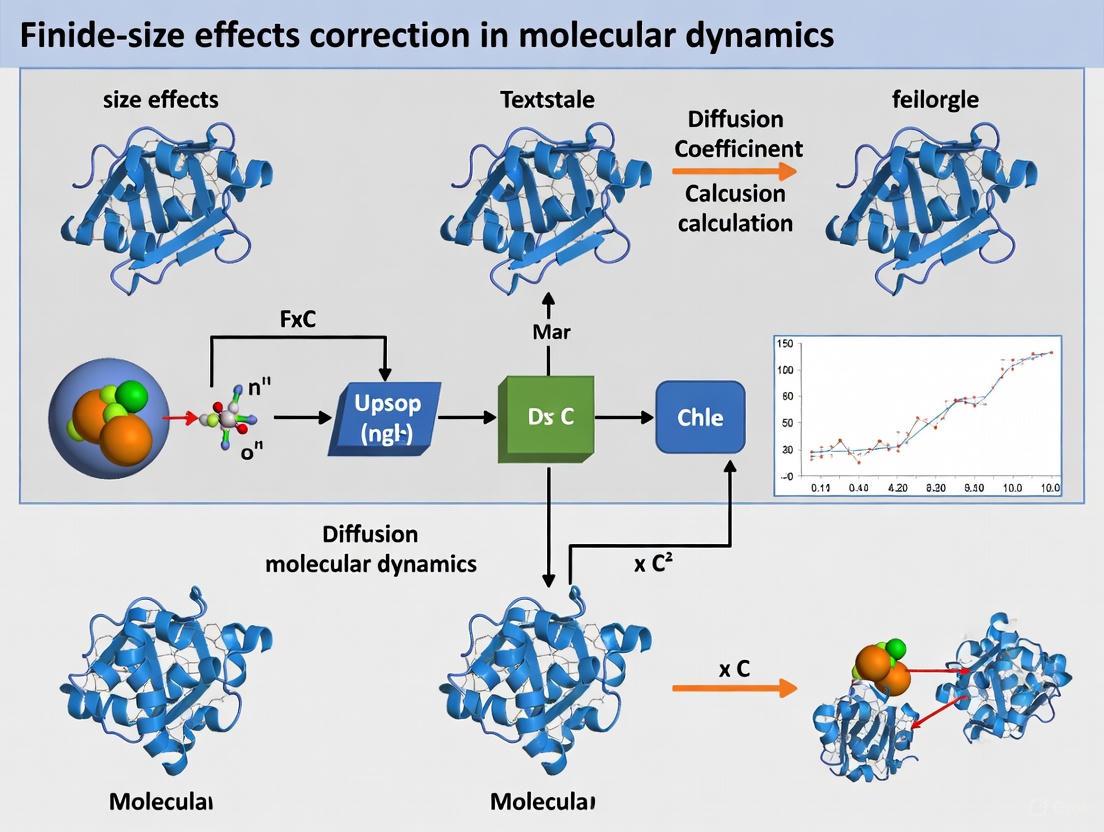
This article provides a systematic examination of finite-size effects on diffusion coefficients computed from molecular dynamics simulations, addressing self-diffusion, Maxwell-Stefan, and Fick diffusion coefficients across pure fluids to multicomponent mixtures.
Finite-Size Effects Correction in Molecular Dynamics: A Comprehensive Guide to Accurate Diffusion Coefficients
Abstract
This article provides a systematic examination of finite-size effects on diffusion coefficients computed from molecular dynamics simulations, addressing self-diffusion, Maxwell-Stefan, and Fick diffusion coefficients across pure fluids to multicomponent mixtures. We explore the foundational hydrodynamic theory behind finite-size corrections, detail methodological implementations including the Yeh-Hummer correction and its extensions, address troubleshooting for challenging systems near demixing or with electrostatic interactions, and present validation case studies from Lennard-Jones systems to molecular mixtures. Special emphasis is placed on implications for biomedical and pharmaceutical research where accurate diffusion predictions are critical for drug delivery systems and biomolecular transport.
Understanding Finite-Size Effects: Why Simulated Diffusion Coefficients Depend on System Size
In molecular dynamics (MD) simulations, the assessment of transport properties, such as diffusion coefficients, is fundamentally constrained by the finite size of the simulation box. This limitation creates a significant discrepancy between computed values from MD and the true properties of a system at the thermodynamic limit (TL), where the number of particles (N) and the system volume (V) approach infinity (N→∞, V→∞, N/V=constant) [1]. For properties dependent on long-wavelength fluctuations and collective molecular motion, such as mutual diffusion, this finite-size effect is particularly pronounced. The core problem is that conventional MD simulations model a finite, closed system (NVT or NVE ensembles) with periodic boundary conditions, which perturbs the long-range hydrodynamic interactions responsible for diffusion phenomena [2]. Consequently, a direct comparison between simulation results and experimental data, or their use in predictive modeling for applications like drug development, requires robust methods to extrapolate finite-size MD results to the thermodynamic limit.
Theoretical Background
Key Diffusion Coefficients and Their Physical Meaning
In MD simulations, several types of diffusion coefficients are analyzed, each with a distinct physical interpretation and method of calculation. Table 1 summarizes these coefficients and their relationships.
Table 1: Types of Diffusion Coefficients in Molecular Dynamics Simulations
| Coefficient Type | Symbol | Definition | Calculation Method (EMD) | Relevance to Finite-Size Effects | ||
|---|---|---|---|---|---|---|
| Self-Diffusion | ( D_{i,self} ) | Measures the translational motion of a single tagged particle i due to its own Brownian motion. | Einstein relation: ( D{i,self} = \lim{t \to \infty} \frac{1}{6t} \langle | \mathbf{r}j(t) - \mathbf{r}j(0) | ^2 \rangle ) [2] | Strong dependency on system size; scales with ( N^{-1/3} ) [2]. |
| Maxwell-Stefan (MS) | ( \Ä_{MS} ) | Describes collective mass transport driven by the gradient in chemical potential. | Based on Onsager coefficients from cross-correlation of molecular displacements [2]. | Stronger finite-size dependency than self-diffusion; also influenced by mixture non-ideality [2]. | ||
| Fick | ( D_{Fick} ) | The coefficient relating mass flux to a concentration gradient (Fick's first law). | Calculated from the MS diffusivity and the thermodynamic factor: ( D{Fick} = \Ä{MS} \times \Gamma ) [2]. | Inherits finite-size effects from ( \Ä_{MS} ). |
The thermodynamic factor (( \Gamma )), which measures the non-ideality of a mixture, is a critical component linking MS and Fick diffusivities. For systems close to demixing, the thermodynamic factor can be large, amplifying the finite-size effects on the computed mutual diffusivities [2].
The Origin of Finite-Size Effects in Diffusion
The finite-size dependency arises from the use of periodic boundary conditions, which alter the hydrodynamic self-interactions of particles. In an infinite system, a particle moving through a fluid creates a flow field that decays with distance. In a finite, periodic system, this flow field interacts with its periodic images, effectively reducing the perceived friction and leading to an overestimation of diffusion coefficients [2]. This effect is universal but is particularly critical for collective diffusion coefficients like the MS diffusivity, where the motion of all molecules is correlated.
Correction Methodologies for the Thermodynamic Limit
The Yeh-Hummer Correction for Self-Diffusion
Yeh and Hummer derived an analytical correction for self-diffusion coefficients based on hydrodynamic theory for a spherical particle in a Stokes flow with periodic boundary conditions [2]. The correction term allows for the extrapolation of the finite-size self-diffusivity (( D{i,self} )) to its value at the thermodynamic limit (( D{i,self}^\infty )).
Equation 1: Yeh-Hummer (YH) Correction for Self-Diffusion [ D{i,self}^\infty = D{i,self} + D{YH} = D{i,self} + \frac{kB T \xi}{6 \pi \eta L} ] Here, ( kB ) is the Boltzmann constant, ( T ) is the temperature, ( \eta ) is the shear viscosity of the system, ( L ) is the box length, and ( \xi ) is a dimensionless constant equal to 2.837297 for cubic boxes [2]. The shear viscosity (( \eta )) itself can be computed from equilibrium MD simulations and is independent of system size, making it a reliable parameter in this correction [2].
Proposed Correction for Maxwell-Stefan Diffusivity
The finite-size effects on MS diffusivities are more complex because they depend not only on box size, temperature, and viscosity but also on the non-ideality of the mixture, captured by the thermodynamic factor. A correction for the MS diffusion coefficient in binary mixtures has been proposed, extending the concepts of the YH correction [2].
Equation 2: Finite-Size Correction for Maxwell-Stefan Diffusivity [ \Ä{MS}^\infty = \Ä{MS} + \frac{kB T \xi}{6 \pi \eta L} \Gamma ] In this equation, ( \Gamma ) is the thermodynamic factor. This relationship indicates that for highly non-ideal mixtures (where ( \Gamma ) is large), the finite-size correction can be substantial—sometimes even larger than the simulated ( \Ä{MS} ) value itself, especially for systems near demixing [2].
The following workflow diagram illustrates the protocol for applying these corrections, from running the simulation to obtaining the TL-corrected diffusivity.
Experimental Protocols
Protocol A: Calculating and Correcting Self-Diffusion Coefficients
This protocol details the steps for obtaining a self-diffusion coefficient in the thermodynamic limit from an equilibrium MD simulation.
- System Preparation: Construct a simulation box containing N particles of the species of interest, using a validated force field. Apply periodic boundary conditions in all three dimensions. Equilibrate the system thoroughly in the desired ensemble (e.g., NVT) at the target temperature and density.
- Production Simulation: Run a sufficiently long equilibrium MD simulation to ensure good statistics for trajectory analysis. The simulation time should be several times longer than the diffusion relaxation time of the molecules.
- Compute Finite-Size Self-Diffusivity (( D{i,self} )): Use the Einstein relation from the mean-squared displacement (MSD) of the molecules [2]: ( D{i,self} = \lim{t \to \infty} \frac{1}{6t} \langle | \mathbf{r}j(t) - \mathbf{r}j(0) |^2 \rangle ) Ensure the MSD plot is linear in the diffusive regime, and fit the slope to obtain ( D{i,self} ).
- Compute Shear Viscosity (( \eta )): Calculate the shear viscosity from the autocorrelation of the off-diagonal components of the stress tensor (Pαβ) using the Green-Kubo relation [2]: ( \eta = \frac{V}{kB T} \int0^\infty \langle P{\alpha\beta}(t) \cdot P{\alpha\beta}(0) \rangle dt )
- Apply the YH Correction: Using the box length ( L ), temperature ( T ), computed viscosity ( \eta ), and the constant ( \xi = 2.837297 ), calculate the correction term and add it to the simulated ( D{i,self} ) to obtain ( D{i,self}^\infty ) as shown in Equation 1.
Protocol B: Calculating and Correcting Maxwell-Stefan Diffusivities
This protocol extends the methodology to mutual diffusion in binary mixtures.
- System Preparation & Production: Follow Steps 1 and 2 from Protocol A for a binary mixture.
- Compute Finite-Size MS Diffusivity (( \Ä{MS} )): Calculate the Onsager coefficients (Λâ‚â‚, Λ₂₂, Λâ‚â‚‚) from the cross-correlation of the molecular displacements [2]. For a binary mixture, the MS diffusivity is related to the Onsager coefficients by: ( \Ä{MS} = \frac{x2}{x1} \Lambda{11} + \frac{x1}{x2} \Lambda{22} - 2 \Lambda{12} ) where ( x1 ) and ( x_2 ) are the mole fractions of the two components.
- Compute the Thermodynamic Factor (( \Gamma )): Determine the thermodynamic factor, which requires knowledge of the concentration dependence of the chemical potentials. This can be obtained from free energy calculations (e.g., thermodynamic integration) or from a model equation of state fitted to simulation data.
- Apply the MS Correction: Using the same parameters as the YH correction and the computed thermodynamic factor, apply Equation 2 to extrapolate ( \Ä{MS} ) to ( \Ä{MS}^\infty ).
Data Presentation and Analysis
Quantitative Finite-Size Effects and Corrections
The magnitude of finite-size effects and the efficacy of the corrections can be demonstrated by simulating systems of varying sizes. Table 2 presents hypothetical data for a Lennard-Jones system, illustrating how diffusivities converge to the TL value after correction.
Table 2: Exemplary Finite-Size Data and Correction for a Binary Lennard-Jones Mixture (Component A) (T, Ï, and composition held constant across simulations)
| Number of Molecules (N) | Box Length L (σ) | D_self (σ²/Ï„) | D_self∞ (Corrected) (σ²/Ï„) | Ä_MS (σ²/Ï„) | Γ | Ä_MS∞ (Corrected) (σ²/Ï„) |
|---|---|---|---|---|---|---|
| 512 | 8.0 | 0.115 | 0.131 | 0.085 | 2.5 | 0.131 |
| 1000 | 10.0 | 0.121 | 0.130 | 0.095 | 2.5 | 0.128 |
| 4000 | 15.9 | 0.127 | 0.131 | 0.112 | 2.5 | 0.129 |
| 8000 | 20.0 | 0.129 | 0.131 | 0.120 | 2.5 | 0.130 |
| Thermodynamic Limit | ∞ | ~0.131 | ~0.130 |
Note: σ and τ are Lennard-Jones units of length and time. Data is illustrative based on trends described in [2].
The data in Table 2 shows two key trends: 1) both self and MS diffusivities increase with system size, and 2) after applying the respective corrections, the values for different system sizes converge towards a consistent TL value, validating the methodology.
The Scientist's Toolkit
Research Reagent Solutions
Table 3: Essential Materials and Computational Tools for Finite-Size Correction Studies
| Item / Reagent | Function / Description | Example / Note |
|---|---|---|
| Molecular Dynamics Software | Software package to perform the simulations and often basic trajectory analysis. | ESPResSo++ [1], GROMACS, LAMMPS, HOOMD-blue. |
| Validated Force Field | A set of parameters describing the interatomic potentials for the molecules being studied. | Truncated and shifted Lennard-Jones (TSLJ) for prototypical liquids [1]; OPLS-AA, CHARMM, AMBER for molecular systems. |
| Trajectory Analysis Tools | Custom or built-in scripts to compute MSD, stress tensor autocorrelation, and Onsager coefficients. | Python (MDAnalysis, MDTraj), custom C++/Fortran codes. |
| Thermodynamic Property Calculator | Tools to compute chemical potentials and the thermodynamic factor (Γ). | Free energy perturbation (FEP), thermodynamic integration (TI) methods, or equations of state implemented in analysis suites. |
| Post-Processing Scripts | Custom scripts to implement the finite-size correction formulas (Equations 1 & 2). | In-house Python or MATLAB scripts to aggregate data from multiple system sizes and perform the TL extrapolation. |
| Olivetol-d9 | Olivetol-d9, CAS:137125-92-9, MF:C11H16O2, MW:189.30 g/mol | Chemical Reagent |
| MCPD dioleate | [3-chloro-2-[(Z)-octadec-9-enoyl]oxypropyl] (E)-octadec-9-enoate |
Hydrodynamic Origins of System-Size Dependence in Diffusion
In molecular dynamics (MD) simulations, accurately calculating diffusion coefficients is essential for understanding transport phenomena in materials science and drug development. However, a significant challenge arises from finite-size effects, where the simulated system's inherently small size—often just hundreds or thousands of molecules—distorts the calculated diffusivities compared to the thermodynamic limit (real-world conditions). These effects originate from hydrodynamic self-interactions due to the periodic boundary conditions (PBCs) typically employed in MD simulations [2]. This application note details the hydrodynamic theory underlying these artifacts and provides validated protocols for correcting them, enabling more reliable prediction of diffusion coefficients for applications such as drug candidate screening and material design.
Hydrodynamic Theory of Finite-Size Effects
The primary source of system-size dependence in diffusion coefficients stems from the use of PBCs. In an infinite, unbound system, a particle displacing the solvent experiences a hydrodynamic flow that dissipates infinitely. In a finite simulation box with PBCs, this flow field interacts with its own periodic images, affecting the particle's motion [2].
For self-diffusion coefficients (Dself), which describe the Brownian motion of a single tagged particle, the finite-size effect is quantitatively described by the Yeh-Hummer (YH) correction [2]. The theory, based on the hydrodynamic Stokes flow for a spherical particle, establishes a linear relationship between the computed self-diffusivity and the inverse of the simulation box length: D{self}^{∞} = D{self}(L) + \frac{kB T ξ}{6 π η L} Here, D{self}^{∞} is the corrected self-diffusion coefficient in the thermodynamic limit, D{self}(L) is the value obtained from an MD simulation with a cubic box of side length L, η is the shear viscosity of the system, T is the temperature, and k_B is the Boltzmann constant. The dimensionless constant ξ is 2.837297 for cubic boxes with PBCs [2].
For mutual diffusion coefficients, such as the Maxwell-Stefan (ÄMS) diffusivity, the finite-size effect has an additional dependency on the thermodynamic factor (Γ), which characterizes the non-ideality of the mixture. The proposed correction is [2]: Ä{MS}^{∞} = Ä{MS}(L) + \frac{kB T Γ ξ}{6 Ï€ η L} This formulation indicates that the finite-size effect is amplified in non-ideal mixtures, particularly those near demixing, where the thermodynamic factor can be large [2].
Table 1: Key Parameters in Hydrodynamic Finite-Size Corrections
| Parameter | Symbol | Description | How to Obtain |
|---|---|---|---|
| Box Length | ( L ) | Side length of the cubic simulation box. | Directly from the MD simulation setup. |
| Shear Viscosity | ( η ) | Viscosity of the system. | Calculate from MD using the Green-Kubo relation (eq. 3) [2]. |
| Thermodynamic Factor | ( Γ ) | Measure of mixture non-ideality. | Compute from a CALPHAD thermodynamic assessment or MD simulations [2]. |
| YH Constant | ( ξ ) | Dimensionless constant for PBCs. | 2.837297 for standard cubic boxes [2]. |
Quantitative Assessment of System-Size Dependence
The system-size dependence of diffusion coefficients has been quantified across various systems. For the hard-sphere fluid, molecular dynamics simulations reveal that the self-diffusion coefficient D follows a scaling law with the number of particles N: D = D(∞) - AN^{-α}, where the exponent α is approximately 1/3 at intermediate packing fractions (~0.35). This corresponds to a 1/L scaling, consistent with the YH correction. At high and very low densities, the exponent α deviates from 1/3 [3].
For binary mutual diffusion, the finite-size effect can be substantial. A comprehensive study of over 200 binary Lennard-Jones systems and several molecular mixtures showed that the deviation between finite-size and thermodynamic-limit diffusivities can be very significant for mixtures close to demixing. In these cases, the required correction can even be larger than the simulated (finite-size) Maxwell-Stefan diffusivity itself [2].
Table 2: Empirical Scaling of Self-Diffusion with System Size in Hard-Sphere Fluids [3]
| Packing Fraction Range | Scaling Exponent (α) | Notes |
|---|---|---|
| Low Density (< 0.1) | Approaches 1.0 | Due to divergence of mean free path relative to box size. |
| Intermediate (~0.35) | ~0.33 (1/3) | Consistent with hydrodynamic (YH) theory. |
| High Density | ~1.0 | Scaling more closely follows thermodynamic properties. |
Experimental Protocols for Correction
Protocol 1: Correcting Self-Diffusion Coefficients
This protocol outlines the steps to correct self-diffusion coefficients obtained from equilibrium MD simulations for finite-size effects.
Research Reagent Solutions: Table 3: Essential Materials and Tools for Finite-Size Correction
| Item | Function/Description |
|---|---|
| MD Simulation Software | Software package (e.g., GROMACS, LAMMPS, MOE) to perform the dynamics simulations and calculate mean-square displacement [4] [2]. |
| Force Field Parameters | Set of potentials (e.g., Lennard-Jones, MMFF94x) defining interatomic interactions for the system of interest [4] [2]. |
| Thermodynamic Database | CALPHAD-type database for calculating the thermodynamic factor, if required for mutual diffusion [2]. |
| Analysis Scripts | In-house or published scripts (e.g., using IDL, Python) for implementing the YH correction and calculating viscosity [5] [2]. |
Step-by-Step Procedure:
- System Preparation: Construct the simulation box containing N molecules for your system of interest (e.g., a pure solvent or a mixture) using appropriate force fields. Ensure PBCs are applied in all directions [2].
- MD Simulation: Perform an equilibrium MD simulation under the desired thermodynamic conditions (constant NVT or NPT ensemble). Ensure the simulation is long enough for the mean-square displacement (MSD) to reach the diffusive regime [2].
- Calculate D(L): Compute the self-diffusion coefficient D(L) for the finite system using the Einstein relation from the MSD of the molecules (eq. 1) [2].
- Calculate Viscosity: In the same simulation, calculate the shear viscosity η of the system. This is typically done using the Green-Kubo method, which integrates the stress tensor autocorrelation function (eq. 3) [2]. Note that viscosity itself is generally independent of system size [2].
- Apply YH Correction: Using the box length L, viscosity η, and temperature T from your simulation, calculate the correction term and add it to the computed D(L) to obtain D_{self}^{∞} (eq. 2) [2].
- Validation: Repeat steps 1-5 for at least two different system sizes (e.g., N=500 and N=2000). Plot the computed D(L) against 1/L. The data should fall on a straight line, and the y-intercept (1/L -> 0) corresponds to D_{self}^{∞}, providing a model-free validation of the correction [2].
Protocol 2: Correcting Mutual Diffusion Coefficients
This protocol extends the correction to Maxwell-Stefan diffusion coefficients in binary mixtures.
Step-by-Step Procedure:
- MD Simulation: Perform an equilibrium MD simulation of the binary mixture at the desired composition and temperature [2].
- Calculate Onsager Coefficients: From the particle trajectories, compute the Onsager coefficients Λ_ij using the Einstein relation based on the cross-correlations of molecular displacements (eq. 4) [2].
- Compute Finite-Size ÄMS: Obtain the finite-size Maxwell-Stefan diffusivity ÄMS(L) from the Onsager coefficients and the mixture composition [2].
- Determine Thermodynamic Factor: Calculate the thermodynamic factor Γ for the mixture. This can be derived from a CALPHAD thermodynamic database or computed directly from the MD simulation via fluctuation theory [2].
- Apply Mutual Diffusion Correction: Calculate the corrected mutual diffusion coefficient in the thermodynamic limit using the formula that incorporates the thermodynamic factor: Ä{MS}^{∞} = Ä{MS}(L) + (k_B T Γ ξ) / (6 Ï€ η L) [2].
The Scientist's Toolkit
Table 4: Key Reagents and Computational Tools for Diffusion Studies
| Category | Specific Tool/Method | Function in Research |
|---|---|---|
| Simulation Methods | Equilibrium MD (EMD) | Compute diffusion coefficients from particle trajectories at equilibrium [2]. |
| Einstein Formulation | Calculate diffusivities from the slope of the mean-square displacement (MSD) vs. time [2]. | |
| Analysis Tools | HYDROPRO | Calculate hydrodynamic properties (e.g., Rh) from atomistic structures; accurate but computationally intensive [6]. |
| Kirkwood-Riseman Equation | An efficient and accurate method for calculating the hydrodynamic radius from atomic coordinates [7]. | |
| Physical Models | Stokes-Einstein Equation | Relates diffusion coefficient (D) to hydrodynamic radius (Rh): D = kBT / (6πηRh) [4] [6]. |
| Radius of Gyration (Rg) | A measure of molecular size that can be efficiently calculated from ensembles of conformations [6]. | |
| Experimental Validation | Pulsed-Field Gradient (PFG) NMR | Measures translational diffusion coefficients in solution, providing experimental Rh for validation [6] [7]. |
| Small-Angle X-Ray Scattering (SAXS) | Probes the radius of gyration (Rg) of proteins in solution, offering complementary structural data [6]. | |
| Phenazopyridine | Phenazopyridine, CAS:94-78-0, MF:C11H11N5, MW:213.24 g/mol | Chemical Reagent |
| Raloxifene N-oxide | Raloxifene N-oxide, CAS:195454-31-0, MF:C28H27NO5S, MW:489.6 g/mol | Chemical Reagent |
Theoretical Foundations and Definitions
Understanding the distinct mechanisms of molecular transport is fundamental to accurately modeling and predicting the behavior of fluids in various scientific and industrial contexts. Self-diffusion and mutual diffusion describe different physical phenomena governed by separate driving forces and mathematical formalisms. Self-diffusion refers to the random Brownian motion of a single molecule within a fluid of identical molecules, tracing the trajectory of an individual particle over time [8]. In contrast, mutual diffusion (also called inter-diffusion or collective diffusion) describes the mass transport process where different chemical species intermingle and move down their concentration gradients [9] [10]. This fundamental distinction in physical mechanism leads to significant differences in how these coefficients are defined, measured, and applied across scientific disciplines.
The mathematical description of these processes further highlights their differences. Self-diffusion is characterized by the self-diffusion coefficient (D*), which quantifies the mean-squared displacement of tagged molecules over time. Mutual diffusion in a binary system is described by Fick's first law, where the flux of a component is proportional to its concentration gradient, with the proportionality constant being the mutual diffusion coefficient (D) [9]. For multicomponent systems, this relationship extends to a matrix of Fick diffusion coefficients [11]. A critical theoretical relationship exists at infinite dilution, where the mutual diffusion coefficient equals the self-diffusion coefficient of the infinitely diluted solute [8]. However, at finite concentrations, these values diverge significantly due to intermolecular interactions.
Comparative Analysis: Key Physical Differences
The differential response of self-diffusion and mutual diffusion to intermolecular forces represents one of their most distinguishing characteristics. As demonstrated in membrane systems, interprotein interactions produce markedly different density-dependent changes in these coefficients [12]. Self-diffusion is consistently inhibited by all types of interactions—hard-core repulsions, soft repulsions, and soft repulsions with weak attractions [12]. In contrast, mutual diffusion exhibits a more complex response: it is inhibited by attractive interactions but enhanced by repulsive forces [12]. This fundamental difference arises because self-diffusion depends solely on molecular mobility, while mutual diffusion incorporates both mobility and thermodynamic driving forces.
The conceptual frameworks for these diffusion processes also differ substantially. Self-diffusion can be visualized as the "tracer" motion of a tagged molecule within a homogeneous medium, whereas mutual diffusion describes the macroscopic flux resulting from concentration inhomogeneities. This distinction becomes particularly important in applications such as drug development, where both the passive mobility of a drug molecule (self-diffusion) and its transport across concentration gradients (mutual diffusion) play critical roles in delivery efficacy. The different responses to interactions help explain why disparate values for protein diffusion coefficients are obtained from different experimental techniques such as fluorescence recovery after photobleaching (measuring self-diffusion) and postelectrophoresis relaxation (measuring mutual diffusion) [12].
Table 1: Fundamental Differences Between Self-Diffusion and Mutual Diffusion
| Characteristic | Self-Diffusion | Mutual Diffusion |
|---|---|---|
| Definition | Motion of tagged particles in a uniform chemical potential | Net transport of different species down concentration gradients |
| Driving Force | Thermal energy (Brownian motion) | Chemical potential gradient |
| System Composition | Single-component or uniform mixture | Multi-component system with composition variations |
| Response to Repulsive Interactions | Always decreased | Enhanced |
| Response to Attractive Interactions | Decreased | Inhibited |
| Experimental Techniques | NMR, FRAP, tracer diffusion | Optical interference, Taylor dispersion, diaphragm cell |
Quantitative Relationships and Mathematical Formalism
The mathematical description of diffusion processes reveals the intricate relationships between different diffusion coefficients. For binary mixtures, the Darken equation provides a fundamental relationship connecting mutual and self-diffusion coefficients:
D = (xâ‚‚Dâ‚* + xâ‚Dâ‚‚*)Γ
where D is the mutual diffusion coefficient, Dâ‚* and Dâ‚‚* are the self-diffusion coefficients of components 1 and 2, xâ‚ and xâ‚‚ are their mole fractions, and Γ is the thermodynamic factor [10]. The thermodynamic factor, defined as Γ = 1 + (∂lnγ/∂lnx), where γ is the activity coefficient, accounts for non-ideal mixing behavior [10]. In ideal solutions where components mix randomly, Γ = 1, simplifying the relationship between diffusion coefficients.
The Maxwell-Stefan formulation provides an alternative framework that relates Fick diffusivities (DFick) to Maxwell-Stefan diffusivities (ÄMS) through the matrix of thermodynamic factors [Γ]: [DFick] = [Γ][ÄMS] [11]. This relationship becomes particularly important when describing diffusion in multicomponent systems, where cross-interactions between multiple species must be considered. The matrix of Fick diffusivities contains (n-1)² elements for an n-component mixture, while n·(n-1)/2 Maxwell-Stefan diffusion coefficients are defined [11].
Table 2: Classification of Diffusion Coefficient Types and Their Characteristics
| Diffusion Coefficient Type | Symbol | Definition | Key Applications |
|---|---|---|---|
| Self-Diffusion | D* | Mobility of a species in itself (no net transport) | Studying molecular mobility in pure substances |
| Mutual Diffusion | D_AB | Diffusion of one constituent in a binary system | Mass transfer calculations in chemical processes |
| Tracer Diffusion | D_A'B | Diffusion of a tagged isotope in a mixture | Tracking specific molecules without chemical potential gradient |
| Intrinsic Diffusion | D_A | Diffusion flux relative to container-fixed coordinates | Systems with significant molecular size disparities |
Finite-Size Effects in Molecular Dynamics Simulations
Molecular dynamics (MD) simulations provide powerful tools for computing diffusion coefficients, but the finite size of simulation boxes introduces systematic errors that must be corrected. Self-diffusion coefficients computed from equilibrium MD (Di,self^MD) exhibit a well-characterized system-size dependency, scaling linearly with the inverse of the simulation box length (L) [11]. The Yeh-Hummer (YH) correction provides an analytical finite-size correction for self-diffusivity: Di,self^∞ = Di,self^MD + (kBTξ)/(6πηL), where Di,self^∞ is the self-diffusivity in the thermodynamic limit, kB is Boltzmann's constant, T is temperature, η is shear viscosity, and ξ is a constant dependent on simulation box shape (ξ = 2.837297 for cubic boxes) [11].
For mutual diffusion coefficients, finite-size effects manifest differently. Recent research has established that only the diagonal elements of the Fick matrix show system-size dependency, correctable by adding the YH term [11]. An eigenvalue analysis of finite-size effects reveals that the eigenvector matrix of Fick diffusivities does not depend on system size, while eigenvalues (describing diffusion speed) do [11]. For Maxwell-Stefan diffusivities, all elements depend on system size, with corrections depending on the matrix of thermodynamic factors [11]. For binary mixtures, the finite-size correction for the Fick diffusion coefficient follows the same form as for self-diffusivities: DFick^∞ = DFick^MD + (k_BTξ)/(6πηL) [11].
Experimental Protocols and Measurement Techniques
Fluorescence Recovery After Photobleaching (FRAP) for Self-Diffusion
Principle: FRAP measures the lateral mobility of fluorescently tagged molecules in membranes or solutions by monitoring the recovery of fluorescence in a photobleached area [12].
Protocol:
- Tag molecules of interest with a fluorescent marker (e.g., GFP, fluorescein)
- Photobleach a defined region using high-intensity laser light
- Monitor fluorescence recovery in the bleached area with low-intensity laser
- Quantify the recovery kinetics using appropriate diffusion models
- Calculate the self-diffusion coefficient from the recovery half-time and bleach spot geometry
Applications: Protein mobility in cell membranes, lipid diffusion, polymer films [12].
Postelectrophoresis Relaxation for Mutual Diffusion
Principle: This technique measures mutual diffusion by analyzing the relaxation of concentration gradients after applying an electric field pulse [12].
Protocol:
- Establish an initial concentration gradient in the sample
- Apply a controlled electric field pulse to induce electrophoretic migration
- Turn off the electric field and monitor the relaxation process via interferometry or spectroscopy
- Analyze the spatial and temporal decay of concentration gradients
- Extract mutual diffusion coefficients from relaxation kinetics
Applications: Protein solutions, colloidal suspensions, polyelectrolyte mixtures.
Molecular Dynamics Simulation Protocol for Diffusion Coefficients
System Setup:
- Build initial configuration with appropriate number of molecules (≥1000 recommended)
- Apply periodic boundary conditions to minimize finite-size effects
- Select appropriate force field parameters for all molecular interactions
Equilibration Phase:
- Energy minimization using steepest descent or conjugate gradient algorithm
- NVT equilibration (constant number of particles, volume, and temperature) for 1-5 ns
- NPT equilibration (constant number of particles, pressure, and temperature) for 5-10 ns
Production Phase:
- Conduct equilibrium molecular dynamics simulation for sufficient duration (≥50 ns)
- Record particle trajectories at appropriate intervals (0.1-1 ps)
- For self-diffusion: Calculate mean-squared displacement (MSD) of individual molecules
- For mutual diffusion: Compute Onsager coefficients from velocity cross-correlations
- Apply finite-size corrections using YH formalism for accurate thermodynamic limit values
Research Reagent Solutions and Essential Materials
Table 3: Essential Materials for Diffusion Coefficient Studies
| Reagent/Material | Function/Application | Specific Examples |
|---|---|---|
| Deuterated Solvents | NMR-based diffusion measurements without interference | D₂O, CDCl₃, DMSO-d₆ |
| Fluorescent Tags | Molecular labeling for FRAP measurements | GFP, fluorescein, rhodamine |
| Force Fields | Molecular dynamics simulations | CHARMM, AMBER, OPLS for organic molecules |
| Deep Eutectic Solvents | Environmentally friendly solvent media for pharmaceutical applications | Caprylic acid-based DES [13] |
| Porous Media Models | Studying confinement effects on diffusion | Nanotubes, controlled pore glasses [13] |
| Ternary Model Systems | Validation of multicomponent diffusion theories | Chloroform/acetone/methanol [11] |
Visualization of Diffusion Relationships and Workflows
Diagram 1: Workflow for computing and correcting diffusion coefficients in MD simulations, showing the different pathways for self-diffusion and mutual diffusion.
Diagram 2: Differential response of self-diffusion and mutual diffusion coefficients to intermolecular interactions, based on theoretical and experimental observations.
In molecular dynamics (MD) simulations, accurately predicting transport properties like diffusion coefficients is essential for applications ranging from industrial process design to drug development. A significant challenge in this field is the presence of finite-size effects, where the computed values of these properties depend on the size of the simulation box used. This application note details the core scaling relationship, N^(-1/3), its theoretical foundation, and provides practical protocols for applying finite-size corrections, with a specific focus on Maxwell-Stefan diffusion coefficients in molecular mixtures [2].
The observed finite-size effects arise from the use of periodic boundary conditions in MD simulations. Computed diffusivities have been shown to increase with the number of molecules (N) in the simulation box, meaning that results from finite systems deviate from the true values at the thermodynamic limit (where N approaches infinity). Correcting for this bias is not merely a procedural step but is critical for obtaining reliable data comparable to experimental results, particularly for mixtures near phase separation where the errors can be exceptionally large [2].
Theoretical Foundation: The N^(-1/3) Dependency
The finite-size effect on self-diffusion coefficients manifests as a linear dependency on the inverse of the simulation box's side length. Since the box length (L) is proportional to N^(1/3) for a cubic box, this relationship is equivalently expressed as a linear function of N^(-1/3) [2].
Table 1: Core Scaling Relationships for Diffusion Coefficients in MD Simulations
| Diffusion Coefficient Type | Finite-Size Scaling Relationship | Key Determinants of the Finite-Size Effect |
|---|---|---|
Self-Diffusion (D_self) |
Scales linearly with N^(-1/3) (or 1/L) [2]. |
System size (L), Temperature (T), Shear viscosity (η) [2]. |
Maxwell-Stefan (Ä_MS) |
Scaling is influenced by N^(-1/3) but is more complex [2]. |
System size (L), Temperature (T), Shear viscosity (η), Thermodynamic factor (Γ) [2]. |
The foundational correction for self-diffusion coefficients was derived by Yeh and Hummer (YH) based on hydrodynamic theory [2]. The Yeh-Hummer correction estimates the self-diffusion coefficient in the thermodynamic limit (D_self∞) from the finite-size value (D_self) obtained via MD simulation using the following equation:
D_self∞ = D_self + D_YH
Where the YH correction term is: D_YH = (k_B * T * ξ) / (3 * π * η * L)
Variables: k_B is the Boltzmann constant, T is temperature, η is shear viscosity, L is the box length, and ξ is a dimensionless constant (2.837297 for cubic boxes with periodic boundary conditions) [2].
For Maxwell-Stefan (MS) diffusivities, the finite-size effect is more complex. While it also depends on system size, temperature, and viscosity, it exhibits a strong additional dependence on the non-ideality of the mixture, quantified by the thermodynamic factor (Γ). Research has shown that for mixtures close to demixing, where the thermodynamic factor is large, the required finite-size correction can be even greater than the simulated MS diffusivity itself [2].
Experimental Protocols
Protocol 1: Correcting Self-Diffusion Coefficients
This protocol outlines the steps to compute and correct self-diffusion coefficients for a species in a binary mixture using Equilibrium Molecular Dynamics (EMD).
1. Simulation Setup:
- Software: Use an EMD-capable package (e.g., GROMACS, LAMMPS).
- System: Construct a cubic simulation box containing N molecules of a binary mixture.
- Ensemble: Run simulations in the NVT or NPT ensemble to ensure proper equilibrium state sampling.
- Boundary Conditions: Apply periodic boundary conditions in all three dimensions.
2. Data Collection via Einstein Formulation:
- Calculate the self-diffusion coefficient for species
i(D_self,i) from the mean-square displacement (MSD) of its molecules [2]:D_self,i = (1 / 6) * lim (t→∞) d/(dt) 〈 (1/N_i) * Σ |r_j,i(t) - r_j,i(0)|^2 〉 - Parameters:
N_iis the number of molecules of speciesi,r_j,iis the position vector of thej-th molecule of speciesi, and angle brackets denote the ensemble average.
3. Shear Viscosity Calculation:
- Compute the shear viscosity (
η) using the Green-Kubo relation, which integrates the autocorrelation of the off-diagonal elements of the stress tensor (P_αβ) [2]:η = (V / k_B T) * ∫_0^∞ 〈 P_αβ(0) P_αβ(t) 〉 dt - The shear viscosity is typically independent of system size and can be treated as a constant for the correction [2].
4. Application of Yeh-Hummer Correction:
- Apply the YH correction for each species using the formula in Section 2 to obtain the size-corrected self-diffusion coefficient,
D_self∞,i.
Protocol 2: Correcting Maxwell-Stefan Diffusion Coefficients
This protocol describes the methodology for obtaining finite-size corrected Maxwell-Stefan diffusivities, which describe collective motion in mixtures.
1. Simulation Setup: Follow the same setup as in Protocol 1.
2. Onsager Coefficients Calculation:
- Compute the Onsager coefficients (
Λ_ij) from the cross-correlation of molecular displacements [2]:Λ_ij = (1 / (6 * t * N)) * lim (t→∞) d/(dt) Σ Σ 〈 (r_k,i(t) - r_k,i(0)) * (r_l,j(t) - r_l,j(0)) 〉where the summations are over all molecules of speciesiandj.
3. Finite-Size MS Diffusivity Calculation:
- Calculate the finite-size Maxwell-Stefan diffusivity (
Ä_MS) from the Onsager coefficients and the mixture composition.
4. Correction to Thermodynamic Limit:
- Current research indicates that a correction for MS diffusivities is necessary and is a function of the viscosity, box size, and the thermodynamic factor (Γ) [2].
- The thermodynamic factor, which measures mixture non-ideality, can be obtained from equations of state or free energy calculations.
- The specific formulation of this correction is an active area of research, and practitioners should consult the latest literature (e.g., [2]) for the most current correction procedures.
Table 2: Key Research Reagents and Computational Tools
| Category | Item / Software | Function in Research |
|---|---|---|
| Software Tools | GROMACS, LAMMPS | Molecular dynamics simulation packages for performing EMD simulations and calculating trajectories. |
| Custom Scripts (Python/MATLAB) | For data analysis, including calculating MSD, applying the YH correction, and computing viscosities. | |
| Theoretical Models | Lennard-Jones Potential | A model intermolecular potential used to simulate a wide variety of binary systems for method verification [2]. |
| Yeh-Hummer (YH) Correction | The analytic correction term for extrapolating self-diffusion coefficients to the thermodynamic limit [2]. | |
| Physical Properties | Shear Viscosity (η) | A key transport property required for calculating the finite-size correction [2]. |
| Thermodynamic Factor (Γ) | A measure of mixture non-ideality, crucial for correcting Maxwell-Stefan diffusivities [2]. |
Workflow and Relationship Visualizations
Diagram 1: Finite-Size Correction Workflow for MD Simulations.
Diagram 2: The N^(-1/3) Relationship and Correction Logic.
Molecular Dynamics (MD) simulations have emerged as a powerful computational tool for predicting transport properties, including diffusion coefficients, which are crucial for understanding mass transport in chemical and biological systems. However, a fundamental limitation persists: the number of molecules in a typical MD simulation is orders of magnitude lower than in real physical systems at the thermodynamic limit. This discrepancy introduces significant finite-size effects in computed diffusivities [2] [14]. The recognition and systematic correction of these artifacts have been a central challenge in computational physics and chemistry. This review traces the historical development of finite-size corrections for diffusion coefficients, beginning with the foundational work of Dünweg and Kremer and culminating in the widely adopted Yeh-Hummer (YH) correction, while also exploring its extensions to more complex systems.
The core issue stems from the use of Periodic Boundary Conditions (PBC). While PBC minimize surface effects and are computationally efficient, they introduce artificial hydrodynamic interactions between a molecule and its periodic images. Dünweg and Kremer first quantitatively demonstrated that self-diffusivities computed from MD scale linearly with the inverse of the simulation box length (1/L) [11]. This finding established a systematic framework for understanding finite-size dependencies, setting the stage for the development of robust correction schemes.
Foundational Work: Dünweg and Kremer's Pioneering Insight
In the early 1990s, the work of Dünweg and Kremer provided the first major insight into the system-size dependence of self-diffusion coefficients [11] [14]. Through MD simulations, they established an empirical relationship showing that the computed self-diffusivity ((D_{\text{self}}^{\text{MD}})) decreases linearly with the inverse of the side length ((L)) of a cubic simulation box. Their work highlighted that the finite-size effect was not a mere numerical artifact but a consequence of the hydrodynamic self-interactions imposed by PBC. This linear relationship with 1/L became the cornerstone for all subsequent theoretical developments, including the Yeh-Hummer correction.
The Yeh-Hummer Correction: A Landmark Theoretical Advancement
Building upon the empirical foundation laid by Dünweg and Kremer, Yeh and Hummer performed a detailed investigation in 2004, leading to a seminal analytical correction [2] [11]. They derived the now-famous YH correction term based on hydrodynamic theory for a spherical particle in a Stokes flow with PBC. The correction allows researchers to extrapolate the self-diffusion coefficient from a finite simulation box to the thermodynamic limit ((D_{\text{self}}^{\infty})).
The central equation is:
[ D{\text{self}}^{\infty} = D{\text{self}}^{\text{MD}} + \frac{k_{B} T \xi}{6 \pi \eta L} ]
Here:
- (D_{\text{self}}^{\text{MD}}) is the self-diffusivity obtained directly from the MD simulation.
- (k_{B}) is the Boltzmann constant.
- (T) is the system temperature.
- (\eta) is the shear viscosity of the fluid.
- (L) is the side length of the cubic simulation box.
- (\xi) is a dimensionless constant equal to 2.837297 for cubic boxes [2] [11].
A key insight from Yeh and Hummer was that the shear viscosity ((\eta)) itself, computed from the same MD simulation, does not exhibit significant finite-size effects [2]. This makes the correction self-consistent, as the viscosity required for the formula can be reliably obtained from the finite simulation.
Table 1: Key Parameters in the Yeh-Hummer Correction for Self-Diffusion
| Parameter | Symbol | Description | Note |
|---|---|---|---|
| Boltzmann Constant | (k_B) | Fundamental physical constant | (1.380649 \times 10^{-23} \text{J/K}) |
| System Temperature | (T) | Absolute temperature of simulation | Input from MD setup |
| Shear Viscosity | (\eta) | Viscosity of the fluid | Computed from the same MD simulation |
| Box Size | (L) | Side length of cubic simulation box | Known simulation parameter |
| Dimensionless Constant | (\xi) | Geometric factor for PBC | (\xi = 2.837297) for cubic boxes |
Extension to Mutual Diffusion Coefficients
While the original YH correction was derived for self-diffusion, its application to mutual diffusion coefficients—which describe collective mass transport due to concentration gradients—required further research. Two key mutual diffusion formalisms are the Fick and Maxwell-Stefan (MS) diffusivities [2].
Binary Mixtures
For binary mixtures, the finite-size effect on the Fick diffusion coefficient ((D_{\text{Fick}})) was found to be identical to that for self-diffusion [11]:
[ D{\text{Fick}}^{\infty} = D{\text{Fick}}^{\text{MD}} + \frac{k_{B} T \xi}{6 \pi \eta L} ]
The correction for the MS diffusivity ((\Ä_{\text{MS}})) must account for the non-ideality of the mixture, captured by the thermodynamic factor ((\Gamma)) [2]:
[ \Ä{\text{MS}}^{\infty} = \Ä{\text{MS}}^{\text{MD}} + \frac{1}{\Gamma} \frac{k_{B} T \xi}{6 \pi \eta L} ]
This relationship is critical because it shows that for mixtures close to demixing, where (\Gamma) is large, the finite-size correction can be even greater than the simulated diffusivity itself [2].
Multicomponent Mixtures
The generalization to multicomponent systems revealed that only the eigenvalues of the Fick diffusion matrix, which represent the intrinsic rates of diffusion, are subject to finite-size effects. The eigenvector matrix, which defines the diffusion modes, is independent of system size [11]. Consequently, the finite-size correction for the matrix of Fick diffusivities (([\mathbf{D}_{\text{Fick}}])) is applied by adding the standard YH term to the diagonal elements [11].
Advanced Protocols and Application Notes
Protocol 1: Correcting Self-Diffusion Coefficients
This protocol details the steps for obtaining a finite-size corrected self-diffusion coefficient for a pure substance or a component in a mixture.
- System Preparation: Construct a cubic simulation box containing (N) molecules. Ensure the system is equilibrated at the desired temperature and pressure.
- MD Simulation: Perform a sufficiently long Equilibrium MD (EMD) simulation in the NVT or NPT ensemble using a reliable force field.
- Compute Self-Diffusivity ((D{\text{self}}^{\text{MD}})): Use the Einstein relation from the mean-squared displacement (MSD) of the molecules [2]: [ D{\text{self, } i}^{\text{MD}} = \frac{1}{6Ni t} \left\langle \sum{j=1}^{Ni} \left[ \mathbf{r}{j,i}(t0 + t) - \mathbf{r}{j,i}(t0) \right]^2 \right\rangle{t0} ] where (Ni) is the number of molecules of species (i), and (\mathbf{r}_{j,i}) is the position of the (j)-th molecule of species (i).
- Compute Shear Viscosity ((\eta)): Calculate the viscosity from the Green-Kubo relation, which integrates the autocorrelation function of the off-diagonal elements of the stress tensor ((\mathbf{P}{\alpha\beta})) [2]: [ \eta = \frac{V}{kB T} \int0^\infty \left\langle P{\alpha\beta}(t0) P{\alpha\beta}(t0 + t) \right\rangle{t_0} dt ] where (V) is the volume of the system. The average is typically taken over the three independent off-diagonal components (xy, xz, yz).
- Apply YH Correction: Calculate the corrected self-diffusivity at the thermodynamic limit using the box length (L = V^{1/3}): [ D{\text{self}}^{\infty} = D{\text{self}}^{\text{MD}} + \frac{k_{B} T \xi}{6 \pi \eta L} ]
The following workflow diagram illustrates this protocol:
Protocol 2: Correcting Mutual Diffusion in a Binary Mixture
This protocol extends the correction to Maxwell-Stefan diffusivities, which are crucial for describing mass transport in mixtures.
- Steps 1-4: Follow Protocol 1 to perform the simulation and obtain the viscosity ((\eta)) and box size ((L)).
- Compute MS Diffusivity ((\Ä{\text{MS}}^{\text{MD}})): Calculate the Onsager coefficients ((\Lambda{ij})) from the cross-correlations of molecular displacements [2], then derive the MS diffusivity.
- Determine Thermodynamic Factor ((\Gamma)): Compute (\Gamma) from the derivative of the activity coefficient with respect to concentration, often obtained via free energy methods or Kirkwood-Buff analysis [2] [11].
- Apply Binary MS Correction: Calculate the corrected MS diffusivity using the thermodynamic factor: [ \Ä{\text{MS}}^{\infty} = \Ä{\text{MS}}^{\text{MD}} + \frac{1}{\Gamma} \frac{k_{B} T \xi}{6 \pi \eta L} ]
Table 2: Summary of Finite-Size Correction Formulas for Different Diffusion Coefficients
| Diffusion Coefficient | Symbol | Finite-Size Correction Formula | Key Dependencies |
|---|---|---|---|
| Self-Diffusivity | (D_{\text{self}}^{\infty}) | ( D{\text{self}}^{\text{MD}} + \frac{k{B} T \xi}{6 \pi \eta L} ) | Box size (L), Viscosity (η), Temp (T) |
| Fick Diffusivity (Binary) | (D_{\text{Fick}}^{\infty}) | ( D{\text{Fick}}^{\text{MD}} + \frac{k{B} T \xi}{6 \pi \eta L} ) | Box size (L), Viscosity (η), Temp (T) |
| Maxwell-Stefan Diffusivity (Binary) | (\Ä_{\text{MS}}^{\infty}) | ( \Ä{\text{MS}}^{\text{MD}} + \frac{1}{\Gamma} \frac{k{B} T \xi}{6 \pi \eta L} ) | Box size (L), Viscosity (η), Temp (T), Thermodynamic Factor (Γ) |
| Fick Diffusivity (Multicomponent) | ([\mathbf{D}_{\text{Fick}}^{\infty}]) | ( [\mathbf{D}{\text{Fick}}^{\text{MD}}] + \frac{k{B} T \xi}{6 \pi \eta L} \mathbf{I} ) | Box size (L), Viscosity (η), Temp (T) (applied to diagonal) |
The Scientist's Toolkit: Essential Reagents and Computational Solutions
Table 3: Key Research Reagent Solutions for Finite-Size Diffusion Studies
| Tool / "Reagent" | Function / Purpose | Example Application / Note |
|---|---|---|
| Molecular Dynamics Engine | Software to perform the simulations. | LAMMPS [11], GROMACS |
| Force Field Parameters | Define interatomic potentials and charges. | OPLS-AA, CHARMM; Critical for accuracy of both dynamics and thermodynamics [11]. |
| Kirkwood-Buff Analysis Code | Computes the thermodynamic factor (Γ). | OCTP plugin for LAMMPS; Essential for MS diffusivity correction [11]. |
| System Builder | Creates initial molecular configurations. | PACKMOL [11] |
| YH Correction Script | Custom script to apply the correction. | In-house Python/MATLAB code implementing the formulas in Table 2. |
| Epirubicinol | Epirubicinol Research Compound|Supplier | Epirubicinol, a primary metabolite of Epirubicin. Vital for cancer therapy metabolism and mechanism of action studies. For Research Use Only. |
| Flumethrin | Flumethrin CAS 69770-45-2 - Research Grade | High-purity Flumethrin for veterinary parasitology research. Explore its application as a pyrethroid acaricide and insecticide. This product is for Research Use Only (RUO). Not for human or veterinary use. |
Special Cases and Recent Developments
Rotational Diffusion
The finite-size formalism has been extended beyond translational diffusion. For rotational diffusion of membrane proteins, the apparent coefficient ((D{\text{rot}}^{\text{PBC}})) slows down relative to the infinite-system value ((D{\text{rot}}^{0})) approximately as [15]: [ D{\text{rot}}^{\text{PBC}} \approx D{\text{rot}}^{0} \left( 1 - \frac{\pi RH^2}{A} \right) ] where (RH) is the protein's hydrodynamic radius and (A) is the area of the periodic membrane patch. This correction is significant in membrane simulations where the protein covers a substantial fraction of the simulation box [15].
Macromolecules and Higher-Order Corrections
For large solutes like proteins, the standard YH correction (a first-order term in 1/L) may be insufficient. Yeh and Hummer originally noted an additional, higher-order term proportional to (1/L^3) [16]: [ D{\text{pbc}} = D0 - \frac{kB T \xi}{6 \pi \eta{\text{sol}} L} + \frac{2 kB T R^2}{9 \eta{\text{sol}} L^3} ] where (R) is the solute's hydrodynamic radius. This term becomes non-negligible when the solute size ((R)) is large compared to the box size ((L)). For accurate results with macromolecules, ensuring (L > 7.4R) is recommended to keep the higher-order contribution below 1% [16]. When this is computationally prohibitive, a scheme fitting simulation data at multiple box sizes to the unsimplified equation becomes necessary.
The following diagram illustrates the decision process for applying the appropriate level of correction:
The journey from the initial observation of finite-size effects by Dünweg and Kremer to the comprehensive analytical correction by Yeh and Hummer has profoundly impacted the reliability of MD simulations. The YH correction provides a robust, physics-based method to obtain diffusion coefficients at the thermodynamic limit from finite-sized simulations. Its successful extension to mutual diffusion coefficients in binary and multicomponent mixtures, as well as to rotational diffusion and macromolecular systems, has made it an indispensable tool in the computational scientist's arsenal. For researchers in drug development, applying these protocols ensures that predicted diffusivities—key parameters in understanding drug transport and binding kinetics—are quantitatively accurate and directly comparable to experimental results.
Practical Implementation: Correction Methods for Different Diffusion Coefficients
Molecular dynamics (MD) simulation has become an indispensable tool for calculating transport properties, such as self-diffusion coefficients, which are crucial for understanding mass transfer in chemical, pharmaceutical, and materials science applications [17] [18]. However, a significant challenge persists: MD simulations typically model systems containing thousands to millions of molecules, whereas real-world systems approach the thermodynamic limit (~10²³ molecules) [2]. This disparity causes finite-size effects that substantially influence computed diffusivities.
The Yeh-Hummer (YH) correction addresses this fundamental limitation by providing a robust method to extrapolate self-diffusion coefficients from finite simulation boxes to their thermodynamic limit values [2]. This protocol explores the theoretical foundation, practical application, and implementation nuances of the YH correction, framed within broader research on finite-size effects in diffusion coefficient calculation.
Theoretical Foundation
The Finite-Size Problem in Diffusion Calculations
In MD simulations under periodic boundary conditions (PBC), calculated self-diffusion coefficients exhibit a predictable dependence on system size. The primary origin of this artifact is hydrodynamic self-interaction—a particle's interaction with its periodic images—which alters diffusion dynamics [2]. Computed self-diffusivities consistently increase with the number of molecules (N) in the simulation box, scaling linearly with N^(-1/3) or equivalently with 1/L, where L is the box length [2].
The Yeh-Hummer Equation
Yeh and Hummer derived an analytical correction based on hydrodynamic theory for a spherical particle in Stokes flow with PBC. The correction relates the self-diffusion coefficient in the thermodynamic limit (D∞) to the finite-size value obtained from MD simulation (DMD) [2]:
D∞ = DMD + D_YH
where the Yeh-Hummer correction term D_YH is defined as:
DYH = (kB T ξ) / (6 π η L)
The equation variables and constants are summarized in the table below:
Table 1: Parameters in the Yeh-Hummer Correction Equation
| Parameter | Description | Units | Notes |
|---|---|---|---|
| D_∞ | Self-diffusion coefficient at thermodynamic limit | m²/s | Extrapolated value for real systems |
| D_MD | Self-diffusion coefficient from MD simulation | m²/s | Computed from MSD or VACF |
| k_B | Boltzmann constant | J/K | 1.38065 × 10â»Â²Â³ J/K |
| T | Temperature | K | System temperature |
| η | Shear viscosity | Pa·s | Calculated from MD simulation |
| L | Box length | m | Side length of cubic simulation box |
| ξ | Dimensionless constant | - | 2.837297 for cubic boxes with PBC |
The following diagram illustrates the theoretical relationship between finite-size effects and the application of the YH correction:
Research Reagents and Computational Tools
Table 2: Essential Research Reagents and Computational Tools for YH Correction Implementation
| Category | Item | Function/Description | Application Notes |
|---|---|---|---|
| Force Fields | OPLS4 | Defines molecular interactions and potentials | Provides accurate diffusion predictions [18] |
| Lennard-Jones | Model potential for simple fluids | Verification of finite-size effects [2] | |
| Water Models | TIP3P, TIP4P, SPC/E | Specific water molecular models | Performance varies in diffusion calculations [18] |
| Software Tools | Molecular Dynamics Packages | GROMACS, Desmond, LAMMPS, etc. | Generates particle trajectories [18] |
| Analysis Scripts | Python, MATLAB, R scripts | Implements YH correction calculations | |
| System Components | Periodic Boundary Conditions | Standard MD simulation setup | Required for YH correction application [2] |
| Thermostats & Barostats | Nose-Hoover, Langevin, etc. | Maintain ensemble conditions (NVT, NPT) [18] |
Implementation Protocols
Core Methodology for Self-Diffusion Coefficient Calculation
The following workflow outlines the complete process for calculating size-corrected self-diffusion coefficients:
Protocol 1: MD Simulation for Diffusion Coefficients
System Setup
- Force Field Selection: Employ appropriate force fields (e.g., OPLS4 for organic liquids) [18]
- System Builder: Construct cubic simulation cells with periodic boundary conditions
- Minimum System Size: Include ≥1000 molecules to minimize statistical uncertainty [13] [18]
- Initialization: Use Brownian dynamics at low temperature (10 K) for 100 ps with 1 fs timestep for stable initialization [18]
Equilibration Procedure
- NVT Ensemble: 100 ps at 10 K using Langevin thermostat
- Temperature Ramp: 100 ps at target temperature
- NPT Ensemble: 20 ns at target temperature and pressure (1.01325 bar) using Nose-Hoover thermostat and Martyna-Tobias-Klein barostat [18]
- Timestep: 2 fs for numerical stability
- Electrostatics: Utilize u-series algorithm with 9.0 Ã… cutoff for short-range interactions [18]
Production Run
- Duration: 40 ns for high-diffusivity systems (log D > -9.5), 150 ns for low-diffusivity systems [18]
- Ensemble: NPT maintained at target conditions
- Trajectory Saving: Save frames at 4 ps intervals for MSD calculation [18]
Protocol 2: Mean Square Displacement Calculation
The Einstein formulation provides the most straightforward approach for self-diffusion coefficient calculation:
DMD = (1/(6t)) × lim(t→∞) ⟨|ri(t) - r_i(0)|²⟩
where r_i(t) is the position of molecule i at time t, and ⟨·⟩ denotes ensemble averaging [17] [18].
Implementation Steps
- Center of Mass Tracking: Calculate MSD using molecular center of mass
- Averaging: Average MSD over all molecules in the system
- Linear Regression: Fit MSD versus time lag in the normal diffusion regime (typically 12-20 ns for high diffusivity, 45-75 ns for low diffusivity) [18]
- Slope Extraction: D_MD equals one-sixth of the linear regression slope
Exclusion of Abnormal Diffusion
- Identify and exclude initial and final trajectory segments showing nonlinear MSD-t behavior [17]
- Use only the normal diffusion regime where MSD shows linear time dependence
Protocol 3: Viscosity Calculation
The shear viscosity (η) required for the YH correction can be computed from the stress tensor autocorrelation:
η = (V/kB T) × ∫₀^∞ ⟨Pαβ(0) P_αβ(t)⟩ dt
where P_αβ represents off-diagonal components of the stress tensor (α≠β), and V is system volume [2].
Practical Implementation
- Stress Tensor Components: Use Pxy, Pxz, and P_yz components for averaging
- Ensemble Average: Average over all three components for isotropic fluids
- Integration: Employ Green-Kubo formalism with appropriate correlation time
Note: System size dependence of viscosity is negligible, making single-calculation sufficient [2].
Protocol 4: Applying the Yeh-Hummer Correction
Calculation Steps
- Extract Box Length: Calculate L = V^(1/3) from equilibrated simulation volume
- Compute Correction: Apply DYH = (kB T ξ)/(6 π η L) with ξ = 2.837297
- Extrapolate: Calculate D∞ = DMD + D_YH
Validation Procedures
- System Size Series: Perform simulations with varying N (256, 512, 1024, 2048 molecules)
- Convergence Check: Verify linear dependence of D_MD on 1/L
- Extrapolation Validation: Confirm corrected values are system-size independent
Data Analysis and Validation
Quantitative Correction Factors
Table 3: Typical Magnitude of Yeh-Hummer Correction in Various Systems
| System Type | Box Size (nm) | Typical D_MD (10â»â¹ m²/s) | Typical D_YH (10â»â¹ m²/s) | Correction % |
|---|---|---|---|---|
| Pure Water | 3.0-5.0 | 2.3-2.9 | 0.15-0.25 | 5-11% |
| Organic Liquids | 3.5-4.5 | 0.8-2.0 | 0.10-0.20 | 5-25% |
| Ionic Solutions | 4.0-6.0 | 0.5-1.5 | 0.08-0.15 | 5-30% |
| Lennard-Jones Fluids | 3.0-5.0 | 1.5-3.0 | 0.12-0.22 | 4-15% |
Performance and Accuracy Assessment
The YH correction significantly improves agreement with experimental data:
- Pre-Correction Error: Uncorrected MD values may underestimate experimental diffusivities by 5-30% [2]
- Post-Correction Accuracy: Corrected values typically achieve 8-15% average relative deviation from experimental data [17]
- Validation: Comprehensive testing on Lennard-Jones systems and molecular mixtures confirms correction reliability [2]
Advanced Applications and Considerations
Binary and Multicomponent Systems
For mutual diffusion coefficients, finite-size effects become more complex:
- Maxwell-Stefan Diffusivities: Exhibit stronger size dependence than self-diffusion coefficients [2]
- Nonideality Dependence: Finite-size correction depends on thermodynamic factor (Γ) [2]
- Demixing Systems: Near phase separation boundaries, corrections can exceed simulated diffusivity values [2]
Membrane Systems
Rotational diffusion in membrane simulations requires specialized finite-size corrections:
- Box Geometry: Anisotropic systems need modified approaches [15]
- Saffman-Delbrück Model: Basis for membrane-specific corrections [15]
- Area Dependence: Apparent rotational diffusion coefficient decreases with protein-to-box area ratio [15]
The Yeh-Hummer correction provides an essential, theoretically grounded method for addressing finite-size effects in MD-calculated self-diffusion coefficients. Implementation requires careful attention to simulation protocols, viscosity calculation, and linear response regime identification. When properly applied, this correction significantly improves the quantitative accuracy of diffusion coefficients, enabling more reliable prediction of transport properties for pharmaceutical, chemical, and materials applications.
A primary challenge in calculating mixture permeances or diffusion coefficients from Molecular Dynamics (MD) simulations is the significant finite-size effect, where the computed values depend on the number of molecules (N) in the simulation box [19] [2]. For self-diffusion coefficients, this manifests as a linear scaling with N–1/3 [2]. For Maxwell-Stefan (MS) diffusion, which describes mass transport due to chemical potential gradients, the problem is more complex. The finite-size effects for MS diffusivities not only depend on the box size, temperature, and viscosity but also exhibit a strong dependence on the thermodynamic factor (Γ), which measures the non-ideality of the mixture [2]. In systems close to demixing, the required finite-size correction can be even larger than the simulated diffusivity value itself, making its application crucial for obtaining reliable, predictive data from MD simulations [2].
The MS diffusion formulation provides the most rigorous framework for describing diffusion in multicomponent systems. The fundamental MS equations relate the chemical potential gradients to the fluxes and friction [19] [20]. For an n-component system, the equation is: [-\frac{ci}{RT} \nabla \mui = \sum{j=1, j \neq i}^{n} \frac{xj Ni - xi Nj}{\Ä{ij}} + \frac{Ni}{\Äi} \quad ; \quad i=1,2,\dots,n] where (ci) is the concentration of species i, (\nabla \mui) is its chemical potential gradient, (xi) is its mole fraction, (Ni) is its molar flux, (\Äi) is its diffusivity representing species-wall interactions, and (\Ä{ij}) is the MS exchange coefficient between components i and j [19]. The Fick diffusivity ((D{\text{Fick}})), more commonly used in industrial applications, is related to the MS diffusivity ((\Ä{MS})) through the thermodynamic factor: (D{\text{Fick}} = \Gamma \cdot \Ä{MS}) [2].
Table 1: Key Diffusion Coefficients and Their Relationships
| Coefficient Type | Symbol | Defining Characteristic | Primary Application |
|---|---|---|---|
| Self-Diffusion | (D_{self}) | Motion of a tagged particle in a uniform medium. | Probing molecular-level Brownian motion. |
| Maxwell-Stefan (MS) | (\Ä_{MS}) | Describes transport against chemical potential gradients; accounts for molecule-molecule friction. | Fundamental, rigorous modeling of multicomponent mixture diffusion. |
| Fickian | (D_{Fick}) | Relates mass flux directly to concentration gradient. | Common in industrial design and process simulation. |
Finite-Size Correction Methodology
The finite-size effects for self-diffusion coefficients are successfully corrected by the Yeh and Hummer (YH) term [2]. This correction is derived from hydrodynamic theory for a spherical particle in a Stokes flow with periodic boundary conditions and accounts for the difference in hydrodynamic self-interactions between a finite (periodic) and an infinite (non-periodic) system. The self-diffusion coefficient in the thermodynamic limit ((D{i,self}^\infty)) is obtained from the finite-size value from MD ((D{i,self})) using: [D{i,self}^\infty = D{i,self} + D{YH}] [D{YH} = \frac{kB T \xi}{6 \pi \eta L}] where (kB) is the Boltzmann constant, T is the temperature, (\eta) is the shear viscosity of the system, L is the side length of the (cubic) simulation box, and (\xi) is a dimensionless constant equal to 2.837297 [2].
This YH correction forms the basis for the extension to MS diffusivities. The proposed correction for the Maxwell-Stefan diffusion coefficient in a binary mixture to the thermodynamic limit ((\Ä{MS}^\infty)) is given by: [\Ä{MS}^\infty = \Ä{MS} + \Gamma \cdot D{YH}] Here, (\Gamma) is the thermodynamic factor for the binary mixture. This equation indicates that the finite-size effect on mutual diffusion is amplified by the non-ideality of the mixture [2]. In highly non-ideal systems, particularly those near demixing where (\Gamma) can be very large, the correction term (\Gamma \cdot D{YH}) can dominate the raw simulated value of (\Ä{MS}).
Table 2: Finite-Size Correction Terms for Diffusion Coefficients
| Correction For | Finite-Size Value | Thermodynamic Limit Value | Key Correction Formula |
|---|---|---|---|
| Self-Diffusion | (D_{i,self}) | (D{i,self}^\infty = D{i,self} + D_{YH}) | (D{YH} = \frac{kB T \xi}{6 \pi \eta L}) |
| Maxwell-Stefan Diffusion | (\Ä_{MS}) | (\Ä{MS}^\infty = \Ä{MS} + \Gamma \cdot D_{YH}) | (\Gamma) = Thermodynamic Factor |
The following workflow diagram outlines the sequential protocol for applying these corrections, from MD simulation to the final corrected diffusivity.
Detailed Experimental and Computational Protocols
Protocol 1: Equilibrium MD Simulation for Diffusion Data
This protocol details the setup for obtaining finite-size self-diffusion and MS diffusion coefficients from Equilibrium Molecular Dynamics (EMD).
1. System Preparation:
- Force Field Selection: Choose an appropriate all-atom or coarse-grained force field. For Lennard-Jones (LJ) systems, use standard LJ parameters [2].
- Initial Configuration: Construct a cubic simulation box containing N molecules of the binary mixture (e.g., N = 500, 1000, 2000) at the desired composition and density. Use packing software like PACKMOL for molecular systems.
- Equilibration: Energy-minimize the system. Then, run an isothermal-isobaric (NPT) ensemble simulation for at least 1-5 ns to relax the density to the target pressure (e.g., 1 bar) and temperature. Follow with a canonical (NVT) ensemble simulation for further equilibration. Use a thermostat like Nosé-Hoover and, for NPT, a barostat like Parrinello-Rahman.
2. Production Run (NVT Ensemble):
- Simulation Length: Run a sufficiently long simulation (tens to hundreds of nanoseconds) in the NVT ensemble to ensure proper convergence of the mean-square displacement (MSD). The required time depends on the system viscosity and diffusivity.
- Trajectory Saving: Save the atomic coordinates (trajectory) at intervals short enough to capture molecular motion (e.g., 1-10 ps).
3. Data Analysis:
- Self-Diffusion Coefficient ((D{self})): Use the Einstein relation from the linear regime of the mean-square displacement (MSD) vs. time plot [2]: ( D{i,self} = \frac{1}{6} \lim{t \to \infty} \frac{d}{dt} \left\langle | \mathbf{r}j(t) - \mathbf{r}j(0) |^2 \right\rangle ) where (\mathbf{r}j) is the position of a molecule j of species i, and the angle brackets denote the ensemble average over all molecules of species i and time origins.
- MS Diffusion Coefficient ((\Ä{MS})): Calculate the Onsager coefficients ((\Lambda{ij})) from the cross-correlations of molecular displacements [2]: ( \Lambda{ij} = \frac{1}{6Nt} \lim{t \to \infty} \frac{d}{dt} \left\langle \sum{l=1}^{Ni} [\mathbf{r}{l,i}(t) - \mathbf{r}{l,i}(0)] \cdot \sum{m=1}^{Nj} [\mathbf{r}{m,j}(t) - \mathbf{r}{m,j}(0)] \right\rangle ) For a binary mixture, the MS diffusivity is then obtained from the Onsager coefficients and mole fractions ((xi)) as: (\Ä{MS} = \frac{\Lambda{11}}{x2^2} - \frac{2\Lambda{12}}{x1 x2} + \frac{\Lambda{22}}{x_1^2}).
Protocol 2: Calculation of Auxiliary Properties
1. Shear Viscosity ((\eta)):
- Method: Use the Green-Kubo formula, which relates viscosity to the integral of the stress tensor autocorrelation function [2]: ( \eta = \frac{V}{kB T} \int0^\infty \left\langle P{\alpha\beta}(t) \cdot P{\alpha\beta}(0) \right\rangle dt ) where V is the volume, and (P_{\alpha\beta}) represents the off-diagonal components (xy, xz, yz) of the stress tensor. The average is taken over these three components.
- Implementation: Compute the stress tensor during the NVT production run and calculate its autocorrelation function. The viscosity is the integral of this decay. Ensure the correlation function has decayed to zero.
2. Thermodynamic Factor ((\Gamma)):
- Method via MD: The thermodynamic factor can be computed from the derivative of the activity with respect to concentration. In a Grand Equilibrium MD (GEMC) simulation, it can be derived from the concentration fluctuations in the system [2].
- Method via Equation of State: If a reliable equation of state (EOS) is available for the mixture, (\Gamma) can be calculated from the excess Gibbs energy model. For a binary mixture, (\Gamma = 1 + \frac{\partial \ln \gamma1}{\partial \ln x1}), where (\gamma_1) is the activity coefficient of component 1.
Protocol 3: Application of the Finite-Size Correction
1. Calculate the YH Correction ((D_{YH})):
- Gather the required parameters: Temperature (T) from the simulation, shear viscosity ((\eta)) from Protocol 2, and the box length (L) from the average simulation box volume during the NVT production run ((L = V^{1/3})).
- Use the formula: ( D{YH} = \frac{kB T \cdot 2.837297}{6 \pi \eta L} ).
2. Apply the Corrections:
- For Self-Diffusivity: For each species i, compute (D{i,self}^\infty = D{i,self} + D_{YH}).
- For MS Diffusivity: Compute (\Ä{MS}^\infty = \Ä{MS} + \Gamma \cdot D_{YH}), where (\Gamma) is the binary thermodynamic factor from Protocol 2.
3. Validation:
- Repeat Protocols 1-3 for different system sizes (e.g., N=500, 1000, 2000). The corrected values (\Ä{MS}^\infty) and (D{i,self}^\infty) for the different system sizes should converge, validating the correction. Significant remaining discrepancies indicate insufficient simulation length or problems in the force field.
The Scientist's Toolkit: Essential Research Reagents and Materials
Table 3: Essential Computational Tools and Parameters for Finite-Size Correction Studies
| Item / Parameter | Function / Description | Example / Typical Value |
|---|---|---|
| MD Software | Software package to perform simulations and trajectory analysis. | GROMACS, LAMMPS, HOOMD-blue |
| Force Field | Set of parameters defining interatomic potentials. | OPLS-AA, CHARMM, TraPPE (for LJ fluids) |
| Thermodynamic Factor (Γ) | Quantifies non-ideality of the mixture; critical for MS correction. | Γ = 1 for ideal mixtures; can be >>1 near demixing |
| Shear Viscosity (η) | Measure of fluid's resistance to flow; required for YH correction. | Computed from stress tensor autocorrelation (Green-Kubo) |
| YH Constant (ξ) | Dimensionless constant for periodic cubic boxes. | ξ = 2.837297 |
| Binary LJ System | A standardized model system for method validation. | Methanol, Water, Ethanol, Acetone mixtures [2] |
| Elisartan | Elisartan|Angiotensin II Receptor Blocker (ARB) | Elisartan is a non-peptide angiotensin II receptor antagonist for research use. This product is for Research Use Only (RUO), not for human consumption. |
| 6-Methylchrysene | 6-Methylchrysene, CAS:1705-85-7, MF:C19H14, MW:242.3 g/mol | Chemical Reagent |
Application Notes and Validation
The finite-size correction for MS diffusion has been validated for a wide range of systems. The methodology was verified for over 200 distinct binary Lennard-Jones systems and 9 real molecular binary systems, including mixtures of methanol, water, ethanol, acetone, methylamine, and carbon tetrachloride [2]. The success across this diverse set confirms the correction's general applicability.
A critical application is in the estimation of mixture permeances across porous membranes from unary permeation data, which relies on accurate MS diffusion coefficients [19]. Two limiting scenarios are often considered:
- Correlations Negligible: The permeance of each component in the mixture equals that of its pure component. This occurs when (\Äi / \Ä{ij}) is small.
- Correlations Dominant: The permeances in the mixture differ significantly from pure component values, dictated by both mobilities and adsorption equilibrium [19].
Applying the finite-size correction ensures that the MS diffusivities fed into these models, such as the Maxwell-Stefan equations for membrane permeation, represent true thermodynamic-limit properties, leading to more reliable predictions of mixture separation performance. Furthermore, using the corrected MS diffusivities is vital for accurately predicting reaction rates and selectivities in catalytic particles, where simplified models like Fick-Wilke often fail to simultaneously capture effectiveness factors and selectivity [21].
Molecular dynamics (MD) simulation has emerged as a powerful tool for computing diffusion coefficients in liquid mixtures, essential for designing processes in chemical engineering and drug development [11]. A significant challenge is that MD simulations are performed with a finite number of molecules, which introduces spurious finite-size effects that prevent direct comparison with experimental data [11] [2]. For self-diffusion coefficients, the finite-size correction derived by Yeh and Hummer (YH) is well-established [11] [2]. This document outlines the generalized finite-size correction formulations for mutual diffusion coefficients in multicomponent mixtures, enabling researchers to obtain reliable, quantitatively accurate diffusion data comparable to experimental results [11].
Theoretical Background
Diffusion Coefficients in Mixtures
In MD simulations, two main types of mutual diffusion coefficients are used to describe mass transport:
- Fick Diffusion coefficients (( D_{Fick} )): These describe the flux of a species in response to a concentration gradient according to Fick's law. They are experimentally measurable [22].
- Maxwell-Stefan (MS) diffusion coefficients (( \Ä_{ij} )): These describe diffusion driven by chemical potential gradients, balanced by friction forces between components. They are directly computed from equilibrium MD simulations [11] [22].
For an (n)-component mixture, the matrix of Fick diffusivities, ([D{Fick}]), and the MS diffusivities are related via the matrix of thermodynamic factors, ([\Gamma]) [11]: [ [D{Fick}] = [B]^{-1} [\Gamma] ] Here, ([B]) is a matrix dependent on the Onsager coefficients and mole fractions [22]. The thermodynamic factor is a measure of the non-ideality of the mixture and can be computed from MD simulations using methods like Kirkwood-Buff integration [22].
Origin of Finite-Size Effects
Finite-size effects in MD simulations arise from the use of periodic boundary conditions (PBC), which cause molecules to interact with their own periodic images [11] [2]. This leads to artificial hydrodynamic coupling that systematically affects the dynamics:
- Self-diffusion: The self-diffusivity computed from MD ((D{i,self}^{MD})) is lower than its value in the thermodynamic limit ((D{i,self}^{\infty})) [2].
- Mutual Diffusion: The finite-size dependence of mutual diffusivities is more complex and is influenced by both hydrodynamic interactions and the mixture's thermodynamics [11] [2].
Generalized Finite-Size Correction Formulations
The Yeh-Hummer (YH) Correction for Self-Diffusion
The correction for self-diffusion coefficients of species (i) is given by [11] [2]: [ D{i,self}^{\infty} = D{i,self}^{MD} + D{YH} ] [ D{YH} = \frac{k_B T \xi}{6 \pi \eta L} ] where:
- (D_{i,self}^{\infty}): Self-diffusivity in the thermodynamic limit.
- (D_{i,self}^{MD}): Self-diffusivity obtained from MD simulation.
- (k_B): Boltzmann constant.
- (T): Temperature.
- (\eta): Shear viscosity of the system.
- (L): Box length of the cubic simulation cell.
- (\xi): Dimensionless constant (2.837297 for cubic boxes) [2].
Table 1: Parameters for the Yeh-Hummer Finite-Size Correction Term.
| Parameter | Description | Notes |
|---|---|---|
| (k_B T) | Thermal energy | |
| (\eta) | Shear viscosity | Can be computed from the same MD simulation [2]. |
| (L) | Simulation box length | (L = V^{1/3}), where (V) is the box volume. |
| (\xi) | Geometric constant | Value is 2.837297 for cubic boxes with PBC [2]. |
Extension to Mutual Diffusion in Multicomponent Systems
Research has shown that for mutual diffusion, the finite-size effects manifest differently for Fick and MS diffusivities.
Fick Diffusion Matrix
For the matrix of Fick diffusivities (([D{Fick}])), only the diagonal elements exhibit system-size dependency [11]. The finite-size effects of these elements can be corrected by adding the YH term: [ [D{Fick}^{\infty}] = [D{Fick}^{MD}] + \frac{kB T \xi}{6 \pi \eta L} [I] ] where ([I]) is the identity matrix. An eigenvalue analysis reveals that while the eigenvalues of ([D_{Fick}]) (which describe the speed of diffusion) depend on system size, the eigenvector matrix does not [11].
Maxwell-Stefan Diffusion Matrix
For the matrix of MS diffusivities, the dependency is more complex. All MS diffusivities depend on the system size, and the required correction depends explicitly on the matrix of thermodynamic factors ([\Gamma]) [11]. The generalized analytic relation is: [ [\Ä{MS}^{\infty}] = [\Ä{MS}^{MD}] + \frac{k_B T \xi}{6 \pi \eta L} [\Gamma] ] This relationship proves the validity of earlier empirical corrections proposed for binary mixtures and provides the fundamental framework for multicomponent systems [11].
Table 2: Summary of Generalized Finite-Size Corrections for Mutual Diffusivities.
| Diffusivity Type | System-Size Dependency | Generalized Correction Formula |
|---|---|---|
| Fick (([D_{Fick}])) | Only diagonal elements | ([D{Fick}^{\infty}] = [D{Fick}^{MD}] + \frac{k_B T \xi}{6 \pi \eta L} [I]) |
| Maxwell-Stefan (([\Ä_{MS}])) | All elements depend on system size | ([\Ä{MS}^{\infty}] = [\Ä{MS}^{MD}] + \frac{k_B T \xi}{6 \pi \eta L} [\Gamma]) |
Experimental Protocols
This section provides a detailed workflow for applying finite-size corrections when computing mutual diffusion coefficients in multicomponent mixtures.
Workflow for Correcting Mutual Diffusivities
The following diagram illustrates the comprehensive protocol for obtaining mutual diffusion coefficients at the thermodynamic limit, from MD simulation setup to the application of the finite-size correction.
Diagram 1: Workflow for finite-size correction of mutual diffusion coefficients.
Step-by-Step Protocol
Step 1: System Setup and Simulation
- Construct initial configurations for the multicomponent mixture at the desired composition and density. Tools like PACKMOL can be used for this purpose [11].
- Perform Equilibrium MD (EMD) simulations using software such as LAMMPS [11] [2]. It is critical to run simulations for multiple system sizes (e.g., 250, 500, 1000, and 2000 molecules) to later verify the convergence of the corrected diffusivities [11].
- Ensure simulations are sufficiently long to achieve good statistics for collective properties (e.g., >100 ns for molecular mixtures) [11].
Step 2: Calculation of Required Properties from MD
- Onsager Coefficients ((L{ij})): Compute from the cross-correlation of molecular displacements using the Green-Kubo or Einstein formulation [2] [22]: [ \Lambda{ij} = \frac{1}{6N} \lim{t \to \infty} \frac{d}{dt} \left\langle \sum{\alpha=1}^{Ni} [\mathbf{r}{\alpha, i}(t) - \mathbf{r}{\alpha, i}(0)] \cdot \sum{\beta=1}^{Nj} [\mathbf{r}{\beta, j}(t) - \mathbf{r}_{\beta, j}(0)] \right\rangle ]
- Thermodynamic Factor (([\Gamma])):
- Calculate using Kirkwood-Buff integrals from the particle number fluctuations in sub-volumes of the simulation box or via the composition dependence of the chemical potential [22] [1].
- The elements of the symmetric ([\Gamma]) matrix are given by [11]: [ \Gamma{ij} = \delta{ij} + xi \frac{\partial \ln \gammai}{\partial xj}\bigg|{T,p,\Sigma} ] where (\gamma_i) is the activity coefficient of component (i).
- Shear Viscosity ((\eta)):
- Compute via the Green-Kubo relation from the autocorrelation of the off-diagonal elements of the stress tensor ((P{\alpha\beta})) [2]: [ \eta = \frac{V}{kB T} \int0^{\infty} \left\langle P{\alpha\beta}(t) \cdot P_{\alpha\beta}(0) \right\rangle dt ]
- Note that the viscosity itself shows negligible finite-size effects [2].
Step 3: Computation of Diffusion Matrices
- Maxwell-Stefan Diffusivities (([\Ä_{MS}^{MD}])): Obtain from the Onsager coefficients and the mole fractions [11] [22].
- Fick Diffusivities (([D{Fick}^{MD}])): Calculate from the MS diffusivities and the thermodynamic factor [11]: [ [D{Fick}^{MD}] = [B]^{-1} [\Gamma] ]
Step 4: Application of the Finite-Size Correction
- Calculate the YH correction term (D{YH} = \frac{kB T \xi}{6 \pi \eta L}).
- For Fick Diffusivities: Add (D{YH}) to the diagonal elements of ([D{Fick}^{MD}]) [11].
- For MS Diffusivities: Add the matrix (D{YH} [\Gamma]) to ([\Ä{MS}^{MD}]) [11].
The Scientist's Toolkit
Table 3: Essential Reagents and Computational Tools for Finite-Size Correction Studies.
| Item / Software | Function / Purpose | Examples / Notes |
|---|---|---|
| MD Simulation Software | Performs equilibrium MD simulations to generate particle trajectories. | LAMMPS [11] [2], GROMACS, ESPResSo++ [1]. |
| Plugins & Analysis Tools | Computes transport properties and thermodynamic factors from trajectories. | OCTP plugin (for Onsager coefficients, KB integrals) [11], VMD (trajectory analysis, input generation) [11]. |
| Initial Configuration Builder | Creates initial molecular coordinates for simulation boxes. | PACKMOL [11]. |
| Lennard-Jones (LJ) Particles | Simple model system for force field validation and method development. | Used for 28 distinct ternary LJ systems in validation [11]. |
| Molecular Mixtures | Real-system validation for proposed correction methods. | Chloroform/Acetone/Methanol [11], Water/Methanol/Ethanol/2-propanol [22]. |
| 4'-Epi-daunorubicin | 4'-Epi-daunorubicin for Cancer Research | Research-grade 4'-Epi-daunorubicin, an anthracycline analog. Explores mechanisms and efficacy with potential reduced toxicity. For Research Use Only. Not for human use. |
| Vorapaxar Sulfate | Vorapaxar Sulfate | Vorapaxar sulfate is a selective PAR-1 antagonist for research use. This product is for research purposes only and not for human consumption. |
Validation and Case Studies
The generalized correction has been validated for a wide range of systems:
- Model Systems: 28 distinct ternary Lennard-Jones mixtures, confirming the accuracy of the derived expressions [11].
- Molecular Mixtures:
- The ternary mixture chloroform/acetone/methanol was used for validation. Simulations with 250, 500, 1000, and 2000 molecules showed that corrected diffusivities converged to the thermodynamic limit [11].
- Studies on aqueous alcoholic mixtures (water, methanol, ethanol, 2-propanol) highlight the importance of these corrections for systems with strong intermolecular interactions like hydrogen bonding [22].
- Critical Note: For mixtures close to demixing, where the thermodynamic factor approaches zero, the finite-size correction for MS diffusivities can be larger than the simulated value itself, making its application crucial [2].
This document has detailed the generalized finite-size correction formulations for mutual diffusion coefficients in multicomponent mixtures. The key insight is that while the Yeh-Hummer correction term remains central, its application differs for Fick and Maxwell-Stefan diffusivities, with the latter requiring the additional involvement of the thermodynamic factor matrix. By following the provided protocols, researchers can reliably extrapolate MD simulation results to the thermodynamic limit, enabling quantitative comparison with experimental data and improving the predictive power of molecular simulations in drug development and materials design.
Molecular dynamics (MD) simulations are a powerful tool for predicting transport properties, such as viscosity and diffusion coefficients, which are critical for the design of industrial and pharmaceutical processes. However, these simulations are performed with a limited number of molecules, leading to finite-size effects that can significantly impact the accuracy of computed properties, including the Maxwell-Stefan diffusion coefficients [2]. This document details protocols for calculating viscosity and thermodynamic factors within MD simulations and outlines the necessary corrections to extrapolate results to the thermodynamic limit, a crucial consideration for research in drug development and material science.
Theoretical Foundations
Molecular Viscosity
Viscosity (( \eta )), a measure of a fluid's internal resistance to flow, can be computed from MD trajectories using two primary approaches [23]:
The Green-Kubo Relation expresses viscosity as the time integral of the pressure tensor autocorrelation function: [ \eta = \frac{V}{kBT} \int0^\infty \left< \tau{\alpha\beta}(t0) \tau{\alpha\beta}(t) \right> dt ] where ( V ) is the volume, ( kB ) is the Boltzmann constant, ( T ) is temperature, and ( \tau_{\alpha\beta} ) is an off-diagonal component of the pressure tensor.
The Einstein Relation offers an alternative, often computationally more efficient, formulation [23]: [ \eta = \lim{t \to \infty} \frac{V}{2tkBT}\left<\left( \int0^t \tau{\alpha\beta}(t') dt' \right)^2 \right> ] The pressure tensor itself contains contributions from atomic momenta and interatomic forces [23]: [ \tau{\alpha\beta} = \sumi mi v{i,\alpha} v{i,\beta} - \frac{dE}{d\varepsilon{\alpha\beta}} ]
Diffusion Coefficients and the Thermodynamic Factor
In mixture diffusion, several coefficients are essential [2]:
Self-Diffusion Coefficient (( D{self} ))) describes the Brownian motion of a single tagged particle in a medium. In Equilibrium Molecular Dynamics (EMD), it is calculated via the Einstein relation from the mean-squared displacement (MSD) [2]: [ D{i,self} = \lim{t \to \infty} \frac{1}{6t} \left< | \mathbf{r}j(t) - \mathbf{r}_j(0) |^2 \right> ]
Maxwell-Stefan (MS) Diffusion Coefficient (( \Ä{MS} ))) describes mass transport driven by chemical potential gradients. It is related to the Onsager coefficients (( \Lambda{ij} )), which can be computed from molecular displacement cross-correlations [2].
Fick Diffusion Coefficient (( D{Fick} ))) is the collective diffusion coefficient commonly used in Fick's law. For binary mixtures, it is linked to the MS diffusivity by the Thermodynamic Factor (( \Gamma )) [2], which measures the non-ideality of the mixture: [ D{Fick} = \Gamma \cdot Ä_{MS} ] The thermodynamic factor can be determined from the derivative of the activity coefficient with respect to concentration.
Finite-Size Effects in Diffusion Coefficients
A critical challenge in MD simulations is the finite-size effect, where computed diffusivities depend on the system size. Self-diffusivities obtained from simulations with periodic boundary conditions scale linearly with ( N^{-1/3} ) (or ( L^{-1} ), where ( L ) is the box side length) [2].
The Yeh-Hummer (YH) Correction for Self-Diffusion
Yeh and Hummer derived an analytical correction to extrapolate self-diffusion coefficients to the thermodynamic limit [2]: [ D{i,self}^{\infty} = D{i,self} + \frac{k_B T \xi}{6 \pi \eta L} ] where:
- ( D_{i,self}^{\infty} ) is the corrected self-diffusivity in the thermodynamic limit.
- ( D_{i,self} ) is the self-diffusivity obtained from the finite-size MD simulation.
- ( \xi ) is a dimensionless constant (2.837297 for cubic boxes).
- ( \eta ) is the shear viscosity of the system.
- ( L ) is the side length of the cubic simulation box.
This correction accounts for hydrodynamic self-interactions in a periodic system and is crucial for obtaining accurate diffusion coefficients [2].
Finite-Size Effects on Maxwell-Stefan Diffusivity
Finite-size effects on MS diffusivities are more complex and exhibit a strong dependence on the thermodynamic factor (( \Gamma )) [2]. Systems close to demixing (where ( \Gamma ) is large) can experience finite-size corrections larger than the simulated diffusivity value itself. A correction for MS diffusion coefficients has been proposed, which is a function of the system viscosity, box size, and the thermodynamic factor [2].
Table 1: Summary of Key Quantitative Formulae
| Parameter | Mathematical Formula | Key Variables |
|---|---|---|
| Viscosity (Green-Kubo) | ( \eta = \frac{V}{kBT} \int0^\infty \left< \tau{\alpha\beta}(t0) \tau_{\alpha\beta}(t) \right> dt ) | V: Volume, T: Temperature, Ï„: Pressure tensor |
| Viscosity (Einstein) | ( \eta = \lim{t \to \infty} \frac{V}{2tkBT}\left<\left( \int0^t \tau{\alpha\beta}(t') dt' \right)^2 \right> ) | V: Volume, T: Temperature, Ï„: Pressure tensor |
| Self-Diffusion | ( D{i,self} = \lim{t \to \infty} \frac{1}{6t} \left< | \mathbf{r}j(t) - \mathbf{r}j(0) |^2 \right> ) | r: Atomic position |
| YH Correction | ( D{i,self}^{\infty} = D{i,self} + \frac{k_B T \xi}{6 \pi \eta L} ) | L: Box length, η: Viscosity, ξ: Constant (2.84) |
| Fick vs. MS Diffusion | ( D{Fick} = \Gamma \cdot Ä{MS} ) | Γ: Thermodynamic factor |
Application Notes & Computational Protocols
Protocol: Viscosity Calculation for Liquid Methanol using OPLS-AA
This protocol outlines the calculation of viscosity for a molecular liquid, using methanol as an example [23].
Step 1: System Construction and Force Field Assignment
- Building: Create an initial configuration of 250 methanol molecules in a cubic box with a side length of approximately 28 Ã… to achieve a realistic density.
- Tagging: Assign correct OPLS-AA atom types (CT, HC, OH, HO) to each atom in the molecule.
- Force Field Definition: Configure the forcefield with the following bonded terms [23]:
- Bonds: Harmonic potential, ( E{bond} = \sum{ij} K{ij}\left( r{ij} - r0 \right)^2 ).
- Angles: Harmonic potential, ( E{angle} = \sum{ijk} K{ijk}\left( \theta{ijk} - \theta0 \right)^2 ).
- Torsions: Fourier expansion, e.g., ( E_{torsion} = K (1+\cos(3\phi)) ).
- Non-Bonded Terms:
- Van der Waals: Use a
LennardJonesSplinePotentialwith a cutoff of 10 Ã… and a spline scaling starting at 9 Ã…. Apply OPLS-AA combination rules and a bonded mode scaling of 0.5 for atoms separated by three bonds. - Electrostatics: Use
CoulombSPME(Smooth Particle Mesh Ewald) with a 9 Ã… real-space cutoff and an accuracy of 0.001.
- Van der Waals: Use a
Step 2: System Equilibration
- Energy Minimization: Perform geometry optimization to remove bad contacts and large forces.
- Density Equilibration: Run an NPT (isothermal-isobaric) MD simulation at the target temperature and pressure to equilibrate the system density.
Step 3: Production Run and Analysis
- Trajectory Production: Run an NVE (microcanonical) or NVT (canonical) MD simulation to generate a trajectory for analysis.
- Viscosity Calculation: Use the Einstein relation (recommended for computational efficiency [23]) on the off-diagonal elements of the pressure tensor saved during the production run.
Protocol: Calculating Diffusivities with Finite-Size Correction
This protocol describes the calculation of self-diffusion and MS diffusion coefficients, including finite-size corrections [2].
Step 1: Simulation and Initial Calculation
- Run a well-equilibrated NVT MD simulation for the mixture system.
- Calculate the finite-size self-diffusivity (( D_{i,self} )) from the MSD of each species.
- Calculate the Maxwell-Stefan diffusivity (( \Ä_{MS} )) from the Onsager coefficients via the cross-correlation of molecular displacements.
- Compute the shear viscosity (( \eta )) of the mixture using the Green-Kubo or Einstein relation.
Step 2: Applying the Finite-Size Correction
- Apply the Yeh-Hummer correction to the self-diffusivity to obtain the value at the thermodynamic limit (( D_{i,self}^{\infty} )) [2].
- Apply the proposed correction for the MS diffusivity, which depends on ( \eta ), ( L ), and the thermodynamic factor ( \Gamma ), to extrapolate to the thermodynamic limit.
Table 2: Essential Research Reagent Solutions for Molecular Dynamics
| Reagent / Tool | Function / Application | Example Use Case |
|---|---|---|
| OPLS-AA Force Field | All-atom potential for organic molecules and liquids. Provides parameters for accurate liquid-state simulations. | Simulating thermophysical properties of methanol [23] and high-energy hydrocarbon fuels like JP-10 [24]. |
| LAMMPS (MD Engine) | Open-source, highly parallelized software for performing classical MD simulations. | Core simulation engine for calculating viscosity and diffusion coefficients [24] [2]. |
| GAFF2 Force Field | General Amber Force Field for organic molecules, often used in drug discovery. | Alternative to OPLS-AA; accuracy should be compared for the specific system [24]. |
| VMD / OVITO | Visualization and analysis tools for MD trajectories. Used for model visualization and analysis [24]. | Visualizing system configuration, analyzing density profiles, and rendering simulation snapshots. |
| YH Correction Term | Analytical correction for finite-size effects in self-diffusion coefficients. | Extrapolating self-diffusivity from finite MD simulations to the thermodynamic limit [2]. |
Workflow and Signaling Diagrams
Diagram 1: Overall MD Simulation Workflow
Diagram 2: Finite-Size Correction Pathway for Self-Diffusion
Molecular Dynamics (MD) simulations have become an indispensable tool in computational chemistry and drug discovery, providing atomic-level insights into the behavior of proteins, nucleic acids, and other biological macromolecules [25]. In the pharmaceutical industry, MD simulations are extensively employed for target validation, detection of druggable sites, evaluation of ligand-binding energetics and kinetics, and investigation of membrane protein dynamics [26]. However, a significant technical limitation of conventional MD simulations stems from their relatively small system sizes, typically comprising only (10^4)-(10^6) particles, which introduces systematic deviations from the thermodynamic limit known as finite-size effects [27].
These finite-size effects are particularly problematic when calculating diffusion coefficients, which are crucial for understanding molecular transport in biological systems and materials. The principal cause of these artifacts is the use of Periodic Boundary Conditions (PBCs), which artificially replicate the system periodically along one or more dimensions to avoid interfacial effects [27]. In simulations of hindered ion transport through nanoporous membranes, for instance, strong polarization-induced finite-size effects can alter transport timescales by several orders of magnitude [27]. Similar artifacts affect computed diffusivities in deep eutectic solvents and other complex fluids [13] [11]. This protocol outlines comprehensive workflows for identifying, quantifying, and correcting these finite-size effects to obtain accurate diffusion coefficients representative of the thermodynamic limit.
Theoretical Foundation of Diffusion and Finite-Size Artifacts
Fick's Laws of Diffusion
Fick's laws provide the fundamental framework for describing diffusion processes. Fick's first law states that the diffusive flux (J) goes from regions of high concentration to regions of low concentration, with a magnitude proportional to the concentration gradient:
[ J = -D \nabla \phi ]
where D is the diffusion coefficient and (\phi) is the concentration [28]. Fick's second law predicts how diffusion causes the concentration to change with respect to time:
[ \frac{\partial \phi}{\partial t} = D \nabla^2 \phi ]
In molecular simulations, both self-diffusion (tracer diffusion) and mutual diffusion (collective diffusion) coefficients are important for characterizing transport properties [11].
Origins of Finite-Size Effects
Finite-size effects in MD simulations manifest through several mechanisms. For self-diffusivities, the pioneering work by Dünweg and Kremer established that computed values scale linearly with the inverse of the simulation box size [11]. Yeh and Hummer later derived an analytical hydrodynamic correction (YH correction) for self-diffusivities:
[ D{i,self}^{MD} = D{i,self}^{\infty} - \frac{k_B T \xi}{6 \pi \eta L} ]
where (D{i,self}^{\infty}) is the self-diffusivity in the thermodynamic limit, (kB) is Boltzmann's constant, T is temperature, η is shear viscosity, L is the simulation box length, and ξ is a constant depending on the box shape (ξ = 2.837297 for cubic boxes) [11].
In hindered ion transport systems, a novel category of polarization-induced finite-size effects arises when an ion traversing a pore polarizes other ions in reservoirs, creating spurious interactions between the traversing ion and periodic replicates of other ions [27]. Additionally, "secondary finite-size effects" can emerge from changes in the spatial distribution of non-traversing ions in small systems, altering the fundamental physics of ion translocation [27].
Table 1: Classification of Finite-Size Effects in MD Simulations of Diffusion
| Effect Type | Origin | Impact on Diffusivity | Primary Correction Method |
|---|---|---|---|
| Hydrodynamic Finite-Size Effects | System size limitation under PBC | Linear scaling with 1/L for self-diffusivity | Yeh-Hummer correction |
| Polarization-Induced Primary Effects | Spurious long-range interactions between ion and its periodic images | Alters free energy barriers for ion translocation | Ideal Conductor/Dielectric Model (ICDM) |
| Polarization-Induced Secondary Effects | Changes in spatial distribution of non-traversing ions | Modifies underlying translocation physics | System size increase |
| Multicomponent Mutual Diffusion Effects | Coupling between different species in mixture | Affects Fick and Maxwell-Stefan diffusivities | Generalized matrix correction |
Workflow for Correcting Diffusion Coefficients
The following diagram illustrates the comprehensive workflow for obtaining corrected diffusion coefficients from MD simulations, integrating multiple correction pathways for different finite-size effects:
Self-Diffusion Coefficient Correction Protocol
For self-diffusion coefficients, follow this detailed protocol to apply finite-size corrections:
System Preparation and MD Simulations
- Construct simulation cells with varying box sizes (L) while maintaining constant composition and density. For reliable statistics, a minimum of 250 molecules is recommended, though 1000 particles provides more satisfactory predictions of thermophysical properties [13] [11].
- Perform equilibrium MD simulations using common biomolecular MD packages such as GROMACS, NAMD, AMBER, or LAMMPS [29] [30] [31]. Ensure sufficient simulation length (typically >100 ns for molecular systems) to achieve converged mean-squared displacement (MSD) calculations [11].
- For accurate electrostatic treatment, employ Particle-Particle Particle-Mesh (PPPM) or Ewald-based methods with a minimum of 10 Ã… cutoff for non-bonded interactions [11].
Self-Diffusivity Calculation
- Compute the Mean-Squared Displacement (MSD) from the trajectory for each species i:
[ MSDi(t) = \langle | \mathbf{r}i(t) - \mathbf{r}_i(0) |^2 \rangle ]
- Calculate the uncorrected self-diffusion coefficient using the Einstein relation:
[ D{i,self}^{MD} = \frac{1}{6} \lim{t \to \infty} \frac{d}{dt} MSD_i(t) ]
Yeh-Hummer Correction Application
- Compute the shear viscosity (η) of the system from pressure fluctuations or using the Green-Kubo relation.
- Apply the YH correction for each system size L:
[ D{i,self}^{\infty} = D{i,self}^{MD} + \frac{k_B T \xi}{6 \pi \eta L} ]
- For cubic simulation boxes, use ξ = 2.837297. For non-cubic boxes, consult reference values for the appropriate shape factor [11].
- Extrapolate to the thermodynamic limit by performing this correction for multiple system sizes and verifying consistency.
Table 2: Yeh-Hummer Correction Parameters for Common System Types
| System Type | Recommended Minimum Molecules | Typical Viscosity Range | Shape Factor (ξ) Cubic | Convergence Check |
|---|---|---|---|---|
| Pure Simple Liquids | 250 | Low (0.2-1 cP) | 2.837297 | MSD linearity > 50 ps |
| Molecular Mixtures | 500 | Medium (0.5-2 cP) | 2.837297 | Multiple 100 ns replicates |
| Ionic Solutions | 1000 | Low to Medium (0.8-1.5 cP) | 2.837297 | Viscosity convergence |
| Deep Eutectic Solvents | 1000 | High (10-500 cP) | 2.837297 | Structural properties |
Mutual Diffusion Coefficient Correction Protocol
For mutual diffusion coefficients in multicomponent mixtures, finite-size effects manifest in the Fick and Maxwell-Stefan diffusivities. Follow this correction protocol:
Matrix of Fick Diffusivities Calculation
- For an n-component mixture, compute the (n-1)×(n-1) matrix of Fick diffusivities [D_Fick] from collective MSDs or using the Green-Kubo formalism [11].
- Calculate the matrix of thermodynamic factors [Γ] from fluctuations in species composition:
[ \Gamma{ij} = \delta{ij} + xi \frac{\partial \ln \gammai}{\partial x_j} ]
where (xi) is the mole fraction of species i and (\gammai) is its activity coefficient [11].
Maxwell-Stefan Diffusivities Calculation
- Compute the Maxwell-Stefan (MS) diffusivities [Ä] using the relationship:
[ [D_{Fick}] = [B]^{-1} [\Gamma] ]
where the matrix [B] contains the MS diffusivities Ä({}_{ij}) [11].
Generalized Finite-Size Correction
- Recent research has shown that only the diagonal elements of the Fick matrix show system-size dependency, correctable using the YH term [11].
- Apply the generalized correction to MS diffusivities using the matrix of thermodynamic factors:
[ \Ä{ij}^{\infty} = \Ä{ij}^{MD} + \frac{k_B T}{6 \pi \eta L} \times f([\Gamma]) ]
- The exact functional dependence on [Γ] varies with mixture composition and should be validated for each system [11].
Hindered Ion Transport Correction Protocol
For ion transport through nanoscale channels and pores, where polarization-induced artifacts are significant, implement the Ideal Conductor/Dielectric Model (ICDM):
System Setup and Free Energy Calculation
- Set up the membrane-channel system with explicit ions and solvent molecules using tools like CHARMM-GUI [32].
- Perform umbrella sampling or metadynamics to compute the potential of mean force (PMF) or free energy profile for ion translocation.
ICDM Correction Application
- Partition the simulation box into multiple dielectric domains: feed and filtrate domains as ideal conductors (ε_r = ∞), and the membrane as a low-dielectric medium [27].
- For all charges located within non-conducting domains (including the traversing ion), enumerate their image charges using the method of images [27].
- Estimate E({}^{ex}_z(z)), the z-component of the excess electric field exerted on the traversing ion by periodic replicates of all other real and image charges.
- Compute the free energy correction as:
[ \Delta \mathcal{F}{corr}(z) = - \int{z0}^z qt E^{ex}_z(\bar{z}) d\bar{z} ]
where (q_t) is the charge of the traversing ion [27].
Kinetics Analysis with Markov State Models
- For systems with multiple comparable free energy barriers, avoid the Arrhenius relationship and instead employ Markov State Models (MSMs) to estimate translocation timescales in the thermodynamic limit [27].
- Validate the corrected free energy profiles by comparing kinetics predictions from MSMs with experimental data where available.
The following diagram illustrates the specialized workflow for correcting finite-size effects in hindered ion transport systems:
Essential Research Tools and Reagents
Successful implementation of these correction workflows requires specific computational tools and theoretical frameworks. The table below summarizes the essential "research reagents" for finite-size correction studies:
Table 3: Research Reagent Solutions for Finite-Size Correction Studies
| Tool Category | Specific Tools | Function in Workflow | Key Features |
|---|---|---|---|
| MD Simulation Software | GROMACS, NAMD, AMBER, CHARMM, LAMMPS, OpenMM [29] [30] [31] | Perform molecular dynamics simulations | High performance, GPU acceleration, multiple force fields |
| System Building Tools | CHARMM-GUI, PACKMOL, VMD [32] [11] | Prepare initial molecular configurations | Membrane building, solvation, ion placement |
| Analysis Packages | GROMACS analysis tools, OCTP plugin, VMD analysis modules [11] | Compute diffusivities, MSDs, thermodynamic factors | Trajectory analysis, correlation functions |
| Specialized Correction Tools | Custom implementations of ICDM, YH correction [27] [11] | Apply finite-size corrections | Dielectric modeling, image charge calculation |
| Enhanced Sampling Methods | PLUMED, Colvars [27] | Calculate translocation free energy profiles | Umbrella sampling, metadynamics |
| Markov State Modeling | MSMBuilder, PyEMMA [27] | Analyze kinetics with multiple barriers | State discretization, transition matrix estimation |
Validation and Best Practices
System Size Selection
To minimize finite-size artifacts while maintaining computational efficiency:
- Use system sizes with at least 1000 particles for reliable prediction of thermophysical properties [13].
- For ion transport systems, select cross-sectional areas large enough to avoid secondary finite-size effects (typically > 3×3 nm² for biological channels) [27].
- Always perform simulations with at least three different system sizes to confirm convergence toward the thermodynamic limit.
Methodological Checks
- Verify that corrected diffusivities are independent of system size within statistical uncertainty.
- For mutual diffusion in mixtures, confirm that the eigenvector matrix of Fick diffusivities does not depend on system size (only eigenvalues should be size-dependent) [11].
- In hindered transport systems, ensure that the spatial distribution of non-traversing ions matches distributions observed in larger reference systems [27].
Common Pitfalls and Troubleshooting
- Avoid applying the ICDM model to systems that are too small, as secondary finite-size effects cannot be fully resolved by this approach [27].
- Do not use the Arrhenius relationship for estimating translocation timescales in systems with multiple comparable free energy barriers; instead, use Markov State Models [27].
- Ensure viscosity calculations for YH corrections are properly converged, as inaccuracies in η propagate directly into corrected diffusivities.
This protocol provides comprehensive workflows for correcting finite-size effects in MD simulations of diffusion coefficients. The methodologies presented address the main categories of finite-size artifacts: hydrodynamic effects in self-diffusion, mutual diffusion in multicomponent mixtures, and polarization-induced artifacts in hindered transport. Implementation requires careful system setup, appropriate choice of correction methodology, and rigorous validation using multiple system sizes. As MD simulations continue to grow in importance for drug discovery and materials design [25] [26], proper accounting for finite-size effects becomes increasingly crucial for obtaining quantitative predictions that can be reliably compared with experimental measurements.
The accurate prediction of diffusion coefficients in pharmaceutical mixtures is a critical challenge in drug development, influencing processes from formulation design to drug absorption. Molecular dynamics (MD) simulation has emerged as a powerful tool to study these molecular processes at atomic resolution. This application note details protocols for calculating diffusion coefficients using MD simulations, framed within broader research on finite-size effects corrections. We provide a comprehensive case study on solvent mixtures and protein-aqueous systems, demonstrating how MD can yield quantitative insights for pharmaceutical development.
Key Quantitative Data from Molecular Dynamics Studies
Molecular dynamics simulations provide valuable diffusion coefficient data for various systems relevant to pharmaceutical research. The table below summarizes key quantitative findings from recent studies:
Table 1: Experimentally Validated Diffusion Coefficients from MD Simulations
| System Type | Number of Compounds/Species | Correlation with Experiments (R²) | Reported Error Metrics | Key Findings |
|---|---|---|---|---|
| Organic solutes in aqueous solution [33] | 5 | Not specified | AUE: 0.137 ×10â»âµ cm²/sRMSE: 0.171 ×10â»âµ cm²/s | Diffusion coefficients well predicted for organic solutes |
| Proteins in aqueous solutions [33] | 4 | 0.996 | Not specified | Excellent correlation with experimental data |
| Organic compounds in non-aqueous solutions [33] | 9 | 0.834 | Not specified | Good correlation with experimental data |
| Pure solvents [33] | 17 | 0.784 | Not specified | Good correlation with experimental data |
| Solvent Mixtures (Density) [34] | 11 pure solvents | 0.98 | RMSE: ~15.4 g/cm³ | Strong agreement between MD and experiments |
| Solvent Mixtures (ΔHvap) [34] | 34 pure solvents | 0.97 | RMSE: 3.4 kcal/mol | Accurate prediction of cohesion energy |
| Solvent Mixtures (ΔHm) [34] | 53 binary mixtures | Good agreement | Not specified | Captured experimental trends for polar and non-polar mixtures |
| Freely jointed Lennard-Jones chain fluids [35] | Chain lengths: 2, 4, 8, 16 | Not specified | AAD: 15.3% | Provided fundamental data for polyatomic fluids |
Experimental Protocols
Diffusion Coefficient Calculation Using Mean Square Displacement
Principle: This method utilizes the Einstein relation that connects mean square displacement (MSD) of particles with the diffusion coefficient [33].
Protocol Steps:
System Setup: Construct simulation box with solute molecules immersed in explicit solvent molecules. For organic solutes in aqueous solution, use periodic boundary conditions [33].
Force Field Selection: Apply appropriate force fields such as GAFF (General AMBER Force Field) for organic molecules and compatible water models (e.g., TIP3P) [33].
Equilibration: Conduct energy minimization followed by NVT (constant Number, Volume, Temperature) and NPT (constant Number, Pressure, Temperature) equilibration phases to stabilize temperature and density.
Production Run: Perform extended MD simulation (nanosecond to microsecond timescales) under NVT or NPT ensemble.
Trajectory Analysis:
- Extract atomic coordinates at regular intervals from the production trajectory.
- Calculate MSD for the center of mass of molecules of interest using the formula:
MSD(t) = ⟨|r(t) - r(0)|²⟩where r(t) is the position at time t, and ⟨⟩ denotes ensemble average [33]. - Ensure analysis is performed in the linear regime of MSD versus time plot.
Diffusion Coefficient Calculation: Determine the diffusion coefficient (D) from the slope of the MSD versus time plot using the Einstein relation:
MSD(t) = 2nDtwhere n is the dimensionality (n=3 for 3D diffusion) [33]. Thus,D = (1/6) * slope(MSD(t)).
High-Throughput Screening of Formulation Properties
Principle: This protocol uses high-throughput MD simulations to predict key formulation properties of solvent mixtures, enabling rapid screening of pharmaceutical formulations [34].
Protocol Steps:
Formulation Selection: Create binary and ternary solvent mixtures from a library of miscible solvents (e.g., 81 solvents). Define composition variations (e.g., 20%, 40%, 50%, 60%, 80% for binary systems) [34].
Simulation Parameters: Utilize classical MD with force fields parameterized for density and heat of vaporization (e.g., OPLS4). Employ explicit solvent models in periodic boundary conditions [34].
System Preparation: Build simulation cells with defined composition for each formulation. Energy minimization and equilibration in NPT ensemble.
Production Simulation: Run production MD for sufficient duration to converge properties (e.g., >10 ns). Use consistent simulation protocols across all formulations [34].
Property Extraction:
- Packing Density: Calculate from equilibrated simulation volume and molecular mass.
- Heat of Vaporization (ΔHvap): Compute from energy difference between liquid and gas phases.
- Enthalpy of Mixing (ΔHm): Determine from energy changes upon mixing pure components [34].
Validation: Compare MD-derived properties (density, ΔHvap, ΔHm) with experimental data to validate simulation accuracy before proceeding with screening [34].
Finite-Size Effects Correction Methodology
Principle: Diffusion coefficients obtained from finite simulation boxes require correction for system size effects to approximate infinite dilution conditions.
Protocol Steps:
Multiple System Sizes: Simulate the same system at identical thermodynamic conditions but with varying box sizes (increasing number of molecules).
Diffusion Coefficient Extraction: Calculate apparent diffusion coefficients (D_app) for each system size using the MSD method described in Protocol 3.1.
Finite-Size Analysis: Plot D_app against 1/L (where L is the box length) for each system size.
Extrapolation: Perform linear regression and extrapolate to 1/L → 0 to obtain the corrected diffusion coefficient at infinite system size (D∞).
Visualization of Workflows
Diffusion Coefficient Calculation Workflow
Finite-Size Correction Methodology
High-Throughput Formulation Screening
The Scientist's Toolkit: Research Reagent Solutions
Table 2: Essential Materials and Computational Tools for Diffusion MD Studies
| Item/Resource | Function/Application | Relevance to Pharmaceutical Mixtures |
|---|---|---|
| General AMBER Force Field (GAFF) [33] | Provides parameters for molecular interactions of organic molecules | Accurate modeling of drug-like molecules and excipients in solution |
| OPLS4 Force Field [34] | Force field parameterized for density and heat of vaporization | High-accuracy prediction of formulation properties for solvent mixtures |
| Lennard-Jones Potential [35] | Simplified model for intermolecular interactions | Fundamental studies of chain fluid behavior and diffusion mechanisms |
| Molecular Dynamics Software (e.g., GROMACS, AMBER, LAMMPS) | Engine for running MD simulations | Core computational tool for all diffusion studies |
| Mean Square Displacement (MSD) Analysis [33] | Primary method for calculating diffusion coefficients from trajectories | Essential for extracting transport properties from simulation data |
| ACT Rules for Color Contrast [36] | Guidelines for accessible data visualization | Ensures research findings are presented accessibly to all scientists |
| Color Contrast Analyzers [37] | Tools to verify sufficient color contrast in visualizations | Important for creating accessible figures for publications and presentations |
| High-Throughput Screening Pipeline [34] | Automated workflow for simulating multiple formulations | Enables rapid evaluation of thousands of potential pharmaceutical mixtures |
| Tetraethylene glycol | Tetraethylene Glycol Research Reagent|High-Purity | |
| 7-hydroxy-PIPAT | 7-hydroxy-PIPAT, CAS:148258-46-2, MF:C16H22INO, MW:371.26 g/mol | Chemical Reagent |
Addressing Challenges: Optimization Strategies for Problematic Systems
In molecular dynamics (MD) research, accurately predicting the bulk properties of materials from finite-sized simulations is a fundamental challenge. System size limitations introduce significant finite-size effects (FSEs) that can skew results, particularly for properties like the diffusion coefficient. These corrections are most critical in high-risk systems, such as deep eutectic solvents (DESs) with applications in the pharmaceutical industry, where an inaccurate prediction of molecular motion can have significant consequences for drug safety and efficacy profiling [13] [38]. This document outlines protocols for identifying these high-risk scenarios and provides detailed methodologies for performing essential corrections.
Quantitative Data on Finite-Size Effects in MD Simulations
The following tables summarize key quantitative findings and system parameters related to finite-size effects from relevant MD simulation studies.
Table 1: Impact of System Size on Simulated Properties of Deep Eutectic Solvents [13]
| System Size (Number of Particles) | Impact on Hydrogen Bonding Networks | Impact on Dynamic Behavior (Diffusivity) | Deviation from Bulk Property Predictions |
|---|---|---|---|
| Small System (e.g., < 500 particles) | Marked disruption; inaccurate local structuring | Significant deviation; slower dynamics | High deviation; unsatisfactory predictions |
| ~1000 Particles | More stable network formation | DMD approaches thermodynamic limit | Satisfactory predictions of thermophysical properties |
| Large System (e.g., > 2000 particles) | Approximates bulk system behavior | Minimal deviation from experimental values | Low deviation; reliable predictions |
Table 2: Key Structural and Dynamic Properties Analyzed for FSEs [13]
| Property Category | Specific Metric | Relevance to Finite-Size Effects |
|---|---|---|
| Structural | Hydrogen bonding network integrity | Disrupted in small systems; affects energy landscape |
| Radial distribution functions (RDF) | Altered local structuring impacts density and cohesion | |
| Spatial distribution of species | Finite boundaries distort natural distribution | |
| Dynamic | Mean Squared Displacement (MSD) | Directly used to calculate diffusion coefficients |
| Velocity Autocorrelation Function (VACF) | Provides insights into molecular motion and collisions | |
| Vector Reorientation Dynamics (VRD) | Reveals rotational dynamics of species |
Experimental Protocols
Core Protocol: Evaluating Finite-Size Effects on Diffusion Coefficients
This protocol provides a step-by-step methodology for assessing the impact of system size on the calculation of diffusion coefficients in MD simulations, specifically tailored for systems like Deep Eutectic Solvents [13].
System Setup and Simulation
- System Construction: Build the initial configuration of the system (e.g., a caprylic acid-based DES) using packing software. Create multiple systems of the same composition but varying sizes (e.g., 250, 500, 1000, 2000 particles).
- Force Field Selection: Choose an appropriate, validated classical force field (e.g., OPLS-AA, GAFF) to describe atomic interactions. Ensure parameters are available for all molecular species.
- Energy Minimization: Perform energy minimization using the steepest descent algorithm until the maximum force is below a specified tolerance (e.g., 1000 kJ/mol/nm) to remove bad contacts and high-energy configurations.
- Equilibration:
- Conduct an NVT (canonical ensemble) simulation for 1-5 ns, using a thermostat (e.g., Nosé-Hoover) to stabilize the temperature at the desired value (e.g., 300 K).
- Follow with an NPT (isothermal-isobaric ensemble) simulation for 5-10 ns, using a barostat (e.g., Parrinello-Rahman) to achieve the correct experimental density.
Production Run and Data Acquisition
- Production Simulation: Run a sufficiently long production simulation in the NPT or NVE ensemble. The length must allow molecules to diffuse over distances significantly larger than their own size to ensure statistical accuracy for mean squared displacement (MSD) calculations. A minimum of 50-100 ns is often required.
- Trajectory Output: Save the atomic coordinates and velocities at regular intervals (e.g., every 1-10 ps) for subsequent analysis. Ensure the trajectory is long enough to capture the relevant dynamics.
Analysis of Diffusion Coefficients
- Mean Squared Displacement (MSD) Calculation: Calculate the MSD for the center of mass of the molecules of interest from the saved trajectory using the standard formula: ( \text{MSD}(t) = \langle | \vec{r}(t + t0) - \vec{r}(t0) |^2 \rangle ) where the angle brackets denote an average over all molecules and all time origins ((t_0)).
- Diffusion Coefficient (D) Extraction: Fit the linear portion of the MSD curve as a function of time ((t)) using the Einstein relation: ( \text{MSD}(t) = 2n D t + C ) where (n) is the dimensionality (e.g., 6 for 3D diffusion), (D) is the self-diffusion coefficient, and (C) is a constant. The slope of the linear fit is equal to (2nD).
Finite-Size Effect Correction
- Trend Analysis: Plot the obtained diffusion coefficients ((D_{\text{MD}})) against the inverse of the simulation box length ((1/L)) for the different system sizes.
- Extrapolation to Bulk: Perform a linear regression and extrapolate to (1/L = 0) (infinite system size) to estimate the bulk diffusion coefficient ((D_{\text{bulk}})), correcting for the finite-size effect.
Supplementary Protocol: Confinement Effects in Nanotubes
For systems under nanoscale confinement [13]:
- Model Construction: Embed the DES system within a model carbon nanotube (CNT) of defined diameter and length.
- Simulation Execution: Follow the same equilibration and production steps as in Section 3.1.
- Density Profile Analysis: Calculate the mass or number density profile along the radial axis of the nanotube. This reveals the layered structure and inhomogeneous distribution of components induced by confinement, which directly affects dynamics and effective diffusion.
Data Visualization and Workflow Diagrams
The following diagrams, created with Graphviz using the specified color palette, illustrate the core concepts and experimental workflows.
Diagram 1: Finite-Size Correction Workflow for Diffusion Coefficients.
Diagram 2: Logic for Identifying High-Risk Systems Requiring Correction.
The Scientist's Toolkit: Research Reagent Solutions
Table 3: Essential Materials and Software for Finite-Size Effects Research
| Item/Reagent | Function/Application |
|---|---|
| Molecular Dynamics Software (GROMACS, LAMMPS, NAMD) | Core engine for performing all-atom or coarse-grained simulations; calculates forces and integrates equations of motion. |
| Force Fields (OPLS-AA, GAFF, CHARMM) | Parameter sets defining bonded and non-bonded interactions between atoms; critical for accurate energy and force calculations. |
| System Building Tool (PACKMOL) | Prepares initial molecular configurations by packing molecules into a defined simulation box. |
| Visualization Software (VMD, PyMOL) | Analyzes and renders simulation trajectories; used for qualitative checks and creating publication-quality images. |
| Trajectory Analysis Tools (MDTraj, MDAnalysis) | Python libraries for programmatically analyzing MD trajectories (e.g., calculating MSD, RDFs). |
| Deep Eutectic Solvent Components (e.g., Caprylic Acid, Choline Chloride) | Model systems for studying nanoconfinement and finite-size effects, with direct pharmaceutical relevance [13]. |
| High-Performance Computing (HPC) Cluster | Essential computational resource for running multiple, long-timescale simulations of different system sizes in parallel. |
| 18:1 Ethylene Glycol | 18:1 Ethylene Glycol|1-2-Dioleoyl Ethylene Glycol |
| Chlorotriethylsilane | Chlorotriethylsilane, CAS:994-30-9, MF:C6H15ClSi, MW:150.72 g/mol |
In molecular simulations, finite-size effects refer to the deviations in computed system properties from their true thermodynamic limit values, arising from the limited number of particles modeled. These effects become particularly pronounced and non-trivial in mixtures on the verge of demixing—a phase separation process where components of a mixture spontaneously separate into distinct domains. For researchers and drug development professionals using molecular dynamics (MD) to design deep eutectic solvents or model membrane domains, overlooking these effects can lead to severely inaccurate predictions of transport properties and thermodynamic stability [13] [2] [39]. This application note details the extraordinary impact of finite-size effects in systems near demixing and provides protocols for their identification and correction.
The Profound Impact of Finite-Size Effects Near Demixing
In systems close to a demixing transition, the correlation length of composition fluctuations approaches infinity. In a finite simulation box, this divergence is artificially truncated, leading to significant inaccuracies in the measured properties.
Effects on Transport Properties: Diffusion Coefficients
For Maxwell-Stefan (MS) diffusion coefficients, which describe mass transport driven by chemical potential gradients, finite-size effects are dramatically amplified in mixtures near demixing. The dependency on the thermodynamic factor (Γ), a measure of a mixture's non-ideality, is a key differentiator from the size-effects observed for self-diffusion.
Table 1: Finite-Size Effects on Different Diffusion Coefficients
| Diffusion Coefficient Type | Definition | Primary Finite-Size Dependency | Correction Method |
|---|---|---|---|
| Self-Diffusion ((D_{self})) | Diffusivity of a single tagged particle in a medium [2]. | System size (L), Temperature (T), Shear viscosity (η) [2]. | Yeh-Hummer (YH) correction: ( D{self}^{\infty} = D{self} + \frac{k_B T \xi}{6 \pi \eta L} ) [2]. |
| Maxwell-Stefan (ÄMS) | Describes collective mass transport due to chemical potential gradients [2]. | All factors for self-diffusion, plus the thermodynamic factor (Γ) [2]. | Modified YH correction: ( Ä{MS}^{\infty} = Ä{MS} + \Gamma \frac{k_B T \xi}{6 \pi \eta L} ) [2]. |
The critical insight is that for Fick diffusivities ((D{Fick})), which are related to MS diffusivities by (D{Fick} = \Gamma \, Ä{MS}), the finite-size error is effectively applied twice: once in the uncorrected (Ä{MS}) and again through the thermodynamic factor. In near-demixing mixtures where (\Gamma) becomes very large, the finite-size correction can be larger than the simulated diffusivity value itself, underscoring the absolute necessity of applying this correction for reliable results [2].
Effects on Structural and Thermodynamic Properties
Finite system size also constrains the formation and growth of domains, directly impacting computed free energy landscapes and phase diagrams.
- Free Energy of Phase Separation: Studies on ternary lipid bilayers (DPPC/DIPC/CHOL) show that the free energy cost of phase separation ((\Delta\Delta G_{sep})) converges to a bulk-like value only once the system contains a sufficient number of lipids. Research indicates that systems with roughly 4,000 lipids are required to achieve this thermodynamic limit for such membranes, while smaller systems show significant deviations [39].
- Phase Behavior: The very location of mixing-demixing phase boundaries can shift with system size. In binary bosonic mixtures confined in a ring trimer, the ground-state phase diagram, which features mixed and demixed phases, is constructed in the "large-populations limit," a specific thermodynamic limit for that system [40]. Using smaller populations would alter the observed phase boundaries.
Protocols for Managing Finite-Size Effects
Protocol 1: Correcting Diffusion Coefficients in Near-Critical Mixtures
This protocol provides a step-by-step method for obtaining accurate mutual diffusion coefficients in the thermodynamic limit from MD simulations of mixtures close to demixing [2].
Workflow Overview
Step-by-Step Procedure
- Equilibrium MD (EMD) Simulation: Perform a standard EMD simulation of the binary mixture of interest. Ensure the simulation is sufficiently long to achieve good statistics for collective properties.
- Property Calculation:
- Maxwell-Stefan Diffusivity ((Ä_{MS})): Calculate the finite-size MS diffusivity from the molecular trajectories using the Onsager coefficients derived from the mean-square displacement of mass centers [2].
- Shear Viscosity (η): Compute the shear viscosity from the autocorrelation of the off-diagonal components of the stress tensor (eq 3 in [2]). Note that viscosity itself is typically independent of system size [2].
- Thermodynamic Factor (Γ): Determine the thermodynamic factor from the derivative of the activity coefficient with respect to concentration, often obtained from free energy calculations or a suitable equation of state [2].
- Box Length (L): Record the side length of the cubic simulation box.
- Apply the Finite-Size Correction: Use the modified YH correction to extrapolate to the thermodynamic limit: ( Ä{MS}^{\infty} = Ä{MS} + \Gamma \frac{kB T \xi}{6 \pi \eta L} ) where (kB) is Boltzmann's constant, (T) is temperature, and (\xi = 2.837297) for cubic boxes with periodic boundary conditions [2].
- Validation: For critical systems, verify the result by repeating the calculation for a larger system size, if computationally feasible, to confirm convergence.
Protocol 2: Determining the Thermodynamic Limit for Phase Separation
This protocol outlines a procedure to assess the system size required for bulk-like behavior in studies of membrane domain formation or other phase-separating systems [39].
Workflow Overview
Step-by-Step Procedure
- System Construction: Build multiple systems of the same composition but with progressively larger total numbers of particles (e.g., for a lipid bilayer, build systems ranging from a few hundred to several thousand lipids) [39].
- Enhanced Sampling Simulations: Employ an enhanced sampling method, such as the Weighted Ensemble (WE) method within the FLOPSS workflow, to efficiently sample the transitions between mixed and demixed states across all system sizes [39].
- Free Energy Calculation: For each system size, compute the free energy profile as a function of a collective variable that describes the extent of phase separation. A suitable variable is the Fraction of Lipids in Clusters (FLC), which uses a clustering algorithm like DBSCAN [39]. From this profile, extract the free energy of phase separation, (\Delta\Delta G_{sep}).
- Convergence Analysis: Plot (\Delta\Delta G_{sep}) as a function of the total number of particles (e.g., lipids). The point at which this value plateaus and becomes statistically independent of system size indicates the minimum size required to approximate bulk-like behavior.
The Scientist's Toolkit
Table 2: Essential Research Reagents and Computational Tools
| Item / Software | Function / Description | Relevance to Finite-Size Studies |
|---|---|---|
| GROMACS | A molecular dynamics simulation package. | Used for running equilibrium MD simulations to compute diffusion coefficients and viscosities [39]. |
| CHARMM-GUI | A web-based platform for building complex molecular systems. | Used for constructing initial structures of systems like lipid bilayers with controlled size and composition [39]. |
| MARTINI Coarse-Grained Force Field | A coarse-grained force field for biomolecular simulations. | Reduces computational cost, enabling the simulation of large systems (e.g., 10,000+ lipids) required to study finite-size effects [39]. |
| Weighted Ensemble (WE) Method | An enhanced sampling strategy for rare events. | Core of the FLOPSS workflow; enables efficient sampling of mixing/demixing transitions for free energy calculation [39]. |
| Thermodynamic Factor (Γ) | A measure of the non-ideality of a mixture. | A critical input parameter for the finite-size correction of Maxwell-Stefan diffusivities, especially near demixing [2]. |
| Yeh-Hummer (YH) Correction | An analytical correction term for diffusivities. | The foundational equation ( \frac{k_B T \xi}{6 \pi \eta L} ) used to correct self-diffusion and, when modified with Γ, mutual diffusion [2]. |
| Dulcin | Dulcin Reagent | Dulcin (4-Ethoxyphenylurea) is a high-purity reagent for taste perception and sweetener research. This product is for research use only (RUO) and not for personal consumption. |
| Tribromoacetonitrile | Tribromoacetonitrile|Nitrogen DBPs|For Research | Tribromoacetonitrile is a nitrogen-containing disinfection by-product. This product is for research use only and is not intended for personal use. |
For researchers relying on molecular simulations, particularly in drug development where excipient properties and membrane interactions are critical, acknowledging and managing finite-size effects is not a minor detail but a central concern. The extraordinary amplification of these effects in systems near demixing mandates a rigorous approach. By adopting the protocols outlined here—applying the modified YH correction for diffusion coefficients and systematically determining the convergence size for thermodynamic properties—scientists can significantly enhance the predictive power and reliability of their simulations, ensuring that in-silico results are truly reflective of macroscopic reality.
{APPLICATION NOTES & PROTOCOLS}
Accurate modeling of electrostatic interactions is fundamental to obtaining reliable results from Molecular Dynamics (MD) simulations, particularly in fields like drug development where predicting binding affinities is critical. Standard correction schemes, while computationally efficient, introduce significant limitations, especially finite-size effects, that can systematically bias results in simulations of charged species. These effects arise from the use of periodic boundary conditions (PBC) and lattice-sum methods like Particle Mesh Ewald (PME), which create a deviation from the ideal, macroscopic Coulombic environment [41]. This document details the sources of these errors, presents quantitative evidence of their impact, and provides validated protocols for implementing more accurate correction schemes.
Quantifying the Impact of Electrostatic Artifacts
The errors introduced by standard electrostatic treatments are not merely theoretical but have a concrete, measurable impact on simulation outcomes. The table below summarizes key quantitative findings from recent investigations.
Table 1: Quantitative Evidence of Finite-Size and Electrostatic Artifacts
| System Studied | Artifact Type | Magnitude of Effect | Key Finding | Citation |
|---|---|---|---|---|
| Protein-Ligand Binding (Charged) | Electrostatic Finite-Size | Up to 17.1 kJ molâ»Â¹ in charging free energies | Effect is highly dependent on the net charge of the protein and ligand. | [41] |
| Deep Eutectic Solvents (DES) | Finite Particle Size (System Size) | Deviation in predicted bulk properties (e.g., diffusivity) | A system size of ~1000 particles was required to approach the thermodynamic limit for self-diffusion coefficients. | [13] |
| Water Transport Properties | Nuclear Quantum Effects (NQEs) | Significant deviation in D, η, κ without quantum corrections | A machine-learned framework (NEP-MB-pol) combined with path-integral MD was necessary for quantitative agreement with experiment. | [42] |
| Free Energy Perturbation (FEP) | Conventional Hamiltonian | >30% slower computational performance | The modified Hamiltonian scheme eliminated the need for two reciprocal-space calculations per timestep, greatly accelerating large systems. | [43] |
These data underscore that standard corrections are often insufficient, potentially leading to errors that exceed the threshold of chemical accuracy (∼1 kcal/mol or 4.2 kJ/mol). Furthermore, system size and nuclear quantum effects are critical, often overlooked factors influencing dynamic properties like the diffusion coefficient.
Experimental Protocols for Advanced Electrostatic Handling
Protocol: Analytical Correction for Electrostatic Finite-Size Effects in Free Energy Calculations
This protocol is based on the scheme developed by Rocklin et al. [41] to correct alchemical free energy calculations for charged species.
1. Principle: The goal is to correct the raw charging free energy obtained from a finite, periodic simulation to match the value expected in a macroscopic (infinite) system.
2. Requirements:
- MD simulation data from the alchemical transformation of a charged ligand in solution and in the protein-bound state.
- Software capable of solving the Poisson-Boltzmann (PB) equation (e.g., APBS, DelPhi).
3. Procedure:
- Step 1: Perform standard MD-based free energy calculations (e.g., FEP/TI) for ligand charging in both protein and solvent environments under PBC.
- Step 2: Generate structural snapshots of the solvated protein-ligand complex and the ligand in solution.
- Step 3: Continuum Solvation Calculations.
- 3.1 Non-Periodic Calculation: For each snapshot, compute the electrostatic solvation free energy, ΔGnon-periodic, using a PB solver with non-periodic boundary conditions and a single dielectric constant for the solvent (e.g., ε=80 for water).
- 3.2 Periodic Correction Calculation: For the same snapshot, compute the electrostatic energy, ΔGperiodic, using the PB solver but applying the same periodic boundary conditions and lattice-sum method used in the MD simulation.
- Step 4: Analytical Correction: Apply the following formula for each state (e.g., protein-bound or free ligand) to compute the corrected charging free energy (ΔGcorr):
- ΔGcorr = ΔGMD, raw + (ΔGnon-periodic - ΔGperiodic)
- where ΔGMD, raw is the charging free energy obtained directly from the MD simulation.
- Step 5: Use the corrected free energies (ΔGcorr, protein and ΔGcorr, solvent) to compute the final, size-independent binding free energy.
4. Critical Notes:
- This scheme corrects for both finite-size effects and a residual discrete-solvent effect.
- The analytical version requires only a few PB calculations per system, making it efficient and physically interpretable.
Protocol: Modified Hamiltonian for Accelerated FEP Calculations
This protocol outlines the use of a modified Hamiltonian to improve the performance of FEP calculations, as proposed by [43].
1. Principle: Replaces the conventional energy interpolation (EI) scheme with a parameter interpolation (PI) scheme that scales partial charges directly, avoiding the need for multiple, costly PME reciprocal-space calculations.
2. Requirements:
- An MD package that supports parameter interpolation and the soft-core method for alchemical transformations (e.g., GENESIS, OpenMM).
3. Procedure:
- Step 1: System Setup. Prepare the dual-topology system with parts A (disappearing atoms), B (appearing atoms), and C (common atoms).
- Step 2: Parameter Scaling. Instead of scaling energy terms, scale the force field parameters themselves. For electrostatic interactions, scale the partial charges of atoms in parts A and B as:
- qi,A(λ) = λA * qi,A
- qi,B(λ) = λB * qi,B
- Step 3: Soft-Core Application. Apply a soft-core potential to both the Lennard-Jones and scaled electrostatic interactions to avoid end-point singularities.
- Step 4: Single PME Calculation. At each molecular dynamics timestep, construct a single system with all scaled parameters and perform only one FFT-based PME calculation for the entire system.
- Step 5: On-the-fly Energy Evaluation. To enable the use of the BAR/MBAR estimator, evaluate the energy differences between adjacent λ windows during the simulation with a low frequency to minimize computational overhead.
4. Critical Notes:
- This method can improve computational performance by over 30% for large biomolecular systems where PME is a bottleneck.
- It has been validated to produce free energy changes in good agreement with conventional FEP [43].
The following diagram illustrates the logical decision process for selecting an appropriate electrostatic handling strategy in your research workflow.
The Scientist's Toolkit: Essential Research Reagents & Computational Solutions
Table 2: Key Software, Force Fields, and Methods for Electrostatic Modeling
| Tool Name | Type | Primary Function | Application Note |
|---|---|---|---|
| Poisson-Boltzmann (PB) Solvers (e.g., APBS) | Software | Compute electrostatic solvation free energies in continuum solvents. | Essential for implementing the finite-size analytical correction scheme in Protocol 3.1 [41]. |
| Modified Hamiltonian FEP | Computational Method | Accelerates FEP by scaling force field parameters instead of energy terms. | Implemented in MD packages like GENESIS; reduces PME computation cost [43]. |
| Neuroevolution Potential (NEP) | Machine-Learned Forcefield | Provides quantum-chemical accuracy with empirical-potential speed for MD. | Crucial for accurately predicting transport properties (diffusion, viscosity) of water [42]. |
| Path-Integral MD (PIMD) | Simulation Technique | Explicitly includes nuclear quantum effects (NQEs) in molecular dynamics. | Necessary for quantitative prediction of properties in systems with strong NQEs, like water [42]. |
| AMBER/GAFF Forcefields | Classical Forcefield | Provides parameters for proteins and small molecules in classical MD and FEP. | ff14SB/GAFF2.11 with TIP3P water is a common, validated choice for FEP; water model selection affects accuracy [44]. |
| Cisplatin | Cisplatin|DNA Crosslinking Chemotherapy Agent for Research | Cisplatin is a platinum-based compound that induces DNA damage and apoptosis in cancer cells. For Research Use Only. Not for human or veterinary diagnostic or therapeutic use. | Bench Chemicals |
In molecular dynamics (MD) simulations, the choice of simulation box geometry is a critical factor that significantly influences the calculated physical properties, particularly transport coefficients like diffusion constants. While cubic simulation cells offer simplicity, non-cubic cells are often necessary for studying anisotropic systems, membrane proteins, or for optimizing computational performance. The use of periodic boundary conditions (PBC) in these non-orthorhombic cells introduces complexities in implementing the minimum image convention and accounting for finite-size effects, which must be properly addressed to obtain accurate, thermodynamic-limit values comparable to experimental data. This application note examines these considerations within the broader context of finite-size effects correction for diffusion coefficients in MD research, providing methodologies and protocols relevant to researchers, scientists, and drug development professionals.
Mathematical Foundation
Minimum Image Convention in Non-Orthorhombic Cells
The minimum image convention (MIC) ensures that each particle interacts only with the closest periodic image of other particles in the system. For monoclinic, triclinic, and other non-orthorhombic unit cells, this calculation becomes non-trivial due to the non-orthogonal lattice vectors.
For a monoclinic supercell with lattice vectors:
- A1 = [32.816, 0.0, 0.0]
- B1 = [0.0, 32.976, 0.0]
- C1 = [-5.5906912278125445, 0.0, 31.38596137758504]
The coordinate transformation to fractional coordinates is achieved by multiplying position vectors by the inverse of the matrix h = [A1; B1; C1]. The minimum image convention in fractional coordinates is then applied as [45]:
After this operation, the fractional coordinates are transformed back to Cartesian coordinates using the lattice vector matrix for distance calculations [45].
Challenges in General Triclinic Cells
For general triclinic cells, simply rounding fractional coordinates may be insufficient because the Cartesian region corresponding to fractional coordinates in the range [-0.5, 0.5] may not be the minimum image region. The correct approach involves [45]:
- Identifying the correct set of neighboring cells to search
- Potentially considering more than the 26 adjacent cells
- Using reciprocal lattice vectors or interplane distances to generate the full set of possibly relevant neighboring cells
Table 1: Lattice Vector Conventions for Common Non-Cubic Cells
| Cell Type | Vector Relationships | MIC Implementation |
|---|---|---|
| Orthorhombic | A⟂B⟂C, α=β=γ=90° | Simple fractional coordinate rounding |
| Monoclinic | A⟂B⟂C, α=γ=90°≠β | Fractional coordinate rounding with proper box matrix |
| Triclinic | A∦B∦C, α≠β≠γ≠90° | Requires extended neighbor search beyond adjacent cells |
Finite-Size Effects and Correction Methods
Theoretical Background
Finite-size effects in MD simulations arise from the use of periodic boundary conditions with limited system sizes, leading to altered hydrodynamic properties. For self-diffusivities, the computed values from MD (DMD) scale linearly with the inverse of the simulation box length (L) [11]: DMD = D∞ - (kBTξ)/(6πηL) where D∞ is the self-diffusivity in the thermodynamic limit, kB is Boltzmann's constant, T is temperature, η is shear viscosity, and ξ is a constant depending on simulation box shape [11].
System-Size Dependence in Multicomponent Mixtures
For mutual diffusion coefficients in multicomponent mixtures, finite-size effects manifest primarily in the diagonal elements of the Fick matrix. The generalized finite-size correction term validated for ternary molecular mixtures and LJ systems demonstrates that [11]:
- Only diagonal elements of the Fick matrix show system-size dependency
- The finite-size effects of these elements can be corrected using the Yeh-Hummer (YH) term
- The eigenvector matrix of Fick diffusivities does not depend on simulation box size
- Eigenvalues, describing diffusion speed, depend on system size
Table 2: Finite-Size Correction Methods for Different Diffusion Coefficients
| Diffusion Type | Finite-Size Effect | Correction Method |
|---|---|---|
| Self-diffusivity | Linear with 1/L | Yeh-Hummer: D∞ = DMD + (k_BTξ)/(6πηL) |
| Fick diffusivity (binary) | Same as self-diffusivity | Apply YH correction to DFick |
| Maxwell-Stefan (binary) | System size dependent | ÄMS^∞ = ÄMS^MD + (k_BTξ)/(6πηL) |
| Fick matrix (multicomponent) | Diagonal elements only | Apply YH correction to diagonal elements |
OrthoBoXY Protocol for System-Size Independent Diffusion
Magic Box Ratio Approach
The OrthoBoXY method provides a way to compute true self-diffusion coefficients without prior knowledge of viscosity by using a specific "magic" box length ratio. For orthorhombic unit cells, when [46]: Lz/Lx = Lz/Ly = 2.7933596497 the computed self-diffusion coefficients Dx and Dy in the x- and y-directions become system-size independent and represent the true self-diffusion coefficient: D0 = (Dx + D_y)/2
Viscosity Calculation
Using this particular box geometry, viscosity can be determined from the difference of components of the diffusion coefficients using [46]: η = kBT × 8.1711245653/[3πLz(Dx + Dy - 2D_z)]
This approach has been validated through MD simulations of TIP4P/2005 water for various system sizes using both orthorhombic and cubic box geometries [46].
Experimental Protocols
Minimum Image Convention Implementation
Protocol 1: MIC for General Non-Orthorhombic Cells
- Define lattice vectors: Construct the 3×3 matrix h = [A1; B1; C1] containing the lattice vectors as rows
- Transform to fractional coordinates: For each particle pair vector rij, compute sij = h^(-1) · r_ij
- Apply minimum image: For each component k of sij, compute sij[k] = sij[k] - round(sij[k])
- Transform back to Cartesian: rijMIC = h · s_ij
- Compute distance: Calculate the Euclidean norm of rijMIC
Special consideration: For highly triclinic cells, implement an extended search beyond the immediate 26 neighboring cells to ensure the true minimum image is found [45].
Finite-Size Correction for Diffusion Coefficients
Protocol 2: Yeh-Hummer Correction Application
- Compute uncorrected diffusivities: Calculate self-diffusivities (DselfMD) or mutual diffusivities from MD simulations using the Green-Kubo or Einstein relation
- Determine box shape factor:
- For cubic boxes: ξ = 2.837297
- For orthorhombic boxes: Use appropriate ξ value from hydrodynamic calculations
- Calculate shear viscosity: Compute η from equilibrium MD using the Green-Kubo relation for stress tensor autocorrelation function
- Apply YH correction: D∞ = DMD + (k_BTξ)/(6πηL)
- Extrapolate to thermodynamic limit: Repeat for multiple system sizes and extrapolate to L→∞
OrthoBoXY Method Implementation
Protocol 3: System-Size Independent Diffusion Calculation
- Set up orthorhombic simulation box with magic ratio: Lz/Lx = Lz/Ly = 2.7933596497
- Run production MD simulation with periodic boundary conditions
- Calculate directional MSDs: Compute mean-squared displacements separately in x, y, and z directions
- Extract directional diffusion coefficients:
- Dx from MSDx(t) = 2Dxt
- Dy from MSDy(t) = 2Dyt
- Dz from MSDz(t) = 2D_zt
- Compute true self-diffusion coefficient: D0 = (Dx + D_y)/2
- Optional viscosity calculation: Use the formula in Section 4.2
Visualization of Workflows
Workflow for Finite-Size Correction of Diffusion Coefficients
The Scientist's Toolkit
Table 3: Essential Research Reagent Solutions for Finite-Size Effects Studies
| Tool/Resource | Function/Purpose | Implementation Notes |
|---|---|---|
| LAMMPS [11] | MD simulation engine | Open-source, supports various non-orthogonal cells |
| OCTP plugin [11] | Transport properties calculation | Computes MS diffusivities from Onsager coefficients |
| Yeh-Hummer correction | Finite-size correction for self-diffusivity | D∞ = DMD + (k_BTξ)/(6πηL) |
| OrthoBoXY method [46] | System-size independent diffusion | Uses magic box ratio Lz/Lx = Lz/Ly = 2.7933596497 |
| Kirkwood-Buff coefficients | Thermodynamic factors calculation | Required for Γ matrix in mutual diffusion |
| Particle-Particle Particle-Mesh (PPPM) | Long-range electrostatic handling | Essential for molecular systems with charges |
| Martini force field [47] | Coarse-grained simulations | Enables larger system sizes and longer timescales |
Minimum System Size Requirements for Reliable Corrections
Molecular dynamics (MD) simulations are a powerful computational tool for predicting transport properties like diffusion coefficients in liquid mixtures, essential for designing and optimizing industrial processes including drug development [2]. However, a significant challenge arises from the finite-size effects inherent in MD simulations, where the number of molecules is orders of magnitude lower than in real physical systems [2]. This article establishes the minimum system size considerations and protocols for reliably correcting finite-size effects in diffusion coefficient calculations, a critical factor for ensuring the accuracy of data used in scientific and industrial applications.
The core of the issue is that self-diffusivities and Maxwell-Stefan (MS) diffusivities computed from MD simulations show a strong dependency on the number of molecules in the simulation box [2]. Without appropriate corrections, these finite-size values can significantly deviate from the true thermodynamic limit, potentially leading to erroneous conclusions in downstream applications.
Theoretical Background and Finite-Size Effects
Types of Diffusion Coefficients
In MD simulations, three primary diffusion coefficients are analyzed:
- Self-diffusion coefficient (D_self): Describes the motion of an individual tagged particle due to its Brownian motion in a uniform medium. It is calculated from the mean-square displacement of molecules of a species [2].
- Fick diffusivity (D_Fick): The coefficient relating the mass flux to the concentration gradient in a system. It is the common descriptor used in industrial applications [2].
- Maxwell-Stefan diffusivity (Ä_MS): Describes mass transport due to the gradient in chemical potential. MS diffusivities are more fundamental and are related to Fick diffusivities via the thermodynamic factor [2].
For both self-diffusion and mutual diffusion (ÄMS and DFick), the computed values from a finite simulation box differ from their values in the thermodynamic limit.
Origin of Finite-Size Effects
The finite-size effects originate from hydrodynamic interactions in a system with periodic boundary conditions [2]. The computed diffusivity in a finite system is lower than the thermodynamic limit value because the periodic images of a diffusing particle create a viscous drag effect. For self-diffusion coefficients, it has been extensively shown that the diffusivity scales linearly with the inverse of the box side length, L (which is proportional to N–1/3, where N is the number of molecules) [2].
Table 1: Key Parameters Influencing Finite-Size Corrections for Diffusion Coefficients
| Parameter | Impact on Finite-Size Correction | Dependency |
|---|---|---|
| System Size (N) | Diffusivity increases with N; correction is larger for smaller systems. | Inverse (1/L or Nâ»Â¹/³) |
| Shear Viscosity (η) | Higher viscosity leads to a larger correction term. | Direct (∠1/η) |
| Temperature (T) | Higher temperature typically increases the correction. | Direct (∠T) |
| Thermodynamic Factor (Γ) | For MS diffusion, non-ideality (Γ ≠1) amplifies finite-size effects. | Direct (∠1/Γ) |
Correction Methodologies
The Yeh-Hummer (YH) Correction for Self-Diffusion
For self-diffusion coefficients, the finite-size correction derived by Yeh and Hummer is the established standard. It posits that the self-diffusion coefficient in the thermodynamic limit (Di,self^∞) can be obtained from the finite-size value (Di,self) computed via MD simulation by adding a correction term [2]:
Di,self^∞ ≈ Di,self + D_YH
where DYH = (kB T ξ)/(6 π η L)
Here, k_B is the Boltzmann constant, T is the temperature, L is the box length, and η is the shear viscosity of the system. ξ is a dimensionless constant with a value of 2.837297 for cubic simulation boxes with periodic boundary conditions [2]. A critical aspect of this correction is that the shear viscosity (η) itself is independent of the system size, allowing it to be treated as a constant in the equation [2].
Extension to Maxwell-Stefan Diffusion
For MS diffusivities, the finite-size effects are more complex due to their collective nature. The correction must account for the non-ideality of the mixture, represented by the thermodynamic factor (Γ). The proposed correction for the MS diffusion coefficient in the thermodynamic limit (Ä_MS^∞) takes the form [2]:
ÄMS^∞ ≈ ÄMS + (D_YH / Γ)
This relationship indicates that the finite-size effect on MS diffusion is inversely proportional to the thermodynamic factor. In near-ideal mixtures (Γ ≈ 1), the correction is similar to that for self-diffusion. However, for highly non-ideal mixtures, particularly those close to demixing where Γ can be very large, the finite-size correction (D_YH/Γ) can become substantial. In extreme cases, the correction can even be larger than the simulated finite-size MS diffusivity itself [2].
The following workflow diagrams the process for calculating reliable, corrected diffusion coefficients.
Minimum System Size Requirements and Experimental Protocols
Determining a universal absolute minimum system size is challenging, as the required size for reliable results depends on the specific system and desired accuracy. The guiding principle is that larger systems reduce the magnitude of the correction (D_YH), making the final result less dependent on the accuracy of the correction term itself. The key is to perform simulations for multiple system sizes (N) and verify that the corrected diffusivities converge.
Protocol for Self-Diffusion Coefficient Correction
This protocol details the steps to obtain reliable self-diffusion coefficients in the thermodynamic limit.
Objective: To determine the self-diffusion coefficient of a species in a liquid mixture, corrected for finite-size effects. Method: Equilibrium Molecular Dynamics (EMD) with the Einstein formulation.
System Preparation:
- Create simulation boxes of the mixture at the desired composition and temperature, with varying numbers of molecules (N). A minimum of 3 different system sizes (e.g., N=500, 1000, 2000) is recommended to assess convergence.
- Ensure proper equilibration in the NpT ensemble (constant Number of particles, pressure, and temperature) to achieve the correct density.
EMD Simulation Production:
- Run long enough simulations in the NVT (constant Number, Volume, Temperature) or NVE (constant Number, Volume, Energy) ensemble to ensure good statistics for mean-square displacement (MSD). The simulation length should be at least 10 times the characteristic diffusion time of the slowest species.
Data Analysis:
- Calculate Finite-Size Dself: For each system size, compute the self-diffusion coefficient from the slope of the linear portion of the MSD vs. time plot using the Einstein relation [2]: Dself = (1/(6t)) * lim (t→∞) ⟨ | rj(t) - rj(0) |² ⟩
- Calculate Shear Viscosity (η): From the same EMD trajectory, compute the shear viscosity using the Green-Kubo relation by integrating the autocorrelation function of the off-diagonal elements of the stress tensor (Pαβ) [2]: η = (V / kB T) ∫0^∞ ⟨ Pαβ(t) P_αβ(0) ⟩ dt
- Apply YH Correction: For each system size, calculate the corrected self-diffusion coefficient using: Dself^∞ ≈ Dself,MD + (k_B T * 2.837297) / (6 π η L)
Validation:
- Plot D_self^∞ against 1/L for the different system sizes. The results should converge to a stable value, indicating that the finite-size effects have been adequately accounted for.
Protocol for Maxwell-Stefan Diffusion Coefficient Correction
This protocol is for obtaining finite-size corrected MS diffusivities, which is crucial for non-ideal mixtures.
Objective: To determine the MS diffusion coefficient of a binary mixture, corrected for finite-size effects. Method: Equilibrium Molecular Dynamics (EMD) using the Einstein formulation for Onsager coefficients.
System Preparation:
- Follow the same system preparation steps as in Protocol 4.1, using multiple system sizes.
EMD Simulation Production:
- Identical to Step 2 in Protocol 4.1.
Data Analysis:
- Calculate Finite-Size ÄMS: Compute the Onsager coefficients (Λij) from the cross-correlation of the displacement of molecules i and j [2]: Λij = (1/(6t)) * lim (t→∞) (1/N) ⟨ Σ [rl,i(t) - rl,i(0)] * Σ [rm,j(t) - rm,j(0)] ⟩ The MS diffusivity is then obtained from the Onsager coefficients and the mole fractions (xi).
- Calculate Thermodynamic Factor (Γ): Determine Γ using thermodynamic integration, free energy methods, or from the derivative of activity coefficients with respect to concentration, typically obtained from a separate simulation (e.g., Gibbs-Duhem integration or Widom's test particle method).
- Apply Finite-Size Correction: Calculate the corrected MS diffusivity using the viscosity from Protocol 4.1 and the thermodynamic factor: ÄMS^∞ ≈ ÄMS,MD + ( (k_B T * 2.837297) / (6 Ï€ η L Γ) )
Validation:
- Plot Ä_MS^∞ against 1/L for the different system sizes. Convergence to a stable value validates the correction. Special attention is needed for mixtures with low Γ (close to demixing), where the correction is most significant.
The following diagram illustrates the logical and quantitative relationships between system properties, the YH correction, and the final results for both self and mutual diffusion.
The Scientist's Toolkit: Research Reagent Solutions
Table 2: Essential Computational Tools and Methods for Finite-Size Corrections
| Tool/Method | Function/Role | Key Details |
|---|---|---|
| Equilibrium MD (EMD) | Core simulation method for calculating transport properties from systems at equilibrium. | Uses Einstein or Green-Kubo formulations to compute diffusion coefficients and viscosity from correlation functions [2]. |
| Yeh-Hummer (YH) Correction | Analytical equation to correct self-diffusion coefficients for finite-size effects. | DYH = (kB T ξ) / (6 π η L); fundamental for bridging finite MD systems to the thermodynamic limit [2]. |
| Thermodynamic Factor (Γ) | Measure of mixture non-ideality, connecting MS and Fick diffusivities and scaling their finite-size correction. | Γ = 1 for ideal mixtures. For non-ideal mixtures, it is calculated from activity coefficient derivatives or free energy methods [2]. |
| Shear Viscosity (η) | Transport property quantifying internal fluid friction, a key parameter in the YH correction. | Calculated in EMD via the Green-Kubo relation; independent of system size, allowing its use as a constant in corrections [2]. |
| Machine-Learned Potentials (MLPs) | Advanced interatomic potentials enabling accurate and computationally efficient MD simulations. | Frameworks like NEP-MB-pol allow for large-scale, long-time MD simulations with quantum-chemical accuracy, which is crucial for predicting transport properties [42]. |
| Path-Integral MD (PIMD) | Simulation technique that accounts for Nuclear Quantum Effects (NQEs). | Essential for accurately modeling systems like water, where NQEs significantly impact structural, thermodynamic, and transport properties [42]. |
In molecular dynamics (MD) research, the accurate calculation of diffusion coefficients is crucial for understanding mass transfer in biological and chemical systems. A significant challenge in this field is the finite-size effect, where simulations performed with a limited number of particles yield results that systematically deviate from true bulk properties. These effects arise from artificial periodicity and spatial constraints inherent in computationally feasible MD systems [13]. For researchers and drug development professionals, these inaccuracies can propagate into erroneous predictions of drug solubility, binding affinities, and transport phenomena, ultimately compromising the reliability of molecular models.
Machine learning (ML) has emerged as a transformative approach for correcting finite-size effects and enhancing the accuracy of diffusion coefficient calculations. By learning the complex relationships between system parameters and dynamical properties from reference data, ML models can provide physically consistent corrections that bridge the gap between finite simulation boxes and thermodynamic limits. This protocol details the application of ML-enhanced methods for obtaining accurate diffusion coefficients within the context of finite-size effects correction research.
Machine Learning Correction Frameworks
Symbolic Regression for Universal Expression
Symbolic regression (SR) represents a powerful machine learning technique that discovers mathematical expressions from data without pre-specified model forms. This approach has been successfully applied to derive universal expressions for self-diffusion coefficients (D) that correlate with macroscopic properties, effectively bypassing traditional numerical methods based on mean squared displacement and autocorrelation functions [48].
The SR framework operates by exploring a space of mathematical expressions composed of basic operators and functions, selecting those that best fit the training data while maintaining physical consistency. For diffusion in bulk fluids, the derived symbolic expressions typically take the form:
[ D{SR}^{*} = \alpha1 T^{\alpha_2} \rho^{\alpha3} - \alpha4 ]
where (T^) and (\rho^) represent reduced temperature and density, respectively, and (\alpha_i) are fluid-specific parameters [48]. This relationship successfully captures the expected physical behavior where diffusion coefficients increase with temperature and decrease with density, providing an interpretable model that aligns with theoretical expectations.
Table 1: Symbolic Regression Parameters for Various Molecular Fluids in Bulk Systems
| Molecular Fluid | α₠| α₂ | α₃ | α₄ |
|---|---|---|---|---|
| Carbon Disulfide | 12.83 | 0.63 | 2.58 | 9.507 |
| Cyclohexane | 13.05 | 0.82 | 2.59 | 10.91 |
| Ethane | 22.59 | 0.91 | 1.38 | 15.605 |
| n-Hexane | 23.81 | 1.26 | 1.19 | 12.14 |
| n-Heptane | 12.63 | 0.68 | 2.62 | 9.32 |
| n-Octane | 9.34 | 0.78 | 3.17 | 6.05 |
| n-Nonane | 11.11 | 0.74 | 2.84 | 7.72 |
| n-Decane | 18.84 | 0.55 | 1.95 | 15.605 |
| Toluene | 12.37 | 0.79 | 2.55 | 8.731 |
For confined systems such as nanochannels, the pore size ((H^*)) becomes an additional critical parameter in the symbolic expression, as confinement significantly impacts molecular mobility [48]. The SR framework successfully generates expressions that capture how diffusion coefficients increase with channel width, eventually approaching bulk values beyond a critical confinement threshold.
Neuroevolution Potentials for Quantum-Accurate Simulations
Neuroevolution potential (NEP) models represent another ML approach that enhances the accuracy of MD simulations at their foundation. These potentials are trained on highly accurate quantum chemical reference data, enabling them to capture complex interatomic interactions with near-quantum accuracy while maintaining computational efficiency comparable to classical force fields [42].
The NEP-MB-pol framework combines neuroevolution potentials with path-integral molecular dynamics and quantum-correction techniques to account for nuclear quantum effects (NQEs), which are crucial for accurately modeling water's transport properties [42]. This approach has demonstrated remarkable success in predicting multiple transport properties simultaneously, including self-diffusion coefficients, viscosity, and thermal conductivity across broad temperature ranges.
Table 2: Performance Metrics of Machine Learning Potentials for Water Modeling
| ML Potential | Training Data | Force RMSE (meV/Ã…) | Application to Transport Properties |
|---|---|---|---|
| NEP-MB-pol | MB-pol (coupled-cluster-level) | 47.7 | Quantitative prediction of diffusion, viscosity, and thermal conductivity |
| NEP-SCAN | SCAN functional | 85.1 | Limited to thermal conductivity prediction |
| DP-MB-pol | MB-pol | 48.2 | Moderate accuracy for transport properties |
| DP-SCAN | SCAN functional | 121.1 | Qualitative agreement with experimental trends |
Experimental Protocols
Protocol 1: Symbolic Regression for Finite-Size Corrections
Objective: To derive a symbolic expression for correcting finite-size effects in diffusion coefficient calculations of molecular fluids.
Materials and Software:
- MD simulation software (GROMACS, LAMMPS)
- Reference dataset of diffusion coefficients across varying system sizes
- Symbolic regression platform (GPTree, Eureqa, or custom genetic programming code)
Procedure:
- Generate Training Data: Perform MD simulations of the target fluid using multiple system sizes (e.g., 250, 500, 1000, 2000 particles) under identical thermodynamic conditions [13].
- Calculate Reference Diffusion Coefficients: Compute diffusion coefficients for each system size using established methods (Einstein relation from mean squared displacement).
- Extract Macroscopic Parameters: For each simulation, record reduced temperature ((T^)), density ((\rho^)), and system size (N).
- Train SR Model: Input the dataset into the symbolic regression framework, specifying accuracy metrics (R², AAD) and complexity constraints.
- Validate Expression: Evaluate the derived expression against a holdout validation set (20% of data) to ensure generalizability [48].
- Extrapolate to Thermodynamic Limit: Use the validated expression to predict the diffusion coefficient at the thermodynamic limit (N→∞).
Validation: Compare SR-corrected values with experimental data or large-scale simulation results where available. For caprylic acid-based deep eutectic solvents, systems with 1000 particles have been shown to provide satisfactory predictions approaching the thermodynamic limit [13].
Protocol 2: ML Potential-Driven Diffusion Calculations
Objective: To compute accurate diffusion coefficients using machine-learned potentials that inherently reduce finite-size errors through improved physical fidelity.
Materials and Software:
- Quantum chemistry software (for reference calculations)
- ML potential framework (GPUMD, DeePMD)
- Path-integral MD capability (for NQE inclusion)
Procedure:
- Reference Data Generation: Perform high-accuracy quantum mechanical calculations (CCSD(T) or MB-pol) on representative molecular structures [42].
- Potential Training: Train the ML potential (e.g., NEP) on the reference data using a evolutionary algorithm or gradient-based optimization.
- System Setup: Construct the simulation box with careful consideration of finite-size effects. For confined systems, explicitly include the confinement geometry.
- Equilibration: Perform extensive equilibration in the NPT ensemble to achieve stable density and temperature.
- Production MD: Conduct long-duration MD simulations (nanoseconds to microseconds) to ensure sufficient sampling of molecular diffusion.
- Quantum Corrections: Apply path-integral molecular dynamics or quantum-correction techniques to account for nuclear quantum effects where necessary [42].
- Diffusion Calculation: Compute the diffusion coefficient from particle trajectories using the Einstein relation.
Validation: Validate the ML potential by comparing predicted structural properties (radial distribution functions) and thermodynamic properties (density) with experimental measurements. For water, the NEP-MB-pol framework accurately predicts density and radial distribution functions across a broad temperature range [42].
Workflow Visualization
ML Correction Workflow
Research Reagent Solutions
Table 3: Essential Computational Tools for ML-Enhanced Diffusion Corrections
| Tool Category | Specific Examples | Function in Research |
|---|---|---|
| MD Simulation Software | GROMACS, LAMMPS, GPUMD | Generate training data and perform production simulations with ML potentials |
| Quantum Chemistry Packages | ORCA, Gaussian, CP2K | Produce high-accuracy reference data for ML potential training |
| Machine Learning Potential Frameworks | DeePMD, NEP, ANI | Develop and deploy ML potentials for accelerated MD simulations |
| Symbolic Regression Platforms | GPTree, Eureqa, PySR | Discover mathematical expressions correlating system parameters with diffusion coefficients |
| Force Fields | GROMOS 54a7, MB-pol, SCAN-based potentials | Provide baseline interactions for conventional and ML-enhanced MD |
| Analysis Tools | MDAnalysis, VMD, custom scripts | Extract diffusion coefficients and other properties from trajectory data |
Machine learning-enhanced correction methods represent a paradigm shift in addressing finite-size effects in molecular dynamics simulations. The approaches outlined here—symbolic regression for deriving universal correction expressions and neuroevolution potentials for quantum-accurate simulations—provide researchers with powerful tools to obtain accurate diffusion coefficients that reliably predict bulk behavior from finite systems. For drug development professionals, these methods offer improved prediction of solubility, binding affinities, and transport properties, ultimately enhancing the efficiency and reliability of molecular design processes. As ML methodologies continue to evolve, their integration with molecular simulation promises to further bridge the gap between computationally feasible finite systems and experimentally relevant thermodynamic limits.
Validation and Performance: Assessing Correction Accuracy Across Systems
Benchmarking molecular dynamics (MD) simulations against reliable reference data is a critical step in validating simulation protocols, ensuring the correctness of codes, and producing meaningful, reproducible scientific results [49] [50]. The Lennard-Jones (LJ) fluid, described by the potential ( V_{\text{LJ}}(r) = 4\epsilon \left[ (\sigma/r)^{12} - (\sigma/r)^{6} \right] ), serves as an archetypal model for this purpose due to its simple mathematical form and its ability to capture essential physics of soft repulsive and attractive interactions [51]. For researchers investigating finite-size effects, particularly in the computation of diffusion coefficients, a rigorous benchmarking workflow is indispensable. This application note provides detailed protocols and resources for using LJ system benchmarks, with a specific focus on the context of finite-size correction methods in diffusion coefficient research.
Reference Data for Benchmarking
Reproducing published benchmark results is a fundamental test for the correctness of any MD code, either developed in-house or obtained from external sources [49] [52]. The National Institute of Standards and Technology (NIST) provides curated reference data for this explicit purpose.
NIST Standard Reference Data
The following table summarizes key benchmark data available from the NIST Standard Reference Simulation Website (SRSW) for the Lennard-Jones fluid [49] [52].
Table 1: Summary of NIST Lennard-Jones Benchmark Data
| Simulation Method | Ensemble | Reported Properties | Conditions (Reduced Units) |
|---|---|---|---|
| Molecular Dynamics | NVE | Mean and standard deviation of temperature, energy, pressure, diffusion coefficient | Liquid-like densities, T* = 0.85 |
| Monte Carlo | NVT | Mean and standard deviation of energy and pressure | Liquid- and vapor-like densities, T* = 0.85 and 0.90 |
| Monte Carlo (TMMC) | Grand Canonical | Saturation pressure, coexisting liquid and vapor densities, energies, activities | T* = 0.70 to 1.20 (increments of 0.05) |
| Monte Carlo (TMMC) | Grand Canonical | Pressure as a function of density (Equation of State) | T* = 0.70 to 1.20 and 1.35 - 1.50 |
| Empirical Fit | - | Liquid-vapor coexistence properties | Broad temperature range (not for critical region) |
These data are provided in reduced units, denoted by an asterisk (), which are defined in terms of the LJ parameters σ and ε: reduced temperature ( T^ = kBT / \epsilon ), reduced density ( \rho^* = \rho \sigma^3 ), and reduced pressure ( p^* = p \sigma^3 / \epsilon ) [49] [51]. The established critical parameters for the pure LJ fluid are ( Tc^* = 1.3120(7) ), ( \rhoc^* = 0.316(1) ), and ( pc^* = 0.1279(6) ) [49].
LAMMPS Performance Benchmarks
For benchmarking computational performance and parallel scaling, the LAMMPS MD package provides standard input scripts and baseline timings. The LJ liquid benchmark is a common test case [53].
Table 2: Key Parameters for the LAMMPS LJ Liquid Benchmark
| Parameter | Value | Description |
|---|---|---|
| Number of Atoms | 32,000 | Standard fixed-size problem |
| Reduced Density | 0.8442 | Liquid state |
| Force Cutoff | 2.5 σ | Truncation distance |
| Neighbor Skin | 0.3 σ | Skin distance for neighbor lists |
| Integration | NVE | Time integration ensemble |
The computational cost for this benchmark is approximately 7.02×10â»â· CPU seconds per atom per timestep on a single 3.47 GHz Intel Xeon processor, providing a baseline for performance comparisons [53].
Experimental Protocols
Protocol 1: Reproducing NIST Thermodynamic Benchmarks
This protocol outlines the steps to validate a simulation code against NIST thermodynamic data for a liquid-like state.
1. System Setup:
- Potential: Use the full Lennard-Jones potential.
- Cutoff: Set the cutoff radius ( r_c ) to 3.0 σ [49].
- Long-Range Corrections (LRC): Apply standard analytic tail corrections for energy and pressure for a homogeneous fluid [49] [52]:
- Energy Correction: ( U{\text{LRC}} = \frac{1}{2} 4 \pi \rho \int{rc}^{\infty} dr~r^2~V{\text{LJ}}(r) )
- Pressure Correction: ( p{\text{LRC}} = -\left( \frac{1}{2} \right) \left( \frac{1}{3} \right) 4 \pi \rho^2 \int{rc}^{\infty} dr~r^2~r~\frac{dV{\text{LJ}}(r)}{dr} )
- Simulation Box: Initialize a cubic box with periodic boundary conditions in all three dimensions.
- Initial Configuration: Use a face-centered cubic (FCC) lattice for liquid-state densities.
2. Simulation Parameters:
- Ensemble: NVE (Microcanonical) for MD.
- Target State Point: Reduced temperature ( T^* = 0.85 ), reduced density ( \rho^* = 0.85 ) (as an example from NIST data).
- Thermostat: If using NVT to reach the state, use a thermostat like Nosé-Hoover or a velocity rescale thermostat with a coupling constant appropriate for LJ fluids.
- Time Step: A reduced time step of ( \Delta t^* = 0.001 ) to 0.005 is typically stable.
- Run Length: The simulation must be sufficiently long to achieve statistical uncertainty less than the discrepancy being tested. NIST benchmarks were run for long times to produce small standard deviations.
3. Execution and Analysis:
- Equilibrate the system until properties like energy and temperature are stable.
- Production run: sample the potential energy, kinetic energy (temperature), and pressure frequently.
- Compute the mean and standard deviation of these properties and compare them directly with the mean and standard deviation reported in the corresponding NIST data tables [49].
Protocol 2: Finite-Size Effects and Diffusion Coefficient Correction
This protocol is specifically designed for research on finite-size effects in diffusion coefficients, extending the general benchmark to a key transport property.
1. System Setup Variation:
- Prepare multiple systems of different sizes (e.g., N = 256, 500, 1000, 2000, 4000 atoms) while keeping the density constant [11].
- Use the LJ Truncated & Shifted (LJTS) potential with a cutoff of ( r_{\text{end}} = 2.5\sigma ) to reduce computational cost, acknowledging it is a different potential from the full LJ [51].
- Ensure all other parameters (density, temperature, cutoff) are identical across different system sizes.
2. Simulation and Calculation of Diffusion Coefficients:
- Ensemble: NVT is commonly used.
- Thermostat: Use a low-friction thermostat to minimize interference with dynamics.
- Run Length: Perform long equilibrium runs (e.g., > 100 ns for molecular systems) to ensure good statistics for mean-squared displacement (MSD) calculations [11].
- Self-Diffusion Coefficient Calculation: For each system size (L), compute the self-diffusion coefficient ( D^{\text{MD}}{i, \text{self}}(L) ) from the slope of the mean-squared displacement (MSD) of the particles: ( D{i, \text{self}} = \lim{t \to \infty} \frac{1}{6t} \langle | \mathbf{r}i(t) - \mathbf{r}_i(0) |^2 \rangle ).
3. Application of Finite-Size Correction:
- Apply the Yeh-Hummer (YH) correction to account for the system size effect on the computed self-diffusivity [11]:
(
D{i, \text{self}}^{\infty} = D^{\text{MD}}{i, \text{self}}(L) + \frac{kB T \xi}{6 \pi \eta L}
)
where:
- ( D{i, \text{self}}^{\infty} ) is the corrected diffusion coefficient at the thermodynamic limit.
- ( k_B ) is Boltzmann's constant.
- T is the temperature.
- η is the shear viscosity of the system.
- L is the length of the cubic simulation box.
- ξ is a constant equal to 2.837297 for a cubic box [11].
- The viscosity η can be computed from the same simulation or from a separate, well-equilibrated simulation.
4. Validation:
- Plot the uncorrected ( D^{\text{MD}}_{i, \text{self}} ) against 1/L. The data should exhibit a linear dependence [11].
- The y-intercept of a linear fit of ( D^{\text{MD}}{i, \text{self}} ) vs. 1/L should agree with the YH-corrected value ( D{i, \text{self}}^{\infty} ).
- For mutual diffusion coefficients in multicomponent mixtures, recent research indicates that the finite-size effects of the Fick diffusion matrix can be corrected by the same YH term added to the diagonal elements [11].
The following diagram illustrates the logical workflow and decision points in the finite-size correction process for diffusion coefficients.
The Scientist's Toolkit
The following table details essential resources and computational tools used in benchmarking LJ systems and studying finite-size effects.
Table 3: Research Reagent Solutions for LJ System Benchmarking
| Tool / Resource | Type | Function in Research | Example/Reference |
|---|---|---|---|
| NIST SRSW LJ Data | Reference Data | Provides verified benchmark data for code validation and method comparison. | [49] [52] |
| LAMMPS | MD Software Engine | A widely-used, open-source MD simulator that includes standard LJ potentials and performance benchmarks. | [53] [11] |
| ESPResSo | MD Software Package | An extensible simulation package for soft-matter systems, suitable for LJ fluid studies and tutorial learning. | [54] |
| Yeh-Hummer Correction | Analytic Correction | The standard method for correcting finite-size effects in self-diffusion coefficients from MD simulation. | [11] |
| Formal Verification (LeanLJ) | Verification Method | A mathematically verified framework for LJ energy calculations, providing strong guarantees of code correctness. | [55] |
| ForceBalance | Parameterization Tool | Software used for the systematic optimization of force field parameters, including LJ types. | [56] |
Benchmarking against established LJ reference data is a critical first step in ensuring the reliability of molecular simulation research, particularly for specialized investigations like finite-size corrections. By adhering to the detailed protocols for thermodynamic and transport property validation outlined in this document, researchers can build a solid foundation of code correctness. The subsequent application of rigorous finite-size corrections, such as the Yeh-Hummer method for diffusion coefficients, is then essential for deriving quantitatively accurate, physically meaningful results that can be directly compared with experimental data. This two-pronged approach of validation and correction significantly enhances the credibility and impact of simulation-based research in drug development and materials science.
This application note details protocols for validating molecular dynamics (MD) simulations of key molecular mixtures—specifically water, methanol, ethanol, and acetone—with a focus on correcting finite-size effects in the calculation of diffusion coefficients. Accurate prediction of transport properties like diffusion coefficients is critical for applications in drug development, chemical engineering, and materials science. However, MD simulations of associating liquids are challenged by micro-heterogeneous structures and system size dependencies that can render results unreliable without proper validation and correction [57]. This document provides a standardized framework, integrating structural and thermodynamic validation techniques with finite-size effect corrections, to enhance the accuracy and reproducibility of diffusion data in multicomponent systems.
Molecular dynamics simulation has become an indispensable tool for investigating diffusion processes in liquid mixtures, which are fundamental to numerous scientific and industrial applications. The mixtures of water, methanol, ethanol, and acetone represent a class of highly associating liquids characterized by complex hydrogen-bonding networks. These networks often lead to micro-heterogeneous structures, where molecules exhibit preferential self-association, forming clusters within the mixture [57] [58]. This inhomogeneity introduces a second, slower dynamic scale—that of the clusters themselves—which paradoxically requires excessively large simulation sizes and long run times despite the small molecular size [57].
A core challenge in obtaining quantitative diffusion data from MD simulations is the finite-size effect, where the calculated diffusion coefficient depends on the size of the simulation box [59]. For accurate results, simulations must be performed with progressively larger system sizes to extrapolate to the thermodynamic limit. Furthermore, strong intermolecular interactions in these mixtures lead to significant coupling effects in multicomponent diffusion, necessitating a matrix-based approach for an accurate description [22]. This note provides detailed protocols to control for these factors, ensuring robust validation of mixture models.
Quantitative Data on Molecular Mixtures
Key Structural and Thermodynamic Properties
Table 1: Characteristic structural and thermodynamic properties of neat components and their mixtures from MD simulations.
| System | Molar Ratio | RDF O-O First Peak (Å) | Excess Enthalpy (kJ/mol) | Excess Volume (cm³/mol) | Key Structural Feature |
|---|---|---|---|---|---|
| Neat Methanol [57] [58] | - | ~2.71 | - | - | Linear/irregular H-bond chains |
| Neat Water [58] | - | - | - | - | Tetrahedral H-bond network |
| Water-Methanol [57] [58] | 50:50 (X050) | ~2.71 (Om-Om) | ~ -0.8 | ~ -0.25 | Micro-heterogeneity; separate H-bond networks |
| Water-Methanol [58] | 25:75 (X075) | ~2.71 (Om-Om) | Data from simulation | Data from simulation | Enhanced water structuring at high methanol fraction |
| Acetone-Methanol [57] | 50:50 | - | ~ 0.5 | ~ 0.4 | Preserved methanol self-association |
Diffusion Coefficients in Multicomponent Mixtures
Table 2: Fick diffusion matrix elements (10â»â¹ m²/s) for the quaternary mixture Water (1) + Methanol (2) + Ethanol (3) + 2-Propanol (4) at 298.15 K and xâ‚„=0.25 mol/mol in the molar reference frame [22].
| Composition (xâ‚, xâ‚‚, x₃) | D11 | D12 | D21 | D22 | Notes |
|---|---|---|---|---|---|
| (0.25, 0.25, 0.25) | 1.15 | -0.11 | -0.07 | 1.32 | Strong coupling effects observed |
| (0.40, 0.10, 0.25) | 0.95 | -0.12 | -0.11 | 1.45 | D11 decreases with higher water content |
| (0.10, 0.40, 0.25) | 1.35 | -0.09 | -0.05 | 1.65 | D22 increases with higher methanol content |
Experimental and Simulation Protocols
Protocol 1: Calculation of Diffusion Coefficients with Finite-Size Correction
This protocol describes the calculation of diffusion coefficients for a component (e.g., Li⺠in a cathode material, analogous to ions/molecules in solution) using Mean Squared Displacement (MSD), including a correction for finite-size effects [59].
- System Preparation: Build your system in the simulation software (e.g., AMSinput). Ensure the geometry is fully optimized and equilibrated at the target temperature and pressure.
- Production MD Run: Perform a molecular dynamics simulation in the NVT ensemble.
- Force Field: Select an appropriate force field (e.g., ReaxFF for complex materials).
- Settings: Set the number of production steps (e.g., 100,000+). Set the sampling frequency to write atomic positions and velocities to the trajectory file every few steps (e.g., 5 steps). A time step of 0.25 fs is often suitable.
- Thermostat: Use a thermostat (e.g., Berendsen) to maintain the target temperature (e.g., 1600 K for high-temperature studies).
- MSD Analysis:
- Load the trajectory file into the analysis tool (e.g., AMSmovie).
- Select the atoms for which the diffusion coefficient is to be calculated (e.g., "Li").
- Calculate the MSD. The software typically uses the formula:
MSD(t) = ⟨[r(0) - r(t)]²⟩, wherer(t)is the position at timetand the angle brackets denote an average over all selected atoms and time origins. - The diffusion coefficient
Dis obtained from the slope of the MSD vs. time plot at long times:D = slope(MSD) / (6)for 3-dimensional diffusion. Ensure the MSD plot is linear in the region used for the fit.
- Finite-Size Correction:
- Repeat steps 1-3 for the same system but with progressively larger simulation box sizes (e.g., 2x, 4x the original number of molecules).
- Plot the calculated diffusion coefficient
D(L)against the inverse of the box side length1/L. - Perform a linear extrapolation to
1/L → 0(infinite system size) to obtain the corrected diffusion coefficientD₀.
Diagram 1: Finite-Size Correction Workflow for Diffusion Coefficients.
Protocol 2: Validation via Kirkwood-Buff Integrals (KBI) and Thermodynamic Factor
This protocol outlines the use of Kirkwood-Buff Integrals (KBI) derived from site-site radial distribution functions (RDFs) to validate the microstructure of mixtures and compute the thermodynamic factor essential for converting Maxwell-Stefan to Fick diffusion coefficients [57] [22].
- RDF Calculation:
- Run an equilibrium MD simulation of the mixture for a sufficiently long time to ensure good statistics for structure.
- Calculate all relevant site-site pair correlation functions (RDFs), such as oxygen-oxygen (O-O) for water-methanol mixtures.
- Kirkwood-Buff Integral Calculation:
- Compute the KBI,
G_{ij}, for each component pair by integrating the corresponding RDF,g_{ij}(r):G_{ij} = 4π ∫ [g_{ij}(r) - 1] r² dr. - Critical Asymptote Correction: Be aware that the RDF in a finite system does not converge to 1 at long range. Apply a correction to the asymptote of the RDF to account for this, which significantly improves the reliability of the KBI [57].
- Compute the KBI,
- Thermodynamic Factor Calculation:
- Use the KBIs to calculate the elements of the
Bmatrix:B_{ii} = 1 + Ï G_{ii}andB_{ij} = Ï G_{ij}(for i≠j), whereÏis the total number density. - The thermodynamic factor matrix
Γis related to the inverse of theBmatrix. Specifically, for a binary mixture, the thermodynamic factor is given byΓ = 1 / (xâ‚ xâ‚‚ (Bâ‚â‚ + Bâ‚‚â‚‚ - 2Bâ‚â‚‚)), wherexare mole fractions.
- Use the KBIs to calculate the elements of the
- Validation:
- Compare the simulated KBIs or the derived thermodynamic factor against experimental data if available. A good agreement indicates that the force field correctly captures the mixture's microstructure and non-ideal thermodynamics.
Diagram 2: Microstructure Validation via Kirkwood-Buff Integrals.
The Scientist's Toolkit: Research Reagent Solutions
Table 3: Essential software and force field models for simulating aqueous-alcoholic mixtures.
| Tool / Force Field | Type | Primary Function | Application Note |
|---|---|---|---|
| CP2K [58] | Software Package | Ab Initio Molecular Dynamics | Performs AIMD simulations with DFT, suitable for studying chemical reactions in mixtures under electric fields. |
| GROMACS/ LAMMPS | Software Package | Classical Molecular Dynamics | Highly optimized for classical force fields; efficient for calculating MSD and VACF for large systems. |
| OPLS-AA (Methanol, Acetone) [57] | Classical Force Field | Models intermolecular interactions | Often used for organic liquids; provides good descriptions of thermodynamics but may require validation of structure. |
| SPC/E (Water) [57] | Classical Force Field | Models water molecules | A standard 3-site model for water; commonly mixed with OPLS-AA for methanol-water simulations. |
| BLYP-D3 [58] | DFT Functional | Ab Initio MD; handles XC and dispersion | Used in CP2K for AIMD; D3 correction improves description of dispersion forces in H-bonded liquids. |
| VMD Diffusion Coefficient Tool [60] | Analysis Tool | Calculates diffusion coefficients | A plugin for VMD to compute diffusion coefficients from simulation trajectories. |
| Kirkwood-Buff Integration [57] [22] | Analysis Method | Solves for solution thermodynamics | Directly links RDFs to thermodynamic quantities, crucial for validating microstructure and obtaining the thermodynamic factor. |
Validating molecular dynamics simulations of associating mixtures like water, methanol, ethanol, and acetone requires a multi-faceted approach that addresses both structural and thermodynamic fidelity. The protocols outlined here—emphasizing the correction of finite-size effects in diffusion coefficients and the validation of microstructures through Kirkwood-Buff integrals—provide a robust framework for researchers. By integrating these methods, scientists in drug development and related fields can generate more reliable data on transport properties, leading to better predictive models for complex liquid systems. Future work should focus on the continued development of accurate force fields and the efficient application of these validation protocols to increasingly complex multicomponent mixtures.
In molecular dynamics (MD) simulations, diffusion coefficients are critical for understanding mass transport, yet computed values are notoriously influenced by the finite size of the simulation box. The use of corrected diffusion coefficients, which account for these finite-size effects, is essential for obtaining results that are representative of the macroscopic, infinite-dilution limit. In contrast, uncorrected coefficients derived directly from simulation under periodic boundary conditions (PBC) can be significantly inaccurate, potentially leading to erroneous conclusions in fields like drug development where molecular mobility influences reaction rates and membrane permeability [61] [16]. This application note provides a comparative analysis of corrected and uncorrected diffusion coefficients, detailing the underlying theories, presenting quantitative data, and offering validated protocols for researchers.
Theoretical Background and Key Concepts
The Origin of Finite-Size Effects
In MD simulations, the limited number of molecules—a drastic reduction from the thermodynamic limit—leads to hydrodynamic self-interactions between a molecule and its periodic images. These interactions artificially slow down molecular motion, resulting in a diffusion coefficient ((D{pbc})) that is systematically lower than the value for an infinite system ((D0)) [61]. This finite-size effect is a fundamental consequence of solving the hydrodynamics of the system under PBC and is distinct from simple statistical sampling error.
Fundamental Equations for Diffusion
The diffusion coefficient in an unbounded, infinite system is often described by the Stokes-Einstein relation for a spherical particle: [ D0 = \frac{kB T}{6 \pi \eta R} ] where (k_B) is Boltzmann's constant, (T) is temperature, (\eta) is the solvent viscosity, and (R) is the hydrodynamic radius of the solute [16].
In practice, within MD simulations, the diffusion coefficient is most commonly calculated using the Einstein relation, which connects it to the mean squared displacement (MSD) of the particles over time: [ D{pbc} = \frac{1}{2n t} \langle | \vec{r}(t) - \vec{r}(0) |^2 \rangle ] where (n) is the dimensionality (typically 3), and the angle brackets denote an ensemble average [33] [62]. The value (D{pbc}) computed from this equation in a finite simulation box is the uncorrected, or apparent, diffusion coefficient.
Quantitative Comparison of Correction Methods
The following tables summarize the primary correction schemes and their reported performance.
Table 1: Prominent Finite-Size Correction Methods for Diffusion Coefficients
| Correction Method | Core Equation | Key Parameters | Applicable System Types |
|---|---|---|---|
| Yeh-Hummer (Simplified) [16] | ( D{pbc} = D0^{YH1} - \frac{kB T \xi}{6 \pi \eta{sol} L} ) | (L)=box side length, (\xi)=constant (2.837), (\eta_{sol})=solvent viscosity | Simple liquids, small solutes |
| Yeh-Hummer (Unsimplified) [16] | ( D{pbc} = D0^{YH2} - \frac{kB T \xi}{6 \pi \eta{sol} L} + \frac{2 kB T R^2}{9 \eta{sol} L^3} ) | (R)=hydrodynamic radius | Macromolecules, proteins |
| Rotational Diffusion Correction [15] | ( D{pbc}^{rot} = D0^{rot} \left( 1 - \frac{\pi R_H^2}{A} \right) ) | (R_H)=hydrodynamic radius, (A)=membrane area | Membrane proteins, rotational diffusion |
| Fushiki Method [16] | ( D{pbc} = D0^F - \frac{\alpha}{L} ) | (\alpha)=system-dependent constant | Empirical correction |
Table 2: Reported Impact of Corrections on Diffusion Coefficients
| Study Context | Uncorrected vs. Corrected Value | Key Findings and Performance |
|---|---|---|
| Chignolin in Water [16] | Uncorrected (D_{pbc}) showed strong (1/L) dependence. | The unsimplified Yeh-Hummer method provided a more accurate estimate of (D_0) for a protein, whereas the simplified version showed significant deviation for small box sizes. |
| Membrane Protein (ANT1) Rotational Diffusion [15] | ( D{pbc}^{rot} ) decreased linearly with the fraction of box area covered ((\pi RH^2/A)). | The finite-size correction accurately accounted for system-size effects, converging to the infinite-system limit as (1/A). |
| General Review [61] | Uncorrected coefficients can contain significant, system-dependent errors. | A comprehensive review confirms that corrections are essential for self-, Maxwell-Stefan, and Fick diffusion coefficients in pure liquids and multi-component mixtures. |
Experimental Protocols
This section provides a detailed workflow for computing and correcting diffusion coefficients in MD simulations.
Workflow for Calculating Corrected Diffusion Coefficients
The following diagram outlines the core protocol from system setup to the final corrected result.
Diagram Title: Workflow for MD Diffusion Coefficient Correction
Step-by-Step Protocol
Protocol 1: Calculation of Uncorrected Diffusion Coefficient ((D_{pbc}))
Step 1: System Setup and Equilibration
- Construct the Simulation Box: Solvate the solute molecule(s) (e.g., a protein or drug molecule) in an appropriate solvent (e.g., water, lipid membrane) within a periodic box. A cubic box is most common, but rectangular boxes can be used.
- Energy Minimization: Use steepest descent or conjugate gradient algorithms to remove steric clashes and bad contacts.
- Equilibration: Perform equilibration runs in the NVT (constant Number, Volume, Temperature) and NPT (constant Number, Pressure, Temperature) ensembles to stabilize system temperature and density. The system is considered equilibrated when properties like potential energy and temperature fluctuate around a stable average.
Step 2: Production Molecular Dynamics
- Run Parameters: Conduct a sufficiently long production run in the NVT or NPT ensemble. The simulation length must allow particles to reach the diffusive regime where MSD is linear with time.
- Trajectory Saving: Save atomic coordinates (trajectory) at frequent intervals (e.g., every 1-10 ps) to ensure adequate sampling for MSD calculation.
Step 3: Mean Squared Displacement (MSD) Calculation
- Post-Processing: Using the saved trajectory, calculate the MSD for the center of mass of the molecules of interest. For a single solute, this is self-diffusion. For multiple solutes, one can calculate collective diffusion coefficients.
- Algorithm: The MSD is computed as (\langle | \vec{r}(t + t0) - \vec{r}(t0) |^2 \rangle), where the average is over all time origins (t_0) and, if applicable, all molecules of the same type.
Step 4: Linear Fitting for (D_{pbc})
- Identify Diffusive Regime: Plot the MSD as a function of time. The initial ballistic regime (MSD (\propto t^2)) is excluded.
- Fit Linear Slope: In the subsequent linear regime (MSD (\propto t)), perform a linear least-squares fit. The uncorrected diffusion coefficient is calculated as (D_{pbc} = \frac{1}{2n} \times \text{slope}), where (n) is the dimensionality (3 for 3D diffusion) [33].
Protocol 2: Application of Yeh-Hummer Finite-Size Correction
Step 1: Determine Solvent Viscosity ((\eta_{sol}))
- Calculation: Compute the solvent viscosity from a separate, well-equilibrated simulation of the pure solvent using the Green-Kubo relation (integrating the stress-tensor autocorrelation function) or the Einstein relation (from the MSD of the momentum flux).
- Alternative: Use experimental solvent viscosity values if available and appropriate for the force field.
Step 2: Measure Simulation Box Size ((L))
- For a Cubic Box: (L) is simply the side length of the cubic simulation cell. Ensure to use the average length from the production run if an NPT ensemble was used.
Step 3: Estimate Hydrodynamic Radius ((R))
- Stokes-Einstein Inversion: This is an iterative step. An initial guess for (D0) (e.g., from the simplified Yeh-Hummer correction or an empirical estimate) is used in the Stokes-Einstein equation, (R = \frac{kB T}{6 \pi \eta D_0}), to obtain (R).
- Alternative Methods: (R) can also be estimated from the molecular volume or from structural data (e.g., using the
g_sastool in GROMACS).
Step 4: Apply the Unsimplified Yeh-Hummer Equation
- Use the following equation to compute the corrected diffusion coefficient [16]: [ D0 = D{pbc} + \frac{kB T \xi}{6 \pi \eta{sol} L} - \frac{2 kB T R^2}{9 \eta{sol} L^3} ] where (\xi = 2.837297) for a cubic box. The third term is often negligible for small solutes ((R < L/2)) but is crucial for accurate correction of macromolecules like proteins [16].
The Scientist's Toolkit
Table 3: Essential Research Reagents and Computational Tools
| Item | Function/Description | Example Use Case |
|---|---|---|
| MD Simulation Engine | Software to perform the dynamics calculations. | GROMACS, AMBER, NAMD, LAMMPS. |
| Force Field | A set of parameters describing interatomic potentials. | GAFF (for small organics), CHARMM, AMBER (for biomolecules). |
| Solvent Models | Molecular models for water and other solvents. | TIP3P, SPC/E water models [33]. |
| Trajectory Analysis Tools | Software modules for calculating MSD and other properties. | gmx msd in GROMACS, cpptraj in AMBER, MDAnalysis (Python). |
| Viscosity Calculation Tools | Modules for computing solvent viscosity from MD. | gmx energy & correlation analysis in GROMACS. |
Critical Considerations for Application
- Choosing the Right Correction: The simplified Yeh-Hummer method is often adequate for small solute molecules. However, for macromolecules like proteins, the unsimplified equation that includes the (R^2/L^3) term is necessary to avoid significant underestimation of (D_0) [16]. For studies of rotational diffusion in membranes, the area-dependent correction is more appropriate than 3D formulations [15].
- Box Size Dependence: Always perform simulations at multiple box sizes to confirm that the corrected (D_0) converges to a stable value, independent of system size. This practice validates the correction process.
- Force Field Selection: The accuracy of the final corrected diffusion coefficient is inherently limited by the quality of the force field. Force fields should be validated for dynamical properties, as a force field that accurately predicts densities may not necessarily predict correct diffusivities [33].
- Computational Cost vs. Accuracy: For large solutes, satisfying the condition (L > 7.4R) to make higher-order terms negligible can be computationally prohibitive. In such cases, applying the full unsimplified Yeh-Hummer correction to data from smaller, feasible system sizes is the recommended strategy [16].
In molecular dynamics (MD) research focused on finite-size effects, correcting computed properties like diffusion coefficients is only half the challenge. Equally crucial is the precise quantification of statistical uncertainties in these corrected values. Such quantification ensures reliable comparison with experimental data and robust scientific conclusions. This application note provides a structured framework for researchers, scientists, and drug development professionals to quantify, report, and interpret the statistical uncertainties associated with diffusion coefficients after applying finite-size corrections in MD simulations.
Theoretical Framework: Uncertainty in Finite-Size Corrections
Uncertainty Quantification (UQ) is the science of quantitatively characterizing and estimating uncertainties in computational applications [63]. In the context of finite-size corrections, two primary types of uncertainty are relevant:
- Aleatoric Uncertainty: This inherent, stochastic uncertainty arises from the random nature of molecular motions simulated in MD. It is present even in perfectly converged simulations and is representative of unknowns that differ each time we run the same simulation [63].
- Epistemic Uncertainty: This systematic uncertainty results from a lack of knowledge, such as inaccuracies in the force field parameters, the correction models themselves (e.g., the Yeh-Hummer equation), or the numerical approximations used in the simulation [63].
The process of applying a finite-size correction and quantifying its uncertainty is a form of inverse uncertainty quantification, where the goal is to assess both parameter uncertainty (e.g., in the shear viscosity used in the correction) and model discrepancy (e.g., the accuracy of the correction formula) [63].
Quantitative Data on Finite-Size Effects and Corrections
The following tables summarize key quantitative data essential for understanding and planning finite-size correction studies in MD simulations.
Table 1: System Size Dependence of Computed Diffusion Coefficients from MD Simulations
| Property | System Size Dependence | Correction Formula | Key References |
|---|---|---|---|
| Self-Diffusivity | Scales linearly with the inverse simulation box length ((1/L)) | ( D{i,self}^{\infty} = D{i,self}^{MD} + \frac{k_B T \xi}{6 \pi \eta L} ) (Yeh-Hummer) | [11] |
| Maxwell-Stefan Diffusivity (Binary Mixture) | Empirical correction required | ( \DD{ij}^{\infty} = \DD{ij}^{MD} + \frac{k_B T \xi}{6 \pi \eta L} ) | [11] |
| Fick Diffusivity (Binary Mixture) | Requires same correction as self-diffusivities | ( D{Fick}^{\infty} = D{Fick}^{MD} + \frac{k_B T \xi}{6 \pi \eta L} ) | [11] |
| Finite-Size Effect Onset | Significant for systems below ~1000 particles | Systems with 1000 particles provide satisfactory predictions of thermophysical properties | [13] |
Table 2: Typical Error Ranges for Diffusion Coefficient Methodologies
| Methodology | Reported Error | Notes & Context |
|---|---|---|
| Electrochemical Methods | "Larger error" compared to non-electrochemical methods | As evaluated for determining molecular diffusion coefficients [64] |
| Hayduk-Laudie Equation | < 8% | Error is comparable to experimental determination; for rigid molecules [64] |
| Semi-Empirical Method (PM6-D3) | Correlates with experiment (R = 0.99) | Used for calculating molecular volumes for diffusion coefficient prediction [64] |
| Single-Particle Tracking Analysis | Varies significantly by method | Performance depends on detecting changes in D or anomalous exponent α [65] |
Experimental Protocols for Uncertainty Quantification
Protocol: Quantifying Uncertainty in Corrected Self-Diffusion Coefficients
This protocol details the steps to compute a self-diffusion coefficient at the thermodynamic limit and quantify the statistical uncertainty of the final corrected value.
I. Research Reagent Solutions
Table 3: Essential Materials and Software for Finite-Size Correction Studies
| Item | Function/Description | Example Tools |
|---|---|---|
| MD Simulation Engine | Performs the molecular dynamics simulations. | LAMMPS [11], GROMACS |
| Analysis Plugin | Computes transport properties and thermodynamic factors from simulation trajectories. | OCTP plugin [11] |
| Force Field | Defines the interatomic potentials for the molecules in the system. | OPLS, CHARMM, AMBER |
| System Builder | Prepares initial molecular configurations for simulation. | PACKMOL [11] |
II. Step-by-Step Workflow
System Preparation and Simulation:
- Construct initial configurations for the system of interest across multiple box sizes (e.g., 250, 500, 1000, 2000 molecules) using a tool like PACKMOL [11].
- Perform a sufficient number of independent MD simulations for each system size (e.g., 100 independent runs) to gather statistics for uncertainty analysis [11].
Compute Raw Self-Diffusivity (
D_i,self^MD):- For each independent simulation, calculate the self-diffusion coefficient from the mean-squared displacement (MSD) of individual molecules using the Einstein relation [11].
- For each system size (N), calculate the ensemble average
D_i,self^MD(N)and its standard error from the set of independent runs.
Compute Shear Viscosity (
η):- Calculate the shear viscosity for the system from equilibrium MD simulations, for example, via the Green-Kubo relation. Note that
ηcomputed from EMD does not show significant finite-size effects itself [11].
- Calculate the shear viscosity for the system from equilibrium MD simulations, for example, via the Green-Kubo relation. Note that
Apply Finite-Size Correction:
Quantify Statistical Uncertainty:
- The statistical uncertainty in the final corrected value arises from two primary sources: the uncertainty in
D_i,self^MDand the uncertainty inη. - Propagate Uncertainty: Use standard error propagation formulae. The combined variance for the corrected diffusivity can be approximated as:
- Extrapolation Method: An alternative and often more robust method is to simulate multiple system sizes (N), plot
D_i,self^MD(N)against1/L(N), and perform a linear fit. The y-intercept givesD_i,self^∞, and the standard error of the intercept from the fit provides a direct measure of its statistical uncertainty [11].
- The statistical uncertainty in the final corrected value arises from two primary sources: the uncertainty in
Protocol: Assessing Uncertainty in Corrected Mutual Diffusion Coefficients
Correcting mutual diffusion coefficients (Fick or Maxwell-Stefan) is more complex due to their dependence on composition and thermodynamic factors.
Compute Finite-Size MS Diffusivities (
Ä_ij^MD): Use an analysis plugin like OCTP to compute the matrix of Maxwell-Stefan diffusivities from Onsager coefficients and Kirkwood-Buff integrals for each system size [11].Compute Thermodynamic Factor (
Γ): Calculate the matrix of thermodynamic factors, which also requires statistical averaging to estimate its uncertainty [11].Apply Generalized Correction: For a multicomponent mixture, add the Yeh-Hummer term to the diagonal elements of the phenomenological matrix
[Δ]before transforming it back to the Fick framework. The correction for the Fick matrix[D_Fick]is[D_Fick]^∞ = [D_Fick]^MD + (k_B T ξ)/(6 π η L) [I], where[I]is the identity matrix [11].Quantify Combined Uncertainty: The uncertainty in the final corrected mutual diffusivity is a combination of the uncertainties from:
- The raw MS diffusivities (
Ä_ij^MD). - The thermodynamic factors (
Γ), which can be a significant source of error. - The shear viscosity (
η) used in the correction term. - A Monte Carlo propagation approach is recommended here: sample values for
Ä_ij^MD,Γ, andηfrom their respective probability distributions (e.g., Gaussian with means and standard errors from simulation data), apply the correction to each sample, and then analyze the distribution of the resulting[D_Fick]^∞to obtain confidence intervals.
- The raw MS diffusivities (
The Scientist's Toolkit
Table 4: Key Reagents and Computational Tools for Diffusion Coefficient Correction and Uncertainty Quantification
| Category | Item | Critical Function |
|---|---|---|
| Software | LAMMPS | Open-source MD simulator used for production runs to compute diffusion coefficients [11]. |
| Software | OCTP Plugin | Calculates Onsager coefficients, Kirkwood-Buff integrals, and thermodynamic factors from MD trajectories, which are essential for mutual diffusion [11]. |
| Software | andi-datasets Python Package | Generates simulated single-particle trajectories with known ground truth for validating analysis methods [65]. |
| Method | Yeh-Hummer (YH) Correction | Analytic hydrodynamic correction term for self-diffusivities and mutual diffusivities to account for finite-size effects [11]. |
| Parameter | Shear Viscosity (η) | A key, system-dependent property required for calculating the YH finite-size correction [11]. |
| Parameter | Thermodynamic Factor (Γ) | Relates Fick and Maxwell-Stefan diffusivities; a major source of epistemic uncertainty if inaccurately determined [11]. |
This application note details the protocols for computing and correcting diffusion coefficients in the ternary mixture of chloroform, acetone, and methanol using Molecular Dynamics (MD) simulations. A primary focus is placed on the application of finite-size corrections to achieve quantitative accuracy with experimental data. This mixture serves as a benchmark for studying molecular association and transport properties in non-ideal, multicomponent liquid systems relevant to pharmaceutical and chemical processes. The methodologies outlined herein are integral to a broader thesis on developing robust finite-size correction frameworks for diffusion coefficients obtained from MD simulations.
Core Correction Framework and Quantitative Data
In MD simulations with periodic boundary conditions, computed diffusion coefficients exhibit a significant dependence on the size of the simulation box, a phenomenon known as the finite-size effect [66] [14]. For the ternary chloroform/acetone/methanol system, a generalized finite-size correction must be applied to the matrix of Fick diffusion coefficients to obtain values representative of the thermodynamic limit.
Finite-Size Correction Formalism
The finite-size effects manifest differently for various diffusion coefficients. For self-diffusion coefficients, the correction derived by Yeh and Hummer (YH) is used [11] [66]: [ D{i,self}^{\infty} = D{i,self}^{MD} + \frac{kB T \xi}{6 \pi \eta L} ] where ( D{i,self}^{\infty} ) is the corrected self-diffusivity of component ( i ) at the thermodynamic limit, ( D{i,self}^{MD} ) is the value computed directly from MD, ( kB ) is Boltzmann's constant, ( T ) is temperature, ( \eta ) is the shear viscosity of the system, ( L ) is the box length, and ( \xi ) is a constant depending on the box geometry (ξ = 2.837297 for a cubic box) [11].
For mutual diffusion coefficients, the generalized correction is applied to the matrix of Fick diffusivities, ( [D{Fick}] ). It has been shown that only the diagonal elements of the Fick matrix require correction, and they are corrected with the same YH term [11]: [ [D{Fick}^{\infty}] = [D{Fick}^{MD}] + \frac{kB T \xi}{6 \pi \eta L} [I] ] where ( [I] ) is the identity matrix. The matrix of Maxwell-Stefan (MS) diffusivities, ( [\ –D{ij}] ), is subsequently corrected using the thermodynamic factor matrix ( [\Gamma] ) [11]: [ [\ –D{ij}^{\infty}] = [\Gamma]^{-1} \left( [D{Fick}^{MD}] + \frac{kB T \xi}{6 \pi \eta L} [I] \right) ]
Table 1: Key Simulation and System Parameters for the Ternary Case Study [11]
| Parameter | Value / Specification | Description |
|---|---|---|
| Components | Chloroform (1), Acetone (2), Methanol (3) | Ternary molecular mixture |
| Mole Fractions | xâ‚=0.3, xâ‚‚=0.3, x₃=0.4 | System composition |
| State Conditions | T=298 K, P=1 atm, Ï=1025 kg/m³ | Isothermal-isobaric ensemble |
| Force Fields | Rigid molecule models from literature [11] | CHCl₃ , Acetone , MeOH |
| System Sizes (N) | 250, 500, 1000, 2000 molecules | For finite-size analysis |
| Simulation Length | 100 ns | Production run per replica |
| Statistical Ensembles | 100 independent simulations | For uncertainty reduction |
Finite-Size Effects on Diffusivity Matrices
An eigenvalue analysis of the Fick matrix reveals that the eigenvalues, which represent the speeds of the independent diffusion processes, are system-size dependent. In contrast, the eigenvectors, which describe the independent modes of diffusion, are not affected by the system size [11]. This finding confirms that the finite-size effect primarily scales the rate of diffusion without altering the fundamental coupling mechanisms between the components.
Table 2: Finite-Size Correction Data for Computed Diffusivities
| Property | Value / Relationship | Notes |
|---|---|---|
| Self-Diffusivity Scaling | ( D_{i,self}^{MD} \propto 1/L ) | Linear dependence on inverse box length [11] |
| Fick Matrix Correction | Additive YH term to diagonals | Validated for ternary molecular and LJ mixtures [11] |
| Shear Viscosity (η) | No significant finite-size effects | Can be computed from MD for use in YH correction [11] |
| MS Diffusivity Correction | Depends on ( [\Gamma] ) | All MS diffusivities are system-size dependent [11] |
| Thermodynamic Factor [Γ] | Γâ‚â‚=0.61, Γâ‚â‚‚=-0.40, Γ₂â‚=-0.31, Γ₂₂=0.79 | From Kirkwood-Buff analysis [11] |
Experimental and Computational Protocols
Workflow for Accurate Diffusion Coefficient Determination
The following diagram illustrates the integrated workflow for simulating and correcting diffusion coefficients in a ternary system, from initial configuration to the final corrected values.
Protocol 1: MD Simulation Setup and Execution
Objective: To generate a statistically reliable MD trajectory for the computation of transport properties.
System Construction:
- Obtain molecular structure files (e.g., .pdb, .mol2) for chloroform, acetone, and methanol.
- Using a tool like PACKMOL [11], create an initial configuration of the ternary mixture in a cubic simulation box with periodic boundary conditions. The composition should match the target mole fractions (e.g., 0.3/0.3/0.4).
- Generate the simulation input files (e.g., for LAMMPS [11]) using a helper tool like VMD.
Force Field Parameterization:
- Assign validated force field parameters. For the benchmark system, use rigid molecule models with bonds and angles constrained [11].
- Electrostatics: Handle long-range interactions using the Particle-Particle Particle-Mesh (PPPM) method with a relative precision of 1×10â»â¶ [11].
- Van der Waals: Apply a cutoff distance (e.g., 12 Ã…) with analytic tail corrections for energy and pressure.
Simulation Procedure:
- Energy Minimization: Minimize the energy of the initial configuration to remove bad contacts.
- Equilibration: Run simulations in the NpT ensemble (constant Number of particles, pressure, and temperature) at 298 K and 1 atm until the density and energy stabilize.
- Production: Switch to the NVT ensemble (constant Volume and Temperature) for a production run of sufficient length (e.g., 100 ns [11]) to ensure good statistics for mean-squared displacement calculations. A time step of 1 fs is appropriate for rigid molecules.
- Replication: Perform multiple independent simulation runs (e.g., 100 replicas [11]) from different initial configurations to obtain reliable statistics and uncertainty estimates.
Protocol 2: Computing and Correcting Diffusion Coefficients
Objective: To extract self, Fick, and Maxwell-Stefan diffusion coefficients from the MD trajectory and apply finite-size corrections.
Compute Raw Diffusivities:
- Self-Diffusion Coefficients (( D{i,self}^{MD} )): Calculate from the slope of the ensemble-averaged mean-squared displacement (MSD) of molecules of each species ( i ) using the Einstein relation: ( D{i,self} = \frac{1}{6} \lim{t \to \infty} \frac{d}{dt} \langle | \vec{r}i(t) - \vec{r}_i(0) |^2 \rangle ).
- Onsager Coefficients (( L_{ij} )): Compute from the integrals of the cross-correlations of the species' center-of-mass velocities.
- Thermodynamic Factor (( [\Gamma] )): Calculate using Kirkwood-Buff integrals derived from the particle number fluctuations in sub-volumes of the simulation box [11] [67]. Alternatively, obtain it from a molecular-based equation of state.
- Fick and MS Diffusivities: Construct the raw Fick matrix as ( [D{Fick}^{MD}] = [B]^{-1}[\Gamma] ), where ( [B] ) is the matrix of Onsager coefficients. The MS diffusivities are related by ( [\ –D{ij}^{MD}] = [\Gamma]^{-1}[D_{Fick}^{MD}] ) [11].
Apply Finite-Size Corrections:
- Calculate Shear Viscosity (( \eta )): Compute the shear viscosity from the MD trajectory using the Green-Kubo relation (integral of the stress-tensor autocorrelation function) or the Einstein relation applied to the stress tensor.
- Compute YH Correction Term: For a cubic box of length ( L ), calculate ( \frac{k_B T \xi}{6 \pi \eta L} ) with ( \xi = 2.837297 ).
- Correct the Fick Matrix: Add the YH term to the diagonal elements of the raw Fick matrix to obtain the corrected matrix at the thermodynamic limit: ( [D{Fick}^{\infty}] = [D{Fick}^{MD}] + \frac{k_B T \xi}{6 \pi \eta L} [I] ).
- Correct the MS Diffusivities: Recompute the corrected MS diffusivities using the thermodynamic factor: ( [\ –D{ij}^{\infty}] = [\Gamma]^{-1} [D{Fick}^{\infty}] ).
The Scientist's Toolkit: Research Reagent Solutions
Table 3: Essential Materials and Computational Tools for Ternary Mixture MD
| Item / Reagent | Function / Role in Protocol |
|---|---|
| Chloroform (CHCl₃) | Component 1 in ternary mixture; exhibits molecular association, particularly with methanol [68]. |
| Acetone (C₃H₆O) | Component 2 in ternary mixture; a polar aprotic solvent influencing mixture thermodynamics. |
| Methanol (CH₃OH) | Component 3 in ternary mixture; strong self- and hetero-association contributor [68]. |
| LAMMPS (MD Engine) | Open-source MD software package used to perform the energy minimization, equilibration, and production simulations [11]. |
| OCTP Plugin | Used with LAMMPS for the computation of Onsager coefficients and Kirkwood-Buff integrals to derive transport properties and thermodynamic factors [11]. |
| PACKMOL | Software used to build the initial configuration of the molecular mixture in the simulation box [11]. |
| VMD | Molecular visualization and analysis program; used for trajectory analysis and generating initial simulation input files [11]. |
| Thermodynamic Factor ([Γ]) | Captures the non-ideal thermodynamic behavior of the mixture, crucial for converting between Fick and MS diffusivity frameworks [11] [67]. |
Relationship Between Different Diffusion Coefficients
The following diagram summarizes the key relationships and transformations between the different types of diffusion coefficients discussed in this note, highlighting where finite-size corrections are applied.
Experimental validation serves as the critical bridge between theoretical molecular dynamics (MD) simulations and real-world application, ensuring that computational predictions are accurate, reliable, and meaningful. Within finite-size effects correction research for diffusion coefficient MD, validation provides the essential link that transforms abstract models into trusted scientific tools. MD simulations model molecular behavior by applying Newton's equations of motion to atoms within a defined system [69]. However, all simulations incorporate approximations; validation against controlled experiments is what grounds their results in physical reality and quantifies their predictive accuracy. This document provides detailed protocols and application notes for researchers, particularly in drug development, to robustly validate MD simulations against experimental data.
Fundamentals of Molecular Dynamics (MD) Simulation
A thorough understanding of MD setup is prerequisite to meaningful validation. The core components of an MD simulation are as follows [69]:
- Simulation Box: The defined boundary for the system, which can vary in shape (e.g., cube, rectangle, cylinder). Periodic Boundary Conditions (PBCs) are typically applied to simulate a larger bulk environment by effectively replicating the box in all directions.
- Force Field (FF): A set of mathematical functions and parameters describing the potential energy of the system as a function of nuclear coordinates. It governs both bonded (bonds, angles, dihedrals) and non-bonded (van der Waals, Coulombic) interactions. Selection is critical; common force fields include OPLS-AA, CHARMM27, and COMPASS.
- Ensemble: A statistical representation of the system's state. Common ensembles include:
- NVE: Maintains constant Number of particles, Volume, and Energy; isolates the system.
- NVT: Maintains constant Number of particles, Volume, and Temperature using a thermostat (e.g., Nose-Hoover, Berendsen).
- NPT: Maintains constant Number of particles, Pressure (using a barostat), and Temperature, most closely mimicking common laboratory conditions.
- Cut-off Radius: A distance threshold beyond which non-bonded interactions are neglected or approximated to balance computational cost and accuracy. It is typically set to a value less than half the simulation box size.
The general workflow for MD simulation is outlined in Figure 1 below.
Figure 1. Molecular Dynamics Simulation Workflow. This diagram outlines the key stages in setting up and running an MD simulation.
Protocols for MD Simulation of Diffusion
System Construction and Equilibration
- Model Building: Construct molecular models of the solute (e.g., a drug molecule) and solvent (e.g., water, lipid bilayer) using software like Avogadro, CHARMM-GUI, or Packmol. For finite-size effect studies, prepare multiple systems of varying sizes (e.g., box lengths from 4 nm to 10 nm).
- Force Field Assignment: Assign parameters from a carefully selected force field. Consistently use the same force field and water model across all system sizes to isolate size effects.
- Energy Minimization: Perform energy minimization using the steepest descent or conjugate gradient algorithm for a maximum of 50,000 steps or until the energy change between steps falls below a tolerance (e.g., 1000 kJ/mol/nm). This removes steric clashes and unfavorable geometry.
- System Equilibration:
- NVT Equilibration: Run a simulation for 100-500 ps using a thermostat (e.g., Nose-Hoover) to stabilize the system at the target temperature (e.g., 310 K).
- NPT Equilibration: Follow with a simulation for 1-5 ns using a thermostat and a barostat (e.g., Parinello-Rahman) to achieve the correct density and pressure (e.g., 1 bar). Monitor potential energy, temperature, pressure, and density to confirm stability.
Diffusion Coefficient Calculation (MSD Analysis)
- Production Run: Conduct a long-term simulation (tens to hundreds of nanoseconds, depending on system size and solute diffusivity) in the NPT ensemble. Save the atomic coordinates (trajectory) at regular intervals (e.g., every 10-100 ps).
- Trajectory Processing: Post-process the trajectory to remove periodicity-induced jumps introduced by PBCs, ensuring continuous molecular paths.
- Mean Squared Displacement (MSD) Calculation: For the molecules of interest, calculate the MSD as a function of time using the Einstein relation: ( \text{MSD}(t) = \langle | \vec{r}(t + t0) - \vec{r}(t0) |^2 \rangle ) where ( \vec{r}(t) ) is the position at time ( t ), and the angle brackets denote an average over all molecules and time origins ( t_0 ).
- Extracting the Diffusion Coefficient (D_MD): Fit the linear portion of the MSD curve (typically after the initial ballistic regime) to the equation: ( \text{MSD}(t) = 2n D t + C ) where ( n ) is the dimensionality (e.g., 3 for 3D diffusion, 2 for lateral membrane diffusion), ( D ) is the diffusion coefficient, and ( C ) is a constant. The slope is equal to ( 2nD ).
Protocols for Experimental Validation
Experimental Diffusion Measurement Techniques
4.1.1 Pulsed-Field Gradient Nuclear Magnetic Resonance (PFG-NMR)
PFG-NMR is a premier non-invasive technique for measuring self-diffusion coefficients.
- Principle: The method uses magnetic field gradients to label nuclear spins based on position. The attenuation of the spin-echo signal due to diffusion is measured, and this attenuation is related to the diffusion coefficient via the Stejskal-Tanner equation.
- Protocol:
- Sample Preparation: Prepare a solution of the solute at the desired concentration in a suitable deuterated solvent.
- Calibration: Calibrate the gradient pulse strength accurately.
- Pulse Sequence: Employ a stimulated echo or spin-echo pulse sequence.
- Data Acquisition: Acquire a series of NMR spectra while systematically varying the gradient strength (( g )) or the diffusion delay time (( \Delta )).
- Data Analysis: Fit the signal decay, ( I/I0 ), to the Stejskal-Tanner equation: ( \frac{I}{I0} = \exp[-D{\text{exp}} \gamma^2 g^2 \delta^2 (\Delta - \frac{\delta}{3})] ) where ( I ) and ( I0 ) are the signal intensities with and without the gradient, ( D_{\text{exp}} ) is the experimental diffusion coefficient, ( \gamma ) is the gyromagnetic ratio, ( g ) is the gradient strength, ( \delta ) is the gradient pulse length, and ( \Delta ) is the diffusion time.
4.1.2 Fluorescence Recovery After Photobleaching (FRAP)
FRAP is ideal for measuring 2D diffusion in systems like lipid bilayers.
- Principle: A small region of a fluorescently labeled sample is photobleached with a high-intensity laser. The subsequent recovery of fluorescence in the bleached area, due to the influx of unbleached molecules from the surrounding region, is monitored over time.
- Protocol:
- Sample Preparation: Incorporate a fluorescent analog of the drug or lipid into the system (e.g., a supported lipid bilayer).
- Bleaching: Use a high-power laser pulse to bleach a defined area (e.g., a circular spot).
- Recovery Monitoring: Immediately switch to a low-power laser to monitor the fluorescence intensity within the bleached area over time.
- Data Analysis: Fit the normalized recovery curve to an appropriate diffusion model to extract the diffusion coefficient, ( D_{\text{exp}} ).
Dynamic Shear Rheometer (DSR) Characterization
As used in material science validation, DSR can infer diffusion-related properties by measuring bulk viscoelasticity [70].
- Principle: The rheological response (e.g., complex modulus G*) of a material changing over time can indicate molecular-level blending and diffusion, such as when a rejuvenator diffuses into aged bitumen.
- Protocol:
- Sample Preparation: Create a layered or mixed sample (e.g., aged bitumen with rejuvenator).
- Oscillatory Testing: Perform time-sweep tests at a fixed frequency and strain to monitor the evolution of viscoelastic properties.
- Correlation: Correlate the temporal changes in rheological properties with the diffusion process, potentially using models to back-calculate an effective diffusion coefficient for validation [70].
Data Integration and Finite-Size Corrections
Quantitative Comparison Table
A structured table is essential for direct comparison between simulation and experiment.
Table 1: Sample Comparison of Simulated and Experimental Diffusion Coefficients (Hypothetical Data for a Drug Molecule in Water)
| System / Condition | Simulation Box Size (nm³) | D_MD (10â»â¹ m²/s) | D_exp (10â»â¹ m²/s) | Experimental Method | Relative Error (%) |
|---|---|---|---|---|---|
| Drug A @ 25°C | 5x5x5 | 5.20 | 5.85 | PFG-NMR | -11.1% |
| Drug A @ 25°C | 8x8x8 | 5.65 | 5.85 | PFG-NMR | -3.4% |
| Drug A @ 37°C | 5x5x5 | 7.90 | 8.50 | PFG-NMR | -7.1% |
| Drug B in Bilayer | 6x6x6 (2D) | 0.85 | 0.92 | FRAP | -7.6% |
| Rejuvenator in Bitumen [70] | N/A | ~0.0001 - 0.001 | ~0.0001 - 0.001 | DSR-based Test | Good agreement |
Finite-Size Effect Analysis and Correction
A systematic deviation of DMD from Dexp across system sizes indicates finite-size effects. A common correction method involves simulating at multiple box sizes (L) and extrapolating to an infinite system.
- Data Collection: Calculate D_MD from simulations with at least 3-4 different box sizes (L), keeping all other conditions identical.
- Plotting and Extrapolation: Plot D_MD as a function of the inverse box size (1/L). For diffusion in a cubic box with periodic boundaries, the diffusion coefficient is often linearly related to 1/L.
- Applying the Correction: Fit the data to the equation: ( D{\text{MD}} = D{\infty} - \frac{\beta}{L} ) where ( D{\infty} ) is the extrapolated diffusion coefficient at infinite system size, and ( \beta ) is a system-dependent constant. The value ( D{\infty} ) should then be compared to the experimental value D_exp for the most accurate validation.
The overall validation workflow, integrating both simulation and experiment, is depicted in Figure 2.
Figure 2. Simulation-Experimental Validation Workflow. This diagram illustrates the iterative process of validating an MD-derived diffusion coefficient against experimental data, including the crucial step of finite-size correction.
The Scientist's Toolkit: Research Reagent Solutions
Table 2: Essential Materials and Tools for Diffusion Studies
| Item | Function/Benefit | Example Use Case |
|---|---|---|
| GROMACS | A high-performance MD software package for simulating biomolecular and material systems. | Simulating drug diffusion across a lipid bilayer. |
| LAMMPS | A flexible classical MD simulator with a wide range of force fields and interaction potentials. | Simulating diffusion of polymers or in complex fluids [70] [69]. |
| CHARMM36 Force Field | A widely used and tested force field for proteins, lipids, and nucleic acids. | Ensuring accurate physical representation of biomolecules in simulation. |
| Deuterated Solvents (e.g., Dâ‚‚O) | Solvents used in NMR to allow for signal lock and avoid proton interference. | Preparing samples for PFG-NMR diffusion measurements. |
| Fluorescent Lipid Probes (e.g., NBD-PE) | Lipids tagged with a fluorescent group for tracking and visualization. | Labeling membranes for FRAP diffusion assays. |
| Pendant Drop Tensiometer | Instrument for measuring interfacial tension (IFT) via image analysis of a suspended liquid drop. | Validating MD simulations of IFT in CO2-EOR systems [69]. |
Conclusion
Finite-size corrections are indispensable for obtaining quantitatively accurate diffusion coefficients from molecular dynamics simulations, particularly for mutual diffusion in non-ideal mixtures where corrections can exceed the simulated values themselves. The Yeh-Hummer framework and its extensions provide robust analytical foundations for these corrections, though careful attention must be paid to systems with strong electrostatic interactions or those near demixing. Future directions should focus on developing specialized corrections for biologically relevant systems, integrating machine learning approaches for enhanced accuracy, and establishing standardized protocols for pharmaceutical applications where diffusion governs drug transport, membrane permeability, and binding kinetics. The continued refinement of these corrections will further enhance the role of MD simulations as a predictive tool in drug development and biomolecular research.
References
- 1. Fluctuations, Finite-Size Effects and the Thermodynamic ... [https://www.mdpi.com/1099-4300/20/4/222]
- 2. Finite-Size Effects of Binary Mutual Diffusion Coefficients ... [https://pmc.ncbi.nlm.nih.gov/articles/PMC5943679/]
- 3. Self-diffusion coefficient of the hard-sphere fluid [https://pubmed.ncbi.nlm.nih.gov/17249725/]
- 4. Molecular Modeling to Estimate the Diffusion Coefficients of ... [https://pmc.ncbi.nlm.nih.gov/articles/PMC7709040/]
- 5. Quantitative analysis of diffusion-weighted magnetic ... [https://pmc.ncbi.nlm.nih.gov/articles/PMC3599215/]
- 6. An Efficient Method for Estimating the Hydrodynamic Radius ... [https://pmc.ncbi.nlm.nih.gov/articles/PMC5550300/]
- 7. Assessment of models for calculating the hydrodynamic ... [https://www.sciencedirect.com/science/article/pii/S0006349522039236]
- 8. Database for liquid phase diffusion coefficients at infinite ... [https://pubs.rsc.org/en/content/articlehtml/2022/dd/d2dd00073c]
- 9. Diffusion Coefficient | Fundamentals of Fluid Flow in ... [https://perminc.com/resources/fundamentals-of-fluid-flow-in-porous-media/chapter-3-molecular-diffusion/diffusion-coefficient/]
- 10. Mutual Diffusion - an overview [https://www.sciencedirect.com/topics/engineering/mutual-diffusion]
- 11. Generalized Form for Finite-Size Corrections in Mutual ... [https://pmc.ncbi.nlm.nih.gov/articles/PMC7288667/]
- 12. Theoretical comparison of the self diffusion and mutual ... [https://pmc.ncbi.nlm.nih.gov/articles/PMC282050/]
- 13. Finite particle size effects on dynamic and structural ... [https://www.sciencedirect.com/science/article/pii/S2590123025014331]
- 14. Finite-size effects of diffusion coefficients computed from ... [https://www.semanticscholar.org/paper/5fd964b10a7855bdba716dbb5f0acd001fd35e42]
- 15. Finite-Size-Corrected Rotational Diffusion Coefficients of ... [https://pmc.ncbi.nlm.nih.gov/articles/PMC6750896/]
- 16. Usefulness of higher-order system-size correction for ... [https://www.sciencedirect.com/science/article/abs/pii/S0009261422007539]
- 17. Testing and validation of a self-diffusion coefficient model ... [https://www.sciencedirect.com/science/article/pii/S1004954121002755]
- 18. Prediction of selfâ€diffusion coefficients of chemically ... [https://pmc.ncbi.nlm.nih.gov/articles/PMC9804551/]
- 19. A simplified procedure for estimation of mixture ... [https://www.sciencedirect.com/science/article/abs/pii/S0376738810008380]
- 20. Visual analysis of flow and diffusion of hemolytic agents and ... [https://pmc.ncbi.nlm.nih.gov/articles/PMC7846623/]
- 21. Comparison of multi-component diffusion models in a ... [https://www.sciencedirect.com/science/article/pii/S0009250925014824]
- 22. Diffusion in multicomponent aqueous alcoholic mixtures [https://www.nature.com/articles/s41598-021-91727-w]
- 23. Viscosity in liquids from molecular dynamics simulations [https://docs.quantumatk.com/tutorials/viscosity_methanol/viscosity_methanol.html]
- 24. Molecular dynamics simulation study on the ... [https://www.sciencedirect.com/science/article/abs/pii/S0016236124033878]
- 25. Applications of Molecular Dynamics Simulations in Drug ... [https://pubmed.ncbi.nlm.nih.gov/37676596/]
- 26. Molecular Dynamics Simulations in Drug Discovery and ... [https://www.mdpi.com/2227-9717/9/1/71]
- 27. Secondary finite-size effects and multi-barrier free energy ... [https://arxiv.org/html/2508.07475v1]
- 28. Fick's laws of diffusion [https://en.wikipedia.org/wiki/Fick%27s_laws_of_diffusion]
- 29. Modeling and Simulation Software [https://www.rcsb.org/docs/additional-resources/modeling-and-simulation-software]
- 30. Comparison of software for molecular mechanics modeling [https://en.wikipedia.org/wiki/Comparison_of_software_for_molecular_mechanics_modeling]
- 31. Top Molecular Dynamics Simulation Software Free, Open ... [https://www.iaanalysis.com/top-molecular-dynamics-simulation-software-open-source.html]
- 32. CHARMM-GUI [https://www.charmm-gui.org/]
- 33. Application of Molecular Dynamics Simulations in ... [https://pmc.ncbi.nlm.nih.gov/articles/PMC3193570/]
- 34. Leveraging high-throughput molecular simulations and ... [https://www.nature.com/articles/s41524-025-01552-2]
- 35. Molecular dynamics simulation data of self-diffusion ... [https://www.sciencedirect.com/science/article/abs/pii/S0378381204001943]
- 36. Text has enhanced contrast | ACT Rule | WAI [https://www.w3.org/WAI/standards-guidelines/act/rules/09o5cg/]
- 37. Elements must meet minimum color contrast ratio thresholds [https://dequeuniversity.com/rules/axe/4.8/color-contrast]
- 38. Systems pharmacology to predict drug safety in ... [https://pubmed.ncbi.nlm.nih.gov/27251780/]
- 39. System size effects on the free energy landscapes from ... [https://pmc.ncbi.nlm.nih.gov/articles/PMC11829248/]
- 40. The mixing-demixing phase diagram of ultracold ... [https://pmc.ncbi.nlm.nih.gov/articles/PMC6502803/]
- 41. an accurate correction scheme for electrostatic finite-size effects [https://pubmed.ncbi.nlm.nih.gov/24320250/]
- 42. NEP-MB-pol: a unified machine-learned framework for fast ... [https://www.nature.com/articles/s41524-025-01777-1]
- 43. Modified Hamiltonian in FEP Calculations for Reducing the ... [https://pmc.ncbi.nlm.nih.gov/articles/PMC9199518/]
- 44. Assessing the effect of forcefield parameter sets on ... [https://www.frontiersin.org/journals/molecular-biosciences/articles/10.3389/fmolb.2022.972162/full]
- 45. Minimum image convention for non-orthorhombic unit cells [https://mattermodeling.stackexchange.com/questions/4618/minimum-image-convention-for-non-orthorhombic-unit-cells]
- 46. A Simple Way to Compute True Self-Diffusion Coefficients ... [https://pubmed.ncbi.nlm.nih.gov/37683293/]
- 47. Multiresolution molecular dynamics simulations reveal the ... [https://pmc.ncbi.nlm.nih.gov/articles/PMC11409197/]
- 48. Physically Consistent Self-Diffusion Coefficient Calculation ... [https://pmc.ncbi.nlm.nih.gov/articles/PMC12295290/]
- 49. Lennard-Jones simulation benchmarks [https://mmlapps.nist.gov/srs/LJ_PURE/index.htm]
- 50. Essential guidelines for computational method benchmarking [https://pmc.ncbi.nlm.nih.gov/articles/PMC6584985/]
- 51. Lennard-Jones potential [https://en.wikipedia.org/wiki/Lennard-Jones_potential]
- 52. Lennard-Jones Fluid Properties | NIST [https://www.nist.gov/mml/csd/chemical-informatics-group/lennard-jones-fluid-properties]
- 53. LAMMPS Benchmarks [https://www.lammps.org/bench.html]
- 54. Introductory Tutorial: Lennard-Jones Liquid [https://espressomd.github.io/tutorials/lennard_jones/lennard_jones.html]
- 55. Benchmarking Energy Calculations Using Formal Proofs [https://arxiv.org/html/2505.09095v1]
- 56. Data-driven analysis of the number of Lennard–Jones ... [https://www.nature.com/articles/s42004-020-00395-w]
- 57. A comparative Molecular Dynamics study of water ... [https://www.sciencedirect.com/science/article/abs/pii/S0167732210001480]
- 58. Ab Initio Molecular Dynamics Study of Methanol-Water ... [https://pmc.ncbi.nlm.nih.gov/articles/PMC7435743/]
- 59. Diffusion coefficient — Tutorials 2025.1 documentation - SCM [https://www.scm.com/doc/Tutorials/MolecularDynamicsAndMonteCarlo/BatteriesDiffusionCoefficients.html]
- 60. The Diffusion Coefficient Tool for VMD [https://github.com/giorginolab/vmd_diffusion_coefficient]
- 61. Finite-size effects of diffusion coefficients computed from ... [https://repository.tudelft.nl/record/uuid:e9f22aac-91a9-4c74-bc1e-acdf942ea3f5]
- 62. Molecular Dynamics Simulations of Diffusion Coefficients [https://www.nature.com/research-intelligence/nri-topic-summaries/molecular-dynamics-simulations-of-diffusion-coefficients-micro-40089]
- 63. Uncertainty quantification [https://en.wikipedia.org/wiki/Uncertainty_quantification]
- 64. Critical evaluation of semi-empirical methods for ... [https://ui.adsabs.harvard.edu/abs/2025PhyS..100j5404O/abstract]
- 65. Quantitative evaluation of methods to analyze motion ... [https://www.nature.com/articles/s41467-025-61949-x]
- 66. Finite-size effects of diffusion coefficients computed from ... [https://research.tudelft.nl/en/publications/finite-size-effects-of-diffusion-coefficients-computed-from-molec]
- 67. Entropy scaling for diffusion coefficients in fluid mixtures [https://www.nature.com/articles/s41467-025-57780-z]
- 68. Molecular association contribution to self-diffusion in a ... [https://www.sciencedirect.com/science/article/pii/S2211715624000419]
- 69. Experimental and Molecular Dynamics Simulation of ... [https://www.mdpi.com/2673-5628/5/4/23]
- 70. Molecular dynamics simulation and experimental ... [https://www.sciencedirect.com/science/article/pii/S0264127523000345]