Correcting Finite-Size Effects in Molecular Dynamics Diffusion Coefficients: From Theory to Pharmaceutical Applications
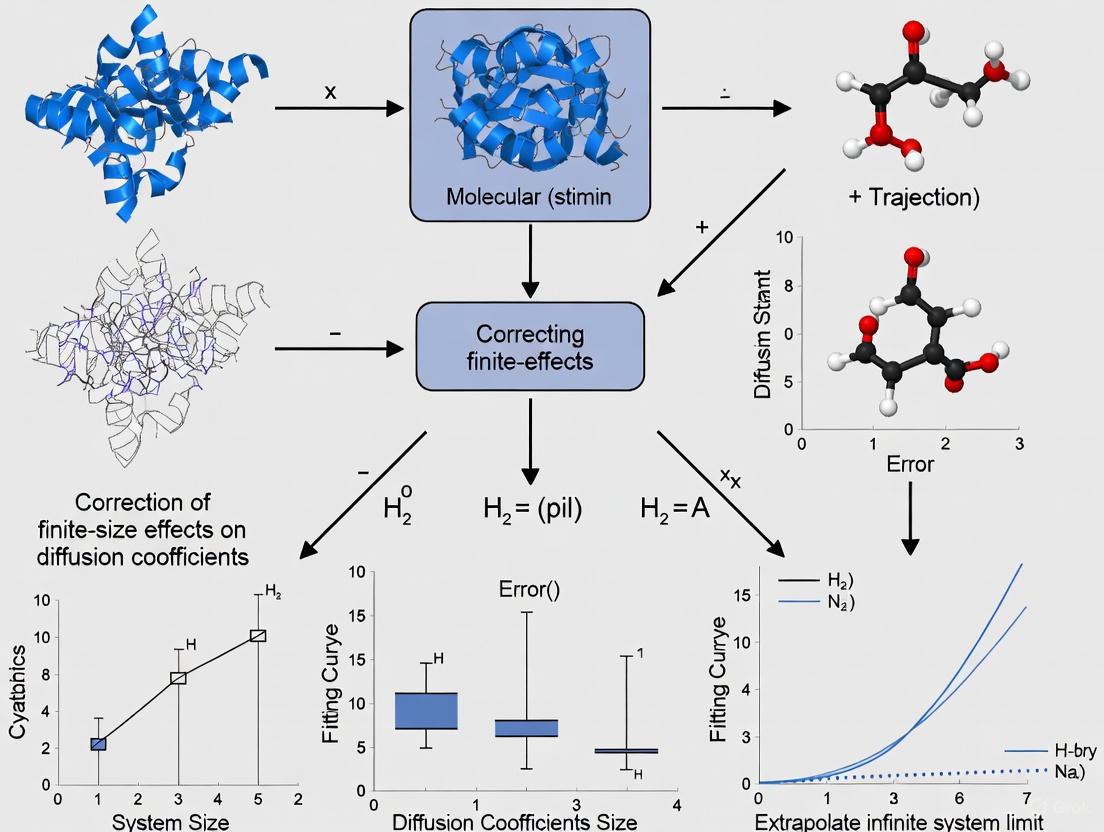
Molecular dynamics simulations are powerful tools for predicting diffusion coefficients crucial for drug development, but results are skewed by finite-size effects where computed diffusivities artificially depend on simulated system size.
Correcting Finite-Size Effects in Molecular Dynamics Diffusion Coefficients: From Theory to Pharmaceutical Applications
Abstract
Molecular dynamics simulations are powerful tools for predicting diffusion coefficients crucial for drug development, but results are skewed by finite-size effects where computed diffusivities artificially depend on simulated system size. This comprehensive review explores the foundational theory behind these effects, presents practical correction methodologies including the established Yeh-Hummer approach and its extensions to mutual diffusion, addresses troubleshooting for challenging systems near demixing, and validates techniques through comparative analysis across Lennard-Jones and molecular systems. For researchers and drug development professionals, we provide essential guidance for obtaining reliable, experimentally comparable diffusion coefficients from molecular simulations, with direct implications for pharmaceutical formulation and biomolecular transport modeling.
Understanding Finite-Size Effects: Why Your Simulated Diffusion Coefficients Are Wrong
Frequently Asked Questions (FAQs)
FAQ 1: What is the fundamental problem with system size and diffusion coefficients? In molecular dynamics (MD) simulations, the calculated diffusion coefficients show a strong dependency on the number of molecules (N) in the simulation box. Computed diffusivities artificially increase with the number of molecules and the size of the simulation box. This is a finite-size effect, meaning the simulated value is not the true value for the macroscopic system (the "thermodynamic limit") [1].
FAQ 2: Why does this inflation occur? The artificial inflation occurs primarily due to hydrodynamic self-interactions imposed by the use of periodic boundary conditions. In a finite, periodic system, a molecule's motion is correlated with its own images in neighboring cells. The difference in these interactions between a finite periodic system and an infinite non-periodic system leads to the observed discrepancy. The effect scales linearly with the inverse of the box size (1/L) [1].
FAQ 3: Which types of diffusion coefficients are affected? This problem affects all major types of diffusion coefficients obtained from simulations:
- Self-diffusion coefficient (D~self~): The diffusivity of a single tagged particle in a medium [1].
- Maxwell-Stefan (MS) diffusivity (Ä~MS~): Describes mass transport due to the gradient in chemical potential [1].
- Fick diffusivity (D~Fick~): The coefficient relating mass flux to concentration gradient, which can be derived from the MS diffusivity [1].
FAQ 4: When are finite-size effects most severe? Finite-size effects are particularly pronounced and critical to correct for in the following scenarios [1]:
- Systems close to demixing, where the thermodynamic factor indicates strong non-ideality.
- Mixtures near critical points or phase transitions.
- Simulations with a small number of molecules. In some severe cases near demixing, the required finite-size correction can be larger than the simulated diffusivity value itself.
FAQ 5: How can I correct for this artifact?
The most common method is to apply the Yeh-Hummer (YH) correction. For self-diffusion coefficients, the formula is:
D_{self}^∞ = D_{self} + D_{YH}, where D_{YH} = (k_B T ξ)/(6 π η L)
This correction term is a function of the system's shear viscosity (η), the simulation box size (L), and temperature (T) [1]. For MS diffusivities, a modified correction that also accounts for the thermodynamic factor (Γ) must be used [1].
Troubleshooting Guides
Problem: My simulated diffusion coefficient is higher than expected or reported in literature.
| Potential Cause | Diagnostic Steps | Recommended Solution |
|---|---|---|
| Small system size | 1. Calculate diffusion coefficients for systems with different numbers of molecules (N).2. Plot D versus 1/N¹/³. A clear positive slope indicates a strong finite-size effect [1]. | Apply the appropriate Yeh-Hummer correction to extrapolate the value to the thermodynamic limit (N→∞) [1]. |
| Inadequate analysis protocol | The statistical uncertainty of the diffusion coefficient estimated from Mean-Squared Displacement (MSD) data depends heavily on the choice of statistical estimator and data processing decisions [2]. | Do not rely solely on ordinary least squares (OLS) regression. Explore and clearly report the analysis protocol used, as alternative methods can estimate D* more precisely [2]. |
| Uncorrected MS diffusivity | Check if you are simulating a mixture close to demixing (using the thermodynamic factor). Finite-size effects on MS diffusivities are most severe in these non-ideal systems [1]. | Apply the finite-size correction for MS diffusion, which incorporates the thermodynamic factor: Ä_{MS}^∞ = Ä_{MS} + (k_B T)/(6 Ï€ η L) * (Γ^{-1} - 1) [1]. |
Problem: High uncertainty in my calculated diffusion coefficient.
| Potential Cause | Diagnostic Steps | Recommended Solution |
|---|---|---|
| Poor MSD statistics | Check the smoothness and linearity of the MSD plot over time. Noisy data or a poor fit will lead to high uncertainty [2]. | Increase simulation time to improve sampling. Ensure the MSD is calculated from a sufficiently long, steady-state trajectory segment. |
| Incorrect regression method | Compare results using different regression techniques (e.g., ordinary least squares vs. methods that account for correlated data points) on the same MSD data [2]. | Use a statistical analysis protocol that is robust and accounts for the correlations in the MSD data, as the uncertainty is not universal but depends on the estimator choice [2]. |
The following table summarizes key relationships and correction factors for finite-size effects, as identified in the literature.
Table 1: Summary of Finite-Size Effects and Corrections for Diffusion Coefficients
| Diffusion Coefficient Type | Observed Finite-Size Scaling | Proposed Correction Method | Key Variables |
|---|---|---|---|
| Self-Diffusion (D~self~) | Increases linearly with 1/N¹/³ (equivalent to 1/L) [1] | Yeh-Hummer (YH) correction: D_{self}^∞ = D_{self} + (k_B T ξ)/(6 π η L) [1] |
L: Box side lengthT: Temperatureη: Shear viscosityξ: Constant (2.837 for cubic boxes) |
| Maxwell-Stefan (Ä~MS~) | Increases with system size; effect magnified by non-ideality [1] | Modified YH correction: Ä_{MS}^∞ = Ä_{MS} + (k_B T)/(6 Ï€ η L) * (Γ^{-1} - 1) [1] |
Γ: Thermodynamic factor (measure of non-ideality). All other variables as above. |
| Fick (D~Fick~) | Derived from MS diffusivity, so inherits its finite-size effects. | Correct the parent MS diffusivity first: D_{Fick} = Ä_{MS} * Γ [1] |
D~Fick~ is calculated from the corrected Ä~MS~∞ and Γ. |
Table 2: Experimental vs. Predicted Diffusion Coefficients in a Sample System (Glucose-Water) [3]
| Temperature (°C) | Experimental D (cm²/s) | Wilke-Chang Prediction (cm²/s) | Notes |
|---|---|---|---|
| 25 | ~ 6.8 × 10â»â¶ | Similar to experimental value | Semi-empirical models can be inaccurate outside their calibration range [3]. |
| 65 | ~ 1.7 × 10â»âµ | Significant overestimation | At higher temperatures, common models like Wilke-Chang can fail, highlighting the need for accurate measurement or simulation [3]. |
Experimental Protocols
Protocol 1: Correcting Self-Diffusion Coefficients from MD Simulations
This protocol details the steps to obtain a size-corrected self-diffusion coefficient from an Equilibrium Molecular Dynamics (EMD) simulation [1].
1. Run Simulations: Perform EMD simulations for systems with different numbers of molecules (N) while maintaining constant density.
2. Calculate MSD: For each system, compute the Mean-Squared Displacement (MSD) of the molecules over time using the Einstein relation:
MSD(t) = (1/N) ⟨ |r~j~(t) - r~j~(0)|² ⟩
3. Extract D~self~: Perform a linear regression on the MSD plot to obtain the uncorrected self-diffusion coefficient for each system size: D_{self} = (1/(6t)) * MSD(t).
4. Compute Viscosity: Calculate the shear viscosity (η) for your system from the autocorrelation of the off-diagonal components of the stress tensor using the Green-Kubo relation. Note that viscosity is generally independent of system size [1].
5. Apply YH Correction: For each D_{self}, calculate the corrected value for the thermodynamic limit using:
D_{self}^∞ = D_{self} + (k_B T * 2.837297)/(6 π η L)
Protocol 2: Measuring Diffusion Coefficients via Taylor Dispersion
This is an experimental method used to validate computational results or obtain diffusion data directly. It is considered highly accurate and is used for both binary and ternary liquid systems [3].
1. Setup: Use a long (e.g., 20 m), thin, coiled Teflon tube immersed in a thermostat for temperature control. The tube should have a circular cross-section to ensure laminar flow.
2. Prepare Solutions: Create a solvent stream and a pulse of solution with a slightly different composition.
3. Inject Pulse: Introduce a small volume (e.g., 0.5 cm³) of the solution pulse into the laminar solvent stream using a pump.
4. Detect Concentration: At the outlet of the tube, use a differential refractive index analyzer to measure the concentration profile of the dispersed pulse, which will take a Gaussian shape.
5. Calculate D: The mutual diffusion coefficient is determined by fitting the variance of the detected concentration profile over time. The governing equation is derived from Taylor's work:
D = (u² R²) / (48 * σ²)
where u is the average flow velocity, R is the tube radius, and σ² is the temporal variance of the concentration profile [3].
Workflow and Signaling Diagrams
Finite-Size Correction Workflow
Cause of Artificial Inflation
Research Reagent Solutions
Table 3: Essential Computational and Experimental Tools
| Tool / Reagent | Function / Description | Application Context |
|---|---|---|
| Equilibrium Molecular Dynamics (EMD) | Simulation method where transport coefficients are computed from time-correlation functions in a system at equilibrium [1]. | Core method for computing diffusion coefficients from simulations. |
| Periodic Boundary Conditions (PBC) | A common boundary condition used in MD simulations to mimic a bulk system by replicating the simulation box in all directions [1]. | The source of the finite-size artifact for diffusion. |
| Yeh-Hummer (YH) Correction | An analytical correction term derived from hydrodynamic theory to compensate for finite-size effects on self-diffusivity [1]. | The primary method for extrapolating simulated D_self to the thermodynamic limit. |
| Thermodynamic Factor (Γ) | A measure of the non-ideality of a mixture, calculated from the derivative of chemical potential with respect to concentration [1]. | Critical for correcting Maxwell-Stefan diffusivities in mixtures. |
| Taylor Dispersion Apparatus | An experimental setup involving a long capillary tube to measure mutual diffusion coefficients in liquids based on laminar flow dispersion [3]. | Used for obtaining ground-truth experimental data to validate simulation results. |
FAQs: Understanding Finite-Size Effects
What are finite-size effects in the context of diffusion coefficients? Finite-size effects refer to the systematic errors or deviations in calculated self-diffusion coefficients that arise from simulating a fluid in a limited, finite-sized periodic box rather than in an infinite medium. In molecular dynamics (MD) simulations of bulk liquids, these effects cause the diffusion tensor to appear anisotropic and can lead to diffusivity in the direction of the box's short side exceeding the value for an infinite system [4].
What is the hydrodynamic origin of these finite-size dependencies? The origin is rooted in hydrodynamic interactions. A moving particle generates a long-ranged flow disturbance in the surrounding fluid, which decays inversely with interparticle distance. In a finite system with periodic boundaries, these disturbance flows interact with the periodic images of the simulation box, affecting the particle's motion. The resulting hydrodynamic coupling means particles do not move independently but exhibit collective, system-size-dependent behavior [5].
Why does the shape of the simulation box matter? The box geometry determines how the periodic images interact hydrodynamically. In a highly asymmetric (e.g., rectangular parallelepiped) box, the confinement effect is direction-dependent. This leads to an apparent anisotropy in the diffusion tensor, even for an isotropic bulk liquid, with the diffusion component along the short side of the box being most significantly enhanced [4].
Troubleshooting Guides
Issue: Anisotropic Diffusion in a Bulk Liquid Simulation
Problem: Your simulation of a simple, isotropic bulk liquid yields an anisotropic diffusion tensor.
Diagnosis Steps:
- Check Box Geometry: Verify the aspect ratio of your periodic simulation box. A high aspect ratio is a primary cause of this artifact [4].
- Quantify the Effect: Calculate the diffusion coefficients along each box vector (Dx, Dy, Dz). The highest value will typically align with the shortest box vector.
- Compare to Theory: Use the hydrodynamic theory for periodic rectangular box systems to predict the expected diffusivity for your box size and shape. Compare this to your MD results [4].
Solutions:
- Apply a Correction: Use the analytical expressions derived from hydrodynamic theory to correct your computed self-diffusion coefficient to its infinite-system value [4].
- Modify System Geometry: If possible, use a cubic simulation box to avoid artificial anisotropy. For non-cubic boxes, be aware that the aspect ratio at which the diffusivity coincides with the infinite-system value is a universal constant, independent of the cross-sectional area or thickness [4].
Issue: Inaccurate Hydrodynamic Interactions in Dense Suspensions
Problem: Your simulation of a particle suspension fails to capture the correct many-body hydrodynamic interactions (HIs), leading to inaccurate dynamics.
Diagnosis Steps:
- Review Method Approximations: Identify the level of approximation in your HI model. Common methods like the two-body Rotne-Prager-Yamakawa (RPY) approximation neglect crucial many-body effects and near-field lubrication forces [5].
- Check Boundary Conditions: Confirm that your method correctly handles the desired boundary conditions (e.g., periodic). Some far-field approximations are limited to open boundaries [5].
- Validate with a Test System: Run a simulation for a system with a known solution to isolate the error.
Solutions:
- Use a More Accurate Method: Implement Stokesian Dynamics (SD), which combines far-field approximations with near-field lubrication corrections for a balanced approach [5].
- Adopt Advanced Algorithms: For larger systems, use modern implementations like Fast Stokesian Dynamics (FSD) that use iterative solvers and matrix-free techniques for linear scaling [5].
- Consider a Hybrid Framework: For complex systems, explore emerging hybrid models that use a neural network to correct efficient two-body approximations, trained on SD data to capture many-body effects at a lower computational cost [5].
Experimental Protocols & Data
Detailed Methodology: System Size Effect Analysis via MD
This protocol outlines how to quantify the finite-size effect on the self-diffusion coefficient using Molecular Dynamics simulations, based on the work of Kikugawa et al. [4].
1. System Preparation:
- Software: Use an MD package capable of simulating periodic boundary conditions and calculating mean-squared displacement (e.g., GROMACS, LAMMPS).
- Model System: Select a simple liquid (e.g., Lennard-Jones particles).
- Box Creation: Generate multiple simulation boxes with identical particle density but different geometries:
- A series of cubic boxes of increasing size (e.g., side lengths from 5σ to 20σ).
- A series of rectangular boxes with varying aspect ratios (e.g., rod-shaped and film-type).
2. Simulation Execution:
- Equilibration: Equilibrate each system in the NVT ensemble until energy and pressure stabilize.
- Production Run: Switch to the NVE ensemble for production. Ensure the simulation is long enough to obtain a linear region in the mean-squared displacement (MSD) plot.
- Data Collection: Output trajectory data at a frequency sufficient for accurate MSD calculation.
3. Data Analysis:
- Calculate MSD: For each box geometry and direction, compute the mean-squared displacement,
MSD(t) = ⟨|r(t) - r(0)|²⟩. - Extract Diffusion Coefficient: Fit the linear part of the MSD curve for each direction to the equation
MSD(t) = 2dDt, wheredis the dimensionality, to obtain the diffusion tensor componentsD_xx,D_yy,D_zz. - Compare to Theory: Plot the computed diffusivity against the theoretical prediction from hydrodynamic theory for periodic systems [4].
Key Quantitative Relationships
Table 1: Finite-Size Effects on Self-Diffusion Coefficient in Periodic Systems
| System Geometry | Key Finding | Theoretical Basis |
|---|---|---|
| Cubic Box | Diffusivity converges to infinite-system value as box size increases; well-described by standard hydrodynamic theory. | Stokes equations with periodic boundary conditions [4] [5]. |
| Rectangular Parallelepiped Box | Diffusion tensor becomes anisotropic. Diffusivity along the short side is enhanced and can exceed the infinite-system value. | Extended hydrodynamic theory for periodic rectangular boxes [4]. |
| Rod-Shaped & Film-Type Boxes | Exists a universal aspect ratio where the measured diffusivity matches that of an infinite system, independent of cross-sectional area or thickness. | Simplified approximate model derived from hydrodynamic description [4]. |
Table 2: Comparison of Methods for Simulating Hydrodynamic Interactions (HIs)
| Method | Description | Strengths | Weaknesses |
|---|---|---|---|
| Stokesian Dynamics (SD) | Combines far-field Green's functions with near-field lubrication corrections [5]. | High accuracy for both far- and near-field HIs; models many-body effects [5]. | Historically complex and computationally expensive; requires matrix inversions [5]. |
| Rotne-Prager-Yamakawa (RPY) | A common far-field approximation for the mobility matrix [5]. | Computationally efficient; good for dilute suspensions [5]. | Neglects many-body effects and near-field lubrication; inaccurate for dense suspensions [5]. |
| Fast Stokesian Dynamics (FSD) | Modern SD using spectral Ewald methods and matrix-free algorithms [5]. | Linear O(N) scaling; competitive for large systems with simple boundaries [5]. |
Less versatile for complex geometries compared to LB or MPCD [5]. |
| Lattice Boltzmann (LB) | Solves discrete Boltzmann equation on a lattice [5]. | Handles complex geometries; captures thermal fluctuations and inertia [5]. | Struggles to match SD's precision in near- and far-field HIs [5]. |
Mandatory Visualization
The Scientist's Toolkit
Table 3: Research Reagent Solutions for Hydrodynamic Studies
| Item / Reagent | Function / Role in Experiment |
|---|---|
| Molecular Dynamics (MD) Software | Performs the core simulation of particle dynamics, calculates trajectories, and outputs data for analysis (e.g., mean-squared displacement) [4]. |
| Stokesian Dynamics (SD) Code | A numerical framework specifically designed to accurately simulate many-body hydrodynamic interactions in suspensions at low Reynolds numbers [5]. |
| Monodisperse Hard Sphere Model | A simplified, standard model for suspended particles. Allows for analytical and numerical treatment to study fundamental HI behavior without complex particle shape effects [5]. |
| Linear Solver & Preconditioner | Numerical tools required to efficiently solve the large system of linear equations that arise in methods like SD, especially for dense suspensions [5]. |
| Dihydrohypothemycin | Dihydrohypothemycin, MF:C19H24O8, MW:380.4 g/mol |
| Antitumor agent-196 | Antitumor agent-196, MF:C51H81NO15, MW:948.2 g/mol |
Frequently Asked Questions
1. What are finite-size effects in diffusion coefficient calculations, and why must they be corrected?
In molecular dynamics (MD) simulations, the simulated system's size (or "box size") is finite, unlike in real-world experiments. This limitation introduces artifacts in the calculation of transport properties like diffusion coefficients. In concentrated protein solutions, for instance, the translational diffusion coefficients (DtPBC) obtained directly from simulation require correction for large finite-size effects using system viscosity. Without this correction, the reported diffusion coefficients will be inaccurate and not representative of the true bulk material behavior [6].
2. How does system viscosity relate to diffusion coefficients?
The relationship between viscosity and diffusion is formally described by the Stokes-Einstein relation, which states that the translational diffusion coefficient (D_t) is inversely proportional to the viscosity (η) of the medium and the hydrodynamic radius (R_h) of the diffusing particle. In concentrated protein solutions, research confirms that the Stokes-Einstein relation remains valid. However, the effective hydrodynamic radius increases with protein volume fraction, which explains the dramatic slowdown of diffusion in crowded environments. The viscosity itself increases strongly with protein concentration, an effect that exceeds predictions from simple hard-sphere colloid models due to attractive protein-protein interactions and dynamic cluster formation [6].
3. What is the specific effect of temperature on diffusion coefficients?
Temperature has a direct and profound impact on molecular motion and therefore on diffusion coefficients. This influence is captured by the Arrhenius equation, which relates the diffusion coefficient (D) to the activation energy (Q) and temperature (T). Experimental studies consistently show that diffusion coefficients increase with temperature. For example, in the FCC Al-Cu-V alloy system, the activation energies for solute diffusion were calculated and analyzed, quantitatively showing how temperature accelerates diffusion [7]. Similarly, in polymer systems, diffusion coefficients for volatile components were measured at different temperatures (e.g., 60°C, 80°C, and 100°C), confirming this relationship [8].
Troubleshooting Guides
Issue 1: Inaccurate Diffusion Coefficients in Simulations
Problem: Diffusion coefficients calculated from your molecular dynamics (MD) simulations seem excessively high or do not match experimental values.
Solution:
- Check System Size: Ensure your simulation box is large enough. For protein solutions, systems containing hundreds of proteins (e.g., 540 proteins with 3.6 million atoms) are used to better approximate bulk conditions [6].
- Apply Finite-Size Correction: The diffusion coefficient obtained directly from simulation (
DtPBC) must be corrected. Use the relation based on the system's viscosity [6]:D_t = D_tPBC + (k_B * T * ξ)/(6 * π * η * L)wherek_Bis Boltzmann's constant,Tis temperature,ηis the viscosity of your solution,Lis the box length, andξis a constant. - Validate with Long-Time Diffusion: Use the long-time diffusion coefficient derived from the linear portion of the mean-squared displacement (MSD) curve at sufficiently long time scales (e.g., 10 ns to 30 ns in protein solutions) [6].
Issue 2: Uncontrolled Variables in Experimental Diffusion Measurements
Problem: Results from experimental diffusion measurements (e.g., using diffusion couples or spectroscopy) are inconsistent between replicates.
Solution:
- Control Temperature Precisely: Temperature must be tightly controlled and reported, as it directly affects diffusion rates. For diffusion couple studies in alloys, annealing temperatures should be maintained precisely (e.g., 530°C, 555°C, 580°C) [7].
- Ensure Proper Sample Saturation: When measuring solvent diffusion in polymers, ensure samples are deliberately saturated to a known equilibrium concentration in a controlled sorption experiment before desorption measurements begin [8].
- Align Analytical Techniques: When using techniques like Electron Probe Microanalysis (EPMA) on diffusion couples, align multiple line scans (e.g., at least five) to the interface position to generate a reliable average concentration profile [7].
Quantitative Data Tables
Table 1: Experimentally Determined Drug Diffusion Coefficients through Artificial Mucus
This table summarizes data obtained via ATR-FTIR spectroscopy and analysis using Fick's second law [9].
| Drug | Diffusion Coefficient (D) at Reported Conditions | Molecular Characteristics | Experimental Method |
|---|---|---|---|
| Theophylline | 6.56 × 10â»â¶ cm²/s | - | ATR-FTIR spectroscopy coupled with Fick's 2nd Law and Crank's trigonometric series solution for a planar semi-infinite sheet. |
| Albuterol (Salbutamol) | 4.66 × 10â»â¶ cm²/s | - | ATR-FTIR spectroscopy coupled with Fick's 2nd Law and Crank's trigonometric series solution for a planar semi-infinite sheet. |
Table 2: Key Dependencies of Diffusion from Simulation and Experiment
This table synthesizes the influence of key parameters as reported across multiple studies [9] [7] [8].
| Parameter | Effect on Diffusion Coefficient (D) |
Context & Supporting Evidence |
|---|---|---|
Temperature (T) |
Increases with temperature following an Arrhenius relationship (D ∠exp(-Q/RT)). |
Activation energies (Q) for solute diffusion were calculated in Al-Cu-V alloys [7]. Diffusion coefficients for toluene in polymers increased with temperature from 60°C to 100°C [8]. |
Viscosity (η) |
Inversely proportional to translational diffusion (D_t ∠1/η). Stokes-Einstein relation holds. |
In concentrated protein solutions, viscosity increase from ~1 mPa·s to over 4 mPa·s (at ϕ=0.15) correlates with a strong slowdown in diffusion [6]. |
| Box Size (Simulation) | Artificially high D in small boxes; requires finite-size correction. |
In MD simulations of proteins, finite-size corrections are applied to DtPBC using box length (L) and viscosity (η) [6]. |
Concentration / Volume Fraction (Ï•) |
Generally decreases as the volume fraction of the diffusing species increases. | In Al-Cu-V, adding V decreased the diffusivity of Cu [7]. In protein solutions, D_t decreases significantly as protein concentration rises from dilute to 200 mg/mL and higher [6]. |
| Molecular Size | Larger molecules/particles typically have smaller diffusion coefficients. | An inverse relationship between molecular weight and diffusion coefficient has been reported for drugs in mucus [9]. |
Experimental Protocols
Protocol 1: Determining Drug Diffusion Coefficients using ATR-FTIR Spectroscopy
This protocol is adapted from studies measuring the diffusion of asthma drugs through artificial mucus [9].
1. Principle: Couple time-resolved Attenuated Total Reflectance Fourier Transform Infrared (ATR-FTIR) spectroscopy with Fickian diffusion models to determine the diffusivity of drug molecules through a synthetic membrane.
2. Materials:
- ATR-FTIR Spectrometer: Equipped with a flow-through cell and a Zinc Selenide (ZnSe) crystal.
- Artificial Mucus: A synthetic construct that mimics the complex, hydrophobic, and crosslinked fiber network of pulmonary mucus.
- Drug Solutions: Prepared with the analytes of interest (e.g., Theophylline, Albuterol).
3. Procedure:
- Sample Setup: Place a layer of artificial mucus in direct contact with the ZnSe crystal of the ATR-FTIR. The lower surface of the mucus contacts the crystal, while the upper surface is exposed to the drug solution.
- Data Collection: Initiate the experiment by introducing the drug solution to the upper mucus surface. Collect FTIR spectra at constant, short time intervals (e.g., every few seconds).
- Quantitative Monitoring: Monitor quantitative changes in the height of IR absorption peaks that are specific to functional groups of the drug molecule.
- Data Analysis:
a. Correlate the changes in peak height to drug concentration using Beer's Law.
b. Analyze the concentration-over-time data using Fick's Second Law of Diffusion.
c. Fit the experimental data to Crank's trigonometric series solution for a planar semi-infinite sheet to determine the diffusion coefficient (
D).
The following workflow diagram illustrates this experimental process:
Protocol 2: Extracting Interdiffusion Coefficients using the Diffusion Couple Method
This protocol is standard in materials science for studying diffusion in alloys, as applied in the Al-Cu-V system [7].
1. Principle: Bring two materials with different compositions into intimate contact and anneal at high temperature to allow solutes to interdiffuse. Measurement of the resulting concentration profile allows for the calculation of interdiffusion coefficients.
2. Materials:
- High-purity elemental materials (e.g., 99.99% Al, 99.9% Cu, 99.8% V).
- Arc melting furnace for casting alloy samples.
- Hydraulic press for assembling diffusion couples.
- High-temperature annealing furnace with precise temperature control.
- Electron Probe Microanalyzer (EPMA) for high-resolution concentration measurements.
3. Procedure:
- Sample Preparation: Cast binary (e.g., Al-Cu, Al-V) and ternary (Al-Cu-V) alloys via arc melting. Machine samples to create flat, smooth surfaces for interface contact.
- Assembly: Sandwich two different alloy samples together (e.g., Al-Cu-V vs. Al-V) and use a hydraulic press to assemble them into a diffusion couple under a protective atmosphere to prevent oxidation.
- Annealing: Seal the diffusion couple in an evacuated quartz tube and anneal it at the target temperatures (e.g., 530°C, 555°C, 580°C) for an extended period (e.g., 1500 hours) to facilitate solute interdiffusion.
- Concentration Profiling: After annealing, cross-section the couple and use EPMA to perform multiple line scans perpendicular to the diffusion interface, measuring the concentrations of each solute (Cu, V) as a function of distance.
- Data Analysis: Extract the interdiffusion coefficients from the concentration profiles. This can be done using:
- The Forward Simulation Analysis (FSA) method, which iteratively refines
Dvalues until the simulated concentration profile matches the experimental one [7]. - Traditional methods based on the Boltzmann-Matano analysis.
- The Forward Simulation Analysis (FSA) method, which iteratively refines
Conceptual Diagrams
Diagram: Finite-Size Effects Correction Workflow in MD Simulations
This diagram illustrates the logical process for correcting finite-size effects in diffusion coefficients obtained from MD simulations of concentrated solutions, based on the cited research [6].
The Scientist's Toolkit: Research Reagent Solutions
Table 3: Essential Materials for Key Experimental Approaches
| Item / Reagent | Function / Application | Example Context |
|---|---|---|
| Artificial Mucus | A synthetic hydrogel that mimics the biochemical and physical (viscosity, mesh network) properties of native pulmonary mucus for in vitro drug diffusion studies. | Used as a diffusion barrier to measure the diffusivity of asthma drugs like Theophylline and Albuterol [9]. |
| High-Purity Alloy Elements (Al, Cu, V) | Serve as the base materials for fabricating binary and ternary alloy samples used in the diffusion couple method. Purity (e.g., 99.99%) is critical to avoid contamination that can skew diffusion results. | Used to cast FCC Al-Cu-V alloys for studying interdiffusion coefficients and atomic mobilities [7]. |
| Diffusion Couple Assembly Jig | A device, often used with a hydraulic press, to apply uniform pressure and create intimate, void-free contact between the two surfaces of a diffusion couple. | Essential for preparing high-quality samples in metallurgical diffusion studies [7]. |
| Thermogravimetric Analysis (TGA) | An indirect method to determine the average diffusion coefficient of volatile components in polymer phases by measuring mass loss as a function of time under controlled temperature. | Used to study the desorption of toluene from saturated HDPE and PP, and for post-industrial plastic waste melt [8]. |
| Pressure Decay Apparatus (PDA) | An indirect method used to validate TGA results by monitoring the pressure drop in a closed cell as a volatile component desorbs from a polymer sample. | Provided comparable results to TGA for toluene diffusion in HDPE and PP, validating the TGA method [8]. |
| Anticancer agent 213 | Anticancer agent 213, MF:C38H35N7O5, MW:669.7 g/mol | Chemical Reagent |
| cis-4-Br-2,5-F2-PCPA | cis-4-Br-2,5-F2-PCPA, MF:C9H8BrF2N, MW:248.07 g/mol | Chemical Reagent |
FAQ: Fundamental Concepts and Definitions
What is the core difference between self-diffusion and mutual diffusion? Self-diffusion refers to the motion of a single, tagged particle (or molecule) within a uniform chemical environment, tracing its Brownian motion. In contrast, mutual diffusion describes the collective, net transport of multiple chemical species down their concentration gradients in a mixture.
- Self-Diffusion: This is the movement of a tracer particle in a homogeneous medium, such as a single water molecule moving in pure water. It characterizes the intrinsic random motion of particles in the absence of a chemical potential gradient.
- Mutual Diffusion: Also known as collective diffusion, this process occurs in mixtures where there is a net flow of components to eliminate concentration differences. It is the macroscopic diffusion described by Fick's first law [1].
Can the coefficients for self-diffusion and mutual diffusion be equal? Under specific conditions, yes. For example, in a highly idealized binary system where components are similar and interactions are negligible, the coefficients can be comparable. A study on small molecules in curdlan hydrogels found that both self- and mutual-diffusion coefficients were similar and reduced by 30% compared to aqueous solutions, primarily due to molecular-level interactions rather than the gel's porous structure [10]. However, in most real systems, especially non-ideal mixtures or those with significant interparticle interactions, the values differ [11].
How do interparticle interactions affect these diffusion types differently? Interparticle interactions can drive self-diffusion and mutual diffusion in opposite directions. Theoretical work on membrane proteins has shown that:
- Self-diffusion is inhibited by all types of interactions: hard-core repulsions, soft repulsions, and soft repulsions with weak attractions [11].
- Mutual diffusion is inhibited by attractive interactions but can be enhanced by repulsive interactions [11]. This disparate response is a key reason why different experimental techniques (e.g., fluorescence recovery after photobleaching vs. postelectrophoresis relaxation) can yield different diffusion coefficients for the same system.
FAQ: Experimental Design and Measurement
What are the primary experimental techniques for measuring each diffusion type? Different techniques are optimized for measuring self-diffusion versus mutual diffusion, though some methods can characterize both.
- For Self-Diffusion: Pulsed Field Gradient (PFG) NMR spectroscopy is a highly suitable technique. It measures the mean-square displacement of molecules over time [10] [1] [12].
- For Mutual Diffusion:
- Taylor Dispersion Method: This is a widely used technique where a pulse of solution is injected into a solvent flowing laminarly through a capillary tube. The dispersion of the pulse is measured at the outlet, often via a differential refractive index detector, to determine the mutual diffusion coefficient [3].
- NMR Profiling: This method can determine mutual diffusion coefficients and can be used alongside PFG-NMR on the same system under identical conditions [10].
- Interferometric Methods: Techniques like Gouy and Rayleigh interferometry are also used, though Taylor dispersion is now more common [3].
My molecular dynamics (MD) simulations show system-size dependent diffusion coefficients. Why, and how can I correct for this? Finite-size effects are a well-known artifact in MD simulations because the periodic boundary conditions influence hydrodynamic interactions.
- Cause: Computed self-diffusivities scale linearly with the inverse of the simulation box length (1/L). The finite size of the simulation box affects the hydrodynamic self-interactions of particles [1].
- Correction for Self-Diffusion: The Yeh-Hummer (YH) correction is used to extrapolate to the thermodynamic limit [1]: ( D{i,self}^{\infty} = D{i,self} + \frac{kB T \xi}{6 \pi \eta L} ) where ( D{i,self}^{\infty} ) is the corrected self-diffusion coefficient, ( k_B ) is Boltzmann's constant, T is temperature, η is shear viscosity, L is the box length, and ξ is a constant (2.837297 for cubic boxes) [1].
- Correction for Mutual Diffusion: A finite-size correction for Maxwell-Stefan (MS) diffusivities has also been proposed. This correction depends not only on box size, temperature, and viscosity but also strongly on the thermodynamic factor, which measures the non-ideality of the mixture. For systems near demixing, this correction can be very significant [1].
How does the thermodynamic factor relate mutual and self-diffusion? For binary mixtures, the Darken equation provides a fundamental link: ( D = (xB DA^* + xA DB^) (1 + \frac{\partial \ln \gamma}{\partial \ln x}) ) Here, ( D ) is the mutual diffusion coefficient, ( x_A ) and ( x_B ) are mole fractions, ( D_A^ ) and ( D_B^* ) are the self-diffusion coefficients, and the term ( (1 + \frac{\partial \ln \gamma}{\partial \ln x}) ) is the thermodynamic factor (Γ) [13]. This equation shows that mutual diffusion is influenced by both the weighted average of self-diffusion coefficients and the thermodynamics of the mixture.
Troubleshooting Guide: Common Experimental Issues
| Problem | Possible Cause | Solution |
|---|---|---|
| Discrepancy between diffusion coefficients from different measurement techniques. | 1. Techniques are measuring different types of diffusion (self vs. mutual) [11].2. Strong interparticle interactions are affecting self and mutual diffusion differently [11]. | Identify which diffusion type your technique measures. Use a method like NMR that can measure both in the same system to ensure comparability [10]. |
| Diffusion coefficients from MD simulations are overestimated compared to experimental values. | Finite-size effects in the simulation. The limited number of molecules in the periodic box artificially enhances diffusivity [1]. | Apply the appropriate finite-size correction (e.g., Yeh-Hummer for self-diffusion or the proposed correction for MS diffusion) to extrapolate to the thermodynamic limit [1]. |
| Non-parabolic growth behavior in diffusion-controlled layer growth experiments (e.g., nitriding). | Assuming a diffusion zone of infinite size, while the real sample has finite dimensions [14]. | Implement a model that incorporates a finite-size diffusion zone and uses total mass balance to correct the estimated effective diffusion coefficients [14]. |
| Large variations in measured solid-phase diffusion coefficients for battery materials (e.g., using GITT). | 1. Underlying assumption of linear diffusion instead of realistic 3D radial diffusion.2. Nonlinearity of the open-circuit potential [15]. | Employ the Surface Concentration Potential Response (SCPR) method with a realistic 3D radial diffusion model to more accurately determine the diffusion coefficient [15]. |
The Scientist's Toolkit: Research Reagent Solutions
| Item | Function in Diffusion Studies |
|---|---|
| Curdlan Hydrogels | A bacterial polysaccharide used to create a porous matrix for studying how confinement and molecular interactions affect the diffusion of small molecules like phosphates and glucose-6-phosphate [10]. |
| AOT Surfactant | Used to form water-in-oil microemulsions, creating nano-droplets that act as pseudo-binary systems for studying mutual diffusion in structured fluids [13]. |
| D(+)-Glucose & D-Sorbitol | Model saccharides used in binary and ternary aqueous systems to study concentration and temperature dependence of mutual diffusion coefficients, relevant for industrial process design like sorbitol production [3]. |
| Lennard-Jones Systems | Simple model particles used in molecular dynamics simulations to establish foundational knowledge and verify theoretical corrections for finite-size effects in diffusion coefficients [1]. |
| NCM523 (Lithium Nickel Cobalt Manganese Oxide) | A common cathode material in lithium-ion batteries, used as a model system for developing and validating accurate methods to determine solid-phase diffusion coefficients [15]. |
| Ac-VDQQD-PNA | Ac-VDQQD-PNA, MF:C31H43N9O14, MW:765.7 g/mol |
| Gpx4-IN-16 | Gpx4-IN-16, MF:C29H24N4O3S2, MW:540.7 g/mol |
Workflow and Conceptual Diagrams
Experimental Workflow for Diffusion Coefficient Determination
This diagram outlines a general workflow for determining diffusion coefficients, integrating insights from multiple experimental contexts.
Relationship Between Diffusion Types and Key Concepts
This conceptual diagram illustrates the factors connecting and differentiating self-diffusion and mutual diffusion.
FAQs: Understanding Finite-Size Effects
What are finite-size effects (FSEs) in molecular dynamics simulations? Finite-size effects are artificial disturbances or inaccuracies that occur in molecular dynamics (MD) simulations when the size of the simulated system (the simulation box) is too small to properly represent bulk material behavior [16]. In such cases, particles interact unnaturally with their own periodic images, leading to corrupted data, particularly for transport properties like diffusion coefficients [16].
Why are accurate diffusion coefficients critical in drug development? In drug discovery, accurately determining the diffusion coefficient of a system is fundamental for understanding small-scale, short- and long-range interactions [16]. These coefficients describe how quickly molecules move and interact within a specific chemical environment, which influences drug dissolution, binding, and distribution processes. Errors in these values can cost theorists, wet-lab chemists, and drug-discovery researchers significant time, resources, and money [16].
How do I know if my simulation is suffering from significant finite-size effects? A key indicator is an unrealistic lowering of the computed diffusion coefficient [16]. This occurs because particles in a small box artificially interact with their own periodic images, effectively disrupting normal transport mechanisms [16]. The diffusion coefficient demonstrates a predictable 1/L finite-size effect correction factor based on the box length, L [16].
What is the relationship between simulation box size and the accuracy of the diffusion coefficient? As the simulation box length (L) increases, finite-size effects are reduced, bulk behavior is more accurately modeled, and the accuracy of the diffusion coefficient (D) increases [16]. The correction for this effect follows a 1/L relationship [17].
Can FSEs be corrected, or is a larger system size the only solution? While increasing system size is one solution, a common and effective mitigation strategy is the linear extrapolation of the diffusion coefficient from simulations run with multiple different box sizes to the infinite-size limit [16]. A generalized finite-size correction term, building on the Yeh and Hummer (YH) correction, can be applied to mutual diffusion coefficients in multicomponent mixtures [17].
Troubleshooting Guides
Issue 1: Unphysically Low Diffusion Coefficients
Problem The self-diffusion or mutual diffusion coefficients obtained from your MD simulation are significantly lower than expected or reported in experimental literature.
Diagnosis This is a classic symptom of a simulation box that is too small [16]. The particles in your system are interacting with their own periodic images, which restricts their motion and leads to an underestimation of diffusion [16].
Solution
- Run Size-Series Simulations: Perform the same simulation with progressively larger box sizes (e.g., 250, 500, 1000, and 2000 molecules) [18] [17].
- Extrapolate to the Thermodynamic Limit: Plot the computed diffusion coefficients against the inverse of the box length (1/L). Perform a linear extrapolation to the y-intercept (where 1/L = 0, representing an infinite system) to obtain the corrected diffusion coefficient [16].
- Apply a Analytic Correction: For self-diffusivity, apply the Yeh and Hummer (YH) correction [17]:
Di,self∞ = Di,selfMD - (kBT ξ) / (6 π η L)whereDi,self∞is the corrected self-diffusivity in the thermodynamic limit,Di,selfMDis the value computed from MD, kB is the Boltzmann constant, T is temperature, η is the shear viscosity, L is the box length, and ξ is a constant dependent on the box shape (ξ=2.837297 for a cubic box) [17].
Issue 2: FSEs in Complex Multicomponent Mixtures (e.g., Deep Eutectic Solvents)
Problem Predicting bulk properties like diffusivity in complex, eco-friendly solvents like caprylic acid-based Deep Eutectic Solvents (DESs) is unreliable, especially under nanoscale confinement, which is relevant for drug delivery applications [18].
Diagnosis The local structuring and dynamic behavior of DES components are highly sensitive to finite particle size effects and confinement, leading to significant deviations from bulk properties [18].
Solution
- Validate with a Sufficient System Size: Research indicates that systems with 1000 particles can provide satisfactory predictions of thermophysical properties, as the self-diffusion coefficient from MD begins to approach values observed in the thermodynamic limit [18].
- Account for Confinement Explicitly: When modeling applications involving nanotubes or other nanoscale structures, the confinement itself must be part of the simulation model, as it significantly influences structural properties and hydrogen bonding networks [18].
Experimental Protocols & Data
Detailed Methodology: Correcting Finite-Size Effects in Diffusion Coefficients
This protocol outlines the steps for obtaining diffusion coefficients at the thermodynamic limit using a system-size extrapolation approach [16] [17].
Step-by-Step Guide:
- System Preparation: Create an initial configuration of your system (e.g., a liquid mixture) using tools like PACKMOL [17]. Define the force field parameters for all molecules [17].
- Define Simulation Box Sizes: Choose a range of system sizes. A recommended set includes boxes containing 250, 500, 1000, and 2000 molecules to adequately sample the size dependence [18] [17].
- Configure MD Simulation Parameters:
- Software: Use a package like LAMMPS [17].
- Boundary Conditions: Apply Periodic Boundary Conditions (PBCs) in all three dimensions [16].
- Ensemble: Use an NPT ensemble to maintain constant Number of particles, Pressure, and Temperature.
- Thermostat/Barostat: Select appropriate algorithms (e.g., Nosé-Hoover) to maintain temperature and pressure.
- Interaction Cut-offs: Ensure your non-bonded interaction cut-off radius is less than half the length of your smallest simulation box to avoid violating the minimum image convention [16].
- Simulation Time: Run long enough to achieve proper equilibration and gather good statistics for mean-squared displacement (MSD) or velocity autocorrelation function (VACF). A total simulation length of 100 ns or more is common [17].
- Run Simulations and Calculate Diffusion: For each system size, run multiple independent simulations. Calculate the self-diffusion coefficient from the slope of the mean-squared displacement (MSD) vs. time or via the Green-Kubo relation from the velocity autocorrelation function [16] [17].
- Extrapolation:
- For each system size
i, compute1/L_i, whereL_iis the box length. - Plot the calculated diffusion coefficient
D_iagainst1/L_i. - Perform a linear regression. The y-intercept of the best-fit line corresponds to the diffusion coefficient at the thermodynamic limit (
D∞).
- For each system size
Quantitative Data on System Size Effects
Table 1: Impact of Simulation System Size on Self-Diffusion Coefficient [18] [17]
| Number of Molecules | Approximate Box Length (L) * | Relative 1/L | Computed Self-Diffusivity (D^MD) | Corrected Self-Diffusivity (D^∞) |
|---|---|---|---|---|
| 250 | Smallest | Largest | Most Underestimated | Requires largest YH correction |
| 500 | Intermediate | Intermediate | Underestimated | Requires intermediate correction |
| 1000 | Intermediate | Intermediate | Approaches D^∞ | Requires small correction |
| 2000 | Largest | Smallest | Closest to D^∞ | Requires minimal correction |
Note: Actual box length depends on system density. The key relationship is that correction is a function of 1/L [16].
Table 2: Finite-Size Correction Formulas for Different Diffusion Types
| Diffusion Type | System Composition | Finite-Size Effect Correction Formula | Key References |
|---|---|---|---|
| Self-Diffusion | Pure and Mixed Fluids | D_self∞ = D_self^MD - (k_B T ξ) / (6 π η L) |
[17] |
| Mutual (Fick) Diffusion | Binary Mixtures | D_Fick∞ ≈ D_Fick^MD - (k_B T ξ) / (6 π η L) (Same as self-diffusion correction) [17] |
|
| Maxwell-Stefan (MS) Diffusion | Multicomponent Mixtures | A generalized correction exists, derived from the finite-size effects of the Fick matrix and the matrix of thermodynamic factors[Γ] [17] |
Workflow Visualization
The Scientist's Toolkit: Research Reagent Solutions
Table 3: Essential Tools for Simulating and Correcting Finite-Size Effects
| Item / Resource | Function / Description | Example / Note |
|---|---|---|
| MD Simulation Software | Open-source software package used to perform molecular dynamics simulations. It is highly flexible and can model a wide range of materials. | LAMMPS (used in cited research) [17] |
| System Builder | A software tool for building initial molecular configurations and packing molecules into simulation boxes with defined composition and density. | PACKMOL (used in cited research) [17] |
| Analysis Plugin | A plugin for MD software that assists in computing transport properties and thermodynamic factors from simulation trajectories. | OCTP plugin (used with LAMMPS) [17] |
| Visualization Tool | A molecular visualization program used for simulating, visualizing, and analyzing molecular systems. It can also help generate input files for MD software. | VMD (VMD) [17] |
| Yeh and Hummer (YH) Correction | An analytical hydrodynamic correction term that must be added to self-diffusivities computed from EMD to obtain diffusivities at the thermodynamic limit. Valid for pure components and mixtures [17]. | D_self∞ = D_self^MD - (k_B T ξ) / (6 π η L) [17] |
| Generalized Multicomponent Correction | A derived correction term for mutual diffusion coefficients in multicomponent mixtures, extending the principles of the YH correction to more complex systems [17]. | Based on finite-size effects of the Fick matrix and the matrix of thermodynamic factors[Γ] [17] |
| Thermodynamic Factor ([Γ]) Calculation | A matrix whose elements describe the deviation from ideal mixing behavior in a solution. It is crucial for converting between Fick and Maxwell-Stefan diffusion coefficients [17]. | Computed from Kirkwood-Buff integrals or activity coefficient models [17] |
| Neoeuonymine | Neoeuonymine, MF:C36H45NO17, MW:763.7 g/mol | Chemical Reagent |
| Lsd1-IN-23 | Lsd1-IN-23, MF:C19H13BrClN5O2S, MW:490.8 g/mol | Chemical Reagent |
Practical Correction Methods: Implementing Yeh-Hummer and Beyond
Frequently Asked Questions (FAQs)
FAQ 1: What is the Yeh-Hummer correction, and why is it critical for my self-diffusion calculations?
The Yeh-Hummer (YH) correction is an analytical term that compensates for the finite-size effects inherent in calculating self-diffusion coefficients ((D{i,self})) from Molecular Dynamics (MD) simulations with periodic boundary conditions. These simulations systematically underestimate the true self-diffusivity (the value at the thermodynamic limit, (D{i,self}^\infty)) because long-range hydrodynamic interactions are truncated. The YH correction accounts for these omitted interactions, providing a more accurate value [1] [19]. The correction is expressed as: [ D{i,self}^\infty = D{i,self} + D{YH} ] where the correction term (D{YH}) is given by: [ D{YH} = \frac{\zeta kB T}{6 \pi \eta L} ] In this equation, (\zeta) is a dimensionless constant (~2.837297 for cubic boxes), (k_B) is Boltzmann's constant, (T) is temperature, (\eta) is the shear viscosity of the system, and (L) is the box length [1] [19]. Without this correction, your reported diffusion coefficients can contain a systematic error, which for systems of around 2000 molecules can be approximately 10% [19].
FAQ 2: For which types of diffusion coefficients and systems should I apply the Yeh-Hummer correction?
The Yeh-Hummer correction was originally derived and is most straightforwardly applied to self-diffusion coefficients [1] [19]. Self-diffusion refers to the movement of a tagged particle in a uniform medium due to Brownian motion [20] [1].
- Applicability: It has been successfully verified for a wide range of systems, including simple Lennard-Jones fluids, water, COâ‚‚, and various pure liquids and mixtures like n-alkanes [21] [19].
- Mutual Diffusion: Finite-size effects also impact mutual diffusion coefficients (Maxwell-Stefan and Fick diffusivities). Recent studies have proposed extensions of the YH approach to correct these collective diffusion coefficients, noting that the dependency on system size is also strong, especially for non-ideal mixtures [1].
- Important Caution: The correction may not be accurate for systems with strong electrostatic interactions, such as charged molecules in a polar or ionic medium, and might require rescaling [1]. Furthermore, some force fields parameterized to target transport properties may inadvertently mask the finite-size effect. Applying the YH correction in such cases could paradoxically worsen the agreement with experimental data [19].
FAQ 3: What specific input data do I need to calculate the Yeh-Hummer correction for my simulation?
Applying the YH correction requires several key pieces of data, typically obtainable from your MD simulation.
Table: Input Parameters for the Yeh-Hummer Correction
| Parameter | Symbol | Description | Common Source |
|---|---|---|---|
| Simulation Box Length | (L) | Side length of the primary cubic simulation cell. | Directly from simulation input/output (e.g., LAMMPS log files). |
| System Temperature | (T) | Absolute temperature of the simulation. | Directly from simulation parameters. |
| System Shear Viscosity | (\eta) | Shear viscosity of the fluid mixture at the simulated state. | Calculated from the simulation using the Green-Kubo relation (eq. 3) or the Einstein relation, from off-diagonal components of the stress tensor [1]. |
| Boltzmann Constant | (k_B) | Fundamental physical constant. | (1.380649 \times 10^{-23} \ J \cdot K^{-1}) |
| YH Constant | (\zeta) | Dimensionless constant for 3D periodic cubic boxes. | 2.837297 [1] [19] |
FAQ 4: The YH correction made my results less accurate compared to experiment. What could be the cause?
This is a known issue and often points to one of two underlying problems [19]:
- Force Field Inaccuracies: The molecular force field used in your simulation may itself be a source of error. Some force fields are parameterized to reproduce thermodynamic equilibrium properties but may not accurately capture transport dynamics. If a force field inherently overestimates self-diffusion, the finite-size effect might accidentally make the uncorrected result ((D_{i,self})) look closer to experiment. Applying the positive YH correction then reveals the underlying inaccuracy of the force field [19].
- Incorrect Viscosity: The YH correction is linearly dependent on the simulated shear viscosity ((\eta)). An inaccurate viscosity estimate will directly propagate an error into the corrected diffusivity. You should verify that your simulation reliably reproduces the system's viscosity [1].
Troubleshooting Guides
Issue 1: Correcting Finite-Size Effects in Self-Diffusion Calculations
Problem: Self-diffusion coefficients calculated from MD simulations show a strong, unrealistic dependency on the size of the simulation box (N or L). The values are underestimated compared to the experimental thermodynamic limit [1] [19].
Solution: Apply the Yeh-Hummer correction and validate the force field.
- Calculate Required Inputs: From your production simulation trajectory, calculate the system's shear viscosity ((\eta)) using an equilibrium method (Green-Kubo or Einstein) [1].
- Compute the Correction: Use the equation (D{YH} = \frac{\zeta kB T}{6 \pi \eta L}) with (\zeta = 2.837297).
- Apply the Correction: Obtain the corrected self-diffusion coefficient: (D{i,self}^\infty = D{i,self} + D_{YH}).
- Validate with a Robust Force Field: Ensure your results are physically sound by testing with a force field known to accurately predict transport properties for your system. For organic liquids and hydrocarbons, all-atom OPLS4 has shown excellent agreement with experimental self-diffusion data [21]. Be aware that united-atom models may exhibit biases, such as caging effects or inaccurate dihedral distributions, that affect diffusion [19].
The following workflow outlines the systematic procedure for addressing this issue:
Issue 2: High Uncertainty in Corrected Diffusivity Due to Viscosity Calculation
Problem: The calculated YH correction term has high variability, leading to an unreliable final self-diffusion coefficient. This is often traced to noise in the viscosity calculation [1].
Solution: Improve the statistical accuracy of the viscosity measurement.
- Prolong Simulation Time: Viscosity is a collective property that typically requires longer simulation times for convergence than self-diffusion. Extend your production run to improve sampling.
- Average Multiple Components: Use all three independent off-diagonal components of the stress tensor (Pxy, Pxz, Pyz) to calculate three viscosity values and report the average [1].
- Use Block Averaging: Calculate the viscosity over multiple, independent blocks of your trajectory and compute the mean and standard error.
The Scientist's Toolkit: Essential Research Reagents & Materials
Table: Key Computational Tools for Self-Diffusion Studies with YH Correction
| Tool / Reagent | Function / Description | Application Note |
|---|---|---|
| Stable Isotope Enrichment | Enables direct measurement of self-diffusion in host materials (e.g., Ge, Si) by creating isotope superlattices [20]. | Provides the most fundamental data for validating simulation methodologies and understanding vacancy-mediated diffusion mechanisms in solids [20]. |
| Pulsed-Field Gradient NMR | Primary experimental technique for measuring self-diffusion coefficients in liquids [21] [19]. | Serves as the gold standard for validating MD simulation results and the accuracy of the YH-corrected diffusivities [21]. |
| OPLS4 Force Field | An all-atom force field for molecular dynamics simulations [21]. | Demonstrated excellent predictive performance for self-diffusion coefficients of chemically diverse pure liquids, making it a strong choice for reliable results [21]. |
| Equilibrium MD (EMD) | A class of MD simulations where transport coefficients are computed from time-correlation functions at equilibrium [1]. | The standard method for computing both self-diffusion (via MSD) and viscosity (via stress tensor autocorrelation) needed for the YH correction [1]. |
| Einstein Formulation | A method within EMD that calculates diffusivity from the slope of the Mean Squared Displacement (MSD) over time [1] [19]. | Preferred for its robustness and lower noise compared to the Green-Kubo method; less sensitive to integration limits [19]. |
| D-(+)-Cellotriose | D-(+)-Cellotriose, MF:C18H32O16, MW:504.4 g/mol | Chemical Reagent |
| Borapetoside F | Borapetoside F, MF:C27H34O11, MW:534.6 g/mol | Chemical Reagent |
Frequently Asked Questions
1. What are finite-size effects in Molecular Dynamics (MD) simulations? In MD simulations, the number of molecules is orders of magnitude lower than in real, macroscopic systems (the thermodynamic limit). This finite system size, combined with the use of periodic boundary conditions, affects computed transport properties, including diffusion coefficients. For self-diffusion coefficients, a strong dependency on the number of molecules, scaling linearly with ( N^{-1/3} ) (where ( N ) is the number of molecules), has been observed [1] [22].
2. Why do finite-size effects matter for Maxwell-Stefan (MS) diffusion coefficients? Finite-size effects lead to significant deviations between MS diffusivities computed from MD simulations and the true values at the thermodynamic limit. The simulated (finite-size) MS diffusivity can be much lower than the corrected value, especially for mixtures close to demixing. In these cases, the required finite-size correction can be even larger than the simulated diffusivity itself. Ignoring these effects can result in unreliable data [1].
3. What is the relationship between Fick and Maxwell-Stefan diffusivities? The Fick and Maxwell-Stefan diffusion coefficients are related by the thermodynamic factor (( \Gamma )), which measures the non-ideality of the mixture. For a binary mixture, the relationship is given by ( D{\text{Fick}} = \Gamma \times Ä{\text{MS}} ). The MS formulation describes diffusion as a balance between the thermodynamic driving force (chemical potential gradient) and molecular friction, while the Fick formulation relates mass flux directly to concentration gradients [1] [23].
4. What correction is used for self-diffusion coefficients? The Yeh and Hummer (YH) correction is used for self-diffusion coefficients. The self-diffusivity in the thermodynamic limit (( D{i,self}^{\infty} )) is obtained from the finite-size value (( D{i,self} )) computed by MD via [1] [17]: [ D{i,self}^{\infty} = D{i,self} + D{YH} ] [ D{YH} = \frac{kB T \xi}{6 \pi \eta L} ] where ( kB ) is Boltzmann's constant, ( T ) is temperature, ( \eta ) is shear viscosity, ( L ) is the box length, and ( \xi ) is a constant (2.837297 for cubic boxes).
5. How is the finite-size correction for binary MS diffusivities derived? The correction for binary MS diffusivities is an extension of the YH correction, incorporating the thermodynamic factor. It is given by [1] [17]: [ Ä{MS}^{\infty} = Ä{MS}^{MD} + \Gamma \frac{kB T \xi}{6 \pi \eta L} ] Here, ( Ä{MS}^{\infty} ) is the MS diffusivity at the thermodynamic limit, ( Ä_{MS}^{MD} ) is the value obtained from MD simulation, and ( \Gamma ) is the thermodynamic factor. This shows that the non-ideality of the mixture strongly influences the magnitude of the finite-size effect.
6. Does the system size affect the shear viscosity computed from MD? No, studies have shown that the shear viscosity (( \eta )) of the system, required for the YH correction, is independent of the system size. Therefore, it can be reliably computed from a single system size without correction [1].
7. For which types of mixtures are finite-size effects most critical? Finite-size effects are particularly pronounced for non-ideal mixtures and those close to demixing. The more non-ideal the mixture (i.e., the further the thermodynamic factor ( \Gamma ) deviates from 1), the larger the required correction for the MS diffusivity will be [1].
Troubleshooting Guides
Issue 1: Corrected MS Diffusivity is Much Larger than the Simulated Value
Problem: After applying the finite-size correction, the value of ( Ä{MS}^{\infty} ) is significantly larger than ( Ä{MS}^{MD} ), or even negative.
Solutions:
- Check the Thermodynamic Factor: This problem often occurs for highly non-ideal mixtures, especially those near phase separation (demixing). Verify the calculation of the thermodynamic factor ( \Gamma ), as it amplifies the correction term. A small or negative ( \Gamma ) can lead to a very large correction [1].
- Verify System Homogeneity: Ensure the mixture is homogeneous and stable under the simulated conditions. The correction formalism assumes a homogeneous phase [1].
- Increase System Size: If the correction is implausibly large, perform simulations with a larger number of molecules (N). The finite-size effect diminishes as system size increases, and results from larger systems are more reliable [1] [22].
Issue 2: Large Uncertainty in Corrected Diffusion Coefficients
Problem: The final corrected diffusivity has high statistical uncertainty.
Solutions:
- Increase Sampling: Perform a larger number of independent simulation runs. The study on ternary molecular mixtures, for instance, used 100 independent simulations to achieve low statistical uncertainties [17].
- Check Viscosity Calculation: Ensure the shear viscosity ( \eta ) is computed with high precision, as it appears in the correction term. Use long simulation runs and multiple independent components of the stress tensor for averaging [1].
- Validate Self-Diffusion Correction: First, verify that the YH correction properly extrapolates the self-diffusion coefficients of all components to the thermodynamic limit. This is a prerequisite for the MS correction [17].
Issue 3: How to Handle Finite-Size Effects in Multicomponent Mixtures
Problem: The user is simulating a ternary or higher-order mixture and needs to correct mutual diffusivities.
Solutions:
- Apply the Generalized Matrix Formulation: For multicomponent systems, the finite-size effects on the Fick diffusion matrix are such that only the diagonal elements require correction. The generalized correction involves the Yeh-Hummer term and the matrix of thermodynamic factors [17].
- Eigenvalue Analysis: It has been shown that the finite-size effects on the matrix of Fick diffusivities are confined to its eigenvalues. The eigenvector matrix is independent of system size. This insight can be used for reliable extrapolation [17].
- Consult Recent Reviews: Refer to comprehensive reviews on finite-size effects for the latest generalized protocols for ternary and quaternary mixtures [22].
The table below summarizes the essential formulas for finite-size corrections in binary systems.
Table 1: Finite-size correction formulas for diffusion coefficients in binary systems.
| Diffusion Coefficient | Finite-Size Value from MD | Correction Formula (for Thermodynamic Limit) | Key Parameters |
|---|---|---|---|
| Self-Diffusivity (( D_{i,self} )) | ( D_{i,self}^{MD} ) | ( D{i,self}^{\infty} = D{i,self}^{MD} + \dfrac{k_B T \xi}{6 \pi \eta L} ) [1] | ( \eta ): Shear viscosity( L ): Box length( \xi ): Constant (2.837) |
| Maxwell-Stefan Diffusivity (( Ä_{MS} )) | ( Ä_{MS}^{MD} ) | ( Ä{MS}^{\infty} = Ä{MS}^{MD} + \Gamma \dfrac{k_B T \xi}{6 \pi \eta L} ) [1] [17] | ( \Gamma ): Thermodynamic factor |
| Fick Diffusivity (( D_{Fick} )) | ( D_{Fick}^{MD} ) | ( D{Fick}^{\infty} = D{Fick}^{MD} + \dfrac{k_B T \xi}{6 \pi \eta L} ) [17] | Derived from ( D{Fick} = \Gamma \times Ä{MS} ) |
Experimental Protocol: Correcting MS Diffusivity in a Binary Mixture
Below is a detailed step-by-step methodology for obtaining a finite-size corrected Maxwell-Stefan diffusion coefficient from Molecular Dynamics simulations.
Objective: To compute the Maxwell-Stefan diffusion coefficient for a binary mixture at the thermodynamic limit.
Required Reagents & Computational Tools: Table 2: Essential research reagents and computational solutions for MD-based diffusion calculations.
| Item | Function / Description |
|---|---|
| MD Software (e.g., LAMMPS) | Open-source software package used to perform the molecular dynamics simulations [17]. |
| Force Field Parameters | Set of potentials and constants defining intermolecular and intramolecular interactions. |
| Configuration Builder (e.g., PACKMOL) | Tool for generating initial molecular configurations for the simulation box [17]. |
| Shear Viscosity (( \eta )) | Transport property of the fluid, computed from the autocorrelation of the off-diagonal components of the stress tensor [1]. |
| Thermodynamic Factor (( \Gamma )) | Measure of the non-ideality of the mixture, computable from Kirkwood-Buff integrals or activity coefficient models [1] [24]. |
Workflow Diagram
The following diagram visualizes the sequence of key stages in the correction process.
Step-by-Step Instructions:
System Preparation: Define the binary mixture of interest (components A and B). Create initial simulation boxes containing different total numbers of molecules (N), for example, N=250, 500, 1000, and 2000, using a tool like PACKMOL [17]. Ensure the composition is the same across all system sizes.
MD Simulation Setup: Use software like LAMMPS to perform Equilibrium Molecular Dynamics (EMD) simulations.
- Employ appropriate force fields and periodic boundary conditions.
- Use a time step of 1-2 fs for molecular systems.
- Ensure simulations are long enough (e.g., >50-100 ns) for good statistical averaging of transport properties.
- Perform multiple independent simulation runs (e.g., 100) for each system size to reduce statistical uncertainty [17].
Property Calculation:
- Maxwell-Stefan Diffusivity (( Ä_{MS}^{MD} )): Compute via the Onsager coefficients using the Einstein formulation based on the cross-correlation of molecular displacements [1].
- Shear Viscosity (( \eta )): Calculate from the autocorrelation function of the off-diagonal elements of the stress tensor (eq 3 in [1]). This property is system-size independent.
- Thermodynamic Factor (( \Gamma )): Determine for the binary mixture. This can be obtained from activity coefficient models (e.g., Wilson, NRTL, UNIQUAC) or, more rigorously, from MD simulations using Kirkwood-Buff integrals [24].
Application of Finite-Size Correction:
- For each system size, calculate the box length ( L ) from the simulation box volume (( L = V^{1/3} )).
- Apply the correction formula for MS diffusivity: [ Ä{MS}^{\infty} = Ä{MS}^{MD} + \Gamma \frac{k_B T \xi}{6 \pi \eta L} ]
- Use the constant ( \xi = 2.837297 ) for a cubic simulation box [1].
Validation and Extrapolation:
- Plot the computed ( Ä{MS}^{MD} ) and the corrected ( Ä{MS}^{\infty} ) against ( 1/L ).
- The values of ( Ä_{MS}^{\infty} ) for different system sizes should cluster closely together, validating that the correction successfully removes the system-size dependency. The result is a reliable MS diffusion coefficient at the thermodynamic limit.
Frequently Asked Questions
1. What are the primary sources of error when determining diffusion coefficients in multicomponent systems? Research indicates that several factors introduce error into diffusion coefficient measurements. For MRI-derived Apparent Diffusion Coefficient (ADC) values, lower ADC values consistently show increased error and lower signal-to-noise ratio (SNR) [25]. In molecular dynamics (MD) simulations, the uncertainty of a computed diffusion coefficient depends not only on the input simulation data but also on the specific statistical estimator and data processing decisions used during analysis [2]. Furthermore, all simulation-derived diffusivities exhibit system-size dependence, requiring appropriate finite-size corrections for quantitative comparison with experimental data [17].
2. How do finite-size effects impact computed diffusion coefficients in molecular simulations?
Finite-size effects significantly impact diffusivities computed from Equilibrium Molecular Dynamics (EMD). Self-diffusivities scale linearly with the inverse of the simulation box length [17]. For mutual diffusion coefficients in multicomponent mixtures, only the diagonal elements of the Fick matrix show system-size dependency and can be corrected using the Yeh and Hummer (YH) term: D_corrected = D_MD + (k_B * T * ξ) / (6 * π * η * L), where k_B is Boltzmann's constant, T is temperature, η is shear viscosity, L is box length, and ξ is a constant depending on box shape (ξ = 2.837297 for cubic boxes) [17]. All Maxwell–Stefan diffusivities also depend on system size, with the required correction depending on the matrix of thermodynamic factors [17].
3. What matrix approaches are used to relate different diffusion coefficient frameworks for multicomponent mixtures?
The relationship between Fick and Maxwell–Stefan diffusivities is governed by matrix equations. For an n-component mixture, the matrix of Fick diffusivities [DFick] is related to the Maxwell–Stefan diffusivities [ÄMS] and the matrix of thermodynamic factors [Γ] through the equation: [D_Fick] = [B]^{-1}[Γ], where [B] is a matrix whose elements are defined in terms of the mole fractions and Maxwell–Stefan diffusivities [17]. Specifically, the diagonal and off-diagonal elements of [B] are given by:
B_ii = x_i / Ä_in + Σ_{k≠i} (x_k / Ä_ik)for i = 1 to n-1B_ij = -x_i (1/Ä_ij - 1/Ä_in)for i ≠j wherex_iare mole fractions andÄ_ijare Maxwell–Stefan diffusivities [17].
Troubleshooting Guides
Problem: Inconsistent ADC Measurements Across Multiple Scanners
Issue: Quantitative ADC measurements show significant variability when performed across different MRI scanners, field strengths, and orientations.
Solution:
- Standardized Phantom Use: Implement a comprehensive quality assurance program using NIST-traceable diffusion phantoms scanned across all institutional scanners [25].
- Orientation Awareness: Avoid sagittal acquisition orientations, which consistently show higher coefficient-of-variation (CoV) across reference ADC values [25].
- Error Anticipation: Account for increased error magnitude at lower ADC values, which is directly related to lower SNR [25].
- Scanner Matching: Utilize quality assurance data to develop advanced scheduling systems that match patients to similarly performing MRI scanners for longitudinal studies [25].
Problem: Significant Finite-Size Effects in Simulated Diffusion Coefficients
Issue: Computed diffusion coefficients from molecular dynamics simulations show strong dependence on simulated system size, preventing direct comparison with experimental values.
Solution:
- Apply YH Correction: Implement the generalized finite-size correction for multicomponent mutual diffusivities. For Fick diffusivities, only the diagonal elements require correction using the YH term [17].
- Eigenvalue Analysis: Perform eigenvalue analysis of the finite-size effects of the matrix of Fick diffusivities. The eigenvector matrix does not depend on simulation box size, while eigenvalues (describing diffusion speed) do require correction [17].
- System Size Validation: Conduct simulations with varying system sizes (e.g., 250, 500, 1000, 2000 molecules) to verify the linear scaling with 1/L and ensure correction validity [17].
- MS Diffusivity Correction: Apply the appropriate finite-size correction to all Maxwell–Stefan diffusivities, which depends on the matrix of thermodynamic factors [17].
Problem: Poor Predictive Power of Mode-Coupling Theory for Binary Mixtures
Issue: Standard mode-coupling theory (MCT) fails to accurately predict the glassy dynamics of binary mixtures, showing discrepancies with simulation results.
Solution:
- Implement Multi-component GMCT: Apply the hierarchical framework of generalized mode-coupling theory (GMCT) extended to multi-component systems [26].
- Hierarchical Improvement: Utilize progressively higher levels of the GMCT hierarchy, as each additional level gradually improves predictive power beyond the previous limit [26].
- Structure Factor Input: Rely on static structure factors S(k) as the sole input for the theory, as all predicted differences in dynamics between systems are encoded in their static structure factors [26].
Quantitative Data Tables
Table 1: ADC Measurement Error Analysis Across Scanner Fleet
| ADC Value Range | Orientation | Coefficient of Variation (CoV) | Error Range | Primary Factor |
|---|---|---|---|---|
| Lower ADC | Sagittal | Highest CoV | Largest Error | Low SNR |
| Lower ADC | Axial/Other | Increased CoV | Large Error | Low SNR |
| Higher ADC | Sagittal | Moderate CoV | Moderate Error | Orientation |
| Higher ADC | Axial/Other | Lowest CoV | Smallest Error | Reference Standard |
Data compiled from multi-scanner study using NIST-traceable phantoms across 23 MRI scanners [25].
Table 2: Finite-Size Correction Factors for Diffusion Coefficients
| Diffusion Coefficient Type | System Size Dependence | Correction Formula | Required Input Parameters |
|---|---|---|---|
| Self-Diffusivity | Scales with 1/L | D_self∞ = D_self_MD + (k_B*T*ξ)/(6*π*η*L) |
η (viscosity), L (box length) |
| Fick Diffusivity (Binary) | Scales with 1/L | D_Fick∞ = D_Fick_MD + (k_B*T*ξ)/(6*π*η*L) |
η, L, Γ (thermodynamic factor) |
| Fick Diffusivity (Multi-component) | Diagonal elements only | [D_Fick]_ii∞ = [D_Fick]_ii_MD + (k_B*T*ξ)/(6*π*η*L) |
η, L, [Γ] (matrix) |
| Maxwell–Stefan Diffusivity | All elements | Ä_ij∞ = Ä_ij_MD + f([Γ], kB, T, η, L) |
η, L, [Γ], composition |
Generalized finite-size corrections for molecular dynamics simulations [17].
Experimental Protocols
Protocol 1: Multi-Scanner ADC Quantification and Quality Assurance
Objective: Establish consistent ADC measurements across a multi-vendor, multi-field-strength MRI scanner fleet for reliable multicompartment diffusion assessment.
Materials:
- NIST-traceable diffusion phantoms (minimum of 3 recommended)
- Clinical MRI scanners (various vendors, 1.5T and 3T)
- Standardized imaging protocol provided with phantom
Methodology:
- Phantom Preparation: Utilize three NIST/QIBA DWI phantoms with known reference ADC values [25].
- Data Acquisition: Scan each phantom across all institutional MRI scanners (23 scanners in validation study) using identical protocols [25].
- ROI Analysis: Apply user-directed regions-of-interest on each phantom vial to obtain ADC measurements across the range of reference values [25].
- Statistical Analysis: Calculate coefficient-of-variation across all MRI systems and perform Bland-Altman analysis to assess inter-scanner variability [25].
- Implementation: Use comprehensive analysis to deploy institutional quality assurance program and advanced scheduling system for matching similarly performing scanners [25].
Protocol 2: Finite-Size Correction for Multicomponent Mutual Diffusivities
Objective: Compute size-corrected mutual diffusion coefficients for ternary mixtures from molecular dynamics simulations.
Materials:
- Molecular dynamics software (LAMMPS recommended)
- OCTP plugin for transport properties
- Ternary molecular mixture (e.g., chloroform/acetone/methanol)
Methodology:
- System Preparation: Construct initial molecular configurations for multiple system sizes (250, 500, 1000, 2000 molecules) using PACKMOL [17].
- Simulation Parameters: Use a time step of 1 fs, total simulation length of 100 ns, and 100 independent simulations for low statistical uncertainty [17].
- Property Calculation: Compute transport properties and thermodynamic factors using the OCTP plugin with Kirkwood–Buff coefficients for thermodynamic factors and Onsager coefficients for MS diffusivities [17].
- Finite-Size Analysis: Calculate Fick and Maxwell–Stefan diffusivities for each system size and observe scaling behavior [17].
- Correction Application: Apply generalized finite-size correction term to diagonal elements of Fick matrix and appropriate correction to Maxwell–Stefan diffusivities based on thermodynamic factor matrix [17].
The Scientist's Toolkit: Research Reagent Solutions
Table 3: Essential Materials for Diffusion Coefficient Research
| Reagent/Software | Function/Benefit | Application Context |
|---|---|---|
| NIST-Traceable Diffusion Phantoms | Provides reference standard for quantitative ADC validation | MRI scanner calibration and cross-site comparison studies [25] |
| LAMMPS MD Software | Open-source molecular dynamics package with diffusion coefficient analysis | Simulation of ternary mixtures for finite-size effect studies [17] |
| OCTP Plugin | Computes transport properties and thermodynamic factors from MD trajectories | Calculation of Onsager coefficients and Kirkwood–Buff integrals [17] |
| PACKMOL | Creates initial molecular configurations for MD simulations | System preparation for multicomponent mixture diffusion studies [17] |
| Multi-component GMCT Code | Hierarchical extension of mode-coupling theory for mixtures | Predicting glassy dynamics of binary mixtures from static structure factors [26] |
| Lokysterolamine B | Lokysterolamine B, MF:C31H48N2O2, MW:480.7 g/mol | Chemical Reagent |
| DMT-OMe-rA(Bz) | DMT-OMe-rA(Bz), MF:C39H37N5O7, MW:687.7 g/mol | Chemical Reagent |
Workflow Visualization
Finite-Size Correction Workflow
Theory Hierarchy Evolution
Frequently Asked Questions
What are finite-size effects in MD simulations? In Molecular Dynamics (MD), finite-size effects are errors that arise because simulations model only a few hundred to thousands of molecules in a small box with Periodic Boundary Conditions (PBCs), rather than a system at the macroscopic thermodynamic limit. This affects the accuracy of computed properties like diffusion coefficients [27] [22].
Why do I need to correct diffusion coefficients? Without correction, the self-diffusion coefficients you compute from an MD simulation ((D{PBC})) will be systematically lower than the true value at the thermodynamic limit ((D{\infty})). Applying a correction allows for quantitative comparison with experimental data [17] [28] [22].
Which diffusion coefficients require correction? Finite-size corrections are necessary for self-diffusion coefficients and mutual diffusion coefficients (both Fick and Maxwell-Stefan) [17] [22]. The Yeh-Hummer correction is standard for self-diffusion, while mutual diffusivities require a generalized approach.
How do I know if my system is large enough to avoid corrections? While larger systems (e.g., 1000+ particles) reduce the finite-size error, a correction is often still required for quantitative accuracy. You can verify the need by computing the diffusion coefficient for different box sizes; if it changes significantly, a correction is essential [18] [17].
Troubleshooting Guides
Problem: My corrected diffusion coefficient is still significantly different from experimental values.
Potential Causes and Solutions:
- Inaccurate Viscosity Input: The Yeh-Hummer correction (Eq. 1) requires the shear viscosity ((\eta)) of your system. If this value is inaccurate, the correction will be too. Re-compute the viscosity from the same MD simulation or use a reliable experimental value if available [27] [28].
- Incorrect MSD Analysis Regime: The self-diffusion coefficient must be calculated from the linear, diffusive regime of the Mean Squared Displacement (MSD) plot. Ensure you are fitting the MSD after the initial ballistic stage (where MSD ∠(t^2)) and before it becomes too noisy at long times [27] [28]. The
MD2DPython module can help automatically identify and exclude the ballistic stage [27]. - Uncertainty in the Analysis Protocol: The uncertainty of a diffusion coefficient depends not only on the simulation data but also on the statistical analysis method. Try different analysis protocols (e.g., varying the time intervals used for fitting) to estimate the uncertainty robustly [2].
Problem: I am studying a multi-component mixture and need to correct mutual diffusion coefficients.
Solution: For mutual diffusion in multi-component mixtures, the finite-size effects are more complex. A generalized correction has been established [17]:
- Only the diagonal elements of the Fick diffusion matrix ([D_Fick]) show system-size dependency and can be corrected by adding the standard Yeh-Hummer term [17].
- All Maxwell-Stefan (MS) diffusivities depend on the system size. The required correction uses a term derived from the Yeh-Hummer expression and the matrix of thermodynamic factors ([Γ]) [17]. The relationship is given by: ( \left[ \mathcal{D}{MS} \right]{\infty} = \left[ \mathcal{D}{MS} \right]{PBC} + \frac{k_B T \xi}{6 \pi \eta L} [\Gamma] ) Consult the literature for a detailed derivation and implementation [17].
Problem: I am simulating lipid membranes and my lateral diffusion coefficients seem too low.
Solution: Lateral diffusion in membrane simulations with PBCs is subject to substantial hydrodynamic finite-size effects. Use specialized correction formulas developed for these systems, such as:
- The Oseen correction for transmembrane and monotopic components.
- Corrections from the immersed-boundary method.
The
memdiffPython package provides an implementation of these corrections [29].
The table below summarizes the primary correction methods discussed.
Table 1: Common Finite-Size Correction Formulas for Diffusion Coefficients
| Correction Method | Applicable System | Key Formula | Required Parameters |
|---|---|---|---|
| Yeh-Hummer [17] [28] | Self-diffusion in pure fluids and mixtures | ( D{\infty} = D{PBC} + \frac{k_B T \xi}{6 \pi \eta L} ) | ( D{PBC} ): Uncorrected MD result( kB ): Boltzmann constant( T ): Temperature ( \eta ): Shear viscosity( L ): Box length( \xi ): Constant (2.837 for cubic box) |
| Generalized Mutual Diffusion [17] | Maxwell-Stefan diffusivities in multi-component mixtures | ( \left[ \mathcal{D}{MS} \right]{\infty} = \left[ \mathcal{D}{MS} \right]{PBC} + \frac{k_B T \xi}{6 \pi \eta L} [\Gamma] ) | ( [\mathcal{D}{MS}]{PBC} ): Uncorrected MS matrix( [\Gamma] ): Matrix of thermodynamic factors(All other parameters same as above) |
| Membrane Corrections (e.g., Oseen) [29] | Lateral diffusion in lipid membrane simulations | Implementation varies (see memdiff package) |
( D{pbc} ): Uncorrected coefficient( T ): Temperature( \etaf ): Solvent viscosity( \eta_m ): Membrane viscosity( L, h ): Box width and height |
Experimental Protocol: Applying the Yeh-Hummer Correction
This protocol provides a detailed methodology for applying the finite-size correction to a self-diffusion coefficient computed from an equilibrium MD simulation of a pure liquid.
1. Compute the Uncorrected Self-Diffusion Coefficient ((D_{PBC}))
- Procedure: Run an NPT or NVT simulation to generate a trajectory. Calculate the Mean Squared Displacement (MSD) for the particles of interest.
- Data Fitting: In the MSD vs. time plot, identify the linear diffusive regime (where MSD ∠(t)). Do not include the initial ballistic regime (MSD ∠(t^2)). Perform a linear fit to the equation: ( \text{MSD}(t) = 2d D{PBC} t + C ) where (d) is the dimensionality (e.g., 3 for a 3D system) [28]. The slope gives you (D{PBC}).
2. Calculate the Shear Viscosity ((\eta))
- Procedure: Use the same equilibrium MD trajectory.
- Method: The shear viscosity is typically computed using the Green-Kubo relation, which integrates the stress autocorrelation function, or via the Einstein relation applied to the stress tensor. This calculation is often built into MD software packages like LAMMPS and GROMACS [17] [28].
3. Apply the Yeh-Hummer Correction
- Formula: Use the formula from Table 1.
- Parameter Setup:
- (D{PBC}): The value obtained in Step 1.
- (T): Temperature of your simulation.
- (\eta): Viscosity obtained in Step 2.
- (L): Length of your (cubic) simulation box.
- (\xi): Use 2.837297 for a cubic box [17].
- (kB): Boltzmann constant (ensure unit consistency).
- Output: The result (D_{\infty}) is your system-size corrected self-diffusion coefficient.
Workflow Visualization
The following diagram illustrates the complete workflow for calculating and applying a finite-size correction to a self-diffusion coefficient.
The Scientist's Toolkit
Table 2: Essential Software and Code Resources
| Tool Name | Type | Primary Function | Reference/Link |
|---|---|---|---|
| MD2D | Python Module | Accurately determines self-diffusion coefficients from MD, excludes ballistic MSD regime, and estimates uncertainties. | [27] |
| memdiff | Python Package | Implements Oseen and immersed-boundary corrections for lateral diffusion coefficients in membrane simulations. | [29] |
| LAMMPS | MD Software | A widely used open-source MD simulator with built-in commands for computing MSD and viscosity. | [17] |
| GROMACS | MD Software | A popular MD software package; its gmx msd tool calculates diffusion coefficients from trajectories. |
[28] |
| Curcumaromin C | Curcumaromin C, MF:C29H32O4, MW:444.6 g/mol | Chemical Reagent | Bench Chemicals |
| Lucialdehyde A | Lucialdehyde A, MF:C30H46O2, MW:438.7 g/mol | Chemical Reagent | Bench Chemicals |
Frequently Asked Questions (FAQs)
Q1: What are finite-size effects in diffusion coefficient calculations, and why are they a problem? In molecular dynamics simulations, the diffusion coefficient (D) calculated in a finite supercell can be significantly different from its value in an infinitely large system. This error, a finite-size effect, arises from the artificial periodicity of the simulation cell and the resulting spurious interactions between periodic images of the diffusing particle. For accurate results, it is necessary to perform simulations for progressively larger supercells and extrapolate the calculated diffusion coefficients to the "infinite supercell" limit [30].
Q2: My Mean Squared Displacement (MSD) curve looks unreasonable (horizontal or decreasing). Is this a bug? A horizontal MSD curve at low temperatures often indicates restricted atomic motion, where atoms lack the kinetic energy to overcome diffusion barriers within the simulation time. A decreasing MSD is physically implausible for a standard diffusion calculation and typically suggests a technical issue, such as atoms "wrapping" through periodic boundaries in a way that is misinterpreted by the analysis tool. It is recommended to visualize your trajectory to verify the physical reasonableness of the atomic motion [31].
Q3: Why don't I get the exact same results when I run the same simulation on a different number of processors?
This is typically not a bug. Slight differences in numerical round-off, triggered by different ordering of atoms due to different domain decompositions or different CPU architectures, can cause phase space trajectories to diverge after a few hundred timesteps. The statistical properties of the runs, however, should remain the same. Note that commands using random number generators, like fix langevin, or initial velocity generation, can also produce different results on different processor counts [32].
Q4: What tools exist to automate complex computational workflows? Several open-source platforms are being developed to automate workflows for materials simulation. VASPilot uses a multi-agent system to fully automate VASP workflows, from structure retrieval and input generation to job submission and error handling [33]. The autoplex framework automates the exploration of potential-energy surfaces and the fitting of machine-learned interatomic potentials, streamlining a process that traditionally requires significant expert intervention [34].
Troubleshooting Guides
Issue 1: Correcting for Finite-Size Effects in Diffusion Coefficients
Problem: The calculated diffusion coefficient is artificially low due to the constrained size of the simulation cell.
Solution: The established methodology is to extrapolate results to the infinite-size limit [30].
- Run Multiple Simulations: Perform several MD simulations using the same conditions but with increasingly larger supercell sizes.
- Calculate D for Each Cell: Compute the diffusion coefficient for each supercell. The two recommended methods are:
- Mean Squared Displacement (MSD): The diffusion coefficient is derived from the slope of the MSD vs. time plot: ( D = \frac{\text{slope(MSD)}}{6} ) (for 3D diffusion) [30].
- Velocity Autocorrelation Function (VACF): The diffusion coefficient is obtained by integrating the VACF: ( D = \frac{1}{3} \int{0}^{t{\text{max}}} \langle \textbf{v}(0) \cdot \textbf{v}(t) \rangle \, dt ) [30].
- Extrapolate: Plot the calculated diffusion coefficients against the inverse of the supercell size (1/L) and extrapolate the trend to the y-intercept (where 1/L = 0, representing an infinite system).
The workflow for this correction procedure is as follows:
Issue 2: Diagnosing an Unphysical Mean Squared Displacement (MSD) Curve
Problem: The MSD curve is flat, decreases, or has a step-like pattern.
Solution:
- Verify Physical Expectations: Determine the expected physical state of your system at the simulated temperature (solid, liquid). A flat MSD at low temperatures in a solid system is not necessarily an error but may indicate limited diffusion [31].
- Visualize the Trajectory: Use visualization software (e.g., OVITO, VMD) to visually inspect the atomic motion. Check for:
- Liquid-like behavior: Continuous, random motion.
- Solid-like behavior: Atoms vibrating around fixed positions.
- Discrete hopping: Atoms moving infrequently between lattice sites (can cause step-like MSD).
- Check for Technical Artifacts:
- Periodic Boundary Condition (PBC) Handling: Ensure your MSD calculation tool correctly accounts for atoms crossing PBCs. An error here can cause spurious decreases in the MSD.
- Simulation Stability: Check your log file for warnings or errors. Look for "NaN" (Not a Number) values in thermodynamic output, which can indicate an unstable simulation due to an overly large timestep or unphysical interactions [32].
Issue 3: Managing Divergent Results and Errors in Parallel LAMMPS Runs
Problem: Simulations crash, hang, or give different results on different machines or processor counts.
Solution:
- Divergent Trajectories:
- Expected Divergence: Understand that MD trajectories are chaotic and will diverge numerically. This is normal, and statistical averages should be consistent [32].
- Control Random Seeds: To ensure reproducibility for commands with random numbers (e.g.,
velocity,fix langevin), use the same random number seed across runs.
- Handling Crashes and Hangs:
- Check for Obvious Errors: Look for clear error messages in the log file and screen output. LAMMPS usually prints the last command it was processing [32].
- Use Non-Blocking I/O: If LAMMPS hangs in parallel and prints no error, try running with the
-nonblockor-nbcommand-line flag to disable I/O buffering. (Note: This can impact performance) [32]. - Monitor Thermodynamics: Use
thermo_style custom step temp etotal pressand a highthermofrequency to monitor simulation stability. Wild values or NaNs indicate a problem with your physical model or numerical setup [32].
- Invalid Command Errors:
- Check Style Availability: An error like "Invalid pair style" often means the style is misspelled or the required LAMMPS package was not compiled in. Use the
-hcommand-line switch to see available styles [32]. - Verify Syntax and Variables: Carefully check the command syntax. Remember that variable references (e.g.,
v_temp) are only allowed if the command's documentation explicitly permits them [32].
- Check Style Availability: An error like "Invalid pair style" often means the style is misspelled or the required LAMMPS package was not compiled in. Use the
The Scientist's Toolkit: Essential Research Reagents and Solutions
Table: Key Computational Tools and Resources
| Tool Name | Function / Purpose | Relevance to Workflow |
|---|---|---|
| ReaxFF / AMS | Force field engine for molecular dynamics simulations. | Used for simulating complex reactive systems, like lithiated sulfur cathodes, and calculating diffusion coefficients [30]. |
| VASP | Performs quantum-mechanical DFT calculations for electronic structure. | Provides accurate reference data for forces and energies; the foundation for many automated workflows [33] [34]. |
| LAMMPS | A classical molecular dynamics simulator. | Widely used for large-scale MD; features like compute msd are directly used for diffusion analysis [31]. |
| VASPilot | An autonomous multi-agent platform. | Automates the entire VASP workflow, from structure retrieval to calculation and analysis, reducing manual effort [33]. |
| autoplex | Automated framework for exploring potential-energy surfaces. | Automates the generation of training data and fitting of machine-learned interatomic potentials [34]. |
| Materials Project | Online database of computed crystal structures and properties. | A primary resource for initial crystal structures in automated workflows [33]. |
| Gaussian Approximation Potential (GAP) | Framework for developing machine-learned interatomic potentials. | Enables the creation of efficient and accurate potentials for large-scale MD from DFT data [34]. |
Experimental Protocols for Diffusion Coefficient Calculation
Detailed Methodology from SCM Tutorial [30]:
System Preparation:
- Import/Generate Structure: Start with a crystal structure (e.g., from a CIF file). Use builder tools or Grand Canonical Monte Carlo (GCMC) to insert diffusing species (e.g., Li atoms).
- Geometry Optimization: Relax the structure and the lattice vectors using a force field to achieve a stable starting configuration.
- Simulated Annealing (Optional): To create an amorphous structure, perform MD with a temperature profile: hold at 300 K, heat to a high temperature (e.g., 1600 K), then rapidly quench to 300 K.
Production Molecular Dynamics:
- Setup: Set the
tasktoMolecular Dynamics. Use a thermostat (e.g., Berendsen) to maintain the target temperature. - Sampling: Run a sufficiently long simulation. Set the
sample frequencyto write atomic positions and velocities to the trajectory file regularly (e.g., every 5 steps).
- Setup: Set the
Data Analysis:
- Via Mean Squared Displacement (MSD):
- Calculate the MSD for the diffusing species: ( MSD(t) = \langle [\textbf{r}(0) - \textbf{r}(t)]^2 \rangle ).
- Perform a linear fit on the linear portion of the MSD vs. time curve.
- Compute the diffusion coefficient: ( D = \frac{\text{slope(MSD)}}{6} ).
- Via Velocity Autocorrelation Function (VACF):
- Calculate the VACF for the diffusing species.
- Integrate the VACF over time.
- Compute the diffusion coefficient: ( D = \frac{1}{3} \int{0}^{t{\text{max}}} \langle \textbf{v}(0) \cdot \textbf{v}(t) \rangle \, dt ).
- Via Mean Squared Displacement (MSD):
Finite-Size Correction:
- As described in the troubleshooting guide above, repeat the calculation for different supercell sizes and extrapolate to an infinite system size [30].
Extrapolation to Lower Temperatures (Arrhenius):
- To estimate diffusion at experimentally relevant (low) temperatures, calculate ( D ) at several high temperatures.
- Use the Arrhenius equation: ( D(T) = D0 \exp{(-Ea / k{B}T)} ), or in linear form: ( \ln{D(T)} = \ln{D0} - \frac{Ea}{k{B}}\cdot\frac{1}{T} ).
- Plot ( \ln{(D(T))} ) against ( 1/T ). The slope gives ( -Ea/kB ), allowing extrapolation to lower temperatures.
Frequently Asked Questions (FAQs)
What are finite-size effects in the context of molecular dynamics (MD) simulations? In MD simulations, finite-size effects refer to the deviations in computed properties, such as diffusion coefficients, that arise from using a simulation box with a limited number of molecules, which is orders of magnitude smaller than in the real, thermodynamic system. These effects occur because the simulated environment does not perfectly represent an infinite bulk solution, potentially leading to inaccuracies in predicting transport properties [18] [22].
Why is it critical to correct for finite-size effects in drug diffusion studies? Correcting for finite-size effects is essential because uncorrected diffusion coefficients from MD simulations can be inaccurate. These coefficients are fundamental physicochemical parameters that influence a drug's passive diffusion through biological barriers, thereby directly impacting its bioavailability and biodistribution. Using inaccurate data can mislead the rational design of drug delivery systems and pharmacokinetic models [35] [36].
Which diffusion coefficients require finite-size corrections? Finite-size corrections are relevant for various types of diffusion coefficients computed from MD simulations. This includes self-diffusivities (motion of individual molecules), Maxwell–Stefan diffusivities (related to friction between components), and Fick diffusivities (collective transport driven by concentration gradients) in pure liquids, as well as binary, ternary, and quaternary mixtures [22] [37].
What are the primary methods for determining drug diffusion coefficients? Both experimental and computational methods are used. Experimental techniques include time-resolved Fourier Transform Infrared Spectroscopy (FTIR) and UV-visible spectroscopy in unstirred environments. Computational approaches primarily rely on Molecular Dynamics simulations, often using the Einstein-Smoluchowski relation applied to mean-squared displacement (MSD) data [38] [39] [35].
Troubleshooting Guides
Issue 1: MD Simulations Yield Overestimated Diffusion Coefficients
Problem The self-diffusion coefficients obtained from your MD simulations of a drug solvent system are consistently higher than experimentally measured values.
Solution This is a classic symptom of finite-size effects. The following steps can help diagnose and correct the issue:
- System Size Validation: Ensure your simulation box is sufficiently large. A system with 1000 particles often provides a satisfactory prediction of thermophysical properties, as the self-diffusion coefficient approaches values observed in the thermodynamic limit [18].
- Apply Finite-Size Corrections: Use established analytical or empirical corrections. A comprehensive review of these methods is available in the literature [22].
- Check Trajectory Length: Run production trajectories for a long enough time to capture the linear, diffusive regime of the Mean-Squared Displacement (MSD), ensuring statistical reliability [39].
Issue 2: Inconsistent Fick Diffusion Matrix in Multicomponent Mixtures
Problem When simulating a ternary or quaternary drug solvent system, the elements of the Fick diffusion coefficient matrix show high sensitivity to the chosen reference frame and component order.
Solution This variation is a known challenge in multicomponent systems.
- Understand the Framework: Recognize that the Fick diffusion matrix depends on the velocity reference frame (e.g., molar, mass). This is a mathematical property of the model, not necessarily an error [37].
- Compute Thermodynamic Factors: Use a consistent method, such as Kirkwood–Buff integration, to compute the thermodynamic factor matrix based on your force field. This factor is key for converting between Maxwell–Stefan and Fick diffusivities [37].
- Report Conventions: Always clearly state the reference frame and component order used in your calculations to allow for proper comparison and interpretation [37].
Issue 3: Low Signal-to-Noise in Experimental Diffusion Measurements
Problem Experimental determination of a drug's diffusion coefficient in an unstirred aqueous environment using UV-vis spectroscopy results in data with high uncertainty.
Solution
- Optimize Setup: Ensure the environment is truly unstirred and free from vibrations that could cause convective mixing [35].
- Data Fitting: Employ standard mathematical treatment to solve Fick's second law of diffusion. Using Crank's trigonometric series solution for a planar semi-infinite sheet can help robustly analyze concentration profile data [38].
- Method Cross-Check: Validate your results against an alternative technique. For example, the FTIR method, which tracks functional group-specific peaks, can serve as a reliable cross-verification [38].
Experimental Protocols
Protocol 1: Determining Drug Diffusivity via Time-Resolved FTIR
This protocol measures drug diffusion coefficients through artificial mucus, relevant for asthma drug development [38].
- Sample Preparation: Place a layer of artificial mucus in contact with a drug solution (e.g., theophylline or albuterol). The lower surface of the mucus layer should be in contact with a zinc selenide crystal.
- Data Acquisition: Use an FTIR spectrometer to collect spectra at constant time intervals from the lower mucus surface. Monitor quantitative changes in peak heights corresponding to functional groups specific to the drug.
- Concentration Correlation: Correlate the changes in FTIR peak heights to drug concentration using Beer-Lambert Law.
- Diffusivity Calculation: Analyze the concentration-versus-time data using Fick's 2nd Law of Diffusion. Fit the experimental data using Crank's trigonometric series solution for a planar semi-infinite sheet to determine the diffusion coefficient, D.
Protocol 2: Computational MD Workflow Using SLUSCHI
This protocol outlines an automated workflow for computing diffusion coefficients from first-principles MD [39].
- Input Preparation: Prepare standard VASP inputs (INCAR, POSCAR, POTCAR). In the
job.infile, set the target temperature, pressure, and supercell size (controlled by theradiustag). - Trajectory Generation: Launch SLUSCHI to execute the MD trajectory in the volume search stage (
Dir_VolSearch). Use an NPT ensemble with a typical timestep (e.g., provided byPOTIMin INCAR). - Trajectory Analysis: After the MD run, invoke the post-processing script (
diffusion.csh). The module will automatically:- Parse the VASP outputs to extract unwrapped atomic trajectories.
- Compute the species-resolved Mean-Squared Displacement (MSD).
- Coefficient Extraction: The self-diffusion coefficient for each species α is calculated from the slope of the MSD curve in the linear regime using the Einstein relation: Dα = (1/(2d)) * limt→∞ (d/dt) MSDα(t), where d=3 is the spatial dimension.
Data Presentation
Table 1: Experimental vs. Computed Drug Diffusion Coefficients
Table comparing diffusion coefficients (D × 10â»â¶ cm²/s) of various compounds obtained through different experimental and computational methods.
| Compound / System | Experimental D (×10â»â¶ cm²/s) | Computational D (×10â»â¶ cm²/s) | Method / Conditions |
|---|---|---|---|
| Theophylline [38] | 6.56 | - | FTIR in Artificial Mucus |
| Albuterol/Salbutamol [38] | 4.66 | - | FTIR in Artificial Mucus |
| Xylose [40] | 7.50 | 7.24 (De) | Molecular Modeling (Stokes-Einstein) |
| Glucose [40] | 6.79 | 6.65 (De) | Molecular Modeling (Stokes-Einstein) |
| Sucrose [40] | 5.23 | 5.07 (De) | Molecular Modeling (Stokes-Einstein) |
| Deep Eutectic Solvents [18] | - | Approaches bulk value | MD, System size of 1000 particles |
Table 2: Research Reagent Solutions for Diffusion Studies
Table listing key materials, computational tools, and their functions in diffusion coefficient research.
| Item Name | Function / Application | Key Characteristic |
|---|---|---|
| Artificial Mucus [38] | Simulates lung fluid environment for pulmonary drug diffusion studies. | Models the physiological barrier for asthma drugs. |
| Zinc Selenide (ZnSe) Crystal [38] | Allows for time-resolved FTIR measurements at the mucus interface. | Transparent to IR light, enabling non-invasive monitoring. |
| SLUSCHI Package [39] | Automates first-principles MD calculations and diffusion analysis. | Provides workflow for MSD calculation and diffusivity extraction. |
| MOE Software [40] | Molecular modeling to calculate stable conformers and molecular radii. | Uses force field MMFF94x to estimate molecular geometry. |
| VASP [39] | Performs ab initio MD simulations to generate atomic trajectories. | Plane-wave code used for DFT-based MD. |
| Green-Kubo Formalism [37] | Method to compute Maxwell-Stefan diffusion coefficients from EMD. | Based on integrals of velocity autocorrelation functions. |
Workflow and Pathway Visualization
Correcting Drug Diffusion Coefficients Workflow
Troubleshooting Finite-Size Corrections: Challenges and Solutions
Frequently Asked Questions (FAQs)
Q1: What are finite-size effects in the context of molecular dynamics (MD) simulations of diffusion? A1: Finite-size effects are deviations in computed properties, like diffusion coefficients, that arise from using a simulation box with a limited number of molecules (typically thousands to millions) instead of the thermodynamic limit (essentially an infinite system) [1]. In MD simulations, computed diffusivities have been found to increase with the number of molecules in the system [1].
Q2: Why are systems near demixing or critical points particularly problematic for calculating diffusion coefficients? A2: Mixtures close to demixing show a substantial increase in their sensitivity to field-induced reorganization, a phenomenon known as critical demixing [41]. For these systems, the finite-size correction can be even larger than the simulated (finite-size) Maxwell-Stefan diffusivity itself, making the accurate calculation of diffusion coefficients particularly challenging [1].
Q3: What is the relationship between Fick diffusion coefficients and Maxwell-Stefan (MS) diffusion coefficients? A3: The Fick diffusivity (DFick) and the MS diffusivity (ÄMS) are related by the thermodynamic factor (Γ), which measures the non-ideality of the mixture [1]. The relationship is given by: DFick = ÄMS * Γ
Q4: How can I correct for finite-size effects in my simulations of mutual diffusion coefficients? A4: A correction, inspired by the work of Yeh and Hummer for self-diffusion, can be applied. For MS diffusivities, the finite-size effect depends on the box size, temperature, viscosity, and the thermodynamic factor [1]. The corrected MS diffusion coefficient in the thermodynamic limit (ÄMS^∞) can be estimated from the finite-size value (ÄMS) using: ÄMS^∞ ≈ ÄMS + (Γ k_B T ξ) / (6 Ï€ η L) where η is the shear viscosity, L is the box side length, and ξ is a constant (2.837297 for cubic boxes) [1].
Troubleshooting Guide: Common Issues with Diffusion near Criticality
Problem: My simulated mutual diffusivity seems unreasonably high and is highly dependent on my system size.
- Potential Cause: You are likely simulating a mixture near a critical demixing point, where finite-size effects are greatly amplified [1].
- Solution:
Problem: The concentration profile in my confined bilayer system shows unexpected patterns, like a peak away from the boundary.
- Potential Cause: This could be a signature of critical demixing behavior, where collective molecular effects dominate the reorganization process [41].
- Solution:
- Extend your thermodynamic model to include a critical demixing parameter (γ).
- Analyze the results in the context of a non-ideal free energy of mixing model to determine if the system is near a consulate critical point [41].
Problem: After applying a finite-size correction, my corrected diffusivity is much larger than the value I simulated.
- Potential Cause: This is expected for systems very close to demixing. The thermodynamic factor (Γ) approaches zero near critical points, and since the correction term is divided by Γ, the correction itself becomes very large [1].
- Solution: This result highlights the critical importance of applying the correction. The large corrected value is likely more physically realistic, but it also indicates extreme sensitivity to system conditions. Ensure your model's interaction parameters are accurate.
Quantitative Data Tables
Table 1: Finite-Size Effects on Simulated Diffusivities
| System Type | Proximity to Critical Point | Finite-Size Effect on Ä_MS | Magnitude of Correction |
|---|---|---|---|
| Ideal / Highly Ideal Mixture | Far | Weak / Negligible | Small |
| Moderately Non-ideal Mixture | Intermediate | Moderate | Significant |
| Binary Mixture near Demixing | Close | Very Strong | Can be larger than simulated Ä_MS |
Data synthesized from analysis of Lennard-Jones and molecular mixtures [1].
Table 2: Key Parameters for Finite-Size Correction
| Parameter | Symbol | Role in Correction | How to Obtain |
|---|---|---|---|
| Shear Viscosity | η | Determines hydrodynamic resistance; larger η reduces the correction. | Calculate from MD via stress tensor autocorrelation [1]. |
| Thermodynamic Factor | Γ | Measures non-ideality; small Γ (near criticality) drastically increases correction. | Determine from equation of state or free energy model [1]. |
| Simulation Box Length | L | Larger L reduces the finite-size effect. | Directly from simulation box dimensions [1]. |
| System Temperature | T | Higher T provides more thermal energy, influencing the correction term. | A defined input parameter of the simulation. |
Experimental Protocols
Protocol 1: Calculating Finite-Size Corrected MS Diffusivity
Objective: To compute a Maxwell-Stefan diffusion coefficient (Ä_MS) corrected for finite-size effects and extrapolated to the thermodynamic limit.
Methodology:
- Run Equilibrium MD (EMD) Simulations: Perform simulations for the binary mixture at multiple different system sizes (N), while keeping the composition and density constant [1].
- Compute MS Diffusivity: For each system size (N), calculate the finite-size MS diffusivity (ÄMS) from the Onsager coefficients using the Einstein formulation [1]: Λij = (1 / (6Nt)) * ⟨ Σ [r{l,i}(t0+t) - r{l,i}(t0)] · Σ [r{m,j}(t0+t) - r{m,j}(t0)] ⟩ The MS diffusivity is then derived from the Onsager coefficients.
- Calculate the Thermodynamic Factor (Γ): Determine Γ for your mixture using an appropriate thermodynamic model [1].
- Compute Shear Viscosity (η): Calculate the shear viscosity from the autocorrelation of the off-diagonal components of the stress tensor (Pαβ) for one of your system sizes (it is largely size-independent) [1]: η = (V / kB T) ∫ ⟨ Pαβ(0) Pαβ(t) ⟩ dt
- Apply Finite-Size Correction: For each system size with box length L, calculate the corrected ÄMS^∞ using [1]: ÄMS^∞ ≈ ÄMS + (Γ kB T ξ) / (6 Ï€ η L)
Protocol 2: Observing Field-Induced Demixing in Supported Lipid Bilayers
Objective: To experimentally observe and quantify critical demixing in a lipid bilayer under an applied electric field.
Methodology:
- Prepare Supported Membrane: Form a planar-supported lipid bilayer containing a mixture of lipids (e.g., cardiolipin and egg-PC) and a small fraction (~1 mol%) of a fluorescently labeled probe lipid (e.g., NBD-PE) on a silica substrate [41].
- Create Confinement Barriers: Partition the membrane into isolated corrals using manually scratched barriers or a pre-patterned substrate [41].
- Apply Tangential Electric Field: Apply an electric field tangent to the plane of a confined patch of the supported lipid bilayer [41].
- Monitor with Epifluorescence Microscopy: Use epifluorescence microscopy to image the steady-state concentration profile of the fluorescent probe as it drifts and builds up a gradient against the barrier [41].
- Analyze Concentration Profile: Perform image analysis to obtain quantitative data on the probe concentration. A profile that peaks away from the barrier is indicative of critical demixing behavior [41].
- Model Thermodynamically: Fit the observed concentration profiles using a non-ideal free energy of mixing model (e.g., incorporating Flory's expression) to extract parameters like the critical demixing parameter (γ) or critical temperature (T_c) [41].
Signaling Pathway and Workflow Visualizations
Research Reagent Solutions
Table 3: Essential Materials for Demixing and Diffusion Studies
| Item | Function / Role in Research |
|---|---|
| Cardiolipin | A lipid used in model membrane studies; its attributes (e.g., charge of -2, large molecular area) can cause collective demixing effects in mixtures with other lipids like egg-PC [41]. |
| Egg-PC (Egg Phosphatidylcholine) | A common lipid used to form fluid bilayer membranes; serves as a base matrix for studying the demixing of other components like cardiolipin or dioleoyl-phosphatidylserine (DOPS) [41]. |
| Fluorescent Probe (e.g., NBD-PE) | A fluorescently labeled lipid used at low concentrations (~1 mol%) to probe the distribution and concentration profiles of other lipids in a bilayer via epifluorescence microscopy [41]. |
| Supported Silica Substrate | A solid surface on which a lipid bilayer is formed, preserving a thin water layer and many properties of a free membrane while allowing for the creation of confined corrals [41]. |
| Lennard-Jones (LJ) Potential Model | A simple model for intermolecular interactions widely used in molecular dynamics simulations to study fundamental behavior, such as finite-size effects in binary mixtures [1]. |
Frequently Asked Questions (FAQs)
FAQ 1: Why do my simulated mutual diffusion coefficients show significant inaccuracies, especially for mixtures close to demixing?
Molecular dynamics (MD) simulations suffer from finite-size effects, where the simulated mutual diffusivity increases with the number of molecules in the simulation box [1]. This effect is particularly pronounced in non-ideal mixtures and can be so substantial for systems near demixing that the required correction is larger than the simulated diffusivity itself [1]. The primary solution is to apply a finite-size correction.
FAQ 2: What is the best predictive model for mutual diffusivity in non-ideal binary mixtures?
Recent comparative studies of prediction models show that Darken-based models generally provide the most accurate predictions for mutual diffusivities, especially when they incorporate a scaling power on the thermodynamic factor [42]. The table below summarizes the performance of various models.
| Model Type | Key Characteristic | Average Prediction Accuracy (AARD) | Best For |
|---|---|---|---|
| Darken-based [42] | Includes a scaling power on the thermodynamic factor | 1% to 20% AARD [42] | Non-ideal binary mixtures in general [42] |
| Viscosity-based (Vis-SF) [42] | Includes a scaling factor | ~14% AARD [42] | --- |
| Viscosity-based (Vis-nSF) [42] | No scaling factor | ~30% AARD [42] | --- |
| Dimerization Model [42] | Accounts for molecular dimerization | Inaccurate for most systems [42] | Mixtures containing water [42] |
| Vignes-based (V-Gex) [42] | Based on Gibbs free energy | ~25% AARD [42] | --- |
FAQ 3: How are Fick and Maxwell-Stefan diffusion coefficients related, and why is the thermodynamic factor so important?
The Fick diffusion coefficient (Dᵢⱼ) and the Maxwell-Stefan diffusion coefficient (Äₘₛ) are related through the thermodynamic factor (Γ) for a binary mixture by the equation [43]: Dᵢⱼ = Äₘₛ × Γ The thermodynamic factor, calculated from the Gibbs free energy, is a direct measure of the non-ideality of the mixture [43]. In ideal mixtures, the thermodynamic factor is 1, making the Fick and Maxwell-Stefan diffusivities equal. In non-ideal mixtures, Γ deviates from 1, and this relationship is crucial for accurate modeling [43].
FAQ 4: What is an advanced framework for predicting diffusion coefficients over a wide range of states?
Entropy scaling is a powerful framework that enables predictions of diffusion coefficients for gases, liquids, and supercritical fluids, including for strongly non-ideal mixtures [43]. This method models self-diffusion and mutual diffusion coefficients based on the configurational entropy of the mixture, which can be obtained from molecular-based equations of state [43].
Troubleshooting Guides
Problem 1: Correcting Finite-Size Effects in MD Simulations
Symptoms: Computed diffusivities are system-size dependent, increasing with the number of molecules. The error is largest for non-ideal mixtures close to demixing [1].
Solution Protocol:
- Perform EMD Simulations: Use Equilibrium Molecular Dynamics (EMD) to compute the finite-size Maxwell-Stefan diffusivity (Äₘₛ) from the Onsager coefficients [1].
- Calculate the Thermodynamic Factor: Determine the thermodynamic factor (Γ) for your mixture using an appropriate model, such as NRTL or Redlich-Kister, fitted to vapour-liquid equilibrium (VLE) data [42] [1].
- Apply the Finite-Size Correction: Extrapolate the simulated diffusivity to the thermodynamic limit (Äₘₛ^∞) using a correction derived from the Yeh-Hummer (YH) method [1]. The correction is a function of:
- The system's shear viscosity (η)
- The simulation box size (L)
- The thermodynamic factor (Γ) [1]
- Compute the Fick Diffusivity: Finally, calculate the corrected Fick diffusivity using the relationship: Dᵢⱼ^∞ = Äₘₛ^∞ × Γ [43].
Diagram 1: Finite-size correction workflow.
Problem 2: Selecting a Predictive Model for Mutual Diffusivity
Symptoms: Empirical models (e.g., Vignes, Stokes-Einstein) fail to accurately predict concentration dependence in strongly non-ideal mixtures [43].
Solution Protocol:
- Gather Required Data: You will need pure component and infinite-dilution diffusion coefficients, as well as the mixture's thermodynamic factor [42] [43].
- Choose a Model: Prioritize a Darken-based model that incorporates a scaling power on the thermodynamic factor for the best accuracy [42].
- Consider Entropy Scaling: For predictions over a wide range of temperatures and pressures (including metastable states), implement the entropy scaling framework, which requires an equation of state to determine the configurational entropy [43].
This table details essential materials, data, and models required for research in this field.
| Item | Function / Purpose |
|---|---|
| Vapour-Liquid Equilibrium (VLE) Data | Essential for modeling the thermodynamic factor using activity coefficient models (e.g., NRTL, Redlich-Kister) [42]. |
| Molecular Dynamics (MD) Simulation Software | Used to compute finite-size diffusion coefficients (self, Maxwell-Stefan, Fick) from first principles [1]. |
| Activity Coefficient Model (NRTL) | A model for calculating the thermodynamic factor to account for mixture non-ideality [42]. |
| Finite-Size Correction Term | A correction, based on the Yeh-Hummer method, applied to MD simulation results to extrapolate diffusivities to the thermodynamic limit [1]. |
| Entropy Scaling Framework | A state-of-the-art modeling approach that uses the mixture's configurational entropy to predict diffusion coefficients across wide ranges of state conditions [43]. |
Appendix: Fundamental Relationships
Diagram 2: Relationship between diffusion coefficients.
Troubleshooting Guides
Guide 1: Diagnosing and Correcting Electrostatic Finite-Size Effects in Binding Free Energy Calculations
Problem: Calculated binding free energies for charged ligands show a strong, unphysical dependence on the size of the simulation box used in molecular dynamics (MD) simulations.
Primary Cause: The use of periodic boundary conditions (PBC) with lattice-sum electrostatics in finite-sized simulation boxes distorts the long-range electrostatic potential compared to an ideal, macroscopic system. This is particularly severe for interactions between charged species [44].
Diagnosis Checklist:
- System Charge: Are the protein, ligand, or both, charged? The error increases with the magnitude of the net charges involved [44].
- Box Size Dependency: Have you tested multiple box sizes? A significant variation (e.g., > 1-2 kJ/mol) in charging free energies with box size is a key indicator of finite-size effects [44].
- Ionic Concentration: Is the ionic strength of the solution low? Low salt concentration increases the Debye length, exacerbating finite-size errors [45].
Solution Protocol: Apply a post-processing correction scheme to the raw charging free energy obtained from simulation.
Method 1: Analytical Correction Scheme [44] This method is generally preferred for its simplicity and computational efficiency.
- Continuum Electrostatics Calculation: Perform three Poisson-Boltzmann (PB) calculations for the protein-ligand system without periodic boundary conditions.
- Incorporate Box Size Analytically: The analytical dependence on the simulation box size (e.g., the Makarov-Barbara-Kumar correction term) is built into the scheme.
- Apply Correction: Use the results of the PB calculations and the analytical term to compute the corrective energy, ( E_{corr} ).
- Correct Raw Data: Add ( E{corr} ) to the charging free energy from the explicit-solvent MD simulation: ( \Delta G{corrected} = \Delta G{MD} + E{corr} ).
Verification: The corrected binding free energies should show minimal dependence on the simulation box size (e.g., deviations < 1.5 kJ/mol) [44].
Guide 2: Addressing Finite-Size Effects in Maxwell-Stefan Diffusion Coefficients
Problem: Computed diffusion coefficients in binary mixtures increase systematically with the number of molecules in the simulation box, making it difficult to estimate the true thermodynamic limit value.
Primary Cause: Hydrodynamic self-interactions arising from the use of periodic boundary conditions. The effect is pronounced in mixtures close to demixing and is influenced by the system's non-ideality [1].
Diagnosis Checklist:
- N-dependency: Do the computed diffusivities increase with the number of molecules (N) or box side length (L)?
- Thermodynamic Factor: Is the mixture non-ideal? The finite-size effect is stronger for systems with a thermodynamic factor (Γ) significantly different from 1 [1].
- Proximity to Demixing: Is the system near phase separation? The correction can be larger than the simulated diffusivity itself in these cases [1].
Solution Protocol: Apply the Yeh and Hummer (YH)-based correction for mutual diffusion [1].
- Compute Finite-Size MS Diffusivity (( Ä_{MS} )): Obtain the value from equilibrium MD simulations using the Einstein formulation of the Onsager coefficients.
- Calculate Shear Viscosity (η): Determine the viscosity from the autocorrelation of the off-diagonal components of the stress tensor (see Eq. 3 in Theory section). This property is typically independent of system size [1].
- Determine Thermodynamic Factor (Γ): Calculate this factor, which measures the non-ideality of the mixture.
- Apply Correction: The corrected Maxwell-Stefan diffusivity in the thermodynamic limit (( Ä{MS}^∞ )) is given by: ( Ä{MS}^∞ = Ä{MS} + \frac{Γ kB T}{6 Ï€ η L} ) where ( k_B ) is Boltzmann's constant, ( T ) is temperature, and ( L ) is the box length.
Verification: The corrected ( Ä_{MS}^∞ ) values should be consistent across simulations with different system sizes.
Guide 3: Managing Long-Range Electrostatics in Grid-Based Potential Methods
Problem: In Brownian Dynamics (BD) simulations or implicit-solvent MD using precomputed gridded potentials, interaction energies and forces are inaccurate at low ionic strength or for highly charged macromolecules.
Primary Cause: The finite size of the electrostatic grid leads to truncation errors because the Coulomb potential decays slowly. At low salt, the Debye length is large, requiring impractically large grids [45].
Diagnosis Checklist:
- Grid Size vs. Debye Length: Is the grid dimension smaller than the Debye length? For example, at 5 mM ionic strength, the Debye length is ~43 Ã… [45].
- Charge Magnitude: Is the protein highly charged? The error is more severe for large net charges [45].
- Interaction Profiles: Do protein-protein interaction profiles appear distorted at medium-to-long range?
Solution Protocol: Implement a long-range Debye-Hückel correction [45].
- Precompute Grids: Calculate the detailed electrostatic potential on a cubic grid around the macromolecule.
- Define Threshold: Set a distance threshold equal to the radius of the largest sphere enclosed by the grid.
- Hybrid Calculation:
- For inter-particle distances within the threshold, use the gridded potential.
- For distances beyond the threshold, switch to a continuous, spherically-symmetric screened Coulomb (Debye-Hückel) potential.
- Integration: Use this hybrid method to compute forces during the BD or MD simulation.
Verification: Improved accuracy in protein-protein interaction profiles and diffusion coefficients, especially at low ionic strength [45].
Frequently Asked Questions (FAQs)
Q1: My system contains a charged point defect in a solid-state material. The FNV correction scheme fails when lattice relaxations are significant. What should I do? A: The FNV scheme uses a plane-averaged potential to compute the alignment term (( \Delta \phi )), which can be problematic with large lattice relaxations. We recommend using the Kumagai and Oba (KO) scheme [46]. It uses atomic-site potentials instead of the plane-averaged potential, which converge more reliably in regions far from the defect where local relaxations are negligible. The KO scheme is also better suited for anisotropic materials.
Q2: Are finite-size corrections only necessary for charged systems? A: While the effects are most dramatic and potentially large (>> ( k_B T )) for charged species [44], corrections are still required for neutral systems. A discrete solvent effect persists even in the limit of infinite box sizes for neutral solutes, and finite-size effects for collective properties like diffusion coefficients are present regardless of charge [44] [1].
Q3: How can I experimentally validate the electrostatic corrections applied in my simulations? A: A strong method is to use a salt-dependence assay. For example, in protein-RNA binding, the number of ionic interactions (( n )) can be derived from the slope of ( \log(k2/K{1/2}) ) vs. ( \log[\text{KCl}] ) (Eq. 1). After applying corrections, the simulated contribution of specific residues to this salt dependence should agree with mutagenesis experiments and predictions from Poisson-Boltzmann calculations [47].
Q4: The Yeh and Hummer correction for diffusion is derived for self-diffusion. Can I use it for mutual diffusion coefficients? A: No, not directly. For Maxwell-Stefan (mutual) diffusivity (( Ä{MS} )), the finite-size effect has an additional, critical dependence on the thermodynamic factor (Γ). The correction term must be rescaled by Γ [1]: ( Ä{MS}^∞ = Ä{MS} + \frac{Γ kB T}{6 Ï€ η L} ). For ideal mixtures (Γ=1), it reduces to the self-diffusion form. Neglecting this factor will lead to an incorrect correction, especially for non-ideal systems.
Data Presentation
Table 1: Magnitude of Finite-Size Effects in Test Systems
| System Type | Charging Free Energy Error (max) | Key Parameters | Reference |
|---|---|---|---|
| Protein-Ligand Binding (Charged) | Up to 17.1 kJ/mol | Protein charge: -5 to +9 e; Ligand: +1 e; Box edge: 7.4-11.0 nm | [44] |
| Maxwell-Stefan Diffusion (LJ Mixtures) | Correction > simulated ( Ä_{MS} ) (near demixing) | Thermodynamic Factor (Γ) >> 1 | [1] |
| Self-Diffusion (Water) | ~25% under-reporting (128 molecules) | L ~ 15 Ã…; Viscosity | [1] |
Table 2: Comparison of Electrostatic Finite-Size Correction Schemes
| Scheme | Required Inputs | Key Feature | Best For |
|---|---|---|---|
| Freysoldt, Neugebauer, Van de Walle (FNV) | potential_pristine, potential_defective, axis [46] |
Uses plane-averaged potential for alignment | Isotropic materials with minimal lattice relaxation [46] |
| Kumagai and Oba (KO) | potential_pristine, potential_defective (atomic-site) |
Uses atomic-site potentials for alignment [46] | Anisotropic materials and systems with significant lattice relaxation [46] |
| Rocklin et al. Analytical | 3x Poisson-Boltzmann calculations (non-PBC) | Simple to apply; physical insight [44] | Charged ligand binding free energies in explicit solvent MD [44] |
| Debye-Hückel Grid Correction | Precomputed electrostatic grid, Debye length | Hybrid grid/continuum model [45] | Brownian Dynamics or implicit-solvent MD with grid-based potentials [45] |
Workflow and Pathway Visualizations
Diagram Title: Finite-Size Error Troubleshooting Workflow
The Scientist's Toolkit: Research Reagent Solutions
Table 3: Essential Computational Tools for Finite-Size Corrections
| Tool / "Reagent" | Function | Example / Note |
|---|---|---|
| Lattice-Sum Electrostatics | Models long-range interactions under PBC in MD. | Ewald Sum, Particle Mesh Ewald (PME); source of the finite-size artifact [44]. |
| Poisson-Boltzmann Solver | Continuum electrostatics calculations for analytical corrections. | APBS, DelPhi; used in Rocklin and KO schemes [44] [47] [46]. |
| Shear Viscosity (η) | A key parameter for hydrodynamic finite-size corrections. | Calculated from stress tensor autocorrelation in EMD; size-independent [1]. |
| Thermodynamic Factor (Γ) | Measures non-ideality in mixtures for diffusion corrections. | Γ ≠1 amplifies finite-size effects in MS diffusivities [1]. |
| Atomic-Site Potentials | Robust reference for electrostatic alignment. | Used in the KO scheme for defective solids [46]. |
| Debye Length Calculator | Determines the range of electrostatic screening. | ( κ^{-1} = \sqrt{\frac{εs kB T}{8π N_A e^2 I}} ); critical for grid corrections [45] [48]. |
Frequently Asked Questions
1. What are finite-size effects in molecular simulations? Finite-size effects are systematic errors that arise when simulating a smaller or discretized model of a macroscopic system with a very large number of degrees of freedom. In essence, the properties you calculate (like diffusion coefficients) are influenced by the artificial constraints of your finite simulation box and finite number of particles, which can prevent the system from exhibiting its true bulk behavior [49] [50].
2. How can I tell if my simulation results are affected by finite-size effects? The most common method is to perform a series of simulations while progressively increasing the system size (number of particles, N). If the properties you are measuring, such as the self-diffusion coefficient, significantly change as you increase N, your results are likely affected by finite-size effects. The goal is to find the point where these properties become size-independent or follow a known asymptotic behavior [18] [50].
3. What is a good starting point for the number of particles to minimize these effects? While the optimal size is system-dependent, research on deep eutectic solvents suggests that systems with around 1000 particles can provide satisfactory predictions for thermophysical properties like diffusion coefficients. At this size, the calculated self-diffusion coefficient begins to approach the value observed in the thermodynamic limit (infinite system size) [18].
4. My computed diffusion coefficient is lower than the experimental value. Could finite-size effects be the cause? Yes, this is a classic symptom. In a finite system, the periodic boundary conditions and the limited box size can artificially restrict long-wavelength fluctuations and hydrodynamic interactions. These restrictions typically lead to an underestimation of the diffusion coefficient [49]. The effect is more pronounced in smaller systems.
5. Besides system size, what other "finite" parameters can affect my results? Finite-size effects in a broader sense include [49]:
- Finite simulation box with periodic boundary conditions.
- Finite time step in your integration algorithm.
- Finite grid spacing for electrostatic calculations (e.g., PME).
- Finite sampling time due to limited computational resources, leading to incomplete sampling of phase space.
Troubleshooting Guides
Problem: Underestimated Diffusion Coefficient
Potential Cause: The simulation box is too small, leading to artificial correlations and suppressed long-range dynamics.
Solution Steps:
- Run a Size-Scaling Series: Perform multiple simulations of the same system using different numbers of particles (e.g., N=250, 500, 1000, 2000).
- Calculate the Property: Compute the self-diffusion coefficient (D) for each system size. The self-diffusion coefficient can be obtained from the slope of the mean squared displacement (MSD) using the Einstein relation: ( D = \frac{1}{6} \lim_{t \to \infty} \frac{d}{dt} \langle | \vec{r}(t) - \vec{r}(0) |^2 \rangle ).
- Analyze and Extrapolate: Plot the calculated diffusion coefficient (D) against the inverse of the system size (1/N) or the inverse of the box length (1/L).
- Extrapolate to the Thermodynamic Limit: Fit a line to the data points and extrapolate to the y-intercept (where 1/N → 0). This intercept gives the estimated diffusion coefficient for an infinite system [49].
Table: Example Size-Scaling Data for an Aqueous System
| Number of Particles (N) | Box Length (L in nm) | Computed D (10â»â¹ m²/s) |
|---|---|---|
| 512 | 4.5 | 2.9 |
| 1000 | 5.6 | 3.3 |
| 2048 | 7.1 | 3.5 |
| 4096 | 8.9 | 3.6 |
| Extrapolated (N→∞) | ∞ | 3.7 |
Problem: Inconsistent Structural Properties
Potential Cause: The local structuring of molecules (e.g., hydrogen bonding network, solvation shells) is distorted by the small, finite system size and confinement effects [18].
Solution Steps:
- Compare Radial Distribution Functions (RDFs): Calculate RDFs (e.g., g_OO(r)) for different system sizes.
- Check for Convergence: Ensure that the key peaks and troughs of the RDF, which represent the solvation structure, no longer change significantly with increasing system size.
- Validate Against Experiment: If available, compare the simulated structure factor with experimental X-ray or neutron scattering data to validate the accuracy of the local structure.
Problem: How to Choose a System Size for a New Material
Guidance: There is no universal number, but you can follow a systematic protocol.
Recommended Protocol:
- Initial Estimate: Start with a system size that experience suggests is reasonable, such as 1000 particles [18].
- Pilot Scans: Run a limited set of simulations with smaller and larger sizes (e.g., 500, 1000, and 1500 particles) for a short time to gauge the sensitivity of your key properties to system size.
- Cost-Accuracy Balance: Based on the pilot scan, select the smallest system size where the property of interest (e.g., diffusion coefficient) is within an acceptable error margin of the larger systems. This balances computational cost with accuracy.
- Final Production Run: Use the selected system size for your final, long production simulation.
The following workflow summarizes the key decision points for managing system size in your research:
Research Reagent Solutions
Table: Essential Materials for Experimental Diffusion Coefficient Measurement via Taylor Dispersion
| Item | Function / Description | Key Consideration for Accuracy |
|---|---|---|
| Teflon Capillary Tube | Long, narrow tube where laminar flow and solute dispersion occur. | Length (~20 m) and inner diameter (~0.4 mm) are critical for establishing the Taylor dispersion regime [3]. |
| Thermostat | Maintains the capillary tube and solutions at a constant, precise temperature. | Diffusion coefficients are highly temperature-sensitive; stability is crucial [3]. |
| Differential Refractometer | Detector that measures refractive index changes at the tube outlet to monitor solute concentration. | High sensitivity (e.g., 8×10â»â¸ RIU) is required to accurately capture the dispersed solute peak [3]. |
| Peristaltic Pump | Drives the solvent and sample through the capillary at a constant, low flow rate. | Flow rate must be stable and slow enough to ensure laminar (parabolic) flow and avoid turbulence [3] [51]. |
Frequently Asked Questions (FAQs)
FAQ 1: What are finite-size effects and why are they a critical problem in my molecular dynamics simulations for diffusion coefficients?
Finite-size effects are deviations from true bulk (thermodynamic limit) properties that arise from simulating a system with a limited number of particles in a small, periodic box. In the context of diffusion coefficients, these effects cause significant inaccuracies because the computed self-diffusivity scales linearly with N–1/3, where N is the number of molecules [1]. This happens due to altered hydrodynamic self-interactions under periodic boundary conditions. For mutual diffusion in binary mixtures, the errors can be even more pronounced, especially in non-ideal mixtures near demixing, where the required correction can be larger than the simulated diffusivity value itself [1]. Ignoring these effects compromises the predictive power and experimental relevance of your simulation data.
FAQ 2: How can machine learning (ML) possibly correct for these finite-size effects?
Traditional methods, like the Yeh-Hummer (YH) correction, use an analytical formula to compensate for finite-size effects on self-diffusion [1]. Machine learning transcends this by learning the complex, often non-linear relationship between system characteristics and the required correction. ML models can:
- Identify complex patterns: Learn from a large dataset of finite-size system simulations to predict corrections for new, unseen systems [52] [53].
- Incorporate multiple descriptors: Use information beyond box size and viscosity, such as the thermodynamic factor (for non-ideal mixtures), particle interaction parameters, and composition [1] [52].
- Improve accuracy: Demonstrated success shows ML can reduce errors in corrected diffusion coefficients by an order of magnitude compared to existing YH corrections, particularly for mixtures with large dissimilarities in particle size or interaction energies [52].
FAQ 3: My research is on binary fluid mixtures. Is ML effective for correcting mutual diffusion coefficients?
Yes, this is an area where ML shows particular promise. A 2020 study specifically used Artificial Neural Networks (ANNs) to identify improvements to finite-size corrections for both self-diffusion and Maxwell-Stefan (MS) diffusion in binary Lennard-Jones fluid mixtures [52]. The research found that while the modified YH correction could be insufficient for mixtures with large dissimilarities, the ANN models performed well, significantly reducing error in the corrected diffusion coefficients [52].
FAQ 4: I have limited data from expensive simulations. Can I still use machine learning effectively?
Yes, certain ML approaches are designed for data-scarce scenarios. Gaussian Process Regression (GPR) is a kernel-based method that is especially powerful when training data is limited [53]. It provides uncertainty estimates with its predictions, which is invaluable for judging the reliability of the finite-size extrapolation. Research has shown that GPR trained on relatively small systems (e.g., 10–30-atom chains) can achieve sub-milliHartree accuracy when predicting energies in the thermodynamic limit [53].
FAQ 5: What is the difference between correcting static properties (like energy) and dynamic properties (like diffusion)?
While the core ML philosophy is similar, the properties and methods differ:
- Static Properties (e.g., Energy): The target is a single value for a given configuration. ML models are often trained on data from high-accuracy quantum methods (Coupled Cluster, QMC) to extrapolate the energies of finite systems to the thermodynamic limit [53].
- Dynamic Properties (e.g., Diffusion): The target is a transport coefficient derived from molecular trajectories. ML is used to learn the discrepancy between diffusion coefficients calculated from finite-sized MD simulations and their estimated true bulk values [52]. This often requires a robust training set spanning various system sizes, compositions, and interaction parameters.
Troubleshooting Guides
Issue 1: Poor Performance of ML Model in Predicting Finite-Size Corrections
| Symptom | Potential Cause | Solution |
|---|---|---|
| High prediction error on both training and test data. | Inadequate or non-representative training data. | Expand training dataset to cover a wider range of system sizes, compositions, and interaction parameters. Use farthest-point sampling in descriptor space to select a more representative, smaller dataset if needed [54]. |
| Model performs well on training data but poorly on new data (overfitting). | Model is too complex for the amount of available data. | Switch to a less complex model (e.g., from a deep neural network to Gaussian Process Regression). Employ regularization techniques. Increase the training dataset size. |
| Inaccurate corrections for mutual diffusion in non-ideal mixtures. | Model lacks key physical descriptors. | Incorporate the thermodynamic factor (Γ) as an input feature, as it is a critical measure of non-ideality that strongly influences finite-size effects on MS diffusivities [1]. |
| Unreliable predictions for systems with large particle dissimilarities. | Over-reliance on traditional correction forms. | Use an ANN model, which has been shown to outperform standard YH corrections for such challenging mixtures [52]. |
Issue 2: Inefficient Workflow for Generating Training Data
| Symptom | Potential Cause | Solution |
|---|---|---|
| MD simulations for training data are computationally prohibitive. | Using overly large system sizes or insufficient sampling of parameter space. | Start with a strategic Design of Experiments (DoE). Focus on a range of smaller, computationally tractable system sizes. Use ML's power to extrapolate from this data to the thermodynamic limit [53]. |
| Target data (properties in the thermodynamic limit) is unknown. | Difficulty defining the "ground truth" for training. | For initial model development, use the YH-corrected self-diffusivity or MS-diffusivity as the training target [1] [52]. As a more advanced strategy, use the largest computationally feasible system as a proxy for the thermodynamic limit. |
Experimental Protocols & Methodologies
Protocol 1: Implementing a Machine-Learned Correction for Diffusion Coefficients
This protocol outlines the steps to develop and apply an ML model for correcting finite-size effects in self-diffusion coefficients.
1. Data Generation:
- Perform Equilibrium MD (EMD) simulations for the system of interest across a matrix of different particle numbers (N) - for example, N=250, 500, 1000 - while keeping thermodynamic conditions (T, P) constant.
- For each simulation, calculate the finite-size self-diffusion coefficient (D_self) using the Einstein formulation from the mean-square displacement [1].
- Calculate the shear viscosity (η) for each system from the autocorrelation of the off-diagonal components of the stress tensor using the Green-Kubo relation [1].
2. Target Preparation:
- Apply the analytical Yeh-Hummer (YH) correction to each Dself to estimate the bulk value (Dself∞) [1]: ( D{self}^\infty = D{self} + D{YH} ) ( D{YH} = \frac{kB T \xi}{6 \pi \eta L} ) where ( kB ) is Boltzmann's constant, T is temperature, L is the box length, and ξ is a constant (2.837297 for cubic boxes).
- Use these calculated D_self∞ values as the target for the ML model to learn.
3. Model Training & Validation:
- Choose an ML model (e.g., ANN, GPR).
- For each data point, use features like 1/L, η, T, and any relevant molecular parameters.
- Train the model to predict the target Dself∞ from the features and the raw Dself.
- Validate the model on a held-out set of system sizes not used in training.
Workflow Diagram: ML Correction for Diffusion Coefficients
Protocol 2: Gaussian Process Regression for Finite-Size Extrapolation of Energies
This protocol is adapted from Landinez Borda et al. (2024) for extrapolating static properties like correlation energy to the thermodynamic limit [53].
1. Generate Reference Data:
- Use a high-accuracy many-body method (e.g., Coupled Cluster, AFQMC) to calculate the total energy per atom for a series of systems of increasing size (e.g., 10, 20, 30 atoms).
2. Compute Descriptors:
- For each atom in every system, compute an atomic environment descriptor, such as the Smooth Overlap of Atomic Positions (SOAP) descriptor. This provides a mathematical representation of the chemical environment around each atom that is invariant to translation, rotation, and atom indexing [53].
3. Train Gaussian Process Model:
- The average SOAP descriptor for the system (or another suitable global descriptor) is used as the input feature (X).
- The corresponding energy per atom from the quantum calculation is the target value (y).
- Train a GPR model on this data. The GPR will learn the mapping from the descriptor of a finite system to its energy per atom.
4. Predict at Thermodynamic Limit:
- To extrapolate, construct the SOAP descriptor for a very large system (e.g., 100+ atoms) that is computationally infeasible for the direct quantum method.
- Feed this descriptor into the trained GPR model to predict the energy per atom in the thermodynamic limit.
Table 1: Performance Comparison of Finite-Size Correction Methods for Diffusion Coefficients
| Method | System Type | Key Input Features | Reported Performance | Reference / Source |
|---|---|---|---|---|
| Yeh-Hummer (YH) | Self-diffusion, single-component | L (box length), T, η | Foundational method; accuracy varies with system | [1] |
| Modified YH | MS diffusion, binary mixtures | L, T, η, Γ (thermodynamic factor) | Significant improvement over no correction; may be insufficient for highly dissimilar mixtures | [1] [52] |
| Artificial Neural Networks (ANNs) | Self & MS diffusion, binary LJ mixtures | Mixture-specific features (e.g., size ratio, ε, composition) | Reduced error by an order of magnitude vs. YH corrections | [52] |
| Gaussian Process Regression (GPR) | Energy of H-chains | SOAP descriptors | Sub-milliHartree accuracy extrapolating from 30 to 100+ atoms | [53] |
Table 2: The Scientist's Toolkit: Essential Computational Reagents
| Tool / Reagent | Function / Purpose | Application Context |
|---|---|---|
| Yeh-Hummer (YH) Correction | Analytical formula to estimate the thermodynamic limit of self-diffusion coefficients from finite-size MD. | Standard first-pass correction for self-diffusion; serves as a baseline and target-generator for ML models [1] [52]. |
| Smooth Overlap of Atomic Position (SOAP) Descriptor | A versatile representation of a local atomic environment that is invariant to symmetry operations. Used as input for ML models. | Featurization of molecular and solid-state systems for regression tasks like energy prediction [53]. |
| Thermodynamic Factor (Γ) | A measure of the non-ideality of a mixture, derived from the derivative of chemical activity with composition. | Critical input for accurately correcting mutual (MS) diffusion coefficients in non-ideal mixtures [1]. |
| Neuroevolution Potential (NEP) | A type of machine-learned interatomic potential trained via an evolutionary algorithm. | Provides high accuracy and efficiency for MD simulations, enabling large-scale generation of training data [54]. |
| Gaussian Process Regression (GPR) | A non-parametric Bayesian ML method that provides uncertainty estimates with its predictions. | Ideal for finite-size extrapolation with small, expensive datasets (e.g., from quantum chemistry calculations) [53]. |
Core Computational Workflow
Logical Flow of a Machine-Learning-Enhanced Finite-Size Study
Technical Support Center
Troubleshooting Guides
Q1: Why do my computed diffusion coefficients from molecular dynamics simulations show a strong dependency on the system size?
A: This is a known finite-size effect. In molecular dynamics simulations, computed diffusivities artificially increase with the number of molecules in the simulation box due to hydrodynamic self-interactions in systems with periodic boundary conditions [1]. The difference between finite-size and true thermodynamic limit values arises from these hydrodynamic self-interactions [1]. For reliable results, you must apply a finite-size correction.
Q2: What correction should I apply to my Maxwell-Stefan diffusion coefficients to account for finite-size effects?
A: We recommend a correction based on the Yeh and Hummer (YH) approach, extended for mutual diffusion [1]. The correction term is a function of the system's shear viscosity, the size of the simulation box, and the thermodynamic factor, which measures the mixture's non-ideality [1]. For systems close to demixing, this correction can be critically important, sometimes even larger than the simulated finite-size diffusivity itself [1].
Q3: My finite-size correction seems unreasonably large. Is this possible?
A: Yes. Significant deviations between finite-size and thermodynamic-limit diffusivities are most pronounced for mixtures close to demixing [1]. In these cases, the finite-size correction can indeed be larger than the simulated (finite-size) Maxwell-Stefan diffusivity [1]. This underscores the crucial importance of applying the correction.
Q4: How can I validate my corrected diffusion coefficients experimentally?
A: You can use a newly developed Surface Plasmon Resonance (SPR) method, termed D-SPR [55]. This label-free technique measures diffusion coefficients in solution by analyzing Taylor-Aris dispersion within a microfluidic channel coupled to an SPR detector [55]. It offers high precision, reproducibility, low sample consumption, and does not require molecular labeling, making it ideal for biomolecules [55].
Frequently Asked Questions (FAQs)
Q: What is the fundamental difference between self-diffusion and mutual diffusion coefficients in the context of finite-size effects?
A: While both are affected, the finite-size effects for self-diffusion depend on box size, temperature, and viscosity [1]. For Maxwell-Stefan mutual diffusivity, there is an additional strong dependence on the non-ideality of the mixture, represented by the thermodynamic factor [1].
Q: Are certain types of systems more susceptible to significant finite-size errors?
A: Yes. Finite-size effects are particularly severe for mixtures close to demixing and for systems with strong electrostatic interactions [1]. For the latter, the standard YH correction may require rescaling [1].
Q: Besides MD simulations, why are accurate diffusion coefficients important?
A: Accurate diffusion coefficients are critical for designing and optimizing industrial processes, such as chemical reactors [56]. Using estimated values from models (e.g., Wilke–Chang) versus experimentally determined coefficients can lead to significantly different predictions of process outcomes, like reactant conversion profiles [56].
Experimental Protocols for Validation
Protocol 1: Validating Finite-Size Corrections using the Yeh-Hummer Method
This protocol details the steps to compute and correct Maxwell-Stefan diffusion coefficients from Equilibrium Molecular Dynamics (EMD) simulations.
- 1. System Preparation: Construct simulation boxes for your binary mixture with varying numbers of molecules (N) to probe system-size dependence [1].
- 2. EMD Simulation: Perform EMD simulations using the Einstein formulation to compute the Onsager coefficients (Λij) from the mean-square displacement of molecules [1].
- 3. Compute Properties:
- Calculate the finite-size Maxwell-Stefan diffusivity from the Onsager coefficients [1].
- Compute the shear viscosity (η) of the system from the autocorrelation of the off-diagonal components of the stress tensor. Note that viscosity is generally independent of system size [1].
- Determine the thermodynamic factor (Γ), which quantifies the mixture's non-ideality [1].
- 4. Apply Correction: Apply the finite-size correction to extrapolate the computed MS diffusivity to the thermodynamic limit. The correction is a function of η, the box length (L), and T [1].
Protocol 2: Experimental Measurement using D-SPR
This protocol outlines the use of Surface Plasmon Resonance to measure diffusion coefficients for validation purposes [55].
- 1. Instrument Setup: Use a commercial SPR instrument. Ensure it is set to record at least one data point per second for sufficient temporal resolution [55].
- 2. Sample Introduction: Introduce a sharp plug of your analyte molecule into the capillary tube system. Use the air bubble trapping method to create a clean interface between the analyte and the carrier liquid [55].
- 3. Data Collection: The laminar flow and radial dispersion will distort the initially sharp interface, resulting in a concentration profile at the SPR detector that resembles an error function [55].
- 4. Data Analysis:
Workflow Visualization
Finite-Size Correction & Validation Workflow
Research Reagent Solutions & Essential Materials
The following table details key materials and computational tools used in the finite-size correction of diffusion coefficients.
| Item Name | Function / Purpose |
|---|---|
| Molecular Dynamics Software | Software (e.g., GROMACS, LAMMPS) for performing Equilibrium MD simulations to compute trajectories and initial diffusivities [1]. |
| Force Field Parameters | A set of mathematical functions describing interatomic potentials, critical for accurately modeling molecular interactions in the mixture [1]. |
| Shear Viscosity Calculator | A tool (often integrated into MD software) to compute shear viscosity from the autocorrelation of the stress tensor, a required input for the finite-size correction [1]. |
| Thermodynamic Factor Calculator | A tool to compute the thermodynamic factor from the derivative of chemical potential with composition, which is essential for the mutual diffusion correction [1]. |
| Finite-Size Correction Script | A custom or published script (e.g., implementing the YH-based correction) to extrapolate finite-size diffusivities to the thermodynamic limit [1]. |
| D-SPR Setup | A Surface Plasmon Resonance instrument with a microfluidic flow cell and associated Python analysis script for label-free experimental measurement of diffusion coefficients [55]. |
Validation and Comparison: Benchmarking Corrected Diffusion Coefficients
Frequently Asked Questions (FAQs)
Q1: Why do my computed diffusion coefficients from molecular dynamics simulations change with system size?
The diffusion coefficients computed from molecular dynamics simulations exhibit strong dependency on the number of molecules in the simulation box due to finite-size effects. In the thermodynamic limit (infinite system size), the computed diffusivities would converge to their true values, but practical simulations are limited to finite numbers of molecules. For self-diffusion coefficients, this dependency scales linearly with N-1/3, where N is the number of molecules. These finite-size effects originate from hydrodynamic self-interactions in systems with periodic boundary conditions. [1]
Q2: What is the Yeh-Hummer correction and when should I apply it?
The Yeh-Hummer (YH) correction is an analytical correction term derived from hydrodynamic theory that compensates for system-size effects in self-diffusion coefficients. According to Yeh and Hummer, the difference between self-diffusivity in an infinite (nonperiodic) and a finite (periodic) system stems from differences in hydrodynamic self-interactions. The correction is given by:
Di,self∞ = Di,self + DYH
where DYH = (kBTξ)/(6πηL)
with kB being the Boltzmann constant, T the temperature, L the box side length, η the shear viscosity, and ξ a dimensionless constant equal to 2.837297 for cubic boxes with periodic boundary conditions. [1] This correction should be applied when extrapolating self-diffusion coefficients to the thermodynamic limit.
Q3: How do I handle finite-size effects for mutual diffusion coefficients in mixtures?
For Maxwell-Stefan (MS) diffusion coefficients in mixtures, finite-size effects are more complex than for self-diffusion because they additionally depend on the nonideality of the mixture through the thermodynamic factor. The correction for MS diffusivities incorporates the Yeh-Hummer framework but must account for the thermodynamic factor (Γ), which measures mixture nonideality. The finite-size effects can be particularly significant for mixtures close to demixing, where the correction term can sometimes be larger than the simulated diffusivity itself. [1]
Q4: What cutoff distance should I use for Lennard-Jones interactions in water simulations?
While increasing cutoff distances might intuitively seem to improve accuracy, for water models specifically, it's recommended to use the cutoff that was originally used to validate the force field. For the SPC/Fw water model, the original validation used a 9 Ã… cutoff. Force fields are often parameterized with specific cutoffs, and deviating from these validated conditions may introduce artifacts or reduce accuracy. Some studies have reported that larger cutoffs can lead to "layering" and other artifacts in pure water simulations. [57]
Q5: What's the difference between the "full" Lennard-Jones potential and truncated versions?
The "full" Lennard-Jones potential has an infinite range, while practical simulations use truncated versions for computational efficiency. The Lennard-Jones Truncated and Shifted (LJTS) potential is a common alternative defined as:
VLJTS(r) = { VLJ(r) - VLJ(rend) for r ≤ rend; 0 for r > rend }
where rend is the truncation distance, typically 2.5σ. The LJTS potential is computationally significantly cheaper but remains physically realistic, still capturing essential features like phase equilibria and critical points. [58] It's crucial to recognize that the "full" and truncated potentials yield different thermophysical properties.
Troubleshooting Guides
Problem: Inconsistent Diffusion Coefficients Across System Sizes
Symptoms: Computed diffusion coefficients vary significantly when changing the number of molecules in simulation box; no convergence observed with increasing system size.
Solution:
- Compute baseline diffusivities: Run simulations with multiple system sizes (e.g., 256, 512, 1024, 2048 molecules).
- Calculate shear viscosity: Determine viscosity from off-diagonal components of the stress tensor using Green-Kubo relations.
- Apply Yeh-Hummer correction: Use the formula D∞ = Dsimulated + (kBT × 2.837297)/(6πηL).
- Verify correction: Plot corrected diffusivities against 1/L; values should converge.
Verification: Corrected diffusivities from different system sizes should cluster within statistical error bars. [1]
Problem: Abnormal Layering Artifacts in Water Simulations
Symptoms: Unphysical density variations or ordering in water simulations; anomalous radial distribution functions.
Solution:
- Check cutoff consistency: Ensure LJ cutoff matches the value used in force field parameterization (typically 9-12 Ã… for water models).
- Verify long-range corrections: Apply appropriate analytical tail corrections for Lennard-Jones interactions beyond cutoff.
- Validate water model: Confirm that simulation parameters match the original publication for your specific water model.
- Test multiple cutoffs: Compare structural properties (g(r)) with different cutoffs to identify artifacts.
Prevention: Always use the cutoff distance specified during force field development rather than arbitrarily increasing it. [57]
Problem: Large Errors in Mutual Diffusion Near Demixing Conditions
Symptoms: Extremely large finite-size corrections for binary mixtures; corrections exceeding simulated diffusivity values.
Solution:
- Compute thermodynamic factor: Determine Γ from activity coefficients or equation of state.
- Apply generalized correction: Use finite-size correction specific to Maxwell-Stefan diffusivity that incorporates both hydrodynamic effects and thermodynamic factor.
- Increase system size: Use larger simulation boxes for mixtures near phase boundaries.
- Validate with multiple methods: Compare with alternative methods like nonequilibrium MD if available.
Note: Systems close to demixing require special attention as finite-size effects are magnified. [1]
Experimental Protocols
Protocol 1: Establishing LJ Benchmark System for Diffusion
Purpose: Create standardized Lennard-Jones systems for validating finite-size corrections in diffusion coefficient calculations.
Materials:
- Lennard-Jones potential with known parameters (e.g., ε, σ for argon-like particles)
- Molecular dynamics software (LAMMPS, GROMACS, etc.)
- Multiple system sizes (N = 256, 512, 1024, 2048, 4096 molecules)
Procedure:
- System preparation: Create cubic simulation boxes with varying numbers of LJ particles at reduced density Ï* = 0.85.
- Equilibration: Run in NVT ensemble at reduced temperature T* = 0.90 for 100,000 steps using velocity rescaling thermostat.
- Production run: Switch to NVE ensemble and simulate for 1,000,000 steps (minimum) with trajectory saving every 100 steps.
- Diffusivity calculation: Compute mean-squared displacement using Einstein relation:
Viscosity calculation: Compute shear viscosity from stress tensor autocorrelation:
η = (V/kBT) ∫0∞ ⟨Pαβ(t)Pαβ(0)⟩dt
Apply corrections: Implement YH correction for each system size.
- Validation: Compare corrected values across system sizes; they should converge within statistical uncertainty.
Expected Results: Corrected diffusivities should show significantly improved consistency across system sizes compared to uncorrected values. [1]
Protocol 2: Validation of Finite-Size Corrections for Binary Mixtures
Purpose: Verify accuracy of finite-size corrections for mutual diffusion coefficients in Lennard-Jones mixtures.
Materials:
- Binary LJ mixture with components A and B
- Parameters: εAA, εBB, εAB, σAA, σBB, σAB
- Lorentz-Berthelot mixing rules: εAB = √(εAAεBB), σAB = (σAA + σBB)/2
Procedure:
- System preparation: Create binary mixtures at multiple compositions (xA = 0.1, 0.3, 0.5, 0.7, 0.9) with varying system sizes.
- Equilibration: Run in NpT ensemble at desired temperature and pressure until density stabilizes.
- Production simulation: Conduct NVT simulation for sufficient duration to obtain reliable MS diffusivities.
- Onsager coefficients calculation: Compute from molecular displacements:
- MS diffusivity calculation: Convert Onsager coefficients to MS diffusivities using thermodynamic factor.
- Apply finite-size correction: Use generalized correction incorporating both hydrodynamic effects and thermodynamic factor.
- Validate: Check consistency of corrected MS diffusivities across system sizes.
Quality Control: For reliable results, ensure statistical uncertainty is less than 5% through sufficiently long simulation times. [1]
Data Presentation
Table 1: Finite-Size Correction Performance for Lennard-Jones Systems
| System Type | Typical Finite-Size Error (Uncorrected) | Correction Method | Residual Error After Correction | Key Parameters |
|---|---|---|---|---|
| Pure LJ Fluid | 15-25% | Yeh-Hummer | 2-5% | L, T, η |
| Binary LJ Mixtures (Ideal) | 10-20% | Generalized YH | 3-6% | L, T, η, Γ |
| Binary LJ Mixtures (Near Demixing) | 50-100%+ | Generalized YH + Thermodynamic | 5-15% | L, T, η, Γ |
| SPC/Fw Water | 5-15% | Force Field Specific Cutoff | 2-8% | rcut = 9Ã… |
| Drug-like Molecules | 10-30% | Optimized LJ Parameters | 3-7% | ε, σ (atom-specific) |
Table 2: Key Lennard-Jones Parameters for Benchmark Systems
| System | ε (kJ/mol) | σ (nm) | Reference Density (atoms/nm³) | Reference Temperature (K) | Cutoff (σ) |
|---|---|---|---|---|---|
| Argon-like LJ | 0.996 | 0.340 | 5.32 | 125 | 2.5 |
| Standard Benchmark | 1.000 | 0.340 | 5.00 | 120 | 3.0 |
| Binary Mixture (A) | 1.200 | 0.350 | 4.80 | 120 | 2.5 |
| Binary Mixture (B) | 0.800 | 0.330 | 5.20 | 120 | 2.5 |
| SPC/Fw Water | N/A | N/A | 33.47 | 300 | ~3.0 (9Ã…) |
Workflow Visualization
Finite-Size Correction Workflow
Research Reagent Solutions
Table 3: Essential Materials for LJ Benchmark Studies
| Reagent/Software | Function/Benefit | Application Context |
|---|---|---|
| Lennard-Jones Potential | Fundamental pair potential for van der Waals interactions | Base model for simple fluids and benchmark systems |
| SPC/Fw Water Model | Flexible water model with validated parameters | Aqueous system benchmarks |
| CHARMM Drude FF | Polarizable force field with optimized LJ parameters | Drug-like molecule simulations |
| Yeh-Hummer Correction | Analytical finite-size correction for self-diffusion | Eliminating system size dependencies |
| Thermodynamic Factor (Γ) | Measure of mixture nonideality | Mutual diffusion corrections |
| LJ Truncated & Shifted (LJTS) | Computationally efficient potential variant | Large-scale production simulations |
| NIST SRSW | Standard reference data for validation | Benchmark verification |
FAQs: Addressing Core Research Challenges
Q1: What are finite-size effects in the context of molecular dynamics (MD) simulations of diffusion, and why must they be corrected?
Finite-size effects are artificial distortions in simulation results caused by the limited, computationally feasible size of the simulated system. In MD simulations of diffusion coefficients, these effects arise from spurious long-range interactions between a diffusing molecule and its periodic images in adjacent simulation boxes [37] [59]. If left uncorrected, these artifacts can significantly alter diffusion free energy profiles, reverse expected trends in transport kinetics, and lead to quantitatively inaccurate diffusion coefficients, thereby compromising the validity of your research [59].
Q2: Which aqueous alcoholic mixtures have known finite-size effects for diffusion coefficients?
The highly associating quaternary mixture of water + methanol + ethanol + 2-propanol, along with its ternary and binary subsystems, has been explicitly studied for finite-size effects [37]. Molecular dynamics simulations of these mixtures require a careful analysis of finite-size effects on the calculation of their Fick diffusion matrices. A thorough analysis is recommended when working with these specific components [37].
Q3: How does solvent purity impact the analysis of pharmaceutical residual solvents?
Solvent purity is critical. Impurities can interfere with analytical results, causing false peaks or reducing sensitivity in techniques like Gas Chromatography (GC) or Liquid Chromatography-Mass Spectrometry (LC-MS) [60]. For residual solvent analysis, always use high-purity grades (e.g., HPLC grade for LC, HSGC-grade for headspace GC) to ensure accurate quantitation and prevent the introduction of additional contaminants that could be misidentified as process residuals [61].
Q4: What is the relationship between Maxwell-Stefan and Fick diffusion coefficients?
Maxwell-Stefan (MS) diffusion coefficients describe friction between components and are directly accessible from equilibrium molecular dynamics simulations [37]. Fick diffusion coefficients, which are experimentally measurable, incorporate both kinetic (MS) and thermodynamic effects. They are related through the thermodynamic factor (Γ). For a multicomponent system, the Fick diffusion matrix D is calculated as D = Bâ»Â¹Î“, where B is a matrix constructed from the MS coefficients and mole fractions [37].
Troubleshooting Guides
Troubleshooting Molecular Dynamics Simulations of Diffusion
| Observation | Possible Cause | Recommended Solution |
|---|---|---|
| Inaccurate or physically implausible diffusion coefficients | Strong polarization-induced finite-size effects from spurious interactions with periodic images [59]. | Apply an analytical correction model like the ideal conductor/dielectric model (Icdm) [59]. |
| Secondary finite-size effects distorting the distribution of other ions/molecules in the system [59]. | Increase the system size until the artifact is negligible; this effect cannot be corrected by Icdm [59]. | |
| High uncertainty in sampled diffusion coefficients | Insufficient sampling over the simulation trajectory [37]. | Extend the simulation time and ensure a large enough number of molecules are simulated to improve statistics [37]. |
| Discrepancies between simulated and experimental diffusion data | Inadequacy of the force field to describe intermolecular interactions, especially hydrogen bonding [37]. | Use force fields validated for highly associating mixtures. Compare simulation results with experimental data for vapor-liquid equilibrium and viscosity as an initial check [37]. |
Troubleshooting Residual Solvent Analysis by Headspace GC
| Observation | Possible Cause | Recommended Solution |
|---|---|---|
| Poor recovery of volatile solvents (e.g., dichloromethane) | Loss during standard preparation due to evaporation of neat solvents during pipetting [61]. | Pipet volatile solvents directly into a sufficient volume of diluent (e.g., DMA) instead of a dry flask [61]. |
| Low sensitivity for high-boiling point solvents (e.g., NMP) | Suboptimal headspace equilibration temperature [61]. | Increase the headspace oven equilibration temperature to improve the partitioning of less volatile solvents into the gas phase. |
| Poor chromatographic resolution | Inappropriate GC temperature program [61]. | Optimize the temperature ramp rate and hold times to resolve all target solvents. A typical method may take >25 minutes [61]. |
| Inconsistent quantification | Incomplete dissolution or extraction of solvents from the API matrix [61]. | Ensure the sample is finely powdered. Use a suitable diluent (e.g., DMA, DMF) and consider longer equilibration times with high shaking [61]. |
Quantitative Data on Solvents and Diffusion
| Solvent | Boiling Point (°C) | Polarity | Common Use in Sample Preparation | Safety & Environmental Notes |
|---|---|---|---|---|
| Water | 100.0 | High | Universal solvent for aqueous samples, LC mobile phase. | Green solvent. Use high-purity (deionized) to prevent contamination [60]. |
| Methanol | 64.7 | Polar | LC-MS modifier, extraction, protein precipitation. | Flammable, toxic. Store in sealed containers to avoid moisture absorption [60]. |
| Acetonitrile | 81.6 | Polar | LC-MS mobile phase (low UV cutoff, high elution strength). | Flammable. Use high-purity grades to minimize background noise [60]. |
| Ethanol | 78.4 | Intermediate | Extraction of polar and non-polar compounds, cleaning. | Flammable. Use anhydrous and high-purity grades [60]. |
| Isopropanol (2-Propanol) | 82.6 | Moderate | Protein precipitation, instrument cleaning. | Flammable. Can oxidize upon prolonged air exposure [60]. |
| Dichloromethane (DCM) | 39.6 | Moderate | Extraction of organic compounds. | Volatile, potential toxicity. Handle in fume hoods [60] [61]. |
| N,N-Dimethylacetamide (DMA) | 165 | Polar | Diluent for headspace GC analysis of residual solvents. | High boiling point. Preferred for its solvating power and stability [61]. |
The following data, presented as logâ‚â‚€(Dâ‚€), is derived from linear free energy relationships (Abraham model) combining data for ions and nonelectrolytes. Dâ‚€ is in units of 10â»âµ cm²·sâ»Â¹.
| Solvent | Equation Coefficients (Summary) | Number of Data Points (N) | Standard Deviation (SD) |
|---|---|---|---|
| Water | logâ‚â‚€(Dâ‚€) = 0.1803 - 0.2519V - 0.0798Iâ‚šâ‚•â‚ ... | 377 | 0.0474 |
| Methanol | logâ‚â‚€(Dâ‚€) = 0.4601 + 0.019... (truncated) | 96 | 0.0332 |
| Ethanol | logâ‚â‚€(Dâ‚€) = 0.3710 - 0.2215V + 0.4084J⺠... | 96 | 0.0666 |
| Propan-1-ol | (Data available in source) | 71 | 0.0487 |
| Butan-1-ol | (Data available in source) | 53 | 0.0600 |
Key for solute descriptors: V = McGowan's molecular volume; Jâº/Jâ» = descriptors for charged solutes; Iâ‚šâ‚•â‚ = indicator for polyaromatic hydrocarbons [62].
Experimental Protocols
This protocol is for the determination of common Class 2 and Class 3 residual solvents in active pharmaceutical ingredients (APIs).
1. Materials and Reagents
- Diluent: N,N-Dimethylacetamide (DMA), spectrophotometry-grade or equivalent.
- Standard Solutions: Prepare a stock standard solution in DMA containing all target solvents at concentrations reflecting their ICH limits. Serially dilute to create working and sensitivity check solutions.
- GC System: Gas chromatograph equipped with a flame ionization detector (FID) and a static headspace autosampler.
- GC Column: Agilent J&W DB-624 or equivalent (30 m x 0.32 mm, 1.8 µm film thickness).
2. Sample Preparation
- API Samples: Accurately weigh approximately 100 mg of API into a 10-mL headspace vial.
- Add 1.0 mL of DMA via pipette, immediately crimp-seal the vial, and vortex to dissolve or suspend the sample thoroughly. Note: Sonication is not recommended as it may degrade the sample or diluent.
- For new chemical entities (NCEs) with limited availability, sample amounts can be scaled down to 10–50 mg.
3. Instrumental Conditions
- Headspace Oven: Equilibration at 100°C for 30 minutes.
- GC Parameters:
- Carrier Gas: Helium, constant flow at 1.5 mL/min.
- Injector: 140°C, split mode (split ratio 2:1).
- Oven Temperature Program: Initial 40°C for 5 minutes, ramp to 120°C at 10°C/min, then to 240°C at 20°C/min, hold for 5 minutes. Total run time ~25 minutes.
- Detector (FID): 250°C.
4. System Suitability and Quantitation
- Perform consecutive injections of a blank, sensitivity solution, and six replicates of the working standard.
- System Suitability Criteria:
- Resolution: Rs ≥ 0.9 between critical pairs (e.g., methyl ethyl ketone and ethyl acetate).
- Precision: RSD ≤ 15.0% for peak areas of six standard injections.
- Signal-to-Noise: S/N ≥ 10 for each peak in the sensitivity solution.
- Quantitate residual solvents in samples using external standardization, comparing sample peak areas to those of the working standard and correcting for sample weight.
Workflow: Correcting Finite-Size Effects in Diffusion Simulations
The following diagram outlines a logical workflow for identifying and correcting finite-size effects in molecular dynamics simulations of diffusion, based on current research findings [37] [59].
Workflow for Correcting Finite-Size Effects
The Scientist's Toolkit: Key Research Reagent Solutions
| Item | Function & Application | Key Considerations |
|---|---|---|
| High-Fidelity Force Fields | Model intermolecular interactions (e.g., hydrogen bonding) in MD simulations of aqueous alcoholic mixtures [37]. | Validate against experimental VLE and viscosity data. Crucial for accurate prediction of thermodynamic factors and diffusion coefficients. |
| Green-Kubo Formalism | A method within equilibrium MD to calculate Maxwell-Stefan diffusion coefficients from velocity autocorrelation functions [37]. | Requires long simulation times and large system sizes for acceptable statistical uncertainty. |
| Kirkwood-Buff Integration | A molecular simulation technique to sample the thermodynamic factor (Γ) consistently with the chosen force field [37]. | Provides the essential link between Maxwell-Stefan and Fick diffusion coefficients. |
| DB-624 GC Column | A mid-polarity chromatography column (6% cyanopropylphenyl/94% dimethylpolysiloxane) optimized for separating volatile residual solvents [61]. | The USP phase G43 equivalent; the standard column for many pharmacopeial and generic residual solvent methods. |
| Diluent (DMA/DMF/DMSO) | A high-purity, high-boiling point solvent used to dissolve or suspend API samples for headspace GC analysis [61]. | Must be free of target analytes. DMA is often preferred for its solvating power and stability. |
Frequently Asked Questions
Q1: What is the fundamental difference between EMD and NEMD for predicting transport properties like diffusion coefficients?
A1: EMD (Equilibrium Molecular Dynamics) and NEMD (Non-Equilibrium Molecular Dynamics) differ in their underlying principles and application:
- EMD analyzes the natural fluctuations of a system at equilibrium. It uses the Green-Kubo relation, which connects the transport coefficient (e.g., the diffusion coefficient) to the time integral of an autocorrelation function of the relevant flux (e.g., the velocity autocorrelation function for diffusion or the heat flux for thermal conductivity) [63] [18].
- NEMD drives the system out of equilibrium by applying an external perturbation, such as a temperature or chemical potential gradient. It then calculates the transport coefficient from the system's response, based on a linear response theory, such as Fourier's law for heat conduction or Fick's law for diffusion [63].
Q2: My EMD-calculated diffusion coefficients show a strong dependence on the system size. What is the cause, and how can I correct for it?
A2: Finite-size effects are a well-known challenge in EMD. The primary cause is that in a finite simulation box with periodic boundary conditions, the long-range hydrodynamic interactions are artificially truncated, affecting the predicted diffusivity [18].
- Correction Protocol: A robust methodology involves running simulations for multiple system sizes (N) and extrapolating the self-diffusion coefficient (D) to the thermodynamic limit (where N → ∞). Research on deep eutectic solvents suggests that systems with at least 1000 particles can provide satisfactory predictions as their self-diffusion coefficient values approach those observed in the thermodynamic limit [18]. The recommended workflow is:
- Simulate your system with varying numbers of particles (e.g., 250, 500, 1000, 2000).
- Calculate the self-diffusion coefficient (DMD) for each system size using the mean squared displacement (MSD) or the velocity autocorrelation function from EMD.
- Plot DMD against 1/N (or 1/L, where L is the box length).
- Perform a linear extrapolation to find the y-intercept, which corresponds to the bulk diffusion coefficient [18].
Q3: When using a complex potential like Tersoff, how do I choose the correct heat flux formulation for Green-Kubo calculations, and can this choice affect my results?
A3: The choice of heat flux formulation is critical and can significantly impact predicted properties like thermal conductivity. This is because the derivation of the heat flux vector is not straightforward for many-body potentials [63].
- Troubleshooting Guide: For the Tersoff potential, different formulations for the heat flux have been proposed. To ensure consistency and accuracy:
- Identify Formulations: Consult literature for the various proposed heat flux formulations specific to your potential [63].
- Perform NEMD Benchmark: Run a controlled NEMD simulation where you apply a known heat flux.
- Compare and Validate: Calculate the steady-state heat flux in your NEMD simulation using the different formulations. The formulation that yields a calculated heat flux closest to the value you explicitly applied is the most consistent and recommended for use in EMD Green-Kubo calculations [63].
Q4: Under what circumstances would NEMD be preferred over EMD, and vice versa?
A4: The choice depends on the property of interest and practical considerations [63]:
| Criterion | Equilibrium MD (EMD) | Non-Equilibrium MD (NEMD) |
|---|---|---|
| Primary Use | Calculating transport properties from equilibrium fluctuations; studying equilibrium structures and dynamics. | Simulating systems under a defined external drive; observing non-equilibrium steady states. |
| Advantages | • Predicts properties in all directions simultaneously with one simulation [63].• No perturbation, so results are in the linear response regime. | • Directly analogous to experimental measurements (e.g., using Fourier's law) [63].• Can be computationally faster for some properties. |
| Disadvantages | • Results can be sensitive to simulation parameters and require long runs for good statistics [63].• Subject to finite-size effects, particularly for diffusion [18]. | • The applied gradient can introduce non-linear effects [63].• Stronger finite-size effects due to the presence of source/sink interfaces [63].• Only calculates conductivity in one direction per simulation. |
Experimental Protocols for Key Methodologies
Protocol 1: Calculating Diffusion Coefficients using EMD and the Green-Kubo Formula
- System Preparation: Build and equilibrate your system (e.g., a deep eutectic solvent) in an NVT ensemble at the desired temperature.
- Production Run: Switch to an NVE ensemble (microcanonical) to collect the dynamics trajectory. Ensure the velocity of the center of mass is set to zero to avoid trivial divergences [63].
- Data Collection: From the trajectory, calculate the velocity autocorrelation function (VACF) for the atoms of interest [18]:
- VACF(t) = 〈v(0) · v(t)〉 where v(t) is the velocity vector at time t, and the angle brackets denote an average over all atoms and time origins.
- Integration: The self-diffusion coefficient (D) is given by the time integral of the VACF:
- D = (1/3) ∫0∞ 〈v(0) · v(t)〉 dt
- Finite-Size Correction: Repeat steps 1-4 for different system sizes and extrapolate the calculated D values to the thermodynamic limit (1/N → 0) as described in FAQ A2 [18].
Protocol 2: Calculating Thermal Conductivity using EMD and the Green-Kubo Formula
- Equilibration: Equilibrate the system (e.g., a graphene sheet) in the NVT ensemble.
- NVE Production: Run a production simulation in the NVE ensemble.
- Heat Flux Calculation: During the simulation, calculate the components of the heat flux vector, J, at every time step. The specific formulation depends on the interatomic potential used (see FAQ A3) [63].
- Autocorrelation Function: Compute the heat current autocorrelation function (HCACF):
- HCACF(t) = 〈J(0) · J(t)〉
- Green-Kubo Integration: The thermal conductivity (κ) in a specific direction (e.g., αα) is calculated as:
- καα = (V / kBT²) ∫0∞ 〈Jα(0) Jα(t)〉 dt where V is the system volume, kB is Boltzmann's constant, and T is the temperature [63].
Methodological Workflow and Relationship Diagrams
The following diagram illustrates the logical decision process for choosing between EMD and NEMD methodologies, and their connection to Fourier-domain analysis for correcting finite-size effects.
The Scientist's Toolkit: Research Reagent Solutions
The following table details key software and analytical tools essential for conducting research in this field.
| Tool/Resource Name | Function/Brief Explanation |
|---|---|
| MDAnalysis [64] | A Python library for analyzing molecular dynamics trajectories. It can be used for tasks like RMSD calculation, hydrogen bond analysis, and diffusion map analysis. |
| NGL View [64] | A molecular visualization tool that can be integrated into Python environments, useful for visual inspection and animation of MD simulation trajectories. |
| Tersoff Potential [63] | An empirical interatomic potential widely used to model covalent interactions in materials like graphene and silicon. Its many-body nature requires careful formulation of properties like the heat flux. |
| Green-Kubo Relation [63] [18] | A fundamental formula in statistical mechanics that links transport coefficients (e.g., diffusion, viscosity, thermal conductivity) to the integral of time-autocorrelation functions of the corresponding fluxes in an equilibrium (EMD) simulation. |
| Velocity Autocorrelation Function (VACF) [18] | A function calculated from an EMD trajectory, the time integral of which gives the self-diffusion coefficient. Its Fourier transform yields the phonon density of states. |
Frequently Asked Questions (FAQs)
Q1: Why do my simulated diffusion coefficients not match my experimental measurements, even in simple systems? A primary cause is finite-size effects. Molecular dynamics (MD) simulations calculate properties using a few hundred to thousands of molecules in a box with periodic boundary conditions, which is far from the thermodynamic limit (an infinite system). This finite system size artificially influences the computed diffusivities, causing them to increase with the number of molecules (N) in the simulation box [1]. A strong dependency on system size has been observed, with computed diffusivities found to increase with the number of molecules [1].
Q2: What is the most critical step to improve the reliability of my diffusion coefficient simulations? Applying a finite-size correction to extrapolate your simulation results to the thermodynamic limit is crucial. For self-diffusion coefficients, the correction derived by Yeh and Hummer (YH correction) is widely used. For mutual (Maxwell-Stefan) diffusion coefficients, the correction must also account for the thermodynamic factor, which measures the non-ideality of the mixture. In mixtures near demixing, the finite-size correction can be even larger than the simulated diffusivity itself [1].
Q3: How does the geometry of my experimental setup, like nanoscale confinement, affect my simulations? Nanoscale confinement significantly alters the structural and dynamic properties of liquids like deep eutectic solvents (DESs). Molecular dynamics simulations show that confinement within nanotubes markedly influences local structuring, hydrogen bonding networks, and dynamic behavior, leading to deviations from bulk property predictions [18]. Simulations must account for this confinement to avoid pitfalls in property prediction.
Q4: Can AI and machine learning help bridge the simulation-experiment gap? Yes, Artificial Intelligence (AI) is emerging as a powerful tool to tackle challenges such as accelerating simulations, generating synthetic data, and automating data analysis. In neuroscience and nanoscience, AI can, for example, automate the analysis of micro-electrode array data or be used to create and complete synthetic datasets for experiments, thereby enhancing the synergy between simulation and experiment [65].
Troubleshooting Guides
Problem 1: Significant Discrepancies in Diffusion Coefficients
Symptoms: Simulated diffusion coefficients are consistently higher than experimental values, or the discrepancy changes with system composition, particularly near critical points.
Diagnosis and Solution: This likely indicates unaddressed finite-size effects. The solution is to perform simulations at multiple system sizes (N) and apply the appropriate correction to extrapolate to the thermodynamic limit (N→∞).
For Self-Diffusion Coefficients (D_self): Apply the Yeh-Hummer (YH) correction [1]:
D_self∞ = D_self + (k_B * T * ξ) / (3 * π * η * L)D_self∞: Corrected diffusion coefficient at the thermodynamic limit.D_self: Diffusion coefficient from your MD simulation.k_B: Boltzmann constant.T: Temperature.η: Shear viscosity of the system.L: Side length of the cubic simulation box.ξ: Dimensionless constant (2.837297 for cubic boxes with periodic boundaries).
For Maxwell-Stefan Diffusion Coefficients (Ä_MS): The finite-size correction for mutual diffusion is more complex and depends on the thermodynamic factor (Γ). Refer to the methodology in [1], which proposes a correction verified for over 200 distinct binary Lennard-Jones systems.
Verification Protocol:
- Simulate your system using different numbers of molecules (e.g., N=500, 1000, 2000).
- Compute the uncorrected diffusion coefficient for each system size.
- Plot D against N^(-1/3). The data should show a roughly linear relationship.
- Apply the correction formula to extrapolate to the thermodynamic limit (N^(-1/3) → 0).
Table 1: Key Parameters for Finite-Size Corrections in Diffusion Simulations
| Parameter | Description | How to Obtain | Notes |
|---|---|---|---|
| System Size (N) | Number of molecules in the simulation box. | Defined in simulation setup. | Use multiple values for extrapolation. |
| Box Length (L) | Side length of the cubic simulation box. | Calculated from simulation box volume. | L = V^(1/3) |
| Shear Viscosity (η) | Viscosity of the system. | Calculate from MD simulation using the autocorrelation of the off-diagonal stress tensor components [1]. | Independent of system size [1]. |
| YH Constant (ξ) | Dimensionless correction constant. | Use 2.837297 for cubic periodic boxes [1]. |
Problem 2: Inaccurate Property Predictions in Confined Systems
Symptoms: Simulations of solvents in porous materials or nanochannels do not match experimental observations regarding structure or dynamics.
Diagnosis and Solution: Your simulation might not properly account for finite particle size effects and confinement. Standard bulk simulations are insufficient.
Recommended Workflow:
- Model the Confinement: Explicitly include the confining geometry (e.g., carbon nanotubes) in your MD simulation setup [18].
- Assess System Size: For bulk property prediction, a system size of 1000 particles has been shown to provide satisfactory predictions as its self-diffusion coefficient approaches the value at the thermodynamic limit [18].
- Analyze Local Properties: Use tools like:
- Radial distribution functions (RDFs) to understand local structuring.
- Hydrogen bonding analysis to see how networks are disrupted.
- Density profiles to see how molecules layer near pore walls [18].
- Velocity autocorrelation functions (VACFs) and vector reorientation dynamics (VRD) to probe dynamic behavior [18].
Problem 3: Ill-Posed Inverse Problems in Coefficient Recovery
Symptoms: When trying to recover an unknown diffusion coefficient from experimental terminal measurement data (e.g., concentration profile at a final time), the solution is unstable and highly sensitive to noise.
Diagnosis and Solution: This is an ill-posed inverse problem. Small errors in measurement can lead to large errors in the recovered coefficient. A standard approach is to use a regularized output least-squares formulation [66].
Numerical Recovery Protocol:
- Formulate the Problem: Set up a least-squares problem that minimizes the difference between your observed data and the data predicted by the model (e.g., the subdiffusion equation).
- Add Regularization: Incorporate a penalty term, such as the H¹(Ω)-seminorm of the unknown diffusion coefficient. This penalizes rough solutions and stabilizes the problem [66].
- Discretize and Solve: Use a numerical method like the Galerkin Finite Element Method (FEM) with piecewise linear elements in space and a suitable time discretization (e.g., backward Euler) to solve the regularized optimization problem [66].
The Scientist's Toolkit: Research Reagent Solutions
Table 2: Essential Computational and Analytical Tools for Diffusion Research
| Tool / Reagent | Function / Purpose | Application Context |
|---|---|---|
| Molecular Dynamics (MD) Software | Simulates the physical movements of atoms and molecules over time to compute transport properties like diffusion coefficients. | Equilibrium MD for calculating self-diffusion and Maxwell-Stefan diffusivities from time-correlation functions [1]. |
| Finite-Size Correction Models | Analytical models (e.g., Yeh-Hummer) that correct for the artificial finite size of the simulation box, extrapolating results to the thermodynamic limit. | Essential for obtaining quantitatively accurate diffusion coefficients from MD simulations that can be compared with experiment [1]. |
| Cleo Simulation Testbed | A Python package that simulates closed-loop experiments, incorporating electrophysiology and optophysiology into neural population models. | Bridging model and experiment in systems neuroscience; testing experimental interfaces via simulation [67]. |
| PolySim Platform | A training platform that integrates multiple heterogeneous simulators to mitigate the "sim-to-real gap" by reducing the inductive bias of any single simulator. | Useful for robotics and humanoid control policies, enabling better transfer from simulation to the real world [68]. |
| Regularized Inverse Problem Solvers | Numerical algorithms (e.g., output least-squares with Tikhonov regularization) for stably estimating unknown parameters (like diffusion coefficients) from indirect and noisy measurements. | Recovering a space-dependent diffusion coefficient from terminal measurement data [66]. |
Experimental and Simulation Workflows
Workflow 1: Finite-Size Correction for Diffusion Coefficients
The following diagram illustrates the systematic workflow for correcting finite-size effects in molecular dynamics simulations.
Workflow 2: System Confinement Analysis
This diagram outlines the process for analyzing the impact of nanoscale confinement on molecular properties.
Frequently Asked Questions (FAQs)
FAQ 1: What are finite-size effects in the context of diffusion coefficients? Finite-size effects are deviations from true bulk system behavior that occur when the simulated system is too small. In molecular dynamics (MD) simulations, these effects significantly impact the prediction of dynamic properties like diffusion coefficients because the limited number of particles and the constrained volume artificially influence particle mobility and interactions [18].
FAQ 2: How does system size affect the measurement of diffusion coefficients? The system size markedly affects the local structuring and dynamic behavior of components. Using a system that is too small can lead to inaccurate predictions of bulk properties. Studies on deep eutectic solvents have shown that systems with at least 1000 particles provide satisfactory predictions, as the self-diffusion coefficient values from MD simulations begin to approach the values observed in the thermodynamic limit [18].
FAQ 3: What is the recommended minimum system size for reliable diffusion data? MD simulation research suggests that a system containing 1000 particles provides a satisfactory prediction of thermophysical properties, including diffusion coefficients, for deep eutectic solvents. This size helps minimize finite-size effects, causing the simulated self-diffusion coefficient to approach its thermodynamic limit value [18].
FAQ 4: Can prolonged sampling times in experiments cause errors? Yes, lengthy sampling times can cause erroneous results, particularly in the steep parts of an interaction potential where forces of the order of pico-Newtons or larger act on a particle. If the sampling time is long enough to allow the particle to move between positions with significantly different forces, both static and dynamic results can be distorted [69].
Troubleshooting Guides
Issue 1: Inaccurate Diffusion Coefficients in Small Systems
Problem: Measured or simulated self-diffusion coefficients do not match expected bulk values.
- Cause: The primary cause is a finite-size effect due to an insufficient number of particles in the simulation or a confined experimental geometry [18].
- Solution:
- Increase System Size: For MD simulations, increase the number of particles. A system with 1000 particles is a good starting point for more reliable predictions [18].
- Apply Corrections: Use finite-size correction formulas for diffusion coefficients, if available for your specific system.
- Validate with Larger Systems: Perform a convergence test by simulating increasingly larger systems until the diffusion coefficient stabilizes.
Issue 2: Erroneous Results in Steep Interaction Potentials
Problem: Measurements of forces and dynamics are distorted in regions where the interaction potential has a large gradient.
- Causes:
- Solutions:
Issue 3: Discrepancies with Theoretical Hydrodynamic Predictions
Problem: Experimentally determined local diffusion coefficients near a wall do not agree with theoretical predictions based on stick hydrodynamic boundary conditions.
- Cause: The assumption of perfect stick boundary conditions may be invalid. The reality may involve partial slip at the particle-fluid interface [69].
- Solution:
- Re-evaluate Boundary Conditions: Consider models that incorporate partial slip in your data analysis.
- Cross-validate: Use complementary techniques, such as video microscopy, to study particle motion parallel to the wall [69].
Data Presentation
Table 1: Impact of Finite System Size on Dynamic Properties
Data based on MD simulations of deep eutectic solvents, illustrating the convergence of properties with increasing system size [18].
| Number of Particles | System Size Effect on Self-Diffusion Coefficient (DMD) | Deviation from Thermodynamic Limit | Recommendation for Bulk Property Prediction |
|---|---|---|---|
| Small (e.g., 200) | Strongly suppressed or enhanced | Significant | Not recommended |
| Medium (e.g., 600) | Moderately affected | Moderate | Use with caution |
| Large (e.g., 1000) | Approaches thermodynamic limit | Low | Satisfactory |
| Very Large (>1500) | Minimal | Very Low | Excellent, but computationally expensive |
Table 2: Troubleshooting Experimental Parameters in Force Measurements
Common experimental error sources and their solutions, particularly relevant to techniques like Total Internal Reflection Microscopy (TIRM) [69].
| Experimental Parameter / Error Source | Impact on Measurement | Recommended Solution |
|---|---|---|
| Small Probe Particle Radius | Causes issues in measuring dynamic properties; increases susceptibility to Brownian motion. | Use larger probe particles where possible. |
| Prolonged Sampling Time | Distorts results in steep potential gradients; particle moves too far during measurement. | Shorten sampling time so particle movement is negligible. |
| Detector Shot Noise | May cause erroneous results in regions with large force gradients (pN+ forces). | Increase signal intensity to improve photon counting statistics. |
| Background Noise | Generally negligible below certain thresholds. | Identify and eliminate sources of stray light. |
| Assumption of Stick Boundary Conditions | Leads to discrepancies between experimental diffusion coefficients and theoretical predictions. | Consider models with partial slip boundary conditions. |
Experimental Protocols
Methodology 1: Assessing Finite-Size Effects in MD Simulations
This protocol is designed to systematically evaluate and correct for finite-size effects in the calculation of self-diffusion coefficients.
System Preparation:
- Create multiple simulation boxes of the same material with varying numbers of particles (e.g., 200, 400, 600, 1000, 1500).
- Ensure all other parameters (composition, temperature, pressure) are identical across systems.
- Use the same force field and simulation software for all boxes.
Simulation Run:
- Equilibrate all systems thoroughly in the NPT ensemble (constant Number of particles, Pressure, and Temperature) to achieve the correct density.
- Switch to the NVT ensemble (constant Number of particles, Volume, and Temperature) for production runs.
- Run each simulation for a sufficiently long time to ensure good statistics for dynamic properties.
Data Analysis:
- Calculate the mean-squared displacement (MSD) for particles in each system size.
- Compute the self-diffusion coefficient (DMD) for each system size using the Einstein relation: ( D = \frac{1}{6N} \lim{t \to \infty} \frac{d}{dt} \left \langle \sum{i=1}^{N} | \vec{r}i(t) - \vec{r}i(0) |^2 \right \rangle ) where ( N ) is the number of particles, and ( \vec{r}_i(t) ) is the position of particle ( i ) at time ( t ).
- Plot DMD against the inverse of the system size (1/N) or the simulation box length (1/L). Extrapolate to the y-intercept (1/N → 0) to estimate the diffusion coefficient at the thermodynamic limit.
Methodology 2: Minimizing Sampling Time Errors in TIRM
This protocol guides the optimization of sampling time to prevent distortion of interaction potential and dynamic measurements [69].
Preliminary Measurement:
- Perform a short initial TIRM measurement with a sampling time that is likely too fast (e.g., 0.1 ms).
Data Inspection:
- Analyze the intensity trace. The particle should not move a distance that causes a significant change in scattered intensity during a single sampling interval.
- Check the histogram of scattering intensities. A sharp, well-defined peak suggests sufficient time resolution.
Iterative Optimization:
- Gradually increase the sampling time and repeat the measurement until the histogram begins to broaden artificially or the calculated forces in steep potential regions start to change.
- Select a sampling time that is significantly shorter than this threshold. The particle's movement during this time should be a small fraction of the characteristic length scale of the interaction.
Mandatory Visualization
Experimental Workflow for Finite-Size Correction
Error Source Diagnosis Map
The Scientist's Toolkit: Research Reagent Solutions
Table 3: Essential Materials for Finite-Size Effect Corrections
| Item | Function in Research |
|---|---|
| Molecular Dynamics (MD) Software | Software platform used to simulate the movement of particles under specified forces, enabling the study of finite-size effects by modeling systems of different sizes [18]. |
| High-Performance Computing (HPC) Cluster | A network of computers providing the substantial computational power required to run multiple, large-scale MD simulations with thousands of particles and long timeframes [18]. |
| Total Internal Reflection Microscopy (TIRM) | An experimental technique used to measure interaction potentials and local dynamics (e.g., diffusion coefficients) of a single colloidal particle near a wall, requiring careful control of sampling time [69]. |
| Monodisperse Colloidal Probes | Spherical particles of uniform size used in techniques like TIRM; a radius that is too small can lead to issues in measuring dynamic properties [69]. |
| Finite-Size Correction Algorithms | Computational scripts or programs that implement mathematical extrapolations (e.g., D_MD vs. 1/N) to estimate bulk properties from simulations of finite systems [18]. |
Troubleshooting Guides and FAQs
Guide 1: Correcting Finite-Size Effects in Molecular Dynamics Simulations
This guide helps researchers diagnose and correct finite-size effects when computing diffusion coefficients from Molecular Dynamics (MD) simulations.
Q1: My computed self-diffusion coefficients seem too low. Could this be a finite-size effect?
- A: Yes, this is a classic symptom. Self-diffusivities computed from MD simulations with periodic boundary conditions are known to be underestimated and scale linearly with the inverse of the simulation box size (1/L) [1] [17]. This effect is due to hydrodynamic self-interactions in a periodic system [1].
Q2: How do I correct self-diffusion coefficients to get the thermodynamic limit value?
- A: Apply the Yeh-Hummer (YH) correction. Add the following term to your computed self-diffusivity ((D{i, self}^{MD})) [1] [17]: ( D{i,self}^{\infty} = D{i,self}^{MD} + D{YH} ) where the correction term is ( D{YH} = \frac{kB T \xi}{6 \pi \eta L} ). Here, (k_B) is the Boltzmann constant, (T) is temperature, (\eta) is the shear viscosity of the system, (L) is the box length, and (\xi) is a constant (2.837297 for cubic boxes) [1].
Q3: I work with mutual diffusion in binary mixtures. Does the same correction apply?
- A: For Fick diffusion coefficients ((D{Fick})) in binary mixtures, the same YH correction term applies [17]. However, for Maxwell-Stefan (MS) diffusivities ((\Ä{MS})), the correction depends on the system's non-ideality. The finite-size correction is [1] [17]: ( \Ä{MS}^{\infty} = \Ä{MS}^{MD} + \Gamma \cdot D_{YH} ) where (\Gamma) is the thermodynamic factor. This means the correction can be significantly larger for mixtures close to demixing, where (\Gamma) is large [1].
Q4: When does the Yeh-Hummer correction fail or require caution?
Guide 2: Addressing Biases in Short Trajectories from Single-Particle Tracking
This guide addresses challenges in estimating anomalous diffusion exponents ((\alpha)) from short trajectories, common in biophysical experiments like single-particle tracking (SPT).
Q1: My estimates for the anomalous diffusion exponent α are inconsistent across short trajectories. Why?
- A: For short trajectories, the variance of the α estimate is inversely proportional to the trajectory length (T): ( \text{Var}[\hat{\alpha}] \propto 1/T ) [70]. This high variance is an intrinsic limitation when data points are scarce.
Q2: How can I improve the robustness of α estimation for short trajectories?
- A: Use ensemble-based methods. Instead of analyzing each trajectory in isolation, leverage the collective information from an ensemble of trajectories [70].
- Calculate the mean exponent ((\bar{\alpha})) across the entire ensemble.
- Characterize the variance of the estimator you are using for your specific trajectory length.
- Apply a shrinkage correction that optimally combines the individual trajectory estimate with the more robust ensemble mean [70].
- A: Use ensemble-based methods. Instead of analyzing each trajectory in isolation, leverage the collective information from an ensemble of trajectories [70].
Q3: My estimates for α seem systematically biased. Is this a known issue?
- A: Yes. Short trajectories and finite-length effects can introduce significant systematic bias in addition to noise, often overestimating or underestimating the true exponent [70].
Q4: How can I correct for the systematic bias in α?
- A: For systems exhibiting fractional Brownian motion, using a time–ensemble averaged mean squared displacement (TEA-MSD) can provide a more reliable and length-invariant estimate of the diffusion behavior, which can then be used to correct the systematic bias in the ensemble mean [70].
Table 1: Finite-Size Correction Formulas in Molecular Dynamics
| Diffusion Coefficient Type | System Size Effect | Correction Formula | Key Considerations |
|---|---|---|---|
| Self-Diffusivity ((D_{self})) | Increases linearly with (1/L) [1] [17] | ( D{i,self}^{\infty} = D{i,self}^{MD} + \dfrac{k_B T \xi}{6 \pi \eta L} ) [1] [17] | - (\eta) is system size-independent [1].- Less accurate for ionic systems [1]. |
| Fick Diffusivity (Binary) ((D_{Fick})) | Increases linearly with (1/L) [17] | ( D{Fick}^{\infty} = D{Fick}^{MD} + \dfrac{k_B T \xi}{6 \pi \eta L} ) [17] | Correction is identical to the self-diffusion case [17]. |
| Maxwell-Stefan Diffusivity (Binary) ((\Ä_{MS})) | Depends on (\Gamma) and (1/L) [1] [17] | ( \Ä{MS}^{\infty} = \Ä{MS}^{MD} + \Gamma \cdot \dfrac{k_B T \xi}{6 \pi \eta L} ) [1] [17] | - (\Gamma) = Thermodynamic factor.- Correction can be >100% for mixtures near demixing [1]. |
Table 2: Challenges and Corrections in Single-Particle Tracking
| Challenge | Impact on Exponent ((\alpha)) Estimation | Proposed Correction Method |
|---|---|---|
| High Variance (Short Trajectories) | Variance ( \text{Var}[\hat{\alpha}] ) is inversely proportional to trajectory length (T) [70]. | Variance-Based Ensemble Estimation: Use shrinkage correction by combining individual trajectory estimates with the ensemble mean [70]. |
| Systematic Bias (Finite-Length Effects) | Can lead to overestimation or underestimation of the true (\alpha), especially for trajectories below 20 points [70]. | Bias Correction: Use Time-Ensemble Averaged MSD (TEA-MSD) for a more reliable, length-invariant reference to correct the ensemble mean [70]. |
| Method Dependency | Variance of the estimator depends on the specific algorithm and number of time lags used [70]. | Empirically characterize the method-specific noise component (\sigma^2(\alpha, T)) for optimal correction [70]. |
Experimental Protocols
Protocol 1: Applying the Yeh-Hummer Correction in MD Simulations
Purpose: To compute self-diffusion coefficients at the thermodynamic limit from equilibrium MD simulations [1].
Methodology:
- System Preparation: Construct simulation boxes of the mixture with different numbers of molecules (e.g., N=250, 500, 1000, 2000) while maintaining the same composition and density [17].
- Equilibrium MD: Perform Equilibrium MD simulations in the NVT or NPT ensemble using a cubic box with periodic boundary conditions.
- Compute Finite-Size Diffusivity: Calculate the self-diffusion coefficient ((D{i, self}^{MD})) from the mean-squared displacement (MSD) of molecules using the Einstein relation: ( D = \frac{1}{6} \lim{t \to \infty} \frac{d}{dt} \langle | \mathbf{r}(t) - \mathbf{r}(0) |^2 \rangle ) [1].
- Compute Shear Viscosity: Calculate the shear viscosity ((\eta)) of the system from the autocorrelation of the off-diagonal components of the stress tensor (Green-Kubo relation) [1]. Note: Viscosity itself does not show significant finite-size effects [1].
- Apply Correction: For each system size, apply the YH correction: ( D{i,self}^{\infty} = D{i,self}^{MD} + \frac{k_B T \xi}{6 \pi \eta L} ), where ( L = V^{1/3} ) [1].
- Verification: The corrected self-diffusivities ((D_{i,self}^{\infty})) should become independent of the system size (L).
Protocol 2: Ensemble-Based Correction for Short SPT Trajectories
Purpose: To improve the robustness and accuracy of anomalous diffusion exponent (α) estimation from an ensemble of short single-particle trajectories [70].
Methodology:
- Data Input: Collect an ensemble of (M) particle trajectories of fixed length (T).
- Initial Estimation: For each individual trajectory (i), calculate an initial estimate of the exponent (\hat{\alpha}_i) using a chosen method (e.g., TA-MSD via linear regression in log-log scale: (\log(\text{TA-MSD}(\tau)) \approx \hat{\alpha} \log(\tau) + \text{const})) [70].
- Ensemble Statistics: Calculate the ensemble mean ((\bar{\alpha})) and total variance ((\hat{\sigma}{total}^2)) of the initial estimates [70]:
- ( \bar{\alpha} = \frac{1}{M} \sum{i=1}^{M} \hat{\alpha}i )
- ( \hat{\sigma}{total}^2 = \frac{1}{M-1} \sum{i=1}^{M} (\hat{\alpha}i - \bar{\alpha})^2 )
- Variance Characterization: Determine the variance inherent to your estimation method and trajectory length, (\sigma{TAMSD}^2). This can be derived theoretically (e.g., for TA-MSD with lags Ï„={1,2,3,4}, (\sigma{TAMSD}^2 \approx 0.9216 / T) [70]) or empirically from control simulations.
- Shrinkage Correction: Obtain a corrected, more reliable estimate for each trajectory by optimally combining the individual estimate with the ensemble mean, effectively reducing the influence of method-specific noise [70].
Workflow Visualization
Decision Flow for Finite-Size Corrections
SPT Ensemble Correction Workflow
The Scientist's Toolkit: Research Reagent Solutions
Table 3: Essential Computational Tools and Methods
| Item | Function in Research | Application Notes |
|---|---|---|
| Yeh-Hummer (YH) Correction | An analytical term added to self/mutual diffusivities from MD to extrapolate to the thermodynamic limit [1] [17]. | Core tool for finite-size correction. Requires prior computation of system viscosity (η) and box length (L). |
| Thermodynamic Factor (Γ) | Measures non-ideality of a mixture. Determines the magnitude of the finite-size correction for Maxwell-Stefan diffusivities [1] [17]. | Critical for accurate correction of mutual diffusion. Can be computed from Kirkwood-Buff integrals or equation of state models [17]. |
| Time-Ensemble Averaged MSD (TEA-MSD) | A hybrid averaging method that combines time and ensemble averaging to characterize diffusion, reducing bias in short trajectory analysis [70]. | Used in SPT analysis when an ensemble of trajectories is available. Provides a more reliable reference for anomaly exponent α. |
| Ensemble-Based Shrinkage | A statistical technique that improves individual trajectory estimates by optimally combining them with the more robust ensemble average [70]. | Reduces variance of estimates in SPT. Requires characterization of the estimator's variance for a given trajectory length. |
| Kirkwood-Buff Integrals | A method to compute the thermodynamic factor (Γ) from equilibrium MD simulations, based on particle number fluctuations [17]. | Essential for linking MD simulation outputs to thermodynamic properties needed for finite-size corrections. |
Conclusion
Finite-size corrections are not optional refinements but essential components of reliable diffusion coefficient calculation from molecular dynamics simulations. The Yeh-Hummer approach and its extensions to mutual diffusion provide robust, theoretically grounded methodologies that bridge the gap between computationally feasible system sizes and experimentally relevant thermodynamic limits. For pharmaceutical researchers, implementing these corrections is particularly crucial when studying systems prone to strong finite-size effects, such as mixtures near demixing or with significant non-ideality. Future directions include increased integration of machine learning for enhanced correction accuracy, development of specialized protocols for biomolecular systems, and continued validation against experimental data across broader thermodynamic spaces. Embracing these correction protocols will significantly enhance the predictive power of molecular simulations in drug development applications, from excipient design to biomembrane transport prediction.
References
- 1. Finite-Size Effects of Binary Mutual Diffusion Coefficients ... [https://pmc.ncbi.nlm.nih.gov/articles/PMC5943679/]
- 2. Uncertainty in MD-Derived Diffusion Coefficients Depends ... [https://chemrxiv.org/engage/chemrxiv/article-details/68e65856bc2ac3a0e0e6c7fa]
- 3. The importance of measuring diffusion coefficients in reactor ... [https://pubs.rsc.org/en/content/articlehtml/2025/ra/d5ra00669d]
- 4. consideration of the Hydrodynamic on the... finite size effect [https://pubmed.ncbi.nlm.nih.gov/26178118/]
- 5. Hydrodynamic Interactions in Particle Suspensions [https://arxiv.org/html/2503.16083v1]
- 6. Dynamic cluster formation determines viscosity and diffusion ... [https://pmc.ncbi.nlm.nih.gov/articles/PMC6525548/]
- 7. Experimental study of diffusion coefficients and ... [https://www.sciencedirect.com/science/article/abs/pii/S0364591623001013]
- 8. An Experimental Approach to Determining the Average ... [https://www.mdpi.com/2313-4321/8/5/72]
- 9. Experimental and modeling approaches to determine drug ... [https://pmc.ncbi.nlm.nih.gov/articles/PMC11619999/]
- 10. Self-diffusion and mutual diffusion of small molecules in ... [https://pubmed.ncbi.nlm.nih.gov/19522479/]
- 11. Theoretical comparison of the self diffusion and mutual ... [https://pubmed.ncbi.nlm.nih.gov/3413121/]
- 12. Improvement of Diffusion Coefficient Prediction by Active ... [https://pubmed.ncbi.nlm.nih.gov/40880414/]
- 13. Mutual Diffusion - an overview [https://www.sciencedirect.com/topics/engineering/mutual-diffusion]
- 14. Finite size corrections on the estimation of the effective ... [https://www.sciencedirect.com/science/article/pii/S2451904921002560]
- 15. Accurate determination of solid-phase diffusion coefficients ... [https://www.sciencedirect.com/science/article/abs/pii/S1385894725015992]
- 16. Annabelle Carney, DuBay Group, Describes Research in Five ... [https://chemistry.as.virginia.edu/node/6966]
- 17. Generalized Form for Finite-Size Corrections in Mutual ... [https://pmc.ncbi.nlm.nih.gov/articles/PMC7288667/]
- 18. Finite particle size effects on dynamic and structural ... [https://www.sciencedirect.com/science/article/pii/S2590123025014331]
- 19. Self-diffusion coefficients of methane/n-hexane mixtures at ... [https://www.sciencedirect.com/science/article/abs/pii/S0896844619304590]
- 20. Self-Diffusion - an overview [https://www.sciencedirect.com/topics/materials-science/self-diffusion]
- 21. Prediction of selfâ€diffusion coefficients of chemically ... [https://pmc.ncbi.nlm.nih.gov/articles/PMC9804551/]
- 22. Finite-size effects of diffusion coefficients computed from ... [https://research.tudelft.nl/en/publications/finite-size-effects-of-diffusion-coefficients-computed-from-molec]
- 23. Maxwell–Stefan diffusion [https://en.wikipedia.org/wiki/Maxwell%E2%80%93Stefan_diffusion]
- 24. Fick and Maxwell-Stefan Diffusion Coefficients in the ... [https://www.physchemres.org/article_134291.html]
- 25. Quantitative evaluation of apparent diffusion coefficient in a ... [https://www.sciencedirect.com/science/article/pii/S2405631625001617]
- 26. Multi-component generalized mode-coupling theory [https://pmc.ncbi.nlm.nih.gov/articles/PMC8260512/]
- 27. A python module for accurate determination of diffusion ... [https://www.sciencedirect.com/science/article/abs/pii/S0010465522003186]
- 28. How are diffusion coefficients calculated? [https://mattermodeling.stackexchange.com/questions/9224/how-are-diffusion-coefficients-calculated]
- 29. bio-phys/memdiff: Implementation of corrections for ... [https://github.com/bio-phys/memdiff]
- 30. Diffusion coefficient — Tutorials 2025.1 documentation - SCM [https://www.scm.com/doc/Tutorials/MolecularDynamicsAndMonteCarlo/BatteriesDiffusionCoefficients.html]
- 31. Unreasonable shape of MSD curve - LAMMPS [https://matsci.org/t/unreasonable-shape-of-msd-curve/62755]
- 32. 7.1. Common issues that are often regarded as bugs [https://docs.lammps.org/Errors_common.html]
- 33. VASPilot: MCP-Facilitated Multi-Agent Intelligence for ... [https://arxiv.org/html/2508.07035v1]
- 34. An automated framework for exploring and learning ... [https://www.nature.com/articles/s41467-025-62510-6]
- 35. Experimental Determination of Drug Diffusion Coefficients ... [https://pubmed.ncbi.nlm.nih.gov/29462563/]
- 36. Diffusion measurements for drug design [https://www.nature.com/articles/nmat1489]
- 37. Diffusion in multicomponent aqueous alcoholic mixtures [https://www.nature.com/articles/s41598-021-91727-w]
- 38. Experimental and modeling approaches to determine drug ... [https://www.sciencedirect.com/science/article/pii/S2405844024146695]
- 39. Extending SLUSCHI for Automated Diffusion Calculations [https://arxiv.org/html/2511.16059v1]
- 40. Molecular Modeling to Estimate the Diffusion Coefficients of ... [https://pmc.ncbi.nlm.nih.gov/articles/PMC7709040/]
- 41. Electric field-induced critical demixing in lipid bilayer ... [https://pmc.ncbi.nlm.nih.gov/articles/PMC18630/]
- 42. Rationalizing the use of mutual diffusion prediction models ... [https://www.sciencedirect.com/science/article/pii/S0009250924002306]
- 43. Entropy scaling for diffusion coefficients in fluid mixtures [https://www.nature.com/articles/s41467-025-57780-z]
- 44. an accurate correction scheme for electrostatic finite-size effects [https://pubmed.ncbi.nlm.nih.gov/24320250/]
- 45. Long range Debye-Hückel correction for computation of grid ... [https://pmc.ncbi.nlm.nih.gov/articles/PMC4082500/]
- 46. Correction schemes for electrostatic finite-size effects [https://spinney.readthedocs.io/en/latest/tutorial/corrschemes.html]
- 47. Electrostatic Interactions Guide the Active Site Face of a ... [https://pmc.ncbi.nlm.nih.gov/articles/PMC2646754/]
- 48. Electrostatic Interactions in Protein Structure, Folding, Binding ... [https://pmc.ncbi.nlm.nih.gov/articles/PMC5831536/]
- 49. Exploiting finite-size effects in simulations [https://www.cecam.org/workshop-details/exploiting-finite-size-effects-in-simulations-299]
- 50. Finite size effect - statistical mechanics [https://physics.stackexchange.com/questions/401555/finite-size-effect]
- 51. Broadâ€Spectrum Diffusion Coefficient Measurements via ... [https://pmc.ncbi.nlm.nih.gov/articles/PMC12388167/]
- 52. Machine Learning-Based Upscaling of Finite-Size ... [https://pubmed.ncbi.nlm.nih.gov/33236915/]
- 53. Gaussian processes for finite size extrapolation of many-body ... [https://pubs.rsc.org/en/content/articlehtml/2024/fd/d4fd00051j]
- 54. NEP-MB-pol: a unified machine-learned framework for fast ... [https://www.nature.com/articles/s41524-025-01777-1]
- 55. Label-free determination of diffusion coefficients at the ... [https://pmc.ncbi.nlm.nih.gov/articles/PMC11706461/]
- 56. The importance of measuring diffusion coefficients in ... [https://pubs.rsc.org/en/content/articlelanding/2025/ra/d5ra00669d]
- 57. Does increasing Lennard-Jones cutoff means higher ... [https://mattermodeling.stackexchange.com/questions/1859/does-increasing-lennard-jones-cutoff-means-higher-accuracy]
- 58. Lennard-Jones potential [https://en.wikipedia.org/wiki/Lennard-Jones_potential]
- 59. Secondary Finite-Size Effects and Multibarrier Free Energy ... [https://pubmed.ncbi.nlm.nih.gov/41129696/]
- 60. Solvents in Sample Preparation for Chromatography and ... [https://www.organomation.com/solvents-in-sample-preparation-for-chromatography-and-mass-spectrometry]
- 61. A Generic Headspace GC Method for Residual Solvents in ... [https://www.chromatographyonline.com/view/generic-headspace-gc-method-residual-solvents-pharmaceutical-benefits-rationale-and-adaptations-new]
- 62. Limiting Diffusion Coefficients for Ions and Nonelectrolytes in Solvents Water, Methanol, Ethanol, Propan-1-ol, Butan-1-ol, Octan-1-ol, Propanone and Acetonitrile at 298 K, Analyzed Using Abraham Descriptors | Journal of Solution Chemistry [https://link.springer.com/article/10.1007/s10953-019-00884-0]
- 63. Comparison of Green–Kubo and NEMD heat flux ... [https://www.sciencedirect.com/science/article/abs/pii/S0927025612007392]
- 64. T020 · Analyzing molecular dynamics simulations [https://projects.volkamerlab.org/teachopencadd/talktorials/T020_md_analysis.html]
- 65. Bridging Simulation and Experiment in Nanoscience with AI [https://research.tudelft.nl/en/publications/bridging-simulation-and-experiment-in-nanoscience-with-ai/]
- 66. Numerical recovery of the diffusion coefficient in ... [https://link.springer.com/article/10.1007/s00211-025-01495-2]
- 67. Bridging model and experiment in systems neuroscience ... [https://pubmed.ncbi.nlm.nih.gov/41193257/]
- 68. PolySim: Bridging the Sim-to-Real Gap for Humanoid ... [https://arxiv.org/html/2510.01708v3]
- 69. Analysing Sources of Error in Total Internal Reflection ... [https://pmc.ncbi.nlm.nih.gov/articles/PMC10647835/]
- 70. Ensemble-Based Correction for Anomalous Diffusion ... [https://www.mdpi.com/2076-3417/15/14/8000]