A Practical Guide to Setting Up Molecular Dynamics Simulations for Cyclic Peptides
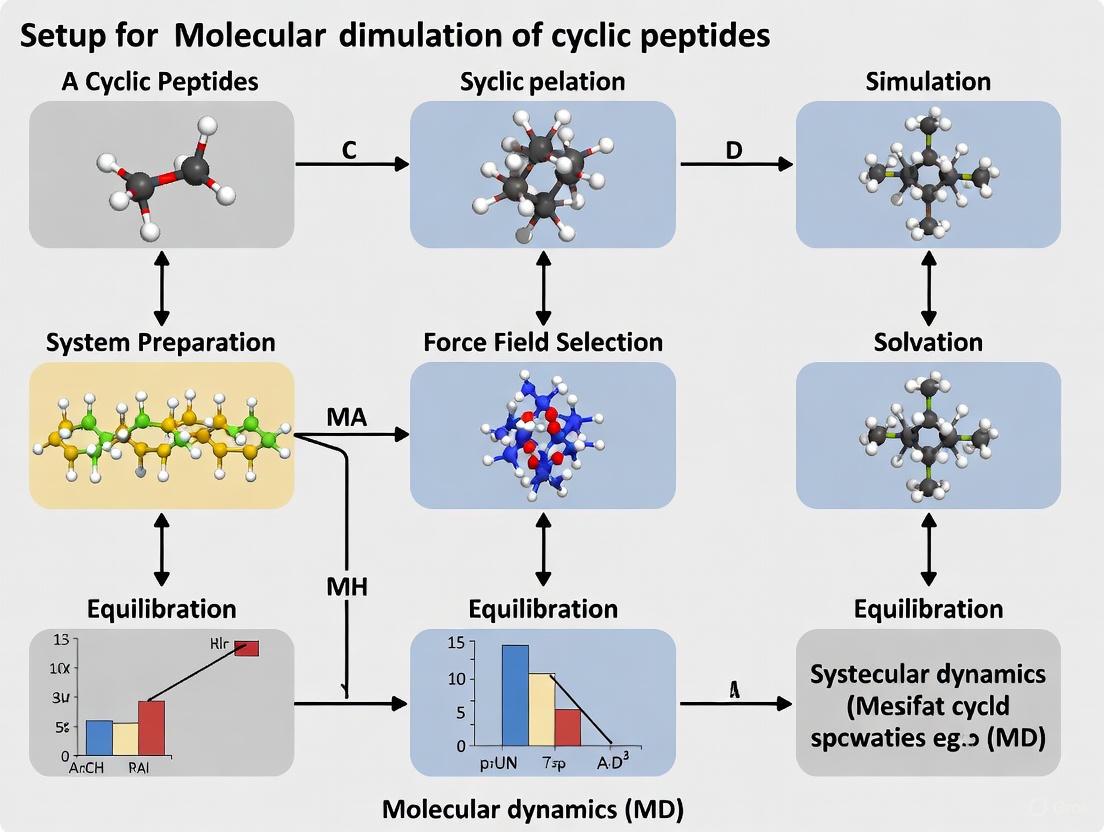
This article provides a comprehensive, step-by-step guide for researchers and drug development professionals to set up and run molecular dynamics (MD) simulations for cyclic peptides.
A Practical Guide to Setting Up Molecular Dynamics Simulations for Cyclic Peptides
Abstract
This article provides a comprehensive, step-by-step guide for researchers and drug development professionals to set up and run molecular dynamics (MD) simulations for cyclic peptides. Covering everything from fundamental concepts and system preparation with explicit solvent to advanced enhanced sampling techniques and result validation, this guide addresses key challenges in simulating these complex molecules. Readers will learn how to select appropriate force fields, implement methods like GaMD and REMD for efficient conformational sampling, troubleshoot common issues, and correlate simulation data with experimental observables like membrane permeability and LogD to advance therapeutic design.
Understanding Cyclic Peptides and Why They Challenge Conventional MD
The Unique Conformational Landscape of Cyclic Peptides
Cyclic peptides are an emerging therapeutic modality that combine the advantages of small molecules and biologics. Their conformational rigidity, target specificity, protease resistance, and potential for membrane permeability make them attractive for drug development, particularly for disrupting intracellular protein-protein interactions [1]. However, their circular structure creates a unique conformational landscape that is challenging to characterize and predict. Molecular dynamics (MD) simulations have become an indispensable tool for studying these landscapes in solution, providing atomic-level insights that complement experimental data [2] [3]. This Application Note provides a structured framework for employing MD simulations in cyclic peptide research, detailing force field selection, enhanced sampling protocols, and analytical approaches to accurately capture their conformational ensembles.
Force Field Performance and Selection
The accuracy of MD simulations is critically dependent on the force field. A recent benchmark study evaluated seven state-of-the-art force fields against NMR data for 12 cyclic peptides (6 pentapeptides, 4 hexapeptides, and 2 heptapeptides) [3]. The performance was measured by the ability of simulations to recapitulate experimental NMR-derived structural information.
Table 1: Performance of Force Fields for Cyclic Peptide Simulations
| Force Field + Solvent Model | Number of Cyclic Peptides with NMR Data Recapitulated | Performance Rating |
|---|---|---|
| RSFF2 + TIP3P | 10/12 | Excellent |
| RSFF2C + TIP3P | 10/12 | Excellent |
| Amber14SB + TIP3P | 10/12 | Excellent |
| Amber19SB + OPC | 8/12 | Good |
| OPLS-AA/M + TIP4P | 5/12 | Moderate |
| Amber03 + TIP3P | 5/12 | Moderate |
| Amber14SBonlysc + GB-neck2 (Implicit) | 5/12 | Moderate |
The data indicates that RSFF2+TIP3P, RSFF2C+TIP3P, and Amber14SB+TIP3P demonstrate the best and similar performance, successfully reproducing NMR data for 10 out of 12 benchmark peptides [3]. The use of explicit solvent models is generally recommended, as implicit solvent models (e.g., GB-neck2) showed inferior performance in this assessment.
Experimental Protocols for MD Simulation
System Preparation and Equilibration
A robust protocol for initializing cyclic peptide systems is crucial for simulation stability and convergence [3].
- Initial Structure Construction: Build a linear all-glycine peptide with random (ϕ, ψ) dihedrals using molecular visualization software (e.g., Chimera). Perform head-to-tail cyclization between the N- and C-termini, followed by energy minimization. Finally, mutate the glycine residues to the desired sequence.
- Convergence Verification: Generate at least two different initial conformations (S1 and S2) with a backbone RMSD ≥ 1.2 Å. Perform parallel simulations starting from these structures to monitor convergence.
- Solvation and Neutralization: Solvate the peptide in a box of explicit water molecules (e.g., TIP3P), maintaining a minimum distance of 1.0 nm between the peptide and the box edge. Add counterions (Na⺠or Clâ») to neutralize the system charge.
- Energy Minimization and Equilibration:
- Minimize the energy of the solvated system using the steepest descent algorithm.
- Equilibrate in the NVT ensemble for 50 ps, restraining heavy atoms of the peptide with a force constant of 1000 kJ·molâ»Â¹Â·nmâ»Â².
- Equilibrate in the NPT ensemble for 50 ps with the same restraints.
- Perform subsequent NVT and NPT simulations for 100 ps each without any restraints.
Enhanced Sampling with Bias-Exchange Metadynamics (BE-META)
For efficient sampling of cyclic peptide conformational space, Bias-Exchange Metadynamics (BE-META) is highly effective [3].
- Collective Variables (CVs): For a cyclic peptide of n residues, define 2n biased replicas. Each replica biases a pair of dihedral angles: n replicas bias the (ϕ~i~, ψ~i~) pairs, and the other n replicas bias the (ψ~i~, ϕ~i+1~) pairs.
- Production Simulation: Run the BE-META production simulation in the NPT ensemble. Apply a LINCS constraint algorithm only to bonds involving hydrogen atoms. Use a time step of 2 fs.
- Analysis: The resulting trajectories can be used to reweight and construct the free-energy landscape of the peptide, providing populations for various conformations.
Figure 1: System setup and equilibration workflow.
The Scientist's Toolkit: Research Reagent Solutions
Table 2: Essential Software and Force Fields for Cyclic Peptide Simulations
| Tool/Reagent | Type | Primary Function | Key Consideration |
|---|---|---|---|
| GROMACS [2] [3] | Software | High-performance MD simulation engine. | Highly optimized for explicit solvent simulations on CPUs and GPUs. |
| AMBER [3] | Software | Suite for MD simulations and analysis. | Includes tools for system building (tleap) and analysis (cpptraj, ptraj). |
| PLUMED [3] | Plugin | Enhanced sampling and free-energy calculations. | Essential for implementing BE-META; interfaces with GROMACS/AMBER. |
| RSFF2 [2] [3] | Force Field | Residue-specific force field for peptides. | Top performer for cyclic peptide conformational ensembles. |
| Amber14SB [3] | Force Field | General protein force field. | Robust and well-tested; excellent performance for cyclic peptides. |
| Chimera [3] | Software | Molecular visualization and analysis. | Used for initial model building, cyclization, and visualization. |
| BE-META [3] | Method | Enhanced sampling algorithm. | Efficiently explores conformational space of cyclic peptides. |
| REMD [2] | Method | Enhanced sampling algorithm. | Useful for overcoming energy barriers; implemented in GROMACS. |
| 3-Chloro-5-(p-tolyl)-1,2,4-triazine | 3-Chloro-5-(p-tolyl)-1,2,4-triazine|CAS 1368414-41-8 | 3-Chloro-5-(p-tolyl)-1,2,4-triazine is a key building block for synthesizing diverse 1,2,4-triazine derivatives. This reagent is For Research Use Only. Not for human or veterinary use. | Bench Chemicals |
| 4-Methyl-5-nitropicolinaldehyde | 4-Methyl-5-nitropicolinaldehyde, CAS:5832-38-2, MF:C7H6N2O3, MW:166.13 g/mol | Chemical Reagent | Bench Chemicals |
Integrating Simulation with Broader Research Goals
Connection to de novo Design
Accurate MD simulations are a critical validation step in de novo cyclic peptide design pipelines. Physics-based design tools, such as CyclicChamp, can generate candidate peptides with 15–24 residues [1]. Subsequent microsecond-length MD simulations are used to assess the kinetic and thermodynamic stability of these designs, identifying promising candidates for experimental testing [1]. Furthermore, MD-generated structural ensembles can be used to train machine learning models like StrEAMM, which can then predict ensembles for new sequences in seconds instead of days [4].
Machine Learning and Deep Learning Approaches
Deep learning methods like AfCycDesign have been adapted from AlphaFold2 for cyclic peptide structure prediction and design [5]. These tools can rapidly generate and score large libraries of cyclic peptide scaffolds. However, they are currently limited to canonical L-amino acids and their accuracy may be constrained by the limited training data available for macrocycles [1] [5]. Therefore, MD simulations remain the gold standard for modeling peptides containing D-amino acids or non-canonical residues and for predicting complete structural ensembles, including for poorly-structured, "chameleonic" peptides that may be crucial for membrane permeability [4].
Figure 2: MD simulation role in cyclic peptide research.
Molecular dynamics (MD) simulation has become an indispensable tool for studying cyclic peptides, which are promising therapeutic candidates due to their ability to modulate protein-protein interactions. However, their computational characterization faces three fundamental challenges: ring strain that restricts conformational sampling, the existence of multiple solution conformations, and significant solvent interactions that dictate structural preferences. This Application Note details protocols and solutions for addressing these challenges in MD simulations, providing researchers with practical methodologies for obtaining accurate solution structural ensembles.
Key Challenges in Cyclic Peptide Simulations
Ring Strain and Conformational Sampling
The closed topology of cyclic peptides introduces significant ring strain that creates high energy barriers between conformations. This leads to several computational challenges:
- Slow dynamics with extended correlation times compared to linear peptides
- Kinetic trapping in local energy minima during simulation
- Insufficient sampling with conventional MD (cMD) on typical timescales
These limitations necessitate enhanced sampling methods to achieve adequate conformational exploration [6]. Table 1 compares the performance of various sampling methods for cyclic peptide systems.
Table 1: Performance of Enhanced Sampling Methods for Cyclic Peptides
| System | Method | # Replicas | Length/Replica | Convergence Assessment | Converged? | Reference |
|---|---|---|---|---|---|---|
| Cyclo-(PSIDV) | cMD | 1 | 1 µs | N/A | No | [6] |
| Cyclo-(PSIDV) | aMD | 1 | 1 µs | N/A | N/A | [6] |
| 20 cyclic peptides | REMD | 24-32 | 100-200 ns | Block analysis | Yes | [6] |
| Cyclo-(YNPFEEGG) | REMD | 51-59 | 300 ns | Independent trajectories | Mixed | [6] |
| Cyclo-(YNPFEEGG) | BE-META | 18 | 300 ns | Independent trajectories | Yes | [6] |
| Cyclosporin A | CoCo-MD | 10 | 2 ns | Ensemble diversity | 9822 confs | [6] |
Multiple Conformational States
Most cyclic peptides exist as ensembles of multiple conformations in solution rather than single structures. Experimental characterization, particularly by NMR spectroscopy, is challenging because it provides time- and ensemble-averaged data that are difficult to deconvolute [6]. This multiplicity has functional significance, as chameleonic properties may enable membrane permeability by adopting different conformations in various environments [7]. Computational methods must therefore capture complete structural ensembles rather than identifying single low-energy states.
Solvent Interactions
Explicit solvent modeling is particularly important for cyclic peptides due to their:
- High solvent exposure of backbone polar groups
- Bridged water molecules that can be caged within peptide structures
- Direct hydrogen bonding with solvent that dictates conformational preferences
Implicit solvent models often fail to capture these specific peptide-water interactions, leading to inaccurate structural predictions [6].
Computational Protocols
Enhanced Sampling Methods
Replica Exchange Molecular Dynamics (REMD)
REMD is particularly effective for cyclic peptides as it facilitates escape from local minima. The following protocol implements REMD using GROMACS:
REMD Workflow for Cyclic Peptides
Key Parameters:
- Temperature distribution: Use 24-59 replicas exponentially spaced between 300-500K
- Exchange attempts: Every 1-2 ps
- Simulation length: 100-300 ns per replica
- Force field: AMBERff99SB with RSFF2 modification or CHARMM36 with CMAP corrections [2] [6]
Convergence Assessment:
- Perform block analysis of backbone RMSD
- Compare two independent simulations
- Monitor replica exchange rates (target: 20-30%)
- Calculate ensemble diversity metrics [6]
Bias-Exchange Metadynamics (BE-META)
BE-META accelerates transitions along specific collective variables (CVs) relevant to cyclic peptides:
Protocol:
- Define CVs: Backbone dihedrals, radius of gyration, principal components
- Set bias parameters: Height=0.1-0.5 kJ/mol, width=CV fluctuations, deposition=1 ps
- Exchange attempts: Every 500 steps between CVs
- Simulation length: 100-250 ns per replica with 12-18 replicas [6]
Convergence: Monitor CV distributions and free energy surface evolution
Force Field Selection and Modification
Standard protein force fields require modifications for cyclic peptides:
Table 2: Force Field Recommendations for Cyclic Peptides
| Force Field | Modification | Advantages | Limitations | Reference |
|---|---|---|---|---|
| AMBERff99SB | RSFF2 (Residue-specific) | Improved backbone dihedral sampling | Parameterization required | [2] [6] |
| OPLS-AA/L | RSFF1 | Better side-chain rotamers | Limited testing | [2] |
| CHARMM36 | CMAP | Good secondary structure balance | May over-stabilize helices | [6] |
| General Amber | GAFF | Compatible with non-natural amino acids | Limited peptide validation | [6] |
Residue-Specific Force Fields (RSFF) incorporate amino acid-specific corrections derived from protein coil libraries, significantly improving conformational sampling for cyclic peptides [2].
Trajectory Analysis and Validation
Clustering and Ensemble Characterization
Ensemble Analysis Workflow
Clustering Protocol:
- Feature selection: Backbone dihedrals or heavy atom coordinates
- Dimensionality reduction: PCA or t-SNE for visualization
- Clustering algorithm: Density-based (DBSCAN) or k-means++
- Cluster validation: Silhouette score, convergence between replicates
RING-PyMOL Integration: Use RING-PyMOL plugin to analyze residue interaction networks across clusters and identify correlated contacts that explain structural heterogeneity [8].
Experimental Validation
Compare computational ensembles with experimental data:
- NMR chemical shifts: Calculate using SHIFTX2 or SPARTA+
- J-couplings: Compare^3JHN-HA with experimental values
- NOEs: Calculate expected NOE patterns from ensembles
- RMSD: Target ≤1.5 Å for well-structured peptides, higher for flexible systems
Advanced Applications
Machine Learning Accelerated Predictions
The StrEAMM method combines MD simulations with machine learning to predict structural ensembles in seconds rather than days of computation:
Workflow:
- Run MD simulations for basis-set cyclic peptides (100-500 sequences)
- Train neural networks on (sequence → ensemble) mapping
- Predict ensembles for new sequences in seconds [7]
Performance: Achieves MD-quality predictions with seven-order-of-magnitude speed improvement while maintaining accuracy [7].
Designing Larger Cyclic Peptides
For cyclic peptides beyond 15 residues, traditional sampling becomes prohibitive. The CyclicChamp pipeline addresses this challenge:
Key Innovations:
- Converts cyclic constraint into error function for optimization
- Uses simulated annealing to search low-energy backbone space
- Enables design of 15-24 residue cyclic peptides [1]
Validation: Microsecond MD simulations and replica exchange MD confirm kinetic and thermodynamic stability of designs [1].
The Scientist's Toolkit
Table 3: Essential Computational Tools for Cyclic Peptide Research
| Tool | Application | Key Features | Reference |
|---|---|---|---|
| GROMACS | MD Simulation | REMD implementation, GPU acceleration | [2] [9] |
| RING-PyMOL | Trajectory Analysis | Residue interaction networks, clustering | [8] |
| StrEAMM | Ensemble Prediction | ML-accelerated ensemble prediction | [7] |
| CyclicChamp | Peptide Design | Heuristic search for large macrocycles | [1] |
| Rosetta | Peptide Design | GenKIC cyclization, sequence design | [6] [1] |
| CPMP | Permeability Prediction | MAT-based membrane permeability | [10] |
| 4-(Methylthio)phenylacetyl chloride | 4-(Methylthio)phenylacetyl Chloride|RUO|Supplier | 4-(Methylthio)phenylacetyl chloride is a synthetic building block for research. This product is for Research Use Only and is not intended for personal use. | Bench Chemicals |
| N'-(4-Aminophenyl)benzohydrazide | N'-(4-Aminophenyl)benzohydrazide, CAS:63402-27-7, MF:C13H13N3O, MW:227.26 g/mol | Chemical Reagent | Bench Chemicals |
Accurate simulation of cyclic peptides requires addressing ring strain with enhanced sampling methods, capturing multiple conformational states through ensemble approaches, and explicitly modeling solvent interactions. The protocols described herein provide researchers with robust methodologies for overcoming these challenges and obtaining biologically relevant structural ensembles. As computational power increases and methods like machine learning acceleration mature, MD simulations will play an increasingly central role in the rational design of cyclic peptide therapeutics.
Why Explicit Solvent Models are Non-Negotiable
Molecular dynamics (MD) simulation has become an indispensable tool for studying the structure, dynamics, and function of cyclic peptides, which are emerging as promising therapeutic candidates due to their ability to target challenging protein interfaces. The accuracy of these simulations critically depends on how molecular interactions are modeled, with solvent representation being perhaps the most important factor. While implicit solvent models offer computational efficiency by approximating water as a continuous dielectric medium, explicit solvent models treat water molecules as individual entities, capturing specific and directional peptide-water interactions at the molecular level. For cyclic peptides, whose conformational behavior and biological activity are often dictated by a delicate balance of intramolecular and solvent-mediated forces, explicit solvent modeling is not merely an option but a fundamental requirement for obtaining physiologically relevant results.
The non-negotiable nature of explicit solvents stems from several critical factors. Cyclic peptides frequently display many solvent-exposed backbone carbonyl and amide groups, and their structural ensembles are strongly influenced by peptide-water interactions that must be described at the molecular level [4]. Water molecules can form bridging hydrogen bonds between peptide atoms, become caged within peptide structures, and create microenvironments that stabilize specific conformations—all phenomena that implicit models cannot capture. Furthermore, the chameleonic properties of some cyclic peptides, where their ability to adopt multiple conformations is essential for membrane permeability and biological function, are intimately tied to solvent interactions [4]. This application note establishes why explicit solvent models are essential for meaningful MD simulations of cyclic peptides and provides practical protocols for their implementation.
Quantitative Comparison: Explicit vs. Implicit Solvent Models
Table 1: Key Differences Between Explicit and Implicit Solvent Models for Cyclic Peptide Simulations
| Feature | Explicit Solvent | Implicit Solvent (GB/SA) |
|---|---|---|
| Solvent Representation | Individual water molecules (e.g., TIP3P, TIP4P) [11] | Continuum dielectric medium [11] |
| Specific Hydrogen Bonding | Directly captures specific peptide-water H-bonds [4] | Approximated via effective dielectric response |
| Solvent Caging/Bridging | Models caged water molecules and water bridges [4] | Cannot capture discrete water mediation |
| Conformational Sampling | Essential for accurate ensembles of poorly-structured peptides [4] | Often fails for flexible, solvent-exposed peptides |
| Computational Cost | High (~70-90% of computation on water) [11] | Low (enables faster sampling) |
| Recommended Use Case | Final production simulations and validation [2] [11] | Initial conformational sampling or screening |
The quantitative requirements for achieving reliable statistics in explicit solvent simulations further underscore their sophisticated treatment of solvent effects. For instance, reproducing Raman Optical Activity (ROA) spectra of a cyclic dipeptide required averaging over a substantial number of independent MD snapshots—approximately 40 snapshots for middle-frequency regions and more than 120 snapshots for the highly solvent-sensitive amide I band region [12]. This demonstrates how explicit solvent models capture the dynamic interplay between peptide conformation and aqueous environment, which is particularly crucial for spectroscopic properties and solvent-exposed motifs.
Practical Consequences: How Solvent Models Impact Research Outcomes
Conformational Sampling and Population Distributions
The choice of solvent model directly influences the predicted structural ensembles of cyclic peptides. Well-structured cyclic peptides that predominantly populate a single conformation may sometimes be studied with simpler models, but the majority of cyclic peptides adopt multiple conformations in solution [4]. For these "poorly-structured" or "chameleonic" peptides, explicit solvent is essential because their functional properties often depend on the equilibrium between different conformations. The ability to adopt multiple conformations can be essential for biological properties, including the high cell membrane permeability observed in some therapeutic cyclic peptides [4]. Implicit models typically fail to predict the correct populations of these conformational states because they miss the discrete, directional nature of water-peptide interactions that tip the energetic balance between similar structures.
Binding Mechanisms and Molecular Recognition
Explicit solvent simulations have revealed how solvent interactions dictate binding mechanisms. In studies of cyclic β-hairpin ligands designed to disrupt the MDM2-p53 interaction, massively parallel explicit-solvent MD simulations revealed a conformational selection mechanism where the solution-state preorganization of the ligands determined their binding affinities [13]. Markov State Model analysis of over 3 milliseconds of aggregate trajectory data showed a striking relationship between the relative preorganization of each ligand in solution and its affinity for MDM2, with entropy loss upon binding being the main factor influencing affinity [13]. Such insights would be impossible with implicit solvent models, which cannot capture the detailed dehydration processes and water-mediated interactions that accompany binding.
Force Field Dependencies and Sampling Limitations
It is important to note that explicit solvent simulations still face challenges related to force field accuracy and sampling completeness. Protein force fields contain parameters for bonded interactions (bond lengths, angles, dihedral angles) and non-bonded interactions (van der Waals and electrostatics), and recent improvements have focused particularly on refining backbone and side-chain dihedral-angle terms to fit quantum mechanics calculations or NMR observables [11]. These force fields are continuously being improved (AMBER, CHARMM, OPLS-AA), and their performance is best evaluated with explicit solvents [11]. Enhanced sampling methods like replica-exchange MD (REMD) have become popular for cyclic peptide simulations because they facilitate better conformational exploration [2], but they remain computationally demanding when combined with explicit solvent models.
Experimental Protocols: Implementing Explicit Solvent Simulations
Protocol 1: Standard Explicit Solvent MD for Cyclic Peptides
Table 2: System Setup and Simulation Parameters for Explicit Solvent MD
| Parameter | Specification | Purpose/Rationale |
|---|---|---|
| Force Field | AMBERff99SB, CHARMM36, OPLS-AA with recent dihedral corrections [11] | Balanced protein/water interactions |
| Water Model | TIP3P or TIP4P [11] | Compatible with force field; reproduces water properties |
| System Setup | Solvate in truncated octahedron or rectangular box with ≥10 Å padding from solute | Minimizes artificial periodicity effects |
| Neutralization | Add counterions (Na+/Cl-) to physiological concentration (0.15 M) | Models physiological ionic strength |
| Energy Minimization | Steepest descent followed by conjugate gradient | Removes bad contacts and high-energy configurations |
| Equilibration | Gradual warming from 0 K to target temperature (e.g., 300 K) with position restraints on solute | Allows solvent to relax around peptide |
| Production MD | 50-500 ns (system-dependent) with 2-fs time step | Generates trajectory for analysis |
This protocol provides a foundation for routine explicit solvent simulations of cyclic peptides. After system setup, energy minimization should be performed until the maximum force is below a reasonable threshold (typically 1000 kJ/mol/nm). Equilibration then proceeds in stages: first with strong position restraints on the peptide while the solvent relaxes, then with gradually reduced restraints. During production simulation, temperature and pressure coupling are maintained using algorithms like Nosé-Hoover thermostat and Parrinello-Rahman barostat to simulate NPT conditions. Long-range electrostatics are typically handled with Particle Mesh Ewald methods, which are essential for accurate forces in periodic systems.
Protocol 2: Enhanced Sampling with Replica-Exchange MD (REMD)
For more challenging cyclic peptides with complex energy landscapes, enhanced sampling is necessary. Replica-exchange molecular dynamics (REMD) has become the most popular enhanced sampling method for ab initio folding studies because it efficiently utilizes parallel computing resources [11]. The following protocol is adapted from Gromacs implementations for cyclic peptides [2]:
- System Preparation: Prepare the explicit solvent system as in Protocol 1, ensuring identical configuration across all replicas.
- Temperature Selection: Choose a temperature distribution (typically 8-64 replicas) spanning from the target temperature (e.g., 300 K) to a sufficiently high temperature (e.g., 500 K) where conformational transitions occur rapidly. Temperature spacing should provide ~20% exchange probability between adjacent replicas.
- Parallel Equilibration: Equilibrate each replica independently at its assigned temperature using the same procedure as Protocol 1.
- REMD Production: Run parallel MD simulations with attempted exchanges between neighboring temperatures at regular intervals (e.g., every 1-2 ps). Exchanges are accepted or rejected based on the Metropolis criterion to maintain detailed balance.
- Trajectory Analysis: Recombine trajectories using weighted histogram analysis method (WHAM) or similar approaches to compute thermodynamic properties at the temperature of interest.
REMD is particularly valuable for predicting complete structural ensembles of cyclic peptides, including both well-structured and poorly-structured variants [4]. This method allows conformations to overcome energy barriers at high temperatures while maintaining proper Boltzmann sampling at the target temperature through the exchange process.
Visualization of Methodologies and Workflows
Table 3: Key Software Tools for Explicit Solvent Cyclic Peptide Simulations
| Tool Name | Type | Primary Function | Application in Cyclic Peptide Research |
|---|---|---|---|
| GROMACS [2] [11] | MD Software | High-performance MD simulations | Production MD and REMD simulations with explicit solvent |
| AMBER [11] | MD Software | Biomolecular simulation suite | Force field development and explicit solvent MD |
| CHARMM [11] | MD Software | Biomolecular simulation | All-atom explicit solvent simulations |
| StrEAMM [4] | Machine Learning | Structural ensemble prediction | Predicts MD-quality ensembles without new simulations |
| CPMP [10] | Deep Learning | Membrane permeability prediction | Predicts permeability from structure using MAT framework |
| OpenMM [11] | MD Library | GPU-accelerated simulations | High-throughput explicit solvent simulations |
Beyond the core simulation software, several specialized computational tools have emerged that leverage explicit solvent simulations for cyclic peptide research. The StrEAMM (Structural Ensembles Achieved by Molecular Dynamics and Machine Learning) method uses MD simulation results to train machine learning models that can predict structural ensembles for new cyclic peptide sequences in seconds rather than days [4]. Similarly, the CPMP (Cyclic Peptide Membrane Permeability) model employs a Molecular Attention Transformer based on molecular graph structures and atomic relationships that were initially informed by explicit solvent understanding [10]. These tools represent the next generation of computational methods that build upon insights gained from explicit solvent simulations.
The evidence from multiple research domains consistently demonstrates that explicit solvent models are non-negotiable for meaningful MD simulations of cyclic peptides. While implicit solvents retain value for specific applications like initial conformational sampling or high-throughput screening, they cannot capture the essential physics of peptide-water interactions that govern cyclic peptide behavior. The directional hydrogen bonding, discrete water bridging, and solvent caging effects that explicit models provide are indispensable for predicting accurate structural ensembles, binding mechanisms, and spectroscopic properties.
As computational resources continue to grow and methods like machine learning accelerate structural prediction, the role of explicit solvent simulations will only become more central. They provide the fundamental reference data for training faster predictive models and the validation benchmark for new computational approaches. For researchers pursuing cyclic peptide therapeutics, investing the computational resources in explicit solvent simulations is not merely a technical choice but a scientific necessity for obtaining reliable, physiologically relevant results that can guide experimental design and decision-making.
Relating Solution Ensembles to Biological Function and Permeability
For cyclic peptides, which are promising therapeutic candidates for modulating intracellular protein-protein interactions, the dynamic ensemble of conformations they adopt in solution (their solution ensemble) is a critical determinant of their biological function and membrane permeability [6]. Unlike small molecules or structured proteins, cyclic peptides are highly flexible, frequently populating multiple conformational states in equilibrium. The composition of this ensemble dictates both their ability to bind biological targets with high affinity and specificity, and their capacity to passively cross cell membranes to reach intracellular sites of action [14] [15]. A profound challenge in de novo cyclic peptide design is the inability of traditional structural biology techniques, such as X-ray crystallography and standard NMR spectroscopy, to adequately resolve these multiple, interconverting solution states [6]. Molecular dynamics (MD) simulations, particularly when enhanced sampling methods are employed, have emerged as a powerful computational microscope, capable of characterizing these elusive conformational landscapes and relating them directly to experimental observables like permeability coefficients and binding affinities [6] [11]. This application note details protocols for applying MD simulations to uncover the links between cyclic peptide sequence, solution ensemble, and biological activity, providing a foundation for their rational design.
The Critical Link Between Conformational Dynamics and Permeability
The conformational plasticity of cyclic peptides is central to the hypothesized mechanism of passive membrane permeability. Many cyclic peptides exhibit chameleonic properties, allowing them to modulate their three-dimensional structure to adapt to different environments [15]. A peptide may preferentially adopt a more polar, solvent-exposed conformation in an aqueous extracellular environment, while shifting its ensemble toward compact, hydrophobic states with internal hydrogen bonds (H-bonds) to minimize the exposure of polar backbone groups within the lipid bilayer [14]. The ability to sample these permeable-active conformations, even transiently in water, is a key prerequisite for membrane crossing.
Molecular dynamics simulations provide the means to quantify these features by sampling the free energy landscape of the peptide. Key metrics that can be derived from simulation trajectories and correlated with experimental permeability include:
- Solvent-Accessible Surface Area (SASA): A measure of molecular exposure, particularly for polar and non-polar groups.
- Number of Internal Hydrogen Bonds: A hallmark of compact, closed conformations that shield polar atoms.
- Radius of Hydration (Râ‚€): An indicator of molecular volume and compactness.
- Principal Component Analysis (PCA) Modes: The dominant collective motions that define the transitions between conformational states.
The free energy difference of a peptide between aqueous and membrane-mimetic environments (e.g., octanol) serves as a computational proxy for its measured permeability, as demonstrated in GaMD studies of lariat peptides [14].
Computational Methods for Sampling Cyclic Peptide Ensembles
Accurately capturing the conformational ensemble of a cyclic peptide requires overcoming significant energy barriers associated with ring strain and cis-trans peptide bond isomerization. Conventional MD (cMD) simulations often fail to adequately explore this complex landscape within practical timeframes. The table below summarizes enhanced sampling methods particularly suited for cyclic peptide studies.
Table 1: Enhanced Sampling Methods for Cyclic Peptide Simulations
| Method | Key Principle | Advantages for Cyclic Peptides | Considerations |
|---|---|---|---|
| Replica-Exchange MD (REMD) [6] [2] | Multiple copies (replicas) run at different temperatures; periodic swapping allows escape from local minima. | Excellent for broad exploration of conformational space; efficient on parallel architectures. | Resource-intensive (many replicas); choice of temperature range is critical. |
| Gaussian Accelerated MD (GaMD) [14] | Adds a harmonic boost potential to the system's energy landscape, smoothing energy barriers. | No need to predefine reaction coordinates; provides a un-biased potential for reweighting. | Requires careful tuning of boost potential parameters for accurate reweighting. |
| Bias-Exchange Metadynamics (BE-META) [6] | History-dependent bias potentials are added along multiple collective variables (CVs) to discourage revisiting states. | Efficiently samples complex transitions dependent on multiple variables (e.g., multiple torsions). | Selection of optimal CVs requires prior knowledge of the system. |
The following diagram illustrates the logical workflow for connecting simulation methodologies with the analysis of solution ensembles and their functional outcomes.
Diagram 1: Workflow for connecting simulation, ensemble analysis, and functional properties.
Force Field and Solvation Considerations
The choice of force field and solvent model is paramount for generating physically meaningful ensembles. Best practices include:
- Force Fields: Modern, refined protein force fields such as CHARMM36, AMBER ff99SB-ILDN, and OPLS-AA are recommended, with some studies suggesting residue-specific modifications (RSFF) can improve accuracy for peptides [2] [16] [11].
- Solvent Model: Explicit solvent models (e.g., TIP3P, TIP4P) are strongly preferred over implicit models for cyclic peptides. Explicit water is crucial for modeling specific water-peptide interactions, such as bridging hydrogen bonds or water molecules caged within the peptide ring, which can significantly stabilize certain conformations [6] [11].
Protocol: GaMD for Permeability Prediction
This protocol outlines the use of Gaussian Accelerated MD (GaMD) to sample cyclic peptide conformations in different solvents to predict membrane permeability, based on the methodology of Kelly et al. and subsequent GaMD studies [14].
System Setup
- Initial Structure Generation: Generate an initial 3D structure of the cyclic peptide. For lariat or other non-standard peptides, ensure force field parameters for unusual linkages (e.g., depsipeptide bonds) are properly parameterized using tools like the FFTK plugin in VMD.
- Solvation: Solvate the peptide in two separate systems:
- Aqueous Environment: Use a periodic water box (e.g., TIP3P) with a minimum 10 Ã… buffer between the peptide and box edge.
- Membrane-Mimetic Environment: Use a periodic box of octanol (e.g., using the CGENFF force field) [14].
- Energy Minimization and Equilibration:
- Minimize the system for 5,000-7,500 steps to remove steric clashes.
- Equilibrate in the NPT ensemble (1 atm, 310 K) for at least 100 ps to stabilize system density.
GaMD Production Simulation
- Conventional MD Run: First, run a short (e.g., 10 ns) conventional MD simulation in the NVT ensemble (310 K). This data is used by the GaMD algorithm to calculate the statistics of the potential energy for applying the boost potential.
- GaMD Parameters: Configure the GaMD simulation for "dual-boost" mode, applying boost potentials to both the total potential energy and the dihedral energy. The threshold energy (E) and harmonic force constant (k) should be set according to the GaMD implementation guidelines (e.g., in NAMD 2.14+) to ensure a Gaussian distribution of the boost potential for accurate reweighting [14].
- Production Sampling: Run the GaMD production simulation for a sufficient duration (e.g., 40-250 ns per system, as used in recent studies [14]) to achieve convergence in the sampled conformational space.
Trajectory Analysis and Permeability Estimation
- Cluster Analysis: Use clustering algorithms (e.g., K-means) on the backbone heavy atom RMSD to identify the predominant conformational families in each solvent [14].
- Calculate Key Metrics: For each cluster, compute:
- Backbone and total SASA.
- Number of internal hydrogen bonds.
- Radius of hydration (Râ‚€), found by fitting the average cluster conformation to the smallest enclosing sphere.
- Construct Free Energy Landscapes: Reweight the simulation data using the GaMD boost potential to compute the potential of mean force (PMF) along relevant collective variables, such as principal components or RMSD.
- Estimate Permeability: The permeability (P) can be estimated using an adapted form of the Stokes-Einstein and solubility-diffusion equations, integrating the PMF and diffusion coefficient across the solvent boundary [14]:
1/P = R = ∫ [exp(βW(z)) / D(z)] dzwhere R is resistivity, β is 1/KBT, W(z) is the PMF, and D(z) is the diffusion coefficient.
Protocol: Machine Learning for Permeability Prediction
As a complementary high-throughput approach, machine learning (ML) models can predict permeability directly from peptide sequence or structure. The following table summarizes the performance of top-performing ML models based on a recent benchmark [15].
Table 2: Performance of Selected ML Models on Cyclic Peptide Permeability Prediction (PAMPA Assay Data)
| Model | Molecular Representation | Key Performance (Regression R² on Test Set) | Key Advantage |
|---|---|---|---|
| DMPNN [15] | Molecular Graph | ~0.67 (Random Split) | Consistently top performer; directly models atomic interactions. |
| MAT [10] | Molecular Graph + Attention | 0.67 (PAMPA) | Attention mechanism captures long-range atom interactions. |
| Random Forest [15] | Molecular Fingerprints | Comparable to advanced models | Simplicity, robustness, and low computational cost. |
| Support Vector Regression [10] | Molecular Fingerprints | Lower than graph-based models | Effective for simpler feature sets. |
ML Model Implementation Workflow
- Data Curation: Obtain a curated dataset of cyclic peptides with experimental permeability values, such as the CycPeptMPDB [10] [15]. Preprocess SMILES strings and handle missing data.
- Feature Generation: Convert the peptide into a machine-readable format. Common representations include:
- Molecular Graphs: Atoms as nodes, bonds as edges, used as input for DMPNN or MAT.
- Molecular Fingerprints: Fixed-length bit vectors representing structural features, used for Random Forest or SVR.
- Model Training and Validation:
- Split data into training, validation, and test sets. Use scaffold splitting (grouping by molecular core) for a more rigorous assessment of generalizability to novel chemotypes [15].
- Train the model on the training set, using the validation set for hyperparameter tuning.
- Evaluate final performance on the held-out test set using metrics like R² (regression) or AUC-ROC (classification).
The Scientist's Toolkit: Essential Research Reagents and Software
Table 3: Key Computational Tools for Cyclic Peptide Ensemble Studies
| Tool Name | Type/Category | Primary Function in Research |
|---|---|---|
| GROMACS [16] | MD Simulation Software | High-performance engine for running cMD and REMD simulations. |
| NAMD [14] | MD Simulation Software | Highly scalable MD engine with implementations of enhanced sampling methods like GaMD. |
| VMD [14] | Molecular Visualization & Analysis | System setup, trajectory visualization, and calculation of geometric properties (e.g., SASA, H-bonds). |
| CHARMM36 [14] | Molecular Force Field | Empirical energy function parameters for proteins, lipids, and nucleic acids. |
| AMBER ff99SB-ILDN [16] | Molecular Force Field | A widely used force field for proteins, known for good balance in modeling folded and disordered states. |
| CycPeptMPDB [15] | Database | Curated repository of cyclic peptide sequences and experimental permeability data for training ML models. |
| RDKit [15] | Cheminformatics Library | Generation of molecular fingerprints, scaffolds, and other descriptors from SMILES strings. |
| CPMP [10] | Web Tool / Model | Pre-trained MAT model for predicting cyclic peptide membrane permeability from SMILES. |
| CYCLOPS [17] | Web Tool | User-friendly simulator (CYCLOpeptide Permeability Simulator) for predicting membrane permeability. |
| p-Azidomethylphenyltrimethoxysilane | p-Azidomethylphenyltrimethoxysilane, CAS:83315-74-6, MF:C10H15N3O3Si, MW:253.33 g/mol | Chemical Reagent |
| Thiophene-2-ethylamine HCl salt | Thiophene-2-ethylamine HCl salt, CAS:86188-24-1, MF:C6H10ClNS, MW:163.67 g/mol | Chemical Reagent |
Integrating molecular dynamics simulations and machine learning provides a powerful, multi-faceted framework for elucidating the relationship between the dynamic solution ensembles of cyclic peptides and their biological function and permeability. Enhanced sampling MD methods like GaMD and REMD offer a physics-based approach to reveal the conformational landscapes and chameleonic properties that underpin passive diffusion across membranes. Simultaneously, machine learning models, particularly those based on graph neural networks, enable rapid, high-throughput screening for permeable candidates. By adopting the protocols and tools outlined in this application note, researchers can accelerate the rational design of cyclic peptides, transforming them from challenging targets into viable therapeutics for intracellular applications.
A Step-by-Step MD Setup Protocol: From Structure to Production Run
Initial Structure Generation and Cyclization
Molecular dynamics (MD) simulations have become an indispensable tool for studying cyclic peptides, which are promising therapeutic agents due to their conformational rigidity, binding specificity, and proteolytic resistance. A critical first step in any MD study is the generation of accurate initial structures and the proper implementation of cyclization constraints. This protocol details computational and experimental methodologies for creating realistic cyclic peptide structures suitable for subsequent simulation and analysis. The conformational behavior of cyclic peptides in solution is fundamentally governed by their cyclized structure, making proper initial setup essential for obtaining physiologically relevant results [9] [2].
The content is structured within a broader framework for establishing MD simulations of cyclic peptides, addressing the key initial phases of structure generation and cyclization that fundamentally influence all subsequent computational analysis. These protocols are designed for researchers, scientists, and drug development professionals engaged in rational peptide therapeutic design.
Computational Structure Generation Methods
Computational methods for generating cyclic peptide structures have evolved significantly, with both physics-based and machine learning approaches now available. The choice of method depends on peptide size, presence of non-canonical amino acids, and desired structural features.
Physics-Based De Novo Design
Physics-based approaches remain valuable for their ability to handle diverse chemical spaces, including non-canonical and D-amino acids. These methods utilize force fields and sampling algorithms to explore conformational space.
Table 1: Physics-Based Computational Methods for Cyclic Peptide Structure Generation
| Method/Software | Key Algorithm | Peptide Size Range | Special Features | Applications |
|---|---|---|---|---|
| CyclicChamp | Simulated annealing with cyclic constraints | 7-24 residues | Handles mixed chirality; No disulfide bonds required | De novo design of stable macrocycles [1] [18] |
| Rosetta | Generalized Kinematic Closure (GenKIC) | 7-13 residues (standard); Up to 26 residues (with disulfides) | Monte Carlo sequence design; Mixed L/D-amino acids | Small cyclic peptide design [1] |
| Replica-Exchange MD (REMD) | Parallel sampling at multiple temperatures | Varies | Enhanced conformational sampling | Solution structure determination [9] [19] |
For peptides larger than 13 residues, the CyclicChamp pipeline provides a robust approach. The algorithm converts cyclic constraints into an error function and employs simulated annealing to search for low-energy peptide backbones while maintaining peptide closure. This method addresses the high-dimensionality challenge that large macrocycle designs encounter, making conformational sampling tractable for 15- to 24-residue cyclic peptides without additional cross-links or symmetry requirements [1].
The following diagram illustrates the core computational workflow for generating cyclic peptide structures:
Machine Learning Approaches
Recent advances in machine learning have produced specialized tools for cyclic peptide structure prediction and design:
- AfCycDesign: Encodes cyclic backbone constraints into amino acid relative position matrices using AlphaFold architecture, effective for 7-13 residue peptides [1]
- RFpeptides: Uses RFdiffusion for backbone generation and ProteinMPNN for sequence design, capable of generating binders of 13-16 residues [1]
- HighFold: Predicts macrocycles with disulfide bonds for peptides of 12-39 residues [1]
A significant limitation of current ML approaches is their reliance on training data containing only canonical L-amino acids, making them less suitable for designing peptides with D-amino acids or non-canonical residues [1]. For such applications, physics-based methods remain preferable.
Experimental Cyclization Strategies
Experimental cyclization methods provide both synthetic templates for simulation and validation pathways for computationally designed peptides. These techniques can be categorized by the type of linkage formed and the resulting structural constraints.
Cyclization Methodologies
Table 2: Experimental Cyclization Strategies for Peptide Macrocyclization
| Method Category | Specific Approach | Linkage Formed | Key Features | Considerations |
|---|---|---|---|---|
| Head-to-Tail | Lactam formation | Amide bond | Mimics natural backbone; Common in natural products | Pre-organization required; Epimerization risk [20] |
| Native Chemical Ligation (NCL) | Amide bond | Chemoselective; Aqueous conditions; No side chain protection | Requires N-terminal Cysteine [20] [21] | |
| Side Chain-to-Side Chain | Disulfide formation | Disulfide bond | Reversible; Native to many proteins | redox-sensitive [21] |
| Ring-closing metathesis | Carbon-carbon bond | Stable; Conformational constraint | Requires unnatural amino acids [20] | |
| Stapled peptides | Various | Stabilizes secondary structures | Requires special synthetic approaches [20] | |
| Head/Tail-to-Side Chain | Thiazolidine formation | Thiazolidine ring | Chemoselective | Ring contraction mechanism [20] |
The following workflow outlines key experimental cyclization processes and their relationship to computational structure preparation:
Practical Implementation Considerations
Successful experimental cyclization requires addressing several practical challenges:
- Pre-organization: Incorporation of turn-inducing elements like proline, D-amino acids, or N-methylation to favor cyclization-prone conformations [20]
- Coupling reagents: Careful selection to minimize epimerization (e.g., PyBOP for cyclomarin C; HATU/Oxyma Pure for teixobactin) [20]
- Pseudo-dilution effects: Using solid-phase supports to favor intramolecular reactions over intermolecular oligomerization [20]
- Chemoselective approaches: Native chemical ligation and similar methods that avoid protecting groups and are compatible with aqueous conditions [20]
For head-to-tail cyclization of peptides shorter than seven residues, particular care is needed to prevent cyclodimerization and C-terminal epimerization [20].
MD Simulation Setup for Cyclic Peptides
Initial Structure Preparation
Proper preparation of cyclic peptide structures is essential for successful MD simulations. The protocol varies based on the cyclization method:
For computationally generated structures:
- Extract lowest energy conformation from design pipeline
- Ensure proper bond lengths and angles at the cyclization site
- Confirm closure through distance measurements between connecting atoms
For experimentally derived structures:
- Implement appropriate distance constraints for the cyclization type
- Apply proper atom types and parameters for non-native linkages
- For disulfide bonds, verify proper chirality and geometry
Specialized Simulation Techniques
Enhanced sampling methods are particularly valuable for cyclic peptides due to their conformational complexity:
- Replica-Exchange MD (REMD): Implemented in GROMACS, this method allows parallel sampling at multiple temperatures, enhancing conformational exploration [9] [2]
- Residue-specific force fields: Specialized force fields that account for the unique conformational preferences of amino acids in cyclic contexts [9] [2]
- Clustering analysis: Identification of representative conformations from simulation trajectories to characterize the structural ensemble [9]
Research Reagent Solutions
Table 3: Essential Reagents and Tools for Cyclic Peptide Research
| Category | Specific Tool/Reagent | Function | Application Notes |
|---|---|---|---|
| Simulation Software | GROMACS | MD simulation engine | REMD implementation for enhanced sampling [9] [2] |
| Rosetta | Protein structure prediction & design | GenKIC for cyclic conformation sampling [1] | |
| CyclicChamp | De novo cyclic peptide design | Specialized for 15-24 residue macrocycles [1] [18] | |
| Coupling Reagents | HATU/Oxyma Pure/HOAt/DIEA | Amide bond formation | Used for teixobactin cyclization [20] |
| PyBOP | Amide bond formation | Applied in cyclomarin C synthesis [20] | |
| Chemical Tools | Tris(2-carboxyethyl)phosphine (TCEP) | Disulfide reduction | Used in NCL for cyclic peptide formation [20] |
| Methyldiaminobenzoyl (MeDbz) linker | Solid-phase support | Enables on-resin NCL for head-to-tail cyclization [20] |
The generation of accurate initial structures and proper implementation of cyclization constraints form the critical foundation for successful MD simulations of cyclic peptides. Computational methods like CyclicChamp have expanded the accessible size range for de novo design up to 24 residues, while experimental techniques such as native chemical ligation provide robust synthetic routes for model validation. The integration of these approaches enables researchers to create realistic cyclic peptide models that faithfully represent their solution behavior, supporting the rational design of novel therapeutic agents targeting challenging protein-protein interactions. As computational power increases and algorithms refine, the synergy between in silico design and experimental synthesis will continue to accelerate the development of cyclic peptide therapeutics.
Molecular dynamics (MD) simulation has emerged as an indispensable tool for studying the structural ensembles and biological activities of cyclic peptides, which are promising therapeutic candidates capable of targeting protein-protein interactions [19]. The accuracy of these simulations is profoundly dependent on the molecular mechanics force field employed—the mathematical function and parameters that describe the potential energy of a molecular system [3]. Unlike linear peptides and proteins, cyclic peptides present unique challenges for force fields due to their constrained geometries, diverse non-canonical sequences, and complex conformational dynamics in solution [4]. An inappropriate force field selection can lead to inaccurate structural predictions, potentially misdirecting experimental validation and drug development efforts. This application note provides a critical evaluation of contemporary force field performance for cyclic peptide simulations and establishes detailed protocols for researchers embarking on computational studies of these pharmaceutically relevant molecules.
Performance Assessment: Quantitative Comparison of Force Fields
Performance Against NMR Data for Canonical Cyclic Peptides
Systematic evaluation of force field performance against experimental nuclear magnetic resonance (NMR) data provides the most reliable metric for assessing accuracy in simulating cyclic peptide structural ensembles. A recent benchmark study evaluated seven state-of-the-art force fields against NMR-derived structural information for 12 benchmark cyclic peptides (6 cyclic pentapeptides, 4 cyclic hexapeptides, and 2 cyclic heptapeptides) in aqueous solution [3].
Table 1: Force Field Performance for Cyclic Peptides Against NMR Data
| Force Field + Solvent Model | Peptides Matching NMR Data | Performance Rating | Recommended Use Cases |
|---|---|---|---|
| RSFF2 + TIP3P | 10/12 | Excellent | General purpose; well-structured peptides |
| RSFF2C + TIP3P | 10/12 | Excellent | General purpose; broad conformational sampling |
| Amber14SB + TIP3P | 10/12 | Excellent | General purpose; compatibility with Amber tools |
| Amber19SB + OPC | 8/12 | Good | Newer Amber variant; membrane permeability studies |
| OPLS-AA/M + TIP4P | 5/12 | Moderate | Cross-validation; specific peptide classes |
| Amber03 + TIP3P | 5/12 | Moderate | Legacy systems comparison |
| Amber14SBonlysc + GB-neck2 | 5/12 | Moderate | Implicit solvent requirements; rapid screening |
The data reveals a clear performance hierarchy, with RSFF2+TIP3P, RSFF2C+TIP3P, and Amber14SB+TIP3P demonstrating superior capability in recapitulating experimental observations [3]. These three force fields successfully reproduced NMR-derived structural information for 10 out of the 12 benchmark cyclic peptides. The study also highlighted the critical importance of solvent model pairing, with TIP3P emerging as the preferred water model for cyclic peptide simulations.
Special Considerations for Non-Canonical and Hybrid Peptides
While standard force fields perform well for conventional cyclic peptides, their accuracy diminishes for systems containing non-proteinogenic elements. A systematic assessment of eight widely used force fields (from AMBER, OPLS, CHARMM, and GROMOS families) against 79 NMR observables for cyclic α/β-peptides containing β-amino acids revealed significant limitations [22]. Most investigated force fields displayed good agreement with experimental ^3J(HN,Hα) coupling constants for α-amino acid residues, but showed poor agreement for NMR observables directly related to β-amino acids [22]. This performance deficit highlights the need for careful force field selection and potential parameterization when working with hybrid cyclic peptides containing non-canonical amino acids.
Parameterization Protocols for Novel Cyclic Peptides
Automated Parameterization Workflow
Novel cyclic peptides often contain chemical motifs not fully represented in standard force fields, necessitating additional parameterization. The General Automated Atomic Model Parameterization (GAAMP) method provides a robust framework for generating parameters compatible with biomolecular force fields using ab initio quantum mechanical (QM) target data [23].
Diagram 1: Automated parameterization workflow for novel cyclic peptides. Critical optimization steps (green) target electrostatic potential, water interactions, and dihedral parameters using QM reference data.
The GAAMP protocol combines information from both electrostatic potential (ESP) fitting and explicit water interaction energies to optimize atomic partial charges, providing more robustly accurate models than either approach alone [23]. Additionally, the method automatically identifies "soft" dihedrals with low energy barriers and parameterizes them using systematic one-dimensional dihedral scans from QM calculations.
System Setup and Equilibration Protocol
Proper system setup and equilibration are essential for generating physically realistic simulations of cyclic peptides. The following protocol, adapted from contemporary cyclic peptide simulation studies [3], ensures stable production dynamics:
Initial Structure Preparation:
- Build linear peptide with all glycine residues and random (ϕ, ψ) dihedrals using molecular visualization software (e.g., Chimera)
- Perform head-to-tail cyclization between N- and C-termini
- Conduct energy minimization in vacuum using steepest descent algorithm
- Mutate glycine residues to desired sequence
- Generate at least two distinct initial conformations (backbone RMSD ≥ 1.2 Å) to verify simulation convergence
Solvation and Equilibration:
- Solvate the cyclic peptide in a rectangular water box with minimum 1.0 nm distance between peptide and box walls
- Add counterions (Na⺠or Clâ») to neutralize system charge
- Energy minimization of solvated system (steepest descent algorithm)
- 50 ps NVT simulation with peptide heavy atoms restrained (1000 kJ·molâ»Â¹Â·nmâ»Â²)
- 50 ps NPT simulation with same restraints
- 100 ps NVT simulation without restraints
- 100 ps NPT simulation without restraints
Simulation Parameters:
- Temperature: 300 K (V-rescale thermostat, coupling constant 0.1 ps)
- Pressure: 1 bar (Parrinello-Rahman barostat, coupling constant 2.0 ps)
- Electrostatics: Particle Mesh Ewald (cutoff 1.0 nm)
- van der Waals: cutoff 1.0 nm with long-range dispersion correction
- Constraints: LINCS for all bonds (equilibration) or bonds involving hydrogens (production)
- Integration: Leapfrog algorithm with 2 fs time step
Advanced Sampling and Efficiency Enhancement
Enhanced Sampling Techniques
Conventional MD simulations often struggle to adequately sample the conformational landscape of cyclic peptides within practical computational timeframes. Enhanced sampling methods significantly improve conformational sampling efficiency:
Bias-Exchange Metadynamics (BE-META):
- Implement multiple replicas biasing different collective variables (CVs)
- For n-residue cyclic peptide, use 2n biased replicas
- n replicas bias 2D CVs (ϕᵢ, ψᵢ)
- n replicas bias 2D CVs (ψᵢ, ϕᵢ₊â‚)
- Regular exchange attempts between replicas to ensure proper sampling [3]
Gaussian Accelerated MD (GaMD):
- Adds a boost potential to system potential energy when below threshold energy E
- Enables "dual-boost" potential applied to both total potential and dihedral energies
- Allows accurate reweighting using cumulant expansion to recover original free energy landscape [24]
- Particularly effective for studying membrane permeability of cyclic peptides [24]
Simulation Acceleration Strategies
Two principal methods exist for increasing integration time steps beyond the standard 2 fs limit, significantly reducing computational cost for long timescale simulations:
Hydrogen Mass Repartitioning (HMR):
- Transfers 2-3 Da of mass from heavy atoms to bonded hydrogen atoms
- Allows time steps of 5-7 fs while maintaining simulation stability
- Best suited for united atom force fields (e.g., GROMOS) due to challenges with methyl groups [25]
Hydrogen Isotope Exchange (HIE):
- Directly increases hydrogen atom mass (equivalent to deuteration)
- Avoids mass imbalance issues in HMR with multiple bonded hydrogens
- Allows time steps of 5-7 fs with excellent energy conservation [25]
Table 2: Acceleration Methods for Cyclic Peptide MD Simulations
| Method | Principle | Max Time Step | Advantages | Limitations |
|---|---|---|---|---|
| HMR | Mass transfer from heavy atoms to hydrogens | 5-7 fs | Well-established; good stability | Problematic for methyl groups; non-physical |
| HIE | Direct mass increase of hydrogens | 5-7 fs | Conceptually simple; experimentally correspondable | Alters vibrational properties |
| GaMD | Boost potential enhances barrier crossing | 2-4 fs | No predefined CVs needed; excellent for permeability | Complex reweighting; parameter sensitivity |
Integration with Machine Learning Approaches
Recent advances combine MD simulations with machine learning (ML) to dramatically accelerate structural ensemble prediction for cyclic peptides. The StrEAMM (Structural Ensembles Achieved by Molecular Dynamics and Machine Learning) method uses MD simulation results for several hundred cyclic pentapeptides to train ML models that can predict structural ensembles for entire sequence spaces [4].
Diagram 2: Integration of molecular dynamics with machine learning for rapid prediction of cyclic peptide structural ensembles. The StrEAMM approach achieves a seven-order-of-magnitude speed improvement over conventional MD [4].
The StrEAMM approach represents cyclic peptide conformations using structural digits that categorize (ϕ, ψ) space into 10 distinct regions (B, Π, Γ, Λ, Z, β, π, γ, λ, ζ), enabling efficient structural encoding for machine learning applications [4]. This methodology provides MD-quality predictions of structural ensembles in seconds rather than days, revolutionizing high-throughput cyclic peptide screening.
The Scientist's Toolkit: Essential Research Reagents and Solutions
Table 3: Essential Computational Tools for Cyclic Peptide Research
| Tool Category | Specific Software/Package | Primary Function | Application Notes |
|---|---|---|---|
| Simulation Engines | GROMACS, NAMD, AMBER | MD simulation execution | GROMACS recommended for speed; AMBER for integrated workflows |
| Enhanced Sampling | PLUMED | Advanced sampling algorithms | Essential for BE-META; community CV library available |
| Force Fields | RSFF2, Amber14SB, CHARMM36 | Molecular mechanics parameters | RSFF2 recommended for cyclic peptides; CHARMM36 for membranes |
| Parameterization | GAAMP, Antechamber, CGenFF | Novel molecule parameterization | GAAMP for QM-optimized parameters; Antechamber for GAFF |
| Analysis | MDAnalysis, LOOS, VMD | Trajectory analysis and visualization | MDAnalysis for programmatic analysis; VMD for visualization |
| Machine Learning | StrEAMM Models | Rapid ensemble prediction | Seconds vs days for MD; trained on pentapeptide data |
| (r)-1-Phenylethanesulfonic acid | (r)-1-Phenylethanesulfonic acid, CAS:86963-40-8, MF:C8H10O3S, MW:186.23 g/mol | Chemical Reagent | Bench Chemicals |
| 2-Ethoxynaphthalene-1-carboxamide | 2-Ethoxynaphthalene-1-carboxamide|High-Quality Research Chemical | 2-Ethoxynaphthalene-1-carboxamide for Research Use Only (RUO). Explore its potential as a building block in medicinal chemistry and anticoagulant research. | Bench Chemicals |
Based on comprehensive performance assessments and methodological developments, we recommend the following best practices for force field selection and parameterization in cyclic peptide research:
For general-purpose cyclic peptide simulations, prioritize RSFF2+TIP3P, RSFF2C+TIP3P, or Amber14SB+TIP3P based on their demonstrated superior performance against NMR experimental data [3].
For membrane permeability studies, consider GaMD simulations with CHARMM36 in both aqueous and membrane-mimetic environments (e.g., octanol) to capture environment-dependent conformational preferences [24].
For high-throughput screening, implement the StrEAMM framework to predict structural ensembles for large sequence spaces, using limited MD simulations for validation [4].
For cyclic peptides containing non-canonical elements, employ automated parameterization tools (GAAMP) with QM target data to ensure accurate representation of novel chemical motifs [23].
For enhanced sampling, utilize BE-META with biasing of backbone dihedrals to efficiently explore the constrained conformational landscape of cyclic peptides [3].
As force fields continue to evolve and computational methodologies advance, the integration of physical simulations with machine learning approaches promises to further accelerate the rational design of cyclic peptide therapeutics.
In molecular dynamics (MD) simulations of cyclic peptides, the accurate representation of the solvent and ionic environment is not merely a technical step but a fundamental determinant of success. Cyclic peptides, with their constrained geometry and diverse conformational behaviors, are highly sensitive to their electrostatic and hydrophobic environment [7] [1]. The choices made during system building—whether to model water molecules explicitly or implicitly, and how to neutralize and ionize the system—directly impact the stability of the simulation, the accuracy of the conformational sampling, and the biological relevance of the results [26] [27]. This guide outlines best practices for solvation and ionization, framed within the context of cyclic peptide research for drug development.
Solvation Methods: Explicit vs. Implicit Solvent Models
The first major decision in building a simulation system is selecting a solvation model. The two primary approaches, explicit and implicit solvation, offer a trade-off between computational efficiency and physical detail. The table below provides a comparative overview.
Table 1: Comparison of Explicit and Implicit Solvation Models for MD Simulations
| Feature | Explicit Solvent | Implicit Solvent (Continuum) |
|---|---|---|
| Physical Representation | Discrete water molecules (e.g., TIP3P, TIP4P) surrounding the solute [11] | Solvent represented as a continuous medium with a dielectric constant [28] |
| Computational Cost | High (most computational resources spent on water) [11] | Low (dramatically faster than explicit solvent) [26] [28] |
| Sampling Speed | Slower conformational exploration due to solvent viscosity [28] | Faster exploration due to absence of viscous drag [26] |
| Solvation Free Energy | Not directly calculated; emerges from interactions | Directly estimated, e.g., via Generalized Born (GB) or Poisson-Boltzmann (PB) models [28] |
| Treatment of Hydrophobic Effect | Naturally emerges from water-water and water-solute interactions | Must be added empirically, often via a Solvent Accessible Surface Area (SASA) term [28] |
| Ionic Effects | Added explicitly as discrete ions [27] | Modeled via the Poisson-Boltzmann equation [28] |
| Ideal Use Cases | Final validation, studying specific solvent interactions, refining structures [7] [1] | High-throughput screening, initial conformational sampling, long time-scale folding studies [26] [11] |
For cyclic peptides, which often adopt multiple conformations in solution, the choice is particularly nuanced [7]. Explicit solvent simulations are considered the gold standard for producing physically accurate dynamics and are crucial for final validation of designs [1]. However, the computational efficiency of implicit solvent models like the Generalized Born (GB) model makes them invaluable for large-scale conformational sampling and high-throughput screening in early-stage projects [26] [11]. A common strategy is to use implicit solvent for extensive sampling and then refine promising structures or characterize their dynamics using explicit solvent simulations.
The Generalized Born Model and Its Augmentations
The Generalized Born (GB) model is a popular implicit solvent approximation due to its favorable balance of speed and accuracy. It models electrostatic solvation energy using the following functional form [28]: [ Gs = -\frac{1}{8\pi\epsilon0}\left(1-\frac{1}{\epsilon}\right)\sum{i,j}^{N}\frac{qi qj}{f{GB}} ] where ( f{GB} = \sqrt{r{ij}^2 + a{ij}^2e^{-D}} ) and ( a{ij} = \sqrt{ai aj} ).
This model is often augmented with a hydrophobic solvent accessible surface area (SA) term to account for the non-polar contribution to solvation, creating a GBSA model [28]. This combination has been successfully used in protein dynamics, modeling, and design [26].
Ionization Protocols: Neutralization and Achieving Physiological Conditions
Proper ionization is essential for achieving correct electrostatic interactions and mimicking the biological environment. This process involves two main steps.
System Neutralization
The first and mandatory step is to neutralize the total charge of the solute (e.g., a cyclic peptide). A net charge in a periodic system can lead to unphysical calculations of electrostatic energy [27]. Counter-ions, such as Na+ for negatively charged solutes or Cl- for positively charged ones, are added to bring the total system charge to zero. It is recommended to place ions according to the electrostatic potential of the macromolecule before solvation, as this is more physically realistic and requires less equilibration than random placement [27].
Adding Physiological Salt Concentrations
After neutralization, additional ions are added to mimic a specific salt concentration, such as a physiological 150 mM NaCl solution. The number of ion pairs needed can be estimated using the formula [27]: [ N{Ions} = 0.0187 \cdot [Molarity] \cdot N{WaterMol} ] where ( N_{WaterMol} ) is the number of water molecules in the simulation box. For more accurate concentrations that account for electrostatic screening effects, tools like the SLTCAP server can be used [27].
Table 2: Ion Addition Strategies and Best Practices
| Step | Description | Best Practice / Formula | Rationale |
|---|---|---|---|
| 1. Neutralization | Add counter-ions to balance the solute's charge. | Place ions based on electrostatic potential. | Corrects for net charge, avoids unphysical electrostatics and long equilibration [29] [27]. |
| 2. Salination | Add ion pairs (e.g., Na+/Cl-) to achieve target concentration. | ( N{Ions} = 0.0187 \cdot [Molarity] \cdot N{WaterMol} ) [27] | Mimics the ionic strength of a biological environment, which affects conformation and dynamics [27]. |
Practical Protocols for System Setup
Protocol 1: Explicit Solvent Setup with AMBER
This protocol is ideal for production simulations and final validation of cyclic peptide structures [30] [27].
- Initial Preparation: Obtain the initial cyclic peptide structure from PDB or computational modeling. Ensure the terminal amide bond is correctly formed.
- Load Force Field and Solute: In the
tleapmodule of AMBER, load the appropriate force field (e.g.,leaprc.protein.ff19SB) and your cyclic peptide structure [27]. - Neutralize the System: Use the
addionscommand to add the necessary counter-ions to bring the net charge to zero. Pre-placing ions based on electrostatic potential is recommended [27]. - Solvation: Place the neutralized solute into a solvent box. A cubic or octahedral box with a minimum distance of 10-15 Ã… between the solute and the box edge is standard to prevent artificial self-interactions [27].
- Add Salt: Introduce additional ion pairs to achieve physiological concentration (e.g., 150 mM). The
addionsrandcommand can be used for this purpose, which replaces random water molecules with ions [27]. - Generate Topology and Coordinates: Output the final topology and coordinate files for the simulation.
Protocol 2: Implicit Solvent Setup for Enhanced Sampling
This protocol is suitable for replica-exchange MD (REMD) or high-throughput conformational sampling of cyclic peptides [2] [11].
- Select an Implicit Solvent Model: Choose a model such as the Generalized Born (GB) with a suitable parameter set (e.g., GBNP, GBSW, GBMV) [26]. The choice should be compatible with your force field.
- Incorporate Non-Polar Effects: Augment the GB model with a surface area (SA) term to account for the hydrophobic effect. This creates a GBSA model, which provides a more complete description of solvation [28].
- Configure the MD Engine: In your MD software (e.g., AMBER, GROMACS), set the parameters to use the implicit solvent model instead of explicit water. This typically involves specifying the GB method and its associated parameters in the configuration file.
- Run Enhanced Sampling Simulation: With the reduced computational cost, employ methods like REMD to achieve broad conformational sampling, which is crucial for cyclic peptides that may have multiple low-energy states [2] [7].
The following workflow diagram summarizes the decision process and key steps for building a solvated and ionized system for cyclic peptide MD simulations.
Table 3: Key Research Reagent Solutions for Cyclic Peptide MD Simulations
| Tool / Resource | Function | Application Note |
|---|---|---|
| AMBER | A suite of biomolecular simulation programs [30] | Includes tleap for system building, sander/pmemd for simulation, and supports both explicit and implicit solvent [30] [27]. |
| GROMACS | High-performance MD simulation package [2] | Known for its speed; can be used with AMBER force fields and topology files for cyclic peptide simulations [27]. |
| CHARMM | MD simulation and analysis program [26] | Often used with implicit solvent (GB) models for protein folding and decoy discrimination studies [26]. |
| OPC Water Model | A 4-point explicit water model [27] | Provides a highly accurate representation of water properties for explicit solvent simulations [27]. |
| Generalized Born (GB) Models | A class of implicit solvent models [26] [28] | Models like GBNP, GBMV2 are optimized for use with specific force fields (e.g., CHARMM, AMBER) [26]. |
| SLTCAP Server | An online calculation tool [27] | Calculates the number of ions needed for a target concentration, correcting for electrostatic screening effects [27]. |
Meticulous construction of the solvation and ionization environment is a prerequisite for obtaining reliable and biologically relevant insights from MD simulations of cyclic peptides. The choice between explicit and implicit solvent should be guided by the specific research objective, whether it is ultimate accuracy or computational efficiency. Adhering to the established protocols of neutralization and salination ensures electrostatic stability and physiological relevance. By integrating these best practices, researchers can build robust simulation systems that provide a solid foundation for understanding the structure, dynamics, and function of cyclic peptides in drug discovery pipelines.
In molecular dynamics (MD) simulations, the equilibration phase is a preparatory period where the macromolecular system and its surrounding solvent undergo relaxation before reaching a stationary state suitable for data collection [31]. This stage is particularly critical for cyclic peptide research, as these molecules often adopt multiple conformations in solution, and their structural ensembles are key to understanding their biological activity and membrane permeability [4] [32]. A properly equilibrated system ensures that the subsequent production phase samples from a thermodynamically representative ensemble, thereby providing reliable insights into cyclic peptide behavior.
The fundamental goal of thermal equilibration is to bring the system to a state where the average kinetic energy is appropriately distributed according to the target temperature, as defined by the classical kinetic theory of gases [33]. For cyclic peptides, which frequently display complex conformational dynamics and peptide-water interactions that must be described at the molecular level, achieving proper equilibration is essential for accurate structural ensemble prediction [4]. This protocol outlines robust equilibration procedures tailored to the specific challenges of cyclic peptide simulations.
Comparative Analysis of Equilibration Methodologies
Table 1: Overview of Equilibration Protocols for Molecular Dynamics Simulations
| Protocol Type | Key Features | Applications | Advantages | Limitations |
|---|---|---|---|---|
| Traditional Full-System Coupling | Coupling all system atoms to a thermal bath [33] | General biomolecular simulations | Simple implementation; Widely used | Potential for inadequate equilibration; Longer stabilization times |
| Solvent-Only Coupling | Coupling only solvent atoms to a thermal bath [33] | Systems requiring precise thermal transfer | More physical representation of heat bath; Monitored equilibration progress; Reduced structural divergence | Requires specific monitoring of protein-solvent temperature difference |
| Two-Stage Constant Volume/Pressure | Initial constant volume heating followed by constant pressure equilibration [31] | AMBER tutorial protocols; Standard protein simulations | Gradual system relaxation; Controlled density adjustment | Potentially longer setup time |
Table 2: Key Parameters in Equilibration Protocols
| Parameter | Typical Settings | Function | Impact on Simulation |
|---|---|---|---|
| Temperature Coupling Algorithm | Berendsen thermostat [31] | Maintains system temperature | Affects kinetic energy distribution |
| Time Constant (tautp) | 2.0 ps [31] | Controls coupling strength to heat bath | Influences temperature stability |
| Initial Temperature (tempi) | 100 K [31] | Starting point for heating | Prevents initial instability |
| Reference Temperature (temp0) | 300 K [31] | Target temperature | Determines final system energy |
| Pressure Control | 0 (none for initial stage) [31] | Regulates system density | Affects solvent organization around peptide |
Advanced Protocol: Solvent-Coupling for Enhanced Thermal Equilibration
Theoretical Basis
The solvent-coupling method represents a paradigm shift from traditional equilibration approaches. Rather than coupling all atoms to a thermal bath, this method uniquely couples only the solvent atoms, treating the surrounding solvent as a more realistic physical representation of a heat bath [33]. This approach is guided by the kinetic theory of gases, where thermal equilibrium is reached when the temperatures of two systems in contact are equal [33]. For cyclic peptides, which often have many solvent-exposed backbone hydrogen-bond donors and acceptors, explicitly modeling the peptide-water interactions during equilibration is particularly valuable for subsequent accurate sampling of conformational ensembles [4].
Implementation Workflow
Detailed Methodology
The implementation of the solvent-coupling protocol involves the following key steps:
Initial System Preparation: Begin with a structurally minimized system where protein/peptide atoms are initially fixed, and the system energy is minimized with only solvent atoms mobile [33].
Solvent Pre-Equilibration: Perform a short MD simulation (approximately 50 ps) at the target temperature (e.g., 300 K) with the heat bath coupled only to solvent atoms, maintaining pressure at 1 atm [33].
Protein/Peptide Release: Remove all protein atom restraints and perform a quenched energy minimization to relax the entire system [33].
Equilibration Monitoring: Conduct the main equilibration phase while monitoring the difference in temperature between the solvent and the protein/peptide separately. Thermal equilibrium is achieved when these temperatures converge [33].
This protocol provides a unique measure of the time required for equilibration completion, removing ambiguities associated with traditional heuristic approaches and avoiding bias introduced by the inclusion of non-equilibrium events [33].
Standard Protocol: Traditional Two-Stage Equilibration
AMBER-Based Implementation
For researchers using the AMBER software package, a standard two-stage equilibration protocol is commonly employed, which can be adapted for cyclic peptide systems [31]:
Stage 1: Constant Volume Heating
- Objective: Gradually heat the system from a low initial temperature to the target temperature while maintaining constant volume.
- Parameters: Begin at 100 K (tempi=100.0) and increase to the target temperature (e.g., 300 K, temp0=300.0) over 10-20 ps using the Berendsen coupling algorithm [31].
- Constraints: Use the SHAKE algorithm to constrain bonds involving hydrogen (ntc=2, ntf=2) [31].
- Volume Control: Maintain constant volume (ntb=1) with no pressure control (ntp=0) during this initial phase [31].
Stage 2: Constant Pressure Equilibration
- Objective: Allow system density to adjust to the target temperature and pressure.
- Parameters: Switch to constant pressure regulation (ntp=1) while maintaining temperature control.
- Duration: Continue until system properties (energy, density, temperature) stabilize, typically 50-100 ps.
This traditional approach benefits from widespread implementation in major MD packages and extensive documentation in tutorials and manuals [31].
Table 3: Essential Computational Tools for Cyclic Peptide Simulations
| Tool/Resource | Function | Application in Cyclic Peptide Research |
|---|---|---|
| NAMD | Molecular dynamics program | Simulation of cyclic peptides in explicit solvent [33] |
| AMBER | Molecular dynamics software package | Equilibration and production MD with specialized force fields [31] |
| Gromacs | Molecular dynamics package | Replica-exchange MD for conformational sampling [2] |
| Bias-Exchange Metadynamics | Enhanced sampling technique | Efficient exploration of cyclic peptide conformational space [4] [32] |
| StrEAMM Method | Machine learning approach | Prediction of structural ensembles from MD data [4] [32] |
| SHAKE Algorithm | Constraint algorithm | Allows longer time steps by constraining bond vibrations [31] |
| Berendsen Thermostat | Temperature coupling algorithm | Maintains system temperature during equilibration [31] |
The equilibration phase establishes the foundation for successful MD simulations of cyclic peptides. While traditional protocols provide reasonable approaches for many systems, the solvent-coupling method offers a more physically realistic representation of thermal equilibration that may be particularly advantageous for complex cyclic peptide systems with broad conformational ensembles [33]. By implementing these robust equilibration protocols, researchers can ensure that their production simulations sample from appropriate thermodynamic ensembles, enabling accurate prediction of cyclic peptide structural preferences, membrane permeability, and ultimately supporting rational drug design efforts for this promising therapeutic modality.
Molecular dynamics (MD) simulations provide atomic-level insights into the structure and function of biomolecules. However, the utility of conventional MD is often limited by its ability to sample biologically relevant timescales, particularly for complex systems like cyclic peptides which frequently adopt multiple conformations in solution [19]. Enhanced sampling methods effectively overcome these limitations by accelerating the exploration of conformational space and facilitating the calculation of free energies [34]. For cyclic peptide research—especially in drug development where membrane permeability and binding affinity are critical—techniques including Gaussian accelerated MD (GaMD), Replica-Exchange MD (REMD), and Metadynamics have become indispensable tools [14] [9]. This article provides detailed application notes and protocols for implementing these methods within the context of cyclic peptide simulation, forming a foundational component of a broader thesis on establishing robust MD workflows for this promising class of therapeutics.
Enhanced Sampling Methods: Theoretical Background and Comparative Analysis
Gaussian Accelerated Molecular Dynamics (GaMD) enhances conformational sampling by adding a harmonic boost potential to the system's potential energy when it falls below a specified threshold. This boost potential, which follows a Gaussian distribution, reduces energy barriers and accelerates transitions between low-energy states. The method is particularly valuable because it requires no predefined collective variables (CVs) and allows for accurate reweighting to recover the original free-energy landscape [14] [34]. GaMD's "dual-boost" mode, where boost potentials are applied to both the total potential energy and the dihedral energy, is especially effective for sampling peptide and protein conformational changes [14].
Replica-Exchange Molecular Dynamics (REMD), also known as Parallel Tempering, simultaneously runs multiple replicas of the system at different temperatures. Periodically, exchanges between replicas at adjacent temperatures are attempted based on a Metropolis criterion. This allows conformations trapped in local minima at lower temperatures to escape by visiting higher temperatures, thereby ensuring broad sampling of the conformational landscape [9] [34]. The efficiency of REMD hinges on sufficient exchange probabilities between neighboring replicas, which requires careful selection of the temperature ladder.
Metadynamics is a CV-based technique that enhances sampling by depositing repulsive Gaussian potentials along selected CVs during the simulation. These "hills" actively push the system away from already visited states, encouraging exploration of new regions of the CV space. Over time, the sum of these deposited biases converges to the negative of the underlying free-energy surface, providing a direct estimate of the system's free-energy landscape [34]. Variants such as Well-Tempered Metadynamics control the growth of the bias potential to improve convergence [34].
Comparative Analysis of Methodologies
Table 1: Key Characteristics of Enhanced Sampling Methods
| Method | Requires CVs? | Primary Output | Computational Cost | Best Suited for Cyclic Peptide Studies |
|---|---|---|---|---|
| GaMD | No (can be CV-free) | Free energy landscape, conformational ensembles [14] | Moderate (single system) | Predicting permeability & solvent-dependent behavior [14] |
| REMD | No (temperature-based) | Boltzmann-weighted structural ensembles [9] | High (multiple replicas) | General solution-phase conformational sampling [4] [9] |
| Metadynamics | Yes (user-defined) | Free energy as a function of CVs [34] | Moderate to High (depends on CV number) | Calculating binding free energies, focused conformational transitions [34] |
Table 2: Advantages and Limitations for Cyclic Peptide Research
| Method | Advantages | Limitations |
|---|---|---|
| GaMD | - No need for prior knowledge of CVs- Accurate reweighting for free energy calculations [14] | - Boost potential parameters need tuning- Can be less efficient for specific transitions than CV-based methods |
| REMD | - Conceptually simple, easy to implement- Provides properly weighted ensembles [9] | - Number of replicas scales with system size- High computational resource demand |
| Metadynamics | - Directly computes free energy surfaces- Flexible and powerful with well-chosen CVs [34] | - Quality heavily dependent on CV selection- Risk of non-convergence with complex landscapes |
Application Notes for Cyclic Peptide Studies
Practical Considerations for Method Selection
Choosing the appropriate enhanced sampling method depends heavily on the specific research question. For broad, unbiased exploration of a cyclic peptide's conformational landscape—particularly when little is known about its dynamics—GaMD or REMD are excellent starting points. GaMD is particularly effective for studying solvent-dependent behavior and predicting properties like membrane permeability, as demonstrated in studies of lariat peptides [14]. When the research aims to characterize a specific conformational transition or a binding process, and relevant CVs (e.g., a key dihedral angle, a distance between groups, or a radius of gyration) can be identified, Metadynamics is the more targeted and efficient approach [34]. For generating comprehensive structural ensembles of cyclic peptides in explicit solvent, REMD has proven highly successful, though its computational cost can be prohibitive for larger systems [4] [9].
Workflow Integration
The following diagram illustrates a generalized workflow for integrating these enhanced sampling methods into a cyclic peptide research project, from system setup to analysis.
Experimental Protocols
Protocol 1: Gaussian Accelerated MD (GaMD)
Application Note: This protocol is adapted from a 2024 study investigating the permeability of lariat peptides using GaMD. It is ideal for calculating solvent-dependent free energy differences and predicting properties like logP, which correlates with passive membrane permeability [14].
Step-by-Step Protocol:
System Preparation:
- Force Field: Utilize the CHARMM36 force field for proteins and lipids [14]. For non-standard residues (e.g., N-methylated amino acids, D-amino acids), generate parameters using tools like the Force Field Toolkit (FFTK) in VMD or CGenFF [14].
- Solvation: Solvate the cyclic peptide in a pre-equilibrated box of TIP3P water for aqueous simulations. For membrane-mimetic environments, use an explicit octanol box parameterized with the CGenFF force field [14].
- Neutralization: Add ions to neutralize the system charge.
Simulation Setup:
- Energy Minimization: Minimize the system energy for 5,000-7,500 steps using a conjugate gradient algorithm.
- Equilibration: Equilibrate the system in the NPT ensemble (1 atm, 310 K) for at least 100 ps. Positional restraints may be applied to the peptide backbone during initial equilibration and gradually released.
- Conventional MD (cMD): Run a short (e.g., 10 ns) unrestrained MD simulation to collect potential statistics for GaMD parameterization [14].
GaMD Production Simulation:
- Parameter Calculation: From the cMD run, calculate the average and standard deviation of the system potential. Set the threshold energy
Eand the harmonic force constantkfor the boost potential according to the GaMD formulation [14]. - Boost Potential: Apply a "dual-boost" potential to both the total potential energy and the dihedral energy.
- Production Run: Run the GaMD simulation in the NVT ensemble (310 K) for a sufficient duration (e.g., 40-250 ns) to achieve convergence, as indicated by stable conformational populations [14].
- Parameter Calculation: From the cMD run, calculate the average and standard deviation of the system potential. Set the threshold energy
Analysis and Reweighting:
- Reweighting: Use cumulant expansion to the second order to reweight the simulation trajectory and recover the unbiased free-energy landscape [14] [35].
- Permeability Prediction: Calculate the potential of mean force (PMF) and the diffusion coefficient for the peptide in different solvents. Combine these to predict membrane permeability using a relationship such as
1/P = ∫ [exp(βW(z)) / D(z)] dz[14].
Protocol 2: Replica-Exchange MD (REMD)
Application Note: This protocol is based on established methodologies for elucidating the solution structures of cyclic peptides [9]. REMD is highly effective for mapping the conformational landscape and identifying both major and minor populations in solution, which is crucial for understanding chameleonic behavior linked to permeability [4].
Step-by-Step Protocol:
System Preparation:
- Follow the same system preparation steps as in the GaMD protocol (Step 1).
Replica Setup:
- Temperature Ladder: Determine an appropriate set of temperatures for the replicas. A typical range for cyclic peptides is 300 K to 500 K, with 24-64 replicas. The temperatures should be spaced to ensure an exchange probability between 20-30% [9].
- Replica Generation: Create identical copies of the solvated and equilibrated system, each assigned to a different temperature in the ladder.
REMD Production Simulation:
- Simulation Engine: Use a package like GROMACS that supports REMD [9].
- Exchange Attempts: Configure the simulation to attempt replica exchanges (swapping coordinates between adjacent temperatures) at regular intervals, typically every 1-2 ps.
- Duration: Run the simulation until the conformational space is adequately sampled. This can be monitored by the convergence of properties like backbone RMSD or radius of gyration at the temperature of interest (e.g., 310 K).
Analysis:
- Trajectory Reweighting: The output of REMD is inherently a Boltzmann-weighted ensemble. Analysis focuses on the trajectory at the target temperature.
- Clustering Analysis: Use algorithms like K-means or Daura clustering on the backbone dihedral angles to identify dominant conformational states and their populations [14] [9].
- Ensemble Properties: Calculate ensemble-averaged properties such as the number of intramolecular hydrogen bonds, solvent-accessible surface area (SASA), and radius of gyration.
Protocol 3: Metadynamics
Application Note: Metadynamics is powerful for calculating binding free energies or for driving specific conformational changes, such as the opening of a cyclic peptide or its insertion into a membrane. This protocol outlines its use for such targeted investigations [34].
Step-by-Step Protocol:
System Preparation:
- Follow standard system preparation steps.
Collective Variable (CV) Selection:
- Definition: Choose CVs that accurately describe the process of interest. For cyclic peptides, common CVs include:
- Radius of Gyration: Measures compactness.
- Principal Component Analysis (PCA) eigenvectors: Describe large-amplitude collective motions.
- Specific Dihedral Angles: e.g., key ω or ϕ angles that define backbone transitions.
- Distance(s): Between groups involved in a conformational change or between the peptide and a membrane.
- Number of CVs: Limit to 1 or 2 CVs for efficient sampling and convergence.
- Definition: Choose CVs that accurately describe the process of interest. For cyclic peptides, common CVs include:
Metadynamics Production Simulation:
- Bias Deposition: Use Well-Tempered Metadynamics, where the height of the deposited Gaussian hills decreases over time according to a bias factor [34].
- Hill Parameters: Set the initial Gaussian height (e.g., 0.5-1.5 kJ/mol), width (σ), and deposition stride (e.g., every 500 steps).
- Bias Factor: Choose a bias factor (e.g., 10-100) to control the exploration vs. convergence trade-off.
- Simulation Length: Run the simulation until the free energy surface no longer shifts significantly, indicating convergence.
Analysis:
- Free Energy Surface: The negative of the accumulated bias potential provides an estimate of the free energy as a function of the chosen CVs.
- Barrier Heights and Minima: Analyze the FES to identify stable conformational states and the energy barriers between them.
Table 3: Key Research Reagents and Computational Tools
| Item / Resource | Function / Purpose | Example / Note |
|---|---|---|
| CHARMM36 Force Field | Provides parameters for standard amino acids, lipids, and carbohydrates for MD simulations [14]. | Suitable for cyclic peptides; parameters for non-standard residues (e.g., D-amino acids, N-methylation) must be derived [14]. |
| CGenFF (CHARMM General FF) | Provides parameters for drug-like molecules and organic solvents (e.g., octanol) [14]. | Used for parameterizing membrane-mimetic solvents. |
| Force Field Toolkit (FFTK) | A plugin in VMD for generating force field parameters for novel molecules [14]. | Essential for creating parameters for depsipeptide linkages and non-standard residues. |
| VMD/PSFGEN | Molecular visualization and analysis; used for building cyclic peptide topologies [14]. | Critical for forming specific cyclization linkages (e.g., end-to-end, depsipeptide). |
| NAMD | A widely used, parallel MD simulation engine [14]. | Supports GaMD and conventional MD simulations. |
| GROMACS | A high-performance MD simulation package. | Supports REMD simulations, commonly used for cyclic peptide studies [9]. |
| PLUMED | A library for enhanced sampling, including Metadynamics. | Integrates with many MD engines (NAMD, GROMACS) to implement Metadynamics and other CV-based methods [34]. |
| LOOS & PyLOOS | Lightweight Object-Oriented Structure library for simulation analysis [14]. | Used for calculating dihedrals, hydrogen bonds, SASA, and performing clustering. |
| Octanol & Water Boxes | Solvents representing organic and aqueous phases for calculating partition coefficients (LogP/LogD) [14] [36]. | Mimics the membrane environment for permeability prediction. |
Solving Common Problems and Accelerating Sampling
Overcoming Sampling Barriers in Macrocyclic Systems
Macrocyclic compounds, particularly cyclic peptides, are promising therapeutic candidates capable of modulating challenging biological targets like protein-protein interfaces [37] [19]. However, their conformational analysis using molecular dynamics (MD) simulations presents unique challenges due to restricted bond movements and high energy barriers associated with peptide bond isomerization and ring deformations [37]. This application note provides detailed protocols for employing enhanced sampling molecular dynamics simulations to overcome these barriers, framed within the broader context of setting up MD simulations for cyclic peptide research. We summarize key methodological advances and provide structured workflows to guide researchers in obtaining reliable conformational ensembles for macrocyclic systems in various solvent environments.
Quantitative Comparison of Enhanced Sampling Methods
Table 1: Enhanced Sampling Methods for Macrocyclic Conformational Sampling
| Method | Key Principle | Applicable System Sizes | Strengths | Reported Performance |
|---|---|---|---|---|
| Accelerated MD (aMD) | Global potential energy flattening to overcome energy barriers [37] | 7-47 residue macrocycles [37] | Overcomes torsional barriers; speeds up sampling by ~1000x; no need for predefined collective variables [37] | Reliably samples conformational space in polar solvents; successful for 47 peptidic macrocycles [37] |
| Gaussian Accelerated MD (GaMD) | Adds boost potential following Gaussian distribution to system potential [24] | Lariat peptides with 7-residue macrocycles [24] | Accurate reweighting; predicts membrane permeability; computationally efficient [24] | Enabled permeability prediction for 89 lariat peptides; convergence within 50ns [24] |
| Replica-Exchange MD (REMD) | Multiple copies at different temperatures overcome barriers through exchanges [2] | Small cyclic peptides and stapled peptides [2] | Enhanced sampling of conformational space; avoids kinetic traps [2] | Successful for backbone-cyclized and side-chain-linked peptides [2] |
| Heuristic Search (CyclicChamp) | Simulated annealing with closure constraints [1] | 7-24 residue cyclic peptides [1] | Addresses high-dimensionality challenge; enables large macrocycle design [1] | Produced stable designs for 15-, 20-, and 24-residue cyclic peptides [1] |
Protocol 1: Accelerated MD for Solvent-Dependent Conformational Sampling
Background and Application Scope
This protocol employs dual-boost accelerated MD (aMD) to overcome high energy barriers in macrocyclic conformational sampling, particularly cis-trans isomerization of peptide bonds [37]. The method has been validated on 47 peptidic macrocycles with various modifications including linker length, bulky side chains, rigidification by proline, additional side chain polar atoms, stereochemistry, and N-methylation [37]. It performs robustly in polar solvents like water and DMSO, while requiring special consideration for apolar solvents like chloroform [37].
Step-by-Step Workflow
Step 1: Initial Structure Preparation
- Generate initial 3D conformations from SMILES strings using RDKit with the ETKDG (experimental-torsion-knowledge distance geometry) algorithm [37]
- Add protons at physiological pH (7.4) using molecular operating environment (MOE) "wash" function [37]
- For macrocycles with secondary amine rings, consider both neutral and charged forms by protonating at pH 5.4 when necessary [37]
Step 2: Partial Charge Assignment
- Assign partial charges using the restrained electrostatic potential (RESP) approach with HF/6-31G* basis set after geometric optimization in Gaussian 09 [37]
- Alternatively, calculate averaged charges from 10 randomly generated ETKDG structures to account for conformational diversity [37]
- Assign atom types with antechamber and parametrize other potential energy terms with ff14SB and GAFF force fields using tLEaP in AmberTools [37]
Step 3: Solvation and System Setup
- Solvate systems in explicit solvent models: TIP3P for water, or specialized models for chloroform and DMSO [37]
- Maintain minimum 12 Ã… wall distance between macrocycle and box edge using tLEaP [37]
- Apply the SHAKE algorithm to restrain hydrogen movements, enabling 2 fs time steps [37]
Step 4: aMD Simulation Parameters
- Use dual-boost aMD (applying boosts to both dihedral and total potential energy) [37]
- Set dihedral boosts according to the number of freely movable backbone dihedrals [37]
- Set potential energy boosts to 0.56 kcal/mol times the number of atoms above the unbiased potential energy [37]
- Run production simulations for 1 μs using AMBER20 with PMEMD [37]
Step 5: Trajectory Analysis and Reweighting
- Calculate 2D RMSD with CPPTRAJ to assess conformational coverage [37]
- Perform principal component analysis (PCA) of sine and cosine of the 11 dihedrals common to all macrocycles [37]
- Apply Maclaurin reweighting to the 20th order to recover unbiased free energy surfaces [37]
- Analyze intramolecular hydrogen bonds (IMHBs) with distance cutoff at 3.5 Å and angle cutoff at 90° [37]
Protocol 2: Gaussian Accelerated MD for Permeability Prediction
Background and Application Scope
This protocol employs Gaussian accelerated MD (GaMD) to characterize the effect of solvent on the free energy landscape of cyclic peptides, particularly lariat peptides with tail-to-sidechain cyclization [24]. The approach enables prediction of membrane permeability by simulating peptides in both aqueous and membrane-mimetic environments, providing a cost-effective alternative to free energy MD simulations for virtual screening of cyclic peptide libraries [24].
Step-by-Step Workflow
Step 1: System Selection and Setup
- Select lariat peptides with depsipeptide linkage (ester bond between Thr3 and Pro9) [24]
- Generate linear structures and form depsipeptide linkage with psfgen in VMD [24]
- For modified residues (methylated leucine, D-leucine, D-alanine), derive parameters from existing CHARMM36 residues [24]
Step 2: Force Field Parameterization
- Use CHARMM36 force field for most molecules [24]
- Employ TIP3P model for aqueous solvent and CGENFF force field for octanol solvent [24]
- Generate parameters for depsilinkage using FFTK plugin in VMD [24]
Step 3: Simulation Procedure
- Minimize systems for 5000 steps with 10 kcal/mol/Ų restraint on omega dihedrals [24]
- Solvate in water or octanol using solvate plugin in VMD [24]
- Equilibrate in NPT ensemble (P = 1 atm, T = 310 K) for 100 ps [24]
- Run conventional MD for 10 ns followed by dual-boost GaMD for 40 ns in NVT ensemble (T = 310 K) using NAMD 2.14 [24]
Step 4: Permeability Calculation
- Calculate diffusion coefficient using Stokes-Einstein equation: D = kBT / (6πηRo) where kB is Boltzmann constant, T is temperature, η is viscosity, and Ro is solute radius [24]
- Compute permeability from PMF using: 1/P = R = ∫ exp(W(z)/kBT) / D dz, where W(z) is the potential of mean force [24]
- Determine Ro using PyLOOS to find smallest sphere fitting the average conformation [24]
- Calculate PMF using rmsd2ref and K-means clustering with LOOS tools [24]
Step 5: Analysis and Validation
- Measure backbone dihedral angles using torsion tool in LOOS [24]
- Validate convergence by running extended simulations (250 ns) for selected systems [24]
- Correlate computed permeability with experimental PAMPA measurements [24]
Research Reagent Solutions
Table 2: Essential Computational Tools for Macrocyclic Sampling
| Tool Category | Specific Software/Package | Key Function | Application Notes |
|---|---|---|---|
| Structure Generation | RDKit [37] | Initial 3D conformation from SMILES | Use ETKDG version 3 for macrocyclic compounds |
| Quantum Chemistry | Gaussian 09 [37] | Geometry optimization and RESP charges | HF/6-31G* basis set recommended for partial charges |
| Molecular Dynamics | AMBER [37] | aMD simulations | Includes PMEMD implementation for accelerated sampling |
| Molecular Dynamics | NAMD [24] | GaMD simulations | Compatible with CHARMM36 force field |
| Analysis Tools | CPPTRAJ [37] | Trajectory analysis | 2D RMSD, hydrogen bond analysis, clustering |
| Analysis Tools | LOOS [24] | Permeability calculations | Includes rmsd2ref and PyLOOS for radius calculation |
| Force Fields | ff14SB/GAFF [37] | Protein and general AMBER force fields | Compatible with RESP charges |
| Force Fields | CHARMM36 [24] | All-atom force field | Parameters for depsipeptide linkages required |
| Visualization | PyMOL [37] | Structure visualization | Conformation checking and rendering |
| Enhanced Sampling | Rosetta [1] | Macrocycle design and sampling | GenKIC for kinematic closure |
Critical Considerations for Successful Implementation
Solvent Environment Selection
The choice of solvent environment critically impacts sampling reliability. Polar solvents like water and DMSO generally yield more robust ensembles with standard protocols [37]. For apolar solvents like chloroform, special care is needed in partial charge assignment due to reduced dielectric screening [37]. Using multiple solvent environments (water, chloroform, octanol) enables assessment of chameleonic properties relevant to membrane permeability [37] [24].
Force Field Parameterization
Accurate parameterization is particularly crucial for macrocyclic systems. RESP charges derived from multiple conformations provide better ensemble representation than single-structure charges [37]. For non-standard linkages (e.g., depsipeptides), specialized parameters must be derived [24]. Validation against experimental NMR data is recommended when available [38].
Sampling Validation
Implement reproducibility tests by initiating simulations from different starting structures and assessing convergence of conformational spaces [37]. For challenging systems with slow transitions, consider extended sampling times or alternative enhanced sampling methods [37]. Principal component analysis of common dihedrals provides effective visualization of sampling completeness [37].
The protocols presented here for accelerated MD and Gaussian accelerated MD provide robust approaches for overcoming sampling barriers in macrocyclic systems. By implementing these detailed methodologies, researchers can obtain reliable conformational ensembles that enable prediction of key properties like membrane permeability and facilitate the design of macrocyclic therapeutics with optimized characteristics. The integration of enhanced sampling methods with careful system setup and validation represents a powerful framework for advancing cyclic peptide research and drug development.
Validating Convergence of Your Conformational Ensemble
In molecular dynamics (MD) simulations of cyclic peptides, a conformational ensemble is the complete set of three-dimensional structures the peptide adopts in solution, rather than a single, static snapshot [39] [40]. For cyclic peptides, which are often highly flexible, accurately characterizing this ensemble is crucial because their biological function and binding capabilities are directly linked to the range of conformations they can access [6]. Validating the convergence of this ensemble is a critical step in simulation workflow. A converged ensemble indicates that the simulation has adequately sampled the thermally accessible conformational space, meaning that the observed structural distribution reliably represents the peptide's true behavior in solution. Without proper convergence checks, subsequent analyses of structure-function relationships or binding poses can be misleading and non-reproducible [6].
This challenge is particularly acute for cyclic peptides. Their constrained topology introduces ring strain, which can create high energy barriers between low-energy conformers and slow down dynamics, making it difficult to sample the free-energy landscape effectively using standard MD simulation [6]. Furthermore, cyclic peptides frequently exist in solution as a mixture of multiple conformations, a property sometimes described as "chameleonic," which can be key to their membrane permeability [41]. This guide provides protocols and quantitative measures to rigorously assess the convergence of conformational ensembles, thereby ensuring the reliability of MD simulation results.
Quantitative Metrics for Assessing Convergence
Convergence should be evaluated using multiple, orthogonal metrics that assess different aspects of the ensemble. The table below summarizes the key quantitative measures.
Table 1: Key Quantitative Metrics for Convergence Assessment
| Metric | Description | Interpretation of Convergence | Application Example from Literature |
|---|---|---|---|
| RMSD Analysis | Measures the root-mean-square deviation of atomic positions, either pairwise between conformations or to a reference structure [42]. | The RMSD distribution becomes stable over simulation time and does not drift. Pairwise RMSD matrices show a uniform, well-mixed pattern [6]. | Used in the validation of the StrEAMM method to ensure predictions matched explicit-solvent MD ensembles [41]. |
| Block Analysis | The total simulation time is divided into sequential blocks, and the property of interest (e.g., radius of gyration) is calculated for each block [6]. | The average and variance of the property remain consistent across all sequential blocks, indicating that no new states are being discovered in later blocks. | Applied in REMD studies of 20 cyclic peptides to confirm sufficient sampling [6]. |
| Replica Exchange Mixing | For REMD simulations, this assesses the efficiency with which replicas diffuse through temperature space [6]. | High acceptance rates and efficient random walk of replicas across temperatures indicate good sampling of conformational space. | A key criterion in REMD studies of cyclic peptides like cyclo-(YNPFEEGG) [6]. |
| Free Energy Surface (FES) Stability | Examines the topography of the free energy landscape as a function of collective variables (e.g., RMSD, number of hydrogen bonds) [18] [1]. | The locations and depths of the primary energy minima on the FES do not change with additional simulation time. | Used to validate the thermodynamic stability of large (15-24 residue) cyclic peptide designs [18] [1]. |
| Ensemble Diversity & Clustering | Quantifies the number of unique conformational clusters present in the ensemble, often assessed via clustering algorithms (e.g., k-means, hierarchical) on backbone dihedral angles [6]. | The number of identified clusters and the population of each cluster plateau as more simulation data is included. | In studies of Cyclosporin A, methods like CoCo-MD were evaluated based on the number of distinct conformations (e.g., 9822 confs) they could sample [6]. |
Experimental Protocols for Convergence Validation
Protocol for Multi-Trajectory Analysis via Block Analysis
This protocol is designed to assess whether a single, long simulation trajectory has sampled all relevant conformational states.
- Trajectory Preparation: Concatenate the production run segments of your MD trajectory, ensuring all frames are properly aligned (e.g., to the peptide backbone) to remove rotational and translational artifacts.
- Division into Blocks: Divide the total trajectory into a minimum of 4-5 consecutive, non-overlapping blocks. For a 1 μs simulation, you might create five blocks of 200 ns each.
- Property Calculation: For each block, calculate key structural properties. Recommended properties include:
- Backbone Root-Mean-Square Deviation (RMSD) to monitor global conformational stability.
- Radius of Gyration (Rg) to measure compactness.
- Key intramolecular hydrogen bonds or side-chain dihedral angles.
- Statistical Comparison: Plot the average value and standard deviation (or standard error) of each property across the blocks. A converged simulation will show no systematic drift in the average values, and the variances will be consistent across blocks.
- Interpretation: Convergence is confirmed if the property distributions from the second half of the simulation are statistically indistinguishable from those of the first half, and from the entire dataset.
Protocol for Independent Trajectory Validation
This is a more rigorous method involving the comparison of two or more completely independent simulations started from different initial conditions.
- Initialization: Generate at least two different starting structures for the same cyclic peptide. These can be:
- Parallel Simulation: Run complete, independent MD or enhanced sampling simulations (e.g., REMD, aMD) for each starting structure, following identical simulation parameters and protocols.
- Ensemble Comparison: Compare the resulting conformational ensembles using quantitative metrics:
- Calculate the pairwise RMSD matrices for each ensemble and visually inspect for similarity.
- Use tools like
g_ensemble_compfrom the SimTK toolkit to directly and quantitatively compare the ensembles [43]. - Project the ensembles onto a common free energy surface using the same collective variables (e.g., principal components).
- Interpretation: The simulations are considered converged if the independent ensembles overlap significantly in their structural properties and cover the same regions of the free energy landscape [6]. This approach was used to validate the BE-META sampling method for cyclic peptides [6].
Protocol for Assessing Enhanced Sampling Simulations (REMD/aMD)
Enhanced sampling methods require specific checks to ensure efficiency and proper sampling.
Replica Exchange Molecular Dynamics (REMD):
- Mixing Efficiency: Calculate the replica exchange acceptance rates, which should ideally be between 20-30%. Plot the time evolution of a single replica through temperature space; it should perform a random walk across the entire temperature range.
- Convergence at Target Temperature: Apply block analysis or independent trajectory validation specifically to the ensemble collected at the target temperature (usually 300 K).
Accelerated Molecular Dynamics (aMD) & Other Methods:
- Dihedral Angle Sampling: Monitor the time evolution of key backbone dihedral angles (φ/ψ) to ensure they are not trapped in a single basin and have sampled all likely regions of the Ramachandran plot.
- Convergence of Boost Potential: For aMD, check that the average boost potential has stabilized, indicating that the major conformational states have been visited.
Graphviz diagram illustrating the logical workflow for applying these protocols:
Workflow for Convergence Validation
The Scientist's Toolkit: Research Reagent Solutions
Table 2: Essential Software Tools for Ensemble Generation and Validation
| Tool Name | Function | Application in Convergence |
|---|---|---|
| GROMACS | A versatile package for performing MD simulations. | The primary engine for running simulations, including REMD. Provides many analysis tools for RMSD, Rg, H-bonds, etc. [43]. |
| gensemblecomp | A tool from the SimTK project for direct ensemble comparison [43]. | Quantifies the difference between two conformational ensembles using a thermodynamic metric, providing a direct measure of convergence between independent trials. |
| ProDy | A Python package for protein dynamics analysis [42]. | Used to calculate RMSDs, deformations vectors, and perform ensemble comparisons and superimpositions. |
| Rosetta | A comprehensive suite for macromolecular modeling and design. | Used for initial conformational sampling of cyclic peptides (e.g., with GenKIC) and sequence design [18] [1]. |
| CyclicChamp | A specialized pipeline for de novo cyclic peptide design [18] [1]. | Generates low-energy cyclic peptide backbone conformations for use as starting structures in independent validation protocols. |
| CPPTRAJ/ MDTraj | Popular tools for trajectory analysis. | Used to calculate a wide range of structural metrics, including RMSD, Rg, dihedral angles, and for clustering conformational snapshots. |
| StrEAMM | A machine-learning method for predicting structural ensembles [41]. | Provides a high-quality benchmark ensemble for validation by comparing MD-generated ensembles to StrEAMM's ML-predicted ensembles. |
| furan-2-yl(pyridin-3-yl)methanol | furan-2-yl(pyridin-3-yl)methanol, CAS:89667-21-0, MF:C10H9NO2, MW:175.18 g/mol | Chemical Reagent |
| N,O-Bis-(4-chlorobenzoyl)tyramine | N,O-Bis-(4-chlorobenzoyl)tyramine|CAS 41859-56-7 | High-purity N,O-Bis-(4-chlorobenzoyl)tyramine (CAS 41859-56-7) for pharmaceutical research. This in-house impurity is for Research Use Only. Not for human consumption. |
Case Studies and Best Practices
Case Study: Validating a Cyclic Peptide Design with REMD
In the development of the CyclicChamp pipeline for designing large cyclic peptides (15-24 residues), researchers used replica exchange molecular dynamics (REMD) to validate the thermodynamic stability of their designs [18] [1]. The protocol involved:
- Initial Screening: Running microsecond-length conventional MD simulations to identify designs with kinetic stability.
- Free Energy Analysis: Performing REMD simulations on promising candidates to generate free energy surfaces (FES).
- Convergence Check: The FES was constructed as a function of collective variables like RMSD. Convergence was confirmed when the primary energy minima—their depths and locations—remained stable with additional simulation time. Designs that showed a single, deep global minimum or a few well-defined low-energy minima were considered stable and promising for experimental testing.
- Use Multiple Metrics: Never rely on a single metric. Combine RMSD, clustering, block analysis, and FES stability.
- Prioritize Independent Validation: Whenever computationally feasible, running multiple independent trajectories from different starting points provides the strongest evidence for convergence.
- Match the Method to the System: For highly flexible peptides with broad ensembles, enhanced sampling methods like REMD are often necessary to overcome energy barriers and achieve convergence in a practical timeframe [6].
- Report Comprehensively: When publishing, include evidence of convergence attempts, such as RMSD time series, replica exchange statistics, and comparisons of independent trials, to bolster confidence in your results.
Molecular dynamics (MD) simulation has become an indispensable tool for studying cyclic peptides, providing atomic-level insights into their solution structures, dynamics, and membrane permeability—properties crucial for therapeutic development [19]. However, a significant challenge persists: achieving sufficient sampling of conformational space and accurate prediction of key physicochemical properties without prohibitive computational expense. This application note outlines structured protocols and performance-tuned methodologies to balance these competing demands of computational cost and predictive accuracy, enabling more efficient research workflows for scientists and drug development professionals.
The conformational flexibility of cyclic peptides is both a key determinant of their function and a major computational challenge. Many cyclic peptides exist as structural ensembles in solution, and their "chameleonic" ability to adopt different conformations in different environments is often linked to critical properties like membrane permeability [4]. Accurately capturing these ensembles requires extensive sampling, which traditionally demands substantial computational resources. Meanwhile, for drug development pipelines, predicting membrane permeability and other key properties like distribution coefficients (LogD) early in the process is essential for reducing reliance on costly experimental screening [44] [45].
Performance-Tuned Methodologies: A Comparative Analysis
Computational Methods for Cyclic Peptide Research
Table 1: Performance and application scope of computational methods for cyclic peptides.
| Method | Computational Cost | Key Accuracy Metrics | Primary Application | Best-Suited Use Case |
|---|---|---|---|---|
| Explicit-Solvent MD with Enhanced Sampling [19] [4] | High (hours to days per peptide) | Backbone RMSD < 1.0 Ã… [46] | Conformational ensemble prediction | Detailed mechanism studies; final validation |
| Machine Learning (ML) / AI Models [44] [15] | Low (seconds per peptide) | MAE ≈ 0.7 for LogPapp; ROC-AUC > 0.9 [44] [15] | High-throughput permeability screening | Early-stage screening of large virtual libraries |
| Hybrid MD+ML (StrEAMM) [4] | Very Low (seconds per peptide) | MD-quality ensemble prediction [4] | Rapid structural ensemble prediction | Quickly predicting ensembles for many sequences |
| High-T MD with RSFF2C [46] | Medium | 19/23 peptides with RMSD < 1.0 Ã… [46] | Structure prediction for proline-containing peptides | Accurate structure prediction where cis/trans isomerization is a factor |
Quantitative Performance Benchmarking of AI Models
Recent systematic benchmarking of 13 AI models for predicting cyclic peptide membrane permeability reveals clear performance trends, guiding method selection based on project needs [15].
Table 2: Benchmarking results for AI-based permeability prediction (adapted from [15]).
| Model Category | Representative Model | Regression Performance (MAE ↓) | Classification Performance (ROC-AUC ↑) | Generalizability (Scaffold Split) |
|---|---|---|---|---|
| Graph-Based | Directed Message Passing Neural Network (DMPNN) | 0.71 | 0.92 | Moderate |
| Fingerprint-Based | Random Forest (RF) | 0.73 | 0.90 | Moderate |
| String-Based (SMILES) | Recurrent Neural Network (RNN) | 0.75 | 0.88 | Low |
| Image-Based | Convolutional Neural Network (CNN) | 0.79 | 0.85 | Low |
The benchmark demonstrates that graph-based models, particularly DMPNN, achieve superior performance across regression and classification tasks [15]. Regression tasks generally outperform classification for predicting permeability, a continuous property. A critical finding is that random data splitting yields more reliable and generalizable models than scaffold splitting, contrary to common practice in small-molecule informatics, likely because scaffold splitting artificially reduces chemical diversity in training data for cyclic peptides [15].
Detailed Experimental Protocols
Protocol 1: High-Throughput Permeability Screening with AI
Purpose: To rapidly predict membrane permeability for large virtual libraries of cyclic peptides. Relevance: Replaces costly initial experimental screening; ideal for prioritizing candidates for synthesis.
Step 1: Data Preparation and Featurization
- Input: Curate a dataset of cyclic peptides with experimentally measured apparent permeability (LogPapp), such as the PAMPA data from CycPeptMPDB [44] [15].
- Featurization: Represent each cyclic peptide using multi-level features [44]:
- Atom-level: 3D atomic coordinates and atom features (e.g., element type, hybridization).
- Monomer-level: Amino acid residue or non-natural building block features (e.g., side-chain properties).
- Peptide-level: Global descriptors (e.g., molecular weight, topological polar surface area).
Step 2: Model Selection and Training
Step 3: Prediction and Validation
- Screening: Use the trained model to predict LogPapp for novel, unsynthesized cyclic peptide designs.
- Validation: Select top candidates for experimental validation via PAMPA assays to confirm predictions and iteratively refine the model.
Protocol 2: Accurate Structure Prediction with High-Temperature MD
Purpose: To predict solution structures of proline-containing cyclic peptides with high accuracy, accounting for slow cis/trans isomerization. Relevance: Essential for understanding structure-function relationships when peptide bonds exhibit high rotational barriers [46].
Step 1: System Setup
- Initial Structure: Generate an initial 3D model of the cyclic peptide.
- Force Field: Employ a residue-specific force field like RSFF2C, which is parametrized for accurate conformational sampling [46].
- Solvation: Solvate the peptide in an explicit water model (e.g., TIP3P) within a periodic box.
Step 2: Enhanced Sampling Simulation
- Protocol: Perform high-temperature MD simulations (e.g., 500 K) to enhance sampling efficiency and overcome energy barriers associated with proline isomerization [46].
- Reweighting: Apply a reweighting algorithm (e.g., based on probability densities) to recover the canonical ensemble distribution at the target temperature (e.g., 300 K).
Step 3: Conformational Analysis and Validation
- Cluster Analysis: Cluster the reweighted simulation trajectories to identify predominant conformational states and their populations.
- Validation: Compare the predicted lowest-energy structure(s) with available experimental data (e.g., X-ray crystallography or NMR) using backbone root-mean-square deviation (RMSD) as a key metric [46].
Protocol 3: Rapid Structural Ensemble Prediction with StrEAMM
Purpose: To obtain MD-quality structural ensembles for hundreds of thousands of cyclic peptide sequences in a fraction of the time. Relevance: Enables large-scale sequence-structure relationship studies and informs the design of peptides with desired conformational properties [4].
Step 1: Training Set Generation
- Run explicit-solvent, enhanced-sampling MD simulations (e.g., bias-exchange metadynamics) for a basis set of several hundred cyclic peptides covering diverse sequences [4].
Step 2: Machine Learning Model Training
- Feature Engineering: Describe each peptide's conformation using a structural alphabet (e.g., a 5-letter code for pentapeptides representing dihedral angle regions) [4].
- Model Architecture: Train a machine learning model (StrEAMM) to learn the relationship between peptide sequence and the population of different structural features from the MD training data.
Step 3: Ensemble Prediction
- Input: Sequence of a novel cyclic peptide.
- Output: The StrEAMM model predicts the complete structural ensemble, including populations of various conformations, in less than one second of computation time [4].
The Scientist's Toolkit: Essential Research Reagents & Materials
Table 3: Key computational tools and resources for cyclic peptide research.
| Tool/Resource | Type | Primary Function | Access/Reference |
|---|---|---|---|
| CycPeptMPDB [44] [15] | Database | Curated repository of cyclic peptide structures and experimental membrane permeability data. | Publicly available database |
| RSFF2C Force Field [46] | Software Parameter Set | A residue-specific force field for more accurate conformational sampling in MD simulations. | Implemented in MD codes like AMBER, GROMACS |
| DMPNN [15] | Software Algorithm | A graph neural network architecture for highly accurate molecular property prediction. | Open-source implementations (e.g., in DeepChem) |
| StrEAMM [4] | Software Algorithm | A hybrid MD+ML method for predicting structural ensembles of cyclic peptides near-instantaneously. | Method described in Lin et al. |
| HELM Notation [44] | Standard | A standardized notation system for unambiguously representing complex cyclic peptides and their monomers. | Pistoia Alliance standard |
Workflow Visualization & Decision Pathways
Computational Method Selection Workflow
Selecting the optimal computational strategy requires aligning methodology with specific research objectives and constraints. For high-throughput permeability prediction, graph-based AI models like DMPNN offer the best balance of speed and accuracy [15]. When detailed atomistic insight into conformational dynamics is required, particularly for complex cases involving proline residues, enhanced sampling MD with specialized force fields remains the gold standard, despite its higher computational cost [46]. The emerging hybrid MD+ML approaches, such as StrEAMM, present a transformative opportunity for obtaining MD-quality structural insights at a fraction of the computational expense, enabling large-scale exploration of sequence space [4].
Effective performance tuning involves leveraging these methods in a complementary, hierarchical workflow: using rapid AI screens to filter large libraries, followed by more detailed MD analysis on a refined subset of promising candidates. This integrated approach maximizes both computational efficiency and scientific insight, accelerating the rational design of cyclic peptide therapeutics.
Addressing Pitfalls with Non-Standard Residues and Cross-Links
Molecular dynamics (MD) simulations are indispensable for studying cyclic peptides, providing atomic-level insights into their conformation, stability, and interactions. However, the incorporation of non-standard residues (such as D-amino acids and N-methylated amino acids) and cross-links (including disulfide bonds and side-chain staples) introduces significant methodological challenges that can compromise simulation accuracy and reliability. These elements are crucial for engineering peptides with enhanced stability, permeability, and target affinity, yet they are often poorly represented in standard force fields and require specialized sampling techniques due to the conformational constraints they impose [1] [47] [48].
Successfully addressing these pitfalls is essential for leveraging computational designs in therapeutic development, particularly for targeting amyloidogenic proteins in neurodegenerative diseases and achieving desired membrane permeability profiles [47] [48]. This application note provides detailed protocols and solutions for simulating these complex systems, framed within the broader context of setting up robust MD simulations for cyclic peptide research.
Key Pitfalls and Computational Solutions
The table below summarizes the primary challenges associated with non-standard residues and cross-links, alongside recommended computational solutions.
Table 1: Common Pitfalls and Recommended Solutions for Cyclic Peptide Simulations
| Pitfall Category | Specific Challenge | Recommended Solution | Key References/Tools |
|---|---|---|---|
| Force Field Accuracy | Poor parameterization for D-amino acids, N-methylated residues, and other non-canonicals. | Use residue-specific force fields (RSFF2) or modify existing force fields (e.g., AMBERff99SB) to account for altered conformational preferences [2]. | RSFF2 [2], GROMACS [49] |
| Standard force fields fail to accurately model macrocyclic ring constraints. | Employ energy functions and sampling methods specifically designed for cyclic systems, such as those in Rosetta or the CyclicChamp pipeline [1]. | Rosetta [1], CyclicChamp [1] | |
| Conformational Sampling | Inadequate sampling of the "closed" conformations critical for membrane permeability. | Implement enhanced sampling methods like Replica-Exchange MD (REMD) to overcome energy barriers [47] [2]. | REMD in GROMACS [2] |
| Difficulty sampling cyclic peptide conformations, especially with cross-links. | Utilize a protocol of unbiased and biased (e.g., metadynamics) simulations to enrich for key events along pathways like membrane permeation [47]. | BE-META simulations [49] | |
| System Setup & Docking | Generating realistic initial cyclic conformations for docking. | Apply stepwise cyclization protocols in tools like HADDOCK, starting from linear sequences and applying distance restraints [50]. | HADDOCK2.4 [50] |
| Docking flexible cyclic peptides to protein targets. | Use conformational ensembles from MD simulations (e.g., high-temperature MD or REMD) as input for docking calculations [50]. | HADDOCK [50], AutoDock CrankPep [50] |
Detailed Protocols for Robust Simulation Setup
Protocol 1: Conformational Sampling Using Replica-Exchange MD (REMD)
This protocol, adapted from Jiang et al. (2019), is designed to achieve thorough conformational sampling of cyclic peptides, which is particularly important for systems with non-standard residues [2].
System Preparation:
- Initial Structure: Generate an initial cyclic peptide structure using a builder in software like PyMOL or Chimera.
- Solvation: Solvate the peptide in a cubic water box (e.g., using TIP3P water model) with a minimum distance of 1.0 nm between the peptide and the box edge.
- Neutralization: Add ions (e.g., Na⺠or Clâ») to neutralize the system's net charge.
REMD Simulation in GROMACS:
- Temperature Replicas: Typically, 24-32 replicas are used. The temperature range should be chosen to ensure sufficient exchange rates between adjacent replicas (e.g., spanning 300 K to 500 K). The
mdruncommand in GROMACS is used with the-replexoption to attempt replica exchanges every 100-200 steps. - Force Field: Apply a residue-specific force field like RSFF2, which is a modification of AMBERff99SB, for more accurate backbone and side-chain dihedral potentials [2].
- Simulation Parameters: Use a 2-fs time step, applying constraints to all bonds involving hydrogen atoms (e.g., LINCS algorithm). Run production simulations for hundreds of nanoseconds per replica to achieve convergence.
- Temperature Replicas: Typically, 24-32 replicas are used. The temperature range should be chosen to ensure sufficient exchange rates between adjacent replicas (e.g., spanning 300 K to 500 K). The
Trajectory Analysis:
- Cluster Analysis: Use algorithms like density-based clustering (as implemented in GROMACS or MATLAB) to identify predominant conformational states from the combined replica trajectories [49] [2].
- Free Energy Surface: Project the trajectories onto key reaction coordinates (e.g., backbone dihedral angles or radius of gyration) to generate free energy surfaces and identify low-energy conformations.
Protocol 2: Cyclization and Docking with HADDOCK
This protocol, based on the work of Singh et al. (2022), provides a step-by-step guide for generating cyclic peptide conformations and docking them to a protein target [50].
Generate Starting Conformations:
- Using PyMOL, generate two distinct starting conformations for the linear peptide sequence: an extended beta-sheet (
ss = beta) and a polyproline (ss = polypro) conformation [50].
- Using PyMOL, generate two distinct starting conformations for the linear peptide sequence: an extended beta-sheet (
Cyclization in HADDOCK:
- Step 1 - Reduce Termini Distance: Input the two linear structures into HADDOCK. Define distance restraints (e.g., 0.5-1.0 Ã…) between the terminal atoms (N of N-terminus and C of C-terminus for backbone cyclization, or S atoms for disulfide bonds) and run a short docking calculation to bring the termini closer.
- Step 2 - Peptide Bond Formation: Use the output from Step 1. Apply a covalent bond restraint (e.g., 1.33 Ã… for C-N bond) and angle restraints to form the peptide bond, finalizing the cyclization.
Ensemble Docking:
- Use the ensemble of cyclized conformations generated above as input for HADDOCK docking against the target protein structure.
- If available, use experimental or predicted information about the binding site on the protein to define "active residues," which guides the docking process.
- HADDOCK will perform rigid-body docking, semi-flexible refinement, and explicit solvent refinement to generate and rank the cyclic peptide-protein complexes [50].
The following workflow diagram illustrates the key stages of this integrated process.
Cyclic Peptide Modeling and Docking Workflow
The Scientist's Toolkit: Essential Research Reagents and Software
Table 2: Key Research Reagent Solutions for Cyclic Peptide Simulations
| Tool/Reagent | Category | Function/Purpose | Example Use Case |
|---|---|---|---|
| RSFF2 Force Field | Force Field | A residue-specific modification of AMBERff99SB; provides more accurate conformational energies for peptides [2]. | Simulating cyclic peptides with mixed L/D-amino acids to predict stable folds. |
| GROMACS | MD Software | A versatile package for performing MD simulations, including REMD; highly optimized for performance [49] [2]. | Running high-throughput REMD simulations of cyclic peptides in explicit solvent. |
| HADDOCK2.4 | Docking Software | Integrative modeling platform with a dedicated protocol for cyclizing peptides and docking them to protein targets [50]. | Predicting the binding mode of a disulfide-rich cyclic peptide to its receptor. |
| Rosetta/GenKIC | Design Software | Suite for protein structure prediction and design; includes Generalized Kinematic Closure (GenKIC) for sampling cyclic geometries [1]. | De novo design of a novel cyclic peptide backbone conformation. |
| BE-META | Enhanced Sampling | Bias-Exchange Metadynamics; an advanced sampling method to explore complex conformational landscapes [49]. | Studying the permeation mechanism of a cyclic peptide across a lipid bilayer. |
| PyMOL | Visualization & Modeling | Molecular visualization system with scripting capabilities; useful for building initial peptide structures [50]. | Generating initial linear and cyclic peptide conformations for further simulation. |
Successfully addressing the pitfalls associated with non-standard residues and cross-links is paramount for advancing the computational design and optimization of cyclic peptides. By implementing specialized force fields like RSFF2, employing enhanced sampling strategies such as REMD, and adhering to robust cyclization and docking protocols in platforms like HADDOCK, researchers can significantly improve the accuracy and predictive power of their MD simulations. These detailed application notes provide a structured framework for researchers to navigate these complexities, ultimately accelerating the development of cyclic peptides as next-generation therapeutics.
Benchmarking Results and Extracting Biological Insights
Molecular dynamics (MD) simulations have emerged as a powerful tool for studying the structural dynamics and thermodynamic properties of cyclic peptides, which are increasingly important in drug development for targeting protein-protein interactions. However, the predictive power and reliability of these simulations depend critically on rigorous validation against experimental data. Nuclear Magnetic Resonance (NMR) spectroscopy serves as the gold standard for solution-state structural validation, providing atomic-level insights into conformational ensembles, dynamics, and stability. This application note outlines integrated protocols for validating MD simulations of cyclic peptides against NMR and other experimental data, ensuring computational models accurately represent physical reality.
The robustness of any MD simulation framework depends on the continuous feedback loop between computational predictions and experimental verification. Without such validation, simulations may yield physically implausible results or incorrect interpretations of biological mechanisms. This document provides detailed methodologies for experimental data collection, computational parameter selection, and validation metrics specifically tailored to cyclic peptide research, enabling researchers to establish confidence in their simulation outcomes and make reliable predictions for drug design applications.
Experimental Protocols for NMR Data Collection
Comprehensive NMR Restraint Acquisition for Cyclic Peptides
NMR provides multiple types of structural restraints that collectively define the solution-state conformational ensemble of cyclic peptides. A comprehensive dataset should include both isotropic and anisotropic parameters to adequately constrain computational models.
For the cyclic peptide heterophyllin B, researchers successfully employed an extensive NMR restraint set including 3JHH-couplings, 1H-1H NOE-derived distances, amide proton temperature coefficients, 1DCH residual dipolar couplings (RDCs), and 13C-ΔΔ residual chemical shift anisotropies (RCSAs) [51]. This multi-parametric approach enables robust structural determination by providing complementary information about local geometry, through-space interactions, hydrogen bonding, and molecular orientation.
Protocol 2.1.1: Acquisition of Isotropic NMR Parameters
Sample Preparation: Prepare ≈1 mM uniformly 13C,15N-labeled cyclic peptide in appropriate solvent (e.g., MeOD-d4 for hydrophobic peptides or H2O/D2O mixtures for hydrophilic variants). Include reference compounds for chemical shift calibration [52].
3JHH-Coupling Constant Measurement:
- Acquire 2D 1H,1H-COSY and 1H,1H-TOCSY spectra with sufficient digital resolution in the indirect dimension (typically <2 Hz/pt).
- Extract 3JHH values from cross-peak fine structures or use specialized J-modulated experiments for accurate quantification.
- Record temperature series (275-310 K) to assess temperature dependence of couplings.
NOE-Derived Distance Constraints:
- Acquire 2D 1H,1H-NOESY spectra with multiple mixing times (e.g., 50, 100, 200, 300 ms) to account for spin diffusion.
- Classify NOE cross-peaks as strong, medium, or weak corresponding to upper distance bounds of 2.5, 3.5, and 5.0 Ã…, respectively.
- For larger peptides (>15 residues), implement 3D 15N,13Caliphatic,13Caromatic-resolved [1H,1H]-NOESY to resolve overlapping signals [53].
Amide Proton Temperature Coefficients:
- Record 1D 1H spectra at temperature increments of 5°C from 275K to 310K.
- Calculate temperature coefficients (Δδ/ΔT) for each amide proton.
- Values less than -4.5 ppb/K suggest hydrogen-bond formation, while values greater than -4.5 ppb/K indicate solvent-exposed amides [51].
Protocol 2.1.2: Acquisition of Anisotropic NMR Parameters
Alignment Media Preparation:
- Prepare weakly aligning media for RDC measurements. For methanol solutions, use liquid-crystal-forming oligopeptide AAKLVFF at concentrations of 2-5% w/v [51].
- Confirm weak alignment by monitoring 2H splitting of solvent signals.
RDC Measurement:
- Acquire F2-coupled 1H,13C-CLIP-HSQC spectra under both isotropic and anisotropic conditions.
- Calculate one-bond 1DCH RDCs as the difference between couplings measured in aligned and isotropic phases.
- For methylene groups, use averaged RDC values unless stereospecific assignments are available.
RCSA Measurement:
- Record 13C spectra of initial and final alignment stages using the same alignment media as for RDC measurements.
- Reference RCSA values to the Cα atom with the smallest chemical shift anisotropy constant, as determined by GIAO-DFT calculations [51].
- Measure ΔΔRCSAs as the difference in chemical shifts between aligned and isotropic states.
Table 1: NMR Experimental Times for Structure Determination
| Spectrum Type | Measurement Time | Key Information Obtained |
|---|---|---|
| HNNCαβCα and CαβCα(CO)NHN | 10-67 hours [53] | Backbone resonance assignment |
| HACACONHN/HαβCαβ(CO)NHN | 1-28 hours [53] | Sidechain resonance assignment |
| HCCH aliphatic/aromatic | 4-29 hours [53] | Aromatic sidechain assignment |
| 3D NOESY (750 MHz) | 9-103 hours [53] | Distance constraints for structure calculation |
| RDC/RCSA measurements | 24-48 hours [51] | Orientation constraints |
High-Throughput NMR Data Collection Strategies
For structural genomics applications where throughput is essential, a streamlined NMR data collection protocol can significantly reduce measurement time while maintaining data quality:
Implement G-matrix Fourier transform (GFT) NMR spectroscopy to jointly sample several indirect dimensions, reducing total measurement time by approximately 75% compared to conventional approaches [53].
Acquire a minimal dataset consisting of five GFT NMR experiments for resonance assignment combined with a single simultaneous 3D 15N,13Caliphatic,13Caromatic-resolved [1H,1H]-NOESY spectrum for 1H-1H upper distance limit constraints [53].
Utilize highly sensitive spectrometers equipped with cryogenic probes to achieve adequate signal-to-noise ratios within 1-9 days total measurement time per structure, compared to 2-6 weeks with conventional approaches [53].
Computational Methods for MD Simulation Setup
Force Field Selection and Validation
The accuracy of MD simulations in reproducing experimental observables depends critically on force field selection. Recent benchmarking studies have evaluated multiple state-of-the-art force fields against NMR data for cyclic peptides:
Table 2: Force Field Performance for Cyclic Peptide Simulations
| Force Field | Solvent Model | Performance (Number of peptides matching NMR data) | Recommended Application |
|---|---|---|---|
| RSFF2 [54] | TIP3P | 10/12 peptides | General purpose cyclic peptide simulations |
| RSFF2C [54] | TIP3P | 10/12 peptides | Cyclic peptides with canonical amino acids |
| Amber14SB [54] | TIP3P | 10/12 peptides | Well-structured cyclic peptides |
| Amber19SB [54] | OPC | 8/12 peptides | Newer Amber variant with improved water model |
| OPLS-AA/M [54] | TIP4P | 5/12 peptides | Less recommended for cyclic peptides |
| Amber03 [54] | TIP3P | 5/12 peptides | Legacy force fields, not recommended |
Protocol 3.1.1: Force Field Validation Workflow
System Preparation:
- Generate initial cyclic peptide structure using AfCycDesign or similar tools with cyclic constraints properly implemented [55].
- Parameterize disulfide bonds using standard parameters from the chosen force field.
- Solvate the peptide in an appropriate water box with minimum 10 Ã… padding in all directions.
Equilibration Protocol:
- Perform energy minimization using steepest descent algorithm until convergence (<1000 kJ/mol/nm).
- Gradually heat system from 0K to target temperature (typically 300K) over 100 ps with position restraints on heavy atoms (force constant 1000 kJ/mol/nm²).
- Conduct NPT equilibration for 1-5 ns with gradually reduced position restraints.
Production Simulation:
- Run unrestrained production simulation for time scales appropriate to the system (typically 100 ns - 1 μs for convergence).
- Employ enhanced sampling techniques (GaMD, metadynamics) for efficient conformational sampling of cyclic peptides [19].
Advanced Sampling and Ensemble Refinement
Cyclic peptides frequently adopt multiple conformational states in solution, necessitating enhanced sampling methods and ensemble refinement techniques:
Protocol 3.2.1: Bayesian Inference of Conformational Populations
Conformational Sampling:
- Use the Conformer-Rotamer Ensemble Sampling Tool (CREST) with GFN-FF force field to generate initial conformational ensemble [51].
- For peptides with proline residues, perform separate sampling for each possible cis/trans isomer combination.
- Retain all conformations within an energy window of 6 kcal/mol for subsequent analysis.
Markov State Model Construction:
- Cluster molecular dynamics trajectories based on backbone root-mean-square deviation (RMSD).
- Build Markov State Models (MSMs) to characterize the folding landscape and kinetic transitions.
Bayesian Reweighting:
- Apply the Bayesian Inference of Conformational Populations (BICePs) algorithm to reweight conformational ensembles against experimental NMR observables [56].
- Refine Karplus parameters to obtain optimal forward model for scalar coupling constants before ensemble reweighting.
- Validate refined ensembles against experimental NOE distances, chemical shifts, and 3JHNHα scalar couplings.
Validation Strategies and Metrics
Quantitative Comparison with NMR Observables
Successful validation requires quantitative comparison between simulation-derived observables and experimental measurements:
Protocol 4.1.1: Calculation of NMR Observables from Simulations
Chemical Shifts:
- Calculate backbone chemical shifts from MD trajectories using empirical programs such as SHIFTX2 or SPARTA+.
- Compare calculated versus experimental chemical shifts using Pearson correlation coefficients and root-mean-square errors.
J-Coupling Constants:
- Extract backbone dihedral angles from simulation trajectories.
- Calculate 3JHH coupling constants using Karplus equations with optimized parameters [56].
- Compare with experimental values using mean absolute error metrics.
NOE Validation:
- Calculate interproton distances throughout the simulation trajectory.
- Identify violations where simulated distances exceed experimental upper bounds.
- Quantify the percentage of satisfied NOE constraints.
RDC and RCSA Validation:
- Calculate alignment tensors from molecular shape using PALES or similar tools.
- Compute theoretical RDC and RCSA values for each conformer in the ensemble.
- Compare with experimental values using quality factor (Q) metrics [51].
Validation Metrics and Acceptance Criteria
Establish quantitative metrics for determining when MD simulations adequately reproduce experimental data:
Table 3: Validation Metrics for Cyclic Peptide Simulations
| Validation Metric | Target Value | Calculation Method |
|---|---|---|
| Backbone heavy atom RMSD | <1.5 Ã… [55] | RMSD between simulation average and NMR structure |
| pLDDT (predicted local distance difference test) | >0.7 [55] | Confidence metric from AlphaFold2-based predictions |
| NOE satisfaction rate | >85% | Percentage of experimental NOEs satisfied in simulation |
| J-coupling MAE | <0.5 Hz | Mean absolute error for 3JHH couplings |
| RDC quality factor (Q) | <0.3 | Q = √(Σ(Dcalc - Dexp)²/ΣDexp²) |
| Heavy atom coordinate precision | <1.0 Ã… | RMSD among ensemble members |
Implementation Workflow and Research Tools
Integrated Validation Workflow
The following diagram illustrates the integrated workflow for validating MD simulations of cyclic peptides against experimental NMR data:
Essential Research Reagent Solutions
Table 4: Key Research Reagents and Computational Tools for Cyclic Peptide Studies
| Reagent/Tool | Function | Application Notes |
|---|---|---|
| AAKLVFF oligopeptide [51] | Alignment media for RDC measurements | Effective in methanol solutions for weak alignment |
| Cryogenic NMR probes [53] | Signal enhancement for NMR | Reduces data collection time by ~80% |
| CREST [51] | Conformational sampling | Generates initial conformational ensembles with GFN-FF |
| AfCycDesign [55] | Cyclic peptide structure prediction | Implements cyclic constraints in AlphaFold2 framework |
| BICePs algorithm [56] | Bayesian ensemble refinement | Reweights ensembles against NMR data |
| G-matrix Fourier transform NMR [53] | Rapid data collection | Enables high-throughput structure determination |
| Amber14SB force field [54] | Molecular dynamics | Recommended for cyclic peptide simulations with TIP3P water |
The integration of MD simulations with comprehensive NMR validation provides a robust framework for elucidating the solution structures of cyclic peptides. By implementing the protocols outlined in this application note, researchers can establish high-confidence computational models that accurately reflect experimental observables. The iterative process of simulation, validation, and refinement enables the development of reliable structure-activity relationships critical for rational drug design. As force fields, sampling algorithms, and experimental techniques continue to advance, this integrated approach will play an increasingly important role in unlocking the therapeutic potential of cyclic peptides for targeting challenging biological interfaces.
For researchers focusing on cyclic peptides, predicting key experimentally-relevant metrics like the distribution coefficient (LogD) and membrane permeability is crucial in early-stage drug design. These parameters directly influence a compound's absorption, distribution, metabolism, and excretion (ADME) properties. Molecular dynamics (MD) simulations offer a powerful in silico tool to obtain these metrics, providing atomistic insight that complements experimental data. This application note details protocols for calculating LogD and permeability within the context of setting up MD simulations for cyclic peptide research.
Theoretical Background and Key Metrics
The Octanol-Water Partition Coefficient (LogP) and Distribution Coefficient (LogD)
The logarithm of the partition coefficient (LogP) describes the hydrophobicity of a neutral molecule, measuring its equilibrium concentration in octanol versus water. It is a fundamental parameter in Quantitative Structure-Activity Relationship (QSAR) analysis and rational drug design [57].
For ionizable compounds like many cyclic peptides, the distribution coefficient (LogD) is more relevant. LogD represents the apparent partition coefficient at a specified pH, accounting for all ionic forms of a compound present at that pH [57]. Since the ionization of groups depends on pH, LogD provides a more accurate picture of a compound's hydrophobicity under physiological conditions.
Membrane Permeability Coefficient
Passive permeation of substrates through cell membranes is a fundamental process in biological systems. The permeability coefficient ((P)), characterized by the steady-state flux ((J{ss})) driven by a concentration gradient ((cD)), quantifies the efficiency of this passive permeation according to Fick's law [58]: [ J{ss} = cD \mathcal{P}_{ss} ] A molecular-level understanding of skin permeation can rationalize and streamline the development of transdermal and topical drug delivery systems [59].
Computational Approaches and Quantitative Comparison
LogP and LogD Prediction Methods
| Method Type | Examples | Key Features | Applicability |
|---|---|---|---|
| Atom-Based | ALogP [60] | Sums additive contributions of all atoms; simple and fast. | Small molecules; may fail for complex structures. |
| Fragment-Based | CLogP [60] | Sums hydrophobic contributions of molecular fragments; includes correction factors. | Larger molecules; better performance than atom-based. |
| Property-Based | FElogP (MM-PBSA) [60] | Calculates transfer free energy from water to octanol; physically rigorous. | Structurally diverse molecules; higher computational cost. |
| Plugin-Based | Marvin logP [57] | Offers multiple calculation methods (VG, KLOP, PHYSPROP, Weighted). | User-trainable with experimental data. |
Membrane Permeability Prediction Methods
| Method | Description | Key Advantage | Reference |
|---|---|---|---|
| Inhomogeneous Solubility-Diffusion (ISD) | Uses free energy profile and position-dependent diffusion coefficient. | Simple treatment of permeation. | [58] |
| Flux-Based/Transition-Based Counting | Directly counts permeation events from simulations. | Model-free and reliable for fast-permeating compounds. | [58] |
| Returning Probability (RP) Theory | Applies bimolecular reaction theory to permeation; uses MD. | Provides physicochemical insight into permeation mechanism. | [58] |
| Accelerated Weight Histogram (AWH) | Efficiently samples free energy using a 2D reaction coordinate. | Improved sampling and correlation with experimental data. | [59] |
Detailed Experimental Protocols
Protocol 1: Calculating LogD Using the Marvin Plugin
This protocol is suited for obtaining a rapid estimate of LogD for cyclic peptides at various pH levels [57].
- Structure Preparation: Draw the 2D or 3D structure of the cyclic peptide of interest using the MarvinSketch interface.
- Plugin Selection: Navigate to the "Calculations" menu and select the "logD" plugin.
- Parameter Configuration:
- logP Method: In the "General Options" tab, select the method for the underlying logP calculation (e.g., "Weighted" for an average of VG, KLOP, and PHYSPROP methods).
- Electrolyte Concentration: Set the Clâ» concentration between 0.1 and 0.25 mol/L and the Naâº/K⺠concentration between 0.1 and 0.25 mol/L to mimic physiological conditions.
- pH Considerations:
- For a single value: Enter the desired "Reference pH" value (e.g., 7.4).
- For a profile: In the "Chart" section, define the pH range (e.g., 2 to 12) and the pH step size (e.g., 0.5).
- Tautomerization: Check "Consider tautomerization" to account for all dominant tautomers at the given pH.
- Execution and Analysis: Run the calculation. The results will display the LogD value at the specified pH or a chart of the LogD(pH) curve.
Protocol 2: Calculating Permeability via the Returning Probability (RP) Theory and MD
This protocol uses the RP theory to calculate the permeability coefficient from MD simulations, providing a balance between rigor and computational efficiency [58].
- System Setup:
- Membrane Model: Construct a model of the skin's barrier structure (e.g., a lipid bilayer of POPC) or use a pre-equilibrated system.
- Solvation and Ions: Solvate the membrane in a water box and add ions to a physiologically relevant concentration (e.g., 0.15 M NaCl).
- Permeant Placement: Insert the cyclic peptide permeant into the donor (water) phase.
- Simulation Parameters:
- Force Field: Choose an appropriate force field (e.g., GAFF2 for small molecules).
- Ensemble: Use the NPT ensemble to maintain constant pressure (1 atm) and temperature (310 K).
- Electrostatics: Treat long-range electrostatics with Particle Mesh Ewald (PME).
- Reactive Phase Definition: Define the "reactive phase" (R) as the inner region of the membrane through which the permeant must pass.
- MD Trajectory Production: Run multiple, independent MD trajectories starting from the reactive phase (R) to sample the permeant's dynamics within the membrane.
- Data Analysis:
- From the trajectories, compute the necessary thermodynamic and kinetic quantities for the reactive phase, as required by the RP theory reformulation.
- Use these quantities to calculate the permeability coefficient, (\mathcal{P}_{ss}).
Protocol 3: Calculating Permeability using the ISD Model
The ISD model is a well-established approach for permeability prediction [58].
- System Setup: Follow the same steps as Protocol 2, point 1, to prepare the membrane-permeant system.
- Potential of Mean Force (PMF) Calculation:
- Reaction Coordinate: Define the reaction coordinate as the distance along the membrane normal (z-axis).
- Sampling: Use an enhanced sampling method (e.g., Umbrella Sampling or Metadynamics) to constrain the permeant at various positions (windows) along the z-axis and ensure adequate sampling across the membrane.
- Analysis: Use the WHAM or MBAR method to combine data from all windows and construct the free energy profile, (\Delta G(z)).
- Diffusion Coefficient Calculation:
- At each window, calculate the position-dependent diffusion coefficient, (D(z)), of the permeant along z.
- Permeability Calculation: Integrate the free energy profile and diffusion coefficient using the ISD equation: [ P = \left[ \int{\mathrm{donor}}^{\mathrm{acceptor}} \frac{\exp\left(\Delta G(z) / kB T\right)}{D(z)} dz \right]^{-1} ]
Diagram 1: A workflow for calculating LogD and permeability for cyclic peptides.
The Scientist's Toolkit: Research Reagent Solutions
| Reagent / Resource | Function / Description | Example Use Case |
|---|---|---|
| Marvin Suite Plugins | Software for calculating physicochemical properties like logP and logD from chemical structure [57]. | Rapid, structure-based prediction of LogD for cyclic peptides at various pH levels. |
| GROMACS | A versatile molecular dynamics simulation package. | Running the MD simulations for permeability prediction using the ISD or RP theory methods. |
| POPC Lipid Bilayer | A common model membrane system for MD simulations. | Simulating the biological membrane environment through which a cyclic peptide must permeate [58]. |
| GAFF2 Force Field | The General AMBER Force Field for small molecules. | Parameterizing the cyclic peptide molecule for an MD simulation [60]. |
| Returning Probability (RP) Theory | A rigorous diffusion-influenced reaction theory reformulated for permeation [58]. | Calculating the permeability coefficient from MD trajectories initiated in the membrane interior. |
| MM-PBSA Solvation Model | Molecular Mechanics Poisson-Boltzmann Surface Area method for calculating solvation free energies [60]. | Used in property-based logP models (e.g., FElogP) to compute transfer free energy. |
Understanding the relationship between the conformational dynamics of a ligand and its binding affinity is a central challenge in structural biology and drug design. This is particularly true for cyclic peptides, an emerging therapeutic class that targets protein-protein interactions (PPIs) with high specificity. A key hypothesis in molecular recognition is that conformational preorganization—the propensity of a ligand to populate its bioactive conformation in solution prior to binding—can enhance binding affinity by reducing the entropic penalty associated with the binding process. [61] [6]
This application note presents a detailed case study on using molecular dynamics (MD) simulations to quantitatively relate the solution-state conformational ensembles of cyclic peptides to their experimentally measured binding affinities. The methodologies and protocols described herein are framed within the broader objective of establishing robust MD workflows for cyclic peptide research, enabling researchers to interpret experimental data, predict binding mechanisms, and guide the rational design of optimized therapeutics. [61]
Background and Biological System
Cyclic Peptides as Therapeutic Agents
Cyclic peptides offer a promising modality for targeting PPIs, which have traditionally been difficult to drug with small molecules. Their constrained structure often provides improved affinity, metabolic stability, and selectivity compared to their linear counterparts. However, a major obstacle in their de novo design is the inherent conformational flexibility of peptides; they frequently exist in solution as an ensemble of interconverting structures, only one of which may be bioactive. [6] [19]
The p53/MDM2 Interaction as a Model System
This case study focuses on cyclic β-hairpin peptides designed to inhibit the interaction between the proteins MDM2 and p53. The tumor suppressor p53 is a critical regulator of cell cycle and apoptosis, and its activity is negatively regulated by MDM2. In many cancers, MDM2 is overexpressed, effectively shutting down p53 function. Disrupting the p53/MDM2 interaction with a competitive inhibitor is, therefore, a validated therapeutic strategy for oncology. [61]
The designed cyclic peptides mimic the α-helical segment of the p53 transactivation domain (residues 15–29) that binds to the hydrophobic cleft of MDM2. A series of four cyclic peptides (Peptides 1–4), featuring variations in turn motifs and side chains, were investigated with a combination of MD simulations and biophysical assays to dissect the role of preorganization. [61]
Key Findings: Linking Preorganization to Affinity
The central finding of this study was a striking correlation between the degree of a peptide's solution-state preorganization and its experimentally measured binding affinity for MDM2. Markov State Model (MSM) analysis of over 3 milliseconds of aggregate MD simulation data revealed that peptides with higher affinity existed in a more restricted conformational ensemble in solution, with a greater population of conformations resembling the MDM2-bound structure. [61]
Table 1: Relationship between Preorganization and Binding Affinity for Cyclic β-Hairpin Peptides
| Peptide | Key Sequence/Structural Variations | Relative Preorganization in Solution (from MSMs) | Experimental Binding Affinity for MDM2 |
|---|---|---|---|
| Peptide 1 | D-Pro/L-Pro turn | Highest | Strongest |
| Peptide 2 | D-Pro-Gly turn, polar residue substitutions | High | Strong |
| Peptide 3 | Turn variation, halogenated aromatic | Intermediate | Weaker |
| Peptide 4 | Turn variation, different side chains | Lowest | Weakest |
The MSM analysis suggested that entropic loss upon binding was the primary factor modulating affinity across the series. Peptides that were more flexible in solution (e.g., Peptide 4) paid a larger conformational entropy penalty upon locking into the bound state, resulting in a less favorable binding free energy. In contrast, the more preorganized peptides (e.g., Peptides 1 and 2) were already primed for binding, leading to a more favorable binding entropy. [61]
Furthermore, the study elucidated that the binding mechanism for these cyclic peptides followed a conformational selection pathway, wherein the protein selectively binds a pre-existing, low-population bioactive conformation from the peptide's solution ensemble. This is in contrast to an induced-fit mechanism and underscores the importance of characterizing the unbound ensemble. [61]
Experimental and Computational Workflow
The following diagram illustrates the integrated workflow used in this case study to relate conformational ensembles to binding affinity, combining molecular simulations and experimental validation.
Protocol 1: Molecular Dynamics Simulations of Cyclic Peptides
Objective: To generate a statistically representative set of conformational states sampled by the cyclic peptide in an aqueous solution.
Detailed Methodology: [61] [3]
System Preparation:
- Initial Structure: For unbound peptide simulations, construct the cyclic peptide using a tool like
tleapfrom AmberTools. For bound-state simulations, initiate simulations from a crystal structure (e.g., PDB ID: 2axi for Peptide 1) or a homology model based on a known template. - Force Field Selection: The choice of force field is critical. The study utilized the
AMBER ff99sb-ildn-NMRforce field. Recent benchmarks suggestRSFF2+TIP3PandAmber14SB+TIP3Palso perform well for cyclic peptides. [3] - Solvation and Ions: Solvate the peptide in a cubic box of explicit water molecules (e.g., TIP3P model) with a minimum distance of 1.0 nm between the peptide and box edge. Add counterions (e.g., 0.1 M NaCl) to neutralize the system.
- Initial Structure: For unbound peptide simulations, construct the cyclic peptide using a tool like
Equilibration:
- Minimize the system energy using a steepest descent algorithm.
- Perform step-wise equilibration in the NVT (constant Number, Volume, Temperature) and NPT (constant Number, Pressure, Temperature) ensembles for 100-200 ps, gradually releasing restraints on the solute atoms.
- Maintain temperature at 300 K using a stochastic thermostat (e.g., Langevin) and pressure at 1 atm using a barostat (e.g., Berendsen or Parrinello-Rahman).
Production Simulation:
- Run multiple, independent explicit-solvent MD simulations in the NPT ensemble using a distributed computing platform like Folding@home to achieve sufficient sampling.
- Use a 2-fs time step, applying constraints to bonds involving hydrogen (e.g., LINCS algorithm).
- Handle long-range electrostatics with the Particle Mesh Ewald (PME) method.
- The aggregate simulation time for the four peptides in the case study exceeded 3 milliseconds, underscoring the need for extensive sampling. [61]
Protocol 2: Constructing Markov State Models (MSMs)
Objective: To transform a collection of short, discrete MD trajectories into a quantitative kinetic model that describes the thermodynamics and dynamics of the peptide's conformational landscape. [61]
Detailed Methodology:
Featurization: Represent the conformation of the peptide at each simulation frame using structural features. Pairwise distances between Cα and Cβ atoms were found to be effective features for MSM construction in this study. Dihedral angles can also be tested.
Dimensionality Reduction: Project the high-dimensional feature data into a lower-dimensional subspace using time-structure based independent component analysis (tICA). This method identifies the slowest collective degrees of freedom (ICs) that best describe the conformational transitions.
Conformational Clustering: Cluster the projected data into discrete microstates using an algorithm like k-means. This discretizes the continuous conformational space.
Model Building: Count the transitions between these microstates at a specific lag time (Ï„) to construct a transition count matrix. This matrix is used to estimate the transition probability matrix, T(Ï„), which is the core of the MSM.
Validation: Validate the MSM by checking its implied timescales and comparing structural ensembles with experimental NMR data, such as chemical shifts or J-couplings. [61]
Experimental Validation Protocol
Objective: To ground the computational predictions in experimental data.
Detailed Methodology: [61]
- Binding Affinity Measurement: Use biophysical techniques such as Surface Plasmon Resonance (SPR) or Fluorescence Polarization (FP) assays to determine the binding kinetics (on-rate, kon; off-rate, koff) and equilibrium dissociation constant (K_D) for each peptide against the target protein (MDM2).
- Solution-Structure Validation: Employ Nuclear Magnetic Resonance (NMR) spectroscopy to obtain experimental insights into the solution ensemble.
- Record 2D NMR spectra (e.g., TOCSY, ROESY).
- Use algorithms like NAMFIS to analyze the NMR data and derive an ensemble of structures, which can be compared to the MSM-predicted ensemble. [61]
The Scientist's Toolkit
Table 2: Essential Research Reagents and Computational Tools
| Item/Tool | Function/Role | Example/Note |
|---|---|---|
| MDM2 Protein | The target protein; E3 ubiquitin ligase that negatively regulates p53. | Recombinantly expressed and purified for binding assays. |
| Cyclic Peptides | The therapeutic ligands designed to inhibit the MDM2-p53 interaction. | Feature D-Pro/L-Pro or D-Pro-Gly capping motifs to stabilize the β-hairpin. |
| SPR or FP Assay Kits | To measure binding affinity and kinetics quantitatively. | Provides KD, kon, and k_off values for correlation with simulations. |
| NMR Spectrometer | For experimental characterization of solution-state conformational ensembles. | Used to collect structural restraints (e.g., NOEs) and validate MSM ensembles. |
| Molecular Dynamics Software | Engine for running MD simulations. | GROMACS, AMBER. Often deployed on distributed computing (e.g., Folding@home). |
| MSM Construction Software | To build and analyze Markov State Models from trajectory data. | MSMBuilder, PyEMMA. |
| Enhanced Sampling Methods | To improve sampling of conformational space. | Metadynamics, Umbrella Sampling, Bias-Exchange Metadynamics (BE-META). [6] [3] |
| AMBER ff99sb-ildn-NMR | A molecular mechanics force field for proteins. | Used in the featured case study. [61] |
| RSFF2, Amber14SB | Modern force fields with good performance for cyclic peptides. | Identified in recent force field benchmarking studies. [3] |
Technical Considerations and Optimization
- Force Field Selection: The accuracy of MD simulations is highly force-field dependent. A recent benchmark study evaluating 12 cyclic peptides recommended RSFF2+TIP3P and Amber14SB+TIP3P for best recapitulating NMR-derived solution structures. [3]
- Enhanced Sampling: Standard MD may not adequately sample the high-energy barriers between peptide conformers. Techniques like Bias-Exchange Metadynamics (BE-META) can dramatically improve sampling efficiency and are particularly useful for cyclic peptide systems. [6] [3]
- Linker Design: MD simulations can be used prospectively to optimize the linker length and chemistry in cyclic peptides. The principle is to design linkers that maximize the population of the bioactive conformation in solution, thereby preorganizing the peptide for binding. [62]
This case study demonstrates a powerful, integrated approach for relating the conformational ensembles of cyclic peptides to their biological activity. By combining large-scale MD simulations, MSM analysis, and experimental biophysics, researchers can move beyond static structures to understand the dynamic determinants of binding. The key insight—that solution-state preorganization correlates with binding affinity via a conformational entropy mechanism—provides a strategic framework for the rational design of next-generation cyclic peptide therapeutics. The protocols outlined herein offer a practical roadmap for researchers to implement these methods in their own drug discovery programs.
Comparative Analysis of Different Force Fields and Sampling Methods
Molecular dynamics (MD) simulation has emerged as a powerful tool for characterizing the solution structural ensembles of cyclic peptides, which are promising drug candidates due to their ability to target protein-protein interactions with high specificity and affinity. The accuracy of MD simulations in recapitulating experimental observables and making reliable predictions depends critically on two fundamental components: the force field employed to describe atomic interactions and the sampling methods used to explore conformational space. This application note provides a comparative analysis of contemporary force fields and enhanced sampling methodologies, offering practical protocols for researchers to establish reliable MD simulation frameworks for cyclic peptide research and drug development.
Performance Evaluation of Biomolecular Force Fields
Comparative Performance of Modern Force Fields
The selection of an appropriate force field is paramount for achieving accurate molecular dynamics simulations of cyclic peptides. A comprehensive 2024 study evaluated seven state-of-the-art force fields against experimental NMR data for 12 benchmark cyclic peptides, providing crucial quantitative performance data [3] [54].
Table 1: Performance of Force Fields for Cyclic Peptide Simulations
| Force Field + Solvent Model | Number of Peptides with Recapitulated NMR Data | Performance Ranking | Key Characteristics |
|---|---|---|---|
| RSFF2 + TIP3P | 10 out of 12 | Best | Excellent balance for cyclic peptide structural ensembles |
| RSFF2C + TIP3P | 10 out of 12 | Best | Comparable performance to RSFF2 |
| Amber14SB + TIP3P | 10 out of 12 | Best | Reliable choice for diverse cyclic peptide systems |
| Amber19SB + OPC | 8 out of 12 | Good | Modern Amber variant with improved water model |
| OPLS-AA/M + TIP4P | 5 out of 12 | Lower | Struggles with less structured peptides |
| Amber03 + TIP3P | 5 out of 12 | Lower | Older force field with limited accuracy |
| Amber14SBonlysc + GB-neck2 | 5 out of 12 | Lower | Implicit solvent model limitations |
The benchmark encompassed 6 cyclic pentapeptides, 4 cyclic hexapeptides, and 2 cyclic heptapeptides, offering a diverse assessment platform [3]. The study revealed that RSFF2+TIP3P, RSFF2C+TIP3P, and Amber14SB+TIP3P demonstrated superior performance, successfully recapitulating experimental NMR data for 10 of the 12 cyclic peptides. In contrast, OPLS-AA/M+TIP4P, Amber03+TIP3P, and the implicit-solvent combination Amber14SBonlysc+GB-neck2 could only reproduce NMR-derived structural information for 5 peptides [3] [54].
Special Considerations for Transmembrane Cyclic Peptide Nanotubes
Simulations of transmembrane cyclic peptide nanotubes present unique challenges. A 2022 study evaluated four classical force fields—AMBER, CHARMM, OPLS, and GROMOS—for modeling these systems [25]. The research identified significant differences in the structural properties of the resulting nanopores, including variations in pore diameter, water molecule distribution, and solvent density profiles [25]. This highlights the importance of force field validation for specific cyclic peptide applications, particularly those involving membrane environments.
Enhanced Sampling Methods for Cyclic Peptides
Cyclic peptides exhibit slow conformational dynamics due to ring strain, making enhanced sampling methods essential for adequate exploration of their free energy landscape [6]. Several methods have been specifically adapted for cyclic peptide simulations:
Table 2: Enhanced Sampling Methods for Cyclic Peptides
| Sampling Method | Key Principle | Advantages | Limitations |
|---|---|---|---|
| Bias-Exchange Metadynamics (BE-META) | Parallel replicas with different collective variable biases | Efficiently overcomes conformational barriers | Requires careful selection of collective variables |
| Replica Exchange MD (REMD) | Multiple replicas at different temperatures | No need for predefined reaction coordinates | High computational resource demand |
| Accelerated MD (aMD) | Addition of non-negative bias potential | Accelerates all degrees of freedom | Potential alteration of energy landscape |
| Steered MD + Umbrella Sampling | Targeted sampling along reaction coordinate | Good for membrane permeation studies | Requires knowledge of permeation pathway |
Application to Structure Prediction and Permeability Studies
Bias-exchange metadynamics has proven particularly effective for cyclic peptide simulations. In studies of cyclic peptides, BE-META typically employs 2n replicas (where n is the number of amino acids), with n replicas biasing the (ϕi, ψi) dihedral angles and n replicas biasing the (ψi, ϕi+1) angles [3]. This approach has successfully predicted structural ensembles for both well-structured and poorly-structured cyclic peptides [4].
For membrane permeability prediction—a critical property for drug development—studies have combined steered MD with replica-exchange umbrella sampling. This approach allows researchers to calculate the potential of mean force along the membrane normal and predict permeability coefficients using the inhomogeneous solubility-diffusion model [63]. This methodology has been validated on libraries of cyclic peptides, showing reasonable correlation with experimental permeability measurements [63].
Integrated Protocols for Cyclic Peptide Simulations
System Setup and Equilibration Protocol
For explicit-solvent simulations of cyclic peptides, the following protocol provides a robust starting point [3]:
Initial Structure Preparation: Build initial cyclic peptide structures using molecular modeling software (e.g., Chimera). Generate at least two different initial conformations (backbone RMSD ≥ 1.2 Å) to assess simulation convergence [3].
System Solvation: Solvate the peptide in a rectangular water box with a minimum distance of 1.0 nm between the peptide and box boundaries. Use TIP3P water model for most force fields or OPC for Amber19SB [3].
Neutralization: Add minimal counterions (Na+ or Cl-) to neutralize system charge.
Energy Minimization: Perform energy minimization using the steepest descent algorithm to remove steric clashes.
Equilibration:
- 50 ps NVT simulation with heavy atom restraints (force constant: 1000 kJ·molâ»Â¹Â·nmâ»Â²)
- 50 ps NPT simulation with heavy atom restraints
- 100 ps NVT simulation without restraints
- 100 ps NPT simulation without restraints
- Maintain temperature at 300 K using V-rescale thermostat and pressure at 1 bar using Parrinello-Rahman barostat [3].
Production Simulation with Enhanced Sampling
For production simulations using bias-exchange metadynamics [3]:
Collective Variable Setup: Define 2n replicas for an n-residue cyclic peptide, with n replicas biasing (ϕi, ψi) dihedral pairs and n replicas biasing (ψi, ϕi+1) pairs.
Simulation Parameters: Use a 2 fs time step, LINCS constraint for bonds involving hydrogens, 1.0 nm cutoff for van der Waals and electrostatic interactions, and Particle Mesh Ewald for long-range electrostatics.
Exchange Attempts: Attempt exchanges between replicas every 100-500 steps to enhance conformational sampling.
Convergence Monitoring: Monitor convergence through block analysis of dihedral angles and RMSD values, and compare results from independent simulations starting from different initial structures.
The Scientist's Toolkit
Table 3: Essential Research Reagents and Computational Tools
| Tool Category | Specific Tools/Parameters | Function/Purpose |
|---|---|---|
| Force Fields | RSFF2, Amber14SB, Amber19SB | Describe atomic-level interactions and potential energies |
| Water Models | TIP3P, TIP4P, OPC | Represent solvent effects explicitly |
| Sampling Methods | BE-META, REMD, Umbrella Sampling | Enhance conformational space exploration |
| Simulation Software | GROMACS, AMBER, PLUMED | Perform MD simulations and enhanced sampling |
| Analysis Tools | MDAnalysis, VMD, Chimera | Process trajectories and visualize results |
| Benchmark Datasets | 12 cyclic peptides with NMR data [3] | Validate force field and method performance |
Emerging Integrations with Machine Learning
Recent advancements have integrated MD simulations with machine learning to dramatically improve prediction efficiency. The StrEAMM (Structural Ensembles Achieved by Molecular Dynamics and Machine Learning) approach uses MD simulation results to train machine learning models that can predict structural ensembles for new cyclic peptide sequences in seconds instead of days [4]. This integration achieves a seven-order-of-magnitude speed improvement while maintaining accuracy comparable to explicit-solvent simulations [4].
For membrane permeability prediction, machine learning models using graph-based neural networks (particularly Directed Message Passing Neural Networks) have shown promising results when trained on large datasets of experimental permeability measurements [15]. These models can complement MD-based approaches for high-throughput screening of cyclic peptide libraries.
This comparative analysis demonstrates that careful selection of force fields and sampling methods is crucial for reliable cyclic peptide simulations. The benchmark data indicates that RSFF2+TIP3P and Amber14SB+TIP3P currently provide the most accurate representation of cyclic peptide structural ensembles, while bias-exchange metadynamics offers an effective sampling strategy for these constrained systems. The provided protocols establish a foundation for robust molecular dynamics simulations of cyclic peptides, enabling researchers to pursue drug development campaigns with greater confidence in computational predictions. As the field advances, integration of physical simulations with machine learning approaches promises to further accelerate the design and optimization of cyclic peptide therapeutics.
Conclusion
Molecular dynamics simulations have evolved into an indispensable tool for elucidating the complex conformational ensembles of cyclic peptides, directly impacting rational therapeutic design. By mastering the setup process—from careful system preparation with explicit solvent to the application of enhanced sampling methods—researchers can now reliably predict key properties like membrane permeability and binding affinity. The integration of machine learning with MD, as seen in methods like StrEAMM, promises to further revolutionize the field by offering rapid, accurate predictions. As these computational approaches continue to mature, they will undoubtedly accelerate the discovery and optimization of cyclic peptide-based drugs for targeting challenging protein-protein interactions, opening new frontiers in biomedical research and clinical application.
References
- 1. Heuristic energy-based cyclic peptide design | PLOS Computational Biology [https://journals.plos.org/ploscompbiol/article?id=10.1371/journal.pcbi.1012290]
- 2. Computational Methods for Studying Conformational ... | SpringerLink [https://link.springer.com/protocol/10.1007/978-1-4939-9504-2_4]
- 3. Assessing the Performance of Peptide for Modeling the... Force Fields [https://pmc.ncbi.nlm.nih.gov/articles/PMC11163431/]
- 4. Structure prediction of cyclic by molecular dynamics... peptides [https://pubs.rsc.org/en/content/articlehtml/2021/sc/d1sc05562c]
- 5. Cyclic peptide structure prediction and design using AlphaFold2 | Nature Communications [https://www.nature.com/articles/s41467-025-59940-7]
- 6. Elucidating solution structures of cyclic peptides using molecular dynamics simulations - PMC [https://pmc.ncbi.nlm.nih.gov/articles/PMC8340081/]
- 7. Structure prediction of cyclic by peptides ... molecular dynamics [https://pmc.ncbi.nlm.nih.gov/articles/PMC8597836/]
- 8. RING-PyMOL: residue interaction networks of structural ensembles and molecular dynamics - PubMed [https://pubmed.ncbi.nlm.nih.gov/37079739/]
- 9. Computational Methods for Studying Conformational Behaviors of Cyclic Peptides - PubMed [https://pubmed.ncbi.nlm.nih.gov/31134567/]
- 10. Frontiers | Cyclic membrane permeability prediction using... peptide [https://www.frontiersin.org/journals/bioinformatics/articles/10.3389/fbinf.2025.1566174/full]
- 11. Applications of Molecular Dynamics Simulation in Structure Prediction of Peptides and Proteins - PMC [https://pmc.ncbi.nlm.nih.gov/articles/PMC6709365/]
- 12. Raman optical activity of a cyclic dipeptide analyzed by quantum... [https://pubmed.ncbi.nlm.nih.gov/24873951/]
- 13. Solution-State Preorganization of Cyclic β-Hairpin Ligands Determines... [https://chemrxiv.org/engage/chemrxiv/article-details/60c757efbdbb898a30a3acd0]
- 14. Gaussian accelerated molecular dynamics simulations facilitate... [https://pmc.ncbi.nlm.nih.gov/articles/PMC11037548/]
- 15. Systematic benchmarking of 13 AI methods for predicting cyclic ... [https://jcheminf.biomedcentral.com/articles/10.1186/s13321-025-01083-4]
- 16. Validating Molecular Dynamics Simulations Against Experimental Observables in Light of Underlying Conformational Ensembles - PMC [https://pmc.ncbi.nlm.nih.gov/articles/PMC6420231/]
- 17. Unravelling cyclic membrane peptide prediction: a study... permeability [https://pubs.rsc.org/en/content/articlelanding/2025/dd/d4dd00375f]
- 18. Heuristic energy-based cyclic design - PMC peptide [https://pmc.ncbi.nlm.nih.gov/articles/PMC12043242/]
- 19. Elucidating Solution Structures of Cyclic Peptides Using Molecular Dynamics Simulations - PubMed [https://pubmed.ncbi.nlm.nih.gov/33426882/]
- 20. Macrocyclization strategies for cyclic peptides and peptidomimetics - PMC [https://pmc.ncbi.nlm.nih.gov/articles/PMC8372203/]
- 21. Approaches for peptide and protein cyclisation - PMC [https://pmc.ncbi.nlm.nih.gov/articles/PMC8114279/]
- 22. A critical assessment of force accuracy against NMR data for... field [https://pubs.rsc.org/en/content/articlelanding/2018/cp/c8cp00234g]
- 23. AUTOMATED FORCE FIELD PARAMETERIZATION FOR NON-POLARIZABLE AND POLARIZABLE ATOMIC MODELS BASED ON AB INITIO TARGET DATA - PMC [https://pmc.ncbi.nlm.nih.gov/articles/PMC3819940/]
- 24. Gaussian accelerated molecular dynamics simulations ... | PLOS One [https://journals.plos.org/plosone/article?id=10.1371/journal.pone.0300688]
- 25. Molecular Dynamics Simulations of Transmembrane Cyclic ... Peptide [https://www.mdpi.com/1422-0067/23/6/3158]
- 26. Implicit Solvation - an overview | ScienceDirect Topics [https://www.sciencedirect.com/topics/biochemistry-genetics-and-molecular-biology/implicit-solvation]
- 27. Solvating a System, Adding Ions and Generating Input Files – Running Molecular Dynamics on Alliance clusters with AMBER [https://computecanada.github.io/molmodsim-amber-md-lesson/12-Adding_Ions/index.html]
- 28. Implicit solvation - Wikipedia [https://en.wikipedia.org/wiki/Implicit_solvation]
- 29. A comparison of different initialization protocols to obtain statistically independent molecular dynamics simulations - PubMed [https://pubmed.ncbi.nlm.nih.gov/21132839/]
- 30. Protocols for Molecular Dynamics Simulations of RNA Nanostructures - PMC [https://pmc.ncbi.nlm.nih.gov/articles/PMC10802794/]
- 31. 3. Equilibration [https://ambermd.org/tutorials/advanced/tutorial8/loop7.php]
- 32. Training Neural Network Models Using Molecular Dynamics... [https://pmc.ncbi.nlm.nih.gov/articles/PMC10373485/]
- 33. Novel procedure for thermal equilibration in molecular dynamics simulation - PMC [https://www.ncbi.nlm.nih.gov/pmc/articles/PMC4128190/]
- 34. in molecular dynamics Enhanced and their... sampling simulations [https://link.springer.com/article/10.1007/s12274-023-6311-9]
- 35. Improved reweighting protocols for variationally enhanced ... sampling [https://pubs.rsc.org/en/content/articlelanding/2023/cp/d2cp04009c]
- 36. Predicting Distribution Coefficients (LogD) of Cyclic Using... Peptides [https://link.springer.com/article/10.1007/s11095-025-03850-2]
- 37. Addressing Challenges of Macrocyclic Conformational Sampling in Polar and Apolar Solvents: Lessons for Chameleonicity - PMC [https://www.ncbi.nlm.nih.gov/pmc/articles/PMC10685455/]
- 38. Obstacles and innovations of macrocyclic drug development - Drug Target Review [https://www.drugtargetreview.com/article/155484/obstacles-and-innovations-of-macrocyclic-drug-development/]
- 39. Conformational Ensembles - an overview | ScienceDirect Topics [https://www.sciencedirect.com/topics/agricultural-and-biological-sciences/conformational-ensembles]
- 40. Conformational ensembles - Wikipedia [https://en.wikipedia.org/wiki/Conformational_ensembles]
- 41. Structure prediction of cyclic peptides by molecular dynamics + machine learning - Chemical Science (RSC Publishing) [https://pubs.rsc.org/en/content/articlelanding/2021/sc/d1sc05562c]
- 42. Conformational Ensemble — ProDy [http://www.bahargroup.org/prody/manual/reference/ensemble/ensemble.html]
- 43. SimTK: Statistical analysis of conformational ensembles: Project Home [https://simtk.org/projects/conf_ensembles]
- 44. CycPeptMP: enhancing membrane permeability prediction of cyclic ... [https://pmc.ncbi.nlm.nih.gov/articles/PMC11361855/]
- 45. Predicting Distribution Coefficients (LogD) of Cyclic Peptides Using Molecular Dynamics Simulations - PubMed [https://pubmed.ncbi.nlm.nih.gov/40140127/]
- 46. Accurate Structure Prediction for Cyclic Peptides Containing Proline Residues with High-Temperature Molecular Dynamics - PubMed [https://pubmed.ncbi.nlm.nih.gov/39028892/?fc=20220608142915&ff=20240727232708&v=2.18.0.post9+e462414]
- 47. Lessons for Oral Bioavailability: How Conformationally Flexible Cyclic ... [https://pmc.ncbi.nlm.nih.gov/articles/PMC9969412/]
- 48. Unlocking novel therapies: cyclic design for amyloidogenic... peptide [https://pubs.rsc.org/en/content/articlehtml/2024/cc/d3cc04630c]
- 49. ysl-lab/CP_tutorial: Introduction to cyclic and our... peptide simulations [https://github.com/ysl-lab/CP_tutorial]
- 50. Cyclization and Docking Protocol for Cyclic –Protein Modeling... Peptide [https://pmc.ncbi.nlm.nih.gov/articles/PMC9202357/]
- 51. Heterophyllin B: Combining Isotropic and Anisotropic NMR for the... [https://pmc.ncbi.nlm.nih.gov/articles/PMC12053296/]
- 52. of Analysis Metabolomics NMR | SpringerLink Data [https://link.springer.com/protocol/10.1007/978-1-0716-0239-3_5]
- 53. collection and NMR for high-throughput protein... data analysis protocol [https://pmc.ncbi.nlm.nih.gov/articles/PMC1180791/]
- 54. Assessing the Performance of Peptide Force Fields for Modeling the Solution Structural Ensembles of Cyclic Peptides - PubMed [https://pubmed.ncbi.nlm.nih.gov/38785765/]
- 55. structure prediction and... | Nature Communications Cyclic peptide [https://www.nature.com/articles/s41467-025-59940-7?error=cookies_not_supported&code=4bf3ea16-80ab-4bf0-9182-b1c95ebfeb25]
- 56. High-Resolution Tuning of Non-Natural and Cyclic Peptide Folding Landscapes against NMR Measurements Using Markov Models and Bayesian Inference of Conformational Populations - PubMed [https://pubmed.ncbi.nlm.nih.gov/40489790/]
- 57. Partitioning [https://cdb.ics.uci.edu/resource/marvin-6.3.0/help/calculations/partitioning.html]
- 58. A methodology of quantifying membrane permeability based on... [https://arxiv.org/html/2404.11363v2]
- 59. Skin permeability prediction with MD sampling spatial and... simulation [https://pmc.ncbi.nlm.nih.gov/articles/PMC9674988/]
- 60. Development And Test of Highly Accurate Endpoint Free Energy... [https://pmc.ncbi.nlm.nih.gov/articles/PMC10101867/]
- 61. Solution-state preorganization of cyclic β-hairpin ligands determines... [https://pmc.ncbi.nlm.nih.gov/articles/PMC9960209/]
- 62. Cyclic Peptide Linker Design and Optimization by Molecular Dynamics Simulations - PubMed [https://pubmed.ncbi.nlm.nih.gov/37903231/]
- 63. Large-Scale Membrane Permeability Prediction of Cyclic Peptides Crossing a Lipid Bilayer Based on Enhanced Sampling Molecular Dynamics Simulations - PubMed [https://pubmed.ncbi.nlm.nih.gov/34236179/]